
Artificial intelligence is entering a phase where its defining constraint is no longer intelligence—it is power.
For more than a decade, the narrative around AI has focused on models, data, and compute. But beneath that layer lies a more fundamental reality: every unit of intelligence requires continuous electricity. As AI systems scale, they no longer behave like software—they behave like industrial systems, consuming energy at unprecedented levels.
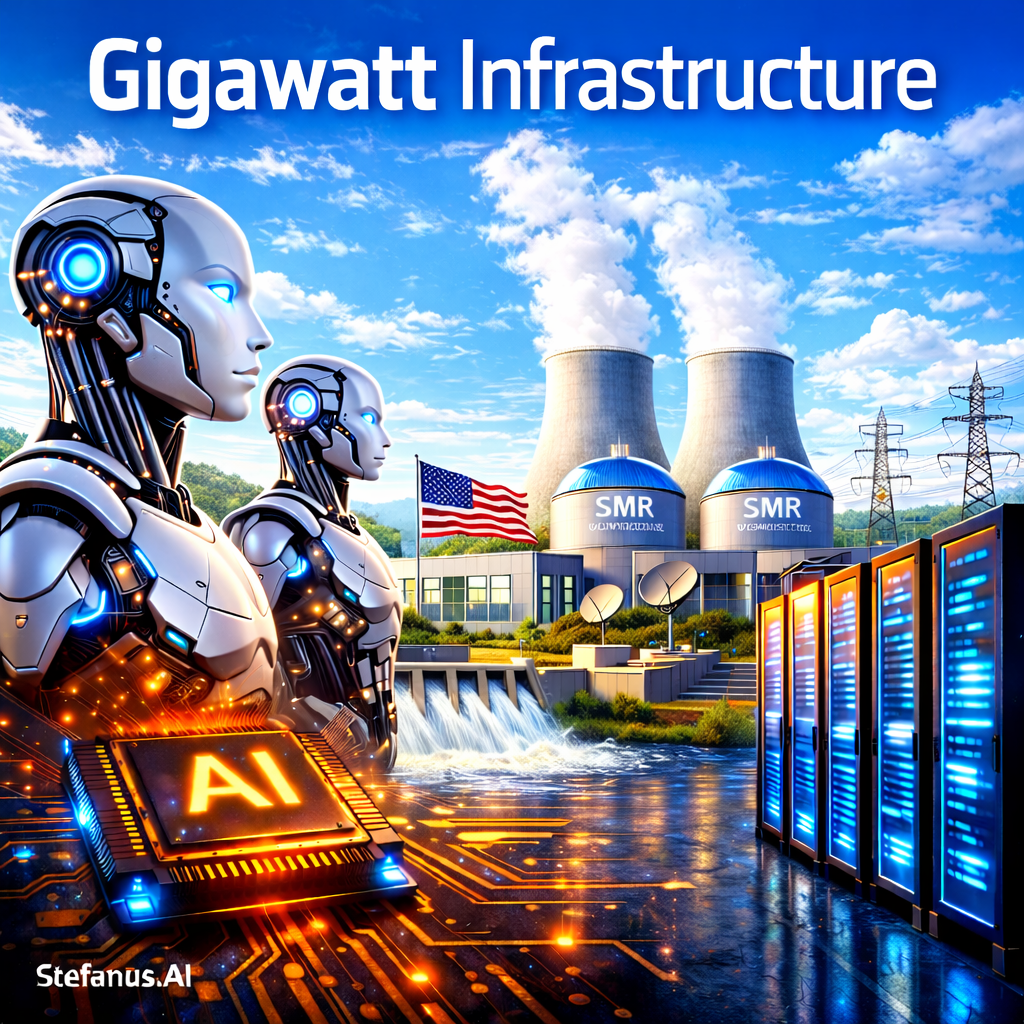
This paper defines the current moment as the era of Gigawatt Infrastructure.
The term is chosen deliberately for three reasons:
- Scale
Leading AI clusters are rapidly approaching gigawatt-scale energy demand, a level comparable to the output of a full nuclear power plant. To put this into perspective, a single 1-gigawatt facility can generate enough electricity to power approximately one million homes. - Continuity
AI systems require 24/7 uninterrupted energy, unlike traditional industrial loads. - Control
Energy supply is no longer external—it is becoming integrated into AI systems themselves.
According to the International Energy Agency (IEA):
“Global data centre power demand is expected to double by 2030.”¹ (Reuters)
This surge is not theoretical. It is already reshaping infrastructure decisions across the United States and globally.
At the same time, a second transformation is emerging:
The revitalization of legacy energy systems—especially nuclear power plants.
Instead of building entirely new infrastructure, companies and governments are:
- Restarting old nuclear facilities
- Repurposing coal plants into nuclear sites
- Extending the life of existing reactors
This reflects a critical insight:
The fastest way to build the future is often to rebuild the past.
Gigawatt Infrastructure, therefore, is not just about scale.
It is about speed, control, and the transformation of energy into the foundation of intelligence.

1. The Geography of Intelligence: Power Determines Location
The location of AI infrastructure is increasingly dictated by electricity, not connectivity.
Historically, data centers clustered in:
- The Pacific Northwest (hydropower from the Columbia River)
- Northern Virginia (natural gas + dense grid infrastructure)
Northern Virginia now represents the most concentrated data center region globally, consuming a substantial share of the state’s electricity.
Academic research confirms this shift. A 2026 study on AI infrastructure notes:
“AI data centers are becoming a structural component of power-system dynamics.”² (arXiv)
This reveals a new principle:
- Infrastructure follows energy
- Energy determines geography
- Geography determines economic power
The digital economy is no longer weightless.
It is anchored to electricity.

2. The Power Bottleneck: When AI Outgrows the Grid
AI demand is now exceeding the capacity of existing electrical systems.
Across the United States:
- Data center projects face delays due to grid limitations
- Utilities struggle to allocate power between industry and households
- Energy prices rise in regions with heavy AI concentration
The scale of demand is accelerating rapidly.
According to Reuters:
“U.S. data centre demand could hit 100–130GW by 2030.”³ (Reuters)
This creates a structural imbalance:
- Compute scales exponentially
- Power infrastructure scales slowly
The result is a bottleneck that cannot be solved by software innovation.
It must be solved by physical infrastructure expansion.
3. AI Companies Are Becoming Energy Companies
To overcome energy constraints, AI companies are transforming their operational model.
They are no longer simply buying electricity.
They are securing, generating, and controlling it.
This includes:
- Direct investment in nuclear and renewable energy
- Long-term power purchase agreements
- Co-location of compute with generation
- Ownership stakes in energy assets
One of the clearest signals of this shift is the scale of energy procurement.
Meta has secured agreements for:
“More than 6 gigawatts of nuclear power.”⁴ (Bloomberg)
This is equivalent to powering millions of homes—and it reflects a broader industry trend.
As one energy executive stated:
“We must deploy gigawatts of advanced nuclear energy.”⁵ (ESG Today)
The implication is clear:
AI companies are becoming energy companies.
4. Nuclear Returns: SMRs and the New Energy Stack
To meet gigawatt-scale demand, companies are turning to nuclear energy—specifically Small Modular Reactors (SMRs).
Key Players
- TerraPower (Private)
- Natrium sodium-cooled fast reactor
- Strategic partnership with Meta (Jan 2026) to support AI data centers
- NuScale Power (NYSE: SMR)
- First SMR design approved by U.S. regulators
- Nano Nuclear Energy (NASDAQ: NNE)
- Focused on portable microreactors
These systems offer:
- Continuous baseload power
- Scalability
- Reduced emissions
However, they face challenges:
- Long deployment timelines
- High capital costs
- Regulatory complexity
This creates a gap:
AI demand is immediate. Nuclear supply is delayed.
That gap is driving innovation in how nuclear infrastructure is deployed.

5. The Nuclear Reboot Strategy: Reviving Legacy Infrastructure
A defining feature of the Gigawatt Infrastructure era is not just building new energy systems—but rebuilding old ones.
Companies and governments are increasingly pursuing a strategy of:
- Restarting decommissioned nuclear plants
- Extending licenses of existing reactors
- Repurposing coal plants into nuclear facilities
This approach addresses the most critical constraint:
Time.
Building a new nuclear plant can take a decade.
Restarting an existing one can take significantly less.
5A. Bill Gates and the Strategic Revival of Nuclear Power
The most prominent example of this strategy is led by Bill Gates through TerraPower.
Rather than constructing entirely new sites, TerraPower is:
- Deploying advanced reactors
- At or near former coal plant locations
- Leveraging existing transmission infrastructure
The Wyoming project exemplifies this model.
According to Reuters:
“The U.S. Nuclear Regulatory Commission approved TerraPower’s reactor.”⁶ (Reuters)
This approval is historically significant:
- First advanced reactor approval in nearly a decade
- Fast-tracked regulatory timeline
- Designed to replace retiring fossil fuel infrastructure
TerraPower’s approach reflects a broader industry insight:
Legacy infrastructure reduces friction.
- Permitting is faster
- Grid connections already exist
- Communities are more familiar with energy operations
At the same time, tech companies are increasingly supporting existing plants.
Meta’s agreements include power from:
- Operational nuclear plants
- Future SMR deployments
As reported:
“Deals could unlock up to 6.6 gigawatts of clean energy.”⁷ (latitudemedia.com)
This signals a hybrid strategy:
Revive existing capacity while building future systems.
The approach is not limited to TerraPower.
Across the United States, there is growing momentum to restart previously shut-down nuclear plants, including:
- Three Mile Island (Pennsylvania)
- Palisades (Michigan)
- Duane Arnold (Iowa)
These efforts are driven by a convergence of forces:
- AI-driven electricity demand
- Climate policy favoring zero-emission baseload power
- Rising costs of building new infrastructure
Regulatory Acceleration and Policy Shift
Regulatory dynamics are shifting alongside this trend.
The NRC approval in Wyoming reflects a broader change:
- Faster review timelines
- Increased political support
- Alignment with national energy strategy
Observers describe this as a “thaw” in nuclear policy, driven by:
- AI energy demand
- National security concerns
- Competition with global powers
Local Resistance and Social Constraints
Despite strategic advantages, resistance remains.
Communities continue to raise concerns about:
- Safety
- Waste management
- Environmental impact
This creates a persistent tension:
- AI requires massive power
- Nuclear provides it
- Social acceptance lags behind

6. Wyoming and the New Geography of Power
Wyoming represents a pivotal case in the Gigawatt Infrastructure era.
The state has emerged as a focal point for nuclear deployment due to:
- Available land
- Energy expertise
- Political alignment with infrastructure development
Most importantly, it is the site of a historic milestone:
The U.S. Nuclear Regulatory Commission approved construction of TerraPower’s 345-MW reactor in Kemmerer.⁶ (Reuters)
This marks:
- The first commercial advanced reactor approval in nearly a decade
- A transition from fossil fuel to nuclear-backed AI infrastructure
- A blueprint for future deployment across the U.S.
Wyoming demonstrates a broader principle:
Regions that align energy policy with AI infrastructure will become economic centers of gravity.
Other states—such as Texas and Arizona—are beginning to follow this model.
7. Global Competition: Energy as the New Axis of Power
The transformation extends beyond the United States.
Globally, nations are recognizing that:
Energy capacity determines AI capability.
Industry projections indicate:
- Massive increases in electricity demand
- Competition for reliable baseload power
- Strategic alignment between energy and technology sectors
The implications are geopolitical:
- Energy-rich regions gain AI advantage
- Energy-constrained regions fall behind
AI is no longer just a digital race.
It is an energy race.
Conclusion: Gigawatt Infrastructure as the Foundation of the AI Age
The term Gigawatt Infrastructure defines this era because it captures the true constraint shaping artificial intelligence.
It is not compute.
It is not capital.
It is not even innovation.
It is electricity at scale.
Gigawatt Infrastructure represents:
- The transition from software systems to industrial systems
- The integration of energy into the core of AI operations
- The shift from centralized grids to dedicated power ecosystems
It also explains why:
- Tech companies are building energy assets
- Nuclear power is being revived
- Old infrastructure is being repurposed
- Geography is being redefined
Most importantly, it reveals a deeper transformation:
Control of electricity is becoming control of intelligence.
The future of AI will not be determined solely by breakthroughs in models.
It will be determined by who can:
- Generate power
- Secure power
- Scale power
At the level of gigawatts.
This is why the term matters.
This is why the shift is structural.
And this is why we have entered:
The era of Gigawatt Infrastructure.

Footnotes (Accessible Links)
- International Energy Agency (IEA), Energy and AI Report
https://www.iea.org/reports/energy-and-ai - Chen et al. (2026), AI Data Centers and Power Systems, arXiv
https://arxiv.org/abs/2604.06198 - Reuters (2026), AI Power Demand Forecast
https://www.reuters.com/sustainability/climate-energy/time-go-nuclear-inside-battle-power-ai–ecmii-2025-12-17/ - Bloomberg / Meta Nuclear Deals
https://www.bloomberg.com/news/articles/2026-01-09/meta-signs-multi-gigawatt-nuclear-deals - ESG Today / TerraPower Statement
https://www.esgtoday.com/meta-unveils-series-of-major-nuclear-energy-deals - Reuters (2026), NRC Approval of TerraPower Reactor
https://www.reuters.com/business/energy/us-approves-construction-gates-backed-terrapower-reactor-wyoming-2026-03-04/ - Latitude Media (2026), Meta Nuclear Agreements
https://www.latitudemedia.com/news/meta-strikes-6-6-gw-nuclear-deal

Comments
[…] → Power capacity (gigawatt infrastructure, nuclear, […]
[…] becomes literal in the AI era. Intelligence can no longer be discussed without referencing gigawatts, grid stability, and energy […]