
The structure of power is undergoing a transformation that is both subtle and profound. For centuries, political authority has been organized around the sovereign state—centralized, territorially bound, and ultimately responsible for governance. That model assumed governments controlled the systems that mattered most: communication, intelligence, infrastructure, defense, and economic coordination.
That assumption no longer holds.
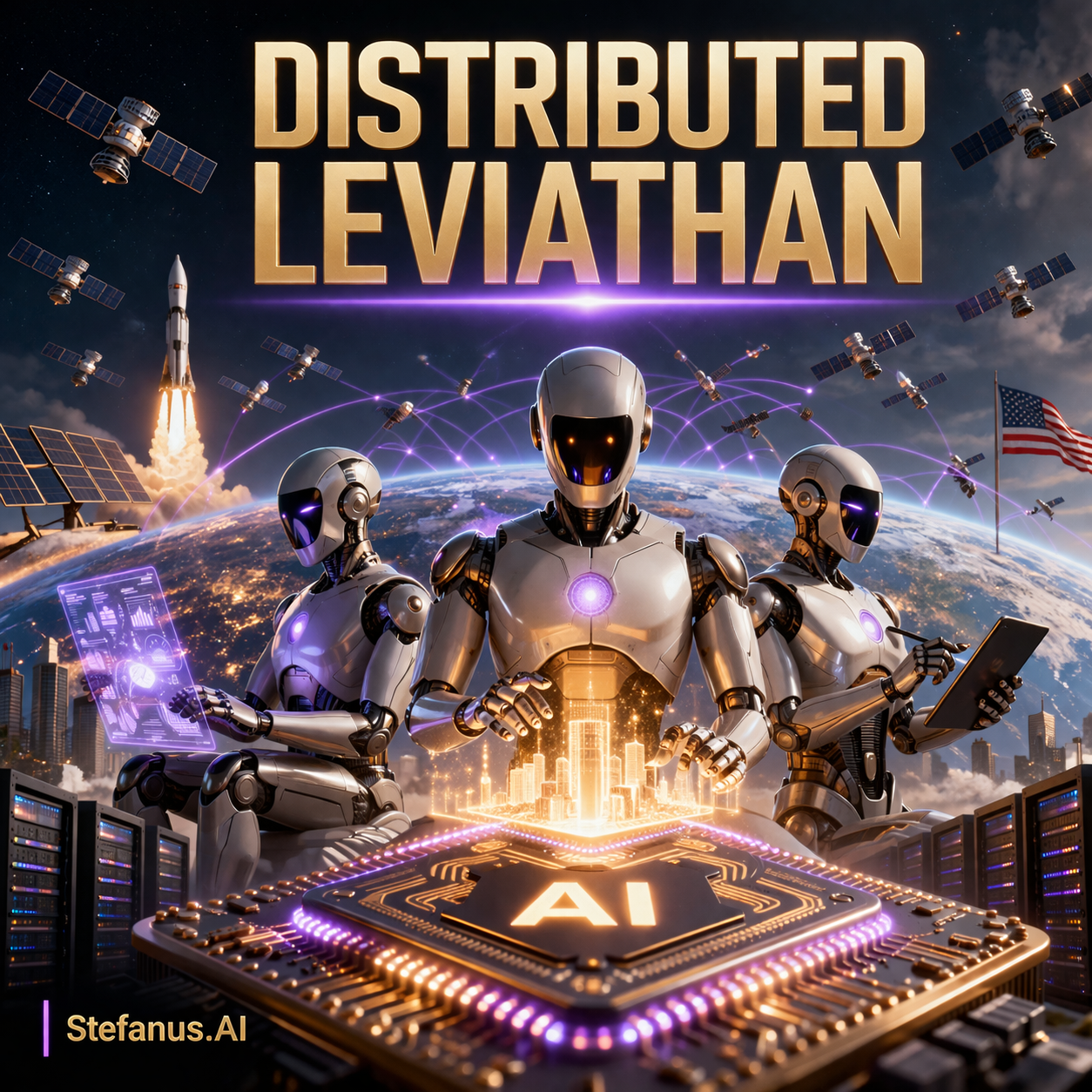
This paper introduces the term Distributed Leviathan.
The concept of Leviathan, drawn by Thomas Hobbes, describes a singular sovereign authority: one state, one center of control, one ultimate source of decision-making. In simple terms, it represents centralized power.
But the AI era has fundamentally altered that structure.
Power has not disappeared—it has been redistributed across a network of actors whose financial scale, infrastructure control, and technological reach now rival—and in some cases exceed—the economic capacity of entire nations. The emerging AI ecosystem, driven by firms such as xAI and SpaceX, represents capital concentrations measured in hundreds of billions of dollars, with forward-looking valuations approaching the trillion-dollar range.¹
This level of capital deployment is not globally distributed. It is highly concentrated within a specific geographic ecosystem—primarily the United States, and more precisely, Silicon Valley and its surrounding institutional network. What makes this moment historically unique is not simply the scale of investment, but its concentration within a system that combines capital, talent, infrastructure, and technological leadership into a single reinforcing structure.
In practical terms, power is now distributed across:
- AI corporations controlling intelligence systems
- semiconductor firms controlling compute capacity
- hyperscale cloud providers operating infrastructure
- autonomous platforms reshaping labor and cities
- private satellite networks enabling global communication
- universities producing the human capital that sustains all the above
As Amy Zegart (Stanford) observes:
“The private sector is increasingly shaping national security capabilities in ways governments do not fully control.”²
This paper examines that transformation across five interconnected dimensions: the actors who now hold power, the instability within those systems, the erosion of government exclusivity, the concentration of talent, and the structural implications for sovereignty.
The Leviathan has not disappeared.
It has been distributed.

1. From Centralized Authority to Distributed Power
Historically, governments controlled the primary levers of power: lawmaking, defense, currency, infrastructure, and institutional authority. Even when private firms played major roles, they operated within a system ultimately defined by the state.
That relationship is now reversing.
Today:
- cloud providers host government systems
- AI models shape decision-making
- semiconductor firms determine computational capacity
- private infrastructure underpins public operations
As Benjamin Bratton (MIT) writes:
“We are living inside a planetary-scale computation stack that reorganizes governance itself.”³
The implication is not incremental change—it is structural transformation.
Governance is no longer purely institutional.
It is increasingly infrastructural.
2. Key Actors of the Distributed Leviathan
2.1 AI Corporations as Capital-Scale Sovereign Actors
AI firms are no longer simply participants in the economy. They emerge as actors with sovereign-scale influence, defined not only by technology but by capital concentration.
Based on reports from early February 2026, the combined ecosystem of xAI and SpaceX is estimated at over $1.2 trillion, with forward projections placing SpaceX’s valuation potentially near $2 trillion in a pre-IPO scenario.¹ This level of capitalization places a single corporate system within the economic range of nation-states.
The IMF highlights the structural reach of AI:
“Artificial intelligence is set to affect nearly 40% of global employment.”⁴
When a private system influences labor, capital, and infrastructure simultaneously, it is no longer external to governance—it becomes embedded within it.
2.2 NVIDIA and the Industrialization of Compute
The foundation of AI power lies in compute.
NVIDIA has become the central supplier of that capability, with hyperscale firms committing extraordinary capital:
- Google: ~$100B+ AI infrastructure
- Meta: ~$100B+
- Amazon: ~$100B+
These investments are directed toward gigawatt-scale data centers, placing AI infrastructure in the same category as national energy systems.
As Financial Times observes:
“Nvidia has become the backbone of the global AI boom.”⁵
This represents a transformation from digital infrastructure to industrial infrastructure.
2.3 Autonomous Systems and Control of Physical Reality
Autonomous systems extend distributed power into the physical world:
- Tesla’s Optimus robots → workforce transformation
- Robotaxi systems → urban transportation restructuring
- Competition with Waymo → privately driven mobility ecosystems
As Erik Brynjolfsson (Stanford) explains:
“AI will transform not just productivity, but the structure of work.”⁶
This shift reduces the role of policy as the primary driver of change.
2.4 SpaceX and Orbital Infrastructure
Private satellite systems now represent a new layer of sovereignty.
The FCC has enabled large-scale satellite deployment, with long-term expansion trajectories envisioning up to one million satellites, effectively forming a continuous, global infrastructure layer comparable to gigawatt-scale systems operating in orbit.
The United Nations warns:
“Outer space is becoming increasingly congested and contested.”⁷
This is infrastructure beyond territory—power without borders.
2.5 Private Intelligence Systems
Modern conflicts demonstrate:
- intelligence is no longer state-exclusive
- private firms control critical data flows
As Amy Zegart notes:
“The intelligence landscape is being reshaped by private-sector capabilities.”²
3. When Distributed Power Fails
The Distributed Leviathan is not uniformly successful. Its power is real—but uneven.
3.1 Oracle and the Limits of AI Infrastructure Expansion
Large-scale AI infrastructure projects often encounter significant friction.
Oracle’s ambitious data-center expansion—linked to broader AI healthcare and infrastructure visions—has been accompanied by layoffs and operational challenges.
Reuters reports:
“Oracle plans thousands of job cuts as data center costs rise.”⁸
This illustrates a key reality:
Scale does not guarantee stability.
3.2 Systemic Frictions Across AI Development
Across the AI landscape:
- infrastructure costs are escalating
- ROI remains uncertain
- deployment complexity slows progress
Research associated with MIT highlights:
“Barriers to AI adoption are as much organizational and economic as technical.”⁹
Failure is not an anomaly—it is part of the system.

4. The Erosion of Government Exclusivity
The most consequential shift is not technological—it is institutional.
Governments no longer exclusively control critical infrastructure.
War: Ukraine
During the Ukraine war:
- Starlink enabled battlefield communication
- operations depended on private satellite infrastructure
Reuters reports:
“Starlink disruptions affected battlefield operations.”¹⁰
This represents a structural shift: a private company becomes essential to national defense capability.
Disaster: United States
During hurricanes in Florida and North Carolina:
- communication networks failed
- emergency coordination broke down
- governments relied on Starlink
Reuters reports:
“Starlink systems were deployed to restore connectivity.”¹¹
This is not supplementary infrastructure.
It is primary operational infrastructure.
Core Structural Insight
Government authority is no longer absolute.
Sovereignty is conditional on access to privately controlled systems.

5. West Coast Talent Pipeline and the Concentration of AI Power
This is the most critical—and most overlooked—dimension of the Distributed Leviathan.
The system is not built solely on capital or infrastructure.
It is built on talent concentration.
5.1 Universities as Strategic Power Infrastructure
Institutions such as:
- Stanford University
- University of California, Berkeley
- University of California, Los Angeles (UCLA)
- University of Southern California (USC)
function not only as educational institutions but as core infrastructure nodes in the AI ecosystem.
They produce:
- engineers
- researchers
- founders
- system architects
These individuals do not disperse randomly.
A defining feature of the current AI landscape is geographic concentration.
- A significant portion of graduates in computer science, AI, and engineering from these universities remain in California. They concentrate geographically within Silicon Valley.
- Both domestic and international students transition directly into:
- AI labs (OpenAI, Anthropic)
- Big Tech firms (Google, Meta, Microsoft)
- semiconductor companies (NVIDIA, Intel)
- startup ecosystems funded by venture capital
5.2 The Geographic Concentration of Intelligence
AI capability is not evenly distributed across the world.
It is concentrated.
As Financial Times notes:
“AI development is becoming increasingly concentrated in a small number of global hubs.”¹²
This concentration creates compounding advantage.
The system is global in input, local in output.
NBER research shows:
“Immigrants account for more than half of STEM PhDs.”¹³
International students:
- enter U.S. universities
- train in advanced systems
- remain in U.S. firms
This creates a global-to-local talent funnel.
5.4 The Self-Reinforcing Loop
This is the core mechanism:
- Universities → Talent
- Talent → Companies
- Companies → Capital
- Capital → More Talent
This loop is not linear—it is exponential.
5.5 Talent as Infrastructure
As Fei-Fei Li (Stanford) states:
“The future of AI depends on the people who build it.”¹⁴
This reframes the definition of infrastructure.
Infrastructure is not only:
- data centers
- chips
- satellites
It is also:
- human capital
5.6 Strategic and Geopolitical Implication
Control of talent pipelines determines:
- innovation direction
- technological leadership
- economic power
This is why Section 5 is foundational.
Without it, Distributed Leviathan does not exist.
Conclusion
Distributed Leviathan is not theoretical—it is measurable.
It is visible in:
- trillion-dollar capital concentration
- gigawatt-scale infrastructure
- corporate control of intelligence systems
- government reliance on private actors
- university-driven talent pipelines
In the past:
- sovereignty was centralized
Today:
- sovereignty is distributed
The Leviathan has not disappeared.
It has been distributed across capital, infrastructure, and human networks.

Footnotes
¹ Reuters
https://www.reuters.com/legal/government/how-math-works-175-trillion-spacex-valuation-2026-04-08/
² Amy Zegart
https://hai.stanford.edu/news/amy-zegart-integrating-ai-realm-national-security
³ Benjamin Bratton
https://mitpress.mit.edu/9780262528441/the-stack/
⁴ IMF
https://www.imf.org/en/blogs/articles/2024/01/14/ai-will-transform-the-global-economy
⁵ Financial Times
https://www.ft.com
⁶ Erik Brynjolfsson
https://www.gsb.stanford.edu
⁷ United Nations
https://www.unoosa.org
⁸ Reuters
https://www.reuters.com/business/oracle-plans-thousands-job-cuts
⁹ MIT
https://www.mit.edu
¹⁰ Reuters
https://www.reuters.com/investigations/musk-ordered-shutdown-starlink
¹¹ Reuters
https://www.reuters.com/world/us/us-lets-starlink-provide-direct-to-cell
¹² Financial Times
https://www.ft.com
¹³ NBER
https://www.nber.org/digest/nov16/immigrants-play-key-role-stem-fields
¹⁴ Fei-Fei Li
https://hai.stanford.edu/people/fei-fei-li