
The modern technology economy is no longer satisfied with scale measured in millions or even billions. It now operates in the language of the extreme—giga, tera, and soon, peta—as a signaling mechanism of power, ambition, and inevitability. From “Gigafactories” to “Terafabs,” from “Cloud” to “Constellations,” naming itself has become a strategic act: to define the future before competitors can contest it.
Elon Musk has popularized terms like Gigafactory and now Terafactory (Terafab) to describe industrial systems capable of unprecedented output. Meanwhile, Jeff Bezos has leaned into concepts like Terawave and space-based infrastructure—suggesting that computation and communications will scale beyond terrestrial limits. These naming conventions are not cosmetic—they are declarations of industrial intent.
At the same time, the identity of wealth itself is being redefined. The “billionaire era,” once the pinnacle of economic achievement, is beginning to feel transitional. With the anticipated IPO of SpaceX, speculation has intensified that the second half of 2026 could witness the emergence of the world’s first trillionaire—most likely Musk himself, given the convergence of rockets, satellites, AI, and energy systems under a unified industrial vision.
Yet even within this landscape, not all titans are equal. Jensen Huang, despite holding a massive stake in NVIDIA valued in the hundreds of billions, remains far from trillionaire status. But his influence may prove more consequential than raw wealth. On April 16, 2026, at the Stanford Graduate School of Business, Huang articulated a concept that reframes the entire AI race—not in terms of hardware alone, but in terms of software scale:
“Agentic AI will work with us, not replace us—it will accelerate our capabilities.”
This statement introduces the central thesis of this paper:
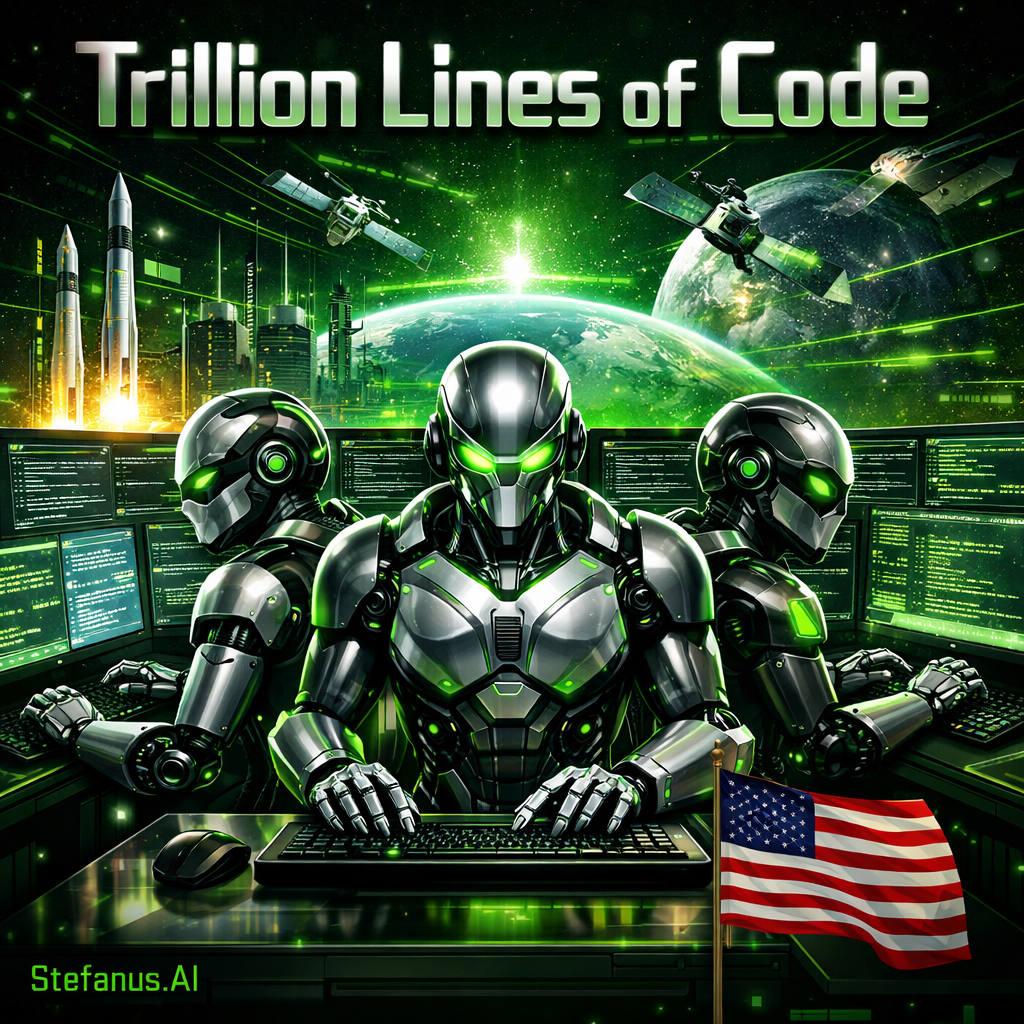
the next frontier of dominance is not chips, not data centers, but the ability to generate and manage a trillion lines of code.

Section 1: What Is “A Trillion Lines of Code”?
The phrase “Trillion Lines of Code” is not merely quantitative—it is civilizational. It represents a transition from human-scale software production to machine-augmented, continuously expanding code ecosystems.
Historically, software systems have been constrained by human labor. Even the largest systems—operating systems, enterprise platforms, or hyperscale cloud services—operate within billions of lines of code. But Agentic AI fundamentally alters this constraint.
At institutions like MIT and Stanford University, researchers have increasingly framed AI as a general-purpose technology comparable to electricity or the steam engine.¹
Erik Brynjolfsson (Stanford Digital Economy Lab) noted:
“The key economic shift is not automation alone, but augmentation—the ability of AI to multiply what humans can produce.”²
Under this paradigm, code is no longer written linearly. It is generated, tested, refactored, and redeployed autonomously, creating recursive loops of productivity.
Huang’s concept of Agentic AI introduces a new operational model:
“AI agents will guide engineers step by step, increasing productivity beyond anything we’ve seen.”
In practical terms, this means:
- Developers oversee rather than produce code directly
- AI systems generate modular, reusable, evolving codebases
- Software becomes self-expanding infrastructure
Thus, a trillion lines of code is not written once—it is continuously produced and maintained by AI systems themselves.

Section 2: The Race Toward a Trillion Lines of Code
The pursuit of trillion-scale software is inseparable from massive investments in infrastructure—especially energy, compute, and orbital systems.
a) Nuclear Power and the Energy Constraint
AI’s expansion is fundamentally limited by energy. As Vaclav Smil of University of Manitoba emphasizes:
“Energy is the only universal currency.”³
To sustain AI growth, companies are turning toward nuclear solutions:
- Meta Platforms exploring partnerships linked to TerraPower
- Google securing nuclear-powered energy contracts
The logic is clear: no gigawatt, no intelligence.
b) Hyperscaler Expansion
Hyperscale companies are investing hundreds of billions annually into AI infrastructure. According to reporting from the Financial Times and Wall Street Journal, total AI capex is projected to exceed $600 billion annually by 2026.
These investments include:
- GPU clusters
- Data center campuses
- AI training infrastructure
c) Musk’s Integrated Stack: Terafab
Musk’s vision is uniquely integrated:
- Tesla → manufacturing & robotics
- xAI → AI models
- SpaceX → satellite infrastructure
This convergence forms what can be described as a Terafab system—a vertically integrated machine for producing intelligence at scale.
d) Bezos and Space-Based Intelligence
Bezos is pursuing a different axis: orbital infrastructure.
- Globalstar expansion
- “Terawave” concept for global connectivity
- Potential integration with space-based compute systems
As researchers at Oxford University note:
“The next frontier of computing may not be terrestrial.”⁴

Section 3: Agentic AI and the Reinvention of Work
Huang’s assertion that AI will “micromanage” engineers is controversial—but transformative.
Daron Acemoglu of MIT writes:
“AI will not eliminate work, but it will radically restructure it.”⁵
In this new model:
- Engineers become supervisors of AI agents
- Productivity increases exponentially
- Output expectations rise dramatically
Quote:
“Technology historically creates more jobs than it destroys—but not the same jobs.”⁶
Thus, “Trillion Lines of Code” becomes:
- A performance benchmark
- A recruitment signal
- A capital attraction mechanism
Companies that operate at this scale signal dominance, attracting:
- Talent
- Investment
- geopolitical leverage

Section 4: Implications for Graduates and National Power
a) Talent Retention and Immigration
The U.S. faces a structural challenge: retaining global AI talent.
According to research from Harvard University:
“Immigrant talent is a critical driver of innovation in the United States.”⁷
Policies that align with trillion-scale ambitions must:
- Retain STEM graduates
- Expand visa pathways
- Integrate global talent into AI ecosystems
b) U.S.–China Competition
The AI race is increasingly geopolitical.
China’s advantages:
- Control of rare-earth processing
- Massive state-backed funding
U.S. advantages:
- Leading semiconductor firms
- Top-tier universities
- Venture capital ecosystems
As Joseph Nye of Harvard University notes:
“Power in the 21st century is not just about military strength, but technological leadership.”⁸
“Trillion Lines of Code” becomes a proxy for:
- Innovation capacity
- Economic power
- strategic dominance
Conclusion: From Code to Civilization
“Trillion Lines of Code” may have originated as a conceptual vision associated with Jensen Huang, but it represents something far larger: a new organizing principle for the global economy.
It is not just about software—it is about:
- Energy systems
- Industrial scale
- Talent mobilization
- geopolitical competition
The transition from billionaires to trillionaires mirrors this shift:
- Wealth follows infrastructure
- Infrastructure follows scale
- Scale follows intelligence
In this sense, the race is no longer about who builds the best model—but who builds the largest system capable of generating intelligence itself.
“Trillion Lines of Code” is not a destination.
It is a signal.
A signal that we have entered an era where:
- software writes software
- factories produce intelligence
- and nations compete not just for resources, but for compute, code, and cognition

Footnotes
- MIT Technology Review – AI as General Purpose Technology
https://www.technologyreview.com - Erik Brynjolfsson – Stanford Digital Economy Lab
https://digitaleconomy.stanford.edu - Vaclav Smil – Energy and Civilization
https://vaclavsmil.com - Oxford Martin School – Future of Computing
https://www.oxfordmartin.ox.ac.uk - Daron Acemoglu – MIT Economics
https://economics.mit.edu - IMF Report on AI and Jobs
https://www.imf.org - Harvard Business School – Immigration and Innovation
https://www.hbs.edu - Joseph Nye – The Future of Power
https://www.hks.harvard.edu
Comments
[…] modern artificial intelligence revolution—defined by hyperscale models, agentic systems, and trillion-line codebases—is often framed as a problem of compute, talent, and capital. Yet beneath these visible layers […]
[…] trillion-line-code economy, a robotics economy, and an agentic-capitalism economy will require enormous data-center […]