
For nearly two decades, the technology industry has been obsessed with a single archetype: the billionaire founder. Wealth was the metric, valuation the scoreboard, and scale the silent assumption. But by 2026, this narrative is collapsing under its own weight.
The emergence of trillion-dollar firms such as Apple Inc., Microsoft, and NVIDIA has fundamentally altered the ceiling of ambition. A billion is no longer aspirational—it is baseline.
What replaces it is not merely a new number, but a new language.
The word “TERA”—denoting one trillion—has begun to seep into naming conventions of next-generation infrastructure. This is not coincidence. It is signaling.
As Manuel Castells writes,
“power is exercised through the construction of meaning in the human mind”¹
Naming is no longer descriptive—it is strategic. It defines how capital interprets ambition before infrastructure is built.
At the same time, the scale of capital has already surpassed narrative. According to The Wall Street Journal,
“hyperscalers are expected to spend nearly $400 billion” on AI infrastructure annually²
—numbers previously reserved for national programs.
Thus, TeraEconomics is not emerging—it is catching up to reality.

Section 1: “TERA” — From Measurement Unit to Ideology of Scale
The prefix “tera-” originates from the Greek teras, meaning monster or marvel—a duality that now defines modern technological systems: awe-inspiring in capability, overwhelming in consequence.
In computing, “tera” marked exponential thresholds—terabytes, teraflops. But in economics, its adoption is symbolic. It is not a unit. It is an ideology of scale.
MIT economist Erik Brynjolfsson notes,
“the largest firms can dominate globally due to scale economies”³
—transforming competition into asymmetry.
This is no longer theoretical. According to industry data, Big Tech is projected to spend $650 billion annually on AI data centers by 2026⁴, a level comparable to Cold War-era national investments.
Even more striking, International Monetary Fund observes that
“market concentration has increased significantly in digital sectors”⁵
—confirming that scale is no longer optional; it is structural.
“TERA” therefore becomes:
- A declaration of non-linearity
- A rejection of incrementalism
- A signal that scale itself is strategy
It is not exaggeration.
It is linguistic inevitability.

Section 2: TeraWave — Orbital Infrastructure as Economic Doctrine
On January 21, 2026, Blue Origin, led by Jeff Bezos, introduced TeraWave—a system that repositions space as infrastructure.
The scale of infrastructure investment reinforces this shift. According to The Wall Street Journal, Amazon alone is committing
“$200 billion investment in AI infrastructure”⁶
—linking terrestrial compute with orbital ambitions.
Stanford economist Susan Athey explains,
“control over data flows determines competitive advantage”⁷.
TeraWave represents:
- A continuous orbital data layer
- A platform beyond jurisdiction
- A system where geography becomes irrelevant
This is not connectivity.
This is planetary-scale control architecture.

Section 3: Terafabs — Manufacturing Beyond the Nation-State
Two months later, Elon Musk introduced Terafabs—industrial systems that merge AI, robotics, and energy into self-optimizing ecosystems.
The scale of this transformation is already visible. Semiconductor giant TSMC is projected to spend $52–56 billion annually to support AI demand⁸, while global AI infrastructure investment continues accelerating.
McKinsey & Company notes,
“the next productivity frontier lies in integrating digital and physical systems”⁹.
Yet the risk is equally large. MIT’s Daron Acemoglu warns,
“technology can concentrate power unless institutions evolve”¹⁰.
Terafabs therefore represent a fundamental shift:
Not factories within nations—
But systems that rival nations themselves.
Section 4: The Spread of “TERA” — Early Signals of Systemic Shift
The spread of “TERA” across sectors reflects deeper economic restructuring.
Financial narratives increasingly frame AI as a macroeconomic driver. According to The Wall Street Journal, AI-related investment has contributed
“up to half of GDP growth” in recent periods¹¹.
Meanwhile, the World Bank states that
“digital platforms operate at scales beyond national boundaries”¹².
Even energy systems are being reshaped. Data centers are projected to consume up to 21% of global electricity by 2030¹³—turning compute into a primary economic driver.
“TERA” is therefore not branding.
It is the first linguistic attempt to describe
an economy whose units are no longer human-scale.

Section 5: TeraEconomics — The Formalization of Trillion-Scale Thinking
The registration of domain name TeraEconomics.com on April 15, 2026—coinciding with U.S. tax day—marks a symbolic inflection point.
Economist Mariana Mazzucato writes,
“transformational change requires mission-oriented investments”¹⁴
—precisely what trillion-scale systems represent.
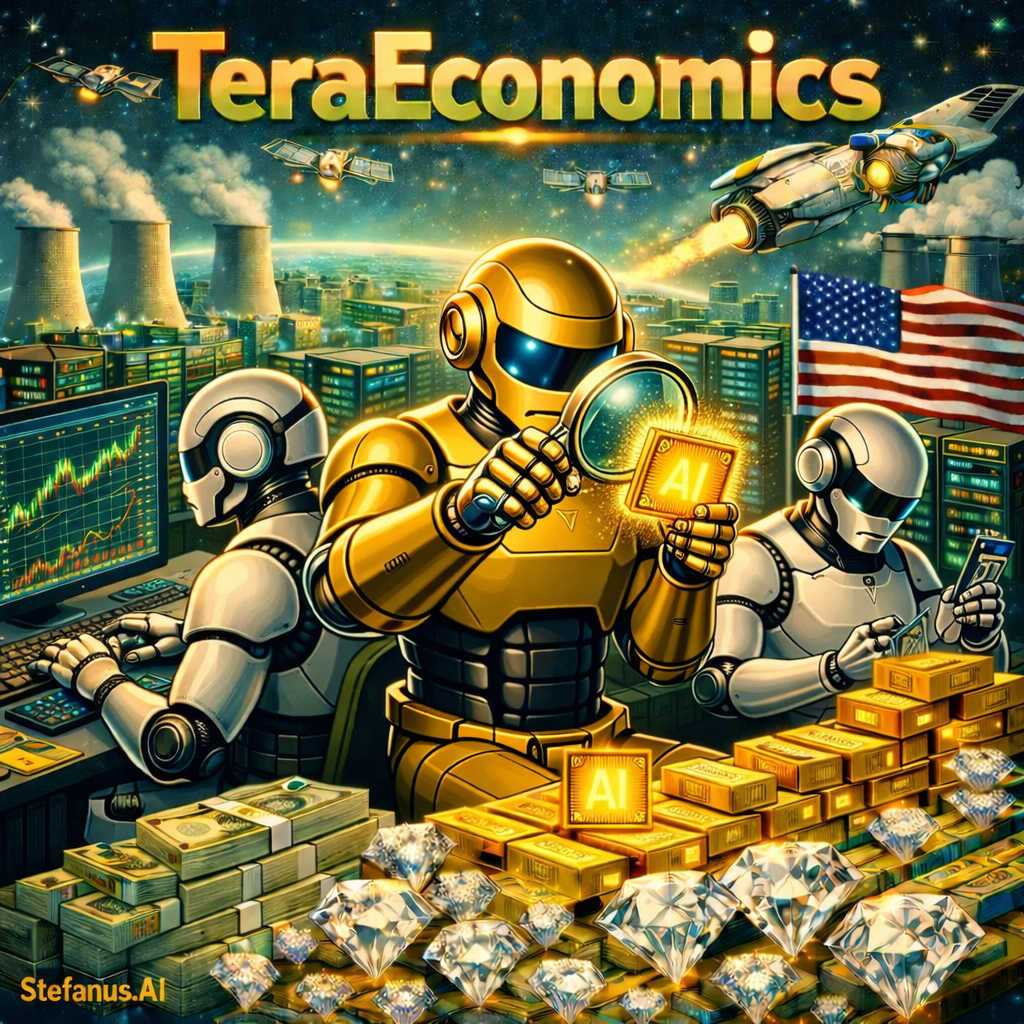
TeraEconomics can now be defined as:
An economic system where trillion-scale infrastructure, capital, and computation define power—and naming signals inevitability before execution.
The numbers reinforce the thesis:
- $635+ billion planned AI spending in 2026¹⁵
- $400B–$450B annual capex projections¹⁶
- Trillion-dollar energy infrastructure pipelines¹⁷
At this scale, markets do not decide outcomes.
Infrastructure does.
Section 6: The Non-Tera World — The Expanding Gap
Yet TeraEconomics produces asymmetry at unprecedented levels.
The United Nations reports that
“nearly half the global population lacks meaningful connectivity”¹⁸.
Meanwhile, AI infrastructure concentrates in a handful of regions, with over 90% of compute capacity clustered in advanced economies¹⁹.
Nobel laureate Amartya Sen reminds us,
“development is about expanding human capabilities”²⁰.
But TeraEconomics risks the opposite:
- Expanding capability for systems
- Contracting opportunity for individuals
This creates a new divide:
Not rich vs poor.
But Tera vs non-Tera worlds.

Section 7: Investment Implications — The Trillion-Dollar Arms Race
Capital is now aligning with Tera-scale systems.
According to recent reporting, U.S. utilities alone plan to invest $1.4 trillion to support AI energy demand²¹—an infrastructure expansion unprecedented outside wartime economies.
At the same time, hyperscalers are projected to deploy $650+ billion annually into AI systems⁴, while sovereign funds increasingly co-invest in data centers and energy grids.
Harvard economist Kenneth Rogoff states,
“capital flows increasingly follow scale and strategic advantage”²².
This creates a new investment logic:
- Capital chases inevitability, not profitability
- Infrastructure precedes market dominance
- Naming precedes valuation expansion
In this environment, “TERA” is not branding.
It is capital signaling.
Conclusion: TERA vs ONLINE — The Evolution of Economic Language
Two decades ago, adding “Online” signaled participation.
Today, adding “TERA” signals intent to dominate.
As Shoshana Zuboff writes,
“new economic logics emerge when new forms of power become operational”²³.
That new logic is now visible:
- Infrastructure over applications
- Scale over efficiency
- Dominance over competition
The defining question of the next decade will not be:
Who builds?
But:
Who builds at a scale so large that competition becomes irrelevant?
That is TeraEconomics.
And increasingly,
that is the only game being played.

Footnotes
- Manuel Castells — https://www.wiley.com/en-us/The+Rise+of+the+Network+Society
- WSJ AI Capex — (The Wall Street Journal)
- Erik Brynjolfsson (MIT) — https://mitsloan.mit.edu
- AI data center spending — (Wikipedia)
- IMF — https://www.imf.org
- Amazon AI investment — (The Wall Street Journal)
- Susan Athey — https://www.gsb.stanford.edu
- TSMC capex — (The Wall Street Journal)
- McKinsey — https://www.mckinsey.com
- Daron Acemoglu — https://economics.mit.edu
- WSJ GDP impact — (The Wall Street Journal)
- World Bank — https://www.worldbank.org
- MIT energy projection — (MIT Sloan)
- Mariana Mazzucato — https://www.ucl.ac.uk
- Big Tech AI spend — (Reuters)
- Deloitte/WSJ capex — (Deloitte Insights)
- Utility expansion — (The Wall Street Journal)
- United Nations — https://www.un.org
- AI infrastructure concentration — (arXiv)
- Amartya Sen — https://global.oup.com
- Utility $1.4T — (Business Insider)
- Kenneth Rogoff — https://scholar.harvard.edu
- Shoshana Zuboff — https://www.hbs.edu