
The defining contest of the artificial intelligence era is no longer about who builds the most advanced models, but who can power them at scale. As AI systems expand into trillion-parameter architectures and hyperscale deployments, electricity demand has crossed a critical threshold: from megawatts to gigawatts. This transition marks a structural shift in the foundations of technological power.
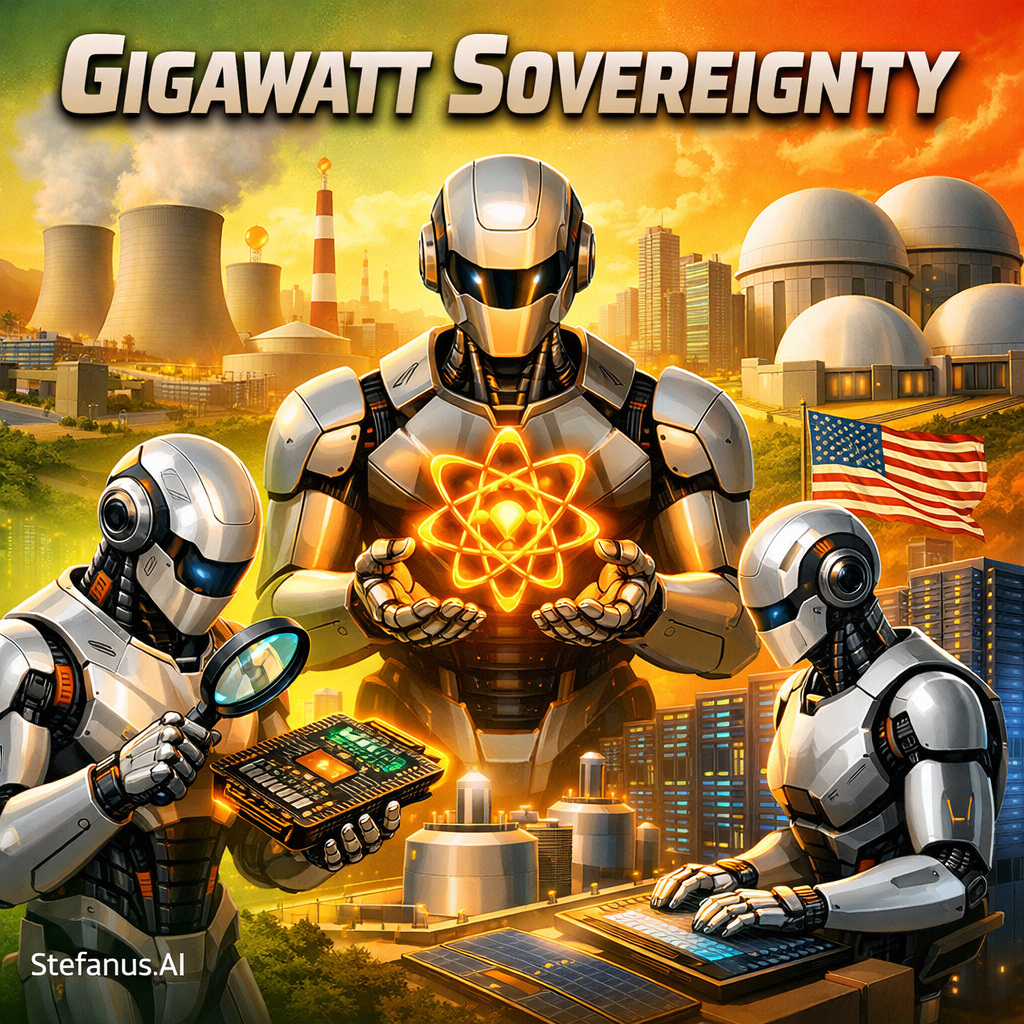
This paper introduces the concept of Gigawatt Sovereignty—a new framework that captures how control over gigawatt-scale energy infrastructure determines leadership in AI, industrial production, and global influence. Sovereignty in the 21st century is no longer defined solely by territory, currency, or even semiconductor fabrication capacity. It is increasingly defined by the ability to generate, allocate, and sustain energy at the scale required by machine intelligence.

Recent developments make this shift unmistakable. Hyperscale AI data centers are now being designed to consume 500 megawatts to over 1 gigawatt per facility, placing them on par with nuclear power plants.¹ The rapid expansion of AI infrastructure is already straining regional power grids, forcing utilities and governments to reconsider long-term capacity planning.²
At the same time, leading technology firms are moving upstream into energy. Meta Platforms has secured multi-gigawatt nuclear-backed power agreements across U.S. states, while Google and Amazon are entering long-term power purchase agreements tied directly to nuclear and advanced energy projects.³
Parallel to this, Bill Gates’s TerraPower is building next-generation reactors in Wyoming, explicitly designed to support industrial-scale energy demand.⁴
As energy scholar Vaclav Smil observed,
“Energy is the only universal currency.”⁵
In the age of AI, that currency is now measured in gigawatts.
Gigawatt Sovereignty therefore defines a new hierarchy: those who control gigawatt-scale energy systems will control the future of intelligence.

Section 2: Nuclear Revival and the Strategic Reuse of Licensed Infrastructure
Across the United States, a quiet but decisive transformation is underway. States are no longer abandoning nuclear energy—they are reviving it, often by repurposing existing plants whose licenses and grid connections remain intact.
Michigan: The First Restart in U.S. History
Michigan has become the symbolic center of this revival. The Palisades Nuclear Plant, shut down in 2022, is now being restored and is expected to become the first decommissioned nuclear plant ever restarted in the United States.⁶
Backed by federal loans and state funding, the project will not only restore 800 MW of capacity but also introduce new SMR units at the same site, signaling a hybrid model of old + new infrastructure.⁶
Governor Gretchen Whitmer framed the strategy clearly:
“This will show the world that we are the best place to do business.”⁷
Pennsylvania: From Legacy to AI Power Hub
Pennsylvania is emerging as a second major node. The restart of the Three Mile Island Unit 1 (Crane Clean Energy Center) is scheduled for 2027, supported by federal financing and private capital.⁸
Simultaneously, partnerships between utilities and hyperscalers are exploring nuclear-powered data centers near existing plants such as Susquehanna—linking AI compute directly to nuclear baseload supply.⁹
Iowa: Tech-Driven Nuclear Reactivation
In Iowa, the Duane Arnold Energy Center is being brought back online through long-term agreements involving technology firms and utilities.⁸ This reflects a new pattern:
technology companies are directly influencing energy infrastructure decisions.
Wyoming: The SMR Frontier
Wyoming hosts the flagship project of next-generation nuclear: TerraPower’s Natrium reactor in Kemmerer, recently approved by regulators.¹⁰
This system integrates:
- 345 MW nuclear output
- Thermal storage boosting capacity to ~500 MW
- Grid flexibility for industrial loads
It represents a prototype of AI-era energy systems.
Kansas, Texas, and Beyond
States such as Kansas and Oklahoma are actively competing for future reactor deployments, including additional Natrium sites and experimental SMR technologies.¹¹
Texas, already home to the emerging Terafab corridor near Austin, is positioning itself as a convergence point of:
- semiconductor manufacturing
- AI clusters
- next-generation power infrastructure
Strategic Insight
The pattern is consistent across all these states:
- Reuse existing nuclear licenses
- Attract private capital
- Integrate with AI and industrial demand
As the U.S. Department of Energy notes, nuclear assets are becoming “80-year infrastructure platforms” for future economic growth.¹²
Gigawatt Sovereignty is being built not from scratch—but from the strategic revival of legacy energy systems.

Section 3: SMRs and the Financialization of Energy Infrastructure
The resurgence of nuclear energy is being driven by a new class of technologies—Small Modular Reactors (SMRs)—and an emerging financial ecosystem around them.
Key Public Companies (Tickers)
- NuScale Power → SMR
- BWX Technologies → BWXT
- Fluor Corporation → FLR
- Centrus Energy → LEU
Private Leaders
- TerraPower
- X-energy
- Oklo
These firms represent a new industrial category: energy providers for AI infrastructure.
Why SMRs Matter
SMRs offer:
- Modular construction
- Lower upfront capital (relative to large reactors)
- Deployment flexibility near industrial zones
They are uniquely suited for:
- Data centers
- AI clusters
- Hydrogen production
Investor Perspective
Financial analysts are increasingly treating SMRs as part of the AI value chain.
According to analysis cited by Business Insider,
SMRs are attracting “billions in venture capital tied directly to AI-driven demand.”¹³
Meanwhile, reports from the Financial Times caution:
“Timelines and costs remain uncertain.”¹⁴
Goldman Sachs analysts emphasize that AI-driven electricity demand could reshape entire power markets, potentially creating new winners among utilities and reactor developers.¹⁵
Risks and Constraints
Despite strong interest, investors face real risks:
- Regulatory delays
- Fuel supply constraints (HALEU dependency)
- High initial costs ($12M–$15M per MW in early projects)⁶
As a result, SMRs remain a high-risk, high-upside frontier investment.
Strategic Insight
The key transformation is this:
Energy is no longer just a utility—it is becoming a technology sector tied directly to AI growth.

Section 4: Terafabs, AI Clusters, and the Cost of Electricity
The rise of Terafab-scale infrastructure, particularly in Texas and the U.S. industrial corridor, has transformed electricity into the primary constraint of AI expansion.
Modern AI clusters now require:
- 500 MW to 1 GW per facility¹
- Dedicated grid infrastructure
- Long-term power contracts
In extreme cases, companies are building their own energy systems.
The case of xAI’s Colossus supercomputer illustrates the scale: electricity costs alone can reach hundreds of millions annually, making power the dominant operational expense.
As Amory Lovins explains,
“Energy becomes the limiting factor at scale.”¹⁶
Strategic Question for Investors
The critical question is no longer:
- Can we build the AI system?
But:
- Can we secure gigawatt-scale power for decades?

Section 5: Global Competition and the Energy Divide
Gigawatt Sovereignty is unevenly distributed.
United States Advantage
- Existing nuclear fleet
- Flexible state policies
- Deep capital markets
- Land availability
European Constraints
- Regulatory complexity
- Public resistance to nuclear
- Fragmented energy strategy
According to the European Commission, balancing energy security with decarbonization remains a central challenge.¹⁷
Developing World Challenge
The World Bank notes:
“Energy access remains a prerequisite for digital development.”¹⁸
This creates a structural divide:
- Energy-rich nations → AI leaders
- Energy-constrained nations → AI dependents
Conclusion: Gigawatt Sovereignty as the Defining Condition of AI Power
Across every dimension of artificial intelligence expansion—from data centers and semiconductor fabrication to emerging orbital systems—the same constraint appears with increasing clarity: energy.
This is why the term Gigawatt Sovereignty is not only appropriate, but necessary.
It captures the defining transformation of this era:
- AI systems scale with energy, not just algorithms
- Industrial capacity depends on continuous power supply
- National competitiveness is tied to gigawatt-level infrastructure
The revival of nuclear energy, the rise of SMRs, the emergence of Terafabs, and the global competition for power resources all point to the same conclusion:
The future of AI will not be decided solely in data centers—it will be decided in power plants.
As Steven Chu stated,
“Energy is the engine of prosperity.”¹⁹
In the AI era, that engine must operate at gigawatt scale.
Gigawatt Sovereignty therefore defines the new global order:
those who command energy at scale will command intelligence itself.

Footnotes and Sources
- WSJ – AI data center electricity demand
https://www.wsj.com/business/energy-oil/ai-data-centers-desperate-for-electricity-are-building-their-own-power-plants-291f5c81 - WSJ – Grid strain from AI
https://www.wsj.com/business/energy-oil/power-grid-ai-data-centers-1235f296 - World Nuclear Association – Corporate PPAs
https://world-nuclear.org - TerraPower official site
https://www.terrapower.com - Vaclav Smil – Energy and Civilization
https://vaclavsmil.com - Circle of Blue – Palisades restart
https://www.circleofblue.org/2026/water-energy/a-nuclear-shift-buoyed-by-billions-and-the-waters-of-the-great-lakes/ - Michigan State announcement (Whitmer)
https://www.greatlakesnow.org - Energy Policy Platform – US nuclear restart projects
https://energy.policyplatform.news - American Nuclear Society – Pennsylvania projects
https://www.ans.org - Reuters – TerraPower Wyoming approval
https://www.reuters.com/business/energy/us-approves-construction-gates-backed-terrapower-reactor-wyoming-2026-03-04/ - NCSL – Kansas nuclear development
https://www.ncsl.org - U.S. Department of Energy
https://www.energy.gov - Business Insider – SMR investments
https://www.businessinsider.com - Financial Times – SMR outlook
https://www.ft.com - Goldman Sachs research
https://www.goldmansachs.com - Rocky Mountain Institute
https://rmi.org - European Commission Energy Policy
https://energy.ec.europa.eu - World Bank Energy Access
https://www.worldbank.org - Steven Chu – Stanford University
https://profiles.stanford.edu/steven-chu