
Introduction: The Birth of “Machine Quarantine”
When I started to put together the outline for this paper, it reminded me of the time I had to transfer my beloved dog from the United States to a new country where I would be staying for about six months. Before leaving the U.S., we had to visit a local veterinarian so the dog could receive a battery of vaccinations, each one documented, stamped, and certified. We had to place him inside a well-equipped travel cage — one fitted with an automatic food dispenser and a bottle that dripped water on demand — so that he could survive the journey as a sealed, self-contained system. And when we finally arrived at the destination country, my dog was not released to me at the airport. He was taken to a secured quarantine area operated by a licensed local veterinarian, where he spent seven days under observation and diagnostic testing before the authorities were satisfied that he carried nothing dangerous inside him. Only then was he released to his owner.
The longer I studied the events of July 28, 2026, the more I became convinced that the experience of my dog and the current situation of embodied AI robotic machines are not very different at all. A humanoid robot arriving at an American port is, from the perspective of a national-security official, a sealed biological specimen of unknown provenance. It has a body that moves. It has senses — cameras, microphones, LiDAR, GPS — that perceive. It has a metabolism of electricity and data. It carries, deep inside its firmware, code written in another country that no customs officer can inspect by eye. And, most importantly, it can transmit: it maintains a living connection back to the environment it came from, through cloud servers, telemetry channels, and over-the-air update pipelines. A nation that would never admit an unvaccinated animal without observation is now asking itself, with growing urgency, why it has been admitting unexamined machines without any observation at all.
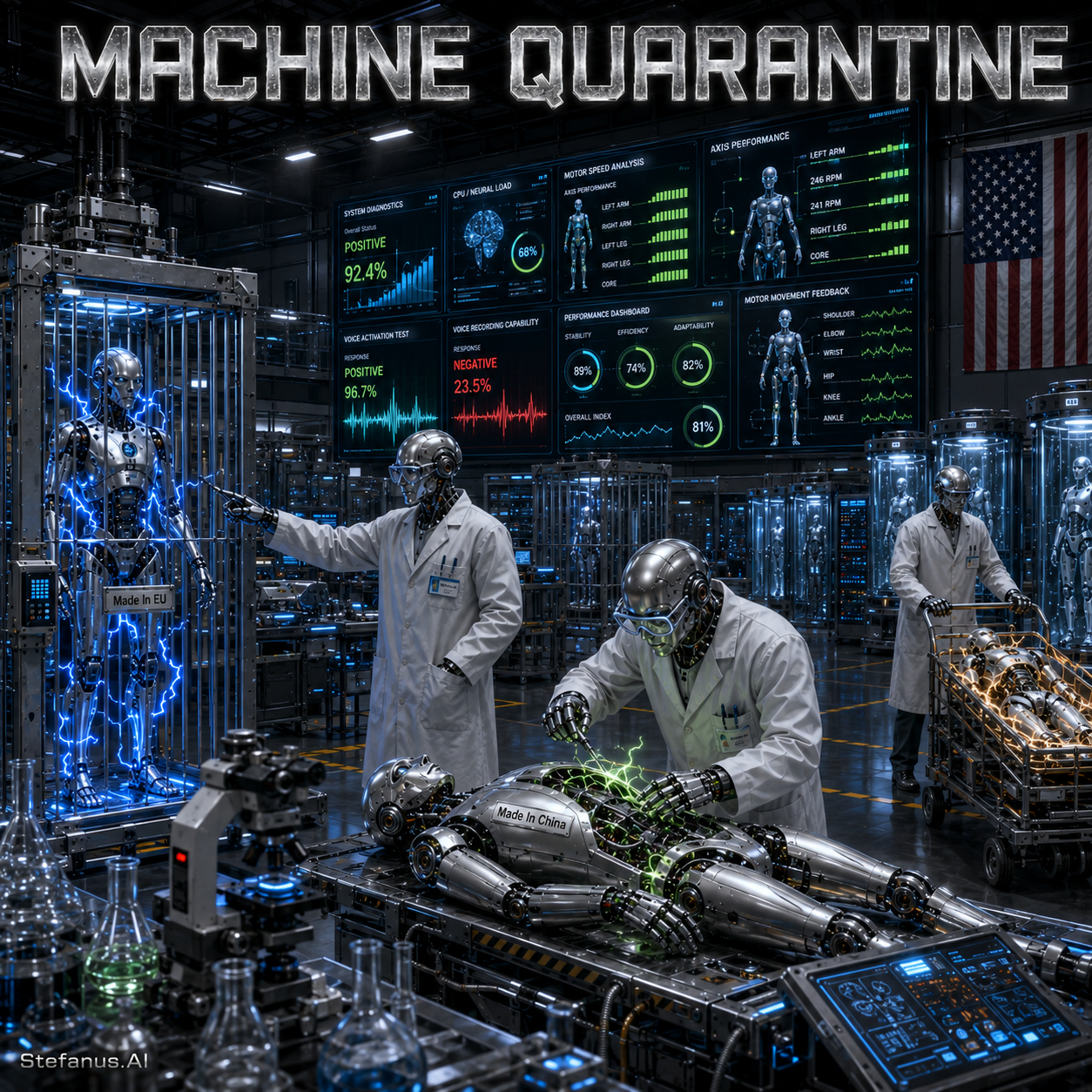
This is the intuition captured by the title of this paper. The “Machine Quarantine“ is a regulatory paradigm in which cybersecurity borders begin to mimic biological borders — enforcing isolation, testing, certification, and conditional entry for physical, connected hard-tech. It defines a shift away from the old model, in which imported hardware was treated as a static commodity to be checked for radio-spectrum compliance and electrical safety, toward a new model in which every connected machine is treated as a potentially infectious organism: admitted only after diagnosis, monitored after release, and subject to permanent revocation of its right to remain.
I chose this title deliberately, and for reasons worth stating at the outset. Traditional software firewalls are functionally obsolete for embodied AI and critical grid hardware. A firewall assumes that the threat arrives over a wire and can be filtered at a chokepoint; an embodied machine is the wire, the sensor, the actuator, and the payload all at once, and it walks through the front door on legs. The phrase “machine quarantine” captures the essential friction of our moment: the collision between open global trade, which treats goods as innocent until proven dangerous, and physical national security, which increasingly treats connected machines as dangerous until proven innocent.
The contextual trigger for this paper is concrete and datable. On July 28, 2026, the FCC’s Public Safety and Homeland Security Bureau released Public Notice DA 26-786, adding foreign-produced advanced robotic devices and foreign-produced power inverters to the Covered List maintained under the Secure and Trusted Communications Networks Act of 2019.[1] Equipment on that list generally cannot receive the FCC equipment authorization that nearly every electronic device must obtain before it can be imported, marketed, or sold in the United States.[2] The action followed formal National Security Determinations transmitted on July 27, 2026 by a White House-convened Executive Branch interagency body, which concluded that both device categories pose an unacceptable risk to the national security of the United States and to the safety and security of U.S. persons.[1] The restrictions primarily affect new device models, grandfather previously authorized equipment, and — critically for the quarantine metaphor — provide a conditional-approval pathway through which a foreign machine may still be admitted after a favorable national-security examination by the Department of War or, for inverters, the Department of Homeland Security.[3]
The thesis of this paper is that the FCC’s expansion marks the birth of a physical “digital border” — a forward-looking regulatory mechanism that stops treating hardware as static commodities and starts managing machines as kinetic threat vectors. American technology controls are moving beyond semiconductor performance thresholds. The next perimeter will surround machines that can sense, communicate, move, manipulate physical objects, or influence the electrical grid. That perimeter creates a single unified policy field connecting things that were previously regulated in isolation: humanoid robots, quadrupeds, autonomous industrial equipment, solar and battery inverters, datacenter power electronics, firmware, and the cloud-based control systems that animate all of them.
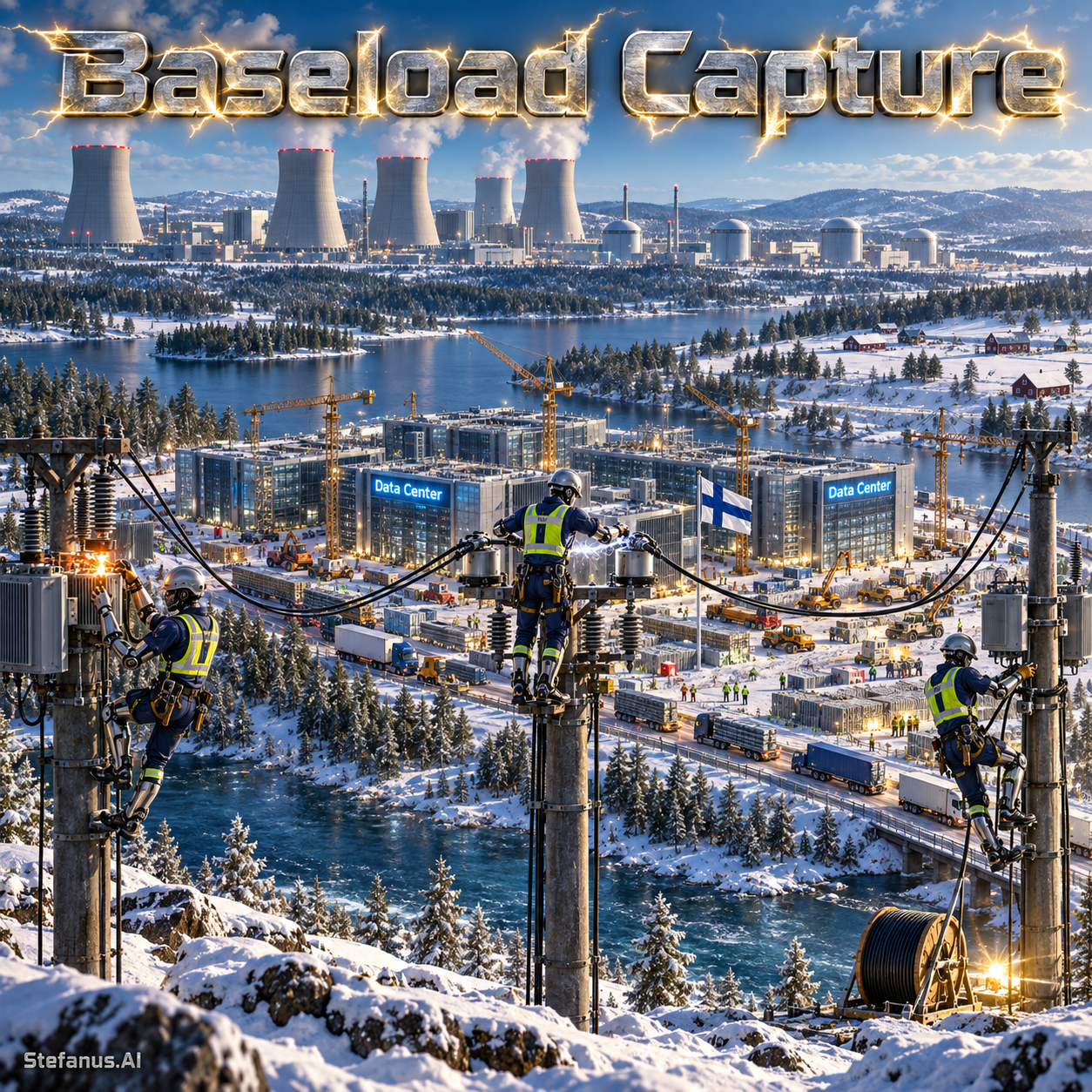
In the five-layer model of the technology stack that I use throughout my work — Layer 1, power and energy systems; Layer 2, semiconductors and compute; Layer 3, models and software; Layer 4, networks and cloud control; Layer 5, physical applications in the real world — the Machine Quarantine is remarkable because it is anchored simultaneously at the bottom and the top of the stack. The power inverter restriction operates at Layer 1, where electrons enter the grid. The robotics restriction operates at Layer 5, where machines act upon the physical world. And the two are connected through Layers 2 through 4, because the threat in both cases is not the metal but the mediated software channel — the chips, models, and cloud connections through which a foreign actor could reach into American territory and do something physical. Chip export controls were a Layer 2 story. The Machine Quarantine is the first policy regime that spans the entire stack.
The paper proceeds in eight sections. Section 1 situates the July 28 action in the arc that runs from chip controls to machine controls, and explains why embodied AI creates categorically different security risks than disembodied software. Section 2 dissects the anatomy of the FCC expansion itself — its legal mechanics, definitions, country-neutral drafting, and forward-looking structure. Section 3 examines the kinetic threat vectors that motivated the action: the connected-inverter problem and the humanoid supply chain as an instrument of spatial surveillance and physical hijacking. Section 4 maps the architecture of the quarantine — the conditional-approval pipeline, the jurisdictional handoffs, and the technical criteria for lifting isolation. Section 5 assesses the geopolitical and market disruption, drawing on corporate earnings through Q1 2026 and the record of Chinese retaliation. Section 6 analyzes the legal and bureaucratic precedent, tracing the Covered List’s evolution from Huawei to humanoids. Section 7 turns to the domestic industrial-policy corollary: the protected greenhouse being built for American robotics and power electronics. Section 8 distills what we have learned into seven pillars of the Machine Quarantine, before the Conclusion considers what it means to live inside the quarantined machine age.

Section 1: From Chip Controls to Machine Controls — Why Embodied AI Creates Different Security Risks
Every era of technology competition produces a characteristic instrument of control, and the instrument always reveals what the era believes power is made of. In the Cold War, the Coordinating Committee for Multilateral Export Controls policed machine tools and jet engines, because power was believed to reside in industrial capacity. In the 2018–2025 period, the United States constructed an elaborate lattice of semiconductor export controls — the Entity List actions against Huawei, the October 2022 advanced-computing rules, the successive tightening of restrictions on AI accelerators and chipmaking equipment — because power was believed to reside in computation. The scholarly literature of that period, from Chris Miller’s Chip War to the extensive output of Georgetown’s Center for Security and Emerging Technology and CSIS’s Wadhwani AI Center, treated the transistor as the strategic atom of the twenty-first century. The premise of this paper is that the July 28, 2026 action announces the arrival of a third era, in which the strategic atom is no longer the transistor but the actuator — and in which the object of control is no longer what a chip can compute, but what a machine can do.
To understand why this shift was inevitable, one must appreciate what changed between 2020 and 2026 in the technology itself. As a 2026 Nature analysis of embodied intelligence observed, a series of breakthroughs over the past five years brought the field to a tipping point: high-fidelity simulation platforms such as NVIDIA’s Isaac Sim and Stanford’s BEHAVIOR benchmark allowed robots to train in virtual environments that faithfully replicate friction, fluids, and contact physics, while the rise of large language models after 2022 gave machines abstraction, multi-step planning, and language-grounded reasoning.[4] The result was that the humanoid robot stopped being a laboratory curiosity and became a manufacturable product. Approximately 16,000 humanoid robots were installed worldwide in 2025, and China accounted for more than 80 percent of those installations; Chinese firms AGIBOT and Unitree each delivered more than 5,000 units in a single year, while the leading American developers produced a few hundred machines or fewer.[5] Whatever one’s view of the hype cycle, the physical population of intelligent machines on Earth is now doubling on a timescale measured in months, and the overwhelming majority of that population is manufactured inside the strategic rival of the United States.
The Stanford Emerging Technology Review’s 2026 robotics chapter — the product of Stanford’s leading science and engineering faculty working with the Hoover Institution — frames the policy problem precisely in these dual-use terms: robots can now perform many tasks that require physical presence, in peace and in war, and sound policy must balance innovation against dual-use risk.[6] But the deeper argument of this section is that embodied AI does not merely add another dual-use technology to an existing list. It changes the kind of risk that imported technology represents, along four dimensions that the semiconductor-control paradigm was never designed to address.
First, embodiment converts data risk into kinetic risk. A compromised phone leaks information; a compromised machine exerts force. The National Security Determination underlying the robotics restriction makes this explicit, warning that the networked capabilities of advanced robotic systems create extensive vulnerabilities and attack vectors that can
“manipulate the data and physical operation of the advanced robotic system.”
— Executive Branch National Security Determination, quoted in FCC Public Notice DA 26-786 [1]
The phrase physical operation is doing historic work in that sentence. For the first time, a U.S. equipment-authorization document treats the possibility that an adversary could move an imported machine’s limbs as a matter of national security. The regulatory imagination has crossed from the informational to the mechanical.
Second, embodiment makes the sensor payload the product. A humanoid robot is, functionally, a walking sensor array: stereo cameras, depth sensors, LiDAR, microphone arrays, inertial units, GPS. Every task it performs — folding laundry, patrolling a warehouse, delivering parts on a factory floor — is simultaneously an act of environmental mapping. The data that trains the next generation of robot foundation models is precisely the data that intelligence services have always sought: the interior layouts of homes, offices, laboratories, and defense facilities, indexed by location and time. In the embodied-AI era, surveillance is not a misuse of the machine; it is the machine’s training pipeline operating as designed.
Third, embodiment collapses the distinction between the device and the network. Semiconductor controls could reason about a chip as a discrete object with measurable performance. A modern robot or inverter is better understood as the local terminal of a distributed system whose brain lives partly in the cloud, whose behavior is revised by over-the-air updates, and whose telemetry flows continuously back to servers chosen by the manufacturer. The imported object is never finished; it is perpetually rewritten from abroad. Any control regime that inspects the machine only at the moment of import is inspecting a single frame of a motion picture.
Fourth, embodiment attaches the risk to critical infrastructure at both ends of the stack. At Layer 5, robots enter factories, hospitals, ports, and homes. At Layer 1, inverters constitute the power-electronic interface between renewable generation, battery storage, datacenter power systems, and the alternating-current grid. As inverter-based resources proliferate — and as electricity demand surges under the load of AI datacenters — the devices that condition the grid’s power become the grid’s nervous system. A control regime for the embodied-AI era therefore had to be a control regime for energy hardware at the same time, which is exactly what the July 28 action is.
It is worth pausing on how different this logic is from the export-control logic it succeeds. Chip controls are outbound: they prevent American technology from reaching adversaries, on the theory that computation is the scarce input to adversary capability. The Machine Quarantine is inbound: it prevents adversary technology from reaching American territory, on the theory that presence is itself the threat. Chip controls ask, “What could they build with what we sell them?” The quarantine asks, “What could they do with what they sell us?” The first question belongs to the arms-control tradition; the second belongs to the epidemiological tradition — which is why the biological metaphor of quarantine, testing, and conditional release fits the new regime so naturally, and why this topic is positioned to become the conceptual successor to semiconductor export-control research as the defining field of technology-security scholarship in the second half of the decade.
The academic community, it should be said, saw the embodiment turn coming even where it did not predict the regulatory response. In a National Science Review roundtable on embodied intelligence, Professor Han Ding of Huazhong University of Science and Technology captured the field’s self-understanding in a single sentence:
“The robot is the flagship carrier of embodied intelligence.”
— Prof. Han Ding, Huazhong University of Science and Technology [7]
If the robot is the flagship carrier of embodied intelligence, then the flagship carrier of embodied intelligence is also the flagship carrier of embodied risk — and July 28, 2026 is the date on which the United States government formally adopted that syllogism as policy.

Section 2: The Anatomy of the July 28 FCC Expansion
Great regulatory transformations rarely announce themselves with new statutes. They arrive, more often, as administrative notices built on old legal plumbing, and their revolutionary content becomes visible only when one reads the plumbing closely. The July 28 action is a textbook case. To understand the Machine Quarantine, one must dissect four elements of its founding document: the regulatory mechanics, the definitional scope, the country-neutral drafting, and the forward-looking temporal structure.
2.1 The Regulatory Action: Public Notice DA 26-786 and Its Inter-Agency Genesis
The formal instrument is Public Notice DA 26-786, released July 28, 2026 by the FCC’s Public Safety and Homeland Security Bureau (PSHSB), which maintains the Covered List of equipment and services determined to pose an unacceptable risk to U.S. national security under Section 2 of the Secure and Trusted Communications Networks Act of 2019 and Sections 1.50002(a) and 1.50003 of the Commission’s rules.[1] The critical procedural fact is that the FCC did not act alone and, under the statute, cannot act alone: additions to the Covered List follow determinations by enumerated national-security authorities. On July 27, 2026, a White House-convened Executive Branch interagency body with appropriate national-security expertise transmitted two National Security Determinations to the Commission — one addressing foreign-produced power inverters, the other addressing foreign-produced advanced robotic devices — and the FCC’s notice operationalized them the following day.[1][3]
The first determination concluded that power inverters produced in a foreign country, regardless of the nationality of the producer, pose an unacceptable risk unless the Department of War or the Department of Homeland Security transmits a specific determination that a given inverter or class of inverters does not pose such a threat.[1] The determination’s threat logic is explicit about the software channel:
“Inverters’ remote connectivity introduces additional vulnerabilities which compound as inverter-based resources proliferate on the US grid.”
— Executive Branch National Security Determination on Power Inverters [8]
The second determination applied parallel logic to advanced robotic devices, with the Department of War alone serving as the exemption authority.[3] FCC Chairman Brendan Carr framed the action as the Commission executing the national-security community’s judgment rather than substituting its own:
“The FCC is acting in lock step with our national security agencies.”
— Brendan Carr, Chairman, Federal Communications Commission [9]
The consequence of Covered-List placement is severe because of where it bites. Nearly every electronic device sold in America requires an FCC equipment authorization before it can be imported, marketed, or sold; equipment on the Covered List is ineligible for new authorizations.[2][10] The FCC is thus the enforcement chokepoint of the quarantine not because it is a security agency but because it controls the single administrative gate through which all connected hardware must pass to reach the U.S. market. The quarantine did not need a new border post; it repurposed the oldest one in the electronic economy.
2.2 Scope and Definition: What Counts as an “Advanced Robotic Device”
Definitions are destiny in regulatory design, and the definition of “advanced robotic device” repays close reading. Drawing on the FCC’s guidance and contemporaneous reporting on the determination, a covered device must satisfy a conjunction of criteria, summarized in Table 1.[11][12]
Table 1. Definitional Criteria for a Covered “Advanced Robotic Device”
| Criterion | Requirement | Quarantine Logic |
| Mobility | Mobile mechanical system able to move, navigate, avoid obstacles, or operate on the ground | Distinguishes kinetic agents from fixed appliances |
| Mass threshold | Weighs more than 4.4 lbs (2 kg) | Excludes toys; captures machines with meaningful physical agency |
| Remote operability | Can function or be operated remotely from a human operator via commands or sensor information | Targets the remote-commandeering vector |
| Sensing | Contains at least one sensor to perceive its environment | Targets the surveillance vector |
| Connectivity | Supports wired or wireless network connections (Bluetooth, Wi-Fi, cellular, satellite) capable of at least 200 kbps | Targets the data-exfiltration and update channel |
| Software dependence | Movement, perception, data collection, or remote command controlled by software, firmware, or AI | Defines the machine as a continuous software artifact |
| Exclusions | Connected road vehicles; rail-only equipment; aircraft and drones (separately covered); unmanned underwater vehicles; specified FDA-regulated medical and mobility devices | Avoids double regulation and carve-outs for regulated sectors |
Two features of this definition deserve emphasis. First, it is functional, not morphological: it captures humanoids, quadrupeds, wheeled autonomous mobile robots, and tracked platforms alike, because the threat model attaches to mobility-plus-sensing-plus-connectivity rather than to any particular body plan. Fixed stationary industrial arms — the robots of the twentieth century — fall outside it, which is a quiet but profound statement that the old robotics was never the problem; the new robotics, which moves through human space, is. Second, the connectivity floor of 200 kilobits per second is a threat-model artifact: it is roughly the bandwidth at which continuous video exfiltration and meaningful real-time teleoperation become practical. The definition, in other words, encodes the quarantine’s epidemiology — it describes the symptoms of a machine capable of carrying the disease.
The inverter determination sweeps comparably broadly, reaching grid-tied power inverters across solar, wind, battery-storage, and datacenter applications — the full population of power-electronic devices that convert direct current to alternating current at the grid interface.[8][10]
2.3 Country-Neutral Format vs. De Facto Reality
The most intellectually interesting drafting choice in the July 28 action is what it does not say. The restriction is written in country-neutral form: it applies to devices “produced in a foreign country, regardless of the nationality of the producer,” and it names no company and no state.[1] There is no mention of Unitree, UBTech, AGIBOT, Sungrow, Huawei, or China. The operative concept is production origin, applying the domestic-end-product logic familiar from the Federal Acquisition Regulation’s 48 CFR § 25.101(a) standard — under which, as a senior FCC official explained on background, even robots assembled in the United States are covered if more than 35 percent of their components are manufactured abroad.[11]
Yet the de facto reality is unambiguous, and contemporaneous reporting stated it plainly: the new bans effectively target Chinese suppliers, and many non-Chinese suppliers are expected to be exempted through the conditional-approval process, exactly as occurred with the FCC’s earlier actions on foreign drones and routers.[9][13] The same senior official acknowledged that while the action targets no specific country, it would effectively bar device authorizations for products from China.[11] One analysis put the matter with admirable economy: the text says any nationality; the target is China.[13]
Why draft it this way? Three reasons, each characteristic of the emerging quarantine architecture. First, country-neutral drafting is legally durable: it survives corporate restructuring, third-country assembly, and the transshipment games that plagued entity-based controls. A quarantine keyed to the pathogen’s characteristics outlasts a quarantine keyed to the pathogen’s passport. Second, it is diplomatically expandable: the same instrument reaches Russian, Iranian, or any future adversary’s machines without amendment. Third, and most subtly, it inverts the burden of proof. Under an entity list, the government must prove a company is dangerous; under the country-neutral quarantine, every foreign producer must prove its machines are safe. The default state of the foreign machine has flipped from admitted to excluded — which is the precise legal signature of a quarantine as opposed to a blacklist.
2.4 The Forward-Looking Precedent: Grandfathering and the 2029 Horizon
The final structural element is temporal. The July 28 restrictions apply only to new device models seeking FCC authorization. They do not claw back robots or inverters that consumers already own; they do not prevent retailers from continuing to sell, import, or market models previously approved through the equipment-authorization process; and they do not restrict federal-government purchase or use at all.[3][10] This is an import gate, not a recall — a forward-looking blockade whose bite grows over time as newer models are frozen out while older approved ones age in place.[13] The Forbes analysis of the action captured the strategic effect: in a field advancing this quickly, the best robots are tomorrow’s robots, and being limited to today’s models will extinguish whatever nascent market share foreign companies had built in the United States.[10]
The grandfathering structure carries one further, quietly consequential feature. Consistent with the FCC’s treatment of previously covered categories, authorizations tied to legacy devices interact with software-update policy: the Covered List framework contemplates update-related waivers for existing fleets running through January 1, 2029, after which the software lifeline connecting grandfathered foreign machines to their manufacturers enters a new compliance regime.[2] The message embedded in that date is the quarantine’s deepest teaching: a connected machine is never a finished product. Even the grandfathered robot lives on borrowed regulatory time, because its manufacturer’s continuing ability to reach into it — the update channel — is itself the object of governance. The border, once crossed, is never fully behind the machine.
Taken together, the four elements of DA 26-786 — chokepoint enforcement through equipment authorization, functional definition of the kinetic machine, country-neutral pathogen-style drafting, and forward-looking temporal design — constitute something genuinely new in American administrative law: a general-purpose admission-control system for autonomous physical technology. What remains is to understand the threat evidence that convinced the national-security establishment to build it.

Section 3: Kinetic Threat Vectors — Why Robots and Why Inverters?
A regulatory architecture is only as legitimate as the threat model beneath it, and the striking feature of the July 28 action is that its threat model is not speculative. In both categories — inverters and robots — the government could point to concrete, documented, and in several cases academically peer-reviewed evidence that the machines in question had already been observed doing, or being capable of doing, the very things the quarantine was designed to prevent. This section reconstructs that evidence, because without it the Machine Quarantine looks like protectionism dressed in security language, and with it the regime looks like a belated response to demonstrated vulnerability. The truth, as usual, contains elements of both — but the evidentiary core is real, and it is worth examining closely.
3.1 The Power Inverter Problem: A Built-In Way to Physically Destroy the Grid
Begin with the inverter, because it is the less intuitive of the two threats and, in some ways, the more alarming. A power inverter is a deceptively humble device. It converts the direct current produced by solar panels, wind turbines, and battery banks into the alternating current that the grid runs on, and it does so at a scale that has quietly become foundational: inverter-based resources are the fastest-growing category of generation on modern grids, and they are increasingly the interface through which datacenters — the ravenous electrical load of the AI boom — connect to the power system. The inverter is where renewable electrons become grid electrons. It is also, by design, a networked computer, because operators need remote access to monitor performance and push firmware updates.
In May 2025, this humble device became a national-security emergency. Reuters reported that U.S. energy officials, stripping down Chinese-made inverters, had discovered undocumented communication equipment — including cellular radios — that did not appear in the devices’ software bill of materials.[14] These components were “rogue” in the precise technical sense that they were undisclosed: they provided additional, undocumented communication channels that could allow the firewalls utilities install to be circumvented remotely.[14][15] The implication, as reported, was that an adversary could bypass the security perimeter, reach the inverter directly, and switch it off or alter its settings — and because inverters are synchronized to the grid, doing so to enough of them at once could destabilize the entire power system. One U.S. official put the stakes in language that has since become the defining quotation of the inverter debate:
“That effectively means there is a built-in way to physically destroy the grid.”
— U.S. energy official, quoted by Reuters [14]
The same investigation found undocumented cellular radios in Chinese-made batteries as well, and noted that the problem extended across nine months of teardown discoveries.[15] The security concern is sharpened by a legal fact that has nothing to do with the hardware: Chinese firms are required by law to cooperate with their government’s intelligence services, which means that control over a Chinese-made inverter’s remote channel is, in the last analysis, control that the Chinese state can compel.[14] This is why the vulnerability cannot be engineered away by a better firewall. The firewall assumes the threat is outside; the rogue radio places the threat inside, on the trusted side of the perimeter, with a direct line home.
Congress reacted with unusual speed and bipartisanship. Representative August Pfluger, a Republican member of the House Homeland Security Committee, framed the discovery as one instance of a systematic pattern:
“The threat we face from the Chinese Communist Party is real and growing. Whether it’s telecom hacks or remotely accessing solar and battery inverters, the CCP stops at nothing to target our sensitive infrastructure.”
— Rep. August Pfluger [15]
The inverter determination that underlies the July 28 action tracks this evidence directly. Its threat logic, as quoted in the National Security Determination, is that the absence of a secure U.S. supply chain for inverters, combined with the continuous inflow of foreign-produced or foreign-controlled inverters and components, poses threats to U.S. economic and national security — and that the remote connectivity of inverters introduces vulnerabilities that compound as inverter-based resources proliferate on the grid.[16] The word compound is the analytically important one. The threat is not one inverter; it is the aggregate exposure of a grid whose flexibility increasingly depends on millions of networked power-electronic devices, any meaningful fraction of which, if commandeered simultaneously, becomes a synchronized attack surface. The quarantine treats the inverter the way an epidemiologist treats a vector species: the individual mosquito is harmless; the swarm carries the plague.
3.2 The Humanoid Supply Chain: Sensors, Actuators, Foundation Models — and Backdoors
The robotics half of the threat model is, if anything, better documented, because independent security researchers have spent 2025 and 2026 publishing detailed, reproducible analyses of the machines in question. To understand why the government treated Chinese humanoids and quadrupeds as a category rather than as individual bad actors, one must understand the supply chain that produces them and the vulnerability record that has accumulated around its dominant vendor.
A modern humanoid robot is an assembly of high-value subsystems: precision actuators and harmonic drives at the joints, brushless motors, lithium battery packs, an array of sensors (stereo and depth cameras, LiDAR, microphones, inertial measurement units, GPS), an onboard compute stack, and — increasingly — a foundation model that grounds language instructions in physical action. China dominates the manufacturing of nearly every link in this chain, and it dominates the assembled product: of the roughly 16,000 humanoids installed worldwide in 2025, more than 80 percent were Chinese, with AGIBOT and Unitree each shipping over 5,000 units.[5] Unitree alone reported 2025 revenue of ¥1.708 billion, up 335 percent year-on-year, and shipped more than 5,500 humanoid units for a 32.4 percent global share by units.[17] These are not prototypes; they are products, sold at prices — the Unitree G1 starts near $16,000 — that are roughly an order of magnitude below full-size Western platforms.[18]
The security record of these machines is the evidentiary heart of the robotics determination. It unfolds in three documented acts. In March 2025, researchers disclosed CVE-2025-2894, a backdoor in Unitree’s Go1 quadruped: a service called CloudSail, operated by a Chinese firm, auto-started on boot and created a persistent peer-to-peer tunnel that gave the manufacturer — and anyone holding the CloudSail API key — complete remote control of the device without the owner’s knowledge.[19] Researchers subsequently confirmed vulnerable units operating inside networks at MIT, Princeton, Carnegie Mellon, and the University of Waterloo.[19] In September 2025, a second and more severe flaw was disclosed: the UniPwn exploit, a Bluetooth Low Energy vulnerability affecting Unitree’s Go2 and B2 quadrupeds and its G1 and H1 humanoids — the company’s current commercial lineup. UniPwn yields root-level access, and it is wormable: a compromised robot can scan for other Unitree units within Bluetooth range and infect them automatically, without human intervention.[20][21] The underlying command-injection flaw was later cataloged as CVE-2025-35027, present across a common firmware codebase shared by the Go2, G1, H1, and B2.[22]
The academic assessment that accompanied UniPwn is worth stating precisely, because it is the single clearest articulation of why embodied AI demanded a new regulatory category. In a systematic security assessment titled Cybersecurity AI: Humanoid Robots as Attack Vectors, researchers Víctor Mayoral-Vilches, Andreas Makris, and Kevin Finisterre demonstrated that the Unitree G1 operates simultaneously as a covert surveillance node and can be repurposed as an active cyber-operations platform. They documented that the robot continuously exfiltrated multi-modal sensor and service-state telemetry — audio, video, LiDAR, GPS — to servers in China every 300 seconds, without operator notice.[23] The researchers’ own framing of the significance is the quotation that best captures the entire threat model of the July 28 action:
“Our discoveries are disruptive because they anticipate the future of this new data-hungry robotics: a generation of technological Trojan horses that will enter our homes, factories, and public spaces to solve specific problems, but at the cost of our privacy and fundamental rights.”
— Víctor Mayoral-Vilches, Andreas Makris & Kevin Finisterre, *Cybersecurity AI: Humanoid Robots as Attack Vectors* [23]
Andreas Makris, reflecting on the difficulty of getting the manufacturer to respond, posed the question that haunts the country-neutral drafting of the rule:
“Are they introducing vulnerabilities like this on purpose, or is it sloppy development? Both answers are equally bad.”
— Andreas Makris, security researcher [20]
That sentence explains why the quarantine keys on origin rather than intent. For a national-security regulator, the distinction between a deliberate backdoor and a negligently insecure architecture is immaterial when the manufacturer sits inside an adversary’s jurisdiction and is legally compellable by that adversary’s intelligence services. Whether the Trojan horse was built as a weapon or assembled carelessly, the horse is inside the walls, and it phones home every five minutes.
The wormability finding deserves separate emphasis because it is what defeats the intuitive defense of air-gapping. At the GEEKCon competition in Shanghai in late 2025, researchers demonstrated taking control of a domestically produced humanoid with a single verbal command and then using that compromised machine to infect others — turning one robot into a Trojan horse capable of seizing a whole population.[24] A later demonstration showed a hacked robot using near-field wireless communication to infect a second, offline robot within minutes, proving that physical isolation does not guarantee security against this class of attack.[25] This is the property that makes the robot category qualitatively different from, say, a compromised laptop. A laptop that is unplugged is safe. A robot that is unplugged can still be infected by its neighbor when it powers on, and can still be commandeered by anyone who walks within Bluetooth range. The kinetic attack surface is not merely larger than the informational one; it propagates through physical space in a way that firewalls were never designed to contain.
3.3 The Kinetic Attack Surface: From Data Theft to Physical Hijacking
The synthesis of the inverter and robot evidence yields the concept that gives the July 28 action its true novelty: the kinetic attack surface. In the semiconductor-and-telecom era, the paradigmatic supply-chain threat was passive: a compromised device leaks data. Huawei’s inclusion on the Covered List rested on the fear that its network equipment could route or copy communications. That is a serious threat, but it is an informational one — the harm is realized in the theft of secrets.
The embodied-AI era introduces an active threat. A compromised inverter does not merely leak the grid’s telemetry; it can switch off, destabilizing the physical power system. A compromised robot does not merely map a facility’s interior; it can be, in the language of the FCC’s own summary of the determination, remotely commandeered — its limbs, its mobility, its manipulators placed under an adversary’s control.[26] The robot determination warns that networked machines collect data that could be leveraged to surveil Americans, and that an attacker could remotely commandeer the robots.[27] The harm is no longer realized in the theft of secrets but in the exertion of force: a machine in a warehouse, a hospital, a substation, or a home that can be made to act against the people around it.
This is the conceptual leap that the semiconductor-control paradigm could not make, and it is why the Machine Quarantine is a genuinely new regime rather than an extension of an old one. Export controls govern capability. The quarantine governs presence and animacy. It accepts that the dangerous property of an embodied machine is not what it knows but what it can do, and not where it was made but who can reach it after it is deployed. Once one sees the kinetic attack surface clearly, the biological metaphor becomes irresistible: the imported machine is a body that can be possessed, and the quarantine is the period of observation before we trust it not to be.

Section 4: The Architecture of the Machine Quarantine
If Sections 2 and 3 established what the July 28 action does and why, this section examines how — the institutional machinery through which a foreign machine is isolated, examined, and either admitted or excluded. The genius of the design, and the reason it deserves the name “quarantine” rather than “ban,” lies in its conditional-approval architecture. A pure ban would be a wall. What the FCC built is closer to a border clinic: a structured pathway through which a foreign machine can still gain entry, but only after passing through the hands of the national-security agencies that have the expertise to diagnose it. This section maps that pathway, the jurisdictional handoffs it requires, and the technical criteria by which isolation is lifted.
4.1 The Conditional-Approval Pathway
The operative mechanism is deceptively mundane: an email address. Entities seeking conditional approval for a covered advanced robotic device or power inverter are directed to submit an application, following published guidance, to conditional-approvals@fcc.gov; the FCC then forwards the submission to the Department of War and, for inverters, the Department of Homeland Security, for their evaluation.[28] The FCC’s Covered List entries are drafted to build the exemption directly into the category: the list covers “foreign-produced advanced robotic devices, except advanced robotic devices which have been granted a Conditional Approval by DoW,” and the parallel construction for power inverters.[28] The default is exclusion; the exception is earned, device-by-device or class-by-class, through favorable national-security determination.
This structure is precisely what distinguishes a quarantine from a blacklist, and the distinction is not merely rhetorical. A blacklist enumerates the excluded; everything not named is admitted. A quarantine excludes the category and admits the individual only after examination; everything not cleared is held. The burden of proof runs in opposite directions. Under the July 28 architecture, a foreign manufacturer cannot simply demonstrate that it is not on a list of bad actors — there is no such list. It must affirmatively persuade the Department of War that its specific machine, or class of machines, does not pose the risk that the category as a whole is presumed to carry. The precedent for how this plays out already exists: when the FCC placed foreign drones and routers on the Covered List, many non-Chinese suppliers were subsequently exempted through exactly this conditional pathway, while the Chinese incumbents were not.[13] The country-neutral text and the conditional pathway work together as a sorting machine: the text sweeps everyone in, and the pathway lets the trusted back out.
There is even an early, concrete illustration of a firm racing to stay on the admitted side of this line. In April 2026 — months before the robotics determination — the California-based embodied-AI company Faraday Future announced that its FX Aegis quadruped had completed full FCC compliance certification for U.S. sale, following its Futurist and Master humanoids through the same Authorization and Certification Division process.[29] Whatever one thinks of any individual company’s prospects, the episode shows the quarantine’s incentive structure operating as designed: the gate rewards firms that can demonstrate a clean, auditable, U.S.-facing compliance posture, and it penalizes those that cannot or will not open their machines to inspection.
4.2 Jurisdictional Handoffs: The FCC as Gatekeeper, DoW and DHS as Diagnosticians
The July 28 architecture is notable for a division of labor that would have seemed constitutionally odd a decade ago: a communications regulator serving as the enforcement gate for machines that walk and for hardware that feeds the grid, with a defense department and a homeland-security department serving as the actual diagnosticians. Table 2 lays out the handoffs.
Table 2. Institutional Division of Labor in the Machine Quarantine
| Function | Agency | Role in the Quarantine |
| Enforcement gate | Federal Communications Commission (PSHSB) | Maintains the Covered List; denies equipment authorization to covered devices; receives conditional-approval applications |
| Robot diagnostics | Department of War (DoW) | Evaluates advanced robotic devices; transmits determinations that a device or class does not pose an unacceptable risk |
| Inverter diagnostics | Department of Homeland Security (DHS) and/or DoW | Evaluates power inverters for grid-security risk; transmits exemption determinations |
| Threat determination | White House-convened Executive Branch interagency body | Issues the National Security Determinations that authorize Covered List additions |
| Statutory foundation | Congress (Secure Networks Act of 2019) | Provides the legal authority under which the Covered List operates |
The logic of this division is that market access and security expertise live in different institutions, and the quarantine unifies them without merging them. The FCC controls the only universal chokepoint — equipment authorization — but it has no capacity to reverse-engineer a robot’s firmware or assess a grid-security risk. The Department of War and DHS have that capacity but no control over the market gate. By routing conditional-approval applications from the FCC to the security agencies and back, the architecture lets the gatekeeper enforce what the diagnosticians decide. This is co-regulation in the strict sense: two kinds of authority, structurally combined, so that a civilian-technology market is now governed jointly by a trade regulator and a defense establishment. It is one of the most consequential and least remarked features of the new regime, and I return to it as a distinct pillar in Section 8.
4.3 Technical Compliance Auditing: The Criteria for Lifting a Quarantine
What must a foreign machine actually demonstrate to earn conditional admission? The July 28 documents do not publish a detailed rubric, but the shape of the required auditing can be reconstructed from the threat model, from the FCC’s treatment of prior categories such as drones (where conditional approvals without a termination date remain effective only so long as the recipient abides by an onshoring plan and updated product vetting), and from the technical literature on what a secure robot architecture looks like.[28] Four criteria are implied by the structure of the threat.
The first is provenance and supply-chain transparency. Because the rule keys on production origin and applies the 48 CFR § 25.101(a) domestic-end-product standard, a credible application must document the origin of components and demonstrate that the machine does not exceed the foreign-content threshold, or that its foreign content is nonetheless trustworthy.[11] The rogue-radio episode makes clear why this matters: the danger was precisely a component that did not appear in the software bill of materials, so a credible audit must reconcile the physical device against a complete and verified bill of materials.
The second is firmware integrity and update governance. The distinguishing property of the covered machines is that they are continuously rewritten from abroad. A quarantine that examined the machine only once would be examining a snapshot of a moving target. The security literature is explicit about what good practice looks like here: Boston Dynamics’ Spot, widely treated as a benchmark, uses TLS 1.2+ encrypted communications, mutual authentication via X.509 client certificates, firmware integrity based on cryptographically signed hash trees, and per-device unique keys — precisely the architecture that Unitree’s hardcoded, fleet-wide AES key so conspicuously lacked.[30] A credible conditional-approval application must therefore demonstrate signed firmware, controlled and auditable update pipelines, and the absence of undocumented remote channels.
The third is communications isolation and telemetry control. The G1’s every-five-minutes exfiltration to Chinese servers is the paradigmatic disqualifying behavior. A machine seeking admission must demonstrate that its telemetry destinations are disclosed, controllable, and severable — that the owner, not the manufacturer, governs what leaves the device and where it goes. In the strongest cases this shades into a requirement for air-gapped or domestically-terminated operation, in which the machine’s cloud dependencies are hosted on trusted infrastructure rather than on servers subject to a foreign intelligence service.
The fourth is continuing inspection. Because the threat is dynamic, admission cannot be permanent in the way a customs clearance is permanent. The drone precedent, in which conditional approvals persist only so long as the recipient adheres to an onshoring plan and submits to updated vetting, points toward a model in which the quarantine is never fully lifted — it is merely relaxed, conditionally and revocably, subject to the machine’s continued good behavior.[28] This is the deepest structural echo of the biological metaphor. My dog’s seven-day quarantine ended, but his vaccination record followed him, and any subsequent sign of disease would have returned him to isolation. The machine quarantine works the same way: conditional admission is probation, not acquittal.
Assembled, these four criteria describe a compliance regime that is far more intrusive than anything the equipment-authorization process previously demanded. The old process asked whether a device met spectrum and safety standards — an engineering question answerable by measurement. The new process asks whether a device can be trusted — a question about provenance, governance, and the identity of whoever holds the keys. That is a different kind of question, and answering it requires opening the machine in a way that a country determined to protect its manufacturing secrets, or an intelligence service determined to protect its access, may simply refuse to allow. The quarantine’s most powerful feature is that a refusal to be inspected is itself dispositive. The machine that will not open is the machine that stays out.

Section 5: Geopolitical and Market Disruption
Regulatory architectures do not operate in a vacuum; they land on markets, and markets react. The July 28 action arrived in the middle of the single most consequential commercialization race in hardware — the humanoid-robot and inverter markets — and its effects ripple through corporate balance sheets, capital markets, and the strategic calculations of two governments. This section reads the disruption through the financial disclosures available up to the first quarter of 2026, the competitive structure of the affected industries, and the record of Chinese retaliation, before turning to what the action means for the enterprise buyers who must now live inside it.
5.1 The Fragmented Tech Basin: Balkanizing the Global Humanoid Market
The most immediate geopolitical effect of the quarantine is the fragmentation of what had been, until July 28, a single global market for embodied machines into at least two increasingly separate basins — a Chinese ecosystem and a U.S.-and-allied ecosystem — with the conditional-approval pathway serving as the narrow, tightly controlled channel between them. This is the same balkanization that semiconductor controls produced in the compute layer, now reproduced in the physical-application layer of the stack.
The stakes of this fragmentation are best understood through the financial condition of the affected Chinese firms at the moment the quarantine landed. Unitree, the emblem of the robotics category, was mid-way through an initial public offering on Shanghai’s STAR Market when the FCC acted. Its prospectus, filed March 20, 2026, disclosed a company in hyper-growth: 2025 revenue of ¥1.708 billion, up 335 percent year-on-year, with a 60.27 percent gross margin, and a decisive pivot from quadrupeds to humanoids, which rose from 1.9 percent of revenue in 2023 to 51.5 percent in the first nine months of 2025.[17] For the first quarter of 2026, Unitree reported a 68 percent year-on-year revenue surge to ¥422.8 million, even as adjusted net profit fell 52 percent to ¥40.3 million under the weight of R&D and sales spending.[31] The company sought to raise roughly ¥4.2 billion (about $610 million) to fund a smart-manufacturing base and next-generation robot models.[32] This is the financial profile of a firm sprinting to convert a manufacturing lead into durable global market share — and the U.S. quarantine is a direct attempt to wall that firm out of the world’s most valuable single market before it can plant a flag there.
The inverter incumbent tells a parallel story with a different inflection. Sungrow, the world’s largest inverter maker, reported first-quarter 2026 revenue of ¥15.56 billion, down 18.26 percent year-on-year, with net profit down 40.12 percent to ¥2.29 billion, pressured by slowing domestic project development and foreign-exchange losses; on a trailing-twelve-month basis its revenue stood near $12.1 billion.[33][34] A firm of this scale does not vanish because of a U.S. import gate, but the quarantine forecloses a growth market at precisely the moment its home market is softening — and it does so in a way that compounds the reputational damage from the 2025 rogue-radio revelations, which attached to Chinese inverters as a category regardless of any individual manufacturer’s culpability.
5.2 U.S. Market Protectionism: The Insulated Greenhouse
The mirror image of Chinese exclusion is American insulation. By freezing new foreign models out of the equipment-authorization pipeline while grandfathering existing ones and exempting federal procurement, the July 28 action creates a regulatory greenhouse in which domestic robotics and power-electronics developers can mature without facing the full force of Chinese price competition. The Forbes analysis of the action stated the effect plainly: while existing foreign models can still be sold, the forward-looking ban creates a protected market for emerging U.S. developers.[10]
The commercial context makes clear why this greenhouse matters. The American humanoid sector is capital-rich but volume-poor. Figure AI, the most valuable pure-play humanoid company, reached a roughly $39 billion valuation in late 2025 — higher than some analysts’ projections for the entire humanoid market a decade out — yet it and its domestic peers had collectively shipped a tiny fraction of Chinese volumes.[35] Tesla’s Optimus program converted a Fremont production line and targeted mass production in the second half of 2026, with a long-run price guidance of $20,000–$30,000 aimed squarely at Chinese cost leadership.[36] Apptronik, 1X, and others occupied the tier below, well-funded and pre-scale.[37] The strategic problem these firms faced was stark: Chinese manufacturers, backed by state subsidies and a $26-billion-plus municipal investment wave, threatened to reach global scale — and the cost curve that comes with scale — before American firms could get there, potentially locking in Chinese dominance the way Chinese solar manufacturing once did.[38] The quarantine is, among other things, an answer to that problem: it buys the domestic industry time by denying its most formidable competitors the American market during the critical scaling window.
Whether this is wise industrial policy or self-defeating protectionism is genuinely contested, and honesty requires presenting both cases. The protectionist case is that first-mover scale advantages in hardware are close to irreversible, that a compromised robot or inverter is a national-security harm that no price advantage can offset, and that a temporary greenhouse is the price of having a domestic embodied-AI industry at all. The opposing case — advanced most forcefully by Chinese analysts but echoed by some Western economists — is that walling out the most advanced and cheapest machines will slow American robotics adoption, raise costs for U.S. manufacturers who would otherwise deploy these tools, and insulate domestic champions from exactly the competition that would make them excellent. Chinese commentary framed the action as a “small yard, high fence” mindset that ultimately harms U.S. technological development, and China’s Foreign Ministry spokesperson Mao Ning offered the standard rejoinder to technology protectionism:
“Protectionism does not make the U.S. stronger.”
— Mao Ning, spokesperson, Chinese Ministry of Foreign Affairs [39]
A fair assessment holds both truths in tension. The security rationale is real and evidence-backed; the economic cost is also real, and the history of protected industries offers no guarantee that the greenhouse produces champions rather than dependents. What is not in doubt is that the July 28 action decisively chose security and domestic insulation over open-market efficiency — and that this choice, once institutionalized as a permanent architecture, is unlikely to be reversed regardless of which coalition controls the relevant agencies.
5.3 China and Retaliation: Motors, Batteries, Rare Earths, and Robot Components
No analysis of the quarantine’s geopolitics is complete without accounting for the retaliatory arsenal on the other side, because the same supply-chain concentration that makes Chinese machines a security concern gives China formidable leverage over the inputs to American machines. This is the asymmetry at the heart of the confrontation: the United States controls the largest market for finished embodied machines, but China controls the upstream materials and components from which all embodied machines — American ones included — are built.
The most potent lever is rare earths. China refines roughly 85 percent of the world’s rare earth elements, which are essential to the permanent-magnet motors at the heart of every robot actuator, as well as to precision-guided munitions, wind turbines, and radar.[40] Over 2025 and 2026, Beijing demonstrated repeatedly that it would use this dominance as a coercive instrument: a rare-earth licensing regime imposed in April 2025 in response to U.S. tariffs; a sweeping October 2025 expansion adding extraterritorial provisions that reach any product made anywhere with Chinese-origin rare-earth content; a one-year partial suspension negotiated at the Busan summit; and then, five weeks after a May 2026 Beijing summit, the addition of America’s two largest rare-earth independence champions, MP Materials and USA Rare Earth, to China’s export-control blacklist.[40][41] CSIS documented the real effect on the ground: Chinese yttrium exports to the United States collapsed from 333 tons in the eight months before restrictions to just 17 tons in the eight months after, leaving aerospace manufacturers rationing material.[42]
The strategic implication for the Machine Quarantine is sobering. The United States can wall Chinese robots out of its market, but it cannot easily build American robots without Chinese rare earths, motors, and battery inputs. The quarantine addresses the finished-machine threat while leaving the upstream-dependency threat largely unaddressed — and China’s retaliatory playbook targets precisely that dependency. This is why the domestic-industrial-policy response examined in Section 7 is not optional but structurally necessary: a quarantine on foreign machines that leaves the domestic industry dependent on foreign components has merely relocated the vulnerability from the finished good to its bill of materials. Beijing understands this perfectly, which is why its retaliation has concentrated on the materials layer rather than on symbolic tariffs.
5.4 The Compliance Burden on Enterprise Buyers
Finally, the quarantine lands on the enterprise buyers who operate fleets of these machines, and it transforms their procurement calculus. Before July 28, an enterprise buying a warehouse quadruped or a grid-scale inverter asked engineering questions: does it work, what does it cost, how reliable is it? After July 28, the same buyer must ask provenance and lineage questions: is this model’s FCC authorization still valid, or is it a grandfathered model whose update pathway faces the 2029 horizon? What is the foreign-content percentage of this device under the 48 CFR § 25.101(a) standard? If I deploy a fleet of these machines across facilities, am I building a future stranded asset — a population of robots that cannot be replaced with the same model, cannot receive updates, and may become non-compliant as the regulatory perimeter tightens?
This is a genuine and underappreciated shift in the meaning of enterprise technology procurement. The buyer of a connected machine is no longer merely purchasing a capability; the buyer is adopting a compliance liability whose value depends on the shifting boundary of a national-security perimeter. Fleet managers must now audit FCC ID lineage and update status the way they once audited software licenses. The quarantine thereby pushes its logic downstream, past the border and into the operations of every American enterprise that runs foreign connected hardware, making each of them a de facto enforcement node — because a buyer who cannot verify a machine’s provenance and update posture is a buyer exposed to the risk that its fleet becomes, overnight, a liability rather than an asset.

Section 6: The Legal and Bureaucratic Precedent
The Machine Quarantine did not emerge from nothing. It is the latest and most expansive expression of a legal instrument — the Covered List — that has been evolving since 2019, and understanding that evolution is essential to seeing both the continuity and the rupture that July 28 represents. This section traces the arc of the Covered List from its telecommunications origins to its embodied-AI present, examines the national-security exceptionalism that animates it, and considers the international legal reaction it has provoked.
6.1 The Evolution of the Covered List: From Huawei to Humanoids
The Covered List was created by the Secure and Trusted Communications Networks Act of 2019 as an instrument aimed at a specific and narrow problem: Chinese telecommunications equipment, principally from Huawei and ZTE, embedded in American networks. Its original logic was informational and infrastructural — the fear that network gear could route, copy, or disrupt communications. For its first several years, the list stayed close to that mandate, growing to include additional telecom and surveillance-camera vendors whose equipment posed analogous risks.
The acceleration came in 2025 and 2026, and it is visible in the list’s own chronology. In December 2025, the FCC added uncrewed aircraft systems — drones — and their critical components, following national-security determinations.[43] In the summer of 2026, the pace quickened dramatically: conditional-approval frameworks for previously covered categories, a July 8 action, a July 10 conditional approval of certain routers, a July 21 UAS determination — and then, on July 28, the addition of advanced robotic devices and power inverters.[44] In the span of roughly seven months, the Covered List transformed from a telecommunications instrument into a general-purpose admission-control system for connected physical technology, sweeping in drones, consumer routers, grid hardware, and autonomous machines. The trajectory is unmistakable: the list migrated from the network core outward to the network edge, and then off the network entirely into the physical world of machines that move and infrastructure that powers.
This migration matters because it reveals the Covered List’s latent character. What began as a tool for a specific threat turned out to be a general-purpose chokepoint, because its enforcement mechanism — denial of equipment authorization — applies to essentially every connected device. Once the national-security establishment recognized that the equipment-authorization gate could be used to exclude any category of connected hardware, the only question was which categories would be added, and in what order. Robots and inverters were not the end of that process; they were the point at which the process became impossible to ignore.
6.2 National-Security Exceptionalism and the Trade-Security Fusion
The legal engine of this expansion is a form of national-security exceptionalism in which the Executive Branch leverages a piece of trade-adjacent infrastructure — the equipment-authorization system — to enforce boundaries that would be far more contentious if pursued through ordinary trade law. Tariffs must run a gauntlet of trade-remedy procedures, international obligations, and retaliation. An addition to the Covered List, by contrast, requires only a national-security determination by an Executive Branch interagency body, after which the FCC’s ministerial act of updating the list does the rest. The Secure Networks Act supplies the authority; the security determination supplies the justification; and the market gate supplies the enforcement — a compact and fast-moving mechanism that concentrates enormous power over civilian-technology markets in the security agencies.
Two features of this exceptionalism are worth isolating. The first is speed. A bipartisan bill — the Guarding the U.S. Against Adversarial Robotics Dominance (GUARD) Act, introduced June 3, 2026 by Representatives John Moolenaar, Jay Obernolte, and Jennifer McClellan — would have directed a deliberate, year-long agency review of adversary-produced robots before Covered List placement.[45] The July 28 action bypassed that timetable entirely, applying the designation to the whole category at once.[45] The executive route was simply faster than the legislative one, and in a domain where the security establishment perceived urgency, speed won. The second feature is the burden-shift examined earlier: national-security exceptionalism, married to country-neutral drafting and conditional approval, produces a regime in which the foreign producer bears the burden of proving safety, rather than the government bearing the burden of proving danger. This is a significant reallocation of legal presumption, accomplished not by statute but by the structural design of an administrative list.
6.3 International Reaction and Counter-Strategies
The international reaction has been swift and, predictably, adversarial. Beyond the rare-earth retaliation already discussed, China’s response has taken three forms. The first is rhetorical and diplomatic: Foreign Ministry statements framing the action as protectionism, and analyst commentary characterizing it as a self-defeating “small yard, high fence” strategy.[39] The second is the standards counter-offensive. China has moved aggressively to set the global standards for embodied AI, establishing a dedicated Humanoid Robot and Embodied Intelligence Standardization Technical Committee in December 2025 and releasing, by March 2026, the first national standard system covering the humanoid industry’s entire lifecycle — following the same playbook it used for 5G and high-speed rail: establish the domestic standard, build scale around it, then export it as the de facto international norm.[46] If China writes the standards while the United States writes the exclusions, the two systems may become not merely separate markets but incompatible technological civilizations. The third is the elevation of embodied intelligence to a top-line national priority: China’s 15th Five-Year Plan (2026–2030) names embodied intelligence as its own distinct strategic industrial category for the first time, alongside quantum technology and 6G.[47]
The deeper international-legal question the quarantine raises is whether it is a defensible security measure or a disguised trade barrier — and this is genuinely contested terrain on which reasonable observers disagree. Defenders point to the documented backdoors, the rogue radios, and the legal compellability of Chinese firms as evidence that the security rationale is bona fide. Critics note that the country-neutral drafting, combined with the de facto China-specific effect and the explicit domestic-industry benefit, has the structure of protectionism regardless of its stated purpose. Both characterizations capture something true, and the tension between them is not resolvable by analysis alone, because it turns on a prior question — how much economic openness a nation should trade for how much security assurance — on which democratic societies legitimately differ. What the July 28 action settles, at least for the United States and at least for now, is the answer: when the machine can act on the physical world and can be reached by a foreign state, security wins.

Section 7: Domestic Industrial Policy — Building the Machines the Quarantine Protects
A quarantine that only excludes is incomplete, because exclusion without domestic substitution produces scarcity rather than security. The logically necessary complement to the July 28 action is an affirmative industrial policy that builds the American robots and power-electronics the quarantine reserves the market for — and that addresses the upstream component dependency that Chinese retaliation targets. This section examines that complement, which the original outline of this paper identified as its sixth pillar and which the events of 2026 have made unavoidable.
The demand side of American robotics is being built by capital markets and by the largest technology firms, at a scale that dwarfs anything the sector has previously seen. Figure AI’s roughly $39 billion valuation, Tesla’s conversion of a flagship vehicle line to Optimus production with capital expenditure exceeding $20 billion, NVIDIA’s partnership with Unitree on an open humanoid reference design, and the multi-billion-dollar funding rounds flowing to Apptronik, 1X, and Europe’s NEURA Robotics together represent a private-capital mobilization that the quarantine’s protected market is designed to reward.[36][37][48] The greenhouse and the capital are, in effect, two halves of a single industrial-policy bet: that a protected market plus abundant capital can overcome China’s manufacturing and cost lead before the window closes.
But the supply side — the components — is where the policy is most fragile and most consequential, and where the honest analysis must acknowledge that the United States starts from behind. The permanent-magnet motors, the rare-earth materials, the battery cells, and the precision actuators that constitute a humanoid’s physical substance are overwhelmingly Chinese-supplied, and China has demonstrated its willingness to restrict exactly these inputs. A domestic robotics industry that assembles American-branded machines from Chinese motors and Chinese-refined magnets has not escaped the dependency; it has merely moved it one layer up the bill of materials. This is why the most serious version of the industrial-policy response extends well beyond robotics assembly to encompass rare-earth mining and processing (the DFC financing of allied extraction and processing capacity, the federal investments in MP Materials and USA Rare Earth that China’s blacklist directly targeted), domestic magnet manufacturing, battery-cell production, and the power-electronics supply chain for trusted inverters.[41][42]
The uncomfortable truth that the industrial-policy pillar must confront is one of sequencing. The quarantine can be imposed by administrative fiat in a single day, as July 28 demonstrated. The domestic component base that would make the quarantine sustainable takes years or decades to build, as the halting progress on rare-earth independence demonstrates — new DFC commitments actually fell from nearly $12 billion in fiscal 2024 to $3.5 billion in fiscal 2025 amid staffing disruptions.[42] There is, in other words, a dangerous gap between the speed at which the United States can exclude foreign machines and the speed at which it can build trusted domestic ones, and that gap is precisely the terrain on which Chinese retaliation operates. The Machine Quarantine, considered as a complete strategy rather than a single regulatory act, is only as strong as the industrial base being built behind it — and that base, as of mid-2026, remains substantially incomplete.
This is not an argument against the quarantine; it is an argument for its urgency. The security logic that justifies excluding compromised foreign machines is sound. But a wall without a factory behind it produces dependency of a different kind — dependency on grandfathered legacy machines, on scarce and increasingly expensive domestic alternatives, and on the goodwill of component suppliers who happen to sit inside the adversary’s borders. The full realization of the Machine Quarantine therefore requires not just the border but the industrial hinterland: mines, refineries, magnet plants, cell factories, and trusted-firmware laboratories, built at a speed that matches the speed of exclusion. Whether the United States can build that hinterland fast enough is the open question on which the entire strategy ultimately rests.

Section 8: What Have We Learned? The Seven Pillars of the Machine Quarantine
Having traced the anatomy, the threat model, the architecture, the market disruption, the legal precedent, and the industrial-policy corollary of the July 28 action, I can now distill what the whole adds up to. The original outline of this paper proposed five pillars; the evidence assembled here supports seven, because the market and industrial dimensions that emerged over the course of the analysis deserve to stand as structural principles in their own right. These seven pillars are the load-bearing conceptual claims of the Machine Quarantine — the propositions that will remain true even as specific companies, models, and determinations change.
Pillar 1 — Hardware Is No Longer Inert. The foundational claim is that a connected machine is not a static object but a continuous software channel. If a device can be updated remotely, its security posture is never permanently settled: the machine that was safe at import can be made dangerous by the next over-the-air update, and the machine that phones home every five minutes is exfiltrating today what it collected yesterday. This is why a one-time customs inspection is inadequate and why the quarantine’s continuing-inspection logic is necessary. The imported machine is never finished; it is perpetually rewritten from abroad, and governance must therefore attach to the update channel, not merely to the moment of entry.
Pillar 2 — Origin Overrides Specifications. A device’s threat profile is defined less by what it can do than by where it was made and who can reach it. The 48 CFR § 25.101(a) production-origin standard, and the country-neutral drafting built on it, encode the judgment that feature-based security testing is insufficient when the manufacturer sits inside an adversary’s jurisdiction and is legally compellable by that adversary’s intelligence services. Whether a vulnerability is a deliberate backdoor or negligent engineering — “both answers are equally bad,” as the UniPwn researchers put it — is immaterial to a threat model keyed on provenance.[20] The quarantine trusts the supply chain, not the spec sheet.
Pillar 3 — The Border Is Now at the Edge. National borders are no longer only geographic entry points staffed by customs officers. They now exist dynamically inside the firmware authorizations of autonomous edge devices, and they move with the machine. A robot’s compliance status — its FCC authorization, its update posture, its foreign-content percentage — is a portable, revocable border that travels into the warehouse, the hospital, and the home. Enforcement has migrated from the port of entry to the edge device itself, and every enterprise that operates a fleet of connected machines is now, whether it wishes to be or not, an operator of that border.
Pillar 4 — Bifurcated Critical Infrastructure Is Treated as Indivisible. By restricting power inverters with the same instrument and the same stringency as advanced robots, the July 28 action established that energy-generation hardware and autonomous machines are inseparable elements of a single critical-infrastructure security problem. The inverter — a Layer 1 power-system device — and the humanoid — a Layer 5 physical-application device — are governed by one regime because they share one vulnerability: a networked software channel that a foreign state could use to act physically on American territory. The quarantine treats the grid’s power electronics with the same seriousness as military hardware, because a synchronized inverter shutdown and a commandeered robot are, at the level of consequence, the same kind of kinetic threat.
Pillar 5 — Co-Regulated Kinetic Gatekeeping Is the New Governance Form. The July 28 architecture fused a trade-and-communications regulator (the FCC) with the national-defense and homeland-security establishment (the Department of War and DHS) into a single market-access mechanism for civilian technology. National-defense agencies now directly determine which civilian machines may enter the American market, using the FCC’s equipment-authorization gate as their enforcement instrument. This co-regulation — two kinds of authority structurally combined without being merged — is a genuinely new governance form, and it is likely to become the template for controlling every future category of connected physical technology.
Pillar 6 — Exclusion Demands Substitution. A quarantine that excludes foreign machines without building trusted domestic ones produces scarcity, not security, and merely relocates dependency from the finished machine to its components. The July 28 action is therefore incomplete without an affirmative industrial policy — for robotics assembly, for rare-earth mining and processing, for magnets, batteries, and trusted inverters — built at a speed that matches the speed of exclusion. The dangerous gap between how fast the United States can wall out foreign machines and how slowly it can build domestic substitutes is the central strategic vulnerability of the entire regime, and it is precisely the terrain on which adversary retaliation operates.
Pillar 7 — The Presumption Has Inverted. Beneath all the mechanics lies a single reversal of legal presumption. In the old world of open trade, a good was admitted unless proven dangerous. In the world of the Machine Quarantine, a foreign connected machine is excluded unless proven safe. Country-neutral drafting sweeps the entire category in; conditional approval lets only the demonstrably trustworthy back out; and a refusal to be inspected is itself dispositive. This inversion — from innocent-until-proven-guilty to guilty-until-proven-innocent — is the deepest sense in which the regime is a quarantine rather than a ban, and it is the principle from which all the others follow.

Conclusion: Living Inside the Quarantined Machine Age
The July 28, 2026 FCC decision will be remembered, I believe, not as a trade skirmish but as a threshold. On one side of it lies a world in which imported technology was presumed innocent — a world of open markets in which a machine’s passport did not determine its right to enter, and in which the only questions asked at the border were about spectrum and safety. On the other side lies the world we now inhabit, in which every foreign connected machine that can sense, move, manipulate, or feed the grid is presumed to be a potential vector until it proves otherwise, and in which the border that decides its fate lives not at the port but in its firmware. The decision fundamentally alters global supply chains and international technology trade, because it establishes that the most valuable market on Earth will admit an autonomous foreign machine only after that machine has passed through a diagnostic quarantine administered jointly by a communications regulator and a defense establishment.
I chose the title “Machine Quarantine” because no other metaphor captures the structure of what has been built. This is not a firewall, because the threat is not on a wire that can be filtered — the threat walks in on legs, or hums quietly in a substation, carrying its own connection home. It is not a blacklist, because the regime does not enumerate the guilty; it excludes the category and admits the individual only after examination. It is not a tariff, because its currency is trust rather than price. It is a quarantine in the exact sense that my dog’s seven days in the veterinarian’s secured room were a quarantine: a period of enforced isolation and diagnostic scrutiny, imposed on a body of unknown provenance, before conditional and revocable release to circulate among us. The vaccinations, the sealed cage, the observation period, the certificate that follows the animal for the rest of its life — every element of the biological regime has its analogue in the regime the FCC has now built for machines, and the analogy is not decorative. It is structural, and it reveals that the deepest logic of embodied-AI security is epidemiological rather than military.
The “Machine Quarantine” is not a temporary ban that will lapse when tensions ease. It is a permanent, structural architecture for handling foreign autonomous hardware — a new organ of the state, grown to metabolize a new class of threat, and unlikely to atrophy regardless of which coalition holds power or how the specific geopolitical weather shifts. Its instruments will be refined, its category will expand — from robots and inverters to whatever connected physical technology comes next — and its co-regulatory form will become the template for governing the entire physical-application layer of the technology stack. Future scholars, I suspect, will treat the Machine Quarantine as the conceptual successor to semiconductor export-control research: the framework through which we understand how a nation defends itself in an age when the strategic atom is the actuator and the frontier of security is the boundary between an open economy and an autonomous machine.
The final outlook is therefore both clear and sobering. In the age of embodied AI, open trade must stop where physical autonomy begins. A nation can afford to be liberal about the goods that merely sit in its homes and offices; it cannot afford to be liberal about the machines that move through them, watch them, act within them, and remain reachable by a foreign state. The security of a nation is now tethered, intimately and inescapably, to the software provenance of its machines — to the question of who wrote the firmware, who holds the keys, and who can reach into the actuator after it has crossed the border. The July 28 action is the first serious answer to that question. It will not be the last. But it marks the moment at which the United States decided that in the quarantined machine age, the burden of proof belongs to the machine — and that a body of unknown provenance, however useful, must earn its way past the border one diagnosis at a time.

Footnotes and Endnotes:
[1] Federal Communications Commission, Public Safety and Homeland Security Bureau, *Public Notice DA 26-786: FCC Adds Foreign-Produced Power Inverters and Robots to Covered List* (rel. July 28, 2026). https://docs.fcc.gov/public/attachments/DA-26-786A1.pdf
[2] Federal Communications Commission, *List of Equipment and Services Covered By Section 2 of The Secure Networks Act* (Covered List). https://www.fcc.gov/supplychain/coveredlist
[3] Federal Communications Commission, *FAQs on Recent Updates to FCC Covered List Regarding Foreign-Produced Advanced Robotic Devices and Power Inverters* (updated July 28, 2026). https://www.fcc.gov/covered-list-faqs-robots-inverters
[4] Nature (editorial analysis), “How ’embodied intelligence’ makes robots seem more human,” *Nature* (2026), d42473-026-00119-z. https://www.nature.com/articles/d42473-026-00119-z
[5] BetaNews staff, “FCC blocks new foreign-produced robots and power inverters from U.S. authorization,” *BetaNews* (July 28, 2026). https://betanews.com/article/fcc-foreign-robots-power-inverters/
[6] Stanford Emerging Technology Review (Hoover Institution & Stanford School of Engineering), “Robotics” chapter, *2026 Stanford Emerging Technology Review*. https://setr.stanford.edu/technology/robotics/2026
[7] Weijie Zhao & Ye Yuan, “Development of intelligent robots in the wave of embodied intelligence” (roundtable with Prof. Han Ding, Chair, Huazhong University of Science and Technology), *National Science Review*, DOI 10.1093/nsr/nwaf159 (2025). https://www.ncbi.nlm.nih.gov/pmc/articles/PMC12199334/
[8] Robotics & Automation News staff, “FCC updates covered list to include foreign-produced advanced robotic devices and power inverters” (quoting the power-inverter National Security Determination), *Robotics & Automation News* (July 29, 2026). https://roboticsandautomationnews.com/2026/07/29/fcc-updates-covered-list-to-include-foreign-produced-advanced-robotic-devices-and-power-inverters/103658/
[9] Brendan Carr (FCC Chairman), quoted in “FCC Blocks New Robot and Power Inverter Imports Over Security Risks,” *PYMNTS* (July 28, 2026). https://www.pymnts.com/legal/2026/fcc-blocks-new-robot-and-power-inverter-imports-over-security-risks
[10] John Koetsier, “United States Bans Chinese Humanoid & Quadruped Robots, Citing National Security,” *Forbes* (July 28, 2026). https://www.forbes.com/sites/johnkoetsier/2026/07/28/united-states-bans-chinese-humanoid–quadruped-robots-citing-national-security/
[11] Senior FCC official (background briefing), quoted in “FCC Bans Foreign Humanoid Robots, Power Inverters Amid China Concerns,” *The Epoch Times* (July 28, 2026). https://www.theepochtimes.com/china/fcc-bans-foreign-humanoid-robots-power-inverters-amid-china-concerns-6068750
[12] BetaNews staff, “FCC blocks new foreign-produced robots and power inverters from U.S. authorization” (device definition, 200 kbps and 4.4 lb thresholds), *BetaNews* (July 28, 2026). https://betanews.com/article/fcc-foreign-robots-power-inverters/
[13] “FCC bans foreign robots and inverters over China fears,” *The Next Web* (July 28, 2026). https://thenextweb.com/news/fcc-covered-list-foreign-robots-inverters-china
[14] Sarah McFarlane, “Ghost in the machine? Rogue communication devices found in Chinese inverters,” *Reuters* (May 14, 2025). https://www.reuters.com/sustainability/climate-energy/ghost-machine-rogue-communication-devices-found-chinese-inverters-2025-05-14/
[15] Robert Walton, “‘Rogue’ communication devices found on Chinese-made solar power inverters,” *Utility Dive* (May 15, 2025). https://www.utilitydive.com/news/rogue-communication-devices-found-on-chinese-made-solar-power-inverters/748242/
[16] Robotics & Automation News staff, “FCC updates covered list…” (power-inverter determination on supply-chain and remote-connectivity risk), *Robotics & Automation News* (July 29, 2026). https://roboticsandautomationnews.com/2026/07/29/fcc-updates-covered-list-to-include-foreign-produced-advanced-robotic-devices-and-power-inverters/103658/
[17] “Unitree Stock & IPO 2026: Valuation, Risks & Bull Case,” *Tech Market Briefs* (April 30, 2026). https://techmarketbriefs.com/pre-ipo/unitree/
[18] “Humanoid Robots in 2026: What Is Actually Deployed,” *Technology.org* (July 18, 2026). https://www.technology.org/2026/07/18/humanoid-robots-in-2026-what-is-actually-deployed/
[19] “Seoul Physical AI Park Sells Out: Its Unitree Robots Carry an Unfixed Backdoor” (on CVE-2025-2894 / CloudSail and confirmed deployments at MIT, Princeton, Carnegie Mellon, Waterloo), *Travelers Today* (July 9, 2026). https://www.travelerstoday.com/articles/60345/20260709/seoul-physical-ai-park-sells-out-its-unitree-robots-carry-unfixed-backdoor.htm
[20] Andreas Makris, quoted in “Unitree humanoid robots send data to China every 5 minutes” (on the UniPwn disclosure), *Interesting Engineering* (October 1, 2025). https://interestingengineering.com/innovation/security-flaw-unitree-humanoids-china
[21] “FCC Bans Chinese Humanoid Robots and Power Inverters Linked to Confirmed Backdoors” (UniPwn wormability and firmware detail), *Tech Times* (July 28, 2026). https://www.techtimes.com/articles/321890/20260728/fcc-bans-chinese-humanoid-robots-power-inverters-linked-confirmed-backdoors.htm
[22] “CVE-2025-35027: Multiple robotic products by Unitree sharing a common firmware,” *CVE Details* (Sept. 26, 2025). https://www.cvedetails.com/cve/CVE-2025-35027/
[23] Víctor Mayoral-Vilches, Andreas Makris & Kevin Finisterre, “Cybersecurity AI: Humanoid Robots as Attack Vectors,” *arXiv:2509.14139* (2025). https://arxiv.org/html/2509.14139v3
[24] “Chinese researchers show how 1 word could allow spies to take control of a robot army,” *South China Morning Post* (Dec. 22, 2025). https://www.scmp.com/news/china/science/article/3337300/chinese-researchers-show-how-one-word-could-allow-spies-take-control-robot-army
[25] “The trojan horse in your living room: How mass-produced Chinese robots pose an unprecedented national security threat,” *NaturalNews* (Dec. 27, 2025). https://www.naturalnews.com/2025-12-27-chinese-robots-pose-unprecedented-national-security-threat.html
[26] Brittany Miller, “FCC blocks new foreign-made power inverters and advanced robots over national security risks,” *AOL / Fox Business* (July 28, 2026). https://www.aol.com/articles/fcc-blocks-foreign-made-power-224245000.html
[27] “FCC bans foreign robots and inverters over China fears” (quoting the robot determination on surveillance and remote commandeering), *The Next Web* (July 28, 2026). https://thenextweb.com/news/fcc-covered-list-foreign-robots-inverters-china
[28] Federal Communications Commission, *FAQs on Recent Updates to FCC Covered List* (conditional-approvals@fcc.gov pathway; DoW/DHS evaluation) and *Covered List* (UAS conditional-approval / onshoring precedent). https://www.fcc.gov/covered-list-faqs-robots-inverters ; https://www.fcc.gov/supplychain/coveredlist
[29] Faraday Future Intelligent Electric Inc., “Faraday Future Announces Its Latest Robot, the FX Aegis Quadruped, Has Completed Its Full Compliance Certification in the United States,” *Business Wire* (April 2, 2026). https://www.barchart.com/story/news/1127023/faraday-future-announces-its-latest-robot-the-fx-aegis-quadruped-has-completed-its-full-compliance-certification-in-the-united-states
[30] “Cybersecurity of Teleoperated Quadruped Robots: A Systematic Survey of Vulnerabilities, Threats, and Open Defense Gaps” (Boston Dynamics Spot security benchmark; Unitree hardcoded AES key), *arXiv:2602.23404* (2026). https://arxiv.org/pdf/2602.23404
[31] “Inside Unitree’s Prospectus: Revenue Climbs and Profits Dip as Star Market IPO Hearing Approaches,” *Humanoids Daily* (May 28, 2026). https://www.humanoidsdaily.com/news/inside-unitree-s-prospectus-revenue-climbs-and-profits-dip-as-star-market-ipo-hearing-approaches
[32] “Unitree Robotics Files for $608 Million STAR Market IPO,” *Caixin Global* (March 21, 2026). https://www.caixinglobal.com/2026-03-21/unitree-robotics-files-for-608-million-star-market-ipo-102425491.html
[33] “Sungrow Power Supply Co., Ltd. Reports Earnings Results for the First Quarter Ended March 31, 2026,” *MarketScreener* (April 27, 2026). https://www.marketscreener.com/news/sungrow-power-supply-co-ltd-reports-earnings-results-for-the-first-quarter-ended-march-31-2026-ce7f59d2d98ef422
[34] “Sungrow Power Supply (300274) Investor Relations, Earnings Summary & Outlook,” *Quartr*; and Sungrow company profile, *PitchBook* (TTM revenue ~$12.1B as of Mar. 31, 2026). https://quartr.com/companies/sungrow-power-supply-co-ltd_16350 ; https://pitchbook.com/profiles/company/60342-85
[35] “Humanoid Robots in 2026: What Is Actually Deployed” (Figure AI ~$39B valuation; Unitree shipment volumes), *Technology.org* (July 18, 2026). https://www.technology.org/2026/07/18/humanoid-robots-in-2026-what-is-actually-deployed/
[36] “US Robotics Stocks to Watch in the Second Half of 2026” (Tesla Optimus V3 line conversion; NVIDIA–Unitree reference design), *TradingKey* (June 21, 2026). https://www.tradingkey.com/analysis/stocks/more/261979543-optimus-tsla-nvda-tradingkey
[37] “Humanoid Robots 2026: Figure vs Apptronik vs 1X vs Tesla Optimus vs Unitree,” *ValueAdd VC* (June 23, 2026). https://valueaddvc.com/blog/humanoid-robots-in-2026-figure-apptronik-1x-and-tesla-optimus-compared
[38] “The Widening Gap: China’s Humanoid Robotics Dominance (May 2026),” *Educational Technology and Change Journal* (May 21, 2026). https://etcjournal.com/2026/05/21/the-widening-gap-chinas-humanoid-robotics-dominance-may-2026/
[39] Mao Ning (spokesperson, Chinese Ministry of Foreign Affairs), quoted in “FCC bans foreign humanoid robots and power inverters over security risks,” *The Hill* (July 29, 2026). https://thehill.com/homenews/5996462-fcc-bans-foreign-humanoid-robots/ ; and Global Times, “FCC’s ban … a ‘counterproductive, self-defeating’ move: expert” (July 29, 2026). https://www.globaltimes.cn/page/202607/1367059.shtml
[40] “China Targets the U.S. Rare Earth Comeback,” *Foundation for Defense of Democracies* (June 24, 2026). https://www.fdd.org/analysis/2026/06/24/china-targets-the-u-s-rare-earth-comeback/
[41] “China’s Rare Earth Export Controls — Impact on Businesses and Industries,” *China Briefing / Dezan Shira & Associates* (updated Nov. 12, 2025). https://www.china-briefing.com/news/chinas-rare-earth-export-controls-impacts-on-businesses/
[42] “Rare Earth Export Restrictions One Year Later,” *Center for Strategic and International Studies (CSIS)* (May 5, 2026). https://www.csis.org/analysis/rare-earth-export-restrictions-one-year-later
[43] “FCC bans foreign humanoid robots and power inverters over security risks” (December 2025 UAS/router precedent), *The Hill* (July 29, 2026). https://thehill.com/homenews/5996462-fcc-bans-foreign-humanoid-robots/
[44] Federal Communications Commission, *List of Equipment and Services Covered By Section 2 of The Secure Networks Act* (Covered List chronology: July 8, July 10, July 21, July 28, 2026 actions). https://www.fcc.gov/supplychain/coveredlist
[45] “FCC Bans Chinese Humanoid Robots and Power Inverters Linked to Confirmed Backdoors” (GUARD Act, June 3, 2026; House Select Committee on China letter), *Tech Times* (July 28, 2026). https://www.techtimes.com/articles/321890/20260728/fcc-bans-chinese-humanoid-robots-power-inverters-linked-confirmed-backdoors.htm
[46] “China Just Made Physical AI the Center of Its Economy. What’s Washington’s Answer?” (MIIT Humanoid Robot and Embodied Intelligence Standardization Technical Committee, Dec. 2025; first national standard system, March 2026), *Six Degrees of Robotics* (May 15, 2026). https://sixdegreesofrobotics.substack.com/p/china-just-made-physical-ai-the-center
[47] “Embodied AI makes quantum leap in China” (15th Five-Year Plan elevation of embodied intelligence), *China Daily* (April 28, 2026). https://regional.chinadaily.com.cn/Qiushi/2026-04/28/c_1179047.htm[48] “Humanoid Production Economics [2026]” (Tesla Fremont conversion; Figure AI funding; Goldman Sachs and Morgan Stanley market projections), *RoboZaps* (2026). https://blog.robozaps.com/b/economics-of-humanoid-robot-production