
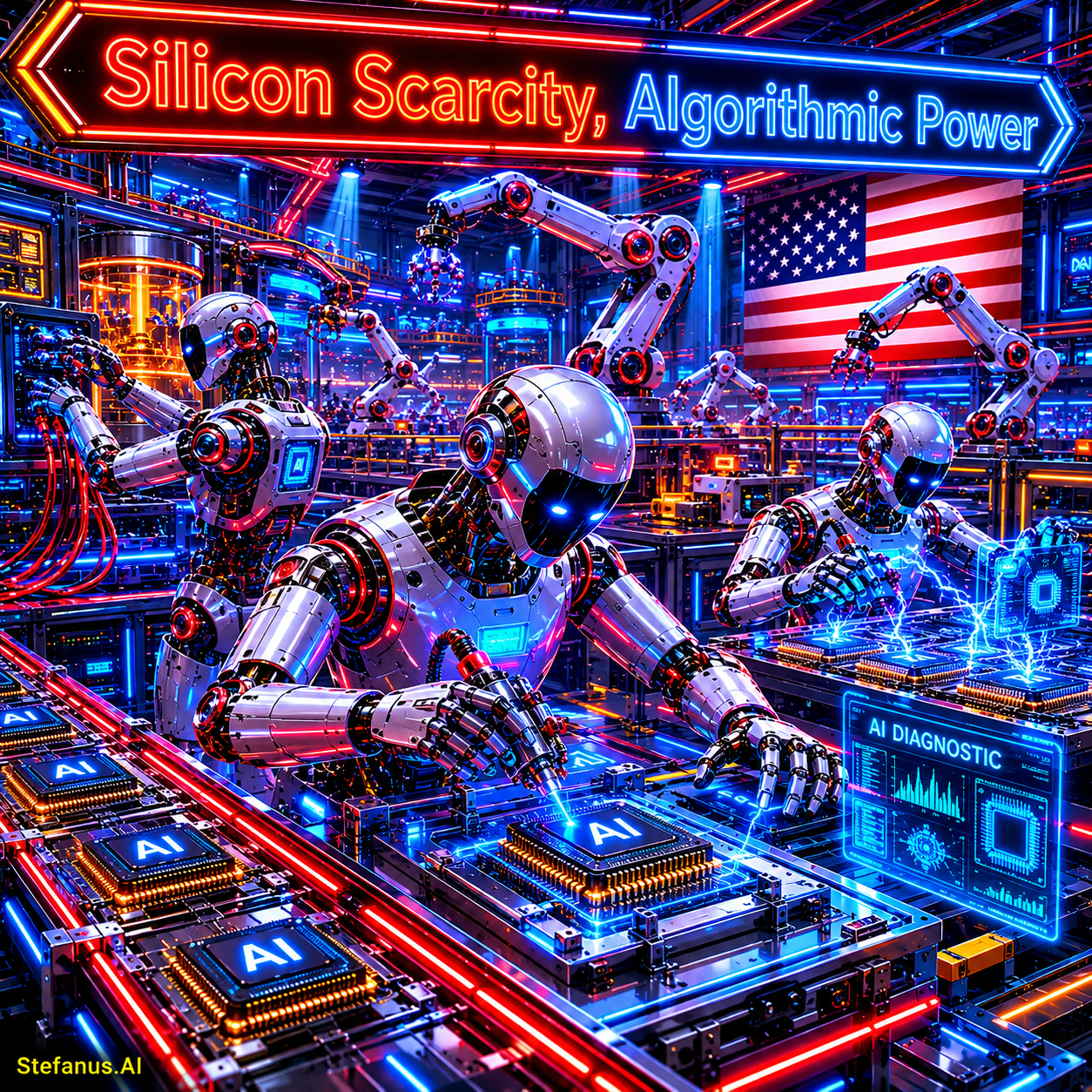

Introduction: US–China Bifurcation Framework
The formal dissolution of the Soviet Union on December 26, 1991, was supposed to mark the triumph of an open, market-integrated world order. The decades that followed produced a hyper-efficient global economy in which hardware was manufactured where costs were lowest, software was deployed across borderless internet protocols, and advanced technology was treated as a shared resource governed by liberal market norms. For the semiconductor industry in particular, this era generated a breathtaking concentration of interdependencies: a single advanced microchip could require raw materials from the Democratic Republic of Congo, intellectual property licensed from California, extreme ultraviolet lithography machines manufactured exclusively in the Netherlands, wafer fabrication in Taiwan, and final assembly in Malaysia. The system was optimized not for resilience but for efficiency, built on the assumption that deeper economic integration was irreversible.
That assumption is now dead. We are not entering a new Cold War — a phrase that implies familiar ideological symmetry and the same geopolitical grammar of the 20th century. We are entering something structurally different: a global competition for AI supply-chain dominance whose stakes are nothing less than the distribution of intelligence itself. The catalyst was OpenAI’s public launch of ChatGPT in November 2022, which transformed artificial intelligence from a long-horizon research agenda into an immediate geopolitical imperative. Within months, the United States government had enacted sweeping semiconductor export controls, China had accelerated its “Big Fund” domestic substitution drive, and the international community had discovered that the invisible architecture of chip supply chains was, in fact, the decisive terrain of 21st-century great-power competition.
This paper introduces and develops what I call the US–China bifurcation framework — the systematic decoupling of the world’s two largest economies across the entire technology stack, from the sub-atomic manipulation of silicon wafers to the philosophical guardrails governing machine intelligence. The central argument is that this bifurcation has created a profound and self-reinforcing feedback loop between hardware scarcity and software sovereignty. By weaponizing semiconductor supply chains through export controls, the United States has triggered an “AI chips war” aimed at denying China the computational foundation required for frontier AI. In response, China has pivoted toward localized hardware architectures and a distinct regulatory model. This material fragmentation is now directly shaping global AI governance, splitting the world into two incompatible technological ecosystems characterized by conflicting algorithmic rules, divergent technical standards, and fragmented compute resources.
The intellectual foundation for understanding this dynamic was laid by professors Henry Farrell (Johns Hopkins SAIS) and Abraham L. Newman (Georgetown), whose theory of “weaponized interdependence” holds that states controlling the central “hubs” in global economic networks can exploit asymmetric positions to coerce adversaries.1 The semiconductor supply chain is perhaps the most extreme embodiment of this dynamic in history. The United States did not need to fire a single missile to deliver a strategic blow to China’s AI ambitions; it needed only to update the export control classification of a graphics processing unit.
The IMF, in its April 2026 scenario-planning synthesis on the global implications of artificial intelligence, issued a stark warning:
“International cooperation on AI standards and taxation is pivotal to avoid bifurcation. Rapid AI diffusion risks concentrating production, capital, and rents in a subset of economies with strong infrastructure and AI capabilities. Cross-border spillovers — through capital flows, mobile rents, and fragmented standards — make cooperation on taxation principles and interoperable assurance frameworks particularly important, especially for emerging and developing economies seeking to avoid being locked into low diffusion equilibria.”
— International Monetary Fund, Global Economic and Financial Implications of Artificial Intelligence, IMF Notes Vol. 2026, Issue 002 (April 2026)²
What follows is a seven-section analytical journey through the full architecture of this bifurcation — from the physical foundations of silicon supply chains, through the anatomy of the chips war, to the governance consequences and global strategic spillovers. This paper is written not merely as a technical survey but as a diagnosis of the structural forces that are reordering global power in the age of artificial intelligence.

Section 1: The Four-Layer Architecture of Semiconductor Supply Chains
To understand why the bifurcation is so consequential, one must first appreciate the extraordinary complexity of the system being fractured. The global semiconductor supply chain is arguably the most intricate, geographically concentrated, and interdependent manufacturing apparatus in human history. A single advanced AI accelerator chip — the kind that powers large language models — embeds decades of cumulative knowledge across materials science, photolithography, electrical engineering, quantum mechanics, and logistics. It requires components, software, and raw materials that traverse international borders dozens of times before a final wafer is sliced and tested. No single country, however powerful, controls all the nodes in this chain.
This chain can be understood through four interdependent layers, each governed by a concentrated set of actors whose market dominance gives them extraordinary structural power:
| DESIGN US / EDA Tools NVIDIA · AMD | ➡ | MACHINERY Netherlands ASML EUV | ➡ | FABRICATION Taiwan (TSMC) S. Korea / Japan | ➡ | ASSEMBLY Malaysia · Singapore Vietnam · Philippines |
1.1 Design Layer: The American Chokepoint
The design layer is where the United States exerts its most powerful leverage. Cutting-edge chip design software — known as Electronic Design Automation (EDA) tools — is dominated by three American firms: Synopsys, Cadence Design Systems, and Mentor Graphics (acquired by Siemens). Without these tools, a semiconductor firm cannot convert an architectural concept into a manufacturable circuit layout. American fabless design giants NVIDIA, AMD, Intel, Qualcomm, and Broadcom all operate within this ecosystem. The centrality of US design software means that export controls can reach deep into foreign firms’ operations even if they manufacture their chips entirely outside the United States.3
Chinese firms, most notably Huawei’s HiSilicon and Alibaba’s T-Head semiconductor division, have made genuine strides in chip design, but remain dependent on EDA tools subject to US license requirements. New entrants such as Cerebras Systems (NASDAQ: CBRS) and the emerging compute architectures being developed within the Tesla and SpaceX (Terafab) engineering ecosystem represent the next wave of specialized AI hardware, further deepening the US lead in design innovation. Beijing’s coalition of eight government bodies — including the Cyberspace Administration of China and the Ministry of Industry and Information Technology — have responded by sponsoring a nationwide push to adopt the open-source RISC-V instruction set architecture, precisely to create a design pathway that circumvents American intellectual property controls.4
1.2 Machinery Layer: The Dutch Monopoly
If the design layer is America’s chokepoint, the machinery layer is the Netherlands’. One hundred percent of the world’s Extreme Ultraviolet (EUV) lithography machines are manufactured exclusively by ASML, headquartered in Veldhoven. EUV is the technology that allows chip makers to etch circuits at scales below 7 nanometers — the threshold required for the most energy-efficient, high-performance AI accelerators. A single EUV machine contains roughly 100,000 components, costs approximately €350 million, and is assembled by a global supply network that itself spans dozens of countries.5
Under sustained pressure from Washington, the Dutch government has for several years blocked ASML from exporting EUV machines to China. This single restriction has proven more strategically consequential than any tariff or trade measure. Without EUV, Chinese foundries cannot manufacture chips below the 7-nanometer threshold with competitive yields, consigning China’s most advanced domestic fabrication to Deep Ultraviolet (DUV) machinery that was commercially mature a decade ago. As Prof. Hung-Yi Chen of Taiwan National University observed in a February 2026 analysis:
“Constructing a single advanced wafer fab requires tens of billions of dollars in investment, thousands of top-tier engineers, the coordinated operation of hundreds of precision instruments, and a construction timeline of three to five years. These extraordinarily high technological barriers and capital intensity mean that semiconductor manufacturing is not an industry one can simply decide to enter — it is more akin to a national-level capability that takes decades to accumulate.”
— Prof. Hung-Yi Chen, Semiconductor Geopolitics in 2026: Taiwan’s Strategic Choices in the Chip War (February 2026)⁶
1.3 Fabrication Layer: The Taiwan Concentration
Over 90% of the world’s most advanced logic chips — those at 7 nanometers and below — are fabricated by Taiwan Semiconductor Manufacturing Company (TSMC), a single firm on an island of 23 million people located 160 kilometers from the Chinese mainland.7 This concentration is not accidental; it reflects six decades of deliberate industrial policy, deep STEM education investment, and the clustering of specialized engineering talent in the Hsinchu Science Park ecosystem.
The geopolitical implications are staggering. TSMC’s Fab 21 in Phoenix, Arizona — a centerpiece of the CHIPS and Science Act’s “re-shoring” ambition — began high-volume production of 4-nanometer chips in early 2025, with yield rates that by late 2025 were reportedly surpassing comparable Taiwan facilities by approximately four percentage points.8 TSMC received $6.6 billion in CHIPS Act grants and up to $5 billion in government loans to support the Arizona investment, which has now grown to a total commitment exceeding $65 billion.9 Yet as Foreign Policy reported in October 2025, Taiwan remains TSMC’s crown jewel, with ten fabs and five backend facilities there producing most of its chips, including its most advanced designs.10 Arizona is a critical hedge, not a replacement.
1.4 Assembly Layer: Southeast Asia’s Strategic Role
The Assembly, Testing, and Packaging (ATP) layer — often mischaracterized as the “low-value” end of the chain — is emerging as a critical geopolitical terrain. Southeast Asia has cemented its role as the world’s premier hub for this stage of production, with four nations occupying distinct strategic niches:11
- Malaysia and its Penang corridor, often called the “Silicon Valley of the East,” anchors a mature 50-year-old ATP ecosystem, hosting Intel, Infineon, and Micron facilities that account for an estimated 7% of global ATP capacity.
- Singapore focuses on high-value advanced packaging and R&D, accounting for over 10% of global chip exports.
- Vietnam is rapidly emerging as the fastest-growing destination for semiconductor assembly, with Foxconn, Amkor, and Intel pouring billions into state-of-the-art facilities since 2023.
- The Philippines, with a four-decade track record, remains a significant processor for microcontrollers and analog integrated circuits. As the bifurcation deepens, these nations face an existential strategic dilemma: US export control “guardrail” regulations increasingly scrutinize transshipment through Southeast Asian hubs, with draft restrictions targeting Malaysia and Thailand over suspected chip diversion to China reported as recently as July 2025.12

Section 2: The Anatomy of US–China Bifurcation — Strategy, Subsidy, and Structural Decoupling
The US–China bifurcation did not emerge from a single policy decision or a single corporate rivalry. It is the cumulative product of a decade of escalating strategic competition, crystallized by the recognition — simultaneous in Washington and Beijing — that artificial intelligence represents not merely a commercial technology but a foundational source of national power. Understanding the anatomy of this bifurcation requires examining how both superpowers have deployed the tools of state in the service of technological supremacy.
2.1 The US Strategy: Weaponized Interdependence in Practice
The structural concentration of the semiconductor supply chain gave the United States a form of latent leverage that it had not fully appreciated until the AI revolution made its strategic value apparent. Farrell and Newman’s framework of weaponized interdependence argues that
“states that control economic chokepoints can weaponize networks to gather information or choke off economic access to adversaries, transforming the architecture of globalization into an instrument of coercion.”
— Henry Farrell (Johns Hopkins SAIS) and Abraham L. Newman (Georgetown University), “Weaponized Interdependence: How Global Economic Networks Shape State Coercion,” International Security, Vol. 44, No. 1 (2019)¹³
The US Department of Commerce Bureau of Industry and Security (BIS) has applied this logic with escalating aggression since October 2022. The initial export controls targeted the most advanced AI accelerators — NVIDIA’s A100 and H100 — as well as the semiconductor manufacturing equipment required to produce them. In subsequent rounds, controls were extended to cover the “downgraded” China-market variants NVIDIA had developed to stay in the market (the H800 and A800), then tightened further to cover the H20 and L20 chips specifically designed to comply with bandwidth thresholds. On April 9, 2025, NVIDIA received notice from the US government that even H20 exports to China now require an export license — effectively a full blockade of the China market.14
The commercial consequences were immediate and severe. In its Q1 FY2026 earnings report (filed May 28, 2025), NVIDIA disclosed a $4.5 billion charge associated with H20 excess inventory and purchase obligations, with sales of H20 products reaching $4.6 billion in Q1 FY2026 prior to the new export licensing requirements — revenue that evaporated overnight.15 CFO Colette Kress warned that losing access to China’s AI accelerator market, which she projected would grow to nearly $50 billion,
“would have a material adverse impact on our business going forward and benefit our foreign competitors in China and worldwide. The question is whether one of the world’s largest AI markets will run on American platforms.”
— Colette Kress, CFO, NVIDIA Corporation, Q1 FY2026 Earnings Call (May 28, 2025)¹⁵
NVIDIA’s Q2 FY2026 guidance projected a further $8 billion loss in H20 revenue, even as total company revenue was guided to $45 billion — a testament to the underlying strength of the AI buildout outside China, but also to the scale of the market being surrendered.16
2.2 State Subsidies: The Race to Re-Shore and Self-Reliance
Both superpowers have backed their strategic intentions with extraordinary fiscal commitments. The CHIPS and Science Act (2022) allocated $52.7 billion in semiconductor manufacturing and R&D subsidies, with the explicit goal of attracting TSMC, Samsung, and Intel to build advanced fabrication on American soil and insulating Western supply chains from cross-strait risk.17 By early 2026, TSMC’s Arizona investment had grown to over $65 billion; Intel’s Fab 52 in Arizona entered high-volume manufacturing using its Intel 18A (1.8-nanometer class) process node — a historic milestone that demonstrated the US could still execute large-scale high-technology industrial programs.18
China’s response is equally muscular. The National Integrated Circuit Industry Investment Fund (colloquially, “The Big Fund”), now in its third iteration, has injected tens of billions of renminbi into the domestic semiconductor ecosystem.19 The overarching national strategy — articulated in China’s 2017 New Generation AI Development Plan and operationalized through successive Five-Year Plans — aims for full self-sufficiency in core semiconductor technologies by 2030, with the intermediate goal of matching global AI standards by 2025. The emergence of DeepSeek in January 2025 — which its own researchers described as having been built while consuming “twice the computing power to achieve the same results” as US peers before algorithmic breakthroughs closed the gap — represents the most dramatic proof-of-concept for China’s forced-march innovation model.20
2.3 The Bifurcation’s Structural Character
What distinguishes this moment from previous episodes of US–China technology competition is the structural depth of the decoupling. It is no longer a matter of restricting individual products or companies. The bifurcation is now encoded in diverging hardware architectures (x86/ARM/CUDA versus RISC-V/Ascend/CANN), diverging cloud ecosystems (AWS/Azure/Google Cloud versus Alibaba Cloud/Huawei Cloud/Tencent Cloud), diverging AI governance frameworks (EU AI Act and NIST voluntary guidelines versus CAC mandatory state-security reviews), and diverging data environments (open, global internet datasets versus nationally curated, ring-fenced sovereign data lakes). As the IMF cautioned in April 2026, without coordinated international intervention,
“the digital frontier may serve as a new barrier to global convergence rather than a bridge.”
— IMF Notes, Global Economic and Financial Implications of Artificial Intelligence (April 2026)²

Section 3: The AI Chips War — Fracturing the Foundation of Compute
Compute is to the AI era what oil was to the industrial era: the foundational energy source from which all downstream capability flows. Frontier AI models — the large language models, multi-modal neural networks, and reasoning systems that are redefining what machines can do — require tens of thousands of specialized Graphics Processing Units (GPUs) training simultaneously for weeks or months. The H100, NVIDIA’s flagship AI accelerator prior to the Blackwell generation, delivers approximately 2,000 TFLOPS of FP16 performance and 900 gigabytes per second of HBM3 memory bandwidth. Training GPT-4 required an estimated 25,000 A100s running continuously for approximately 90 to 100 days. Multiply this by the ambitions of Alibaba, Baidu, ByteDance, and Tencent, and the strategic importance of GPU access becomes self-evident.21
By targeting the compute layer, US export controls strike at the physical precondition for Chinese AI advancement. The following table summarizes the performance landscape created by the bifurcation:
| Metric | Western Standard (NVIDIA H100/B200) | Sanctions-Compliant (H20 / L20) | China Domestic (Huawei Ascend 910C) |
| Process Node | 4 nm (TSMC) | 4 nm (TSMC) | 7 nm DUV (SMIC) |
| FP16 Performance | ~2,000 TFLOPS (B200) | 148 TFLOPS | 640 TFLOPS |
| Memory Bandwidth | Ultra-High (900+ GB/s HBM3e) | Restricted (Latency bottlenecks) | 6.4 TB/s HBM2e (dual-chip module) |
| Interconnect | NVLink / NVSwitch (Full cluster) | Restricted topology | Localized clusters (HCCS) |
| Inference vs H100 | Baseline (or superior) | ~15–25% of H100 | ~60–80% of H100 |
| Primary Deployment | Global Frontier AI Clusters | Market-Specific Compliance Tier | Domestic Sovereign Cloud (China) |
| Production Target (2026) | Scaled globally | Restricted / phased out | ~600,000 units planned |
Source: NVIDIA Q1 FY2026 Earnings Report (May 2025); TrendForce; CFR Technical Analysis (December 2025); Huawei Ascend Technical Documentation; Mizuho Securities Yield Analysis (2025).22
3.1 Huawei Ascend: China’s Sovereign AI Hardware Stack
The hardware denial strategy has forced a dramatic acceleration of China’s domestic substitution drive. Huawei’s Ascend AI ecosystem has emerged as the most credible domestic alternative to NVIDIA inside China, though the performance gap remains substantial and technically revealing. The Ascend 910C — Huawei’s most advanced chip as of 2025–26 — combines two 910B chiplets on a single board using a dual-chip integration approach that exploits packaging innovation to overcome process node limitations. Manufactured using SMIC’s 7-nanometer N+2 process via Deep Ultraviolet (DUV) lithography rather than ASML’s EUV machines, the 910C achieves an estimated 640–800 TFLOPS at FP16 — delivering between 60% and 80% of NVIDIA H100 inference performance under comparable conditions, according to analysis by the Council on Foreign Relations and DeepSeek researchers.23
The manufacturing constraints are significant. Mizuho Securities estimated the Ascend 910C’s yield rate at approximately 30% as of early 2025 — dramatically below the 70–80% yields achieved by TSMC for comparable chips using EUV.24 By February 2025, the Financial Times reported yield had improved to approximately 40%, making the Ascend production line profitable for the first time.25 Huawei plans to manufacture approximately 600,000 units of the Ascend 910C in 2026 — nearly double the 2025 output — with a total Ascend family production target of up to 1.6 million dies.26
Chinese AI developers have adapted to this hardware constraint through horizontal scaling: running larger clusters of Ascend chips rather than relying on the raw per-chip performance of NVIDIA’s Blackwell generation. The B200 GPU, NVIDIA’s current flagship, operates at a 4-nanometer TSMC process node and delivers performance roughly three times that of the Ascend 910C on BF16 workloads — a gap that structural process technology constraints make nearly impossible for China to close through incremental improvement alone.27
3.2 RISC-V and Architectural Sovereignty
Beyond the immediate compute gap, China is executing a longer-horizon strategy to permanently immunize its hardware roadmap from US license revocations. This centers on the RISC-V instruction set architecture, an open-source standard developed at UC Berkeley that allows chip designers to build processors without paying royalties to Intel (x86) or ARM (which remains subject to UK and US regulatory scrutiny). In March 2025, a coalition of eight Chinese government bodies — including the Cyberspace Administration and the Ministry of Industry and Information Technology — issued policy guidance to accelerate nationwide RISC-V adoption.28
The Center for Security and Emerging Technology (CSET) at Georgetown University assessed this development with notable concern: as RISC-V scales from IoT devices to high-performance data center processors, it creates a pathway for China to design AI chips that are architecturally independent of any US-controlled intellectual property — potentially rendering future export control tightening structurally ineffective.29 By early 2026, Chinese firms including Alibaba’s T-Head processor division and the Beijing Open-Source Chip Research Institute had become among the most prolific contributors to the RISC-V standards body, ensuring that their domestic semiconductor industry could continue to innovate even in the face of further sanctions. Alibaba’s Damo Academy launched the next generation of its RISC-V XuanTie processors for applications in 5G communications, robotics, and financial services in February 2025.30

Section 4: Algorithmic Power and the Bifurcation of AI Governance
The fragmentation of physical hardware infrastructure is not merely a commercial or engineering phenomenon. It is a civilizational inflection point. Artificial intelligence governance is fundamentally a political act: the rules that determine which speech is filtered, which decisions are automated, which data may be collected and by whom, and which values are encoded into the reward functions of reinforcement learning systems are not technical specifications. They are expressions of the ideological commitments of the states that write them. As the physical infrastructure splits, so too do the regulatory frameworks governing AI, producing two polarized paradigms of what I term algorithmic power: the capacity to define the operating parameters of machine intelligence at scale.
4.1 The Western Alignment and Safety Paradigm
The Western approach to AI governance is anchored in liberal democratic values and expressed most comprehensively through two complementary frameworks: the EU AI Act (fully operative from 2025 for high-risk systems) and the US NIST AI Risk Management Framework, which provides voluntary guidance emphasizing transparency, fairness, robustness, and explainability. These frameworks share a common intellectual foundation: AI systems should be explainable to those they affect, dangerous applications should be prohibited or heavily regulated, and the market ecosystem that produces AI innovation should remain open, competitive, and pluralistic.31
The EU AI Act introduces a risk-tiered regulatory structure in which applications categorized as “unacceptable risk” (such as social scoring by governments) are banned outright, while “high-risk” systems in sectors such as healthcare, employment, and critical infrastructure face mandatory conformity assessments, transparency obligations, and human oversight requirements. The Act’s extraterritorial scope — applying to any AI system used in the EU regardless of where it was developed — gives it a structural power analogous to GDPR: it becomes a de facto global standard wherever developers seek access to European markets.32
George Washington University’s Regulatory Studies Center, in its analysis of the 2025 IMF Annual Meetings, noted the aspiration expressed by Singapore President Tharman Shanmugaratnam for a
“renewed multilateralism rather than technological fragmentation — a cooperative order where leading economies like the United States and China manage interdependence through shared safety standards, reciprocal research access, and transparent cross-border governance channels. Just as post-war economic stability required Bretton Woods institutions to anchor financial rules, the next era of stability may require a ‘Bretton Woods for algorithms,’ anchored in transparency, accountability, and evidence.”
— GWU Regulatory Studies Center, “Toward a New Multilateralism for AI: Insights from the IMF Annual Meetings 2025” (2025)³³
4.2 The Chinese State-Centric Sovereign Paradigm
China’s AI governance paradigm is structurally different in both its mechanisms and its objectives. Rather than positioning the state as a regulator of an independent market ecosystem, the Chinese framework treats the state as the principal stakeholder in AI development, with the market as its instrument. The regulatory architecture is anchored in a cascade of regulations issued by the Cyberspace Administration of China (CAC): the 2021 Provisions on Algorithmic Recommendations, the 2022 Provisions on Deep Synthesis of Internet Information Services, and the landmark 2023 Interim Measures for the Administration of Generative AI Services — which constituted the world’s first comprehensive generative AI regulation when it entered force in August 2023.34
These measures require that AI-generated content adhere to core socialist values, that training data be sourced from lawful channels aligned with state interests, and that all generative AI services undergo rigorous security reviews before public release. The CAC has also launched two nationwide enforcement campaigns under the “Clean Cyberspace” (Qinglang) initiative: the first targeting algorithmic problems such as homogeneous recommendation systems that create “information cocoons,” and the second focusing specifically on AI misuse and deep synthesis.35
Critically, China’s March 2025 Measures for Labeling of AI-Generated Synthetic Content — which entered force on September 1, 2025 — introduced both explicit labels (visible “AI-generated” disclaimers) and implicit labels (metadata tags embedded in files), accompanied by plans for digital identity verification through centralized government-issued digital IDs. This architecture gives the Chinese state a level of surveillance and content control over AI-generated material that has no equivalent in the Western regulatory framework.36
4.3 The Data Layer: Where Incompatibility Becomes Irreconcilable
The governance split produces its most consequential effects at the data layer. Western models are trained on an open, global internet dataset, shaped by Western cultural norms, common law copyright protections, and the principle of relatively free information flow. Chinese models are trained on heavily curated, nationalized datasets, ring-fenced within a sovereign digital ecosystem that legally prohibits the cross-border transfer of sensitive data without state approval. The result is a bifurcation of world models: the epistemic structures through which AI systems understand language, reason about causality, and generate outputs. A Western-trained model operating on Chinese training data would produce fundamentally different outputs than a Chinese-trained model on the same queries, not merely because of censorship, but because the underlying statistical distribution of language, history, and social relationships is different in the two datasets. This is not a fixable software bug; it is a structural consequence of governing AI through incompatible worldviews.
Stanford University’s Institute for Human-Centered AI (HAI) captured the broader significance of this split in its February 2025 faculty analysis of DeepSeek’s emergence:
“Central to the conversation is how DeepSeek has challenged the preconceived notions regarding the capital and computational resources necessary for serious advancements in AI. The capacity for clever engineering and algorithmic innovation demonstrated by DeepSeek may empower less-resourced organizations to compete on meaningful projects.”
— Stanford Institute for Human-Centered AI (HAI), “How Disruptive Is DeepSeek? Stanford HAI Faculty Discuss China’s New Model” (February 2025)³⁷

Section 5: The Feedback Loop — How Hardware Scarcity Dictates Software Sovereignty
The relationship between the chips war and AI governance is not linear and it is not static. It is a dynamic, self-reinforcing feedback loop in which material constraints drive software innovations that in turn reshape governance architectures, while governance rules are simultaneously being written to target the physical hardware on which AI systems depend. This loop operates simultaneously at the corporate, national, and international levels, compressing timelines, intensifying innovation pressure, and generating structural adaptations that neither superpower fully anticipated.
| STAGE | DYNAMIC MECHANISM |
| 1. Material Hardware Scarcity | GPU export restrictions reduce Chinese compute capacity by limiting access to H100/H200/B200-class hardware |
| 2. Software Innovation | Scarcity forces algorithmic breakthroughs: MoE architectures (DeepSeek-V3), model quantization, efficient fine-tuning of Small Language Models |
| 3. Localized Infrastructure | Sovereign cloud buildout, nationalized data lakes, Huawei Ascend cluster deployments, state-backed AI campuses |
| 4. Compute-Driven Governance | FLOPs thresholds in executive orders, data center megawatt reporting requirements, regulatory mandates tied to physical hardware footprint |
5.1 From Scarcity to Innovation: The DeepSeek Proof-of-Concept
The most dramatic single demonstration of the hardware–software feedback loop is DeepSeek. Launched to global attention on January 20, 2025, DeepSeek R1 and its underlying base model V3 demonstrated that a Chinese AI company could match or surpass the capabilities of frontier Western LLMs at a fraction of the compute cost. DeepSeek-V3 was trained using approximately 2,048 NVIDIA H800 GPUs — a restricted, downgraded variant — and consumed roughly 2.79 million GPU hours, compared to the vastly larger clusters employed for comparable Western models.38
The architectural innovations that made this possible were direct responses to compute scarcity: a Mixture of Experts (MoE) architecture that activates only 37 billion of 671 billion total parameters per token, dramatically reducing per-inference compute cost; Multi-head Latent Attention (MLA) for memory optimization; FP8 mixed-precision training to accelerate performance without sacrificing accuracy; and a custom Multi-Plane Network Topology to minimize inter-device communication overhead.39 As DeepSeek founder Liang Wenfeng told the Chinese media outlet 36Kr in July 2024, before R1’s public launch:
“We [most Chinese companies] have to consume twice the computing power to achieve the same results. Combined with data efficiency gaps, this could mean needing up to four times more computing power. Our goal is to continuously close these gaps.”
— Liang Wenfeng, Founder, DeepSeek, interview with 36Kr (July 2024), cited in MIT Technology Review (January 2025)⁴⁰
The Chinese Academy of Sciences’ Institute of Neuroscience described DeepSeek R1’s emergence in a peer-reviewed assessment published in the National Science Review as
“sending shockwaves around the globe — R1’s base LLM V3 was built with a small fraction of the cost and used a much smaller number of low-grade computer chips than the current top LLMs.”
— Mu-ming Poo, Scientific Director, Institute of Neuroscience, Chinese Academy of Sciences, “Reflections on DeepSeek’s Breakthrough,” National Science Review, nwaf044 (February 2025)⁴¹
5.2 Compute-Driven Regulatory Regimes: Hardware as Governance
The West’s response to the challenge of governing AI has arrived at a counterintuitive but historically logical conclusion: the most tractable point of regulatory intervention is not the abstract software or the diffuse data, but the physical hardware. Data and algorithms can cross borders invisibly and instantaneously; data centers cannot. Compute infrastructure is heavy, expensive, energy-intensive, and geographically fixed. It can be taxed, inspected, licensed, and reported.
The Biden-era Executive Order on AI (October 2023) required companies to notify the federal government when training runs exceed specific floating-point operations (FLOPs) thresholds — establishing compute capacity as the primary regulatory trigger. The Trump administration’s July 2025 AI Action Plan extended this logic into export policy, conditioning access to advanced NVIDIA Blackwell chips for Middle Eastern sovereign wealth funds on those nations meeting “rigorous security and reporting requirements.” In November 2025, the US Department of Commerce authorized the export of up to 35,000 Blackwell GB300 chips each to UAE-based G42 and Saudi Arabia’s HUMAIN, with the UAE having previously divested its Chinese technology holdings and replaced its Chinese-developed AI stack as a precondition.42
Peng Xiao, Chief Executive of G42, captured the transactional logic:
“What we build in the UAE, we will continue to match in the US, maintaining symmetry and trust at every layer.”
— Peng Xiao, CEO, G42, statement on US chip export approval, The National (November 20, 2025)⁴³
This hardware-conditioned diplomacy represents a new instrument of foreign policy: compute access as a form of strategic alignment, with the United States functioning as the gatekeeper of AI infrastructure for the non-China world.

Section 6: Global Spillovers — Navigating a Fractured Tech Ecosystem
The US–China bifurcation does not respect the sovereignty of third parties. For the roughly 190 countries that are neither the United States nor China, the chips war creates a forced-choice dilemma of extraordinary difficulty: align with the American compute ecosystem and accept the conditions Washington imposes, align with the Chinese ecosystem and accept the surveillance architecture and governance norms Beijing exports, or attempt a “strategic autonomy” posture that courts technological irrelevance. None of these options is costless, and the window for genuine neutrality is narrowing rapidly.
6.1 The Dilemma of Neutral Nations
The European Union, despite its size and institutional sophistication, finds itself in an uncomfortable middle position. The EU AI Act positions Europe as a regulatory superpower — its transparency and human-rights-centered standards are the most comprehensive in the world — but European firms remain overwhelmingly dependent on US-designed chips, US-built cloud infrastructure, and US-developed foundation models. The EU’s European Processor Initiative (EPI), which leverages RISC-V to develop indigenous exascale supercomputers, represents a long-term hedge against this dependence, but its commercial maturity remains years away.44
For ASEAN nations, the dilemma is more acute. As both major assembly hubs for Western chip supply chains and significant markets for Chinese technology (Huawei’s 5G infrastructure dominates much of Southeast Asia), they face explicit pressure from Washington that aligning too closely with Beijing on hardware may cost them access to advanced US AI chips. In July 2025, the Trump administration was reported to be drafting restrictions targeting Malaysia and Thailand over suspected chip diversion to China — a signal that even historical US allies would face scrutiny if their supply chains provided transshipment pathways.45
The Middle East case illustrates the precise leverage mechanism. Saudi Arabia’s HUMAIN and UAE’s G42 — both state-backed sovereign AI companies with access to virtually unlimited capital — could in principle have sourced compute infrastructure from either the US or Chinese ecosystems. The US Department of Commerce’s November 2025 authorization of up to 35,000 Blackwell chips for each company — reportedly the equivalent of roughly $1 billion in silicon — came only after the UAE had, in the words of Hasan Alhasan, Senior Fellow at the International Institute for Strategic Studies, taken
“far-reaching measures to assuage US concerns including replacing its Chinese-developed AI stack, letting go of Chinese personnel and divesting its Chinese tech holdings.”
— Hasan Alhasan, Senior Fellow for Middle East Policy, International Institute for Strategic Studies (IISS), CNBC (November 2025)⁴⁶
6.2 The Fragmentation of Technical Standards
Perhaps the most underappreciated dimension of the bifurcation is its effect on international technical standards — the invisible infrastructure that allows devices, protocols, and systems from different manufacturers and jurisdictions to communicate and interoperate. Historically, bodies such as the International Telecommunication Union (ITU), the International Organization for Standardization (ISO), and the 3rd Generation Partnership Project (3GPP) provided a neutral arena for technical standard-setting that transcended geopolitics.
That neutrality is now profoundly compromised. The United States and its allies push for AI and telecommunications standards centered on transparency, security auditing, and human rights considerations. China, which has invested heavily in standards bodies — occupying leadership positions across ITU working groups and contributing the largest share of new proposals in several technical domains — champions standards centered on “network sovereignty” and state-managed data management architectures. As the international financial and policy analysis firm International Banker assessed in September 2025:
“Technological bifurcation is accelerating. The EU is regulating artificial intelligence via the AI Act, while the US pursues voluntary guidelines and China mandates tight state controls. Data governance, cybersecurity and intellectual-property standards are diverging. For global companies, geopolitical risk is no longer an abstraction but a boardroom imperative.”
— International Banker, “Strategic Drift or Systemic Reset? Finance at the Crossroads of a Fractured Global Order” (September 2025)⁴⁷
The consequence is a progressive degradation of international software interoperability. AI agents, autonomous systems, and digital platforms built within one sphere may increasingly lack the technical and legal compatibility to communicate, transact, or collaborate with systems built in the other. The borderless internet is not “splitting” metaphorically; it is fracturing physically at the protocol layer.

Section 7: Lessons Learned and Strategic Implications
History rarely delivers its lessons in clean, legible form. But the US–China bifurcation has been operating long enough, and with sufficient intensity, to permit a preliminary accounting of what the strategic record reveals. The following lessons are drawn not from theoretical prediction but from the empirical record of the chips war as it has actually unfolded through early 2026.
7.1 The Illusion of Complete Decoupling
The most fundamental lesson is that total technological isolation between deeply interdependent great powers is a political illusion. Despite the most comprehensive export control regime in the history of the semiconductor industry, supply chains remain far too fluid to completely lock down. Black markets for high-end GPUs have thrived through transshipment hubs in Central Asia, the Middle East, and Southeast Asia. As the Trump administration’s July 2025 addition of 65 new Chinese entities to the Entity List underscored, the enforcement burden of export controls is immense and the evasion incentives are overwhelming.48
Open-source software repositories continue to allow code to cross borders instantaneously. DeepSeek published its model weights, training methodologies, and architectural innovations openly on Hugging Face, allowing researchers worldwide — including, presumably, those in China’s most restricted research institutions — to replicate and extend its findings. NVIDIA CEO Jensen Huang articulated this logic on the Q1 FY2026 earnings call:
“The US has based its policy on the assumption that China cannot make AI chips. That assumption was always wrong. The platform that wins China is positioned to lead globally.”
— Jensen Huang, President and CEO, NVIDIA Corporation, Q1 FY2026 Earnings Call (May 28, 2025)⁴⁹
Containment strategies can delay a peer adversary’s technological maturation. They cannot permanently prevent it. The appropriate policy target is not prohibition but structural advantage — maintaining a lead sufficient to preserve strategic leverage, not hoping for a permanent ceiling.
7.2 For Enterprise Strategy: Redundancy is the New Efficiency
For the multinational technology companies, professional services firms, and industrial enterprises that operate across both geopolitical spheres, the era of optimizing solely for cost-efficiency across a unified global supply chain is definitively over. The new imperative is structural redundancy: building parallel capabilities that can operate within each sphere without fatal interdependence on the other. This means adopting what might be called a “multi-cloud, multi-architecture” strategy — ensuring that software products can run equally well on Western x86/ARM/CUDA stacks and Chinese RISC-V/Huawei CANN platforms, while complying with entirely different regional data sovereignty laws. It means maintaining duplicate supplier relationships in both Western and Chinese vendor ecosystems. And it means accepting that this structural redundancy carries a real cost premium — one that must be treated as a strategic investment rather than an operational inefficiency.
The IMF’s 2025 scenario-planning synthesis reinforced this imperative, recommending that organizations “build resilience through diversification” as a first-order response to the fragmentation of digital infrastructure — while simultaneously calling on national governments to invest in domestic AI capabilities and education systems as the structural foundation for long-term competitiveness.50
7.3 The Shift from Software Capital to Compute Capital
Perhaps the most consequential strategic insight emerging from the chips war is the revaluation of compute infrastructure as a primary form of geopolitical capital. For much of the past two decades, the dominant framework for understanding technology power was software-centric: the nation or firm with the best algorithms, the most talented engineers, and the most innovative product culture would prevail. The chips war has revealed the decisive primacy of physical computing infrastructure.
Nations lacking domestic fabrication capacity or secure compute alliances risk losing their technological autonomy, rendering them entirely dependent on one of the two primary AI empires — and subject to the conditions, surveillance architectures, and algorithmic values those empires export. The November 2025 US–UAE and US–Saudi chip deals are instructive: the United States effectively traded compute access for geopolitical alignment, demonstrating that advanced silicon has become a form of currency whose denomination is sovereign allegiance.
The IMF workshop synthesis captured the underlying dynamic with precision:
“Capital could reallocate toward jurisdictions with stronger AI readiness, regulatory clarity, institutional capacity, and reliable energy access, potentially increasing outflows from less-prepared economies. These cross-border risks — from financial instability to mobile rents and fragmented standards — necessitate urgent international coordination and clear policy sequencing to prevent global bifurcation.”
— IMF Notes, Global Economic and Financial Implications of Artificial Intelligence (April 2026)²

Conclusion:
The title of this paper — Silicon Scarcity, Algorithmic Power — captures the dual reality of the early 21st-century technology landscape. The US–China bifurcation has permanently dismantled the idealized vision of a unified, open, global digital ecosystem. What began as a targeted trade dispute over semiconductor market access has matured into a structural fracture spanning the entire technology stack of human civilization: from the sub-atomic manipulation of silicon wafers through to the philosophical guardrails of machine intelligence.
The chips war and AI governance are two sides of the same coin. Physical chokepoints in hardware manufacturing — ASML’s EUV monopoly, TSMC’s fabrication dominance, NVIDIA’s CUDA software ecosystem — create the conditions for US weaponized interdependence. Chinese adaptation to those chokepoints — through the Huawei Ascend ecosystem, RISC-V architectural sovereignty, and DeepSeek’s compute-efficient model architectures — simultaneously develops indigenous capabilities and reshapes the global algorithmic landscape. The governance frameworks that each side writes to manage AI — the EU AI Act’s risk-tiered liberal paradigm and the CAC’s state-centric sovereign paradigm — reflect and reinforce the material reality of split supply chains and incompatible data environments.
For the international community — the 190-odd nations that are neither Washington nor Beijing — the emerging bifurcated world order presents a challenge of historic proportions. The IMF’s April 2026 synthesis warned that without coordinated international intervention, AI could deepen global inequality rather than reduce it, concentrating productive capacity in a small subset of compute-rich economies while locking less-prepared nations into structural dependence on one of the two AI empires. The call by Singapore’s President Tharman Shanmugaratnam for a “Bretton Woods for algorithms” — a shared institutional framework for AI governance grounded in evidence, transparency, and accountability — represents the highest aspiration of the multilateral order, even as the trajectory of events moves relentlessly in the opposite direction.51
What is certain is this: the foundational question of the 21st century is no longer “who has the best software?” It is “who controls the silicon,” “who governs the algorithms,” and “whose values are encoded in the machines that will increasingly govern human life.” The bifurcation has made these questions visible. History will judge how the international community chooses to answer them.

Footnotes and Endnotes:
1. Farrell, Henry and Abraham L. Newman.. “Weaponized Interdependence: How Global Economic Networks Shape State Coercion.” International Security, Vol. 44, No. 1 (Summer 2019): 42–79. https://doi.org/10.1162/isec_a_00351
2. International Monetary Fund.. “Global Economic and Financial Implications of Artificial Intelligence.” IMF Notes, Vol. 2026, Issue 002 (April 2026). https://www.imf.org/-/media/files/publications/imf-notes/2026/english/insea2026002.pdf
3. Farrell, Henry and Abraham Newman.. Underground Empire: How America Weaponized the World Economy. Henry Holt and Co., 2023. https://us.macmillan.com/books/9781250877819/underground-empire
4. EE Times / Reuters.. “China Bets on Homegrown Chip Tech with RISC-V Boost.” EE Times (March 11, 2025). https://www.eetimes.com/china-bets-on-homegrown-chip-tech-with-risc-v-push/
5. ASML Holding N.V.. Annual Report 2024. ASML Investor Relations, 2025. https://www.asml.com/en/investors/annual-report
6. Chen, Hung-Yi.. “Semiconductor Geopolitics in 2026: Taiwan’s Strategic Choices in the Chip War.” HungYiChen.com (February 22, 2026). https://www.hungyichen.com/en/insights/semiconductor-geopolitics
7. Chen, Hung-Yi.. Ibid. ‘In the advanced-process domain (7 nanometers and below), TSMC alone accounts for over 90% of worldwide capacity.’ https://www.hungyichen.com/en/insights/semiconductor-geopolitics
8. Finsmes.. “TSMC Arizona Expansion Accelerates as Chairman Wei Commits to U.S. Manufacturing Scale.” FinSMEs (December 5, 2025). https://www.finsmes.com/2025/12/tsmc-arizona-expansion-accelerates-as-chairman-wei-commits-to-u-s-manufacturing-scale.html
9. Semiconductor Geopolitics in 2026.. “TSMC’s investment in Arizona has already exceeded $65 billion.” HungYiChen.com (February 22, 2026). https://www.hungyichen.com/en/insights/semiconductor-geopolitics
10. Foreign Policy.. “The U.S. Remains Dependent on Taiwan for Semiconductor Chip Production.” Foreign Policy (October 10, 2025). https://foreignpolicy.com/2025/10/10/tsmc-taiwan-semiconductor-arizona-tech/
11. Part Locator.. “CHIPS Act 2025 Timeline: When Will US Chip Shortages Actually End?” PartLocator.com (November 24, 2025). https://partlocator.com/blog/chips-act-2025-semiconductor-supply-chain-impact
12. Introl.. “AI Export Controls: Navigating Chip Restrictions Globally.” Introl Blog (January 19, 2026). https://introl.com/blog/ai-export-controls-navigating-chip-restrictions-globally-2025
13. Farrell and Newman.. “Weaponized Interdependence.” International Security (2019): 45. https://doi.org/10.1162/isec_a_00351
14. NVIDIA Corporation.. “NVIDIA Announces Financial Results for First Quarter Fiscal 2026.” NVIDIA Newsroom (May 28, 2025). https://nvidianews.nvidia.com/news/nvidia-announces-financial-results-for-first-quarter-fiscal-2026
15. NVIDIA Corporation.. Q1 FY2026 Earnings Press Release, SEC Form 8-K. Filed May 28, 2025. (‘Sales of H20 products were $4.6 billion for Q1 FY2026 prior to the new export licensing requirements.’) https://www.sec.gov/Archives/edgar/data/0001045810/000104581025000115/q1fy26pr.htm
16. NVIDIA Corporation / Computer Weekly.. “Nvidia Takes $4.5bn Hit Due to Export Restrictions.” Computer Weekly (May 29, 2025). (Kress: ‘Losing access to the China AI accelerator market, which we believe will grow to nearly $50bn, would have a material adverse impact.’) https://www.computerweekly.com/news/366625005/Nvidia-takes-45bn-hit-due-export-restrictions
17. CHIPS and Science Act, Pub. L. 117-167.. U.S. Congress (August 9, 2022). $52.7 billion allocation for semiconductor manufacturing and R&D subsidies. https://www.nist.gov/system/files/documents/2022/08/09/CHIPSandScienceAct2022.pdf
18. FinancialContent / TokenRing.. “The Silicon Renaissance: US CHIPS Act Enters Production Era as Intel, TSMC, and Samsung Hit Critical Milestones.” (January 1, 2026). https://markets.financialcontent.com/wral/article/tokenring-2026-1-1-the-silicon-renaissance-us-chips-act-enters-production-era-as-intel-tsmc-and-samsung-hit-critical-milestones
19. FinancialContent / MarketMinute.. “TSMC: The Unseen Shield — How Taiwan’s Chip Giant Dominates Global Geopolitics.” (October 1, 2025). (‘China accelerating its self-sufficiency drive through initiatives like the Big Fund 3.0.’) https://markets.financialcontent.com/wral/article/marketminute-2025-10-1-tsmc-the-unseen-shield-how-taiwans-chip-giant-dominates-global-geopolitics
20. MIT Technology Review.. “How Chinese Company DeepSeek Released a Top AI Reasoning Model Despite US Sanctions.” MIT Technology Review (January 24, 2025 / updated September 2025). https://www.technologyreview.com/2025/01/24/1110526/china-deepseek-top-ai-despite-sanctions/
21. MarkTechPost.. “DeepSeek-V3 Delivers High-Performance Language Modeling by Minimizing Hardware Overhead.” MarkTechPost (May 16, 2025). https://www.marktechpost.com/2025/05/16/this-ai-paper-from-deepseek-ai-explores-how-deepseek-v3-delivers-high-performance-language-modeling-by-minimizing-hardware-overhead-and-maximizing-computational-efficiency/
22. Tom’s Hardware / CFR.. “Huawei’s AI Chip Capabilities Still Pale in Comparison to American Silicon.” Tom’s Hardware (December 18, 2025). (‘The CFR analysis estimates that the Ascend 910C delivers roughly 60% of the inference performance of Nvidia’s H100 under comparable conditions.’) https://www.tomshardware.com/tech-industry/semiconductors/huawei-still-cant-match-nvidia-on-ai-chips-says-cfr-report
23. TrendForce.. “Huawei’s Ascend 910C Takes on NVIDIA as China’s AI Race Heats Up.” TrendForce (March 13, 2025). (‘reportedly hitting 800 TFLOP/s at FP16 with 3.2 TB/s memory bandwidth — nearly 80% as performant as NVIDIA’s H100’) https://www.trendforce.com/news/2025/03/13/news-huaweis-ascend-910c-takes-on-nvidia-as-chinas-ai-race-heats-up-more-alleged-details/
24. Bitrue Research.. “Huawei Ascend AI Chip Specs 2025: Mizuho Securities estimated yield rate for Ascend 910C at approximately 30%.” Bitrue (May 20, 2025). https://www.bitrue.com/blog/huawei-ascend-ai-chip-specs-2025
25. DigiTimes.. “Huawei Ascend 910C Reportedly Hits 40% Yield, Turns Profitable; Aims for 60% Industry Standard.” DigiTimes (February 25, 2025). https://www.digitimes.com/news/a20250225PD224/huawei-ascend-ai-chip-yield-rate.html
26. RCR Wireless / Bloomberg.. “Huawei to Double Output of Ascend AI Chips.” RCR Wireless (March 25, 2026). (‘Huawei aims to manufacture about 600,000 units of its Ascend 910C chip in 2026, roughly twice the expected output for this year.’) https://www.rcrwireless.com/20250930/ai-infrastructure/huawei-ai-chips-2
27. Abhishek Gautam / Huawei Ascend 910C Analysis.. “Huawei Plans to Produce 600,000 Ascend 910C AI Chips in 2026. Each 910C delivers roughly one-third the BF16 throughput of Nvidia’s B200.” ABHS.in (March 8, 2026). https://www.abhs.in/blog/huawei-ascend-910c-china-nvidia-alternative-2026
28. EE Times.. “China Bets on Homegrown Chip Tech with RISC-V Boost.” (March 11, 2025). https://www.eetimes.com/china-bets-on-homegrown-chip-tech-with-risc-v-push/
29. CSET, Georgetown University.. “RISC-V: What It Is and Why It Matters.” Center for Security and Emerging Technology (December 19, 2025). https://cset.georgetown.edu/article/risc-v-what-it-is-and-why-it-matters/
30. CSIS.. “Sustaining Standards Leadership: The United States Cannot Disengage from RISC-V.” Center for Strategic and International Studies (July 16, 2025). https://www.csis.org/analysis/sustaining-standards-leadership-united-states-cannot-disengage-risc-v
31. IAPP.. “Global AI Governance Law and Policy: China.” IAPP (November 12, 2025 / updated). https://iapp.org/resources/article/global-ai-governance-china
32. European Union.. Regulation (EU) 2024/1689 of the European Parliament and of the Council — Artificial Intelligence Act. Official Journal of the European Union (July 12, 2024). https://eur-lex.europa.eu/legal-content/EN/TXT/?uri=CELEX:32024R1689
33. GWU Regulatory Studies Center.. “Toward a New Multilateralism for AI: Insights from the IMF Annual Meetings 2025.” George Washington University (2025). https://regulatorystudies.columbian.gwu.edu/toward-new-multilateralism-ai-insights-imf-annual-meetings-2025
34. Securiti.. “Navigating China’s AI Regulatory Landscape in 2025: What Businesses Need to Know.” Securiti.ai (October 13, 2025). https://securiti.ai/china-ai-regulatory-landscape/
35. ICLG.. “China’s Key Developments in Artificial Intelligence Governance in 2025.” International Comparative Legal Guides (December 15, 2025). https://iclg.com/practice-areas/telecoms-media-and-internet-laws-and-regulations/03-china-s-key-developments-in-artificial-intelligence-governance-in-2025
36. Mayer Brown.. “China Formulates New AI Global Governance Action Plan and Issues Draft Ethics Rules and AI Labelling Rules.” Mayer Brown (November 19, 2025). (‘Labelling Measures released by the CAC on 14 March 2025, took effect on 1 September 2025.’) https://www.mayerbrown.com/en/insights/publications/2025/10/artificial-intelligence-a-brave-new-world-china-formulates-new-ai-global–governance-action-plan-and-issues-draft-ethics-rules-and-ai-labelling-rules
37. Stanford HAI.. “How Disruptive Is DeepSeek? Stanford HAI Faculty Discuss China’s New Model.” Stanford Report (February 13, 2025). https://news.stanford.edu/stories/2025/02/how-disruptive-is-deepseek
38. MarkTechPost.. “DeepSeek-V3 trained using approximately 2,048 NVIDIA H800 GPUs, consuming roughly 2.79 million GPU hours.” (May 16, 2025). https://www.marktechpost.com/2025/05/16/this-ai-paper-from-deepseek-ai-explores-how-deepseek-v3-delivers-high-performance-language-modeling-by-minimizing-hardware-overhead-and-maximizing-computational-efficiency/
39. MarkTechPost.. “Innovations include Multi-head Latent Attention (MLA), Mixture of Experts (MoE) framework activating 37B of 671B parameters per token, FP8 mixed-precision training.” (May 16, 2025). https://www.marktechpost.com/2025/05/16/this-ai-paper-from-deepseek-ai-explores-how-deepseek-v3-delivers-high-performance-language-modeling-by-minimizing-hardware-overhead-and-maximizing-computational-efficiency/
40. MIT Technology Review.. “How Chinese Company DeepSeek Released a Top AI Reasoning Model Despite US Sanctions.” Quoting Liang Wenfeng interview with 36Kr (July 2024). MIT Technology Review (January 2025). https://www.technologyreview.com/2025/01/24/1110526/china-deepseek-top-ai-despite-sanctions/
41. Poo, Mu-ming.. “Reflections on DeepSeek’s Breakthrough.” National Science Review, nwaf044 (February 12, 2025). DOI: 10.1093/nsr/nwaf044. https://www.ncbi.nlm.nih.gov/pmc/articles/PMC11879125/
42. U.S. Department of Commerce.. “Statement on UAE and Saudi Chip Exports.” Bureau of Industry and Security, U.S. Department of Commerce (November 20, 2025). (‘Both companies are receiving approvals to purchase the equivalent of up to 35,000 Nvidia Blackwell chips (GB300s).’) https://www.commerce.gov/news/press-releases/2025/11/statement-uae-and-saudi-chip-exports
43. Peng Xiao, CEO G42.. Quoted in The National, “US Approves Export of Nvidia AI Chips to UAE and Saudi Arabia.” The National (November 20, 2025). https://www.thenationalnews.com/future/technology/2025/11/20/uae-ai-nvidia-chips-us/
44. FinancialContent / TokenRing.. “The RISC-V Revolution: How an Open-Source Architecture is Upending the Silicon Status Quo.” (‘The EU is utilizing RISC-V to develop its own exascale supercomputers.’) January 28, 2026. https://markets.financialcontent.com/wral/article/tokenring-2026-1-28-the-risc-v-revolution-how-an-open-source-architecture-is-upending-the-silicon-status-quo
45. Introl.. “AI Export Controls: Navigating Chip Restrictions Globally. July 2025: Reports emerge of draft restrictions targeting Malaysia and Thailand over suspected chip diversion to China.” (January 19, 2026). https://introl.com/blog/ai-export-controls-navigating-chip-restrictions-globally-2025
46. Alhasan, Hasan.. Senior Fellow for Middle East Policy, International Institute for Strategic Studies. Quoted in CNBC, “U.S. Greenlights AI Chip Exports to Gulf Tech Giants” (November 21, 2025). https://www.cnbc.com/2025/11/20/us-approves-ai-chip-exports-to-gulf-after-saudi-crown-prince-visit.html
47. International Banker.. “Strategic Drift or Systemic Reset? Finance at the Crossroads of a Fractured Global Order.” International Banker (September 5, 2025). https://internationalbanker.com/finance/strategic-drift-or-systemic-reset-finance-at-the-crossroads-of-a-fractured-global-order/
48. Introl.. “AI Export Controls: Navigating Chip Restrictions Globally. 65 new Chinese entities added to Entity List in 2025.” (January 19, 2026). https://introl.com/blog/ai-export-controls-navigating-chip-restrictions-globally-2025
49. Huang, Jensen.. NVIDIA Corporation, Q1 FY2026 Earnings Call. Quoted in Manufacturing Dive, “Nvidia Logs 69% Q1 Revenue Jump Despite Trump Export Controls” (May 29, 2025). https://www.manufacturingdive.com/news/nvidia-q1-2026-earnings-export-controls-china-trump/749261/
50. IMF.. “Global Economic and Financial Implications of Artificial Intelligence.” IMF Notes, 2026/002 (April 2026). https://www.elibrary.imf.org/view/journals/068/2026/002/article-A001-en.xml
51. GWU Regulatory Studies Center.. “Toward a New Multilateralism for AI.” Citing Singapore President Tharman Shanmugaratnam at IMF Annual Meetings 2025. GWU (2025). https://regulatorystudies.columbian.gwu.edu/toward-new-multilateralism-ai-insights-imf-annual-meetings-2025


Comments
[…] second paper, Silicon Scarcity, Algorithmic Power: How the US–China Bifurcation is Reshaping AI Governance, Semi…, introduces the most analytically complete framework in the entire body of work: the US–China […]
[…] is the central argument of this paper: compute is the new oil, and the wells are running dry. The global shortage of high-performance GPU capacity — driven by semiconductor memory constraints at SK Hynix, TSMC […]
[…] United States restricted advanced AI chips because compute is now a strategic input to model capability — arguably the strategic input. […]