
Introduction: The Day Half a Nuclear Plant Became an AI Asset
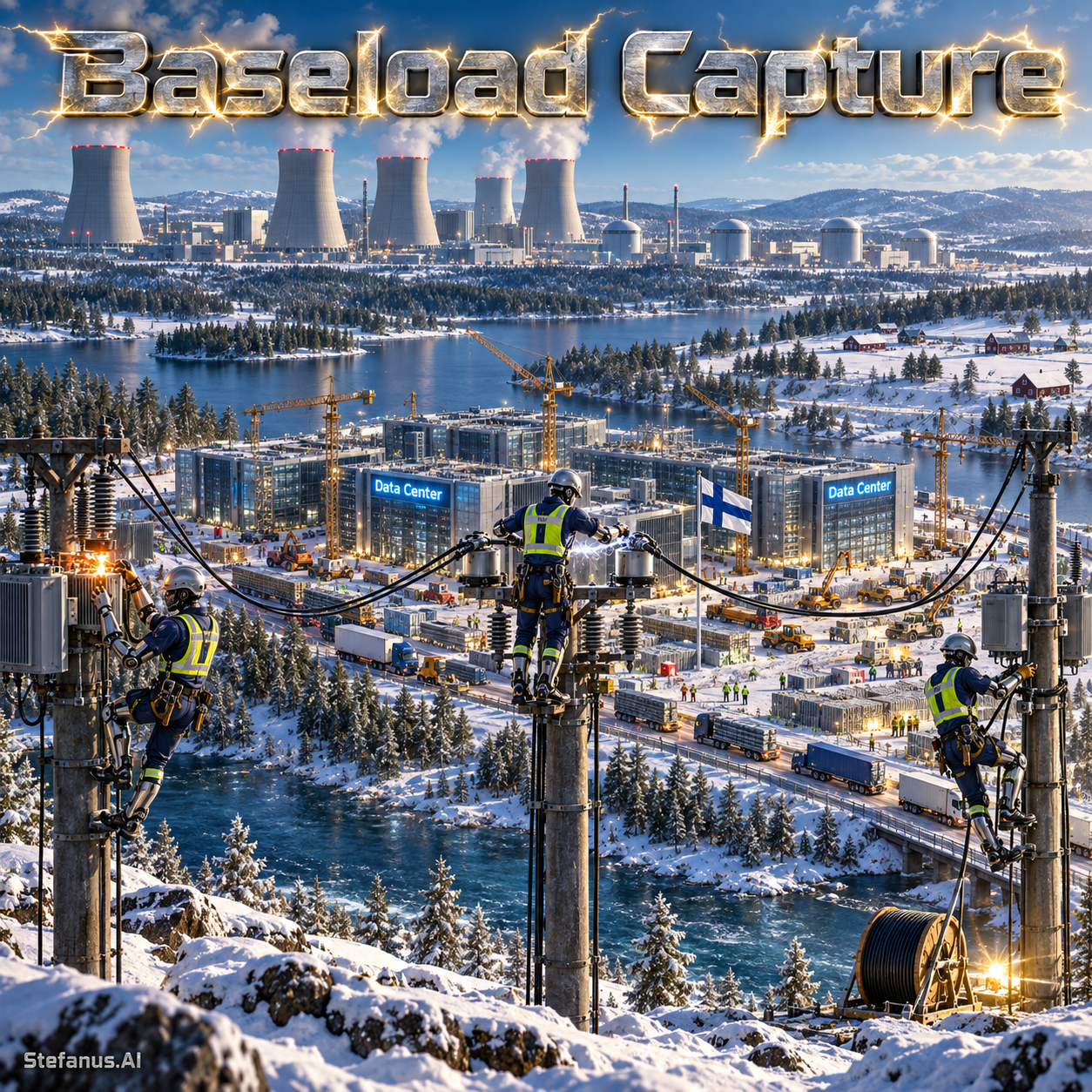
On September 9, 2026, Google made an announcement in Finland that at first sounded like just another chapter in the extraordinary global buildout of artificial-intelligence infrastructure. The company said it would invest at least €13 billion—approximately $15.1 billion at prevailing exchange rates—over 2027 and 2028 in Finnish digital infrastructure, clean energy, and supporting projects, including data-center investments and partnerships in Hamina, Kajaani, Muhos, and Vaala. It was Google’s largest single investment ever announced in Europe, and the market treated it as a headline about capital expenditure, jobs, and the geography of cloud computing.[1] Finland was, on the surface, an understandable destination for such capital. Its cool northern climate lowers the cooling burden that consumes so much of a data center’s energy budget; its electricity system is among the most decarbonized in Europe, with nuclear power alone generating a large share of national supply; and Google already had a long operational history in the country, beginning in 2009 when it purchased a former paper mill on the coast at Hamina and converted it into one of its flagship European data centers.[1][3]
But the most consequential element of the announcement was not the €13 billion, and it was not the four data-center municipalities whose names briefly appeared in international headlines. It was a contract concerning a nuclear power plant on Finland’s southern coast. On the same day, Google and the Finnish utility Fortum disclosed a 22-year power purchase agreement covering up to 50 percent of the capacity of Fortum’s Loviisa nuclear power plant, a two-unit station whose Soviet-designed VVER-440 pressurized water reactors have been generating electricity since the late 1970s.[2][3] The agreement begins at a smaller volume in 2028 and rises to half of Loviisa’s capacity during the years 2030 through 2049. Fortum stated plainly that the agreement provides the revenue certainty required to support the plant’s lifetime-extension program through 2050—a program worth approximately €1 billion, of which roughly €700 million in capital spending still awaited final investment decisions at the moment the Google contract was signed.[2][4] Loviisa currently generates roughly 10 percent of Finland’s electricity, and Fortum has said the plant could not have continued operating beyond 2030 without the life-extension investment that Google’s contract now underwrites.[4] Goldman Sachs analysts estimated that Google agreed to pay a premium of roughly €32 per megawatt-hour above the forward curve—approximately 1.6 times the prevailing 2030 Finnish power price—which is not the behavior of a company shopping for cheap electricity, but the behavior of a company purchasing certainty.[4] Equity markets understood the significance immediately: Fortum’s shares rose nearly 16 percent in a single session, and JPMorgan upgraded the stock the following morning, raising its price target by more than a third on the strength of a single customer’s signature.[5]
The economic logic of the transaction was compelling, and each side solved the other’s defining problem. Google needed enormous quantities of dependable, low-carbon electricity for the expansion of Gemini, its cloud infrastructure, Search, Maps, YouTube, and whatever computational systems may follow them—quantities measured not in annual megawatt-hours purchased opportunistically on wholesale markets, but in firm megawatts available every hour of every day for decades. Fortum possessed an existing nuclear asset capable of delivering exactly that profile of electricity around the clock, but it needed sufficient long-term economic certainty to justify extending the asset’s life through mid-century in a volatile Nordic power market. A hyperscaler with a multi-decade appetite for electricity and a nuclear operator with a multi-decade capital requirement could therefore solve one another’s problem with a single instrument. Fortum’s chief executive framed the logic in precisely these terms of market volatility and long-horizon commitment:
Markus Rauramo, President and CEO, Fortum: “especially in today’s uncertain market environment characterized by low visibility and highly volatile electricity prices” [6]
Yet within a single day, the transaction had become a political question rather than merely a commercial one. Finnish opposition parties warned that the combination of Google’s new data centers and its long-term nuclear arrangement could tighten the country’s electricity supply, place upward pressure on household prices, and complicate transmission planning for the industrial users still waiting in Fingrid’s connection queue. The leader of the Centre Party, Finland’s second-largest opposition group, told Reuters that data centers were welcome but that the state had lost sight of the system as a whole, and he proposed a national permitting regime for large data-center investments:
Antti Kaikkonen, Leader of the Centre Party of Finland: “At the moment, no one is really looking after the overall picture” [7]
A Social Democratic member of parliament went further, reframing electricity affordability not as an economic variable but as a matter of the nation’s internal security—language that, only a few years earlier, would have seemed extravagant when applied to a data-center announcement:
Niina Malm, Member of Parliament, Social Democratic Party of Finland: “a broader internal security issue” [8]
Finland’s government pushed back. Prime Minister Petteri Orpo assured reporters that the country’s electricity supply would remain sufficient and that Google was committed to keeping production adequate and prices under control:
Petteri Orpo, Prime Minister of Finland: “Based on all the information available, there is enough electricity” [9]
The disagreement was more revealing than either side’s position. The concern was made concrete by the grid itself: Finland’s transmission operator Fingrid had already restricted new industrial-scale connections in the south of the country since early 2025 because demand was growing faster than expected, and data centers now account for roughly half of all new connection enquiries the operator receives.[8] With the Social Democrats leading national polls ahead of Finland’s April parliamentary election, the permitting question could plausibly become a live campaign issue within months.[8] What the episode exposed is a question that will increasingly confront governments everywhere: when a private corporation contracts for a substantial share of a strategic power asset for decades, what portion of tomorrow’s electricity system has effectively been committed before tomorrow’s citizens, factories, and industries even arrive to ask for it?
That question is larger than Google, and it is much larger than Finland. Microsoft has entered a 20-year agreement supporting the restart of Pennsylvania’s former Three Mile Island Unit 1, renamed the Crane Clean Energy Center, whose roughly 835 megawatts will help match electricity consumed by Microsoft’s data centers across the PJM Interconnection.[10][11] Meta signed a 20-year agreement associated with Constellation’s 1,121-megawatt Clinton nuclear plant in Illinois, stepping into the economic role a state subsidy program had played for a decade.[12] Amazon has an expanded agreement with Talen Energy that can supply as much as 1,920 megawatts from Pennsylvania’s Susquehanna nuclear plant at full contract quantity through 2042.[13] Google separately holds a 25-year arrangement supporting the restart of Iowa’s 615-megawatt Duane Arnold nuclear plant—now backed by a federal loan of up to $1.9 billion that closed in September 2026—and has commissioned advanced reactors from Kairos Power.[14][15][16] Hyperscalers are no longer merely purchasing renewable-energy certificates or negotiating short-duration wholesale electricity contracts. Increasingly, they are becoming anchor customers whose balance sheets determine whether nuclear plants remain open, restart, expand, or get built at all.
This paper calls that emerging phenomenon Baseload Capture. The phrase does not suggest that Google or another hyperscaler physically removes electrons from a national grid and places them behind a corporate fence. Electricity remains interconnected; dispatch rules remain relevant; and power purchase agreements come in different physical and financial structures, some of which never touch a specific plant’s output at all. Rather, Baseload Capture describes something more economically important: the long-duration contractual appropriation, underwriting, reservation, or economic alignment of a large share of scarce firm generating capacity with the future needs of artificial-intelligence infrastructure. It is a claim on the future, executed through contracts in the present, secured by balance sheets that few sovereign governments can match.
Within the Five-Layer AI Economy—Energy, Chips, Datacenters, Models, and Applications and Agents—Baseload Capture represents a profound reversal of causality. Layer 1 was once treated as a passive utility input to the higher layers, an operating expense line that facilities teams managed while executives worried about GPUs and model quality. Increasingly, Layers 3, 4, and 5 are reaching backward into Layer 1 and reshaping which power plants survive, which generating technologies receive financing, where capacity is built, and who receives priority access to firm electricity for the next quarter century. The scale of the capital driving this reversal is difficult to overstate: by the second quarter of 2026, the four largest hyperscalers had guided their combined annual capital expenditure toward roughly $725 billion for the year—up approximately 77 percent from the already record-breaking $410 billion of 2025—with Amazon alone raising its 2026 guidance to approximately $220 billion and Google to as much as $205 billion.[17][18] Goldman Sachs now projects a combined $5.3 trillion of capital expenditure across the four largest hyperscalers between fiscal 2025 and fiscal 2030, spanning compute, data centers, and power.[18] When investment flows of that magnitude collide with an electricity system whose transformers take years to procure and whose transmission corridors take a decade to permit, the collision does not resolve itself quietly.
The thesis of this paper is therefore not simply that artificial intelligence requires enormous amounts of electricity, or that nuclear power happens to be useful for data centers. Those propositions are by now well understood, extensively modeled, and repeated at every energy conference on Earth. The deeper question—the question the Loviisa contract forces into the open—is distributional, institutional, and ultimately political: who owns the right to tomorrow’s baseload?
Why This Paper Is Titled “Baseload Capture”
The title deserves a deliberate defense, because the choice of words shapes the entire analysis that follows. I choose Baseload Capture because the emerging AI-energy relationship is moving decisively beyond ordinary electricity procurement, and the existing vocabulary—corporate PPA, clean-energy deal, sustainability commitment—no longer describes what is actually happening. A hyperscaler that signs a 20-, 22-, or 25-year agreement tied to hundreds or thousands of megawatts of nuclear capacity is not simply shopping for electricity at today’s price with tomorrow’s delivery date. It is using its balance sheet to secure economic access to generating capacity across several technology generations, multiple presidential administrations and parliamentary majorities, several complete regulatory cycles, and more business cycles than most corporate strategies survive. The word “baseload” identifies the strategic resource at stake: firm, continuously available electricity, the scarcest and most contested commodity in a grid increasingly dominated by variable renewables and increasingly strained by electrification. The word “capture” identifies the transformation: a portion of that future resource becomes economically committed to one very large corporate demand center long before competing future users—the green-steel plant, the semiconductor fabrication facility, the electrified district-heating network, the household of 2040—ever appear to bid for it.
The title also deliberately introduces political tension, because the phenomenon itself is politically double-edged, and any honest analysis must hold both edges at once. Capture can generate value, and frequently does: Google’s contract is the reason Loviisa will operate past 2030 rather than beginning decommissioning; Microsoft’s agreement is the reason a retired Pennsylvania reactor is being restored to service; hyperscaler commitments are financing new reactor designs that conventional utility balance sheets were unwilling to carry. But capture can also create distributional questions that markets alone cannot answer. Manufacturers, households, hospitals, transportation systems, defense facilities, and industries that do not yet exist all depend upon the same electricity system, the same transmission corridors, and the same finite pipeline of transformers, turbines, and skilled electrical workers. The issue is therefore not whether hyperscalers should be permitted to buy electricity—of course they should, and the system benefits when they do so transparently and at scale. The issue is whether long-duration AI contracts are beginning to create a hierarchy of claims on the electricity system, and how governments should govern that hierarchy without destroying the very investment incentives that are required to build more supply. That tension—between capture as creation and capture as appropriation—runs through every section of this paper.

Section 1: From Power Purchasing to Baseload Capture
To understand why the current wave of nuclear contracts represents a structural break rather than an incremental evolution, it is necessary to begin with what corporate electricity procurement used to be, because the distance between that older practice and the Loviisa agreement measures precisely how far the AI economy has already reached into the physical world. For most of the past fifteen years, when a technology company “bought clean energy,” it was engaging in an activity whose primary constituency was its own sustainability report. The instruments were real and the renewable projects they supported were real, but the transaction was fundamentally an accounting and reputational exercise layered on top of an electricity system that would have functioned identically without it. What has changed is that the transaction has become load-bearing—in the financial sense, in the engineering sense, and increasingly in the political sense.
1.1 The Old Corporate PPA Was Primarily an Accounting and Decarbonization Instrument
The first generation of corporate renewable-energy procurement was shaped overwhelmingly by voluntary sustainability targets rather than by physical necessity. Technology companies signed wind and solar power purchase agreements, purchased renewable-energy certificates by the tens of millions, and attempted to match their annual electricity consumption with an equivalent annual quantity of renewable generation somewhere on the same continent, or sometimes merely on the same planet. Microsoft assembled a contracted renewable portfolio that eventually reached 34 gigawatts across two dozen countries; Google pioneered the more demanding standard of 24/7 carbon-free energy matching; Amazon became, by most counts, the world’s largest corporate purchaser of renewable energy.[11] These achievements were genuine, and they materially accelerated wind and solar deployment by providing developers with creditworthy offtakers. But the architecture had a defining characteristic: it treated electricity as an annual quantity to be matched rather than as an hourly service to be guaranteed. A solar PPA in one region could offset consumption in another; a certificate generated in a windy March could notionally cover a data center’s consumption during a windless January evening. That architecture worked reasonably well when data-center growth was comparatively gradual, when the workloads were web search and video streaming rather than frontier-model training, and when corporate electricity procurement was primarily a decarbonization exercise conducted from a position of grid abundance.
Artificial intelligence changes the equation along every one of those dimensions simultaneously. Large AI campuses require hundreds of megawatts of continuous draw, and the emerging generation of training clusters requires gigawatts—individual facilities whose electrical appetite rivals that of mid-sized cities. The International Energy Agency projects that global data-center electricity consumption will more than double from roughly 415 terawatt-hours in 2024 to around 945 terawatt-hours by 2030—slightly more than the entire present-day electricity consumption of Japan—with AI as the most important driver, and with the United States accounting for by far the largest share of the increase.[19][20] In the United States, data centers are expected to account for nearly half of all electricity demand growth between now and 2030, by which point the country is projected to consume more electricity for data processing than for the production of aluminum, steel, cement, chemicals, and all other energy-intensive goods combined.[19] The Electric Power Research Institute’s 2026 analysis sharpened the picture further: U.S. data centers, which currently consume roughly 4 to 5 percent of national electricity, could plausibly consume between 9 and 17 percent by 2030 depending on how much of the announced project pipeline is actually built—estimates roughly 60 percent higher than EPRI’s own projections from just two years earlier.[21][22] The head of the International Energy Agency captured the moment when the agency released its landmark study:
Dr. Fatih Birol, Executive Director, International Energy Agency: “AI is one of the biggest stories in the energy world today” [20]
More importantly for the argument of this paper, accelerated computing places a premium not merely on the quantity of power but on its continuity. Training workloads can sometimes be scheduled and shifted; but cloud availability commitments, inference serving, search, agentic applications, and enterprise services increasingly need infrastructure available every hour of every day, with reliability expectations that make even brief curtailment commercially painful. AI therefore shifts corporate procurement from a question of annual energy quantity toward a question of hourly power availability. The asset that matters is no longer simply a megawatt-hour generated somewhere on the grid at some point during the year and matched on a spreadsheet. It is a dependable megawatt, physically deliverable through a specific set of transmission constraints, at the exact hour the AI factory needs it. And once the relevant asset becomes the dependable megawatt rather than the annual megawatt-hour, the procurement conversation inevitably migrates toward the technologies that produce dependable megawatts—which is to say, toward nuclear power, and toward the long-duration contracts that nuclear economics demand.
1.2 Nuclear Power Turns the PPA Into an Infrastructure-Financing Instrument
The Google-Fortum agreement demonstrates the next evolutionary stage with unusual clarity, because the causal arrow is documented in Fortum’s own disclosures rather than inferred by analysts. Fortum is not merely selling Google electricity that would inevitably have existed anyway; the agreement supplies the economic certainty for the specific investments required to extend the life of Loviisa. Fortum has stated that the plant could not continue operating beyond 2030 without the roughly €1 billion lifetime-extension program, that approximately 80 percent of the program’s individual projects remained unsanctioned before the contract, and that the Google agreement releases some €700 million of capital spending that previously carried no final investment decision.[2][4] The contract, in Fortum’s own investor language, improves the risk-adjusted return profile of its existing nuclear fleet and is expected to lift the group’s comparable return on net assets by approximately 1.4 percentage points once the full contracted volume is reached.[2] In other words, the PPA is not downstream of the investment decision; the PPA is the investment decision, expressed in contractual form.
That changes the fundamental character of what a power purchase agreement is. The instrument becomes, simultaneously, an electricity-procurement mechanism securing physical supply for decades; a hedge against future power-price volatility for both counterparties, with Google insulated from price spikes and Fortum insulated from price collapses; a financing mechanism for the generator, functioning much as an anchor-tenant lease functions in commercial real estate development; an instrument of de facto industrial policy, since it determines which generating assets exist in the national fleet; an energy-security arrangement, since it extends a domestic firm-power source in a country bordering Russia that has learned recent and painful lessons about imported energy; and an infrastructure-development commitment, since the parties have additionally signed a memorandum of understanding to explore new reactors at the Loviisa site, new renewable capacity, flexibility resources, and energy-management services.[2] A single signature performs six functions that were historically performed by six different institutions—a utility regulator, a futures exchange, a project-finance bank, an industrial ministry, an energy-security council, and an infrastructure fund. The hyperscaler starts behaving less like a traditional commercial electricity customer and more like an anchor tenant for the national power system itself.
1.3 Baseload Capture Is Not Ownership—but It Can Resemble Economic Control
This distinction is essential, and the analysis collapses without it. A power purchase agreement does not necessarily give Google physical control over individual electrons produced at Loviisa; indeed, in an interconnected alternating-current grid, the very notion of tracing specific electrons to specific consumers is a physical fiction. Finland remains part of the integrated Nordic electricity system, coupled to Sweden, Estonia, and the wider European market. Electricity flows according to grid physics, market dispatch, transmission constraints, and the operating rules of system operators—not according to the counterparty names on commercial contracts. Loviisa’s output will continue to serve Finnish demand in the physical sense regardless of who holds the financial rights to it, and nothing in the agreement gives Google the ability to switch the plant on or off.
But economic control can matter almost as much as physical control, and over a twenty-year horizon it can matter more. If a company contracts for half of a generating asset’s output for two decades, that output is economically spoken for: the revenue associated with it has been committed, the investment decisions concerning the plant have become partly dependent on the hyperscaler’s continued creditworthiness and continued appetite, and the generator’s exposure to future electricity markets has been deliberately reduced because one very large customer has accepted long-term obligations that the anonymous market previously bore. The counterfactual world—in which Loviisa’s full output remained available to be bid into Nordic markets, or contracted by a Finnish steel producer, or reserved by the state for strategic industries—has been foreclosed, legally and durably, by a private commercial instrument. This is why Baseload Capture is analytically useful as a term: it names contractual influence over scarce future firm capacity, a real and consequential form of power, without overstating it as literal ownership of electricity. The distinction also explains why the political reaction in Helsinki was simultaneously overheated and entirely rational: nothing was nationalized, nothing was fenced off, and yet something genuinely was committed.
1.4 AI Changes the Time Horizon of Electricity Competition
A striking and underappreciated feature of the new nuclear agreements is their sheer duration, which deserves to be listed plainly because the pattern is the point. Google’s Fortum agreement runs 22 years. Microsoft’s Constellation agreement for the Crane restart runs 20 years. Meta’s Constellation agreement at Clinton runs 20 years. Google’s agreement with NextEra at Duane Arnold runs 25 years. Amazon’s expanded arrangement with Talen extends through 2042, with options for further extension.[2][10][12][13][14] These are periods longer than the useful life of many current AI accelerators by an order of magnitude, longer than today’s dominant model architectures are likely to remain dominant, and longer than most corporate strategies—or most governments—survive unchanged. A Blackwell-, Rubin-, or successor-generation accelerator may be economically obsolete within four to six years of deployment, and the hyperscalers themselves depreciate this equipment on schedules of similar length. A nuclear PPA, by contrast, can remain in force across four or five complete hardware generations, spanning technological regimes that no one can currently describe.
AI companies are therefore using extraordinarily long-lived energy contracts to support extraordinarily fast-moving computing technologies, and that temporal mismatch is one of the deepest structural features of Baseload Capture. It means that today’s expectations about AI demand—expectations formed in the middle of an investment boom, by executives under intense competitive pressure not to be the one who under-built—will influence the allocation of national electricity resources in 2040 and 2050, decades after anyone can verify whether those expectations were correct. If the demand projections prove accurate, the contracts will look like far-sighted infrastructure statecraft conducted by private firms. If the projections prove inflated, national power systems will carry multi-decade commitments calibrated to a demand curve that never fully arrived, and the question of who bears that error—shareholders, ratepayers, or taxpayers—will become one of the defining regulatory disputes of the 2030s. Either way, the time horizon of competition for electricity has been permanently lengthened: firms are no longer competing for this year’s megawatt-hours but for the standing right to decades of future output, and latecomers to that competition will find the shelves of firm power increasingly bare.
1.5 The Five-Layer AI Economy Is Becoming Vertically Coupled
The Five-Layer AI Economy provides the structural frame within which Baseload Capture operates, and it is worth restating the stack explicitly: Layer 1 is Energy; Layer 2 is Chips; Layer 3 is Datacenters; Layer 4 is Models; and Layer 5 is Applications and Agentic Systems. During the first phase of generative AI—roughly the period from the release of ChatGPT through the great GPU shortage—public and investor attention concentrated overwhelmingly on Layers 2 and 4: on Nvidia’s accelerators and on the frontier models trained upon them. Energy appeared in the discussion, when it appeared at all, as a sustainability footnote or an operating-cost curiosity. The next phase of the AI economy is about coupling, and the coupling runs downward through the stack with mechanical inevitability. A new agentic workload at Layer 5 creates model inference at Layer 4; inference at scale creates accelerator demand at Layer 2; accelerators must be racked, powered, and cooled at Layer 3; and racks require substations, transmission connections, cooling infrastructure, transformers, turbines, and ultimately generators at Layer 1. Follow the causal chain far enough and it terminates at a nuclear plant on the Finnish coast whose retirement date has been moved twenty years into the future because a company in Mountain View signed a contract.
The Five-Layer AI Economy has therefore ceased to be a metaphor and become an industrial system, in which decisions taken at the top of the stack propagate to the bottom with quantifiable financial force, and in which constraints at the bottom of the stack—interconnection queues, transformer lead times, firm-capacity scarcity—propagate back to the top and determine which models get trained, where inference gets served, and which applications become economically viable. Baseload Capture is the principal mechanism through which that system now reaches into national energy infrastructure: it is the contractual interface between the world’s fastest-moving industry and its slowest-moving one. The remainder of this paper examines that interface from four vantage points—the strategies of the individual hyperscalers, the competing claimants on the same electricity, the regulators and governors who are beginning to intervene, and the plausible institutional trajectory of the years 2027 through 2030—before drawing the lessons together into a set of concluding pillars.

Section 2: Five Strategies of Capture—Google/Fortum Versus Microsoft, Amazon, Meta, and the Advanced-Nuclear Frontier
If Baseload Capture were a single transaction type, it would be a curiosity; what makes it a structural phenomenon is that it has already differentiated into at least five distinct strategic models, each solving a different version of the same underlying problem—how to convert a hyperscaler balance sheet into decades of firm, low-carbon power—and each carrying different implications for the public grid around it. The five models can be summarized as preservation, resurrection, repetition, gigawatt-scale expansion, and pre-construction capture, and the sections that follow examine them in turn. Taken together, they reveal something remarkable: within roughly twenty-four months, the four largest American technology companies independently converged on nuclear power as the backbone of their long-horizon energy strategy, and each of them discovered a different door into the same building. The table below summarizes the landscape before the detailed discussion.
| Hyperscaler | Counterparty / Plant | Capacity | Duration | Strategic Model |
| Fortum — Loviisa (Finland) | Up to 50% of ~1,014 MW | 22 years (to 2049) | Preservation: life extension to 2050 | |
| Microsoft | Constellation — Crane CEC (ex-TMI Unit 1, PA) | ~835 MW | 20 years | Resurrection: restart of retired plant |
| NextEra — Duane Arnold (Iowa) | 615 MW | 25 years | Repetition: restart + $1.9B DOE loan | |
| Amazon (AWS) | Talen — Susquehanna (PA) | Up to 1,920 MW | Through 2042 + options | Gigawatt scale: front-of-meter ramp |
| Meta | Constellation — Clinton (Illinois) | 1,121 MW + 30 MW uprate | 20 years (from 2027) | Subsidy replacement: private demand succeeds ZEC |
| Kairos Power (multiple sites) | Up to 500 MW | First unit ~2030, fleet by 2035 | Pre-construction: advanced reactors | |
| Amazon (AWS) | X-energy / Energy Northwest (WA) | 320 MW initial, up to 960 MW | First phase ~2030s | Pre-construction: SMR fleet |
Table 1. The principal hyperscaler-nuclear agreements as of September 2026, organized by strategic model. Sources: company disclosures and regulatory filings cited in the endnotes. [2][10][12][13][14][23][24]
2.1 Google and Fortum: Preserve the Existing Baseload
The Finnish model begins with preservation, and its elegance lies in what it does not require: no new construction permits, no first-of-a-kind engineering risk, no decade-long licensing process, and no bet on unproven reactor technology. Loviisa already exists. It already operates at the high capacity factors characteristic of mature nuclear stations. It already supplies roughly a tenth of Finland’s electricity through transmission infrastructure that was amortized decades ago. What the plant lacked was not physical capability but economic certainty: a merchant nuclear operator in the volatile Nordic market could not prudently commit approximately €1 billion to refurbishment, component replacement, and power uprates without confidence about revenue through mid-century. Google’s 22-year contract supplies precisely that confidence, converting an asset scheduled to leave the system in 2030 into an asset committed to the system through 2050, while the accompanying memorandum of understanding opens exploration of entirely new reactors at the site, additional renewable capacity, flexibility resources, and the use of Fortum’s powered land for Google’s future data-center needs.[2][4]
This is Baseload Capture through life extension, and it is arguably the most publicly defensible variant of the phenomenon, because the counterfactual is not a contested allocation of existing supply but the outright disappearance of supply. Google is not waiting for a new reactor to be designed, licensed, financed, and constructed; it is helping to prevent an existing source of firm electricity—one tenth of a nation’s generation—from vanishing at the exact moment national demand is projected to surge. Google’s president and chief investment officer, Ruth Porat, has described the company’s emerging approach with an acronym borrowed from a more casual context—BYOP, bring your own power—and the Loviisa agreement, Google’s first nuclear deal outside the United States, is the clearest European expression of that doctrine to date.[8] Yet even the most defensible variant carries the structural signature of capture: half of the extended plant’s output is now economically aligned with a single foreign corporation’s computing infrastructure for two decades, and the Finnish political system noticed within twenty-four hours.
2.2 Microsoft and Crane: Reanimate the Retired Baseload
Microsoft’s strategy in Pennsylvania represents a categorically different model, one that would have sounded implausible as recently as 2023: the resurrection of a nuclear plant that had already been withdrawn from service. Constellation’s 20-year power purchase agreement with Microsoft, signed in September 2024, supports the restart of Three Mile Island Unit 1—renamed the Crane Clean Energy Center after the late Exelon chief executive Chris Crane—a unit that operated at industry-leading levels of safety and reliability for decades before being shut down in 2019 for purely economic reasons, producing electricity at maximum capacity 96.3 percent of the time even in its final year.[10][11] The revived facility is expected to contribute approximately 835 megawatts of carbon-free electricity to the PJM grid, matched against Microsoft’s data-center consumption across the thirteen-state region; Constellation is investing $1.6 billion in the restoration, has secured a $1 billion federal loan, and by mid-2026 had cleared its major FERC hurdles, taken delivery of new main power transformers, and was targeting a return to service in 2027, ahead of the original 2028 schedule.[11][25][26] Constellation’s chief executive articulated the underlying thesis in terms that have since become the industry’s standard argument:
Joseph Dominguez, President and CEO, Constellation Energy: “nuclear plants are the only energy sources that can consistently deliver on that promise” [11]
Microsoft therefore demonstrates Baseload Capture through resurrection, and the remarkable point is not merely that an AI company wants nuclear electricity—by 2026 that is unremarkable—but that a technology company’s projected future computing demand proved sufficient to reverse a prior economic verdict rendered by the electricity market itself. An asset that wholesale power prices had condemned as uneconomic in 2019 became economically viable in 2024 because artificial intelligence changed the market value of firm, carbon-free power. That reversal carries a broader lesson about the malleability of “stranded” energy assets: retirement decisions that appeared final under one demand regime can be reopened under another, and the American nuclear fleet’s recent retirements suddenly look less like an obituary and more like an inventory. The federal government has embraced the precedent enthusiastically, with the Department of Energy’s loan office financing not only Crane but also Holtec’s Palisades restart in Michigan—making restarts a repeatable public-private template rather than a one-off curiosity.[15]
2.3 Google and Duane Arnold: Baseload Capture Becomes Repeatable
Iowa supplies the case that transforms an anecdote into a strategy. NextEra Energy is restarting the 615-megawatt Duane Arnold Energy Center in Linn County—Iowa’s only nuclear plant, which ceased operations in August 2020 after a derecho damaged its cooling towers and repairs failed to pencil against an already-planned economic retirement—and Google has signed a 25-year power purchase agreement that underpins the majority of the plant’s output and project economics, taking the power as 24/7 carbon-free supply for its expanding cloud and AI infrastructure in Iowa.[14][16] On September 8, 2026, the U.S. Department of Energy’s Office of Energy Dominance Financing announced the financial close of a loan of up to $1.9 billion to NextEra to help finance the restart, with commercial operation targeted no later than the first quarter of 2029, subject to Nuclear Regulatory Commission licensing; the Iowa Utilities Commission had already issued its certificate in June 2026, and an economic study projects more than $9 billion in benefits to Iowa over 25 years alongside roughly 1,500 construction jobs and more than 400 permanent positions.[15][16][27] NextEra’s chief executive framed the project in the vocabulary that the entire industry is converging upon—growth without cost-shifting:
John Ketchum, Chairman, President and CEO, NextEra Energy: “delivering new power to meet new demand” [27]
The analytical importance of Duane Arnold is repetition. Loviisa, considered alone, might look like a unique Nordic transaction enabled by peculiar local conditions; Crane, considered alone, might look like an unrepeatable confluence of a famous site, a motivated seller, and a single wealthy buyer. Duane Arnold suggests instead a generalizable playbook: a hyperscaler identifies a stranded or retiring firm asset, provides long-term demand certainty at a price the merchant market would not offer, combines that private demand with public financing or regulatory support, and returns the asset to the national electricity system with its output substantially aligned to AI infrastructure. Three shuttered American reactors—Crane, Palisades, and Duane Arnold—are now being financed back onto the grid through variations of this exact structure.[15] What was once the most capital-intensive and politically fraught category of energy project in the Western world has acquired, in the span of two years, a standard deal architecture with three recurring parties: the reactor owner, the federal lender, and the hyperscaler. That standardization is itself a milestone in the industrial history of both sectors, and it is what allows this paper to speak of Baseload Capture as an emerging system rather than a collection of transactions.
2.4 Amazon and Susquehanna: Capture at Gigawatt Scale—and the Regulatory Collision
Amazon’s relationship with Talen Energy moves the strategy to a different order of magnitude, and it also supplies the clearest demonstration that Baseload Capture cannot remain a purely private matter, because at sufficient scale the private contract collides with the architecture of the public grid. Under the expanded power purchase agreement announced in June 2025, Talen will supply Amazon Web Services with up to 1,920 megawatts of carbon-free nuclear power from the two-unit Susquehanna station through 2042, with extension options—a contract Talen values at approximately $18 billion in revenue at full quantity—ramping to 840–1,200 megawatts by 2029 and to the full volume no later than 2032, while the parties additionally explore small modular reactors within Talen’s Pennsylvania footprint and uprates intended to add net-new energy to the PJM grid.[13][28] Nearly two gigawatts of nuclear output—roughly the production of two large reactors—will thus be economically dedicated to a single corporation’s AI and cloud operations for the better part of two decades.
The evolution of the deal’s physical structure is even more revealing than its size. The arrangement began as a co-location scheme: Talen sold its Cumulus data-center campus, directly connected behind the meter to the Susquehanna plant, to AWS for $650 million in March 2024, with contracted load stepping upward toward 960 megawatts. When PJM filed an amended interconnection service agreement to raise the co-located load from 300 to 480 megawatts, the Federal Energy Regulatory Commission rejected it in November 2024 on a 2–1 vote, with the majority concluding that PJM had not justified deviating from its standard rules and with opponents—including AEP and Exelon—warning that the model could allow enormous loads to sidestep transmission costs and reliability obligations that every other grid user bears.[29] Rather than continue the behind-the-meter fight, Talen and Amazon restructured: the arrangement transitioned in spring 2026 to a front-of-the-meter configuration in which Susquehanna sells its power to the PJM grid, Talen acts as retail supplier to Amazon, and PPL Electric Utilities handles transmission and delivery—with Talen emphasizing that large customers connected this way pay significant transmission charges that reduce bills for everyone else.[13][28] Meanwhile, the controversy the original structure ignited kept burning at the federal level: FERC opened a show-cause review of co-located large loads across PJM, found in December 2025 that PJM’s tariff did not clearly address the issue, ordered new rules, and by June 2026 had broadened the framework through a new “Eligible Load” category while PJM adopted a 50-megawatt threshold for its new large-load procedures.[24][29] The Susquehanna case thus produced little direct precedent but triggered the entire regulatory framework now governing large data-center loads in America’s biggest power market—a perfect illustration of how Baseload Capture forces regulators to determine, line by tariff line, where the private contract ends and the public grid begins.
2.5 Meta and Clinton: Replace Public Support With Corporate Demand
Meta’s agreement with Constellation provides a fourth model, and conceptually it may be the most important of the five, because it demonstrates a direct substitution between public subsidy and private hyperscaler demand as the economic foundation of a strategic asset. The Clinton Clean Energy Center in central Illinois—a single boiling-water reactor of 1,121 megawatts—was slated for premature closure in 2017 after years of merchant-market losses, and was saved only when the Illinois legislature enacted the Future Energy Jobs Act, whose zero-emission-credit program channeled ratepayer-funded support to the plant through mid-2027.[12][30] Beginning in June 2027, precisely as that public program expires, Meta’s 20-year power purchase agreement takes over the economic role: it supports the relicensing and continued operation of the plant for another two decades explicitly “without ratepayer support,” funds a 30-megawatt uprate, preserves roughly 1,100 jobs, sustains $13.5 million in annual tax revenue, and leads Constellation to evaluate an advanced reactor or small modular reactor at the same site.[12][30] The Brattle Group estimated that closure of Clinton would instead have added 34 million metric tons of emissions over twenty years and stripped roughly $765 million per year from Illinois GDP.[31] Meta’s head of global energy stated the company’s motivation without ornament:
Urvi Parekh, Head of Global Energy, Meta: “Securing clean, reliable energy is necessary to continue advancing our AI ambitions” [30]
The mechanism deserves to be dwelt upon, because it will recur. A strategically important nuclear plant has migrated from ratepayer-supported economics to hyperscaler-supported economics: the burden of preserving the asset has shifted from a broad public subsidy, imposed on millions of Illinois electricity customers, to a concentrated private buyer with a triple-A-adjacent balance sheet. In one sense this is an unambiguous public win—ratepayers stop paying, the plant keeps running, the jobs and the tax base and the carbon-free megawatt-hours all survive. Yet the substitution also transfers something subtler: influence. When the marginal supporter of a strategic asset was the state, the asset’s continuation was a public decision revisited through public processes; now its continuation past the 2040s will substantially depend on the commercial priorities of a single social-media and AI conglomerate, whose data-center strategy in the MISO footprint—not Illinois energy policy—becomes the quiet fulcrum of the plant’s fate. Baseload Capture through subsidy replacement is therefore politically attractive and structurally consequential at the same time, and legislators who welcome the relief to ratepayers today are also, whether they articulate it or not, ceding a lever of energy policy to a private counterparty tomorrow.
2.6 Advanced Nuclear: Capture the Plant Before the Plant Exists
The final stage of the strategy is the most ambitious, and it points directly at the electricity system of the 2030s: hyperscalers are no longer content to secure existing baseload or resurrect retired baseload—they are commissioning future baseload into existence. Google’s collaboration with Kairos Power, announced in October 2024 as the first corporate agreement of its kind, contemplates a fleet of up to seven advanced reactors totaling as much as 500 megawatts, with the first unit targeted around 2030 and the fleet complete by 2035; Google will purchase energy, ancillary services, and environmental attributes from plants sited in service territories relevant to its data centers, and the Department of Energy has explicitly identified this kind of early demand aggregation as the mechanism that enables serial reactor deployment and cost reduction.[23] Amazon, for its part, anchored an approximately $500 million financing round in the reactor developer X-energy—later expanded to roughly $700 million of cumulative investment—and committed to support Energy Northwest’s initial four-module, 320-megawatt deployment of Xe-100 reactors in Washington State, a project now branded the Cascade Advanced Energy Facility and tripled in ambition to twelve reactors and up to 960 megawatts, within a broader collaboration targeting more than five gigawatts of new projects by 2039.[24][32] Meta has run a formal request for proposals seeking one to four gigawatts of new nuclear generation and has assembled, by industry counts, commitments approaching 6.6 gigawatts across multiple developers, while trackers of the sector now count roughly ten gigawatts of announced hyperscaler-nuclear deals in aggregate.[33]
Here the phenomenon reaches its logically complete form: Baseload Capture before construction. The anchor customer no longer merely influences whether an existing plant survives; it influences which reactor technologies reach commercial maturity, which developers can raise capital, where the first fleets are sited, what deployment schedules are feasible, and consequently the very geography of future firm-power supply. A small modular reactor company with a hyperscaler anchor order can finance its learning curve; one without such an order may never build its first commercial unit at all, regardless of the merits of its engineering. By the early 2030s, some power plants may therefore begin their commercial lives with a substantial portion of their lifetime output already economically aligned with AI infrastructure from the moment of first criticality—plants that, in a meaningful economic sense, were called into existence by the computing industry and will spend their operating decades answering to it. Whatever one concludes about the desirability of that arrangement, it is unprecedented: at no prior point in the history of electrification has a single downstream industry functioned as the demand engine for an entire generation of generating technology.

Section 3: When AI Electricity Competes With Factories, Households, and Future Industries
The previous section examined Baseload Capture from the perspective of the companies executing it, where the logic is coherent, the capital is available, and the transactions are—on their own terms—rational and often publicly beneficial. This section changes the vantage point and examines the same transactions from the perspective of everyone else who depends on the same electricity system, because it is from that perspective that the phenomenon acquires its political charge. The central difficulty is that electricity, during periods of scarcity, stops behaving like the frictionless commodity of economic textbooks and starts behaving like what it physically is: a service delivered through congested, slow-to-build, regionally bounded infrastructure, in which one very large new customer’s arrival changes the conditions facing every existing and future customer around it. Understanding that difficulty requires beginning with the physics and the supply chains before arriving at the politics.
3.1 Electricity Is Not an Ordinary Commodity During Scarcity
In stylized economic theory, electricity can appear perfectly interchangeable: a megawatt-hour is priced, a buyer purchases it, the market clears, and a new entrant with deep pockets simply bids supply away from lower-value uses while price signals summon new generation into existence. In physical reality, electricity systems operate under constraints that money can shorten but cannot eliminate. Transmission lines have finite thermal capacity and take the better part of a decade to permit and build. Large power transformers—the unglamorous bottleneck of the entire energy transition—carry procurement lead times measured in years. Interconnection queues in major markets have become congested to the point of dysfunction. Gas turbines, switchgear, substations, skilled electrical workers, and above all firm generating assets cannot instantly appear merely because prices rise; the response time of the physical system is measured in years to decades, while the response time of AI capital allocation is measured in quarters. It is precisely this asymmetry of tempo—EPRI notes that transmission and generation capacity can take up to ten years to add while a data center can be built in a fraction of that time—that converts abundant national statistics into acute local scarcity.[22]
The aggregate numbers frame the collision. The International Energy Agency projects global data-center consumption roughly doubling to around 945 terawatt-hours by 2030, growing about 15 percent per year—more than four times faster than all other electricity demand combined—with AI-optimized facilities more than quadrupling their consumption, and with the United States accounting for the largest national increase.[19][20] EPRI’s 2026 scenarios place U.S. data centers at 9 to 17 percent of national electricity by 2030, up from 4 to 5 percent today, with roughly 380 to 790 terawatt-hours of annual consumption at decade’s end and with eight states facing far higher local concentrations; states such as Louisiana, Mississippi, New Mexico, Ohio, and Pennsylvania are projected to see data centers exceed 10 percent of their total electricity demand.[21][22] EPRI’s leadership has characterized the moment in language that regulators have begun to echo:
David Porter, Vice President of Electrification and Sustainable Energy Strategy, EPRI: “The scale and speed of data center growth represent a defining moment” [21]
Thomas Wilson, Principal Technical Executive, EPRI: “unprecedented amount of investment in data center construction and project planning” [22]
International institutions have reached parallel conclusions through independent methods. An International Monetary Fund working paper, using the IMF-ENV general-equilibrium model, found that AI-producing sectors in the United States have grown at nearly triple the rate of the private non-farm business economy, that electricity costs for vertically integrated AI companies nearly doubled between 2019 and 2023, and that under scenarios with constrained renewable buildout and limited transmission expansion, U.S. electricity prices could rise by 8.6 percent as a consequence of the AI boom—an increase the Fund characterizes as manageable in aggregate but highly uneven in incidence across regions and customer classes.[34] MIT’s Energy Initiative, for its part, judged the problem sufficiently structural to launch a dedicated Data Center Power Forum in late 2025, convening researchers and member companies around grid operations, market design, and regulatory policy for data-center power—an institutional acknowledgment that the question has outgrown ad hoc analysis.[35] The result of all of these converging assessments is the same: even if the global electricity system remains adequately supplied in aggregate, the localities where AI infrastructure concentrates will experience genuine scarcity of firm capacity, transmission headroom, or both. And politics, as always, occurs locally.
3.2 The Finnish Question: Who Gets the Next Megawatt?
This was the central issue raised almost immediately after Google’s Finland announcement, and it deserves careful restatement because the opposition’s framing was more sophisticated than simple hostility to foreign investment. The Finnish opposition politicians did not reject Google; several went out of their way to welcome data centers as an industry. What they questioned was whether enormous new data-center loads could coexist with industrial growth, household affordability, and transmission constraints in the absence of any national institution charged with viewing the system whole—hence the specific proposal for a national permitting regime, and hence the reframing of electricity affordability as internal security.[7][8] Their concern identifies the true political problem beneath Baseload Capture, which is not the existence of any single contract but the sequencing of claims. Suppose Finland possesses enough electricity for today’s households and industry, as the Prime Minister insisted it does. Then Google arrives with four campuses. Then a green-steel plant seeks a connection. Then hydrogen production expands, as national strategy intends. Then transportation electrifies; then district heating electrifies; then a second hyperscaler requests a gigawatt. Each claimant is individually reasonable, and the early claimants are served on something close to a first-come, first-served basis—yet the queue itself embodies a priority ranking that no democratic institution ever explicitly chose. The important question, in Finland and everywhere, is not whether electricity exists today. It is which future demand receives priority when infrastructure cannot expand at the same speed as the requests for power, and who decides.
3.3 Industrial Policy Can Collide With AI Policy
The sequencing problem becomes an outright contradiction inside governments that are simultaneously pursuing several electricity-hungry objectives, which is to say inside virtually every advanced-economy government of the mid-2020s. The same administration typically wants to attract AI data centers, reshore semiconductor production, electrify transportation, expand advanced manufacturing, produce green hydrogen, decarbonize heavy industry, and keep household electricity affordable—and every single one of those objectives requires additional firm electricity, transmission capacity, transformers, water, and construction labor drawn from the same finite pools. This creates an underappreciated form of policy fratricide: the same government may subsidize a semiconductor fabrication plant through one statute and a hyperscale AI campus through another, only to discover that both projects need access to the same substation, the same transmission corridor, and the same interconnection queue position. AI industrial policy can therefore quietly cannibalize manufacturing industrial policy unless the energy system expands quickly enough to accommodate both—and at present, in most jurisdictions, it demonstrably is not expanding quickly enough.
Ohio has supplied the first explicit regulatory articulation of this conflict, and it is a landmark of sorts. In September 2026, the Public Utilities Commission of Ohio urged federal regulators to prevent PJM from sweeping traditional manufacturers into the same “new large load” category as data centers and cryptocurrency miners—PJM’s proposed definition turned on size alone—arguing that the burdens appropriate for speculative digital loads should not be imposed on the factories the country is simultaneously trying to onshore, and having argued in a parallel filing that data-center customers should bear the full cost of the capacity shortfalls they help create.[36] The commission’s chair stated the principle directly:
Jenifer French, Chair, Public Utilities Commission of Ohio: “it is counterproductive to place additional constraints on traditional manufacturers” [36]
That filing is the beginning of an electricity-priority debate conducted in the open, and its logic is worth pausing over: a state regulator is asserting, in a federal docket, that different categories of large electricity demand have different social value and should face different rules—that a steel mill and a training cluster of equal megawatts are not equal claimants. Once that principle is admitted anywhere, it becomes very difficult to confine, and Section 5 of this paper argues that its generalization into explicit priority hierarchies is among the most probable institutional developments of 2027 through 2030. Ohio’s regulators, it should be noted, had already approved a first-in-the-nation data-center tariff for AEP Ohio in July 2025 over the objections of Google, Amazon, Microsoft, and Meta, requiring large data centers to make minimum payments tied to their subscribed capacity—evidence that the state’s differentiation instinct extends from federal advocacy into its own rate design.[37]
3.4 Household Affordability Converts Infrastructure Into Electoral Politics
Electricity allocation becomes politically explosive at the precise moment residential customers come to believe their bills are rising to support AI infrastructure, and that moment has already arrived in several American jurisdictions. The issue is especially combustible because of who the counterparties are: hyperscalers are among the wealthiest corporations in the history of capitalism, guiding toward three-quarters of a trillion dollars of combined annual capital expenditure, and a household facing a rate increase can reasonably ask why it should absorb any portion of the infrastructure costs generated by companies of that scale.[17] The scholarly foundation for that suspicion was laid by Harvard Law School’s Electricity Law Initiative, whose March 2025 paper reviewed nearly fifty regulatory proceedings and demonstrated the specific ratemaking mechanisms—averaged cost allocation, confidential special contracts, and utility incentives to build—through which the costs of serving data centers can be quietly socialized onto captive ratepayers while utilities profit from the expansion.[38][39] The initiative’s director has distilled the distributional point into a single sentence that has since traveled far beyond legal academia:
Ari Peskoe, Director, Electricity Law Initiative, Harvard Law School: “We’re all paying for the energy costs of the world’s wealthiest corporations” [39]
and has explained the structural mechanism with equal economy:
Ari Peskoe, Harvard Law School (with co-author Eliza Martin): “the public is paying for new power plants” [40]
The Martin-Peskoe paper’s policy verdict—that the industry’s prevailing practice of attracting data centers with confidential discounted contracts and lopsided tariffs cannot endure—has aged remarkably well, because the states have begun proving it correct.[41] Virginia, host to the largest data-center cluster on Earth, created a distinct large-load rate class precisely to prevent cost-shifting from hyperscale customers onto ordinary ones: the State Corporation Commission’s November 2025 order in Dominion’s biennial review established the GS-5 class for customers of 25 megawatts or more, effective January 2027, requiring 14-year contracts, minimum monthly payments of at least 85 percent of contracted transmission and distribution demand and 60 percent of generation demand, exit fees covering remaining minimum charges, three years’ notice before demand reductions, and collateral that analyses place at roughly $1.5 million per megawatt of contracted capacity.[42][43][44] The former FERC chairman—himself a past chair of the Virginia commission—captured why the order matters far beyond one state:
Mark Christie, former Chairman, Federal Energy Regulatory Commission: “we are the state that is the center of data center universe” [45]
The principle embedded in GS-5 is likely to spread, and in generalized form it reads: the entity creating extraordinary new demand should be required to internalize the infrastructure cost of serving that demand, and to bear the stranded-asset risk if its projections fail. That principle is defensible, popular, and probably necessary. But it is also only the first half of the political sequence. The next step—already visible at the edges of several proceedings—moves from who pays for the wires to who receives the electricity during emergencies and scarcity, and that second question cannot be answered with collateral requirements. It requires governments to rank uses of electricity by social importance, which is a task that market-era energy institutions were deliberately designed never to perform.
3.5 Baseload Becomes a Distributional Question Before It Becomes a Scarcity Question
Nuclear power, throughout its civilian history, served broad utility systems: its output flowed into regional markets or vertically integrated utilities serving millions of undifferentiated customers, and no household ever had reason to ask whose plant it was in any sense beyond the corporate nameplate. Long-duration hyperscaler contracts introduce a categorically new relationship between a specific corporation and a strategic asset, and the political consequence does not depend on any household actually losing a single kilowatt-hour. Indeed, as Section 2 demonstrated at length, several of these contracts create or preserve supply that would otherwise not exist, leaving the physical system better off than the counterfactual. But the politics can change even when the physics improves. Citizens may increasingly perceive nuclear plants, dams, gas plants, transmission corridors, and future small modular reactors as assets contested among rival economic constituencies—households, traditional manufacturing, AI infrastructure, semiconductor fabs, electric vehicles, defense installations, hydrogen producers, and industries that do not yet exist—rather than as neutral public plumbing. Once that perceptual shift occurs, every long-duration corporate contract on a strategic asset becomes a statement about relative priority, whether or not it was intended as one, and the burden of proof migrates to the corporation to demonstrate that its capture created supply rather than merely claiming it. Baseload therefore becomes a distributional question before scarcity ever fully materializes—and distributional questions, unlike engineering questions, are settled in elections.

Section 4: Governors, Utility Commissions, Grid Operators, and the Return of Energy Sovereignty
If Section 3 described the collision between AI electricity demand and its rival claimants, this section describes the institutions through which that collision is being adjudicated, and its central observation is that the decisive institutions are not the ones the AI-policy conversation usually watches. AI policy is typically discussed as a federal and international matter—export controls, model-safety frameworks, antitrust, procurement, national security. Yet the most consequential AI decisions of 2025 and 2026 have been made in state capitols, public utility commission hearing rooms, and the dockets of a federal energy regulator that most technology executives could not have named three years ago. The physical turn of the AI economy has quietly relocated its governance, and the relocation rewards a different kind of political actor: the governor, the utility commissioner, and the grid operator, who among them control the permits, the tariffs, and the interconnections upon which every announced gigawatt actually depends.
4.1 Governors Are Becoming De Facto AI-Energy Ministers
Consider the instruments a state governor controls, and the list reads like the operating manual of the Five-Layer AI Economy’s foundation: data-center tax incentives; environmental permits; the appointment of utility regulators; transmission siting; water access; economic-development packages; nuclear policy; gas-plant approvals; the scope of local-government authority; and the standing relationships with the utilities that must physically serve every campus. No federal official holds a comparable portfolio over the physical layer of AI, and no hyperscaler site-selection team can route around it. As AI becomes an infrastructure industry, state executives therefore become central actors in the global technology economy whether they seek the role or not—and the record of 2026 shows them seizing it with striking speed, in both parties, and with a common direction of travel: away from unconditional recruitment and toward conditionality. Three states illustrate the arc.
4.2 Pennsylvania: From Datacenter Promotion to Conditions
Pennsylvania embodies the transition most vividly because it began from the most enthusiastic position. The state possesses attractive power infrastructure, Marcellus shale gas, the second-largest nuclear fleet contribution to any state’s AI story, proximity to East Coast markets, and—as Section 2 detailed—two of the most important AI-nuclear relationships in America in the Crane restart and the Susquehanna arrangement. Governor Josh Shapiro was an early and vocal champion, celebrating a $20 billion Amazon commitment and declaring the future of AI would run through the Commonwealth. Then the ground shifted. In August 2026, Shapiro signed Executive Order 2026-05, imposing what he called the nation’s strictest guardrails: all data-center proposals above 25 megawatts must make legally binding commitments to the Governor’s Responsible Infrastructure Development (GRID) requirements covering energy affordability, environmental protection, workforce standards, transparency, and community engagement; projects must show proof of local approval before receiving state permits; developers must bring their own electricity generation and pay all costs associated with increased energy usage; data centers were removed from the state’s Fast Track permitting program entirely; and state agencies were prohibited from signing nondisclosure agreements with developers.[46][47][48] The governor’s stated rationale focused on the speculative overhang—of more than one hundred proposed projects, only about fifteen had applied for any permit and only five held all permits for a first phase:[46]
Governor Josh Shapiro of Pennsylvania: “a hundred projects or so that are wreaking havoc on our communities” [49]
Pennsylvania therefore holds the policy paradox in a single frame: the same state government that hosts and celebrates the resurrection of Three Mile Island and the largest nuclear-AI contract in the country has simultaneously erected the most demanding conditions in the country for the facilities that consume the output. Government wants AI investment; government wants nuclear investment; government wants the jobs and the tax base; and government also wants local consent, affordable household electricity, and protection from speculative projects that reserve infrastructure they will never use. The era of unconditional data-center recruitment did not end with a backlash against the technology—it ended because the physical externalities of the buildout arrived before its promised benefits, and governors are graded on externalities in real time.
4.3 Texas: From “Come Here” to “Prove Your Load”
Texas presents an even sharper reversal, executed by a governor with impeccable pro-business credentials, which is precisely what makes it significant. The state became one of America’s two great magnets for AI infrastructure, and its interconnection queue became the register of the mania: large-load requests to ERCOT ballooned from roughly 48 gigawatts in 2023 to more than 474 gigawatts by mid-2026—more than five times the highest peak demand ever recorded on the Texas grid, with approximately 90 percent of the requests coming from data centers—while Reuters found that comparable queues across ten major utilities in the Midwest, Mid-Atlantic, and South pushed the national total of large-load requests above 700 gigawatts, an order of magnitude beyond what the entire American data-center fleet actually consumes today.[50][51] The industry’s own executives concede that half or more of the queue may be speculative or duplicative—“phantom” or “ghost” demand filed at multiple utilities for the same eventual campus—and the chairman of the Texas Public Utility Commission described the planning consequence with admirable bluntness:
Thomas Gleeson, Chairman, Public Utility Commission of Texas: “you really don’t know how to build the infrastructure for it” [51]
Governor Greg Abbott’s response unfolded in two directives. In June 2026 he ordered the PUC to require data centers to fully fund the electric infrastructure needed to serve them, preventing pass-through to residential ratepayers, and to identify further ratepayer protections.[52] Then on August 3, 2026, he ordered a comprehensive audit of every data center in the ERCOT interconnection queue—demanding disclosure of tax incentives received, electricity and water consumption, self-generation plans, community-impact mitigation, and ultimate ownership—and directed that projects failing verification be denied connection outright, a directive that froze the advancement of new projects through ERCOT’s processes while the audit proceeds:[50][53]
Governor Greg Abbott of Texas: “protect the reliability and resilience of the Texas electric grid” [50]
The political bargain underlying American economic development has thus been rewritten in the space of a single year. The old formulation was: bring us your data center, and we will provide the infrastructure. The new formulation—now explicit in the two states hosting the most AI capital—is: bring us your data center, but bring credible power with it, prove your load is real, pay your own way, and disclose enough that we can plan around you. For the argument of this paper, the Texas episode carries a further lesson: Baseload Capture and speculative queue inflation are two faces of the same scarcity. Sophisticated players lock up real firm capacity through decades-long contracts precisely because they understand that the queue is clogged with phantoms, and regulators purge the phantoms precisely so they can see which claims on the future are real. Both behaviors are rational responses to a system that no longer has slack.
4.4 Virginia: Separate the AI Electricity Economy
Virginia offers the third model, and institutionally the most fully developed one, because Northern Virginia’s two decades as the world’s most important data-center cluster forced it to confront the ratepayer question earlier and more concretely than anyone else. The GS-5 rate class described in Section 3.4—with its 25-megawatt threshold, 14-year contracts, 85 and 60 percent minimum-payment floors, exit fees, notice periods, and collateral on the order of $1.5 million per megawatt—amounts to something more than a tariff: it is the institutional recognition that AI-scale consumers constitute a fundamentally different class of electricity customer, with different risk profiles, different cost causation, and different capacity to pay, and that pretending otherwise shifts risk onto captive households.[42][43][44] A companion legislative study had estimated that meeting unconstrained data-center demand could raise a typical residential bill materially over the coming decade, which supplied the political mandate; the commission has additionally directed Dominion to move away from averaged cost-allocation methods toward methods that assign costs to the customers who cause them, and has opened an inquiry into whether the GS-5 framework should incorporate demand-response and curtailment obligations.[44] That last item deserves emphasis, because it is the hinge to everything Section 5 describes: once a separate customer class exists in rate design, governments possess a legal chassis onto which they can later bolt reliability obligations, generation-contribution requirements, emergency-curtailment priority, and resource-adequacy responsibilities. Virginia has, in effect, built the administrative category through which the AI electricity economy can be governed as a distinct thing—and Ohio and Oregon had already adopted narrower minimum-payment frameworks before Virginia’s order, confirming the direction of regulatory diffusion.[43]
4.5 Federal Regulators Will Determine the Boundary Between Corporate Power and Public Power
The state-level story, however consequential, cannot be the whole story, because the American grid is federally interconnected and the deepest questions raised by Baseload Capture are jurisdictionally federal. FERC’s involvement in the Amazon-Susquehanna controversy demonstrated this with unusual speed. When an enormous data center locates adjacent to a power plant—or contracts for most of its output—a cascade of questions follows: Does the load pay transmission charges commensurate with the network services it still implicitly relies upon? Is generation effectively being withdrawn from regional capacity markets, and who pays for replacement? How should reliability obligations be calculated for a load that claims to stand apart from the system while depending on it for backup and stability? Can a generator and a data center form what amounts to a private energy island inside a public grid? FERC’s November 2024 rejection of the amended Susquehanna interconnection agreement, its subsequent show-cause review of co-location across PJM, its December 2025 finding that PJM’s tariff failed to address the issue, and its June 2026 broadening of the framework through the new Eligible Load category—running in parallel with PJM’s adoption of a 50-megawatt large-load threshold and a Department of Energy advance rulemaking on interconnecting large loads to the interstate transmission system—collectively constitute the construction, in real time and under commercial pressure, of the legal architecture of the AI electricity economy.[29][24][36] These proceedings are not technical footnotes. They will define, for a generation, where the private contract ends and the public grid begins.
4.6 Federal Nuclear Finance Makes Government a Partner in Baseload Expansion
The federal government has entered on the financing side as well, and the resulting structure deserves to be named because it is likely to become the standard architecture of firm-power expansion in the AI era. The Department of Energy’s Office of Energy Dominance Financing—the renamed Loan Programs Office—has now closed loans of up to $1.9 billion for the Duane Arnold restart, $1 billion for the Crane restart, and $1.52 billion for the Palisades restart, in each case alongside long-duration hyperscaler or utility offtake commitments, and in each case framed by the administration as part of a deliberate program of reinvigorating the nuclear industrial base.[15][16] This creates a triangular structure with three load-bearing corners: government provides financing and policy support, absorbing part of the development and regulatory risk; the nuclear operator restores or develops the physical asset; and the hyperscaler provides long-duration demand certainty, absorbing part of the price and volume risk. Each corner de-risks the other two, and the triangle can be replicated—across restarts today, uprates tomorrow, and small modular reactors by the early 2030s. Baseload Capture, in this configuration, matures into a form of public-private industrial policy: the state and the platform economy jointly underwriting the generating fleet, with the utility as the operating partner between them. Whether that arrangement constitutes an inspired alignment of interests or an unexamined entanglement of public credit with private compute demand is precisely the kind of question that the institutions described in Section 5 will have to answer—and one which a DOE ratepayer-protection pledge, invoked by journalists at the Duane Arnold closing, has already begun to test.[16]

Section 5: 2027–2030—The Emergence of an Electricity-Priority Hierarchy
The preceding sections have described a system in motion: hyperscalers converting balance sheets into decades of contracted firm power, rival claimants discovering that the queue itself is a policy, and state and federal institutions improvising the first governing instruments. This section projects the trajectory forward through the end of the decade, not as prophecy but as institutional extrapolation—each stage described below is already visible in embryonic form somewhere in the 2025–2026 record, and the argument is simply that scarcity will generalize what experimentation has begun. The stages are sequenced by political difficulty: each one requires governments to make a more explicit, more contestable, and more distributional choice than the one before it, which is why they will arrive in roughly this order and why the later stages will arrive only where scarcity forces them. Taken together, they describe the gradual construction of something the deregulated electricity era was designed never to have: an explicit hierarchy of priority among uses of power.
5.1 Stage One: “Bring Your Own Power”
Between 2027 and 2030, more jurisdictions are likely to tell hyperscalers that access to the grid can no longer be assumed as a background condition of doing business, and the first generalized rule will be disarmingly simple: if you create a gigawatt of new demand, demonstrate where the additional supply comes from. Pennsylvania’s executive order already mandates that data centers bring their own generation and pay the full costs of their energy usage; Texas’s governor has pledged to work with his legislature to ensure data centers add to the state’s electric capacity rather than merely increasing demand; and Google’s own leadership has adopted the BYOP formulation as a description of its strategy rather than a burden imposed upon it.[46][52][8] Crucially, this requirement does not necessarily mean behind-the-meter generation or physical islanding—the Susquehanna saga demonstrated the regulatory hazards of that path. It can be satisfied through long-term PPAs that finance life extensions, through nuclear uprates and reactor restarts, through renewable portfolios firmed with storage, through gas generation where jurisdictions accept it, through geothermal and advanced nuclear development, or through transmission investment that unlocks stranded capacity. The important institutional shift is that electricity supply becomes part of the data-center development application itself—evaluated, verified, and conditioned before approval—rather than a problem handed to the utility after the ribbon-cutting. Stage One, in other words, converts Baseload Capture from a corporate strategy into a regulatory requirement: the very behavior this paper describes becomes, within a few years, the price of admission.
5.2 Stage Two: “Pay for the Grid You Cause”
The second stage involves cost responsibility, and it is the furthest advanced because it maps most directly onto existing ratemaking machinery. Utilities and commissions will increasingly require substantial deposits; multi-year minimum bills decoupled from actual consumption; long service commitments with exit fees; interconnection payments and transmission contributions; collateral scaled to stranded-asset risk; and penalties when speculative projects withdraw after infrastructure has been committed. Virginia’s GS-5 class—with its 14-year terms, 85 percent transmission-and-distribution minimums, 60 percent generation minimums, and collateral near $1.5 million per megawatt—is the fullest current expression, but Ohio’s AEP tariff and Oregon’s framework preceded it, and the diffusion pattern is unmistakable.[37][42][43][44] The purpose of Stage Two is to prevent ordinary ratepayers from financing infrastructure built for data centers that never materialize, and its deeper effect is taxonomic: it institutionalizes the distinction between ordinary commercial users and AI-scale loads as a permanent category of utility law. Once the category exists, everything that follows in Stages Three through Five has an administrative home. Harvard’s electricity-law scholars supplied the intellectual case that the previous arrangement quietly subsidized the world’s wealthiest firms; the commissions are now supplying the corrective, and the hyperscalers—whose objections to the early tariffs were vigorous—have largely concluded that paying visibly is preferable to being accused of extracting invisibly.[38][41]
5.3 Stage Three: “Add Net-New Firm Capacity”
The third stage is more demanding, and it is the policy heart of this paper. Merely signing a contract with an existing plant—even a contract that extends the plant’s life—may no longer satisfy policymakers if total electricity demand continues rising faster than total generation, because a claim on existing supply, however constructive, still narrows what remains for everyone else. Governments will therefore increasingly favor, and eventually require, projects that expand the denominator: restart a closed reactor; uprate an existing nuclear facility; finance a small modular reactor fleet; construct gas generation with carbon controls where policy allows; develop enhanced geothermal; build renewables paired with long-duration storage; fund the transmission that unlocks stranded generation. The template already exists in every particular—Crane, Palisades, and Duane Arnold for restarts; Clinton’s 30 megawatts and Susquehanna’s planned uprates for expansion; Kairos and X-energy for new construction—and Stage Three simply converts the template from voluntary strategy into an expectation of admission.[12][13][15][23][24] This is the most important available policy response to Baseload Capture, because it dissolves the zero-sum framing rather than adjudicating it: the solution to competition for scarce baseload is not to prevent corporations from contracting for electricity, which would merely suppress the one source of long-horizon capital the generating fleet has found, but to require that their demand cause additional reliable capacity. Stated as a maxim: if AI adds load, AI capital must help add generation. Every subsequent distributional fight becomes easier in a system that is growing.
5.4 Stage Four: Priority During Grid Stress
Eventually regulators will confront the question that Stages One through Three are quietly designed to postpone: when electricity remains insufficient during a heat wave, a winter storm, a transmission failure, a cyberattack, a drought, or a generator outage, which users curtail first? Utilities have long operated interruptible tariffs and emergency demand-response programs, but AI introduces very large loads with a genuinely novel characteristic—partial, schedulable flexibility. Training jobs can sometimes be checkpointed and delayed; inference can be geographically redistributed across regions; data centers possess backup generation and increasingly large battery systems; and research now under way at Princeton and elsewhere on grid-responsive GPU scheduling suggests that substantial fractions of AI computation can flex without commercial catastrophe.[54] Certain AI workloads may therefore be more flexible than a steel furnace, a hospital, a household heating system, or a semiconductor fabrication line whose wafers are destroyed by interruption—which means AI loads could become an asset to reliability rather than merely a burden, if regulation learns to see and compensate the difference. Princeton’s leading energy-systems scholar has anticipated exactly this evolution in the questions utilities will ask:
Professor Jesse Jenkins, Princeton University (ZERO Lab): “How much of your compute portfolio is flexible?” [54]
By 2030, electricity regulation may therefore classify large loads not only by quantity but by social priority and demonstrated flexibility. A plausible hierarchy—assembled from categories already present in existing curtailment practice, in Ohio’s differentiation filing, and in the flexibility literature—might rank: critical public infrastructure first; households and health systems second; strategic manufacturing third; flexible AI training fourth; commercial inference fifth; cryptocurrency mining sixth; and other discretionary loads last. Any such codification would be politically explosive, contested at every boundary, and gamed at every margin—but the alternative to an explicit hierarchy is an implicit one, assembled from queue positions, private contracts, and lobbying power, and the lesson of every prior scarcity in economic history is that hierarchy emerges whether or not governments acknowledge it. The only real choice is between a priority order that is written down, debated, and legitimate, and one that is discovered after the fact in the pattern of who lost power during the storm.
5.5 Stage Five: Electricity Rights Become Strategic Corporate Assets
If AI growth continues on anything like its present trajectory, long-term access to firm electricity will become nearly as strategically valuable as access to advanced accelerators—and in constrained regions, more valuable, because a hyperscaler can possess warehouses of the latest silicon and still be unable to energize it. The industry’s own executives now describe the constraint in these terms; the analyst consensus has migrated from counting GPUs to counting gigawatts; and Amazon’s chief executive, in defending the largest capital program in corporate history, reached naturally for the language of long-horizon capacity reservation, noting that the lion’s share of 2027 compute capacity is already spoken for and articulating an ambition whose scale explains the energy strategy beneath it:[18]
Andy Jassy, President and CEO, Amazon: “very possibly be $1 trillion annual revenue business for us in time” [18]
This changes corporate strategy in a way that outlasts any single investment cycle. Technology companies will increasingly maintain portfolios not simply of data centers but of energy positions: nuclear contracts of twenty years and more; options on future generation; transmission rights and interconnection queue positions, which are already traded as assets; fuel arrangements; battery systems; grid-service capabilities that monetize flexibility; and deliberate geographic diversification of electricity exposure across markets and regulatory regimes. In effect, hyperscalers will manage strategic energy reserves for compute, with dedicated energy-trading and origination desks that resemble those of oil majors more than those of software companies—several already do. That is the point at which Baseload Capture ceases to be a description of individual transactions and becomes a description of a permanent corporate function, as fundamental to a hyperscaler as chip procurement or capital allocation. And it is also the point at which the asymmetry with every other electricity user becomes structural: no hospital system, no steel producer, and no municipal utility can field a comparable origination capability, which is precisely why the countervailing public institutions of Stages One through Four will be needed.
5.6 The Geography of AI Will Follow Firm Power
The traditional geography of the technology industry was drawn by talent, venture capital, research universities, customers, and fiber; the next geography will be drawn, to a degree that would have seemed eccentric a decade ago, by available megawatts, transmission headroom, nuclear fleets, gas infrastructure, cooling resources, construction capability, regulatory speed, political acceptance, and delivered energy prices. Finland illustrates the transition in a single announcement: northern latitude, cool ambient temperatures, one of Europe’s most decarbonized grids, political stability, and an extendable nuclear plant collectively outbid warmer jurisdictions with deeper talent pools for €13 billion of AI capital, and Google explicitly selected its new sites with the grid operator, targeting locations with existing transmission and carbon-free supply.[1][3] The same logic is redrawing the American map: Pennsylvania’s nuclear fleet has become a technology-development asset courted by two hyperscalers; Iowa’s retired reactor has become material to Google’s cloud expansion; Virginia’s rate design now shapes the economics of global cloud infrastructure; Texas grid rules determine where the next wave of AI capital migrates; and EPRI’s state-level scenarios identify Louisiana, Mississippi, New Mexico, Ohio, and Pennsylvania as the coming concentrations.[21][22] The map of artificial intelligence is becoming a map of electricity, and jurisdictions are learning to read it in both directions—as an inventory of what they can offer, and as a warning of what they may be asked to give up.
5.7 Baseload Capture Becomes International Competition
The final extension of the logic crosses borders, because nothing confines the competition for firm power to subnational units. Picture the closing years of the decade: the United States pursues AI leadership and energy dominance as fused objectives, with its Energy Department financing reactor restarts contracted to hyperscalers; Europe pursues digital sovereignty while its most electricity-rich member states discover that their grids are their most marketable asset; China couples the world’s largest reactor construction program to the world’s largest data-center buildout; Japan seeks data-center growth atop a restarting nuclear fleet; the Gulf states convert energy abundance into AI capital through sovereign vehicles; and the Nordic countries market low-carbon power and cool climates as a package. In that world, countries compete for AI investment not merely with tax incentives but by credibly demonstrating that a hyperscaler can obtain dependable electricity for twenty or thirty years—which converts national electricity systems, their unused hydro potential, their nuclear fleets, their transmission capacity, and their permitting institutions into instruments of technology policy. The competitive metric of the late 2020s will no longer simply be how many advanced accelerators a country can import. It will be how many firm gigawatts the country can credibly dedicate to intelligence production without destabilizing the rest of its economy—a metric on which small, cold, nuclear-rich, well-governed countries suddenly punch far above their demographic weight, as Finland has just demonstrated, and on which the political sustainability of the dedication matters as much as its engineering. A country that dedicates firm power to AI over the objections of its households will discover, at the following election, that contracts are more durable than the coalitions that permitted them—but only somewhat.

Section 6: What Have We Learned? Seven Pillars
It is time to consolidate. The preceding five sections have moved from a single Finnish contract outward through corporate strategy, distributional conflict, institutional response, and forward trajectory; this section compresses the analysis into seven pillars—five inherited from the paper’s original frame and two added by the evidence assembled along the way. Together they constitute the working conclusions of the paper, stated with the bluntness that conclusions deserve.
Pillar 1 — Electricity Is Becoming a Strategic AI Asset Rather Than a Utility Expense
The first lesson is that power can no longer sit quietly at the bottom of the Five-Layer AI Economy as a passive input. For years, technology economics concentrated on compute costs, GPU availability, model performance, software talent, and customer acquisition, while electricity appeared as an operating line item delegated to facilities teams. AI infrastructure inverts that ordering: when data centers require hundreds of megawatts or gigawatts of continuous supply, electricity access becomes a prerequisite for deploying the hundreds of billions of dollars already committed to chips and buildings, and Layer 1 acquires veto power over every layer above it. Baseload is therefore becoming a strategic asset class of the AI economy in the fullest sense—scarce, contested, priced at a premium, and hoarded by the sophisticated. A company that controls GPUs but lacks reliable electricity possesses stranded compute; a company that secured reliable electricity before its competitors understood the scarcity possesses a durable infrastructure advantage that no software release can erode. The €32-per-megawatt-hour premium Goldman Sachs estimates Google accepted at Loviisa is the market price of that understanding, paid voluntarily and early.[4]
Pillar 2 — Hyperscalers Are Becoming Energy-Market Makers
The second lesson is that Google, Microsoft, Amazon, and Meta are no longer passive utility customers of any recognizable kind. Their commitments now prevent nuclear retirements, restart closed plants, finance uprates, underwrite new reactor designs, alter project economics sufficiently to unlock federal lending, and reshape the load forecasts around which entire regional grids plan. That makes the hyperscalers a genuinely new class of energy-market participant—simultaneously resembling extremely large industrial customers, infrastructure financiers, technology developers, and power-market counterparties, while being fully none of these. Their balance sheets increasingly determine which generating assets exist, and their internal energy organizations increasingly perform functions—origination, structuring, portfolio management across decades—that were historically the province of utilities and sovereign planners. The market-maker role carries market-maker responsibilities that the companies have only begun to acknowledge and that regulators have only begun to define; the trajectory of Sections 4 and 5 is, in essence, the definition process happening in public.
Pillar 3 — Baseload Capture Can Create Supply Rather Than Merely Consume It
The third lesson prevents the analysis from collapsing into a simple morality tale, and it must be stated as firmly as the warnings. Baseload Capture does not automatically harm the public, and in its best current expressions it demonstrably helps: Google’s agreement is the reason Loviisa operates past 2030; Microsoft’s demand is the reason Crane returns to the grid; Google’s contract underpins Duane Arnold’s restart; Meta’s agreement carries Clinton past the expiration of its state subsidy without ratepayer support; Amazon’s investments advance a reactor fleet in Washington State that no utility would have ordered alone.[2][10][12][15][24] In each case, corporate demand increased or preserved total generation relative to the counterfactual, and the public grid is stronger for the transaction. The correct policy objective is therefore not to stop hyperscalers from contracting for energy—that would suppress the largest source of patient, creditworthy demand the firm-power fleet has found in a generation. It is to design contracts and regulation so that hyperscaler demand causes additional reliable capacity, pays its full infrastructure costs, and transfers no unreasonable risk to other customers. That three-part test—additionality, cost internalization, risk containment—should anchor every proceeding this phenomenon generates, and it distinguishes productive capture from mere appropriation more reliably than any judgment about the buyers’ identity or industry.
Pillar 4 — Electricity Allocation Will Become Political, and Visibly So
The fourth lesson is unavoidable and already empirically confirmed on two continents. Once electricity becomes scarce locally, economic allocation becomes political allocation, and the questions citizens ask are precisely the ones this paper has catalogued: Why does a data center receive a connection before a factory? Why should households pay for transmission built for hyperscalers? Should AI training be curtailed before residential customers during emergencies? Should corporations hold decades-long claims on generating assets that public subsidy once sustained? Should a national government review extremely large PPAs on energy-security grounds, as Finland’s opposition proposes? Should domestic manufacturers receive priority, as Ohio’s regulators argue? These questions acquired parliamentary voice in Helsinki within twenty-four hours of the Loviisa announcement and gubernatorial force in Harrisburg and Austin within the same summer, and they will intensify through every election cycle in which household electricity bills rise, because electricity bills are among the few macroeconomic quantities every voter inspects monthly.[7][36][46][50] AI policy is therefore migrating from abstract questions about algorithms toward concrete questions about who pays, who connects, who consumes, and who waits—and the industry’s political standing will be determined less by what its models can do than by what its infrastructure is seen to take.
Pillar 5 — Government Is Becoming a Structural Partner, Not Merely a Referee
The fifth lesson emerged from the evidence of Section 4 and deserves independent standing: the state has entered the capture structure itself. The triangular architecture now visible at Duane Arnold, Crane, and Palisades—public loan, utility operator, hyperscaler offtake—means government is no longer merely regulating Baseload Capture from outside but co-financing it from inside, with billions of dollars of public credit extended against project economics that private AI demand underwrites.[15][16] This partnership accelerates deployment magnificently, and it also binds public balance sheets to private demand projections in ways that deserve more scrutiny than they have received: if the AI demand curve of 2026 proves overbuilt, the workout will involve taxpayers, and the ratepayer-protection pledges attached to these loans will be tested in earnest. A government that is simultaneously lender to the plant, regulator of the tariff, and strategic promoter of the industry occupies three seats at a table where interests can diverge—and the institutional design task of the late 2020s includes keeping those seats honest with one another.
Pillar 6 — Flexibility Is the Undervalued Currency of the AI-Grid Bargain
The sixth lesson looks forward rather than back. The most promising unexploited resource in the entire AI-electricity relationship is the partial flexibility of AI computation itself: the checkpointable training run, the geographically shiftable inference fleet, the campus battery, the cooling system that can pre-chill ahead of a peak. A grid that learns to see, verify, and compensate that flexibility gains the equivalent of new peaking capacity without pouring concrete, and an AI industry that learns to sell that flexibility converts its most criticized attribute—enormous load—into a reliability contribution that changes its political position entirely.[54][22] The research programs at Princeton, the utility inquiries in Virginia, and EPRI’s DCFlex initiative are the early scaffolding of this bargain, and Stage Four of Section 5 is where it becomes law. The hyperscaler that arrives at a 2029 commission hearing able to demonstrate verified, contractual, automatically dispatched flexibility will be treated as part of the solution; the one that arrives demanding firm service for an inflexible gigawatt will be treated as part of the problem. The difference between those two receptions is worth more than any tax incentive currently on offer.
Pillar 7 — The Real Competition Is for Tomorrow’s Baseload
The seventh lesson returns the paper to its title. AI companies compete today for accelerators, fabrication capacity, model talent, networking equipment, data-center sites, and customers, and each of those competitions is real; but all of them increasingly converge on one underlying constraint, because a data center without GPUs is an empty building, a GPU without electricity is expensive silicon, a frontier model without compute cannot train, and an agentic economy without inference capacity cannot operate. Reliable electricity is the enabling asset beneath the entire Five-Layer AI Economy, and—unlike chips, whose supply doubles on semiconductor timescales—its supply expands on infrastructure timescales that no amount of urgency compresses below several years. The central strategic question of 2027 through 2030, for corporations and countries alike, will therefore increasingly be the one the contracts of 2024 through 2026 were quietly answering: who has already contracted for tomorrow’s megawatts before everybody else realizes they are scarce? The signatories of Loviisa, Crane, Clinton, Susquehanna, and Duane Arnold have placed their answer on file, in public dockets, with dates and durations attached. The rest of the economy is now reading those filings and understanding, somewhat late, what they mean.

Conclusion: Who Owns the Right to Tomorrow’s Baseload?
The Google-Fortum agreement in Finland may eventually be remembered for something much larger than its €13 billion headline. A technology company agreed to support the economics of a nuclear power plant across more than two decades and to associate itself economically with as much as half of that plant’s capacity; the contract is the acknowledged reason an asset generating roughly one-tenth of a nation’s electricity will operate to 2050 rather than close in 2030; and the same announcement committed the company’s expanding AI infrastructure to creating enormous new electricity demand in the very system whose supply it had just helped extend.[1][2][4] One day later, national politicians were asking what that relationship means for electricity availability, prices, transmission, and permitting, and a leading opposition party had placed a national data-center permitting regime on the agenda of an election seven months away.[7][8] That sequence—announcement, contract, connection, competing claimant, regulator, politician, and finally the question of priority—is a preview of the standard political lifecycle that large AI-energy transactions will follow everywhere, and this paper has argued that the sequence is now visible, at different stages of completion, across the entire American map: a resurrected reactor in Pennsylvania, a restarting reactor in Iowa, a subsidy-succeeding contract in Illinois, a gigawatt-scale arrangement at Susquehanna that rewrote federal tariff law, and executive orders in Harrisburg and Austin that ended the era of unconditional recruitment.[10][15][12][29][46][50]
These transactions collectively reveal a structural change in capitalism’s relationship with electricity. The largest technology companies are moving relentlessly upstream: from software into cloud infrastructure, from cloud into chips, from chips into networking, from networking into data centers, and now from data centers into the economics of power generation itself. That movement is why Baseload Capture fits this paper better than any conventional title—AI and Nuclear Power, Datacenter Electricity Demand, Hyperscaler Energy Strategy—could have. Those titles describe an industry trend; Baseload Capture names the mechanism. It captures the transformation from purchasing electricity as a commodity to securing long-duration economic claims on the assets capable of producing electricity continuously. It explains why these contracts matter far beyond corporate sustainability accounting: because they alter the retirement dates of nuclear plants, trigger reactor restarts, justify uprates, unlock public financing for new capacity, reshape transmission planning, and provoke democratic argument over who receives access to future electricity. And it exposes the distributional problem hidden beneath the AI-energy boom, which no quantity of new investment fully dissolves: the Five-Layer AI Economy cannot expand indefinitely while treating Layer 1 as an inexhaustible background resource. Energy must be produced somewhere; transmission must carry it; communities must host the infrastructure; someone must finance it; someone must assume the risk; someone ultimately pays; and during scarcity, someone receives priority. Every one of those clauses names a constituency, and every constituency votes.
The policy challenge of 2027 through 2030 should therefore not be framed as a binary struggle between artificial intelligence and electricity consumers, because that framing guarantees the worst outcome for both. Governments should instead construct a bargain in which extraordinary AI demand is paired, explicitly and enforceably, with extraordinary investment in energy supply. A hyperscaler seeking hundreds of megawatts should have clear, fast pathways to finance nuclear restarts, uprates, small modular reactors, geothermal plants, renewables with storage, gas generation where appropriate, and transmission—and should be expected to use them. Large-load tariffs on the Virginia model should protect ordinary customers from cost-shifting and stranded-asset risk. Interconnection processes on the Texas model should separate credible projects from the seven hundred gigawatts of phantoms distorting national planning. Regulators should learn to value and compensate flexible computing loads that reduce consumption when the grid is stressed, converting the industry’s scale from a threat into a reserve. And communities hosting generation and data centers should share economically in the infrastructure they make possible, on the Pennsylvania model of binding community benefit rather than the older model of confidential recruitment.[42][50][46][54]
If those institutions emerge, Baseload Capture can become one of the more productive alignments of private capital and public need in the modern history of infrastructure: private demand preserving nuclear plants that would otherwise close, AI capital accelerating generating technologies that conventional utilities were too constrained to finance, and long-duration contracts supplying the certainty required to build assets whose economic lives extend half a century. If those institutions fail to emerge, the same phenomenon becomes politically destabilizing along a path that is easy to trace: citizens watching technology companies secure electricity while household bills rise; manufacturers discovering they cannot obtain timely connections; states competing by promising resources they do not possess; utilities overbuilding around speculative projections and sending the invoice to captive ratepayers; and political coalitions forming against AI development as such. The largest threat to AI expansion in the 2030s may then come not from semiconductor export controls, model regulation, or technological limits, but from voters who conclude that the intelligence economy has been granted preferential access to the physical economy—a conclusion that, once formed, no earnings call can reverse.
That is why the Google-Fortum agreement deserves attention far beyond Finland, and far beyond the energy trade press. It offers an early view of a world in which artificial intelligence is no longer merely consuming the electricity system but contracting with it, financing it, extending it, reviving it, and reorganizing it. The first phase of the AI revolution was about obtaining the chips. The second was about constructing the data centers. The third, now beginning, is about securing the electricity underneath them for decades at a time. And once corporations begin making twenty- and twenty-five-year commitments to the power plants that will supply the next generation of intelligence, policymakers must confront a question that did not exist in quite this form only a few years ago, and that will organize energy politics for the rest of the decade: when tomorrow’s electricity is contracted today, who owns the right to tomorrow’s baseload?
That is the meaning of Baseload Capture.

Footnotes and Endnotes:
[1] GuruFocus / Yahoo Finance, “Google Signs 22 Years of Nuclear to Power Finnish Data Centers,” Yahoo Finance, September 9, 2026. https://ca.finance.yahoo.com/news/google-signs-22-years-nuclear-164436613.html
[2] Fortum Oyj (Investor Release), “Inside information: Fortum and Google partner to drive sustainable growth for Finland — sign nuclear Power Purchase Agreement,” Fortum.com, September 9, 2026. https://www.fortum.com/en/media/2026/09/inside-information-fortum-and-google-partner-drive-sustainable-growth-finland-sign-nuclear-power-purchase-agreement
[3] Data Center Dynamics, “Google signs nuclear PPA with Fortum in Loviisa, Finland,” DatacenterDynamics.com, September 2026. https://www.datacenterdynamics.com/en/news/google-signs-nuclear-ppa-with-fortum-in-loviisa-finland/
[4] Global Data Center Hub, “Google Fortum Loviisa Nuclear PPA: Finland Data Centers,” GlobalDataCenterHub.com, September 2026. https://www.globaldatacenterhub.com/p/google-fortum-loviisa-finland-data-centers
[5] Ad-hoc-news / Morningstar / JPMorgan, “Fortum stock gains after Google nuclear deal and analyst upgrades,” Ad-hoc-news.de, September 10, 2026. https://www.ad-hoc-news.de/boerse/news/corporate-news/fortum-stock-gains-after-google-nuclear-deal-and-analyst-upgrades/70087392
[6] Tech Times (quoting Markus Rauramo, CEO, Fortum), “Google’s 22-Year Finland Nuclear Deal Keeps Loviisa Plant From Closing,” TechTimes.com, September 10, 2026. https://www.techtimes.com/articles/327156/20260910/googles-22-year-finland-nuclear-deal-keeps-loviisa-plant-closing.htm
[7] Anne Kauranen, Reuters (quoting Antti Kaikkonen and Niina Malm), “Finland risks strained power supply after Google AI deal, opposition warns,” Reuters via WTAQ, September 10, 2026. https://wtaq.com/2026/09/10/finland-risks-strained-power-supply-after-google-ai-deal-opposition-warns/
[8] Capacity Media (quoting Niina Malm; Ruth Porat; Fingrid data), “Finland’s opposition calls for data centre permitting system after Google’s €13bn deal,” CapacityGlobal.com, September 11, 2026. https://capacityglobal.com/news/finlands-opposition-calls-for-data-centre-permitting-system/
[9] Reuters (quoting Prime Minister Petteri Orpo), “Google plans for $15B AI build-out in Finland,” Reuters via Arkansas Democrat-Gazette, September 10, 2026. https://www.nwaonline.com/news/2026/sep/10/google-plans-for-15b-ai-build-out-in-finland/
[10] Constellation Energy Corporation, “Constellation to Launch Crane Clean Energy Center, Restoring Jobs and Carbon-Free Power to The Grid,” ConstellationEnergy.com, September 20, 2024. https://www.constellationenergy.com/news/2024/Constellation-to-Launch-Crane-Clean-Energy-Center-Restoring-Jobs-and-Carbon-Free-Power-to-The-Grid.html
[11] Data Center Dynamics (quoting Joe Dominguez, CEO, Constellation; Bobby Hollis, Microsoft), “Three Mile Island nuclear power plant to return as Microsoft signs 20-year, 835MW AI data center PPA,” DatacenterDynamics.com, September 2024. https://www.datacenterdynamics.com/en/news/three-mile-island-nuclear-power-plant-to-return-as-microsoft-signs-20-year-835mw-ai-data-center-ppa/
[12] Constellation Energy Corporation, “Constellation, Meta Sign 20-Year Deal for Clean, Reliable Nuclear Energy in Illinois,” ConstellationEnergy.com, June 3, 2025. https://www.constellationenergy.com/news/2025/constellation-meta-sign-20-year-deal-for-clean-reliable-nuclear-energy-in-illinois.html
[13] Talen Energy Corporation (Investor Release), “Talen Energy Expands Nuclear Energy Relationship with Amazon,” ir.talenenergy.com, June 11, 2025. https://ir.talenenergy.com/news-releases/news-release-details/talen-energy-expands-nuclear-energy-relationship-amazon
[14] NextEra Energy, Inc. (Investor Release), “U.S. Department of Energy Closes Up to $1.9 Billion Loan to Restart NextEra Energy’s Duane Arnold Energy Center,” investor.nexteraenergy.com, September 8, 2026. https://www.investor.nexteraenergy.com/news-and-events/news-releases/2026/09-08-2026-123110497
[15] MarketScale Newsroom, “NextEra Advances Duane Arnold Nuclear Restart With Federal Loan,” MarketScale.com, September 12, 2026. https://www.marketscale.com/industries/energy/nexteras-duane-arnold-restart-plan-hinges-on-a-long-term-ppa-for-data-centers
[16] U.S. Department of Energy, “Energy Department Closes $1.9 Billion Loan to Restart Duane Arnold Nuclear Plant,” Energy.gov, September 8, 2026. https://www.energy.gov/articles/energy-department-closes-19-billion-loan-restart-duane-arnold-nuclear-plant
[17] Trace Cohen / Value Add VC, “$725B AI Capex 2026: Amazon, Google, Meta & Microsoft,” ValueAddVC.com, June 2026. https://valueaddvc.com/blog/ai-hyperscaler-capex-compared-why-microsoft-google-meta-and-amazon-are-all-spending-at-once
[18] UncoverAlpha (Q2 2026 earnings analysis; quoting Andy Jassy, CEO, Amazon), “Amazon, Google, Microsoft, Meta Q2 earnings: The AI CapEx ROIC is bad thesis is DEAD,” UncoverAlpha.com, August 2026. https://www.uncoveralpha.com/p/amazon-google-microsoft-meta-q2-earnings
[19] International Energy Agency, “Energy and AI — Executive Summary (World Energy Outlook Special Report),” IEA.org, 2025. https://www.iea.org/reports/energy-and-ai/executive-summary
[20] S&P Global Commodity Insights (quoting Dr. Fatih Birol, Executive Director, IEA), “Global data center power demand to double by 2030 on AI surge: IEA,” SPGlobal.com, April 10, 2025. https://www.spglobal.com/energy/en/news-research/latest-news/electric-power/041025-global-data-center-power-demand-to-double-by-2030-on-ai-surge-iea
[21] Electric Power Research Institute (EPRI; quoting David Porter), “EPRI: Data Centers Could Consume Up to 17% of U.S. Electricity by 2030 (Powering Intelligence 2026),” GlobeNewswire, February 26, 2026. https://www.globenewswire.com/news-release/2026/2/26/3245491/0/en/epri-data-centers-could-consume-up-to-17-of-u-s-electricity-by-2030.html
[22] Jason Plautz and Christa Marshall, E&E News by POLITICO (quoting Thomas Wilson, EPRI), “Data centers’ share of US electricity seen doubling by 2030,” EENews.net, February 13, 2026. https://www.eenews.net/articles/data-centers-share-of-us-electricity-seen-doubling-by-2030/
[23] Ethan Howland, Utility Dive, “Google, Kairos Power ink 500-MW advanced nuclear reactor deal,” UtilityDive.com, October 2024. https://www.utilitydive.com/news/google-kairos-power-advanced-nuclear-reactor-data-center-electricity-demand-ai/729876/
[24] Alexander C. Kaufman, Latitude Media, “Amazon plans to triple the size of debut X-energy nuclear plant (Cascade Advanced Energy Facility),” LatitudeMedia.com, October 2025. https://www.latitudemedia.com/news/amazon-plans-to-triple-the-size-of-debut-x-energy-nuclear-plant/
[25] American Nuclear Society, Nuclear Newswire, “Constellation seeks FERC help with Crane restart (2027 target),” ANS.org, April 3, 2026. https://www.ans.org/news/2026-04-03/article-7905/constellation-seeks-ferc-help-with-crane-restart/
[26] Ethan Howland, Utility Dive, “Constellation plans restart of Three Mile Island Unit 1, spurred by Microsoft PPA,” UtilityDive.com, September 2024. https://www.utilitydive.com/news/constellation-three-mile-island-nuclear-power-plant-microsoft-data-center-ppa/727652/
[27] ESG Dive (quoting John Ketchum, CEO, NextEra Energy), “NextEra secures $1.9B DOE loan for Duane Arnold nuclear restart,” ESGDive.com, September 2026. https://www.esgdive.com/news/nextera-doe-loan-duane-arnold-nuclear-restart/829926/
[28] Ethan Howland, Utility Dive, “Talen to sell Amazon 1.9 GW from Susquehanna nuclear plant,” UtilityDive.com, June 11, 2025. https://www.utilitydive.com/news/talen-amazon-aws-susquehanna-nuclear-data-centert/750440/
[29] POWER Magazine, “FERC Blocks PJM Proposal to Expand Amazon Data Center Load at Susquehanna Nuclear Plant,” PowerMag.com, November 2024. https://www.powermag.com/ferc-blocks-pjm-proposal-to-expand-amazon-data-center-load-at-susquehanna-nuclear-plant/
[30] Utility Dive (quoting Urvi Parekh, Head of Global Energy, Meta), “Meta, Constellation ink 20-year nuclear power deal to support AI goals,” UtilityDive.com, June 2025. https://www.utilitydive.com/news/meta-constellation-illinois-clinton-nuclear-ppa-support-ai-goals/749992/
[31] ESG News (citing The Brattle Group analysis), “Meta and Constellation Secure 20-Year Nuclear Power Deal to Sustain Clinton Clean Energy Center,” ESGNews.com, June 2025. https://esgnews.com/meta-and-constellation-secure-20-year-nuclear-power-deal-to-sustain-clinton-clean-energy-center/
[32] Data Center Frontier, “Google and Amazon Make Major Inroads with SMRs to Bring Nuclear Energy to Data Centers,” DataCenterFrontier.com, October 2024. https://www.datacenterfrontier.com/energy/article/55235902/google-and-amazon-make-major-inroads-with-smrs-to-bring-nuclear-energy-to-data-centers
[33] SMR Intel, “Every Nuclear-Powered Data Center Deal: Google, Amazon, Meta & Microsoft (2026),” SMRIntel.com, 2026. https://smrintel.com/nuclear-data-center-deals/
[34] Giovanni Melina, Andrea Pescatori, and Sneha Thube, International Monetary Fund, “Power Hungry: How AI Will Drive Energy Demand (IMF Working Paper WP/25/81),” IMF.org, April 2025. https://www.imf.org/en/publications/wp/issues/2025/04/21/power-hungry-how-ai-will-drive-energy-demand-566304
[35] MIT Energy Initiative (Principal Investigator: Deepjyoti Deka), “Data Center Power Forum,” MIT Industrial Liaison Program, November 2025. https://ilp.mit.edu/node/71144
[36] Ohio News (quoting Jenifer French, Chair, PUCO), “PUCO urges FERC to separate Ohio manufacturers from new PJM data center rules,” Ohio.news, September 2026. https://www.ohio.news/stories/puco-urges-ferc-to-separate-ohio-manufacturers-from-new-jpm-data-center-rules/
[37] Renewable Energy World, “Ohio utility regulators approve AEP’s contested data center tariff proposal,” RenewableEnergyWorld.com, July 2025. https://www.renewableenergyworld.com/energy-business/policy-and-regulation/ohio-utility-regulators-approve-aeps-contested-data-center-tariff-proposal/
[38] Eliza Martin and Ari Peskoe, Harvard Law School Electricity Law Initiative, “Extracting Profits from the Public: How Utility Ratepayers Are Paying for Big Tech’s Power,” Harvard Environmental & Energy Law Program, March 2025. http://eelp.law.harvard.edu/wp-content/uploads/2025/03/Harvard-ELI-Extracting-Profits-from-the-Public.pdf
[39] Floodlight News (quoting Ari Peskoe, Harvard Law School), “Power for data centers could come at “staggering” cost to consumers,” FloodlightNews.org, March 2025. https://floodlightnews.org/power-for-data-centers-could-come-at-staggering-cost-to-consumers/
[40] The Harvard Crimson (quoting Ari Peskoe), “Utilities May Charge Public to Offer Discounts for Big Tech, HLS Report Finds,” TheCrimson.com, April 1, 2025. https://www.thecrimson.com/article/2025/4/1/hls-utility-discounts-big-tech/
[41] Ethan Howland, Utility Dive (quoting Martin and Peskoe), “Utilities may subsidize data center growth by shifting costs to other ratepayers: Harvard Law paper,” UtilityDive.com, March 2025. https://www.utilitydive.com/news/utilities-subsidize-data-center-growth-ratepayer-cost-shif-harvard-peskoe/742001/
[42] Virginia State Corporation Commission, “SCC Issues Order on Dominion Energy Virginia Biennial Review 2025 (creation of GS-5 rate class),” SCC.Virginia.gov, November 25, 2025. https://www.scc.virginia.gov/about-the-scc/newsreleases/release/scc-issues-order-on-dev-biennial-review-2025/scc-rules-in-dev-biennial-review-case.html
[43] American Action Forum, “Virginia’s New Data Center Electricity Rate Class,” AmericanActionForum.org, April 2026. https://www.americanactionforum.org/insight/virginias-new-data-center-electricity-rate-class/
[44] Dara Abasiita, Forbes, “Virginia Now Makes Data Centers Post $1.5 Million A Megawatt,” Forbes.com, June 9, 2026. https://www.forbes.com/sites/daraabasiita/2026/06/09/virginia-now-makes-data-centers-post-15-million-a-megawatt/
[45] MTS AI Capex Wiki (quoting Mark Christie, former FERC Chairman, via E&E News), “Virginia SCC GS-5 Rate Order (PUR-2025-00058), Annotated,” drops.mts.now, 2026. https://drops.mts.now/ai-capex/wiki/documents/dominion-gs5-order/
[46] Commonwealth of Pennsylvania, Office of the Governor, “Governor Shapiro Signs Executive Order on Data Center Development in PA (Executive Order 2026-05, GRID Requirements),” PA.gov, August 18, 2026. https://www.pa.gov/governor/newsroom/2026-press-releases/governor-shapiro-signs-executive-order-on-data-center-developmen
[47] The Philadelphia Inquirer, “Gov. Josh Shapiro signs executive order restricting data center development in Pennsylvania,” Inquirer.com, August 18, 2026. https://www.inquirer.com/politics/pennsylvania/josh-shapiro-data-center-order-20260818.html
[48] Spotlight PA, “Bad actors can still skirt Shapiro’s new data center rules, but he’s betting they won’t,” SpotlightPA.org, August 2026. https://www.spotlightpa.org/news/2026/08/pennsylvania-data-center-executive-order-shapiro-explainer-environment/
[49] NBC10 Philadelphia (quoting Governor Josh Shapiro), “Gov. Shapiro signs order placing guardrails on Pa. data centers,” NBCPhiladelphia.com, August 2026. https://www.nbcphiladelphia.com/news/local/pennsylvania-governor-josh-shapiro-data-centers-executive-order/4449803/
[50] Utility Dive (quoting Governor Greg Abbott), “Facing an estimated 474 GW of interconnection requests, Texas hits pause on data centers,” UtilityDive.com, August 5, 2026. https://www.utilitydive.com/news/texas-hits-pause-data-center-interconnections/827046/
[51] Vision Times (citing Reuters; quoting Thomas Gleeson, Chairman, PUCT), “Texas Halts New Data Center Grid Connections as “Ghost Demand” Surges,” VisionTimes.com, September 1, 2026. https://www.visiontimes.com/2026/09/01/texas-halts-new-data-center-grid-connections-as-ghost-demand-surges.html
[52] Office of the Texas Governor, “Governor Abbott Directs PUC And ERCOT To Shield Texans From Data Center Infrastructure Costs,” Gov.Texas.gov, June 10, 2026. https://gov.texas.gov/news/post/governor-abbott-directs-puc-and-ercot-to-shield-texans-from-data-center-infrastructure-costs
[53] Office of the Texas Governor, “Governor Abbott Directs Comprehensive Data Center Audit,” Gov.Texas.gov, August 3, 2026. https://gov.texas.gov/news/post/governor-abbott-directs-comprehensive-data-center-audit
[54] Professor Jesse D. Jenkins, Princeton University (ZERO Lab), “Power-Flexible AI Data Centers: A New Paradigm for Grid-Responsive Compute (commentary on grid-responsive GPU scheduling research),” LinkedIn / Princeton ZERO Lab, 2026. https://www.linkedin.com/in/jessedjenkins/