
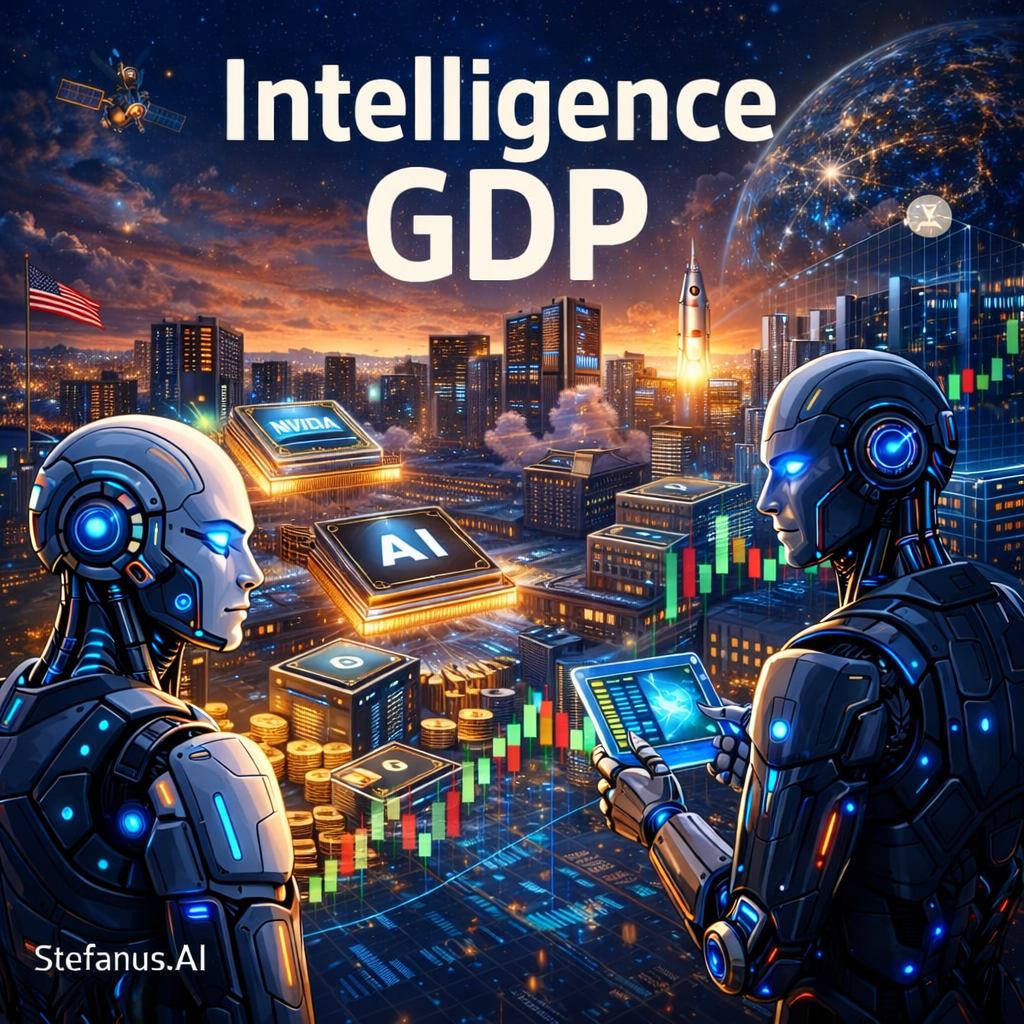

Gross Domestic Product has long served as the primary measure of economic strength, capturing the total value of goods and services produced within a nation. Yet this framework was designed for an industrial and post-industrial economy—one defined by labor, capital, and physical output. It does not adequately capture a world in which intelligence itself—generated, scaled, and deployed through artificial systems—becomes the central driver of value creation.
This paper introduces the term “Intelligence GDP” to describe a new economic layer: the measurable output generated not by human labor alone, but by machine-augmented cognition, algorithmic decision-making, and continuous computational inference. Intelligence GDP reflects the production of insight, prediction, optimization, and automation—outputs that increasingly determine competitive advantage across industries and nations.
The emergence of Intelligence GDP signals a structural transition. Economic power is no longer defined solely by industrial capacity or financial capital, but by who owns, controls, and scales intelligence infrastructure. Artificial intelligence is not simply a tool—it is becoming an asset class, one that is accumulated, financed, and geopolitically contested.

1. From Industrial Output to Cognitive Output
Traditional GDP measures physical production, services, and consumption. However, modern economies are increasingly driven by non-physical outputs: recommendations, predictions, optimizations, and decisions generated by AI systems.
According to International Monetary Fund, artificial intelligence is expected to affect nearly 40% of global employment, reshaping productivity and economic structure [1]. Yet the IMF also notes that traditional metrics struggle to fully capture these gains.
Economist Erik Brynjolfsson of Massachusetts Institute of Technology argues:
“GDP is a flawed measure for the digital economy because it misses much of the value created by free digital goods and services.” [2]
AI amplifies this measurement gap. When a model replaces decision-making across millions of transactions, the value generated is diffuse, continuous, and often invisible to traditional accounting systems.
Thus, Intelligence GDP emerges as a necessary concept—capturing:
- Algorithmic decision output
- Predictive accuracy improvements
- Automation of cognitive labor
- Continuous optimization systems
2. AI as an Asset Class: From Software to Capital
Artificial intelligence is rapidly transitioning from a software category into a capitalized asset class.
Historically, assets included:
- Land (agriculture era)
- Machinery (industrial era)
- Financial instruments (modern capitalism)
Today, a new category is forming intelligence assets, composed of:
- Large-scale models
- Proprietary datasets
- Compute infrastructure
- Training pipelines
According to Stanford Institute for Human-Centered AI:
“The cost of training frontier AI models has grown exponentially, exceeding hundreds of millions of dollars.” [3]
This transforms AI into something that behaves like:
- Infrastructure (like railroads or electricity)
- Financial capital (requiring upfront investment, yielding long-term returns)
The Financial Times recently observed that AI investment is now comparable to large-scale industrial capital cycles, with hyperscalers committing tens of billions annually [4].
In this context, Intelligence GDP becomes the output yield of intelligence capital.
3. Compute, Data, and Energy: The Triad of Intelligence Production
Intelligence GDP is not abstract—it is grounded in physical infrastructure.
It depends on three core inputs:
1. Compute
Advanced chips and data centers
- NVIDIA GPUs as “intelligence engines”
- Hyperscale infrastructure investments
2. Data
Training corpora and real-time inputs
- Proprietary vs public data asymmetry
3. Energy
Electricity as the limiting factor
The International Energy Agency reports that data center electricity consumption could double by 2030, driven largely by AI workloads [5].
As Daron Acemoglu notes:
“The productivity effects of AI depend critically on complementary investments, particularly infrastructure.” [6]
This aligns directly with a broader thesis:
Intelligence is no longer purely digital, it is infrastructural.

4. The Financialization of Intelligence
As AI becomes capital-intensive, it is increasingly financialized.
We are witnessing:
- AI-specific investment funds
- Sovereign AI strategies
- Compute-backed valuations
- Strategic subsidies
The World Bank emphasizes that digital infrastructure is now a core determinant of economic competitiveness [7].
Meanwhile, the The Wall Street Journal reports that major firms are investing unprecedented sums into AI infrastructure, reshaping capital allocation priorities [8].
This introduces a new financial logic:
Intelligence is not just used, it is accumulated, leveraged, and monetized.
Intelligence GDP thus becomes:
- A return metric on AI capital
- A signal of national competitiveness
- A basis for valuation
5. Geopolitics of Intelligence GDP
The rise of Intelligence GDP is fundamentally geopolitical.
Nations are now competing not just on:
- GDP
- Military strength
- Industrial output
…but on:
- Compute capacity
- AI model leadership
- Data control
The United Nations has warned of a growing “AI divide” between nations [9].
Similarly, Nick Bostrom of University of Oxford states:
“Machine intelligence is the last invention that humanity will ever need to make.” [10]
If true, then control over intelligence systems equates to control over:
- economic production
- strategic advantage
- long-term global power
This reframes geopolitical competition as a race for Intelligence GDP dominance.

6. Labor, Productivity, and the Recomposition of Work
Intelligence GDP also reshapes labor dynamics.
Rather than replacing all jobs, AI:
- compresses entry-level roles
- amplifies high-skill workers
- shifts value from labor → intelligence systems
According to the Organisation for Economic Co-operation and Development:
“AI will significantly alter job tasks rather than eliminate entire occupations.” [11]
However, this transformation creates a structural imbalance:
- AI-augmented individuals produce disproportionately more value
- Non-augmented workers fall behind
Thus, Intelligence GDP grows even as:
- traditional labor metrics stagnate
- inequality increases
7. Measuring Intelligence GDP: Toward a New Economic Framework
To operate Intelligence GDP, new metrics must emerge.
Possible components include:
1. Compute Output Index
Total AI inference + training capacity
2. Model Productivity Contribution
Economic value generated per model deployment
3. Automation Penetration Rate
Percentage of decisions handled by AI
4. Intelligence Capital Stock
Total investment in AI infrastructure
Economist Hal Varian notes:
“The biggest impacts of AI will come from improved decision-making.” [12]
This reinforces the need to measure not just production—but decision quality and speed.
Conclusion: The Repricing of the World Economy
The emergence of Intelligence GDP represents a fundamental shift in how economic value is created, measured, and distributed.
Artificial intelligence is no longer an enabling technology, it is becoming:
- a form of capital
- a driver of national power
- a new axis of inequality
- a measurable output in its own right
In this new paradigm:
- Nations compete on intelligence capacity
- Firms are valued by intelligence assets
- Individuals are differentiated by intelligence augmentation
The global economy is being repriced—not by labor or land, but around intelligence itself.
The central question of the coming decade is no longer:
“Who produces the most?”
It is:
“Who produces the most intelligence—and how is it measured?”

Footnotes & Sources
[1] IMF – AI and Jobs
https://www.imf.org/en/Publications/WP/Issues/2024/01/14/GenAI-and-Labor-Markets
[2] Brynjolfsson, MIT – GDP and Digital Economy
https://www.nber.org/papers/w25695
[3] Stanford HAI AI Index Report
https://aiindex.stanford.edu/report/
[4] Financial Times – AI Investment Boom
https://www.ft.com/content/ai-investment
[5] IEA – Electricity and Data Centers
https://www.iea.org/reports/data-centres-and-data-transmission-networks
[6] Acemoglu – MIT Economics AI Paper
https://economics.mit.edu/research/publications
[7] World Bank – Digital Economy
https://www.worldbank.org/en/topic/digitaldevelopment
[8] WSJ – AI Spending Surge
https://www.wsj.com/tech/ai
[9] United Nations – AI Governance
https://www.un.org/en/ai
[10] Bostrom – Superintelligence
https://www.oxfordmartin.ox.ac.uk/publications/superintelligence
[11] OECD – AI and Jobs
https://www.oecd.org/employment/ai/
[12] Hal Varian – AI Economics
https://pubs.aeaweb.org/doi/pdf/10.1257/jep.33.2.3


Comments
[…] Economics signals a transition from GDP-based metrics toward compute-based sovereignty, where nations and corporations are evaluated by their ability to […]
[…] the realm of political economy. When AI infrastructure investment is contributing meaningfully to national GDP growth — Harvard economist Jason Furman has estimated that AI-driven infrastructure investment accounted […]