
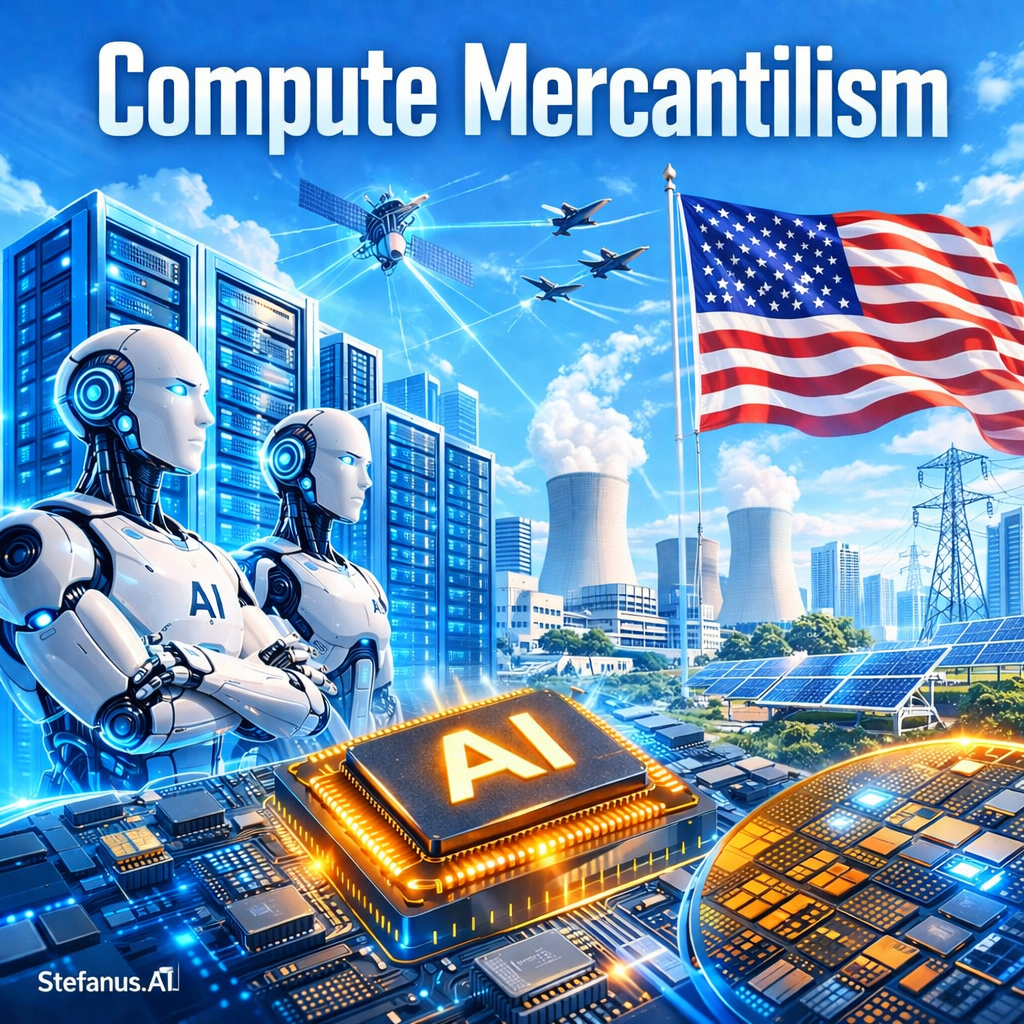

Global power has always been tied to what nations accumulate and control.
In earlier eras, this meant land, gold, and industrial output. In the 20th century, it shifted toward oil and energy systems. In the 21st century, a new axis is emerging: compute capacity—the ability to generate intelligence at scale.
This paper adopts the term compute mercantilism to describe this transformation.
Classical mercantilism was defined by the accumulation of gold reserves and the pursuit of trade surpluses to strengthen national power. Today, a similar logic is reappearing—but instead of gold, nations are accumulating:
- advanced semiconductors
- hyperscale data centers
- gigawatt-level energy systems
- proprietary AI models
The analogy is not metaphorical—it is structural.
As economist Daron Acemoglu of Massachusetts Institute of Technology argues:
“The direction of technological change is shaped by economic and political incentives, not just scientific progress.”¹
Compute mercantilism therefore reflects a deliberate strategy:
to accumulate computational power as a national reserve, restrict its diffusion, and deploy it to secure geopolitical advantage.

2. From Gold Standard to Compute Standard
To understand why compute is becoming a strategic reserve, it is necessary to revisit the transformation of the global monetary system.
Until the early 1970s, the US dollar was anchored to gold under the Bretton Woods system. This changed in 1971, when President Richard Nixon suspended gold convertibility, effectively ending the gold standard.
Economic historian Barry Eichengreen of University of California, Berkeley explains:
“The collapse of Bretton Woods marked the transition to a fiat currency system in which confidence, not gold, underpins value.”²
Following this shift, the strength of the US dollar became increasingly tied to:
- oil markets (petrodollar system)
- financial markets
- global trade dominance
However, structural changes are now emerging.
By early 2026, renewed instability in the Middle East—including disruptions in key shipping routes such as the Strait of Hormuz—has reintroduced uncertainty into global energy flows.³
As reported by the Financial Times:
“Any sustained disruption in the Strait of Hormuz would have immediate consequences for global oil supply and pricing.”⁴
In this environment, the United States faces a strategic imperative:
to reinforce the global role of the dollar without relying on gold or unstable energy flows.
Compute—anchored in domestic technological superiority—emerges as a new foundation.

3. Compute as the New Strategic Reserve
Artificial intelligence transforms computation into an industrial resource.
According to the Stanford University AI Index:
“The amount of compute used in training frontier AI models has increased exponentially, becoming a key determinant of capability.”⁵
This has several implications:
- compute is scarce at the frontier
- access is uneven across nations
- scaling requires enormous capital and energy
Professor Erik Brynjolfsson of Stanford University notes:
“AI is not just software—it is a general-purpose technology that reshapes entire economic systems.”⁶
Like gold reserves in the past, compute now functions as:
- a store of strategic value
- a driver of economic output
- a foundation of national power
4. AI Dominance and the Strategic Role of the United States
The United States currently holds a dominant position in the global AI ecosystem.
This dominance is not accidental. It is built on:
- leading semiconductor firms (e.g., NVIDIA)
- hyperscale cloud providers
- frontier AI labs (OpenAI, Anthropic, Google DeepMind)
- deep capital markets
Professor David Autor of Massachusetts Institute of Technology emphasizes:
“Technological leadership translates into economic and geopolitical influence.”⁷
To preserve this advantage, US policy has shifted toward restriction.
As reported by the The Wall Street Journal:
“Washington has moved aggressively to limit China’s access to advanced AI chips, aiming to preserve a technological edge.”⁸
This reflects a core principle of compute mercantilism:
limit rivals’ access to compute while expanding domestic capacity.

5. Compute Nationalism and Infrastructure Buildout
Nations are now investing heavily in domestic compute infrastructure.
This includes:
- semiconductor fabrication plants
- hyperscale data centers
- AI superclusters
- energy systems capable of gigawatt output
Professor Mark Hansen of University of California, Berkeley observes:
“Data infrastructure is becoming as essential to governance and economic life as physical infrastructure was in the industrial era.”⁹
At the same time, energy constraints are emerging as a limiting factor.
According to the International Energy Agency:
“Electricity demand from data centers, AI, and cryptocurrencies is set to grow significantly in the coming years.”¹⁰
Professor Leah Stokes of University of California, Santa Barbara (closely tied to California energy policy networks) notes:
“Energy systems will determine the pace and scale of digital transformation.”¹¹
This creates a direct linkage:
AI dominance → compute demand → energy infrastructure → national strategy

6. Silicon Valley as the Epicenter of Compute Power
The geographic concentration of AI capability is highly uneven.
The US West Coast—particularly California—hosts:
- leading AI labs
- semiconductor design firms
- venture capital ecosystems
- top research universities
At Stanford University, University of California, Berkeley, University of California, Los Angeles, and University of Southern California, research and talent pipelines feed directly into industry.
Professor Fei-Fei Li of Stanford University states:
“Artificial intelligence is fundamentally about augmenting human capabilities at scale.”¹²
Meanwhile, Professor Jens Hainmueller (Stanford) highlights the broader impact:
“Data-driven systems are reshaping how institutions operate and make decisions.”¹³
This concentration creates a structural advantage for the United States:
- innovation proximity
- talent density
- infrastructure clustering
In the logic of compute mercantilism, geography still matters—but it is the geography of compute.
7. Fragmentation and the Global AI Divide
The rise of compute mercantilism is fragmenting the global economy.
Instead of open technological exchange, we are seeing:
- restricted chip exports
- localized AI ecosystems
- competing standards and platforms
The United Nations warns:
“Digital divides risk deepening inequalities between countries with and without advanced technological infrastructure.”¹⁴
This creates a new hierarchy:
- compute-rich nations
- compute-constrained nations
Access to intelligence becomes a defining factor of global inequality.
8. Conclusion: Why This Is Compute Mercantilism
This paper is titled Compute Mercantilism because the dynamics it describes mirror, in modern form, the logic of historical mercantilism.
Then:
- nations accumulated gold
- restricted trade
- pursued economic dominance
Now:
- nations accumulate compute
- restrict AI and semiconductor access
- pursue technological dominance
In a post-gold world—where the US dollar is no longer backed by physical reserves—the foundation of power is shifting again.
First to oil.
Now to intelligence production.
Compute has become:
- a strategic reserve
- an economic engine
- a geopolitical instrument
The United States’ pursuit of AI dominance is not only about innovation. It is about maintaining systemic influence in a world where traditional anchors of power—gold and oil—are no longer sufficient.
As global instability re-emerges in energy markets, and as geopolitical tensions reshape supply chains, compute offers something uniquely powerful:
- domestically controllable
- infinitely scalable (within constraints)
- directly tied to economic output
This is the essence of compute mercantilism.
It is not a theory of technology.
It is a theory of power in the age of artificial intelligence.

Footnotes & Sources
- Daron Acemoglu (MIT), “Technical Change, Inequality, and Power”
https://economics.mit.edu - Barry Eichengreen (UC Berkeley), Globalizing Capital
https://eml.berkeley.edu/~eichengr/ - IMF – Global Energy Market Risks
https://www.imf.org/en/Publications/WEO - Financial Times – Strait of Hormuz risk analysis
https://www.ft.com - Stanford AI Index Report 2025
https://aiindex.stanford.edu/report/ - Erik Brynjolfsson (Stanford), “The Turing Trap”
https://www.nber.org/papers/w25639 - David Autor (MIT), Labor Markets and Technology
https://economics.mit.edu - Wall Street Journal – US-China chip restrictions
https://www.wsj.com/tech - Mark Hansen (UC Berkeley), Data and Society
https://datascience.berkeley.edu - International Energy Agency – Electricity 2024 Report
https://www.iea.org/reports/electricity-2024 - Leah Stokes – Energy Policy Research
https://www.leahstokes.com - Fei-Fei Li (Stanford), AI and Society
https://profiles.stanford.edu/fei-fei-li - Jens Hainmueller (Stanford), Data and Governance
https://www.hainmueller.net - United Nations – Digital Cooperation Report
https://www.un.org/en/digital-cooperation

Comments
[…] A significant portion of graduates in computer science, AI, and engineering from these universities remain in California. They concentrate geographically within Silicon Valley. […]
[…] is compute mercantilism: the belief that national prosperity and security depend on controlling key layers of the compute […]