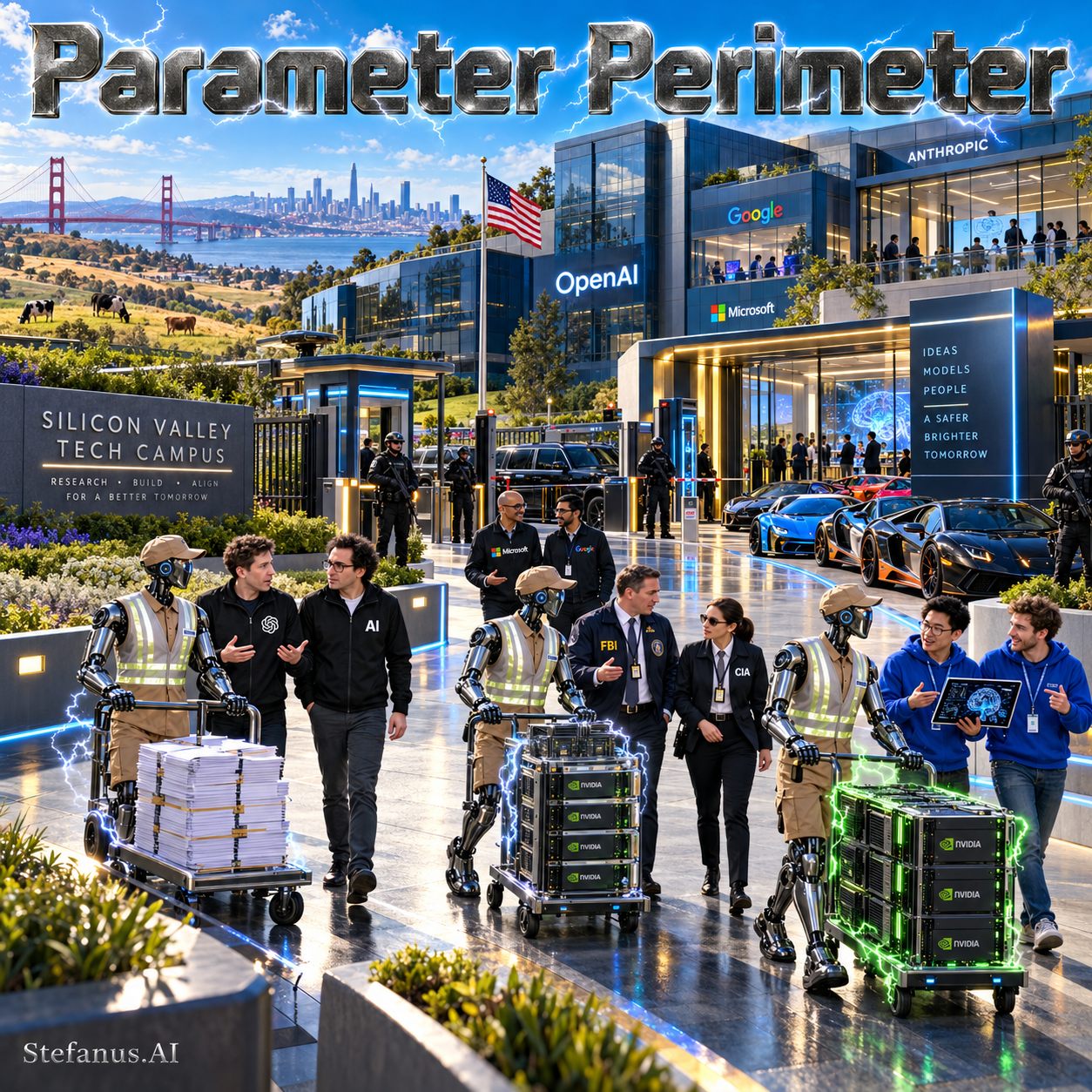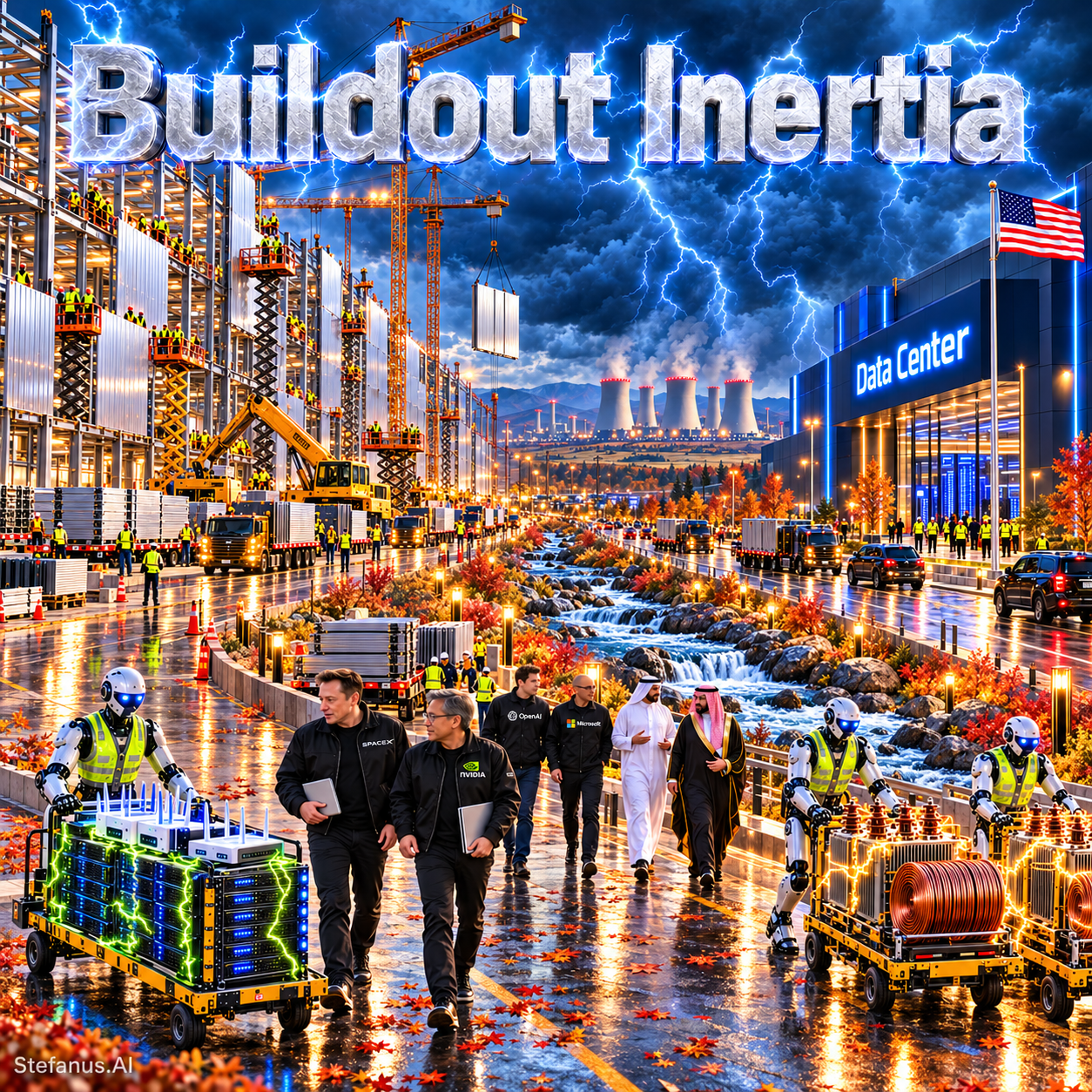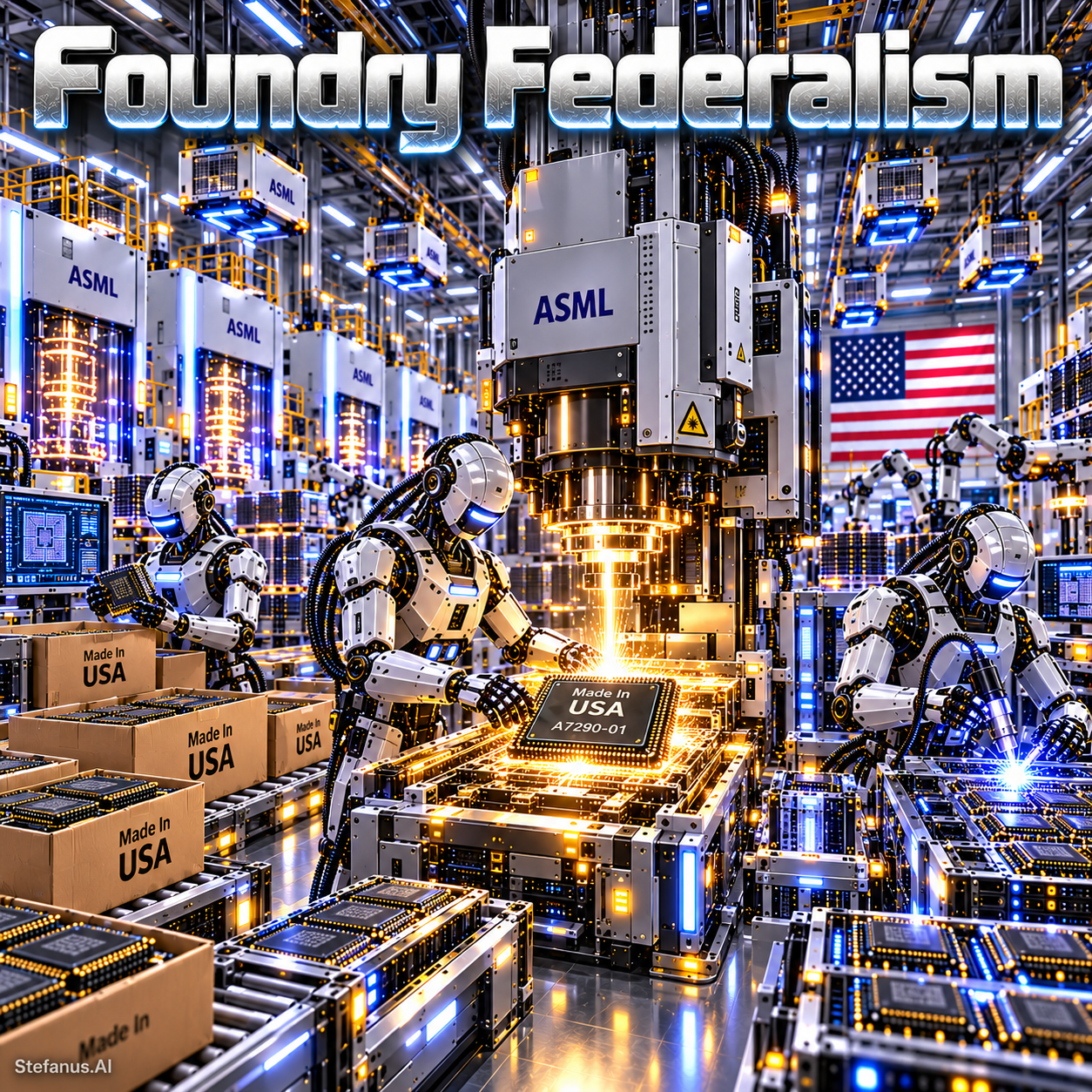
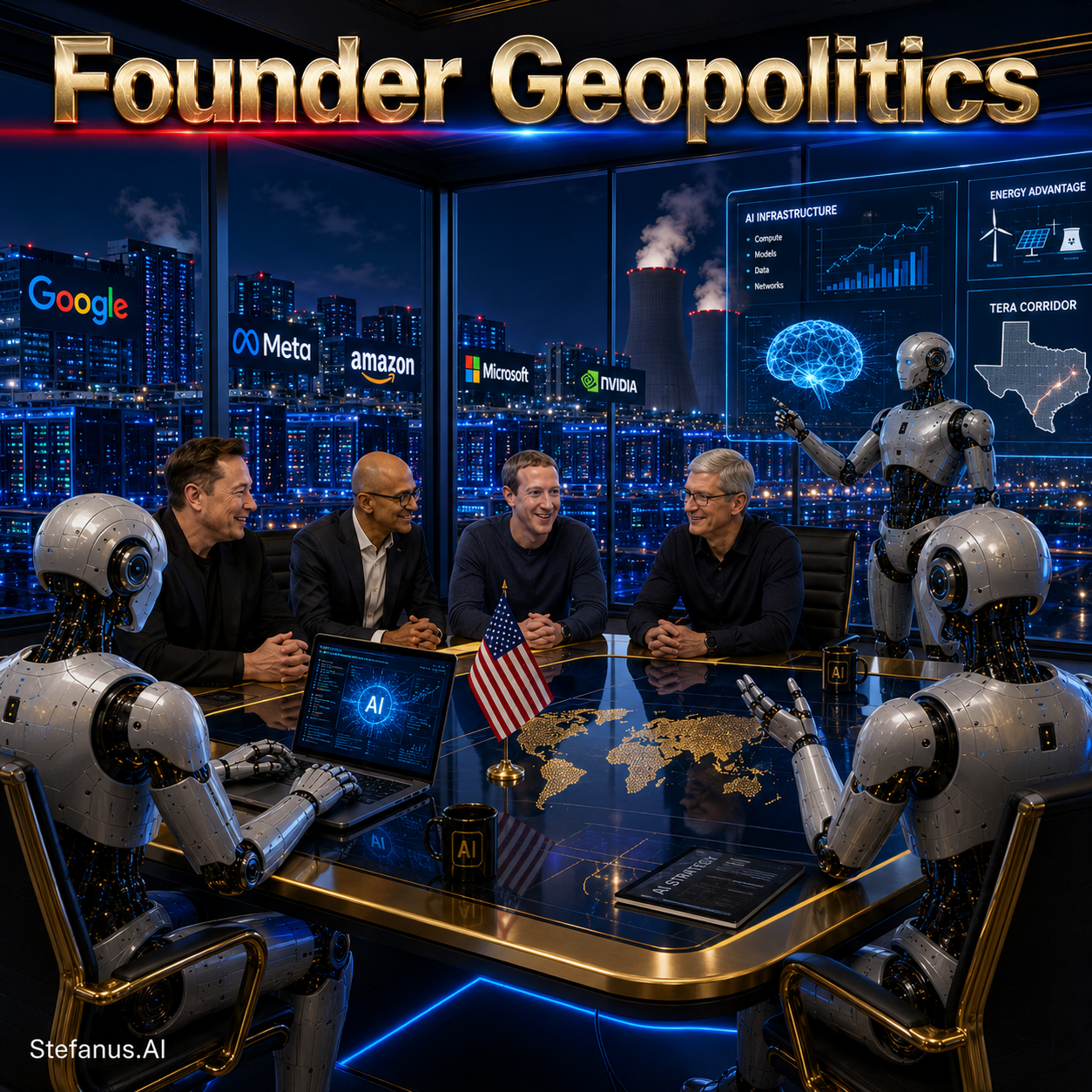

Introduction: The Paradigm Shift and the Birth of Founder Geopolitics
There is a moment in the history of any civilizational shift when the old vocabulary ceases to describe the new reality. We have entered such a moment. The instruments of international power — treaties, embassies, armies, currency reserves — remain, but they now share the stage, and often cede the lead, to a new class of actor: the unelected founder. The individual who built a satellite constellation or an artificial intelligence laboratory now holds leverage over battlefield communications, intelligence architectures, and the algorithmic systems that mediate access to information for billions of human beings. This is not hyperbole. It is a structural feature of the early twenty-first century world order, and it demands a new analytical framework.
I call this framework Founder Geopolitics. It is a framework that names, for the first time as a coherent category, the condition in which private technology founders and the companies they control possess infrastructure — compute, orbit, AI models, data flows, chip manufacturing roadmaps — whose geopolitical significance is indistinguishable from, and in certain domains superior to, that of medium-sized nation-states. The framework is not merely descriptive. It is diagnostic. It identifies the specific mechanisms through which founders exercise geopolitical agency, the institutional gaps that allow this agency to go unaccounted for, and the structural asymmetries between the American and Chinese approaches to managing — or failing to manage — the power that founders accumulate.
The accelerant for this condition is threefold. First, the rise of artificial intelligence as a determinant of both economic and military superiority has concentrated critical decision-making capacity in the hands of a small number of companies whose founders retain extraordinary personal control through dual-class share structures and institutional authority. Second, the commercialization of low-earth orbit satellite constellations has created a new form of strategic infrastructure that is legally private but operationally sovereign. Third, the emergence of digital currencies, cloud computing, and AI-driven financial systems has extended the reach of these founders into the monetary and informational sovereignty of states that depend on their platforms. Taken together, these three accelerants have produced a world in which private actors regularly bypass traditional diplomatic channels, sometimes deliberately and sometimes simply because those channels are too slow, too bureaucratic, or too poorly equipped to engage with the pace of technological change.
The geopolitical implications became vivid, and impossible to ignore, with the Russia-Ukraine war, in which a single American entrepreneur’s decisions about where to activate his satellite internet service shaped the operational capacity of a sovereign nation’s military. They became structural with the emergence of AI-driven targeting systems that transformed private software companies into embedded participants in the command and control architecture of Western armed forces. And they became systemic with the recognition that the most consequential decisions about who gets access to advanced semiconductor technology — the physical substrate of AI power — are made not in the halls of government but in the corporate headquarters of firms whose founders retain personal authority over roadmaps that determine the trajectory of national technological capability.
The theoretical underpinning of this analysis draws on the growing literature concerning the erosion of Westphalian sovereignty in the digital age. Scholars have long recognized that the Peace of Westphalia of 1648 established the conceptual architecture of the modern state system: supreme territorial authority, legal equality among sovereigns, and non-interference in domestic affairs. What they could not have anticipated is that sovereignty would one day be contested not by rival states but by corporations whose infrastructural power transcends territorial borders.1 More recently, scholars of digital sovereignty have begun to map what one Cambridge University press analysis called “oligarchic sovereignty” — the condition in which platform corporations equipped with dual-class share structures and infrastructural reach give their founders and CEOs the capacity to cause large-scale geopolitical effects across fields including data and privacy, communications networks, and financial systems.2
This paper is organized as follows. Section 1 establishes the specific domains through which founders shape state capability. Section 2 provides detailed profiles of the American founders who have become the principal architects of this new order, attending closely to the geography of their founding and expansion, for location shapes not only economic ecosystems but the political cultures and regulatory relationships within which founder power develops. Section 3 provides the Chinese counterpart analysis, examining a set of founders who exercise comparable technological power but within a fundamentally different relationship to the state. Section 4 undertakes a comparative analysis of the regulatory environments that shape founder power in each system. Section 5 draws the strategic lessons. The conclusion returns to the question of what Founder Geopolitics means for the future of international order.
I name this paper Founder Geopolitics rather than, say, “corporate statecraft” or “big tech diplomacy,” because the agency is irreducibly personal. It is not the corporation that makes the decision to turn off satellite service near Crimea, or to withhold AI model access from a particular government, or to accelerate a chip manufacturing roadmap in ways that favor one national economy over another. It is the founder. The corporation is the vehicle; the founder is the driver. And the driver, in the most consequential cases of our era, answers to no electorate, no parliament, and no treaty obligation. That is the condition this paper exists to name, analyze, and ultimately address.

Section 1: Private Founders Now Shape State Capability
The proposition that private founders now shape state capability is not a speculative claim about a future toward which we are trending. It is a description of the present condition, documented across six distinct domains of strategic significance: compute allocation, artificial intelligence model access, satellite deployment, communications infrastructure, defense relationships, and semiconductor manufacturing roadmaps. Each of these domains was, within living memory, either the exclusive province of states or, where private actors were involved, subject to regulatory architectures that preserved meaningful state primacy. What is new — and what constitutes the defining feature of the Founder Geopolitics era — is that private founders now exercise discretionary authority over these domains in ways that states cannot easily override, replicate, or regulate without their cooperation.
Before examining each domain, it is worth pausing on the structural mechanism that makes this authority possible. The dual-class share structure, now standard among the most consequential American technology firms, allows founders to retain voting control over their companies long after they have ceased to own a majority of the economic value. This legal architecture means that the founder’s personal judgment is institutionalized within the governance of the firm in a way that insulates it from the normal mechanisms of shareholder accountability. When Elon Musk decides to restrict Starlink coverage near Russian-occupied Crimea, that decision is not subject to board override or shareholder vote. It is a unilateral exercise of personal authority by an individual who controls a system that a sovereign nation depends on for battlefield communications. The dual-class structure does not merely protect the founder’s economic interests; it constitutionalizes the founder’s geopolitical discretion.
1.1 Compute Allocation and AI Model Access
The allocation of computing power has emerged as one of the most consequential determinants of national capability in the artificial intelligence era. The firms that control the most powerful AI training clusters — measured in the aggregate processing power of their GPU arrays — effectively control access to the frontier of AI capability. Governments, universities, and competing firms that lack internal compute capacity must negotiate with these founders for access, and the terms of that access are set by private decision-making processes that are neither transparent nor democratically accountable.
The interdependence between compute access and national AI capability has become so acute that the United States government has begun to treat semiconductor export controls as a primary instrument of foreign policy. The April 2025 decision to require licenses for exports of Nvidia’s H20 chips to China represented a recognition that the allocation of compute is equivalent to the allocation of strategic power.3 Yet the irony of this recognition is that the policy was implemented through regulatory action directed at a private company, Nvidia, whose founder Jensen Huang retains the kind of personal authority over product roadmaps and business strategy that no government official possesses over the broader semiconductor ecosystem. The state sets the outer boundaries; within those boundaries, the founder governs.
AI model access is the downstream expression of compute allocation. The decision about which governments, militaries, and private actors receive access to the most capable AI models is made by a small number of American founders and their senior leadership teams. These decisions carry geopolitical weight that rivals formal treaty commitments. When Anthropic makes its Claude models available to the United States Department of Defense for integration into targeting and command systems, that is a geopolitical act with consequences measured in lives and strategic outcomes, yet it occurs within a private contractual framework that bypasses the legislative and diplomatic processes through which sovereign nations have historically governed the disposition of lethal capability.
1.2 Satellite Deployment and Communications Infrastructure
The geopolitical significance of private satellite constellations became impossible to ignore with the Russia-Ukraine war. Since February 2022, Ukraine has relied on SpaceX’s Starlink for military, government, and civilian communications.4 The dependency has been total: artillery units have used Starlink to aim their fire, drone operators have used it to survey Russian positions, and government agencies have used it to maintain digital identification systems during power outages. This dependency has transformed Musk into an actor with discretionary authority over the operational capacity of a sovereign military — an authority he has exercised in ways that reveal both the power and the accountability deficit of the Founder Geopolitics condition.
The most revealing episode came in 2022, when Musk declined to enable Starlink coverage near Russian-occupied Crimea in order to support a Ukrainian naval drone operation, citing his personal concern about the risk of nuclear escalation. The decision was unilateral. It was not coordinated with the United States government, with NATO, or with the Ukrainian military command. It was the expression of one man’s strategic judgment, imposed on a sovereign nation’s military operations. Foreign Policy magazine captured the constitutional significance of the moment precisely:
When a private supplier can decide which operations a front-line state is permitted to conduct based on personal intuition, the relationship has ceased to be commercial. It is a delegation of sovereignty, a strategic function exercised by an unaccountable executive.
— Foreign Policy, March 2026µ
In March 2025, Musk went further, writing on the social media platform X: “I literally challenged Putin to one-on-one physical combat over Ukraine and my Starlink system is the backbone of the Ukrainian army. Their entire front line would collapse if I turned it off.”5 Whatever one makes of the rhetorical register, the underlying claim was accurate and strategic: a private individual was publicly articulating his power to determine the outcome of a sovereign nation’s war. This is not a failure of regulation. It is a structural feature of a world in which critical national security infrastructure has been built by private founders faster than states have been able to develop frameworks for governing the discretion those founders exercise.
1.3 Defense Relationships and the New Algorithmic Warfare
Palantir Technologies has emerged as perhaps the most consequential illustration of how a private founder’s creation can become embedded within the military command and control infrastructure of the world’s most powerful states. The company’s Maven Smart System (MSS), an AI-enabled targeting platform, was designated an official program of record by the United States Department of Defense in 2026, locking in multi-year funding and establishing it as a protected line item in the Future Years Defense Program.6 MSS uses computer vision and machine learning to automatically detect objects in satellite and drone feeds, flagging potential targets for human approval and signaling appropriate weapons systems for kinetic strikes.
Palantir CEO Alex Karp has described this embedding in terms that reveal the full scope of what it means for a private company to become strategic defense infrastructure:7
The fact that you can now target more precisely, more accurately, more quickly, and that you, meaning America, can do these things, organize the total power of our fleet and all of our resources, and bring it to bear against adversaries and enemies, has shifted the way in which war is fought.
— Alex Karp, CEO of Palantir Technologies, March 2026
The significance of this statement extends beyond corporate self-promotion. A private CEO is describing his company’s technology as having fundamentally altered the conduct of war for the world’s preeminent military power. The political and moral accountability that attaches to this claim is, however, routed through private contractual and fiduciary structures rather than through the democratic institutions through which sovereign nations have historically governed decisions about lethal force. This is the accountability deficit at the heart of Founder Geopolitics.
1.4 Chip Manufacturing Roadmaps and the Semiconductor Geopolitics
Semiconductor manufacturing roadmaps are among the least visible but most consequential instruments of geopolitical power in the current era. The decision about which chips to develop, at what capability levels, and on what timeline, determines the AI capabilities available to every state and non-state actor that depends on those chips for model training and inference. Nvidia’s Jensen Huang presides over a company that, before export controls took full effect, commanded approximately ninety-five percent of China’s market for advanced AI accelerators.8 The product roadmap decisions he makes in Santa Clara shape the trajectory of artificial intelligence development globally, including for military applications that will determine strategic outcomes for decades.
The export control decisions of the United States government illustrate the dependency running in both directions: the government needs Nvidia’s cooperation to make export controls effective, but it also depends on Nvidia’s innovation to maintain American AI leadership. This mutual dependency creates a structural entanglement between the founder and the state that neither pure market logic nor traditional regulatory theory adequately describes. It is, precisely, Founder Geopolitics: the condition in which state power and founder power are so deeply intertwined that their separation becomes analytically and practically impossible.

Section 2: American Founders, Location, and the Shaping of Local and Global Economies
Geography is not incidental to Founder Geopolitics. The locations where founders begin their companies, and the decisions they make about where to expand or relocate them, have profound consequences for regional economic ecosystems, talent concentration, regulatory cultures, and the political relationships that shape how founder power interacts with state power. The American experience reveals a tale of two dominant poles — Silicon Valley and Texas — with Seattle as a third center, and a growing number of secondary nodes whose emergence reflects the ongoing geographic dispersal of technology power. Understanding where each founder built, and why, is essential to understanding how each has shaped not only local economies but the broader geopolitical ecosystem of American technology leadership.
2.1 Elon Musk: From California Orbit to Texas Foundation
Elon Musk’s geographic trajectory is among the most consequential in the history of American technology. Having arrived in the United States from South Africa, Musk was accepted into a graduate program in materials science at Stanford University in 1995 but chose not to attend, opting instead to pursue entrepreneurship in the fertile ecosystem of Silicon Valley. The companies he began there — including the payments platform that became PayPal, later acquired by eBay — established the financial foundation and the reputational architecture from which all his subsequent ventures would draw.
Tesla began in Fremont, California, and SpaceX was founded in Hawthorne, approximately one mile south of Los Angeles International Airport, placing it within the defense and aerospace industrial ecosystem of Southern California. These were not accidental choices. California’s concentration of aerospace engineering talent, its proximity to military procurement relationships, and its culture of ambitious technological risk-taking made it the natural home for companies attempting to reinvent electric vehicles and commercial spaceflight simultaneously.
Musk’s subsequent decision to relocate the headquarters of both Tesla and SpaceX to Austin, Texas represented a political and economic statement as much as a business decision. The move brought with it the Tesla Gigafactory in Austin and, subsequently, the Terafab facility at the same location — manufacturing infrastructure whose scale and strategic significance transformed Austin’s role in the American technology economy. Texas offered lower taxes, a more accommodating regulatory environment, and a political culture more aligned with Musk’s evolving public positions. The economic impact on Austin has been substantial, with Tesla and SpaceX collectively contributing billions in investment and tens of thousands of jobs to the regional economy.9
Perhaps the most geopolitically significant of Musk’s geographic decisions was the establishment of xAI’s Colossus data center facility in Memphis, Tennessee. The Colossus supercomputer, which became one of the most powerful AI training clusters in the world, represents the physical substrate of a frontier AI company whose ambitions extend to competing directly with OpenAI and Anthropic for dominance in the large language model market. The location of this facility in Memphis is significant not only for its regional economic impact but for what it signals about the ongoing geographic dispersal of critical AI infrastructure beyond the traditional technology centers of California.
Musk’s geopolitical significance, however, ultimately rests less on his location decisions than on the nature of the infrastructure he controls. Starlink, with its constellation of more than six thousand low-earth orbit satellites, has created a global communications network whose strategic value is demonstrated daily in Ukraine and whose potential applications — from supporting resistance movements in authoritarian states to providing communications infrastructure for military operations in contested environments — make Musk one of the most consequential private actors in the history of international relations.
2.2 Jensen Huang: Silicon Valley’s Permanent Compute Sovereign
Jensen Huang completed his undergraduate education at Oregon State University before earning a Master of Science degree from Stanford University in 1992. The following year, he co-founded Nvidia in what would become one of the most consequential founding decisions in the history of American technology. Huang’s decision to remain rooted in Silicon Valley, initially in Sunnyvale and later with a broader presence across the Bay Area, was a decision to embed Nvidia within the densest concentration of technology talent, venture capital, and engineering culture in the world.10
The company Huang built has become, in the AI era, the closest thing to a physical sovereign over the resources that determine AI capability. Nvidia’s graphics processing units, originally designed for gaming, proved uniquely suited to the parallel computation required for training large neural networks. This architectural accident of history has made Nvidia the indispensable provider of the physical infrastructure on which the AI revolution runs. Every major AI laboratory in the world — OpenAI, Anthropic, Google DeepMind, xAI — depends on Nvidia’s chips for training and inference. This dependency makes Huang’s product decisions consequential in ways that transcend normal commercial significance.
The export control drama of 2025 and 2026 illustrated this with unusual clarity. When the United States government required licenses for export of Nvidia’s H20 chips to China in April 2025, Nvidia reported a charge of $4.5 billion associated with the resulting excess inventory and purchase obligations.11 The episode demonstrated that Huang’s decisions about chip design — specifically, the decision to create the H20 as a China-market product — had created geopolitical exposure that neither Nvidia nor the government had fully anticipated. The chip that was designed primarily to serve a commercial market became, almost overnight, a central element of US-China strategic competition. This is the texture of Founder Geopolitics: commercial decisions made in Silicon Valley by a private founder reverberating across the architecture of global strategic competition.
2.3 Mark Zuckerberg: The Social Infrastructure Sovereign of Menlo Park
Mark Zuckerberg dropped out of Harvard University while building the social network that would become Facebook, then made the defining geographic choice of his career by relocating the company to the Silicon Valley ecosystem. The move embedded Facebook — later rebranded as Meta — within the talent, capital, and cultural infrastructure of the Bay Area, where it has remained. From Menlo Park, Zuckerberg built not merely a social media platform but a global communications infrastructure that carries the daily interaction of more than three billion people, making Meta’s content moderation, algorithmic, and data-handling decisions consequential for democratic processes, public health information, and political discourse in virtually every country on earth.
Zuckerberg’s acquisitions of Instagram and WhatsApp were acts of platform consolidation whose geopolitical implications were not fully understood at the time they were made. WhatsApp, in particular, has become the primary communications infrastructure for civil society, journalism, and political organizing in dozens of countries across Latin America, South Asia, and Africa. The decisions Zuckerberg and his team make about encryption standards, content policies, and government data requests on WhatsApp are, in practice, decisions about the communications sovereignty of states whose populations depend on the platform for everyday communication. This is founder power of a kind that no treaty has attempted to govern and no regulatory regime has successfully constrained.
2.4 Sam Altman: The Diplomat of San Francisco
Sam Altman’s stewardship of OpenAI from its San Francisco base has made him one of the most consequential diplomatic actors of the current era, even though he holds no diplomatic title and answers to no electorate. In January 2025, Altman appeared alongside President Donald Trump at the White House to announce a $500 billion data center investment project that would substantially benefit OpenAI — a moment that crystallized the convergence of founder power and executive power in the American political economy.12
Altman has been equally active in international diplomacy. He traveled with the presidential entourage to Saudi Arabia in May 2025, where he met with Crown Prince Mohammed bin Salman, and he has engaged in bilateral meetings with heads of state and senior officials across Asia, the Middle East, and Europe.13 These meetings are not ceremonial. They are substantive negotiations about the terms on which OpenAI’s technology will be deployed in each country, the data governance frameworks that will apply, and the strategic alignments that AI deployment will create. In this sense, Altman functions as a diplomat whose portfolio covers the most consequential technology in human history, conducting foreign policy without the institutional constraints or democratic accountability that attach to formal diplomatic representation.
The February 2026 India AI Impact Summit illustrated the pattern at scale: Altman, Jensen Huang, Sundar Pichai, and Dario Amodei gathered in New Delhi alongside Indian business and government leaders to negotiate the terms of AI deployment in the world’s most populous democracy. The summit was structured as a business event, but its substance was geopolitical — a negotiation about which AI systems would power India’s digital infrastructure, on what terms, with what implications for data sovereignty and strategic alignment. That this negotiation occurred between private founders and a sovereign government, rather than between governments through diplomatic channels, is the defining signature of the Founder Geopolitics era.
2.5 Dario Amodei: Safety, Power, and the Anthropic Doctrine
Dario Amodei’s intellectual formation is singular among the founders of frontier AI companies. He began his undergraduate education at the California Institute of Technology before transferring to Stanford University, where he earned a Bachelor of Science degree in physics. He subsequently completed a doctorate in biophysics at Princeton University, studying the electrophysiology of neural circuits, and undertook a postdoctoral fellowship at the Stanford University School of Medicine. This formation in rigorous empirical science and biological complexity informs an approach to AI development that is distinguished from its peers by an explicit commitment to safety research as a parallel and co-equal priority to capability development.
Amodei co-founded Anthropic after departing OpenAI, and the company’s commitment to remaining within the Silicon Valley and San Francisco ecosystem reflects both a practical judgment about talent concentration and a philosophical orientation toward engagement with the regulatory and governmental environment of the Bay Area. Anthropic’s Claude models have become embedded in defense and intelligence applications at a pace that challenges any simple distinction between safety-oriented AI development and the demands of national security. The integration of Claude into Palantir’s Maven Smart System for CENTCOM operations is perhaps the most striking illustration of how even the most safety-conscious AI founders become participants in the architecture of military power when their technology reaches sufficient capability levels.
Amodei’s participation in the 2026 India AI Impact Summit alongside Huang and other founders reinforces the pattern of founder diplomacy that characterizes this era. The decisions Anthropic makes about model capability, access, and deployment terms are geopolitical decisions, whether or not they are recognized as such by the regulatory frameworks within which the company operates.
2.6 Larry Page and Sergey Brin: The Stanford Ecosystem and the Search Sovereign
Larry Page and Sergey Brin founded Google while both were doctoral students at Stanford University — a founding biography that encapsulates the symbiotic relationship between elite research universities and the technology companies that have come to dominate the global information economy. Their decision to remain in the Bay Area, building Google into what became Alphabet, created one of the most consequential concentrations of technological and organizational power in human history. Google’s search algorithm determines what information billions of people access daily; its advertising infrastructure funds a significant proportion of the global journalism and information ecosystem; and its cloud computing and AI research divisions are central to the strategic technology competition between the United States and China.
2.7 Michael Dell: Texas Technology Independence
Michael Dell began his entrepreneurial career at the University of Texas at Austin, founding what would become Dell Computer Company before completing his degree. His decision to build and remain in Austin, Texas rather than relocating to Silicon Valley was among the earliest and most consequential demonstrations that significant technology companies could be built outside the Bay Area ecosystem. Dell’s presence in Austin helped to establish the infrastructure — talent networks, supplier relationships, real estate infrastructure, and political culture — that would later make the city an attractive destination for Musk’s Texas relocation and the broader technology migration of the 2020s. The Austin technology ecosystem, and by extension Texas’s emerging role as an alternative pole of American technology power, owes a significant debt to Dell’s founding geographic decision.
2.8 Jeff Bezos: The Pacific Northwest and the Infrastructure of Everything
Jeff Bezos founded Amazon as an online bookstore in Seattle, Washington, a location whose proximity to Boeing’s engineering culture, its abundance of technical talent from the University of Washington, and its geographic distance from Silicon Valley all shaped the company’s distinctive organizational culture. Amazon’s evolution from retail platform to cloud computing infrastructure provider through Amazon Web Services (AWS) transformed the company from a commercial actor into critical infrastructure for governments, militaries, and economies across the world. AWS powers a significant proportion of the United States government’s digital infrastructure, including classified systems, making Amazon’s architectural and security decisions consequential for national security in ways that were not anticipated when the cloud division was founded. Bezos’s broader ambitions through Blue Origin in the space economy represent a second channel through which this founder extends his geopolitical footprint into the emerging domain of commercial space.
2.9 Bill Gates: Microsoft and the Azure Dominion
Bill Gates co-founded Microsoft with Paul Allen in the Seattle area, and the company’s decision to remain anchored in the Pacific Northwest established a second major pole of American technology power outside California. Microsoft’s Azure cloud computing platform has become, alongside AWS, one of the two primary infrastructure providers for the global internet economy, including for governments and militaries whose cloud strategies depend on Azure’s security, reliability, and geographic reach. The partnership between Microsoft and OpenAI, which has made Azure the primary cloud infrastructure for OpenAI’s training and inference operations, has created an additional layer of geopolitical significance: the physical infrastructure on which the most capable AI systems run is provided by a Seattle-founded company that retains deep relationships with United States government and military customers.
2.10 Larry Ellison: The Database Sovereign Migrates South
Larry Ellison founded Oracle Corporation in the San Francisco Bay Area, building the company that would become the dominant provider of enterprise database software for corporations and governments around the world. His subsequent decision to relocate Oracle’s headquarters to Austin, Texas — driven in part by California’s regulatory and tax environment — followed a pattern that several other founders would replicate. Ellison’s significance for the Founder Geopolitics framework lies not primarily in his geographic decisions but in Oracle’s strategic role in the AI era: database infrastructure is the foundation on which AI training data is organized, stored, and made accessible, making Oracle’s architectural decisions consequential for the AI capabilities of every government and corporation that depends on its systems.

Section 3: The Chinese Founder Contrast — Directed Innovation and the Limits of Sovereign Ambition
To understand the full scope of Founder Geopolitics, one must examine not only the American model but its Chinese counterpart. China has produced a cohort of technology founders whose companies command comparable scale and whose technologies carry comparable geopolitical significance. What distinguishes the Chinese case, and what makes it essential to the comparative analysis this paper undertakes, is the fundamentally different relationship between founder and state that has defined and continues to define the Chinese technology ecosystem. Where American founders exercise geopolitical power that exists largely outside formal state structures — sometimes in alignment with state interests, sometimes in tension with them — Chinese founders operate within a governance architecture in which the Party-state retains ultimate authority over both the direction and the limits of private technological ambition.
This is not a simple story of state control versus private freedom. The reality in China is considerably more nuanced, and considerably more dynamic, than that binary suggests. Chinese founders have, at various points, exercised extraordinary personal agency in building companies that reshaped entire industries. The state has, at various points, celebrated their success, tolerated their autonomy, cracked down on their power, and then rehabilitated them when strategic circumstances required. What remains constant is the asymmetry: in China, the founder serves the state’s strategic priorities, however flexibly those priorities are defined and however much latitude founders are granted within them. In America, the relationship is reversed, or at least contested: the state must negotiate with founders who have built infrastructure that the state cannot replicate or easily do without.
3.1 Jack Ma and Alibaba: The Costs of Overreach
Jack Ma founded Alibaba in 1999 from his apartment in Hangzhou, China, alongside seventeen co-founders. Initially launched as a business-to-business e-commerce marketplace, Alibaba grew into a technology conglomerate encompassing retail, cloud computing, digital payments through Ant Group, and logistics infrastructure. By the late 2010s, Alibaba’s influence had expanded to rival state power in key industries including finance and digital infrastructure that had until then been dominated by state-owned companies.14
The consequences of this overreach became clear in 2020, when Ma made public comments critical of Chinese financial regulators at the Bund Summit in Shanghai. The Chinese regulatory authorities launched an anti-monopoly investigation into Alibaba and suspended the massive stock market listing of Ant Group. Ma moved to Japan, where he maintained a low public profile for several years. His reappearance in February 2025, at a high-level symposium hosted by President Xi Jinping at the Great Hall of the People in Beijing, was interpreted as a signal of Beijing’s strategic recalibration: in a period of economic slowdown and mounting US-China tensions, the Party was prepared to rehabilitate entrepreneurs whose capabilities it needed, provided they aligned their business goals with state priorities.15
Xi Jinping’s message to the assembled tech executives at the February 2025 symposium was simultaneously a welcome back and a reminder of the terms of engagement:16
Those who get rich first should promote common prosperity.
— President Xi Jinping, Private Enterprises Symposium, Beijing, February 2025
The Jack Ma episode is the most vivid illustration of the central difference between the American and Chinese models of Founder Geopolitics. In America, the founder accumulates power that the state cannot easily constrain; the state must negotiate, regulate, or collaborate. In China, the founder accumulates power at the state’s sufferance; the state can, when it chooses, retract that sufferance. This asymmetry defines the Chinese model and shapes everything that follows from it.
3.2 Ma Huateng (Pony Ma) and Tencent: Platform Power Under Party Guidance
Tencent was founded on November 11, 1998, in Shenzhen, China, by Ma Huateng and four co-founders. Beginning as an instant messaging company, Tencent evolved into one of the world’s largest technology and entertainment conglomerates, with its WeChat super-app serving as the primary communications, payments, and social infrastructure for more than a billion users in China. The strategic significance of WeChat for the Chinese state is difficult to overstate: the platform is simultaneously a commercial product, a surveillance instrument, a tool for social credit monitoring, and the digital infrastructure through which the Party communicates with, monitors, and when necessary controls, its population.
Tencent’s geopolitical significance beyond China lies in its investments across global gaming, entertainment, and digital infrastructure companies, which give the Party an indirect visibility into and potential influence over digital ecosystems in dozens of countries. The Shenzhen location of Tencent’s founding reflects the strategic importance of that city as China’s designated laboratory for market-oriented economic development — a geography that shapes Tencent’s regulatory culture and its proximity to the hardware manufacturing ecosystem of the Pearl River Delta.
3.3 Zhang Yiming and ByteDance: The Algorithm at the Center of Global Information
Zhang Yiming founded ByteDance in 2012, creating the company that would develop TikTok and transform global social media through the application of recommendation algorithms of unprecedented sophistication and effectiveness. TikTok’s penetration of Western markets — particularly among younger demographics in the United States, Europe, and Latin America — has made ByteDance the most geopolitically contested technology company in the world. The concern, articulated by United States government officials and repeated across Western regulatory environments, is that a Chinese founder’s recommendation algorithm shapes the information environment of Western populations in ways that serve Chinese strategic interests, however indirectly or inadvertently.
The ByteDance case illustrates a dimension of Founder Geopolitics that has no precise American counterpart: a founder whose algorithm has become critical information infrastructure in adversary states, creating a form of epistemic influence that operates below the threshold of formal diplomacy but above the level of mere commerce. Zhang Yiming’s decisions about algorithmic design — decisions made within a corporate structure ultimately subject to Chinese law and Party guidance — shape what hundreds of millions of non-Chinese people see, believe, and feel, every day. This is geopolitical power of a kind that no previous theory of international relations has adequately theorized.
3.4 Robin Li, Wang Chuanfu, and Ren Zhengfei: The Infrastructure Triad
Robin Li, co-founder and CEO of Baidu, has led China’s primary attempt to build an AI research and deployment capability that can rival American frontier models. Baidu’s Ernie Bot and its underlying large language model infrastructure represent the Chinese state’s primary response to the ChatGPT moment, and Li’s decisions about model capability and deployment are made within a framework that integrates state guidance at every level. Wang Chuanfu, founder of BYD, has built the world’s largest electric vehicle company, whose battery technology and manufacturing scale give China a structural advantage in the electrification of transportation that carries significant implications for energy geopolitics and resource dependency. Ren Zhengfei, founder of Huawei, has built the world’s most advanced telecommunications equipment company outside the United States, creating the 5G infrastructure backbone on which a growing number of countries’ digital economies depend — a dependency that the United States and its allies have identified as a primary security risk and spent billions attempting to mitigate.
Together, these three founders represent the Chinese state’s strategic approach to Founder Geopolitics: identify the domains — AI, electric vehicles, telecommunications — in which technological leadership translates directly into geopolitical leverage, and cultivate champions who will develop that leadership within a framework aligned with Party goals. The contrast with the American approach, in which founders pursue commercial objectives that sometimes align and sometimes conflict with state interests, could not be more stark.

Section 4: Comparative Analysis — Regulatory Environments and the Architecture of Founder Power
The divergence between the American and Chinese approaches to founder power is not merely a difference in degree; it is a difference in the fundamental structure of the relationship between the state and the private actor in the technology domain. Understanding this structural difference is essential to understanding the distinctive geopolitical risks and opportunities that each system generates, and to developing the strategic frameworks that states outside both systems need to navigate the Founder Geopolitics era.
4.1 The American Model: Bottom-Up Innovation with Regulatory Lag
The American system for governing technology power can be characterized, with only modest simplification, as one of bottom-up innovation followed by top-down regulatory response, with a persistent and structurally significant lag between the two. Founders build; companies grow; power accumulates; and the state eventually attempts to regulate, partner with, or co-opt the power that founders have assembled. This sequence has a long historical antecedent in American regulatory history, from the railroad trusts of the late nineteenth century to the telecommunications deregulation of the 1980s and the antitrust debates of the internet era. What is new in the Founder Geopolitics era is that the speed of technological change, and the depth of state dependency on founder-controlled infrastructure, has made the lag between innovation and regulation a structural vulnerability rather than a manageable friction.
Scholars of digital sovereignty have identified the core problem with precision. As one recent analysis from Cambridge University notes, the state “is no longer simply contracting private services; it is increasingly dependent on opaque systems that operate beyond their control, understanding, or ability to replicate.”17 This dependency is not a temporary condition that regulation will eventually resolve. It is an ongoing structural feature of a world in which the rate of technological innovation consistently outpaces the rate of institutional adaptation. The American government’s attempt to use export controls to govern Nvidia’s chip exports to China illustrates both the reach and the limits of the regulatory tool: the state can set rules about where products go, but it cannot easily govern the design decisions, the pricing structures, or the access policies that determine who benefits from the most advanced technology.
The emergence of what this paper terms “Venture-Capital Populism” — the 2025-2026 trend of tech magnates stepping into government advisory roles and aligning political movements with technological power — represents a further blurring of the boundary between founder agency and state authority. When a founder’s political alignment with a presidential administration gives him advisory access to the executive branch, and when that same founder controls critical national security infrastructure, the distinction between public and private authority becomes, for practical purposes, dissolved. This is both a feature and a bug of the American approach: it preserves the dynamism of private innovation while creating accountability gaps that the Westphalian system of state sovereignty is entirely unequipped to address.
4.2 The Chinese Model: Top-Down Direction and the Limits of Strategic Control
The Chinese model inverts the American sequence: the Party identifies strategic technology domains, sets development priorities, and cultivates private founders who will pursue those priorities within a framework of Party guidance. The advantages of this model are real: it enables the concentration of resources and talent on strategic goals at a speed that market allocation alone cannot achieve, and it prevents the accumulation of private power that might rival state authority. The Jack Ma episode demonstrated that these guardrails are not merely theoretical.
The academic literature on Chinese platform governance identifies the model as what one scholar characterizes as a “market in the fragmented state” — a hybrid architecture in which the pragmatic Leninist central state both leverages and controls private tech giants to balance economic growth, social stability, and national security amid geopolitical tensions and a slowing economy.18 Local governments maintain a fragile symbiosis with platforms like Alibaba to advance their own political and economic goals, creating a layered and sometimes contradictory governance structure that is neither purely hierarchical nor purely market-driven.
The limits of the Chinese model have also become visible. The anti-monopoly crackdown that began in 2020 produced a significant chilling effect on private technology investment and entrepreneurial ambition that the Party subsequently found necessary to address through explicit reassurance campaigns. The February 2025 symposium was precisely this kind of reassurance: an acknowledgment that the crackdown had gone further than strategic interest required, and a signal that a recalibration was necessary. The deeper limitation of the Chinese model is that the same Party authority that can prevent founders from accumulating dangerous amounts of power can also prevent the kind of boundary-pushing innovation that produces world-leading technology. The tension between control and creativity is not resolved in the Chinese system; it is managed, imperfectly and dynamically, by a Party leadership that must constantly balance competing imperatives.
4.3 The Shared Reality: Founders as a New Class of Geopolitical Actor
Beneath the structural differences between the American and Chinese models lies a shared reality: both sets of founders hold more geopolitical power than many of the world’s nation-states. The combined market capitalization of the seven largest American technology companies exceeds the GDP of every country except the United States and China. The AI models being developed by American and Chinese frontier AI companies will set the standards and architectural norms that define how artificial intelligence is built, deployed, and governed globally for the next several decades. The satellite constellations, cloud platforms, and semiconductor supply chains that American founders have built create structural dependencies for dozens of states whose sovereign decision-making is, in practice, conditioned by choices made in private boardrooms in Menlo Park, Austin, and Seattle.
This shared reality demands a new conceptual framework for international relations, one that acknowledges founders as a class of geopolitical actor with their own interests, capabilities, and accountability structures, rather than treating them as either subordinate instruments of state policy or as apolitical market participants. Founder Geopolitics is that framework.

Section 5: Strategic Lessons from Founder Geography and the Architecture of State Capability
The emergence of Founder Geopolitics as a structural feature of the international system carries several strategic lessons that states, international institutions, and civil society organizations must internalize if they are to navigate the coming decades effectively. These lessons are not primarily lessons about regulation or antitrust, though those remain important. They are lessons about the nature of power, the sources of dependency, and the kinds of institutional innovation that the Founder Geopolitics era demands.
5.1 The Outsourcing of Security Creates Structural Fragility
The most immediate strategic lesson of the Founder Geopolitics era is that states which outsource critical security infrastructure to private founders create structural fragility that cannot be easily remedied once the dependency has been established. Ukraine’s dependence on Starlink is the paradigm case, but it is far from the only one. Governments across the world have embedded private AI systems into intelligence analysis, defense planning, and command communications in ways that create dependencies on specific companies and, through those companies, on the personal judgments of their founders.
The fragility this creates is not merely technical. It is political and relational. When a state depends on a private founder’s infrastructure for national security functions, it must factor the founder’s interests, political alignments, and personal judgments into its strategic planning in ways that compromise its sovereign autonomy. This is not a failure of contracting or procurement; it is a structural feature of a world in which the most capable technology is controlled by private actors whose loyalty runs to shareholders, personal ideology, and market position rather than to any state’s national interest. The strategic lesson is not that states should avoid using private technology — that ship has sailed — but that they must invest in the redundancy, the domestic capability, and the contractual and regulatory frameworks that prevent any single founder’s decisions from becoming existential threats to national security capacity.
5.2 The Founder as Diplomat: A New Channel of Foreign Policy
The second strategic lesson is that founders have become a new channel of foreign policy, one that operates parallel to and sometimes in competition with traditional diplomatic channels. Sam Altman’s meetings with the Saudi Crown Prince, Jensen Huang’s role in US-China semiconductor politics, and Musk’s interventions in the Ukraine conflict are all examples of founders conducting what amounts to foreign policy without the institutional constraints of formal diplomacy. This parallel channel is not going away. States that fail to develop sophisticated frameworks for engaging with founders as diplomatic actors will find themselves systematically disadvantaged in negotiations whose outcomes are determined as much by founder decisions as by government policy.
The implication for governments is that foreign ministries and national security establishments need to develop dedicated capacities for founder engagement: not merely regulatory enforcement, but genuine bilateral dialogue with the individuals who control critical infrastructure. The analogy is to the development of science diplomacy as a recognized channel in the mid-twentieth century, when governments recognized that the scientists who understood nuclear technology needed to be engaged as actors in arms control negotiations, not merely as technical advisors to policymakers. The founders of the twenty-first century AI era occupy an analogous position: they are not merely technical experts; they are strategic actors whose choices shape the geopolitical environment.
5.3 Corporate Statecraft as a Necessary Discipline
The third strategic lesson is that “corporate statecraft” — the deliberate alignment of a nation’s security needs, economic interests, and diplomatic priorities with the innovations and interests of its technology founders — has become a necessary discipline for states that wish to maintain meaningful sovereignty in the digital age. This is a more demanding proposition than it might initially appear. Corporate statecraft is not simply procurement policy, in which governments buy technology from domestic vendors. It is a sustained strategic relationship in which governments actively shape the conditions under which founders build, help to create the markets and talent pools that attract founder investment, and develop the regulatory frameworks that channel founder power toward national goals without suppressing the innovation that makes that power valuable.
The American model of corporate statecraft has been improvised and reactive, developed in response to specific crises rather than in accordance with a strategic vision. The Chinese model has been deliberate but has generated its own pathologies of over-control. The strategic frontier for the coming decade lies in developing approaches to corporate statecraft that are both deliberate enough to channel founder power effectively and flexible enough to preserve the innovation dynamism on which that power ultimately depends.
5.4 Redefining Sovereignty: From Territory to Technology Infrastructure
The final and most fundamental strategic lesson is that sovereignty itself must be conceptually redefined for the Founder Geopolitics era. The Westphalian conception of sovereignty — supreme territorial authority, legal equality among states, non-interference in domestic affairs — was designed for a world in which the critical instruments of power were physical: armies, navies, and the territory they could control. The instruments of power in the twenty-first century are increasingly non-physical: data flows, algorithmic systems, compute allocation, satellite connectivity, and the AI models that mediate access to information and decision-making. These instruments do not respect territorial borders; they are, by their nature, extraterritorial.19
Data control and AI algorithms now function as the effective borders of a new kind of sovereignty, one in which the power of a state is determined not by the territory it controls but by the technology infrastructure it can access, influence, or develop independently. States that depend entirely on foreign-controlled technology infrastructure for their digital economies, their military communications, and their AI capabilities are, in a meaningful sense, not fully sovereign in the twenty-first century understanding of that term. The strategic imperative for states is to recognize this condition, to assess their technological dependencies honestly, and to develop the policies, investments, and international partnerships that will allow them to build meaningful digital sovereignty in an era when the most powerful technologies are controlled by a small number of private founders.

Conclusion: The Founder Century and the Future of International Order
This paper set out to name, analyze, and draw lessons from a condition that the existing vocabulary of international relations has not adequately described: the condition in which unelected technology founders exercise geopolitical power that rivals, and in specific domains exceeds, that of sovereign nation-states. I have called this condition Founder Geopolitics, and I have argued that it is not a temporary feature of a transitional moment but a structural characteristic of the world order that is now taking shape.
The evidence for this claim is not speculative. It is documented in the decisions Elon Musk has made about Starlink coverage in Ukraine, in the targeting architecture that Palantir’s Maven Smart System has created within the United States military’s command and control infrastructure, in the semiconductor export controls that define the terms of competition between the United States and China, in the diplomatic meetings that Sam Altman and Jensen Huang conduct with heads of state and crown princes, and in the strategic recalibration that President Xi Jinping’s February 2025 symposium represented — a superpower’s acknowledgment that it needs its founders aligned if it is to pursue its national technology ambitions effectively.
The framework of Founder Geopolitics also illuminates the deeper structural shift of which these episodes are evidence. The Westphalian state system was built on the assumption that the primary actors in international relations are sovereign states, that the instruments of power are physical and territorial, and that the accountability structures of democratic governance and international law can, at least in principle, govern the exercise of power in international affairs. All three of these assumptions are now under serious pressure from a world in which private founders control infrastructure that is simultaneously commercial and strategic, extraterritorial and sovereign-making, subject to market disciplines and yet insulated from democratic accountability by the dual-class share structures and speed of innovation that define the technology industry.
I name this framework Founder Geopolitics rather than a description of corporate power or technological disruption because the agency is irreducibly personal. The decisions that shape international outcomes in the current era — to activate or restrict a satellite network, to embed an AI model in a targeting system, to accelerate or constrain a chip manufacturing roadmap — are made by individuals whose personal judgments, ideological commitments, and institutional authority combine in ways that no regulatory framework currently governs and that no democratic mandate has authorized. The founder is the new sovereign, not in the sense that he has replaced the state, but in the sense that his decisions have become a necessary input into any adequate account of how state power is constituted, projected, and constrained in the twenty-first century.
The lesson I draw from this analysis is not a counsel of despair. The Founder Geopolitics era has produced extraordinary technological achievement that has genuinely expanded human capability, created economic value, and in many cases served genuine public goods. The lesson is rather a counsel of clarity: states, international institutions, and civil society organizations need to see founders as they are — as geopolitical actors with enormous power and limited accountability — rather than as either benevolent innovators or dangerous monopolists. The frameworks we develop for governing this new reality must be as sophisticated, as dynamic, and as strategically aware as the founders themselves.
The future of 2026 and beyond is defined by what this paper has characterized as a “bipolar” technological world, in which the United States and China compete not only through their states and their militaries but through their founders and their technology ecosystems. The victor in this competition will be determined not primarily by territorial control or military spending but by who develops the most capable AI systems, who controls the most critical compute infrastructure, who sets the standards that govern global digital connectivity, and who builds the relationships — between founders and states, between technology and diplomacy, between innovation and accountability — that allow technology power to be translated into sustainable geopolitical advantage. That is the world that Founder Geopolitics describes. The task before us is to understand it well enough to navigate it wisely.

Footnotes and Citations
1. Hongfei Gu, “Data, Big Tech, and the New Concept of Sovereignty,” Journal of Chinese Political Science 29 (2024): 591. https://link.springer.com/article/10.1007/s11366-024-09891-5
2. Maha Rafi Atal, “Oligarchic Sovereignty: Technology and the Future of Global Order,” Review of International Studies (Cambridge University Press, December 2025). https://www.cambridge.org/core/journals/review-of-international-studies/article/oligarchic-sovereignty-technology-and-the-future-of-global-order/1E8CA6E567E56FB8CE93FC835A6ED60D
3. U.S. Securities and Exchange Commission, NVIDIA Corporation Form 8-K, April 9, 2025. “The U.S. Government informed NVIDIA that a license is required for export to China of H20 integrated circuits.” https://www.sec.gov/Archives/edgar/data/0001045810/000104581025000082/nvda-20250409.htm
4. Euronews, “Fact Check: Is Elon Musk Allowing Russia to Use Starlink to Attack Ukraine?” February 3, 2026. https://www.euronews.com/my-europe/2026/02/03/fact-check-is-elon-musk-allowing-russia-to-use-starlink-to-attack-ukraine
5. Elon Musk, Post on X (formerly Twitter), March 9, 2025. Reported in Latin Times, “Musk Claims He Challenged Putin to One-on-One Physical Combat over Ukraine,” March 9, 2025. https://www.latintimes.com/usk-claims-challenged-putin-one-one-physical-combat-ukraine-577915
6. U.S. Securities and Exchange Commission, Palantir Technologies Form PX14A6G, FY2026: “In 2026, MSS was designated an official program of record by the USDoD, locking in multi-year funding.” https://www.sec.gov/Archives/edgar/data/0001321655/000121465926005220/o429261px14a6g.htm
7. Alex Karp, CEO of Palantir Technologies, Quoted in 247 Wall St., “Palantir CEO: AI Precision Targeting Has Fundamentally Shifted Modern Warfare,” March 12, 2026. https://247wallst.com/investing/2026/03/12/palantir-ceo-ai-precision-targeting-has-fundamentally-shifted-modern-warfare/
8. MEXC News, “Nvidia China Chip Exports Flare as Jensen Huang Is Left Off Trump’s 2026 China Trip,” May 12, 2026. “Nvidia’s China market share reportedly dropped from 95% to nearly zero after the restrictions escalated.” https://www.mexc.com/news/1085111
9. Tesla, Inc., Annual Report; Texas Economic Development documentation. Tesla Gigafactory Austin opened April 2022; Terafab expansion announced 2024. https://www.tesla.com/gigafactory-austin
10. Nvidia Corporation, Jensen Huang biography and Nvidia company history. Stanford Engineering Alumni records. Nvidia founded 1993, Santa Clara, California. https://www.nvidia.com/en-us/about-nvidia/
11. Nvidia Corporation, Q1 FY2026 Earnings Press Release: “$4.5 billion charge in the first quarter of fiscal 2026 associated with H20 excess inventory.” U.S. Securities and Exchange Commission filing. https://www.sec.gov/Archives/edgar/data/0001045810/000104581025000115/q1fy26pr.htm
12. TIME Magazine, “Sam Altman: The 100 Most Influential People in AI 2025.” August 26, 2025. Describes Altman’s January 2025 White House appearance and $500 billion data center announcement. https://time.com/collections/time100-ai-2025/7305828/sam-altman-ai/
13. TIME Magazine, “Sam Altman: The 100 Most Influential People in AI 2025.” Altman traveled with presidential entourage to Saudi Arabia in May 2025, meeting Crown Prince Mohammed bin Salman. https://time.com/collections/time100-ai-2025/7305828/sam-altman-ai/
14. Lin Zhang, “Alibaba and the Chinese Governance Regime of Big Tech,” Sociological Research (2025): 14. “By the late 2010s, Alibaba’s influence had expanded to rival state power.” https://linzhangweb.org/wp-content/uploads/2025/06/zhang-2025-market-in-the-fragmented-state-alibaba-and-the-chinese-governance-regime-of-big-tech.pdf
15. The Japan Times, “Harnessing China’s Tech Giants: The Case of Jack Ma,” May 26, 2025. Describes February 2025 symposium and Ma’s reappearance. https://www.japantimes.co.jp/commentary/2025/05/26/world/jack-ma-china-tech-entrepreneurs/
16. NPR / OPB, “To Instill Confidence, China Tries to Reassure Private Entrepreneurs of Support,” April 11, 2025. Xi Jinping quoted at the February 2025 private enterprises symposium. https://www.opb.org/article/2025/04/11/china-tries-to-reassure-entrepreneurs-of-support/
17. ResearchGate / Academic Journal, “Redefining Digital Sovereignty: Infrastructural Dependence, Epistemic Asymmetry, and Governance Challenges in the Age of Big Tech,” April 2, 2026. https://www.researchgate.net/
18. Lin Zhang, “Alibaba and the Chinese Governance Regime of Big Tech,” 2025: “The pragmatic Leninist central state both leverages and controls private tech giants to balance economic growth, social stability, and national security.” https://linzhangweb.org/wp-content/uploads/2025/06/zhang-2025-market-in-the-fragmented-state-alibaba-and-the-chinese-governance-regime-of-big-tech.pdf
19. Emre Akıllı, “Sovereignty 2.0: Adapting the Westphalian Principle to the Technopolar Era,” in Cognitive Diplomacy and Digital Autonomy (Palgrave Macmillan, 2025). https://link.springer.com/chapter/10.1007/978-3-032-04470-9_4