
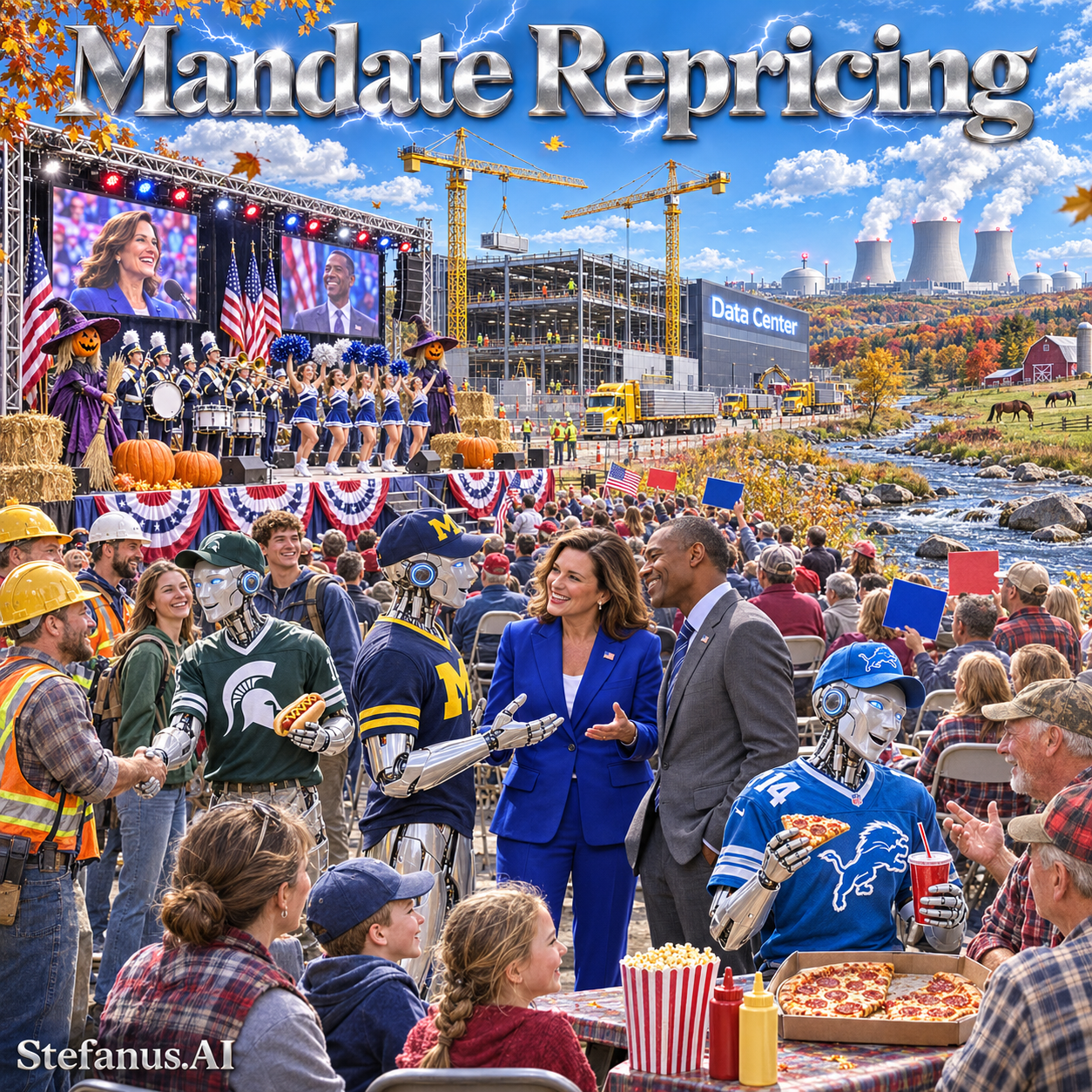

Introduction: The Election That Changed the Price of Artificial Intelligence Infrastructure
On the morning of November 4, 2026, an extraordinary political development confronted America’s artificial intelligence industry, and it did so not through a courtroom, a central bank, a semiconductor shortage, or a sudden collapse in demand for computation, but through the oldest and most ordinary of democratic instruments: the ballot. For the better part of a decade, the United States had competed with itself to attract increasingly enormous investments in semiconductor manufacturing, hyperscale datacenters, cloud computing, and the advanced artificial intelligence infrastructure that sits on top of all three. State governors celebrated multibillion-dollar announcements as if they were sporting victories. Local officials competed with one another to offer tax incentives, expedited zoning, and discounted land. Utilities prepared for a scale of electricity demand that had no precedent in the history of the American grid. Technology executives, speaking in the language of gigawatts rather than square feet, presented plans to construct the next generation of what they had taken to calling “AI factories” across the country, from the deserts of Arizona to the farmland of central Ohio and the oil-and-gas corridors of West Texas.
Then American voters began rewriting the political assumptions underlying those investments.
The scale of what happened is best understood through a number that was widely reported on election night and that will, for a long time, serve as shorthand for the entire phenomenon. CNBC, drawing on Ballotpedia’s tracking and its own canvass of county results, reported that voters sided against datacenters in every one of the forty-one local datacenter-related measures on the ballot in ten states for which results were available, with a single exception in Harwood, North Dakota.[4] Stateline, working from the independent tracker Data Centers on the Ballot, counted thirty-three restriction measures that had either passed or were leading late on Tuesday evening, with roughly a dozen more in jurisdictions that had not yet reported.[5] Reuters, in its morning-after analysis of what a Democratic sweep of Congress could mean for American energy policy, cited a figure of thirty-three successful restriction initiatives out of thirty-four with reported outcomes.[1] These counts differ slightly because they were taken at different moments and used different denominators, and the distinction matters for anyone who intends to build a financial model on top of them, but the direction of the results was unmistakable. Across communities in Ohio, Illinois, Maine, California, Florida, New Hampshire, and other states, the issues on the ballot ranged from temporary construction moratoriums and zoning restrictions to electricity consumption thresholds, water resources, and the requirement that any large facility obtain direct voter approval before it could proceed. The figure was an election-night snapshot rather than a final certified accounting; some measures were advisory, while others would create binding local restrictions. Nevertheless, the message was unambiguous: communities increasingly wanted a direct role in determining the conditions under which AI infrastructure could expand, and when given the opportunity to say so, they said so overwhelmingly.
The most consequential single development occurred in Texas.
Gina Hinojosa, a Democratic state representative from Austin who had campaigned against the state’s rapid expansion of datacenters, defeated three-term Republican Governor Greg Abbott in what the Texas Tribune described as a political earthquake in a state that had not elected a Democrat to the governor’s mansion since 1990.[7] Abbott conceded shortly after ten o’clock in the evening. The upset was all the more remarkable for the financial asymmetry that preceded it: Abbott had spent roughly $281 million on the campaign against Hinojosa’s $36.8 million, an advantage of nearly eight to one that most political observers had assumed would be decisive.[77] During the campaign, Hinojosa had advocated an immediate moratorium on new datacenter development that would last until the legislature established stronger protections involving electricity costs, water supplies, environmental standards, tax incentives, and community participation.[9] She had attacked Abbott’s support for House Bill 2712, which granted datacenters twenty-year tax exemptions, and she had characterized the governor’s own late-summer permitting pause as nothing more than an “election year pause” designed to defuse an issue rather than resolve it.[8]
Texas had become a central destination for the expansion of the AI economy. Its comparatively abundant land, its industrial infrastructure, its natural gas resources, its independent electricity market, and its established technology ecosystem had attracted large investments from companies including Google, Amazon, Microsoft, OpenAI, Oracle, Meta, xAI, and a long list of other participants in the global computing industry. Google alone had announced a $40 billion Texas infrastructure program in 2025.[56] The Stargate campus in Abilene had become the most photographed construction site in the world’s technology press. Yet the political environment had already begun changing before the election. In August 2026, Abbott ordered a comprehensive audit of datacenter projects seeking electrical interconnections, noting that interconnection requests under consideration in ERCOT exceeded 474 gigawatts and that roughly nine-tenths of that requested capacity related to datacenters.[10] In September, he directed the Texas Commission on Environmental Quality to halt relevant permits until the audit was completed.[11] Hinojosa’s election therefore did not introduce political scrutiny into an otherwise unregulated environment. It raised a more consequential question: whether a temporary administrative pause, imposed by a Republican governor under electoral pressure, could evolve into a durable legislative framework under a Democratic governor who had promised exactly that.
The reaction from the industry’s most visible figure captured the mood with characteristic economy. Within hours of the result, Elon Musk, whose xAI operates the Colossus supercomputing campus in Memphis and who had supported Abbott, posted a single sentence on X.[12]
“Data centers in space looking pretty appealing right now.”
— Elon Musk, xAI and SpaceX [12]
The remark was offered half in jest, but it illustrated something that financial markets understood immediately and that this paper takes as its central subject. The distinction between a temporary administrative restriction and a durable legislative framework matters enormously to the valuation of infrastructure assets.
Consider a hypothetical hyperscale datacenter project in Central Texas whose developers have acquired land, negotiated an electricity supply arrangement, obtained preliminary construction agreements, and reserved billions of dollars of computing equipment from NVIDIA or one of its competitors. Before an election, its financial model might assume a high probability of receiving the remaining approvals within twelve months, with the governor’s audit understood as a verification exercise that compliant projects would survive. After an election, investors must confront the possibility of a longer moratorium whose end date is tied to legislative action rather than administrative completion, revised or revoked tax incentives, additional water infrastructure obligations, stronger community-benefit requirements, and higher electricity charges under a reformed large-load tariff. The physical property has not changed. The engineering design may remain identical. Its proposed GPUs may still be among the most advanced in the world. Its prospective customers may continue demanding additional computing capacity with an urgency that borders on desperation; Amazon’s chief executive had said only days earlier that AWS cloud capacity was largely sold out through 2027.[35] Nevertheless, the project’s economic value can change substantially because the political conditions governing its completion have changed.
This is the central research problem explored in this paper.
The November 2026 elections reveal that the future of artificial intelligence infrastructure cannot be understood exclusively through semiconductor performance, hyperscaler capital expenditure, power-generation capacity, or the sophistication of frontier AI models. Increasingly, the financial feasibility of the entire industrial system also depends on electoral outcomes, state government decisions, utility regulation, congressional oversight, local democratic participation, and the distribution of economic benefits and infrastructure costs across the communities asked to host these facilities. The election arrived at a moment when the capital at stake had reached a magnitude without historical parallel. In the third quarter of 2026 alone, Alphabet, Microsoft, Amazon, and Meta spent a combined sum in the vicinity of $200 billion on capital expenditures, and their stated plans for the full calendar year sum to roughly $735 billion.[36][33][35][34] When political permission becomes uncertain for capital programs of that size, the repricing is not a rounding error in a spreadsheet. It is a structural change in how an entire industry must be valued.
This paper adopts the Five-Layer AI Economy framework — Layer 1: Energy; Layer 2: Chips; Layer 3: Datacenters; Layer 4: Models; and Layer 5: Applications and Agentic Systems — to examine how political decisions affecting one layer can transmit economic consequences throughout the others. The framework is useful precisely because political authority does not touch all five layers equally. Voters in a township in Ohio cannot vote on the architecture of a transformer model or the yield of a three-nanometer process node. They can vote on whether a building is permitted to exist, whether it may draw power from their utility, whether it may use their water, and whether it will pay taxes. The consequences of those votes, however, travel upward through the system to every layer that depends on the building being there.
Why I Chose the Title “Mandate Repricing”
I chose Mandate Repricing because these two words capture a transformation that conventional descriptions of political opposition, permitting uncertainty, or infrastructure regulation do not fully explain. Mandate refers to the authority voters confer upon elected leaders and, where applicable, the direct decisions voters make through ballot measures. A mandate is not merely a preference expressed in a poll; it is a transfer of authority that an elected official can convert into statutes, executive orders, appointments, and administrative priorities. Repricing refers to the reassessment of an investment’s economic value when that political authority changes the expected probability, timing, conditions, or cost of obtaining project approval. Together, these words describe how democratic decisions can alter the financial assumptions supporting multibillion-dollar AI infrastructure investments without any immediate change in the underlying technology, and often before any law has actually changed.
The title also reflects a broader argument that runs through every section of this paper: through 2030, America’s AI infrastructure industry may encounter a new investment environment in which political approval becomes a material and continuously reassessed component of project value, in the same way that interest rates, equipment costs, and customer demand are continuously reassessed today. The election of a governor supporting a moratorium, the adoption of a new electricity tariff, the removal of a tax exemption, the arrival of a new majority on a state utility commission, or the rejection of a local development proposal can alter the economics of an otherwise attractive datacenter. Mandate Repricing therefore provides a framework for connecting electoral decisions with infrastructure finance, regional competitiveness, hyperscaler strategy, and the allocation of capital throughout the Five-Layer AI Economy. The subtitle has been revised from its tentative form to recognize that the relevant political authorities now include not only governors and local voters but also a Congress whose incoming majority has publicly promised to make datacenters pay their fair share, and the elected and appointed utility regulators whose technical proceedings determine who actually pays for the wires.
How This Paper Is Organized
Section 1 examines the November political discontinuity itself: what the ballot measures and gubernatorial results actually decided, what they did not decide, and why the distinction between an election-night statistic and a certified legal effect is the first discipline any serious analyst must impose. Section 2 develops the financial transmission mechanism through which a change in political mandate becomes a change in project value, drawing on the real-options literature, the 2026 empirical work on datacenter electricity-price incidence, and the tariff and capacity-market mechanics now being written in Virginia, Michigan, and PJM. Section 3 maps the geography of political exposure across nine states whose futures now diverge. Section 4 traces the effects through all five layers of the AI economy, using the most recent corporate earnings through the third quarter of 2026 to show the scale of what is now exposed to political approval. Section 5 offers a 2027–2030 outlook, four scenarios, a timeline of decision points, and a practical Mandate-Adjusted Project Value framework. Section 6 distills seven pillars of what we have learned. The conclusion returns to the title and to the argument that the election did not end the AI infrastructure boom but changed the terms on which its future projects will be judged.

Section 1. The November Political Discontinuity: From Economic Development Consensus to Electoral Conditions
Every serious analysis of a political shock must begin by separating what actually happened from what it was immediately said to mean, and this is especially true when the shock arrives as a cascade of local results, exit polls, and statewide upsets reported simultaneously on a single night. The purpose of this section is to establish the factual foundation on which the rest of the paper rests: the ballot measures, the gubernatorial outcomes, the congressional transition, and the institutional map of who holds authority over what. The section is deliberately long because the financial consequences explored later depend on a precise understanding of which decisions have legal force, which are advisory, which are campaign promises not yet converted into law, and which belong to officials who have not yet taken office. An analyst who collapses these distinctions will either overstate the risk, by treating promises as statutes, or understate it, by treating statutes as mere promises.
1.1. What Exactly Happened on November 3?
The November election must be interpreted as both an event and a measurement problem. The election-night figures of thirty-three restriction measures passed or leading, and of forty out of forty-one measures resolved against datacenter development, were powerful signals of public sentiment.[1][4][5] But those figures did not mean that every ballot across the nation asked the same question, that every proposal imposed a legally binding construction ban, or that an overwhelming share of all American voters opposed datacenters. Those would be invalid inferences. Ballotpedia tracked at least fifty local datacenter-related measures in thirteen states during 2026, including forty-one scheduled for November 3. Twenty-eight of the November propositions were written such that a yes vote would restrict development; thirteen were framed to facilitate or support it. Some electoral results favored restriction through a no vote on a permissive proposal, which is why a count of measures “won” by opponents is not identical to a count of yes votes.[3]
The ballot universe included disparate legal instruments, and the difference among them is where financial analysis must begin. A city charter amendment preventing new datacenter approvals is different from a nonbinding advisory question asking elected officials to consider a moratorium. A local prohibition affecting facilities above a specified electrical threshold is different from a voter-approval rule, a rezoning reversal, or a permit-specific rejection. These instruments may ultimately have comparable financial consequences for a developer, because a project that cannot obtain a permit is equally unbuildable whether the obstacle is a charter or a council vote taken under advisory pressure, but they reach those consequences through different legal pathways with different timelines, different litigation exposures, and different possibilities of reversal.
The distinction can be observed in specific communities. Voters in Edgewater, Florida, approved a charter amendment prohibiting datacenters in the city. Voters in Perry, Ohio, approved a measure imposing financial and operational conditions on any hyperscaler seeking tax incentives, a formulation that does not prohibit development but prices it. Voters in Alhambra, California, considered Measure DB, which sought to prohibit datacenters within the city. Bloomington, Illinois, voted on a moratorium advisory question. In Sunbury, Ohio, residents appear to have passed a charter amendment banning datacenters using twenty-five megawatts or more, with unofficial counts showing lopsided margins. In Wilmington, Ohio, roughly eighty percent of voters rejected rezoning across four separate referendums intended to accommodate a single datacenter project. And in Ashville, Ohio, residents voted to block a datacenter campus that was already under construction, a result that raises precisely the vested-rights questions that will occupy lawyers for months.[3][5][6] The lesson lies not in treating these measures as interchangeable, but in recognizing that local electorates used whatever institutional mechanisms were available to them, and that the variety of mechanisms is itself evidence of how deeply the issue has penetrated local government.
The aggregate results also pose a geographic question. Ohio accounted for twenty-one of the forty-one November measures, spread across eighteen jurisdictions, far more than any other individual state.[4][6] That concentration matters because Ohio combines accessible land, a major cloud-computing presence anchored by years of Amazon, Google, Microsoft, and Meta investment in the Columbus region, extensive electricity infrastructure within the PJM footprint, and intense competition for advanced industrial investment. Fortune reported that the state already had more than one hundred twenty-five local datacenter moratoriums in place before November 3, and that polling by SurveyUSA for the Institute for Civics and Public Policy found fifty-five percent of Ohio adults opposed to datacenter construction against twenty-two percent in support, with sixty-five percent opposed to tax breaks for such developments.[6] A national narrative about popular resistance can obscure the regional conditions that produce unusually high ballot activity, and Ohio’s conditions — a PJM capacity crunch that has already raised bills, a visible concentration of hyperscale campuses, and an aggressive state tax exemption now under review — are not replicated everywhere.
The national mood was nevertheless real and measurable. An NBC News exit poll found that fifty-six percent of voters rated AI and datacenters as a crucial or major influence on how they voted for Congress, a figure that would have been unthinkable in any previous American election.[54] A University of Massachusetts Amherst poll earlier in the year found that only eleven percent of Americans would support the construction of an AI datacenter in their own community.[5] And an NBC News survey in the autumn found that voters trusted Democrats over Republicans to handle datacenters by thirty-two percent to twenty percent, although a plurality of forty-four percent chose neither party or said both would perform equally, which suggests that the issue had become partisan in its electoral expression without becoming partisan in its underlying sentiment.[53]
The November 4 tally should thus be treated as an early-warning indicator, not as an immutable statistical law. Election offices will certify results in the coming weeks. Some ballot propositions will face litigation, implementation disputes, or interpretation by local officials. Local governments will have to reconcile municipal measures with state statutes, vested development rights, and existing agreements, and Ohio in particular will confront the question of whether a charter amendment can lawfully halt a campus on which concrete has already been poured. The financial research should track the actual legal effects of each measure after the election, rather than simply preserving an election-night percentage as though it were a permanent feature of the landscape.
1.2. Texas: An Upset, but Not a Simple Reversal
The victory of Gina Hinojosa over Greg Abbott is compelling because it challenges an assumption embedded in many AI infrastructure forecasts: that a state with inexpensive land, industrial capacity, an energy-rich economy, and a pro-business reputation will maintain a stable political commitment to rapid datacenter construction regardless of which party governs it. Reuters reported the outcome as a stunning upset, and the Texas Tribune noted that Hinojosa, at fifty-two, will be the state’s first Latina governor.[2][7] Yet attributing the entire result to datacenters would confuse a salient campaign issue with the total motivation of an electorate. Education funding and the school voucher program, which Hinojosa promised to end; household affordability, including her promise to return $1,500 to each Texas household from the state’s savings account; immigration; a competitive United States Senate race in which James Talarico defeated Ken Paxton; and a broadly favorable national environment for Democrats in a midterm held under an unpopular president were all important.[7] A defensible interpretation is that datacenter policy became part of a wider argument over whether private industrial expansion was delivering public value, and that it provided Hinojosa with a concrete, locally visible example of what she described as a Big Tech takeover of Texas land, resources, and schools.[7]
Republican strategists reached a similar conclusion in the immediate aftermath. Jeff Burton, a founding partner at Maven Advocacy Partners in Austin and a longtime GOP strategist, told The Epoch Times that Abbott’s earlier enthusiasm for datacenters had likely hurt him with the rural, traditionally Republican voters who had turned out against the facilities.[55]
“Greg Abbott, just like Josh Shapiro and other governors, [was] promoting data centers for so long.”
— Jeff Burton, Maven Advocacy Partners [55]
Indeed, Abbott himself had departed from an unrestricted development posture months earlier. His June directive sought to protect consumers from datacenter-related infrastructure costs. In August, the governor required ERCOT and the Public Utility Commission of Texas to audit projects advancing through the interconnection process, demanding information on tax incentives, water use, whether facilities were bringing their own power or water, and whether they were mitigating light and noise impacts on neighbors.[10] In September, he directed the Texas Commission on Environmental Quality to halt permits associated with datacenters pending the audit.[11] He also promised, late in the campaign, to pursue the elimination of datacenter tax breaks in the next legislative session.[8] The official August announcement stated that interconnection requests under consideration exceeded 474 gigawatts and that approximately ninety percent of that requested capacity related to datacenters.[10] That figure describes requests under consideration, not credible commitments that all 474 gigawatts will be built or energized; ERCOT’s entire system peak demand has historically been in the range of eighty to ninety gigawatts, so the queue represents a multiple of the existing grid that no serious planner expects to materialize in full.
Hinojosa’s campaign went further. It called for an immediate moratorium lasting until legislators could establish legal protections, including changes to tax benefits and safeguards for water and electricity.[9]
“We need an immediate moratorium on data centers to last until the legislature can meet.”
— Gina Hinojosa, Governor-elect of Texas, campaign policy statement [9]
Her campaign described a temporary administrative pause as insufficient if approvals could resume without durable statutory rules, and she insisted during the campaign that a governor could order such a moratorium without waiting for the legislature.[8] What the election changes, therefore, is not simply the direction of a policy switch from development to regulation, because that switch had already been partially thrown by Abbott. It changes the potential duration, legal foundation, and political bargaining conditions of regulation.
Under Abbott, a developer might have interpreted the audit as a temporary verification exercise whose successful completion, expected before the end of 2026, would allow a project to progress. Under Governor-elect Hinojosa, who takes office in January 2027 at the same moment the Texas Legislature convenes for its biennial regular session, that same developer must now consider the possibility that legislative conditions could replace or extend the administrative pause, and that the pause may not lift until a bill is signed. The investment implications depend on which projects are grandfathered, what standards the legislature adopts, whether tax relief is altered prospectively or for existing beneficiaries under House Bill 2712, and whether water and power obligations can be satisfied by particular engineering solutions such as self-supplied generation and closed-loop cooling. As of November 4, these outcomes remain unknown, and the honest position for any investor is that the distribution of outcomes has widened rather than that a specific outcome has been determined.
There is another reason Texas is an unusually important case. Its electricity market is materially different from the multistate PJM structure that governs Virginia, Ohio, and Pennsylvania. ERCOT manages roughly ninety percent of the Texas grid as an electrically isolated system, while the PUCT and state policymakers have substantial responsibilities for tariffs, interconnection, and reliability without the overlay of a federally regulated regional capacity market. Changes in Austin can therefore affect a very large computing geography through a distinctive regulatory system that answers to state officials to a degree that no other large American electricity market does. Yet cities and counties, groundwater conservation districts, river authorities, state environmental agencies, and project-specific agreements remain important. It would be analytically wrong to assume that the governor can unilaterally extinguish every existing development right, and it would be equally wrong to assume that she cannot change the economics of every project still awaiting its next approval.
1.3. The Governors-Elect and the Regional Electoral Map
Texas was not alone. November 3 produced a set of gubernatorial outcomes directly relevant to datacenter siting and utility regulation, and each must be read in light of the institutional environment the winner inherits. Xavier Becerra won the California governor’s race to succeed Gavin Newsom. Jocelyn Benson won the Michigan race to succeed Gretchen Whitmer. Amy Acton defeated Vivek Ramaswamy in Ohio. Keisha Lance Bottoms won in Georgia. Katie Hobbs was reelected in Arizona. Josh Shapiro was reelected in Pennsylvania.[13][14][15][16][17][18] Virginia, by contrast, did not undergo a new gubernatorial transition in 2026: Abigail Spanberger took office in January and had already advanced an extensive Data Center Accountability Framework by September.[19]
These outcomes must not be collapsed into a uniform national moratorium. The new officials enter different institutional environments, and their recorded positions vary in ways that matter to project economics. Acton’s published conditional-moratorium proposal, which ties future development to full utility-cost recovery, union labor, transparency, environmental compliance, and community benefits, is not the same as Hinojosa’s call for a pause pending legislative protections.[20] Becerra inherits seven datacenter laws already signed by Newsom in September and will govern their implementation rather than their enactment.[23] Benson inherits Michigan’s enterprise datacenter tax exemption alongside the Public Service Commission’s large-load safeguards and Whitmer’s pledge framework.[22] Bottoms has advocated a pause while Georgia evaluates the costs and benefits of the industry, and she will govern alongside a Public Service Commission whose majority has just changed hands.[21][63] Hobbs continues an administration that has already signed a three-year suspension of new datacenter tax relief.[24] Shapiro’s reelection provides continuity for the GRID standards he formalized by executive order in August.[61] Each state therefore exposes developers to a different combination of policy-continuity risk and policy-change risk, and the appropriate discount for each is not the same number.
Nor can the partisan affiliation of a governor alone predict the degree of regulatory pressure. Abbott’s final months included a permitting pause. Republican Governor Mike DeWine had already paused review of new Ohio datacenter tax exemptions in May.[25] The Republican-led federal executive branch had publicly endorsed ratepayer protection through the March 2026 pledge.[26] Senator Jon Husted, who lost his Ohio seat to Sherrod Brown after Brown labeled him “the face of data centers,” had himself authored a Ratepayer Protection Act intended to make large loads cover the infrastructure required to serve them.[4][53] The relevant political divide increasingly concerns who bears marginal infrastructure costs, not a simple pro-technology versus anti-technology contest, and the fact that both parties were competing to be seen as the party of ratepayer protection is itself the clearest evidence of how far the political center of gravity has moved.
The transition timeline itself matters. A governor-elect is not yet the governor. A proposed moratorium does not automatically take effect on election night. Newly elected legislators will need to organize, committees must hold hearings, governors must appoint agency leaders and utility commissioners, administrative procedures require notice and implementation, and existing projects may remain governed by previously executed contracts. Investors should record an election as a political information event and subsequent legal actions as separate valuation events. Combining them would double-count risk or attribute future rules to officials who have not yet exercised authority.
1.4. Congress: A New Majority With a Stated Agenda
The congressional dimension of November 3 deserves separate treatment because it introduces a layer of authority that the state-focused analysis of earlier election cycles largely ignored. Reuters reported the election as a Democratic sweep with projected control of both chambers when the new Congress is seated in January 2027.[1] In Ohio, Sherrod Brown’s defeat of Jon Husted was explicitly framed around datacenters; in Texas, Talarico’s defeat of Paxton accompanied Hinojosa’s victory.[4][7] Senate Democratic Leader Chuck Schumer had previewed the party’s priorities in the final weeks of the campaign, promising to force datacenters to pay their fair share and to promote healthy communities.[72] The House Democratic caucus’s Thriving Economy Project, released in September, included datacenter policy among more than eight hundred recommendations and endorsed what S&P Global summarized as a “bring your own clean energy” approach for large loads.[70][71]
The Atlantic Council, writing before the vote, identified permitting reform, ratepayer protection legislation, oversight of large-load cost allocation, and the fate of clean-energy tax credits as the four areas where a Democratic Congress could act.[70] The Ratepayer Protection Act, in the form that had cleared the House Energy and Commerce Committee unanimously, would direct states to consider standards ensuring that datacenters bear their share of grid-upgrade costs, which is a soft federal nudge rather than a mandate, and it illustrates the limits of what Congress can do in a domain where retail rates are regulated by states.[70] Goldman Sachs political economist Alec Phillips wrote in the days before the election that Congress might limit tax breaks for datacenters but that a national moratorium looked unlikely under any outcome.[50] The more consequential congressional tool may be oversight: committee hearings, document requests, and investigations into the relationships among utilities, hyperscalers, and federal agencies, which can change corporate behavior without changing a single statute. Investors should therefore expect a Congress that raises the cost of opacity rather than one that prohibits construction.
1.5. Why Political Mandates Now Reach the Entire Industrial System
For much of the cloud-computing era, datacenters were regarded primarily as commercial real estate and utility customers. A community might value their construction spending, property-tax contributions, and relatively limited traffic compared with some traditional industrial facilities. Their energy consumption was visible to utilities but often not central to statewide electoral debate. The growth of frontier AI changed the dimensions of the proposition. Modern AI campuses may seek hundreds of megawatts, and proposed portfolios can span multiple gigawatts. Their cooling equipment, backup generators, substations, transmission needs, and water systems bring them into direct contact with public infrastructure planning in a way that a ten-megawatt enterprise facility never did.
Lawrence Berkeley National Laboratory’s 2025 update, published in June 2026, estimated that U.S. datacenters could consume approximately 649 terawatt-hours of electricity in a 2030 reference case, or 11.8 percent of projected national electricity use, with sensitivity estimates ranging from 521 to 843 terawatt-hours.[27] The International Energy Agency reported that global electricity demand from datacenters surged seventeen percent in 2025, more than five times faster than overall demand growth, and projected that datacenter demand would double by 2030 with AI-specific demand tripling.[48] These are scenarios, not guaranteed future outcomes. Nevertheless, they illustrate why residents may perceive a different scale of industrial demand from the one associated with the previous generation of internet infrastructure. The IEA’s executive director has framed the dependency in a sentence that every governor would now recognize.
“There is no AI without energy.”
— Dr. Fatih Birol, Executive Director, International Energy Agency [48]
That energy demand is part of an investment sequence. The developer selects land based partly on expected power availability; the utility forecasts the load; the transmission provider studies upgrades; equipment manufacturers allocate capacity; a cloud tenant commits to capacity; and a model developer plans training or inference workloads. If an election changes the timing of only one authorization, the consequences can propagate across all of those decisions.
Political legitimacy is consequently becoming a form of infrastructure capacity. It is not physical capacity in the sense of generating megawatts or manufacturing semiconductors. Rather, it determines whether a technical project is permitted to convert potential capacity into operating capacity. In a world of increasingly expensive AI campuses, where the Goldman Sachs Global Institute has estimated that construction costs have risen from roughly $10 million per megawatt in the 2010s toward $15 million to $19 million per megawatt today, this conversion has substantial economic value.[51]
1.6. The Layers of Authority: Ballot, Governor, Commission, Grid Operator, Congress
Mandate Repricing requires a clear map of governmental authority, because the single most common analytical error in the weeks after November 3 will be to assume that a headline about one level of government describes the behavior of all of them. Local voters can amend municipal charters or zoning ordinances where state law permits. County planning commissions evaluate land use and siting. Water utilities and regional authorities assess supply and infrastructure. State legislatures establish tax policy and many statutory standards. Governors administer executive agencies and may issue orders within their legal powers. Utility commissions approve retail tariffs and determine the allocation of certain infrastructure costs. Regional transmission organizations such as PJM operate wholesale electricity markets under federally regulated tariffs. FERC oversees matters within its federal jurisdiction; Congress can amend federal law, fund agencies, and conduct oversight.
These institutions do not form a simple hierarchy in which one favorable presidential order automatically overrules every restrictive local action. The White House’s July 2025 Executive Order 14318 directed federal agencies to accelerate relevant federal permitting for qualifying datacenter infrastructure.[28] The March 2026 Ratepayer Protection Pledge promoted the principle that large AI customers should cover the energy and infrastructure costs they cause, and Amazon, Google, Meta, Microsoft, OpenAI, Oracle, and xAI accepted its commitments.[26] Both measures were influential, but neither can be assumed to grant a developer comprehensive relief from otherwise applicable state or local law.
In June 2026, FERC launched what it described as aggressive targeted action to speed large-load integration, requiring regional grid operators to justify or reform rules governing the connection of large loads.[29] In September, FERC accepted PJM’s Reliability Backstop Procurement proposal in principle while directing revisions, and the Department of Energy intervened to argue that PJM’s original cost-allocation model might be unjust and unreasonable because it failed to allocate costs to the customers who caused them.[41] This was a significant federal regulatory response to electricity demand growth, and it illustrates how the federal executive branch, the federal regulator, and the regional grid operator can disagree among themselves even before a state or locality enters the picture. It did not transform every proposed megawatt into an approved local construction project. Financial analysis therefore must identify the precise authority that controls a project’s next required milestone.
The legal category of each action is crucial. A campaign promise alters expectations. An executive directive may change agency procedures immediately, subject to legal limits. An enacted statute changes positive law. A tariff approved by a utility commission changes the commercial cost of service. A binding ballot measure may directly alter local development rights. A nonbinding advisory ballot measure may influence subsequent decisions without directly modifying law. A lender who treats all six as equivalent has not measured risk; it has blurred the mechanism that creates it.
1.7. Opposition Is Not Necessarily a Vote Against Artificial Intelligence
An important interpretive error would be to label every voter favoring restrictions as opposed to artificial intelligence, semiconductor manufacturing, or technological progress. An individual may use AI products every day, support advanced medical research, welcome higher-paying technical employment, and still oppose an opaque project that could raise electricity rates or constrain local water supplies. Another voter may favor datacenters on former industrial sites but object to their placement near schools or residential areas. A third may support construction if the developer guarantees permanent tax revenues and funds grid upgrades upfront.
Anjney Midha, who teaches a widely followed course on AI infrastructure at Stanford University, has argued that the resistance stems not from opposition to progress but from a fundamental lack of transparency about what datacenters do and whom they serve, and that communities organize against the mystery rather than against the technology.[47]
“That is the level at which communities will want clarity before they provide strong enough, vocal enough support.”
— Anjney Midha, Stanford University [47]
Midha has proposed something like a nutritional label for datacenters, disclosing energy use, environmental impact, and local benefits in a standardized form, and it is notable that California’s September laws and Virginia’s accountability framework move in exactly that direction.[23][19][47]
Research from the Brookings Institution has emphasized the limited number of permanent jobs many large datacenters create relative to their construction workforce, while also cautioning that employment effects vary and require careful empirical measurement.[30] Goldman Sachs estimates that construction jobs tied to datacenters are up about 315,000 since 2022 relative to broader construction trends, which is a real and substantial benefit, but one that is temporary by nature and concentrated in the trades rather than in the host community’s long-term tax base.[50] Communities weigh those jobs against electricity, land-use, environmental, and fiscal consequences. Transparent local agreements can improve that calculus, but they cannot make underlying resource constraints vanish.
There are also real benefits on the other side of the ledger. New generation funded by large customers can improve the electrical system; well-designed large-load tariffs can protect households; datacenter tax revenue can support schools and local services; and construction can create thousands of skilled trade positions. A credible framework must distinguish projects that transfer uncompensated costs from projects that create net community value. Treating all proposals as equally harmful would be as unscientific as treating all proposed investments as self-evidently beneficial.
1.8. The Research Consequence: Political Uncertainty Becomes Project-Specific
The November election suggests that country-level or state-level political-risk labels are too crude. Two facilities in the same state may face very different risks because of municipal zoning, water availability, existing utility contracts, permit status, tax-incentive agreements, and local electoral sentiment. A facility already operating under a long-term tariff is not equivalent to a speculative campus with no executed electric service agreement. A leased campus with a creditworthy hyperscaler tenant is not equivalent to a merchant development dependent on future demand. A project on a brownfield industrial site may have a distinct public-benefit profile from one requiring substantial greenfield land conversion.
The task for 2027 is to construct a project-level evidence base. For every proposed campus, analysts should record the jurisdiction; current approval stage; outstanding permits; tariff exposure; estimated firm load; water source; electricity supply; incentive status; and political decisions capable of changing each item. Only then can investors determine whether November 3 produced a change in expected project economics or merely a heightened level of public attention.
The central lesson of Section 1 is straightforward. Voters did not vote on the architecture of a transformer, the efficiency of a GPU, or the return on a frontier model. They voted on institutions and local conditions that determine whether those technologies can be deployed. Those institutions now belong inside any serious valuation of the AI infrastructure industry.

Section 2. The Financial Transmission Mechanism: How a Political Mandate Reaches Project Value
The first section established what happened. This section asks how a political event of that kind becomes a financial event, and it insists on answering that question with more precision than the phrase “political risk” ordinarily carries. The temptation in infrastructure finance is to treat an election as an adjustment to the discount rate, a few dozen basis points added to a cost of capital to reflect a vaguer sense that things have become harder. That approach is convenient, but it is wrong in a way that matters, because it conceals the mechanism by which value is created or destroyed and therefore makes it impossible to tell which projects are genuinely exposed and which are not. The purpose of this section is to open the mechanism, to show where a changed mandate enters the cash-flow model, and to connect that model to the 2026 empirical literature on who actually pays for the grid that datacenters require.
2.1. Defining Mandate Repricing as an Economic Mechanism
Mandate Repricing is the reassessment of an infrastructure project’s expected economic value when an election or other democratic decision changes the probability, timing, conditions, or expense of regulatory approval. It is not identical to the announcement of a new law. Repricing can begin the moment credible information changes expectations, which is why Amazon’s shares could fall nearly seven percent on an earnings report that reiterated its capital plan, and why datacenter-exposed equities moved on the morning of November 4 before a single statute had been drafted. At the same time, the possibility of a legal change is not evidence that it will occur, and the market’s first reaction is frequently wrong about both direction and magnitude.
This definition contains four distinct variables, and separating them is the first analytical task. The first is approval probability: the likelihood that a project ultimately receives the authorizations required for operation. The second is approval timing: the expected date at which approved construction and electric service become available. The third is approval conditions: the technical, environmental, labor, community, and infrastructure obligations that attach to permission. The fourth is approval cost: the present value of financial commitments required to comply with those conditions, including potential changes to taxes and tariffs.
These variables can move in opposing directions, and this is the point most often missed in the immediate aftermath of an election. A newly elected governor might require more extensive water reporting but also introduce a transparent, expedited approval channel for compliant projects. The direct compliance cost would rise while the risk of indefinite delay might decline. In that circumstance, the value of a well-designed project could increase even though regulatory requirements became more demanding. Conversely, vague requirements and unpredictable agency timelines could lower value even if the stated compliance obligations were modest. The November election has produced both kinds of states: Pennsylvania, where the rules are explicit and the governor who wrote them has been reelected, and Texas, where the rules are promised but unwritten and the governor who promised them has not yet taken office.
Financial markets often discuss political uncertainty as a single risk premium. That formulation is convenient but incomplete. An accurate valuation should locate particular policy risks in the cash flows and the probability distribution wherever possible. A project may need to budget for a new cooling system, a large refundable interconnection deposit, or five additional months before operation. These should not all be buried in one unexplained addition to the discount rate. If the same risk is also deducted from expected revenues or approval probability, it should not be charged again mechanically through a higher discount rate, because double-counting a risk is as serious an error as ignoring it.
The theory of irreversible investment provides the right foundation for this exercise. The research associated with Robert Pindyck at MIT and the broader real-options literature explains why firms may rationally wait before committing resources when investment is difficult to reverse and new information is expected, and why the value of waiting rises precisely when uncertainty rises.[31] A 2026 National Bureau of Economic Research paper by Anna French and Nicholas Vreugdenhil treats permits themselves as real options, analyzing how regulatory regimes and permit timing influence decisions to invest and how firms anticipate regulatory change and relocate activity across jurisdictional borders in response, a phenomenon the authors describe as regulatory leakage.[32] Datacenters are a particularly interesting application because land can sometimes be repurposed, but foundations, bespoke electrical equipment, grid connections, and particular networking configurations may have limited value outside the intended project, and because the interjurisdictional leakage that French and Vreugdenhil describe is exactly what a Texas moratorium might produce in Oklahoma, Louisiana, or Indiana.
2.2. A Simple Valuation Framework
Suppose an investor is deciding whether to finance a campus that requires further approvals. For a simplified one-period screening model, the political value of the project can be written as the probability-weighted sum of its value conditional on approval and its value conditional on rejection, less the spending required before the outcome is known and less the present value of identifiable delay costs:
V(political) = p × V(success) + (1 − p) × V(failure) − C(pre-approval) − C(delay)
Here, p is the probability that the required approvals are ultimately received; V(success) is the project’s value conditional on approval, measured consistently after the remaining relevant capital and operating costs; V(failure) is the recovery or loss if approval fails; C(pre-approval) covers spending required before the outcome is resolved; and C(delay) is the present value of identifiable postponement costs not already incorporated into the conditional values. All components must use the same valuation date and must not double-count cash flows.
Consider a deliberately illustrative example. A proposed project has a $2.0 billion net present value if completed and a negative $300 million value in a rejection scenario because of sunk development spending and incomplete recovery. Before an election, analysts estimate an eighty-five percent probability of approval. Ignoring separate pre-approval and delay costs, the probability-weighted value is $1.655 billion. After the election, suppose the probability declines to sixty percent while the two scenario values remain unchanged. The new expectation becomes $1.080 billion. The $575 million decline is an analytical demonstration of repricing, not an observed market loss or a forecast for any actual Texas facility, but it illustrates how a change in a single probability, with no change in the engineering or the customer, can remove more than a quarter of a project’s expected value.
| Scenario | Probability of approval | Value if approved | Value if rejected | Expected value |
| Pre-election baseline | 85% | $2,000 million | −$300 million | $1,655 million |
| Post-election, moratorium pending legislation | 60% | $2,000 million | −$300 million | $1,080 million |
| Post-election, clear rules adopted and project compliant | 90% | $1,850 million (higher compliance cost) | −$300 million | $1,635 million |
| Post-election, prolonged indefinite pause | 40% | $1,700 million (one-year delay) | −$400 million | $440 million |
The third row of the table deserves attention because it captures the paradox at the heart of this paper. A state that adopts clear, somewhat more expensive rules can leave a compliant project almost exactly where it was before the election, because the higher probability of approval offsets the higher cost of compliance. The fourth row shows the opposite: an indefinite pause with no exit criteria destroys most of the value even if the eventual rules would have been acceptable, because the project cannot survive the uncertainty long enough to meet them.
If the election also changes the expected commercial-operation date, the effect can be compounded. A one-year delay reduces the present value of future cash flows at a positive discount rate, but the amount depends on whether costs and revenues are deferred together, whether equipment is already purchased, and whether customer contracts contain schedule penalties. At a ten percent discount rate, a single payment received one year later has approximately 9.1 percent less present value than the same payment received today. That simple arithmetic should not be applied indiscriminately to the entire value of a construction project, because actual project cash flows occur across many years and because, in the current market, a delayed campus may lose its tenant entirely rather than merely receiving its rent a year late.
The model can be expanded into a multistage decision tree. A project may receive approval immediately, require redesign, remain paused for a specified period, move to another state, or be abandoned. A project’s expected value is the sum of the probability-weighted present values of these mutually exclusive pathways, less the cost of retaining the option to pursue them. The analysis becomes more realistic when probabilities depend on facts such as permit completeness, water availability, demonstrated power supply, public consultation, and the likelihood of legislative action.
2.3. The Clock: Why Timing Can Matter More Than the Permit Fee
In frontier computing, time has an unusually high opportunity cost, and the reason is specific to this technology rather than to infrastructure in general. A conventional office building can remain attractive to tenants for decades with relatively modest changes to its core technology. An AI campus may be designed around a particular generation of GPUs, memory, interconnects, and cooling requirements. Its technical usefulness evolves as rapidly as the surrounding semiconductor market. Waiting twelve months for an electrical interconnection can therefore mean more than carrying land and debt for an additional year. It can mean revising equipment procurement, altering rack density, changing cooling design from air to direct-to-chip liquid, and renegotiating the tenant’s deployment schedule.
The third-quarter 2026 earnings season provides the clearest possible indication of the investment scale now exposed to this clock. Microsoft’s first quarter of fiscal 2027 showed $45.2 billion in capital expenditures, the addition of twenty-four datacenters across five continents, and guidance for more than $50 billion in the following quarter; its chief financial officer, Amy Hood, had earlier told investors that the company expected calendar 2026 capital spending of roughly $190 billion, including approximately $25 billion attributable to higher component pricing rather than additional capacity.[33][74] Alphabet spent $51.4 billion in the September quarter, maintained its 2026 outlook of $195 billion to $205 billion, and told investors that capital spending would increase significantly in 2027, a disclosure that pushed its free cash flow to negative $9.1 billion and its shares down eleven percent.[36][75] Meta’s October release reported $34.9 billion of third-quarter capital expenditures including finance-lease principal and narrowed its annual range to $135 billion to $145 billion.[34] Amazon reported third-quarter purchases of property and equipment of $77.3 billion, nearly $20 billion above expectations, against operating cash flow of $42.4 billion, reiterated its roughly $220 billion plan for 2026, and said it would spend meaningfully more in 2027; AWS revenue grew thirty-nine percent to $46 billion on a contracted backlog of $578 billion.[35] These figures use different accounting periods and definitions and should not be added casually into a single standardized measure. Their common message is that immense capital programs now depend on the successful coordination of physical facilities and digital products, and that the companies deploying them are already consuming more cash than they generate.
The demand side of that equation is equally relevant to the clock. Amazon’s chief executive Andy Jassy told investors that AWS capacity was effectively sold out for 2026 and largely committed for 2027, with substantial portions of 2028 already spoken for.[35] NVIDIA’s second quarter of fiscal 2027, reported in August, showed revenue of $96.2 billion, up 106 percent from a year earlier, with datacenter revenue of $89.0 billion, and the company guided its October quarter to $108 billion while assuming no datacenter compute revenue from China.[37] Jensen Huang’s description of the moment was characteristically compact.
“Now, compute is revenue. And demand is accelerating.”
— Jensen Huang, Founder and CEO, NVIDIA [37]
Procurement schedules accentuate the timing problem. NVIDIA has announced plans with AWS for the deployment of two million additional GPUs across Blackwell Ultra, Rubin, and Rubin Ultra during 2027 and 2028.[38] Frontier-model builders plan training and inference capacity according to hardware availability and software roadmaps. An approved facility can host useful equipment; a delayed facility may force customers to rent capacity elsewhere, reconfigure deployments, or alter the model-development calendar. Not all delays are losses — sometimes a delay allows newer, more efficient equipment to become available — but unplanned delay reduces managerial flexibility and can create contractual mismatches between a chip delivery that cannot be deferred and a building that cannot be energized.
Datacenter construction itself is sequential. Land-use approval precedes certain site works. Transmission and distribution plans must fit load forecasts. Long-lead transformers and switchgear require procurement, and the lead time for large power transformers has stretched past two years. Liquid-cooling systems need water and thermal engineering. Generators require environmental approval and fuel arrangements. Independent testing and commissioning occur after installation. Compressing one phase does not remove the dependencies of another. A developer should therefore track the critical path and identify precisely which milestones a political action could affect.
The economically correct question is not merely whether a state is hostile or welcoming to datacenters. It is whether the project can receive firm, enforceable permission and physically usable power by the date its contracts require. Investors should distinguish the dates of political announcement, statutory enactment, agency approval, grid energization, commissioning, and customer acceptance. Failure to separate them can produce false assumptions about near-term revenue.
2.4. Electricity Tariffs: Turning Public Opposition into Private Obligations
Electricity is the most visible channel through which political preferences become measurable financial terms, and it is also the channel on which the empirical literature advanced most dramatically during 2026. A datacenter developer may initially evaluate a site by its advertised industrial electricity rate and the cost of constructing a substation. The full economic cost can be larger: additional generation capacity, transmission upgrades, distribution reinforcement, emergency reliability reserves, fuel infrastructure, and financing costs associated with building before customer demand is certain.
The fundamental policy dispute concerns cost causation. If a utility would not have needed a particular power line or generating resource without a new hyperscale customer, how much of its cost should the customer bear? If infrastructure also benefits existing customers, how should the shared portion be allocated? If the datacenter cancels after utilities invest, who pays for stranded assets? If the facility consumes less electricity than it contracted for, can the fixed cost recovery still be assured? These are questions of tariff design, utility regulation, and financial accountability rather than merely environmental preferences, and the answer to them determines whether the voter’s fear of a rising bill is justified in a given service territory.
The 2026 academic literature on exactly this question is unusually rich and unusually divided, which is itself instructive. A working paper from the Electric Power Research Institute, using an instrumental-variables strategy to isolate causal effects between 2015 and 2024, concluded that datacenters caused average retail electricity rates to fall modestly, by spreading fixed costs over more sales, and that a doubling of a state’s datacenter capacity was associated with roughly a 3.5 percent decrease in residential rates.[43] A study from the University of Southern California’s Zage Business of Energy Initiative, by Angela Ryu and Professor Shon Hiatt, found that doubling a utility’s operating datacenter capacity was associated with a 0.62 percent increase in residential prices, roughly one dollar per megawatt-hour, an effect the authors characterized as small relative to the public perception.[44] A working paper from MIT’s Center for Energy and Environmental Policy Research by Robyn Meeks, Jacquelyn Pless, Zhiyuan Qi, and Zhenxuan Wang, revised in October 2026, reached a less comforting conclusion at the utility level: datacenter entry between 2010 and 2024 raised average retail rates by 2.7 percent and residential rates by 2.1 percent, with effects concentrated among investor-owned utilities, where the average increase was 5.6 percent, and larger in restructured markets; infrastructure investment and authorized rate bases rose, but price effects were smaller where utilization improved.[42] Professor Pless described the significance of the divergence with care.
Her findings “challenge blanket claims that data centers have not raised electricity prices.”
— Jacquelyn Pless, MIT Sloan School of Management [46]
The reconciliation among these studies is not that one is right and the others wrong. It is that the incidence of datacenter costs depends on the institutional regime that governs investment and cost recovery, which is precisely what Meeks and her coauthors conclude in their abstract, and precisely what voters in Ohio and Texas appear to have intuited.[42] Where a regulated utility adds load that improves the utilization of existing assets, rates can fall. Where an investor-owned utility in a restructured market builds new rate-base assets to serve a load that has not yet materialized, and recovers those costs across all customers, rates rise. The policy response is therefore not to ban the load but to govern the cost recovery, which is what the large-load tariffs now being written attempt to do.
A separate MIT study led by Christopher Knittel, the George P. Shultz Professor at MIT Sloan, with Senga and Shen Wang of CEEPR, examined the end-to-end implications of datacenter flexibility and found that a flexible arrangement for datacenter electricity consumption, compared with an inflexible one, would produce system cost savings of up to five percent in Texas, four percent in the Mid-Atlantic, and two percent in the western United States.[45] The policy implication is that the terms on which a datacenter connects — whether it agrees to curtail during peak hours, whether it brings storage, whether it accepts interruptible service — can determine whether it is a burden or a benefit to other customers, and that those terms are exactly what a tariff proceeding sets.
The White House’s March 2026 Ratepayer Protection Pledge placed this issue at the center of federal political messaging. Amazon, Google, Meta, Microsoft, OpenAI, Oracle, and xAI accepted commitments associated with securing their own energy resources and paying for relevant infrastructure, with separate rate arrangements intended to protect ordinary customers.[26] A pledge is an important statement of policy and corporate intent, but it is not a substitute for evaluating the enforceable tariff, contract, commission order, and actual cost recovery in a particular service territory.
Virginia already shows how those principles can be translated into tariff mechanics. The State Corporation Commission placed customers demanding at least twenty-five megawatts into a new Dominion Energy GS-5 rate class effective January 1, 2027. Certain large customers must pay at least eighty-five percent of contracted distribution and transmission demand and sixty percent of contracted generation demand, among other conditions, for a minimum contract term.[39] This gives the utility a more predictable source of fixed-cost recovery if a facility operates below its expected level, although the detailed effect depends on each customer’s service contract and usage profile.
Michigan’s Public Service Commission has adopted safeguards including minimum billing demand, contract termination fees, minimum contract terms, and credit or collateral requirements for large datacenter loads, according to the Whitmer administration’s July action plan.[22] These measures respond to a specific financial failure mode: a developer may request large amounts of capacity, cause a utility to incur costs, and then fail to construct or use the facility at the anticipated scale. Without suitable commitments, existing customers could be exposed to the shortfall.
The risk is particularly important when a utility invests against projected growth from multiple developers that are not all independent. Some proposed facilities may ultimately be pursuing the same pool of potential hyperscaler tenants, creating a greater risk of duplicated load forecasts. The Texas interconnection queue’s 474 gigawatts is the most vivid example, but PJM’s own filings concede that without project-level information it cannot reliably reconcile its base forecast with load adjustments, avoid double counting, or revise its procurement target when forecast load fails to appear.[40][41] Better verification and financial assurances can prevent avoidable investment. They can also increase the cost of entry for speculative developers with limited balance sheets. That is a genuine trade-off between a lower probability of stranded public infrastructure and a higher hurdle for private development, and it is a trade-off that the November electorate resolved, at least rhetorically, in favor of the former.
2.5. Capacity Markets: An Additional Financial Layer
The financial effects of datacenters extend beyond retail electricity bills to regional resource adequacy, and nowhere is this more consequential than in PJM, which operates the largest U.S. regional wholesale electricity system across thirteen states and the District of Columbia. PJM reported a 6,831-megawatt capacity shortfall relative to its reliability requirement in the auction for the 2028–2029 delivery year. On October 29, 2026, PJM submitted an amended Reliability Backstop Procurement proposal to FERC with a goal of starting procurement on March 1, 2027, subject to the regulatory process.[40]
The proposal addresses a problem that ordinary energy purchasing does not solve by itself. A company may pay for all the kilowatt-hours it expects to consume yet still rely on a regional grid that must maintain enough dependable capacity for stressed hours. Some generation capacity may need to be built or retained primarily because of the anticipated peak demand. PJM’s amended proposal would allocate the costs of the backstop procurement to load-serving entities based on large-load growth between the actual summer peak of 2026 and the forecast for the 2028–2029 delivery year, would reduce the procurement target by qualifying megawatts procured through executed bilateral contracts, and would remove an earlier provision allowing certain municipal utilities and cooperatives to opt out.[40] The amended filing followed FERC’s September order, which accepted the concept while recommending revisions, and a Department of Energy intervention that shared FERC’s concern that the original cost allocation might not assign costs to the consumers who caused them.[41] The exact tariff terms and state-level retail recovery remain consequential; the proposal should not be described as final, universally applied direct billing to every individual datacenter.
This matters because the obligation to support reliability can persist even when individual facilities change operators or reduce load. The amended filing addressed credit requirements and exit responsibilities for load-serving entities, and one of the sharpest questions raised by analysts of the filing is who carries a fifteen-year obligation if a large load reported in 2026 never arrives by 2028.[40] Financial institutions should investigate how those obligations flow through utility agreements to customers, whether security is refundable, and whether a campus lease passes the charges through to the tenant. A datacenter site may appear economically attractive under an energy-only price but less attractive after adequate capacity and long-term fixed obligations are incorporated.
The deeper principle is that grid reliability is a shared public good with physical constraints, but the financial obligation to maintain it must be allocated. In many cases, a reasonable allocation can allow growth without transferring disproportionate costs to existing households. The election may accelerate scrutiny of whether current contractual terms accomplish that objective, and the arrival of a Democratic congressional majority with jurisdiction over FERC makes that scrutiny more likely. It does not follow that every capacity charge is attributable solely to AI; retirements of generating units, transmission constraints, weather risks, industrial demand, and past planning decisions also influence resource adequacy, and PJM’s shortfall predates the AI boom in its origins even if it has been enlarged by it.
2.6. Tax Incentives: The Political Value of an Exemption
Tax incentives are another channel through which electoral decisions reach project valuation, and they are the channel on which the November results were most direct. A large AI campus may qualify for exemptions from sales and use taxes on servers and electrical equipment, property-tax arrangements, infrastructure grants, or development incentives. Such benefits can be material because computer hardware is extraordinarily expensive and may be replaced several times during a facility’s economic life. A long-term exemption can therefore alter the cumulative cost of maintaining a competitive computing operation, and in Texas, Hinojosa made the twenty-year exemptions under House Bill 2712 a central line of attack.[77]
Yet the present value of an announced incentive is not always the same as the present value of an enforceable one. Eligibility may depend on minimum investment, employment thresholds, completion dates, certification, or continued operations. An incentive granted through law may survive a political transition under existing rules; an unapproved application may not. Developers should distinguish a signed agreement, a statutory entitlement after qualifying conditions are satisfied, and an expected concession that officials have merely discussed.
Arizona offers a clear, already-enacted example. In June 2026, Governor Katie Hobbs signed a budget package containing a three-year moratorium on new datacenter tax relief applications and awards, covering July 1, 2026, through June 30, 2029.[24] This did not ban datacenter construction. It changed the fiscal terms available to new applicants. A company able to build profitably without the exemption may still proceed. A more marginal project may reconsider its timing, structure, or jurisdiction.
Ohio supplies another example. In May 2026, Governor Mike DeWine directed a pause in consideration of new datacenter tax exemption applications while a legislative committee studied the sector.[25] Governor-elect Amy Acton has advocated a conditional moratorium tied to full utility-cost recovery, union labor, transparency, environmental compliance, and community benefits.[20] The two actions are different: one concerns processing of tax exemptions; the other is a proposed framework affecting development approval. An analyst must not treat their consequences as interchangeable.
Tax policy also shapes local distributional conflict. A state may value aggregate capital investment while a school district cares about the incremental property-tax revenue it will actually receive. Residents may compare the promised construction boom with the small number of permanent operating employees. An incentive package that once appeared necessary to win an interstate competition can look less compelling after electricity constraints and public costs become visible, and the Ohio polling showing sixty-five percent opposition to datacenter tax breaks suggests that the incentive itself, rather than the facility, has become the object of resentment.[6] Mandate Repricing captures the financial recalculation created by that political change.
2.7. Water, Environmental Compliance, and the Cost of a Social License
Water introduces a different economic dimension. Datacenters can use water directly for cooling, indirectly through electricity generation, and through the supply chains that manufacture their equipment. The quantities differ substantially according to climate, cooling architecture, electrical efficiency, water treatment, workload utilization, and local operating practices. Consequently, simple claims about the water consumption of an AI query are poor substitutes for facility-specific measurement.
California’s September 2026 package of seven datacenter laws seeks more information on water and electricity use, creates a special electricity rate for datacenters, imposes new cost protections, and strengthens local oversight.[23] Virginia’s framework also addresses water scarcity, alternative cooling, wastewater, noise, and the cumulative effects of backup generators.[19] The policy choices may encourage closed-loop cooling, water recycling, better efficiency, and investment in municipal systems. They may also raise capital expenditure or constrain sites where adequate water cannot be secured without compromising other users.
In arid regions, the option to use water can be economically more important than a small difference in land cost. Arizona is an instructive case because the state’s semiconductor manufacturing investments and datacenter growth draw attention to long-term water security. The relevant analysis should evaluate the actual water source, return flows, aquifer conditions, utility capacity, and indirect generation-related demand, rather than assume every facility has the same environmental footprint.[73][65]
Environmental obligations must also be separated by legal status. Some are already statutory, some arise from permit conditions, some are contractual, and others are voluntary commitments. A project claiming efficient cooling should provide measured water-use effectiveness, assumptions about peak outdoor temperatures, and verified water-system impacts. Public legitimacy is more durable when its evidence can survive independent scrutiny.
2.8. The Cost of Capital and the Option to Wait
Political change can affect financing long before a developer is formally denied a permit. Lenders may require larger equity contributions, higher contingency reserves, additional collateral, shorter draw periods, or signed customer contracts before committing construction debt. Credit committees may demand an independent assessment of existing legal rights and the probability of changes to tax or utility terms. Insurance and project-finance counterparties may exclude particular unapproved risks or require the sponsor to retain them.
The financing structure of the current buildout makes this sensitivity acute. Goldman Sachs’ Global Institute reported that datacenter debt issuance doubled to $182 billion in 2025 alone, and its “Tracking Trillions” analysis projected roughly $7.6 trillion in cumulative AI capital expenditure between 2026 and 2031 across chips, datacenters, and power.[51] The Bank of America Global Research economists wrote on the day before the election that a sustained correction in the AI trade represented a major risk to the global economy.[50] Dario Perkins of TS Lombard warned that an AI bust could originate in places investors were not watching, including political backlash, and observed that much of the industry’s revenue growth still came from spending within the industry itself.[52]
“They don’t realize that ordinary people don’t like AI.”
— Dario Perkins, Managing Director, TS Lombard [52]
Jan Hatzius, chief economist at Goldman Sachs, offered the more measured version of the same caution in September, holding that AI investment was in his baseline sustainable and productive but acknowledging that an investment phase of this intensity could not continue indefinitely.[49]
“It will not go on forever.”
— Jan Hatzius, Chief Economist, Goldman Sachs [49]
There is no need to assert that November 3 instantly raised borrowing rates for every datacenter. That claim would require transaction-level evidence that is not yet available. The analytically defensible proposition is that the election changes information that lenders may incorporate into credit decisions, especially for projects still awaiting key approvals, and that it does so at a moment when the hyperscalers’ own free cash flow has turned negative and when private credit has become the marginal source of funding for merchant developers. A project with completed permits and firm, protected service agreements may see little change. A speculative development relying on expected subsidies and an unverified multi-gigawatt load request may face a substantial reassessment.
Developers can respond through staged investment. They can acquire purchase options on land rather than closing immediately; delay ordering equipment until permits and power are secured; build a first phase with the ability to expand; reserve alternative locations; and negotiate termination rights in tenant agreements. These strategies preserve flexibility but are not free. Options require premiums, land prices may rise while developers wait, suppliers may demand reservations, and competitors may acquire scarce power capacity.
Real-options reasoning offers a more subtle conclusion than simply advising companies to stop building whenever elections create uncertainty. Waiting is most valuable when new information is expected soon, the investment is irreversible, and the cost of postponement is manageable. It is less valuable when a competitor can seize the market, a utility queue position is lost, or demand for near-term inference capacity is exceptionally strong, as it plainly is when the largest cloud provider in the world reports that its capacity is sold out. The optimal decision depends on balancing the value of further political clarity against the revenue and strategic advantages of early deployment.[31][32]
2.9. Who Ultimately Pays for the Repricing?
The immediate accounting impact of a delayed project may appear on a developer’s books, but the eventual economic burden may be distributed across several actors. Equity investors may lose development option value. Construction lenders may carry loans longer. Engineering contractors may incur standby costs. Equipment suppliers may experience schedule changes. Utilities may need to reassign capacity or recover already incurred costs. Hyperscalers may pay more for alternative capacity. Frontier-model developers may defer training runs, optimize smaller models, or shift resources toward inference. Enterprise customers may face different cloud availability or prices.
These transmissions depend on contracts, not merely corporate headlines. Some cloud tenants have take-or-pay obligations; others can terminate after missed delivery dates. Some developers bear equipment procurement exposure; others rely on customers to purchase IT hardware. Some utility facilities are refundable through customer contributions, while others can become part of a broader regulated rate base. The analyst must review the agreements controlling each interface, without assuming that a disclosed construction budget is a committed payment to every supplier.
A politically controversial project can also create winners. A competing site with existing power and secure approvals may become more valuable, and the valuation premium on energized, permitted capacity in the weeks after November 3 is likely to be the most measurable form of Mandate Repricing. Utilities with sound large-load tariffs may avoid stranded costs. Companies specializing in efficiency, cooling, distributed generation, or load flexibility may gain demand. Communities that negotiate enforceable benefits may capture more lasting economic value. Policymakers may remove speculative projects from the queue, allowing scarce engineering resources to be directed toward credible developments. Repricing changes relative values; it need not imply an equal decline in the value of the entire AI economy.
The November political shift matters financially because datacenter investments are capital-intensive, time-sensitive, and entangled with regulated infrastructure. The core mechanism runs from a changed expectation of public approval to a revised probability distribution of cash flows, timing, compliance obligations, and recovery value. Mandate Repricing is therefore a project-finance concept as much as a political one, and the next section applies it to the states where the mechanism will actually operate.

Section 3. The Geography of Political Exposure: Nine States, Several Different Futures
The abstract mechanism developed in Section 2 acquires its real content only when it is applied to specific places, because political authority in the United States is exercised through specific institutions in specific jurisdictions, and because the physical infrastructure of the AI economy is likewise fixed in particular counties, utility service territories, and river basins. This section therefore walks through nine states that together account for the overwhelming majority of announced hyperscale investment and the overwhelming majority of November’s political activity. The treatment is deliberately detailed, because the single most important conclusion of this paper is that there is no national Mandate Repricing discount, and that conclusion can be demonstrated only by showing how differently the same election played out in different places. Each case distinguishes policy already operating on November 4 from potential action in a future administration. This distinction is necessary for public officials and private capital allocators alike, because a proposal to change the law should never be reported as a law that already exists.
3.1. Why the Geographic Map Cannot Be Reduced to Red and Blue
The election has altered the political map, but the physical map of AI infrastructure remains more complex, and the two maps overlap imperfectly. A state may possess abundant land yet lack near-term transmission capability. Another may have a skilled technology workforce but impose expensive electricity or water conditions. A third may offer low-cost power and fast interconnection but face local zoning resistance. A fourth may have generous tax incentives that are politically vulnerable. These differences existed before November 3; the election changes their relative weight.
The proper unit of comparison is therefore not merely the identity of a governor. It is the project-specific conjunction of political authority, grid topology, water systems, environmental requirements, existing industrial assets, customer demand, and the enforceability of commercial commitments. S&P Global’s 451 Research tracked 3,173 operational U.S. datacenters with about 56.6 gigawatts of net IT power as of the second quarter of 2026, plus 1,140 planned facilities, and the planned facilities are not distributed in proportion to the operating ones.[71] A state with a large installed base and a small pipeline is exposed to regulation of existing operations; a state with a small installed base and an enormous pipeline is exposed to regulation of approvals. These are different exposures with different financial consequences.
There are also interstate spillovers of the kind the regulatory-leakage literature predicts.[32] If a Texas campus slows, a hyperscaler may consider Indiana, Oklahoma, Louisiana, or another Texas jurisdiction with a more favorable local posture. If multiple states simultaneously tighten approval conditions, demand may shift toward existing campuses or power-ready industrial sites rather than flow automatically to the nearest alternative. If a governor announces a faster permitting process for projects meeting new standards, that state may attract developers willing to internalize public costs. The outcome is a competition in credible delivery, not just nominal tax rates.
3.2. Texas: Energy Abundance Meets Political Conditionality
Texas exemplifies the change from an industrial-recruitment narrative to a more conditional development environment, and it does so in the state that had most fully embraced the recruitment narrative. The state has substantial natural gas production, a diverse electricity generation portfolio in which wind and solar now supply a large share of energy, large tracts of land, transmission infrastructure, fiber routes, and a growing cluster of AI and cloud operations. Google announced a $40 billion Texas infrastructure investment initiative in 2025.[56] In Abilene, the Stargate campus associated with OpenAI and Oracle became a visible symbol of the scale of AI computing construction. Other participants pursue new facilities and energy arrangements throughout the state, and the Texas Politics Project found that fifty-six percent of Texas voters opposed datacenter construction even as thirty-two gas-fired projects had been proposed specifically to power such facilities.[71]
But the availability of fuel and land does not mean that every proposed datacenter can receive reliable electricity on its chosen timetable. ERCOT’s interconnection requests became dramatically larger than the electricity demand the system historically served. The governor’s August 2026 announcement cited more than 474 gigawatts of requests, roughly ninety percent involving datacenters; these were prospective requests, not a forecast of completed projects.[10] A large queue can contain uncertainty, duplication, uncommitted demand, and projects at different stages of development. Treating it as inevitable consumption risks driving unnecessary transmission and generation spending, which is exactly the outcome the ratepayer-protection movement most fears.
Texas had already responded through Senate Bill 6 and the ERCOT large-load study process, including new mechanisms concerning large-load connections and curtailment during emergencies. The PUCT’s June 2026 approval of ERCOT’s Batch Zero process reflected the need to screen large prospective customers more rigorously by requiring financial commitments and demonstrated readiness before studies proceed.[57] Abbott’s subsequent verification and environmental-approval directives further altered the process. Thus, the new governor-elect inherits an unfinished regulatory project, rather than a blank slate, and the legislature that convenes in January will be asked to finish it under a governor who has promised that nothing resumes until it does.
Hinojosa’s campaign called for a moratorium until legislators could enact more durable consumer and community protections.[9] The policy uncertainty centers on how that promise becomes legally operative, how long any pause lasts, and what qualifies a project to proceed. Will the next administration distinguish operating datacenters from future phases? Will a developer with privately financed generation — and Texas has more behind-the-meter gas generation proposals than any other state — receive different treatment from one relying on utility capacity? Will incentives already awarded under House Bill 2712 be preserved, prospectively curtailed, or clawed back? Will local governments and groundwater districts acquire more authority over zoning and water? Each answer can change the value of a campus.
Investors should consider at least three Texas pathways. Under a rules-then-resumption pathway, new legislation during the 2027 regular session creates clear water, tariff, and public-benefit standards, after which compliant projects can proceed with stronger certainty, perhaps by the middle of 2027. Under a prolonged transition pathway, regulatory uncertainty outlasts the normal construction decision cycle, the legislature fails to agree on a framework before adjourning, and some sponsors defer commitments or redirect them to neighboring states. Under a fragmented implementation pathway, different agencies, municipal bodies, groundwater districts, and utilities apply new obligations on different timelines, producing uneven results across the state in which a campus near Abilene and a campus near Dallas face materially different conditions. These are scenarios, not claims about what Governor-elect Hinojosa will do.
For Texas technology entrepreneurs and private investors, the critical task is to replace generic confidence in the state’s reputation with evidence of available capacity, signed obligations, environmental compliance, and political support. A project with its own credible generation, water plan, and community agreement may be better positioned than a speculative proposal that treats the state as a low-cost blank canvas. The projects most exposed are those that were sold to investors precisely on the premise that Texas would never do what it has now done.
3.3. California: Newsom’s Enacted Framework and Becerra’s Next Decisions
California presents a different form of Mandate Repricing because its most important 2026 regulatory development preceded the election rather than following it. On September 21, Governor Gavin Newsom signed seven laws addressing datacenter energy use, electricity costs, water reporting, and local environmental oversight. The package included AB 1577, AB 2383, AB 2469, AB 2619, SB 886, SB 887, and SB 1168, and the governor’s office described it as the most comprehensive set of datacenter laws in the nation.[23] These are enacted laws, not campaign proposals, and the governor who signed them was the same governor who had, a year earlier, been among the most enthusiastic recruiters of AI investment in the country.
The California Energy Commission estimated that datacenters accounted for approximately 1,000 megawatts, or about two percent of California ISO peak demand, in early 2026.[58] California’s load profile differs from that of major datacenter clusters in Virginia and Texas. Nevertheless, the state is home to major AI laboratories, software companies, semiconductor designers, research universities, and venture capital. Its significance to the Five-Layer AI Economy exceeds its share of physical datacenter capacity by a very wide margin, because the companies deciding where to build the Layer 3 facilities are overwhelmingly headquartered within fifty miles of one another in the Bay Area.
Xavier Becerra’s victory over Steve Hilton makes him governor-elect, while Newsom remains the incumbent until the transition is completed in January.[13] Becerra inherits statutory obligations already adopted by the legislature and signed by Newsom. His future influence will depend on implementation: appointment of agency leaders and commissioners, regulations, enforcement priorities, fiscal proposals, and coordination with local governments and the California Public Utilities Commission. A responsible paper cannot assert that Becerra has already adopted a new 2027 datacenter rule on November 4, and the Alhambra measure demonstrates that California municipalities will act on their own regardless of what Sacramento does.[3]
California is an important laboratory because transparency obligations can change the economics of public consent. If local governments receive standardized forecasts for electricity consumption, cooling-water demand, environmental impacts, and grid upgrades, voters can evaluate projects with more precision. That can lead to the rejection of an unsuitable site, but it can also create a credible approval pathway for well-designed facilities. The result may be less speculative development and more predictable outcomes for developers that meet published standards, which is the nutritional-label outcome that Midha has advocated.[47]
The state’s wider technology ecosystem presents a strategic opportunity. California could develop more energy-efficient inference, advanced cooling, software orchestration, distributed computing, and flexible-load management even if some new hyperscale campuses locate elsewhere. In the Five-Layer AI Economy, the location of the application and model designers need not be identical to the location of every physical server. However, latency, data residency, network resiliency, specialized research workloads, and access to local engineering talent can still make regional compute desirable. California’s policy challenge is to preserve those advantages while managing resource costs.
3.4. Ohio: Acton’s Conditional Moratorium and the Incentive Question
Ohio’s election is especially relevant because the state has become a destination for cloud and datacenter investment, while local voters and state politicians have scrutinized the electricity and fiscal consequences more intensely than anywhere else in the country. Twenty-one of November’s forty-one measures were on Ohio ballots, and at least fourteen municipalities passed bans or other restrictions.[6] The political environment was already changing under outgoing Governor Mike DeWine, who paused review of new datacenter tax exemptions in May pending legislative analysis.[25] And the state’s United States Senate race was decided, in significant part, on the issue: Sherrod Brown’s campaign cast Jon Husted as “the face of data centers,” and Brown won.[4]
Governor-elect Amy Acton advocated a conditional moratorium. Her July campaign statement tied future development to developers paying their full utility costs, using union labor, providing transparent information, meeting environmental requirements, supporting communities, and delivering opportunities to former industrial areas.[20] These conditions suggest a bargaining framework rather than an unconditional commitment to prevent all facilities everywhere. Their future legal form remains to be determined, and Acton will govern alongside a legislature whose partisan composition may not share her priorities.
One potential economic consequence is a shift in project design toward documented local benefits. A proposal located on an underused industrial site in the Mahoning Valley, employing local trades, financing its own power requirements, and restoring productive use to a community could have a different political reception from a project competing with residents in Delaware County for limited grid capacity and requiring extensive tax relief. Such a distinction must be supported by site-level evidence; industrial reuse is not automatically superior if contamination remediation, transmission upgrades, or water needs are excessive.
Ohio also sits within PJM’s broad electricity geography. That exposes new datacenter demand to regional capacity procurement debates as well as state-specific tariffs and siting approvals, and the PJM backstop procurement’s allocation of costs according to large-load growth will fall heavily on Ohio load-serving entities precisely because Ohio’s growth has been so large.[40] An Ohio project may face a combination of statewide tax uncertainty, local ballot conditions, utility service obligations, and PJM-driven wholesale costs. The difficulty is not a single permit. It is the interaction of multiple cost and timing variables.
The investment question for Ohio is whether Acton’s administration and the legislature can convert campaign conditions into transparent, standardized rules. An indefinite moratorium could favor incumbents with secured capacity and raise barriers for new competitors. Clear conditional approvals, by contrast, might protect customers while giving developers a knowable path to compliance. The difference could influence both the number and composition of projects financed through 2030.
3.5. Michigan: Whitmer’s Safeguards, Benson’s Transition, and the Nuclear Option
Michigan enters the post-election period with an unusually explicit combination of economic-development incentives and protective utility rules, which makes it a natural experiment in whether the two can coexist. Governor Gretchen Whitmer signed legislation establishing sales and use tax exemptions for qualifying enterprise datacenters, effective in April 2025. The program can eliminate Michigan’s six percent sales and use tax on qualifying datacenter equipment and construction purchases.[59] In July 2026, her administration introduced a Michigan Affordable and Responsible Growth Action Plan and a pledge focused on ratepayer protection, transparency, environmental stewardship, and employment.[22]
The plan drew attention to protections already adopted by the Michigan Public Service Commission, including minimum billing demand, credit and collateral, termination fees, and minimum contract lengths. Whitmer also asked legislators to codify appropriate safeguards. This difference between existing commission requirements and proposed legislative codification matters. The former have immediate commercial relevance under their governing orders; the latter remain contingent on future political action.[22]
Jocelyn Benson’s electoral victory over John James produces a transition from Whitmer’s administration, not a sudden replacement of Michigan’s statutory and regulatory framework.[15] Benson’s initial decisions will be consequential because she inherits large industrial projects, electricity affordability concerns, clean-energy obligations under the state’s 2023 energy law, and competing demands for economic development in a state whose automotive sector is itself under strain. There is no basis on November 4 to claim that her administration has repealed Whitmer’s incentives or adopted a new moratorium. The prudent approach is to evaluate continuity as the baseline while monitoring actual proposals and appointments.
Michigan also illustrates why AI infrastructure cannot be separated from the supply of dependable power. The U.S. Department of Energy has supported the proposed restoration and restart of the 800-megawatt Palisades nuclear generating station through an approximately $1.52 billion financing package. The Nuclear Regulatory Commission’s licensing and inspection work has been central to that process.[60] DOE was still describing the project as a restart effort in late October 2026. Analysts should not count Palisades as newly operating capacity merely because financing or regulatory milestones have occurred.
The connection between nuclear power and datacenters should be explored carefully. A restarted plant can affect regional supply, reliability, and clean-electricity procurement. But a reactor’s generation is not automatically dedicated to a particular AI facility, and any claim that a campus has secured its output requires actual commercial arrangements. Moreover, nuclear restart timelines, fuel, maintenance, grid delivery, and regulatory compliance impose their own uncertainties. A project that assumes new nuclear energy will arrive by a fixed date must be evaluated against verified milestones, not political aspiration.
3.6. Pennsylvania: Shapiro’s Reelection and the Formalization of Conditions
Pennsylvania is perhaps the strongest counterexample to a simplistic claim that the November election created regulation from nothing. Governor Josh Shapiro had already articulated Governor’s Responsible Infrastructure Development, or GRID, standards. In August 2026, he signed Executive Order 2026-05 directing Commonwealth agencies to apply these requirements to datacenter proposals seeking relevant state permits. The standards involve energy affordability, local engagement, labor, transparency, and environmental responsibilities.[61]
Shapiro won reelection on November 3.[18] This means investors must evaluate the continuation and implementation of an existing policy rather than wait for an unknown new governor to articulate one. Reelection can raise confidence that a particular framework will persist. But stability of a restrictive rule is not necessarily bad for investment: if it clearly defines the conditions for approval, firms can price compliance and avoid prolonged political uncertainty, which is the third row of the valuation table in Section 2. It is worth noting that the same Republican strategist who attributed Abbott’s defeat to his earlier enthusiasm for datacenters grouped Shapiro in the same category, and that Shapiro, unlike Abbott, survived — perhaps because he had already converted his enthusiasm into conditions voters could see.[55]
Pennsylvania is economically interesting because its energy infrastructure includes existing nuclear facilities, legacy coal sites, natural gas resources from the Marcellus Shale, and transmission connections to PJM. The redevelopment of the former Homer City coal generation site into a planned gas-powered datacenter campus illustrates the possible reuse of major industrial locations. The Pennsylvania Department of Environmental Protection describes a more than 3,200-acre project intended to support AI and high-performance computing.[62] That description is a development plan, not evidence that all the intended capacity has been built, permitted, or placed into service.
The Commonwealth has also supported major datacenter investment announcements and the proposed restart of the former Three Mile Island Unit 1, renamed the Crane Clean Energy Center. The investment case is compelling because some brownfield sites possess transmission assets, industrial zoning history, or community familiarity with energy infrastructure. However, existing power plant infrastructure does not automatically eliminate new interconnection, environmental, or local-review requirements. The technical feasibility of reuse must be established project by project.
For investors, Pennsylvania illustrates a possible regulated competitiveness model. The state can seek substantial investment while making participation conditional on measurable protections. Under such a model, developers face higher explicit obligations but potentially lower uncertainty about the standards used by public agencies. The open question is whether implementation is consistent, timely, and supported by adequate administrative capacity. Political conditions create value when they are clear enough to finance; they destroy value when they remain ambiguous or are applied unpredictably.
3.7. Virginia: A Mature Datacenter Market Under Spanberger’s Framework
Virginia provides the most mature test of many issues now reaching other states, because it confronted them first. Its Northern Virginia datacenter concentration, access to fiber and enterprise markets, skilled workforce, and utility infrastructure made the Commonwealth a leading global computing hub, with Loudoun County alone hosting more datacenter capacity than most countries. Yet the scale of accumulated electricity demand created persistent questions about transmission upgrades, utility rates, local land use, and environmental effects. Governor Abigail Spanberger, who took office in January 2026 after a campaign in which datacenters’ energy demands were a central plank, unveiled a Data Center Accountability Framework in September.[19]
Virginia’s framework includes proposals and executive actions concerning transparency, local control, water, noise, backup power, community benefits, grid reliability, and employment. Among its stated priorities are stronger local approval for datacenters above twenty-five megawatts, limits on nondisclosure agreements that obscure community decisions, and more equitable allocation of transmission and generation costs. Some elements require additional legislation, regulation, or agency implementation; they should not all be described as existing statutory restrictions merely because they appear in a gubernatorial framework.[19]
Meanwhile, the State Corporation Commission adopted a concrete tariff mechanism: Dominion Energy’s new GS-5 customer class for loads of at least twenty-five megawatts, effective January 2027, along with minimum billing obligations for certain large customers.[39] Governor Spanberger’s administration also advocated allocating the cost of transmission facilities constructed exclusively for datacenters to the customers that necessitate them. This is precisely where political objectives translate into project-level cash flows, and it is precisely the mechanism that the MIT incidence research suggests is necessary to prevent the rate increases it documented at investor-owned utilities in restructured markets.[42]
Virginia highlights an important distinction between an established cluster and an emerging destination. Established facilities may enjoy sunk infrastructure, qualified labor, existing interconnections, and proximity to customers. Those advantages can offset higher regulation. New proposals on the margins of the cluster may face constrained power availability and more stringent local conditions. Therefore, tightening rules could increase the relative value of operating, well-located facilities even as it reduces the value of speculative land holdings. A mature market may experience internal repricing rather than simply lose its competitive position.
The state also illustrates why governors do not control all relevant costs. Virginia participates in PJM, whose capacity-market and transmission decisions span jurisdictions. The SCC regulates important retail matters, but federal and regional institutions also affect power economics. A Virginia datacenter must therefore satisfy an overlapping set of market and legal conditions. The Commonwealth’s policy innovations may become precedents for neighboring states, yet their success should be judged through measured ratepayer outcomes, project completion, employment, and environmental performance.
3.8. Georgia: Governor-Elect Bottoms and the Election of Utility Regulators
Georgia adds a dimension absent from analyses focused exclusively on governors, and it may prove to be the most instructive case of all for the next cycle of states. Keisha Lance Bottoms won the governorship after campaigning in favor of pausing new datacenter construction while the state evaluated environmental and infrastructure impacts.[17][21] Her proposal will require further legal and administrative decisions before any statewide pause can be characterized as operational. The state had already attracted enormous datacenter investment, particularly in the Atlanta region, so even the possibility of revised approval terms affects a large pipeline.
Equally important, Democrats gained control of Georgia’s five-member Public Service Commission following the November election, completing a shift that began with two Democratic victories in the 2025 commission races, in which datacenter-driven rate increases at Georgia Power were the dominant issue.[63] The commission’s decisions can influence Georgia Power’s rates, generation planning, capital recovery, and the treatment of large electricity customers, including the approval of the utility’s datacenter-driven generation expansion that Democrats had opposed. Political attention to utility regulation matters because the costs of a datacenter boom are frequently contested through highly technical tariff proceedings that receive much less public coverage than a governor’s speech, and Georgia is one of the few states where voters can reach those proceedings directly.
This dual political change produces distinct risk pathways. A governor may seek a pause or new environmental conditions; the commission may revisit how electricity infrastructure costs are allocated. These measures can operate independently or reinforce one another. Developers cannot infer the precise outcome from party control alone. Commissioners will have statutory responsibilities, evidentiary hearings, utility proposals, and legal constraints. The timing and content of binding orders will matter more than speculative descriptions of a future policy.
Georgia may also develop a more explicit bargain between electricity consumers and large industrial load. If datacenter operators finance dedicated generation and grid upgrades and provide verifiable local benefits, the public rationale for allowing projects can strengthen. If a project depends on hidden concessions or expects households to absorb costs, its political exposure will be greater. The election makes it more likely that these differences will receive sustained scrutiny.
3.9. Arizona and Indiana: Two Additional Competitive Models
Arizona is essential to the geographic analysis because it is both a rapidly developing datacenter market and the location of TSMC’s large U.S. advanced-semiconductor manufacturing program. TSMC’s Arizona materials described a planned U.S. investment commitment of approximately $265 billion and additional intentions announced in 2026 for logic fabrication and advanced packaging.[64] These announcements must be differentiated from completed expenditure or operating fab capacity. The state’s strategic role in Layer 2, chips, also increases demand for electricity, water, specialized labor, and supplier infrastructure.
Governor Katie Hobbs was reelected in November 2026.[16] Her administration had already signed the three-year suspension of new datacenter tax relief, making fiscal eligibility a known consideration rather than a mere campaign possibility.[24] The Arizona Corporation Commission was separately examining large-load contract design and protection of other ratepayers through workshops held in April.[65] Water conditions, local zoning in places such as Phoenix and Pima County, and utility-specific arrangements complicate the investment picture.[73] It would be wrong to interpret the tax-relief pause as a ban on all datacenter investment or to equate semiconductor fabs with ordinary server campuses. Their employment, process-water, electricity, and national-security profiles differ, and the political coalition that supports a fab employing thousands of engineers is not the same as the one that opposes a campus employing a few dozen technicians.
Indiana illustrates another model: enthusiastic industrial recruitment coupled with negotiated financial safeguards. Governor Mike Braun’s administration has sought to attract technology investment while emphasizing energy affordability and system growth. Amazon announced a $15 billion investment in Northern Indiana datacenter campuses, part of a larger series of commitments in the state.[66] In April 2026, AES Indiana announced an agreement framework under which Google’s proposed Monrovia datacenter would cover its energy use and new service infrastructure costs, projecting more than $770 million in customer savings; the utility submitted the proposal to state regulators.[67]
The Indiana example shows that the economic choice need not be between unlimited expansion and permanent prohibition. A developer can assume substantial contractual responsibility for infrastructure, and a utility can argue that such an arrangement protects existing customers. Whether the expected savings are realized must be assessed through final commission orders and subsequent performance. Yet the contractual structure itself is significant. It provides an example of how a politically acceptable datacenter may be constructed through cost allocation rather than a simple subsidy contest, and it is the kind of arrangement that a Texas or Ohio legislature could adopt as a template.
Indiana’s next challenge is physical capacity. A favorable agreement cannot create turbines, wires, transformers, or construction workers instantly. The state’s 2026 energy plan acknowledges large-load growth alongside manufacturing and other industrial electricity demand.[68] Fast approvals without realistic resource schedules can create a new form of risk; conversely, a conservative planning process that reliably delivers power may be attractive to hyperscalers on multiyear horizons.
3.10. A Comparative Map of the Political Transmission Channels
| Geography | Political status on November 4, 2026 | Relevant existing policy or verified campaign position | Primary variable for investors to monitor |
| Texas | Abbott incumbent; Hinojosa governor-elect (January 2027) | Abbott audit and TCEQ permit pause; Hinojosa advocates moratorium pending legislative safeguards; HB 2712 twenty-year exemptions under attack | Duration and legal scope of approval restrictions; treatment of incentives and existing projects; 2027 legislative session |
| California | Newsom incumbent; Becerra governor-elect | Seven datacenter laws signed September 2026 | Implementation of disclosure, special tariff, water, and local-review requirements |
| Ohio | DeWine incumbent; Acton governor-elect; Brown replaces Husted in U.S. Senate | Tax-exemption review paused; Acton proposes conditional moratorium; 21 local measures decided | Conditions for future construction, incentive eligibility, PJM-linked costs |
| Michigan | Whitmer incumbent; Benson governor-elect | Enterprise datacenter tax exemption and MPSC large-load protections; Palisades restart pending | Continuity of incentives; utility contracts; clean-energy and supply schedules |
| Pennsylvania | Shapiro reelected incumbent | GRID standards and Executive Order 2026-05 | Compliance certification, local approval, power costs and PJM resource adequacy |
| Virginia | Spanberger incumbent; no 2026 gubernatorial transition | Accountability Framework; SCC GS-5 tariff effective January 2027 | Cost allocation, local requirements, implementation of proposed standards |
| Georgia | Bottoms governor-elect; PSC majority changes to Democrats | Bottoms advocates pause; new PSC majority | Construction policy and future Georgia Power tariff and resource decisions |
| Arizona | Hobbs reelected incumbent | Three-year pause on new datacenter tax relief through June 2029 | Utility contracts, water constraints, local siting; continuing chip-fab ecosystem |
| Indiana | Braun incumbent; no 2026 gubernatorial transition | Existing incentives and negotiated large-load utility proposals (AES–Google) | Deliverable electricity, tariff approvals, developer-funded infrastructure |
The central conclusion from the geographic comparison is that there is no single national Mandate Repricing discount. Different projects face different legal instruments, physical limitations, and political time horizons. A prudent 2027 investment committee should therefore evaluate specific facilities and contractual rights rather than classify entire states as permanently open or closed to AI infrastructure, and it should recognize that the states with the clearest rules — Pennsylvania, Virginia, Indiana, and to an increasing degree California — may now be the states with the lowest political risk premium, even though they are also the states with the most demanding requirements.

Section 4. The Five-Layer AI Economy: From Electoral Authority to Technological Capability
The analysis so far has concentrated on the layer of the AI economy where political authority bites most directly: the physical datacenter and the electricity that feeds it. But the datacenter is not an end in itself. It exists because chips must be housed somewhere, because models must be trained and served somewhere, and because the applications that enterprises and consumers actually pay for must run somewhere. The purpose of this section is to trace the consequences of a political shock at Layer 3 upward and downward through the entire system, using the most recent corporate disclosures through the third quarter of 2026 to establish what is now at stake at each layer. The exercise is necessary because the single most dangerous form of analytical complacency in the weeks after November 3 would be the belief, common in the semiconductor and software industries, that local zoning fights in Ohio are somebody else’s problem.
4.1. Why the Five Layers Must Be Analyzed Together
The Five-Layer AI Economy explains a sequence of dependencies: energy powers chips; chips operate inside datacenters; datacenters train and serve models; models create the capabilities used by applications and agentic systems. These layers are analytically distinct but economically interdependent. Their relationships are neither perfectly linear nor controlled by a single corporation. A chip can be used across many applications, an AI model can run across multiple clouds, and an agent may shift between model providers. Nevertheless, growth at the upper layers creates demands for physical infrastructure at the lower layers, and the scale of that demand in 2026 has become the defining fact of the industrial economy. NVIDIA’s datacenter segment alone generated $89.0 billion in a single quarter, and the four largest hyperscalers plan combined 2026 capital expenditures of roughly $735 billion, up about seventy-nine percent from approximately $410 billion in 2025.[37][33][34][35][36]
Mandate Repricing introduces a cross-cutting variable: the availability of political and regulatory authorization to convert investment plans into operating capacity. Governmental decisions most directly affect land, electricity, water, environmental approval, and fiscal terms in Layers 1 and 3. But their consequences can propagate to semiconductor sales, model training, cloud pricing, and enterprise deployments. The critical insight is that the same political event has different effects at each layer, depending on contractual arrangements and the degree to which resources can be relocated or substituted.
This is also why political action need not halt technological progress. If developers cannot build one particular campus, they may distribute workloads across other sites or use more efficient computing hardware. A model laboratory may alter training schedules or invest more heavily in software optimization. A utility may propose cleaner or more flexible power arrangements. Political constraints can induce innovation, but substitution is limited by cost, technical suitability, regulatory conditions, and the availability of genuinely additional capacity, and in a market where the largest provider is sold out, the availability of genuinely additional capacity is exactly what is scarce.
4.2. Layer 1 — Energy: The Real Resource Behind the Ballot
Energy is the first layer because electricity is a continuous operating input for advanced computation, and because it is the layer at which the voter’s experience of the AI economy is most direct. A household does not see a GPU; it sees a bill. A datacenter cannot provide reliable training or inference service if its electrical connection is uncertain, intermittent beyond its design tolerance, or priced in ways its customers cannot support. Electricity availability also includes more than annual generation volume. Utilities must meet peak conditions, maintain reserves, control voltage and frequency, and build transmission and distribution capacity capable of moving electricity to specific loads.
The June 2026 Lawrence Berkeley report estimated 2030 datacenter electricity demand across a wide range of outcomes, with a 649-terawatt-hour reference case and a compounded-uncertainty range of 521 to 843 terawatt-hours.[27] The IEA’s 2026 update reported that electricity demand from AI-focused datacenters rose by fifty percent in 2025 and that in the United States datacenters are on course to account for almost half of the growth in electricity demand through the end of the decade.[48] The breadth of these ranges is itself important. Energy planning must avoid both excessive optimism and unnecessary construction based on speculative demand. A forecast should indicate which loads are committed, which are merely requested, and which depend on unresolved permits or customers.
Political change affects Layer 1 through resource planning, tariffs, siting, water regulation, and new generation procurement. Governors may advocate a particular energy mix or insist that large customers fund their own infrastructure. Utility commissions decide how certain costs are allocated. Grid operators assess reliability and interconnection. Local opposition may prevent a transmission corridor or generating plant even when the associated datacenter has local support. A comprehensive project assessment must examine these multiple physical and institutional interfaces.
The incidence literature discussed in Section 2 is the empirical core of this layer. The reason the EPRI, USC, and MIT studies reach different conclusions is that they measure different things under different institutional regimes, and the lesson for policy is that the rate impact of a datacenter is not a property of the datacenter but of the rules under which it connects.[42][43][44] Roger Pielke Jr., writing in August, argued that the backlash was really a debate about energy abundance and that supply-side solutions rather than bans were the appropriate response, a position that the hyperscalers’ own pledges to bring their own generation implicitly endorse.[76] But supply-side solutions take years, and the voter’s bill arrives monthly.
The nuclear examples illustrate the distinction between strategic ambition and project readiness. Palisades in Michigan and Crane in Pennsylvania are important potential sources of additional dependable power, but their value for AI infrastructure depends on safe restart, necessary regulatory approvals, commercial arrangements, and actual grid deliverability.[60] Natural gas facilities can offer dispatchable generation but may require pipelines, environmental permits, and long-term fuel arrangements, and Texas’s thirty-two proposed gas projects dedicated to datacenters will each require a TCEQ air permit of the kind Abbott paused.[71][11] Wind and solar can contribute substantial energy and may be paired with storage or flexible loads, while reliability requirements still depend on the broader portfolio and hourly system conditions. No single generation technology eliminates the need for serious planning.
The political premium for credible energy projects could increase after November 3. A developer that can demonstrate incremental generation, efficient cooling, fair cost allocation, and participation in grid-reliability programs may obtain stronger local support. A developer presenting only a vague promise to acquire power later may find its project increasingly difficult to finance and approve.
4.3. Layer 2 — Chips: Semiconductor Roadmaps Depend on Physical Deployment
The semiconductor industry is sometimes treated as geographically remote from local datacenter elections, and the industry’s own financial results through mid-2026 would seem to support that detachment. NVIDIA reported second-quarter fiscal 2027 revenue of $96.2 billion, up 106 percent from a year earlier, with gross margins of seventy-five percent, operating income of $63.7 billion, and guidance for $108 billion in the October quarter; its market capitalization reached $5.49 trillion the following day after a single-session gain of $441.5 billion.[37] Jensen Huang described a golden age of new AI laboratories and startups, multiple frontier labs scaling in parallel, a thriving open-model ecosystem, and physical AI coming online, and declared that the Vera Rubin platform, now in full production, was built to power exactly this moment.[37] Nothing in those numbers suggests a company worried about a township referendum in Wyandot County.
Yet the economic return on AI accelerators depends on buyers obtaining datacenter space, electricity, cooling, and networking in time to deploy the products. A delayed campus can affect delivery scheduling, system integration, and the return on hardware already purchased. The $108 billion that NVIDIA expects to book in its October quarter is, in the overwhelming majority, hardware that will be installed in buildings that must be permitted, powered, and cooled during 2027. If a meaningful fraction of those buildings are in Texas and Ohio, and if a meaningful fraction of those face moratoriums whose end dates are tied to legislative calendars, then the chips will be delivered to customers who cannot yet turn them on.
The relationship is particularly sensitive to product-generation transitions. NVIDIA’s Blackwell Ultra and Rubin platforms, AMD’s competing accelerator roadmap, AWS Trainium, Google TPUs, and other customized designs operate within rapidly changing combinations of compute, memory, and networking. Microsoft’s chief financial officer attributed roughly $25 billion of the company’s 2026 capital budget to higher component pricing rather than additional capacity, which means that memory and packaging constraints are already raising the cost of every megawatt before any political constraint is applied.[74] The product with the best theoretical throughput is not necessarily the most economically useful option if the facility designed to host it arrives late. Engineers may need to trade peak performance against energy efficiency, availability, reliability, and software portability.
NVIDIA’s announced plans with AWS for two million additional GPUs during 2027 and 2028 illustrate the scale of equipment integration now scheduled against buildings that do not yet exist.[38] TSMC’s expansion in Arizona illustrates a different strategic issue: manufacturing the chips domestically does not ensure that every U.S. region has enough electricity and approved real estate to operate the eventual systems.[64] Conversely, datacenter bottlenecks do not imply that a foundry expansion itself should be canceled, because demand for semiconductors spans global markets, many customers, and applications beyond U.S. hyperscale computing.
U.S.–China export controls add another layer of policy complexity. NVIDIA’s October-quarter guidance assumes no datacenter compute revenue from China whatsoever, and Hopper shipments to China under license fell below one percent of datacenter revenue in the July quarter.[37] If domestic datacenter approvals become slower while international demand remains strong, chip and cloud companies may look for geographically alternative deployment arrangements in the Gulf states, Europe, and Asia, subject to national-security rules and local laws. This raises a strategic tension that the November election sharpened considerably: the U.S. government may seek to keep advanced computing capabilities under trusted domestic control while state and local governments demand tougher terms for hosting their infrastructure. Resolving the tension requires coordination rather than assuming that federal industrial policy can simply dictate local construction approvals, and the arrival of a Congress controlled by the party that won on datacenter skepticism makes that coordination harder rather than easier.
4.4. Layer 3 — Datacenters: The Primary Site of Political Conversion
The third layer is where much of the political uncertainty becomes tangible. A datacenter is a fixed industrial asset that combines land, construction, high-voltage electricity, cooling, information networks, security, and specialized equipment. It may be operated directly by a hyperscaler, leased from a real-estate platform, or developed through a joint venture with a private-credit sponsor. Its financial risk therefore depends on who owns the land, who pays for power upgrades, who buys the servers, and who is responsible if the tenant delays occupancy.
The distinction between announced, permitted, energized, and commissioned capacity is essential, and it has become more essential as the announced figures have grown. Announced capacity may be a corporate aspiration. Permitted capacity has satisfied specified legal requirements but may still lack grid service. Energized capacity has power available but may not have completed testing or installed computing hardware. Commissioned capacity is technically ready for its intended commercial workload. Public reports often collapse these categories under a single planned-gigawatt figure, creating an illusion of certainty that neither regulators nor financiers should accept. Microsoft’s disclosure that some third-party capacity deliveries had been delayed, even as it added twenty-four datacenters in a quarter, is a reminder that the gap between the first and last of these categories is where money is lost.[33]
An election can change the expected transition between these categories. A new zoning restriction affects land use; a water ordinance affects cooling plans; a retail tariff affects operating costs; a generation delay affects energization; a community-benefit agreement affects both capital commitments and local acceptance. Mandate Repricing is most easily observed at this layer because developers routinely update budgets, schedules, and financing terms in response to such conditions, and because the Census Bureau’s measure of datacenter construction spending — a preliminary annual rate of nearly $85 billion in August, up seventy-three percent from a year earlier — makes the sector large enough to move national construction statistics.[50]
The new competitive advantage may be permission durability: approvals and contractual rights that are clear, legally defensible, environmentally credible, and supported by local stakeholders. Durability is different from laxity. A project that meets well-designed, enforceable obligations may be less vulnerable to political reversal than one approved hurriedly through opaque negotiations, which is why the Ashville, Ohio, result — a vote to block a campus already under construction — should frighten developers more than any moratorium on future projects.[6] The former can attract capital despite higher explicit costs; the latter can face recurring disputes that erode its economic advantage.
4.5. Layer 4 — Models: Training Schedules and Infrastructure Risk
Frontier-model development makes very large and sometimes concentrated demands on compute. Training runs, post-training, evaluation, synthetic-data generation, and safety research can compete for infrastructure capacity. OpenAI, Anthropic, Google DeepMind, Meta, xAI, and other laboratories also depend on repeated access to clusters, reliable networks, and data services. A delay in one datacenter does not necessarily stop model research, but it may change the marginal cost or timing of particular experiments, and when the delayed datacenter is a flagship campus such as Abilene or Memphis, the effect is not marginal.
This connection should be analyzed without the common mistake of treating every dollar of new datacenter capital expenditure as a direct purchase of frontier-model training. Some capacity serves cloud customers, traditional enterprise workloads, storage, search, advertising, streaming, and inference for existing products. Alphabet’s chief financial officer noted that roughly sixty percent of the company’s technical infrastructure spending went to servers and forty percent to datacenters and networking, and a substantial share of those servers serve Search and YouTube rather than Gemini training.[36] Layer 4 itself also includes open-weight models, specialized small models, multimodal systems, world models, and tools for evaluation and security. The distribution of workloads matters when estimating how much model development is exposed to a particular location.
The 2027–2030 period could also see different responses among model builders. A laboratory with access to several cloud providers may shift workloads geographically. A firm tightly integrated with its own facilities may prefer to finance incremental power supply or design more efficient models. Another may use distillation or model-routing systems to reduce expensive inference on larger models. However, geographic substitution can create latency, data governance, export-control, and contractual concerns. Political permission in one state should not be assumed to be fully interchangeable with capacity elsewhere, and the $578 billion AWS backlog and $627 billion Microsoft commercial remaining performance obligation suggest that there is no idle capacity waiting to absorb a displaced training run.[35][74]
Some model developers may become direct participants in local political negotiations. Instead of leaving permitting and utility relations entirely to datacenter landlords, large AI firms may need to demonstrate the value of their applications, employment programs, university research partnerships, and public services. OpenAI’s and Anthropic’s public commitments to American infrastructure, and Microsoft’s and Google’s community-benefit programs around their campuses, are early examples. This would connect Layer 4 more visibly to the communities hosting Layer 3. The ability to articulate a credible public return may become as important to a site’s acceptance as a developer’s engineering proposal.
4.6. Layer 5 — Applications and Agentic Systems: The Revenue That Must Justify the Buildout
The fifth layer supplies the ultimate economic rationale for much of the infrastructure expansion. Enterprises and consumers do not ordinarily buy abstract megawatts; they pay for outcomes enabled by computing systems. These include better search, programming assistance, medical research tools, financial analysis, customer support, industrial optimization, autonomous workflows, robotics, and increasingly capable agentic services. Their value depends on reliability, usefulness, accountability, and willingness to pay, and the skeptics’ case against the buildout rests almost entirely on the proposition that Layer 5 revenue will not arrive fast enough to justify Layer 3 spending.
That case has serious proponents. Goldman Sachs’ own research found, as of March, no meaningful relationship between AI and economy-wide productivity despite isolated task-level gains, and estimated that roughly $700 billion of 2025 AI investment had contributed essentially nothing to measured U.S. productivity.[51] Goldman’s Jim Schneider offered four scenarios for the datacenter market through 2030, ranging from a base case in which supply and demand tighten and occupancy peaks near ninety-three percent to a monetization-failure case in which excess supply forces operators to cut lease rates.[58] Against that stands the operating evidence: AWS growing thirty-nine percent, its fastest pace in nearly five years, with Jassy projecting growth above forty percent in both 2027 and 2028; Azure beating expectations quarter after quarter; and a Google Cloud business whose growth is the one thing Alphabet’s shareholders did not complain about.[35][36][75] Both things can be true at once, because enterprise cloud revenue is itself a Layer 5 outcome, and because the question is not whether anyone pays but whether enough pay enough to cover $735 billion a year.
There is a crucial mismatch of timing. Physical datacenters require long-lived capital commitments, while application markets can shift rapidly. An agentic workflow popular in 2027 may have very different computational requirements by 2029. New algorithms or model architectures may reduce cost per task, even as growing adoption increases total demand. More efficient systems may either release capacity or enable new applications that consume the savings. Therefore, long-term electricity and campus commitments should not be justified by assuming a fixed ratio between the number of agents and the amount of hardware required.
Political constraints could encourage efficiency gains: inference caching, smaller specialized models, smarter batching, heterogeneous chips, data locality, scheduling across regions, and workload flexibility. The Knittel study’s finding that flexible datacenter operation could cut system costs by up to five percent in Texas is, in effect, a finding that Layer 5 design choices can relieve Layer 1 constraints.[45] These strategies may reduce the marginal need for new facilities or shift demand to hours when power is available. But software optimization cannot replace every large training cluster, and not all enterprise tasks tolerate interruption or additional latency. Claims of unlimited flexibility should be verified against actual workload performance.
For public officials, Layer 5 helps clarify the potential social benefits at stake. A new datacenter may support local businesses or public services, but the link is not automatic. Communities may reasonably ask whether the project offers educational partnerships, workforce training, broadband improvements, or meaningful business opportunities. The commercial ecosystem of AI applications can give developers a stronger case for public acceptance if benefits are documented and proportionate to the resources consumed.
4.7. Political Changes as Cross-Layer Shocks
Consider the following hypothetical chain. A local ballot measure changes a campus’s zoning eligibility. The developer postpones a construction tranche. Its utility revises the load forecast and the timing of a proposed transmission upgrade. A chip-system supplier changes delivery plans. The hyperscale tenant negotiates replacement capacity. A model developer shifts training resources or delays an experiment. An enterprise product team modifies the timing or cost of deployment. Each step is contingent: contracts may absorb the shock, backup capacity may exist, and alternate suppliers may be available. The chain illustrates possible transmission, not an inevitable collapse.
The reverse is also possible. A predictable state policy establishes clear standards. The developer finances water and electrical upgrades, achieves local consent, and receives durable approvals. The utility can forecast demand with greater confidence. Suppliers deliver equipment on schedule. Model builders plan capacity without emergency relocation. Applications reach customers at lower uncertainty. Public safeguards can therefore be a component of industrial competitiveness when they are credible and effectively administered.
| Layer | What political authority can directly change | How the November 2026 shock transmits | Who can absorb or substitute |
| Layer 1 — Energy | Tariffs, cost allocation, generation siting, water permits, capacity procurement | Large-load tariffs (VA GS-5, MI MPSC), PJM backstop allocation, TCEQ permit pause | Utilities with sound tariffs; developers bringing own generation; flexible loads |
| Layer 2 — Chips | Export controls, fab incentives, trade policy (indirectly: where chips can be installed) | Delivery schedules collide with delayed buildings; $108B quarterly guidance depends on 2027 energization | Global customers outside affected states; sovereign and international deployments |
| Layer 3 — Datacenters | Zoning, charters, moratoriums, environmental permits, tax exemptions | Direct: 40 of 41 measures; TX pause; OH/GA/CA transitions; Ashville vested-rights test | Operators of energized, permitted sites; brownfield redevelopers; states with clear rules |
| Layer 4 — Models | Nothing directly; indirectly through compute availability and data-residency law | Training schedules at flagship campuses; relocation costs; no idle capacity to absorb | Labs with multi-cloud access; efficiency and distillation; international compute |
| Layer 5 — Applications | Nothing directly; indirectly through cloud pricing and availability | Cloud capacity sold out; price and availability effects on enterprise adoption | Efficient inference, caching, smaller models, demand flexibility |
The Five-Layer AI Economy is especially useful here because it prevents a narrow political narrative from becoming detached from technology. Political events primarily change permissions and economic obligations, but those changes matter because energy, chips, datacenters, models, and applications are connected by real contracts and physical constraints. Mandate Repricing identifies the valuation consequence of those connections, and the next section asks how those consequences are likely to unfold through the end of the decade.

Section 5. The 2027–2030 Outlook: A Framework for Political Approval Risk and Industrial Strategy
The preceding sections have described an event, a mechanism, a geography, and a transmission system. This section turns to the future, and it does so with an explicit methodological commitment: it will not convert one night of results into a single forecast. The political economy of datacenters through 2030 depends on legislatures that have not yet convened, governors who have not yet taken office, utility commissions that have not yet held their hearings, courts that have not yet ruled on the vested rights of a campus in Ashville, Ohio, and a technology whose cost curve has repeatedly surprised everyone who tried to extrapolate it. What a serious analyst can do is lay out the plausible futures, identify the decision points at which they diverge, and offer a practical framework that converts political risk from a narrative into a set of auditable assumptions. That is the purpose of this section.
5.1. Four Plausible Futures, Not One Prediction
The most important forecasting discipline after a major election is to resist the temptation to turn one night of results into a single inevitable future. Through 2030, the political economy of datacenters could follow several pathways. Their likelihood will depend on legislatures, governors, public utility commissions, courts, local voters, corporate behavior, energy markets, and the performance of AI technology. The scenarios below should be updated as actual policies develop, and they are deliberately described at the level of the whole system rather than any single state, because the same state can move between them.
Scenario A — Conditional Expansion. States adopt transparent approval standards that require developers to demonstrate adequate electricity supply, finance incremental infrastructure, report water use, meet environmental requirements, and negotiate community benefits. Projects meeting those standards proceed. The number of speculative applications declines, while the quality of financed development improves. In this case, the headline pace of announcements may slow without a comparable decline in operating capacity delivered over time. Pennsylvania, Virginia, and Indiana already operate close to this scenario, and California’s September laws point toward it. If Texas’s 2027 legislature produces a workable statute by June, Texas joins them, and the national picture is one of higher explicit costs but lower uncertainty.
Scenario B — Prolonged Restriction. Several major destinations impose extended moratoriums or changing requirements while electricity and water infrastructure remain constrained. Developers postpone large commitments, equipment suppliers adjust deliveries, and the value of existing powered sites rises sharply. Model builders and cloud companies compete more intensely for available capacity, and the sold-out condition that Jassy described in October becomes the permanent state of the market rather than a transitional one.[35] National AI growth continues but may face higher costs, more geographic concentration, and increased deployment abroad where legally and commercially feasible. This is the scenario in which the TS Lombard warning about political backlash as an unwatched source of an AI bust becomes operative, because it is the scenario in which hyperscaler capital expenditure is forced down not by a failure of demand but by a failure of permission.[52]
Scenario C — Uneven Migration. Some jurisdictions establish clearer rules quickly; others maintain unresolved regulatory processes. Projects shift toward states and localities with predictable timelines and deliverable power. The result is not a simple relocation of entire technology companies but a reconfiguration of infrastructure portfolios, of the kind the French and Vreugdenhil regulatory-leakage model predicts.[32] Research laboratories, enterprise headquarters, and software developers remain in established centers while compute facilities become more geographically distributed, toward states such as Indiana, Oklahoma, Louisiana, Wyoming, and the Dakotas, where Harwood’s lone pro-development vote may prove to have been a leading indicator.[4]
Scenario D — Negotiated Acceleration. Federal and state institutions coordinate permitting, cost allocation, and resource planning. Large customers finance additional generation or flexibility, utilities adopt transparent contracts, and local governments secure meaningful benefits. Political opposition becomes more selective as communities gain confidence that projects will not impose uncompensated burdens. AI infrastructure expands rapidly, but under more explicit public obligations than characterized the earlier investment cycle. This scenario requires the new Democratic Congress and the Republican executive branch to find common ground on ratepayer protection, which the unanimous committee vote on the Ratepayer Protection Act suggests is not impossible.[70]
The scenarios are not mutually exclusive at the national level. Texas could follow one pathway, California another, and even two counties within the same state could diverge. The appropriate 2030 forecast is thus a distribution of site-level outcomes aggregated upward, rather than a national capacity number multiplied by an arbitrary political discount.
| Scenario | Defining feature | Effect on announced capacity | Effect on delivered capacity | Winners | Losers |
| A — Conditional Expansion | Clear, enforceable standards adopted in major states by mid-2027 | Fewer, better-documented announcements | Modest slowdown; higher completion rate | Compliant developers; utilities with good tariffs; host communities | Speculative queue positions; opaque incentive packages |
| B — Prolonged Restriction | Open-ended moratoriums; no exit criteria | Sharp decline | Significant shortfall against hyperscaler plans | Owners of energized sites; international hosts | Merchant developers; chip delivery schedules; U.S. compute share |
| C — Uneven Migration | Divergent state responses | Redistributed | Delayed but delivered elsewhere | Fast-rule states; brownfield sites | Slow-rule states; stranded local utilities |
| D — Negotiated Acceleration | Federal–state coordination on cost allocation | Maintained | Fastest delivery under explicit obligations | Nearly everyone with a credible project | Projects that depended on hidden subsidies |
5.2. A 2027–2030 Timeline of Decision Points
2027: Implementation and contract renegotiation. Governors-elect take office in January; Texas’s biennial legislative session opens the same month and must adjourn by early June, which makes the first half of 2027 the single most important legislative window in the history of American datacenter policy. Agencies interpret the priorities of new administrations, and legislatures in Ohio, Georgia, and Michigan debate statutory changes. New utility tariffs, including Virginia’s GS-5 classification, begin to operate on January 1. PJM’s amended Reliability Backstop Procurement is scheduled to begin on March 1 if FERC accepts the October filing.[39][40] The 120th Congress is seated on January 3 with a Democratic majority whose leaders have promised oversight hearings on datacenter cost allocation.[1][72] Developers test whether existing permits and incentives retain their expected value, and the Ohio courts begin to address whether charter amendments can halt projects already under construction. Financial agreements are revised to clarify completion dates, infrastructure responsibility, and exit obligations. Hyperscalers report 2027 capital budgets that Alphabet and Amazon have already said will rise significantly from 2026’s record levels, which means the gap between planned spending and permitted capacity widens before it narrows.[36][35]
2028: Physical delivery and the visibility of costs. Projects approved or redesigned in 2027 reach commissioning, while delayed sites reveal the actual cost of postponement. Deliveries of the Rubin Ultra generation and its competitors make original building designs less efficient. Utilities observe whether proposed loads materialize as expected, and PJM’s 2028–2029 delivery year arrives, testing whether the backstop procurement was sized correctly. Communities begin evaluating whether promised employment, tax revenue, and water safeguards are being realized. The 2028 presidential election cycle puts national AI policy and local economic effects back into political debate, with the datacenter issue now established as a proven vote-winner in both parties’ internal calculations.
2029: Incentive renewal and industrial competition. Arizona’s statutory three-year pause on new datacenter tax relief is scheduled to end after June 30, 2029, unless lawmakers change the framework.[24] Other jurisdictions revisit incentives or large-load contracts in response to measured costs. Companies compare the returns of operating established facilities, expanding phased campuses, and seeking fresh land. The economics of training and inference may have changed significantly by this point, requiring updated demand forecasts rather than mechanical extensions of 2026 projections. If the Goldman monetization-failure scenario has materialized, some of the capacity approved in 2027 will be renegotiating its leases; if the demand-overwhelms-supply scenario has materialized, the states that chose Scenario B will be visibly poorer for it.[58]
2030: Institutional maturity or repeated political volatility. By the end of the decade, the best-performing jurisdictions may have established durable systems for measuring electricity demand, assigning infrastructure costs, providing community participation, and delivering permits on predictable schedules. Other jurisdictions may experience recurring conflict over water, land, and ratepayer exposure. The most consequential outcome will not necessarily be the total number of datacenters built, but whether the nation develops reliable institutions capable of converting large AI investments into lasting productivity gains while maintaining public trust.
5.3. The Mandate-Adjusted Project Value Framework
To make the concept usable, this paper proposes a Mandate-Adjusted Project Value assessment, abbreviated MAPV. It is a research framework, not a published market index or regulatory metric. Its purpose is to convert political risk from a vague narrative into an auditable set of assumptions within a conventional project cash-flow model, so that an investment committee can see exactly which assumption changed on November 3 and by how much.
MAPV should begin with a standard technical and commercial model: capacity, construction costs, operating costs, customer contracts, financing terms, useful life, and residual value. It then adds political states that change the timing, probability, or conditions of the project. The output is not one magic risk percentage; it is a set of scenario values, probability assumptions, and evidence supporting those assumptions.
Eight categories deserve explicit attention, and each should be scored not with a number alone but with a citation to the document that supports the score:
| MAPV category | Core question | Evidence of appropriate authority | Example of a November 2026 change |
| 1. Legal authority | Which body can approve, pause, condition, or prohibit the project? Is the rule binding, advisory, proposed, or under judicial review? | Statute, charter text, executive order, commission order | TX: executive pause (binding, temporary) plus promised statute (proposed) |
| 2. Permit maturity | Which permits are issued, which pending, with what deadlines and appeal rights? | Permit instruments, agency dockets | TCEQ air permits halted pending audit |
| 3. Electrical deliverability | How much firm power is contractually available, by what date, under what curtailment provisions? | Executed ESA, interconnection agreement, ERCOT/PJM study results | ERCOT Batch Zero screening; PJM backstop allocation |
| 4. Cost allocation | Who bears generation, capacity, transmission, distribution, reliability, and stranded-asset costs? What credit support? | Approved tariff, service contract, commission order | VA GS-5 minimums; MI MPSC collateral; PJM large-load growth allocation |
| 5. Water and environmental resilience | Are source, cooling architecture, emissions, noise, and cumulative impacts documented to the applicable legal standard? | Water rights, discharge permits, measured WUE | CA reporting laws; VA cooling and generator provisions |
| 6. Fiscal durability | Are incentives legislated, certified, and contractually protected? What if eligibility changes? | Signed agreement, statutory entitlement, certification | AZ three-year pause; OH exemption review; TX HB 2712 under attack |
| 7. Public legitimacy | Has the community received sufficient information and meaningful participation? Are benefits measurable and enforceable? | Community-benefit agreement, hearing record, local vote | 40 of 41 measures; Ashville vote on project under construction |
| 8. Execution flexibility | Can the project be phased, relocated, redesigned, or delayed without destroying value? How portable are workloads and equipment? | Lease termination rights, equipment reservation terms, alternative sites | Sold-out cloud capacity reduces portability of displaced workloads |
For each category, a project team should record evidence, the next decision date, the decision-maker, possible outcomes, and the cash-flow effect. For example, a conditional water permit might require a cooling redesign with a specified construction cost and schedule. A new tariff might require a minimum-demand payment. A legislature might grant or deny tax relief. A local zoning vote might remove a particular site from the feasible set entirely. These cannot all be expressed accurately through one uniform numerical penalty.
The model should also consider correlations. If two permits depend on the same groundwater study, the probability of success cannot be calculated by assuming the two approvals are independent. If multiple datacenter projects rely on one utility’s speculative load forecast, their risks are linked. If several states respond similarly to national public opinion — and the fifty-six percent exit-poll figure suggests that they will — geographic diversification provides less protection than it appears.[54] A serious MAPV exercise would use consistent scenario trees and stress tests, ideally reviewed by independent legal, engineering, and financial specialists.
5.4. Evidence Hierarchy: Preventing Political Headlines from Becoming False Financial Facts
An analytical framework can fail if its inputs are not credible. The first step is to classify each relevant claim by its evidentiary strength. An election-night projection should be cited as a projection until certification. A candidate’s website is evidence of the candidate’s stated position, not proof that a statute exists. A government press release may accurately describe an executive action but may emphasize its intended benefits. A utility’s forecast is not the same as a signed customer demand obligation. A corporate capital-expenditure plan is not the same as completed spending.
An investment memo should distinguish at least six statuses: announced proposal, draft rule, enacted rule, permit granted, contract executed, and operational performance verified. Researchers can then match each major financial assumption to a document of appropriate authority. For electricity tariffs, approved regulatory orders and service agreements are stronger than marketing claims. For construction status, commissioning records are stronger than artist renderings. For election results, official canvasses and established race calls should replace preliminary overnight dashboards as they become available.
The November 4 ballot statistic itself illustrates this need. The thirty-three-of-thirty-four figure, the thirty-three-passed-or-leading figure, and the forty-of-forty-one figure all appeared within twelve hours of one another and all are, in their own terms, correct.[1][5][4] Ballotpedia’s wider list includes a different count of total tracked measures, some worded to allow rather than restrict datacenters, and several that are advisory.[3] It would be a methodological mistake to describe these as contradictory without reconciling their denominators and reporting times. A paper intended to guide investors and policymakers should explicitly preserve the distinction.
The same standard applies to corporate announcements. A $15 billion investment commitment does not necessarily mean $15 billion was spent in the year announced. A proposed acquisition is not completed ownership. A gigawatt-scale campus plan is not an operating gigawatt. A power plant restart under regulatory supervision is not necessarily connected to a particular datacenter. Consistent classification is essential to avoid overstating the degree of infrastructure certainty, and the hyperscalers’ own earnings calls, in which “capacity constrained” has become the most repeated phrase, are the best evidence that the gap between announced and delivered capacity is already large.
5.5. What Hyperscalers and Model Developers Should Do
Amazon, AWS, Microsoft, Google, Meta, Oracle, OpenAI, Anthropic, xAI, and other major AI participants can respond to the new political environment by treating public-infrastructure obligations as an integral part of procurement and deployment. The objective is not to maximize the number of speculative site announcements. It is to secure sufficient, dependable, financially sustainable capacity for the applications and models customers will actually use, and the companies that have already signed the Ratepayer Protection Pledge have in effect conceded the principle.[26]
First, firms should link capacity procurement to verified utility and construction milestones. A datacenter agreement that promises megawatts without a clear delivery pathway creates risk for tenants and their own customers. Contracts should distinguish land control, regulatory approval, grid connection, commissioning, and customer acceptance. Where appropriate, payment schedules can follow objectively verifiable milestones.
Second, hyperscalers should disclose the governing principles of large-load cost allocation. Confidential commercial terms can remain protected without concealing whether existing customers are expected to bear significant infrastructure costs. Public confidence is more likely when electricity providers can explain how a proposed facility will contribute to new supply, transmission, and reliability expenses. Virginia’s proposed limits on nondisclosure agreements are a warning that the alternative to voluntary disclosure is compelled disclosure.[19]
Third, companies should improve load forecasting. Separate speculative requests, reserved capacity, contracted customer commitments, and expected utilization. Consider the effects of chip efficiency, model architectures, workload routing, and demand flexibility. A sophisticated forecast should include both a plausible high-demand case and a contraction scenario in which some proposed facilities never materialize, and it should be shared with utilities and grid operators in enough detail that PJM’s complaint about its inability to avoid double counting no longer applies.[41]
Fourth, large firms should invest in communities as long-term industrial partners rather than treat community agreements as a final-stage public-relations exercise. The relevant benefits may include apprenticeships, vocational training, local procurement, water-system improvements, or infrastructure useful beyond the facility. Agreements need measurable outcomes and credible monitoring. A one-time donation cannot automatically offset decades of potential electricity or environmental burdens.
Finally, firms should preserve geographic and technological flexibility while respecting security constraints. They can diversify power sources and service regions, design modular facilities, negotiate contingent equipment delivery, and improve software portability. None of these strategies will eliminate the need for large physical campuses. They can reduce the cost of adapting when political or commercial assumptions change.
5.6. What Investors, Banks, and Infrastructure Funds Should Do
Project lenders should stop treating land control and preliminary power discussions as sufficient evidence of bankability. Credit diligence should identify the specific political authorizations needed before the next capital draw. If a project has already received permits, counsel should evaluate whether those rights are durable under existing law, and the Ashville litigation will provide the first test of that durability. If approvals remain pending, lenders should model denial, redesign, and delay rather than assume a favorable outcome is certain.
Infrastructure funds should also investigate exposure across portfolios. Five campuses in different counties may depend on the same transmission upgrade, utility, chip-supply contract, or model developer. Apparent geographic diversification can conceal concentrated political or electrical risk. Portfolio analysis should consider correlated permit delays, shared fuel price exposure, and simultaneous changes to tax treatment. A site may be physically distant from another yet financially linked through the same corporate counterparties, and the $182 billion of datacenter debt issued in 2025 is concentrated among a small number of sponsors and an even smaller number of tenants.[51]
An attractive financial structure can allocate risks to the parties best able to manage them. Developers may bear the risk of obtaining land-use approval. Utilities may assume construction responsibility for regulated assets subject to commission oversight. Hyperscalers may provide contracted minimum demand or appropriate credit support. Public agencies may establish clear permitting standards and enforceable deadlines within applicable law. But no allocation works if agreements are ambiguous or the burden is silently transferred to customers who did not consent to assume it.
For private credit providers, termination rights and collateral matter greatly. A completed datacenter with an established customer contract has a different recovery profile from a partially constructed campus with custom equipment and no secured power. Lenders should stress the possibility that a delayed GPU generation becomes less valuable, that replacement tenants require redesign, and that a utility’s minimum demand charge persists after occupancy falls. The risks are not necessarily prohibitive; they are precisely the risks that debt covenants and equity cushions should recognize.
Financial institutions should also look for opportunities created by better governance. Projects with credible water infrastructure, low-risk interconnection, clear tariffs, and durable community support may command lower required returns or access broader funding than otherwise comparable but uncertain projects. Political scrutiny can improve capital allocation when it exposes weak proposals early, before enormous amounts of irreversible capital are committed.
5.7. What Governors, Utility Commissions, and Congress Should Do
Governors face a difficult but manageable balancing problem. Their states compete for investment, jobs, tax revenue, and national strategic industries. They also have obligations to households, existing manufacturers, farmers, water systems, and environmental quality. A credible policy should describe which types of projects are acceptable, what evidence developers must supply, and how decisions will be made. An indefinite slogan is inadequate to govern multibillion-dollar projects; an unconditional approval policy is equally inadequate where public costs are material. The governors-elect of Texas, Ohio, and Georgia each campaigned on a pause, and each now faces the harder task of writing the conditions under which the pause ends.
State legislatures can improve legal clarity by defining thresholds, establishing reporting requirements, protecting existing rights where required by law, and specifying the relationship between local and statewide authority. Statutes should avoid accidentally treating a modest enterprise facility like a multi-gigawatt campus. They can distinguish early-stage speculative proposals from projects with firm energy service and genuine industrial benefits. Carefully designed requirements can also avoid penalizing efficiency improvements or retrofits that reduce environmental burdens.
Utility commissions should make cost causation central to tariff review. That does not mean every dollar of electricity investment can be attributed to one datacenter. Many network assets produce shared benefits, and utility systems require planning for uncertain future needs. The appropriate method should be transparent about which investments would occur without the new load, which are dedicated to that load, and how shared costs are allocated. Minimum-demand charges, credit support, exit fees, and demand flexibility should be calibrated to actual financial risks rather than adopted as symbolic punishment, and the MIT finding that price effects are lower where utilization improves is a reminder that a well-connected large load can be a benefit to other customers rather than a burden.[42]
Local governments need sufficient expertise to evaluate technically complex proposals. A county planning department may face an applicant supported by sophisticated engineering, legal, and finance teams. The public sector requires credible independent analysis of electricity connections, water supply, noise, emissions, tax revenue, employment, and decommissioning. State-supported technical assistance, transparent public hearings, and well-defined community-benefit agreements can reduce the information asymmetry identified by public-policy researchers.[30]
Congress has complementary responsibilities. The 2026 election was reported as giving Democrats projected control of both chambers in January 2027, and the incoming Senate majority leader has said that making datacenters pay their fair share will be a priority, but any specific oversight agenda or legislative change must be evaluated when proposed and enacted.[1][72] Congressional committees can investigate whether federal programs, tax policy, or agency decisions adequately protect the public interest. Lawmakers can debate faster federal permitting, consumer safeguards, disclosure standards, and workforce training. They should also respect statutory jurisdiction: federal authorities oversee important transmission, interstate energy, and environmental matters, while many retail utility and land-use decisions remain subject to state and local law.
The White House’s 2025 AI Action Plan sought to accelerate American AI infrastructure, while the 2026 Ratepayer Protection Pledge emphasized that ordinary electricity customers should not pay the full price of private datacenter expansion.[69][28][26] The two goals are not inherently inconsistent. A national industrial strategy becomes more durable when it can demonstrate that the public costs of investment are identified, allocated, and justified. The challenge is to translate policy principles into enforceable, coordinated, and commercially workable rules, and the divided government that November produced makes that translation a test of whether the two parties can cooperate on the one energy issue on which their voters now agree.
5.8. The New Competitive Metric: Delivered Capacity Under Publicly Defensible Terms
The data most often emphasized in AI infrastructure reporting are planned capital expenditure, proposed gigawatts, square footage, and the number of accelerators ordered. These figures remain valuable, but the political shift calls for additional measurements. A more informative metric would track commissioned, customer-usable computing capacity delivered on schedule under enforceable power, water, and community obligations. That measure is harder to produce than an announcement count, but it is more closely aligned with economic output and public welfare.
Additional indicators could include the share of large-load requests supported by executed customer agreements; the share of projects with verified funding for incremental power infrastructure; the median time from complete permit application to final decision; the percentage of datacenter-related utility spending recovered directly from relevant large-load customers; and the number of projects meeting independent environmental monitoring requirements. Regulators should publish such indicators where legally and commercially appropriate, with confidentiality protections for legitimate sensitive information.
Public officials should also examine the distribution of benefits. An increase in state GDP is not a complete response to a local household concerned about rising power bills. Construction employment is not the same as long-term operations employment. A community-benefit agreement is meaningful only if it produces verifiable improvements. The value of a project should be evaluated from both private and public perspectives, while recognizing that those perspectives use different objectives and should not be collapsed into one undisclosed score.
The ultimate test for Mandate Repricing through 2030 will be empirical. Do higher requirements reduce harmful cost shifting? Do they discourage speculative queues while preserving projects with genuine demand? Do transparent procedures shorten uncertainty? Do well-structured large-load contracts improve energy affordability? Do local communities receive durable benefits? If the answers are positive, political conditions can increase the quality of growth even if they initially reduce the number of announced projects. If the answers are negative, policy instability can impose avoidable costs without delivering public protection. Both outcomes must remain open to evidence.

Section 6. What Have We Learned? Seven Pillars of Mandate Repricing
A paper of this length owes its reader a synthesis, and the synthesis offered here takes the form of seven pillars rather than a list of findings, because each pillar is meant to bear weight in the analysis of a specific project rather than merely to summarize what has been said. The first five pillars correspond to the architecture of the argument: political permission as an economic input, cost distribution as the source of legitimacy, clear conditions as a form of value, the five-layer transmission of political effects, and measurable public value as the winning strategy. The sixth and seventh were added in light of what the November results and the 2026 literature revealed that the original outline did not anticipate: that the political risk of AI infrastructure has become bipartisan and therefore durable, and that the empirical question of who pays has an institutional answer rather than a technological one.
Pillar 1 — Political Permission Has Become an Economic Input
The first lesson is that political authorization has become an economically significant input to AI infrastructure, alongside electricity, capital, land, semiconductor equipment, and specialized labor. A campus may possess excellent technology and a compelling customer market but remain unable to generate its expected return unless the relevant authorities permit it to operate. The November 2026 election made this dependency more visible, particularly in Texas, Ohio, and Georgia, and it did so at the precise moment when the hyperscalers were reporting that demand for their capacity exceeded anything they could build. The central pricing mechanism is a change in the expected probability, timing, cost, or conditions of approval — not simply a generalized dislike of technology.
Political permission is neither a commodity that can be bought without limit nor an absolute veto in every case. Abbott’s $281 million campaign demonstrated the first proposition; the survival of Pennsylvania’s industry under Shapiro’s GRID standards demonstrated the second.[77][61] Permission is mediated through constitutions, statutes, zoning rules, regulatory proceedings, public consultation, and enforceable agreements. Its value is therefore highly project-specific. A developer with complete and durable approvals faces different risk from one that only possesses a land option and an aspirational power request. Investors should not rely on state reputations or election headlines as substitutes for analysis of those rights.
The lasting implication is that political risk belongs inside the initial feasibility study. It should not be relegated to the final pages of a legal memorandum after billions of dollars have already been committed. Companies that understand the approval sequence early can design better projects and allocate capital more prudently.
Pillar 2 — The Distribution of Electricity Costs Is Central to Democratic Legitimacy
The second lesson concerns the financial distribution of infrastructure burdens. Datacenters consume electricity, but the most difficult public question is often who pays for the additional generation, transmission, distribution, and reliability capacity required to serve them. Residents can reasonably support digital innovation while opposing the transfer of private infrastructure costs onto household utility bills, and the Pew finding that forty-three percent of Americans believe datacenters have already raised their bills shows how widely that suspicion has spread.[47] The White House pledge, state large-load tariffs, and PJM proceedings demonstrate that cost allocation is now a national policy concern.[26][39][40]
Fair allocation requires more than insisting that every developer pay an arbitrary high fee. The goal is to establish which costs are caused by new loads, which are shared, who benefits from upgrades, and how costs are recovered if projects never materialize. Accurate forecasting, minimum contract obligations, collateral, and transparent commission review can help. Overly rigid charges can unnecessarily discourage useful investment; inadequate security can expose the public to stranded costs. Both risks matter.
The political mandate becomes more durable when households can observe that major AI customers are paying for the burdens they impose and when developers can predict the obligations before building. This is a workable foundation for continued growth rather than an argument for permanent conflict between technology companies and voters.
Pillar 3 — Clear Conditions Can Be More Valuable Than Unstable Incentives
The third lesson is that predictable regulation can create economic value. A generous tax exemption appears attractive, but if its future treatment is uncertain, the expected benefit can be difficult to finance; the twenty-year exemptions of Texas House Bill 2712 were worth a great deal on November 2 and considerably less on November 4, though not a word of the statute had changed.[77] A stable rule requiring a developer to fund specific grid upgrades may be more expensive on paper yet offer greater certainty over execution. California’s enacted disclosure package, Pennsylvania’s GRID standards, Virginia’s tariff structure, and Arizona’s fixed-duration tax-relief pause show different ways of making conditions more explicit.[23][61][39][24]
This principle does not imply that all restrictions are beneficial. An indefinite moratorium without clear exit criteria can destroy otherwise productive investment opportunities, as the fourth row of the valuation table in Section 2 illustrates. A poorly designed reporting rule can create expense without improving decisions. A local approval system lacking administrative capacity can become unpredictable even when its stated standards are reasonable. The relevant objective is not the maximum number of regulations but their clarity, proportionality, enforceability, and connection to demonstrable public interests.
The most promising competitive advantage may belong to jurisdictions that offer clear rules and deliverable power rather than the smallest nominal tax bill. By 2030, markets may reward states whose institutions convert well-designed proposals into functioning facilities with fewer surprises, and the early evidence from the states that moved first — Virginia, Pennsylvania, Indiana — is that developers have not fled from conditions they can price.
Pillar 4 — The Five-Layer AI Economy Transmits Political Effects Beyond Datacenters
The fourth lesson is that local approval decisions have consequences beyond the sites where votes occur. Energy investments depend on credible load forecasts. Semiconductor systems require powered facilities, and NVIDIA’s $108 billion quarterly guidance is a guidance about buildings as much as about chips.[37] Datacenters serve frontier models and commercial cloud services. Applications and AI agents generate the productivity and revenue needed to justify infrastructure spending. A political delay can thus affect decisions throughout the Five-Layer AI Economy, although the extent of transmission depends on contracts, alternative capacity, and the adaptability of the technology.
The same interconnected structure can transmit benefits from better governance. A credible utility agreement improves the reliability of project forecasts; reliable forecasts reduce unnecessary infrastructure investment; durable approvals support equipment delivery; on-time deployment supports model and application development. Public policy is not external to the industrial system. It is one of the institutions that determines how effectively the system operates.
This framework also prevents technological determinism. Faster GPUs do not automatically produce enough electricity. More capable models do not automatically grant construction rights. Larger capital budgets do not automatically create community acceptance. Progress requires coordination across physical, financial, technological, and political constraints.
Pillar 5 — The Winning Strategy Is Measurable Public Value, Not Simply Faster Construction
The fifth lesson is that the industry’s lasting political legitimacy will be earned through outcomes. Announcements of billions in investment, thousands of temporary jobs, or future computing capability are not sufficient by themselves to resolve local concerns, and the eleven percent of Americans who would welcome a datacenter in their own community is the measure of how thoroughly the announcement strategy has failed.[5] Communities need evidence about water use, electricity bills, permanent employment, environmental safeguards, tax revenues, and infrastructure benefits. Developers need transparent standards and predictable decisions. Investors need verifiable milestones, credible counterparties, and enforceable contracts.
The next phase of AI industrial development should therefore be judged by delivered and usable capacity under publicly defensible terms. This is a more demanding measure than announced gigawatts or press-release capital expenditure, but it better connects industrial competitiveness with civic accountability. Projects that meet such standards may find political scrutiny manageable and sometimes commercially advantageous. Projects that rely on opacity or uncompensated public costs may become progressively more difficult to sustain.
Pillar 6 — The Risk Is Bipartisan, and Therefore Durable
The sixth lesson is one that the original outline of this paper did not anticipate with sufficient force, and it emerged from the pattern of the results rather than from any single one of them. The datacenter backlash is not a partisan phenomenon that a change of administration will reverse. Abbott paused permits before he lost. DeWine paused tax exemptions before Acton won. Husted authored a Ratepayer Protection Act before Brown defeated him for being the face of datacenters. The Trump White House issued a Ratepayer Protection Pledge that seven of the largest AI companies signed. The Department of Energy intervened at FERC to argue that PJM’s cost allocation was unjust to consumers. The one measure that favored development on November 3 was in North Dakota, a state with no shortage of Republican voters, and the twenty-one measures in Ohio passed in townships that voted for the president by wide margins two years earlier.[10][25][53][26][41][4][6]
What unites these actors across the partisan divide is the household electricity bill, which is the one artifact of the AI economy that every voter receives every month. A strategist in Austin and a senator from Cleveland reached the same conclusion for the same reason. This matters for the forecasting horizon of this paper because it means the political conditions described here will not be relaxed by the next election, or the one after that. A risk that both parties have discovered to be electorally rewarding is a risk that will be priced for a decade, and an investment committee that models it as a temporary Democratic enthusiasm has misunderstood its nature.
Pillar 7 — Who Pays Is an Institutional Question, Not a Technological One
The seventh lesson is drawn from the 2026 empirical literature, and it is the most hopeful of the seven. The EPRI, USC, and MIT studies examined the same decade of American data and reached conclusions ranging from a modest decrease in retail rates to a 5.6 percent increase at investor-owned utilities.[43][44][42] The reconciliation is not that the studies disagree about facts but that they measure the outcomes of different institutional regimes. Where a large load improves the utilization of a regulated system’s existing assets, other customers benefit. Where an investor-owned utility in a restructured market adds rate base to serve load that may not materialize and recovers the cost from everyone, other customers pay. Meeks, Pless, Qi, and Wang state the conclusion plainly: the incidence of infrastructure-intensive technological change depends on system conditions and the institutions governing investment and cost recovery.[42]
This means that the datacenter is not inherently a burden or a benefit to its neighbors. Its effect is a design choice, made in the tariff, the interconnection agreement, the collateral requirement, the curtailment provision, and the capacity-market allocation. The Knittel study’s demonstration that flexible operation can cut system costs by up to five percent in Texas is the engineering counterpart of the same point.[45] The voters of November 3 may not have read these papers, but they voted as if they had: not against the technology, but against the institutional arrangements that allowed its costs to be socialized. The task for 2027 is to change those arrangements, and the evidence suggests that doing so can turn a political liability into a public good.
For public and private leaders, Mandate Repricing recommends neither automatic approval nor reflexive prohibition. It recommends disciplined assessment: identify the authority, verify the physical resources, determine who pays, measure community benefits, and update project value when facts change. This process provides a foundation for both innovation and durable democratic consent.

Conclusion: Why “Mandate Repricing” Defines the Next Phase of the AI Infrastructure Economy
The November 3–4, 2026 elections revealed an increasingly important reality about America’s technological transformation: the enormous resources flowing into artificial intelligence infrastructure do not place those investments outside democratic judgment. Voters can welcome innovation while insisting on accountability for electricity costs, water consumption, environmental effects, fiscal incentives, and local development. Governors and utility regulators can pursue economic growth while changing the conditions under which companies obtain permission to build. And a Congress elected in part on the promise that datacenters would pay their fair share can raise the cost of opacity across the entire industry without passing a single prohibition.
Texas made the change visible through Gina Hinojosa’s victory over Greg Abbott, but the broader evidence is national. California enacted new datacenter laws before its gubernatorial transition. Ohio elected a governor who had advocated conditional development requirements and a senator who had made his opponent the face of datacenters. Michigan chose a successor who inherits both incentives and safeguards. Pennsylvania reelected a governor who had already formalized stringent conditions. Virginia continued implementing an accountability framework under a governor elected earlier. Georgia changed both its governorship and its utility-regulatory majority. Arizona retained a governor who had approved a pause in new datacenter tax relief. Indiana continued demonstrating a model of large-load investment combined with negotiated infrastructure-cost responsibility. And in forty of forty-one local contests across ten states, voters given a direct choice chose restriction.
These outcomes do not prove that American AI infrastructure will contract. The hyperscalers’ third-quarter disclosures — $77 billion of Amazon capital spending in a single quarter, a $578 billion AWS backlog, Alphabet’s promise of a significant increase in 2027, NVIDIA’s $108 billion quarterly guidance — describe an industry whose demand has outrun its ability to build, not one whose demand has failed.[35][36][37] The elections do not mean that every ballot measure is binding or every moratorium permanent. Nor do they establish that a particular election caused the entire change in popular attitudes, which had been building in Pew surveys, UMass polls, and township council meetings for more than a year. They do show that public consent and regulatory conditions are becoming more prominent components of infrastructure strategy. The financial consequences will emerge through specific laws, permits, tariffs, contracts, and construction schedules — not through political rhetoric alone.
This is why Mandate Repricing is the right title for the paper. Mandate identifies the democratic authority that can reshape the rules governing industrial expansion. Repricing identifies what happens in the financial system when those rules, or credible expectations about them, change. Together, the terms explain how a project can gain or lose value even while its GPUs, buildings, customers, and projected technological benefits remain unchanged. They connect electoral outcomes to discounted cash flows, the timing of electricity delivery, the cost of capital, and the distribution of resources across the Five-Layer AI Economy.
The concept also carries a positive possibility, and the 2026 empirical literature gives that possibility a firmer foundation than optimism alone. Political scrutiny can expose weak projects, reduce the risk of speculative electricity commitments, and encourage better cooling, improved load flexibility, transparent community agreements, and financially responsible infrastructure contracts. The research from MIT, USC, and EPRI converges on the proposition that the effect of a datacenter on its neighbors’ bills is determined by the rules under which it connects rather than by the fact of its existence. If public officials establish credible standards and companies meet them, regulatory conditions can improve the quality of investment rather than merely slow its quantity. The greatest long-term winners may be projects that can demonstrate both technical superiority and lasting public value, and the states that win may be the ones that wrote their rules first rather than the ones that wrote none.
Through 2030, the United States will continue confronting the enormous challenge of powering, manufacturing, building, training, and applying advanced artificial intelligence. The question is no longer only whether enough capital and technology exist to expand this industrial system; the earnings reports of October 2026 answer that question emphatically. It is whether the institutions governing land, energy, water, utilities, and communities can support that expansion on terms that citizens regard as legitimate and investors regard as dependable.
The November 2026 election did not end the AI infrastructure boom. It changed the conditions under which its future projects will be judged.
And when the conditions change, the value of the investment must be reconsidered. That is the meaning — and the enduring relevance — of Mandate Repricing.

Endnotes and Research Sources:
[1] Reuters, “How the Democratic sweep could change US energy policy,” November 4, 2026. https://www.reuters.com/business/energy/how-democratic-sweep-could-change-us-energy-policy-2026-11-04/
[2] Reuters, “Democrat Gina Hinojosa defeats Texas Governor Abbott in a stunning upset,” November 4, 2026. https://www.reuters.com/world/us/texas-governor-abbott-loses-bid-fourth-term-2026-11-04/
[3] Ballotpedia, “Data center-related ballot measures, 2026,” election-tracking report, accessed November 4, 2026. https://ballotpedia.org/Data_center-related_ballot_measures,_2026
[4] CNBC, “Voters rebuff data centers in every ballot measure except one during the 2026 midterms,” November 4, 2026. https://www.cnbc.com/2026/11/04/data-center-ballot-measures-2026-midterm.html
[5] Alex Brown, Stateline, “Voters across the country reject data centers,” November 4, 2026. https://stateline.org/2026/11/04/voters-across-the-country-reject-data-centers/
[6] Fortune, “Ohioans overwhelmingly oppose data centers. 21 ballot measures just put their ire to the test,” November 4, 2026. https://fortune.com/2026/11/04/ohio-data-center-ballot-measures-midterm-elections/
[7] The Texas Tribune, “Democrat Gina Hinojosa topples Greg Abbott to become first Latina governor of Texas,” November 3, 2026. https://www.texastribune.org/2026/11/03/texas-governor-greg-abbott-gina-hinojosa-election/
[8] The Texas Tribune via KSAT, “Gina Hinojosa won the governor’s race. What happens to Texas data centers now?” November 4, 2026. https://www.ksat.com/news/texas/2026/11/04/gina-hinojosa-won-the-governors-race-what-happens-to-texas-data-centers-now/
[9] Gina Hinojosa for Texas Governor, “Data Centers,” campaign policy statement, accessed November 4, 2026. https://ginafortexas.com/priority/data-centers/
[10] Office of Texas Governor Greg Abbott, “Governor Abbott Directs Comprehensive Data Center Audit,” August 3, 2026. https://gov.texas.gov/news/post/governor-abbott-directs-comprehensive-data-center-audit
[11] Office of Texas Governor Greg Abbott, “Governor Abbott Directs TCEQ To Halt Data Center Permits,” September 21, 2026. https://gov.texas.gov/news/post/governor-abbott-directs-tceq-to-halt-data-center-permits
[12] Benzinga, “Elon Musk Reacts After Gina Hinojosa Defeats Greg Abbott in Texas Governor Race: ‘Data Centers in Space Looking Pretty Appealing,’” November 4, 2026. https://www.benzinga.com/news/politics/26/11/62852925/elon-musk-says-data-centers-in-space-looking-pretty-appealing-right-now-after-gina-hinojosa-defeats-greg-abbott-in-texas-governor-race
[13] Associated Press, “Democrat Xavier Becerra wins election for governor in California,” November 4, 2026. https://apnews.com/article/5c8d4ce6c6f5431bb040682d1a4a98a3
[14] CBS News, “Democrat Amy Acton wins Ohio governor’s race, defeating Republican Vivek Ramaswamy,” November 2026. https://www.cbsnews.com/news/ohio-governors-race-results-amy-acton-vivek-ramaswamy/
[15] WKAR Public Media, “Jocelyn Benson wins Michigan governor’s race, defeating Republican John James,” November 4, 2026. https://www.wkar.org/election-2026/2026-11-04/jocelyn-benson-wins-michigan-governors-race-defeating-republican-john-james
[16] Associated Press, “Democrat Katie Hobbs wins reelection for governor in Arizona,” November 4, 2026. https://apnews.com/article/a83bdf3fb291462786b3e8b7471f7adc
[17] Associated Press, “Democrat Keisha Bottoms wins election for governor in Georgia,” November 4, 2026. https://apnews.com/article/521a4669d5404d30ac82d3e9597669b4
[18] Associated Press, “Democrat Josh Shapiro wins reelection for governor in Pennsylvania,” November 4, 2026. https://apnews.com/article/99481bc0596c40c693f39c01fbd4ff5c
[19] Commonwealth of Virginia, Office of the Chief Energy Officer, “Data Center Accountability Framework,” September 2026. https://www.energychief.virginia.gov/datacenters/
[20] Amy Acton for Governor, “Dr. Amy Acton Announces Support for Conditional Moratorium On Data Centers,” July 27, 2026. https://actonforgovernor.com/dr-amy-acton-announces-support-for-conditional-moratorium-on-data-centers/
[21] Georgia Recorder, “Debate over data center growth in Georgia heats up race for governor,” September 29, 2026. https://georgiarecorder.com/2026/09/29/debate-over-data-center-growth-in-georgia-heats-up-race-for-governor/
[22] Office of Michigan Governor Gretchen Whitmer, “Gov. Whitmer Launches Michigan Affordable and Responsible Growth Action Plan,” July 15, 2026. https://www.michigan.gov/whitmer/news/press-releases/2026/07/15/gov-whitmer-data
[23] Office of California Governor Gavin Newsom, “Governor Newsom signs most comprehensive data center laws in the nation,” September 21, 2026. https://www.gov.ca.gov/2026/09/21/governor-newsom-signs-most-comprehensive-data-center-laws-in-the-nation-providing-communities-more-control-on-water-electricity-and-land-use/
[24] Office of Arizona Governor Katie Hobbs, Arizona First budget announcement, June 13, 2026; and Arizona Legislature, SB 1861 summary. https://azgovernor.gov/node/7753 ; https://www.azleg.gov/legtext/57leg/2R/summary/S.1861ATT.DOCX.htm
[25] Office of Ohio Governor Mike DeWine, “Governor DeWine Announces Pause of Data Center Tax Exemption,” May 27, 2026. https://governor.ohio.gov/media/news-and-media/governor-dewine-announces-pause-of-data-center-tax-exemption
[26] The White House, “Ratepayer Protection Pledge Proclamation,” March 4, 2026; and accompanying fact sheet naming initial signatories. https://www.whitehouse.gov/presidential-actions/2026/03/ratepayer-protection-pledge-proclamation/ ; https://www.whitehouse.gov/fact-sheets/2026/03/fact-sheet-president-donald-j-trump-advances-energy-affordability-with-the-ratepayer-protection-pledge/
[27] Sarah Josephine Smith, Alex Hubbard, Alexander Newkirk, Mohan Ganeshalingam, Billie Holecek, Dale A. Sartor, Michael Mills, and Arman Shehabi, Lawrence Berkeley National Laboratory, “United States Data Center Energy Usage Report: 2025 Update,” June 2026. https://datacenters.lbl.gov/publications/united-states-data-center-energy-2025
[28] The White House, Executive Order 14318, “Accelerating Federal Permitting of Data Center Infrastructure,” July 23, 2025. https://www.whitehouse.gov/presidential-actions/2025/07/accelerating-federal-permitting-of-data-center-infrastructure/
[29] Federal Energy Regulatory Commission, “FERC Launches Aggressive Targeted Action to Speed Large Load Integration,” June 18, 2026. https://www.ferc.gov/news-events/news/ferc-launches-aggressive-targeted-action-speed-large-load-integration
[30] Brookings Institution, Greg Wright and colleagues, “New evidence on data center employment effects,” 2026; and “Turning the data center boom into long-term, local prosperity,” February 5, 2026. https://www.brookings.edu/articles/new-evidence-on-data-center-employment-effects/ ; https://www.brookings.edu/articles/turning-the-data-center-boom-into-long-term-local-prosperity/
[31] Robert S. Pindyck, Massachusetts Institute of Technology, National Bureau of Economic Research, “Irreversibility, Uncertainty, and Investment,” Working Paper 3307, 1990. https://www.nber.org/papers/w3307
[32] Anna French and Nicholas Vreugdenhil, National Bureau of Economic Research, “Permits as Real Options: Anticipation and Regulatory Leakage,” Working Paper 35794, 2026. https://www.nber.org/papers/w35794
[33] Microsoft Investor Relations, “Microsoft Fiscal Year 2027 First Quarter Earnings Conference Call,” October 28, 2026. https://www.microsoft.com/en-us/investor/events/fy-2027/earnings-fy-2027-q1
[34] Meta Investor Relations, “Meta Reports Third Quarter 2026 Results,” October 21, 2026. https://investor.atmeta.com/investor-news/press-release-details/2026/Meta-Reports-Third-Quarter-2026-Results/
[35] Constellation Research, “AWS Q3 revenue growth surges 39%, capex stings Amazon’s cash flow,” October 29, 2026 (reporting Amazon.com Inc. third-quarter 2026 results and Andy Jassy’s capacity remarks). https://www.constellationr.com/insights/news/aws-q3-revenue-growth-surges-39-capex-stings-amazons-cash-flow
[36] RBN Energy, “Q3 2026 Earnings Calls: Alphabet, Microsoft Report Record Capex as Data Center Buildout Rolls On,” October 29, 2026. https://rbnenergy.com/daily-posts/analyst-insight/q3-2026-earnings-calls-alphabet-microsoft-report-record-capex-data
[37] NVIDIA Investor Relations, “NVIDIA Announces Financial Results for Second Quarter Fiscal 2027,” August 26, 2026. https://investor.nvidia.com/news/press-release-details/2026/NVIDIA-Announces-Financial-Results-for-Second-Quarter-Fiscal-2027/default.aspx
[38] NVIDIA Investor Relations, “AWS and NVIDIA to Deliver 2 Million Additional GPUs and Next-Generation Infrastructure for Agentic and Physical AI,” 2026. https://investor.nvidia.com/news/press-release-details/2026/AWS-and-NVIDIA-to-Deliver-2-Million-Additional-GPUs-and-Next-Generation-Infrastructure-for-Agentic-and-Physical-AI/default.aspx
[39] Virginia State Corporation Commission, “SCC Issues Order on DEV Biennial Review 2025,” December 2025, with GS-5 provisions effective January 2027. https://www.scc.virginia.gov/about-the-scc/newsreleases/release/scc-issues-order-on-dev-biennial-review-2025/scc-rules-in-dev-biennial-review-case.html
[40] PJM Interconnection, “PJM Files Amended Reliability Backstop Proposal,” October 29, 2026; and American Public Power Association summary of the amended filing. https://insidelines.pjm.com/pjm-files-amended-reliability-backstop-proposal/ ; https://www.publicpower.org/node/31581
[41] Utility Dive, “DOE presses PJM to adopt FERC’s ratepayer protections on large-load costs,” 2026. https://www.utilitydive.com/news/doe-pjm-ferc-ratepayer-protection-large-load-costs/832479/
[42] Robyn Meeks, Jacquelyn Pless, Zhiyuan Qi, and Zhenxuan Wang, MIT Center for Energy and Environmental Policy Research, “Who Pays for Growth? Evidence from Data Centers and the Grid,” Working Paper, June 2026 (revised October 2026). https://ceepr.mit.edu/workingpaper/who-pays-for-growth-evidence-from-datacenters-and-the-grid/
[43] Electric Power Research Institute, “Have Data Centers Raised Your Electric Bill?” working paper, arXiv:2606.19777, June 18, 2026. https://arxiv.org/pdf/2606.19777v1
[44] Angela Ryu and Shon R. Hiatt, University of Southern California, Zage Business of Energy Initiative, “Data Center Entry and U.S. Electricity Prices: From the Wholesale Market to the Power Bill,” 2026, as summarized by the National Center for Energy Analytics, August 4, 2026. https://energyanalytics.org/research/dont-blame-the-data-centers
[45] MIT News, “How data centers can better manage energy use,” reporting research by Christopher R. Knittel, Shen Wang, and colleagues, MIT Center for Energy and Environmental Policy Research, June 26, 2026. https://news.mit.edu/2026/how-data-centers-can-better-manage-energy-use-0626
[46] FactCheck.org, “Data Centers and Electricity Prices: It’s Not as Simple as Voters May Think,” October 2026 (quoting Jacquelyn Pless, MIT Sloan School of Management). https://www.factcheck.org/2026/10/data-centers-and-electricity-prices-its-not-as-simple-as-voters-may-think/
[47] The News International, “43% say data centers are raising energy bills, Stanford prof warns,” reporting remarks by Anjney Midha, Stanford University, and Pew Research Center survey data, May 8, 2026. https://www.thenews.com.pk/latest/1401869-43-say-data-centers-are-raising-energy-bills-stanford-prof-warns
[48] International Energy Agency, “Energy and AI” and 2026 update, as reported by W.Media, “Data center power demand will double by 2030: IEA,” April 20, 2026 (quoting Dr. Fatih Birol). https://w.media/data-center-power-demand-will-double-by-2030-iea/ ; https://www.iea.org/reports/energy-and-ai
[49] Yahoo Finance, “The AI investment boom won’t last forever, Goldman Sachs chief economist Jan Hatzius warns,” September 10, 2026. https://finance.yahoo.com/markets/article/the-ai-investment-boom-wont-last-forever-goldman-sachs-chief-economist-jan-hatzius-warns-122546159.html
[50] Fortune, “‘A major risk to the global economy’: BofA warns about the AI boom the day before a midterm vote framed around data-center backlash,” November 2, 2026 (citing BofA Global Research, Goldman Sachs’ Alec Phillips, and U.S. Census Bureau construction data). https://fortune.com/2026/11/02/midterms-2026-bofa-ai-correction-risk-global-economy-goldman-tariffs-jobs
[51] Fortune, “‘FOMO has proven a stronger incentive than poor stock performance’: Goldman Sachs finds insecurity is a key part of the AI boom,” reporting the Goldman Sachs Global Institute “Tracking Trillions” analysis, May 6, 2026. https://fortune.com/2026/05/06/is-ai-a-bubble-goldman-sachs-skeptics-overhyped/
[52] Yahoo Finance UK, “An AI bust could come from places investors aren’t watching, an economist says,” reporting analysis by Dario Perkins, TS Lombard, October 2026. https://uk.finance.yahoo.com/news/ai-bust-could-come-places-054342285.html
[53] Newsweek, “Democrats Take Upper Hand on Data Centers in Ohio Senate Battle,” reporting NBC News polling, 2026. https://www.newsweek.com/democrats-take-upper-hand-data-centers-ohio-senate-12487263
[54] Quartz, “Voters rejected AI data centers across America,” reporting NBC News exit polling, November 4, 2026. https://qz.com/voters-reject-data-centers-ballot-measures-midterms-110426
[55] The Epoch Times, “Democrat Hinojosa Defeats Texas Gov. Abbott,” quoting Jeff Burton, Maven Advocacy Partners, November 4, 2026. https://www.theepochtimes.com/us/democrat-hinojosa-defeats-texas-gov-abbott-6109453
[56] Office of Texas Governor Greg Abbott, “Governor Abbott, Google Announce $40 Billion Investment In Texas,” 2025. https://gov.texas.gov/news/post/governor-abbott-google-announce-40-billion-investment-in-texas
[57] Electric Reliability Council of Texas, “PUCT Approves ERCOT’s Batch Zero Process for Connecting Large Electricity Users,” June 18, 2026. https://www.ercot.com/news/release/06182026-puct-approves-ercots
[58] The Register, “AI datacenter boom could end badly, Goldman Sachs warns,” reporting Goldman Sachs Research scenarios by Jim Schneider, December 12, 2025. https://www.theregister.com/special-features/2025/12/12/ai-datacenter-boom-could-end-badly-goldman-sachs-warns/2565049
[59] Michigan Economic Development Corporation, “Enterprise Data Center Sales & Use Tax Exemption,” program details. https://www.michiganbusiness.org/services/data-center/
[60] U.S. Department of Energy, “Palisades,” project financing record; and “Project Uprise Is Delivering On President Trump’s Agenda To Unleash American Nuclear Power,” October 2026. https://www.energy.gov/edf/palisades ; https://www.energy.gov/articles/fact-sheet-project-uprise-delivering-president-trumps-agenda-unleash-american-nuclear
[61] Commonwealth of Pennsylvania, “Governor Shapiro Signs Executive Order on Data Center Development in PA,” August 18, 2026; and Pennsylvania DCED, GRID Requirements. https://www.pa.gov/governor/newsroom/2026-press-releases/governor-shapiro-signs-executive-order-on-data-center-developmen ; https://dced.pa.gov/business-assistance/data-center-resources/grid-requirements/
[62] Pennsylvania Department of Environmental Protection, “Homer City Generation Site Redevelopment,” project record. https://www.pa.gov/agencies/dep/dep-regions/northwest-regional-office/homer-city-generation-redevelopment
[63] Georgia Public Broadcasting, “Democrats to take control of Georgia Public Service Commission,” November 4, 2026. https://www.gpb.org/news/2026/11/04/democrats-take-control-of-georgia-public-service-commission
[64] Taiwan Semiconductor Manufacturing Company, “TSMC Arizona,” corporate project status and plans, accessed November 4, 2026. https://www.tsmc.com/static/abouttsmcaz/index.htm
[65] Arizona Corporation Commission, “ACC Large Load / Data Center Workshop Highlights,” April 20, 2026. https://www.azcc.gov/news/home/2026/04/20/acc-large-load-data-center-workshop-highlights
[66] Amazon, “Amazon to invest $15 billion in Indiana for new data centers,” corporate announcement. https://www.aboutamazon.com/news/company-news/amazon-15-billion-indiana-data-centers
[67] AES Indiana, “AES Indiana and Google Partner to Deliver Over $770 Million in Customer Savings While Powering Central Indiana Growth,” April 23, 2026 (benefits described are company projections). https://www.aesindiana.com/press-release/aes-indiana-google-partner
[68] Indiana Office of Energy Development, “2026 Indiana Energy Plan,” draft, April 2026. https://www.in.gov/oed/files/2026-Indiana-Energy-Plan-Draft-OED-4.20.26-For-Web.pdf
[69] The White House, “White House Unveils America’s AI Action Plan,” July 23, 2025. https://www.whitehouse.gov/releases/2025/07/white-house-unveils-americas-ai-action-plan/
[70] Atlantic Council, “Four ways the midterms can reshape US energy policy,” October 2026. https://www.atlanticcouncil.org/?p=954356
[71] S&P Global Commodity Insights, “FACTBOX: Data centers, oversight dominate US midterm election battles,” October 29, 2026; and “FACTBOX: Energy affordability dominates US midterm contests as climate takes backseat,” August 4, 2026. https://www.spglobal.com/energy/en/news-research/latest-news/electric-power/102926-factbox-data-centers-oversight-dominate-us-midterm-election-battles ; https://www.spglobal.com/energy/en/news-research/latest-news/electric-power/080426-factbox-energy-affordability-dominates-us-midterm-contests-as-climate-takes-backseat
[72] The Hill via AOL, “Schumer eyes green tax credits, data center reforms if Democrats retake majority,” 2026. https://www.aol.com/articles/schumer-eyes-green-tax-credits-184053675.html
[73] University of California, Berkeley, Center for Law, Energy & the Environment, “Regulating Data Center Water Use in California,” February 2026. https://clee.berkeley.edu/publications/regulating-data-center-water-use-in-california/
[74] Microsoft Investor Relations, “Microsoft Fiscal Year 2026 Third Quarter Earnings Conference Call,” remarks by Amy Hood, Chief Financial Officer, April 2026. https://www.microsoft.com/en-us/investor/events/fy-2026/earnings-fy-2026-q3
[75] 24/7 Wall St., “Alphabet Sinks 11% as AI Spending Pushes Cash Flow Negative Again; Microsoft and Meta Edge Higher, Amazon Slips,” October 29, 2026. https://247wallst.com/investing/2026/10/29/alphabet-sinks-11-as-ai-spending-pushes-cash-flow-negative-again-microsoft-and-meta-edge-higher-amazon-slips/
[76] Roger Pielke Jr., The Dispatch, “The Data Center Backlash Is Really About Abundance,” August 4, 2026. https://thedispatch.com/newsletter/dispatch-energy/data-center-bans-abundance-energy-demand/
[77] The Real Deal, “Hinojosa upsets Abbott in Texas governor race, ushering in a new era for data center development in the state,” November 3, 2026. https://therealdeal.com/texas/2026/11/03/gina-hinojosa-defeats-greg-abbott-in-texas-governor-race/