
Introduction: The Day the Promises Became the Story
On August 17, 2026, the artificial-intelligence economy crossed a threshold that cannot be understood through conventional measures of capital expenditure alone. NVIDIA announced an extraordinary arrangement surrounding the PORTS-Pike Technology Campus in Pike County, Ohio, on the grounds of the decommissioned Portsmouth Gaseous Diffusion Plant — a Cold War-era uranium-enrichment complex now being redeveloped across private and federal land in collaboration with AEP Ohio, the U.S. Department of Energy, and the U.S. Department of Commerce.[2][8] SB Energy, the SoftBank-backed energy and infrastructure developer, will build, own, and operate what is planned to become one of the largest artificial-intelligence infrastructure projects in the world. OpenAI will lease the campus for twenty years and is expected eventually to utilize approximately eight gigawatts of information-technology capacity — a scale of electricity draw comparable to the peak demand of a mid-sized industrialized nation’s largest city.[1] NVIDIA will supply the AI computing infrastructure exclusively through its full-stack DSX AI factory platform of GPUs, CPUs, and networking; will provide credit support for the land, power, and shell buildout associated with the initial 4.25 gigawatts of IT load; will retain discretion over credit support for the remaining roughly 3.75 gigawatts; and will invest $1.5 billion directly in SB Energy, joining existing investors SoftBank Group and OpenAI.[2][3] The first 800 megawatts of capacity are expected to become available in 2028, with the campus coming online in phases through a construction program expected to run through 2032.[1][4]
The scale of NVIDIA’s possible credit support is, in analytical terms, even more consequential than its equity investment. According to the current report NVIDIA filed with the Securities and Exchange Commission on the day of the announcement, the company entered into residual-value guaranties with SB Energy covering leases for approximately 4.25 gigawatts of IT load, with NVIDIA’s cumulative payment obligation capped at $105 billion for the initial commitment — an amount that Reuters, Bloomberg, and other outlets immediately identified as one of the largest single credit backstops ever extended by a technology company.[3][4][5] It is essential to understand precisely what this figure does and does not represent. It is not an immediate $105 billion cash payment to OpenAI, and it does not cover the project’s entire cost. The guaranty structure activates only if OpenAI defaults on a lease or becomes insolvent; it supports portions of the lease and power obligations and protects a minimum residual value for the infrastructure if the anchor tenant cannot perform as expected.[3] OpenAI, for its part, remains responsible for paying rent as completed capacity becomes available, and has stated that it will fund those commitments through revenue and cash flow from the growth of its business together with capital raised from investors.[1] NVIDIA, however, is doing something that no ordinary equipment supplier does: it is placing part of its own balance sheet behind the physical environment in which future generations of its own chips will operate. The transaction therefore connects chip sales, project finance, electricity procurement, datacenter construction, model demand, and corporate creditworthiness inside one contractual structure. Jensen Huang, NVIDIA’s founder and chief executive, framed the strategic logic in the language of permanence rather than product:
“AI is becoming infrastructure — the foundation for intelligence in every industry.” [3]
— Jensen Huang, Founder and CEO, NVIDIA
Ohio is not an isolated megaproject. It is the most visible expression of a much larger transformation occurring throughout the AI economy. By the end of the second quarter of 2026, the combined purchase commitments disclosed by Alphabet, Microsoft, Amazon, Meta, Oracle, and NVIDIA had reportedly exceeded $1.5 trillion — up from approximately $1 trillion only three months earlier — according to a Financial Times analysis of corporate disclosures published in August 2026.[9][11] These purchase commitments sit apart from a further pool of lease-related obligations: Goldman Sachs has identified roughly another $1.5 trillion in lease commitments across the sector, while FactSet calculates approximately $820 billion in aggregate lease-related commitments not yet recognized as balance-sheet liabilities across the five largest hyperscalers, with Oracle the most exposed through lease obligations carrying fifteen- to nineteen-year terms that total nearly three times its forward capital-expenditure guidance.[11][13] These commitments do not all represent immediate expenditures, and they are not exclusively AI-related purchases. Nevertheless, a very large portion is associated with technical infrastructure, chips, cloud capacity, memory, networking equipment, and long-duration energy arrangements supporting the AI buildout — and, critically, most of them are recorded off-balance-sheet until the underlying transactions begin, which is precisely why they have escaped the headline attention that capital expenditure receives.[9][12]
Alphabet alone reported approximately $811 billion in material purchase commitments and other contractual obligations as of June 30, 2026, including $200.7 billion classified as short-term — a figure that had stood at $332.4 billion three months earlier and at just $149.1 billion at the end of 2025.[10][12] The company has said these obligations primarily concern technical infrastructure and inventory obtained through long-term supply agreements and open purchase orders, together with energy take-or-pay agreements and other contracts, and it has separately disclosed tens of billions of dollars in existing and prospective financial backstops for datacenter and energy infrastructure. The strain is now visible in the cash-flow statement itself: in the second quarter of 2026, Alphabet posted its first negative quarterly free cash flow as a public company, while Meta’s free cash flow fell 91 percent year over year as capital spending nearly consumed its operating cash flow.[9] Combined, the four largest hyperscalers are projected to deploy roughly $700–725 billion in capital expenditures in 2026 alone, an increase of approximately 77 percent over the record $410 billion deployed in 2025.[14][16] These figures show why annual capital expenditure has become an incomplete measure of the AI race: much of the competition is now taking place through contracts governing what companies will purchase, lease, guarantee, finance, or consume in future years.
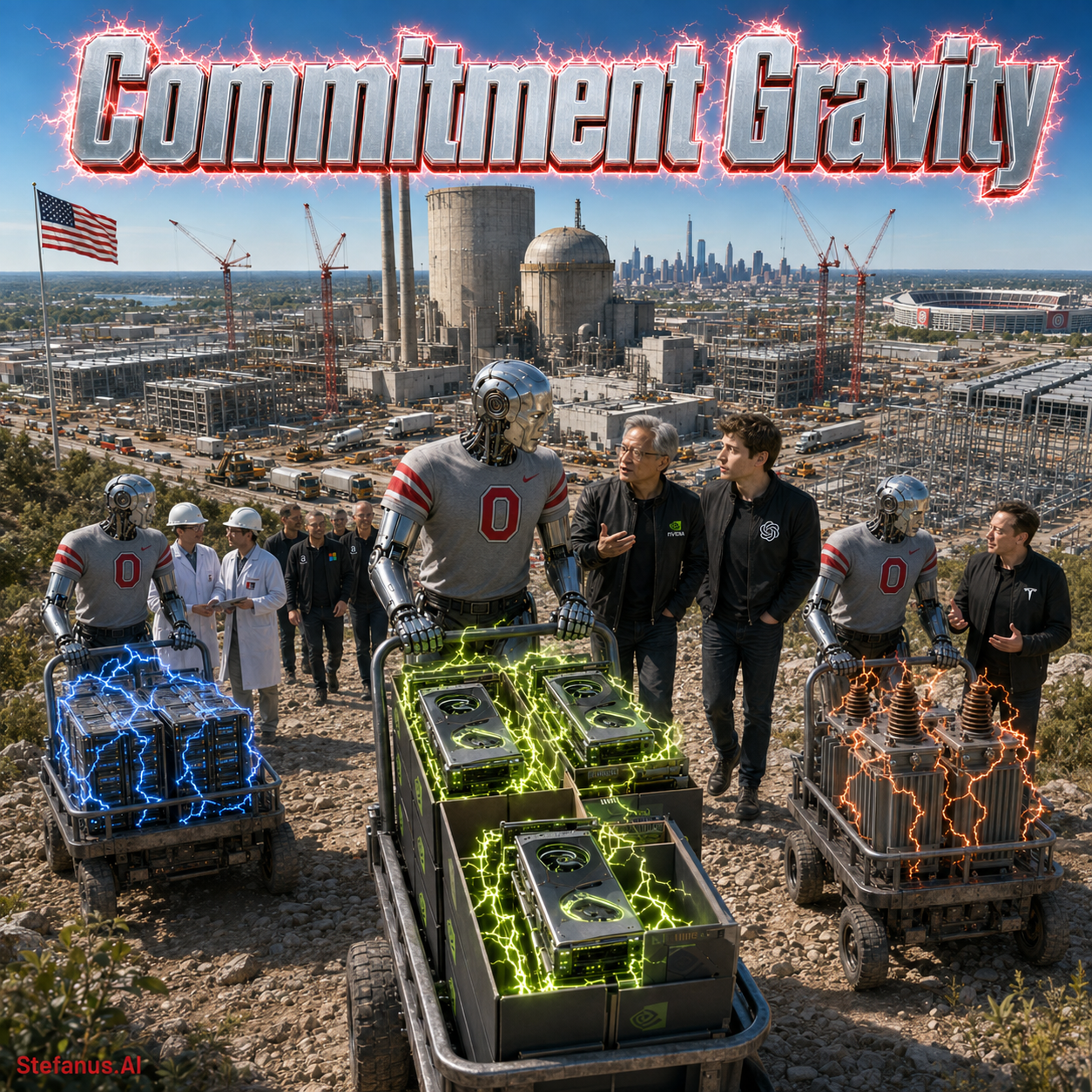
The distinction between spending and commitment matters more than any other distinction in this paper, so it is worth stating carefully. Capital expenditure describes resources that a company has already deployed during a reporting period; it is history by the time it is disclosed. A purchase commitment reaches into future reporting periods. A lease reserves infrastructure that may not yet exist. A take-or-pay energy agreement creates a payment obligation whether or not the contracted electricity is fully consumed. A financial guarantee transfers part of a project’s credit risk to another balance sheet. A capacity reservation can prevent a competitor from obtaining the same chips, power, packaging, land, or construction window. These instruments differ legally and financially — some are executory contracts, some are contingent liabilities, some are off-balance-sheet disclosures buried in the commitments-and-contingencies footnotes of quarterly filings — but they share one strategic effect: they allow projected future demand to reorganize present investment. This paper calls that force Commitment Gravity.
Commitment Gravity is the cumulative pressure exerted by long-duration purchase agreements, leases, guarantees, capacity reservations, energy contracts, and construction obligations that pull companies and their counterparties toward a predetermined infrastructure trajectory. Its strength depends not only on the dollar amount promised, but also on the duration of the promise, the cost of cancellation, the specialization of the underlying asset, the number of dependent counterparties, and the difficulty of repurposing the infrastructure. The larger and more interconnected the obligations become, the more expensive it becomes for any participant to change direction. The basic sequence runs as follows:
Forecast Demand → Reserve Capacity → Arrange Financing → Construct Infrastructure → Require Utilization → Defend the Original Forecast
Once a model company forecasts enormous demand, it reserves datacenter capacity. That reservation helps a developer obtain financing. Financing causes substations, pipelines, generation facilities, semiconductor capacity, cooling systems, and server halls to be built. Once those assets exist, their owners require revenue. The model company must then sell enough intelligence services to utilize the capacity it reserved, while chipmakers, cloud providers, utilities, investors, and governments acquire their own incentives to keep the buildout moving. A forecast that began as an estimate gradually becomes an ecosystem of institutions whose economic interests depend on making the forecast come true. This is not a conspiracy; it is a coordination equilibrium — and, as this paper will argue, it is the most important structural fact about the AI economy in 2026.
The Five-Layer AI Economy provides the essential structure for understanding this process, and it organizes the body of this paper. Energy commitments at Layer One make chip and datacenter commitments physically possible. Chip reservations at Layer Two determine which computing architectures become dominant. Datacenter leases at Layer Three convert forecasts into long-lived real assets. Model companies at Layer Four become anchor tenants whose expected growth supports the financing of the lower layers. Applications and agents at Layer Five must ultimately generate the revenue, productivity, and social value required to pay for everything beneath them. Power flows upward through the stack; revenue flows downward; and contractual obligations bind the layers together.
Table 1. The Five-Layer AI Economy and Its Characteristic Commitment Instruments
| Layer | What It Provides | Characteristic Commitments | Typical Duration |
| Layer 1 — Energy | Generation, transmission, substations, fuel, cooling | Power-purchase agreements, take-or-pay contracts, minimum bills, grid cost-allocation agreements | 15–40 years |
| Layer 2 — Chips | Accelerators, memory, packaging, networking, racks | Fab and packaging reservations, HBM supply agreements, prepayments, vendor financing | 2–10 years |
| Layer 3 — Datacenters | Land, power, and shell; specialized server halls | Twenty-year leases, residual-value guarantees, project debt, construction contracts | 10–25 years |
| Layer 4 — Models | Frontier training and inference capability | Capacity reservations, cloud purchase commitments, anchor-tenant leases | 5–20 years |
| Layer 5 — Applications & Agents | Revenue, productivity, and end-user value | Subscriptions, enterprise contracts, API consumption, agentic workloads | Months–3 years |
The central thesis of this paper is therefore not that the AI boom is guaranteed to succeed, nor that every announced project will be completed — several will not be, and some have already been resized. The thesis is that the AI economy is acquiring institutional momentum before its ultimate demand, returns, and social benefits are fully known. The scale of that momentum is now macroeconomic. Harvard economist Jason Furman calculated that investment in information-processing equipment and software, though only about 4 percent of U.S. GDP, accounted for fully 92 percent of U.S. GDP growth in the first half of 2025, with growth excluding those categories running at an annualized 0.1 percent — a near standstill — and Renaissance Macro Research estimated that the dollar contribution of AI datacenter buildout to GDP growth surpassed that of all U.S. consumer spending during the same period.[29] More than a technology cycle is being financed. An industrial system is being pre-committed.
Why This Paper Is Titled “Commitment Gravity”
I chose the title Commitment Gravity because “capital expenditure” is no longer sufficient to describe what is happening. Capex measures expenditure after an investment decision has entered the financial accounts. Commitment Gravity describes the force that begins earlier — when a company reserves future chips, signs a twenty-year lease, guarantees an infrastructure developer, promises to purchase cloud capacity, or contracts for electricity that has not yet been generated. These commitments influence present behavior long before the facilities are operational or the promised revenue has materialized. They shape where utilities file rate cases, where turbine manufacturers allocate their order books, where memory makers plan capacity, where construction labor migrates, and where state legislatures write tariff law. A promise, at sufficient scale, is a form of industrial policy conducted through private contract.
I use the word gravity deliberately. One commitment pulls other commitments toward it. A datacenter lease attracts project finance; project finance requires credit support; credit support enables construction; construction creates demand for turbines, transformers, chips, cooling equipment, labor, and transmission; completed infrastructure creates pressure for utilization; and utilization requires applications capable of generating recurring revenue. Like gravity, the force becomes stronger as economic mass accumulates, and — like gravity — it is invisible in any single transaction while being decisive for the trajectory of the whole system. The title fits the paper because it captures both the scale of the promises and their directional effect: trillions of dollars of obligations are pulling the Five-Layer AI Economy toward a future that becomes progressively more difficult, and more expensive, to abandon.
A note on method and sources. This paper draws on the corporate disclosures of the largest AI-exposed companies through the second quarter of 2026, on the reporting that accompanied the PORTS-Pike announcement of August 17, 2026, and on the 2020–2026 academic and institutional literature: Daron Acemoglu’s task-based macroeconomic framework for AI (MIT); Jason Furman’s national-accounts decompositions (Harvard); Ari Peskoe and Eliza Martin’s work on utility ratemaking and datacenter cost-shifting (Harvard Law School’s Electricity Law Initiative); the International Energy Agency’s Energy and AI report series; the International Monetary Fund’s 2026 scenario analysis of AI’s macro-financial implications; the Bank for International Settlements’ 2026 Annual Economic Report; and the Stanford Institute for Human-Centered AI’s 2026 AI Index.[26][29][32][15][24][23][39] Where numbers conflict across sources — and in a field moving this quickly, they frequently do — the paper preserves the disagreement rather than resolving it artificially, because the disagreements are themselves evidence of how much uncertainty the commitment structure is being built on top of.

Section 1 — Energy: The First and Longest Commitment
Every layer of the AI economy ultimately rests on the layer beneath it, and the bottom layer is not silicon. It is electricity — and, beneath electricity, the generation plants, transmission corridors, substations, transformers, cooling systems, water arrangements, and fuel contracts that make sustained multi-gigawatt consumption physically possible. This section argues that energy is both the first commitment in every AI megaproject and the longest-lived, and that the mismatch between the tempo of AI development and the tempo of energy infrastructure is the deepest structural source of Commitment Gravity. Model roadmaps are revised in months; power plants are financed and amortized over decades. When the fastest-moving industry in economic history binds itself contractually to the slowest-moving physical asset class in the industrial economy, the resulting obligations do not merely constrain the companies that sign them. They restructure regional grids, utility rate bases, and, potentially, the electricity bills of households that have never used an AI product.
1.1 Energy Before Intelligence
The physical arithmetic is unforgiving. The International Energy Agency’s 2026 report, Key Questions on Energy and AI, found that global electricity demand from datacenters grew 17 percent in 2025 — in line with the agency’s prior projections — while consumption from AI-focused datacenters surged 50 percent, both figures dramatically outpacing the 3 percent growth of global electricity demand overall.[15][16] The IEA’s updated central projection sees datacenter electricity consumption roughly doubling from 485 terawatt-hours in 2025 to approximately 950 terawatt-hours in 2030 — approaching the present-day electricity demand of Japan and representing about 3 percent of global consumption — with AI-focused facilities tripling their draw over the same period.[15][17] An individual server rack in an advanced facility, the agency notes, is only the size of a large refrigerator, yet by 2027 a single rack could have peak power demand equivalent to sixty-five households.[15] In the United States, which accounted for roughly 45 percent of global datacenter electricity consumption in 2024, the Lawrence Berkeley National Laboratory projects datacenters could consume between 6.7 and 12 percent of total national electricity by 2028, up from about 4.4 percent in 2023.[18]
What makes these numbers structurally significant is not their absolute size — 3 percent of global electricity is large but not overwhelming — but the timing asymmetry they impose. As the IEA observes, a datacenter can be operational in two to three years, while the broader energy system requires far longer lead times: extensive planning, permitting, interconnection studies, equipment procurement in supply chains that have tightened sharply since 2024, and construction programs measured in half-decades.[17] Gas turbines, large power transformers, and high-voltage equipment now carry multi-year order backlogs. The consequence is that any AI company that intends to operate at gigawatt scale in 2029 must commit to energy in 2026 — before it knows what its models will be capable of, what its customers will pay, or what its competitors will build. Energy commitments therefore come first in time, longest in duration, and earliest in irreversibility. Intelligence, in the industrial sense, is downstream of the substation.
1.2 From Electricity Purchases to Power Commitments
It is tempting to describe hyperscalers as very large electricity customers, but the description is a decade out of date. An ordinary customer buys power from whatever the grid happens to generate; a hyperscaler in 2026 helps decide what the grid will generate. The instruments through which this influence travels form a spectrum of escalating commitment, and distinguishing among them is essential to measuring gravity at Layer One. Ordinary utility consumption is the weakest form: the customer pays for what it uses and can, in principle, leave. A power-purchase agreement (PPA) is stronger: the buyer contracts for the output of a specific generating asset, often for fifteen to twenty-five years, and that contract is frequently the document that allows the generator to be financed and built at all. A take-or-pay contract is stronger still: the buyer pays for contracted volumes whether or not it consumes them, converting demand risk into a fixed obligation — and it is precisely this category that Alphabet identifies among the drivers of its $811 billion in disclosed commitments.[10][12] Behind-the-meter generation and dedicated substations bind the customer to a physical site; utility minimum-payment requirements and collateral obligations bind it to a rate schedule; and corporate guarantees supporting new generation bind its balance sheet to assets it will never own.
Table 2. The Spectrum of Energy Commitment, from Weakest to Strongest Gravity
| Instrument | What the Buyer Promises | Reversibility |
| Ordinary utility consumption | Pay for metered usage | High — customer can reduce or relocate load |
| Power-purchase agreement (PPA) | Buy output of a named asset for 15–25 years | Low — contract typically survives changes in buyer demand |
| Take-or-pay energy contract | Pay for contracted volumes regardless of consumption | Very low — payment obligation is unconditional |
| Behind-the-meter generation / dedicated substation | Fund site-specific physical assets | Very low — assets are location-bound |
| Utility minimum bill / collateral (e.g., large-load tariffs) | Guarantee minimum revenue to the utility | Very low — designed precisely to prevent exit |
| Corporate guarantee for new generation or grid buildout | Backstop another party’s financing | Effectively none until debt matures |
The central argument of this subsection is that hyperscalers are no longer merely buying electricity; they are helping determine which generating assets will be financed and where regional grids will expand. When a technology company signs a twenty-year take-or-pay contract for the output of a gas plant that does not yet exist, it has performed a function historically reserved for utility resource planning and public regulation: it has selected the generation mix of a region. The IEA notes that the capital expenditure of the five largest technology companies surged past $400 billion in 2025 and is set to rise a further 75 percent in 2026, with datacenter investment as the dominant driver — a private capital-allocation process now operating at the scale of national energy policy.[16] The question this raises, developed in subsections 1.5 and 1.6, is who absorbs the consequences when the private forecast behind that allocation turns out to be wrong.
1.3 PORTS-Pike and the Ten-Gigawatt Promise
The PORTS-Pike Technology Campus makes the energy-first character of the AI buildout unusually visible, because in Pike County the energy system and the compute system are being developed as a single coordinated project rather than sequentially. To support eight gigawatts of IT capacity, SB Energy and SoftBank plan to build at least ten gigawatts of new energy generation — the U.S. Department of Energy’s announcement of the site’s selection described up to ten gigawatts of new power generation, including 9.2 gigawatts of natural-gas capacity — and to invest at least $4.2 billion in new regional grid infrastructure through a partnership with AEP Ohio, the American Electric Power subsidiary serving the region.[2][5][8] The campus spans private property and remediated federal land controlled by the Department of Energy, and its development involves the Department of Commerce as well — meaning that federal land policy, state utility regulation, and private project finance are all load-bearing elements of a single transaction.[2][7]
Three features of the Ohio arrangement deserve emphasis. First, the generation is oversized relative to the IT load by design: ten gigawatts of generation for eight gigawatts of IT capacity reflects the losses, redundancy, and cooling overhead that gigawatt-class AI campuses require, and it means the energy commitment is roughly 125 percent of the compute commitment in physical terms. Second, the developers have pledged that grid upgrades and new transmission will not be borne by other Ohio ratepayers — SB Energy has stated that these costs will not land on the bills of other customers, and OpenAI has committed to paying the project-specific energy and infrastructure costs directly — a pledge whose enforcement will run through the AEP Ohio large-load tariff framework discussed below.[1][6] Third, the water design was engineered for political durability: the campus will use closed-loop, air-cooled systems that recirculate water rather than consuming it, with OpenAI stating that ongoing water use will resemble that of an office building once the system is filled.[6] Each of these features is simultaneously an engineering decision and a legitimacy decision — a theme to which Section 1.6 returns. The essential point is that PORTS-Pike is not simply a datacenter with a power contract attached. It is a ten-gigawatt energy project with a datacenter as its anchor customer, and the energy obligations will outlive multiple generations of every chip installed inside it.
1.4 The Mismatch of Clocks
The deepest risk in the Five-Layer AI Economy can be stated as a comparison of clocks. Model-development cycles are measured in months: frontier laboratories shipped multiple major model generations per year throughout 2024–2026, and capability leaderboards turned over on a quarterly rhythm.[39] GPU generations are measured in one to several years: NVIDIA moved to an approximately annual architecture cadence, a pace that is central to the depreciation controversy examined in Section 2.4.[36] Datacenter leases are measured in decades: OpenAI’s Ohio lease runs twenty years, and Oracle has disclosed lease obligations with fifteen- to nineteen-year terms.[1][13] Power plants and transmission assets are measured in multiple decades: a combined-cycle gas plant is typically financed against thirty or more years of operation, and transmission lines longer still.
Table 3. The Mismatch of Clocks Across the Five Layers
| Asset or Decision | Characteristic Cycle | Layer |
| Frontier model generation | 3–12 months | Layer 4 |
| Application / agent product cycle | 1–6 months | Layer 5 |
| GPU architecture generation | ~1–3 years | Layer 2 |
| Datacenter construction | 2–3 years per phase | Layer 3 |
| Datacenter lease (PORTS-Pike; Oracle disclosures) | 15–20+ years | Layer 3 |
| Gas generation plant (financing life) | 30–40 years | Layer 1 |
| Transmission and substation assets | 40+ years | Layer 1 |
The table makes the paper’s central temporal risk legible: the upper layers of the stack can change direction one to two orders of magnitude faster than the lower layers can recover their capital. A model architecture that halves inference costs, a training breakthrough that reduces compute requirements, a shift of workloads toward efficient custom silicon, or simply a demand curve that arrives later than forecast — any of these can materialize within a single year, while the generation and transmission built against the original forecast will still be seeking recovery for decades. The IEA formalizes the same asymmetry from the energy side: the technology sector moves quickly, but the energy system “requires longer lead times” involving extensive planning and high upfront investment.[17] Commitment Gravity is, in large part, the financial expression of this clock mismatch. The contracts exist precisely because the slow layers refuse to build without protection against the fast layers changing their minds — and every such protection transfers the cost of changing one’s mind onto someone.
1.5 Who Pays if the Forecast Is Wrong?
That question — onto whom? — is the subject of an increasingly sophisticated legal and regulatory literature, much of it produced at Harvard Law School’s Electricity Law Initiative. In their March 2025 paper, Extracting Profits from the Public: How Utility Ratepayers Are Paying for Big Tech’s Power, Eliza Martin and Ari Peskoe documented the mechanisms through which the costs of serving datacenters can migrate onto the bills of households and small businesses: utilities profit by building infrastructure, serving datacenters is therefore a lucrative growth opportunity, and the subjectivity and complexity of ratemaking can conceal the resulting transfers, with the public facing significant risks that utilities will profit from new datacenters by making major investments and then shifting costs to their captive ratepayers.[32][33] Subsequent analyses — including Virginia’s legislative audit commission study, assessments by PJM’s market monitor, and a 2026 review by the consultancy E3 — have converged on the same core concern: infrastructure built against speculative load forecasts becomes a stranded asset in the rate base if the load never arrives, and under conventional cost-recovery rules, everyone pays for it.[43][44]
The risk allocation therefore runs across at least seven parties. Hyperscalers bear contract risk on their PPAs and take-or-pay obligations. Utilities bear construction and interconnection risk, which they seek to pass through to ratepayers. Independent power producers bear merchant risk on any capacity not covered by contract. Bondholders and project lenders bear refinancing and counterparty risk. Ratepayers bear the residual risk of stranded transmission and generation socialized into the rate base. Taxpayers bear the fiscal cost of incentives and, at sites like PORTS-Pike, the implicit subsidy of federal land. And local communities bear the risk that the promised employment and tax base underdeliver. The emerging policy response is the large-load tariff: as of mid-2026, twenty-three states had approved at least one special rate class forcing datacenters above a size threshold to sign long-term contracts, post substantial collateral, and pay minimum bills regardless of actual consumption.[43] Ohio is a leading case. After state regulators approved AEP Ohio’s datacenter tariff — requiring firm financial commitments from large loads — the utility’s projected datacenter demand pipeline fell from roughly thirty gigawatts to around thirteen, as speculative projects that would not sign binding contracts dropped out of the queue.[35] The episode is one of the cleanest natural experiments yet conducted on the difference between announced demand and committed demand: more than half of the announced gigawatts evaporated when asked to become obligations. Peskoe’s summary of the field is characteristically restrained:
“The details matter here. It’s important to have strong oversight of these deals.” [34]
— Ari Peskoe, Director, Electricity Law Initiative, Harvard Law School
The lesson generalizes far beyond Ohio. Properly structured, very large loads can put downward pressure on rates by spreading fixed system costs over more kilowatt-hours; improperly structured, they raise rates for everyone and leave households underwriting the demand forecasts of the world’s wealthiest companies.[34] Commitment Gravity at Layer One is therefore not merely a corporate phenomenon. It is a question of public risk allocation, and the tariff proceedings now underway in state utility commissions are, in a real sense, where the reversibility of the AI buildout is being negotiated.
1.6 Political Permission as a Financial Input
A final feature of Layer One deserves separate treatment, because it has quietly become part of the capital stack: political legitimacy. A gigawatt-class campus cannot be financed if it cannot be permitted; it cannot be permitted if the host community, the state legislature, and the utility commission are aligned against it; and lenders now underwrite that alignment as seriously as they underwrite the anchor tenant’s credit. The PORTS-Pike structure reads as a case study in engineered legitimacy. The partners project 35,000 construction jobs across a six-year buildout through 2032 and roughly 2,500 long-term operating positions.[1] OpenAI committed $40 million to a community grant fund directed by local residents, building on SB Energy’s previously announced $40 million commitment — a combined community-benefits pool of $80 million — and separately pledged $84 million in Codex credits giving every Ohio college student access to its software-development tools, bringing total announced Ohio programs to roughly $164 million.[1][7] The developers pledged that grid costs would not migrate onto other ratepayers; the cooling design was chosen to neutralize the water objections that have derailed campuses elsewhere; and the site itself — a decommissioned uranium-enrichment complex in a region that lost its industrial anchor — was selected in part because reindustrialization narratives generate political support that greenfield sites do not.[6][2]
None of this is charity, and describing it as public relations misses the point. These are financial inputs: they lower permitting risk, shorten interconnection disputes, stabilize the tax environment, and reduce the probability that a future legislature turns hostile mid-construction — all of which lowers the cost of capital for a project whose debt must survive twenty years of local politics. The inverse is equally true, and 2025–2026 supplied abundant evidence: datacenter proposals were delayed or defeated by local opposition across multiple states, and rising residential electricity prices became a live national political issue, with data-center cost allocation featuring in state and federal campaigns.[42][43] A project without political legitimacy may eventually become an impaired financial asset. Legitimacy, in the commitment economy, compounds like interest — and its absence compounds like penalty interest.
1.7 The Layer One Gravity Test
Each section of this paper closes with a gravity test: a short set of questions that measures how strongly a given commitment binds its signatories and their neighbors. For energy commitments, five questions do most of the work.
Table 4. The Layer One Gravity Test — Energy Commitments
| # | Question | Why It Measures Gravity |
| 1 | How long is the obligation? | Duration is the primary multiplier of all other risks; a 25-year PPA outlives every current model and chip. |
| 2 | Is payment required if demand falls? | Take-or-pay and minimum-bill structures convert demand risk into unconditional obligation. |
| 3 | Can the asset serve other customers? | Grid-connected generation is repurposable; a dedicated behind-the-meter plant serving one campus is not. |
| 4 | Who bears construction and interconnection risk? | Cost overruns and delays must land on a balance sheet; identifying which one reveals the true guarantor. |
| 5 | Who pays if the datacenter never reaches planned utilization? | The stranded-asset question — the ultimate test of whether risk sits with the forecaster or the public. |
Applied to PORTS-Pike, the test yields a mixed but instructive reading: the duration is maximal (twenty years of lease against thirty-plus years of generation life); payment obligations are substantially firm; the generation is largely dedicated; construction risk sits with SB Energy under NVIDIA’s credit umbrella; and the ratepayer-protection pledges, if honored and enforced through the AEP Ohio tariff structure, would place utilization risk on the project parties rather than the public.[1][5][35] Whether those pledges hold across two decades of rate cases is precisely the kind of question that Commitment Gravity forces regions to live inside.

Section 2 — Chips: Reserving Tomorrow’s Computing Architecture
If energy is the first and longest commitment, silicon is the commitment that decides what kind of intelligence economy gets built. This section examines Layer Two: the semiconductors, memory, packaging, networking, and rack-scale systems through which electricity becomes computation. Its argument is that the nature of chip procurement has changed categorically since 2023. AI companies and hyperscalers are no longer buying finished accelerators the way enterprises once bought servers; they are reserving future manufacturing capacity years in advance — fabrication slots, advanced-packaging throughput, high-bandwidth memory supply, networking silicon, and integration capacity — and, increasingly, the chip supplier itself has begun financing the buildings, power, and land in which its products will run. The PORTS-Pike arrangement, in which NVIDIA acts simultaneously as exclusive supplier, equity investor, and credit guarantor, is the furthest point yet reached along this trajectory, and it raises the analytical question that organizes this section: what happens to an industry when its dominant component vendor becomes the coordinator, financier, and backstop of the entire stack?
2.1 From Chip Procurement to Capacity Reservation
The 2026 disclosures make the shift from purchasing to reservation unmistakable. Combined purchase commitments across the largest hyperscalers approached $2 trillion by the second quarter of 2026 by some tallies, and analysts attribute a substantial share of the increase to long-term supply agreements for compute hardware and, notably, memory.[10][12] AI datacenters consume enormous quantities of high-bandwidth memory (HBM), DRAM, and storage, and because expanding memory fabrication capacity takes years, major buyers have locked in multi-year supply agreements that have shifted pricing power decisively toward Micron, Samsung, and SK hynix — turning memory, in the words of one industry analysis, into a strategic asset and competitive weapon rather than a commodity.[10] The bottleneck, as a 2026 assessment put the point, has migrated from any single component to the entire industrial chain required to convert electricity into computing capacity: a GPU requires HBM; thousands of GPUs require switches, optics, and storage; racks require power and cooling; buildings require transformers and substations; and all of it must arrive at roughly the same time.[12] Reserving one link in that chain without the others buys nothing, which is why commitments now propagate across the whole chain at once — and why the commitments of a few very large buyers can crowd every other purchaser in the world market. When several firms with enormous balance sheets reserve years of forward capacity simultaneously, the rest of the market competes for the remainder.[12] NVIDIA itself discloses the mirror image of its customers’ obligations: its most recent quarterly filing showed total supply-related commitments of $119 billion alongside $30 billion of multi-year cloud service commitments — the supplier pre-committing to its own suppliers, and to buying back capacity from its own customers.[45]
2.2 NVIDIA as Supplier, Investor, and Guarantor
The Ohio transaction assembles, in one contract set, five roles that in prior technology cycles were held by five different institutions. NVIDIA is the exclusive compute-infrastructure provider for the campus, which will deploy its full-stack DSX AI factory platform across the initial 4.25 gigawatts.[2][3] NVIDIA is a $1.5 billion equity investor in SB Energy, the developer, alongside SoftBank Group and OpenAI.[2][4] NVIDIA is the credit guarantor, through residual-value guaranties capped at $105 billion covering the land, power, and shell buildout for the initial phase, with payments triggered only by OpenAI default or insolvency.[3] NVIDIA is the principal beneficiary of the future hardware demand the campus represents — eight gigawatts of exclusive NVIDIA deployment across a twenty-year lease implies multiple full hardware refresh cycles of purchases. And NVIDIA holds an option, at its sole discretion, to extend credit support to the remaining roughly 3.75–3.8 gigawatts, giving it a contractual lever over whether and when the second half of the campus gets financed.[3][5] In earlier industrial eras these functions were separated deliberately: the equipment vendor sold machines, a bank provided credit, an insurer wrote guarantees, a developer owned the building, and a utility provided power — with each party pricing the others’ risk at arm’s length. At PORTS-Pike, one balance sheet spans the supplier, the financier, and the guarantor, and the arm’s-length pricing of risk becomes correspondingly harder for outsiders to observe. The analytical question is no longer whether NVIDIA is a chip company. It is whether a chip supplier is becoming the infrastructure coordinator for the entire stack — the private counterpart of a development bank, with an exclusive equipment mandate attached.
2.3 The Vendor-Financier Transformation and the Circularity Debate
Why would a chipmaker finance the environments in which its products will be installed? The strategic logic is genuine and threefold. First, demand assurance: guaranteeing the campus guarantees the order book, converting uncertain future chip demand into contractually anchored deployment. Second, ecosystem lock-in: an exclusively NVIDIA campus forecloses substitution for two decades at one of the world’s largest single sites. Third, bottleneck removal: if land, power, and shell — not chips — are the binding constraint on AI deployment, then the highest-return use of NVIDIA’s capital may be to unblock the constraint that is throttling its own sales. Huang has framed land, power, and shell as vital resources of the AI age, and the Ohio structure operationalizes that view: NVIDIA is spending its balance sheet on the scarcest complements to its own product.[2][3]
The concerns are equally genuine, and by 2026 they had acquired a name: circularity. When one company invests in, lends to, or guarantees another in exchange for — or in close connection with — that second company purchasing the first’s products, revenue and demand signals begin to travel in a loop, and outside observers lose the ability to distinguish end demand from financed demand. The pattern is now pervasive: NVIDIA’s 2025 commitment of up to $100 billion toward OpenAI’s datacenters alongside OpenAI’s commitment to NVIDIA chips; OpenAI’s AMD arrangement carrying warrants for up to a tenth of the chipmaker; NVIDIA’s stake in CoreWeave paired with its agreement to purchase CoreWeave’s unused capacity; and now the Ohio guaranty structure.[41][22] Members of Congress have formally raised the pattern in oversight letters; commentators have revived the dot-com era vocabulary of vendor financing and round-tripping; and the Bank for International Settlements’ 2026 Annual Economic Report listed the bursting of an AI bubble and the unwinding of circular deals among the top risks to the global financial system, noting that AI capital expenditure is increasingly debt-financed and that circular investing raises contagion risk.[41][21][23] Moody’s Analytics chief economist Mark Zandi captured the credit dimension after technology issuers sold well over $100 billion of bonds in a single quarter:
“It’s a lot of debt, and a lot of it all of a sudden.” [20]
— Mark Zandi, Chief Economist, Moody’s Analytics
The fair reading, and the one this paper adopts, is neither alarm nor absolution. Vendor financing is a legitimate and historically common instrument for building out network industries — railroads, telegraphy, and telecommunications all used it — and the INSEAD analysis of the question frames the decisive test correctly: the distinction between a flywheel and a house of cards comes down to whether real end-user demand is being generated, or whether money is simply moving in circles.[22] What circularity unambiguously does, however, is amplify Commitment Gravity. Every loop tightens the coupling between balance sheets, so that a demand disappointment at one node propagates as a credit event across several. Guarantees, as Section 6 will argue as a general pillar, move risk; they do not destroy it — and circular guarantees move it in circles.
2.4 Silicon Commitments and Technological Obsolescence
A twenty-year facility will host many generations of accelerators, and this fact generates one of the sharpest live controversies in AI finance: over what period should the chips be depreciated, and what does the answer imply for the true economics of the buildout? Hyperscalers currently depreciate GPU-class hardware over roughly four to six years. Critics — most prominently the investor Michael Burry, joined in various registers by Jim Chanos, Aswath Damodaran, and researchers at Princeton’s Center for Information Technology Policy — argue that NVIDIA’s approximately annual architecture cadence compresses the real economic life of frontier hardware toward two to three years, and that stretched schedules therefore overstate industry earnings; Burry’s own estimate put the potential understatement of depreciation at roughly $176 billion across 2026–2028.[36][37] NVIDIA has responded that observed utilization supports four-to-six-year lives, and defenders of current schedules point to the cascade: hardware waterfalls from frontier training to mainstream inference to batch and internal workloads as it ages, remaining productive long after it ceases to be state of the art.[36][37] The debate cannot be settled here — accounting standards genuinely leave useful life to management judgment — but Microsoft’s chief executive supplied the most candid data point in the entire discussion when explaining why Microsoft had deliberately slowed some purchases:
“I didn’t want to go get stuck with four or five years of depreciation on one generation.” [38]
— Satya Nadella, CEO, Microsoft
For the purposes of this paper, the depreciation debate matters less as an accounting question than as a gravity question. If effective hardware life is short, then a twenty-year campus is not a place where chips live; it is a place where chips are perpetually replaced — a permanent reinvestment cycle in which the land, power, and shell are the durable asset and the silicon is closer to a consumable. That reading, notably, is exactly the one NVIDIA’s Ohio structure implies: the guaranty protects the residual value of land, power, and shell, the twenty-year elements, while the chips inside are expected to turn over repeatedly — each turnover being, of course, a fresh NVIDIA sale.[3] Whether the facility is thereby adaptable (because it can absorb every future architecture) or trapped (because it must fund every future architecture to stay economic) depends entirely on whether the revenue layers above it grow fast enough to pay for perpetual refresh. The maturity mismatch flagged by credit analysts — ten-year bonds funding five-year (or shorter) assets — is the financial shadow of this physical cycle.[45]
2.5 Commitment as Competitive Exclusion
Commitments at Layer Two do more than secure supply; they remove supply from everyone else. A reserved fabrication slot at TSMC, a contracted year of HBM output, a booked advanced-packaging line, or an exclusively committed campus cannot simultaneously serve a competitor. This is the quiet second function of the trillion-dollar commitment totals: they operate as competitive exclusion executed through procurement. The effect is visible across the 2026 supply chain — memory prices rising as hyperscaler agreements absorb forward capacity, smaller AI companies and enterprises competing for residual allocation, and even the largest consumer-electronics buyers finding themselves outweighed in markets they once anchored.[10][12] Exclusivity clauses convert this from side effect into strategy: PORTS-Pike will host NVIDIA compute exclusively for the duration of the arrangement, meaning that eight gigawatts of the world’s future AI capacity is contractually closed to every rival architecture — custom hyperscaler silicon, rival GPU vendors, and novel accelerator startups alike — regardless of what those alternatives achieve technically over the next two decades.[2] Commitment Gravity here shapes not just how much gets built, but who is allowed to compete inside what gets built. Antitrust scholarship has barely begun to address exclusion executed prospectively, through reservation of capacity that does not yet exist; the AI buildout is likely to force the question.
2.6 Export Controls and Geographic Rigidity
Long-duration silicon commitments are also exposed to a risk that no counterparty controls: policy. Export-control regimes governing advanced accelerators have been revised repeatedly since 2022, redrawing which chips may be sold into which jurisdictions, sometimes within a single fiscal year. Domestic-content expectations, federal land arrangements of the PORTS-Pike variety, and national-security review of AI infrastructure all tie campuses to specific legal geographies. Meanwhile the manufacturing base remains extraordinarily concentrated — leading-edge logic in Taiwan, HBM in Korea, advanced packaging in a handful of facilities — so that a geopolitical shock anywhere along that chain revalues every forward commitment simultaneously.[10] A ten-year chip reservation is therefore not merely a bet on demand and architecture; it is a bet on the stability of trade policy across three or four electoral cycles in multiple countries. The Stanford AI Index’s documentation of intensifying U.S.–China parity — with the performance gap between top American and Chinese models narrowing to low single digits by early 2026 — guarantees that this policy environment will remain contested for the life of every commitment now being signed.[39][40] Contracts can allocate commercial risk between signatories; they cannot allocate geopolitical risk away from the system as a whole.
2.7 The Layer Two Gravity Test
Table 5. The Layer Two Gravity Test — Silicon Commitments
| # | Question | Why It Measures Gravity |
| 1 | Is the commitment tied to one chip architecture? | Exclusivity converts a supply contract into a two-decade architectural bet. |
| 2 | Can hardware from another supplier be substituted? | Substitutability is the escape hatch; its absence is lock-in. |
| 3 | Who bears obsolescence risk? | Depreciation assumptions decide whether earnings today are borrowing from write-downs tomorrow. |
| 4 | Does financing depend on continuing GPU resale or residual value? | Residual-value guaranties make the guarantor’s solvency a function of secondary-market prices for its own product. |
| 5 | Does the arrangement create measurable end demand, or transfer demand among related counterparties? | The circularity test — the flywheel-versus-house-of-cards question. |
Applied to the Ohio arrangement: the commitment is architecture-exclusive by contract; substitution is foreclosed for the initial phases; obsolescence risk is shared between the tenant (through lease payments across refresh cycles) and the guarantor (through the residual-value structure); the financing explicitly rests on residual values that NVIDIA itself guarantees for infrastructure hosting NVIDIA products; and the demand it anchors is, by design, the demand of a counterparty in which NVIDIA and its co-investors hold economic interests.[2][3][41] On the Layer Two test, PORTS-Pike registers close to maximal gravity — which is precisely why it is this paper’s anchoring case.

Section 3 — Datacenters: The Physical Gravity Wells
Layers One and Two supply the inputs; Layer Three is where the inputs fuse into something that cannot be unmade cheaply. A gigawatt-class AI campus is the point in the stack at which forecasts stop being spreadsheet entries and become poured concrete, energized substations, and steel that has a street address. This section examines the datacenter layer as the system’s set of physical gravity wells: assets so large, so specialized, and so heavily financed that, once built, they bend the behavior of every party around them — tenants, guarantors, lenders, utilities, and the surrounding regional economy. The section develops the land-power-shell model, uses the OpenAI–SB Energy lease to dramatize the paper’s central temporal mismatch, traces how a promise becomes project finance, and works through the residual-value problem, the accounting periphery, regional lock-in, and four failure scenarios.
3.1 Land, Power, and Shell
The industry’s own vocabulary has crystallized around a three-word phrase: land, power, and shell — LPS, in the abbreviation NVIDIA’s announcement uses.[2] Land means entitled, permitted acreage with water rights, fiber routes, and workable local politics. Power means firm, contracted electricity at the site boundary: interconnection agreements, substations, and generation either dedicated or reserved. Shell means the building itself — but a shell engineered for AI bears little resemblance to a warehouse or even a conventional cloud datacenter. Rack densities an order of magnitude above enterprise norms; liquid or closed-loop air cooling plumbed through the structure; electrical distribution sized for hundreds of megawatts per hall; floor loading, ceiling heights, and mechanical yards dimensioned around specific accelerator platforms. The consequence is that a usable AI campus is not interchangeable with ordinary industrial real estate in either direction: warehouses cannot be upgraded into AI factories economically, and an AI factory’s specialized systems are largely worthless to any tenant that does not run dense compute. Specialization is what turns capital intensity into gravity. An asset that can serve many uses disciplines its owner lightly; an asset that can serve one use makes its owner a hostage to that use’s success.
3.2 The Twenty-Year Lease and the Two-Year Technology Cycle
The OpenAI–SB Energy lease is the clearest single artifact of the paper’s central temporal mismatch. OpenAI has agreed to lease the PORTS-Pike campus for twenty years, with payments beginning only as completed capacity becomes available, funded — in the company’s own formulation — through revenue and cash flow from the significant growth of its business and capital raised from investors.[1] Twenty years is a duration borrowed from an industry with slow clocks: it is the tenor of an airport concession or a toll-road agreement. Yet the tenant is a company founded in 2015, whose flagship product launched in late 2022, whose model lineup turns over multiple times per year, and whose own disclosed compute strategy was revised downward — from roughly $1.4 trillion in touted commitments to a stated target near $600 billion of total compute spend by 2030 — within a span of months between late 2025 and early 2026.[30][31] The lease will outlast, on any reasonable reckoning, five to ten generations of the chips installed under it and an unknowable number of strategic pivots by the tenant. That is not an argument that the lease is a mistake; infrastructure has always required someone to sign for longer than they can see. It is an argument that the lease’s economics depend on institutions — guarantors, refinancing markets, and ultimately application-layer revenue — that must repeatedly bridge the gap between a two-year technology cycle and a twenty-year obligation. Every bridge is a commitment, and every commitment is gravity.
3.3 How a Promise Becomes Project Finance
It is worth slowing down to trace, step by step, how a demand forecast becomes a construction site, because the chain is the mechanism of Commitment Gravity in its purest form:
Anchor Tenant → Long-Term Lease → Credit Support → Equity → Project Debt → Construction
The chain begins with an anchor tenant whose projected demand is large enough to fill the asset: OpenAI, contracting for approximately eight gigawatts on the basis of its projected long-term needs for frontier training and growing product demand.[1] The tenant signs a long-term lease, which converts the forecast into a contractual revenue stream that a developer can show to financiers. But a lease from a young, unprofitable, privately held tenant — however celebrated — does not by itself support investment-grade project debt at the hundred-billion-dollar scale; hence the third link, credit support, in which NVIDIA’s residual-value guaranties, capped at $105 billion, stand behind the land, power, and shell obligations and assure lenders of a floor value even in tenant default.[3] Equity comes next: NVIDIA’s $1.5 billion into SB Energy alongside SoftBank and OpenAI aligns the developer’s capital structure with the guarantee.[2][4] With lease, guaranty, and equity assembled, project debt can be raised against the package, and only then does construction begin — 35,000 workers, six years, phased energization from 2028.[1] Read backward, the chain reveals its own fragility: the construction exists because of the debt, the debt because of the guaranty, the guaranty because of the lease, and the lease because of a forecast. Everything physical at PORTS-Pike is, in the end, a derivative of OpenAI’s expectations about the demand for intelligence in the 2030s — expectations that Apollo Global Management’s chief economist, among others, has flagged as resting for now on investor capital rather than proven end-customer economics:
“Capital can bridge the gap for a while, but not indefinitely.” [19]
— Torsten Slok, Chief Economist, Apollo Global Management
3.4 Guarantees Do Not Eliminate Risk
The guaranty deserves its own subsection because it is the most misunderstood instrument in the commitment economy. A guarantee reallocates risk among parties; it does not make the underlying demand certain, and it does not make the asset more valuable than its future cash flows. The Ohio structure contains, explicitly or implicitly, at least six distinct risk channels. Lease-payment support: if OpenAI defaults or becomes insolvent, NVIDIA’s obligations activate, capped at $105 billion for the initial commitment.[3] Power-payment support: the credit umbrella extends over the power obligations bundled into land, power, and shell.[1][3] Residual-value risk: the guaranty warrants a minimum value for infrastructure whose resale market, as 3.5 argues, may be narrow precisely in the states of the world where the guaranty is called. Completion risk: a six-year, multi-phase construction program across remediated federal land carries schedule and cost risk that guarantees can cushion but not abolish. Refinancing risk: project debt of this tenor will be refinanced repeatedly across two decades of unknowable rate environments — a risk the broader sector already feels, having moved from almost fully self-funded capex to raising external capital at scale, with incremental annual debt rising from 9 percent of hyperscaler capex in fiscal 2024 to 32 percent by mid-2026, alongside Alphabet’s $84.75 billion equity raise and Oracle’s planned $40 billion of combined issuance.[13] And counterparty risk in the other direction: the guaranty is only as strong as NVIDIA, which means the campus’s financing has embedded a correlation — the guarantor’s fortunes and the tenant’s fortunes both depend on the same AI demand curve. A backstop correlated with the thing it backstops is weaker than it appears in exactly the scenarios that matter. This is the sense in which Section 6’s third pillar should be read: guarantees move risk; they do not destroy it.
3.5 The Residual-Value Problem
Ask the question directly: what would an eight-gigawatt AI campus be worth if its original tenant departed? The theoretical replacement value is enormous — entitled land, ten gigawatts of generation, $4.2 billion of grid infrastructure, and shells engineered to the frontier standard.[2][5] But value in a sale is set by buyers, and the roster of entities that could plausibly absorb eight gigawatts of specialized AI capacity is short: a handful of hyperscalers, one or two frontier laboratories, perhaps a sovereign. Every name on that list is a company that (a) is already building its own capacity, (b) would be bidding into the same demand downturn that dislodged the original tenant, and (c) knows the seller has no alternative use. The residual-value guaranty exists precisely because everyone in the transaction understands this: in the good states of the world the guaranty is free, and in the bad states the market it references may be one buyer deep. The depreciation debate of Section 2.4 re-enters here at building scale — if the durable value is in land, power, and shell while the compute inside is quasi-consumable, then the recoverable floor is the LPS value, which is exactly the perimeter NVIDIA chose to guarantee.[3] The structure is internally coherent. Whether the floor is high enough, in a scenario stressful enough to trigger it, is the sixty-four-gigawatt question.
3.6 Obligations Outside Conventional Capex
A measurement warning is required before any totals are quoted, and this paper repeats it deliberately. Leases, minimum purchase agreements, guarantees, and uncompleted facilities do not appear in headline capital-expenditure figures in comparable ways, and several of the large numbers circulating in 2026 overlap. The Financial Times-derived $1.5 trillion of purchase commitments is distinct from Goldman Sachs’s roughly $1.5 trillion of lease commitments, which is measured differently from FactSet’s $820 billion of unrecognized lease-related commitments across five firms; OpenAI’s $1.4 trillion of touted commitments overlaps with the obligations of the cloud providers and developers on the other side of those same contracts; and NVIDIA’s $105 billion guaranty cap is a contingent maximum, not an expected outlay.[11][13][30][3] Adding every disclosed number together produces an impressive and meaningless total, because one project can generate a purchase commitment for the tenant, a lease obligation for the same tenant, a supply commitment for the vendor, a guarantee for the guarantor, and project debt for the developer — five disclosures, one campus. The honest analytical statement is narrower and stronger: on any consistent measurement, forward obligations are now multiples of annual capital expenditure, they grew on the order of 50 percent in a single quarter at the sector level, and the majority of them sit off-balance-sheet where conventional leverage metrics do not register them.[9][12] Commitment Gravity is real; double-counting it only hands ammunition to those who would prefer not to measure it at all.
3.7 Regional Economic Lock-In
Gravity wells capture more than their financiers. Once roads, transmission, generation, workforce-training pipelines, tax-increment arrangements, school budgets, and municipal services are organized around a campus, the surrounding region becomes a committed party without ever signing the lease. Pike County illustrates the mechanism at full scale: 35,000 construction jobs over six years, 2,500 permanent positions, an $80 million community fund, $84 million in student credits, and the explicit framing of the project as the reindustrialization of a region that lost its federal anchor when the enrichment complex closed.[1][6][7] These are genuine benefits, and this paper does not sneer at them; Appalachian Ohio has waited decades for capital at this scale. But reciprocal dependence is the definition of lock-in. A county whose budget, housing market, and identity reorganize around a campus acquires an interest in the campus’s success that will express itself politically — in permitting, in tax policy, in utility proceedings — for twenty years. Regional lock-in is how Commitment Gravity escapes the boundaries of contract law and becomes a fact about democracy: communities become constituencies for the forecast.
3.8 Datacenter Failure Scenarios
Stress-testing the gravity well requires imagining futures other than the base case. Four scenarios span the space, and it is essential to notice that the campus is exposed in three of them — including two in which AI succeeds.
Table 6. Four Scenarios for a Gigawatt-Class Campus
| Scenario | What Happens | Who Absorbs the Stress |
| S1 — Demand exceeds forecast | Capacity is scarce; utilization and pricing are strong; expansions exercise the option on the remaining ~3.75 GW. | No one — commitments look prescient; gravity is celebrated as vision. |
| S2 — Demand grows, prices collapse | Usage rises but token prices fall faster; revenue per unit of compute erodes below the level lease economics assumed. | Tenant margins first; then guarantor exposure; then refinancing markets. |
| S3 — Demand shifts to efficient architectures | Algorithmic gains, custom silicon, or smaller models cut compute per unit of intelligence; exclusive-architecture halls face early economic obsolescence. | Guarantor and lessor; the exclusivity that was an asset becomes the liability. |
| S4 — Anchor-tenant distress | Financial, competitive, or regulatory distress at the tenant triggers the guaranty; residual value is tested in a thin market. | Guarantor up to the cap; then lenders; then, through rates and taxes, the region. |
Scenario S2 deserves particular attention because it is the one the industry’s own optimists inhabit. Falling inference prices are the mechanism by which AI diffuses — the IEA documents per-task power consumption falling by roughly an order of magnitude annually, an efficiency improvement it calls unprecedented in energy history — and yet each price decline forces the question of whether volume grows fast enough to cover fixed obligations contracted at yesterday’s price assumptions.[15][16] A campus can be a stranded asset in a booming industry if the boom happens at a price point the lease did not anticipate. This is the scenario conventional bubble analysis misses entirely: the technology succeeds, adoption soars, and the infrastructure financing still fails.
3.9 The Layer Three Gravity Test
Table 7. The Layer Three Gravity Test — Datacenter Commitments
| Dimension | What to Measure | PORTS-Pike Reading |
| Lease duration | Years of committed tenancy versus technology cycle length | 20 years — maximal[1] |
| Cancellation terms | Cost and conditions of early exit | Effectively none disclosed; guaranty covers default states[3] |
| Tenant concentration | Share of capacity committed to one tenant | Single anchor tenant — maximal |
| Alternative-use value | Breadth of the buyer pool if repurposed | Narrow; specialized LPS with exclusive architecture |
| Power-source flexibility | Ability to vary generation mix and volumes | Low; dedicated ~10 GW buildout, largely gas[8] |
| Refinancing dependence | Number of future refinancings assumed | High; multi-decade project debt in a shifting rate environment[13] |
| Community / government exposure | Public commitments organized around the asset | High; federal land, state tariffs, county dependence[2][35] |
Seven dimensions, and the anchoring case scores at or near the deep end of each. That is not a prediction of failure — deep gravity wells can be exactly where civilizational infrastructure belongs, and the transcontinental railroads scored similarly on every analogous test. It is a statement about optionality: at PORTS-Pike, essentially all of it has been spent. What was purchased with it is the subject of the next two sections.

Section 4 — Models: Turning Forecast Demand Into Present Obligations
Layer Four is where the forecasts originate. The frontier model companies — OpenAI, Anthropic, Google DeepMind, Meta’s research organization, xAI, and a handful of others — are the entities whose demand projections set the size of everything below them: the leases, the guarantees, the generation, the grid. This section examines how a model company functions as an infrastructure anchor tenant; why it must contract for capacity before it can know its revenue; how training and inference demand differ; what the utilization imperative does to pricing and product strategy; how forecasts begin defending themselves; whether efficiency is an escape valve or a demand accelerator; and what it means for the entire lower stack that only a handful of laboratories can carry gigawatt-scale commitments at all.
4.1 The Model Company as an Infrastructure Anchor Tenant
The historical analogy for a frontier laboratory in 2026 is not a software company. It is an industrial off-taker: the aluminum smelter whose demand justified a hydroelectric dam, the airline whose route commitments anchored an airport, the steel mill around which a rail spur was financed. In each case, a single customer’s projected consumption became the bankable fact around which slower, larger, longer-lived infrastructure organized itself. OpenAI at PORTS-Pike is exactly this figure: the campus, the generation, the grid investment, and the guaranty all exist because one company projected sufficient long-term demand to lease as much as eight gigawatts of capacity, contracting — in its own words — on the basis of projected long-term needs for frontier training and growing product demand.[1] What distinguishes the AI case from its industrial ancestors is the epistemic gap between the commitment and the knowledge supporting it. The smelter knew the price of aluminum; the airline knew its routes. A model company in 2026 does not know what its models will be capable of in 2029, what those capabilities will sell for, or whether its current architectural approach will still be competitive. It is an anchor tenant whose cargo has not been invented yet.
4.2 Capacity Before Revenue
The numbers on both sides of that gap are now public, and their juxtaposition defined the industry’s discourse across late 2025 and 2026. In November 2025, Sam Altman publicly quantified the forward book:
“We are looking at commitments of about $1.4 trillion over the next 8 years.” [30]
— Sam Altman, CEO, OpenAI (post on X, November 2025)
At the time, OpenAI expected to end 2025 above a $20 billion annualized revenue run rate — a ratio of forward commitments to current annualized revenue on the order of seventy to one.[30] The tension was not sustainable as rhetoric, and it did not remain sustainable as strategy: by February 2026, the company was telling investors it now targeted roughly $600 billion in total compute spend by 2030 against a 2030 revenue target of approximately $280 billion, a recalibration widely read as the first major retreat of the commitment era — and reporting through the spring described internal disagreement between the chief executive and the chief financial officer over the pace at which new obligations were being signed relative to revenue visibility.[31][47] The recalibration matters for this paper in two directions at once. It demonstrates that commitments are not destiny — forecasts can be, and were, revised downward before all the concrete was poured. But it also demonstrates the ratchet: the roughly $600 billion that survived the revision is itself among the largest capital programs in industrial history, anchored by contracts (Ohio among them) signed at the height of the earlier forecast. Gravity weakened; it did not release.
4.3 Training Demand Versus Inference Demand
The composition of a model company’s demand matters as much as its size, because the two kinds of demand justify infrastructure differently. Training demand is episodic and lumpy: a frontier run concentrates enormous compute for weeks or months, then releases it. It rewards very large contiguous clusters — which is what gigawatt campuses uniquely provide — but it does not, by itself, fill them continuously. Inference demand is the opposite: continuous, distributed, latency-sensitive, and scaling with users and usage rather than with research ambition. The IEA’s modeling attributes the majority of projected AI electricity growth to inference as adoption widens, projecting roughly 30 percent annual growth in inference-driven server consumption.[18] The structural implication is uncomfortable for campuses justified by training ambitions: a facility sized for frontier runs must ultimately be paid for by mass-market inference, because only inference generates the continuous utilization that twenty-year lease payments require. Training builds the cathedral; inference must fill the pews every day for two decades. Every gigawatt campus is therefore an implicit bet that consumer and enterprise usage — Layer Five — will grow into the space that research ambition reserved.
4.4 The Utilization Imperative
Once capacity has been contracted, unused compute becomes economically painful in a way idle software never was: the lease payment, the power minimum, and the depreciation clock all run regardless. This creates what this paper calls the utilization imperative — a standing pressure on model companies to generate workloads for capacity they are already paying for — and it predictably reshapes strategy across at least eight channels: lower token prices to stimulate volume; consumer subsidies and free tiers; enterprise discounts and committed-use agreements; expanded context windows and always-on features that raise compute per interaction; synthetic-data generation as an internal workload of last resort; scientific-computing services sold to governments and universities; more compute-intensive reasoning modes that convert model quality into token consumption; and the rapid deployment of agents, which transform a single user request into extended chains of autonomous computation. None of these behaviors is irrational, and several genuinely benefit users — the Stanford AI Index estimates U.S. consumer surplus from generative AI at roughly $172 billion annually by early 2026, most of it delivered through free or nearly free tools.[39][39] But the imperative blurs a line that investors and policymakers need kept sharp: the line between demand that exists because customers value the output and demand that exists because the capacity does. Section 5.5 returns to this distinction at the application layer.
4.5 When the Forecast Begins Defending Itself
The subtlest mechanism of Commitment Gravity is sociological rather than financial. Once trillions of dollars of obligations have been organized around a demand forecast, an ecosystem of institutions acquires incentives to promote the assumptions that support it. Executives whose commitments would look reckless under a modest forecast are drawn toward immodest ones. Investors marked at valuations that presume the forecast defend the forecast. Suppliers whose order books depend on the buildout supply supportive research. Governments that have staked industrial strategy, land, and electoral narratives on AI leadership treat skepticism as defeatism. Even the developer ecosystem, whose careers appreciate with the platform, participates. The result is not deception but a systematic tilt in the information environment — what one might call forecast capture. MIT’s Daron Acemoglu, the 2024 Nobel laureate whose task-based analysis projects far more modest near-term productivity effects than the buildout presumes — on the order of a 0.5–0.7 percent total-factor-productivity gain and roughly 1 percent of GDP over a decade — identified the mechanism directly:[26][28]
“I think that hype is making us invest badly in terms of the technology.” [27]
— Daron Acemoglu, Institute Professor, MIT; Nobel Laureate in Economic Sciences (2024)
Acemoglu has further warned that frontier laboratories’ recruitment of prominent economists risks tilting the research literature itself toward favorable assumptions — a concern about forecast capture operating inside the academy.[46] One need not accept his specific productivity estimates, which Goldman Sachs and others contest with projections several times larger, to accept the structural point: when the forecast is load-bearing for trillions of dollars of obligations, the forecast stops being a neutral estimate and becomes a defended position.[26] The honest analytical posture is to treat every demand projection in this industry — bullish and bearish alike — as testimony from an interested party, and to weight accordingly.
4.6 Efficiency: Escape Valve or Demand Accelerator?
Two competing possibilities govern the long-run relationship between algorithmic progress and infrastructure demand, and the entire commitment structure is a wager on which one dominates. The first possibility: greater efficiency reduces infrastructure requirements. If compute per unit of delivered intelligence keeps falling at the pace documented since 2023 — the IEA reports per-task power consumption declining by at least an order of magnitude annually — then the intelligence the world will demand in 2032 may be deliverable on a fraction of the capacity now being contracted, stranding the excess.[15] The second possibility is Jevons’s: lower costs expand use more than proportionally, so efficiency increases total demand. The evidence of 2025–2026 leans toward Jevons — total consumption surged even as per-task efficiency improved at record rates, because users, use cases, and agentic complexity grew faster than efficiency gains — and every gigawatt commitment is effectively a leveraged position on that pattern persisting for twenty years.[15][16] The intellectually honest statement is that both forces are real, their race is undecided, and the commitment structure has removed the option of waiting to find out. That is what it means to say the system is pre-committed: the wager has been placed on behalf of parties — ratepayers, regions, future refinancing markets — who were not consulted about the odds.
4.7 Model-Concentration Risk
Finally, the anchor-tenant model has a concentration problem. Only a handful of laboratories worldwide can plausibly sign gigawatt-scale commitments, which means the entire lower stack — hundreds of billions of dollars of generation, grid, and shell — rests on the continued creditworthiness and competitive success of fewer than ten counterparties, several of which are unprofitable and privately held. The IMF’s 2026 scenario analysis flags precisely this channel: greater concentration in the technology sector elevates single-source exposures, undermines diversification, and amplifies macro-financial feedback loops, while elevated leverage against AI investment, combined with rapid capital-obsolescence risk, complicates credit assessment across the system.[24] Concentration also runs in the other direction — the laboratories depend on one dominant chip vendor, a few clouds, and a narrow memory oligopoly — so the stack is concentrated in both directions from its waist. A structure in which a few entities anchor everything below them and depend on a few entities above them is efficient in expansion and brittle in reversal. That asymmetry, more than any valuation multiple, is what distinguishes the present buildout from an ordinary investment boom.
4.8 The Layer Four Gravity Test
Table 8. The Layer Four Gravity Test — Model-Company Commitments
| # | Question | Why It Measures Gravity |
| 1 | What revenue assumptions justify the commitment? | The ratio of forward obligations to current revenue is the leverage of the forecast itself. |
| 2 | How much capacity must be utilized, and how continuously? | Training-justified capacity must be inference-funded; the utilization floor sets the required adoption curve. |
| 3 | What happens if inference prices collapse? | Scenario S2 — success at the wrong price point — is the failure mode unique to this industry. |
| 4 | Can the contracted compute serve competing models or customers? | Fungibility of capacity is the tenant’s hedge; exclusivity removes it. |
| 5 | Is the obligation supported by revenue, external capital, or another participant’s guarantee? | Identifies whose balance sheet actually stands behind the forecast. |
For the anchoring case, the answers assemble into a coherent but demanding picture: the commitments assume revenue growth from roughly $13–20 billion toward hundreds of billions within a decade; utilization must be near-continuous across eight gigawatts; the price-collapse scenario is actively underway as competition compresses token prices; the Ohio capacity is contractually available to one tenant on one architecture; and the obligation is supported, in order, by investor capital, projected revenue, and NVIDIA’s guaranty.[31][48][1][3] Layer Four is where the Five-Layer economy’s optimism is most concentrated — and where, accordingly, its gravity originates.

Section 5 — Applications and Agents: The Revenue Burden at the Top
The first four layers of the AI economy create capacity. The fifth must create value. Applications and agents — the chat assistants, coding tools, enterprise copilots, scientific instruments, customer-facing products, and increasingly autonomous software workers built on top of frontier models — are the only layer that touches the customers whose payments must ultimately flow downward through the entire stack: down to the model companies’ invoices, down to the lease payments on twenty-year campuses, down to the take-or-pay power contracts and the bond coupons of the utilities. Every dollar of the trillion-plus in commitments documented in this paper is, in the last analysis, a claim on Layer Five revenue that mostly does not exist yet. This section examines what that burden looks like from above: how machine-generated demand differs from human demand, whether agents are the utilization thesis in disguise, the price-volume problem, the boundary between subsidized and durable usage, productivity as the ultimate repayment mechanism, and the distribution of whatever returns arrive.
5.1 The Layer That Must Pay for the Other Four
The arithmetic of the burden can be stated simply. If forward obligations across the stack are conservatively counted in the low trillions of dollars over the coming decade, and if infrastructure investors require ordinary returns on that capital, then Layer Five must generate on the order of several hundred billion dollars of annual revenue attributable to AI capability by the early 2030s — sustained, recurring, and margin-bearing — merely for the commitments to be serviced, before anyone earns an economic profit. The current base is growing extraordinarily fast but remains an order of magnitude short: the Stanford AI Index records global corporate AI investment of $581.7 billion in 2025 — more than doubling year over year — and adoption by 88 percent of surveyed organizations, yet the direct revenues of the model layer are measured in the low tens of billions, and much of the value being created is escaping monetization entirely as consumer surplus delivered through free tools.[39] The gap between value created and revenue captured is real and, from a social standpoint, welcome — users are the beneficiaries. From the standpoint of servicing the commitment structure, however, consumer surplus pays no lease. The burden question is not whether AI is valuable. It is whether enough of the value can be converted into cash flows located at the right points in the stack, on the schedule the contracts assume.
5.2 From User Growth to Machine Consumption
Traditional cloud demand was ultimately bounded by human attention: people and organizations clicked, queried, streamed, and stored, and capacity planning could anchor on population-scale limits. Agentic demand breaks that boundary. An autonomous or semi-autonomous agent, once instructed, can plan, search, browse, write and execute code, call other services, monitor conditions continuously, and spawn subtasks — consuming compute around the clock without a human in the loop for each step. A single user request can fan out into thousands of model calls; a single enterprise deployment can run agent fleets whose aggregate consumption resembles that of a large human workforce that never sleeps. The IEA identifies precisely this shift — more users, but above all more energy-intensive uses such as agents — as the reason total consumption keeps surging despite per-task efficiency improving at rates unprecedented in energy history.[15][16] Machine consumption is, from the infrastructure’s point of view, the perfect customer: continuous, elastic, and unconstrained by leisure. That is exactly why it must be scrutinized rather than celebrated, because demand that machines generate is demand that their operators choose to generate — and the choosers are frequently the same parties who need the capacity utilized.
5.3 Agents as the Utilization Thesis
It is therefore worth asking a deliberately uncomfortable question: to what extent have autonomous agents become the economic assumption required to justify infrastructure already contracted? The timeline invites the question. The gigawatt-scale commitments of 2025–2026 were signed when agentic products were nascent; the Stanford Index finds that, despite 88 percent organizational AI adoption, agents remained deployed in the single digits across nearly every business function as of early 2026.[39] The forecasts that fill eight-gigawatt campuses in the 2030s lean heavily on agentic workloads that do not yet exist at scale. Skeptics regard this as the tell: Acemoglu, for one, doubts that agents can substitute for the messy, multi-task, context-rich work humans actually perform, and has named the still-missing layer of broadly usable applications as the signal to watch for genuine economic impact.[46] Optimists respond that every platform transition looked like this from the inside — that the browser preceded e-commerce, and capacity preceded the applications that filled it. Both positions are coherent. What this paper insists on is the structural observation between them: when a demand category becomes load-bearing for trillions in obligations before it exists at scale, the incentive to will it into existence becomes enormous, and observers should expect the ecosystem to push agents into production faster than organic demand alone would — the utilization imperative of Section 4.4 operating at industry scale. Stanford’s own benchmark caution applies with full force to the economic question:
“We generally lack measures of how well a system (or agent) needs to function in a particular setting.” [40]
— Raymond Perrault, Co-Director, AI Index, Stanford HAI
5.4 The Price-Volume Problem
Layer Five faces a version of the scenario labeled S2 in Section 3.8, and it deserves precise statement because it is the industry’s most likely stress path. Token prices — the unit prices of model output — have fallen relentlessly since 2023 under competition from open-weight models, price wars among closed providers, and the efficiency gains documented by the IEA.[15][39] Falling prices are the diffusion mechanism: they expand adoption, enable new use cases, and generate the consumer surplus Stanford measures. But the commitments beneath the stack were sized in dollars, not tokens. The decisive variable is therefore whether usage volume grows faster than unit prices decline — whether the demand curve is elastic enough that revenue rises as prices fall. If it is, falling prices and rising infrastructure returns coexist, and the Jevons reading of Section 4.6 wins. If it is not — if adoption saturates in key segments while prices keep falling — then the industry experiences booming usage, delighted users, and deteriorating unit economics simultaneously: a success-shaped failure in which the technology triumphs and the financing structure does not. No aggregate statistic yet settles which regime prevails, and it may differ by segment: enterprise coding assistance shows strong willingness to pay, while consumer chat monetizes weakly relative to its usage. The price-volume question, more than any single benchmark or capability milestone, is what the trillion-dollar commitment stack is actually long.
5.5 Application Subsidies and Artificial Demand
Measuring true Layer Five demand requires subtracting several categories of usage that resemble demand but are funded from the supply side. Free products and bundled features convert infrastructure cost into user acquisition, generating consumption without revenue. Promotional credits — including credit programs of the kind attached to the PORTS-Pike announcement, in which $84 million of Codex access flows to Ohio students — generate usage whose economics are borne by the provider.[1][7] Internal workloads (synthetic-data generation, research runs, evaluation harnesses) fill capacity with the operator’s own consumption. Investor-funded usage — startups spending venture capital on API calls — recycles the capital markets’ AI enthusiasm through the income statements of the model layer, a soft form of the circularity examined in Section 2.3. None of these categories is illegitimate; free tiers built the consumer internet, and credits are ordinary market development. But an honest accounting of the commitment structure’s coverage must distinguish durable customer demand — usage that would survive full pricing — from utilization created to support capacity economics. The distinction is invisible in aggregate usage statistics and only partially visible in revenue, which is precisely why the sector’s revenue-quality debate — including regulatory and congressional scrutiny of circular arrangements — intensified through 2026.[41][22] The commitment stack is serviced by cash, and only the durable component generates it.
5.6 Productivity as the Ultimate Repayment Mechanism
Strip away every intermediate layer and the buildout is repaid, if it is repaid, by one thing: the economy doing measurably more because AI exists — higher productivity, scientific discovery, new products, cost reduction, and markets that could not previously exist. On this ultimate question the 2020–2026 literature spans an unusually wide and unusually honest range. At the modest end, Acemoglu’s task-based framework projects total-factor-productivity gains around half a percentage point and GDP effects near 1 percent over a decade — nontrivial, in his phrase, but far from transformative, because only a limited share of economic tasks can be profitably automated with current capabilities.[26][28] Goldman Sachs and other institutional forecasters project effects several times larger, contending that the task-exposure estimates understate capability growth and new-task creation.[26] The IMF’s 2026 scenario exercise deliberately refuses to choose, modeling futures from muted diffusion to runaway transformation, and warning that even the favorable scenarios carry transition risks — investment booms, concentration, leverage against uncertain earnings — that can destabilize finance before productivity arrives, with AI-driven dynamics able to, in the Fund’s words, “amplify bubbles, and elevate volatility and uncertainty.”[24][25] Meanwhile the measured economy of 2025–2026 delivers a split verdict: AI-linked investment carried nearly all U.S. GDP growth — Furman’s 92 percent decomposition — even as evidence of AI lifting the profitability of the broad non-technology economy remained scarce, and early labor-market effects concentrated on the youngest workers in the most exposed occupations, including a roughly 20 percent employment decline among software developers aged 22 to 25 documented by Stanford.[29][19][39] The repayment mechanism, in short, is real but unproven at the required scale, and its timing — the variable the commitment contracts are least able to accommodate — is the least certain thing about it.
5.7 The Distribution of Returns
Suppose the optimists are right and the value arrives. Who receives it? The candidates are the application developers who touch customers; the model providers who supply capability; the cloud and datacenter operators who supply capacity; the chipmakers who supply silicon; the utilities and energy developers who supply power; the workers whose productivity rises or whose occupations contract; the consumers who, on Stanford’s evidence, are already capturing tens of billions in surplus through free tools; and the infrastructure investors holding the longest paper.[39] The pattern of 2024–2026 is instructive and unsettling in equal measure: profits concentrated spectacularly at the chip layer; capacity providers grew revenue with strained cash flow; model companies grew revenue with negative free cash flow; application-layer margins were squeezed between model costs and customer price resistance; and consumers did wonderfully. If that pattern persists, the parties carrying the longest and least reversible commitments — the twenty-year lessors, the utilities amortizing generation over three decades, the regions organized around single campuses — are also the parties furthest from the value capture. Commitment Gravity, in other words, does not merely determine whether the buildout is repaid; it determines who is positioned where in line when repayment is distributed. A rational system would want duration and reward correlated. The present one correlates duration with exposure.
5.8 The Layer Five Gravity Test
Table 9. The Layer Five Gravity Test — Application-Layer Coverage of the Stack
| Dimension | What to Measure | Why It Matters |
| Revenue per unit of compute | Dollars of end revenue per delivered token / GPU-hour | The exchange rate between usage and lease coverage. |
| Customer willingness to pay | Retention and pricing power at full, unsubsidized prices | Separates durable demand from promotional usage. |
| Recurring vs. subsidized usage | Share of consumption funded by customers rather than providers or investors | The circularity filter applied at the top of the stack. |
| Agent-generated workload growth | Machine-initiated consumption and its realized economics | Tests whether the utilization thesis is becoming revenue. |
| Productivity improvement | Measured firm- and economy-level output effects | The ultimate repayment mechanism. |
| Market concentration | Distribution of application-layer profits | Determines whether returns reach the long-duration parties. |
| Dependence on outside financing | Layer Five’s own reliance on continued capital formation | A layer that must be subsidized cannot subsidize the layers below it. |
Layer Five’s test differs from the others in a fundamental respect: it does not measure how binding the commitments are, but whether anything exists to honor them. The first four tests assess the strength of the gravitational field; the fifth assesses whether the mass at the top of the stack — revenue, productivity, willingness to pay — is growing quickly enough to hold the structure in orbit. As of August 2026, the honest scorecard reads: adoption extraordinary, value creation genuine, monetization lagging, agents promissory, productivity contested. The buildout’s builders are betting that every one of those adjectives improves on schedule. The commitments ensure that everyone else is betting with them.

Section 6 — What Have We Learned? Seven Pillars of Commitment Gravity
Five layers, five gravity tests, one anchoring case, and six years of literature reduce, in the end, to seven propositions. Each pillar below is stated as a general claim about the commitment economy, grounded in the evidence assembled above, and each carries a practical implication for the analysts, policymakers, and communities who must live inside the structure the commitments are building.
Pillar 1 — Promises Now Precede Revenue
The AI economy is being constructed on projected demand rather than demonstrated mature demand. This is not inherently irrational; infrastructure must often be built before customers can use it, and every network industry in history — canals, railways, electrification, telephony, the internet backbone — was financed against forecasts. But the present cycle is distinctive in the ratio of promise to proof: forward obligations measured in trillions rest on a model-layer revenue base measured in tens of billions, and demand forecasts have therefore become financing inputs — documents that summon capital rather than merely describe expectations.[9][30][31] The analytical task this creates is triage: determining, commitment by commitment, which obligations are supported by durable cash flows, which depend on continuing capital formation, and which depend on other participants’ guarantees. The gravity tests of Sections 1–5 are offered as instruments for exactly that triage.
Pillar 2 — Commitment Gravity Travels Through All Five Layers
No obligation remains confined to the company that signs it. A model company’s capacity reservation supports a datacenter lease, which supports a chip order, a power contract, a transmission project, a construction loan, and a county’s development program; conversely, obligations accumulated in the lower layers create standing pressure on the upper layers to produce utilization and revenue. PORTS-Pike demonstrated the downward cascade in a single announcement — one tenant’s forecast producing, within one contractual structure, a twenty-year lease, a $105 billion guaranty envelope, a ten-gigawatt generation program, $4.2 billion of grid investment, and a regional employment commitment.[1][2][3][5] The IMF’s scenario work formalizes the same propagation at the level of the financial system: leverage against AI investment, capital-obsolescence risk, and sectoral concentration transmit shocks across balance sheets that appear unrelated on their face.[24] The practical implication is that no participant can assess its own exposure by reading only its own contracts. Gravity is a field property, not a bilateral one.
Pillar 3 — Guarantees Move Risk; They Do Not Destroy It
NVIDIA’s Ohio guaranty makes financing feasible; it cannot make future AI demand justify every constructed asset. Credit support relocates risk from developers and lenders toward the guarantor, improving project economics precisely by concentrating exposure — and when the guarantor’s own fortunes are correlated with the guaranteed asset’s success, as a chipmaker’s fortunes are with an AI campus’s, the protection is weakest in the scenarios where it is most needed.[3] The same logic governs every backstop in the stack: utility minimum bills relocate stranded-asset risk from ratepayers to tenants (when enforced), take-or-pay contracts relocate volume risk from generators to buyers, and vendor financing relocates demand risk from customers to suppliers. The Bank for International Settlements’ decision to list the unwinding of AI’s circular financing among the top global financial-stability risks is, at bottom, an observation about this pillar: an economy can shuffle a fixed quantity of risk until the shuffling itself obscures where the risk finally sits.[23] The task of disclosure policy in the commitment era is to keep the location of risk legible.
Pillar 4 — Every Completed Asset Reduces Optionality
A proposed campus can be resized — OpenAI’s own retreat from $1.4 trillion of touted commitments toward a $600 billion program proves that paper promises retain flexibility.[31] A signed lease is harder to change. A financed power plant is harder still. Once transmission, generation, buildings, and specialized cooling exist, cancellation becomes economically and politically prohibitive: the capital is sunk, the region is organized around the asset, and the choice is no longer whether to build but how hard to work the thing already built. Commitment Gravity therefore strengthens monotonically as a project moves from announcement to contract to construction to operation — and the AEP Ohio natural experiment quantified the earliest step of that gradient, with the projected pipeline collapsing from roughly thirty gigawatts to thirteen the moment announcements were asked to become firm contracts.[35] The corollary is a timing principle for policy: the moments of maximum public leverage over the buildout are early — at tariff design, at permitting, at guarantee disclosure — because leverage decays with every yard of poured concrete.
Pillar 5 — Legitimacy Has Become Part of the Capital Stack
Community acceptance, grid-cost allocation, water design, environmental review, labor benefits, and political support are no longer peripheral public-relations concerns; they affect permitting schedules, financing costs, project durability, and the probability that infrastructure remains operational across two decades of local politics. The PORTS-Pike package — the $80 million community fund, the $84 million in student credits, the ratepayer-protection pledges, the closed-loop cooling, the reindustrialization framing on remediated federal land — is a fully engineered legitimacy stack, priced into the project as deliberately as its transformers.[1][6][7] The inverse cases are equally probative: projects delayed or defeated by local opposition, and the emergence of electricity prices and data-center cost allocation as live electoral issues across 2025–2026.[42][43] A project without political legitimacy may eventually become an impaired financial asset; a regulatory regime without ratepayer protection may eventually manufacture the backlash that impairs every project at once. Legitimacy, like credit, is borrowed — and it compounds in both directions.
Pillar 6 — The Commitment Economy Has Outrun Its Measurement System
This pillar extends the original five, and the evidence for it accumulated throughout the paper. The instruments that now carry the AI economy’s largest exposures — purchase commitments, unrecognized leases, residual-value guaranties, take-or-pay contracts — live in footnotes, off balance sheets, and in 8-K exhibits, where conventional metrics of leverage, capex, and profitability do not register them.[9][12][13] Alphabet’s obligations quintupling from $149 billion to $811 billion within six months; $820 billion of lease commitments recognized nowhere as liabilities; depreciation schedules whose plausible range swings reported industry earnings by amounts estimated near $176 billion; guarantees whose triggers and caps are disclosed but whose correlations are not — each is an instance of economic reality outgrowing the accounting categories built to describe it.[12][13][37] The dot-com era eventually forced reforms in revenue recognition; the structured-finance era forced consolidation of off-balance-sheet vehicles. The commitment era’s equivalent reckoning — standardized disclosure of forward obligations, their conditions, their counterparty correlations, and their cancellation costs — has not yet occurred, and until it does, the true leverage of the AI economy is a matter of reconstruction rather than reporting. Analysts, regulators, and legislators asking for exactly this disclosure are not enemies of the buildout; they are the prerequisite of its credibility.[41]
Pillar 7 — Reversibility Is the Scarcest Resource in the AI Economy
The final pillar states the paper’s deepest finding. In a domain of radical uncertainty — where the leading laboratory revised its own decade of spending by nearly sixty percent within months, where per-task efficiency improves by an order of magnitude annually, where the productivity literature spans a factor of five or more, and where the top models of two geopolitical rivals sit within a few points of each other — the most valuable asset any participant can hold is the ability to change its mind cheaply.[31][15][26][39] Yet the commitment structure systematically consumes exactly that asset: exclusivity clauses spend architectural optionality, twenty-year leases spend tenancy optionality, take-or-pay contracts spend demand optionality, and regional dependence spends political optionality. Each sale of optionality is individually rational — it is what makes the financing possible — and collectively they produce a system whose capacity to adapt shrinks as its scale grows. Smaller participants should draw the explicit lesson: the correct response to hyperscalers locking in a decade of capacity is not imitation but its opposite — flexibility is the small operator’s only structural advantage, and long contracts should have to earn their place against it.[11] For the system as a whole, the lesson is that the decisive question of the next five years is not how much can be built, but how much of what is built can still be redirected when — not if — the future arrives differently than forecast.

Conclusion: Contracts With the Future
The artificial-intelligence economy is usually measured through annual capital expenditure, GPU shipments, model benchmarks, cloud revenue, and venture-capital valuations. Each measure captures part of the transformation; none fully describes the architecture now forming beneath it. The most consequential development of 2025 and 2026 may be the accumulation of promises: commitments to purchase chips, lease datacenters, consume electricity, finance infrastructure, guarantee counterparties, and reserve capacity years before the underlying demand can be known with confidence. The reported $1.5 trillion of hyperscaler purchase commitments — reached within a single quarter’s fifty-percent leap, and sitting alongside hundreds of billions in unrecognized leases — is therefore more than a spectacular financial statistic.[9][11][13] It is evidence that competition has moved from buying what is available today to controlling what must become available tomorrow. Companies are no longer waiting for electricity, fabrication capacity, advanced packaging, datacenter space, and AI demand to appear independently. They are using contracts and balance sheets to summon those resources into existence.
The PORTS-Pike project makes this transformation visible in one place. OpenAI projects sufficient long-term demand to lease as much as eight gigawatts of capacity. SB Energy agrees to build, own, and operate the campus. NVIDIA supplies the computing architecture exclusively, invests in the developer, and stands behind the land, power, and shell with credit support reported at up to $105 billion. AEP Ohio, SoftBank, and the energy developers must deliver ten gigawatts of generation and $4.2 billion of grid infrastructure. Financial institutions convert the contractual promises into equity and debt. The federal government contributes remediated land and policy support; Ohio and its communities contribute permits, labor, public services, and political consent, and receive jobs, funds, and a claim on the region’s reindustrialization.[1][2][3][5][8] A single capacity forecast consequently produces obligations extending through every layer of the AI economy — which is precisely what this paper means by gravity.
None of this proves that the buildout is a bubble, and none of it proves that the demand forecasts will be fulfilled. Serious institutions hold both views simultaneously: the Bank for International Settlements lists the unwinding of AI’s circular financing among the chief risks to the global financial system in the same year that the Stanford AI Index documents the fastest technology adoption in recorded history and consumer value in the hundreds of billions; the IMF models runaway transformation and muted diffusion in the same exercise; Acemoglu’s decade-scale productivity estimate and Goldman Sachs’s differ by a factor of five or more, and both are defensible readings of the same evidence.[23][39][24][26] The essential point of this paper is more structural than any of those forecasts. The eventual outcome will not be determined by technological demand alone, because the system surrounding that demand is no longer neutral. Once companies, lenders, utilities, construction firms, governments, and communities become economically dependent on the same trajectory, they acquire incentives to sustain it. Commitments begin shaping the future they were originally intended only to anticipate.
That is why the title Commitment Gravity fits this paper. “Commitment” identifies the real unit of analysis: not simply money already spent, but the purchases, leases, guarantees, capacity reservations, and energy obligations governing future behavior — the instruments that live in the footnotes and move the world. “Gravity” identifies their cumulative force: each promise attracts financing and infrastructure; each completed asset attracts additional obligations; each additional obligation makes withdrawal more costly; and the field strengthens with every unit of mass added, until orbits that once looked like choices become trajectories. The Five-Layer AI Economy reveals how the force travels: long-duration power agreements at Layer One determine which generating and transmission assets exist; semiconductor reservations at Layer Two establish computing architectures and exclude rivals from capacity that does not yet exist; leases and guarantees at Layer Three transform expectations into physical campuses and their regions into constituencies; model companies at Layer Four convert forecasts into the anchor tenancies that hold the structure together; and applications and agents at Layer Five inherit the obligation to produce enough economic value to repay every promise accumulated below them.
The decisive question for the next stage of the AI era is therefore not merely how much infrastructure can be built. It is whether the applications at the top of the stack can generate sufficient productivity, revenue, scientific progress, and public benefit to justify the commitments underneath them — and whether they can do so on the schedule the contracts assume, at the prices competition will allow, for the parties who signed for the longest terms. If they can, Commitment Gravity will have accelerated the construction of a new industrial foundation for intelligence, and the twenty-year signatures of 2026 will read, in retrospect, like the founding charters of an era. If they cannot, the same force that accelerated the buildout will reveal, with equal efficiency, where risk was concentrated, where optionality was surrendered, which guarantees were correlated with the things they guaranteed, and which communities and balance sheets were left holding assets designed for a future that arrived differently than expected. Either way, the deeper truth of this moment will remain: the AI economy is no longer simply investing in the future. It is entering into contracts with it. Commitment Gravity is the name for what happens when those contracts become powerful enough to pull an entire industrial system forward — and heavy enough that no one inside the system can any longer step outside it to check whether the destination is the one they chose.

Footnotes / Endnotes
[1] OpenAI — “OpenAI Joins PORTS-Pike Project,” OpenAI, August 17, 2026. https://openai.com/index/openai-joins-ports-pike-project/
[2] NVIDIA Newsroom — “NVIDIA Guarantees SB Energy’s PORTS-Pike Technology Campus in Ohio to Exclusively Host NVIDIA AI Compute,” August 17, 2026. https://nvidianews.nvidia.com/news/nvidia-guarantees-sb-energy-s-ports-pike-technology-campus-in-ohio-to-exclusively-host-nvidia-ai-compute
[3] Unite.AI — “NVIDIA Guarantees up to $105B for 8-GW Ohio AI Campus Leased by OpenAI” (reporting NVIDIA’s Form 8-K of August 17, 2026, and the Jensen Huang statement), August 2026. https://www.unite.ai/nvidia-guarantees-up-to-105b-for-8-gw-ohio-ai-campus-leased-by-openai/
[4] Yahoo Finance — “Nvidia Inks $105 Billion Deal for OpenAI Data Center,” August 17, 2026. https://finance.yahoo.com/technology/article/nvidia-inks-105-billion-deal-for-openai-data-center-190524832.html
[5] Quiver Quantitative — “Nvidia Backs Massive 8-Gigawatt OpenAI Data Center Campus in Ohio” (citing Bloomberg on the $105 billion support figure), August 2026. https://www.quiverquant.com/news/Nvidia+Backs+Massive+8-Gigawatt+OpenAI+Data+Center+Campus+in+Ohio
[6] Cryptopolitan — “Nvidia Backs SB Energy with $1.5 Billion for Ohio AI Campus,” August 2026. https://www.cryptopolitan.com/nvidia-sb-energy-1-5-billion-ohio-ai-campus/
[7] Ohio Tech News — “OpenAI Signs On for Pike County AI Campus, Commits $164 Million for Ohio Programs,” August 2026. https://www.ohiotechnews.com/openai-signs-on-for-pike-county-ai-campus/
[8] Associated Press (via Barchart) — “Trump Officials Announce 10-Gigawatt Data Center, Gas Plants for Former Ohio Uranium Site” (U.S. Department of Energy announcement, PORTS Technology Campus). https://www.barchart.com/story/news/871410/trump-officials-announce-10-gigawatt-data-center-gas-plants-for-former-ohio-uranium-site
[9] BigGo Finance — “Hyperscaler Purchase Commitments Surge Past $1.5 Trillion, Led by Alphabet,” August 2026. https://finance.biggo.com/news/e321e44d-121e-4d0e-8c2d-47ad70fcff25
[10] Anton Shilov, Tom’s Hardware — “Hyperscalers Commit Nearly $2 Trillion to Secure AI Hardware and Memory — Google Leads $811 Billion Spending Surge,” August 2026. https://www.tomshardware.com/tech-industry/semiconductors/hyperscalers-commit-nearly-usd2-trillion-to-secure-ai-hardware-and-memory-google-leads-usd811-billion-spending-surge-while-apple-trails-at-usd57-billion
[11] BeingGuru (summarizing Financial Times analysis) — “Big Tech AI Purchase Commitments Approach $1.5 Trillion as Infrastructure Obligations Surge,” August 2026. https://beingguru.com/big-tech-ai-purchase-commitments-approach-1-5-trillion-as-infrastructure-obligations-surge/
[12] Cloud News — “Hyperscale Companies Commit Nearly $2 Trillion: AI Is Changing Who Buys Chips” (Alphabet commitments of ~$811B as of June 30, 2026, vs. $332.4B in Q1 2026 and $149.1B at end-2025), August 2026. https://cloudnews.tech/hyperscale-companies-commit-nearly-2-trillion-ai-is-changing-who-buys-chips/
[13] FactSet Insight — “Hyperscalers Tap External Financing as AI Capex Outruns Cash Flow,” July 2026. https://insight.factset.com/hyperscalers-tap-external-financing-as-ai-capex-outruns-cash-flow
[14] Futurum Group — “AI Capex 2026: The $690B Infrastructure Sprint,” February 2026. https://futurumgroup.com/insights/ai-capex-2026-the-690b-infrastructure-sprint/
[15] International Energy Agency (IEA) — Key Questions on Energy and AI — Executive Summary, April 2026. https://www.iea.org/reports/key-questions-on-energy-and-ai/executive-summary
[16] International Energy Agency (IEA) — “Data Centre Electricity Use Surged in 2025, Even with Tightening Bottlenecks Driving a Scramble for Solutions,” news release, April 2026. https://www.iea.org/news/data-centre-electricity-use-surged-in-2025-even-with-tightening-bottlenecks-driving-a-scramble-for-solutions
[17] International Energy Agency (IEA) — Energy and AI — Energy Demand from AI, 2025. https://www.iea.org/reports/energy-and-ai/energy-demand-from-ai
[18] Cameron F. Kerry et al., Brookings Institution — “Global Energy Demands within the AI Regulatory Landscape,” updated April 2026. https://www.brookings.edu/articles/global-energy-demands-within-the-ai-regulatory-landscape/
[19] CNN Business — “AI Boom or Bubble? Timing Is Everything” (quoting Torsten Slok, Apollo Global Management), August 13, 2026. https://www.cnn.com/2026/08/13/business/ai-stock-tech-bubble
[20] ManageEngine Insights — “The Current AI Bubble Will Likely Burst” (quoting Mark Zandi, Moody’s Analytics; and Ganesh Sitaraman and Asad Ramzanali, Vanderbilt University), July 2026. https://insights.manageengine.com/artificial-intelligence/the-current-ai-bubble-will-likely-burst/
[21] Adam Lashinsky, The Washington Post (opinion) — “‘Circularity’ Is a Flashing Warning for the AI Boom,” December 8, 2025. https://adamlashinsky.substack.com/p/circularity-is-a-flashing-warning
[22] INSEAD Knowledge — “Are We in an AI Bubble?,” February 2026. https://knowledge.insead.edu/economics-finance/are-we-ai-bubble
[23] Seeking Alpha (on the Bank for International Settlements 2026 Annual Economic Report) — “The BIS Warning: AI Bubble Burst, Credit Event, Inflation, Fiscal Problems,” July 2026. https://seekingalpha.com/article/4920057-bis-warning-ai-bubble-burst-credit-event-inflation-fiscal-problems
[24] International Monetary Fund — “Global Economic and Financial Implications of Artificial Intelligence: Lessons from a Scenario Planning Exercise,” IMF Notes 2026/002, 2026. https://www.imf.org/-/media/files/publications/imf-notes/2026/english/insea2026002.pdf
[25] International Monetary Fund (IMF Blog) — “How Central Banks Can Contain Financial Stability Risks as AI Accelerates Change,” July 23, 2026. https://www.imf.org/en/blogs/articles/2026/07/23/how-central-banks-can-contain-financial-stability-risks-as-ai-accelerates-change
[26] Daron Acemoglu (MIT) — “The Simple Macroeconomics of AI,” NBER Working Paper 32487 (2024); published in Economic Policy 40(121): 13–58 (2025). https://www.nber.org/papers/w32487
[27] MIT Economics — “Daron Acemoglu: What Do We Know About the Economics of AI?” (interview), December 2024. https://economics.mit.edu/news/daron-acemoglu-what-do-we-know-about-economics-ai
[28] Fortune — “Nobel Laureate Daron Acemoglu on the ‘Brainless’ AI Discourse” (productivity estimates of ~0.55% TFP and ~1–1.5% GDP over a decade), June 21, 2026. https://fortune.com/2026/06/21/nobel-laureate-daron-acemoglu-ai-productivity-capitalism-democracy/
[29] Nick Lichtenberg, Fortune (on Jason Furman, Harvard University) — “Without Data Centers, GDP Growth Was 0.1% in the First Half of 2025, Harvard Economist Says,” October 7, 2025. https://fortune.com/2025/10/07/data-centers-gdp-growth-zero-first-half-2025-jason-furman-harvard-economist
[30] TechCrunch — “Sam Altman Says OpenAI Has $20B ARR and About $1.4 Trillion in Data Center Commitments,” November 6, 2025. https://techcrunch.com/2025/11/06/sam-altman-says-openai-has-20b-arr-and-about-1-4-trillion-in-data-center-commitments/
[31] CNBC — “OpenAI Resets Spending Expectations, Tells Investors Compute Target Is Around $600 Billion by 2030,” February 20, 2026. https://www.cnbc.com/2026/02/20/openai-resets-spend-expectations-targets-around-600-billion-by-2030.html
[32] Eliza Martin & Ari Peskoe, Harvard Law School Environmental & Energy Law Program — Extracting Profits from the Public: How Utility Ratepayers Are Paying for Big Tech’s Power, March 2025. https://eelp.law.harvard.edu/wp-content/uploads/2025/03/Harvard-ELI-Extracting-Profits-from-the-Public.pdf
[33] Utility Dive — “Utilities May Subsidize Data Center Growth by Shifting Costs to Other Ratepayers: Harvard Law Paper,” March 2025. https://www.utilitydive.com/news/utilities-subsidize-data-center-growth-ratepayer-cost-shif-harvard-peskoe/742001/
[34] Montana Free Press (interview with Ari Peskoe, Harvard Law School) — “What Happens to Utility Bills When Data Centers Come to Town?,” May 11, 2026. https://montanafreepress.org/2026/05/11/what-happens-to-utility-bills-when-data-centers-come-to-town/
[35] Harvard Salata Institute — “Data Centers, AI, and the Grid” (AEP Ohio large-load tariff and the ~30 GW → ~13 GW pipeline revision). https://salatainstitute.harvard.edu/data-centers-ai-artificial-intelligence-grid-permitting-transmission-electricity-energy
[36] CNBC — “The Question Everyone in AI Is Asking: How Long Before a GPU Depreciates?” (Michael Burry’s critique and industry responses), November 14, 2025. https://www.cnbc.com/2025/11/14/ai-gpu-depreciation-coreweave-nvidia-michael-burry.html
[37] National Law Review — “Deep Quarry: Useful Lives of GPUs — Key Considerations” (the ~$176 billion depreciation-understatement estimate and NVIDIA’s response), December 2025. https://natlawreview.com/article/deep-quarry-useful-lives-gpus-key-considerations
[38] Stanley Laman Group (quoting Satya Nadella, Microsoft) — “Why GPU Useful Life Is the Most Misunderstood Variable in AI Economics,” November 2025. https://www.stanleylaman.com/signals-and-noise/gpus-how-long-do-they-really-last
[39] Stanford Institute for Human-Centered AI (HAI) — The 2026 AI Index Report, April 13, 2026. https://hai.stanford.edu/ai-index/2026-ai-index-report
[40] IEEE Spectrum (quoting Raymond Perrault, Co-Director, Stanford AI Index) — “Stanford’s AI Index for 2026 Shows the State of AI,” June 2026. https://spectrum.ieee.org/state-of-ai-index-2026
[41] Rep. Suhas Subramanyam et al., U.S. House of Representatives — Congressional oversight letter on AI-sector circular spending and investment, October 2025. https://subramanyam.house.gov/sites/evo-subsites/subramanyam.house.gov/files/evo-media-document/ai-bubble-oversight-letter-draft-10_31.pdf
[42] Jason Kirsch, Forbes — “The AI Buildout Has an Electricity Bill — and Someone Has to Pay It,” August 11, 2026. https://www.forbes.com/sites/jasonkirsch/2026/08/11/the-ai-buildout-has-an-electricity-bill-and-someone-has-to-pay-it/
[43] Sierra Club — Data Center State Policies, 2026 (large-load tariffs, ratepayer protections, and stranded-asset risk), January 2026. https://www.sierraclub.org/sites/default/files/2026-01/policies-for-data-centers-2026.pdf
[44] Energy + Environmental Economics (E3) — Understanding the Drivers of Rising Electricity Rates and the Role of Data Centers, May 2026. https://www.ethree.com/wp-content/uploads/2026/05/Understanding-the-Drivers-of-Rising-Electricity-Rates-and-the-Role-of-Data-Centers_E3-2026.pdf
[45] 24/7 Wall St. — “The ‘Michael Burry Bear Case’ for AI Chips Is Back” (NVIDIA 10-Q supply commitments of $119B and $30B cloud commitments; the bond-maturity mismatch), July 2, 2026. https://247wallst.com/investing/2026/07/02/the-michael-burry-bear-case-for-ai-chips-is-back-and-this-gpu-math-problem-wont-go-away/
[46] Metaintro (on Daron Acemoglu’s May 2026 MIT Technology Review interview) — “Nobel Economist Names Three AI Shifts to Watch in 2026: Agents, In-House Economists, and Consumer Apps,” May 12, 2026. https://www.metaintro.com/blog/nobel-economist-three-ai-things-watch
[47] Tech-Insider (on Wall Street Journal reporting) — “OpenAI Misses 2026 Revenue Targets; Internal Debate over the $1.4T Infrastructure Bet,” April 29, 2026. https://tech-insider.org/openai-revenue-miss-friar-altman-stargate-2026/
[48] iTechGuides (on the Brad Gerstner–Sam Altman BG2 podcast exchange) — “Sam Altman Says ‘Enough’ over OpenAI Revenue and Compute Spending,” 2026. https://www.itechguides.com/sam-altman-loses-his-cool-when-asked-about-openais-minuscule-revenue/
[49] ValueAdd VC — “AI Spending Tracker 2026: ~$725B by Big Tech,” updated August 2026. https://valueaddvc.com/ai-spending


Comments
[…] August 17, 2026, Nvidia disclosed that it had secured land, power and shell capacity through a partnership with SB Energy at the PORTS-Pike Technology Campus in Pike County, Ohio—a site adjacent to, and […]