
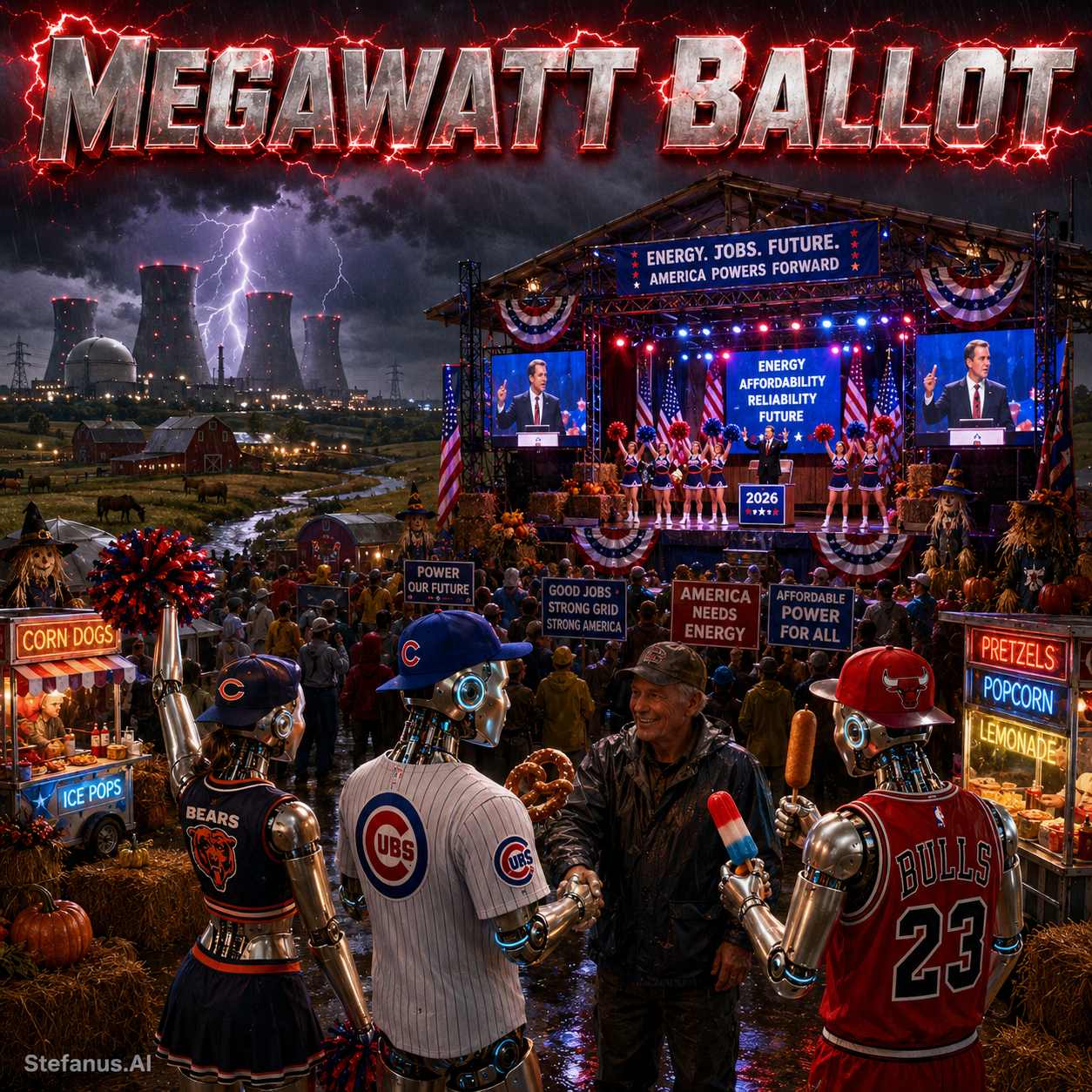

Introduction: When the AI Factory Enters the Voting Booth
In the summer of 2026, the politics surrounding artificial intelligence began changing in a way that could easily be missed by anyone watching only Nvidia earnings, frontier-model benchmarks, hyperscaler capital expenditures, or Washington’s technology competition with China. The newest political argument over AI was increasingly taking place somewhere far removed from the model laboratory. It was happening in state capitols, county commission meetings, utility rate proceedings, gubernatorial campaigns, rural farm communities, and — perhaps most consequentially — in ordinary households opening their monthly electricity bills. The argument was no longer primarily about what AI models can do. It had become an argument about what AI infrastructure consumes, who pays for it, and who gets to decide.
Consider what happened across several major American states within a remarkably short period.
In Illinois, Governor J.B. Pritzker’s administration stopped processing new agreements under the state’s Data Center Investment Program beginning July 1, 2026, after years in which Illinois had used generous tax incentives to attract large digital infrastructure projects. The administration said a new framework was needed to address electricity affordability, water consumption, grid costs, and responsible growth, and the governor called on the General Assembly to pass comprehensive data-center reforms during the fall veto session.[1] The Hill reported that the pause arrived amid a nationwide reckoning over the electricity-cost and water pressures accompanying the AI infrastructure buildout.[2] The governor framed the decision in the language of a political bargain rather than a technical adjustment:
“a comprehensive framework that protects affordability, safeguards our natural resources, and ensures responsible growth”
— Governor JB Pritzker, State of Illinois [1]
Texas produced an equally dramatic reversal in tone. Governor Greg Abbott, who had long promoted Texas as the premier destination for technology and infrastructure investment — a governor who stood alongside Google executives in late 2025 to celebrate new data-center campuses — ordered state regulators on August 3, 2026 to pause approvals for all new grid-connected data-center projects while the Public Utility Commission of Texas and ERCOT conduct “a comprehensive verification and audit” of every data center advancing through the interconnection process.[3] His directive requires developers to disclose electricity and water requirements, verify their cooling technologies, demonstrate what generation they will bring, and accept that any project failing the new verification standards will be denied connection to the Texas grid outright.[4] The governor justified the moratorium in explicitly protective, voter-facing terms:
“Our top priority is to protect Texans’ safety and quality of life”
— Governor Greg Abbott, letter to the PUCT and ERCOT [4]
The numbers behind that pause explain why it happened. By August, ERCOT’s interconnection queue had swollen to an estimated 474 gigawatts of proposed large-load requests — more than five times the record peak demand ever recorded on the Texas grid — and the overwhelming majority of that queue was associated with data centers.[5] When the Public Utility Commission of Texas approved ERCOT’s new “Batch Zero” framework in June, the grid operator was tracking more than 438,000 megawatts of large-load requests, nearly 89 percent of them from data centers alone.[6] A single state’s speculative queue had come to exceed the peak electricity demand of most of the world’s national grids.
The issue is also appearing explicitly in the Texas election environment. Democratic gubernatorial nominee Gina Hinojosa has sought to channel opposition to AI data centers among rural communities in the Panhandle and South Plains — conservative territory that has traditionally served as a counterweight to Democratic urban strongholds — while Abbott has responded with a far stronger regulatory posture emphasizing electricity costs, water, infrastructure, and community protection.[7] The political significance is not that one party has become uniformly “for” data centers while the other has become uniformly “against” them. The more important development is almost the opposite: data-center skepticism and demands for stronger conditions are appearing across conventional partisan boundaries, in red states and blue states, among ranchers and environmentalists alike.
Pennsylvania presents another variation. Governor Josh Shapiro has promoted major technology investment — including Amazon’s planned $20 billion expansion, the largest private-sector investment in the Commonwealth’s history — while simultaneously establishing his Governor’s Responsible Infrastructure Development, or GRID, standards. Those standards condition state support on energy affordability, additional power generation, community engagement, workforce development, and environmental responsibility.[8] His Republican challenger, State Treasurer Stacy Garrity, has taken different positions on whether development should temporarily pause, whether requirements should be voluntary or mandatory, and whether clean-energy mandates belong in the framework at all. Those differences have made data centers a recognizable and recurring issue in Pennsylvania’s 2026 gubernatorial contest.[9]
Virginia, meanwhile, has moved from merely hosting the world’s most concentrated data-center market toward creating entirely new financial rules around it. Governor Abigail Spanberger signed measures intended to prevent ordinary customers from carrying new infrastructure costs associated with large loads, while the Commonwealth implemented a first-of-its-kind statewide electricity-consumption tax on data centers — $0.011 per kilowatt-hour, expected to generate roughly $600 million annually — beginning July 1, 2026.[10] [11] Virginia is therefore transforming the political argument from whether data centers should exist into the far more consequential question of what obligations accompany their enormous electricity consumption.
Then, on August 13, another piece of the story arrived. PJM Interconnection — the largest grid operator in the United States, serving roughly 67 million people across a region containing America’s most important data-center markets — filed a proposal at FERC under which large new data centers could enter service before sufficient new capacity exists to support their demand, but in exchange, any portion of that demand not backed by qualifying new capacity could be curtailed before ordinary customers during emergencies.[12] Reuters reported that the framework would effectively force data centers onto their own backup generation when electricity supply on the grid approaches dangerously low levels, and PJM itself noted that the proposal dovetails with the White House’s Ratepayer Protection Pledge.[13] Suddenly the political question surrounding an AI datacenter was no longer only, Should we approve it? It had also become, When electricity becomes scarce, whose load receives priority?
That is the anecdotal moment from which this paper begins.
A datacenter may be designed by engineers, financed by private capital, filled with Nvidia accelerators, operated by Amazon, Microsoft, Meta, Google, Oracle, xAI, OpenAI’s infrastructure partners, or other technology companies, and connected to frontier artificial-intelligence systems. Yet once that facility demands hundreds of megawatts — or, increasingly, several gigawatts — it enters a completely different institutional environment. It encounters the electricity bill. It encounters the water system. It encounters the tax code. It encounters the transmission network. It encounters county zoning. And eventually, inevitably, it encounters the voter.
The paper that follows develops this argument in six movements. Section 1 traces how the megawatt — a technical unit of utility engineering — is becoming a household political number. Section 2 examines the states as laboratories of what I call the Megawatt Ballot, with detailed case studies of Texas, Illinois, Pennsylvania, Virginia, and the emerging political geography beyond them. Section 3 asks precisely what voters are being asked to approve when a hyperscale campus arrives. Section 4 introduces an original five-part analytical framework for evaluating the political acceptance of AI infrastructure. Section 5 argues that the 2026 election cycle is the beginning, not the end, of AI infrastructure politics. Section 6 distills the lessons into seven pillars. Throughout, the paper draws on the most recent available evidence — state actions through August 2026, corporate earnings and capital-expenditure guidance through the second quarter of 2026, grid-operator filings, national polling, and the emerging academic literature from Harvard, Carnegie Mellon, Stanford, North Carolina State, EPRI, and elsewhere.
Why I Chose the Term Megawatt Ballot
I chose Megawatt Ballot because the term joins two worlds that until recently seemed far apart.
The megawatt belongs to the physical economy of AI. It measures electricity demand. It determines how large the substation must become, how many transmission lines may be required, how much additional generation must be built, how utilities plan capacity, how much backup generation may be necessary, and, increasingly, how quickly a new AI factory can begin operating at all. Within the Five-Layer AI Economy — the analytical structure I use across this research program, running from electricity and land at Layer One, through chips, datacenters, and models, up to applications and autonomous agents at Layer Five — the megawatt sits near the foundation of everything above it. No reliable electricity means no GPU cluster; no GPU cluster means no frontier model; no frontier model means no scalable application economy and no autonomous-agent economy. The megawatt is, quite literally, the load-bearing unit of artificial intelligence.
The ballot, however, represents political permission.
When a proposed 500-megawatt, 1-gigawatt, or multi-gigawatt AI campus begins affecting electricity rates, water supplies, tax incentives, farmland, transmission construction, or municipal planning, the project’s megawatts acquire political meaning. Voters may never study transformer capacity, power purchase agreements, or GPU architecture, but they understand a higher utility bill, a new transmission corridor across their property, a tax exemption granted to a trillion-dollar corporation, construction employment for their union local, disappearing farmland, water scarcity during a drought, or the promise of a large corporate investment in a town that has watched its industrial base hollow out for decades. The megawatt is technical; its consequences are electoral.
Megawatt Ballot therefore describes the moment when AI’s infrastructure requirements become electoral variables.
The phrase also distinguishes this paper from my earlier concept of Siting Beta. Siting Beta asks how permitting, community opposition, water constraints, elections, and local politics become financial risk factors that investors must price into an infrastructure project — a discount rate applied by capital to democracy. Megawatt Ballot approaches the same transformation from the opposite side of the relationship. It asks what happens after citizens discover that the AI economy has acquired a physical footprint large enough to affect their household economics and their political choices — a demand made by democracy upon capital. Siting Beta is the investor’s view of the voter. Megawatt Ballot is the voter’s view of the investment. The two concepts are mirror images, and together they describe a single historical development: the politicization of the physical layer of artificial intelligence.
The central proposition of this paper is therefore the following:
AI infrastructure is entering an era in which access to megawatts increasingly requires political legitimacy — and political legitimacy increasingly depends on convincing voters that the benefits of AI infrastructure exceed the costs they are being asked to absorb.
Nothing about this proposition is hostile to artificial intelligence. Indeed, the paper’s conclusion will argue that the emergence of the Megawatt Ballot may ultimately strengthen the AI buildout by forcing it onto more durable political foundations. But the proposition does insist that the era of frictionless, subsidized, politically invisible datacenter expansion is ending — and that the companies, utilities, and governments that recognize this earliest will hold a decisive advantage over those that do not.

Section 1: From Datacenter Boom to Electoral Infrastructure
Every political transformation begins with a change in visibility. For a quarter century, the datacenter was among the most invisible categories of industrial infrastructure in the United States — a windowless building beside a highway interchange, taxed quietly, powered quietly, cooled quietly, and politically inert. The generative-AI buildout has destroyed that invisibility, not because the buildings look different, but because their resource consumption has crossed thresholds at which utility planning, municipal budgeting, water management, and household economics can no longer absorb them silently. This section traces that crossing: how the megawatt became a household number, how electricity affordability became AI policy, how cooling water moved from an engineering specification to a campaign question, how tax incentives lost their automatic political appeal, and how the AI factory itself changed political category.
1.1 The Megawatt Becomes a Household Number
For most of the digital economy’s history, electricity consumption remained largely invisible to voters. Search engines, cloud software, smartphones, and social networks certainly required datacenters, but their physical infrastructure rarely became a kitchen-table political issue. Between roughly 2005 and 2020, extraordinary gains in server efficiency, virtualization, and hyperscale consolidation allowed digital demand to grow exponentially while datacenter electricity consumption grew only modestly. The infrastructure of the internet effectively hid inside the flat national load curve.
Generative AI changes the scale. Data centers consumed roughly 4.5 percent of U.S. electricity in 2024 — more than double their share five years earlier — and credible projections now place them at 9 to 17 percent of national consumption by 2030.[17] Gartner projects worldwide data-center power demand will rise 27 percent in 2026 alone, reaching 132 gigawatts, on its way to an estimated 290 gigawatts by 2030.[44] Hundreds of megawatts concentrated in individual facilities — and gigawatts spread across campuses — create loads large enough to influence regional generation requirements, transmission investment, and utility planning in ways the public can feel. Jonathan Koomey of Stanford University, perhaps the most cited researcher on data-center energy over the past two decades, captures why the old efficiency escape hatch no longer works:
“efficiency gains are necessary but not sufficient when the underlying workload is growing exponentially”
— Jonathan Koomey, Research Fellow, Stanford University [47]
The consequence is that a technical unit used by utility engineers is gradually becoming connected in the public mind with monthly electricity bills, grid reliability, new power plants, transmission lines, utility capital spending, and — above all — decisions about who pays for all of it. The political translation is simple and, once seen, impossible to unsee:
Megawatts → Infrastructure → Cost Allocation → Household Impact → Political Reaction.
Each arrow in that chain is a site of contestation. Megawatts require infrastructure; infrastructure requires financing; financing requires allocation among customer classes; allocation shows up on household bills; and household bills, in an inflation-scarred electorate, produce political reaction with startling speed. The remainder of this paper is, in one sense, an extended tour of that chain.
1.2 Electricity Affordability Becomes AI Policy
Electricity policy and AI policy are converging, and the convergence point is the residential bill. Since 2020, average U.S. residential electricity prices have risen more than 36 percent nationally, from 12.76 cents to 17.44 cents per kilowatt-hour by February 2026, with further increases projected.[48] A Consumer Reports survey found that 78 percent of Americans are somewhat or very concerned that new data centers will raise their energy bills, and in Virginia — the epicenter of the industry — nearly three-quarters of voters blame data centers for rising electricity costs.[14]
The academic literature is more careful than the public mood, and the paper should be equally careful. A rigorous 2026 causal study by researchers at the Electric Power Research Institute found that, historically, new data-center load has sometimes lowered average rates by spreading fixed costs over more kilowatt-hours, and that the sharp residential price increases of 2021–2024 were concentrated in regions — California, the Northeast — with little data-center growth, driven instead by wildfire costs, gas prices, and delivery infrastructure.[17] [51] Yet the same literature warns that the past is a weak guide to the AI era. A 2026 modeling study from North Carolina State University, Carnegie Mellon University, the University of Pittsburgh, and the University of Toronto projects that data-center and cryptocurrency demand could raise demand-weighted wholesale electricity prices by 6 to 29 percent on average nationally by 2030 — and by as much as 57 percent in the hardest-hit regions — relative to a future without that growth, while increasing power-sector CO₂ emissions by up to 28 percent.[15]
Between the cautious economists and the alarmed ratepayers stands the question of cost allocation, and here the direction of scholarly concern is unmistakable. Ari Peskoe, director of the Electricity Law Initiative at Harvard Law School and author of the influential paper “Extracting Profits from the Public,” observes that data centers are driving tens of billions of dollars of wholesale price increases and utility delivery spending, and that under prevailing rate structures:
“In general, these cost increases are spread to all ratepayers by the utility.”
— Ari Peskoe, Director, Electricity Law Initiative, Harvard Law School [16]
Virginia offers the sharpest live case study. Reuters reported in August 2026 that Dominion Energy’s fuel costs in Virginia have risen nearly 90 percent in five years as data-center-driven demand leaves the utility increasingly exposed to volatile wholesale electricity purchases at 6.28 cents per kilowatt-hour — several multiples of its own nuclear generation cost — with staff at the State Corporation Commission warning that load growth from data centers exposes Dominion to spot prices that can skyrocket to several thousand dollars per megawatt-hour during heatwaves and cold snaps.[18] Whether or not data centers are the sole cause of any given rate increase, the perception architecture is now set: when the bill goes up, the datacenter is the suspect. That is why the electricity bill may become the single most politically powerful interface between ordinary citizens and the AI economy — more powerful than any congressional hearing on model safety, because it arrives twelve times a year, addressed personally, with a number at the bottom.
1.3 Water Moves From Engineering Specification to Campaign Question
Cooling technology once belonged exclusively to datacenter engineering — a matter of PUE ratios, chiller design, and evaporative efficiency discussed at industry conferences. Now governors and legislators discuss it. Governor Abbott’s August directive specifically requires Texas data-center applicants to disclose their water use and cooling operations, and his administration has pressed developers toward closed-loop cooling systems that dramatically reduce consumptive water use.[22] Governor Pritzker’s Illinois framework likewise requires data centers to regularly report their energy and water use, to post public notice when applying for permits, and to enter community benefits agreements — and it would ban the nondisclosure agreements between data centers and local governments that have kept water figures hidden from the public.[28]
Water is politically distinctive for three reasons. First, it is locally zero-sum in a way electricity is not: a megawatt can be imported over a transmission line from hundreds of miles away, but an aquifer cannot. Second, it carries deep cultural meaning in agricultural communities — in the Texas Panhandle, where the Ogallala Aquifer is already declining, a data center’s water draw is experienced as an existential threat to a way of life rather than a utility statistic. At the July 2026 nationwide protests, a demonstrator in Fredericksburg, Virginia carried a sign reading “We thrive on water not data,” while organizers in California’s Imperial County rallied against a proposed project that could consume 260 million gallons per year from the Colorado River system.[36] Third, drought makes water scarcity episodically vivid: a community may tolerate a data center’s consumption for years and then turn against it in a single dry summer. For all these reasons, water could become the most politically explosive datacenter input in Texas, Arizona, Nevada, Georgia, and California — states that combine rapid AI construction with structural water stress — even in years when electricity prices are stable.
1.4 Tax Incentives Lose Their Automatic Political Appeal
For approximately a decade, dozens of states competed for datacenters through sales-and-use tax exemptions on servers and equipment, property-tax abatements, and expedited permitting. The political logic was straightforward and, for a time, genuinely bipartisan: offer the incentive, attract the investment, create construction activity, expand the tax base, and claim an economic-development victory at the ribbon-cutting. Virginia’s pioneering exemption became the national blueprint; Illinois passed its own program with bipartisan support in Governor Pritzker’s first year in office.
That formula is becoming dramatically more complicated. Illinois paused new incentive agreements outright — after a state report showed 27 data centers had benefited from more than $983 million in tax incentives between 2020 and 2024 — with the governor questioning whether the incentives were driving development insensitive to community costs.[26] Virginia’s Department of Taxation estimated that its exemption saved data centers $1.9 billion in fiscal 2025 alone, a figure that motivated legislators to attempt full repeal before settling on the new electricity-consumption tax as a compromise.[31] Texas officials have signaled that data centers failing the new audit standards could lose existing sales-tax advantages. Advocacy voices that once stayed out of economic-development debates now speak in openly distributional terms:
“Illinois families shouldn’t have to pay higher bills”
— Kari Ross, Natural Resources Defense Council [27]
Beneath the politics lies a genuinely serious economic question that this paper poses directly: Why subsidize an industry that may already be desperate for scarce power and suitable land? Classical incentive theory justifies subsidies when investment is mobile and marginal — when the tax break changes the location decision. But when hyperscalers are capacity-constrained, when Microsoft discloses tens of billions of dollars in Azure orders it cannot fulfill for lack of power, and when the binding constraint on a project is the interconnection queue rather than the tax rate, the subsidy may simply transfer public revenue to investments that would have occurred anyway. The emerging state-level consensus — visible in Illinois, Virginia, Pennsylvania, and Texas simultaneously — is not that incentives must end, but that they must be earned through measurable reciprocity. That shift is one of the quiet revolutions of 2026.
1.5 The AI Factory Becomes a Political Object
The section concludes by establishing that the datacenter has changed category. It is no longer merely a commercial property. A hyperscale AI campus increasingly resembles a combination of industrial plant, anchor electricity customer, infrastructure investor, industrial water consumer, major taxpayer (or tax-exemption holder), employer, land developer, and national strategic asset — all fused into a single facility that may draw more power than the city that hosts it. American law and politics have separate, well-developed traditions for regulating each of those identities individually: utility commissions for large customers, environmental agencies for water users, legislatures for taxpayers, zoning boards for land users, and Washington for strategic assets. What they have never had is a settled framework for an entity that is all of them at once.
Once all of those identities converge in one building, political scrutiny becomes inevitable — not because voters are hostile to technology, but because every institutional channel of American governance now has jurisdiction over some part of the AI factory. The datacenter boom did not enter politics through the front door of AI regulation. It entered through five side doors simultaneously: the rate case, the water permit, the tax code, the transmission plan, and the zoning hearing. Section 2 examines what happened when it did.

Section 2: The States Become Laboratories of the Megawatt Ballot
Justice Louis Brandeis famously described the states as laboratories of democracy, and in 2026 they have become, with striking literalness, laboratories of the Megawatt Ballot. Because the United States regulates electricity, water, taxation, and land use primarily at the state and local level, and because governors sit at the intersection of all four, the political terms of the AI buildout are being negotiated state by state, in real time, under electoral pressure. No two experiments are identical. Texas is testing whether an audit regime can discipline the largest speculative load queue on Earth. Illinois is testing whether incentives can be suspended and rebuilt around reciprocity. Pennsylvania is testing conditional support inside a competitive gubernatorial race. Virginia is testing what governance looks like after the buildout has already happened. The table below summarizes the experimental landscape as of August 2026; the subsections that follow examine each laboratory in depth.
Table 1. State Laboratories of the Megawatt Ballot, Summer 2026
| State / Region | Key 2026 Action | Timing | Electoral / Political Context |
| Texas | Governor-ordered pause on new data-center grid approvals pending comprehensive PUCT/ERCOT audit; ~474 GW queue, ~90% data centers; Batch Zero study postponed | Aug. 3, 2026 | Abbott vs. Hinojosa gubernatorial race; rural backlash over water and land; 18 protest sites on July 18 — most of any state |
| Illinois | Pause on new Data Center Investment Program tax-incentive agreements; framework demanding reporting, NDA bans, community benefits agreements, affordability fund | July 1, 2026 | Pritzker seeking third term; POWER Act pending in General Assembly; $983M in incentives 2020–24 under scrutiny |
| Pennsylvania | GRID Standards conditioning tax benefits on clean energy (32%), community benefits agreements, local hiring, bring-your-own-power | Feb.–May 2026 | Shapiro vs. Garrity; voluntary-vs.-mandatory standards a defining campaign difference; $20B Amazon investment as backdrop |
| Virginia | First-in-nation data-center electricity consumption tax ($0.011/kWh, ~$600M/yr); ratepayer-protection and generator-emissions legislation; Affordable Virginia Agenda | July 1, 2026 | Spanberger intervening in $66.8B NextEra–Dominion merger review; legislature demanding data centers “pay their fair share” |
| Michigan | Palisades nuclear restart — first recommissioned U.S. reactor — backed by $1.52B federal loan and $300M state funds, tied publicly to data-center demand | 2026 restart | Whitmer-era energy legacy contested; local data-center rejections (e.g., Lansing) despite nuclear revival |
| PJM Region (13 states + DC) | Emergency curtailment procedures for large loads; DOE §202(c) orders invoked in Jan. and May; Aug. 13 FERC filing: bring-your-own-capacity or face curtailment | Jan.–Aug. 2026 | Governors across PJM pressured by record capacity prices; reliability and affordability converge as campaign issues |
2.1 Texas: From Datacenter Recruitment to Infrastructure Accountability
Texas deserves to be the central case study because it compresses the entire arc of the Megawatt Ballot — from recruitment to reckoning — into roughly eighteen months, inside the nation’s most aggressively pro-growth political culture. If the Megawatt Ballot can emerge in Texas, it can emerge anywhere.
The recruitment era is easy to reconstruct. Texas offered the fastest interconnections in the country through ERCOT’s energy-only market, cheap land, abundant natural gas, no state income tax, and a governor who personally celebrated data-center announcements. The response overwhelmed the system. ERCOT’s large-load interconnection queue stood at 63 gigawatts at the end of 2024, quadrupled to 226 gigawatts by November 2025, reached 438 gigawatts by June 2026 — nearly 89 percent from data centers — and approached 474 gigawatts by the time of the governor’s August directive.[6] [5] To put those figures in perspective, ERCOT’s all-time peak demand record is roughly 85.5 gigawatts. The speculative queue alone was more than five times the largest load Texas had ever actually served.
The institutional response came in stages. The legislature’s Senate Bill 6 (2025) defined large loads as facilities of 75 megawatts or more and directed the Public Utility Commission to create an orderly connection path with transparency requirements. In June 2026, the PUCT approved ERCOT’s “Batch Zero” framework, replacing project-by-project review with a systemwide batch study designed to screen out phantom load and allocate real grid capacity.[6] Then came August 3: Abbott’s directive ordering a comprehensive verification and audit of every data center in the queue — covering tax breaks received, power use and generation, water use and cooling operations, and community impacts — before any project may move forward, with ERCOT postponing Batch Zero to implement it.[3] [22] At its first public discussion of the directive on August 14, the PUCT indicated that 250 to 300 projects will be audited over several months.[23]
The industry’s response is itself revealing. Rather than opposing the audit, the Data Center Coalition — the trade group representing the largest operators — embraced it as a sorting mechanism:
“showcase the good actors in the data center industry rather than delaying them unnecessarily”
— Dan Diorio, Data Center Coalition [22]
That statement deserves attention because it signals the industry’s recognition that legitimacy is now a competitive asset. The sophisticated operators want a credentialing regime that distinguishes them from speculative queue-squatters, because a disciplined queue accelerates real projects. The Megawatt Ballot, in other words, is not purely adversarial: parts of the industry are learning to run on it.
Meanwhile the electoral dimension sharpened. Gina Hinojosa built her long-shot challenge around the data-center backlash, holding roundtables in Lubbock and rallies in Amarillo — deep-red Panhandle territory — where drought-stressed ranchers and farmers fear the water draw of incoming campuses. She has called for a moratorium and a special legislative session, dismissed Abbott’s pause as an election-season maneuver from a governor she says has accepted millions in contributions from data-center executives, and pledged to block permits lacking community consent.[7] [24] Her framing distills the rural grievance:
“Now we have this gold rush of data centers in our communities”
— State Rep. Gina Hinojosa, Democratic nominee for Governor of Texas [24]
Whether or not Hinojosa closes a three-decade partisan gap, Fortune’s July assessment — that data centers have become perhaps the single most cross-cutting issue in current American politics, exposed enough to put even Texas in play rhetorically — captures why Abbott moved so decisively.[25] Texas illustrates the fundamental transition of the Megawatt Ballot era: the question is moving from “How do we attract AI?” toward “Under what conditions should AI be allowed to consume Texas infrastructure?”
2.2 Illinois: When the Incentive Becomes the Election Issue
Illinois provides perhaps the cleanest Megawatt Ballot political case, because the instrument at the center of the fight — the Data Center Investment Program — was itself a bipartisan creation of the current governor’s first term. The state is therefore not litigating someone else’s legacy; it is renegotiating its own bargain in public, during an election year, with the governor who signed it leading the renegotiation.
The sequence matters. Pritzker first proposed suspending new incentives in his February 2026 budget address, pairing the suspension with support for the POWER Act — legislation establishing what advocates called nation-leading guardrails, including a Public Benefits and Affordability Fund into which all data centers would pay annually, calibrated to size, to finance utility-bill assistance, shutoff avoidance, and environmental-justice grants.[27] When the General Assembly adjourned without acting, the governor moved administratively on June 5, directing the Department of Commerce and Economic Opportunity to pause new agreements effective July 1 while honoring existing ones, and publishing a framework whose demands read like a charter of the Megawatt Ballot: ban nondisclosure agreements between data centers and local governments; require regular public reporting of energy and water use; require public notice for permits; require community benefits agreements; require data centers to pay for clean energy resources; allow curtailment — “go dark” provisions — when the grid is strained.[1] [28]
The competing constituencies around this framework are precisely the coalition puzzle that makes Illinois analytically valuable. Organized labor — particularly the building trades — wants the construction pipeline and has historically supported the incentives. Local communities in the collar counties want protections, notice, and revenue. Environmental groups worry about water and the emissions consequences of gas-fired capacity additions; the Illinois Environmental Council and Illinois PIRG cautiously applauded the pause while warning that “the devil is in the details.”[26] ComEd, managing enormous large-load requests in northern Illinois, has publicly embraced interruptible service for data centers as part of the affordability solution.[26] Technology investors, for their part, want what capital always wants: predictable policy — and a two-year suspension announced mid-stream is the opposite of predictable. The governor must reconcile all of this while seeking a third term in a state whose electricity politics were already raw from capacity-price increases.
Illinois therefore demonstrates why the Megawatt Ballot cannot be reduced to a simple pro-AI versus anti-AI argument. Every faction in the Illinois debate claims to support technological growth; the conflict is entirely about distribution — who reports, who pays, who benefits, who decides. When the veto session convenes, Illinois will effectively hold the first legislative referendum on what a mature, post-recruitment data-center policy looks like in a large industrial state. Other states are watching, because Illinois is answering the question they will all face: what happens after the honeymoon.
2.3 Pennsylvania: AI Investment Meets the Politics of Conditional Support
Pennsylvania provides an especially useful Five-Layer AI Economy case because the Commonwealth combines, within a single electoral jurisdiction, nearly every energy asset relevant to the AI buildout: the second-largest natural gas production in the nation, an operating and expanding nuclear fleet (including the restarted unit at Three Mile Island and the Susquehanna plant that anchors Amazon’s co-located campus), a coal-legacy grid and workforce, PJM membership with its record capacity prices, industrial communities hungry for reinvestment, and a genuinely competitive 2026 gubernatorial election. Pennsylvania is where the national-interest argument for AI infrastructure and the local-burden argument meet on equal terms.
Governor Shapiro’s trajectory illustrates conditional support evolving in real time. In June 2025 he stood in Berwick to announce Amazon’s $20 billion investment in two data-center campuses — one beside the Susquehanna nuclear plant, one on a former U.S. Steel site north of Philadelphia — promising at least 1,250 permanent high-paying jobs, and declaring the Commonwealth fully committed to artificial intelligence in the language of great-power competition:[30] [29]
“We are already all in on AI”
— Governor Josh Shapiro, Commonwealth of Pennsylvania [29]
By his February 2026 budget address, the emphasis had shifted from recruitment to selectivity — the projects that get built in Pennsylvania, he told legislators, must now be chosen selectively — and in May he released the full Governor’s Responsible Infrastructure Development (GRID) Standards: escalating clean-energy requirements topping out at 32 percent of operations, community benefits agreements, at least 200 construction jobs and $1.5 million in annual wages, bring-or-pay obligations for new power, and workforce and environmental commitments, all as conditions for access to existing tax exemptions and preferential tax-zone programs.[9] [8] The Clean Power PA Coalition called the standards an important step toward responsible growth; the Data Center Coalition warned that the framework’s complexity could impede future development and operations in the Commonwealth.[29]
Treasurer Garrity’s response defines the alternative model. She lauded the Amazon investment when announced, then pivoted through 2026 toward criticizing Shapiro from both directions — attacking what she characterizes as preferential tax deals and the administration’s failure to address community concerns, while simultaneously rejecting the GRID clean-energy mandate in favor of Pennsylvania’s natural gas, and proposing that data centers be steered to brownfields and industrial sites away from residential communities. Her critique of top-down siting is the purest single expression of the Megawatt Ballot’s procedural demand:[9]
“You can’t just jam it down their throats”
— Treasurer Stacy Garrity, Republican nominee for Governor of Pennsylvania [9]
The analytical value of Pennsylvania is that neither candidate is anti-data-center, and yet the race presents voters with a genuine regulatory choice: voluntary standards tied to incentives and clean-energy escalators (Shapiro), versus restrictions of a different character — siting discipline, skepticism of energy mandates, gas-first supply — with details still unspecified (Garrity). The gubernatorial debate creates an opportunity to examine alternative regulatory architectures without treating either position as inherently superior. Whichever model prevails in November will become a template for the dozen energy-rich states now drafting their own frameworks, which is why Pennsylvania’s Megawatt Ballot may be the most nationally consequential of 2026.
2.4 Virginia: When the Datacenter Capital Becomes the Regulatory Laboratory
Virginia serves as the mature-market case — the state that shows every other state its possible future. Northern Virginia’s “Data Center Alley” is the largest concentration of digital infrastructure on Earth; the industry’s sales-tax exemption, pioneered there, saved operators an estimated $1.9 billion in fiscal 2025 alone; and Dominion Energy’s service territory has become the world’s most intense experiment in what happens when a single customer class comes to dominate a utility’s load forecast.[31]
The 2026 budget fight distilled a decade of accumulated tension into a single legislative compromise. Senate budget writers pushed to repeal the sales-tax exemption outright; the House and the new governor resisted, fearing damage to Virginia’s reputation for stable technology investment; and the standoff nearly forced a government shutdown before lawmakers converged on something no American state had ever done — keep the exemption, but impose a direct tax on the electricity data centers consume: $0.011 per kilowatt-hour, collected by utilities monthly (and self-remitted for behind-the-meter supply), capped at $600 million per year with excess refunded, sunsetting in 2028 pending a study commission.[10] [11] [21] The legislative mood was captured with characteristic bluntness by the 82-year-old president pro tempore of the Virginia Senate, in words addressed to the governor herself:
“Governor, read the damn room.”
— Senator L. Louise Lucas, President Pro Tempore, Senate of Virginia [20]
Governor Spanberger signed the budget on June 30 and, within days, an accompanying Affordable Virginia package: stricter emissions requirements for data-center backup generators, new tools for localities to assess data-center impacts, ratepayer protections against infrastructure cost-shifting, and re-entry into the Regional Greenhouse Gas Initiative. She then announced she would intervene directly in the State Corporation Commission’s review of NextEra Energy’s proposed $66.8 billion merger with Dominion to press for affordability, job, and clean-energy commitments.[18] [19] Her own description of the tax marks the arrival of a new fiscal category in American federalism:
“we created the first-of-its-kind consumption tax on data centers and their energy usage”
— Governor Abigail Spanberger, Commonwealth of Virginia [19]
Virginia’s deeper significance lies in the questions its full policy stack now poses for everyone else: special rate structures that isolate large-load costs; a consumption tax that prices electricity use itself; transmission-cost allocation fights before FERC; Dominion’s generation strategy — offshore wind, new gas, small modular reactors — justified substantially by data-center demand; PJM reliability dependence; persistent local opposition in Prince William and Loudoun counties; and a governor whose affordability agenda treats the industry simultaneously as tax base, cost driver, and merger-review leverage. Virginia allows the paper to ask its forward-looking question in concrete form: Is today’s Northern Virginia tomorrow’s Texas, Pennsylvania, Ohio, or Indiana? The evidence of 2026 suggests the answer is yes — with a lag of perhaps five years, and with each successor state negotiating from Virginia’s precedent rather than from innocence.
2.5 Michigan, Indiana, California, and the Next Political Geography
The final subsection broadens the analysis, because the Megawatt Ballot’s next chapters are already legible in states that rarely share a paragraph.
Michigan connects AI infrastructure with nuclear revival. The Palisades Nuclear Generating Station on Lake Michigan — shuttered in 2022 — is completing the first restart of a decommissioned commercial reactor in American history, supported by a $1.52 billion federal loan, roughly $300 million in state funds, and additional federal grants for two small modular reactors on the same site, with 2026 as the target year and data-center demand as the explicit justification.[45] U.S. Energy Secretary Chris Wright traveled to Lansing in June to tie the plant directly to data centers and affordability — in a city where, pointedly, a proposed data center partnership with the local utility had just collapsed under community pushback.[46] Michigan thus embodies the Megawatt Ballot’s paradox in miniature: the same electorate that welcomes a nuclear restart as jobs and legacy can reject the data center that the restart is meant to serve.
Indiana connects enormous technology investment — multi-billion-dollar campuses from the largest hyperscalers drawn by land, gas, and an accommodating regulatory climate — with escalating questions about who funds the new generation those campuses require. Indiana’s utilities have proposed major gas capacity additions justified by data-center load, and its economic-development incentives now face the same reciprocity scrutiny pioneered in Illinois next door. Indiana matters because it is the archetype of the “next Virginia” cohort: a state importing the buildout at maximum speed precisely as the national political mood turns conditional.
California provides the essential counterexample. The state combines the nation’s highest-profile technology industry with among its highest electricity rates, the strictest environmental review, structural water anxiety, and a 2026 gubernatorial transition in which affordability dominates every issue poll. California’s residential rates rose nearly 40 percent in recent years for reasons largely unrelated to data centers — wildfire costs above all — which means California voters experience the AI buildout against a baseline of pre-existing rate pain.[17] The result is a distinctive politics: California is simultaneously the intellectual home of the AI industry and among the hardest places in America to site its physical plant, exporting its compute demand to Texas, Arizona, and the Midwest — and, with it, exporting the political conflicts this paper describes. Eight of the July 18 protest events took place in California all the same.[36]
Together these states — with Ohio, Georgia, Arizona, New York (whose legislature advanced its own pause framework in July), and others close behind — create a genuinely national laboratory in which governors increasingly become the central actors deciding the terms under which the Five-Layer AI Economy expands. Section 3 turns from the laboratories to the experiment itself: what, precisely, are voters being asked to approve?

Section 3: What Exactly Are Voters Being Asked to Approve?
Political conflicts become tractable when their underlying transactions are made explicit. Beneath the noise of any datacenter fight — the yard signs, the packed zoning hearings, the dueling press releases — sits a set of implicit propositions that a community is being asked to accept: a jobs proposition, an electricity proposition, a water proposition, a tax bargain, and a national-interest proposition. Voters rarely see these propositions stated plainly, because each party to the transaction has an incentive to emphasize some terms and obscure others. This section states them plainly. Doing so is not merely descriptive housekeeping; it is the necessary preparation for the analytical framework in Section 4, because each proposition maps onto one of the five tests that determine whether a project earns political acceptance.
3.1 The Jobs Proposition
Hyperscalers and policymakers frequently lead with capital investment, construction employment, skilled trades, property-tax revenue, and surrounding economic activity — and the numbers are genuinely large. Amazon’s Pennsylvania commitment promises at least 1,250 permanent high-paying jobs atop years of building-trades employment; Shapiro’s GRID standards codify the construction dimension by requiring at least 200 construction jobs and $1.5 million in annual wages as a condition of incentives.[30] [9] But honest analysis requires separating five very different categories that political rhetoric routinely blends: temporary construction jobs, which are substantial (often thousands per campus) but end; permanent datacenter employment, which is famously thin relative to capital invested — typically dozens to low hundreds of technicians per facility; indirect employment among electricians, HVAC firms, security contractors, and local vendors; supplier-ecosystem effects in power equipment, fiber, and cooling; and broader regional technology investment that a flagship campus may (or may not) catalyze.
The political economy of the jobs proposition is therefore asymmetric in time. During construction, a data center is a jobs bonanza and organized labor is its most effective advocate — a central reason Illinois’s building trades defend incentives their neighbors question. After commissioning, the facility becomes a near-jobless consumer of land, power, and water whose visible local benefit narrows to the property-tax check. Communities that approved the project on construction-era enthusiasm often relitigate it in the operating era — which is exactly the temporal pattern now visible in Loudoun and Prince William counties in Virginia. A voter evaluating the jobs proposition is thus being asked to price a declining annuity, and the emerging demand — visible in community benefits agreements from Illinois to Pennsylvania — is that some of the construction-era surplus be converted into durable, contractual local value.
3.2 The Electricity Proposition
Every major project implicitly presents voters with an electricity bargain, and this subsection is one of the intellectual centers of the Megawatt Ballot. The bargain has five clauses. Who builds the generation? A gigawatt-class campus requires new supply somewhere; the question is whether the developer brings it (as the White House pledge and Shapiro’s bring-or-pay standard demand), the utility builds it into the ratebase (spreading cost across all customers), or the region simply draws down reserve margins until scarcity prices the difference. Who finances transmission? FERC’s June 2026 show-cause orders to all six major RTOs — demanding they justify or reform their large-load interconnection rules as fair to all ratepayers — exist precisely because, as FirstEnergy told the Commission, existing tariff structures often require transmission costs to be socialized even when a data-center operator offers to pay its own way.[48] Who pays for substations and delivery infrastructure? Who carries stranded-asset risk if the project shrinks, slips, or disappears — the phantom-load problem that led Texas regulators to demand financial security and that Exelon addressed by cutting speculative requests through transmission security agreements? And who receives priority during scarcity? — the question PJM’s August filing answers, for the first time in American history, explicitly against the data center.
As Carnegie Mellon’s Costa Samaras observed of FERC’s intervention, the regulatory challenge is to reconcile speed with fairness — in his words, the orders appeared to:
“deftly thread the needle”
— Costa Samaras, Professor of Civil and Environmental Engineering, Carnegie Mellon University [48]
The Forbes analysis of the emerging rate-design battles states the voter’s real stake precisely: the raw megawatts matter less than the rules — large-load tariffs, minimum-take provisions, credit requirements, exit fees — that determine how much of the modeled 6-to-29-percent wholesale increase ever reaches a household bill.[49] [15] The Yale Climate Connections finding that residential prices rose 10 percent over two years while industrial prices actually fell 2 percent explains why the electricity proposition has become politically radioactive: the burden is not merely rising; it is visibly, measurably unequal.[50]
3.3 The Water Proposition
The same contractual framework applies to water, but with a crucial difference: the politically explosive question is not consumption but priority. A hyperscale campus using evaporative cooling can consume hundreds of millions of gallons annually; closed-loop designs cut that dramatically at the cost of higher electricity use — meaning the water proposition and the electricity proposition trade off against each other, a fact rarely surfaced in public debate. Texas now demands disclosure of water use and cooling technology as a condition of grid connection; Illinois requires regular public water reporting; Virginia’s new local-assessment tools give counties the ability to interrogate water impacts before approval.[22] [28] [19]
But the deepest political question is the one drought makes vivid: Who gets priority when industrial demand and community demand compete? In the Texas Panhandle, where Hinojosa’s campaign found its rural audience, the fear is not that a data center will use water in the abstract — it is that in a dry year, the aquifer draw that sustains a server hall will be the marginal draw that finishes a farm. In California’s Imperial County, protesters organized around a single number: 260 million gallons per year from the Colorado River system for one proposed project.[36] No community benefits agreement fully answers the priority question, because priority is ultimately a matter of water law and political power. That is why the water proposition, more than any other, converts data-center siting into identity politics — agricultural identity, regional identity, generational identity — and why it becomes especially potent in Texas, Arizona, Nevada, Georgia, and California during drought cycles that climate change is making more frequent.
3.4 The Tax Bargain
The fiscal transaction can be stated as an exchange: tax exemption + infrastructure support + expedited permitting in return for investment + employment + local revenue + strategic importance. For a decade the exchange was executed on trust and celebrated at announcement; 2026 is the year the invoice arrived. Illinois quantified its side — more than $983 million in incentives to 27 data centers over five years — and paused the program pending renegotiation.[26] Virginia quantified its side — $1.9 billion in exemption value in a single fiscal year — and imposed a countervailing consumption tax rather than repeal.[31] Pennsylvania’s GRID standards convert the exemption from an entitlement into a contract with conditions. Texas has put existing sales-tax advantages explicitly on the audit table.[22]
The emerging political demand is not the abolition of the bargain but its measurability. Legislators and voters increasingly insist that both sides of the exchange be quantified, reported, and enforceable: incentive dollars per permanent job, water gallons per megawatt-hour, community-benefit dollars per campus, clean-energy percentage per year. This is the fiscal expression of the Megawatt Ballot: the ballot does not say no; it says show me. And a bargain that must be shown is a bargain that can be lost — which is precisely the new political risk that hyperscaler site-selection teams, accustomed to a seller’s market in incentives, are now learning to price.
3.5 The National-Interest Proposition
The corporate argument does not end locally, and it would be analytically dishonest to pretend otherwise. AI companies can argue — with substantial force — that datacenters support American AI leadership and competition with China; domestic semiconductor demand that underwrites the CHIPS-era manufacturing base; national-security capabilities from intelligence analysis to defense autonomy; the cloud infrastructure on which the rest of the economy now runs; scientific research from protein folding to materials discovery; robotics; and future productivity growth large enough, in the optimistic scenarios, to alter fiscal trajectories. Washington has ratified this framing at the highest level: the White House’s Ratepayer Protection Pledge is explicitly structured as a way to reconcile American dominance in artificial intelligence with household affordability, and Governor Shapiro’s language of an AI-supremacy contest with China shows Democratic governors deploying the same national frame.[38] [29]
The scale of the private commitment behind this proposition is unprecedented in industrial history. Through second-quarter 2026 earnings, the four largest hyperscalers guided to roughly $725 billion in combined capital expenditures for calendar 2026 — up about 77 percent from 2025’s record $410 billion — with Amazon near $200 billion, Microsoft around $190 billion, Alphabet raising its ceiling toward $205 billion at its July report, and Meta raising guidance twice toward $145 billion; Goldman Sachs now projects $5.3 trillion in combined capex from these four companies between fiscal 2025 and 2030.[42] [43] [41] Markets themselves have begun to render a mixed verdict — Alphabet’s shares fell 7 percent the day after it raised its 2026 capex forecast, dragging its peers down with it — even as bulls insist the demand is real:[41]
“The bear thesis is garbage.”
— Brent Thill, Analyst, Jefferies [42]
Table 2. Hyperscaler Capital-Expenditure Guidance for Calendar 2026 (as of Q2-2026 Earnings)
| Company | 2026 Capex Guidance | Notes from 2026 Earnings Cycle |
| Amazon | ~$200 billion | Largest single AI-infrastructure spender; free cash flow projected to turn negative; majority directed to AWS data centers and custom silicon (Trainium) |
| Microsoft | ~$190 billion (calendar-year trajectory) | CFO Amy Hood attributed ~$25B of the increase to memory and component costs; company expects to remain capacity-constrained through at least 2026 |
| Alphabet (Google) | $175–205 billion | Raised ceiling at Q2 2026 earnings; cloud revenue up 63% YoY; shares fell ~7% on the higher capex guidance, triggering sector-wide scrutiny |
| Meta | $125–145 billion | Guidance raised twice in 2026; includes 1-GW Ohio facility and Louisiana campus scalable toward 5 GW |
| Four-company total | ~$725 billion | Up ~77% from ~$410B in 2025; Goldman Sachs projects $5.3 trillion combined FY2025–FY2030 |
Megawatt Ballot therefore creates tension between two valid political scales: national strategic benefit versus local infrastructure burden. The nation may rationally want a gigawatt campus built; the county that hosts it rationally asks why the burden falls there and the benefit diffuses everywhere. Classical federalism has managed such asymmetries before — military bases, interstate highways, nuclear plants — but always through explicit compensation regimes. AI infrastructure is only now, in 2026, beginning to build its compensation regime, and that tension should run through the entire remainder of this paper.

Section 4: The Megawatt Ballot Framework
Having established the empirical landscape (Sections 1–2) and the underlying transactions (Section 3), the paper now introduces its original analytical contribution: a five-part framework for examining a community’s political acceptance of an AI infrastructure project. The framework is deliberately constructed as a sequence of questions rather than a scoring model, because political legitimacy is not additive — a project can pass four tests brilliantly and fail on the fifth. But the five tests are ordered by the sequence in which they typically become salient in an actual political fight: cost first, consumption second, reciprocity third, reliability fourth, purpose last. A developer, utility, regulator, investor, or campaign strategist can apply the framework prospectively to any proposed campus; a scholar can apply it retrospectively to explain why superficially similar projects met opposite political fates.
Table 3. The Megawatt Ballot Framework: Five Tests of Political Acceptance
| Test | Core Question | Political Trigger | 2026 Exemplar |
| 1. Affordability | Who pays? | Rate cases, capacity auctions, fuel-cost pass-throughs, cost socialization | Virginia SCC scrutiny of Dominion; FERC show-cause orders to six RTOs; large-load tariffs |
| 2. Resource | Who consumes? | Water disclosure fights, land conversion, backup-generator emissions, drought | Texas audit of power, water, and cooling; Illinois reporting mandates |
| 3. Reciprocity | What does the community receive? | Incentive renegotiation, community benefits agreements, local hiring | Illinois incentive pause; Pennsylvania GRID standards; Virginia consumption tax |
| 4. Reliability | What happens during scarcity? | Emergency curtailment, backup-generation orders, priority-of-service rules | PJM Aug. 13 FERC filing; DOE §202(c) orders; ERCOT Batch Zero |
| 5. Strategic Benefit | Why this project? | Workload disclosure, national-security framing, AI-vs-crypto distinctions | Ratepayer Protection Pledge national framing; state debates over what counts as valuable compute |
4.1 The Affordability Test — Who Pays?
The first question communities now ask is not whether a project is impressive but whether it will raise their bills — and, increasingly, whether it can be structured so that it demonstrably cannot. Does the project reduce, increase, or isolate household electricity costs? Does the developer finance the transmission and generation its load requires, through bring-your-own-power obligations, contribution-in-aid-of-construction payments, or minimum-take contracts that survive project cancellation? Does a special tariff class ring-fence existing customers from stranded-asset risk?
This is increasingly the first political test because it is the one with a monthly verdict. The evidence base is now rich enough for genuine discrimination: the EPRI causal work shows past load growth often diluted rates; the NC State–Carnegie Mellon modeling shows future AI-scale growth can inflate them regionally by double digits; and the rate-design literature shows the outcome depends almost entirely on tariff architecture rather than on the megawatts themselves.[17] [15] [49] A project that arrives with a signed large-load tariff, self-funded interconnection, and contracted new supply passes the affordability test even in a hostile county; a project that arrives asking the ratebase to gamble does not, even in a friendly one. The Ratepayer Protection Pledge — whatever its enforceability as a voluntary instrument — matters because it made “build, bring, or buy your own power, and pay for it no matter what” the explicit national default expectation.[38]
4.2 The Resource Test — Who Consumes?
The second test inventories the project’s physical draw: How much electricity, and from what generation mix? How much water, under which cooling technology, from which source, with what drought contingency? How much land, converted from what prior use — the ranchland question that animates the Texas Panhandle and the farmland question that animates the Midwest? How much backup fuel — the diesel and gas generator arrays whose emissions Virginia has now specifically regulated?[19] What noise, traffic, and light accompany operation?
The political relevance of each input rises with its local scarcity, which is why the resource test cannot be evaluated from a spreadsheet in a corporate real-estate office. Two identical 500-MW campuses face opposite politics if one sits on reclaimed industrial land beside a nuclear plant with lake cooling, and the other sits on productive farmland over a declining aquifer. The 2026 policy innovation here is mandatory transparency: Texas’s audit, Illinois’s reporting and NDA ban, and locality-assessment tools in Virginia all convert what was private engineering data into public political information. Transparency does not guarantee acceptance — but its absence now guarantees suspicion, because voters have learned that concealed numbers are rarely concealed because they are small.
4.3 The Reciprocity Test — What Does the Community Receive?
Investment totals alone are insufficient as an analytical measure, because a capital-expenditure figure describes what the company spends, not what the community keeps. The reciprocity test examines tangible, enforceable local value: property-tax and (where applicable) consumption-tax revenue; school funding; road and utility upgrades usable by others; workforce training programs with placement commitments; local-hiring thresholds; grid improvements that raise reliability for all customers; water-infrastructure investment; direct community funds; and — the frontier demand — new power generation whose surplus benefits the region.
The instrument through which reciprocity is being institutionalized is the community benefits agreement, now required in the Illinois framework and the Pennsylvania GRID standards and demanded by organizers nearly everywhere.[28] [9] Illinois’s proposed Public Benefits and Affordability Fund goes further, converting reciprocity from project-by-project negotiation into a standing fiscal institution: every data center pays annually, calibrated to size, into a fund financing bill assistance and environmental-justice grants.[27] Virginia’s consumption tax is reciprocity at statewide scale — roughly $600 million per year flowing to the general fund from the industry’s electricity use.[11] The analytical point is that reciprocity is evolving from gift to obligation, from press release to statute; and projects designed under the old gift model are being retrofitted, sometimes expensively, to the new obligation model.
4.4 The Reliability Test — What Happens During Scarcity?
The August 2026 PJM proposal makes this question urgently current, but the machinery had been assembling all year. In late January, the Department of Energy issued emergency orders under Section 202(c) of the Federal Power Act authorizing PJM to direct backup generation at data centers and other large loads to operate as a last resort during winter emergencies; in May, DOE granted similar authority during an unseasonable heatwave, letting PJM curtail large loads with backup generation before instituting rolling blackouts.[34] [35] In June, PJM amended its Manual 13 emergency procedures to institutionalize the coordination.[32] In July, PJM’s board — facing a 6.8-GW capacity shortfall, price-cap auction results, and an expectation of roughly 70 GW of new large-load demand by 2038 against 15 GW of retirements since 2022 — proposed both a backstop capacity auction and a standing rule that new large loads without their own supply face curtailment as conditions approach emergencies.[33] The August 13 FERC filing formalized the bargain: enter service early if you wish, but any demand not backed by qualifying new capacity — Bring Your Own New Capacity, in PJM’s coinage — can be interrupted before residential customers.[12]
So the reliability test asks, concretely: If the system approaches an emergency, does the datacenter curtail? Does it switch to on-site generators, and are those generators permitted, fueled, and clean enough to run? Does it discharge batteries? Does it sell demand response into the market? Do residential customers receive explicit priority — and is that priority written into tariff, statute, or merely goodwill? This is where the Megawatt Ballot intersects with, but remains distinct from, my related concept of Compute Curtailment: Compute Curtailment analyzes the operational and economic consequences of interrupting AI workloads; the reliability test analyzes the political settlement that decides whose interruption comes first. The PJM filings answer that question, for 67 million Americans, in the residential customer’s favor — the first great precedent of the Megawatt Ballot era, and one every other grid operator is now studying.[13]
4.5 The Strategic-Benefit Test — Why This Project?
Finally, the framework asks the question that today’s policy instruments barely reach: What does society receive from the computation itself? A cloud region serving hospitals, banks, and small businesses? Frontier-model training that may define national technological leadership? Defense and intelligence capability? Medical research? Consumer advertising optimization? Cryptocurrency mining? Autonomous-vehicle fleets? Robotics? Present regulation treats a megawatt as a megawatt: the interconnection queue does not ask what the electrons will think about.
The paper’s most forward-looking argument is that this neutrality may not survive. The political system may eventually become less willing to treat every megawatt of computational demand as economically equivalent — and early signals already exist. The NC State–Carnegie Mellon modeling deliberately pairs data centers with cryptocurrency mining, inviting exactly the comparative question regulators have so far avoided.[15] Several states already carve crypto out of data-center incentives. During scarcity events, the moral logic of curtailment invites workload triage: interrupting a model-training checkpoint is not the same civic act as interrupting a hospital’s cloud region. One can imagine — and developers should prepare for — a future in which interconnection priority, tax treatment, or curtailment order depends in part on declared workload class, audited the way Texas now audits water. That world raises hard questions about neutrality, gaming, and state discretion over private computation. But the Megawatt Ballot points toward it, because voters asked to bear visible costs will eventually demand to know what, exactly, the megawatts are for.

Section 5: The 2026 Election May Be the Beginning, Not the End
Political scientists distinguish between issue emergence — the moment a grievance acquires organization, vocabulary, and electoral vehicles — and issue maturity, when parties hold settled positions and institutions routinize the conflict. Everything in this paper suggests AI infrastructure politics is at emergence, not maturity. The 2026 cycle supplied the organization (a national protest network), the vocabulary (ratepayer protection, community benefits, bring-your-own-power), and the vehicles (gubernatorial campaigns in at least four major states). What it has not yet supplied is settlement. This section examines the emergence, explains the issue’s unusual cross-partisan structure, analyzes the governor’s new role as infrastructure architect, argues that hyperscalers must now build political infrastructure alongside physical infrastructure, and extends the horizon to 2028.
5.1 The Emergence of AI Infrastructure Politics
The 2026 midterm cycle marks the first major American election in which datacenter infrastructure itself became a recurring campaign issue across multiple states simultaneously. The clearest single data point arrived on July 18, when opponents of the buildout held 142 protests across 42 states — the first coordinated national action against AI’s physical infrastructure — organized by HumansFirst, a group co-founded by a former leader of the Tea Party movement who explicitly compares the moment to the populist wave of 2009.[36] Texas hosted the most events, with eighteen; Georgia followed with eleven; California held eight. Reuters’s polling context explains the organizers’ confidence: a June Reuters/Ipsos survey found only about one-third of Americans approve of the current pace of data-center construction, and just 14 percent would support a data center being built in their own community for AI projects by firms such as Meta, Alphabet, Amazon, Microsoft, and xAI.[37] Independent tallies count tens of billions of dollars in projects blocked or delayed by community pressure, and more than 300 state bills targeting data-center regulation were introduced in the first half of 2026 alone.
Issue emergence also has a fiscal signature. When Washington responds to a local grievance with a named national instrument, the grievance has arrived: the President first announced the Ratepayer Protection Pledge in the February 2026 State of the Union; seven leading AI companies and hyperscalers — Amazon, Google, Meta, Microsoft, OpenAI, Oracle, and xAI — signed it at the White House on March 4; and by the July expansion it encompassed more than 200 utilities, developers, cooperatives, and states, covering — by the administration’s account — 80 percent of power delivered to U.S. homes.[52] [39] The President’s own framing concedes the political premise of this entire paper — that the buildout’s costs were landing on households and had to be visibly redirected:
“We’re insisting that AI data centers and Big Tech companies pay their own way”
— President Donald J. Trump, The White House [40]
5.2 Why the Issue Can Cross Party Lines
Datacenter politics does not fit conventional partisan categories, and the empirical record of 2026 proves it. A rural conservative in Grayson County, Texas objects to land conversion and blank-check growth. An urban progressive in Atlanta objects to water and emissions. A union electrician in Chicago supports the construction pipeline that skeptics in his own party would pause. A fiscal conservative in Harrisburg opposes preferential tax deals negotiated by a Democratic governor. A technology-oriented policymaker of either party emphasizes competition with China. A homeowner in Manassas — whose January bill nearly tripled — cares principally about the number at the bottom of the page.[14] The July 18 protest coalition contained Tea Party veterans and environmental organizers under one banner; the Fortune headline calling data centers “the most cross-partisan issue” in current politics was reporting, not hyperbole.[25]
This ideological mixture makes the Megawatt Ballot unusually important — and unusually volatile. Cross-partisan issues are dangerous to incumbents of both parties because they cannot be neutralized by base mobilization; they reward whichever candidate moves first and most credibly, which explains both Abbott’s abrupt August pause and Pritzker’s preemptive June one. They also resist national polarization scripts: there is no Fox–MSNBC equilibrium on substations. For as long as that remains true, data-center policy will be decided by local intensity rather than national identity — the configuration in which a few thousand angry voters in a Panhandle county can move a state, and in which every governor knows it.
5.3 Governors Become Architects of AI Infrastructure
The American governor has become the pivotal figure of the Megawatt Ballot because the office uniquely concentrates the relevant instruments: appointment or influence over utility commissions; control of economic-development incentives; environmental permitting agencies; emergency powers; budget leverage; and the bully pulpit in the exact media markets where siting fights occur. Governors now stand between technology companies seeking speed, utilities seeking ratebase growth, state regulators seeking cost discipline, local governments seeking revenue and control, organized labor seeking work, environmental constituencies seeking limits, ratepayers seeking stable bills, and Washington seeking dominance in a technology competition it frames as existential.
The 2026 record shows governors of both parties converging on the same functional role from different directions: Abbott the auditor, Pritzker the renegotiator, Shapiro the conditional recruiter, Spanberger the taxer-and-intervenor, Whitmer’s Michigan the nuclear reviver. Their emerging role is therefore larger than traditional economic development — they increasingly determine how much AI infrastructure their states can physically and politically absorb, and on what terms. The 2026 gubernatorial class will write the templates: the audit regime, the conditional-incentive regime, the consumption-tax regime, the curtailment compact. Future historians of the AI buildout may find that its constitutional settlement was drafted not in Congress but in a half-dozen governors’ offices between 2025 and 2028.
5.4 Hyperscalers Will Need Political Infrastructure Alongside Physical Infrastructure
Amazon, Microsoft, Google, Meta, xAI, Oracle, OpenAI’s infrastructure partners, and the other large operators are discovering that acquiring land, power, and permits is only part of datacenter development — the part their site-selection machinery was built for. The other part is durable political relationship: with communities that will host them for thirty years, utilities that will serve them, governors who will regulate them, legislators who will tax them, labor that will build them, local officials who will field the complaints, and ratepayers who will vote on all of the above. The evidence that the industry has internalized this is everywhere in the 2026 record: seven companies signing a White House pledge to pay their own way; the Data Center Coalition welcoming a Texas audit; operators pre-committing to closed-loop cooling, community benefits agreements, and local hiring before being compelled.[39] [22]
The strategic implication deserves stark statement: the future AI campus requires a form of social and political infrastructure just as important as transformers and fiber — and, like transformers, it has long lead times, cannot be bought on the spot market, and fails catastrophically when neglected. A company that treats legitimacy as a communications problem will discover, at a zoning hearing or on a November ballot, that it was a capital-structure problem all along. The firms that internalize reciprocity earliest — that arrive with the tariff signed, the water technology disclosed, the benefits agreement drafted, and the generation contracted — will find that legitimacy compounds like any other asset: each successful, honest project lowers the political cost of the next. In the Megawatt Ballot era, trust is a grid asset.
5.5 From the 2026 Midterms to the 2028 Presidential Election
The final subsection extends the horizon. Three conditions would migrate datacenter politics from local elections and gubernatorial contests into national presidential politics: continued electricity-price increases in major datacenter regions; the proliferation of new gigawatt campuses into dozens of additional media markets; and a deepening public association between those projects and resource scarcity. All three conditions are currently trending affirmative. Goldman Sachs already warns that data-center demand will add measurably to core inflation through 2028, with the greatest impact in PJM states — which happen to include Pennsylvania, the modern presidency’s most reliable pivot.[47] The 2026 State of the Union has already nationalized the affordability frame; both parties’ 2028 primaries will inherit it.
The vocabulary could shift rapidly. Politicians may be asked not simply, “What is your AI policy?” — a question that invites abstraction — but, “Who should pay for AI’s electricity?” — a question with a checkable answer on every voter’s kitchen table. That is a far more tangible question, and American politics reliably migrates toward tangible questions. If the 2026 cycle established that megawatts can decide governorships, the 2028 cycle may test whether they can help decide the presidency.

Section 6: What Have We Learned? Seven Pillars of the Megawatt Ballot
A working paper of this length should end not with a summary but with a distillation — the load-bearing propositions that survive contact with the evidence. Seven pillars follow. The first five correspond to the paper’s original architecture; the sixth and seventh emerged from the 2026 record itself, from the PJM curtailment precedent and from the deepening interaction between political legitimacy and investment analysis.
Pillar 1 — AI Infrastructure Is Becoming Pocketbook Politics
Artificial intelligence stops being abstract when its physical infrastructure becomes connected with electricity rates, taxes, water bills, and public infrastructure. Seventy-eight percent of Americans worry data centers will raise their energy bills; residential prices have climbed more than a third since 2020; and in the world’s densest datacenter market, three-quarters of voters already assign blame.[14] [48] The household bill — monthly, personal, numerical — may become the most politically consequential interface between citizens and the AI economy, more potent than any abstraction about alignment or superintelligence, because it converts the buildout into a recurring referendum with universal turnout.
Pillar 2 — Every Megawatt Eventually Acquires a Constituency
Electricity is never merely technical. Generators have host communities. Transmission lines cross private property. Water comes from somewhere — an aquifer with farmers on it, a river with a compact over it. Datacenters occupy land that was previously something else. Tax exemptions are foregone school budgets. Once AI consumes physical resources at industrial scale, every megawatt creates winners, costs, constituencies, and political questions — and constituencies, unlike consultants’ demand forecasts, vote. The 438-gigawatt Texas queue is, from this vantage, not an engineering statistic but a census of future political conflicts, each awaiting its county, its hearing, and its November.[6]
Pillar 3 — Incentives Will Increasingly Require Reciprocity
The first era of datacenter competition emphasized attraction: Come to our state. Invest here. Build here. The emerging era emphasizes exchange: What will you contribute in return? Power generation, grid upgrades, water efficiency, workforce development, community benefits agreements, and direct fiscal contributions — Virginia’s consumption tax, Illinois’s affordability fund — are becoming conditions attached to political support rather than voluntary gestures attached to press releases.[11] [27] The bargain has not ended; it has been repriced, and the repricing is bipartisan.
Pillar 4 — Local Legitimacy Is Becoming Part of National AI Capacity
Washington can promote American AI leadership. Nvidia can manufacture more accelerators. Hyperscalers can commit their $725 billion.[42] Utilities can plan new generation. But a national AI strategy ultimately materializes somewhere specific — a county, a town, a watershed, a transmission zone, a utility territory — and if national ambition repeatedly collides with local rejection, local legitimacy itself becomes a binding constraint on America’s AI capacity, as real as any shortage of chips or transformers. The Reuters/Ipsos finding that only 14 percent of Americans would welcome an AI data center in their own community is, on this reading, a national-security statistic.[37]
Pillar 5 — The Political Unit of the AI Economy Is Shifting From the Algorithm to the Megawatt
The early AI political debate concentrated on models: bias, copyright, privacy, misinformation, safety, employment, regulation. Those issues remain important. But the next stage of AI politics increasingly includes the physical system beneath the model — electricity → chips → datacenters → models → applications and agents — which is precisely why the Five-Layer AI Economy framework becomes politically useful. The controversy is moving downward through the stack, and at Layer One, politics meets electricity. In 2026, for the first time, more consequential AI policy was made in utility commissions and governors’ offices than in any legislature debating model regulation.
Pillar 6 — Reliability Priority Is Becoming the Constitutional Question of the Grid
The PJM sequence of 2026 — DOE emergency orders in January and May, Manual 13 revisions in June, the board proposals of July, the FERC filing of August 13 — established a precedent whose significance exceeds its legal footprint: when scarcity comes, the AI factory yields to the household.[34] [32] [12] That ordering — who is curtailed first, who keeps the lights on — is the grid’s constitutional question, and 2026 answered it, provisionally, in the residential customer’s favor across a footprint of 67 million people. Every future siting negotiation now occurs in that precedent’s shadow: developers who bring their own capacity buy their way out of curtailment exposure; developers who do not have accepted a subordinate reliability status that voters will expect to see honored during the first hard August of the coming decade.
Pillar 7 — The Megawatt Ballot Is Becoming an Investment Variable
Finally, the political developments this paper describes feed directly back into finance — the mirror-image territory of Siting Beta. Markets that once priced hyperscaler capex against demand curves now must price it against audit timelines in Texas, veto sessions in Illinois, election outcomes in Pennsylvania, consumption taxes in Virginia, and curtailment tariffs at FERC. Alphabet’s 7-percent single-day decline on higher capex guidance shows investors already discounting execution risk; the state record of 2026 shows a growing share of that execution risk is political.[41] Tens of billions of dollars in projects have been blocked or delayed by community pressure. The cost of capital for AI infrastructure now embeds a legitimacy premium — and the firms, states, and projects that minimize it will build faster and cheaper than those that litigate it. Legitimacy, in the end, is the cheapest megawatt.

Conclusion: Why the Future of AI May Be Decided by the Megawatt Ballot
Artificial intelligence entered politics first as an argument about algorithms. It is now entering politics as infrastructure.
The transition matters because the physical AI economy cannot remain invisible. A frontier model may operate behind an interface that fits on a smartphone screen, but the intelligence behind that screen may require hundreds of thousands of accelerators, enormous datacenter campuses, substations, transmission lines, cooling systems, water infrastructure, backup generators, and gigawatts of electricity. Those physical requirements eventually arrive in communities. And communities vote.
That is why I chose the title Megawatt Ballot. The megawatt represents the industrial scale of the new AI economy. The ballot represents the democratic legitimacy required to sustain that scale. Put them together and they describe one of the defining political transitions of the next stage of artificial intelligence: the conversion of computational expansion into an electoral question.
The 2026 record assembled in this paper supports that description at every point. Illinois shows how tax incentives once designed to attract datacenters can be reconsidered — by the very governor who signed them — when electricity and water concerns intensify.[1] Texas demonstrates how even a state famous for aggressive economic development can impose comprehensive audit scrutiny when proposed electricity demand — 474 gigawatts of it — begins exceeding anything its grid planners previously contemplated.[5] Pennsylvania demonstrates how a $20 billion AI investment can coexist with escalating demands for enforceable conditions, and how those conditions can define a gubernatorial election.[9] Virginia demonstrates what happens when datacenter concentration becomes sufficiently large to reshape taxation, utility economics, and infrastructure policy — producing the first tax in American history levied directly on the electricity a data center consumes.[10] And PJM demonstrates that at the regional-grid level, governments and system operators are beginning to confront the ultimate scarcity question: what happens when an AI factory and millions of ordinary electricity customers need the same constrained megawatts at the same time.[12]
None of this necessarily means America will stop constructing AI infrastructure. The capital commitments alone — roughly $725 billion across the four largest hyperscalers in 2026, with trillion-dollar annual totals projected beyond — argue overwhelmingly against a halt.[42] It may mean something more consequential: America may build enormous amounts of it, but under a new political bargain. Developers may increasingly be expected to bring generation, finance grid upgrades, conserve water through closed-loop cooling, accept special electricity tariffs and curtailment priority, disclose resource consumption publicly, provide measurable community benefits, pay consumption-based taxes, and demonstrate — monthly, on sixty million kitchen tables — that ordinary households are not subsidizing their expansion.
For technology companies, this changes the definition of AI infrastructure strategy. Securing GPUs is not enough. Securing land is not enough. Securing the interconnection is not enough. Eventually, the project must also secure legitimacy — and legitimacy, unlike the other inputs, cannot be purchased at announcement; it must be earned continuously, audited publicly, and renewed at every election. This is the fundamental meaning of Megawatt Ballot.
As the Five-Layer AI Economy expands, the ultimate constraint may not always be whether America possesses enough models, accelerators, capital, or engineering talent. Sometimes the decisive question will be much simpler, and it will be asked in a school gymnasium on a Tuesday in November:
Can the companies asking for the megawatts convince the people casting the ballots that the bargain is worth it?
Because this topic is changing almost weekly ahead of the November elections — with the Texas audit unfolding, the Illinois veto session approaching, the PJM filing pending at FERC with comments due in early September, and gubernatorial polling shifting in Pennsylvania and Texas — the analysis above should be read as a photograph of a system in rapid motion, dated August 2026. The framework, however, is built to outlast the snapshot: whoever pays, whoever consumes, whoever receives, whoever yields in scarcity, and whatever the computation is for — those five questions will organize the politics of the AI buildout long after this election cycle has passed.

Footnotes and Endnotes:
[1] Office of Governor JB Pritzker, “Gov. Pritzker Pauses New Data Center Tax Incentives,” State of Illinois Press Release, June 5, 2026. https://gov-pritzker-newsroom.prezly.com/gov-pritzker-pauses-new-data-center-tax-incentives
[2] Julia Shapero, “Pritzker pauses data center tax incentives in Illinois,” The Hill, June 5, 2026. https://thehill.com/policy/technology/5911899-pritzker-pauses-data-center-tax-incentives-in-illinois/
[3] Office of the Texas Governor, “Governor Abbott Directs Comprehensive Data Center Audit,” gov.texas.gov Press Release, August 3, 2026. https://gov.texas.gov/news/post/governor-abbott-directs-comprehensive-data-center-audit
[4] Josie Fischels, “Texas governor Abbott halts new data center approvals until grid reliability audits are done,” NewsNation, August 8, 2026. https://www.newsnationnow.com/business/tech/abbott-pauses-texas-ai-data-center-approvals/
[5] Robert Walton, “Facing an estimated 474 GW of interconnection requests, Texas hits pause on data centers,” Utility Dive, August 5, 2026. https://www.utilitydive.com/news/texas-hits-pause-data-center-interconnections/827046/
[6] ERCOT (Electric Reliability Council of Texas), “PUCT Approves ERCOT’s Batch Zero Process for Connecting Large Electricity Users While Protecting System Reliability for Texans,” ERCOT News Release, June 18, 2026. https://www.ercot.com/news/release/06182026-puct-approves-ercots
[7] The Associated Press, “Democrats Try to Harness Data Center Backlash That’s Dividing Rural Republicans in Places Like Texas,” AP via U.S. News & World Report, July 23, 2026. https://www.usnews.com/news/best-states/texas/articles/2026-07-23/democrats-try-to-harness-data-center-backlash-thats-dividing-rural-republicans-in-places-like-texas
[8] Commonwealth of Pennsylvania, Office of the Governor, “Gov Shapiro Releases Full GRID Standards to Protect Pennsylvanians,” pa.gov Press Release, May 27, 2026. https://www.pa.gov/governor/newsroom/2026-press-releases/gov-shapiro-releases-full-grid-standards-to-protect-pennsylvania
[9] Spotlight PA, “Pa. election 2026: Where governor candidates Garrity and Shapiro stand on data centers,” Spotlight PA, July 7, 2026. https://www.spotlightpa.org/news/2026/07/garrity-shapiro-data-center-governor-race-2026-pennsylvania-elections/
[10] Williams Mullen, “Virginia Budget Creates New Electricity Consumption Tax for Data Centers,” Williams Mullen Legal Alert, June 30, 2026. https://www.williamsmullen.com/insights/news/legal-news/virginia-budget-creates-new-electricity-consumption-tax-data-centers
[11] Data Center Knowledge, “Virginia Approves First-Ever Data Center Power Tax,” Data Center Knowledge, June 23, 2026. https://www.datacenterknowledge.com/regulations/virginia-approves-first-ever-data-center-power-tax
[12] Shane Snider, “PJM’s New Deal for Data Centers: Bring Power or Face Cuts,” Data Center Knowledge, August 17, 2026. https://www.datacenterknowledge.com/energy-power-supply/pjm-s-new-deal-for-data-centers-bring-power-or-face-cuts
[13] Reuters (Laila Kearney), “US Grid Operator PJM Proposes Forcing Data Center Off Grid During Emergencies,” Reuters via Slashdot, August 17, 2026. https://hardware.slashdot.org/story/26/08/17/1842250/us-grid-operator-pjm-proposes-forcing-data-center-off-grid-during-emergencies
[14] Consumer Reports, “AI Data Centers: Big Tech’s Impact on Electric Bills, Water, and More,” Consumer Reports, March 20, 2026. https://www.consumerreports.org/data-centers/ai-data-centers-impact-on-electric-bills-water-and-more-a1040338678/
[15] Matt Shipman (research by J. DeCarolis and P. Jaramillo, Carnegie Mellon; NC State; U. Pittsburgh; U. Toronto), “Data Centers Are Driving Up Power Bills. A New Study Looks at How Bad It Could Get,” NC State University News, May 18, 2026. https://news.ncsu.edu/2026/05/data-centers-power-bills/
[16] PolitiFact (quoting Ari Peskoe, Harvard Law School), “How much have data centers increased electricity prices?,” PolitiFact, June 12, 2026. https://politifact.com/factchecks/2026/jun/12/elizabeth-warren/data-centers-rising-electricity-costs/
[17] A. Watten, J. Bistline, and G. Blanford (Electric Power Research Institute), “Have Data Centers Raised Your Electric Bill? Causal Evidence from the United States,” EPRI Working Paper (arXiv), 2026. https://arxiv.org/pdf/2606.19777
[18] Tim McLaughlin, “Virginia Data Center Boom Pushes Dominion Deeper Into Costly Power Market,” Reuters via U.S. News & World Report, August 11, 2026. https://www.usnews.com/news/top-news/articles/2026-08-11/virginia-data-center-boom-pushes-dominion-deeper-into-costly-power-market
[19] Office of Governor Abigail Spanberger, “Governor Spanberger Highlights First-of-Its-Kind Data Center Energy Consumption Tax and Affordability Legislation,” governor.virginia.gov Press Release, July 6, 2026. https://www.governor.virginia.gov/newsroom/news-releases/2026/july-releases/name-1120725-en.html
[20] Gabrielle Gurley, “Data Centers Win-Lose in Virginia,” The American Prospect, July 6, 2026. https://prospect.org/2026/07/06/data-centers-win-lose-in-virginia/
[21] Kiplinger, “Virginia Approves First-of-Its-Kind Data Center Power Consumption Tax,” Kiplinger, July 8, 2026. https://www.kiplinger.com/taxes/virginia-approves-first-data-center-power-tax
[22] The Texas Tribune (Alejandra Martinez et al.), “New Texas data center projects frozen until state audits them,” The Texas Tribune, August 3, 2026. https://www.texastribune.org/2026/08/03/texas-data-center-project-audit-greg-abbott/
[23] The Texas Tribune, “Texas will audit up to 300 projects, mostly data center proposals,” The Texas Tribune, August 14, 2026. https://www.texastribune.org/2026/08/14/texas-data-center-approval-pause-ercot-power-grid/
[24] CBS News Texas / The Associated Press, “Texas Democrats hope to seize on AI data center backlash that’s dividing rural Republicans,” CBS News Texas, July 23, 2026. https://www.cbsnews.com/texas/news/texas-data-centers-election-abbott-hinojosa/
[25] Fortune, “’The most cross-partisan issue I’ve ever seen in my life’: Republicans are so exposed on data centers that even Texas is going up for grabs,” Fortune, July 23, 2026. https://fortune.com/2026/07/23/texas-data-centers-toss-up-state-2026/
[26] Capitol News Illinois, “Gov. JB Pritzker suspends tax breaks for data centers, urges more discussion,” Capitol News Illinois, June 7, 2026. https://capitolnewsillinois.com/news/gov-jb-pritzker-to-suspend-tax-breaks-for-data-centers-urging-more-discussion/
[27] Natural Resources Defense Council (statement of Kari Ross), “Pritzker Announces Two Year Suspension of State Tax Incentives for New Data Center Developments,” NRDC Press Release, February 18, 2026. https://www.nrdc.org/press-releases/pritzker-announces-two-year-suspension-state-tax-incentives-new-data-center
[28] ABC7 Chicago, “Illinois Governor JB Pritzker moves to pause new agreements for data center tax incentives,” ABC7 Chicago, June 6, 2026. https://abc7chicago.com/post/illinois-governor-jb-pritzker-moves-pause-new-agreements-data-center-tax-incentives/19239185/
[29] City & State Pennsylvania, “Gov. Josh Shapiro’s new data center standards reflect new reality,” City & State Pennsylvania, May 28, 2026. https://www.cityandstatepa.com/policy/2026/05/gov-josh-shapiros-new-data-center-standards-reflect-new-reality/413789/
[30] Marc Levy, “Amazon to spend $20 billion on data centers in Pennsylvania, including one at a nuclear power plant,” The Associated Press (via Barchart), June 9, 2025. https://www.barchart.com/story/news/32786402/amazon-to-spend-20-billion-on-data-centers-in-pennsylvania-including-one-at-a-nuclear-power-plant
[31] BDO USA, “Virginia Enacts Unprecedented Electricity Consumption Tax on Data Centers,” BDO Insights, July 6, 2026. https://www.bdo.com/insights/tax/virginia-enacts-unprecedented-electricity-consumption-tax-on-data-centers
[32] PJM Interconnection, “PJM Adds Emergency Procedures to Maintain Reliability,” PJM Inside Lines, June 24, 2026. https://insidelines.pjm.com/pjm-adds-emergency-procedures-to-maintain-reliability/
[33] Ethan Howland, “PJM board proposes backstop capacity auction, data center curtailment plans,” Utility Dive, July 28, 2026. https://www.utilitydive.com/news/pjm-board-backstop-capacity-auction-data-center-curtailment/826347/
[34] U.S. Department of Energy, “Federal Power Act Section 202(c): PJM Interconnection (PJM) Order No. 202-26-06,” energy.gov, January 26, 2026. https://www.energy.gov/node/4855884
[35] Ethan Howland, “PJM gets emergency approval to curtail data centers, large loads during hot weather,” Utility Dive, May 19, 2026. https://www.utilitydive.com/news/pjm-doe-emergency-order-curtail-data-centers/820571/
[36] Valerie Volcovici, Lisa Baertlein, and Evelyn Hockstein, “Data Center Opponents Stage 142 Protests Across 42 US States,” Reuters via U.S. News & World Report, July 18, 2026. https://www.usnews.com/news/top-news/articles/2026-07-18/us-data-center-protests-go-national-as-backlash-grows
[37] Reuters, “US data center protests go national as backlash grows (Reuters/Ipsos polling),” Reuters via Yahoo News, July 18, 2026. https://www.yahoo.com/news/politics/articles/us-data-center-protests-national-100647876.html
[38] The White House, “Ratepayer Protection Pledge,” whitehouse.gov, March 4, 2026. https://www.whitehouse.gov/releases/2026/03/ratepayer-protection-pledge/
[39] The White House, “President Trump’s Ratepayer Protection Pledge Secures American AI Dominance, Protects Consumers,” whitehouse.gov, July 2026. https://www.whitehouse.gov/releases/2026/07/president-trumps-ratepayer-protection-pledge-secures-american-ai-dominance-protects-consumers/
[40] Newsweek, “Data Centers: What Taxpayers Should Know About Trump’s Ratepayer Protection Pledge,” Newsweek, July 2026. https://www.newsweek.com/how-taxpayers-residing-near-data-centers-may-be-impacted-by-trumps-policy-12236973
[41] Jordan Novet, “Amazon, Meta and Microsoft face skeptical investors this week after Google report sparked sell-off,” CNBC, July 28, 2026. https://www.cnbc.com/2026/07/28/hyperscalers-face-higher-capex-scrutiny-after-alphabet-report-panned.html
[42] Tom’s Hardware (citing Financial Times and Jefferies analyst Brent Thill), “Google, Microsoft, Meta, and Amazon capex spending to hit $725 billion in 2026, up 77% from last year,” Tom’s Hardware, April 30, 2026. https://www.tomshardware.com/tech-industry/big-tech/big-techs-ai-spending-plans-reach-725-billion
[43] Yahoo Finance (citing Goldman Sachs Research), “Meta, Microsoft, Amazon, and Alphabet are about to spend a shocking amount of money to dominate the AI era,” Yahoo Finance, June 3, 2026. https://finance.yahoo.com/sectors/technology/article/meta-microsoft-amazon-and-alphabet-are-about-to-spend-a-shocking-amount-of-money-to-dominate-the-ai-era-115359575.html
[44] Gartner (analyst Linglan Wang), “Gartner Says Data Center Electricity Consumption to Grow 26% in 2026,” Gartner Press Release, June 10, 2026. https://www.gartner.com/en/newsroom/press-releases/2026-06-10-gartner-says-data-center-electricity-demand-to-grow-26-percent-in-2026
[45] Crain’s Detroit Business (citing BloombergNEF), “Palisades plant part of 2026 reactor boom as nuclear demand accelerates,” Crain’s Detroit Business, December 19, 2025. https://www.crainsdetroit.com/energy/palisade-part-2026-reactor-boom-nuclear-demand-rises
[46] WKAR Public Media, “U.S. Energy Secretary ties Michigan nuclear power plant to data centers,” WKAR (Michigan State University), June 15, 2026. https://www.wkar.org/wkar-news/2026-06-15/u-s-energy-secretary-ties-michigan-nuclear-power-plant-to-data-centers
[47] Tech-Insider (quoting Jonathan Koomey, Stanford University; Goldman Sachs analysis), “AI Data Centers: 1,000 TWh by 2026,” Tech-Insider, 2026. https://tech-insider.org/ai-data-center-power-crisis-2026/
[48] TechTimes (quoting Costa Samaras, Carnegie Mellon University; U.S. EIA data; FERC show-cause orders), “AI Data Centers Are Raising Your Power Bill: White House Expands Pledge Amid Tariff Gap,” TechTimes, July 14, 2026. https://www.techtimes.com/articles/320405/20260714/ai-data-centers-are-raising-your-power-bill-white-house-expands-pledge-amid-tariff-gap.htm
[49] Robert Szczerba, “Will AI Data Centers Raise Your Electric Bill? These Rules Determine Who Pays,” Forbes, August 3, 2026. https://www.forbes.com/sites/robertszczerba/2026/08/03/will-ai-data-centers-raise-your-electric-bill-the-rules-that-decide-who-pays/
[50] Yale Climate Connections, “Home electricity bills are skyrocketing. For data centers, not so much,” Yale Climate Connections, January 6, 2026. https://yaleclimateconnections.org/2026/01/home-electricity-bills-are-skyrocketing-for-data-centers-not-so-much/
[51] Marketplace (citing the Electric Power Research Institute), “Data centers lowered electric bills in some places — for now,” Marketplace, July 10, 2026. https://www.marketplace.org/story/2026/07/10/data-centers-lowered-electric-bills-in-some-places-for-now
[52] U.S. Environmental Protection Agency, “President Trump Expands Historic Ratepayer Protection Pledge to Protect American Ratepayers, Lower Electricity Prices,” EPA Newsroom, July 23, 2026. https://www.epa.gov/newsreleases/president-trump-expands-historic-ratepayer-protection-pledge-protect-american