
Introduction: The Week the Vocabulary Changed
I began thinking about this paper after noticing two developments that, on the surface, had nothing to do with each other. The first was a quiet procurement decision in Southeast Asia. In late 2025, AI Singapore — the city-state’s national artificial-intelligence program — moved its flagship SEA-LION language model off Meta’s Llama family and rebuilt it on Alibaba Cloud’s Qwen architecture, releasing Qwen-SEA-LION-v4 on a Chinese open-weight foundation trained on trillions of tokens and augmented with a hundred billion additional Southeast Asian language tokens.[1] One of the most technologically sophisticated and procurement-disciplined governments on earth had examined the best open models the world had to offer — American and Chinese alike — and chosen the Chinese one, not for ideology and not for price, but because it performed better on the languages its region actually speaks.[2] At almost the same moment, several Gulf states — the United Arab Emirates, Saudi Arabia, and Qatar among them — were leaning visibly in the opposite direction, deepening their technological alignment with Washington amid a regional security environment still shadowed by confrontation with Iran, and anchoring their national AI ambitions in American chips, American clouds, and American security frameworks.
The second development was a change in vocabulary inside the United States government itself. For years, most conversations about American technology policy revolved around individual products and individual restrictions. Washington debated whether NVIDIA could sell a particular accelerator to China, whether semiconductor-manufacturing equipment should be restricted, whether a cloud provider should verify foreign customers, whether a frontier model should remain accessible to researchers abroad, or whether a particular company belonged on an export-control list. The language was overwhelmingly about gates, thresholds, licenses, prohibitions, sanctions, and technological chokepoints. Then, almost quietly, the vocabulary changed. The federal government began discussing the export of an entire American AI technology stack, and by July 2026 the Department of Commerce reported that industry-led consortia had submitted seventy-eight applications containing integrated packages of hardware, data systems, AI models, cybersecurity, and sector-specific applications for designation as U.S. Government-supported export packages.[3] Selected packages could receive government advocacy, federal financing access, and expedited consideration of export licenses. What initially looked like another trade-promotion program began to resemble something much larger.
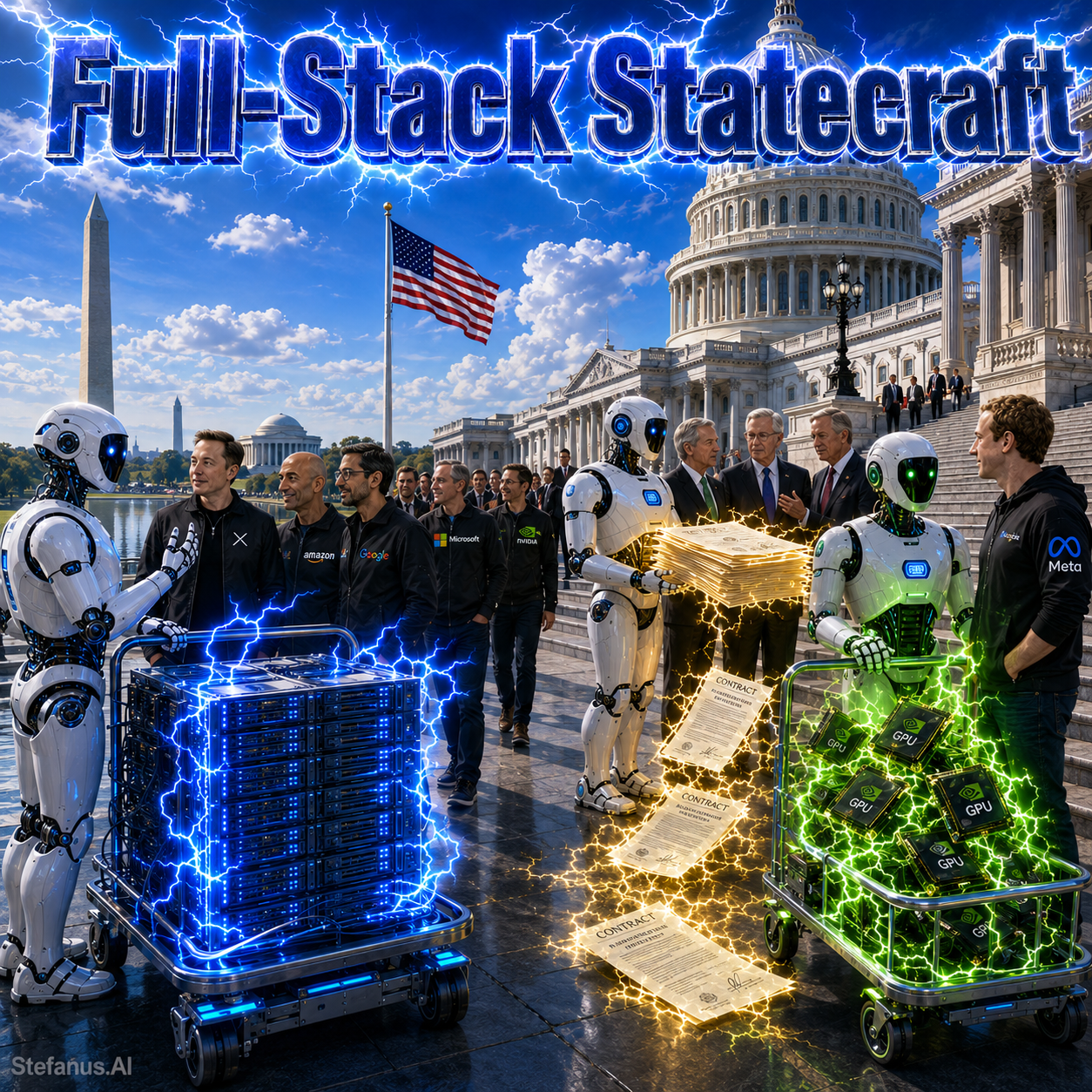
That change is why I chose the title Full-Stack Statecraft. The phrase describes a transition from controlling individual pieces of artificial intelligence to organizing entire technological ecosystems as instruments of national strategy. The United States is no longer merely asking foreign governments to buy American semiconductors, subscribe to an American cloud provider, or license an American model. An emerging policy architecture seeks to connect these components into an exportable system that may include AI accelerators, networking equipment, cloud services, datacenters, cybersecurity, data pipelines, frontier models, sector applications, financing, workforce development, energy infrastructure, technical standards, diplomatic advocacy, export licensing, and security commitments. Executive Order 14320, signed on July 23, 2025, and titled “Promoting the Export of the American AI Technology Stack,” explicitly directed the creation of full-stack AI export packages encompassing hardware, datacenter storage, cloud services, networking, data systems, models, cybersecurity measures, and applications, while also directing federal agencies to mobilize tools such as loans, loan guarantees, equity investment, co-financing, political-risk insurance, credit guarantees, technical assistance, and feasibility studies.[4]
The significance is greater than a new export-promotion initiative because artificial intelligence is becoming an industrial system rather than a single technology. A modern AI capability begins with electricity and extends through semiconductors, datacenters, cloud platforms, models, applications, autonomous agents, security systems, financing structures, and eventually robotics and other physical systems. This relationship is captured by the framework that organizes this paper — the Five-Layer AI Economy: Layer One, Energy; Layer Two, AI Chips; Layer Three, Datacenters; Layer Four, Models; and Layer Five, Applications and Agents. None of these layers operates independently. A host country may obtain advanced GPUs, but those accelerators cannot produce useful intelligence without enormous quantities of reliable electricity, networking, cooling, storage, cloud orchestration, models, software, data, applications, human expertise, security controls, and capital. Once these dependencies are understood, exporting AI stops looking like selling a product and starts looking like transferring a technological infrastructure.
That realization leads to the central argument of this paper. The next phase of international AI competition will increasingly be determined not merely by which nation produces the fastest semiconductor, trains the most capable model, or constructs the largest datacenter, but by which nation can organize these resources into a complete, secure, financeable, politically acceptable, and continuously upgradeable system that other countries are willing to adopt. If that system includes American accelerators, American cloud providers, American cybersecurity, American models, American financing, American standards, and long-term American technical support, then the recipient country is making a decision that extends far beyond an ordinary procurement contract. It is choosing an ecosystem around which portions of its economy, government, scientific institutions, corporations, and future agentic systems may operate. This is the deeper meaning of Full-Stack Statecraft. It represents the transformation of technological advantage into geopolitical architecture.
The idea becomes even more important when compared with China’s emerging international strategy. China is simultaneously expanding domestic semiconductor capabilities, promoting open-source and open-weight AI models, developing national agent-interoperability standards, integrating AI with manufacturing and robotics, and explicitly encouraging international cooperation across the entire chain of AI development. On July 17, 2026, at the World AI Conference in Shanghai, China’s National Development and Reform Commission and other ministries jointly released an international Action Plan for AI Cooperation and Development spanning eight areas — data, computing power, ecosystems, industrial empowerment, talent development, rules and standards, governance, and AI ethics — while calling for broader sharing of open-source AI ecosystems and more inclusive access to intelligent computing services.[5] China is therefore not simply trying to imitate the American AI stack. It is constructing an alternative ecosystem whose attraction may derive from affordability, local adaptability, manufacturing depth, open-weight models, and fewer dependencies on American licensing decisions. The Singapore decision with which this introduction opened is an early data point in exactly that competition.
The global contest that follows will not necessarily resemble the Cold War division between two rigid blocs. Countries may purchase NVIDIA hardware while running Chinese models, deploy American cloud infrastructure while building domestic sovereign models, accept Chinese networking equipment while purchasing American cybersecurity, or require hyperscalers to localize data and employ domestic partners. Singapore itself illustrates the hybridity: a state deeply integrated with American finance and security that nonetheless selected a Chinese open-weight foundation for its regional language model, even as Alibaba Cloud chose Singapore as the launchpad for its international Qwen conference and enterprise push.[6] Nevertheless, the underlying strategic competition will increasingly revolve around the architecture into which these components are assembled. The decisive question will become less about which country possesses the most intelligence and more about whose technological architecture other countries choose to build around.
That is why Full-Stack Statecraft deserves to be studied now. The American AI Exports Program is still developing, Commerce has not yet publicly identified a final universal set of designated consortia, and many international sovereign-AI arrangements remain experimental. The outcome is therefore not predetermined. What is visible, however, is the emergence of a new form of economic diplomacy in which technology companies, governments, export-control agencies, development-finance institutions, sovereign wealth funds, utilities, semiconductor makers, model laboratories, and foreign governments are being assembled into increasingly integrated partnerships. AI foreign policy is moving from selling components to shaping systems.
The central question for the remainder of this paper is therefore straightforward but consequential: When a sovereign government purchases energy infrastructure, accelerators, datacenters, cloud services, cybersecurity, frontier models, applications, autonomous agents, financing, training, and long-term upgrades as an integrated package, is it still purchasing technology, or is it effectively choosing an AI alliance?

Section 1 — From Export Control to Export Architecture
1.1 The Era of Denial
The first era of modern American AI geopolitics was dominated by control. Beginning before the generative-AI boom reached its present scale, Washington increasingly treated advanced semiconductors and semiconductor-manufacturing equipment as strategic technologies whose distribution could affect national security. Export rules were tightened around high-performance accelerators, sophisticated chipmaking tools, certain Chinese companies, military-linked users, and technologies capable of supporting advanced computing. Much of the public discussion therefore focused on the question of denial: how could the United States prevent strategic competitors, most importantly China, from obtaining the most advanced American capabilities?
The logic was understandable. The United States and its allies possessed critical advantages across semiconductor design, electronic-design automation, lithography, advanced manufacturing equipment, high-bandwidth memory relationships, accelerator architectures, and AI software. If frontier artificial intelligence eventually becomes as important to national power as many policymakers expect, unrestricted transfer of the most advanced computing systems could accelerate a competitor’s military, scientific, economic, surveillance, and cyber capabilities. Export controls therefore became one of the central mechanisms through which Washington attempted to preserve technological distance. The historian of that instinct is Chris Miller of the Fletcher School at Tufts University, whose Chip War traced how control over computing power has historically dictated military and economic advantage, and who has continued to argue through 2026 that supply-chain chokepoints are being actively leveraged by major powers to control the world’s digital infrastructure.[7] Speaking about advanced AI accelerators in late 2025, Miller framed the enduring caution succinctly:
“very careful when deciding which countries and which companies we sell these to.”
— Chris Miller, Fletcher School, Tufts University, author of Chip War [8]
1.2 The Limits of Denial as Grand Strategy
Yet denial has an inherent limitation as a long-term international strategy. Preventing a competitor from purchasing a technology does not necessarily persuade the rest of the world to organize around the American ecosystem. A government in Southeast Asia, the Middle East, Africa, Latin America, or Central Asia may want domestic AI capacity but possess neither the capital nor technical expertise required to assemble a complete national stack. If American policy offers restrictions without affordable deployment, while another country offers financing, infrastructure, models, training, and equipment, the recipient’s choice may eventually be determined by availability rather than ideology. The Singapore-Qwen episode described in the Introduction is precisely what this failure mode looks like in miniature: no American licensing decision was violated, no adversary obtained restricted hardware, and yet a strategically important partner quietly standardized a national program on a Chinese model family because it was open, adaptable, and better suited to local needs.[2]
Analysts at the Institute for Progress, reviewing the new export program in mid-2026, made the same structural point: the United States government possesses diplomatic, regulatory, and economic levers unavailable to the private sector, and if deployed strategically these levers can lower market barriers and align industry incentives with American geopolitical objectives — particularly in developing markets where American companies may be under-incentivized to deploy quickly enough on their own.[9] Denial alone does not build markets; it merely closes them. A durable strategy requires an affirmative offer.
1.3 The 2025 Pivot: The AI Action Plan and Executive Order 14320
The Trump administration’s July 2025 AI Action Plan openly recognized this strategic dimension. Its international component called for the United States to work with industry to provide secure full-stack AI export packages — including hardware, models, software, applications, and standards — to friends and allies. Executive Order 14320, signed on July 23, 2025, went further, declaring in its opening lines that artificial intelligence is a foundational technology that will define economic growth, national security, and global competitiveness for decades, and that the United States must ensure American AI technologies, standards, and governance models are adopted worldwide.[4] The order established the American AI Exports Program within ninety days, directed the Secretary of Commerce to solicit proposals from industry-led consortia, and instructed the Economic Diplomacy Action Group, chaired by the Secretary of State, to coordinate the mobilization of federal financing tools — loans, loan guarantees, equity investments, co-financing, political-risk insurance, and technical assistance — in support of priority AI export packages.[4]
This represents a significant conceptual shift. Export controls ask where American technology should not go. Full-Stack Statecraft asks where the American technological ecosystem should go, under what conditions it should be deployed, how deployment should be financed, which companies should participate, and how the resulting infrastructure should remain aligned with American national-security objectives. As law-firm analyses noted at the program’s October 21, 2025 launch, the executive order defines a full-stack package expansively: AI-optimized hardware such as chips, servers, and accelerators; software including AI models and cybersecurity systems; technology including data pipelines and labeling systems; and services spanning datacenter storage, cloud, and networking.[10][11]
1.4 Pre-Set and On-Demand Consortia: The Machinery of Distribution
Commerce’s 2026 implementation makes the change from product promotion to architecture promotion especially visible. Rather than inviting companies simply to submit individual technologies for government promotion, the Department called for industry-led consortia capable of delivering integrated solutions, and it established two structurally different pathways. Pre-set consortia must demonstrate capabilities across all layers of the AI technology stack and maintain standing global offerings ready for deployment on an ongoing basis — these become, in the Department’s own framing, the U.S. Government’s offerings to allies and partners around the world. On-demand consortia, by contrast, are assembled by industry in response to a specific opportunity identified by the Program and need only cover the stack layers required for the particular deal.[12] Announcing the call for proposals, the Under Secretary of Commerce for International Trade stated the strategic premise directly:
“America’s continued global leadership in AI depends on our ability to export our AI.”
— William Kimmitt, U.S. Under Secretary of Commerce for International Trade [12]
The April 10, 2026 Federal Register notice supplies the operational detail. Proposals were accepted from April 1 through June 30, 2026; a designated package would be presented by U.S. Government representatives as a standing, full-stack American AI export package and could receive priority government advocacy, expedited export-licensing review and processing, interagency coordination, and financing referrals — although designation guarantees no particular license approval, financing decision, or contract award.[13] Proposals may include workforce training, capacity building, energy, telecommunications, fiber, and other enabling infrastructure — an acknowledgment, embedded in the regulatory text itself, that the exportable unit now extends well below the software layer and well beyond the datacenter wall.[13] Consortium membership rules add a geopolitical filter: any number of members may join under an anchor member, entities may join multiple consortia, and foreign entities may participate provided they are not located in, or owned or controlled by persons from, a country of concern — currently defined to include China, Hong Kong, and Macau.[14] This language moves AI policy away from the traditional image of a technology company negotiating independently with a foreign buyer. The American government can increasingly act as an organizer around which a group of private firms forms a strategic offering.
By July 6, 2026, the International Trade Administration announced that the application window had closed with seventy-eight submissions — full-stack packages spanning hardware, data, models, cybersecurity, and sector-specific applications — each to be reviewed against published criteria, with the Secretary of Commerce issuing final designation determinations after interagency consultation.[3] Seventy-eight applications is a remarkable number for a program that did not exist twelve months earlier. It demonstrates that the private sector sees genuine commercial value in operating under a governmental umbrella, and it suggests that the consortium — the stack coalition — is becoming a recognized unit of American industrial organization.
1.5 The New Continuum: From Denial Architecture to Full-Stack Distribution
The result can be understood as a three-stage progression in American AI economic policy. The first stage was technological leadership, in which American firms developed dominant chips, clouds, and models. The second stage was technological containment, in which Washington increasingly controlled access to certain strategic technologies. The third stage is now becoming technological distribution, in which Washington seeks to deliberately extend trusted American systems into strategically important foreign markets.
Containment and distribution may appear contradictory, but they are increasingly becoming complementary. Advanced technology can be denied to adversaries while being made more accessible to trusted partners. Commerce’s November 19, 2025 approval of advanced semiconductor exports to G42 in the United Arab Emirates and HUMAIN in Saudi Arabia illustrates the emerging logic. Both companies were authorized to purchase the equivalent of up to 35,000 NVIDIA GB300-class Blackwell chips each, but the approvals were explicitly conditioned on rigorous security and reporting requirements, with the Bureau of Industry and Security engaging both companies and monitoring compliance on an ongoing basis.[15] The policy was not unrestricted globalization and it was not universal denial. It was conditional technological distribution. The full continuum can be expressed as:
Denial Architecture → Conditional Access → Trusted Deployment → Full-Stack Distribution.
Under denial architecture, access is primarily restricted. Under conditional access, governments establish security requirements and licensing mechanisms. Under trusted deployment, hardware is placed within approved facilities and cloud environments operated under negotiated compliance frameworks — such as the Regulated Technology Environment developed by G42 under BIS guidance. Under full-stack distribution, the hardware becomes only one element within a larger system involving energy, datacenters, cloud infrastructure, models, financing, security, software, and applications.
The July 2026 decision by BIS to upgrade the UAE’s treatment under the Export Administration Regulations provides the most recent and perhaps most consequential illustration of how geopolitical relationships and technological access are becoming fused. Effective July 10, 2026, BIS removed the UAE from Country Groups D:3 and D:4, added it to Country Group A:5 — the group reserved for America’s closest trading partners — and created an entity-specific approval framework under which the UAE government and approved entities, including G42 and Core42, may receive certain advanced computing items license-free.[16] BIS framed the change as recognition of the UAE’s status as a U.S. Major Defense Partner and its support for U.S. national-security interests, including cooperation against Iranian regional activity.[16] Legal analysts were careful to note that the rule does not eliminate licensing for the most sensitive items and that approvals are frequently entity-specific rather than country-wide.[17] The significance is not that every advanced AI accelerator suddenly became unrestricted. The broader point is that technological access is now formally embedded in the political relationship: a country’s regulatory classification under the EAR has become a currency of alliance.
1.6 Reliability as the First Principle of Architecture
This model contains opportunities as well as risks. A country that knows it can receive advanced American technology only while maintaining strong security standards has an incentive to align its cybersecurity, investment-screening, procurement, and technology relationships with U.S. expectations. American companies gain markets, American standards gain users, and partner countries receive advanced capabilities. At the same time, the United States must avoid turning technological access into an unpredictable political instrument. If countries conclude that access can be withdrawn arbitrarily, they will rationally seek alternatives — domestic substitutes, multi-vendor systems, or open models that reduce dependence. Full-Stack Statecraft therefore requires more than power; it requires reliability. A successful technological alliance must convince the recipient that American systems will remain secure and governable without becoming permanently vulnerable to political disruption.
This is one reason the term architecture matters. A single semiconductor transaction can be replaced at the next procurement cycle. An architecture is harder to replace because its components become connected through software, training, APIs, cybersecurity practices, power arrangements, financing contracts, developer ecosystems, operating procedures, and data systems. Once an entire national AI environment is designed around a particular architecture, switching becomes expensive. The strategic objective is therefore not simply to maximize today’s exports. It is to create long-duration technological relationships. That is Full-Stack Statecraft’s first principle: the most consequential AI export is no longer necessarily a product. It is an architecture of dependence, capability, interoperability, and continuous renewal.

Section 2 — The Five-Layer AI Economy and the Seven-Actor Full-Stack Compact
2.1 Why the GPU Is the Wrong Unit of Analysis
The easiest mistake in analyzing sovereign artificial intelligence is to begin with the GPU. The accelerator is visible, expensive, politically sensitive, and easy to count, which makes it a natural symbol of national AI power. Yet a warehouse containing tens of thousands of advanced accelerators is not automatically an intelligence factory. The machines require reliable electricity, cooling systems, networking, storage, fiber, cloud orchestration, data pipelines, software frameworks, model weights, cybersecurity, applications, engineers, financing, replacement parts, and customers capable of turning computation into economically useful outputs. This is why the Five-Layer AI Economy provides a more useful framework than semiconductor counts alone, and why the executive order’s definition of the exportable stack — reaching from hardware through data systems, models, security, and applications — is analytically correct even before it is politically convenient.[4]
2.2 The Five Layers
The Five-Layer structure begins with Energy, because every layer above it ultimately converts electricity into computation. The second layer consists of AI Chips: accelerators, CPUs, memory systems, networking silicon, power electronics, and the semiconductor ecosystem surrounding them. The third layer consists of Datacenters, where energy and silicon are assembled into operational computing infrastructure. The fourth layer consists of Models, the software systems that transform compute into usable intelligence. The fifth layer consists of Applications and Agents, where intelligence is converted into services, automated workflows, decisions, scientific discovery, industrial optimization, government operations, robotics, and eventually a larger machine economy. Table 1 summarizes the framework and the strategic question each layer poses for an exporting or importing state.
Table 1. The Five-Layer AI Economy
| Layer | What It Contains | Dominant Actors | The Strategic Question |
| Layer 1 — Energy | Generation (gas, nuclear, solar), transmission, grid, cooling, water | Host nations, utilities, infrastructure consortia, finance | Can the compute actually be powered, and at what political cost? |
| Layer 2 — AI Chips | Accelerators, CPUs, HBM memory, networking silicon, power electronics | Chipmakers (NVIDIA, AMD, others), state licensing bodies | Who is permitted to buy, under what security conditions? |
| Layer 3 — Datacenters | Campuses, racks, fiber, cloud orchestration, physical security | Hyperscalers, developers, utilities, host states, capital | Where does the intelligence physically live, and who operates it? |
| Layer 4 — Models | Frontier proprietary models, open-weight models, sovereign models | Model laboratories, open-source ecosystems, governments | Whose intelligence — and whose values and licenses — run on the metal? |
| Layer 5 — Applications & Agents | Sector applications, agents, robotics, embodied AI, workflows | Software firms, developers, enterprises, agencies, standards bodies | Does the stack produce economic value, and around whose standards? |
The American AI Exports Program can be interpreted as an attempt to package portions of all five layers into a deployable international system. The executive order explicitly reaches across hardware, datacenter services, networking, data, models, security, and applications, while Commerce has additionally recognized workforce training and enabling infrastructure — energy, telecommunications, and fiber — as legitimate components of a proposal.[13] The October 2025 request for information that preceded the program even solicited public comment on consortium formation, foreign markets, business models, federal support, and national-security regulation, treating the entire chain as a single object of policy design.[18]
2.3 The Seven Actors
Technology alone, however, does not explain how these layers reach another country. For that purpose, Full-Stack Statecraft requires a second framework: what can be called the Seven-Actor Full-Stack Compact. The first actor is the State. Washington possesses diplomatic authority, export-control jurisdiction, treaty relationships, security agencies, financing institutions, standards bodies, embassies, and political leverage that no private company can reproduce. The federal government can facilitate strategic relationships, coordinate between agencies, support transactions, influence financing, establish security requirements, and decide which countries or entities should receive sensitive technologies. The state therefore acts as both gatekeeper and promoter — a dual role formalized by EO 14320, which places Commerce, State, Energy, Defense, and OSTP inside a single selection and advocacy process.[4]
The second actor is the Chipmaker. Companies such as NVIDIA, AMD, Qualcomm, Intel, Broadcom, and an expanding ecosystem of accelerator and networking suppliers provide the computational machinery. NVIDIA is particularly important because its dominance extends beyond standalone GPUs into networking, systems, CUDA software, rack architectures, and increasingly integrated AI-factory designs — a position reflected in financial results without modern precedent. In its fiscal year 2026, ending January 2026, NVIDIA recorded $215.9 billion in revenue, up 65 percent, with fourth-quarter datacenter revenue of $62.3 billion; a single quarter later, for the period ending April 26, 2026, the company reported $81.6 billion in quarterly revenue, of which $75.2 billion came from datacenters, and guided to $91 billion for the following quarter while assuming zero datacenter compute revenue from China.[19][20] Announcing those results, NVIDIA’s founder captured the industrial framing that now dominates the field:
“The buildout of AI factories — the largest infrastructure expansion in human history.”
— Jensen Huang, Founder and CEO, NVIDIA [20]
Yet Full-Stack Statecraft should not become synonymous with NVIDIA diplomacy. A resilient American export system benefits from multiple accelerator providers, networking architectures, CPUs, memory suppliers, optical systems, and domestic semiconductor capabilities — a point to which Section 6 returns.
The third actor is the Hyperscaler. AWS, Microsoft Azure, Google Cloud, Oracle Cloud Infrastructure, and other cloud providers transform computing components into usable infrastructure. A foreign government may prefer to buy cloud capacity rather than operate every accelerator directly, and hyperscalers provide identity systems, security, orchestration, databases, AI development tools, storage, observability, inference platforms, and managed services. The cloud provider is therefore not merely hosting the AI stack; it increasingly provides the operational layer through which the stack becomes usable.
The fourth actor is the Model Laboratory. OpenAI, Anthropic, Google DeepMind, Meta, xAI, and other model developers determine which forms of intelligence can operate on the infrastructure. Models are increasingly platforms rather than isolated software products because applications, agents, corporate workflows, development environments, and APIs are built around them. A country that standardizes portions of government, education, healthcare, banking, or industrial automation around a particular model ecosystem may create dependencies that last longer than the server hardware itself.
The fifth actor is the Infrastructure Consortium. Datacenter developers, networking suppliers, cooling companies, electrical-equipment manufacturers, fiber providers, construction contractors, utilities, cybersecurity firms, and power companies transform the digital design into physical infrastructure. The enormous capital intensity of contemporary AI means that transformers, substations, gas turbines, nuclear generation, cooling systems, high-voltage connections, fiber routes, optical networking, and land availability can become as strategically important as models. Full-stack export policy that ignores this layer risks exporting theoretical compute that cannot actually be deployed.
The sixth actor is Finance — perhaps the most underestimated part of the entire architecture, examined in detail in Section 2.5 and Section 4. The seventh actor is the Host Nation, and this is perhaps the most important corrective to any assumption that Full-Stack Statecraft is something Washington simply imposes abroad. Host governments possess land, electricity, permits, sovereign funds, public procurement budgets, national data, telecommunications policy, educational systems, local companies, security requirements, and political legitimacy. They can demand localization, domestic employment, technology transfer, local-language models, national cloud controls, ownership stakes, and reciprocal investment. They may also insist upon technological diversification precisely to avoid dependence upon one foreign country. As the Atlantic Council’s GeoTech Center observed in its 2026 outlook, nations pursue sovereign AI to strengthen domestic economies, protect national security, mitigate geopolitical shocks, and reflect national values — but attempting to rebuild the entire stack domestically is expensive, redundant, and impractical, so every government faces build-buy-partner choices at every layer.[21] In the words of its associate director:
“Not every country can, or should, try to build every part of the stack.”
— Trisha Ray, Associate Director and Resident Fellow, Atlantic Council GeoTech Center [21]
The Full-Stack Compact can therefore be expressed as: State + Chipmaker + Hyperscaler + Model Lab + Infrastructure Consortium + Finance + Host Nation. Around these seven actors sits a broader envelope consisting of security, standards, diplomacy, export controls, capital markets, workforce development, and long-term political alignment. Table 2 summarizes the compact.
Table 2. The Seven-Actor Full-Stack Compact
| Actor | What It Contributes | What It Demands or Controls |
| 1. The State (U.S.) | Licensing, diplomacy, advocacy, financing coordination, security frameworks | End-use controls, alignment conditions, country-of-concern exclusions |
| 2. The Chipmaker | Accelerators, networking silicon, systems, software ecosystems (CUDA) | Market access, licensing predictability, IP protection |
| 3. The Hyperscaler | Cloud operations, identity, orchestration, managed AI services | Power, land, workloads, long-term contracts |
| 4. The Model Laboratory | Frontier and open models, APIs, agent platforms, developer ecosystems | Compute, data-governance terms, deployment rights |
| 5. Infrastructure Consortium | Datacenters, power equipment, cooling, fiber, construction, cybersecurity | Financing, permits, supply chains, grid access |
| 6. Finance (EXIM, DFC, funds) | Loans, guarantees, insurance, equity, mobilized private capital | Credit quality, security conditions, national-interest tests |
| 7. The Host Nation | Land, energy, capital, market access, legitimacy, data, talent | Localization, sovereignty, reciprocity, diversification |
2.4 Superimposing the Actors on the Layers
When the Seven-Actor framework is superimposed onto the Five-Layer AI Economy, the full structure becomes visible. At Layer One, Energy, the host nation and infrastructure consortium become dominant actors, while the state and financial institutions influence project development and long-term energy security. AI-export diplomacy increasingly becomes energy diplomacy because a multi-gigawatt datacenter campus cannot be separated from generation, transmission, fuel availability, water, grid planning, and local electricity politics. The planned UAE–U.S. AI campus, for example, is described in official and partner accounts as spanning roughly ten square miles and drawing eventually on nuclear, solar, and natural-gas generation to support five gigawatts of AI capacity.[22]
At Layer Two, Chips, the chipmaker becomes central, but state licensing and host-country security arrangements determine access. The November 2025 G42 and HUMAIN approvals demonstrate precisely this relationship: advanced hardware was authorized, but access came bundled with security and reporting requirements and continuing BIS engagement.[15] At Layer Three, Datacenters, hyperscalers, infrastructure companies, host nations, utilities, and finance converge; land, electricity, cooling, cloud design, cybersecurity, and capital must be coordinated at massive scale, and this is where Full-Stack Statecraft becomes physically visible. At Layer Four, Models, model laboratories compete over developer ecosystems and institutional adoption while governments debate openness, security, cultural localization, and national control; a country’s choice between a proprietary American frontier model, an American open-weight model, a Chinese open-weight alternative, or a domestic sovereign model can profoundly change the political meaning of the underlying hardware. At Layer Five, Applications and Agents, the stack finally produces economic and governmental value: healthcare applications, financial systems, logistics, scientific research, autonomous industrial processes, education, cybersecurity, public administration, and robotics transform compute from a capital expense into institutional capability. Commerce explicitly includes sector-specific applications among the required stack layers in its call for proposals, signaling that the U.S. government understands that selling infrastructure without useful applications may not generate durable adoption.[23]
2.5 Finance as the Envelope: The Capital Numbers of 2026
The scale of capital now surrounding the stack explains why finance deserves treatment as a structural actor rather than a background condition. In 2026 the four largest American hyperscalers — Amazon, Microsoft, Alphabet, and Meta — collectively plan roughly $725 billion in capital expenditure, up approximately 77 percent from the record $410 billion of 2025, with Amazon alone guiding toward $200 billion; Goldman Sachs now projects a combined $5.3 trillion of hyperscaler capex between fiscal 2025 and fiscal 2030.[24] Independent analyses that include Oracle place the 2026 figure between $660 and $690 billion and note that this spending is consuming nearly the whole of the firms’ operating cash flows, forcing unprecedented bond issuance and drawing shareholder scrutiny — a July 2026 sell-off across the hyperscalers followed Alphabet’s decision to raise its capex forecast yet again.[25][26] Researchers at Epoch AI calculate that aggregate hyperscaler capex has been compounding at roughly 72 percent annually since GPT-4’s release.[27] These are numbers at which the distinction between corporate investment and national infrastructure policy begins to blur; they are also numbers that very few sovereign buyers can replicate, which is exactly why the financing arm of Full-Stack Statecraft matters.
That arm now has institutions. On May 21, 2026, the Export-Import Bank of the United States launched ExportAI, a dedicated initiative to deploy American AI at scale by leveraging Commerce-designated AI exports, to broaden EXIM’s financing reach with new pathways purpose-built for strategic AI transactions, and to streamline compliance so American companies can move at market speed.[28] Reuters reporting on the initiative described insurance and loan guarantees for medium-term transactions and direct loans and guarantees for long-term deals such as foreign AI datacenter construction, with Commerce licensing serving as the gate before financing flows.[29] EXIM’s chairman framed the stakes in explicitly systemic terms:
“American leadership in AI will define the industries, supply chains, and economic competitiveness.”
— John Jovanovic, President and Chairman, Export-Import Bank of the United States [28]
The U.S. International Development Finance Corporation has positioned itself as the second financing pillar. At the June 2026 Pax Silica Summit — the State Department-led coalition launched in December 2025 to secure every layer of the AI and semiconductor supply chain, and expanded in June 2026 to include the EU, Germany, the Netherlands, and Argentina among ten new partners[30] — DFC’s chief executive described U.S. government financing as ready to meet global demand for the trusted American AI technology stack, from training and inference datacenters to terrestrial fiber and subsea cables, and extending to power generation, transmission, and grid modernization, while explicitly contrasting this offer with China’s Digital Silk Road model of subsidized dependency.[31] On the mobilizing power of government risk instruments, he was specific:
“can mobilize private investment in sums that dwarf our own balance sheet.”
— Ben Black, Chief Executive Officer, U.S. International Development Finance Corporation [31]
2.6 Stack Coalitions and Geopolitical Platform Competition
The framework also reveals why no single private company can independently practice Full-Stack Statecraft. NVIDIA cannot build every power plant, finance every foreign datacenter, operate every cloud, supply every model, secure every national network, and negotiate every geopolitical relationship. OpenAI cannot manufacture its entire semiconductor supply, construct international electrical infrastructure, or provide sovereign financing. Amazon possesses cloud, applications, capital, logistics expertise, and growing semiconductor capabilities, but still depends on utilities, governments, external chipmakers, telecommunications infrastructure, and political permissions. Even the largest technology companies operate inside a system of interdependence. The Commerce consortium approach implicitly recognizes this structural reality: AI has become too vertically integrated to be exported efficiently one product at a time.
That has a profound implication for the future of industrial organization. AI companies that historically competed against one another may find themselves cooperating inside particular national packages because the strategic value of winning an entire sovereign ecosystem can exceed the value of controlling every component. A package could include NVIDIA accelerators and Cisco networking, Oracle cloud infrastructure, OpenAI models, an American cybersecurity vendor, a U.S.-supported power project, and host-country financing — which is, as Section 3 shows, a nearly literal description of Stargate UAE. Another package could use AMD chips, AWS infrastructure, Anthropic models, different networking vendors, and different energy partners. Competition could occur not only between companies but increasingly between consortia. This may create a new form of geopolitical platform competition. The relevant unit of analysis is no longer simply the company. It is the stack coalition. Over time, governments may evaluate competing stack coalitions the way enterprises evaluate complex infrastructure tenders, except the procurement decision will influence national security, industrial strategy, diplomatic relationships, data governance, and long-term technological sovereignty. If so, the Seven-Actor Full-Stack Compact becomes not merely a framework for understanding present policy but a potential model for understanding how the international AI economy itself will be organized.

Section 3 — The Gulf Becomes the First Laboratory of Full-Stack Statecraft
3.1 Why the Gulf Moved First
The clearest early examples of Full-Stack Statecraft are emerging in the Persian Gulf, where extraordinary concentrations of sovereign capital, abundant energy, ambitious national development programs, centralized decision-making, and strategic relationships with Washington have created conditions for AI infrastructure projects that would be difficult to reproduce quickly in many other regions. The security environment has accelerated the alignment: with the confrontation between the United States and Iran continuing to shape regional politics through 2026, the Gulf monarchies’ decisions about whose technology to trust have become inseparable from their decisions about whose security guarantees to trust. The BIS rule upgrading the UAE explicitly cited Emirati support for U.S. operations against Iranian regional activity as part of the justification for enhanced technological treatment[16] — as clear a statement as one could ask that compute access and security alignment now travel together. The United Arab Emirates and Saudi Arabia are especially important because their recent agreements reveal how the five AI layers and seven institutional actors can be assembled into a single geopolitical transaction.
3.2 The UAE: Stargate, the Five-Gigawatt Campus, and the Regulated Technology Environment
The United Arab Emirates provides perhaps the most complete case. In May 2025, Washington and Abu Dhabi announced the U.S.-UAE AI Acceleration Partnership, centered on a planned five-gigawatt AI technology campus in Abu Dhabi — spanning approximately ten square miles, powered eventually by a combination of nuclear, solar, and natural-gas generation, and described as the largest AI infrastructure deployment outside the United States.[22] The campus framework allows U.S. hyperscalers and approved cloud providers to use the site for regional compute serving populations within a roughly two-thousand-mile radius, while the UAE committed to security measures, including enhanced know-your-customer requirements, intended to prevent diversion of controlled American technologies. From the Five-Layer perspective, this is immediately a Layer One project before it is a Layer Two project: energy supply determines whether the accelerators can operate, while the scale of planned compute will shape power generation, transmission investment, land use, cooling infrastructure, and long-term regional electricity strategy.
Layer Two entered through advanced American semiconductors; Layer Three emerged through the physical campus and hyperscaler participation; and Layer Four became visible when OpenAI announced Stargate UAE, its first international Stargate deployment and the first partnership under its OpenAI for Countries program. The arrangement joins G42, Oracle, NVIDIA, Cisco, and SoftBank Group: a one-gigawatt compute cluster built by G42 and operated by OpenAI and Oracle, running NVIDIA Grace Blackwell GB300 systems, secured by Cisco zero-trust networking, with the first 200-megawatt phase expected live in 2026 — all developed, in OpenAI’s own description, in close coordination with the U.S. government.[32][33] OpenAI’s chief executive placed the project inside a deliberately global strategy, calling it
“the first major milestone in our OpenAI for Countries initiative.”
— Sam Altman, Co-founder and CEO, OpenAI [34]
This is not a conventional software sale. Consider the institutional structure: the UAE contributes sovereign support, land, energy, capital, and national market access; G42 provides a national technology champion; NVIDIA provides advanced computing; Oracle supplies cloud infrastructure; Cisco provides networking and security; OpenAI provides the model ecosystem; SoftBank contributes capital relationships; and the American government supplies the diplomatic and regulatory architecture within which sensitive technology can be transferred. Every seat in the Seven-Actor Compact is occupied. The result is almost a laboratory demonstration of Full-Stack Statecraft. And when the November 2025 chip authorization arrived — the equivalent of up to 35,000 GB300-class systems for G42 — it came wrapped in the Regulated Technology Environment, a compliance framework developed under BIS guidance to govern access, identity, and diversion risk on an ongoing basis.[15][35] SoftBank’s founder, for his part, described the national decision in terms that capture how the recipient side experiences these arrangements:
“the first nation beyond America to embrace this sovereign AI platform.”
— Masayoshi Son, Founder and CEO, SoftBank Group [36]
3.3 Reciprocity: Capital Flowing in Both Directions
The arrangement also contains an important principle of reciprocity. OpenAI describes the partnership as involving dual investments: the Stargate cluster in Abu Dhabi, and UAE investment flowing back into U.S. Stargate infrastructure, building on the broader Acceleration Partnership announced during the May 2025 presidential visit.[32] The White House has separately emphasized a ten-year Emirati investment framework across AI infrastructure, semiconductors, energy, and manufacturing, with reciprocal UAE investment in American datacenter capacity treated as a condition of the relationship. This suggests that full-stack agreements may increasingly operate in two directions. America exports technology and ecosystem access, while the foreign partner exports capital back into American infrastructure. The traditional distinction between exporter and importer becomes less useful because sovereign capital circulates through both economies: a Gulf country imports U.S. accelerators while simultaneously financing American datacenters; an American model company deploys infrastructure abroad while benefiting from foreign investment in its domestic ecosystem. G42’s chief executive has made the symmetry explicit:
“What we build in the UAE, we will continue to match in the US.”
— Peng Xiao, Group Chief Executive Officer, G42 [35]
3.4 Saudi Arabia: HUMAIN and Diversification Within the American Ecosystem
Saudi Arabia provides a second, differently structured example. In May 2025, NVIDIA and HUMAIN — the AI company backed by Saudi Arabia’s Public Investment Fund — announced plans for AI factories with capacity of up to 500 megawatts and several hundred thousand NVIDIA GPUs over five years. During the same period, AMD announced a collaboration with HUMAIN valued around $10 billion, Qualcomm pursued datacenter-processor development with the kingdom, and AWS and HUMAIN announced plans to invest more than $5 billion in an AI Zone combining dedicated AWS infrastructure, advanced semiconductors, UltraCluster networking, SageMaker, Bedrock, Amazon Q, and workforce-development programs. By the time of the Saudi crown prince’s November 2025 Washington visit, the accumulated pipeline included plans to purchase some 600,000 NVIDIA AI chips for datacenters in both Saudi Arabia and the United States, a HUMAIN joint venture with AMD and Cisco targeting up to one gigawatt of AI infrastructure by 2030 beginning with an initial 100-megawatt project, and agreements with Adobe and Qualcomm to build Arabic-language content on HUMAIN’s Allam large language model.[35] The Commerce authorization of up to 35,000 GB300-equivalent chips for HUMAIN, announced the same week, converted political relationship into licensed hardware under the now-familiar security-and-reporting conditions.[15]
The Saudi case therefore reveals another important characteristic of Full-Stack Statecraft: recipient countries may intentionally diversify within the American ecosystem. A sovereign buyer does not need to choose only NVIDIA or only AMD, only AWS or only Oracle. It may create multiple overlapping relationships to improve bargaining power, reduce supplier dependence, build local expertise, and ensure continued access to competing technologies. This complicates the idea of technological alliances. Full-Stack Statecraft is unlikely to create vertically closed national systems in which every component comes from one company. It is more likely to create trusted ecosystems within which multiple companies compete while the broader geopolitical architecture remains aligned. Analysts at Rest of World captured the other half of the bargain: the chip approvals followed G42’s severing of ties with Huawei and divestment from ByteDance, and HUMAIN’s pledge not to purchase Huawei equipment — the Gulf states converted the U.S.-China rivalry into leverage for their own AI ambitions, and Washington converted access into de-Sinification.[37] The Middle East Institute adds an important quantitative caution: 35,000 chips is modest against the roughly half-million accelerators needed to power a single gigawatt of compute, so the November approvals matter less as volume than as regulatory precedent — the legal mechanism through which the Gulf becomes a trusted hub for large-scale deployment within the U.S.-led ecosystem.[38]
3.5 From Chips to Corridors: Geography, Latency, and Pax Silica
The Gulf cases also reveal the importance of physical geography. The UAE argues that its location places enormous populations within relatively low-latency reach — OpenAI itself notes the Abu Dhabi cluster can serve AI compute within a two-thousand-mile radius — while Saudi Arabia similarly seeks to become a computing hub connecting Europe, Asia, Africa, and the Middle East. AI infrastructure can therefore become a new type of strategic geography. Ports once connected trade routes, oil terminals connected energy systems, and telecommunications hubs connected global data. Hyperscale AI campuses may increasingly become regional intelligence hubs, exporting inference and computational services across national borders. Washington has begun institutionalizing this corridor logic: the State Department’s Pax Silica framework, launched in December 2025 and expanded at its June 2026 summit, explicitly aligns trusted partners across every stage of the AI supply chain — minerals, chemicals, lithography inputs, memory, fabrication, and deployment — while DFC financing reaches the fiber and subsea cables required to move data at scale.[30][31] The corridor is becoming the geography of the stack.
That possibility raises difficult sovereignty questions. A government may want domestic AI capability but rely upon a nearby regional computing hub. Another may insist that sensitive public-sector inference remain inside national territory. A third may accept foreign cloud services but require domestic data storage and identity controls. Sovereign AI will therefore exist along a spectrum rather than as a binary distinction between domestic and foreign systems.
3.6 Beyond the Gulf: Germany, Australia, and the Adaptability Requirement
OpenAI’s broader OpenAI for Countries strategy reinforces this trend. The company announced an initial goal of roughly ten projects with countries or regions, combining local infrastructure development with investment into the wider Stargate network, and subsequent initiatives have extended to Norway, the United Kingdom, Argentina, Germany, and Australia.[39] These arrangements differ substantially from the Gulf megaprojects, which is precisely the point. Full-Stack Statecraft must be adaptable. Germany’s concerns include European regulation, data sovereignty, government procurement, and industrial competitiveness — hence a partnership structure emphasizing public-sector deployment through German infrastructure. Australia combines sovereign infrastructure with an established U.S. security relationship and strong domestic institutions. Gulf states possess extraordinary capital and energy advantages. Emerging economies may prioritize affordable infrastructure, education, government digitalization, or agricultural applications rather than frontier training clusters. The American AI Exports Program’s distinction between pre-set and on-demand consortia appears designed for exactly this heterogeneity: a standardized offering for one group of countries, a customized arrangement for a particular sovereign opportunity.[12]
3.7 Why Layer Five Will Decide the Gulf Experiment
This also explains why the application layer is strategically important. Sovereign governments do not ultimately desire GPUs for the sake of possessing GPUs. Saudi Arabia is interested in economic diversification, industrial productivity, government modernization, Arabic-language AI, science, finance, healthcare, logistics, autonomous systems, and eventually robotics. The UAE similarly views AI as part of a broader transformation involving government, energy, transportation, medicine, education, and regional services; OpenAI specifically identified government, energy, healthcare, education, and transportation as target areas for Stargate UAE deployment, and the UAE became the first nation to roll out ChatGPT access nationwide under the partnership.[32]
The geopolitical competition will therefore eventually be won or lost at Layer Five. If a country receives enormous American compute infrastructure but Chinese open models prove easier to adapt for domestic companies, or if local developers fail to build useful applications, the hardware relationship may not create enduring ecosystem loyalty. Conversely, a modest amount of infrastructure combined with highly successful applications, developer communities, local-language models, and agentic systems could generate stronger long-term influence. The Gulf is therefore not simply purchasing chips. It is becoming an experimental zone for the international organization of the AI economy.
For Washington, this creates opportunity: American technology companies gain large markets, U.S. standards can become embedded, partner countries become more closely aligned with American security requirements, and foreign capital contributes to domestic American infrastructure. For host nations, the arrangements offer access to frontier technology, diversification from hydrocarbons, workforce development, and a chance to become regional AI hubs. Yet the arrangements also contain risk. If capacity expands faster than economically useful demand, enormous datacenter investments could produce underutilized infrastructure. If political relationships change, technology access may become uncertain. If security controls fail, sensitive American technology could leak to restricted entities. If a host nation becomes too dependent on American providers, its own objective of technological sovereignty may become contradictory. These tensions make the Gulf cases analytically valuable. They are not evidence that Full-Stack Statecraft has already succeeded. They are evidence that it has begun.

Section 4 — When Sovereign AI Procurement Begins to Resemble Defense Procurement
4.1 The Total Package Approach
The most provocative comparison in this paper is between sovereign AI procurement and defense procurement. The analogy must be used carefully because the American AI Exports Program is not the Foreign Military Sales program, and civilian technology markets operate through very different legal, commercial, and institutional structures. Nevertheless, the organizational similarities are increasingly difficult to ignore.
Foreign Military Sales has long recognized that a sophisticated military platform cannot be transferred successfully as an isolated object. A country purchasing an aircraft, air-defense system, communications platform, or other major defense capability may also require training, facilities, software, spare parts, technical assistance, ammunition, maintenance, logistical support, mission data, and continuing upgrades. The Defense Security Cooperation Agency therefore uses what it calls a Total Package Approach, under which purchasers obtain the supporting systems and services necessary to introduce and sustain a capability.[40] The important word is sustain. A fighter aircraft without maintenance, pilot training, software updates, weapons integration, spare parts, ground equipment, and logistical support rapidly loses strategic value. Consequently, modern defense procurement often establishes relationships that last decades: the initial platform purchase creates future dependency on upgrades, components, training, software, interoperability standards, and bilateral security cooperation.
4.2 The Structural Mapping
Advanced AI infrastructure increasingly possesses a similar systems character. A country buying 20,000 or 50,000 advanced accelerators does not simply receive computational capability. It requires datacenter facilities, power, networking, cooling, software, cloud orchestration, cybersecurity, models, technical staff, fiber, replacement hardware, system upgrades, and continuing access to software ecosystems. If applications and autonomous agents are built on top of those systems, the institutional dependency deepens further. The comparison can be expressed structurally, as in Table 3.
Table 3. Defense Procurement and Sovereign AI Procurement: A Structural Mapping
| Defense Procurement Element | Sovereign AI Infrastructure Analogue |
| Defense platform (aircraft, air-defense system) | AI infrastructure (campus, cluster, national cloud) |
| Engine | Accelerator (GPU/TPU systems) |
| Communications network | Cloud and networking fabric |
| Mission software | AI models (frontier, open-weight, sovereign) |
| Weapons integration | Applications and agents |
| Pilot and crew training | Developer and workforce programs |
| Maintenance and sustainment | Cloud support and infrastructure operations |
| Spare parts | Servers, optical modules, memory, power equipment, replacement GPUs |
| Interoperability standards (e.g., NATO STANAGs) | APIs, agent protocols, identity systems, cybersecurity standards |
| End-use monitoring | Export-control compliance and compute-access controls (e.g., RTE) |
| Foreign Military Financing | EXIM ExportAI, DFC instruments, sovereign capital, project finance |
| Alliance interoperability | AI ecosystem interoperability |
4.3 Financial Statecraft: EXIM, DFC, and the Cost of Capital
The comparison becomes more meaningful when financing is added. Large sovereign AI projects may be technically attractive yet commercially impossible without long-duration capital. Executive Order 14320 explicitly instructed the Economic Diplomacy Action Group to use loans, loan guarantees, equity investments, co-financing, political-risk insurance, guarantees, technical assistance, and feasibility studies in support of selected AI export packages.[4] EXIM’s ExportAI initiative gives this concept an institutional mechanism, pairing Commerce designation with a graduated financing toolkit — insurance and guarantees for medium-term transactions, direct loans and guarantees for long-duration projects such as foreign datacenter construction.[28][29] DFC adds the development-finance layer: datacenters for training and inference, terrestrial fiber, subsea cables, power generation, transmission, grid modernization, and political-risk insurance capable of mobilizing private capital pools far larger than its own balance sheet.[31]
The financing dimension deserves attention because artificial intelligence competition may eventually be determined partly by cost of capital. A technologically superior American system can lose a foreign procurement contest if the competing system comes with cheaper credit, state-backed construction, bundled telecommunications, or long repayment terms. Infrastructure diplomacy has long operated this way in railways, ports, telecommunications, and energy; AI is joining the same category. This creates what can be called financial statecraft around the AI stack. Government finance does not replace private capital; it reduces risk, supports politically difficult projects, extends repayment periods, insures against sovereign instability, and signals U.S. government backing — which in turn makes private banks, infrastructure funds, pension capital, and sovereign wealth funds more willing to participate.
The model is already visible well outside frontier AI. In August 2025, EXIM’s board approved a $66 million guarantee supporting construction of a national data center in Côte d’Ivoire — the first data center EXIM has ever supported in sub-Saharan Africa — with Washington-based small business Cybastion supplying equipment alongside Cisco, HPE, and Schneider Electric under EXIM’s China and Transformational Exports Program, explicitly displacing Chinese competition; total guarantees for the country’s digital transformation have since grown beyond $100 million, and EXIM named the transaction its Industries of the Future Deal of the Year in May 2026.[41][42] Although this project is not equivalent in scale or sophistication to Stargate UAE, it demonstrates how government-backed finance can extend trusted digital infrastructure into markets where hyperscale private investment alone would not go — the FMS financing logic transposed into the civilian digital economy.
4.4 From Hardware Monitoring to Workload Monitoring
The analogy with defense procurement becomes even stronger when security conditions are considered. Sophisticated military exports carry restrictions on end users, access, modification, transfer, and re-export. Advanced AI systems are developing similar regimes because a datacenter may contain controlled accelerators and models capable of supporting military research, cyber operations, surveillance, autonomous systems, or intelligence analysis. Commerce’s authorizations for G42 and HUMAIN specifically included security and reporting requirements with continuing BIS engagement[15]; the UAE campus framework includes access restrictions and diversion controls; and the July 2026 EAR rule builds an entity-approval architecture — Supplement No. 8 — in which named companies gain license-free access only so long as they satisfy specified conditions.[43]
This suggests the possible emergence of compute end-use monitoring as a permanent feature of high-end sovereign AI partnerships. Governments will increasingly want to know not only where advanced accelerators are physically located but also who can access them, which entities operate workloads, whether restricted organizations are obtaining indirect compute, how identities are verified, and whether systems can be audited. The transition from hardware monitoring to workload monitoring would represent a major expansion in technological governance. A semiconductor can be counted by serial number, but computation is dynamic: capacity can be partitioned, leased, remotely accessed, moved between customers, or used for multiple workloads. Cloud systems make the physical location of a processor less informative than the identity and purpose of the entity consuming the compute. Full-Stack Statecraft may therefore produce a new institutional category somewhere between commercial cloud compliance and strategic end-use verification. Miller’s 2026 warning about autonomous, remotely updated systems applies here with full force: the open questions are who has access, who writes the software, and who provides the over-the-air updates.[7]
4.5 Interoperability: Military Alliances and Economic Networks
Nevertheless, the AI-defense analogy reaches its most important point when interoperability is considered. NATO’s military power is not simply the sum of individual weapons possessed by member states; interoperability allows forces, communications systems, logistics, standards, training, and command structures to operate together. Similarly, a network of countries built around compatible American AI systems could create a form of economic and technological interoperability. Developers could use similar APIs. Government agencies could adopt compatible security standards. Model providers could deploy across shared cloud environments. AI agents could communicate using common protocols. Cybersecurity tools could operate across trusted infrastructure. American companies could expand across countries without rebuilding every integration from scratch. Research institutions could share tools. Multinational companies could move workloads across an allied computing network. The result would not constitute a military alliance, but it could create a technological network with some of the same reinforcing properties.
This is where AI infrastructure may ultimately become more economically pervasive than defense procurement. A fighter jet primarily influences national security and military capability. An AI stack can enter banking, healthcare, education, taxation, government administration, energy management, science, transportation, logistics, telecommunications, manufacturing, media, retail, software development, and robotics. Defense procurement influences military interoperability; Full-Stack Statecraft can influence economic interoperability. That distinction is crucial. A country that adopts an American military platform may become dependent upon American defense support. A country that builds major portions of its economy around American AI infrastructure could become intertwined with American corporations, standards, software updates, cloud providers, cybersecurity practices, developer ecosystems, and regulatory decisions.
4.6 The Limits of the Analogy
This does not automatically mean Washington controls the country. Host nations will retain agency and may deliberately diversify vendors. Europe will continue pursuing sovereign cloud and regulatory strategies. Gulf countries will use sovereign wealth and national champions to demand local ownership. India will seek domestic technological development. Japan and South Korea possess powerful semiconductor and industrial capabilities of their own. Developing countries will resist arrangements that appear to reproduce digital dependency. Therefore, a successful American system cannot be designed around dominance alone. It must provide shared advantage.
The best analogy with defense procurement is not that Washington will dictate the foreign AI environment. It is that major sovereign AI systems may increasingly be purchased as long-lived packages whose operational value depends on continuous relationships, standards, training, upgrades, financing, and trust. If this evolution continues, sovereign AI procurement may eventually resemble strategic infrastructure procurement with defense-like characteristics. Governments will evaluate technical capability, but also supplier-country reliability, sanctions exposure, cybersecurity, intelligence risks, domestic industrial participation, financing, long-term support, interoperability, and political alignment. The procurement document itself may therefore become a geopolitical document.

Section 5 — China’s Countermodel and the Competition to Organize the Global AI Economy
5.1 Two Different Products
Any analysis of Full-Stack Statecraft becomes incomplete if China is treated merely as the country from which Washington is withholding advanced GPUs. China’s response to American technology restrictions has become broader, more adaptive, and increasingly international. It includes domestic semiconductor development, aggressive expansion of open-weight models, industrial integration, robotics, technical standards, computing infrastructure, and an explicit diplomatic effort to portray Chinese AI as accessible to countries that do not want their technological futures determined solely by American companies or American regulatory decisions. The most important strategic distinction may eventually be that the United States and China are not exporting identical systems.
The American approach is emerging around high-performance integrated ecosystems. Its comparative advantages include leading accelerators, hyperscale clouds, frontier proprietary models, sophisticated enterprise software, global cybersecurity capabilities, deep capital markets, venture ecosystems, research universities, and strong technology brands. Full-Stack Statecraft attempts to coordinate those advantages through diplomatic and financial support. China’s alternative may become more open, adaptable, manufacturing-intensive, and cost-conscious. Chinese companies increasingly compete through open-weight models, domestic cloud services, lower-cost inference, telecommunications infrastructure, robotics, electric systems, and integration with China’s enormous manufacturing base. The geopolitical appeal may be especially strong in countries whose primary concern is affordability rather than frontier benchmark leadership.
5.2 The July 2026 Action Plan and Institutionalized Rule Export
China’s July 17, 2026 Action Plan for AI Cooperation and Development demonstrates that Beijing is thinking well beyond individual models. Released at the World AI Conference in Shanghai by the National Development and Reform Commission and partner ministries, the plan organizes joint international action across eight areas — data, computing power, ecosystems, industrial empowerment, talent development, rules and standards, governance, and AI ethics — and calls for greater access to high-quality data, more inclusive intelligent computing services, broader sharing of open-source AI ecosystems, transnational industrial cooperation platforms, and digital-intelligence capacity building for developing countries.[5] Legal analysts read the document as a form of institutionalized rule export: it creates no hard international law, but through mechanisms such as cross-border trusted data spaces, responsible open-source security guidelines, and frameworks for regulated agent applications, it exports legal and technical modules capable of being embedded into bilateral agreements, standards, and contracts. The plan’s architects inside the NDRC describe the ambition in developmental language:
“help countries equally share the dividends of this new round of technological revolution.”
— Huo Fupeng, Director, Innovation-Driven Development Center, National Development and Reform Commission of China [44]
Whatever one concludes about the sincerity of the framing, the structure is unmistakable: this is a full-chain cooperation offer, from computing power and data resources to industrial application and capacity building — China’s answer, at the level of architecture, to the American AI Exports Program.[44]
5.3 The Open-Weight Offensive: Qwen, DeepSeek, Moonshot
The open-weight model layer is especially important because it creates an alternative route to technological influence. A closed American model generally requires customers to remain connected to the provider’s service or authorized deployment environment. An open-weight model can be downloaded, adapted, fine-tuned, translated, and run on locally controlled infrastructure, depending on its license and technical requirements. For governments concerned about sensitive data, foreign access, recurring API costs, or political dependence, that flexibility can be extremely attractive. Alibaba’s Qwen ecosystem, DeepSeek, Moonshot, and other Chinese developers have therefore become strategically significant well beyond China’s borders. By 2026 the numbers were striking: Qwen derivatives on Hugging Face surpassed one hundred thousand — the largest open-weight ecosystem on the platform, larger than Llama’s — while an Andreessen Horowitz estimate cited in a U.S.-China Economic and Security Review Commission report suggested that as many as eighty percent of American startups were building on Chinese base models; DeepSeek’s consumer app counted roughly 130 million monthly active users, and Malaysia’s Communications Ministry launched a sovereign full-stack AI ecosystem on Huawei GPUs.[45] Singapore’s Qwen-SEA-LION-v4 sits inside this same wave, and Kazakhstan’s national model Oylan was likewise built on a Qwen foundation.
The frontier of the Chinese open ecosystem kept moving through the summer of 2026. In July, Alibaba previewed Qwen3.8-Max, a 2.4-trillion-parameter flagship it described as second only to Anthropic’s leading frontier model, with open weights promised after the preview — days after Moonshot’s Kimi K3 had upended perceptions of Chinese capability and roiled global technology stocks.[46] At the same time, the ecosystem’s commercial logic is evolving: Alibaba has moved some flagship variants toward API-only distribution even while maintaining the open pipeline, illustrating that Chinese firms face their own tension between diffusion and monetization.
5.4 The Boomerang: How Chinese Openness Reshapes the American Model Market
The competitive dynamic has become strong enough to influence American companies — most visibly on the very day this paper is being completed. On August 10, 2026, Meta released a new open-weight model, Muse Glimmer, designed for agentic tasks on consumer devices, announced that the weights of its most powerful model, Muse Spark 1.2, would be opened, and published a fourteen-page essay by Mark Zuckerberg arguing that the United States must lower barriers for open-source AI to compete with Chinese rivals — noting explicitly that Moonshot’s Kimi K3, Alibaba’s Qwen3.8-Max, and DeepSeek’s V4-Flash now rival top American systems while the leading models of OpenAI, Anthropic, and Google remain closed.[47][48] His policy argument was blunt:
“reduce this additional friction if we want American open source models to lead.”
— Mark Zuckerberg, Founder and CEO, Meta Platforms [47]
The significance is not simply another model release. It shows that the U.S.-China AI competition is beginning to shape the internal architecture of the American model market itself. The United States therefore faces a structural strategic choice. An exclusively proprietary AI export model may maximize corporate control and recurring revenue, but an exclusively closed ecosystem can become unattractive to sovereign buyers that demand customization and independence. An entirely open ecosystem increases diffusion and adoption but may reduce control over advanced capabilities and weaken the economic advantages of service-based models. The eventual American strategy may require a portfolio containing both frontier proprietary systems and competitive open-weight alternatives — a conclusion developed as Pillar Six in Section 7.
5.5 The Diffusion-Protection Paradox
China faces the same contradiction from the opposite direction. Open models help Chinese technology gain worldwide adoption, yet Beijing may become reluctant to provide unrestricted foreign access as models grow more strategically valuable, and reporting through 2026 indicated Chinese authorities were weighing whether some advanced AI technologies might eventually require tighter protection. This suggests that both countries may ultimately confront the same Full-Stack Statecraft paradox: technology must be distributed widely enough to create global dependence, yet protected tightly enough to preserve the advantage that makes other countries want it.
5.6 Silicon Substitution and the Physical Embodiment of AI
China’s semiconductor strategy further complicates the picture. American controls were partly designed to slow Chinese access to advanced accelerators and manufacturing technologies, yet constraints also encourage substitution. Chinese companies have increasingly invested in domestic chips, local manufacturing capacity, software optimization, and model efficiency; Huawei’s Ascend line has a captive market at national scale, and DeepSeek has been reported to be developing inference silicon with domestic foundry and memory partners. Whether every Chinese domestic accelerator can match the most advanced American systems is not the only strategic question. A sufficiently capable domestic chip combined with efficient software, open models, large manufacturing capacity, and lower deployment costs may be competitive across many real-world applications even if it does not lead frontier benchmarks — and by mid-2026 credible observers placed the leading Chinese frontier models only months, not years, behind their American counterparts.[49]
This is particularly important at Layer Five. Most countries do not need to train the world’s largest frontier model. They need AI that improves factories, ports, healthcare systems, agriculture, education, government services, finance, transportation, telecommunications, and small businesses. The economically decisive benchmark may therefore be useful intelligence per dollar, not maximum theoretical compute. China’s manufacturing ecosystem gives it a further advantage where AI meets the physical world. Robotics illustrates the convergence: in August 2026, DeepSeek took a strategic placement in humanoid-robotics maker Unitree as the company entered the public market, joining model development to China’s vast robotics and manufacturing base.[1] The strategic implication is substantial. The United States may dominate certain cloud and frontier-model layers while China becomes extraordinarily competitive in the physical embodiment of AI — robots, drones, industrial systems, electric vehicles, sensors, batteries, telecommunications equipment, and factory automation. Full-Stack Statecraft therefore cannot remain a datacenter-only concept. Over time, Layer Five extends the geopolitical stack into the physical economy: a model running inside a humanoid robot, autonomous warehouse, mining system, port, agricultural machine, or factory becomes both software and capital equipment.
5.7 Standards as Slow Infrastructure: GB/Z 185-2026
China’s standards strategy adds still another dimension. In 2026, Chinese authorities published GB/Z 185-2026, the country’s first national standards series for AI-agent interconnection: seven guiding standards covering overall architecture, agent identity codes, identity management, capability description, cross-domain discovery, collaborative interaction, and tool invocation, formulated under Ministry of Industry and Information Technology guidance with more than seventy enterprises, and accompanied by the issuance of more than two thousand traceable digital identity codes to operating agents.[50][51] At the July World AI Conference, the Cyberspace Administration of China went further, releasing a Global Cooperation Initiative on agent mutual trust and interoperability aimed explicitly at signatories across the Global South — a deliberate contrast with the American approach of letting the market select de facto protocols such as MCP and A2A.[52]
Standards can appear less dramatic than GPU shipments, but they may have longer-term consequences. If developers in multiple countries build agents around compatible Chinese standards — with identity, discovery, and delegation semantics defined in Beijing — the ecosystem can reproduce itself through software adoption even without direct government pressure. This is precisely why Full-Stack Statecraft should be understood as a contest over architecture rather than products.
5.8 Overlapping Spheres, Not Two Blocs
Imagine two sovereign offerings. The first provides premium American accelerators, a hyperscale cloud environment, leading proprietary models, sophisticated security, government-supported financing, standards support, and diplomatic alignment. It may offer exceptional performance, reliability, security, and enterprise integration, but potentially at higher cost and with greater dependence on U.S. licensing and provider relationships. The second provides less expensive hardware, open or adaptable Chinese models, domestic deployment options, networking and telecommunications infrastructure, robotics integration, manufacturing relationships, and fewer American regulatory dependencies. It may offer lower maximum frontier performance but more local control and affordability. Table 4 sets the two offerings side by side.
Table 4. Two Competing Sovereign Offerings, circa 2026
| Dimension | The American Full-Stack Package | The Chinese Countermodel |
| Compute | Frontier accelerators (NVIDIA, AMD) under license conditions | Domestic accelerators (Ascend and others); adequacy over supremacy |
| Cloud | Hyperscalers with global operations and security tooling | Domestic and regional clouds; telecom-integrated offerings |
| Models | Frontier proprietary leaders; growing open-weight response (Meta) | Open-weight leadership (Qwen, DeepSeek, Kimi); adaptable, low-cost |
| Financing | EXIM ExportAI, DFC, deep private capital markets | State banks, subsidized credit, Digital Silk Road bundling |
| Standards | Market-driven protocols (MCP, A2A); alliance frameworks (Pax Silica) | National standards (GB/Z 185-2026); Global South initiatives |
| Security proposition | Trusted, governed, alliance-anchored; compliance-heavy | Fewer U.S. regulatory dependencies; sovereignty-flexible |
| Physical economy | Leading software and cloud integration | Manufacturing depth: robotics, EVs, sensors, telecom equipment |
| Principal risk to buyer | U.S. licensing and political conditionality | Capability gaps at the frontier; diversion and trust concerns |
Different countries will value these attributes differently. Wealthy U.S. allies may prioritize security interoperability and frontier capability. Gulf states may demand both American technology and local sovereign control. Developing economies may prioritize financing and affordability. European countries may prioritize privacy, sovereignty, and regulation. India may seek strategic autonomy and domestic manufacturing. Southeast Asian states may intentionally maintain relationships with both China and the United States. The future international AI system could therefore resemble a network of overlapping technological spheres rather than two perfectly separated camps.
This also means Washington should be cautious about assuming that every use of Chinese technology represents geopolitical allegiance. A bank may use Qwen because it is inexpensive; OCBC’s staff in Singapore reportedly run Gemma for document summaries, Qwen for coding assistance, and DeepSeek for market analysis across six regulatory jurisdictions simultaneously.[45] A government may buy Chinese telecommunications equipment because financing is available. A university may use DeepSeek because researchers can modify the weights. Similarly, a country purchasing NVIDIA accelerators does not automatically become politically aligned with the United States. Full-Stack Statecraft succeeds only when technological adoption becomes reinforced by economic value, trusted institutions, local participation, and long-term reliability. This leads to one of the paper’s most important policy conclusions: America cannot win the international AI competition solely by making Chinese technology difficult to obtain. It must make the American ecosystem attractive to adopt. That means price matters. Financing matters. Energy matters. Localization matters. Open models matter. Training matters. Local languages matter. Sovereign control matters. Cybersecurity matters. Application development matters. Political predictability matters. The country that understands this most completely will possess a major advantage in organizing the next generation of the global AI economy.

Section 6 — Governing Full-Stack Statecraft: Sovereignty, Dependency, Security, and the 2027–2029 Contest
The emergence of Full-Stack Statecraft creates enormous opportunities for American companies and policymakers, but it also introduces contradictions that cannot be solved simply by exporting more technology. A successful policy must distinguish between technological leadership and technological dependency, between secure partnerships and uncontrolled diffusion, between useful infrastructure and speculative overbuilding, and between strategic alignment and political coercion. These questions will become increasingly important during the remainder of 2026 and into the 2027–2029 period as sovereign AI infrastructure expands. Ten challenges stand out.
6.1 The Sovereignty Paradox
The first challenge is what can be called the Sovereignty Paradox. Governments around the world increasingly describe their AI ambitions in terms of sovereignty. They want national compute capacity, local data storage, domestic-language models, local cybersecurity, control over sensitive government workloads, and reduced dependence on foreign technology. Yet building sovereign AI frequently requires foreign accelerators, cloud software, networking, power equipment, model systems, and capital. A country may therefore spend billions of dollars creating a “sovereign AI” datacenter only to discover that the accelerator firmware comes from the United States, the cloud layer depends on an American provider, critical networking components require foreign updates, the model originates from an American laboratory — or a Chinese one — and upgrades remain subject to foreign export regulations. The infrastructure is geographically sovereign but technologically interdependent.
This does not make sovereign AI meaningless. Sovereignty has always existed by degrees. Governments rely on imported aircraft, energy, telecommunications equipment, pharmaceuticals, and industrial machinery while retaining national authority over their use. The important question is whether dependencies are understood, diversified, contractually manageable, and politically sustainable. Sovereign AI should therefore be measured not by whether every component is domestic but by how much meaningful control a country retains over operation, data, security, switching, upgrades, and continuity.
6.2 Security and the Problem of Workload Governance
The second challenge is security. Advanced AI infrastructure supports commercial applications, but it can also contribute to military research, intelligence analysis, surveillance, autonomous weapons development, offensive cyber operations, biological research, and other national-security capabilities. The more powerful the exported stack becomes, the more difficult it will be for Washington to treat it like ordinary commercial technology. The emerging U.S. approach already combines access with safeguards: the UAE and Saudi semiconductor approvals included ongoing security and reporting conditions, and the UAE campus agreement contains specific controls intended to prevent diversion and regulate access.[15]
However, physical custody of accelerators is only one part of the problem. In a cloud environment, remote customers may access computing power without physically entering the datacenter. A restricted entity could potentially use subsidiaries, intermediaries, shell companies, foreign research partnerships, or indirect cloud contracts. Effective security therefore requires identity, customer verification, workload governance, access logs, network monitoring, ownership transparency, and cooperation between providers and governments. This creates a new policy problem: how should strategic compute be monitored without turning civilian cloud infrastructure into a globally surveilled environment? The answer will require proportionality. Not every AI workload should be subject to extraordinary monitoring. A small enterprise running a customer-service model creates different risk from a national laboratory training a frontier cyber system on tens of thousands of advanced accelerators. Full-Stack Statecraft therefore requires a graduated security framework based on capability, customer identity, scale, and use.
6.3 Political Durability
The third challenge is political durability. AI infrastructure requires long investment horizons, yet governments can change rapidly. A partner that appears strategically aligned today may adopt different policies after an election, leadership transition, regional conflict, or change in foreign relations. Datacenters cannot be relocated as easily as software contracts. This is one reason the host-country decision should include more than immediate commercial attractiveness. Policymakers must consider institutional stability, security relationships, legal systems, foreign investment rules, proximity to restricted actors, ownership structures, telecommunications security, and the possibility of future political change. The same logic runs in reverse: partners are watching whether American access decisions survive American political transitions, and the credibility of the entire export architecture depends on the answer.
6.4 Economic Viability and the Utilization Question
The fourth challenge is economic viability. AI infrastructure is currently attracting extraordinary investment — the roughly $725 billion of 2026 hyperscaler capital expenditure and the trillion-dollar sector total including Stargate are without industrial precedent[24] — but not every sovereign datacenter will generate sufficient utilization to justify its cost, and by mid-2026 even hyperscaler shareholders had begun demanding evidence that spending converts to returns.[26] Governments may be tempted to treat large GPU clusters as prestige projects analogous to airports, stadiums, or industrial parks whose scale demonstrates national ambition. Yet underutilized AI infrastructure depreciates rapidly because accelerator generations improve, networking standards change, and models become more efficient. A government that builds enormous capacity without applications, developer communities, customers, or competitive electricity could discover that its hardware becomes technologically obsolete before the financing is repaid. This is why Layer Five must influence investment decisions at Layer Three: capacity should be linked to realistic demand from government, enterprises, researchers, model developers, regional cloud customers, and industrial users.
6.5 The Domestic Bargain
The fifth challenge is domestic American politics. Exporting enormous quantities of advanced technology may produce questions about whether U.S. infrastructure, utilities, startups, universities, or national-security institutions receive sufficient priority. If American communities experience rising electricity costs, transmission constraints, or datacenter opposition while hyperscale capacity is simultaneously supported abroad, voters may challenge the policy. Full-Stack Statecraft therefore needs a clear domestic-benefit argument. Foreign projects should support American manufacturing, semiconductor demand, cloud revenue, software exports, energy-equipment production, construction expertise, cybersecurity firms, and reciprocal investment. The UAE model’s emphasis on matched investment back into U.S. infrastructure is particularly important in this respect[32] — it converts an export program into a two-way capital relationship that can be defended at home.
6.6 Avoiding Monopoly Dependence
The sixth challenge is avoiding monopoly dependence. A government-supported export program can unintentionally favor the largest technology companies because they alone possess the resources required to participate in complex international projects. If every package revolves around a small number of hyperscalers, model providers, and semiconductor companies, government support could reinforce concentration. Commerce should therefore preserve competitive consortia and ensure that smaller American companies can enter portions of the stack. Specialized cybersecurity firms, networking companies, power-management suppliers, software startups, energy developers, cooling companies, agent platforms, data-management firms, and industry-specific application companies can all contribute valuable components — and the Côte d’Ivoire transaction, anchored by a Washington, D.C. small business, shows the model can work.[41] The goal should be an American ecosystem advantage, not simply government-assisted expansion of a few corporations.
6.7 Standards Diplomacy
The seventh challenge is standardization. Standards are often treated as a technical afterthought, but they determine whether systems communicate and whether customers can switch providers. As AI agents become increasingly autonomous, standards for identity, authorization, communication, tool access, logging, and delegation will become strategically important. China’s GB/Z 185-2026 agent-interconnection series and its follow-on global initiative demonstrate that Beijing recognizes this opportunity and intends to institutionalize it.[50][52] The United States should therefore treat standards diplomacy as part of Full-Stack Statecraft. An American package that uses open, secure, widely accepted interfaces may generate more international trust than a closed architecture that permanently locks customers into one company.
6.8 The Missing Middle: Developing Countries
The eighth challenge involves developing countries. A Full-Stack Statecraft strategy designed only for trillion-dollar Gulf investors and wealthy allied economies would leave enormous portions of the world available to lower-cost competitors — and Section 5 documented how quickly Chinese models and hardware are filling exactly that space across Southeast Asia and Africa.[45] Most countries cannot build a five-gigawatt AI campus and do not need one. They may need a national inference facility, government cloud, university research cluster, regional fiber network, agricultural AI platform, health system, education applications, or shared computing infrastructure. The American AI export architecture therefore needs multiple scales: frontier sovereign stacks, regional AI hubs, national inference stacks, research clusters, industry-specific packages, and development-oriented digital infrastructure. EXIM and DFC could become particularly important in this segment because private hyperscalers may not independently finance markets where returns appear uncertain. The Côte d’Ivoire national datacenter demonstrates that strategic digital-infrastructure finance can reach countries far removed from hyperscale Gulf economics.[42]
6.9 Energy as the First Chapter of Every Package
The ninth challenge is energy. The Five-Layer framework makes clear that an AI export package without an energy strategy is incomplete. DFC has explicitly linked the AI stack to power generation, transmission infrastructure, and grid modernization.[31] The federal government should therefore evaluate whether host-country energy systems can sustainably support promised capacity — and whether commitments measured in gigawatts will destabilize local electricity prices or grids. This could open substantial opportunities for American energy exporters, including natural-gas infrastructure, turbines, advanced nuclear technology, small modular reactors, grid-control systems, storage, transformers, power semiconductors, and renewable generation; EXIM already maintains long-duration financing mechanisms suited to nuclear technologies. A future sovereign AI package could therefore begin with a power plant. The UAE campus — designed around nuclear, solar, and gas from the outset — suggests the most sophisticated buyers already understand this sequencing.[22]
6.10 Measuring Strategic Return
The tenth challenge is measuring strategic return. Government support should not be justified merely because American companies earn revenue. Policymakers should ask whether a project strengthens supply chains, expands secure markets, promotes interoperable standards, supports reciprocal investment, improves host-country development, reduces dependence on strategic competitors, and creates durable demand for American technology.
6.11 The Full-Stack Statecraft Test
These considerations can be organized into a Full-Stack Statecraft Test built around seven questions, summarized in Table 5. The test is intended for use by both sides of a transaction: by American agencies deciding whether a package deserves designation, advocacy, and financing, and by host governments deciding whether an offered architecture deserves the decades-long commitment it implicitly requests.
Table 5. The Full-Stack Statecraft Test
| Criterion | The Question That Must Be Answered |
| 1. Energy | Can the host country reliably and economically power the infrastructure without destabilizing its electricity system or shifting excessive costs to households? |
| 2. Security | Can sensitive chips, models, data, identities, networks, and workloads be protected from diversion and unauthorized access — at the workload level, not merely the hardware level? |
| 3. Economics | Does the project possess credible long-term demand, or is it primarily a prestige investment based on speculative capacity? |
| 4. Reciprocity | What does the United States receive — exports, investment, supply-chain expansion, strategic access, or technological alignment — and what does the host receive beyond hardware? |
| 5. Sovereignty | Does the architecture give the host country sufficient operational control while preserving legitimate American security interests? |
| 6. Adaptability | Can the system evolve as accelerator generations, model architectures, applications, agents, and energy technologies change? |
| 7. Strategic Durability | Would the partnership remain acceptable to both sides if political leadership or regional conditions changed? |
These tests matter because AI infrastructure will increasingly become embedded in foreign economies for decades. The capital equipment may be replaced every few years, but the ecosystem surrounding it can persist much longer. Cloud architecture, technical standards, developer skills, security relationships, financing arrangements, and institutional familiarity create inertia. This is what makes the period from 2027 through 2029 strategically important. The first large sovereign AI systems being constructed now may influence procurement choices for an entire generation. Governments that begin training workers on one cloud environment, building agents around one model family, adopting one set of security practices, and financing infrastructure through one geopolitical network may find it increasingly costly to switch. The competition is therefore moving from technological invention toward ecosystem installation. Washington should understand that distinction. America currently possesses extraordinary technological assets, but possessing an asset and organizing an international system around it are different achievements. The future will belong not necessarily to the country with the strongest individual component, but to the country capable of making its components work together in a way that other nations find valuable, affordable, secure, and politically sustainable. That is the essence of Full-Stack Statecraft.

Section 7 — What Have We Learned? Seven Pillars
7.1 Pillar One: AI Exports Are Becoming Infrastructure Exports
The first lesson is that the meaning of an AI export is changing. During the early semiconductor competition, the natural unit of measurement was the chip. Policymakers counted accelerators, examined performance thresholds, restricted particular semiconductor-manufacturing tools, and debated which countries or companies should receive advanced hardware. That approach remains relevant, but it is increasingly insufficient because the value of a semiconductor depends upon the infrastructure surrounding it. A modern AI system requires electricity, networking, cooling, storage, datacenter buildings, fiber, cloud orchestration, software, data, cybersecurity, models, applications, skilled personnel, financing, and continuing technical support. Once these systems are assembled together, the strategic export is no longer the accelerator itself; the strategic export is an operating environment for intelligence. The American AI Exports Program makes this transition explicit by incorporating hardware, data, models, cybersecurity, applications, workforce considerations, and enabling infrastructure into a coordinated government-supported structure.[13] This means AI is joining categories such as energy, telecommunications, aviation, and defense, in which international commercial transactions frequently involve entire systems rather than individual products. Datacenters become pieces of national infrastructure, cloud services become operational utilities, models become economic platforms, and agents become participants in institutional workflows. The first pillar can therefore be stated simply: the most important AI export of the next decade may not be a semiconductor or a model. It may be the infrastructure connecting them.
7.2 Pillar Two: Finance Is Becoming Part of the Technology Stack
The second lesson is that capital can no longer be treated as something external to AI infrastructure. Financing increasingly determines which technologies are actually deployed. A foreign government may prefer an American AI platform on technical grounds but choose another system if the alternative comes with cheaper financing, longer repayment terms, political-risk protection, infrastructure construction, and easier procurement. Consequently, EXIM, DFC, sovereign wealth funds, private infrastructure funds, banks, and export-credit agencies may become as geopolitically consequential to the spread of AI infrastructure as semiconductor companies. The creation of ExportAI represents a particularly clear recognition of this reality: EXIM explicitly intends to leverage Commerce-designated AI exports and to build financing pathways purpose-built for strategic AI transactions,[28] while DFC describes capital for datacenters, fiber, subsea cables, generation, transmission, and grid modernization as part of America’s ability to export the technology stack, with insurance products that mobilize private investment far exceeding its own balance sheet.[31] Full-Stack Statecraft therefore expands the Five-Layer AI Economy by recognizing that a financial envelope surrounds all five layers. Energy projects require capital. Semiconductor fabs require capital. Datacenters require enormous capital — the hyperscalers alone will deploy roughly three-quarters of a trillion dollars in 2026.[24] Model development requires capital. Application companies require capital. The cost, maturity, security, and political source of that financing can determine which technological ecosystem wins. The second pillar is therefore: finance is not merely paying for the AI stack. Finance is becoming part of the AI stack’s geopolitical architecture.
7.3 Pillar Three: Standards and Ecosystems May Create More Durable Influence Than Hardware
The third lesson concerns time. Accelerators depreciate quickly. Today’s frontier GPU will eventually be replaced by another generation. Datacenter cooling systems will change. Networking technologies will improve. Models that appear dominant today may be surpassed within a few years. Standards, developer ecosystems, institutional procedures, cloud architectures, and technical skills can persist much longer. A government that trains thousands of developers around one software environment, builds public-sector agents around particular APIs, creates cybersecurity requirements compatible with certain providers, and integrates national data systems into one cloud architecture creates switching costs that extend beyond the underlying chips. China’s development of national agent-interconnection standards, and its effort to internationalize them through Global South cooperation initiatives, illustrates why this layer matters.[50][52] America’s advantage will therefore depend not only on exporting products but also on supporting secure standards that foreign governments and developers voluntarily prefer. This is also where open systems can become strategically valuable: interoperability increases adoption because countries feel less trapped, while excessive vendor lock-in may generate immediate revenue but encourage sovereign buyers to develop alternatives. The third pillar is therefore: hardware establishes capacity, but standards establish continuity.
7.4 Pillar Four: Sovereign AI Contains a Sovereignty Paradox
The fourth lesson is that almost every national AI strategy contains an unresolved contradiction. Governments seek AI sovereignty because they want greater control over data, national security, economic capability, and critical infrastructure. Yet achieving that sovereignty often requires foreign chips, foreign software, foreign cloud platforms, foreign models, and foreign capital. A country can therefore become more technologically capable while simultaneously becoming more dependent. This does not make sovereign AI impossible. It means sovereignty should be defined more realistically. The relevant question is not whether every semiconductor, model, transformer, server, and software package originates domestically — very few countries could achieve that standard, and as the Atlantic Council’s analysts note, attempting to do so is expensive, redundant, and impractical.[21] The better questions involve control over sensitive data, operational continuity, switching capability, security, access rights, local expertise, and resilience against political disruption. For the United States, respecting this reality will be important. Full-Stack Statecraft cannot succeed if foreign partners perceive it as an attempt to replace Chinese technological dependence with American technological dependence. The offering must allow enough local control, localization, competition, and shared value that participation feels like partnership rather than technological submission. The fourth pillar is therefore: the strongest AI alliance will not eliminate sovereignty; it will make interdependence compatible with sovereignty.
7.5 Pillar Five: Energy Is the First Layer of Foreign Policy
The fifth lesson emerged from every case study in this paper: the AI competition is becoming an energy competition, and energy has therefore become the opening chapter of AI diplomacy. The UAE campus was designed around nuclear, solar, and natural gas before a single model was deployed.[22] Microsoft’s multi-tens-of-billions Azure backlog is constrained by electricity rather than demand, transformer lead times stretch past two years, and global datacenter power consumption is projected to double by 2030.[53] DFC treats generation, transmission, and grid modernization as inseparable from the exportable stack.[31] A country evaluating competing sovereign AI offers is therefore simultaneously evaluating competing energy partnerships — fuel supply, turbine vendors, nuclear cooperation agreements, grid technology, and electricity-market design. This creates an underappreciated American opportunity, because the United States is one of very few countries that can bundle frontier compute with natural-gas value chains, advanced nuclear technology, and grid equipment inside a single diplomatic relationship. It also creates an underappreciated vulnerability, because domestic American grid constraints and rising consumer electricity prices could turn the export of energy-hungry infrastructure into a contested political question at home. The fifth pillar is therefore: whoever solves the energy layer first controls the tempo of everything built above it.
7.6 Pillar Six: The Open-Closed Portfolio Is a Strategic Necessity
The sixth lesson crystallized in the final weeks before this paper was completed. The events of mid-2026 — Singapore standardizing on Qwen, Kazakhstan building Oylan on a Qwen base, Malaysia launching a Huawei-powered sovereign stack, Qwen derivatives becoming the largest open-weight ecosystem on Hugging Face, and finally Meta opening the weights of its most powerful models while its founder publicly demanded policy support for American open source[45][48] — collectively demonstrate that the open-weight layer is not a sideshow to the frontier competition. It is a parallel theater with its own dynamics of adoption, and it is currently a theater in which Chinese laboratories lead. A purely proprietary American export strategy cedes precisely the segment of the world market — cost-sensitive governments, sovereignty-conscious ministries, developing-country universities, startups building derivative products — where architectural loyalties are formed earliest and last longest. Conversely, a purely open strategy would surrender the recurring-revenue engine and the safety-governance controls that fund and discipline the frontier. The sustainable American position is a portfolio: frontier proprietary systems for premium, security-sensitive deployments, and genuinely competitive American open-weight models for everything else, exported inside the same full-stack packages. The sixth pillar is therefore: in the competition for global architecture, openness is not a concession — it is a distribution strategy.
7.7 Pillar Seven: The AI Race Is Becoming a Competition to Organize Other Countries
The seventh lesson is the largest and most consequential. The first phase of modern AI competition centered on research: which country had the strongest universities, laboratories, scientists, and algorithms? The second phase centered on models: which company could train the most capable system? The third phase centered on compute: who could obtain the most GPUs, build the largest datacenters, and secure enough electricity? The next phase is increasingly about organization. Which nation can organize chipmakers, cloud providers, model companies, energy systems, cybersecurity firms, financial institutions, telecommunications infrastructure, diplomats, standards bodies, developers, and host governments into a coherent international ecosystem? China is already attempting this through open models, domestic semiconductors, international cooperation plans, standards, manufacturing, infrastructure, and robotics.[5] The United States is attempting it through frontier technology, hyperscalers, private capital, sovereign partnerships, export policy, financing institutions, and the American AI Exports Program.[3] This changes the meaning of AI leadership. Leadership is no longer demonstrated only by possessing the world’s most capable technology. Leadership increasingly means persuading others to organize their economic futures around that technology. The seventh pillar can therefore be expressed as the paper’s central proposition: the ultimate contest is no longer simply about which country can build the most intelligence. It is about whose system the rest of the world chooses to build around.

Conclusion: Why Full-Stack Statecraft May Define the Next Phase of the AI Economy
I chose the title Full-Stack Statecraft because the phrase captures a transformation that is easy to miss when artificial intelligence is viewed one headline at a time. A news article about an NVIDIA export license appears to concern semiconductors. An announcement involving AWS and Saudi Arabia appears to concern cloud computing. Stargate UAE appears to concern datacenter construction. EXIM’s ExportAI initiative appears to concern financing. A Chinese open-weight model appears to concern software. A new agent-interoperability standard appears to concern technical specifications. A government agreement concerning electricity, nuclear power, fiber, or telecommunications appears to belong to an entirely different policy field. The Five-Layer AI Economy reveals why these developments should instead be read together. Energy powers the chips. Chips populate the datacenters. Datacenters run the models. Models power applications and agents. Applications and agents generate economic value. Surrounding all five layers are capital, cybersecurity, telecommunications, standards, diplomacy, industrial policy, and national-security rules.
Once these relationships become visible, the American AI Exports Program looks less like an ordinary trade initiative and more like the early institutional architecture of a new kind of statecraft. Washington is beginning to ask whether American companies can organize complete AI offerings rather than merely export components. Commerce has received seventy-eight consortium applications.[3] EXIM has established an initiative designed around AI exports.[28] DFC is discussing financing not only datacenters but also fiber, subsea cables, power generation, transmission, and grid modernization.[31] The UAE and Saudi Arabia already demonstrate how American semiconductor companies, hyperscalers, model laboratories, networking firms, sovereign investors, and governments can be joined together in large-scale technology arrangements.[32] At the same time, China is constructing an alternative approach built around open-source ecosystems, increasingly domestic semiconductor capabilities, industrial applications, manufacturing, robotics, standards, and partnerships with developing countries.[5] The international AI competition is therefore no longer reducible to NVIDIA versus Huawei, OpenAI versus DeepSeek, or one benchmark versus another. It is becoming a competition between systems capable of reproducing themselves internationally.
The comparison with defense procurement helps explain what may happen next. A sophisticated defense platform creates long-term relationships through training, maintenance, interoperability, upgrades, financing, and security cooperation.[40] An advanced AI infrastructure package can create similar relationships, except its reach may be much broader because AI can penetrate nearly every sector of the civilian economy. A sovereign AI system may eventually influence how a government processes taxes, how doctors analyze medical information, how banks detect fraud, how factories coordinate machines, how utilities manage electricity, how scientists conduct research, how students learn, how corporations automate workflows, how agents interact with institutions, and how robots perform physical labor. This makes the architecture surrounding AI extraordinarily important. If a country’s applications operate on American cloud infrastructure, its models depend upon American accelerator architectures, its developers use American software frameworks, its national agents follow American-backed technical standards, its datacenters are financed by American institutions, and its upgrades require continuing American technology relationships, then the country has not merely purchased equipment. It has entered a durable technological ecosystem.
That ecosystem can benefit both countries. The United States gains exports, investment, standards adoption, strategic partnerships, and demand for its technology. The host nation gains access to powerful systems, technical expertise, capital, applications, and infrastructure capable of accelerating economic development. But the relationship becomes sustainable only if both sides consider it legitimate. Full-Stack Statecraft therefore cannot become a euphemism for technological coercion. If Washington uses every dependency as leverage, foreign governments will accelerate efforts to escape the American stack. If America refuses to provide competitive open technologies, developers will adopt Chinese alternatives — the pattern is already visible from Singapore to Kuala Lumpur to Astana.[45] If financing is unavailable, lower-cost ecosystems will win. If partner countries cannot localize applications, develop workers, protect data, and retain meaningful operational control, the promise of sovereign AI will eventually collide with political resistance.
The objective should therefore be neither unrestricted technological diffusion nor permanent technological dependence. It should be trusted interdependence. American companies provide frontier capability. Partner countries provide capital, energy, markets, local institutions, and political legitimacy. Security requirements protect sensitive technology. Financing allows infrastructure to reach viable markets. Competition between American companies prevents the ecosystem from becoming a monopoly. Local developers transform infrastructure into useful applications. Open and interoperable standards reduce unnecessary dependence. Reciprocal investment reinforces domestic American infrastructure. Governments maintain enough policy flexibility to adjust as AI technologies change.
This is a considerably more demanding strategy than traditional export promotion. It requires coordination across agencies that historically operated separately. Commerce thinks about trade. BIS thinks about export controls. EXIM thinks about export finance. DFC thinks about strategic development investment. State thinks about diplomacy — and now about Pax Silica.[30] Energy thinks about power and infrastructure. Defense thinks about national security. Technology companies think about markets and products. Host governments think about sovereignty and domestic political benefits. Full-Stack Statecraft requires these institutions to understand that they increasingly operate on different parts of the same system. That system is the Five-Layer AI Economy.
The United States possesses a remarkable starting position. NVIDIA and other American semiconductor firms remain central to advanced AI compute, at revenue scales — $215.9 billion in a single fiscal year, $75.2 billion of datacenter revenue in a single quarter — that no industrial company has previously recorded.[19][20] AWS, Microsoft, Google, and Oracle operate global cloud platforms and are deploying capital at nation-state scale.[24] OpenAI, Anthropic, Google, Meta, xAI, and other American companies remain at the forefront of major model ecosystems — and, as of this month, the American open-weight response has finally begun in earnest.[48] American financial markets can mobilize enormous capital. American universities and technology clusters remain globally influential. American energy and infrastructure companies can participate in the physical build-out surrounding AI. Yet technological superiority is not self-executing. A country can invent the most advanced technology in the world and still lose influence if another country becomes better at financing, packaging, localizing, distributing, and integrating technology abroad.
That is why the Commerce Department’s seventy-eight applications matter. They are not evidence that Full-Stack Statecraft has already succeeded, nor do they guarantee that American AI packages will dominate global markets. They are evidence that the United States has begun experimenting with a different unit of geopolitical competition. The unit is no longer simply the chip. It is no longer simply the datacenter. It is no longer simply the model. Increasingly, the unit is the stack. And eventually, even the stack may be too narrow a description, because the system includes energy, capital, standards, security, talent, diplomacy, and political relationships that extend beyond conventional definitions of technology.
This brings the paper back to the question raised in the Introduction. When a government acquires an integrated system containing power infrastructure, accelerators, datacenters, cloud services, cybersecurity, frontier models, sector applications, autonomous agents, financing, technical standards, workforce training, continuing upgrades, and diplomatic support, is that government merely purchasing technology? Increasingly, the answer is no. It is choosing who will help build its intelligence infrastructure. It is choosing whose companies will participate in its digital economy. It is choosing which standards its developers will learn. It is choosing which security relationships will govern its most powerful computational systems. It is choosing where future upgrades will come from. It is choosing which technological dependencies it is prepared to accept and which forms of sovereignty it intends to preserve. In that sense, sovereign AI procurement is beginning to resemble a new form of alliance formation — not necessarily a formal political or military alliance, but an infrastructural alliance constructed through computation.
The AI competition of the late 2020s may therefore be remembered differently from the competition of the early 2020s. The first era was defined by extraordinary breakthroughs in models. The next was defined by the race for GPUs and datacenters. The emerging era will be defined by the attempt to assemble these technologies into complete national and international systems. The winner will not necessarily be the nation possessing every technological advantage. It will be the nation most capable of converting its advantages into an ecosystem that other societies voluntarily choose to adopt, finance, operate, trust, and continuously renew. That is why I chose the title Full-Stack Statecraft. Because the next struggle for global AI leadership will not occur only inside laboratories, semiconductor fabs, datacenters, or model-training clusters. It will occur wherever nations decide whose architecture of intelligence will become part of their economic future.

Footnotes / Endnotes:
[1] TechNode (Beijing) — “Singapore’s national AI program drops Meta model and switches to Alibaba’s Qwen” (and TechNode Briefing, Aug. 7, 2026, on DeepSeek’s strategic placement in Unitree). https://technode.com/2025/11/25/singapores-national-ai-program-drops-meta-model-and-switches-to-alibabas-qwen/
[2] South China Morning Post — “AI Singapore picks Alibaba’s Qwen to drive new regional language model,” Nov. 25, 2025. https://www.scmp.com/tech/big-tech/article/3334098/singapore-picks-alibabas-qwen-drive-regional-language-model-big-win-china-tech
[3] U.S. Department of Commerce, International Trade Administration — “Commerce Statement on Application Conclusion, Next Steps of the American AI Exports Program,” July 6, 2026. https://www.trade.gov/press-release/commerce-statement-application-conclusion-next-steps-american-ai-exports-program
[4] The White House — Executive Order 14320, “Promoting the Export of the American AI Technology Stack,” July 23, 2025. https://www.whitehouse.gov/presidential-actions/2025/07/promoting-the-export-of-the-american-ai-technology-stack/
[5] Xinhua / State Council of the People’s Republic of China — “China issues action plan on AI cooperation, development,” July 17, 2026. https://english.www.gov.cn/news/202607/17/content_WS6a5a1bbec6d00ca5f9a0c474.html
[6] Computer Weekly (Aaron Tan) — “Alibaba unveils Qwen 3.7 Max at inaugural Singapore conference,” May 2026. https://www.computerweekly.com/news/366643330/Alibaba-unveils-Qwen-37-Max-at-inaugural-Singapore-conference
[7] Carnegie Mellon Institute for Strategy & Technology — “Chips and Chokepoints: Chris Miller on the Geopolitics of the AI Supply Chain,” March 2026. https://www.cmu.edu/cmist/news-archive/news/2026/march/chips-and-chokepoints-chris-miller-on-the-geopolitics-of-the-ai-supply-chain.html
[8] Chris Miller (Tufts University, Fletcher School) on CNBC Squawk Box — “‘Chip War’ author Chris Miller on the battle of AI chip export controls,” Dec. 12, 2025. https://www.cnbc.com/video/2025/12/12/chip-war-author-chris-miller-on-the-battle-of-ai-chip-export-controls.html
[9] Institute for Progress — “America’s AI Exports Program,” 2026. https://ifp.org/americas-ai-exports-program/
[10] Steptoe LLP — “Department of Commerce Launches American AI Exports Program,” Oct. 30, 2025. https://www.steptoe.com/en/news-publications/steptechtoe-blog/department-of-commerce-launches-american-ai-exports-program.html
[11] U.S. Department of Commerce, ITA — “The Department of Commerce Announces American AI Exports Program Implementation,” Oct. 21, 2025. https://www.trade.gov/press-release/department-commerce-announces-american-ai-exports-program-implementation
[12] U.S. Department of Commerce, ITA (Under Secretary William Kimmitt) — “Department of Commerce Announces New American AI Exports Program Phase,” March 16, 2026. https://www.trade.gov/press-release/department-commerce-announces-new-american-ai-exports-program-phase
[13] Federal Register / U.S. Department of Commerce — “American AI Exports Program; Call for Proposals for Pre-Set Consortia,” 91 FR, April 10, 2026. https://www.federalregister.gov/documents/2026/04/10/2026-06952/american-ai-exports-program-call-for-proposals-for-pre-set-consortia
[14] Cassidy Levy Kent LLP — “Commerce Calls for Proposals for American AI Exports Program,” June 2026. https://www.cassidylevy.com/news/commerce-calls-for-proposals-for-american-ai-exports-program/
[15] U.S. Department of Commerce — “Statement on UAE and Saudi Chip Exports,” Nov. 19, 2025. https://www.commerce.gov/news/press-releases/2025/11/statement-uae-and-saudi-chip-exports
[16] U.S. Department of Commerce, Bureau of Industry and Security — “Department of Commerce Eases Export Controls for UAE,” July 10, 2026. https://www.bis.gov/press-release/department-commerce-eases-export-controls-uae
[17] Morgan Lewis LLP — “BIS Upgrades UAE Export Control Status, with AI Chip Access Limited to Approved Entities,” July 2026. https://www.morganlewis.com/pubs/2026/07/bis-upgrades-uae-export-control-status-with-ai-chip-access-limited-to-approved-entities
[18] Federal Register / U.S. Department of Commerce — “American AI Exports Program” (Request for Information), 90 FR, Oct. 28, 2025. https://www.federalregister.gov/documents/2025/10/28/2025-19674/american-ai-exports-program
[19] NVIDIA Corporation (SEC Form 8-K, CFO Commentary) — Fourth Quarter and Fiscal 2026 Results: revenue $215.9B (+65%), Q4 data center revenue $62.3B. https://www.sec.gov/Archives/edgar/data/1045810/000104581026000019/q4fy26cfocommentary.htm
[20] NVIDIA Newsroom (Jensen Huang) — “NVIDIA Announces Financial Results for First Quarter Fiscal 2027,” May 20, 2026: revenue $81.6B, data center $75.2B, Q2 guidance $91B. https://nvidianews.nvidia.com/news/nvidia-announces-financial-results-for-first-quarter-fiscal-2027
[21] Atlantic Council (Trisha Ray et al., GeoTech Center) — “Eight ways AI will shape geopolitics in 2026,” January 2026. https://www.atlanticcouncil.org/dispatches/eight-ways-ai-will-shape-geopolitics-in-2026/
[22] Gulf News — “Stargate UAE: OpenAI to build world’s largest AI data centre in Abu Dhabi,” May 2025. https://gulfnews.com/business/markets/uae-openai-will-build-massive-stargate-ai-center-in-abu-dhabi-1.500136990
[23] U.S. Department of Commerce, ITA — “Department of Commerce Begins Inaugural Call for Proposals for American AI Exports Program,” April 1, 2026. https://www.trade.gov/press-release/department-commerce-begins-inaugural-call-proposals-american-ai-exports-program
[24] Yahoo Finance (Brian Sozzi), citing Goldman Sachs — “Meta, Microsoft, Amazon, and Alphabet are about to spend a shocking amount of money to dominate the AI era,” June 2026. https://finance.yahoo.com/sectors/technology/article/meta-microsoft-amazon-and-alphabet-are-about-to-spend-a-shocking-amount-of-money-to-dominate-the-ai-era-115359575.html
[25] Futurum Group — “AI Capex 2026: The $690B Infrastructure Sprint,” February 2026. https://futurumgroup.com/insights/ai-capex-2026-the-690b-infrastructure-sprint/
[26] CNBC — “Amazon, Meta and Microsoft face skeptical investors this week after Google report sparked sell-off,” July 28, 2026. https://www.cnbc.com/2026/07/28/hyperscalers-face-higher-capex-scrutiny-after-alphabet-report-panned.html
[27] Epoch AI (Isabel Juniewicz) — “Hyperscaler capex has quadrupled since GPT-4’s release,” 2026. https://epoch.ai/data-insights/hyperscaler-capex-trend
[28] Export-Import Bank of the United States (Chairman John Jovanovic) — “EXIM Launches ExportAI Initiative to Strengthen American Leadership in AI,” May 21, 2026. https://www.exim.gov/news/exim-launches-exportai-initiative-strengthen-american-leadership-ai
[29] Reuters (via Rappler) — “Trump administration seeks to supercharge US AI exports with billions in financing, document shows,” May 21, 2026. https://www.rappler.com/technology/trump-administration-seeks-supercharge-ai-exports-financing/
[30] Investing News Network — “What is Pax Silica? The US-Led Alliance Securing the AI Supply Chain,” July 29, 2026. https://investingnews.com/pax-silica-securing-supply-chains/
[31] U.S. International Development Finance Corporation (CEO Ben Black) — “CEO Ben Black Shares Insights on ‘Exporting the AI Stack’ at Pax Silica Summit,” June 2026. https://www.dfc.gov/media/press-releases/ceo-ben-black-shares-insights-exporting-ai-stack-pax-silica-summit
[32] OpenAI — “Introducing Stargate UAE,” May 22, 2025. https://openai.com/index/introducing-stargate-uae/
[33] G42 (Abu Dhabi) — “Global Tech Alliance Launches Stargate UAE,” May 2025. https://www.g42.ai/resources/news/global-tech-alliance-launches-stargate-uae
[34] W.Media (Sam Altman remarks) — “G42, OpenAI, Oracle, NVIDIA, SoftBank Group and Cisco come together to launch Stargate UAE,” May 2025. https://w.media/g42-openai-oracle-nvidia-softbank-group-and-cisco-come-together-to-launch-stargate-uae/
[35] The National (UAE; Peng Xiao remarks) — “US approves export of Nvidia AI chips to UAE and Saudi Arabia,” Nov. 20, 2025. https://www.thenationalnews.com/future/technology/2025/11/20/uae-ai-nvidia-chips-us/
[36] AIM Congress (Masayoshi Son remarks) — “Stargate UAE launches as largest AI campus beyond U.S., powered by OpenAI, Oracle, Nvidia, with 5GW capacity,” 2025. http://aimcongress.com/articles/stargate-uae-launches-as-largest-ai-campus-beyond-us-powered-by-openai-oracle-nvidia-with-5gw-capacity
[37] Rest of World — “U.S. gains in AI race as Gulf nations ditch China for chips,” 2025. https://restofworld.org/2025/mideast-us-chip-deal-and-china/
[38] Middle East Institute (Policy Memo) — “US Authorizes Chips for the UAE, Saudi Arabia,” February 2026. https://mei.edu/policymemo/us-authorizes-chips-for-the-uae-saudi-arabia-2/
[39] IntuitionLabs — “Stargate Project: OpenAI’s $500B AI Data Center Plan,” October 2025. https://intuitionlabs.ai/articles/openai-stargate-datacenter-details
[40] U.S. Defense Security Cooperation Agency — Security Assistance Management Manual (SAMM), Chapter 5 (Total Package Approach). https://samm.dsca.mil/chapter/chapter-5
[41] Export-Import Bank of the United States — “EXIM Board of Directors Approves Nearly $514 Million…” (first EXIM-supported data center in sub-Saharan Africa, Côte d’Ivoire), August 2025. https://www.exim.gov/news/export-import-bank-united-states-board-directors-approves-nearly-514-million-strengthen
[42] Export-Import Bank of the United States — “EXIM Awards Industries of the Future Deal of the Year to Cybastion Institute of Technology for Côte d’Ivoire National Data Center,” May 2026. https://www.exim.gov/news/exim-awards-industries-future-deal-year-cybastion-institute-technology-for-cote-divoire
[43] Skadden, Arps, Slate, Meagher & Flom LLP — “BIS Liberalizes Export Licensing Rules for Shipments to the UAE,” July 2026. https://www.skadden.com/insights/publications/2026/07/bis-liberalizes-export
[44] Global Times / Bastille Post (Huo Fupeng, NDRC, remarks) — “Global AI cooperation action plan bridges digital divide, forms full-chain collaborative framework,” July 17, 2026. https://www.bastillepost.com/global/article/6017880-global-ai-cooperation-action-plan-bridges-digital-divide-forms-full-chain-collaborative-framework
[45] Digital in Asia — “How Are Chinese AI Models Expanding Across Southeast Asia in 2026?,” July 2026 (citing a16z estimate via the U.S.-China Economic and Security Review Commission; QuestMobile May 2026). https://digitalinasia.com/chinese-ai-models-southeast-asia/
[46] The Edge Singapore (Bloomberg) — “Alibaba’s Qwen unveils preview of flagship AI model” (Qwen3.8-Max, 2.4T parameters), July 19, 2026. https://www.theedgesingapore.com/news/tech/alibabas-qwen-unveils-preview-flagship-ai-model
[47] Reuters (Ananya Palyekar and Shubham Kalia; Mark Zuckerberg remarks) — “Meta launches new AI model as Zuckerberg champions open-weight push,” Aug. 10, 2026. https://kfgo.com/2026/08/10/meta-launches-new-ai-model-as-zuckerberg-champions-open-weight-push/
[48] CNBC — “Meta to open source its most powerful AI model as it takes swipe at OpenAI, Anthropic,” Aug. 10, 2026. https://www.cnbc.com/2026/08/10/meta-muse-glimmer-open-weight-ai.html
[49] Modern Diplomacy — “AI Sovereignty and the New Cold War: Why Nations Are Racing for ‘Sovereign AI’,” May 15, 2026. https://moderndiplomacy.eu/2026/05/15/ai-sovereignty-and-the-new-cold-war-why-nations-are-racing-for-sovereign-ai/
[50] ECNS / China News Service — “China unveils first national standard system for AI agent interconnection, issues digital IDs,” July 23, 2026. http://www.ecns.cn/cns-wire/2026-07-23/detail-ihfhqwkz8167752.shtml
[51] Digital China Summit (MIIT / China Electronics Standardization Institute) — Interpretation of the national standards series “Artificial Intelligence — Agent Interconnection” (GB/Z 185-2026), July 2026. https://www.szzg.gov.cn/2026/english/dn/202607/t20260715_5346957.htm
[52] Geopolitechs — “China’s CAC releases ‘Global Cooperation Initiative on Agent Mutual Trust, Interconnection, and Interoperability’ at WAIC 2026,” July 2026. https://www.geopolitechs.org/p/chinas-cac-releases-global-cooperation
[53] Introl Research — “Hyperscaler CapEx Hits $690B in 2026: Microsoft’s Azure Backlog and the Power Bottleneck,” February 2026. https://introl.com/blog/hyperscaler-capex-690-billion-microsoft-azure-power-bottleneck-2026
Comments
[…] and financing into an international economic strategy. Washington’s policy already calls for exporting full-stack American AI technology packages to allies and partners rather than treating chips, models, cloud […]