
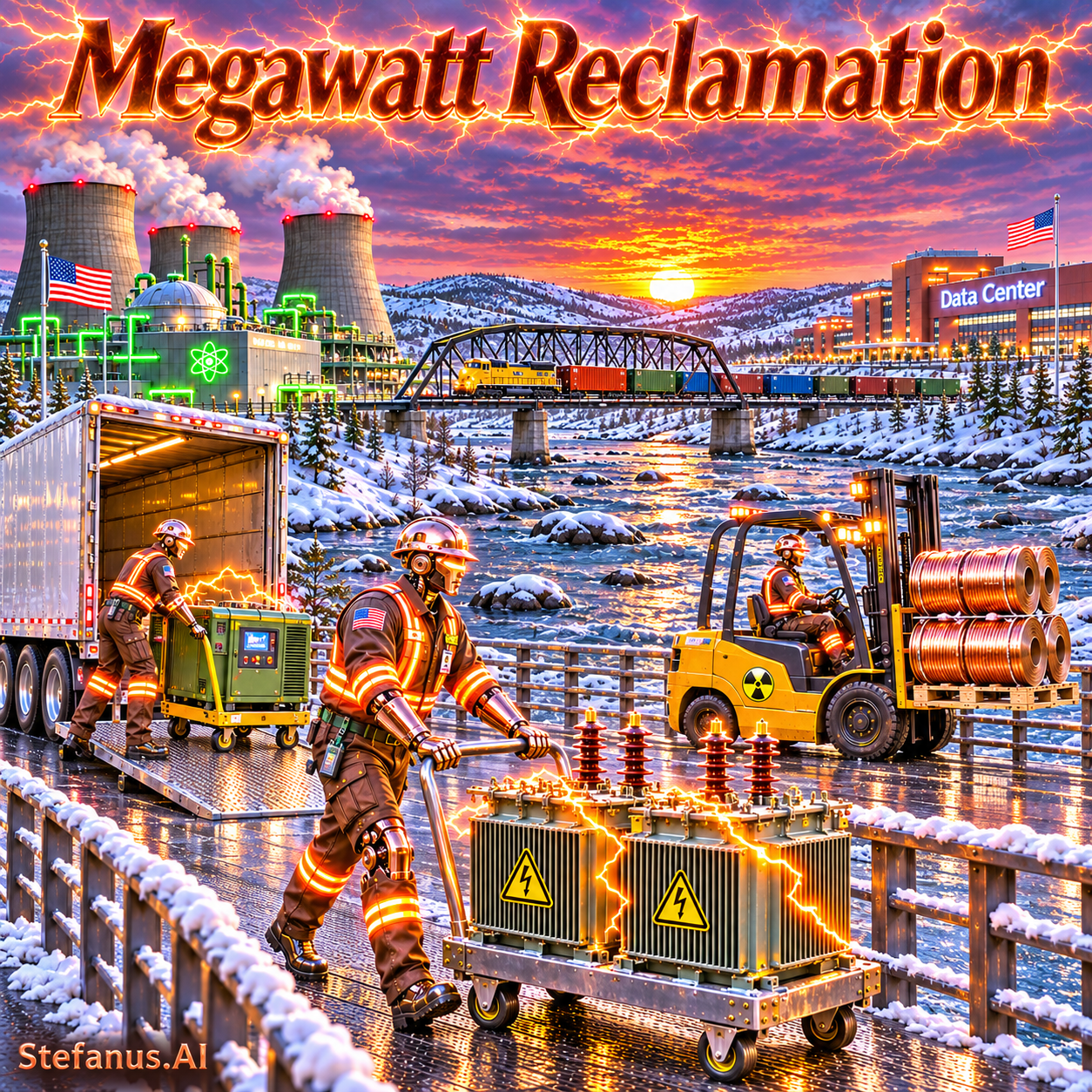

Introduction: The Power Plants America Was Preparing to Leave Behind
On Friday, November 20, 2026, while much of the American technology industry remained preoccupied with semiconductor earnings, artificial intelligence valuations, hyperscaler capital expenditures, and the increasingly competitive commercial landscape surrounding frontier AI models, a comparatively understated announcement from the United States Department of Energy offered a very different perspective on the future of artificial intelligence. The announcement did not concern a new generation of NVIDIA accelerators, the construction of another multibillion-dollar hyperscale datacenter, the release of a more sophisticated reasoning model, or the emergence of autonomous AI agents capable of performing increasingly complex commercial activities; it concerned instead two aging electricity-generation units situated along the Delaware River in southeastern Pennsylvania, each rated at 380 megawatts, each capable of burning natural gas or oil, and each originally scheduled to cease operation permanently on May 31, 2025.[1][2]
On that day the Department issued Emergency Order No. 202-26-52 under Section 202(c) of the Federal Power Act, directing PJM Interconnection, in coordination with Constellation Energy Corporation, to maintain the operational availability of Units 3 and 4 at the Eddystone Generating Station from November 21, 2026 through February 18, 2027, and to employ economic dispatch so that the cost borne by the public would be minimized.[3][2] The Department expressed the operational requirement in language of almost administrative plainness, stating that the order exists to ensure that the two units
“remain available to operate.”
— United States Department of Energy, Order No. 202-26-52 [3]
The November intervention was neither the first nor the second federal action involving Eddystone, because the Department had issued its initial order on May 30, 2025, one day before the planned retirement, and had subsequently renewed that order at ninety-day intervals in August and November of 2025 and in February, May, and August of 2026, which means that the November 2026 order is the seventh consecutive instrument in an unbroken chain that has now kept a plant scheduled for closure in a state of federally mandated readiness for nearly eighteen months.[4][1] In announcing the latest extension, the Secretary of Energy compressed the entire philosophy of the intervention into a single sentence that deserves to be read slowly, because it is in effect a statement about how the value of electricity infrastructure ought to be measured:
“The energy sources that perform when you need them most are the most valuable.”
— Chris Wright, United States Secretary of Energy [2]
What makes Eddystone an unusually instructive anecdote, however, is not merely the persistence of the emergency orders but a quieter transaction that occurred between the fifth and sixth of them. On June 1, 2026, the Federal Energy Regulatory Commission granted Constellation a one-time waiver permitting the company to transfer 760 megawatts of capacity interconnection rights away from the two Eddystone units and across Pennsylvania to the Crane Clean Energy Center, the renamed Three Mile Island Unit 1, whose restart is supported by a twenty-year power purchase agreement with Microsoft and whose full deliverability to the grid would otherwise have depended upon transmission upgrades that PJM’s own studies suggested might not be completed until December 2030.[5][6][7] In other words, the grid rights of a fossil-fueled plant that the market had judged to be obsolete were reclaimed in order to accelerate the return of a nuclear reactor that the market had also judged to be obsolete, and both judgments were being reversed within the same eighteen-month period by the same underlying force, which is the arrival of very large, very fast, and very uncertain industrial demand for electricity. The Eddystone units, stripped of their capacity rights and reclassified in effect as energy resources that are not treated as capacity resources under the terms of the latest order, continue to stand by under federal instruction, while the megawatts of grid access that they once held are being redeployed to serve one of the largest technology companies in the world.[8][6]
The economic implications of this sequence of events extend well beyond the immediate question of whether two aging generating units should remain available during a particular winter season. Eddystone illustrates the growing tension between an electricity system that was designed around historically anticipated demand and an emerging industrial economy whose future electricity requirements are becoming increasingly difficult to forecast, and it demonstrates that an electricity-generation facility which might have been considered commercially unnecessary several years earlier can suddenly acquire strategic importance when regional electricity demand rises, when new generating projects experience construction delays, when transmission infrastructure becomes constrained, or when reserve capacity falls below anticipated reliability requirements. The Department of Energy’s intervention does not establish that artificial intelligence alone caused the Eddystone emergency, because regional electricity reliability reflects numerous interconnected factors that include weather conditions, generation retirements, transmission limitations, industrial demand, fuel availability, and broader economic activity; nevertheless, the emergence of artificial intelligence as a major industrial electricity consumer provides an increasingly important context within which every such generation-retention decision must now be evaluated.
The American economy is therefore confronting a technological paradox of considerable historical interest. Some of the world’s most sophisticated artificial intelligence systems, operating upon advanced semiconductors manufactured through extraordinarily complex industrial processes, may increasingly depend upon electricity infrastructure that was constructed decades before modern artificial intelligence became commercially viable, and the future of digital intelligence could, at least in part, depend upon the continued usefulness of America’s industrial past. Fatih Birol, the Executive Director of the International Energy Agency, has reduced this dependence to a formulation that has become something close to an axiom of the field:
“There is no AI without energy.”
— Fatih Birol, Executive Director, International Energy Agency [9]
Why I Choose the Title “Megawatt Reclamation”
I choose the terminology Megawatt Reclamation because it captures a structural transformation that is occurring within the relationship between electricity-generation infrastructure and the emerging artificial intelligence economy. The word megawatt represents considerably more than a conventional unit of electrical power, because within the Five-Layer AI Economy it represents an indispensable industrial input that determines whether advanced semiconductors, hyperscale datacenters, frontier artificial intelligence models, and autonomous agentic systems can operate at commercially meaningful scale; the word reclamation, for its part, describes the strategic preservation, recovery, and economic revaluation of electricity-generation capacity that might otherwise disappear from the nation’s industrial infrastructure. Together, these two words provide a conceptual framework for understanding why assets previously approaching economic obsolescence could acquire renewed importance as artificial intelligence transforms the magnitude, the geography, and the timing of electricity demand.
I also choose this title because Megawatt Reclamation extends beyond the conventional discussion of reopening nuclear reactors or postponing the retirement of fossil-fueled generating facilities, and introduces a broader economic proposition, namely that the strategic value of an existing power plant may reside not only in the electricity it currently generates but also in its ability to deliver electricity when future industrial demand exceeds available supply. A generating facility that operates infrequently may nevertheless possess substantial economic value if its continued availability helps prevent electricity shortages, reduces infrastructure-development risks, or provides sufficient time for cleaner and more efficient replacement capacity to enter commercial operation. Within this framework, Megawatt Reclamation becomes a forward-looking examination of how governments, utilities, hyperscalers, infrastructure investors, courts, and regional electricity-market operators could collectively reconsider America’s existing energy assets between 2027 and 2030, and of the conditions under which that reconsideration is defensible rather than merely convenient.
Defining Megawatt Reclamation and Its Five Mechanisms
Megawatt Reclamation is the strategic preservation, recovery, and revaluation of electricity-generation capacity previously scheduled for retirement, undertaken in response to emerging industrial demand and disciplined by an explicit comparison with the alternatives that could deliver equivalent reliability. The framework encompasses five interconnected mechanisms, which are summarized in Table 1 and which recur throughout the paper as the organizing vocabulary of the analysis.
Table 1. The Five Mechanisms of Megawatt Reclamation
| Mechanism | Definition | Illustrative case examined in this paper |
| 1. Capacity Preservation | Maintaining the operational availability of generating assets that are approaching retirement | Eddystone Units 3 and 4, Pennsylvania; J.H. Campbell, Michigan |
| 2. Capacity Recovery | Restoring previously shuttered generating facilities where restoration is technically and economically feasible | Crane Clean Energy Center, Pennsylvania; Palisades, Michigan |
| 3. Asset Revaluation | Reassessing infrastructure according to future scarcity, availability, and replacement cost rather than historical depreciation | Transfer of 760 MW of interconnection rights from Eddystone to Crane |
| 4. Industrial Repurposing | Reusing former generation sites and their associated infrastructure for new energy technologies | Former Breed Generating Station, Sullivan County, Indiana |
| 5. Strategic Integration | Connecting preserved and recovered generation with credible future industrial electricity requirements | Long-duration hyperscaler and semiconductor contracts in PJM, MISO, and Arizona |
These mechanisms are related but they are emphatically not interchangeable, since preserving an operating natural gas facility, restarting a shuttered nuclear reactor, and constructing small modular reactors at a former coal-generation site involve fundamentally different engineering, financial, environmental, and regulatory requirements. What connects them is the recognition that previously established electricity infrastructure may possess economic and strategic value that conventional retirement decisions did not fully anticipate, together with the corollary recognition, which this paper treats as equally important, that some of that infrastructure possesses no such value and ought to be retired without delay.
The remainder of the paper proceeds in six sections. Section 1 examines the transformation of American electricity demand, the federal emergency authority through which generation has been retained, and the judicial limits that were placed upon that authority in September 2026. Section 2 maps the emerging geography of reclamation across eight states. Section 3 develops the economics of revaluing generation assets, including a valuation model and an illustrative investment assessment. Section 4 confronts the environmental dilemma and the question of who pays. Section 5 situates reclamation within regional electricity portfolios and within each layer of the Five-Layer AI Economy, and offers scenarios and a roadmap through 2030. Section 6 distills what has been learned into seven fundamental pillars, and the Conclusion returns to Eddystone in order to ask what its seventh emergency order ultimately reveals.

Section 1: Federal Emergency Electricity Authority and the Emergence of Megawatt Reclamation
Any serious account of why retiring power plants are being reclaimed must begin by explaining two developments that arrived almost simultaneously and that would each have been consequential in isolation: the end of a long period in which American electricity demand barely grew, and the decision of the federal government to use a rarely invoked emergency statute as an instrument for preventing the retirement of specific generating units. This section therefore establishes the empirical foundation of the paper by documenting how sharply demand expectations have changed, explains the legal architecture of Section 202(c) of the Federal Power Act, analyzes the September 2026 appellate decision that has materially narrowed the circumstances in which that authority can lawfully be exercised, and then uses Eddystone to develop the central theoretical distinction between electricity that is produced and electricity that is merely, but valuably, available. The purpose is to show that Megawatt Reclamation did not originate as an abstract idea but emerged from an observable mismatch between the pace of industrial demand and the pace at which electricity infrastructure can be planned, financed, permitted, and built.
1.1. The Structural Transformation of American Electricity Demand
For much of the early twenty-first century, the American electricity industry operated within an economic environment characterized by relatively modest aggregate demand growth, steady improvements in energy efficiency, the gradual retirement of aging thermal generating facilities, and the increasing deployment of renewable energy technologies. Electricity providers generally evaluated the retirement of existing generating assets according to anticipated operating costs, maintenance requirements, environmental compliance obligations, expected wholesale electricity prices, and the availability of replacement generation, so that a power plant which could no longer generate sufficient revenue to justify its continued operation would ordinarily become a candidate for retirement without provoking any wider strategic anxiety. William H. Green, the director of the MIT Energy Initiative and the Hoyt C. Hottel Professor of Chemical Engineering at the Massachusetts Institute of Technology, has described the abruptness with which this settled environment was disturbed in terms that capture how little the industry was prepared for it:
“In the past, computing was not a significant user of electricity.”
— William H. Green, Director, MIT Energy Initiative, Massachusetts Institute of Technology [10]
Artificial intelligence has introduced a new variable into that economic calculation, because unlike many previous digital technologies, whose expansion could occur without comparably large increases in physical industrial infrastructure, frontier artificial intelligence depends upon extensive investments in semiconductor manufacturing, electrical distribution, high-density datacenters, cooling systems, networking infrastructure, and continuous computing availability. The International Energy Agency’s 2026 report, Key Questions on Energy and AI, found that electricity consumption by datacenters worldwide rose by roughly seventeen percent during 2025, that the central projection continues to point toward an approximate doubling by 2030, that consumption by datacenters specifically focused on artificial intelligence is expected to triple over the same interval, and that the growth implied by these estimates corresponds to cumulative datacenter investment of approximately 3.9 trillion dollars between 2026 and 2030.[11][9] Applying that growth to the Agency’s earlier estimate of roughly 415 terawatt-hours for 2024 yields consumption on the order of 485 terawatt-hours in 2025 and approximately 950 terawatt-hours in 2030, an increase of some 465 terawatt-hours that slightly exceeds the present annual electricity consumption of Japan.[12][11]

Figure 1. Global datacenter electricity consumption, 2025 estimate and 2030 base-case projection (terawatt-hours). Source: International Energy Agency, Energy and AI (2025) and Key Questions on Energy and AI (2026); the 2030 value is a projection rather than an observation.
The implications for the United States are particularly significant because of the geographical concentration of major hyperscalers, frontier-model developers, semiconductor companies, cloud-computing providers, and emerging artificial intelligence infrastructure projects within its borders. Lawrence Berkeley National Laboratory’s 2024 assessment estimated that American datacenter electricity consumption had increased from 58 terawatt-hours in 2014 to 176 terawatt-hours in 2023, equivalent to roughly 4.4 percent of national consumption, and projected a range of 325 to 580 terawatt-hours by 2028.[13] The Laboratory’s subsequent update, published in June 2026, placed consumption at approximately 192 terawatt-hours in 2024 and advanced a Reference Case of 649 terawatt-hours in 2030, which would represent 11.8 percent of forecast national electricity use, with sensitivity cases ranging from 578 to 664 terawatt-hours depending upon equipment shipments, chip lifetimes, and idle power, and with artificial intelligence servers accounting for more than four-fifths of total server energy use in the Reference Case.[14]

Figure 2. United States datacenter electricity consumption: observed estimates for 2014, 2023, and 2024; alternative scenarios for 2028; and the Reference Case for 2030 (terawatt-hours). Source: Lawrence Berkeley National Laboratory, 2024 Report and 2025 Update (published June 2026). Values for 2028 and 2030 are scenarios, not observations.
The institutions responsible for reliability have responded to these projections with a degree of alarm that is itself a datum worth recording. The North American Electric Reliability Corporation’s Long-Term Reliability Assessment, released in January 2026, projected that summer peak demand across North America could rise by approximately 224 gigawatts over the coming decade, a figure some sixty-nine percent higher than the growth anticipated in the preceding assessment, and it classified PJM and the Texas interconnection as facing elevated risk through 2028 and high risk from 2029 onward, while placing the Midcontinent region in the high-risk category beginning in 2028.[15][16] John Moura, who directs reliability assessment at the Corporation, was careful to explain what the assessment does and does not claim:
“not a prediction of failure but an early warning on the trajectory of risk”
— John Moura, Director of Reliability Assessment and Performance Analysis, NERC [16]
That caution is warranted, because the projections are contested by serious analysts. The consulting firm Grid Strategies argued in March 2026 that the Corporation’s assessment overstates the risk by combining a high demand forecast, including roughly ninety gigawatts of additional datacenter load by 2030, with conservative assumptions about new generation and interregional transfers.[17] Shon R. Hiatt, who directs the Zage Business of Energy Initiative at the University of Southern California’s Marshall School of Business, has nonetheless conveyed the order of magnitude that planners are attempting to absorb by observing that datacenters already under construction could require more than seventy-five gigawatts within roughly two and a half years, which is approximately the electrical load of Texas:
“It’s almost as if we have to create another state.”
— Shon R. Hiatt, Associate Professor and Director, Zage Business of Energy Initiative, University of Southern California [18]
These projections do not guarantee that every announced hyperscale datacenter will be constructed, that every contracted semiconductor will be installed, or that every projected electricity requirement will materialize, and a substantial portion of this paper is devoted to the consequences of that uncertainty. They do, however, establish a substantially different environment for electricity infrastructure planning, in which the retirement decisions of the past, which were often based upon expectations of relatively predictable consumption, must give way to retirement decisions that account for the possibility that entirely new industrial demand could emerge faster than conventional electricity-generation infrastructure can be developed. Megawatt Reclamation arises from this fundamental mismatch between the speed of demand and the speed of supply.
1.2. Section 202(c) of the Federal Power Act
The legal foundation for the Department of Energy’s intervention at Eddystone originates in Section 202(c) of the Federal Power Act, codified at 16 U.S.C. § 824a(c), a provision whose origins lie in the wartime and Depression-era concern that the interconnected electricity system might be unable to respond to sudden disturbances without federal direction. The provision authorizes the Secretary of Energy, during the continuance of a war or whenever the Secretary determines that an emergency exists by reason of a sudden increase in the demand for electric energy, a shortage of electric energy or of generating facilities, a shortage of fuel or water, or other causes, to require by order the temporary connection of facilities and the generation, delivery, interchange, or transmission of electric energy.[19][20] The governing objective is expressed in the statute itself, which permits such measures as, in the Secretary’s judgment,
“will best meet the emergency and serve the public interest.”
— 16 U.S.C. § 824a(c), Federal Power Act [19]
The significance of this authority is that it allows federal intervention when ordinary electricity-market arrangements, existing generating resources, and regional operational mechanisms are insufficient to address an identified emergency, and historically it was used sparingly and for short durations, typically to permit generators to exceed environmental limits during a hurricane, a heat wave, or a severe cold snap. Since May 2025 its use has changed in both frequency and character, since industry tabulations counted more than forty orders issued by April 2026 and at least 4.4 gigawatts of coal capacity whose retirement had been deferred, in addition to the Eddystone units.[21] Section 202(c) is nevertheless fundamentally an emergency instrument rather than a general industrial-development subsidy; its existence does not mean that hyperscalers possess an automatic entitlement to electricity generated by facilities otherwise scheduled for retirement, nor does it mean that commercial artificial intelligence demand automatically constitutes a statutory electricity emergency. Within the Megawatt Reclamation framework, the provision is therefore best understood as a mechanism capable of temporarily preserving generating capacity while broader electricity-system arrangements are evaluated, creating an opportunity to prevent the irreversible disappearance of potentially important resources during periods of uncertainty, without ever becoming a permanent substitute for generation procurement, transmission planning, competitive electricity markets, appropriate environmental regulation, or long-term infrastructure investment.
1.3. The Judicial Boundary: Michigan v. Department of Energy
The proposition that Section 202(c) cannot serve as a standing instrument of resource planning ceased to be merely an analytical preference on September 11, 2026, when a unanimous panel of the United States Court of Appeals for the District of Columbia Circuit vacated the Department’s first order concerning the 1,420-megawatt J.H. Campbell coal plant in West Olive, Michigan. The Department had issued that order on May 23, 2025, eight days before the plant’s state-approved retirement date, relying principally upon concerns about summer capacity in the Midcontinent region, and the court concluded that the Department had exceeded its statutory authority because an emergency within the meaning of the provision denotes a reliability risk that calls for immediate action rather than a longer-term concern about resource adequacy, and because the statute does not empower the Department to override a state-approved retirement plan on the ground that it disagrees with the planning judgment embodied in that plan.[22][23][24] Writing for the court, Judge Cornelia Pillard explained that the panel’s reading of the statute’s text, structure, and history left it
“unpersuaded by DOE’s sweeping conception of its ‘emergency’ authority.”
— Judge Cornelia T.L. Pillard, United States Court of Appeals for the D.C. Circuit [22]
The decision is narrower than some of its early celebrants suggested, because it vacated only the first Campbell order, did not address the order then in effect, and did not eliminate the Department’s authority to act when a genuine short-term emergency can be demonstrated on the record.[24] Its practical consequence was tested within nine weeks, when the Department issued a seventh consecutive Campbell order, No. 202-26-51, on November 13, 2026, effective from November 15 through February 12, 2027, on the ground that dispatchable coal generation remained necessary to prevent winter shortfalls across the region.[25] Michigan’s Attorney General, who had announced after the sixth order that the pattern of renewals revealed an intention on the Department’s part to use the statute
“to force an aging, obsolete plant to operate indefinitely,”
— Dana Nessel, Attorney General of Michigan [26]
has indicated that the state will seek rehearing of the seventh order as well, pointing to costs that Consumers Energy has reported at approximately 295 million dollars between May 2025 and June 30, 2026, which the utility is seeking to recover from customers across the northern and central portions of the Midcontinent region, and to an original retirement plan that had been expected to save Michigan ratepayers nearly 600 million dollars.[27][25] For the purposes of this paper, the importance of Michigan v. Department of Energy is conceptual as much as legal, because the court has in effect drawn the line that the Megawatt Reclamation framework requires: emergency authority may bridge a demonstrable and immediate reliability gap, but the sustained preservation of generating capacity in anticipation of industrial demand growth must be justified through planning processes, markets, contracts, and state regulatory proceedings in which costs, benefits, and alternatives are examined openly.
1.4. Eddystone and the Economics of Operational Availability
The November 2026 Eddystone order provides a particularly useful illustration of the distinction between electricity production and electricity availability, a distinction upon which much of the subsequent argument depends. A generating facility does not necessarily need to operate continuously in order to contribute to regional electricity reliability, because its economic significance may instead arise from its ability to produce electricity during periods when other generating resources are unavailable or insufficient, and this possibility becomes particularly important in an electricity system confronting uncertain demand from very large industrial customers. Consider a regional electricity-market operator that anticipates significant demand growth from multiple hyperscale datacenters between 2027 and 2030 without being able to determine the precise commencement dates of those facilities, and that simultaneously expects several existing generating facilities to retire before new generation and transmission infrastructure becomes commercially operational; such a system could encounter a transitional period during which preserving an existing generating facility becomes considerably more valuable than its historical annual operating revenue would suggest.
The circumstances of PJM in 2026 correspond closely to this stylized description. The Base Residual Auction for the 2028/2029 delivery year, whose results were announced on July 14, 2026, cleared at the administratively determined price cap of 325 dollars per megawatt-day across the entire footprint, procured 138,318 megawatts, and nevertheless fell 6,831 megawatts short of the reliability requirement, a wider shortfall than in the preceding auction, while PJM’s own simulation indicated that the auction would have cleared at approximately 555 dollars per megawatt-day, some seventy-one percent higher, had the cap not been in place.[28][29] The cleared price is more than eleven times the 28.92 dollars per megawatt-day at which capacity for the 2024/2025 delivery year had been procured, and analysts drawing upon the independent market monitor’s work have attributed roughly thirty-eight percent of the auction’s 16.4 billion dollar cost to datacenter load.[29][30]

Figure 3. PJM Base Residual Auction clearing prices for the RTO, delivery years 2024/2025 through 2028/2029 (dollars per megawatt-day), with PJM’s simulated uncapped price for 2028/2029. Sources: PJM auction results as summarized by Modo Energy and Enel North America (2026).
Under such conditions, an aging power plant may function as a form of industrial insurance, in the sense that its continued availability reduces the probability that unexpected demand growth, extreme weather, equipment failures, fuel disruptions, or construction delays will produce an electricity shortage, and its economic value must consequently be evaluated not only according to how much electricity it sells but also according to the potentially costly events that its availability helps to prevent. This represents one of the most important theoretical contributions of Megawatt Reclamation, and it is also the contribution most vulnerable to abuse, because insurance that is never priced, never compared with alternative forms of protection, and never allowed to lapse is not insurance at all but an open-ended subsidy; the analysis in Section 3 is designed to distinguish between the two.
1.5. The Expansion of Federal Generation-Retention Measures and Their Cost
The Eddystone intervention is part of a broader series of federal electricity-reliability actions whose scale has now become large enough to be examined systematically. In addition to Eddystone and Campbell, emergency orders during 2025 and 2026 have reached the F.B. Culley and R.M. Schahfer coal units in Indiana, the Centralia unit in Washington State, and the Craig unit in Colorado, and a tracker maintained by the Environmental Defense Fund counted six plants, nine units, and twenty-four consecutive ninety-day orders by late 2026, with costs to ratepayers that it estimated at approximately 593 million dollars.[31][32] Earlier independent analysis by Grid Strategies had estimated that the annual cost could exceed three billion dollars if comparable orders were extended to every large fossil-fueled plant scheduled to retire before the end of 2028.[33] The Department, for its part, has pointed to operational evidence that the retained units have been useful, noting for example that the two Schahfer units ran at more than 285 megawatts each day during the severe cold of Winter Storm Fern in late January 2026, although critics respond that several of the retained plants have also suffered extended mechanical outages during the very periods for which their availability was ordered.[34][32]
Table 2. Selected generation-retention, recovery, and redevelopment initiatives as of November 2026
| Facility | State | Market | Intervention or strategy | Status in November 2026 |
| Eddystone Units 3 and 4 (760 MW, gas/oil) | Pennsylvania | PJM | Emergency retention under Section 202(c) | Seventh order in effect through February 18, 2027; capacity rights transferred to Crane |
| J.H. Campbell (1,420 MW, coal) | Michigan | MISO | Emergency retention under Section 202(c) | First order vacated by D.C. Circuit; seventh order in effect through February 12, 2027 |
| F.B. Culley Unit 2 and R.M. Schahfer Units 17–18 (coal) | Indiana | MISO | Emergency retention under Section 202(c) | Successive ninety-day orders since December 2025 |
| Crane Clean Energy Center (835 MW, nuclear) | Pennsylvania | PJM | Nuclear restart backed by Microsoft PPA | Restart targeted for second half of 2027 |
| Palisades (about 800 MW, nuclear) | Michigan | MISO | Nuclear restart backed by federal loan | Fuel loaded; not yet generating; schedule delayed |
| Former Breed Generating Station site (960 MW proposed) | Indiana | PJM (AEP zone) | Advanced nuclear redevelopment with Amazon | Feasibility evaluation announced October 19, 2026 |
The expanding number of generation-retention and recovery initiatives suggests that electricity infrastructure previously expected to disappear from America’s generating portfolio deserves a more systematic economic evaluation than a sequence of ninety-day orders can provide. These developments must not, however, be treated as equivalent, because emergency retention is a short-term reliability measure whose costs are recovered administratively, whereas restarting a nuclear facility or developing a new reactor at a former coal site involves long-duration private investment, distinct regulatory approval processes, and commercial counterparties who have voluntarily accepted the associated risk.
1.6. From Emergency Intervention to Strategic Infrastructure Planning
Between 2027 and 2030, federal policymakers, state governments, electricity-market operators, and hyperscalers will need to develop more systematic arrangements for determining when aging electricity-generation assets should be preserved, and the D.C. Circuit’s decision makes the development of such arrangements a matter of legal necessity as well as of sound economics. A well-designed policy framework would distinguish among generating facilities that are immediately necessary for regional reliability, facilities that could economically support transitional industrial demand, facilities suitable for technological modernization, and facilities whose continued operation would impose unacceptable economic or environmental costs. Without such distinctions, repeated emergency interventions could create several undesirable outcomes at once: electricity consumers might become responsible for maintaining expensive facilities long after their economic usefulness has diminished; utility companies might have weaker incentives to develop replacement generation; hyperscalers might obtain electricity-system benefits without assuming an appropriate share of the associated infrastructure costs; and communities might experience prolonged exposure to air pollution and other environmental impacts.
Conversely, retiring generating assets prematurely could increase electricity scarcity, elevate capacity-market costs that are already at record levels, delay industrial investment, and create even greater dependence upon emergency interventions in subsequent years. The appropriate objective is consequently neither unrestricted generation retention nor unconditional retirement, but the preservation of those electricity resources whose continued availability creates demonstrable public and economic value, coupled with the establishment of clear pathways toward cleaner, more efficient, and appropriately financed replacement infrastructure.

Section 2: America’s Emerging Geography of Megawatt Reclamation
The reclamation of megawatts is not occurring uniformly across the United States, and it could not do so, because the country’s electricity system is in reality a collection of regional systems that differ in their market designs, their regulatory institutions, their inherited generating fleets, and their exposure to artificial intelligence demand. A restructured state within an organized capacity market, a vertically integrated state with a powerful public utility commission, and an energy-only market that sits largely outside federal jurisdiction will each encounter the same underlying pressure and will each respond to it through different instruments. This section therefore travels through eight states in order to show how preservation, recovery, and redevelopment are taking concrete institutional form, beginning with the three states of Pennsylvania, Michigan, and Indiana in which the three pathways can be observed most clearly, and continuing through Texas, Arizona, Virginia, Ohio, and California, where the more instructive lessons concern the contractual, financial, and demand-side arrangements that determine whether reclaimed megawatts are in fact needed.
2.1. Pennsylvania: Where Legacy Electricity Infrastructure Meets the Future of Artificial Intelligence
Pennsylvania occupies a particularly important position within the emerging geography of Megawatt Reclamation, because the state’s industrial history encompasses coal mining, steel manufacturing, natural gas production, nuclear electricity generation, and extensive investment in electricity transmission infrastructure, and these historical developments have created an industrial foundation that is acquiring renewed strategic importance as hyperscalers evaluate potential locations for artificial intelligence infrastructure. The Eddystone Generating Station illustrates the preservation dimension of Megawatt Reclamation, while the proposed restart of the former Three Mile Island Unit 1 illustrates its recovery dimension, and, as the Introduction observed, the two are now connected not merely by ownership and geography but by the regulatory transfer of interconnection rights from the one to the other.
On September 20, 2024, Constellation Energy announced a twenty-year power purchase agreement with Microsoft intended to support the restart of the reactor, which the company renamed the Crane Clean Energy Center and which it estimated would restore approximately 835 megawatts of carbon-free generating capacity to the regional electricity system.[35] The company’s disclosures during 2026 describe steady progress: the Department of Energy approved a one-billion-dollar loan guarantee for the project, the Nuclear Regulatory Commission issued a favorable environmental assessment, the first fuel assemblies and the main transformers have arrived on site, and management told investors on its third-quarter call in November 2026 that the restart remains on track for the second half of 2027, which would be ahead of the schedule originally announced.[36][37] In the same quarter Constellation reported adjusted operating earnings of 5.06 dollars per share, raised its full-year guidance to a range of 12.50 to 12.80 dollars per share, and disclosed agreements with three customers covering 4,560 megawatts, of which 1,165 megawatts represent new nuclear capacity to be created through uprates at existing reactors at an anticipated cost of approximately 4.3 billion dollars.[36][37] Joseph Dominguez, the company’s president and chief executive officer, had characterized the strategic logic of these commitments a quarter earlier in language that is essentially a corporate statement of the reclamation thesis:
“we’re strengthening the nation’s energy infrastructure and helping meet growing demand for reliable power.”
— Joseph Dominguez, President and Chief Executive Officer, Constellation Energy [38]
The significance of Microsoft’s involvement is that it demonstrates how an artificial intelligence and cloud-computing company can alter the investment economics of an existing electricity-generation facility, since a nuclear reactor that was retired in 2019 for economic reasons has become commercially viable under a substantially different contractual structure and industrial-demand environment. Within the Megawatt Reclamation framework, the generating asset itself has not undergone any fundamental transformation in its original technological purpose; what has changed is the economic environment surrounding its electricity production, in which long-duration corporate commitments provide a degree of revenue predictability sufficient to justify the expenditures associated with restoring generating capacity. The project’s contribution nevertheless remains prospective until all remaining technical, safety, regulatory, and commercial requirements have been satisfied, and the transfer of interconnection rights from Eddystone, which the Commission granted over the objection of PJM’s independent market monitor, illustrates that even a well-financed recovery project can be constrained less by the reactor than by the wires.[5] Pennsylvania consequently offers a particularly compelling comparison between two different reclamation strategies, one of which preserves generating capacity temporarily by administrative order in order to address reliability, and the other of which seeks to restore generating capacity through voluntary long-duration commercial commitments, and together they suggest that future American energy policy will increasingly incorporate the economic recovery of existing electricity infrastructure alongside conventional new-build generation strategies.
2.2. Michigan: Nuclear Recovery, Coal Retention, and the Challenges of Industrial Transition
Michigan presents another particularly important example of the emerging Megawatt Reclamation economy, and it is the example in which the difficulties of reclamation are most visible. The state possesses a substantial industrial history associated with automobile manufacturing, advanced manufacturing, electricity generation, engineering expertise, and industrial supply chains, and as artificial intelligence becomes increasingly integrated into manufacturing, robotics, autonomous vehicles, and industrial applications, Michigan’s energy infrastructure could become an increasingly important component of its future economic competitiveness. The proposed restart of the Palisades Nuclear Power Plant, located on the shore of Lake Michigan in Covert Township and possessing approximately 800 megawatts of generating capacity, has emerged as the country’s first attempt to return a reactor to service after it had formally entered decommissioning, its original commercial operations having ceased in 2022 before its sale to Holtec International.[39][40]
The Palisades initiative differs fundamentally from constructing an entirely new nuclear-generating facility, because although restoring a previously retired reactor requires extensive inspections, equipment refurbishment, regulatory approvals, personnel preparation, and significant investment, the project begins with an established industrial site and existing generating infrastructure, and thereby creates the possibility of recovering substantial generating capacity without undertaking every stage associated with a greenfield nuclear development. The experience of 2026 has shown, however, that existing infrastructure does not eliminate the technical and safety complexities of nuclear restoration. Holtec’s registration statement for its proposed initial public offering described the plant as on track to restart during 2026 under the supervision of the Nuclear Regulatory Commission, and the facility has indeed been returned to operating status for regulatory purposes and has had fuel loaded into its reactor; yet a fuel assembly tilted during the loading process, the Secretary of Energy’s expectation in late October that the plant would be running before the end of the year has not been confirmed by the company, and trade reporting in November indicated that the schedule had slipped by approximately a year amid workforce reductions and leadership changes.[39][41][42] Most significantly, a Nuclear Regulatory Commission inspection concluded that a chilled work environment existed within the plant’s quality assurance and supply chain departments, and Holtec was required to submit a corrective plan, which it did on November 19, 2026, proposing independent interviews of workers and a report early in 2027; the plant’s chief nuclear officer acknowledged in that submission that the finding means employees
“may be reluctant to raise safety concerns.”
— Fadi Diya, Chief Nuclear Officer, Holtec Palisades [40]
These developments reinforce a central principle of Megawatt Reclamation, which is that the strategic desirability of recovering generating capacity cannot supersede the technical and regulatory requirements necessary to ensure safe and reliable operation, and that a recovered megawatt has no value whatsoever until the institution charged with protecting the public has been satisfied. Michigan simultaneously illustrates a very different dimension of reclamation through the federal intervention at the J.H. Campbell coal plant, discussed in Section 1, whose continued availability presents difficult questions involving near-term electricity reliability, state environmental commitments, utility costs, and the economic consequences of postponing coal-generation retirement. From an industrial-planning perspective, the simultaneous pursuit of nuclear recovery and compelled coal retention within a single state reveals the complexity of managing electricity-system transitions, since a region may seek to reduce long-term dependence upon fossil-fueled generation while temporarily maintaining existing resources until sufficient replacement capacity becomes available, and the challenge is to ensure that temporary measures remain transitional rather than becoming indefinite substitutes for investment in cleaner and more efficient electricity infrastructure.
2.3. Indiana: From Retired Coal Infrastructure to Advanced Nuclear Investment
Indiana illustrates a third dimension of Megawatt Reclamation, which is the strategic redevelopment of previously utilized electricity-generation sites. On October 19, 2026, American Electric Power announced a joint development agreement with X-energy to evaluate the feasibility of constructing approximately 960 megawatts of advanced nuclear capacity at the site of the former Breed Generating Station in Sullivan County, a coal plant once operated by its subsidiary Indiana Michigan Power, using twelve Xe-100 small modular reactors of eighty megawatts each arranged in groups of four; Amazon is supporting the development work through a funding agreement and has stated its intention to purchase the output under a long-term contract structured to cover the cost of the facility and its operation should the project proceed to a final investment decision.[43][44]
The announcement represents an important variation of the Megawatt Reclamation concept, because unlike the Eddystone intervention the former Breed site is not being maintained in operational readiness, and unlike Palisades and Crane the proposal does not involve returning the original generating technology to service; instead, the industrial site itself becomes a potential foundation for an entirely different generating technology, and its economic value arises from geographical suitability, historical industrial utilization, potentially reusable infrastructure, community familiarity with electricity generation, and the opportunity to connect future generation directly with the regional transmission network. Whether individual components of that infrastructure can in fact be reused requires project-specific engineering and regulatory evaluation, and the project is not yet committed operating capacity in any sense.
Amazon’s involvement also illustrates an important transformation in the role of hyperscalers. Historically, technology companies were predominantly electricity consumers whose relationships with utilities involved obtaining electrical service and, increasingly, procuring renewable electricity through contractual arrangements; the growing magnitude of artificial intelligence electricity demand is now encouraging some of them to become sources of development capital, anchor purchasers, contractual counterparties, and participants in regional industrial planning. American Electric Power’s own third-quarter 2026 disclosures indicate the scale of the demand to which such projects respond, since the company reported that fifteen gigawatts of new load commitments signed during the quarter had raised its incremental contracted load to 84 gigawatts through 2031, of which roughly 35 gigawatts are supported by firm take-or-pay electric service agreements.[45] This transition connects the profitability of frontier artificial intelligence models and cloud-computing services with the financing requirements of electricity-generation projects whose development timelines may extend far beyond the commercial lifecycles of individual models, and Indiana’s importance within this paper lies precisely in demonstrating how a former industrial generating site could become economically relevant to an emerging artificial intelligence infrastructure ecosystem.
2.4. Three Distinct Pathways of Megawatt Reclamation
The three cases examined thus far correspond to three analytically distinct pathways, whose differences are summarized in Table 3 and whose common logic can be expressed as a simple sequence: an existing generation asset or site is identified, its infrastructure is assessed, a decision is taken among preservation, recovery, redevelopment, and retirement, and the outcome is measured by the future industrial electricity availability that results.
Table 3. Preservation, Recovery, and Redevelopment Compared
| Dimension | Preservation | Recovery | Redevelopment |
| Primary objective | Avoid immediate capacity loss | Restore retired capacity | Establish new capacity at legacy sites |
| Illustrative case | Eddystone; Campbell | Crane; Palisades | Former Breed site |
| Investment requirement | Maintenance and operational readiness | Refurbishment and recommissioning | New technology development and construction |
| Regulatory emphasis | Emergency authority, state plans, and electricity markets | Operating licenses and safety approvals | New project licensing and permitting |
| Typical planning horizon | Near term (months to three years) | Medium term (three to five years) | Medium to long term (seven years or more) |
| Who has borne the cost to date | Ratepayers, through administrative cost recovery | Owners, corporate purchasers, and federal lenders | Hyperscaler development funding and utility capital |
| Principal risk | Prolonging inefficient or polluting generation | Technical, safety, and schedule uncertainty | Construction, licensing, and financing uncertainty |
The distinction among these three pathways is indispensable because it prevents Megawatt Reclamation from becoming an overly generalized argument for retaining all historical electricity infrastructure. Some facilities may justify preservation, others may justify recovery, and still others may possess valuable industrial locations while retaining no economically viable generating equipment at all; a rigorous reclamation strategy must evaluate which approach provides the greatest reliability, economic, and environmental benefit relative to the available alternatives, and the row of Table 3 that records who has borne the cost suggests that the pathways also differ profoundly in their distributional consequences.
2.5. Texas: ERCOT, Large-Load Growth, and the Industrial Value of Existing Generation
Texas introduces a different electricity-market structure into the discussion, because the Electric Reliability Council of Texas operates a system characterized by a predominantly energy-only wholesale market design, extensive renewable-energy development, substantial natural gas generation, and rapidly evolving industrial electricity demand, and the state has become an increasingly important location for hyperscale computing infrastructure, semiconductor investment, and artificial intelligence development. The enactment of Senate Bill 6 in 2025 introduced new requirements affecting the integration of large electricity-consuming facilities, and on September 18, 2026 the Public Utility Commission of Texas adopted new large-load interconnection standards as Section 25.194 of Title 16 of the Texas Administrative Code, effective October 8, 2026, which apply to new or expanded interconnections of seventy-five megawatts or more and which require, among other things, specified disclosures, a study fee, and financial security of fifty thousand dollars for each megawatt of requested peak demand.[46] For a one-gigawatt campus this security alone amounts to fifty million dollars, and its evident purpose is to separate projects whose sponsors are prepared to commit capital from the far larger number of speculative requests that have crowded the interconnection process.
These developments are particularly relevant to the Megawatt Reclamation framework because they illustrate how states may increasingly require greater certainty regarding industrial electricity commitments before utilities and electricity-market operators undertake significant infrastructure investments. For Texas, the reclamation question involves determining whether existing dispatchable generating assets should be modernized, contractually retained, or replaced in response to future large-load development, and the market has begun to answer that question through acquisition rather than administrative order: Vistra, which reported ongoing-operations adjusted EBITDA of 2.378 billion dollars for the third quarter of 2026 and which projects that load in the Texas interconnection will grow by four to six percent annually through 2030, completed in October 2026 the purchase of approximately 5,500 megawatts of existing natural gas generation from Cogentrix at a price well below the cost of equivalent new construction.[47] The economic challenge is nevertheless particularly complex in an energy-only market, because electricity infrastructure constructed or retained in anticipation of uncertain demand may become underutilized if planned datacenters are delayed, downsized, relocated, or canceled, and Texas’s future electricity strategy must therefore balance industrial competitiveness with appropriate financial safeguards and reliable grid operation.
2.6. Arizona: Semiconductor Manufacturing and the Competition for Firm Electricity
Arizona demonstrates that the electricity requirements of the AI economy extend substantially beyond hyperscale datacenters, since advanced semiconductor fabrication facilities require reliable electricity, highly controlled operating environments, extensive water-management systems, sophisticated industrial equipment, and continuous manufacturing availability, and the continued expansion of Taiwan Semiconductor Manufacturing Company’s American operations places the state at an important intersection between Layer 1 and Layer 2 of the Five-Layer AI Economy. Arizona Public Service signed a direct pricing contract with TSMC Arizona on October 16, 2026 and submitted it to the Arizona Corporation Commission for approval on November 6, 2026; under the agreement the utility would provide service ramping to approximately 1.88 gigawatts for an initial term of twenty-five years, an amount of electricity comparable to the consumption of roughly three hundred thousand homes, and the semiconductor manufacturer would provide upfront credit support and collateral beginning on January 1, 2027 in order to back the new resources that the utility develops to meet that demand.[48][49]
The proposed agreement illustrates how increasingly large industrial electricity consumers may require specialized long-duration contractual arrangements that are designed to support infrastructure investment while protecting existing electricity customers from the risk that the anticipated load fails to materialize. The reclamation opportunities in Arizona differ from those in Pennsylvania or Michigan, because rather than primarily involving the restart of previously retired nuclear facilities they are more likely to include the modernization of existing generating assets, the repurposing of legacy industrial sites, and the integration of nuclear, natural gas, solar, storage, and transmission infrastructure within a single long-term resource plan. The broader lesson is that America’s semiconductor manufacturing strategy cannot be analytically separated from its electricity-generation strategy, for restoring domestic semiconductor manufacturing capacity while failing to develop sufficient reliable industrial electricity would merely relocate one strategic dependency into another layer of the same economic system.
2.7. Virginia and Ohio: The Financial Consequences of Large-Load Growth
Virginia offers one of the most consequential examples of how geographically concentrated datacenter development can transform regional electricity economics. The Commonwealth’s established datacenter industry has created substantial economic activity, but its expansion has also raised questions involving generation availability, transmission investment, wholesale electricity-market exposure, and residential affordability, and Virginia’s Joint Legislative Audit and Review Commission concluded in its 2024 study that unconstrained datacenter growth could impose materially higher generation-related and transmission-related costs upon other customers.[50] Reuters reported in August 2026 that Dominion Energy’s fuel and purchased-power costs in Virginia had risen by nearly ninety percent over five years as datacenter-driven demand left the utility increasingly exposed to volatile wholesale prices, and in the same month the State Corporation Commission ordered the utility to establish a process for assigning to datacenters the direct costs of their own connection facilities, a decision expected to shift several hundred million dollars of transmission cost away from the general body of customers.[51][52]
Ohio has responded to similar uncertainties through a specialized tariff. In July 2025 the Public Utilities Commission of Ohio approved a datacenter-specific tariff for AEP Ohio under which large new datacenter customers must pay for at least eighty-five percent of the capacity to which they subscribe for up to twelve years, whether or not they use it, and must demonstrate financial viability.[53] The effect upon the utility’s pipeline was dramatic and, for present purposes, highly instructive: by February 12, 2026, a queue that had once exceeded thirty gigawatts of proposed projects had resolved into binding electric service agreements for 5,642 megawatts, in addition to the roughly 12,200 megawatts contracted before the tariff took effect.[54] The Ohio example is significant because it illustrates the importance of distinguishing speculative electricity requests from binding commercial commitments, and because it suggests that a large fraction of the demand upon which the most alarming forecasts rest evaporates when its sponsors are asked to post collateral. Megawatt Reclamation should therefore never be predicated upon the assumption that every proposed hyperscale development will become operational; the economic justification for retaining existing generating capacity must be connected to credible electricity forecasts, contractual commitments, realistic construction schedules, and appropriately allocated financial responsibilities.
2.8. California and the Innovation of Demand-Side Electricity Management
California represents another important dimension of the Five-Layer AI Economy, because the state is home to numerous major artificial intelligence developers, semiconductor designers, robotics companies, technology investors, and cloud-computing businesses, and its industrial electricity challenges have intersected with ambitious decarbonization objectives, persistent concerns about affordability, the integration of very large quantities of renewable energy, and grid reliability. California’s experience is particularly relevant because it demonstrates that Megawatt Reclamation need not always involve increasing the availability of traditional thermal generation; the preservation of reliable electricity availability may equally involve maintaining existing low-carbon generation, expanding energy storage, reducing peak industrial demand, enlarging transmission capability, and improving the flexibility of electricity-intensive workloads.
The research community within the state has been especially active on the last of these possibilities. Ram Rajagopal, who directs the Bits and Watts Initiative at Stanford University and whose group studies grid-aware systems that distribute computing loads in coordination with local electricity supply, has summarized what his research implies for the supposedly fixed capacity of the existing network in a remark that is in effect the demand-side counterpart of the reclamation thesis:
“The grid can hold a lot more than we thought.”
— Ram Rajagopal, Associate Professor of Civil and Environmental Engineering, Stanford University [55]
His Stanford colleague Sally Benson has cautioned in the same context that integrating very large loads at very high speed is invariably difficult, and Severin Borenstein of the University of California, Berkeley, whose work is discussed in Section 4, has shown that the consequences for other customers depend heavily upon how the associated costs are recovered.[55][56] California’s significance within this framework is therefore not limited to its generation portfolio, since its concentration of companies developing models, semiconductor architectures, cloud infrastructure, and intelligent applications creates an opportunity to investigate whether technological innovation at Layers 2 through 5 can relieve some of the infrastructure pressure experienced at Layer 1, with more efficient accelerators, improved model architectures, geographically distributed inference, and flexible computing schedules complementing the preservation and recovery of existing generating capacity.
2.9. The Emerging Regional Geography of the AI Energy Economy
Table 4. State-level strategic emphasis and potential contribution to Megawatt Reclamation
| State | Strategic industrial emphasis | Potential Megawatt Reclamation contribution |
| Pennsylvania | Nuclear recovery and existing gas generation within PJM | Retention, restart, and transfer of interconnection rights |
| Michigan | Manufacturing and nuclear revival within MISO | Low-carbon recovery, with contested transitional coal retention |
| Indiana | Advanced nuclear at former industrial sites | Industrial redevelopment financed by a hyperscaler |
| Texas | Hyperscale infrastructure within an energy-only market | Acquisition and modernization of dispatchable capacity; financial security for large loads |
| Arizona | Advanced semiconductor fabrication | Long-duration, collateralized industrial energy contracts |
| Ohio | Datacenter growth under a specialized tariff | Contractually verified demand as the basis for infrastructure planning |
| Virginia | The world’s largest concentration of hyperscale computing | Regional adequacy and direct assignment of connection costs |
| California | AI innovation and electricity decarbonization | Preservation of low-carbon generation and demand flexibility |
The emerging geography of artificial intelligence increasingly reflects a combination of industrial capabilities, electricity availability, political and regulatory institutions, environmental conditions, and existing infrastructure, and between 2027 and 2030 the ability of individual states to manage these interconnected variables could become as important to industrial competitiveness as traditional tax incentives and corporate-development programs. The states that will fare best are unlikely to be those that retain the greatest number of old power plants; they are more likely to be those that develop the institutional capacity to determine, quickly and credibly, which megawatts are worth reclaiming and who ought to pay for them.

Section 3: The Economics of Megawatt Reclamation — Revaluing Electricity-Generation Assets in an Era of Artificial Intelligence
Having established where reclamation is occurring and through which legal and commercial instruments, the paper now turns to the question that ought logically to precede every such decision, namely how the value of an existing generating asset should be measured when the demand it might serve is large, fast-moving, and uncertain. Conventional power-plant economics asks how much energy a facility will sell and at what margin; the economics of reclamation asks, in addition, what the facility’s availability is worth during the limited number of hours in which the system is scarce, what it would cost and how long it would take to replace that availability by other means, and what option value is destroyed when the facility is dismantled. This section develops these ideas in sequence, proposes a formal valuation expression, works through an illustrative investment assessment whose result is deliberately unflattering to reclamation, and concludes by examining the role of time and of hyperscaler capital.
3.1. From Electricity Production to Electricity Availability
One of the most important intellectual propositions of Megawatt Reclamation is that electricity-generation assets possess several distinct categories of economic value. Conventional discussions of power-generation economics emphasize the quantity of electricity produced, the cost of producing it, and the revenues generated through its sale, and these considerations remain indispensable; they do not, however, fully capture the economic significance of an existing generating asset within an electricity system that is confronting rapidly growing and uncertain industrial demand. A power plant may possess substantial value because it can deliver electricity during a relatively small number of critical hours, and its availability during those hours may reduce the likelihood of shortages, alleviate pressure upon regional capacity markets, or provide additional flexibility when other generating resources experience unexpected outages.
This distinction can be understood through two fundamental electricity-market concepts. Capacity, generally measured in megawatts, represents the rate at which a resource can produce power, whereas energy, generally measured in megawatt-hours, represents the amount of electricity produced or consumed over a defined period, and a generating resource may possess substantial capacity while producing relatively little annual energy. Figure 4 illustrates the point with a hypothetical 500-megawatt facility whose theoretical maximum annual production is 4.38 terawatt-hours: at a five percent annual capacity factor it produces 219 gigawatt-hours, at twenty percent it produces 876 gigawatt-hours, at fifty percent 2,190 gigawatt-hours, and at ninety percent 3,942 gigawatt-hours, and yet in every one of these cases its nameplate capacity remains exactly 500 megawatts.

Figure 4. Capacity versus energy: annual production of an illustrative 500 MW facility at alternative capacity factors (gigawatt-hours). Nameplate capacity is identical in every case; dependable capacity depends on availability, fuel security, equipment condition, and regional accreditation.
The economic significance of an electricity-generation facility cannot therefore be determined exclusively through its annual capacity factor, since a low-utilization resource might still provide valuable reliability services if it can deliver electricity during periods of system scarcity. The converse is equally true and equally important, because a facility possessing considerable nameplate capacity might contribute very little dependable reliability value if it suffers from frequent outages, fuel limitations, environmental restrictions, or transmission constraints, and the record of mechanical failures at some of the coal units retained under emergency orders is a reminder that age is not an advantage in this respect.[32] Megawatt Reclamation must consequently focus upon capacity that is demonstrably available and deliverable rather than upon capacity that is merely nominal, which is why modern capacity markets accredit resources according to their expected contribution during the hours of greatest risk rather than according to the figure stamped upon the generator.
3.2. The Economics of Avoided Industrial Disruption
The economic consequences of electricity shortages extend substantially beyond the financial losses experienced by electricity providers, and in the artificial intelligence economy they have become very large in relation to the cost of the electricity itself. Company filings compiled after the third-quarter 2026 reporting season indicate that Amazon, Alphabet, Microsoft, and Meta together recorded capital expenditures on the order of two hundred billion dollars in that single quarter, roughly double the level of a year earlier, and that their guidance for calendar 2026 sums to approximately 720 to 740 billion dollars, with Amazon expecting about 220 billion dollars, Alphabet 195 to 205 billion dollars, Microsoft about 170 billion dollars, and Meta 135 to 145 billion dollars.[57][58] Microsoft’s figure is itself revealing, since the company’s capital spending for the quarter came in below expectations because deliveries of third-party capacity that it had anticipated were delayed into the first half of 2027, which is to say that even the largest purchasers of computing infrastructure are now constrained by the physical availability of powered facilities rather than by their willingness to spend.[59]
Figure 5. Hyperscaler capital expenditures: third-quarter 2026 reported spending and calendar-2026 guidance (billions of dollars; guidance ranges shown at midpoint). Source: company filings as compiled by hyperscalerscapex.com and Walnut (November 2026). Definitions of capital expenditure differ across companies.
An artificial intelligence company that has invested substantial capital in accelerators, networking equipment, storage infrastructure, cooling systems, and long-duration datacenter leases will find that some portion of that capital remains commercially unproductive if sufficient electricity is unavailable, and the economic consequences propagate throughout the Five-Layer AI Economy: at Layer 2, advanced semiconductors may remain uninstalled or underutilized while they depreciate; at Layer 3, newly constructed facilities may fail to achieve anticipated utilization; at Layer 4, model-development programs may experience delays or increased computational costs; and at Layer 5, applications and autonomous agentic systems may encounter higher service prices, delayed commercial deployment, or reduced availability. Jesse Jenkins of Princeton University, whose laboratory has modeled the integration of very large loads, has offered an image that conveys why the timing of supply matters so much when a gigawatt-scale campus is energized:
“it’s like connecting a whole new city.”
— Jesse D. Jenkins, Associate Professor, Princeton University [60]
His accompanying argument is that when demand of this magnitude is added without an equivalent addition of supply that the new customer has paid for, prices for everyone else rise by the ordinary operation of supply and demand.[60] The value of preserving generating capacity must therefore include an assessment of the industrial disruption that its availability could help to prevent, but those benefits must also be assessed against the cost of retention and compared with the benefits obtainable through alternative reliability measures. The appropriate economic question is not whether the existing power plant is old; it is whether its continued availability represents the most economically and environmentally defensible method of addressing a credible electricity-system requirement, and whether the party whose capital would otherwise be stranded is the party that pays for the protection.
3.3. The Revaluation of Legacy Industrial Capital
Megawatt Reclamation introduces the possibility that industrial assets previously approaching the end of their commercial lifecycles could experience a significant reassessment of their economic value, and this reassessment can arise from changes in at least five underlying variables. The first is the increasing replacement cost of generation infrastructure, since constructing a new facility requires capital, engineering expertise, construction labor, specialized equipment, fuel arrangements, environmental evaluation, transmission studies, and regulatory approvals, all of which have become scarcer and more expensive. The second is the increasing importance of infrastructure timing, because even a newly constructed facility with superior long-term operating economics may not become available quickly enough to address an emerging regional requirement. The third is the value of established infrastructure, in that existing generating sites possess electrical connections, industrial land, roads, water-management systems, and other characteristics that reduce development barriers; the transfer of Eddystone’s interconnection rights to Crane is the clearest available demonstration that such attributes can be worth more than the generating equipment to which they were originally attached. The fourth is the appearance of new commercial counterparties, since hyperscalers and other large industrial consumers possess both the financial capacity and the contractual incentive to support investments that would otherwise be commercially unattractive. The fifth is the growing economic significance of reliable electricity availability across the broader digital economy.
The language of real options is helpful in interpreting these variables. A decision to retire and dismantle a power plant is an irreversible decision taken under uncertainty, and the literature on investment under uncertainty has long established that irreversibility confers value upon waiting, so that when the future trajectory of demand is unusually uncertain, the option to defer an irreversible retirement for a limited period can be worth more than the carrying cost of the idle asset. The same logic, however, cuts in the opposite direction with equal force, because committing ratepayers to a long-lived new asset on the strength of an uncertain forecast is also an irreversible decision, and a short, terminable retention arrangement may be attractive precisely because it defers that commitment as well. These variables demonstrate why historical depreciation alone cannot determine the prospective strategic value of a generation facility, since a plant may be substantially depreciated for accounting purposes while retaining considerable physical, geographical, contractual, or industrial usefulness, and an asset with substantial remaining book value may conversely possess little strategic relevance if its operating costs, emissions, reliability problems, or technological limitations make continued operation undesirable. Megawatt Reclamation requires a forward-looking evaluation rather than an automatic preference for either historical infrastructure or newly constructed assets.
3.4. Developing the Megawatt Reclamation Valuation Framework
I propose a conceptual valuation model intended to evaluate whether preserving or recovering an existing generation facility creates demonstrable incremental economic value. The model takes the present value of the benefits associated with continued availability, subtracts the present value of the corresponding financial, environmental, and social costs, and deducts the initial investment required to preserve or restore the asset:
MRV = Σ (t = 1 … T) [ (B_t − C_t) / (1 + r)^t ] − I_0
Table 5. Variables of the net Megawatt Reclamation Value (MRV) model
| Variable | Economic interpretation |
| MRV | Net Megawatt Reclamation Value, measured against an explicitly defined counterfactual |
| B_t | Incremental economic and reliability benefits during period t: avoided unserved energy, deferred replacement expenditure, avoided industrial delay, and option value |
| C_t | Incremental operating, environmental, and social costs during period t: fuel, maintenance, staffing, compliance, and emissions-related damages |
| I_0 | Initial preservation, refurbishment, or restoration investment |
| r | Risk-adjusted discount rate appropriate to the party bearing the risk |
| T | Proposed reclamation or evaluation period, which should end when replacement resources are available |
The benefits may include avoided electricity shortages, deferred replacement-generation expenditure, avoided industrial delays, improved regional reliability, and the additional value of retaining existing infrastructure, while the costs may include maintenance expenditure, fuel consumption, environmental compliance, staffing, equipment refurbishment, emissions-related damages, financing costs, and the potential delay of superior replacement technologies. The model must always be evaluated against an explicitly defined counterfactual, such as retiring the facility and obtaining equivalent reliability through new generation, storage, transmission improvements, demand response, or other resources, and a positive value indicates only that the proposed strategy creates net benefits under the specified assumptions, not that it is superior to every competing alternative. Two further disciplines are essential to the model’s integrity. Payments received by a power-plant owner should not automatically be counted as additional societal benefits, because such payments may simply represent transfers among electricity consumers, utilities, generators, and taxpayers, and counting them twice would inflate the apparent value of retention. Equally, the costs imposed upon third parties through emissions must be counted even though no market participant pays them, a point to which Section 4 returns with recent evidence.
3.5. Operational Readiness as a Contractual Asset
Between 2027 and 2030, utilities, hyperscalers, and infrastructure investors could develop more specialized commercial arrangements for compensating generating facilities that maintain operational availability. Existing capacity markets and reliability-must-run agreements already recognize aspects of this principle, and the proposed innovation is therefore not the invention of capacity compensation but its more explicit integration with the timing and uncertainty of artificial intelligence infrastructure development. A hyperscaler could, for example, participate in a multiyear arrangement supporting the availability of an existing facility while its longer-term electricity supply is being developed, with the arrangement specifying minimum operational requirements, equipment-maintenance obligations, performance verification, environmental limitations, cost-recovery mechanisms, and a predefined termination schedule.
The market has already begun to move in this direction without waiting for a formal category to be defined. Constellation told investors in November 2026 that it had signed a 270-megawatt agreement under a program that links a customer’s support for existing clean resources with the development of other new generation, and Talen Energy described to its investors a strategy of contracting roughly six gigawatts of existing baseload generation under fixed retail arrangements and marketing some four gigawatts of powered land adjacent to its plants to datacenter developers.[36][61] The economic rationale of such arrangements is that the large customer gains greater certainty regarding future electricity availability while the generating facility receives sufficient compensation to maintain readiness, and the arrangement could reduce pressure upon existing customers if the industrial beneficiaries assume an appropriate share of the additional cost. It must nevertheless be compatible with regional market rules and utility regulation, because a private agreement cannot by itself create additional system-wide reliability if the underlying capacity has already been committed to other customers or if transmission limitations prevent delivery, and the contractual arrangement must therefore be accompanied by physical and regulatory verification.
3.6. An Illustrative Megawatt Reclamation Investment Model
The following model demonstrates how an infrastructure investor or a utility regulator might evaluate a hypothetical transitional generation-retention agreement from the perspective of the plant’s owner. The assumptions are purely illustrative and do not represent the actual costs or contractual arrangements of Eddystone, Campbell, or any other named facility; indeed the Eddystone units are not treated as capacity resources under the terms of their current order and therefore receive no capacity-market revenue at all.[8] The base case assumes a 500-megawatt facility with dependable capacity equal to eighty percent of nameplate, annual capacity compensation of one hundred dollars per kilowatt-year, annual fixed readiness costs of thirty million dollars, an initial refurbishment investment of forty million dollars, and a discount rate of eight percent, and it excludes dispatch revenue and variable generating costs.
Table 6. Illustrative owner-side net present value of a transitional retention agreement for a 500 MW facility with 400 MW of dependable capacity (millions of dollars)
| Capacity compensation | 2-year term | 3-year term | 5-year term | 10-year term |
| $100.0 per kW-year (annual net cash flow $10.0M) | −22.2 | −14.2 | −0.1 | +27.1 |
| $118.6 per kW-year, equivalent to the PJM cap of $325 per MW-day (annual net cash flow $17.5M) | −8.9 | +5.0 | +29.7 | +77.1 |
Under the base-case assumptions, capacity payments of one hundred dollars per kilowatt-year do not justify the initial investment and ongoing readiness costs over a three-year term, the net present value being negative by approximately 14.2 million dollars, and the arrangement approaches break-even only when the term is extended to five years. At a level of compensation equivalent to the price cap at which the most recent PJM auction cleared, the same facility becomes marginally viable over three years and comfortably viable over longer periods. The model thereby reveals two important economic distinctions. The first is that preserving generating capacity may become financially viable under a specialized contractual arrangement, or under scarcity pricing, even when conventional electricity-sales revenue is insufficient to justify continued operation, which helps to explain why owners have generally not volunteered to keep such plants open without either a contract or an order. The second, and the more important, is that owner-side financial viability is not equivalent to societal economic efficiency, and that the term over which viability is achieved may be considerably longer than the transitional period for which retention can be justified; a proposed investment must also satisfy public-interest requirements concerning environmental consequences, affordability, regional reliability, competitive alternatives, and the distribution of financial responsibility.
3.7. The Time Value of Electricity-Generation Infrastructure
An increasingly important component of Megawatt Reclamation is the time-dependent value of electricity availability, since a resource capable of becoming available in 2027 may possess a very different economic value from an otherwise comparable resource scheduled to become available in 2032. The distinction is particularly relevant when artificial intelligence infrastructure commitments have substantially shorter deployment timelines than the generation and transmission projects required to support them: frontier-model developers introduce substantially improved models within months, accelerator architectures change significantly within one or two years, and datacenter developers attempt to complete major campuses within two or three years, whereas generation and transmission developments may require much longer periods involving environmental assessments, interconnection studies, regulatory proceedings, financing, construction, equipment procurement, and commissioning.

Figure 6. The industrial timing mismatch: conceptual comparison of typical deployment and development horizons (years). Ranges are indicative and vary considerably by project and region; they are presented to illustrate the transitional interval that retention or recovery may bridge.
Megawatt Reclamation is therefore not simply an analysis of how much generating capacity exists but an analysis of when that capacity can become economically useful. The Crane project again supplies the illustration, since without the transfer of interconnection rights from Eddystone the reactor’s full output might not have been deliverable until the end of the decade, some three years after the reactor itself is expected to be ready.[7] The strategic significance of retaining an existing facility is greatest during a defined transitional period in which the regional system has insufficient time to develop more desirable alternatives, and once those alternatives become operational the economic justification for retaining the older facility may diminish very rapidly; a well-designed reclamation arrangement should consequently contain explicit criteria for reassessment and termination, so that the bridge is removed when the far bank has been reached.
3.8. Hyperscalers as Emerging Participants in Electricity Infrastructure Finance
The growing financial requirements of electricity infrastructure are creating opportunities, and increasingly obligations, for hyperscalers to become more active participants in energy investment. Their participation can take several commercial forms: long-duration power purchase agreements may support the financing of generation projects, as at Crane; development funding may reduce early-stage project risk, as at the former Breed site; specialized utility tariffs and direct pricing contracts may provide greater certainty regarding future demand, as in Ohio and Arizona; and infrastructure agreements may allocate responsibility for transmission upgrades, substations, and dedicated electrical equipment, as in Virginia. On March 4, 2026 this participation was elevated from commercial practice to public commitment when Amazon, Google, Meta, Microsoft, OpenAI, Oracle, and xAI signed the White House’s Ratepayer Protection Pledge, under which the signatories undertake, in the formulation that the administration has repeated since, to
“build, bring, or buy”
— The White House, Ratepayer Protection Pledge, March 4, 2026 [62]
all of the energy needed for their datacenters and to pay the full cost of the associated infrastructure.[62] The pledge is voluntary and non-binding, and its critics, among them Ari Peskoe of Harvard Law School, have observed that the tariff structures through which costs actually reach customers are controlled by state commissions and federal regulators rather than by the White House or the signatory companies.[63] Megawatt Reclamation nevertheless introduces the additional possibility that the pledge’s logic could be extended to transitional generation retention, with a hyperscaler planning a substantial regional development entering into a contract that helps maintain an existing resource until a newly constructed low-carbon facility becomes operational. Such arrangements could align corporate electricity procurement with the development timelines of regional energy infrastructure, but they must not permit financially powerful electricity consumers to receive preferential treatment at the expense of residential customers, small businesses, hospitals, schools, or other industrial participants, and the emergence of hyperscalers as energy-development counterparties should therefore be accompanied by greater transparency regarding corporate electricity commitments and their implications for regional systems.

Section 4: Electricity Reliability, Environmental Commitments, and the Social Contract of Artificial Intelligence Infrastructure
The preceding section treated reclamation as a problem of valuation, but a valuation that omits the costs borne by people who are not parties to the transaction is incomplete in exactly the respect that matters most to the legitimacy of the entire enterprise. The megawatts that are easiest to reclaim quickly are frequently those generated by the oldest and most polluting equipment, the costs of retaining them have thus far been recovered largely from customers who did not request the service, and the communities that live beside retained plants and proposed datacenters have become increasingly unwilling to accept assurances in place of evidence. This section therefore examines the environmental dilemma inherent in reclamation, the statutory mechanisms intended to preserve environmental accountability during emergencies, the danger that the strategic importance of artificial intelligence becomes an all-purpose justification for regression, the unresolved empirical debate about who is paying for load growth, the contractual form that a disciplined reclamation arrangement might take, and the demand-side alternatives through which artificial intelligence might reduce the need for its own infrastructure.
4.1. The Environmental Dilemma of Megawatt Reclamation
The strategic preservation of existing generation infrastructure raises a fundamental environmental dilemma, because the artificial intelligence economy requires reliable electricity availability and yet some of the generating facilities capable of providing electricity during periods of scarcity rely upon technologies associated with significant greenhouse-gas emissions, air pollution, water consumption, and other environmental consequences. A coal-fired facility may provide valuable near-term reliability while simultaneously producing substantial carbon dioxide and other pollutants whenever it is dispatched; a gas-fired or dual-fuel facility such as Eddystone possesses different operational and environmental characteristics, but its continued utilization still raises questions involving combustion emissions, fuel availability, methane leakage, and long-term fossil-fuel dependence; and nuclear recovery presents a different profile again, combining very low operational carbon emissions with continuing requirements involving nuclear safety, radioactive waste management, cooling water, and regulatory oversight.
Recent research has begun to quantify the stakes with a precision that was not available when the first emergency orders were issued. A study led by Noelle Selin of the Massachusetts Institute of Technology and published in November 2026 coupled an electricity-dispatch model with an atmospheric chemistry model and estimated that the additional air pollution attributable to the electricity demand of American datacenters in 2023 was associated with approximately 650 premature deaths, with some of the highest per-capita impacts occurring in the Midwest, far from the facilities whose demand produced them; Professor Selin’s summary of the finding was that people who believe themselves unaffected because no datacenter stands nearby ought to reconsider.[64] A separate study released the same month by researchers at the Harvard T.H. Chan School of Public Health found that roughly fifty-four percent of the electricity supplying the hyperscale datacenters it examined was generated from fossil fuels, principally natural gas and coal.[65] At the global level, analysis published by the International Monetary Fund has estimated that under current policies the rise in electricity demand driven by artificial intelligence could add approximately 1.7 gigatons to global greenhouse-gas emissions between 2025 and 2030, and the Fund’s economists have concluded that the technology
“requires policies to help expand electricity supplies”
— International Monetary Fund, IMF Blog, May 2025 [66]
while encouraging alternative sources and containing price surges.[66][67] The appropriate policy framework cannot therefore treat all reclaimed megawatts as environmentally equivalent, and Table 7 summarizes the distinctions that any serious evaluation must respect.
Table 7. Environmental and operational distinctions among reclamation and alternative resources
| Resource | Potential contribution | Principal environmental and operational burden |
| Coal-generation retention | Near-term dispatchable capacity during seasonal peaks | Substantial carbon dioxide and criteria-pollutant emissions when dispatched; fuel management; high fixed costs; forced-outage risk |
| Gas or dual-fuel retention | Dispatchability and operational flexibility | Combustion emissions; dependence on gas supply during cold weather; local air-quality effects |
| Nuclear-generation recovery | Long-duration firm low-carbon electricity | Stringent safety, licensing, refurbishment, workforce-culture, and waste-management requirements |
| Storage and renewable alternatives | Reduced utilization of fossil generation; rapid deployment | Reliability contribution depends on storage duration, resource availability, and integration |
| Demand flexibility at datacenters | Reduced peak requirement with no new emissions if load is deferred | Emissions if flexibility is delivered by on-site diesel or gas backup generation |
Megawatt Reclamation must consequently be understood as a technology-sensitive analytical framework that identifies the circumstances in which preserving or recovering existing infrastructure generates net economic and environmental benefits relative to available alternatives, and that identifies with equal clarity the circumstances in which the continued operation of an aging facility has become economically and environmentally indefensible.
4.2. Federal Emergency Authority and Environmental Accountability
Section 202(c) of the Federal Power Act contains provisions, added by Congress in 2015, that address emergency orders which may conflict with federal, state, or local environmental requirements. The statute requires that such an order compel operation only during the hours necessary to meet the emergency, that it be consistent to the maximum extent practicable with applicable environmental law, and that it minimize adverse environmental impacts; and it provides that an order which may result in such a conflict must expire no later than ninety days after issuance, while permitting renewal or reissuance for further periods of up to ninety days when the Secretary determines that the emergency persists, after consultation with the primary federal agency responsible for the environmental interest affected.[19] These provisions are significant because they demonstrate that federal emergency authority does not represent an unrestricted exemption from environmental considerations, and they explain the otherwise curious rhythm of the Eddystone and Campbell orders, each of which lasts for precisely ninety days.
The experience of 2025 and 2026 suggests, however, that the ninety-day limit has functioned more as a renewal interval than as a constraint, since an order that is reissued seven times in succession has in practical effect a duration of twenty-one months. Within the Megawatt Reclamation framework, environmental accountability should therefore become an integral component of evaluating any operational-readiness arrangement, whether it arises from an emergency order or from a contract. A temporary reliability agreement involving an aging facility should identify the expected environmental consequences of maintaining the facility, the conditions under which it may operate, the financial responsibility for additional environmental compliance, and the timetable for reassessing its continued necessity, because the absence of such requirements creates an incentive to extend emergency arrangements repeatedly without sufficiently evaluating whether more desirable alternatives have become available. The central challenge is to prevent short-term reliability interventions from becoming indefinite industrial dependencies, and after September 2026 that challenge is also a legal exposure.
4.3. The Risk of Artificial Intelligence Becoming a Justification for Environmental Regression
The economic importance of artificial intelligence creates a risk that increasingly ambitious industrial objectives could be used to justify generation decisions that would otherwise face substantial environmental opposition, the argument being that because artificial intelligence is strategically important to economic competitiveness and national security, any generating capacity capable of supporting its development should be preserved. Such reasoning would be analytically incomplete, since the economic significance of artificial intelligence does not eliminate the social costs of electricity production, nor does it establish that every proposed infrastructure investment generates sufficient public benefit to justify additional environmental burdens. A rigorous policy framework must distinguish among private corporate benefits, regional economic-development benefits, national strategic benefits, and broader social costs, recognizing that some projects may generate substantial industrial value, scientific discovery, manufacturing improvement, employment, and productivity, while others may generate comparatively modest public benefit relative to their electricity consumption, environmental footprint, and infrastructure requirements.
The international institutions have been notably direct on this point. In June 2026 the Secretary-General of the United Nations, António Guterres, called upon every major artificial intelligence company to measure and publicly disclose its emissions, water use, and land use, and to commit to powering its datacenters with renewable energy by 2030, summarizing his demand in a phrase addressed to the industry as a whole:
“It is time to come clean.”
— António Guterres, Secretary-General of the United Nations [68]
The World Bank’s World Development Report 2026, which is on balance optimistic about what artificial intelligence can accomplish for lower-income countries, likewise cautions that the electricity consumption of datacenters could contribute to higher energy prices, notes that the largest technology companies were expected to spend more than 750 billion dollars on AI infrastructure in 2026 alone, and argues that most developing economies can capture the benefits of the technology without building such infrastructure themselves.[69] Indermit Gill, the Bank’s chief economist, expressed the opportunity in terms that implicitly question whether ever-larger concentrations of computing are the only path to value:
“AI has thrown developing economies a lifeline, and they should seize it.”
— Indermit Gill, Chief Economist, World Bank Group [70]
Electricity-system planning should not, in short, assume that all AI-related electricity demand possesses identical economic or social value, and the credibility of Megawatt Reclamation will depend upon its ability to acknowledge these distinctions. Reclamation should become a mechanism for strategically evaluating existing generating resources, not a rhetorical justification for reversing environmental progress without appropriate analysis.
4.4. Residential Electricity Affordability and Industrial Cost Allocation
The social legitimacy of artificial intelligence infrastructure development will increasingly depend upon the distribution of electricity-system costs. When a hyperscaler requests substantial capacity, utilities may need to construct additional generating facilities, transmission infrastructure, substations, and distribution equipment, and existing facilities may require additional investment to remain available; if these expenditures are allocated indiscriminately, residential consumers and small businesses may become financially responsible for infrastructure primarily required by large commercial entities. The capacity market has made this concern tangible in the PJM region, where customers of PECO in the Philadelphia area were informed in November 2026 that their supply rate would rise by approximately ten percent on December 1 as a consequence of wholesale capacity prices, an increase of about ten dollars per month on a typical bill.[71]
The academic evidence on the magnitude of the effect is, however, unsettled, and intellectual honesty requires that the disagreement be reported rather than resolved by assertion. Ari Peskoe, who directs the Electricity Law Initiative at Harvard Law School and whose review of state regulatory proceedings found that special contracts between utilities and datacenters are frequently approved with limited public scrutiny, has characterized the structural incentive bluntly:
“The standard business model of the industry is to socialize costs of new infrastructure.”
— Ari Peskoe, Director, Electricity Law Initiative, Harvard Law School [72]
He has also emphasized that no single nationwide figure can be produced, because much of the information about what particular datacenters pay is concealed behind non-disclosure agreements.[73] A working paper by Robyn Meeks and co-authors, circulated in mid-2026, estimates that datacenter entry between 2010 and 2024 raised average retail electricity prices by about 2.7 percent, with a residential effect of about 2.1 percent.[74] By contrast, research by Angela Ryu and Shon Hiatt at the University of Southern California finds that doubling a utility’s operating datacenter capacity is associated with an increase in residential prices of only about 0.65 percent, less than one dollar per month for a typical household, and finds no statistically significant relationship for investor-owned utilities, the effect being concentrated among smaller municipal and cooperative systems.[75] Severin Borenstein, the faculty director of the Energy Institute at the Haas School of Business of the University of California, Berkeley, has offered what is perhaps the most useful reconciliation of these findings, acknowledging that rapid datacenter growth can raise rates for other customers in the near term while arguing that, where a system has substantial fixed costs that new load can help to cover and where regulators insist that the new load pays at least its incremental cost,
“in the medium run new data center loads can lower our rates.”
— Severin Borenstein, Professor, Haas School of Business, University of California, Berkeley [56]
The implication for reclamation is direct. The actual effects upon customers depend upon contractual details, regulatory decisions, infrastructure utilization, project performance, and the allocation of costs and benefits, and Megawatt Reclamation must therefore incorporate a transparent cost-allocation framework. If an existing facility is retained principally because of incremental industrial requirements, regulators should evaluate whether those industrial beneficiaries should assume a corresponding portion of the retention cost; where the facility provides broader regional reliability benefits, a wider allocation may be justified; and in every case the objective should be to allocate costs according to demonstrable benefits and responsibilities rather than according to the political or financial influence of particular consumers. The present arrangement under which the costs of the Campbell orders are proposed for recovery from customers across the northern and central portions of the Midcontinent region, none of whose regulators requested the plant’s continued operation, satisfies neither criterion.[27]
4.5. The Potential Emergence of Reclamation Contracts
Between 2027 and 2030, I anticipate that electricity-market participants will explore more specialized contractual structures for supporting the continued availability of generating facilities, partly because the commercial incentive exists and partly because the judicial narrowing of emergency authority has removed the administrative alternative. A reclamation contract, as I use the term, would establish a temporary and performance-based arrangement under which a generation asset receives compensation for preserving or restoring capacity that would otherwise be unavailable, and such an arrangement would require the components set out in Table 8.
Table 8. Proposed components of a transitional reclamation contract
| Contractual component | Proposed function |
| Capacity commitment | Establish the dependable, accredited capacity expected to remain available, not the nameplate figure |
| Operational verification | Confirm equipment readiness, staffing, fuel availability, and dispatch capability through periodic testing |
| Financial responsibility | Allocate costs among industrial beneficiaries, utilities, and other customers in proportion to benefit |
| Environmental conditions | Establish limits on operating hours and emissions, and assign responsibility for compliance costs |
| Performance requirements | Reduce or claw back compensation when contracted availability is not delivered |
| Replacement milestones | Identify the cleaner or more economical resources expected to replace the retained facility, with dates |
| Termination mechanism | Prevent indefinite continuation by requiring affirmative re-justification at each milestone |
| Public disclosure | Support regulatory oversight and public accountability, limiting the use of non-disclosure provisions |
These arrangements could build upon existing instruments, including reliability-must-run agreements, bilateral capacity contracts, and large-load tariffs, rather than requiring an entirely new category of energy law, and their distinctive contribution would lie in connecting generation-retention decisions explicitly with the timing of industrial infrastructure development and with the availability of replacement resources. A reclamation contract would be particularly relevant where the temporary preservation of an existing facility is less expensive than the economic disruption associated with scarcity, but where continued long-term operation is less desirable than newly developed generation or alternative reliability resources, and it would therefore function as a transitional industrial-financing mechanism whose success is measured by the punctuality of its own expiration.
4.6. Can Artificial Intelligence Reduce the Need for Its Own Electricity Infrastructure?
One of the most compelling contradictions of the Five-Layer AI Economy is that artificial intelligence simultaneously creates additional electricity demand and provides technologies capable of managing that demand more efficiently. At Layer 2, semiconductor manufacturers can improve computational efficiency through architectural innovation, advanced packaging, memory optimization, and specialized accelerators; at Layer 3, hyperscalers can improve datacenter efficiency through cooling technologies, power-management systems, workload scheduling, and higher utilization; at Layer 4, model developers can reduce computational requirements through improved architectures, quantization, distillation, more efficient training methods, and intelligent inference strategies; and at Layer 5, autonomous agentic systems could optimize electricity consumption, coordinate industrial operations, improve building energy management, and respond dynamically to market conditions. The International Energy Agency reports that the energy required for a given AI task has been declining extremely rapidly, by something like an order of magnitude annually in recent years, a rate of improvement with few precedents in the history of energy use.[11]
Efficiency improvements do not, however, guarantee reductions in aggregate electricity consumption, because lower computational costs encourage substantially greater utilization, create new applications, and expand total demand, a dynamic that economists have recognized since the nineteenth century in the context of coal and that the Agency’s own projections reflect, since consumption is expected to double despite the efficiency gains, driven in part by the emergence of energy-intensive modes of use such as autonomous agents.[11] The ultimate effect depends upon the relationship between efficiency improvements and the growth of computational activity, and the appropriate strategy is therefore not to assume that technological efficiency will eliminate the need for additional electricity infrastructure, but to integrate realistic efficiency scenarios into regional planning and to design reclamation arrangements that can be terminated without penalty if efficiency outruns demand.
4.7. Flexible Computing and the Potential for Demand-Side Reclamation
A significant portion of future artificial intelligence infrastructure may possess varying degrees of computational flexibility, since some model-training workloads can be interrupted, rescheduled, or geographically relocated, certain batch-processing applications can be performed during periods of lower demand, and distributed systems can allocate workloads among facilities located in different electricity markets, whereas real-time inference, safety-sensitive industrial applications, and mission-critical enterprise services require continuously available capacity. The research that has done most to bring this possibility to the attention of regulators is the study Rethinking Load Growth, published in February 2025 by Tyler Norris, Tim Profeta, Dalia Patino-Echeverri, and Adam Cowie-Haskell of Duke University, which introduced the concept of curtailment-enabled headroom and estimated that the existing American power system could accommodate on the order of one hundred gigawatts of new large load if that load were capable of reducing its consumption for a very small fraction of the year, roughly half of one percent of its annual energy, with typical curtailment events lasting only a few hours.[76] Subsequent work by Princeton University’s ZERO Lab with industry partners concluded that a 500-megawatt datacenter able to flex its grid demand for less than one percent of the year could reach full operation three to five years sooner than one that could not, an acceleration whose commercial value to the developer is very large.[77]
An electricity-market operator could therefore reduce the amount of generating capacity that must remain available during periods of scarcity if large computing facilities can reliably reduce consumption during those periods, which would provide a direct alternative to retaining additional generation and which I describe as demand-side reclamation, because it recovers capacity that already exists within the system but that conventional planning treats as unavailable. Theoretical flexibility is not, however, equivalent to dependable demand response. A more recent analysis has cautioned that the location of new loads and the depth of curtailment that is actually feasible substantially limit the headroom that can be realized in practice, PJM’s independent market monitor has expressed skepticism that datacenters will in fact interrupt their operations, and flexibility that is delivered by switching to on-site diesel or gas generators relocates emissions rather than avoiding them.[78][77] The operational behavior of these loads is also a reliability concern in its own right: the International Energy Agency observes that AI datacenters can exhibit swings in server load exceeding half of rated capacity within a second, making storage critical to their integration, and the North American Electric Reliability Corporation issued a rare Level 3 alert on May 4, 2026 after a series of events in which more than a thousand megawatts of computational load disconnected from the bulk power system within seconds.[11][79] Future reliability strategies should accordingly evaluate both supply-side Megawatt Reclamation and demand-side computational flexibility, verifying the latter through contractual obligation, measurement, and testing rather than accepting it on the strength of modeling alone.
4.8. Comparing Generation Retention With Alternative Electricity Resources
A comprehensive reclamation framework must evaluate multiple competing strategies for addressing emerging electricity scarcity, and Table 9 sets out the principal advantage and limitation of each.
Table 9. Alternative strategies for addressing emerging electricity scarcity
| Strategy | Potential advantage | Principal limitation |
| Existing thermal-generation retention | Rapid preservation of dispatchable capacity at an existing interconnection | Emissions, fuel costs, maintenance, forced outages, and legal exposure |
| Nuclear restart | Recovery of substantial low-carbon firm generation in three to five years | Safety, licensing, restoration, and schedule requirements |
| Nuclear uprates at operating plants | Incremental low-carbon capacity without new sites | Limited total quantity; plant-specific engineering |
| New nuclear generation | Long-duration firm low-carbon electricity | Capital intensity and development timelines extending beyond 2030 |
| Battery storage | Rapid response, peak management, and smoothing of AI load swings | Energy-duration limitations |
| Renewable generation | Low operational emissions and comparatively rapid deployment | Variable production and interconnection delays |
| Transmission expansion | Access to geographically diversified generation | Permitting, construction time, and cost allocation |
| Datacenter demand flexibility | Reduction in peak requirement and faster interconnection | Computational, contractual, and verification limitations |
| Energy efficiency | Reduced electricity per unit of useful work | Aggregate demand may continue to grow |
The preferable combination will vary across regions, so that in some markets maintaining an existing facility for a limited transitional period may provide the most economical reliability contribution, while in others storage, demand flexibility, transmission improvements, renewable generation, or additional low-carbon firm generation may provide superior outcomes. Megawatt Reclamation should not privilege historical generation technologies simply because they already exist; its purpose is to identify the circumstances under which existing infrastructure creates measurable incremental value relative to alternatives, and the table makes plain that in a competitive comparison the retention of old thermal plant is only one candidate among many and frequently not the strongest.

Section 5: Designing America’s Regional Electricity Portfolios for the Five-Layer AI Economy Through 2030
If the argument of the preceding sections is accepted, then the proper unit of analysis for reclamation is not the individual power plant but the regional portfolio within which that plant is one resource among many, and the proper measure of success is not the number of megawatts retained but the reliability, affordability, and environmental performance of the system that results. This section accordingly moves from the plant to the portfolio. It considers how the three principal market regions in which reclamation is occurring are attempting to plan under deep uncertainty, describes the federal institutional architecture that is being assembled to govern computational load, traces the consequences of reclamation through each of the five layers of the AI economy, and then looks forward through three scenarios, a proposed roadmap, the geopolitical context, and a proposal for a national assessment of retiring assets.
5.1. The Transformation From Individual Power Plants to Integrated Industrial Electricity Portfolios
The electricity requirements of artificial intelligence are unlikely to be satisfied through a single generating technology, a single corporate investment strategy, or a single nationwide regulatory framework, because the United States possesses geographically diverse energy resources, substantially different regional market structures, varying state regulatory institutions, and industrial infrastructure developed over multiple generations. A strategy that is economically appropriate for Pennsylvania may not be appropriate for Texas, a strategy that supports semiconductor manufacturing in Arizona may not adequately address hyperscale concentration in Virginia, and a strategy involving nuclear recovery in Michigan may not be transferable to California without substantial modification. The future of Megawatt Reclamation will consequently depend upon its integration into diversified regional portfolios that combine existing generating assets, newly constructed resources, storage technologies, transmission investments, industrial demand flexibility, and contractual arrangements designed to manage uncertainty.
The economic logic of this integrated approach is that individual resources possess different operational characteristics which complement one another: nuclear generation contributes sustained production; natural gas generation offers dispatchability where fuel supplies are dependable; renewable generation provides substantial low-carbon electricity under favorable conditions; storage improves short-duration flexibility and absorbs the rapid load swings characteristic of AI training; transmission provides access to geographically diversified resources; and industrial demand management reduces the system’s exposure to peak pressure. The objective is not to maximize the number of existing power plants retained but to maximize the economic usefulness, reliability, environmental performance, and financial sustainability of the regional system supporting the Five-Layer AI Economy, within which Megawatt Reclamation becomes one component of a diversified portfolio rather than an exclusive strategy.
5.2. PJM and the Challenge of Forecasting the Next Industrial Electricity Cycle
PJM Interconnection occupies a particularly important position within the future American artificial intelligence energy economy, because its territory includes Northern Virginia, central Ohio, and several other regions experiencing exceptional datacenter growth, and the Eddystone orders illustrate the consequences of attempting to balance generation retirements against reliability requirements while the demand forecast itself is in dispute. PJM has responded by subjecting large-load forecasts to considerably greater scrutiny than in the past. On September 29, 2026 it began its annual review of the large-load adjustments proposed by twelve utilities under updated guidelines that require information on contract status in order to distinguish firm commitments from aspirations, and for the first time it retained an independent consultant, Charles River Associates, to assess datacenter demand trends in preparation for the long-term load forecast to be published in January 2027.[80] The consultant’s independent forecast, presented to PJM’s Load Analysis Subcommittee on November 2, 2026, projects datacenter demand within PJM reaching approximately thirty gigawatts by 2030 and eighty-two gigawatts by 2047, concentrated in the Dominion and American Electric Power zones, while also observing that available supply is insufficient to meet the growth charted in PJM’s own 2026 forecast, with the consequence that some load is likely to be delayed or to locate elsewhere.[81] Talen Energy’s presentation to investors the following day, citing utility forecasts, anticipated some thirty-one gigawatts of contracted large-load additions in the American Electric Power zone and nearly eleven gigawatts in the PPL zone by 2031.[61]
This uncertainty creates a fundamental planning dilemma. If market operators underestimate future industrial demand, insufficient capacity may be available, creating reliability concerns and delaying industrial development; if they substantially overestimate it, utilities and investors may construct or retain resources that subsequently become underutilized, imposing unnecessary financial obligations upon consumers. Megawatt Reclamation offers one potential mechanism for managing this uncertainty, because preserving existing capacity for a limited period may, under appropriate circumstances, provide greater flexibility than immediately committing to irreversible long-duration construction, although this advantage depends entirely upon the cost of preservation relative to the alternatives. PJM’s planning framework would benefit from clearly distinguishing binding industrial commitments, projects with substantial construction progress, preliminary requests, and speculative proposals, and the strategic preservation of existing generation should respond primarily to the first two categories rather than to aggregate announcements concerning proposed artificial intelligence investments.
5.3. MISO and the Industrial Recovery of America’s Manufacturing Heartland
The Midcontinent Independent System Operator region contains substantial historical generation infrastructure, industrial manufacturing capability, agricultural resources, and emerging opportunities for advanced nuclear development, and Michigan’s Palisades project together with the contested retention of the Campbell plant illustrate two very different pathways through which the region is participating in Megawatt Reclamation. The region’s long-term challenge involves coordinating system transformation across geographically diverse states with different energy policies, industrial priorities, demand growth rates, and generating portfolios, a difficulty that the Campbell litigation has exposed with unusual clarity, since the plant’s retirement had been approved by Michigan’s regulators as part of an integrated plan while the costs of its compelled retention are proposed to be spread across customers in other states whose own regulators had no voice in the matter.[23][27]
As traditional industrial facilities retire, regional infrastructure may become available for alternative economic purposes, since some former industrial sites may be suitable for redevelopment, existing transmission connections may retain strategic value, and experienced electricity-sector workforces may contribute to emerging industrial projects. The potential availability of historical infrastructure should not, however, be confused with immediate readiness for new industrial development, because transmission systems may require substantial modernization, existing generating equipment may be unsuitable for continued operation, environmental remediation may be necessary, and, as Palisades has shown, the restoration of a safety culture can prove as demanding as the restoration of equipment. John Parsons of the MIT Center for Energy and Environmental Policy Research, moderating a panel on the revival of nuclear fission at the MIT Energy Initiative’s 2026 research conference, drew attention to the fact that the current revival differs from its predecessors in consisting of projects that are actually under development and intended to deliver capacity in the very near term.[82] At the same conference, Lawrence Susskind, the Ford Professor of Urban and Environmental Planning at MIT, offered a sentence about earning public confidence in artificial intelligence and datacenters that applies with equal force to every reclamation project discussed in this paper:
“You’re going to have to proceed at the speed of trust.”
— Lawrence Susskind, Ford Professor of Urban and Environmental Planning, Massachusetts Institute of Technology [82]
The opportunity for the Midwest is therefore not simply to preserve the generation technologies of the previous century, but to determine which components of its historical industrial infrastructure can be responsibly integrated into the next generation of manufacturing, semiconductor development, robotics, artificial intelligence, and low-carbon electricity production, and to do so at a pace that the affected communities are prepared to accept.
5.4. ERCOT and the Financial Discipline of Large-Load Integration
Texas offers a valuable comparative framework because the market structure of the Electric Reliability Council of Texas differs substantially from the organized capacity markets operating elsewhere, and because the state’s future industrial requirements are encouraging specialized commercial arrangements involving generators, hyperscale datacenters, storage developers, and other large customers. For Megawatt Reclamation to become economically sustainable within such a market, existing facilities must receive appropriate incentives to remain available where their reliability contributions justify continued operation, and those incentives may arise through wholesale energy revenues, bilateral contracts, ancillary services, reliability mechanisms, or specialized infrastructure arrangements, the challenge being to ensure that contractual structures do not undermine competitive outcomes or shift excessive financial risk onto other consumers. The adoption of the large-load interconnection standards in 2026, with their requirement of financial security proportional to requested demand, demonstrates the increasing importance of managing the relationship between proposed industrial consumption and the infrastructure expenditures required to accommodate it, and the relevance of reclamation within Texas will depend upon whether existing generation can economically provide transitional reliability while new generating facilities, transmission infrastructure, and storage are developed.[46]
5.5. FERC, NERC, and the Emerging Institutional Architecture of Computational Electricity Demand
The increasing magnitude of computational electricity consumption is encouraging federal regulators and reliability institutions to reconsider how large computing facilities interact with the bulk electricity system. On June 18, 2026, the Federal Energy Regulatory Commission issued six show-cause orders under Section 206 of the Federal Power Act, one to each of the regional transmission organizations and independent system operators within its jurisdiction, making the preliminary finding that their existing tariffs may be unjust and unreasonable because they lack adequate provisions for the interconnection of large loads such as datacenters and manufacturing facilities, and requiring each to justify its rules or propose reforms addressing reliability, timing, and the allocation of costs.[83][84] The North American Electric Reliability Corporation, following its Level 3 alert of May 2026, is revising its registry criteria so that large computational loads meeting specified physical and electrical thresholds would be required to register and to comply with reliability standards, and it has initiated the drafting of new standards to define such loads and to establish their obligations.[85][79]
These developments illustrate the transition of large computational infrastructure from a relatively specialized category of industrial consumption into a central subject of electricity-system governance, and they bear directly upon reclamation. Artificial intelligence datacenters present operational characteristics that differ from those of traditional industrial consumers, since their consumption may change very rapidly in response to computational workloads, their equipment configurations may evolve considerably within short periods, and their developers may submit substantial electricity requests before finalizing construction or commercial deployment. The economic justification for retaining existing generating capacity will become more credible when regional operators possess accurate information concerning large computational loads, their expected operating characteristics, their contractual commitments, and their demand-response capabilities, and greater transparency of this kind would reduce the probability that generation-retention measures are founded upon inaccurate or excessively speculative forecasts.
5.6. Integrating Megawatt Reclamation Across the Five-Layer AI Economy
The significance of Megawatt Reclamation becomes particularly evident when it is evaluated through the Five-Layer AI Economy framework, because although electricity generation occupies Layer 1, its preservation and recovery influence economic outcomes across every subsequent layer, while investment in the upper layers generates both the new electricity requirements and the financing capacity that make reclamation possible.

Figure 7. Megawatt Reclamation across the Five-Layer AI Economy. Electricity availability enables downstream industrial activity, while downstream AI investment generates new electricity requirements and financing opportunities.
At Layer 1, energy and electricity infrastructure, Megawatt Reclamation represents the strategic evaluation of existing generation resources according to their potential future industrial usefulness, the principal questions being capacity availability, reliability, refurbishment cost, fuel supply, environmental performance, and the comparative value of competing resources, and the central objective being to establish sufficient reliable electricity to support industrial growth without imposing disproportionate financial or environmental burdens upon society. At Layer 2, semiconductors and advanced computing hardware, reclamation influences the commercial utilization of the products of NVIDIA, AMD, Broadcom, TSMC, Intel, and other companies whose industrial ecosystems depend upon electricity at multiple stages, since fabrication requires continuous and reliable power, as the 1.88-gigawatt Arizona contract illustrates, and the deployment of accelerators requires sufficient electrical infrastructure within datacenters; a semiconductor may possess considerable technological value while remaining economically underutilized if adequate electricity is unavailable, and manufacturers can in turn reduce infrastructure requirements through improvements in computational efficiency, so that the relationship between the first two layers is reciprocal.
At Layer 3, hyperscalers and datacenter infrastructure, reclamation finds its most direct commercial expression, because Amazon Web Services, Microsoft Azure, Google Cloud, Meta, Oracle, and emerging specialized providers require very large quantities of electricity, and the availability of existing generation resources influences where they establish new facilities and how quickly those facilities become operational; it must be remembered, however, that generation availability alone does not guarantee datacenter readiness, since transmission constraints, local infrastructure, water availability, environmental permits, and interconnection arrangements remain essential. At Layer 4, frontier models and the economics of intelligence, electricity availability influences the conditions under which the models of OpenAI, Anthropic, Google DeepMind, Meta, xAI, and others are trained, deployed, and commercially utilized, because the cost of computation reflects semiconductor availability, datacenter infrastructure, electricity prices, utilization, and contractual arrangements with cloud providers, and the marginal cost of intelligence is therefore determined not solely by software innovation or chip performance but also by the industrial energy systems that support computation. At Layer 5, applications, robotics, and agentic systems, electricity availability ultimately influences the commercial accessibility and affordability of artificial intelligence, since as autonomous agents become integrated into enterprise workflows, financial services, manufacturing, logistics, scientific research, and consumer applications the demand for continuous computational availability increases, and system constraints at the foundation acquire economic consequences at the summit. Megawatt Reclamation therefore extends well beyond a conventional energy-industry discussion and concerns the physical infrastructure that enables increasingly sophisticated digital and industrial economic activity.
5.7. Three Scenarios for Megawatt Reclamation Between 2027 and 2030
The future trajectory of Megawatt Reclamation will depend upon the interaction of artificial intelligence demand, technological efficiency, infrastructure investment, government regulation, judicial review, and regional economic conditions, and three illustrative scenarios provide a useful framework for evaluating potential developments. Under the first scenario, accelerated artificial intelligence demand, commercial adoption expands rapidly, hyperscalers continue developing substantial computing infrastructure, and advanced agentic applications generate considerable additional inference demand, so that generation and transmission struggle to accommodate the pace of industrial expansion; the economic value of existing capacity increases substantially, encouraging additional retention arrangements, restart initiatives, site redevelopment, and corporate participation in infrastructure financing, while affordability and environmental concerns intensify and the principal policy challenge becomes ensuring that temporary measures do not become indefinite substitutes for long-term investment.
Under the second scenario, managed industrial expansion, demand continues to grow but more disciplined infrastructure planning, improved forecasting, specialized industrial tariffs, technological efficiency, verified demand flexibility, and diversified investment reduce the severity of regional shortages, so that Megawatt Reclamation becomes a targeted transitional strategy rather than a broadly applied national policy, with existing assets preserved or recovered where they provide measurable advantages while cleaner and more efficient replacements are progressively deployed. Under the third scenario, computational efficiency and investment reassessment, improvements in semiconductor efficiency, model architecture, distributed inference, and utilization reduce the electricity requirements associated with particular services, and some proposed hyperscale developments are delayed, consolidated, downsized, or canceled because of changing commercial conditions; demand growth remains positive but falls below previously anticipated high-growth projections, certain retention arrangements become unnecessary, and infrastructure projects initiated on the assumption of exceptional growth face financial difficulty, in which circumstances the most valuable feature of a well-designed reclamation arrangement would be its contractual flexibility and in particular the ability to terminate it once its economic justification has diminished.
Table 10. Three scenarios for Megawatt Reclamation, 2027–2030
| Strategic variable | A. Accelerated demand | B. Managed expansion | C. Efficiency and reassessment |
| AI electricity growth | Above expectations | Sustained but coordinated | Below high-growth expectations |
| Regional electricity scarcity | Significant | Manageable | More limited |
| Generation retention | Potentially widespread | Selective and contractual | Reduced |
| Nuclear recovery and uprates | Strong investment interest | Project-specific investment | Dependent on existing long-term contracts |
| Hyperscaler financing | Expanding involvement | Disciplined participation | More selective |
| Environmental risk | Elevated without safeguards | More manageable | Reduced retention pressure |
| Stranded infrastructure risk | Present | Moderate | Potentially substantial |
| Role of emergency authority | Frequently contested in court | Rare and short-lived | Largely unnecessary |
These scenarios are analytical hypotheses rather than predictions of specific market outcomes, and their purpose is to demonstrate that Megawatt Reclamation must remain adaptable to changing industrial circumstances; it is worth observing that the evidence assembled in this paper contains elements of all three, since capacity prices and capital expenditures point toward the first, the tariffs of Ohio, Texas, and Arizona toward the second, and the collapse of speculative queues together with the pace of efficiency improvement toward the third.
5.8. A Proposed Strategic Roadmap for 2027–2030
Table 11. Proposed strategic roadmap for Megawatt Reclamation, 2027–2030
| Year | Theme | Principal actions |
| 2027 | Generation assessment and financial accountability | Evaluate existing plants approaching retirement; improve large-load forecasting with contract-status data; replace serial emergency orders with documented reliability findings and negotiated arrangements; identify resources capable of providing transitional regional reliability |
| 2028 | Commercial integration and infrastructure recovery | Bring economically justified nuclear restarts and uprates into service; develop transitional reclamation contracts with performance and termination terms; implement FERC large-load tariff reforms and NERC computational-load standards |
| 2029 | Portfolio diversification and industrial modernization | Expand cleaner firm generation, storage, transmission capacity, and verified computational demand flexibility; reassess the continued necessity of every temporarily retained facility |
| 2030 | Institutional maturity and transitional retirement | Incorporate justified reclamation practices into conventional planning; retire transitional resources when superior alternatives provide equivalent reliability |
This roadmap should be understood as a proposed planning framework rather than as a prediction that particular projects will achieve specific commercial milestones, and its objective is to encourage more coordinated decision-making across the electricity-generation and artificial intelligence infrastructure ecosystems, so that the decisions which are presently being made at ninety-day intervals under emergency authority are progressively replaced by decisions made in the ordinary course of planning.
5.9. The Geopolitical Implications of America’s Existing Electricity Infrastructure
The competition surrounding artificial intelligence increasingly encompasses more than advanced semiconductor design, model performance, export controls, or access to venture capital, because it also involves the physical ability of nations to construct, maintain, and energize large-scale computational infrastructure, and American competition with China and other technologically advanced economies will increasingly reflect differences in generating capacity, infrastructure-development timelines, transmission availability, industrial financing, and regulatory effectiveness. The International Energy Agency’s director has expressed the view that the countries able to provide secure, affordable, and rapid access to electricity will hold an advantage in this competition.[9] The United States possesses an extensive historical generation system constructed over many decades of industrial development, some components of which may become strategically valuable in supporting computational infrastructure while others require modernization, replacement, or retirement, and the country’s historical investments in nuclear energy, natural gas infrastructure, transmission, manufacturing, and engineering expertise represent a significant economic foundation.
National competitiveness cannot, however, be measured simply by the number of generating facilities that remain operational, since reliable electricity, affordability, technological efficiency, environmental sustainability, and the capacity to develop new infrastructure are equally consequential, and a country that preserved its old plants while failing to build new ones would have purchased time without using it. Megawatt Reclamation should therefore contribute to a diversified national industrial strategy rather than become a substitute for technological progress, and its geopolitical significance lies in the possibility that America’s inherited industrial infrastructure could provide additional flexibility while the country develops the next generation of electricity systems required by artificial intelligence.
5.10. Developing a National Megawatt Reclamation Assessment
One institutional innovation that would give practical effect to the argument of this paper would be a systematic national assessment of existing generation assets approaching retirement, coordinated among the Department of Energy, the Federal Energy Regulatory Commission, the Nuclear Regulatory Commission, regional market operators, state utility commissions, and infrastructure participants, with full respect for their respective legal authorities and in particular for the authority of the states over resource planning that the D.C. Circuit has now reaffirmed. The assessment would examine the technical, economic, environmental, and geographical characteristics of facilities expected to retire, and would identify those whose temporary preservation may contribute to regional reliability, those suitable for economic refurbishment, nuclear assets potentially eligible for recovery or uprate, former generating sites and interconnection rights suitable for redevelopment or transfer, and those whose retirement should proceed without unnecessary delay.
The assessment should incorporate credible artificial intelligence demand forecasts without assuming that all announced computational infrastructure projects will become operational, and it should distinguish physical generating capacity from accredited and deliverable reliability contributions. Such a framework would improve the quality of industrial infrastructure decisions by reducing the probability that strategically valuable assets are irreversibly retired before their potential future usefulness has been adequately evaluated, and, equally importantly, by identifying aging facilities whose continued operation would impose greater costs than benefits. Megawatt Reclamation should ultimately become a disciplined decision-making framework capable of supporting both economically justified preservation and economically justified retirement, and a national assessment conducted in advance would supply the evidentiary record that emergency orders issued eight days before a retirement date have conspicuously lacked.

Section 6: What Have We Learned? The Seven Fundamental Pillars of Megawatt Reclamation
The preceding analysis demonstrates that Megawatt Reclamation is not merely a generation strategy but an emerging economic framework that connects the historical development of America’s electricity infrastructure with the future industrial requirements of artificial intelligence. The November 2026 emergency orders, the appellate decision that preceded them, the nuclear restart initiatives, the corporate electricity commitments disclosed in third-quarter earnings, the capacity-market shortfall, and the emerging state industrial strategies collectively reveal a set of principles that can be organized into seven interconnected pillars. The first five correspond to the mechanisms and concerns with which the paper began; the sixth and seventh were added in the course of the research, because the evidence of 2026 showed that a framework lacking an explicit account of legal legitimacy and of demand-side alternatives would be incomplete in precisely the respects that are now most contested.
Pillar 1. Capacity Preservation — Existing Electricity Availability Becomes a Strategic Industrial Resource
The first pillar establishes that generating capacity possesses potential economic value even when it is not continuously utilized. Historically, retirement decisions reflected the commercial performance, operating costs, environmental obligations, and anticipated utilization of individual facilities, and the artificial intelligence infrastructure boom introduces an additional consideration, which is the strategic importance of maintaining availability during periods of uncertain industrial demand; the successive Eddystone orders demonstrate how existing facilities can retain reliability significance beyond their originally anticipated retirement dates, and the PJM auction’s shortfall of 6,831 megawatts demonstrates why that significance has risen. The broader lesson is that permanently retiring a facility may eliminate a valuable future option, because once generating equipment has been dismantled, transmission arrangements have changed, experienced personnel have departed, and sites have been redeveloped, recovering that capacity may become far more expensive or technically impossible. Preservation must nevertheless be based upon verified operational capability and demonstrable reliability benefit, since a facility incapable of dependable production does not become strategically valuable merely because it possesses a substantial nameplate. The fundamental lesson of Pillar 1 is that electricity availability can possess substantial economic value independently of continuous electricity production.
Pillar 2. Asset Revaluation — Artificial Intelligence Changes the Economic Meaning of Industrial Obsolescence
The second pillar establishes that the economic value of historical industrial assets can change when the economic environment surrounding them undergoes structural transformation. A facility previously considered commercially unattractive may become economically relevant when industrial demand increases, when replacement infrastructure becomes more expensive, or when new corporate counterparties introduce long-duration commitments, as the Crane and Palisades restarts illustrate, and even the site and the interconnection rights of a retired or retiring facility can acquire new industrial significance, as the former Breed site and the transfer of 760 megawatts of grid rights from Eddystone to Crane illustrate. Industrial obsolescence is therefore not always a permanent physical characteristic; it is frequently a relationship between an asset’s capabilities and the economic circumstances in which those capabilities are evaluated. Asset Revaluation must not, however, be interpreted as an assumption that every historical asset will experience renewed significance, because some facilities possess excessive operating costs, unacceptable environmental consequences, inadequate technical characteristics, or limited future usefulness. The fundamental lesson of Pillar 2 is that the strategic value of historical energy infrastructure must be evaluated according to future industrial requirements rather than exclusively according to historical commercial performance.
Pillar 3. Regulatory Coordination — Electricity Reliability Becomes an Interconnected Federal, State, and Regional Responsibility
The third pillar establishes that the successful integration of artificial intelligence infrastructure with the electricity system requires coordination among institutions possessing different legal and operational responsibilities: the Department of Energy may exercise specific emergency authorities; the Federal Energy Regulatory Commission regulates interstate wholesale markets and transmission; the Nuclear Regulatory Commission oversees nuclear safety and licensing; state commissions evaluate retail arrangements and utility investments; and regional operators coordinate grid operations and planning, while state governments simultaneously pursue economic development, environmental commitments, and industrial competitiveness. These responsibilities intersect but are not identical, and a single reclamation project may engage all of them, as the Crane restart has done. The strategic challenge for 2027 through 2030 is to develop institutional arrangements capable of identifying potential shortages before repeated emergency interventions become necessary, which will require credible forecasting, transparent proceedings, clear cost allocation, and effective communication between industrial consumers and system institutions. The fundamental lesson of Pillar 3 is that the reliability of the artificial intelligence economy increasingly depends upon the coordination of the institutions responsible for America’s physical electricity infrastructure.
Pillar 4. Capital Alignment — Hyperscalers Become Participants in the Financing of Industrial Electricity Availability
The fourth pillar establishes that artificial intelligence’s expanding electricity requirements are altering the financial relationships among technology companies, utilities, generators, and infrastructure investors. Companies whose combined capital expenditure guidance for 2026 exceeds 700 billion dollars have both the incentive and the means to participate directly in electricity infrastructure, and Microsoft’s power purchase agreement supporting Crane, Amazon’s development funding in Indiana, TSMC’s collateralized contract in Arizona, and the Ratepayer Protection Pledge of March 2026 illustrate the forms that participation is taking. Between 2027 and 2030 similar relationships could extend to the transitional preservation of existing resources through reclamation contracts. Capital Alignment must also establish appropriate financial responsibility, since a hyperscaler should not receive the economic benefits of additional electricity availability while transferring disproportionate infrastructure costs to residential customers or unrelated businesses. The fundamental lesson of Pillar 4 is that those who derive substantial economic value from electricity-intensive artificial intelligence infrastructure should participate proportionately in financing the electricity resources required to support it.
Pillar 5. Sustainable Transition — Megawatt Reclamation Must Become a Bridge Rather Than a Permanent Dependency
The fifth pillar establishes that the strategic preservation of existing capacity must be integrated into a broader transition toward economically efficient, reliable, and environmentally responsible electricity infrastructure. Temporary retention may provide sufficient time for cleaner generation, transmission improvements, storage, advanced nuclear technologies, and computational demand flexibility to become available, but once those alternatives can deliver equivalent or superior reliability at lower overall economic and environmental cost, the original justification for retaining aging facilities disappears, which creates the necessity for defined termination mechanisms, periodic reassessment, transparent environmental accounting that includes health damages borne by distant communities, and realistic replacement milestones. A reclamation strategy that indefinitely prolongs inefficient or highly polluting infrastructure would undermine sustainable industrial development, and a transition strategy that retires useful resources before adequate alternatives are available would expose households, businesses, and emerging industries to unnecessary shortages and costs. The fundamental lesson of Pillar 5 is that Megawatt Reclamation must preserve America’s ability to advance toward a more sophisticated electricity economy rather than permanently bind the future of artificial intelligence to the generating technologies of the past.
Pillar 6. Statutory Discipline — Reclamation Must Rest Upon Lawful Authority and a Demonstrated Record
The sixth pillar, which the events of September 2026 made unavoidable, establishes that the legitimacy of reclamation depends upon the legal instrument through which it is accomplished. The D.C. Circuit’s decision in Michigan v. Department of Energy holds that emergency authority under Section 202(c) is reserved for reliability risks that call for immediate action and cannot be used to override a state-approved retirement on the basis of longer-term adequacy concerns, and although the decision leaves room for emergency orders supported by an adequate record, it removes the premise that a sequence of ninety-day renewals can substitute for planning. The consequence for the framework is constructive rather than merely restrictive, because a megawatt reclaimed through a contract, a tariff, a market mechanism, or a state proceeding has been tested against alternatives and assigned to a payer, whereas a megawatt reclaimed by an order that is later vacated leaves behind unrecovered costs, litigation, and diminished public confidence. The fundamental lesson of Pillar 6 is that only reclamation which is lawful, evidence-based, and respectful of the division of authority between federal and state institutions can be durable.
Pillar 7. Demand-Side Reclamation and Transparency — The Megawatts Already Hidden Within the System
The seventh pillar establishes that the cheapest megawatt to reclaim may be one that never needs to be generated. The research of Norris and his colleagues at Duke, of the Princeton ZERO Lab, and of the Stanford Bits and Watts Initiative indicates that modest and infrequent flexibility on the part of large computational loads could release very substantial headroom within the existing system and could bring datacenters into service years earlier, while the experience of AEP Ohio indicates that requiring binding commitments and collateral can reduce an apparent pipeline of more than thirty gigawatts to fewer than six. Both findings point to the same conclusion, which is that a considerable portion of the scarcity that retention is intended to address is an artifact of inflexible operation and of unverified forecasts. This pillar therefore requires that every proposal to preserve or recover generating capacity be accompanied by an assessment of verified demand flexibility and by forecasts grounded in disclosed contractual commitments, and that the confidentiality provisions which presently obscure what large loads pay be narrowed sufficiently for regulators and the public to evaluate the allocation of costs. The fundamental lesson of Pillar 7 is that reclaiming megawatts on the demand side, and seeing clearly what the demand actually is, must precede and discipline the reclamation of megawatts on the supply side.
6.1. Synthesis of the Seven Pillars
Table 12. Synthesis of the Seven Pillars of Megawatt Reclamation
| Fundamental pillar | Principal contribution | Long-term objective |
| 1. Capacity Preservation | Recognition of the value of operational availability | Prevent economically premature capacity loss |
| 2. Asset Revaluation | Reassessment of historical infrastructure, sites, and grid rights | Identify strategically useful industrial assets |
| 3. Regulatory Coordination | Alignment of federal, regional, and state institutions | Improve reliability planning and public accountability |
| 4. Capital Alignment | Integration of industrial electricity consumers into financing | Allocate infrastructure costs and benefits appropriately |
| 5. Sustainable Transition | Integration of reclamation with long-term modernization | Replace transitional resources when superior alternatives are available |
| 6. Statutory Discipline | Grounding of reclamation in lawful authority and an evidentiary record | Ensure that reclamation decisions are durable and legitimate |
| 7. Demand-Side Reclamation and Transparency | Verified flexibility and contract-based forecasting | Reclaim only the supply that credible demand actually requires |
Together, these seven pillars establish Megawatt Reclamation as a broader political-economic framework for evaluating America’s inherited electricity infrastructure during the emergence of a new computational industrial era, and they also establish the analytical conditions under which the concept should be applied: the preservation of capacity must create demonstrable reliability value; the recovery of assets must be economically defensible; government intervention must remain legally appropriate and transparent; financial obligations must be allocated fairly; environmental consequences must be incorporated into investment decisions; and the demand that is said to require the capacity must be real. Without these conditions, Megawatt Reclamation could become an economically inefficient mechanism for prolonging industrial assets that should otherwise be retired; with them, it could become a useful component of America’s future industrial electricity strategy.

Conclusion: Reclaiming America’s Industrial Past to Power the Future of Artificial Intelligence
The Department of Energy’s November 20, 2026 emergency order concerning Pennsylvania’s Eddystone Generating Station offers an unusually revealing perspective on the emerging industrial realities of artificial intelligence. At a time when technological attention is directed toward advanced accelerators, frontier models, autonomous agents, humanoid robotics, and multibillion-dollar hyperscale campuses, the continued availability of two aging generating units beside the Delaware River reminds us that the future of digital intelligence remains fundamentally dependent upon physical industrial systems, and the fate of those units’ interconnection rights, which now belong to a nuclear reactor that will serve a technology company, reminds us that the value of such systems can migrate in directions that no retirement study anticipated. The sophistication of a model does not eliminate its dependence upon electricity, the performance of an advanced semiconductor does not guarantee its commercial usefulness when electrical infrastructure is unavailable, and the construction of a hyperscale datacenter does not create operational computing capacity until the necessary physical and regulatory conditions have been satisfied.
These relationships constitute the foundational logic of the Five-Layer AI Economy, in which energy enables semiconductors, semiconductors enable datacenters, datacenters enable frontier models, and frontier models enable increasingly sophisticated applications and autonomous agentic systems, so that the economic success of the entire structure ultimately depends upon the strength, adaptability, affordability, and sustainability of its industrial foundation. The emergence of Megawatt Reclamation demonstrates that this foundation cannot be understood exclusively through investment in newly constructed generation, because America’s existing industrial assets also possess strategic significance. Eddystone illustrates how aging facilities can retain transitional reliability value beyond their anticipated retirement dates; the Crane Clean Energy Center demonstrates how a long-duration corporate commitment can support the recovery of previously retired nuclear capacity; Palisades demonstrates both the opportunity and the technical and cultural complexity of nuclear restoration; and Indiana’s proposed advanced nuclear development illustrates how a former coal site could become the foundation for an entirely different energy technology.
This reassessment does not imply that all aging power plants should remain operational, nor that every previously retired facility should be restored, and the experience of the J.H. Campbell plant, where a federal appellate court has held the first retention order unlawful while hundreds of millions of dollars in costs await allocation, is a warning about what reclamation without discipline produces. The central contribution of Megawatt Reclamation is to establish a more rigorous framework for determining which historical generation assets possess future economic usefulness, under what circumstances they should be preserved or recovered, through which lawful instruments, and at whose expense. Between 2027 and 2030 the importance of this framework is likely to increase considerably, as Amazon, Microsoft, Google, Meta, Oracle, and emerging cloud providers discover that their commercial competitiveness depends upon relationships with generators, grid operators, state governments, and transmission developers; as NVIDIA, AMD, TSMC, Broadcom, and other semiconductor companies discover that the deployment of their products depends upon the availability of electricity infrastructure capable of supporting them; as OpenAI, Anthropic, Google DeepMind, xAI, and other frontier-model developers encounter an environment in which the availability and cost of electricity become important determinants of computational affordability; and as the enterprises building agents, robotics, and intelligent applications at Layer 5 come to depend upon an electricity ecosystem whose foundations were laid generations before modern artificial intelligence emerged.
This represents a remarkable historical convergence, in which industrial infrastructure originally constructed to support twentieth-century manufacturing, urban development, and conventional electricity consumption may help to enable portions of the twenty-first-century artificial intelligence revolution. The strategic utilization of America’s industrial past must not, however, occur at the expense of its environmental and technological future. The preservation of aging assets must be evaluated against the availability of cleaner generation, storage, transmission, demand flexibility, and computational efficiency; federal emergency authority must remain connected to legitimate statutory requirements rather than become a permanent mechanism for addressing predictable infrastructure deficiencies; state governments must evaluate artificial intelligence development not solely according to investment announcements and tax revenues but also according to affordability, environmental accountability, reliability, and the long-term interests of their communities; hyperscalers must assume appropriate financial responsibility for the infrastructure required by their increasingly energy-intensive operations; and utilities and regional operators must improve their ability to distinguish credible industrial requirements from speculative proposals.
Why the Terminology “Megawatt Reclamation” Matters
I return, in closing, to the title. I choose Megawatt Reclamation because it captures the strategic intersection between America’s historical generation infrastructure and the uncertain future requirements of the artificial intelligence economy, recognizing that generating assets approaching retirement may possess forms of economic value that are not fully reflected in conventional calculations of annual production, operating revenue, or historical depreciation, and that their strategic importance may instead arise from their ability to preserve regional reliability, reduce the consequences of infrastructure-development delays, and provide transitional flexibility while more advanced resources are developed. Megawatt Reclamation consequently describes the economic recovery of industrial usefulness rather than merely the physical recovery of an aging facility, and it encompasses, as the seventh pillar insists, the recovery of capacity that lies dormant within the system because loads have not been asked to be flexible and forecasts have not been asked to be true.
The terminology also fits this paper because it establishes a conceptual relationship between the reclamation of existing industrial infrastructure and the development of every subsequent layer of the Five-Layer AI Economy. A megawatt preserved through responsible and lawful retention, a megawatt restored through a technically sound nuclear restart, a megawatt developed through the redevelopment of a former generating site, and a megawatt released through verified demand flexibility could each contribute to the electricity foundation required by future semiconductor manufacturing, hyperscale datacenters, frontier models, and autonomous agentic applications. The enduring significance of the concept is therefore its recognition that technological progress does not always require the complete abandonment of historical infrastructure, and that in some circumstances progress depends upon the ability to identify, recover, modernize, and responsibly integrate the most economically valuable components of that infrastructure while retiring, without sentiment, the components whose costs exceed their benefits.
Ultimately, the greatest strategic opportunity for the United States may not reside exclusively in constructing the next generation of power plants; it may also reside in recognizing the potential future industrial value of the generation assets that previous generations were preparing to leave behind. America must simultaneously develop the electricity infrastructure of tomorrow, evaluate the strategic usefulness of the infrastructure it already possesses, and establish responsible mechanisms for retiring assets whose economic and environmental costs exceed their continuing benefits, and Megawatt Reclamation provides a framework for understanding that transition. The future of artificial intelligence may be written in advanced semiconductor architectures, sophisticated computational models, and autonomous intelligent systems, but the ability to sustain that future may depend, in part, upon how intelligently, how lawfully, and how fairly America reclaims the megawatts of its industrial past.

Footnotes and Endnotes:
[1] United States Department of Energy. May 2026. Order No. 202-26-24, PJM Interconnection and Constellation Energy, Regarding Eddystone Unit 3 and Unit 4. https://www.energy.gov/documents/doe-emergency-order-202-26-24
[2] United States Department of Energy (Secretary Chris Wright). November 20, 2026. Energy Secretary Keeps Critical Generation Available in Mid-Atlantic. https://www.energy.gov/articles/energy-secretary-keeps-critical-generation-available-mid-atlantic-0
[3] United States Department of Energy. November 20, 2026. Federal Power Act Section 202(c): PJM Interconnection L.L.C., Order No. 202-26-52. https://www.energy.gov/ceser/federal-power-act-section-202c-pjm-interconnection-llc-pjm-order-no-202-26-52
[4] United States Department of Energy. August 21, 2026. Federal Power Act Section 202(c): PJM Interconnection L.L.C., Order No. 202-26-40. https://www.energy.gov/ceser/federal-power-act-section-202c-pjm-interconnection-llc-pjm-order-no-202-26-40
[5] American Nuclear Society, Nuclear Newswire. June 5, 2026. FERC Approves Constellation Waiver Request on Crane Restart. https://www.ans.org/news/2026-06-05/article-8097/ferc-approves-constellation-waiver-request-on-crane-restart/
[6] World Nuclear News. June 8, 2026. NRC and FERC Boosts for Crane Clean Energy Center Project. https://www.world-nuclear-news.org/articles/ferc-waiver-clears-way-for-crane-clean-nuclear-interconnection
[7] Constellation Energy Corporation. November 2026. Form 10-Q for the Quarter Ended September 30, 2026, Note 3: Regulatory Matters. https://www.sec.gov/Archives/edgar/data/0001868275/000186827526000119/ceg-20260930.htm
[8] Shanghai Metals Market (SMM). November 23, 2026. US Issues Eddystone Emergency Order, Effective Through February 18. https://news.metal.com/newscontent/DYIEDMSBJRF3Q76OODY27NH2RFUJN77BICG2P3Y-smm-news-flash-us-issues-eddystone-emergency-order-effective-through-february-18
[9] International Energy Agency (Fatih Birol). April 2026. Data Centre Electricity Use Surged in 2025, Even With Tightening Bottlenecks Driving a Scramble for Solutions. https://iea.org/news/data-centre-electricity-use-surged-in-2025-even-with-tightening-bottlenecks-driving-a-scramble-for-solutions
[10] Stauffer, Nancy W., MIT Energy Initiative (quoting William H. Green). January 21, 2025. The Multifaceted Challenge of Powering AI. https://news.mit.edu/2025/multifaceted-challenge-of-powering-ai-0121
[11] International Energy Agency. April 2026. Key Questions on Energy and AI: Executive Summary. https://www.iea.org/reports/key-questions-on-energy-and-ai/executive-summary
[12] International Energy Agency. April 2025. Energy and AI: Executive Summary. https://www.iea.org/reports/energy-and-ai/executive-summary
[13] Lawrence Berkeley National Laboratory. January 15, 2025. Berkeley Lab Report Evaluates Increase in Electricity Demand from Data Centers. https://newscenter.lbl.gov/2025/01/15/berkeley-lab-report-evaluates-increase-in-electricity-demand-from-data-centers/
[14] Smith, S.J., Hubbard, A., Newkirk, A., Ganeshalingam, M., Holecek, B., Sartor, D., Mills, M., and Shehabi, A., Lawrence Berkeley National Laboratory. June 2026. United States Data Center Energy Usage Report: 2025 Update. https://eta-publications.lbl.gov/publications/united-states-data-center-energy-2025
[15] North American Electric Reliability Corporation. January 2026. Long-Term Reliability Assessment. https://www.nerc.com/our-work/assessments/long-term-reliability-assessments
[16] The Hill (quoting John Moura, NERC). January 2026. Grid Reliability Projected to Decline as Data Centers Drive Demand, Watchdog Says. https://thehill.com/policy/energy-environment/5713838-electric-grid-ai-data-centers-nerc/
[17] Utility Dive. March 10, 2026. NERC Overstates Reliability Risks in Long-Term Assessment: Grid Strategies. https://www.utilitydive.com/news/nerc-overstates-reliability-risks-ltra-grid-strategies/814292/
[18] Bloomberg Government (quoting Shon R. Hiatt, University of Southern California). April 9, 2026. Data Centers, AI Boom Tests Limits on Power, Trade in Texas. https://news.bgov.com/bloomberg-government-news/data-centers-ai-boom-tests-limits-on-power-trade-in-texas
[19] United States Code. Current edition. Title 16, Section 824a: Interconnection and Coordination of Facilities; Emergencies; Transmission to Foreign Countries. https://uscode.house.gov/view.xhtml?req=granuleid:USC-prelim-title16-section824a&num=0&edition=prelim
[20] United States Department of Energy. Accessed November 2026. DOE’s Use of Federal Power Act Emergency Authority. https://www.energy.gov/ceser/does-use-federal-power-act-emergency-authority
[21] POWER Magazine. April 2026. DOE’s Section 202(c) Emergency Orders Since May 2025: 43 and Counting. https://www.powermag.com/doe-has-issued-more-than-40-section-202c-emergency-orders-since-may-2025-heres-an-updated-log/
[22] United States Court of Appeals for the District of Columbia Circuit (Pillard, J.). September 11, 2026. People of the State of Michigan v. Department of Energy, No. 25-1159. https://law.justia.com/cases/federal/appellate-courts/cadc/25-1159/25-1159-2026-09-11.html
[23] Utility Dive. September 11, 2026. Court Rejects DOE ‘Emergency’ Order Delaying Coal Plant Retirement as Overstep. https://www.utilitydive.com/news/appeals-court-vacates-doe-emergency-order-michigan-power-plant/830189/
[24] Sidley Austin LLP, The Energy and Infrastructure Pulse. September 11, 2026. D.C. Circuit Limits DOE’s Emergency Authority to Keep Power Plants Running. https://energyinfrastructurepulse.sidley.com/2026/09/11/d-c-circuit-limits-does-emergency-authority-to-keep-power-plants-running/
[25] Michigan Advance. November 15, 2026. Defying Federal Court Ruling, DOE Orders Campbell Coal Plant to Stay Open Through at Least February. https://michiganadvance.com/2026/11/15/defying-federal-court-ruling-deo-orders-campbell-coal-plant-to-stay-open-through-at-least-february/
[26] Michigan Department of Attorney General (Dana Nessel). August 17, 2026. AG Nessel to Challenge 6th Unlawful DOE Order Forcing Operation of J.H. Campbell Plant. https://www.michigan.gov/ag/news/press-releases/2026/08/17/ag-nessel-to-challenge-6th-unlawful-doe-order-forcing-operation-of-jh-campbell-plant
[27] Michigan Department of Attorney General. September 11, 2026. Federal Appeals Court Vacates First DOE Order Forcing Operation of J.H. Campbell Coal Plant. https://www.michigan.gov/ag/news/press-releases/2026/09/11/federal-appeals-court-vacates-first-doe-order-forcing-operation-of-jh-campbell-coal-plant
[28] Modo Energy. July 15, 2026. PJM’s 2028/29 Capacity Auction: Prices Remain at the Cap as the Crunch Continues. https://modoenergy.com/research/pjm-capacity-auction-2028-2029-reliability-price-cap-elcc
[29] Enel North America. July 2026. PJM 2028/2029 Capacity Auction Results. https://www.enelnorthamerica.com/insights/blogs/pjm-2028-2029-capacity-auction-results
[30] Black Forge Data Centers. October 2026. PJM Capacity Prices and Data Center Load Growth. https://www.blackforgedatacenters.com/guides/pjm-capacity-prices-and-data-centers
[31] United States Department of Energy. November 2026. 2026 DOE 202(c) Orders: Official Emergency Order Repository. https://www.energy.gov/ceser/2026-doe-202c-orders
[32] Environmental Defense Fund. Accessed November 2026. DOE Coal Plant Mandates: Federal Power Act Section 202(c) Orders Tracker. https://coalcosts.edf.org/mechanisms/202c-orders/
[33] Straight Arrow News (citing Grid Strategies). May 2026. Why Running Coal Plants Beyond Planned Closures Is Costing Hundreds of Millions. https://san.com/cc/why-running-coal-plants-beyond-planned-closures-is-costing-hundreds-of-millions/
[34] Utility Dive. June 2026. DOE Emergency Orders Are Incurring Additional Costs. What Are the Benefits?. https://www.utilitydive.com/news/doe-emergency-power-plants-reliability-benefits-costs/822934/
[35] Constellation Energy Corporation. September 20, 2024. Constellation to Launch Crane Clean Energy Center, Restoring Jobs and Carbon-Free Power to the Grid. https://www.constellationenergy.com/newsroom/2024/Constellation-to-Launch-Crane-Clean-Energy-Center-Restoring-Jobs-and-Carbon-Free-Power-to-The-Grid.html
[36] American Nuclear Society, Nuclear Newswire. November 12, 2026. Constellation Q3 Updates: New Peak+, Uprates, Restart, Midterm Elections. https://www.ans.org/news/2026-11-12/article-8576/constellation-q3-updates-new-peak-uprates-restart-midterm-elections/
[37] The Globe and Mail / The Motley Fool. November 2026. Constellation Energy (CEG) Q3 2026 Earnings Call Transcript. https://www.theglobeandmail.com/investing/markets/stocks/CEG-Q/pressreleases/8740429/constellation-energy-ceg-q3-2026-earnings-call-transcript/
[38] Constellation Energy Corporation (Joseph Dominguez). August 6, 2026. Constellation Reports Second Quarter 2026 Results, Form 8-K Exhibit 99.1. https://www.sec.gov/Archives/edgar/data/0001868275/000186827526000097/ceg-20260806991.htm
[39] Holtec Nuclear Corporation. 2026. Form S-1 Registration Statement. https://www.sec.gov/Archives/edgar/data/0002104277/000119312526301023/d40440ds1.htm
[40] Michigan Public (quoting Fadi Diya, Holtec Palisades). November 19, 2026. Palisades Submits Plan to Encourage Workers to Report Safety Concerns. https://www.michiganpublic.org/environment-climate-change/2026-11-19/palisades-submits-plan-to-encourage-workers-to-report-safety-concerns
[41] WWMT News Channel 3. October 29, 2026. Palisades Nuclear Power Plant Back on Track to Restart by Year’s End. https://wwmt.com/news/local/palisades-nuclear-power-plant-restart-2026-holtec-international-van-buren-county-covert-township-us-secretary-energy-chris-wright-us-representative-bill-huizenga
[42] Engineering News-Record. November 9, 2026. Michigan’s Palisades Nuclear Plant Restart Date Is Still Unclear. https://www.enr.com/articles/64245-michigans-palisades-nuclear-plant-restart-date-is-still-unclear
[43] Utility Dive. October 19, 2026. AEP Signs 960-MW Indiana Nuclear Pact with Amazon, X-energy. https://www.utilitydive.com/news/aep-signs-advanced-960-mw-nuclear-amazon-x-energy/833341/
[44] American Public Power Association. October 2026. AEP Announces Agreement to Evaluate Feasibility of Constructing 960-MW Advanced Nuclear Energy Project in Indiana. https://www.publicpower.org/periodical/article/aep-announces-agreement-evaluate-feasibility-constructing-960-mw-advanced-nuclear-energy-project
[45] American Electric Power. October 28, 2026. AEP Reports Third-Quarter 2026 Earnings, Expands Capital Plan and Increases Growth Outlook, Form 8-K Exhibit 99.1. https://www.sec.gov/Archives/edgar/data/4904/000000490426000069/a3q20268kpressreleaseex991.htm
[46] Public Utility Commission of Texas, Texas Register. October 2, 2026. Adopted Rules: 16 Texas Administrative Code §25.194, Large Load Interconnection Standards. https://www.sos.state.tx.us/texreg/archive/October22026/Adopted%20Rules/16.ECONOMIC%20REGULATION.html
[47] Vistra Corp.. November 2026. Vistra Reports Third Quarter 2026 Results, Form 8-K. https://www.sec.gov/Archives/edgar/data/0001692819/000169281926000023/vistra-20260930xearningsre.htm
[48] Pinnacle West Capital Corporation. November 2026. Form 10-Q for the Quarter Ended September 30, 2026: Direct Pricing Contract with TSMC Arizona. https://www.sec.gov/Archives/edgar/data/0000764622/000076462226000050/pnw-20260930.htm
[49] KJZZ Phoenix. November 11, 2026. Document Shows TSMC Could Use as Much Energy as 300,000 Homes. https://www.kjzz.org/business/2026-11-11/document-shows-tsmc-could-use-as-much-energy-as-300-000-homes
[50] Virginia Joint Legislative Audit and Review Commission. December 2024. Data Centers in Virginia. https://jlarc.virginia.gov/landing-2024-data-centers-in-virginia.asp
[51] McLaughlin, Tim, Reuters (via Virginia Business). August 11, 2026. Virginia Data Center Boom Pushes Dominion Deeper Into Costly Power Market. https://virginiabusiness.com/virginia-data-center-growth-drives-dominion-fuel-costs/
[52] Aton, Adam, E&E News. August 6, 2026. Virginia to Offload More Grid Costs onto Data Centers. https://www.eenews.net/articles/virginia-to-offload-more-grid-costs-onto-data-centers/
[53] Public Utilities Commission of Ohio. July 9, 2025. PUCO Orders AEP Ohio to Create Data Center Specific Tariff. https://puco.ohio.gov/news/puco-orders-aep-ohio-to-create-data-center-specific-tariff
[54] New Project Media. February 2026. AEP Ohio Touts ‘Right-Sized Load’ as Data Center Pipeline Shrinks Further Under New Tariff. https://newprojectmedia.com/policy-aep-ohio-touts-right-sized-load-as-data-center-pipeline-shrinks-further-under-new-tariff/
[55] Stanford Report (quoting Ram Rajagopal and Sally Benson). April 2026. Stanford Fuels Solutions for a Power-Hungry World. https://news.stanford.edu/stories/2026/04/energy-innovation-clean-power-research
[56] Borenstein, Severin, Energy Institute at Haas, University of California, Berkeley. September 29, 2025. What Will Data Centers Do to Your Electric Bill?. https://energyathaas.wordpress.com/2025/09/29/what-will-data-centers-do-to-your-electric-bill/
[57] Hyperscalers Capex Tracker (compiled from company filings). November 2026. Hyperscaler Capex by Quarter: Amazon, Microsoft, Alphabet, Meta, Oracle. https://hyperscalerscapex.com/
[58] Walnut. November 2026. AI Capex Tracker: Hyperscaler Capital Spending by Quarter (2026). https://walnutinvest.com/stats/ai-capex-statistics
[59] Luminix. October 2026. Hyperscaler Capex Q3 2026: What Microsoft, Alphabet, Amazon and Meta Guided. https://www.useluminix.com/reports/industry-analysis/hyperscaler-capex-q3-2026
[60] Jenkins, Jesse D., Princeton University. January 9, 2026. Public statement on gigawatt-scale data center interconnection. https://x.com/jessejenkins/status/2009729602105815489
[61] Talen Energy Corporation / The Motley Fool. November 3, 2026. Talen Energy (TLN) Q3 2026 Earnings Call Transcript. https://www.fool.com/earnings/call-transcripts/2026/11/03/talen-energy-tln-q3-2026-earnings-call-transcript/
[62] The White House. March 4, 2026. Ratepayer Protection Pledge. https://www.whitehouse.gov/releases/2026/03/ratepayer-protection-pledge/
[63] Peskoe, Ari, Harvard Law School Electricity Law Initiative, in Utility Dive. April 15, 2026. An Outdated FERC Policy Is Undermining the White House’s Ratepayer Protection Pledge. https://www.utilitydive.com/news/ferc-transmission-policy-white-house-ratepayer-protection-peskoe/815438/
[64] MIT News (quoting Noelle E. Selin; study by Chen, Y., et al., Environmental Research Letters). November 19, 2026. Study Reveals Data Centers’ Long-Distance Damage to Air Quality. https://news.mit.edu/2026/study-reveals-data-centers-long-distance-damage-air-quality-1119
[65] Harvard T.H. Chan School of Public Health. November 16, 2026. New Research Reveals the Electricity Consumption and Carbon Emissions Behind America’s Hyperscale Data Centers. https://hsph.harvard.edu/?p=111350108288
[66] International Monetary Fund, IMF Blog. May 13, 2025. AI Needs More Abundant Power Supplies to Keep Driving Economic Growth. https://www.imf.org/en/Blogs/Articles/2025/05/13/ai-needs-more-abundant-power-supplies-to-keep-driving-economic-growth
[67] Bogmans, C., Gomez-Gonzalez, P., Ganpurev, G., Melina, G., Pescatori, A., and Thube, S., International Monetary Fund. April 2025. Power Hungry: How AI Will Drive Energy Demand, IMF Working Paper WP/25/81. https://www.imf.org/en/publications/wp/issues/2025/04/21/power-hungry-how-ai-will-drive-energy-demand-566304
[68] Utility Dive (quoting António Guterres, United Nations Secretary-General). June 25, 2026. UN Secretary General Urges AI Giants to Disclose Environmental Impact. https://www.utilitydive.com/news/un-secretary-general-guterres-urges-ai-giants-to-disclose-environmental-impact-renewables-2030/823746/
[69] World Bank Group. 2026. World Development Report 2026: The Promise of Artificial Intelligence. https://www.worldbank.org/en/publication/wdr2026
[70] France 24 / AFP (quoting Indermit Gill, World Bank Group). August 4, 2026. World Bank Warns Developing Countries to Embrace AI or Be Left Behind. https://www.france24.com/en/live-news/20260804-world-bank-warns-developing-countries-to-embrace-ai-or-be-left-behind
[71] The Philadelphia Inquirer. November 23, 2026. Peco Customers Will See Electric Supply Rate Increase Dec. 1 Because of Surge on Power Grid by Data Centers. https://inquirer.com/business/energy/peco-electricity-rate-increase-data-centers-20261123.html
[72] The Boston Globe (quoting Ari Peskoe, Harvard Law School). November 26, 2026. Kraft Group’s Data Center Could Spike Massachusetts Electric Bills. https://www.bostonglobe.com/2026/11/26/business/sutton-data-center-electric-energy-bills/
[73] NPR. October 1, 2026. AI Data Centers: How Much Are Ratepayers on the Hook For?. https://www.npr.org/2026/10/01/nx-s1-5984949/data-centers-ai-ratepayers-congress
[74] Meeks, Robyn, and co-authors. June 2026. Who Pays for Growth? Evidence from Data Centers and the Grid (working paper). https://jacquelynpless.com/wp-content/uploads/2026/07/DCincidence_19jun2026.pdf
[75] Hiatt, Shon R., University of Southern California Marshall School of Business, in RealClearEnergy. June 8, 2026. Data Centers Are Not Driving Up Your Electric Bill. https://www.realclearenergy.org/articles/2026/06/08/data_centers_are_not_driving_up_your_electric_bill_1186606.html
[76] Norris, Tyler H., Profeta, Tim, Patino-Echeverri, Dalia, and Cowie-Haskell, Adam, Nicholas Institute, Duke University. February 2025. Rethinking Load Growth: Assessing the Potential for Integration of Large Flexible Loads in US Power Systems. https://nicholasinstitute.duke.edu/publications/rethinking-load-growth
[77] Data Center Knowledge / Bloomberg (Princeton ZERO Lab, Camus Energy, encoord). December 2025. Flexible Power Accelerates Data Center Projects, Princeton Says. https://www.datacenterknowledge.com/energy-power-supply/flexible-power-accelerates-data-center-projects-princeton-says
[78] arXiv preprint 2611.00462. November 2026. Siting and Curtailment Depth Limit the Grid Headroom Available to New Large Loads. https://arxiv.org/pdf/2611.00462
[79] Utility Dive. April 2026. Sudden Data Center Load Losses Prompt NERC Alert, Recommendations. https://www.utilitydive.com/news/data-center-load-disruptions-nerc-alert-recommendations/818036/
[80] PJM Interconnection, PJM Inside Lines. September 29, 2026. PJM Kicks Off Annual Process of Vetting Large Load Requests. https://insidelines.pjm.com/pjm-kicks-off-annual-process-of-vetting-large-load-requests/
[81] Charles River Associates for PJM Load Analysis Subcommittee. November 2, 2026. Review of Data Center Forecast. https://www.pjm.com/-/media/DotCom/committees-groups/subcommittees/las/2026/20261102/20261102-item-03—charles-river-associates-review-of-data-center-forecast.pdf
[82] Zimmerman, Leda, MIT Energy Initiative (quoting Lawrence Susskind and John Parsons). November 2, 2026. Powering Up for a Pivotal Moment. https://news.mit.edu/2026/powering-up-for-pivotal-moment-1102
[83] Federal Energy Regulatory Commission. June 18, 2026. FERC Launches Aggressive Targeted Action to Speed Large Load Integration. https://www.ferc.gov/news-events/news/ferc-launches-aggressive-targeted-action-speed-large-load-integration
[84] Linklaters LLP. June 2026. FERC Orders Data Center Integration Reforms. https://www.linklaters.com/insights/publications/2026/june/ferc-orders-data-center-integration-reforms
[85] North American Electric Reliability Corporation. July 2026. Large Loads Action Plan: Quarterly Update, Q2 2026. https://www.nysrc.org/wp-content/uploads/2026/07/Att.-5-NERC-Large-Loads-Action-Plan-reduced.pdf