
Introduction: The Second Life of Paducah
The story begins in Paducah, Kentucky, during the final week of July 2026, on a stretch of flat western Kentucky ground that most Americans have never seen and that the federal government has spent seventy years alternately guarding, operating, contaminating, and cleaning. Before Paducah manufactured intelligence, it manufactured isotopes. For six decades, the Paducah Gaseous Diffusion Plant performed one of the most electricity-hungry industrial tasks ever attempted by a government: forcing uranium hexafluoride gas through microscopic barriers, over and over, thousands of times in cascade, until the fissile isotope uranium-235 had been coaxed into higher concentration. The plant enriched uranium from 1952 to 2013 and was the last government-owned uranium enrichment facility operating in the United States.[2] At its peak, the site drew on the order of three thousand megawatts of power — more than many entire American cities — and its appetite justified transmission corridors, switchyards, water intakes, rail spurs, and an industrial security perimeter built to Cold War specifications. When enrichment ended in 2013, all of that engineered capability did not disappear. It simply lost its mission. What remained was a 3,500-acre federal complex with nineteen miles of road, nine miles of railroad track, access to roughly thirty million gallons of water per day, positioning within the Midcontinent Independent System Operator power market, an expensive multi-decade environmental cleanup obligation, and a surrounding community whose economic identity had been fused to a national project that no longer existed.[9]
Then, on July 29, 2026, the mission returned — in an entirely different technological costume. The U.S. Department of Energy announced a partnership with Brookfield, NextEra Energy, Big Rivers Electric Power Corporation, Jackson Purchase Energy Cooperative, and Paducah Power System to redevelop portions of the Paducah Site into an artificial intelligence and high-performance computing campus, described as a more than $100 billion privately funded investment — one of the largest in Kentucky history — expected to create approximately 8,000 construction jobs and 600 permanent jobs.[3,4] Brookfield was selected to develop and operate the data center campus; NextEra Energy was selected to build and own the dedicated energy infrastructure, including 2 gigawatts of new grid-connected natural-gas generation, upgrades to existing transmission, and as much as 2.6 gigawatts of battery energy storage — a dedicated power stack of up to 4.6 gigawatts, built and paid for solely to serve the campus.[2,3] When fully built out, the campus is designed to support up to 1.8 gigawatts of utility capacity and more than 1.2 gigawatts of computing load.[2] The chief executives of the two companies framed the project in language that would have been unintelligible to the plant’s original engineers but perfectly intelligible to its original political sponsors.
“The Department of Energy Paducah Site will be the seed of our plan to invest $100 billion in AI infrastructure.”
— Bruce Flatt, Chief Executive Officer, Brookfield [5]
“The data center will bring its own power, pay for its own power infrastructure and create good-paying jobs for local workers.”
— John Ketchum, Chairman, President and CEO, NextEra Energy [5]
U.S. Secretary of Energy Chris Wright traveled to Kentucky for the announcement and tied the project to the administration’s broader pledge that AI expansion must not be paid for by ordinary households.
“The President’s Ratepayer Protection Pledge ensures America can build the energy infrastructure needed to power the AI revolution while lowering electricity costs for American families.”
— Chris Wright, U.S. Secretary of Energy [4]
A facility designed for the nuclear competition of the twentieth century is being redesigned for the computational competition of the twenty-first. That single sentence contains the entire argument of this paper, and it is worth slowing down to see how many distinct transformations are compressed inside it. First, uranium enrichment becomes AI inference: the same site whose defining industrial characteristic was a nearly bottomless demand for firm, around-the-clock electricity is being handed to an industry whose defining industrial characteristic is a nearly bottomless demand for firm, around-the-clock electricity. Second, Cold War land becomes privately financed infrastructure: territory assembled by federal condemnation, security classification, and atomic-age statute is being leased to some of the largest pools of private capital on Earth. Third, federal cleanup sites become economic-development assets: parcels whose principal line item in the federal budget has been remediation are being re-described, in official language, as “seeds” of nine-figure and twelve-figure investment. Fourth, electricity once used for atomic production becomes electricity for machine intelligence: the transmission inheritance of isotope separation is being re-tasked to token generation. And fifth, national-security geography is reused for a new technological contest with China: the sites chosen for AI campuses are, almost without exception, the sites the United States once chose for the weapons complex, and the officials announcing them reach instinctively for Manhattan Project analogies.[1,14]
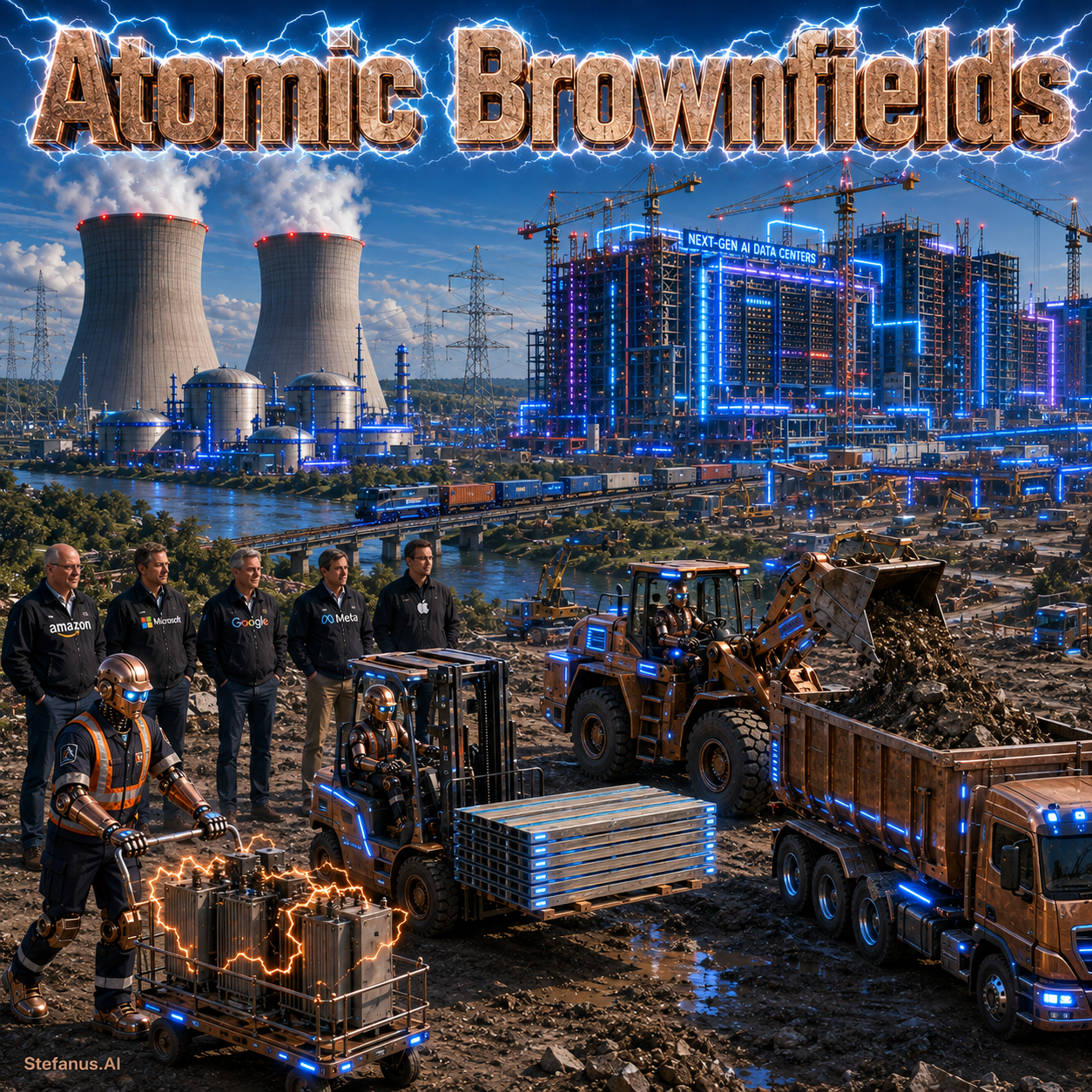
This introduction must also answer a question the reader is entitled to ask at the outset: why this title? The term Atomic Brownfields was chosen deliberately, and for five reasons. First, it is descriptively precise: these are former nuclear-production, uranium-enrichment, weapons-development, reactor, or federal energy sites being repurposed for AI data centers, advanced power generation, semiconductor-adjacent industry, and other compute-intensive infrastructure — which is exactly what the environmental-policy term “brownfield” denotes, land whose reuse is complicated by prior contamination or industrial legacy, elevated here by its atomic provenance. Second, the phrase holds the paper’s two truths in permanent tension: “atomic” carries the grandeur, urgency, and national-security prestige of the original mission, while “brownfield” carries the liability, the contamination, and the unfinished obligations that mission left behind. A reader cannot say the title without acknowledging both. Third, it distinguishes this phenomenon from ordinary data-center siting: Loudoun County, Virginia, is not an atomic brownfield; Paducah, Portsmouth, Savannah River, and Hanford are, and the difference — federal ownership, inherited infrastructure, radiological legacy, security culture — is precisely what the paper analyzes. Fourth, the title signals a policy claim, not merely a description: brownfield redevelopment is a governed activity, with liability rules, disclosure obligations, and community protections, and the paper argues that atomic-to-AI conversion must be governed with at least equal rigor. Fifth, and finally, the title is generative: it names a category that did not previously have a name, allowing Paducah, the PORTS Technology Campus in Ohio, the Savannah River project, and the reactor restarts at Crane and Palisades to be seen as instances of one strategy rather than as isolated announcements.
The introduction ends, as it must, with the paper’s main question, which every subsequent section is designed to answer from a different angle: Are Atomic Brownfields an intelligent form of industrial reuse — or a politically convenient method of placing unprecedented AI expansion inside communities already carrying the liabilities of America’s nuclear past? The honest answer, developed across twelve sections, is that they can be either, and that the difference will be determined not by gigawatts or investment announcements but by the quality of the governance wrapped around them: who bears the remediation burden, whether the power is genuinely additional, what the host communities receive, and who pays if the machines of the future are switched off before the debts of the past are settled.

Section 1: The Geography Left Behind by the Atomic Age
Every technological era leaves behind a geography, and the geography reveals the logic of the era that made it. The textile age left river towns; the steel age left port-and-ore corridors; the automobile age left the arc of factory cities around the Great Lakes. The atomic age left something stranger and, for present purposes, far more valuable: a constellation of enormous, secured, electrically privileged federal reservations placed not where markets wanted them but where the state needed them. The nuclear era created an industrial geography unlike ordinary manufacturing geography because its locations were selected according to national-security and engineering requirements — isolation, water, power, defensibility, rail access, and political feasibility — rather than conventional market demand. To understand why artificial intelligence is now returning to this geography, one must first understand what the geography actually consists of and why it was built the way it was.
1.1 The Locations and Their Logic
The map was drawn in a hurry, under wartime secrecy, and then elaborated over four decades of superpower competition. The Manhattan Project and the postwar nuclear expansion produced Oak Ridge, Tennessee, sited in Appalachian valleys beside the Tennessee Valley Authority’s hydroelectric abundance, where the K-25 gaseous diffusion plant was, at its completion, among the largest buildings in the world and one of the largest single consumers of electricity on the planet. They produced Hanford, Washington, on the Columbia River, whose reactors made the plutonium for the Trinity test and the Nagasaki bomb and whose tank farms still hold the most complex environmental remediation challenge in the Western Hemisphere. They produced Los Alamos, New Mexico, the design laboratory on the mesa, and Savannah River, South Carolina, a 310-square-mile reservation built in the early 1950s to produce tritium and plutonium for the hydrogen-bomb program.[45] They produced the twin gaseous diffusion plants of the interior — Paducah, Kentucky, and Portsmouth (Piketon), Ohio — each a small city of process buildings whose cascades ran continuously for decades. They produced Idaho National Laboratory, an 890-square-mile proving ground on which the United States has built and tested 52 nuclear reactors, four of which remain in operation.[9] And, in the commercial sector that grew out of the weapons complex, the era produced a fleet of power reactors whose retired members — Palisades in Michigan and Three Mile Island Unit 1 in Pennsylvania chief among them — now constitute a second, distinct category of atomic brownfield examined in Section 6.
The relationship between uranium enrichment and massive electricity consumption deserves particular emphasis, because it is the physical hinge on which this entire paper turns. Gaseous diffusion is thermodynamically profligate: separating isotopes that differ by three neutrons requires pushing process gas through diffusion barriers in cascades of more than a thousand stages, with compressors running day and night. In the 1950s, the enrichment complex at times consumed a meaningful single-digit percentage of all electricity generated in the United States. Entire power plants were built for it; entire transmission systems were organized around it. The gaseous diffusion plants were, in the most literal sense, the hyperscale data centers of their century — vast, secretive, energy-devouring federal facilities whose product was strategic advantage — and the electrical infrastructure constructed to feed them is the inheritance now being contested.
1.2 The Important Analytical Point: State-Created Industrial Ecosystems
The analytical point that elevates this history above nostalgia is the following: atomic sites were early — arguably the first fully realized — examples of state-created industrial ecosystems. The government did not merely build factories. It assembled, around a single strategic national objective, every input that a large industrial operation requires: land (through purchase and condemnation at continental scale), power (through dedicated generation and transmission), water (through river siting and industrial intake systems), workforce (through recruitment, training, housing construction, and in some cases the founding of entire towns), transportation (rail, road, and barge), security (perimeters, clearances, and guard forces), and regulatory authority (the Atomic Energy Act of 1954 and its successors, which gave the federal government unique powers over these lands that persist to this day and which, through the 1993 Hall Amendment, now permit the Department of Energy to lease unneeded property at federal facilities being closed or reconfigured — the precise statutory mechanism under which the Paducah solicitation was issued).[2] No private developer in the 1950s could have assembled that package, and the essential insight of 2026 is that no private developer today can easily assemble it either.
1.3 What the AI Industry Is Actually Searching For
This is why the third proposition of this section must be stated bluntly: the AI industry is not merely searching for cheap land. Cheap land is abundant in America. The AI industry is searching for preassembled industrial capability — for places where the land question, the power question, the water question, the transmission question, the security question, and the political-consent question have already been answered once, at public expense, by an earlier generation working on an earlier emergency. What Brookfield and NextEra acquired at Paducah, what SoftBank acquired at Portsmouth, what Amentum is negotiating for at Savannah River, is not acreage. It is seventy years of accumulated state capacity, sitting in inventory. The remainder of this paper examines what it means — economically, environmentally, politically, and strategically — to draw that inventory down.

Section 2: Why Artificial Intelligence Is Returning to Federal Land
The return of computation to federal land did not happen by accident, and it did not happen all at once. It happened through an accelerating sequence of policy actions spanning two administrations, culminating in the announcements of 2026. In January 2025, an executive order signed by the outgoing Biden administration sought to remove hurdles for AI data-center expansion on federal sites; the incoming Trump administration then dramatically expanded and reoriented the effort through its own executive orders on removing barriers to American AI leadership, accelerating federal permitting of data-center infrastructure, and “unleashing American energy.”[10,11] In April 2025, the Department of Energy identified sixteen federal sites — including storied nuclear research laboratories such as Los Alamos — described as “uniquely positioned for rapid data center construction, including in-place energy infrastructure with the ability to fast-track permitting for new energy generation such as nuclear.”[10] In July 2025, DOE narrowed the list, selecting four initial locations — Idaho National Laboratory, Oak Ridge Reservation, the Paducah Gaseous Diffusion Plant, and the Savannah River Site — to move forward with invitations to private-sector partners for AI data-center and energy-generation development.[1] Energy Secretary Chris Wright made the historical frame explicit.
“By leveraging DOE land assets for the deployment of AI and energy infrastructure, we are taking a bold step to accelerate the next Manhattan Project — ensuring U.S. AI and energy leadership. These sites are uniquely positioned to host data centers as well as power generation to bolster grid reliability, strengthen our national security, and reduce energy costs.”
— Chris Wright, U.S. Secretary of Energy [1]
The solicitations followed with unusual speed by federal standards: a Request for Application for Idaho National Laboratory in September 2025, covering approximately 44,000 acres identified for AI infrastructure projects; an NNSA Request for Proposals for Savannah River on September 30, 2025, identifying ten tracts of land totaling 3,103 acres; and DOE’s Paducah Request for Offers on November 4, 2025, with responses due January 30, 2026.[2,14] By mid-2026, three of the four flagship sites had produced selections — Paducah (Brookfield/NextEra), Savannah River (Amentum), and, at the Portsmouth site that had appeared on the original sixteen-site list, the SoftBank-anchored PORTS Technology Campus.[2,11,27] The macroeconomic engine behind this rush is examined in Section 9; here the task is to understand the microeconomics of the sites themselves — what this paper calls the Atomic Brownfield advantage, decomposed into seven inherited characteristics.
2.1 Transmission Inheritance
Some nuclear and enrichment sites already have access to high-capacity electrical infrastructure because their earlier missions required enormous power. Paducah’s connection points were engineered for gigawatt-class industrial load; Oak Ridge sits beneath 500-kilovolt transmission lines fed by TVA hydro, nuclear, and fossil generation.[9] In an era when a conventional large-load interconnection request in MISO or PJM can take years to process, transmission inheritance is not a convenience — it is often the single most valuable asset on the property, worth more than the land itself. The companies selected at Paducah said as much: the site’s existing transmission capacity, water infrastructure, fiber connectivity, and road access from previous operations “will accelerate the development timeline.”[5]
2.2 Land Concentration
Federal control can reduce the fragmented ownership negotiations encountered in densely populated data-center markets. A hyperscale campus in northern Virginia or suburban Ohio must be assembled parcel by parcel, rezoning by rezoning, lawsuit by lawsuit. A federal reservation is already assembled: Savannah River spans 310 square miles under one owner; Idaho National Laboratory spans 890; the Portsmouth site offers 3,700 contiguous acres inside a seven-mile perimeter road.[28,45] Land concentration also concentrates decision-making, which is precisely why critics observe — accurately — that building on federally controlled land allows developers and utilities to sidestep the permitting battles and community backlash that increasingly stall private-land projects.[7]
2.3 Security Inheritance
Existing restricted zones, guard forces, clearance cultures, and physical-security infrastructure may be suitable for sovereign AI, defense computing, model-security operations, and sensitive government workloads. A data center holding frontier model weights is, in the emerging national-security consensus, a strategic asset requiring protection against physical intrusion, insider threat, and sophisticated exfiltration — protection that nuclear-weapons sites have practiced for three generations. Section 5 examines the deepest version of this logic at Savannah River, where the National Nuclear Security Administration itself is the landlord.
2.4 Water Inheritance
Many sites were designed around significant cooling and industrial-water requirements. Paducah’s documented capacity of roughly thirty million gallons per day, engineered for diffusion-plant cooling, maps directly onto the cooling appetites of dense AI computing halls, even as modern liquid-cooling designs reduce per-megawatt water intensity.[9] River siting — the Ohio at Paducah, the Scioto near Portsmouth, the Savannah in South Carolina, the Columbia at Hanford — was a Cold War engineering decision that has aged into a twenty-first-century amenity.
2.5 Permitting Coordination
Federal land does not eliminate permitting, and this paper will insist repeatedly that it must not be described as doing so. State utility commissions retain jurisdiction over service agreements — the Paducah power-service agreement remains subject to approval by the Kentucky Public Service Commission[3] — and environmental statutes continue to apply. But federal ownership can concentrate decision-making in a single landlord with statutory leasing authority, permit coordinated public-private development across an entire campus, and attach federal fast-track processes to reviews that would otherwise proceed serially. The distinction between concentration and elimination of oversight is one of the central governance questions of the entire Atomic Brownfield phenomenon.
2.6 Workforce Inheritance
Nuclear communities often contain exactly the labor market a gigawatt-scale construction project requires: engineers, radiation-control technicians, electricians, pipefitters, heavy-construction crews, security personnel, and — critically — organized labor with decades of experience on federal industrial sites. More than 2,200 workers were already employed on demolition, disposal, and remediation at Portsmouth when the PORTS Technology Campus was announced;[28] Paducah’s cleanup workforce represents a similar reservoir. The 8,000 construction jobs projected at Paducah will draw on a regional labor culture that already knows how to build to federal specification.[3]
2.7 Political Familiarity
Communities surrounding major federal installations may be more familiar with large industrial projects — their disruptions, their payrolls, their security requirements, and their long time horizons — than communities encountering hyperscale development for the first time. This familiarity is double-edged, as Section 8 explores: it can reflect genuine civic capacity to negotiate with large institutions, or it can reflect dependency and resignation born of having no alternative. But as a siting variable it is real. It is notable that as of spring 2026, the Portsmouth project had generated no formal local moratorium or named opposition group, in contrast to at least five Ohio counties where private-land data-center proposals faced organized resistance.[28]
2.8 The Key Warning: Legacy Is Not the Same as Available
Against these seven advantages must be set a warning that disciplines the entire analysis: legacy infrastructure should not be confused with available infrastructure. Transmission equipment engineered in the 1950s may require wholesale replacement to meet modern reliability and cybersecurity standards; the Paducah plan itself includes transmission upgrades precisely because inheritance alone is insufficient.[3] Water rights and intake permits may be constrained by decades of regulatory evolution and by competing agricultural and municipal claims. Contaminated parcels may be categorically unsuitable for construction regardless of their nominal acreage — at Paducah, contamination documented over the decades includes trichloroethylene, technetium-99, polychlorinated biphenyls, and uranium-processing residue, the site sits on the EPA’s Superfund National Priorities List, and active cleanup is expected to continue through roughly 2065, a date that postdates every construction milestone in the DOE’s announcement.[6] And the most consequential proof that inheritance is insufficient is embedded in the deals themselves: at Paducah, the developers concluded that no utility in the region could deliver 1.8 gigawatts of firm capacity on a workable timeline, which is why the project brings 4.6 gigawatts of its own dedicated generation and storage.[2,3] The atomic inheritance opens the door; it does not furnish the house.

Section 3: The Atomic Brownfield Conversion Matrix
If Atomic Brownfields are to be evaluated rather than merely announced, they require an evaluative instrument — a consistent framework that can be applied to Paducah and Portsmouth, to Savannah River and Oak Ridge, to Idaho, and equally to the reactor restarts at Crane and Palisades, so that the strengths of one project illuminate the weaknesses of another. This section proposes that instrument: the Atomic Brownfield Conversion Matrix, the paper’s original analytical framework. The matrix insists that every proposed conversion be scored across six dimensions, and it insists further that the dimensions be scored independently, because the political temptation in every announcement is to let a spectacular score on one dimension (typically capital investment or energy addition) conceal a failing score on another (typically remediation burden or exit responsibility). A project that adds 4.6 gigawatts of new generation but leaves the question of abandonment liability unanswered is not a finished project; it is an impressive façade on an ungoverned structure.
3.1 The Six Dimensions
Dimension One — Legacy Capacity. What land, electricity, water, transportation, fiber, and industrial facilities already exist, and — applying Section 2’s warning — how much of what exists is genuinely usable at modern standards rather than merely present? Legacy capacity should be audited, not assumed, with transmission ratings, water permits, and buildable acreage verified against contamination maps.
Dimension Two — Remediation Burden. What contamination, radioactive material, hazardous waste, groundwater damage, or decommissioning obligation remains, on what schedule, funded by whom, and with what legal separation between the cleanup mission and the commercial development? The burden dimension asks the question every glossy rendering avoids: what is underneath the server hall, and who is responsible for it in 2065?
Dimension Three — Energy Addition. Will the project construct genuinely new generation, or merely redirect existing electricity away from households and industries? This dimension has become the political center of gravity of the entire data-center debate, and the 2026 federal-site deals are notable precisely because they answer it aggressively: Paducah brings up to 4.6 gigawatts of dedicated new generation and storage; Portsmouth commits to 10 gigawatts of new power generation connected to the local grid; Savannah River proposes roughly 2 gigawatts of on-site generation for a 1-gigawatt data center, explicitly structured, in the words of federal officials, to keep the project from driving up electric bills for existing utility customers.[2,15,29]
Dimension Four — Mission Compatibility. Can commercial AI operations coexist with nuclear security, environmental cleanup, defense activities, and continuing federal stewardship on the same reservation? Compatibility is not automatic: construction traffic crosses cleanup zones, commercial network infrastructure abuts classified enclaves, and the landlord’s first legal obligation remains its federal mission, a point the NNSA underscored by conditioning the Savannah River selection on security evaluations and “commitment to mission delivery.”[11,13]
Dimension Five — Community Settlement. What does the surrounding community receive in exchange for accepting additional industrial activity — in tax revenue, durable employment, infrastructure, health monitoring, and voice — and is the settlement contractual or merely rhetorical? Section 8 develops this dimension into a specific policy proposal, the Atomic Community Dividend.
Dimension Six — Exit Responsibility. Who pays if the developer withdraws, the technology becomes obsolete, or the data center closes before the energy and transmission investments are recovered? The AI buildout is being financed against demand projections of historic steepness; prudent policy must price the possibility that the projections are wrong. Exit responsibility asks for decommissioning bonds, financial assurance instruments, and contractual clarity about stranded generation — before groundbreaking, not after abandonment.
| Dimension | Core Question | Illustrative Evidence, 2025–2026 |
| 1. Legacy Capacity | What usable land, power, water, fiber, rail, and facilities already exist? | Paducah: 3,500 acres, ~3 GW MISO design, 30M gal/day water, 19 mi road, 9 mi rail; Oak Ridge: 500 kV TVA lines; INL: 44,000 acres offered |
| 2. Remediation Burden | What contamination and cleanup obligations remain, and who owns them? | Paducah: Superfund NPL listing; TCE, Tc-99, PCBs, uranium residues; cleanup projected through ~2065 |
| 3. Energy Addition | Is generation genuinely new, or redirected from ratepayers? | Paducah: up to 4.6 GW dedicated (2 GW gas + 2.6 GW storage); Portsmouth: 10 GW new generation; SRS: ~2 GW on-site for 1 GW load |
| 4. Mission Compatibility | Can commercial AI coexist with cleanup, defense, and nuclear security? | SRS lease conditioned on security reviews, permitting, and NNSA mission delivery |
| 5. Community Settlement | What do host communities durably receive? | Paducah: ~8,000 construction / 600 permanent jobs projected; PA GRID standards as external benchmark |
| 6. Exit Responsibility | Who pays for failure, obsolescence, or withdrawal? | RFO terms make applicants responsible for building, operating, and decommissioning; financial assurance details largely unpublished |
Table 1. The Atomic Brownfield Conversion Matrix: six dimensions for evaluating atomic-to-AI conversions, with evidence drawn from the 2025–2026 federal-site solicitations and announcements. [2][6][9][11][15][29]
The matrix is deliberately austere. It does not ask whether a project is exciting, whether its investment number is historic, or whether its press conference was well attended. It asks whether the six questions that will determine the project’s legacy in 2040 have been answered in 2026. Applied consistently — as the following sections apply it to Paducah, Savannah River, and the reactor restarts — it converts a scattering of announcements into a comparable, auditable policy category.

Section 4: Paducah — The First Full-Scale Atomic-to-AI Conversion
Paducah deserves to be the principal case study of this paper because it most completely embodies the term Atomic Brownfield: a Cold War enrichment complex, a Superfund-listed cleanup site, a federally owned reservation, and now the anchor of one of the largest private industrial commitments in American history, all on the same 3,500 acres. The July 29, 2026 announcement assembled, in a single transaction, nearly every element this paper analyzes: a former uranium-enrichment site; continuing federal ownership and environmental cleanup under DOE’s Office of Environmental Management; Brookfield as campus developer and operator; NextEra Energy as energy-infrastructure developer; a proposed campus supporting up to 1.8 gigawatts of utility capacity and more than 1.2 gigawatts of compute; 2 gigawatts of planned gas-fired generation; up to 2.6 gigawatts of battery storage; transmission upgrades; wholesale and retail participation by Big Rivers Electric Power Corporation and Jackson Purchase Energy Cooperative, with Paducah Power System as community partner; a power-service agreement subject to Kentucky Public Service Commission approval; and a full buildout expected by roughly 2031–2032 under the newly branded Paducah American Energy Hub coalition.[2,3,4] Congressman Andy Barr, who advocated for the selection, captured the local political framing.
“Together with our private sector partners, this investment will create jobs, strengthen our energy security, and deliver lasting economic growth for Paducah and the Commonwealth for decades to come.”
— Rep. Andy Barr (R-Ky.) [4]
4.1 The Anatomy of the Deal
The procedural anatomy matters as much as the numbers, because it establishes the template that other sites are already copying. DOE’s Office of Environmental Management issued the Paducah Request for Offers on November 4, 2025, seeking proposals under long-term leasing agreements “solely funded by the applicants,” under which applicants would be responsible for building, operating, and decommissioning each project and for securing utility interconnection agreements. The solicitation drew on DOE’s authority under the Atomic Energy Act of 1954 and the 1993 Hall Amendment, which permits the agency to lease unneeded property at federal facilities being closed or reconfigured — a Cold War statute repurposed, with almost poetic symmetry, to lease Cold War land. The RFO explicitly invited proposals integrating innovative energy generation and storage with AI infrastructure, “particularly nuclear technologies including small modular reactors”; the winning proposal, notably, paired the campus with natural gas and batteries instead of on-site nuclear.[2] Responses were due January 30, 2026; selection followed within six months — a velocity that, whatever one concludes about its wisdom, has no recent precedent in federal land disposition.
4.2 Questions for Investigation
A project of this scale, announced this recently, must be interrogated rather than merely described, and the honest state of knowledge in August 2026 is that the most important questions remain open. They are enumerated here both as analysis and as a research agenda for the oversight communities — journalistic, academic, legislative — that will follow this project for the next decade.
- Is this primarily a cleanup-site reuse project, an energy project, or an AI project? The answer determines which agency norms govern it. The DOE frames it under its American Energy Hubs initiative — converting former DOE sites into centers for affordable energy production, advanced manufacturing, and technological innovation — which suggests energy-and-development first, compute second.[4]
- How much land will remain unavailable because of contamination? With active remediation projected through roughly 2065 and documented TCE and technetium-99 groundwater plumes, the buildable envelope inside the 3,500 acres is a technical question with billion-dollar consequences that has not been publicly mapped against the campus plan.[6]
- Will natural gas become a temporary bridge or a permanent dependency? The 2 gigawatts of gas generation will operate for decades; national reporting has already noted that natural gas has become the largest source of U.S. greenhouse-gas emissions and that the Rhodium Group projects U.S. emissions declines could slow because of faster data-center growth and rising gas demand.[8]
- What happens if AI demand changes before 2031? No anchor tenant had been named at announcement.[6] The campus is being financed into a demand forecast; Section 6’s discussion of investment horizons applies with full force.
- Who bears transmission and generation risks? The structure — developer-funded, developer-decommissioned, with ratepayer-protection language and a pending Kentucky PSC review — assigns risk on paper to private capital; the enforcement mechanisms, financial assurance instruments, and stranded-asset provisions are where the assignment will be tested.[2,3]
- Does the project accelerate environmental remediation, and how much control will local governments retain? Lease revenue and co-located investment could fund faster cleanup, or development pressure could complicate it; and a federal landlord with private tenants leaves county and municipal governments with influence but limited jurisdiction.
- Which hyperscalers or AI laboratories will become tenants, and will the campus serve commercial AI, government AI, defense applications, or all three? The workload mix determines everything from security architecture to political accountability.
- Could dedicated power make the campus partially independent from regional electricity constraints? By self-generating, the campus sidesteps a MISO interconnection queue measured in years — an operational advantage that could meaningfully accelerate its timeline relative to grid-dependent competitors, and a structural precedent examined further in Section 9.[2,3]
4.3 The Deeper Interpretation
Beneath the particulars, Paducah represents a new type of public–private industrial arrangement, and naming it precisely is one of this paper’s tasks: the government contributes strategic land and inherited infrastructure; private capital constructs the compute and the energy system; and the two are bound by a lease rather than by a contract for goods. This is neither privatization (the government keeps the land and the cleanup mission) nor traditional procurement (the government is not the customer). It is closer to a concession model — the structure through which states have long developed ports, toll roads, and mineral resources — applied for the first time to the production of machine intelligence. Concession models have a well-documented pathology: they perform brilliantly when the concessionaire prospers and reveal their governance gaps when it does not. Kentucky’s legislature has already begun writing the protective architecture, with a state ratepayer-protection bill introduced in February 2026 and a federal counterpart — H.R. 9340, the Ratepayer Protection Act, backed by House Energy and Commerce Chairman Brett Guthrie of Kentucky — advancing from committee on a 52–0 vote on July 21, 2026.[6] The bipartisan unanimity of that vote is itself a datum: the political system has intuited, faster than the commentary, that the Atomic Brownfield model requires statutory guardrails.

Section 5: Savannah River — Where Nuclear Security Meets Artificial Intelligence
If Paducah is the flagship of atomic-to-AI conversion as economic development, the Savannah River Site is the flagship of atomic-to-AI conversion as national-security strategy — and the difference between the two defines the upper boundary of the Atomic Brownfield concept. On July 20, 2026, the Department of Energy’s National Nuclear Security Administration announced the selection of Amentum to enter negotiations for a phased lease to develop an artificial intelligence data center and dedicated on-site energy generation at the Savannah River Site in South Carolina. The proposed public–private project would establish a 1-gigawatt AI data center supported by approximately 2 gigawatts of on-site generation, initially powered by natural gas and bridging to advanced nuclear energy; DOE also selected data-center developer DC BLOX as the primary digital-infrastructure partner and lead developer within the Amentum-led consortium. The selection follows the NNSA’s competitive September 2025 RFP, which identified ten tracts totaling 3,103 acres, and it remains explicitly subject to successful negotiations, applicable permitting, safety and security evaluations, and other federal approvals — selection, the NNSA emphasized, does not constitute a final lease award.[11,12,13,14]
“This proposed partnership represents an opportunity to strengthen America’s leadership in artificial intelligence, expand reliable energy generation, and strengthen our national security. By working with the private sector, we can move faster, apply innovative technologies, and make productive use of federal land while maintaining our commitment to mission delivery.”
— Brandon Williams, NNSA Administrator [11]
“Under President Trump’s leadership, the work being carried out at NNSA to harness AI will have an impact on national security as the Manhattan Project did in the 1940s.”
— Brandon Williams, NNSA Administrator [14]
“Artificial intelligence, energy resilience, and national security are becoming increasingly interconnected, creating new opportunities to strengthen America’s strategic advantage. Amentum is uniquely positioned at that intersection.”
— John Heller, Chief Executive Officer, Amentum [12]
5.1 Why Savannah River Is Different
Savannah River is not a retired site awaiting a second life; it is a working national-security installation — 310 square miles historically dedicated to tritium production and nuclear-materials missions, still operated in service of the weapons stockpile — onto which commercial AI infrastructure is now being grafted.[45] That difference generates a family of questions that Paducah, whose enrichment mission ended in 2013, does not fully pose, and this paper submits that they are among the most consequential unanswered questions in American technology policy. Can private AI infrastructure operate beside sensitive federal activities, with construction crews, commercial supply chains, and terabit fiber connections inside the outer boundary of a nuclear-security site? Could the data center support classified or sovereign models, and if so, under what accreditation regime — the physical co-location of frontier commercial compute with NNSA missions makes the question unavoidable. Would private employees require enhanced screening, and would the labor economics of commercial data-center operations survive clearance-level personnel costs? How should cyber incidents be handled inside a nuclear-security environment, where an intrusion into commercial infrastructure could be indistinguishable, in its opening minutes, from an intrusion into something far graver? Could the campus combine defense, scientific, and commercial compute, and who arbitrates priority when they conflict? Who owns models trained using federally adjacent infrastructure, and does the government’s role as landlord create any equity, escrow, or access rights in the intelligence produced on its land? Would foreign investment or foreign customers be restricted, and by what instrument — lease covenant, CFIUS-style review, or export-control analogy?
5.2 The Central Argument
The central argument of this section is that Savannah River could transform Atomic Brownfields from a regional redevelopment strategy into a national-security compute strategy. At Paducah, the federal government is a landlord seeking beneficial reuse; at Savannah River, the federal government is a security establishment seeking computational capability adjacent to its most sensitive missions, with the private sector as builder and operator. The Amentum consortium’s composition reinforces the point: it joins a nuclear-site engineering incumbent with a regional data-center developer whose partners — through South Carolina’s Palmetto Nuclear Coalition, launched in July 2025 with founding members including Google and Nucor — are explicitly organized around accelerating nuclear energy deployment for industrial and computational load.[13] If the model matures, the United States will possess something it has never had: bounded federal territories on which energy generation, secured facilities, and frontier computation are integrated under national-security governance. Whether that is a prudent hedge or an over-concentration of strategic assets is the question Section 10 takes up directly. What is already clear is that the gas-bridging-to-nuclear energy design — approximately two gigawatts serving one gigawatt of computing load, with surplus increasing availability of power to the grid — was structured from the outset to answer the ratepayer question that has become the political precondition for every project in this category.[11,15]

Section 6: The Reactor Restart Model
Not every Atomic Brownfield is a former weapons or enrichment complex. A second category — different in ownership, physics, and risk profile, but unmistakably part of the same phenomenon — involves retired commercial nuclear reactors being restarted or recommissioned because AI companies require dependable, carbon-free, around-the-clock electricity at a scale no other technology can currently guarantee. If the federal-site conversions of Sections 4 and 5 show the state leasing its atomic land to computation, the reactor restarts show computation reaching back into the atomic fleet’s retirement community and reversing individual retirements, one power-purchase agreement at a time. Two projects define the category, and this paper treats them with the precision they demand, because public confusion between them — and between the reactors involved and their more infamous neighbors — has been a persistent feature of the coverage.
6.1 Crane Clean Energy Center (Three Mile Island Unit 1)
Three Mile Island Unit 1 operated at industry-leading levels of safety and reliability for decades before being shut down in September 2019 for economic reasons — undercut by cheap natural gas in PJM’s energy markets. Exactly five years later, on September 20, 2024, Constellation Energy announced a 20-year power-purchase agreement with Microsoft under which the unit would be restarted as the Crane Clean Energy Center, named for the late Exelon chief executive Chris Crane. The plant is expected to generate approximately 835 megawatts; Constellation committed roughly $1.6 billion to the restart, plans to pursue license renewal extending operations to at least 2054, and expects the unit to employ about 600 people. Microsoft agreed to purchase the plant’s output over twenty years to match the power its data centers consume across PJM with carbon-free energy — with, notably, no plan to co-locate a Microsoft data center at the plant itself.[16,17,18] The reopening remains subject to Nuclear Regulatory Commission review and state and local permitting, and the project’s path through 2025–2026 has illustrated exactly how entangled a restart is with grid governance: PJM determined that transmission upgrades were needed to deliver the unit’s full output, and in 2026 Constellation secured a FERC waiver allowing it to transfer 760 megawatts of capacity interconnection rights from its Eddystone plant near Philadelphia to the Crane unit — over the opposition of PJM’s independent market monitor — while the Department of Energy closed a $1 billion loan in November 2025 to reduce the project’s borrowing costs.[19,20] By late 2025 the restart target had been accelerated from 2028 toward 2027, and Energy Secretary Wright, touring the plant in December 2025, presented it as proof of concept for the administration’s entire energy-and-AI agenda.[19]
The paper must clearly distinguish Unit 1 from Three Mile Island Unit 2, which suffered the 1979 partial meltdown — the most serious accident in U.S. commercial nuclear power history — and which is being decommissioned by a separate owner, Energy Solutions. Unit 1 was not damaged in the 1979 accident; it is a different reactor with a different operating history on the same island.[24,16] The distinction is not pedantry. It is the difference between restarting a well-run machine that was closed for market reasons and reviving the site of a national trauma — and the fact that the two share an address is precisely why the Crane project carries symbolic weight far beyond its 835 megawatts. Constellation’s chief executive has been candid about both the symbolism and the economics.
“Powering industries critical to our nation’s global economic and technological competitiveness, including data centers, requires an abundance of energy that is carbon-free and reliable every hour of every day, and nuclear plants are the only energy sources that can consistently deliver on that promise.”
— Joe Dominguez, President and CEO, Constellation [18]
“We made a mistake in shutting down this plant, but we’re not here to dwell on that mistake.”
— Joe Dominguez, President and CEO, Constellation [21]
“The Three Mile Island restart is a watershed moment.”
— Jacopo Buongiorno, Professor of Nuclear Science and Engineering, MIT [33]
6.2 Palisades
Michigan’s Palisades project is the other pillar of the restart model, and its history is even more improbable: an 800-megawatt reactor on the Lake Michigan shore that began producing electricity on New Year’s Eve 1971, was shut down by Entergy in May 2022 for economic reasons, and was sold to Holtec International — a company best known for decommissioning nuclear plants — explicitly to be dismantled. Instead, with support from Governor Gretchen Whitmer, roughly $300 million in Michigan state funding, and a $1.52 billion federal loan guarantee, Holtec reversed course and sought to restart the plant. The Nuclear Regulatory Commission approved the transition from decommissioning status back to an operating license in July 2025 — an unprecedented regulatory act — fresh domestically fabricated fuel arrived in October 2025, and after target dates in late 2025 and early 2026 slipped amid extended maintenance and additional regulatory scrutiny, Holtec by mid-2026 described the remaining work as equivalent to a routine refueling outage, with the restart expected to make Palisades the first U.S. nuclear plant ever to return from decommissioning.[22,23,24] Governor Whitmer, who had campaigned for the project since 2022, claimed the milestone in her February 2026 State of the State address, listing among Michigan’s firsts:
“The first state to ever restart a nuclear power plant at Palisades.”
— Gov. Gretchen Whitmer, 2026 State of the State Address [25]
“Once complete, Palisades will become the first successfully restarted nuclear power plant in American history, protecting 600 union jobs at the plant; 1,100 in the community; and access to clean, reliable power.”
— Gov. Gretchen Whitmer [24]
“Nuclear power is our single largest source of carbon-free electricity, directly supporting 100,000 jobs across the country and hundreds of thousands more indirectly.”
— Jennifer Granholm, former U.S. Secretary of Energy [24]
Palisades also demonstrates how restart sites become platforms for the next generation of atomic infrastructure: Holtec plans to construct its first 300-megawatt small modular reactors at the same site, supported by a $400 million Department of Energy matching grant selected in December 2025, with NRC safety evaluations expected in 2027 and commissioning targeted for the early 2030s — meaning the Palisades brownfield is simultaneously a restart, an SMR greenfield, and a test of whether atomic sites can compound rather than merely recover.[26,23] Nor are Crane and Palisades the end of the queue: FERC has approved a waiver allowing NextEra to pursue restart of the Duane Arnold plant in Iowa by 2030, confirming that a restart pipeline, not a pair of curiosities, is forming.[23]
6.3 The Core Analytical Question
The core analytical question of the restart model can be stated in one sentence: Is the AI industry rescuing nuclear energy — or is nuclear energy being financially reorganized around the purchasing power of hyperscalers? Both descriptions are simultaneously true, and the tension between them is productive. In the rescue reading, hyperscaler demand accomplished in twenty-four months what two decades of climate advocacy could not: it made the economics of existing nuclear plants unambiguously positive, halted the retirement wave, and re-legitimized nuclear power across both political parties. In the reorganization reading, the direction of dependency runs the other way: plants restarted under 20-year single-buyer power-purchase agreements are, in financial substance, generation subsidiaries of technology companies, their revenues tied not to public electricity demand but to the capital-expenditure decisions of a handful of firms whose combined 2026 infrastructure budget — roughly $725 billion — exceeds the GDP of most nations.[34] Stanford’s leading data-center energy scholar has warned against assuming efficiency will dissolve the underlying demand pressure.
“The efficiency improvements are real and significant, but they are being overwhelmed by the sheer growth in demand. We’ve seen this pattern before — efficiency gains are necessary but not sufficient when the underlying workload is growing exponentially.”
— Jonathan Koomey, Research Fellow, Stanford University [33]
6.4 The Issues Beneath the Model
A complete evaluation of the restart model must work through a specific issue set, each item of which maps onto a dimension of the Conversion Matrix. Long-term power-purchase agreements: the 20-year Microsoft–Constellation structure transfers price risk elegantly, but its terms are undisclosed, and undisclosed terms in agreements of systemic importance are themselves a policy issue. Reactor licensing and inspection: both restarts proceeded through NRC processes with no precedent to follow, and the regulatory pathway they blazed — including litigation over the exemption that returned Palisades to operating status — will govern every restart that follows. Nuclear workforce rebuilding: each plant requires roughly 600 skilled operators, technicians, and security staff in labor markets that spent a decade shrinking. Supply-chain constraints and reactor fuel: Palisades’ fuel was domestically fabricated, a deliberate statement about supply-chain sovereignty in an industry long dependent on foreign enrichment — an ironic dependency, given where this paper began.[23] Public subsidies and loan guarantees: $1.52 billion federal plus $300 million state for Palisades, $1 billion federal for Crane, plus 45Y production tax credits — public money is load-bearing in both projects, which entitles the public to performance conditions.[24,26,19] Allocation of electricity between the grid and technology customers, and whether hyperscalers obtain economic priority without physical exclusivity: Microsoft buys Crane’s attributes and output while the electrons flow into PJM for everyone — a structure that protects reliability but blurs accountability when scarcity prices rise. And finally, whether old reactors can operate long enough to match data-center investment horizons: license extensions to 2054 assume plants entering their ninth decade of life can serve contracts written for machines with three-year refresh cycles — a mismatch of time constants that is the quiet actuarial gamble beneath the entire model.[17]

Section 7: Environmental Liabilities Beneath the Server Campus
This section exists to prevent the paper from becoming what much of the contemporaneous coverage has been: an overly optimistic development narrative in which contamination appears only as a colorful backstory. The liabilities beneath the server campuses are not backstory. They are present-tense, legally binding, multi-generational obligations, and the single most important environmental fact about the Atomic Brownfield strategy is one of simple chronology: at Paducah, active cleanup operations overseen by DOE’s Office of Environmental Management are expected to continue through approximately 2065 — which means the data centers will be built, operated, refreshed, and quite possibly retired while the remediation of the previous industrial era is still underway beneath and beside them.[6] The two industrial eras will not succeed one another; they will cohabit for forty years.
7.1 The Major Concerns, Stated Concretely
The concerns are best stated concretely rather than generically. Radioactive waste and residues: Paducah’s documented legacy includes technetium-99 and uranium-processing residue; Portsmouth’s 3,700 acres carry the demolition and disposal burden of an entire enrichment complex, with more than 2,200 workers engaged in cleanup at the moment redevelopment was announced.[6,28] Contaminated groundwater: the trichloroethylene and technetium plumes at Paducah are the canonical example of contamination that ignores lease boundaries and outlives business plans. PFAS and other industrial chemicals: even sites without radiological complexity carry the chemical residues of decades of industrial firefighting, degreasing, and maintenance — the Crane site itself illustrates how redevelopment remains intertwined with continuing environmental oversight, including nuclear licensing, state water-quality review, waste regulation, and documented PFAS concerns.[19,21] Decommissioning responsibilities and construction on remediated land: building gigawatt-scale foundations, substations, and cooling infrastructure on or near remediated parcels re-opens engineering questions — cap integrity, soil disturbance, storm-water pathways — that remediation certifications did not anticipate. Worker exposure: two workforces, cleanup and construction, will operate on the same reservations under different regulatory regimes, different unions, and different exposure standards. Water withdrawals and thermal discharge: the same river access that makes these sites attractive makes them accountable, and Great Lakes and Ohio River withdrawals at data-center scale are already drawing scrutiny from environmental journalism and basin governance bodies.[26] Emergency planning, long-term monitoring, and public access to environmental data: a campus combining natural-gas generation, grid-scale batteries, high-density compute, and legacy radiological zones is a novel composite hazard for which no established emergency-planning template exists — and the communities around it can only evaluate what they can see.
7.2 The Central Principle
From these concerns the paper derives its central environmental principle, stated as an absolute because the incentive structure will constantly test it: AI redevelopment must never become a mechanism for transferring nuclear cleanup liabilities from the federal government or established operators to local communities. The transfer would rarely be explicit. It would occur through quieter channels: cleanup schedules “re-baselined” to accommodate construction; monitoring budgets flattened while lease revenue is celebrated; ambiguity about whether new contamination on a leased parcel belongs to the tenant, the developer, or the taxpayer; and the gradual substitution of economic-development metrics for remediation metrics in the way the site’s success is publicly described. The RFO structures point in the right direction — applicants are responsible for building, operating, and decommissioning their projects[2,14] — but responsibility assigned in a solicitation is not responsibility secured in a lease, and none of the executed lease terms had been published as of this writing.
7.3 The Recommended Policy Proposal: A Legacy Liability Ledger
The paper therefore proposes that every Atomic Brownfield development be required to publish, before construction and annually thereafter, a separate public document: the Legacy Liability Ledger. The ledger is deliberately modeled on financial disclosure rather than environmental narrative — an auditable statement of obligations, holders, and schedules — because the genius of financial disclosure is that it makes silent transfers visible. Its required contents are specified in Table 2.
| Ledger Element | What Must Be Disclosed |
| Existing contamination | All known radiological and chemical contamination, mapped against leased and developable parcels, with characterization status |
| Responsible parties | The legally responsible entity for each obligation — federal agency, legacy operator, developer, or tenant — with no unassigned items |
| Cleanup schedules | Remediation milestones and completion dates, with any re-baselining shown against the prior schedule and explained |
| Restricted parcels | Acreage unavailable for development, and any changes in restriction status with supporting technical justification |
| Water conditions | Withdrawal permits, consumption, discharge temperatures, and groundwater-plume monitoring results |
| Radioactive-material responsibilities | Custody, storage, and transport obligations for radioactive materials remaining on site |
| Financial assurance | Bonds, insurance, escrow, and guarantees securing remediation and decommissioning, with counterparties and amounts |
| New contamination risks | Hazards introduced by the development itself: fuels, coolants, battery systems, construction disturbance of remediated media |
| Long-term monitoring | Monitoring networks, sampling frequency, data custodian, and public reporting channel |
| Obligations surviving the lease | All duties that persist after tenant exit, developer withdrawal, or campus closure, and who holds them |
Table 2. The Legacy Liability Ledger: a proposed mandatory annual disclosure for every Atomic Brownfield development.
The ledger’s purpose is not to obstruct development; it is to make the sixth dimension of the Conversion Matrix — exit responsibility — legible in real time. A project confident in its structure loses nothing by publishing it. A project that resists publishing it has told the public something important.

Section 8: Community Consent After the Cold War
Many of the host communities in this paper have already supplied, once before, everything a national project can ask of a place: land, labor, water, health risk, secrecy, and political support. Paducah, Piketon, Aiken, Oak Ridge, and the towns around Idaho’s desert site organized their economies, their school systems, and in some measure their identities around federal missions whose full risks were not always disclosed to them, and whose conclusions — plant closures, layoffs, decades-long cleanups — they absorbed with limited recourse. Any honest account of community consent in 2026 must begin from that history. The question, therefore, is not merely whether AI redevelopment creates jobs. It is whether a second national project will distribute benefits more fairly than the first — and whether consent this time will be informed, contractual, and revocable rather than presumed.
8.1 What Must Be Examined
The examination must be comprehensive, because community impact is a system, not a line item. Local tax revenue on federally owned land is structurally complicated — leased federal parcels generate payment structures very different from private assessment rolls, and communities must understand what they will and will not receive. Permanent versus temporary employment is the central honest number: Paducah projects roughly 8,000 construction jobs but 600 permanent ones, a ratio of more than thirteen to one, which means the durable local payroll is a small fraction of the headline and the community’s long-term settlement must be negotiated accordingly.[3] Union labor and workforce retraining determine whether the construction decade builds transferable regional capability or imports it. Housing pressure, school and road funding, and emergency services are where an 8,000-worker construction surge lands first, years before permanent revenue arrives. Electricity rates are the issue on which the entire political settlement now turns — the reason every 2026 announcement leads with dedicated generation and ratepayer-protection language, and the reason average household rate increases in front-line states like Pennsylvania (nearly 14 percent in a single year) have made data centers an election-season issue.[38,39] Water access, community health monitoring, tribal consultation, environmental-justice review, and public hearings and disclosure complete the list; several of these sites border or affect communities with statutory consultation rights and documented environmental-justice burdens, and the speed of the 2025–2026 solicitations — whatever its industrial merits — compressed exactly the deliberative processes these obligations exist to protect.
Pennsylvania’s 2026 GRID standards provide the most useful external benchmark yet enacted, precisely because they were written for private-land data centers and therefore show what conditional state support looks like. Announced in Governor Josh Shapiro’s budget address and released in full on May 27, 2026, the Governor’s Responsible Infrastructure Development Standards condition Commonwealth support — tax benefits and fast-track permitting eligibility — on certification across four areas: energy affordability (developers must build, bring, or buy the incremental electric capacity their projects require), transparency and community engagement, workforce and economic development, and environmental protection; the Pennsylvania House voted overwhelmingly in June 2026 to codify the standards in law.[38,39]
“I’ve heard directly from Pennsylvanians who are concerned about the impact data center development could have on their communities, the environment, and their utility bills. That’s why I am putting clear guardrails in place to hold developers accountable to protect consumers, strengthen communities, and put Pennsylvanians first.”
— Gov. Josh Shapiro, Commonwealth of Pennsylvania [38]
8.2 An Original Policy Structure: The Atomic Community Dividend
Benchmarks, however, are not settlements. For federal atomic sites — where the host community’s prior contribution is unique and the landlord is the national government itself — this paper proposes a dedicated instrument: the Atomic Community Dividend. Under the dividend, a defined portion of lease payments, tax revenue, or project proceeds from every Atomic Brownfield development would be committed, by lease covenant rather than by annual appropriation, to a community-governed fund supporting: environmental monitoring independent of both the developer and the site office; local electricity affordability, so that the community hosting the generation is demonstrably held harmless or advantaged on rates; technical education, building the operations, electrical, and data-center trades pipeline locally rather than importing it; public-health programs, including the health surveillance that nuclear-legacy communities have long sought; water infrastructure; emergency preparedness matched to the site’s new composite hazard profile; and community-controlled redevelopment funds that survive any single tenant. The dividend’s design principle is that it must be boring: automatic, formula-based, audited, and independent of the project’s public-relations cycle. Communities that supplied the land of the atomic age should not have to renegotiate their share of the intelligence age at every press conference.

Section 9: The Five-Layer AI Economy on Atomic Land
To this point the paper has analyzed sites. This section changes the lens and analyzes the economy landing on them, because the significance of Atomic Brownfields cannot be understood without measuring the force of the demand wave they are absorbing. The numbers, current through the second quarter of 2026, are without industrial precedent. The International Energy Agency estimates that global data-center electricity consumption stood at roughly 415 terawatt-hours in 2024 — about 1.5 percent of global electricity use — and projects it to grow around 15 percent per year to roughly 945 terawatt-hours by 2030, more than four times faster than total electricity consumption from all other sectors, with AI-driven accelerated servers growing about 30 percent annually.[30] Gartner, in June 2026, forecast worldwide data-center power demand rising 27 percent in 2026 alone to 132 gigawatts, reaching 290 gigawatts by 2030, with electricity consumption hitting 565 terawatt-hours in 2026 and exceeding 1,200 terawatt-hours by 2030.[31] The capital side is steeper still: following first-quarter 2026 earnings, Alphabet, Amazon, Meta, and Microsoft collectively guided toward approximately $725 billion of 2026 capital expenditure — up 77 percent from 2025’s record $410 billion — with Goldman Sachs projecting $5.3 trillion of combined hyperscaler capex from 2025 through 2030;[34] and the second-quarter 2026 earnings season, closing days before this paper’s completion, confirmed acceleration rather than pause, with Alphabet raising 2026 guidance toward $195–205 billion and Microsoft reporting the opening of 31 data centers in a single quarter.[36] The IMF’s modeling of this boom finds it will raise energy prices and emissions in manageable but uneven ways — including natural-gas price increases of roughly 7 percent in the United States attributable to AI-driven data-center demand — depending on policy and infrastructure constraints.[37]
“We added nearly 1 GW of new capacity this quarter, opened 31 data centers, and reduced dock-to-live times by nearly 50%.”
— Satya Nadella, Chairman and CEO, Microsoft (Q2 2026 earnings call) [36]
“Our AI investments are redefining what’s possible across every part of our business. Google Cloud revenues accelerated to 82% growth, driven by demand for AI infrastructure and AI solutions.”
— Sundar Pichai, CEO, Alphabet (Q2 2026 earnings call) [36]
“Surging demand for compute-intensive AI workloads is driving unprecedented data center power growth, while AI capacity is now constrained by power availability, making data center power security the new battle ground for scaling and protecting margins in the global AI race.”
— Linglan Wang, Director Analyst, Gartner [31]
“As we move from text to video to image, these AI models are growing larger and larger, and so is their energy impact.”
— Vijay Gadepally, Senior Scientist, MIT Lincoln Laboratory [32]
This demand wave is best understood not as one industry but as a five-layer AI economy, each layer with its own capital structure, geography, and failure modes — and the analytical payoff of the framework is what it reveals about atomic land. The layers are as follows.
9.1 Layer One: Energy
The foundation layer comprises everything that turns fuel and physics into firm electrons and removes the resulting heat: nuclear restarts (Crane, Palisades, and the forming pipeline behind them), natural-gas generation (2 gigawatts at Paducah, 9.2 gigawatts at Portsmouth, the gas bridge at Savannah River), small modular reactors (Holtec’s Palisades SMRs; the nuclear-inclusive language of the DOE solicitations), battery storage at unprecedented scale (2.6 gigawatts at Paducah alone), transmission construction and upgrades ($4.2 billion of AEP work around Portsmouth), and the cooling and water systems that atomic-era river siting anticipated.[2,26,27,28] Layer One is where the Atomic Brownfield advantage is most concentrated, because energy is the layer with the longest lead times and the deepest permitting friction.
9.2 Layer Two: AI Chips
Above energy sits silicon: Nvidia’s accelerator franchise, AMD’s challenge to it, and the custom hyperscaler chips — Google’s TPUs now generating commercial revenue at scale, Microsoft’s Maia 200 and Cobalt 200 deployed across dozens of data centers, Amazon’s Trainium described in earnings as largely sold out — that increasingly define competitive position.[36] For atomic sites, Layer Two arrives as freight and as security burden: controlled-access compute, export-controlled hardware, and domestic semiconductor supply-chain policy all intersect with facilities already practiced in controlling access to strategic materials.
9.3 Layer Three: Datacenters
The physical-plant layer — gigawatt campuses, hardened facilities, federal leases, restricted zones, and dedicated substations — is the layer this paper has examined site by site. Its defining 2026 development is the shift from grid-dependent to self-powered design: the Paducah campus, unable to obtain 1.8 gigawatts of firm regional capacity on any workable timeline, simply builds its own stack, sidestepping interconnection queues entirely — a template with profound implications for how, and whether, public grid governance reaches the largest new loads in the country.[2,3]
9.4 Layer Four: Models
The intelligence layer comprises commercial frontier models, scientific models trained for materials, climate, and fusion research, defense and sovereign models operated under classification, and the nuclear-research applications that make national-laboratory adjacency more than symbolic — the federal Genesis Mission framing for Portsmouth explicitly cites fusion energy, quantum computing, and national-security applications as intended beneficiaries of the compute.[28] Layer Four is where the ownership questions raised at Savannah River — who owns models trained on federally adjacent infrastructure — will ultimately be decided.
9.5 Layer Five: Applications and Agents
The top layer is where intelligence becomes action: grid management (including, recursively, the management of the very campuses described here), weapons stewardship and stockpile science, materials discovery, logistics, robotics, environmental remediation — conceivably including AI-assisted acceleration of the cleanups beneath the campuses themselves — and autonomous federal operations. Layer Five closes the loop of the paper’s framework: the sites that once produced the materials of deterrence may host the agents that steward them.
| Layer | Components | Atomic Brownfield Expression, 2025–2026 |
| 1. Energy | Nuclear restarts, gas, SMRs, batteries, transmission, cooling & water | Crane (835 MW) & Palisades (800 MW) restarts; 2–9.2 GW gas builds; 2.6 GW storage at Paducah; SMRs sited at Palisades |
| 2. AI Chips | Nvidia, AMD, custom hyperscaler silicon, secure hardware, domestic supply chains | Controlled-access compute on secured federal land; TPU/Maia/Trainium fleets driving the demand the sites serve |
| 3. Datacenters | Gigawatt campuses, hardened facilities, federal leases, dedicated substations | Paducah (1.8 GW utility / >1.2 GW compute); PORTS (10 GW); SRS (1 GW); phased federal leases under the Hall Amendment |
| 4. Models | Commercial frontier, scientific, defense, sovereign, nuclear-research models | Genesis Mission science workloads; potential classified/sovereign hosting at NNSA-governed SRS |
| 5. Applications & Agents | Grid management, stewardship, materials, logistics, robotics, remediation, autonomous federal operations | AI-assisted grid and campus operations; prospective remediation and stockpile-science applications on the host sites themselves |
Table 3. The Five-Layer AI Economy as instantiated on atomic land. [2][3][11][17][23][27][28][36]
The paper’s major contribution follows directly from the table: Atomic Brownfields show that the five layers do not always develop independently. At these sites, government and private capital can assemble all five layers inside a single bounded geography. Everywhere else in the economy, the layers are owned by different firms, sited in different jurisdictions, and coordinated through markets. At Paducah, Portsmouth, and Savannah River, they are being co-located behind one fence, under one lease, on one landlord’s ground — a vertical integration of the AI economy by geography rather than by corporate merger. That integration is the source of both the model’s power (speed, security, energy certainty) and its risk (concentration, opacity, and the single-point failures examined next).

Section 10: China, National Security, and the Return of Strategic Geography
The Cold War produced atomic sites because national leaders believed geography, secrecy, electricity, science, and industrial capacity were inseparable — that deterrence had a street address. The intervening decades of globalization taught a different intuition: that technology was placeless, that supply chains were politically neutral, and that computation in particular lived in a “cloud” whose very metaphor denied geography. The AI competition with China is dissolving that intuition and producing a realization structurally similar to the 1940s original: the most consequential technology of the era is, physically, a set of buildings, substations, chip fabs, and transmission lines — and buildings can be sited, secured, subsidized, and denied. It is not incidental that both the Energy Secretary and the NNSA Administrator reached for the Manhattan Project as the governing analogy for the federal-sites program;[1,14] the analogy is doing real conceptual work, signaling that the state has re-entered the business of locating strategic technology on territory it controls.
10.1 The Geopolitical Questions
The strategic questions raised by that re-entry deserve enumeration, because each will surface in legislation, lease negotiations, or crisis within the decade. Should the most powerful AI systems operate on federally controlled land? Federal siting offers security and eminent authority, but it also entangles frontier capability with political control in ways the commercial AI industry has so far avoided. Should Atomic Brownfields host sovereign compute reserves — capacity held for government use in emergencies, the computational analogue of the Strategic Petroleum Reserve — and could these campuses support emergency federal capacity if commercial systems were degraded? Should Chinese capital, equipment, contractors, or customers be excluded, and by what instrument — and how should the campuses treat foreign-made transformers, networking equipment, batteries, and drones, given that grid-scale batteries and large power transformers are supply chains in which Chinese manufacturers hold significant global positions, creating the awkward possibility of a sovereignty-branded campus built from adversary-manufactured components? Could nuclear-site security protect models against physical intrusion? Plausibly better than any commercial alternative — that is the Savannah River thesis. But symmetrically: would concentrating energy, compute, and models inside single perimeters create attractive military or cyber targets, converting resilience into a small set of high-value aim points? And therefore should sites be geographically distributed for national resilience — an argument the sixteen-site inventory implicitly embraces and the flagship-campus pattern implicitly contradicts?[10]
10.2 The Essential Distinction
This paper deliberately does not claim that the AI competition is identical to the Cold War, and the discipline of that refusal matters. The Cold War’s central artifact was a weapon whose use would have been apocalyptic and whose production was wholly state-controlled; AI’s central artifacts are dual-use systems produced overwhelmingly by private firms for commercial markets, diffusing globally at commercial speed. The state is a landlord and customer in the AI economy, not its proprietor. What the paper does argue is narrower and, for that reason, more defensible: both periods compel governments to treat technology as a combination of industrial production, scientific knowledge, energy access, territorial control, corporate capacity, and national security — refusing to let any single lens dominate. The Atomic Brownfield is where that six-fold combination becomes physically visible: an industrial site (production), adjacent to national laboratories (knowledge), consuming dedicated gigawatts (energy), on federal land (territory), built by Brookfield, NextEra, SoftBank, Amentum, and the hyperscalers (corporate capacity), under statutes written for the weapons complex (security). Strategic geography has returned; the task of policy is to ensure it returns with better governance than it had the first time.

Section 11: Guidelines for Governors, Congress, and the Federal Government
Analysis that ends without prescription is commentary. This section converts the preceding ten sections into operational guidance for the three levels of government that will actually decide whether Atomic Brownfields become a model or a cautionary tale — and it does so with the benefit of live legislative motion, from Kentucky’s ratepayer-protection efforts and the bipartisan federal Ratepayer Protection Act to Pennsylvania’s GRID codification, all of which demonstrate that the political system is already converging on the need for guardrails.[6,39]
11.1 Federal Recommendations
- Establish a national inventory of nuclear and federal industrial sites suitable for AI reuse. The 2025 sixteen-site list was a beginning; the inventory should be permanent, criteria-based, publicly documented, and extended to closed reactors, retired fossil sites on federal land, and other energy-privileged federal parcels.[10]
- Separate cleanup funding from development incentives. Remediation budgets must be legally and administratively firewalled from lease revenue and development milestones, so that no cleanup schedule can be slowed — or appear to be slowed — to serve a construction schedule.
- Require dedicated or incremental generation for extremely large campuses. The Paducah, Portsmouth, and Savannah River structures should be floor, not exception: no gigawatt-class federal-land campus should draw firm capacity from the ratepayer-funded grid without building equivalent new supply.[2,15,29]
- Create common cybersecurity rules for AI facilities on federal land, harmonizing NNSA, DOE, and critical-infrastructure standards into a single accreditation regime for campuses that mix commercial, scientific, and sensitive workloads.
- Require beneficial-ownership disclosure for developers and tenants, including upstream investors, so that questions of foreign participation are answered by registry rather than by rumor.
- Establish long-term financial assurance for abandoned projects — decommissioning bonds and stranded-asset provisions sized to the generation and transmission investments, held independently of the developer’s balance sheet.
- Protect nuclear and national-security missions from commercial interference through lease covenants that give the federal mission unambiguous priority, with pre-agreed protocols for conflicts, incidents, and access.
- Publish electricity, water, employment, and cleanup commitments for every project — the Legacy Liability Ledger of Section 7, plus annual performance reporting against the announced job and investment figures.
- Require community-benefit agreements — the Atomic Community Dividend of Section 8 — as a condition of lease execution, not as a post-hoc negotiation.
- Develop contingency plans for failed or obsolete campuses, specifying in advance the disposition of dedicated generation (which can serve the public grid), the reuse of facilities, and the responsible parties for each outcome.
11.2 Recommendations for Governors: The Five Public Tests
Governors — who control public-service commissions’ appointments, state incentive dollars, and the political narrative in which these projects live — should evaluate every Atomic Brownfield project against five public tests, answerable in plain language before support is granted: Does the project add power? (Genuinely new generation at least equal to its load.) Does it accelerate cleanup? (Measurable remediation milestones moved earlier, not later.) Does it protect ratepayers? (Enforceable, commission-reviewed insulation of household rates — the standard Kentucky’s PSC review and Pennsylvania’s GRID certification both operationalize.[3,39]) Does it produce durable employment? (Judged on the permanent-jobs number and the training pipeline, not the construction peak.) Does it leave the community better protected if the AI investor departs? (Financial assurance, surviving obligations, and community funds that outlast any tenant.) A project that passes all five deserves a governor’s podium. A project that fails any one deserves a governor’s questions.
11.3 The November 2026 Relevance
The midterm elections of November 2026 will be the first national vote conducted amid operating restarts, executed federal-site leases, and household electricity bills that have made data centers a kitchen-table issue in states like Pennsylvania, where the governorship, legislature, and competitive congressional districts are all contested this fall.[39] The temptation of the season will be to ask candidates crude questions — are you for AI or against it, for nuclear power or against it — that invite crude answers. This paper proposes the question that actually matters, and commends it to every debate moderator, editorial board, and town-hall constituent in a host community: Under what conditions should public land and inherited federal infrastructure be transferred into privately operated AI production? That is a substantially more sophisticated political question, because it cannot be answered with enthusiasm or hostility alone; it can only be answered with conditions — and conditions, as this paper has argued throughout, are the entire game.

Section 12: What Have We Learned? Eight Pillars of Synthesis
Twelve sections of evidence permit — and demand — synthesis. The paper’s findings are consolidated here as eight pillars, expanding the six conclusions of the original framework with two additions (Pillars VII and VIII) that the events of 2026 made unavoidable.
Pillar 1 — AI expansion is reviving strategic industrial geography. The placeless cloud has acquired an address, and the address is, with striking frequency, an address the Manhattan Project chose first. Computation has rejoined steel, aluminum, and enrichment in the category of industries whose location is a matter of state strategy.[1,10]
Pillar 2 — Federal nuclear sites possess rare combinations of land, power, water, security, and political authority. No private assemblage can currently match the seven-fold inheritance of Section 2, which is why $100 billion committed to Paducah and up to $500 billion in ambition at Portsmouth landed on federal ground rather than on the open market.[2,27,28]
Pillar 3 — Legacy infrastructure carries legacy liabilities. Superfund listings, groundwater plumes, and cleanup horizons stretching to 2065 are not the backstory of these projects; they are co-tenants, and the Legacy Liability Ledger exists because cohabitation without disclosure becomes transfer.[6]
Pillar 4 — Nuclear restarts and federal-site conversions are related but distinct models. Crane and Palisades revive generation for the grid under private ownership and hyperscaler contracts; Paducah and Savannah River lease federal territory for integrated compute-and-energy campuses. They share the atomic inheritance and the AI demand driver, but they differ in ownership, regulation, and risk — and policy that conflates them will misgovern both.[16,22,11]
Pillar 5 — Private AI investment can accelerate redevelopment, but it can also concentrate public risk. The same integration that delivers speed — all five layers behind one fence — concentrates exit risk, target value, and political dependency in single projects of unprecedented scale, financed against demand curves that even their most sophisticated observers describe as newly unpredictable.[35]
Pillar 6 — Success must be measured by cleanup, affordability, community benefits, security, and durability — not simply gigawatts or investment announcements. The five gubernatorial tests and the six-dimension matrix are this pillar rendered operational; every metric in them is measurable, and none of them is a press release.
Pillar 7 — The energy-addition requirement has become the political license to operate. Every successful 2026 project led with dedicated generation and ratepayer protection — 4.6 gigawatts at Paducah, 10 at Portsmouth, 2 at Savannah River — and unanimous committee votes for ratepayer-protection legislation confirm that “bring your own energy” has hardened from slogan into precondition. Projects that ignore this settlement will not merely face criticism; they will not be built.[2,6,15,29,39]
Pillar 8 — Governance is racing deployment, and the race is close. In eighteen months, the United States produced sixteen inventoried sites, four flagship solicitations, three executed selections, two reactor restarts, one groundbreaking, and a genuinely new class of public–private industrial arrangement — while the disclosure instruments, community settlements, and exit-responsibility frameworks this paper proposes remain largely unwritten. The window in which governance can be designed rather than retrofitted is open now, and it is measured in lease negotiations, not in decades.

Conclusion: The Atomic Age Did Not End; Its Geography Changed
The conclusion returns, as promised, to Paducah. For seventy years, the site embodied the industrial requirements of atomic power and national competition: land taken for a national purpose, electricity consumed in quantities that reorganized a regional grid, secrecy maintained across generations, and a community that gave its working life to a mission it was not always permitted to fully understand. Its enormous appetite for electricity once separated uranium isotopes, atom by atom, in cascades that never slept. Its next industrial identity — if the leases are executed, the turbines built, the tenants signed — will involve separating signal from noise, training machine intelligence, and operating autonomous systems in halls that also never sleep. The continuity is not metaphorical. It is electrical, territorial, and institutional: the same acres, fed by descendants of the same transmission system, governed by amendments to the same Atomic Energy Act, hosting the strategic technology of a new century.
And so, one final time: why the title Atomic Brownfields? Because after twelve sections, its two words have earned their pairing. “Atomic” is the inheritance — the land, the gigawatt-class infrastructure, the security culture, the national-purpose legitimacy that makes a $100 billion commitment to western Kentucky thinkable at all. “Brownfield” is the obligation — the plumes, the ledgers, the 2065 cleanup horizon, the communities owed a fairer settlement than the first national project gave them. Every alternative title the author considered kept one word and lost the other: “AI Energy Hubs” keeps the promise and drops the debt; “Nuclear Legacy Sites” keeps the debt and drops the promise. Only the pairing tells the truth, and a paper whose central argument is that promise and debt must be governed together required a title that refuses to separate them.
The final argument of the paper is therefore this: Atomic Brownfields reveal that the artificial-intelligence economy is not weightless, placeless, or purely digital. It is being constructed from inherited land, aging transmission, contaminated soil, public authority, industrial memory, and the unresolved obligations of previous technological eras. The five-layer economy — energy, chips, datacenters, models, agents — does not float above the country; it lands on it, and where it lands, it inherits. Whether that inheritance becomes an intelligent form of industrial reuse or a politically convenient displacement of burden onto communities already carrying the atomic past will be decided in lease covenants, liability ledgers, community dividends, and public-service-commission dockets over the next five years — instruments unglamorous enough to be ignored and consequential enough to define the era.
The machines of the future may ultimately think on land where the machinery of the atomic past is still being dismantled.

Footnotes / Endnotes
[1] U.S. Department of Energy, “DOE Announces Site Selection for AI Data Center and Energy Infrastructure Development on Federal Lands” (statement of Energy Secretary Chris Wright), July 24, 2025. https://www.energy.gov/articles/doe-announces-site-selection-ai-data-center-and-energy-infrastructure-development-federal
[2] Sonal C. Patel, “Brookfield, NextEra to Develop $100B Data Center Campus at DOE’s Paducah Site, Paired With 4.6 GW of Dedicated Generation,” POWER Magazine, July 2026. https://www.powermag.com/brookfield-nextera-to-develop-100b-data-center-campus-at-does-paducah-site-paired-with-4-6-gw-of-dedicated-generation/
[3] KFVS12 News Staff, “Paducah DOE Site Picked for AI, Computing Campus, Including Power Generation and Storage,” KFVS12, July 29, 2026. https://www.kfvs12.com/2026/07/29/paducah-doe-site-picked-ai-computing-campus-including-power-generation-storage/
[4] Sam Knef, “DOE Announces Paducah Data Center Campus with $100B Private Investment” (statements of Secretary Chris Wright and Rep. Andy Barr), Spectrum News 1, July 29, 2026. https://spectrumlocalnews.com/product-pages/nyc/news/2026/07/29/doe-announces-paducah-data-center-campus-with-100b-private-investment
[5] Quartz Staff, “NextEra and Brookfield Are Building a $100 Billion AI Data Center Campus on a Cold War Uranium Site” (statements of Bruce Flatt and John Ketchum), Quartz, July 29, 2026. https://qz.com/nextera-brookfield-ai-data-center-kentucky-paducah-072926
[6] Tech Times Staff, “Paducah AI Hub Wins $100B Federal Deal: Power Built In, No Tenant Named,” Tech Times, July 31, 2026. https://www.techtimes.com/articles/322401/20260731/paducah-ai-hub-wins-100b-federal-deal-power-built-no-tenant-named.htm
[7] NOTUS Staff, “Trump Administration Announces Another Data Center on Federal Land,” NOTUS, July 29, 2026. https://www.notus.org/energy/trump-administration-announces-data-center-on-federal-land
[8] Brad Plumer, “Trump Administration Is Repurposing Federal Land for AI Data Centers,” The New York Times (via GV Wire), July 29, 2026. https://gvwire.com/2026/07/29/trump-administration-is-repurposing-federal-land-for-ai-data-centers/
[9] RCR Wireless News Staff, “US DoE Selects Four Federal Sites for AI DC Projects” (site specifications for Paducah, INL, Oak Ridge, Savannah River), RCR Wireless News, July 28, 2025. https://www.rcrwireless.com/20250728/ai-infrastructure/doe-ai-dc
[10] Associated Press, “US Energy Department Invites AI Data Center Development at Los Alamos and Other Federal Lands” (16-site identification), April 3, 2025. https://www.marketbeat.com/articles/us-energy-department-invites-ai-data-center-development-at-los-alamos-and-other-federal-lands-2025-04-03
[11] U.S. Department of Energy / National Nuclear Security Administration, “NNSA Selects Amentum for AI Data Center and Energy Project at Savannah River Site” (statement of Administrator Brandon Williams), July 20, 2026. https://www.energy.gov/nnsa/articles/nnsa-selects-amentum-ai-data-center-and-energy-project-savannah-river-site
[12] Amentum, “Amentum Selected for the Department of Energy AI Data Center and Energy Generation Project” (statements of John Heller and Mark Whitney), press release, July 20, 2026. https://www.amentum.com/news/amentum-selected-for-the-department-of-energy-ai-data-center-and-energy-generation-project/
[13] Nuclear Engineering International Staff, “Amentum to Develop SRS AI Campus” (DC BLOX; Palmetto Nuclear Coalition), Nuclear Engineering International, July 27, 2026. https://www.neimagazine.com/news/amentum-to-develop-srs-ai-campus/
[14] U.S. National Nuclear Security Administration, “NNSA Seeks Proposals for AI Data Centers, Energy Projects at Savannah River Site” (10 tracts, 3,103 acres; statement of Brandon Williams), September 30, 2025. https://www.energy.gov/node/4853136
[15] WRDW/WAGT News Staff, “Feds Look to Build Massive Data Center at Savannah River Site,” WRDW, July 20, 2026. https://www.wrdw.com/2026/07/20/feds-look-build-massive-data-center-savannah-river-site/
[16] Spencer Kimball, “Constellation Energy to Restart Three Mile Island Nuclear Plant, Sell the Power to Microsoft for AI,” CNBC, September 20, 2024. https://www.cnbc.com/2024/09/20/constellation-energy-to-restart-three-mile-island-and-sell-the-power-to-microsoft.html
[17] Brian Martucci, “Constellation Plans 2028 Restart of Three Mile Island Unit 1, Spurred by Microsoft PPA,” Utility Dive, September 20, 2024. https://www.utilitydive.com/news/constellation-three-mile-island-nuclear-power-plant-microsoft-data-center-ppa/727652/
[18] Constellation Energy, “Constellation to Launch Crane Clean Energy Center, Restoring Jobs and Carbon-Free Power to The Grid” (statement of Joe Dominguez), press release, September 20, 2024. https://www.constellationenergy.com/news/2024/Constellation-to-Launch-Crane-Clean-Energy-Center-Restoring-Jobs-and-Carbon-Free-Power-to-The-Grid.html
[19] Peter Hall, “US Energy Secretary Says Three Mile Island Restart Delivers on Trump Administration Promises,” Pennsylvania Capital-Star, December 17, 2025. https://penncapital-star.com/economy/energy-secretary-christopher-wright-says-three-mile-island-restart-delivers-on-trump-administration-promises/
[20] Ethan Howland, “Constellation’s Three Mile Island Nuclear Restart Gets Boost with FERC Waiver,” Utility Dive, June 2026. https://www.utilitydive.com/news/constellation-three-mile-island-crane-nuclear-ferc-waiver/821836/
[21] Peter Hall, “Microsoft Describes Three Mile Island Plant as a Once-in-a-Lifetime Opportunity” (statement of Joe Dominguez), Pennsylvania Capital-Star, February 2026. https://penncapital-star.com/economy/microsoft-describes-three-mile-island-plant-as-a-once-in-a-lifetime-opportunity/
[22] Alexander C. Kaufman, “America’s First Nuclear Plant Restart May Be Near the Finish Line,” Canary Media, July 2026. https://www.canarymedia.com/articles/nuclear/americas-first-nuclear-plant-restart
[23] American Nuclear Society, “Holtec Announces New Fuel Arrival Ahead of Palisades Restart,” ANS Nuclear Newswire, October 21, 2025. https://www.ans.org/news/2025-10-21/article-7481/holtec-announces-new-fuel-arrival-ahead-of-restart/
[24] PBS NewsHour / Associated Press, “Biden Administration Will Lend $1.5 Billion to Restart Michigan Nuclear Power Plant, a First in the U.S.” (statements of Gov. Gretchen Whitmer and Secretary Jennifer Granholm), March 2024. https://www.pbs.org/newshour/amp/nation/biden-administration-will-lend-1-5-billion-to-restart-michigan-nuclear-power-plant-a-first-in-the-u-s
[25] Office of Governor Gretchen Whitmer, “Gov. Whitmer’s 2026 State of the State Address as Prepared for Delivery,” Michigan.gov, February 25, 2026. https://www.michigan.gov/whitmer/news/press-releases/2026/02/25/whitmer-2026-state-of-the-state-address-as-prepared-for-delivery
[26] Keith Schneider, “A Nuclear Shift Buoyed by Billions and the Waters of the Great Lakes,” Circle of Blue, 2026. https://www.circleofblue.org/2026/water-energy/a-nuclear-shift-buoyed-by-billions-and-the-waters-of-the-great-lakes/
[27] Joshua A. Bickel and Julie Carr Smyth, “Trump Officials Announce 10-Gigawatt Data Center, Gas Plants for Former Ohio Uranium Site,” Associated Press, March 20, 2026. https://irontontribune.com/2026/03/20/10-gigawatt-data-center-gas-plants-coming-to-former-portsmouth-gaseous-diffusion-plant/
[28] ConstructConnect News, “Megaproject Watch: U.S. to Turn Ex-Uranium Plant into Self-Powered 10-Gigawatt Data Center,” ConstructConnect, March 24, 2026. https://news.constructconnect.com/megaproject-watch-u.s.-to-turn-ex-uranium-plant-into-self-powered-10-gigawatt-data-center
[29] U.S. Department of Energy, Office of Environmental Management, “Partnership Ensures Affordable Energy, Powers AI Future at Portsmouth Site,” Energy.gov, March 24, 2026. https://www.energy.gov/em/articles/partnership-ensures-affordable-energy-powers-ai-future-portsmouth-site
[30] International Energy Agency, “Energy Demand from AI,” in Energy and AI (IEA Special Report), Paris, 2025. https://www.iea.org/reports/energy-and-ai/energy-demand-from-ai
[31] Gartner, Inc., “Gartner Says Data Center Electricity Consumption to Grow 26% in 2026” (statement of Linglan Wang), press release, June 10, 2026. https://www.gartner.com/en/newsroom/press-releases/2026-06-10-gartner-says-data-center-electricity-demand-to-grow-26-percent-in-2026
[32] MIT Sloan School of Management, “AI Has High Data Center Energy Costs — But There Are Solutions” (statement of Vijay Gadepally, MIT Lincoln Laboratory), Ideas Made to Matter, February 2026. https://mitsloan.mit.edu/ideas-made-to-matter/ai-has-high-data-center-energy-costs-there-are-solutions
[33] Tech-Insider, “AI Data Centers: 1,000 TWh by 2026” (statements of Prof. Jacopo Buongiorno, MIT, and Jonathan Koomey, Stanford University), June 2026. https://tech-insider.org/ai-data-center-power-crisis-2026/
[34] Yahoo Finance Staff, “Meta, Microsoft, Amazon, and Alphabet Are About to Spend a Shocking Amount of Money to Dominate the AI Era” (Goldman Sachs capex analysis), Yahoo Finance, June 2026. https://finance.yahoo.com/sectors/technology/article/meta-microsoft-amazon-and-alphabet-are-about-to-spend-a-shocking-amount-of-money-to-dominate-the-ai-era-115359575.html
[35] Jordan Novet et al., “Tech AI Spending Approaches $700 Billion in 2026, Cash Taking Big Hit” (statement of Michael Nathanson, MoffettNathanson), CNBC, February 6, 2026. https://www.cnbc.com/2026/02/06/google-microsoft-meta-amazon-ai-cash.html
[36] Data Center Knowledge Staff, “Microsoft, Alphabet, Meta Pivot from Buy to Build in AI” (Q2 2026 earnings statements of Satya Nadella and Sundar Pichai), Data Center Knowledge, July 2026. https://www.datacenterknowledge.com/data-center-construction/hyperscalers-say-ai-race-has-entered-a-new-phase
[37] International Monetary Fund, “Power Hungry: How AI Will Drive Energy Demand,” IMF Working Paper No. 2025/081, April 2025. https://www.elibrary.imf.org/view/journals/001/2025/081/article-A001-en.xml
[38] Commonwealth of Pennsylvania, Office of the Governor, “Gov. Shapiro Releases Full GRID Standards to Protect Pennsylvanians” (statement of Gov. Josh Shapiro), May 27, 2026. https://www.pa.gov/governor/newsroom/2026-press-releases/gov-shapiro-releases-full-grid-standards-to-protect-pennsylvania
[39] Marc Levy, “Pennsylvania’s Governor Has a Plan to Make Data Centers Bring Their Own Energy. Now Comes the Hard Part,” Associated Press / WESA, June 5, 2026. https://www.wesanews.org/politics-government/2026-06-05/pennsylvania-gov-shapiro-ai-data-center-plan
[40] American Nuclear Society, “Private-Sector Data Center Plans Advance for Paducah and Savannah River Sites,” ANS Nuclear Newswire, July 31, 2026. https://www.ans.org/news/2026-07-31/article-8261/privatesector-data-center-plans-advance-for-paducah-and-savannah-river-sites/
[41] Cameron F. Kerry and Joshua P. Meltzer, “Global Energy Demands Within the AI Regulatory Landscape,” Brookings Institution, updated April 2, 2026. https://www.brookings.edu/articles/global-energy-demands-within-the-ai-regulatory-landscape/
[42] Ethan Howland, “DOE Loans Constellation $1B to Restart Three Mile Island Nuclear Unit,” Utility Dive, November 19, 2025. https://www.utilitydive.com/news/constellation-three-mile-island-crane-nuclear-ferc-waiver/821836/
[43] American Nuclear Society, “Holtec Hits Milestones in Palisades Restart, New Reactor Projects,” ANS Nuclear Newswire, April 2, 2026. https://www.ans.org/news/2026-04-02/article-7901/holtec-hits-milestones-in-palisades-restart-new-reactor-projects/
[44] American Nuclear Society, “DOE Seeks Proposals for AI Data Centers at Paducah” (RFO details; statement of Tim Walsh, DOE-EM), ANS Nuclear Newswire, November 6, 2025. https://www.ans.org/news/2025-11-06/article-7525/doe-seeks-proposals-for-ai-data-centers-at-paducah/
[45] Broadband Breakfast Staff, “Energy Department Picks Federal Sites for AI Data Center Development” (Savannah River 310-square-mile site; Oak Ridge and INL characteristics), Broadband Breakfast, 2026. https://broadbandbreakfast.com/energy-department-picks-federal-sites-for-ai-data-center-development/