
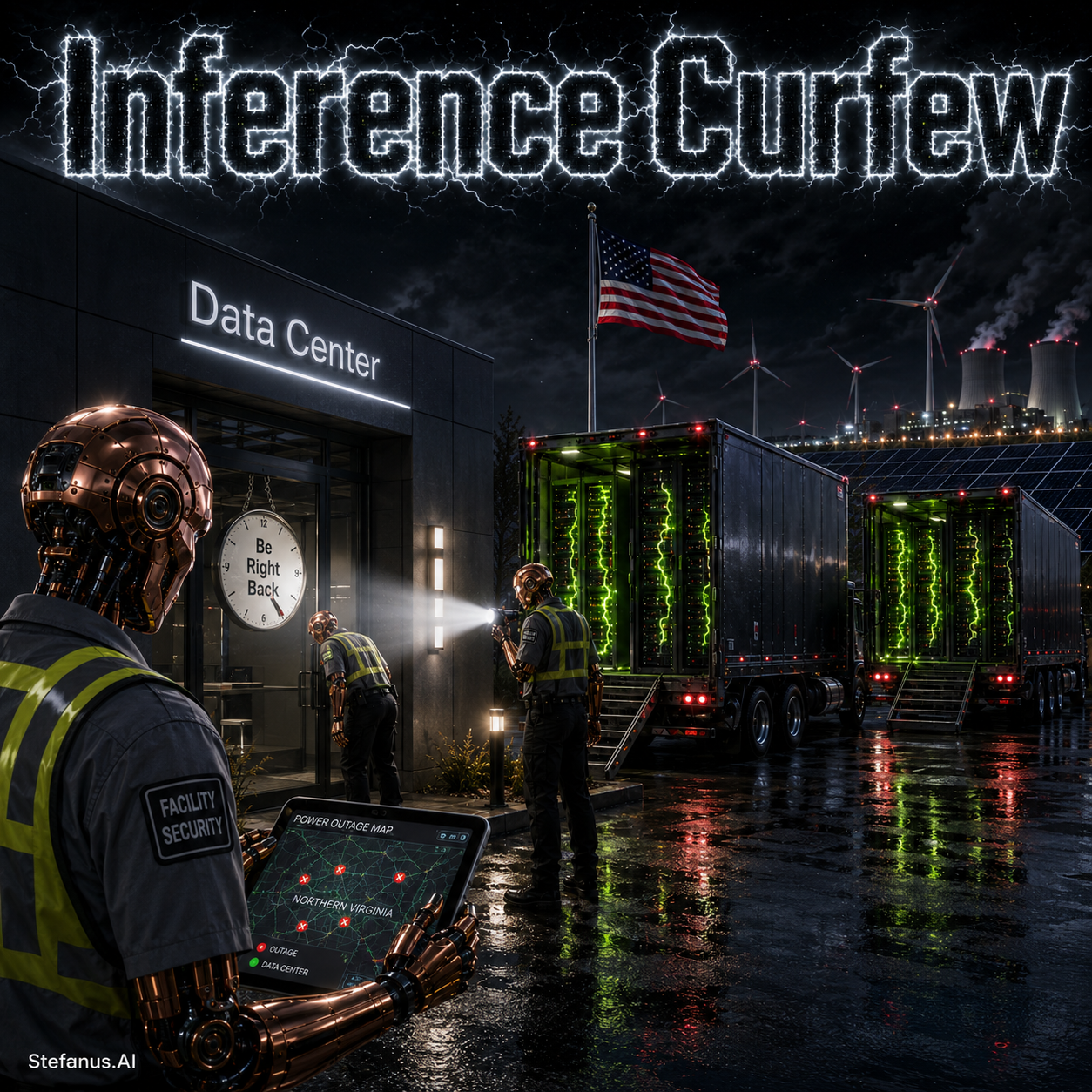

Introduction: The Barber’s Clock and the Grid’s Clock
For more than twenty years I have gone to the same barber shop, tucked into the corner of a small multi-use shopping strip near my house in Los Angeles. I am, I admit, a picky customer: one barber, one chair, once a month, and no substitutes. One hot Friday afternoon, during the lunch hour, I walked up to the shop and found the door locked. Hanging on the glass was one of those rounded cardboard signs shaped like a manual clock face — the universal small-business dialect for “be right back.” The long cardboard pointer was set thirty minutes ahead. There was no panic in that sign, no apology, and no crisis. It carried a simple, almost elegant promise: the service you rely on is temporarily paused, it will resume at a known time, and the pause itself is part of how a small shop stays in business on a difficult day.
That cardboard clock is precisely the image I want to plant at the head of this paper. On a punishing summer afternoon in Southern California — the kind of day when every household air conditioner strains at once and the regional grid operator starts issuing conservation alerts — the electric system faces the same problem my barber faced: more demand than one moment can serve. For a century, the grid’s answer to that problem has been brutal and blunt: rolling blackouts, in which entire neighborhoods, hospitals’ surrounding blocks, traffic signals, and family refrigerators go dark together, indiscriminately. But a new class of electricity consumer has arrived that changes the calculus entirely. Artificial intelligence data centers — single campuses that can draw as much power as a mid-sized city — are simultaneously the fastest-growing strain on the grid and, paradoxically, the most controllable, most schedulable, most “pausable” load the grid has ever hosted. A large language model training run can hang a cardboard clock on its own door. A batch of advertising-optimization inference can wait thirty minutes. Your grandmother’s ventilator cannot.
This paper is about the moment when society learns to hang that clock deliberately, fairly, and automatically. I call the framework an Inference Curfew: a temporary restriction, compute slowdown, workload migration, or suspension of non-essential AI tasks during grid emergencies, electricity capacity shortages, severe weather, or system instability. The word “curfew” is chosen carefully. A curfew is not a punishment and not a prohibition; it is a time-bounded, rule-based, publicly announced restriction imposed for collective safety, with clear criteria for when it begins and when it lifts. An Inference Curfew treats AI data centers as dynamic, curtailable grid citizens rather than static, always-on consumers — and in doing so, it forces an uncomfortable but overdue civic conversation about which machine intelligence is essential and which is merely convenient.
The central thesis of this paper is the following. To prevent systemic blackouts without stifling innovation, grid operators and technology giants must co-develop a tiered, automated curtailment framework that prioritizes human safety and critical infrastructure over non-essential machine learning workloads. When electricity is scarce, society will need to distinguish — formally, contractually, and in software — between hospital AI and advertising optimization; between emergency communications and offline model training; between defense inference and consumer image generation; between financial clearing and autonomous shopping agents. The grid, in other words, is becoming the first institution in history that ranks artificial intelligence by social priority. That ranking is already being written today, mostly in tariff filings and interconnection agreements that few citizens will ever read. This paper argues that it should be written deliberately, in daylight, and with the public interest at the top of the stack.
The argument proceeds in six sections. Section 1 establishes the scale of the collision: the hyper-scale AI load surge, the erosion of grid operating margins, and the vulnerability multiplier of extreme weather. Section 2 examines PJM Interconnection — the largest grid operator in North America and the epicenter of the data center boom — as the emerging blueprint for large load integration, including its Large Load Registry, its Bring-Your-Own-Generation pathway, its Reliability Backstop Procurement, and the historic Department of Energy emergency orders of 2026 that made data center curtailment an operational reality rather than a thought experiment. Section 3 constructs the Hierarchy of Compute: a tiered classification of essential versus discretionary AI workloads, and the legal friction — the SLA Paradox — that such a hierarchy creates. Section 4 details the operational mechanics of an Inference Curfew: power capping and dynamic voltage and frequency scaling, geographic compute migration, and automated load-shedding protocols wired directly into data center orchestration software. Section 5 analyzes the economic, regulatory, and policy frameworks — demand response incentives, the cost of curfew, the roles of FERC, NERC, ERCOT, and state public utility commissions, and the deep distinction between contractual curtailment and government-ordered curtailment. Section 6 distills the lessons into Seven Pillars of Co-operative Compute, expanding the governance architecture that this new era demands, before the Conclusion returns, as all essays should, to the barber’s clock.

Section 1: The Modern Grid Crisis and the AI Load Surge
Every era of American electrification has had its signature load. The early twentieth century had the electric streetcar and the factory motor; mid-century had the air conditioner and the suburban home; the turn of the millennium had, briefly and famously, the dot-com server farm that never quite materialized at feared scale. The signature load of the 2020s is unambiguous: the hyper-scale artificial intelligence data center. What distinguishes this load from every predecessor is not merely its size, though the size is staggering. It is the combination of three properties that have never before coexisted in a single customer class: extreme density (hundreds of megawatts, and increasingly gigawatts, at a single point of interconnection), extreme growth velocity (demand materializing in two to three years against generation and transmission timelines of seven to fifteen), and extreme concentration (a handful of corporate buyers and a handful of regional clusters absorbing most of the growth). Understanding the depth of this collision is the necessary foundation for everything that follows, because the Inference Curfew is not a clever optimization for a healthy grid; it is a survival mechanism for a strained one.
1.1 Hyper-Scale Penetration: The Numbers Behind the Surge
Begin with the authoritative baseline. The Lawrence Berkeley National Laboratory (LBNL), in its landmark 2024 Report on U.S. Data Center Energy Use commissioned by the Department of Energy, found that U.S. data center load growth tripled over the preceding decade and projected that it would double or triple again by 2028.[1] Data centers consumed roughly 176 terawatt-hours in 2023 — about 4.4 percent of all U.S. electricity — a figure the Congressional Research Service adopted as the standard reference point for federal policymakers.[13] By June 2026, LBNL’s updated analysis had sharpened the trajectory: data centers could account for between 9.5 and 15.3 percent of total U.S. electricity consumption by 2030, meaning the sector may more than double its share of national power in a single decade.[2] The report’s authors were explicit about why efficiency alone cannot rescue the situation:
“the scale and growth of computational demand more than offset these efficiency gains”[2]
— Lawrence Berkeley National Laboratory, 2026 U.S. Data Center Energy Use Update
The international picture is equally stark. The International Energy Agency’s special report Energy and AI — the first comprehensive global accounting of the AI-electricity nexus — projected that global data center electricity demand will more than double by 2030 to roughly 945 terawatt-hours, approaching the entire present-day electricity consumption of Japan, with AI-optimized facilities more than quadrupling their draw over the same window.[3] The agency’s 2026 follow-up found the surge already underway: data center electricity demand grew 17 percent in 2025 alone, far outpacing the roughly three percent growth in overall global electricity use.[61] In the United States specifically, the IEA found that data centers are on course to account for almost half of all electricity demand growth through 2030, and that by decade’s end the American economy will consume more electricity for processing data than for manufacturing all energy-intensive goods combined — aluminum, steel, cement, and chemicals together.[5] IEA Executive Director Dr. Fatih Birol compressed the entire field into one sentence delivered to world leaders:
“There is no AI without energy – specifically electricity”[4]
— Dr. Fatih Birol, Executive Director, International Energy Agency
Private-sector forecasts have, if anything, been racing ahead of the official ones. BloombergNEF’s December 2025 outlook projected that data center power draw will nearly triple from roughly 40 gigawatts today to 106 gigawatts by 2035, noting that whereas only ten percent of existing facilities exceed 50 megawatts, the average new facility will draw well over 100 megawatts, nearly a quarter of planned sites will exceed 500 megawatts, and a few will breach a full gigawatt — single buildings the size of nuclear plants, measured by appetite.[11] The World Resources Institute, surveying the full forecast literature, documented modeled 2030 projections ranging from 200 terawatt-hours per year to over 1,050 terawatt-hours — a spread whose sheer width is itself a policy problem, because utilities must commit billions of dollars of ratepayer capital against numbers that disagree with each other by a factor of five.[20] Scholars at the Brookings Institution observed that inference — not training — now constitutes an estimated 80 to 90 percent of AI computing power, and that the IEA expects electricity consumption from AI inference servers to grow roughly 30 percent annually, accounting for almost half the net increase in global data center consumption through 2030.[12] This matters enormously for our subject: a grid crisis policy aimed only at pausing training runs would miss the majority of the load, which is why this paper speaks of an Inference Curfew and not merely a training curfew.
Behind these forecasts stands a wall of corporate capital unlike anything in industrial history. The four largest hyperscalers — Amazon, Microsoft, Alphabet, and Meta — told investors during the Q4-2025 and Q1-2026 earnings cycles that they would collectively spend on the order of $700 billion in capital expenditures in 2026, roughly a 60 to 77 percent increase over 2025’s already record $388–410 billion.[15] Amazon guided to approximately $200 billion; Alphabet to $175–185 billion; Meta raised guidance toward $115–135 billion and later higher on component costs; Microsoft tracked above $110–120 billion for its fiscal year, with some calendar-year estimates approaching $190 billion.[16] The quarterly acceleration is breathtaking when set side by side: Meta went from $13 billion of capex in Q1-2025 to $20 billion in Q1-2026; Alphabet from $17 billion to $36 billion; Microsoft from $17 billion to $31 billion in cash capex; Amazon from roughly $25 billion to $44 billion.[17] Goldman Sachs now models a combined $5.3 trillion of hyperscaler capex between fiscal 2025 and fiscal 2030.[16] Wider estimates spanning the five largest spenders, including Oracle, put 2026 outlays between $700 billion and $900 billion — a 36 percent jump over 2025 by CreditSights’ count.[14] And critically for this paper, the constraint the executives themselves cite is no longer chips. Microsoft disclosed an $80 billion backlog of Azure orders that cannot be fulfilled due to power constraints, while Alphabet’s Sundar Pichai described the company as compute-constrained in the near term.[18] By late July 2026, investors had begun punishing the spending itself: Alphabet shares slid seven percent after it raised 2026 capex guidance again, dragging Amazon, Meta, and Microsoft down with it, as Wall Street’s patience with power-hungry expansion showed its first genuine cracks.[19]

Figure 2. Big Four hyperscaler capital expenditures, 2025 actuals versus 2026 guidance (approximate midpoints). Sources: company earnings calls and guidance as compiled in Q1-2026 reporting.[15][16][17]
The forecast landscape is summarized in Table 1. The reader should notice not only the magnitudes but the institutional breadth: national laboratories, international agencies, reliability regulators, and private analysts, all pointing the same direction with different slopes.
| Source (Year) | Scope | Key Projection |
| LBNL / DOE (2024)[1] | United States | Data center load tripled over prior decade; doubling or tripling again by 2028; ~176 TWh and 4.4% of U.S. power in 2023 |
| LBNL Update (2026)[2] | United States | Data centers reach 9.5–15.3% of U.S. electricity consumption by 2030 |
| IEA Energy and AI (2025–26)[3] | Global | ~945 TWh global data center demand by 2030 (≈ Japan’s total use); AI-optimized demand more than quadruples; 17% demand growth in 2025 alone |
| NERC 2025 LTRA (Jan. 2026)[6] | North America | Summer peak demand +224 GW over ten years (69% above prior-year projection); winter +245 GW; data centers the largest driver |
| BloombergNEF (Dec. 2025)[11] | Global fleet | Data center draw nearly triples from ~40 GW to 106 GW by 2035; average new facility >100 MW |
| Grid Strategies critique (2026)[57] | United States | Counterpoint: NERC demand assumptions (incl. ~90 GW of data centers by 2030) may be overstated via double-counting and project delays |
| Hyperscaler guidance (2026)[15][16] | Corporate | ~$700B combined Big Four capex in 2026, up 60–77% year over year; ~$5.3T projected FY2025–FY2030 |
Table 1. The forecast wall: institutional projections of data center and AI electricity demand, 2024–2026 literature.
1.2 Baseload versus Peak Strain: How AI Erodes the Grid’s Margins
To understand why this growth threatens reliability rather than merely raising bills, one must understand what a grid operating margin actually is. Power systems are engineered around the extreme peak hour — the single hottest late afternoon of summer or the coldest pre-dawn hour of winter — and they carry reserve margins above that peak precisely because generators fail, transmission lines trip, and forecasts err. For two decades, essentially flat U.S. electricity demand allowed those margins to persist even as coal plants retired, because the peak was not moving. The AI load surge attacks this equilibrium from both ends simultaneously. On the demand side, hyper-scale campuses add hundreds of megawatts of high-load-factor consumption that presses upward on every hour of the year, including the peak hour; U.S. data center energy consumption rose roughly 80 percent between 2020 and 2025, and electricity prices are already climbing fastest precisely where the facilities concentrate.[56] On the supply side, the generation fleet is retiring faster than replacements arrive: PJM alone has lost roughly 15 gigawatts of generation since 2022 while forecasting approximately 70 gigawatts of new large load demand by 2038.[27] The North American Electric Reliability Corporation’s 2025 Long-Term Reliability Assessment, released in January 2026, rendered the verdict in institutional prose: thirteen of twenty-three North American assessment areas face elevated or high resource adequacy risks within five years, with the high-risk list — MISO, PJM, ERCOT, WECC-Northwest, WECC-Basin, and SERC-Central — reading like a map of the data center boom itself.[6][7] The Hill’s summary of the NERC findings was blunt: new data centers for AI and the digital economy account for most of the projected increase in North American electricity demand over the next ten years, with several regions at high risk of supply shortfalls by decade’s end.[8]
It bears noting, in the spirit of intellectual honesty, that the pessimism is contested. Grid Strategies, in a February 2026 review prepared for Earthjustice, NRDC, the Sierra Club, and the Environmental Defense Fund, argued that NERC’s assessment is too pessimistic — that its demand assumptions may double-count speculative data center projects, that resources in advanced development could resolve the majority of identified shortfalls, and that data centers may ultimately require significantly less power than announced.[57] Utility Dive’s coverage of the dispute noted the possibility that NERC’s assumed 90 gigawatts of data center growth by 2030 overstates what will actually be built.[57] Indeed, the energy intelligence firm Currence estimated that 30 to 50 percent of large-scale data center capacity expected online in 2026 will likely be delayed, with power constraints a primary cause.[26] This paper takes the dispute seriously and draws from it a governance lesson rather than a forecasting one: precisely because the future load is uncertain, the correct policy instrument is one that scales gracefully with reality — a flexibility and curtailment framework — rather than one that bets ratepayer billions on a single number.
The academy has framed the moment in appropriately historic terms. At the MIT Energy Initiative’s 2025 Spring Symposium, “AI and Energy: Peril and Promise,” MITEI Director and Hoyt C. Hottel Professor William H. Green captured the scale of the transformation:
“We’re at a cusp of potentially gigantic change throughout the economy”[52]
— Prof. William H. Green, Director, MIT Energy Initiative
MIT’s researchers have documented the mechanics beneath that sentence: a single large data center can consume as much electricity as 50,000 homes, and the Electric Power Research Institute projects data centers could reach roughly nine percent of U.S. electricity by 2030 — while the same MIT community, through scholars such as Professor Priya Donti, insists that AI itself could dramatically improve power system operations if pointed at the problem rather than merely feeding on it.[53][52] Tom Falcone, president of the Large Public Power Council, speaking for the utilities that must actually serve this load, described the shock from the trenches:
“Pre ChatGPT, we weren’t seeing this kind of load growth.”[55]
— Tom Falcone, President, Large Public Power Council
1.3 The Vulnerability Multiplier: Extreme Weather Meets Extreme Compute
The final element of the crisis is temporal coincidence. Grid emergencies are not random; they cluster in exactly the weather that also maximizes residential demand and stresses data center cooling. A prolonged heat dome pushes air conditioning load to record peaks at the same moment that data center chillers work hardest and thermal generators derate in the heat. A deep winter freeze spikes electric heating demand while gas supply to power plants tightens — the failure mode that produced the catastrophic Winter Storm Uri blackouts in Texas in 2021 and the near-miss of Winter Storm Elliott across the East in 2022. Into this seasonal knife-fight, the AI boom has now inserted tens of gigawatts of new around-the-clock load, concentrated in precisely the regions — Northern Virginia, central Ohio, Texas, the Southeast — where weather extremes are sharpest. NERC’s 2025–2026 winter assessment warned that much of North America is at risk of failing to meet power needs during extreme operating conditions, and identified the mechanism plainly:
“Winter electricity demand is rising at the fastest rate in recent years”[9]
— North American Electric Reliability Corporation, 2025–2026 Winter Reliability Assessment
There is also a newer, stranger vulnerability that deserves far more public attention than it has received: the data centers themselves have begun to destabilize the grid not by consuming too much, but by disappearing too fast. In 2026 NERC escalated to a rare Level 3 alert — its highest — after documented events in which more than 1,000 megawatts of computational load dropped off the bulk power system in seconds, as facility protection systems, uninterruptible power supplies, and backup-generation controls reacted to minor voltage disturbances by instantly disconnecting entire campuses.[10] A thousand megawatts vanishing in seconds is, from the grid’s perspective, the mirror image of a large nuclear unit tripping offline — except that it happens on the demand side, where operators have no models, no telemetry standards, and no procedures. The significance for this paper is profound: hyper-scale AI load is already curtailing itself, chaotically and unilaterally, on protection-relay timescales. The question is not whether AI compute will be interrupted during grid stress. It already is. The question is whether the interruptions will be designed — tiered, sequenced, compensated, and safe — or accidental. That is the entire case for the Inference Curfew in a single paragraph.

Section 2: PJM’s Blueprint for Large Load Integration
If the Inference Curfew is to move from concept to institution, it will happen first in PJM Interconnection. PJM is the largest regional transmission organization in North America, coordinating wholesale electricity for 67 million people across thirteen states and the District of Columbia — and it happens to contain Northern Virginia’s “Data Center Alley,” the densest concentration of computing infrastructure on Earth. What PJM decides about large loads becomes, by gravitational pull, the national template. Between January and July of 2026, PJM produced the most consequential sequence of large-load governance documents in the history of the American grid: a January Board plan born of an accelerated stakeholder process, a May emergency curtailment order executed with the U.S. Department of Energy, and a July Decisional Letter proposing to the Federal Energy Regulatory Commission the first formal, standing framework under which new data centers that do not bring their own power supplies will be curtailed before ordinary emergency measures reach anyone else. This section reconstructs that blueprint in detail, because it is — whether PJM uses the phrase or not — the first Inference Curfew statute ever drafted.
2.1 Conditional Interconnection: The CIFP Process and the Two Pathways
PJM’s formal reckoning began with the Critical Issue Fast Path for Large Load Additions (CIFP-LLA), an accelerated stakeholder process initiated in 2025 that produced twelve competing proposals from utilities, generators, consumer advocates, and the data center industry itself.[21][22] When stakeholders deadlocked over load forecasting and cost allocation, the PJM Board of Managers issued its January 16, 2026 Decisional Letter, setting forth six governing principles and — crucially for our purposes — defining a “Large Load” as an individual addition of 50 megawatts or more at a single point of interconnection.[23][21] The resulting framework creates two primary regulatory pathways. The first is expedited interconnection via Bring Your Own New Generation (BYOG): a data center that arrives with new, verifiable generation capacity — a co-located gas plant, a contracted nuclear uprate, a dedicated storage portfolio — earns a faster track to connection, because it adds supply commensurate with its demand.[23] The second pathway is conditional: a large load that does not bring its own generation may still connect, but it accepts non-firm service — it agrees, structurally and in advance, to be curtailed when the system is short. This is the pivotal conceptual move. Interconnection itself becomes conditional on flexibility. The always-on data center, drawing firm service at gigawatt scale without contributing supply, is being retired as a legal category in the largest market in the country.
The timing was not academic. The same day the Board released its January plan, the White House National Energy Dominance Council and a bipartisan coalition of all thirteen PJM state governors issued a joint Statement of Principles demanding that data centers bear the infrastructure costs of their own load growth rather than shifting those burdens to utility ratepayers — an extraordinary political alignment spanning both parties and every state in the footprint.[22][23] The Board’s July letter answered in kind:
“new Large Loads should bear the costs they cause”[25]
— PJM Board of Managers, Decisional Letter, July 27, 2026
2.2 The Data Center Registry and the Reliability Backstop
The July 27, 2026 Board proposal, to be filed with FERC, contains four interlocking mechanisms that together constitute the operational skeleton of an Inference Curfew regime. First, PJM will establish and maintain a mandatory Large Load Registry — a detailed roster of massive load sites, their service areas, their on-site and contracted generation arrangements, and their curtailment obligations — so that in an emergency the system operator knows exactly which campuses can be called upon, in what order, and by how much.[26][27] Second, an Interim Resource Adequacy Service will require electric distributors to arrange capacity for new large loads that, as of June 1, 2027, have not secured sufficient supply to cover their own resource adequacy obligation.[27] Third, and most striking, is the curtailment sequencing itself. Under the proposal, new large loads that do not bring their own generation by June 1, 2027 and have not otherwise secured supply will, during capacity shortages, face curtailment ahead of the grid’s conventional emergency demand-response machinery — in PJM’s own tariff language, they
“will be subject to curtailment prior to deployment of Pre-Emergency Load Management”[26]
— PJM Interconnection, proposed tariff provisions, July 2026
Fourth, PJM proposed a one-time Reliability Backstop Procurement — an extra capacity auction to run from September 30 through October 21, 2026, with results in early December — to address a 6.8-gigawatt shortfall from the just-completed capacity auction for the 2028/29 delivery year, offering commitments of up to fifteen years and capping accepted supply offers at $555 per megawatt-day to balance the desperate need for new steel against the equally desperate need for affordability.[24][25] Some accounts of the broader shortfall PJM must close over the coming decade run as high as 60 gigawatts.[27] FERC, for its part, has signaled that governance itself is on the table: Chairman Laura Swett announced a July 2026 conference on reforming PJM’s structure, observing that the thirteen states and the District of Columbia have
“fundamentally different regulatory structures, resource portfolios and politics”[24]
— Laura Swett, Chairman, Federal Energy Regulatory Commission
The economic pressure driving all of this can be read directly off the capacity market’s price tape, reproduced in Figure 1 and Table 2. PJM’s capacity auction — the annual procurement that pays generators to be available at peak — cleared at $28.92 per megawatt-day for the 2024/25 delivery year. One year later it cleared at $269.92, an 833 percent single-year increase and the largest in PJM history; the year after that, $329.17, hitting the FERC-approved price collar; and in December 2025, the 2027/28 auction cleared at $333.44 per megawatt-day against the cap, with a 6,623-megawatt reliability shortfall even at that price, bringing total capacity costs to a record $16.4 billion.[30][33][32] PJM’s Independent Market Monitor attributed 63 percent of the 2025/26 price increase to data center demand — approximately $9.3 billion in costs flowing to ordinary customers through higher rates.[30] Consumer advocates have translated the abstraction into kitchen-table arithmetic: the Natural Resources Defense Council estimates that without reform, PJM households could ultimately pay on the order of $70 more per month, with cumulative regional costs through 2033 in the range of $100 to $163 billion; the Citizens Utility Board, surveying four straight record auctions, accused policymakers of letting “some of the world’s wealthiest corporations” off the hook while 67 million customers absorb a years-long price spike, noting zonal prices as high as $466.35 per megawatt-day in the Baltimore Gas and Electric zone.[31][30]

Figure 1. PJM capacity auction clearing prices by delivery year, showing the roughly tenfold escalation attributed principally to data center load growth. Sources: PJM auction results as reported.[30][32][33]
| Delivery Year | Clearing Price ($/MW-day, RTO) | Notable Facts |
| 2024/25 | $28.92 | Pre-surge baseline; two decades of flat demand still embedded in prices |
| 2025/26 | $269.92 | 833% single-year increase, largest in PJM history; Market Monitor attributes 63% of increase (~$9.3B) to data centers; BGE zone $466.35; Dominion zone $444.26 |
| 2026/27 | $329.17 | Cleared at the FERC-approved price collar; only 139 MW cleared above the reliability requirement |
| 2027/28 | $333.44 | Cleared at the cap with a 6,623 MW reliability shortfall; record $16.4B total capacity cost; triggers the one-time Reliability Backstop Procurement (Sept.–Oct. 2026, offers capped at $555/MW-day) |
Table 2. The price of scarcity: PJM capacity market results, 2024/25–2027/28.[30][31][32][33][25]
2.3 The Last Line of Defense: The May 2026 Emergency Orders
Everything described so far is prospective rule-making. What transformed the Inference Curfew from proposal into precedent was the weather. In late January 2026, amid a winter freeze, PJM prepared to call on data center and large-load backup generation to avoid blackouts as the Department of Energy expanded its use of emergency orders.[28] Then, on May 18, 2026, with unseasonable heat forecast to collide with planned power plant maintenance outages and reserves projected below 5,800 megawatts — with Maryland and Virginia especially stressed — PJM asked for and received a DOE emergency order authorizing it, for the first time, to direct transmission owners and utilities to curtail data centers and other large loads that possess backup generation, as a last resort before instituting rolling blackouts.[28] The order’s architecture is a miniature of the entire framework this paper proposes: it authorized PJM to direct large consumers with at least 50 megawatts of peak load to switch to their own backup generators within fifteen minutes of an emergency signal, thereby freeing grid capacity for residential and commercial customers; it explicitly exempted hospitals, 911 call centers, water treatment plants, air traffic control towers, and defense installations; and it granted specified generating units temporary relief from emissions limits to run at maximum output.[29] Notice what the order did, almost casually, in its exemption list: it wrote down, in a legally operative federal document, a first draft of the Hierarchy of Compute. Hospitals and emergency communications stay on. Discretionary hyper-scale load steps aside first, onto its own generators. Residential customers are shed last, if at all. Society ranked its electrons — and by extension, its algorithms — and the sky did not fall. The heat wave passed, the blackouts never came, and a constitutional-scale precedent now exists: in the modern American grid, the flexible machine yields before the vulnerable human.
One further feature of the PJM blueprint deserves emphasis before we generalize it. The sequencing philosophy — curtail large flexible commercial loads with on-site backup generation before initiating broader residential emergency load shedding — inverts a century of implicit practice, in which industrial interruptible tariffs existed but blackouts, when they came, fell democratically and disastrously on everyone. RMI’s analysis of the CIFP outcome noted that large load customers may satisfy non-firm curtailment obligations through on-site resources or off-site virtual power plants without ever disrupting their own operations, converting a mandatory curtailment regime into an investment signal for batteries and distributed generation.[22] This is the deep elegance of the design: the curfew is real and enforceable, yet a well-prepared data center may experience it not as darkness but as a seamless, pre-arranged transfer to its own supply — the cardboard clock hung on the grid’s side of the door while the shop, quietly, keeps cutting hair on its own power.

Section 3: Defining the Hierarchy of Compute — What Stays On?
Every emergency system that has ever worked rests on triage. Hospitals triage patients; air traffic control triages aircraft; wartime rationing triaged fuel and food. What no society has yet done — because no society has yet needed to — is triage thinking machines. The Inference Curfew forces the question that the May 2026 DOE order answered only in embryo: when the grid runs short, which AI workloads are essential to human life and social function, and which are merely commercially valuable? This section constructs that hierarchy explicitly, defends its boundaries, and then confronts the two hardest problems it creates: the legal collision with service level agreements (the SLA Paradox), and the political question of who holds the pen. It must be said at the outset, and with emphasis: the hierarchy proposed here ranks workloads, never people’s worth, and its entire moral architecture points one direction — machines yield to humans, convenience yields to safety, and profit yields to life.
3.1 Essential versus Non-Essential AI: The Critical Tiers
Begin with what must never go dark. Tier 0 — Life-Critical Compute — comprises AI workloads whose interruption creates a direct, near-term risk to human life or public safety: real-time clinical decision support and diagnostic models running inside hospital networks; emergency dispatch, 911 call-routing, and public-safety communications platforms; air traffic control automation and autonomous transit routing systems with passengers in motion; grid-control, water-treatment, and pipeline SCADA systems that increasingly embed machine learning in their control loops; and weather, wildfire, and flood forecasting models during active severe-weather events — which are, by cruel irony, precisely the moments when curfews trigger. These loads are exempt from curtailment categorically, exactly as the DOE’s May 2026 order exempted hospitals, 911 centers, water treatment plants, air traffic control towers, and defense installations.[29] Tier 1 — Societally Critical Compute — covers workloads whose interruption would not kill anyone in the next hour but would damage essential social machinery within hours or days: financial clearing, settlement, and fraud-detection systems; defense and national-security inference outside active operations; core telecommunications network optimization; and logistics systems supporting medical supply chains. Tier 1 loads should be curtailment-eligible only in the deepest emergencies, after every lower tier has been exhausted, and with the shortest feasible durations.
3.2 The Discretionary Tier: What Can Wait Thirty Minutes
Below the critical tiers lies the great mass of modern AI — and the honest, slightly uncomfortable truth is that most of it can wait. Tier 2 — Deferrable Interactive Compute — includes consumer-facing services whose degradation is inconvenient but harmless: general-purpose chatbot and assistant traffic, consumer image and video generation, recommendation and personalization engines, advertising optimization and real-time bidding, and autonomous shopping or booking agents. These services degrade gracefully: latency can rise, throughput can fall, requests can queue or route to distant regions, and free tiers can pause while emergency-relevant usage continues. Tier 3 — Fully Batchable Compute — is the deepest reservoir of flexibility: offline large language model training runs, model fine-tuning and evaluation, scientific simulation without deadline pressure, data warehouse processing, media transcoding, and — where it still operates — cryptocurrency mining, the original curtailable compute. A training run checkpointed every few minutes loses almost nothing when paused for two hours; the Duke University research discussed in Section 4 found that the average curtailment event lasts approximately two hours, a profile almost custom-designed for batch workloads and short-duration batteries.[37] Table 3 assembles the full hierarchy into the operational form a grid operator and a hyperscaler could actually sign.
| Tier | Representative Workloads | Curfew Treatment | Restoration Priority |
| Tier 0 — Life-Critical | Hospital diagnostics and clinical decision support; 911/emergency dispatch; air traffic and transit safety systems; grid/water SCADA; live severe-weather and wildfire models; active defense operations | Exempt. Never curtailed. Backed by mandatory on-site generation and storage; verified annually via the Large Load Registry | N/A — never interrupted |
| Tier 1 — Societally Critical | Financial clearing, settlement and fraud detection; national-security inference; telecom network cores; medical logistics | Curtailable only in Stage 3+ emergencies, after all lower tiers; maximum-duration limits; immediate advance notice | First |
| Tier 2 — Deferrable Interactive | Consumer chatbots and assistants; image/video generation; recommendations; advertising optimization; autonomous shopping agents | Slowdown first (power capping, DVFS), then geographic migration, then queueing/suspension of non-paying and non-urgent traffic | Second |
| Tier 3 — Fully Batchable | LLM training and fine-tuning; scientific batch simulation; analytics/ETL; transcoding; crypto mining | First to pause. Automated suspension with checkpointing at curfew declaration; reschedule to off-peak hours or surplus regions | Last — restored when reserves normalize |
Table 3. The Hierarchy of Compute: a four-tier triage framework for AI workloads during declared grid emergencies (author’s framework, synthesizing the DOE May 2026 exemption structure[29], PJM curtailment sequencing[26], and the Duke flexibility literature[34]).
3.3 The SLA Paradox: When the Tariff Meets the Contract
Now the friction. The entire commercial edifice of cloud computing is built on service level agreements promising 99.99 or 99.999 percent availability — “four nines” and “five nines” — with financial penalties for breach. A mandatory utility curtailment directive drives a wedge directly through those promises. If PJM orders a campus to shed 60 percent of load within fifteen minutes and the operator complies, who owes whom for the enterprise customers whose inference jobs stalled? The data center’s lawyers will reach for force majeure clauses; the customers’ lawyers will observe that a curtailment regime published in a federal tariff, with a registry and an annual season, is the opposite of unforeseeable. This is the SLA Paradox: curtailment is legally foreseeable enough to be contracted around, yet the industry’s marketing and pricing still pretend electricity is infinite. The resolution is not litigation but product design. Cloud providers must — and the sophisticated ones already quietly do — create curtailment-aware service classes: a premium “firm compute” tier backed by dedicated generation and storage, priced accordingly; a standard tier with explicit curfew carve-outs mirroring the utility tariff; and a discounted “flexible compute” tier that embraces interruption and is compensated for it, exactly as interruptible industrial electricity tariffs have worked for decades. The liability chain must be made continuous: the RTO’s tariff, the utility’s retail contract, the data center’s colocation agreement, and the cloud customer’s SLA must all speak the same curfew language, or every grid emergency will detonate a thousand simultaneous contract disputes. Texas has already supplied the cautionary tale: under Senate Bill 6’s framework, discussed fully in Section 5, the Public Utility Commission required the 525.5-megawatt Goodnight wind-paired AI campus to be capable of full shutdown within thirty minutes during ERCOT emergencies — a ruling that, in the words of industry analysts, invalidates most behind-the-meter co-location finance models built on assumptions of uninterruptible operation.[47]
3.4 Who Defines Essential Intelligence?
The deepest question in this section is not technical but constitutional: who holds the pen that writes the tiers? Four candidate authorities present themselves, and each is inadequate alone. The market would define essential as “whatever pays most,” which ranks a hedge fund’s latency arbitrage above a rural hospital’s radiology model. The grid operator possesses the engineering competence but not the democratic legitimacy to decide, say, whether a university research cluster outranks a streaming service. The federal government can set floors — as the DOE’s exemption list did — but is poorly positioned to adjudicate millions of workload classifications, and the classifications themselves may become instruments of favoritism or censorship if politicized. The companies know their own workloads best but face an obvious incentive to declare everything essential. The workable answer is a layered one, and it mirrors how society already governs other critical infrastructure: statute and regulation define the protected floor (Tier 0) and the process; the RTO administers the registry and verifies claims through audits, with penalties for misclassification; the operators self-classify everything below the floor within published criteria; and state public utility commissions provide the appeal venue and the public record. Alice Hill, the former White House National Security Council senior director for resilience policy, framed the necessary mindset shift for the whole enterprise:
“We need to stop treating rapid grid expansion and resilience needs as competing priorities”[54]
— Alice Hill, former Senior Director for Resilience Policy, U.S. National Security Council (Stanford Woods Institute interview)
Certain political questions, however, cannot be delegated to any registry, and honesty requires listing them even where this paper cannot fully resolve them. Should emergency services receive statutory priority compute, not merely priority electricity — a guaranteed inference lane the way they have guaranteed radio spectrum? Should companies receive lower electricity rates in exchange for accepting deeper curtailment tiers, and if so, how do we prevent the discount from being pocketed while the flexibility is never delivered? Can a governor lawfully order a private AI campus to reduce load — and does the answer change when the campus serves federal defense workloads? Who is liable when an autonomous agent, mid-transaction, fails during a lawful curtailment: the agent’s operator, the cloud provider, the utility, or no one? And most delicately: in a domestic grid emergency, should inference serving foreign customers be deprioritized relative to domestic traffic — a question that transforms electricity dispatch into trade and foreign policy? These questions are raised here deliberately and left partially open, because a paper that pretended to settle them would be less useful than one that puts them on the public agenda where they belong.

Section 4: Operational Mechanics of an Inference Curfew
A curfew that exists only in tariff prose is theater. The Inference Curfew becomes real at the moment a grid operator’s emergency signal propagates, in seconds and without human hands, into the schedulers, power-management firmware, and global traffic routers of the world’s computing fleet. The encouraging news of 2025 and 2026 — and it is genuinely encouraging — is that every component of this machinery already exists in production somewhere. The task is integration and standardization, not invention. This section walks through the three escalating instruments of a curfew — slow down, move away, switch off — and then confronts the two operational hazards that a mature protocol must engineer around: cybersecurity and restart risk.
4.1 Compute Slowdowns: Power Capping and DVFS
The gentlest instrument is to make the computers think slower. Modern accelerators and CPUs support dynamic voltage and frequency scaling (DVFS) — the ability to reduce clock speeds and supply voltage on command — and data center management platforms support fleet-wide power capping, hard ceilings on the wattage any rack, pod, or building may draw. Because power consumption scales super-linearly with frequency, modest performance reductions purchase disproportionate energy savings: shaving performance by ten to twenty percent can reduce power draw substantially while every service stays online, merely a little slower. For inference traffic, a curfew-triggered cap manifests as slightly higher latency and reduced batch throughput — the computational equivalent of highway traffic slowing from 70 to 55 miles per hour during a storm. Nothing crashes; everything breathes. Google’s production demonstrations are the proof of concept at scale: working with the Omaha Public Power District, Google reduced the power demand associated with machine learning workloads during three actual grid emergency events in 2024, then converted the demonstration into formal demand-response agreements with Indiana Michigan Power and the Tennessee Valley Authority — the first time any hyperscaler delivered utility demand response by targeting machine learning workloads specifically.[42] Google’s head of advanced energy, Michael Terrell, has also supplied the single most important design statistic in this entire literature: grid operators typically utilize only about half of available generating capacity, because the system is built for a peak that occurs during a small fraction of the hours in a year — which is precisely the headroom a flexible load can borrow.[43]
4.2 Geographic Compute Migration: Follow the Sun, Flee the Storm
The second instrument exploits AI’s most magical property as an industrial load: unlike an aluminum smelter, its work product travels at the speed of light. A hyperscaler operating dozens of interconnected campuses can, in principle and increasingly in practice, treat electricity scarcity as a routing problem — shifting batch queues and even live inference traffic away from a stressed region toward regions with surplus capacity, following the sun, the wind, and the reserve margin. Google pioneered the pattern in 2023 with carbon-aware and grid-aware load shifting, moving compute tasks across time and geography, and has since generalized it into grid emergency response.[42] The strategic vision — migrating workloads across continental networks ahead of an advancing heat dome or winter storm, the way airlines reposition aircraft ahead of a hurricane — is no longer speculative; it is an engineering roadmap with early production miles on it. Honesty demands the caveats: migration is constrained by data residency and sovereignty law, by inter-region network capacity, by the sheer inertia of petabyte-scale training state, and by the possibility that a continental weather event stresses multiple regions simultaneously. Migration is therefore the middle instrument of the curfew — powerful for Tier 2 and Tier 3 workloads, unavailable as the sole defense.
4.3 Automated Load Shedding: Wiring the RTO into the Orchestrator
The final instrument is the one the word curfew truly names: suspension. Here the state of the art is the integration of RTO emergency signals directly into data center orchestration software — the Kubernetes clusters, the Slurm and Borg-descended schedulers, the building management systems — via automated APIs, so that a declared emergency propagates into workload suspension in seconds. The protocol stack writes itself in outline: a Green state of normal operations; a Yellow advisory in which Tier 3 batch jobs checkpoint and reschedule voluntarily, harvesting incentive payments; an Orange curtailment event in which power caps bind, Tier 2 traffic migrates or queues, and registered campuses transfer to on-site generation per their obligations; and a Red emergency in which everything below Tier 1 suspends, within the fifteen-minute compliance window the DOE’s May 2026 order already made the de facto national standard.[29] The Electric Power Research Institute’s DCFlex initiative — a coalition of hyperscalers, utilities, and RTOs formed precisely to demonstrate data center flexibility — has been running exactly these field trials, including a flexibility hub at an Oracle data center in Phoenix.[42] The scale of the prize was quantified by the most influential single study in this literature: Rethinking Load Growth, from Duke University’s Nicholas Institute for Energy, Environment & Sustainability, authored by Tyler Norris with Professors Tim Profeta and Dalia Patiño-Echeverri and Adam Cowie-Haskell. Analyzing 22 balancing authorities covering 95 percent of U.S. peak load, the team found that if new large loads can curtail for just 0.25 percent of their maximum annual uptime, the existing U.S. power system could absorb approximately 76 gigawatts of new load — roughly a ten percent expansion of national peak demand, exceeding upper-end data center forecasts through the early 2030s — rising to 98–100+ gigawatts at 0.5 percent curtailment, with the average curtailment event lasting about two hours and at least half of load retained ninety percent of the time even during events.[34][37][38] Norris drew the strategic conclusion in a single conditional:
“if they’re able to embrace some degree of flexibility”[35]
— Tyler Norris, Duke University Nicholas Institute (lead author, Rethinking Load Growth), on how quickly new mega-loads can be added
The commercial world has begun converting that finding into signed megawatts. In March 2026, Google announced it had integrated a full 1 gigawatt of data center demand response capacity into long-term contracts with U.S. utilities — flexible capacity roughly equivalent to a large natural gas plant, and the first time any hyperscaler crossed that threshold.[40]
“We’ve signed 1 GW of data center demand response with utility partners”[41]
— Michael Terrell, Head of Advanced Energy, Google
Meanwhile, on the mandatory side of the ledger, the direction of travel is unmistakable. Norris himself has observed that in the emerging PJM design, curtailment obligations that begin as voluntary become mandatory, with large loads subject to curtailment before PJM even calls upon conventional demand response — the exact sequencing this paper formalized in Section 2.[39] Table 4 assembles the full toolkit.
| Mechanism | Response Time | Depth of Reduction | Workload Impact | Best-Suited Tiers |
| Power capping / DVFS (slowdown) | Seconds | Moderate (facility remains online at reduced draw) | Higher latency, lower throughput; no interruption | Tier 2 first; fleet-wide in Yellow/Orange states |
| Thermal & cooling optimization (pre-cooling, storage) | Minutes–hours (pre-event) | Small–moderate | None if pre-staged before the event window | All tiers; preparatory |
| Geographic workload migration | Minutes | Large for the stressed region (load moves, not vanishes) | Transparent to most users; constrained by data law and network capacity | Tiers 2–3 |
| Batch suspension with checkpointing | Seconds–minutes | Large (training clusters are the biggest single blocks) | Schedule delay only; negligible work loss with checkpoints | Tier 3 |
| Transfer to on-site generation/storage | ≤15 minutes (DOE 2026 standard)[29] | Total, from the grid’s perspective | None, if backup sized and tested; fuel and emissions limits apply | All tiers at registered campuses |
| Full curtailment / remote disconnection | Minutes; 30-minute full-shutdown precedent in ERCOT co-location ruling[47] | Total | Service interruption; last resort below Tier 1 | Tiers 2–3; Tier 1 only in deepest emergencies |
Table 4. The Inference Curfew toolkit: escalating curtailment mechanisms, from gentlest to most severe.
4.4 Cybersecurity and Restart Risks: The Hazards of the Kill Switch
A mature protocol must stare directly at its own dangers, and the curfew has two. The first is cybersecurity. Every automated pathway by which an RTO signal can suspend gigawatts of compute is, by construction, a pathway an attacker would love to own. Texas’s Senate Bill 6 — which requires large loads interconnecting after December 31, 2025 to install remote-disconnect capability, earning it the industry nickname the “Kill Switch Bill” — crystallizes the concern: a forged or hijacked curtailment command could shut down critical computing, and conversely a suppressed command could block a genuine emergency response.[45] The engineering answers are known — cryptographically authenticated signaling on dedicated channels, defense-in-depth consistent with NERC Critical Infrastructure Protection standards, human confirmation loops for the deepest curtailment stages, and the architectural principle that Tier 0 exemptions live in physical and network segregation, not merely in policy. But known is not deployed, and the security architecture must be treated as a first-class requirement of the curfew, not an afterthought. The second hazard is restart. Grid engineers have long known that recovery from load shedding is as delicate as the shedding itself: cold-load pickup, inrush currents, and synchronization stresses can re-destabilize a system that has just been saved. The computational analogue is now documented at scale: NERC’s 2026 Level 3 alert — its most severe — followed events in which more than 1,000 megawatts of computational load dropped from the bulk power system in seconds, behavior that can create the mirror-image imbalance of a generator trip and unfold faster than operators can respond; NERC found that grid entities generally lacked adequate processes for this new load class and mandated Essential Actions, beginning with granular performance data collection from computational loads.[10] The lesson cuts both ways: uncoordinated self-disconnection is precisely the chaos a formal curfew exists to replace, and restoration after a curfew must be staged — tiered ramp rates, randomized restart jitter across campuses, and grid-operator-sequenced re-energization — so that the cure never becomes a second disease.

Section 5: Economic, Regulatory, and Policy Frameworks
An Inference Curfew that is technically elegant but economically naive will fail in the only arena that matters: the incentive structures of trillion-dollar corporations and the jurisdictional thicket of American energy law. This section addresses the money and the law in three movements. First, the carrot: demand response compensation and the emerging market for flexibility. Second, the honest accounting: what a curfew actually costs the technology sector, and why the number is smaller than the industry’s reflexive resistance implies. Third, the map of authority: FERC, NERC, ERCOT, and the state commissions, with particular attention to the deep legal distinction between curtailment a company signs and curtailment a government orders — and to the striking divergence between America’s two great laboratory grids, PJM and Texas.
5.1 Demand Response Incentives: Paying for the Pause
The economic logic of compensated flexibility is as old as the interruptible industrial tariff and as current as Google’s 2025–2026 utility agreements. Demand response programs pay large customers — historically smelters, factories, and later cryptocurrency miners — to reduce consumption during peaks, in exchange for capacity payments, energy payments, or discounted rates.[43] The Duke findings supply the crucial quantitative context for why the AI era makes this bargain extraordinary rather than merely useful: because the required curtailment is so brief — a quarter of one percent of annual uptime, in events averaging two hours — the effective price per avoided megawatt of new peak infrastructure is spectacularly low, and researchers noted that the estimated curtailment time is comparable to demand response programs already operating across the United States.[34][36] Tyler Norris’s formulation before utility audiences was disarmingly modest for a finding this large: the existing system, intentionally engineered for extreme peak swings,
“could accommodate significant load additions with modest flexibility measures”[36]
— Tyler Norris, lead author, Rethinking Load Growth (Duke University Nicholas Institute)
The design details determine whether the promise is realized. Texas’s Senate Bill 6 pairs its mandatory emergency curtailment with a voluntary, competitively procured demand response program for loads of 75 megawatts and above, active during defined seasons and subject to a minimum 24-hour notice period — an acknowledgment, urged by commissioners and former regulators alike, that billion-dollar IT installations should not be curtailed with zero warning when a day’s notice suffices for the vast majority of events.[46] PJM’s emerging structure inverts the emphasis — non-firm service as a condition of fast interconnection, with voluntary programs layered above — but converges on the same economic grammar: flexibility is a product; it must be measured, verified, and paid for; and the payment must be structured so that the discount cannot be pocketed while the flexibility is withheld. Verification is the quiet linchpin. The Large Load Registry’s deepest function is not enrollment but audit: telemetry proving that a campus which sold 60 percent curtailability actually delivers it in the event, with penalties — including reclassification to firm service at firm-service cost — for shortfall.
5.2 The Cost of Curfew: Quantifying the Tolerable Sacrifice
What does the curfew cost the technology sector? Begin with the arithmetic of time. A workload curtailed 0.25 percent of the year is interrupted for roughly 22 hours annually; at 0.5 percent, about 44 hours. For Tier 3 batch compute, the cost of those hours is nearly pure schedule slip: a checkpointed training run pauses and resumes, losing minutes of recomputation, not days. For Tier 2 interactive services, the cost is degraded quality-of-service during hours when — it must be remembered — the alternative on a failing grid is not normal operation but regional blackout, which interrupts the data center anyway, along with its customers, its employees’ homes, and its host community. The relevant comparison is never curfew versus perfection; it is curfew versus catastrophe. Against the tens of billions in annual revenue that flow through hyper-scale platforms, the revenue at risk in 22 engineered hours of partial, tiered, largely invisible degradation is a rounding error — while the capacity value created is measured in whole power plants not built and, per the Duke analysis, up to 76–100 gigawatts of interconnection headroom unlocked for the industry’s own growth.[34][38] The subtler costs deserve honest ledger entries: engineering investment in checkpointing, migration tooling, and curfew-aware schedulers; contract restructuring to resolve the SLA Paradox; on-site generation and storage capex for campuses electing the transfer-to-backup pathway; and the option value lost when a company cannot promise absolute firmness to a latency-obsessed customer. Yet even these costs recycle productively — the batteries, the backup fleets, the flexible schedulers — into assets that earn revenue in ancillary service markets during the 99.75 percent of hours when no curfew is in force. Meanwhile, the cost of not building the curfew is now printed on 67 million utility bills: the roughly tenfold escalation of PJM capacity prices, the $9.3 billion single-year data-center-attributed increase, and projected household impacts on the order of $70 per month by 2028 documented in Section 2.[30][31] The technology sector’s social license to keep building depends, bluntly, on which side of that ledger the public believes it stands.
5.3 Regulatory Oversight: FERC, NERC, ERCOT, and the States
The American map of curtailment authority is a federal mosaic, and the Inference Curfew must be built to fit it rather than wish it away. FERC governs wholesale markets and interstate transmission, approves RTO tariffs — including PJM’s pending large-load framework — and, through its co-location dockets, decides the terms on which data centers may plug directly into generators; the Amazon–Talen Susquehanna arrangement was twice rejected on interconnection grounds before being restructured as a front-of-meter transaction that keeps the plant’s output on the PJM grid.[50] NERC writes and enforces the mandatory reliability standards, and its 2026 Level 3 alert on emerging large loads marks the beginning of formal standards development for computational load behavior — the technical constitution the curfew will live under.[10] The Department of Energy, through its emergency authority, demonstrated in January and May 2026 that federal power can reach directly into data center operations when reliability demands it.[28] State public utility commissions control retail service, siting, and cost allocation — and the states have moved with startling speed: Oregon created the first dedicated data center rate class; Virginia’s SB 253 would shift distribution and capacity costs from households toward data centers; Ohio enacted a minimum-bill ratchet; and at least a dozen states have advanced rate reforms, tax-incentive rollbacks, or moratorium proposals.[31] Harvard’s Belfer Center, surveying the legislative wave, traced the states’ alarm to three converging fears — cost-shifting onto smaller customers, behind-the-meter co-location pulling existing generation behind private fences, and the specter of large loads remaining uncurtailed during emergencies — the third of which is, of course, the exact vacuum the Inference Curfew fills.[60]
The starkest jurisdictional contrast — and the most instructive — is Texas. ERCOT, constitutionally insulated from FERC by avoiding interstate transmission, forecasts large loads on its system growing from 87 gigawatts to 138 gigawatts by 2030, an expansion with no historical precedent.[46] The legislature’s response, Senate Bill 6 of June 2025, is the most muscular large-load statute in the nation: mandatory PUCT review for co-location arrangements of 75 megawatts and above; disclosure of on-site backup generation capable of serving at least half of site demand, which ERCOT may direct to deploy in emergencies; remote-disconnect capability required of new transmission-voltage loads; interconnection study fees of at least $100,000; and uniform financial commitments against stranded transmission costs.[44][45][46] The Goodnight ruling of 2026 then showed the statute’s teeth, requiring the full 525.5-megawatt wind-paired AI campus to be curtailable within thirty minutes of an ERCOT emergency declaration — effectively holding that a behind-the-meter campus must be prepared to vanish from the grid’s ledger entirely when the system is short.[47] Set beside PJM’s registry-and-non-firm-service architecture and California’s contract-led experiments such as PG&E’s Flex Connect flexible-interconnection pilot,[37] the American federation is running three simultaneous natural experiments in Inference Curfew design — statutory command in Texas, tariff structure in PJM, and negotiated flexibility in California — while the Southeast’s vertically integrated utilities pursue a fourth path of bilateral special contracts. Table 5 draws the comparison.
| Region / Authority | Primary Instrument | Curtailment Character | Status (as of July 2026) |
| PJM (13 states + DC; FERC-jurisdictional) | Large Load Registry; non-firm service for loads ≥50 MW without own supply; BYOG expedited track; Reliability Backstop auction | Structural/tariff-based: curtailment before Pre-Emergency Load Management for non-BYOG loads from June 2027; DOE emergency orders already exercised (Jan. & May 2026) | Board Decisional Letters Jan. 16 & Jul. 27, 2026; FERC filing end-July 2026; backstop auction Sept.–Oct. 2026[24][25][26][27] |
| ERCOT / Texas (state law; PUCT) | Senate Bill 6 (Jun. 2025): mandatory review ≥75 MW; remote disconnect for new loads; backup-generation dispatch authority; voluntary DR with 24-hr notice | Statutory command-and-control: “kill switch” capability; Goodnight precedent — 30-minute full shutdown of 525.5 MW co-located campus in emergencies | In force; PUCT rulemaking and Batch Zero interconnection framework proceeding through 2026[44][45][46][47] |
| California / CAISO (utility programs) | Flexible interconnection pilots (e.g., PG&E Flex Connect); state emergency proclamations during heat events | Negotiated/contractual flexibility to accelerate connection in constrained areas | Pilot stage, expanding[37] |
| Southeast (vertically integrated utilities) | Bilateral special contracts; large-load tariffs; co-located and dedicated generation deals | Contract-by-contract curtailment and cost-protection clauses | Rapid growth region; NERC flags SERC-Central at high adequacy risk[6][7] |
| Federal overlay (DOE / FERC / NERC) | DOE emergency orders; FERC tariff and co-location jurisdiction; NERC Level 3 alert and standards development for large loads | Backstop of last resort; Tier 0-style exemptions (hospitals, 911, water, air traffic, defense) established in May 2026 order | Active and accelerating[10][28][29] |
Table 5. Four laboratories of the Inference Curfew: comparative regional frameworks for large-load curtailment in the United States, July 2026.
5.4 Contractual versus Government-Ordered Curtailment
Threading through everything above is a distinction the courts will eventually be asked to sharpen. Contractual curtailment — non-firm service elected in exchange for faster interconnection, demand response sold for compensation, interruptible rates accepted for discounts — is voluntary at formation, priced, and legally comfortable; it is ordinary commerce. Government-ordered curtailment — a DOE emergency order, an ERCOT directive under SB 6, a governor’s proclamation — is an exercise of police power over private property in an emergency, comfortable at the extremes (no one seriously disputes shedding advertising compute to keep hospitals lit) and treacherous in the middle (a recurring, seasonal, quasi-predictable “emergency” begins to resemble uncompensated appropriation of contracted capacity). The stable equilibrium, and the explicit recommendation of this paper, is to make the contractual layer so comprehensive, so well-priced, and so routinely exercised that the governmental layer is almost never needed — exactly as the DOE’s May 2026 order was designed to sit behind PJM’s market-based measures, a last line of defense that, because it existed and was credible, disciplined every actor in front of it. The nuclear co-location wave belongs in this analysis as the capital-market expression of the same instinct: Microsoft’s 20-year agreement with Constellation to restart Three Mile Island Unit 1 (the Crane Clean Energy Center, 835 megawatts, targeting 2027–2028), structured so that ratepayers bear none of the restart costs;[48][51] Amazon’s expansion of its Talen Energy Susquehanna arrangement to 1,920 megawatts through 2042 alongside more than $20 billion of Pennsylvania investment;[50][49] Meta’s agreements with Vistra including SMR options; and Google’s Kairos Power SMR fleet order — with the IEA reporting the data-center-linked SMR pipeline growing from 25 gigawatts at the end of 2024 to 45 gigawatts by 2026.[58] Every one of these transactions is, at bottom, a private purchase of exemption from scarcity: firm carbon-free supply bought so that the curfew, when it comes, falls on someone else. Policy must ensure that this exit ramp remains additive — new and revived generation, as BYOG requires — rather than extractive, walling off existing public supply behind private fences, the very concern that animated FERC’s initial Susquehanna rejections and Texas’s co-location review regime.[50][47]

Section 6: What Have We Learned? The Seven Pillars of Co-operative Compute
It is time to gather the threads. The preceding five sections traversed forecasts and tariffs, tiers and toolkits, statutes and contracts. Beneath the detail, a coherent governance philosophy has been assembling itself — one this paper names Co-operative Compute: the proposition that the AI industry and the electric grid are not landlord and tenant but organs of a single system, whose mutual survival depends on engineered reciprocity. That philosophy resolves into seven pillars. The first five formalize the operational architecture; the final two — added here to the framework — supply the economic justice and democratic legitimacy without which the architecture cannot endure.
Pillar 1: Proactive Load Flexibility
Data centers must complete the transition from passive energy sinks into highly responsive grid assets capable of shedding, shifting, or self-supplying megawatts in seconds to minutes. Flexibility must be designed in — checkpointed training, curfew-aware schedulers, power-capping firmware, oversized thermal storage — not bolted on. The Duke findings stand as this pillar’s charter: a quarter of one percent of annual flexibility unlocks seventy-six gigawatts of headroom, the cheapest capacity expansion in the history of the grid.[34]
Pillar 2: Direct Generation Linkage
Every gigawatt-scale campus should be paired with firm, preferably clean, supply — restarted and uprated nuclear, geothermal, long-duration storage, disciplined gas with capture pathways — plus robust on-site backup sized to its registry obligations. The Three Mile Island restart, the Susquehanna expansion, and the SMR pipeline show the market already voting for this pillar with hundreds of billions of dollars;[48][50][58] BYOG-style rules ensure the linkage adds to public supply rather than subtracting from it.[23]
Pillar 3: Granular Workload Triage
Technology companies must implement, and regulators must be able to audit, software architecture that dynamically segments critical-infrastructure AI from leisure and low-priority batch processing — the four-tier Hierarchy of Compute of Section 3, embodied in schedulers, tagged at the workload level, and verified through the Large Load Registry. A curfew without triage is a blackout with better branding; triage is what makes it civilization.
Pillar 4: Geographic Load Portability
The resilience of the digital economy depends on the ability to migrate compute across continental networks ahead of advancing weather fronts and localized scarcity — the follow-the-sun, flee-the-storm doctrine of Section 4.2 — supported by inter-regional transmission investment, data-sovereignty frameworks that accommodate emergency routing, and network capacity treated as reliability infrastructure.
Pillar 5: Unified RTO–Tech Governance
A formalized registry, standardized machine-readable emergency signaling, cryptographically secured control channels, and a unified communication standard between grid operators and data center managers are essential to prevent the uncoordinated, protection-relay-speed chaos that NERC’s Level 3 alert documented.[10] PJM’s Large Load Registry is the prototype; it should mature into a NERC-standardized national institution.[26]
Pillar 6: Ratepayer Equity and Cost Causation
New to this framework, and non-negotiable: large loads must bear the costs they cause. The tenfold capacity-price escalation, the $9.3 billion attributed single-year increase, and the projected $70 monthly household impacts of Section 2 are precisely the outcomes that will destroy public consent for the AI buildout if left unaddressed.[30][31] Dedicated rate classes, minimum-bill ratchets, backstop-auction cost assignment, and the January 2026 governors’ Ratepayer Protection principles[22] belong inside the curfew framework, because affordability and reliability are the same social contract viewed from two sides.
Pillar 7: Transparent, Accountable Definition of Essential Intelligence
Also new, and ultimately the most important: the hierarchy that decides what stays on must be written in public. Statutory floors for life-critical compute; published classification criteria; audited self-classification; state-commission appeal rights; and sunset-and-review cycles as technology shifts what counts as critical. A society that lets its essential-intelligence rankings be drafted silently in private contracts will one day discover, mid-emergency, that it disagrees with them — and that is a discovery best made in a hearing room, not a heat wave. Dr. Birol’s recent reframing points at the constructive horizon of this pillar:
“while AI is still an energy taker, it is also becoming an energy maker”[58]
— Dr. Fatih Birol, Executive Director, International Energy Agency
The IEA has called for exactly the standing cooperation this pillar institutionalizes — closer collaboration among governments, grid operators, and technology companies to modernize infrastructure, manage costs, and make data center demand flexible for the grid, including a new government-industry platform for ongoing dialogue on energy and AI.[59] Co-operative Compute is that call, rendered as architecture.

Conclusion: Hanging the Clock Ourselves
Return, one last time, to the barber shop. The cardboard clock worked because it embodied four promises: the pause is temporary; the return time is known; the rule applies predictably; and the shop’s survival — not its failure — is what the pause protects. The Inference Curfew, fully built, makes the same four promises at continental scale. Curtailment is bounded and tiered. Restoration is scheduled and sequenced. The rules are written in registries and tariffs that every actor can read in advance. And the pause exists precisely so that both patients of the modern age — the power grid and the AI revolution — survive their shared adolescence together.
The survival of both, this paper has argued, relies on a mutual compromise that is really a mutual recognition: the technology sector cannot operate in a vacuum isolated from physical resource limits, and the power sector cannot treat the most controllable load in its history as if it were an uncontrollable one. The evidence assembled here — LBNL’s doubling curves, NERC’s reddening risk maps, PJM’s tenfold capacity prices, the DOE’s May 2026 order that curtailed no one and thereby protected everyone, Texas’s statutory kill switch, Duke’s seventy-six gigawatts of latent headroom, and Google’s first contracted gigawatt of algorithmic flexibility — converges on a single conclusion. The Inference Curfew should not be viewed as a failure of technology planning or utility planning. It is a sophisticated, necessary, and ultimately liberating instrument of modern resource management: the institutional form of the insight that intelligence which can wait thirty minutes should, on the worst day of the year, do exactly that.
The final outlook is therefore not austere but expansive. By embedding grid awareness directly into AI infrastructure — into the schedulers, the contracts, the registries, and the law — society secures uninterrupted access to the machine intelligence that guards human life, keeps faith with the ratepaying public whose grid makes the entire enterprise possible, and sustains the long-term technological advance that flexibility, paradoxically, accelerates: every gigawatt of curtailable headroom is a gigawatt of new AI capacity connected years sooner than steel and turbines could deliver it. The grid is becoming the first institution to rank artificial intelligence by social priority. Let us write that ranking the way the barber wrote his sign — plainly, publicly, and with every confidence that the door reopens on time.

Endnotes and Sources:
[1] U.S. Department of Energy / Lawrence Berkeley National Laboratory — “DOE Releases New Report Evaluating Increase in Electricity Demand from Data Centers” (2024 Report on U.S. Data Center Energy Use). https://www.energy.gov/articles/doe-releases-new-report-evaluating-increase-electricity-demand-data-centers
[2] E&E News by POLITICO — “US data centers’ electricity use could double by 2030, DOE lab says” (LBNL 2026 update; 9.5–15.3% of U.S. power by 2030). https://www.eenews.net/articles/us-data-centers-electricity-use-could-double-by-2030-doe-lab-says/
[3] International Energy Agency — “AI is set to drive surging electricity demand from data centres…” (Energy and AI special report). https://www.iea.org/news/ai-is-set-to-drive-surging-electricity-demand-from-data-centres-while-offering-the-potential-to-transform-how-the-energy-sector-works
[4] Dr. Fatih Birol (IEA), quoted in Space Daily — global data centre electricity outlook to 2030. https://spacedaily.com/m-the-electricity-the-worlds-data-centres-swallow-may-roughly-double-by-2030-to-a-level-so-vast-it-rivals-a-whole-industrial-nation-they-may-draw-about-945-terawatt-hours-a-year-close-to-all-of-japa/
[5] S&P Global Commodity Insights — “Global data center power demand to double by 2030 on AI surge: IEA.” https://www.spglobal.com/energy/en/news-research/latest-news/electric-power/041025-global-data-center-power-demand-to-double-by-2030-on-ai-surge-iea
[6] North American Electric Reliability Corporation — 2025 Long-Term Reliability Assessment (January 2026). https://www.nerc.com/globalassets/our-work/assessments/nerc_ltra_2025.pdf
[7] Sonal C. Patel, POWER Magazine — “NERC Warns Long-Term Grid Reliability Risks Mounting from Surging Demand, Lagging Resources.” https://www.powermag.com/nerc-warns-long-term-grid-reliability-risks-mounting-from-surging-demand-lagging-resources/
[8] The Hill — “Grid reliability projected to decline as data centers drive demand, watchdog says.” https://thehill.com/policy/energy-environment/5713838-electric-grid-ai-data-centers-nerc/
[9] NERC 2025–2026 Winter Reliability Assessment, as reported — “AI Data Centers Fuel Record Winter Demand, Raising Blackout Risk Across North America.” https://www.aol.com/news/ai-data-centers-fuel-record-192425271.html
[10] EE Power — “NERC Warns AI Data Centers Threaten Grid Reliability” (Level 3 alert; >1,000 MW computational load loss events). https://eepower.com/news/nerc-warns-ai-data-centers-threaten-grid-reliability/
[11] BloombergNEF, reported by TechCrunch — “Data center energy demand forecasted to soar nearly 300% through 2035.” https://techcrunch.com/2025/12/01/data-center-energy-demand-forecasted-to-soar-nearly-300-through-2035
[12] Brookings Institution — “Global energy demands within the AI regulatory landscape.” https://www.brookings.edu/articles/global-energy-demands-within-the-ai-regulatory-landscape/
[13] Congressional Research Service — “Data Centers and Their Energy Consumption: Frequently Asked Questions” (R48646). https://www.congress.gov/crs-product/R48646
[14] Jason Kirsch, Forbes — “The AI Capex-to-Revenue Gap Is Widening — and Markets Are Starting to Notice” (CreditSights estimates). https://www.forbes.com/sites/jasonkirsch/2026/06/02/the-ai-capex-to-revenue-gap-is-widening—and-markets-are-starting-to-notice/
[15] CNBC — “Tech AI spending approaches $700 billion in 2026, cash taking big hit.” https://www.cnbc.com/2026/02/06/google-microsoft-meta-amazon-ai-cash.html
[16] Brian Sozzi, Yahoo Finance — “Meta, Microsoft, Amazon, and Alphabet are about to spend a shocking amount of money to dominate the AI era” (Goldman Sachs $5.3T FY25–FY30). https://finance.yahoo.com/sectors/technology/article/meta-microsoft-amazon-and-alphabet-are-about-to-spend-a-shocking-amount-of-money-to-dominate-the-ai-era-115359575.html
[17] Om Malik — “What I Learned about Hyperscalers’ AI Spend” (Q1-2026 earnings synthesis). https://om.co/2026/04/30/what-i-learned-about-hyperscalers-ai-spend/
[18] Futurum Group — “AI Capex 2026: The $690B Infrastructure Sprint” (Microsoft $80B power-constrained Azure backlog). https://futurumgroup.com/insights/ai-capex-2026-the-690b-infrastructure-sprint/
[19] CNBC — “Amazon, Meta and Microsoft face skeptical investors this week after Google report sparked sell-off” (July 28, 2026). https://www.cnbc.com/2026/07/28/hyperscalers-face-higher-capex-scrutiny-after-alphabet-report-panned.html
[20] World Resources Institute — “Powering the US Data Center Boom: The Challenge of Forecasting Electricity Needs.” https://www.wri.org/insights/us-data-centers-electricity-demand
[21] PJM Inside Lines — “PJM Board Outlines Plans To Integrate Large Loads Reliably” (January 16, 2026). https://insidelines.pjm.com/pjm-board-outlines-plans-to-integrate-large-loads-reliably/
[22] RMI — “What PJM States Can Do to Ensure Affordable, Reliable Electricity During the Data Center Boom” (CIFP-LLA analysis; Energy Dominance Council & 13 governors’ Statement of Principles). https://rmi.org/resources/unpacking-the-pjm-cifp-decision-what-pjm-states-can-do-to-ensure-affordable-reliable-electricity-during-the-data-center-boom/
[23] White & Case LLP — “PJM proposes to carve out new services for co-located data centers” (BYOG track; 50 MW Large Load definition; EIT proposal). https://www.whitecase.com/insight-alert/pjm-proposes-carve-out-new-services-co-located-data-centers
[24] Ethan Howland & Herman K. Trabish, Utility Dive — “PJM board proposes backstop capacity auction, data center curtailment plans” (July 27, 2026; FERC Chairman Laura Swett). https://www.utilitydive.com/news/pjm-board-backstop-capacity-auction-data-center-curtailment/826347/
[25] PJM Inside Lines — “PJM Board Directs Action on Resource Adequacy, Affordability and Large Loads” (Reliability Backstop Procurement; $555/MW-day cap; cost-causation principles). https://insidelines.pjm.com/pjm-board-directs-action-on-resource-adequacy-affordability-and-large-loads/
[26] Network World — “AI data centers in the US may face power cuts under PJM reliability proposal” (curtailment prior to Pre-Emergency Load Management; Large Load Registry; Currence delay estimates). https://www.networkworld.com/article/4202800/ai-data-centers-in-the-us-may-face-power-cuts-under-pjm-reliability-proposal.html
[27] Babst Calland (National Law Review) — “PJM’s Proposal to FERC Targets Data Centers and Other Large Load Customers” (70 GW by 2038; ~15 GW retirements since 2022; Interim Resource Adequacy Service). https://natlawreview.com/article/pjms-proposal-ferc-targets-data-centers-and-other-large-load-customers
[28] Ethan Howland, Utility Dive — “PJM gets emergency approval to curtail data centers, large loads during hot weather” (DOE emergency order, May 18, 2026). https://www.utilitydive.com/news/pjm-doe-emergency-order-curtail-data-centers/820571/
[29] Electric Choice — “PJM Emergency Order: Heat Wave Threatens Record Demand (2026)” (15-minute backup transfer; exemptions for hospitals, 911, water treatment, air traffic control, defense). https://www.electricchoice.com/blog/pjm-emergency-order-heat-wave-2026/
[30] Dennis Wamsted / Institute for Energy Economics and Financial Analysis (IEEFA) — “Projected data center growth spurs PJM capacity prices by factor of 10” (Monitoring Analytics 63% attribution; $9.3B). https://ieefa.org/resources/projected-data-center-growth-spurs-pjm-capacity-prices-factor-10
[31] Citizens Utility Board — “CUB: Sustained High PJM Capacity Prices Ramp Up Urgency For Data Center Reform” (July 15, 2026; NRDC household estimates; zonal prices). https://www.citizensutilityboard.org/blog/2026/07/15/cub-sustained-high-pjm-capacity-prices-ramp-up-urgency-for-data-center-reform/
[32] Canary Media — “PJM’s capacity costs hit record as grid falls short on supply” ($16.4B, December 2025 auction). https://www.canarymedia.com/articles/data-centers/pjm-record-capacity-costs-rising-bills
[33] GridShopper — “PJM Capacity Auction” explainer ($333.44/MW-day cap; 6,623 MW shortfall; auction trajectory). https://gridshopper.com/blog/pjm-capacity-auction
[34] Tyler Norris, Tim Profeta, Dalia Patiño-Echeverri & Adam Cowie-Haskell, Duke University Nicholas Institute — “Rethinking Load Growth,” summarized in POWER Magazine, “Duke Researchers: Grid Flexibility Key to Accommodate Load Growth” (76 GW at 0.25% curtailment). https://www.powermag.com/duke-researchers-grid-flexibility-key-to-accommodate-load-growth/
[35] Tyler Norris, quoted by Dan Gearino, Inside Climate News — “Flexibility Will Go a Long Way Toward Managing the Grid of the Near Future.” https://insideclimatenews.org/news/11022025/grid-flexibility-ai-data-centers/
[36] Tyler Norris, quoted by the American Public Power Association — “Study Examines Potential for Integration of Large Flexible Loads in U.S. Power Systems.” https://www.publicpower.org/periodical/article/study-examines-potential-integration-large-flexible-loads-us-power-systems
[37] Latitude Media — “The US grid may have over 100 GW of load to spare” (two-hour average events; PG&E Flex Connect). https://www.latitudemedia.com/news/the-us-grid-may-have-over-100-gw-of-load-to-spare/
[38] Catalyst with Shayle Kann (Latitude Media) — “The potential for flexible data centers” (98 GW at 0.5% curtailment). https://www.latitudemedia.com/news/catalyst-the-potential-for-flexible-data-centers/
[39] Latitude Media — “A status update on data center flexibility” (voluntary-to-mandatory sequencing; curtailment before conventional demand response in PJM design). https://www.latitudemedia.com/news/a-status-update-on-data-center-flexibility/
[40] Google (official blog) — “Google signed 1 GW of data center demand response” (March 2026 milestone). https://blog.google/innovation-and-ai/infrastructure-and-cloud/global-network/demand-response-data-center-milestone/
[41] Michael Terrell (Google), quoted by TechBuzz — “Google hits 1 GW data center demand response milestone.” https://www.techbuzz.ai/articles/google-hits-1-gw-data-center-demand-response-milestone
[42] Latitude Media — “Google expands demand response to target machine learning workloads” (I&M and TVA agreements; OPPD 2024 grid events; EPRI DCFlex; Phoenix hub). https://www.latitudemedia.com/news/google-expands-demand-response-to-target-machine-learning-workloads/
[43] Data Center Dynamics — “Google partners with I&M and TVA to expand use of demand response at its AI data centers” (Terrell: ~50% typical grid capacity utilization). https://www.datacenterdynamics.com/en/news/google-partners-with-im-and-tva-to-expand-use-of-demand-response-at-its-ai-data-centers/
[44] McGuireWoods LLP — “Texas Senate Bill 6 Significantly Expands Regulatory Oversight Over Large Loads in ERCOT.” https://www.mcguirewoods.com/client-resources/alerts/2025/7/texas-senate-bill-6-significantly-expands-regulatory-oversight-over-large-loads-in-ercot/
[45] Data Center Frontier — “Texas Senate Bill 6: A Bellwether On How States May Approach Data Center Energy Use” (remote-disconnect “Kill Switch Bill” provisions). https://www.datacenterfrontier.com/energy/article/55298872/texas-senate-bill-6-a-bellwether-on-how-states-may-approach-data-center-energy-use
[46] Robert Walton, Utility Dive — “Texas law gives grid operator power to disconnect data centers during crisis” (ERCOT 87→138 GW large-load forecast; voluntary DR with 24-hour notice). https://www.utilitydive.com/news/texas-law-gives-grid-operator-power-to-disconnect-data-centers-during-crisi/751587/
[47] Tech Times — “Texas Sets Curtailment Precedent: Co-Located AI Campuses Must Run Off-Grid” (PUCT Docket 59220; Goodnight 525.5 MW / 30-minute shutdown ruling). https://www.techtimes.com/articles/322366/20260730/texas-sets-curtailment-precedent-co-located-ai-campuses-must-run-off-grid.htm
[48] CNBC — “Constellation Energy to restart Three Mile Island nuclear plant, sell the power to Microsoft for AI” (Crane Clean Energy Center). https://www.cnbc.com/2024/09/20/constellation-energy-to-restart-three-mile-island-and-sell-the-power-to-microsoft.html
[49] U.S. Energy Information Administration — “Data center owners turn to nuclear as potential electricity source” (AWS–Talen Susquehanna 960 MW). https://www.eia.gov/todayinenergy/detail.php?id=63304
[50] Trellis — “Amazon, Google, Meta and Microsoft go nuclear” (Talen expansion to 1.92 GW through 2042; FERC’s two interconnection rejections; PPL role). https://trellis.net/article/amazon-google-meta-and-microsoft-go-nuclear/
[51] MIT Technology Review — “Why Microsoft made a deal to help restart Three Mile Island.” https://www.technologyreview.com/2024/09/26/1104516/three-mile-island-microsoft/
[52] Prof. William H. Green & Prof. Priya Donti, MIT Energy Initiative — “Confronting the AI/energy conundrum” (2025 MITEI Spring Symposium). https://energy.mit.edu/news/confronting-the-ai-energy-conundrum/
[53] Nancy W. Stauffer, MIT Energy Initiative — “The multi-faceted challenge of powering AI” (50,000-home equivalence; EPRI ~9% by 2030). https://energy.mit.edu/news/the-multi-faceted-challenge-of-powering-ai/
[54] Alice Hill, interviewed by the Stanford Woods Institute for the Environment — “A warning for the AI era: Why America’s energy infrastructure isn’t ready for what’s coming.” https://woods.stanford.edu/news/warning-ai-era-why-americas-energy-infrastructure-isnt-ready-whats-coming
[55] Tom Falcone (Large Public Power Council), quoted by Ken Silverstein, Forbes — “As AI Booms, Data Centers May Create Electricity Scarcity Among Users.” https://www.forbes.com/sites/kensilverstein/2025/12/15/as-ai-booms-data-centers-may-create-electricity-scarcity-among-users/
[56] MIT Technology Review, “Power Hungry” series — “AI is changing the grid. Could it help more than it harms?” (~80% data center energy growth, 2020–2025). https://www.technologyreview.com/2025/09/09/1123404/ai-grid-help/
[57] Adria E. Brooks, Michael Goggin & John D. Wilson, Grid Strategies (for Earthjustice, NRDC, Sierra Club, EDF) — “Review of NERC’s 2025 Long-Term Reliability Assessment”; see also Utility Dive coverage. https://gridstrategiesllc.com/wp-content/uploads/FINAL-2025-LTRA-Review.pdf
[58] Capacity Media — “AI data centres could triple electricity consumption by 2030, IEA warns” (Birol “energy taker / energy maker”; SMR pipeline 25→45 GW). https://capacityglobal.com/news/iea-ai-data-centres-energy-grid-concerns/
[59] Modern Power Systems — “IEA warns AI could double data centre power use by 2030” (Birol call for government–grid–tech cooperation and demand flexibility; new IEA government-industry platform). https://www.modernpowersystems.com/news/iea-warns-ai-data-centre-electricity-use-will-triple-2030/
[60] Harvard Kennedy School Belfer Center — “AI, Data Centers, and the U.S. Electric Grid: A Watershed Moment” (state legislative alarm; BTM co-location and emergency-operations concerns). https://www.belfercenter.org/research-analysis/ai-data-centers-us-electric-grid[61] Engineering & Technology (IET) — “IEA warns AI data centre electricity use will triple by 2030” (17% data centre demand growth in 2025; UK 50 GW pipeline). https://eandt.theiet.org/2026/04/22/iea-warns-ai-data-centre-electricity-use-will-triple-2030

Comments
[…] arrive from multiple substations. Uninterruptible power supplies bridge the milliseconds between a grid disturbance and the start of diesel or gas backup generators. Cooling systems are duplicated. The premise […]