

Introduction:
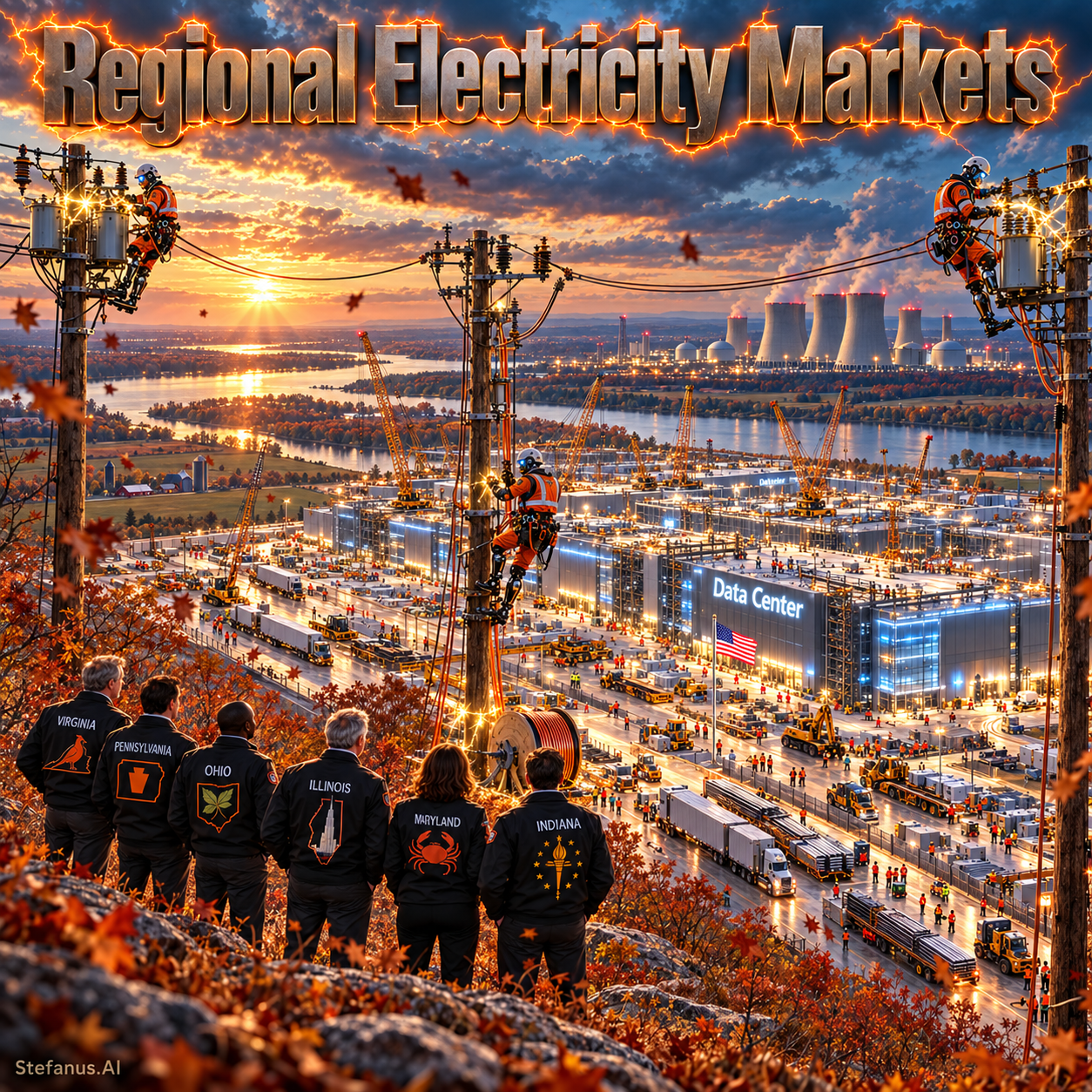
On the morning of October 8, 2026, in the gilded ballroom of the Palmer House in downtown Chicago, Illinois Governor JB Pritzker stood before a bipartisan gathering of governors representing thirteen states and the Mayor of the District of Columbia and announced that the group had unanimously signed a memorandum of understanding formally establishing the PJM Governors’ Collaborative, a standing, multistate organization whose declared purpose is to strengthen the states’ collective hand in the decisions made by PJM Interconnection, the regional transmission organization that manages the flow of electricity for roughly 67 million people from northern Illinois to the Atlantic seaboard.[1] The announcement was, on its surface, a procedural one: the Collaborative establishes a forum in which governors and their administrations can share information, identify areas of common interest, develop joint positions and strategies on PJM issues, share technical assistance to assess PJM proposals, and coordinate their engagement with PJM, the Federal Energy Regulatory Commission, state public utility commissions, and the other institutions that shape regional electricity policy.[1] Beneath the procedural language, however, lay a political statement of unusual force, delivered by a Democratic governor to a room that included the Republican governors of Indiana, Ohio, and Tennessee alongside Democratic colleagues from Pennsylvania, Maryland, Michigan, Virginia, New Jersey, Delaware, and North Carolina.[1]
“Families in Illinois and across the region deserve more from PJM, and as Governors, we refuse to sit by idly as they prioritize profits over people.” — Governor JB Pritzker [1]
The arithmetic that brought these governors to Chicago is not difficult to grasp. In the capacity auction that PJM conducted in July 2024 for the 2025/2026 delivery year, the regional clearing price jumped from $28.92 per megawatt-day to $269.92, an increase of more than 800 percent in a single year; the subsequent auction climbed to $329.17; and the two auctions since then, for the 2027/2028 and 2028/2029 delivery years, have cleared at price caps negotiated between the governors, PJM, and FERC precisely because, absent those caps, prices would have climbed even higher.[2][3] Pritzker summarized the trajectory in language designed to travel well beyond the ballroom.
“Prices in PJM’s capacity market have increased over a thousand percent from 2023.” — Governor JB Pritzker [4]
The revealing development, and the reason the Chicago summit deserves the attention of anyone who studies the intersection of energy policy and the emerging artificial intelligence economy, is that individual governors are moving beyond their own state-level economic-development strategies and are coordinating across an interconnected electricity market whose physical boundaries bear no relationship whatsoever to the political boundaries that define their constituencies. For most of the history of American electricity regulation, governors treated the power system as a largely technical domain delegated to public utility commissions, regional grid operators, and federal regulators, intervening only episodically when a major blackout or a politically painful rate increase forced the issue onto their desks. That posture has been abandoned. The governors who gathered in Chicago, following a first summit hosted by Pennsylvania Governor Josh Shapiro in Philadelphia in September 2025 at which Shapiro warned that states could look for options outside PJM if the grid operator did not act decisively, now treat the governance of the regional wholesale electricity market as a first-order matter of state economic strategy, consumer protection, and electoral accountability.[5][6]
The reason this transformation is occurring now, rather than at any earlier point in the three decades since federal regulators first reorganized the American power system around competitive regional wholesale markets, is the extraordinary and geographically concentrated surge in electricity demand created by hyperscale datacenters serving artificial intelligence workloads. PJM’s independent market monitor, Monitoring Analytics, has calculated that existing and forecast datacenter load was responsible for roughly $29.4 billion of the $63.6 billion in capacity charges produced by PJM’s last four capacity auctions combined, or about 46 percent of the total.[2] That is not a marginal effect at the edges of an otherwise stable system; it is a structural reordering of who pays for the regional grid and why. It is also, as the sections that follow will argue, a preview of the pressures that will arrive, in varying forms and at varying speeds, in every other regional electricity market in the United States as the AI economy expands through 2030.
Why I Chose the Title “Regional Electricity Markets”
I chose the title “Regional Electricity Markets” because America’s rapidly expanding artificial intelligence economy is transforming electricity from a conventional utility service, priced and regulated in the background of economic life, into a strategic foundation for technological competitiveness, industrial location, and political decision-making. The October 8, 2026, formation of the bipartisan PJM Governors’ Collaborative illustrates an important turning point: governors are increasingly recognizing that electricity affordability, grid reliability, transmission expansion, and datacenter growth cannot be addressed independently within individual state boundaries. These challenges require greater coordination among states, regional electricity-market operators, federal regulators, utilities, and the private corporations that are investing hundreds of billions of dollars annually in AI infrastructure.
The title also provides a broader and more analytically durable framework for examining the different electricity-market structures that operate across the United States, particularly the four systems that this paper treats in depth: PJM Interconnection in the Mid-Atlantic and Midwest, the Midcontinent Independent System Operator (MISO) across the industrial heartland and the Gulf South, the Electric Reliability Council of Texas (ERCOT) in its singular, state-centered configuration, and the California Independent System Operator (CAISO) in the nation’s most aggressive clean-energy transition. Rather than concentrating exclusively on one political dispute or one regional grid, this paper investigates how accelerating AI electricity demand is changing the relationships among state governments, federal institutions, hyperscale technology companies, energy producers, and residential consumers. Within my Five-Layer AI Economy framework — Energy, Chips, Datacenters, Models, and Applications and Agents — regional electricity markets represent the critical institutional mechanism that connects physical energy resources to the next generation of American technological and economic development through 2030. Chips cannot run, datacenters cannot open, models cannot train, and agents cannot operate continuously unless the first layer is secured, and in the United States the first layer is secured, or not secured, through regional electricity markets.
The paper proceeds in six sections. Section 1 examines the October 2026 turning point in detail, situating the Chicago summit within a year of extraordinary institutional ferment at PJM and FERC. Section 2 compares the four regional systems and the federalist architecture that divides authority among them. Section 3 applies the Five-Layer AI Economy framework to the question of how datacenter demand is reshaping regional power markets, drawing on corporate earnings reports through the second quarter of 2026 and the latest demand projections from the International Energy Agency, Lawrence Berkeley National Laboratory, and the U.S. Energy Information Administration. Section 4 turns to the political economy of electricity infrastructure, including the growing local resistance to datacenter expansion and the November 2026 midterm elections. Section 5 develops a 2027–2030 outlook, three scenarios, and a five-part regional governance framework. Section 6 distills the lessons of the analysis into seven pillars, and the Conclusion returns to the question of why regional electricity markets will help determine the future of America’s artificial intelligence economy.

Section 1: The October 2026 Turning Point — When American Governors Challenge Regional Electricity Governance
The formation of the PJM Governors’ Collaborative did not occur in isolation, and it cannot be understood as a single event. It is better understood as the culmination of a thirteen-month sequence in which the political leadership of the largest regional electricity market in the United States, the federal regulator that oversees it, the White House, and the market operator itself were drawn into an escalating contest over who should govern the grid, how its costs should be allocated, and whether the institutions designed in the 1990s for an era of flat demand can function in an era of explosive, concentrated, datacenter-driven load growth. This section traces that sequence, examines the structural origins of the dispute in the history of PJM, analyzes the specific concerns that have animated the governors, and asks whether coordinated gubernatorial participation can materially influence regional market outcomes without displacing the legal authorities that remain, for now, in the hands of PJM’s members and the Federal Energy Regulatory Commission.
1.1 The October 8, 2026, Governors’ Summit in Illinois
The Chicago summit was formally the second annual Governors’ Summit on the State of PJM, and the Illinois Governor’s Office framed its central accomplishment as the transition from an informal coalition into a formal, chartered body with a shared mission to increase state and consumer representation in PJM’s governance and decision-making processes.[1] The Collaborative had launched in September 2025 as a bipartisan effort joined by eleven of the thirteen governors whose states PJM serves; by October 2026 it had grown to encompass the full membership, with the governors of Delaware, Indiana, Maryland, Michigan, North Carolina, Ohio, Pennsylvania, Tennessee, Virginia, New Jersey, and Illinois named in the Illinois announcement, alongside the Mayor of the District of Columbia.[1][5] The memorandum of understanding commits the signatories to act together “when sufficient agreement exists,” a formulation that preserves each governor’s autonomy while establishing the expectation that, on the issues where their interests converge, the states will speak with one voice to PJM and to FERC.[1]
What makes the Chicago summit more consequential than the Philadelphia gathering a year earlier is the institutional environment into which it arrived. In the intervening months, three developments transformed the governors’ complaints from political rhetoric into live regulatory proceedings. First, in January 2026, the White House National Energy Dominance Council and all thirteen PJM governors signed a joint Statement of Principles Regarding PJM, calling on the grid operator to hold an emergency Reliability Backstop Auction by September 2026 with fifteen-year price certainty for new generation, to allocate the resulting costs to datacenters and other large new loads that had not brought their own supply, and to return PJM to what the statement called market fundamentals.[7][8][9] Second, in May 2026, FERC Chairman Laura Swett announced a Commission-led technical conference on PJM’s governance and stakeholder processes, which convened on July 23, 2026, and at which the Chairman declared that the regulator would impose its own reforms if PJM’s members failed to agree on a governance package by the end of September.[10][11][12] Third, in the days immediately before the Chicago summit, PJM’s members voted on a governance-reform proposal that, according to reporting cited by the Daily Caller News Foundation, would let governors’ offices participate in the Organization of PJM States for the first time while, in the view of critics, allowing the member companies to retain most of their decision-making power and their effective veto over reforms.[5][6]
“The fact that companies that benefit from the current rules get to write and approve their own reform highlights the broken system Marylanders are footing the bill for.” — Rhyan Lake, spokesperson for Maryland Governor Wes Moore [6]
The Maryland statement captures the governors’ frustration with precision. PJM is a membership organization whose stakeholder process is dominated by the transmission owners, generation owners, and other market participants that have a direct financial stake in the rules; the states, uniquely among regional transmission organizations, lack the ability to file their own proposals with FERC under section 205 of the Federal Power Act and must instead rely on the slower and more adversarial complaint process under section 206.[10] For a governor accountable to voters who have seen their electricity bills rise by 20 percent or more in some utility territories since 2024, that structural exclusion is intolerable, and the Collaborative is best understood as an attempt to compensate for a lack of formal legal standing through coordinated political and technical weight.[10]
The industry’s response to the summit was notably defensive. Todd Snitchler, president of the Electric Power Supply Association, argued that capacity prices make up a small share of monthly electric bills and pointed to a report from the nonprofit PowerLines finding that utility spending on transmission and distribution made up the bulk of rate requests in the third quarter of 2026.[5]
“PJM’s markets deliver reliable power and $5 billion in annual savings — we need to build on that success and get projects built.” — Todd Snitchler, Electric Power Supply Association [5]
The disagreement between Snitchler and the governors is not primarily about facts; both sides agree that capacity charges are a minority of the typical residential bill and that distribution and transmission investment has grown rapidly. The disagreement is about causation, accountability, and trajectory. The governors contend that PJM’s planning failures, interconnection backlogs, and inability to bring new generation online in step with datacenter load are the proximate cause of a price spiral that will worsen without intervention; the generators contend that the market is sending exactly the price signals it was designed to send and that political interference will deter the investment the region needs. Both positions have merit, which is precisely why the governance question has become so difficult to resolve.
1.2 From Interstate Power Coordination to Political Accountability
To understand why thirteen governors now feel compelled to organize against the regional grid operator, it is necessary to recall what PJM was designed to be. PJM traces its origins to a 1927 power-pooling agreement among three utilities in Pennsylvania and New Jersey, expanded to include Maryland in 1956, which allowed vertically integrated monopolies to share generating reserves and dispatch the lowest-cost plants across their combined footprint. For most of the twentieth century this arrangement was a technical convenience among regulated utilities whose rates were set by state commissions; the pool had no independent governance, no markets, and no political profile. That changed in the 1990s, when FERC’s Order 888 opened transmission systems to competition and when PJM was designated first as an independent system operator in 1997 and then as the nation’s first fully functioning regional transmission organization in 2001.[11] In the quarter century since, PJM has expanded westward and southward to encompass all or parts of thirteen states and the District of Columbia, has layered a complex set of energy, capacity, and ancillary-service markets on top of its original dispatch function, and has assumed responsibility for regional transmission planning and for the interconnection queue through which every new generator must pass.[11]
The consequence of this expansion is that an institution designed to coordinate the physical operations of a handful of utilities now makes decisions that allocate tens of billions of dollars annually among 67 million consumers, determine which power plants are built and which retire, and set the terms on which the most capital-intensive industry of the current decade — AI datacenters — can connect to the grid. PJM’s own communications now acknowledge the shift. In a June 2026 statement previewing the capacity auction, the grid operator observed that an auction once followed mainly by industry insiders is now receiving broad attention from policymakers and consumers because its results have become one of the clearest indicators that electricity demand is growing faster than new generation can be built to supply it, with datacenters as the primary driver of that growth, developable two to three times faster than the generation needed to serve them.[13]
The political accountability that the governors demand follows from this expansion of responsibility. When PJM was a power pool, no governor needed a seat at its table because the decisions that mattered to voters were made by state commissions. When PJM became a market operator and planner whose auction results flow directly into retail bills, the absence of state representation in its governance became a democratic deficit that the governors have now decided to close. One energy consultant quoted by Utility Dive described the moment as a recognition that governance itself has become a strategic asset, because in a period of unprecedented AI-driven demand growth the ability to make timely decisions is no longer an administrative matter but a prerequisite for reliable markets and efficient capital allocation.[10]
1.3 The Governors’ Growing Concerns
The governors’ grievances can be organized under five headings, each of which connects directly to the datacenter demand surge.
The first is electricity affordability, which has become the dominant energy issue of the 2026 election cycle. The July 2026 capacity auction for the 2028/2029 delivery year cleared at the FERC-approved cap of $325 per megawatt-day across the entire PJM footprint; without the cap, PJM’s own analysis indicated that prices would have reached $554.72 per megawatt-day regionwide and $776.69 in the Commonwealth Edison zone covering northern Illinois.[14] The cap, which the governors negotiated with PJM and FERC and which now applies to four consecutive auctions, represents a 2.5 percent decrease from the prior year’s cap of $333.44, meaning that ratepayers will see little change in capacity costs when the delivery year begins on June 1, 2028, but will continue to pay prices more than eleven times higher than the $28.92 that cleared for the 2024/2025 delivery year.[3][2] The New York Times reported that the auction is expected to add $6.3 billion in charges to consumers’ bills attributable to datacenter demand alone.[15]
The second concern is the market monitor’s finding that the datacenter-driven price increases do not reflect a competitive outcome. In its report on the first half of 2026, Monitoring Analytics concluded that PJM’s energy market produced competitive results but that its capacity auctions did not, and that wholesale costs across the region rose 50.3 percent in the first six months of the year, with the inclusion of projected datacenter demand in the capacity market adding $11.11 per megawatt-hour to overall wholesale costs.[16] The monitor had reached the same conclusion a year earlier, estimating that datacenter load alone drove up revenue in the 2027/2028 auction by $7.3 billion, or 82 percent, to $16.1 billion.[17]
The capacity auction results were “not competitive, primarily as a result of the inclusion of forecast demand for data centers.” — Joseph Bowring, Independent Market Monitor for PJM [16]
The third concern is transmission-development delay and cost. Pritzker told the Chicago summit that the region is set to pay for a massive transmission build-out made more costly by the lack of productive planning and by insufficient consideration of interregional transmission.[4] The 2025 Regional Transmission Expansion Plan assigned roughly $4.8 billion in projects to Dominion Energy’s Virginia utility alone, a figure that reflects the extraordinary concentration of datacenter load in Northern Virginia and that the other states fear they will be asked to subsidize.[18]
The fourth concern is resource adequacy. The July 2026 auction procured 138,318 megawatts of unforced capacity, which, combined with 10,864 megawatts from regions with fixed resource requirements, left PJM 6,831 megawatts short of its reliability requirement for 2028/2029 — the third consecutive year the auction has missed its target and the largest shortfall since the current auction structure was adopted.[3][19] PJM’s chief operating officer attributed roughly 2 gigawatts of the increase in forecast demand to datacenter development, and the resource mix that did clear remains dominated by natural gas at 46 percent, nuclear at 20 percent, and coal at 18 percent.[3][20]
The fifth concern is the forecast itself. Maryland People’s Counsel David Lapp warned the PJM Board in late 2025 that the utilities’ submissions for the 2026 load forecast implied more than $1 trillion in datacenter capital expenditure within PJM by 2028, a figure that rivals national and even global estimates of datacenter investment, and that existing captive customers bear enormous risk of paying for an overbuilt system if the datacenters do not materialize as projected.[21]
“There are huge signs that the submissions to add more data centers to the forecast are wildly overstated.” — David S. Lapp, Maryland People’s Counsel [21]
Taken together, these five concerns describe a system in which the price signal is extreme, the market monitor doubts its competitiveness, the transmission bill is rising, the reliability margin is shrinking, and the demand forecast on which all of it rests is contested. It would be surprising if governors did not organize in response.
1.4 The Politics of Interstate Electricity Cooperation
The PJM Governors’ Collaborative is remarkable for its bipartisanship in a period of intense partisan polarization, and the explanation lies in the structure of the problem rather than in any convergence of ideology. Governor Shapiro of Pennsylvania, a Democrat widely discussed as a national figure, has pursued the most aggressive posture, suing PJM in late 2024 over the auction results, extracting the original price collar in early 2025, and repeatedly threatening that Pennsylvania could seek alternatives to PJM membership.[5][6] Shapiro’s approach combines consumer protection with industrial strategy: he has promoted his Lightning Plan, a package of permitting reform and a Pennsylvania-only carbon-credit program designed to return revenue to ratepayers, while simultaneously celebrating Amazon’s $20 billion datacenter commitment in the state and pressing for rate structures that allocate incremental generation and transmission costs to large-load users.[18]
“Our utility companies in Pennsylvania make billions of dollars every year — while at the same time,” Pennsylvanians struggle with their bills. — Governor Josh Shapiro [18]
Governor Pritzker of Illinois has emphasized nuclear power as the state’s contribution to new supply and has focused his criticism on PJM’s data-center cost allocation, demanding in April 2026 that datacenter consumption not drive up costs for consumers and filing detailed governance recommendations with FERC in August 2026.[1][4] Governor Gretchen Whitmer of Michigan, whose state straddles both PJM and MISO territory, has faced the sharpest intra-party criticism over the issue, with progressive legislators accusing her of selling out to technology companies even as she called on datacenter developers to sign a voluntary pledge that Michigan households would not absorb the cost of their electricity and water use.[22] Governor Wes Moore of Maryland has been the most pointed critic of the member-dominated reform process. On the Republican side, Governors Mike Braun of Indiana, Mike DeWine of Ohio, and Bill Lee of Tennessee have participated in the Collaborative since its inception, reflecting the reality that datacenter-driven rate increases land on Republican and Democratic households alike and that Ohio in particular, where the Public Utilities Commission approved AEP Ohio’s landmark 85 percent minimum-payment datacenter tariff in July 2025, has been a national laboratory for cost-allocation reform.[5][23]
The challenge of bipartisan consensus lies less in the goals than in the means. All thirteen governors want lower capacity prices, more generation, faster transmission, and protection for residential ratepayers. They differ, sometimes sharply, on the role of renewable energy versus natural gas and nuclear, on whether PJM should be reformed or whether states should threaten exit, on how aggressively to regulate datacenter siting, and on the appropriate relationship with the Trump administration, whose National Energy Dominance Council co-signed the January 2026 principles but whose broader energy agenda favors fossil generation over the solar and storage projects that dominate PJM’s interconnection queue.[7][24] The Collaborative’s charter, which allows joint action only “when sufficient agreement exists,” is an acknowledgment that these differences are real and that the coalition will be most effective on the narrow set of governance and cost-allocation issues where the states’ interests align.[1]
1.5 The Beginning of a New Governance Debate
The deepest question raised by the Chicago summit is whether coordinated gubernatorial participation can materially influence regional market rules, regulatory proceedings, infrastructure planning, and consumer protection without displacing the legal authorities that the Federal Power Act vests in FERC and that PJM’s governing documents vest in its members. The answer, on the evidence of the past year, is a qualified yes, achieved through three channels.
The first channel is political pressure translated into regulatory action by FERC. The governors cannot themselves rewrite PJM’s tariff, but their coordinated advocacy was instrumental in prompting FERC’s unprecedented governance inquiry. At the July 23 technical conference, Chairman Swett used language that no federal regulator had previously applied to the nation’s largest grid operator.
“PJM is facing a grave legitimacy crisis.” — Laura Swett, Chairman, Federal Energy Regulatory Commission [10]
FERC followed the conference with a formal Dispute Resolution Services forum convened on September 1, 2026, in which PJM was invited to circulate a preliminary reform package by August 26 and stakeholders were asked to identify areas of consensus and divergence to inform a future filing.[25] The Commission has also signaled, in a related proceeding on transmission-owner rights, that it will hold its show-cause order in abeyance until November 16, 2026, to allow PJM and the transmission owners to submit section 205 filings addressing the Commission’s preliminary findings.[26] The governors’ role in this process is advisory rather than dispositive, but FERC’s willingness to threaten imposed reforms is directly traceable to the political salience that the governors created.
The second channel is state retail-rate authority, which the governors and their public utility commissions control outright. PJM has acknowledged that it has no jurisdiction to allocate costs directly to individual datacenters and that the success of its Reliability Backstop Procurement depends on state action to assign the resulting retail costs to the large loads that caused them.[27] This is the lever that the January 2026 Statement of Principles explicitly committed the governors to pull, and it is the lever through which the Collaborative can convert regional procurement into protection for residential customers.[8]
The third channel is the credible threat of exit. Shapiro’s warnings that Pennsylvania could leave PJM, echoed by American Electric Power’s own suggestion that it might depart, are not realistic in the near term — the legal, technical, and financial complexity of withdrawing a state’s load from a synchronous regional market is enormous — but they alter the bargaining dynamics by reminding PJM’s members that the organization’s legitimacy depends on the continued consent of the states.[28]
What the governors cannot do is replace PJM’s markets with administrative procurement or override FERC’s determination of what constitutes a just and reasonable rate. The Collaborative therefore represents not the end of regional market governance but the beginning of a hybrid model in which states, acting collectively, become a permanent political counterweight to the member-driven stakeholder process. Whether that hybrid proves stable, or whether it degenerates into a permanent contest between state political demands and federal market principles, will depend heavily on the outcome of the FERC governance proceeding in late 2026 and on the results of the Reliability Backstop Procurement that opened on September 30, 2026, and that FERC accepted on September 29.[20][27]

Section 2: America’s Regional Electricity Markets — Four Different Systems Confronting the Same AI Revolution
The United States does not have a national electricity market. It has a patchwork of regional systems, each the product of a distinct regulatory history, resource endowment, and political culture, and each now confronting the same external shock: a wave of hyperscale datacenter demand that is larger, faster, and more geographically concentrated than any load growth the American grid has absorbed since the postwar industrial expansion. The four systems examined in this section — PJM, MISO, ERCOT, and CAISO — together serve well over half of the nation’s electricity consumers and host the overwhelming majority of its planned AI infrastructure. They differ profoundly in how they procure capacity, how they plan transmission, how they interconnect new loads, and, above all, in the division of authority between state governments and federal regulators. Those differences matter because they determine who absorbs the costs and the risks of the AI buildout, and because they are producing four distinct political responses to the same underlying pressure. The comparison also reveals that no single market design has yet solved the problem; each system is improvising, and each improvisation carries lessons for the others.
Table 1. Four Regional Electricity Systems Confronting AI-Driven Load Growth (as of October 2026)
| Dimension | PJM | MISO | ERCOT | CAISO |
| Footprint | All or part of 13 states + D.C.; ~67 million people | 15 states + Manitoba, Midwest and Gulf South | Roughly 90% of Texas load; ~85 GW peak | California and a small part of Nevada |
| Federal jurisdiction | FERC-regulated RTO | FERC-regulated RTO | Largely outside FERC wholesale jurisdiction (intrastate) | FERC-regulated ISO |
| Capacity mechanism | Three-year forward Base Residual Auction with price collar (2026/27–2029/30) | Annual seasonal Planning Resource Auction; most load self-supplied | Energy-only market; scarcity pricing; no capacity market | State-directed resource adequacy procurement by load-serving entities |
| 2026 capacity signal | $325/MW-day cap; 6,831 MW short of reliability requirement for 2028/29 | $116–$126/MW-day annualized; cleared above reserve margin targets | 474.7 GW of large-load requests tracked (June 2026), ~90% datacenters | Record battery storage; CPUC SB 57 cost-shift study due January 2027 |
| Governance pressure point | Member-dominated stakeholder process; states lack section 205 rights; FERC governance proceeding | Organization of MISO States; large-load forecast and interconnection reforms | Governor and Legislature act directly through PUCT; SB 6 (2025) and June 2026 directive | Governor, Legislature, and CPUC; “study first” posture |
| Datacenter cost-allocation posture | Backstop procurement; state retail allocation; “bring your own generation” | Expedited resource additions; large-load tariffs by state | 75 MW threshold, financial security, mandatory curtailment, batch queue review | Ratepayer protection study; large-load tariff proposals |
Sources: compiled from [3][29][30][31][20][32][33].
2.1 PJM: The Interstate Governance Challenge
PJM’s predicament has already been described in Section 1, but it is worth situating the grid operator’s structural features within the comparative frame, because PJM is the system in which the tension between regional markets and state politics has reached its most acute form. PJM’s defining institutional characteristic is its three-year forward capacity market, the Reliability Pricing Model, which procures commitments from generators and demand-response providers to be available during the delivery year beginning three years after the auction. The design was intended to send a forward price signal that would attract new generation before shortages materialized. In practice, the auction has been overwhelmed by a demand forecast that grows faster than any generator can respond. The 2028/2029 Base Residual Auction procured 138,318 megawatts against a reliability requirement it missed by 6,831 megawatts, and PJM’s own chief operating officer acknowledged that new generation needs significantly more than the $325 cap to be financially viable — which means that the collar negotiated to protect consumers simultaneously suppresses the price signal that was supposed to attract supply.[3]
The result is a system in which the capacity market no longer functions as a market in the conventional sense. Prices are set by an administratively negotiated cap; the shortfall is to be addressed by a one-time administrative procurement with fifteen-year contracts and a maximum willingness to pay of $555 per megawatt-day; and the allocation of the resulting costs will be determined by state public utility commissions acting under principles set by the White House and the governors rather than by the market’s own settlement rules.[27][20] The Reliability Backstop Procurement that FERC accepted on September 29, 2026, is structured in two phases: a bilateral phase in which datacenters and load-serving entities can contract directly with new supply projects, followed by a central procurement to acquire whatever capacity remains necessary.[34] CBRE’s analysis of the April 2026 proposal observed that the few gas and battery projects capable of coming online by mid-2031 will likely contract only with datacenters in the first phase, because datacenters facing aggressive build timelines will pay premium prices for capacity that can be delivered before that deadline.[34]
The market monitor has been scathing. Bowring told FERC that the backstop process would require other customers to pay for datacenter load despite PJM’s assertions to the contrary, and the Institute for Policy Integrity at New York University School of Law argued in comments to FERC that the backstop auction is more costly and less effective than other tools available to PJM and will not isolate other customers from the impact of datacenter-related load growth.[35][36] Environmental advocates have pressed the alternative of requiring datacenters to bring their own capacity, which the Natural Resources Defense Council estimates would spare PJM consumers as much as $163 billion through 2033 relative to the status quo trajectory.[37] The Sierra Club noted that 64 percent of the capacity cleared for 2028/2029 will be fossil-fired and that the backstop auction, under current plans, would carry a cap of its own but would not be bound by the same collar that governs the regular auctions.[38]
The geography of the problem is as important as its market design. Virginia’s Dominion zone, which hosts the largest concentration of datacenters in the world, faces capacity charges roughly 65 percent higher than the rest of PJM, and the 2025 long-term load forecast projected 32 gigawatts of peak load growth across PJM between 2024 and 2030 with datacenters responsible for 94 percent of the increase, while PJM expects to add only 2 to 3 gigawatts of new supply annually against 5 to 7 gigawatts of new datacenter demand from 2027 to 2032.[39] Pennsylvania, Ohio, and Illinois follow Virginia in the dollar value of planned datacenter construction, with Industrial Info Resources tracking 1,321 datacenters scheduled to begin construction in PJM’s footprint between January 2026 and December 2030.[40] The interstate governance challenge, in short, is that a handful of zones are generating the demand that raises prices for all thirteen states, and the states whose residents pay without hosting the datacenters have little recourse within PJM’s existing stakeholder structure.
2.2 MISO: The Industrial Midwest and the New Electricity Demand
The Midcontinent Independent System Operator presents an instructive contrast. MISO stretches from Manitoba to the Gulf of Mexico across fifteen states, serving a region whose political economy is defined by legacy manufacturing, agricultural processing, and, increasingly, the electrification of industry and the arrival of hyperscale datacenters in Indiana, Michigan, Illinois, Wisconsin, Louisiana, and Mississippi. MISO’s capacity construct is fundamentally different from PJM’s: rather than a three-year forward auction that clears a single annual price, MISO runs a residual Planning Resource Auction shortly before each June planning year that clears four separate seasonal prices, and the overwhelming majority of MISO’s load-serving entities — roughly 92 percent in 2026 — secure their capacity through self-supply or bilateral contracts rather than through the auction.[41][29]
The 2026 auction, whose results MISO released on April 28, 2026, illustrated both the relative stability of this structure and the pressure building beneath it. The annualized clearing prices ranged from $116.06 per megawatt-day in Local Resource Zones 8 and 10 to $126.19 in the North and Central subregion, with the summer price in Zone 9 — most of Louisiana and southeast Texas — reaching $412.10 per megawatt-day, reflecting local reliability needs and transfer limitations between the North and South.[29] Capacity offered into the auction grew by as much as 4 percent in each season relative to 2025, and the auction cleared 3.5 percent above the summer planning reserve margin target of 7.9 percent, meaning that MISO, unlike PJM, met its resource adequacy requirement in every season.[29][32] MISO’s vice president of system planning framed the result as real progress with more work to do as load growth accelerates.[29]
The acceleration is substantial. MISO’s long-term forecast, released on April 13, 2026, anticipates 8 to 14 gigawatts of datacenters coming online in 2026 and 2027 alone, driven by what the grid operator calls large, concentrated loads from datacenters, AI, and manufacturing.[41] DTE Energy in Michigan raised its five-year capital plan to $36.5 billion in early 2026 explicitly on the strength of datacenter demand, and the $16 billion Saline Township campus built by Related Digital for Oracle and OpenAI has become a political flashpoint in the state, generating backlash that pushed Governor Whitmer to seek a voluntary ratepayer-protection pledge from developers while progressive legislators proposed a moratorium.[40][22] In Louisiana, Entergy’s construction of natural gas generation to serve Meta’s Hyperion campus has raised similar questions about who bears the risk if the load fails to materialize.
What distinguishes MISO from PJM is less the scale of the challenge than the institutional response. Because most MISO load is served by vertically integrated utilities under state regulation, the cost-allocation question is adjudicated primarily by state commissions in integrated resource planning and rate cases, where large-load tariffs with minimum-bill provisions, collateral requirements, and exit fees can be imposed directly on datacenters. MISO has also moved more quickly than PJM on expedited resource additions and on reforming the accreditation of capacity, and it has begun an interim Expedited Resource Addition process for new generation.[32] The Organization of MISO States, which has formal standing in MISO’s governance, requested and received an extension of FERC’s comment deadline in the large-load interconnection rulemaking, reflecting a state role that is more institutionalized than in PJM.[42] MISO’s challenge is therefore not primarily one of governance legitimacy but of physical delivery: whether enough generation and transmission can be built, fast enough, to serve the industrial Midwest’s dual transition toward electrified manufacturing and AI computing.
2.3 ERCOT: Texas and the State-Centered Electricity Model
Texas occupies a category of its own. Because the ERCOT grid does not synchronously interconnect with the Eastern or Western Interconnections, wholesale electricity sales within it are intrastate commerce largely beyond FERC’s jurisdiction under the Federal Power Act, and the Public Utility Commission of Texas, the Legislature, and the Governor exercise the authority that in other regions is divided between state and federal regulators. ERCOT operates an energy-only market with no capacity auction; generators are compensated through scarcity pricing with a systemwide offer cap of $5,000 per megawatt-hour, and resource adequacy is a function of market expectations rather than administrative procurement.[43] This structure gives Texas a flexibility that no FERC-jurisdictional region possesses, and the state has used it aggressively.
The scale of datacenter interest in Texas is without precedent. ERCOT was tracking approximately 474.7 gigawatts of large-load interconnection requests as of June 2026, of which 420.8 gigawatts, or 90.2 percent, were identified as datacenters — against a grid whose peak demand is roughly 85 gigawatts.[30] A year earlier the figure had been 189 gigawatts; two years earlier, non-cryptocurrency datacenters had made up less than half of large-load requests.[44] Oncor alone told the Texas House that it was tracking 650 large-load requests totaling 273 gigawatts.[43] Everyone involved understands that the overwhelming majority of these requests are speculative, duplicative, or both. UC Berkeley energy economist Severin Borenstein, speaking at the Technology Policy Institute’s Aspen Forum in August 2026, explained that datacenter developers routinely file duplicate interconnection requests across multiple utility territories without intending to build all of them, angling to secure a spot wherever power becomes available first.[45]
The Texas response has been Senate Bill 6, signed by Governor Greg Abbott in June 2025, which applies to any load of 75 megawatts or more and requires large-load customers to post financial security, disclose duplicate requests in other jurisdictions, contribute to interconnection costs, and accept mandatory curtailment during firm load shed; any large load interconnecting after December 31, 2025, must give ERCOT the ability to curtail it in an emergency.[43][46] A 1-gigawatt campus now faces roughly $50 million in upfront security before a single interconnection study begins.[43] The PUCT adopted forecasting criteria in February 2026 designed to exclude phantom load, and ERCOT’s preliminary long-term forecast filed in April 2026, applying those criteria, reduced Oncor’s queue from 273 gigawatts to 110 and the statewide figure to 243 gigawatts — still nearly three times the size of the existing grid.[43][30]
Abbott’s posture then shifted from courtship to discipline. On June 10, 2026, the Governor directed the PUCT and ERCOT to require datacenters to add new generation rather than simply increase demand, ordered a full audit of the interconnection queue, set deadlines for classifying roughly 205 gigawatts of requests into a “Batch Zero” review, and threatened to deny grid access to projects that could not demonstrate commitment.[30][33]
“Data centers must operate in ways that reduce costs for residential electricity customers, do not drain water needed for our communities, and take into consideration the needs of our neighborhoods.” — Governor Greg Abbott [33]
The Texas model has two features that FERC-regulated regions cannot replicate. The first is speed: a governor’s letter and a PUCT rulemaking can change the rules of large-load interconnection in months, whereas in PJM the same change requires a stakeholder process, a FERC filing, and litigation. The second is the direct alignment of political accountability with regulatory authority: Texas voters know whom to blame, and the Governor knows that he will be blamed. The model’s weakness is the absence of a capacity mechanism that guarantees resource adequacy; Texas is betting that scarcity prices, the state’s Texas Energy Fund loans for new gas generation, and the mandatory curtailment of datacenters will together keep the lights on through the buildout. Whether that bet succeeds will be tested in the summers of 2027 through 2030.
2.4 CAISO: California’s Electricity Transition
California’s position in the AI electricity story is paradoxical. The state is home to the companies that design the chips, train the models, and operate the largest hyperscale clouds, yet it hosts a comparatively small share of the physical datacenter capacity, because its electricity prices are among the highest in the nation, its permitting is slow, and its grid is in the midst of the country’s most ambitious transition toward renewable generation and battery storage. CAISO has no capacity market in the PJM sense; resource adequacy is procured by load-serving entities under California Public Utilities Commission direction, and the state has added battery storage at a pace that has made it the global leader in grid-scale batteries, with evening peaks now routinely served by storage discharging solar energy captured during the day.
The datacenter question has nonetheless arrived. Pacific Gas & Electric has indicated it has requests for nearly 2 gigawatts of new datacenter demand in the San José area alone, and at Stanford University’s Sustainable Data Centers Symposium in May 2026, panelists from the Electric Power Research Institute, the Legislature, and PG&E debated whether datacenter growth would strain the grid or accelerate its decarbonization.[47] PG&E’s own estimate, presented at the symposium, was that every 1,000 megawatts of new datacenter demand could lower all customers’ bills by 1 to 2 percent as large customers assume a larger share of fixed grid costs — a claim that stands in direct opposition to the PJM experience and that reflects California’s different circumstance, in which the dominant driver of rates is the fixed cost of wildfire mitigation and distribution investment rather than the marginal cost of capacity.[47]
Governor Gavin Newsom signed Senate Bill 57, the Ratepayer and Technological Innovation Protection Act, on October 11, 2025, directing the CPUC to study the extent to which load growth from datacenters results in cost shifts to other ratepayers, with findings due by January 2027.[48][31] The enacted bill was notably narrower than the version that passed the Assembly Utilities and Energy Committee, which would have required a special tariff to protect other ratepayers from transmission costs serving large loads; as signed, SB 57 imposes no new charges, rate classes, or operational requirements on datacenters, reflecting what Morgan Lewis described as a legislative preference for developing a factual record before pursuing more aggressive regulation.[49] California thus occupies the opposite end of the spectrum from Texas: where Abbott has acted by directive, Newsom has acted by study, and where ERCOT confronts a 474-gigawatt queue, CAISO confronts the question of whether it can attract enough datacenter load to help pay for a grid that is expensive for reasons unrelated to AI.
California’s relevance to the national debate lies in its demonstration that the relationship between datacenter growth and retail prices is theoretically ambiguous, a point that economists have begun to document rigorously. A June 2026 study by researchers at EPRI, using a causal design built to rule out the objection that datacenters simply chose cheap-power states, estimated that datacenters caused average U.S. retail rates to fall modestly between 2015 and 2024 as fixed costs were spread over greater sales volumes.[50] A CEPR column published in September 2026 reached the same conclusion about the ambiguity of the effect, noting that recent working papers report limited or conflicting impacts and that the geographic concentration of datacenters creates far greater pressure on some systems than national figures suggest.[51] The lesson is that the PJM experience is a function of PJM’s market design and PJM’s concentration of load, not an iron law of datacenter economics.
2.5 Federalism and the Geography of Electricity
The four systems described above are embedded in a federalist architecture that divides authority among regional transmission organizations and independent system operators, state public utility commissions, FERC, the North American Electric Reliability Corporation, and, in large parts of the South and West, vertically integrated utilities that operate outside any organized market. The division is not neat. FERC regulates wholesale sales and interstate transmission; states regulate retail sales, generation siting, and distribution; RTOs operate markets and plan regional transmission under FERC-approved tariffs; NERC sets reliability standards that become mandatory only upon FERC approval; and utilities, whether members of an RTO or not, own and operate the physical assets. The datacenter surge has stressed every seam in this structure.
The most consequential jurisdictional development of the past year has been the federal government’s attempt to assert authority over the interconnection of large loads, which has historically been regulated by the states. On October 23, 2025, Energy Secretary Chris Wright invoked a rarely used provision of the Department of Energy Organization Act to direct FERC to initiate a rulemaking that would standardize and rapidly accelerate the interconnection of loads of 20 megawatts or more directly to the interstate transmission system, assign 100 percent of network-upgrade costs to the interconnecting load, and encourage co-location of load with generation, with a deadline of April 30, 2026, for final action.[52] The National Association of Regulatory Utility Commissioners responded with a resolution urging FERC to preserve and affirm states’ retail regulatory authority, and RTO Insider observed that the proposal constituted an entirely new approach to load interconnections that could further limit state powers.[42]
FERC’s response, after receiving more than 3,500 pages of comments, was to issue an Order Regarding Intent to Act on April 16, 2026, committing to action by the end of June, and then, on June 18, 2026, to issue six show-cause orders under section 206 of the Federal Power Act directing each RTO and ISO under its jurisdiction to justify or revise its tariff provisions governing large-load interconnection and co-location.[53][54] The Commission chose region-specific reform over a single national rule, acknowledging that the six organized markets differ materially in design, geography, and existing progress on large-load reforms, and it proposed a standardized definition of large load as a new commercial or industrial customer at a single site with a peak load of 50 megawatts or greater interconnecting at a voltage above 69 kilovolts.[54][55] Critically, FERC continued to recognize that the Federal Power Act reserves to the states the specific terms of retail sales to large loads, the determination of which entities may make retail sales within their borders, and all siting and construction decisions.[56] The orders apply only to the organized markets, which means that ERCOT and the vertically integrated utilities of the Southeast and Mountain West remain outside the framework.
This sequence reveals the geography of electricity federalism in its current form. In PJM, MISO, CAISO, and the other FERC-jurisdictional markets, the rules for connecting a datacenter to the transmission system are now a federal matter, the allocation of the resulting retail costs is a state matter, and the two must be reconciled through tariffs that FERC approves and that state commissions implement. In Texas, the whole chain is a state matter. In Georgia, the Carolinas, and the Southwest, where utilities such as Southern Company and Duke Energy plan and build generation under state commission oversight, the chain runs through integrated resource planning. The governors who formed the PJM Collaborative are responding to the specific structure of their own region, but the broader lesson is that AI-driven load growth has made the division of authority itself a subject of political contest, and that contest will be fought differently in each of the four systems examined here.

Section 3: The Five-Layer AI Economy — When Datacenter Electricity Demand Reshapes Regional Power Markets
The Five-Layer AI Economy framework that organizes this paper treats artificial intelligence not as a software phenomenon but as a vertically integrated industrial system whose layers are physically and economically dependent on one another. The first layer is Energy: the generation, transmission, and distribution infrastructure that delivers electrons to computing facilities. The second is Chips: the graphics processing units, custom accelerators, memory, and networking silicon that convert electricity into computation. The third is Datacenters: the buildings, cooling systems, power-distribution equipment, and real estate that house the chips. The fourth is Models: the frontier systems trained and served on that hardware. The fifth is Applications and Agents: the products, services, and increasingly autonomous software systems that deliver value to end users and that are beginning to run continuously rather than on demand. The framework’s central claim is that constraints at any lower layer propagate upward, and that in 2026 the binding constraint for the American AI economy has moved decisively to the first layer. This section examines each layer in turn, with particular attention to the corporate earnings and capital-expenditure disclosures through the second quarter of 2026 that reveal how the companies at the top of the stack are responding to scarcity at the bottom, and it closes with the question that animates the governors’ revolt: who pays for the electricity expansion that the AI economy requires?
Table 2. The Five-Layer AI Economy and Its Electricity-Governance Interface
| Layer | Core assets | Principal firms and institutions | Electricity-governance interface |
| 1. Energy | Generation, transmission, distribution, storage, fuel supply | Utilities, independent power producers, RTOs/ISOs, FERC, state PUCs, NERC | Capacity markets, interconnection rules, cost allocation, reliability standards |
| 2. Chips | GPUs, custom accelerators, HBM memory, networking | Nvidia, AMD, Broadcom, TSMC, hyperscaler custom silicon | Rack power density drives per-site load (100–1,000+ MW campuses); supply constraints shape demand timing |
| 3. Datacenters | Buildings, cooling, power distribution, land, water | AWS, Microsoft, Google, Meta, Oracle, xAI, OpenAI-affiliated projects, colocation providers | Large-load interconnection, siting, zoning, water permits, local tax policy |
| 4. Models | Frontier training runs, inference serving | Frontier labs and hyperscalers | Training concentrates gigawatt-scale load; inference distributes it; both demand 24/7 reliability |
| 5. Applications and Agents | Consumer and enterprise services, autonomous agents, robotics | Software firms, enterprises, consumers | Persistent, continuous workloads flatten load curves; flexibility potential in batchable tasks |
3.1 Layer One — Energy Becomes the Foundation of AI Growth
For roughly two decades before 2022, American electricity demand was essentially flat; efficiency gains in lighting, appliances, and industrial processes offset population and economic growth, and utilities planned for a future of modest or negative load growth. That era has ended, and the institutions of the power sector are still adjusting to its end. The U.S. Energy Information Administration’s Short-Term Energy Outlook projects that total electricity consumption will climb from a record 4,195 billion kilowatt-hours in 2025 to 4,271 billion in 2026 and 4,397 billion in 2027, with commercial sales — the category that includes datacenters — surpassing residential sales in 2026 for the first time in the agency’s records.[57] EIA has updated its commercial demand model to track server electricity separately from other computing uses, an acknowledgment that datacenter load has become a distinct and dominant driver of national demand.[57]
The projections of datacenter-specific consumption have been revised upward with each passing year. Lawrence Berkeley National Laboratory’s December 2024 report for the Department of Energy estimated that datacenters consumed 176 terawatt-hours, or 4.4 percent of total U.S. electricity, in 2023, and projected consumption of 325 to 580 terawatt-hours, or 6.7 to 12 percent of the national total, by 2028.[58] In June 2026, the laboratory published its 2025 Update, which raised the reference-case estimate to 649 terawatt-hours in 2030, equivalent to 11.8 percent of total U.S. electricity, with a sensitivity range of 9.5 to 15.3 percent, derived from a bottom-up model built on real-world data for planned IT equipment shipments, per-device electricity use, and cooling-system performance.[59] Internationally, the International Energy Agency’s April 2026 report, Key Questions on Energy and AI, found that electricity demand from datacenters rose 17 percent in 2025, more than five times faster than overall global demand growth of 3 percent, and that AI-specific datacenter demand grew roughly 50 percent; the agency projects that global datacenter electricity use will double from about 485 terawatt-hours in 2025 to approximately 945 terawatt-hours in 2030, with AI-specific demand tripling to roughly 465 terawatt-hours.[60][61]
“The IEA was early in recognising that there is no AI without energy and that countries that provide secure, affordable and rapid access to electricity will be one step ahead.” — Fatih Birol, Executive Director, International Energy Agency [60]
Table 3. Datacenter Electricity Demand Projections, 2023–2030
| Source and date | Base year estimate | Projection | Share of total electricity |
| LBNL / DOE (Dec. 2024) | 176 TWh (U.S., 2023) | 325–580 TWh by 2028 | 6.7%–12.0% of U.S. |
| LBNL 2025 Update (June 2026) | — | 649 TWh reference case by 2030 (U.S.) | 11.8% of U.S.; range 9.5%–15.3% |
| IEA Key Questions on Energy and AI (Apr. 2026) | ~485 TWh (global, 2025) | ~945 TWh by 2030 (global); AI-specific ~465 TWh | Just under 3% of global |
| EIA Short-Term Energy Outlook (2026) | 4,195 billion kWh total U.S. (2025) | 4,397 billion kWh total U.S. by 2027 | Commercial overtakes residential in 2026 |
| EPRI (2024, cited at Stanford symposium May 2026) | 4%–5% of U.S. | Could double or triple by 2030 | Up to 9%–17% of U.S. |
Sources: [58][59][60][57][47].
Three features of this demand distinguish it from earlier episodes of load growth and explain why it strains regional markets so severely. The first is concentration: a single hyperscale campus can draw 500 megawatts to several gigawatts at one point of interconnection, which means that a handful of counties in Northern Virginia, central Ohio, or the Dallas–Fort Worth corridor can absorb more new load than entire states did in previous decades. Princeton’s Jesse Jenkins, who leads the ZERO Lab and whose research group has modeled the cost impacts of datacenter development on PJM consumers, has illustrated the scale in terms that resonate beyond the engineering community.[62] Harvard’s Belfer Center has similarly described the moment as a watershed, noting that in parts of the country AI-driven demand is already outpacing available capacity and driving companies to delay projects, contract directly with private producers, or install banks of inefficient gas reciprocating engines.[63]
A 5-gigawatt datacenter consumes “as much electricity as the ENTIRE STATE of Nevada or Kansas!” — Jesse Jenkins, Princeton University [64]
The second feature is speed: datacenters can be built in eighteen to twenty-four months, while new gas plants take four to five years and new transmission lines frequently take a decade, so demand arrives before supply by a margin that no market signal can close in time.[37] The third feature is firmness: AI training and inference workloads have traditionally demanded continuous, uninterrupted power at very high load factors, which means that each new gigawatt of datacenter demand requires nearly a full gigawatt of firm capacity rather than the diversified, weather-correlated demand that utilities historically planned around. Each of these features is now the subject of intense technical and policy work aimed at softening it, as the discussion of flexibility in Section 3.4 will show, but as of 2026 they describe the demand that regional markets are actually being asked to serve.
The strategic value of reliable power has, as a consequence, risen dramatically. Microsoft’s chief executive acknowledged in early 2026 that the company had GPUs sitting idle in inventory because it lacked the electricity to install them, and industry analysts attributed as much as $80 billion of Microsoft’s Azure backlog to power constraints rather than demand softness.[65] In the Five-Layer framework, that is the clearest possible demonstration of a lower layer binding an upper one: the chips exist, the customers exist, the models exist, and the revenue is deferred because the electrons do not.
3.2 Layers Two and Three — Chips and Datacenters Reshape Regional Demand
The second and third layers of the AI economy are where the demand for electricity is physically created, and the corporate disclosures from the second quarter of 2026 reveal an industry that is accelerating rather than pausing in the face of power constraints. Nvidia’s results for the second quarter of its fiscal year 2027, reported on August 26, 2026, are the single most important data point: revenue of $96.2 billion, up 106 percent from a year earlier, with datacenter revenue of $89.0 billion, up 117 percent, and guidance for third-quarter revenue of $108 billion that assumes no datacenter compute revenue from China.[66] The result cleared a Visible Alpha consensus of roughly $92.2 billion, and analysts had already raised full-year datacenter revenue expectations to $368.8 billion on the strength of the Blackwell and Rubin ramps.[67] The company’s Vera Rubin platform entered full production and was expected to account for roughly 20 percent of datacenter revenue in the third quarter, and management described preliminary expectations for fiscal 2028 revenue growth of approximately 70 percent, explicitly characterized as supply constrained.[68]
“AI has reached its inflection point. It’s doing useful work. Its tokens are productive and profitable. Now, compute is revenue.” — Jensen Huang, Founder and CEO, NVIDIA [66]
Every dollar of Nvidia’s datacenter revenue corresponds to a physical quantity of silicon that must be installed in a building and connected to the grid, and each successive generation of accelerators draws more power per rack than the one before. The hyperscalers that purchase that silicon have responded by raising their capital-expenditure plans to levels that have no precedent in corporate history. In the second quarter of 2026 Alphabet reported capital expenditure of $44.9 billion and raised its full-year 2026 guidance to $195 to $205 billion; Meta spent $31.08 billion and narrowed its range to $130 to $145 billion; Amazon’s cash capex reached $53.1 billion and its chief executive lifted the full-year outlook to about $220 billion, citing higher memory costs; and Microsoft’s fiscal fourth-quarter capex reached $41 billion including finance leases, with guidance for more than $50 billion in the September quarter.[69][70] TMT Finance calculated that the aggregate for 2026 now exceeds $700 billion, and Goldman Sachs raised its estimate of combined capex for the four largest hyperscalers from fiscal 2025 through fiscal 2030 to $5.3 trillion, with a baseline aggregate estimate of $7.6 trillion between 2026 and 2031 across compute, datacenters, and power.[71][72]
Table 4. Hyperscaler Capital Expenditure: 2025 Actuals and 2026 Guidance Through Q2 2026 Reporting
| Company | 2025 capex (approx.) | Initial 2026 guidance (Feb. 2026) | Guidance after Q2 2026 reporting | Q2 2026 quarterly capex |
| Amazon | ~$125–130 billion | ~$200 billion | ~$220 billion | $53.1 billion (cash) |
| Alphabet | ~$85 billion | $175–185 billion | $195–205 billion | $44.9 billion |
| Microsoft | ~$88 billion (FY25) | Tracking toward $120 billion+ (later framed at $175–190 billion for CY2026) | >$50 billion guided for calendar Q3 2026 | ~$41 billion (FQ4, incl. finance leases) |
| Meta | $72.2 billion | $115–135 billion | $130–145 billion | $31.08 billion |
| Oracle | — | ~$50 billion | — | — |
| Five-company aggregate | ~$443 billion | $660–690 billion | >$700 billion | — |
Sources: [71][73][69][72][65][74][70]. Figures are as reported or as summarized by the cited sources; accounting bases differ across companies.
The financial strain of this spending is now visible. Alphabet reported its first negative free cash flow since its 2004 initial public offering, at negative $5.9 billion for the quarter; Meta generated a marginal $784 million; Amazon’s own reported measure turned negative; and only Microsoft, at $19.6 billion of free cash flow even as capex rose roughly 70 percent year on year, remained comfortably cash-generative.[71] Investors noticed: Alphabet’s shares fell 7 percent the day after it raised its capex forecast in July 2026, and Amazon, Meta, and Microsoft fell in sympathy, in what CNBC characterized as increased scrutiny of infrastructure investments producing dwindling cash piles with uncertain returns.[73] The relevance for regional electricity markets is twofold. First, the sheer magnitude of committed capital means that the demand forecasts that PJM, MISO, and ERCOT are struggling with are not speculative in aggregate even if individual interconnection requests are; the money is being spent. Second, the growing investor pressure on returns means that hyperscalers will become increasingly sensitive to the cost and timing of power, which strengthens the hand of regions that can deliver it and weakens the willingness of companies to pay premium prices indefinitely.
The geographic expansion of the third layer follows the availability of power. Northern Virginia remains the largest cluster, but the growth is shifting toward Texas, which could exceed 40 gigawatts of datacenter capacity by 2028 and claim nearly 30 percent of national demand; toward Ohio, Pennsylvania, and Indiana within PJM; toward Louisiana, Mississippi, and Wisconsin within MISO; and toward Arizona, Georgia, and the Carolinas in the vertically integrated South and West.[57] The OpenAI–Oracle–SoftBank Stargate project in Abilene, Texas, Meta’s Hyperion campus in Louisiana, xAI’s Colossus facility in Memphis, the Oracle–OpenAI campus in Saline Township, Michigan, and Amazon’s $20 billion commitment in Pennsylvania are the physical expression of the capital flows described above, and each has become a focal point for the state and local politics examined in Section 4.
3.3 The Hyperscaler Energy Strategy
Confronted with a first layer that cannot expand fast enough through conventional utility channels, the hyperscalers have become energy companies in their own right, pursuing a portfolio of strategies that together constitute the most significant private-sector intervention in American electricity supply since the independent power producers of the 1990s.
The first and most symbolically potent strategy is nuclear restart and uprate. Constellation Energy’s twenty-year power-purchase agreement with Microsoft, announced in September 2024, is financing a $1.6 billion restoration of Three Mile Island Unit 1, renamed the Crane Clean Energy Center, with the 835-megawatt unit now targeted for return to service in 2027, a year earlier than originally planned.[75][76] Holtec’s Palisades plant in Michigan, retired in 2022, became in 2025 the first nuclear plant in U.S. history to be restarted, supported by a $1.52 billion Department of Energy loan guarantee and long-term power-purchase agreements with Wolverine Power Cooperative and Hoosier Energy, and the site is slated to host two small modular reactors.[75][76][77] NextEra has secured FERC approval to recommission the 600-megawatt Duane Arnold plant in Iowa, and Constellation is pursuing uprates across its existing fleet.[76] Energy Secretary Wright, visiting the Crane site in December 2025, described the restart as a poster child for an agenda that pairs energy dominance with winning the AI race.[78] Governor Whitmer, who championed the Palisades restart, framed it in explicitly economic terms.
Governor Whitmer favored the restart “to secure [state] competitiveness for future economic development.” — Governor Gretchen Whitmer, as reported by ENR [77]
The second strategy is natural-gas generation, both utility-built and behind the meter. The PJM backstop procurement is expected to attract predominantly gas and battery projects; Entergy is building gas plants for Meta in Louisiana; and xAI’s Memphis facility drew national attention for its deployment of dozens of mobile gas turbines to power its training cluster before a grid connection was available. The IEA has noted that supply-chain shortages for gas turbines, transformers, and advanced chips, together with grid-connection delays and complex permitting, are now slowing datacenter development worldwide.[61] Borenstein made the same point more bluntly at Aspen: regardless of how the queue numbers shake out, the equipment needed to build new capacity is not available at the scale required, making near-term demand impossible to accommodate in full.[45]
The third strategy is renewable energy and storage under long-term power-purchase agreements, which remain the largest single category of hyperscaler procurement by volume and which the IEA expects to supply around 360 terawatt-hours to datacenters globally by 2030.[79] The fourth is the explicit commitment to “bring your own generation.” The Ratepayer Protection Pledge that Google, Microsoft, Meta, Amazon, Oracle, xAI, and OpenAI signed at the White House on March 4, 2026, commits the companies to build, bring, or buy all new energy needed for their datacenters, to pay the full cost of infrastructure upgrades, to pay for new power-delivery infrastructure, to enter special rate agreements with utilities, and to invest in local communities.[80][74] The pledge is voluntary and, as experts noted at the time, likely unenforceable at the federal level, but it has been incorporated by reference into FERC’s reasoning and into PJM’s backstop design, and it signals that the industry has accepted, at least rhetorically, the principle that new load should bring new supply.[53][80]
Harvard’s Ari Peskoe, director of the Electricity Law Initiative at Harvard Law School, has been the most persistent academic skeptic of these commitments. In an interview with the Harvard Salata Institute in March 2026, he explained that the White House statement has three pieces — companies say they will cover the cost of new plants, pay for delivery infrastructure, and pay even if the datacenters do not come online — but that none of this changes the underlying market mechanism.[81]
“Data centers push demand up, supply can’t ramp fast enough, and prices rise – and everyone pays those higher market prices.” — Ari Peskoe, Harvard Law School Electricity Law Initiative [81]
The hyperscaler energy strategy is therefore best understood as a race to internalize supply before political and regulatory pressure forces internalization on less favorable terms. Companies that secure dedicated nuclear, gas, or storage capacity under long-term contracts will be insulated from both capacity-price volatility and the cost-allocation reforms now moving through state commissions; companies that remain dependent on the regional market will bear the full brunt of both.
3.4 Layers Four and Five — From Model Training to Persistent Agentic Computing
The fourth and fifth layers of the AI economy determine not merely how much electricity datacenters consume but when, where, and how flexibly they consume it, and the evolution of these layers through 2030 may matter as much for regional markets as the raw growth in demand. Frontier-model training runs are the most concentrated form of AI load: a single training cluster of tens or hundreds of thousands of accelerators draws hundreds of megawatts to gigawatts continuously for weeks or months, with power draw that can oscillate sharply as the workload synchronizes across the cluster. Inference — the serving of trained models to users — is more distributed, more correlated with human activity patterns, and more amenable to geographic load shifting, because a query can in principle be routed to whichever datacenter has spare capacity and cheap power at that moment. The MIT Energy Initiative, which launched a Data Center Power Forum in September 2025 to bring faculty and member companies together on exactly these questions, ranked data-center and grid-integration issues as the top research priority at its symposium on AI and energy, where participants noted projections that computing could rise from roughly 4 percent of U.S. electricity to 12 to 15 percent by 2030.[82][83]
The shift toward persistent agentic computing is the most consequential development for the demand profile. Nvidia’s chief executive observed in August 2026 that where one lab alone was driving the buildout a year earlier, there are now multiple frontier labs scaling in parallel, a thriving open-model ecosystem, and physical AI coming online.[66] The IEA’s 2026 report is the first to capture a full year in which agentic AI systems and large-scale enterprise inference deployments became mainstream rather than experimental, and it attributes the 50 percent growth in AI-specific demand in 2025 partly to energy-intensive applications such as AI agents.[61][84] Autonomous agents that run continuously, monitoring systems, executing multi-step tasks, and coordinating with other agents, convert AI from a bursty, user-initiated workload into a baseload one; robotics and physical AI add industrial and logistics loads that are tied to physical locations and cannot be shifted. The implication for regional markets is that the load factor of datacenter demand will rise toward that of heavy industry, flattening the daily curve and reducing the natural diversity that planners rely on.
Against this trend runs the countervailing possibility of engineered flexibility. The most influential academic contribution to this debate is the February 2025 study from Duke University’s Nicholas Institute for Energy, Environment and Sustainability, led by Tyler Norris with Tim Profeta, Dalia Patiño-Echeverri, and Adam Cowie-Haskell, which found that the existing U.S. grid could integrate 76 gigawatts of new load — equivalent to 10 percent of national peak demand — if that load accepted an average annual curtailment of 0.25 percent, roughly 85 hours per year in events averaging about two hours; at 0.5 percent curtailment the figure rises to 98 gigawatts, and at 1 percent to 126 gigawatts.[85][86] The study identified PJM as having the largest potential headroom, at 18 gigawatts under 0.5 percent curtailment, followed by MISO at 15 gigawatts and ERCOT and SPP at 10 gigawatts each.[85]
The potential of load flexibility is “demonstrated, it’s feasible, and it’s happening already.” — Tyler Norris, Duke University Nicholas School of the Environment [86]
Borenstein reached a complementary conclusion from the economics side in April 2025, observing that in the vast majority of hours there is ample spare capacity to serve new datacenter loads and that the problem is concentrated in a small number of hours when extra demand could produce crushing prices or shortages.[87] EPRI’s DCFlex initiative is demonstrating flexible operation at datacenters across the country, and the Texas SB 6 curtailment requirement, PJM’s proposed “connect and manage” framework, and PG&E’s flexible interconnection options all represent regulatory attempts to convert this theoretical headroom into practice.[85][3] Whether the fourth and fifth layers evolve toward rigid baseload or toward engineered flexibility is, in a real sense, a design choice that the companies and regulators will make together over the next three years, and it is the single largest source of uncertainty in the 2030 outlook developed in Section 5.
3.5 Who Pays for the AI Electricity Expansion?
The question of cost allocation sits at the center of every dispute described in this paper, and it is worth stating the economics with care, because the answer differs by cost category, by market structure, and by time horizon.
The costs of serving new datacenter load fall into several distinct buckets. There are the direct interconnection costs — substations, transformers, and transmission taps — that connect a facility to the grid. There are network-upgrade costs — reinforcements to the shared transmission system made necessary by the new load. There are generation-capacity costs — the new or retained power plants needed to maintain reliability margins. There are energy costs — the fuel and operating costs of producing the additional electrons. And there are the second-order price effects — the increase in market-clearing prices for capacity and energy that all consumers pay when demand tightens the supply-demand balance, even if the new customer pays its own direct costs in full.
The first two categories are increasingly being assigned to datacenters through large-load tariffs. AEP Ohio’s tariff, approved by the PUCO in July 2025 and upheld on rehearing against challenges from Amazon and Google, requires datacenters above 25 megawatts to pay for at least 85 percent of their subscribed capacity for up to twelve years regardless of actual use, and AEP reported that the requirement had culled the most speculative projects from its pipeline; Ohio legislators introduced House Bill 706 in early 2026 to extend the model statewide and to bar utilities from shifting datacenter-caused costs onto other customers.[23][88][89] Virginia’s State Corporation Commission approved a new rate class in late 2025 requiring fourteen-year contracts for customers above 25 megawatts with load factors above 75 percent.[90] FERC’s June 2026 show-cause orders push the organized markets toward assigning network-upgrade costs to the interconnecting load. The Harvard Electricity Law Initiative’s March 2025 paper by Eliza Martin and Ari Peskoe, Extracting Profits from the Public, documented how utilities, which profit by building infrastructure, have incentives to offer attractive special contracts to technology companies and recommended that datacenters take service under published tariffs rather than special contracts, that regulators consider new tariff classes reflecting the unique risks datacenters pose, and that datacenters be developed within energy parks with co-located generation and storage.[91]
“A lot of this infrastructure, billions of dollars of it, is being built just for a few customers and a few facilities and these happen to be the wealthiest companies in the world.” — Ari Peskoe, Harvard University [92]
The third and fifth categories — capacity costs and market price effects — are where the PJM dispute lives, and they are the hardest to allocate. PJM’s market monitor estimates that datacenters have cost the region’s 67 million ratepayers about $29 billion over roughly two years, and NPR’s October 2026 analysis found that 70 percent of Americans now worry that datacenters will raise their electricity bills.[93] Yet a single, clean national number is, as Peskoe told NPR, not possible, because much of the data about what particular datacenters actually pay is hidden behind non-disclosure agreements.[93] The Dallas Federal Reserve’s 2026 working paper, Processing Power, used an hourly, unit-level least-cost dispatch model of the continental United States to quantify the wholesale price effects of datacenter load and found that incremental emissions have risen steadily as datacenter demand growth outpaced the connection of new renewable capacity.[94] Borenstein has added the observation that industrial customers may absorb more of the pain than residential ratepayers, because datacenters typically connect at the transmission level and do not pay into the cost of the distribution grid, leaving distribution-connected industrial users to compete with them for capacity without sharing the same cost base.[45]
The honest answer to the question “who pays?” is therefore that, under the rules in force in 2026, direct costs are increasingly borne by datacenters; network-upgrade costs are moving toward datacenters in the organized markets and in Texas; capacity and energy price effects are borne by everyone in proportion to consumption, which is why PJM’s residential customers are paying for Northern Virginia’s datacenters; and the risk of stranded investment, if the forecasts prove inflated, falls on captive utility customers unless minimum-bill tariffs, collateral, and take-or-pay contracts are in place. The governors’ Collaborative, the White House principles, the Ratepayer Protection Pledge, the Ohio and Virginia tariffs, and the FERC show-cause orders are all, in their different ways, attempts to move the last three categories from the public to the private side of the ledger. Section 4 examines the political forces driving that effort and the resistance it has encountered.

Section 4: Governors, Federal Regulators, and the Political Economy of Electricity Infrastructure
Electricity infrastructure has always been political, but for most of the past half century its politics were conducted in the specialized and relatively insulated venues of public utility commissions, FERC dockets, and RTO stakeholder committees, where the participants were utilities, generators, large industrial customers, consumer advocates, and environmental organizations, and where the outcomes rarely reached the attention of governors, legislatures, or voters. The AI datacenter surge has ended that insulation. Electricity affordability has become, by many measures, the single most salient economic issue of the 2026 midterm election cycle; datacenter siting has become a flashpoint of local politics from Wisconsin to Virginia; and the division of regulatory authority between Washington and the states has become a live constitutional question. This section examines the changing responsibilities of governors, the evolving role of FERC and federal authority, the rise of state and local resistance to datacenter expansion, the competing energy strategies of the principal datacenter states, and the policy agenda that the November 2026 elections will set for the remainder of the decade.
4.1 The Changing Responsibilities of American Governors
A governor in 2026 confronting the datacenter question must balance six objectives that pull in different directions. The first is economic development: datacenters represent the largest category of private capital investment available to most states, with individual campuses valued at $10 billion to $20 billion or more, and the construction employment, property-tax base, and signaling value of landing a hyperscaler are politically irresistible. Governor Shapiro’s celebration of Amazon’s $20 billion commitment in Pennsylvania, Governor Pritzker’s courtship of datacenter investment in Illinois, and Governor Whitmer’s support for the Saline Township campus all reflect this imperative.[18][22] The second is electricity affordability, which cuts in exactly the opposite direction when the datacenters raise capacity prices or require infrastructure that is socialized across all ratepayers. The third is grid reliability, which the governor will be blamed for if it fails, as Texas Governor Abbott learned in the February 2021 winter storm. The fourth is energy security and the related question of which generation technologies the state should encourage. The fifth is environmental protection, including water consumption, air emissions from backup generation, and the carbon intensity of the incremental supply. The sixth is political accountability to voters who, according to the polling cited by NPR, overwhelmingly worry about the effect of datacenters on their bills and who, according to a survey cited by CEPR, oppose datacenter construction in their own communities by a margin of 71 percent.[93][51]
The balancing act has produced a recognizable gubernatorial repertoire. Governors now routinely demand that datacenters “pay their fair share,” a phrase that appears in nearly every official statement from Pritzker, Shapiro, Whitmer, and Abbott; they seek voluntary pledges from developers as a first step and statutory or regulatory requirements as a second; they press for new generation, with nuclear as the preferred bipartisan option; they organize across state lines when the regional market structure demands it; and they increasingly threaten to withhold grid access or state incentives from projects that cannot demonstrate commitment. Whitmer’s October 2026 call for a voluntary Michigan pledge, coupled with a request that the Legislature write regulatory safeguards into law, is the paradigmatic example.
“Any data center company that wants to invest in Michigan must ensure working families do not pay a single penny for data center development or operations, protect our natural resources and create local, good-paying jobs.” — Governor Gretchen Whitmer [22]
The repertoire has limits, and the limits are structural. A governor in a FERC-jurisdictional region cannot set wholesale prices, cannot rewrite the RTO’s tariff, and cannot compel the RTO to procure generation; a governor in any region cannot manufacture gas turbines or transformers that the global supply chain cannot deliver; and a governor who regulates datacenters too aggressively will watch the investment flow to a neighboring state. The PJM Governors’ Collaborative is best understood as an attempt to expand the repertoire by pooling the political capital of thirteen states, but even thirteen governors acting together remain petitioners before FERC rather than principals.
4.2 FERC, Federal Authority, and Regional Market Governance
The Federal Energy Regulatory Commission has emerged from the past year as the pivotal institution in the datacenter-electricity nexus, and its posture under Chairman Swett represents a sharp departure from the Commission’s historical deference to RTO stakeholder processes. The jurisdictional boundaries are, in principle, well established. The Federal Power Act gives FERC exclusive authority over the transmission of electricity in interstate commerce and over wholesale sales, while reserving to the states authority over retail sales, generation siting, and distribution. RTOs and ISOs operate under FERC-approved tariffs and are subject to FERC’s determination that their rates and practices are just and reasonable. NERC sets reliability standards that become mandatory upon FERC approval. The lines blur at the interconnection of load to transmission, at the allocation of transmission costs between wholesale and retail customers, and at the governance of RTOs themselves, which are private membership organizations whose internal rules FERC approves but does not write.
FERC has moved on all three fronts. On large-load interconnection, the Commission’s June 18, 2026, show-cause orders asserted that the interconnection of large loads directly to the transmission system affects wholesale rates and therefore falls within federal jurisdiction, while expressly preserving state authority over retail terms, retail-supplier eligibility, and siting.[54][56] On co-location, FERC’s December 2025 order directing PJM to adopt transparent rules for loads co-located with generation, and its January 2026 approval of the Southwest Power Pool’s High Impact Large Load framework, established templates that the June orders generalized.[53][55] On governance, the Commission’s July 2026 technical conference, its September Dispute Resolution Services forum, and the Chairman’s explicit threat to impose reforms on PJM if its members fail to agree constitute an unprecedented federal intervention in the internal affairs of a grid operator.[10][25]
NERC has acted in parallel. On May 4, 2026, the reliability organization issued a Level 3 Essential Action Alert — its highest urgency classification and its first ever directed at large loads — after analyzing numerous incidents in 2024 and 2025 in which more than a gigawatt of datacenter computational load unexpectedly disconnected from the grid at once, including a Virginia event in which roughly 1,500 megawatts vanished in what NERC described as customer-initiated large-load reductions.[95][96] The alert requires registered entities to take seven actions, with responses due by August 3, 2026, including collecting more data on computational loads, modeling the impact of minor grid disturbances, and installing high-speed monitoring devices at certain datacenters; NERC also published a reliability guideline on risk mitigation for emerging large loads as a bridge to mandatory standards.[95][70]
NERC warned of “customer-initiated large load reductions and significant oscillations that occur in seconds, leaving little or no room for real-time responses.” — North American Electric Reliability Corporation, Level 3 Alert [97]
The cumulative effect of these federal actions is to centralize authority over the technical terms of datacenter interconnection and reliability while leaving the politically explosive question of retail cost allocation to the states. That division is defensible as a matter of statutory interpretation, but it creates a coordination problem of exactly the kind the governors have identified: FERC decides how datacenters connect, the RTO decides how much capacity is procured and at what price, and the state decides who pays, with no single institution accountable for the combined outcome. The Legal Planet commentary from the University of California law schools captured the irony of the January 2026 White House principles, which committed governors to ensure that datacenters pay the costs they impose on the system.
Making datacenters pay for the costs they impose “has always been a bedrock principle of just and reasonable rates.” — Legal Planet, University of California [98]
4.3 State and Local Resistance to Datacenter Expansion
The most important political development of 2026 outside the formal regulatory arena is the emergence of organized, bipartisan, and increasingly effective local resistance to datacenter construction. A May 2026 analysis by the law firm Nixon Peabody counted more than twelve states with moratorium bills proposed and more than 140 local groups blocking or delaying roughly $60 billion or more in projects, and it reported that a federal Artificial Intelligence Data Center Moratorium Act had been introduced in Congress.[99] Maine became the first state to enact a legislative moratorium, freezing new datacenter construction above 20 megawatts until November 2027; New York introduced a one-year moratorium on permits for new hyperscale facilities; a city in Wisconsin passed a referendum restricting future datacenters following the construction of a massive Oracle–OpenAI campus; and in the first quarter of 2026 alone a record twenty projects were cancelled nationwide, with $41.7 billion in planned investment stalled or abandoned.[96][51][47]
The grievances driving this resistance are more varied than the electricity-price concern that dominates the governors’ agenda. County zoning fights turn on noise, traffic, the visual impact of windowless buildings the size of several football fields, and the loss of agricultural land. Water consumption for cooling is a first-order issue in the arid Southwest and an increasingly salient one in the Great Lakes states, where Michigan’s Whitmer explicitly tied her pledge to the protection of natural resources.[22] Backup diesel generation and, in Memphis, the deployment of unpermitted gas turbines have generated air-quality complaints. Infrastructure permitting disputes over transmission lines and substations pit datacenters against the communities through which the lines must pass. And the electricity-price concern is amplified by the perception, documented by Harvard’s Electricity Law Initiative, that datacenters negotiate confidential discounts while residential customers absorb the resulting cost shift.[93][91]
What makes the resistance politically consequential is its bipartisanship. The signs opposing a datacenter development in Menomonie, Wisconsin, that NPR photographed in September 2026 are not the product of environmental activism alone; they reflect a coalition of property-rights conservatives, fiscal hawks skeptical of tax abatements, farmers, and suburban homeowners worried about their bills.[93] Representative Rashida Tlaib’s criticism of Whitmer from the left and state Representative Dylan Wegela’s accusation that the Governor was selling out Michigan to big tech billionaires illustrate that the issue divides the Democratic coalition as sharply as it divides the Republican one.[22] A Polymarket contract on whether a federal datacenter moratorium would pass before 2027 was reported in May 2026 to have risen sharply in a single month, a sign — whatever one makes of prediction markets — that the political risk of the buildout has become legible to investors.[96]
For regional electricity markets, local resistance introduces a new form of forecast uncertainty that cuts in the opposite direction from the speculative-queue problem. If PJM’s utilities have overstated datacenter load because developers file duplicate requests, local moratoria and cancellations may cause even committed projects to fail, leaving capacity procured under fifteen-year backstop contracts without the load it was meant to serve. The Maryland People’s Counsel’s warning that captive customers bear the risk of overbuilding applies with equal force whether the overbuilding results from speculative filings or from political obstruction.[21]
4.4 Competing State Energy Strategies
The principal datacenter states have adopted energy strategies that reflect their resource endowments, their political cultures, and their positions within or outside the organized markets. The comparison is instructive because it demonstrates that there is no single model and that each strategy carries distinct risks.
Table 5. Competing State Energy Strategies for the AI Buildout (2025–2026)
| State | Governor | Market | Signature strategy | Datacenter cost-allocation instrument | Principal risk |
| Michigan | Gretchen Whitmer (D) | MISO / PJM | Nuclear restart (Palisades, first in U.S. history) and SMR siting; voluntary developer pledge | Utility rate freezes to 2028; proposed statutory safeguards | Intra-party backlash; MISO transmission limits |
| Pennsylvania | Josh Shapiro (D) | PJM | “Lightning Plan” permitting reform and state carbon-credit program; Crane (TMI-1) restart; litigation and exit threats against PJM | PUC model large-load tariff in development | Dependence on PJM reform; gas-price exposure |
| Texas | Greg Abbott (R) | ERCOT | SB 6 large-load law; Texas Energy Fund gas loans; June 2026 directive requiring datacenters to add generation | 75 MW threshold, financial security, mandatory curtailment, queue audit | Energy-only market resource adequacy; water |
| California | Gavin Newsom (D) | CAISO | Renewables and record battery storage; SB 57 cost-shift study | CPUC study due January 2027; large-load tariff proposals pending | High rates deter siting; wildfire-driven costs |
| Virginia | Abigail Spanberger (D) | PJM (Dominion zone) | Managing the world’s largest datacenter cluster; rejoining RGGI; SCC large-load rate class | 14-year contracts for >25 MW, >75% load factor; SB 253 cost-shift proposal | Capacity charges 65% above rest of PJM; JLARC projects +$444/yr residential bills by 2040 |
| Ohio | Mike DeWine (R) | PJM | AEP Ohio 85% minimum-bill tariff (first in nation); HB 706 to extend statewide | 85% of subscribed capacity for up to 12 years | Speculative-load forecasts; sales-tax exemption politics |
| Illinois | JB Pritzker (D) | PJM (ComEd) / MISO | Nuclear expansion; PJM Governors’ Collaborative leadership; FERC governance filings | Demands that datacenter load not raise consumer costs | ComEd zone uncapped price would have been $776.69/MW-day |
Sources: [75][76][77][18][43][30][33][31][48][90][39][23][89][1][14].
Michigan’s strategy is distinctive for its reliance on nuclear restart as the centerpiece of new supply and for the political exposure that reliance has created. The Palisades restart, supported by $1.52 billion in federal loan guarantees and $1.3 billion in additional federal support to the purchasing cooperatives, is the first of its kind, and its success or failure will shape the national appetite for the Crane and Duane Arnold restarts that follow.[75][77] Pennsylvania’s strategy combines the most aggressive confrontation with PJM of any state with an industrial-development agenda that depends on PJM continuing to function; Shapiro’s Lightning Plan, which he claims would save consumers $664 million, and his push for an extended price collar, which his office estimated would mean roughly $575 in savings for every Pennsylvania household, are attempts to deliver affordability within the existing market while reforming it.[18] Texas’s strategy is the most coherent, because the state controls every lever, and the most exposed, because the energy-only market provides no procurement backstop if scarcity pricing fails to attract generation in time. California’s strategy is the most cautious and the least tested, because the state has not yet had to absorb datacenter load at PJM or ERCOT scale. Virginia’s strategy is the most constrained, because the state hosts the problem that the other PJM states are paying for; the Joint Legislative Audit and Review Commission’s December 2024 projection that datacenter growth could raise Dominion residential bills by $444 per year by 2040 framed the 2025 gubernatorial election, and Governor Spanberger entered office pledging affordability while inheriting a capacity-charge differential that no state action can erase.[39][90]
4.5 The November 2026 Elections and the Next Energy Policy Agenda
The 2026 midterm elections, now four weeks away, will be the first national contest in which electricity affordability and datacenter politics feature as central issues, and their outcome will set the policy agenda for governors, state legislatures, Congress, and federal regulators through the end of the decade. The evidence that the issue has arrived is unambiguous. In Ohio’s Senate race, former Senator Sherrod Brown has made Senator Jon Husted’s past support for datacenters a major campaign issue; in Congress, a bipartisan scramble to demonstrate concern about datacenter rate impacts has produced legislation whose ratepayer protections Senate Minority Leader Chuck Schumer has criticized as merely voluntary; and the White House timed both the January 2026 PJM principles and the March 2026 Ratepayer Protection Pledge explicitly to the election calendar.[93][80]
The bipartisan policy agenda that emerges from the analysis in this paper can be organized under six headings, each of which commands support across party lines in at least some of the states examined.
The first is transparency. The non-disclosure agreements that shroud datacenter rate contracts, the confidential load forecasts submitted by utilities, and the opaque stakeholder processes of the RTOs are all obstacles to informed policy, and the simplest reform available to any state is to require that large-load contracts be filed publicly and that forecast submissions be subject to independent review. Pritzker’s August 2026 FERC filing and the Maryland People’s Counsel’s challenge to the 2026 load forecast point in this direction.[1][21]
The second is regional cooperation, institutionalized through bodies like the PJM Governors’ Collaborative and extended to the interregional transmission planning that Pritzker specifically criticized PJM for neglecting.[4] The organized markets’ failure to plan interregional ties means that surplus capacity in MISO cannot relieve shortages in PJM, and the governors of states that straddle both markets — Illinois, Indiana, Michigan, and Kentucky — have a direct interest in fixing that.
The third is consumer safeguards: minimum-bill tariffs, collateral and exit-fee requirements, take-or-pay contracts, and statutory prohibitions on shifting datacenter-caused costs to other customers, following the Ohio and Virginia models and the recommendations of the Harvard Electricity Law Initiative.[23][90][91]
The fourth is infrastructure permitting reform, which is the one area where the hyperscalers, the generators, the utilities, and most governors agree, and which the Trump administration has pursued through executive action while Congress has stalled. Shapiro’s Lightning Plan is the state-level version.[18]
The fifth is the treatment of exceptionally large electricity customers as a distinct class, with distinct obligations — to bring their own generation, to accept curtailment, to post security, and to disclose duplicate requests — in exchange for expedited interconnection. Texas SB 6, FERC’s 50-megawatt large-load definition, and PJM’s backstop design all move in this direction.[43][54][27]
The sixth is a serious national conversation about generation technology that evaluates nuclear, gas, renewables, and storage according to their physical capabilities, economics, deployment timelines, and reliability contributions rather than according to partisan preference. The resource mix that cleared PJM’s 2028/2029 auction — 46 percent gas, 20 percent nuclear, 18 percent coal — is a reminder that the near-term buildout will be dominated by thermal generation regardless of policy preference, while the interconnection queue, dominated by solar and storage, is a reminder that the long-term mix will be determined by what can actually be connected.[20][24]
Whichever party controls Congress and the contested governorships after November, this agenda will confront them, and the regional electricity markets will be the arena in which its success or failure is measured.

Section 5: Regional Electricity Markets Through 2030 — A New Governance Framework for America’s AI Infrastructure
The analysis in the preceding sections has been largely retrospective and diagnostic, tracing how the AI datacenter surge has stressed the four regional systems and provoked a political response that culminated, for the moment, in the Chicago summit of October 8, 2026. This section turns forward. It develops an electricity outlook for 2027 through 2030, constructs three scenarios for how regional markets might evolve, proposes a five-part analytical framework for assessing regional electricity governance, examines the strategies available to corporations and governments, and asks whether regional market reform can improve America’s capacity to expand the Five-Layer AI Economy while preserving the state responsibilities, regional market integrity, and consumer interests that the governors have organized to defend. The analysis is necessarily uncertain; the single most important lesson of the past two years is that both demand forecasts and institutional responses have moved faster than anyone anticipated.
5.1 The 2027–2030 Electricity Outlook
The demand side of the outlook is defined by the convergence of the major forecasts around a doubling or more of U.S. datacenter consumption by 2030. LBNL’s June 2026 reference case of 649 terawatt-hours, or 11.8 percent of national electricity, sits near the center of a range whose lower bound of 9.5 percent would still represent the largest sustained load growth in half a century and whose upper bound of 15.3 percent would require a transformation of the generation fleet comparable to the postwar expansion.[59] The IEA’s global projection of 945 terawatt-hours by 2030, with North America and Asia Pacific together accounting for roughly 86 percent of the total, implies that the United States will remain the largest single market for datacenter electricity through the decade.[79] The hyperscaler capital plans examined in Section 3 — more than $700 billion in 2026 and a Goldman Sachs baseline of $7.6 trillion across compute, datacenters, and power from 2026 through 2031 — provide the financial underpinning for these forecasts, and Nvidia’s guidance for roughly 70 percent revenue growth in fiscal 2028, characterized as supply constrained, suggests that the chip layer will continue to generate demand faster than the energy layer can absorb it through at least 2028.[71][72][68]
The supply side is defined by three constraints that will persist through 2030 regardless of policy. The first is the manufacturing capacity for gas turbines, large power transformers, and switchgear, where global order books are full through the end of the decade and where, as both the IEA and Borenstein have observed, the equipment simply is not available at the scale that the queues imply.[61][45] The second is the interconnection and permitting timeline for new generation and transmission, which PJM’s own analysis places at four to five years for gas and considerably longer for transmission, against datacenter construction timelines of eighteen to twenty-four months.[13][37] The third is the physical limit on nuclear restarts and uprates: the three restarts underway — Palisades, Crane, and Duane Arnold — together add roughly 2.2 gigawatts, a meaningful but modest contribution against PJM’s 6.8-gigawatt shortfall for a single delivery year, and new small modular reactors will not contribute at scale before 2030.[75][76]
Within these constraints, the outlook for each of the four regional systems diverges. PJM will spend 2027 through 2030 operating with reserve margins at or below its reliability requirement, dependent on the backstop procurement, on the “connect and manage” framework for flexible large loads, on demand response, and on the deferral of coal retirements to maintain adequacy; capacity prices will remain at the negotiated cap through the 2029/2030 delivery year and will be set by whatever market design emerges from the governance proceeding thereafter.[3][20] MISO will meet its reserve margins in most seasons but will face growing local reliability problems in load pockets such as Zone 9 and will depend on the pace of expedited resource additions and on transmission between its North and South regions.[29][32] ERCOT will absorb the largest absolute volume of new datacenter load of any system, filtered through SB 6 and the Batch Zero review, and will test whether an energy-only market with mandatory large-load curtailment can maintain reliability through peak summer and winter events.[30][43] CAISO will add storage and renewables at pace and will discover, through the SB 57 study and subsequent proceedings, whether datacenter load lowers or raises its already high retail rates.[31][47]
Table 6. Illustrative Regional Outlook Indicators, 2027–2030
| System | Demand pressure (2027–2030) | Supply response in train | Governance milestone to watch | Indicative reliability posture |
| PJM | 5–7 GW/yr datacenter growth vs 2–3 GW/yr new supply | Backstop procurement (≤15-yr contracts, ≤$555/MW-day); Crane restart 2027; gas and storage | FERC governance order (late 2026); 2029/30 BRA (Dec. 2026); state retail allocation of backstop costs | At or below reliability requirement; collar through 2029/30 |
| MISO | 8–14 GW datacenters online 2026–27; manufacturing electrification | Expedited Resource Additions; Palisades online; utility capex (DTE $36.5B) | Large-load forecast and accreditation reforms; FERC show-cause compliance | Above reserve margins; local pockets tight |
| ERCOT | 243 GW filtered queue vs ~85 GW peak | Texas Energy Fund gas; solar and storage additions; curtailable large loads | Batch Zero classification; PUCT SB 6 rules; Governor’s directive implementation | Scarcity-price dependent; summer/winter stress tests |
| CAISO | ~2 GW PG&E requests; modest relative to others | Record battery storage; renewables | CPUC SB 57 findings (Jan. 2027); large-load tariff design | Adequate; cost allocation unresolved |
Sources: [39][27][29][41][40][30][43][47][31][3].
5.2 Three Possible Futures for Regional Electricity Markets
The interaction of these constraints with the political and institutional responses examined in Section 4 can be organized into three scenarios for the period through 2030. They are not predictions; they are structured descriptions of alternative paths, each of which is consistent with the evidence available in October 2026.
The first scenario is coordinated expansion. In this future, the FERC governance proceeding produces a PJM reform package in late 2026 that gives states meaningful standing — including some form of section 205 filing rights or an expanded role for the Organization of PJM States with gubernatorial participation — while preserving the independence of the market operator; the Reliability Backstop Procurement attracts the gas and storage capacity needed to close most of the 2028/2029 shortfall under fifteen-year contracts whose costs are assigned by state commissions to the datacenters that caused them; the June 2026 show-cause orders produce harmonized large-load tariffs across the organized markets that require new load to bring new supply or accept curtailment; the Duke flexibility findings are operationalized through “connect and manage” frameworks that unlock tens of gigawatts of headroom; the nuclear restarts proceed on schedule; and the hyperscalers’ Ratepayer Protection Pledge is converted, state by state, into enforceable tariffs. In this scenario, datacenter demand grows toward LBNL’s reference case, capacity prices stabilize at or below the cap, residential bills rise with inflation rather than above it, and the United States retains its position as the world’s dominant location for AI infrastructure. The scenario requires sustained bipartisan cooperation of the kind the Chicago summit exemplified and a degree of regulatory coherence between FERC, the RTOs, and the states that the system has not yet demonstrated.
The second scenario is fragmented state-by-state regulation. In this future, the FERC governance proceeding produces only incremental change, the member-dominated stakeholder process survives, and the governors respond by acting unilaterally through the instruments they control: moratoria, aggressive large-load tariffs, restrictions on utility cost recovery, and, in the limiting case, serious exploration of withdrawal from PJM by Pennsylvania or another large state. Texas pursues its own path; California adopts a protective tariff after the SB 57 study; MISO’s states diverge between those courting datacenters and those restricting them. Datacenter investment flows toward the jurisdictions with the most permissive rules and the most available power, which increasingly means Texas, the vertically integrated Southeast, and international locations in the Gulf states and Southeast Asia. Regional markets lose coherence as states impose incompatible conditions on the same shared grid, interregional transmission planning stalls, and the price of fragmentation is paid in higher aggregate costs, slower buildout, and a geographic redistribution of the AI economy away from the states with the strongest consumer protections. This scenario is the default if the Collaborative fails to achieve its goals and if the FERC proceeding disappoints.
The third scenario is infrastructure-constrained development, in which electricity availability becomes the binding constraint on American AI datacenter growth regardless of governance. In this future, the equipment supply chain, the interconnection timeline, and local opposition together prevent new supply from arriving in step with demand; the backstop procurement under-subscribes; the nuclear restarts slip; the NERC reliability concerns about large-load loss events materialize in an actual cascading disturbance; and regional operators respond by rationing interconnection, curtailing large loads frequently, and deferring retirements of aging coal and gas plants indefinitely. Hyperscalers respond by accelerating behind-the-meter generation, by shifting training workloads abroad, and by accepting slower growth; the Microsoft experience of idle GPUs awaiting power becomes general across the industry; and the AI economy’s growth through 2030 falls well short of the capital plans announced in 2026, with consequences for the chip layer, for corporate valuations, and for the national competitiveness objectives that the White House has articulated. In this scenario the governors’ affordability concerns are addressed by default, because demand that cannot connect cannot raise prices, but at the cost of the economic development that every governor also seeks.
Table 7. Three Scenarios for Regional Electricity Markets, 2027–2030
| Dimension | Coordinated expansion | Fragmented state-by-state regulation | Infrastructure-constrained development |
| Governance outcome | FERC-brokered PJM reform with state standing; harmonized large-load rules across RTOs | Incremental RTO change; unilateral state action; exit threats become serious | Governance overtaken by physical scarcity; emergency measures dominate |
| Datacenter demand realized by 2030 | Near LBNL reference case (~11.8% of U.S.) | Redistributed toward Texas, Southeast, abroad; national total near lower bound | Well below reference case; growth deferred or offshored |
| Capacity prices (PJM) | Stabilize at or below cap; market credibility restored | Volatile; cap extended indefinitely; investment deterred | Administrative procurement replaces market; prices politically set |
| Residential bill trajectory | Rises with inflation; datacenters bear incremental costs | Diverges sharply by state; cost shifts persist where protections weak | Stable but at cost of economic growth; stranded-asset risk if load fails |
| Reliability | Maintained through flexibility and new supply | Degraded by incompatible state rules on a shared grid | Frequent curtailment; retirement deferrals; elevated loss-of-load risk |
| Hyperscaler strategy | Bring-your-own-generation under enforceable tariffs | Regulatory arbitrage across states | Behind-the-meter generation; slower growth; offshoring of training |
| Probability drivers | FERC order quality; Collaborative cohesion; backstop results | Collaborative failure; FERC disappointment; election outcomes | Turbine/transformer supply; local opposition; nuclear slippage |
5.3 A Five-Part Regional Electricity Governance Framework
The scenarios above suggest that the quality of regional electricity governance will be a decisive variable in determining which future materializes, and that both policymakers and corporate strategists need a structured way to assess it. I propose a five-part framework, each element of which corresponds to a question that the governors, FERC, and the market operators have confronted in the past year and that will recur in every regional market through 2030.
The first element is reliability, measured not only by the traditional one-in-ten-year loss-of-load standard that PJM missed by 6,831 megawatts for 2028/2029 but by the system’s capacity to manage the new dynamic risks that NERC’s Level 3 alert identified: sudden large-load loss events, rapid oscillations, and the ride-through behavior of computational loads.[3][95] A well-governed regional market has a credible resource adequacy mechanism, a transparent accounting of flexible and curtailable load, and mandatory technical standards for large-load behavior.
The second element is affordability, assessed through the distribution of costs across customer classes rather than through average rates alone. The PJM experience demonstrates that a market can produce competitive energy prices while its capacity construct imposes non-competitive costs on captive customers, and the Ohio and Virginia tariffs demonstrate that direct costs can be assigned to large loads without deterring investment.[16][23][90] A well-governed market tracks and publishes the share of capacity, energy, and transmission costs attributable to large loads and the share actually paid by them.
The third element is transparency, which underlies both of the first two. The confidentiality of datacenter contracts, the opacity of utility load forecasts, and the complexity of RTO stakeholder processes are all governance failures in their own right, and the simplest test of regional governance quality is whether an informed citizen or a governor’s staff can determine, from public records, how much new load is forecast, on what basis, who will serve it, and who will pay.[93][21]
The fourth element is equitable infrastructure cost allocation, which requires a principled answer to the question of which costs are properly socialized and which are properly assigned to the customer that causes them. The framework developed in Section 3.5 — direct interconnection costs to the load, network upgrades predominantly to the load, capacity and energy price effects shared but with large loads required to bring supply or accept curtailment, and stranded-asset risk mitigated through minimum bills and collateral — offers a defensible allocation that is consistent with FERC’s cost-causation principles and with the White House and governors’ January 2026 principles.[8][54][91]
The fifth element is capacity for future economic growth, which asks whether the regional market can actually deliver the interconnection, generation, and transmission that a growing economy requires, and on what timeline. A market that protects existing consumers perfectly but cannot connect a new factory or datacenter within five years has failed a test that matters to every governor, and the Texas model’s great virtue, for all its risks, is the speed with which it can adjust its rules.
Table 8. The Five-Part Regional Electricity Governance Framework
| Element | Core question | Indicative metrics | Illustrative 2026 evidence |
| Reliability | Can the system serve firm load through peak events and manage large-load dynamics? | Reserve margin vs requirement; loss-of-load expectation; large-load ride-through compliance | PJM 6,831 MW short for 2028/29; NERC Level 3 alert |
| Affordability | Are costs distributed in proportion to causation across customer classes? | Share of capacity/energy/transmission costs attributable to vs paid by large loads | IMM: datacenters ~46% of last four PJM capacity auctions’ costs |
| Transparency | Can the public and the states see forecasts, contracts, and decision processes? | Public filing of large-load contracts; independent forecast review; state standing in RTO | NDAs shroud datacenter rates; states lack PJM section 205 rights |
| Equitable cost allocation | Which costs are socialized and which assigned to the causing customer? | Minimum-bill tariffs; collateral; take-or-pay; network-upgrade assignment | AEP Ohio 85% tariff; Virginia 14-year contracts; FERC show-cause orders |
| Capacity for growth | Can new load and new supply connect on an economically meaningful timeline? | Interconnection queue duration; time from request to energization; equipment lead times | PJM: 2–3 GW/yr supply vs 5–7 GW/yr demand; ERCOT Batch Zero |
5.4 Corporate and Government Strategies for the Next Generation of AI Investment
The framework implies strategies for each of the principal actors. For hyperscalers, the dominant strategy through 2030 is to convert the Ratepayer Protection Pledge from a political gesture into a competitive advantage by becoming the most reliable, transparent, and self-supplied large customers on every grid they enter. The companies that bring dedicated generation, accept curtailment in exchange for expedited interconnection, publish their contract terms, and invest visibly in host communities will face less local resistance, shorter queues, and more favorable regulatory treatment than those that rely on confidential special contracts and speculative multi-jurisdiction filings. The financial pressure now visible in negative free cash flow at Alphabet, Meta, and Amazon makes the cost of power a board-level concern, and the companies with the strongest balance sheets — Microsoft above all — are positioned to lock in long-term supply on terms their competitors cannot match.[71]
For utilities and generators, the strategy is to recognize that the political license to build is now contingent on demonstrable protection of existing customers. AEP Ohio’s experience, in which a minimum-bill tariff culled speculative load and simultaneously unlocked a moratorium on new connections, suggests that the utilities that embrace strict large-load terms will build more, not less, because they will have the regulatory and community support to do so.[88] For independent generators, the backstop procurement’s fifteen-year contracts represent an opportunity to finance new gas and storage capacity on terms the three-year capacity market never offered, and the question is whether enough projects can clear the equipment and permitting constraints to participate.[27]
For datacenter developers and semiconductor companies, the strategy is site selection informed by the governance framework rather than by power price alone. The Nixon Peabody analysis of an asymmetric U.S. market in which siting is redefined by state and local action is the practical expression of this shift; a site in a jurisdiction with clear large-load rules, available curtailable interconnection, and a supportive community is worth more than a cheaper site that will spend three years in litigation.[99] For Nvidia and its peers, the energy constraint on their customers’ deployment is now the most important variable in their own revenue forecasts, and their stated commitment to supply-constrained growth of 70 percent in fiscal 2028 is implicitly a bet that the first layer will expand fast enough to absorb the second.[68]
For state governments, the strategy is to use the instruments they control — retail tariffs, siting, incentives, and collective political action — to shape the terms of the buildout while supporting the regional market reforms that only FERC can approve. The PJM Governors’ Collaborative is the template; its extension to MISO’s states, and its coordination with the Organization of MISO States and the Organization of PJM States, would strengthen it. For the federal government, the strategy is to complete the large-load interconnection framework begun with the June 2026 show-cause orders, to resolve the PJM governance proceeding in a way that gives states durable standing, to accelerate permitting for generation and transmission, and to support the nuclear restarts and advanced reactors that offer the only path to firm, clean supply at scale.[54][25]
5.5 From Regional Competition to National Economic Coordination
The final question is whether regional electricity-market reform can improve America’s ability to expand the Five-Layer AI Economy while preserving the state responsibilities, regional market integrity, and consumer interests that the governors have organized to defend — or whether the three are fundamentally in tension.
The case that they are in tension is straightforward. Regional markets were designed to produce efficient prices through competition among generators serving a given footprint; they were not designed to coordinate a national industrial buildout, to protect residential customers from the price effects of concentrated new load, or to accommodate state political demands for standing in their governance. Every intervention described in this paper — the price collar, the backstop procurement, the White House principles, the governors’ Collaborative, the FERC governance proceeding — compromises the market’s design in order to achieve an objective the market was not built to serve. The critics at the Electric Power Supply Association and the market monitor’s warnings about administrative procurement both reflect a legitimate concern that the cumulative effect of these interventions will be a market in name only, in which prices are politically set, investment is deterred, and the efficiency gains of two decades are lost.[5][35]
The case that they can be reconciled rests on the recognition that regional markets have always operated within a political and regulatory structure that defines their objectives, and that the objectives have changed. A market that produces efficient prices for a flat-demand system is not the same institution as a market that must procure 6 to 7 gigawatts of new firm capacity annually for a decade while protecting captive customers from the consequences of a demand forecast that may or may not materialize. The reforms that the governors seek — state standing in governance, transparent forecasting, cost allocation to large loads, interregional planning — do not abolish the market; they redefine the problem it is asked to solve and the constraints under which it solves it. The Texas experience, in which a state-centered system has imposed the toughest large-load rules in the country and watched its queue grow regardless, suggests that clear rules attract rather than deter investment, and the Ohio experience suggests the same at the utility level.[43][88]
The reconciliation, if it comes, will take the form of a hybrid model in which regional markets retain their core function of competitive dispatch and capacity procurement, in which states acting collectively hold a formal and continuous role in market governance, in which FERC establishes national principles for large-load interconnection and cost causation that each region implements according to its circumstances, and in which the largest electricity customers in American history accept, as the price of expedited access to the grid, obligations to bring supply, accept flexibility, and pay for the infrastructure they require. That model would represent a genuine shift from regional competition — in which states compete for datacenters by offering the most permissive terms and the regional market absorbs the consequences — toward national economic coordination, in which the rules of the buildout are set at the level where the costs and benefits actually fall. The October 8, 2026, memorandum of understanding is a step toward that model. Whether it is remembered as the beginning of a durable new governance architecture or as a moment of bipartisan frustration that dissipated once the election passed will depend on what FERC decides, what the backstop procurement delivers, and whether the thirteen governors who signed it are still coordinating when the 2029/2030 delivery year arrives.

Section 6: What Have We Learned? Seven Pillars
The analysis developed across the preceding five sections can be distilled into seven pillars, each of which represents a conclusion that the evidence of 2025 and 2026 supports and that the governors, regulators, companies, and scholars engaged in this debate would do well to carry forward through 2030.
Pillar 1 — Electricity Markets Are Becoming Strategic Institutions of the AI Economy
Regional electricity markets are no longer merely technical mechanisms for coordinating electricity supply and demand among utilities and generators. Their market rules, transmission decisions, interconnection procedures, and resource-adequacy arrangements increasingly determine where advanced AI infrastructure can be developed, how quickly it can operate, and whether the capital committed to it — more than $700 billion in 2026 alone — can be deployed on the timelines that investors expect.[71] Microsoft’s idle GPUs and PJM’s eleven-fold capacity price increase are two faces of the same fact: the first layer of the Five-Layer AI Economy is now the binding constraint on the layers above it, and the institutions that govern the first layer have acquired a strategic significance that their designers never contemplated.[65][2] Governors have recognized this before most other political actors, which is why thirteen of them gathered in Chicago.
Pillar 2 — Interstate Cooperation Is Becoming Essential to Effective Energy Governance
The formation of the PJM Governors’ Collaborative demonstrates that the political geography of electricity has outgrown the state. While governors remain accountable to their own constituents, regional electricity systems require coordinated decisions that account for shared infrastructure, pooled generation resources, transmission constraints that cross state lines, and the wider consequences of market policy for consumers who neither host datacenters nor benefit from their tax revenue. The Collaborative’s charter, which allows joint action when sufficient agreement exists, is a realistic acknowledgment that interstate cooperation will be partial and issue-specific, but even partial cooperation has already produced a price collar, a White House statement of principles, and an unprecedented FERC governance inquiry.[1][7][10] The lesson extends beyond PJM: MISO’s states, which already possess a more institutionalized voice through the Organization of MISO States, and the states of the Southeast, which lack any organized market at all, will confront the same need for coordination as datacenter load spreads.
Pillar 3 — AI Infrastructure Expansion Must Balance Corporate Investment With Public Affordability
Hyperscale technology companies can create substantial economic opportunities through datacenter investment, construction employment, property-tax revenue, and the broader innovation ecosystem that AI infrastructure supports. However, these benefits must be assessed alongside electricity costs, public infrastructure obligations, grid reliability, and the demonstrated possibility — documented by PJM’s market monitor at $29 billion over two years — that existing customers will bear costs created by exceptionally large new loads.[93] The economic evidence is more nuanced than either side of the political debate acknowledges: EPRI and the CEPR literature find that datacenters have historically lowered average retail rates by spreading fixed costs, while the PJM experience shows that concentrated load in a capacity market with slow supply response can impose very large costs on everyone.[50][51] The policy conclusion is that the effect depends on market design and cost allocation, both of which are choices, and that the burden of proof should rest on those who propose to socialize the costs of serving the wealthiest companies in the world.[92]
Pillar 4 — Reliable Electricity Supply Requires More Than Building Additional Power Plants
A dependable energy system for the AI era requires coordination among generation, transmission, distribution, storage, demand flexibility, and long-term planning, and the past year has produced evidence on every one of these dimensions. The equipment supply chain for turbines and transformers is a binding constraint that no amount of capital can relieve before 2030.[61][45] Transmission, not generation, is now the dominant driver of utility rate requests.[5] The Duke flexibility research demonstrates that the existing system has tens of gigawatts of headroom for loads that accept modest curtailment, and NERC’s Level 3 alert demonstrates that large loads that do not behave predictably are themselves a reliability hazard.[85][95] Nuclear power, natural gas, renewables, batteries, and emerging technologies must be evaluated according to their physical capabilities, economics, deployment schedules, and contributions to system reliability rather than according to political preference; the resource mix that cleared PJM’s 2028/2029 auction and the composition of its interconnection queue together make clear that the near-term buildout will be thermal and the long-term buildout will be whatever can actually be connected.[20][24]
Pillar 5 — Cost Allocation, Not Price Level, Is the Decisive Political Variable
The governors’ revolt was triggered by a price spike, but the enduring political question is not how high capacity prices rise but who pays them. Every significant policy innovation of the past two years — AEP Ohio’s 85 percent minimum bill, Virginia’s fourteen-year contracts, Texas’s SB 6 security and curtailment requirements, PJM’s backstop allocation to datacenters that have not brought their own supply, FERC’s assignment of network-upgrade costs to large loads, and the Ratepayer Protection Pledge itself — is an instrument of cost allocation rather than price control.[23][90][43][27][54][80] The Harvard Electricity Law Initiative’s insight that utilities profit by building infrastructure and therefore have incentives to offer discounts to large customers at the expense of captive ratepayers is the analytical key to this pillar; regulators who understand that incentive can design around it, and those who do not will preside over cost shifts regardless of their stated intentions.[91]
Pillar 6 — Federalism Is Being Renegotiated Through the Grid
The datacenter surge has forced a renegotiation of the division of authority between Washington and the states that has been more consequential than any since the restructuring of the 1990s. The Department of Energy’s directive to FERC, FERC’s assertion of jurisdiction over large-load interconnection while preserving state authority over retail terms and siting, the states’ coordinated pushback through NARUC and the governors’ Collaborative, and Texas’s demonstration of what a fully state-controlled system can do have together redrawn the map.[52][56][42][43] The emerging settlement — federal rules for connection and cost causation, state rules for retail allocation and siting, regional implementation adapted to each market’s circumstances — is defensible but creates a coordination problem that no single institution owns. The governors have identified that problem correctly; whether the hybrid governance model that would solve it can be built is the central institutional question of the next four years.
Pillar 7 — The Five-Layer AI Economy Requires a New Generation of Regional Policy Leadership
Future economic competitiveness will depend not only on access to advanced AI models and semiconductor technologies but also on the institutions governing electricity infrastructure. The companies at the top of the stack have understood this and have become energy companies; Nvidia’s chief executive now speaks of compute as revenue, and the hyperscalers’ capital plans are constrained more by electrons than by chips.[66][65] The institutions at the bottom of the stack — RTOs designed for flat demand, state commissions organized around rate cases, a federal regulator accustomed to deference — are adapting more slowly, and the gap between the speed of the technology and the speed of its governance is the source of nearly every dispute examined in this paper. Governors, regulators, utilities, and corporate leaders must develop policies that connect technological ambitions with realistic energy-system capabilities, transparent economic obligations, and durable public support. The bipartisan coalition that gathered in Chicago on October 8, 2026, is evidence that such leadership is possible; the fragility of that coalition, exposed in every disagreement over generation technology, federal relations, and the pace of regulation, is evidence of how much remains to be done.

Conclusion: Why Regional Electricity Markets Will Help Determine the Future of America’s Artificial Intelligence Economy
The October 8, 2026, establishment of the PJM Governors’ Collaborative may eventually be remembered as more than another disagreement over electricity rates or regional grid management. It represents a potentially important moment in the evolution of American energy governance, when state leaders from both parties recognized that decisions concerning electricity infrastructure had become inseparable from broader questions of industrial development, public affordability, and technological competitiveness, and when they concluded that the institutions they had inherited — a member-governed regional market, a deferential federal regulator, and a set of state commissions each acting alone — were not adequate to the moment. As artificial intelligence accelerates demand for semiconductor manufacturing, hyperscale datacenters, frontier models, and autonomous applications, the institutions responsible for coordinating electricity resources will face growing pressures that cannot be resolved through conventional infrastructure expansion alone, because the infrastructure cannot be built fast enough and because the question of who pays for it has become the most politically charged economic issue in the country.
The experiences of PJM, MISO, ERCOT, and CAISO demonstrate that America’s electricity systems operate under distinct regulatory structures, political priorities, resource conditions, and market mechanisms, and that no single electricity-market model automatically guarantees economic competitiveness, affordable prices, or reliable service. PJM’s forward capacity market has produced the most extreme price signals and the most acute governance crisis; MISO’s self-supply model has produced relative stability with growing local stress; ERCOT’s state-centered energy-only market has produced the fastest rule changes and the largest queue; and CAISO’s state-directed procurement has produced the most cautious response to the smallest relative load. Each region must address the relationship between electricity supply and demand, the distribution of infrastructure costs, and the institutional responsibilities of governments, utilities, regulators, and major corporate customers in its own way. The challenge through 2030 will be to preserve the advantages of regional flexibility while improving coordination on the issues — large-load interconnection, cost causation, interregional transmission, and the technical behavior of computational loads — that increasingly cross state and regional boundaries.
Within the Five-Layer AI Economy, electricity is the first physical requirement supporting every subsequent layer of technological development. Advanced chips cannot operate without reliable power, as Microsoft’s idle inventory demonstrated. Datacenters cannot expand without adequate energy infrastructure, as the 474 gigawatts of requests in the ERCOT queue and the 6,831-megawatt shortfall in PJM’s auction both attest. Frontier models cannot scale economically without sufficient computing capacity, and computing capacity is now rationed by electrons rather than by silicon. Applications, robotics, and autonomous agents cannot become ubiquitous without a dependable system supporting their continuous operation, and their continuous operation will in turn reshape the load that the system must serve. Consequently, electricity-market governance is becoming an important determinant of the speed, geography, and economic sustainability of American AI development, and the governors who have organized to influence that governance have correctly identified where the leverage lies.
This is precisely why I chose the title “Regional Electricity Markets.” It captures a transformation larger than an individual datacenter, state government, political dispute, or electricity-generation technology. The central issue is how America’s regional electricity institutions will adapt when artificial intelligence becomes a major influence on electricity demand, infrastructure investment, and industrial strategy — and whether they will adapt through coordinated reform, through fragmentation, or through the hard discipline of physical scarcity. The title provides the necessary breadth to connect engineering, economics, law, corporate investment, and public policy within a coherent national research framework, and it directs attention to the institutional layer that sits between the physics of the grid and the politics of the statehouse.
Ultimately, the future of America’s artificial intelligence economy will depend not only on how rapidly companies develop more capable chips, models, and autonomous systems, but also on how effectively public and private institutions coordinate the electricity infrastructure required to support them. The thirteen governors who signed the memorandum of understanding in Chicago, the FERC chairman who warned of a legitimacy crisis, the market monitor who found the auctions non-competitive, the Harvard scholars who traced the cost shifts, the Duke researchers who quantified the flexibility, the Berkeley economist who explained the inflated queues, and the chief executives who reported record revenues alongside negative free cash flow are all participants in the same story, and the arena in which that story will be resolved is the regional electricity market. Regional electricity markets may therefore become one of the most consequential arenas in which the technological ambitions of the Five-Layer AI Economy meet the economic realities of the physical world.

Footnotes and Endnotes:
[1] Office of Governor JB Pritzker, “Gov. Pritzker & Bipartisan Governors Formalize Collective to Hold PJM Accountable,” The State of Illinois Newsroom, October 8, 2026. https://gov-pritzker-newsroom.prezly.com/gov-pritzker-bipartisan-governors-formalize-collective-to-hold-pjm-accountable
[2] Who Pays for Data Centers, “PJM capacity auction prices — $325/MW-day (2028/2029): zonal table, full history, and IMM data-center attribution,” August 2026. https://whopaysfordatacenters.com/capacity-auctions/
[3] Ethan Howland, “PJM capacity prices hit price cap, reserve shortfall grows,” Utility Dive, July 15, 2026. https://www.utilitydive.com/news/pjm-capacity-auction-price-cap-reserve-shortfall/825282/
[4] Sean Reed, “Governors sign electric capacity agreement to collaborate in PJM territory,” The Center Square, October 9, 2026. https://www.cities929.com/2026/10/09/governors-sign-electric-capacity-agreement-to-collaborate-in-pjm-territory/
[5] Daily Caller News Foundation, “Governors Meet To Fight Back After Power Companies Kept Their Veto Over Grid Reforms,” The Daily Caller, October 7, 2026. https://dailycaller.com/2026/10/07/pjm-governors-collaborative-chicago-summit-grid-governance-electric-bills-wes-moore-pritzker/
[6] Daily Caller News Foundation, “Governors take on power companies over who controls your electric bill,” BizPac Review, October 7, 2026. https://www.bizpacreview.com/2026/10/07/governors-take-on-power-companies-over-who-controls-your-electric-bill-1662314/
[7] Mike Nasi and Travis Wussow, “White House, Governors, and PJM Respond to Grid Capacity Shortfall,” Jackson Walker LLP, January 22, 2026. https://www.jw.com/news/insights-grid-capacity-shortfall/
[8] Latham & Watkins LLP, “US Data Center Demand: White House and Governors Issue Principles While PJM Issues Decisional Letter,” January 20, 2026. https://lw.com/en/insights/us-data-center-demand-white-house-and-governors-issue-principles-while-pjm-issues-decisional-letter
[9] Akin Gump Strauss Hauer & Feld LLP, “White House and Governors Call for PJM Emergency Procurement Auction,” Speaking Energy, January 22, 2026. https://www.akingump.com/en/insights/blogs/speaking-energy/white-house-and-governors-call-for-pjm-emergency-procurement-auction
[10] Ethan Howland, “FERC will impose reforms if PJM fails to adopt changes by September, chairman warns,” Utility Dive, July 24, 2026. https://www.utilitydive.com/news/ferc-pjm-governance-reforms-data-centers-capacity-market/826140/
[11] Federal Energy Regulatory Commission, “PJM Governance and Stakeholder Processes” (proceeding page), updated August 11, 2026. https://www.ferc.gov/pjm-reforms
[12] PJM Interconnection, “FERC Technical Conference Debates PJM Governance, Stakeholder Reforms,” PJM Inside Lines, July 24, 2026. https://insidelines.pjm.com/ferc-technical-conference-debates-pjm-governance-stakeholder-reforms/
[13] PJM Interconnection, “The Capacity Auction Is Coming. Here’s What We’re Doing Now,” PJM Inside Lines, June 25, 2026. https://insidelines.pjm.com/the-capacity-auction-is-coming-heres-what-were-doing-now/
[14] OilPrice.com, “PJM Auction Comes Up 6.8 Gigawatts Short As Data Centers Devour Power,” July 15, 2026. https://oilprice.com/Energy/Energy-General/PJM-Auction-Comes-Up-68-Gigawatts-Short-As-Data-Centers-Devour-Power.html
[15] Ivan Penn, “Data Centers to Add Billions in Power Costs in 13 PJM States,” The New York Times, July 14, 2026 (via Society of Environmental Journalists). https://www.sej.org/node/53300
[16] MyChesCo, “PJM Power Costs Jump 50% as Data Centers Drive Capacity Surge” (Monitoring Analytics, State of the Market Report, first half 2026), August 2026. https://www.mychesco.com/?p=677762
[17] Ethan Howland, “Data centers ‘primary reason’ for high PJM capacity prices: market monitor,” Utility Dive, October 2, 2025. https://www.utilitydive.com/news/data-centers-pjm-capacity-auction-market-monitor/801780/
[18] Pennsylvania Municipal Electric Association, PMEA Newsletter, February 2026 (Governor Shapiro budget address, Lightning Plan, PJM litigation and RTEP Window 1). https://tarentumboro.com/wp-content/uploads/2026/03/PMEANewsletterFebruary2026.pdf
[19] EnergyPulse / Open Sentiment, “PJM Capacity Auction Prices Reach Cap as Reserve Margins Tighten,” August 14, 2026. https://www.opensentiment.org/article/pjm-capacity-auction-prices-reach-cap
[20] Federal Energy Regulatory Commission, “Order Accepting Reliability Backstop Procurement,” Docket No. ER26-3380-000, issued September 29, 2026. https://www.pjm.com/pjmfiles/directory/etariff/FercOrders/9154/20260929-er26-3380-000.pdf
[21] Maryland Office of People’s Counsel, “Customers could be on the hook for billions in added costs if PJM does not act on data center forecast requests,” bulletin, 2025. https://content.govdelivery.com/accounts/MDOPC/bulletins/3f71d62
[22] WOOD TV / WLNS, “Whitmer asks data center companies to pledge that Michiganders won’t pay for their power,” October 2026. https://www.woodtv.com/news/michigan/whitmer-asks-data-center-companies-to-pledge-that-michiganders-wont-pay-for-their-power/amp/
[23] POWER Magazine, “Regulator Approves AEP Ohio’s Landmark Data Center Tariff,” July 2025. https://www.powermag.com/regulator-approves-aep-ohios-landmark-data-center-tariff
[24] Levittown Now, “Pres. Trump’s admin, Gov. Shapiro & states push grid operator for reforms amid high energy costs,” January 21, 2026. https://levittownnow.com/2026/01/21/pres-trumps-admin-gov-shapiro-states-push-grid-operator-for-reforms-amid-high-energy-costs/
[25] Federal Energy Regulatory Commission, “FERC Issues Notice for Dispute Resolution Services Proceedings for PJM Governance and Stakeholder Processes,” August 10, 2026. https://www.ferc.gov/news-events/news/ferc-issues-notice-dispute-resolution-services-proceedings-pjm-governance-and
[26] Federal Energy Regulatory Commission, Order Addressing Arguments Raised on Rehearing, 196 FERC ¶ 61,214, Docket No. EL26-67-001, September 21, 2026. https://www.pjm.com/-/media/DotCom/documents/ferc/orders/2026/20260921-el26-67-001.pdf
[27] American Public Power Association, “PJM Reliability Backstop Proposal Outlines Steps to Secure New Supply and Maintain Reliability,” August 2026. https://www.publicpower.org/periodical/article/pjm-reliability-backstop-proposal-outlines-steps-secure-new-supply-and-maintain-reliability
[28] Francisco “A.J.” Camacho, “FERC warns PJM’s power market players against inaction,” E&E News by POLITICO, July 27, 2026. https://www.eenews.net/articles/ferc-warns-pjms-power-market-players-against-inaction/
[29] American Public Power Association, “MISO’s Planning Resource Auction shows sufficient capacity for coming year,” April 2026. https://www.publicpower.org/periodical/article/misos-planning-resource-auction-shows-sufficient-capacity-coming-year
[30] POWER Magazine, “Abbott Orders Full Audit of Texas Data Center Interconnection Queue, Threatens to Deny Grid Access,” August 2026. https://powermag.com/abbott-orders-full-audit-of-texas-data-center-interconnection-queue-threatens-to-deny-grid-access/
[31] American Bar Association, Section of Environment, Energy, and Resources, “State-level regulation of data centers: Ratepayer protection and resource disclosure in California’s 2025–26 session,” Trends, May/June 2026. https://www.americanbar.org/groups/environment_energy_resources/resources/trends/2026-may-june/state-level-regulation-data-centers
[32] Neil Shah (MISO), “MISO Status Update — Planning Resource Auction,” presentation to the Missouri Public Service Commission, May 28, 2026. https://psc.mo.gov/CMSInternetData/Agenda%20Presentations/2026%20Presentations/5-28-26%20MISO%20Status%20Update.pdf
[33] Energy News Beat, “Texas Gov. Abbott Directs PUC and ERCOT to Shield Texans from Data Center and Infrastructure Costs,” June 2026. https://energynewsbeat.co/data-center/texas-gov-abbott-directs-puc-and-ercot-to-shield-texans-from-data-center-and-infrastructure-costs/
[34] CBRE Market Intelligence, “PJM’s Reliability Backstop Procurement: Implications for capacity costs and reliability,” April 15, 2026. https://www.cbre.com/insights/reports/energy-market-flash-implications-for-capacity-costs-and-reliability
[35] Data Center Knowledge, “PJM’s Power Shortfall Puts Data Center Growth in Focus,” 2026. https://www.datacenterknowledge.com/energy-power-supply/pjm-s-power-shortfall-puts-data-center-growth-in-focus
[36] Institute for Policy Integrity, New York University School of Law, “Comments to the Federal Energy Regulatory Commission About PJM’s Proposed Backstop Auction,” August 2026. https://policyintegrity.org/projects/update/comments-to-the-federal-energy-regulatory-commission-about-pjms-proposed-backstop-auction
[37] Tom Rutigliano, “Building Data Centers Without Breaking PJM,” Natural Resources Defense Council, 2025. https://www.nrdc.org/bio/tom-rutigliano/building-data-centers-without-breaking-pjm
[38] Sierra Club, “PJM Capacity Auction Hits Price Cap for Third Consecutive Time,” press release, July 15, 2026. https://www.sierraclub.org/press-releases/2026/07/pjm-capacity-auction-hits-price-cap-third-consecutive-time
[39] Introl, “Virginia SB 253: The Bill That Could Reshape Data Center Economics Nationwide” (citing JLARC and PJM long-term load forecast), 2026. https://introl.com/blog/virginia-sb-253-data-center-electricity-rate-shift-2026
[40] Industrial Info Resources, “Report: Data Centers Create About US$6.3 Billion in Electric Costs for PJM Customers,” July 17, 2026. https://www.industrialinfo.com/news/article/report-data-centers-create-about-us63-billion-in-electric-costs-for-pjm-customers–360334
[41] Enel North America, “MISO 2026/2027 Capacity Auction Results: Key Drivers,” May 15, 2026. https://www.enelnorthamerica.com/insights/blogs/miso-2026-2027-capacity-auction-results
[42] RTO Insider, “DOE Request to FERC on Large Load Interconnections May Further Limit State Powers,” February 17, 2026. https://www.rtoinsider.com/?p=119763
[43] Compute Heat Rate, “Texas AI Buildout: The Queue Survived — Even Thrived — with SB6,” 2026. https://computeheatrate.substack.com/p/the-queue-survived-even-thrived-with
[44] Inside Climate News, “Texas Grid Operators and Regulators Iron Out New Rules for Data Centers,” 2025. https://insideclimatenews.org/?p=100856
[45] Broadband Breakfast, “Economist Warns Data Center Interconnection Requests May Be Inflated” (Severin Borenstein, UC Berkeley, at the Technology Policy Institute Aspen Forum), August 20, 2026. https://broadbandbreakfast.com/economist-warns-data-center-interconnection-requests-may-be-inflated/
[46] Mondaq (law firm commentary), “Senate Bill 6 Reforms Interconnection and Co-Location Rules for Data Centers and Other Large Loads in ERCOT,” 2025. https://www.mondaq.com/unitedstates/oil-gas-electricity/1660318/senate-bill-6-reforms-interconnection-and-co-location-rules-for-data-centers-and-other-large-loads-in-ercot
[47] Mountain View Voice, “‘We need more energy’: Stanford symposium explores data center growth,” May 4, 2026 (Stanford Precourt Institute for Energy, Sustainable Data Centers Symposium, May 1, 2026). https://www.mv-voice.com/stanford-university/2026/05/04/we-need-more-energy-stanford-symposium-explores-data-center-growth/
[48] Office of California State Senator Steve Padilla, “Legislation to Protect California Ratepayers from Paying for Data Centers’ Energy Costs Signed into Law,” October 2025. https://sd18.senate.ca.gov/node/358
[49] Morgan, Lewis & Bockius LLP, “California Takes a ‘Study First’ Approach to Data Center Regulation,” Data Center Bytes, January 2026. https://www.morganlewis.com/blogs/datacenterbytes/2026/01/california-takes-a-study-first-approach-to-data-center-regulation
[50] Energy Factbook, “Are Data Centers Raising Electricity Prices? What the Evidence Shows” (citing Watten, Bistline & Blanford, EPRI, “Have Data Centers Raised Your Electric Bill? Causal Evidence from the United States,” June 18, 2026). https://energyfactbook.com/data-centers/electricity-prices/
[51] CEPR VoxEU, “How data centres affect electricity prices and for whom,” September 2026. https://cepr.org/voxeu/columns/how-data-centres-affect-electricity-prices-and-whom
[52] Kirkland & Ellis LLP, “Potential Game-Changing Rulemaking for Data Centers: DOE Directs FERC on Large Load Interconnection,” Kirkland Alert, November 2025. https://www.kirkland.com/publications/kirkland-alert/2025/11/potential-game-changing-rulemaking-for-data-centers
[53] Federal Energy Regulatory Commission, “FERC to Act on Large Load Interconnection Docket by June 2026,” Docket No. RM26-4-000, April 16, 2026. https://www.ferc.gov/news-events/news/ferc-act-large-load-interconnection-docket-june-2026
[54] Akin Gump Strauss Hauer & Feld LLP, “FERC Issues Landmark Show Cause Orders on Large Load Interconnection,” Speaking Energy, June 18, 2026. https://www.akingump.com/en/insights/blogs/speaking-energy/ferc-issues-landmark-show-cause-orders-on-large-load-interconnection
[55] Sidley Austin LLP, “FERC Launches Region-Specific Reform Initiative for Large-Load Interconnection and Co-Location,” Energy Infrastructure Pulse, June 2026. https://energyinfrastructurepulse.sidley.com/?p=7425
[56] Troutman Pepper Locke, “FERC Orders Regional Grid Operators to Justify or Reform Tariff Provisions for Interconnection of Large Loads,” Troutman Energy Report, July 2026. https://www.troutmanenergyreport.com/2026/07/ferc-orders-regional-grid-operators-to-justify-or-reform-tariff-provisions-for-interconnection-of-large-loads/
[57] WebProNews, “AI Data Centers Push U.S. Power Demand to Fresh Records Through 2027” (U.S. Energy Information Administration, Short-Term Energy Outlook), 2026. https://www.webpronews.com/ai-data-centers-push-u-s-power-demand-to-fresh-records-through-2027/
[58] BIC Magazine, “DOE report states data center energy usage expected to triple by 2028” (Lawrence Berkeley National Laboratory, 2024 Report on U.S. Data Center Energy Use), December 2024. https://www.bicmagazine.com/industry/powergen/doe-report-states-data-center-energy-usage-expected-to-triple-2028
[59] Sarah Josephine Smith, Alex Hubbard, Alexander Newkirk, Mohan Ganeshalingam, Billie Holecek, Dale A. Sartor, Michael Mills, and Arman Shehabi, “United States Data Center Energy Usage Report: 2025 Update,” Lawrence Berkeley National Laboratory, June 2026. https://eta-publications.lbl.gov/publications/united-states-data-center-energy-2025
[60] W.Media, “Data center power demand will double by 2030: IEA” (International Energy Agency, Key Questions on Energy and AI), April 20, 2026. https://w.media/data-center-power-demand-will-double-by-2030-iea/
[61] Power Technology, “IEA warns AI could double data centre power use by 2030,” April 2026. https://www.power-technology.com/newsletters/iea-warns-ai-could-double-data-centre-power-use-by-2030
[62] Laura Hwa (advised by Prof. Jesse Jenkins, Princeton ZERO Lab), “Cost Impacts of Data Center Development on Consumers in the PJM Region: Bring-Your-Own-Capacity,” Princeton Research Day, February 20, 2026. https://researchday.princeton.edu/document/2241
[63] Rachel Mural, Dipesh Pherwani, and Chaitanya Gupta, “AI, Data Centers, and the U.S. Electric Grid: A Watershed Moment,” Belfer Center for Science and International Affairs, Harvard Kennedy School, February 10, 2026. https://www.belfercenter.org/research-analysis/ai-data-centers-us-electric-grid
[64] Jesse Jenkins (Princeton University), post on X, as reproduced in “Data Centers Massive Demand Pushes Electricity Prices Up,” This Is Not Cool, July 23, 2025. https://thinc.blog/2025/07/23/data-centers-massive-demand-pushes-electricity-prices-up/
[65] Introl, “Hyperscaler CapEx Hits $690B in 2026,” February 20, 2026. https://introl.com/blog/hyperscaler-capex-690-billion-microsoft-azure-power-bottleneck-2026
[66] NVIDIA Corporation, “NVIDIA Announces Financial Results for Second Quarter Fiscal 2027,” Form 8-K press release, U.S. Securities and Exchange Commission, August 26, 2026. https://www.sec.gov/Archives/edgar/data/0001045810/000104581026000073/q2fy27pr.htm
[67] S&P Global Market Intelligence, “Nvidia earnings preview: Q2 2027,” August 24, 2026. https://www.spglobal.com/market-intelligence/en/news-insights/research/2026/08/nvidia-earnings-preview-q2-2027
[68] Rivkin Securities, “NVIDIA Corporation (NVDA:NASDAQ): July quarter revenue doubles, October guide lands at US$108bn,” August 31, 2026. https://rivkin.com.au/?p=37534
[69] EffectStory, “Microsoft, Alphabet, Meta, Amazon: Q2 2026 AI Capex Actuals and Raised Full-Year Guidance,” October 2026. https://effectstory.com/en/articles/hyperscaler-ai-capex-q2-2026-microsoft-alphabet-meta-amazon
[70] Davis Wright Tremaine LLP, “NERC Signals Rare Level 3 Alert on Large Loads and Data Centers,” Energy & Environmental Law Blog, May 2026. https://www.dwt.com/blogs/energy–environmental-law-blog/2026/05/nerc-level-3-alert-large-loads-data-centers
[71] TMT Finance, “2026 hyperscaler capex tops US$700bn — analysis,” August 18, 2026. https://www.tmtfinance.com/intel/2026-hyperscaler-capex-tops-us700bn-analysis
[72] Yahoo Finance, “Meta, Microsoft, Amazon, and Alphabet are about to spend a shocking amount of money to dominate the AI era” (citing Goldman Sachs), June 3, 2026. https://finance.yahoo.com/sectors/technology/article/meta-microsoft-amazon-and-alphabet-are-about-to-spend-a-shocking-amount-of-money-to-dominate-the-ai-era-115359575.html
[73] CNBC, “Amazon, Meta and Microsoft face skeptical investors this week after Google report sparked sell-off,” July 28, 2026. https://www.cnbc.com/2026/07/28/hyperscalers-face-higher-capex-scrutiny-after-alphabet-report-panned.html
[74] Washington Examiner, “Big Tech firms sign Trump pledge to have data centers pay for their own power use,” March 4, 2026. https://www.washingtonexaminer.com/?p=4480533
[75] American Public Power Association, “Agreement Calls for Restart of Pennsylvania’s Three Mile Island Unit 1,” September 2024. https://www.publicpower.org/periodical/article/agreement-calls-restart-pennsylvanias-three-mile-island-unit-1
[76] Latitude Media, “Restarts and uprates are powering the nuclear renaissance,” 2025. https://www.latitudemedia.com/news/restarts-and-uprates-are-powering-the-nuclear-renaissance/
[77] Debra K. Rubin, “Palisades Plant Gets $1.5B From Feds to Restart, Joins Pa. Reactor Revival,” Engineering News-Record, October 14, 2024. https://digital.bnpmedia.com/article/Nuclear+Power/4869945/833480/article.html
[78] Pennsylvania Capital-Star, “US Energy Secretary says Three Mile Island restart delivers on Trump administration promises,” December 2025. https://penncapital-star.com/?p=63714
[79] AE Solar, “Data centre electricity demand: IEA Key Questions on Energy and AI, 2026 — regional and renewable supply projections,” 2026. https://ae-solar.com/company/news/149
[80] Associated Press (via WTOP), “Trump says deal on data centers will lower electricity prices as tech companies vow to cover costs,” March 4, 2026. https://wtop.com/virginia/2026/03/trump-says-deal-on-data-centers-will-lower-electricity-costs-but-offers-few-details/
[81] Harvard Salata Institute for Climate and Sustainability, “A new White House pledge does not change the math, says Harvard Law School’s Ari Peskoe,” Harvard Climate Brief, March 17, 2026. https://salatainstitute.harvard.edu/data-centers-ai-artificial-intelligence-grid-permitting-transmission-electricity-energy
[82] MIT Energy Initiative, “MIT Energy Initiative launches Data Center Power Forum,” Massachusetts Institute of Technology, 2025. https://energy.mit.edu/news/mit-energy-initiative-launches-data-center-power-forum/
[83] MIT Energy Initiative, “Confronting the AI/energy conundrum” (MITEI Spring Symposium, “AI and energy: Peril and promise”), MIT Climate, February 11, 2026. https://climate.mit.edu/posts/confronting-aienergy-conundrum
[84] TechJack Solutions, “IEA: AI Data Center Energy Demand Jumped 50% in 2025, Projected to Triple to 465 TWh by 2030,” 2026. https://techjacksolutions.com/ai-brief/iea-ai-data-center-energy-demand-jumped-50-in-2025-projected/
[85] Tyler H. Norris, Tim Profeta, Dalia Patiño-Echeverri, and Adam Cowie-Haskell, “Rethinking Load Growth: Assessing the Potential for Integration of Large Flexible Loads in US Power Systems,” Nicholas Institute for Energy, Environment & Sustainability, Duke University, February 2025. https://nicholasinstitute.duke.edu/sites/default/files/publications/rethinking-load-growth.pdf
[86] Latitude Media, “The US grid may have over 100 GW of load to spare,” February 2025. https://www.latitudemedia.com/news/the-us-grid-may-have-over-100-gw-of-load-to-spare/
[87] Severin Borenstein, “Can Data Centers Flex Their Power Demand?” Energy Institute Blog, UC Berkeley Haas School of Business, April 14, 2025. https://energyathaas.wordpress.com/2025/04/14/can-data-centers-flex-their-power-demand/
[88] Industrial Info Resources, “New Ohio Rules Help Rein in Power Demand from State’s Data Center Pipeline,” October 2, 2025. https://www.industrialinfo.com/iirenergy/industry-news/article/new-ohio-rules-help-rein-in-power-demand-from-states-data-center-pipeline–346704
[89] WYSU / Ohio Public Radio, “Ohio House bill would extend data center tariff to rest of state,” March 2, 2026. https://wysu.org/ohio-news/2026-03-02/ohio-house-bill-would-extend-data-center-tariff-to-rest-of-state
[90] Utility Dive, “Spanberger, Hashmi pledge Virginia energy affordability push as Dominion bills rise with data center load,” 2025. https://www.utilitydive.com/news/spanberger-hashmi-virginia-energy-bills-affordability-dominion-data-centers/807156/
[91] Eliza Martin and Ari Peskoe, “Extracting Profits from the Public: How Utility Ratepayers Are Paying for Big Tech’s Power,” Harvard Law School Electricity Law Initiative, March 2025. https://eelp.law.harvard.edu/wp-content/uploads/2025/03/Harvard-ELI-Extracting-Profits-from-the-Public.pdf
[92] Associated Press (via Broadband Breakfast), “As Electric Bills Rise, Evidence Mounts That Data Centers Share Blame,” August 9, 2025. https://broadbandbreakfast.com/as-electric-bills-rise-evidence-mounts-that-data-centers-share-blame.md
[93] NPR, “AI data centers: How much are ratepayers on the hook for?” October 1, 2026 (via KAXE). https://www.kaxe.org/news/2026-10-01/ai-data-centers-how-much-are-ratepayers-on-the-hook-for
[94] Federal Reserve Bank of Dallas, “Processing Power: The Effect of Data Centers on Wholesale Electricity Markets,” Working Paper 2606, 2026. https://www.dallasfed.org/research/papers/2026/wp2606
[95] Latitude Media, “NERC sounds the alarm that data centers risk overtaxing the grid,” May 2026. https://www.latitudemedia.com/news/nerc-sounds-the-alarm-that-data-centers-risk-overtaxing-the-grid/
[96] Live in the Future, “AI Data Center Backlash: Moratoria, Cancellations, and NERC’s Grid Alert,” May 2026. https://liveinthefuture.org/stories/ai-data-center-backlash-69-bans-grid-alert
[97] Let’s Data Science News, “NERC Issues Level 3 Alert on Data Center Loads” (quoting NERC Level 3 Essential Action Alert, May 4, 2026). https://letsdatascience.com/news/nerc-issues-level-3-alert-on-data-center-loads-5b6e48df
[98] Legal Planet (UC Berkeley Law and UCLA Law environmental programs), “Another White House Power Grab: PJM,” January 20, 2026. https://legal-planet.org/2026/01/20/another-white-house-power-grab-pjm/
[99] Nixon Peabody LLP, “Data center site selection strategy update,” client alert, May 7, 2026. https://www.nixonpeabody.com/-/media/files/alerts/2026/05/data_center_siting_strategies.pdf