
Introduction: The Day a Semiconductor Foundry Became an Investor in Intelligence
Every serious attempt to understand an industrial transformation benefits from a single observable moment in which the old arrangement and the new one sit side by side on the same page, and for the economics of artificial intelligence that moment arrived on November 10, 2026, in Hsinchu, Taiwan, when the board of directors of Taiwan Semiconductor Manufacturing Company met to approve its third-quarter results and, in the same session, passed a short list of resolutions whose items belonged to two quite different economic worlds. The first of those worlds was the familiar one of factories, lithography tools, cleanrooms, and process engineers, because the board approved capital appropriations of approximately $40.93 billion for the installation and upgrade of advanced technology capacity, for advanced packaging together with mature and specialty capacity, for fab construction and facility systems, and for the capital portion of 2027 research and development. The second world was one in which TSMC had never before been a visible participant, because the board also approved an investment of no more than $500 million in Anthropic, to be made in the company’s shares at the price of its initial public offering, and an investment of no more than $500 million in the preferred stock of OpenAI Group PBC, alongside a separate authorization of up to $500 million to establish an investment company dedicated to strategic investments in the semiconductor industry and its related ecosystem.[1]
The dollar amounts in the second group of resolutions were small when they were measured against the first, since a combined ceiling of $1 billion for the two artificial intelligence developers amounts to roughly two and a half percent of the manufacturing appropriation approved in the same meeting, and yet it was the smaller figure that travelled around the world’s financial press within hours, precisely because it described something that the company’s four-decade history had never contained. For nearly forty years TSMC had built its position by manufacturing chips that other companies designed, by protecting the intellectual property of customers who competed ferociously with one another, by improving yields and advancing process technology faster than any rival, and by distributing scarce production capacity according to commercial agreements and operational requirements rather than according to any ownership interest in the fortunes of one customer over another. Companies such as NVIDIA, AMD, Apple, and Broadcom depended on that manufacturing capability, and the customers of those designers depended in turn on the resulting processors to power cloud computing and frontier models, so that TSMC occupied a foundational position in a vast industrial network without ever needing to own a share of the software companies whose products ultimately generated the demand for its wafers.
The resolutions of November 10 suggested that this relationship was beginning to change in a specific and measurable way, because a company whose principal business is the fabrication of semiconductors was preparing to become a shareholder in enterprises that develop the artificial intelligence systems responsible for a large and growing proportion of the demand for those semiconductors. If the transactions close on the terms the board authorized, TSMC would benefit from the commercial expansion of artificial intelligence through two distinct economic channels, the first being the revenue and profit earned from manufacturing chips for its direct customers, and the second being the investment return associated with the enterprise value of selected model developers who sit several contractual steps downstream from its invoices. It matters for everything that follows that the approvals established maximum amounts rather than completed purchases, that the published resolution disclosed no capacity rights, information rights, or board representation, and that nothing in the public record demonstrates that either developer will receive preferred access to manufacturing capacity as a consequence of the investment.[1]
The significance of the resolution deepened considerably when it was read alongside a document filed in Washington on the very same day, because Anthropic’s second amended registration statement disclosed that seven companies had agreed, severally and not jointly, to purchase an aggregate of $26.0 billion of its non-voting Class N common stock in a private placement priced at the initial public offering price and scheduled to close immediately after the offering itself. The purchasers named in that filing were Google, NVIDIA, Advanced Micro Devices, Broadcom, Micron Technology, Microsoft, and TSMC Partners, Ltd., which is to say a cloud platform that also designs its own accelerators, the two leading merchant designers of graphics processors, the leading designer of custom accelerators and networking silicon, a principal supplier of high-bandwidth memory, a second cloud platform, and the foundry that manufactures leading-edge chips for almost all of them.[2] The offering itself was marketed at a range of $70 to $78 per share, which implied an equity valuation approaching or exceeding one trillion dollars, and press reports at the time of writing indicated that the shares were expected to begin trading on Nasdaq within days, so that the placement described in this paper remained, on November 15, 2026, a signed but unclosed commitment that was contingent on the completion of the offering.[3]
What made the filing remarkable was less the amount of capital than the composition of the prospective shareholder register, since the companies that supply the physical and computational foundations of modern artificial intelligence were becoming, in a single coordinated transaction, prospective owners of one of the organizations that consumes those foundations at the greatest scale. A semiconductor manufacturer would invest in a model developer, that developer would purchase computing services from cloud providers and lease equipment from chip designers, those providers and designers would purchase wafers and packaging from the original manufacturer, and the processors so produced would support the commercial products whose revenue underpins the developer’s valuation, with the consequence that investment capital, contractual expenditure, operating revenue, and eventual investor returns could each travel in a different direction around what is, in substance, a closed industrial loop. The International Monetary Fund had drawn attention to exactly this pattern only four weeks earlier, when its October 2026 Global Financial Stability Report examined fourteen publicly disclosed arrangements in which roughly $300 billion of equity and $650 billion of debt had been channelled toward artificial intelligence firms that had in return committed approximately $1.4 trillion of future revenue to their backers.[4][5]
“We now have an economy that is standing on one leg, the AI leg.”
— Kristalina Georgieva, Managing Director, International Monetary Fund [6]
The arrangement therefore raises a question that is simple to state and difficult to answer, namely what happens to incentives, to competition, and to the allocation of capital when the companies responsible for manufacturing the infrastructure of artificial intelligence begin acquiring ownership interests in the businesses that generate the demand for that same infrastructure.
Why the Title “Wafer Equity”
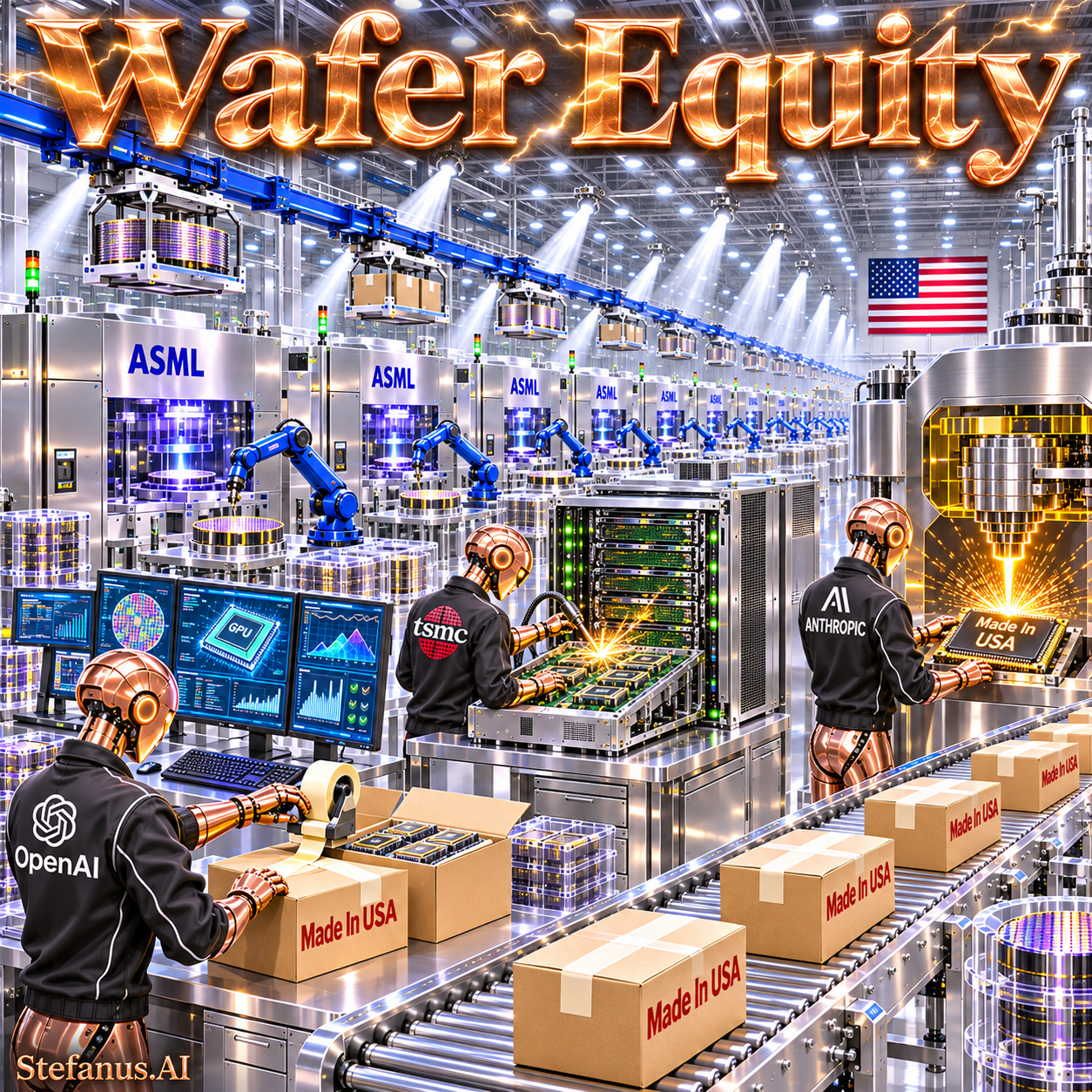
I chose the term Wafer Equity because it joins two economic foundations that scholars and practitioners have traditionally analyzed in separate literatures and with separate vocabularies. A wafer is the physical foundation of advanced semiconductor production, the polished disc of silicon from which processors, memory, and every other integrated circuit eventually emerge after several hundred process steps, and it stands in this paper for the entire world of tangible manufacturing capacity that must be planned, financed, and built years before it produces a dollar of revenue. Equity is an ownership claim on the future economic value of a business, a residual and contingent entitlement whose worth depends on what remains after every supplier, lender, and employee has been paid, and it stands here for the world of financial participation in the uncertain commercial future of artificial intelligence. When a foundry invests in a model developer whose computing requirements influence the demand for its own manufacturing capacity, the two foundations are connected within a single balance sheet, and the term is intended to capture precisely that movement from manufacturing semiconductors for an industry toward holding financial interests in the companies that are shaping the industry’s future.
The title is appropriate for a second reason, which is that it describes more than a conventional strategic investment of the kind that technology companies have made in one another for decades. Wafer Equity names the potential convergence of manufacturing capacity, investment capital, and downstream value creation within one interconnected economic system, and it therefore provides a framework for asking whether a foundry can simultaneously remain a commercially neutral supplier to competing customers, become a long-term investor in a selected subset of the developers those customers serve, and participate financially in the growth of intelligence produced with its own manufacturing capabilities. It also brings into focus a governance question that the remainder of this paper treats as central, which is whether participation through equity can alter corporate incentives even in circumstances where formal control over customers, products, and manufacturing decisions remains entirely separate.
The Central Research Question
The fundamental issue examined here is not whether a semiconductor company may lawfully or sensibly invest in a developer of artificial intelligence, because strategic minority investments have existed across technology industries for generations and no single minority position necessarily changes the competitive relationship between the companies involved. The more consequential issue is whether a widening lattice of ownership connections across the industry could produce a system in which financial returns, strategic decisions, manufacturing capacity, cloud infrastructure, and the development of future models become so interdependent that the conventional picture of independent buyers and sellers negotiating at arm’s length ceases to describe how the industry actually behaves. OpenAI and Anthropic both require enormous computing resources to train, evaluate, and deploy increasingly capable models, and their commercial prospects depend partly on the availability, performance, price, and efficiency of the semiconductor systems that operate inside hyperscale datacenters, although their model architectures, cloud relationships, governance structures, and customer bases differ enough that each has pursued access to several computing architectures at once.
TSMC, for its part, operates in a manufacturing environment where investment decisions must be made years before the resulting capacity is available, since fabrication facilities, process development, equipment procurement, packaging lines, and qualified workforces cannot be expanded on the timescale at which software demand changes. An investment in a model developer could accordingly carry strategic significance that reaches beyond the possibility of financial appreciation, because it could place the foundry in a closer commercial relationship with an important source of future demand, although whether that relationship actually yields better forecasts, additional information, or any form of influence depends on contractual provisions and governance rights that cannot be presumed from an investment announcement alone. The potential advantages must be weighed against risks that include conflicts between customers, asymmetries of information, the misallocation of capital, heightened economic dependence, and the possibility that manufacturing decisions come to be perceived, fairly or unfairly, as favouring the downstream companies in which the foundry holds shares.
These questions are pressing because the industry is already characterized by dense investment relationships along its computing supply chain. NVIDIA announced in September 2025 a letter of intent contemplating investment of up to $100 billion in OpenAI tied to the deployment of ten gigawatts of its systems, AMD granted OpenAI and later Meta warrants over as many as 160 million of its own shares linked to purchasing milestones, Microsoft holds an interest of roughly 27 percent in OpenAI, Amazon has invested $13 billion in Anthropic with as much as $20 billion more conditionally available, and Broadcom has agreed with OpenAI to develop and deploy custom accelerators at ten-gigawatt scale.[7][8][9][10][11] These arrangements differ markedly in their financial mechanisms, their contractual commitments, and their industrial objectives, and they should never be treated as interchangeable, yet taken together they demonstrate that increasingly sophisticated capital structures are being used to coordinate the extraordinary investment requirements of artificial intelligence.
The Five-Layer AI Economy as an Analytical Frame
This paper examines Wafer Equity through a framework that I call the Five-Layer AI Economy, which arranges the industry as a vertical stack in which each layer supplies an indispensable input to the layer above it and receives its revenue, directly or indirectly, from the layers above. The framework is deliberately simple, but it disciplines the analysis by forcing every claim about an investment to be located at a particular layer and by making visible the direction in which capital, operating expenditure, technical requirements, and investment returns move between layers.
Table 1. The Five-Layer AI Economy
| Layer | Economic function | Representative participants | How the layer earns its return |
| Layer 5 — Applications and autonomous agents | Converts model capability into products, workflows, and completed work | Enterprise software vendors, agent platforms, vertical applications | Subscriptions, usage fees, and productivity captured from end customers |
| Layer 4 — Models | Develops, trains, and serves frontier and specialized models | OpenAI, Anthropic, Google, Meta, xAI, open-weight developers | Consumption-based and subscription revenue for intelligence |
| Layer 3 — Datacenters | Provides compute capacity, networking, and operations | Microsoft, Amazon, Google, Oracle, specialized cloud providers | Cloud service revenue and long-term capacity contracts |
| Layer 2 — Chips | Designs, fabricates, packages, and supplies processors and memory | TSMC, NVIDIA, AMD, Broadcom, Micron | Wafer, packaging, component, and systems revenue |
| Layer 1 — Energy | Generates and delivers electricity | Utilities, independent power producers, grid operators | Regulated and contracted power revenue |
Author’s framework. Capital, operating expenditure, technical requirements, and investment returns can each move in different directions across the layers.
Within this framework, Wafer Equity is a financial connection that runs from Layer 2 toward Layer 4, that passes commercially through Layer 3 because model developers ordinarily reach the foundry only through cloud providers and chip designers, that depends for its ultimate value on Layer 5 because applications and agents are where end customers decide what intelligence is worth, and that rests physically on Layer 1 because none of the layers above can operate without electricity delivered at the right place and time. The paper advances a central proposition, which is that the next phase of industrial competition in artificial intelligence may be shaped not only by who manufactures the most advanced semiconductors or who develops the most capable models, but also by how ownership, financing, and commercial dependence are distributed among the companies responsible for the entire system. The analysis proceeds from the emergence of the investment model in Section 1 to its financial architecture in Section 2, its competitive and governance implications in Section 3, its geopolitical and regional exposure in Section 4, and its possible evolution through 2030 in Section 5, before Section 6 gathers the argument into seven pillars and the Conclusion returns to the question with which the paper began, and which it deliberately leaves open: whether the world’s most strategically important foundries could become indirect financial owners of the intelligence produced with their chips, and what such ownership would mean for manufacturing independence, industrial competition, and the allocation of capital.

Section 1: From Pure-Play Manufacturing to Financial Participation in Artificial Intelligence
Before the financial mechanics of Wafer Equity can be evaluated, it is necessary to understand the institutional arrangement that the November resolutions appear to extend, because the importance of a foundry’s decision to hold shares in a downstream developer can only be measured against the principle of separation on which the foundry industry was built. The pure-play foundry model was never merely a business strategy in the narrow sense of a choice about which products to sell, since it was also an organizational solution to a problem of trust, in which competing chip designers needed to hand their most sensitive intellectual property to a manufacturer who would see every layout, every volume forecast, and every product roadmap, and who therefore had to be structurally incapable of using that knowledge against them. This section accordingly begins with the historical separation between manufacturing capacity and technology ownership, explains why artificial intelligence alters the economics that sustained that separation, reads the three distinct investment decisions contained in the November 10 resolutions with care, examines what Anthropic’s filing reveals about the wider ownership network, and closes by offering a deliberately narrow definition of Wafer Equity together with the mechanisms through which it might create value.
1.1 The Historical Separation Between Manufacturing Capacity and Technology Ownership
When Morris Chang established TSMC in 1987, the semiconductor industry was organized around integrated device manufacturers that designed and fabricated their own chips, an approach that demanded enormous financial resources because fabrication required specialized equipment, complex process development, and expensive facilities whose cost rose with every technology generation. TSMC helped to establish a different institutional arrangement in which designers could concentrate on creating chips without owning the factories required to manufacture them, and the consequences of that separation between the development of intellectual property and physical production were profound, because companies with strong designs but limited manufacturing resources could enter increasingly sophisticated markets while the foundry concentrated capital and engineering talent into manufacturing systems capable of serving many customers at once. The scale that this diversification eventually reached is visible in the company’s most recent annual report, which records that in 2025 TSMC manufactured 12,682 different products using 305 distinct technologies for 534 different customers.[12]
That diversification rested on a commitment that the company continues to place at the centre of its corporate identity, and which it expresses in language that has changed remarkably little across four decades of annual reports.
“the Company ensures that it never competes with its customers”
— Taiwan Semiconductor Manufacturing Company, 2025 Annual Report [12]
The importance of this principle extends well beyond corporate branding, because it supplies the economic reason for which semiconductor designers have been willing to entrust TSMC with proprietary information, technical roadmaps, and strategically decisive products that they would never share with a manufacturer who also sold competing chips under its own name. Chris Miller’s history of the industry describes how this arrangement allowed an entire generation of fabless companies to come into existence, and the academic literature on vertical specialization has long treated the foundry’s credible neutrality as the asset that makes the whole structure function, since a designer’s willingness to disclose is only as strong as its confidence that disclosure will not be turned to a rival’s advantage. The pure-play model therefore created a special kind of industrial independence, one that never eliminated commercial conflict and never meant that every customer received identical terms, but that did separate the foundry’s manufacturing incentives from any direct stake in the competitive outcome among the products its customers designed.
Wafer Equity introduces a new question into that historical arrangement, which is whether a foundry can remain independent in its manufacturing activities while becoming an equity investor in businesses situated further downstream, and the answer depends entirely on what is meant by independence. A foundry may preserve operational independence, manufacturing confidentiality, and non-discriminatory commercial procedures while holding passive minority investments in model developers, and it is equally true that a small equity position could give rise to legitimate concern if it were accompanied by access to confidential customer information, by contractual preferences, or by influence over the allocation of scarce resources. The distinction between financial participation and operational favouritism is therefore fundamental to everything that follows, and Wafer Equity should be read not as evidence that TSMC has abandoned its original model but as a possible extension of that model into an additional financial domain whose compatibility with the original has yet to be demonstrated.
1.2 Why Artificial Intelligence Changes the Economics of Semiconductor Manufacturing
The traditional semiconductor industry was shaped by demand categories such as personal computers, smartphones, consumer electronics, telecommunications, automotive systems, and industrial equipment, each of which involved a large number of end customers and a reasonably well understood replacement cycle. Artificial intelligence alters that demand structure in at least four respects that bear directly on a foundry’s capital allocation, the first being that advanced accelerators are extraordinarily demanding products that rely simultaneously on leading-edge process nodes, sophisticated packaging, the integration of high-bandwidth memory, dense interconnects, and complex thermal management, so that a shortage in any one of those inputs constrains the output of all the others. The second is that demand has become concentrated among a small group of very large buyers, and the scale of that concentration is now difficult to overstate, since the four largest hyperscalers together guided to between roughly $720 billion and $740 billion of capital expenditure for calendar 2026 after reporting their third-quarter results, with model developers such as OpenAI and Anthropic further shaping procurement through their own cloud and infrastructure commitments.[13]
The third change is that infrastructure investment now involves very long planning horizons, because fabrication plants and advanced packaging lines must be committed well before the workloads they will eventually support are fully understood, and the fourth is that demand for inference may ultimately prove both larger and more diverse than demand for the training of frontier models, since training concentrates enormous processing capacity for defined periods whereas inference involves continuous workloads spread across millions of users, enterprises, and autonomous agents. These characteristics create a forecasting environment of unusual difficulty, in which a foundry may understand perfectly well the immediate manufacturing requirements of an accelerator designed by NVIDIA and still be unable to say with confidence whether the wider market will sustain demand across several technology generations, whether autonomous agents will generate sufficient revenue to justify the inference capacity now being ordered, or whether alternative architectures and more efficient models will reduce the number of advanced processors required per unit of useful computation.
TSMC’s own results show how consequential those questions have become for the company. In the third quarter of 2026 the foundry reported revenue of $46.72 billion and a gross margin of 66.4 percent, with process technologies of seven nanometers and below accounting for 79 percent of wafer revenue, and management reiterated a full-year capital budget of between $60 billion and $64 billion while indicating that spending across 2026 through 2028 would be significantly higher than in the preceding three years.[14][15] On the same call the chairman described a gap between demand and supply for leading-edge capacity that remained wide, and he explained that the company now plans its capacity in collaboration not only with its customers but with its customers’ customers, a phrase that describes with some precision the informational problem that an equity relationship with a model developer might be thought to address. He nevertheless accompanied that confidence with a note of caution about the year ahead that deserves to be recorded in his own words.
“we are being prudent in our business planning going into 2027”
— C.C. Wei, Chairman and Chief Executive Officer, TSMC [15]
Such figures place the November equity authorization in its proper perspective, because the proposed $1 billion is modest beside the capital required for advanced manufacturing and nevertheless represents exposure to an asset of an entirely different kind. A fabrication plant creates physical manufacturing capacity whose value depends on utilization, yield, and the pace of technological obsolescence, whereas equity in a model developer creates a claim on the future value of a software-centred business whose worth depends on revenue growth, margins, dilution, and the terms on which later capital is raised, and the two investments are consequently not substitutes for one another but complements with different risks, different potential returns, and different strategic benefits.
1.3 The November 10 Resolutions: Three Separate Investment Decisions
The structure of the November 10 resolutions is instructive precisely because they concerned three different categories of investment that public commentary has frequently run together. The first was the capital appropriation of approximately $40.93 billion, which represents the board’s authorization for specific capital uses within the company’s manufacturing programme rather than an additional annual spending forecast to be added to previously announced capital expenditure guidance, and which followed an appropriation of roughly $31.28 billion approved at the board’s May meeting. The second was the authorization to invest no more than $500 million in the establishment of an investment company whose stated purpose is to make strategic investments in the semiconductor industry and its related ecosystem, and the third comprised the two separate approvals for Anthropic and OpenAI, each capped at $500 million and each specifying a different class of security.[1]
These categories must not be conflated, because nothing in the published resolution establishes that the investment company will hold the OpenAI or Anthropic positions, that the $500 million authorized for the vehicle forms part of the $1 billion authorized for the two developers, or that any of the three authorizations will be drawn in full. It is also worth observing a small but revealing difference between the two documents filed on November 10, since TSMC’s resolution describes the Anthropic investment as an acquisition of common shares at the initial public offering price, while Anthropic’s registration statement identifies the purchaser as TSMC Partners, Ltd. and the security as non-voting Class N common stock, a distinction that matters a great deal for the governance analysis in Section 3.[2] Several interpretations of the board’s intent remain open on the available evidence, among them that the foundry wishes to preserve a small but meaningful financial exposure to the wider innovation ecosystem while investing selectively in particular frontier developers, that the investments are primarily financial assets rather than instruments for influencing future manufacturing demand, or that strategic and financial considerations are both present without either predominating, and any interpretation claiming that capacity rights or privileged information were obtained would go beyond what has been published.
1.4 Anthropic’s Proposed Financing Reveals a Wider Ownership Network
The Anthropic transaction offers unusually valuable evidence because a registration statement, unlike a press release, must describe the securities, the purchasers, and the conditions with legal precision. Under the concurrent private placement the seven strategic investors agreed, subject to the completion of the offering and the satisfaction of specified conditions, to purchase Class N common stock at the public offering price in the amounts set out in Table 2, and the filing notes that these shares will not be registered in the offering, will not be subject to lock-up agreements with the underwriters, and will be restricted securities that may be resold only under an effective registration statement or an available exemption.[2]
Table 2. Anthropic’s Proposed $26.0 Billion Concurrent Private Placement of Class N Common Stock
| Proposed investor | Position in the Five-Layer AI Economy | Approximate investment | Share of placement |
| Layer 3 cloud; Layer 2 custom accelerators; Layer 4 models | $10.0 billion | 38.5% | |
| NVIDIA | Layer 2 accelerator and systems design | $10.0 billion | 38.5% |
| AMD | Layer 2 accelerator and processor design | $2.5 billion | 9.6% |
| Broadcom | Layer 2 custom silicon and networking | $1.0 billion | 3.8% |
| Micron | Layer 2 memory | $1.0 billion | 3.8% |
| Microsoft | Layer 3 cloud; Layer 5 enterprise software | $1.0 billion | 3.8% |
| TSMC (through TSMC Partners, Ltd.) | Layer 2 foundry and advanced packaging | $0.5 billion | 1.9% |
| Total | $26.0 billion | 100% |
Anthropic, PBC, Amendment No. 2 to Form S-1, November 10, 2026. Amounts are conditional commitments contingent on completion of the offering; they do not confirm that the offering or the placement has closed. Percentages are the author’s arithmetic.

Figure 1. Anthropic’s proposed concurrent private placement by investor (US$ billions). Source: Anthropic, PBC, Amendment No. 2 to Form S-1, November 10, 2026.
The composition of this investor group deserves careful attention, because these are not passive participants in a distant financial market but companies that occupy strategically decisive positions in the infrastructure required to develop and distribute artificial intelligence, and several of them are direct competitors of one another. NVIDIA and AMD compete in accelerator markets, Google and Microsoft compete in cloud computing and enterprise software, and Broadcom participates in the development of custom chips that offer hyperscalers an alternative to systems built on merchant graphics processors, and yet each would hold an economic interest in the success of the same model developer. The filing itself acknowledges the overlap when it observes that certain of the company’s cloud providers and suppliers have strategic and investment relationships with it and are also its customers, and secondary analysis of the document indicates that part of the placement gives effect to arrangements already in existence, with Google’s purchase funding a portion of a previously committed investment obligation.[2]
This introduces a distinction that runs through the whole of the paper, between competition within a layer and financial alignment across layers. The economics literature on common ownership, which has examined what happens when the same institutional investors hold stakes in competing firms, suggests that overlapping ownership can soften competitive incentives under some conditions, with Antón, Ederer, Giné, and Schmalz showing theoretically and empirically that managerial incentives become less sensitive to performance where common ownership is higher, while Backus, Conlon, and Sinkinson document how substantially such overlapping holdings have grown over four decades.[16][17] The situation described here differs from that literature in an important respect, because the common owners are themselves operating companies with commercial relationships to the investee, and whether shared financial exposure produces any anticompetitive effect depends on the details of each relationship rather than on the mere fact of overlapping shareholdings, although a growing network of such investments certainly complicates the assumption that firms compete exclusively as independent buyers and sellers.
1.5 Economic Ownership Is Different from Voting Control
One of the most important features of the proposed placement is the class of share through which it is made, since the registration statement is unambiguous about the rights attached to the Class N stock.
“Shares of our Class N common stock have no voting rights”
— Anthropic, PBC, Amendment No. 2 to Form S-1 [2]
The filing explains that Class N shares generally convert into voting Class A shares only upon sale or transfer to an unaffiliated third party, that the Class F stock held by a founders’ entity is entitled to an aggregate number of votes equal to 50.1 percent of the total voting power on matters submitted to stockholders generally, and that the company’s Long-Term Benefit Trust holds the authority to elect and remove the Class T directors who together constitute a majority of the authorized members of the board.[2] This supplies an essential qualification to the Wafer Equity thesis, because TSMC’s proposed position would not confer ordinary voting power, and would not by itself entitle the foundry to appoint directors, to inspect confidential model-development records, to influence Anthropic’s procurement decisions, or to determine which accelerators the company should use, since powers of that kind would have to arise from a separate agreement or from applicable law. Scholars of corporate governance who have studied the structure have emphasized how thoroughly it insulates the company from its outside shareholders, and one of the leading academic authorities on initial public offerings summarized the practical position of investors with notable economy.
“public shareholders don’t have the power”
— Jay Ritter, Professor Emeritus, University of Florida [18]
The distinction illustrates why economic ownership and corporate control must be analysed separately, because an investor can hold a financial interest without possessing any corresponding governance authority, and an investor with relatively limited equity may sometimes exercise significant influence through contractual arrangements or through the sheer commercial importance of its continued cooperation. For Wafer Equity this means that the percentage of shares owned is only one relevant variable, and at an investment of $500 million against an equity valuation in the vicinity of one trillion dollars the percentage in question is about one-twentieth of one percent, which is far too small to matter through any conventional channel of shareholder influence. The more important analytical questions concern the nature of the securities, the information rights attached to them, the existence of separate commercial contracts, the magnitude of the financial exposure relative to the investor’s own balance sheet, and the investor’s role elsewhere in the supply chain.
1.6 Investing in a Model Developer Is Not Like Investing in a Chip Designer
TSMC’s relationships with companies that design semiconductors follow a commercial logic that is relatively direct, in which the designer develops a processor, the foundry manufactures it, the designer sells it or integrates it into a larger system, and the foundry receives manufacturing revenue. With a model developer the relationship is considerably less direct, because OpenAI and Anthropic develop systems that run on computing infrastructure, and their need for semiconductor capacity is ordinarily mediated through hyperscalers, specialized cloud providers, accelerator designers, and custom-silicon partners. One chain of demand might run from OpenAI to a cloud provider, from the cloud provider to NVIDIA, and from NVIDIA to TSMC, while another might run from Anthropic to Amazon’s Trainium processors or to equipment leased from Broadcom, and in each case the developer helps to create demand for wafers without ever purchasing a wafer itself. Anthropic’s own filing describes a strategy in which graphics processors from NVIDIA and AMD, Amazon’s Trainium, and Google’s tensor processing units are treated as a pool of largely interchangeable accelerators, and the fact that the leading-edge versions of nearly all of them are fabricated by the same foundry is exactly what makes the foundry’s position so distinctive.[2]
Wafer Equity therefore involves indirect industrial relationships, and it is this indirectness that makes the concept more interesting than the ordinary case of a supplier taking a financial stake in a direct customer, since the foundry may be investing in a company located several commercial transactions away from its own invoices while remaining exposed to that company’s demand through almost every architectural path the company could choose. The economic connection can nevertheless be imperfect, because greater model revenue does not translate automatically into proportionately greater semiconductor revenue when efficiency improvements reduce the computing required per task, when model distillation lowers inference costs, when open-weight models redirect demand, or when enterprises alter how extensively they deploy the technology, and the foundry consequently cannot assume that appreciation in a model developer’s equity will always correspond to growth in its own manufacturing business.
1.7 A Conceptual Definition of Wafer Equity and Its Value Mechanisms
For the purposes of this research the term is given a deliberately specific meaning, so that it can be tested against evidence rather than stretched to cover every investment that touches both semiconductors and artificial intelligence.
Definition. Wafer Equity is a financial arrangement in which a strategically important semiconductor foundry acquires an equity interest in an artificial intelligence developer whose present or future computing requirements contribute, directly or indirectly, to demand for the foundry’s manufacturing capacity.
The definition contains five necessary components, the first being a semiconductor manufacturing institution, which distinguishes the concept from investments made by venture-capital firms, cloud providers, or fabless designers, and the second being a genuine equity interest that creates an economic claim on the enterprise rather than a supply agreement, a purchase order, or a capacity reservation. The third component is a downstream developer of models, systems, or applications whose activity generates computing demand beyond the foundry’s conventional manufacturing business, the fourth is a plausible industrial connection between the target’s success and the future market for semiconductor production, and the fifth is the coexistence of distinct financial and commercial incentives within the investor, which remains a manufacturer while potentially benefiting from the target’s valuation. The definition intentionally excludes any assumption that the investment confers preferential manufacturing rights, and it equally excludes any assumption that equity ownership transfers rights in model weights, patents, training data, or customer contracts, because such rights would need to be established separately, so that Wafer Equity describes an indirect financial interest in the economics of intelligence and never automatic ownership of intelligence itself.
Three mechanisms might allow such an arrangement to create value, and the corporate venture capital literature offers a useful guide to each of them. The first is straightforward financial appreciation, which depends on the investment’s terms, on subsequent dilution, on liquidation preferences, and on eventual liquidity, and the second is industrial information, since Song Ma’s study of the life cycle of corporate venture capital finds that established firms tend to launch such programmes when they need to acquire knowledge about technologies and markets adjacent to their own, and tend to wind them down once that informational need has been met.[19] The third mechanism is ecosystem development, in which a foundry supports an industry whose success generates demand for advanced semiconductor technologies, and the relative importance of the three cannot be determined from the November announcement, because the investment could disappoint even while the semiconductor business thrives and could equally succeed while manufacturing demand migrates toward different architectures or customers.
The timing of the announcement reflects several structural developments that have matured together during 2026, including the extraordinary capital intensity of frontier development, the emergence of infrastructure commitments that span multiple hardware generations, the growing specialization of the supply chain, the rising financial significance of models and applications, and the industry’s search for mechanisms that distribute risk and reward across companies making complementary investments. Stanford’s 2026 AI Index reported that corporate investment in artificial intelligence reached $581.7 billion worldwide in 2025 and that private investment in the United States alone reached $285.9 billion, and its authors, working under a steering committee that includes researchers from Stanford and the University of Southern California, opened their summary of the year’s evidence with a judgement about the trajectory of the technology that helps to explain why suppliers are so anxious to participate in the layers above them.[20]
“AI capability is not plateauing.”
— Stanford Institute for Human-Centered Artificial Intelligence, 2026 AI Index Report [20]
Central finding of Section 1. The November 2026 resolutions do not prove the beginning of an industry-wide transition, but they provide a concrete and precisely documented example through which to investigate whether foundry participation in downstream ownership could become a durable feature of the Five-Layer AI Economy, and they establish that such participation, where it occurs, is economic rather than controlling, indirect rather than bilateral, and conditional rather than complete.

Section 2: The Financial Architecture of Wafer Equity: Capital Allocation Across the Five-Layer AI Economy
The financial significance of a foundry’s equity position in a model developer cannot be read from the size of the position alone, because the position sits inside a much larger architecture of investments, purchase commitments, capacity reservations, leases, and contingent equity instruments that now connects almost every large participant in the industry to almost every other. To evaluate Wafer Equity responsibly it is therefore necessary to understand that architecture as a whole, to distinguish carefully among the different kinds of transaction that compose it, to compare the foundry’s position with the positions already taken by chip designers and hyperscalers, and to recognize that financing, reported demand, and realized end-user demand are three different economic quantities that the industry’s headline figures routinely blur together. This section begins with the transition from linear purchasing to interconnected financing, sets out four transaction types that should never be confused, reviews the precedents established by NVIDIA, AMD, Broadcom, Microsoft, and Amazon in light of what has actually happened to each of them since they were announced, examines the scale of the commitments disclosed by Anthropic, and then develops a simple valuation framework that shows why a foundry’s downstream equity may concentrate risk rather than diversify it.
2.1 From Linear Purchasing to Interconnected Financing
Conventional supply chains are usually represented as sequences of purchases in which a foundry manufactures a processor for a designer, a cloud provider buys the processor, a model developer buys computing capacity, and an end user buys access to an application, and nothing in such a sequence requires any participant to own shares in any other. Wafer Equity changes the financial structure without eliminating any of the underlying transactions, and a simplified example makes the change visible, since TSMC might invest $500 million in a developer, the developer might use its financing and its operating revenue to purchase cloud services, the cloud provider might buy acceleration systems from NVIDIA or another supplier, and that supplier would then pay TSMC to manufacture the chips, so that the original investment and the subsequent spending are legally separate transactions while money nonetheless circulates through an interconnected group of companies. The International Monetary Fund’s technical staff described the phenomenon with unusual clarity in a note published in October 2026, in which they mapped the industry through what they termed an AI Value Stack and assessed the balance-sheet vulnerabilities that arise as leverage, concentration, and interconnectedness increase.[21]
“Circular financing increasingly links investment, financing and commercial relationships across the AI ecosystem.”
— Yingyuan Chen, Deepali Gautam, and Jason Wu, International Monetary Fund [22]
The process is economically significant because the same broad group of investors, suppliers, and customers participates at multiple stages of value creation, with the foundry receiving manufacturing revenue while holding equity downstream, the model developer receiving financing from strategic investors while assuming enormous obligations to acquire computing services, the cloud provider receiving long-term demand while having to finance datacenters, networking, and power, and the chip designer receiving orders while managing manufacturing cost, inventory, and technological competition. Such an arrangement can align investment incentives across firms that must commit capital years ahead of revenue, and economists who have studied it are careful to note that it reflects real features of the industry, such as the need to secure critical inputs and the presence of severe information asymmetries about future demand, rather than any intention to deceive. It can also make financial dependencies considerably harder to distinguish, because a developer’s ability to pay for cloud services may depend partly on fresh equity, the cloud provider’s investment plans may depend on the developer’s purchase commitments, and the chip designer’s revenue forecasts may depend on the cloud provider’s expansion, so that the foundry finds itself exposed to the same underlying assumption through its manufacturing business and through its shareholding at once.
None of this implies that the transactions are fictitious, because cash changes hands, hardware is delivered, and useful services are produced, and the more thoughtful academic commentary has been careful on precisely this point. A finance scholar writing in a survey of expert opinion observed that the general lesson of research on financial structure is that complexity frequently conceals where risk has come to rest, and a strategy professor at Harvard Business School, interviewed about the same arrangements, captured the unease they provoke among observers who remember the vendor financing of the late 1990s.[23][24]
“complex financing structures often serve the purpose of hiding risk”
— Boris Vallée, Associate Professor of Finance, writing for INSEAD Knowledge [23]
“To some, it appears that Nvidia is paying its customers to buy its products.”
— Andy Wu, Associate Professor of Business Administration, Harvard Business School [24]
2.2 Four Financial Relationships That Should Not Be Confused
Four types of transaction recur throughout the contemporary industry, and because they carry different consequences for accounting, financing, capital requirements, business risk, and competition, an analysis that adds them together into a single measure of investment will substantially overstate what is actually known about the capital committed, deployed, or earned by the companies involved.
Table 3. Four Transaction Types in the Financing of Artificial Intelligence
| Transaction type | What is exchanged | What determines the outcome | Leading example |
| Equity investment | Capital for an ownership claim | Security terms, dilution, valuation, eventual liquidity | TSMC’s proposed positions in Anthropic and OpenAI; the $26.0 billion Class N placement |
| Commercial purchasing | Money for products or services | Price, volume, delivery, and utilization | Cloud consumption; wafer and packaging orders |
| Capacity commitment | A present obligation or intention to take future infrastructure | Delivery schedules, financing conditions, cancellation and milestone terms | Anthropic’s commitment of more than $100 billion to AWS over ten years |
| Contingent equity compensation | Potential shares for achieving defined conditions | Purchase milestones, deployment, share-price thresholds | AMD’s warrants issued to OpenAI and to Meta |
Author’s classification, drawing on the company announcements and filings cited in the text.
TSMC’s announced investments belong to the first category, AMD’s warrant arrangements are the clearest instances of the fourth, and long-term hyperscaler contracts typically combine the second and third, and the importance of keeping them apart is illustrated by what happened to the largest headline of all.
2.3 NVIDIA: When the Headline and the Capital Diverge
NVIDIA’s relationship with OpenAI illustrates better than any other example the distance that can separate strategic ambition from completed capital deployment. In September 2025 the two companies announced a letter of intent involving at least ten gigawatts of NVIDIA systems, under which NVIDIA stated its intention to invest up to $100 billion in OpenAI progressively as each gigawatt was deployed, and the announcement was widely reported as though the full amount had been committed.[7] The letter never became a binding contract, however, and in late February 2026 it was replaced by a direct equity investment of $30 billion made as part of a funding round that valued OpenAI at $730 billion before the new money and that subsequently grew to $122 billion of committed capital, and by early November 2026 the company was reported to have completed the first close of a further round at a pre-money valuation of $1.25 trillion, somewhat below the figure it had originally been reported to be seeking.[25][26]
The episode carries two lessons for the study of Wafer Equity, the first of which is methodological, since a headline commitment can differ by a factor of more than three from the capital that eventually follows, and the second of which is structural, since NVIDIA’s position differs from TSMC’s in ways that affect both influence and risk. NVIDIA designs and markets the processors and systems that model developers actually deploy, its original framework was expressly linked to the deployment of its own products, and it participates directly in software, networking, and systems, all of which create more points of commercial contact with downstream companies than a foundry possesses. Its financial reach has also grown to a scale that makes its governance a matter of systemic interest, because the company reported revenue of $96.2 billion for the quarter that ended in July 2026 and has committed $10 billion to Anthropic’s placement in addition to its OpenAI holding, and the abrupt resignation of its founder and chief executive on November 12, 2026, with the chief financial officer appointed as interim chief executive, reminded investors that the judgement behind this web of investments had been concentrated in remarkably few hands.[27][28] The founder’s last quarterly statement had expressed the commercial thesis behind those investments in four words.
“Now, compute is revenue”
— Jensen Huang, then Founder and Chief Executive Officer, NVIDIA [27]
TSMC’s Wafer Equity position is more indirect than NVIDIA’s in every respect, since its manufacturing may be several contractual relationships removed from a developer’s final computing expenditure, and a hardware supplier investing in its own customer can structure the transaction around identifiable purchases of its products whereas a foundry investing in a downstream developer benefits from general industry growth without any exclusive claim on the associated manufacturing demand.
2.4 AMD: When the Customer Receives Potential Ownership in the Supplier
AMD’s agreements introduce a mechanism that reverses the direction of the equity relationship altogether. In October 2025 AMD and OpenAI announced an agreement for the deployment of six gigawatts of AMD graphics processors across multiple generations, under which AMD issued OpenAI a warrant over up to 160 million shares of its common stock with vesting tied to purchasing milestones and other conditions, and in February 2026 AMD announced a parallel arrangement with Meta for a further six gigawatts and a second performance-based warrant over up to 160 million shares, with vesting linked both to shipment volumes and to share-price thresholds.[8][29] The accounting consequences of these instruments began to appear in AMD’s results for the third quarter of 2026, a quarter in which the company reported record revenue of $13.4 billion and data-centre revenue of $8.5 billion, up 97 percent from a year earlier, and in which management noted that it had started to recognize the impact of the warrants.[30]
Rather than the supplier acquiring shares in the model developer, the computing customer receives an opportunity to acquire shares in the supplier, which demonstrates that strategic equity incentives can flow in either direction and which aligns the customer’s purchasing and deployment decisions with the supplier’s commercial performance. Arrangements of this kind can help to coordinate difficult technology transitions, particularly where customers must adapt software, networking, cooling, and systems architecture to unfamiliar hardware, but they also raise questions that belong to financial analysis rather than to accusation, such as whether a customer would choose an architecture solely on performance and cost when the potential value of its warrant also depends on the choice, whether an otherwise attractive alternative becomes less appealing because selecting it would prevent a tranche from vesting, and how much dilution the supplier’s existing shareholders will bear if the agreement achieves its targets. AMD’s simultaneous commitment of $2.5 billion to Anthropic’s placement means that the company now stands on both sides of the equity relationship at once, as an issuer of contingent equity to two customers and as an investor in a third, and together with Wafer Equity these arrangements reveal the growing variety of financial structures that connect hardware procurement with corporate ownership.
2.5 Broadcom, Microsoft, and Amazon: Custom Silicon and the Precedent for Infrastructure-Linked Ownership
Broadcom introduces a further element, because in October 2025 it announced with OpenAI a collaboration for the development and deployment of ten gigawatts of custom accelerators and networking systems through 2029, an arrangement that differs from the purchase of an existing processor architecture in that it allows a developer to embed the characteristics of its own workloads into the design of the silicon.[11] Broadcom’s role becomes especially consequential when it is combined with its position in Anthropic’s financing, since reporting on the registration statement identifies equipment leases with Broadcom of roughly $161 billion as the single largest of Anthropic’s disclosed computing commitments, ahead of Google at about $121 billion and Amazon at $110 billion, while Broadcom has also agreed to purchase $1.0 billion of Class N stock.[31] For the foundry this creates a distinct analytical problem, because it must serve customers pursuing different processor architectures while retaining the commercial confidence of all of them, and it may manufacture chips for one customer while holding equity in a developer whose principal infrastructure is supplied by another.
Microsoft and Amazon show how cross-layer investing had already become central to the industry before TSMC entered it. In October 2025 Microsoft disclosed a revised relationship under which its investment represented approximately 27 percent of OpenAI on an as-converted basis following recapitalization, OpenAI contracted to purchase an additional $250 billion of Azure services, and Microsoft relinquished its former right of first refusal to serve as OpenAI’s computing provider, which shows that substantial ownership and long-term commercial spending can coexist even as contractual exclusivity is loosened.[9] Amazon, having previously invested $8 billion in Anthropic, announced in April 2026 a further $5 billion with up to $20 billion more available in the future, while Anthropic committed more than $100 billion over ten years to AWS technologies in order to secure up to five gigawatts of capacity.[10] Investors assessing a hyperscaler’s performance must therefore separate the economic contribution of providing cloud services from changes in the carrying value of its equity investment, and those assessing the developer must weigh its reported growth against the cost of the computing it has contracted to buy, and where Microsoft and Amazon connect Layer 3 to Layer 4, Wafer Equity connects Layer 2 to Layer 4 by way of Layer 3.
Table 4. Cross-Layer Ownership Arrangements Compared
| Arrangement | Layers connected | Direction of equity | Status at November 15, 2026 |
| NVIDIA–OpenAI | 2 → 4 | Supplier invests in customer | $100 billion letter of intent (September 2025) replaced by $30 billion equity investment (February 2026) |
| AMD–OpenAI and AMD–Meta | 4 → 2 | Customer may acquire supplier’s shares | Warrants over up to 160 million shares each; accounting recognition began in Q3 2026 |
| Broadcom–OpenAI; Broadcom–Anthropic | 2 ↔ 4 | Development partner; lessor; proposed investor | Ten-gigawatt collaboration; roughly $161 billion of leases; $1.0 billion Class N commitment |
| Microsoft–OpenAI | 3 → 4 | Cloud provider holds about 27% | $250 billion incremental Azure commitment; exclusivity relaxed |
| Amazon–Anthropic | 3 → 4 | Cloud provider invests | $13 billion invested; up to $20 billion more conditionally available; more than $100 billion AWS commitment |
| TSMC–Anthropic and TSMC–OpenAI | 2 → 4 (via 3) | Foundry invests in indirect customer | Board authorization of up to $500 million each; neither transaction reported as closed |
Company announcements and filings cited in the text; classification by the author.
2.6 The Scale of Anthropic’s Infrastructure Commitments
Anthropic’s securities disclosures explain why financing relationships along the supply chain deserve such close examination. The first amendment to its registration statement, filed on November 2, 2026, reported approximately $895.4 billion of aggregate purchase commitments and lease agreements, substantially all of them related to compute and infrastructure, of which about $447.5 billion was expected to be incurred before the end of 2030.[32] The second amendment, filed eight days later together with the price range and the private placement, reported a higher figure of approximately $900.9 billion, of which about $451.6 billion is expected to be incurred before December 31, 2030 and about $70.7 billion falls due within twelve months of the end of September, and the difference between the two versions is a useful reminder that a headline figure of this kind is a snapshot of a moving quantity that must always be cited with its date.[2] Set against these obligations, the same filing reports revenue of $17.0 billion for the third quarter, liquidity of $146.6 billion at the end of September before the proceeds of the offering, and a run-rate of revenue that press accounts of the filing placed at roughly $81 billion at the end of October.[2][3]
These are disclosed commitments and not evidence that the corresponding capital has been spent, financed, or received by suppliers, and they include obligations with different counterparties, commencement dates, and delivery conditions, but their scale is significant because they extend across a period in which semiconductor capacity, datacenter construction, electricity supply, and enterprise adoption are all expected to change substantially. A foundry evaluating an equity position in such a company must therefore ask how the developer will generate sufficient revenue to honour obligations that are roughly eleven times its October run-rate, how it will obtain further financing if growth slows, how it will manage declining prices for intelligence, and how it will adapt to technological improvements that may alter the quantity of computing its products require. Large commitments can signal confident expectations of demand, and they can equally create fixed or contingent obligations that become difficult to support if revenue disappoints, which is why the foundry’s equity exposure introduces the risk of software commercialization into an enterprise otherwise associated with manufacturing technology.
2.7 A Valuation Framework: Two Exposures to One Driver
Wafer Equity can be represented conceptually as two distinct economic exposures held by the same manufacturer, one being the value of its manufacturing operations and the other the value of its downstream equity, and a simple decomposition expresses the idea.
Vtotal = Vfoundry + VAI equity + Vother
In this expression the first term represents the economic value of semiconductor manufacturing, the second represents the value of investments in model developers, and the third captures the remaining assets and liabilities, and the decomposition is offered as a conceptual aid rather than as an accounting identity, since any actual valuation must address financing liabilities, taxes, and the risk of counting the same value twice. The corresponding investment decision can be written as a net present value.
NPVWafer Equity = − I0 + Σt=1…T E[CFt] ÷ (1 + r)t
Here the initial outlay is the equity investment, the expected cash flows are future distributions or exit proceeds, the discount rate reflects the risk of the investment, and the horizon is the period over which the position is expected to be held, and where no distribution or liquidity event is foreseeable the analyst must model exit values explicitly and accept that the investment may remain illiquid for a long time. The more important feature of the framework is that the return on the equity is likely to be correlated with the return on the manufacturing business, because a decline in demand for artificial intelligence would reduce expected wafer orders and the developer’s valuation simultaneously while strong adoption would support both, and whereas a conventionally diversified portfolio seeks assets whose returns are imperfectly correlated, Wafer Equity may deliberately increase exposure to a single common driver. This is exactly the amplification channel that the Fund’s staff identified when they warned that a disappointment in commercialization would be felt through several instruments at once, with equity investments losing value, debt becoming harder to service, and contracted future revenue failing to materialize.[4]
“there are certain companies and nodes that are particularly exposed”
— Jason Wu, Assistant Director, Monetary and Capital Markets Department, International Monetary Fund [4]
The investment could nevertheless prove diversifying under particular conditions, and the conditions are worth stating precisely because they depend on where value is created. If model profits arise mainly from greater consumption of advanced computing, the foundry and the developer hold closely aligned exposures, but if profits arise from exceptional improvements in computational efficiency, the foundry could benefit as an investor while experiencing weaker manufacturing demand per dollar of model revenue, and the thesis must therefore account both for the quantity of compute consumed and for the economic value generated per unit of compute.
2.8 The Economics of a Model That Becomes More Efficient
A major uncertainty for the years between 2027 and 2030 is whether improvements in efficiency will reduce aggregate semiconductor demand or enlarge it. More efficient models perform useful work with fewer tokens, fewer processors, and less electricity, which appears at first sight unfavourable to hardware manufacturers, and yet lower costs also stimulate demand, because once inference becomes substantially cheaper businesses can deploy autonomous systems across activities that were previously uneconomical, such as continuous accounting review, the monitoring of industrial equipment, the management of complex logistics, the testing of software, and the coordination of scientific experiments. The International Energy Agency’s 2026 analysis captures both sides of this relationship when it reports that the energy required for a simple query has fallen dramatically while video generation, advanced reasoning, and autonomous agents can consume hundreds or thousands of times more per request, and when it nonetheless projects that electricity consumption by datacenters will roughly double from 485 terawatt-hours in 2025 to about 950 terawatt-hours in 2030.[33]
This is a version of the rebound problem that economists have studied since the nineteenth century, in which efficiency reduces the resources required per task while lower prices increase the number of tasks performed, and the eventual outcome depends on the responsiveness of demand, on product quality, on customers’ willingness to pay, and on the availability of complementary infrastructure. Academic estimates of the underlying productivity effect remain widely dispersed, with Acemoglu’s task-based model implying gains in total factor productivity of well under one percent over a decade, while Brynjolfsson, Korinek, and Agrawal argue in a 2026 research agenda that such estimates may understate the capacity of the technology to transform the innovation process itself and to generate accelerating feedback.[34][35] For investors in Wafer Equity both outcomes matter, because equity in a successful developer could appreciate if intelligence becomes more profitable as computing becomes cheaper, and the manufacturing business could also benefit if lower costs induce an even larger expansion of applications, but nothing guarantees that additional demand will offset efficiency gains, and a foundry contemplating downstream equity must distinguish the growth of economic value related to intelligence from the growth of physical semiconductor demand, since the two may be positively related without expanding at the same rate.
2.9 Why a Small Authorization Matters, and How It Should Be Measured
TSMC’s maximum of $1 billion across the two developers is modest by any internal comparison, since it is equivalent to about 2.4 percent of the capital appropriation approved at the same meeting, to about 1.6 percent of the midpoint of the 2026 capital budget, and, on the company’s reported third-quarter net income of NT$763.06 billion, to rather less than a week of quarterly profit.[1][14] It neither redirects the company’s capital resources nor substitutes software ownership for factory investment, and yet financial significance is not determined solely by the percentage of capital deployed, because some strategic investments matter for the relationships they create, for the lawful information channels they open, or for the option they preserve to participate in a market whose eventual value remains uncertain.

Figure 2. The November 10, 2026 authorizations in proportion (US$ billions). Source: TSMC, Board of Directors Meeting Resolutions, November 10, 2026.
An essential methodological lesson follows from all of these examples, which is that the large amounts the industry reports for financing, spending commitments, infrastructure plans, equity stakes, and hardware purchases cannot simply be added together to determine total investment in artificial intelligence. If a cloud provider raises $10 billion from investors and spends $7 billion on computing equipment and $3 billion on other infrastructure, while a model developer separately commits to purchase $10 billion of services from that provider, then counting the financing, the equipment purchases, and the service commitment as $30 billion of independently created investment would overstate the underlying economic activity threefold, because the transactions represent different claims on overlapping infrastructure. Finance scholars who have attempted the reconciliation have preferred to begin from physical capacity rather than from announcements, and one such estimate, discussed in a September 2026 survey of the literature, assumes that roughly 183 gigawatts of planned compute is built between 2025 and 2032 at a cost of about $41 billion per gigawatt, which implies that revenues would have to rise into the trillions of dollars for the investment to be sustained.[36]
For future empirical work, Wafer Equity can be evaluated along four dimensions that should be analysed jointly, since a small passive investment may create limited governance implications while offering exposure to industry growth, a larger investment tied to exclusive manufacturing arrangements could raise additional competition concerns, and an investment linked to commitments that depend on future financing may present a more complex risk profile than its headline amount suggests.
Table 5. A Financial Research Framework for Wafer Equity
| Dimension | Core research question | Potential evidence |
| Ownership exposure | How much downstream equity does the foundry hold, and in what securities? | Securities filings, investment disclosures, fair-value notes |
| Manufacturing exposure | How much operating income is linked to artificial intelligence demand? | Revenue by platform, technology mix, customer concentration |
| Contractual exposure | What commitments connect the investor, the investee, and infrastructure providers? | Supply agreements, capacity commitments, lease disclosures |
| Governance exposure | What rights or restrictions accompany the equity? | Share classes, board rights, information-access provisions |
Central finding of Section 2. Wafer Equity should be understood as a new financial connection across the supply chain rather than as merely another source of funding for model developers, and its significance depends on the interaction between manufacturing income, equity returns, contractual commitments, and the ultimate commercialization of intelligence, which means that the appropriate measure is never the dollar value invested but the degree to which the investment changes the foundry’s overall economic exposure, incentives, and relationships.

Section 3: Manufacturing Independence, Competition, and the Governance of Cross-Layer Ownership
The financial architecture described in the previous section would be of interest mainly to investors if it left the conduct of the participating firms unchanged, but ownership is studied by economists and lawyers precisely because it can alter incentives, and the central governance question raised by Wafer Equity is whether a foundry that has always presented itself as the neutral manufacturer for an entire industry can hold shares in particular downstream companies without impairing, or appearing to impair, the neutrality on which its business depends. Answering that question requires a more exact vocabulary than the word independence ordinarily supplies, because a foundry may be independent in one sense while being entangled in another, and it requires a clear separation between conduct that is an ordinary feature of semiconductor manufacturing, such as allocating scarce capacity to customers with firm commitments, and conduct that would constitute favouritism arising from an ownership interest. This section distinguishes three forms of independence, considers the role of privileged information, sets out four governance tests that any Wafer Equity transaction should be able to pass, reviews the treatment of minority ownership under American antitrust law, uses Anthropic’s governance structure as a case study, and proposes a Manufacturing Independence Test for use by boards, regulators, and counterparties.
3.1 Three Meanings of Independence
Wafer Equity creates an apparent contradiction, since TSMC’s commercial identity rests on manufacturing for customers without designing competing products while its proposed investments would give it financial exposure to companies operating in an intensely competitive market for models, and the contradiction can be resolved only by distinguishing among different forms of corporate independence. Manufacturing independence means that the foundry makes its decisions about capacity, process technology, customer confidentiality, and production execution according to its commercial obligations and operational requirements, financial independence concerns whether those decisions are made without improper influence from the company’s separate investment interests, and competitive independence concerns whether the foundry treats commercially distinct customers in ways consistent with its contracts and with applicable competition law. These concepts overlap without being identical, so that a foundry could remain entirely independent in product design while acquiring financial interests downstream, and the presence of those interests may then require additional procedures to demonstrate that manufacturing decisions are not shaped by investment considerations.
The matter is especially delicate because TSMC’s customers compete so directly with one another, with NVIDIA facing AMD in accelerated computing, both facing the custom processors that Broadcom and others design for hyperscalers, and Google, Amazon, and Microsoft each developing silicon for their own clouds. A foundry serving all of these companies must decide how to distribute advanced-node capacity, production schedules, technical support, and packaging resources, and in a supply-constrained environment the timing of those decisions is commercially decisive even where the underlying technology is comparable, since an additional quarter of availability can affect product launches, cloud deployment schedules, and the competitive positions of downstream model providers. The company’s chairman addressed the principle directly on the October 2026 earnings call, when an analyst asked whether one category of customer might be treated differently from another, and his reply stated the standard against which any future Wafer Equity arrangement will inevitably be judged.
“we treat every customer fairly”
— C.C. Wei, Chairman and Chief Executive Officer, TSMC [37]
3.2 Legitimate Capacity Allocation and Preferential Treatment
Semiconductor capacity has never been allocated through a system in which all customers receive equal quantities at identical prices, because customers differ in purchasing volume, manufacturing complexity, design readiness, contract duration, technical requirements, yield characteristics, and willingness to commit to future production, and a foundry may quite rationally allocate capacity to a customer with a firm long-term contract in preference to one whose demand is uncertain, or bring a technically mature design into production ahead of a more complex design that requires further engineering. Differences of this kind are ordinary features of the industry, and the relevant question is whether an equity relationship introduces considerations that are unrelated to legitimate commercial and operational factors. A hypothetical case clarifies the distinction, in which two accelerator companies request limited advanced packaging capacity, one producing processors heavily used by a developer in which the foundry owns equity and the other producing a competing architecture that serves other developers, and in which the foundry’s shareholding need not affect the outcome at all if capacity is allocated according to documented contractual priorities and manufacturing requirements, whereas a decision to disadvantage the second customer in order to raise the value of the downstream investment would create serious contractual, reputational, and potentially legal exposure.
The November announcement offers no evidence whatever that TSMC has engaged in conduct of the second kind, and the hypothetical is intended only to illustrate a governance risk that becomes relevant whenever a supplier’s commercial decisions can influence the valuation of companies in which it holds shares. The theoretical literature on vertical relationships has long recognized that even partial ownership of a downstream firm can change an upstream supplier’s incentives toward that firm’s rivals, and it has also recognized that the effect depends heavily on whether the ownership confers control, on how large the financial interest is relative to the supplier’s upstream margin, and on how easily the disadvantaged rivals can turn elsewhere. In TSMC’s case the financial interest is minute relative to the upstream margin, which argues strongly against any incentive to foreclose, but the rivals’ ability to turn elsewhere at the leading edge is extremely limited, which is why the appearance of neutrality carries such weight.
3.3 Privileged Demand Information and the Asymmetry It Creates
One potential strategic benefit of Wafer Equity is improved visibility into future demand, which is valuable because building a fabrication facility involves land, engineering, construction, equipment procurement, process qualification, materials supply, and workforce development over a period of years, so that a foundry which expands too slowly forfeits revenue and frustrates its customers while one that expands too aggressively is left with expensive underutilized assets. Model developers possess information about architectures, planned inference services, customer adoption, training requirements, and infrastructure plans that would be useful to a manufacturer, and TSMC has already acknowledged that it sends teams to verify the progress of datacenter construction in the United States as part of its planning process.[15] Ownership does not, however, create an automatic entitlement to confidential information, since a minority investor holding non-voting shares may receive nothing beyond ordinary shareholder disclosures, and even where additional information rights exist they are constrained by confidentiality obligations, competition law, securities law, and contract.
Corporate influence is conventionally assessed through ownership percentages and voting control, but in interconnected technology industries access to information can be an equally important consideration, because an investor with little formal voting power may receive forecasts, roadmaps, or strategic updates through separately negotiated arrangements, and an investor with substantial financial exposure may receive none. The Federal Trade Commission drew attention to exactly this problem in the staff report it issued in January 2025 on partnerships between major cloud providers and developers of generative models, which identified potential concerns relating to access to computing resources, contractual and technical switching costs, exclusivity provisions, and the exchange of sensitive technical and commercial information that is unavailable to rivals.[38] That study examined cloud-provider relationships and not the transactions discussed here, but its analytical framework transfers readily, and the Vanderbilt policy scholar Asad Ramzanali has described the resulting structure in terms that explain why regulators have become attentive to it.
“All of the largest AI, cloud, and chip companies own parts of each other”
— Asad Ramzanali, Director of AI and Technology Policy, Vanderbilt Policy Accelerator [39]
A further complication arises from the position of the developer itself, which receives confidential information from competing cloud and semiconductor partners that cannot properly be passed to another investor, so that a sophisticated governance framework must separate permitted strategic collaboration from inappropriate information exchange in both directions, and the key question in every case is whether the investor obtains information or influence capable of distorting competition in markets where it also operates.
3.4 Four Governance Tests
A disciplined assessment of any Wafer Equity transaction can be organized around four tests, each addressing a different channel through which ownership might affect conduct. The first concerns the ownership rights actually acquired, and it begins with the securities themselves, since Anthropic’s Class N shares carry no ordinary voting rights, which closes one direct path of influence without eliminating rights that may arise from law, from investment contracts, or from separate commercial arrangements, while TSMC’s proposed OpenAI position is in preferred stock, a category that may carry liquidation preferences, conversion features, or protective provisions that the board resolution does not describe and that it would be improper to assume. The second test concerns manufacturing confidentiality, because a foundry routinely handles chip layouts, design specifications, projected volumes, process requirements, test results, and schedules that its customers regard as strategically sensitive, and none of that information should become available to a model developer merely because the foundry holds its shares, just as a developer’s confidential procurement intentions should not be used to advantage unrelated manufacturing customers.
The third test concerns the integrity of capacity-allocation decisions, and it asks whether advanced capacity is allocated according to identifiable criteria such as contractually committed volumes, technical readiness, production efficiency, yields, facility availability, and legal requirements, whether decisions are documented and reviewed when customers compete for scarce capacity, and whether those who make the decisions are insulated from the investment function, the objective being not to require equal allocation to every customer but to establish that differences are supported by legitimate factors. The fourth and most difficult test concerns competitive neutrality toward developers in which the foundry has not invested, since OpenAI and Anthropic do not constitute the whole market and Google, Meta, xAI, and a growing number of open-weight and specialized developers are also investing heavily in capability and infrastructure, so that a designer supplying one of those companies may compete directly with a designer whose systems are used mainly by the foundry’s investees. Even where the equity position is small, perceived favouritism could erode customer confidence, which gives the foundry a strong commercial incentive to maintain formal safeguards whether or not the law requires them, because the value of preserving trust is likely to exceed by orders of magnitude the expected return on a small downstream position.
3.5 Minority Ownership and American Antitrust Law
Competition law in the United States provides a useful framework for these issues, because the Merger Guidelines issued by the Department of Justice and the Federal Trade Commission in 2023 address partial ownership directly, with Guideline 11 explaining that acquisitions falling short of full control may still raise concern where they confer influence over business decisions, where they provide access to competitively sensitive information, or where they reduce the acquirer’s incentive to compete.[40] The guidelines are an analytical framework and not a determination that any particular investment is unlawful, and they certainly do not imply that minority ownership in a model developer is inherently suspect, since the legal assessment depends on the specific terms of the transaction, the markets involved, the competitive relationships of the parties, and the likely effects. Korinek and Vipra’s analysis of market structure in foundation models adds an economic rationale for vigilance, because they show that the enormous fixed costs of training and the scale economies of deployment create a natural tendency toward concentration at the model layer, and that vertical relationships with suppliers of computing are among the principal channels through which that concentration could be reinforced or contested.[41]
The distinction between passive and active positions is particularly important for a foundry, because a passive, non-controlling financial investment presents a different risk profile from one accompanied by board representation, special information rights, or contractual conditions affecting the treatment of other customers, and the analysis would differ again depending on whether the companies compete directly, operate at different levels of the supply chain, or participate in adjacent markets. A broad claim that every semiconductor investment in a model developer is anticompetitive would therefore be unsupported by either law or evidence, and a broad claim that non-voting investments can never affect competition would be equally unsatisfactory, so that Wafer Equity calls for evaluation one transaction at a time.
3.6 The Paradox of Strategic Alignment
Strategic equity relationships can improve industrial coordination and can also weaken the incentives that ordinarily discipline commercial relationships, and the two effects are often produced by the same feature of the arrangement. A cloud provider that invests in a developer while supplying its computing may strengthen confidence in future demand, encourage technical collaboration, and facilitate the financing of infrastructure, and it may at the same time make the developer more reluctant to move to another provider even when better terms are available, just as a semiconductor supplier holding equity in a developer has a reason to support that developer’s growth. The Commission’s study raised related concerns about contractual and technical switching costs, and those considerations become relevant to Wafer Equity once ownership relationships extend beyond cloud providers to chip designers, manufacturers, and infrastructure investors, because the cost of changing suppliers, architectures, or strategic partners rises as financial and commercial obligations become more closely intertwined.[38]
The competitive effects are not necessarily negative, however, and the case for strategic capital deserves to be stated as carefully as the case against it. Equity financing can absorb risk that debt is poorly suited to bear, since frontier development involves uncertain outcomes and very large upfront investment and equity holders participate in the upside without demanding fixed repayment, and strategic investors can support new entrants, finance alternative architectures, and increase technological diversity in ways that purely financial investors might not. The Tufts historian Chris Miller, whose account of the semiconductor industry is the standard reference on its geopolitics, has cautioned against treating concentration and competition as opposites in this market.[42]
“The market’s concentrated right now, but it’s a market that is also highly competitive.”
— Chris Miller, Professor, The Fletcher School, Tufts University [42]
The benefits must nevertheless be weighed against the possibility that established suppliers repeatedly fund the same small group of developers, in which case their financing decisions would help to determine which companies obtain enough capital to compete at the frontier, with greater stability for incumbents and greater difficulty for newer entrants, and an important empirical question for future research is whether strategic semiconductor investors tend to support a broad range of developers or to concentrate their capital among the largest existing participants.
3.7 Anthropic’s Governance Structure as a Case Study
Anthropic’s registration statement is especially instructive because it separates several forms of authority that are usually bundled together, with the Class N shares allowing strategic investors to participate economically without ordinary voting rights, the founders’ Class F stock carrying a fixed 50.1 percent of general voting power, the Long-Term Benefit Trust electing the directors who form a majority of the board, and the company’s status as a public benefit corporation permitting its directors to weigh a stated public mission alongside the interests of shareholders.[2] These arrangements create an unusual separation between economic participation and formal governance, and they have attracted considerable attention from scholars of corporate law, one of whom, in a discussion recorded on the day of the amended filing, observed that the trust’s mandate is itself plural rather than single-minded.[43]
“Even the trust has a triple mission”
— Roberto Tallarita, Assistant Professor of Law, Harvard Law School [43]
A second scholar, writing shortly before the amended filing, argued that the structure should be understood as a shield that protects the company’s commitments from market pressure rather than as a mechanism that guarantees their performance.[44]
“Its unusual governance can protect that promise, but cannot fulfill it alone.”
— Stavros Gadinis, Professor of Law, University of California, Berkeley [44]
The distinction that these commentators draw is important for understanding corporate power, because formal voting control is only one dimension of influence, and access to financing, infrastructure, distribution, technical expertise, and strategically necessary suppliers represents a further and frequently more consequential source of bargaining power. A developer may retain formal corporate independence while depending heavily on external organizations for essential operational resources, and with more than $900 billion of commitments to a group of counterparties that overlaps substantially with its strategic shareholders, Anthropic illustrates that condition with unusual clarity, which does not mean that those organizations control the developer but does mean that any serious governance analysis must consider economic dependence alongside shareholder rights.
3.8 A Proposed Manufacturing Independence Test
To allow Wafer Equity transactions to be evaluated consistently, this paper proposes a four-part Manufacturing Independence Test, which is offered as an analytical instrument and not as an existing regulatory standard or as a description of TSMC’s current internal policies.
Table 6. The Manufacturing Independence Test
| Test | Essential question | Evidence to examine |
| Operational separation | Are manufacturing decisions insulated from improper investment influence? | Decision procedures, delegations of authority, conflict-management policies, separate investment vehicles |
| Information protection | Are proprietary customer and investee data appropriately segregated? | Confidentiality obligations, access controls, information barriers between functions |
| Commercial justification | Can differences in capacity, pricing, and service be explained by legitimate factors? | Contracts, technical requirements, documented allocation decisions |
| Investment transparency | Can shareholders, customers, and regulators understand the ownership relationship and its material risks? | Securities filings, related-party disclosures, governance provisions, fair-value reporting |
A transaction that performs well against these criteria would not thereby be free of every legal or commercial risk, but it would provide much stronger grounds for confidence that investment ownership and independent manufacturing can coexist. It should also be acknowledged that complete economic separation is unrealistic in an industry where designers depend on foundries, foundries depend on equipment suppliers, developers depend on clouds, and clouds depend on power, land, and capital markets, so that the objective is not to eliminate interdependence but to preserve the competitive and governance benefits that remain achievable within an integrated structure.
Central finding of Section 3. Ownership does not automatically produce control, and the absence of voting control does not eliminate every possible conflict, so that the durability of Wafer Equity will depend less on obtaining influence over model developers than on demonstrating, through separation of functions, protection of information, documented commercial justification, and transparent disclosure, that financial participation can coexist with disciplined manufacturing neutrality.

Section 4: The Geopolitical and Industrial Consequences of Wafer Equity: Taiwan, the United States, China, and the Geography of the Five-Layer AI Economy
Wafer Equity is not simply a financial question for semiconductor manufacturers, because the foundry at the centre of this paper occupies a position in the world economy that governments regard as a matter of national security, and the developers in which it proposes to invest are building a technology that those same governments regard as decisive for productivity, scientific progress, cybersecurity, and military capability. An equity investment that would be unremarkable between two ordinary companies therefore acquires additional layers of meaning when the investor is headquartered in Taiwan, the investees are American, much of the relevant manufacturing is located on an island whose political status is contested by China, and the downstream infrastructure is being built in American states whose governors and legislatures have begun to take sharply different views of datacenters. This section explains why corporate ownership has become entangled with industrial policy, distinguishes the public promotion of semiconductor manufacturing from the private flow of capital toward models, examines the federal framework of trade agreements and export controls, considers the hypothetical extension of Wafer Equity across competing technological blocs, and then turns to the states, where the practical feasibility of the upper layers of the stack is increasingly being decided.
4.1 Why Corporate Ownership Becomes a Matter of Industrial Policy
TSMC’s proposed investments connect corporations situated within different political, regulatory, and industrial systems, and they do so through three overlapping relationships, the first being the commercial relationship between Taiwan’s manufacturing ecosystem and American technology companies, the second being the investment relationship between a Taiwanese manufacturer and American developers, and the third being the security relationship among governments that are attempting to protect sensitive technologies while encouraging private investment and industrial expansion. These relationships do not necessarily conflict, since cross-border investment can support innovation and manufacturing partnerships can strengthen the resilience of supply chains, but national-security policy can determine which companies obtain manufacturing services, where production takes place, who may purchase advanced processors, and which technologies may cross borders, and Wafer Equity adds investment exposure to that environment without altering any of its rules. An equity stake in an American developer does not shield TSMC from export restrictions, from manufacturing disruption, or from changes in the political relationship between Taiwan and its trading partners, and it confers no independent authority over the technologies and customers that government rules affect.
The macroeconomic stakes of the sector in which these companies operate have risen to a level that itself draws official attention, because the International Monetary Fund’s October 2026 World Economic Outlook attributed much of the resilience of global growth, which it projected at 3.1 percent for the year, to investment related to artificial intelligence, while warning in the same breath that the risks ran in both directions.[45]
“Risks surrounding AI are two-sided.”
— International Monetary Fund, World Economic Outlook press briefing, October 13, 2026 [45]
4.2 Public Investment in Manufacturing and Private Capital in Models
The distinction between public industrial policy and private Wafer Equity is most visible in Arizona. On July 16, 2026, the United States Department of Commerce announced that TSMC would invest an additional $100 billion in the state, bringing its total planned investment in the United States to $265 billion and adding four advanced manufacturing facilities to reach a total of twelve leading-edge fabrication and packaging plants, and the announcement was presented as a consequence of the trade and investment agreement concluded between the United States and Taiwan in January.[46] State economic development officials described the full programme as comprising ten fabs, two advanced packaging facilities, and a research and development centre, and local authorities added that upon completion around 30 percent of the company’s capacity at two nanometers and beyond would be located in Arizona.[47] The Secretary of Commerce summarized the purpose of the policy in language that makes its object unmistakable.
“bring advanced semiconductor manufacturing back to America”
— Howard Lutnick, United States Secretary of Commerce [46]
The economic rationale for such a programme differs fundamentally from the rationale for an investment in OpenAI or Anthropic, because Arizona’s facilities are physical industrial assets whose construction increases manufacturing capacity, creates employment, develops engineering expertise, and establishes domestic supply-chain capabilities, whereas equity in a model developer provides a financial interest in the future performance of a business. The two categories may complement one another without performing the same function, since a fabrication plant cannot be replaced by a shareholding and a successful model company does not automatically generate the manufacturing employment or industrial capacity associated with a fab, and the distinction matters to policymakers evaluating claims about investment in artificial intelligence, because a billion dollars invested in equity securities finances or purchases ownership claims while a billion dollars spent on construction creates physical assets, equipment orders, and local economic activity, and the two should be measured separately.
4.3 Federal Policy: Trade Agreements, Permitting, and Export Controls
The federal framework within which Wafer Equity operates has three principal elements. The first is the agreement on trade and investment announced on January 15, 2026, under which, according to the Commerce Department’s fact sheet, Taiwanese semiconductor and technology enterprises committed to at least $250 billion of new direct investment in the United States while Taiwan undertook to provide credit guarantees of at least a further $250 billion to facilitate additional investment across the supply chain.[48] The second is Executive Order 14318 of July 23, 2025, which directed federal agencies to accelerate permitting for qualifying datacenter projects and for the energy infrastructure and components that support them, and which reflects a federal view that datacenters and their supporting technologies are strategically connected industrial assets, although federal permitting priorities do not override every state, local, environmental, or utility requirement and cannot guarantee that an individual project obtains financing, power, equipment, or customers.[49]
The third element is export control, and it bears on the Wafer Equity framework with particular directness. In January 2026 the Bureau of Industry and Security revised its licensing policy for certain advanced semiconductors destined for China and Macau, replacing a presumption of denial with case-by-case review for products at the level of NVIDIA’s H200 and AMD’s MI325X, subject to conditions that include a certification that production for those destinations will not divert global foundry capacity away from similar or more advanced chips for customers in the United States.[50] The provision demonstrates that semiconductor manufacturing capacity is no longer treated merely as a commercial resource, because under defined regulatory circumstances its allocation has become an explicit criterion in national export-control decisions, and a foundry whose customers serve markets governed by different rules must therefore make manufacturing decisions that depend not only on commercial demand but also on restrictions concerning chip performance, end users, and destinations. Holding equity in an American developer removes none of those obligations and creates no duty to prioritize that developer over other lawful demand, so that the geography of shareholder ownership and the geography of industrial production remain distinct, with a model company headquartered in California generating demand for processors designed in the United States, fabricated in Taiwan or Arizona, packaged elsewhere, and deployed in datacenters across many states.
4.4 The China Question and the Limits of Cross-Bloc Ownership
The United States and China are pursuing different but interconnected approaches to artificial intelligence and semiconductors, with American firms holding leading positions in frontier models, accelerator design, cloud infrastructure, and manufacturing equipment while China continues to invest in domestic chip capability, models, computing infrastructure, and alternative supply chains, and Stanford’s 2026 AI Index reported that the performance gap between the best American and Chinese models had narrowed to a few percentage points despite an enormous disparity in recorded private investment.[20] The relationship is not a clean separation between two independent systems, because companies continue to operate through global markets and cross-border manufacturing networks, and TSMC occupies a particularly consequential position within them because its capabilities support products designed by customers in many jurisdictions.
An important hypothetical question is whether foundries could eventually hold equity in developers headquartered in more than one geopolitical bloc, and the answer appears to be that such an arrangement would encounter investment screening, sanctions, technology-transfer restrictions, and national-security review of a severity that would make it commercially impractical for a Taiwanese foundry with predominantly American customers. Wafer Equity may therefore develop unevenly across international markets, expanding among companies that operate within aligned regulatory environments while remaining constrained wherever sensitive technologies cross contested borders, and the events of the week in which this paper was completed, during which the leadership of the industry’s most valuable chip designer changed amid concerns that touched on national security, underline how quickly the political environment surrounding these companies can shift.[28] This is offered as a scenario and not as a demonstrated consequence of the November announcement.
4.5 The States: Where the Upper Layers Are Being Decided
State governments have no authority over whether TSMC may own shares in OpenAI or Anthropic, but governors and legislatures shape the economic environment in which the infrastructure of artificial intelligence is constructed and operated, through electricity regulation, industrial incentives, environmental permitting, land use, taxation, and workforce development, and those policies influence the economics of datacenters and hence the demand for computing hardware. During 2026 the direction of state policy changed markedly, and five states illustrate the range of approaches that a foundry with downstream equity exposure must now take into account, even where it has no manufacturing facility in the state concerned.
Table 7. State-Level Policy Developments Affecting Layers 1 and 3 During 2026
| State | Measure | Key terms | Relevance to Wafer Equity |
| Arizona | Three-year pause on new datacenter sales-tax relief, signed June 13, 2026 | No new certifications from July 1, 2026 through June 30, 2029; existing participants unaffected | The state hosting TSMC’s $265 billion programme promotes fabs while withdrawing incentives from new datacenters |
| Virginia | Datacenter electricity consumption tax in the 2026–2028 budget | $0.011 per kilowatt-hour from July 1, 2026 to June 30, 2028, including self-generated power; capped at $600 million a year | Raises operating costs in the largest datacenter market in the United States |
| Pennsylvania | Executive Order 2026-05, signed August 18, 2026 | Projects above 25 megawatts must commit to affordability, transparency, workforce, and environmental requirements and obtain local approval; removed from fast-track permitting | Separates proposed capacity from deliverable capacity |
| Texas | Gubernatorial election of November 3, 2026 | Governor-elect campaigned on blocking permits for projects she characterized as unfair and on protecting residential rates; outgoing governor had already paused approvals pending audit | Creates policy uncertainty in the second-largest datacenter state |
| Michigan | Restart of the Palisades nuclear plant | Restart repeatedly delayed, including by a fuel-handling incident in August 2026; no firm date at the time of writing | Illustrates the gap between announced and operating power supply |
Sources cited in the text; compilation by the author.
Arizona provides the most instructive contrast, because the governor who publicly welcomed TSMC’s July expansion had one month earlier signed a budget containing a three-year suspension of new applications for the state’s datacenter sales-tax exemption, effective from July 1, 2026 through June 30, 2029, a measure that concerns new applications for a specific tax benefit and does not prohibit datacenter construction.[51] The policy distinction reflects a judgement that fabs and datacenters, although both require substantial electricity, water, land, and infrastructure, differ in their employment structures, their supplier ecosystems, and their fiscal contributions, and it illustrates a central characteristic of the Five-Layer AI Economy, which is that political support for one layer does not imply identical support for the others. Wafer Equity connects these differently treated activities through ownership, so that TSMC could hold shares in a developer whose services increase demand for datacenter capacity while the state that hosts its largest overseas manufacturing complex adopts a more restrictive approach to incentives for that very capacity.
Virginia shows how states can alter the operating economics of hyperscale computing directly, since its budget for 2026 through 2028 created what legal commentators described as the first statewide tax on electricity consumed by datacenters, levied at $0.011 per kilowatt-hour from July 1, 2026 and scheduled to expire on June 30, 2028 unless extended.[52] An illustrative facility drawing an average of 100 megawatts throughout a year would consume approximately 876 million kilowatt-hours and would therefore incur a tax of about $9.6 million before any exemption, cap, or refund is taken into account, a figure offered to illustrate the magnitude of the mechanism rather than the liability of any actual facility. Pennsylvania offers a third approach, since Executive Order 2026-05 directed state agencies to establish a two-track permitting framework for projects with peak demand above 25 megawatts, to require binding commitments under the governor’s infrastructure development requirements, and to remove datacenters from the state’s fast-track permitting programme, with the declared aim of screening out speculative projects that lack developed commercial or infrastructure arrangements.[53]
The Pennsylvania measure draws attention to a distinction that is vital for forecasting semiconductor demand, which is that a proposed datacenter is not a completed facility, and that an announcement involving several gigawatts of potential capacity does not establish that the necessary power, financing, customers, hardware, and approvals have been secured. Texas adds political uncertainty to the picture, because on November 3, 2026 voters elected a new governor who had campaigned in part on restricting datacenter development and protecting residential electricity rates, defeating an incumbent who had himself suspended approvals pending an audit of their effect on the grid, and it would be premature to treat campaign proposals as enacted law or to assume that previously announced projects will be modified, although the direction of sentiment is clear.[54] Michigan, finally, demonstrates the difficulty of converting announced energy plans into operating capacity, since the restart of the Palisades nuclear plant, long expected to be the first recommissioning of a shut-down reactor in American history, was delayed again after a fuel-handling incident at the end of August 2026, and although the Secretary of Energy said after a visit in late October that restart might be only weeks away, no firm date had been confirmed at the time of writing.[55][56]
The common lesson of these five cases is that a model developer’s commitment to purchase future computing services depends on infrastructure developers completing projects across several jurisdictions, each with its own regulatory and political risk, so that the foundry faces demand forecasts built on projects at very different stages of execution, and Wafer Equity supplies an additional reason to distinguish rigorously among capacity that is contracted, financed, under construction, energized, and operational.
4.6 The Five Layers as a Geopolitical System
The five layers can be understood through distinct strategic concerns, and setting them side by side shows why Wafer Equity cannot be assessed solely from a semiconductor company’s financial statements, since the outcome of the investment depends substantially on developments beyond the investor’s control.
Table 8. Strategic Concerns by Layer and Their Relevance to Wafer Equity
| Layer | Strategic concern | Relevance to Wafer Equity |
| Layer 1: Energy | Electricity availability, grid reliability, energy cost, public acceptance | Determines the feasibility and expense of downstream computing |
| Layer 2: Chips | Manufacturing concentration, advanced processes, export controls | Directly affects foundry operations and customer relationships |
| Layer 3: Datacenters | Financing, permits, regional incentives and taxes | Governs hardware procurement and the availability of model compute |
| Layer 4: Models | Frontier capability, financing, intellectual property, national security | The direct target of the downstream investment |
| Layer 5: Applications and agents | Enterprise adoption, productivity, willingness to pay | Determines the ultimate demand that supports model valuations |
The uneven global distribution of these layers is itself a matter of international concern, as the World Bank emphasized in its 2026 flagship report on artificial intelligence and in its mid-year economic outlook, which observed that the infrastructure on which the technology depends is concentrated in a handful of economies and firms.[57][58]
“Developing economies account for less than one-quarter of global data-center capacity”
— World Bank, Global Economic Prospects, June 2026 [57]
The United Nations has framed the same concentration as a question of who benefits, with its trade and development body reporting that roughly one hundred companies, most of them in the United States and China, account for some 40 percent of the world’s private research and development spending, and with its Secretary-General for trade and development calling for governance that shifts the emphasis of policy.[59]
“from technology to people”
— Rebeca Grynspan, Secretary-General, United Nations Conference on Trade and Development [59]
One possible long-term implication is that foundries may come to regard geographic diversification as complementary to downstream equity ownership, because a portfolio increasingly exposed to American developers gives the foundry a financial interest in the reliability of the infrastructure that supports them, although additional capacity outside Taiwan must still be justified by expected manufacturing demand and acceptable returns and would not eliminate the supply chain’s dependence on specialized locations. The most important geopolitical lesson, however, is that equity does not confer sovereignty over infrastructure, since TSMC cannot use a shareholding to escape export controls, the developers cannot use a strategic investor to guarantee electricity or capacity, and hyperscalers cannot use ownership interests to accelerate construction without satisfying the requirements of legislatures, regulators, courts, and utilities.
Central finding of Section 4. Wafer Equity operates within a geographically dispersed and politically regulated industrial economy, in which ownership can connect semiconductor manufacturers to downstream value while the realization of that value remains dependent on energy systems, manufacturing geography, trade rules, regional policy, and national-security constraints, so that the arrangement represents an expansion of corporate financial integration without any corresponding expansion of corporate control over the resources the system requires.

Section 5: The Future of Wafer Equity, 2027–2030: Could Semiconductor Foundries Become Indirect Owners of the Intelligence They Enable?
The preceding sections have described an arrangement that exists, at the time of writing, as a pair of board authorizations and a signed but unclosed commitment in a registration statement, and the question that now has to be addressed is whether those documents will come to be seen as an isolated financial decision or as the earliest evidence of a durable development in semiconductor economics. That question cannot be resolved by examining the announcement alone, and the purpose of forward-looking analysis in a paper of this kind is not to declare one outcome inevitable but to identify the economic mechanisms, the institutional constraints, and the observable indicators that would allow a careful observer to distinguish among the possibilities as evidence accumulates. The four years to 2030 are especially important because the enormous commitments entered into during the expansion of 2025 and 2026 will begin to interact with changing semiconductor technologies, with datacenter construction schedules that are already slipping in places, with the shift of workloads from training toward inference, and with the commercialization of autonomous agents, so that the industry’s performance will depend not only on how much capital has been invested but on whether that capital produces computing services that customers are willing to pay for. This section sets out three trajectories, examines the inference economics on which all of them depend, proposes metrics for measuring a foundry’s downstream exposure, offers a year-by-year guide to the evidence that should become available, and considers what the arrangement means for founders, institutional investors, and boards.
5.1 Three Possible Trajectories
Three scenarios help to organize thinking about how the concept might evolve, and they are presented as institutional possibilities against which future evidence can be assessed and not as forecasts to which probabilities have been assigned.
Table 9. Three Trajectories for Wafer Equity Through 2030
| Scenario | Description | Observable signatures |
| A — Passive financial participation | Foundries hold small interests in selected developers without material influence; investments are judged on financial return; allocation and confidentiality procedures are unchanged | Positions remain a low single-digit percentage of annual capital expenditure; no associated commercial rights disclosed; no customer objections |
| B — Strategic ecosystem investment | Foundries gradually enlarge downstream portfolios and establish defined collaborations on workloads, feasibility, and optimization within confidentiality and competition safeguards | Recurring investments through dedicated vehicles; published investment criteria; disclosed collaboration agreements with information barriers |
| C — Contested cross-layer integration | Foundries and other suppliers accumulate substantial stakes linked to long-term supply or roadmap agreements; customers or regulators challenge the structure, or a market correction exposes concentrated losses | Regulatory inquiries; customer diversification toward other foundries; impairments; disclosure of supply rights tied to equity |
In the first scenario Wafer Equity becomes a specialized category of strategic portfolio investment and nothing more, in the second it becomes one of several mechanisms supporting relationships across the computing ecosystem while the foundry remains fundamentally a manufacturer, and in the third it encounters contractual, regulatory, and financial constraints that force a retreat. It is entirely possible that different foundries will follow different paths, with some avoiding downstream equity altogether in order to preserve an especially strict interpretation of commercial neutrality, others holding limited passive positions, and still others investing through separately governed entities with explicit information barriers, and such institutional variation would itself provide valuable evidence about the practical governance of the arrangement.
5.2 The Importance of Inference Economics
The most important determinant of the future value of Wafer Equity is the relationship between inference demand and economic productivity, because although the training of frontier models attracts the greater share of public attention, long-term commercialization depends on models being used for purposes that customers value. A model that requires vast capital to train but generates limited revenue in deployment cannot justify the infrastructure needed to sustain its development, whereas a model that supports commercially valuable applications in software development, pharmaceutical research, industrial design, legal analysis, logistics, customer support, and financial analysis can generate durable demand for inference capacity, and autonomous agents extend that potential by performing sequences of tasks, each of which may involve many model calls. Anthropic’s filing indicates how far this transition has already progressed in one company, since consumption-based revenue accounted for 79 percent of its total in the first nine months of 2026 under a model that the company describes as paying for intelligence.[2]
The economic value does not arise from producing tokens, however, but from accomplishing useful work, and the scale of the capital now committed makes the distinction urgent. The four largest hyperscalers reported capital expenditure for the third quarter of 2026 at the levels shown in Table 10, and their combined guidance for the calendar year stood at roughly $720 billion to $740 billion, a figure that the World Bank’s economists noted exceeds the gross domestic product of many countries.[13][58]
Table 10. Hyperscaler Capital Expenditure, Third Quarter 2026, and Guidance for Calendar 2026
| Company | Q3 2026 capital expenditure | Basis | Guidance for 2026 |
| Amazon | $77.3 billion | Purchases of property and equipment | About $220 billion |
| Alphabet | $51.4 billion | Purchases of property and equipment | $195–205 billion |
| Microsoft | $45.2 billion | Including finance leases | About $170 billion |
| Meta | $34.9 billion | Including principal payments on finance leases | $135–145 billion |
Company results for the quarter ended September 30, 2026, as compiled from quarterly filings and earnings calls. The companies report on differing bases, and the figures should not be summed without adjustment.
Whether spending on this scale is sustainable depends on productivity gains that have so far been easier to demonstrate in controlled studies than in aggregate statistics. Brynjolfsson, Li, and Raymond’s study of a generative assistant deployed to more than five thousand customer-support agents found an average productivity improvement of about 14 percent, concentrated among less experienced workers, which is strong evidence that the technology can raise output in particular settings.[60] The economist who has been most sceptical of extrapolating from such results to the whole economy, the Nobel laureate Daron Acemoglu of the Massachusetts Institute of Technology, told an interviewer in September 2026 that the present level of investment can only be sustained over five to ten years if productivity gains become visible, and a year earlier he had expressed his concern about the financing arrangements themselves in sharper terms.[36][61]
“The danger is that these kinds of deals eventually reveal a house of cards.”
— Daron Acemoglu, Institute Professor, Massachusetts Institute of Technology [61]
For semiconductor manufacturers the relevant demand signal may therefore evolve from the number of models being trained toward the quantity of economically valuable work performed by deployed systems, and TSMC’s management has already observed rising demand from the processors that support agentic workloads, which it excludes from its deliberately narrow definition of accelerator revenue.[15] If agentic applications generate substantial customer value they will support continued demand for computing infrastructure, and if customers prove unwilling to pay enough to cover the cost of inference the relationship between model valuations and semiconductor demand will be weaker than present commitments assume, an uncertainty that weighs with particular force on Wafer Equity investors because they participate in the economics of the infrastructure supplier and of the downstream business simultaneously.
5.3 Measuring the Exposure: The Wafer Equity Ratio and Its Companions
A research framework is useful only if it contains measurable indicators, and this paper proposes the Wafer Equity Ratio, defined as the fair value of a foundry’s qualifying downstream equity investments relative to the capital invested in its operating business.
WERt = ( EAI,t ÷ ICoperating,t ) × 100
The numerator is the fair value of qualifying downstream investments at a given date and the denominator is the foundry’s operating invested capital at the same date, which should be defined consistently from period to period and should be a measure of the capital base rather than of annual capital expenditure. A low ratio would indicate that Wafer Equity remains financially limited and a rising ratio would indicate that downstream investments are becoming more important to capital allocation, although the ratio measures neither governance influence nor manufacturing favouritism nor the quality of the investments, and it may change because of valuation movements rather than new purchases, limitations that should be disclosed whenever the metric is reported. Because operating invested capital is not disclosed as such, a rough upper bound on the initial ratio can be obtained by comparing the $1 billion authorization with a single year’s capital budget of $60 billion to $64 billion, which yields about 1.6 percent, and since the true capital base is several times larger than one year’s spending the ratio on its proper definition would begin at a small fraction of one percent, which is the quantitative sense in which the November resolutions are a beginning and not a transformation.[15]
The ratio is insufficient by itself, because two investments of identical value may bear quite different relationships to the manufacturing business, depending on whether the investee’s compute runs mainly on processors fabricated by the investor or on competing architectures and processes, and a complementary measure should therefore examine the proportion of the foundry’s revenue associated with products used for artificial intelligence, distinguishing direct customer sales from estimates of downstream end use and recognizing that revenue from high-performance computing, which reached 68 percent of TSMC’s total in the third quarter, includes workloads unrelated to artificial intelligence.[14] The combined risk profile can then be examined through the covariance between returns on foundry operations and returns on the equity portfolio.
Cov( RF , RE )
A positive covariance would indicate that the two streams of return tend to move together, as they would in a period of rapid adoption that lifts both chip sales and developer valuations, while a period of dramatic efficiency improvement could produce a more complicated result in which software profitability rises as hardware demand grows more slowly, and a geopolitical disruption to semiconductor production could harm the foundry’s operations without reducing the developer’s underlying demand to the same degree. An investor should therefore avoid assuming that the equity provides diversification merely because it belongs to a different sector, since the relationship depends on common demand drivers and shared risks and must be estimated empirically. Liquidity adds a fourth dimension, because private preferred shares may carry transfer restrictions and liquidation preferences and may be revalued abruptly between financing rounds, while the Class N shares that TSMC would acquire in Anthropic, although free of an underwriters’ lock-up, are restricted securities that can be resold only under a registration statement or an exemption, and a poorly performing position may produce impairments without reducing the capital requirements of the manufacturing business by a single dollar.[2]
5.4 A Calendar of Evidence, 2027 to 2030
The year 2027 should provide the first opportunity to evaluate whether the November decisions develop into a broader strategy, and five indicators deserve attention, beginning with completion, since approval by a board is not equivalent to settlement and analysts should confirm whether the investments close, in what amounts, and in which securities. The second indicator is the disclosure of any associated rights or agreements that would clarify whether the positions are passive holdings or elements of a wider relationship, the third is the progress of the manufacturing programme itself as the company balances advanced-node expansion, packaging, research, and overseas development against a planning stance that management has described as prudent, the fourth is the commercial trajectory of the developers, including revenue growth, gross margins, computing costs, and financing requirements, and the fifth is the deployment of new architectures, since next-generation systems from NVIDIA and AMD, custom chips developed with Broadcom, and processors designed by the hyperscalers will all influence the pattern of demand for advanced manufacturing.
By 2028 researchers may be able to determine whether foundries treat downstream equity as a recurring category of investment governed by systematic criteria such as technological significance, commercial viability, alignment with future semiconductor demand, governance safeguards, and expected returns, and the investment company authorized in November would be the natural place to look for such criteria, although the resolution does not establish that the vehicle will manage the OpenAI or Anthropic positions or adopt any particular governance structure.[1] Separately governed vehicles could provide organizational separation between investment management and manufacturing operations, which would reduce conflicts of interest and clarify accountability, but legal entities do not create complete economic or operational independence where decisions remain subject to common corporate leadership, and not every downstream investment would qualify as Wafer Equity under the definition proposed here, since an investment in a business with no meaningful relationship to computing demand would simply be a conventional financial holding.
By 2029 the financial sustainability of earlier commitments is likely to matter more than the scale of new announcements, because a large part of the industry will by then be operating infrastructure financed or contracted during the mid-decade expansion, and its commercial performance will depend on utilization, customer demand, electricity costs, technological efficiency, financing conditions, and the cost of replacing assets whose useful lives are shorter than those of traditional industrial equipment. The Bank for International Settlements has documented how a rising share of this infrastructure is being financed with long-term debt and through off-balance-sheet structures that distribute credit risk to insurers and private credit funds, and the International Energy Agency has emphasized that the pace of datacenter growth will be sensitive to market sentiment and to expectations of returns on investment, so that the financial and physical constraints are likely to bind together.[62][33] If applications and agents produce substantial recurring revenue, downstream equity may become a valuable source of return, and if adoption fails to justify earlier spending, model valuations and demand for new semiconductor capacity could be affected at once, which is the outcome that the Fund’s stress scenarios are designed to explore.
By 2030 the distinction between manufacturing hardware and owning downstream businesses could have become considerably more important, since a foundry might continue to derive most of its revenue and profit from manufacturing while holding a portfolio of equity interests in model developers, remaining fundamentally industrial while its financial returns include a component linked to the success of software and intelligence services. The foundry would not thereby own the models, control how they are trained, or determine which applications they support, because a shareholder holds a financial claim defined by the relevant securities and by corporate law and that claim does not transfer ownership of corporate assets, and the statement that foundries could become indirect owners of intelligence should accordingly be understood as an economic metaphor grounded in corporate ownership and never as a claim about ownership of weights or algorithms.
5.5 What Wafer Equity Means for Founders, Investors, and Boards
For the founders of emerging companies the framework raises a financing question that has no general answer, which is whether to seek investment from a semiconductor manufacturer or to maintain a shareholder base independent of potential infrastructure suppliers. A company developing specialized inference software or robotics may benefit from early technical relationships with chip designers and manufacturing partners, and a frontier developer may value investors capable of supporting long-term computing demand, but strategic financing can also constrain the freedom to choose among competing processors, clouds, and architectures and may require the sharing of sensitive information with investors whose other relationships overlap with competitors. If strategic capital becomes a significant determinant of who can afford to compete at the frontier, ownership structure will itself become a dimension of competition among developers, with some drawing stability and technical collaboration from supplier-investors and others drawing flexibility from independent financing, and the relevant question for a founder is whether the additional capital and industrial benefits justify the obligations, governance provisions, and commercial dependencies that accompany them.
Institutional investors must consider the possibility of overlapping economic exposure, because a portfolio containing shares in TSMC, NVIDIA, AMD, Microsoft, Amazon, Alphabet, and publicly traded developers will hold indirect interests in the same underlying enterprises several times over once those corporations own equity in one another’s strategic partners. This does not mean that ownership claims should be added together, since corporate valuations already reflect the assets held and the look-through exposure of a TSMC shareholder to Anthropic is trivially small, but portfolio managers will increasingly need to distinguish direct ownership of developers, indirect ownership through infrastructure suppliers, and contractual revenue dependence on the same demand, and the Fund’s recommendation that authorities assess the potential for system-wide losses arising from interconnected and circular exposures applies with equal force to private risk management.[5]
For the boards of semiconductor manufacturers, finally, downstream investments should be subject to a disciplined process that addresses six considerations in sequence, namely whether the expected financial return has a credible valuation rationale independent of optimistic assumptions about industry growth, whether the strategic benefits are real and lawful, whether the same capital would produce greater value in manufacturing capacity, packaging, research, or distributions to shareholders, how closely the investment’s returns are correlated with existing operations, whether the relationship could create conflicts involving customer confidentiality, allocation, competition, or disclosure, and whether the position can be sold when necessary. Table 11 extends the same logic to the other parties whose decisions will shape the outcome.
Table 11. A Practical Wafer Equity Decision Framework
| Stakeholder | Key decision | Recommended analytical focus |
| Semiconductor foundries | Whether to invest in model developers | Risk-adjusted returns, manufacturing independence, strategic fit |
| Chip designers | How to respond to foundry investments | Confidentiality, access to capacity, competitive neutrality |
| Model developers | Whether to accept strategic foundry capital | Financing terms, flexibility, protection of intellectual property |
| Hyperscalers | How to structure infrastructure partnerships | Contractual independence, utilization, investment overlap |
| Startups | Whether strategic financing strengthens the business | Access to resources weighed against loss of flexibility |
| Investors | How to value cross-layer ownership | Exposure overlap, liquidity, concentration, quality of cash flow |
| Regulators | Whether investments raise competition or security concerns | Control rights, information access, potential foreclosure |
| State governments | How to evaluate infrastructure projects | Physical investment, energy costs, employment, public benefit |
5.6 The Breakthrough Question and the Research Hypothesis
A foundry has traditionally captured value by producing semiconductor components, and its success has depended on technological capability, manufacturing performance, capital discipline, customer relationships, and demand for the products it makes, whereas model developers seek to capture value by creating systems that customers are willing to use and pay for, and Wafer Equity introduces a financial connection between these two positions in the production of artificial intelligence. That connection would become important if a disproportionate share of the technology’s ultimate economic value were to accrue to models, platforms, or applications rather than to hardware, and it would matter much less if advanced manufacturing were to remain scarce and highly profitable while the market for models became intensely competitive, in which case the manufacturing business would capture the more durable value. TSMC’s operating margin of nearly 59 percent in the third quarter of 2026, set beside the substantial losses that frontier developers continue to report, suggests that at present the scarce asset is the wafer and not the model, and the foundry is therefore not simply deciding whether it believes that artificial intelligence will grow but whether ownership in a particular downstream company offers an attractive claim on that growth.[14]
The most important constraint on the practice may prove to be the need to preserve the business model that gives foundries their strategic importance, because if downstream investments were to create distrust among important customers the economic cost could exceed any return those investments generate, and a foundry may accordingly choose to limit its ownership positions, to decline certain governance rights, and to establish strict information barriers for the simple reason that its manufacturing relationships are more valuable than any incremental influence over a model developer. In that sense Wafer Equity could develop as a deliberately constrained investment practice whose success depends precisely on the foundry’s willingness not to use ownership for operational advantage, and the ability to participate financially in downstream growth while maintaining credible neutrality could become an important competitive distinction among manufacturers. The central hypothesis can now be stated in a form that future research can test.
Research hypothesis for 2030. As artificial intelligence becomes more commercially significant, leading semiconductor foundries may increasingly acquire minority equity interests in downstream developers in order to participate financially in the economic value generated by their manufacturing ecosystems, but the scale and strategic importance of those investments will be constrained by capital-allocation discipline, manufacturing neutrality, competition law, geopolitical risk, and the commercial performance of applications.
Evidence of recurring foundry investments in several downstream developers would support the proposition that the practice is expanding, evidence of sustained avoidance, divestment, or isolated passive holdings would suggest a more limited role, and neither result would diminish the analytical usefulness of a concept that identifies a specific economic relationship whose significance can be measured rather than assumed.
Central finding of Section 5. The future of Wafer Equity depends not on whether artificial intelligence attracts more investment but on whether foundries can earn attractive returns from downstream ownership without weakening their core manufacturing businesses, and by 2030 the distinction between producing the physical infrastructure of intelligence and owning financial claims on the enterprises that sell it may have become one of the more consequential questions in semiconductor capital allocation.

Section 6: What Have We Learned? Seven Pillars of the Wafer Equity Economy
A paper that ranges across corporate filings, competition law, geopolitics, and state energy policy owes its reader a consolidation of the argument, and this section gathers what the evidence currently supports into seven pillars, each of which states a lesson, explains the reasoning behind it, and identifies the limits within which it should be applied. The pillars are ordered so that they build upon one another, beginning with the basic observation that manufacturing has become connected to downstream ownership, proceeding through the distinctions between capital and value, between ownership and control, and between announcement and delivery, and ending with the broader implications for measurement, for public policy, and for the distribution of corporate power by 2030. They are intended as working conclusions that the evidence of the next four years may confirm, qualify, or overturn, and each should be read with the caution appropriate to an arrangement that, at the time of writing, has been authorized but not completed.
Pillar 1. Semiconductor Manufacturing Is Becoming Connected to Downstream Ownership
The first lesson is that semiconductor manufacturers can now participate in the economy of artificial intelligence through more than the production and sale of chips, and TSMC’s approval of up to $1 billion of combined investment in OpenAI and Anthropic provides the concrete example. The foundry’s economic value has historically derived from manufacturing capability, process innovation, customer relationships, and the efficient deployment of physical capital, and Wafer Equity introduces a further possible source of value in the form of ownership interests in the developers whose software creates demand for advanced computing, which represents a change in the scope of financial participation and not necessarily a change in the foundry’s principal business. TSMC does not need to develop frontier models in order to hold a claim on a developer’s commercial performance, and the developer does not need to purchase wafers directly from TSMC for a meaningful economic connection to exist, because the connection operates through chip designers, hyperscalers, custom processors, and specialized cloud providers. Scale matters in interpreting the lesson, since a small and passive position should not be mistaken for the transformation of a manufacturer into an investment conglomerate, and the presence of downstream equity is significant because it creates an additional financial relationship and not because it alters the company’s fundamental identity.
Pillar 1. Wafer Equity expands the possible financial boundaries of semiconductor manufacturing without requiring foundries to abandon their primary industrial function.
Pillar 2. Capital Can Travel Across the Five Layers, but Economic Value Must Ultimately Be Created
The second lesson is that the movement of capital and the creation of value are not the same thing, and that the industry’s present arrangements make it unusually easy to confuse them. The five layers form an interdependent system whose members earn their returns through different mechanisms, with an electricity provider supplying power, a foundry earning manufacturing revenue, a cloud provider selling computing services, a model developer commercializing systems, and an application developer creating products for end users, and strategic investments can connect all of these businesses financially without making the underlying system any more profitable. A cloud provider that invests in a developer helps to finance that developer’s future purchases of computing, and a semiconductor company that invests in the same developer acquires exposure to its valuation, and both transactions can support industrial development, but lasting returns depend on products and services for which customers are willing to pay, and no developer can indefinitely justify its infrastructure commitments through financing alone. The contrast between Anthropic’s disclosed commitments of roughly $900 billion and its third-quarter revenue of $17.0 billion states the challenge in a single comparison, and it explains why the success of a Wafer Equity investment should be measured through long-term financial performance and never through headline commitments.
Pillar 2. Cross-layer capital relationships can finance the expansion of artificial intelligence, but sustainable value must ultimately come from economically productive applications and services.
Pillar 3. Manufacturing Independence Becomes More Valuable as Ownership Relationships Expand
The third lesson concerns commercial trust, which is the asset on which the pure-play model was founded and which downstream equity places under a new kind of scrutiny. A foundry serves customers that compete directly with one another and that rely on it to protect confidential information, to honour manufacturing contracts, and to make legitimate production decisions, and a foundry that benefits financially from the success of one developer while manufacturing the chips used by that developer’s competitors has acquired a potential conflict that must be managed even though it implies no wrongdoing. The distinction between economic ownership and voting authority is central to that management, and Anthropic’s Class N shares show how strategic investors may hold financial claims without ordinary voting rights, although share structures cannot by themselves resolve every question about information access or commercial dependence. The economic logic ultimately favours restraint, because the potential cost of undermining a foundry’s reputation for independence far exceeds the expected benefit of favouring any particular downstream investment, and that asymmetry supplies a self-interested reason to maintain clear boundaries.
Pillar 3. Wafer Equity is most sustainable when financial participation remains compatible with manufacturing neutrality, confidentiality, and credible competition.
Pillar 4. The Value of Wafer Equity Depends on the Entire Five-Layer AI Economy
The fourth lesson is that a downstream equity investment cannot be evaluated in isolation from conditions in energy, manufacturing, and infrastructure, because a developer’s success depends on obtaining sufficient computing capacity at sustainable prices, that capacity depends on processors, datacenters, networking equipment, and electricity, and the physical infrastructure depends in turn on supply chains, financing, permits, engineering, and regional policy. Events in one layer therefore influence the financial performance of companies in another, as when a state that welcomes semiconductor manufacturing withdraws tax relief from new datacenters, when a nuclear restart on which regional power plans depend is delayed by an incident during fuel loading, or when a hyperscaler reduces its capital guidance because third-party capacity deliveries have slipped into the following year. Cross-layer ownership does not create additional electricity, does not guarantee that a new fab will reach its intended output, and does not ensure that a developer will find enough paying customers, and the value of the investment consequently remains sensitive to performance throughout the system, which is why the five-layer framework is useful as a discipline against evaluating companies as isolated financial entities.
Pillar 4. The financial returns of Wafer Equity are influenced by developments across all five layers, even when the investment itself directly connects only chips and models.
Pillar 5. Financing, Reported Demand, and Realized Demand Are Three Different Quantities
The fifth lesson is methodological, and it may be the one of most immediate practical use to analysts, because the industry’s headline figures mix together equity investments, purchase commitments, lease obligations, capacity reservations, contingent warrants, and letters of intent as though they were commensurable. The history of the largest announcement in the sector, in which a contemplated $100 billion became an actual $30 billion within five months, and the revision of Anthropic’s own commitment total between two filings eight days apart, show that such figures must always be cited with their date, their legal status, and their conditions. The International Monetary Fund’s finding that fourteen arrangements involving about $300 billion of equity had been associated with $650 billion of debt and $1.4 trillion of revenue commitments illustrates how a relatively limited quantity of equity can support a far larger structure of obligations, and it implies that a foundry’s exposure through a small shareholding may be connected to chains of commitment many times the size of the shareholding itself. A rigorous assessment must therefore reconcile sources of capital, contractual expenditures, physical assets, and operating revenues, and must resist the temptation to add together claims that refer to the same underlying infrastructure.
Pillar 5. The durability of the expansion can be judged only by separating capital raised, demand contracted, and demand realized, and by dating and qualifying every figure that describes them.
Pillar 6. Equity Does Not Confer Sovereignty: Public Policy Sets the Boundaries of Private Ownership
The sixth lesson is that private capital relationships in this industry operate inside boundaries drawn by public authorities, and that those boundaries have been moving quickly. Export-control rules now make the allocation of foundry capacity an explicit criterion in licensing decisions, trade agreements have attached hundreds of billions of dollars of investment commitments to tariff treatment, federal executive action has sought to accelerate the permitting of datacenters, and during 2026 a succession of states moved in the opposite direction by pausing incentives, taxing electricity consumption, tightening permitting, and electing officials who promised further restrictions. A foundry cannot use a shareholding to escape any of these constraints, a developer cannot use a strategic investor to guarantee power or capacity, and competition authorities retain the ability to examine minority positions that confer influence or access to sensitive information, so that the practical reach of Wafer Equity will be determined as much in legislatures, regulatory agencies, and utility commissions as in boardrooms. For policymakers the corresponding challenge is to distinguish investments that support productive competition and physical capacity from arrangements that concentrate risk or foreclose rivals, and to measure the economic footprint of a dollar of equity separately from that of a dollar of construction.
Pillar 6. Wafer Equity extends corporate financial integration without extending corporate control over energy, permits, trade rules, or security policy, and its limits are therefore set by public institutions.
Pillar 7. By 2030, Corporate Power May Depend on Both Industrial Capabilities and Financial Relationships
The seventh lesson concerns the future structure of the technology industry, in which corporate power has usually been discussed in terms of model capability, semiconductor performance, cloud market share, computing capacity, or access to electricity, and to which Wafer Equity adds ownership relationships as a further dimension. One company may possess strategic influence because it controls a manufacturing capability that cannot readily be replicated, another because it provides cloud infrastructure, and another because it develops models that enterprises have come to depend upon, and strategic equity creates financial connections among these different sources of economic importance that may support cooperation and distribute risk and may equally complicate competitive relationships and deepen financial interdependence. By 2030 researchers may need to examine not only who supplies whom but also who owns financial interests in whom, while remembering that ownership is not universal control, that a minority shareholder does not determine an investee’s decisions, and that a foundry investor does not own the intellectual property a developer produces. The meaningful question is whether financial claims influence the incentives and strategic choices of firms occupying different positions in the economy of artificial intelligence, and for corporations the challenge will be to preserve the benefits of cooperation without weakening their independence, while for investors it will be to understand their exposure to common economic drivers without overstating the diversification that overlapping ownership appears to provide.
Pillar 7. The future distribution of economic power in artificial intelligence may be shaped by a combination of manufacturing capability, commercial relationships, and cross-layer equity ownership, and by no single one of these factors alone.

Conclusion: Wafer Equity and the Changing Meaning of Ownership in the Artificial Intelligence Economy
When TSMC’s board met on November 10, 2026, its approval of up to $1 billion of investment in OpenAI and Anthropic was a small financial decision by comparison with the capital that advanced semiconductor manufacturing requires, and yet the significance of the decision cannot be measured through its dollar value, because it concerned the relationship between two forms of economic power that have historically occupied different positions in the technology industry, the first being the power to manufacture advanced semiconductors and the second being the power to develop and commercialize artificial intelligence. TSMC helped to establish the industrial architecture that allowed designers to create increasingly sophisticated processors without operating their own fabrication facilities, and its manufacturing model supported competition and specialization across a diverse ecosystem, while OpenAI and Anthropic represent a later stage of the same industrial evolution, in which technologies that create demand for computing systems seek to capture economic value through models, platforms, enterprise applications, and autonomous agents. The proposed investments bring these activities into a financial relationship, under which a foundry may earn revenue from manufacturing chips and simultaneously hold equity in businesses whose computing requirements help to sustain the demand for those chips.
That is why the title Wafer Equity fits the central argument, since the wafer represents the material foundation of advanced computing and equity represents a claim on the future value of a corporation, and their combination describes a potential economic transformation in which manufacturers participate financially in the downstream enterprises that their capabilities make possible. The term does not imply that semiconductor companies automatically own models, control customer decisions, or receive preferred manufacturing rights, and it identifies instead a specific form of cross-layer financial participation whose effects depend on investment terms, ownership rights, commercial relationships, and the underlying performance of the industry. The analysis has shown that this participation raises interconnected questions of finance, because it introduces new sources of return together with concentrated exposure to the conditions that drive manufacturing demand, of competition, because legitimate strategic investment must be distinguished from arrangements that compromise confidentiality or independent allocation, of governance, because economic ownership, voting control, contractual influence, and commercial dependence are four different things, and of geopolitics, because cross-border ownership sits within a system shaped by export controls, manufacturing geography, security policy, and the decisions of individual states.
These issues extend well beyond the three companies named in the title, since NVIDIA, AMD, Broadcom, Micron, Microsoft, Amazon, and Google are all parties to increasingly complex financial and commercial relationships associated with the expansion of artificial intelligence, relationships that differ substantially in structure, with some involving equity, others warrants, and still others long-term computing commitments, leases, or joint development agreements, and that nonetheless demonstrate collectively that technological interdependence is now accompanied by financial interdependence. The Five-Layer AI Economy provides a systematic way of understanding the development, because energy supports manufacturing and datacenters, semiconductors enable computing infrastructure, infrastructure supports models, models enable applications and agents, and applications create the economic demand that can finance further investment throughout the system, and Wafer Equity adds to that structure a financial connection running from manufacturing toward model development. The connection may become more important if developers accumulate substantial economic value through the commercialization of intelligence, and it may remain limited if the financial benefits prove insufficient, if commercial risks become excessive, or if customers and regulators attach greater weight to independent relationships among infrastructure suppliers.
The years from 2027 to 2030 will supply the evidence, because researchers will be able to observe whether foundries enlarge their downstream portfolios, whether such investments produce attractive returns, whether governance arrangements succeed in preserving manufacturing independence, and whether applications generate sufficient revenue to justify the extraordinary infrastructure commitments undertaken during the industry’s expansion. The most important question is not simply whether artificial intelligence becomes more capable but whether that capability becomes economically productive, and how the resulting value is distributed among the companies responsible for energy, chips, datacenters, models, and applications, and Wafer Equity offers one framework for investigating that distribution. A foundry could remain an independent manufacturer while acquiring a financial interest in the future of intelligence, and its success would then depend on maintaining the commercial trust and manufacturing expertise that made it important while exercising disciplined judgement about investments outside its traditional domain, a balance that may prove more consequential than the initial amount invested.
The November 10 resolutions should therefore be understood neither as proof that semiconductor foundries are abandoning their manufacturing identities nor as a routine financial transaction without broader significance, because they are an observable development at the intersection of semiconductor industrial organization, capital markets, and the commercialization of artificial intelligence, in which the company that manufactures the physical foundation of intelligence is considering ownership in the businesses that are attempting to turn that intelligence into economic value. If this form of investment becomes more widespread, the Five-Layer AI Economy may evolve into a system in which the companies that construct the foundations of artificial intelligence also participate financially in the value created at its highest commercial layers, and by 2030 an important question for the semiconductor industry may no longer be only who can manufacture the chips that power artificial intelligence, but whether those manufacturers can share in the economic rewards of intelligence without compromising the independence that makes their manufacturing capabilities indispensable. That is the central proposition of Wafer Equity, and it is the question that future research must test.

Endnotes and References:
[1] Taiwan Semiconductor Manufacturing Company, “TSMC Board of Directors Meeting Resolutions,” Form 6-K, Hsinchu, November 10, 2026. https://www.sec.gov/Archives/edgar/data/0001046179/000104617926000797/tsm-boardx202611xx.htm
[2] Anthropic, PBC, Amendment No. 2 to Form S-1 Registration Statement, U.S. Securities and Exchange Commission, November 10, 2026. https://www.sec.gov/Archives/edgar/data/0002130357/000162828026072484/anthropicpbc-sx1ax2.htm
[3] CNBC, “Anthropic sets IPO price range of $70 to $78, looks to start trading Nov. 19, sources say,” November 10, 2026. https://www.cnbc.com/2026/11/10/anthropic-sets-price-range-of-70-to-78-in-upcoming-ipo.html
[4] CNBC, “IMF warns bond yields could see a ‘disorderly’ spike as debt, inflation risks worsen” (reporting the IMF Global Financial Stability Report press briefing and remarks by Jason Wu), October 13, 2026. https://www.cnbc.com/amp/2026/10/13/treasury-yields-imf-debt-inflation-.html
[5] International Monetary Fund, Global Financial Stability Report: Resilience, Risk, and Transformation, October 2026. https://www.imf.org/en/publications/gfsr/issues/2026/10/13/global-financial-stability-report-october-2026
[6] Reuters (via Business Day), “IMF warns of risks from AI market correction and war” (remarks by Kristalina Georgieva to the Bretton Woods Committee), October 13, 2026. https://www.businessday.co.za/world/americas/2026-10-13-imf-warns-of-risks-from-ai-market-correction-and-war/
[7] NVIDIA, “OpenAI and NVIDIA Announce Strategic Partnership to Deploy 10 Gigawatts of NVIDIA Systems,” September 22, 2025. https://nvidianews.nvidia.com/news/openai-and-nvidia-announce-strategic-partnership-to-deploy-10gw-of-nvidia-systems
[8] OpenAI and Advanced Micro Devices, “AMD and OpenAI Announce Strategic Partnership to Deploy 6 Gigawatts of AMD GPUs,” October 6, 2025. https://openai.com/index/openai-amd-strategic-partnership/
[9] Microsoft, “The Next Chapter of the Microsoft–OpenAI Partnership,” October 28, 2025. https://blogs.microsoft.com/blog/2025/10/28/the-next-chapter-of-the-microsoft-openai-partnership/
[10] Anthropic, “Anthropic and Amazon Expand Collaboration for up to 5 Gigawatts of New Compute,” April 20, 2026. https://www.anthropic.com/news/anthropic-amazon-compute
[11] OpenAI and Broadcom, “OpenAI and Broadcom Announce Strategic Collaboration to Deploy 10 Gigawatts of OpenAI-Designed AI Accelerators,” October 13, 2025. https://openai.com/index/openai-and-broadcom-announce-strategic-collaboration/
[12] Taiwan Semiconductor Manufacturing Company, 2025 Annual Report (Letter to Shareholders and Company Profile), 2026. https://investor.tsmc.com/static/annualReports/2025/english/index.html
[13] Walnut, “AI Capex Tracker: Hyperscaler Capital Spending by Quarter (2026)” (compiled from each company’s Form 10-Q and earnings calls for the quarter ended September 30, 2026), November 2026. https://walnutinvest.com/stats/ai-capex-statistics
[14] Taiwan Semiconductor Manufacturing Company, “TSMC Reports Third Quarter EPS of NT$29.43,” Form 6-K, October 15, 2026. https://www.sec.gov/Archives/edgar/data/0001046179/000104617926000726/a3q26e_withguidancexfinal.htm
[15] C.C. Wei and Wendell Huang, TSMC Third Quarter 2026 Earnings Conference Call, transcript published by The Motley Fool, October 15, 2026. https://www.fool.com/earnings/call-transcripts/2026/10/15/tsmc-tsm-q3-2026-earnings-call-transcript/
[16] Miguel Antón, Florian Ederer, Mireia Giné, and Martin Schmalz, “Common Ownership, Competition, and Top Management Incentives,” Journal of Political Economy 131(5), 2023. https://doi.org/10.1086/722414
[17] Matthew Backus, Christopher Conlon, and Michael Sinkinson, “Common Ownership in America: 1980–2017,” American Economic Journal: Microeconomics 13(3), 2021. https://doi.org/10.1257/mic.20190389
[18] Jay Ritter, quoted in CNN, “Anthropic was founded to answer to humanity. Soon, it will also answer to Wall Street,” November 3, 2026. https://www.cnn.com/2026/11/03/tech/anthropic-ipo-ai-safety
[19] Song Ma, “The Life Cycle of Corporate Venture Capital,” Review of Financial Studies 33(1), 2020. https://doi.org/10.1093/rfs/hhz042
[20] Stanford Institute for Human-Centered Artificial Intelligence, The 2026 AI Index Report, Stanford University, April 2026. https://hai.stanford.edu/ai-index/2026-ai-index-report
[21] Yingyuan Chen, Deepali Gautam, and Jason J. Wu, “The AI Ecosystem: Structure, Financing, and Financial Stability Considerations,” IMF Technical Notes and Manuals No. 2026/013, October 2026. https://www.imf.org/en/publications/tnm/issues/2026/10/06/the-ai-ecosystem-structure-financing-and-financial-stability-considerations-579504
[22] Global Association of Risk Professionals, “Will AI Cause a Financial Crisis? There Is No Shortage of Warnings” (quoting the IMF note by Chen, Gautam, and Wu), November 13, 2026. https://www.garp.org/risk-intelligence/technology/will-ai-cause-financial-crisis-261113
[23] Boris Vallée and colleagues, “Are We in an AI Bubble?” INSEAD Knowledge, 2026. https://knowledge.insead.edu/economics-finance/are-we-ai-bubble
[24] Andy Wu, interviewed in “Should U.S. be worried about AI bubble?” The Harvard Gazette, December 2025. https://news.harvard.edu/gazette/story/2025/12/should-u-s-be-worried-about-ai-bubble/
[25] Tech Times, “NVIDIA OpenAI Investment Shrinks From $100B to $30B: Compute Lock-In War Continues,” June 5, 2026. https://www.techtimes.com/articles/317839/20260605/nvidia-openai-investment-shrinks-100b-30b-compute-lock-war-continues.htm
[26] 24/7 Wall St. (via Yahoo Finance), “OpenAI Just Raised $11 Billion at a $1.25 Trillion Valuation, Below the $1.4 Trillion It First Sought,” November 7, 2026. https://finance.yahoo.com/technology/ai/articles/openai-just-raised-11-billion-133842228.html
[27] NVIDIA, “NVIDIA Announces Financial Results for Second Quarter Fiscal 2027,” August 26, 2026. https://nvidianews.nvidia.com/news/nvidia-announces-financial-results-for-second-quarter-fiscal-2027
[28] TechCrunch, “Nvidia’s Jensen Huang resigns, chipmaker names CFO Colette Kress as interim CEO,” November 12, 2026. https://techcrunch.com/2026/11/12/nvidias-jensen-huang-resigns-chipmaker-names-cfo-colette-kress-as-interim-ceo/
[29] Advanced Micro Devices, “AMD and Meta Announce Expanded Strategic Partnership to Deploy 6 Gigawatts of AMD GPUs,” February 24, 2026. https://ir.amd.com/news-events/press-releases/detail/1279/
[30] Advanced Micro Devices, “AMD Reports Third Quarter 2026 Financial Results,” November 3, 2026. https://ir.amd.com/news-events/press-releases/detail/1303/amd-reports-third-quarter-2026-financial-results
[31] Yahoo Finance, “Anthropic’s new IPO filing puts its computing bill near $900 billion,” November 2, 2026. https://finance.yahoo.com/markets/article/anthropics-new-ipo-filing-puts-its-computing-bill-near-900-billion-151830444.html
[32] The Next Web, “Anthropic’s amended IPO filing shows $17bn revenue, $895bn commitments” (reporting Amendment No. 1 to Form S-1 of November 2, 2026), November 2026. https://thenextweb.com/news/anthropic-ipo-filing-17bn-revenue-commitments
[33] International Energy Agency, Key Questions on Energy and AI, Executive Summary, 2026. https://www.iea.org/reports/key-questions-on-energy-and-ai/executive-summary
[34] Daron Acemoglu, “The Simple Macroeconomics of AI,” NBER Working Paper 32487 (published in Economic Policy 40(121), 2025). https://www.nber.org/papers/w32487
[35] Erik Brynjolfsson, Anton Korinek, and Ajay Agrawal, “A Research Agenda for the Economics of Transformative AI,” Communications of the ACM 69(11), November 2026. https://cacm.acm.org/research/a-research-agenda-for-the-economics-of-transformative-ai/
[36] MIT Technology Review, “What must happen for AI’s trillion-dollar gamble to pay off” (citing Jessica Wachter, Stijn Van Nieuwerburgh, and Daron Acemoglu), September 15, 2026. https://www.technologyreview.com/2026/09/15/1144028/ai-infrastructure-boom-investment-bubble-risk/
[37] C.C. Wei, TSMC Third Quarter 2026 Earnings Conference Call, full transcript published by Benzinga, October 15, 2026. https://www.benzinga.com/news/26/10/62373492/taiwan-semiconductor-reports-q3-2026-results-full-earnings-call-transcript
[38] Federal Trade Commission, “FTC Issues Staff Report on AI Partnerships & Investments Study,” January 17, 2025. https://www.ftc.gov/news-events/news/press-releases/2025/01/ftc-issues-staff-report-ai-partnerships-investments-study
[39] Asad Ramzanali, After the AI Crash, Vanderbilt Policy Accelerator for Political Economy and Regulation, Vanderbilt University, March 2026. https://cdn.vanderbilt.edu/vu-URL/wp-content/uploads/sites/412/2026/03/23144242/After-the-AI-Crash.pdf
[40] U.S. Department of Justice and Federal Trade Commission, Merger Guidelines (Guideline 11, partial ownership and minority interests), December 2023. https://www.justice.gov/atr/2023-merger-guidelines
[41] Anton Korinek and Jai Vipra, “Concentrating Intelligence: Scaling and Market Structure in Artificial Intelligence,” NBER Working Paper 33139, 2024. https://www.nber.org/papers/w33139
[42] Chris Miller, interviewed in Fast Company, “The chip war never ended,” November 15, 2026. https://www.fastcompany.com/91642012/the-chip-war-never-ended
[43] Roberto Tallarita, in conversation with Kevin Frazier, “Lawfare Daily: Anthropic’s Safety Mission vs. Public-Company Pressure,” Lawfare, November 10, 2026. https://www.lawfaremedia.org/article/lawfare-daily–anthropic-s-safety-mission-vs.-public-company-pressure–november-10
[44] Stavros Gadinis, “Berkeley Law professor: Anthropic’s IPO puts AI accountability to the test,” Fortune, October 30, 2026. https://fortune.com/2026/10/30/anthropic-ipo-s1-ai-accountability-independent-evaluator/
[45] International Monetary Fund, World Economic Outlook press briefing, IMF–World Bank Annual Meetings, Bangkok, October 13, 2026. https://mediacenter.imf.org/news/imf—world-economic-outlook-annual-meetings–2026/s/22f94667-d194-473b-87b2-34c692b5a5a3
[46] U.S. Department of Commerce / National Institute of Standards and Technology, “Trump Administration Secures an Additional $100 Billion U.S. Semiconductor Manufacturing Investment for a Total of $265 Billion from TSMC,” July 16, 2026. https://www.nist.gov/news-events/news/2026/07/trump-administration-secures-additional-100-billion-us-semiconductor
[47] Arizona Commerce Authority, “TSMC Announces Additional $100 Billion Investment in Arizona,” July 16, 2026. https://www.azcommerce.com/news-events/news/2026/7/tsmc-announcement/
[48] U.S. Department of Commerce, “Fact Sheet: Restoring American Semiconductor Manufacturing Leadership Through an Agreement on Trade & Investment with Taiwan,” January 15, 2026. https://content.govdelivery.com/accounts/USDOC/bulletins/4049bf0
[49] The White House, Executive Order 14318, “Accelerating Federal Permitting of Data Center Infrastructure,” July 23, 2025. https://www.whitehouse.gov/presidential-actions/2025/07/accelerating-federal-permitting-of-data-center-infrastructure/
[50] U.S. Department of Commerce, Bureau of Industry and Security, “Revision to License Review Policy for Advanced Computing Commodities,” Final Rule, Federal Register 91(10), January 15, 2026. https://www.govinfo.gov/content/pkg/FR-2026-01-15/html/2026-00789.htm
[51] MultiState, “State Data Center Policy Shifts as Governors Impose New Restrictions” (Arizona H.B. 4168 / S.B. 1861), June 22, 2026. https://www.multistate.us/insider/2026/6/22/state-data-center-policy-shifts-as-governors-impose-new-restrictions
[52] Williams Mullen, “Virginia Budget Creates New Electricity Consumption Tax for Data Centers” (H.B. 30, 2026 Special Session I), July 1, 2026. https://www.williamsmullen.com/insights/news/legal-news/virginia-budget-creates-new-electricity-consumption-tax-data-centers
[53] Reed Smith, “Pennsylvania governor signs executive order imposing new requirements on data center development” (Executive Order 2026-05, August 18, 2026), August 2026. https://www.reedsmith.com/articles/pennsylvania-governor-signs-executive-order-imposing-new-requirements-on-data-center-development/
[54] S&P Global Commodity Insights, “Democrat Hinojosa wins Texas governor’s race, ends 3-decade Republican run,” November 4, 2026. https://www.spglobal.com/energy/en/news-research/latest-news/electric-power/110426-democrat-hinojosa-wins-texas-governors-race-ends-3-decade-republican-run
[55] Michigan Public, “Historic Palisades nuclear plant restart may only be weeks away, Energy Secretary says,” October 29, 2026. https://www.michiganpublic.org/transportation-infrastructure/2026-10-29/historic-palisades-nuclear-plant-restart-may-only-be-weeks-away-energy-secretary-says
[56] Nuclear Engineering International, “Palisades restart delayed,” 2026. https://www.neimagazine.com/news/palisades-restart-delayed/
[57] Axios, “Poorest countries aren’t set up to benefit from AI productivity: World Bank” (quoting World Bank, Global Economic Prospects, June 2026), June 12, 2026. https://axios.com/2026/06/12/ai-world-bank-iran-energy-economy
[58] World Bank, World Development Report 2026: The Promise of Artificial Intelligence, Washington, DC, 2026. https://www.worldbank.org/wdr2026
[59] United Nations News (reposted by eTrade for all), “AI’s $4.8 trillion future: UN warns of widening digital divide without urgent action” (UNCTAD Technology and Innovation Report 2025; remarks by Rebeca Grynspan), April 2025. https://etradeforall.org/es/node/13702
[60] Erik Brynjolfsson, Danielle Li, and Lindsey Raymond, “Generative AI at Work,” NBER Working Paper 31161 (published in the Quarterly Journal of Economics 140(2), 2025). https://www.nber.org/papers/w31161
[61] Daron Acemoglu, quoted in NPR, “Here’s why concerns about an AI bubble are bigger than ever,” November 23, 2025. https://www.npr.org/2025/11/23/nx-s1-5615410/ai-bubble-nvidia-openai-revenue-bust-data-centers
[62] Mathias Drehmann and Egemen Eren, “Building AI on credit: structures and spillovers,” BIS Bulletin No. 140, Bank for International Settlements, October 27, 2026. https://www.bis.org/publications/bulletin-140-building-ai-credit-structures-and-spillovers.pdf