
Introduction: The Designer and the Tailor
Every year, when the Academy Awards unfold beneath the blazing lights of Hollywood, a particular ritual happens on the red carpet that has very little to do with film. Millions of viewers lean forward not merely to admire the famous faces, but to ask the enduring question: who are they wearing? The names that echo through living rooms around the world belong not to actors or directors, but to couturiers — Christian Dior, Giorgio Armani, Ralph Lauren. The designer receives the glory. Yet behind every immaculate gown and every perfectly fitted tuxedo stands a smaller army of craftspeople who are almost never mentioned at all: the tailors. These are the skilled specialists who spent countless nights adjusting millimeters of fabric, stitching seams with surgical precision, fitting each garment to the exact body that would wear it. Without the designer, there is no vision. Without the tailor, there is no garment.
This relationship — at once interdependent and asymmetric, collaborative and hierarchical, celebrated and invisible — serves as the conceptual foundation for one of the most consequential business dynamics of our time. In the global artificial intelligence economy of 2026, the designer is Nvidia. The tailor is TSMC. Between them flows a relationship that is neither purely competitive nor purely cooperative, but something more nuanced, more strategically layered, and ultimately more powerful than either firm could generate alone.
“Taiwan is the epicentre of the AI revolution. This is where the chips come, packaging comes, this is where the systems are made, this is where AI supercomputers were created. The number of partners we work with here in Taiwan, incredible.”
— Jensen Huang, CEO, Nvidia — Taipei, May 27, 2026
On May 27, 2026, Jensen Huang stood before roughly one thousand Nvidia employees at the Beitou-Shilin Technology Park in northern Taipei, at the groundbreaking of Nvidia Constellation — the company’s first overseas headquarters campus, secured under a 50-year lease with the Taipei city government. The campus investment exceeds NT$40 billion (approximately $1.27 billion USD) and will house 4,000 employees when it opens in 2030. Nvidia, Huang announced, now spends $100 billion per year in Taiwan and is on a direct path to $150 billion — a tenfold increase from the $10 to $15 billion committed just four or five years earlier.[1] The announcement sent Taiwan’s Taiex stock index climbing 1.7% to a record close.[2]
May 2026 was an extraordinary month for strategic surprises. Barely three weeks before Huang’s Taipei declaration, the AI world learned that Elon Musk’s xAI (operating as SpaceXAI following the merger of SpaceX and xAI) had signed an agreement to lease its entire Colossus 1 data center in Memphis, Tennessee — featuring over 220,000 Nvidia GPUs — to Anthropic, the AI safety company that Musk himself had repeatedly derided on social media.[3] The deal was valued at $1.25 billion per month through May 2029, and could bring xAI over $40 billion in revenue.[4]
Around the same time, Meta struck a deal to deploy approximately $200 million worth of Tesla Megapack battery storage systems to power its AI datacenter operations in Wyoming.[5] Tesla and Meta are not obvious natural partners. Yet energy scarcity — one of the defining constraints of the AI buildout — made them so.
Taken together, these three events in May 2026 suggest something deeper than tactical convenience. They suggest that the competitive landscape of artificial intelligence is being fundamentally reshaped by a new kind of strategic logic: one in which today’s fiercest competitor may simultaneously be tomorrow’s most critical supplier, infrastructure partner, or distribution channel. This is what this paper calls Strategic Interdependence.
The central thesis of this paper is straightforward but far-reaching: In the AI era, no single company — no matter how well-funded, how technically brilliant, or how strategically aggressive — can succeed entirely alone. The complexity of the AI technology stack is too vast, the capital requirements too enormous, and the ecosystem dependencies too deeply interwoven. The firms that learn to balance the protection of their intellectual property with the cultivation of strategic collaboration will be best positioned to shape the coming decade.

Section 1: Understanding Strategic Interdependence
1.1 Defining the Concept
Strategic Interdependence, as used in this paper, refers to a condition in which the decisions, investments, innovations, and competitive actions of one technology company directly and materially influence the strategic options available to other firms within the same ecosystem. It is a state of mutual reliance that is neither voluntary nor incidental, but is instead structurally embedded within the technology stack, the supply chain, the capital markets, and the regulatory environment within which AI companies operate. Under conditions of Strategic Interdependence, the success of one firm is partially contingent on the success — or at minimum, the continued functioning — of other firms whose interests may simultaneously align and conflict.
This concept builds upon earlier frameworks in strategic management. Ronald Coase’s theory of the firm established that companies exist to minimize transaction costs — and therefore, when transaction costs with external partners are low enough, it may be more efficient to cooperate than to integrate vertically. Michael Porter’s Diamond Model of Competitive Advantage identified factor conditions, demand conditions, related and supporting industries, and firm strategy as the four determinants of national competitive advantage — a framework that helps explain why Taiwan, with its dense ecosystem of related and supporting industries, has become such a critical node in the global AI supply chain.[6]
Most directly relevant is the framework of co-opetition, introduced by Harvard Business School Professor Adam Brandenburger and Yale School of Management Professor Barry Nalebuff in their landmark 1996 work:
“Businesses can become more competitive by cooperating. The fate of one player is interdependent with the other; the move one person makes influences the moves the other person will make.”
— Adam M. Brandenburger (Harvard Business School) & Barry J. Nalebuff (Yale School of Management), Co-opetition, Crown Business, 1996[7]
Brandenburger and Nalebuff introduced the concept of the Value Net — a framework that maps the full web of relationships a company inhabits, including not only competitors and customers but also suppliers and complementors. Their central insight was that companies cooperate to grow the total value created by an industry and then compete to capture their share of that value. In the AI ecosystem of 2026, this framework has become not merely academically relevant but operationally indispensable.
More recently, Professor Vik Pant and Professor Eric Yu of the University of Toronto’s Faculty of Information developed computational foundations for strategic coopetition, formalizing the interdependence and complementarity relationships that Brandenburger and Nalebuff identified. Their December 2025 technical report demonstrated through over 22,000 experimental trials that interdependence coefficients derived from structural dependency analysis can reliably predict the value appropriation dynamics between co-competing firms.[8]
1.2 Why Artificial Intelligence Creates Structural Interdependence
The artificial intelligence revolution is not a single technology. It is a layered stack of technologies, each layer dependent upon the one below it. No single company in 2026 controls all five layers of the Five-Layer AI Economy:
- Energy — the raw electrical power required to train and run AI models;
- Chips — the GPUs, TPUs, and custom silicon that execute AI workloads;
- Datacenters — the physical infrastructure housing the chips;
- Models — the foundation models trained on the infrastructure; and
- Applications — the products and services that deliver AI value to end users.
No single company controls all five layers simultaneously. This fragmentation of capability across firms is the structural condition from which Strategic Interdependence emerges.
Speaking at the World Economic Forum in Davos in January 2025, Aiman Ezzat, CEO of Capgemini, captured this reality precisely:
“Define what you want to invest in, but also think ecosystem. And who do you need to partner with to complement your capability and evolve your understanding of how you can be disrupted and how this ecosystem can disrupt industries.”
— Aiman Ezzat, CEO, Capgemini — World Economic Forum, Davos, January 2025[9]
1.3 Strategic Interdependence vs. Strategic Independence
To understand the significance of Strategic Interdependence, it is useful to contrast it with its predecessor logic — Strategic Independence — which dominated corporate strategy through much of the twentieth century:
| Strategic Independence | Strategic Interdependence |
| Self-reliance as the primary competitive posture | Ecosystem reliance as the primary competitive posture |
| Vertical integration to control all value chain steps | Network integration to leverage specialized partners |
| Internal R&D generates all meaningful innovation | Shared innovation within collaborative frameworks |
| Control over processes and technologies maximized | Collaboration with competitors accepted as strategic necessity |
| Competitor relationships are purely adversarial | Competitor relationships are simultaneously adversarial and cooperative |
| Supply chains are transactional and commodity-based | Supply chains are strategic assets with deep interdependencies |
| Success measured by individual firm performance | Success measured by ecosystem health and positioning within it |
1.4 The Central Thesis
Today’s competitor may become tomorrow’s most important supplier, customer, infrastructure partner, or distribution channel.
This single observation — almost paradoxical in its simplicity — is the key insight of Strategic Interdependence. It is an insight that Elon Musk acknowledged when he explained his decision to lease Colossus 1 to Anthropic.[10] It is an insight that Apple’s board acknowledged when it agreed to pay Google $1 billion per year to power Siri with Gemini — despite years of positioning Apple as the privacy alternative.[11] And it is an insight that Nvidia’s $150 billion annual Taiwan commitment acknowledges every day it operates.

Section 2: Strategic Interdependence in Action — Nine Cases
The following nine cases are not presented as curiosities. They are presented as evidence — a cumulative body of real-world data points demonstrating that Strategic Interdependence is not a theory but a practice, not an exception but an emerging norm.
CASE 1: Nvidia and TSMC: The Designer and the Tailor
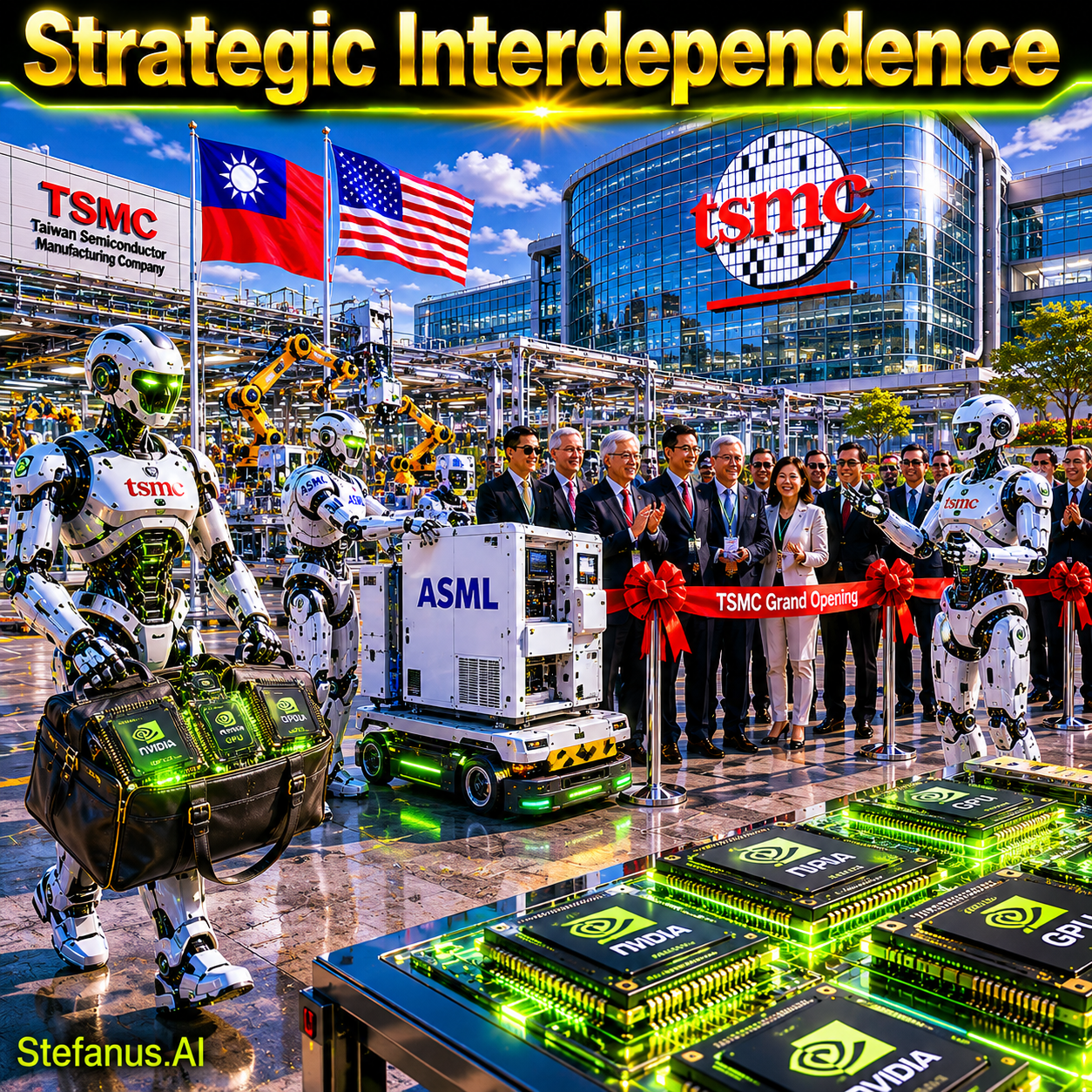
Nvidia designs the world’s most advanced artificial intelligence processors. TSMC fabricates them. The relationship between these two firms is the foundational example of Strategic Interdependence in the AI era because it is simultaneously the most intimate and the most asymmetric: Nvidia cannot produce a single chip without TSMC, and TSMC’s leading-edge revenue is substantially driven by Nvidia’s orders.
The commercial significance is staggering. In Q1 FY2027 (the quarter ending April 26, 2026), Nvidia’s total revenue reached $81.6 billion — up 85% year-over-year — driven overwhelmingly by Data Center revenue of $75.2 billion, itself up 92% year-over-year.[12] TSMC’s Q1 2026 revenue grew 35.1% year-over-year for its ninth consecutive quarter of growth, with March 2026 monthly revenue alone reaching NT$415.19 billion ($13.07 billion), a 45.2% year-over-year jump.[13]
The technological depth of the Nvidia-TSMC relationship extends beyond fabrication into advanced packaging — specifically, Chip-on-Wafer-on-Substrate (CoWoS), the packaging technology that integrates multiple chiplets and High Bandwidth Memory into the dense architectures that make Blackwell function. These are not commodity services. They represent decades of accumulated process knowledge that cannot be replicated quickly or cheaply anywhere else on earth. The intellectual property dimension is equally important: TSMC is trusted with the physical implementation of Nvidia’s most closely guarded trade secrets. This is the essence of Strategic Interdependence: mutual reliance creating mutual vulnerability creating mutual trust as the only viable operating posture.
CASE 2: Nvidia and the Taiwan Ecosystem: One Ecosystem, Irreplaceable
When Jensen Huang declared Taiwan the epicenter of the AI revolution, he was not referring only to TSMC. He was referring to an entire industrial ecosystem — a dense, self-reinforcing cluster of specialized firms that collectively make Taiwan the only place on earth where the full AI chip supply chain can be executed at leading-edge scale. This ecosystem spans TSMC’s foundry services, Foxconn’s AI server assembly, Quanta Computer’s server manufacturing, Wistron’s assembly capacity, Delta Electronics’ power management and cooling systems, and ASE Group’s advanced packaging. Nvidia’s decision to establish a permanent headquarters campus inside this ecosystem is a strategic statement about the irreplaceability of geographic proximity.[14]
The $150 billion annual commitment — a tenfold increase from $15 billion just five years earlier — is not merely a financial pledge. It is a strategic wager that the Taiwan ecosystem will remain the indispensable center of AI hardware production for the next generation. As one analysis noted: Nvidia does not commit $150 billion annually to a single island unless management already sees the demand behind it.[15]
CASE 3: xAI and Anthropic: When Rivals Share Infrastructure
Few business relationships in 2026 are as philosophically striking as the compute partnership between xAI and Anthropic. Elon Musk had been vocally hostile toward Anthropic for years — calling the company “woke” and “misanthropic.” Yet in May 2026, these two rivals struck the most significant AI infrastructure sharing agreement yet disclosed.[16]
The terms, disclosed through SpaceX’s S-1 filing with the SEC, are remarkable: Anthropic agreed to purchase compute services delivered through xAI’s Colossus 1 and Colossus 2 AI infrastructure clusters through May 2029, under an agreement valued at roughly $1.25 billion per month. All told, the deal could bring xAI over $40 billion in revenue.[17] Anthropic secured access to more than 300 megawatts of capacity across more than 220,000 Nvidia GPUs, including H100, H200, and GB200 accelerators.[18]
“The $45 billion Anthropic/SpaceX agreement shows that scarce, high-quality AI compute has become valuable enough to be treated as a standalone commercial asset — not just an internal resource. It is one of the first meaningful public market valuations of frontier AI compute capacity.”
— Arun Boloor, Analyst — Network World, May 2026[19]
CASE 4: Meta and Tesla Energy: When Energy Scarcity Forces Cooperation
The artificial intelligence buildout is, at its foundation, an energy buildout. The International Energy Agency projected in 2025 that data center electricity consumption could reach 1,000 terawatt-hours by 2026 — roughly equivalent to Japan’s total annual electricity consumption.[20] This energy reality has created an unexpected axis of Strategic Interdependence between AI companies and energy infrastructure providers.
Meta had announced an $800 million, 715,000-square-foot AI-optimized data center in Cheyenne, Wyoming. Securing reliable, dispatchable power for AI workloads required creative solutions the local grid alone could not provide. Meta’s solution: approximately $200 million worth of Tesla Megapack battery storage systems, deployed to smooth power delivery and provide resilience against grid fluctuations.[21] Separately, a $1.2 billion hybrid energy project by Enbridge — comprising 365 MW of solar and a 200 MW / 1,600 MWh battery energy storage system — is already underway near Cheyenne to supply clean, dispatchable electricity to Meta’s operations. The strategic implication is profound: Tesla Energy, which competes with Meta in no obvious product category, has become essential to Meta’s AI infrastructure strategy.
CASE 5: Apple and Google: The Privacy Paradox of Strategic Partnership
For years, Apple defined its competitive identity in opposition to Google. Privacy was Apple’s sword and its shield. Then, on January 12, 2026, Apple and Google jointly announced a multi-year partnership. Apple would pay Google approximately $1 billion annually to license a custom 1.2 trillion parameter Gemini model — eight times larger than Apple’s then-current cloud-based models — to power the next generation of Siri and Apple Intelligence features.[22] The deal was structured so Gemini’s role would be “white-labeled” with no Google branding visible to end users.
The infrastructure advantage that made this deal necessary was stark. Apple’s fiscal 2025 capital expenditure on AI infrastructure was $12.7 billion — substantial, but a fraction of Google’s $90 billion or Microsoft’s $150 billion.[23]
“A pragmatic acknowledgment that Apple cannot win the AI arms race alone. The company that perfected hardware design is now wisely leveraging the best AI model infrastructure available rather than reinventing the wheel.”
— Daniel Ives, Senior Equity Analyst, Wedbush Securities — January 2026[24]
The Apple-Google partnership builds on a foundation of existing commercial interdependence: Google already pays Apple approximately $20 billion annually for default search exclusivity on Safari browsers — one of the largest annual inter-company transfers in the technology industry.[25] Adding the Gemini-Siri deal layers a new dimension of mutual reliance on top of an already deeply interdependent relationship between two firms that compete fiercely in mobile software, advertising, mapping, and productivity applications.
CASE 6: Microsoft and OpenAI: The Deepest Investment in AI History
In October 2025, Microsoft and OpenAI announced a new definitive partnership agreement. Following OpenAI’s recapitalization and conversion to a public benefit corporation, Microsoft held an investment in OpenAI Group PBC valued at approximately $135 billion — representing roughly 27% on an as-converted diluted basis. The agreement extended Microsoft’s exclusive IP rights and Azure API exclusivity through 2032, including models post-AGI.[26]
In practical terms, Microsoft’s entire Copilot AI product suite — embedded across Windows, Office, Teams, GitHub, and Azure — depends on OpenAI’s models. Simultaneously, OpenAI’s ability to train and serve frontier-scale models depends on Microsoft’s Azure infrastructure. Neither can easily walk away from the other without catastrophic disruption to its own business. Yet even within this deeply interdependent relationship, competitive tensions are visible: OpenAI signed a $50 billion investment deal and $100 billion cloud commitment with Amazon in early 2026, in part because, as an internal OpenAI memo noted, the Microsoft partnership had limited our ability to meet enterprises where they are.[27]
CASE 7: Amazon and Anthropic: Infrastructure as Partnership Currency
By April 2026, Amazon had committed to up to $25 billion in new investment in Anthropic — on top of the $8 billion previously invested — plus a commitment of $100 billion-plus in AWS cloud services over 10 years.[28]
“Our users tell us Claude is increasingly essential to how they work, and we need to build the infrastructure to keep pace with rapidly growing demand.”
— Dario Amodei, CEO, Anthropic — AWS Partnership Announcement, April 2026[29]
Simultaneously, Microsoft agreed to invest up to $5 billion into Anthropic (November 2025), with Anthropic committing to purchase $30 billion of Azure compute capacity. In March 2026, Anthropic expanded its partnerships with Google and Broadcom for multiple gigawatts of additional capacity.[30] The result is an Anthropic that has deliberately cultivated dependency relationships with all three major cloud providers simultaneously — a deliberate strategy of multi-cloud interdependence designed to maximize negotiating leverage and avoid becoming captive to any single hyperscaler’s interests.
CASE 8: Toyota and Panasonic: The Lesson That Preceded the AI Era
Strategic Interdependence is not a phenomenon invented by the AI revolution. The partnership between Toyota and Panasonic, formalized through their joint venture Prime Planet Energy & Solutions (PPES) in April 2020, offers a powerful prior example. PPES is owned 51% by Toyota and 49% by Panasonic, and its mandate includes not only prismatic lithium-ion batteries but solid-state batteries and next-generation battery technologies — technologies that will define automotive competitive advantage for the next two decades.[31]
The lesson for AI-era strategists is clear: Strategic Interdependence between competitors did not begin with AI, and it will not end with it. The pattern of competitors collaborating on enabling technologies while competing on final products is a recurring structure in industrial history. What the AI revolution has done is accelerate, deepen, and extend this pattern across a technology stack of unprecedented complexity.
CASE 9: ASML, TSMC, Nvidia, and the Semiconductor Ecosystem: No One Builds Chips Alone
The semiconductor supply chain is the most concentrated, most globally interdependent, and most geopolitically consequential industrial ecosystem in human history. At its apex sits ASML — the Dutch company that is the sole supplier of Extreme Ultraviolet (EUV) lithography machines, the equipment required to print every leading-edge AI chip. Without ASML’s EUV machines, there are no advanced chips. Without advanced chips, there is no frontier AI.[32]
ASML’s Q1 2026 revenue reached EUR 8.8 billion at a 53% gross margin, with full-year guidance raised to EUR 36–40 billion. Year-end 2025 backlog stood at EUR 38.8 billion, including EUR 7.4 billion of EUV bookings.[33] Each EUV machine costs in excess of $150 million and contains more than 100,000 individual components sourced from hundreds of specialized suppliers across Europe, Asia, and North America.[34]
This semiconductor ecosystem — encompassing ASML’s EUV monopoly, TSMC’s fabrication expertise, Synopsys and Cadence’s EDA software, Applied Materials’ deposition and etch equipment, and Nvidia’s chip architectures — represents the deepest and most consequential example of Strategic Interdependence in the modern economy. Every firm in this chain is simultaneously a supplier, a customer, a partner, and a potential competitor of every other firm.

Section 3: Taiwan — The Epicenter of Strategic Interdependence
3.1 Why Taiwan Matters
Taiwan is home to roughly 2.3% of the world’s population and occupies a landmass smaller than many U.S. states. Yet in 2026, it is the single most strategically important territory in the global economy — not because of its military power, its natural resources, or its domestic market, but because it houses the only fabrication ecosystem on earth capable of producing the world’s most advanced semiconductors at scale, in time, and with the yield rates that the AI revolution demands.
TSMC alone accounts for more than 90% of global production of chips at 5nm and below — the process nodes on which Nvidia’s Blackwell and upcoming Vera Rubin architectures run, on which Apple’s M-series chips are built, and on which the intelligence at the core of every frontier AI model is ultimately executed.[35]
3.2 Nvidia’s $150 Billion Commitment — A Strategic Declaration
Nvidia’s decision to commit $150 billion annually to Taiwan is best understood not as a real estate decision but as a strategic declaration. By locating 4,000 employees at the Constellation campus, Nvidia ensures that the engineering decision loops between chip design and chip fabrication are as short as possible, reducing the latency between innovation and production.
Nvidia’s Q4 FY2026 Data Center revenue was $62.3 billion, up 75% year-over-year, with hyperscaler customers accounting for over 50% of Data Center revenue.[36] The Vera Rubin platform, expected to ramp in the second half of 2026, is already generating order book commitments that Huang told investors would help the company beat the $1 trillion sales forecast for Blackwell and Rubin chips through 2027.[37]
3.3 Geopolitical Risks and the Taiwan Strait Paradox
The concentration of AI hardware production in Taiwan creates what analysts have described as the Taiwan Strait Paradox: the very success of Taiwan’s semiconductor ecosystem makes it both the most strategically valuable territory in the world and, simultaneously, the most strategically vulnerable. In Q1 FY2027 (ending April 26, 2026), Nvidia took a $4.5 billion charge for unsold H20 inventory and purchase obligations after new U.S. export licensing restrictions disrupted shipments to China.[38] ASML’s China revenue fell from 36% of system sales in Q4 2025 to 19% in Q1 2026.[39]
3.4 Why Ecosystems Beat Individual Firms
The deepest lesson of Taiwan’s rise to semiconductor supremacy is that the competitive unit in the AI era is not the firm — it is the ecosystem. Nvidia’s value would be approximately zero without TSMC, ASML, Synopsys, Cadence, Applied Materials, ASE Group, Quanta Computer, and the hundreds of other firms that constitute the Taiwan AI ecosystem. No individual firm, however brilliant, however well-capitalized, can replicate this ecosystem quickly. The ecosystem is the moat.

Section 4: Strategic Lessons from Strategic Interdependence
4.1 Ecosystems Are More Powerful Than Individual Firms
The evidence is unambiguous. The Taiwan semiconductor ecosystem — developed over four decades through continuous investment, talent cultivation, policy support, and the self-reinforcing dynamics of industrial clustering — represents a competitive advantage that no individual firm has been able to replicate at comparable scale. For strategists, this lesson implies a fundamental reorientation of competitive analysis. The question is no longer simply what does our firm do better than our competitors? The question is within what ecosystem do we operate, and how strong is that ecosystem?
4.2 Competitors Can and Must Create Mutual Value
The xAI-Anthropic compute partnership and the Apple-Google Gemini deal each demonstrate that even the most publicly antagonistic competitive relationships can yield significant mutual value when the structural conditions for cooperation exist. The academic literature on coopetition, pioneered by Brandenburger and Nalebuff at Harvard and Yale and extended by Dagnino and Padula’s work on inter-organizational coopetition dynamics, identifies a consistent pattern:
“At the inter-organisational level, coopetition occurs when companies interact with partial congruence of interests. They cooperate with each other to reach a higher value creation, if compared to the value created without interaction, and struggle to achieve a competitive advantage.”
— Dagnino, G.B. & Padula, G. — Coopetition Strategy: A New Kind of Interfirm Dynamics, EURAM 2002
[40]
4.3 Infrastructure Is the New Battleground
The strategic battles of the AI era are being fought not primarily in the domain of model quality or user experience, but in the domain of infrastructure. Who controls the chips, the data centers, the energy supplies, and the networking fabric controls the enabling conditions for AI development. This is why Amazon has committed $50 billion to OpenAI and $25 billion to Anthropic; why Microsoft holds a $135 billion stake in OpenAI; why Nvidia is spending $150 billion annually in Taiwan; and why even Tesla — primarily an automotive company — has become an infrastructure partner for Meta’s AI buildout.
4.4 Supply Chains Are Strategic Assets
The conventional view of supply chains — as logistical mechanisms to be optimized for cost and speed — is no longer adequate for the AI era. The TSMC-Nvidia relationship, the ASML supply chain, and the Taiwan ecosystem each demonstrate that supply chains in the AI industry are strategic assets that must be cultivated, protected, and invested in as carefully as any core technology. A supply chain that can deliver Blackwell GPUs reliably, at yield, on schedule is worth more than any marketing advantage. A supply chain that cannot is an existential risk.
4.5 Long-Term Partnerships Beat Short-Term Rivalries
The Toyota-Panasonic joint venture, now five years into its operations, offers the clearest evidence for this lesson. By committing to a long-term collaborative structure — despite the competitive tensions inherent in a relationship between an automotive OEM and a battery manufacturer that supplies competitors — both companies secured access to battery technology and manufacturing capabilities they could not have developed as quickly or as cost-effectively alone.
4.6 Strategic Interdependence Does Not Eliminate Competition
Perhaps the most important lesson of all: Strategic Interdependence does not mean that competition disappears. Apple and Google remain intense rivals in mobile software, advertising, and AI assistants, even as Google’s Gemini powers Apple’s Siri. Anthropic and xAI remain direct competitors for AI users, even as Anthropic’s Claude runs on xAI’s Colossus infrastructure. What Strategic Interdependence does is change the nature of competition. Competition shifts from zero-sum destruction of rivals to the more complex task of capturing value within a shared ecosystem while collectively growing that ecosystem.
4.7 The Future Belongs to Network Builders
The greatest winners of the AI era may not be the firms with the best individual technologies. They may be the firms that most skillfully orchestrate the strongest ecosystems. Jensen Huang understood this when he declared Taiwan the epicenter of the AI revolution. Satya Nadella understood this when Microsoft deepened its OpenAI partnership while simultaneously investing in Anthropic. Jeff Bezos understood this when Amazon committed tens of billions to both OpenAI and Anthropic, ensuring AWS remains the infrastructure backbone of frontier AI regardless of which model provider prevails.

Conclusion: Neither the Designer Nor the Tailor Can Win Alone
We began this paper on the red carpet of the Academy Awards, watching the cameras find the designer’s name while the tailors work through the night, invisible. The metaphor was offered not to diminish either party but to illuminate the nature of their relationship: mutual dependence, asymmetric visibility, and the simple truth that without both, there is no gown.
In the AI economy of 2026, Jensen Huang is both designer and network orchestrator. Taiwan — through TSMC, Foxconn, Quanta, and dozens of other specialized firms — is the tailor. Elon Musk’s infrastructure is the studio where Anthropic’s Claude is now being trained. Tesla’s Megapacks are the power storage enabling Meta’s AI factories. Google’s Gemini is the intelligence behind Apple’s Siri. Amazon’s cloud is the delivery mechanism for both OpenAI and Anthropic. Every layer of this stack is woven through with relationships that are simultaneously competitive and cooperative, adversarial and essential.
The firms that will define the next decade of artificial intelligence are not those that manage to escape these interdependencies — because escape is not possible. They are the firms that learn to navigate Strategic Interdependence with sophistication: protecting their most critical intellectual property while cultivating the partnerships that allow them to access capabilities they cannot build alone, at a speed the market will not allow them to wait for, and at a cost that makes self-reliance prohibitive.
“The AI Revolution is not merely a contest between Nvidia, Microsoft, Google, Meta, OpenAI, Anthropic, Tesla, Amazon, Apple, and countless emerging challengers. It is increasingly a contest between ecosystems. The firms that learn how to balance intellectual property protection with strategic collaboration will be best positioned to shape the next decade of artificial intelligence.”
This is the central insight of Strategic Interdependence, and it is an insight that every major player in the AI ecosystem has now demonstrated through their actions, if not always their words: today’s competitor is tomorrow’s most important partner. The designer needs the tailor. The tailor needs the designer. And the AI revolution needs both to keep working — through every night — for the world to see what they have made together when morning comes.

Footnotes and References
[1] Jensen Huang, CEO Nvidia. Speech at Constellation groundbreaking, Taipei, May 27, 2026. https://www.business-standard.com/world-news/nvidia-to-raise-taiwan-spend-to-150-billion-annually-ceo-jensen-huang-126052701850_1.html
[2] CNBC. “Taiwan chip stocks climb after Nvidia announces $150 billion spending plans.” May 27, 2026. https://www.cnbc.com/2026/05/27/nvidia-taiwan-investment-150-billion-spending.html
[3] CNBC. “Anthropic, SpaceX announce compute deal.” May 6, 2026. https://www.cnbc.com/2026/05/06/anthropic-spacex-data-center-capacity.html
[4] TechCrunch. “Anthropic will pay xAI $1.25 billion per month for compute.” May 20, 2026. https://techcrunch.com/2026/05/20/anthropic-will-pay-xai-1-25-billion-per-month-for-compute/
[5] Basenor. “Meta Taps Tesla Megapack for Wyoming AI Datacenter Power.” May 2026. https://www.basenor.com/blogs/news/meta-taps-tesla-megapack-for-wyoming-ai-datacenter-power
[6] Porter, M.E. “The Competitive Advantage of Nations.” Harvard Business Review, March-April 1990. https://economie.ens.psl.eu/IMG/pdf/porter_1990_-_the_competitive_advantage_of_nations.pdf
[7] Brandenburger, A.M. and Nalebuff, B.J. Co-opetition. Crown Business, 1996. https://en.wikipedia.org/wiki/Co-opetition_(book)
[8] Pant, V. and Yu, E. “Computational Foundations for Strategic Coopetition.” University of Toronto, December 2025. https://arxiv.org/pdf/2510.18802
[9] World Economic Forum. “Industries in the Intelligent Age.” Davos, January 2025. https://www.weforum.org/stories/2025/01/industries-in-the-intelligent-age-ai-tech-theme-davos-2025/
[10] Simon Willison. “Notes on the xAI/Anthropic data center deal.” May 7, 2026. https://simonwillison.net/2026/May/7/xai-anthropic/
[11] CNBC. “Apple picks Google’s Gemini to run AI-powered Siri.” January 12, 2026. https://www.cnbc.com/2026/01/12/apple-google-ai-siri-gemini.html
[12] Nvidia. Form 10-Q (Q1 FY2027). SEC Filing, April 26, 2026. https://www.sec.gov/Archives/edgar/data/0001045810/000104581026000052/nvda-20260426.htm
[13] Tech-Insider. “TSMC Q1 2026 Revenue: 35B Earnings Beat.” April 14, 2026. https://tech-insider.org/tsmc-q1-2026-revenue-35-billion-ai-chip-capex/
[14] TechTimes. “Nvidia Pledges $150 Billion a Year in Taiwan.” May 28, 2026. https://www.techtimes.com/articles/317324/20260528/nvidia-pledges-150-billion-year-taiwan-constellation-campus-breaks-ground.htm
[15] Yahoo Finance. “Jensen Huang has bold new market cap prediction for Nvidia.” May 28, 2026. https://finance.yahoo.com/markets/stocks/articles/jensen-huang-bold-market-cap-174700120.html
[16] CNBC. “Anthropic, SpaceX announce compute deal.” May 6, 2026. https://www.cnbc.com/2026/05/06/anthropic-spacex-data-center-capacity.html
[17] TechCrunch. “Anthropic will pay xAI $1.25B per month.” May 20, 2026. https://techcrunch.com/2026/05/20/anthropic-will-pay-xai-1-25-billion-per-month-for-compute/
[18] Data Center Dynamics. “Anthropic to use all of SpaceX-xAI Colossus 1.” May 2026. https://www.datacenterdynamics.com/en/news/anthropic-to-use-all-of-spacex-xais-colossus-1-data-center-compute/
[19] Network World. “xAI-Anthropic deal signals rise of AI compute as standalone business.” May 24, 2026. https://www.networkworld.com/article/4176194/xai-anthropic-deal-signals-the-rise-of-ai-compute-as-a-standalone-business.html
[20] World Economic Forum / IEA data cited at Davos, January 2025. https://www.weforum.org/stories/2025/01/industries-in-the-intelligent-age-ai-tech-theme-davos-2025/
[21] Basenor. “Meta Taps Tesla Megapack for Wyoming AI Datacenter Power.” May 2026. https://www.basenor.com/blogs/news/meta-taps-tesla-megapack-for-wyoming-ai-datacenter-power
[22] CNBC. “Apple picks Google Gemini to run AI-powered Siri.” January 12, 2026. https://www.cnbc.com/2026/01/12/apple-google-ai-siri-gemini.html
[23] Tech-Insider. “Apple $1B Gemini Deal.” April 10, 2026. https://tech-insider.org/apple-google-gemini-siri-deal-1-billion-2026/
[24] Daniel Ives, Wedbush Securities, quoted in Tech-Insider. April 10, 2026. https://tech-insider.org/apple-google-gemini-siri-deal-1-billion-2026/
[25] Gadget Hacks. “Apple Siri Gets $1B Google Gemini AI Upgrade in 2026.” January 28, 2026. https://apple.gadgethacks.com/news/apple-siri-gets-1b-google-gemini-ai-upgrade-in-2026/
[26] Microsoft. “The next chapter of the Microsoft-OpenAI partnership.” SEC Form 8-K, October 28, 2025. https://www.sec.gov/Archives/edgar/data/0000789019/000119312525256310/msft-ex99_2.htm
[27] CNBC. “OpenAI touts Amazon alliance in memo.” April 13, 2026. https://www.cnbc.com/2026/04/13/openai-touts-amazon-alliance-in-memo-microsoft-limited-our-ability.html
[28] GeekWire. “Amazon doubles down on Anthropic with $25B investment.” April 20, 2026. https://www.geekwire.com/2026/amazon-doubles-down-on-anthropic-with-25b-investment-mirroring-its-openai-cloud-deal/
[29] Dario Amodei, CEO Anthropic, quoted in AI Magazine. April 23, 2026. https://aimagazine.com/news/amazons-25b-anthropic-bet-fuels-ai-infrastructure-race
[30] AI Magazine. “Amazon US$25bn Anthropic Bet Fuels AI Infrastructure Race.” April 23, 2026. https://aimagazine.com/news/amazons-25b-anthropic-bet-fuels-ai-infrastructure-race
[31] Toyota Motor Corporation & Panasonic. “Prime Planet Energy & Solutions.” February 3, 2020. https://global.toyota/en/newsroom/corporate/31477926.html
[32] MindRemix. “The ASML Monopoly.” February 6, 2026. https://www.mindremix.com/2026/01/asml-monopoly-euv-lithography-semiconductor-future-2026.html
[33] HeyGoTrade. “ASML Investment Case: EUV Monopoly & Semi Capex Cycle.” May 2026. https://www.heygotrade.com/en/blog/asml-investment-case-euv-monopoly-semi-capex/
[34] ResearchGate. “Monopolizing Innovation: The Strategic Role of ASML.” November 2024. https://www.researchgate.net/publication/385661355_Monopolizing_Innovation_The_Strategic_Role_of_ASML_in_Global_Semiconductor_Dominance_and_its_Impact_on_China
[35] Tech-Insider. “TSMC Q1 2026 Revenue.” April 14, 2026. https://tech-insider.org/tsmc-q1-2026-revenue-35-billion-ai-chip-capex/
[36] Nvidia. Form 8-K (Q4 FY2026). SEC Filing, February 2026. https://www.sec.gov/Archives/edgar/data/0001045810/000104581026000019/q4fy26pr.htm
[37] Yahoo Finance. “Jensen Huang has bold new market cap prediction for Nvidia.” May 28, 2026. https://finance.yahoo.com/markets/stocks/articles/jensen-huang-bold-market-cap-174700120.html
[38] Nvidia. Form 10-Q (Q1 FY2027). SEC Filing, April 26, 2026. https://www.sec.gov/Archives/edgar/data/0001045810/000104581026000052/nvda-20260426.htm
[39] HeyGoTrade. “ASML Investment Case.” May 2026. https://www.heygotrade.com/en/blog/asml-investment-case-euv-monopoly-semi-capex/
[40] Dagnino, G.B. and Padula, G. “Coopetition Strategy.” EURAM 2002. https://en.wikipedia.org/wiki/Coopetition
Comments
[…] quiet but decisive divergence in the kind of silicon the industry buys. In the laboratory era, the general-purpose graphics processing unit reigned supreme, and for good reason: research demands flexibility. When you do not yet know what […]
[…] most consequential single mutation in the anatomy is the transformation of the semiconductor vendor from supplier into financier—the chipmaker as banker. The logic is straightforward once stated, […]
[…] which no chip below roughly seven nanometers can be economically produced. One Taiwanese foundry, TSMC, fabricated the overwhelming majority of the world’s leading-edge logic. American firms […]