
The opening months of 2026 mark a structural turning point—not in space exploration, but in the architecture of intelligence itself.
While Jeff Bezos continued to capture global attention through Blue Origin missions, Elon Musk demonstrated a different form of power through SpaceX—the ability to operate persistent infrastructure in orbit.
“Space is transitioning from exploration to infrastructure.”¹
— Martin Elvis, Harvard-Smithsonian Center for Astrophysics
At the same time, a constraint on Earth is becoming unavoidable.
“Electricity demand from data centers could double by 2026.”²
— International Energy Agency
“AI is using so much energy that computing firepower is running out.”³
— The Wall Street Journal
These pressures are not cyclical—they are structural.
They force a new question:
What happens when intelligence can no longer scale efficiently on Earth?
In early 2026, two developments provided a clear answer:
- Blue Origin filed Project Sunrise, proposing orbital AI data centers
- Amazon committed $11.57 billion to acquire Globalstar, securing satellite connectivity
Together, they signal a new architecture:
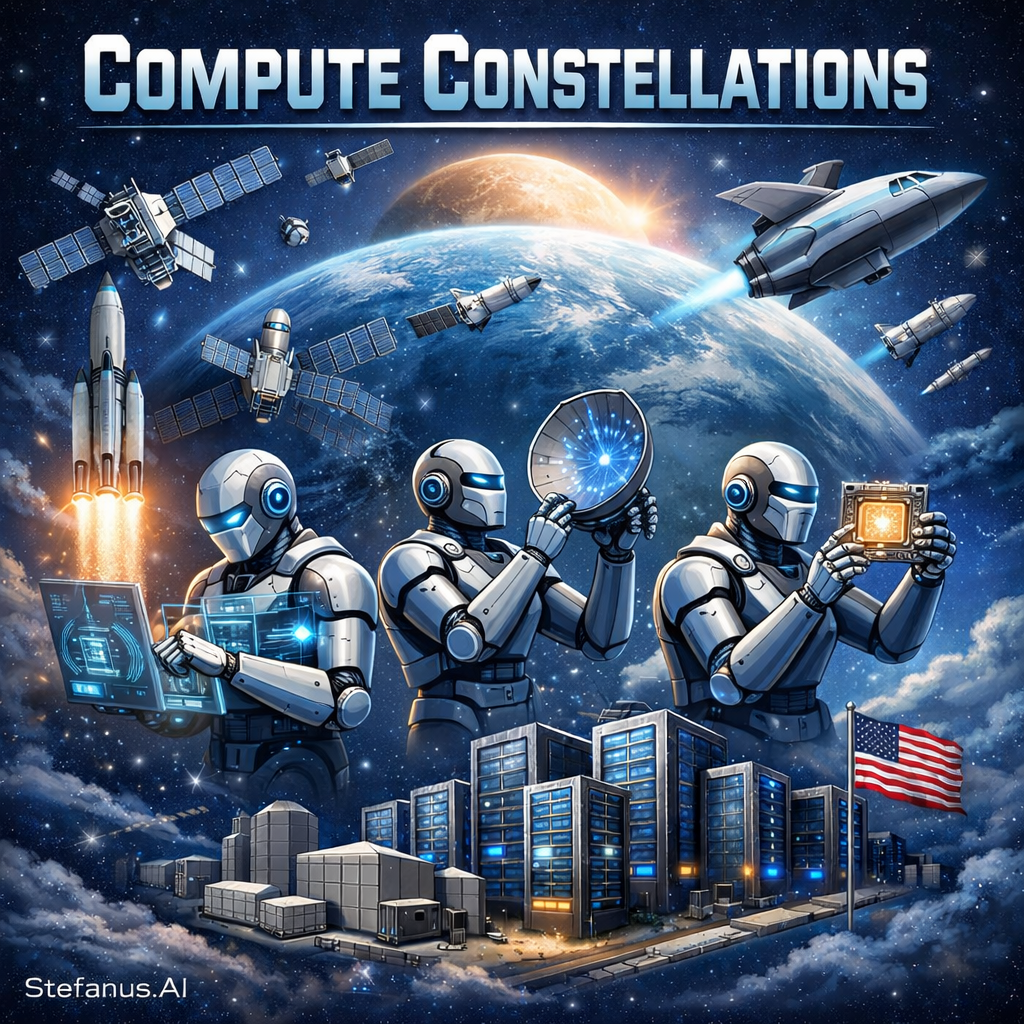
Compute Constellations — distributed orbital systems where computation, energy, and intelligence operate beyond Earth.
“Space-based data centers represent a new paradigm capable of supporting large-scale intelligent services.”⁴
— Hassan Naser et al., arXiv (2026)
This paper argues that the future of AI will not be defined solely by model capability.
It will be defined by where those models live.

Section 1: What Are Compute Constellations?
Compute Constellations represent the evolution from centralized hyperscale computing into distributed orbital intelligence systems.
“The future of computing will be distributed across systems rather than centralized.”⁵
— Michael I. Jordan, UC Berkeley
“Intelligence is increasingly a property of systems, not individual models.”⁶
— Yoshua Bengio
“AI systems will rely on globally distributed infrastructure.”⁷
— Fei-Fei Li, Stanford
At Low Earth Orbit (500–1,800 km), constellations provide:
- Global reach
- Low latency
- Redundancy through scale
“LEO constellations can support real-time global communication and computing.”⁸
— MIT Space Systems Laboratory
Compute is no longer tied to location.
It becomes distributed across space.

Section 2: SpaceX and the Industrialization of Orbit
SpaceX has transformed orbit from frontier into infrastructure.
By 2026:
- Over 10,000 satellites deployed
- Over 10 million users globally
“Starlink is the largest satellite constellation ever deployed.”⁹
— European Space Agency
“The system is continuously evolving as satellites are added.”¹⁰
— Ali et al., arXiv
“Amazon and SpaceX are racing to build data centers in space.”¹¹
— The Wall Street Journal
“Satellite constellations are becoming platforms for computation.”¹²
— Financial Times
More importantly, regulatory momentum is aligning with ambition. In early 2026, the Federal Communications Commission granted approvals that could allow SpaceX to scale toward hundreds of thousands—potentially up to one million satellites over time.
At that scale, the constellation ceases to be a network—it becomes infrastructure equivalent to a gigawatt-class data center, but distributed across orbit.
This is the critical shift:
Starlink is no longer just connectivity. It is the prototype of a planetary compute layer.
Section 3: Blue Origin — From Delay to Strategic Repositioning
Blue Origin is often described as trailing behind.
This view is incomplete.
“Access to space is becoming commoditized.”¹³
— Oxford Economics
“What matters is not reaching orbit—but what you build once you are there.”¹⁴
— Brian Cox
Blue Origin’s early phase built:
- Visibility
- Capital
- Institutional positioning
By 2026, the strategy shifted.
“Space companies are evolving from launch providers to infrastructure providers.”¹²
— Financial Times
“Disruption often comes from redefining the architecture of a system.”¹⁵
— Clayton Christensen
Blue Origin is not simply late.
It is repositioning toward orbital compute infrastructure.

Section 4: Dual-Bezos Architecture — Connectivity, Cloud, and Orbital Compute
The most important structural development in 2026 is not a single company.
It is a dual architecture under Jeff Bezos.
On one side:
- Amazon
- Amazon Web Services
On the other:
- Blue Origin
These entities are separate—but strategically converging.
Amazon: Connectivity and Cloud Control
Amazon is building the connectivity layer.
In April 2026:
“Amazon signs $11.57 billion deal for satellite firm Globalstar.”¹⁶
— Reuters
This acquisition provides:
- Satellite spectrum
- Orbital connectivity
- Integration with AWS
“The cloud is becoming a continuum beyond Earth.”¹⁷
— Satya Nadella
Amazon is positioning itself to control data movement between Earth and orbit.
Blue Origin: Orbital Compute + Backbone
At the same time, Blue Origin is building the compute layer.
“Blue Origin enters the space data center game.”¹⁸
— TechCrunch
Project Sunrise proposes:
- 51,600 satellites
- AI workloads in orbit
“Space offers continuous solar power for energy-intensive systems.”¹⁹
— Caltech
Alongside Project Sunrise, Blue Origin has introduced TeraWave, a high-capacity satellite network designed to support enterprise and data-center connectivity—positioning it as a backbone layer for future orbital compute systems.¹⁶
This directly addresses the core constraint:
“The ultimate constraint on AI is energy.”²⁰
— Daron Acemoglu
Convergence: A Full-Stack Compute Constellation
Together, these systems form a unified architecture:
- AWS → cloud
- Globalstar → connectivity
- TeraWave → backbone network
- Project Sunrise → orbital compute
“Future computing systems will span multiple physical domains.”²¹
— Erik Brynjolfsson
This is not competition at a single layer.
It is competition across the full stack of intelligence.
Strategic Insight
Bezos is not simply catching up to SpaceX.
He is assembling a different system:
- SpaceX → infrastructure-first scaling
- Bezos → ecosystem-first integration
The implication is clear:
Compute Constellations will not be defined by one company.
They will be defined by competing architectures of intelligence in space.

Section 5: NVIDIA and the Hardware Frontier — Compute Becomes a Physics Problem
If earlier sections describe infrastructure and strategy, Section 5 addresses the underlying constraint:
Can computation survive in space?
NVIDIA is central to this question.
“NVIDIA launches space computing to bring AI into orbit.”²²
— NVIDIA Newsroom
This marks a transition:
AI hardware is no longer designed only for Earth.
It is being redesigned for orbit.
Space fundamentally changes computing conditions.
“Space is a harsh radiation environment for electronics.”²³
— NASA Jet Propulsion Laboratory
Radiation can:
- Corrupt data
- Damage chips
- Reduce system lifespan
“Radiation effects must be mitigated in space systems.”²⁴
— MIT Lincoln Laboratory
Thermal conditions are equally extreme.
“Thermal management is a major challenge in spacecraft design.”²³
— NASA JPL
At the same time, space offers a critical advantage:
“Space provides abundant solar energy for power systems.”¹⁹
— Caltech
This creates a paradox:
- Space is hostile to hardware
- But abundant in energy
Once hardware becomes viable, the architecture shifts again.
“Distributed systems improve resilience and scalability.”²⁵
— IMF
Instead of centralized data centers:
- Satellites become compute nodes
- Workloads are distributed
- Systems become resilient
“AI systems are moving toward autonomous operation.”²⁶
— Stanford AI Lab
Satellites are no longer passive.
They become intelligent agents within a distributed system.
Strategic Implication
Compute Constellations are not just a cloud evolution.
They represent a deeper shift:
- From software → physics
- From infrastructure → environment
- From centralized systems → distributed intelligence
Without space-grade hardware, this architecture fails.
With it, Compute Constellations become inevitable.
Conclusion: Compute Constellations as the New Architecture of Intelligence
Compute Constellations define a structural transformation.
“Distributed systems define the future of computing.”⁵
— Michael I. Jordan
The signals of 2026 align:
- SpaceX → industrializing orbit
- Blue Origin → building orbital compute
- Amazon → controlling connectivity
- NVIDIA → enabling hardware
“AI systems will rely on globally distributed infrastructure.”⁷
— Fei-Fei Li
“Space-based systems will become essential to digital infrastructure.”⁴
— Hassan Naser et al.
Compute Constellations represent:
- Distributed intelligence
- Energy independence
- Infrastructure beyond geography
The next era of AI will not be defined by models alone.
It will be defined by where those models live.
And increasingly—
They will live in constellations.

Footnotes
- Martin Elvis — Harvard CfA
https://www.cfa.harvard.edu - International Energy Agency
https://www.iea.org/reports/electricity-2024 - The Wall Street Journal
https://www.wsj.com/tech/ai - Hassan Naser et al.
https://arxiv.org/abs/2603.18601 - Michael I. Jordan
https://people.eecs.berkeley.edu/~jordan - Yoshua Bengio
https://mila.quebec - Fei-Fei Li
https://hai.stanford.edu - MIT SSL
https://ssl.mit.edu - ESA
https://www.esa.int - Starlink arXiv
https://arxiv.org/abs/2603.25835 - WSJ
https://www.wsj.com - Financial Times
https://www.ft.com - Oxford Economics
https://www.oxfordeconomics.com - Brian Cox
https://www.manchester.ac.uk - Clayton Christensen
https://www.hbs.edu - Reuters
https://www.reuters.com - Microsoft
https://news.microsoft.com - TechCrunch
https://techcrunch.com - Caltech
https://www.caltech.edu - Daron Acemoglu
https://economics.mit.edu - Erik Brynjolfsson
https://digitaleconomy.stanford.edu - NVIDIA
https://nvidianews.nvidia.com - NASA JPL
https://www.jpl.nasa.gov - MIT Lincoln Lab
https://www.ll.mit.edu - IMF
https://www.imf.org - Stanford AI Lab
https://ai.stanford.edu


Comments
[…] ambition, and inevitability. From “Gigafactories” to “Terafabs,” from “Cloud” to “Constellations,” naming itself has become a strategic act: to define the future before competitors can contest […]
[…] establish and safeguard sovereignty over space-based data centers […]
[…] paradigm is the move from thinking about satellites as individual nodes to thinking about constellations as distributed intelligence networks. A single satellite with onboard AI is an improvement. A constellation of satellites that can share […]
[…] for cruise ships and RVs, a lifeline for disaster zones. That category is now obsolete. The LEO constellations of 2026 are high-throughput, optically interlinked routing meshes whose latency profiles rival […]