

Introduction:
We are living through one of the most consequential transitions in the history of human civilization — a transition that is unfolding not in the chambers of governments or on the battlefields of wars, but in the invisible logic of algorithms, in the silicon pathways of data centers, and in the daily decisions we increasingly delegate to machines we do not fully understand. Our lives are becoming structurally dependent on artificial intelligence, and increasingly, the AI systems we interact with are not passive tools that merely respond to commands. They are agentic systems — capable of planning, deciding, and acting on our behalf, often anticipating our needs before we consciously recognize them ourselves.
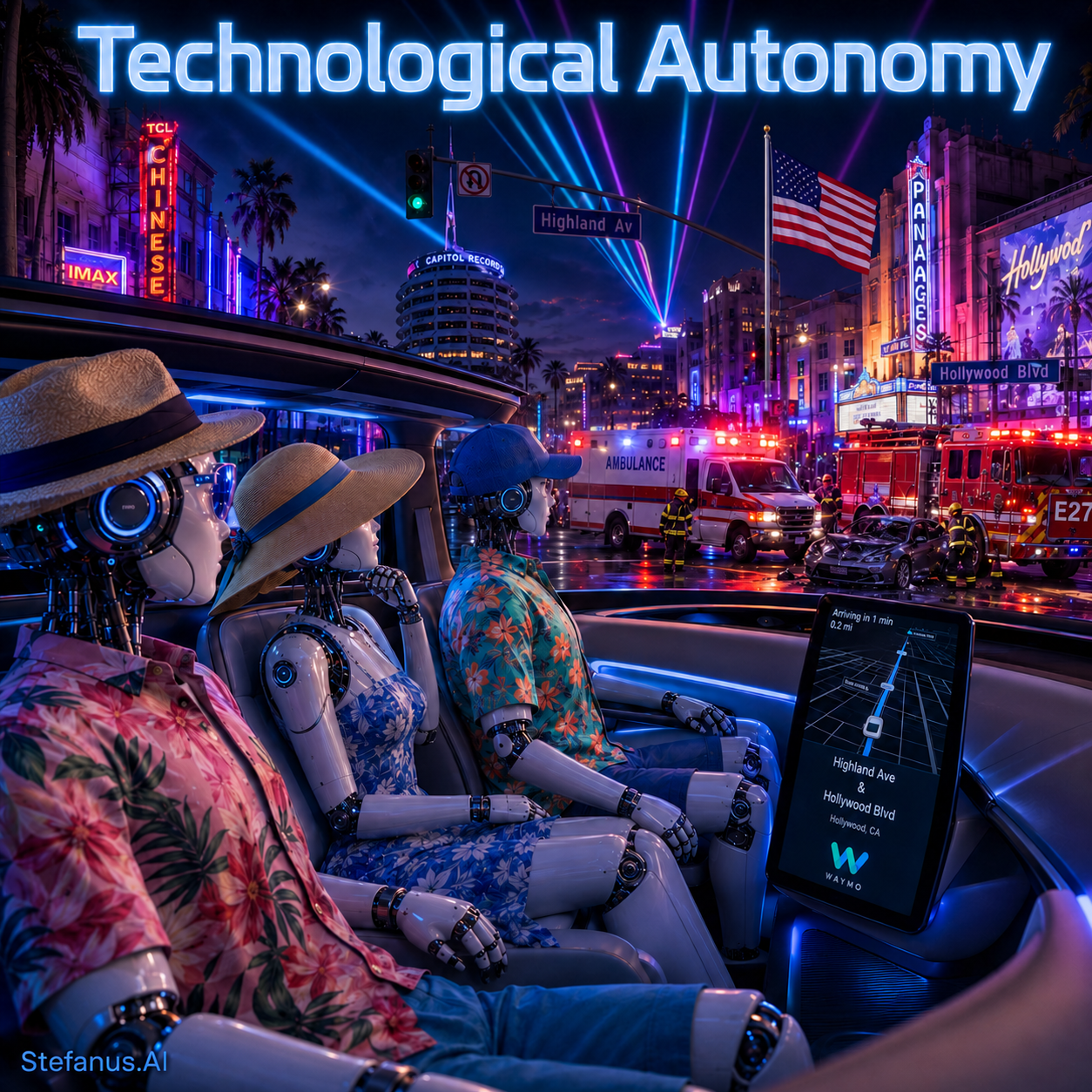
Consider the seemingly mundane act of summoning a Waymo robotaxi in West Los Angeles or activating Tesla’s Full Self-Driving (FSD) system while driving northbound on Interstate 405. In each case, a passenger surrenders directional authority to a machine intelligence. When an unexpected accident blocks the primary route, the vehicle does not wait for a human override — it calculates alternatives, weighs risk probabilities, and reroutes autonomously, often within milliseconds. The human in the seat did not program this rerouting. They agreed, implicitly, to a pre-negotiated set of contingency behaviors encoded at the time of software deployment. This is not automation in the classical sense. This is autonomy — machine agency exercised within parameters set by humans, but triggered and executed without real-time human cognition.
By early 2026, Waymo had released safety data covering nearly 100 million fully driverless miles across four American cities, [1] while Tesla reported that its cumulative FSD miles had exceeded 10 billion as of Q1 2026, with the company’s global fleet generating the equivalent of over 500 years of continuous driving data per day. [2] These figures are not merely impressive statistics. They are evidence of a fundamental reorientation in the relationship between human beings and machines — a reorientation that is spreading far beyond transportation into healthcare, law, finance, education, military strategy, and governance.
This paper was born from a recognition that existing analytical frameworks — legal, philosophical, economic, geopolitical — are individually insufficient to capture the full scope of what is happening. What is needed is a unified lens, one that can simultaneously hold the mechanical question of how autonomous AI systems operate, the philosophical question of what machine autonomy means for human self-determination, the political question of who controls the technologies that mediate global power, and the economic question of how the AI revolution reshapes productivity, labor, and inequality across the developed and developing worlds.
That unified lens is what I call Technological Autonomy.
The term is deliberately double-edged. On one side, it refers to the autonomy of technology itself — the growing capacity of artificial systems to act, decide, and adapt without continuous human guidance. On the other side, it refers to the autonomy of peoples, nations, and individuals in the face of technological power — the ability of human beings to remain self-governing agents in an environment increasingly shaped by systems they did not choose and may not fully understand. These two dimensions are inseparable. The more we grant autonomy to our machines, the more urgently we must ask what autonomy we retain for ourselves.
The framework of Technological Autonomy is also geopolitical. In the contemporary world, the nations and corporations that control the most advanced AI systems, the most sophisticated semiconductor architectures, and the most data-rich ecosystems wield a form of structural power that is unprecedented in history. The ability to design, train, and deploy autonomous AI is rapidly becoming the defining axis of geopolitical competition — more consequential, in many respects, than military spending or conventional trade policy. When the European Commission unveiled its sweeping tech sovereignty package in June 2026, including a Chips Act 2.0 and a Cloud and AI Development Act, the stated rationale was blunt: Europe could not afford to remain dependent on American and Chinese technology stacks for the critical infrastructure of its digital economy. The Commission’s Executive Vice-President Henna Virkkunen captured the stakes with remarkable directness:
“We live in a world where geopolitics and technology are inseparable. We want to be sure nobody has a kill switch.” — Henna Virkkunen, European Commission Executive Vice-President for Tech Sovereignty [3]
This paper is structured in six sections that proceed from the conceptual to the empirical, from the individual to the global, and from the descriptive to the normative. Section 1 establishes the core conceptual distinctions that underpin the entire analysis — the difference between system autonomy and human autonomy, between automation and genuine autonomy — and offers a precise definition of Technological Autonomy. Section 2 argues that the shift from automated to autonomous AI constitutes a paradigm break that demands entirely new analytical frameworks. Section 3 examines the internal architecture of AI autonomy — its levels, its accountability gaps, and the troubling philosophical gap between machine execution and genuine moral deliberation. Section 4 turns to the human side of the equation, exploring how algorithmic systems reshape choice, erode cognitive independence, and create new vulnerabilities in the fabric of human agency. Section 5 zooms out to the global level, analyzing the geopolitical dimensions of technological sovereignty, the diverging regulatory philosophies of the United States, China, and the European Union, and the profoundly unequal distribution of technological power between wealthy and developing nations. Section 6 synthesizes all of these threads into six foundational pillars — lessons learned and imperatives for action — that constitute the policy and philosophical agenda of the age of Technological Autonomy. The paper concludes by returning to the central question with which it began: in a world of increasingly autonomous machines, what does it mean to remain the authors of our own lives?

Section 1: Key Differences — System Autonomy vs. Human Autonomy; Automation vs. Autonomy
Before any serious analysis of Technological Autonomy can proceed, it is necessary to establish the conceptual vocabulary with precision. The terms that populate public discourse around artificial intelligence — automation, autonomy, agency, self-driving, agentic — are frequently used interchangeably, and this terminological slippage generates real intellectual confusion. Clarity here is not pedantry. It is the foundation of sound reasoning.
1.1 System Autonomy vs. Human Autonomy
1.1.1 System Autonomy
System autonomy, in its most technically precise sense, refers to the capacity of an artificial agent to pursue defined objectives across a range of environmental conditions without requiring continuous human input. A system is autonomous to the degree that it can perceive its environment, reason about relevant states of affairs, select among alternative courses of action, execute those actions, and adjust its behavior in response to feedback — all without a human being directing each step of the process.
The key word is ‘continuous.’ Even the most autonomous systems in existence today operate within parameters that were established by human designers. The autonomy is real — these systems genuinely make decisions that no human being made — but it is bounded. A Waymo robotaxi autonomously navigates intersections, but it does so within a geofenced operational design domain established by its engineers. A large language model autonomously generates prose, but it does so within an architecture trained on human-generated data by human researchers pursuing human-defined objectives. System autonomy is therefore best understood not as independence from human intention but as independence from human real-time control — a crucial distinction.
The Stanford HAI 2026 AI Index documents the extraordinary pace at which system autonomy is advancing. In 2025, AI agents succeeded at real-world digital tasks approximately 20% of the time. By early 2026, agent success on Terminal-Bench had risen to 77.3%, cybersecurity task success from 15% (2024) to 93%, and computer-use agents (OSWorld benchmark) to 66.3% — all approaching human-level performance on defined task categories. [4]
1.1.2 Human Autonomy
Human autonomy is a philosophically richer and more ancient concept. At its core, it refers to the capacity of rational agents to govern themselves — to set their own ends, to deliberate about the means to achieve those ends, and to act in accordance with their own judgment rather than the dictates of external authority. The classical philosophical tradition, from Aristotle’s account of practical reason to Kant’s moral philosophy, identifies self-governance as the distinguishing feature of human dignity. To be a moral agent is, at minimum, to be the kind of being whose choices can be genuinely one’s own.
Human autonomy has multiple dimensions that are relevant to the present analysis. There is epistemic autonomy — the ability to form beliefs through one’s own reasoning rather than mere acceptance of external authority. There is preference autonomy — the ability to form and act on one’s own desires and values rather than having those desires manufactured by external manipulation. And there is political autonomy — the ability to participate in the collective governance of the institutions and systems that shape one’s life.
What makes the age of Technological Autonomy so philosophically consequential is that autonomous AI systems threaten all three dimensions simultaneously. Recommender algorithms shape our epistemic environments, nudging our beliefs toward engagement-maximizing content. Personalization engines manufacture and amplify preferences that may never have emerged organically. And the concentration of AI capability in a small number of corporations and states creates forms of technological power over which ordinary citizens exercise little meaningful governance.
1.2 Automation vs. Autonomy
Perhaps no conceptual distinction matters more for understanding the present moment than the difference between automation and autonomy. These terms are often treated as synonyms, but they describe fundamentally different relationships between human beings and machines.
1.2.1 Automation — Fixed Rules, Predictable Execution
Automation refers to the deployment of machines to execute fixed, predetermined, rule-governed processes without human intervention at the point of execution. The defining characteristic of automation is that its behavior is fully specified in advance. A factory robotic arm that welds the same joint in the same way ten thousand times per day is automated. A sorting algorithm that routes parcels according to a lookup table is automated. An email filter that moves messages containing specific keywords to a designated folder is automated. In each case, the machine does exactly what it was programmed to do, nothing more and nothing less, and its behavior under any given input is entirely predictable to a sufficiently informed observer.
Automation is enormously powerful and has been the engine of economic productivity for two centuries. But it is fundamentally brittle. An automated system encounters a situation outside its programming parameters and fails — it either produces an error, halts, or produces an incorrect output. It cannot generalize. It cannot learn. And it has no capacity to handle the unexpected with anything resembling judgment.
1.2.2 Autonomy — Adaptive Decision-Making Under Uncertainty
Autonomy, by contrast, refers to the capacity of a machine to handle situations it was not explicitly programmed for — to reason about novel circumstances, select among alternative courses of action based on contextual evaluation, and adapt its behavior accordingly. The autonomous machine does not merely execute a script; it exercises something that at least functionally resembles judgment.
The clearest contemporary illustration is precisely the autonomous vehicle scenario described in this paper’s introduction. When a Waymo robotaxi encounters an accident that blocks its planned route, it does not fail or halt. It perceives the obstruction through its sensor array, evaluates alternative routes against multiple criteria — estimated travel time, traffic density, road conditions, passenger comfort — and selects a new route autonomously, without any human being making that specific decision. The human operator who designed the system established the decision criteria and the optimization objectives, but the actual routing decision in that moment belongs to the machine.
The Springer Nature Artificial Intelligence Review’s comprehensive 2025 survey of 90 studies defines this paradigm precisely: modern agentic AI systems are distinguished by “proactive planning, contextual memory, sophisticated tool use, and the ability to adapt their behavior based on environmental feedback.” [5] These are not qualities of automation. They are the hallmarks of genuine agency.
1.3 Defining Technological Autonomy
With these distinctions established, I can now offer a precise definition of the framework that organizes this paper. Technological Autonomy is the study and governance of the mutual constitution of machine agency and human self-determination in the age of artificial intelligence. It encompasses three interrelated dimensions:
First, the technical dimension: the architectures, capabilities, and limitations of AI systems that act with degrees of independence from human real-time control — from simple rule-based automation to fully agentic systems capable of long-horizon planning and unsupervised action.
Second, the human dimension: the ways in which the deployment of autonomous AI systems affects the conditions for genuine human self-governance — including epistemic independence, preference authenticity, cognitive agency, moral responsibility, and political participation.
Third, the geopolitical dimension: the distribution of technological power — who controls the most capable AI systems, the most advanced semiconductor fabrication, the most extensive training data — and how that distribution shapes global relations, national sovereignty, and the life-chances of peoples around the world.
The name Technological Autonomy is deliberate. It insists that autonomy is not solely a property of human beings or solely a property of machines, but a relational concept that describes the dynamic interplay between the two. To understand our present moment, we must understand both.

Section 2: From Automated to Autonomous — Why a New Framework Is Required
Throughout most of the twentieth century, the intellectual frameworks through which we understood the relationship between human beings and machines were adequate to the task. Machines were powerful but fundamentally subordinate instruments — tools that amplified human capabilities without displacing human judgment. Even the most sophisticated industrial robotics of the late twentieth century operated within this paradigm. A robotic assembly line was an extension of human will, executing with speed and precision what engineers had determined in advance. The human remained the locus of decision-making; the machine was its executor.
This paradigm is no longer adequate. The shift from automated to autonomous AI is not a quantitative improvement along a familiar dimension — faster, more accurate, more efficient — but a qualitative transformation in the nature of the human-machine relationship. It is a paradigm break, and it demands a correspondingly new framework of analysis.
The core of the paradigm break is this: autonomous AI systems do not merely execute human decisions. They make decisions that humans did not make and, in many cases, could not have made given the speed, complexity, or scale of the relevant circumstances. When a high-frequency trading algorithm executes thousands of transactions per second in response to market microstructure signals that no human trader could perceive, let alone evaluate, in real time, it is not extending human judgment — it is replacing it. When a medical AI system reads hundreds of pathology images simultaneously and flags potential malignancies with accuracy that exceeds the most experienced human radiologists, it is not assisting human expertise — it is, in a meaningful sense, generating expertise of its own.
This transformation has profound implications for accountability, ethics, law, and governance — none of which are adequately addressed by frameworks designed for an age of mere automation.
2.1 The Accountability Gap
In the age of automation, accountability was relatively tractable. If an automated system produced a harmful outcome, the chain of responsibility could in principle be traced back through the programming decisions to the human beings who wrote the code, approved the deployment, and authorized the system to operate. The machine’s behavior was a direct expression of human choices.
Autonomous AI systems break this accountability chain in ways that are philosophically and legally novel. A deep learning model trained on vast datasets develops emergent behaviors that no single human designed or anticipated. The model’s outputs are the product of billions of learned parameters adjusted through optimization processes that no human engineer fully comprehends. When such a system produces a harmful outcome — an erroneous medical diagnosis, a discriminatory hiring decision, a dangerous autonomous vehicle maneuver — the question of who is responsible is genuinely difficult. The individual data scientists? The corporation that deployed the system? The regulators who approved it? The users who relied on it?
The 2025 AI Agent Index, published in advance of the ACM FAccT 2026 conference in Montreal, documents this accountability gap across 30 deployed agentic systems, examining legal frameworks, autonomy controls, ecosystem interactions, and safety features. Its finding is sobering: the growth in deployed agent capability has substantially outpaced the development of accountability mechanisms adequate to govern it. [6]
2.2 The Thesis: Algorithmic Systems as Environment-Shaping Agents
The central thesis of this paper is the following: Algorithmic systems do not merely serve humans; they dynamically alter human environments and require new frameworks of meaningful human control. This thesis has several dimensions that each receive extended treatment in subsequent sections.
The first dimension is environmental. Autonomous AI systems do not simply respond to pre-existing human situations; they actively reshape the information environments, decision architectures, and social structures within which human choices are made. A recommendation algorithm does not merely reflect existing human preferences; it actively cultivates new preferences, reinforces existing ones, and determines which possibilities human beings are even aware of. An autonomous credit-scoring system does not merely evaluate existing human creditworthiness; it shapes the conditions under which creditworthiness can be established or demonstrated. These systems are not neutral instruments. They are agents of environmental transformation.
The second dimension is normative. The transformation of human environments by autonomous AI systems is not value-neutral. Every algorithmic system embeds a set of values — values that determine what counts as a good outcome, how competing interests are weighted, and whose preferences are optimized. When these value judgments are made by machines operating at scale with minimal human oversight, they acquire a kind of social authority that democratic governance has not yet found adequate ways to contest or correct.
The third dimension is structural. The capabilities required to build and deploy the most powerful autonomous AI systems — vast computational resources, enormous datasets, sophisticated engineering talent, access to frontier semiconductor technology — are distributed with extreme inequality across the globe. This structural inequality in AI capability is rapidly translating into structural inequality in economic productivity, military capability, and geopolitical influence. A new framework is needed not only for governing autonomous AI within societies but for managing the dynamics of technological power between societies.
As Stanford HAI’s distinguished fellow Professor Fei-Fei Li stated upon receiving the Queen Elizabeth Prize for Engineering in November 2025,
“We’re at a pivotal moment. The next chapter of AI will depend on our ability to align innovation with human needs and values.” — Professor Fei-Fei Li, Stanford University, Queen Elizabeth Prize for Engineering, November 2025 [7]
Her observation captures precisely the normative imperative at the heart of the Technological Autonomy framework. The pivot she describes is not merely technological but civilizational. It is the question of whether the extraordinary power of autonomous AI will be harnessed in ways that expand human flourishing or in ways that concentrate power, erode agency, and deepen inequality. That question cannot be answered by engineers alone. It requires the full engagement of political philosophy, economics, jurisprudence, ethics, and democratic governance.

Section 3: What Is AI Autonomy? Levels, Accountability, and the Illusion of Moral Deliberation
Understanding what artificial intelligence autonomy actually is — as opposed to what it is often imagined to be — requires moving beneath the surface of popular discourse and engaging seriously with both the technical architecture of autonomous systems and the philosophical implications of that architecture. Autonomy is not a binary property. It exists on a spectrum, and the position of any given AI system on that spectrum has profound implications for how it should be governed, how accountability should be assigned, and what moral burdens it can legitimately carry.
3.1 The Five Levels of AI Autonomy
Drawing on emerging frameworks in AI governance and robotics research, it is useful to conceptualize AI autonomy as comprising five functional levels, which I characterize as the Operator, Collaborator, Consultant, Approver, and Observer. These levels are not stages of a linear progression but distinct modes of human-machine relationship, each with characteristic properties, applications, and governance challenges.
At the Operator level, the AI system executes tasks delegated to it by human principals but requires explicit human authorization for each action. The human remains the decision-maker; the AI is its hand. Contemporary examples include basic robotic process automation, simple chatbots, and rule-based decision support tools. The accountability structure at this level is relatively clean: the human who authorized the action is responsible for its consequences.
At the Collaborator level, the AI system engages in genuine joint problem-solving with human counterparts, generating options, flagging considerations, and contributing to the deliberative process, but with the human retaining final decision authority. This is the level at which most enterprise AI deployment currently operates — AI-assisted diagnosis in medicine, AI-generated drafts in legal and creative work, AI-augmented analysis in financial services. The accountability structure here is more complex, as the AI’s contributions shape the human’s decisions in ways that can be difficult to disentangle.
At the Consultant level, the AI system provides authoritative recommendations that human decision-makers are expected to follow in the absence of strong countervailing reason. The authority gradient between the system and the human operator begins to shift. Research on automation bias suggests that at this level, human override rates drop dramatically — humans who are presented with confident AI recommendations frequently defer to them even when their own judgment would lead to different conclusions.
A striking empirical illustration: an audit of Spain’s Viogén system — an algorithm designed to assess domestic violence risk — found that police officers followed the system’s recommendations in 95% of cases, raising profound questions about whether human oversight at this level constitutes genuine supervision or mere rubber-stamping. [8]
At the Approver level, the AI system acts autonomously within defined parameters and requires human involvement only for decisions that fall outside those parameters or exceed defined thresholds. This is the level at which autonomous vehicles currently operate in supervised deployment: the system drives, the human monitors and intervenes only when needed. At this level, the human’s cognitive role shifts from active decision-making to vigilant oversight — a role that human psychology is poorly designed to perform over extended periods, a phenomenon explored in Section 4.
At the Observer level — which represents the theoretical frontier of AI autonomy — the AI system operates fully independently, with human oversight occurring only after the fact through the review of logs, outcomes, and reports. This level does not yet exist at meaningful deployment scale for high-stakes applications, but it is the implicit trajectory of the systems currently being built. Understanding the Observer level is crucial for policy design: governance frameworks designed for the Collaborator or Consultant level will be wholly inadequate for systems operating at the Observer level.
As Professor Stuart Russell of UC Berkeley, one of the world’s foremost AI safety researchers and co-author of the definitive textbook Artificial Intelligence: A Modern Approach, has argued in his work on value alignment and human-compatible AI, the fundamental challenge is that
“as machines become more capable, we will have to think more carefully about how to specify objectives and ensure that what we want is what the machine optimizes for.” — Professor Stuart Russell, UC Berkeley, AI: A Modern Approach [9]
This observation becomes acutely urgent at the Observer level, where the human capacity for ongoing course-correction is most constrained.
3.2 The Problem of Opacity — How Opaque Training Data and Complex Architectures Affect Accountability
The accountability challenges created by autonomous AI systems are substantially compounded by a structural feature of modern deep learning that distinguishes it from all previous generations of computational systems: fundamental opacity. Classical software systems — however complex — were in principle interpretable. Given sufficient time and expertise, a skilled engineer could read the code, trace the logic, and understand why any particular output was produced. The explainability of the system, while sometimes practically difficult, was guaranteed by its architecture.
Modern large language models, neural networks, and reinforcement learning systems do not share this property. Their behaviors emerge from the statistical properties of parameter spaces containing billions or trillions of numerical values, adjusted through optimization processes that no human being designed in any detailed sense. The ‘reasons’ for a particular output — a medical recommendation, a credit decision, a content moderation judgment — are distributed across the entire parameter space in ways that are not decomposable into human-interpretable propositions. We can sometimes produce post-hoc explanations of why a system behaved as it did, but these explanations are approximations — they describe the behavior without genuinely revealing its causes.
This opacity creates a structural accountability gap that has no precedent in the history of engineered systems. When an autonomous AI system makes a consequential error — misdiagnosing a cancer, denying a loan application to a qualified borrower, failing to brake in time to avoid an accident — the inability to explain the system’s reasoning makes it extremely difficult to assign responsibility, to correct the error, or to prevent its recurrence. The system cannot be audited in the way that a human decision-maker can be cross-examined or a traditional software system can be code-reviewed.
The problem is compounded further by the nature of training data. Large AI systems learn from datasets that are themselves products of human societies — datasets that embed historical biases, reflect past injustices, and encode the perspectives and priorities of those who generated or curated them. When these datasets are used to train autonomous systems that then operate at scale across millions of individuals, the biases become institutionalized in ways that are both pervasive and difficult to detect.
3.3 The Illusion of Moral Deliberation
Perhaps no aspect of autonomous AI systems is more philosophically treacherous — or more consequential for public understanding — than the appearance of moral reasoning. Modern AI systems, particularly large language models, can produce outputs that bear a striking surface resemblance to moral deliberation. They can articulate principles, weigh competing considerations, identify relevant ethical frameworks, and produce recommendations that sound like the outputs of careful moral reasoning. This appearance is deeply misleading.
Consider the trolley problem — one of the most famous thought experiments in moral philosophy, introduced by British philosopher Philippa Foot in 1967. The scenario asks: if a runaway trolley is heading toward five people who will be killed unless you divert it onto a side track where it will kill one person, what should you do? This scenario has become a staple of discussions about autonomous vehicle ethics, with researchers and commentators debating how self-driving cars should be programmed to handle analogous life-or-death decisions.
The Alan Turing Institute has analyzed this debate with great care, observing that the trolley problem “gets to the heart of some of the oldest debates in moral philosophy, not least the divide between consequentialist and utilitarian approaches — which seek to optimize the ‘greatest good for the greatest number’ — and deontological approaches, which hold that certain actions are intrinsically right or wrong regardless of their consequences.” [10]
But here is the crucial point that is frequently obscured in popular discussions: when an autonomous vehicle’s software ‘decides’ how to respond to an emergency scenario, it is not engaging in moral deliberation in any philosophically meaningful sense. It is executing an optimization procedure over pre-specified objective functions. The ‘ethics’ embedded in the system are not the product of genuine moral reasoning by the machine — they are the product of moral and engineering choices made by the human beings who designed the system, expressed as mathematical constraints.
This distinction matters enormously for accountability. If a human driver makes a split-second decision in an emergency that results in someone’s death, we can ask whether that decision reflected good judgment, reasonable care, or culpable recklessness. The human was a moral agent exercising practical wisdom under conditions of uncertainty. If an autonomous vehicle’s algorithm produces the same outcome, we cannot ask the machine for its reasons in any meaningful sense. We can only ask: who designed this optimization function? Who approved these objective weights? Who deployed this system without adequate testing?
The philosophical differences between human moral reasoning and machine execution of ‘ethical’ algorithms have practical consequences that extend far beyond autonomous vehicles. In every domain where AI systems are given authority over consequential decisions — criminal sentencing, child welfare, medical treatment, military targeting — the illusion that machines can engage in genuine moral deliberation creates a dangerous tendency to defer to algorithmic outputs as though they carry a kind of objective moral authority that they do not and cannot possess.
The philosopher Travis LaCroix has argued compellingly that using trolley-style problems as validation mechanisms for autonomous system ethics represents a fundamental misapplication of philosophical thought experiments — one that fails to appreciate the purpose of moral dilemmas and carries potentially catastrophic consequences for the design of AI governance frameworks.[11]

Section 4: The Impact of Algorithmic Systems on Human Autonomy
The previous sections examined the nature and architecture of AI autonomy — what it is, how it works, and why it demands new conceptual frameworks. This section turns to the human side of the equation: the ways in which autonomous algorithmic systems are reshaping the conditions for genuine human self-governance. The impact is not limited to the dramatic scenarios of autonomous vehicles and medical AI. It is pervasive, subtle, and in some respects more threatening in its subtlety than in its drama. The most significant transformations in human autonomy are happening not in moments of visible machine decision-making but in the invisible architecture of the environments within which human beings exercise their daily agency.
4.1 Choice Architecture and Manipulation — How Personalization Algorithms Constrain Free Will
The concept of choice architecture — the way in which the presentation and framing of options shapes the choices that people make — was introduced into behavioral economics by Richard Thaler and Cass Sunstein in their landmark 2008 book Nudge. The core insight is that no presentation of choices is neutral: the order of options, the default settings, the visual salience of alternatives, the framing of outcomes — all of these structural features of decision environments significantly influence the choices people make, often without their awareness.
Digital platforms and algorithmic recommendation systems have taken the logic of choice architecture to a scale and sophistication that Thaler and Sunstein could not have anticipated. Every interface that a user encounters on a major digital platform is the product of optimization — engineered to maximize engagement, retention, and conversion through the exploitation of known human cognitive biases and the real-time adaptation of content to individual behavioral profiles. These are not neutral tools for connecting people with information they want. They are dynamic environments designed to shape behavior.
The philosophical question is whether this kind of systematic, personalized environmental shaping constitutes a form of manipulation that is incompatible with genuine human autonomy. Manipulation, in the philosophical sense that matters here, refers to the influence of a person’s beliefs, desires, or behaviors through means that bypass their rational agency — means that exploit psychological vulnerabilities, create false impressions, or generate preferences that the person would not endorse upon reflection. By this standard, much of what contemporary recommendation algorithms do is properly understood as manipulation.
The Springer Nature journal Philosophy & Technology published a landmark 2025 analysis, ‘Autonomy by Design: Preserving Human Autonomy in AI Decision-Support,’ which argued that recommender systems are often designed to retain user attention through the ‘attention economy,’ and that “the benefits of personalization for autonomy will need to be carefully balanced against ethical concerns around data privacy and algorithmic bias.” [12]
The capacity for real-time personalization makes contemporary recommendation algorithms qualitatively different from any previous form of choice architecture. A newspaper editor deciding what to put on the front page creates a single choice environment for all readers. A recommendation algorithm creates a distinct, personalized choice environment for each of hundreds of millions of users, tailored in real time to their demonstrated behavioral patterns. At this scale, the systemic effect on public discourse, political opinion formation, and shared social reality is profound.
The Stanford HAI 2026 AI Index documents that generative AI reached 53% population adoption within three years of mass-market launch — faster than the personal computer or the internet. [13] With that adoption has come a corresponding expansion of algorithmically curated information environments. The epistemic autonomy of more than half the world’s adult population is now being shaped, in real time, by optimization processes designed not for truth-seeking but for engagement maximization.
4.2 Automation Bias — The Psychology of Deference to Machines
Alongside the external manipulation of choice environments by recommendation algorithms, there is a complementary internal transformation occurring in human psychology — a transformation that is, in some respects, even more fundamental to the question of human autonomy. This is the phenomenon of automation bias: the well-documented tendency of human beings to defer to the outputs of automated and autonomous systems, even when those outputs are incorrect or when the human’s own independent judgment would lead to better outcomes.
Automation bias is not a character flaw or a form of laziness. It is a predictable consequence of the cognitive architecture of human beings. Humans are cognitive satisficers, not optimizers. We operate with limited attentional resources and tend to apply effortful, deliberate reasoning only to decisions that we perceive as important or uncertain. When an AI system provides a confident recommendation, it tends to trigger a heuristic judgment that the recommendation is reliable and that devoting cognitive resources to evaluating it independently would be wasteful. This tendency is reinforced by the design of AI interfaces, which typically present recommendations with visual cues of authority and confidence.
A 2026 Nature Scientific Reports study examining human reliance on AI found that “frequent use of and, therefore, familiarity with AI that is designed to support humans during decision-making tasks, may lead to problematic over-reliance on AI such that it is treated as an entirely autonomous decision-maker.” [14] The study found that automation bias was further amplified by the tendency to anthropomorphize AI systems — to attribute human-like intentionality and certainty to machine outputs, thereby increasing the perceived authority of AI recommendations.
The consequences of automation bias in high-stakes domains are deeply troubling. In medicine, studies have shown that clinicians who are presented with AI-generated diagnostic recommendations before forming their own independent judgment are significantly more likely to defer to the AI recommendation, even when it is incorrect. In criminal justice, research on algorithmic risk assessments has found that judicial sentencing decisions are substantially influenced by algorithmic risk scores in ways that reflect the scores’ errors and biases. In military contexts, the automation bias problem takes on literally life-or-death dimensions.
The European Data Protection Supervisor’s 2025 TechDispatch on Human Oversight of Automated Decision-Making documents the real-world severity of automation bias, citing the Spanish Viogén domestic violence risk assessment system where police followed algorithmic recommendations in 95% of cases, and observing that high concordance rates “raise questions about the genuineness of autonomous human judgment in the oversight process.” [8]
The insidious quality of automation bias is that it is self-reinforcing. The more we rely on AI recommendations, the less we exercise our own independent judgment, and the less we exercise our own judgment, the more atrophied our capacity for independent judgment becomes. This creates a feedback loop that threatens not just individual decision quality but the social and institutional infrastructure of human deliberation upon which democracy, science, and law depend.
4.3 Emerging Theories of Technological Vulnerability — Human Autonomy as Environmentally Constituted
The phenomena of algorithmic choice architecture and automation bias point toward a deeper philosophical insight that emerging theories of human autonomy are beginning to articulate with increasing sophistication: human autonomy is not a fixed property of individual persons that exists independently of their social and technological environments. It is an achievement — a capacity that is constituted, sustained, and potentially undermined by the conditions under which it is exercised.
This insight has deep roots in the history of social and political philosophy. John Stuart Mill’s arguments for freedom of thought and expression were grounded in a recognition that genuine intellectual autonomy requires an environment characterized by diversity of viewpoints, freedom of inquiry, and genuine contestability of ideas. Jürgen Habermas’s theory of communicative action identifies the conditions for genuine rational discourse — conditions that are threatened when strategic rather than communicative action dominates social interaction. These traditions all converge on the recognition that human self-governance is environmentally sensitive in ways that simple libertarian accounts of individual freedom tend to obscure.
Contemporary theorists are developing these insights in direct response to the challenges posed by autonomous AI systems. The philosophical literature on ‘relational autonomy’ — which understands self-governance as constituted through social relationships and institutions rather than as a property of isolated individuals — provides powerful resources for understanding why algorithmic environments that systematically manipulate, nudge, and constrain choice are threats to autonomy even when they leave formal choice intact. You can technically choose not to click the recommended video, but if the recommendation algorithm has systematically cultivated your preferences over years of engagement, the choice between clicking and not clicking is not a free expression of your prior autonomous preferences. It is a choice made within an environment that your autonomous preferences never governed.
The practical implication of this insight is that the protection of human autonomy in the age of Technological Autonomy requires not just individual rights — rights to privacy, to opt-out, to explanation of algorithmic decisions — but structural interventions in the environments that autonomous systems create. This is why the governance of AI cannot be reduced to consumer protection law. It requires something more analogous to environmental regulation: the governance of the informational and decisional ecologies within which human agency is exercised.

Section 5: Geopolitics, Sovereignty, and Power — The New Technological Order
The questions explored in Sections 3 and 4 — about the nature of AI autonomy, its accountability implications, and its effects on human agency — are questions that arise within the context of particular societies, with particular regulatory frameworks, particular cultural norms, and particular distributions of power. But the most consequential dimension of Technological Autonomy is the one that operates at the global level: the geopolitical competition for technological supremacy that is reshaping the international order with a speed and thoroughness that has few historical precedents.
Control over advanced artificial intelligence — its infrastructure, its frontier models, its applications — is rapidly becoming the defining variable in global power. Nations and corporations that master the full stack of AI capability — from semiconductor design and fabrication through data infrastructure and model training to deployment at scale — will enjoy structural advantages across every domain of economic and military competition. Nations that do not will face forms of dependence that challenge the meaningfulness of their sovereignty in ways that recall the most uncomfortable moments of twentieth-century colonialism.
5.1 Technological Sovereignty — Semiconductors, AI, and Quantum Computing as Instruments of Geopolitical Power
The concept of technological sovereignty — the capacity of a nation or bloc to develop, control, and deploy critical technologies independently of potential adversaries — has moved from the margins of strategic studies to the center of international relations discourse with remarkable speed. It is now a core organizing concept of technology policy in every major economy. The reason is straightforward: the technologies that underpin modern AI — semiconductors, high-performance computing, advanced data infrastructure — are simultaneously economic foundations and strategic assets.
Semiconductors are the most visible battleground. The most advanced logic chips — those manufactured at 3 nanometer process nodes and below — are produced in commercially meaningful quantities by exactly one company in the world: Taiwan Semiconductor Manufacturing Company (TSMC). The extreme capital intensity and engineering complexity of leading-edge chip fabrication has produced a market structure in which a single facility in Hsinchu, Taiwan, is an irreplaceable node in the global AI supply chain. The geopolitical implications are staggering.
A 2025 Central European University study of U.S.-China semiconductor competition concluded that states are using “export controls, tariffs, and interdependencies to gain technological sovereignty, strategic superiority and geopolitical dominance,” and documented the emergence of new technology alliances — including the Chip 4 Alliance between the United States, Taiwan, Japan, and South Korea — as expressions of techno-nationalist strategy. [15]
The American CHIPS and Science Act, enacted in 2022 and substantially funded through 2025-2026 appropriations, represents the most significant U.S. industrial policy intervention since the Space Race — a recognition that semiconductor production cannot be treated as an ordinary market good subject only to economic efficiency criteria. The Brookings Institution observed that the CHIPS Act “marks a shift in U.S. industrial policy to address renewed concerns over maintaining U.S. technological leadership in the face of fast-growing competition from China.” [16]
The European Union has followed a parallel trajectory. In June 2026, the European Commission unveiled a sweeping technological sovereignty package — including a Chips Act 2.0 and a Cloud and AI Development Act — that represents the most ambitious European technology policy initiative in decades. The package explicitly targets overdependence on American and Chinese technology stacks across semiconductors, cloud computing, AI services, and open-source software infrastructure.
CNBC reported that the Commission aimed to ensure no cloud providers of critical workloads had a “kill switch” over European infrastructure — a phrase that captures the sovereignty anxiety at the heart of European tech policy with unusual vividness. [3]
Beyond semiconductors and cloud, quantum computing is emerging as the next frontier of technological sovereignty competition. Nations that achieve practical quantum advantage — the ability to perform computations that classical computers cannot accomplish in feasible time — will gain capabilities in cryptography, materials science, drug discovery, logistics optimization, and AI model training that could translate into structural advantages across virtually every domain of scientific and economic activity. The United States, China, the European Union, the United Kingdom, and Canada are all pursuing substantial national quantum programs, with investment levels that reflect the perceived strategic stakes.
5.2 Regulatory Frameworks — The Diverging Models of the United States, China, and the European Union
The geopolitical competition for AI supremacy is not occurring in a regulatory vacuum. Each of the major powers has developed a distinctive approach to governing AI — an approach that reflects its particular values, institutions, economic interests, and strategic objectives. Understanding these diverging models is essential for anyone attempting to navigate the global landscape of Technological Autonomy.
The United States approach has historically been characterized by a commitment to innovation-first principles and a deep structural aversion to prescriptive ex ante regulation. The dominant philosophy in American technology policy has been to allow markets and private enterprise to drive AI development, with government involvement limited primarily to funding foundational research, setting security-related export controls, and providing liability frameworks after the fact. This approach has demonstrably succeeded in producing the world’s leading AI corporations and the most capable large language models — OpenAI, Anthropic, Google DeepMind, and Meta AI collectively define the global frontier of AI capability.
But the American model has significant weaknesses. The concentration of AI development in a small number of private corporations creates accountability gaps that public law has been slow to address. The United States has no comprehensive federal AI regulation analogous to the European AI Act — AI governance occurs primarily through a patchwork of sector-specific regulations, executive orders, voluntary commitments, and state-level initiatives. This fragmentation creates regulatory arbitrage opportunities and leaves significant risks inadequately governed.
China’s approach is the mirror image of the American model in important respects. The Chinese state plays a far more directive role in guiding AI development, channeling substantial public investment into priority areas, mandating data-sharing with government authorities, and deploying AI systems in ways — particularly in surveillance, social credit, and content moderation — that would be legally and politically impossible in liberal democracies. China’s pursuit of indigenous AI capability is embedded in a comprehensive strategy of technological self-reliance, accelerated dramatically by American export controls that restricted Chinese access to the most advanced AI chips.
The Chinese response to American semiconductor restrictions has been to mount the most ambitious domestic chip development program in history. While China has not yet matched the manufacturing capabilities of TSMC or Intel for the most advanced logic nodes, its progress in less advanced nodes and in designing chips optimized for specific AI workloads has been more rapid than many Western analysts anticipated. Huawei’s Ascend AI chip series, developed after American export controls cut off access to Nvidia hardware, represents a significant engineering achievement — evidence that the push to create technological chokepoints in the semiconductor supply chain may have an unintended consequence of accelerating indigenous Chinese capability development.
The European Union’s approach is the most procedurally elaborate and philosophically distinctive of the three. The EU AI Act — enacted in 2024 and entering phased enforcement through 2026 — establishes the world’s first comprehensive legal framework for regulating AI according to a risk-based taxonomy. High-risk AI systems (in domains including medical devices, critical infrastructure, law enforcement, and employment) face stringent requirements for transparency, human oversight, accuracy, and bias mitigation. Certain applications — real-time biometric identification in public spaces, social scoring by governments — are banned outright.
The Tech Diplomacy Global Institute’s analysis of these three models concludes that their divergence is driving “a new phase of technological decoupling and regulatory divergence” that “threatens to reduce the spillover benefits of open scientific collaboration.” [17] The fragmentation of global AI governance into three incompatible regulatory regimes — the American innovation-first model, the Chinese state-directed model, and the European rights-and-risk model — creates a trilemma for multinational corporations, researchers, and international institutions that will require substantial diplomatic innovation to navigate.
5.3 Superpower Dominance and the Concentration of AI Power
The financial scale of AI investment in 2026 is almost incomprehensible by the standards of any previous technology cycle. The four hyperscaler corporations — Microsoft, Alphabet, Amazon, and Meta — collectively committed between $635 billion and $665 billion in capital expenditure for 2026, a roughly 67% increase from their $381 billion in combined expenditure in 2025.
Nvidia reported Q1 2026 revenue of $81.6 billion — up 85% year-over-year — with Data Center revenue alone reaching $75.2 billion, or 92% of total revenue. [18] Alphabet raised its full-year 2026 capital expenditure guidance to $180-190 billion. [19] Google Cloud revenue grew 63% year-over-year to $20 billion. Google CEO Sundar Pichai reported that revenue from products built on Google’s generative AI models grew nearly 800% year-over-year in Q1 2026 — a figure that gives tangible content to the phrase ‘AI boom.’ [19]
These numbers are not merely a reflection of corporate ambition. They are evidence of a structural concentration of AI capability in a handful of American corporations that has no precedent in the history of transformative technologies. The steam engine, the internal combustion engine, the computer, the internet — each of these transformative technologies was widely distributed in its manufacturing and deployment, accessible to entrepreneurs and governments across the world. Advanced AI, by contrast, is capital-intensive to a degree that creates almost insuperable barriers to entry.
Training a frontier large language model requires tens of thousands of the most advanced AI accelerator chips, costing hundreds of millions of dollars in hardware alone, plus months of compute time at data centers whose power consumption rivals that of small cities. A 2025 Stanford HAI analysis found that global AI data center power capacity reached 29.6 gigawatts — equivalent to the annual electricity consumption of Switzerland. Only a small number of corporations and a handful of governments possess the resources to operate at this scale.
The implications for global power distribution are profound. Nations that can build, train, and deploy frontier AI systems will enjoy structural economic and military advantages that are likely to compound over time — more capable AI enables better scientific research, which enables more advanced AI, which enables better products and stronger economic growth, which funds more AI development. Nations that lack these capabilities will face the prospect of permanent structural disadvantage in a global economy increasingly organized around AI-generated value.
5.4 The Global South — Technology Dependency, Digital Colonialism, and the New Divide
The most troubling dimension of the global AI landscape is the one that receives the least attention in the mainstream technology policy discourse: the situation of the world’s poorest nations in relation to the AI revolution. The language of opportunity that dominates discussions of AI in wealthy nations — the emphasis on productivity gains, new industries, and economic growth — systematically obscures a structural reality that is beginning to attract serious attention from international institutions: for a large proportion of the world’s population, the AI revolution is not primarily an opportunity. It is a new form of dependency.
The World Bank’s 2025 Digital Progress and Trends Report documents a compute divide that is as stark as any economic inequality on earth: as of June 2025, high-income countries accounted for 77% of global colocation data center capacity; upper-middle-income countries held 18%; lower-middle-income countries, 5%; and low-income countries, less than 0.1%. [20]
A December 2025 analysis drawing on this World Bank data reported that developing nations hold 0% of global supercomputer capacity — a figure that is not a rounding error but a categorical statement about the distribution of computational power in the world. [21] The report identified chronic brain drain as a self-reinforcing cycle: the specialists who develop the skills to run AI infrastructure tend to emigrate to higher-wage economies, reducing investor confidence, which reduces investment, which reduces the development of local capacity.
The dependency this creates is multidimensional. It is computational dependency: nations that lack domestic AI infrastructure must access AI services through foreign-controlled cloud platforms, creating vulnerabilities in their critical digital infrastructure and potential exposure to foreign surveillance. It is epistemic dependency: AI models trained primarily on data generated in wealthy, English-speaking nations encode the cultural norms, linguistic patterns, and social assumptions of those nations, producing outputs that may be systematically biased against or simply irrelevant to the populations of the Global South. And it is economic dependency: nations whose workers, farmers, and professionals adopt AI tools produced and controlled by foreign corporations become structurally dependent on those corporations in ways that mirror the extractive dynamics of nineteenth-century colonialism.
The UNCTAD’s October 2025 analysis of this dynamic found that fewer than a third of developing countries have national AI strategies, and 118 mostly developing nations remain absent from global AI governance discussions — absent from the conversations that are determining the rules and standards that will govern the technologies upon which their futures increasingly depend. [22]
The parallel to historical colonialism is not merely rhetorical. The structural features are genuinely analogous: a small number of powerful actors controlling advanced productive technologies; a large number of less powerful actors dependent on those technologies for access to global markets; the terms of that dependency set by the powerful and accepted by the weak; and the extraction of value — in this case, data rather than raw materials — flowing systematically from periphery to center. What scholars of digital political economy have called ‘data colonialism’ — the extraction of data from developing countries without fair compensation or governance — is not a metaphor. It is a description of an existing structural relationship.
French President Emmanuel Macron’s warning, issued in 2020, has lost none of its urgency:
“If we don’t build our own champions in all areas — digital, artificial intelligence — our choices will be dictated by others.” — President Emmanuel Macron of France, 2020 [23]
For wealthy European nations with substantial technological capacity, this warning is a call to competitive action. For the nations of Sub-Saharan Africa, South Asia, and Latin America, it is a description of an existing condition — one that the current dynamics of AI development are likely to deepen rather than alleviate without deliberate international intervention.

Section 6: What We Have Learned — Six Pillars for the Age of Technological Autonomy
The analysis developed across the preceding sections converges on a set of foundational lessons that together constitute the normative agenda of the Technological Autonomy framework. These are not merely academic conclusions. They are practical imperatives — principles that should guide the design of AI systems, the architecture of governance frameworks, the conduct of international negotiations, and the educational formation of the citizens who must navigate this transformed world. I organize them here as Six Pillars, each addressing a distinct dimension of the challenge.
Pillar 1: Meaningful Human Control Must Be Actively Designed, Not Assumed
The most important lesson of the analysis presented in this paper is that human control over autonomous AI systems is not a default condition that can be assumed in the absence of deliberate design. It is an achievement — a capacity that must be actively built into the architecture of AI systems, the procedures of their deployment, and the training of those who operate them.
This insight runs against a widespread assumption in both popular and policy discourse: that human oversight is achieved simply by ensuring that a human being is nominally ‘in the loop’ — present in the chain of decision-making, technically capable of intervention. The research on automation bias makes clear that nominal human oversight is often substantively hollow. A human being who is presented with confident AI recommendations and has been conditioned through repeated experience to defer to them is not exercising genuine oversight, regardless of their formal authority to override. Genuine human control requires more: it requires decision environments designed to promote independent human judgment, including through the deliberate introduction of friction in the process of accepting AI recommendations, the institutional cultivation of disagreement and critical evaluation, and the regular exposure of AI system outputs to human scrutiny that is independent of the deployment context.
The IMF’s landmark 2026 Staff Discussion Note on AI and labor markets found that 40% of global employment is potentially exposed to AI, with the share rising to 60% in advanced economies. [24] At this scale of penetration, the design of human-AI interaction is not merely a technical question — it is a question of social architecture that will determine the character of work, deliberation, and accountability across every sector of economic and professional life.
Pillar 2: Accountability Must Be Structurally Embedded in AI Governance
The opacity of contemporary AI systems creates accountability gaps that cannot be closed by traditional legal and regulatory mechanisms alone. When AI systems make consequential errors — medical misdiagnoses, discriminatory decisions, autonomous vehicle accidents — the inability to trace those errors to specific human decisions creates a vacuum of responsibility that is both ethically unacceptable and practically dangerous. Without clear accountability, there are no incentives for adequate investment in safety, no clear pathways for redress, and no mechanisms for systematic learning from failure.
Closing the accountability gap requires structural intervention at multiple levels. At the technical level, it requires sustained investment in interpretability research — the development of tools and methods that can make the reasoning processes of complex AI systems more transparent to human oversight. At the institutional level, it requires mandatory incident reporting, independent audit regimes, and liability frameworks that ensure that the costs of AI failures are borne by those who profit from AI deployment rather than by those who suffer its errors. At the international level, it requires the development of common standards and mutual recognition frameworks that prevent regulatory arbitrage and ensure that accountability requirements apply consistently across jurisdictions.
The EU AI Act represents the most ambitious attempt yet to embed accountability requirements in a comprehensive legal framework. Its risk-based approach — imposing the most stringent requirements on the highest-risk applications, while allowing lighter-touch governance of low-risk systems — provides a template that other jurisdictions are beginning to study and adapt. The challenge of the coming years is to translate the principles of the EU framework into globally coherent standards that can govern AI systems that operate across jurisdictional boundaries.
Pillar 3: Technological Sovereignty Requires Both Competition and Cooperation
The geopolitical competition for AI supremacy that is reshaping the international order creates a genuine dilemma for the governance of global AI development. On one hand, the concentration of frontier AI capability in a small number of American corporations represents a structural power asymmetry that other nations — whether allied with the United States or not — have legitimate interests in addressing. On the other hand, the fragmentation of global AI research and development into competing national silos threatens the open scientific collaboration that has historically driven the most important breakthroughs.
The resolution of this dilemma requires a distinction between strategic competition and scientific collaboration. It is legitimate and necessary for nations to seek technological sovereignty in domains that are directly relevant to their security and critical infrastructure — control over domestic cloud computing for sensitive government data, domestic semiconductor production capacity, domestic AI research institutions. These are the reasonable preconditions of genuine national self-governance in the digital age.
But technological sovereignty, properly understood, does not require technological autarky. The most sophisticated semiconductor supply chains in the world involve components and expertise from dozens of countries — American EDA tools, Dutch lithography machines, Taiwanese fabrication, South Korean memory, Japanese materials. The mutual interdependence of this ecosystem has been both a source of vulnerability and a source of extraordinary dynamism. Severing it entirely would impose enormous costs on all parties. The goal of technology policy should be to identify genuine strategic vulnerabilities and address them through targeted interventions, not to dismember global technology supply chains in the name of a self-sufficiency that no nation can achieve.
Pillar 4: The AI Divide Must Become a Central Priority of International Development Policy
The analysis of Section 5.4 makes clear that the current trajectory of global AI development is producing a new form of international inequality that is, if anything, more structurally entrenched than the digital divide of the 1990s and 2000s. The compute divide — the extreme concentration of high-performance computing resources in wealthy nations — is not merely a quantitative gap. It is a qualitative barrier to meaningful participation in the AI economy.
Addressing the AI divide requires a multi-pronged international policy response. At the infrastructure level, it requires substantial public investment in computing capacity accessible to developing nations — whether through regional shared computing facilities, development bank financing for domestic data centers, or international agreements that provide preferential access to cloud computing for public research and government applications. At the institutional level, it requires deliberate inclusion of developing nation representatives in AI governance discussions — not as observers but as genuine participants in the design of the global AI governance architecture that will shape their futures.
The IMF’s 2026 World Economic Outlook forecast global GDP growth at 3.3% in 2026, noting that “an AI investment boom has fueled asset wealth and expectations of productivity gains,” while simultaneously acknowledging that “robotics can widen economic gaps, benefiting advanced countries while potentially causing GDP declines in developing countries.” [25] This simultaneous acknowledgment of AI’s macroeconomic promise and its distributional risks captures precisely the policy challenge: the management of a technology that could lift global living standards significantly but is currently poised to deepen global inequality unless deliberate redistribution mechanisms are designed.
The analogy to colonialism is instructive for policy design as well as for critique. The post-colonial development architecture — including the World Bank, the IMF’s technical assistance programs, regional development banks, and bilateral aid programs — was constructed to address the legacies of extractive colonial economic relationships. A parallel architecture for the post-digital era is needed: institutions and programs specifically designed to ensure that the benefits of AI-driven productivity are shared across the global community rather than captured entirely by the nations and corporations that happen to control the most advanced technologies.
Pillar 5: Epistemic Autonomy Must Be Treated as a Public Good
The analysis of Section 4 established that the most pervasive threat to human autonomy in the age of Technological Autonomy is not the dramatic scenario of a machine making a life-or-death decision without human input, but the quotidian reality of algorithmic systems that systematically shape the informational and epistemic environments within which human beings form their beliefs, develop their preferences, and make their choices.
If epistemic autonomy — the capacity to form beliefs through genuine engagement with evidence and argument rather than through algorithmic curation and psychological manipulation — is genuinely threatened by the current architecture of digital information environments, then its protection must be treated as a public good. Individual choices to opt out of recommendation algorithms, to seek out diverse information sources, or to practice what technologists call ‘digital hygiene’ are necessary but insufficient responses. The structural forces shaping digital information environments operate at a scale and with a sophistication that individual choice cannot adequately counter.
Public goods require public governance. The protection of epistemic autonomy at scale requires regulatory intervention in the design of recommendation algorithms — not to dictate specific content outcomes, but to prohibit design patterns that exploit psychological vulnerabilities, to require transparency about the objectives that algorithms are optimizing for, and to mandate the provision of genuine alternatives to engagement-maximized content curation. It requires antitrust enforcement that prevents the consolidation of informational power in a small number of platforms whose design choices determine the epistemic environment for billions of people. And it requires investment in the institutions — public education, public media, community deliberative forums — that cultivate the capacities for critical thinking and genuine dialogue upon which democratic governance depends.
Pillar 6: A New Moral Architecture for the Age of Autonomous Systems
The final pillar is the most fundamental and the most demanding. The analysis of Section 3 established that autonomous AI systems create an appearance of moral deliberation without its substance — that the ethical algorithms embedded in these systems are not expressions of genuine machine moral reasoning but are the downstream consequences of human design choices, value weightings, and optimization objectives. This insight has a corollary that is both uncomfortable and unavoidable: the human beings who design, deploy, and govern autonomous AI systems carry moral responsibilities that they cannot offload onto the machines.
When an autonomous hiring algorithm systematically discriminates against qualified candidates from minority groups, the humans who designed the algorithm, curated the training data, approved the deployment, and profited from its use bear moral responsibility for those discriminatory outcomes. The opacity of the algorithm does not dissolve that responsibility — it makes the institutional cultivation of responsibility more important, not less. When an autonomous weapons system makes targeting decisions that violate the laws of armed conflict, the humans in the chain of command who authorized its deployment bear moral responsibility for those violations. The autonomy of the machine does not create a moral vacancy. It creates a moral allocation problem — the challenge of assigning responsibility across complex institutional structures in which no single human being made any particular decision.
Turing Award laureate and University of Montreal professor Yoshua Bengio, writing in 2026, articulated this responsibility with unusual directness:
“We’re seeing that the rapid progress of this technology also brings an increase in unintended adverse effects and potential risks, which could be far greater if AI capabilities continue unchecked. The transformative nature of AI is also why we must consider its risks.” — Professor Yoshua Bengio, University of Montreal, Turing Award Laureate, March 2026 [26]
The development of an adequate moral architecture for the age of autonomous systems requires more than the articulation of principles, however. It requires institutional structures that translate moral principles into accountable organizational practice. This means mandatory ethics review processes for high-stakes AI deployments, with genuine authority to block or modify deployments that fail to meet ethical standards. It means professional ethical obligations for AI engineers and data scientists analogous to those that govern medical practitioners, lawyers, and civil engineers — obligations that are enforced through professional licensing and peer accountability. And it means democratic oversight of the largest AI deployments, ensuring that the most consequential autonomous systems operate under genuine public scrutiny and democratic control.
The moral architecture of the age of Technological Autonomy cannot be built by machines. It can only be built by human beings who are willing to accept the full weight of the responsibilities that come with the extraordinary power of the tools they are creating.

Conclusion: The Meaning of Autonomy in the Age of Autonomous Machines
This paper began with a deceptively simple observation: that a passenger in a Waymo robotaxi who watches the vehicle autonomously reroute around an accident has, in a meaningful sense, delegated a piece of their self-governance to a machine. That observation, examined with the seriousness it deserves, opens onto a landscape of intellectual and practical challenges that spans philosophy, engineering, economics, political science, and international relations. The framework of Technological Autonomy was developed to provide the analytical tools necessary to navigate that landscape with both rigor and comprehensiveness.
The central argument of this paper can be stated with precision. Technological Autonomy, as an analytical framework, is the recognition that the autonomy of machines and the autonomy of human beings are not independent variables. They are mutually constitutive — changes in the one produce changes in the other — and the relationship between them is now the most important single variable in the human future. The expansion of machine autonomy that we are witnessing in 2026 — in autonomous vehicles, in agentic AI systems, in algorithmic governance — does not automatically diminish human autonomy. But it creates conditions under which human autonomy is profoundly vulnerable, and in which its preservation requires deliberate, sustained, and structurally sophisticated effort.
We have learned, through the analysis of these six sections, that the distinction between automation and autonomy is not merely semantic but fundamental — that autonomous AI systems introduce accountability gaps, moral allocation problems, and governance challenges that have no precedent in the history of engineered systems. We have learned that human autonomy is environmentally sensitive — that algorithmic systems that shape our informational environments and exploit our cognitive biases can undermine genuine self-governance even in the absence of any formal coercion. We have learned that the global distribution of AI capability is deeply unequal, and that the current trajectory of AI development is likely to deepen those inequalities in ways that challenge the most basic norms of international justice.
We have learned, in the domain of geopolitics, that the control of advanced AI is becoming the defining axis of international competition — that semiconductor supply chains, cloud infrastructure, and frontier model capabilities are now strategic assets as consequential as any in the history of international relations. The European Commission’s June 2026 technology sovereignty package, Nvidia’s extraordinary Q1 2026 earnings of $81.6 billion, and the collective $650 billion AI capital expenditure commitment of the four American hyperscalers are not merely corporate and policy news. They are data points in the emergence of a new international order organized around technological capability.
And we have learned — perhaps most importantly — that the moral responsibilities of the age of Technological Autonomy are human responsibilities. The machines that are transforming our world do not bear them. The engineers, executives, regulators, legislators, and citizens who design, deploy, govern, and use those machines do.
The name Technological Autonomy captures both dimensions of the challenge that title was designed to honor. It names the autonomy of technology — the growing independence of algorithmic systems from human real-time control — as the defining feature of our technological moment. And it names the autonomy that is at stake — the capacity of human beings, individually and collectively, to remain the genuine authors of their own lives and their shared futures — as the value that this moment most urgently demands we protect.
The trolley problem, in its original philosophical formulation, was a thought experiment designed to illuminate the difficulty of moral choice under conditions of tragic constraint. The real trolley problem of the age of Technological Autonomy is not the question of how to program a self-driving car to apportion harm in a freak accident. It is the much larger and more consequential question of how to design, govern, and distribute the extraordinary power of autonomous AI in ways that expand rather than contract the space of genuine human freedom — freedom not just from external coercion, but freedom to think, to deliberate, to choose, and to govern ourselves in the fullest sense of that term.
That question cannot be answered by any single paper, discipline, or generation. But it can be engaged with the seriousness, the rigor, and the sustained intellectual commitment that its stakes demand. This paper has attempted to make a contribution to that engagement. The work — the most important work of our age — has only just begun.

Footnotes and Endnotes:
[1] CBT News / Waymo Expansion.. Waymo Expansion Signals Tipping Point for Autonomous Tech (December 2025). Waymo has released safety data covering nearly 100 million fully driverless miles across four American cities. https://www.cbtnews.com/waymo-expansion-signals-tipping-point-for-autonomous-vehicles/
[2] Tesla, Inc. Form 8-K Q1 2026.. Tesla Q1 2026 Earnings Report — FSD Cumulative Miles and AI Infrastructure (April 2026). SEC filing documenting cumulative FSD miles, Robotaxi expansion, and AI training capacity. https://www.sec.gov/Archives/edgar/data/0001318605/000162828026026551/exhibit991.htm
[3] Virkkunen, H. / European Commission.. Europe unveils tech sovereignty package to cut reliance on US, Chinese suppliers. The Record / CNBC, June 3, 2026. Includes Chips Act 2.0 and Cloud and AI Development Act (CADA). https://www.cnbc.com/2026/06/03/europe-tech-sovereignty-us-tech-reliance.html
[4] Stanford HAI.. 2026 AI Index Report — Agentic AI benchmarks and population adoption rates (April 2026). IEEE Spectrum coverage. https://spectrum.ieee.org/state-of-ai-index-2026
[5] Springer Nature / Artificial Intelligence Review.. Agentic AI: A Comprehensive Survey of Architectures, Applications, and Future Directions (November 2025). PRISMA-based review of 90 studies (2018–2025). https://link.springer.com/article/10.1007/s10462-025-11422-4
[6] Staufer et al.. The 2025 AI Agent Index: Documenting Technical and Safety Features of Deployed Agentic AI Systems. ACM FAccT 2026, Montreal (February 2026). MIT AI Agent Index. https://aiagentindex.mit.edu/data/2025-AI-Agent-Index.pdf
[7] Li, Fei-Fei / Stanford HAI.. Fei-Fei Li wins Queen Elizabeth Prize for Engineering. Stanford Report, November 7, 2025. Quote: ‘We’re at a pivotal moment. The next chapter of AI will depend on our ability to align innovation with human needs and values.’ https://news.stanford.edu/stories/2025/11/fei-fei-li-queen-elizabeth-prize-engineering
[8] European Data Protection Supervisor.. TechDispatch #2/2025 — Human Oversight of Automated Decision-Making (September 2025). Documenting automation bias and the Spanish Viogén system (95% police compliance rate). https://www.edps.europa.eu/data-protection/our-work/publications/techdispatch/2025-09-23-techdispatch-22025-human-oversight-automated-making_en
[9] Russell, Stuart J.. Artificial Intelligence: A Modern Approach (4th ed., with Peter Norvig). Pearson, 2020. Quote on value alignment and machine optimization objectives. See also Russell’s AI safety research at UC Berkeley EECS. https://people.eecs.berkeley.edu/~russell/publications.html
[10] The Alan Turing Institute.. AI’s Trolley Problem Problem. Turing Institute Blog. Analysis of the trolley problem in the context of autonomous systems ethics. https://www.turing.ac.uk/blog/ais-trolley-problem-problem
[11] LaCroix, Travis.. Moral Dilemmas for Moral Machines. arXiv preprint (2022). Argues that trolley-style problems are a misapplication of philosophical thought experiments in autonomous vehicle ethics contexts. https://arxiv.org/pdf/2203.06152
[12] Springer Nature / Philosophy & Technology.. Autonomy by Design: Preserving Human Autonomy in AI Decision-Support (July 2025). Analysis of recommender systems and the ‘attention economy’ in the context of human autonomy. https://link.springer.com/article/10.1007/s13347-025-00932-2
[13] Stanford HAI / Digital Applied.. State of AI Agents 2026: 200+ Data Points. Citing Stanford HAI 2026 AI Index: generative AI reached 53% population adoption within three years of mass-market launch. https://www.digitalapplied.com/blog/state-of-ai-agents-2026-200-data-points
[14] Nature Scientific Reports.. Examining Human Reliance on Artificial Intelligence in Decision Making (February 2026). Peer-reviewed study on automation bias, over-reliance, and anthropomorphization of AI systems. https://www.nature.com/articles/s41598-026-34983-y
[15] Maksakova, Anastasia.. Semiconductors are a New Weapon of Geopolitics: The U.S.–China Rivalry, AI, and the Future of Global Security. Central European University, 2025. Documents techno-nationalism, Chip 4 Alliance, and export control strategies. https://www.etd.ceu.edu/2025/maksakova_anastasia.pdf
[16] Brookings Institution.. The Geopolitics of AI and the Rise of Digital Sovereignty (June 2023). Analysis of CHIPS and Science Act as industrial policy shift. Brookings, Washington DC. https://www.brookings.edu/articles/the-geopolitics-of-ai-and-the-rise-of-digital-sovereignty/
[17] Tech Diplomacy Global Institute.. The Geopolitics of AI: Three Models of Digital Sovereignty (December 2025). Analysis of U.S., EU, and Chinese regulatory divergence and its effects on global AI development. https://tdgi.org/the-geopolitics-of-ai-three-models-of-digital-sovereignty/
[18] TechJournal.org / Nvidia.. Nvidia’s $81.6B Quarter: What Record AI Chip Profits Tell Us About the AI Economy (May 2026). Q1 FY2026 earnings: $81.6B revenue, $75.2B Data Center, 85% YoY growth. https://techjournal.org/nvidia-record-earnings-ai-economy-2026
[19] Fortune / Alphabet Q1 2026.. Microsoft, Meta, and Google just announced billions more in AI spending (April 30, 2026). Google CEO Pichai: GenAI model revenue grew nearly 800% YoY. Alphabet 2026 capex guidance $180-190B. https://fortune.com/2026/04/29/microsoft-meta-google-ai-capex-spending-billions/
[20] World Bank.. Digital Progress and Trends Report 2025: Strengthening AI Foundations (September 2025). World Bank Open Knowledge. Documents global compute divide: HICs = 77% of colocation capacity, LICs = less than 0.1%. https://openknowledge.worldbank.org/server/api/core/bitstreams/d2ac1ea9-b70e-4080-b5de-8b31098e992f/content
[21] Impact Newswire / World Bank.. World Bank Warns of Widening Compute Divide as Poor Nations Hold 0% of Global Supercomputer Capacity (December 2025). Medium/Impact Newswire. https://medium.com/@impactnews-wire/world-bank-warns-of-widening-compute-divide-as-poor-nations-hold-0-of-global-supercomputer-dca21b7c6069
[22] UNCTAD.. From Divides to Dialogue: How Developing Countries Can Catch the AI Boom (October 2025). UN Trade and Development: fewer than a third of developing countries have national AI strategies; 118 nations absent from global AI governance. https://unctad.org/news/divides-dialogue-heres-how-developing-countries-can-catch-ai-boom
[23] Macron, Emmanuel.. Statement by President of the French Republic Emmanuel Macron on European digital and AI sovereignty (2020). Cited in Wikipedia, Technological Sovereignty entry. https://en.wikipedia.org/wiki/Technological_sovereignty
[24] Jaumotte et al. / IMF.. Bridging Skill Gaps for the Future: New Jobs Creation in the AI Age. IMF Staff Discussion Note SDN2026/001. Washington D.C., 2026. Key finding: 40% of global employment potentially exposed to AI. https://www.imf.org/-/media/files/publications/sdn/2026/english/sdnea2026001.pdf
[25] Gourinchas, Pierre-Olivier / IMF.. IMF Sees Steady Global Growth in 2026 as AI Boom Offsets Trade Headwinds. Reuters / AOL, January 2026. IMF World Economic Outlook: 3.3% global GDP growth forecast; AI investment boom noted as growth driver. https://www.aol.com/articles/imf-sees-steady-global-growth-093446583.html
[26] Bengio, Yoshua.. Yoshua Bengio: We’re Not Ready for AI’s Risks. TIME Magazine, March 11, 2026. Quote on rapid AI progress and the imperative to consider its risks. https://time.com/7339687/yoshua-bengio-ai/



Comments
[…] agents are AI systems designed to pursue goals rather than merely respond to prompts. They can monitor triggers, call external tools, retrieve […]