
Introduction: The Night the Model Went Dark
In the early years of this century, before the phrase “artificial intelligence” had entered the vocabulary of governors or utility commissioners, I worked for a web hosting company navigating the turbulence of the 2000–2001 California electricity crisis. Rolling blackouts swept through the state during summer heat waves, and our data center lost power multiple times. The support team fielded customer complaints while scrambling to explain why critical services were offline. Local news attributed the shortages to soaring demand, particularly from air conditioners. But in the data center business, the explanation mattered less than the consequence: our uptime promise, the cornerstone of everything we sold, was in jeopardy.
Our CEO made a strategic decision. He invested in a large mobile backup generator, positioned away from the main building near the corner of El Segundo Boulevard and Sepulveda Boulevard, far enough to minimize noise, close enough to carry the load. Once operational, that generator transformed our operational reality. Power reliability was no longer a concern. The electricity crisis continued. Political consequences followed — public frustration over the blackouts contributed to the 2003 recall of Governor Gray Davis, who was replaced by Arnold Schwarzenegger, marking one of the most dramatic political reversals in California’s modern history. But inside our data center, the machines kept running.
That experience planted a seed of understanding that has only grown more consequential over the intervening decades: in the business of intelligence infrastructure, the physical reliability of power is not a secondary concern. It is the first condition of everything else.
More than two decades later, in May 2026, a different but structurally identical drama played out at a far larger scale. Meta Platforms — the social media colossus controlled by Mark Zuckerberg — had entered into a $1.2 billion energy infrastructure arrangement for its Cowboy Project in Wyoming. Tesla Energy secured a deal to supply approximately $200 million worth of Megapack batteries to support Meta’s AI data center operations. Meta didn’t purchase the batteries directly from Tesla. Instead, Canadian energy conglomerate Enbridge purchased the Tesla Megapack systems as part of a $1.22 billion solar and storage project near Cheyenne, Wyoming, which will power Meta’s data center.[1]
This arrangement is remarkable not only for its scale, but for what it represents symbolically. Zuckerberg and Elon Musk spent nearly a decade trading philosophical broadsides, challenging each other to physical combat, and performing elaborate corporate hostility. Yet in May 2026, their companies are bound together by the oldest of economic forces: the imperative to keep the machines running. Meta needs power that never fails. Tesla Energy can supply it. The philosophy dissolves. The electrons flow.
Now imagine a frontier AI company preparing to launch a new model. The engineers have spent months fine-tuning the system. The GPUs are installed. The inference cluster is ready. Customer contracts are signed. The marketing team has scheduled the announcement. The CEO has already told investors that this model will become the next platform layer for enterprise AI, robotics, coding agents, drug discovery, defense simulation, and consumer assistants.
Then the problem appears.
It is not a software bug. It is not a model-alignment issue. It is not a lack of GPUs.
It is power.
The local utility cannot guarantee the full load until a substation upgrade is complete. The interconnection queue has slipped. Backup generators face permitting scrutiny. The cooling system requires more water than local officials anticipated. A regional heat wave raises grid stress. A transformer shipment is delayed by eighteen months. Local residents begin asking why ordinary households should pay higher rates so a hyperscaler can run millions of AI queries from their neighborhood.
At that moment, the AI company discovers a hard truth: intelligence is no longer limited by algorithms alone. It is limited by the reliability of the physical world.
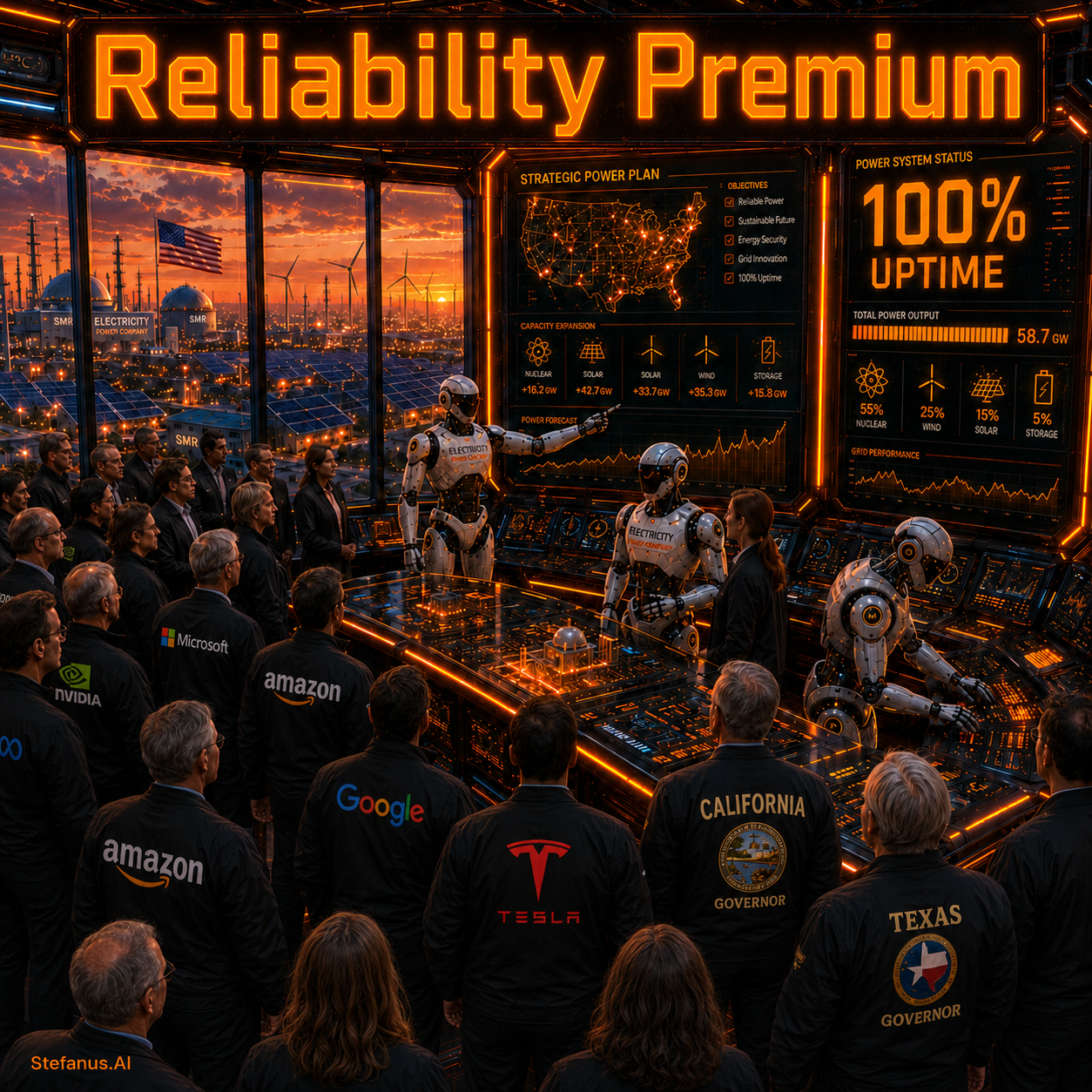
That is the birth of the Reliability Premium.
The central question of this paper is both simple and consequential: In an economy where AI workloads must run continuously, who can deliver power that never fails — and what price will the world pay for that reliability?
The answer will reshape the geography of data centers, the politics of governors, the economics of utilities, the investment strategies of hyperscalers, and the geopolitical competition between the United States, China, and other AI powers. Reliability is no longer a utility concept. It is a strategic concept. And in the AI economy, power that never fails will be worth more than power that is merely cheap.

Section 1 — From Cheap Power to Firm Power: How AI Changed the Economics of Electricity
For most of the history of commercial computing, the dominant logic governing data center site selection was relatively simple: find cheap electricity, favorable tax treatment, cool climates that reduce cooling costs, and available land with good fiber connectivity. The Pacific Northwest offered hydropower. The Nordic countries offered cold air and political stability. Northern Virginia offered proximity to federal contracts and dense fiber networks. Cheap power and permissive zoning were the winning combination, and for cloud computing, that formula worked reasonably well.
AI workloads are categorically different. They are larger, denser, less forgiving of interruption, and more strategically important than anything the commercial computing industry has previously attempted at scale. Training a frontier model requires sustained, enormous bursts of electricity — sometimes tens of thousands of GPUs running continuously for weeks or months without interruption. Inference, the process of actually running a deployed model to answer queries, creates continuous demand around the clock. Agentic systems — AI that acts autonomously in the background — may run persistently for days or weeks. Robotics requires real-time compute. Defense AI, financial AI, healthcare AI, and industrial AI require uninterrupted service. A power interruption of even a few minutes during a training run can corrupt the entire process, requiring days of rollback and restart.
The International Energy Agency reported in April 2026 that electricity demand from data centers soared by 17 percent in 2025, with AI-focused data centers growing even faster — far outpacing global electricity demand growth of 3 percent. The IEA projects that global data center electricity consumption will roughly double from 485 TWh in 2025 to approximately 950 TWh by 2030, with AI-focused facilities tripling their consumption in that same period.[2][3]
Goldman Sachs Research puts the American picture in even sharper relief. U.S. data center power demand is forecast to more than double — from 31 gigawatts in 2025 to 66 GW in 2027 — driven by an accelerating buildout of AI infrastructure. Year-over-year capacity additions are scheduled to reach 36.3 GW in 2027 alone, compared to realized additions of just 6.4 GW in 2024.[4] The share of U.S. data centers in total peak summer power demand is projected to rise from 4.1 percent in 2025 to 5.3 percent in 2026 and 8.5 percent the following year.
The Brookings Institution placed this in global perspective, observing that energy consumption from data centers could approach 1,050 TWh by 2026, which, if data centers were a country, would make them the fifth largest energy consumer in the world, between Japan and Russia.[5]
The IMF’s Working Paper “Power Hungry: How AI Will Drive Energy Demand” underscored the macroeconomic stakes, noting that without adequate transmission infrastructure, U.S. electricity prices could increase by 8.6 percent, while carbon emissions would rise under current policies.[6] The IMF’s January 2026 World Economic Outlook Update, meanwhile, credited technology investment — driven substantially by AI — as a primary driver of the slight upward revision to global growth of 3.3 percent in 2026.[7]
The value of electricity is therefore changing in a fundamental way. The cheapest megawatt is not always the most valuable megawatt. The most valuable megawatt is the one that arrives when the AI system needs it — at full capacity, without voltage deviation, without interruption, and without the threat of political or regulatory withdrawal.
Regions with cheap but unreliable power may find themselves losing the AI infrastructure competition to regions with more expensive but dependable energy. This is the central economic insight that motivates the Reliability Premium framework. AI is transforming electricity from a commodity input into a strategic input — one that carries both operational and competitive value far beyond its cost per megawatt-hour.
Stanford’s Alice Hill, a former White House senior director for resilience policy and visiting fellow at the Stanford Woods Institute, offered a warning that captures the structural tension precisely:
“If the U.S. fixates only on winning the AI race, it could lose the grid reliability race. A grid that cannot withstand extreme rainstorms and record heat waves will not reliably power homes or data centers. We need to stop treating rapid grid expansion and resilience needs as competing priorities.” — Alice Hill, Stanford Woods Institute for the Environment [8]
Data centers are becoming industrial loads comparable to steel mills, aluminum smelters, and chemical refineries. The interconnection queue has become a strategic bottleneck as consequential as chip supply. The NERC’s 2025 reliability report identified large, fast-changing electrical loads as among the most pressing emerging reliability risks for the North American grid.[9] This is the physical reality underlying the Reliability Premium: AI intelligence cannot scale on intermittent or uncertain power any more than a steel mill can run on a generator that switches off every few hours.
“In the AI economy, the cheapest power is not always the winning power. The winning power is the power that arrives on time, survives stress, and scales without political collapse.” — Reliability Premium Framework

Section 2 — The Return of Firm Energy: Nuclear, Gas, Geothermal, and the Uncomfortable Arithmetic
There is an uncomfortable but increasingly unavoidable reality running through the energy decisions of the world’s largest AI companies: intermittent power must be backed by firm capacity. No amount of renewable energy procurement, sustainability branding, or net-zero commitment changes the physics of an AI training run that cannot tolerate a two-hour power gap. The consequence of this reality is playing out across the energy landscape, bringing nuclear plants back from decommissioning, extending coal assets that should have retired, accelerating geothermal investment, and making natural gas more valuable than climate goals would prefer.
The Reliability Premium explains all of these developments simultaneously. It is not that AI companies are indifferent to climate. It is that they are acutely aware that the most advanced models in history are only as powerful as the electricity supply sustaining them. When the choice is between a clean-energy future and a reliably powered data center today, the operational imperative has repeatedly won.
Nuclear Revival: From Liability to Strategic Asset
The nuclear renaissance of 2025 and 2026 is one of the most striking consequences of the Reliability Premium. Microsoft signed a 20-year, $16 billion agreement to restart Three Mile Island in Pennsylvania (renamed the Crane Clean Energy Center), targeting 2028 completion, providing 835 MW of around-the-clock, carbon-free power directly to Microsoft’s data center operations.[10] Google signed the first corporate agreement in U.S. history to develop a fleet of small modular reactors, partnering with Kairos Power for up to 500 MW across six to seven reactors, with the first targeted for operational delivery around 2030.[10]
Amazon led a $500 million financing round to support X-energy, developing a gas-cooled SMR targeting at least 5 GW of total output by 2039. Meta issued a request for proposals to nuclear developers targeting between 1 and 4 GW of new capacity.[10] BloombergNEF expects approximately 15 reactors to come online globally in 2026, adding close to 12 gigawatts of new capacity, reversing nuclear’s weakest year in recent memory in 2025.[11]
In Michigan, the Palisades nuclear plant — which would become the first nuclear facility in U.S. history to restart after entering decommissioning — received $1.52 billion in federal loan support and became a symbol of the broader shift. Governor Gretchen Whitmer embraced the restart as both a clean-energy and economic development statement, connecting Michigan’s industrial heritage with AI-era infrastructure needs.
Goldman Sachs has identified energy availability as the single biggest infrastructure constraint for AI development, displacing chip supply as the binding limit. Nvidia itself has reportedly slowed the expansion of certain clusters not because of GPU shortages, but because of power shortages.[4]
Geothermal: The Clean Firm Pivot
Geothermal energy has emerged from niche status into a genuine strategic tool for the world’s largest technology companies. The pitch is direct: geothermal offers always-on, carbon-free power that behaves more like conventional baseload generation than any other renewable source. Unlike solar and wind, it does not depend on weather. Unlike nuclear, it does not require decommissioning management and decade-long permitting timelines for new builds.
Technology companies signed 14 geothermal power purchase agreements totaling 635 megawatts in 2025 alone — three times the volume of 2024. Data centers now drive 60 percent of new geothermal capacity development, targeting 120 GW by 2050 according to DOE forecasts.[12] Google’s deal with Fervo Energy for a 115 MW enhanced geothermal system project in Nevada — approved by a regulated utility and now in commercial validation through 2025 and 2026 — represents the technology’s emergence from science project to bankable grid asset.[13]
Cindy Taff, CEO of Sage Geosystems, described the technological shift at Data Center World 2026 in Washington:
“Traditional geothermal is about 2% of the resource globally, whereas next-generation geothermal can tap into much more. If you’re only providing sustainability, you have to lead on performance, cost, or reliability — that’s where you create value.” — Cindy Taff, CEO of Sage Geosystems, Data Center World 2026 [14]
Meta signed a geothermal deal with XGS Energy in New Mexico for 150 megawatts. Urvi Parekh, Global Head of Energy at Meta, said:
“With next-generation geothermal technologies like XGS ready for scale, geothermal can be a major player in supporting the advancement of technologies like AI as well as domestic data center development.” — Urvi Parekh, Global Head of Energy, Meta [15]
Google pushed the concept further still by acquiring Intersect, a company developing multi-gigawatt solar, storage, and natural gas-backed power projects co-located with data centers, in a deal expected to close in H1 2026. The strategic logic was unambiguous: vertical integration into power generation to eliminate grid interconnection bottlenecks and cost volatility.[16]
Natural Gas: The Uncomfortable Backbone
Goldman Sachs identified the near-term reality of AI power demand clearly: Berkeley Lab estimates that in the United States, the additional short-term AI demand will be met primarily by new natural gas plants, with a direct impact on emissions.[4] Alberta, Canada, actively pitched its cheap natural gas supply as a competitive advantage for data center location, positioning itself against clean-energy mandates with a simple argument: firms that need reliable power immediately cannot wait for clean-firm solutions that are five years away.
The IEA found in April 2026 that data center developers are advancing a large number of projects with on-site natural gas-based power generation, largely in the United States. One of the key challenges is that AI data centers have rapid and large swings in demand, and meeting their power needs reliably can stretch the technical capabilities of on-site gas plants.[2] The xAI Colossus project in Memphis stands as the starkest illustration of how speed-to-power can override environmental and regulatory caution. XAI deployed mobile natural gas turbines normally reserved for post-disaster emergencies to run its supercomputer before formal air permits were obtained. By early 2026, the NAACP and Earthjustice had filed suit over Clean Air Act violations, and community resistance in Memphis and Southaven, Mississippi had become a national story.[17][18]
The SELC noted that residents near the xAI facility already face cancer risks at four times the national average. KeShaun Pearson, Executive Director of Memphis Community Against Pollution, said:
“The ongoing policy violence that allows xAI to continue the consistent damaging of our lungs in Southwest Memphis is immoral. We deserve clean air, not silent strangulation.” — KeShaun Pearson, Executive Director, Memphis Community Against Pollution [19]
The Memphis case is not an anomaly. It is a preview. When the drive for firm power outpaces the governance infrastructure to manage its environmental consequences, the Reliability Premium extracts its costs from the communities least equipped to resist.
“AI is not bringing back old energy because old energy is fashionable. AI is bringing back firm energy because intelligence cannot scale on hope.” — Reliability Premium Framework

Section 3 — Governors as Reliability Brokers: The New Industrial Policy of Artificial Intelligence
There is a new class of political actor emerging in the AI economy. Its formal title is governor. Its functional role is closer to infrastructure minister, economic development broker, and energy reliability guarantor, all compressed into a single elected office. The governors who understand this transformation — and can credibly package land, transmission, firm power, permitting speed, workforce, water, and public consent — will attract the largest concentrations of AI infrastructure in history. Those who cannot will watch the capital flow elsewhere.
The Belfer Center at Harvard noted in April 2026 that the “Who Pays?” conflict is escalating as traditional socialized cost-recovery models break down under the scale of required grid investments. PJM’s congestion costs rose 64 percent in 2024, and Texas is planning over $30 billion in transmission upgrades. Regulators face acute pressure to protect residential ratepayers from cross-subsidizing technology giants.[20] This fiscal tension places governors at the center of every AI infrastructure negotiation: they must simultaneously attract the jobs and tax revenue that hyperscaler investment brings while protecting the households and communities who will ultimately bear the grid upgrade costs.
Texas — Greg Abbott: Speed, Scale, and Structural Stress
Texas has embraced AI infrastructure with the fervor of a frontier economy. Research from real estate firm Jones Lang LaSalle found that Texas could surpass Virginia as the world’s top data center market by 2030, driven by its business-friendly regulatory climate, abundant land, and a growing energy supply.[21] More than half of all data center construction in the United States is already happening outside traditional hubs, and Texas is the primary beneficiary.
But the scale of ambition is creating structural stress that ERCOT — the state’s independent grid operator — is now openly documenting. ERCOT’s preliminary Long-Term Load Forecast for 2026–2032 projects potential peak demand climbing from today’s record 85,508 MW to theoretical levels above 367,000 MW by 2032 under a high-growth scenario that stacks new data center and industrial demand.[22] ERCOT’s large-load interconnection queue nearly quadrupled in a single year.[23]
Governor Greg Abbott signed legislation requiring data centers and other large non-critical power consumers in ERCOT to accept curtailment during firm load shed events — a significant acknowledgment that the state cannot simply absorb unlimited AI demand without establishing priority hierarchies during grid stress.[24]
Virginia — Former Governor Glenn Youngkin: Maturity, Congestion, and the Ratepayer Question
Northern Virginia remains the world’s largest data center market, accounting for a globally dominant share of hyperscale capacity. But its maturity is now its vulnerability. PJM Interconnection, the regional grid operator for much of the Mid-Atlantic, faces load growth projections far exceeding historical norms. Utility filings show that proposed data center campuses require new substations and major transmission upgrades before construction can begin.[20]
Virginia’s “GS-5” tariff, which requires large loads to pay 85 percent of transmission capacity costs during ramp-up, represents a shift toward strict cost-causation frameworks — an acknowledgment that the state can no longer afford to socialize the infrastructure costs of hyperscaler demand across the general ratepayer base. Siting conflicts, backup diesel generator emissions, air permits, and ratepayer protection debates are now permanent features of Virginia’s data center policy landscape.
Michigan — Gretchen Whitmer: Clean Firm Power and Industrial Revival
Michigan occupies a different position in the AI infrastructure map. Rather than competing on volume or speed, Michigan is positioning itself as the state that can offer clean, firm, nuclear-backed power as a differentiating value proposition. The Palisades restart — the first nuclear plant in U.S. history to restart after decommissioning — is the centerpiece of that strategy.[11]
Governor Whitmer has framed the Palisades investment as a convergence of clean energy goals, industrial employment, and AI-era infrastructure readiness. It is a politically sophisticated argument that connects Michigan’s manufacturing heritage with the demands of the next economy. If successful, it offers a template for how states with existing nuclear assets can reframe those assets as competitive advantages in the Reliability Premium era.
Pennsylvania — Josh Shapiro: Coal Extensions and the Reliability Conflict
Pennsylvania offers the most uncomfortable version of the Reliability Premium story. Governor Shapiro moved to keep two coal-fired power plants — Keystone and Conemaugh — operating beyond their planned retirement dates, explicitly citing data center demand and grid reliability concerns as justification.[25]
This decision places Pennsylvania at the intersection of AI ambition and climate commitment in the most direct way possible. The argument is not that coal is desirable. The argument is that the grid cannot lose firm capacity before firm replacement capacity is available. The AI demand surge is so large and so fast that the normal transition timeline has been compressed past the point where clean energy can fill the gap.
California — Gavin Newsom: Innovation State, Constrained Grid
California presents the paradox at its most acute. The state is home to the largest concentration of AI companies in the world — Google, Meta, Apple, Anthropic, OpenAI, and dozens of others. It is simultaneously among the most difficult places to build large data center infrastructure. Electricity prices are among the highest in the nation. Water scarcity constrains cooling options. Permitting timelines stretch years. The California Energy Commission has documented mounting data center demand without a clear resolution pathway.[26]
Newsom has attempted to accelerate data center permitting through executive action, but the structural constraints — grid capacity, water, air quality, ratepayer protection — are not easily resolved by permitting speed alone. California may find itself in the position of being the intellectual capital of AI while watching the physical infrastructure of AI build out elsewhere.
“The governor who can guarantee reliable power becomes an unofficial minister of artificial intelligence.” — Reliability Premium Framework

Section 4 — Hyperscalers and the New Power Strategy: When Megawatts Become as Strategic as GPUs
For most of the last decade, the strategic competition among hyperscalers was conducted primarily across three dimensions: talent, algorithms, and compute. The company that could hire the best researchers, develop the most capable models, and secure the most GPU capacity would win. Capital expenditure was a secondary consequence of competitive position, not a primary driver of it.
In 2026, that calculus has been fundamentally altered. The four largest hyperscalers — Microsoft, Alphabet, Meta, and Amazon — reported Q1 2026 earnings in late April that revealed a combined capital expenditure commitment approaching $700 billion for the full year 2026, up roughly 77 percent from the already historic levels of 2025.[27][28]
Amazon led with $44.2 billion in quarterly capex as AWS grew 28 percent. Alphabet spent $35.67 billion in Q1, more than doubling year-over-year, with Google Cloud backlog jumping to over $460 billion. Microsoft added $30.88 billion in fiscal Q3 capex, up 84 percent year-over-year, with AI revenue surpassing a $37 billion annual run rate. Meta raised its full-year 2026 capex guidance to between $125 and $145 billion, citing higher component pricing and additional data center costs.[27]
Mark Zuckerberg framed the Meta investment as funding for “personal superintelligence to billions of people.” Investors flinched — Meta shares fell 9.25 percent on the announcement, the first real market rebellion against the AI spending curve. But Brent Thill, an analyst at Jefferies, captured the prevailing institutional view in a comment to the Financial Times:
“The AI economy is healthy. The bear thesis is garbage.” — Brent Thill, Analyst, Jefferies [29]
The IEEE ComSoc Technology Blog noted that the five hyperscalers — Amazon, Alphabet, Microsoft, Meta, and Oracle — have plans to add approximately $2 trillion of AI-related assets to their balance sheets by 2030, an infrastructure commitment comparable in scale to the Interstate Highway System or the Apollo program as a share of GDP.[30]
But embedded within these capital expenditure announcements is a dimension that receives far less attention than GPU procurement: power. The hyperscaler capex cycle is increasingly a power infrastructure cycle. Equinix reported that approximately 60 percent of its largest Q4 deals were AI-driven, and the company explicitly cited power and cooling as the binding constraint on further growth.[27]
Nvidia — The Demand Engine
Nvidia sits at the origin of the power demand curve. Its data center revenue hit $62.31 billion in Q4, up 75 percent year-over-year, with networking revenue up 263 percent. Jensen Huang called it “the agentic AI inflection point,” and the market has largely agreed with that framing.[27] But every Nvidia chip sold creates a downstream obligation: the data center that houses it must have adequate power, cooling, and grid connectivity. The faster Nvidia chips proliferate, the faster the power demand crisis deepens.
Google — Vertical Integration into Power
Google’s acquisition of Intersect, closed in Q1 2026, represents the most aggressive form of the new power strategy: owning power generation capacity engineered specifically for its data centers.[16] Google is simultaneously pursuing geothermal with Fervo and Ormat, small modular reactors with Kairos Power, and behind-the-meter solar and storage through its own subsidiaries. Google CEO Sundar Pichai acknowledged that Google is compute-constrained in the near term — a candid admission that the bottleneck has shifted from algorithms to electrons.[28]
Microsoft — Nuclear as Infrastructure
Microsoft’s nuclear strategy is the most structurally coherent of any hyperscaler. The Three Mile Island agreement, the Kairos Power SMR framework, and the $190 billion 2026 capex commitment — two-thirds of which flows to short-lived assets like GPUs and CPUs — represent a company that has internalized the Reliability Premium as corporate strategy. Devon Swezey, Senior Manager in Global Energy and Climate at Google (who articulated a view widely shared across the industry), said:
“We know that wind, solar and batteries will be critical in order to decarbonize our energy consumption. But we also need firm, dispatchable, carbon-free electricity technologies to cost-effectively decarbonize our electricity consumption.” — Devon Swezey, Senior Manager, Global Energy and Climate, Google [31]
Meta — Scale Without Apology
Meta’s AI buildout reflects the capital intensity of AI at its most naked. The $1.22 billion Cowboy Project in Wyoming — the Tesla Megapack deal with Enbridge — the New Mexico geothermal agreement — and Meta’s nuclear RFP together represent a company that is building a private energy portfolio as a condition of competing in the AI race. The Cowboy Project alone will supply enough power to sustain a small city, and it is dedicated entirely to one company’s AI operations.[1]
xAI — Speed Without Permission
xAI’s Memphis operations represent the opposite end of the reliability-governance spectrum from Microsoft’s nuclear strategy. Colossus and Colossus 2 were built and powered at extraordinary speed, but without the permitting, environmental review, and community engagement that most jurisdictions require. The result was a lawsuit from the NAACP and Earthjustice, congressional scrutiny, and community protests in one of the nation’s most economically vulnerable cities.[17][18][19]
The xAI case is a cautionary parable for the entire AI infrastructure industry. Speed without permission is not a competitive advantage. It is a political liability that can strand billions of dollars of investment and damage the broader industry’s social license to operate.
As Carbon Direct observed, in 2026 the new mandate is responsible scale: reconciling voracious power demands with aggressive net-zero commitments and rising energy costs. The competitive advantage likely belongs to those who integrate power, hardware, and climate strategy from day one.[32]
“The AI company of the future will not only train models. It will negotiate megawatts, finance substations, secure cooling, and design around grid failure.” — Reliability Premium Framework

Section 5 — The Reliability Premium Framework: A Formal Architecture
The preceding sections have traced the empirical landscape of AI power demand, energy strategy, state competition, and corporate behavior. This section introduces the formal framework that ties those observations into a coherent analytical structure: the Reliability Premium.
The Reliability Premium is defined as the extra economic, political, and strategic value assigned to electricity systems that reduce the probability of delay, downtime, instability, political interruption, regulatory risk, or public backlash for AI infrastructure operators. It is, in essence, the price of certainty in an age when intelligence has become physically dependent on the grid.
The framework has eight components, each capturing a distinct dimension of reliability value.
Component 1 — The Firmness Premium
The value of power that is available around the clock, regardless of weather, season, or grid condition. Nuclear, geothermal, natural gas, hydropower, and storage-backed hybrid systems all command a Firmness Premium over intermittent renewables because AI workloads cannot pause. A training run that requires 72 hours of uninterrupted compute cannot tolerate a four-hour solar gap. The Firmness Premium explains why nuclear restarts are economically rational even when the levelized cost of nuclear exceeds that of wind or solar: the nuclear electron arrives when needed; the wind electron may not.
Component 2 — The Interconnection Premium
The value of connecting to the grid quickly and predictably. Carbon Direct observed that interconnection queues stretch three to five years for renewables, while large electrical load interconnection lacks consistent standards.[32] The FERC expected to issue a final rule on large electrical load interconnections by April 30, 2026, following over 150 public comments from grid operators, utilities, and customers. A data center that can achieve interconnection in twelve months has a structural advantage over one that waits four years. That advantage is the Interconnection Premium.
Component 3 — The Stability Premium
The value of voltage stability, frequency response, transmission capacity, interconnection quality, and the ability of large loads to remain connected during grid disturbances. ERCOT identified rapid swings in AI data center demand — multi-hundred-megawatt drops and recoveries over short timescales — as a novel reliability risk requiring new planning frameworks.[9] The Stability Premium compensates for the engineering value of a grid that can absorb these swings without disturbance.
Component 4 — The Political Premium
The value of state, local, and federal support for AI infrastructure. A governor who actively packages land, power, tax incentives, and permitting acceleration reduces the political risk premium that hyperscalers would otherwise bear. The Political Premium is highest in states with contentious siting environments (California, Virginia’s mature market) and lowest in states with active industrial recruitment strategies (Indiana, Michigan’s nuclear positioning). The xAI Memphis case demonstrates what happens when the Political Premium is ignored: project delay, litigation, regulatory scrutiny, and reputational damage.
Component 5 — The Cooling Premium
The value of water access, thermal management capability, and climate-appropriate siting. The IEA noted that AI data centers have rapid and large swings in demand that create thermal management challenges beyond the capabilities of conventional on-site generation.[2] Liquid cooling reduces direct water use by 70 to 90 percent but raises capital cost. The xAI Memphis operations withdrew over a million gallons of water daily from a 2,000-year-old aquifer.[35] The Cooling Premium captures the value of sites where thermal management infrastructure already exists or can be built without community conflict.
Component 6 — The Transmission Premium
The value of proximity to existing high-capacity transmission infrastructure. New substations and major transmission upgrades are now required before many proposed data center campuses can begin construction in both Virginia and Texas.[36] The cost of transmission delay — measured in months of deferred revenue for AI services that cannot be delivered — represents the economic content of the Transmission Premium.
Component 7 — The Flexibility Premium
The value of workloads that can shift, pause, or respond to grid stress. Not all AI compute is time-critical. Model training runs can be scheduled during off-peak hours. Batch inference can queue during grid stress events. Data centers that can participate in demand response programs effectively sell back a portion of their load flexibility to the grid operator, reducing their effective power cost. Texas law now explicitly requires non-critical large loads to accept curtailment during firm load shed events — establishing a regulatory framework that the Flexibility Premium seeks to make economically rational.[24]
Component 8 — The Sovereignty Premium
The value of keeping critical AI infrastructure inside trusted jurisdictions. The IMF’s “Power Hungry” working paper warned that infrastructure bottlenecks in the United States could shift AI development abroad — a geopolitical risk that senior defense and intelligence officials now take seriously.[6] The Sovereignty Premium captures the value governments and corporations assign to AI infrastructure that cannot be disrupted by foreign adversaries, subject to foreign export controls, or exposed to jurisdictional risks in politically unstable regions. Microsoft and G42’s $1 billion geothermal AI data center in Kenya stalled in May 2026 precisely when the Kenyan government refused to guarantee 1 GW of reliable power — a vivid demonstration of the Sovereignty Premium in action at the national scale.[37]
“The Reliability Premium is the price of certainty in an age when intelligence has become physically dependent on the grid.” — Reliability Premium Framework

Section 6 — What Have We Learned? Seven Hard Truths About AI and Power
The evidence accumulated across these sections points toward a set of durable conclusions about the relationship between artificial intelligence and energy infrastructure. These are not provisional observations that a few years of technological progress will overturn. They are structural realities rooted in physics, economics, and the political organization of democratic societies. Each one has significant implications for how AI companies, governments, investors, and communities should approach the decades ahead.
1. AI Is Not Weightless
Artificial intelligence feels digital, but it is becoming one of the most physically intensive industries in human history. Every model depends on land, power, chips, cooling, substations, transformers, fiber, water, and political approval. The IEA projects that data center electricity consumption will roughly double to 950 TWh by 2030, consuming approximately 3 percent of all global electricity.[2] The Lawrence Berkeley National Laboratory predicts that U.S. data center demand alone will grow from 176 TWh in 2023 to between 325 and 580 TWh by 2028.[38] This is not a metaphorical weight. It is a physical weight, measured in terawatt-hours, cubic meters of water, and acres of industrial land.
2. Cheap Power Is No Longer Enough
Cheap electricity matters, but it does not guarantee AI leadership. A region with cheap but unreliable power may find itself losing the AI infrastructure competition to a region with more expensive but dependable energy. The Reliability Premium reflects this shift. Hyperscalers are increasingly willing to pay more — for nuclear, for geothermal, for behind-the-meter gas, for dedicated substations — in exchange for operational certainty. The marginal cost of downtime in a frontier AI operation vastly exceeds the marginal savings from cheaper intermittent power.
3. Reliability Is Becoming a Competitive Advantage
The winners of the AI economy may well be the states and companies that most effectively reduce uncertainty. Reliable power reduces launch risk, capital risk, regulatory risk, and customer risk. It enables faster time-to-market for new model deployments, lower insurance and hedging costs for data center operators, and stronger contractual commitments to enterprise customers whose own operations depend on AI service continuity.
4. Governors Are Now AI Infrastructure Actors
Governors are becoming central figures in the AI race whether they choose that role or not. Their decisions on nuclear restarts, coal extensions, data center incentives, water rules, utility regulation, transmission investment, and permitting timelines will shape the future geography of intelligence. The Belfer Center at Harvard identified that the “Who Pays?” conflict is now the central regulatory fault line in AI infrastructure policy, placing governors at the intersection of economic development ambition and consumer protection obligation.[20]
5. Energy Strategy Is AI Strategy
The AI race cannot be meaningfully separated from energy policy. Nuclear, natural gas, geothermal, long-duration storage, hydropower, transmission expansion, and demand response are not peripheral considerations for AI infrastructure planning. They are the infrastructure stack on which AI intelligence is built. Tech companies collectively contracted for 48 GW of clean energy year-on-year, and U.S. hyperscalers’ combined 2026 capital expenditure approaches the scale of mid-tier sovereign infrastructure programs.[33][28]
6. Reliability Has a Price — and Someone Pays It
The Reliability Premium will appear in higher power contracts, faster permitting deals, colocated generation agreements, dedicated substations, premium data center leases, long-term infrastructure finance, and ultimately in the electricity bills of neighboring households. PJM’s congestion costs rose 64 percent in 2024, adding approximately $18 per month to household electricity bills in some counties.[20][34] The question of who bears these costs is not merely technical. It is the central political question of AI infrastructure deployment, and communities are beginning to demand answers.
7. Public Consent Matters — and Cannot Be Purchased
Even the most advanced AI campus can fail politically if the surrounding community believes it is paying the costs while hyperscalers receive the benefits. The Memphis xAI case is the clearest recent example, but it is not an isolated one. The Belfer Center noted that 70 percent of Americans oppose data centers near their homes — making them now less popular than nuclear power plants in community surveys.[38] The era of AI infrastructure deployment without community engagement, environmental review, and equitable cost allocation is ending. The companies and governments that understand this earliest will face fewer delays, lower litigation costs, and more durable operating licenses from the communities they depend on.

Section 7 — The Seven Pillars of the Reliability Premium
Having traced the empirical evidence, the corporate strategies, the political dynamics, and the formal framework, it is now possible to articulate the load-bearing pillars of the Reliability Premium — the foundational conditions that must be present for any AI infrastructure investment to reach its full operational and economic potential.
Pillar 1 — Firm Power
AI infrastructure requires power that is available continuously, without weather-dependent gaps, seasonal troughs, or intermittent shortfalls. Nuclear, geothermal, natural gas, hydropower, and storage-backed renewable hybrid systems will command premium valuations in the AI economy because AI workloads cannot depend on intermittent supply alone. The nuclear agreements signed by Microsoft, Google, Amazon, and Meta in 2024 and 2025 represent a collective judgment by the most sophisticated infrastructure buyers in history: firm power is worth more than cheap power.[10]
Pillar 2 — Grid Stability
Reliability is not only about total megawatts. It is about voltage stability, frequency response, transmission capacity, interconnection quality, and the ability of large, rapidly fluctuating AI loads to remain connected during grid disturbances. The 2025 NERC report identified AI data center demand swings as an emerging reliability risk requiring new planning standards.[9] Grid stability investment — in transmission upgrades, synchronous condensers, storage systems, and advanced protection schemes — is a prerequisite for the Reliability Premium to function as intended.
Pillar 3 — Political Permission
Power must be politically deliverable. Interconnection approvals, air permits, water rights, zoning variances, and utility rate cases all require political processes that can extend years beyond the engineering timeline. States that offer fast permits, transparent utility planning, ratepayer protection frameworks, and community benefit agreements will attract capital over states where projects become trapped in public backlash. The Political Permission Pillar is arguably the most underappreciated constraint on AI infrastructure expansion, because it does not appear in technical feasibility studies until a project is already in crisis.
Pillar 4 — Infrastructure Timing
The AI economy moves at a pace that traditional utility planning was never designed to match. Interconnection queues that stretch three to five years, transformer lead times that have extended to eighteen months or more, and transmission upgrade processes that require decade-long regulatory proceedings are structurally incompatible with the pace of AI model deployment cycles. The value of power increases sharply when it can be delivered on schedule. A five-year infrastructure delay can eliminate the economic rationale for an AI campus entirely, as the models it was designed to support may already be obsolete.[32]
Pillar 5 — Resilient Economics
The Reliability Premium only produces sustainable value if the costs are fairly allocated. Hyperscalers must pay for the grid upgrades they require rather than socializing those costs across residential ratepayers. Utilities must avoid shifting infrastructure investment costs to households who receive no direct benefit. States must ensure that AI infrastructure investment produces durable economic value — jobs, tax revenue, workforce development, supply chain activity — that justifies the public resources committed to attracting and supporting it. Virginia’s GS-5 tariff, which requires large loads to pay 85 percent of transmission capacity costs during ramp-up, represents one early model of this cost-causation approach.[20]
Pillar 6 — Environmental Accountability
The xAI Memphis case demonstrated what happens when environmental accountability is treated as a negotiable constraint rather than a foundational condition. The NAACP and Earthjustice lawsuit, the TVA hearings, the congressional scrutiny, and the community protests all represent the regulatory and reputational costs of building AI infrastructure without adequate environmental review.[17][19] Environmental accountability is not merely a compliance obligation. It is a strategic risk management function. The communities where AI infrastructure is built are not passive recipients of economic development. They are political actors with the legal standing, organizational capacity, and media access to disrupt projects that impose environmental costs without commensurate community benefits.
Pillar 7 — Geopolitical Security
The Sovereignty Premium described in Section 5 elevates into a structural pillar when considered in the context of the U.S.-China AI competition. The IMF warned that American infrastructure bottlenecks could shift AI development to other jurisdictions.[6] The collapse of the Microsoft-G42 Kenya project demonstrated that even well-financed, well-intentioned cross-border AI infrastructure investments can fail when the host government cannot guarantee the reliability conditions that hyperscalers require.[37] Geopolitical security means building AI infrastructure inside jurisdictions that are politically stable, legally reliable, diplomatically aligned, and capable of delivering the energy guarantees on which multi-billion-dollar AI investments depend. It is the outermost layer of the Reliability Premium, and it will become more consequential as the AI race intensifies.
“Reliability is becoming the new currency of intelligence. In the AI economy, power that never fails will be worth more than power that is merely cheap.” — Reliability Premium Framework

Conclusion: The New Price of Intelligence
In the early 2000s, I stood near the corner of El Segundo Boulevard and Sepulveda Boulevard and watched a backup generator come to life during a California blackout. The generator was unglamorous, expensive to operate, and logistically complicated to maintain. But in the moment it mattered, it was the most important piece of equipment our company owned. It kept the machines running while the grid failed. It kept our promises to our customers when the utility broke its promises to us.
That experience contained the essential logic of the Reliability Premium, compressed into a single operational moment: the value of power that never fails is not measured by its cost per kilowatt-hour. It is measured by what you lose when it is absent.
The age of artificial intelligence has created a new paradox. The world’s most advanced digital systems now depend on some of the oldest physical questions: Where will the power come from? Who will build the transmission lines? Who will cool the machines? Who will pay for the grid upgrades? Who will approve the permits? Who will absorb the environmental consequences? Who will be asked to live next to the gas turbines?
The answer to these questions cannot be found by building better algorithms or procuring more GPUs. It requires a different kind of problem-solving — one that integrates energy policy, grid engineering, state politics, community relations, environmental accountability, and long-term capital allocation into a single coherent strategy. That is what the Reliability Premium demands.
The hyperscalers are beginning to understand this. Their Q1 2026 earnings reports revealed companies that are becoming power planners, energy financiers, nuclear revivalists, geothermal pioneers, storage investors, and grid negotiators at the same time they are model developers and cloud operators. Their combined $700 billion capital expenditure commitment for 2026 is not only a bet on AI demand. It is a bet on the physical infrastructure that makes AI demand serviceable.[27][28]
The governors are beginning to understand this. The ones who move fastest to package firm power, permitting certainty, ratepayer protection, and community benefit will write the geography of the next decade’s AI infrastructure. The ones who treat data center recruitment as a simple economic development transaction — without managing the grid stress, environmental consequences, and cost allocation questions — will face the political consequences that Texas, Virginia, and Memphis are already navigating.
The communities are beginning to understand this. The residents of Boxtown in Memphis, the ratepayers of Northern Virginia, the farmers near Wyoming’s Cowboy Project, and the neighbors of proposed nuclear restart sites are all different actors in the same story: the story of who bears the costs of the intelligence economy and who receives its benefits. That story will be told in courtrooms, at utility commission hearings, in state legislatures, and in elections. The outcome will shape the social license that AI infrastructure depends on as much as any engineering specification.
Three eras of AI competition have unfolded within the span of a generation. In the first era, the winners were those with the best algorithms. In the second era, the winners were those with the most GPUs. In the third era — the era we are now entering — the winners will be those who control reliable power.
Nuclear restarts. Coal extensions. Geothermal contracts. Natural gas basins. Battery storage systems. Transmission corridors. Governor-led industrial policy. Community benefit agreements. Environmental accountability frameworks. These are not peripheral details in the AI story. They are the AI story. They are the infrastructure on which every model, every agent, every robotic system, every defense application, and every consumer AI product ultimately depends.
The Reliability Premium is not a passing condition of the current AI boom. It is the structural price of operating intelligence at planetary scale. It will persist as long as AI infrastructure requires continuous, massive, and politically acceptable flows of electricity — which is to say, it will persist indefinitely.
Reliability is becoming the new currency of intelligence. And in the AI economy, power that never fails will be worth more than power that is merely cheap.

Footnotes and Endnotes
[1] Stefanus.AI. Meta Platforms “Cowboy Project” / Tesla Energy Megapack / Enbridge $1.22B Wyoming solar-storage deal. May 2026. https://stefanus.ai/sleeping-with-the-frenemy-how-meta-and-tesla-became-unlikely-partners-in-powering-the-ai-machine-and-what-it-reveals-about-the-new-economics-of-tech-rivalry-in-the-age-of-artificial-intelli/
[2] International Energy Agency (IEA). “Key Questions on Energy and AI.” April 2026. Data centre electricity demand soared 17% in 2025; AI-focused data centres tripling by 2030. https://www.iea.org/news/data-centre-electricity-use-surged-in-2025-even-with-tightening-bottlenecks-driving-a-scramble-for-solutions
[3] IEA. “Key Questions on Energy and AI — Executive Summary.” April 2026. Global data centre consumption projected ~485 TWh (2025) to ~950 TWh (2030). https://www.iea.org/reports/key-questions-on-energy-and-ai/executive-summary
[4] Goldman Sachs Research. “US Data Center Power Demand Projected to Double by 2027.” May 2026. Wei, Struyven & Dart. U.S. demand: 31 GW (2025) → 66 GW (2027). Energy availability identified as single biggest AI infrastructure constraint. https://www.goldmansachs.com/insights/articles/us-data-center-power-demand-projected-to-double-by-2027
[5] Brookings Institution. “Global Energy Demands Within the AI Regulatory Landscape.” Updated April 2026. Data centre energy could approach 1,050 TWh by 2026 — fifth largest energy consumer globally. https://www.brookings.edu/articles/global-energy-demands-within-the-ai-regulatory-landscape/
[6] IMF — Melina, Pescatori, Thube. “Power Hungry: How AI Will Drive Energy Demand.” IMF Working Paper WP/25/81. Washington DC. U.S. electricity prices +8.6% without transmission investment; AI bottlenecks could shift development abroad. https://www.imf.org/-/media/Files/Publications/WP/2025/English/wpiea2025081-print-pdf.ashx
[7] International Monetary Fund. “World Economic Outlook Update.” January 2026. Global growth revised to 3.3% in 2026, driven in part by technology and AI investment surge. https://www.imf.org/-/media/files/publications/weo/2026/january/english/text.pdf
[8] Alice Hill, Stanford Woods Institute for the Environment. “A Warning for the AI Era: Why America’s Energy Infrastructure Isn’t Ready for What’s Coming.” Stanford Woods Institute. March 2026. https://woods.stanford.edu/news/warning-ai-era-why-americas-energy-infrastructure-isnt-ready-whats-coming
[9] NERC / arXiv (Bui et al.). “A Two-Stage Risk-Averse DRO-MILP Methodological Framework for Managing AI/Data Center Demand Shocks.” The 2025 NERC Report identifies large, fast-changing electrical loads as among the most pressing emerging reliability risks for the North American grid. https://arxiv.org/pdf/2601.14665
[10] Introl.io / IEEE Spectrum. “Nuclear Power for AI Data Centers: Microsoft, Google, Amazon 2025.” Big tech signing 10 GW+ of new U.S. nuclear capacity. Microsoft Three Mile Island 20-year $16B deal (835 MW); Google/Kairos Power first U.S. corporate SMR fleet deal (500 MW, 2030+). Amazon $500M X-energy financing. https://introl.com/blog/nuclear-power-ai-data-centers-microsoft-google-amazon-2025
[11] Carbon Credits / BloombergNEF. “2026: The Year Nuclear Power Reclaims Relevance With 15 Reactors, AI Demand, and China’s Expansion.” December 2025. BloombergNEF expects ~15 reactors online in 2026, ~12 GW new capacity. Palisades targeting early 2026 restart with $1.52B federal loan support. https://carboncredits.com/2026-the-year-nuclear-power-reclaims-relevance-with-15-reactors-ai-demand-and-chinas-expansion/
[12] Carbon Credits / DOE. “Google Taps Earth’s Heat in 150MW Geothermal Deal with Ormat Technologies.” February 2026. 14 geothermal PPAs totaling 635 MW signed by tech giants in 2025, 3x from 2024. Data centers drive 60% of new geothermal capacity. https://carboncredits.com/google-taps-earths-heat-in-150mw-geothermal-deal-with-ormat-technologies-to-power-data-centers/
[13] Enkiai.com. “Geothermal Data Centers: The 2026 Clean Transition Tariff Guide.” April 2026. Google-Fervo 115 MW EGS project in Nevada; Google-Ormat 150 MW conventional geothermal portfolio. https://enkiai.com/data-center/geothermal-data-centers-the-2026-clean-transition-tariff-guide/
[14] Data Center Knowledge. “Geothermal and Storage: The Next Frontier in Reliable Data Center Power.” Data Center World panel. April 2026. Cindy Taff (Sage Geosystems), Chris Rees (Meta), Daniel Sottosanti (XL Batteries). https://www.datacenterknowledge.com/energy-power-supply/data-center-world-2026-the-push-for-clean-firm-power
[15] AOL News / Meta Press. “Meta Signs Deal for Advanced Geothermal Power in New Mexico.” 150 MW geothermal agreement with XGS Energy. Quote: Urvi Parekh, Global Head of Energy, Meta. https://www.aol.com/news/meta-signs-deal-advanced-geothermal-214446794.html
[16] IntuitionLabs / Alphabet Q1 2026 Earnings. “Analysis: Why Google Bought Intersect for AI Energy Supply.” April 2026. Google acquires Intersect Power (multi-GW solar, storage, gas-backed generation); deal closed H1 2026. https://intuitionlabs.ai/articles/google-intersect-acquisition-ai-energy
[17] Earthjustice. “Illegal Pollution from Data Center Power Plants Shouldn’t Harm Our Communities. We’re Suing xAI.” April 2026. NAACP and Earthjustice sue xAI over unpermitted gas turbines at Colossus II, Southaven, Mississippi. Clean Air Act violations. https://earthjustice.org/case/xai-illegal-gas-power-plant-data-center-colossus
[18] CNBC. “Musk’s xAI Faces Fresh Opposition After Landing Permit for Mississippi Power Plant.” April 2026. SpaceX acquired xAI in February 2026 valuing combined entity at $1.25 trillion. https://www.cnbc.com/2026/04/10/musks-xai-draws-more-opposition-over-mississippi-power-plant-permit.html
[19] Data Center Dynamics / Democracy Now!. “Fury from campaigners as xAI gets 150MW for Colossus supercomputer in Memphis.” TVA board approved additional 150 MW for Colossus over community opposition. KeShaun Pearson quote. May 2026. https://www.datacenterdynamics.com/en/news/xai-colossus-memphis-power-tva/
[20] Belfer Center for Science and International Affairs, Harvard Kennedy School. “Data Centers and Large-Scale Electric Growth: The Virginia and Texas Experiences.” April 2026. PJM congestion costs +64% in 2024; Texas $30B+ transmission upgrades; Virginia GS-5 tariff. “Who Pays?” conflict escalating. 70% of Americans oppose data centers near homes. https://www.belfercenter.org/research-analysis/data-centers-texas-virginia-comparison
[21] CB Insights / JLL Research. “Texas Could Pass Virginia as World’s Top Data Center Market.” February 2026. Jones Lang LaSalle research finding >50% of U.S. data center construction outside traditional hubs. https://www.cbinsights.com/company/electric-reliability-council-of-texas
[22] ERCOT / Texas Scorecard. “ERCOT Warns of Explosive Load Growth Driven by Data Centers.” ERCOT Long-Term Load Forecast 2026–2032. High-growth scenario: peak demand 85,508 MW today → potentially 367,790 MW by 2032. April 2026. https://texasscorecard.com/state/ercot-warns-of-explosive-load-growth-driven-by-data-centers/
[23] Latitude Media. “ERCOT’s Large Load Queue Has Nearly Quadrupled in a Single Year.” February 2026. https://www.latitudemedia.com/news/ercots-large-load-queue-has-nearly-quadrupled-in-a-single-year/
[24] Utility Dive. “Data Center Activity ‘Exploded’ in Texas, Spiking Reliability Risks.” Texas law signed by Governor Abbott requiring data centers to accept curtailment during firm load shed events. July 2025. https://www.utilitydive.com/news/data-center-activity-has-exploded-in-ercot-spiking-grid-reliability-risk/752780/
[25] Allegheny Front / Governor Shapiro’s Office. “Gov. Shapiro Moves to Keep Two Coal-Fired Power Plants Open as Data-Center Demand Grows.” Keystone and Conemaugh plants. Pennsylvania. https://www.alleghenyfront.org/
[26] California Energy Commission. “Data Centers.” California Energy Commission official documentation on data center energy demand and regulatory frameworks. https://www.energy.ca.gov/data-reports/energy-almanac/california-electricity-data/data-centers
[27] Yahoo Finance / Tom’s Hardware / Gotrade News. “Hyperscalers Hit $700 Billion in 2026 AI Spending Plans.” Q1 2026 earnings: Amazon $44.2B capex; Alphabet $35.67B; Microsoft $30.88B (fiscal Q3); Meta raises FY2026 guidance to $125–145B. Combined tracking $650–$700B. April–May 2026. https://finance.yahoo.com/sectors/technology/articles/hyperscalers-hit-700-billion-2026-111243744.html
[28] CNBC / Om.co. “Tech AI Spending Approaches $700 Billion in 2026.” Combined capex up ~77% from record 2025 levels of $410B. Sundar Pichai: “Google is compute-constrained in the near term.” https://www.cnbc.com/2026/02/06/google-microsoft-meta-amazon-ai-cash.html
[29] Financial Times / Tom’s Hardware. “Google, Microsoft, Meta, and Amazon Capex Spending to Hit $725 Billion in 2026, Up 77% from Last Year.” Brent Thill, Jefferies analyst quote. April 2026. https://www.tomshardware.com/tech-industry/big-tech/big-techs-ai-spending-plans-reach-725-billion
[30] IEEE ComSoc Technology Blog. “Hyperscaler Capex > $600bn in 2026, a 36% Increase Over 2025.” $2 trillion AI-related asset addition to hyperscaler balance sheets by 2030. Larry Page quoted on competitive intensity. December 2025. https://techblog.comsoc.org/2025/12/22/hyperscaler-capex-600-bn-in-2026-a-36-increase-over-2025-while-global-spending-on-cloud-infrastructure-services-skyrockets/
[31] IAEA / Google Energy. “Data Centres, Artificial Intelligence and Cryptocurrencies Eye Advanced Nuclear to Meet Growing Power Needs.” IAEA Bulletin. Devon Swezey, Senior Manager Global Energy and Climate, Google, quote on firm dispatchable carbon-free electricity. https://www.iaea.org/bulletin/data-centres-artificial-intelligence-and-cryptocurrencies-eye-advanced-nuclear-to-meet-growing-power-needs
[32] Carbon Direct. “AI Scale and Climate Commitments: A 2026 Outlook.” January 2026. Interconnection queues 3–5 years for renewables; large load interconnection lacks consistent standards. “Responsible scale” as 2026 mandate. https://www.carbon-direct.com/insights/ai-scale-and-climate-commitments-a-2026-outlook
[33] Enkiai.com. “Gigawatt PPAs: How AI Redefined Hyperscaler Energy in 2026.” April 2026. U.S. technology companies collectively contracting 48 GW of clean energy year-on-year. https://enkiai.com/solar/gigawatt-ppas-how-ai-redefined-hyperscaler-energy-in-2026/
[34] TTMS / PJM data. “Growing Energy Demand of AI Data Centers 2024–2026.” May 2026. PJM new data center capacity added ~$9.3 billion to energy market costs, translating to ~$18/month on household bills in some counties. https://ttms.com/growing-energy-demand-of-ai-data-centers-2024-2026/
[35] Technostatecraft / Substack. “How South Memphis Became a Sacrifice Zone for xAI’s Data Center.” Colossus initial demand: 150 MW power, over 1 million gallons of water daily from the Memphis Sand Aquifer. https://technostatecraft.substack.com/p/how-south-memphis-became-a-sacrifice
[36] Engineering News-Record. “Grid Access, Not Land, Emerges as Bottleneck for Data Center Construction.” December 2025. New substations and major transmission upgrades now precondition for data center campus construction in Virginia and Texas. https://www.enr.com/articles/62227-grid-access-not-land-emerges-as-bottleneck-for-data-center-construction
[37] Windows News AI. “Microsoft and G42’s $1 Billion Geothermal AI Data Center in Kenya Stalls as Government Refuses 1GW Power Guarantees.” May 2026. Kenyan government declined to underwrite 1GW load; negotiations collapsed. https://windowsnews.ai/article/microsoft-and-g42s-1-billion-geothermal-ai-data-center-in-kenya-stalls-as-government-refuses-1gw-pow.418554
[38] Belfer Center for Science and International Affairs, Harvard Kennedy School. “AI, Data Centers, and the U.S. Electric Grid: A Watershed Moment.” February 2026. Lawrence Berkeley National Laboratory data: U.S. data center demand 176 TWh (2023) → 325–580 TWh by 2028. https://www.belfercenter.org/research-analysis/ai-data-centers-us-electric-grid

Comments
[…] already used significant power, but AI clusters intensify the load per rack and the need for reliable, continuous electricity. A facility that looks like a warehouse from the outside can function like […]
[…] To ensure this utility grid never suffers a supply outage, operators are executing broad upstream hardware locks across memory, storage, optics, and accelerators — Meta’s $100 billion, six-gigawatt AMD agreement and its combined $110 billion of GPU commitments being the disclosed examples — mirroring the fuel-supply contracts of classical utilities.[11] When these multi-gigawatt facilities flood the market with unused operational cycles, enterprise developers do not respond by building custom infrastructure; they plug their software platforms directly into hyperscaler power walls via micro-fee API integrations, exactly as the factories of 1910 plugged into the grid. […]
[…] sums, to the administrative anatomy of grid connection itself. Every discrete step required to connect a project to the grid — every study, every executed agreement, every equipment reservation — is now treated as an […]
[…] and after construction: judicial review; utility or grid-operator interconnection rejection on reliability grounds; incentive clawbacks when employment or investment targets are missed; revocation for […]
[…] for everything that follows, because the Inference Curfew is not a clever optimization for a healthy grid; it is a survival mechanism for a strained […]
[…] It is capacity. Frontier AI companies are competing for the right to command future quantities of electricity, silicon, rack space, cooling, networking, and datacenter availability before those resources […]