
Introduction: The Port of Los Angeles Custom-House Clash (2028)
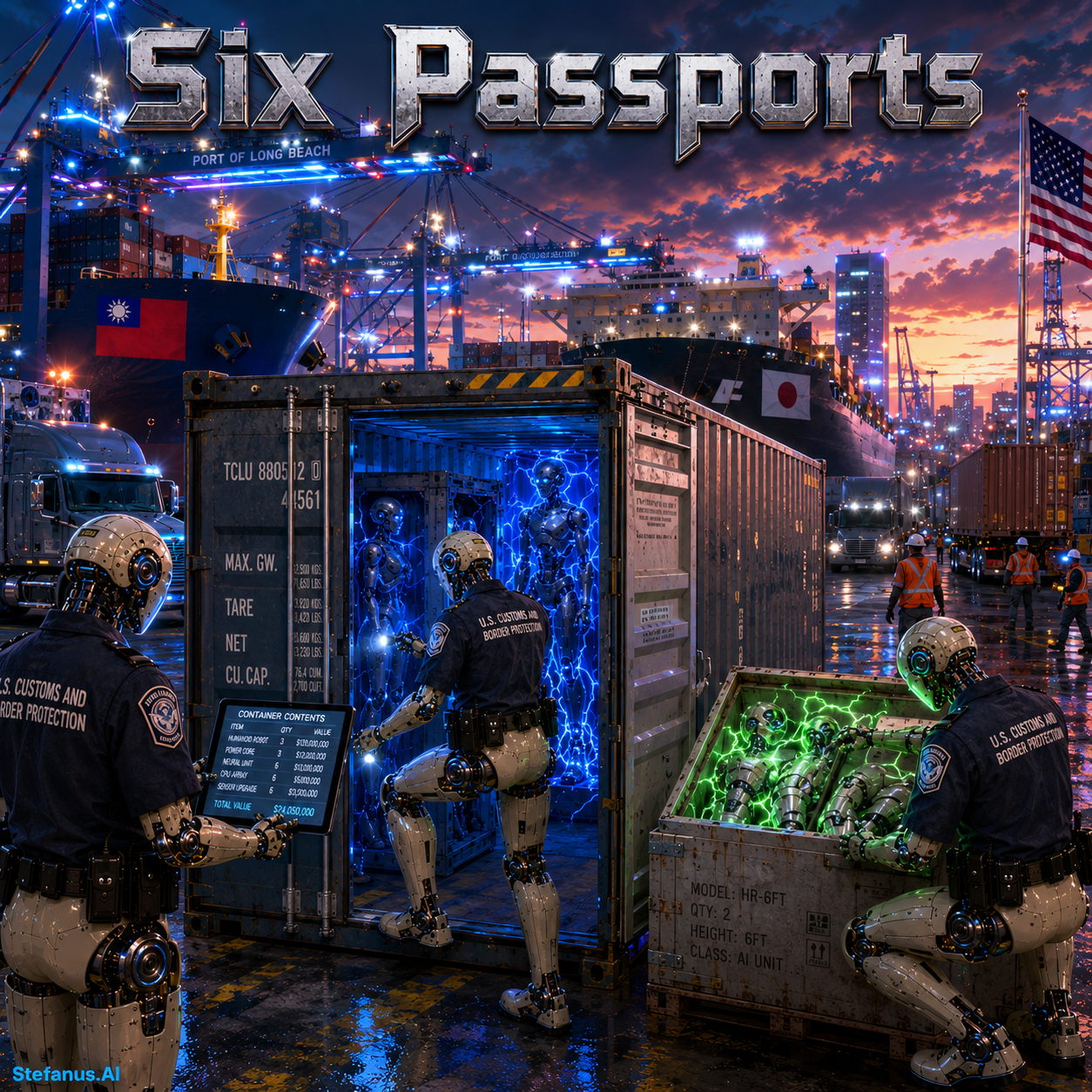
Picture the scene, because within a very few years some version of it will occur. A shiny, state-of-the-art humanoid logistics robot stands motionless at the Port of Long Beach, California. It is part of a highly anticipated fleet deployed for the 2028 Los Angeles Olympic Games, designated to handle athlete logistics, public entertainment, and stadium security. The Games are weeks away. Television crews are already staging along the waterfront. And yet the machine cannot clear customs, because a U.S. Customs and Border Protection officer is locked in a heated argument with an import logistics manager over a question that sounds simple and is anything but: where is this robot from?
Consider what the officer’s paperwork reveals. The robot’s aluminum chassis was forged and assembled in Mexico, and it carries a USMCA preferential tariff stamp attesting to that fact. Inside its head sits a high-end neural processing unit designed in California but fabricated in Taiwan — a chip whose export, re-export, and even re-import is now governed by an entirely separate body of national-security law. Its foundational “brain,” the AI model that performs its reasoning, was developed by an American technology giant but fine-tuned on data scraped from European Union citizens in apparent violation of the General Data Protection Regulation. The command server currently streaming its balance-control telemetry sits in a data center in London. And the human remote operator standing by to take manual control if the machine stumbles is seated at a desk in Manila, wearing a virtual-reality headset, eleven time zones away.
Is the robot Mexican, Taiwanese, American, European, British, or Filipino? If it malfunctions during an Olympic security sweep and injures a spectator, who is liable — the Mexican assembler, the Taiwanese fab, the American model developer, the British cloud host, or the Filipino teleoperation contractor? Under twentieth-century trade law, the physical shell dictates origin, and the answer is trivially “Mexico.” Under twenty-first-century reality, the physical shell is a dumb container for a multinational cognitive engine, and the answer is genuinely indeterminate. Under the current United States administration’s tariff regime for imported foreign goods — a regime that as of January 2026 imposes a targeted 25 percent Section 232 duty on a defined class of advanced semiconductors while exempting most domestic-use imports — even the narrow fiscal question of what tariff this robot owes requires tracing components through at least three legal systems.[1][2] And beneath the fiscal question lies a classification failure: customs officials inspecting the humanoid cannot determine whether it is an appliance, a computer, a telecommunications device, a vehicle, a worker, a surveillance platform, or a military dual-use system. It is, in some meaningful fraction, all seven.
This is not a hypothetical torn from science fiction. Every element of the scenario above is drawn from supply chains, regulatory actions, and commercial deployments that exist today, in July 2026. The literature of the past half-decade — spanning trade law, robotics, export-control policy, data-protection scholarship, and labor economics — has documented each fragment of the problem in isolation. What it has not yet done is assemble the fragments into a single governing framework. That is the task of this paper.
The stakes are not merely academic. The Secretary-General of the United Nations, opening the first Global Dialogue on AI Governance in Geneva, framed the general condition with unusual bluntness:
“Artificial intelligence is advancing at runaway speed.” — António Guterres, Secretary-General, United Nations [3]
He was speaking of software. But the runaway is now growing legs. When intelligence acquires actuators — when the model that yesterday drafted emails today lifts a pallet, restocks a shelf, or patrols a stadium concourse — every unresolved question of AI governance becomes a question of physical jurisdiction, and every unresolved question of physical jurisdiction becomes a question of national security. The legal scholar Ryan Calo of the University of Washington, whose two-volume Robot Law project has done more than any other body of work to define this field, anticipated the shift a decade ago:[4]
“We’re going to have to strike a different balance when software can touch you.” — Ryan Calo, University of Washington School of Law [5]
Software can now touch you. The balance has not been struck.
Thesis Statement
Traditional international law, Westphalian sovereignty, and global customs regimes assume an object’s utility and identity are fixed at the border. Fragmented machines shatter this paradigm by splitting their physical, digital, and operational identities across dozens of borders simultaneously. To govern them, nations must abandon static “Rules of Origin” and adopt a dynamic, multi-layered “Six Passports” framework to manage the modern realities of fractional nationality.
Why This Title?
“Six Passports” establishes a highly evocative, concrete metaphor for a highly abstract legal problem. A passport is the paradigmatic instrument of sovereign identity: it declares who you are, where you belong, and which state stands behind you. By insisting that a single machine carries six of them, the framework forces policymakers to view software layers, data layers, and telemetry layers with the same sovereign weight that they have always accorded to physical bodies. A customs officer who would never wave through an undocumented shipping container currently waves through an undocumented foundation model every time a connected robot rolls off a ship.
“Sovereign Jurisdiction and National Security” signals that this is not merely a technical tariff dispute. It is a high-stakes geopolitical vulnerability in which digital backdoors can convert imported hardware into foreign intelligence assets, in which an overnight software update can re-arm a machine that cleared inspection the previous morning, and in which the human hands on the emergency-stop lever may answer to the labor law — and the intelligence services — of another state entirely.
“Fractional Nationality of Fragmented Machines” captures the core thesis. Modern robots are no longer cohesive national exports; they are fragmented entities holding fractional citizenship across multiple jurisdictions. Nationality, for a machine, is no longer a binary attribute to be stamped once. It is a portfolio — weighted, dynamic, and continuously rebalanced by every update pushed and every server migrated.
The remainder of the paper proceeds in five sections. Section I documents the disaggregation of the robot supply chain, tracing the platform layer that NVIDIA is assembling around GR00T, Isaac, and Cosmos, and the bipolar manufacturing race between Western integrators and China’s state-supported champions. Section II develops the Six Passports framework itself, layer by layer. Section III maps each passport onto the legacy regulatory regime with which it collides — tariffs, export controls, cybersecurity certification, product liability, labor regulation, and telemetry restrictions. Section IV proposes the Six Pillars of Fractional Governance. Section V translates the framework into an operational instrument: an International Robot-Origin Certificate and a six-passport customs declaration. The conclusion states the deeper stake plainly: countries will not merely import robots; they will import layered foreign authority embedded inside machines.

Section 1: The Disaggregation of the Robot Supply Chain
Before any legal framework can be justified, the underlying industrial fact must be established: no humanoid robot manufactured in 2026 is, in any meaningful sense, a single-nation product. This section documents that fact in three movements. First, it describes the economic logic by which value has migrated out of the physical body and into the cognitive stack. Second, it examines the platform layer — dominated by NVIDIA’s GR00T, Isaac, and Cosmos ecosystem — through which that cognitive value now flows. Third, it surveys the manufacturer layer, where a bipolar race between Western integrators and Chinese champions is pulling the machine’s physical origin and its cognitive origin apart along geopolitical fault lines.
1.1 From Monolithic Export to Layered Assembly
For most of the industrial era, the nationality of a machine was a coherent concept because the value of a machine was overwhelmingly physical. A German machine tool was German because German steel, German gearing, German engineering labor, and German assembly constituted nearly all of its worth. The customs regimes built at Bretton Woods and refined through the World Customs Organization’s Harmonized System reflected this reality faithfully: origin followed substantial transformation, substantial transformation happened in factories, and factories had street addresses.
The humanoid robot inverts this structure. Analysts across the 2024–2026 literature converge on the same observation: the physical body of a humanoid — its aluminum frame, harmonic drives, ball screws, and battery pack — is commoditizing at extraordinary speed, while the value concentrates in five intangible or semi-intangible layers stacked above it. Morgan Stanley’s landmark “Humanoid 100” research program, which projects the global humanoid market to reach roughly $5 trillion in annual revenue by 2050 with approximately one billion units in service, explicitly models the opportunity as a “brain-body-integrator” stack in which the brain — chips, models, data, and cloud services — captures the dominant share of long-run value.[6] The firm’s analysts describe the industrial moment in terms usually reserved for the dawn of the automobile:
“With enthusiastic backing from enterprises, investors and governments, the humanoid space is evolving rapidly.” — Adam Jonas, Morgan Stanley [7]
Bank of America’s parallel forecast anticipates roughly 90,000 humanoid shipments in 2026, rising to 1.2 million annual units by 2030 — a fourteen-fold expansion in four years.[8] Whether or not one accepts the most aggressive projections (and serious robotics practitioners have voiced healthy skepticism about billion-unit scenarios), the direction is not in dispute: a product category is forming whose unit economics resemble the smartphone more than the machine tool, and whose bill of materials crosses more borders than any manufactured object in history.
The governance consequence follows immediately. If a robot’s body is assembled in a low-tariff nation but its value is overwhelmingly driven by imported digital intelligence, then using physical origin to determine trade status creates a loophole the size of the entire cognitive economy. A machine that is 15 percent Mexican aluminum and 85 percent American-Taiwanese-scraped-European cognition clears customs as a Mexican good. Every incentive in the system pushes manufacturers to arbitrage exactly this gap — to locate the cheap, taxable, visible layer in friendly jurisdictions while the expensive, untaxed, invisible layers flow freely across the wire. Twentieth-century trade law does not merely fail to capture this arbitrage; it actively subsidizes it.
1.2 The Platform Layer: NVIDIA and the Physical-AI Stack
If one company’s disclosures can serve as a census of the fragmented machine, they are NVIDIA’s. Over eighteen months spanning 2025 and the first half of 2026, NVIDIA has positioned itself not as a robot manufacturer but as the sovereign platform on which nearly every serious humanoid program now depends — a position with profound implications for any origin framework, because it means the cognitive core of robots assembled on four continents traces to a single American design house fabricating in Taiwan.
The cadence of announcements tells the story. At CES in Las Vegas on January 5, 2026, NVIDIA released Cosmos Reason 2, an open reasoning vision-language model that enables machines to see, understand, and act in the physical world, alongside Isaac GR00T N1.6, an open reasoning vision-language-action model purpose-built for humanoid robots that unlocks full-body control; the same launch introduced the Blackwell-architecture Jetson T4000 edge module and the OSMO edge-to-cloud compute framework, with Boston Dynamics, Caterpillar, Franka Robotics, Humanoid, LG Electronics, and NEURA Robotics debuting machines built on the stack.[9] NVIDIA’s founder framed the moment in the vocabulary of the last platform shift:
“The ChatGPT moment for robotics is here.” — Jensen Huang, Founder and CEO, NVIDIA [10]
Ten weeks later, at GTC in San Jose on March 16, 2026, the company announced GR00T N1.7 in early access with commercial licensing — bringing generalized robot skills, including advanced dexterous control, to production-ready deployments — together with Isaac Lab 3.0 built on the new Newton physics engine for large-scale robot learning on DGX-class infrastructure. The partner list read like a census of the global robotics industry: ABB Robotics, AGIBOT, Agility, CMR Surgical, FANUC, Figure, Hexagon Robotics, KUKA, Medtronic, Skild AI, Universal Robots, World Labs, and YASKAWA.[11] Huang’s keynote declaration was, if anything, more sweeping than his CES formulation:
“Physical AI has arrived — every industrial company will become a robotics company.” — Jensen Huang, GTC 2026 [12]
Industry analysts tracking the GTC releases noted that NVIDIA plans to launch the GR00T N2 model by the end of 2026, built on its in-house DreamZero World Action Model architecture and expected to more than double robot task-success rates in unfamiliar environments — accelerating the shift from specialized systems to general-purpose platforms.[13] In parallel, NVIDIA and Hugging Face integrated Isaac and GR00T into the open-source LeRobot framework, connecting NVIDIA’s roughly two million robotics developers with Hugging Face’s thirteen million AI builders — a single stroke that open-sourced substantial portions of the cognitive layer across every jurisdiction with an internet connection.[14]
The financial scale underneath this platform is without precedent in industrial history, and it matters for governance because tariff regimes are ultimately about value, and the value is here. For the fourth quarter of fiscal 2026, ended January 25, 2026, NVIDIA reported record revenue of $68.1 billion, up 73 percent from a year earlier, including record data-center revenue of $62.3 billion; full-year fiscal 2026 revenue reached $215.9 billion, up 65 percent.[15] The following quarter — the first quarter of fiscal 2027, reported on May 20, 2026, and colloquially the “Q1 2026” report — set the record again: $81.6 billion in revenue, up 85 percent year over year, with data-center revenue of $75.2 billion accounting for 92 percent of total sales.[16] Closing the earnings call, Huang compressed the demand environment into a single line:
“Demand has gone parabolic.” — Jensen Huang, Q1 FY2027 earnings call, May 20, 2026 [17]
One further detail from these filings deserves emphasis, because it prefigures the export-control analysis of Sections II and III: NVIDIA’s official guidance for the first quarter of fiscal 2027 — revenue of approximately $78 billion — explicitly assumed no data-center compute revenue from China whatsoever.[18] The most valuable company in the world now plans its quarters around the assumption that an entire continental market may be closed to its most advanced silicon by force of American law. The chip passport, in other words, is already being stamped — just not by customs officers.
Beneath the platform sits the supporting hardware ecosystem that completes the physical half of the machine: sensors (cameras, LiDAR, force-torque arrays, tactile skins), actuators (harmonic drives, planetary rollers, quasi-direct-drive motors), batteries, and edge accelerators. Each of these component families has its own multinational fabrication footprint — Japanese and German dominance in precision reduction gearing, Chinese and Korean dominance in cells and packs, Taiwanese dominance in leading-edge logic — such that a single “American” robot may run a U.S.-designed platform fabricated in Taiwan, perceive through Japanese sensors, move on German or Chinese actuators, and draw power from Korean chemistry. The intellectual foundations of this stack, meanwhile, are being articulated most influentially by academic researchers. Stanford’s Fei-Fei Li, the inaugural Sequoia Professor of Computer Science and founding co-director of the Stanford Institute for Human-Centered AI, has argued in a widely circulated November 2025 essay that today’s language models, for all their power, remain:
“…eloquent but inexperienced, knowledgeable but ungrounded.” — Fei-Fei Li, Stanford University [19]
Her prescription — spatial intelligence built on world models that understand geometry, physics, and dynamics — is precisely the capability that Cosmos-class systems are racing to commercialize, and she has been explicit about the stakes:
“This is AI’s next frontier.” — Fei-Fei Li, TIME, on spatial intelligence [20]
At MIT, Daniela Rus, director of the Computer Science and Artificial Intelligence Laboratory, has framed the same transition through what she calls physical intelligence — the fusion of AI’s cognitive power with robotic embodiment — insisting that unlike standard models,
“…physical intelligence is rooted in physics.” — Daniela Rus, Director, MIT CSAIL [21]
The convergence of these research programs with NVIDIA’s commercial stack defines the platform layer of the fragmented machine. And it defines something else as well: a de facto cognitive monoculture. When one design house’s models, simulators, and silicon sit inside robots assembled in Shanghai, Fremont, Munich, and Seoul alike, the question “where is this robot from?” acquires a second, more uncomfortable form — who can reach inside it?
1.3 The Manufacturer Layer: A Bipolar Industrial Race
Above the platform sits the integrator layer, and here the geography sharpens into a two-bloc race whose asymmetries drive the entire national-security dimension of this paper.
On the Western side, the marquee programs are Tesla’s Optimus, Figure, Agility Robotics, and Boston Dynamics. Tesla’s program is structurally unique because Tesla is simultaneously the robot’s manufacturer and its first manufacturing customer: Optimus units are built in Tesla factories, deployed in Tesla factories, and generate training data that feeds directly into the next generation.[22] By January 2026, more than a thousand units were reported operating on a live Fremont production line, and at the Abundance Summit Elon Musk confirmed that the third-generation Optimus enters production in the summer of 2026 — first in low volumes for Tesla’s own facilities — describing the machine, characteristically, as:
“…the most advanced humanoid robot in the world.” — Elon Musk, CEO, Tesla [23]
The V3 design pairs 22-degree-of-freedom hands with Tesla’s custom AI silicon roadmap and a target price of $20,000–$30,000 at scale, with consumer availability projected for late 2027 — though independent trackers note that production targets have repeatedly slipped and that the gap between choreographed demonstrations and reliable general-purpose autonomy remains real and large.[24] Figure, meanwhile, has placed its robots into BMW manufacturing facilities and Amazon warehouse pilots; Agility Robotics’ Digit works Amazon and Ford logistics flows; Boston Dynamics’ electric Atlas anchors Hyundai’s program.[25] The Western bloc’s strengths are foundation models, custom silicon, capital markets, and software integration.
On the Chinese side, the champions are Unitree Robotics and AgiBot (Zhiyuan Robotics), backed by a domestic field of more than 140 companies.[26] The output statistics compiled across independent research houses in the first half of 2026 are striking in their consistency. IDC’s January 2026 tally put 2025 global humanoid shipments at roughly 18,000 units — up approximately 508 percent year over year — with AgiBot first at roughly 5,200 units and Unitree second at roughly 4,700, meaning both of the world’s top two shippers are Chinese; Unitree’s own IPO prospectus discloses more than 5,500 units shipped, with the flagship G1’s average price falling to 167,600 yuan.[27] TrendForce projects China’s humanoid output to grow up to 94 percent in 2026, with Unitree and AgiBot together capturing nearly 80 percent of shipments; global shipments are expected to grow more than 700 percent and surpass 50,000 units, making 2026 the inflection year of commercialization.[28] AgiBot rolled its 10,000th general-purpose embodied robot off the Shanghai line in late March 2026 — scaling from 5,000 to 10,000 cumulative units in roughly three months — while Unitree targets 20,000 humanoid shipments for the year and has committed to expanding capacity toward 75,000 humanoids and 115,000 quadrupeds annually.[29][30]
Three structural advantages compound behind these numbers, and each is a matter of explicit public policy rather than private accident. The first is the domestic component supply chain: with more than 70 percent of global industrial-robot installations already inside China and a domestic robotics market estimated at $14.2 billion growing 47 percent year over year, Chinese humanoid makers source joint modules, dexterous hands, sensors, and batteries from suppliers down the street rather than across an ocean.[31] The second is state procurement as guaranteed demand: in 2026 the State Grid Corporation of China issued a procurement order worth CNY 6.8 billion (approximately $1.0 billion) covering 500 live-line working humanoids, 3,000 dual-arm robots, and 5,000 quadrupeds — the largest single order in the sector’s history — while Unitree’s STAR Market IPO registration was approved in early July 2026 just 73 days after acceptance, with 2025 revenue of CNY 1.7 billion, net profit near CNY 591 million, gross margins above 60 percent, and a G1 bill of materials of just $8,976, bringing equivalent hourly cost below the $30 human-wage threshold for the first time.[32][33] The third is public capital: China completed fourteen funding rounds exceeding CNY 1 billion in the sector during the first half of 2026 alone, and Morgan Stanley raised its 2026 forecast for Chinese humanoid shipments from 28,000 to 50,000 units.[32]
Morgan Stanley’s head of industrials research states the asymmetry without varnish:
“National support for ‘embodied AI’ may be far greater in China than in any other nation.” — Sheng Zhong, Morgan Stanley [6]
Sober voices caution against reading every viral video as a production reality. Professor Mohd Rizal Arshad, Dean of the School of Robotics at Xi’an Jiaotong-Liverpool University in Suzhou, has warned that many of the humanoid feats circulating in public media are best understood as staged demonstrations of potential rather than evidence of deployed, reliable capability — a caution consistent with the modest absolute production figures behind the spectacle.[26] The caution is well taken, and this paper does not require humanoid ubiquity for its argument. It requires only what is already true: that the machines now crossing borders in five-figure annual volumes embody a supply chain in which the chassis race and the intelligence race have different winners, on opposite sides of an intensifying geopolitical divide.
Table 1. The disaggregated humanoid supply chain, circa mid-2026
| Layer | Representative actors | Dominant geography | Value trajectory |
| Chassis, actuators, assembly | Unitree, AgiBot, UBTech, Tesla Fremont, contract assemblers | China; Mexico/US/EU assembly | Commoditizing rapidly |
| Semiconductors and edge compute | NVIDIA (Jetson Thor, T4000), Tesla AI5 roadmap, TSMC fabrication | US design; Taiwan fabrication | Concentrating |
| Foundation models | NVIDIA GR00T N1.6/N1.7, Cosmos Reason 2, Figure Helix, Skild AI, open LeRobot ecosystem | US-led; open weights global | Concentrating, then diffusing via open source |
| Training data | Simulation (Isaac Lab, Cosmos), teleoperation demonstrations, scraped video corpora | Global; legally heterogeneous | Expanding, contested |
| Cloud command and OTA | Hyperscale clouds; vendor fleet-management planes | US, EU, China data-center regions | Expanding |
| Teleoperation and telemetry | Astro Robotics (Manila), vendor pilot centers, 1X remote assist | Philippines, India, Eastern Europe | Expanding |
The table’s final column is the quiet argument of this entire section. Value is flowing away from the one layer that customs law can see and toward the five layers it cannot. A governance regime that continues to tax, inspect, certify, and sanction only the first row is a regime that has chosen, by inertia, to govern the least important sixth of the machine.

Section 2: The Six Passports of the Fragmented Machine
The framework at the heart of this paper can now be stated in full. A modern humanoid robot carries six distinct layers of identity, each anchored in a different body of law, each typically issued — in the metaphor this paper urges policymakers to take literally — by a different sovereign. This section develops each passport in turn: the layer it describes, the legal framework that currently governs it, and the friction point at which that framework fails.
Table 2. The Six Passports framework
| Passport | Layer | Current legal framework | Core friction point |
| 1 | Mechanical-body origin | WCO rules, HS codes, USMCA/EU rules of origin | Physical origin no longer tracks value |
| 2 | Semiconductor origin | Export controls, BIS entity lists, Section 232, CHIPS Act | Sanctioned cognition inside friendly chassis |
| 3 | Foundation-model origin | IP law, licensing, EU AI Act | No forum for cognitive liability |
| 4 | Training-data jurisdiction | GDPR, CCPA, cross-border transfer rules | Extraterritorial data claims travel with the machine |
| 5 | Cloud-command location | Data residency, cloud certification, telecom sovereignty | Capabilities mutate after import via OTA updates |
| 6 | Telemetry and remote-operator destination | Labor law, visas, drone-operation analogies | Physical action and human control in different states |
2.1 The First Passport — Mechanical-Body Origin
The first passport is the only one the existing system knows how to stamp. It covers the physical chassis, actuators, motors, structural materials, and final structural assembly, and it is governed by the traditional apparatus of the World Customs Organization: Harmonized System codes, substantial-transformation tests, and the regional preference regimes of trade blocs such as the USMCA and the EU single market. When the robot at Long Beach presents its USMCA stamp, it is presenting Passport 1 — and under current law, Passport 1 is the only document customs is entitled to demand.
The friction point is the value inversion documented in Section I. Physical bodies are increasingly commoditized and cheap: Unitree’s G1 carries a bill of materials under $9,000, its R1 retails at $5,900, and analysts project sub-$5,000 consumer-grade humanoids from multiple Chinese firms by 2027 — price points that are, in the words of one 2026 market survey, categorically impossible for Western makers today.[31][33] If a robot body is assembled in a low-tariff nation while its value is entirely driven by imported digital intelligence, then using the physical origin to determine trade status creates massive tax and regulatory loopholes. The problem is not that rules of origin are administered badly; it is that they are administered perfectly against a target that has moved. A tariff schedule keyed to the weight and provenance of aluminum is, in economic substance, a decision to let the cognitive 85 percent of the machine cross every border of the world duty-free, inspection-free, and anonymously.
2.2 The Second Passport — Semiconductor Origin
The second passport covers the neural processing units, GPUs, edge accelerators, and associated memory that enable onboard machine learning — the physical substrate of the robot’s mind. Its governing framework is not trade law but national-security law: the U.S. Bureau of Industry and Security’s Export Administration Regulations and entity lists, the foreign direct product rules that extend American jurisdiction to any chip made anywhere with American tools, allied regimes in Japan and the Netherlands, and the subsidy architecture of the CHIPS Act.
Events of January 2026 demonstrate how rapidly this passport is evolving — and how completely it now operates on a separate track from Passport 1. On January 14, 2026, the White House issued a Section 232 proclamation imposing a 25 percent ad valorem tariff on a narrow category of advanced semiconductors, and one day later BIS published a final rule shifting license review for certain advanced AI chips destined for China from a presumption of denial to case-by-case review under strict supply, security, and testing conditions — the two actions together implementing an arrangement under which the U.S. government effectively collects a percentage of advanced-chip sales to China.[1][34] Notably, the tariff exempts imports destined for domestic civil industrial applications, including factory robotics — while chips imported for testing and re-export to China bear the full 25 percent.[35] Congressional researchers have already flagged the constitutional novelty of using an import-adjustment statute to accomplish what looks economically like an export levy.[2]
For the fragmented machine, the friction point is severe: a robot with a perfectly friendly mechanical passport — Canadian assembly, say, or the Mexican chassis of our Long Beach humanoid — may carry a sanctioned, restricted, or revenue-encumbered processor in its head. Such a machine is a moving geopolitical loophole. It can bypass traditional hardware embargoes simply by walking through them, because embargo enforcement is built around identifiable shipments of chips, not around chips that arrive pre-installed inside the skull of a machine classified, per Passport 1, as Mexican industrial equipment. The obverse risk is equally real: exported robots become uncontrolled channels for controlled silicon. Export-control scholars have observed that the U.S. government now treats these authorities as a flexible, revenue-bearing instrument of general geoeconomic policy rather than a narrow security screen — which makes the absence of any robot-level declaration regime all the more anomalous.[36]
2.3 The Third Passport — Foundation-Model Origin
The third passport covers the core artificial intelligence model — the weights, the reasoning engine, the foundational cognitive software that decides what the machine does next. Its nominal legal framework is a patchwork: intellectual-property law and copyright registration, software licensing terms, and the emerging apparatus of AI safety regulation, of which the EU AI Act is the world’s most comprehensive example.
This is the passport of cognitive jurisdiction, and its friction point is the deepest in the framework. If a robot commits a crime, violates a patent, or destroys property, does legal liability rest with the nation (and firm) that manufactured the physical arm, or with the nation (and firm) that gave birth to the foundation model controlling it? The question is no longer hypothetical. GR00T N1.7 is now commercially licensed into production robots built by companies headquartered in at least a dozen countries;[11] open-weight variants circulate through the LeRobot ecosystem to millions of developers with no licensing relationship to NVIDIA at all;[14] and Chinese open-source robot models now lead several real-robot benchmarks, meaning Western-assembled machines will increasingly run Chinese-origin cognition just as Chinese-assembled machines run American-origin cognition.[30]
Europe’s answer — classify, certify, and CE-mark high-risk AI systems — is instructive precisely because of how it has strained under contact with reality. The AI Act entered into force on August 1, 2024, with high-risk obligations originally applicable from August 2, 2026; by late 2025 implementation was visibly off track, and the Digital Omnibus on AI, politically agreed in May 2026 and formally endorsed in June 2026, deferred high-risk obligations for stand-alone Annex III systems to December 2, 2027, and for AI embedded in regulated products — the category that captures robotics and industrial machinery — to August 2, 2028.[37][38] The European Commission’s own guidance now states plainly that for systems integrated into products such as robotics, the rules apply from 2 August 2028.[39] The world’s most ambitious attempt to issue Passport 3 has, in effect, conceded that it cannot stamp the document until the second half of the decade — while the machines ship today.
2.4 The Fourth Passport — Training-Data Jurisdiction
The fourth passport covers the vast datasets used to train the robot’s vision, spatial awareness, and behavioral models — and, critically, the legal rights and violations embedded in that data. Its governing framework is the global archipelago of data-protection law: the GDPR and its adequacy mechanisms, the California Consumer Privacy Act and its state-law siblings, China’s Personal Information Protection Law and data-export reviews, and the widening web of cross-border transfer restrictions.
The friction point is extraterritorial regulatory collision. A humanoid operating in New York that relies on a model fine-tuned on data unlawfully scraped from European or Chinese citizens is a walking vector for international data litigation: the violation occurred nowhere near the machine, attaches to no component customs can inspect, and yet travels with the robot into every jurisdiction it enters. The data layer is also where the physical and digital worlds feed each other most intimately. As Fei-Fei Li has emphasized, spatial data is scarce and hard-won, which is precisely why robot builders lean so heavily on three legally distinct sources — simulation, purchased or scraped video corpora, and human teleoperation demonstrations — each carrying a different jurisdictional signature.[20] Simulation data generated in Isaac Lab inherits the licensing of the simulator; scraped video inherits the privacy and copyright law of wherever the humans in the frames were standing; and teleoperation demonstrations inherit the labor and data law of wherever the demonstrating human sits — which, as Passport 6 will show, is very often Manila. A single behavioral policy in a single robot can therefore embody data-rights obligations owed simultaneously under European, American, Chinese, and Philippine law, with no instrument anywhere in the trade system that requires this to be declared.
2.5 The Fifth Passport — Cloud-Command Location
The fifth passport covers the live servers, cloud infrastructure, fleet-management planes, and real-time over-the-air update channels that guide the machine’s higher-level logic after it has been deployed. Its nominal frameworks are cloud-security certification regimes, data-residency laws, and telecommunications sovereignty rules.
The friction point is that this passport, uniquely, can be re-issued overnight without the machine moving an inch. A robot can be imported under perfect legal compliance — every form correct, every inspection passed — and then an over-the-air software update, directed from a foreign cloud server, can radically alter its capabilities, its security posture, or its operational parameters while it stands motionless in a warehouse. The customs stamp certifies a machine that, in the relevant cognitive sense, may cease to exist the first night it connects to its vendor. The commercial architecture of the industry guarantees this dynamism: fleet learning is the business model. Every major humanoid program — Optimus explicitly, Figure and Agility operationally, the Chinese fleet vendors emphatically — improves its deployed robots through continuous cloud-delivered policy updates, and NVIDIA’s OSMO framework exists precisely to orchestrate training and deployment across edge and cloud.[9] The security dimension compounds the regulatory one: the cloud-command channel is simultaneously the mechanism of product improvement, the pathway for capability change that no importing regulator reviews, and — in the adversarial case — the vector by which a foreign power could reach into thousands of embodied machines standing inside another nation’s hospitals, ports, and power stations. NVIDIA’s own earnings guidance, which excludes China data-center revenue as a matter of assumption, shows that firms already treat cloud-and-compute access as a variable of great-power politics; importing states have yet to internalize the mirror image.[18]
2.6 The Sixth Passport — Telemetry and Remote-Operator Destination
The sixth passport covers the human-in-the-loop layer: the destination to which the robot’s operational telemetry streams, and the physical location of the remote teleoperators who monitor it, correct it, and seize control when autonomy stalls. Its nominal frameworks are labor law, remote-work visa regimes, and — in the closest existing analogy — the legal doctrines developed for remotely piloted military aircraft.
This layer is not speculative; it is an operating industry with a payroll. Tokyo-based Telexistence has deployed shelf-stocking robots in more than 300 FamilyMart and Lawson convenience stores across Japan, running on NVIDIA and Microsoft platforms; those machines are monitored around the clock from a multistory office building in Manila’s financial district, where employees of the robot-workforce startup Astro Robotics each watch roughly fifty robots at a time, donning VR headsets to take direct control whenever a bot drops a can.[40] The pattern is generalizing quickly: remotely supervised security robots in Atlanta, remote-driven airport shuttles trialed in Düsseldorf, a teleoperated surgical procedure performed from France on a patient in India, and consumer humanoids — 1X’s $20,000 home robot among them — that are explicitly sold with the expectation of intermittent remote human control.[41] Oxford internet-geography professor Mark Graham observes that teleoperation extends the century-old logic of offshoring to work previously considered:
“…stubbornly local.” — Mark Graham, University of Oxford [41]
The labor economics are double-edged. University of Michigan robotics professor Lionel Robert calls the offshored-teleoperation configuration:
“…an economic double whammy.” — Lionel Robert, University of Michigan [42]
— by which he means that the importing country loses the local jobs automation was once expected to upgrade, while the exporting country gains work that is frequently precarious and underpaid. And the loop closes back into Passport 4: every corrective motion a Manila pilot performs is captured as demonstration data used to train the autonomy that will eventually replace the pilot — Telexistence’s own partnership announcements state the goal of moving from manual teleoperation to full autonomy explicitly.[42] MIT Technology Review’s investigation of the sector put the governance question directly: if most robots still need remote human operators to be safe and effective, the machine’s trustworthiness is inseparable from a faceless worker in another country — one whose training, wages, oversight, and legal accountability are invisible to the jurisdiction where the robot’s steel actually moves.[43]
The friction point, then, is the invisible labor border. When physical actions happen in Country A but the human brain pulling the emergency-stop lever sits in Country B, traditional workplace liability, immigration law, occupational licensing, and local public-safety jurisdiction break down entirely. A forklift operator in Los Angeles must hold a California certification; the Manila pilot steering a functionally identical machine through the same warehouse holds no U.S. credential of any kind, is invisible to OSHA, cannot be subpoenaed by a California court in any practical sense, and — in the security-critical case of our Olympic robot — occupies precisely the position that espionage and sabotage doctrine was written to guard, without any of the vetting that doctrine assumes.
Taken together, the six passports describe a machine whose nationality is a weighted portfolio: perhaps 15 percent Mexican by mass, 30 percent Taiwanese-American by silicon, 25 percent American by cognition, 10 percent European by data-rights exposure, 10 percent British by command infrastructure, and 10 percent Filipino by supervising labor. No instrument in international law can currently read this portfolio, let alone tax, certify, or sanction its components. Section III examines what happens when each layer collides with the regime that was never designed for it.

Section 3: The Regulatory Collision — Six Regimes That No Longer Fit
Each passport identified in Section II collides with a legacy regulatory regime that was engineered, often brilliantly, for a world of unified and static objects. This section maps the six collisions in turn — tariffs, export controls, cybersecurity certification, product liability, labor regulation, and telemetry restrictions — because the design of any remedial framework must begin from a precise diagnosis of where the existing machinery breaks. The deep pattern across all six collisions is the same: each regime regulates a snapshot — a shipment, a license, a certificate, a defect, an employee, a transmission — while the fragmented machine is a stream, continuously re-constituted by updates, migrations, and remote interventions long after any snapshot was taken.
3.1 Tariffs and Rules of Origin (Collision with Passport 1)
Customs valuation keyed to weight, material, and place of substantial transformation systematically misprices machines whose value is overwhelmingly software. The current U.S. tariff environment makes the mispricing vivid. The 2025–2026 tariff program constitutes, by independent estimates, the largest U.S. tax increase as a share of GDP since 1993, averaging roughly $1,500 per household in 2026 — and yet the semiconductor action of January 2026, for all its geopolitical weight, applies a 25 percent duty only to a narrow class of advanced chips destined ultimately for re-export, while exempting nearly all domestic-use imports.[35][44] A humanoid robot entering U.S. commerce thus faces a tariff computed on the declared value of its assembled body under whatever HS classification the importer can defend, while the foundation model inside it — arguably the majority of its economic worth — enters as a costless intangible. The same asymmetry runs in reverse for exporting nations: China’s champions can land a sub-$16,000 humanoid in any market whose tariff schedule sees only aluminum, capturing the recurring software, skills-subscription, and fleet-service revenue afterward through channels no customs regime touches. Trade economists have long debated how to tax digital flows; the humanoid forces the debate because here the digital flow arrives wearing a body that indisputably crosses the border.
3.2 Export Controls (Collision with Passport 2)
Export-control regimes chase enumerated components through documented shipments; they were not built for assembled ambulatory systems that carry controlled silicon across borders on their own legs. The January 2026 BIS rule and companion Section 232 proclamation demonstrate both the sophistication and the blind spot of the current approach: license review for advanced AI chips to China is now case-by-case under strict supply, security, and testing conditions — conditions enforced at the level of chip shipments — while the derivative-product logic that might capture a robot containing such a chip remains embryonic.[1][34] The foreign direct product rules give Washington nominal jurisdiction over any qualifying chip anywhere; but jurisdiction without a declaration instrument is a right without a remedy. No form filed at any border today asks the question that matters: what compute is inside this machine, who fabricated it, and what license authorized its journey here? Until that question is asked at the robot level, every humanoid export is a potential embargo bypass, and every humanoid import a potential Trojan container for silicon that could not have entered as a bare chip.
3.3 Cybersecurity Certification (Collision with Passports 3 and 5)
Point-in-time certification is meaningless for machines whose firmware and cognition mutate through over-the-air updates. The EU’s experience is again the leading case study. The AI Act’s high-risk regime contemplates conformity assessment, technical documentation, CE marking, and database registration before a system is placed on the market[45] — a snapshot architecture. The Digital Omnibus deferrals (to December 2027 for stand-alone systems, August 2028 for AI embedded in products such as robotics) were driven substantially by the recognition that harmonized technical standards for continuously learning systems simply did not exist on the original timeline.[37][38] The United States, having chosen an innovation-first posture in its July 2025 AI Action Plan, has no comparable pre-market regime at all for embodied AI.[46] The result on both continents is the same operational fact wearing different legal clothes: a robot’s cybersecurity posture on the day of certification bears no guaranteed relationship to its posture ninety days later, and no regulator in the world currently receives notice when the difference emerges. Certification regimes must either become continuous — subscription audits of the update channel itself — or accept that they certify a ghost.
3.4 Product Liability (Collision with Passports 1 and 3)
Courts cannot cleanly assign fault among a structural defect, an algorithmic reasoning failure, and a negligent remote command — yet these are the three canonical failure modes of the fragmented machine, and they map to three different passports held by three different firms in three different countries. The doctrinal ground is finally shifting. The EU’s Revised Product Liability Directive, adopted in 2024 and applicable from December 2026, formally recognizes software as a product — including software integrated into robots — thereby dragging the foundation model within reach of strict liability for the first time in any major jurisdiction.[45] American law remains comparatively unreconstructed: commentators reviewing Tesla’s Optimus program note bluntly that when a humanoid causes a workplace injury, no existing U.S. legal infrastructure cleanly answers whether the manufacturer, the deployer, or the facility owner bears responsibility.[47] Ryan Calo’s scholarship anticipated the deadlock a decade ago, warning that jurists hold increasingly outdated mental models of robots and will be poorly positioned for the novel questions they pose;[4] the near-miss incidents already accumulating in early commercial deployments — dropped battery modules, robots freezing mid-task and blocking warehouse aisles for hours — suggest the first true test cases will not wait for the doctrine to mature.[47]
3.5 Labor Regulation (Collision with Passport 6)
Teleoperated labor performed “inside” a country by workers physically outside it evades minimum-wage law, occupational-safety regimes, workers’ compensation, immigration control, and collective-bargaining structures simultaneously — not through any loophole in those laws, but because every one of them presumes the worker’s body is where the work is. The Manila operations documented in Section II already employ hundreds; the sector’s own analysts describe the Philippines as becoming the central hub for teaching robotic dexterity through teleoperation and human-in-the-loop instruction.[40][48] The policy questions arrive in waves. First-order: which nation’s wage floor, working-time rules, and safety standards protect the pilot? Second-order: which nation’s licensing regime governs safety-critical remote acts — the remote surgeon, the remote forklift correction, the remote emergency stop at an Olympic venue? Third-order, and least examined: teleoperation converts labor into training data, meaning the pilot is simultaneously a worker under (some) labor law and a data subject and data producer under (some other) data law, compensated under the first and generally uncompensated under the second. No international labor instrument currently even names this category of worker.
3.6 Telemetry Restrictions (Collision with Passports 5 and 6)
Finally, the continuous sensor exhaust of an embodied machine collides with the fragmentary patchwork of surveillance, data-localization, and critical-infrastructure law. A humanoid is, incidentally but unavoidably, a mobile sensor platform: cameras, depth sensors, microphones, and force telemetry, streaming by default to whichever jurisdiction hosts its fleet-management plane. When the machine works inside a port, a hospital, a power substation — or an Olympic stadium — that stream is a standing intelligence collection channel pointed at another nation’s critical infrastructure, operated lawfully under commercial contract. States have begun to respond in fragments: data-residency mandates for government cloud workloads, security reviews of connected vehicles, sectoral rules for medical devices. But no jurisdiction has yet enacted the general principle the situation demands — that the telemetry destination of an embodied machine operating in sensitive space is itself a regulated attribute of the machine, as material as its voltage rating. The IMF’s Managing Director, describing how global commerce reorganizes itself around every new barrier, offered a metaphor that applies with equal force to data flows:
“Trade is like water.” — Kristalina Georgieva, Managing Director, IMF [49]
Telemetry is more like water still. It flows around every restriction not written directly into the machine’s architecture — which is why Section IV argues the restrictions must, finally, be written there.
Table 3. Mapping regulatory collisions to passports
| Legacy regime | Colliding passport(s) | Failure mode | Leading 2024–2026 development |
| Tariffs / rules of origin | 1 | Value invisible to customs | Section 232 semiconductor proclamation, Jan. 2026 |
| Export controls | 2 | Embodied silicon evades shipment-level control | BIS case-by-case rule for China-bound AI chips, Jan. 2026 |
| Cybersecurity certification | 3, 5 | Snapshot certifies a mutating system | EU AI Act Omnibus deferrals to 2027/2028 |
| Product liability | 1, 3 | Fault unassignable across layers | EU Revised Product Liability Directive, applicable Dec. 2026 |
| Labor regulation | 6 | Worker’s body and work in different states | Manila teleoperation hubs at commercial scale |
| Telemetry restriction | 5, 6 | Sensor exhaust as standing foreign collection | Fragmentary data-residency mandates |

Section 4: Fractional Governance — The Six Pillars
Diagnosis without prescription is commentary. This section proposes the pivot: a system of Fractional Governance built on six pillars, each engineered to govern one passport’s failure mode, and all six sharing a single design philosophy — govern the stream, not the snapshot. The proposals are deliberately institutional rather than utopian; each builds on an instrument that already exists somewhere in the international system, extended to the layer where it is now needed.
The macroeconomic frame matters here, because fractional governance will be resisted as friction, and the correct answer to that resistance is that well-designed friction is what makes large gains durable. The IMF estimates that with the right measures in place, artificial intelligence could add materially to global productivity growth:
“…a boost to global productivity of up to 0.8 percentage points per year.” — Kristalina Georgieva, IMF, World Government Summit, February 2026 [50]
Gains of that magnitude — enough, on the Fund’s arithmetic, to lift global growth above its pre-pandemic trend — will only be realized in embodied form if importing publics trust the machines walking among them, and importing governments trust the layered foreign authority inside them. Governance, in this sense, is not the tax on the humanoid economy; it is the admission ticket.
Pillar 1: Dynamic Customs Declarations (The Living Manifest)
Customs cannot remain a one-time stamp at the border. Every imported robot above a capability threshold should be required to maintain a digital, cryptographically signed — plausibly blockchain-backed — manifest that updates in near-real time whenever a material layer changes jurisdiction: a new cloud provider, a migrated command server, a re-based foundation model, a relocated teleoperation hub. The precedents are mature. Aviation has operated continuing-airworthiness regimes for decades, in which a certificate is a living relationship between regulator and airframe rather than a birth document; maritime law’s flag-state registration follows the vessel through every port call; and software supply-chain policy has, since the U.S. Executive Order 14028 era, converged on the Software Bill of Materials as a machine-readable disclosure standard. The Living Manifest is simply the union of the three: an SBOM with a flag, continuously re-attested. Its immediate practical payoff is that it converts Sections 3.2 and 3.3’s unanswerable questions — what compute is inside, what model version is running, where does command authority sit tonight — into database queries.
Pillar 2: Cognitive Tariffs (Value-Shift Accounting)
Tariff law must decouple duty from weight and physical material and instead calculate value-content on the basis of software equity — levying intellectual-property tariffs at the digital border rather than only taxing the steel chassis at the maritime border. The mechanics are less exotic than they sound. Transfer-pricing law already forces multinationals to assign arm’s-length values to intangibles moving between their own subsidiaries; customs valuation law already includes “assists” — tooling, engineering, and design supplied free of charge — in dutiable value. Cognitive tariffs extend the assist doctrine to the foundation model and skills stack: the declared value of an imported robot must include the imputed value of the cognition it runs, allocated by the same documentation the Living Manifest already carries. The distributional argument is symmetrical and honest: exporting nations that dominate the body layer (today, China) currently bear tariff incidence on nearly all of their contribution, while nations dominating the cognition layer (today, the United States) bear it on almost none. A value-shift regime is not protectionism; it is the restoration of neutrality between atoms and bits.
Pillar 3: Decoupled Liability Frameworks (Split Fault)
Courts and legislatures must adopt a decoupled liability structure in which fault is automatically triaged across the six passports: physical structural defects map to Passport 1 and its manufacturer; algorithmic reasoning failures map to Passport 3 and its model provider; negligent remote operation maps to Passport 6 and its teleoperation contractor; compromised update channels map to Passport 5 and its cloud operator. The EU’s software-as-product directive supplies the doctrinal keystone — a model is now a product that can be defective[45] — and the Living Manifest supplies the evidentiary keystone, because triage is only automatic if the machine’s layer-composition at the moment of harm is a matter of record rather than discovery warfare. Two subsidiary instruments complete the pillar: mandatory layer-specific insurance (each passport-holder carries coverage for its layer, the way aviation apportions hull, liability, and product coverage), and a rebuttable presumption that an unexplained failure in a machine with an incomplete manifest is attributed to the layer whose records are missing. Incentives, thereby, do the enforcement.
Pillar 4: Digital Sovereignty Sanctions (The Cognitive Embargo)
Hardware embargoes are no longer sufficient, because the sanctioned capability can arrive as weights over a wire or as an OTA update after import. National-security agencies must therefore develop the cognitive embargo: legally restricting physical machines operating on national territory from connecting to designated foreign cloud-command servers, and from downloading or executing models owned or controlled by designated hostile entities. The tools exist in scattered form — entity listing, telecommunications equipment bans, connected-vehicle security rules, the “know-your-customer” provisions now attached to advanced-chip export licenses[34] — but they have never been assembled at the robot layer. The White House’s own AI strategy already gestures at the underlying ambition, promising that federal investment in robotics and next-generation manufacturing will:
“…usher in a new industrial renaissance.” — Winning the Race: America’s AI Action Plan, The White House [46]
A renaissance of embodied machines without a cognitive-embargo authority is a renaissance whose statuary can be repainted overnight by whoever holds the update keys. The authority should be narrow, listed, and reviewable — an embargo instrument, not a general censorship of models — but it must exist before the first hostile OTA campaign, not after.
Pillar 5: Cross-Border Tele-Labor Accords
International labor and trade bodies must draft the frameworks governing the cross-border digital workforce that Passport 6 has already created. The core instrument is mutual recognition with registration: teleoperators performing safety-relevant control of machines in a host country must be registered — individually or through accredited employers — under agreements ensuring that their training, working conditions, and legal accountability meet the host country’s standards, exactly as maritime officer certification and aviation crew licensing operate across flags today. Three provisions deserve emphasis, drawn directly from the documented conditions of the existing Manila hubs:[40][42] wage-and-conditions floors above local call-center baselines for safety-critical piloting; disclosure requirements obligating deployers to state where and how teleoperation is used and what fraction of “autonomous” operation is human-assisted; and data-dividend terms recognizing that pilots’ corrective demonstrations are training data of substantial commercial value, compensable as such. The ILO and the WTO’s services frameworks each hold half of the necessary mandate; the accord belongs jointly to both.
Pillar 6: Kinetic Data Residency (The Air-Gap Mandate)
For critical infrastructure — hospitals, power grids, water systems, ports, and military logistics — nations must mandate kinetic data residency: the requirement that Passports 3, 4, 5, and 6 be entirely localized within the physical border where the machine operates. The model must run on-territory; the training-data rights must be settled under domestic law; the command server must sit on domestic soil under domestic legal process; the teleoperators must be domestically located, vetted, and licensed. This is the framework’s bluntest pillar, and deliberately so: it prices the sovereignty externality directly, and it creates the commercial demand for on-premise and edge deployment architectures that vendors are already building for exactly these customers.[22] Outside critical infrastructure, market choice among manifest-transparent configurations should govern; inside it, the burden of proof reverses. The precedent, once again, is not novel: no nation permits foreign nationals to staff its nuclear control rooms, however friendly the nation and however qualified the staff. Kinetic data residency merely notices that a control room can now be a VR headset eleven time zones away.
Table 4. Passports, pillars, and precedents
| Pillar | Governs passport(s) | Institutional precedent |
| 1. Living Manifest | All six | Continuing airworthiness; SBOM; flag-state registry |
| 2. Cognitive Tariffs | 1, 3 | Customs “assists”; transfer pricing of intangibles |
| 3. Split Fault | 1, 3, 5, 6 | EU PLD 2026; apportioned aviation insurance |
| 4. Cognitive Embargo | 2, 3, 5 | Entity lists; telecom equipment bans; chip-license conditions |
| 5. Tele-Labor Accords | 6 | Maritime/aviation crew licensing; ILO conventions |
| 6. Kinetic Data Residency | 3, 4, 5, 6 | Nuclear staffing rules; government cloud residency |

Section 5: The Proposed Instrument — An International Robot-Origin Certificate
Frameworks persuade; instruments govern. This section translates the Six Passports and Six Pillars into a single operational mechanism that a customs service could pilot within a budget cycle: the six-passport customs declaration, maturing into a treaty-backed International Robot-Origin Certificate (IROC).
5.1 The Six-Passport Customs Declaration
The declaration is a standardized, machine-readable filing submitted at import — and re-filed upon material change, per Pillar 1 — disclosing all six origin layers of the machine. Its fields follow the framework exactly:
Table 5. The six-passport customs declaration — core fields
| Field | Passport | Illustrative disclosure (Long Beach humanoid) |
| Chassis and assembly origin | 1 | Mexico; USMCA preference claimed |
| Compute bill of materials | 2 | US-designed NPU, fabricated Taiwan; export license class and number |
| Foundation model provenance | 3 | US developer; model family/version hash; license type (commercial) |
| Training-data jurisdiction attestation | 4 | Simulation (vendor license); video corpora incl. EU subjects — GDPR basis attested |
| Cloud-command and OTA endpoints | 5 | London region, named provider; update-channel signing authority |
| Telemetry and teleoperation destination | 6 | Telemetry to UK; teleoperation hub Manila, contractor named and registered |
Each field is an attestation carrying legal consequence: a false compute declaration is an export-control offense under Passport 2’s existing law; a false data attestation is actionable under Passport 4’s existing law. The declaration invents almost no new substantive obligations — its genius, if it has one, is purely architectural: it forces six bodies of existing law, currently blind to one another, to read the same document about the same machine.
5.2 The International Robot-Origin Certificate
The IROC is the declaration’s treaty-grade successor: a versioned certificate — functionally the fusion of a certificate of origin, an airworthiness certificate, and a flag-state registration — issued by accredited national authorities under a mutual-recognition compact, and re-validated whenever any passport layer materially changes. Version history is the point: an IROC is less a document than a ledger of the machine’s jurisdictional life, and a machine whose ledger has gone stale is, by that fact alone, out of certificate.
Enforcement hooks make the certificate self-executing. Tariff treatment keys to the declared cognitive-value split (Pillar 2). Market access for sensitive sectors keys to residency fields (Pillar 6). Insurance underwriting keys to layer disclosures (Pillar 3) — an uninsurable machine being, in practice, an unsellable one. And sanctions screening keys to the compute and model fields (Pillar 4), giving export-control agencies for the first time a routine, declaration-based view into embodied silicon and embodied cognition.
5.3 Institutional Home
No single existing body owns all six layers, which is an argument for a coalition architecture rather than a new organization. The World Customs Organization is the natural custodian of the declaration format itself, as steward of the Harmonized System. The WTO’s e-commerce and services workstreams hold the mandate for the cognitive-tariff and tele-labor trade dimensions. ISO/IEC robotics and AI-management standards (the ISO 10218 family, ISO/IEC 42001) supply the conformity-assessment scaffolding that national certifiers would apply. Bilateral and minilateral security compacts — the natural venue for Pillars 4 and 6 among allies — can move first and fastest, exactly as export-control coordination already does. And the United Nations’ newly created machinery — the Global Dialogue on AI Governance and the Independent International Scientific Panel on AI, both established in 2025 — provides the one table at which the fractional-nationality problem can be discussed as what it is: a universal condition of the embodied-AI era rather than a bilateral grievance.[51][52] The Secretary-General’s framing of that machinery’s promise applies to the IROC precisely:
“…every country will have a seat at the table of AI.” — António Guterres, United Nations, September 2025 [51]
For machines of fractional nationality, a table where every country sits is not diplomatic nicety; it is a structural requirement, because by construction every significant humanoid will hold passports from several of the countries in the room.
5.4 Objections and Answers
Three objections deserve direct treatment.
Feasibility: critics will note that supply-chain attestations can be falsified. True — and yet the SBOM regime, conflict-minerals disclosure, and export-license documentation all function tolerably under the same limitation, because attestation converts concealment from ambiguity into fraud, changing the legal and reputational price of lying.
Burden: vendors will protest compliance cost. But the vendors’ own architectures already generate every field the declaration requires — fleet-management planes know their endpoints, model registries know their versions, teleoperation contractors know their rosters. The declaration asks industry to disclose what it already logs.
Fragmentation risk: some will warn that origin certificates become tools of technological bloc-formation. The honest answer is that bloc-formation is already underway — in chip controls, in cloud restrictions, in China’s procurement preferences and America’s exclusion assumptions — and that a transparent, layered certificate is the instrument most likely to keep trade flowing across blocs by making trust verifiable rather than assumed. The IMF’s 2026 outlook warns that the AI investment boom carries genuine correction risk if confidence falters;[53] nothing would falter confidence in embodied AI faster than the first major incident traced to an undisclosed foreign layer inside a machine everyone believed was domestic.

Conclusion: Importing Layered Foreign Authority
The fragmented machine is the ultimate expression of hyper-globalization and digital-physical convergence. As humanoid robots move from laboratories into the real economy — 18,000 units shipped in 2025, a projected 50,000-plus in 2026, with Wall Street modeling a billion by mid-century[27][28][6] — they expose the fatal flaw of modern borders: they are built for things you can touch, not for things that think via the cloud. The Six Passports framework demonstrates that a machine’s nationality is no longer binary. It is fractional — a weighted, dynamic portfolio of sovereign attachments that current law can neither read nor price.
The deeper stake must be stated without euphemism. Countries will not merely import robots; they will import layered foreign authority embedded inside machines — foreign chips whose export terms were set in Washington, foreign cognition whose values and failure modes were fixed in training runs abroad, foreign data rights whose violations travel with the model, foreign command servers answerable to foreign courts and foreign intelligence law, and foreign hands hovering over the controls from an office tower eleven time zones away. Every one of these authorities will operate, lawfully and by default, inside the importing nation’s territory: on its factory floors, in its hospitals, through its ports, and — beginning with a motionless humanoid at a Long Beach customs house in 2028 — inside the security perimeter of its most-watched public events. Sovereignty has always meant the monopoly of legitimate authority within a territory. The fragmented machine quietly retails that monopoly, layer by layer, to whoever holds the passports the importing state never thought to check.
None of this argues for autarky, and the evidence assembled in this paper argues emphatically against panic. The same interdependence that creates the vulnerability creates the leverage: no nation — not the United States with its models and silicon designs, not China with its supply chains and production lines, not Taiwan with its fabs, not the Philippines with its pilots — holds more than a fraction of the stack, which means every nation has both something to protect and something the others need. That is precisely the configuration in which governance regimes get built. The IMF’s Managing Director has counseled that in this era:
“…uncertainty has settled as the new normal.” — Kristalina Georgieva, Davos, January 2026 [54]
The Six Passports framework is an argument that, for embodied AI, uncertainty is a policy choice rather than a natural condition — the residue of asking twentieth-century documents twenty-first-century questions.
The final call to action is therefore addressed jointly to the three communities that each hold a piece of the mandate. To international trade bodies: pilot the six-passport declaration now, as a voluntary annex to existing customs filings, before the unit volumes make retrofitting impossible. To national-security councils: create the cognitive-embargo and kinetic-residency authorities before the first hostile update campaign, because such authorities improvised during a crisis will be broader, blunter, and worse than authorities designed in peacetime. To global courts and legislatures: adopt split-fault liability while the case law is still unwritten, so that the first spectator injured by the first Olympic robot meets a legal system that knows which of six defendants to call. If these institutions do not collaborate on a multi-layered, dynamic governance regime, the borders of tomorrow will not be defended and breached; they will simply become obsolete — inspected religiously at the waterline while everything of consequence flows over them through the air. We must prepare for a world in which sovereign jurisdiction is negotiated not by the crate, but by the layer, the chip, the code, and the stream.

Endnotes:
[1] Morgan Lewis (Kenneth J. Nunnenkamp et al.), “BIS Revises Export Review Policy for Advanced AI Chips Destined for China and Macau,” January 16, 2026. https://www.morganlewis.com/pubs/2026/01/bis-revises-export-review-policy-for-advanced-ai-chips-destined-for-china-and-macau
[2] Congressional Research Service, “Legal Authority for Export Controls and Tariffs on Semiconductor Chips Sold to China,” Congress.gov, March 2026. https://www.congress.gov/crs-product/LSB11409
[3] António Guterres, Remarks to the First Global Dialogue on AI Governance, Geneva, UN Meetings Coverage SG/SM/23211, July 2026. https://press.un.org/en/2026/sgsm23211.doc.htm
[4] Ryan Calo, A. Michael Froomkin & Ian Kerr (eds.), Robot Law (Edward Elgar, 2016); Ryan Calo, A. Michael Froomkin & Kristen Thomasen (eds.), Robot Law: Volume II (Edward Elgar, 2025); Ryan Calo, “Robots in American Law,” Univ. of Washington School of Law Research Paper 2016-04. https://digitalcommons.law.uw.edu/faculty-books/20/
[5] Ryan Calo, quoted in “The Good, The Bad and The Robot: Experts Are Trying to Make Machines Be ‘Moral,’” Stanford Center for Internet and Society (press). https://cyberlaw.stanford.edu/press/good-bad-and-robot-experts-are-trying-make-machines-be-moral
[6] Adam Jonas & Sheng Zhong, “Humanoid Robot Market Expected to Reach $5 Trillion by 2050,” Morgan Stanley Insights, 2025. https://www.morganstanley.com/insights/articles/humanoid-robot-market-5-trillion-by-2050
[7] Adam Jonas & Sheng Zhong, quoted in CNBC, “Morgan Stanley says humanoid robots will be a $5 trillion market by 2050,” April 29, 2025. https://www.cnbc.com/2025/04/29/how-to-play-a-5-trillion-market-for-humanoid-robots-by-2050.html
[8] AI2Work, “AgiBot Ships 10,000 Humanoid Robots as China Dominates Global Production” (citing Bank of America forecasts), May 2026. https://ai2.work/blog/agibot-ships-10-000-humanoid-robots-as-china-dominates-global-production
[9] NVIDIA Newsroom, “NVIDIA Releases New Physical AI Models as Global Partners Unveil Next-Generation Robots,” CES, January 5, 2026. https://nvidianews.nvidia.com/news/nvidia-releases-new-physical-ai-models-as-global-partners-unveil-next-generation-robots
[10] Jensen Huang, quoted in NVIDIA Investor Relations press release, January 5, 2026. https://investor.nvidia.com/news/press-release-details/2026/NVIDIA-Releases-New-Physical-AI-Models-as-Global-Partners-Unveil-Next-Generation-Robots
[11] NVIDIA Newsroom, “NVIDIA and Global Robotics Leaders Take Physical AI to the Real World,” GTC, March 16, 2026. https://nvidianews.nvidia.com/news/nvidia-and-global-robotics-leaders-take-physical-ai-to-the-real-world
[12] Jensen Huang, quoted in NVIDIA Investor Relations press release, March 16, 2026. https://investor.nvidia.com/news/press-release-details/2026/NVIDIA-and-Global-Robotics-Leaders-Take-Physical-AI-to-the-Real-World
[13] TrendForce, “NVIDIA Expands Robotics Ecosystem at GTC as Physical AI Moves Toward Large-Scale Deployment,” March 19, 2026. https://www.trendforce.com/news/2026/03/19/insights-nvidia-expands-robotics-ecosystem-at-gtc-as-physical-ai-moves-toward-large-scale-deployment/
[14] Steve Crowe / The Robot Report, “NVIDIA works with global robotics leaders to make physical AI a reality,” March 18, 2026. https://www.therobotreport.com/nvidia-collaborates-global-robotics-leaders-make-physical-ai-reality/
[15] NVIDIA Corp., Form 8-K, “NVIDIA Announces Financial Results for Fourth Quarter and Fiscal 2026,” U.S. Securities and Exchange Commission, February 25, 2026. https://www.sec.gov/Archives/edgar/data/1045810/000104581026000019/q4fy26pr.htm
[16] CNBC (Kif Leswing et al.), “Nvidia earnings takeaways: Data center revenue nearly doubles,” May 20, 2026. https://www.cnbc.com/2026/05/20/nvidia-nvda-earnings-report-q1-2027.html
[17] Jensen Huang, Q1 FY2027 earnings call, as reported by CNBC, May 20, 2026. https://www.cnbc.com/2026/05/20/nvidia-nvda-earnings-report-q1-2027.html
[18] NVIDIA Newsroom, “NVIDIA Announces Financial Results for Fourth Quarter and Fiscal 2026” (Q1 FY2027 outlook), February 25, 2026. https://nvidianews.nvidia.com/news/nvidia-announces-financial-results-for-fourth-quarter-and-fiscal-2026
[19] Fei-Fei Li, “From Words to Worlds: Spatial Intelligence Is AI’s Next Frontier,” Substack essay, November 10, 2025. https://drfeifei.substack.com/p/from-words-to-worlds-spatial-intelligence
[20] Fei-Fei Li, “Spatial Intelligence Is AI’s Next Frontier,” TIME, December 2025. https://time.com/7339693/fei-fei-li-ai/
[21] Daniela Rus, “To Interact With the Real World, AI Will Gain Physical Intelligence,” WIRED (The WIRED World in 2025), January 6, 2025. https://danielarus.csail.mit.edu/wp-content/uploads/2025/01/To-Interact-With-the-Real-World-AI-Will-Gain-Physical-Intelligence-by-Daniela-Rus-WIRED-article.pdf
[22] iFactory, “Tesla Optimus at Fremont: Gen 3 Humanoid Deployment & Mass Production Update 2026,” July 2026. https://ifactoryapp.com/industries/automotive-manufacturing/tesla-optimus-fremont-gen-3-humanoid-2026
[23] Elon Musk, Abundance Summit remarks, as reported in “Tesla Optimus Gen 3: summer 2026 production, price, skills,” GreenDrive, June 2026. https://www.greendrive-accessories.com/blog/language/en/tesla-optimus-gen3/
[24] Optimusk / BotInfo tracker, “Tesla Optimus Latest Version 2026” and “Tesla Optimus Gen 3: Specs, Release Date & Price,” June–July 2026. https://optimusk.blog/blog/tesla-optimus-humanoid-robot-latest-version-2026/
[25] AI Magicx, “Humanoid Robots in the Workplace: The 2026 Business Leader’s Reality Check,” March 2026. https://www.aimagicx.com/blog/humanoid-robots-workplace-tesla-optimus-atlas-2026
[26] DirectIndustry e-Magazine, “A Deep Look Into China’s Humanoid Robot Market” (incl. Prof. Mohd Rizal Arshad, XJTLU), March 17, 2026. https://emag.directindustry.com/2026/03/17/china-humanoid-robots-market-unitree-robotics-agibot-ubtech-leju-xpeng/
[27] Tianxia Gongchang Research, “On the Eve of Humanoid Robot Mass Production: China’s Components Supply Chain Reignited by Orders” (citing IDC, January 2026), July 2026. https://faxiangongchang.com/en/reports/china-humanoid-robot-supply-chain-2026
[28] TrendForce, “China’s Humanoid Robot Output to Surge 94% in 2026; Unitree and AgiBot to Capture Nearly 80% Market Share,” April 9, 2026. https://www.trendforce.com/presscenter/news/20260409-13007.html
[29] eWeek, “7 Next-Gen Chinese Humanoid Robots: From ‘Kung Fu’ Spectacles to Factory Workhorses,” February 24, 2026. https://www.eweek.com/news/7-next-gen-chinese-humanoid-robots-2026/
[30] TechTimes, “Humanoid Robots: China Ships 90% of Global Units and Now Leads AI Benchmarks,” June 18, 2026. https://www.techtimes.com/articles/318641/20260618/humanoid-robots-china-ships-90-global-units-now-leads-ai-benchmarks.htm
[31] Silicon Valley Robotics Center (SVRC Research), “China Robotics Market 2026: Humanoids, Manufacturing & Global Leadership,” April 2026. https://www.roboticscenter.ai/robotics-market-china
[32] BigGo Finance, “Unitree IPO Ignites Frenzy: Humanoid Robot Stocks Surge as Sector Shifts from Hype to Earnings Validation,” July 2026. https://finance.biggo.com/news/2374a872-1444-4702-8a21-476cd2b54403
[33] See [31] and [32]; Unitree G1 bill-of-materials and R1 pricing per SVRC and Unitree IPO filing coverage.
[34] Pillsbury Winthrop Shaw Pittman, “Trump Admin Targets Advanced AI Semiconductors, Defers Broader Tariffs,” January 28, 2026. https://www.pillsburylaw.com/en/news-and-insights/trump-advanced-ai-semiconductors-actions.html
[35] Wilson Sonsini Goodrich & Rosati, “A Mixed Bag of Chips: Significant New Import and Export Changes for Advanced Semiconductors,” January 22, 2026. https://www.wsgr.com/en/insights/a-mixed-bag-of-chips-significant-new-import-and-export-changes-for-advanced-semiconductors.html
[36] Just Security, “Export Controls and U.S. Trade Policy: Making Sense of the New Terrain,” 2026. https://www.justsecurity.org/121725/export-controls-trade-policy-new-terrain/
[37] Gibson Dunn, “EU AI Act Omnibus Agreement — Postponed High-Risk Deadlines and Other Key Changes,” May 27, 2026. https://www.gibsondunn.com/eu-ai-act-omnibus-agreement-postponed-high-risk-deadlines-and-other-key-changes/
[38] DLA Piper GENIE, “The Digital AI Omnibus: Proposed deferral of high risk AI obligations under the AI Act (update),” June–July 2026. https://knowledge.dlapiper.com/dlapiperknowledge/globalemploymentlatestdevelopments/2026/The-Digital-AI-Omnibus-Proposed-deferral-of-high-risk-AI-obligations-under-the-AI-Act
[39] European Commission, “Guidelines for providers and deployers of AI high-risk systems,” Shaping Europe’s Digital Future, July 2026. https://digital-strategy.ec.europa.eu/en/policies/guidelines-ai-high-risk-systems
[40] Rest of World, “Japanese convenience stores are hiring robots run by workers in the Philippines,” November 2025. https://restofworld.org/2025/philippines-offshoring-automation-tech-jobs/
[41] SingularityHub, “Companies Could Soon Staff ‘Stubbornly Local’ Jobs With Workers 4,000 Miles Away” (incl. Prof. Mark Graham, Oxford), June 25, 2026. https://singularityhub.com/2026/06/25/companies-could-soon-staff-stubbornly-local-jobs-with-workers-4000-miles-away/
[42] Futuro Prossimo, “Japan: Robots operated by Filipino workers perform physical labor” (incl. Prof. Lionel Robert, University of Michigan; Prof. Rowel Atienza, University of the Philippines), October 2025. https://en.futuroprossimo.it/2025/10/giappone-robot-guidati-da-operatori-filippini-fanno-lavoro-fisico/
[43] James O’Donnell, “Will we ever trust robots?,” MIT Technology Review, December 2024. https://www.technologyreview.com/2024/12/23/1108466/general-purpose-robots-humanoids-ai-remote-assistants/
[44] Tax Foundation, “Tariff Tracker: 2026 Trump Tariffs & Trade War by the Numbers,” May 2026. https://taxfoundation.org/research/all/federal/trump-tariffs-trade-war/
[45] Timelex, “Navigating the legal maze: AI, autonomous robots, and the EU’s regulatory overhaul,” October 2025. https://www.timelex.eu/en/blog/navigating-legal-maze-ai-autonomous-robots-and-eus-regulatory-overhaul
[46] The White House, Winning the Race: America’s AI Action Plan, July 23, 2025. https://www.whitehouse.gov/wp-content/uploads/2025/07/Americas-AI-Action-Plan.pdf
[47] NRI Globe, “Tesla Optimus Gen 3: Specs, AI Capabilities, and Production Timeline,” January 2026; AI Magicx, note [25] (near-miss incident reporting). https://nriglobe.com/technology/tesla-optimus-gen-3-unveil/
[48] PITON-Global, “Humanoid Robot Task Demonstration Outsourcing Philippines,” March 2026. https://www.piton-global.com/blog/humanoid-robot-task-demonstration-outsourcing-philippines/
[49] Kristalina Georgieva, remarks at the World Government Summit 2026, as reported by News On Air, February 3, 2026. https://www.newsonair.gov.in/world-government-summit-imfs-georgieva-says-global-economy-resilient
[50] Kristalina Georgieva, “Leveraging Artificial Intelligence and Enhancing Countries’ Preparedness,” IMF, World Government Summit, Dubai, February 3, 2026. https://www.imf.org/en/news/articles/2026/02/03/sp-md-leveraging-artificial-intelligence-and-enhancing-countries-preparedness
[51] António Guterres, remarks at the launch of the Global Dialogue on AI Governance, UN Headquarters, September 25, 2025 (UNifeed / UN Meetings Coverage SG/SM/22839). https://press.un.org/en/2025/sgsm22839.doc.htm
[52] Laura Caroli & Matt Mande, “What the UN Global Dialogue on AI Governance Reveals About Global Power Shifts,” CSIS, October 2025. https://www.csis.org/analysis/what-un-global-dialogue-ai-governance-reveals-about-global-power-shifts
[53] World Economic Forum, “4 reasons the global economy is proving resilient, despite headwinds” (summarizing IMF 2026 Economic Outlook on AI investment risks), January 2026. https://www.weforum.org/stories/2026/01/4-reasons-global-economy-resilient-imf-2026-outlook/
[54] Kristalina Georgieva, “Meet the Leader” podcast, World Economic Forum Annual Meeting, Davos, January 2026. https://www.weforum.org/podcasts/meet-the-leader/episodes/ai-skills-global-economy-imf-kristalina-georgieva/