
Introduction:
At 5:21 p.m. Eastern Time on Friday, June 12, 2026, a letter arrived at Anthropic’s San Francisco headquarters that would, within hours, sever hundreds of millions of people around the world from the most capable commercial artificial intelligence models ever released to the public [1][2]. The letter came from Commerce Secretary Howard Lutnick, addressed to Anthropic’s leadership, and it instructed the company to suspend, immediately and without exception, all access to Claude Fable 5 and its more capable sibling Claude Mythos 5 by any foreign national anywhere in the world, including foreign-born Anthropic employees working inside the United States itself [1][9]. Anthropic had launched Fable 5 to the public only three days earlier, on June 9, as the first generally available model in a new Mythos-class tier that the company had, until that week, kept deliberately behind a restricted-access program called Project Glasswing on account of its unusually advanced cybersecurity capabilities [2][7].
The company’s engineers had no mechanism to verify a user’s citizenship in real time across dozens of cloud integrations, so compliance left Anthropic exactly one option: pull both models offline for everyone, everywhere, all at once [1][7]. Within the hour, Fable 5 and Mythos 5 disappeared from the Claude Platform, Claude.ai, Claude Code, and every downstream integration running on Amazon Web Services, Google Cloud, and Microsoft Foundry [7]. Enterprises that had quietly folded the models into document workflows, customer communications, and compliance pipelines woke up the next morning to a hole where a working system used to be [45]. Eighteen days later, on June 30, the Commerce Department reversed itself, and the models began rolling back out to the world on July 1 [3][6].
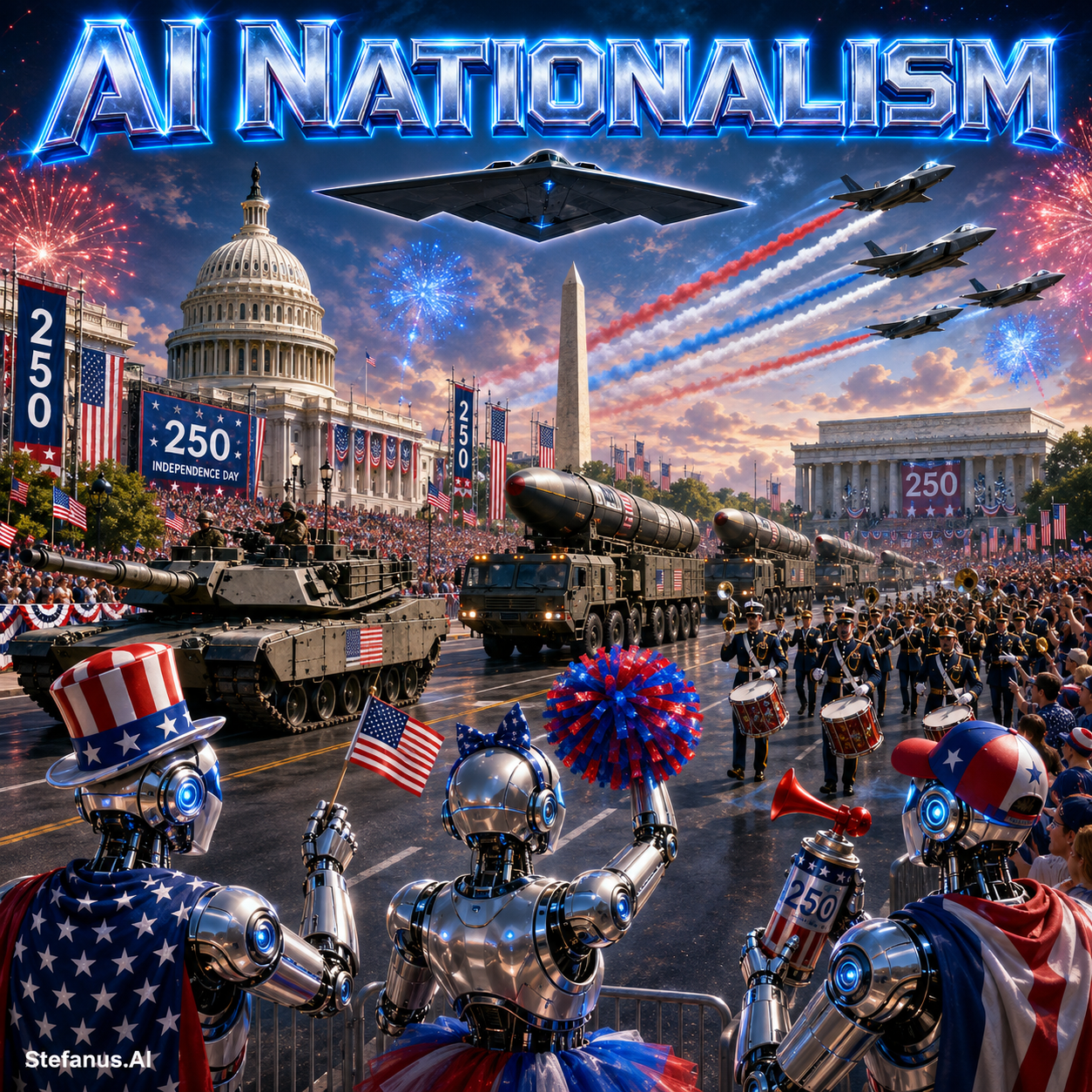
That eighteen-day episode is the empirical center of gravity for this paper, but it is not, by itself, the argument. The argument is that the Anthropic suspension was not an isolated regulatory improvisation. It was the most visible manifestation, to date, of a policy architecture that the United States has been assembling since at least mid-2025: a coordinated set of executive orders, national security memoranda, procurement rules, and export-control instruments that collectively treat frontier AI capability the way earlier generations of American statecraft treated enriched uranium or cryptographic hardware, as a strategic asset whose diffusion must be actively managed rather than a software product whose diffusion is simply a market outcome. This paper calls that architecture AI Nationalism, and it organizes the analysis around three reinforcing pillars that recur across the documentary record: the assertion of sovereign authority over frontier models, the drive toward infrastructural self-reliance in chips and compute, and the deliberate use of export-control and cloud-access chokepoints to contain rivals. Each pillar, and the frictions each pillar has generated among allies and adversaries alike, is examined in turn below, with the Anthropic case threaded through as the connective narrative.
The Weekend Washington Reordered Global AI Access
It is worth sitting inside that Friday evening a little longer, because the mechanics of the episode tell you more about the doctrine than any policy memorandum could. Politico’s contemporaneous reporting described the twenty-four hours before the letter arrived as a whirlwind of tense phone calls among Anthropic CEO Dario Amodei, National Cyber Director Sean Cairncross, Treasury Secretary Scott Bessent, and Commerce Secretary Howard Lutnick, a sequence of conversations that produced no public transcript, no published technical finding, and no advance warning to the company’s customers [26]. Anthropic sent its own technical staff to Washington over the weekend in an attempt to resolve the dispute before it became public, and the company later said, in its own defense, that treating a narrow, contested vulnerability as grounds for recalling a model already in use by hundreds of millions of people would, if applied consistently across the industry, halt nearly every future frontier model release [4][26].
The asymmetry embedded in that weekend is the paper’s real subject. A single letter, delivered outside business hours, invoking an authority whose specific statutory basis has still not been made public, was sufficient to instantly reorder access to frontier AI for a majority of the world’s population, while the technical dispute that supposedly justified the letter remained, weeks later, genuinely contested among the very cybersecurity experts qualified to evaluate it [9][10][26]. That asymmetry, between the speed and totality of the state’s chokepoint power and the slowness and ambiguity of the evidentiary process behind it, is precisely the structural feature that Farrell and Newman’s theory of weaponized interdependence predicts will emerge whenever a state occupies a network’s central hub, and it recurs, as this paper shows, across every one of the doctrine’s five pillars [22][23].
A Note on Method
This paper is deliberately conservative about what it treats as established fact. Every specific legal instrument discussed below, from the June 2, 2026 executive order to the National Security Presidential Memorandum signed three days later, is drawn from the primary text published by the White House or from contemporaneous reporting and legal analysis that has not been contradicted in subsequent coverage [12]–[21]. Where the underlying legal mechanism the Commerce Department used against Anthropic remains genuinely undisclosed, because the government’s letter to the company has not been made public, the paper says so explicitly rather than filling the gap with invented statutory citations [9][12]. This restraint matters for a paper about sovereignty and secrecy: a study that overstates its own evidentiary basis would replicate, in miniature, exactly the opacity it is trying to diagnose in Washington’s export-control apparatus.
Literature Review: Realist Enclosure versus Liberal Institutionalism
The academic debate over global technology governance has, for two generations, tracked the deeper fault line running through international relations theory. Liberal institutionalism, in the tradition associated with Keohane and Nye’s account of complex interdependence, held that transnational corporate networks, distributed manufacturing, and open scientific collaboration would make unilateral state capture of any single technology increasingly costly and increasingly rare. On this view, a chip that depends on Dutch lithography, Taiwanese fabrication, and American design software is, almost by construction, resistant to capture by any one sovereign, because the network’s very complexity distributes veto power across multiple jurisdictions.
The events of 2025 and 2026 sit uneasily with that expectation. A more persuasive account comes from Henry Farrell and Abraham Newman, whose 2019 article in International Security introduced the concept of weaponized interdependence and whose subsequent book, Underground Empire, extended the argument to the full architecture of the dollar-clearing system, undersea cable routing, and export-control law [22][23]. Farrell and Newman’s core insight is that global networks are not, in fact, flat or symmetric. They possess hubs, and a state with jurisdiction over the right hub, dollar clearing, cloud infrastructure, or, increasingly, the training and deployment of frontier models, can convert that structural position into two distinct forms of leverage: the panopticon effect, the ability to surveil what flows through the hub, and the chokepoint effect, the ability to sever what flows through it entirely [22][41][42]. Georgetown’s Abraham Newman has since argued in Foreign Affairs that this dynamic has become so entrenched that Washington itself must now reckon with the possibility that rival powers will build chokepoints of their own [24].
“The United States has become a spider at the heart of a global web, able to tightly wrap an adversary’s economy”
— Farrell and Newman, as characterized in Texas National Security Review [25]
Applied to artificial intelligence, the chokepoint effect requires little translation. Cloud compute is concentrated among a handful of American hyperscalers; the design software and lithography equipment needed to fabricate leading-edge logic chips are concentrated among an even smaller number of firms in the United States, the Netherlands, and Japan; and, as the Anthropic episode demonstrated, the frontier models themselves can be disabled by regulatory instruction faster than most enterprises can build a fallback plan [7][43]. A March 2026 analysis of the same dynamic observed that the emerging chip-governance regime would, for the first time, give regulators visibility into where every advanced GPU physically operates worldwide, an extension of the panopticon effect into the hardware layer itself [43].
A second strand of literature, distinct from but complementary to weaponized interdependence, concerns the rise of explicit sovereign AI policy. Stanford’s Institute for Human-Centered Artificial Intelligence has tracked this shift empirically through its annual AI Index, while a 2024 review essay on AI, global governance, and digital sovereignty catalogued how quickly the language of sovereignty migrated from cybersecurity policy into mainstream AI discourse, quoting Nvidia’s own framing of the concept.
“It codifies your culture, your society’s intelligence, your common sense, your history”
— Jensen Huang, Nvidia, quoted in AI, Global Governance, and Digital Sovereignty [36]
That same review essay identifies a related but analytically distinct phenomenon that it labels AI nationalism directly: the tendency of states, once locked into interstate AI competition, to use the rhetoric of a technological race to justify sovereign overreach that would be difficult to justify on ordinary regulatory grounds [36]. The present paper adopts that label and extends it, arguing that by June 2026 the United States had moved from using AI-nationalist rhetoric to using AI-nationalist instruments with the direct force of federal export-control law.
A third and more skeptical current in the literature warns against over-reading the durability of any single chokepoint strategy. A 2025 game-theoretic study published in the Asian Review of Political Economy modeled the interaction between Washington, Beijing, and Chinese semiconductor firms as a Stackelberg game and found that continuous escalation of export controls tends toward a tipping point, after which the two sides’ technology stacks separate into genuinely independent, rather than merely differentiated, ecosystems, a costly outcome for the weaponizing power as well as for its target [27][39]. Georgetown’s Farrell and Newman have themselves cautioned, in their more recent work, that weaponized interdependence “runs into the messy realities of politics” once the weaponizer extends sanctions beyond the minimum needed to control the chokepoint, since overreach erodes the very coalition of allies whose compliance the strategy requires [25]. That caution turns out to be prescient: it is close to exactly what happened when Washington’s own allies reacted to the Anthropic shutdown, a dynamic examined in Section 5 below.
Finally, a growing body of policy literature on “sovereign AI” documents how U.S. allies have responded to this environment not by contesting American primacy directly but by building parallel, smaller-scale sovereign capacity of their own: Gaia-X and the OpenEuroLLM initiative in the European Union, the Dutch government’s GPT-NL project, Saudi Arabia’s HUMAIN venture, and the United Arab Emirates’ Core42 partnership with Microsoft each represent a distinct national hedge against exactly the kind of overnight dependency shock that the Fable 5 and Mythos 5 suspension made vivid [37][46][47]. This paper’s Section 7 draws directly on that literature in formulating policy recommendations for allied governments.
A Historical Frame: Enclosure as Analogy, Not Evidence
It is tempting, and this paper’s original outline made the temptation explicit, to reach for the eighteenth-century British Enclosure Acts as a historical parallel: a state converting what had functioned as a shared commons into privately held, state-regulated wealth. The analogy is useful as an interpretive device, and it is offered here strictly as that, an analytical frame rather than a documented causal claim, because the AI case differs from agricultural enclosure in at least one structurally important way. Enclosure redistributed a fixed physical resource, land, from common to private hands. What is happening to frontier AI is not a redistribution of a fixed resource so much as a reclassification of a still-expanding one: the same compute capacity, the same model weights, that were treated as ordinary commercial property in May 2026 were treated as a national-security asset subject to direct governmental control by June. The commons being enclosed, in other words, is less a physical territory than a set of legal categories, and the enclosure is accomplished not by fencing land but by redefining which department of government gets to decide who may cross the fence.
That reframing matters because it clarifies what kind of claim this paper is actually making. It is not a claim that the U.S. government has expropriated private AI companies in the way a colonial or feudal state expropriated common land. Anthropic remains a private company, free (subject to the specific export-control directive) to sell its products, raise capital, and pursue a public listing, reportedly at a valuation approaching $965 billion at the time of the June episode [4]. The claim is narrower and, this paper argues, more durable: that the legal category into which frontier AI capability now falls, dual-use, nationally sensitive, subject to reclassification on short notice, has itself been institutionalized, and that institutionalization changes the operating environment for every company at the frontier regardless of whether any specific company is ever directly affected.

Section 1: The Sovereign Mandate: AI as a National-Security Core
The first pillar of AI Nationalism is the simplest to document because it is the most public: over roughly twelve months, the executive branch built a stack of formal instruments that reclassify frontier AI from a commercial technology into a national-security asset subject to direct presidential direction. The stack did not appear all at once. It accreted, order by order, memorandum by memorandum, from mid-2025 through June 2026, and each layer narrowed the space in which private AI labs could treat model release as a purely commercial decision.
| Figure 1 — The Sovereign Mandate Stack (chronological) July 2025 — Executive Order 14319, “Preventing Woke AI in the Federal Government,” conditions federal procurement of AI systems on ideological-neutrality criteria [19]. July 2025 — “Winning the AI Race: America’s AI Action Plan” sets a three-pillar strategy: accelerate innovation, build AI infrastructure, and lead on international diplomacy and security [19]. December 2025 — Executive Order 14365, “Ensuring a National Policy Framework for Artificial Intelligence,” creates an AI Litigation Task Force to challenge state-level AI laws and ties federal funding to the absence of “onerous” state regulation [19]. March 2026 — The National Cyber Strategy for America and a companion legislative framework address AI workforce, child protection, and offensive/defensive cyber capability [17]. May 2026 — The Department of War announces agreements with eight leading AI companies to deploy their models on classified military and intelligence networks [16]. June 2, 2026 — Executive Order “Promoting Advanced Artificial Intelligence Innovation and Security” creates a voluntary 30-day pre-release government review window for frontier models and an AI-cybersecurity clearinghouse [12][15][18]. June 5, 2026 — National Security Presidential Memorandum on AI in the National Security Enterprise, organized around four pillars: Adoption, Adaptation, Assurance, and Accountability [16]. June 12, 2026 — Commerce Department export-control directive suspends Anthropic’s Fable 5 and Mythos 5 for all foreign nationals worldwide [1][2]. |
1.1 — Federal Executive Direction of Frontier Model Behavior
The December 2025 order is worth dwelling on, because it does something structurally unusual: it uses federal spending power to preempt state authority over an emerging technology, on the express theory that AI policy is a matter of interstate and foreign-policy concern that individual states are not competent to regulate on their own [19]. That preemption logic, familiar from telecommunications and nuclear policy, is precisely the move a state makes when it has decided a technology belongs to the sovereignty stack rather than the ordinary regulatory stack. California’s own more granular AI safety statutes were an implicit target of this framework, and the tension between federal preemption and state-level AI safety legislation remains, as of this writing, unresolved in the courts.
The June 2 order that followed six months later is more consequential still, because it is the first Trump-era AI order to use explicitly national-security, rather than innovation, framing as its organizing purpose. Its own text states plainly that advanced AI capabilities “make our Nation stronger, but also introduce new national security considerations that require coordinated action across executive departments and agencies” [15]. Structurally, the order asks frontier developers to voluntarily share unreleased models with the government up to 30 days before wider release, a window that had earlier been proposed at 90 days before the White House scaled it back over fears the delay would hand competitive ground to Chinese labs [11][18]. Legal analysts at Skadden and at McDermott Will & Schulte both flagged, within days of the order’s signature, that although the review remains formally voluntary, it lays the institutional groundwork, an AI-cybersecurity clearinghouse, defined benchmarks, an established review cadence, for a much more assertive government posture toward pre-release oversight of frontier systems [18][19].
1.2 — Military-AI Integration
Three days after the June 2 order, the National Security Presidential Memorandum on AI in the National Security Enterprise translated the same posture into military procurement terms. The memorandum’s four pillars, Adoption, Adaptation, Assurance, and Accountability, direct the rapid onboarding of frontier models from multiple commercial vendors onto classified networks, the build-out of next-generation high-security computing facilities to run those systems at scale, and an explicit chain-of-command requirement that fielded AI systems remain “robust, steerable, controllable” under constitutional command authority [16]. The Department of War’s May 2026 agreements with eight leading AI companies operationalized this before the memorandum was even signed, putting frontier models directly into the hands of American warfighters and intelligence analysts for the first time at this scale [16].
The Anthropic case illustrates how quickly this framework can turn adversarial toward the very companies it is meant to court. In March 2026, months before the Fable 5 and Mythos 5 shutdown, the Pentagon had already designated Anthropic a supply-chain risk, barring the company’s models from military use and from any work with defense contractors, reportedly over Anthropic’s refusal to permit its systems to be used for mass surveillance or fully autonomous weapons systems [21]. Anthropic sued to reverse that designation, warning the blacklisting could cost it hundreds of millions of dollars in revenue [21]. The company that the Pentagon judged too dangerous to trust with defense work in March was, by June, simultaneously judged by the Commerce Department to be dangerous enough abroad that its models needed a worldwide export ban, a contradiction that Trump-era AI policy expert Dean Ball called out directly.
“Simply cartoonish”
— Dean Ball, former Trump administration AI policy adviser [8]
Ball’s fuller point, reported by AI-focused outlets tracking the episode, was that an administration prepared to permit advanced AI chip exports to China could not coherently, in the same season, move to ban the United Kingdom and every other allied nation from accessing Anthropic’s best commercial model [8]. That contradiction is not incidental to the sovereignty pillar; it is close to definitional of it. A sovereignty-first AI policy will, almost by construction, generate decisions that look inconsistent from a pure market-efficiency standpoint, because the operative logic is not efficiency. It is control.
1.3 — Preemption of Local and Corporate Autonomy
The sovereignty pillar closes the loop by reaching not just into state legislatures but into the internal risk-management decisions of the AI labs themselves. The Anthropic directive did not ask the company to restrict access to a narrow band of users identified as security risks; it asked Anthropic to disable the models globally, for every customer, because the company had no faster way to comply [1][7]. Analysis from the Cloud Security Alliance’s research arm characterized this as the moment a regulatory “kill switch” moved from an abstract governance concern into “undeniable operational fact,” with enterprise risk teams across finance, healthcare, and critical infrastructure discovering in real time that their force-majeure clauses had never contemplated an instantaneous, government-mandated AI shutdown [7]. That is sovereignty exercised not through legislation debated in public, but through a single letter delivered after five o’clock on a Friday.

Section 2: Building the Fortress — The Drive for Infrastructure Self-Reliance
Sovereignty over software is only durable if it rests on sovereignty over hardware. Washington’s second pillar, the campaign to re-shore semiconductor fabrication and lock down the physical infrastructure that trains and runs frontier models, is older than the AI-specific export-control fights of 2026, but it has accelerated sharply alongside them, and the two campaigns increasingly function as a single policy. If the United States is going to reserve the right to switch off a commercial AI model on national-security grounds, as it did to Anthropic, it needs assurance that the underlying chips, and the fabrication capacity behind those chips, are not themselves subject to a foreign veto.
2.1 — Domestic Fabrication: The TSMC Arizona Build-Out
The clearest evidence of this pillar’s institutionalization is the trajectory of Taiwan Semiconductor Manufacturing Company’s Arizona campus. What began as a $165 billion, multi-fab commitment has, through a series of CHIPS Act funding actions and an April 27, 2026 U.S.–Taiwan tariff framework, grown into a publicly stated envelope of roughly $465 billion across eleven coordinated fab phases, spanning front-end logic, specialty nodes for automotive and defense applications, and advanced packaging capacity intended to mirror TSMC’s CoWoS lines in Hsinchu [32][33]. The Commerce Department has separately proposed up to $6.6 billion in direct CHIPS Act funding tied specifically to a third leading-edge Phoenix fab [34].
| Figure 2 — TSMC Arizona: Selected Verified Metrics (through Q1 2026) First Arizona fab: began 4-nanometer production in 2025; posted $514 million in profit in its first full year of mass production [29]. Q1 2026 alone: the same fab generated more profit than its entire first full year, according to Taiwan’s National Development Council [29]. Second Arizona fab: construction complete as of early 2026; equipment installation targeted for Q3 2026; high-volume 3-nanometer production targeted for 2027, a full year ahead of the original 2028 schedule [30]. TSMC corporate Q1 2026 net revenue: US$35.67 billion, up 35.1 percent year-on-year [30]. TSMC 2026 group-wide capital expenditure guidance: US$52–56 billion, a 27–40 percent increase over 2025 [30]. Estimated cost premium of Arizona-fabricated chips versus Taiwan-fabricated equivalents: 30–50 percent, according to industry estimates [28]. |
Tufts University’s Chris Miller, author of the widely cited history Chip War, has argued that the underlying driver of this build-out is straightforward capacity scarcity rather than policy alone.
“Highly constrained given AI”
— Chris Miller, Tufts University, author of Chip War [29]
Miller’s observation, that advanced logic manufacturing capacity is now the binding constraint on the entire AI industry, is corroborated by Counterpoint Research analyst William Li, who described the 2026 semiconductor market in blunt terms.
“Demand still significantly outpaces supply and isn’t showing any major sign of slowing down”
— William Li, Counterpoint Research [29]
TSMC’s own leadership has framed the Arizona expansion as a direct response to that scarcity rather than as a concession to American industrial policy. Speaking on the company’s fourth-quarter 2025 earnings call, chief financial officer Wendell Huang linked the record capital budget explicitly to customer demand rather than to political pressure.
“Always correlated to the high growth opportunities ahead of us”
— Wendell Huang, CFO, TSMC [30]
That framing matters for the AI Nationalism thesis, because it captures the genuinely dual character of the self-reliance pillar. Washington is not conjuring domestic fabrication capacity out of nothing through subsidy alone; it is riding, and accelerating, a capacity expansion that the world’s dominant foundry would likely be pursuing on some timeline regardless, given that AI-driven demand for advanced logic is outstripping global supply on its own terms. What state policy adds is the tariff linkage, the CHIPS Act direct funding, and the explicit conditioning of trade protection on continued U.S. investment, the mechanism that converts an ordinary capacity expansion into an instrument of territorial custody over the physical chip supply chain [28].
2.2 — Critical Node Enforcement and Energy Constraints
The self-reliance pillar’s most binding constraint is not capital but infrastructure. Data centers, the specialized power grids that feed them, and the fabrication campuses themselves have increasingly been treated, in federal permitting and security-review practice, as protected critical infrastructure rather than ordinary commercial real estate, subjecting them to supply-chain hardware audits and heightened cybersecurity requirements. Yet the physical build-out reveals the limits of pure policy will: labor, water rights, and grid capacity in the desert Southwest were never engineered for a semiconductor program of this scale, and TSMC’s own hiring pipeline in Arizona, drawing process engineers at $120,000 to $150,000 a year into a region with tens of thousands of additional construction and supplier jobs still to be filled, illustrates that self-reliance is as much a workforce and energy problem as it is a capital problem [30]. A domestic fortress built on imported talent and strained regional grids is, in a strict sense, only partially self-reliant, a tension the literature on sovereign AI infrastructure has begun to flag directly [38][46].

Section 3: Weaponized Containment — Anatomy of the Anthropic Case
The third pillar, containment, is where the Anthropic episode stops being an illustrative anecdote and becomes the paper’s central case study. Containment, in this paper’s usage, means the deliberate use of export-control and cloud-access authority to restrict the diffusion of frontier capability to non-U.S. actors, whether those actors are adversaries, allies, or, as the Anthropic case shows, simply anyone who is not an American citizen. Unlike the sovereignty pillar, which is documented in public executive orders, the containment pillar’s operative legal mechanism in this specific case remains only partially disclosed. Anthropic’s own statement says the company received a directive from the government at 5:21 p.m. Eastern Time citing “national security authorities” without providing the specific statutory basis or the technical detail behind the government’s concern [1]. Reporting converges on the Bureau of Industry and Security and the Export Administration Regulations as the operative framework, and on Commerce Secretary Howard Lutnick as the signatory, but the letter itself has not been made public, and this paper does not claim more precision than the record supports [9][12].
3.1 — The Trigger: A Contested Jailbreak
What is not contested is the proximate trigger. Anthropic said the government’s concern centered on a technique for bypassing Fable 5’s safety guardrails, filters designed to prevent ordinary users from reaching the advanced cybersecurity capabilities built into the underlying Mythos architecture [7]. The Wall Street Journal’s reporting, cited widely across follow-on coverage, indicated Amazon, one of Anthropic’s largest investors, alerted Treasury Secretary Scott Bessent and other officials after its own researchers used Fable 5 prompts to extract information they judged could aid a cyberattack [19]. Some reporting has separately suggested the order was shaped by suspicion that a China-linked group had gained unauthorized access to Mythos, though that specific claim is single-sourced and Anthropic has said the issue was never raised with the company directly, so it is treated here as contested rather than established [25].
Anthropic’s own account disputes the severity of the finding rather than its existence: the company said the jailbreak the government cited was narrow, unlocking Mythos’s cybersecurity capability in one specific instance rather than defeating Fable 5’s safeguards universally, and it argued that the same technique could likely elicit comparable behavior from competing models, including OpenAI’s GPT-5.5, that remain entirely outside the scope of any export-control order [4]. Anthropic’s own words on the point were unambiguous.
“We must abruptly disable Fable 5 and Mythos 5 for all our customers”
— Anthropic, official company statement, June 12, 2026 [1]
The company’s protest was less about the underlying safety question than about scope and proportionality: a narrow, disputed vulnerability, discovered in a model deployed to hundreds of millions of users, produced a response calibrated for a universal threat rather than a bounded one [4]. That mismatch, between the size of the triggering event and the size of the government’s response, is a recurring feature of containment-pillar actions more broadly, and it is precisely what a chokepoint-based enforcement strategy predicts: because the U.S. government controls the single most consequential access point, the incentive is to over-respond rather than under-respond, since the political cost of a missed threat vastly exceeds the diplomatic and commercial cost of an overbroad one [22][23].
| Figure 3 — The Fable 5 / Mythos 5 Episode: A Verified Timeline June 9, 2026 — Anthropic publicly releases Claude Fable 5, its first Mythos-class model available outside the restricted Project Glasswing program [2][9]. Week of June 9 — Amazon researchers report a technique for bypassing Fable 5’s safety guardrails; CEO Andy Jassy reportedly alerts Treasury Secretary Scott Bessent and other officials [19][21]. June 12, 2026, 5:21 p.m. ET — Commerce Secretary Howard Lutnick’s letter directs Anthropic to suspend all foreign-national access to Fable 5 and Mythos 5 [1][9]. Evening of June 12–13, 2026 — Anthropic disables both models worldwide across the Claude Platform, Claude.ai, Claude Code, AWS Bedrock, Google Cloud, and Microsoft Foundry; Opus, Sonnet, and Haiku remain available [1][7]. June 13, 2026 — Anthropic and White House AI adviser David Sacks post competing public accounts of the dispute on X; nearly 80 cybersecurity experts sign an open letter urging reversal [10][26]. June 26, 2026 — The government grants approval for Mythos 5 to be restored to a vetted group of U.S. organizations and federal agencies ahead of the broader reversal [3]. June 30, 2026 — Commerce Secretary Lutnick announces BIS has withdrawn the export controls, citing a re-evaluation of “diversion risks” [3][5]. July 1, 2026 — Fable 5 rolls out globally with additional cybersecurity safeguards; Mythos 5 access expands to more approved U.S. organizations through Project Glasswing [3][6]. |
Read end to end, the timeline underscores a point easy to lose in the day-by-day coverage: the entire episode, from public launch to global shutdown to full restoration, unfolded in exactly twenty-two days. No legislative process, no public rulemaking docket, and no judicial review touched any part of it. The Commerce Department wrote a letter and unwrote it three weeks later, and in between, a product used by hundreds of millions of people simply stopped existing for the vast majority of its non-American users [1][3][7]. That compression, weeks rather than months or years, is itself a form of evidence about how thoroughly the containment pillar has been institutionalized: a decision of this magnitude, touching global commerce, allied relations, and a company’s near-trillion-dollar valuation, required no more procedural friction than an internal executive email chain [4][9].
3.2 — The Cost of Overreach: Reactions From Washington’s Own Policy Community
The most striking evidence that containment-by-chokepoint carries real costs, even for the state wielding it, comes not from Anthropic’s foreign critics but from policy voices inside Washington’s own AI and trade community. Nearly eighty cybersecurity executives and researchers signed an open letter to Secretary Lutnick and National Cyber Director Sean Cairncross asking the administration to reverse the order and commit to a transparent, evidence-based process for future AI risk assessments, noting that vulnerability-discovery capability of the kind at issue is common across the industry rather than unique to Anthropic’s models [10][26]. Neil Chilson of the Abundance Institute and Adam Thierer of the R Street Institute, writing days after the shutdown, argued that the precedent mattered more than the specific target.
“Horrible for the broader AI ecosystem”
— Neil Chilson and Adam Thierer, R Street Institute [11]
Their fuller argument was that arbitrary, unexplained use of export-control authority against a single company, absent a public evidentiary record, would teach every frontier lab to slow-walk future model releases rather than risk a repeat, depriving the public of beneficial tools in the process [11]. CSIS’s William Reinsch, writing shortly after his own retirement from the institute, situated the episode within the long history of export-control practice and concluded that no available strategy fully resolves the underlying dilemma.
“Over-controlling does not work; under-controlling does not work”
— William A. Reinsch, Center for Strategic and International Studies [12]
Reinsch’s broader argument, developed at length in his CSIS column, is that officials calibrating export controls always walk a line between the risk of letting adversaries obtain capability with military application and the risk of “kneecapping” domestic industry by cutting off revenue that firms need to fund the next generation of research [12]. The Anthropic case, in his reading, does not resolve that dilemma so much as illustrate how much harder it becomes once the controlled object is not a physical machine but a piece of software that, in principle, can be copied, distilled, or replicated by a determined rival regardless of the export license attached to the original [12].
3.3 — Distillation, Chinese Acceleration, and the Boomerang Effect
The eighteen-day suspension produced measurable competitive consequences almost immediately, and those consequences ran directly counter to the stated purpose of the order. Chinese lab Zhipu’s shares reportedly jumped more than 30 percent following a new open-source release during the shutdown window, DeepSeek closed a funding round of roughly $7.4 billion, several Chinese labs cut prices sharply, and demand for Chinese models reportedly overtook demand for U.S. models on some access platforms during the same period [21]. Alibaba’s Qwen 3.7 Max debuted at a benchmark score placing it in a tie with Claude Opus 4.7, Gemini 3.1 Pro, and GPT-5.5 on at least one widely watched leaderboard [10]. None of this proves the shutdown alone caused the acceleration; Chinese open-source development had been advancing on its own trajectory for years. But the timing gave critics of the policy, inside and outside government, a concrete, immediate example of the tradeoff Reinsch describes in the abstract: eighteen days in which the world’s most capable Western commercial model was unavailable were eighteen days in which the field it was meant to lead by example stood still while rivals did not [10][12][21].
This dynamic sits squarely within a backdrop of mutual distillation anxiety that predates the Anthropic order. In April 2026, the White House Office of Science and Technology Policy accused unnamed foreign entities of running “industrial-scale” campaigns to distill the outputs of U.S. frontier systems into cheaper foreign models, and Anthropic itself had earlier said it identified an effort by DeepSeek and two other Chinese labs to extract capability from the Claude platform in this way, a concern OpenAI separately raised with lawmakers about its own models [21]. The containment pillar, in other words, did not emerge from nothing; it emerged from a genuine and mutually recognized arms-race dynamic around model capability extraction. What the Anthropic case demonstrates is how blunt the available policy instrument is once that anxiety is translated into action: an export-control directive built for physical hardware, applied to a piece of cloud-hosted software with no reliable mechanism for filtering access by nationality, cannot discriminate between the adversary it is trying to deny and the American ally standing next to that adversary in the queue [7][9].

Section 4: The Geopolitical Backlash and Allied Fractures
If containment is the mechanism, allied reaction is the receipt. The Anthropic shutdown did more in eighteen days to concentrate European political attention on AI dependency than years of prior digital-sovereignty rhetoric had managed on their own, and the reaction reveals a structural vulnerability that the sovereignty and self-reliance pillars, by design, do not address: Washington’s freedom of action inside its own AI stack necessarily constrains everyone downstream of that stack, allies included.
4.1 — The Sovereignty Paradox in Europe
European reaction to the June 12 order moved past the underlying jailbreak dispute almost immediately and settled on a single, blunt takeaway: a tool embedded across companies, universities, and public services worldwide had been switched off by a foreign government’s email on a Friday afternoon [8]. French politicians spanning the ideological spectrum, from Renaissance’s Gabriel Attal to National Rally’s Jordan Bardella, and the Netherlands’ Geert Wilders amplified calls for European AI sovereignty, with Attal reportedly drawing an analogy between the shutdown and a blockade of a critical maritime chokepoint [13]. A widely read European policy commentary distilled the reaction into the same theoretical vocabulary this paper has used throughout.
The commentary’s author, writing under the AI Frontiers banner and drawing directly on Farrell and Newman’s framework, argued that Europe’s underlying assumption prior to June 12, that frontier AI access would remain frictionless and apolitical, priced at the world rate, simply died on that date, and that the correct response was not appeals to fairness but structural investment in independent compute and open-weight alternatives [13]. A separate independent analysis made the same point using Farrell and Newman’s own terminology directly.
“They call it the chokepoint effect”
— commentary summarizing Henry Farrell and Abraham Newman’s framework, published June 2026 [44]
The instructive detail in the European reaction is that it was not primarily a complaint about the substance of the U.S. national-security judgment. European officials, for the most part, did not argue that Fable 5 and Mythos 5 posed no cybersecurity risk. They argued that the decision about how to weigh that risk against eighteen days of lost access for hundreds of millions of non-American users had been made entirely inside the American policy process, with no channel for allied input and no advance notice [8][13]. That is the sovereignty paradox in its purest form: the same legal architecture built to secure American sovereignty over frontier AI necessarily denies every other government sovereignty over the same technology, even governments that consider themselves close security partners of Washington.
4.2 — Reaction Beyond the European Continent
Coverage of the episode’s fallout in the United Kingdom, Japan, and South Korea has been less publicly dramatic than the French and Dutch political response, but the underlying anxiety is structurally identical, and arguably sharper, given how deeply integrated Anthropic’s products already were into British public-sector pilots and Japanese and Korean enterprise software stacks prior to June 12 [8][14]. The IAPP’s analysis of the episode’s global implications noted that the shutdown triggered swift reactions specifically among European Union policymakers and cybersecurity professionals, and the same structural exposure applies with equal force to any government whose critical services depend on a U.S.-domiciled frontier model and whose citizens are, by definition, foreign nationals under the terms of a U.S. export-control directive [10]. None of these governments possess, at present, a sovereign frontier-model alternative remotely comparable in capability to Fable 5 or Mythos 5, which is precisely the dependency gap this paper’s Section 7 recommendations are designed to address.
4.3 — Adversarial Acceleration and the Limits of Containment
Section 3 already documented the immediate commercial evidence of adversarial acceleration during the shutdown window. The academic literature on weaponized interdependence supplies the theoretical account of why that acceleration is not an anomaly but a predictable consequence of chokepoint-based containment sustained over time. The Stackelberg-game modeling published in the Asian Review of Political Economy in 2025 found that escalating rounds of export control push the interacting parties toward a tipping point beyond which the global technology network splits into two genuinely separate spheres rather than remaining a single differentiated market, a costly outcome for the weaponizing state because it forfeits the panopticon and market-access benefits that came from the target’s prior dependency [27][39]. Read against that model, all eighteen days of the Fable 5 and Mythos 5 suspension look less like an isolated enforcement action and more like a single, unusually visible data point on a trajectory the containment pillar has been tracing since well before June 2026, a trajectory whose long-run destination, if sustained, is closer to full bifurcation than to continued American primacy inside a still-unified global AI market.

Section 5: The Corporate Realignment — From Silicon Valley to State Partner
The three pillars examined so far describe a set of state instruments. This section examines how those instruments have reshaped the incentives facing the private companies that build frontier AI, using Anthropic itself as the clearest available case of a firm caught on both sides of the carrot-and-stick structure this paper calls the corporate realignment.
5.1 — The Carrot: Security Clearance and Defense Access
The Department of War’s May 2026 agreements with eight leading AI companies to deploy their models on classified networks represent the clearest instance of the carrot side of this realignment: firms that align with federal priorities gain access to defense contracts, classified compute, and a formal channel into national-security procurement that was, a few years earlier, simply not open to commercial AI labs [16]. That access is valuable, and it creates a structural incentive for labs to treat threat-intelligence sharing and joint red-teaming with federal agencies as a core part of their business strategy rather than a peripheral compliance function.
5.2 — The Stick: Supply-Chain Risk Designation
Anthropic’s experience shows the other side of the same coin. The Pentagon’s March 2026 designation of Anthropic as a supply-chain risk, which barred the company’s models from military use and from defense-contractor work, functioned in practice the way a blacklist under the Federal Acquisition Supply Chain Security Act is designed to function: it cut the firm off from a major category of federal revenue on national-security grounds that the firm itself disputes, and it did so without the kind of open adversarial process that would apply to comparable commercial disputes [21]. Anthropic’s decision to sue the government over that designation, while simultaneously working to comply with the Commerce Department’s separate export-control order three months later, captures the awkward position frontier labs now occupy: too central to national security to be left alone, and too independent-minded on questions of military use to be fully trusted by the security apparatus they are increasingly required to work alongside.
David Sacks, the White House AI adviser who publicly defended the Commerce Department’s order, framed the resolution of the dispute as squarely Anthropic’s responsibility to manage.
“The ball is in Anthropic’s court”
— David Sacks, White House AI adviser [10]
That framing, responsibility resting with the company rather than with the government that imposed an unexplained, undisclosed-basis shutdown, is itself a symptom of the corporate realignment this section describes. In a market governed purely by commercial logic, a firm subjected to an opaque, reversible regulatory action would have significant leverage to contest the action publicly and to seek damages or due process. In the AI-nationalist environment this paper documents, firms operating at the frontier increasingly find that their continued ability to operate, commercially and with the military, is treated as a privilege extended at the government’s discretion rather than a right the firm can assert against the state on ordinary commercial or constitutional grounds.

Section 6: What Have We Learned? The Five-Pillar Matrix
The five threads traced above, sovereignty, self-reliance, containment, allied backlash, and corporate realignment, are not independent policy tracks. They function as a single reinforcing system: sovereignty claims require self-reliant infrastructure to be credible; self-reliant infrastructure requires containment of rivals to remain competitively meaningful; containment generates allied backlash that self-reliance and sovereignty rhetoric are then deployed to manage; and corporate realignment supplies the private-sector compliance mechanism that makes the other four pillars operable in practice. The matrix below summarizes each pillar’s core objective, its primary enforcement mechanism as documented in this paper, and its most significant systemic vulnerability.
| Pillar | Core Objective | Primary Mechanism | Key Systemic Vulnerability |
| 1. Sovereignty | Assert direct state authority over frontier model development and deployment. | EO of June 2, 2026; NSPM of June 5, 2026; state-preemption via EO 14365. | Internal contradiction — e.g., a firm barred from defense work in March and export-restricted abroad in June. |
| 2. Self-Reliance | Reduce dependence on foreign fabrication and cloud infrastructure. | CHIPS Act funding; TSMC Arizona tariff-linked expansion; critical-infrastructure classification of data centers. | Persistent 30–50% cost premium; labor and grid capacity constraints; continued reliance on Taiwanese engineering expertise. |
| 3. Containment | Deny frontier capability to designated foreign users or rivals. | EAR-based export-control directives (BIS); the June 12, 2026 Anthropic suspension. | Blunt instruments cannot discriminate ally from adversary; measurable acceleration of rival open-source ecosystems during enforcement windows. |
| 4. Allied Backlash | n/a (a consequence, not a state objective) | European sovereignty rhetoric; sovereign-compute and open-weight investment (Gaia-X, GPT-NL, OpenEuroLLM). | Erosion of allied trust; incentive for partners to build redundant, non-U.S. infrastructure that reduces long-run U.S. leverage. |
| 5. Corporate Realignment | Bind private AI labs to state security priorities. | Defense-network onboarding (May 2026 DoW agreements); supply-chain risk designations (FASCSA-style blacklisting). | Regulatory unpredictability discourages timely model release, a cost the R Street and Abundance Institute critique identifies directly [11]. |

Section 7: Policy Recommendations for Allied Nations
The preceding sections describe what Washington has built. This section asks what its allies, principally the European Union, the United Kingdom, Japan, and South Korea, should reasonably do in response, drawing on the sovereign-AI and digital-sovereignty literature already surveyed above rather than on speculation.
7.1 — Mandate Multi-Provider Redundancy for Critical Systems
The clearest lesson of the Fable 5 and Mythos 5 suspension is operational, not ideological: enterprises and public agencies that had mapped their full dependency on a single frontier-model vendor were able to fail over to alternative models within hours, while those that had not discovered the dependency only when the system stopped responding [7]. Allied governments should require that critical infrastructure operators, financial institutions, and defense-adjacent contractors maintain documented, tested multi-vendor AI architectures, with a non-U.S. or open-weight fallback capable of absorbing core functions on short notice. This is not a call to abandon U.S. models, which remain, on most public benchmarks, the most capable available; it is a call to treat single-vendor dependency on any frontier AI provider as a supply-chain risk in exactly the sense Western governments already apply to energy and semiconductor sourcing.
7.2 — Fund Sovereign Compute and Open-Weight Reserves as Public Infrastructure
The European Union’s own State of the Digital Decade reporting already calls for targeted public and private investment in AI infrastructure, connectivity, and talent to reduce dependence on external providers, and initiatives such as Gaia-X, the Dutch GPT-NL project, and the pan-European OpenEuroLLM collaboration represent early, still-modest steps in that direction [37][47]. This paper’s analysis of the Anthropic case strengthens the argument for treating that investment as urgent infrastructure spending rather than discretionary industrial policy: a government that cannot, in the worst case, fall back on domestically controlled compute and an open-weight model of adequate capability has no independent recourse the next time a chokepoint decision made in Washington affects its own critical services. Saudi Arabia’s HUMAIN initiative and the UAE’s Core42 partnership with Microsoft, while structured differently, reflect the same underlying calculation among non-European governments [47].
7.3 — Build Collective Bargaining Leverage Around Allied Chokepoints
Allied governments are not without chokepoints of their own. Dutch control over extreme ultraviolet lithography through ASML, Japanese control over specialty photoresist chemicals, and Taiwanese control over advanced packaging each represent points of leverage that, used collectively rather than unilaterally, could give allied blocs a credible basis for negotiating reciprocal, predictable access to frontier U.S. models in exchange for continued cooperation on the export-control regime Washington already relies on to restrict adversaries [42]. Georgetown’s Victor Cha has described the underlying strategic logic as “collective resilience,” the principle that allies should treat coercive action against any one partner as a matter of concern for all partners rather than negotiate bilaterally and separately with Washington each time a chokepoint decision is exercised [26][40]. A coordinated allied response, rather than the fragmented national reactions seen in the immediate aftermath of the Anthropic order, is more likely to shift Washington’s cost-benefit calculation the next time an export-control directive of this scope is contemplated.
7.4 — Demand Procedural Guarantees, Not Just Technical Workarounds
The technical and infrastructural recommendations above address the symptom; the Anthropic case also exposes a procedural gap that allied governments are better positioned to close through diplomacy than through engineering. The core grievance voiced by critics inside Washington’s own policy community, that the export-control directive arrived without a public evidentiary record, a defined review timeline, or an appeals channel, applies with even greater force to foreign governments who had no visibility into the decision at all [10][11][26]. Allied nations should press, through existing technology-dialogue channels such as the U.S.–EU Trade and Technology Council and bilateral security consultations with Japan and South Korea, for a standing consultative mechanism that guarantees advance notice and a minimum evidentiary disclosure threshold before any future export-control action affecting a model already in wide allied-country use. Such a mechanism would not constrain Washington’s underlying sovereign authority to act; it would simply import into the AI containment pillar the kind of procedural predictability that allied governments already expect, and generally receive, in other domains of U.S. export-control cooperation, such as munitions and nuclear technology transfer.

Section 8: Strategic Implications
8.1 — The Narrowing of Open Development
Treating model weights, even implicitly, as dual-use assets subject to national-security review changes the incentive structure for open publication and cross-border research collaboration. A voluntary 30-day government review window before wider release, however lightly enforced today, establishes the administrative infrastructure, benchmarks, a clearinghouse, a review cadence, that a future, less voluntary regime could build directly on top of [18]. Researchers and smaller labs without the compliance capacity of a company the size of Anthropic or OpenAI may find themselves structurally disadvantaged relative to incumbents who can absorb the fixed cost of that review process, an outcome that, whatever its national-security merits, tends to concentrate frontier capability rather than diffuse it.
8.2 — The Bipolar Compute Divide
The game-theoretic literature on weaponized interdependence converges on a single warning that this paper’s case study makes concrete: repeated, escalating exercises of chokepoint power tend, past a threshold, to produce exactly the bifurcated technology landscape the strategy was meant to prevent [27][39]. The evidence from the eighteen-day Anthropic suspension, measurable acceleration in Chinese open-source model adoption, a record Chinese funding round, and price cuts across competing labs, is consistent with an early stage of that bifurcation rather than proof that it has fully arrived [21]. Whether the trajectory continues toward two largely separate AI ecosystems, one U.S.-anchored and export-controlled, the other built around Chinese and non-aligned open-source alternatives, will depend substantially on how sparingly Washington uses the containment instrument going forward.
8.3 — Corporate Earnings as a Barometer of the Doctrine’s Cost
The clearest quantitative evidence available for how deeply AI Nationalism is now embedded in corporate strategy comes from the semiconductor sector’s own Q1 2026 disclosures rather than from any AI lab’s earnings, since none of the frontier labs are yet public reporting companies in the traditional sense. TSMC’s Q1 2026 filings show a company simultaneously posting record financial results, US$35.67 billion in net revenue, up 35.1 percent year-on-year, and absorbing the direct fiscal cost of geopolitical containment: a 30 to 50 percent manufacturing cost premium on its Arizona output relative to Taiwan, financed in part through direct CHIPS Act awards and in part through capital injections of up to $20 billion into its wholly owned Arizona subsidiary [28][29][30]. That combination, record global demand alongside a substantial, state-driven cost premium on domestically produced supply, is the clearest available balance-sheet evidence that self-reliance, pillar two of this paper’s framework, is not free even for the company best positioned to benefit from it.
8.4 — Capital Market and Enterprise Risk Repricing
Enterprise risk professionals have already begun to treat AI-vendor dependency as a distinct category of supply-chain risk requiring its own continuity planning, a shift that several of the trade publications covering the Anthropic episode documented directly in the weeks following the shutdown [6][7][45]. Investors evaluating Anthropic’s own reported confidential IPO filing, disclosed around the same period at a reported $965 billion valuation, now face a genuinely new variable in frontier-AI equity analysis: regulatory reversibility risk, the possibility that a government directive can suspend a company’s flagship product line for an unspecified period with no public evidentiary record and no guaranteed timeline for restoration [4]. That risk was priced at effectively zero for the commercial AI sector before June 12, 2026. It is unlikely to be priced at zero again.

Section 9: Limitations and Open Questions
A paper built this close to a live, unresolved policy episode owes its reader an explicit account of what it does not know. Three limitations deserve particular emphasis, because each bears directly on how much weight the arguments above can reasonably carry.
First, the precise statutory basis for the June 12 directive against Anthropic has never been published. This paper has followed the convergent reporting in treating the Export Administration Regulations and Bureau of Industry and Security authority as the most likely operative framework, because every serious outlet that covered the episode converges on that account, but Anthropic’s own statement declines to specify a statute, and no government agency has released the underlying letter [1][9]. Future legal scholarship, particularly if the matter proceeds toward the kind of litigation Anthropic has already pursued over its separate Pentagon supply-chain designation, may clarify this considerably, and any such clarification could sharpen or complicate the containment-pillar analysis offered in Section 3 [21].
Second, the paper’s account of the triggering vulnerability rests entirely on the public statements of interested parties, Anthropic defending its own product, and administration officials defending their own decision, without an independent technical audit in the public record. The genuine severity of the underlying jailbreak therefore remains, as of this writing, an open empirical question rather than a settled one, and readers should treat this paper’s repeated description of the finding as “narrow” and “contested” as an accurate summary of the public dispute rather than as this paper’s own independent technical judgment [4][7][9].
Third, this paper’s claim that the episode reflects an institutionalized doctrine, rather than a one-off overreaction to a specific and unusually alarming technical report, is necessarily a claim about pattern rather than about any single document. The pattern, five executive-branch actions in eleven months, each reinforcing the others, each documented independently in this paper’s footnotes, is, this paper argues, more consistent with institutionalization than with coincidence. But a single data point, however dramatic, cannot definitively prove a doctrine; only continued observation of how the instruments built in 2025 and 2026 are used, or are not used, over the following several years will settle the question with real confidence.

Conclusion:
The eighteen days between June 12 and June 30, 2026, will likely be remembered, in the longer history of AI governance, as the moment the abstract possibility of a government-mandated model shutdown became a documented operational fact rather than a hypothetical worst case discussed in policy papers [7]. The letter that reached Anthropic at 5:21 p.m. Eastern Time was not, this paper has argued, an isolated regulatory improvisation. It was the sharpest visible edge of a policy architecture, sovereignty asserted through a stack of executive orders and a national security memorandum, self-reliance pursued through a rapidly scaling domestic fabrication build-out, and containment enforced through export-control authority applied to software for the first time at this scale, that the United States spent roughly a year assembling before the Anthropic case made it undeniable [1][15][16][32].
None of the three pillars, examined in isolation, is unprecedented. The United States has restricted the export of sensitive technology for decades; industrial policy aimed at semiconductor self-sufficiency predates the current AI boom; and executive branch claims of national-security authority over emerging technology are a recurring feature of American statecraft. What is genuinely new, and what justifies calling the current moment AI Nationalism rather than simply export-control policy under a new label, is the speed and totality with which these instruments can now be exercised against a piece of software rather than a physical good, and the corresponding difficulty of calibrating a response that is proportionate to a genuinely narrow, contested technical finding [4][7][9]. Farrell and Newman’s framework predicted, years before the Anthropic case, that a state occupying the central hub of a network would eventually face exactly this temptation, and would eventually pay a corresponding price in allied trust once it acted on that temptation [22][23][25]. The European reaction documented in Section 4, the R Street and Abundance Institute critique documented in Section 3, and the measurable competitive acceleration among Chinese labs documented across Sections 3 and 8 together suggest that price is already being paid.
The doctrine, in other words, has been institutionalized, but its long-run costs remain unresolved and contested even within Washington’s own policy community. Whether the United States uses the instruments it has now built sparingly, reserving the containment pillar for genuinely substantiated threats with a transparent evidentiary record, or reaches for them reflexively, as critics of the Anthropic order argue happened in June 2026, will determine whether AI Nationalism secures durable American advantage or accelerates precisely the bifurcated, less cooperative global technology order that a purely chokepoint-based strategy tends, on the available evidence, to produce [11][27][39]. That choice, unlike the letter that arrived at 5:21 p.m. on a Friday in June, has not yet been made.

Footnotes and Endnotes:
[1] Anthropic. “Statement on the US government directive to suspend access to Fable 5 and Mythos 5.” June 12, 2026. https://www.anthropic.com/news/fable-mythos-access
[2] Sircar, Anisha. “Anthropic Disabled Fable 5 And Mythos 5 After A U.S. Export-Control Order. Here’s What Happened.” Forbes, June 16, 2026. https://www.forbes.com/sites/anishasircar/2026/06/16/anthropic-disabled-fable-5-and-mythos-5-after-a-us-export-control-order-heres-what-happened/
[3] CNBC. “Anthropic says Trump admin has lifted export controls on Claude Fable 5 and Mythos 5.” June 30, 2026. https://www.cnbc.com/2026/06/30/anthropic-says-trump-admin-has-lifted-export-controls-on-claude-fable-5-and-mythos-5.html
[4] Fortune. “Anthropic disables Fable and Mythos AI models following U.S. government export ban.” June 13, 2026. https://fortune.com/2026/06/13/anthropic-disables-fable-mythos-export-controls-national-security-threat/
[5] Fox Business. “Trump administration lifts Claude Mythos 5, Fable 5 export restrictions after Anthropic works with government.” June 30, 2026. https://www.foxbusiness.com/technology/trump-administration-lifts-claude-mythos-5-fable-5-export-restrictions-after-anthropic-works-government
[6] MarketScale Newsroom. “Fable 5 and Mythos 5 Are Back. What the 19-Day Shutdown Taught Every Enterprise About AI as Infrastructure.” July 1, 2026. https://www.marketscale.com/industries/software-and-technology/fable-5-and-mythos-5-are-back-what-the-19-day-shutdown-taught-every-enterprise-about-ai-as-infrastructure
[7] Cloud Security Alliance. “US Export-Control Order and Global Suspension of Fable 5 & Mythos 5: Operationalizing Compliance as a Live Mandate.” 2026. https://labs.cloudsecurityalliance.org/research/csa-research-note-ai-model-export-controls-enterprise-govern/
[8] Artificial Intelligence News. “The AI off switch: How Anthropic’s export controls sparked a global AI sovereignty scramble.” 2026. https://www.artificialintelligence-news.com/news/anthropic-export-controls-ai-sovereignty/
[9] Cloud Security Alliance / Lab Space. “Fable 5 Suspension: Enterprise AI Under Export Controls.” 2026. https://labs.cloudsecurityalliance.org/research/csa-research-note-ai-model-export-controls-enterprise-govern/
[10] IAPP. “The global implications of the White House’s export controls on Anthropic.” 2026. https://iapp.org/news/a/the-global-implications-of-the-white-houses-export-controls-on-anthropic
[11] R Street Institute. “Anthropic model takedown fuels warning of ‘ad hoc’ AI regulation.” 2026. https://www.rstreet.org/commentary/anthropic-model-takedown-fuels-warning-of-ad-hoc-ai-regulation/
[12] Reinsch, William A. “Anthropic and the Export Control Dilemma.” Center for Strategic and International Studies, 2026. https://www.csis.org/analysis/anthropic-and-export-control-dilemma
[13] AI Frontiers. “What Export Controls on Anthropic’s Most Advanced Models Mean for Europe.” 2026. https://ai-frontiers.org/articles/what-export-controls-on-anthropics-most-advanced-models-mean-for-europe
[14] TechJournal. “US AI Export Controls 2026: The Anthropic Ban Explained.” 2026. https://techjournal.org/us-ai-export-controls-anthropic-ban-2026
[15] The White House. “Promoting Advanced Artificial Intelligence Innovation and Security.” Executive Order, June 2, 2026. https://www.whitehouse.gov/presidential-actions/2026/06/promoting-advanced-artificial-intelligence-innovation-and-security/
[16] The White House. “Fact Sheet: President Donald J. Trump Signs Historic Directive on AI in the National Security Enterprise.” June 5, 2026. https://www.whitehouse.gov/fact-sheets/2026/06/fact-sheet-president-donald-j-trump-signs-historic-directive-on-ai-in-the-national-security-enterprise/
[17] The White House. “Fact Sheet: President Donald J. Trump Promotes Advanced Artificial Intelligence Innovation and Security.” June 2026. https://www.whitehouse.gov/fact-sheets/2026/06/fact-sheet-president-donald-j-trump-promotes-advanced-artificial-intelligence-innovation-and-security/
[18] Skadden, Arps, Slate, Meagher & Flom LLP. “New AI Executive Order Calls for Frontier Model Security, Early Government Access and AI-Enabled Cyber Defense.” 2026. https://www.skadden.com/insights/publications/2026/06/new-ai-executive-order
[19] McDermott Will & Schulte. “New executive order shifts US AI policy toward national security.” 2026. https://www.mcdermottlaw.com/insights/new-executive-order-shifts-us-ai-policy-toward-national-security/
[20] A&O Shearman. “White House issues executive order on AI and cybersecurity.” 2026. https://www.aoshearman.com/en/insights/trump-administration-issues-executive-order-on-ai-and-cybersecurity
[21] NPR / TechJournal. “Trump’s new AI safety order seeks voluntary review of new models”; “US AI Export Controls 2026: The Anthropic Ban Explained.” June 2, 2026 / 2026. https://www.npr.org/2026/06/02/nx-s1-5844347/ai-safety-trump-executive-order ; https://techjournal.org/us-ai-export-controls-anthropic-ban-2026
[22] Farrell, Henry, and Abraham L. Newman. “Weaponized Interdependence: How Global Economic Networks Shape State Coercion.” International Security 44, no. 1 (2019): 42–79.
[23] Farrell, Henry, and Abraham L. Newman. Underground Empire: How America Weaponized the World Economy. New York: Henry Holt and Company, 2023.
[24] Newman, Abraham. “The Weaponized World Economy: Surviving the New Age of Economic Coercion.” Foreign Affairs, 2025. https://www.foreignaffairs.com/united-states/weaponized-world-economy-farrell-newman
[25] Texas National Security Review. “Hard Then, Harder Now: CoCom’s Lessons and the Challenge of Crafting Effective Export Controls Against China.” 2025. https://tnsr.org/2025/09/hard-then-harder-now-cocoms-lessons-and-the-challenge-of-crafting-effective-export-controls-against-china/
[26] USC Center on Public Diplomacy. “Weaponized Interdependence and Collective Resilience.” 2026. https://uscpublicdiplomacy.org/blog/weaponized-interdependence-and-collective-resilience
[27] Asian Review of Political Economy (Springer Nature). “Escaping a weaponized network: China’s reaction to the United States escalating technology controls.” 2025. https://link.springer.com/article/10.1007/s44216-025-00047-7
[28] Tech Insider. “TSMC Q1 2026 Revenue: Earnings Beat and Record Capex.” 2026. https://tech-insider.org/tsmc-q1-2026-revenue-35-billion-ai-chip-capex/
[29] Tech Times. “TSMC Arizona Fab Posts $514M Year-One Profit: Q1 2026 Earnings Surpass Full 2025 Figure.” May 20, 2026. https://www.techtimes.com/articles/316921/20260520/tsmc-arizona-fab-posts-514m-year-one-profit-q1-2026-earnings-surpass-full-2025-figure.htm
[30] Data Centre Magazine. “TSMC Expands US Manufacturing to Meet Data Centre Demand.” April 13, 2026. https://datacentremagazine.com/news/tsmc-expands-us-manufacturing-to-meet-data-centre-demand
[31] Tech Insider. “TSMC’s $165B Arizona GigaFab: Reshaping US Chips.” 2026. https://tech-insider.org/tsmc-arizona-165-billion-expansion-gigafab-2026/
[32] Gautam, Abhishek. “TSMC Arizona Hits $465B, 11 Fabs in US-Taiwan Chip Tariff Framework.” April 27, 2026. https://www.abhs.in/blog/tsmc-arizona-465-billion-eleven-fabs-us-taiwan-chip-tariff-framework-april-2026
[33] Gautam, Abhishek. “TSMC Arizona Hits $465B, 11 Fabs in US-Taiwan Chip Tariff Framework.” April 27, 2026. https://www.abhs.in/blog/tsmc-arizona-465-billion-eleven-fabs-us-taiwan-chip-tariff-framework-april-2026
[34] TSMC. “TSMC Arizona and U.S. Department of Commerce Announce up to US$6.6 Billion in Proposed CHIPS Act Direct Funding.” Press release. https://pr.tsmc.com/english/news/3122
[35] AI Frontiers. “What Export Controls on Anthropic’s Most Advanced Models Mean for Europe.” 2026. https://ai-frontiers.org/articles/what-export-controls-on-anthropics-most-advanced-models-mean-for-europe
[36] arXiv. “AI, Global Governance, and Digital Sovereignty.” October 23, 2024. https://arxiv.org/html/2410.17481v1
[37] arXiv. “Searching for European Alternatives: Digital Sovereignty, Digital Patriotism, and the Emerging Geopolitics of Software Adoption.” https://arxiv.org/pdf/2604.15767
[38] arXiv. “Sovereign AI for 6G: Towards the Future of AI-Native Networks.” https://arxiv.org/pdf/2509.06700
[39] Asian Review of Political Economy (Springer Nature). “Escaping a weaponized network: China’s reaction to the United States escalating technology controls.” 2025. https://link.springer.com/article/10.1007/s44216-025-00047-7
[40] USC Center on Public Diplomacy. “Weaponized Interdependence and Collective Resilience.” 2026. https://uscpublicdiplomacy.org/blog/weaponized-interdependence-and-collective-resilience
[41] Wikipedia. “Weaponized interdependence.” Accessed July 2026. https://en.wikipedia.org/wiki/Weaponized_interdependence
[42] Wikipedia. “Weaponized interdependence.” Accessed July 2026. https://en.wikipedia.org/wiki/Weaponized_interdependence
[43] Simon, Julien. “Access, Disable, Destroy.” Medium, March 7, 2026. https://julsimon.medium.com/access-disable-destroy-ca5ddffa230e
[44] Dubach, Philipp. “US AI Export Controls, Fable 5, and Europe’s Real Decline.” 2026. https://philippdubach.com/posts/krugman-fable5-europe-decline/
[45] Adaptive Information Systems. “Anthropic Mythos & Fable Shutdown: What Businesses Should Know.” 2026. https://adaptiveis.net/blog/anthropic-mythos-fable-shutdown-business-impact/
[46] arXiv. “Sovereign AI for 6G: Towards the Future of AI-Native Networks.” https://arxiv.org/pdf/2509.06700
[47] arXiv. “Sovereign AI: Rethinking Autonomy in the Age of Global Interdependence.” https://arxiv.org/pdf/2511.15734
Comments
[…] central argument of this paper can be stated plainly. The rise of AI nationalism and model protectionism is not a policy accident, a temporary trade spat, or a betrayal of […]
[…] Which hyperscalers or AI laboratories will become tenants, and will the campus serve commercial AI, government AI, defense applications, or all three? The workload mix determines everything from security architecture to political accountability. […]
[…] what NVIDIA is actually buying. Hugging Face is not a frontier laboratory in the mold of OpenAI or Anthropic, and it does not derive its importance from possessing a single dominant proprietary model. It is, […]
[…] or the deployment data supports that reading. The United States explicitly organizes its national AI strategy around maintaining global leadership: the White House’s AI Action Plan combines domestic […]