
Introduction:
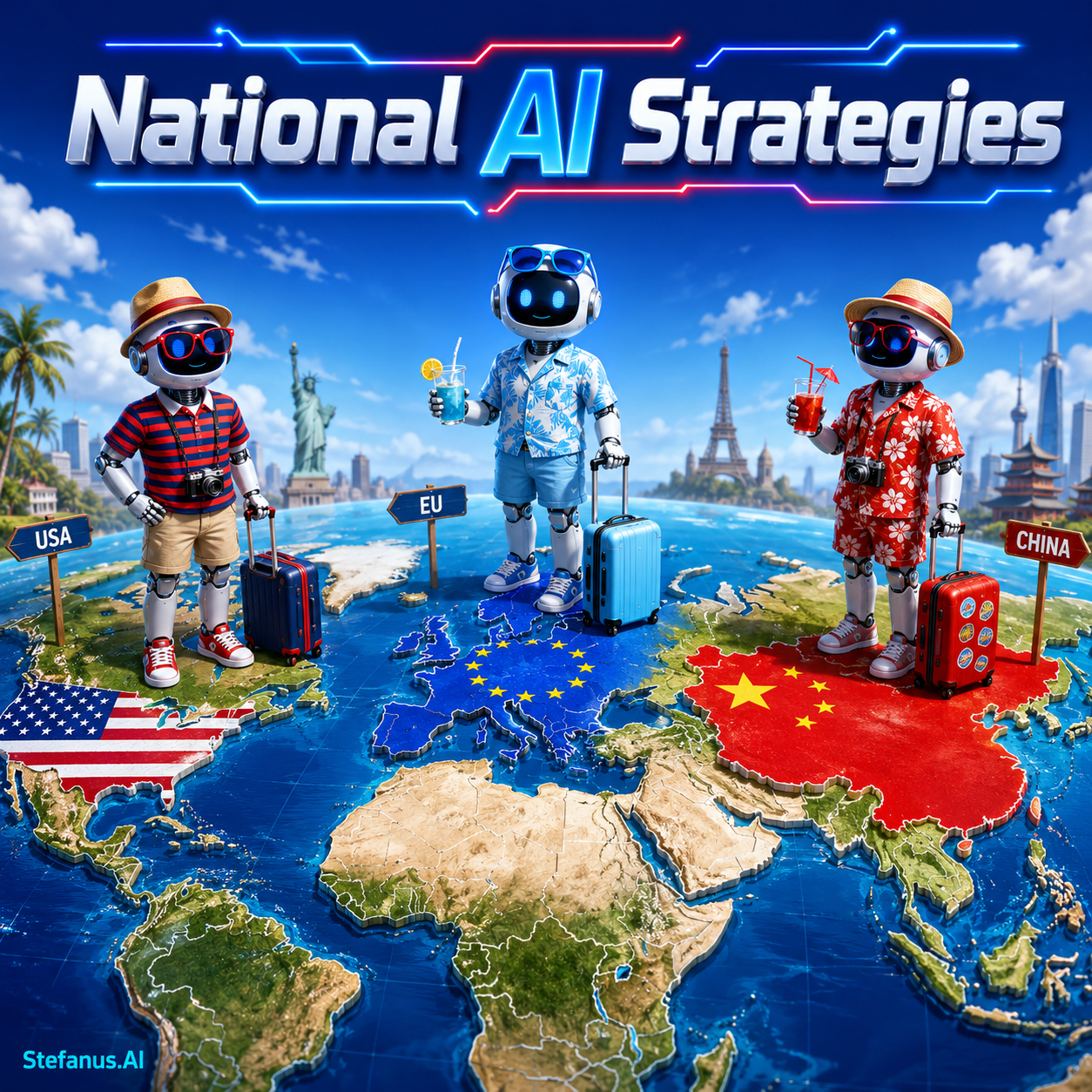
Artificial intelligence has stopped behaving like an ordinary technology sector and has started behaving like a strategic resource, in the same register as oil in the twentieth century or the atom in 1945. What distinguishes the current moment is not merely the pace of capability gains — though that pace is genuine — but the fact that three of the world’s largest economic blocs have each concluded, independently and almost simultaneously, that the organization of AI development is now inseparable from the organization of national power. The United States has chosen to let its frontier laboratories run essentially unbridled domestically while drawing an ever-sharper export perimeter around the rest of the world. China has chosen to treat AI diffusion as a problem of state planning, folding the technology into a five-year industrial blueprint the way earlier plans folded in steel or rail. The European Union has chosen neither speed nor self-reliance as its organizing principle, but trust — wagering that the bloc’s comparative advantage lies in being the jurisdiction the rest of the world can point to when it wants proof that AI was deployed responsibly.
This paper sets out to compare those three wagers in close, current detail, anchored in events through June 2026 — a month in which the gap between AI-as-technology and AI-as-geopolitics nearly disappeared. In rapid succession, the U.S. Department of Defense signed classified-network agreements with eight frontier companies while pointedly excluding one of the very labs that had pioneered military AI deployment; the U.S. Department of Commerce ordered a leading AI company to cut off its most capable models from every foreign national on Earth, allies included; and the G7 heads of state, meeting at Évian-les-Bains on the shore of Lake Geneva, sat down to lunch with the chief executives of OpenAI, Google DeepMind, and Anthropic without producing a single binding commitment. Each of these episodes will recur throughout the sections that follow, because each illuminates, with unusual clarity, the structural logic that separates Washington’s posture from Beijing’s and from Brussels’.
A note on the title is therefore in order. The paper is called “National AI Strategies” rather than, say, “AI Policy” or “AI Regulation,” because the word strategy carries a deliberate weight: a strategy implies an actor with an objective, a set of resources, and a willingness to accept costs and trade-offs to reach that objective. The United States’ objective is frontier dominance, financed by private capital and protected by the state when convenient. China’s objective is comprehensive economic penetration, financed and sequenced by the state. The European Union’s objective is the export of a regulatory template, financed largely by the credibility of its institutions rather than its compute. None of the three blocs is merely “regulating” or merely “innovating” — all three are positioning, and positioning is the proper subject of a comparative strategic analysis.

Section 1: Methodology and Analytical Framework
1.1 Dual-Axis Mapping
This analysis evaluates each bloc along two axes rather than one. The first axis asks how AI is governed — through centralized federal preemption, through state-directed industrial planning, or through a codified, risk-tiered legal regime. The second axis asks what AI is leveraged to achieve — commercial and military primacy, integrated productivity growth across the real economy, or citizen protection and the export of normative standards. Plotting the three blocs on this grid avoids the common error of treating “regulation” and “innovation” as opposites; in practice, the EU regulates in service of an innovation theory just as much as the United States innovates in service of a security theory.
1.2 Metric Variables
Five comparative pillars recur throughout the paper: research-and-development funding intensity and its public-private composition; the structure of public-private partnerships, including defense procurement; the severity and enforcement architecture of legislative penalties; the scale and geography of compute and energy infrastructure buildouts; and the retention or attrition of frontier AI talent. Stanford’s Human-Centered AI Institute, whose annual AI Index has become the closest thing the field has to a shared statistical baseline, observed in its 2026 edition that:
“AI capability is not plateauing. It is accelerating and reaching more people than ever.”
— Stanford HAI, 2026 AI Index Report [26]
a finding that frames the urgency behind all three blocs’ strategic choices: none of them believes it can afford to wait and see.

Section 2: The United States — Market-Driven Innovation and Federal Uniformity
2.1 Strategic Directives
Washington’s approach rests on a wager that frontier capability, once achieved and sustained, becomes a self-reinforcing source of both economic and military advantage — and that the fastest way to sustain it is to let well-capitalized private labs compete with minimal domestic friction while the federal government concentrates its own energy on two things: clearing physical and regulatory bottlenecks at home, and controlling who outside the country gets access to the result. The federal posture has increasingly emphasized a single national standard over a patchwork of state rules, on the theory that fifty different compliance regimes would slow the very labs the strategy depends on.
2.2 Governance Model: Federal Preemption over Fragmentation
The clearest illustration of the costs of not having a single federal standard is the scramble that followed the events of June 2026, when state and allied governments alike discovered they had no advance notice of, and no formal channel to contest, a national-security action that reshaped global AI access overnight. Stanford’s Colin Kahl, senior fellow at the Freeman Spogli Institute, captured how quickly the strategic clock has compressed even among specialists who study this professionally:
“If you had asked me a year ago, how far ahead U.S. companies are relative to China at the frontier, I would have said the consensus is a year or two. Now I think the consensus is measured in months.”
— Colin Kahl, Stanford Freeman Spogli Institute [27]
That compression is precisely the argument federal officials make for moving policy through executive and procurement channels rather than through slower legislative or multilateral processes — speed is treated as a strategic asset in itself, even when it produces decisions, like the one described in Section 2.6, that allies experience as arbitrary.
2.3 Funding and Economic Pillars
The scale of private capital now flowing into American AI infrastructure has no historical precedent outside wartime mobilization. Nvidia alone reported record revenue of $81.6 billion for its fiscal first quarter of 2027 (the quarter ended April 26, 2026), up 85 percent year over year, with data-center revenue of $75.2 billion driving the bulk of that growth. [21] The company’s founder and chief executive, Jensen Huang, described the moment in terms that fused commercial confidence with infrastructural ambition:
“The buildout of AI factories — the largest infrastructure expansion in human history — is accelerating at extraordinary speed.”
— Jensen Huang, NVIDIA [21]
That single quarter’s data-center revenue followed a fiscal 2026 in which Nvidia’s annual revenue reached $215.9 billion, up 65 percent from the prior year. [22] The customer base behind those numbers is itself instructive: roughly half of Nvidia’s data-center revenue now comes from the four largest hyperscalers — Microsoft, Google, Amazon, and Meta — who are together expected to spend approximately $700 billion on AI infrastructure in 2026 alone, with the aggregate hyperscaler capital expenditure figure for the year estimated at roughly $650 billion. [24, 25] Huang has framed this spending not as speculative excess but as a direct revenue mechanism:
“In this new world of AI, compute is revenue. Without compute, there’s no way to generate tokens. Without tokens, there’s no way to grow revenues.”
— Jensen Huang, NVIDIA [23]
Federal policy has moved to match this private tempo by fast-tracking data-center permitting and electricity interconnection approvals, treating grid capacity as a national competitiveness variable rather than a purely local utility question.
2.4 Defense and Geopolitics
Nowhere is the fusion of commercial and security logic more visible than in the Pentagon’s approach to classified-network AI access. On May 1, 2026, the Department of Defense — rebranded in places as the Department of War — finalized Classified Networks AI Agreements covering Impact Level 6 and Impact Level 7 systems with eight companies: SpaceX, OpenAI, Google, Nvidia, Reflection AI, Microsoft, Amazon Web Services, and Oracle. [10, 11, 14] The agreements were explicitly framed around “lawful operational use” intended to streamline data synthesis, elevate situational understanding, and augment warfighter decision-making. [14]
What makes this deal strategically significant is who is missing from it. Anthropic, which had been the first AI laboratory ever to operate inside Pentagon classified systems under a roughly $200 million contract signed in mid-2025, was deliberately excluded after refusing to drop guardrails the Pentagon wanted lifted around autonomous weapons systems and mass domestic surveillance. [10, 11] The Department of Defense had earlier designated Anthropic a “supply chain risk” — a label historically reserved for firms tied to foreign adversaries — triggering litigation that remains unresolved. Pentagon Chief Technology Officer Emil Michael described the resulting posture bluntly:
“I need redundancy.”
— Emil Michael, Pentagon Chief Technology Officer [12]
The episode demonstrates the American model’s defining tension in miniature: a government that wants frontier capability inside its most sensitive systems, paired with companies willing to compete for that access on the government’s terms, and a residual category of firms — for now, just one major lab — willing to forfeit revenue rather than relax safety commitments it has made public.
2.5 The Classified Networks Agreement and the New Compute-for-Access Bargain
The structural effect of the May 1 agreements is to formalize a compute-for-access bargain: companies that accept the Pentagon’s operational terms gain entry to a market segment — classified defense computing — that no foreign competitor can realistically contest, since IL6/IL7 environments are by definition closed to non-U.S. persons and non-U.S. infrastructure. This is, in effect, an industrial policy delivered through procurement rather than subsidy, and it sits alongside the export-control regime discussed below as the second pillar of Washington’s strategy: control entry into the most sensitive American systems on one side, and control exit of the most capable American models on the other.
2.6 The Algorithmic Iron Curtain: The Fable 5 and Mythos 5 Suspension
The starkest demonstration of that export-control instinct arrived just eleven days later. On June 9, 2026, Anthropic released Claude Fable 5 and Claude Mythos 5, models the company described as exhibiting capabilities that “exceed those of any model we’ve ever made generally available.” [2] Three days after that launch, at 5:21 p.m. Eastern Time on June 12, the U.S. Department of Commerce transmitted an export-control directive ordering Anthropic to suspend all access to both models for any foreign national, anywhere in the world — including the company’s own non-citizen employees, whether they were physically inside or outside the United States. [2, 3, 5]
Anthropic’s account of the episode is worth quoting at some length because it illustrates how thin the technical basis for a sweeping geopolitical action can be. The company said the directive’s stated trigger was a reported jailbreak of Fable 5’s cybersecurity safeguards, and that the government’s evidence for that claim was never put in writing:
“The government has only given us verbal evidence of a potential narrow, non-universal jailbreak, which essentially consists of asking the model to read a specific codebase and fix any software flaws.”
— Anthropic, official statement [4]
Anthropic further argued that the same capability was “widely available from other models, including OpenAI’s GPT-5.5,” and that applying this standard industry-wide “would essentially halt all new model deployments for all frontier model providers.” [2] The company nonetheless complied in full, disabling both models for every customer rather than attempting to segment access by nationality, and stated plainly:
“We believe this is a misunderstanding and are working to restore access as soon as possible.”
— Anthropic, official statement on X [5]
Outside reaction split along familiar lines. AI critic Gary Marcus argued the directive was strategically incoherent, since it risked pushing Chinese-born researchers at American labs back toward China at precisely the moment Washington claims it must out-compete Beijing — and that it would teach investors the American AI sector’s policy environment is unpredictable. [1] Legal analysts at the National Law Review noted a broader compliance consequence: because the directive targeted people rather than infrastructure, any company with foreign-national employees, contractors, or API integrations touching Fable 5 or Mythos 5 now faces deemed-export exposure regardless of where its own headquarters sit. [6] The directive thus functions, in practice, as what this paper terms an Algorithmic Iron Curtain — a perimeter drawn not around a country, but around a citizenship status, applied retroactively to a model already running in production for hundreds of millions of users worldwide.
The G7 summit at Évian-les-Bains, convened just three days later, could not avoid the subject. According to reporting from Euronews, the directive “loomed large” over the leaders’ working lunch with Sam Altman, Demis Hassabis, and other AI executives on June 17, as Western allies absorbed the realization that they, too, could be cut off from America’s most advanced technology “at a moment’s notice, just like everyone else.” [7] No binding outcome emerged from that lunch; one industry account observed flatly that “the lack of concrete outcomes from Évian-les-Bains means the regulatory landscape remains in a holding pattern.” [8] The 52nd G7 summit’s formal outputs that week were instead concentrated on child online safety, critical-mineral supply chains, and geopolitical statements on Ukraine and the Middle East — AI dominated the conversation without producing a single new G7 commitment of its own. [9, 13]

Section 3: China — State-Led Development and Omnipresent Agentic Ecosystems
3.1 Strategic Directives: The “AI Plus” Initiative under the 15th Five-Year Plan
Where Washington’s strategy is organized around laboratories and Brussels’ around statutes, Beijing’s is organized around a plan. China’s 15th Five-Year Plan, covering 2026 through 2030 and adopted by the National People’s Congress in March 2026, elevates the “AI Plus” initiative — first announced in 2024 — to a top national priority, targeting the integration of AI into 90 percent of the Chinese economy by 2030. [19] The shift in emphasis is measurable in the plan’s own text: artificial intelligence is mentioned 52 times in the 15th Five-Year Plan, compared with just 11 mentions in the 14th plan released in 2021. [19] The State Council’s underlying directive describes the ambition in distinctly civilizational language, framing AI-driven transformation as something that will:
“reshape the paradigm of human production and life, promote a revolutionary leap in productivity and profound changes in production relations.”
— State Council of the People’s Republic of China, “AI Plus” directive [18]
3.2 Infrastructure and Self-Reliance
China’s plan pairs that rhetorical ambition with concrete sectoral milestones. By 2027, the government guideline implementing AI Plus targets a penetration rate above 70 percent for next-generation intelligent terminals and AI agents across six designated sectors — science and technology, industrial development, consumption, public well-being, governance, and global cooperation. [20] Unlike the American model, where infrastructure spending is overwhelmingly private and demand-led, the Chinese buildout is explicitly sequenced by the state, paired with a parallel push for domestic-hardware self-reliance as Beijing continues to face restrictions on access to Nvidia’s most advanced Blackwell- and Vera Rubin-class chips. [25] Chinese firms have compensated in part through workable, if less efficient, domestic alternatives such as Huawei’s chip lines and through algorithmic efficiency gains exemplified by DeepSeek’s benchmark performance on less advanced hardware. [25]
3.3 The National Agentic Framework
China’s agentic policy differs from the more permissive, market-tested deployment pattern in the United States in that it is organized around designated use-case categories rather than open-ended commercial release. The AI Plus guideline frames agent deployment as a governance tool as much as an economic one, explicitly calling for the use of AI to achieve “intelligent urban operations” and smarter city planning and construction — extending the agentic logic of the private chatbot into the machinery of administration itself. [18] The Ministry of Education’s parallel “AI Plus Education” action plan, announced April 10, 2026, illustrates how granular this sequencing becomes in practice: it sets a 2030 implementation horizon for embedding AI tools across primary, secondary, and higher education for a system serving roughly 291 million students across more than 500,000 schools. [38]
3.4 Social Governance, Hardware Friction, and the Information Perimeter
China’s domestic-hardware push and its information-control architecture are best understood as two faces of the same sovereignty logic that animates its industrial planning. Beijing’s restriction on the deployment of foreign-made advanced AI chips inside the country is mirrored by its long-standing system of internet content control, administered principally by the Cyberspace Administration of China, which enforces speech and platform rules across the same digital infrastructure that AI Plus is now extending into governance functions. [18] The practical effect is a national AI ecosystem in which industrial self-reliance, public-sector deployment, and information governance are designed as a single integrated stack rather than as three separable policy domains — a structural difference from both the American and European models, which keep platform regulation, defense procurement, and antitrust enforcement in largely separate institutional lanes.
China’s relative position has also shifted markedly in capability terms. Stanford’s 2026 AI Index reported that the performance gap between top American and Chinese frontier models has “effectively closed,” with Anthropic’s leading model retaining only a 2.7 percent edge as of March 2026 — a striking compression from the one-to-two-year lead Western analysts assumed as recently as 2024. [26, 27] The Atlantic Council’s Tess deBlanc-Knowles has argued that this narrowing capability gap, combined with China’s lead in open-source model releases, may ultimately matter more commercially than raw frontier supremacy:
“China holds some key advantages. Its lead in open-source AI models and focus on applied AI could prove to be the winning formula for capturing global market share.”
— Tess deBlanc-Knowles, Atlantic Council [29]

Section 4: The European Union — Risk-Based Regulation and Digital Sovereignty
4.1 Strategic Directives: The EU AI Act’s Implementation Arc
The European Union entered 2026 committed to becoming the first jurisdiction in the world with a comprehensive, horizontal, risk-tiered AI statute fully in force. The AI Act, which entered into force on August 1, 2024, was designed to roll out its most consequential obligations in stages, with rules governing high-risk AI systems originally set to apply from August 2, 2026 for Annex III use-based systems and August 2, 2027 for Annex I product-embedded systems. [16]
4.2 Governance Model: The Risk Categorization Framework
The Act’s structural innovation is its tiering of obligations by risk category — prohibited practices, high-risk systems subject to conformity assessment, limited-risk systems subject to transparency duties, and general-purpose AI models subject to systemic-risk obligations under Articles 51 through 55, which have already applied since August 2025 and remain untouched by the reforms discussed below. [17]
4.3 Implementation Hurdles: The “AI Omnibus” Revisions
By late 2025 it had become evident that the regulatory infrastructure needed to operationalize the high-risk rules — harmonized technical standards, common specifications, designated national competent authorities — was not going to be ready in time. [15] The European Commission responded on November 19, 2025 by tabling a Digital Omnibus on AI, proposing to defer the high-risk compliance deadlines by as much as sixteen months. [15, 16] Negotiations proved harder than expected: an initial trilogue on April 28, 2026 collapsed without agreement, prompting real concern in Brussels that the August 2026 deadline might arrive with no relief in place. [16] A provisional political agreement was finally reached on May 7, 2026, and confirmed by Council representatives on May 13. [15, 16]
Under that agreement, Annex III high-risk obligations move from August 2, 2026 to December 2, 2027 — a sixteen-month deferral — while Annex I product-embedded high-risk obligations move from August 2, 2027 to August 2, 2028. [17] Transparency and watermarking duties under Article 50 were treated differently: rather than receiving the full deferral, their grace period was compressed from an initially proposed six months down to three, fixing a firm compliance date of December 2, 2026 for systems already on the market. [16, 17] One compliance analysis summarized the asymmetry for businesses succinctly:
“2 August 2026 remains a live compliance date.”
— Gibson Dunn, legal compliance briefing [15]
for transparency rules even as the high-risk machinery is pushed back, meaning companies should use the additional time on high-risk planning rather than wait for it.
The Omnibus also added substantive new prohibitions that were not part of the Commission’s original proposal: a ban, effective December 2, 2026, on AI systems that generate non-consensual intimate imagery or child sexual abuse material, including so-called “nudifier” applications, with a narrow safe-harbor for systems incorporating effective preventive safeguards. [16, 17] The Council framed the broader package as a competitiveness measure as much as a simplification one:
“This agreement significantly supports our companies by reducing recurring administrative costs, ensuring legal certainty and strengthening the EU’s digital sovereignty.”
— Council of the European Union, press statement [22]
4.4 Civil Liability and Trust
Even with the high-risk deadlines deferred, the Act’s transparency architecture — mandatory labeling of AI-generated content, disclosure obligations for chatbots, and a tiered penalty structure tied to global turnover — remains the centerpiece of the EU’s claim to global regulatory leadership. The bloc’s wager is that predictable, codified rules, even if slower to implement than American or Chinese deployment cycles, will themselves become a competitive asset as governments and consumers worldwide grow more skeptical of unaccountable model behavior — a skepticism the G7’s own discussions at Évian, and the Fable 5 episode described in Section 2.6, did nothing to dispel.
4.5 Timeline Synthesis and the G7 Echo
Taken together, the EU’s 2026 timeline now runs as follows: GPAI systemic-risk obligations already in force; transparency and watermarking obligations binding from December 2, 2026; the new NCII/CSAM prohibition binding from the same date; Annex III high-risk obligations binding from December 2, 2027; and Annex I high-risk obligations binding from August 2, 2028 — assuming formal adoption and Official Journal publication occur, as expected, before August 2026. [17] That the G7’s own June 2026 communiqués on AI dealt almost exclusively with child online safety — a domain the EU AI Act’s NCII/CSAM provision had already begun to formalize — suggests the EU’s narrower, codified approach to harm categories is, for now, traveling further into multilateral consensus than either Washington’s security-driven export controls or Beijing’s productivity-driven integration targets. [7]

Section 5: Synthesis and Comparative Analysis
5.1 Comparative Matrix
The three models can be summarized along the dual axes introduced in Section 1. The United States governs through federal preemption and procurement leverage, and leverages AI toward frontier-model and military dominance, financed almost entirely by private capital with the state intervening selectively — through defense contracts on the entry side and export controls on the exit side. China governs through centralized five-year planning married to sector-specific guidelines, and leverages AI toward comprehensive integration into the real economy and into the apparatus of governance itself, financed by state direction of both capital and hardware self-reliance. The European Union governs through a codified, risk-tiered statute enforced by national authorities and the AI Office, and leverages AI toward citizen protection and the export of a regulatory template that other jurisdictions can adopt wholesale, financed less by compute than by institutional credibility.
5.2 Talent and Research Discrepancy
Stanford’s AI Index data complicates any simple ranking. The United States “still produces more top-tier AI models and higher-impact patents,” while China “leads in publication volume, citations, patent output, and industrial robot installations,” and South Korea — outside the three blocs under direct comparison here — leads the world in patents per capita, a reminder that the AI competition is not strictly bipolar even when policy attention treats it that way. [26] Public trust diverges just as sharply as capability: only 31 percent of U.S. citizens and 27 percent of Chinese citizens say they trust their government to regulate AI properly, compared with 53 percent of EU citizens — numbers that lend some empirical support to Brussels’ wager that legal codification, whatever its costs in deployment speed, buys something American and Chinese citizens currently lack. [26]
5.3 The Global “Brussels Effect” versus Technology Dominance
Whether the rest of the world ultimately aligns with European compliance benchmarks or with American and Chinese hardware-and-software stacks may depend less on regulatory elegance than on simple availability — and June 2026 supplied a vivid illustration of how quickly availability can be revoked. MIT’s Alex (Sandy) Pentland, writing from Stanford’s Digital Economy Lab, has argued that the resulting anxiety is reshaping the very concept of sovereignty for mid-sized nations:
“What’s emerging is not simply a new set of trade agreements, but a new operating model for sovereignty: shared digital infrastructure, interoperable standards, and AI systems tuned to local markets.”
— Alex (Sandy) Pentland, MIT / Stanford HAI [28]
Pentland’s framing helps explain why the G7’s tech-CEO lunch produced atmosphere rather than agreements: even close American allies now have direct, recent evidence — the Fable 5 and Mythos 5 suspension — that dependence on a single national AI supply chain carries risks no compliance certificate can fully insure against, regardless of which jurisdiction’s rulebook that certificate was issued under.

Section 6: What Have We Learned — Five Pillars of the Comparative Landscape
Pillar 1: Speed Is Now a Strategic Variable in Its Own Right.
The compressed timeline separating Anthropic’s June 9 launch of Fable 5 and Mythos 5 from the June 12 suspension order — just three days — shows that the United States is prepared to act on AI policy at a tempo that outpaces any formal interagency or international consultative process, treating decisiveness itself as a competitive asset even at the cost of allied confidence.
Pillar 2: State Planning Can Substitute for Market Signals, but Not for Frontier Hardware.
China’s 15th Five-Year Plan demonstrates that comprehensive sectoral integration of AI can be sequenced and targeted with a precision no market-driven system attempts, yet that same plan’s emphasis on domestic chip self-reliance is itself the clearest evidence that planning cannot yet fully substitute for access to the most advanced compute, which remains concentrated among Nvidia and a handful of American and allied foundries.
Pillar 3: Regulatory Codification Buys Trust Faster Than It Buys Capability.
The European Union’s AI Act, even delayed by its own Omnibus, has produced measurably higher public confidence in government AI oversight than either the American or Chinese systems — but the same Omnibus negotiations show that codification carries real costs in implementation speed, requiring sixteen-month deferrals simply to let supporting technical standards catch up to the law’s ambitions.
Pillar 4: Compute-for-Access Bargains Are Replacing Traditional Defense Procurement.
The Pentagon’s May 1 Classified Networks AI Agreements, and Anthropic’s simultaneous exclusion from them, indicate that the terms of access to classified military computing have become a primary lever of American AI industrial policy — arguably as consequential to corporate strategy as direct government subsidy, and one other governments cannot easily replicate without comparable security infrastructure of their own.
Pillar 5: Multilateral Forums Are Becoming Venues for Disclosure, Not Decision.
The G7 summit at Évian-les-Bains hosted the most senior direct conversation yet between heads of state and frontier AI executives, yet produced no binding AI commitment — its substantive AI-adjacent output limited to a child-safety declaration — suggesting that for the foreseeable future, the real architecture of AI governance will continue to be set unilaterally by Washington, Beijing, and Brussels, with multilateral summits serving mainly as the place where the consequences of those unilateral choices are absorbed and discussed.

Conclusion:
Returning to the question posed at the outset — why this paper is titled “National AI Strategies” rather than something narrower — the case for the title should now be more concrete than it was in the introduction. Each of the three blocs examined here is pursuing a coherent theory of how artificial intelligence converts into durable national advantage, and each theory carries its own internal logic of trade-offs: the United States accepts allied friction and domestic legal uncertainty in exchange for frontier speed and security control; China accepts continued hardware dependency and a narrower diffusion of its agentic tools abroad in exchange for systemic, planned economic integration at home; the European Union accepts slower deployment and real implementation strain in exchange for what it hopes will be durable institutional credibility. These are not regulatory postures so much as bets about what kind of power AI will confer, and on whom.
The events of May and June 2026 — the Pentagon’s classified-network agreements, the Fable 5 and Mythos 5 suspension, the EU’s hard-fought Omnibus compromise, and the inconclusive G7 lunch at Évian — did not resolve which bet will pay off. If anything, they sharpened the question by showing each bloc’s strategy under live pressure rather than in the abstract. Washington’s strategy revealed both its speed and its capacity to alarm its own allies in the same week. Beijing’s strategy revealed both its planning discipline and its continuing hardware vulnerability. Brussels’ strategy revealed both its institutional patience and the real cost, measured in compliance uncertainty, of legislating in advance of a fast-moving frontier.
What is reasonably clear is that none of the three blocs can now fully decouple economic strategy from security strategy, or security strategy from questions of public trust. The necessity of bilateral and multilateral AI safety dialogue — to manage exactly the kind of allied friction the Fable 5 suspension produced — is no longer a normative aspiration but an operational requirement, since unilateral action by any one power now visibly ripples through the compute and capital plans of the other two within days, not years. Who ultimately dictates the technical standards of the next decade will likely be decided less by any single dramatic breakthrough than by the cumulative weight of choices like these: which export controls hold, which five-year targets are met, and which compliance deadlines are kept. On the present evidence, that contest remains genuinely open.

Footnotes and Endnotes
[1] CNBC, “Anthropic disables access to Fable 5 and Mythos 5 to comply with government directive,” June 12, 2026. https://www.cnbc.com/2026/06/12/anthropic-disables-access-to-fable-5-and-mythos-5-to-comply-with-government-directive.html
[2] Anthropic, “Statement on the US government directive to suspend access to Fable 5 and Mythos 5,” June 12, 2026. https://www.anthropic.com/news/fable-mythos-access
[3] Bloomberg, “Anthropic Says US Orders Halt to Foreign Access for Fable 5, Mythos 5 AI Models,” June 13, 2026. https://www.bloomberg.com/news/articles/2026-06-13/anthropic-says-us-limits-foreign-access-to-fable-5-mythos-5
[4] Snyk, “When a Government Pulls an AI Model: What the Fable 5 and Mythos 5 Suspension Means for Security Teams,” June 2026. https://snyk.io/blog/fable-mythos-suspension-security-takeaways/
[5] Anthropic (@AnthropicAI), statement on X, June 12, 2026. https://x.com/AnthropicAI/status/2065597531644743999
[6] National Law Review, “AI Company Anthropic Suspends Access to Claude Fable 5, Claude Mythos 5 Following US Export Control Directive,” June 2026. https://natlawreview.com/article/ai-company-anthropic-suspends-access-claude-fable-5-claude-mythos-5-following-us
[7] Euronews, “Six takeaways from the G7 summit in Évian,” June 17, 2026. https://www.euronews.com/my-europe/2026/06/17/six-takeaways-from-the-g7-summit-in-evian
[8] CryptoBriefing, “G7 leaders sit down with Sam Altman and Demis Hassabis to talk AI in France,” June 2026. https://cryptobriefing.com/g7-leaders-tech-ceos-ai-france/
[9] Wikipedia, “52nd G7 summit,” accessed June 2026. https://en.wikipedia.org/wiki/52nd_G7_summit
[10] Idlen, “Pentagon 8 classified AI contracts May 2026: Anthropic out, OpenAI in,” May 2026. https://www.idlen.io/news/pentagon-8-classified-ai-contracts-openai-google-spacex-anthropic-excluded-may-2026/
[11] CNN Business, “Pentagon strikes deals with 8 Big Tech companies after shunning Anthropic,” May 1, 2026. https://www.cnn.com/2026/05/01/tech/pentagon-ai-anthropic
[12] Let’s Data Science, “Pentagon Signs Eight AI Companies for Classified Networks, Excludes Anthropic,” May 2026. https://letsdatascience.com/blog/pentagon-signs-eight-ai-companies-anthropic-excluded
[13] The Washington Post, “Pentagon strikes AI deals for classified military use,” May 1, 2026. https://www.washingtonpost.com/technology/2026/05/01/pentagon-ai-deals-microsoft-amazon-google-classified-military/
[14] The Hill, “Seven AI firms agree to deploy tech in Pentagon classified networks,” May 1, 2026. https://thehill.com/policy/technology/5858995-pentagon-ai-companies-classified-work-deal/
[15] Gibson Dunn, “EU AI Act Omnibus Agreement — Postponed High-Risk Deadlines and Other Key Changes,” May 2026. https://www.gibsondunn.com/eu-ai-act-omnibus-agreement-postponed-high-risk-deadlines-and-other-key-changes/
[16] White & Case LLP, “EU agrees Digital Omnibus deal to simplify AI rules,” May 14, 2026. https://www.whitecase.com/insight-alert/eu-agrees-digital-omnibus-deal-simplify-ai-rules
[17] Covington & Burling, “EU AI Act Update: Timeline Relief, Targeted Simplification, and New Prohibitions,” Inside Privacy, May 18, 2026. https://www.insideprivacy.com/artificial-intelligence/eu-ai-act-update-timeline-relief-targeted-simplification-and-new-prohibitions/
[18] Trivium China, “The AI Plus initiative – China’s blueprint for AI diffusion,” September 2025. https://triviumchina.com/research/the-ai-plus-initiative-chinas-blueprint-for-ai-diffusion/
[19] South China Morning Post, “China’s 5-year plan emphasises ‘orderly’ AI development amid global tech volatility,” March 5, 2026. https://www.scmp.com/tech/policy/article/3345586/chinas-five-year-plan-emphasises-orderly-ai-development-amid-global-tech-volatility
[20] Xinhua, “China moves forward with its ‘AI Plus’ initiative,” November 22, 2025. https://english.news.cn/20251122/52b3321558a14e55a7b143a4ea05d6f2/c.html
[21] NVIDIA Corporation, SEC Form 8-K, “NVIDIA Announces Financial Results for First Quarter Fiscal 2027,” May 20, 2026. https://www.sec.gov/Archives/edgar/data/0001045810/000104581026000051/q1fy27pr.htm
[22] NVIDIA Corporation, SEC Form 8-K, Fourth Quarter Fiscal 2026 results, February 25, 2026; Council of the European Union, press release, May 7, 2026. https://www.sec.gov/Archives/edgar/data/0001045810/000104581026000019/q4fy26pr.htm ; https://www.consilium.europa.eu/en/press/press-releases/2026/05/07/artificial-intelligence-council-and-parliament-agree-to-simplify-and-streamline-rules/
[23] TechCrunch, “Nvidia has another record quarter amid record capex spends,” February 25, 2026. https://techcrunch.com/2026/02/25/nvidia-earnings-record-capex-spend-ai/
[24] Investing.com, “Nvidia AI Spending Tailwind Still Points to Higher Revenue Estimates,” April 2, 2026. https://www.investing.com/analysis/nvidia-ai-spending-tailwind-still-points-to-higher-revenue-estimates-200677805
[25] Tech Insider, “Big Tech’s $650B AI Capex Surge Reshaping the Economy,” 2026. https://tech-insider.org/big-tech-650-billion-ai-infrastructure-capex-2026/
[26] Stanford Institute for Human-Centered Artificial Intelligence (HAI), “The 2026 AI Index Report,” April 13, 2026. https://hai.stanford.edu/ai-index/2026-ai-index-report
[27] Stanford HAI, “AI Reshapes Global Power: Insights from Stanford HAI’s Congressional Boot Camp” (remarks of Colin Kahl, Amy Zegart, and Chris Manning), 2025–2026. https://hai.stanford.edu/news/ai-reshapes-global-power-insights-from-stanford-hais-congressional-boot-camp
[28] Stanford HAI, “A New Economic World Order May Be Based on Sovereign AI and Mid-Sized Nation Alliances” (Alex Pentland, MIT/Stanford HAI), February 6, 2026. https://hai.stanford.edu/news/a-new-economic-world-order-may-be-based-on-sovereign-ai-and-midsized-nation-alliances
[29] Atlantic Council, “Eight ways AI will shape geopolitics in 2026” (Tess deBlanc-Knowles and Atlantic Council experts), January 15, 2026. https://www.atlanticcouncil.org/dispatches/eight-ways-ai-will-shape-geopolitics-in-2026/
[30] Foreign Affairs, “Geopolitics in the Age of Artificial Intelligence,” February 2, 2026. https://www.foreignaffairs.com/united-states/geopolitics-age-artificial-intelligence

Comments
[…] allied reaction is the receipt. The Anthropic shutdown did more in eighteen days to concentrate European political attention on AI dependency than years of prior digital-sovereignty rhetoric had managed on their own, and the […]
[…] has first been measured cleanly. The American build-out has been faster, larger, and more chaotic; the European build-out has been slower, more constrained, and consequently more legible. When a system is […]