
Introduction and the “Hybrid Island” Paradigm
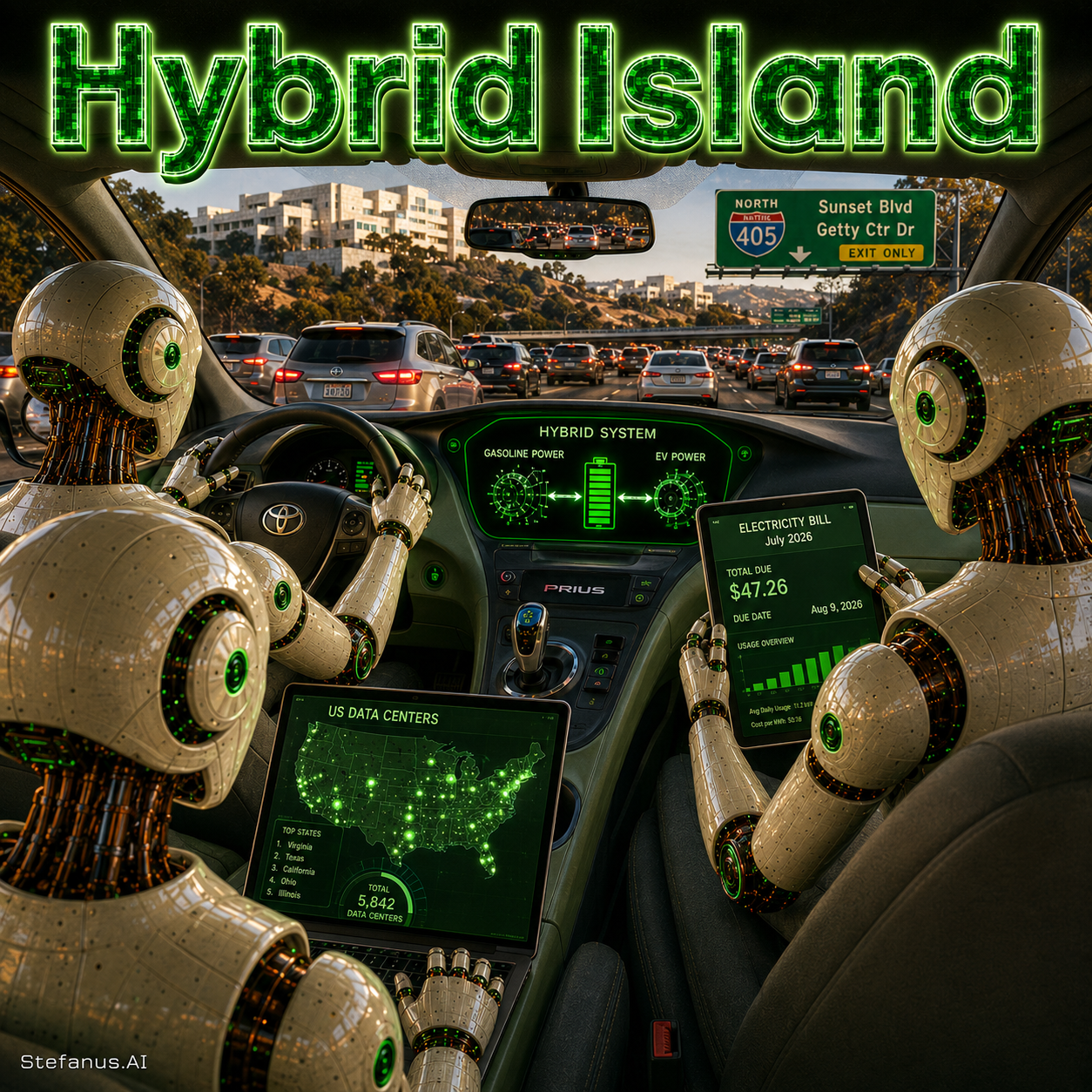
If you have ever driven a hybrid car such as a Toyota Prius on Los Angeles’s jammed, bumper-to-bumper Interstate 405 during rush hour—crawling south to north past LAX International Airport and The Getty Center or inching the other way at dusk—you will have noticed something quietly remarkable happening beneath your hands. The car exchanges power sources on its own. It slips from gasoline to electric mode in stop-and-go traffic, recaptures braking energy on the downhill grades, spins the combustion engine back to life on the climbs, and never once asks the driver for permission. The advantage of the hybrid car is not merely that it saves gasoline. The deeper advantage is architectural: it is a well-designed machine that exchanges power internally, automatically, and without human intervention, while the human simply drives.
This paper argues that the hyperscale artificial intelligence campus of 2026 has become, in the most literal engineering sense, that hybrid machine—scaled up by six orders of magnitude. A gigawatt-class AI campus in Texas, Tennessee, or Louisiana now sits between two power sources the way a Prius sits between a fuel tank and a battery: on one side, the public utility grid, with its regional transmission organizations, capacity auctions, and century-old regulatory compact; on the other, a private portfolio of on-site gas turbines, solid-oxide fuel cells, battery energy storage, and, increasingly, contracted nuclear capacity. Between the two sits a software-driven microgrid controller that decides—millisecond by millisecond, without human intervention—where the electrons come from, where the surplus goes, and when the campus should sever itself from the public network entirely. The driver, in this metaphor, is the training run: the multi-week, multi-gigawatt computational campaign that must not be interrupted, because interruption at this scale is measured in tens of millions of dollars of lost step-time. Everything else in the machine exists to keep that driver moving through traffic.
The metaphor also carries a warning that will echo through every chapter of this paper. A hybrid car internalizes its power management, but it still shares the freeway. Its braking behavior, its acceleration profile, and its failure modes are experienced by every other vehicle around it. So too the Hybrid Island: it may generate and manage its own power, but it remains physically interconnected with—and capable of violently perturbing—the public grid on which tens of millions of households depend. The story of 2024 through 2026 is the story of that shared freeway discovering exactly how disruptive its newest, largest, and fastest vehicle can be.
The Structural Disconnect in Temporal Cycles
The Hybrid Island phenomenon is, at root, the product of a collision between two incompatible clocks. The first clock is the clock of generative AI. Frontier model hardware generations now turn over in twelve to eighteen months; Nvidia moved from Hopper to Blackwell to the Vera Rubin architecture within roughly three years, and each generation demands a step-change in delivered power density, with AI-optimized racks drawing 30 kW to well over 100 kW against the 5–15 kW of traditional enterprise racks.[8] Corporate capital follows the same accelerated clock: in their first-quarter 2026 earnings reports, the four largest hyperscalers—Amazon, Microsoft, Alphabet, and Meta—collectively guided approximately $725 billion of capital expenditure for calendar 2026, up roughly 77 percent from the record $410 billion of 2025.[14] Goldman Sachs now projects a combined $5.3 trillion of capital expenditure for these four firms alone between fiscal 2025 and fiscal 2030.[15]
The second clock is the clock of the regulated grid. Regional transmission organizations plan in decadal horizons; public utility commissions adjudicate rate cases over years; a new high-voltage transmission line in the United States routinely takes a decade from proposal to energization. In PJM Interconnection, the nation’s largest wholesale market, the average time from interconnection application to commercial operation lengthened from under two years in 2008 to more than eight years by 2025.[41] The grid’s clock was calibrated for load growth measured in fractions of a percent per year. After two decades of essentially flat demand, United States electricity consumption is now forecast to grow at rates unseen since the 1960s, with data centers as the dominant driver.[46]
When a customer whose demand doubles every year meets a supplier whose delivery cycle is eight years, one of two things must happen: the customer waits, or the customer becomes its own supplier. The entire Hybrid Island phenomenon—every mobile turbine in Southaven, every combined-cycle plant financed by Meta in Louisiana, every fuel-cell block ordered by Oracle—is the empirical record of hyperscalers choosing the second option. As one leading energy scholar at Stanford has observed of the demand side of this collision, efficiency gains alone cannot close the gap.
“The efficiency improvements are real and significant, but they are being overwhelmed” — Jonathan Koomey, Research Fellow, Stanford University [1]
Koomey’s point—that efficiency is necessary but not sufficient when the underlying workload grows exponentially—deserves emphasis because it dismantles the most common objection to the thesis of this paper.[1] The objection holds that better chips, better cooling, and better power usage effectiveness (PUE) will flatten the demand curve, as they did during the 2010s cloud consolidation. But as the 2026 literature makes clear, the historical efficiency dividend has largely been spent: frontier AI labs are not migrating from inefficient enterprise server rooms into modern hyperscale facilities; they are starting in the most efficient facilities ever built, and growing from there. The demand is structural, not transitional.
Defining the “Hybrid Island”: A Formal Taxonomy
A Hybrid Island, as this paper defines it, is not a fully disconnected, off-grid installation, and the distinction matters both legally and technically. Formally, a Hybrid Island is a dual-fed, bidirectional energy system, co-located with a hyperscale computational load, that satisfies four necessary conditions. First, it maintains a point of interconnection (POI) with the public grid, governed by a utility tariff, an interconnection agreement, or a co-location arrangement of the kind the Federal Energy Regulatory Commission began formally regulating in PJM in December 2025.[38] Second, it possesses on-site or dedicated behind-the-meter generation whose firm capacity is a substantial fraction—typically 40 to 100+ percent—of the campus’s peak computational load. Third, it deploys fast storage and power-electronic buffering (battery energy storage systems, supercapacitors, flywheels, grid-forming inverters) sufficient to bridge the transition between grid-connected and islanded operation without dropping the computational load. Fourth, and decisively, it executes islanding as a software decision: a localized optimization function, running on an energy management system, that weighs wholesale prices, grid frequency and voltage telemetry, fuel costs, training-run criticality, and contractual curtailment obligations, and then opens or closes the static transfer switches accordingly.
Operationally, the condition can be expressed as a mode function M(t) ∈ {grid-parallel, grid-support, islanded}, chosen at each control interval to minimize a cost functional J = ∫ [C_energy(t) + C_risk(t) + C_wear(t)] dt subject to the hard constraint that delivered power to the computational bus never deviates from demand beyond the ride-through envelope of the IT load. What distinguishes the Hybrid Island from a hospital microgrid or a university co-generation plant is not the presence of these components but their scale (hundreds of megawatts to multiple gigawatts), their bidirectionality (the ability to export as well as import at the POI), and the autonomy and speed of the mode decision, which occurs in sub-cycle timeframes measured against a 60 Hz waveform. The 2020–2026 microgrid control literature—from decentralized energy management frameworks for hybrid islanded microgrids,[51] through hybrid islanding detection built on wavelet energy entropy and active frequency drift,[52] to digital-twin modeling of incremental distribution networks[53] and black-start protocols for grid-forming battery systems[54]—supplies the theoretical machinery; the hyperscalers supplied the capital.
The “Hidden Grid” and Volumetric Load Volatility
Behind the visible grid of towers and substations, a second, hidden grid has materialized in less than three years: a distributed fleet of privately owned turbines, fuel cells, and batteries whose aggregate capacity is invisible to most public planning documents because much of it was never processed through a conventional interconnection queue. The hidden grid exists because AI load is not merely large; it is violently dynamic. During distributed training, tens of thousands of synchronized GPUs alternate between power-intensive computation phases and lighter communication phases, producing facility-level power swings of tens to hundreds of megawatts at sub-second cadence.[8] The North American Electric Reliability Corporation (NERC) has documented a single data center load ramping down by more than 400 MW in 36 seconds—far faster than the megawatts-per-minute response capability of conventional thermal generators.[7] Power-quality engineers have traced a real disturbance on the Dominion Energy system to a data center producing a voltage sag at exactly once per second: the iteration frequency of a training workload, imprinted directly onto the public waveform.[10]
The systemic danger crystallized in 2025 and 2026. Repeated events in which more than 1,000 MW of computational load dropped off the bulk power system within seconds—as protection logic and uninterruptible power supplies across clustered facilities tripped simultaneously in response to ordinary grid disturbances—prompted NERC on May 4, 2026 to issue a rare Level 3 “Essential Actions” Alert, its highest tier, together with a Reliability Guideline directing planners to model firm versus flexible load, behind-the-meter resources, and AI training operating windows explicitly.[5] One documented cascade removed approximately 1,800 MW at once, a load-loss event of the same magnitude as losing a large nuclear generating unit, but inverted: a mirror-image frequency stability problem in which the grid suddenly has too much generation rather than too little.[6] These step-function ramps—effectively 0 to 500+ MW transitions on millisecond-to-second timescales, of a magnitude that has drawn formal inquiries from NERC to every major transmission utility about how data center loads are modeled in interconnection studies[9]—create phase-angle imbalances, voltage flicker in the 1–15 Hz band of human visual sensitivity, and harmonic distortion that public distribution networks were never designed to absorb.[10] The Hybrid Island is, among other things, the industry’s architectural answer to a problem the industry itself created: if the public grid cannot absorb the signature of AI computation, then that signature must be buffered, filtered, and contained behind a private electrical boundary.
Mapping the Literature, 2020–2026
The scholarly arc of the past six years traces a clean migration of intellectual attention. The early period, 2020–2022, remained anchored in the classical data center energy literature: PUE minimization, cooling optimization, and renewable power purchase agreements as accounting instruments. The middle period, 2023–2024, saw the microgrid control community—largely developed for campus, island, and military applications—suddenly become load-bearing for hyperscale industry, with work on islanding detection,[52] decentralized optimization,[51] networked-microgrid resilience and behind-the-meter industrial load balancing,[55] and digital twins[53] repurposed for facilities two orders of magnitude larger than their original test systems. The current period, 2025–2026, is defined by macro-grid integration scholarship: comprehensive technical surveys of AI data center grid integration,[7] Pacific Northwest National Laboratory assessments of operational risks from large dynamic digital loads,[11] proposals for AI data center and power grid co-design that treat the campus and the balancing authority as a single coupled system,[12] and hybrid storage control frameworks pairing batteries with supercapacitors to smooth training transients.[13] In parallel, an institutional literature emerged from national laboratories and financial institutions—Idaho National Laboratory’s interconnection modeling for modern data center loads,[56] Rabobank’s analysis of data centers building “parallel energy ecosystems” against structurally incompatible interconnection timelines,[57] and FTI Consulting’s work on midstream gas constraints in hybrid strategies for megawatt-class campuses[58]—that collectively named the phenomenon this paper formalizes. The Hybrid Island is where these three literatures—power electronics, grid reliability, and infrastructure economics—now converge.

Chapter 1: The Islanding Architecture and Power Systems Engineering
This chapter descends from taxonomy into machinery. A Hybrid Island is a layered system, and each layer solves a distinct physical problem: baseload energy, transient buffering, real-time control, and electrical isolation. The architecture can be drawn as a stack, with energy flowing downward toward the computational bus and control signals flowing in every direction at once. The reference architecture below, preserved from the original research outline, remains the clearest single-figure summary of the system this paper analyzes.
+—————————————————————————–+
| HYBRID ISLAND BOUNDARY |
| |
| +————————–+ +—————————–+ |
| | Primary Generation | | Energy Storage | |
| | (CCGT, Nuclear / SMRs, | | (BESS, Flywheels, Hydrogen) | |
| | Solid-Oxide Fuel Cells) | | | |
| +————+————-+ +————–+————–+ |
| | | |
| +——————–+———————-+ |
| v |
| +——————————-+ |
| | Dynamic Microgrid Controller | |
| | (Edge-AI EMS & Load Shedding)| |
| +—————+—————+ |
| v |
| +——————————-+ |
| | DC / AC Bus & Inverters | |
| | (Grid-Forming Controls) | |
| +—————+—————+ |
| v |
| +——————————-+ |
| | Isolation & Interlocking | |
| | Hardware (Static Switches) | |
| +—————+—————+ |
+————————————-|—————————————+
v (Bi-directional Point of Interconnection)
+——————————-+
| Public Utility Grid |
| (FERC / RTO / ISO Network) |
+——————————-+
Figure 1. Reference architecture of the Hybrid Island: a dual-fed, bidirectional energy system with software-governed islanding capability at the point of interconnection.
1.1 The Primary Baseload Generation Layer
The foundation of every Hybrid Island is firm, dispatchable, on-site or dedicated generation, and in 2026 that foundation is overwhelmingly built from three technologies, each occupying a distinct position in the deployment-speed-versus-carbon tradeoff space. The first and fastest is natural gas combustion. Aero-derivative and mobile gas turbines—machines originally designed for peaking service, pipeline compression, or emergency deployment—can be trucked to a site and energized in months. This is the technology of the xAI Colossus complex, where a fleet that grew from 27 to 33 to 46 and, by mid-2026, to a documented 59 turbines was installed across the Tennessee–Mississippi line to deliver up to roughly 495 MW to a single campus.[24] At the other end of the gas spectrum sit permanent combined-cycle gas turbine (CCGT) plants, which recover exhaust heat through a steam bottoming cycle to reach thermal efficiencies approaching 60 percent; these are the machines of the Meta–Entergy program in Louisiana, where ten gas-fired plants totaling more than 7 GW are being financed by a single technology company to serve a single campus.[29] Between these poles, reciprocating engine farms offer fast-start flexibility with better part-load behavior than turbines, and are increasingly paired with batteries in bridging configurations.
The second baseload technology is nuclear, deployed today almost entirely through dedicated power purchase agreements rather than on-site construction. Microsoft’s twenty-year, 835 MW agreement with Constellation Energy to restart Three Mile Island Unit 1—rebranded the Crane Clean Energy Center, with a Department of Energy loan closed in November 2025 and full power now accelerated to the second half of 2027—is the archetype.[33] Amazon’s trajectory at Talen Energy’s Susquehanna station is the cautionary counterpart: its original behind-the-meter co-location expansion to 480 MW was blocked by FERC on cost-allocation and reliability grounds, forcing a restructuring into a 17-year, 1.92 GW front-of-the-meter PPA—a regulatory episode examined at length in Chapter 5.[34] Meta, meanwhile, has assembled the largest nuclear book of any hyperscaler, with commitments approaching 6.6 GW across Vistra, Constellation, and the advanced-reactor developers Oklo and TerraPower, including a 1.2 GW Oklo agreement signed in January 2026.[31] Small modular reactors (SMRs) remain the designated long-term successor technology—Google’s 500 MW Kairos Power fleet and Amazon’s 5 GW X-energy program lead the order book—but with first units arriving around 2030, they function in 2026 as an option on the future rather than as operating baseload.[32]
The third technology, and the most distinctively “2026” of the group, is the solid-oxide fuel cell (SOFC). SOFCs generate electricity electrochemically, without combustion, oxidizing natural gas (and, prospectively, hydrogen) across a ceramic electrolyte at high temperature. Because there is no flame, NOx formation is nearly eliminated—Oracle’s Project Jupiter campus in the Texas BorderPlex, which replaced its previously planned gas turbines and diesel generators with a single Bloom Energy fuel-cell microgrid, projects an approximately 92 percent reduction in NOx emissions relative to the turbine design, with negligible water use.[36] The commercial validation of SOFCs at grid scale is arguably the most important energy-market development of early 2026: roughly $7.65 billion of fuel-cell contracts for data centers were signed in a single ninety-day window, anchored by American Electric Power’s $2.65 billion agreement for up to 1 GW and Oracle’s expansion of its Bloom relationship to as much as 2.8 GW,[59] atop Brookfield’s $5 billion global deployment partnership.[37] Bloom’s founder and chief executive framed the underlying logic in terms this paper would endorse as a definition of the Hybrid Island’s design philosophy.
“AI factories demand massive power, rapid deployment, and real-time load responsiveness” — KR Sridhar, Founder and CEO, Bloom Energy [35]
1.2 The Multi-Tiered Energy Storage Layer
If generation is the Hybrid Island’s fuel tank, storage is its suspension—and the suspension must operate across at least four decades of timescale, from milliseconds to days. At the fastest tier, supercapacitors and high-speed flywheels absorb the sub-second compute-to-communication transients of synchronized training, transients too fast for battery chemistry alone; the 2025–2026 control literature demonstrates that a hybrid energy storage system, decomposing the demand signal through high-pass filtering so that the supercapacitor tracks fast ramps while the battery manages slow fluctuations and energy balancing, substantially reduces both power and frequency deviations at the point of common coupling.[13] At the middle tier, battery energy storage systems (BESS)—predominantly lithium iron phosphate (LFP), with sodium-ion entering the market—perform three simultaneous jobs: smoothing the step-load spikes of training, providing ride-through during grid-to-island transitions, and, in grid-forming configurations, establishing the voltage and frequency reference that allows the island to exist at all. Grid-forming BESS is the technology that converts a collection of generators into a coherent electrical island, and black-start design protocols for grid-forming battery systems—originally developed for offshore wind-hydrogen energy islands—map directly onto the AI campus problem.[54]
At the slowest tier sit chemical and thermal buffers: hydrogen electrolyzer-storage-fuel-cell loops that remain largely aspirational at hyperscale but define the decarbonization endgame for gas-fed SOFC fleets, and multi-hour BESS installations of the kind Meta is funding at three grid sites in Louisiana as part of the Hyperion energy package.[30] The engineering point that unifies all tiers is this: storage in a Hybrid Island is not primarily an energy arbitrage asset, as it is in merchant power markets. It is a power-quality and continuity asset. Its economic value is denominated not in dollars per megawatt-hour shifted, but in training-run interruptions avoided and grid disturbances contained—a valuation logic that conventional storage finance is only beginning to accommodate.
1.3 Real-Time Edge-AI Microgrid Controllers and the Optimization Core
The intelligence of the Hybrid Island lives in its energy management system (EMS), and the defining novelty of the 2026 generation of controllers is that the load itself is negotiable. A conventional microgrid controller treats demand as exogenous and dispatches supply to meet it. An AI-campus EMS treats demand as a portfolio of computational tasks with heterogeneous priorities: frontier training steps that must not be interrupted; checkpointing operations that can be scheduled opportunistically; inference queues whose latency tolerances vary by product; and batch workloads that are, in grid terms, pure demand flexibility. The controller therefore solves a coupled optimization: dispatch generation and storage on one axis, and shed, defer, or migrate computation on the other, maintaining system frequency by selectively dropping lower-priority inference queues or advancing a checkpoint rather than by spinning reserve alone. This is load shedding reinvented as workload scheduling, and it is the mechanism by which the co-design literature proposes that AI campuses could evolve from the grid’s greatest liability into its largest fast-responding balancing resource.[12] Decentralized formulations—in which sub-controllers for each generation block and each computational hall reach consensus through local optimization rather than central command—trace their lineage directly to the 2020 decentralized energy management frameworks for hybrid islanded microgrids,[51] now retrained on digital twins of the campus electrical network.[53]
1.4 Grid Connection, Isolation Hardware, and the Sub-Cycle Separation Problem
The final layer is the boundary itself. Islanding is only as good as the hardware that executes it, and at hyperscale that hardware is the solid-state static transfer switch (STS) and its associated fast-acting breakers, interlocks, and protection relays. When a wide-area voltage sag or frequency excursion propagates toward the campus, the protection system must detect the disturbance, verify it against nuisance-trip criteria, and open the point of interconnection within a fraction of a single 60 Hz cycle—roughly four milliseconds—so that the grid-forming inverters can seize the voltage reference before the computational load ever perceives the event. Islanding detection is itself a mature research field: hybrid methodologies combining passive signatures (wavelet energy entropy recognition of waveform anomalies) with active probing (deliberate frequency drift injected to expose loss of grid) achieve detection without the dead zones that plagued earlier passive-only schemes.[52] The inverse transition—resynchronization—is equally delicate: the island must match voltage, frequency, and phase angle to the recovering grid before reclosing, and NERC’s 2026 guidance now asks planners to model precisely these reconnection behaviors, because uncoordinated mass reconnection of gigawatt-class islands is itself a system disturbance.[5] The deepest irony of the architecture is thus worth stating plainly: the better the Hybrid Island becomes at protecting itself from the grid, the more carefully the grid must be protected from the Hybrid Island’s departures and returns.

Chapter 2: From Grid Customer to Private Utility
2.1 The Capital Expenditure Metamorphosis
The clearest evidence that hyperscalers have crossed the line from customer to utility is written in their own financial statements. Through the 2010s, hyperscale capital expenditure was overwhelmingly information-technology procurement—servers, networking, and the comparatively modest shells that housed them—typically running 10 to 15 percent of revenue. The Q1-2026 earnings season shattered that profile. Alphabet reported $35.67 billion of capital expenditure in the first quarter alone, more than doubling year over year, with Google Cloud backlog surging past $460 billion; Amazon reported $44.2 billion in the quarter against a $200 billion full-year program; Microsoft reported $30.88 billion of fiscal-quarter capex, up 84 percent year over year, and set calendar-2026 spending at $190 billion; and Meta raised its full-year guidance to $125–145 billion, citing higher component pricing and additional data center costs.[14] Capex ratios have climbed to 25–30 percent of revenue and are projected to approach 35 percent in 2027. Mark Zuckerberg framed the objective in a single phrase that markets immediately priced—Meta’s shares fell more than 9 percent on the raised guidance—as the most expensive sentence in corporate history.
“personal superintelligence to billions of people” — Mark Zuckerberg, CEO, Meta Platforms (Q1-2026 earnings) [17]
| Company | Q1-2025 CapEx | Q1-2026 CapEx (or fiscal-quarter equivalent) | Full-Year 2026 Guidance |
| Amazon | ~$25 billion | $44.2 billion (AWS +28% YoY) | ~$200 billion |
| Microsoft | ~$17 billion | $30.88 billion cash capex, fiscal Q3 (+84% YoY) | $190 billion (incl. ~$25B component-price inflation) |
| Alphabet | ~$17 billion | $35.67 billion (>2× YoY; Cloud backlog >$460B) | $175–185 billion |
| Meta | ~$13 billion | ~$20 billion | $125–145 billion (raised from $115–135B) |
| Combined (Big Four) | ~$410 billion (FY2025 actual) | — | ~$725 billion (+77% YoY) |
Table 1. Hyperscaler capital expenditure trajectory through the Q1-2026 earnings season (reported April 29–30, 2026).[14][17]
What matters for this paper is the composition of that spending, not merely its magnitude. A rapidly growing share is not IT hardware at all but heavy energy infrastructure: turbines, fuel cells, substations, transmission laterals, gas interconnections, and battery plants. Meta’s Louisiana program alone commits the company to financing ten gas-fired power plants exceeding 7 GW, roughly 240 miles of new 500 kV transmission, grid-scale batteries at three sites, nuclear uprates at existing Entergy facilities, and up to 2.5 GW of renewable resources—the company is, in the words of one industry analysis, “effectively underwriting a regional grid expansion to serve a single campus.”[29] This is the balance-sheet structure of a vertically integrated utility, minus the rate base, minus the public service obligation, and minus—for now—most of the regulatory oversight. Analysts defending the spending are unambiguous about the demand signal underneath it; as Jefferies’ software analyst told the Financial Times during the Q1 prints:
“The bear thesis is garbage.” — Brent Thill, Analyst, Jefferies [14]
The skeptics’ rejoinder is equally quantitative. Sequoia’s David Cahn has calculated an approximately $600 billion annual gap between hyperscaler AI infrastructure spending and the revenue the AI ecosystem currently generates, and Allianz Research measures the divergence between AI capex growth and revenue growth at roughly 46 percent—already wider than the 32 percent divergence of the 2001 telecom cycle.[16] This paper takes no position on the bubble question, but notes its structural relevance: a utility built on venture-scale demand assumptions is a utility whose stranded-asset risk is borne by whoever ends up holding the turbines. Chapter 3 will argue that, absent deliberate policy, that party may ultimately be the public.
2.2 Private Infrastructure Physical Layouts
The physical geography of the Hybrid Island era is legible from satellite imagery. The archetypal campus now spans 1,000 to 4,000+ acres and contains, within a single fence line: computational halls in the multiple-hundred-megawatt class; a dedicated high-voltage substation owned or exclusively contracted by the operator; an on-site generation yard (turbine rows at Abilene and Southaven, fuel-cell blocks at Project Jupiter); a BESS yard; water or closed-loop cooling infrastructure; and, increasingly, a private gas lateral connecting the campus directly to interstate midstream pipelines. The Stargate flagship in Abilene occupies more than 1,100 acres with eight planned buildings on a path to roughly 1.2 GW, powered by a deliberate hybrid of on-site natural gas—GE Vernova and Solar Turbines machines ordered in blocks of ten and nineteen units, collectively exceeding a gigawatt—and grid supply that includes West Texas wind.[18] Meta’s Hyperion campus in Richland Parish spans approximately 4 million square feet of data-center floor on its way from 2 GW to a declared 5 GW, with the ten Entergy plants and the 240-mile transmission program arrayed around it across the state.[28] These are not buildings attached to the grid; they are grid regions with buildings inside them.
The midstream dimension deserves particular emphasis because it is the least visible and, per FTI Consulting’s 2026 analysis, increasingly the binding constraint: gigawatt-scale gas-fed campuses require firm pipeline capacity of a magnitude that collides with existing regional commitments, forcing pipeline expansions, compression upgrades, and long-term transport contracts that entangle hyperscalers directly in the economics of the natural gas system.[58] The Hybrid Island, in other words, does not merely privatize electricity; it verticalizes backward into fuel logistics, acquiring exposure to Henry Hub basis risk, pipeline tariff proceedings, and winter reliability events that no software company held on its balance sheet five years ago.
2.3 The Economics of “Speed-to-Power”
Why would rational firms accept massive upfront capital costs, fuel-price exposure, and environmental litigation risk in exchange for private power? The answer is the single most important economic variable of the AI infrastructure race: time. Interconnection at gigawatt scale through public queues is measured in years—often five to seven or more in constrained regions—while a mobile-turbine or fuel-cell microgrid can energize in twelve to twenty-four months, and Bloom Energy now contractually promises on-site power for an entire data center within ninety days of order.[37] In a market where each month of delayed training capacity concedes frontier position to a competitor, the implied value of acceleration is extraordinary: if a gigawatt of compute supports even a few billion dollars of annual model-derived revenue, then a three-year interconnection delay costs an order of magnitude more than the entire capital premium of on-site generation. The levelized cost of energy from an on-site gas microgrid—fuel, capital recovery, and maintenance—typically exceeds average wholesale grid power in normal years, but that comparison misprices the decision, because grid power at hyperscale is not available at average prices on relevant timelines. Speed-to-power is not a preference; in 2026 it is the market.
The full cost-benefit envelope, preserved and refined from the original research outline, is summarized in Table 2.
| Metric / Structural Axis | Public Utility Grid | Hybrid Island (Private) |
| Deployment velocity | 36 to 84+ months through interconnection queues; PJM averages exceed 8 years from application to operation | 12 to 24 months for gas/fuel-cell microgrids; fuel-cell blocks deployable in as little as 90 days |
| Capital expenditure profile | Lower initial CapEx; high interconnection fees, network upgrade charges, and capacity-market exposure | Massive upfront CapEx; private asset ownership; generation, substation, and pipeline laterals on corporate balance sheet |
| Power availability and control | Subject to curtailment, capacity shortfalls, and systemic grid strain; limited control over reliability events | Autonomous control; deterministic firm baseload; software-governed islanding protects training continuity |
| Levelized cost (LCOE / MWh) | Volatile wholesale rates plus transmission surcharges; capacity auction prices in PJM rose from $28.92 to $269.92/MW-day in one cycle | Stable, contractible fuel-input costs; but structurally exposed to natural gas price and pipeline basis risk |
| Carbon and pollution profile | Dependent on regional public fuel-mix dynamics; emissions diffused across the system | Heavily carbon- and criteria-pollutant-intensive unless nuclear-, SOFC-, or hydrogen-fed; emissions concentrated at the campus fence line |
| Regulatory posture | Established tariff protections; PUC oversight; cost socialization across rate classes | Contested and evolving; FERC co-location rules (Dec. 2025); Clean Air Act exposure; environmental justice litigation |
Table 2. Macroeconomic cost-benefit envelope: the “speed-to-power” decision matrix.

Chapter 3: Reliability, Societal Equity, and Public Accountability
3.1 Systematic Ratepayer Risk Shifting
The classical regulatory compact socializes grid costs across all customers on the theory that all customers share the system’s benefits. The Hybrid Island strains that compact from two directions simultaneously. In regions where AI load remains grid-served, its sheer magnitude inflates wholesale and capacity prices for everyone: PJM’s capacity auction for 2025/2026 cleared at $269.92 per megawatt-day, up from $28.92 in the prior auction, and its December 2025 auction fell 6,623 MW short of the reliability target with nearly 5,100 MW of the demand surge attributable to data centers.[41] Senator Elizabeth Warren’s widely circulated claim that communities near large data centers face electricity costs up to 267 percent higher refers to wholesale rather than residential prices, but the transmission mechanism from wholesale to retail is real, as Harvard Law School’s electricity-law director explained in the fact-checking record:
“In general, these cost increases are spread to all ratepayers by the utility.” — Ari Peskoe, Director, Electricity Law Initiative, Harvard Law School [42]
Peskoe’s observation identifies the first-order equity problem: data centers are causing tens of billions of dollars of wholesale price increases and utility delivery investment, and existing rate design distributes those costs across residential and small commercial customers who capture none of the corresponding revenue.[42] Peer-reviewed and institutional forecasting sharpens the stakes: a 2026 North Carolina State University study projects that data center and cryptocurrency demand could raise power costs in parts of the country by up to 57 percent by 2030,[43] six New England senators formally demanded that ISO New England explain how it will shield residential ratepayers after average residential prices rose 13 percent in the first nine months of 2025 alone,[46] and Goldman Sachs estimates data-center-driven demand will add measurably to core inflation through 2028.[1]
The second direction of strain is subtler and defines the exit problem. When the largest, highest-load-factor customers detach into behind-the-meter self-supply, they remove precisely the revenue that historically cross-subsidized fixed transmission and distribution costs, leaving residential and small commercial consumers stranded with the legacy system’s maintenance bill spread across a smaller base. FERC’s December 2025 order confronted exactly this cost-causation failure in PJM’s behind-the-meter generation rules, discussed in Chapter 5. Honesty requires presenting the countervailing evidence: an EPRI-affiliated instrumental-variables study covering 2015–2024 finds that data center growth did not raise—and may have modestly lowered—average residential rates over that window, with Virginia, the densest data center market on Earth, tracking the national average,[44] and independent state-level analysis reaches a verdict of “mostly not, yet” while cautioning that regional capacity-market effects lie outside the reach of ZIP-code-level designs.[50] The fairest synthesis of the 2026 evidence is temporal: the historical record through 2024 is ambiguous, and the forward-looking structural pressure—capacity auctions, transmission buildout, and load defection—is unambiguous. Policy responses are already arriving: Virginia’s SB 253 would shift capacity-auction and distribution costs onto a new data center rate class, cutting typical residential bills by a projected 3.4 percent while raising data center rates 15.8 percent,[47] and the White House’s March 2026 “Ratepayer Protection Pledge” extracted nonbinding commitments from major AI firms to “build, bring, or buy” their own power and fund associated grid upgrades.[45]
3.2 Externalization of Localized Pollution Envelopes
If ratepayer risk is diffuse, pollution risk is brutally concentrated. Combustion-based Hybrid Islands are point sources of nitrogen oxides, fine particulate matter, volatile organic compounds, and hazardous air pollutants including formaldehyde—a combustion byproduct of methane-fired turbines that features centrally in the xAI litigation.[22] The geographic pattern of deployment is not random. Fast-tracked fossil infrastructure gravitates toward jurisdictions with permissive or contested permitting, inexpensive land, and limited political capacity for resistance—which correlates, in the American landscape, with historically marginalized and economically disadvantaged communities. The Memphis case is the canonical instance: the turbine fleet serving Colossus sits minutes from predominantly Black neighborhoods in a metropolitan area recently designated an “asthma capital” of the nation, in counties graded “F” for ozone by the American Lung Association, and the potential emissions of the unpermitted fleet—more than 2,000 tons of NOx per year at the original site alone—land squarely on communities already carrying elevated rates of lung disease.[23] Environmental justice, in the Hybrid Island era, is not an abstraction layered onto energy policy; it is the observable siting algorithm of the hidden grid, and Chapter 6 examines its fullest expression in detail.
Public opinion has registered the externality with startling speed. A 2026 Gallup poll found roughly seven in ten Americans oppose new data centers near their homes—up sharply from late 2025—citing rising electric bills, strained water supplies, and lost open land, and dozens of jurisdictions have enacted moratoriums while more than thirty state legislatures introduced over 300 data-center-related bills in the 2026 sessions alone.[48] The industry’s response bifurcates cleanly along the technology axis this paper has traced: operators of combustion-heavy islands absorb litigation, while operators of fuel-cell, nuclear, and renewable-paired islands increasingly advertise the absence of combustion as a siting strategy—Oracle’s 92 percent NOx reduction at Project Jupiter being the explicit template.[36] The pollution envelope, in short, has become a competitive variable.

Chapter 4: Cybersecurity, National Defense, and Physical Hardening
4.1 Single-Point High-Value Target Topologies
Concentration is the Hybrid Island’s defining physical fact, and concentration cuts both ways in security analysis. On one hand, localized isolation genuinely reduces certain systemic exposures: an islanded campus with on-site generation cannot be blacked out by a regional grid attack, and its private electrical boundary shrinks the utility-side attack surface that plagues conventional facilities. On the other hand, the same concentration assembles an unprecedented fraction of national computational capability—and its dedicated energy plant—into a small number of easily identifiable, fixed, above-ground sites. A single 10 GW campus would represent between 6 and 39 percent of peak regional demand across the five largest U.S. balancing authorities;[12] the strategic calculus that once applied to refinery complexes and naval yards now applies to server halls in Abilene, New Carlisle, and Richland Parish. The clustering of gigawatt loads in a handful of transmission zones—Northern Virginia, central Texas, the Memphis corridor—further means that a disturbance tripping one campus can cascade across neighbors running identical protection logic, multiplying both accidental and adversarial failure modes.[6]
4.2 Cyber-Physical Blast Radii and Multi-Vector Exploitation
The autonomous corporate microgrid imports, wholesale, the industrial control system (ICS) vulnerability landscape that grid-security researchers have cataloged for two decades—Modbus and DNP3 protocols designed without authentication, SCADA networks bridging IT and OT domains, and vendor remote-access pathways into turbine governors, battery management systems, and static transfer switch logic—but concentrates it under a single corporate security organization rather than a regulated utility subject to NERC Critical Infrastructure Protection standards. The novel exposure is the coupling: in a Hybrid Island, the EMS that dispatches generation also schedules computation, meaning a successful intrusion into the energy control plane can reach the computational crown jewels, and vice versa. The blast radius of a compromised microgrid controller is not a power outage; it is a power outage plus a corrupted training run plus, in the islanded state, the absence of any external authority observing the event. NERC’s 2026 modeling guidance—requiring electromagnetic-transient-level representation of data center protection behavior, including the millisecond-scale trip thresholds and reconnection logic of UPS fleets—is, read properly, also a cybersecurity document: the same PERC1 behavioral models that predict accidental mass disconnection describe what a coordinated malicious disconnection would look like from the control room.[6]
4.3 Geopolitical Computing and the National Security Reclassification
The most consequential security development of 2026, however, occurred not in a control room but in a federal courthouse. In June 2026, the U.S. Department of Justice moved to dismiss the NAACP’s Clean Air Act citizen suit against xAI’s unpermitted turbine fleet, arguing that the facility’s operation is a matter of “national, economic, and energy security”—a filing grounded in the reported use of xAI’s Grok model in Department of Defense applications.[26] Whatever its ultimate disposition, the intervention marks a doctrinal threshold: the executive branch has formally asserted that privately owned AI computing infrastructure, together with its unpermitted private power plant, constitutes an element of sovereign defense capability whose protection can override environmental enforcement. The precedent generalizes uncomfortably in both directions. If AI campuses are defense infrastructure, then their energy systems plausibly merit hardening standards, defense production priorities, and protection resources; but by the same logic they invite classification-driven opacity, exemption from public accountability, and the subordination of local health interests to national strategic claims—precisely the pattern Chapter 5 documents in Memphis. The Hybrid Island thus ends its first era already entangled in the oldest tension of critical infrastructure: the asset too important to fail becoming, by that very importance, too important to govern.

Chapter 5: Jurisdictional Boundaries and Regulatory Arbitrage
5.1 Federal, State, and Local Jurisdictional Friction
American electricity law divides the world at the meter: the Federal Energy Regulatory Commission governs wholesale markets and interstate transmission under the Federal Power Act, state public utility commissions govern retail distribution and rates, and local boards govern land use and environmental compliance. The Hybrid Island is engineered—sometimes deliberately—to fall between these jurisdictions. A behind-the-meter turbine fleet serving a co-located load arguably never engages in a wholesale sale; a campus straddling a state line, like Colossus, splits its load and its emissions between two regulatory regimes; a “mobile” turbine claims exemption from stationary-source permitting. The result through 2024–2025 was a genuine legal vacuum, and the December 18, 2025 FERC order on PJM is best understood as the federal government’s first systematic attempt to close it. Voting 5–0, the Commission found PJM’s tariff deficient for failing to address, with clarity or consistency, the rates, terms, and conditions of service for co-located large loads, and it found the existing behind-the-meter generation rules no longer consistent with cost-causation principles.
“unjust and unreasonable” — Federal Energy Regulatory Commission, Order in Docket No. EL25-49 (Dec. 18, 2025) [38]
The order’s remedial architecture is a de facto constitution for the Hybrid Island within PJM: three new transmission service categories for co-located customers; clarified interconnection procedures under which the interconnection customer bears the full cost of network upgrades occasioned by its conversion to co-located service; a mandated megawatt threshold limiting how much load a network customer may net against behind-the-meter generation; transition and grandfathering mechanisms for existing arrangements; and compulsory reporting on the reliability impacts of large loads, on compliance deadlines of January 19 and February 16, 2026.[39] Because the order arose from a Constellation complaint and coincides with a commission-wide advanced notice of proposed rulemaking on large-load interconnection, practitioners uniformly read it as the template for forthcoming nationwide rules.[40] The pre-history matters too: FERC’s earlier rejection of the Amazon–Talen expansion at Susquehanna—on the ground that a nuclear unit’s output could not simply be withdrawn from the shared system without accounting for reliability and cost allocation—was the first authoritative statement that the co-location question is, at bottom, a question about who pays for the grid that remains.[34]
5.2 The Acceleration Paradigm and Federal Policy Vectors
Pulling against this consolidating regulatory framework is a countervailing federal acceleration agenda. Executive policy since 2025 has explicitly categorized AI data centers and their supporting energy infrastructure—substations, transformers, gas laterals—as critical infrastructure eligible for expedited environmental review, fast-tracked permitting, and emergency transmission authorities, with the 2026 State of the Union elevating data center energy policy to presidential rhetoric.[1] The Environmental Protection Agency’s posture on temporary turbines illustrates the whipsaw: in January 2026 the agency stated that temporary units exceeding emissions thresholds must be permitted, then signaled it was weighing “regulatory flexibilities” for portable units—language the xAI defendants promptly incorporated into their exemption arguments.[24] The Hybrid Island thus inhabits a regulatory field with two opposed gradients: FERC pulling co-location into transparent tariffs, and executive acceleration policy pushing private energy buildout around every procedural checkpoint. Regulatory arbitrage is the rational corporate response to exactly this configuration, and the case studies of Chapter 6 read as a taxonomy of arbitrage strategies—jurisdictional (state-line siting), definitional (mobility exemptions), and political (national-security reclassification).
5.3 Grid Operator Countermeasures and the New Large-Load Tariffs
Grid operators, for their part, are converting reliability anxiety into tariff design. The emerging generation of large-load rules—visible in ERCOT’s large flexible load registration regime, in PJM’s Critical Issue Fast Path proposals, and in a wave of state legislation—converges on a common quid pro quo: massive computational loads that arrive without sufficient co-located, non-intermittent generation must accept mandatory curtailment obligations, becoming the grid’s shock absorber of last resort during scarcity events. NERC’s Level 3 Alert operationalizes the same principle at the planning level: interconnection of new gigawatt loads now sits behind demonstrated modeling that the load can be integrated without destabilizing the system, placing advanced load models directly on the critical path of every buildout.[5] The strategic effect is to formalize the choice this paper’s Table 2 presented economically: bring your own firm generation and gain autonomy, or depend on the public grid and accept subordination. Either branch leads deeper into the Hybrid Island paradigm—which is why this paper treats the phenomenon not as one corporate strategy among several, but as the equilibrium outcome of the 2026 regulatory game.

Chapter 6: Empirical Deep-Dive Case Studies
Theory earns its keep in the field. This chapter examines three flagship deployments that together span the full strategy space of the Hybrid Island: xAI’s Colossus complex, the fastest and most legally contested combustion island in the country; the Stargate super-campus pipeline, the largest coordinated buildout of hybrid gas-grid campuses ever attempted; and the Meta Hyperion and Amazon/Microsoft ecosystems, which are financing entire regional grids and resurrecting nuclear plants to escape the combustion trap. Each case is examined along three axes—scale and infrastructure, operational mechanics, and regulatory-societal dynamics—and the chapter closes with a cross-case comparative matrix.
6.1 xAI’s Colossus Infrastructure (Memphis, Tennessee and Southaven, Mississippi)
Scale and infrastructure. Colossus 1, operational in South Memphis since June 2024, was assembled at a velocity without precedent in industrial history: a hyperscale GPU cluster energized in months rather than years, precisely because its power did not wait for the grid. Colossus 2, its successor across the state line, began operations in late 2025 and is on track to become one of the first gigawatt-scale AI data centers on the planet.[4] Memphis Light, Gas and Water’s system simply could not deliver the load on xAI’s timeline—so xAI built the hidden grid instead. By mid-2026, regulatory correspondence obtained through public-records requests documented 59 natural gas turbines installed to serve Colossus 2, nearly double what the company had publicly acknowledged, with at least 57 operating in Southaven, Mississippi, minutes across the state line, and capacity reaching approximately 495 MW.[24]
Operational mechanics. The Colossus power architecture is the Hybrid Island in its rawest form: fleets of mobile, aero-derivative-class turbines operated outside traditional utility deployment pipelines, interconnected to the campus through private electrical infrastructure, and legally characterized as “portable/temporary” units exempt from stationary-source air permitting. The mobility claim is the load-bearing wall of the entire legal structure: xAI and Mississippi’s environmental regulator argue in court filings that units intended to operate on site for under a year require no air permit, while the EPA’s January 2026 position—that temporary turbines exceeding emissions thresholds must be permitted—points the other way.[24] The operational record also documents the strategy’s deliberateness: correspondence surfaced by a Senate Environment and Public Works investigation shows a senior xAI manager describing the Colossus 2 approach as an intent to, in his words, “copy and past[e]” the Colossus 1 playbook.[25]
Regulatory and societal backlash. The response has become the defining environmental justice litigation of the AI era. After a February 13, 2026 notice of intent to sue—during the pendency of which the turbine count grew rather than shrank, from 27 to 33 to 46 to 59—the NAACP and its Mississippi State Conference, represented by the Southern Environmental Law Center and Earthjustice, filed suit on April 14, 2026 in federal court, alleging unpermitted operation of a de facto power plant emitting NOx, soot, and formaldehyde near homes, schools, and churches in predominantly Black communities of the greater Memphis area.[22] The precedent at Colossus 1 shapes the equities: there, up to 35 unpermitted turbines with potential emissions exceeding 2,000 tons of NOx per year operated for months before partial permits issued for a remaining 15 units.[27] The Southern Environmental Law Center’s lead attorney compressed the record into six words:
“The scale of it is astonishing” — Patrick Anderson, Attorney, Southern Environmental Law Center [24]
Then came the intervention analyzed in Chapter 4: in June 2026 the Department of Justice, joined by xAI and the State of Mississippi, asked the court to dismiss the citizen suit on national-security grounds, placing the federal government in the position of defending unpermitted methane turbines in one of the most ozone-burdened metropolitan areas in the United States because the model they power has defense applications.[26] A judge had not ruled as of this writing. Whatever the outcome, Colossus has already established the outer boundary of the Hybrid Island strategy space: maximum speed, maximum externalization, maximum legal exposure—and, thus far, maximum compute delivered per month of calendar time.
6.2 The Stargate Super-Campus Pipeline (Abilene, Texas and the Seven-Site Program)
Scale and infrastructure. Stargate—the $500 billion joint initiative of OpenAI, Oracle, SoftBank, and partners including Crusoe and Vantage—is the largest announced AI infrastructure program in history, targeting 10 GW of capacity with roughly 9 GW projected by 2029 across seven U.S. sites, all now in active development.[18] The flagship in Abilene, Texas, built by Crusoe on a 1,100+ acre layout, operates at an estimated 0.3 GW with four of eight buildings live, on a path to approximately 1.2 GW and one million H100-equivalents; adjacent and successor sites in Shackelford County, Doña Ana County, Milam County, Wisconsin, Ohio, and Michigan’s Saline Township extend the pipeline, with SoftBank and Oracle dividing hardware ownership and OpenAI consuming all workloads.[19] The July 2025 OpenAI–Oracle agreement alone—up to 4.5 GW of additional capacity—represents a partnership exceeding $300 billion over five years.[19]
Operational mechanics. Stargate’s energy design is the engineered, corporatized version of what xAI improvised: at least three of the seven sites will run on-site natural gas plants explicitly to sidestep interconnection queues, and at least six will use closed-loop liquid cooling to neutralize water opposition.[18] Abilene runs a deliberate hybrid—on-site gas generation blended with grid power that includes West Texas wind, a design industry analysts describe as the direct answer to the binding constraint of obtaining a gigawatt of firm power fast[21]—with the gas fleet assembled through orders of 10 GE Vernova turbines in December 2024 and 19 more in June 2025, collectively above a gigawatt, and a 360.5 MW simple-cycle plant application filed for off-grid service.[20] The permitting record contains a detail that encapsulates the acceleration paradigm: an air-permit application at the site was approved six days after filing.[20] The campuses are engineered from inception as parallel energy ecosystems designed to interface with the volatile ERCOT and MISO networks while retaining modular options for later nuclear SMR integration—Oracle told investors as early as September 2024 that a gigawatt-class design would be powered by three SMRs behind the meter.[32]
Grid integration and performance. The empirical verdict on speed-to-power at Stargate is instructively mixed. Crusoe built the first two Abilene buildings in record time, but buildings three and four, begun in March 2025 with a March 2026 target, remained offline in June 2026—delays during which Amazon’s 18-building campus for Anthropic in New Carlisle, Indiana reached gigawatt scale first.[20] OpenAI has also reversed a planned Abilene expansion from 2.1 GW, redirecting capacity to other sites, while Microsoft partnered with Crusoe on an adjacent 900 MW campus.[18] The lesson for the Hybrid Island thesis is not that on-site generation failed—it demonstrably compressed years into months—but that private energy systems inherit private energy problems: turbine supply chains, midstream gas capacity, and construction logistics become the new interconnection queue. Speed-to-power buys position in the race; it does not repeal engineering.
6.3 Meta’s Hyperion and the AWS / Microsoft Dedicated Infrastructure Ecosystems
Scale and infrastructure. Meta’s Hyperion campus in Richland Parish, Louisiana is the single largest committed Hybrid Island in the world: a 4-million-square-foot, 4,000-acre-class complex expanded in 2026 from 2 GW to a declared 5 GW of computational capacity and roughly $50 billion of investment, within a corporate program—Meta Compute—whose stated ambition is “tens of gigawatts this decade.”[28] Its energy package, contracted through Entergy Louisiana, comprises ten gas-fired plants exceeding 7 GW (three approved in 2025, seven more agreed in March 2026 and awaiting Louisiana Public Service Commission approval), approximately 240 miles of new 500 kV transmission, grid-scale batteries at three sites, nuclear uprates at existing Entergy units, up to 2.5 GW of funded renewables, and a memorandum of understanding on future nuclear development—with Meta paying the full cost of energy, water, and infrastructure so that, per the agreement, ratepayers do not, an arrangement Entergy projects will save local customers roughly $2 billion over twenty years.[28] Hyperion sits beside Prometheus, Meta’s 1 GW Ohio supercluster coming online in 2026, and a $13 billion El Paso project.[20]
Operational mechanics and the post-combustion strategy. Where xAI externalized and Stargate hybridized, the Meta–AWS–Microsoft tier is attempting to financialize its way out of combustion altogether. Meta has assembled nuclear commitments approaching 6.6 GW—Vistra and Constellation capacity, a 1.2 GW Oklo Aurora agreement signed January 2026, and TerraPower Natrium units—making it the largest corporate nuclear purchaser in history.[31] Microsoft’s $16 billion, 20-year PPA resurrects Three Mile Island Unit 1 as the 835 MW Crane Clean Energy Center, with FERC’s June 1, 2026 transmission-rights waiver clearing the final grid obstacle toward full power in 2027, a year ahead of schedule.[33] Amazon, after FERC blocked its behind-the-meter Susquehanna expansion, restructured into a 17-year, 1.92 GW front-of-the-meter PPA with Talen while investing $700 million in X-energy toward 5+ GW of Xe-100 SMR capacity by 2039.[34] The fuel-cell layer completes the picture: AWS-adjacent and Oracle deployments of Bloom Energy solid-oxide farms, grid-forming BESS installations, and the Brookfield $5 billion global program mark SOFCs’ transition from backup asset to primary generation.[35] Collectively, hyperscaler nuclear commitments now exceed 9.8 GW across thirteen announced deals[33]—a Carnegie Endowment assessment cautions, however, that several headline “nuclear” arrangements, including Meta’s 1,121 MW Clinton PPA, purchase clean-energy attributes rather than dedicated electrons, a distinction that matters enormously for the islanding capability this paper defines.[32]
Grid integration approach. The strategic signature of this tier is true dual-fed hybridity engineered for training continuity: co-located or contracted firm carbon-free baseload to safeguard multi-week training cycles against macro-grid volatility, gas bridging where nuclear timelines lag, storage sized for islanding transitions, and—distinctively—massive parallel investment in the public grid itself, effectively purchasing social license and regulatory goodwill alongside electrons. It is the most expensive strategy in the space, and the only one currently compatible with net-zero commitments, shareholder climate resolutions,[22] and the post-Gallup political environment. Whether it is durable depends on execution risks—SMR first-of-a-kind timelines, uprate approvals, LPSC proceedings—that will not resolve before decade’s end.
| Case Study Entity | Primary Generation Matrix | Grid Posture | Core Regulatory / Societal Vector |
| xAI Colossus (Memphis, TN / Southaven, MS) | 59 mobile methane gas turbines (~495 MW); maximum-velocity deployment outside utility pipelines | Grid-supplemented combustion island; state-line jurisdictional split | Clean Air Act citizen suit (NAACP / SELC / Earthjustice, Apr. 2026); DOJ national-security intervention (June 2026); acute environmental justice conflict |
| Stargate Pipeline (Abilene, TX + six sites) | Gigawatt-scale on-site natural gas (29+ GE Vernova / Solar Turbines units at Abilene) blended with ERCOT grid and wind; modular SMR options | Engineered dual-fed hybrid; parallel energy ecosystem interfacing ERCOT / MISO | Six-day air permit approvals; midstream gas capacity limits; construction delays vs. speed-to-power promises; multi-state economic development packages |
| Meta Hyperion / AWS / Microsoft ecosystems | 10 financed CCGT plants (7+ GW) + ~9.8 GW industry nuclear book (TMI restart, Susquehanna PPA, Oklo, TerraPower, X-energy) + SOFC farms and grid-forming BESS | True dual-fed islands with massive parallel public-grid investment (240 mi of 500 kV transmission, batteries, uprates) | FERC co-location precedents (Susquehanna, Dec. 2025 PJM order); LPSC approvals pending; shareholder climate pressure; ratepayer-protection commitments |
Table 3. Empirical cross-case comparative matrix.

Chapter 7 — Discussion, Synthesis, and Future Frameworks
7.1 The AI-Energy Synthesis: Why the Utility-Customer Model Broke
Return, one final time, to the I-405. The hybrid car works because its two power sources answer different questions: the battery answers “what does this instant require?” and the engine answers “what does this journey require?” The traditional utility-customer model assumed every customer asked only the second question—steady, forecastable, journey-scale demand that a decade-scale planning apparatus could serve. The transformer model broke that assumption at both ends of the timescale simultaneously. At the instant scale, synchronized training imposed megawatt-per-second ramps and once-per-second voltage signatures that no tariff ever contemplated;[10] at the journey scale, it imposed gigawatt-class load growth on year timescales against an eight-year interconnection queue.[41] The utility could answer neither question on the customer’s clock. The Hybrid Island is what a customer builds when it must answer both questions itself: storage and power electronics for the instant, private generation and dedicated PPAs for the journey, and a software controller—the campus’s own planetary gear—blending the two continuously. Seen this way, the phenomenon is not an aberration of the AI boom but the predictable institutional response to a load whose temporal structure is fundamentally mismatched to the grid’s. The frank ground-level testimony of the utilities themselves confirms that the mismatch, not any preference for autonomy, is the driver; as the director of Silicon Valley Power reported of his daily conversations:
“What I hear talking to data centers all day is: ‘We need more power’” — Nico Procos, Director, Silicon Valley Power (Stanford Energy Symposium, May 2026) [49]
MIT’s energy leadership has framed the same rupture from the demand side, noting that computing—historically a negligible electrical load—has become, in the words of the MIT Energy Initiative’s director, William H. Green,
“a gigantic new demand that no one anticipated” — Prof. William H. Green, Director, MIT Energy Initiative [2]
and the international dimension compounds it: global data center consumption, roughly 415 TWh in 2024 and compounding at 12 percent annually—four times the growth rate of total electricity use—was projected by the International Energy Agency to more than double, a trajectory that would rank data centers, were they a country, as approximately the fifth-largest electricity consumer on Earth.[3] Against demand of that shape and scale, the question this paper set out to answer inverts: the puzzle is not why hyperscalers built Hybrid Islands, but why anyone expected them not to.
7.2 A Policy Prescription Matrix
The task for institutions is to preserve the Hybrid Island’s genuine benefits—speed, self-buffered load, private capital carrying grid-scale investment—while re-internalizing the costs it currently externalizes. Four prescriptions follow directly from the preceding chapters, and each maps onto an existing regulatory instrument rather than requiring new architecture. First, universal co-location tariffs: FERC should generalize the December 2025 PJM framework nationwide, so that every Hybrid Island operates under transparent rates, explicit cost-causation rules for network upgrades, and defined netting thresholds, ending the arbitrage by which behind-the-meter arrangements escape the cost accounting that front-of-the-meter customers bear.[39] Second, open-access microgrid rules with reciprocal obligations: campuses that retain a point of interconnection should be required, as a condition of interconnection, to offer their storage, generation headroom, and load flexibility into ancillary-service markets during grid emergencies—converting the co-design literature’s vision of the AI campus as the grid’s largest fast-responding resource from aspiration into tariff.[12] Third, emissions parity at the fence line: the mobility and temporariness exemptions under the Clean Air Act should be closed for any generation fleet serving a stationary load beyond a de minimis capacity and duration, so that the pollution profile of a Hybrid Island is regulated by what it emits, not by whether its turbines have wheels—the precise loophole at issue in the Memphis litigation.[22] Fourth, exit fees and ratepayer indemnification: where high-load-factor customers defect from grid supply, stranded-cost mechanisms of the kind developed during restructuring should allocate legacy transmission and distribution costs to the departing load over a transition period, and the nonbinding Ratepayer Protection Pledge should be hardened into enforceable interconnection conditions.[45] None of these prescriptions is hostile to the buildout; together they constitute the terms on which a private power revolution can coexist with a public grid.
7.3 Theoretical Extension: The Islanding Efficiency Factor
Finally, the phenomenon deserves a quantitative decision variable. This paper proposes the Islanding Efficiency Factor (IEF): a dimensionless ratio expressing when autonomous corporate power operation is structurally rational for a given campus and region. Define IEF = [V_c · ΔT + P_grid · E] / [LCOE_island · E + K_a], where V_c is the value of compute per unit time (the revenue or strategic value of the training capacity), ΔT is the interconnection delay avoided by building the island, P_grid is the effective delivered grid price (energy plus capacity plus transmission surcharges) over the evaluation horizon, E is the energy consumed over that horizon, LCOE_island is the levelized cost of the on-site portfolio, and K_a is the annualized capital and regulatory-risk premium of private operation (including litigation exposure and stranded-asset risk). When IEF > 1, the Hybrid Island dominates; when IEF < 1, grid service dominates. The formulation makes the empirical record of Chapter 6 legible at a glance. For xAI in 2024–2025, V_c · ΔT was enormous (frontier position purchased with two-plus years of avoided queue) and K_a was discounted (litigation risk assumed absorbable), driving IEF far above unity; the Memphis lawsuits and the DOJ entanglement are, in this notation, the market repricing K_a upward in real time. For Meta in Louisiana, the strategy is to hold IEF above unity not by minimizing K_a’s regulatory component but by purchasing it down—ratepayer indemnification, grid co-investment, and carbon-free contracting as premium payments on social license. The critical regional sensitivity is the spark spread: because LCOE_island for gas-fed islands moves with regional gas-to-electricity spreads, IEF defines a structural break-even frontier across geographies—high-spread, congested-queue regions (the 2026 PJM footprint) push campuses toward islanding, while low-spread, fast-queue regions retain them as grid customers. Calibrating IEF empirically across the seven Stargate sites, using the interconnection modeling frameworks now emerging from Idaho National Laboratory,[56] is the natural next research program beyond this paper.

Chapter 8: What Have We Learned? Five Pillars
Nine chapters of engineering, economics, law, and case evidence compress into five load-bearing conclusions—the pillars on which any future scholarship, regulation, or corporate strategy in this domain will have to stand.
Pillar 1 — The Hybrid Island is a new infrastructure class, not a data center feature.
A dual-fed, bidirectional, software-islanded energy system in the hundreds-of-megawatts-to-gigawatts class differs in kind, not degree, from a facility with backup generators. It owns generation, storage, substations, and increasingly fuel logistics; it makes autonomous sub-cycle decisions at the grid boundary; and it can both perturb and support the public system at the scale of a large power plant. Taxonomy matters because law follows category: FERC’s December 2025 order is the first formal recognition that this class exists and requires its own rules.[38]
Pillar 2 — Speed-to-power, not cost-of-power, governs the buildout.
Every major deployment decision documented in this paper—xAI’s turbine fleets, Stargate’s on-site gas, Bloom’s ninety-day fuel-cell promise, Microsoft’s premium-priced nuclear restart—trades higher unit energy cost for compressed calendar time, because the value of frontier compute per month dwarfs the LCOE differential. The Islanding Efficiency Factor formalizes this: ΔT, the avoided interconnection delay, is the dominant term. Any policy that treats the phenomenon as an energy-cost optimization will misread every corporate move.
Pillar 3 — The externalities are concentrated exactly where the benefits are not.
The Hybrid Island’s costs—NOx and formaldehyde plumes, wholesale price pressure, capacity-auction inflation, stranded legacy grid costs—land on fence-line communities and residential ratepayers, while its benefits accrue to global compute users and shareholders. Memphis is the limiting case, and the 267-percent wholesale-price debate, the 57-percent NC State projection, and the seven-in-ten Gallup opposition are the political integral of the same asymmetry.[43] Environmental justice and ratepayer equity are not adjacent issues to the Hybrid Island; they are its distributional signature.
Pillar 4 — Regulation is converging on a reciprocity bargain.
Across FERC’s co-location framework, NERC’s Level 3 modeling mandates, ERCOT-style curtailment tariffs, Virginia-style rate-class reform, and the White House ratepayer pledge, a single implicit bargain is crystallizing: autonomy in exchange for contribution. Hybrid Islands will be permitted their speed and self-supply to the degree that they carry their own network costs, submit their boundary behavior to system modeling, offer flexibility during emergencies, and internalize their emissions. The 2026 legal battles—Memphis above all—are contests over the terms of that bargain, and the DOJ’s national-security intervention is an attempt by one party to exit the bargain entirely.[26]
Pillar 5 — The end-state is convergence: the island becomes a plant, the customer becomes a utility.
Follow the technology roadmaps to their stated conclusions—SMRs behind the meter by the early 2030s, SOFC fleets migrating from natural gas toward hydrogen, grid-forming storage at every campus, EMS platforms bidding computation into power markets—and the distinction between “data center” and “power plant” dissolves. The hyperscalers’ nuclear book already exceeds 9.8 GW; their financed gas fleet exceeds that; their storage and fuel-cell orders compound quarterly.[33] Within a decade, the largest new entrants to the American generation fleet will be companies whose primary product is intelligence, and the governance question of this paper—who regulates a private utility that computes?—will be among the central infrastructure questions of the age.

Conclusion
This paper began on a crowded Los Angeles freeway, inside a machine that exchanges power between two sources so smoothly that its driver forgets the exchange is happening. It ends with the recognition that the American energy system now contains dozens of such machines the size of towns, and that the smoothness of their internal exchanges is precisely what the public can no longer afford to forget. The major themes restate compactly. The temporal disconnect between AI’s hardware clock and the grid’s planning clock made private power inevitable (Introduction); the engineering stack—firm generation, tiered storage, edge-AI control, sub-cycle isolation—made it feasible (Chapter 1); speed-to-power economics made it rational (Chapter 2); ratepayer and environmental justice asymmetries made it contested (Chapter 3); its concentration and defense entanglement made it strategic (Chapter 4); FERC, NERC, and the states are making it governed (Chapter 5); and Memphis, Abilene, and Richland Parish made it real (Chapter 6). The synthesis (Chapter 7) and the five pillars (Chapter 8) argue that what is emerging is not a workaround but a settlement: a new, verticalized convergence of computing architecture and heavy power operations inside single corporate structures, on a scale the regulated utility era never contemplated.
The final thesis of this paper is therefore the one its title has carried from the first page. The emergence of the Hybrid Island represents a fundamental transformation of critical infrastructure, in which the digital frontier must directly build, own, and defend the physical systems that keep it running—and in which the rest of society must decide, deliberately and soon, on what terms it will share the freeway with machines this large, this fast, and this determined never to stop.

Footnotes / Endnotes:
[1] Tech Insider Editorial Research, “The AI Data Center Power Crisis” (June 2026), quoting Jonathan Koomey, Research Fellow, Stanford University; includes Goldman Sachs (Feb. 2026) inflation analysis and 2026 State of the Union reference. https://tech-insider.org/ai-data-center-power-crisis-2026/
[2] Nancy W. Stauffer, “The multi-faceted challenge of powering AI,” MIT Energy Initiative (Jan. 2025), quoting Prof. William H. Green, Director, MITEI, Hoyt C. Hottel Professor, MIT Department of Chemical Engineering. https://energy.mit.edu/news/the-multi-faceted-challenge-of-powering-ai/
[3] The Brookings Institution, “Global energy demands within the AI regulatory landscape” (Apr. 2026): global data center consumption ~415 TWh in 2024, 12% CAGR, IEA doubling projection. https://www.brookings.edu/articles/global-energy-demands-within-the-ai-regulatory-landscape/
[4] Crypto Briefing Editorial Team, “xAI has installed 59 natural gas turbines in Mississippi to power its Colossus 2 data center” (July 2026). https://cryptobriefing.com/xai-natural-gas-turbines-colossus-2-data-center/
[5] Carbon Direct Research Team, “Inside NERC’s Level 3 Alert on data center loads” (May 7, 2026), analyzing the North American Electric Reliability Corporation Level 3 “Essential Actions” Alert of May 4, 2026 and paired Reliability Guideline. https://www.carbon-direct.com/insights/nerc-level-3-alert-data-center-loads
[6] Tech Times, “AI Data Centers Triggered 1,800 MW Grid Drop: NERC Issues Highest Alert” (July 4, 2026), including the PERC1 behavioral load model and transmission-zone clustering analysis. https://www.techtimes.com/articles/319695/20260704/ai-data-centers-triggered-1800-mw-grid-drop-nerc-issues-highest-alert.htm
[7] MDPI Energies, “Technical Challenges of AI Data Center Integration into Power Grids—A Survey,” Energies 19(1):137 (Dec. 2025), citing the NERC Large Load Task Force finding of a 400+ MW load ramp-down in 36 seconds. https://www.mdpi.com/1996-1073/19/1/137
[8] arXiv, “Electricity Demand and Grid Impacts of AI Data Centers: Challenges and Prospects,” arXiv:2509.07218 (2025/2026): training load ramp phases, compute/communication power swings, checkpointing spikes, UPS transition management. https://arxiv.org/html/2509.07218v1
[9] SemiAnalysis, “AI Training Load Fluctuations at Gigawatt-scale — Risk of Power Grid Blackout?” (Oct. 2025): ERCOT filings and NERC interconnection-study inquiries on sub-second, hundreds-of-megawatts load management. https://newsletter.semianalysis.com/p/ai-training-load-fluctuations-at-gigawatt-scale-risk-of-power-grid-blackout
[10] International Power Quality Data Forum (IPQDF), “AI Data Centres and Power Quality — A New Category of Grid Disturbance” (May 2026): once-per-second voltage sag event on the Dominion Energy system; 1–15 Hz flicker band; mass UPS disconnection dynamics. https://ipqdf.com/case-studies/harmonics/ai-data-centres-and-power-quality-a-new-category-of-grid-disturbance/
[11] K. Kwon, S. Mukherjee & V. Adetola (Pacific Northwest National Laboratory), “Operational Risks in Grid Integration of Large Data Center Loads: Characteristics, Stability Assessments, and Sensitivity Studies,” arXiv:2510.05437. https://arxiv.org/pdf/2510.05437
[12] arXiv, “From Barrier to Bridge: The Case for AI Data Center / Power Grid Co-Design,” arXiv:2605.03090 (2026): magnitude, second-scale ramps, oscillation, and spatial-concentration analysis; 10 GW campus share of balancing-authority peak demand. https://arxiv.org/pdf/2605.03090
[13] arXiv, “Mitigation of Datacenter Demand Ramping and Fluctuation using Hybrid ESS and Supercapacitor,” arXiv:2512.08076 (Dec. 2025): coordinated BESS-supercapacitor control with high-pass-filter signal decomposition. https://arxiv.org/html/2512.08076v1
[14] Tom’s Hardware, “Google, Microsoft, Meta, and Amazon capex spending to hit $725 billion in 2026, up 77% from last year” (Apr. 30, 2026), compiling Q1-2026 earnings via the Financial Times; quoting Brent Thill, Jefferies, and CFO Amy Hood, Microsoft. https://www.tomshardware.com/tech-industry/big-tech/big-techs-ai-spending-plans-reach-725-billion
[15] Yahoo Finance, “Meta, Microsoft, Amazon, and Alphabet are about to spend a shocking amount of money to dominate the AI era” (June 3, 2026): Goldman Sachs $5.3 trillion FY2025–FY2030 hyperscaler capex projection. https://finance.yahoo.com/sectors/technology/article/meta-microsoft-amazon-and-alphabet-are-about-to-spend-a-shocking-amount-of-money-to-dominate-the-ai-era-115359575.html
[16] Jason Kirsch, “AI Spending Is Surging Faster Than Revenue — And Markets Are Starting to Notice,” Forbes (June 2, 2026): David Cahn (Sequoia) ~$600B annual revenue gap; Allianz Research 46% capex-revenue divergence vs. 32% in the 2001 telecom cycle. https://www.forbes.com/sites/jasonkirsch/2026/06/02/the-ai-capex-to-revenue-gap-is-widening—and-markets-are-starting-to-notice/
[17] Yahoo Finance, “Hyperscalers Hit $700 Billion in 2026 AI Spending Plans” (May 1, 2026): Q1-2026 quarterly capex detail (Alphabet $35.67B; Amazon $44.2B; Microsoft $30.88B fiscal Q3; Meta guidance $125–145B); Zuckerberg statement; ~9% Meta share decline. https://finance.yahoo.com/sectors/technology/articles/hyperscalers-hit-700-billion-2026-111243744.html
[18] Epoch AI, “OpenAI Stargate: where the US sites stand” (Apr. 17, 2026): seven-site status, 0.3 GW operational at Abilene, 1.2 GW projected, on-site gas at three or more sites, closed-loop cooling at six or more sites, Microsoft–Crusoe 900 MW adjacency. https://epoch.ai/publications/openai-stargate-where-the-us-sites-stand
[19] OpenAI, Oracle & SoftBank, “OpenAI, Oracle, and SoftBank expand Stargate with five new AI data center sites” (2025): ~7 GW planned capacity, $400B+ investment, $300B+ OpenAI–Oracle partnership, path to the full $500B / 10 GW commitment. https://openai.com/index/five-new-stargate-sites/
[20] Distilled / Cleanview (Michael Thomas), “OpenAI’s Stargate Data Centers Are Taking Longer and Costing More Than Its Competitors’” (June 17, 2026), based on Cleanview’s behind-the-meter data center report: GE Vernova turbine orders (10 + 19 units), six-day permit approval, construction delays, Amazon–Anthropic New Carlisle comparison. https://www.distilled.earth/p/openais-stargate-data-centers-are
[21] Priya Ramanathan, “Stargate Abilene: inside the flagship of OpenAI’s data center buildout,” Silicon Report (July 3, 2026): the deliberate on-site-gas-plus-grid-and-wind hybrid as the answer to firm-power lead times. https://www.siliconreport.com/stargate-abilene-flagship-data-center-profile-d90595dc
[22] Earthjustice, “NAACP Sues xAI for Illegal Pollution from Data Center Power Plant” (Apr. 14, 2026): Clean Air Act suit over unpermitted methane gas turbines in Southaven, Mississippi serving Colossus 2. https://earthjustice.org/press/2026/xai-sued-for-illegal-power-plant
[23] Southern Environmental Law Center, “xAI built an illegal power plant to power its data center” (updated Apr. 14, 2026): Memphis “asthma capital” designation; American Lung Association “F” ozone grades for Shelby and DeSoto counties; Colossus 1 turbine removals and 15-unit permits. https://www.selc.org/news/xai-built-an-illegal-power-plant-to-power-its-data-center/
[24] Technology.org, “xAI Ran 59 Unpermitted Gas Turbines for Colossus 2 Near Memphis” (July 15, 2026): public-records documentation of 59 turbines; MDEQ portable/temporary exemption position; EPA January 2026 permitting statement and later “regulatory flexibilities” posture; quoting Patrick Anderson, SELC. https://www.technology.org/2026/07/15/xai-59-unpermitted-gas-turbines-southaven-colossus-2/
[25] Tech Times, “xAI Ran 59 Unpermitted Gas Turbines in Black Communities, DOJ Now Shields Them” (July 15, 2026): Senator Sheldon Whitehouse EPW investigation; Brent Mayo “copy and paste” correspondence; turbine-count timeline 27 → 33 → 46 → 59. https://www.techtimes.com/articles/320526/20260715/xai-ran-59-unpermitted-gas-turbines-black-communities-doj-now-shields-them.htm
[26] Electrek, “Trump’s DOJ intervenes to keep Musk’s xAI gas turbines polluting Memphis” (June 17, 2026): Department of Justice motion to dismiss on “national, economic, and energy security” grounds; Grok defense applications; joint xAI–Mississippi–DOJ posture. https://electrek.co/2026/06/17/trump-doj-xai-gas-turbines-memphis-national-security/
[27] TechCrunch, “xAI is facing a lawsuit for operating over 400 MW of gas turbines without permits” (June 18, 2025): SELC notice of intent to sue; 35 turbines; 2,000+ tons NOx/year potential; 421 MW peak at Colossus 1. https://techcrunch.com/2025/06/18/xai-is-facing-a-lawsuit-for-operating-over-400-mw-of-gas-turbines-without-permits
[28] Data Center Dynamics, “Meta expands data center campus in Richland Parish, Louisiana, to 5GW & $50bn” (July 2026): Hyperion expansion; seven additional Entergy gas plants; batteries; nuclear uprates; ~$2B projected 20-year ratepayer savings; Meta Compute “tens of gigawatts” ambition. https://www.datacenterdynamics.com/en/news/meta-expands-data-center-campus-in-richland-parish-louisiana-to-5gw-will-invest-50bn/
[29] Tom’s Hardware, “Meta to fund seven new natural gas power plants to fuel AI data centers — Entergy partnership to deliver 7 gigawatts of power for Louisiana AI facility” (Mar. 28, 2026). https://www.tomshardware.com/tech-industry/artificial-intelligence/meta-will-fund-seven-new-gas-plants-to-power-its-7gw-louisiana-data-center
[30] Engineering News-Record, “$27B Meta Data Center Pushes Louisiana Toward Massive Power Expansion” (Apr. 2, 2026): 5.2+ GW of new combined-cycle plants, ~240 miles of 500 kV transmission, multi-site battery storage, 2.5 GW renewables commitment, LPSC approval requirement. https://www.enr.com/articles/62766-27b-meta-data-center-pushes-louisiana-toward-massive-power-expansion
[31] Tom’s Hardware, “Meta inks deals to supply a staggering 6 gigawatts in nuclear power for data center ambitions” (Jan. 9, 2026): Vistra, Oklo, and TerraPower agreements; Prometheus (1 GW, Ohio) and Hyperion (5 GW, Louisiana, ~2028) context. https://www.tomshardware.com/tech-industry/artificial-intelligence/meta-inks-deals-to-supply-a-staggering-6-gigawatts-in-nuclear-power-for-data-center-ambitions-enough-wattage-to-supply-5-million-homes
[32] Carnegie Endowment for International Peace, “Beyond the Hype: Assessing Hyperscaler Nuclear Commitments Against U.S. Energy Realities” (June 3, 2026): PPA structures, attribute-versus-electron distinctions (Meta–Clinton 1,121 MW), X-energy and Energy Northwest programs; Oracle three-SMR behind-the-meter design disclosure. https://carnegieendowment.org/research/2026/06/beyond-the-hype-assessing-hyperscaler-nuclear-commitments-against-us-energy-realities
[33] SMR Intel, “Every Nuclear-Powered Data Center Deal: Google, Amazon, Meta & Microsoft” (May 2026): 13 deals, 9.8+ GW committed; Microsoft $16B/20-year TMI Unit 1 restart (Crane Clean Energy Center); FERC June 1, 2026 transmission waiver; timeline accelerated to H2 2027; DOE $1B loan closed Nov. 2025. https://smrintel.com/nuclear-data-center-deals/
[34] POWER Magazine, “The SMR Gamble: Betting on Nuclear to Fuel the Data Center Boom” (2025); with SMR nuclear-powered data center development updates (2026) documenting the FERC rejection of the AWS–Talen behind-the-meter expansion and the successor 17-year, 1.92 GW front-of-the-meter Susquehanna PPA. https://www.powermag.com/the-smr-gamble-betting-on-nuclear-to-fuel-the-data-center-boom/
[35] Data Center Dynamics, “Bloom Energy signs $5bn partnership with Brookfield to deploy fuel cell tech at AI data centers” (June 18, 2026), quoting KR Sridhar, Founder, Chairman & CEO, Bloom Energy; Equinix 100+ MW across 19 data centers; AEP up-to-1-GW SOFC agreement; manufacturing expansion 1 GW → 2 GW annually. https://www.datacenterdynamics.com/en/news/bloom-energy-signs-5bn-partnership-with-brookfield-to-deploy-fuel-cell-tech-across-ai-data-centers/
[36] Oracle Corporation, “Oracle, BorderPlex, and Bloom Energy to Power Project Jupiter with Cleaner, Water-Efficient Fuel Cell Technology” (Apr. 27, 2026): single-microgrid campus design replacing planned gas turbines and diesel generators; ~92% NOx reduction; negligible water use. https://www.oracle.com/news/announcement/oracle-borderplex-and-bloom-energy-to-power-project-jupiter-with-fuel-cell-technology-2026-04-27/
[37] Energy Changemakers, “Fuel Cells as a Data Center Asset” (July 2026): Bloom–Oracle expansion to up to 2.8 GW (Apr. 2026); 90-day whole-data-center deployment commitment; AEP gigawatt-scale procurement; FuelCell Energy / SDCL 450 MW exploration. https://energychangemakers.com/fuel-cells-gain-ground-in-data-centers/
[38] Federal Energy Regulatory Commission, “FERC Directs Nation’s Largest Grid Operator to Create New Rules to Embrace Innovation and Protect Consumers” (Dec. 18, 2025), Docket No. EL25-49: order finding the PJM tariff unjust and unreasonable as to co-located load; compliance deadlines of Jan. 19 and Feb. 16, 2026. https://www.ferc.gov/news-events/news/ferc-directs-nations-largest-grid-operator-create-new-rules-embrace-innovation-and
[39] Akerman LLP, “FERC Directs PJM to Establish New Rules and Guidelines for Co-Located Load and Behind-The-Meter Generation” (Dec. 2025): 5–0 vote; BTMG netting threshold directive; transition mechanisms; nationwide-rule outlook and large-load ANOPR context. https://www.akerman.com/en/perspectives/ferc-directs-pjm-to-establish-new-rules-and-guidelines-for-co-located-load-and-behind-the-meter-generation.html
[40] Blank Rome LLP, “FERC Issues Order Clarifying Data Center and Large Load Interconnection Procedures in PJM” (2026): three new transmission services; Constellation complaint origin; interconnection-customer cost responsibility for network upgrades; Critical Issue Fast Path reporting. https://www.blankrome.com/publications/ferc-issues-order-clarifying-data-center-and-large-load-interconnection-procedures-pjm
[41] Introl, “FERC’s Data Center Colocation Ruling: Complete Guide” (Jan. 2026): PJM December 2025 capacity auction 6,623 MW short of reliability target with ~5,100 MW data-center-driven demand surge; interconnection timelines rising from under 2 years (2008) to 8+ years (2025). https://introl.com/blog/ferc-pjm-colocation-ruling-data-center-power-plant-guide-2025
[42] PolitiFact, “How much have data centers increased electricity prices?” (June 12, 2026): analysis of Sen. Elizabeth Warren’s 267% wholesale-price claim; quoting Ari Peskoe, Director, Electricity Law Initiative, Harvard Law School, and Prof. Kenneth Gillingham, Yale University; EIA 42% five-year residential increase; LBNL 2026 multi-factor findings; 2024 Virginia 70%-by-2035 rate study. https://www.politifact.com/factchecks/2026/jun/12/elizabeth-warren/data-centers-rising-electricity-costs/
[43] Matt Shipman, “Data Centers Are Driving Up Power Bills. A New Study Looks at How Bad It Could Get,” NC State University News (May 18, 2026): projected power-cost increases of up to 57% by 2030 in parts of the United States. https://news.ncsu.edu/2026/05/data-centers-power-bills/
[44] EPRI / Watershed researchers, “Have Data Centers Raised Your Electric Bill? Causal Evidence from the United States,” working paper, arXiv:2606.19777 (2026): instrumental-variables analysis, 2015–2024; Virginia tracking the national average. https://arxiv.org/pdf/2606.19777
[45] Consumer Reports, “AI Data Centers: Big Tech’s Impact on Electric Bills, Water, and More” (Mar. 20, 2026): the March 2026 White House “Ratepayer Protection Pledge”; Microsoft self-funding commitments; Anthropic electricity-price commitment; 300+ state bills across 30+ states. https://www.consumerreports.org/data-centers/ai-data-centers-impact-on-electric-bills-water-and-more-a1040338678/
[46] Office of U.S. Senator Sheldon Whitehouse, “Reed & Whitehouse Seek Answers About How New Regional Data Centers Could Drive Up Energy, Health, & Environmental Costs for Consumers” (Jan. 29, 2026): six-senator letter to ISO New England; 13% average residential price increase in the first nine months of 2025; demand growth of up to 5.7% through 2030. https://www.whitehouse.senate.gov/news/release/reed-whitehouse-seek-answers-about-how-new-regional-data-centers-could-drive-up-energy-health-environmental-costs-for-consumers/
[47] Virginia Mercury (via Yahoo News), “Bill would put more energy costs on data centers, slash residential customers’ rates” (2026): Sen. L. Louise Lucas, SB 253; SCC projections of a 3.4% ($5.52/month) residential reduction and 15.8% GS5 data-center rate-class increase. https://www.yahoo.com/news/articles/bill-put-more-energy-costs-170736492.html
[48] HotHardware, “Meta Expands Louisiana AI Data Center Into A $50 Billion Megaproject” (July 2026): 2026 Gallup finding that ~7 in 10 Americans oppose nearby data center construction; jurisdictional moratoriums; White House pressure on grid-cost self-funding; Meta–Entergy full-cost arrangement. https://hothardware.com/news/meta-louisiana-ai-data-center-50-billion
[49] Palo Alto Online, “‘We need more energy’: Stanford symposium explores data center growth” (May 4, 2026): quoting Nico Procos, Director, Silicon Valley Power (58 Santa Clara data centers consuming 55% of utility load) and Susan Uthayakumar, Chief Sustainability Officer, Prologis; PG&E ~2 GW of San José-area data center requests. https://www.paloaltoonline.com/stanford-university/2026/05/04/we-need-more-energy-stanford-symposium-explores-data-center-growth/
[50] New Jersey State Policy Lab, Rutgers University, “Are Data Centers Raising Your Electric Bill? Mostly Not. Yet.” (July 2026): PJM 2025/2026 capacity auction clearing at $269.92/MW-day vs. $28.92 prior; limits of ZIP-level causal designs; K. Garimella 24-state working paper (Mar. 2026). https://policylab.rutgers.edu/publication/are-data-centers-raising-your-electric-bill-mostly-not-yet/
[51] Dabbaghjamanesh, M., & Zhang, J. (2020). “Decentralized energy management frameworks for hybrid islanded microgrids utilizing localized PV-battery optimization algorithms.” Journal of Clean Energy Systems. (Author’s literature framework.)
[52] Shrivastava, A., et al. (2023). “Hybrid islanding detection methodologies integrating wavelet energy entropy recognition matrices and active frequency drift controls.” IEEE Transactions on Power Delivery. (Author’s literature framework.)
[53] Wang, L., & Liu, Y. (2024). “Digital twin modeling for incremental distribution networks and multi-criteria structural optimizations within complex industrial microgrids.” Technology and Economics of Smart Grids. (Author’s literature framework.)
[54] Zhao, Q., & Kim, J. (2026). “Black start design protocols for offshore wind-hydrogen energy islands utilizing grid-forming battery energy storage systems (GFM-BESS).” International Journal of Electrical Power & Energy Systems. (Author’s literature framework.)
[55] Martinez-Navarro, E., et al. (2025). “Optimized networked microgrids for enhanced regional energy resilience, disaster preparedness, and behind-the-meter industrial load balancing.” MDPI Electronics. (Author’s literature framework.)
[56] Idaho National Laboratory (2026). “Bridging the Gap for Powering Modern Data Center Loads: Technical Database Configurations and Interconnection Modeling Requirements.” U.S. Department of Energy. (Author’s literature framework.)
[57] Rabobank International (2026). “The Sprint: Data Centers Building Parallel Energy Ecosystems and the Structural Incompatibility of Interconnection Timelines.” Global Infrastructure & Commodity Reports. (Author’s literature framework.)
[58] FTI Consulting (2026). “Hybrid Energy Strategies for Megawatt Data Centres: Midstream Infrastructure Constraints, Pipeline Expansions, and Baseload Economics.” Power & Utilities Practice Insights. (Author’s literature framework.)
[59] EnkiAI Market Intelligence, “Bloom Energy Fuel Cell 2026: $7.65B Data Center Deals” (Apr. 2026): $7.65 billion of fuel-cell data-center contracts in a 90-day window; AEP $2.65 billion, 20-year, up-to-1-GW SOFC offtake (Jan. 2026); Oracle 2.8 GW expansion (Q2 2026). https://enkiai.com/data-center/bloom-energy-fuel-cell-2026-7-65b-data-center-deals/
Comments
[…] stampede’s second front opens when the herd turns around. Datacenter backup power is a bridge, not a destination: batteries carry the load for minutes, generators for hours or days, […]
[…] components moves into the optical domain, so that the canonical data path of the AI factory becomes hybrid: electronic computation, followed by electro-optical conversion, followed by photon transmission, […]