

Introduction: When Jensen Walked Into Wall Street
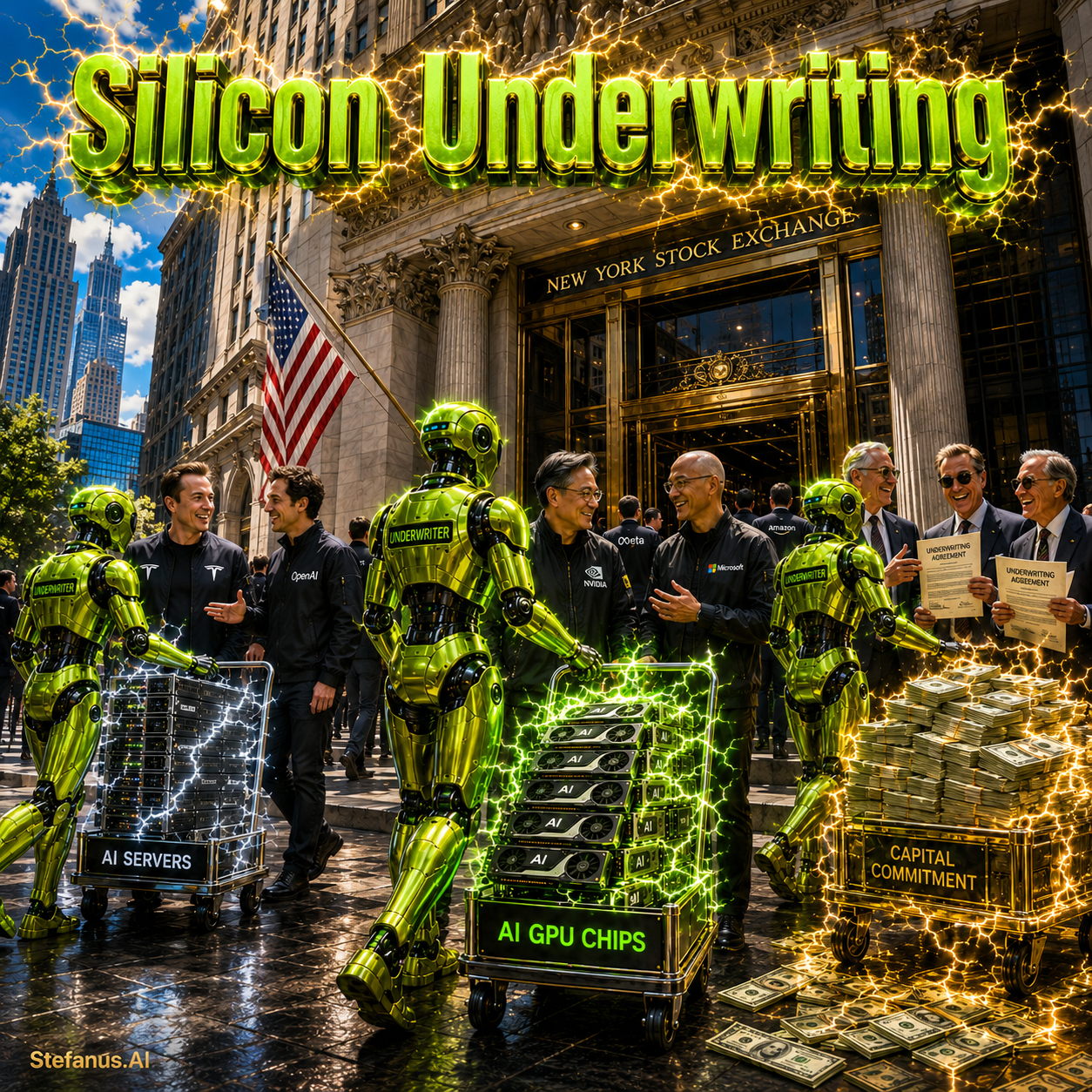
There are days on which the financial system quietly changes shape, and only later do historians agree on the date. October 24, 1907, when J.P. Morgan locked the presidents of New York’s trust companies in his library until they pledged a rescue pool, was such a day. August 15, 1971, when the dollar left gold, was another. This paper proposes that August 10, 2026 belongs on that list — not because a crisis erupted, but because a boundary dissolved. On that Monday morning, NVIDIA, the world’s most valuable semiconductor company and the dominant supplier of the computational substrate of artificial intelligence, announced strategic partnerships with six of the largest asset managers and investment banks on earth — Apollo, BlackRock, Blackstone, Brookfield, Goldman Sachs and KKR — to establish independent compute financing platforms designed to mobilize more than $500 billion of third-party capital for the buildout of AI infrastructure over time [1]. Executives from all seven firms appeared together in a rare joint television interview, and Jensen Huang, NVIDIA’s founder and chief executive, told CNBC that his chips had become an “investable asset” — something lenders could underwrite the way they underwrite commercial real estate, toll roads, or aircraft [2].
The scale of the announcement was arresting, but scale alone is no longer news in the AI economy; hundred-billion-dollar figures have become the ambient weather of the sector. What made August 10 historically distinct was the structure of the thing announced. A chip vendor was not merely selling hardware, nor merely extending trade credit to a struggling customer, nor merely making venture investments in promising startups. It was helping to organize the financing market itself — convening the institutions, shaping the asset class, defining the collateral, and, according to Huang’s public remarks accompanying the launch, retaining an option to backstop as much as $125 billion, approximately a quarter of the potential transaction volume, with NVIDIA’s own balance sheet. The company framed the platforms as dedicated pools of capital at significant scale and at attractive rates for NVIDIA’s customers — frontier AI laboratories, enterprises, governments, and cloud providers [1]. NVIDIA’s announcement pitched its compute as delivering superior token economics, the strongest revenue generation, and the longest useful life of any available silicon, surrounded by a deep ecosystem of offtakers — the language not of a component supplier but of an infrastructure sponsor describing an asset class to institutional investors [1].
“In AI, compute is revenue.”
— Jensen Huang, Founder and CEO, NVIDIA [1]
One caveat must appear prominently at the outset, because intellectual honesty about it disciplines everything that follows: the August 10 platforms rest, for now, on memorandums of understanding. Detailed commitments, financial terms, deployment schedules, and the precise legal mechanics of any NVIDIA backstop have not been disclosed [1]. Nothing like $500 billion has been funded, and this paper does not write as though it has. MOUs can shrink; NVIDIA’s own trajectory demonstrates the point vividly, since the up-to-$100 billion OpenAI investment framework announced in September 2025 was ultimately finalized at approximately $30 billion in early 2026, a steep reduction driven partly by internal doubts about circularity [12][13]. But announced architecture matters even before it is funded, because it tells us how the most sophisticated actors in the system intend the future to be financed. The blueprint is itself the historical event.
And the blueprint reveals something genuinely new. This paper gives it a name: Silicon Underwriting. The term is chosen deliberately, and the choice deserves a brief defense, since the title of a paper should carry its thesis. “Underwriting” is the oldest and most consequential function in finance: to underwrite is to stand beneath a risk — to assess it, to price it, to distribute it to investors, and, critically, to absorb what the market will not take. Investment banks underwrite securities; insurers underwrite hazards; governments, in extremis, underwrite entire systems. What NVIDIA began assembling on August 10 is underwriting in this full, classical sense, but performed by an entity whose primary business is fabricating the very asset being underwritten — silicon. The chipmaker assesses which customers deserve capital (through its allocation of scarce supply), shapes how the risk is structured (through the platforms it convenes), influences how it is priced (through the demand assurances only it can provide), and offers to absorb residual risk (through its optional backstop). “Silicon Underwriting” captures this fusion in two words: the physical substrate of intelligence and the financial function of standing beneath its risks have merged in a single corporate actor. No existing vocabulary — vendor finance, captive finance, corporate venture capital, project finance — describes this configuration, because none of those older forms involved the vendor helping to constitute the capital market for its own product while remaining that product’s near-monopoly supplier. Hence a new term, and hence this paper.
The announcement did not arrive in a vacuum. Two weeks earlier, in late July 2026, Bloomberg reported that NVIDIA was working on a fresh round of AI deals worth more than $750 billion — including a partnership with South Korea’s SK Group exceeding $500 billion in mutual business and talks to backstop as much as $250 billion of financing so that OpenAI could lease computing power from a U.S. data center project — news that sent NVIDIA shares down nearly five percent in a single session as investors relitigated the question of “circular” financing, in which suppliers become investors in, and guarantors of, their own customers [5][6][18]. The August 10 platforms can be read, in part, as NVIDIA’s institutional answer to that anxiety: rather than carrying customer risk alone on its own balance sheet, the company would syndicate the compute economy to Wall Street, with itself as arranger of first resort and guarantor of last resort. Semafor observed that the decision to expand the lending and spread its risk revealed a ceiling on how much even the world’s most valuable company is willing to finance the AI boom singlehandedly — and simultaneously noted that the platforms would tether enormous pools of capital to NVIDIA’s ecosystem and away from its competitors [4].
The financial firepower behind the announcement is real even if the platforms are not yet funded. NVIDIA reported revenue of $81.6 billion for its first quarter of fiscal 2027 (ended April 2026), up 85 percent year over year, with data center revenue of $75.2 billion growing 92 percent, GAAP net income of $58.3 billion, free cash flow of $48.6 billion, and guidance for approximately $91 billion in the following quarter — alongside a new $80 billion share repurchase authorization and a twenty-five-fold dividend increase [7]. A company generating cash at that velocity, facing customers who must collectively deploy trillions of dollars of capital they do not have, confronts a strategic question that classical microeconomics never had to answer: what does a monopolist of a scarce input do when the binding constraint on its own growth is not demand for its product but its customers’ access to capital? The answer NVIDIA gave on August 10 is the subject of this paper. Apollo’s president Jim Zelter spoke of deploying the firm’s flexible, long-term capital base; BlackRock’s chief executive framed the platforms as giving companies the compute capacity they need [3].
“to grow and create more jobs”
— Larry Fink, Chairman and CEO, BlackRock [3]
The remainder of the paper proceeds in eight sections. Section 1 situates Silicon Underwriting in the long history of vendor finance and explains why AI infrastructure breaks the older templates, introducing the Seven-Node Silicon Underwriting Stack. Section 2 maps the emerging “Bank of Nvidia” — the web of platforms, strategic investments, and guarantees through which credit is being built around silicon. Section 3 examines GPU-backed capitalism through the CoreWeave financing lineage and the SEC’s consequential 2026 guidance on data center securitizations. Section 4 turns to offtake intelligence — the transformation of frontier-lab customer contracts into the true collateral of the system, with the Broadcom–Apollo–Blackstone platform for Anthropic as the paradigm case. Section 5 confronts the GPU duration gap, the system’s deepest structural risk. Section 6 asks what happens when Silicon Underwriting becomes systemic underwriting. Section 7 addresses the public policy problem. Section 8 distills seven pillars of what we have learned, and the conclusion returns to the machine behind the machine.

Section 1 — From Vendor Finance to Silicon Underwriting
1.0 Situating the Paper: A Review of the 2020–2026 Literature
Before the historical argument, a word on where this paper sits in the literature, because the scholarly conversation on AI economics and AI finance has developed along four largely separate tracks between 2020 and 2026, and Silicon Underwriting lives precisely at their unbuilt intersection. The first track is the macroeconomics of AI’s productivity effects. Furman and Seamans’ foundational survey of AI and the economy set the pre-pandemic baseline; the decisive intervention of the period is Acemoglu’s “The Simple Macroeconomics of AI” (Economic Policy, 2025), which decomposes AI’s aggregate effect into the share of tasks affected, the cost savings per task, new task creation, and distributional channels, and concludes that AI can be economically significant without generating anything like the productivity acceleration that market pricing implies — his own estimates of the boost to U.S. output over a decade sit close to one percentage point, against sell-side projections several multiples higher [38][39]. The task-exposure literature descending from Acemoglu and Restrepo, Felten and co-authors, and Eloundou and co-authors refined the crucial distinction that exposure is not adoption, adoption is not productivity, and productivity is not necessarily captured by the shareholders financing the buildout [38]. If Acemoglu is even approximately right, the revenue assumptions embedded in the financing structures this paper documents are the largest open empirical bet in modern capital markets.
The second track is the asset-pricing and bubble-identification literature. The workhorse results — Greenwood and Shleifer on extrapolative expectations, Greenwood, Shleifer and You on the predictive content of price run-ups combined with issuance and volatility — predate the AI cycle but supplied the toolkit that 2026’s multi-method assessments apply to it; the most systematic of these, working through valuation metrics, credit dynamics, and adoption data simultaneously, reaches the deliberately uncomfortable verdict that AI exhibits some but not all classical bubble signatures, with the credit-financed phase of 2025–2026 marking the transition into the historically dangerous configuration [38]. The third track is the official-sector financial stability literature, which barely existed for AI before late 2024 and then arrived in force: the Bank of England’s December 2025 and July 2026 Financial Stability Reports, the BIS’s Bulletin No. 120 on private credit to AI companies and its June 2026 Annual Economic Report, and the IMF’s 2026 scenario-planning work treating AI as a macro-critical transition [35][37][38]. These documents supply this paper’s systemic evidence base, and Sections 5 through 7 engage them directly. The fourth track — industry and legal scholarship on the deal structures themselves — remains the thinnest: practitioner analyses of the CoreWeave facilities [20][21], law-firm advisories on the SEC’s securitization guidance [24][25], journalistic anatomies of circular deals [17], and early legal-academic warnings from Sitaraman and Ramzanali about financial engineering outrunning disclosure [40]. What no track yet offers is a unified account of the vendor’s new position across all of them — the supplier as investor, arranger, guarantor, and narrative-setter simultaneously. Supplying that account, under the name Silicon Underwriting, is this paper’s intended contribution.
1.1 The Long Prehistory: Financing the Customer Is an Old Idea
The instinct of a capital goods producer to finance its own customers is nearly as old as industrial capitalism itself, and any honest account of Silicon Underwriting must begin by acknowledging its ancestors, precisely so that the genuinely novel features stand out against the familiar ones. Caterpillar Financial Services, founded in 1981, became the canonical captive finance company of the machinery age: when a mining operator or construction firm could not pay cash for a fleet of excavators, Caterpillar’s finance arm would write the loan or lease, secured by the equipment itself, priced against decades of actuarial knowledge about how excavators depreciate, how they are resold, and how their operators default. The model worked because the collateral was legible. A five-year-old excavator has a deep secondary market, a predictable residual value curve, and a useful life measured in decades. The captive lender was not betting on a technological paradigm; it was betting on steel.
Aircraft finance elaborated the same logic at greater scale and longer duration. The modern aircraft leasing industry — pioneered by firms such as GPA and ILFC and today dominated by AerCap and its peers — rests on a single magnificent fact: a commercial airframe is a fungible, mobile, internationally registrable asset with a thirty-year economic life, standardized maintenance records, and a global market of hundreds of potential operators. Lessors can finance a Boeing or Airbus aircraft with twelve-year debt because the asset will demonstrably outlive the loan, and because if one airline fails, the aircraft flies to another. Export credit agencies — the U.S. Export-Import Bank, France’s Bpifrance Assurance Export, and their peers — added the sovereign layer: governments guaranteeing loans so that foreign buyers could purchase domestic champions’ products, an early and explicit fusion of industrial policy with credit enhancement.
Telecommunications equipment finance in the late 1990s supplied the cautionary chapter of this prehistory, and it is the chapter every risk officer in the AI economy has read. Lucent, Nortel, and their peers extended tens of billions of dollars of vendor financing to competitive local exchange carriers and startup telecoms so that those customers could buy switches and optical gear. The equipment vendors booked the sales as revenue; the customers booked the debt; and when the telecom bubble collapsed in 2001–2002, the receivables proved worthless, the equipment proved unsalable at anything near book value, and the vendors’ own solvency was impaired by the failure of the demand they had financed into existence. Vendor finance, the episode taught, is a demand amplifier on the way up and a loss concentrator on the way down. Finally, project finance — the discipline developed for pipelines, power plants, toll roads and LNG terminals — contributed the structural grammar that AI infrastructure finance now borrows wholesale: the special purpose vehicle, the non-recourse loan, the offtake agreement, the ring-fenced cash flow waterfall. In a classic LNG project, lenders advance billions against a facility whose output is pre-sold under twenty-year take-or-pay contracts to investment-grade utilities; the contract, not the concrete, is the true collateral.
1.2 Why AI Infrastructure Breaks the Templates
Silicon Underwriting inherits pieces of all of these forms — the captive lender’s customer knowledge, the aircraft lessor’s asset-based structuring, the export credit agency’s strategic guarantee, the telecom vendor’s demand amplification, and project finance’s SPV grammar — yet it is reducible to none of them, because five features of AI infrastructure jointly break every older template. The first is accelerated technological depreciation. An excavator is productive for thirty years and an aircraft for twenty-five; a frontier GPU faces a successor generation roughly every twelve to eighteen months that may double performance per watt, and NVIDIA itself has moved to an annual architecture cadence — Hopper, Blackwell, Rubin — that compresses the economic half-life of the installed base even when the hardware remains physically functional. Accountants debate whether the right depreciation schedule is three years or six; nobody argues for thirty. Financing structures with five-to-seven-year maturities are therefore lending against an asset whose competitive relevance may expire before the loan does — the central problem to which Section 5 returns.
The second feature is the sheer verticality of the capital requirement. Building 122 gigawatts of data center capacity between 2026 and 2030 — the projection in J.P. Morgan’s November 2025 report on financing the AI investment cycle — is estimated to cost between five and seven trillion dollars, with 2026 funding needs alone around $700 billion [45]. The Bank for International Settlements calculates that the five largest hyperscalers are set to spend over a trillion dollars on AI-related capital expenditure across 2025–2026, commitments that are outpacing their earnings and free cash flow and pushing even the richest companies in history toward debt issuance [9]. No previous technology buildout — not railroads relative to their era’s GDP over so compressed a window, not telecom fiber, not shale — has demanded external capital at this velocity from an industry this young. Harvard economist Jason Furman calculated that investment in information-processing equipment and software, though only about four percent of U.S. GDP in the first half of 2025, accounted for roughly ninety-two percent of U.S. GDP growth in that period; stripped of the data center buildout, annualized growth would have registered a bare 0.1 percent [8].
“absent the AI boom we would probably have lower interest rates”
— Jason Furman, Professor of the Practice of Economic Policy, Harvard University [8]
The third feature is supplier concentration. Vendor finance in machinery or aviation operated in competitive or duopolistic supply markets; the AI compute economy runs, for its most advanced training workloads, substantially through a single vendor’s architecture and software ecosystem. CUDA lock-in means the collateral is not merely hardware but hardware-plus-ecosystem, which cuts both ways: it supports residual values while NVIDIA’s dominance persists, and it concentrates the entire collateral class’s fate on one company’s roadmap. The fourth feature is uncertain utilization. An LNG terminal’s offtaker is a regulated utility with a century of demand history; a GPU cluster’s offtaker is often a frontier AI laboratory whose revenues, while growing explosively, are years old, unprofitable at the operating line, and dependent on continued willingness of equity and debt markets to fund losses. The fifth feature is demand growth so rapid that it inverts normal credit logic: scarcity of compute is currently so acute that the financing question is not whether the asset can find a user but whether the user can find the asset — a seller’s market in collateral that flatters every underwriting model built during it, exactly as 2005-vintage housing models were flattered by 2005 housing conditions. Man Group’s 2026 analysis of the cycle describes a closed, recursive financing loop in which rising valuations justify heavier capex, rising capex signals explosive future demand, and the signal itself reinforces valuations — with the demand signal at risk of becoming circular and divorced from independent market validation [10].
1.3 The Seven-Node Silicon Underwriting Stack
To analyze the system rigorously rather than anecdotally, this paper proposes a seven-node institutional stack — a map of the distinct functional layers through which capital now flows from the world’s savers to the world’s GPUs. Each node existed before; the novelty of Silicon Underwriting is that a single vendor now touches, shapes, or guarantees activity at every one of them simultaneously. The stack is summarized in Table 1 and referenced throughout the remainder of the paper.
Table 1. The Seven-Node Silicon Underwriting Stack
| Node | Function | Principal Actors (2025–2026) | NVIDIA’s Touchpoint |
| 1. Silicon Supply | Fabricates the scarce input; allocates supply among customers | NVIDIA, Broadcom, AMD; TSMC, SK hynix upstream | Core business; allocation is de facto credit rationing |
| 2. Strategic Equity | Vendor and hyperscaler equity stakes in AI labs and neoclouds | NVIDIA ($30B OpenAI, $10B Anthropic), Microsoft, Amazon, Google | Direct investor; signaled 2026 pullback from further lab stakes |
| 3. Compute Operators | Neoclouds and hyperscalers that own/operate GPU fleets | CoreWeave, Nebius, Nscale, Fluidstack; AWS, Azure, GCP, Oracle | Supplier, investor, and sometimes capacity buyer of last resort |
| 4. Structured Credit | SPVs, delayed-draw term loans, GPU-backed and lease-backed debt | Blackstone Credit, Apollo/Athene, Ares, Blue Owl, banks (MS, MUFG, GS, JPM) | Collateral definer; platform convener as of Aug 10, 2026 |
| 5. Financing Platforms | Dedicated capital pools organizing the asset class at scale | NVIDIA–Apollo/BlackRock/Blackstone/Brookfield/GS/KKR; Broadcom AI XPV | Co-architect; optional backstop of up to ~$125B (~25%) |
| 6. Offtakers | Frontier labs, enterprises, sovereigns whose contracts back the debt | OpenAI, Anthropic, hyperscalers, governments (Korea, Gulf states) | Customers whose creditworthiness NVIDIA enhances and depends on |
| 7. Public Backstop (latent) | Regulators, tax incentives, power commitments, implicit support | SEC, Fed/BoE/BIS oversight, state incentives, DOE partnerships | Lobbying object; potential ultimate underwriter (Section 7) |
Read vertically, the table describes a capital pipeline; read horizontally, it describes a concentration of functions. In classical finance these nodes were held apart by institutional boundaries — banks did not fabricate collateral, vendors did not convene syndicates, and offtakers did not receive equity from their suppliers. Silicon Underwriting is the name for the collapse of those boundaries around a single input. The next section examines the collapse in detail.

Section 2 — The Bank of Nvidia: Building Credit Around Silicon
2.1 The Platform Layer: Six Institutions, One Ecosystem
The August 10 platforms are best understood not as a single fund but as an architecture for manufacturing an asset class. According to NVIDIA’s announcement, the memorandums of understanding with Apollo, BlackRock, Blackstone, Brookfield, Goldman Sachs and KKR aim to establish the first compute financing platforms of their kind at global scale, creating dedicated pools of capital at attractive rates for NVIDIA customers across frontier AI labs, enterprises, and AI clouds, and turning NVIDIA compute and full-stack AI infrastructure into an investable asset class that generates long-lived revenue streams tied to actual usage [1]. Each of the six partners brings a distinct balance sheet to the stack mapped in Table 1. Apollo contributes the insurance-annuity liabilities of Athene — long-duration, spread-hungry capital ideally suited to holding amortizing infrastructure debt. Blackstone brings the largest private credit and insurance franchise in the world, and had already anchored CoreWeave’s landmark GPU-backed facility in March 2026 [19]. Brookfield brings power, real assets, and — through its nonbinding term sheet of up to $9 billion for NAVER’s Korean AI factory — a template for sovereign-adjacent compute projects [14][15]. BlackRock brings the world’s largest asset management distribution; Goldman Sachs brings underwriting and syndication machinery; KKR brings infrastructure private equity. NVIDIA brings the one thing none of them possess: control of the input, knowledge of the demand pipeline, and the credibility to declare which projects will receive allocation.
That last contribution deserves emphasis, because it is the quiet mechanism through which a chip vendor becomes a credit actor without writing a single loan. In an environment of genuine supply scarcity, NVIDIA’s allocation decisions function as a form of pre-underwriting: a data center project that has secured NVIDIA allocation and NVIDIA’s participation in a financing platform carries an implicit certification that the most informed actor in the industry considers the project real, the customer serious, and the demand durable. Lenders price that certification. Huang’s framing on August 10 — that the platforms would help customers, in his words, “access scarce compute at scale” and build DSX AI factories across every industry and country [4] — makes the point explicitly: the platforms bundle capital access with compute access, and each secures the other. Semafor’s analysts immediately noted the competitive implication: the financing packages will keep a huge amount of capital tethered to NVIDIA and away from fledgling or established rivals [4].
2.2 The Equity Layer: From $100 Billion Frameworks to Final Checks
Beneath the platform layer sits the strategic equity layer, and its 2025–2026 history is a compressed lesson in the tensions of Silicon Underwriting. In September 2025, NVIDIA and OpenAI announced a letter of intent under which NVIDIA would invest up to $100 billion in OpenAI alongside the deployment of at least ten gigawatts of NVIDIA systems — an announcement that instantly became the reference case for circular financing, since the investment would fund the purchase of the investor’s own products. Over the following months the framework was quietly renegotiated: NVIDIA’s third-quarter fiscal 2026 filings described the OpenAI position only as an “opportunity” without the $100 billion figure, and the investment was ultimately finalized at approximately $30 billion as part of OpenAI’s roughly $110 billion funding round in early 2026 [12][13]. In November 2025, NVIDIA and Microsoft jointly announced investments of up to $10 billion and $5 billion respectively in Anthropic — a transaction that lifted Anthropic’s valuation into the range of $350 billion and was paired with Anthropic’s commitment to purchase $30 billion of Azure compute capacity [11]. Then, in March 2026, Huang publicly signaled the end of the era: the $100 billion OpenAI opportunity was “probably not in the cards,” and the Anthropic stake was likewise expected to be the company’s final major check to a frontier lab, with both companies heading toward public markets [12].
Industry analysts read the pullback as more than IPO mechanics. Patrick Moorhead of Moor Insights and Strategy argued that NVIDIA does not abandon forty billion dollars of combined positioning over a listing technicality.
“Something fundamental has shifted in how Jensen sees the risk-reward equation”
— Patrick Moorhead, Founder and CEO, Moor Insights & Strategy [13]
MIT Sloan professor Michael Cusumano identified the underlying paradox with academic precision: when NVIDIA invests tens of billions in OpenAI’s equity while OpenAI simultaneously commits to purchase comparable sums of NVIDIA hardware, the same dollars are, in an economic sense, being counted twice — once as investment on one balance sheet and once as revenue on the other — and the apparent demand signal contains a reflexive component that neither company’s auditors are required to isolate [13]. The March 2026 pullback and the August 2026 platforms are therefore two halves of a single strategic migration: NVIDIA is exiting the equity layer of the stack, where circularity is most visible and most criticized, and entering the platform layer, where its exposure takes the more traditional — and more traditionally regulated — forms of arrangement, certification, and contingent guarantee. Whether that migration reduces systemic circularity or merely launders it through intermediaries is the central question of Section 6.
2.3 The Sovereign Layer: Korea as the Template
The third layer of the Bank of Nvidia is sovereign, and its clearest expression came in late July 2026 during South Korean President Lee Jae Myung’s visit to the United States. In a single week, NVIDIA announced a long-term commercial partnership with SK Group described as worth more than $500 billion — spanning AI factories, a planned two-gigawatt AI cloud project with SK Telecom using NVIDIA’s DSX factory design and Vera Rubin systems with SK hynix HBM4 memory, and multi-year memory co-development — alongside a $1 billion direct investment in NAVER to more than triple its GAK Sejong AI data center from 55 to 200 megawatts, with Brookfield signing a nonbinding term sheet to fund up to $9 billion for the project [14][15][16]. The Korean package displays the full seven-node stack in miniature: silicon supply (NVIDIA systems and SK hynix memory), strategic equity (the NAVER stake), compute operation (SK Telecom and NAVER), structured credit and platform capital (Brookfield), sovereign offtake (Korea’s explicit sovereign AI ambitions, blessed at the presidential level), and the latent public backstop of a national government that has made AI capacity a strategic priority. Critics described the pattern bluntly as circular financing replicated with sovereign partners [14]; supporters described it as the only realistic mechanism by which a mid-sized economy secures frontier compute. Both descriptions are accurate, which is precisely what makes the template consequential.
2.4 What Distinguishes the Bank of Nvidia From a Bank
It is worth stating precisely what the Bank of Nvidia is not, because loose analogies obscure the real risks. NVIDIA takes no deposits, faces no capital requirements, undergoes no stress tests, and holds no banking license; its backstop option is a corporate contingent liability, not a regulated guarantee. The platforms it convenes are private capital vehicles whose disclosures are contractual rather than statutory. Yet the functional resemblance to banking is unmistakable: maturity transformation (long-lived financing against short-lived technology), credit intermediation (channeling institutional savings to borrowers), credit enhancement (backstops and residual value support), and — most bank-like of all — the creation of confidence as a product. When the most informed actor in the system offers to stand beneath a quarter of the risk, other actors lend more cheaply and more abundantly than they otherwise would. That is what underwriting does. It is also, as the 2001 telecom vendors and the 2008 monoline insurers discovered, what underwriting costs when the confidence proves misplaced. The Bloomberg graphics team’s January 2026 anatomy of AI circular deals — mapping how Microsoft, OpenAI, NVIDIA, Amazon, Anthropic and the neoclouds keep paying, investing in, and guaranteeing one another — documents how far the web already extends [17]. The next two sections descend from the institutional map to the transactions themselves, because it is in the fine print of the CoreWeave facilities and the Broadcom AI XPV platform that Silicon Underwriting’s true mechanics — and true vulnerabilities — become visible.

Section 3 — GPU-Backed Capitalism: When Compute Becomes Collateral
3.1 CoreWeave as the Laboratory of the Asset Class
If Silicon Underwriting has a laboratory, it is CoreWeave. The company’s financing history from 2023 through mid-2026 is the single best time series we possess of how markets learned — facility by facility, covenant by covenant — to treat GPUs as collateral, and the learning curve is steep enough to constitute a financial innovation in its own right. CoreWeave began the period as a crypto-mining pivot borrowing at double-digit effective costs against Hopper GPUs and Microsoft contracts; it ended it as a public company whose debt carries investment-grade ratings on some facilities and trades in syndicated markets. Three milestones define the arc. In its earlier delayed-draw structures (culminating in what the market calls DDTL 3.0), CoreWeave borrowed at spreads around SOFR plus 400 basis points under formulaic, asset-based frameworks in which loan-to-value tests against the GPUs themselves governed leverage [20]. On March 30–31, 2026, the company closed its $8.5 billion DDTL 4.0 facility — rated A3 by Moody’s and A (low) by DBRS, the first investment-grade rated financing secured by high-performance computing infrastructure and an associated customer contract — priced at SOFR plus 225 basis points on the floating tranche and approximately 5.9 percent fixed, maturing in March 2032, structured as non-recourse to a ring-fenced entity (CoreWeave Compute Acquisition Co. VIII, LLC), arranged by MUFG and Morgan Stanley with Goldman Sachs and JPMorgan, and anchored by Blackstone Credit & Insurance [19][21]. Repayment is tied solely to the dedicated vehicle, secured by GPU clusters and contracted revenue including an estimated $19 billion backlog from Meta [21]. Then on May 18, 2026, CoreWeave closed the $3.1 billion DDTL 5.0 facility — the first publicly syndicated HPC infrastructure-backed financing vehicle, rated Ba2/BB+, meaningfully oversubscribed with pricing tightening by 50 basis points during syndication, maturing in late 2031, and enabling secondary market trading of the debt — bringing the company past $20 billion of debt and equity raised in 2026 alone [22].
Table 2. The CoreWeave Financing Lineage: How Markets Learned to Lend Against GPUs
| Facility | Closed | Size | Pricing / Rating | Structural Innovation |
| DDTL 2.0–3.0 era | 2023–2025 | Multi-billion (cumulative) | ~SOFR + 400 bps; unrated/high-yield | Asset-based borrowing base; GPUs as primary collateral; formulaic LTV tests |
| DDTL 4.0 | Mar 31, 2026 | $8.5 billion | SOFR + 225 bps / ~5.9% fixed; A3 (Moody’s), A low (DBRS) | First investment-grade GPU-backed loan; non-recourse SPV; contract + hardware dual collateral; Blackstone anchor |
| DDTL 5.0 | May 18, 2026 | $3.1 billion | Ba2 (Moody’s), BB+ (Fitch); tightened 50 bps in syndication | First publicly syndicated HPC-backed facility; secondary trading; two dedicated customer contracts |
The compression from SOFR plus 400 to SOFR plus 225 within roughly a year is the market’s tuition receipt: lenders concluded that the asset class was safer than they had first priced, and the arrival of investment-grade ratings unlocked the deepest pool of capital in the world — insurance balance sheets — for which sub-investment-grade paper is largely off-limits. But the structural evolution matters more than the pricing. Deep Quarry’s forensic analysis of DDTL 4.0 observed that the facility’s apparent improvements obscured a more consequential shift: leverage is no longer governed by a formulaic, asset-based framework tied to the GPUs’ appraised value, but by a more complex, project-style financing model in which the customer contract does much of the load-bearing work [20]. In plain terms, between DDTL 3.0 and DDTL 4.0 the collateral quietly migrated from the silicon to the promise — from physical hardware toward pledged customer cash flows. That migration is rational (contracts with Meta or Microsoft are better credits than used GPUs), but it means the label “GPU-backed” increasingly names the garnish rather than the meal, a point whose full implications belong to Section 4.
3.2 The Anatomy of a GPU-Backed Structure
The canonical structure that emerged from this laboratory deserves careful anatomical description, because it now propagates across the industry. A borrower forms a bankruptcy-remote special purpose vehicle. The SPV purchases GPUs and associated infrastructure — servers, networking, sometimes the fitted-out data hall — using proceeds from a delayed-draw term loan whose draw schedule is aligned with hardware delivery and deployment, so that interest does not accrue on capital before the assets it funds are revenue-generating. The SPV’s assets are pledged to lenders; its revenues are the payments from one or a small number of long-term customer contracts; a cash flow waterfall pays operating costs, then debt service, then reserves, then distributions; covenants govern debt service coverage rather than simple loan-to-value; and the facility amortizes on a schedule intended to track — here is the load-bearing assumption — the useful economic life of the underlying hardware, typically five to six years in the 2026-vintage deals [22]. The parent’s exposure is formally limited to its equity in the SPV; the lender’s exposure is formally limited to the SPV’s assets and contracts. Everything in the structure is borrowed from project finance; what is new is the asset at the center, which unlike a toll road cannot be repaved and unlike an aircraft has never lived through a full technology cycle as collateral.
3.2.1 Beyond CoreWeave: The New Cloud Ecosystem as Distribution Layer
CoreWeave is the laboratory, but it is no longer alone, and the propagation of its template across the neocloud sector matters because the neoclouds are the distribution layer of Silicon Underwriting — the tier of specialized operators through which NVIDIA reaches customers too small, too fast-moving, or too strategically inconvenient to be served by hyperscalers. Nebius, Nscale, Fluidstack, Lambda, Crusoe and their peers have all raised capital in rounds that NVIDIA has variously led, joined, or anchored with purchase commitments; Bloomberg’s mapping of the circular-deal web documents NVIDIA’s roughly seven percent CoreWeave stake, its $6.3 billion capacity purchase agreement with the same company, and its participation in funding rounds for Nscale and Nebius [17]. The new cloud’s structural function in the stack is subtle and double. On the way up, it is a demand aggregator and balance-sheet extender: it converts NVIDIA’s lumpy, allocation-constrained supply into rentable capacity for hundreds of customers, and it does so on a balance sheet willing to carry leverage that hyperscalers’ shareholders would punish. Fluidstack’s role in the AI XPV structure — operating the physical sites at which Anthropic’s leased TPU gigawatt will run [27] — shows the layer’s vendor-neutral maturation: the same operators now intermediate NVIDIA, Google, and Amazon silicon alike. On the way down, however, the neocloud is the system’s designated shock absorber, the tier where utilization risk, refinancing risk, and residual value risk concentrate first — which is exactly why its financing terms, chronicled in Table 2, are the most sensitive barometer the market possesses. When neocloud spreads compress, as they did through the first half of 2026, the market is declaring the whole stack safer; when they gap wider, the declaration will run in reverse, and faster.
3.3 The SEC’s Gift: The July–August 2026 Securitization Clarification
While private credit built the loan market, the securitization market was preparing its own expansion, and in the summer of 2026 the regulatory groundwork shifted decisively. Data center asset-backed securities and related commercial-mortgage structures had already surpassed $25 billion of issuance in 2025, eclipsing the combined total of the prior three years. On July 29, 2026, the SEC’s Division of Corporation Finance, through its Office of Structured Finance, issued an interpretive letter — responding to counsel from Latham & Watkins — confirming that securities issued in a major class of data center securitizations are not “asset-backed securities” within the meaning of Section 3(a)(79) of the Securities Exchange Act of 1934, where the issuing entity directly owns the data center and the securities are repaid from net operating income [24][25]. Bloomberg reported the market’s translation on August 10 — the same day as the NVIDIA platforms: a major subset of data-center securitizations will not need the disclosures and investor protections that similar deals require, including risk retention, the post-2008 requirement that securitizers keep skin in the game [23]. Law firm analyses enumerated the consequences: no Regulation AB pool-level disclosure or ongoing Form 10-D reporting, no five-percent risk retention (where sponsors had typically been retaining around thirty percent partly out of regulatory caution), no Rule 15Ga-1 repurchase reporting or 15Ga-2 third-party due diligence reports, and expected exemption from Rule 192’s conflict-of-interest prohibition [24][25].
The clarification is defensible as statutory interpretation — a data hall generating operating income genuinely differs from a pool of auto loans — and it will lower funding costs for exactly the infrastructure the buildout requires. But its timing and direction deserve the emphasis this paper’s outline demands. At the precise moment when central banks were warning that opacity in AI-sector financing compounds vulnerability, the U.S. securities regulator reduced the disclosure and risk-retention requirements applicable to one of the fastest-growing financing channels in the system. Risk retention exists because the 2008 crisis demonstrated what happens when originators can transfer one hundred percent of the risk they create; its removal from data center structures means the alignment mechanism must now be supplied, if at all, by contract and reputation. Section 7 returns to the policy question; for present purposes the point is architectural: as of August 2026, the securitization on-ramp for compute-adjacent assets is wider, cheaper, and darker than it was a year earlier.
3.4 Physical Collateral versus Pledged Cash Flows
The deep question running beneath every structure in this section is what, exactly, the lender owns when things go wrong — and the answer differs radically between the two collateral philosophies now coexisting in the market. Physical-collateral lending (the DDTL 3.0 philosophy) owns silicon: repossessable, transferable — as Huang emphasized on August 10, NVIDIA compute is fungible across customers and operators [1][2] — but exposed to technological depreciation, to the logistics of re-racking hundreds of thousands of accelerators, and to the awkward fact that mass repossession would likely occur precisely in the demand environment least favorable to resale. Contract-collateral lending (the DDTL 4.0 and AI XPV philosophy) owns promises: the pledged revenues of a Meta, a Microsoft, or an Anthropic, insulated from hardware residual values but exposed to counterparty credit, to contract renegotiation in distress, and to the correlation — uncomfortably high — between the scenarios in which AI customers default and the scenarios in which the repossessed hardware is worthless. The market’s migration from the first philosophy to the second is the single most important structural fact of 2026-vintage AI finance, and it sets up this paper’s next claim: the true asset of the compute economy is not the GPU. It is the offtake.

Section 4 — Offtake Intelligence: The Customer Contract Becomes the Real Asset
4.1 The AI XPV Platform: A Paradigm Transaction
On June 9, 2026, the paradigm transaction of offtake-backed compute finance closed, and it is worth dwelling on its architecture because every element of Silicon Underwriting appears in it — performed, instructively, by NVIDIA’s principal competitor. Apollo announced that Apollo-managed funds and affiliates were leading an initial $35 billion capital solution as part of Broadcom’s new AI XPV Platform, in partnership with Blackstone and leading global banks, designed to enable more than twenty gigawatts of compute capacity for leading frontier AI labs through 2028 [26]. The initial commitment expands Anthropic’s AI computing capacity by one gigawatt — roughly the power draw of 750,000 homes — deployed at Fluidstack-operated sites beginning mid-2026 [27]. Apollo’s partner Jamshid Ehsani described the transaction in superlatives that were, for once, literally accurate.
“the largest private financing ever executed”
— Jamshid Ehsani, Partner, Apollo Global Management [26]
The structure, as reported by the Financial Times, Bloomberg, and subsequent tranche-level analyses, is a masterclass in credit manufacturing. A special purpose vehicle raises the $35 billion in debt and equity; the SPV purchases custom AI accelerators — including Google-designed tensor processing units that Broadcom co-develops — and leases them to Anthropic; Anthropic’s lease payments service the debt; and the hardware sits off Anthropic’s balance sheet, a considerable convenience for a company preparing for public markets where heavy debt loads are punished [29][30]. The debt priced across three tranches: reported analyses describe a $6 billion senior A1 tranche and a $24 billion A2 tranche, both supported by Broadcom credit endorsement and residual value guarantees — meaning that if Anthropic fails to pay and the repossessed chips prove insufficient, Broadcom compensates the shortfall to those tranches — lifting their ratings toward Broadcom’s own investment-grade level without consolidating the debt onto Broadcom’s balance sheet, with Apollo’s Atlas SP contributing equity and Apollo’s insurance arm Athene absorbing a sizable share of the syndication alongside insurers and banks [28][30]. Broadcom’s chief executive Hock Tan framed the strategic vision as combining Broadcom’s technology with the balance sheets of the strongest investment partners to deliver sufficient compute to frontier labs [28].
Pause on what this structure accomplishes, because it is the purest specimen of Silicon Underwriting yet executed — more complete, as of this writing, than anything NVIDIA has closed. The chip vendor (Broadcom) designs the silicon, sells the silicon, guarantees the residual value of the silicon, and credit-enhances the debt that finances the silicon’s purchase for its customer’s benefit — collecting the sale margin today while warehousing a contingent liability whose trigger is the failure of the very demand the sale represents. The asset managers manufacture investment-grade paper from a sub-investment-grade counterparty by layering the vendor’s guarantee over the customer’s lease. The customer obtains a gigawatt of compute without a dollar of balance-sheet debt. Everyone’s incentives are individually rational; the question the remainder of this paper pursues is what they sum to.
4.2 The Offtaker’s Balance Sheet: Anthropic as Case Study
The credibility of every offtake-backed structure ultimately rests on the offtaker, and Anthropic — which sits at the center of both the AI XPV platform and this section — illustrates both the strength and the strangeness of frontier-lab credit. In April 2026, Anthropic and Amazon announced an expanded collaboration under which Anthropic commits more than $100 billion over ten years to AWS technologies, securing up to five gigawatts of capacity across current and future generations of Trainium and Graviton silicon, while Amazon invests $5 billion immediately with up to $20 billion more to follow, atop $8 billion previously invested [31][32]. Anthropic disclosed that it already operates more than one million Trainium2 chips through Project Rainier, one of the largest compute clusters in the world [31]. Amazon’s chief executive Andy Jassy pitched the custom silicon’s economics — in his words, “high performance at significantly lower cost” [33] — while Anthropic’s chief executive framed the demand side.
“Claude is increasingly essential to how they work”
— Dario Amodei, CEO and Co-Founder, Anthropic [31]
Aggregate Anthropic’s publicly announced compute commitments as of mid-2026 and the strangeness comes into focus: more than $100 billion to AWS over ten years [31], $30 billion of Azure capacity announced alongside the Microsoft–NVIDIA investment [11], and the $35 billion AI XPV leasing structure [26][27] — well over $150 billion of long-duration obligations undertaken by a private company whose valuation reached the $350 billion range in late 2025 [11] and whose revenues, though compounding at rates almost without precedent in enterprise software, remain a small fraction of the committed spend. TechCrunch noted the structural rhyme: the Amazon deal echoes Amazon’s arrangement with OpenAI months earlier, with investment flowing in one direction structured partly as cloud services flowing back in the other [34]. This is the deliberate strategy that distinguishes Anthropic’s approach — distributing compute across AWS Trainium, Google TPUs via the XPV lease, Azure, and NVIDIA hardware, hedging supplier concentration in exchange for multiplying counterparties — and it is simultaneously the reason the offtaker’s promise, not any single vendor’s hardware, has become the system’s load-bearing asset. Every one of those commitments is someone else’s collateral.
4.3 When Does a Compute Contract Equal an LNG Offtake?
The intellectual test this section’s title poses can now be administered. Project finance history demonstrates that a customer contract can function as bankable collateral — the entire LNG industry was built on it — but it also specifies the conditions under which the trick works, and Table 3 scores compute offtakes against them.
Table 3. Offtake Bankability: LNG Terminal versus Frontier-Lab Compute Contract
| Bankability Condition | Classic LNG Offtake | Frontier-Lab Compute Offtake (2026) |
| Offtaker credit | Investment-grade utilities; sovereign-linked buyers; decades of audited history | Private labs (OpenAI ~$1T, Anthropic ~$350B valuations); explosive revenue growth; operating losses; pre-IPO |
| Contract tenor vs asset life | 20-year take-or-pay vs 40-year facility — asset outlives contract | 5–10-year commitments vs 3–6-year silicon relevance — contract outlives asset |
| Demand for underlying output | Century of energy demand data; inelastic end-use | Token demand growing explosively but 4 years old; elasticity unknown; efficiency gains cut cost per unit of output continuously |
| Price discovery | Liquid global commodity benchmarks (Henry Hub, JKM) | No liquid compute benchmark; pricing bilateral and opaque; BIS notes lease terms often undisclosed [37] |
| Substitution risk | Pipeline gas; renewables — slow, visible, decadal | Custom silicon, model efficiency, algorithmic progress — fast, partly invisible, annual |
| Recourse on default | Terminal retains value; gas re-marketable to global buyers | Vendor guarantees (Broadcom RVGs) substitute for thin secondary evidence; repossession correlated with sector distress |
The honest verdict is neither dismissal nor endorsement. A frontier lab’s compute payments can function economically like an LNG offtake to the degree that four conditions hold: the lab’s revenue growth continues to convert into durable enterprise and consumer spending rather than venture-subsidized experimentation; the lab retains access to equity markets to fund the gap between commitments and cash flow (which is why the OpenAI and Anthropic IPO trajectories are, quietly, credit events for the entire stack); the contracts prove enforceable in distress rather than renegotiable, an untested proposition, since no frontier lab has yet failed while owing tens of billions of committed capacity; and the vendors’ credit enhancements — Broadcom’s residual value guarantees today, NVIDIA’s $125 billion backstop option tomorrow — remain credible without ever being drawn at scale. Where LNG finance rested on geology and thermodynamics, compute finance rests on the continuation of a demand curve that is four years old. That is not a reason to refuse the analogy; it is the precise measure of the leap of faith embedded in every A-rated tranche of the new asset class.

Section 5 — The GPU Duration Gap: When Finance Lasts Longer Than Technology
5.1 Defining the Gap
Every financial crisis has a signature mismatch. Banking crises are mismatches of liquidity — short liabilities against long assets. The savings and loan crisis was a mismatch of interest rates. This paper argues that if the AI financing system ever produces a crisis, its signature will be a mismatch of duration between capital and technology: financing structures whose maturities — the 2032 maturity of CoreWeave’s DDTL 4.0 [19], the 5.5-year tenor of DDTL 5.0 [22], the multi-year draw schedules of the AI XPV platform [26], the long-lived, usage-tied revenue streams NVIDIA promises platform investors [1] — extend beyond the horizon at which anyone can responsibly forecast the competitive relevance of the financed assets. Call it the GPU duration gap. It is not a tail risk appended to the system; it is the system’s constitutive wager. The entire edifice of Silicon Underwriting exists because compute assets are too expensive to fund from cash flow and too short-lived to fund with the century-long instruments of classical infrastructure — so the market has settled on five-to-seven-year structures and a portfolio of arguments for why the gap will not bind. This section examines the gap’s six components and then the arguments.
5.2 Six Components of the Gap
First, technological depreciation and obsolescence. NVIDIA’s annual architecture cadence means that hardware financed at closing may be two generations behind by maturity. The economics are unforgiving because the operating cost of a GPU is dominated by power, and each generation delivers dramatically more computation per watt: a cluster that remains physically functional can become economically stranded when the electricity it consumes exceeds the market value of the tokens it produces relative to newer silicon. Depreciation schedules are therefore not accounting trivia but the load-bearing wall of every model; hyperscalers’ own extensions of server useful lives to six years have drawn persistent skeptical commentary from analysts who note that frontier training economics turn over far faster. Second, custom-silicon competition. The same June week that Broadcom guaranteed TPU residual values for Anthropic’s lease, it was demonstrating why NVIDIA’s pricing power is contestable: Google’s TPUs, Amazon’s Trainium (with Anthropic alone committed to five gigawatts of it [31]), Microsoft’s Maia, and OpenAI’s Broadcom co-designed accelerators collectively attack the assumption that today’s dominant architecture anchors tomorrow’s residual values. NVIDIA’s answer — CUDA’s ecosystem and the claim that its compute is uniquely fungible and continuously improved through software, extending its useful life [1] — is serious, but note its circularity within the financing system: the residual values that collateralize the loans depend on the persistence of the very dominance the loans are financing customers to entrench.
Third, utilization risk. Project models assume high, sustained utilization at contracted rates; yet utilization depends on demand for AI services whose enterprise adoption, the BIS observed in June 2026, still shows employee-level efficiency gains but few discernible productivity gains from at-scale production deployments [37]. Fourth, model and algorithmic efficiency. Every improvement in training efficiency, inference optimization, distillation, and model architecture reduces the compute required per unit of capability; DeepSeek’s 2025 demonstrations and the subsequent wave of efficient open-weight models showed the market how violently a single algorithmic release can repriced expected compute demand. Efficiency gains are wonderful for the technology’s diffusion and ambiguous for its creditors, since debt is serviced by compute revenue, not by capability. Fifth, refinancing risk. Delayed-draw structures amortize, but the industry’s growth model assumes continuous re-leveraging — each cohort of hardware refinanced or replaced by new issuance. A closing of the market window (a rate shock, a lab failure, a bubble reassessment) converts a rolling program into a wall of maturities. Sixth, power and physical constraints: interconnection queues, turbine and transformer lead times, and electricity price exposure sit outside every SPV’s control yet inside every SPV’s cash flow model.
5.3 The Central Banks Name the Risk
What elevates the duration gap from analyst worry to systemic finding is that the two most sober institutions in global finance spent mid-2026 documenting it. The Bank of England’s July 2026 Financial Stability Report devotes a full section to the macrofinancial implications of the AI transition, observing that AI-focused companies reached an inflection point in 2025 when required investment exceeded their capacity to finance it internally, that the turn to external — particularly debt — financing accelerated substantially in the first half of 2026 across private markets, public debt markets, and bank lending, and that while risks have so far been contained by the modest stock of outstanding debt, the report warns that this containment is eroding rapidly as issuance accelerates [35]. The FPC’s conditional warning is precise: if AI debt financing grows as expected, an adverse shock to AI companies’ earnings or debt service capacity
“could more materially affect global financing conditions”
— Bank of England, Financial Stability Report, July 2026 [35]
The Bank’s accompanying analysis flagged the compounding role of opacity — the borrowing arrangements of AI firms and the lease terms of their facilities are often undisclosed — and noted that for investors’ AI bets to pay off there must be widespread profitable adoption, effective infrastructure buildout, and continued easy access to finance, three conditions that are jointly, not severally, required [36]. The Bank for International Settlements, in its Annual Economic Report published June 28, 2026, went further, naming the AI capex boom and its financing structures among the top pressure points for global financial stability: hyperscaler commitments outpacing earnings and free cash flow, private credit exposure to AI-related companies having grown by an order of magnitude over the decade, vulnerabilities extending to the comparatively weak balance sheets of the engineering and construction supply chain, and — most relevant to this paper — circular deals mixing equity, debt, and supplier contracts in which the same assets may serve as security more than once across overlapping structures [37][41].
“Disappointment in returns could trigger a sudden pullback in financing”
— Bank for International Settlements, Annual Economic Report, June 2026 [37]
The BIS’s scenario is exactly the duration gap binding: a protracted investment bust in which the financing built for a six-year asset life meets a demand reassessment on a two-year clock, transmitted through credit markets whose AI footprint is no longer modest [37][41]. Neither institution predicts the bust; both document that the system’s capacity to absorb one is untested and shrinking.
5.4 A Risk Matrix for the Duration Gap
Table 4. The GPU Duration Gap: Risk Matrix
| Risk Vector | Mechanism | Who Absorbs First Loss (2026 structures) | Key Mitigant Claimed |
| Technological obsolescence | New architecture strands financed fleet economically before maturity | SPV equity; then residual-value guarantors (vendors); then junior lenders | CUDA software life extension; fungibility across workloads [1] |
| Custom-silicon substitution | TPU/Trainium/Maia erode NVIDIA pricing and residual values | Holders of NVIDIA-hardware-collateralized paper | Ecosystem lock-in; multi-vendor offtaker demand |
| Utilization shortfall | Contracted capacity idles as adoption lags production deployment | Operator equity; contract-backed lenders via coverage covenants | Take-or-pay contract terms; scarcity backlog |
| Model efficiency shock | Algorithmic gains cut compute demanded per unit of AI output | Entire stack via demand repricing; uninsurable by structure | Jevons-effect argument: cheaper compute expands total demand |
| Offtaker credit event | Frontier lab fails or renegotiates amid funding winter | Contract-collateral lenders; vendor guarantors (Broadcom RVGs; NVIDIA backstop option) | Lab IPOs; hyperscaler strategic support; diversified offtake |
| Refinancing wall | Market window closes; rolling program becomes maturity cliff | Borrowers; then correlated sell-off across platforms | Platform capital (the Aug 10 pools) as committed liquidity |
| Power/physical constraint | Grid delays and electricity costs compress SPV cash flows | Project sponsors; sovereign partners in national projects | Sovereign power commitments; behind-the-meter generation |
Two features of the matrix deserve underlining. First, the mitigant column is populated substantially by claims that originate with the vendors themselves — software life extension, fungibility, Jevons effects, backstops — which is the epistemic signature of Silicon Underwriting: the entity with the largest informational advantage and the largest conflict of interest is also the principal author of the risk narrative. MIT’s Daron Acemoglu — whose published estimates of AI’s aggregate productivity effects remain far more modest than market narratives imply [37][38] — warned in 2026 about precisely this dynamic as AI companies hire star economists, expressing the hope that the industry does not engage them merely
“just to further their viewpoints or further the hype”
— Daron Acemoglu, Institute Professor, MIT; Nobel Laureate in Economics [39]
Second, the first-loss column shows how deliberately the structures route early losses to equity and vendor guarantees before they touch rated debt — which is sound engineering, and also exactly how confidence in an asset class survives its first small failures long enough to meet its first large one. The academic literature on bubble identification — from Greenwood and Shleifer’s work on extrapolative expectations through the 2026 multi-method assessments applying that toolkit to AI — converges on the finding that the danger zone is not high valuations per se but high valuations financed by accelerating credit with deteriorating information quality [38]. Each of those three dials moved in the same direction in the first half of 2026.
5.5 The Bull Case, Taken Seriously
Intellectual honesty requires that the duration gap’s strongest rebuttals be stated in their best form, because the architects of these structures are not naive and their counterarguments are substantive. The first rebuttal is the demand-scarcity argument: as of mid-2026, the binding constraint on the AI economy is supply, not demand — NVIDIA guided to roughly $91 billion for a single quarter with supply commitments of $119 billion signaling capacity being reserved years ahead [7], CoreWeave’s syndications were meaningfully oversubscribed [22], and every gigawatt announced is contracted before it is energized. In a world of durable excess demand, obsolete hardware does not strand; it cascades down the workload ladder from frontier training to inference to batch processing, earning declining but positive returns — which is exactly the fungibility-across-workloads case NVIDIA made to platform investors [1]. The second rebuttal is the Jevons argument: every efficiency gain that reduces compute per unit of capability has, so far, expanded total compute demand by making new applications economical, just as cheaper lighting multiplied the consumption of light; on this view the model-efficiency “risk” of Section 5.2 is actually the demand engine. The third rebuttal is compositional: unlike the dot-com era’s cash-burning issuers, the core of this cycle’s spending is funded by the most profitable corporations in recorded history, whose debt issuance is a capital-allocation choice rather than a survival necessity — the point hyperscaler treasurers make when challenged on the borrowing that so puzzled Kedrosky [40].
Each rebuttal is genuinely strong, and each contains a conditional that converts it from refutation into restatement of the risk. The scarcity argument holds while scarcity holds — it is a description of the current state, not a law; cascading residual value has never been tested through a demand air-pocket, and the secondary-market evidence base for late-generation accelerators remains thin precisely because so few holders have needed to sell. The Jevons argument is probabilistic, not mechanical: elasticity of demand for intelligence may indeed exceed one, but the debt schedules of Section 3 require it to exceed one on a particular timetable, in dollars, at prices that service fixed obligations. And the compositional argument, true for hyperscalers, is precisely untrue for the tier of the system where Silicon Underwriting concentrates — the neoclouds, the frontier labs, and the SPVs, whose obligations are survival-necessary and whose access to markets is the system’s single point of correlated failure. The bull case, in short, is a forecast that the gap will be refinanced faster than it can bind. It may well be right. The duty of analysis is only to note that “the gap will be refinanced” is the identical sentence every duration-mismatched system in financial history has offered in its own defense, and that its truth value has always been decided by conditions outside the system’s control.

Section 6 — From Silicon Underwriting to Systemic Underwriting
6.1 The Interconnection Map
Suppose every transaction described so far performs exactly as designed. The question this section asks is what the transactions collectively create, because systemic risk is a property of networks, not of nodes. Consider the web as it stood in August 2026. NVIDIA supplies chips to CoreWeave, holds equity in CoreWeave, and has agreed to purchase CoreWeave capacity; CoreWeave’s debt is anchored by Blackstone and secured partly by a Meta backlog [17][19][21]. NVIDIA holds roughly $30 billion of OpenAI equity and has explored backstopping as much as $250 billion of OpenAI’s data center financing [6][12]; Microsoft holds a stake in OpenAI valued around $135 billion while investing up to $5 billion in Anthropic, which commits $30 billion to Azure [11]. Amazon has invested up to $33 billion in Anthropic, which commits over $100 billion to AWS [31][32]. Broadcom guarantees the residual values behind $30 billion of the tranches financing Anthropic’s leased Google-designed TPUs, held substantially by Apollo’s insurance affiliate Athene and syndicated to insurers and banks [28][30]. Brookfield finances NAVER’s NVIDIA-based factory; SK Group and NVIDIA exchange more than $500 billion of intended mutual business [14][15]. And atop it all, the August 10 platforms propose to route a further half-trillion dollars of pension, insurance, and sovereign wealth into the same ecosystem, with NVIDIA optionally backstopping a quarter of it [1][2]. Bloomberg’s January 2026 mapping of these circular deals — tracing how the same handful of companies keep paying, investing in, and guaranteeing one another — already required an interactive graphic to render [17]; the additions since have only densified the graph.
Moody’s chief economist Mark Zandi captured the credit-side acceleration after technology issuers sold over $108 billion of corporate bonds in a single late-2025 quarter, a pace sustained into 2026 [40].
“It’s a lot of debt, and a lot of it all of a sudden”
— Mark Zandi, Chief Economist, Moody’s Analytics [40]
Venture capitalist Paul Kedrosky posed the uncomfortable arithmetic question — if the hyperscalers are so profitable, why the debt? — answering that the borrowing itself reveals the true scale of the commitments relative to even history’s richest cash flows [40]. Vanderbilt law professor Ganesh Sitaraman and policy scholar Asad Ramzanali, writing in TIME, sounded the alarm from the legal academy on the financial engineering — SPVs, circular investment, off-balance-sheet leasing — migrating into the AI buildout faster than the disclosure regime tracking it [40].
6.2 Circularity Without Automatic Alarm
This paper’s outline insists on exploring circularity without automatically labeling it dangerous, and the insistence is analytically correct, because circular capital flows are not inherently pathological — they are how industrial ecosystems bootstrap. The nineteenth-century railroads were financed substantially by the iron and locomotive interests they enriched; Samsung and the Korean chaebol cross-financed the industries that became the Korean miracle; and every banking system on earth is, at bottom, a circular arrangement in which the economy’s deposits fund the economy’s loans. Investment that creates genuine productive capacity justifies the circle: if the financed GPUs produce AI services whose value to end customers exceeds their cost, then the loop is a virtuous flywheel and the critics will have been wrong in the way critics of railroad finance were wrong — right about the leverage, wrong about the asset. The circular-financing critique bites only where three specific pathologies attach. The first is demand fabrication: when the vendor’s investment funds the customer’s purchase, reported revenue overstates independent demand, and every downstream model calibrated to that revenue — lender models, equity valuations, capacity plans — inherits the overstatement. The second is discipline erosion: credit enhancement is the deliberate suspension of market discipline, benign when the enhancer prices the risk correctly and malignant when the enhancer’s own income depends on the risk being taken; a vendor guaranteeing debt whose proceeds purchase its products is structurally in the second position, whatever its underwriting skill. The third is loss opacity: when the same assets and promises appear — as the BIS warns — pledged across multiple overlapping structures [37][41], no participant can compute the system’s true leverage, and in a stress event the discovery process itself becomes the amplifier, as it was in 2008 when the question “who holds the mortgage risk?” proved unanswerable at the speed markets required.
6.3 Who Absorbs Losses If Utilization Disappoints?
The waterfall can be traced on paper. First loss sits with SPV equity and operator shareholders — CoreWeave’s stock, Fluidstack’s sponsors, the equity slices of the XPV structure. Second loss reaches the credit enhancers: Broadcom’s residual value guarantees, and — if exercised and drawn — NVIDIA’s backstop, converting the vendors’ contingent promises into realized charges against the fattest margins in industrial history. Third loss reaches the structured lenders and, through them, the insurance and pension balance sheets that anchor them: Athene’s annuitants, Blackstone’s insurance clients, the syndicated investors of DDTL 5.0 and the data-center ABS market that the SEC has just made cheaper and darker [23][24]. Fourth loss is macroeconomic: because AI-related investment has supplied the preponderance of recent U.S. GDP growth [8] and roughly half of S&P 500 earnings growth by 2026 estimates, a financing pullback transmits to employment, tax receipts, and the retirement wealth of households who never knowingly bought AI exposure. The IMF’s leadership spent late 2025 and 2026 rehearsing exactly this transmission: Managing Director Kristalina Georgieva warned that valuations were approaching dot-com-era levels and that easy financial conditions can mask softening trends.
“History tells us this sentiment can turn abruptly”
— Kristalina Georgieva, Managing Director, International Monetary Fund [42]
Her deputy-turned-Harvard-returnee Gita Gopinath quantified the tail — estimating that an AI-led correction could erase tens of trillions of dollars of global asset value — and separately warned that widespread AI adoption could convert an ordinary downturn into a deeper crisis through simultaneous labor-market, financial-market, and supply-chain channels [43][44]. The honest synthesis is that Silicon Underwriting has not created new losses; it has created new routes by which losses, if they occur, travel farther and faster while appearing, until the moment of stress, to be locally insured. That is what “systemic” means. The system’s designers understand this, which is why the final pre-crisis question is not financial but political — and it is the subject of the next section.
6.4 Three Stress Scenarios
To make the transmission channels concrete rather than rhetorical, consider three stylized scenarios, ordered by severity, each grounded in mechanisms the official-sector literature has already documented. Scenario One — the efficiency repricing — begins not with failure but with success: a step-change in model efficiency, of the kind the market has already sampled, cuts the compute required per unit of delivered capability faster than aggregate demand expands. Contracted utilization holds (take-or-pay terms bind), but renewal pricing collapses, forward capacity bookings thin, and the refinancing assumption embedded in every rolling delayed-draw program — that maturing hardware cohorts are replaced by new issuance on comparable terms — quietly fails. No default occurs; the system simply stops growing into its obligations, and the equity layer of the stack absorbs a slow, grinding markdown. This is the benign stress, and even it would end the spread compression of Table 2 and test the August 10 platforms’ willingness to deploy into a falling market. Scenario Two — the offtaker event — is the one the structures are explicitly engineered against: a frontier laboratory suffers a funding rupture (a failed listing, a governance crisis, a capability disappointment) and seeks renegotiation of commitments that other parties have pledged as collateral. Here the untested legal machinery of Section 4 activates: lease enforcement against an entity whose only valuable asset is its ongoing operation, vendor guarantees drawn for the first time at scale, and repossessed hardware remarketed into the exact demand environment that produced the default. The Broadcom residual value guarantees and the NVIDIA backstop option are designed for this scenario — and their exercise would convert the vendors’ contingent promises into realized losses against current earnings in full view of equity markets that have never priced the contingency [6][28].
Scenario Three — the correlated reassessment — is the BIS’s protracted-bust scenario and the Bank of England’s amplification scenario occurring together [35][37]: disappointment in enterprise returns triggers a simultaneous repricing of AI equities (concentrated, momentum-held, and leveraged, per the FPC’s July 2026 findings [35][36]), a widening of AI-issuer credit spreads that Goldman-tracked markets were already signaling by mid-2026, redemption pressure on the private funds holding the unlisted middle of the stack, and a discovery process across the pledging chains the BIS warned may overlap [37][41]. In this scenario the interconnection map of Section 6.1 runs in reverse: the same relationships that recycled capital on the way up synchronize the margin calls on the way down, and the question of Section 7 — whether the public backstop is real — is answered under the worst possible conditions for answering it deliberately. The purpose of enumerating these scenarios is not prediction; mid-2026’s evidence is fully consistent with none of them ever occurring. The purpose is to specify, in advance and in writing, what the system’s own official supervisors believe its failure modes look like — so that if one arrives, no participant can claim it was unimaginable.

Section 7 — The Public Policy Problem: Who Underwrites the Underwriters?
7.1 The Regulatory Perimeter Problem
The first policy problem is that Silicon Underwriting has assembled bank-like functions outside the bank regulatory perimeter. The platforms announced August 10 are private capital vehicles; the SPVs of Sections 3 and 4 are unregulated issuers; the vendor backstops are corporate contingent liabilities disclosed, if at all, in footnotes; and the SEC’s July 29 interpretive letter has now removed a major class of data center securitizations from Regulation AB disclosure, risk retention, repurchase reporting, and conflict-of-interest rules [23][24][25]. Each exemption is individually defensible; collectively they mean that the fastest-growing credit complex in the world economy reports less, retains less, and is stress-tested by no one. The Bank of England’s and BIS’s mid-2026 assessments are, in institutional terms, the supervisors’ acknowledgment that they can see the exposure growing — through banks’ lending to private credit funds, insurers’ holdings of infrastructure paper, and equity market concentration — without possessing tools calibrated to it [35][36][37]. The historical rhyme is uncomfortable: the 2000s built a shadow banking system for household credit that regulators mapped only in the post-mortem; the 2020s are building one for computational capital, with the difference that this time the supervisors are publishing the warnings in real time and the buildout is proceeding anyway.
7.2 The Subsidy Lattice and the November 2026 Question
The second policy problem is that the public sector is already inside the structure, node seven of the stack, in ways that are individually small and collectively constitutive. State and local governments compete with tax abatements and discounted power to attract data centers; utilities socialize grid upgrades across ratepayers; the federal government has made AI infrastructure an explicit industrial-policy priority, with the Department of Energy partnering in data center campus development for OpenAI-linked projects [6] and export policy managing which nations may buy which chips. Sovereign programs abroad — Korea’s presidential-level embrace of the SK and NAVER projects [16], Gulf sovereign purchases, European sovereign-compute initiatives — make governments direct offtakers and co-investors. None of this is scandalous; all of it accumulates into implicit support, and implicit support is the raw material of moral hazard. As the United States approaches its November 2026 midterm elections, the politics have become explicit: AI’s claim on electricity prices, water, land, and now household savings (through the pension and insurance channels of Section 6) has made data center siting and AI finance retail political issues, while the sector’s market weight — a third of the S&P 500 in a handful of AI-levered names — makes any correction a votable event. The question that will confront whichever coalition governs after November is the one this section’s title poses. If a systemically consequential compute-financing structure fails — a major neocloud, a frontier lab, a platform vehicle — will the state stand back and let the waterfall run, imposing losses on annuitants and pensioners in an election cycle? Or will it discover, as it discovered in 1907, 1984, 1998, 2008 and 2023, that entities performing underwriting functions at systemic scale enjoy the public’s underwriting whether or not anyone voted for it?
7.3 A Policy Agenda Short of Prohibition
The purpose of naming Silicon Underwriting is not to demand its abolition — the buildout it finances may prove to be the most productive capital formation of the century — but to insist that a system performing underwriting functions be governed by underwriting’s accumulated wisdom. Five measures follow directly from the analysis. First, disclosure symmetry: vendor backstops, residual value guarantees, and inter-affiliate compute commitments above a materiality threshold should be disclosed with the same rigor as bank guarantees, so that the double-counting Cusumano identified [13] can at least be measured. Second, retention where enhancement exists: where a vendor credit-enhances debt that finances purchases of its own products, a risk-retention analogue — skin retained against the specific enhanced exposure — would restore the alignment the SEC’s letter removed for the securitized channel [23][24]. Third, a compute-finance data initiative: the BIS’s complaint that lease terms and pledging chains are opaque [37] is remediable by a trade-repository model of the kind derivatives markets accepted after 2009. Fourth, stress coordination: supervisors should model the correlated scenario — simultaneous lab distress, hardware repricing, and platform redemption pressure — across banking, insurance, and fund channels, precisely because no single regulator owns it. Fifth, honesty about the implicit guarantee: if sovereign-compute projects are strategic infrastructure, the guarantee should be explicit, priced, and voted, not discovered in a crisis. Nations that make the guarantee explicit will, paradoxically, discipline the system better than nations that pretend it does not exist.

Section 8 — What Have We Learned: Seven Pillars of Silicon Underwriting
The argument of this paper can now be compressed into seven pillars — the original five of the research design, and two that the evidence of 2026 forced upon it.
8.1 Pillar One: Compute Is Becoming Financeable
Between CoreWeave’s first double-digit-cost GPU loans and the investment-grade, publicly syndicated, secondarily traded facilities of spring 2026 [19][22], compute crossed the threshold that land crossed with the mortgage, the receivable crossed with factoring, and the aircraft crossed with the lease: it became an asset class — ratable, structurable, insurable, and sellable to strangers. The August 10 platforms are the institutionalization of that crossing at half-trillion-dollar scale [1]. Financeability is an achievement, not merely a hazard: it lowers the cost of the buildout and democratizes access to compute beyond the hyperscalers. But financeability also means compute now imports finance’s pathologies — leverage cycles, extrapolative pricing, and the permanent temptation to mistake liquidity for safety.
8.2 Pillar Two: The Offtaker Is the Hidden Collateral
The market’s migration from asset-based to contract-based structures — DDTL 3.0 to DDTL 4.0 [20], hardware liens to Broadcom-guaranteed lease tranches [28] — reveals that the system’s true collateral is the frontier laboratory’s promise to pay. Anthropic’s aggregate announced commitments exceeding $150 billion [11][26][31], and OpenAI’s larger equivalents, are the load-bearing members of structures rated far above the offtakers’ own standalone credit. The corollary is that the IPOs, revenue trajectories, and even the internal governance of a handful of private companies have become credit events for pension funds that have never heard of them.
8.3 Pillar Three: The Vendor Has Become a Credit Actor
NVIDIA’s arc — equity investor (2024–2025), reluctant near-backstop of $250 billion (July 2026) [5][6], platform convener with a $125 billion backstop option (August 2026) [1][2] — and Broadcom’s residual value guarantees [28] establish that chip vendors now perform assessment, structuring, enhancement, and absorption: the four functions of underwriting. The vendor’s informational advantage makes it a genuinely skilled underwriter; the vendor’s income statement makes it a genuinely conflicted one. Both facts are permanent features of the system.
8.4 Pillar Four: Technological Duration Is the System’s Weak Point
Section 5’s duration gap — five-to-seven-year finance against one-to-three-year technological relevance, mediated by contested depreciation schedules and vendor-authored residual narratives — is the single fault line along which every other risk (utilization, substitution, efficiency, refinancing) would propagate. The Bank of England’s and BIS’s 2026 reports are best read as official confirmation that the gap is real, growing, and unhedged at the system level [35][37].
8.5 Pillar Five: AI Finance Is Becoming Systemically Interconnected
The interconnection map of Section 6 — vendors in customers’ equity, customers in vendors’ order books, asset managers in both, insurers beneath all, and assets possibly pledged multiple times across the graph [37][41] — means that AI finance now satisfies the two defining conditions of systemic relevance: correlated exposure across institution types, and opacity sufficient to prevent rapid loss allocation under stress. Whether the system ever suffers that stress is unknowable; that it would transmit it is no longer seriously contestable.
8.6 Pillar Six: Regulation Is Racing the Structures It Must Govern — and Losing
The evidence of a single summer makes the sixth pillar unavoidable: in the same six weeks, the BIS and Bank of England published their most pointed warnings about AI credit opacity [35][37], and the SEC materially reduced disclosure and risk-retention requirements for data center securitizations [23][24][25]. The structures are evolving on deal time; the rules are evolving on comment-period time; and the arbitrage between them is itself a product that law firms now market [25]. Financial history offers no example of that race being won from behind after the asset class exceeds a trillion dollars.
8.7 Pillar Seven: Industrial Policy and Market Finance Are Dissolving Into Each Other
From Korea’s presidentially blessed NVIDIA week [16] to the Department of Energy’s data-center partnerships [6] to the sovereign offtakers of the August 10 announcement [1], the state is no longer merely the regulator of Silicon Underwriting; it is a customer, a subsidizer, a co-investor, and — latently — the guarantor of last resort. The seventh pillar is that the compute economy is being financed the way strategic infrastructure has always ultimately been financed: with private capital in front and public capacity behind, whether or not the public has been asked. Making that arrangement explicit, priced, and accountable is the central unfinished task this paper leaves with its readers.

Conclusion — The Machine Behind the Machine
Artificial intelligence presents itself to the world as software: weightless, instant, conjured from a text box. This paper has argued that the presentation is a magnificent illusion. Producing intelligence at industrial scale requires gigawatts of power, millions of accelerators, and — the subject of these pages — an unprecedented financing machine underneath the computing machine: a lattice of platforms, SPVs, delayed-draw facilities, residual value guarantees, offtake pledges, and optional backstops through which the savings of the world are being converted, at historic velocity, into silicon whose economic life is shorter than the paper that funds it. On August 10, 2026, that machine acquired its architect of record. When NVIDIA convened Apollo, BlackRock, Blackstone, Brookfield, Goldman Sachs and KKR to mobilize $500 billion for the consumption of its own output, with its own balance sheet optionally standing beneath a quarter of the risk, the world’s leading chipmaker completed its transformation into the investment banker of the compute economy — assessor, structurer, enhancer, and absorber of the risks its products create [1][2].
The verdict this paper renders is deliberately double. Silicon Underwriting may be remembered as the financial innovation that built the productive base of a new industrial era — the twenty-first century’s answer to the railroad bond and the project-financed power plant — in which case its architects will deserve the credit that accrues to those who financed the future before it was certain. Or it may be remembered as the mechanism by which a technological boom converted itself into a credit cycle: demand certified by the seller, collateral valued by the guarantor, risk retained by no one, and losses discovered — as they always are — by the holders least equipped to have modeled them. The determining variable is not financial engineering but the underlying object itself: whether machine intelligence generates end-customer value at the scale and speed the structures assume. Finance can bring the future forward; it cannot make the future true. What can be said with certainty is only this: the question of who underwrites the compute economy has been answered — the chipmaker, the asset managers, the insurers, and, silently, the public. The question of who underwrites the underwriters has not. It is the most expensive open question in the world, and as of August 10, 2026, the meter is running at five hundred billion dollars and counting.

Footnotes / Endnotes:
[1] NVIDIA Newsroom, “NVIDIA Partners With Apollo, BlackRock, Blackstone, Brookfield, Goldman Sachs and KKR to Establish AI Compute Infrastructure Financing Platforms to Mobilize Over $500 Billion of Third-Party Capital,” August 10, 2026. https://nvidianews.nvidia.com/news/nvidia-partners-with-apollo-blackrock-blackstone-brookfield-goldman-sachs-and-kkr-to-establish-ai-compute-infrastructure-financing-platforms-to-mobilize-over-500-billion-of-third-party-capital
[2] CNBC, “Nvidia lines up $500 billion in financing as CEO Jensen Huang tells CNBC his chips are ‘investable asset’,” August 10, 2026. https://www.cnbc.com/2026/08/10/nvidia-wall-street-asset-managers-500-billion-ai-push.html
[3] Axios, “Nvidia and Wall Street partner on $500B AI financing,” August 10, 2026. https://www.axios.com/2026/08/10/nvidia-financing-ai-goldman-sachs-blackrock
[4] Semafor, “Nvidia partners with lenders to finance AI infrastructure,” August 10, 2026. https://www.semafor.com/article/08/10/2026/nvidia-partners-with-lenders-to-finance-ai-infrastructure
[5] Bloomberg News, “Nvidia’s $750 Billion in Deals Reignite Circular AI Fears,” July 27, 2026. https://www.bloomberg.com/news/articles/2026-07-27/nvidia-s-750-billion-deals-revive-fear-of-ai-circular-financing
[6] CNBC (Kristina Partsinevelos and Lora Kolodny, contributing), “Nvidia and OpenAI in talks for up to $250 billion backstop to fund AI infrastructure plans,” July 27, 2026. https://www.cnbc.com/2026/07/27/nvidia-and-openai-in-talks-for-up-to-250-billion-dollar-ai-backstop.html
[7] NVIDIA Corporation, Form 8-K / Q1 FY2027 Financial Results (quarter ended April 2026), via StockTitan, May 20, 2026. https://www.stocktitan.net/sec-filings/NVDA/8-k-nvidia-corp-reports-material-event-56086a88bbb4.html
[8] Nick Lichtenberg, Fortune, “Without data centers, GDP growth was 0.1% in the first half of 2025, Harvard economist says” (Jason Furman analysis), October 7, 2025. https://fortune.com/2025/10/07/data-centers-gdp-growth-zero-first-half-2025-jason-furman-harvard-economist
[9] Bank for International Settlements, Annual Economic Report 2026, Chapter I, “Progress and Peril,” June 28, 2026. https://www.bis.org/publ/arpdf/ar2026e1.htm
[10] Man Group, “The AI Bubble: Hidden Risks and Opportunities,” June 2026. https://www.man.com/insights/the-ai-bubble
[11] CNBC, “Anthropic valued in range of $350 billion following investment deal with Microsoft, Nvidia,” November 18, 2025. https://www.cnbc.com/2025/11/18/anthropic-ai-azure-microsoft-nvidia.html
[12] PYMNTS, “Nvidia Signals Final Investments in OpenAI and Anthropic,” March 4, 2026. https://www.pymnts.com/artificial-intelligence-2/2026/nvidia-signals-final-investments-in-openai-and-anthropic/
[13] Tech-Insider, “Why Nvidia Dumped $40B in OpenAI & Anthropic” (quoting Prof. Michael Cusumano, MIT Sloan, and Patrick Moorhead, Moor Insights & Strategy), June 2026. https://tech-insider.org/nvidia-openai-anthropic-investment-pullback-2026/
[14] The Next Web, “Nvidia invests $1 billion in Naver and strikes $500 billion deal with SK Group,” July 2026. https://thenextweb.com/news/nvidia-naver-sk-group-korea-ai-investment
[15] StorageReview, “Korea AI Summit: SK and NVIDIA Float a $500B Partnership as NAVER Triples Its AI Factory,” July 2026. https://www.storagereview.com/news/korea-ai-summit-sk-and-nvidia-float-a-500b-partnership-as-naver-triples-its-ai-factory
[16] Korea JoongAng Daily, “Nvidia announces $500 billion SK Group partnership and Naver investment during Lee Jae Myung U.S. visit,” July 2026. https://www.koreajoongangdaily.com/business/jensen-huang-announces-major-partnerships-with-korean-companies-following-meeting-with-president-lee/12791015
[17] Bloomberg Graphics, “AI Circular Deals: How Microsoft, OpenAI and Nvidia Keep Paying Each Other,” January 22, 2026. https://www.bloomberg.com/graphics/2026-ai-circular-deals/
[18] Ines Ferre, Yahoo Finance, “Nvidia drops nearly 5%, leading chip stocks lower amid renewed worries of circular financing,” July 27, 2026. https://finance.yahoo.com/markets/article/nvidia-drops-nearly-5-leading-chip-stocks-lower-amid-renewed-worries-of-circular-financing-193309793.html
[19] CoreWeave, Inc. Investor Relations, “CoreWeave Closes Landmark $8.5 Billion Financing Facility, Achieving First Investment-Grade Rated GPU-backed Financing,” March 31, 2026. https://investors.coreweave.com/news/news-details/2026/CoreWeave-Closes-Landmark-8-5-Billion-Financing-Facility-Achieving-First-Investment-Grade-Rated-GPU-backed-Financing/default.aspx
[20] Deep Quarry, “CoreWeave’s new debt facility: beyond lower interest rate and $8.5 billion capacity,” April 4, 2026. https://deepquarry.substack.com/p/coreweaves-new-debt-facility-beyond
[21] Global Data Center Hub, “Is CoreWeave’s $8.5B Deal the GPU Asset Class Moment?,” April 7, 2026. https://www.globaldatacenterhub.com/p/is-coreweaves-85-billion-deal-the
[22] CoreWeave, Inc. Investor Relations, “CoreWeave Closes $3.1 Billion Loan Facility, Expanding Access to Public Markets for GPU-Backed Financing,” May 18, 2026. https://investors.coreweave.com/news/news-details/2026/CoreWeave-Closes-3-1-Billion-Loan-Facility-Expanding-Access-to-Public-Markets-for-GPU-Backed-Financing/default.aspx
[23] Bloomberg News, “SEC Eases Securitization Rules for Data-Center Bonds, Boosting Debt Sales,” August 10, 2026. https://www.bloomberg.com/news/articles/2026-08-10/sec-exempts-data-center-bonds-from-key-securitization-rules
[24] Alston & Bird Finance Advisory, “SEC Releases Guidance on Data Center Securitizations” (SEC Office of Structured Finance interpretive letter, July 29, 2026), August 2026. https://www.alston.com/en/insights/publications/2026/08/data-center-securitizations-sec-regulations
[25] Asset Securitization Report (American Banker), “Data center ABS could now see less cumbersome execution, after SEC guidance” (Latham & Watkins analysis), August 3, 2026. https://asreport.americanbanker.com/news/data-center-abs-could-now-see-less-cumbersome-execution-after-sec-guidance
[26] Apollo Global Management, “Apollo Leads $35 Billion Capital Solution for Broadcom AI XPV Platform in Partnership with Blackstone and Leading Global Banks,” June 9, 2026. https://www.apollo.com/insights-news/pressreleases/2026/06/apollo-leads-35-billion-capital-solution-for-broadcom-ai-xpv-platform-in-partnership-with-blackstone-and-leading-global-banks-3308896
[27] Reuters (via Yahoo Finance), “Apollo, Blackstone back Anthropic’s $35 billion capacity expansion in new Broadcom tie-up,” June 9, 2026. https://finance.yahoo.com/sectors/technology/articles/apollo-blackstone-back-anthropics-35-155215932.html
[28] TradingKey, “Apollo and Blackstone Said to Complete $35 Billion Private Credit Deal to Provide ‘Chip Financing’ for Anthropic’s Computing Power Expansion” (tranche structure; Hock Tan remarks), August 2026. https://www.tradingkey.com/analysis/stocks/us-stocks/261954424-apo-bx-avgo-tpu-anthropic-tradingkey
[29] Capacity Media, “Inside the $35bn deal: Apollo and Blackstone’s chip-backed SPV for Anthropic signals a new financing era,” June 10, 2026. https://capacityglobal.com/news/anthropic-blackstone-apollo-35bn-ai-infrastructure-spv/
[30] Financial Times (via Yahoo Finance), “Apollo, Blackstone lend $35B against AI chips, computing power,” June 9, 2026. https://finance.yahoo.com/sectors/technology/articles/apollo-blackstone-lend-35b-against-220610560.html
[31] Anthropic, “Anthropic and Amazon expand collaboration for up to 5 gigawatts of new compute,” April 20, 2026. https://www.anthropic.com/news/anthropic-amazon-compute
[32] CNBC, “Amazon to invest up to another $25 billion in Anthropic as part of AI infrastructure deal,” April 20, 2026. https://www.cnbc.com/2026/04/20/amazon-invest-up-to-25-billion-in-anthropic-part-of-ai-infrastructure.html
[33] About Amazon, “Amazon announces $5B Anthropic investment, up to $20B more” (Andy Jassy remarks), April 20, 2026. https://www.aboutamazon.com/news/company-news/amazon-invests-additional-5-billion-anthropic-ai
[34] TechCrunch, “Anthropic takes $5B from Amazon and pledges $100B in cloud spending in return,” April 20, 2026. https://techcrunch.com/2026/04/20/anthropic-takes-5b-from-amazon-and-pledges-100b-in-cloud-spending-in-return/
[35] Bank of England Financial Policy Committee, Financial Stability Report, July 2026. https://www.bankofengland.co.uk/financial-stability-report/2026/july-2026
[36] David Milliken and Phoebe Seers, Reuters (via Global Banking & Finance Review), “Bank of England Warns of Rising Financial Stability Risks from AI,” July 7, 2026. https://www.globalbankingandfinance.com/bank-england-sees-growing-risks-financial-stability-ai/
[37] Bank for International Settlements, Annual Economic Report 2026, Chapter I (AI capex, circular financing, and financial stability), June 28, 2026. https://www.bis.org/publ/arpdf/ar2026e1.htm
[38] arXiv working paper 2606.01575, “Boom, Bubble, or Buildout? A Multi-Method Evaluation of Whether Artificial Intelligence Is in an Ongoing Financial Bubble” (surveying Acemoglu 2025, Furman & Seamans 2019, Greenwood & Shleifer 2014, IMF 2026, Goldman Sachs Global Institute 2026), June 2026. https://arxiv.org/html/2606.01575v1
[39] Metaintro (reporting MIT Technology Review interview), “Nobel economist Daron Acemoglu: three AI shifts to watch in 2026,” May 12, 2026. https://www.metaintro.com/blog/nobel-economist-three-ai-things-watch
[40] ManageEngine Insights, “The current AI bubble will likely burst” (quoting Mark Zandi, Moody’s Analytics; Paul Kedrosky; Prof. Ganesh Sitaraman and Asad Ramzanali, Vanderbilt, in TIME), July 2026. https://insights.manageengine.com/artificial-intelligence/the-current-ai-bubble-will-likely-burst/
[41] The Register, “How the AI bubble could pop and take down the global economy, according to the BIS,” June 29, 2026. https://www.theregister.com/ai-and-ml/2026/06/29/how-the-ai-bubble-could-pop-and-take-down-the-global-economy-according-to-the-bis/5263793
[42] CNBC, “‘Buckle up’: IMF and Bank of England join growing chorus warning of an AI bubble” (Kristalina Georgieva remarks), October 9, 2025. https://www.cnbc.com/2025/10/09/imf-and-bank-of-england-join-growing-chorus-warning-of-an-ai-bubble.html
[43] Yahoo Finance / AFP, “Is there an AI bubble? Financial institutions sound a warning” (Georgieva on dot-com-level valuations), October 8, 2025. https://finance.yahoo.com/news/ai-bubble-financial-institutions-sound-180912878.html
[44] Jason Ma, Fortune (via AOL), “IMF official delivers stark warning on AI’s potential to turn an ordinary downturn into a severe economic crisis” (Gita Gopinath, May 30 speech). https://www.aol.com/finance/imf-official-delivers-stark-warning-202202427.html
[45] International Journal of Political Economy (Taylor & Francis), “The U.S. Is Betting the Economy on ‘Scaling’ AI” (citing J.P. Morgan, “AI Capex — Financing the Investment Cycle,” November 2025), 2026. https://www.tandfonline.com/doi/full/10.1080/08911916.2026.2616133


Comments
[…] August 10, a second and much larger piece of the architecture became visible. Nvidia announced memoranda of understanding with Apollo, BlackRock, Blackstone, Brookfield, Goldman Sachs and KKR to […]