
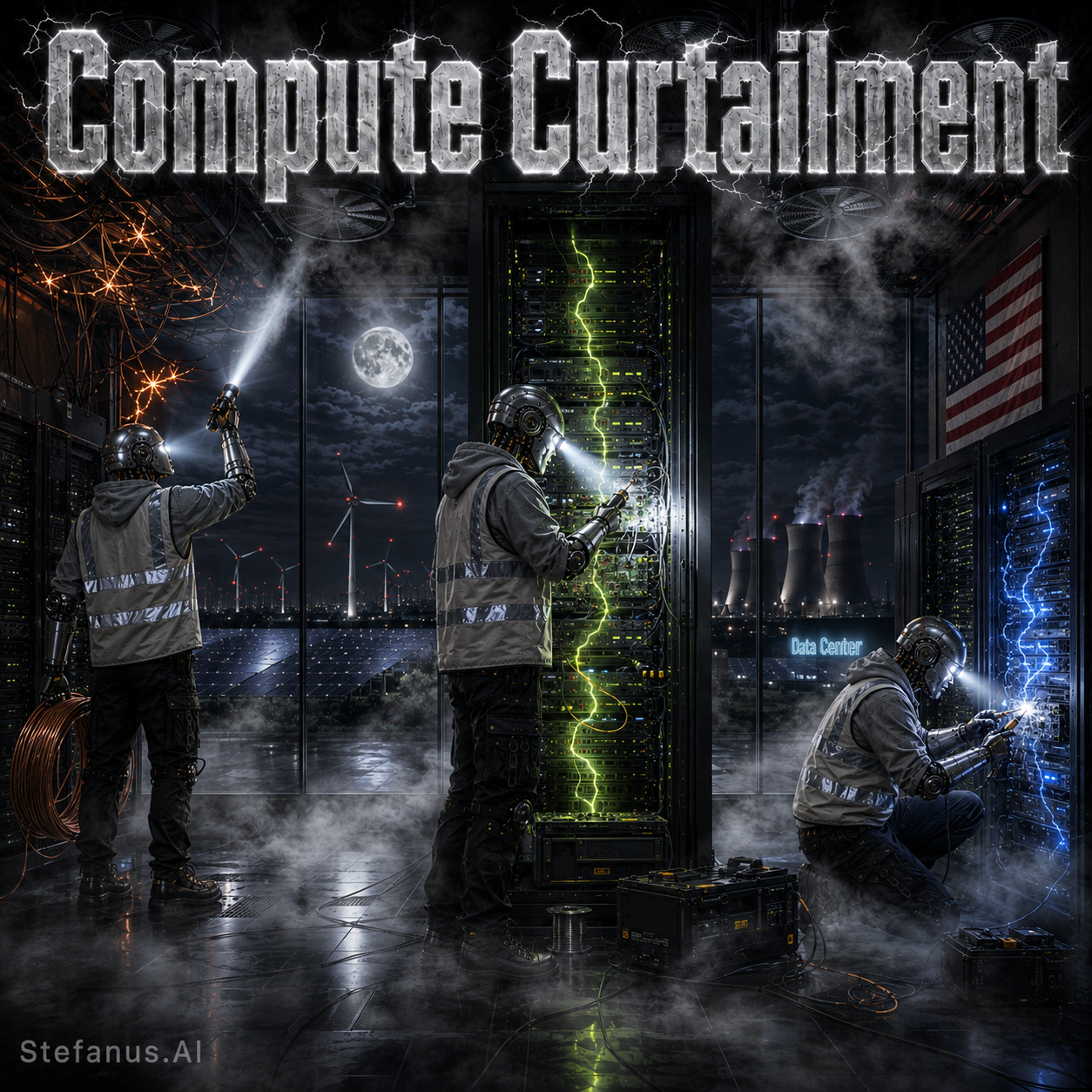

Introduction: The Day the Grid Operator Calls the AI Factory
It is a hot summer afternoon in the PJM region, the thirteen-state electricity market that stretches from the Atlantic coast to the edge of Chicago and serves sixty-seven million people. Temperatures across the Mid-Atlantic have climbed past one hundred degrees. Air conditioners are running everywhere at once. Electricity demand approaches emergency conditions, and inside the control rooms of the largest grid operator in the United States, dispatchers are watching reserve margins shrink hour by hour toward the thresholds that trigger emergency procedures.
At the same moment, in Northern Virginia — the largest and most concentrated datacenter ecosystem on Earth — hundreds of hyperscale facilities continue pulling power at industrial scale. Inside those buildings, AI workloads are running for Microsoft, Amazon, Google, Meta, Oracle, and a rapidly expanding constellation of AI companies. A single hyperscale campus is running tens of thousands of accelerators. Training jobs are consuming megawatts continuously. Inference clusters are serving users in real time. Cooling systems, networking equipment, storage arrays, batteries, and backup generators are all operating behind the meter, largely invisible to the outside world, drawing electricity as if the grid were an infinite resource.
For a century, the question confronting a grid operator on an afternoon like this was simple, even if answering it was hard: Where can we find another megawatt? Dispatchers would call peaker plants, import power from neighbors, and pay industrial customers to shut down. But on this particular afternoon, in this particular decade, the question has quietly changed. It is no longer only about finding another megawatt of supply. It has become something genuinely new in the history of electricity:
Which computation actually needs that megawatt right now?
Consider what is actually running inside those Virginia buildings at the moment of maximum grid stress. A chatbot response may need electricity immediately, because a human being is sitting in front of a screen waiting for it. A financial fraud-detection inference may be critical, because a transaction is clearing in milliseconds. A hospital AI workload may be genuinely difficult to interrupt, because clinical systems depend on it. These computations are urgent in the most literal sense: delay destroys their value.
But a model-training checkpoint might be delayed by an hour without any user on Earth noticing. Synthetic-data generation might be postponed until midnight. Embedding creation might move several hours into the evening. A batch inference job might migrate from Virginia to Texas, where the afternoon sun is powering gigawatts of solar generation. An AI agent performing nonurgent background research might simply wait until electricity demand falls. And a datacenter equipped with sufficient batteries, generators, or onsite generation might temporarily leave the public grid altogether, continuing its work on its own power while the surrounding region rides through the emergency.
Then the signal arrives from the grid operator — and this is the moment the entire paper is built around. The message, in operational language, says something like: Reduce demand. Shift the workload. Start backup generation. Or disconnect from the grid. The hyperscaler’s energy desk receives it. Its workload orchestration software receives it. And for the first time, the production of machine intelligence itself begins to bend around the physics of the electricity system.
That is the beginning of what this paper calls Compute Curtailment. I use that name deliberately, and it is worth pausing on why. “Curtailment” is one of the oldest words in the electric power industry. For decades it described what grids did to supply — wind farms curtailed when transmission was full, solar curtailed when midday generation exceeded demand — or what utilities did to old-economy factories through interruptible industrial tariffs, paying aluminum smelters and cement plants to shut down during emergencies. By joining the word “compute” to the word “curtailment,” the title makes a precise claim: computation has now become a large enough, controllable enough, and prioritizable enough electrical load that the grid’s oldest demand-management tool is being extended to the newest and most valuable industrial activity in the world economy — the production of intelligence. The name captures the collision of the two systems: the megawatt and the token, the reserve margin and the training run, the dispatcher and the scheduler.
And as of August 2026, none of this is theoretical. On July 27, 2026, PJM’s Board of Managers released a proposal under which certain new large loads — explicitly including datacenters — that do not bring their own generation or otherwise secure supply will be curtailed during capacity shortages before the deployment of broader pre-emergency demand-response measures, beginning June 1, 2027.[1,2] The proposal, expected to be filed with the Federal Energy Regulatory Commission, also creates a Large Load Registry giving PJM detailed visibility into the location, megawatt quantity, and supply arrangements of every large computational load in its footprint.[1] The board’s own language is unambiguous:
“will be subject to curtailment prior to deployment of Pre-Emergency Load Management”
— PJM Board of Managers, Interim Resource Adequacy Service proposal, July 2026 [1]
This followed a January 2026 Decisional Letter in which the PJM Board defined a “large load” as any addition of 50 MW or more at a single point of interconnection, established a “Bring Your Own New Generation” expedited interconnection track to be in place by August 2026, and directed staff to design curtailment allocations based on each load’s contribution to any shortfall in the required reserve margin.[3] It also followed something more visceral: in May 2026, the U.S. Department of Energy issued an emergency order allowing PJM to curtail datacenters and other large loads with backup generation during a hot-weather event, as a last resort before rolling blackouts — the first time federal emergency authority was invoked specifically to move AI facilities off the public grid.[5] The winter before, PJM had prepared to call on datacenter backup generation during a January freeze.[5] The scenario that opens this paper has, in partial and preliminary forms, already happened.
The important conceptual transition, therefore, is not the familiar historical one — old factories became interruptible factories, and now datacenters join the list. That framing understates what is occurring. The real transition is this:
AI Datacenter → Flexible Compute Load → Dispatchable Intelligence Infrastructure
An interruptible aluminum smelter, when curtailed, simply stops making aluminum. A dispatchable intelligence infrastructure, when curtailed, does something far more interesting: it re-prioritizes what intelligence gets produced, when, and where. It throttles some computations, defers others, relocates still others across the continent, and shields the most critical ones behind batteries and generators. Electric-grid operators, in other words, may eventually influence not merely how much electricity AI consumes, but when and where machine intelligence is produced. That inversion — the grid beginning to schedule intelligence — is the central architecture of this paper, and one recurring idea will run through every section of it: not every computation is equally urgent. Once that single fact is admitted, everything else in this paper follows from it.
The paper proceeds in eight sections. Section 1 explains how datacenters engineered never to lose power are being asked to deliberately give it up. Section 2 builds a five-mode operational framework — Throttle, Defer, Divert, Island, Restore — for how curtailment actually works. Section 3, the paper’s theoretical core, argues that the grid is beginning to schedule computational priority itself, and proposes a five-tier hierarchy of intelligence. Section 4 shows how the hyperscaler is becoming a grid operator behind the meter. Section 5 maps the geography of interruptible AI across eight American regions. Section 6 confronts the politics of who gets curtailed first. Section 7 develops the new economics of interruptible intelligence. Section 8 distills the argument into seven pillars, before the conclusion returns to the paper’s title — and to the reason it carries that title.

Section 1: From Constant Load to Interruptible Intelligence
1.1 The Facility That Was Never Supposed to Blink
To understand how radical Compute Curtailment is, one must first understand what a hyperscale AI datacenter was engineered to be. These facilities are among the most reliability-obsessed structures human beings have ever built. Their entire design philosophy descends from the “five nines” tradition of telecommunications and cloud computing: 99.999 percent availability, which permits roughly five minutes of downtime per year. Every layer of the facility is redundant. Utility feeds arrive from multiple substations. Uninterruptible power supplies bridge the milliseconds between a grid disturbance and the start of diesel or gas backup generators. Cooling systems are duplicated. The premise beneath all of it is that electricity is the one input that must never, under any circumstances, be interrupted — because the workloads inside were assumed to be continuous, indivisible, and priceless.
The AI buildout inherited that philosophy and multiplied its scale. A traditional enterprise datacenter drew perhaps 5 to 30 megawatts; a modern AI training campus draws hundreds of megawatts and is heading toward gigawatts, with individual sites now proposed at capacities that rival the peak demand of major cities. The International Energy Agency’s landmark special report, Energy and AI, projects that global datacenter electricity consumption will more than double from roughly 415 TWh in 2024 to around 945 TWh by 2030 — slightly more than the entire electricity consumption of Japan today — with AI as the most important driver, and with the United States accounting for by far the largest share of the increase.[12] In the United States, datacenters account for nearly half of all electricity demand growth between now and 2030; by the end of the decade the country is set to consume more electricity for datacenters than for the production of aluminum, steel, cement, chemicals, and all other energy-intensive goods combined.[12] As IEA Executive Director Fatih Birol put it when the report launched:
“AI is one of the biggest stories in the energy world today”
— Fatih Birol, Executive Director, International Energy Agency [13]
For the first several years of the AI boom, the industry’s response to this collision was entirely supply-side: build more generation, sign more power purchase agreements, restart nuclear plants, order gas turbines. The datacenter itself remained conceptually untouchable — a constant, inflexible block of demand that the grid simply had to serve. Grid planners modeled a 500-megawatt AI campus as 500 megawatts, every hour of every day, forever.
1.2 The Inversion
Here is the inversion at the heart of this paper, and it deserves to be stated as sharply as possible:
Datacenters were engineered to survive grid interruptions. The emerging grid is asking datacenters to deliberately create them.
The same redundancy that was built so the facility would never lose power — the batteries, the generators, the dual feeds — turns out to be exactly the equipment that allows the facility to voluntarily release the grid during an emergency. PJM’s evolving framework contemplates precisely this: certain large loads curtailing their grid consumption or operating backup generation for limited periods during stressed conditions, rather than allowing a wider reliability event to reach residential and conventional commercial customers.[1,3] The January 2026 Decisional Letter explicitly contemplated curtailment of non-supply-backed large loads before pre-emergency demand response, and PJM has already exercised federal emergency authority to call on large-load backup generation during both winter and summer stress events.[3,5] What was defensive armor is being re-imagined as a grid resource.
The intellectual foundation for this inversion was laid in February 2025, when a team at Duke University’s Nicholas Institute — Tyler Norris, Tim Profeta, Dalia Patiño-Echeverri, and Adam Cowie-Haskell — published what became the most talked-about energy paper of the decade, “Rethinking Load Growth.” Examining twenty-two balancing authorities covering about 95 percent of U.S. peak load, they found that the existing power system — deliberately over-built to survive extreme peaks that occur only a few dozen hours per year — could absorb enormous quantities of new load if that load were modestly flexible: roughly 76 GW of new demand nationwide if new loads curtail just 0.25 percent of their annual consumption during peak stress hours, and up to 98–100 GW at higher flexibility levels, including about 18 GW of headroom in PJM alone and roughly 10–15 GW in ERCOT.[9,10] Norris summarized the finding directly:
“could accommodate significant load additions with modest flexibility measures”
— Tyler Norris, Duke University, lead author of “Rethinking Load Growth” [9]
The paper’s significance was not merely quantitative. It reframed the entire debate. The binding constraint on AI expansion, it argued, is not annual energy — the terawatt-hours are available — but coincident peak demand during a small number of stressed hours. If AI facilities can step aside during those hours, the grid’s “curtailment-enabled headroom” is vast. The scarcity is temporal, not volumetric. And a temporal scarcity is exactly the kind of problem that computation, uniquely among industrial loads, is equipped to solve, because computation — unlike molten aluminum — can be paused, checkpointed, rescheduled, and moved at the speed of software.
1.3 Defining Compute Curtailment
With that foundation in place, the paper’s central concept can be defined precisely:
Compute Curtailment is the deliberate reduction, postponement, relocation, or self-supply of computational workloads in response to electricity-system constraints, grid emergencies, market prices, or contractual reliability obligations.
Every word in that definition is doing work. “Deliberate” distinguishes curtailment from outage: this is a scheduled, managed, often compensated act, not a failure. “Reduction, postponement, relocation, or self-supply” anticipates the five operational modes developed in Section 2 — the point being that curtailment is a family of actions, not a single switch. “Computational workloads” locates the object of curtailment at the level of the job, not the building: the facility may remain fully energized while the intelligence being produced inside it is re-prioritized. And the four triggers — physical constraints, declared emergencies, market prices, and contracts — span the full spectrum from involuntary to voluntary, from the DOE emergency order of May 2026 to a hyperscaler quietly shifting training jobs to chase cheap midnight power.
The key point, and the reason this paper is not simply another essay about backup generators, is this: Compute Curtailment does not necessarily mean shutting down the datacenter. It means managing what intelligence gets produced. A facility undergoing curtailment may look, from the outside, exactly like a facility at full production. The lights are on; the cooling hums. What has changed is invisible and profound: inside, the training run has paused at a checkpoint, the batch jobs have fled to another region, the chatbots are still answering, and the facility’s draw on the public grid has fallen by hundreds of megawatts. The industrial load has learned to think about its own electricity — which is another way of saying that Layer 1 of the AI economy, energy, has begun to reach up into the scheduling of every layer above it.

Section 2: The Five Modes of Compute Curtailment
If Section 1 established that AI datacenters can be curtailed, this section establishes how. Public discussion tends to compress datacenter flexibility into a single crude image — the plug being pulled — and that compression has done real analytical damage, because it makes flexibility sound like an existential threat to AI operations rather than what it actually is: a portfolio of graduated responses, most of which are invisible to end users. Drawing on the operational record of 2024–2026 — Google’s utility agreements, the EPRI DCFlex demonstrations, the Emerald AI field tests, ERCOT’s Senate Bill 6 protocols, and PJM’s emergency operations — this paper proposes a five-mode framework. The modes escalate in operational depth, and a real curtailment event typically moves through them in sequence: Throttle, Defer, Divert, Island, and Restore.
It helps to remember that interruptible industrial load is one of the oldest, most successful, and least glamorous tools in the electricity industry’s kit. For half a century, aluminum smelters in the Pacific Northwest, electric-arc steel furnaces in the Midwest, industrial gas separators, and irrigation pumps across the Great Plains have sold their willingness to stop back to the grid, through interruptible tariffs and demand-response programs that routinely deliver several percent of system peak during emergencies. What those loads could never do, however, was anything other than stop. A smelter interrupted at 4 p.m. produces no aluminum at 4 p.m., and the potlines risk freezing if the interruption runs long; the flexibility was real but crude, binary, and physically punishing. The five modes below exist because computation broke that mold. A computational load can partially slow down without stopping (Throttle); it can do the same work later with no loss (Defer); it can do the same work somewhere else entirely (Divert); it can keep working on its own power (Island); and its return can be sequenced with precision (Restore). No previous interruptible industrial load in history has possessed more than one of those five capabilities. AI datacenters possess all five simultaneously, which is why they are not simply the newest entry on the interruptible-load roster but a categorical break with it.
| Mode | Action | Grid Meaning | Real-World Anchor (2024–2026) |
| 1. Throttle | Reduce GPU power draw, cap processor utilization, trim non-essential loads | Partial megawatt relief within minutes | Emerald AI Phoenix test: 25% power cut for 3 hours on 256 NVIDIA GPUs[17] |
| 2. Defer | Postpone training, batch, and other latency-tolerant jobs | Demand shifted across hours | Google demand response targeting ML workloads with I&M, TVA, OPPD[14,16] |
| 3. Divert | Migrate workloads to other regions | Demand shifted across geography | Emerald AI inference shift from Virginia to Chicago during winter peak[19] |
| 4. Island | Serve the facility from batteries, generators, onsite power | Load leaves the public grid | PJM/DOE emergency orders calling on large-load backup generation[5] |
| 5. Restore | Staged, scheduled return of curtailed load | Managed ramp to avoid a second event | PJM concern over abrupt large-load swings and voltage excursions[2] |
2.1 Throttle — Lowering Computational Intensity
The gentlest mode of curtailment does not stop any workload at all; it simply makes the silicon breathe more slowly. Modern accelerators support fine-grained power capping: GPU clock speeds can be reduced, utilization ceilings imposed, and supporting loads — some cooling margin, non-essential auxiliary systems — trimmed. The relationship this establishes is elegantly direct: grid constraint → lower computational intensity. The jobs continue; they merely run somewhat slower and consume meaningfully less power.
Throttling moved from theory to demonstrated fact in 2025. In the first field demonstration under EPRI’s DCFlex initiative, the startup Emerald AI — working with NVIDIA, Oracle Cloud Infrastructure, Salt River Project, and Arizona Public Service — orchestrated a cluster of 256 NVIDIA GPUs in Phoenix during a real grid stress event on a punishingly hot May afternoon, reducing the cluster’s power consumption by 25 percent for three consecutive hours while preserving acceptable compute service quality.[17] The results were subsequently published in Nature Energy as the first peer-reviewed evidence of AI power flexibility.[20] A companion demonstration in London in 2026 cut a Blackwell Ultra cluster’s electricity demand by over a third in under a minute while high-priority workloads continued to run.[19] Independent academic work presented at ACM e-Energy 2026 found that AI datacenters, by exploiting the distinct characteristics of training and inference, can offer between 18 and 55 percent flexibility relative to their average power consumption while still meeting quality-of-service requirements.[21] Emerald’s founder, the physicist and former U.S. energy official Varun Sivaram, describes the underlying grid reality with a memorable image — the power system, he notes, is built for peaks it rarely experiences:
“like a large-scale freeway that only faces rush hour two times a month”
— Varun Sivaram, Founder & CEO, Emerald AI, on the under-utilized power grid [17]
2.2 Defer — Real-Time Intelligence versus Deferrable Intelligence
The second mode rests on the paper’s recurring idea — not every computation is equally urgent — and converts it into an operational sorting rule. A remarkable share of what happens inside an AI datacenter is not latency-sensitive at all. The canonical examples deserve to be listed, because each one represents megawatts that can move: model training, whose multi-week runs checkpoint constantly and can absorb pauses; model fine-tuning; synthetic-data generation, which manufactures inputs for future training and has no external clock; offline evaluation and benchmarking; batch inference over large corpora; search and database indexing; embedding creation; and non-urgent agentic workflows — the background research, code migration, and document processing that AI agents increasingly perform without a human waiting on the other end.
This introduces the distinction that may prove to be one of this paper’s most durable contributions: Real-Time Intelligence versus Deferrable Intelligence. Real-Time Intelligence is computation whose value decays in milliseconds to seconds — the chatbot answer, the fraud check, the copilot suggestion. Deferrable Intelligence is computation whose value is preserved across hours or even days — the training epoch, the embedding job, the synthetic-data run. The economics of the two are categorically different: deferring real-time inference destroys its value, while deferring a training step merely time-shifts it. A grid-aware compute scheduler is, at bottom, a machine for separating these two categories and letting the electricity system borrow time from the second in order to protect both the grid and the first.
Deferral, too, is now operational reality rather than conjecture. In August 2025, Google announced utility agreements with Indiana Michigan Power and the Tennessee Valley Authority under which, for the first time, it delivers datacenter demand response by targeting machine-learning workloads specifically — limiting or shifting a portion of ML computation during grid stress — building on a demonstration with Omaha Public Public Power District in which it reduced ML-related power demand during three real grid events.[14,16] By March 2026, Google had embedded a full gigawatt of demand-response capacity into long-term contracts with five U.S. utilities — Indiana Michigan Power, TVA, Entergy Arkansas, Minnesota Power, and Michigan’s DTE Energy — the largest single commitment of datacenter demand response by any hyperscaler, treated by the utilities as a defined capacity resource in their reliability planning.[15,44] Tyler Norris, in formal regulatory comments, called the original Google agreements the first documented case in which AI datacenter flexibility was, in his words:
“explicitly integrated into U.S. utility planning”
— Tyler Norris, Duke University, formal comments to the North Carolina Utilities Commission [11]
Indiana Michigan Power’s president Steve Baker, from the utility side of the same contracts, described the capability as:
“a highly valuable tool to meet their future energy needs”
— Steve Baker, President & COO, Indiana Michigan Power, on Google’s load flexibility [16]
The engineering substrate that makes deferral cheap deserves a paragraph of its own, because it explains why training — the largest single block of deferrable megawatts — tolerates interruption so gracefully. Modern large-model training is checkpointed by necessity: at intervals, the full state of the run — model weights, optimizer state, data-loader position — is written to durable storage, originally so that a hardware failure among tens of thousands of accelerators would not destroy weeks of work. Fault tolerance built for reliability turns out to be curtailment tolerance for free. A training run paused at a checkpoint at 4 p.m. and resumed at 9 p.m. loses only the wall-clock hours, not the computation; the marginal cost of a well-timed pause is the idle depreciation of the hardware during the gap, which is real but calculable, and which the mechanisms of Section 7 exist to price and compensate. The same logic extends down the deferrable stack: batch inference is restartable by construction, indexing and embedding jobs are idempotent, and synthetic-data pipelines have no external customer waiting. The deferral mode, in other words, did not require inventing new computer science. It required noticing that the computer science already built for failure recovery doubles as an interface to the electricity system.
2.3 Divert — Geography as a Degree of Freedom
The third mode exploits the property that most decisively separates computation from every previous interruptible industrial load: it can move. A curtailed smelter’s production simply vanishes; a curtailed workload can rematerialize eight hundred miles away. A job originally scheduled in Virginia can migrate to capacity in Texas, Arizona, Ohio, Indiana, or any region where electricity is momentarily abundant, subject to data-residency rules, network bandwidth, and latency budgets. When this happens, computational orchestration becomes, in part, energy orchestration — the cloud’s global scheduler starts functioning as a kind of continental power-balancing mechanism, moving demand toward supply at the speed of fiber rather than the speed of transmission construction.
The first public demonstrations of spatial diversion arrived in 2025–2026, when Emerald AI and NVIDIA shifted live AI inference workloads from Virginia to Chicago — maintaining low-latency service — specifically to relieve winter peak load on the Virginia grid, running on Oracle Cloud Infrastructure with NVIDIA’s Dynamo framework.[19] EPRI’s expanded DCFlex program now includes demonstrations in Ashburn and Chicago explicitly testing geospatial workload shifting.[46] The strategic implication is enormous: a globally distributed AI company holds a portfolio of interconnection points across a dozen balancing authorities, and can treat regional grid stress the way a logistics company treats a congested port — as a routing problem.
Diversion is also the mode with the most binding constraints, and stating them is part of taking it seriously. Latency budgets limit how far interactive inference can travel before users notice; data-residency and sovereignty rules pin certain workloads — government, health, financial — to specific jurisdictions regardless of electricity prices; network bandwidth between regions is finite and itself costly; and the destination region must actually have idle accelerators, which in a supply-constrained GPU market is never guaranteed. There is also a subtler system-level concern that recent power-systems research has begun to model: if many large loads chase the same price signals simultaneously, workload migration itself can become a source of grid instability, with gigawatts of demand sloshing between regions faster than transmission operators can re-dispatch around it.[22] Diversion, in other words, is a powerful valve that will eventually need its own coordination layer — a point that anticipates the restoration problem below, and, at the largest scale, the argument of Section 3 that somebody ends up scheduling all of this.
2.4 Island — Leaving the Grid Without Leaving Service
The fourth mode is the deepest: the facility temporarily removes its demand from the public grid entirely, riding on batteries, backup generators, onsite natural-gas turbines, fuel cells, microgrids, dedicated generation, and — increasingly, later this decade — co-located nuclear and other firm-energy arrangements. From the grid’s perspective, islanding is the most powerful act a large load can perform during an emergency, because it does not merely reduce demand; it erases hundreds of megawatts of it in minutes, the functional equivalent of a large power plant appearing on the system exactly when needed.
The economics of islanding are the economics of insurance made productive. The backup fleet at a hyperscale campus — diesel or gas generators sized to carry the full facility, batteries bridging the transfer — represents hundreds of millions of dollars of capital that, under the old design philosophy, was expected to run a few test hours per year and otherwise exist as pure premium against catastrophe. Every hour that fleet runs in support of the grid converts dead insurance capital into a revenue-earning or obligation-satisfying asset, which is why the transition of backup power into a grid resource is one of DCFlex’s founding objectives.[46] The constraints are equally concrete: air-quality permits historically limit non-emergency runtime for diesel units, fuel logistics bound endurance, and grid operators need verified telemetry to trust that an islanded megawatt is truly gone — all of which is why DCFlex demonstrations now test cleaner backup fuels and measurement frameworks, and why statutes like Texas SB 6 require disclosure of behind-the-meter generation as a condition of interconnection.[46,38]
Islanding is also where curtailment policy has moved fastest and most coercively. PJM sought and received federal emergency authority to direct large loads with backup generation to deploy it during stressed conditions — first during the January 2026 winter freeze, then under the DOE’s emergency order of May 18, 2026, when unseasonable heat combined with planned generator maintenance left PJM expecting under 5,800 MW of reserves.[5] In Texas, Senate Bill 6 wrote islanding into statute: ERCOT may, during grid emergencies and after exhausting market services, issue notice requiring large loads with substantial behind-the-meter generation to deploy that generation or curtail their load, and facilities interconnecting after December 31, 2025 must install equipment permitting remote disconnection during firm load shed.[38,39] The reliability fortress built to survive the grid’s failure is being formally conscripted into preventing it.
2.5 Restore — The Curtailment After the Curtailment
The fifth mode is the one almost no one discusses, and its neglect is a mistake this framework is designed to correct: the emergency ends, and the curtailed compute wants to come back. Restoration sounds administrative but is physically treacherous. If ten gigawatts of datacenter demand were to reconnect simultaneously — every deferred training run resuming, every diverted job returning home, every islanded campus re-synchronizing to the grid in the same half hour — the restoration event itself could create another power-system problem: a demand surge on a still-recovering system, with voltage and frequency consequences. PJM’s 2026 proposals were motivated in part by exactly this class of phenomenon; regulators have documented reliability concerns from abrupt load changes at large computational facilities, with one state utility commission staffer noting that voltage and frequency excursions on the transmission network increase with the interconnection of each new large computational load.[2]
The conclusion writes itself, and it completes the framework’s symmetry: compute restoration may eventually need to be scheduled just as compute curtailment is scheduled. Staged ramps, randomized reconnection windows, telemetry-verified return-to-service — the same choreography grids use to restore feeders after a storm will be applied to the return of intelligence production. Curtailment, properly understood, is not an event but a round trip.

Section 3: When the Grid Starts Scheduling Intelligence
This is the paper’s most important theoretical section, because it is where an operational practice hardens into a structural claim about the AI economy. Everything described so far — the throttled GPUs, the deferred training runs, the diverted inference — can be read as clever engineering. But step back far enough and a deeper pattern appears: for the first time, the electricity system is acquiring instruments that rank computations against one another. The grid is beginning, implicitly and then explicitly, to schedule intelligence.
3.1 What the Grid Has Always Scheduled
For a century, the grid operator’s core intellectual activity has been scheduling generation against electricity demand. Demand was treated as an exogenous force of nature — measured, forecast, but never negotiated with. The entire apparatus of power-system economics, from unit-commitment algorithms to capacity markets, was built to arrange supply beneath a demand curve that simply was. Demand response programs chipped at the edges of this worldview from the 1970s onward — through interruptible industrial tariffs, air-conditioner cycling programs, and eventually market-integrated demand bidding — but they remained peripheral: a few percent of load, activated a few hours a year, treated as an emergency tool rather than a planning resource.
What kept demand response peripheral was never a lack of imagination; it was a lack of granularity. The grid could ask a factory to stop, but it could not ask the factory to reorder its production by value, because the grid had no visibility into that value and the factory had no machinery for expressing it. A megawatt of demand was a megawatt of demand — the system was value-blind on the consumption side in a way it never was on the generation side, where every plant has always carried a marginal cost that markets could rank. Computation dissolves that blindness. Every job in a datacenter’s queue carries metadata — a deadline, a service-level objective, a customer contract, a priority class — which means that, for the first time, a category of demand arrives at the grid’s doorstep already sorted by urgency, already machine-readable, already equipped with a scheduler capable of acting on price and reliability signals in seconds. The historical significance of AI load is not only its size. It is that it is the first industrial demand in history that can negotiate.
3.2 What the AI Economy Changes
The AI economy potentially changes the equation to something richer: Generation + Flexible Demand + Computational Priority. The first two terms are familiar extensions of existing practice. The third is genuinely new. When PJM’s Large Load Registry records which facilities have secured their own supply and which have not, and its curtailment framework determines which of them lose grid power first during a shortage, the grid operator is — without ever using the vocabulary — encoding a priority ordering over the computations those facilities perform.[1,3] When Google’s contracts commit specific ML workloads to reduction during utility-declared events while search and cloud services for healthcare customers continue, a corporate scheduler is doing the same thing at finer grain.[14,15] When ERCOT’s SB 6 protocols exempt “critical load industrial customers” from mandatory curtailment while subjecting ordinary large loads to remote disconnection, a legislature has drawn the priority line in statute.[38,39] Modeling work at MIT’s Center for Energy and Environmental Policy Research — by Yang Shen and Christopher Knittel, the George P. Shultz Professor of Energy Economics at MIT Sloan — has begun formalizing exactly this interaction, simulating Mid-Atlantic, Texas, and Western power systems under varying levels of datacenter temporal flexibility and finding that the ability to shift computational demand materially alters investment decisions, plant retirements, and reliability planning trajectories.[23]
3.3 The Five-Tier Hierarchy of Compute
Make the implicit explicit, and a hierarchy emerges. The future grid — through some braid of tariffs, contracts, registries, and software — may distinguish among computational workloads roughly as follows:
| Tier | Name | Contents | Curtailment Posture |
| Tier 1 | Critical Compute | National security, emergency communications, healthcare systems, critical infrastructure control | Effectively never curtailed; protected like hospitals in load-shed plans |
| Tier 2 | Transactional Compute | Payments, cybersecurity, core cloud services, latency-sensitive business inference | Curtailed only in extremis; firm supply contracts |
| Tier 3 | Interactive Intelligence | Chatbots, search, copilots, consumer AI applications | Throttled or degraded briefly during severe events; rarely interrupted |
| Tier 4 | Deferrable Intelligence | Training, fine-tuning, evaluations, synthetic-data generation, batch processing, indexing | First to defer and divert; the workhorse of compute flexibility |
| Tier 5 | Opportunistic Compute | Workloads intentionally scheduled when electricity, network, or accelerator capacity is cheapest | Runs only in the valleys; curtailment is its native habitat |
The tiers are not merely descriptive; each maps to a different economic contract and a different relationship with the grid. Tier 1 resembles the treatment of hospitals in existing load-shed hierarchies. Tier 2 pays for firmness. Tier 3 accepts graceful degradation — a chatbot that answers a half-second slower during the ten worst grid hours of the year, an economic exchange most users would never detect. Tier 4 is where Norris’s curtailment-enabled headroom lives, and where Google’s ML-targeting demand response already operates.[9,14] Tier 5 barely exists yet as a named product, but it is the logical endpoint: computation that behaves like an interruptible industrial gas contract, consuming only surplus.
3.4 A Hierarchy of Intelligence?
And so the section arrives at the question the whole paper has been building toward, the provocative question that distinguishes Compute Curtailment from yet another essay about datacenters consuming too much electricity: Could electricity scarcity eventually create a hierarchy of intelligence? If megawatts during stressed hours are rationed, and rationing operates through the tier structure above, then the scarcity propagates upward through the AI stack. Frontier training schedules bend around summer peaks. The compute available to consumer applications at 6 p.m. on the hottest day of the year becomes a policy outcome. Access to firm, never-curtailed compute becomes a premium product — purchasable by those who can pay for Tier 1 and Tier 2 treatment — while price-sensitive intelligence lives in Tiers 4 and 5, produced at night, in shoulder seasons, in whichever region has spare power. Sivaram, whose company’s software is one of the first instruments of this new order, has argued the flexibility framing with maximal force:
“the Holy Grail of demand-side management”
— Varun Sivaram, CEO of Emerald AI, on AI compute load, GridFuture 2025 [24]
3.5 What the Hierarchy Means for the AI Race Itself
Before turning to the objections, it is worth tracing the hierarchy’s consequences upward into the competition among AI developers, because they are not symmetrical. A frontier lab whose training capacity sits inside firm, supply-backed facilities — co-located with restarted nuclear plants, wrapped in long-term power purchase agreements, exempt by construction from curtailment — experiences electricity scarcity as a line item. A lab renting Tier 4 capacity in a constrained region experiences the same scarcity as a schedule: its training calendar acquires blackout windows shaped by heat waves and winter storms, its effective compute budget varies with the weather, and its time-to-next-model — the metric the entire industry competes on — becomes partially a function of grid conditions. Electricity reliability classes, once they propagate into cloud pricing, therefore become a competitive differentiator among model developers, and the buildout strategies of the hyperscalers — who are simultaneously the labs’ landlords, rivals, and grid counterparties — determine who sits where in the hierarchy. This is what it means, concretely, for Layer 1 to reach into Layer 4: the ordering of the tiers becomes an ordering of the racers.
But the Holy Grail cuts both ways, and intellectual honesty requires saying so. A system flexible enough to protect the grid is also a system in which someone — a grid operator, a legislature, a hyperscaler’s scheduler, a market price — is deciding whose computation matters most at the margin. Sociologists of infrastructure have long observed that priority hierarchies embedded in technical systems tend to become invisible and durable. The follow-on research to the Duke study, published in early 2026, has already begun probing the long-term system effects of flexibility at scale, including whether flexibility changes not just when compute runs but what generation gets built — and, by extension, whose emissions and whose costs the AI economy ultimately carries.[25] Section 6 returns to this as an explicitly political question. For now, the theoretical claim stands: once demand becomes prioritizable, the grid is no longer merely a supplier to the intelligence economy. It is one of its schedulers.

Section 4: The Hyperscaler Becomes a Grid Operator Behind the Meter
4.1 The Miniature Power System
Walk through what a hyperscaler — Amazon/AWS, Microsoft, Google, Meta, Oracle, xAI, and their peers — must now manage simultaneously at a single flagship campus, and the conclusion becomes unavoidable. The company operates: a grid interconnection measured in the hundreds of megawatts, governed by tariffs, telemetry obligations, and now curtailment provisions; battery systems sized in the tens to hundreds of megawatt-hours; fleets of backup generators with fuel-supply contracts and emissions permits; increasingly, onsite generation — gas turbines, solar fields, and prospective small modular reactors; industrial-scale cooling whose own load can be pre-chilled and time-shifted; accelerator scheduling across tens of thousands of GPUs; geographic workload routing across a continental fleet of facilities; and cloud pricing, through which all of these physical realities are ultimately translated into products. That is not a description of an electricity customer. It is a description of a vertically integrated miniature power system — generation, storage, load, dispatch, and retail — that happens to sell intelligence instead of electrons.
The scale of investment behind this transformation is staggering and worth anchoring in the most recent earnings data. Across their Q2 2026 reporting season, the four largest hyperscalers — Alphabet, Amazon, Microsoft, and Meta — guided to roughly $725 billion in combined 2026 capital expenditures, up about 77 percent from an already record ~$410 billion in 2025: Amazon at approximately $200 billion, Microsoft at roughly $190 billion for the calendar year, Alphabet raising its ceiling toward $205 billion at its July 2026 earnings, and Meta guiding as high as $145 billion after twice raising its range.[26,27,28] Alphabet’s decision to lift its capex forecast alongside second-quarter earnings triggered a 7 percent share slide and dragged the other three down with it, as investors began openly questioning dwindling cash piles set against uncertain returns — even as Google Cloud revenue surged more than 60 percent year over year.[26] Jefferies analyst Brent Thill dismissed the pessimists bluntly:
“The AI economy is healthy”
— Brent Thill, Analyst, Jefferies, on hyperscaler capital spending [27]
Whatever one’s view of the returns debate, the physical consequence is settled: the overwhelming majority of this capital is being poured into power-hungry AI infrastructure, and every incremental gigawatt deepens the hyperscalers’ entanglement with electricity systems — and therefore with curtailment regimes.
4.2 The New Control Loop
The organizational novelty is the closing of a loop that never existed before. The hyperscaler’s software scheduler can now receive electricity information — a PJM emergency signal, an ERCOT notice, a utility demand-response dispatch, a locational marginal price — and answer, in real time, the question that defines the era: Where should this AI workload run, and should it run right now? The control loop runs:
Grid Signal → Datacenter Energy Controller → Compute Scheduler → GPU Cluster → Model / Agent Workload
Each arrow in that chain is now a real, engineered interface. Google’s demand-response agreements formalize the first arrow: the utility’s dispatch reaches Google’s energy team under contractually defined conditions.[14,15] Platforms like Emerald AI’s Conductor — now integrated with NVIDIA’s DSX Flex reference architecture for next-generation AI factories, with the stated ambition of unlocking up to 100 GW of grid capacity — formalize the second and third: an AI-powered mediator sits between grid conditions and cluster orchestration, deciding which jobs throttle, pause, or migrate.[18,19] Sivaram’s summary of the design goal doubles as a summary of the entire behavioral shift this paper describes:
“flex when the grid is tight — and sprint when users need them to”
— Varun Sivaram, Founder & CEO, Emerald AI, on grid-responsive AI factories [18]
Google’s head of advanced energy, Michael Terrell, has been equally careful to state the boundary condition — flexibility is real but bounded, because reliability commitments to search, maps, and cloud customers in essential industries constrain how much load can move:
“There are limits to how flexible a given data center can be”
— Michael Terrell, Head of Advanced Energy, Google [14]
4.3 The Energy Desk as a Core Competency
The organizational chart tells the same story as the control loop. Five years ago, a hyperscaler’s energy function was a procurement office: it signed power purchase agreements, hedged prices, and reported sustainability metrics. Today it is evolving into something closer to a merchant utility’s trading and operations floor — staffed with former ISO engineers, capacity-market specialists, and transmission planners, negotiating demand-response contracts that utilities count as capacity resources, filing in regulatory dockets from Richmond to Austin, and co-designing tariffs with the monopolies that serve them.[15,44] Google’s trajectory is the cleanest illustration: from a single demonstration with the Omaha Public Power District, to first-of-kind ML-targeting agreements with Indiana Michigan Power and TVA, to a contracted gigawatt across five utilities embedded in long-term supply arrangements — each step deepening the company’s participation in the planning processes that were once the exclusive province of utilities and their regulators.[14,15,16] Notably, the intellectual traffic runs in both directions: Tyler Norris, whose Duke research created the analytical case for flexible interconnection, has since moved into an energy policy role at Google — the scholar of curtailment-enabled headroom now inside the company operationalizing it.[25]
4.4 Layer 1 Reaches Upward
Situate this inside the Five-Layer AI Economy — the stack running Energy → Chips → Datacenters → Models → Applications/Agents — and the structural meaning of Compute Curtailment snaps into focus. In the static reading of the stack, Layer 1 is simply an input constraint: energy limits how many chips can run. Under Compute Curtailment, the relationship becomes dynamic rather than merely structural. Layer 1 begins directly controlling the utilization economics of Layers 2 through 5 in real time: the grid signal modulates how hard the chips run (Layer 2), how the datacenter dispatches itself (Layer 3), when and where models train and serve (Layer 4), and which agentic workloads proceed immediately versus wait for the valley hours (Layer 5). Electricity stops being the stage on which the AI economy performs and becomes one of the conductors of the performance. The hyperscaler, in turn, stops being merely the grid’s biggest customer and becomes something unprecedented: a grid operator behind the meter, running a private dispatch stack whose output is not electricity but intelligence.

Section 5: The Geography of Interruptible AI
Compute Curtailment is not experienced uniformly across the American map. It lands differently in a region where datacenters are a quarter of the load than in one where they are a rounding error; differently under a centralized capacity market than in an energy-only market; differently where governors have made electricity prices a campaign issue than where they court hyperscalers with tax abatements. This section moves from the datacenter to the regions, because the regions are where curtailment policy is actually being written — and where its politics, taken up in Section 6, are being felt. Eight jurisdictions anchor the survey.
5.1 Virginia / PJM — The Epicenter
Northern Virginia remains the central case, and must, because it is simultaneously the world’s most concentrated datacenter ecosystem and the geographic core of PJM’s reliability challenge. The numbers have become almost gothic. Data-center-driven demand helped push PJM capacity prices from $28.92 per megawatt-day for the 2024/25 delivery year to the FERC-approved cap of $329.17 for 2026/27 — an order-of-magnitude increase across two auctions — with IEEFA calculating that ratepayers across PJM are paying roughly $9.3 billion more in a single year than they would have absent datacenter demand.[29] The Dominion zone’s winter peak reached a record 25.2 GW on February 9, 2026, up 43 percent from its 2019–20 winter peak, even as the zone’s modeled ability to import emergency capacity from neighbors has fallen below its emergency import need.[34] Dominion’s fuel costs have risen nearly 90 percent in five years as the utility buys an ever-larger share of its energy — 23 percent, up from 14 percent in 2021 — from the volatile PJM wholesale market, with filings showing typical residential bills could rise as much as 13 percent to about $195 a month.[31] Virginia regulators approved a 2026 rate increase adding roughly $16 a month to typical bills while beginning to assign more grid-upgrade costs to a new datacenter rate class.[30,32] PJM’s chief executive Manu Asthana, facing political fire up to and including a governor’s call for his removal, stated the diagnosis plainly:
“Prices are up because of tightening supply and demand”
— Manu Asthana, President & CEO, PJM Interconnection [33]
It is therefore no accident that Virginia is also where curtailment’s future is being prototyped. The DOE’s May 2026 emergency order was aimed squarely at the Mid-Atlantic’s stressed core, with PJM warning that Maryland and Virginia would be especially exposed.[5] And in Manassas — minutes from Data Center Alley — NVIDIA is deploying Emerald AI’s orchestration software at the 96 MW Aurora facility, an explicit attempt to prove that flexible AI factories can keep connecting in the world’s tightest datacenter market without breaking it. Norris, advising the project, framed the stakes:
“software-based workload shifting can be a credible and measurable grid resource”
— Tyler Norris, power analyst and Emerald AI advisor, on the Aurora facility [48]
5.2 Pennsylvania — Curtailment Meets a Governor’s Race
Pennsylvania demonstrates what happens when PJM’s reliability mathematics collides with retail politics. Governor Josh Shapiro has spent his term in open combat with PJM — filing a federal complaint over its interconnection backlog, negotiating a capacity-price cap he credits with saving consumers billions, and in 2026 securing federal support to extend that cap through the end of the decade while advancing his “Lightning Plan” to accelerate in-state generation, permitting, and interconnection.[35] His administration has restarted Three Mile Island Unit 1 into service for Microsoft’s long-term purchase, converted coal sites to gas, and added roughly five gigawatts to the regional grid, while insisting that datacenters “pay their fair share.”[35] Energy costs are now a central issue in the 2026 governor’s race between Shapiro and Stacy Garrity — a contest in which both candidates agree the state needs more generation and disagree principally over how to get it — making Pennsylvania the clearest example of curtailment-adjacent policy being litigated before voters rather than merely before FERC.[36] Johns Hopkins energy researcher Abraham Silverman judged the price-cap extension in terms every incumbent understands:
“a very significant win for consumers”
— Abraham Silverman, Johns Hopkins University, on extending the PJM price cap [37]
5.3 Ohio — The Quiet Second Front
Ohio has become PJM’s quiet second front: an explosive datacenter corridor around Columbus, capacity-market costs estimated to add about $16 a month to average residential bills starting in mid-2026, and utilities pioneering tariffs that require large new loads to make long-term financial commitments before connecting.[29] The August 2026 PJM plan lands with particular force here, because — as Canary Media’s analysis emphasized — PJM’s legal authority runs to utilities, not to individual customers: PJM can obligate a utility to shed load across its territory, but cannot tell it which circuits or which customers to cut, which means Ohio’s regulators and utilities must themselves decide how curtailment obligations reach the datacenters that caused the shortfall.[6] That same jurisdictional gap was one reason PJM backed away from its earlier “non-capacity-backed load” concept, which would have forced new large loads to submit directly to interruption — the authority to reach the individual customer simply was not PJM’s to exercise.[6] Ohio is thus the test of the new plan’s central bet: that states, holding the retail relationship, will do the politically hard part of translating a regional curtailment framework into named customers on named circuits. How Columbus answers will likely become the template — or the cautionary tale — for every other PJM state.
5.4 Michigan — Data Centers and the Return of the Atom
Michigan connects new AI electricity demand to the most symbolically loaded energy project in America: the restart of the Palisades nuclear plant. DTE Energy is seeking to allocate over 4.4 gigawatts to datacenter projects — a pipeline one researcher calculated as the equivalent of six Palisades plants — with the single Saline Township hyperscale project alone requiring 1.4 GW, roughly a quarter of DTE’s current load.[42,45] Against that demand, Holtec International’s 800 MW Palisades restart — backed by a $1.52 billion federal loan facility and a $300 million state grant, and targeted for 2026 as the first restart of a decommissioned U.S. reactor in history — reads less as nostalgia than as arithmetic.[43] Michigan is also where flexibility entered the deal structure itself: Google’s Project Cannoli with DTE embeds demand response alongside 2.7 GW of new grid infrastructure, solar, and storage, with Google covering its own electricity and infrastructure costs.[44] The state thus displays the full curtailment-era bargain in miniature: enormous new load, firm new supply, and contractual flexibility stitched between them.
5.5 Indiana — Flexibility as Economic Development
Indiana shows the same bargain framed as economic development strategy. The state has courted hyperscale investment through energy and tax policy, and the Google–Indiana Michigan Power agreement at the new Fort Wayne datacenter — the first in the nation to target ML workloads for demand response — made Indiana the proving ground for flexibility as an interconnection accelerant: the utility treats Google’s curtailable megawatts as a planning resource, which lets the facility connect faster than firm-only load could.[14,16] By early 2026, Indiana Michigan Power was crediting datacenter revenue for planned rate reductions for its Indiana customers — a pointed counterexample in the national cost-shift debate, and a preview of the argument hyperscalers will make everywhere: flexible, fully-paying compute load can lower, not raise, everyone else’s bills.[45]
5.6 Texas / ERCOT — The Statutory Alternative
The deeper contrast between Texas and PJM is one of market philosophy, and it shapes how curtailment feels in each place. PJM runs a capacity market: reliability is procured years ahead through auctions, scarcity shows up as capacity prices, and curtailment policy is being built as an adjunct to that procurement — who cleared the auction, who brought supply, who therefore stands where in the shortage queue. ERCOT runs an energy-only market: there is no capacity auction, scarcity shows up as wholesale prices that can spike by orders of magnitude during tight hours, and large loads have always faced the rawest possible price signal to flee the peak. In a sense, ERCOT’s scarcity pricing has been performing economic compute curtailment for years — Bitcoin miners in West Texas built entire business models around powering down during price spikes — and Senate Bill 6 added the administrative layer on top of the price layer, ensuring that when prices alone do not clear the emergency, the operator can physically reach the load.
Texas offers the sharpest institutional contrast to PJM in its legal machinery as well: an energy-only market, a single-state regulator, and a legislature willing to write curtailment directly into law. Senate Bill 6, signed June 2025, created a comprehensive framework for loads of 75 MW and above: disclosure of onsite backup generation; ERCOT authority — during emergencies, after market tools are exhausted — to order large loads with substantial behind-the-meter generation to deploy it or curtail; mandatory curtailment protocols and remote-disconnection equipment for loads interconnecting after December 31, 2025; and a new voluntary, competitively procured demand-response service with 24-hour notice.[38,39] The scale being governed is astonishing: by late March 2026, ERCOT was tracking approximately 410 GW of large-load interconnection requests — roughly 87 percent from datacenters — against a system peak near 85–90 GW.[40] In 2026 the machinery began to bite: the PUCT affirmed curtailment authority over a co-located datacenter in the first net-metering case under SB 6, and in August ERCOT paused its “Batch Zero” large-load classification process pending a gubernatorial audit, freezing project timelines across the state.[52,41] Texas, in short, chose statute where PJM chose market design — but both arrived at the same destination: interruptibility as a condition of connection.
5.7 Arizona — Chips, Water, and the First Flex
Arizona binds together semiconductor manufacturing, datacenters, water scarcity, and some of the fastest load growth in the nation. TSMC’s expanding Phoenix fab complex and a wave of hyperscale construction have made central Arizona a load-growth hotspot precisely where summer peaks are most brutal and water constraints shadow every cooling decision. It is therefore fitting that Arizona hosted the founding demonstration of the entire compute-flexibility movement: the May 2025 Phoenix test in which Emerald AI, NVIDIA, Oracle, EPRI, Salt River Project, and Arizona Public Service proved a live AI cluster could shed a quarter of its load for three hours during a genuine heat-driven grid event.[17,20] The desert Southwest, which has the most to fear from coincident peaks, produced the first evidence that AI could step around them.
5.8 California — The Laboratory of Flexibility
California occupies a paradoxical position. Expensive electricity, constrained in-state generation, aggressive electrification, and formidable permitting make it a difficult market for gigawatt-scale AI campuses — and the Duke analysis found comparatively modest curtailment-enabled headroom in CAISO relative to PJM or MISO.[9] Yet California also possesses the nation’s most sophisticated demand-management infrastructure: decades of demand-response programs, dynamic pricing, storage mandates, and a grid already accustomed to choreographing millions of flexible devices around the solar duck curve. The question worth posing — and this paper poses it as a genuine research question rather than a settled claim — is whether California’s very difficulty makes it the early laboratory for computational flexibility: the place where AI load, unable to demand firm service at continental scale, learns instead to live gracefully inside a flexibility-first grid, running opportunistic compute against midday solar surpluses and vanishing politely during net-peak evenings. If Tier 5 Opportunistic Compute develops a native habitat, it may well be Californian.
Across all eight regions, one observation unifies the survey: governors and state regulators are no longer footnotes to AI infrastructure — they are becoming principal characters. PJM’s own plan, by its jurisdictional design, hands states the decisive role in deciding how curtailment reaches actual customers.[6] The geography of interruptible AI is, finally, a map of political choices.

Section 6: The Politics of Who Gets Curtailed First
Every technical system for allocating scarcity eventually produces a political question, and Compute Curtailment produces one of unusual clarity and voltage. When electricity becomes scarce on a summer afternoon, elected officials face an allocation choice that can be stated in a single sentence and understood by every voter: Should households conserve electricity so an AI datacenter can continue training a frontier model — or should the AI facility surrender electricity first? Phrased that way, the question sounds rhetorical. It is not. The honest answer depends on what the datacenter is computing (Section 3’s tiers), what it has paid for (Section 7’s contracts), and what it contributes to the region — and the machinery for answering it is being assembled right now, in public, across at least four layers of American government.
The 2026 political landscape has already organized itself around the question. In January 2026, the White House National Energy Dominance Council and a bipartisan coalition of all thirteen PJM-state governors issued a joint Statement of Principles demanding that datacenters bear the infrastructure costs of their own load growth rather than shifting those burdens to utility ratepayers, and endorsing a backstop auction to bring new generation online with fifteen-year price certainty.[7,8] It is difficult to overstate how unusual that alignment is: a Republican White House and Democratic and Republican governors from Illinois to Virginia converging on the proposition that the most valuable industry in the world should be first in line for interruption if it does not bring its own supply. The federal executive, meanwhile, is simultaneously accelerating datacenter construction — the AI Action Plan of July 2025 and Executive Order 14318 fast-track permitting and open federal lands to AI infrastructure — while its Energy Department both champions the buildout and, when reliability demands, orders it curtailed.[50,51,5] Energy Secretary Chris Wright captured the administration’s framing of the stakes:
“The global race for AI dominance is the next Manhattan project”
— Chris Wright, U.S. Secretary of Energy [49]
Yet even a Manhattan Project runs on a grid with neighbors, and the institutional map of who decides curtailment is a study in fragmentation. PJM operates within real jurisdictional limitations: it can direct utilities to shed load for emergency and pre-emergency purposes across their territories, but it cannot select which customers or circuits are shed — that authority belongs to states, their public utility commissions, and the distribution utilities they regulate.[6] FERC reviews the market rules; the DOE holds emergency powers; local governments control siting; environmental regulators govern the backup generators that make islanding possible. Implementing large-load curtailment therefore requires cooperation among governors, PUCs, FERC, PJM and the other RTOs, utilities, hyperscalers, datacenter developers, local governments, and federal energy policy simultaneously — a coordination problem PJM’s August 2026 plan resolved, candidly, by handing the hardest part to the states.[6,2] This is where Compute Curtailment stops being an engineering doctrine and becomes political economy: the allocation of a scarce essential good among households, factories, and machines that think.
Notice, too, how the question changes shape as it descends from region to neighborhood. At the RTO level it is an abstraction about reserve margins; at the state level it is a rate case; but at the local level it becomes visceral — a school district’s summer cooling bill, a fixed-income retiree’s August statement, a town council weighing a hyperscale campus against its water table and its substation. The local layer is where resistance has moved fastest: moratoria and zoning fights have proliferated across datacenter markets, community opposition has become what analysts now identify as a true material driver of project delays alongside power and equipment constraints, and between 30 and 50 percent of the large datacenter capacity expected online in 2026 is projected to slip.[45,4] Curtailment policy, properly understood, is partly an instrument for managing exactly this legitimacy problem: a datacenter that visibly yields during emergencies — that can tell the county it will island itself before a single household loses air conditioning — is making a political argument, not just an engineering one. Flexibility is becoming the industry’s social license.
The distributional record explains the heat. Analyses attribute the overwhelming share of recent PJM capacity-cost increases to datacenter demand — with data-center-driven costs consuming roughly 45 percent of $47.2 billion across three auctions and residential bills rising by double-digit dollar amounts per month from Maryland to Ohio to the District of Columbia — while the industry and its utilities respond that datacenters pay their allocated costs and increasingly fund their own infrastructure.[29,31,30] Both claims contain truth, which is precisely why the politics are unstable: cost allocation under load growth is genuinely contested terrain, and every state is drawing the lines differently, from Virginia’s new datacenter rate class to Indiana’s rate reductions credited to datacenter revenue.[30,45]
Out of this contest, the paper’s central political-economy argument emerges: AI companies may increasingly receive electricity access in exchange for flexibility. The old negotiation — “give us 2 GW continuously” — is being replaced by a new one: “give us 2 GW, but 600 MW can become interruptible during defined emergencies.” The evidence that this exchange is real, and not merely proposed, is now abundant: PJM’s framework explicitly offers faster connection to loads that accept curtailment risk or bring generation[1,3]; ERCOT’s SB 6 makes interruptibility a statutory condition of large-load service[38]; Google’s gigawatt of contracted demand response exists precisely because flexibility lets its facilities connect years earlier than firm load could[15]; and academic modeling confirms that flexible loads impose radically lower system costs than firm ones.[9,23] Flexibility has become the currency in which computational access to the grid is purchased. That transaction changes datacenter economics from the foundation up — which is the subject of the next section.

Section 7: The New Economics of Interruptible Intelligence
Every mature commodity system eventually develops a market for reliability itself. Natural gas has firm and interruptible pipeline service; airlines sell refundable and basic-economy seats against the same aluminum tube; electricity itself has long sold firm supply to households and interruptible tariffs to smelters. The pattern is always the same: once a scarce capacity serves customers with heterogeneous urgency, someone discovers that the right to be served first can be unbundled from the service and priced separately — and the moment that unbundling happens, the underlying physical system becomes vastly more efficient, because the customers who never needed firmness stop paying for it and the capacity they release serves someone who does. Compute Curtailment now drags cloud computing — and with it, the production of intelligence — into the same evolution. This section maps the contract types that are emerging, because contracts are where a physical practice hardens into a durable economic institution. Six instruments define the new landscape, followed by the core equation the paper keeps returning to.
| Contract Type | What It Sells | Price Logic | Early Anchors |
| 7.1 Firm Compute | Guaranteed electricity and compute availability; effectively Tier 1–2 service | Highest cost; buyer pays for reserve margin behind it | Traditional cloud SLAs; supply-backed loads exempt from PJM curtailment[1] |
| 7.2 Interruptible Compute | Cheaper capacity that can disappear during defined grid emergencies | Discount mirrors interruptible industrial tariffs | PJM Interim Resource Adequacy Service; ERCOT SB 6 protocols[1,38] |
| 7.3 Flexible Training | Training scheduled around electricity availability | Pays valley prices for peak-tolerant work | Google ML-targeting demand response[14,15] |
| 7.4 Geographic Compute Arbitrage | Jobs routed toward regions with surplus power | Captures inter-regional price spreads | Emerald AI Virginia→Chicago inference shift[19] |
| 7.5 Emergency Compute Capacity | Premium protection from curtailment | Insurance-like premium for firmness | Critical-load exemptions in ERCOT and load-shed hierarchies[39] |
| 7.6 Grid-Responsive AI | Automatic demand modulation as a paid grid service | Compensated as a capacity/ancillary resource | Google DR counted as utility capacity resource; DCFlex frameworks[15,46] |
7.1 Firm and Interruptible Compute
The foundational split is between compute that cannot be taken away and compute that can. Firm Compute inherits the cost structure of firm power: someone must hold generation, storage, or transmission headroom idle against the worst hour of the year, and the customer pays for that idleness. Interruptible Compute sheds that cost and pockets the difference — the buyer accepts that during defined emergencies, for bounded hours, the capacity vanishes. The regulatory scaffolding for this split is already standing: PJM’s framework explicitly divides new large loads into those that bring or secure supply and those that instead accept curtailment before pre-emergency load management, and a December 2025 FERC order has already prompted ISOs to revise tariffs for non-firm transmission service to large loads.[1,22] What remains is for cloud providers to pass the distinction through to their own customers — and the logic of competition makes that step nearly inevitable, because a provider that monetizes its flexibility can undercut one that sells only firmness.
7.2 Flexible Training and Geographic Arbitrage
The next two instruments monetize the two great degrees of freedom identified in Section 2: time and space. Flexible Training treats the training run as what it economically is — an enormous, interruptible, checkpointable consumer of energy whose deadline is measured in weeks — and schedules it into the valleys: nights, weekends, shoulder seasons, solar-flooded afternoons. Geographic Compute Arbitrage does the same across the map, routing deferrable jobs toward whichever balancing authority currently has surplus. Both already exist in embryo: Google’s contracts time-shift ML workloads under utility dispatch, and the Emerald–NVIDIA demonstrations have moved live inference across half a continent to relieve a regional peak.[14,19] As these practices scale, something remarkable happens to the electricity system itself: AI demand starts behaving like a fast, price-responsive balancing resource — absorbing surplus renewables, retreating from scarcity — which is precisely the behavior grid planners have spent two decades trying to summon from batteries and smart appliances, now arriving in gigawatt blocks.
7.3 Emergency Capacity and Grid-Responsive AI
The final pair completes the market. Emergency Compute Capacity is the insurance product: customers whose workloads genuinely cannot stop — the hospital systems, the payment networks, the national-security tenants of Tier 1 — pay premiums for contractual immunity from curtailment, mirroring the critical-load exemptions that statutes like SB 6 already carve out.[39] Grid-Responsive AI inverts the flow of money entirely: the datacenter is paid — as a capacity resource, a demand-response asset, or an ancillary-service provider — for its willingness to modulate. Google’s gigawatt is the proof of concept: utilities count its contracted flexibility as firm capacity in reliability assessments, meaning the absence of demand has become a product the hyperscaler sells.[15] EPRI’s DCFlex, whose nine demonstration hubs across the U.S. and Europe are building the measurement and verification frameworks such products require, is effectively writing the market’s rulebook; its vice president David Porter describes the coalition as:
“a powerhouse coalition of energy and technology companies working together”
— David Porter, Vice President, EPRI, on the DCFlex initiative [46]
The endpoint of this evolution is easy to state: the cloud marketplace comes to offer something structurally analogous to electricity reliability classes. A customer configuring a workload will select between 99.999% Firm AI — guaranteed execution, premium price — and Flexible AI — Lower Cost, Interruptible, with intermediate tiers between them. At that moment, power-market economics will have been imported directly into cloud computing, and the tier hierarchy of Section 3 will have acquired a price list.
7.4 The Core Compute Curtailment Equation
The paper’s argument can now be compressed into the chain it will keep returning to:
Electricity Constraint → Compute Prioritization → Workload Curtailment → Geographic Rebalancing → Intelligence Restoration
Or, more simply still:
Megawatts Become Tokens
When power becomes scarce, electricity availability determines how many tokens, training cycles, agent actions, and model computations can be produced — and the five-stage chain determines which ones. EPRI’s chief executive Arshad Mansoor, whose organization launched DCFlex precisely to operationalize this chain, has framed flexible design and operation as:
“a key strategy for accelerating AI development and realizing its benefits”
— Arshad Mansoor, President & CEO, EPRI [47]
The equation’s deepest implication is the one this paper’s subtitle asserts: the power grid is no longer merely supplying the AI economy. Through the contracts, tariffs, registries, and schedulers described above, it is beginning to participate in scheduling it.

Section 8: What Have We Learned? — Seven Pillars of Compute Curtailment
A framework earns its keep by what it lets us see. Compressing the preceding sections, seven pillars summarize what the emergence of Compute Curtailment teaches — five drawn from the paper’s core argument, and two added because the evidence of 2025–2026 demands them.
8.1 Pillar 1 — Not Every AI Workload Needs Electricity at the Same Moment
This is the paper’s recurring idea, and everything else stands on it. AI demand should no longer be automatically treated as one indivisible baseload requirement. Inside the aggregate megawatts lives a spectrum from millisecond-critical inference to training runs indifferent to the hour — Real-Time Intelligence and Deferrable Intelligence — and the difference between modeling AI load as a monolith versus a portfolio is worth roughly a hundred gigawatts of grid headroom, multiple years of interconnection time, and billions of dollars of avoided peak capacity.[9,10,21] The single most consequential analytical error of the early AI-energy debate was treating the datacenter as a block. The single most consequential correction is the sorting rule.
8.2 Pillar 2 — Datacenter Reliability and Grid Reliability Are Becoming Interdependent
A facility designed never to fail is increasingly being asked to reduce its dependence on the grid precisely so that the larger electricity system does not fail. The redundancy stack built for the datacenter’s private resilience — batteries, generators, dual feeds — has been conscripted, by DOE emergency orders, PJM frameworks, and Texas statute, into the public reliability toolkit.[5,1,38] The two reliability regimes, private and public, are fusing into one interdependent system, and neither can now be planned without the other.
8.3 Pillar 3 — Geography Becomes a Computational Resource
A globally distributed AI company can move computation toward available electricity at the speed of software, which means regional grid conditions have become inputs to workload placement, and interconnection portfolios across balancing authorities have become strategic assets comparable to spectrum or shipping lanes. The Virginia-to-Chicago inference shift is the proof that space, like time, is now a curtailment dimension.[19]
8.4 Pillar 4 — Flexibility Acquires Economic Value
A gigawatt of interruptible datacenter demand is politically, economically, and operationally different from a gigawatt that must run continuously. It connects faster, imposes lower system costs, earns capacity payments, and generates less political resistance — which is why flexibility has become the currency in which grid access is purchased, and why an entire contract stack, from Interruptible Compute to Grid-Responsive AI, is crystallizing around it.[15,1,23]
8.5 Pillar 5 — Electricity Policy Can Influence the Production of Intelligence
This is the largest implication, and the paper’s title claim. Governors, utility commissions, FERC, and regional grid operators — through registries, curtailment hierarchies, rate classes, and emergency authorities — may increasingly shape when, where, and under what conditions AI computation occurs.[1,6,38] Electricity policy is becoming, in a precise and traceable sense, compute policy; the dispatcher’s decisions propagate up the Five-Layer stack into the timing, geography, and economics of intelligence itself.
8.6 Pillar 6 — Restoration Is a First-Class Problem
Added on the operational evidence of 2026: the return of curtailed load is as consequential as its departure. Gigawatt-scale reconnection surges, and the voltage and frequency excursions regulators now document from abrupt large-load swings, mean that the end of every curtailment event is itself a grid event to be choreographed.[2] Any curtailment regime that schedules only the descent, and not the climb back, has solved half the problem.
8.7 Pillar 7 — Flexibility Is Bounded, and the Bounds Are Where the Politics Live
Added in candor: compute flexibility is real but not unlimited. Google’s own architects of the practice emphasize that reliability commitments cap how much load can move, and that the capability exists only at certain locations[14]; utilization economics push against idling nine-figure GPU fleets; latency, data residency, and contractual SLAs constrain diversion; and 30 to 50 percent of the large datacenter capacity expected online in 2026 already faces delay from power constraints regardless of flexibility.[4] The honest model is a flexibility envelope — wide enough to matter enormously, narrow enough that its edges will be fought over. Who gets to consume the inflexible core, and who is pushed to the flexible margin, is exactly the political question of Section 6, and it will not be settled by engineering.

Conclusion: Scheduling Intelligence
For most of the AI boom, the industry’s electricity question was expansive and one-directional: How do we build enough power for AI? Every answer — gas turbines, nuclear restarts, capacity auctions, $725 billion of hyperscaler capital — accepted the premise that computational demand was a fixed destination toward which the electricity system simply had to travel.[27] Compute Curtailment introduces the reverse question, and 2026 is the year that question acquired institutional force: How much AI can the power system accommodate at this particular moment?
The answer, it turns out, is not a number but a schedule. Once hyperscale AI facilities can throttle processors, postpone training, redirect inference, activate onsite power, or move computation among regions — and once grid operators possess registries that see them, frameworks that rank them, and authorities that can dispatch them — datacenters cease to behave like completely inflexible consumers. They become participants in electricity-system reliability: the largest, fastest, most intelligent demand-side resource the grid has ever had. And once grid conditions influence whether a model trains now or tonight, whether inference happens in Virginia or Texas, whether an agent acts immediately or waits, and whether GPUs draw grid electricity or onsite power, the relationship between electricity and artificial intelligence has fundamentally changed — from supplier and customer to co-schedulers of a shared, constrained system.
Why, then, does this paper carry the name Compute Curtailment — and why insist on it one final time? Because the name performs the argument. “Curtailment” is the electricity industry’s oldest confession that scarcity requires priority: that when there is not enough, someone decides what runs. For a hundred years that word applied to generators and to factories that melted metal. Attaching it to “compute” declares that the decision now reaches the production of intelligence itself — that the training run and the token stream have joined the smelter and the wind farm inside the grid’s hierarchy of priority. The title is not a metaphor. It is a literal description of PJM’s June 2027 framework, ERCOT’s statutory protocols, the DOE’s emergency orders, and Google’s contracted gigawatt.[1,38,5,15] The paper is called Compute Curtailment because that is the name of the institution being born.
And beneath the institution sits the idea this paper has repeated until it became a refrain, the idea that gives Compute Curtailment an intellectual identity far larger than a paper about backup generators: not every computation is equally urgent. PJM’s August 2026 proposal is the immediate news hook, but the lasting thesis is computational prioritization under physical scarcity — Layer 1 of the AI economy beginning to influence the timing, geography, and economics of Layers 2 through 5.[1,2] Real-Time Intelligence will be defended; Deferrable Intelligence will learn to wait, to travel, and to be paid for its patience. The dispatcher and the scheduler, two professions that never previously spoke, are becoming colleagues.
A research and policy agenda follows naturally, and it is offered here as the paper’s closing contribution rather than its afterthought. Measurement first: curtailment markets will require standardized, auditable telemetry proving that a claimed megawatt of flexibility actually materialized — the accounting infrastructure DCFlex and its nine demonstration sites are beginning to build.[46] Market design second: capacity constructs, non-firm interconnection service, and demand-response compensation must be reconciled so that a gigawatt of contracted flexibility is valued consistently whether it appears in Richmond, Columbus, or Abilene — work FERC’s recent orders on non-firm service have only begun.[22] Equity third: the tier hierarchy of Section 3 should be designed in daylight, with explicit answers to who defines critical compute and who audits the exemptions, before the hierarchy hardens invisibly inside tariffs and schedulers. And restoration fourth: the choreography of return — staged ramps, verified reconnection, coordination across regions whose curtailed workloads all want the same recovery hour — remains the least studied stage of the cycle and, as Section 2 argued, potentially the most dangerous. The scholars, regulators, and engineers who take up these four problems will be writing the operating manual for something that has never existed: an electricity system and an intelligence industry that schedule each other.
The grid is no longer simply powering intelligence. It is beginning to schedule intelligence.

Footnotes / Endnotes:
[1] PJM Interconnection, “PJM Board Directs Action on Resource Adequacy, Affordability and Large Loads,” PJM Inside Lines, July 2026. https://insidelines.pjm.com/pjm-board-directs-action-on-resource-adequacy-affordability-and-large-loads/
[2] Ethan Howland, “PJM board proposes backstop capacity auction, data center curtailment plans,” Utility Dive, July 2026. https://www.utilitydive.com/news/pjm-board-backstop-capacity-auction-data-center-curtailment/826347/
[3] PJM Board of Managers (David Mills, Interim President & CEO), Decisional Letter on the Results of the CIFP Process — Large Load Additions, January 16, 2026. https://www.pjm.com/-/media/DotCom/about-pjm/who-we-are/public-disclosures/2026/20260116-pjm-board-letter-re-results-of-the-cifp-process-large-load-additions.pdf
[4] Network World, “AI data centers in the US may face power cuts under PJM reliability proposal,” August 2026 (citing Currence estimates of 2026 data center delays). https://www.networkworld.com/article/4202800/ai-data-centers-in-the-us-may-face-power-cuts-under-pjm-reliability-proposal.html
[5] Ethan Howland, “PJM gets emergency approval to curtail data centers, large loads during hot weather,” Utility Dive, May 19, 2026. https://www.utilitydive.com/news/pjm-doe-emergency-order-curtail-data-centers/820571/
[6] Jeff St. John, Canary Media (republished by Ohio Capital Journal), “PJM’s big new data center plan: Make the states figure it out,” August 10, 2026. https://ohiocapitaljournal.com/2026/08/10/pjms-big-new-data-center-plan-make-the-states-figure-it-out/
[7] White & Case LLP, “PJM proposes to carve out new services for co-located data centers,” March 2026. https://www.whitecase.com/insight-alert/pjm-proposes-carve-out-new-services-co-located-data-centers
[8] Latham & Watkins LLP, “US Data Center Demand: White House and Governors Issue Principles While PJM Issues Decisional Letter,” January 2026. https://www.lw.com/en/insights/us-data-center-demand-white-house-and-governors-issue-principles-while-pjm-issues-decisional-letter
[9] Tyler Norris, Tim Profeta, Dalia Patiño-Echeverri, and Adam Cowie-Haskell (Duke University, Nicholas Institute for Energy, Environment & Sustainability), “Rethinking Load Growth: Assessing the Potential for Integration of Large Flexible Loads in US Power Systems,” February 2025; summarized in POWER Magazine, “Duke Researchers: Grid Flexibility Key to Accommodate Load Growth.” https://www.powermag.com/duke-researchers-grid-flexibility-key-to-accommodate-load-growth/
[10] Tyler Norris (Duke University), interview in The Powerline, “The Growing Grid — A Q&A With Energy Expert Tyler Norris,” March 2025. https://thepowerline.substack.com/p/the-growing-grida-q-and-a-with-energy
[11] Tyler Norris, quoted in Canary Media, “As data centers go up, North Carolina weighs how to meet demand,” September 2025. https://www.canarymedia.com/articles/utilities/north-carolina-duke-plans-data-center-demand
[12] International Energy Agency (IEA), “Energy and AI” (World Energy Outlook Special Report), Executive Summary, 2025. https://www.iea.org/reports/energy-and-ai/executive-summary
[13] Fatih Birol (IEA Executive Director), quoted in S&P Global Commodity Insights, “Global data center power demand to double by 2030 on AI surge: IEA,” April 10, 2025. https://www.spglobal.com/energy/en/news-research/latest-news/electric-power/041025-global-data-center-power-demand-to-double-by-2030-on-ai-surge-iea
[14] Michael Terrell (Google, Head of Advanced Energy), “How we’re making data centers more flexible to benefit power grids,” Google Blog, 2025. https://blog.google/innovation-and-ai/infrastructure-and-cloud/global-network/how-were-making-data-centers-more-flexible-to-benefit-power-grids/
[15] Google, “A new milestone for smart, affordable electricity growth” (1 GW of data center demand response), Google Blog, March 19, 2026. https://blog.google/innovation-and-ai/infrastructure-and-cloud/global-network/demand-response-data-center-milestone/
[16] American Public Power Association, “Google, TVA Enter Agreement Tied to Data Center Demand Response” (quoting Steve Baker, Indiana Michigan Power, and Claire Jones, TVA), August 4, 2025. https://www.publicpower.org/periodical/article/google-tva-enter-agreement-tied-data-center-demand-response
[17] NVIDIA, “Emerald AI: How Grid-Flexible AI Factories Unlock 100 GW of Capacity” (case study; Phoenix demonstration with Oracle, EPRI, Salt River Project), 2026. https://www.nvidia.com/en-us/case-studies/emerald-ai/
[18] Varun Sivaram (Founder & CEO, Emerald AI), quoted in NVIDIA Blog, “How AI Factories Can Help Relieve Grid Stress,” 2025. https://blogs.nvidia.com/blog/ai-factories-flexible-power-use
[19] Latitude Media, “Emerald AI integrates with NVIDIA DSX Flex to unlock up to 100 GW of grid capacity for next-generation AI factories,” March 17, 2026. https://www.latitudemedia.com/industry-news/emerald-ai-integrates-with-nvidia-dsx-flex-to-unlock-up-to-100-gw-of-grid-capacity-for-next-generation-ai-factories/
[20] P. Colangelo, A. K. Coskun, V. Sivaram, D. C. Wilson, et al., “AI data centres as grid-interactive assets,” Nature Energy, vol. 11, pp. 254–261 (2026); first peer-reviewed evidence of AI power flexibility from the Phoenix demonstration. https://www.nature.com/nenergy/
[21] Proceedings of the 17th ACM International Conference on Future and Sustainable Energy Systems (ACM e-Energy 2026), “Investigating Power Consumption Flexibility of AI Data Centers for Demand Response Participation” (finding 18–55% flexibility relative to average power consumption). https://doi.org/10.1145/3744255.3798112
[22] arXiv:2606.25098, “Power-Flexible AI Data Centers: A New Paradigm for Grid-Responsive Compute,” June 2026 (noting December 2025 FERC order on non-firm contract demand transmission service). https://arxiv.org/html/2606.25098
[23] Yang Shen and Christopher R. Knittel (MIT Sloan; MIT Center for Energy and Environmental Policy Research), “Flexible Data Centers and the Grid,” MIT CEEPR Working Paper 2025-14, July 2025. https://ceepr.mit.edu/wp-content/uploads/2025/07/MIT-CEEPR-WP-2025-14-Brief.pdf
[24] Varun Sivaram, quoted in CPower Energy, “AI, Data Centers and the Grid’s ‘Holy Grail’ — 4 Takeaways on Demand Response from GridFuture 2025,” September 2025. https://cpowerenergy.com/ai-data-centers-and-the-grids-holy-grail-here-are-4-takeaways-on-demand-response-from-gridfuture/
[25] Latitude Media, “The long-term grid impacts of data center flexibility,” February 23, 2026. https://www.latitudemedia.com/news/the-long-term-grid-impacts-of-data-center-flexibility/
[26] CNBC, “Amazon, Meta and Microsoft face skeptical investors this week after Google report sparked sell-off,” July 28, 2026. https://www.cnbc.com/2026/07/28/hyperscalers-face-higher-capex-scrutiny-after-alphabet-report-panned.html
[27] Tom’s Hardware, “Google, Microsoft, Meta, and Amazon capex spending to hit $725 billion in 2026, up 77% from last year” (quoting Brent Thill, Jefferies, and Amy Hood, Microsoft CFO), April 30, 2026. https://www.tomshardware.com/tech-industry/big-tech/big-techs-ai-spending-plans-reach-725-billion
[28] Futurum Group, “AI Capex 2026: The $690B Infrastructure Sprint,” February 2026. https://futurumgroup.com/insights/ai-capex-2026-the-690b-infrastructure-sprint/
[29] Institute for Energy Economics and Financial Analysis (IEEFA), “Projected data center growth spurs PJM capacity prices by factor of 10,” 2025. https://ieefa.org/resources/projected-data-center-growth-spurs-pjm-capacity-prices-factor-10
[30] American Action Forum, “Virginia’s New Data Center Electricity Rate Class,” April 22, 2026. https://www.americanactionforum.org/insight/virginias-new-data-center-electricity-rate-class/
[31] Reuters (republished by Virginia Business), “Virginia data center boom pushes Dominion deeper into costly power market,” August 11, 2026. https://virginiabusiness.com/virginia-data-center-growth-drives-dominion-fuel-costs/
[32] Inside Climate News, “Virginia Regulators Approve New Dominion Rates, Assign More Costs to Data Centers,” January 2026. https://insideclimatenews.org/news/07012026/virginia-regulators-approve-new-dominion-rates/
[33] Manu Asthana (PJM President & CEO), quoted in The New Energy Crisis, Part 3, “Bills Rise,” 2025–2026. https://thenewenergycrisis.com/series/part-3
[34] Grid Flexibility, “Why Dominion Bills Are Rising: Data Centers and Who Pays” (case study of the PJM DOM zone, including the February 9, 2026 winter peak of 25.2 GW), May 2026. https://gridflexibility.fyi/case-studies/dominion-virginia
[35] Commonwealth of Pennsylvania, Office of Governor Josh Shapiro, “Gov. Shapiro Secures Federal Support to Extend PJM Price Cap,” 2026. https://www.pa.gov/governor/newsroom/2026-press-releases/gov-shapiro-secures-federal-support-to-extend-pjm-price-cap
[36] Spotlight PA, “PA governor race 2026: Energy costs take center stage,” July 2026. https://www.spotlightpa.org/news/2026/07/pennsylvania-governor-race-energy-costs-shapiro-garrity-environment/
[37] Abraham Silverman (Johns Hopkins University, Ralph O’Connor Sustainable Energy Institute), quoted in Pennsylvania Capital-Star, November 2025. https://penncapital-star.com/energy-environment/shapiro-among-governors-whose-states-rely-on-pjm-who-want-data-centers-to-guarantee-their-own-power/
[38] McGuireWoods LLP, “Texas Senate Bill 6 Significantly Expands Regulatory Oversight Over Large Loads in ERCOT,” July 2025. https://www.mcguirewoods.com/client-resources/alerts/2025/7/texas-senate-bill-6-significantly-expands-regulatory-oversight-over-large-loads-in-ercot/
[39] Baker Botts LLP, “Texas Senate Bill 6: Understanding the Impacts to Large Loads and Co-located Generation,” July 2025. https://www.bakerbotts.com/thought-leadership/publications/2025/july/texas-senate-bill-6-understanding-the-impacts-to-large-loads-and-co-located-generation
[40] Merissa Hansen, “Texas Senate Bill 6: Balancing Data Center Boom with Grid Reliability in ERCOT” (ERCOT tracking approximately 410 GW of large load interconnection requests as of late March 2026), April 14, 2026. https://www.merissahansen.com/p/texas-senate-bill-6-balancing-data
[41] Troutman Pepper Locke LLP, “Texas Hits Pause on Data Center Grid Connections Amid Growing Oversight Push,” August 2026. https://www.troutman.com/insights/texas-hits-pause-on-data-center-grid-connections-amid-growing-oversight-push/
[42] WKAR Public Media (Michigan State University), “Michigan data centers could require power equal to six nuclear plants” (quoting Erik Nordman, MSU Institute of Public Utilities), February 27, 2026. https://www.wkar.org/michigans-data-center-divide/2026-02-27/michigan-data-centers-could-require-power-equal-to-six-nuclear-plants
[43] Circle of Blue, “Nuclear Power Plant Restart: A New Era Begins” (Palisades restart, Holtec International), February 18, 2026. https://www.circleofblue.org/2026/water-energy/a-nuclear-shift-buoyed-by-billions-and-the-waters-of-the-great-lakes/
[44] Renewable Energy World, “Google has integrated 1 GW of data center demand response with US utilities” (including Project Cannoli with DTE Energy in Michigan), March 20, 2026. https://www.renewableenergyworld.com/power-grid/smart-grids/google-has-integrated-1-gw-of-data-center-demand-response-with-us-utilities/
[45] Planet Detroit, “Data center news: DTE Energy’s data center pipeline could require power of 6 nuclear plants,” March 2026. https://planetdetroit.org/2026/03/dte-data-center-pipeline/
[46] EPRI, “EPRI’s DCFlex Initiative Expands to Nine Demonstration Sites Across U.S., Europe” (quoting David Porter, EPRI Vice President), PR Newswire, February 2, 2026. https://www.prnewswire.com/news-releases/epris-dcflex-initiative-expands-to-nine-demonstration-sites-across-us-europe-302676241.html
[47] Arshad Mansoor (EPRI President & CEO), quoted in Turbomachinery Magazine, “EPRI Addresses Data Center Power Demand with New Program: DCFlex.” https://www.turbomachinerymag.com/view/epri-addresses-data-center-power-demand-with-new-program-dcflex
[48] Data Center Dynamics, “Nvidia to deploy Emerald AI’s orchestration software at 96MW Aurora data center in Manassas, Virginia” (quoting Tyler Norris), May 2026. https://www.datacenterdynamics.com/en/news/nvidia-to-deploy-emerald-ais-orchestration-software-at-96mw-aurora-data-center-in-manassas-virginia/
[49] U.S. Department of Energy, “DOE Identifies 16 Federal Sites Across the Country for Data Center and AI Infrastructure Development” (quoting Secretary of Energy Chris Wright), April 3, 2025. https://www.energy.gov/node/4850502
[50] Bipartisan Policy Center, “Strategic Federal Actions Aim to Strengthen AI and Energy Infrastructure,” May 26, 2026. https://bipartisanpolicy.org/explainer/strategic-federal-actions-aim-to-strengthen-ai-and-energy-infrastructure/
[51] Congressional Research Service, “Data Center Energy Infrastructure: Federal Permit Requirements” (R48762), on America’s AI Action Plan and Executive Order 14318. https://www.congress.gov/crs-product/R48762
[52] White & Case LLP, “PUCT affirms curtailment authority over co-located data centers in first net metering case under Senate Bill 6,” August 2026. https://www.whitecase.com/insight-alert/puct-affirms-curtailment-authority-over-co-located-data-centers-first-net-metering



Comments
[…] when and where to occur. In the language of power systems, a portion of the AI load is not merely interruptible; it is dispatchable in reverse. The grid has spent a century dispatching supply to follow demand. […]