
Introduction: The Eleven Days That Exposed a New Vulnerability in the Artificial Intelligence Economy
On the morning of Monday, November 23, 2026, before the opening bell in New York, a statement emerged from Santa Clara, California, that would have been difficult to imagine even one week earlier. Nvidia Corporation, the semiconductor company whose accelerated computing platforms have become foundational to the global artificial intelligence industry, announced that Jensen Huang had been reinstated, effective immediately, as president and chief executive officer and as a member of its board of directors, and that the board’s vote had been unanimous. [7] The announcement was extraordinary not because founders have never returned to the companies they built, since the histories of Apple, Dell, Starbucks, and OpenAI all contain some version of that story, but because Huang had resigned only eleven days earlier amid an unfolding controversy involving admitted personal conduct that the board described as inconsistent with the company’s code of conduct, reporting that he had been the target of a foreign intelligence effort, and long-running federal scrutiny of whether restricted American semiconductor technology had been diverted into China through an overseas customer. [1][7][9]
The sequence deserves to be stated carefully, because the entire argument of this paper rests on the distinction between what has been established and what remains alleged. According to the company’s regulatory filing, the board accepted Huang’s resignation on November 11 and announced it on November 12, appointing Colette Kress, the chief financial officer since 2013, as interim chief executive while she retained her finance responsibilities, and naming Harvey C. Jones, a director of long standing, as the first separately designated chair of the board in the company’s history. [1][2] The board said it would search for a permanent successor among internal and external candidates, and it emphasized that operations, customer commitments, and the product roadmap would continue without interruption. On November 17, the same day on which the company reported the largest quarter in its history, the chair told investors on the earnings call that Huang had voluntarily resigned after disclosing personal behavior inconsistent with the company’s standards, and he removed any ambiguity about the board’s intentions.
“The Nvidia board unanimously accepted his resignation and does not intend to reinstate Jensen as CEO.”[9]
— Harvey C. Jones, Chair of the Board, NVIDIA (November 17, 2026) [9]
Six days later the same board, composed of the same directors, reached the opposite conclusion, also unanimously. The filing that accompanied the announcement dates the board’s action to Sunday, November 22, and the press release that followed on Monday morning was drafted with evident care. [8] It reported that the directors had held a series of discussions and meetings with Huang and were satisfied with respect to his candor and his ability to lead; it disclosed that, in reaching its decision, the board had received input from senior levels of the United States government and was confident on the basis of that input that reinstatement posed no national security risk; it confirmed that a committee composed solely of independent directors, advised by independent counsel, would carry its investigation of the foreign intelligence reporting to a conclusion; and it announced a search for a chief compliance officer, a position the company had not previously maintained, who would report to the nominating and corporate governance committee. [7] Jones remained chair, and Kress returned to her role as chief financial officer.
“The Board believes Jensen is the right person to lead NVIDIA”[7]
— Harvey C. Jones, Chair of the Board, NVIDIA (November 23, 2026) [7]
The White House was not a bystander to this reversal, and it did not pretend to be. President Donald Trump had urged the board to rehire Huang in a public post on the day before the vote, and on the morning of the announcement he told a television interviewer that he had spoken with the directors, that they had asked for assurance on the national security question, and that his administration had provided it. [10][66] He described his role in language more commonly associated with a negotiated transaction than with the governance of a publicly traded Delaware corporation.
“I made the deal.”[10]
— President Donald J. Trump, The White House (November 23, 2026) [10]
These are statements by a president, and they should be weighed as such: they are neither judicial findings nor substitutes for the board’s continuing investigation, and the allegations concerning a suspected intelligence connection remain contested by the individuals and companies involved, with the Attorney General having said that no conclusion had been reached and with the overseas customer denying wrongdoing. Yet the fact that a sitting president publicly claimed authorship of a chief executive appointment at the most valuable semiconductor company in the world, and that the company’s own press release acknowledged governmental input into the decision, is itself a datum of considerable importance for anyone who studies the boundary between the state and the corporation.
Financial markets rendered their own verdict with a violence that has few precedents. Reuters reported that Nvidia shares were up 32.2 percent at midday, on course for their largest single-session gain in more than two decades, while the Nasdaq Composite advanced nearly seven percent, the Philadelphia Semiconductor Index rose more than thirteen percent, and specialized cloud providers whose business models depend on Nvidia hardware, including CoreWeave, Nebius, and IREN, gained between roughly twenty-one and twenty-six percent. [12] Bespoke Investment Group calculated that the rally had added more than a trillion dollars to Nvidia’s market capitalization, which would be the largest one-day creation of value by any public company on record. [13] The recovery followed a slump of more than forty percent in the stock over the preceding month, a week in which the Nasdaq suffered its worst performance since 2020, and a selloff that had pushed the Standard and Poor’s 500 into correction territory. [12][14] One market strategist captured the meaning of the day in a sentence that could serve as an epigraph for this entire study.
“Never has so much value rested on the shoulders of a single executive”[12]
— David Russell, Global Head of Market Strategy, TradeStation [12]
What, then, had actually changed in eleven days? Nvidia’s semiconductor designs did not become more advanced because one individual resumed his executive duties on a Sunday afternoon. Its fabrication partners in Taiwan did not create new wafer capacity overnight, its packaging suppliers did not accelerate their expansion schedules, the electricity required to operate a gigawatt-scale datacenter did not become cheaper, and the customers of its customers did not acquire millions of additional users. The physical and contractual substance of the artificial intelligence economy on the morning of November 23 was, to a first approximation, identical to its substance on the evening of November 20. What changed was something less tangible and, as it turns out, no less consequential: investors, employees, suppliers, customers, lenders, and public officials simultaneously revised their assessment of the continuity of the institution that coordinates one of the most important technology supply chains in the world. That distinction between unchanged productive capacity and sharply changed expectations about coordination is the foundation on which the remainder of this paper is built.
Why the Title “Leadership Backstop”?
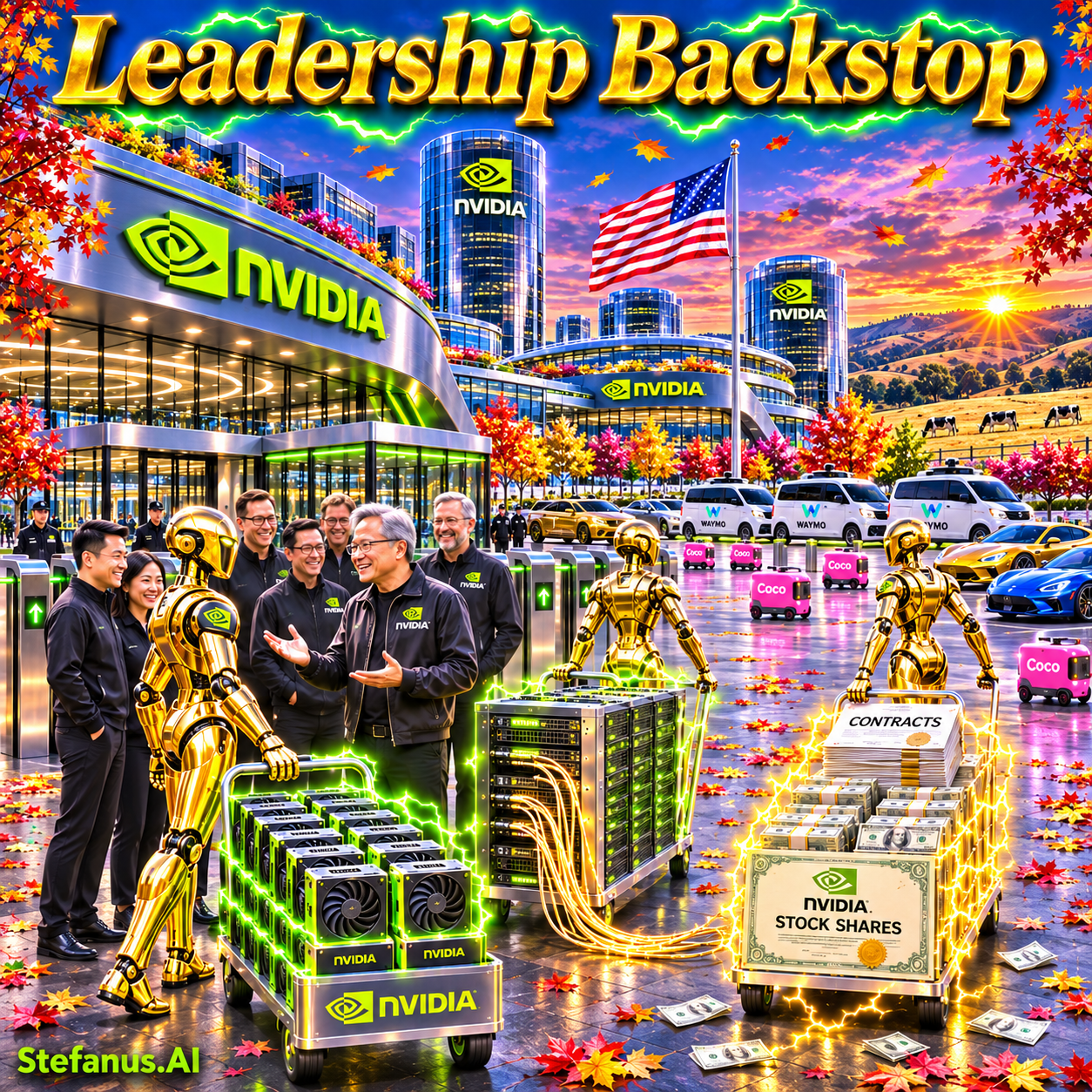
The term Leadership Backstop was selected because the November 2026 episode suggests that executive continuity at a strategically important artificial intelligence company can become an economic concern that extends beyond ordinary corporate succession. In finance, a backstop is a mechanism that provides assurance when a system faces disruption that its ordinary arrangements cannot absorb: a central bank lending facility, a deposit guarantee, an underwriter’s commitment to purchase unsold securities. In the Nvidia case no money was lent and no guarantee was issued, but the board’s reassessment, the government’s expressed national security view, the visible alarm of major shareholders, and the continued commitment of large customers collectively formed part of a process whose effect was to restore the continuity of one person’s leadership. The term does not imply a government bailout, legal immunity, guaranteed employment, or any formal obligation to preserve an executive’s position. It identifies a possible new category of strategic dependence, in which the perceived importance of an individual leader influences decisions across corporate and public institutions that are formally independent of one another.
The title also captures a deeper contradiction within what this paper calls the Five-Layer AI Economy, the stack of energy, chips, datacenters, models, and applications through which artificial intelligence is produced and delivered. The industry is committing extraordinary sums, on the order of seven hundred billion dollars in 2026 from four hyperscalers alone, to automate decision-making, to increase computational intelligence, and to reduce operational dependence on individual human workers. [33] Yet parts of its own industrial and financial architecture appear to remain unusually dependent on a small number of human founders, to a degree that a market strategist can plausibly describe as unprecedented. The central question of this paper is therefore not whether Jensen Huang should or should not lead Nvidia, a matter on which reasonable scholars of governance have already divided sharply and which the continuing investigations may yet affect. The question is whether the artificial intelligence economy is developing forms of executive concentration that existing corporate governance, financial risk management, and national security institutions are insufficiently prepared to understand, to measure, and to manage.
The argument developed in the sections that follow is that leadership continuity is becoming a strategic variable in the economics of artificial intelligence. This does not mean that every prominent founder is irreplaceable, and it emphatically does not justify exempting influential executives from established legal or ethical standards. It means that an unexpected interruption in leadership can produce consequences beyond the corporation when the company controls technologies, relationships, and production commitments that other institutions cannot easily replace, and that this possibility deserves systematic investigation between 2027 and 2030. Section 1 distinguishes corporate succession from national economic exposure and reconstructs the November sequence as a stress test of governance. Section 2 examines how financial markets price founder-specific risk and proposes a framework for measuring it. Section 3 analyzes the role of Washington, the duties of the board, and the expanding reach of export controls. Section 4 compares nine leadership models across the artificial intelligence industry. Section 5 traces the transmission of leadership risk across the five layers and offers scenarios through 2030, and Section 6 distills what has been learned into seven pillars.
Exhibit 1. The November 2026 sequence at Nvidia: established events and their sources
| Date | Event | Source |
| Nov. 11 | Board accepts Huang’s resignation as president, chief executive, and director; Colette Kress appointed interim chief executive; Harvey C. Jones appointed first chair of the board. | [2] |
| Nov. 12 | Resignation announced publicly; board begins search for a permanent successor. | [1] |
| Nov. 16–19 | Bureau of Industry and Security releases, then publishes, its interim final rule on remote access to advanced semiconductors; the rule takes effect on publication. | [25][26] |
| Nov. 17 | Third-quarter fiscal 2027 results: revenue of $115.8 billion and Data Center revenue of $107.6 billion. Board creates the National Security and Export Control Oversight Committee. Chair states that the board does not intend to reinstate Huang. Three House committees schedule a transcribed interview with Huang for December 1. | [3][5][9][23] |
| Nov. 20 | President Trump says Huang deserves a second chance; technology shares complete their worst week since 2020. | [14][66] |
| Nov. 22 | President publicly urges rehiring; board votes unanimously to reinstate Huang, effective immediately. | [8][66] |
| Nov. 23 | Reinstatement announced; shares rise roughly 32 percent intraday; Senate Banking Committee confirms a public hearing with Huang for December 3. | [7][12][64] |

Section 1: From Corporate Succession to National Economic Exposure
For most of modern corporate history, the appointment or departure of a chief executive officer has been treated as a matter internal to the corporation and its owners, important to shareholders and employees but of limited interest to anyone else. The premise of this section is that this assumption, which remains correct for the overwhelming majority of companies, has begun to fail for a small number of firms that occupy chokepoints in the artificial intelligence supply chain. To see why, it is necessary first to recall what the law assumes about the relationship between a corporation and the people who run it, then to examine what economists have learned over the past several years about how much individual leaders actually matter, and finally to consider what happens when a firm whose leadership matters a great deal also happens to supply an input on which a significant share of national investment depends. The November 2026 sequence at Nvidia is valuable precisely because it compressed all three of these questions into eleven days and forced boards, investors, and governments to answer them in public.
1.1. The Historical Meaning of Executive Succession
The legal architecture of the corporation is built on a deliberate separation between the institution and the individuals who manage it. A corporation has its own legal identity; it owns property, enters into contracts, employs workers, and assumes liabilities independently of its officers, and it is intended to survive changes of personnel, including the departure of the people who founded it. Shareholders elect directors, directors appoint and oversee management, and when a chief executive retires, resigns, becomes unavailable, or is removed, the board activates a succession process designed to preserve the enterprise. Section 141(a) of the Delaware General Corporation Law, which governs Nvidia as it governs most large American public companies, places the business and affairs of the corporation under the direction of its board of directors, and nothing in that provision is suspended because a company has become economically important or because a president has expressed a preference about who should run it. [47] The international consensus is the same: the G20/OECD Principles of Corporate Governance assign to the board the responsibility to select, oversee, and when necessary replace key executives, and to oversee succession planning as a core element of risk management. [48]
Legal separateness, however, has never guaranteed economic substitutability, and the empirical literature of the past several years has made that gap considerably easier to quantify. The most persuasive evidence comes from studies that exploit events no board can plan for. Bennedsen, Pérez-González, and Wolfenzon, using the hospitalization of chief executives across more than twelve thousand Danish firms, found that the temporary absence of a chief executive has a significant negative effect on profitability and investment, that the effect is larger in growing firms and in industries intensive in human capital, and that the hospitalization of other senior executives does not produce a comparable effect, a result the authors interpret as showing that chief executives are unique and that contingency planning for their absence is valuable. [36] Becker and Hvide, studying the deaths of nearly fifteen hundred entrepreneurs, found large and sustained negative effects on the growth and profitability of the firms they had founded, with a mean effect on sales of roughly sixty percent among the larger startups, and concluded that the effect reflects the specialness of the entrepreneur and not merely the disruption of a leadership transition. [37] Lee, Kim, and Bae, examining the sudden deaths of founder chief executives at public firms, reported that the loss of a founder is followed by a measurable decline in the quantity and quality of innovation, which suggests that founders contribute something to technological direction that professional successors do not automatically replicate. [38]
This evidence must be read alongside an older finding that complicates it. The classic study by Johnson, Magee, Nagarajan, and Newman of stock price reactions to sudden executive deaths showed that markets do not always respond negatively to the loss of a powerful leader, and that in the case of some founders the reaction was positive, apparently because investors believed that an entrenched individual had been extracting value or blocking change. [39] The correct inference from the literature as a whole is therefore conditional. A founder can be the firm’s most valuable asset and its most serious governance risk simultaneously, and the sign of the market’s reaction to a departure reveals which of those two characteristics investors believe to be dominant at that moment. In November 2026 the market’s answer with respect to Nvidia was not subtle, but the direction of a price move, however large, does not settle the question of whether the dependence it reveals is healthy.
1.2. The November 2026 Sequence as a Governance Stress Test
Nvidia’s eleven days offer an unusually concentrated case study because they separate, almost as a laboratory experiment would, four dimensions of continuity that are ordinarily bundled together and therefore difficult to observe independently. The first is operational continuity, meaning the capacity of the organization to keep designing, shipping, and supporting products when its founder is absent. The second is strategic continuity, meaning the extent to which customers, investors, employees, and suppliers believe that long-term decisions will remain coherent. The third is governance continuity, meaning whether the board retains credible authority to supervise conduct, compliance, and strategy. The fourth is policy continuity, meaning whether government agencies, legislators, and foreign regulators continue to regard the company as a reliable counterpart. These dimensions are related, but the November sequence demonstrates that they can diverge sharply.
On operational continuity, the evidence from the interim period is strong. Five days after the resignation, under a chief financial officer who was simultaneously serving as interim chief executive, Nvidia reported third-quarter fiscal 2027 revenue of 115.8 billion dollars, an increase of 103 percent from a year earlier, including Data Center revenue of 107.6 billion dollars, and it guided to approximately 130 billion dollars for the following quarter while assuming no Data Center compute revenue from China. [3] It announced that the Vera Rubin NVL72 platform had shipped, and on the same day it disclosed expanded long-term commitments with six manufacturing partners spanning substrates, advanced packaging, wafers, and contract manufacturing. [3][6] An organization that can do all of this in the week after losing the only chief executive it has ever had is not an organization that ceases to function without its founder.
On strategic continuity, by contrast, the market’s assessment during the same period was severe. The shares extended a decline that reached more than forty percent over the month, even as the reported numbers exceeded expectations, which implies that investors were not responding to current operations at all but to their beliefs about the future coherence of the enterprise. [14] Part of that belief had an identifiable organizational basis. Huang had reportedly managed with something on the order of sixty direct reports, without a chief operating officer, and had said publicly that he did not believe in succession planning; the company’s proxy statement named no successor, and corporate governance scholars at Stanford had observed months earlier that the board faced the difficult but essential task of planning for succession even while the company was thriving. [45][63] Chris Miller of Tufts University, the historian of the semiconductor industry, summarized the organizational reality in the days after the resignation.
“There’s not really a deputy who was waiting in the wings to take over.”[21]
— Chris Miller, Professor, The Fletcher School, Tufts University; author of Chip War [21]
On governance continuity, the episode is most troubling, and it is here that academic opinion has been harshest. A board that announces on a Tuesday that it will not reinstate an executive and reinstates him the following Sunday, before its own independent investigation has concluded, has revealed something about the practical limits of its authority, whatever the merits of either decision taken separately. On policy continuity, finally, the picture is mixed in an instructive way: the executive branch expressed confidence and actively promoted the reinstatement, while the legislative branch signaled the opposite, with three House committees insisting that the reinstatement altered nothing about their scheduled December 1 interview and the Senate Banking Committee confirming a public hearing on export control oversight for December 3. [23][24][64] A company can thus enjoy the support of one branch of government and the suspicion of another at the same moment, and a leadership backstop provided by the former offers no protection against the latter.
Much of the confusion in public commentary on the episode arises because different stakeholders use the word confidence to describe different things. An investor’s confidence concerns future earnings; a supplier’s concerns purchase commitments and the stability of forecasts; an employee’s concerns the direction and culture of the organization; a regulator’s concerns compliance; and a board’s concerns candor, oversight, and fiduciary responsibility. The reinstatement restored the first three almost instantly, left the fourth unresolved, and arguably damaged the fifth. The Leadership Backstop framework is useful because it insists that these forms of confidence be examined together without being mistaken for one another.
1.3. Strategic Importance Is Not Government Ownership
It would be a serious analytical error to conclude from the events of November that Nvidia has become, in any formal sense, an instrument of the state. Its directors remain responsible for its governance, its officers remain subject to the law, its shareholders bear its financial risks, and its customers make commercial decisions according to their own interests. The press release of November 23 did not say that the government had appointed Huang, had assumed responsibility for the company’s management, or had guaranteed its performance; it said that the board had received input and had formed its own confidence on the basis of that input. [7] The significance of the episode lies in the government’s participation in the environment surrounding the decision, and that participation can take forms that differ greatly in their legal character. Export licensing, formal investigations, and subpoenas involve binding authority. Public statements of support, private conversations with directors, and the sharing of intelligence assessments involve persuasion, information, and reputation. To treat all of these as equivalent would produce a misleading account of what occurred.
There is nonetheless a body of scholarship that helps to explain why the boundary has become so porous. Eichensehr and Hwang have described a phenomenon they call national security creep, the steady expansion of security-related review and regulation into corporate transactions that would once have been regarded as purely commercial, driven by a bipartisan tendency to frame economic questions in security terms. [41] Their analysis concerned cross-border investment, but the logic extends naturally to leadership: once a company’s products are understood as strategic assets, the identity, relationships, and vulnerabilities of the person who directs it become matters in which the state believes it has a legitimate interest. Farrell and Newman’s theory of weaponized interdependence supplies the complementary insight that global economic networks contain hubs whose control confers coercive leverage on the states that host them, and advanced accelerators are among the clearest contemporary examples of such a hub. [42] The Stanford AI Index for 2026 estimates that Nvidia hardware accounts for more than sixty percent of the world’s artificial intelligence computing capacity, and the World Bank’s World Development Report 2026 observes that a small number of companies in a few economies control the most advanced models, the chips on which they rely, and the datacenters that run them. [30][32]
“This concentration creates dependency risks”[30]
— The World Bank, World Development Report 2026: The Promise of Artificial Intelligence [30]
When a hub of that importance experiences a leadership crisis that also involves an alleged foreign intelligence dimension, it would be more surprising if the state remained silent than if it spoke. The Leadership Backstop should therefore be understood as a possible form of strategic continuity support that arises from the structure of the industry, and not as a suspension of ordinary corporate law.
1.4. The Founder as an Industrial Coordinator
Jensen Huang occupies an unusual position because Nvidia’s business increasingly consists of something more than designing individual semiconductor products. A modern accelerated computing system requires the simultaneous alignment of chip architecture, leading-edge fabrication, high-bandwidth memory, advanced packaging, substrates, interconnect and networking, system software, rack-scale mechanical and thermal design, and the deployment practices of cloud operators. A decision in any one of these domains propagates into several others: a faster architecture may demand a different memory configuration, which may require a different packaging process, which may alter rack power density, which changes cooling requirements and, eventually, the electrical design of the buildings in which the systems are installed. This paper refers to the resulting condition as industrial coordination dependence, by which it means a dependence that arises not from centralized ownership but from the fact that a single enterprise plays the coordinating role across many legally independent organizations.
The supplier announcements of November 17 illustrate both the breadth of that role and its financial weight. Nvidia disclosed expanded commitments with Kinsus and Samsung Electro-Mechanics for substrates, with Amkor and Siliconware Precision Industries for advanced packaging, with Foxconn for system manufacturing, and with TSMC for wafers, and it reported that Kinsus intends to expand the substrate capacity dedicated to Nvidia to more than three and a half times its current level by the third quarter of 2028. [6] These are investments that suppliers undertake on the strength of forecasts that extend years into the future, and the company’s quarterly report for the period ended July 26, 2026 showed that its own supply and capacity commitments had reached approximately 279 billion dollars, having more than doubled in a single quarter. [35] The executive responsible for operations described the arrangement in terms that make the strategic logic explicit.
“Our supply chain is a strategic advantage”[6]
— Debora Shoquist, Executive Vice President of Operations, NVIDIA [6]
A founder who has spent three decades building personal relationships with the leaders of these suppliers may reduce negotiation costs and accelerate decisions in ways that are real and valuable. A mature corporation, however, should also possess the teams, processes, and contractual institutions required to sustain those relationships without him, and the fact that these very announcements were made during the interim period, under the signature of the operations organization, is evidence that Nvidia possesses more of that institutional capacity than the market’s reaction implied. The distinction between individual coordination and institutional coordination becomes more consequential, not less, as the financial scale of the commitments grows.
1.5. Leadership Backstop Versus Conventional Key-Person Risk
Financial markets have recognized key-person risk for decades, and in the conventional understanding it is a risk borne by the firm and its investors: a biotechnology company that depends on a leading scientist, an investment partnership that depends on the judgment of particular partners, a startup that cannot raise capital without its original entrepreneur. The Leadership Backstop extends this familiar idea in a specific direction by asking whether the losses associated with a leadership disruption can propagate across an economically important technology system, and whether public institutions consequently develop an interest in the continuity of the executive concerned. The phenomenon would be most relevant where three conditions hold simultaneously. The enterprise must provide an input that is difficult to replace quickly. The individual leader must be perceived as unusually important to the strategic relationships or technical direction of the enterprise. And a disruption at the enterprise must be capable of affecting other organizations whose projects, financing, or public functions depend on that input.
A leading semiconductor platform can satisfy these conditions more strongly than a typical software company, because its production network consists of physical facilities and capital-intensive commitments that cannot be replicated on short notice, and because, as the literature on superstar firms has documented, modern industries increasingly concentrate output and market value in a small number of highly productive enterprises whose fortunes then carry macroeconomic weight. [43] The framework must nonetheless remain falsifiable if it is to be of any scholarly use. If evidence shows that production, customer commitments, and strategic execution continue with minimal disruption under alternative leadership, the case for an individual-specific backstop weakens and the November reaction begins to look like a panic about perception. If evidence shows substantial disruption beyond the corporation, the case strengthens. The eleven days themselves supply evidence on both sides, which is exactly why they repay careful study.

Section 2: Founder-Specific Risk, Financial Markets, and the Economics of Strategic Continuity
If the first section established that leadership can matter beyond the firm, this section asks how much it matters, to whom, and by what mechanism, because a concept that cannot be measured cannot be managed and will sooner or later be abused. The temptation after a day like November 23 is to read the change in market capitalization as the monetary value of a human being, as though the market had weighed Jensen Huang and found him to be worth a trillion dollars. That reading is wrong, and understanding why it is wrong is the key to the entire economics of the Leadership Backstop. The discussion proceeds from the general question of why investors assign value to individual leadership, through a disciplined interpretation of the November rally, to a framework for estimating what this paper calls Strategic Succession Exposure, and then outward to the hyperscalers, specialized cloud providers, and lenders whose own balance sheets are linked to Nvidia’s by commitments that, in aggregate, the Federal Reserve now regards as a matter of financial stability.
2.1. Why Investors Assign Value to Individual Leadership
The market value of a company reflects expectations about its future cash flows and the risk attached to them, and leadership matters to valuation because management decisions influence revenue growth, margins, capital requirements, competitive position, technological direction, and legal exposure. For a mature industrial company, investors may reasonably assume that established processes, long-term contracts, and experienced operating teams provide most of the continuity that matters. For a founder-led technology company operating at the frontier of a rapidly changing market, investors tend to assign greater weight to the founder’s strategic judgment, because the most valuable decisions such a company makes are precisely those that cannot be reduced to process: which architecture to pursue, which market to abandon, which customer to finance, which regulatory battle to fight.
Huang’s position at Nvidia combined several characteristics that heighten this sensitivity. He had led the company since its founding in 1993, a tenure of thirty-three years that is almost without parallel among the leaders of large technology companies. He was personally identified with the long and for many years unprofitable investment in the CUDA software ecosystem, with the transition from graphics processors to accelerated computing, and with the more recent transformation of the company from a chip vendor into a supplier of integrated, rack-scale computing systems on an annual cadence. He represented the company to customers, suppliers, investors, and governments, and he did so while reportedly owning less than four percent of its shares, which means that his authority rested not on voting control, as Mark Zuckerberg’s does at Meta, but on the accumulated confidence of directors and shareholders. [62][63] That last point deserves emphasis because it distinguishes the Nvidia case from most discussions of founder power. Huang could be removed by an ordinary board vote and, briefly, he effectively was. The backstop that restored him was not a legal entitlement built into the capital structure; it was an economic and political fact that asserted itself against the formal structure.
Steve Blank of Stanford, writing during the interim period, placed the problem in a longer historical frame by comparing Nvidia with companies such as Microsoft and Apple at the moments when execution-oriented successors inherited enterprises built by visionary founders. His argument was that such successors can sustain and even enlarge the core business for many years while missing the next technological transition, and that the board’s real decision was therefore about what kind of company it wanted Nvidia to be. [20]
“Execution pays your salary. Innovation pays your pension.”[20]
— Steve Blank, Adjunct Professor, Stanford University; Co-founder, Gordian Knot Center for National Security Innovation [20]
The observation is useful because it explains why strong quarterly results under interim leadership did so little to reassure investors. Nobody doubted that Nvidia could execute the roadmap already in place. What the market doubted was whether the institution, absent its founder, would continue to generate the next roadmap, and that is a question about a capability that financial statements do not report.
2.2. Interpreting the November 23 Rally
The magnitude of the November 23 move is evidence that investors regarded the leadership announcement as economically significant, but it does not establish that Huang’s individual contribution equals the corresponding change in market capitalization, and four considerations counsel caution. The first is that a share price reflects many simultaneous risks. In the weeks before the reinstatement, investors had been incorporating into Nvidia’s valuation a set of adverse possibilities that extended well beyond the identity of the chief executive: prolonged management uncertainty, an expanding set of federal, congressional, and state inquiries, the prospect of tighter export controls, a newly effective rule on remote access to advanced chips, and the general fragility of a market in which artificial intelligence had become the dominant narrative. The reinstatement, accompanied by an explicit statement that the government saw no national security risk in it, reduced the probability that investors attached to several of these outcomes at once.
The second consideration is that a large upward move after a large decline is, to a considerable degree, the recovery of previously discounted value and not the creation of new productive capacity. Even after a gain of roughly one third, the shares remained below the level at which they had traded before the crisis began, which indicates that the market did not regard the reinstatement as a full restoration of the status quo. The third consideration is mechanical: at least one strategist warned on the day that a substantial share of the buying was driven by the forced covering of positions and by systematic strategies, which amplify price changes in both directions without conveying information about fundamentals. [13] The fourth is that the rally was not confined to Nvidia. The technology sector of the Standard and Poor’s 500 rose nearly nine percent and the largest technology companies gained between roughly six and twelve percent, which suggests that part of what was being repriced was a market-wide risk premium attached to the artificial intelligence trade as a whole. [12]
A rigorous assessment would take the form of an event study that estimates abnormal returns around each of the relevant announcements, using market and factor benchmarks to establish expected returns and a set of comparable semiconductor companies to control for industry news. Such a study should examine separately the windows around November 11 and 12, when the resignation was decided and announced; November 17, when earnings, the new oversight committee, and the chair’s refusal to reinstate all arrived on the same day; November 20, when the President’s remarks about a second chance coincided with a further sharp decline; and November 22 and 23. It should also test whether the abnormal returns of related companies were proportional to their measurable dependence on Nvidia, since a finding that the most dependent firms moved the most would support the transmission hypothesis advanced in this paper, whereas a uniform move across the sector would suggest sentiment. An analysis of this kind would not resolve every causal question, but it would provide a far more credible foundation than describing a rally as the direct monetary value of a founder.
2.3. The Strategic Succession Exposure Model
The Leadership Backstop can be developed into an economic risk framework through a concept this paper calls Strategic Succession Exposure, defined as the expected economic loss associated with an interruption in leadership that affects a firm’s strategic execution, financing, commercial relationships, or regulatory environment. In its simplest form the expected loss from disruption equals the probability of a disruption multiplied by the economic loss conditional on its occurrence, and the analytical work lies in decomposing the conditional loss into components that can be estimated separately and in avoiding the double counting that arises when the same underlying effect is described in more than one way. Delayed production and lower revenue, for example, are frequently two descriptions of a single phenomenon, and a model that adds them together will overstate exposure. A careful model should also distinguish cash-flow effects, which alter what the firm and its counterparties actually receive and pay, from valuation effects, which alter the price at which claims on those cash flows trade.
Exhibit 2. Components of Strategic Succession Exposure and observable indicators
| Component of conditional loss | Mechanism | Observable indicator | Principal bearer |
| Financing cost of delay | Committed capital earns no return while projects wait for clarity on supply, specification, or policy | Slippage in construction and energization milestones; draw schedules on project debt | Datacenter developers, lenders, specialized cloud providers |
| Production and deployment slippage | Supplier allocation, qualification, or roadmap decisions are deferred during a leadership vacuum | Lead times, supplier capacity announcements, shipment timing of new platforms | The firm, its suppliers, and its largest customers |
| Commercial relationship risk | Customers reassess reliance and accelerate alternatives | Share of orders moving to competing or internally designed accelerators | The firm and its shareholders |
| Regulatory and investigative cost | Inquiries multiply and compliance requirements tighten | Number of open inquiries; license processing times; compliance headcount | The firm; indirectly, its overseas customers |
| Cost of capital | Rating outlooks and credit spreads adjust to governance uncertainty | Bond spreads, rating actions, terms of vendor financing | The firm and counterparties financed against its hardware |
| Human capital attrition | Senior engineers and managers reconsider their commitment | Voluntary turnover among senior technical staff; retention grants | The firm |
A stylized illustration shows why the duration of uncertainty matters more than its intensity. Consider a hypothetical datacenter developer with ten billion dollars of deployed and committed capital whose project is delayed by ninety days because of uncertainty at a critical supplier, and suppose that the capital carries an annualized financing cost of eight percent. The simple carrying cost of that delay is approximately 197 million dollars, calculated as ten billion dollars multiplied by eight percent multiplied by ninety over three hundred sixty-five, before considering lost revenue, contractual penalties, offsets, or the difference between committed and drawn amounts. This is an illustration and not an estimate of losses caused by the events of November, but it demonstrates that even when hardware prices and delivery obligations are unchanged, a short period of indecision can impose material costs on investors several steps removed from the company where the indecision originated. Scaled across an industry in which four companies alone spent more than two hundred billion dollars on capital expenditure in a single quarter, the aggregate sensitivity to delay is plainly large.
2.4. Separating Founder Value From Organizational Value
A persistent danger in research on founder-specific risk is the tendency to confuse a company’s success with the personal contribution of its founder. Nvidia’s technological achievements depend on tens of thousands of engineers, scientists, operations specialists, and software developers, and on external organizations including its foundry, memory, packaging, and system manufacturing partners. No individual designs, fabricates, packages, tests, installs, and operates an accelerated computing system. The economic contribution of leadership is therefore largely coordinative: a leader sets priorities, selects the major investments, builds trust with external partners, resolves internal disputes, and communicates a coherent strategic direction. Those functions matter greatly, and the evidence reviewed in the first section suggests that they matter more in growing, human-capital-intensive firms than anywhere else, but they are not equivalent to possessing the knowledge required to run the business. [36]
This distinction identifies the central governance challenge. Companies can benefit from exceptional founders while gradually building the institutions that reduce their dependence on exceptional individuals, and successful institutionalization does not diminish entrepreneurial accomplishment but converts it into organizational durability. The strongest form of leadership continuity is a company that continues to perform well when its founder is unavailable. Nvidia’s eleven days provided a brief and imperfect test of that proposition, and both of its results should be retained. The interim appointment of an experienced executive, the continued financial reporting, and the supplier and product announcements all demonstrated real institutional capacity. The market’s reaction, and the board’s eventual reversal, demonstrated that neither investors nor directors believed that capacity to be sufficient. The Stanford governance literature has long observed that boards of thriving companies find succession planning hardest exactly when it is most valuable, because the incumbent’s success makes the exercise seem both unnecessary and disloyal. [44] November 2026 is what the cost of that deferral looks like when it finally falls due.
2.5. Hyperscaler Procurement, Customer Concentration, and Capital Commitment Risk
The financial consequences of leadership uncertainty extend beyond Nvidia’s shareholders because the largest cloud providers purchase and deploy its technology through capital programs of a scale that has no precedent in corporate history. In the third calendar quarter of 2026, according to their own reports, Amazon spent approximately 77.3 billion dollars on capital expenditure, Alphabet 51.4 billion, Microsoft 39.4 billion, and Meta 34.9 billion, a combined total in excess of two hundred billion dollars for a single quarter, and their guidance implied aggregate spending in the neighborhood of 730 billion dollars for the full year. [33] Three of the four reported capital expenditure in excess of operating cash flow for the quarter, and Meta’s capital spending reached more than half of its quarterly revenue of 64.6 billion dollars. [33][34][68] Nvidia’s chief financial officer reported that hyperscale customers accounted for roughly 60 billion dollars of the company’s 107.6 billion dollars of quarterly Data Center revenue. [4]

Exhibit 3. Capital expenditure of the four largest hyperscalers, third calendar quarter of 2026 (billions of U.S. dollars). Source: company reports as compiled in [33].
These investment decisions have mismatched time horizons, which is what makes them vulnerable to uncertainty about a supplier’s direction. Accelerator architectures now change annually. Datacenter construction requires several years of planning and permitting. Electricity infrastructure involves longer schedules still. A hyperscaler placing a multibillion-dollar order must therefore make assumptions about the performance, availability, software compatibility, and production capacity of systems that do not yet exist, and it must embed those assumptions in buildings and power contracts that will outlast several generations of hardware. If the assumptions become uncertain, the cost depends on the alternatives available: a customer with several viable architectures, including accelerators of its own design, can adjust its procurement mix, while a customer committed to a particular Nvidia rack configuration faces higher switching costs.
Nvidia’s own disclosures reveal that the dependence is reciprocal. In the first quarter of fiscal 2027, three direct customers accounted for 21, 17, and 16 percent of total revenue; in the second quarter, a single direct customer accounted for 16 percent; and the company cautioned that its revenue is concentrated among a limited number of direct and indirect customers and that this trend may continue. [35] Concentration of this kind cuts in two directions. Large customers depend on Nvidia’s technology and therefore have an interest in its continuity, but Nvidia depends on those customers for revenue, which gives them bargaining power and a strong incentive to reduce their reliance over time through custom silicon, multiple procurement channels, and greater software portability. Miller, asked how customers would respond to the crisis, anticipated that companies which had relied on Nvidia would watch closely to determine whether they could continue to do so and that competitors and in-house designs stood to gain if the company were distracted, while also insisting that the market for artificial intelligence chips, though concentrated, remains highly competitive. [21] The Leadership Backstop does not assume that Nvidia’s strategic importance is permanent. It identifies the conditions under which reliance on a central supplier creates broader exposure, and it recognizes that every leadership crisis at such a supplier strengthens the customers’ case for diversification.
2.6. Cloud Providers, Credit, and the Transmission of Financial Expectations
The behavior of Nvidia-linked equities on November 23 illustrates how expectations concerning one enterprise are transmitted to the valuations of others. For specialized cloud companies such as CoreWeave and Nebius, the price, availability, and future performance of accelerated computing systems determine revenue growth, equipment utilization, the residual value of collateral, and the terms on which debt can be raised, and many of these companies finance hardware in advance of customer revenue. A change in expectations about the principal hardware supplier can therefore influence lender confidence even when every existing contract remains intact, and the same mechanism operates in reverse when confidence is restored. The shares of these companies rose by more than twenty percent on the day of the reinstatement, a response larger than that of the diversified hyperscalers and consistent with their greater dependence. [12][14]
The official sector has begun to treat these linkages as a matter of systemic concern. The Federal Reserve’s Financial Stability Report of November 2026 devoted a section to the financing of artificial intelligence for the first time, reporting that 87 percent of the market contacts it surveyed cited artificial intelligence as a salient risk to financial stability, up from half in the spring, that debt issued to finance advanced computing had exceeded 680 billion dollars, and that a group of large technology companies carried off-balance-sheet obligations in excess of three trillion dollars. [29] The International Monetary Fund’s October 2026 World Economic Outlook credited artificial intelligence investment with sustaining global growth of 3.1 percent in a year of war and energy shocks, and at the same time modeled a downside scenario in which a sharp decline in such investment reduces global output by 1.1 percent by 2028 and United States output by 1.8 percent. [27][28] The Fund’s managing director offered an image of the resulting fragility that deserves to be remembered.
“We now have an economy that is standing on one leg, the AI leg”[27]
— Kristalina Georgieva, Managing Director, International Monetary Fund [27]
It is in this context that the Leadership Backstop acquires its macroeconomic meaning. If global growth is leaning on artificial intelligence investment, if that investment is financed increasingly with debt and long-dated obligations, if the hardware on which it is spent comes predominantly from one company, and if the market believes that the coherence of that company depends substantially on one person, then a chain of dependence runs from a single executive office to the growth forecasts of the world’s principal economic institutions. Each link in that chain is contestable, and the mechanism should not be confused with proof that every related company shares identical risks, since each enterprise’s financing structure, customer base, and operating flexibility must be evaluated on its own terms. But the chain is not imaginary, and for a few days in November 2026 the market priced it as though it were made of glass.

Section 3: Washington, Corporate Boards, and the National-Security Boundary of Executive Power
The preceding sections treated the state as part of the environment in which a leadership crisis unfolds. This section places it at the center, because the most novel feature of the Nvidia episode is not that a founder returned, nor even that the market rejoiced, but that the President of the United States publicly asserted that he had arranged the return and that the company’s own disclosure acknowledged governmental input into a decision that corporate law assigns to directors alone. Understanding what this means requires holding several ideas in tension. The government possesses information and responsibilities that a board does not, and there are circumstances in which its participation improves a decision. Political involvement in the selection of corporate leaders also carries obvious dangers for accountability, for the equal treatment of firms, and for the credibility of the board itself. And the regulatory terrain on which all of this occurred, the regime of export controls on advanced computing, was itself being redrawn in the very same week. The section therefore examines the White House’s role, the duties that survive a president’s intervention, the divided judgment of governance scholars, the new board-level machinery for national security oversight, the separate track of congressional inquiry, and the transformation of export controls from restrictions on shipping hardware into restrictions on access to computation.
3.1. The White House’s Role in the Reinstatement
When the federal government regards a technology company as strategically important, how should it participate in questions concerning that company’s leadership? The executive branch is responsible for national security, for trade policy, and for administering the export control system, and it receives intelligence assessments that are unavailable to corporate directors. When a leadership decision turns in part on whether an executive has been compromised by a foreign intelligence service, the government is the only party in a position to know, and a board that sought no governmental view before reinstating such an executive would be open to justified criticism. In that narrow sense, the board’s request for assurance and the government’s willingness to provide it were both defensible, and the disclosure in the press release that the board’s confidence on the national security question rested on governmental input was more candid than silence would have been. [7]
The difficulty lies in everything that surrounded that narrow exchange. The President did not merely transmit an assessment; he campaigned publicly for a particular outcome, urged the board on the eve of its vote to rehire the executive, and afterward described his own participation as decisive. [10][66]
“I believe my intervention was very important.”[11]
— President Donald J. Trump, The White House (interview of November 23, 2026) [11]
When the same official both supplies the national security assessment on which a board relies and advocates for the result that the assessment supports, the informational value of the assessment is compromised, because directors and investors cannot easily distinguish a professional judgment of the intelligence community from the preference of the person who communicates it. The concern is sharpened by policy context. The administration’s stated artificial intelligence strategy, set out in the July 2025 AI Action Plan and reinforced by Executive Order 14409 of June 2026, treats American leadership in artificial intelligence as a national objective to be pursued in close collaboration with the private sector. [49][50]
“Advanced AI capabilities make our Nation stronger”[50]
— The White House, Executive Order 14409, Promoting Advanced Artificial Intelligence Innovation and Security [50]
An administration that has defined the success of a particular industry as a national goal has an evident interest in the stability of that industry’s most important company, and that interest is not identical to the interest in rigorous counterintelligence review. None of this establishes that the assurance given to Nvidia’s board was mistaken. It establishes that the process by which it was given did not insulate the security judgment from the industrial policy preference, and that a durable framework for such situations would need to do so.
3.2. The Board’s Duties Do Not Disappear When the President Intervenes
The distinction between governmental advice and corporate authority is central to the legal meaning of the Leadership Backstop. Directors may consult experts, counsel, regulators, security professionals, employees, and officials, but consultation is not a substitute for deliberation, and the board must exercise its own judgment under the law of the state of incorporation. In practical terms, Nvidia’s directors needed to weigh the company’s operational needs, the interests of shareholders, whatever findings were then available from the internal review, Huang’s own explanations, the government’s national security view, and the risks both of reinstatement and of continued exclusion. The public record does not disclose the documents they reviewed or the substance of their discussions, although reporting on the day indicated that the first conversations between Huang and the board since his departure took place on the Saturday and that the vote followed on the Sunday. [8][69] It would therefore be inappropriate to conclude that the decision was compelled by the President, that the deliberations were legally deficient, or that any unresolved allegation was dismissed. The confirmed facts are a unanimous reinstatement, governmental input, and a continuing independent investigation.
Those facts have been sufficient to divide the scholars who study boards for a living, and the division is itself instructive. The severest critics hold that the board abdicated. Jeffrey Sonnenfeld of the Yale School of Management, who had argued during the interim period that reinstatement would contradict the company’s own code of conduct, responded to the reversal by describing it as a wholesale breakdown of the board’s oversight function and by observing that, in the absence of a succession plan, the directors had been left captive to the executive they were supposed to supervise. [15][16]
“The board should resign. Every one of them”[15]
— Jeffrey Sonnenfeld, Senior Associate Dean for Leadership Studies, Yale School of Management [15]
Bill George, the former chief executive of Medtronic and now an executive fellow at Harvard Business School, reached a similar judgment about where authority actually resided.
“The board does not appear to be in control”[16]
— Bill George, Executive Fellow, Harvard Business School [16]
Eric Talley of Columbia Law School was reported to regard the decision as a considerable gamble, and Charles Elson, a longtime scholar of corporate governance formerly at the University of Delaware, faulted the directors for a lack of resolve. [18][19] Peter Jaworski of Georgetown University stated the underlying principle with a precision that makes it the natural counterweight to the entire concept examined in this paper.
“Just because Jensen Huang is indispensable doesn’t mean he should be unaccountable”[18]
— Peter Jaworski, Professor of Business Ethics, Georgetown University [18]
The defenders of the board do not dispute the awkwardness of the reversal; they dispute the standard by which it should be judged. Jesse Fried of Harvard Law School argued that the directors were being faithful to their fiduciary duty, given the evident effect of the founder’s absence on the value of the enterprise, while predicting that any sanction imposed on Huang would be largely symbolic and that the full findings of the internal investigation were unlikely to be made public. [17]
“At a high level, the board’s job is to generate long term value for shareholders”[17]
— Jesse Fried, Professor of Law, Harvard Law School [17]
Others quoted in the same reporting took an intermediate view, observing that boards are entitled to change their minds but that shareholders will expect an explanation of what changed between Tuesday and Sunday, and that a company built around one person without a succession plan had left its directors with no good options. [17] What unites the critics and the defenders is the recognition that the board’s formal authority and its practical authority had come apart. That is the precise sense in which this paper treats founder dependence as a governance vulnerability: a board that cannot credibly exercise its power to replace the chief executive does not really possess the power to supervise him, and the remedy lies not in choosing differently on a given Sunday but in building, over years, the institutional depth that makes the choice a real one.
3.3. The Emergence of Board-Level National-Security Governance
One lasting institutional product of the crisis predates the reinstatement and may outlive its controversy. On November 17 the board established a standing National Security and Export Control Oversight Committee, chaired by Suzanne Nora Johnson with Stephen C. Neal and John O. Dabiri as members, charged with board-level oversight of the company’s national security policies, export control compliance, and global trade risk management, empowered to retain independent legal, national security, and trade compliance experts, and required to meet at least quarterly, with the company’s existing national security and trade compliance teams reporting to it. [5] The reinstatement announcement added the search for a chief compliance officer who will report to a board committee and not to the chief executive. [7]
Corporate boards have historically organized their oversight around audit, compensation, and nomination, and large technology companies have added cybersecurity, privacy, and product safety through various arrangements. Advanced accelerators introduce a different category of concern. Their performance bears on military modernization, intelligence analysis, and the development of frontier models; their production depends on international manufacturing networks; their sale is restricted by regulation that changes frequently; and their ultimate use is difficult to verify once they pass through distributors, cloud providers, and overseas facilities. A dedicated committee can improve oversight by requiring systematic reporting and independent review, and by giving compliance personnel a channel to directors that does not run through the executive whose commercial decisions they may need to question. The existence of a committee does not, however, prove that controls are effective. Observers noted at its creation that the committee’s published mandate conferred no stated power to block customer orders or to review past shipments, and effectiveness will depend on the quality of information it receives, its staffing and technical competence, its escalation procedures, and the willingness of its members to challenge a chief executive whom the full board has just declared to be the right person for the job. Whether similar structures spread among chip designers, hyperscalers, model developers, and specialized cloud providers is among the more important governance questions for 2027 through 2030.
3.4. Congressional Oversight and the Limits of an Executive Backstop
The legislative branch has made clear that the reinstatement resolves nothing from its perspective. Three House committees, on foreign affairs, intelligence, and strategic competition with China, had announced on November 17 that Huang would sit for a transcribed interview on December 1 and that Nvidia’s general counsel would follow on December 2, with the stated purpose of examining how certain Chinese entities gained access to advanced chips and what role a suspected intelligence asset may have played. [23] Asked whether the reinstatement altered those plans, a committee spokesperson answered in two words.
“changes nothing”[24]
— Spokesperson, House Permanent Select Committee on Intelligence [24]
The chair of the Senate Banking Committee confirmed on the day of the reinstatement that Huang would testify publicly on December 3 at a hearing on the oversight of export controls, and members of both parties in the Senate were advancing legislation to restrict further the sale of advanced Nvidia processors to China, while the Senate minority leader promised investigations of the administration’s own conduct. [17][24][64] Congressional oversight differs from corporate governance and from executive enforcement in mandate and in evidentiary standard: directors ask whether management followed company policy and informed the board; legislators ask whether the law was enforced, whether agencies were told the truth, and whether the statute is adequate; agencies ask whether particular transactions complied with licensing requirements; and courts may eventually be asked to resolve disputes arising from any of these. The processes can run concurrently without reaching identical conclusions.
For the present argument, the significance of this parallel track is that a leadership backstop supplied by the executive branch is inherently partial and politically contingent. The midterm elections of November 2026 have altered the composition of the incoming Congress, and Miller, among others, anticipated before the reinstatement that the scandal would sharply reduce Nvidia’s influence over technology policy toward China and that the legislative response would depend on what investigators found. [21][22]
“Congress is likely to pass legislation that Beijing does not like”[22]
— Chris Miller, Professor, The Fletcher School, Tufts University [22]
A company whose strategic position depends on political access to one administration is exposed to every change in the distribution of political power, and an executive who is restored with the help of one branch may thereby become a more attractive target for another. This paper’s research date precedes the December testimony, and it would be speculative to treat the forthcoming interviews as either confirming allegations or dispelling them.
3.5. Export Controls Are Becoming Controls on Access to Computation
Advanced semiconductor export controls are the substantive core of Nvidia’s relationship with Washington, and they changed materially in the same week as the leadership crisis. The Bureau of Industry and Security released an interim final rule titled Addressing Remote Access to Advanced Semiconductors, which took effect on its publication in the Federal Register on November 19, 2026, with public comments due in January 2027. [25] According to the analyses published by practitioners, the rule imposes new license requirements on exports, reexports, and in-country transfers of advanced computing items where there is knowledge that they are destined for a datacenter, wherever located, that provides substantial computing capacity to entities headquartered in countries of concern; extends destination-based advanced computing controls to Brazil, Indonesia, Malaysia, Singapore, and Thailand, subject to a reporting-based exclusion for United States-headquartered recipients; adds notification and due diligence obligations along the supply chain; and formally rescinds the earlier AI Diffusion Rule while retaining other advanced computing controls. [26]
The conceptual shift is considerable. Traditional export control analysis followed the physical movement of controlled items and technical data across borders. Cloud computing breaks that framework, because an accelerator can remain in one jurisdiction while delivering its computational output to a customer in another, and an organization that cannot lawfully import the most capable processors may not need to if it can rent sufficient access to systems that contain them. The November rule is an attempt to align the treatment of remote access with the treatment of physical shipment, and its timing, in the middle of a scandal that concerned precisely the suspected diversion of chips through a Southeast Asian intermediary, was not coincidental in its political effect even if the rule had been long in preparation.
For corporate leadership, the consequence is a compliance obligation that reaches into product design, customer onboarding, cloud partnerships, licensing, and end-use verification, and that cannot prudently be left to the personal judgment or personal relationships of a prominent executive. Nvidia’s own disclosures have described the commercial cost of the controls, warning that restrictions on its ability to compete in China’s datacenter market may strengthen the alternative ecosystems of foreign competitors, and its guidance for the current quarter assumes no Data Center compute revenue from China at all. [3][35] Huang had been the most visible corporate critic of these controls. His return does not alter the government’s authority to impose them, and Nvidia’s obligations under them do not vary with the identity of its chief executive. The Leadership Backstop concerns the economic consequences of leadership continuity within this regulatory environment; it is not, and must never become, an exemption from the environment itself.
3.6. The Risks of Political Dependence
Governmental engagement can reduce uncertainty when it clarifies legal requirements or provides authoritative information, and it can increase uncertainty when corporate outcomes appear to depend on relationships with particular political leaders. A favorable interpretation under one administration may be reversed under the next; control of Congress changes; rules are amended; courts review administrative action; international negotiations alter market access; and state governments pursue infrastructure policies of their own. When a corporation’s perceived advantage rests heavily on political access, a leadership change compounds regulatory risk, because the organization loses a trusted intermediary at the same moment that the future of policy becomes less predictable. A company whose compliance systems are strong, whose reporting is transparent, and whose relationships with government are distributed across institutional channels is less exposed to the fortunes of any individual relationship.
This suggests a distinction between institutional governmental engagement and personal political access. The first supports predictable policy implementation. The second can create valuable channels of communication but introduces concentration risk of exactly the kind that the Leadership Backstop describes, transposed from the commercial to the political domain. For investors and lenders evaluating assets expected to operate for decades, the distinction is material: a datacenter financed in 2027 will still be in service after two or three further presidential elections, and no prudent underwriter should treat the preferences of any one administration as a permanent feature of the landscape.
3.7. A Governance Framework for Strategic Companies
The events of November 2026 suggest a set of practical requirements for governance at companies central to the Five-Layer AI Economy, none of which prescribes an outcome for any particular leadership dispute and all of which concern the process by which continuity and accountability can be reconciled.
- Succession planning should include scenarios involving immediate and unexpected transitions, with at least one identified emergency successor and a development plan for internal candidates that is reviewed by the full board at least annually.
- Major commercial and supplier relationships should be supported by institutional teams with documented authority, so that no strategic relationship exists only in the person of the chief executive.
- Export control and national security compliance should possess sufficient independence, including a reporting line to independent directors, to challenge commercial decisions.
- The board should have direct access to technical and national security expertise and should not rely exclusively on information filtered through the chief executive.
- The company should maintain a clear protocol for interaction with government officials during a leadership or compliance crisis, including a record of what was requested, what was received, and from whom.
- Communication with shareholders should distinguish completed findings from continuing investigations, and where a decision is reversed, should explain what changed.
- The board should assess the risks of reinstating a prominent founder and the risks of proceeding without that founder against consistent, documented standards that are established before a crisis and not improvised during one.
The ultimate objective of such a framework is institutional resilience, by which is meant an organization whose most important decisions about its own leadership can be made on the merits because the cost of either answer is bearable.

Section 4: Nine Technology Leadership Models — Jensen Huang and the Founders Shaping Artificial Intelligence
The Leadership Backstop hypothesis becomes considerably more useful when it is examined comparatively, because Jensen Huang is not the only prominent founder whose decisions shape a major segment of the artificial intelligence economy, and because the differences among these founders are at least as illuminating as their similarities. Sam Altman, Elon Musk, Mark Zuckerberg, Sergey Brin and Larry Page, Dario Amodei, Larry Ellison, Bill Gates, and Jeff Bezos have each played formative roles in organizations that now sit at one or more layers of the stack. Their authority, however, is constructed in very different ways. Some remain chief executives and some do not; some hold voting control that makes their removal practically impossible and others, like Huang, hold only a small minority of the shares; some operate through nonprofit or public-benefit structures designed to subordinate commercial incentives to a mission; and some have long since handed operational control to professional successors while retaining influence through boards, share classes, or reputation. The purpose of this section is not to rank these individuals by importance, an exercise that would be both invidious and uninformative, but to show that leadership concentration takes several structurally distinct forms and that each form calls for a different response from boards, investors, and regulators. The research on dual-class share structures provides a useful point of departure: Aggarwal, Eldar, Hochberg, and Litov document that the rise of such structures in recent initial public offerings has been driven by founder-controlled firms and that the wedge between a founder’s voting power and economic ownership is greater when the founder’s bargaining power at the time of the offering is stronger, a finding that describes with some precision the conditions under which several of the companies discussed below went public. [40]
4.1. Jensen Huang: The Integrated Technology Founder Without Voting Control
Huang’s distinctive role derives from the connection between Nvidia’s technology architecture and its external industrial ecosystem, and from the fact that he personally embodied four functions that most large companies distribute among several executives: technical direction, industrial coordination across suppliers, commercial credibility with the largest customers, and engagement with governments on three continents. That combination reduces friction when major investments require rapid alignment, and it produces acute uncertainty when investors or partners come to believe that the company’s direction depends disproportionately on his continued involvement. The November events revealed the difference between formal leadership authority, which transferred to Colette Kress in an afternoon, and perceived strategic importance, which did not transfer at all. They also revealed the paradox noted earlier: of all the founders considered here, Huang was among the least protected by the capital structure and the most protected by the market and the state. His is the purest case of a backstop that arises from economic indispensability and not from legal entrenchment, which is why it is the central case of this paper.
4.2. Sam Altman: The Reinstated Executive and Mission-Governance Conflict
The closest historical precedent is the five-day crisis at OpenAI in November 2023, when the board of the nonprofit that then controlled the company removed Altman as chief executive, employees and investors rebelled, Microsoft offered to hire the departing staff, and Altman returned under a reconstituted board. [51] The resemblance to Nvidia lies in the rapid reversal of a leadership decision under pressure from stakeholders whose collective response made the original decision practically unsustainable. The differences are equally important. OpenAI’s crisis arose from tension between a mission-oriented nonprofit board and a commercially vital operating company, and the decisive pressure came from employees and from a single strategic investor. Nvidia is a conventional publicly traded corporation, and its crisis added an explicit national security and export control dimension together with the direct involvement of a head of state. What the two episodes share is the lesson that a board’s formal authority can remain intact while the economic consequences of exercising it become prohibitive. That is not a reason to abandon board independence; it is a reason to ask, before a crisis and not during one, whether governance arrangements are aligned with the organizational and commercial realities of the enterprise.
4.3. Elon Musk: Leadership Across Multiple Interconnected Enterprises
Musk presents a different form of concentration, one that spans corporate boundaries. He serves as chief executive of Tesla and leads SpaceX, into which his artificial intelligence venture has reportedly been absorbed, and in 2026 Tesla and SpaceX, with Intel as a process technology partner, confirmed plans for a jointly developed semiconductor complex in Grimes County, Texas, known as Terafab, with an announced first phase of 16.8 billion dollars and the stated ambition of producing chips at a scale that existing global capacity could not supply. [52][67] These activities create real strategic complementarities among autonomous vehicles, humanoid robotics, satellite communications, and computing. They also raise questions that single-company founder dependence does not: how executive attention is allocated, how corporate opportunities are divided among entities with different shareholders, how related-party transactions are priced, and which board is responsible when the interests of the enterprises diverge. The Leadership Backstop framework should therefore distinguish single-company founder dependence from cross-company leadership concentration, in which a disruption affecting one individual would propagate simultaneously through several balance sheets and several regulatory relationships.
4.4. Mark Zuckerberg: Founder Control Through Voting Structures
Meta offers the model of continuity secured through the capital structure itself. Zuckerberg is founder, chair, and chief executive, and the company’s differentiated voting rights have long given him majority control of shareholder votes. In October 2026, alongside third-quarter results that showed revenue of 64.6 billion dollars, Meta announced that its board had approved a new class of publicly listed, non-voting Class C common stock to take effect in January 2027, and the company’s own description of the measure explicitly linked it to ensuring that its founder continues to lead the company into its next era while preserving the ability to raise equity for an artificial intelligence buildout that is now consuming more than half of quarterly revenue. [34] A founder with voting control faces no realistic threat of removal by ordinary governance mechanisms, which supports strategies that require patience and very large investment, and which also deprives shareholders of the remedy that Nvidia’s board briefly exercised. The Meta model thus eliminates the kind of eleven-day crisis that Nvidia experienced, but it does so by removing the board’s option, not by reducing the organization’s underlying dependence on one individual. The dependence is managed by being made unchallengeable.
4.5. Sergey Brin and Larry Page: Founder Influence Without Daily Executive Management
Alphabet demonstrates that founder influence and operational leadership can be separated. Page and Brin established a share structure in which high-vote stock preserves substantial founder influence, and in December 2019 they stepped away from their executive positions while Sundar Pichai assumed responsibility as chief executive of both Google and Alphabet. [54] The company’s subsequent development of frontier models, custom accelerators, and one of the three largest cloud platforms has been carried out by broad technical and managerial organizations under professional leadership, with the founders retaining board seats and voting power. The interesting research question is whether this separation reduces leadership disruption risk or merely relocates it into the voting structure, where it would surface only at a moment of fundamental strategic disagreement.
4.6. Dario Amodei: Founder Continuity Within a Public-Benefit Structure
Anthropic’s initial public offering in November 2026, completed in the same week as the Nvidia crisis, makes it an especially timely comparison. The company is a public benefit corporation whose prospectus describes a stated purpose of responsible development and maintenance of advanced artificial intelligence for the long-term benefit of humanity. According to that prospectus as reported at the time of the listing, a single share of Class F common stock, carrying no economic rights, was issued to an entity whose members are the company’s co-founders and which holds 50.1 percent of the voting power on matters put to stockholders generally, while a separate Long-Term Benefit Trust holds rights to elect a majority of the board. [53] The structure is not equivalent to majority ownership by one individual. It is a deliberately engineered distribution of authority among a founder group, a mission-oriented trust, and public shareholders, and it means that leadership continuity at this company depends on the alignment of at least two bodies and not on the standing of a single person with a conventional board. As frontier model developers become more important to enterprise software, cybersecurity, public administration, and scientific research, the question of whether their leadership arrangements acquire significance beyond their shareholders will become harder to avoid, and this structure offers one of the first opportunities to observe how mission governance and founder continuity coexist under the discipline of public markets.
4.7. Larry Ellison: Founder Influence Through Technology and Capital Strategy
Ellison serves as Oracle’s executive chairman and chief technology officer and not as its chief executive, and his influence is exercised through long-term technology direction and through the very large customer commitments that have made Oracle’s cloud infrastructure business a significant participant in the buildout of artificial intelligence capacity. [55] The model shows that a founder can shape capital strategy without holding the senior operating position, which may provide greater organizational continuity if operating responsibilities are effectively distributed. It also shows that strategically important relationships can remain attached to an individual regardless of title. For investors and lenders, the relevant questions concern the extent of delegated authority, the concentration of commercial relationships, and the capacity of the management team to continue executing large infrastructure commitments in the founder’s absence.
4.8. Bill Gates: Founder Influence After Formal Executive Departure
Gates illustrates a completed transition. He co-founded Microsoft, relinquished the chief executive role in 2000, and stepped down from the board in March 2020, six years after Satya Nadella had become chief executive. [56] Under professional leadership Microsoft became one of the principal participants in cloud computing and artificial intelligence, which establishes an important counterexample to the idea that founder dependence must intensify with technological importance. Blank’s caution applies here in both directions: the intermediate period between Gates and Nadella is often cited as an era of strong execution and missed transitions, while the Nadella period shows that a non-founder can restore strategic vitality. [20] The lesson is that the outcome of succession is not determined by whether the successor is a founder, and that the ultimate test of institutional maturity is the capacity to remain competitive across several generations of leadership.
4.9. Jeff Bezos: Founder Continuity Through an Executive Chair Arrangement
Bezos founded Amazon and moved to the role of executive chair in 2021, when Andy Jassy, who had built and led Amazon Web Services, became president and chief executive. [57] The arrangement separated founder influence from executive management while placing in the senior role an individual with deep knowledge of the business unit most relevant to artificial intelligence infrastructure, and the company’s capacity to spend more than seventy-seven billion dollars on capital expenditure in a single quarter of 2026 rests on a large institutional organization and not on its founder’s daily involvement. [33] The Amazon example suggests that founder-led companies can develop successors from within their most strategically important divisions, and that doing so well in advance reduces the perceived risk attached to the founder’s eventual departure.
4.10. A Comparative Framework for Artificial Intelligence Leadership
Exhibit 4. Nine leadership models and the Leadership Backstop question each raises
| Leader | Principal institutional position | Distinctive governance feature | Leadership Backstop question |
| Jensen Huang | Nvidia president and chief executive (reinstated November 22, 2026) | Founder with a small minority stake; no voting control; no named successor | Can strategic continuity across several layers depend on one executive whom the board cannot credibly replace? |
| Sam Altman | OpenAI chief executive | Removed and reinstated in 2023; foundation-controlled structure | How do mission oversight and commercial dependence interact during a leadership crisis? |
| Elon Musk | Chief executive of Tesla; leads SpaceX and associated ventures | Leadership spanning several interconnected enterprises | How should concentration across companies and boards be governed? |
| Mark Zuckerberg | Meta founder, chair, and chief executive | Majority voting control; new non-voting Class C stock from January 2027 | Does voting control improve continuity while removing the board’s remedy? |
| Sergey Brin and Larry Page | Alphabet founders and directors | High-vote shares; daily management delegated since 2019 | Can strategic influence persist while operational dependence declines? |
| Dario Amodei | Anthropic co-founder and chief executive | Public benefit corporation; founder voting entity; Long-Term Benefit Trust | How does mission governance coexist with founder continuity after a public listing? |
| Larry Ellison | Oracle executive chair and chief technology officer | Strategic founder role outside the chief executive position | Can distributed operating authority coexist with concentrated strategic influence? |
| Bill Gates | Microsoft co-founder; left the board in 2020 | Long-completed executive succession | How does founder influence become institutional capability? |
| Jeff Bezos | Amazon executive chair | Founder-to-internal-successor transition in 2021 | Can an informed successor preserve growth while reducing key-person risk? |
These cases should not be reduced to a single ordering of founder importance, since each company differs in capital structure, board authority, regulatory exposure, product portfolio, and stage of development. The strongest analytical insight they yield is that leadership concentration may arise through executive authority, voting rights, strategic relationships, control of technology development, institutional reputation, or influence across several companies, and that the appropriate risk-management response differs accordingly. Where concentration is legal, as at Meta, the relevant safeguards are disclosure, sunset provisions, and the pricing of non-voting equity. Where it is economic and relational, as at Nvidia, the relevant safeguards are succession depth, distributed customer and supplier relationships, and independent compliance. Where it spans companies, as with Musk, the relevant safeguards concern conflicts, related-party transactions, and the independence of each board. A regulator or investor who applies a single template to all nine will misjudge most of them.

Section 5: Leadership Backstop Across the Five-Layer AI Economy — 2027–2030
The argument to this point has moved from the firm to its investors, its customers, and the state. This section completes the movement by placing the Leadership Backstop within the full structure of what this paper calls the Five-Layer AI Economy, because the claim that a leadership event at a chip company is a matter of national economic security can only be evaluated by tracing, layer by layer, how such an event would actually reach the rest of the system. The five layers are energy, which supplies the electricity and related infrastructure that computation requires; chips, which comprises processors, memory, networking, packaging, and integrated systems; datacenters, the physical facilities in which those systems are deployed; models, the frontier and specialized systems trained and operated on that capacity; and applications and agents, which convert model capabilities into economic activity. The layers are connected by contracts, capital commitments, technical standards, and institutional relationships, and they operate on very different clocks: applications change in weeks, models in months, chips annually, datacenters over several years, and energy infrastructure over a decade. A disturbance in the second layer does not travel through all the others automatically, and much of the analysis that follows is concerned with identifying where transmission is strong, where it is weak, and what interrupts it. The section concludes with three scenarios for 2027 through 2030 and a research agenda designed to turn the hypothesis into something that evidence can confirm or refute.
5.1. Layer 1 — Energy: Executive Continuity and the Economics of Long-Lived Infrastructure
Energy is the first layer because advanced computing consumes electricity at a scale that has begun to reshape utility planning, and because the development of generation, transmission, substations, and large transformers proceeds on timelines far longer than those of the technology they serve. The connection between a semiconductor leadership event and this layer is real but indirect, and it runs entirely through expectations. A chief executive’s departure does not delay a transmission line or void a power purchase agreement. It matters only to the extent that uncertainty causes hyperscalers and developers to revise the hardware orders and construction schedules on which electricity demand forecasts are based, and whether that happens depends on the duration of the uncertainty. Eleven days was not long enough to move a single load forecast; eleven months might have been.
The more immediate risks to this layer are political and local, and they are evolving quickly. In Pennsylvania, the administration of Governor Josh Shapiro has issued requirements for responsible infrastructure development that condition state support for datacenters on protections for electricity consumers and host communities. [59] In Michigan, the restart of the Palisades nuclear plant, supported by federal financing, represents an attempt to add firm supply in a region of rising demand and remains subject to regulatory and technical milestones. [60] In Indiana, Amazon’s announced investment of fifteen billion dollars in new datacenters illustrates the scale of corporate demand, and the subsequent debate over local tax incentives shows that such projects remain contested. [61] And in Texas, the election in November 2026 of Gina Hinojosa as governor, on a platform that included halting new datacenter approvals until the legislature enacts protections for affected communities, has introduced fresh uncertainty into one of the fastest-growing markets in the country, with the transition from the incumbent administration scheduled for January 2027. [58]
“We will have laws to protect Texans”[58]
— Gina Hinojosa, Governor-elect of Texas [58]
Daron Acemoglu of the Massachusetts Institute of Technology has argued more generally that if investment in artificial intelligence continues to outpace the demand that can be shown to justify it, the expansion may eventually slow for economic reasons of its own, a caution consistent with his published estimates that the technology’s aggregate productivity effects over the coming decade are likely to be considerably more modest than the investment boom assumes. [65][70] Leadership continuity at semiconductor companies is therefore only one variable within the energy system, and a secondary one. It nonetheless influences the confidence with which developers commit capital to assets whose useful lives extend across many product generations and several election cycles.
5.2. Layer 2 — Chips: The Center of the Leadership Backstop Hypothesis
The semiconductor layer presents the strongest direct case for the hypothesis because it is the layer in which concentration is greatest and substitution slowest. Nvidia designs but does not fabricate its products, and its strategic function is to align architecture, software, and the capacity of legally independent partners on an annual cadence. The supplier commitments disclosed in November show how far into the future that alignment reaches: dedicated substrate capacity targeted for the third quarter of 2028, support for the expansion of packaging capacity at Amkor and at Siliconware Precision Industries in Taiwan, and multiyear arrangements for wafers and system assembly. [6] With supply and capacity commitments of approximately 279 billion dollars on the company’s books as of July 2026, the forecasts communicated by Nvidia to its partners have become, in effect, the planning assumptions of a substantial part of the Asian electronics supply chain. [35]
The United Nations Conference on Trade and Development, in its Technology and Innovation Report 2025, drew attention to the degree of market concentration in both the hardware and the software of artificial intelligence and to the public interest implications of that concentration. [31]
“Leading technology companies are gaining control over the technology’s future”[31]
— United Nations Conference on Trade and Development, Technology and Innovation Report 2025 [31]
In such a structure, a leadership transition can plausibly affect technology priorities, the allocation of scarce capacity among customers, and the willingness of suppliers to invest ahead of demand. Contracts and dedicated operating teams provide substantial continuity, as the interim period demonstrated, and the research task is to identify where founder-specific judgment materially affects outcomes beyond what those institutional arrangements secure. The growing importance of advanced packaging and high-bandwidth memory sharpens the question, because the performance of each new generation depends on the co-design of processor, memory, interconnect, and package, and a failure of coordination in any one element delays the whole system. The Leadership Backstop is most meaningful when leadership uncertainty undermines confidence in precisely this coordination.
Geography adds a further dimension. Arizona has become the principal American location for leading-edge fabrication and packaging investment by international manufacturers; Texas is the site of the Terafab project and of a rapidly changing policy environment for datacenter power; and Nvidia’s production continues to depend on capabilities in Taiwan and South Korea. No governor, federal official, or chief executive controls every stage of this distributed system, and the relevant policy question is whether major industrial commitments remain durable when the individuals who negotiated them change. Industrial policy that rests on transparent agreements and durable institutions will survive such changes; industrial policy that rests on personal relationships among governors, executives, and federal officials will not.
5.3. Layer 3 — Datacenters: Long-Lived Physical Assets and Short-Lived Strategic Uncertainty
The third layer consists of the facilities that house computing infrastructure, and its defining characteristic is the mismatch between the life of the asset and the life of the technology inside it. A building designed for one generation of accelerated systems must accommodate successors with higher power density and different cooling requirements, and many of these investments are committed before the ultimate demand for the capacity is known. A sudden leadership transition at the dominant accelerator supplier introduces additional uncertainty about future specifications, delivery schedules, and customer demand, but it does not follow that developers should suspend projects whenever a technology company changes its management. The appropriate response is to examine the resilience of each project’s economics. A facility with flexible power distribution, adaptable cooling, several prospective tenants, and contractual protections is far less exposed than a specialized campus built for one customer and one hardware architecture, and a project backed by long-term commitments from an investment-grade tenant carries a different risk from a speculative development financed in anticipation of demand.
The Federal Reserve’s finding that advanced computing debt has exceeded 680 billion dollars, and its attention to complex financing structures as a distinct category of risk, indicate that this is the layer in which a leadership shock would most quickly become a credit event. [29] State policy compounds the exposure. Texas, Virginia, Pennsylvania, Michigan, Ohio, Indiana, Arizona, and California each present different combinations of electricity infrastructure, industrial capacity, environmental regulation, and political sentiment, and the 2026 elections altered several of these simultaneously. A hyperscaler deciding where to expand must evaluate hardware supply, energy availability, regulatory conditions, and customer demand together, and the honest conclusion is that executive continuity at a supplier is one variable among many. The research objective should be to determine whether it changes investment decisions materially after the others have been controlled for.
5.4. Layer 4 — Frontier Models: Computing Supply and Research Strategy
Frontier model developers depend on access to very large quantities of computing capacity, and their dependence on Nvidia varies with their strategies: some purchase Nvidia-based infrastructure directly or through cloud providers, some rely substantially on accelerators designed by their cloud partners, and most now use a combination. Nvidia’s third-quarter announcement nonetheless indicates how far the relationship between chip designers and model developers extends beyond a purchase order, describing deepened partnerships with leading developers that include access to current and next-generation capacity through cloud providers and continuing engineering collaboration. [3] Where hardware and model developers co-design systems for performance, the continuity of leadership on the hardware side bears on the confidence with which model developers can plan training runs that are scheduled a year or more in advance.
It would be an overstatement to say that any frontier model program depends personally on Jensen Huang; research organizations have their own infrastructure teams and commercial arrangements, and several have invested heavily in hardware flexibility. The more defensible conclusion is that leadership risk should be evaluated wherever strategic partnerships involve substantial co-development. Erik Brynjolfsson of Stanford, in organizing a statement signed by several hundred economists in July 2026, framed the wider difficulty that confronts everyone attempting to plan in this environment. [46]
“AI capabilities are advancing far faster than our understanding of the economic implications.”[46]
— Erik Brynjolfsson, Professor and Director, Stanford Digital Economy Lab [46]
Over 2027 through 2030 the integration of model training, inference optimization, and specialized hardware design is likely to tighten, and the challenge for model developers will be to preserve the performance advantages of that integration while avoiding excessive dependence on a single supplier or technological pathway.
5.5. Layer 5 — Applications and Agents: The Downstream Economic Consequences
The fifth layer converts model capabilities into products and services, including enterprise applications, coding assistants, scientific tools, autonomous agents, and industrial robotics, and it is the layer through which the technology reaches most firms and households. Application developers typically do not buy accelerators; they consume models through interfaces priced by usage, which insulates them from procurement while leaving them exposed to the cost, reliability, and availability of services that are determined upstream. If infrastructure becomes more expensive or scarcer, model providers face higher operating costs and may pass them on; if supply improves or architectures become more efficient, inference prices fall and new applications become viable. The Leadership Backstop therefore reaches this layer only through indirect channels, and the magnitude of the effect depends on competition among model providers, contract terms, software portability, and the ease with which developers can switch. The significant point is that a company with no relationship to Nvidia whatsoever may still be exposed to events there, and this is the practical value of analyzing the industry as a stack: it reveals dependencies that are invisible when companies are classified only by their immediate products.
5.6. The Five-Layer Transmission Pathway
The discussion can be summarized as a five-stage transmission framework. A leadership event occurs at a strategically important enterprise; stakeholder expectations change; commercial behavior changes, in the form of altered procurement, financing, or investment decisions; operating conditions change across one or more layers; and economic effects are realized by customers, investors, workers, or public institutions. The sequence distinguishes perception from realized disruption. A leadership event can produce an enormous market reaction without affecting physical supply, which appears to be what occurred in November 2026, when the process advanced decisively through the second stage and was arrested before the third. Alternatively, a modest market reaction can conceal operational problems that surface only later. Researchers should therefore examine financial and non-financial evidence together.
Exhibit 5. Transmission of a Layer 2 leadership event across the Five-Layer AI Economy
| Layer | Channel of transmission | Typical lag | Evidence to monitor | Principal mitigant |
| 1. Energy | Revised load forecasts as deployment schedules shift | Quarters to years | Interconnection requests; utility capital plans; power contract amendments | Diversified demand; flexible contracts |
| 2. Chips | Roadmap, capacity allocation, and supplier investment decisions | Weeks to quarters | Lead times; supplier capacity commitments; platform shipment dates | Succession depth; long-term supply agreements; institutional supplier teams |
| 3. Datacenters | Financing cost of delay; collateral and residual value of hardware | Weeks to quarters | Credit spreads; construction milestones; lease-up of new capacity | Multi-tenant and multi-architecture design; long-term tenant commitments |
| 4. Models | Timing and cost of training and inference capacity | Quarters | Training schedules; announced compute partnerships; use of alternative accelerators | Hardware flexibility; multiple cloud relationships |
| 5. Applications and agents | Price and availability of model services | Quarters to years | Inference pricing; service reliability; switching among providers | Software portability; provider competition |
Substitute products, contractual protections, diversified suppliers, and experienced management teams can interrupt the pathway at each stage, and the existence of a possible pathway does not establish that a disruption will occur. The framework earns its place only to the extent that it identifies observable mechanisms that can be tested.
5.7. Three Scenarios for 2027–2030
The future of the Leadership Backstop is better explored through scenarios than through prediction, and three seem sufficiently distinct to organize the possibilities.
Exhibit 6. Three scenarios for leadership concentration in the AI economy, 2027–2030
| Scenario | Defining development | Role of government | Principal benefit | Principal risk |
| A. Institutional resilience | Leading firms adopt real succession plans, independent compliance, and distributed operating authority; suppliers and customers rely on documented institutional relationships | Information-sharing through formal channels; no involvement in appointments | Lower uncertainty for long-term investors and customers; November 2026 remembered as a governance lesson | Complacency if reforms are cosmetic |
| B. Strategic founder dependence | Industry complexity outpaces governance; a few founders continue to control critical decisions and relationships; markets capitalize their continuity | Officials become regular participants in leadership questions at strategic firms | Rapid coordination during technological change | Personal relationships and executive availability become determinants of institutional performance; accountability erodes |
| C. Competitive and regulatory diversification | Customers and governments promote alternative suppliers and architectures; hyperscalers expand internal chip programs; disclosure and compliance rules tighten | Active, through export controls, procurement, and disclosure requirements | A system less dependent on any single company or executive | Higher near-term cost, reduced economies of scale, and greater technical complexity |
In the first scenario, the November episode becomes a turning point in corporate practice, much as earlier scandals reshaped audit committees, and founder-specific disruption remains possible while its financial effects diminish. In the second, the episode becomes a precedent, and the expectation that the state will intervene to preserve indispensable executives is absorbed into valuations, which would reward boards for failing to plan and executives for making themselves irreplaceable. In the third, the response comes from the demand side, as the largest customers and several governments conclude that concentration of this degree is unacceptable and pay the price of reducing it. These scenarios are not mutually exclusive, and different segments of the industry may follow different trajectories: the chip layer may move toward diversification while the model layer moves toward founder dependence, or the reverse.
5.8. A Leadership Backstop Research Agenda for 2030
To evaluate the hypothesis systematically, researchers should assemble evidence in five categories and follow it across a panel of artificial intelligence companies from 2027 through 2030.
- Executive concentration: which strategic decisions require the direct approval or intervention of a prominent founder, measured through spans of control, approval thresholds, and the presence or absence of a chief operating officer or designated successor.
- Institutional substitutability: whether qualified successors and management teams can sustain essential operations, as revealed by performance during planned and unplanned absences.
- Commercial dependence: the degree to which customer relationships, supplier commitments, and long-term partnerships are attached to particular individuals and not to institutional teams.
- Regulatory exposure: whether policy engagement and compliance are institutionalized or depend on personal political relationships, and how outcomes change when administrations or legislative majorities change.
- Economic transmission: whether leadership events produce measurable changes in financing terms, procurement, production, infrastructure deployment, or the cost of applications, as distinct from changes in share prices alone.
A longitudinal program of this kind should compare founder-led with professionally managed firms and firms with different voting structures, and it should test the proposition, implied by the hospitalization and mortality studies discussed in the first section, that companies with stronger succession and compliance arrangements experience smaller financial and operational disruptions when leadership is interrupted. [36][37] If that proposition holds, the Leadership Backstop will have developed from a descriptive concept into a testable framework of political economy, and its policy implication will be clear: the most effective backstop is the one a company builds for itself.

Section 6. What Have We Learned? Seven Pillars of Leadership Backstop
The preceding sections have ranged from Delaware corporate law to substrate capacity in Taiwan and from the Oval Office to the load forecasts of regional utilities, and it is reasonable to ask what holds this material together. The answer proposed here takes the form of seven pillars, each of which states a lesson that the November 2026 episode makes visible and that the evidence reviewed in this paper supports. They are offered not as settled conclusions, since the investigations are unfinished and the testimony has not yet been given, but as the propositions that boards, investors, lenders, regulators, and scholars will most need to examine between now and 2030. The first three concern what leadership has become in this industry, the fourth and fifth concern the system in which it operates, and the last two concern what should be done.
Pillar 1. Artificial Intelligence Leadership Has Become an Economic Infrastructure Variable
The first lesson is that executive leadership at a small number of firms has acquired economic significance beyond the boundaries of the corporation. Nvidia supplies the hardware on which an estimated three-fifths of the world’s artificial intelligence computing capacity runs, its largest customers are spending at a combined annual rate above seven hundred billion dollars, and the principal international financial institutions now describe global growth as leaning on that spending. [27][32][33] When investors believe that the strategic coherence of such a company depends heavily on one executive, a leadership event alters the valuation of commitments made by many other parties, as the simultaneous repricing of chip makers, server manufacturers, specialized clouds, and hyperscalers on November 23 demonstrated. This does not mean that the executive personally generates the economic value of the enterprise. It means that markets attribute a substantial part of the enterprise’s coordinating capability to that individual, and that the attribution, whether or not it is accurate, has real consequences for the cost of capital throughout the stack. A strategic company should therefore be able to explain, in terms as concrete as those it uses for supply chain resilience or cybersecurity, how it preserves essential functions when its leadership changes.
Pillar 2. Corporate Boards Remain the Primary Guardians of Executive Accountability
The second lesson concerns authority. The reinstatement was approved by Nvidia’s board, which disclosed the governmental input it had received and confirmed that its independent investigation would continue, and no amount of presidential commentary alters the fact that the legal responsibility for the decision rests with the directors who voted for it. [7][47] An economically important executive may enjoy strong support from investors, customers, employees, and political leaders, and that support does not diminish the board’s duty to exercise independent judgment, to act on reliable evidence, and to explain itself to the shareholders it serves. The division among governance scholars over whether the board acted pragmatically or abdicated its role is, at bottom, a disagreement about whether directors who face a ruinous cost for one of their two options can still be said to be choosing. The lesson for other boards is unambiguous. If a company becomes so dependent on one individual that its directors cannot credibly exercise their authority over succession, that dependence is itself the governance failure, and it was years in the making before it became visible in eleven days.
Pillar 3. Indispensability Is Not Immunity
The third lesson follows from the second and deserves separate statement, because it marks the boundary that keeps the concept examined in this paper from becoming a doctrine of impunity. The fact that an executive is costly to replace is a fact about the organization’s preparedness, not a finding about the executive’s conduct, and the two must be assessed by different processes that reach their conclusions independently. A backstop that restores continuity while an investigation proceeds is defensible only if the investigation retains the capacity to reach an unwelcome result and the board retains the will to act on it. The commitments made on November 23, to complete the independent inquiry, to appoint a chief compliance officer reporting to directors, and to cooperate with governmental investigations, are the minimum conditions for that defensibility, and their credibility will be established by what happens over the following year and not by the announcement. [7] The principle stated by one of the board’s critics, that being indispensable does not mean being unaccountable, is the proper constraint on every application of the framework. [18]
Pillar 4. National-Security Policy and Corporate Strategy Are Now Interlocked
The fourth lesson concerns the changing relationship between advanced technology companies and the state. Accelerators are commercial products with national security implications; export controls determine market access; a rule that took effect during the very week of the crisis now reaches the remote use of computing capacity in overseas facilities; and federal policy on permitting, energy, and procurement shapes the conditions under which infrastructure is built. [25][26][49] Corporate leaders must therefore understand policy developments that lie far beyond conventional product competition, and public officials need technical knowledge that at present resides largely in the firms they regulate. This creates a legitimate basis for dialogue and an equally real risk of dependence in both directions. Government should not rely on personal relationships with a few founders for its understanding of critical technologies, and corporations should not treat political relationships as substitutes for compliance systems. The phenomenon that legal scholars have described as national security creep in corporate transactions has now reached the question of who leads the corporation, and a resilient system requires that this reach be governed by institutions on both sides, with assessments of security separated from preferences about industrial outcomes. [41]
Pillar 5. The Five-Layer AI Economy Amplifies Dependencies and Also Supplies the Means of Resilience
The fifth lesson is that the infrastructure of artificial intelligence must be analyzed as an interconnected system, in which energy, chips, datacenters, models, and applications develop through relationships among many independent organizations and a disturbance in one layer can alter expectations or operations in another. Those relationships do not ensure that every disturbance becomes systemic. Diversification, competition, long-term contracts, experienced management, and technological flexibility all reduce transmission, and the November episode, in which a severe shock to expectations dissipated before it altered physical supply, is evidence that the system possesses real buffers. The framework is thus a tool for designing resilience as much as for identifying risk. Infrastructure investors should ask whether a project depends on a single hardware supplier, tenant, financing source, or architecture. Model developers should assess their hardware flexibility. Application providers should evaluate the concentration and portability of the services on which they build. Public institutions should consider how changes in policy propagate through investment decisions at every layer.
Pillar 6. Leadership Concentration Is a Financial Stability Question
The sixth lesson is that the subject has moved from the domain of corporate governance into that of macroprudential concern. The Federal Reserve now reports that artificial intelligence is the risk most frequently cited by its market contacts, and it has begun to quantify the debt and off-balance-sheet obligations that finance the buildout; the International Monetary Fund has modeled the consequences of a sharp retrenchment in that investment for global output. [27][29] In a system financed in this way, a governance failure at a single dominant supplier can affect collateral values, refinancing conditions, and equity risk premia across a wide set of institutions within days, as the month preceding the reinstatement showed. Supervisors, rating agencies, and lenders who already examine concentration by counterparty, sector, and geography have reason to add concentration by decision-maker to that list, and to ask of the companies on which the financial system’s artificial intelligence exposure ultimately rests the same questions about succession and control that they would ask of any other critical node. Disclosure is the natural starting point: a company whose proxy statement names no successor and describes no emergency plan has left a material risk undescribed.
Pillar 7. The Long-Term Objective Is Institutional Continuity, Not Permanent Founder Preservation
The seventh lesson addresses the paradox with which the paper began. Artificial intelligence promises to automate increasingly sophisticated cognitive tasks, yet its development remains dependent on human judgment, on institutions, and on relationships among a remarkably small number of people. Exceptional founders create new technologies and build organizations capable of transforming industries, and nothing in this analysis diminishes that achievement. Economic maturity nonetheless requires that their achievements be transferred into durable structures. The experiences of Microsoft, Amazon, Alphabet, OpenAI, Meta, Anthropic, Oracle, Tesla, SpaceX, and Nvidia show that there is no single model of founder involvement, and that the appropriate arrangement depends on a company’s mission, ownership, risk profile, competitive environment, and governance obligations. What the successful cases share is that the transition was prepared long before it was needed. A Leadership Backstop should therefore be judged not by its success in keeping a founder in office but by the organization’s ability to preserve its critical capabilities, maintain accountability, and continue meeting its obligations when leadership changes, as one day it must.

Conclusion: Why Leadership Backstop Defines a New Question for the Artificial Intelligence Economy
The return of Jensen Huang to Nvidia on November 23, 2026, offers a revealing case study in the changing relationship among technology leadership, corporate governance, financial markets, and national economic security. Within eleven days the company moved from the sudden departure of the only chief executive it had ever had to his reinstatement following board deliberations and input from senior levels of the United States government. In the interval it operated under interim leadership, reported revenue of nearly 116 billion dollars for a single quarter, extended supply commitments reaching into 2028, created a board committee dedicated to national security and export controls, watched a new federal rule on remote access to advanced chips take effect, and received requests for testimony from both chambers of Congress. Its share price, meanwhile, described an arc that removed and then partially restored a sum of market value larger than the annual output of most national economies.
The episode demonstrates both the strength and the fragility of modern technology institutions. Nvidia possessed an experienced executive team that kept the company functioning without visible interruption. It also operated within an environment in which investors, customers, suppliers, and policymakers attached such importance to the continuity of one individual’s leadership that a board which had unanimously decided one thing on a Tuesday unanimously decided the opposite on the following Sunday. The market’s reaction illustrates the scale of that perception, though the price changes involved cannot be read as a measurement of any individual’s contribution, since they also reflected the easing of regulatory fears, the reversal of earlier selling, and the repricing of an entire sector.
The value of the concept proposed in this paper lies in the distinctions it forces the analyst to maintain. The economic importance of a founder is not the legal authority of a board. The strategic importance of a company is not government ownership. Governmental advice concerning national security risk is not a completed investigation or a judicial finding, and the support of the executive branch is not the acquiescence of Congress. Leadership Backstop names a possible emerging phenomenon of political economy in which the continuity of leadership at a strategically important artificial intelligence company becomes a concern for institutions beyond the company itself, expressed through market expectations, commercial relationships, governmental engagement, and the actions of directors. It does not require public financing or a formal guarantee, and it does not establish that any particular founder must remain in office.
The wider significance becomes visible through the Five-Layer AI Economy. Energy supplies the power, chips supply the computation, datacenters house it, models use it, and applications and agents translate it into economic activity, and these layers are bound together by contracts, capital commitments, technical standards, and relationships through which confidence, and the loss of confidence, can travel. The same interconnected structure offers the means of resilience: customers can diversify their procurement, corporations can develop successors, boards can strengthen independent oversight, governments can build their own technical competence, and developers can pursue portable architectures. The future of this economy therefore need not be one of deepening dependence on a handful of executives. It can instead be a period in which exceptional entrepreneurial capability is converted into durable institutions.
That is the deeper reason for the title. The phrase captures the tension between the extraordinary economic influence of individual leaders and the institutional safeguards required to sustain the technologies they helped to create. It asks whether leadership continuity is becoming an overlooked component of national economic security and, of equal importance, whether the institutions responsible for that security are capable of operating independently of the individuals they may at a given moment seek to preserve. Between 2027 and 2030 that question will matter to semiconductor manufacturers, hyperscalers, frontier laboratories, robotics enterprises, institutional investors, state governments, federal regulators, and every business that has begun to rely on autonomous systems.
The most important lesson of November 23 is not that one founder returned to his company. It is that the event revealed how deeply the future of artificial intelligence depends on the quality of human institutions, even as those institutions invest in machines intended to perform an expanding share of human work. A mature Five-Layer AI Economy cannot rely indefinitely on exceptional individuals; it must become capable of preserving the value those individuals create, and of holding them to account while it does so. That is the lasting economic meaning of Leadership Backstop.

Endnotes and References:
[1] NVIDIA Corporation. “NVIDIA Announces CEO Transition.” Press release, November 12, 2026. https://www.sec.gov/Archives/edgar/data/0001045810/000104581026000082/nvidiaannouncesceotransiti.htm
[2] NVIDIA Corporation. Form 8-K reporting the resignation of Jen-Hsun Huang and the appointment of interim leadership (event date November 11, 2026). https://www.sec.gov/Archives/edgar/data/0001045810/000104581026000082/nvda-20261111.htm
[3] NVIDIA Corporation. “NVIDIA Announces Financial Results for Third Quarter Fiscal 2027.” November 17, 2026. https://www.sec.gov/Archives/edgar/data/1045810/000104581026000088/q3fy27pr.htm
[4] NVIDIA Corporation (Colette Kress). “CFO Commentary on Third Quarter Fiscal 2027 Results.” November 17, 2026. https://www.marketscreener.com/news/nvidia-third-quarter-2027-cfo-commentary-ce785edcdc81f420
[5] NVIDIA Corporation. “NVIDIA Board of Directors Establishes National Security and Export Control Oversight Committee.” November 17, 2026. https://nvidianews.nvidia.com/news/nvidia-board-of-directors-establishes-national-security-and-export-control-oversight-committee
[6] NVIDIA Corporation. “NVIDIA Expands Commitments With Supply Chain Partners to Support AI Infrastructure Buildout.” November 17, 2026. https://nvidianews.nvidia.com/news/nvidia-expands-commitments-with-supply-chain-partners-to-support-ai-infrastructure-buildout
[7] NVIDIA Corporation. “NVIDIA Board Reinstates Jensen Huang as President, CEO and Board Director.” Press release, November 23, 2026. https://www.sec.gov/Archives/edgar/data/0001045810/000104581026000090/nov23pressrelease.htm
[8] NVIDIA Corporation. Form 8-K reporting the reinstatement of Jen-Hsun Huang (event date November 22, 2026). https://www.sec.gov/Archives/edgar/data/0001045810/000104581026000090/nvda-20261122.htm
[9] NPR. “Nvidia Board Says It Does Not Intend to Reinstate Jensen Huang as CEO.” November 17, 2026. https://www.npr.org/2026/11/17/nx-s1-6044213/jensen-huang-nvidia-congress
[10] CNBC. “Trump Tells CNBC ‘I Made the Deal’ to Reinstate Nvidia’s Jensen Huang.” November 23, 2026. https://www.cnbc.com/2026/11/23/trump-nvidia-jensen-huang.html
[11] NBC News. “Trump Says He Spoke ‘Directly and Indirectly’ With Nvidia’s Board About Reinstating Jensen Huang.” November 23, 2026. https://www.nbcnews.com/politics/trump-administration/trump-nvidia-board-reinstates-jensen-huang-rcna610882
[12] Ragini Mathur, Avinash P, and Niket Nishant. Reuters. “Wall Street Roars Back as Nvidia Reinstates Jensen Huang as CEO.” November 23, 2026. https://lufkindailynews.com/news_reuters/business/wall-street-roars-back-as-nvidia-reinstates-jensen-huang-as-ceo/article_e6d9ac41-7498-5fb0-ad1e-4379284b6679.html
[13] Ines Ferré et al. Yahoo Finance. “Stock Market Today: Dow, S&P 500, Nasdaq Surge as Jensen Huang’s Reinstatement at Nvidia Sparks Stunning Rally.” November 23, 2026. https://finance.yahoo.com/markets/live/stock-market-today-monday-november-23-dow-sp-500-nasdaq-nvidia-reinstates-jensen-huang-141511975.html
[14] CNBC. “Tech Stocks Rally After Nvidia Board Approves Jensen Huang’s Return as CEO.” November 23, 2026. https://www.cnbc.com/2026/11/23/anthropic-nvidia-shares.html
[15] CNN Business. “Live Updates: Jensen Huang Reinstated as CEO of Nvidia” (interview with Jeffrey Sonnenfeld). November 23, 2026. https://www.cnn.com/2026/11/23/business/live-news/jensen-huang-reinstated-as-ceo-of-nvidia
[16] CNN Business. “Inside Nvidia’s Decision to Reinstate Jensen Huang” (comments of Bill George and others). November 23, 2026. https://www.cnn.com/2026/11/23/tech/nvidia-reinstates-jensen-huang-corporate-governance
[17] Fortune. “Incompetent or Pragmatic? Nvidia Board’s Rehiring of Jensen Huang Splits Corporate Governance Experts” (comments of Jesse Fried and others). November 23, 2026. https://fortune.com/2026/11/23/corporate-governance-experts-divided-nvidia-decision-rehire-jensen-huang/
[18] Axios. “Nvidia Board Shows ‘Lack of Backbone’ in Re-hiring Jensen Huang, Governance Experts Say” (comments of Peter Jaworski and Charles Elson). November 23, 2026. https://www.axios.com/2026/11/23/jensen-huang-ceo-board-affair
[19] Alison Durkee. Forbes. “Jensen Huang Reinstated as Nvidia CEO—Stock Jumps 30%” (reporting comments of Eric Talley). November 23, 2026. https://www.forbes.com/sites/alisondurkee/2026/11/23/jensen-huang-returns-as-nvidia-ceo-despite-affairs-scandal-stock-surges-30/
[20] Steve Blank. The Cipher Brief. “The Future of Nvidia Is About More Than AI Chips.” November 18, 2026. https://www.thecipherbrief.com/the-future-of-nvidia-is-about-more-than-ai-chips
[21] Fast Company. “The Chip War Never Ended” (interview with Chris Miller). November 15, 2026. https://www.fastcompany.com/91642012/the-chip-war-never-ended
[22] CNBC. “How Jensen Huang Scandal Makes Congress a Bigger Risk to U.S.-China Relations” (comments of Chris Miller). November 17, 2026. https://www.cnbc.com/2026/11/17/jensen-nvidia-trump-xi-tech-curbs-congress.html
[23] CNBC. “Jensen Huang, Nvidia Lawyer to Appear Before House Panels in December.” November 17, 2026. https://www.cnbc.com/2026/11/17/nvidia-jensen-huang-house-committee.html
[24] NBC News. “Congress Reacts With Anger and Skepticism About Jensen Huang Reinstatement.” November 23, 2026. https://www.nbcnews.com/politics/congress/congress-criticism-jensen-huang-nvidia-reinstated-ceo-trump-rcna610926
[25] U.S. Department of Commerce, Bureau of Industry and Security. “Addressing Remote Access to Advanced Semiconductors.” Interim final rule, Federal Register, November 19, 2026. https://www.govinfo.gov/content/pkg/FR-2026-11-19/html/2026-23529.htm
[26] Morgan, Lewis & Bockius LLP. “Commerce Targets Remote Access to Advanced Semiconductors in New Interim Final Rule.” November 2026. https://www.morganlewis.com/pubs/2026/11/commerce-targets-remote-access-to-advanced-semiconductors-in-new-interim-final-rule
[27] Reuters. “IMF Warns of Risks From AI Market Correction and War” (remarks of Kristalina Georgieva; October 2026 World Economic Outlook). October 13, 2026. https://www.businessday.co.za/world/americas/2026-10-13-imf-warns-of-risks-from-ai-market-correction-and-war/
[28] CNBC. “IMF Sees Milder Global Slowdown as AI Boom Offsets War Hit—Warns Resilience Is Nearing Limits.” October 2026. https://www.cnbc.com/2026/10/12/imf-world-bank-annual-meetings-october-bangkok-asia-.html
[29] Board of Governors of the Federal Reserve System. Financial Stability Report, November 2026. https://www.federalreserve.gov/publications/financial-stability-report.htm
[30] World Bank Group. World Development Report 2026: The Promise of Artificial Intelligence. 2026. https://www.worldbank.org/en/publication/wdr2026
[31] United Nations Conference on Trade and Development. Technology and Innovation Report 2025: Inclusive Artificial Intelligence for Development, Chapter I. 2025. https://unctad.org/system/files/official-document/tir2025ch1_en.pdf
[32] Stanford Institute for Human-Centered Artificial Intelligence. The AI Index 2026 Annual Report. April 2026. https://hai.stanford.edu/ai-index/2026-ai-index-report
[33] Walnut. “AI Capex Tracker: Hyperscaler Capital Spending by Quarter (2026),” compiled from the third-quarter 2026 reports of Microsoft, Alphabet, Amazon, and Meta. November 2026. https://walnutinvest.com/stats/ai-capex-statistics
[34] Meta Platforms, Inc. “Meta Reports Third Quarter 2026 Results; Announces Establishment of New Class C Common Stock.” October 21, 2026. https://www.sec.gov/Archives/edgar/data/0001326801/000162828026066700/meta-09302026xexhibit991.htm
[35] NVIDIA Corporation. Form 10-Q for the quarter ended July 26, 2026. https://www.sec.gov/Archives/edgar/data/0001045810/000104581026000075/nvda-20260726.htm
[36] Morten Bennedsen, Francisco Pérez-González, and Daniel Wolfenzon. “Do CEOs Matter? Evidence from Hospitalization Events.” Journal of Finance 75(4), 2020, 1877–1911. https://doi.org/10.1111/jofi.12897
[37] Sascha O. Becker and Hans K. Hvide. “Entrepreneur Death and Startup Performance.” Review of Finance 26(1), 2022, 163–185. https://doi.org/10.1093/rof/rfab015
[38] Joon Mahn Lee, Jongsoo Kim, and Joonhyung Bae. “Founder CEOs and Innovation: Evidence From CEO Sudden Deaths in Public Firms.” Research Policy 49(1), 2020. https://www.sciencedirect.com/science/article/pii/S0048733319301817
[39] W. Bruce Johnson, Robert P. Magee, Nandu J. Nagarajan, and Harry A. Newman. “An Analysis of the Stock Price Reaction to Sudden Executive Deaths.” Journal of Accounting and Economics 7, 1985. https://www.sciencedirect.com/science/article/pii/0165410185900345
[40] Dhruv Aggarwal, Ofer Eldar, Yael V. Hochberg, and Lubomir P. Litov. “The Rise of Dual-Class Stock IPOs.” Journal of Financial Economics 144(1), 2022, 122–153. https://doi.org/10.1016/j.jfineco.2021.12.012
[41] Kristen E. Eichensehr and Cathy Hwang. “National Security Creep in Corporate Transactions.” Columbia Law Review 123, 2023, 549. https://www.columbialawreview.org/wp-content/uploads/2023/03/Eichensehr-Hwang-National_security_creep_in_corporate_transactions.pdf
[42] Henry Farrell and Abraham L. Newman. “Weaponized Interdependence: How Global Economic Networks Shape State Coercion.” International Security 44(1), 2019, 42–79. https://cyberlaw.stanford.edu/publications/weaponized-interdependence-how-global-economic-networks-shape-state-coercion/
[43] David Autor, David Dorn, Lawrence F. Katz, Christina Patterson, and John Van Reenen. “The Fall of the Labor Share and the Rise of Superstar Firms.” Quarterly Journal of Economics 135(2), 2020, 645–709. https://doi.org/10.1093/qje/qjaa004
[44] David F. Larcker, Amit Seru, and Brian Tayan. “CEO Succession Planning: A Guide to Understanding Concepts of Corporate Governance.” Stanford Graduate School of Business, Corporate Governance Research Initiative, March 2023. https://www.gsb.stanford.edu/faculty-research/publications/ceo-succession-planning-guide-understanding-concepts-corporate
[45] Ian King. Bloomberg. “Nvidia Lacks Clear Successor for Superstar CEO Who Built Company” (with commentary from David F. Larcker, Stanford). January 27, 2026. https://www.bloomberg.com/news/articles/2026-01-27/nvidia-lacks-clear-successor-for-superstar-ceo-who-built-company
[46] Fortune. “‘We Are Driving in the Fog’: Hundreds of Economists Admit They’re Flying Blind on AI” (statement organized by Erik Brynjolfsson and others). July 13, 2026. https://fortune.com/2026/07/13/we-must-act-now-economists-ai-productivity-driving-in-fog-flying-blind/
[47] State of Delaware. Delaware General Corporation Law, Title 8, Section 141, Board of Directors. https://delcode.delaware.gov/title8/c001/sc004/index.html
[48] OECD. G20/OECD Principles of Corporate Governance 2023: The Responsibilities of the Board. https://www.oecd.org/en/publications/g20-oecd-principles-of-corporate-governance-2023_ed750b30-en/full-report/component-8.html
[49] The White House. “White House Unveils America’s AI Action Plan.” July 23, 2025. https://www.whitehouse.gov/releases/2025/07/white-house-unveils-americas-ai-action-plan/
[50] The White House. Executive Order 14409, “Promoting Advanced Artificial Intelligence Innovation and Security.” June 2, 2026. https://www.whitehouse.gov/wp-content/uploads/2026/06/eo-14409.pdf
[51] OpenAI. “Sam Altman Returns as CEO, OpenAI Has a New Initial Board.” November 29, 2023. https://openai.com/index/sam-altman-returns-as-ceo-openai-has-a-new-initial-board/
[52] Office of the Governor of Texas. “Governor Abbott Announces SpaceX Expansion in Grimes County.” August 6, 2026. https://gov.texas.gov/news/post/governor-abbott-announces-spacex-expansion-in-grimes-county
[53] CNBC. “Anthropic IPO Takeaways: ANT Debuts in Landmark Moment for AI” (summarizing the company’s prospectus). November 19, 2026. https://www.cnbc.com/2026/11/19/anthropic-ipo-ant-live-updates.html
[54] Alphabet Inc. “Alphabet Management Change.” December 3, 2019. https://abc.xyz/investor/news/news-details/2019/Alphabet-management-change-12-03-2019/default.aspx
[55] Oracle Corporation. “Larry Ellison: Executive Biography.” https://www.oracle.com/corporate/executives/larry-ellison/
[56] Microsoft. “Microsoft Announces Change to Its Board of Directors.” March 13, 2020. https://news.microsoft.com/source/2020/03/13/microsoft-announces-change-to-its-board-of-directors/
[57] Amazon.com, Inc. “Officers and Directors.” Investor Relations. https://ir.aboutamazon.com/officers-and-directors/default.aspx
[58] Reuters. “Texas Governor-Elect Says State Will Have Laws to Shield Citizens From Data Centers.” November 5, 2026. https://www.usnews.com/news/us/articles/2026-11-05/texas-governor-elect-says-state-will-have-laws-to-shield-citizens-from-data-centers
[59] Commonwealth of Pennsylvania. “The Governor’s Responsible Infrastructure Development (GRID) Requirements.” 2026. https://dced.pa.gov/business-assistance/data-center-resources/grid-requirements/
[60] U.S. Department of Energy. “Palisades.” Project information. https://www.energy.gov/edf/palisades
[61] Amazon. “Amazon to Invest $15 Billion in Indiana for New Data Centers.” November 24, 2025. https://www.aboutamazon.com/news/company-news/amazon-15-billion-indiana-data-centers
[62] Jim Osman. Forbes. “Jensen Huang Is Back. But Who Really Controls Nvidia?” November 23, 2026. https://www.forbes.com/sites/jimosman/2026/11/23/jensen-huang-is-back-but-who-really-controls-nvidia/
[63] Cris Tolomia. Quartz. “Nvidia Stock Falls as Board Probe Exposes Succession Void for Jensen Huang.” November 9, 2026. https://qz.com/nvidia-stock-board-probe-jensen-huang-succession-110926
[64] Investing.com. “Nvidia’s Huang to Testify Before U.S. Senate on Dec. 3.” November 23, 2026. https://za.investing.com/news/stock-market-news/nvidias-huang-to-testify-before-us-senate-on-dec-3-4592761
[65] Daron Acemoglu. “The Simple Macroeconomics of AI.” NBER Working Paper 32487, 2024; published in Economic Policy 40, 2025, 13–58. https://www.nber.org/papers/w32487
[66] Alison Durkee. Forbes. “Jensen Huang Returns: Timeline of the Nvidia Scandal as He Makes a Comeback.” November 23, 2026. https://www.forbes.com/sites/alisondurkee/2026/11/23/jensen-huang-returns-timeline-of-the-nvidia-scandal-as-he-makes-a-comeback/
[67] Tesla, Inc. “Elon Musk.” Investor Relations, corporate biography. https://ir.tesla.com/corporate/elon-musk
[68] Ruslan Averin. “Big Tech Q3 2026 Earnings: AI Capex, Azure, Google Cloud, AWS” (operating cash flow versus capital expenditure, compiled from company filings). November 2026. https://averin.com/en/journal/ruslan-averin-big-tech-q3-2026-earnings-ai-capex-stress-test-microsoft-alphabet-meta-amazon-apple
[69] CNBC. “Jensen Huang Reinstated as Nvidia CEO. Stock Skyrockets 33%.” November 23, 2026. https://www.cnbc.com/2026/11/23/nvidia-jensen-huang-ceo.html
[70] Axios. “The AI Boom Tests the Limits of Growth” (comments of Daron Acemoglu, MIT). July 16, 2026. https://www.axios.com/2026/07/16/ai-boom-tests-limits-growth