
Introduction: When Intelligence Leaves the Datacenter
On August 10, 2026, Meta released Muse Glimmer, a relatively compact, 30-billion-parameter open-weight model designed to perform reasoning and agentic tasks on personal hardware using a single consumer GPU.[1] The announcement was easy to interpret as merely another entry in the increasingly crowded open-model competition — one more Apache 2.0 checkpoint posted to Hugging Face, one more benchmark chart, one more press cycle. But its deeper significance was architectural. Meta was demonstrating, in a commercially deliberate way, that useful agentic intelligence does not necessarily have to begin every task by reaching across the internet toward a hyperscale datacenter. A sufficiently capable model can now reside beside the user, on hardware the user or the enterprise already owns, executing coding, administrative, reasoning, tool-calling, and other agentic workloads locally — with or without an internet connection.[1][2]
The details of the release reward close reading. Muse Glimmer was distilled from Meta’s larger closed system, Muse Spark, and was engineered specifically for what Meta calls “always-on local agent workflows”: function calling, local coding, long tool-use sessions, screenshot and document interpretation, and model-as-judge evaluation.[1][3] Meta compressed the roughly 30-billion-parameter model to approximately 4-bit precision and paired it with block-level speculative decoding so that it responds quickly enough to sit inside a real agent loop on a 24-gigabyte consumer GPU or a modern Mac.[33] Alexandr Wang, Meta’s chief AI officer and the leader of its Superintelligence Labs, made the locality claim explicit when announcing the model:
Alexandr Wang, Chief AI Officer, Meta [3]
Just like much larger models, Muse Glimmer can operate as a fully capable agent — and it “can run on 24GB of VRAM without losing agentic reliability.”
Mark Zuckerberg accompanied the release with a broader political-economic argument against concentrating advanced artificial intelligence exclusively inside a small number of centralized systems. In a 6,500-word essay titled “The Future is for Everyone,” he framed widely distributed, locally runnable models as the pathway to what he calls “personal superintelligence,” announced plans to open the weights of Meta’s most advanced model, Muse Spark 1.2, and called for lower American regulatory barriers on open-source AI so that United States developers can compete with aggressive Chinese open-weight releases from Alibaba, DeepSeek, and Moonshot.[2][4][35]
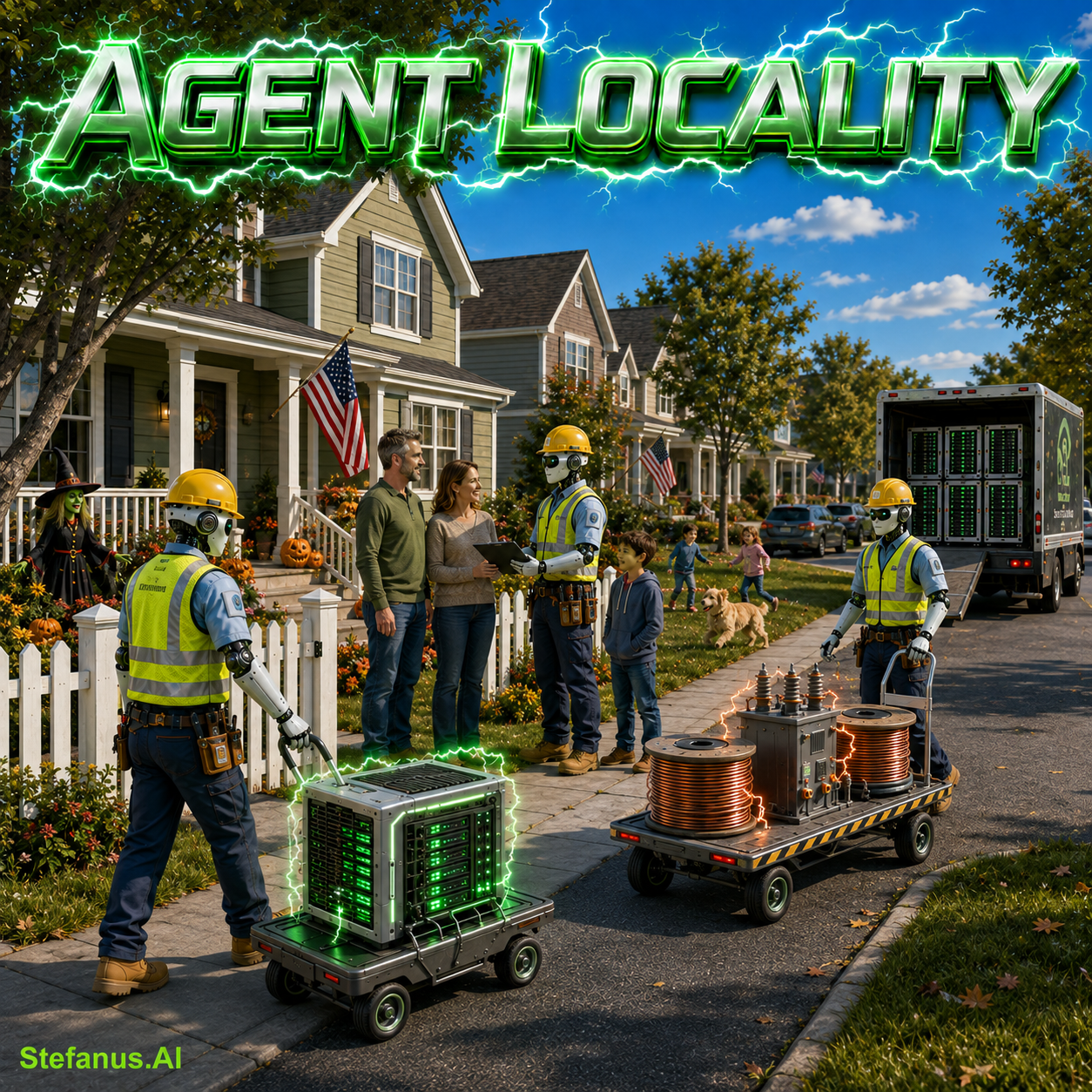
The timing was striking because Meta was not acting alone — and because the physical infrastructure of computing itself has begun migrating toward the user. In the spring of 2026, NVIDIA, the king of AI chip makers, joined smart-energy startup Span and homebuilder PulteGroup to place small AI compute nodes — roughly the size of an outdoor air-conditioning condenser unit, called XFRA units — directly onto new residential homes, with early deployments in communities in the American Southwest.[5][6] Each liquid-cooled node packages enterprise-grade NVIDIA RTX PRO 6000 Blackwell Server Edition GPUs behind a Span smart electrical panel that harvests the unused electrical headroom of the house: American homes are typically wired for far more power than they draw, operating at roughly 40 percent of peak capacity on average, and XFRA converts that dormant capacity into distributed inference infrastructure that bypasses the multi-year interconnection queues strangling traditional datacenter construction.[6][7][34] Span claims it can deploy 8,000 such units roughly six times faster and at approximately one-fifth the cost of building a comparable centralized 100-megawatt data center.[5][8]
Arch Rao, Founder and CEO, Span [8]
The model helps “meet what is clearly an insatiable demand for more compute, much more cost effectively.”
Brian Jamison, VP Strategic Sourcing, PulteGroup [6]
“XFRA offers an innovative solution that can help to reduce build costs.”
In the same August window, NVIDIA continued highlighting an expanding ecosystem of open-source models and intelligent agents designed to run locally on RTX-class hardware, while Qualcomm demonstrated commercial agentic applications running natively and privately on Snapdragon X-series PCs, emphasizing that always-on agents need sustained local processing, memory bandwidth, energy efficiency, and privacy rather than a permanent round trip to remote servers.[9] Apple has gone still further, at the operating-system level: its 2026 Foundation Models framework gives every developer direct Swift-native access to the on-device model powering Apple Intelligence — including multimodal reasoning over images, autonomous tool calling, Dynamic Profiles that swap models and instructions mid-session, and the freedom to route any given request among the local model, Apple’s Private Cloud Compute, or third-party cloud models such as Claude and Gemini, depending on the task.[12][13]
These developments suggest that one of the most consequential changes now underway in artificial intelligence may not be another increase in model parameter counts, another benchmark record, or another gigawatt campus announcement. It may be a change in where intelligence resides.
During the first generative-AI boom, the geography of intelligence appeared relatively straightforward. Users held relatively unintelligent endpoints — phones, laptops, browsers — and sent requests to gigantic centralized GPU clusters. The datacenter contained the intelligence; the device contained the interface. A user typed into a browser, the prompt crossed fiber networks, GPUs somewhere in Virginia, Texas, Oregon, Iowa, Nevada, Arizona, or another major compute region processed it, and an answer traveled back. That architecture produced one of history’s largest infrastructure investment cycles: the four largest hyperscalers alone — Amazon, Microsoft, Alphabet, and Meta — now plan to spend roughly $725 billion on capital expenditures in 2026, up about 77 percent from an already record-breaking $410 billion in 2025, and Goldman Sachs projects a combined $5.3 trillion of hyperscaler capex between fiscal 2025 and fiscal 2030.[21][22][37]
Agentic AI changes that architecture. An agent does not merely answer an occasional question. It observes context, maintains memory, monitors events, calls tools, manipulates files, interacts with applications, perceives images and sound, and carries out long sequences of steps toward a goal. If agents become persistent companions rather than occasional chatbot sessions, sending every perception, intermediate reasoning step, memory retrieval, application interaction, sensor reading, and physical-control decision to a distant datacenter becomes economically expensive, unnecessarily slow, privacy-sensitive, bandwidth-intensive, and — in some circumstances — physically impossible.
A robot cannot stop moving every time its internet connection disappears. A vehicle cannot wait hundreds of milliseconds for a remote server before making every safety-critical decision. A smartphone assistant should not necessarily upload every personal interaction merely to determine whether a reminder should be created. A corporate laptop containing confidential documents may be able to perform many routine tasks without ever transmitting those documents outside the machine.
These examples point toward an emerging principle: the future of AI may not be cloud versus edge. It may be the intelligent allocation of computation between them. I call that principle Agent Locality.
Why I Chose the Title “Agent Locality”
I chose the term Agent Locality because existing expressions such as edge AI, on-device AI, local inference, and small language models describe important technologies but do not fully capture the economic transformation occurring as artificial intelligence becomes agentic. Those older terms describe hardware categories or model sizes. Locality asks a broader question: where should an intelligent agent actually live, remember, reason, perceive, and act? And crucially — that location can be different for different parts of the same task.
A user’s phone might maintain personal context locally. A laptop might summarize private files locally. A vehicle might perform immediate perception and control inside the car. A robot might plan its next physical motion on an embedded AI computer. A larger cloud model might still be invoked when the local system encounters a problem requiring frontier-level reasoning. Long-term memory might be divided between encrypted local storage and cloud synchronization. Training could remain concentrated inside massive datacenters even as much of inference becomes geographically distributed. Agent Locality therefore describes an architectural decision system, rather than merely a device category.
The second reason I chose this title is that locality will increasingly become an economic variable inside the Five-Layer AI Economy that has organized my previous papers. Until recently, discussions about AI infrastructure generally assumed that application growth at Layer 5 would produce more model inference at Layer 4, requiring more accelerators at Layer 2, more datacenters at Layer 3, and ultimately more electricity at Layer 1. That remains substantially true. But capable local agents introduce a second pathway. Instead of every application request moving downward into a remote hyperscale stack, some intelligence can be executed on computing resources already located near the user: the phone routes to its NPU; the PC routes to its GPU and NPU; the vehicle routes to its automotive system-on-chip; the robot routes to its embedded accelerator; the factory routes to its edge server; and now, with XFRA-style deployments, even the neighborhood routes to compute bolted onto the side of the house. Only the difficult portions of a task travel upward into centralized cloud infrastructure. The Five-Layer AI Economy therefore begins developing a distributed topology rather than functioning solely as a vertically centralized stack.
I define the basic framework as follows:
Agent Locality = Device Capability + Data Sensitivity + Latency Requirement + Connectivity Risk + Inference Cost + Physical Autonomy
Each factor influences where an agent should operate. If a task is computationally difficult but not time-sensitive, the cloud may remain optimal. If a task is highly private but computationally modest, local execution may dominate. If the task controls a moving machine, latency and resilience may require local intelligence regardless of cloud economics. If connectivity is intermittent — as with vehicles, factories, ships, aircraft, farms, remote infrastructure, or eventually space systems — the ability to operate independently becomes strategically important.
This paper therefore does not argue that AI is abandoning the cloud. The opposite may happen: overall AI cloud consumption can continue growing dramatically, and the capital-expenditure evidence through Q2-2026 suggests it will.[21][23] The argument is more interesting. AI is becoming geographically divisible. Intelligence will increasingly be placed according to the characteristics of the task. And once intelligence acquires geography, locality itself becomes part of AI economics.

Section 1: From Cloud Intelligence to Distributed Intelligence
The purpose of this section is to establish, with as much precision as the evidence allows, how the architecture of artificial intelligence is changing beneath the surface of the model wars — and why the change is structural rather than cyclical. The generative-AI industry has spent three years debating which model is smartest. It has spent far less time asking where models should run. Yet the second question is quietly redrawing the map of the entire industry, from Apple’s operating systems to Qualcomm’s automotive design wins to the electrical panel on the side of a new Arizona home. This section traces that redrawing step by step: the original centralized architecture, the shrinking of capable models, the elevation of local AI into an operating-system primitive, the transformation of the PC into an agentic compute node, and the conceptual arrival of the personal datacenter.
1.1 The Original Cloud-AI Architecture
The first generation of large-scale generative AI reinforced centralization. Frontier models required enormous clusters of NVIDIA GPUs and other accelerators interconnected with high-bandwidth networking, enormous memory capacity, industrial cooling systems, and utility-scale power infrastructure. The architecture therefore resembled a simple pipeline: User Device → Internet → Datacenter → Frontier Model → Internet → User Device. The device served primarily as a terminal. Most economic value in inference flowed through centralized infrastructure because the models were too large and computationally intensive for ordinary devices.
This architecture helped produce the extraordinary capital-expenditure cycle involving Microsoft, Meta, Amazon, Google, Oracle, xAI, OpenAI’s infrastructure partners, CoreWeave, and numerous specialized datacenter developers. By mid-2026 the numbers had become almost unmanageably large: Amazon guiding toward roughly $200 billion of capital expenditure for the year, Microsoft tracking toward approximately $190 billion, Alphabet raising its ceiling to $205 billion at its Q2-2026 earnings report, and Meta guiding to as much as $145 billion after raising its range twice.[21][36] NVIDIA, the primary beneficiary, reported record quarterly revenue of $81.6 billion for its first fiscal quarter of 2027 in May 2026, up 85 percent year over year, with datacenter revenue of $75.2 billion — a 92 percent annual increase — and guided the following quarter toward roughly $91 billion.[21]
Jensen Huang, CEO, NVIDIA [21]
The buildout of AI infrastructure is “the largest infrastructure expansion in human history.”
Investor scrutiny of that expansion, however, has sharpened. When Alphabet lifted its 2026 capex forecast alongside its late-July earnings, its shares slid roughly 7 percent, and Amazon, Meta, and Microsoft fell in sympathy — a market signal that infrastructure investments are drawing down cash piles against returns that remain uncertain.[23] Free cash flow at Amazon is projected by some analysts to turn negative under the weight of the buildout.[36] This is precisely the environment in which a second architectural pathway — one that reuses compute the customer already owns — begins to look economically interesting rather than merely technically elegant.
1.2 The Shrinking Model Changes the Geography
Model capability, however, does not remain fixed at a particular parameter count. Distillation, quantization, sparsity, optimized attention mechanisms, better training data, improved inference engines, specialized NPUs, faster memory, and accelerator improvements continually allow useful capabilities to migrate onto smaller machines. The Stanford AI Index has documented the economic expression of this migration with a statistic that deserves to be repeated in every boardroom: the inference cost of achieving a GPT-3.5-level system fell more than 280-fold between November 2022 and October 2024, while AI hardware costs have declined roughly 30 percent annually and energy efficiency has improved about 40 percent per year.[17] Capability that was economically exotic thirty months ago is now economically trivial — and increasingly small enough to carry.
Meta’s Muse Glimmer illustrates this process concretely. Rather than attempting to reproduce every capability of the largest frontier models, it targets the agentic workloads that can operate on personal computing hardware: a dense causal transformer of roughly 29.6 billion parameters with a dedicated 1.8-billion-parameter perception encoder, accepting interleaved text and images across a context window of more than 131,000 tokens, quantized to run within 24 gigabytes of VRAM, and shipped with optimized integrations for llama.cpp, MLX, and ExecuTorch.[3] NVIDIA is simultaneously supporting local-model ecosystems across RTX hardware, and its own research arm has supplied the intellectual scaffolding for the shift. In a widely discussed position paper, Peter Belcak and colleagues at NVIDIA Research — together with Professor Yingyan Celine Lin of the Georgia Institute of Technology — argued that small language models are:
Peter Belcak et al., NVIDIA Research / Georgia Tech [15]
“sufficiently powerful, inherently more suitable, and necessarily more economical” for many invocations in agentic systems.
Their reasoning is worth internalizing because it inverts the industry’s default intuition. Most of the work inside an agent is not open-ended conversation; it is a small number of specialized subtasks performed repetitively and with little variation — parsing an instruction, selecting a tool, emitting valid JSON, checking a result. For that work, a fast, cheap, format-reliable small model running locally is not a compromise; it is the correct engineering choice, with large frontier models reserved for the genuinely hard or novel steps.[15] This creates what I call Capability Migration: yesterday’s datacenter-only capability becomes tomorrow’s workstation capability, followed eventually by laptop, phone, vehicle, or embedded-device capability. The frontier continues moving upward. But the capability floor beneath it rises as well — and agents live mostly on the floor.
1.3 Apple Turns the Operating System Into an AI Platform
Apple’s Foundation Models strategy is particularly important because it moves local AI from an application feature toward an operating-system primitive. Apple’s 2026 developer framework gives every application direct access to on-device models capable of structured generation, multimodal understanding of images, and autonomous tool calling — including system tools drawn from the Vision framework, such as on-device OCR and barcode reading, that the model can invoke by itself.[12] Developers can use Dynamic Profiles to alter tools, instructions, and even the underlying model during an ongoing session, enabling genuinely agentic multi-mode workflows in which, for example, an on-device profile analyzes a user’s photographs and a Private Cloud Compute profile then performs heavier brainstorming over the same shared transcript.[13] Most strikingly, Apple explicitly allows applications to select among its on-device models, Private Cloud Compute, and third-party cloud providers such as Claude and Gemini — any model conforming to its Language Model protocol — through a single Swift call site.[12] The operating system has become a locality router.
Apple describes its on-device path as running entirely on Apple Silicon with zero server dependencies and zero token costs. That phrase deserves economic attention. Zero token cost does not mean zero economic cost. The device was already purchased; electricity is still consumed; hardware depreciates; battery life matters; memory and thermal constraints matter. But the marginal economics become fundamentally different from paying an external inference API for every action — the cost of an additional local inference approaches the cost of the electricity it draws, which is why persistent, high-frequency agents gravitate naturally toward it. The strategy also rests on formidable installed-base economics: Apple reported a record June quarter for fiscal Q3-2026, with revenue of $109.4 billion, up 16 percent year over year, and an installed base of active devices at an all-time high across every major product category — hundreds of millions of NPU-equipped computers already deployed at the edge of the network.[26]
1.4 Qualcomm Makes the PC an Agentic Compute Node
Qualcomm’s August 2026 demonstrations provide another important signal. The company now describes Snapdragon X-series PCs as practical compute nodes for persistent agentic systems, showcasing commercial agentic applications from multiple independent software developers running on-device — with local reasoning, private data handling, and all-day battery life presented as a package aimed squarely at enterprise deployments.[9] Qualcomm’s argument, developed across CES 2026 and its Computex keynote, is that agentic workloads differ from occasional chatbot requests because agents remain active for extended periods, monitor context continuously, reason persistently, and execute actions across applications — and that this workload profile places new requirements on sustained NPU performance (its Snapdragon X2 platforms now deliver 80–85 TOPS), memory bandwidth, battery efficiency, thermal management, secure local storage, persistent agent memory, and operating-system permissions.[10][11]
The financial results suggest the strategy is more than marketing. In its fiscal Q3-2026 report on July 29, 2026, Qualcomm posted revenues of $9.9 billion at the high end of guidance, with automotive revenue reaching a record $1.59 billion — up 61 percent year over year, its twenty-third consecutive quarter of double-digit growth — and combined non-handset revenue up 28 percent.[24][25] The company raised its automotive annualized run-rate outlook to roughly $7 billion exiting fiscal 2026 and updated its long-term targets:
Cristiano Amon, President and CEO, Qualcomm [24]
The company raised “our total non-handset revenue outlook to $40 billion by fiscal 2029.”
The AI PC, in other words, becomes something more than a laptop with a chatbot button. It becomes a small private inference facility — and the silicon vendors selling it are increasingly compensated like platform companies rather than component suppliers.
1.5 The Personal Datacenter
This leads to a provocative conceptual shift. A sufficiently capable future laptop may contain a CPU; a GPU; an NPU; tens or hundreds of gigabytes of high-speed memory; encrypted local storage; multimodal sensors; persistent agent memory; several local models of different sizes; tool access to the file system and applications; and cloud escalation capability for the hard cases. Functionally, the device begins resembling a tiny datacenter designed for one user. The Span-NVIDIA XFRA program pushes the same logic one step further up the residential stack: if a laptop is a personal datacenter, the XFRA node is a neighborhood datacenter, sixteen server-class GPUs drinking from the unused electrical headroom of a single-family home and serving inference to nearby demand.[7][34] The distinction between “client” and “server” — a distinction that organized fifty years of computing economics — therefore becomes less rigid, and in some deployments dissolves entirely.
1.6 Locality Is Not Binary
The emerging architecture should not be described as Cloud OR Device. It is better understood as Device + Edge + Private Infrastructure + Cloud, with a single agent dividing one assignment across all four. Consider what an enterprise research agent could do under hybrid locality: it inspects confidential documents locally on the analyst’s machine; extracts sanitized, abstracted facts; sends only the necessary abstracted problem to a frontier cloud model; receives higher-level reasoning in return; combines that reasoning locally with the confidential information; and generates the final document without the underlying files ever leaving the building. The cloud contributed its intelligence; the device protected its data; the agent orchestrated the division. This is hybrid agent locality — and the remainder of this paper argues that hybrid locality is on course to become the dominant architecture of the agentic era, for reasons that are economic before they are technical.

Section 2: The Economics of Where an Agent Thinks
If Section 1 established that intelligence can now live in multiple places, this section asks the question that determines where it will live: what does each location cost, and what does each location earn? The deep claim of Agent Locality is that placement is not an engineering afterthought but a first-order economic decision — one that will shape unit economics, competitive strategy, and ultimately the shape of the entire Five-Layer stack. Traditional cloud architecture asked: which datacenter should process the request? Agentic architecture increasingly asks a prior question: should the request enter a datacenter at all? To answer it rigorously, we need a decision framework, and we need to understand how the economics of inference change when agents — rather than humans — become the dominant generators of model calls.
2.1 The Locality Decision and the Agent Locality Matrix
That decision can be represented through an Agent Locality Matrix built on six variables. Together they yield a composite that I express as: Locality Score = Compute Need + Latency + Privacy + Connectivity + Frequency + Physical Criticality. Tasks scoring differently should be routed differently — and a well-designed agent recomputes the score at every step of a task, not once per task.
Table 1 — The Agent Locality Matrix: Six Variables That Determine Where an Agent Should Think
| Variable | Core Question | Pushes Toward Local When… | Pushes Toward Cloud When… |
| 1. Computational Intensity | How much model capability does the task require? | The task is routine, structured, or repetitive | The task requires frontier-level reasoning or vast knowledge |
| 2. Latency Sensitivity | How quickly must the system respond? | Milliseconds matter (control, perception, UI) | Seconds or minutes are acceptable (reports, research) |
| 3. Data Sensitivity | How private or regulated is the information? | Medical, financial, legal, proprietary, or personal data is involved | Data is public, sanitized, or already cloud-resident |
| 4. Connectivity Reliability | Can the device depend on continuous internet access? | Connectivity is intermittent, contested, or absent | Connectivity is fast, cheap, and dependable |
| 5. Economic Frequency | How often will the task run? | Thousands of small calls per day per user | Rare, high-value invocations |
| 6. Physical Consequence | Does the agent control something in the real world? | A robot, vehicle, or machine acts on the output | Output is informational only |
2.2 The Economics of Repeated Inference
Consider a personal agent executing thousands of small actions every day: classifying email; organizing files; transcribing speech; recognizing photographs; monitoring applications; summarizing documents; extracting dates; identifying contacts; maintaining short-term memory; checking schedules; performing simple coding operations. None of these actions is individually difficult. All of them are relentlessly frequent. Sending every small operation to an expensive frontier model is economically irrational for exactly the reason the NVIDIA Research small-model paper identified: the agent’s workload distribution is dominated by narrow, repetitive subtasks for which sub-10-billion-parameter models are 10 to 30 times cheaper to serve, dramatically lower-latency, and more reliable at producing the strictly formatted outputs that agent code expects.[15]
Local inference therefore creates a natural hierarchy: the small routine task goes to the local model; the moderately difficult task goes to a larger local or enterprise model; frontier-level reasoning escalates to the cloud model. The economic optimization becomes a single maxim — Use the Cheapest Sufficient Intelligence — and that maxim matters enormously for agentic systems because agents generate far more inference events than conversational chatbots ever did. A human asks a chatbot a few dozen questions per day. An agent watching a user’s screen, inbox, calendar, and file system may perform thousands of inferences per hour. When call volume rises by two orders of magnitude, the placement of each call stops being rounding error and starts being the business model. The IEA’s 2026 update makes the demand side vivid: major model providers reported a threefold increase in active users and a fivefold increase in revenue in a single year, with energy-intensive applications such as AI agents explicitly named among the accelerants of AI-focused datacenter electricity consumption, which surged 50 percent in 2025 alone.[19]
2.3 Cost per Answer Becomes Cost per Completed Task
The chatbot economy measured tokens, API calls, cost per million tokens, and inference throughput. The agent economy increasingly needs a different metric: Cost per Successful Action, and eventually Cost per Completed Objective. An agent might use one hundred small model calls to complete one task. Running eighty of those calls locally while escalating twenty to the cloud dramatically changes unit economics — not by making any single call cheaper, but by changing the blended cost of the objective. Locality therefore becomes part of agent orchestration itself: the router that decides where each call executes is as economically consequential as the models it routes among. Application developers who master this routing will enjoy structurally lower cost curves than developers who default everything to a frontier API, and in thin-margin consumer agents, that difference will decide who survives.
It is worth pausing on how fast the underlying price floor is falling. The Stanford AI Index’s 280-fold collapse in GPT-3.5-class inference cost over two years is often quoted as a reason not to bother with local execution — if cloud tokens are nearly free, why own hardware?[17] But the same report series documents the counterforce: total usage is exploding faster than unit prices fall, generative AI reached 53 percent population adoption within three years — faster than the PC or the internet — and the consumer value of these tools in the United States alone is estimated at $172 billion annually.[16] Falling unit prices plus exploding call volumes is precisely the environment in which owning your marginal capacity — a paid-off NPU in a laptop, a paid-off GPU on the side of a house — becomes the cheapest sufficient intelligence for the high-frequency floor of the workload.
2.4 Privacy Has an Economic Value
Privacy is usually discussed as an ethical or regulatory objective. Agent Locality allows it to be treated as an architectural and economic variable. A local agent might access medical documents; financial records; corporate contracts; source code; photographs; private messages; location history; calendar information; personal memories. The value of keeping these inputs on-device can influence willingness to adopt AI at all — enterprises that will never stream their deal documents to a third-party API will happily let a local model read them, and consumers who distrust cloud assistants may trust an assistant whose perceptions demonstrably never leave the phone. Privacy therefore creates economic demand for local computation, and vendors have noticed: Apple’s Private Cloud Compute, Qualcomm’s on-device enterprise pitch, and Meta’s open-weight self-hosting path are all, at bottom, monetizations of the privacy variable.[9][12] Mid-market teams running Muse Glimmer on-premises get inference without a per-token bill and without their data crossing a network boundary — two purchases in one.[33]
2.5 Latency Creates Geographic Value: The Locality Premium
A cloud model can be vastly more capable than a local model while still being unsuitable for a particular task. Suppose the cloud model responds in 400 milliseconds and the local model responds in 20 milliseconds. For drafting an email, the difference is irrelevant. For a robot balancing while walking down stairs, it is decisive. For an in-car assistant warning a distracted driver that a vehicle is merging ahead — a scenario Qualcomm demonstrated with LG at CES 2026 — the warning is only valuable if it arrives before the merge.[10] The value of intelligence therefore depends not merely on how intelligent the model is, but on how quickly intelligence reaches the point of action. This creates what could be called a Locality Premium: the additional economic value a unit of intelligence earns purely by being physically close to the event it serves. Industry observers have begun describing 2026 as the year this premium became visible at scale, with the analyst firm IDC arguing that as AI’s center of gravity shifts from training to inference,
Dave McCarthy, Research VP for Cloud and Edge Services, IDC [28]
“edge computing will be required to address the need for reduced latency” and enhanced privacy.
2.6 Resilience Creates Another Premium
Cloud-based intelligence assumes connectivity. But many economically important environments contain intermittent communications: mines; farms; construction sites; ships; aircraft; warehouses; military systems; disaster zones; remote roads; factories; offshore energy installations; space systems. An agent capable of continuing to function when disconnected possesses resilience value — a second premium, distinct from latency, that accrues to local intelligence. In consumer settings resilience is a convenience; in industrial, defense, and sovereign settings it is a requirement, and it prices accordingly. Local AI therefore becomes both an economic and a strategic capability, and this dual character — commercial premium and strategic necessity — is why the locality question will not be settled by cost curves alone. Section 5 returns to the strategic dimension; first, we must walk the territories where locality is being contested device by device.
2.7 A Worked Example: The Economics of One Agentic Day
To make the framework concrete, consider a stylized but realistic accounting of a single knowledge worker’s agent across one working day. The agent performs roughly 4,000 discrete inferences: about 3,200 are micro-tasks — classifying incoming messages, updating memory, extracting entities, watching for calendar conflicts, validating tool outputs; about 700 are mid-weight tasks — summarizing documents, drafting routine replies, writing small code changes; and perhaps 100 are genuinely hard — multi-document reasoning, ambiguous planning, novel analysis. Under a cloud-only architecture, all 4,000 calls travel to a hosted API, and even at today’s collapsed token prices the frequency alone produces a meaningful recurring bill per user per day, multiplied across an enterprise into a permanent operating expense — while every one of those 4,000 payloads, including the private ones, transits the network.
Under a locality-routed architecture, the 3,200 micro-tasks execute on the laptop’s NPU at a marginal cost approaching the electricity they draw — the hardware being already purchased and already depreciating whether or not it thinks. The 700 mid-weight tasks split between the local model and an enterprise-edge model, according to the Locality Matrix. Only the 100 hard tasks escalate to the frontier cloud model at premium prices — and those are precisely the calls where frontier pricing is worth paying. The blended cost per completed objective falls dramatically; the privacy exposure falls even faster, because roughly 97 percent of the agent’s perceptions never left the machine; and the cloud provider’s revenue, far from disappearing, concentrates in its highest-margin tier. This is the quiet win-win-win that makes hybrid locality, in my judgment, not one possible future but the default one: the user gets privacy and responsiveness, the developer gets sustainable unit economics, and the hyperscaler gets the traffic it is best positioned to monetize. The same arithmetic, scaled from one worker to a billion devices, is the macro-story of the rest of this paper.

Section 3: PCs, Phones, Vehicles and Robots Become AI Territories
Abstractions about locality become real only when they touch hardware, and this section walks the four territories where the contest is now visibly underway — the PC, the phone, the vehicle, and the robot — before widening to the factory floor and the grid edge. Each territory imposes a different balance among the six locality variables, and each is producing a different winner profile. The deeper pattern across all of them is the same: the endpoint is ceasing to be a window onto intelligence located elsewhere and becoming a location where intelligence lives. Understanding how that transition unfolds territory by territory is essential preparation for Section 4, where we return to the Five-Layer AI Economy and ask what distributed intelligence does to each layer’s economics.
3.1 PCs: The First Major Local-Agent Battleground
Personal computers provide the easiest transition because they already contain substantial compute, memory, storage, power, keyboards, cameras, microphones, files, and complete software environments. A local PC agent can understand documents; operate applications; write and debug code; search local files; maintain user context; summarize meetings; automate workflows; and interact with corporate systems — all without a network round trip, and all against data that many enterprises would never permit to leave the machine. NVIDIA’s local-AI initiatives across RTX hardware, Meta’s explicit targeting of the single-consumer-GPU form factor with Muse Glimmer, and Qualcomm’s Snapdragon agent demonstrations together indicate that semiconductor and model companies increasingly view personal computing as an agentic platform rather than simply a portal into cloud AI.[1][9] The hardware race is explicit: Qualcomm’s Snapdragon X2 generation ships NPUs delivering 80 to 85 TOPS — performance that industry commentators compared to a mid-range server deployment of only a few years earlier — while COMPUTEX 2026 was branded, by Qualcomm itself, “the year of agents,” complete with compact AI workstations such as the ASUS Ascent QN10 marketed as personal AI workspaces for developers.[10][11] The AI PC’s upgrade cycle is thus being driven not by spreadsheets running faster but by a new resident: the persistent local agent.
3.2 Phones: Intelligence Becomes Personal and Persistent
The smartphone creates an even more intimate locality. Phones know where their users are; whom they communicate with; what photographs they take; what applications they use; what appointments they have; what languages they speak; what notifications they receive. Moving increasing amounts of reasoning onto the device allows assistants to become dramatically more contextual without constantly exporting raw personal data — the assistant can be more helpful precisely because its perceptions are private. Apple’s third-generation foundation models are explicitly designed for on-device operation, and its 2026 framework allows richer agentic interactions directly with those models, including autonomous tool calling into the phone’s own sensors and services, with escalation to Private Cloud Compute or third-party clouds reserved for genuinely heavy reasoning.[12][13] Qualcomm’s Computex keynote sketched the complementary vision from the silicon side: the consumer continues to carry a single device — the phone — as the natural interface to a personal agent that moves with the user across the PC, the earbuds, the wearables, and the car, with the agent at the center of all nearby devices.[11] The smartphone therefore evolves from communications device to personal intelligence node — and its economics evolve with it: an installed base of NPU-equipped phones numbering in the billions represents the single largest pool of latent inference capacity on Earth, already purchased, already powered, already distributed to exactly where the demand is.
3.3 Vehicles: The Car Becomes an Autonomous Compute Territory
Vehicles present a stronger locality requirement, because the vehicle combines high physical consequence with unreliable connectivity — the two variables that most decisively force intelligence local. Qualcomm describes the transition from the software-defined vehicle toward the AI-defined vehicle, in which onboard agents understand occupants, monitor vehicle systems, interpret road conditions, personalize cabin functions, and coordinate actions across the car; its CES 2026 demonstrations with LG showed vision-language models running in-cabin, watching both the road and the driver’s state and intervening with context-specific voice alerts.[10] Its Computex keynote went further, layering a personal agent (the user’s continuing digital companion, which happens to be riding in the car) on top of the physical-AI layer (the local intelligence actually handling driving tasks) — two different layers of intelligence, designed to operate as one integrated system.[11]
The commercial traction is unambiguous. Qualcomm’s automotive segment posted a record $1.59 billion in fiscal Q3-2026, up 61 percent year over year, with the company raising its exit run-rate target to $7 billion and announcing an expanded decade-long relationship under which it becomes BMW’s lead compute silicon provider for digital cockpit and automated-driving platforms, alongside broadened agreements with Stellantis.[24][25] A future vehicle therefore operates multiple tiers of intelligence: immediate control stays local; driver personalization stays mostly local; navigation updates run hybrid; complex planning runs hybrid or cloud; and fleet learning runs cloud. The car becomes the canonical example of tiered locality — a rolling proof that the question “cloud or edge?” was always malformed, because a single machine profitably uses both at once.
Table 2 — Tiered Locality Inside One Vehicle
| Function | Locality Tier | Why |
| Immediate control (braking, steering assist, perception) | Local (automotive SoC) | Millisecond latency; safety-critical; must survive disconnection |
| Occupant monitoring and cabin personalization | Mostly local | Continuous, private, high-frequency inference |
| Navigation, traffic, and map updates | Hybrid | Benefits from global data; tolerates seconds of latency |
| Complex trip planning and rich assistant dialogue | Hybrid / Cloud | Frontier reasoning valuable; latency non-critical |
| Fleet learning and model retraining | Cloud | Aggregates data across millions of vehicles; runs offline |
3.4 Robots: Locality Becomes Physical Necessity
Robotics makes the argument categorical rather than economic. On August 21, 2026, speaking at the World Robot Conference in Beijing, ACE Robotics chairman Wang Xiaogang — who is also a co-founder of the AI visual-recognition pioneer SenseTime — predicted that embodied-AI systems could experience a breakthrough comparable to ChatGPT’s impact on language AI, telling Reuters that he expects:
Wang Xiaogang, Chairman, ACE Robotics; Co-founder, SenseTime [14]
“the ‘ChatGPT moment’ for embodied intelligence by the end of next year,” driven by world models and environmental data capture — followed by four to five more years before broad commercial implementation across sectors.
Unitree founder Wang Xingxing offered a similar horizon the same week, predicting a dramatic robot-brain breakthrough within two to three years at the earliest, while acknowledging that acquiring high-quality real-world training data remains the bottleneck.[14] These systems combine perception, multimodal understanding, simulation, planning, and physical action — and every one of those functions except training must run substantially on the machine. A robot operating in a warehouse cannot send every camera frame to a remote datacenter before adjusting its hand. A humanoid cannot depend upon a cloud connection for every balancing correction. A household robot cannot become truly useful if internet congestion renders basic manipulation impossible. For robotics, intelligence must travel with the machine.
The academic foundation for this territory is being laid most visibly at Stanford, where Professor Fei-Fei Li — often called the godmother of AI for her contributions to computer vision — has spent two years arguing that the next frontier beyond language is spatial intelligence, delivered through world models that learn the statistical structure of space, time, and physics rather than of text. Her framing is characteristically blunt:
Fei-Fei Li, Professor, Stanford University; Co-founder, World Labs [29]
“The world is not made of words.”
Li has been equally candid about the gap that remains, observing that compared with language,
Fei-Fei Li, Professor, Stanford University (in TIME) [30]
“spatial reasoning is way worse in today’s AI.”
Capital is nevertheless converging on her thesis: World Labs raised $1 billion in February 2026 from investors including NVIDIA, AMD, Autodesk, and Fidelity to build world models whose most important customers may prove to be robotics companies that need interactable, physics-consistent 3D environments in which to train and evaluate machines.[31] The cloud remains essential to this territory — for training, model updates, fleet learning, simulation, aggregated data, and difficult reasoning — but real-time operation requires substantial local autonomy. Embodied AI is thus the territory where Agent Locality stops being an optimization and becomes a law of physics.
3.5 Factories Become Distributed AI Clouds
Industrial facilities extend the robot’s logic to an entire building. A modern factory could contain thousands of local AI nodes: robots; cameras; autonomous vehicles; predictive-maintenance systems; quality-control models; scheduling agents; safety systems. Instead of sending all sensor data to a remote hyperscale cloud, factories increasingly construct hierarchical computing architectures — Machine → Factory Edge → Regional Cloud → Hyperscale Cloud — in which each layer handles tasks appropriate to its latency and computational requirements. The machine layer handles millisecond perception and control; the factory edge aggregates, coordinates, and runs the heavier models that many machines share; the regional and hyperscale layers handle planning, analytics, and learning. The factory itself begins resembling a distributed datacenter — and the MIT Technology Review’s analysis of the future of AI processing gives the pattern its proper name: heterogeneous compute, the deliberate allocation of AI workloads across device, edge, and cloud hardware according to performance, latency, and power efficiency, as the precondition for AI becoming truly embedded and seamless.[32]
3.6 The Edge Becomes an AI Capital Asset — Including the Side of Your House
This territorial expansion has profound consequences for semiconductor economics. AI infrastructure spending will not consist exclusively of multimillion-dollar accelerator racks. It will increasingly include billions of smaller chips distributed across PCs; smartphones; cars; robots; cameras; industrial machinery; appliances; drones; and medical equipment. The AI accelerator market therefore bifurcates into Central Compute — large, expensive, electricity-intensive accelerators optimized for frontier workloads — and Local Compute — efficient, embedded accelerators optimized for persistent inference. The total AI economy requires both, and the strategic surprise of 2026 is that the same companies increasingly sell both: NVIDIA supplies Blackwell racks to hyperscalers, Jetson modules to robot makers, RTX GPUs to local-agent PCs, and now liquid-cooled server GPUs to residential XFRA nodes.[6][21]
The XFRA program deserves emphasis here as a genuinely new asset class sitting between the endpoint and the datacenter. Each node bundles Dell PowerEdge servers with sixteen NVIDIA RTX PRO 6000 Blackwell GPUs, four AMD EPYC CPUs, and three terabytes of RAM behind a Span smart panel, paired with a whole-home battery that buffers demand spikes, responds to utility demand-response events, and provides the homeowner with backup power during outages — while the network migrates compute workloads away from affected nodes.[34][7] Homeowners receive heavily discounted energy and internet in compensation, the utility gains load it can orchestrate, and the AI cloud provider gains capacity years faster than the interconnection queue would otherwise permit.[5] Whether the model scales to true gigawatts remains unproven — analysts note the realistic ceiling is widest where homes pair smart panels with solar and storage — but as an existence proof it is remarkable: inference infrastructure has physically arrived in the residential neighborhood, mounted beside the HVAC unit.[7]

Section 4: Agent Locality Reshapes the Five-Layer AI Economy
We can now return to the framework that organizes this series of papers — the Five-Layer AI Economy of Energy, Chips, Datacenters, Models, and Applications — and ask what happens to each layer when intelligence becomes geographically divisible. The short answer is that no layer is destroyed and every layer is redrawn. Energy consumption acquires geography; the chip market broadens and bifurcates; the datacenter’s role specializes; models become portfolios; and applications become routers. The long answer occupies this section, and it ends with the most counterintuitive conclusion of the paper: Agent Locality is not a bearish thesis on cloud infrastructure, and may in fact be one of the strongest bullish arguments for it.
4.1 Layer 1 — Energy Becomes Geographically Distributed
Centralized AI concentrates electricity consumption inside datacenters, and the scale of that concentration is now a first-order energy story. The International Energy Agency’s landmark Energy and AI report projects that global electricity demand from datacenters will more than double from roughly 415 TWh in 2024 to around 945 TWh by 2030 — slightly more than the entire electricity consumption of Japan today — with AI as the most significant driver, and with datacenters accounting for nearly half of all United States electricity-demand growth to 2030.[18] By decade’s end, the United States is set to consume more electricity for processing data than for manufacturing aluminum, steel, cement, chemicals, and all other energy-intensive goods combined.[18] The agency’s 2026 update held the central trajectory — 485 TWh in 2025 roughly doubling to 950 TWh in 2030, about 3 percent of global electricity demand — while noting that datacenter electricity consumption grew 17 percent in 2025 and AI-focused consumption surged 50 percent, even as grid bottlenecks now threaten delays to as much as a fifth of planned projects.[19]
Fatih Birol, Executive Director, International Energy Agency [20]
“AI is one of the biggest stories in the energy world today.”
Local AI redistributes part of this consumption geography. Instead of one gigawatt concentrated in a single campus, some inference becomes ten watts multiplied across millions of devices — NPUs sipping power inside phones and laptops, automotive SoCs drawing from the vehicle’s electrical system, XFRA nodes drinking the unused headroom of residential panels that utilities already built and homeowners already pay for.[6][34] This does not mean total AI electricity consumption decreases; the rebound effect may be substantial, because cheap and convenient local intelligence dramatically increases the total number of AI interactions. The important change is where electricity is consumed — and therefore which grids, which utilities, which permitting regimes, and which communities carry the load. A demand forecast that ignores local inference will overestimate centralized demand; a forecast that assumes local AI replaces the cloud will underestimate total demand. Layer 1 planning now requires a locality assumption, and most current forecasts do not contain one.
4.2 Layer 2 — The AI Chip Market Broadens
Agent Locality greatly increases the importance of NPUs; mobile GPUs; automotive accelerators; embedded AI chips; low-power memory; sensor processors; and edge-compute modules. NVIDIA’s datacenter GPUs remain foundational to frontier AI — the company holds an estimated 80 to 88 percent of the AI accelerator market by revenue as of mid-2026 — while Qualcomm, Apple, AMD, Intel, MediaTek, NVIDIA’s own Jetson line, and a long tail of specialized semiconductor companies compete across the distributed inference market.[21] Layer 2 therefore becomes more heterogeneous, and its constraint structure changes in revealing ways. The clearest evidence arrived through an unexpected channel: Apple’s record June quarter came with a warning that supply constraints on iPhone, Mac, and iPad will worsen, driven substantially by the reallocation of DRAM production toward AI datacenters — memory manufacturers are directing an estimated 70 percent of production to AI in 2026, with SK Hynix forecasting 2027 as the worst supply-shortage year in the semiconductor industry’s history.[27] Qualcomm likewise attributed its handset softness to industry-wide memory dynamics.[25] The central and local compute economies, in other words, are not separate markets politely coexisting; they are now bidding against each other for the same wafers, the same memory, and the same advanced packaging — and that competition is itself evidence that local AI has become a first-class claimant on the world’s silicon.
4.3 Layer 3 — Datacenters Become Escalation Engines
The most provocative implication concerns Layer 3. If local agents perform routine cognition, hyperscale datacenters increasingly serve as frontier reasoning engines; training infrastructure; synchronization systems; global memory systems; model-update centers; and difficult-task escalation infrastructure. The datacenter remains enormously important — but its role changes from process everything toward process what cannot economically or safely be processed elsewhere. This is specialization, not decline: escalation traffic is the highest-value traffic, the hard reasoning for which customers will pay frontier prices, and the training runs behind every local model still consume centralized compute at historic scale. Even the distributed XFRA architecture reinforces the point in miniature — Span is explicit that the system is not intended to replace centralized datacenters but to augment them by accelerating capacity growth at the grid edge, placing inference near demand while the heavy lifting remains centralized.[6]
4.4 Layer 4 — Models Become Families Rather Than Monoliths
Agent Locality encourages model families. Instead of one model performing everything, an ecosystem contains a tiny model for the device; a small model for the PC; a medium model for the enterprise server; and a frontier model for the hyperscale cloud — with distillation as the manufacturing process that propagates capability down the family. Meta’s 2026 lineup makes the structure explicit: Muse Spark as the closed frontier system, Muse Glimmer as its distilled, locally deployable descendant, with the promised open release of Muse Spark 1.2 extending the family further.[1][2] Apple’s architecture reflects the same idea from the platform side, spanning on-device models, Private Cloud Compute, and pluggable third-party providers behind one protocol.[12] The competitive unit therefore shifts from the individual model toward the model portfolio — and toward the distillation pipeline, evaluation harness, and update distribution system that keep a portfolio coherent. A lab that ships only a frontier monolith is, in locality terms, selling into just one tier of a five-tier market.
4.5 Layer 5 — Applications Become Routers of Intelligence
The most sophisticated application may not always use the smartest model. It may use the smartest routing system. A successful agent continuously asks: Can I solve this locally? Does this information need to leave the device? Is additional reasoning worth the cost? Is the network available? Is the action time-sensitive? Should I use another model? Can the task wait? Should a human approve it? Applications therefore become orchestrators of locality, and the platform vendors are racing to supply the orchestration primitives — Apple’s Dynamic Profiles let a session hand itself between an on-device model and Private Cloud Compute mid-conversation; Qualcomm’s hybrid AI stack blends local inference with cloud models behind a single experience.[13][9] Not everyone believes today’s agents deserve this trust: NYU professor Gary Marcus, whose skeptical 2025 predictions proved largely accurate, has argued bluntly that agents have not yet turned out to be reliable — a warning that routing, guardrails, audit trails, and rollback mechanisms are not optional features of the agentic era but its load-bearing walls.[28] The router, in other words, is not only the profit center of Layer 5; it is the safety mechanism.
4.6 The Five-Layer Stack Becomes a Loop
The traditional interpretation of the framework is vertical: Energy → Chips → Datacenters → Models → Applications. Agent Locality introduces a return path. Applications determine how much model capability is required; models determine which chips are sufficient; chips determine whether the work can stay on-device; local execution determines whether the datacenter is needed; and datacenter utilization feeds back into electricity demand. The architecture therefore becomes Energy ⇄ Chips ⇄ Datacenters ⇄ Models ⇄ Agents — a loop with feedback in both directions rather than a one-directional stack. This is more than a diagrammatic nicety. Feedback loops are where forecasting errors compound: an analyst who models only the downward direction will systematically mis-estimate every layer, because each layer’s demand is now partly determined by decisions made above it about where computation should live.
Table 3 — How Agent Locality Redraws Each Layer of the Five-Layer AI Economy
| Layer | Centralized-Era Role | Agent-Locality-Era Role |
| Layer 1 — Energy | Concentrated gigawatt campus loads | Dual geography: campus loads plus millions of distributed watt-scale loads at homes, devices, vehicles |
| Layer 2 — Chips | Datacenter accelerators dominate value | Bifurcated market: central compute and local compute competing for the same wafers and memory |
| Layer 3 — Datacenters | Process everything | Escalation engines: training, frontier reasoning, synchronization, global memory |
| Layer 4 — Models | Monolithic frontier models | Model families propagated by distillation across device, PC, enterprise, cloud tiers |
| Layer 5 — Applications | Thin clients calling one cloud API | Locality routers orchestrating many models across many locations |
4.7 Cloud Capex May Continue Growing Anyway
This deserves emphasis, because Agent Locality is easily misread as a bearish thesis on hyperscaler capex. It is not. Several forces coexist: frontier models become more computationally expensive; total AI usage expands at historically unprecedented adoption speed; agentic systems generate many more inference calls per user; local hardware performs a growing fraction of routine computation; and cloud infrastructure continues growing rapidly regardless — with the four largest hyperscalers guiding toward roughly $725 billion in 2026 and analysts projecting the industry crossing $1 trillion in 2027.[21][36][37] This is similar to the history of computing itself. Personal computers did not eliminate servers; they multiplied the reasons servers existed. Smartphones did not eliminate cloud computing; they became its largest demand driver. Local AI may actually create more cloud demand by dramatically increasing the overall number of intelligent applications, each of which escalates its hardest fraction upward. The bear case for the cloud is not locality; it is the absence of applications. Locality is how applications become numerous enough, cheap enough, and trusted enough to justify the datacenters being built.
4.8 What Could Slow Agent Locality Down
Intellectual honesty requires naming the frictions, because the locality thesis is a direction, not a guarantee of pace. Five stand out. First, the memory shortage: the same DRAM reallocation toward AI datacenters that constrained Apple’s and Qualcomm’s device businesses in 2026 raises the cost of exactly the high-bandwidth local memory that capable on-device models require, and SK Hynix’s forecast of 2027 as the industry’s worst shortage year suggests the squeeze tightens before it loosens.[27][25] Second, energy and thermals at the endpoint: a phone running persistent inference drains batteries, and an always-on laptop agent competes with the user’s own workload for the thermal envelope — engineering constraints that cap how much cognition the endpoint can absorb per charge cycle. Third, agent reliability itself: the skeptics’ case, articulated most persistently by NYU professor Gary Marcus, is that agents in 2025–2026 repeatedly failed to reach dependable autonomy — and an unreliable agent is more dangerous distributed across a billion permissioned endpoints than contained in one auditable cloud.[28] Fourth, model logistics: distributing, updating, evaluating, and revoking models across heterogeneous fleets of devices is an unsolved operational discipline, and version drift across a locality fabric is a new class of systemic risk. Fifth, business-model gravity: cloud vendors are compensated per token and platform vendors per device, which means the router — the layer that would optimize globally — is being built by parties with incentives to route toward themselves. None of these frictions reverses the direction of travel; each shapes its slope. The realistic forecast is not a step-function migration but a decade-long rebalancing, workload by workload, down the gradient of the Locality Matrix.

Section 5: Corporate Strategy, Security, Regulation and the 2027–2030 Locality Contest
If the previous sections described what Agent Locality is and why it is happening, this section asks who wins, who is exposed, and what governments should do about it. Locality is not merely a technical architecture; it is a redistribution of control — over data, over inference revenue, over the agent itself — and redistributions of control produce strategic contests. The contest of 2023–2026 was over the largest model. The contest of 2027–2030 will increasingly be over the endpoint, the router, and the escalation relationship between them. This section maps that contest across corporate strategy, cybersecurity, political economy, enterprise adoption, sovereignty, and policy design.
5.1 Hyperscalers Must Become Hybrid-AI Companies
Microsoft, Google, Amazon, Meta, Apple, OpenAI, Anthropic, and others face an architectural decision. A company optimizing exclusively for centralized inference risks ignoring the growing value of offline operation; privacy; latency; device integration; local personalization; and lower marginal inference costs. Conversely, a company optimizing exclusively for the device forfeits the frontier. The future platform winner therefore likely controls both the Local Agent and the Cloud Escalation Layer — and the strategic positioning of mid-2026 shows every major player converging on this hybrid posture from a different starting point. Apple starts from the device and adds Private Cloud Compute plus third-party cloud routing.[12] Meta starts from open local models and retains its closed frontier system as the escalation tier and distillation source.[1] Microsoft and Google start from the cloud and push Copilot and Gemini progressively onto NPU-equipped endpoints. Qualcomm starts from silicon and builds upward into hybrid orchestration.[9] The pattern is unmistakable: nobody with resources is betting on a single locality anymore. The open question is who owns the router — the layer that decides, call by call, where intelligence executes — because the router owns the customer relationship, the telemetry, and the margin.
5.2 Semiconductor Companies Move Up the Stack
Qualcomm and NVIDIA illustrate another transformation. Semiconductor companies historically sold computing components. Agent Locality encourages them to provide models; agent frameworks; inference engines; development environments; orchestration software; and security tools. The chip increasingly arrives with an intelligence ecosystem attached, and hardware competition therefore becomes platform competition. NVIDIA publishes research arguing the case for small local models, curates optimized open-model ecosystems for RTX, and now extends its platform to residential grid-edge infrastructure through XFRA.[15][6] Qualcomm ships agentic frameworks with Snapdragon, converts automotive sockets into decade-long platform relationships with BMW and Stellantis, and is entering datacenter silicon from the edge inward, targeting more than $15 billion in datacenter revenue within its $40 billion non-handset ambition for fiscal 2029.[24][25] The strategic meaning is that Layer 2 companies are integrating vertically into Layers 4 and 5 — chips reaching up toward models and agents — at the same time that model companies reach down toward silicon through custom accelerators. The layers of the stack are not merely looping; their occupants are invading one another.
5.3 Local AI Changes Cybersecurity
Locality provides privacy advantages but creates different security risks. If powerful agents reside on endpoints, attackers target model weights; local memory; agent credentials; tool permissions; personal data; prompt histories; and connected applications. A cloud service can patch one centralized system; a distributed agent ecosystem may require securing billions of endpoints. The asymmetry can be stated simply: Centralization Risk equals Concentrated Breach, while Locality Risk equals Distributed Attack Surface. Neither architecture is inherently secure, and the agentic dimension makes the endpoint problem qualitatively new — a local agent holds standing permissions to act, which means a compromised agent is not a leaked file but a hijacked employee. Meta’s own release materials for Muse Glimmer acknowledge the point: giving a local model access to tools creates a different security problem from deploying a local chatbot, and safety performance across open agentic models remains uneven.[3] Security models must change accordingly, toward hardware-rooted attestation of models and weights, permissioned tool sandboxes, cryptographically logged agent actions, and revocable agent identities — the endpoint-security industry rebuilt around the assumption that the endpoint now thinks.
5.4 Who Controls the Local Agent?
Agent Locality raises a political-economy question that may become one of the defining governance debates of the decade. If an agent runs on hardware owned by the user, who ultimately controls it — the user; the operating-system vendor; the model provider; the device manufacturer; the employer; or the application developer? Each has plausible claims and real levers. The OS vendor controls permissions and distribution; the model provider controls weights and updates; the employer controls the corporate device; the user controls the power button. Open-weight models make this question particularly interesting because users and businesses can modify or self-host their intelligence outright — the Apache 2.0 license on Muse Glimmer is, among other things, a transfer of control from platform to owner.[1] Zuckerberg’s essay frames open local models precisely as an argument about who should hold advanced capability.[4] Locality therefore becomes associated not only with geography but with control, and regulators who today ask “what may a model say?” will increasingly need to ask “who may command an agent, and who may audit what it did?”
5.5 Enterprise AI Could Become More Local Than Consumer AI
Some of the largest opportunities may emerge inside enterprises. Banks, defense contractors, pharmaceutical companies, law firms, hospitals, manufacturers, governments, and research laboratories possess information they may not wish to send continuously into public-cloud systems. Local or on-premises agents can provide document intelligence; coding; research; workflow automation; cybersecurity analysis; and engineering assistance — and the tooling for this posture matured markedly in 2026, from Qualcomm’s enterprise-focused on-device agentic applications to Meta’s explicit positioning of Muse Glimmer for on-premises inference without a per-token bill.[9][33] This creates a continuum of enterprise locality: Personal Device → Enterprise Edge → Private Datacenter → Sovereign Cloud → Public Cloud, with each organization choosing its preferred point — or, more precisely, its preferred distribution of workloads across several points — according to the sensitivity of each workload. The consumer market taught the industry to think of local AI as a convenience feature; the enterprise market will teach it to think of local AI as a compliance architecture.
5.6 Locality and AI Sovereignty
Governments may eventually treat local inference as part of digital sovereignty. A country relying exclusively on foreign cloud models faces disruption channels that have nothing to do with model quality: export controls; sanctions; geopolitical conflict; cable failures; cloud restrictions; and pricing changes. Locally deployable models create another layer of resilience — a nation whose hospitals, courts, and utilities can run capable open-weight models on domestically controlled hardware retains functioning AI even if its access to foreign frontier APIs is interrupted. Agent Locality therefore intersects with national AI strategy without requiring every country to construct frontier-scale datacenters, which most countries cannot: the sovereign question shifts from “can we build a frontier lab?” to the far more tractable “can we deploy, secure, fine-tune, and govern local intelligence on infrastructure we control?” The geopolitics of open weights sharpen the point — American open local models now compete directly with aggressive Chinese open-weight releases for the position of default sovereign fallback across the rest of the world, a competition Zuckerberg invoked explicitly at Muse Glimmer’s launch.[2][4]
5.7 The Locality Competition of 2027–2030
The next several years could produce competition across four territories, each requiring a different locality balance and favoring a different coalition of incumbents.
Table 4 — Four Territories of the 2027–2030 Locality Contest
| Territory | Primary Contestants | Decisive Locality Variables |
| Territory 1 — Personal Compute (AI PCs, workstations) | Apple, Microsoft, Qualcomm, Intel, AMD, NVIDIA, PC OEMs | Privacy, economic frequency, sustained NPU performance |
| Territory 2 — Mobile Intelligence (phones, wearables) | Apple, Google, Qualcomm, smartphone ecosystems | Privacy, personal context, battery efficiency |
| Territory 3 — Automotive Intelligence | Qualcomm, NVIDIA, Google, Tesla, automakers with proprietary stacks | Latency, physical consequence, connectivity risk |
| Territory 4 — Physical AI (robots, drones, machinery) | NVIDIA, Tesla, Figure, ACE Robotics, Unitree, industrial automation firms | Physical consequence, resilience, world-model capability |
5.8 The Agent Locality Policy Framework
Policymakers should avoid assuming that all AI computation is equivalent, because regulation calibrated for one locality routinely misfires when applied to another. Future AI regulation should distinguish at least five categories: Cloud AI — centralized infrastructure serving millions; Enterprise AI — privately controlled datacenters; Edge AI — facility-level or network-level systems; Personal AI — user-controlled devices; and Physical AI — robots and machines acting in the physical world. The regulatory obligations appropriate for a cloud model handling millions of users — incident reporting, systemic-risk evaluation, usage monitoring — may make no sense for a small local model organizing files on someone’s laptop, where the same obligations would amount to surveillance of private computing. Conversely, Physical AI warrants safety-certification regimes closer to automotive and aviation law than to content moderation. A locality-blind AI statute will simultaneously over-regulate the laptop and under-regulate the robot.
5.9 A New Infrastructure Question
Governors and utility commissions currently ask: how many AI datacenters will our state need? Agent Locality introduces another question: how much future inference will actually need to occur inside those datacenters? Electric utilities, hyperscalers, policymakers, and investors should incorporate explicit locality assumptions into long-term forecasts, because the error bars run in both directions — a model predicting AI electricity consumption without considering local inference could overestimate centralized demand, while a model assuming local AI dramatically replaces cloud infrastructure could underestimate total demand, since local intelligence multiplies total AI activity even as it diverts a share of it.[18][19] The correct answer will depend on workload distribution, and workload distribution is exactly what the Agent Locality Matrix of Section 2 is designed to reason about. The XFRA experiment adds a final twist for regulators: the same residential grid that policymakers worried AI datacenters would strain is now itself being recruited as AI infrastructure, with distributed nodes that can shed or migrate load on utility command — turning the grid-stress problem partially into a grid-flexibility asset.[6][7]

Section 6: What Have We Learned? Seven Pillars
Every paper in this series closes by compressing its argument into pillars — the propositions that should survive even if particular companies, models, or quarterly numbers cited above are eventually superseded. The original outline contained five; the evidence assembled through August 2026 justifies seven. Each pillar begins with a deep restatement of why it matters before stating what it claims, because the discipline of this series is that conclusions must be earned, not asserted.
Pillar 1 — Intelligence Is Becoming Geographically Divisible
The first major lesson is that artificial intelligence no longer has one natural location. For three years the industry’s mental model placed all meaningful intelligence inside hyperscale campuses, and every strategic question — capex, energy, regulation, valuation — inherited that assumption silently. The assumption is now false in a precisely characterizable way. Training may remain highly centralized. Frontier reasoning may remain largely centralized. Routine inference can increasingly become distributed. Sensor interpretation may need to occur locally. Physical control almost certainly requires substantial local autonomy. The AI economy therefore becomes geographically layered, and the most important question is no longer simply “which model performed the task?” It increasingly becomes “where did the model perform the task?” That is the foundation of Agent Locality.
Pillar 2 — The Best Agent Will Not Always Use the Biggest Model
The second lesson challenges a core assumption of the generative-AI era: that capability rankings determine deployment choices. Model quality matters enormously, but not every action requires frontier intelligence. An agent sorting photographs does not need the model that proves a mathematical theorem. A robot maintaining balance does not need a gigantic cloud model for every correction. A calendar agent does not require maximum reasoning power to identify tomorrow’s appointments. The NVIDIA Research position — that small models are sufficient, more suitable, and more economical for most agentic invocations — supplies the theoretical grounding, and the 2026 product landscape supplies the confirmation.[15] Successful agent architectures will increasingly combine Minimum Sufficient Intelligence with Maximum Necessary Intelligence When Required. The winning architecture is hierarchical rather than monolithic.
Pillar 3 — Locality Becomes Part of AI Unit Economics
The third lesson is financial. Running an agent involves far more than token pricing, and analysts who model agent businesses on API price sheets alone will misprice them. The full economic equation includes Cloud Inference Cost + Local Hardware Cost + Electricity + Connectivity + Latency + Privacy + Reliability + Security. Local execution reduces marginal API expenses but raises device requirements; cloud inference provides scalable capability but creates recurring usage costs; the optimal solution differs by workload and must be recomputed as the 280-fold-and-falling cost curves keep moving.[17] Agent Locality is therefore a financial optimization problem — a continuous one — and the metric that ultimately matters is cost per completed objective, blended across every location the objective touched.
Pillar 4 — Physical AI Makes Local Intelligence Unavoidable
The fourth lesson emerges from robotics and vehicles, and it is the pillar least vulnerable to revision because it rests on physics rather than pricing. Chatbots can tolerate network delays; physical systems often cannot. When an AI system operates a car, a robot, a drone, factory machinery, medical equipment, or autonomous infrastructure, decision latency becomes part of physical safety. Cloud connectivity may enhance these systems, but complete dependence on distant computing is impractical for machines that act in real time — and the industry’s own timeline claims, from ACE Robotics’ predicted embodied-intelligence inflection by late 2027 to the world-model research agenda articulated at Stanford, all presuppose intelligence that travels with the machine.[14][29] Embodied AI therefore guarantees that some portion of advanced intelligence must migrate closer to the physical world. Agent Locality is not merely a consumer-computing trend. It is a prerequisite for physical autonomy.
Pillar 5 — The Endpoint Becomes a Capital Asset, and Capital Follows It
The fifth lesson is that locality converts the endpoint from an expense into infrastructure. When a laptop’s NPU performs a billable quantum of cognition, when a phone’s silicon substitutes for an API call, when a house’s electrical panel hosts revenue-generating GPUs, the installed base of devices becomes a distributed capital stock competing with, and complementing, centralized capital stock. The evidence runs through this paper’s financial data: Qualcomm converting locality into a $7 billion automotive run-rate and a $40 billion non-handset target; Apple’s record installed base functioning as the deployment surface for its Foundation Models platform; NVIDIA extending server-class silicon to residential nodes deployable six times faster and at one-fifth the cost of equivalent centralized capacity.[24][26][5] Investors who count only datacenter capex are measuring one of two AI capital formations. The other one ships in delivery trucks and gets bolted to houses.
Pillar 6 — Privacy, Control, and Sovereignty Are Locality Variables, Not Slogans
The sixth lesson elevates the governance themes of Section 5 to a pillar because they will not remain secondary. Where an agent runs determines who can read its inputs, who can command its actions, who can audit its behavior, and who can shut it off — which means locality decisions are simultaneously privacy decisions, control decisions, and sovereignty decisions. Open weights transfer control to owners; on-device execution transfers privacy to users; locally deployable models transfer resilience to nations; and every one of these transfers subtracts leverage from someone who previously held it. The coming policy architecture must therefore be locality-aware — distinguishing cloud, enterprise, edge, personal, and physical AI — or it will systematically misallocate both its burdens and its protections.
Pillar 7 — Agent Locality Does Not Kill the Cloud; It Redefines It
The final lesson may be the most important, and it must be stated carefully because this paper will otherwise be misquoted. The emergence of capable local agents should not be interpreted as the end of hyperscale computing. Cloud infrastructure remains essential for frontier-model training; difficult reasoning; global coordination; fleet learning; model distribution; synchronization; large memory systems; and enterprise services — and the capital markets are pricing continued expansion, from $725 billion of 2026 hyperscaler capex toward a projected trillion-dollar year in 2027.[21][37] But the cloud becomes increasingly specialized. Instead of being the only place where intelligence exists, it becomes the highest-capability layer of a distributed intelligence network. The future architecture is neither Cloud AI nor Local AI. It is Local Intelligence + Cloud Intelligence + Intelligent Routing Between Them. That combination defines Agent Locality.

Conclusion: Intelligence Acquires an Address
The first generative-AI revolution taught the world that intelligence could be delivered as an internet service. A user did not need to own an AI supercomputer. Somewhere far away, a hyperscale datacenter containing thousands of accelerators could perform enormous quantities of computation and return an answer within seconds. That architecture produced one of history’s largest technology infrastructure investment cycles. Power plants were reconsidered. Nuclear reactors were revived. Gigawatt datacenters were proposed. NVIDIA became one of the world’s most valuable corporations, reporting $75.2 billion of datacenter revenue in a single quarter.[21] Hyperscaler capital expenditures climbed toward $725 billion for 2026 alone.[36] States competed for AI infrastructure. Electric utilities rewrote demand forecasts around a doubling of global datacenter electricity consumption by 2030.[18] The implicit assumption behind this expansion was that increasingly intelligent models would remain concentrated inside increasingly enormous computing facilities.
By August 2026, that assumption requires modification. Meta’s Muse Glimmer performs agentic workloads on personal hardware using a single GPU.[1] NVIDIA is actively cultivating a local-agent ecosystem — and bolting liquid-cooled server GPUs onto suburban homes.[5] Qualcomm is positioning AI PCs as persistent agentic compute nodes and converting vehicles into decade-long compute platforms.[9][24] Apple’s Foundation Models framework provides every developer direct access to multimodal, tool-using intelligence running on personal devices, and allows applications to move fluidly among on-device, private-cloud, and third-party models according to need.[12] Robots increasingly require intelligence physically beside their sensors and actuators, and the leaders of the embodied-AI industry are publicly dating the arrival of that intelligence to within eighteen months.[14] None of these developments eliminates the hyperscale datacenter. They end its monopoly over intelligence.
That is precisely why I chose the title Agent Locality. The word Agent matters because the economic architecture changes when AI moves beyond answering questions and begins observing, remembering, planning, calling tools, executing workflows, controlling applications, and eventually manipulating the physical world. The word Locality matters because those actions force developers to decide where each portion of intelligence belongs. Should it occur inside a giant GPU cluster? Inside a corporate server? Inside a laptop? Inside a smartphone? Inside a vehicle? Inside a humanoid robot? On a node mounted beside the air-conditioning condenser? Or across several of those locations simultaneously? These are no longer merely engineering questions. They are becoming questions of economics, privacy, security, energy, semiconductor strategy, industrial policy, sovereignty, and infrastructure investment.
The Five-Layer AI Economy therefore acquires a new dimension. Previously, its architecture could be visualized vertically: Layer 1 Energy, descending through Layer 2 Chips, Layer 3 Datacenters, Layer 4 Models, and Layer 5 Applications and Agents. Agent Locality introduces a horizontal axis across the entire framework. Each layer now has geography. Energy can be centralized or distributed. Chips can sit inside datacenters or endpoints. Compute can reside inside hyperscale campuses, enterprise facilities, vehicles, factories, PCs, phones, or robots. Models can be frontier-scale, medium-sized, distilled, embedded, or dynamically selected. Agents can invoke different forms of intelligence according to context. We can therefore redraw the Five-Layer AI Economy not simply as a stack but as a distributed intelligence fabric — Cloud ⇄ Enterprise ⇄ Edge ⇄ Device ⇄ Machine — in which intelligence moves among locations according to cost, capability, privacy, latency, connectivity, and risk. That is the core meaning of Agent Locality.
It also explains why the concept could matter greatly between 2027 and 2030. If agents become persistent, billions of devices begin executing enormous numbers of AI operations that previously would have required remote inference. If robots become economically useful, physical autonomy forces intelligence onto machines. If corporations grow more protective of proprietary data, enterprise agents move toward private or local execution. If geopolitical restrictions fragment access to AI infrastructure, locally deployable models acquire strategic importance. If inference prices continue their collapse, applications become more computationally ambitious, generating even more total demand across both local and centralized infrastructure. Thus the coming competition will not simply determine who owns the largest model. It will determine: Who controls the local model? Who controls the endpoint hardware? Who controls the operating system? Who decides when the agent calls the cloud? Who owns the agent’s memory? Who pays for its inference? Who can operate when the network disappears? And perhaps most importantly: where does intelligence actually live?
That question is why Agent Locality fits this paper. The cloud made artificial intelligence universally accessible. Agent Locality could make artificial intelligence physically present. Not somewhere across the network. Not exclusively inside a hyperscale complex. But increasingly on the desk, in the pocket, inside the automobile, across the factory floor, on the wall of the house, and eventually walking beside us in machines capable of perceiving and acting in the real world. The first AI infrastructure race built enormous places for intelligence to live. The next race may be about making intelligence capable of living almost everywhere.

Footnotes / Endnotes:
[1] Meta AI Research (Meta Superintelligence Labs) — “Introducing Muse Glimmer: An Open Agentic Model That Runs on Your Device,” August 10, 2026. https://research.meta.ai/blog/introducing-muse-glimmer-open-agentic-model
[2] CNBC (with Reuters reporting) — “Meta launches Muse Glimmer open-weight AI model,” August 10, 2026. https://www.cnbc.com/2026/08/10/meta-muse-glimmer-open-weight-ai.html
[3] VentureBeat — “Meta returns to open source with Muse Glimmer, an Apache 2.0 licensed 30B parameter AI model optimized for agents,” August 2026 (Alexandr Wang quotation). https://venturebeat.com/technology/meta-returns-to-open-source-with-muse-glimmer-an-apache-2-0-licensed-30b-parameter-ai-model-optimized-for-agents-available-now
[4] Technology.org — “Meta Launches Muse Glimmer Open-Weight AI Model,” August 11, 2026 (Zuckerberg essay “The Future is for Everyone”). https://www.technology.org/2026/08/11/meta-muse-glimmer-open-weight-ai-model/
[5] CNBC — “Nvidia, PulteGroup partner with Span to put mini data centers on homes,” May 5, 2026. https://www.cnbc.com/2026/05/05/nvidia-pulte-span-mini-data-centers-on-homes.html
[6] SPAN (company announcement) — “SPAN Announces XFRA, a Distributed Data Center Solution to Close the Speed-to-Power Gap for AI Compute Demand,” April 13, 2026 (Arch Rao; Brian Jamison, PulteGroup). https://www.span.io/blog/span-announces-xfra-a-distributed-data-center-solution-to-close-the-speed-to-power-gap-for-ai-compute-demand
[7] Scientific American — “Span wants to turn homes into mini data centers,” May 2026. https://www.scientificamerican.com/article/span-wants-to-turn-homes-into-mini-data-centers/
[8] Yahoo Finance — “Nvidia Wants Your Next House to be a Mini Data Center,” May 7, 2026 (Arch Rao quotation). https://finance.yahoo.com/sectors/technology/articles/nvidia-wants-next-house-mini-171222508.html
[9] Qualcomm OnQ Blog — “Powered by Snapdragon X Series, agentic AI is delivering real, on-device experiences today,” August 2026. https://www.qualcomm.com/news/onq/2026/08/agentic-ai-apps-snapdragon-x-series
[10] Futurum Group — “Qualcomm Unveils Future of Intelligence at CES 2026, Pushes the Boundaries of On-Device AI,” January 2026. https://futurumgroup.com/insights/qualcomm-unveils-future-of-intelligence-at-ces-2026-pushes-the-boundaries-of-on-device-ai/
[11] ServeTheHome — “Qualcomm Computex 2026 Live Coverage” (agentic AI keynote; Snapdragon ecosystem), June 2026. https://www.servethehome.com/qualcomm-computex-2026-live-coverage/
[12] Apple Developer — “WWDC26 Apple Intelligence Guide — Foundation Models Framework” (Dynamic Profiles; multimodal prompts; Language Model protocol), June 2026. https://developer.apple.com/wwdc26/guides/apple-intelligence/
[13] Apple Developer (WWDC26 Session 241) — “What’s new in the Foundation Models framework,” June 9, 2026. https://developer.apple.com/videos/play/wwdc2026/241/
[14] Reuters via BNN Bloomberg — “ACE Robotics chairman says robot brains will have ‘ChatGPT moment’ by end of 2027,” August 21, 2026 (Wang Xiaogang; Wang Xingxing). https://www.bnnbloomberg.ca/business/company-news/2026/08/21/ace-robotics-chairman-says-robot-brains-will-have-chatgpt-moment-by-end-of-2027/
[15] Peter Belcak, Greg Heinrich, Shizhe Diao, Yonggan Fu, Xin Dong, Saurav Muralidharan, Yingyan Celine Lin (Georgia Tech), Pavlo Molchanov — NVIDIA Research — “Small Language Models are the Future of Agentic AI,” arXiv:2506.02153 (2025). https://arxiv.org/abs/2506.02153
[16] Stanford University, Institute for Human-Centered AI (HAI) — “The 2026 AI Index Report” (adoption, consumer value, investment data). https://hai.stanford.edu/ai-index/2026-ai-index-report
[17] Stanford University HAI (AI Index, 2025 edition) — analysis via Mirantis — “Optimizing Inference Costs” (280-fold GPT-3.5-class inference-cost decline; 30%/yr hardware cost decline; 40%/yr energy-efficiency gain). https://www.mirantis.com/blog/inference-costs/
[18] International Energy Agency (IEA) — “Energy and AI — Executive Summary” (945 TWh datacenter electricity by 2030), 2025. https://www.iea.org/reports/energy-and-ai/executive-summary
[19] International Energy Agency (IEA) — “Key Questions on Energy and AI — Executive Summary” (2026 update: 485→950 TWh; 17% growth in 2025; 50% AI-datacenter surge). https://www.iea.org/reports/key-questions-on-energy-and-ai/executive-summary
[20] S&P Global Commodity Insights — “Global data center power demand to double by 2030 on AI surge: IEA” (Fatih Birol quotation), April 2025. https://www.spglobal.com/energy/en/news-research/latest-news/electric-power/041025-global-data-center-power-demand-to-double-by-2030-on-ai-surge-iea
[21] AOL Finance / 24-7 Wall St. — “Google, Amazon, Meta, and Microsoft Hiked AI Capex and It Benefits One Stock” (2026 capex guidance; NVIDIA Q1 FY2027 results; Jensen Huang quotation), August 2026. https://www.aol.com/articles/google-amazon-meta-microsoft-hiked-093700000.html
[22] Yahoo Finance — “Meta, Microsoft, Amazon, and Alphabet are about to spend a shocking amount of money to dominate the AI era” (Goldman Sachs $5.3 trillion 2025–2030 hyperscaler capex projection), June 2026. https://finance.yahoo.com/sectors/technology/article/meta-microsoft-amazon-and-alphabet-are-about-to-spend-a-shocking-amount-of-money-to-dominate-the-ai-era-115359575.html
[23] CNBC — “Amazon, Meta and Microsoft face skeptical investors this week after Google report sparked sell-off,” July 28, 2026. https://www.cnbc.com/2026/07/28/hyperscalers-face-higher-capex-scrutiny-after-alphabet-report-panned.html
[24] Investing.com — “Earnings call transcript: Qualcomm Q3 2026 beats revenue but shares slide,” July 29, 2026 (Cristiano Amon quotations; fiscal-2029 targets). https://www.investing.com/news/transcripts/earnings-call-transcript-qualcomm-q3-2026-beats-revenue-but-shares-slide-93CH-4821887
[25] CNBC — “Qualcomm (QCOM) earnings report Q3 2026,” July 29, 2026 (automotive record; BMW/Stellantis; memory supply crunch). https://www.cnbc.com/2026/07/29/qualcomm-qcom-earnings-report-q3-2026-.html
[26] Apple Inc. (Newsroom) — “Apple reports third quarter results” (fiscal Q3-2026: $109.4B revenue; record installed base), July 30, 2026. https://www.apple.com/newsroom/2026/07/apple-reports-third-quarter-results/
[27] TechTimes — “Apple Q3 2026 Earnings: Record Revenue, Worsening Mac Supply, and a Below-Consensus Q4 Outlook” (DRAM reallocation to AI datacenters; SK Hynix 2027 shortage forecast), July 31, 2026. https://www.techtimes.com/articles/322442/20260731/apple-q3-2026-earnings-record-revenue-worsening-mac-supply-below-consensus-q4-outlook.htm
[28] R&D World — “2026 AI story: Inference at the edge, not just scale in the cloud” (Dave McCarthy, IDC; John Roese, Dell CTO; Prof. Gary Marcus, NYU), December 2025. https://www.rdworldonline.com/2026-ai-story-inference-at-the-edge-not-just-scale-in-the-cloud/
[29] Dr. Fei-Fei Li (Stanford University; World Labs) — “A Functional Taxonomy of World Models,” June 3, 2026. https://drfeifei.substack.com/p/a-functional-taxonomy-of-world-models
[30] TIME — “Inside Fei-Fei Li’s Plan to Build AI-Powered Virtual Worlds” (spatial-reasoning quotation), 2026. https://time.com/7339513/ai-fei-fei-li-virtual-worlds/
[31] Reuters via Yahoo Finance — “AI pioneer Fei-Fei Li’s World Labs raises $1 billion in funding,” February 18, 2026. https://finance.yahoo.com/news/ai-pioneer-fei-fei-lis-202957884.html
[32] MIT Technology Review — “The future of AI processing” (heterogeneous compute; edge inference), 2025. https://www.technologyreview.com/2025/04/22/1114962/the-future-of-ai-processing/
[33] MarkTechPost — “Meta AI Releases Muse Glimmer: A 30B Open-Weights Agentic Model That Runs on One Consumer GPU” (4-bit compression; speculative decoding; on-prem inference), August 10, 2026. https://www.marktechpost.com/2026/08/10/meta-ai-releases-muse-glimmer/
[34] pv magazine USA — “Span and Nvidia to develop AI data centers in your backyard, lowering electric bills” (XFRA node hardware specification; 40% average home power utilization), April 2026. https://pv-magazine-usa.com/2026/04/15/span-and-nvidia-to-develop-ai-data-centers-in-your-backyard-lowering-electric-bills/
[35] Dealroom.co — “Meta releases Muse Glimmer open-weight model” (‘personal superintelligence’ framing; Muse Spark distillation), August 2026. https://app.dealroom.co/news/note/meta-releases-muse-glimmer-open-weight-model
[36] CNBC — “Tech AI spending approaches $700 billion in 2026, cash taking big hit,” February 6, 2026. https://www.cnbc.com/2026/02/06/google-microsoft-meta-amazon-ai-cash.html
[37] ValueAddVC (AI Spending Tracker) — “AI Spending Tracker 2026: $725B by Big Tech” (2026 capex guidance through Q2-2026 earnings; $1T+ 2027 projection), updated August 2026. https://valueaddvc.com/ai-spending