
Introduction: The Night the Future Stopped at a Transformer
There is a moment in every technological revolution when the weight of ambition meets the resistance of physical reality. For the railroad era, it was the mountain range that forced engineers to dynamite through granite rather than route around it. For the electrification era, it was the thousand miles of copper wire that had to be strung from pole to pole across a continent that had never seen artificial light. For the nuclear era, it was the cooling tower, the containment vessel, the exclusion zone. For the internet era, it was the fiber trench and the data center campus and the undersea cable. Each age believed it had transcended its predecessor’s physical constraints — until it discovered its own.
The age of artificial intelligence is discovering its physical constraint in 2026. And that constraint, unexpectedly and almost poetically, is the transformer.
Not the neural network architecture that powers large language models. The other kind. The squat, oil-filled, steel-jacketed cylinder that sits at the edge of every substation, quietly converting high-voltage electricity to the voltages that buildings and factories and data centers can use. The transformer that most Americans have never seen, never thought about, and never imagined could matter to the question of whether their country leads the world in artificial intelligence.
During the Q1 2026 earnings season, which concluded on April 29, 2026, the four largest American technology companies — Microsoft, Amazon, Alphabet, and Meta — disclosed a combined capital expenditure commitment of approximately $725 billion for AI infrastructure in 2026 alone, representing a 69 percent year-over-year increase and the largest corporate infrastructure investment cycle in modern history.[1] Microsoft projected $190 billion; Amazon confirmed $200 billion; Alphabet projected $185 billion; Meta guided between $125 billion and $145 billion.[2] Nvidia CEO Jensen Huang, speaking at the World Economic Forum in Davos in January 2026 alongside BlackRock CEO Larry Fink, declared that the AI buildout would ultimately require “trillions of dollars” of spending on what he called “the largest infrastructure build-out in history.”[3]
“Infrastructure is linking economic ambition with real-world capacity. For AI infrastructure, power availability and reliability remains a key constraint.”[3]
— BlackRock Strategists, Davos 2026 Report
These were extraordinary numbers. They were also numbers that could not be translated into functioning data centers at the speed the companies desired — because nearly half of the approximately 12 gigawatts of U.S. data center capacity announced for 2026 was facing cancellation or delay, not from a shortage of capital, not from a shortage of chips, but from a shortage of transformers.[4] According to Bloomberg reporting confirmed by Sightline Climate tracking 140 projects, the binding constraint was not compute — it was electrical equipment. Transformers, switchgear, and battery systems needed both inside facilities and for the external grid upgrades required to serve them were in severe shortage, with high-voltage transformer lead times stretching from the pre-2020 norm of 24 to 30 months to as long as five years.[5]
The World Economic Forum, in a May 2026 analysis, stated the situation with unusual directness: “The underlying issue is that investment in AI data centres is accelerating faster than power grids were designed to accommodate. While compute capacity, capital and talent remain critical, in many regions, connecting a new facility to the power grid can take 4 to 10 years, while AI data centres are typically planned and built within two to three. This misalignment increasingly determines which projects advance and which stall.”[6]
“If electricity and data are the ‘new oil’, is grid connectivity the strategic bottleneck in the AI transformation?”[6]
— World Economic Forum, May 2026
The Stargate initiative, announced by President Trump the day after his second inauguration on January 20, 2025, had pledged $500 billion in phased AI infrastructure investment across four years — a declaration of national ambition that made headlines around the world.[7] But on March 6, 2026, Oracle and OpenAI quietly scrapped plans to expand their flagship Stargate data center in Abilene, Texas, from 1.2 gigawatts to 2 gigawatts, citing unresolved financing disputes and OpenAI’s shifting capacity needs.[8] Meta Platforms stepped in to consider leasing the abandoned expansion space, with Nvidia paying a $150 million deposit to secure the site.[9] The original vision remained intact in outline. The physical execution had buckled under pressure.
Meanwhile, Anthropic — the company behind the Claude family of AI assistants — found itself unable to build new data centers fast enough to serve its customers. Its compute demand grew approximately 80 times in Q1 2026 alone.[10] The solution was not a new campus, not a new substation, not a new transformer order. The solution was to rent an existing facility from a competitor. On May 6, 2026, Anthropic announced it had signed a deal with SpaceX — which had absorbed Elon Musk’s xAI earlier in the year — to rent the entire Colossus 1 supercomputer cluster in Memphis, Tennessee, comprising over 220,000 Nvidia GPUs and 300 megawatts of power, at a reported cost of $1.25 billion per month through 2029.[11] Google followed in June 2026, signing a deal for approximately 110,000 GPUs from Colossus 2 at $920 million per month.[12]
The irony was profound. Colossus 1 had been operating at roughly 11 percent capacity — xAI was using little of what it had built.[13] Two of the world’s most sophisticated AI companies, commanding billions in capital and staffed with thousands of the world’s brightest engineers, were begging to rent idle servers from a man whose companies they had been openly competing against. Not because of any failure of intelligence or ambition. Because they could not get transformers fast enough to wire new buildings to the grid.
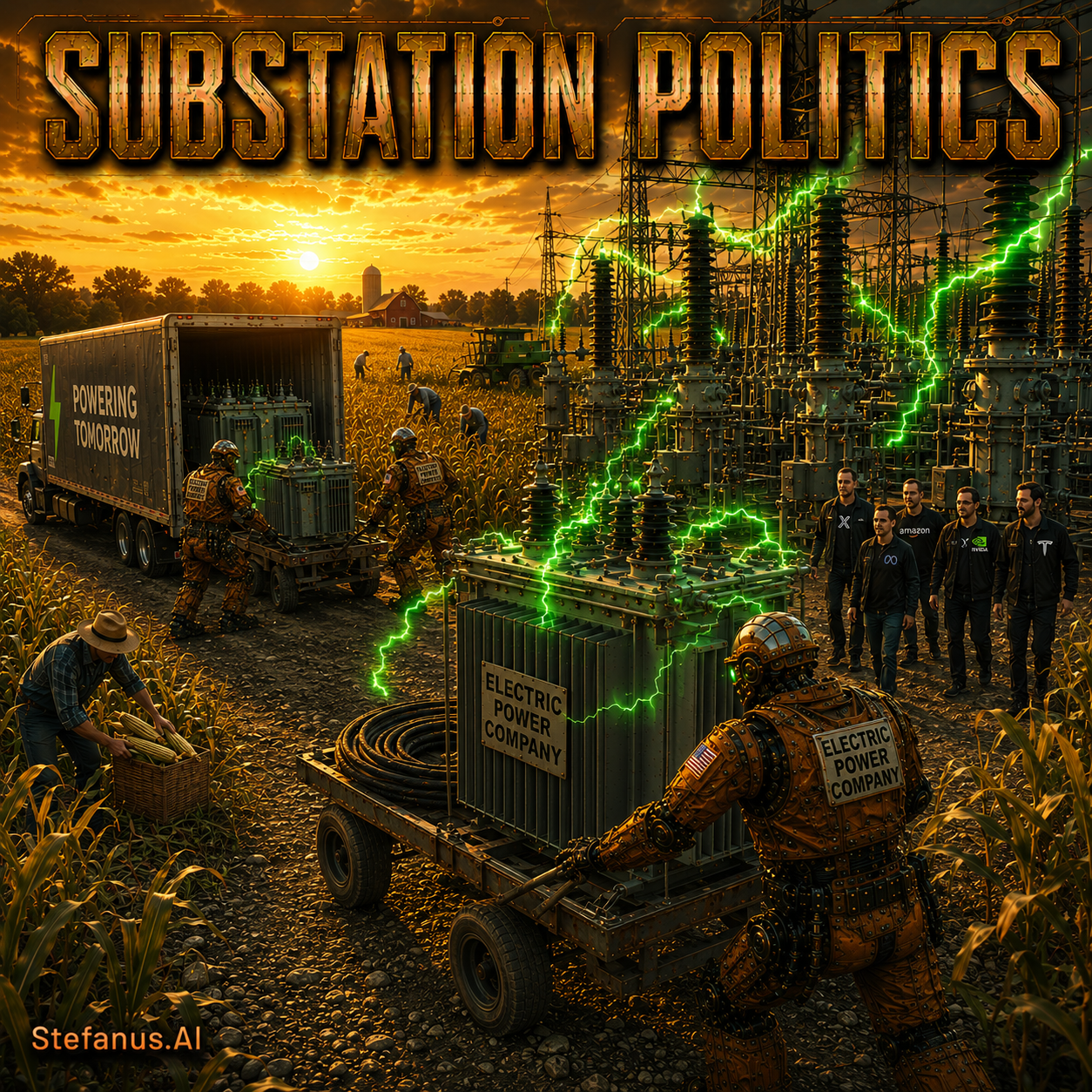
This is the story of Substation Politics.
I use that phrase deliberately. Not merely to describe a policy problem or an infrastructure challenge — though it is both. I use it to name a new political condition that is rewriting the geography of American technological growth, reshaping the relationship between private capital and public infrastructure, activating a conflict between corporate ambition and household electricity bills, and quietly determining where artificial intelligence can physically exist on the surface of the earth.
A substation is not supposed to be a political institution. It is not supposed to be a strategic asset. It is not supposed to be a chokepoint in a geopolitical race between the United States and China over who will define the next century of human civilization. And yet, in 2026, that is precisely what it has become.
Behind every AI product is electricity. Behind every electricity contract is a grid connection. Behind every grid connection is a substation. And behind every substation, as this paper will argue, is politics.

Section 1: From Cloud Abstraction to Grid Reality
1.1 The End of Weightless Computing
For more than a decade, cloud computing was successfully marketed as a form of weightlessness. Businesses did not need to think about servers, power plants, cooling systems, backup generators, fiber trenches, or the geography of data. They opened an account with Amazon Web Services, Microsoft Azure, or Google Cloud. They paid a monthly bill. Computing happened somewhere, invisibly, elastically. The language of cloud computing was deliberately spatial — data floated, storage was unlimited, capacity was infinite. It was infrastructure for people who did not want to think about infrastructure.
This was, in retrospect, one of the most successful acts of productive abstraction in the history of technology. It democratized access to computing power. It allowed startups to compete with enterprises. It moved the economy from ownership to service. But it also concealed from public view the enormous physical apparatus that made computing possible: the acre-wide campuses of server halls, the megawatts of electricity, the cooling towers consuming millions of gallons of water, the high-voltage transmission lines, the substations, the backup diesel generators running in reserve. The cloud was not weightless. It was just invisible.
Generative AI destroyed that invisibility.
1.2 Why AI Workloads Are Different from Traditional Cloud Workloads
The electricity demand of traditional cloud computing, while substantial, had been partially offset for two decades by efficiency gains. Hyperscale migration, server virtualization, higher utilization rates, and advances in power usage effectiveness meant that global data center electricity consumption had grown far more slowly than the underlying growth in data traffic. The Lawrence Berkeley National Laboratory’s landmark 2024 U.S. Data Center Energy Usage Report documented this phenomenon in careful detail, projecting that without the AI inflection, demand would have remained relatively contained.[14]
AI workloads are fundamentally different from traditional cloud workloads along three dimensions that matter enormously for power infrastructure: intensity, continuity, and concentration.
Intensity refers to the electricity consumption per unit of compute. Training a large language model — the process of running vast amounts of data through a neural network to adjust billions of parameters — requires extraordinary concentrations of GPU compute running continuously over weeks or months, drawing hundreds of megawatts at a single site. The Harvard Belfer Center’s February 2026 paper, “AI, Data Centers, and the U.S. Electric Grid: A Watershed Moment,” noted that large-scale data centers can draw as much electricity as small cities, and their clustering in specific regions intensifies local grid impacts.[15]
“In some parts of the country, AI-driven energy demand is outpacing available capacity, driving companies to delay projects, contract power directly from private producers, and/or install multiple, inefficient reciprocating generators using natural gas.”[15]
— Belfer Center, Harvard University, February 2026
Continuity refers to the fact that AI inference — the process of running a trained model to answer a question, generate an image, write a line of code, or control an autonomous system — is not a batch workload that can be scheduled for off-peak hours. It is continuous. Every time a user sends a message to Claude, ChatGPT, Gemini, or any other AI assistant, somewhere a cluster of GPUs wakes up and runs a forward pass through a model with billions of parameters. Multiplied across hundreds of millions of users doing this dozens of times a day, inference becomes a continuous industrial load. The Brookings Institution noted in its April 2026 briefing that by one estimate, data center energy consumption could approach 1,050 terawatt-hours by 2026 — a level that would make data centers, if treated as a country, the fifth-largest energy consumer in the world, ranking between Japan and Russia.[16]
Concentration refers to the geographic clustering of AI compute. Unlike traditional cloud workloads, which were distributed across dozens of global regions, leading AI training clusters tend to be massive and site-specific. A single hyperscale AI campus may draw a gigawatt or more of power from a single substation or cluster of substations. This concentration means that the local grid node — the substation — is not merely absorbing a distributed demand increase. It is being asked to deliver an industrial-scale load that the grid in that region may never have been designed to accommodate.
1.3 The Inference Burden
It is tempting to think of AI electricity demand primarily in terms of training: the initial, one-time creation of a model that then runs cheaply in deployment. This is a misconception that has significant implications for grid planning. Training a frontier model is expensive and power-intensive, but it happens relatively rarely. Inference — serving a trained model to real users — is what creates the continuous, large-scale, permanent industrial load.
As AI models have been embedded in search engines, office productivity software, customer service systems, coding tools, autonomous agents, and soon robotics platforms, the inference burden has grown from a niche concern to a central grid planning challenge. Microsoft’s Copilot is running inference continuously across hundreds of millions of Office users. Google’s AI Mode is running inference on every search query. Amazon’s Alexa, AWS Bedrock, and Anthropic’s Claude are running inference for businesses at scale. Meta’s AI recommendations run on every social media interaction. The aggregate load is no longer occasional. It is the new baseline.
1.4 The Return of Physical Infrastructure
The AI era has therefore accomplished something that two decades of cloud computing rhetoric had obscured: it has forced the technology industry to confront its own physicality. The invisible has become visible. The weightless has acquired mass. The elastically scalable has hit hard physical limits.
Those limits are expressed most acutely in three places: the interconnection queue, the transformer supply chain, and the substation. The interconnection queue — the process by which a new facility formally requests a connection to the power grid through the relevant grid operator — had, by early 2026, swollen to extraordinary lengths. PJM Interconnection, which manages the grid serving 67 million Americans across 13 states and the District of Columbia, had processed more than 170,000 megawatts of new generation requests since 2023, with the process so overwhelmed that FERC announced in April 2026 that it planned to act in June to address the DOE’s proposed reforms for interconnecting data centers and other large loads.[17] FERC Chairman Laura Swett stated:
“Our nation stands at a pivotal moment as we face rapid growth in demand from data centers and other large-scale consumers that are reshaping our transmission landscape. I want to reassure the public that we are addressing this challenge head-on, working tirelessly and collaboratively with stakeholders and federal partners to deliver real solutions.”[17]
— FERC Chairman Laura V. Swett, April 2026
The transformer supply chain, meanwhile, had entered a crisis that most Americans have not registered because transformers are not the kind of hardware that earns headlines. The pv magazine reported in May 2026 that transformer lead times in the United States had extended to as long as four years, with a supply and demand imbalance expected to persist for years.[18] The HSBC report on AI bottlenecks was characteristically blunt: “Grid equipment lead times are rising with some shortages in medium voltage equipment, but the key bottleneck is in high voltage substations, where lead times are 3-5 years.”[19]
1.5 From GPU Scarcity to Grid Scarcity
The history of the AI infrastructure boom can be told as a succession of bottlenecks. The first bottleneck was compute: Nvidia’s GPUs were in desperately short supply through 2023 and into 2024, with hyperscalers competing aggressively for allocation. The second bottleneck became data and talent. The third — and the one that will define the geography of AI for a decade — is power.
As the data center crisis reporting service enkiai.com summarized it: “From 2025 onward, the bottleneck has migrated from the server rack to the substation.”[20] Electrical equipment is, as one analyst noted with characteristic precision, “under 10 percent of total data center cost and 100 percent of the bottleneck.”[5]
The transition from GPU scarcity to grid scarcity is not merely a supply chain story. It is a political economy story. GPU scarcity was a problem between Nvidia and its customers — a corporate negotiation resolved by market pricing and priority contracts. Grid scarcity is a problem between private technology companies and public infrastructure: the electrical grid that serves households, hospitals, factories, schools, and communities as well as data centers. That shift from private market to public infrastructure is precisely what transforms a supply chain problem into a political one — and precisely what gives rise to the phenomenon I am calling Substation Politics.

Section 2: The Substation as the New Political Unit
2.1 Why the Smallest Node Becomes the Strategic Node
In the architecture of the electrical grid, the substation is neither the most powerful nor the most visible element. Generation plants produce the electricity. High-voltage transmission lines carry it across hundreds of miles. Distribution networks deliver it to homes and businesses. The substation sits between transmission and distribution, performing the essential but unglamorous function of voltage transformation: stepping electricity down from the 100,000 to 500,000 volts at which it travels efficiently over long distances to the 4,000 to 35,000 volts at which it can be distributed locally.
For most of the twentieth century, the substation was infrastructure in the truest sense: background, invisible, taken for granted. Power engineers and utility planners thought carefully about substations. Regulators approved their construction. Communities occasionally protested their placement. But they were not political institutions in any meaningful sense. They were technical nodes.
The AI economy has changed that. A substation is now, in many contexts, a gatekeeper. It is the physical point through which a data center must pass to receive the power it needs to exist. When the substation is congested, the data center waits — or moves. When the substation lacks transformer capacity, the data center cannot be built. When the substation requires upgrades, someone must pay for them. And in each of these moments, the substation becomes a decision point not just for engineers but for governors, regulators, legislators, ratepayers, and communities.
2.2 Defining Substation Politics
Substation Politics, as I define it, is the emerging struggle among technology companies, utilities, regulators, governors, local communities, and ratepayers over access to the electrical nodes that determine where artificial intelligence can physically exist. It is the politics of who receives access to limited grid capacity, under what conditions, at what cost, and with whose consent.
This definition has five component dimensions worth unpacking in detail, because each dimension generates its own political conflicts.
The first dimension is access. Grid capacity is not available uniformly across the United States. It is concentrated in regions where transmission infrastructure, generation resources, and interconnection capacity happen to coincide. Northern Virginia became the global capital of data center concentration in part because Dominion Energy had built an unusually robust transmission network for reasons having nothing to do with data centers — a legacy of federal government and defense contractor demand in the Washington metropolitan area. When Amazon, Microsoft, Google, and Meta arrived with gigawatt-scale demands, they found a pre-existing grid capable of accommodating them. But by 2024 and 2025, even Virginia’s extraordinary grid was beginning to strain. The Belfer Center’s April 2026 analysis of Virginia and Texas noted that PJM’s congestion costs had risen 64 percent in 2024 alone, and that Texas was planning more than $30 billion in transmission upgrades.[21]
The second dimension is cost. Building or upgrading a substation to serve a large AI data center costs tens of millions to hundreds of millions of dollars. Those costs can be assigned in three ways: to the data center company that created the need; to the utility, which can then seek rate recovery from all customers; or to the ratepayer base directly through increased transmission charges. Each assignment creates different political dynamics. If the data center pays, the economics of AI infrastructure become more transparent and more challenging. If the utility pays and recovers through rates, ordinary households subsidize the infrastructure needs of private technology companies. If ratepayers pay directly, the political backlash can be intense. The “Who Pays?” conflict is, as the Belfer Center noted, “escalating” — traditional socialized cost-recovery models are breaking down under the scale of required grid investments.[21]
The third dimension is consent. A data center requires not only a utility connection but a local permit, an environmental review, water rights (for cooling), zoning approval, and in many cases the tacit or explicit endorsement of local officials and communities. Communities that host AI infrastructure face tradeoffs: construction jobs in the short term, potentially some tax revenue, but also increased water consumption, visual and noise intrusion, potential rate impacts, and the transformation of rural or suburban landscapes into industrial campuses. The Business Insider reporting of June 2026 documented the rapid expansion of data centers into rural areas, alongside the tax exemptions that states and localities often grant to attract them, and the local backlash that has followed in places where communities feel the costs outweigh the benefits.[22]
The fourth dimension is reliability. An AI data center is not an inert load. It is a dynamic, potentially destabilizing addition to the grid. ERCOT discovered this with particular urgency in June 2026, when it reported that four clusters of large electricity consumers — including data centers and cryptocurrency mining facilities — had abruptly disconnected from the grid during routine voltage disturbance tests. Each cluster could trigger more than 5,000 megawatts of demand tripping — roughly the load of a large city.[23] Since 2023, ERCOT had identified 26 events of data centers and crypto facilities abruptly disconnecting during voltage disturbances.[24]
The fifth dimension is geopolitics. The United States is engaged in a competition with China over who will define the next generation of artificial intelligence, and that competition is being fought, in part, at the level of physical infrastructure. China has invested heavily in grid modernization, transformer manufacturing, and data center construction. The transformer shortage afflicting U.S. AI infrastructure is partly a function of China’s dominance in electrical equipment manufacturing — even as U.S.-China trade tensions have added tariff and supply chain uncertainty to that dependence.[4]
2.3 Transformer Shortages and the Geopolitics of Electrical Equipment
The transformer shortage is worth examining in some depth, because it illuminates the degree to which AI infrastructure — commonly imagined as a product of software and silicon — depends on heavy industrial manufacturing with long supply chains and multi-year production timelines.
A large high-voltage power transformer is not a commodity. It is a custom-engineered, custom-manufactured piece of capital equipment weighing hundreds of tons, requiring specialized steel cores, precision windings, and careful testing. Before the AI boom, lead times for large transformers ran 24 to 30 months — already long by most industrial standards. By 2026, lead times had extended to three to five years. The U.S. transformer market was facing what pv magazine described as “severe supply constraints” that were “expected to persist for years.”[18]
The practical consequence was that data center developers who had not placed transformer orders years in advance were facing indefinite delays regardless of how much capital they commanded. Bloomberg’s April 2026 reporting confirmed that the electrical equipment needed to bring AI data center facilities online was “hard to come by” and already creating delays that were “forcing developers to get creative with how they source equipment.”[25]
Some developers have responded by pursuing the “Bring Your Own Power” model: siting data centers with on-site generation rather than grid connection, using natural gas turbines, fuel cells, or other sources to generate electricity directly. The Colossus 1 facility in Memphis, for example, was built using natural gas turbines, which allowed it to come online within 19 days of project conception — a speed that was impossible through conventional grid interconnection. But this model carries its own political costs: natural gas turbines in a residential neighborhood generated protests and civil rights complaints in Memphis, and xAI faced sustained community opposition over air quality, water use, and regulatory compliance.[13]
2.4 Utility Commissions as AI Regulators
Perhaps the most underappreciated political development in the AI infrastructure story is the transformation of state public utility commissions into de facto AI regulators. These agencies — typically staffed by engineers, lawyers, and policy specialists with deep expertise in traditional utility regulation but limited familiarity with AI business models — are now being asked to answer questions that no regulatory framework was designed to address.
Who should pay for the transmission upgrades required to serve a hyperscale AI campus? Should a utility be allowed to build dedicated infrastructure for a single large customer and recover those costs from all ratepayers? How should interconnection queues prioritize competing applicants? What voltage ride-through standards should apply to facilities that, if they disconnect suddenly, can destabilize a regional grid?
The multistate legislative tracking service reported in June 2026 that at least several states had enacted or were considering ratepayer-protection bills requiring data centers to pay for grid expansion directly, rather than socializing those costs.[26] In April 2026, it reported that federal AI data center policy was meeting resistance from state lawmakers who felt that Washington was overriding state regulatory authority in ways that benefited technology companies at the expense of local consumers.[27]
The question of whether utility commissions are the right institutions to govern AI infrastructure — or whether the decisions are too large and too consequential to be left to state-level regulatory processes that lack the expertise, the resources, and the authority to address them — is one that the United States has not yet seriously confronted.

Section 3: Governors, Utilities, and the New Ratepayer War
3.1 The Ratepayer Question
The political heart of Substation Politics is a question that sounds mundane but is, in practice, one of the most consequential distributional conflicts in American public policy: who pays for the grid infrastructure that AI data centers require?
On its face, the question seems technical — a matter of cost allocation in utility tariff proceedings. In practice, it is a question about who benefits from the AI economy and who subsidizes it. Technology companies and their investors capture the value created by AI products. The grid infrastructure that makes those products possible — the transmission lines, the substations, the transformers, the generation capacity — is shared public infrastructure. When a large AI campus arrives in a region and requires hundreds of millions of dollars in grid upgrades, the decision about who funds those upgrades determines whether ordinary families effectively cross-subsidize the infrastructure of private technology companies.
This is not an abstract concern. A PowerLines analysis of 51 U.S. investor-owned utilities, published in April 2026, found planned capital expenditure of at least $1.4 trillion through 2030, more than a 21 percent increase over the same utilities’ plans from a year earlier.[28] A Synapse Energy Economics analysis projected that PJM consumers would pay an extra $100 billion through 2033 as new data centers continue to exceed available power supply — and that PJM’s 67 million customers had already absorbed an extra $9.4 billion in electricity bills during summer 2025.[29]
3.2 Texas and the “Bring Your Own Power” Doctrine
Texas is the most consequential laboratory for the ratepayer conflict in 2026. Governor Greg Abbott had spent years positioning Texas as the most welcoming state in the nation for technology investment: low taxes, limited regulation, a deregulated electricity market, and a political culture that celebrated private enterprise. Texas is home to approximately 300 operating data centers, with more than 100 planned or under development.[30]
But on June 10, 2026 — the same day this paper was being completed — Governor Abbott issued a letter to the Public Utility Commission of Texas and the Electric Reliability Council of Texas that effectively announced a new doctrine for AI infrastructure in Texas. The letter directed the PUC to initiate action that would require data centers to pay for all of their electric infrastructure costs, ensuring that no residential ratepayer is burdened by those costs.[31]
“The rapid scale of data center development requires oversight to ensure everyday Texans are not burdened with the costs of infrastructure driven by data center expansion, and to ensure that as data centers interconnect to the ERCOT grid, residential electric bills are not negatively affected.”[31]
— Governor Greg Abbott, Letter to PUC and ERCOT, June 10, 2026
Abbott also directed the PUC and ERCOT to identify additional steps to protect residential and small business ratepayers, and to submit a joint memo to the governor’s office by July 17, with action to begin by July 31. He indicated plans to work with the Texas Legislature to expand protections ensuring data centers add to the state’s electric capacity rather than consuming it at the public’s expense.
“Data centers must operate in ways that reduce costs for residential electricity customers, do not drain water needed for our communities, and take into consideration the needs of our neighborhoods.”[32]
— Governor Greg Abbott, Press Release, June 10, 2026
The Abbott letter arrived on the heels of a separate ERCOT warning that had shaken the Texas grid reliability community. In early June 2026, ERCOT reported that four clusters of large electricity consumers — data centers and crypto facilities — had failed key voltage ride-through tests in preparation for the summer peak season. Each cluster, if it disconnected suddenly during a grid disturbance, could trigger more than 5,000 megawatts of demand tripping — enough to rival the load of a city the size of Boston. Since 2023, ERCOT had documented 26 events of data centers and crypto facilities disconnecting during disturbances, and a 2022 transformer failure had already demonstrated the cascading effect: facilities dropping off the grid created a surplus of 1,700 megawatts — roughly 5 percent of the Texas grid’s total demand at that moment.[24]
The significance of Abbott’s June 10 action should not be understated. Texas is not an anti-technology, anti-business state. It is the state that welcomed Tesla, Oracle, Hewlett Packard Enterprise, and countless technology companies when they relocated from California. The fact that even Texas — the model of pro-growth, low-regulation energy economics — has concluded that the ratepayer question requires affirmative policy intervention reflects the degree to which the balance has tipped. The message from Austin is unmistakable: bring your investment, but bring your own power budget.
3.3 Virginia and the Burden of Success
If Texas is the case of a state proactively drawing lines before costs spiral, Virginia is the case of a state that discovered the costs of success after the fact. Northern Virginia — a concentration of data center campuses in Loudoun, Prince William, and Fairfax counties known informally as “Data Center Alley” — hosts the largest concentration of data center capacity on the planet. It is the infrastructure underpinning of a substantial portion of the global internet. It is also a cautionary tale about what happens when a state becomes the de facto host of a national infrastructure buildout without a governance framework designed for that role.
Dominion Energy, the dominant utility in Virginia, has faced extraordinary grid planning challenges as data center demand has accelerated. Transmission lines that were designed for a region of government contractors and suburban households are now being asked to carry loads far beyond their original design parameters. The Belfer Center’s April 2026 paper examining Virginia and Texas found that “traditional ‘socialized’ cost-recovery models are breaking down under the scale of required grid investments.”[21]
Northern Virginia has also begun experiencing the social consequences of data center concentration: land consumption, water strain, visual transformation of rural landscapes, and a growing community awareness that the region is, in effect, hosting national infrastructure without commensurate compensation or representation. The Business Insider analysis of June 2026 documented these dynamics in the context of rural data center expansion more broadly, noting that tax exemptions granted to attract data centers often far exceed the public revenue they generate in the short term.[22]
3.4 Michigan, Pennsylvania, and the Return of Firm Power
The AI electricity demand surge has produced a striking reversal in the energy politics of several states: the rehabilitation of generation assets that had been retired or were scheduled for retirement. Firm power — electricity that is available on demand regardless of weather conditions, unlike wind and solar — has become more valuable because AI data centers require it. Intermittent renewables cannot, without substantial storage, serve the 24/7/365 operational profile of a large inference cluster.
Michigan’s Palisades Nuclear Generating Station, on the eastern shore of Lake Michigan, shut down for financial reasons in 2022. Its revival — backed by a $1.52 billion federal loan guarantee from the Department of Energy and $300 million from the state of Michigan — is widely understood as a direct response to AI-driven electricity demand.[33] Palisades, if successfully restarted, would become the first nuclear plant in U.S. history to return to service after decommissioning. Holtec International, the plant’s owner, targeted an early 2026 restart, though delays pushed the timeline somewhat.[34]
“We have seen [Michigan’s] baseload generation go offline at a rapid rate as they’ve moved away from fossil generation. How do you address growing demand in a clean and reliable way? Nuclear is part of the answer.”[33]
— Nick Culp, Holtec International, December 2025
Pennsylvania, facing similar firm power concerns, has extended the operational life of coal plants that would otherwise have retired — a decision driven not by climate indifference but by the recognition that the grid cannot simultaneously decarbonize and accommodate exponentially growing AI load without reliable baseload generation to fill the gap. The political sensitivity of this tradeoff is considerable: states that have made public climate commitments are being forced to maintain or extend fossil generation to serve private technology companies. The distributional question — why should public climate commitments be compromised for private AI infrastructure? — is only beginning to be asked.
Iowa’s Duane Arnold nuclear plant, shut down in 2020, is being explored for restart by NextEra Energy. Three Mile Island’s Unit 1 in Pennsylvania, restarted in a landmark deal with Microsoft in late 2024 and rechristened the Crane Clean Energy Center, represents the first major demonstration that AI companies will enter long-term power purchase agreements directly with nuclear plants to secure firm, clean power.[35]
3.5 Arizona and the Chip-Water-Power Triangle
Arizona represents a distinctly different dimension of AI infrastructure stress. It is the state where semiconductor manufacturing, AI data centers, and climate pressure converge most acutely. The arrival of TSMC’s fabrication facilities in Phoenix — representing the largest foreign direct investment in U.S. manufacturing history — has added a second category of extreme electricity demand alongside the data center buildout. Together, they are straining a grid that is also managing the demands of one of the fastest-growing metropolitan areas in the country, in a desert climate that makes cooling expensive and water-intensive.
Arizona’s water situation deserves particular attention. Large AI data centers use millions of gallons of water per day for cooling. In a state facing long-term aridification, declining Colorado River allocations, and groundwater depletion, the water demands of data centers are not merely an environmental concern — they are a resource conflict that implicates agriculture, municipal water supply, and the rights of downstream states. Governor Abbott’s June 2026 letter to ERCOT explicitly mentioned water as well as electricity: data centers “must not drain water needed for our communities.”[32] Arizona faces an even more acute version of the same dilemma.
3.6 California’s Innovation-Constraint Paradox
California is home to most of the AI companies whose products are reshaping the world. It is also a state with the highest electricity rates in the continental United States, an environmental permitting regime that adds time and cost to large infrastructure projects, grid reliability challenges that have included public safety power shutoffs, and a policy culture that takes seriously the distributional implications of infrastructure investment.
The result is that most of the physical AI infrastructure funded by California-headquartered companies is being built elsewhere. California’s role in the AI economy is to produce the intellectual property, the models, the products, and the companies. The grid nodes on which those products physically run are located in Virginia, Texas, Indiana, Tennessee, Georgia, and Arizona. This creates an unusual disconnect: the innovation benefits accrue in California, while the grid burdens are borne by communities in other states.
Whether this is sustainable as a national infrastructure model — or whether it creates, over time, political resentments in host states that will challenge the implicit compact between technology companies and the regions where they place their physical infrastructure — is a question that Substation Politics will eventually force into the open.

Section 4: Voltage, Reliability, and the Physics of AI Growth
4.1 AI as a Grid Reliability Event
The electrical grid is not merely a passive delivery system for electricity. It is a complex, interconnected, real-time balancing system in which supply and demand must be matched continuously — not over the course of a day or an hour, but moment to moment. When supply and demand diverge significantly, the system’s frequency drops or rises, voltage becomes unstable, and in extreme cases, cascading failures can produce widespread outages.
For most of the history of the modern grid, the large loads that grid operators worried about most were industrial consumers: aluminum smelters, steel mills, chemical plants. These were large, relatively predictable, and relatively well-understood. The grid was designed and operated with their behavior in mind.
AI data centers are a different kind of industrial load, and they introduce reliability dynamics that the grid was not originally designed to accommodate. The Hong Kong Polytechnic University’s January 2026 paper in the journal Energies, “Power for AI Data Centers: Energy Demand, Grid Impacts, Challenges and Perspectives,” documented in technical detail how AI workloads are characterized by high power density, temporal variability, and cooling requirements that shape total energy use and grid interaction in novel ways.[36]
4.2 Voltage Tests and the New Reliability Politics
The ERCOT voltage ride-through failures of June 2026 illustrate the reliability risk with unusual clarity. Voltage ride-through is the ability of a facility to remain connected to the grid during a brief voltage disturbance — the kind of disturbance that occurs when a transmission line fault is isolated or a large generator trips offline. Traditional industrial loads are designed to ride through these disturbances. Most AI data center facilities, however, are designed primarily to protect their sensitive computing equipment: when voltage drops outside normal parameters, the facility’s protection systems trip the load offline to prevent hardware damage.
This creates a potentially dangerous dynamic. When a voltage disturbance occurs, instead of remaining connected and helping the grid stabilize, a cluster of large data centers may simultaneously disconnect. Their sudden absence creates an overcapacity condition on the supply side, pushing voltage and frequency in the opposite direction. The disturbance, instead of being absorbed by the system, is amplified.
ERCOT’s June 2026 warning stated that four clusters of large loads had failed voltage ride-through tests, with each capable of tripping more than 5,000 megawatts of demand. Since 2022, ERCOT had documented a 2022 transformer failure that caused crypto facilities and data centers to disconnect, yielding a surplus of 1,700 megawatts — about 5 percent of the Texas grid’s total demand.[24] The Texas Prism News analysis described it bluntly: “Texas is finding out what happens when AI growth collides with a grid built for a different era.”[37]
4.3 Flexible Compute and Time-Shifting AI
The reliability challenge, while real, is also an opportunity. AI data centers are, in principle, more flexible than steel mills or chemical plants. Not all AI workloads require instantaneous response. Training runs can be scheduled for off-peak hours. Inference for non-time-sensitive applications can be delayed by seconds or minutes without user impact. Batch processing, model fine-tuning, data preprocessing, and other background tasks can be shifted to times when grid stress is low or renewable generation is abundant.
The academic paper “To Defer or To Shift? The Role of AI Data Center Flexibility on Grid Interconnection,” published in April 2026, examined in detail the degree to which AI data center flexibility could reduce grid stress and potentially accelerate interconnection approval by demonstrating a less aggressive demand profile.[38] The findings were cautiously optimistic: significant flexibility was technically achievable, but required intentional architecture, software systems to manage workload scheduling, and commercial incentives that do not currently exist in standard utility tariffs.
The World Economic Forum’s March 2026 analysis argued that “flexible grid optimization could double effective capacity faster than any building programme,” noting that when Microsoft CEO Satya Nadella acknowledged that his company had GPU clusters sitting idle — depreciating assets waiting for power that might not arrive for years — he had “crystallized the defining constraint of the AI era.”[39]
4.4 Batteries, UPS Systems, and Grid-Interactive Infrastructure
Beyond workload flexibility, AI data centers contain large amounts of energy storage in the form of uninterruptible power supply systems and, increasingly, grid-scale battery arrays. These systems are designed to protect computing equipment from power interruptions, but they can also, if configured appropriately, provide services to the grid: frequency response, voltage support, demand response, and backup capacity.
The February 2026 academic review of energy storage solutions for AI data center grid integration, published in a peer-reviewed journal, found that the aggregate storage capacity of planned U.S. AI data center infrastructure could be substantial enough to provide meaningful grid services if the regulatory and commercial frameworks to enable that participation were developed.[40]
The concept of the “grid-interactive data center” — a facility that is not merely a passive consumer of electricity but an active participant in grid management — is gaining traction among researchers and some forward-thinking operators. It represents a potential resolution to the reliability conflict: instead of being a source of grid instability, large AI data centers become contributors to grid stability through their storage assets, their flexible workloads, and their on-site generation.
4.5 From Passive Load to Grid Participant
The transition from passive load to grid participant will not happen automatically. It requires regulatory frameworks that recognize and reward grid services provided by large loads. It requires utility tariff structures that create incentives for demand flexibility. It requires data center operators to invest in the software and control systems needed to manage workloads in response to grid signals. And it requires a fundamental shift in how data center operators think about their relationship with the grid: from a utility customer relationship to a participant in shared infrastructure management.
The argument of this paper is that such a shift is not merely desirable. In the world of Substation Politics, it will become necessary. Communities and regulators that are being asked to absorb the costs and risks of AI infrastructure will increasingly insist, as a condition of approval, that the infrastructure contributes to rather than degrades the reliability of the grid it depends upon.

Section 5: The Substation Doctrine: A Framework for AI Infrastructure Governance
5.1 Why America Needs a Substation Doctrine
The United States does not currently have a coherent national framework for governing AI infrastructure at the intersection of private investment and public grid. What it has, instead, is a patchwork: federal interconnection rules administered by FERC; state utility regulation administered by public utility commissions with widely varying capacity and authority; local zoning and permitting; federal permitting for certain categories of infrastructure; executive orders on AI and infrastructure from the White House; and ad hoc legislative responses from state legislatures that vary enormously in their sophistication and consistency.
This patchwork was adequate for the era of traditional cloud computing, when data centers were relatively small, relatively dispersed, and relatively modest in their grid demands. It is not adequate for the era of gigawatt-scale AI campuses that can reshape regional grid dynamics, require nine-figure infrastructure investments, consume water at industrial scale, and concentrate nationally strategic compute in ways that create both economic and national security risks.
What the United States needs is what I am calling a Substation Doctrine: a coherent framework for approving, pricing, locating, and regulating AI infrastructure according to its impact on the local grid node, the communities it affects, the ratepayers who share its costs, and the national resilience it either strengthens or compromises. The doctrine I propose below builds on the emerging state-level actions in Texas, Virginia, and elsewhere, the FERC proceedings of 2025 and 2026, the Belfer Center’s research framework, and the practical lessons of the infrastructure crises examined throughout this paper.
5.2 The Five Questions Every Governor Should Ask
The Substation Doctrine begins not with regulation but with a set of questions that every governor, utility commission, and local authority should require answered before approving a large AI data center project. These are not rhetorical questions. They are the organizing questions of a governance framework.
The first question: Who pays for the substation and grid upgrade? Every large AI data center creates infrastructure costs. The doctrine requires that these costs be transparently identified, quantified, and allocated before approval — not after, when the sunk cost fallacy makes reversal politically difficult. Data centers above a defined load threshold should be required to fund the dedicated infrastructure upgrades created by their demand. Ratepayer cost socialization should be permitted only for infrastructure improvements that demonstrably benefit the broader service territory, not solely the data center operator.
The second question: Does the project increase or reduce local reliability? A project that fails voltage ride-through tests, that lacks backup generation, that cannot guarantee demand response participation, and that introduces concentrated load instability into a regional grid is a reliability liability. The doctrine requires that large AI data centers demonstrate their reliability contribution — or pay for the reliability mitigation measures required to offset their impact — as a condition of grid interconnection.
The third question: Does the project bring its own firm power or storage? The bring-your-own-power model, however imperfect in its early natural-gas-turbine implementation, embodies an important principle: large AI data centers should not expect the public grid to absorb unlimited demand increases without contribution. The doctrine encourages data centers to develop on-site generation, long-term power purchase agreements with dedicated generation resources, and battery storage that contributes grid services — and creates regulatory incentives for these choices.
The fourth question: Does the community receive durable benefits beyond temporary construction jobs? The social contract of AI infrastructure is currently heavily weighted toward the private sector. Technology companies receive tax exemptions, accelerated permitting, and publicly funded grid upgrades. Communities receive construction employment that ends when the campus is built, and then face the permanent reality of large industrial campuses consuming local water and power. The doctrine requires negotiated community benefit agreements as a condition of approval for large AI data centers: tax revenue sharing, water mitigation commitments, environmental monitoring, workforce development for permanent operations employment, and transparent reporting on resource consumption.
The fifth question: Does the project strengthen national AI resilience or merely concentrate risk? The geopolitical dimension of AI infrastructure requires national attention. The concentration of the vast majority of U.S. AI compute capacity in a small number of regions — Northern Virginia, parts of Texas, and a handful of other locations — creates fragility. A single severe weather event, a grid disturbance, or a malicious attack on a concentrated cluster could significantly degrade U.S. AI capability. The doctrine includes a national resilience standard: major AI infrastructure investments should be evaluated not only for their local economics but for their contribution to a geographically distributed, resilient national AI infrastructure system.
5.3 Ratepayer Protection as AI Policy
The Abbott doctrine from Texas and the multistate ratepayer protection legislation emerging across the country represent the beginnings of a political consensus on one element of the Substation Doctrine: ratepayers should not be required to subsidize private AI infrastructure. This consensus is politically significant because it spans the ideological spectrum. In Texas, it emerges from a conservative skepticism of corporate welfare and a commitment to protecting household electricity bills. In blue states like California and New York, it emerges from a progressive concern about wealth concentration and the distributional impact of utility rate increases on lower-income households.
The Substation Doctrine formalizes this emerging consensus into a clear policy principle: where AI data centers create the need for new or upgraded grid infrastructure, the costs of that infrastructure should be borne by the data center operator, not socialized across the ratepayer base. Exceptions may be appropriate for infrastructure improvements that genuinely benefit the broader grid, but the burden of demonstrating that benefit should rest with the data center operator, not the ratepayer.
5.4 Community Consent and Local Benefit
The community consent dimension of the Substation Doctrine draws on a tradition that is well-established in other infrastructure contexts — from the environmental justice requirements that govern the siting of power plants and industrial facilities, to the community benefit agreements negotiated for large urban development projects. The principle is simple: when private infrastructure that generates private profit is located in a community, that community is entitled to a negotiated share of the public value created.
The Memphis experience with Colossus 1 is instructive. The xAI campus, built in the Boxtown neighborhood of South Memphis — a historically Black community with longstanding environmental justice concerns — arrived with a community benefit agreement that included a commitment to build a greywater recycling facility. By mid-2026, that facility had not been built, its completion was described as “not optional” by the mayor, and community residents remained frustrated by the gap between the promises of the initial agreement and the reality of a natural-gas-powered industrial campus in their neighborhood.[41] The Memphis City Council had passed an ordinance directing 25 percent of property tax revenue to benefit the neighborhoods surrounding the data centers.[41]
The Substation Doctrine would give the Memphis model a stronger legal and regulatory foundation: requiring negotiated community benefit agreements as a condition of approval, with enforcement mechanisms and public reporting requirements, rather than relying on voluntary commitments that may or may not be honored.
5.5 Grid-Interactive Data Centers
The grid-interactive data center standard — the requirement that large AI data centers contribute to rather than merely consume from the grid — represents perhaps the most technically innovative element of the Substation Doctrine. It transforms the regulatory relationship between data centers and the grid from a one-way supplier-customer model to a two-way participant model.
Operationally, a grid-interactive data center would commit to: maintaining voltage ride-through capability for all loads above a defined threshold; participating in demand response programs that allow the grid operator to temporarily reduce consumption during grid emergencies; providing frequency response services through large UPS battery systems; shifting non-time-sensitive workloads to off-peak hours in response to grid price signals; and reporting real-time consumption and flexibility data to the grid operator.
In exchange, grid-interactive data centers would receive preferential interconnection treatment, regulatory recognition of their grid services as offsetting infrastructure investment requirements, and potentially market compensation for the reliability services they provide. The goal is to align the incentives of data center operators with the needs of the grid, rather than treating them as adversaries in a zero-sum regulatory negotiation.
5.6 National AI Resilience Through Local Infrastructure
The final element of the Substation Doctrine addresses the national resilience dimension. The AI race between the United States and China is not merely a competition of models and algorithms. It is a competition of infrastructure. China has invested heavily in both the AI stack and the physical infrastructure that supports it. The United States has invested heavily in the AI stack but has allowed its physical infrastructure investment to be driven primarily by private market dynamics, which tend to concentrate in the most favorable existing locations rather than the most strategically distributed ones.
A national AI resilience standard would direct federal agencies — including the Department of Energy, FERC, and potentially a new inter-agency AI infrastructure office — to evaluate the geographic distribution of planned AI data center capacity and to use available tools (permitting incentives, loan guarantees, tax credit eligibility) to encourage distribution of capacity across resilient, well-planned, power-secure corridors rather than continued concentration in already-strained regions.
The Stargate initiative, if it is to fulfill its national ambition, needs this kind of strategic geography. A $500 billion investment in AI infrastructure that merely deepens the concentration of compute in Northern Virginia and a few Texas counties is not a national strategy. It is a continuation of private market dynamics at public subsidy scale.

Section 6: The Five Pillars of Substation Politics
The framework of Substation Politics rests on five structural pillars that together explain why AI infrastructure has become a political phenomenon and why it will remain one for the remainder of this decade and beyond. These pillars are not policy recommendations — they are analytical structures, the load-bearing elements of the argument this paper has constructed.
Pillar One: Grid Access as the First Political Filter
The geography of AI is not determined by market forces alone. It is determined, first and foremost, by grid access. A data center cannot be built where power cannot be delivered. In a world of unlimited grid capacity, data center siting would be governed entirely by land costs, fiber connectivity, water availability, labor markets, and tax policy. In the world of Substation Politics, grid access becomes the first political filter — the condition that must be satisfied before any other consideration matters.
Grid access is not equally distributed. It is a function of transmission investment history, utility planning decisions, regulatory frameworks, and the accumulated legacy of industrial and population geography. States and regions that happen to have abundant, well-maintained, high-capacity grid infrastructure have a competitive advantage in attracting AI investment that has nothing to do with their current policy choices — and that advantage is difficult for less-endowed regions to replicate on any reasonable timeline.
This means that Substation Politics is, among other things, a politics of legacy infrastructure: who benefits from the grid that was built in the past, and who must wait for the grid that will be built in the future. It is a politics in which communities near overbuilt transmission corridors find themselves hosting AI campuses whether they want them or not, and communities in grid-constrained regions find themselves excluded from the AI economy regardless of the incentives they offer.
Pillar Two: Cost Assignment as the Central Conflict
The most persistent and politically charged dimension of Substation Politics is cost assignment: who pays for the infrastructure that AI data centers require. As this paper has documented, this conflict is playing out simultaneously in state legislatures, utility commission proceedings, FERC rulemaking dockets, and gubernatorial directives from Austin to Richmond to Phoenix.
The cost assignment conflict is not merely about money, though the sums involved are large. It is about the social contract of infrastructure. In the industrial era, the social contract was that infrastructure serving broad public purposes — railroads, highways, electrical grids, telephone networks — would be built with public investment and regulated to ensure broad access. In the digital era, infrastructure that began with public support (the internet, GPS, cellular networks) has been increasingly privatized while its benefits have concentrated in private hands.
AI data centers test the limits of that social contract. They are privately owned and operated. Their revenues accrue to their corporate owners and shareholders. Their infrastructure needs are substantial and growing. And they are served by a public electrical grid whose cost-recovery mechanisms were designed for a different era of demand. The political resistance to ratepayer subsidization of AI infrastructure is the social contract striking back.
Pillar Three: Reliability Obligation
The reliability pillar of Substation Politics reflects a basic principle of electrical engineering: large loads that draw power from the grid have an obligation to support the grid’s stability, not merely to consume from it. This principle has been recognized in industrial contexts for decades — large industrial customers often face requirements to provide demand response, maintain power factor correction, or contribute to voltage stability.
AI data centers have, until recently, largely escaped these obligations. They have been treated as commercial customers — large ones, but customers nonetheless — rather than as industrial loads with grid responsibility. The ERCOT voltage ride-through failures of June 2026 have made clear that this treatment is no longer adequate. As AI data centers grow to gigawatt scale, their behavior during grid disturbances matters as much as their static demand level.
The reliability pillar of the Substation Doctrine formalizes this obligation: large AI data centers should be required to demonstrate voltage ride-through capability, demand response participation, and grid-interactive operation as a condition of interconnection and continued operation. This is not a burden unique to AI data centers — it is the standard that applies to industrial loads of comparable size and grid impact. The exceptionalism that has allowed AI data centers to avoid this obligation needs to end.
Pillar Four: Local Consent and Community Benefit
The local consent pillar of Substation Politics reflects a reality that the technology industry has been slow to acknowledge: communities are not merely passive recipients of the economic development that AI data centers bring. They are stakeholders in decisions that affect their landscapes, their water supplies, their electricity bills, their air quality, and their sense of place. The political legitimacy of AI infrastructure depends, ultimately, on whether the communities that host it feel that they have been treated fairly.
The emerging backlash against data centers in rural communities — documented by Business Insider and others in mid-2026 — reflects a gap between the promises made to attract AI investment and the experience of living next to it.[22] Tax exemptions that were intended to bring jobs and economic activity have, in many cases, produced facilities that employ very few permanent workers while consuming enormous amounts of water and power. The construction boom has been real; the long-term community benefit has been more elusive.
Community consent is not a veto on AI infrastructure. It is a requirement for honest negotiation, transparent disclosure of costs and benefits, legally binding community benefit agreements, and the ongoing accountability that distinguishes infrastructure that communities embrace from infrastructure that they merely endure.
Pillar Five: Strategic Resilience
The fifth pillar elevates the analysis from local and state politics to national strategy. AI infrastructure is national security infrastructure. The compute clusters that train frontier models, run inference at scale, and power autonomous systems are as strategically significant as the semiconductor fabs, the defense production lines, and the communication networks that the United States has long treated as matters of national interest.
Strategic resilience requires geographic distribution, redundancy, diversity of ownership, and resistance to single points of failure. A national AI infrastructure that is concentrated in a few regions, dependent on a small number of utilities, and vulnerable to the weather events, grid disturbances, and physical disruptions that affect any specific geography is not resilient. It is fragile in exactly the ways that adversaries might exploit and that natural disasters might damage.
The national resilience dimension of Substation Politics is the least developed in current policy thinking but may prove to be the most consequential. The United States has learned, through hard experience, the strategic importance of diversified semiconductor manufacturing — which is why the CHIPS Act directed tens of billions of dollars toward building fab capacity outside the existing concentration in Taiwan. The same lesson should apply to AI compute infrastructure: diversity of location, diversity of power source, and diversity of ownership are not merely economic preferences. They are strategic necessities.

Section 7: What We Have Learned
Any paper that claims to describe a new political phenomenon has an obligation to state clearly what it believes its own contribution to be. This one is no different. The argument of this paper is not merely descriptive — that AI data centers require electricity and that electricity infrastructure is political. That observation, while true, is insufficient. The argument is that a new political form has emerged — Substation Politics — that requires a new analytical vocabulary, a new governance framework, and a new kind of national attention.
Here is what the evidence of 2025 and 2026 has taught us.
The first lesson is that AI is not only a digital revolution. It is a physical infrastructure revolution. The hundreds of billions of dollars being committed by Microsoft, Amazon, Alphabet, Meta, and other hyperscalers are not investments in software. They are investments in transformers, substations, cooling towers, fiber networks, backup generators, power purchase agreements, and grid connections. The future of intelligence is being manufactured in buildings that require the same industrial infrastructure as steel mills and aluminum smelters, but at a speed and scale that the relevant institutions were not designed to accommodate.
The second lesson is that the AI race is becoming local. A national AI strategy cannot succeed if counties and communities reject the infrastructure needed to support it. The Memphis protests against Colossus 1. The Texas ratepayer legislation. The Virginia transmission strain. The Arizona water conflicts. These are not footnotes to the main story. They are the main story. AI infrastructure must earn its right to exist in communities, not simply assume it.
The third lesson is that governors are becoming AI infrastructure leaders. The decisions that Greg Abbott made on June 10, 2026, will shape the geography of AI compute in Texas for years. The decisions that Michigan made to fund the Palisades restart, that Pennsylvania made to extend coal plants, that Virginia has made about transmission investment — these are AI policy decisions as much as energy policy decisions. The governors who understand this will have significant power to shape where and how AI infrastructure develops. The governors who do not will find themselves managing the consequences of decisions made for them by private capital.
The fourth lesson is that substations reveal the hidden social contract of AI. Every substation upgrade, every transmission line, every interconnection fee, every rate increase is a moment at which the implicit contract between private AI companies and the public infrastructure they depend on becomes explicit and contested. The social contract is not being renegotiated by philosophers or policy scholars. It is being renegotiated by public utility commissioners, state legislators, county boards, and community activists who are asserting, in the language of utility regulation, a simple principle: private profit requires private payment.
The fifth lesson is that the United States cannot win the AI race through speed alone. It must build quickly, but also fairly, reliably, and strategically. The transformer shortage, the interconnection queue, the voltage ride-through failures, the ratepayer backlash — these are not obstacles to be bulldozed. They are signals from physical reality that the current pace and method of AI infrastructure development is not sustainable. A governance framework that addresses these signals will build more durable infrastructure than one that ignores them.

Conclusion: The Future Will Be Decided Before the Model Runs
Artificial intelligence is often described as a contest of minds: better models, smarter agents, faster chips, deeper datasets, more capable robots. The companies and countries that lead in AI are typically measured by the sophistication of their models, the size of their training clusters, the talent they attract, and the products they deploy. These measures are real and important. But they are downstream of something more fundamental.
Before any model runs, before any agent acts, before any humanoid robot learns, before any AI assistant responds — electricity must arrive at the right place, at the right voltage, at the right reliability, and at the right political price. That is why the substation matters.
The substation is where the abstract future becomes physical. It is where national AI strategy meets county zoning. It is where hyperscaler ambition meets transformer lead times. It is where governors balance investment with public anger. It is where utilities translate digital dreams into engineering schedules. It is where ratepayers ask whether they are subsidizing the private infrastructure of an AI economy whose benefits they do not proportionally share.
In the old industrial economy, railroads, ports, highways, and pipelines determined growth. In the AI economy, substations, transmission corridors, cooling systems, data centers, and power contracts will determine where intelligence can be manufactured. Schneider Electric CEO Olivier Blum captured the paradox at Davos in January 2026:
“This is the fundamental paradox of the modern economy. AI is the digital engine of growth, but it is also a massive consumer of one of the world’s most in-demand resources — energy.”[3]
— Olivier Blum, CEO, Schneider Electric, Davos 2026
IMF Managing Director Kristalina Georgieva, speaking at the same World Economic Forum gathering, was direct about the infrastructure precondition for AI’s global potential:
“No access to electricity means a big obstacle for AI to come and prosper.”[42]
— Kristalina Georgieva, IMF Managing Director, Davos 2026
These statements, coming from the leaders of a global industrial company and the world’s premier international financial institution respectively, are not marginal observations. They are acknowledgments that the electricity question is the central infrastructure question of the AI era — and that countries and communities that cannot resolve it will be left behind.
The United States cannot treat substations as invisible background assets anymore. They are now strategic infrastructure. They are political institutions. They are economic filters. They are national-security assets. They are the local gates through which the global AI race must pass.
The Substation Doctrine proposed in this paper is not a complete answer to the challenges described here. No single framework could be. The political economy of AI infrastructure is too complex, too geographically varied, too rapidly evolving, and too deeply entangled with questions of federalism, environmental justice, energy economics, and national security for any single paper to resolve. What this paper has tried to do is name the phenomenon, describe its dimensions, document its current state with the best available evidence from 2025 and 2026, and propose a framework of principles for governance that respects the urgency of AI development while insisting on the fairness and reliability that durable infrastructure requires.
The future of AI will not be decided only in Silicon Valley boardrooms, Washington policy papers, Nvidia product launches, OpenAI model releases, or Wall Street financing rounds.
It will also be decided behind a fence, beside a transformer, at the edge of a county road, where a substation quietly determines whether the next age of intelligence can turn on.

Footnotes and Endnotes
[1] Daloopa / ThorstenMeyerAI, May 2026 — Q1 2026 Earnings Check-In: Hyperscaler Capex $725B Commitment. Combined Big Four capex $131B in Q1 2026, up 71% YoY. — https://daloopa.com/blog/analyst-pov/q1-2026-earnings-check-in-data-center-cpus-700b-hyperscaler-capex-daloopa-mcp
[2] Multiple Sources — Microsoft, Amazon, Alphabet, Meta Q1 2026 Earnings Disclosures, April 29, 2026 — Microsoft $190B; Amazon $200B; Alphabet $185B; Meta $125–145B. Morgan Stanley global estimate: $740B. — https://strongmocha.com/ai-infrastructure-data-centers/the-725-billion-question-hyperscaler-capex-q1-2026-and-what-the-earnings-don-t-a/
[3] Yahoo Finance / Davos WEF, January 2026 — Nvidia CEO Jensen Huang at Davos: AI buildout will require “trillions of dollars.” BlackRock strategists: “Infrastructure is linking economic ambition with real-world capacity. For AI infrastructure, power availability and reliability remains a key constraint.” Schneider Electric CEO Olivier Blum: “AI is the digital engine of growth, but it is also a massive consumer of one of the world’s most in-demand resources — energy.” — https://finance.yahoo.com/news/ai-power-and-infrastructure-needs-boomed-in-2025-at-davos-the-ai-story-for-2026-remains-the-same-100005093.html
[4] Digital Watch Observatory / Bloomberg, April 2026 — Despite $650B+ in 2026 AI spending, nearly half of U.S. data-centre projects may be delayed or cancelled due to transformer shortages and grid bottlenecks. — https://dig.watch/updates/power-hardware-shortages-are-delaying-ai-data-centre-expansion-despite-record-investment
[5] Tech Insider / Sightline Climate / Bloomberg, May 2026 — Sightline Climate tracked 12 GW of 2026 U.S. data center capacity across 140 projects; only 5 GW under active construction. Transformer lead times now 3–5 years. “Electrical equipment is under 10% of total data center cost and 100% of the bottleneck.” — https://tech-insider.org/us-ai-data-center-delays-cancellations-7gw-capacity-crisis-2026/
[6] World Economic Forum, May 2026 — “Is power grid connectivity the strategic bottleneck in the AI transformation?” — In many regions, connecting a facility to the grid takes 4–10 years; AI data centres are planned in 2–3. — https://www.weforum.org/stories/2026/05/electricity-data-grid-connectivity-strategic-bottleneck-ai-transformation/
[7] White House, January 21, 2025 — President Trump announces Stargate initiative: $500 billion phased investment in AI infrastructure over four years. — https://www.whitehouse.gov/
[8] Bloomberg / Tom’s Hardware, March 6–10, 2026 — Oracle and OpenAI scrap plan to expand Abilene Stargate site from 1.2 GW to 2 GW after financing talks collapse and OpenAI shifting needs. — https://www.bloomberg.com/news/articles/2026-03-06/oracle-and-openai-end-plans-to-expand-flagship-data-center
[9] Data Center Dynamics / Bloomberg, March 2026 — Meta Platforms in talks to lease Abilene expansion space. Nvidia paid $150M deposit to secure site for its GPU ecosystem. — https://www.datacenterdynamics.com/en/news/oracleopenai-drop-plans-to-expand-flagship-abilene-stargate-site-meta-in-talks-to-pick-up-crusoe-capacity-with-nvidias-help/
[10] Idlen / Anthropic, May 2026 — “Anthropic’s compute demand grew 80x in Q1 2026 alone, driven by enterprise adoption of Claude for coding agents, Claude Code, and the new Cowork desktop product.” — https://www.idlen.io/news/anthropic-spacex-colossus-memphis-300mw-gpu-deal-2026/
[11] Daily Memphian / Yahoo Finance / ActuIA, May 2026 — Anthropic signs deal with SpaceX (xAI) to rent Colossus 1 — 220,000+ Nvidia GPUs, 300+ MW. Cost: $1.25 billion/month through May 2029 (~$40B total). — https://dailymemphian.com/subscriber/article/63148/anthropic-claude-memphis-spacex-xai-data-center-colossus
[12] 512pixels.net / The Verge, June 2026 — Google signs deal for ~110,000 GPUs from Colossus 2 at $920M/month October 2026–June 2029. Combined SpaceX AI deals exceed $2B/month. — https://512pixels.net/2026/06/google-leasing-spacex-xai/
[13] ActuIA / Data Center Dynamics / Fox 13 Memphis, 2026 — Colossus 1 was operating at 11% capacity before Anthropic deal. Musk: “SpaceXAI had already moved training to Colossus 2.” Memphis community protests over natural gas turbines and greywater facility commitment. — https://www.actuia.com/en/news/anthropic-rents-colossus-1-for-125-billionmonth-on-an-xai-park-capped-at-11-capacity/
[14] Lawrence Berkeley National Laboratory, 2024 — U.S. Data Center Energy Usage Report: data center demand projected to grow from 176 TWh in 2023 (4.4% of U.S. electricity) to 325–580 TWh (6.7–12%) by 2028. Cited by Harvard Belfer Center and U.S. DOE. — https://eta.lbl.gov/
[15] Harvard Belfer Center, February 10, 2026 — Rachel Mural et al., “AI, Data Centers, and the U.S. Electric Grid: A Watershed Moment.” Lawrence Berkeley National Laboratory prediction of 325–580 TWh data center demand by 2028. “In some parts of the country, AI-driven energy demand is outpacing available capacity.” — https://www.belfercenter.org/research-analysis/ai-data-centers-us-electric-grid
[16] Brookings Institution, April 2, 2026 — “Global Energy Demands Within the AI Regulatory Landscape.” Data center consumption could approach 1,050 TWh by 2026, placing data centers 5th globally by energy consumption if treated as a country. — https://www.brookings.edu/articles/global-energy-demands-within-the-ai-regulatory-landscape/
[17] FERC / Utility Dive, April 16–17, 2026 — FERC Chairman Laura Swett: “Our nation stands at a pivotal moment as we face rapid growth in demand from data centers.” FERC announces action on large load interconnection reform in June 2026. PJM’s Expedited Interconnection Track proposed March 2026. — https://www.ferc.gov/news-events/news/ferc-act-large-load-interconnection-docket-june-2026
[18] pv magazine USA, May 11, 2026 — U.S. transformer market faces severe supply constraints; four-year wait times for critical equipment; supply-demand imbalance expected to persist for years. — https://pv-magazine-usa.com/2026/05/11/u-s-transformer-market-faces-severe-supply-constraints-as-lead-times-extend-to-four-years/
[19] HSBC AI Bottlenecks Report, cited in Tech Investments, May 2026 — “Grid equipment lead times are rising with some shortages in medium voltage equipment, but the key bottleneck is in high voltage substations, where lead times are 3–5 years. This shortage has driven the rise of the BYOP (bring your own power) model.” — https://www.techinvestments.io/p/power-bottlenecks-and-the-ai-data
[20] enkiai.com, Data Center Power Crisis 2026, February 2026 — “From 2025 onward, the bottleneck has migrated from the server rack to the substation. Power availability is now officially the primary constraint to new construction.” — https://enkiai.com/data-center/data-center-power-crisis-2026-the-grid-bottleneck/
[21] Harvard Belfer Center, April 20, 2026 — Rachel Mural, Dipesh Pherwani, Chaitanya Gupta, “Data Centers and Large-Scale Electric Growth: The Virginia and Texas Experiences.” PJM congestion costs +64% in 2024. Texas planning $30B+ in transmission upgrades. “Traditional ‘socialized’ cost-recovery models are breaking down.” — https://www.belfercenter.org/research-analysis/data-centers-texas-virginia-comparison
[22] Business Insider, June 2026 — Rapid expansion of U.S. data centers; projected electricity use; rural siting; tax exemptions; local backlash documentation. — https://www.businessinsider.com/
[23] ERCOT / Reuters, June 5, 2026 — ERCOT warns that four clusters of data centers and crypto facilities failed voltage ride-through tests. Each cluster could trigger 5,000+ MW of demand tripping. — https://www.reuters.com/
[24] Texas Scorecard / Prism News, June 2026 — ERCOT reports 26 voltage disconnection events since 2023 involving data centers and crypto. 2022 transformer failure caused 1,700 MW surplus (5% of Texas grid demand). — https://texasscorecard.com/state/test-failures-show-how-data-centers-could-destabilize-the-texas-power-grid/
[25] Bloomberg, April 1, 2026 — “The US Data Center Boom Is Hitting a Transformer Crunch.” Electrical equipment needed to bring facilities online is hard to come by, creating delays and forcing developers to source equipment creatively. — https://www.bloomberg.com/news/newsletters/2026-04-01/us-data-center-boom-relies-on-hard-to-find-electrical-equipment
[26] Multistate, June 4, 2026 — State ratepayer-protection bills requiring data centers to pay for grid expansion. Several states enacted or considering legislation. — https://www.multistate.us/
[27] Multistate, April 2026 — Federal AI data-center policy meeting resistance from state lawmakers over regulatory authority and consumer protection. — https://www.multistate.us/
[28] PowerLines / Enline Energy, April–May 2026 — Analysis of 51 U.S. investor-owned utilities: planned capex $1.4T through 2030, 21% increase over prior year plans. — https://enline.energy/articles/ai-data-center-grid-capacity-2026
[29] Synapse Energy Economics / FERC/PJM data, 2026 — PJM consumers projected to pay $100B extra through 2033 from data center demand. Summer 2025: $9.4B in extra electricity bills. Summer 2026: additional $1.4B locked in. — https://introl.com/blog/ferc-pjm-colocation-ruling-data-center-power-plant-guide-2025
[30] KVUE / Community Impact, June 10, 2026 — Texas has ~300 operating data centers with 100+ planned or under development. ERCOT CEO Pablo Vegas on capacity concerns. — https://www.kvue.com/article/news/local/texas/texas-abbott-puc-ercot-data-centers/269-3788a3a5-ed74-4802-b758-816ae6f76441
[31] Office of the Texas Governor, June 10, 2026 — Governor Abbott letter to PUC and ERCOT: “The rapid scale of data center development requires oversight to ensure everyday Texans are not burdened.” PUC/ERCOT to submit joint memo by July 17; action by July 31. — https://gov.texas.gov/news/post/governor-abbott-directs-puc-and-ercot-to-shield-texans-from-data-center-infrastructure-costs
[32] KVUE / Governor Abbott Press Release, June 10, 2026 — “Data centers must operate in ways that reduce costs for residential electricity customers, do not drain water needed for our communities, and take into consideration the needs of our neighborhoods.” — https://communityimpact.com/austin/central-austin/texas-legislature/2026/06/10/gov-abbott-tells-puc-ercot-to-ensure-texas-consumers-do-not-foot-the-bill-for-data-center-growth/
[33] WBUR / KOSU / NPR, December 9, 2025 — Nick Culp, Holtec: “We have seen [Michigan’s] baseload generation go offline at a rapid rate as they’ve moved away from fossil generation.” Palisades targeting early 2026 restart. Federal $1.52B loan; Michigan $300M. — https://www.wbur.org/hereandnow/2025/12/09/nuclear-power-ai
[34] E&E News / Engineering News-Record, January 2026 — Palisades Nuclear restart delayed from October 2025 target to February–March 2026; some reports suggest late March. “The 800-MW plant’s announced recommissioning has been propelled by the Trump administration to expand operating domestic nuclear power.” — https://www.enr.com/articles/62386-tasks-delay-restart-of-palisades-nuclear-site-until-possibly-late-march
[35] Pennsylvania Capital-Star / Energy News Beat, December 2025 — Three Mile Island (Crane Clean Energy Center) restart; Constellation 20-year PPA with Microsoft. Palisades became first U.S. nuclear plant restarted after decommissioning. Department of Energy: UPRISE initiative targeting +2.5 GW by 2027. — https://energynewsbeat.co/data-center/three-mile-island-nuclear-plant-set-to-restart-amid-booming-ai-power-demand/
[36] Energies (MDPI), January 29, 2026 — “Power for AI Data Centers: Energy Demand, Grid Impacts, Challenges and Perspectives.” Department of Electrical and Electronic Engineering, Hong Kong Polytechnic University. DOI: 10.3390/en19030722 — https://www.mdpi.com/1996-1073/19/3/722
[37] Prism News, June 2026 — “Texas is finding out what happens when AI growth collides with a grid built for a different era: four unnamed groups of data centers and crypto facilities failed key voltage ride-through tests.” — https://www.prismnews.com/news/texas-grid-tests-fail-data-centers-raising-summer-outage
[38] Academic Paper, April 2026 — “To Defer or To Shift? The Role of AI Data Center Flexibility on Grid Interconnection.” Analysis of workload time-shifting potential and incentive structures for demand flexibility. Referenced in Harvard Belfer Center analysis.
[39] World Economic Forum, March 31, 2026 — “AI doesn’t need more power, it needs a smarter energy grid.” Satya Nadella acknowledged GPU clusters sitting idle waiting for power. “Flexible grid optimization could double effective capacity faster than any building programme.” — https://www.weforum.org/stories/2026/03/ai-needs-a-smarter-energy-grid/
[40] Academic Review, February 2026 — Energy storage solutions for AI data center grid integration; aggregate storage capacity of planned U.S. AI facilities could provide meaningful grid services with appropriate regulatory frameworks. Referenced in Belfer Center analysis.
[41] Fox 13 Memphis / Daily Memphian, 2026 — Memphis City Council passed ordinance directing 25% of property tax revenue to benefit Boxtown neighborhoods. Greywater facility promised by xAI not yet built. Community residents await fulfillment of infrastructure commitments. — https://www.fox13memphis.com/news/anthropic-will-pay-xai-1-25-billion-in-monthly-rent-sec-filing-reveals/
[42] World Economic Forum / IMF, Davos, January 2026 — Kristalina Georgieva, IMF Managing Director: “No access to electricity means a big obstacle for AI to come and prosper.” On AI, skills, and the global economy at Annual Meeting in Davos. — https://www.weforum.org/podcasts/meet-the-leader/episodes/ai-skills-global-economy-imf-kristalina-georgieva/
Comments
[…] weightless. But by 2026, the weight has become visible. Artificial intelligence now arrives as a substation request, a transmission upgrade, a water-permit dispute, a capacity auction price, a local zoning […]
[…] roughly equal to the entire current peak load of the Texas grid [4]. Institutions built to study transformers are now, functionally, allocating the future of the technology […]