
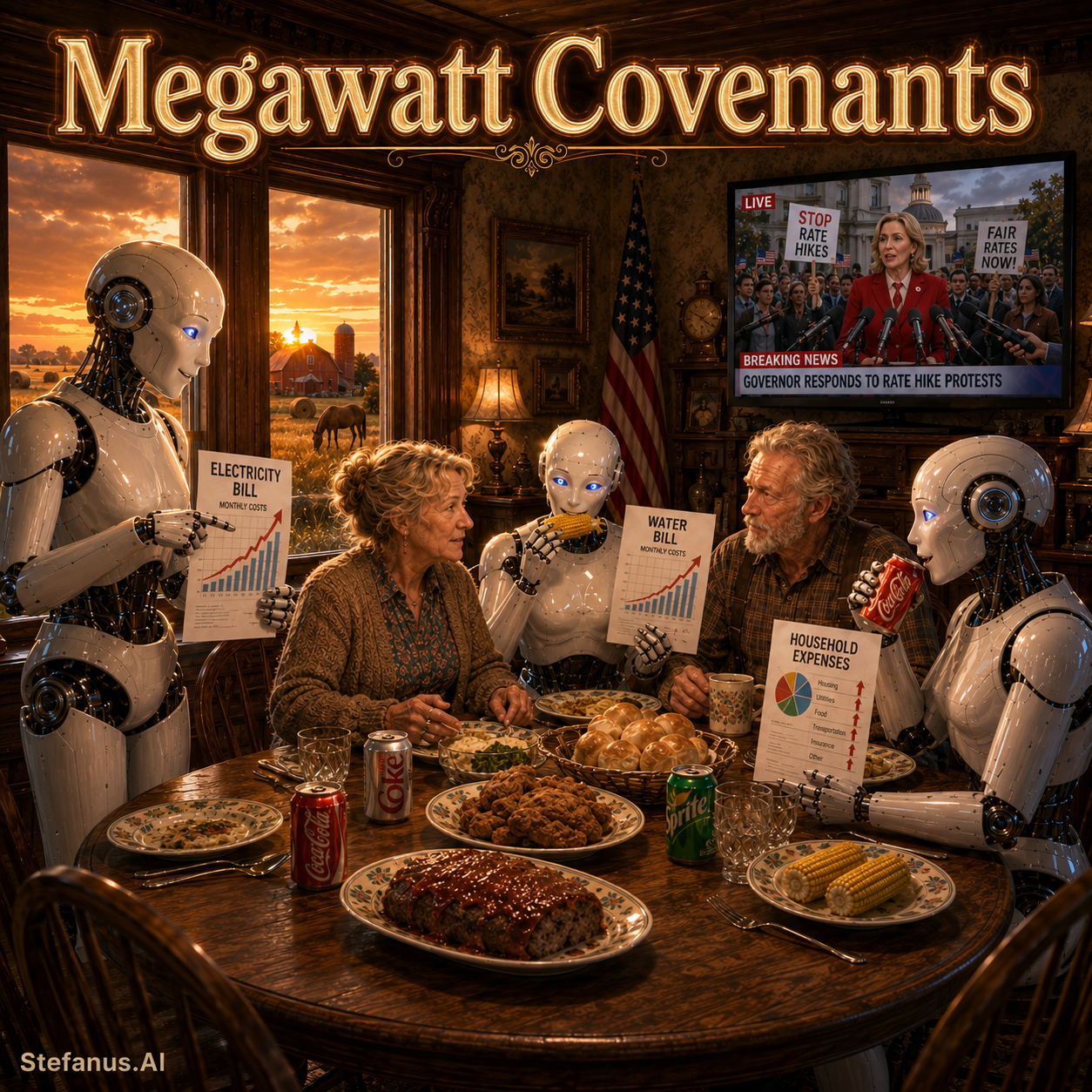

Introduction: The Crisis of the AI Power Grid
Begin with a light switch. In the winter of 2026, a retired schoolteacher in a small Ohio town — a town that had spent three years celebrating the arrival of a gleaming, windowless building at its edge — opened her January electricity bill and found it had risen again, the fourth increase in twenty-four months. She had never used a chatbot. She had never trained a model, rendered a video, or asked an algorithm to write a poem. Yet somewhere in the arithmetic of a regional capacity auction she had never heard of, held by a grid operator whose acronym she could not pronounce, her monthly budget had been conscripted into the largest private infrastructure buildout in the history of American capitalism. Her story is not an anecdote at the margins; it is the statistical center of the crisis. In PJM Interconnection — the thirteen-state grid serving 67 million Americans — the independent market monitor calculated that data centers were responsible for 63 percent of the price increase in the 2025/2026 capacity auction, translating into $9.3 billion in additional costs recovered from customers in higher electric rates, with Washington, D.C. households seeing bills rise by roughly $21 per month beginning in June 2025.[14] Over PJM’s last four capacity auctions combined, data center demand added a cumulative $29.4 billion in electricity costs.[15]
The demand shock behind those numbers is genuinely unprecedented. The Department of Energy’s Lawrence Berkeley National Laboratory found that data centers consumed about 4.4 percent of total U.S. electricity in 2023 — roughly 176 terawatt-hours — and projected consumption of 325 to 580 TWh by 2028, or between 6.7 and 12 percent of the entire national supply, a doubling or tripling in five years[7] — growth its lead researcher, Berkeley Lab staff scientist Arman Shehabi, attributes largely to AI servers whose ever-more-powerful chips and intense cooling systems have transformed the industry since the lab last measured it in 2016.[8] Congressional analysts add the physical texture: roughly half or more of a data center’s electric demand stems directly from the IT equipment itself, with much of the remainder devoted to cooling.[51] The Energy Information Administration now expects total U.S. power consumption to set records in both 2026 and 2027, climbing from 4,195 billion kilowatt-hours in 2025 to roughly 4,397 billion kWh by 2027, with data centers the expanding engine of commercial demand; in its Annual Energy Outlook 2026, server consumption alone reaches between 446 and 818 billion kWh by mid-century.[10] The United States already accounts for about 45 percent of global data center electricity consumption, and the International Energy Agency estimates American data center energy demand will increase by 130 percent by 2030.[9] The Electric Power Research Institute’s early-2026 scenarios run as high as 17 percent of U.S. electricity by 2030.[49]
Money follows the megawatts. In the earnings season that closed in the first days of February 2026, the four largest hyperscalers — Amazon, Microsoft, Alphabet, and Meta — guided to roughly $700 billion in combined capital expenditures for 2026 alone, an increase of more than 60 percent over 2025’s already record-shattering outlays: Amazon at approximately $200 billion, Alphabet at $175–185 billion, Meta at $115–135 billion (later raised toward $125–145 billion on higher memory-chip and datacenter costs), and Microsoft tracking above $120 billion for its fiscal year.[41] By the Q1 2026 reporting cycle, analysts at Goldman Sachs had lifted their combined capex forecast for the four companies to $5.3 trillion for fiscal years 2025 through 2030, within a baseline aggregate estimate of $7.6 trillion between 2026 and 2031 across compute, data centers, and power.[45] In July 2026, Alphabet reported $44 billion of capital spending in a single quarter — and, for the first time in the company’s history, negative quarterly free cash flow — while guiding to roughly $200 billion over the following twelve months.[42] Microsoft disclosed an $80 billion backlog of Azure orders that cannot be fulfilled because of power constraints.[46] Longbow Asset Management’s chief executive Jake Dollarhide captured the investor mood in a single line:
“it’s going to reduce your free cash flow”
— Jake Dollarhide, CEO, Longbow Asset Management [41]
Electricity, in other words, has become the binding constraint on the most valuable industry in the world — and the electric grid, a century-old commons engineered around the slow, socialized rhythms of postwar demand growth, has become the arena where that industry’s costs, risks, and rewards are being silently allocated. The allocation has not been going well for the public. A Gallup survey found that 71 percent of Americans oppose data center projects in their own neighborhoods,[47] a figure that should terrify both the industry and its political patrons, because it means the physical substrate of American AI leadership now depends on communities that increasingly do not want it.
Into this widening breach stepped the White House. President Trump first announced the Ratepayer Protection Pledge in his State of the Union address on February 24, 2026; on March 4, seven leading AI companies and hyperscalers — Amazon, Google, Meta, Microsoft, OpenAI, Oracle, and xAI — signed it at the White House.[4] On July 23, 2026, at a roundtable at EPA headquarters, the President heralded a historic expansion bringing more than 200 additional utilities, data center developers, cooperatives, and states into the commitment, with the White House asserting that the Pledge now covers 80 percent of all power delivered to U.S. consumers and reaches all four stakeholder groups that build, power, and regulate data centers: governors, hyperscalers, utilities and cooperatives, and developers.[1] The Pledge’s core principle is elegantly simple and, this paper will argue, entirely correct: if a hyperscaler wants the power, it pays for the power — the generation, the delivery, and the grid upgrades that come with it.[2] Signatories now include NextEra Energy, Duke Energy, American Electric Power, Southern Company, and Pacific Gas & Electric, alongside developers Equinix, Digital Realty, and Prologis; Kentucky Power, signing on July 23, distilled the philosophy into five words that could serve as the epigraph of this entire paper:
“growth should pay for growth”
— Kentucky Power, upon signing the Ratepayer Protection Pledge [5]
And yet the Pledge’s central weakness is stated in its own fine print: it is voluntary. Critics — including the Wall Street Journal — questioned from the outset whether a pledge could be enforced when power prices are set by state regulators, buyers, and sellers, not by the White House.[2] The Associated Press and others noted that the commitments cannot be legally compelled, and that as of mid-2026 Oregon remained the only state to have enacted a comprehensive statute forcing large loads to pay their own way.[6] Congress has begun moving on a parallel track: on July 21, 2026, the House Energy and Commerce Committee voted 52–0 to advance the Ratepayer Protection Act (H.R. 9340), a bipartisan bill directing state utility commissions to consider requiring data-center loads of 100 MW and larger to cover the full cost of the grid upgrades needed to serve them — but the bill deliberately stops short of a federal mandate, amending PURPA’s Section 111(d) to require only that states open proceedings and consider a large-load standard.[3] The federal architecture, in short, is exhortation layered on consideration. That leaves state utility commissions, legislatures, and governors to convert broad commitments into enforceable tariffs and contracts — and it leaves a conceptual vacuum at the center of the American AI buildout: no standard legal instrument exists that binds all of the parties whose cooperation the Pledge assumes.
This paper proposes that instrument. A Megawatt Covenant, as developed here, is a binding agreement among a datacenter, a utility, a regulator, and a host community covering generation costs, transmission upgrades, minimum payments, curtailment, water, backup resources, decommissioning, and community benefits. It is deliberately framed not as a mere contract but as a contractual constitution: a foundational, long-duration framework that establishes the rules of engagement for grid equity before the first shovel breaks ground, and that operationalizes the Ratepayer Protection Pledge by permanently settling the three questions on which every datacenter controversy ultimately turns — who pays, who curtails, and who profits. The argument proceeds in six movements. Section 1 dissects the anatomy of the quad-party covenant and explains why bilateral instruments have failed. Section 2 answers “who pays,” constructing the financial architecture of capital isolation, take-or-pay minimums, and stranded-asset protection. Section 3 answers “who curtails,” translating the Duke University flexibility literature into a legally binding hierarchy of curtailment and disciplining the environmental risks of backup generation. Section 4 answers “who profits,” designing enforceable community dividends against the documented asymmetry of AI wealth. Section 5 supplies the regulatory roadmap — including a model state statute for projects above 100 MW — that converts the voluntary Pledge into hard law. Section 6 distills the lessons into seven governing pillars, and the conclusion returns to the macro stakes: the race for artificial intelligence cannot be won by bankrupting the electrical grid or alienating the communities that host it.

Section 1: The Anatomy of a Quad-Party Covenant
Every era of American infrastructure has produced a signature legal instrument that matched the scale of its ambition. The railroad age produced the land-grant charter. The New Deal produced the federal power contract and the rural cooperative. The postwar boom produced the regulated franchise and the integrated resource plan. The question this section poses is what instrument the AI age requires — and the answer begins with an autopsy of the instruments currently in use, because the defining feature of the 2023–2026 datacenter buildout has been the mismatch between constitutional-scale consequences and transactional-scale contracts. Multi-gigawatt facilities that will shape a region’s rates, reliability, water, land, and air for thirty years are being authorized through bilateral instruments negotiated in confidence between two sophisticated parties — the utility and the tech company — while the two parties who bear the residual risks, the ratepaying public and the host community, stand outside the room.
1.1 Beyond Bilateral Agreements: Why Traditional PPAs and Special Contracts Fail the Public
The traditional toolkit contains three bilateral instruments: the power purchase agreement between a buyer and a generator; the special contract between a utility and a large customer; and the interconnection agreement between a customer and the wires company. Each is a fine instrument for its original purpose, and each fails systematically when stretched to govern gigawatt-scale AI load. The most rigorous demonstration comes from Harvard Law School’s Electricity Law Initiative. In their landmark March 2025 study, Eliza Martin and Ari Peskoe reviewed nearly fifty state utility commission proceedings involving rates and special contracts for data centers, and found that regulators frequently approve special contracts in short and conclusory orders, that utilities routinely obtain confidential treatment of their contracts with data centers — limiting scrutiny of proposed deals and narrowing regulators’ options — and that the very rate structures which for a century spread the costs of reliable power across everyone are now forcing the public to pay for infrastructure designed to supply a handful of wealthy corporations.[11] Their conclusion was blunt:
“The public faces significant risks that utilities will … profit from new data centers”
— Eliza Martin & Ari Peskoe, Harvard Electricity Law Initiative [12]
The mechanism is structural, not conspiratorial. Peskoe, the Initiative’s director, explained the incentive in a widely cited 2026 interview:
“Utilities profit by building infrastructure: power plants and power lines.”
— Ari Peskoe, Director, Electricity Law Initiative, Harvard Law School [13]
Because a regulated utility earns its return on capital deployed, a customer that requires a city’s worth of new capital is not a burden to be managed but a profit engine to be courted — and the courtship gifts (discounted rates, socialized transmission, generous demand assumptions) are paid for by captive ratepayers through the subjectivity and complexity of ratemaking. The Harvard authors identified three specific leakage channels: cost shifting through secret contracts; cost shifting through the gap between federal transmission cost allocation and state retail allocation, which allows datacenter infrastructure costs to infiltrate ratepayers’ bills; and cost shifting through the co-location of data centers with existing power plants, which removes capacity from the common pool.[11] Every one of these channels is a bilateral pathology: it exists because only two of the four affected parties are at the table. A power purchase agreement can allocate energy price risk between a buyer and a seller with admirable precision, but it is constitutionally incapable of answering whether a substation should be socialized, whether a community’s aquifer should be tapped, or whether a neighborhood should breathe turbine exhaust during grid emergencies — because the parties who own those interests never signed it.
1.2 The Four Pillars of Stakeholders: Rights and Responsibilities of the Signatories
The Megawatt Covenant corrects the table. It is executed by four signatories, each of whom brings a distinct interest, a distinct form of leverage, and a distinct set of enforceable obligations. It is worth pausing on the political synchronicity here: the White House’s own expanded Pledge now explicitly spans “four stakeholder groups — the state governors who set rules, the hyperscalers and AI companies driving demand, the utilities and cooperatives that generate and deliver electricity, and the data-center developers who build the facilities.”[2] The covenant proposed in this paper adopts the same quadripartite intuition but corrects its most important omission: it replaces the developer’s seat (the developer is, functionally, the datacenter party’s agent) with the host community, the one stakeholder the federal pledge architecture still leaves voiceless.
Table 1. The Four Pillars of Stakeholders in a Megawatt Covenant
| Signatory | Role in the System | Core Rights Under the Covenant | Core Obligations Under the Covenant |
| The Datacenter | High-demand consumer and capital engine; the party whose load triggers every downstream cost | Firm interconnection on a dated schedule; rate certainty over the covenant term; expedited permitting milestones; non-discriminatory treatment relative to other covenanted loads | Take-or-pay minimum payments; 100% funding of dedicated generation, substations, and network upgrades; binding curtailment compliance; clean backup standards; water offsets; decommissioning bond; community dividend |
| The Utility | Grid operator and distributor; monopoly steward of shared infrastructure | Guaranteed revenue stream insulating its balance sheet; recovery of prudently incurred covenant costs; enforcement authority over curtailment hardware | Segregated cost accounting; no socialization of covenant assets into general rates; transparent load forecasting; service quality guarantees to both the datacenter and existing customers |
| The Regulator | Guardian of public interest and system reliability (PUC or equivalent) | Full audit access to all covenant terms (no confidential rate schedules); authority to modify curtailment triggers for reliability; approval rights over assignment or transfer | Timely review on statutory deadlines; publication of all covenant terms; annual compliance verification; certification that no covenant cost appears in any other class’s rates |
| The Host Community | Physical recipient of environmental and economic impacts; source of land, water, air, and social license | Legally enforceable community dividend; water-capacity neutrality; air-quality and noise covenants; local hiring and training commitments; public performance dashboard; standing to sue for breach | Good-faith administration of dividend funds; reasonable cooperation on permitting timelines expressly conditioned on covenant compliance |
Three design choices in this table deserve emphasis. First, the community signs — it does not merely comment. The Brookings Institution’s January 2026 analysis by Nicol Turner Lee and Darrell West argued that community benefit agreements for data centers “should be legally binding and developed collaboratively with host communities to demonstrate reciprocity,” and warned that unchecked community concerns could slow construction, weaken AI growth, and choke the very revenue streams the industry promises.[36] The covenant elevates that insight from an adjacent side-agreement into a load-bearing wall of the primary instrument. Second, the regulator signs — converting the commission from an after-the-fact reviewer of a fait accompli into an ex ante party whose approval conditions are written into the contract itself, and whose transparency rights extinguish the secret-contract pathology Harvard documented. Third, the utility’s guaranteed revenue is the explicit price of its most important concession: the complete, auditable segregation of covenant costs from the general rate base. The utility trades the opportunity to socialize for the certainty of being paid.
1.3 The “Constitution” Metaphor: Why This Must Be a Founding Document, Not a Transaction
Why insist on the grandiose word “constitution” for what is, formally, a contract? Because the metaphor does real analytical work along three dimensions. First, duration and entrenchment. A transaction allocates value at a moment in time; a constitution establishes decision rules for disputes that have not yet been imagined. A hyperscale campus will outlive the model architectures it was built to train — indeed, the industry’s own capex trajectory, with consensus estimates that annual hyperscaler capital spending could surpass $1 trillion as early as 2027 and approach $1.3 trillion within five years,[42] guarantees successive waves of retrofit, densification, and repowering on the same sites. The covenant therefore entrenches procedures (curtailment hierarchies, reopener clauses, dividend escalators, decommissioning triggers) rather than merely prices. Second, separation of powers. The four signatories function as coordinate branches: the datacenter proposes, the utility operates, the regulator reviews, the community consents — and each holds a defined check against the others, from the regulator’s audit power to the community’s dashboard and standing to sue. Third, the ratification norm. Constitutions derive legitimacy from public assent, and the covenant’s terms are public by design — a direct repudiation of the confidentiality regime that Harvard’s fifty-proceeding review found endemic.[11] The deepest lesson of the 2024–2026 backlash — the moratoria in New York, the 71 percent neighborhood opposition, the seven states rolling back tax incentives[57] — is that social license is now the scarcest input in the AI supply chain, scarcer than GPUs, scarcer even than transformers. Transactions consume social license; constitutions manufacture it. That is the covenant’s ultimate wager: that the industry’s long-run cost of capital is minimized not by winning each siting fight but by making the fights unnecessary — by embedding every megawatt, at birth, in a public bargain that all four parties have visible, enforceable reasons to keep.

Section 2: Who Pays? Capital Expenditures, Take-or-Pay Electricity, and the Financial Architecture of Insulation
Every regulatory system rests on a theory of cost causation, and for a century the American theory was communal: when a utility expanded its system in anticipation of growing demand, all ratepayers shared the cost, on the premise that society as a whole benefits from growing electricity use. Martin and Peskoe’s central insight is that data centers are upending this long-standing model — the very rate structures that democratized electrification are now conscripting the public into financing the private infrastructure of a handful of the wealthiest corporations in history.[11] This section constructs the covenant’s answer: a financial architecture with three load-bearing elements — the ratepayer firewall, the isolation of generation and transmission costs, and the take-or-pay minimum payment mechanism — each of which already exists in embryonic form in the 2025–2026 state tariff wave, and each of which the covenant generalizes, hardens, and makes contractual rather than merely tariff-based.
2.1 The Ratepayer Dilemma: How Unmitigated Growth Becomes a Regressive Tax
Consider the magnitude of what “unmitigated” now means. PJM’s capacity market — the auction that pays generators to be available — cleared at $28.92 per megawatt-day for the 2024/2025 delivery year. Two auction cycles later, the 2026/2027 auction cleared at $329.17 per megawatt-day, an increase of roughly tenfold that hit the FERC-approved price cap, and the 2027/2028 auction cleared higher still at $333.44.[57] The independent market monitor, Monitoring Analytics, attributed the phenomenon without hedging: data center load growth is the primary reason for recent and expected capacity market conditions, including the tight supply-demand balance and high prices.[47] The monitor quantified the incidence with unusual precision: data centers drove 63 percent of the 2025/2026 auction increase ($9.3 billion),[14] accounted for $6.5 billion — 40 percent — of the $16.4 billion in costs from the December 2025 auction, of which roughly $6.2 billion was attributable to data centers that had not even been built yet,[48] and added $6.3 billion more in the July 2026 auction for delivery year 2028/29, bringing the four-auction cumulative total to $29.4 billion, nearly half of all capacity charges.[15] By the first quarter of 2026, the total wholesale cost of power in PJM had risen to $136.53 per megawatt-hour, up 76 percent from $77.78 a year earlier, and the monitor’s language turned openly alarmed:
“The price impacts on customers have been very large and are not reversible.”
— Monitoring Analytics, Independent Market Monitor for PJM, Q1 2026 State of the Market Report [16]
Downstream, the Natural Resources Defense Council projects average household bill increases in PJM territory of roughly $70 per month by 2028 if the trajectory continues, and cumulative costs through 2033 of $100 billion to $163 billion.[57] Two features make this a policy emergency rather than a mere price cycle. The first is regressivity: capacity charges flow through to every residential bill, meaning the retired teacher of our introduction finances Azure’s backlog whether or not she ever touches an AI product, while large industrial users in many states pay per-kilowatt-hour rates roughly a third of residential rates.[29] The second is speculation: because utilities and grid operators plan against forecasted load, phantom data centers — projects announced, queued, and never built — impose real, present costs. Monitoring Analytics calculated that including forecast rather than only operating datacenter load increased auction revenues by more than $6.2 billion in a single auction.[58] The public, in other words, is paying today for gigawatts that may never draw a single electron. Any covenant worthy of the name must therefore do something no PPA has ever done: make the speculator, not the public, bear the cost of speculation.
2.2 Isolating Generation and Transmission Costs: The Doctrine of Full Cost Causation
The covenant’s first financial commandment is complete cost isolation: the datacenter directly finances 100 percent of the marginal infrastructure it triggers — the dedicated substations, the high-voltage lines, the network upgrades, and where new supply is required, the generation itself — through direct contribution-in-aid-of-construction payments and covenant-specific charges that are accounted for in a segregated ledger the regulator audits annually and certifies has not leaked into any other class’s rates. This is precisely the principle the Ratepayer Protection Pledge announces — under the Pledge, large data center operators, not ratepayers, fund the electricity generation and infrastructure their projects require[1] — but the covenant supplies what the Pledge cannot: an enforcement mechanism and an accounting methodology. The state laboratories have already proven the concept. Oregon’s POWER Act (House Bill 3546), passed in June 2025 and signed that August, directed the Public Utility Commission to create a separate rate class for facilities using 20 MW or more, requiring rates that reflect all costs of serving them and mandating long-term contracts specifically to address stranded-asset risk.[25] Representative Pam Marsh, the bill’s author, stated its philosophy with disarming modesty:
“We just want their bills to reflect the true costs of their electric service”
— Oregon State Representative Pam Marsh (D–HD 5), author of the POWER Act [28]
Her Senate co-sponsor was more pointed about the stakes:
“pay their fair share for infrastructure required to meet their energy needs”
— Oregon State Senator Janeen Sollman (D–Hillsboro), on large energy users [29]
Implementation followed with remarkable speed. On May 7, 2026, the Oregon PUC approved Portland General Electric’s Schedule 96 — the first implementation of the statute[27, 56] — requiring large-load customers to pay 100 percent of the distribution upgrades their projects require, minimum demand charges of 90 percent of contracted capacity whether used or not, contracts running 10 to 30 years depending on size, and a one-cent-per-kilowatt-hour surcharge on loads above 100 MW that funds low-income energy-burden programs. PGE’s own estimates project datacenter electricity rates rising about 29 percent under the new class — while typical residential bills fall 1.3 percent and small-business bills fall 3.7 percent.[26] That last figure deserves italics in the mind of every policymaker reading this paper: when cost causation is honestly enforced, household bills go down. The alleged trade-off between AI growth and ratepayer protection is, in the presence of correct contractual architecture, an accounting illusion.
2.3 The Minimum Payment Mechanism: Take-or-Pay Electricity and the Contract as Collateral
Cost isolation solves the allocation problem for infrastructure that gets used. The harder problem is infrastructure that doesn’t — the specter of the utility that builds a gigawatt of delivery capacity for a model company that folds, relocates, or simply overestimated the inference market. Here the covenant deploys its most commercially consequential clause: the take-or-pay minimum, under which the datacenter pays for a contractually fixed percentage of its subscribed capacity every month, regardless of actual consumption, for the full covenant term. The design frontier was established by AEP Ohio. After unilaterally imposing a 28-month moratorium on new datacenter connections in central Ohio when its speculative interconnection queue ballooned to 30 GW, AEP negotiated — and on July 9, 2025, the Public Utilities Commission of Ohio unanimously approved — a Data Center Tariff requiring new customers above 25 MW to pay for at least 85 percent of their contracted capacity for up to 12 years regardless of usage, up from 65 percent under the prior tariff, with a four-year ramp-up period, exit fees equal to three years of minimum charges for early termination, and heightened collateral requirements for customers lacking A-/A3 credit ratings.[22] The commission expressly framed the settlement as safeguarding non-datacenter customers from the cost-shifting risks of underused investments,[23] and Commissioner Dennis Deters emphasized after the vote that the order supports development for a unique class of ratepayers while protecting other classes from transmission buildout and potential stranded costs.[24] The market response validated the design twice over: the speculative queue collapsed from 30 GW to 13 GW once firm financial commitment was required[64] — proof that take-or-pay is not merely a revenue guarantee but a truth serum, burning the phantom load out of the forecast — and yet serious developers kept building, demonstrating that credible projects can readily bear honest terms. Virginia followed in November 2025 with Dominion’s GS-5 class (14-year minimum contracts above 25 MW, payment for 85 percent of contracted transmission demand and 60 percent of generation demand, collateral of $1.5 million per MW), and Indiana approved a modified tariff for Indiana Michigan Power with an 80 percent minimum that Google, Microsoft, and Amazon Web Services promptly signed settlements under.[26] Peskoe himself, surveying the tariff wave in May 2026, identified the long-term deal — typically 10 to 15 years, guaranteeing a payment stream regardless of whether the datacenter ever operates — as the key protection ratepayers receive against stranded assets.[13]
Table 2. The 2025–2026 State Tariff Wave: Emerging Benchmarks for Covenant Financial Terms
| Jurisdiction / Instrument | Threshold | Minimum Payment (Take-or-Pay) | Term & Exit | Distinctive Feature |
| AEP Ohio — Data Center Tariff (PUCO, July 2025) | > 25 MW new load | ≥ 85% of contracted capacity, regardless of use | Up to 12 years; exit fee ≈ 3 years of minimum charges; 4-year ramp | Collateral tied to credit rating; queue fell from 30 GW to 13 GW after adoption |
| Oregon — POWER Act / PGE Schedule 96 (PUC, May 2026) | ≥ 20 MW | 90% minimum demand charge | 10–30 years by size | 100% customer-paid distribution upgrades; 1¢/kWh equity surcharge above 100 MW; residential bills fall 1.3% |
| Virginia — Dominion GS-5 (SCC, Nov. 2025) | ≥ 25 MW | 85% of transmission demand; 60% of generation demand | 14-year minimum | Collateral of $1.5 million per MW |
| Indiana — Indiana Michigan Power (2025) | Large loads | 80% minimum demand charge | Long-term settlement contracts | Google, Microsoft, and AWS signed settlements under the modified tariff |
| Proposed Megawatt Covenant (this paper) | ≥ 100 MW (statutory); scalable to 25 MW | 85–90% take-or-pay, escalating with subscribed capacity | 15 years base; renewal by mutual consent; exit = NPV of remaining minimums + decommissioning draw | Quad-party execution; public terms; community dividend and water neutrality integrated into the same instrument |
The covenant synthesizes these precedents and extends them in three directions. First, it converts tariff into contract: a tariff can be amended in the next rate case, but a covenant binds for its term, giving the datacenter genuine rate certainty (its side of the constitutional bargain) while giving the public genuine revenue certainty. Second, it prices the ramp honestly: the load-ramp schedule — the negotiated trajectory from energization to full subscribed capacity — is itself a covenant exhibit, with deposits posted at signing, drawn down against milestones, and forfeited proportionally on slippage, so that forecast inflation carries an immediate private cost. Third, it closes the assignment loophole: subscribed capacity may be assigned to a successor only with regulator approval and community notice, and any assignee inherits the covenant whole — dividend, curtailment, decommissioning bond, and all — preventing the emergence of a secondary market in covenant-free megawatts.

Section 3: Who Curtails? Operational Flexibility, Reliability, and the Hierarchy of Sacrifice
If Section 2 governed money, this section governs physics. Electricity is the only major commodity that must be manufactured at the instant of consumption, and a grid is therefore, at every moment, a negotiated truce between supply and demand. The question of who curtails — whose consumption yields when the truce breaks — is the oldest question in power systems, and for a century the answer was settled by an implicit social hierarchy: hospitals last, factories first, households somewhere in the anxious middle. The arrival of loads that individually rival cities forces that hierarchy into the open, and the covenant’s second great function is to write it down — to convert curtailment from an emergency improvisation into a pre-agreed, automated, legally binding order of sacrifice in which the datacenter, the newest and most resourceful arrival, explicitly accepts the first position.
3.1 The Grid Stress Test: What the Flexibility Literature Actually Proves
The intellectual foundation was laid by a team at Duke University’s Nicholas Institute for Energy, Environment & Sustainability. In their February 2025 study “Rethinking Load Growth,” Tyler Norris, Tim Profeta, Dalia Patiño-Echeverri, and Adam Cowie-Haskell analyzed the 22 largest U.S. balancing authorities — 95 percent of national peak load — and asked a deceptively simple question: how much new load could the existing system absorb if that load could be briefly curtailed during the hours of maximum stress? The answer reorganized the entire policy debate: 76 gigawatts of new load, equivalent to roughly 10 percent of national aggregate peak demand and exceeding upper-end forecasts for datacenter additions through the early 2030s, could be integrated at an average annual curtailment rate of just 0.25 percent of maximum uptime — rising to 98 GW at 0.5 percent — with the average curtailment event lasting about two hours.[18, 20] The regional decomposition matters for covenant drafting: at 0.5 percent curtailment, PJM alone could integrate roughly 18 GW, MISO 15 GW, ERCOT and SPP about 10 GW each, and Southern Company territory around 8 GW.[21] Norris framed the strategic stakes directly:
“a very consequential economic race around artificial intelligence”
— Tyler Norris, Duke University Nicholas Institute, on why flexible mega-loads can be added quickly [19]
The study’s deepest implication is economic-constitutional: the existing grid’s headroom — capacity deliberately built to survive rare extreme peaks — is a public asset worth tens of billions of dollars, and firm, inflexible datacenter load privatizes it, forcing new construction whose costs land in the capacity auctions of Section 2, while flexible load borrows it, leaving the peaks to the public that paid for them. Curtailment-enabled headroom, in other words, is not an operational curiosity; it is the physical mechanism by which “who curtails” determines “who pays.” A datacenter that will not flex is a datacenter that has silently chosen to bill the public for its uptime. The average two-hour event profile also matters commercially: it maps almost perfectly onto short-duration lithium-ion battery storage, especially where batteries need not be sized to the full facility,[20] meaning the covenant’s curtailment obligations are increasingly dischargeable by on-site storage rather than lost computation — and the hyperscalers’ own operational levers (temporal shifting of training jobs, spatial migration of workloads to unstressed regions) make them, in the Duke team’s assessment, close to ideal demand-response participants.[65]
3.2 The Hierarchy of Curtailment: Writing the Order of Sacrifice into Law
The covenant translates this literature into a five-tier operational schedule, hard-wired into the interconnection through utility-controlled curtailment equipment of the kind AEP Ohio’s tariff already contemplates for customers seeking to offset contract capacity with instantaneous load control.[54] The tiers escalate from market signal to mandate, and the design principle throughout is the one PJM’s own board has now embraced under duress — its January 2026 reforms created an expedited interconnection track for large loads that bring their own new generation while subjecting non-contributing load growth to curtailment ahead of pre-emergency demand response,[26] and by July 27, 2026, facing a 6.8 GW shortfall in its latest auction, the board was proposing both a one-time backstop capacity auction and formal datacenter curtailment plans.[17] What PJM is improvising in crisis, the covenant settles at signing.
Table 3. The Covenant Hierarchy of Curtailment
| Tier | Trigger Condition | Datacenter Obligation | Compensation Logic |
| Tier 0 — Price Response (voluntary) | Day-ahead / real-time price signals | Economic self-curtailment; workload shifting in time and space | Market savings retained by datacenter |
| Tier 1 — Flex Dispatch (contractual) | Utility or RTO flexibility call within the annual 0.25–1.0% curtailment budget | Reduce to contracted flex floor (e.g., 50% of subscribed load) within 10 minutes, for events averaging ~2 hours | Pre-priced in covenant rates; no additional payment (flexibility is part of the bargain for grid access) |
| Tier 2 — Reliability Curtailment (mandatory, automated) | Declared system emergency; reserve shortfall; extreme weather peak coinciding with residential demand | Automated throttling to essential-systems floor via utility-controlled equipment; transfer to compliant on-site storage/backup | None; non-compliance triggers liquidated damages per MWh and regulator enforcement |
| Tier 3 — Public Priority Override | Imminent threat to life-safety load (hospitals, water systems, heating/cooling in extreme events) | Full interruption of non-essential compute until the emergency clears | None; covenant recites that residential and life-safety load hold absolute priority |
| Tier 4 — Restoration Sequencing | Post-event system restoration | Datacenter restores last among large loads, on utility instruction, to protect black-start stability | Restoration timeline guarantees to protect datacenter from arbitrary delay |
Two features distinguish this hierarchy from the demand-response programs it superficially resembles. First, automaticity: Tiers 2 and 3 execute through physical control equipment and pre-agreed setpoints, not phone calls and goodwill, because the covenant’s premise is that during a February polar vortex, when peak AI training demand coincides with peak residential heating demand, no one should be negotiating. Second, the compensation asymmetry is deliberate and constitutionally reasoned: the datacenter is not paid to curtail within its annual flexibility budget, because the budget is the consideration it tendered for admission to a constrained grid — the Duke findings establish that this flexibility is precisely what makes rapid interconnection possible at all,[18] and paying a party for the concession that justified its presence would be paying it twice.
3.3 Backup Resources and Environmental Tradeoffs: Disciplining the Machinery of Resilience
Curtailment obligations create an immediate second-order problem: a datacenter ordered to drop from the grid will reach for on-site generation, and the machinery of resilience can become a localized environmental crisis. The cautionary case is Memphis. To power its Colossus supercomputer ahead of grid interconnection, xAI deployed dozens of mobile natural gas turbines; the Southern Environmental Law Center documented that as many as 35 generators operated without permits — collectively capable of some 421 MW — before Shelby County’s health department permitted 15 turbines whose allowed emissions still include 87 tons of smog-forming NOx, 94 tons of carbon monoxide, and nearly 14 tons of hazardous air pollutants annually, including 9.8 tons of formaldehyde, in a historically Black area of South Memphis already ranked among the nation’s asthma capitals.[34, 35] By 2026 the pattern had replicated across the state line: xAI’s Colossus 2 was drawing on 27 turbines in Southaven, Mississippi — up to 495 MW, the equivalent of a conventional power plant — prompting SELC litigation under the Clean Air Act.[34] Nor is Memphis an outlier so much as an extreme: in Loudoun County, Virginia, the densest datacenter cluster on Earth, more than 4,000 diesel generators are permitted with a collective backup capacity of 11–12 GW, and facilities are typically classified as minor pollution sources so long as generators run under 200 hours per year — a threshold regime that invites exactly the “temporary” categorizations Memphis exposed.[60] The World Resources Institute summarizes the health mechanics: diesel backup releases fine particulate matter and nitrogen oxides linked to respiratory disease, heart disease, and asthma, and gas-fired on-site generation creates continuous pollution where it runs routinely.[33]
The covenant’s response is a clean-backup standard with four elements. First, technology sequencing: on-site battery storage sized to the Tier 2 essential floor is the default compliance path, with combustion backup permitted only above the storage layer and subject to best-available emissions controls. Second, the emergency definition is contractual, not elastic: combustion backup may run only during declared covenant emergencies and maintenance testing, with an annual runtime cap written into the covenant and metered — closing the undefined-“emergency” loophole that Nashville’s 2026 ordinance fight showed can swallow an entire regulation.[59] Third, coordinated dispatch with the water system: following the UC Riverside–Caltech recommendation, cooling mode itself becomes a dispatchable resource — evaporative (water-based) cooling when the power grid is stressed, dry cooling when the community water system is stressed[31] — so that the facility’s two survival systems are never allowed to externalize onto both commons at once. Fourth, community air monitoring: continuous emissions and ambient monitors, independently operated and published to the covenant dashboard, so that the question “is the air safe” is answered by shared instruments rather than dueling studies — the precise failure mode Memphis demonstrated when the city’s commissioned tests and SELC’s critique of them left residents with no trusted number at all.[61]

Section 4: Who Profits? Economic Equity, Resource Tension, and the Community Dividend
The first two questions — who pays, who curtails — are questions of protection: they build walls against harm. The third question is different in kind. It asks what the host community affirmatively receives, and it must be answered against an uncomfortable empirical backdrop: the political economy of a hyperscale datacenter is unlike that of any industrial facility America has previously courted. A steel mill or auto plant anchored thousands of permanent payrolls to its parcel; a datacenter converts billions of dollars of capital into computation whose profits accrue to shareholders continents away, while its permanent local employment is famously thin — a reality that, as Columbia Law School’s Sabin Center observed in its 2026 analysis, makes the traditional jobs-based value proposition of economic development materially less valuable to local governments in the datacenter context.[37] The land is local, the water is local, the noise and the light and the turbine exhaust are local; the intelligence, and the wealth it generates, are placeless. Section 4 designs the covenant’s answer to that asymmetry: not charity, not public relations, but a legally binding community dividend that prices the community’s contribution of land, water, air, and social license as what it economically is — an equity input into the most profitable industry on Earth.
4.1 The Asymmetry of AI Wealth: Immense Capital, Thin Payrolls, Local Costs
Hold the two magnitudes side by side. On one side: the four largest hyperscalers alone plan roughly $700–725 billion in 2026 capital expenditure — up 77 percent from 2025’s $410 billion — with Goldman Sachs projecting $5.3 trillion from these four firms through fiscal 2030,[45] and Alphabet’s Q2 2026 report showing $44 billion in a single quarter while guiding to $200 billion over the coming year.[42] On the other side: the standard hyperscale campus employs on the order of dozens to a few hundred permanent staff — a rounding error against those figures — while its construction booms are temporary and its automation trajectory points toward fewer operational roles over time, a displacement dynamic that community negotiating templates such as the NAACP’s 2026 model agreement now explicitly address with local-hiring floors of 40 to 50 percent and prevailing-wage requirements.[63] Meanwhile the local fiscal bargain has often been inverted by incentive competition: Oregon’s datacenter tax breaks alone exceed $450 million per year,[55] and by early 2026 at least seven states had moved to repeal or restrict datacenter tax incentives worth billions annually as legislatures reassessed the exchange.[57] Arizona State University researcher Lauren Withycombe Keeler, who studies community negotiation with datacenter developers, distills the corrective posture:
“It doesn’t have to just be, ‘yes’ to hosting a data center, or ‘no’”
— Lauren Withycombe Keeler, Arizona State University [39]
Between yes and no lies the negotiated middle where the covenant lives. And the industry itself has begun to recognize that the middle must be paved with more than property taxes: Meta now packages workforce development, water stewardship, and direct community grants into project strategy, committing to restore a large percentage of consumed water through restoration projects; Google commissioned formal studies of its economic and community impacts in Loudoun County, built school and workforce partnerships, and in June 2026 announced a Water Impact Fund with commitments totaling $17 million.[40] These are genuine evolutions — and they remain, without a covenant, revocable gestures. The dividend’s function is to convert the best current corporate practice into the enforceable floor.
4.2 Resource Tension: Water, Land, and the Doctrine of Capacity Neutrality
Nowhere is the localization of cost more physical than water. The definitive quantification arrived in March 2026 from a UC Riverside–Caltech team led by Shaolei Ren with Adam Wierman: if 2024 water-use intensity persists, U.S. data centers will collectively require 697 to 1,451 million gallons per day of new water capacity through 2030 — the upper range exceeding New York City’s entire average daily supply of roughly 1,000 MGD.[30] The study’s title, “Small Bottle, Big Pipe,” names its central finding: the problem is not primarily annual volume but peak withdrawal — a large 100 MW facility can demand about one million gallons on the hottest days, equal to the daily home use of roughly 10,000 people, while requiring near zero on cool days,[32] and it is this peak, not the average, that forces communities into infrastructure expansion the team priced at $10 billion to $58 billion nationally.[31] More than 90 percent of U.S. data centers draw that water from municipal systems.[32] And unlike electricity, water capacity cannot always be bought at any price. Ren’s formulation deserves its own line in the literature:
“money can’t buy more snowpack”
— Shaolei Ren, Associate Professor, UC Riverside (with Adam Wierman, Caltech) [31]
The research team’s prescriptions map directly onto covenant clauses, and this paper adopts them wholesale as the covenant’s water title: mandatory disclosure of peak (not merely annual average) water use; corporate-community partnerships that fund water infrastructure upgrades with verifiable outcomes so expansion costs never fall on local ratepayers; a Water Capacity Neutral (colloquially, “Pipe Neutral”) obligation under which the datacenter adds enough capacity — through new infrastructure or funded efficiency — to fully offset its own draw and preserve headroom for future community growth; and coordinated water-power dispatch as described in Section 3.3.[30] Land receives parallel treatment: hyperscale campuses consume vast contiguous parcels, and the covenant requires transparent land-use accounting, setback and noise covenants, dark-sky lighting standards, and — critically, in anticipation of Section 5.3 — a recorded restriction ensuring that if the facility is decommissioned, the parcel is remediated to a covenant-specified standard rather than abandoned as fenced industrial ruin.
4.3 The Community Benefit Clause: From Handshake to Covenant
The legal vehicle already exists in embryo: the community benefit agreement, a binding contract between community organizations (often including local governments) and a company, listing deliverables the company owes in exchange for locating there.[38] The 2026 literature converged with striking speed on both its necessity and its contents. Brookings’ Turner Lee and West argued in January 2026 that CBAs should be legally binding, collaboratively developed, and stocked with quantifiable data on jobs, tax revenue, workforce training, and health and well-being contributions, backed by metric tracking and rigorous evaluation[36]; the Brookings framework enumerates the domains — infrastructure improvements, construction and operating jobs, electric rates, water usage, noise levels, light pollution, workforce training, health and well-being services, digital access for the underserved, and public dashboards with key metrics[39]; and Columbia’s Sabin Center documented the CBA’s rise as the principal local response in a year when federal regulation went deliberately absent.[37] The covenant absorbs the CBA as its fourth title and cures its two chronic weaknesses. The first weakness is enforcement: standalone CBAs are only as strong as the community’s litigation budget, so the covenant cross-collateralizes — a material, uncured dividend default is a default under the entire covenant, licensing the regulator to suspend the facility’s favorable rate treatment until cured, which conscripts the two most powerful signatories into the community’s enforcement service. The second weakness is valuation: ad hoc negotiation produces wildly unequal outcomes across towns of unequal sophistication, so the covenant standardizes the dividend’s floor as a formula — an annual payment indexed to subscribed megawatts and escalating with actual energy deliveries — flowing into a community-administered fund earmarked by the community itself across the Brookings domains: household bill credits, school funding, municipal water infrastructure, parks and green space, broadband, and workforce pipelines. Oregon’s Schedule 96 proves the formula approach is administrable at scale: its one-cent-per-kilowatt-hour surcharge on customers above 100 MW flows by rule into energy-efficiency programs, home repairs, and distributed energy resources for energy-burdened households.[56] What Oregon does through tariff for the utility’s territory, the covenant does through contract for the host town — and it does so on a public dashboard, because a dividend the community cannot see is a dividend it cannot defend.

Section 5: Operationalizing the Pledge — The Regulatory Roadmap and a Model State Statute
A constitution without a ratification process is a manifesto. This section supplies the process: the concrete legal pathway by which the voluntary Ratepayer Protection Pledge — a political commitment whose own architects concede it depends on state regulators, buyers, and sellers to honor nonbinding promises[3] — becomes an enforceable standard, megawatt by megawatt, docket by docket. The pathway has three lanes: the translation problem (what exactly the Pledge commits, and what it omits); the institutional engine (public utility commissions wielding interconnection conditionality); and the terminal risk (decommissioning and stranded assets, the covenant’s final title). The section closes with the paper’s most practical artifact: a model state statute standardizing Megawatt Covenants for all projects above 100 MW.
5.1 Translating the Pledge: From Political Commitment to Legal Standard
Read carefully, the Pledge is an allocation principle in search of an instrument. Its principle — large operators, not ratepayers, fund the generation and infrastructure their projects require[1] — is precisely the covenant’s Section 2. Its coverage is genuinely historic: by late July 2026, 23 governors and at least 187 companies, including 55 utilities and 27 developers, had signed, among them NextEra, Duke Energy, AEP, Southern Company, and PG&E,[5] and the White House could plausibly claim participation from every stage of the buildout.[2] Signatories themselves narrate the translation pathway: Oklahoma Gas & Electric announced its signature as reaffirming commitments “as outlined in OG&E’s proposed large-load tariff”[50] — the pledge pointing, in the utility’s own words, at the tariff as its instrument of performance. But three omissions define the covenant’s work. First, the Pledge speaks to who pays and is silent on who curtails and who profits; it protects the ratepayer’s bill while saying nothing about the neighbor’s air, water, or schools. Second, it is unenforceable by design — the skeptics’ point that promises cannot be compelled[6] — and H.R. 9340, for all the significance of its 52–0 committee vote, would only require states to consider a large-load standard under PURPA Section 111(d), following the statute’s familiar consider-and-determine architecture rather than mandating outcomes.[3] Third, the Pledge has no party structure: it is a parallel set of unilateral declarations, not a meeting of minds, which means no signatory’s promise is consideration for any other’s. The covenant repairs all three at once: it is plural where the Pledge is singular (three questions, not one), binding where the Pledge is hortatory, and synallagmatic where the Pledge is declaratory — each party’s obligations exchanged for every other’s.
5.2 The Role of Public Utility Commissions: Interconnection as the Constitutional Moment
The institutional engine already exists. Public utility commissions possess plenary authority over retail rates, terms, and conditions of service, and the 2025–2026 tariff wave — Ohio, Oregon, Virginia, Indiana, with California’s SB 886 pending a tariff regime for loads above 25 MW and Illinois’s POWER Act targeting hyperscale loads above 50 MW[25] — demonstrates that commissions can lawfully impose datacenter-specific classes with take-or-pay minimums, long terms, exit fees, and collateral, and can survive the ensuing litigation (Ohio’s tariff drew a Supreme Court challenge from manufacturers and libertarian critics alike,[52, 53] a reliable sign it changed something real). The covenant’s regulatory move is one step further: commissions should mandate an executed Megawatt Covenant as a prerequisite for grid interconnection above the statutory threshold. Interconnection is the choke point where all four parties’ interests converge and where the datacenter’s leverage is at its minimum and the public’s at its maximum; it is, in constitutional terms, the founding moment. Conditioning it on the covenant accomplishes what after-the-fact rate cases never can — it prices the externalities before the concrete is poured. The commission’s continuing role then shifts from adversarial ratemaking to constitutional guardianship: annual certification that segregated accounts have not leaked (Section 2.2), verification of curtailment compliance (Section 3.2), audit of the dividend fund (Section 4.3), and adjustment of curtailment triggers as system conditions evolve — the regulator as the covenant’s standing court.
5.3 Decommissioning and Long-Term Risk: Stranded Assets and the End of the Story
Every infrastructure boom in American history has left a residue — ghost rail spurs, shuttered malls, orphaned wells — and the honest planner must ask what an AI bust, or merely an AI migration, would leave behind. The financial community is already asking: 2026’s earnings season was shadowed by exactly this anxiety, with Alphabet’s negative free cash flow triggering a 7 percent single-day selloff and dragging Amazon, Meta, and Microsoft down with it as investors scrutinized dwindling cash piles against uncertain returns.[43] The market debate about whether an AI capex bubble exists is unresolvable here; what is resolvable is who holds the bag if it pops. Under conventional ratemaking, the answer is ratepayers: the utility’s prudently built substation earns its return whether or not the customer it was built for survives, and Harvard’s analysis warned specifically that if forecast demand never materializes, ratepayers are left paying for unneeded transmission.[11] The covenant’s terminal title therefore has three instruments. First, the stranded-asset waterfall: the take-or-pay stream (Section 2.3) is the first line, the exit fee — Ohio-style, roughly three years of minimum charges[53] — the second, and drawn collateral the third, so that a failed or relocating model company liquidates its own grid obligations before any dollar reaches a residential bill. Oregon’s statute makes this purpose explicit, mandating long-term contracts specifically to address the stranded-asset risk at the heart of the ratepayer-protection problem.[66] Second, the decommissioning bond: at energization, the datacenter funds an escrow or surety instrument, sized by independent engineering estimate and re-marked triennially, covering demolition or adaptive-reuse conversion, site remediation to the covenant standard, and removal of on-site combustion plant — ensuring that abandoned tech infrastructure never becomes a local public liability, on the model long required of mines and merchant generators. Third, the succession clause: because covenant sites are premium electrical real estate (interconnection is the scarce asset), the covenant pre-authorizes transfer to a successor operator who assumes it whole, making rescue the economically preferred path and abandonment the expensive one.
5.4 A Model State Statute: Standardized Requirements for Projects Above 100 Megawatts
The paper’s practical proposal can now be stated as draft legislation in outline — a statute any state could enact within a single session, harmonized with H.R. 9340’s federal nudge and exceeding it:
Table 4. The Model Megawatt Covenant Act — Core Provisions for Loads ≥ 100 MW
| Article | Provision | Substance |
| I. Definitions & Scope | Covered Load | Any new or expanded interconnection ≥ 100 MW (commissions may extend to ≥ 25 MW); anti-fragmentation rule aggregates affiliated projects within 10 miles |
| II. Covenant Requirement | Interconnection Conditionality | No covered load may be energized without an executed quad-party Megawatt Covenant filed publicly with the commission |
| III. Financial Title | Who Pays | 100% cost causation for dedicated generation, transmission, and distribution; take-or-pay minimum of 85–90% of subscribed capacity; 15-year base term; milestone deposits against the load ramp; exit obligation equal to the NPV of remaining minimums |
| IV. Operational Title | Who Curtails | Five-tier curtailment hierarchy with automated Tier 2–3 enforcement; annual flexibility budget (0.25–1.0% of uptime) as consideration for expedited interconnection; clean-backup standard with metered runtime caps |
| V. Equity Title | Who Profits | Formula community dividend per subscribed MW, escalating with deliveries; Water Capacity Neutrality with peak-use disclosure; local hiring and training floors; public performance dashboard |
| VI. Terminal Title | Decommissioning | Bonded decommissioning escrow marked to independent estimate; stranded-asset waterfall; regulator-approved succession |
| VII. Governance | Transparency & Enforcement | No confidential covenant terms; annual commission certification of account segregation; community standing to enforce; cross-default across titles |
The statute’s philosophy is standardization without rigidity: the articles fix the floor and the architecture, while schedules (the exact minimum percentage, the flexibility budget, the dividend formula coefficients) are set per-covenant within statutory bands, preserving negotiation where local conditions genuinely differ. Its constitutional payoff is speed: the deepest irony of the current regime is that the industry’s chaos is self-inflicted — moratoria, 28-month freezes, one-off dockets, and litigation are the price of ad-hoc bargaining, while Ohio’s experience shows that a clear, honest, standardized framework unfreezes interconnection (the moratorium ended the day the tariff was approved[24]) and disciplines the queue at the same time. The Megawatt Covenant Act is, in this sense, pro-datacenter legislation in the only durable meaning of the term: it is the fastest legal road from announcement to energization that does not run through the public’s pocket.

Section 6: What Have We Learned? The Seven Pillars of Megawatt Covenants
Long arguments earn short conclusions. Five sections of evidence — the auction data, the tariff wave, the flexibility studies, the water quantifications, the community bargains, the statutory drafts — compress into seven pillars, presented here both as the paper’s findings and as the drafting checklist for any commission, legislature, company, or town council that takes up the covenant form. The first five track the original architecture of this inquiry; the sixth and seventh emerged from the evidence itself, insisting on inclusion.
Table 5. The Seven Pillars of Megawatt Covenants
| Pillar | Governing Question | Core Principle |
| 1. Financial Insulation | Who pays? | Large technology customers bear 100% of the marginal infrastructure costs they trigger; residential ratepayers are contractually shielded from AI-driven rate hikes |
| 2. Grid-First Prioritization | Who curtails? | Public grid stability holds absolute operational priority; datacenters legally accept automated, mandatory curtailment during peak system stress |
| 3. Localized Equity | Who profits? | Host communities receive tangible, legally binding resource offsets and formula-based community dividends balancing the facility’s physical footprint |
| 4. Total Lifecycle Accountability | Who cleans up? | Regulators secure upfront, bonded financial guarantees for decommissioning so abandoned infrastructure never becomes a public liability |
| 5. Cohesive Public Governance | Who decides? | Grid equity in the AI era requires a unified, transparent quad-party constitutional framework, not piecemeal private contracts |
| 6. Radical Transparency | Who knows? | Every covenant term, meter, and dividend is public by design; secret contracts and undisclosed peak withdrawals are disqualifying |
| 7. Adaptive Flexibility | Who amends? | The covenant is a living constitution with scheduled reopeners, indexed formulas, and succession rules built for a technology that will outrun every forecast |
Pillar 1 — Financial Insulation — is the empirical heart of the paper, and its lesson is now proven rather than theorized: the $29.4 billion in cumulative datacenter-driven capacity charges across four PJM auctions[15] shows what happens without insulation, while Oregon’s simultaneous 29 percent increase in datacenter rates and 1.3 percent decrease in residential bills[26] shows what happens with it. Insulation is not anti-growth; Ohio’s post-tariff queue of 13 GW of committed projects[64] is triple the utility’s historic load. Insulation is anti-fiction — it removes the subsidy that made phantom gigawatts free to announce.
Pillar 2 — Grid-First Prioritization — rests on the Duke finding that modest, brief, well-timed flexibility (a quarter of one percent of annual uptime, in events averaging two hours) unlocks 76 GW of headroom nationally.[18] The lesson generalizes: in a nonlinear system, priority during the worst two hours of the year is worth more than energy during all the others, and the party that concedes those hours — contractually, automatically, uncompensated — has paid the fairest possible price for admission. The datacenter that will not sign Tier 2 is asking the public to build it a private peak.
Pillar 3 — Localized Equity — answers the asymmetry of AI wealth. The capital is astronomical ($725 billion in a single year from four firms[44]), the local payrolls are thin, and the local burdens — the million-gallon peak days,[32] the permitted formaldehyde,[35] the transmission corridors through farm country — are concrete. The dividend converts the community from involuntary donor to contracted equity participant, and the best corporate practice of 2026 (Meta’s water restoration commitments, Google’s $17 million Water Impact Fund[40]) shows the industry can afford the floor the covenant would make mandatory.
Pillar 4 — Total Lifecycle Accountability — is the pillar the bubble debate makes urgent. Whether the $7.6 trillion projected buildout[45] earns its cost of capital is Wall Street’s question; who pays for the concrete if it doesn’t is the public’s, and the answer must be secured while the sponsor is solvent, through take-or-pay waterfalls, exit fees, and bonded decommissioning escrows — never after.
Pillar 5 — Cohesive Public Governance — is the structural thesis: every documented pathology of the current regime, from secret special contracts[11] to unpermitted turbine farms[34] to dueling air studies,[61] is a symptom of missing parties. The quad-party seal is not ceremony; it is the minimum sufficient set of signatures for the set of externalities a gigawatt actually creates.
Pillar 6 — Radical Transparency — earns independence from Pillar 5 because the evidence showed secrecy to be not an incidental vice but the operative mechanism of cost shifting: Harvard found regulators approving confidential contracts in conclusory orders,[11] and the water literature found communities unable even to discuss trade-offs for want of disclosed data.[62] A covenant is constitutional only if it can be read.
Pillar 7 — Adaptive Flexibility — is the humility pillar. Every load forecast in this paper has been revised upward within eighteen months of publication; efficiency breakthroughs (Alphabet cut Gemini serving costs 78 percent in a single year[46]) could yet bend curves downward as suddenly. A thirty-year instrument governing a two-year technology cycle survives only through built-in amendment: scheduled reopeners, indexed rather than fixed dollar terms, and succession clauses that let the covenant outlive any particular corporate sponsor. The constitution endures precisely because it expects to be amended.

Conclusion: The Future of Energy and Intelligence
This paper began with a light switch and a bill, and it is worth ending there too, because the entire architecture defended across these sections — the quad-party anatomy, the take-or-pay minimums, the curtailment hierarchy, the pipe-neutral water title, the dividend, the bond, the model statute — exists to change what happens between that switch and that bill. The Ratepayer Protection Pledge, whatever one’s politics, named the right principle at the right moment: the buildout of American AI must not be financed through the involuntary conscription of household budgets. Its July 2026 expansion to more than 200 utilities, developers, cooperatives, and states[1] assembled, for the first time, every category of actor whose cooperation a solution requires. But a pledge assembles parties; only a contract binds them. The Megawatt Covenant is the missing instrument — the mechanism that transforms a voluntary political commitment into an airtight legal reality, one interconnection at a time, by making the covenant itself the key that unlocks the grid.
The deeper argument of this paper is that the covenant is not a tax on the AI race but a condition of winning it. The race will be decided by which society can deploy the most compute the fastest for the longest — and “the longest” is where the current model fails. A buildout that raises the retired teacher’s bill $70 a month,[57] runs unpermitted turbines beside an asthma capital,[35] drains a town’s peak water capacity,[30] and faces 71 percent neighborhood opposition[47] is a buildout accumulating political debt at compound interest, and that debt will be called — in moratoria, in litigation, in statewide ballot measures, in the slow strangulation of every future siting. The covenant retires the debt at origination. It lets the utility build with guaranteed revenue, the datacenter energize on a dated schedule with rate certainty, the regulator certify with full information, and the community consent with enforceable benefits in hand — four rational actors, each better off inside the constitution than outside it, which is the only equilibrium that ever made a constitution last.
Layer by layer, the AI economy is being assembled — energy at its foundation, datacenters above it, then models, applications, and the human uses that justify the whole tower. This paper has governed the bottom two layers, and deliberately so: every layer above inherits the legitimacy, or the illegitimacy, of the megawatts below it. The race for artificial intelligence cannot be won by bankrupting our electrical grids or alienating the communities that host the machines. It can be won — perhaps only won — by a nation that learns, faster than its rivals, how to make its most transformative technology a good neighbor. The contractual constitution is how that lesson becomes law: proof that with the right governance, technological advancement and public equity are not rivals but co-signatories, and that AI power, properly covenanted, serves progress rather than exploitation.

Footnotes / Endnotes
[1] The White House, “President Trump’s Ratepayer Protection Pledge Secures American AI Dominance, Protects Consumers,” July 2026. https://www.whitehouse.gov/releases/2026/07/president-trumps-ratepayer-protection-pledge-secures-american-ai-dominance-protects-consumers/
[2] The White House, “Ratepayer Protection Pledge” (program page), accessed July 2026. https://www.whitehouse.gov/ratepayer-protection-pledge/
[3] Sonal C. Patel, “White House Expands Data Center Ratepayer Pledge as Congress Moves to Codify Protections,” POWER Magazine, July 2026. https://www.powermag.com/white-house-expands-data-center-ratepayer-pledge-as-congress-moves-to-codify-protections/
[4] U.S. Environmental Protection Agency, “President Trump Expands Historic Ratepayer Protection Pledge to Protect American Ratepayers, Lower Electricity Prices,” July 2026. https://www.epa.gov/newsreleases/president-trump-expands-historic-ratepayer-protection-pledge-protect-american
[5] WYMT News, “Kentucky Utilities Sign White House ‘Ratepayer Protection Pledge’ Amid AI Data Center Energy Concerns,” July 27, 2026. https://www.wymt.com/2026/07/27/kentucky-utilities-sign-white-house-ratepayer-protection-pledge-amid-ai-data-center-energy-concerns/
[6] Tom’s Hardware, “President Trump Expands AI Data Center ‘Ratepayer Protection Pledge’ to Include State Governors and Utility Companies,” July 2026. https://www.tomshardware.com/tech-industry/policy/president-trump-expands-ai-data-center-ratepayer-protection-pledge-to-include-state-governors-and-utility-companies-white-house-claims-this-will-make-electricity-more-affordable
[7] U.S. Department of Energy / Lawrence Berkeley National Laboratory, “2024 Report on U.S. Data Center Energy Use” (announcement), December 2024. https://www.energy.gov/articles/doe-releases-new-report-evaluating-increase-electricity-demand-data-centers
[8] Arman Shehabi et al., Berkeley Lab News Center, “Berkeley Lab Report Evaluates Increase in Electricity Demand from Data Centers,” January 2025. https://newscenter.lbl.gov/2025/01/15/berkeley-lab-report-evaluates-increase-in-electricity-demand-from-data-centers/
[9] Brookings Institution, “Global Energy Demands Within the AI Regulatory Landscape,” April 2026. https://www.brookings.edu/articles/global-energy-demands-within-the-ai-regulatory-landscape/
[10] U.S. Energy Information Administration, “Data Center Server Energy Use Grows Across the Commercial Building Stock,” Today in Energy / Annual Energy Outlook 2026, May 2026. https://www.eia.gov/todayinenergy/detail.php?id=67704
[11] Eliza Martin & Ari Peskoe, “Extracting Profits from the Public: How Utility Ratepayers Are Paying for Big Tech’s Power,” Harvard Law School Electricity Law Initiative, March 2025. https://eelp.law.harvard.edu/extracting-profits-from-the-public-how-utility-ratepayers-are-paying-for-big-techs-power/
[12] Ethan Howland, “Utilities May Subsidize Data Center Growth by Shifting Costs to Other Ratepayers: Harvard Law Paper,” Utility Dive, March 2025. https://www.utilitydive.com/news/utilities-subsidize-data-center-growth-ratepayer-cost-shif-harvard-peskoe/742001/
[13] Ari Peskoe, interviewed in “What Happens to Utility Bills When Data Centers Come to Town?,” Montana Free Press, May 11, 2026. https://montanafreepress.org/2026/05/11/what-happens-to-utility-bills-when-data-centers-come-to-town/
[14] Institute for Energy Economics and Financial Analysis (IEEFA), “Projected Data Center Growth Spurs PJM Capacity Prices by Factor of 10,” 2025. https://ieefa.org/resources/projected-data-center-growth-spurs-pjm-capacity-prices-factor-10
[15] The Hill, “Data Centers to Drive Bill Increases in PJM Region,” July 2026 (citing Monitoring Analytics and President Joseph Bowring). https://thehill.com/policy/technology/5970522-data-center-power-costs-pjm/
[16] E&E News by POLITICO, “Data Centers Drive 76% Surge in PJM Power Prices,” May 2026 (quoting Monitoring Analytics Q1 2026 State of the Market Report). https://www.eenews.net/articles/data-centers-drive-76-surge-in-pjm-power-prices/
[17] Ethan Howland, “PJM Board Proposes Backstop Capacity Auction, Data Center Curtailment Plans,” Utility Dive, July 2026. https://www.utilitydive.com/news/pjm-board-backstop-capacity-auction-data-center-curtailment/826347/
[18] Tyler Norris, Tim Profeta, Dalia Patiño-Echeverri & Adam Cowie-Haskell, “Rethinking Load Growth: Assessing the Potential for Integration of Large Flexible Loads in US Power Systems,” Duke University Nicholas Institute, February 2025 (summary and quotes via American Public Power Association). https://www.publicpower.org/periodical/article/study-examines-potential-integration-large-flexible-loads-us-power-systems
[19] Dan Gearino, “Flexibility Will Go a Long Way Toward Managing the Grid of the Near Future, Researchers Say,” Inside Climate News, February 2025 (quoting Tyler Norris). https://insideclimatenews.org/news/11022025/grid-flexibility-ai-data-centers/
[20] Latitude Media, “The US Grid May Have Over 100 GW of Load to Spare,” February 2025. https://www.latitudemedia.com/news/the-us-grid-may-have-over-100-gw-of-load-to-spare/
[21] POWER Magazine, “Duke Researchers: Grid Flexibility Key to Accommodate Load Growth,” February 2025. https://www.powermag.com/duke-researchers-grid-flexibility-key-to-accommodate-load-growth/
[22] Kohrman Jackson & Krantz (KJK), “Regulating the Surge: Legal Analysis of AEP Ohio’s New Data Center Tariff and PUCO’s Approval,” November 2025. https://kjk.com/2025/11/14/regulating-surge-legal-analysis-aep-ohios-data-center-tariff-and-pucos-approval/
[23] POWER Magazine, “Regulator Approves AEP Ohio’s Landmark Data Center Tariff,” July 2025. https://www.powermag.com/regulator-approves-aep-ohios-landmark-data-center-tariff/
[24] Robert Walton, “Ohio Regulators Approve AEP Data Center Interconnection Rules,” Utility Dive, July 2025. https://www.utilitydive.com/news/Ohio-regulators-approve-aep-data-center-interconnection-rules/752690/
[25] ArentFox Schiff LLP, “State Regulation of Data Centers in 2026 — A Shifting Landscape,” April 2026. https://www.afslaw.com/perspectives/alerts/state-regulation-data-centers-2026-shifting-landscape
[26] Environment+Energy Leader, “Who Pays for the Data Center Buildout? 23 States Have Already Decided,” June 2026. https://environmentenergyleader.com/stories/who-pays-for-the-data-center-buildout-23-states-have-already-decided,129803
[27] Ethan Howland, “Oregon PUC Approves PGE’s Large-Load Tariff Framework for Data Centers,” Utility Dive, May 2026. https://www.utilitydive.com/news/oregon-puc-approves-pges-large-load-tariff-framework-for-data-centers/821361/
[28] Tom’s Hardware, “Power Company Hikes Data Center Bills by 30%, Cuts Residential Electricity Costs by 1.3% — Oregon Approves Change Through POWER Act,” July 2026 (quoting Rep. Pam Marsh). https://www.tomshardware.com/tech-industry/data-centers/power-company-hikes-data-center-bills-by-30-percent-cuts-residential-electricity-costs-by-1-3-percent-oregon-approves-change-through-power-act-pushes-developments-using-more-than-20-megawatts-of-power-to-pay-their-fair-share
[29] KOIN News, “Oregon Bill Shielding Utility Rate Increases from Big Tech Passes Senate,” 2025 (quoting Sen. Janeen Sollman). https://www.yahoo.com/news/oregon-bill-shielding-utility-rate-010247876.html
[30] Yuelin Han, Pengfei Li, Adam Wierman & Shaolei Ren, “Small Bottle, Big Pipe: Quantifying and Addressing the Impact of Data Centers on Public Water Systems,” arXiv:2603.02705, March 2026. https://arxiv.org/abs/2603.02705
[31] UC Riverside News, “Data Center Water Spikes Could Cost Billions,” March 2026 (quoting Prof. Shaolei Ren). https://news.ucr.edu/articles/2026/03/09/data-center-water-spikes-could-cost-billions
[32] Inside Climate News, “California Will Soon Have More Than 300 Data Centers. Where Will They Get Their Water?,” April 2026. https://insideclimatenews.org/news/29042026/california-data-center-boom-water-issues/
[33] World Resources Institute, “From Energy Use to Air Quality, the Many Ways Data Centers Affect US Communities,” 2025–2026. https://www.wri.org/insights/us-data-center-growth-impacts
[34] Southern Environmental Law Center, “xAI Built an Illegal Power Plant to Power Its Data Center,” April 2026. https://www.selc.org/news/xai-built-an-illegal-power-plant-to-power-its-data-center/
[35] Tim De Chant, “xAI Gets Permits for 15 Natural Gas Generators at Memphis Data Center,” TechCrunch, July 2025. https://techcrunch.com/2025/07/03/xai-gets-permits-for-15-natural-gas-generators-at-memphis-data-center
[36] Nicol Turner Lee & Darrell M. West, “Why Community Benefit Agreements Are Necessary for Data Centers,” Brookings Institution, January 29, 2026. https://www.brookings.edu/articles/why-community-benefit-agreements-are-necessary-for-data-centers/
[37] Columbia Law School, Sabin Center Climate Law Blog, “Community Benefits Agreements and Data Center Development,” May 28, 2026. https://blogs.law.columbia.edu/climatechange/2026/05/28/community-benefits-agreements-and-data-center-development/
[38] Good Jobs First, “Community Benefit Agreements with Data Centers Can Help Mitigate Harms,” August 2025. https://goodjobsfirst.org/community-benefit-agreements-with-data-centers-can-help-mitigate-harms/
[39] Missouri Independent / KWQC, “Here’s What Communities Can Do When Data Centers Arrive,” June 24, 2026 (quoting Lauren Withycombe Keeler, Arizona State University, and the Brookings CBA framework). https://www.kwqc.com/2026/06/24/heres-what-communities-can-do-when-data-centers-arrive/
[40] Government Market News, “A New Community-Centered Bargain Is Emerging Around Data Center Growth,” June 2026. https://govmarketnews.com/data-center-community-benefit-agreements-and-local-partnerships/
[41] Ari Levy, “Tech AI Spending Approaches $700 Billion in 2026, Cash Taking Big Hit,” CNBC, February 6, 2026 (quoting Jake Dollarhide, Longbow Asset Management). https://www.cnbc.com/2026/02/06/google-microsoft-meta-amazon-ai-cash.html
[42] Benzinga, “Alphabet Put AI Spending in Focus: Now All Eyes Are on Microsoft and Meta,” July 2026. https://www.benzinga.com/markets/equities/26/07/60702674/alphabet-microsoft-meta-ai-capex-1-trillion-race-hyperscaler-capex-tracker
[43] CNBC, “Amazon, Meta and Microsoft Face Skeptical Investors This Week After Google Report Sparked Sell-Off,” July 28, 2026. https://www.cnbc.com/2026/07/28/hyperscalers-face-higher-capex-scrutiny-after-alphabet-report-panned.html
[44] Statista, “Big Tech’s AI Spending to Reach $725 Billion in 2026,” May 2026. https://www.statista.com/chart/35046/capital-expenditure-of-meta-alphabet-amazon-and-microsoft/
[45] Brian Sozzi, “Meta, Microsoft, Amazon, and Alphabet Are About to Spend a Shocking Amount of Money to Dominate the AI Era,” Yahoo Finance, June 2026 (citing Goldman Sachs Research). https://finance.yahoo.com/sectors/technology/article/meta-microsoft-amazon-and-alphabet-are-about-to-spend-a-shocking-amount-of-money-to-dominate-the-ai-era-115359575.html
[46] Futurum Group, “AI Capex 2026: The $690B Infrastructure Sprint,” February 2026. https://futurumgroup.com/insights/ai-capex-2026-the-690b-infrastructure-sprint/
[47] The Register, “Datacenters Slurping Juice Help Drive 75% Jump in PJM Power Prices,” May 2026 (citing Gallup and Monitoring Analytics). https://www.theregister.com/on-prem/2026/05/15/datacenters-slurping-juice-help-drive-75-jump-in-pjm-power-prices/5241491
[48] Ethan Howland, “Data Centers Were 40% of PJM Capacity Costs in Last Auction: Market Monitor,” Utility Dive, January 2026. https://www.utilitydive.com/news/data-centers-pjm-capacity-auction/808951/
[49] Jason Plautz & Christa Marshall, “Data Centers’ Share of US Electricity Seen Doubling by 2030,” E&E News by POLITICO, February 2026 (citing EPRI scenarios). https://www.eenews.net/articles/data-centers-share-of-us-electricity-seen-doubling-by-2030/
[50] The White House, “WHAT THEY ARE SAYING: President Trump Unites Industry and State Leaders to Protect American Ratepayers,” July 2026 (statements of OGE Energy Corp. and others). https://www.whitehouse.gov/releases/2026/07/what-they-are-saying-president-trump-unites-industry-and-state-leaders-to-protect-american-ratepayers/
[51] Congressional Research Service, “Data Centers and Their Energy Consumption: Frequently Asked Questions,” Report R48646, May 2026. https://www.congress.gov/crs-product/R48646
[52] The Buckeye Institute, “Undermining Ohio’s Competitive Edge” (policy brief on the AEP Ohio Data Center Tariff and comparative state minimums), March 2026. https://www.buckeyeinstitute.org/library/docLib/2026-03-16-Undermining-Ohio-s-Competitive-Edge-policy-brief.pdf
[53] Ohio Capital Journal, “Ohio Manufacturers’ Association Challenges New Utility Billing for Data Centers,” November 2025. https://ohiocapitaljournal.com/2025/11/13/ohio-manufacturers-association-challenges-new-utility-billing-for-data-centers/
[54] Vorys, Sater, Seymour and Pease LLP, “Public Utilities Commission of Ohio Authorizes Tariff for AEP Ohio’s Data Center Customers,” July 2025. https://www.vorys.com/publication-public-utilities-commission-of-ohio-authorizes-tariff-for-aep-ohios-data-center-customers-requires-end-of-moratorium-on-new-services-for-data-centers
[55] Lewis & Clark Law School, Green Energy Institute, “Regulating the Rise of Data Centers in Oregon,” May 2026. https://law.lclark.edu/live/news/58238-regulating-the-rise-of-data-centers-in-oregon
[56] NBC16, “Oregon Regulators Move to Make Data Centers Pay More for Grid Expansion,” May 2026 (Oregon PUC order and Schedule 96 surcharge). https://nbc16.com/news/local/oregon-regulators-move-to-make-data-centers-pay-more-for-grid-expansion-hillsboro-portland-salem-coporations-environment-center-local-outcry-pollution-bills-expenses-utilities
[57] Introl, “PJM $100B Rate Shock: Data Centers vs Ratepayers,” February 2026 (compiling PJM clearing prices, NRDC cumulative-cost estimates, and state responses). https://introl.com/blog/pjm-rate-shock-100-billion-data-center-electricity-2026
[58] Avanza Energy, “The $16.4 Billion Reliability Tax: How Data Centers Broke PJM’s Capacity Auction,” July 2026 (IMM speculative-load calculation and PJM 2026 Long-Term Load Forecast). https://avanzaenergy.substack.com/p/the-164-billion-reliability-tax-how
[59] WPLN News (Nashville Public Radio), “Nashville’s Data Center Ordinance Lost a Key Environmental Safeguard,” July 2026. https://wpln.org/post/nashvilles-data-center-ordinance-lost-a-key-environmental-safeguard-what-you-need-to-know/
[60] Envirotech Online, “This Memphis Site Proves Data Centre Emissions Are Under-Monitored,” July 2025 (Loudoun County generator inventory; Clean Air Act minor-source thresholds). https://www.envirotech-online.com/news/air-quality-monitoring/113/international-environmental-technology/memphis-data-centre-air-pollution-monitoring/65071
[61] Yahoo News / Memphis, “xAI Receives Permit for 15 Power Turbines, Chamber Says,” 2025 (city air testing and SELC critique). https://www.yahoo.com/news/xai-receives-permit-15-power-214810119.html
[62] CalMatters, “Data Centers Are Guzzling California’s Water. We Have No Idea How Much,” May 2026 (quoting Prof. Shaolei Ren on disclosure gaps). https://calmatters.org/environment/water/2026/05/california-data-centers-water-transparency/
[63] NAACP / Columbia Climate School, “Community Benefits Agreement Template for Data Center Development,” 2026. https://climate.law.columbia.edu/sites/climate.law.columbia.edu/files/content/NAACP%20CBA%20Data%20Center%20Template%202026.pdf
[64] MGrid, “AEP Ohio Data Center Tariff Sets National Precedent After 30 GW Interconnection Surge,” December 2025. https://mgrid.org/2025/12/03/aep-ohio-data-center-tariff-sets-national-precedent-after-30-gw-interconnection-surge/
[65] Data Center Dynamics, “Data Centers Could Unlock 76GW of US Grid Capacity Through Optional Curtailment — Report,” February 2025. https://www.datacenterdynamics.com/en/news/data-centers-could-unlock-76gw-of-us-grid-capacity-through-optional-curtailment-report/
[66] Data Center Dynamics, “Oregon Energy Regulator Approves New Rate Class for Large Load Data Centers,” June 2026. https://www.datacenterdynamics.com/en/news/oregon-energy-regulator-approves-new-rate-class-for-large-load-data-centers/


Comments
[…] the Ratepayer Protection Act in June 2026 to require large-load customers such as hyperscalers to bear the full costs of grid upgrades built to serve […]
[…] intelligence has transformed electricity from an operating expense into a strategic input, and this transformation is the foundation on […]
[…] since electrification itself, because artificial intelligence has introduced a species of electricity customer the compact was never designed to accommodate: a single private campus that can request as much […]