
Introduction: When a Chip Order Starts Looking Like an Ownership Agreement
On August 19, 2026, an announcement involving Google and Marvell Technology offered one of the most revealing glimpses yet into how the economics of artificial intelligence infrastructure are changing. At first glance, the transaction looked like just another enormous semiconductor supply agreement in an industry that has grown accustomed to extraordinary numbers. Google, the operator of one of the largest computing systems ever constructed, was deepening its relationship with Marvell around custom silicon used across its AI and cloud infrastructure. Marvell, a company whose products most consumers have never heard of and will never see, was announcing the kind of hyperscaler design win that semiconductor executives spend entire careers pursuing. But buried inside the commercial arrangement was something considerably more consequential than another purchase order: Marvell granted Google a warrant allowing it to acquire up to 58,970,907 Marvell shares at an exercise price of $206.58 per share—potential equity worth roughly $12.2 billion if fully exercised, tied to purchasing targets that run through Marvell’s fiscal year 2033.[1][2]
The mechanics of the warrant deserve close attention, because the mechanics are the message. Google does not simply receive a stake in its supplier; it earns one. Only about 1.36 million of the warrant shares vest automatically, in equal quarterly installments during the first year of the agreement. The remaining shares are divided into 240 equal tranches running from Marvell’s third quarter of fiscal 2027 through fiscal 2033, and one tranche vests for every $500 million in eligible custom-products revenue that Google generates for Marvell.[3] If every tranche were earned, Marvell would have generated approximately $120 billion in qualifying revenue from Google-related purchases over the life of the agreement—a vesting threshold, importantly, rather than a spending commitment, but a threshold that reveals the sheer scale of infrastructure both companies believe is plausible.[4] A stake of the full size contemplated would represent roughly seven percent of Marvell and would rank Google among the company’s largest shareholders.[3] In its securities filing, Marvell described the commercial agreement, signed on July 29, 2026, as covering products that
“attach to the [tensor processing unit] ecosystem”
— Marvell Technology, Form 8-K filing, as reported by CNBC [1]
—a phrase that will recur throughout this paper, because it captures precisely where the strategic frontier of AI silicon now lies. The chips Marvell will build for Google are not the headline accelerators. They are AI inference accelerators, storage controllers, network interface controllers, memory interface controllers, and near-memory computing technologies—the connective and supporting semiconductor tissue that transforms a warehouse full of processors into a functioning intelligence factory.[5][1]
The announcement immediately affected more than Marvell. Marvell’s shares jumped more than ten percent, while Broadcom—Google’s longtime custom-silicon collaborator, whose relationship with Google on TPU development stretches back roughly a decade and was itself expanded in April 2026 through an agreement covering future chip generations through 2031—fell several percent as investors attempted to determine whether Google was shifting part of its semiconductor strategy toward a second major supplier.[1][6] The more useful interpretation, however, is diversification rather than substitution. Google is constructing an AI infrastructure system so large, so specialized, and so strategically important that relying on one semiconductor partner, one accelerator architecture, or one networking ecosystem increasingly represents its own form of risk. The Google–Marvell agreement therefore should not be viewed narrowly as Google buying chips from another vendor. It is better understood as an example of a hyperscaler redesigning the industrial relationships surrounding its AI factories.
The technical background makes the development even more significant. Google’s Tensor Processing Units are no longer isolated accelerators installed one server at a time. At Cloud Next in April 2026, Google announced its eighth-generation TPU architecture—for the first time splitting the family into two purpose-built designs: TPU 8t for frontier training and TPU 8i for inference, reasoning, and agentic workloads.[7] Google says a single TPU 8t superpod now connects 9,600 chips with two petabytes of shared high-bandwidth memory and double the interchip bandwidth of the previous Ironwood generation, delivering roughly 121 FP4 ExaFLOPs of compute from one pod.[7][8] Its new Virgo networking fabric can tie as many as 134,000 TPU 8t chips into a single non-blocking data center fabric with 47 petabytes per second of bisection bandwidth, and Google has discussed scaling TPU systems past one million chips across multiple sites.[8] At such scale, the value of the individual processor can no longer be separated from the network that allows processors, memory, storage, and distant facilities to function as one computational system. As Amin Vahdat, Google’s Senior Vice President and Chief Technologist for AI and Infrastructure, framed the design philosophy behind a decade of TPU co-design:
“deliver dramatically more power efficiency and absolute performance”
— Amin Vahdat, SVP and Chief Technologist for AI and Infrastructure, Google [7]
Marvell sits precisely in this increasingly important territory. The company develops custom ASICs, but it also provides SerDes technology, PCIe and CXL connectivity, optical digital signal processors, silicon photonics, network switching, storage controllers, data-center interconnect products, and other semiconductor technologies that move information inside and between AI systems. In June 2026, Marvell introduced the Teralynx T100, which it describes as the industry’s first 102.4-terabit-per-second switch silicon purpose-built for the AI era, architected on a monolithic 3-nanometer die to address the power and latency bottlenecks of large AI clusters.[9] Marvell has increasingly characterized connectivity—not simply raw accelerator performance—as a fundamental constraint on future AI scaling, and in early 2026 it reinforced that thesis with acquisitions of Celestial AI in photonic interconnect and XConn Technologies in scale-up switching.[10]
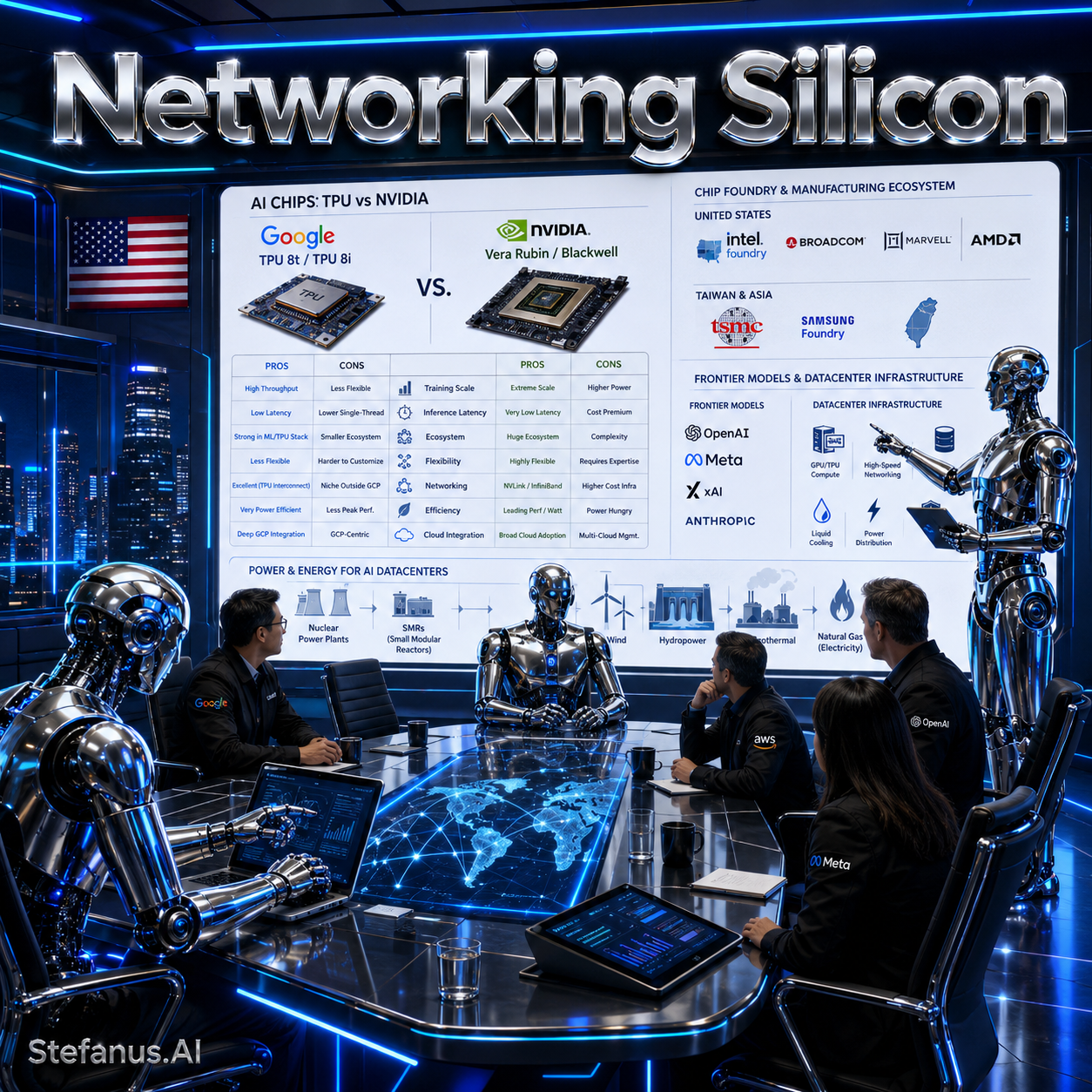
This is why I choose the title Networking Silicon.
The word networking should not be interpreted narrowly as Ethernet switches sitting somewhere behind a rack of GPUs. In the emerging AI factory, networking extends from links between chiplets inside a package, to accelerator-to-accelerator communication inside a server, to rack-scale fabrics, row-to-row connections, optical links across a datacenter campus, and high-capacity connections between geographically distributed computing facilities. Compute is becoming networked at nearly every physical scale. An accelerator that cannot efficiently communicate with thousands of other accelerators may possess extraordinary theoretical processing capability while delivering disappointing economic productivity. As AI systems become larger, more distributed, and increasingly dominated by inference and agentic workloads, moving data becomes almost as strategically important as calculating with it.
The second word—silicon—is equally deliberate. This paper is not principally about cloud-networking software. It is about the physical semiconductor architecture underneath the AI economy: accelerators, custom ASICs, network interface cards, data processing units, switch silicon, SerDes, optical DSPs, memory interfaces, chiplets, interconnects, and the specialized devices that transform enormous collections of processors into functioning AI factories. Marvell itself describes a portfolio spanning custom compute and connectivity at the rack, row, datacenter, campus, and multi-campus level—a taxonomy that maps almost perfectly onto the physical anatomy this paper will explore.[9]
But Networking Silicon also carries a second meaning, and the second meaning is the deeper one: the silicon companies themselves are becoming economically networked.
Google can become Marvell’s customer, design collaborator, and potentially major shareholder simultaneously. Nvidia can supply accelerator architecture, networking technology, and capital to companies participating in its ecosystem—including, remarkably, a $2 billion investment in Marvell itself, announced in March 2026 alongside a strategic partnership around NVLink Fusion, custom XPUs, and silicon photonics.[11] Meta can commit to purchasing up to $60 billion or more of AMD accelerators over five years while receiving performance-based warrants for as many as 160 million AMD shares—roughly ten percent of the company.[12][13] OpenAI holds a structurally similar warrant from AMD, issued in October 2025 alongside a six-gigawatt GPU agreement.[14] Cloud providers, semiconductor designers, model companies, neoclouds, financiers, foundries, and infrastructure developers are increasingly connected through purchase commitments, equity warrants, preferred shares, financing guarantees, and long-term capacity agreements. The physical network inside the AI datacenter is being mirrored by a financial network outside it.
That is the central thesis of this paper: the next phase of AI infrastructure competition will not be decided by GPUs alone. It will be decided by who controls the networks of silicon, capital, suppliers, intellectual property, and industrial relationships required to make millions of accelerators operate as coherent intelligence factories.
The Google–Marvell transaction is therefore not the conclusion of the story. It is the anecdote that reveals the story. The pages that follow proceed in six movements. Section 1 establishes the technological foundation: why the accelerator is no longer the whole AI machine, and why connectivity is becoming a form of compute. Section 2 examines the new deal architecture—warrants, milestones, and procurement-linked ownership—through the Google–Marvell, Meta–AMD, and OpenAI–AMD agreements. Section 3 traces the transformation of hyperscalers into semiconductor architects and industrial conglomerates. Section 4 maps the financial network being constructed around the physical network, including the mounting concerns of the Bank for International Settlements, the International Monetary Fund, and United States lawmakers. Section 5 elevates the analysis to industrial power and geopolitics. Section 6 distills the lessons into seven pillars, before the Conclusion returns to the symmetry at the heart of the argument: inside the AI factory, silicon connects silicon; outside the AI factory, capital connects the companies that design the silicon.

Section 1: The Accelerator Is No Longer the Whole AI Machine
1.1 From GPU Competition to System Competition
The first era of generative AI infrastructure was commonly described as a race for GPUs, and for a period that framing was substantially accurate. Nvidia’s accelerators became shorthand for AI capacity itself. Governments announced sovereign AI ambitions by counting H100s. Startups raised venture capital on the strength of allocation letters. Hyperscalers reported capital expenditures whose quarterly increments exceeded the annual revenues of most Fortune 500 companies, and investors measured computational ambition chip by chip—H100s, H200s, Blackwells, and the successive generations that followed. The scarcity of leading accelerators was so acute, and their pricing power so extraordinary, that it was easy to conclude the entire industrial contest reduced to a single question: who has the most GPUs?
That framing is becoming incomplete, and the numbers now demonstrate it. A modern AI cluster is not simply a warehouse containing expensive accelerators. It is a tightly coupled computing system in which thousands—soon hundreds of thousands—of processors must exchange enormous quantities of data with memory, storage, and one another, continuously and at extreme speed. The faster individual accelerators become, the greater the probability that communication, rather than computation, becomes the binding constraint. Nvidia’s own financial disclosures tell this story with unusual clarity: in the fourth quarter of its fiscal 2026, alongside record data center compute revenue of $51.3 billion, Nvidia reported networking revenue of $11.0 billion—up 263 percent from a year earlier—driven by the ramp of NVLink compute fabric for its GB200 and GB300 rack-scale systems and the growth of its Ethernet and InfiniBand platforms.[15] When the dominant accelerator company earns eleven billion dollars in a single quarter from moving data rather than computing on it, the strategic unit of AI competition has visibly migrated from the chip toward the system.
The migration continued into 2026. In the quarter ended April 2026, Nvidia’s data center revenue reached $75.2 billion, up 92 percent year over year, with hyperscalers accounting for slightly more than half and a rapidly diversifying set of AI clouds, industrial, and enterprise customers supplying the remainder.[16] The scale of the systems being assembled around those chips—rack-scale NVLink domains, Spectrum-X Ethernet fabrics, BlueField data processing units, optical interconnects—confirms that what is being sold is no longer a component. It is an architecture.
1.2 Why Connectivity Becomes More Valuable as Compute Scales
There is a precise technical logic behind this shift, and it is worth developing carefully because it explains nearly everything else in this paper. AI training at the frontier requires collective operations—all-reduce, all-gather, all-to-all exchanges of gradients and parameters—across enormous numbers of accelerators. Every training step is, in effect, a synchronized conversation among thousands of processors, and the conversation can proceed no faster than its slowest, most congested link. Inference, meanwhile, is evolving from relatively straightforward model serving toward reasoning models that generate long internal chains of thought, mixture-of-experts architectures that route tokens dynamically across distributed expert networks, and autonomous agents capable of executing long sequences of computational steps that traverse memory, storage, retrieval systems, and external tools. Google explicitly designed its TPU 8i inference chip around this reality, introducing a new Collectives Acceleration Engine and a serving-optimized network topology called Boardfly precisely because, in Google’s words, interactions between agents at scale magnify even small inefficiencies.[17][7]
That changes the economics of networking in a way that is easy to state and staggering to quantify. A marginal improvement in network utilization across a few servers has modest consequences. The same improvement across tens of thousands—or eventually hundreds of thousands—of accelerators translates into enormous electricity savings, greater model-training throughput, faster convergence, shorter checkpointing stalls, and billions of dollars of improved asset utilization. Industry analysts have begun stating the principle as a first-order fact of datacenter design. As Alan Weckel, co-founder and technology analyst at 650 Group, observed at the launch of Marvell’s Teralynx T100:
“data center infrastructure becomes a defining factor in network efficiency and performance”
— Alan Weckel, Co-Founder and Technology Analyst, 650 Group [18]
The arithmetic behind that statement is unforgiving. Marvell notes that GPU- and XPU-based racks are approaching 120 kilowatts, pushing air cooling to its limits; that network inefficiencies translate directly into underutilized GPUs and higher training costs; and that high-radix, high-bandwidth, low-latency switching is now among the most effective levers for raising GPU utilization, lowering tail latencies, and improving convergence times for training algorithms.[9] The Teralynx T100’s design choices—a monolithic 3-nanometer die, a power envelope roughly 25 percent below competing solutions, support for a 512-port scale-out radix that flattens network tiers—are all answers to the same underlying question: how do you keep a million dollars an hour of accelerator capital from sitting idle while it waits for data?[9][19]
At AI-factory scale: idle accelerator time becomes wasted capital. And poor networking produces idle accelerators.
1.3 The New Semiconductor Anatomy of the AI Factory
To reason clearly about where value and power are migrating, readers need a broader map of the semiconductor stack than the accelerator-centric view provides. The table below sets out the anatomy this paper will use throughout—eight categories of silicon, each indispensable, each with its own competitive landscape, and each increasingly entangled with the others through packaging, protocols, and capital.
Table 1. The New Semiconductor Anatomy of the AI Factory
| Silicon Layer | What It Does | Representative Technologies and Suppliers |
| Compute Silicon | Executes training and inference mathematics | Nvidia GPUs (Blackwell, Rubin); Google TPU 8t/8i; AMD Instinct MI450; AWS Trainium; Microsoft Maia; custom XPUs from Broadcom, Marvell, MediaTek |
| Memory Silicon | Feeds accelerators with model weights and activations | HBM3E/HBM4 from SK Hynix, Samsung, Micron; memory interface controllers; near-memory computing (a named element of the Google–Marvell agreement) |
| Scale-Up Silicon | Connects accelerators inside a coherent high-performance domain | NVLink and NVLink Fusion; Google inter-chip interconnect (3D torus, Boardfly); UALink and eSUN switches; XConn-derived scale-up fabrics |
| Scale-Out Silicon | Connects racks and clusters into datacenter-scale fabrics | Marvell Teralynx T100 (102.4 Tbps); Broadcom Tomahawk 6; Cisco Silicon One G300; Nvidia Spectrum-X Ethernet and InfiniBand |
| Interface Silicon | Standardized high-speed device connectivity | SerDes IP; PCIe and CXL controllers and retimers |
| Optical Silicon | Moves data across rows, campuses, and regions at light speed | Coherent optical DSPs; silicon photonics; co-packaged optics; data-center interconnect modules (Marvell, Broadcom, Nvidia/Celestial-class technologies) |
| Storage Silicon | Serves training datasets, KV caches, and checkpoints | Storage controllers; TPUDirect Storage-class direct-access paths; BlueField-4-class storage platforms |
| Data-Processing Silicon | Offloads movement, security, and infrastructure workloads | NICs, SmartNICs, and DPUs (Nvidia ConnectX and BlueField; custom NICs named in the Google–Marvell agreement) |
Two features of this anatomy deserve emphasis. First, the accelerator remains essential—nothing in this paper argues otherwise—but it increasingly sits inside an ecosystem rather than at the center of a simple server. Google’s own TPU 8t documentation illustrates the point: the training system’s headline advances include TPUDirect RDMA, which lets data move between memory and network interface cards without touching the host CPU, and TPUDirect Storage, which routes hundred-petabyte datasets directly to the silicon and delivers storage access ten times faster than the prior generation—capabilities that live entirely in the connective layers of the stack.[17] Second, the categories are converging physically. Co-packaged optics places the optical layer inside the switch package; near-memory computing places computation inside the memory subsystem; chiplet architectures dissolve the boundary between compute and interface silicon altogether. The anatomy is not a set of separate markets. It is one machine, drawn at different magnifications.
1.4 Google as an Intelligence-Factory Designer
Google provides an unusually important case study because it controls multiple layers of this anatomy simultaneously, and has for a decade. It designs TPUs—now with Broadcom engineering the training-oriented TPU 8t and MediaTek the inference-oriented TPU 8i, ending Broadcom’s exclusive design role after roughly ten years.[8] It builds datacenters. It operates Google Cloud. It develops Gemini and the DeepMind research portfolio that co-designs models with the silicon that will run them. It controls software frameworks and orchestration systems, from JAX to the new TorchTPU effort intended to reduce framework lock-in perceptions. It builds networking technologies, including the optical circuit switching that reshaped its datacenter fabrics and the new Virgo fabric that extends TPU clusters toward the million-chip scale.[8] And it serves consumer and enterprise applications operating at billion-user scale, generating precisely the inference demand that justifies workload-specific silicon.
Google’s TPU strategy therefore demonstrates why hyperscalers increasingly want hardware optimized for their own model architectures, workloads, and datacenter designs instead of depending exclusively on merchant accelerators. The eighth-generation split between TPU 8t and TPU 8i—one chip tuned for maximum training throughput with two petabytes of pooled HBM per superpod, the other tuned with tripled on-chip SRAM and a low-diameter Boardfly topology for high-concurrency reasoning—is the clearest public statement yet that frontier training and agentic inference are diverging into different hardware disciplines.[17][20] Crucially, none of this implies a rupture with the merchant ecosystem: Google continues to partner deeply with Nvidia and offers infrastructure based on Nvidia’s platforms through Google Cloud, demonstrating that custom silicon and merchant GPUs are complementary strategies rather than mutually exclusive ones. The August 2026 Marvell agreement adds a further dimension—an expanding cast of suppliers building the accelerators, controllers, and interfaces that attach to the TPU ecosystem as Google begins supplying TPU systems beyond its own datacenters.[6]
1.5 The Five-Layer AI Economy Becomes Physically Interdependent
This paper situates the argument within the Five-Layer AI Economy framework that organizes my broader body of work. The layers, and the role Networking Silicon plays within them, are summarized below.
Table 2. The Five-Layer AI Economy and the Position of Networking Silicon
| Layer | Function | How Networking Silicon Changes the Layer |
| Layer 1 — Energy | Powers everything | Network efficiency is now an energy strategy: a switch that saves 25% power, or a fabric that lifts accelerator utilization, effectively creates new gigawatts without building plants |
| Layer 2 — Chips | Performs and connects computation | Layer 2 can no longer be read as accelerator manufacturing alone; it now spans the full anatomy of Table 1, and it increasingly determines how efficiently Layers 3–5 consume Layer 1 |
| Layer 3 — Datacenters | Organizes chips into physical factories | Rack power density, cooling architecture, campus topology, and multi-site training are all functions of interconnect choices made in Layer 2 |
| Layer 4 — Models | Converts computing capacity into machine intelligence | Model architectures (MoE, long-context reasoning, agents) are co-designed with fabrics; the network shapes what models are economically trainable and servable |
| Layer 5 — Applications & Agents | Converts intelligence into economic activity | Agentic workloads consume ten to fifty times more tokens per completed task than chatbot queries, pushing inference—and therefore inference networking—to the center of the economy[21] |
The framework yields the first structural conclusion of this paper. The five layers were conceived as a vertical stack, and as a description of physical dependence the stack remains accurate: energy constrains chips, chips determine datacenter architecture, datacenters constrain model scale, models determine application economics, and applications generate additional demand for energy and compute. But Networking Silicon demonstrates that Layer 2 has become the connective tissue of the entire system—the layer through which efficiency gains or losses propagate in both directions. A better optical interconnect enables larger campuses in Layer 3, which enables larger models in Layer 4, which enables new agentic applications in Layer 5, which recursively increases demand on Layers 1 through 3. The network is not one component among many. It is the transmission mechanism of the AI economy.

Section 2: From Purchase Orders to Strategic Entanglement
2.1 The Google–Marvell Warrant Changes the Meaning of Procurement
Traditional procurement maintains a relatively straightforward separation between buyer and seller, and the separation is not incidental—it is the foundation of how markets discipline both sides. A customer wants components. A supplier manufactures them. A price is negotiated through competition among alternatives. Products are delivered, invoices are paid, and each party remains free to walk away at the end of the contract. The customer’s leverage is the credible threat of switching; the supplier’s leverage is the quality and scarcity of what it builds. Everything about the modern theory of supply chains—second sourcing, qualification cycles, competitive bidding—presumes this arm’s-length architecture.
The Google–Marvell structure points toward something categorically different. Recall the mechanics established in the Introduction: one warrant tranche vests for every $500 million of eligible custom-products revenue, across 240 tranches stretching to fiscal 2033, with only a token 1.36 million shares vesting on the calendar rather than on commerce.[3] In practice, this means Google’s ownership position in Marvell scales in direct proportion to its cumulative procurement spending under the deal. Google’s commercial success with Marvell products eventually contributes to Google’s ability to acquire a substantial position in the very supplier whose products it purchases. The warrant cannot be transferred outside Google’s controlled affiliates without Marvell’s consent, and vested shares carry securities-law and trading-volume restrictions—details that confirm both parties understand this is not a portfolio investment but an instrument of industrial alignment.[3] The relationship begins to form a circle:
Procurement → Revenue → Strategic Importance → Equity Rights → Deeper Alignment → Additional Procurement
Each arrow in that circle deserves a moment of reflection, because each represents a departure from arm’s-length commerce. Procurement generates revenue, as it always has. But revenue now generates equity rights, which convert the customer into a beneficiary of the supplier’s market value. Equity rights deepen alignment, because Google now gains twice from every successful Marvell product cycle—once as a buyer of better silicon, and again as a holder of appreciating warrants. And deeper alignment rationally encourages additional procurement, because the marginal chip order is no longer merely an input cost; it is also a step toward vesting the next tranche. That is a fundamentally different industrial relationship from a purchase order, and financial markets recognized it instantly: they repriced Marvell not on the value of a contract, but on the value of a strategic position spanning the Google, Amazon, and Nvidia ecosystems simultaneously.[6]
2.2 Meta–AMD Shows This Is Becoming a Pattern
Google–Marvell should not be examined in isolation, because the structure it employs was already becoming the template of the AI hardware era. On February 24, 2026, AMD and Meta announced a multi-year, multi-generation agreement under which Meta will deploy up to six gigawatts of AMD Instinct GPUs—beginning with one gigawatt of custom MI450-based Helios rack-scale systems in the second half of 2026—alongside lead-customer commitments for AMD’s sixth-generation EPYC Venice CPUs and next-generation Verano processors, including a customized CPU variant tailored to Meta’s performance and efficiency requirements.[12][13] The five-year arrangement carries a headline value of roughly $60 billion, with some reporting placing the potential total as high as $100 billion.[13][22]
As part of the deal, AMD issued Meta a performance-based warrant for up to 160 million shares of AMD common stock—approximately ten percent of the company—at an exercise price of one cent per share. Vesting proceeds in tranches tied to Instinct GPU shipment milestones, beginning with the first gigawatt deployment and reaching full vesting only at six gigawatts of qualifying deployments; vesting is further conditioned on AMD achieving escalating stock-price thresholds up to $600 per share, and exercise is tied to Meta meeting defined technical and commercial milestones.[13][12] The structure is remarkable when stated plainly: Meta is not merely negotiating a volume discount for buying huge quantities of chips. Its purchasing scale creates a path toward ownership, and the path is gated on both sides—the supplier must execute and the market must reward that execution before the customer’s stake materializes. The principals were explicit that this was strategic rather than transactional. AMD’s chief executive framed the customer’s decision bluntly:
“Meta is making a big bet on AMD”
— Dr. Lisa Su, Chair and CEO, AMD [23]
while Meta’s founder framed the supplier decision as a matter of structural independence:
“an important step for Meta as we diversify our compute”
— Mark Zuckerberg, Founder and CEO, Meta Platforms [24]
and AMD’s chief financial officer described the warrant design itself as an alignment machine—a structure that, in her words,
“tightly aligns AMD and Meta around execution and long-term value creation”
— Jean Hu, EVP and CFO, AMD [25]
The timing sharpened the message. The AMD agreement arrived only a week after Meta committed to deploying millions of Nvidia GPUs under a separate multi-year partnership spanning GPUs, Spectrum-X Ethernet switches, and Grace and Vera CPUs.[12] Meta, in other words, was not choosing sides in the accelerator wars. It was constructing a multi-vendor compute portfolio, taking equity-linked positions where its demand could move a supplier’s destiny, and paying market rates where it could not. As chip analyst Ben Bajarin of Creative Strategies summarized the strategic logic of a buyer able to abstract hardware differences behind its own software stack:
“we are compute constrained, and deals will be done across the board”
— Ben Bajarin, CEO and Principal Analyst, Creative Strategies [12]
2.3 OpenAI, AMD, and the Broadening Model
AMD created the prototype for this structure not with a hyperscaler but with a model laboratory—illustrating that procurement-linked ownership extends well beyond established cloud giants. In October 2025, AMD and OpenAI announced a six-gigawatt agreement spanning multiple generations of AMD Instinct GPUs, beginning with a one-gigawatt MI450 deployment in the second half of 2026, and AMD concurrently issued OpenAI a warrant for up to 160 million shares at one cent per share.[26] AMD’s own annual report describes the mechanics with the dry precision of securities disclosure: the shares vest in tranches based on Instinct GPU purchase milestones by OpenAI, its affiliates, or authorized third parties, subject to specified AMD stock-price targets, with each vested tranche further conditioned on technical and commercial requirements, exercisable through October 5, 2030.[14] At full vesting and AMD’s terminal $600 price threshold, the warrant’s value would approximate the value of the hardware in the deal itself—a symmetry that transforms the customer’s purchasing program into something economically resembling a co-investment.
Taken together, the OpenAI–AMD, Meta–AMD, and Google–Marvell agreements suggest the emergence of a new industrial mechanism, which this paper names Procurement-Linked Ownership. Its logic runs in both directions. Large AI customers possess something extraordinarily valuable—credible, enormous, multi-year demand—and they can now exchange that demand not merely for price concessions but for engineering priority, capacity guarantees, roadmap influence, and equity participation. Semiconductor companies, for their part, face development programs whose costs have grown so large that committing billions of dollars of engineering and leading-edge wafer capacity to uncertain customers is untenable; an anchor customer whose purchases are contractually mapped to milestones converts demand uncertainty into a financeable schedule. Both sides effectively share the upside the relationship creates. The table below places the three landmark structures side by side.
Table 3. The New Deal Architecture: Procurement-Linked Ownership Agreements, October 2025 – August 2026
| Deal Term | Google – Marvell (Aug 2026) | Meta – AMD (Feb 2026) | OpenAI – AMD (Oct 2025) |
| Commercial scope | Custom silicon attaching to the TPU ecosystem: inference accelerators, storage, NICs, memory interface controllers, near-memory compute[5] | Up to 6 GW of Instinct GPUs (MI450 Helios racks), plus EPYC Venice/Verano CPUs incl. custom variant[12] | Up to 6 GW of Instinct GPUs across generations, first 1 GW of MI450 in 2H 2026[26] |
| Headline value | Up to ~$120B in qualifying revenue through FY2033 (vesting threshold, not commitment)[4] | ~$60B over five years; up to ~$100B in some reporting[13][22] | Tens of billions; ~$90B potential hardware value reported |
| Warrant size | 58,970,907 shares (~7% of Marvell)[3] | 160 million shares (~10% of AMD)[13] | 160 million shares (~10% of AMD)[14] |
| Exercise price | $206.58 per share[1] | $0.01 per share[13] | $0.01 per share[14] |
| Vesting driver | 240 tranches; one per $500M of eligible Google-driven revenue, Q3 FY2027–FY2033[3] | GPU shipment milestones to 6 GW + AMD stock-price thresholds up to $600 + Meta technical/commercial milestones[13] | GPU purchase milestones to 6 GW + AMD stock-price targets + technical/commercial conditions[14] |
| Expiry / horizon | Exercisable to August 18, 2033 | Vesting through ~2031 deployment arc | Exercisable through October 5, 2030[14] |
| Strategic meaning | Customer earns ownership of the connective-silicon supplier as TPU ecosystem scales | Buyer diversifies beyond Nvidia while acquiring an equity stake in the alternative | Model lab converts compute demand into a self-funding equity pathway |
2.4 Nvidia–Marvell Reverses the Direction of the Relationship
The network grows more complicated still, because capital in this ecosystem does not flow only from customers to suppliers. On March 31, 2026, Nvidia and Marvell announced a strategic partnership connecting Marvell to the Nvidia AI factory and AI-RAN ecosystem through NVLink Fusion, with collaboration extending across custom XPUs, scale-up networking, optical interconnect, and silicon photonics—and Nvidia invested $2 billion in Marvell.[11] Under the arrangement, Marvell provides custom XPUs and NVLink Fusion-compatible scale-up networking, while Nvidia contributes the surrounding platform: Vera CPUs, ConnectX NICs, BlueField DPUs, NVLink interconnect, Spectrum-X switches, and rack-scale AI compute.[11] Nvidia’s founder framed the moment in terms that could serve as an epigraph for this entire paper:
“The inference inflection has arrived”
— Jensen Huang, Founder and CEO, NVIDIA [27]
Now consider the resulting structure in its entirety. Google may become one of Marvell’s largest shareholders through a warrant earned by purchasing Marvell silicon that attaches to Google’s TPUs—TPUs that compete with Nvidia’s GPUs. Nvidia already holds a $2 billion position in Marvell and has architected NVLink Fusion so that custom accelerators designed by Marvell for other customers remain compatible with—and partially monetized through—Nvidia’s own platform. Marvell supplies technology into Amazon’s custom-silicon programs, into Nvidia’s ecosystem, and now into Google’s. Google builds proprietary TPUs while simultaneously offering Nvidia GPUs through Google Cloud at enormous scale. These companies are competitors, customers, suppliers, collaborators, and investors—frequently all at once, and sometimes within a single transaction. This is Networking Silicon in corporate form.
2.5 Competition Without Separation
The classical model of competition assumes relatively distinct firms fighting for market share across a clean boundary: my gain is your loss, my customer is not your shareholder, my supplier is not my rival’s financier. AI infrastructure increasingly produces something stranger, which this paper terms competitive interdependence. Google can challenge Nvidia through TPU development while remaining one of Nvidia’s major cloud partners. Marvell can compete against Broadcom for custom silicon business while collaborating with Nvidia—whose platform Broadcom’s largest customers also depend upon. AMD can compete against Nvidia while its largest customers hold warrants that make them beneficiaries of AMD’s rise. Broadcom can remain central to hyperscaler custom silicon—its Google relationship was extended through 2031 only months before the Marvell announcement—even as those same hyperscalers deliberately cultivate second sources.[6]
Competitive interdependence is not a euphemism for collusion, and it is not the end of rivalry; the battles over switch silicon, accelerator roadmaps, and custom-design sockets are as fierce as any in the industry’s history. But it does mean that the familiar analytical categories—monopoly versus competition, vertical versus horizontal, make versus buy—no longer map cleanly onto the industrial reality. When your competitor is also your customer, your supplier, and occasionally your shareholder, strategy becomes a problem of network position rather than market position. The remainder of this paper takes that reframing seriously.

Section 3: Hyperscalers Are Becoming Semiconductor Architects
3.1 Why Merchant Silicon Is No Longer Enough
Merchant silicon remains enormously important, and nothing in the custom-silicon movement should obscure why. Standardized platforms amortize staggering development costs across many customers; they arrive with mature software ecosystems, global supply chains, and the accumulated debugging of thousands of deployments; and they allow a company to convert capital into capability within a single procurement cycle. Nvidia’s platform is not merely a chip—it is CUDA, NVLink, networking, systems engineering, and an installed base of developer knowledge that no custom program can replicate quickly. For the overwhelming majority of companies, merchant silicon is not a compromise. It is the only rational choice.
But the economics of hyperscale AI can invert that logic at the extreme end of the distribution. When a company deploys hundreds of thousands—prospectively millions—of processors, even a modest gain in performance per watt, memory utilization, network efficiency, or workload specialization compounds into billions of dollars. A ten percent improvement in inference cost, applied to a fleet serving billions of users, funds an entire custom-silicon program many times over. Just as important, customization allows the buyer to shape the ratios inside the machine—compute to memory bandwidth, scale-up to scale-out connectivity, SRAM to HBM—around its own workloads rather than around an industry average. At sufficient scale, customization becomes economically rational, and beyond that threshold it becomes competitively necessary.
3.2 Google TPU: From Internal Accelerator to Strategic Platform
Google’s TPU program demonstrates the long-term implications more completely than any other example, because it is the oldest and most mature hyperscaler silicon effort. What began a decade ago as an internal inference accelerator has become a full strategic platform: TPUs now power Gemini and numerous billion-user Google services, the eighth generation splits into training and inference architectures co-designed with Google DeepMind, and Google has begun supplying TPU systems beyond its own datacenters—a development that expands the population of controllers, interfaces, and networking components required around each TPU deployment and directly motivates the Marvell agreement.[20][6] Industry estimates cited around the eighth-generation launch projected TPU shipments in the millions of units for 2026 with steep multi-year growth—volumes that demand meaningful allocations of TSMC’s most advanced process capacity and that turn TPU supply-chain decisions into events with industry-wide consequences.[8]
The bifurcation of the eighth generation points toward a future in which AI hardware becomes increasingly workload-specific. Instead of one universal accelerator market, the industry is plausibly heading toward specialized architectures for frontier pre-training; reasoning and high-concurrency inference; reinforcement learning and post-training; video generation; recommendation systems; robotics and physical AI; autonomous vehicles; sovereign AI deployments with distinct security and locality constraints; and low-latency agentic systems whose economics are dominated by token throughput. Each specialization changes the silicon ratios—and therefore changes which suppliers, which interconnects, and which memory systems matter. A world of many purpose-built architectures is, almost by definition, a world in which the connective and supporting silicon around the accelerator multiplies in variety and value. That is the world the Google–Marvell agreement is built for.
3.3 AWS, Microsoft, and Meta Expand Custom Silicon
Google is not alone, and the breadth of the movement matters for the argument. Amazon Web Services has developed Trainium and Inferentia across multiple generations—with Marvell long identified as a key design partner in that ecosystem—while continuing to operate among the world’s largest Nvidia fleets. Microsoft has developed Maia accelerators and Cobalt CPUs alongside infrastructure silicon for networking and security, even as it remains one of Nvidia’s largest customers. Meta continues to advance MTIA for ranking and recommendation inference while simultaneously signing the largest external accelerator agreements in its history with both Nvidia and AMD.[12] The pattern across all four companies is identical in shape: custom silicon where workload concentration justifies it, merchant silicon where flexibility and time-to-market dominate, and—increasingly—financially structured relationships with the suppliers who build either.
The hyperscaler, in other words, increasingly behaves less like a technology retailer purchasing standardized equipment and more like an industrial manufacturer designing its own productive machinery, qualifying multiple component suppliers, and securing its inputs years in advance. The historical analogy is not the software company buying servers; it is the automaker of the mid-twentieth century, engineering its own engines while cultivating a deep, financially interlinked supplier network for everything around them.
3.4 Supplier Diversification Becomes Strategic Insurance
The market reaction to Google–Marvell—Marvell sharply higher, Broadcom lower—demonstrated another principle that boards now treat as elementary: if a hyperscaler’s AI strategy depends excessively on one supplier, supplier concentration becomes strategic risk, and the market prices the reallocation of that risk in real time.[1] Diversification across silicon partners provides bargaining leverage in every subsequent negotiation; redundancy against execution failure on any single roadmap; additional engineering capacity at a moment when advanced-package design talent is the scarcest resource in the industry; alternative intellectual property portfolios in SerDes, optics, and switching; geographic and manufacturing resilience; protection from shortages in HBM, substrates, and advanced packaging; and faster product development through parallel programs. Google’s relationship with Marvell therefore does not imply the end of its relationship with Broadcom—whose April 2026 extension through 2031 remains in force—any more than Meta’s AMD agreement implied the end of its Nvidia relationship.[6] It indicates that the size of the AI buildout now makes multiple strategic silicon relationships desirable simultaneously, and that the warrant is the instrument by which each relationship is made durable.
3.5 From Hyperscaler to Industrial Conglomerate
This produces an important conceptual shift that extends far beyond semiconductors. Amazon, Google, Meta, and Microsoft are conventionally categorized as software, advertising, e-commerce, or cloud companies, and their income statements still reflect those origins. But their balance sheets and capital programs increasingly describe something else. In the June quarter of 2026 alone, Microsoft, Alphabet, Amazon, and Meta spent a combined $166 billion on capital expenditures—up 87 percent from a year earlier—bringing the ten-quarter increase since the start of 2024 to 272 percent.[28] Full-year 2026 hyperscaler capital spending has been revised toward roughly $725 billion, with consensus for 2027 approaching $900 billion; sovereign AI programs tripled to more than $30 billion in Nvidia’s fiscal 2026 alone.[29][21]
The financial results reported across late 2025 and the first half of 2026 give this transformation numerical form, and they are worth assembling in one place because they constitute the demand-side evidence for everything this paper argues about the supply side. The scoreboard below draws on the most recent company disclosures available as of August 2026.
Table (Section 3). The 2026 Financial Scoreboard of the AI Buildout (latest reported results as of August 2026)
| Indicator | Latest Reported Figure | Significance for Networking Silicon |
| Nvidia fiscal-year 2026 revenue | $215.9B (+65% YoY); Q4 FY26 data center revenue $62.3B (+75%)[15] | The accelerator platform’s scale sets the ceiling for every attached market |
| Nvidia networking revenue, Q4 FY26 | $11.0B in one quarter, +263% YoY[15] | Direct evidence that connectivity is the fastest-growing layer of the stack |
| Nvidia data center revenue, quarter ended April 2026 | $75.2B, +92% YoY; hyperscalers slightly over half[16] | Demand base diversifying beyond hyperscalers into AI clouds and enterprise |
| Marvell fiscal-year 2026 revenue | $8.195B record, +42% YoY[30] | The connective-silicon specialist growing at platform speed |
| Marvell Q1 FY2027 (quarter ended May 2, 2026) | $2.418B record, +28% YoY; data center 76% of revenue; Q2 guided to $2.7B midpoint (+35% YoY)[10] | Accelerating each quarter on custom silicon, DCI optics, and switching—before Google revenue begins |
| Combined hyperscaler capex, June quarter 2026 | $166.0B (+87% YoY); +272% over ten quarters[28] | The capital pool that funds every layer of the anatomy in Table 1 |
| Full-year 2026 hyperscaler capex trajectory | ~$725B and rising; 2027 consensus approaching $900B[29][21] | Multi-year visibility that justifies warrants, prepayments, and custom programs |
| Cloud revenue growth, Q2 2026 | AWS +37% (fastest in 18 quarters); Google Cloud +82%; Azure low-to-mid 40s[21] | The monetization gap between AI capex and AI revenue has begun to close |
Companies deploying capital at that scale do not merely buy technology; they reorganize the industrial landscape around themselves. They procure electricity in gigawatts and negotiate transmission interconnection queues. They acquire land and design buildings measured in millions of square feet. They develop processors and finance the suppliers who fabricate the components around those processors. They secure manufacturing capacity years ahead at TSMC and Samsung, contract for nuclear and gas generation, build global fiber networks, design liquid-cooling systems for 120-kilowatt racks, and increasingly hold equity instruments in the companies producing the physical equipment they require. The AI hyperscaler is becoming a vertically coordinated industrial system disguised inside a technology company—and the disguise is wearing thin.

Section 4: The Financial Network Around the Physical Network
4.1 Why AI Supply Chains Require New Financial Structures
Advanced semiconductor programs are extraordinarily expensive, and the expense arrives before a single dollar of revenue. A leading custom accelerator requires architecture development, electronic-design-automation licenses, verification at a scale that consumes entire engineering divisions, third-party intellectual property, leading-edge fabrication slots reserved years in advance, high-bandwidth memory allocations negotiated against fierce competition, advanced packaging capacity, networking co-design, and engineering teams numbering in the thousands. Meanwhile, the AI datacenters those chips populate require tens of billions of dollars of land, power, shell, and cooling before producing meaningful economic output. The result is an unusual structural problem, and it is the origin of every financial innovation this paper describes:
AI infrastructure requires industrial-scale capital expenditure while technological generations move at software-like speed.
Railroads amortized their capital over half a century of stable technology. AI factories must amortize theirs across accelerator generations measured in eighteen-month increments, against demand projections that themselves depend on the pace of model progress. Traditional project finance struggles with that combination, because lenders cannot underwrite technology risk and hyperscalers cannot alone absorb supplier risk. The tension is producing increasingly inventive arrangements—warrants, prepayments, capacity guarantees, backstops, and cross-investments—that redistribute risk across the network rather than concentrating it at any single node.
4.2 Warrants as Industrial Coordination Mechanisms
Seen in this light, a warrant tied to purchasing milestones does far more than provide financial upside; it functions as an industrial coordination mechanism. The buyer wants successful products delivered on schedule, so it now holds an instrument whose value depends on the supplier executing. The supplier wants the buyer to purchase enormous volumes, so it has granted an instrument whose vesting depends on those volumes materializing. The buyer benefits financially if its purchases help increase the supplier’s value; the supplier gains a long-term anchor customer whose commitment is legible to every other stakeholder—employees deciding where to work, foundries deciding where to allocate capacity, and lenders deciding what to finance. The AMD structures add a further refinement: stock-price vesting thresholds ensure that the customer’s stake materializes only in states of the world where existing shareholders have already prospered, converting potential dilution into a success fee.[13] The general formula can be stated simply:
Demand Commitment + Product Roadmap + Equity Incentive = Strategic Alignment
That formula could become a defining financing architecture of the AI hardware era, in the way that take-or-pay contracts defined pipeline economics and power purchase agreements defined renewable energy. It is also worth noting what the formula replaces. In earlier technology cycles, a supplier seeking to bind a giant customer offered price: volume discounts, most-favored-nation clauses, rebates. Equity changes the temporal structure of the relationship—price concessions reward the buyer today, while warrants reward the buyer for the supplier’s success tomorrow, which is precisely the horizon over which multi-generation silicon roadmaps play out.
4.3 When Customer and Owner Become the Same Institution
This architecture creates genuinely difficult questions, and intellectual honesty requires stating them sharply rather than gesturing at them. If Google becomes both one of Marvell’s most important customers and one of its largest shareholders, how should other investors think about supplier independence? What happens when a hyperscaler-shareholder requests preferential engineering resources during a capacity crunch—does the supplier’s management weigh that request as a vendor or as a fiduciary? Could ownership influence product roadmaps in ways that disadvantage the supplier’s other customers, who may be the owner’s direct competitors? Could a rival hyperscaler rationally worry that commercially sensitive information—performance targets, volume forecasts, architectural choices—might indirectly benefit a competitor with a board-adjacent position? And could a semiconductor company that has organized its roadmap around two or three warrant-holding buyers find that it has traded demand uncertainty for a deeper dependency: customer concentration so severe that losing one relationship becomes an existential event?
None of these questions has a settled answer in August 2026, and the honest observation is that the governance technology of this new industrial order—information barriers, independence covenants, transfer restrictions, disclosure norms—is being improvised deal by deal. The Google–Marvell warrant’s transfer restrictions and the AMD warrants’ milestone conditionality are early examples of such governance engineering. But the questions matter enormously, because the AI semiconductor industry may be becoming simultaneously more diversified technologically and more concentrated economically—more suppliers of more kinds of silicon, bound to fewer and fewer ultimate sources of demand and capital.
4.4 Circularity Versus Strategic Alignment
Critics describe some of these arrangements as circular, and the concern is neither new nor frivolous. When Nvidia announced its investment framework with OpenAI in late 2025, Bernstein’s semiconductor analyst captured the market’s immediate reflex:
“The action will clearly fuel ‘circular’ concerns”
— Stacy Rasgon, Managing Director and Senior Analyst, Bernstein Research [31]
and when the Meta–AMD warrant was announced months later, the head of markets at AJ Bell voiced the same unease about the pattern’s return:
“The return of circular transactions in the industry gives investors something else to worry about”
— Dan Coatsworth, Head of Markets, AJ Bell [32]
The anatomy of the concern is straightforward. A customer buys a supplier’s products. The supplier gives the customer equity rights, or the supplier invests in the customer. The resulting purchase commitments increase the supplier’s revenues and backlog. The rising supplier valuation increases the customer’s potential equity gains, which strengthens the case for further commitments. If poorly structured—or merely poorly disclosed—such arrangements can obscure the distinction between genuine end-market demand and financially reinforced ecosystem demand, allowing the same underlying dollar of spending to appear as strength on several income statements at once. Bloomberg has tracked the phenomenon prominently enough to maintain a continuously updated graphic mapping the web of AI cross-investments; estimates circulating in 2026 place the cumulative value of such interlinked arrangements well into the hundreds of billions of dollars.[33] Nvidia’s expanding financial role sits at the center of the debate: beyond its Marvell position, the company invested an additional $2 billion in CoreWeave in January 2026 to accelerate more than five gigawatts of AI-factory buildout by 2030, and by mid-2026 was reported to be weighing credit support measured in the hundreds of billions for OpenAI’s Ohio datacenter campus.[34][35] Nvidia’s founder has rejected the circularity framing directly—arguing that tenants will pay their leases, that frontier labs are simply growing faster than their balance sheets, and that OpenAI’s plans could represent roughly $600 billion of Nvidia compute through 2030—but the fact that the chief executive of the world’s most valuable company must now regularly litigate the distinction is itself evidence of how central the question has become.[36]
Yet not every reciprocal arrangement is artificial, and the analytical error of dismissing them all would be as serious as the error of excusing them all. Gigawatt-scale AI infrastructure genuinely requires long-duration commitments, because semiconductor suppliers cannot dedicate billions of dollars of engineering and manufacturing resources to uncertain customers, and datacenter developers cannot finance shells and substations against merchant demand. Vendor financing built the railroads, rural electrification, aviation, and telecommunications; some of those episodes ended in ruin and others created the infrastructure of modern life—frequently within the same industry, distinguished only by whether ultimate end-demand arrived. The analytical challenge, for investors and policymakers alike, is therefore to distinguish productive industrial alignment from financially engineered demand—and the honest test is not the presence of reciprocity but the trajectory of third-party revenue: whether the tokens, subscriptions, and enterprise contracts at the end of the chain are growing fast enough to service the capital deployed along it.[21]
4.5 The Institutional Alarm: BIS, IMF, and the United States Senate
What elevates this from a market-structure curiosity to a policy question is that the world’s most sober financial institutions have now formally engaged it. The Bank for International Settlements devoted a substantial portion of its Annual Economic Report 2026 to the AI investment boom, observing that the five largest hyperscalers are on pace to spend more than $1 trillion on AI-related capital expenditure across 2025 and 2026 combined—a sum outpacing their earnings and free cash flow and pushing some toward debt issuance—and warning, with reference to the canal, railway, and dot-com manias, that the current boom’s scale and pace
“bear resemblance to these precedents”
— Bank for International Settlements, Annual Economic Report 2026 [37]
A dedicated BIS study of the buildout’s financing structure went further, identifying the equity interlinkages themselves as a stability variable. Its author, examining a dynamic contest in which firms over-commit resources while racing for a few dominant positions, wrote that the boom’s
“scale, reliance on debt and circular equity ties raise questions”
— Phurichai Rungcharoenkitkul, Economist, Bank for International Settlements [38]
about sustainability and financial stability.[38] A subsequent BIS Bulletin added the macroeconomic dimension: AI-related capital expenditure has become a significant tailwind to global growth—datacenter and IT-manufacturing spending reached roughly 0.8 percent of United States GDP—which means a correction in expectations would tighten financial conditions, dampen investment, and weaken aggregate demand through channels far broader than technology equities.[39] The International Monetary Fund, through Financial Counsellor Tobias Adrian, has framed the complementary supervisory concern: as AI embeds itself in trading, lending, and market infrastructure, regulators face growing concentration risk from reliance on a handful of cloud, data, and model providers, where disruption at one critical node could propagate system-wide.[40] And in the United States Congress, Senator Elizabeth Warren and colleagues formally pressed the Financial Stability Oversight Council in January 2026 to investigate the more than $1 trillion of projected AI infrastructure debt, warning that companies unable to grow revenues into their obligations could inflict destabilizing losses on interconnected financial institutions—
“triggering a broader financial crisis that harms the economy”
— U.S. Senator Elizabeth Warren and colleagues, letter to the Financial Stability Oversight Council [41]
This paper takes no position on whether the boom ends in vindication or correction; that question will be settled by token demand, not by rhetoric. What the institutional record establishes beyond dispute is that the financial network around the physical network is now large enough to be a macro-prudential object—studied by the BIS, flagged by the IMF, and investigated by legislators—and any serious analysis of AI silicon strategy must hold both the industrial logic and the systemic risk in view simultaneously.
4.6 The New AI Capital Map
It is now possible to map the capital topology with some precision. At least four distinct kinds of capital relationship structure the AI economy of 2026, and the striking fact is how closely their combined shape mirrors the technical topology of the datacenter itself: heavily interconnected, capital intensive, and dependent on every major component continuing to function.
Table 4. The New AI Capital Map: Four Directions of Capital Flow
| Capital Relationship | Direction and Instrument | Landmark Examples (2025–2026) |
| Customer-to-Supplier Capital | Demand converted into equity rights via performance warrants | Google → Marvell (~$12.2B warrant)[2]; Meta → AMD (160M-share warrant)[13]; OpenAI → AMD (160M-share warrant)[14] |
| Supplier-to-Customer Capital | Equity investment, prepayment, or credit support flowing downstream to demand | Nvidia → CoreWeave ($2B, January 2026, toward 5+ GW of AI factories by 2030)[34]; reported Nvidia credit support for OpenAI’s Ohio campus[35] |
| Supplier-to-Supplier Capital | Cross-investment binding ecosystem participants to a shared architecture | Nvidia → Marvell ($2B, March 2026, NVLink Fusion and silicon photonics)[11] |
| Financial-System-to-Compute Capital | Private credit, infrastructure funds, banks, and institutional debt financing GPUs, datacenters, and energy | The $1T+ debt-financed buildout flagged by the BIS Annual Economic Report and the Warren-led FSOC letter[37][41] |
One vignette makes the map concrete. When Nvidia invested in CoreWeave, the neocloud’s chief executive explained the purpose in terms any industrial economist would recognize—capital flowing upstream from the supplier so the customer could scale and, paradoxically, depend less on any single client:
“continued diversification and reducing dependency on any particular client”
— Mike Intrator, Co-Founder and CEO, CoreWeave [42]
A supplier financing its customer so that the customer can become less dependent on the supplier’s other customers: sentences like that simply could not have been written about the technology industry of a decade ago. They are ordinary today. That is the measure of how completely the financial network has come to mirror the physical one.

Section 5: Networking Silicon Becomes a Question of Industrial Power
5.1 Who Controls the AI Architecture?
The strategic contest, properly understood, is no longer simply Nvidia versus AMD versus custom silicon, and framing it that way increasingly misleads more than it informs. The more important question is architectural: who determines the shape of the AI factory—the protocols its components speak, the topologies its networks assume, the ratios its systems embody, and the interfaces at which one supplier’s territory ends and another’s begins? The company controlling the accelerator does not automatically control every critical layer. Networking can come from another supplier; high-bandwidth memory from a third; fabrication from TSMC or Samsung; advanced packaging from yet another ecosystem; cloud orchestration from the hyperscaler; frontier models from an independent laboratory; energy from regulated utilities and independent generators. The AI factory is a coalition of industrial systems, and in a coalition, power belongs increasingly to whoever can coordinate the members—set the standards, sequence the roadmaps, and absorb the risks that would otherwise deter participation.
This is why the anatomy of Section 1 and the capital map of Section 4 belong to the same argument. Technical architecture and financial architecture are converging into a single discipline of ecosystem design. A company that defines the interconnect standard shapes which components can participate; a company that holds equity across the coalition shapes which participants can afford to. The masters of the next phase will be fluent in both languages.
5.2 Networking Silicon and the Nvidia Ecosystem
Nvidia illustrates the principle with singular clarity, because its advantage has never rested on the GPU alone. Its influence extends through CUDA’s software gravity, NVLink’s scale-up fabric, Spectrum-X Ethernet and InfiniBand scale-out networking, ConnectX NICs and BlueField DPUs, rack-scale reference systems, and now Vera CPUs and BlueField-4 storage platforms—an architecture in which every layer reinforces the others. The March 2026 Marvell partnership extends this logic in a direction that would once have seemed paradoxical: rather than treating hyperscaler custom silicon as an existential threat to be resisted, Nvidia opened NVLink Fusion so that custom XPUs—including those Marvell designs for Nvidia’s ostensible rivals—can integrate natively with Nvidia’s interconnect, networking, and rack-scale platform, with collaboration extending into optical interconnect and silicon photonics.[11] The strategic effect is subtle and powerful: even where the computing element is not an Nvidia GPU, the architecture around it can remain Nvidia’s. The contest, in other words, increasingly concerns ecosystem architecture rather than individual chips—and Nvidia has chosen to be the platform beneath heterogeneity rather than merely a combatant within it. Jensen Huang’s own assessment of Marvell at Computex 2026—styling the connectivity company as the
“next trillion-dollar company”
— Jensen Huang, Founder and CEO, NVIDIA, speaking at Computex 2026 [43]
—was simultaneously a compliment, a market forecast, and a declaration of where the value in the AI stack is migrating: toward the silicon that connects.[43]
5.3 Networking Silicon and the Google Ecosystem
Google represents a different but equally coherent model of architectural power. Where Nvidia’s platform is horizontal—sold to everyone, integrating everything—Google’s is vertical: proprietary accelerators, proprietary interconnects and fabrics, proprietary datacenter designs, proprietary software frameworks, its own cloud, and its own frontier models, co-designed as a single system in the manner Amin Vahdat describes as a decade-long exercise in cross-layer optimization.[7] The Marvell relationship strengthens this vertical system in three ways at once. It adds a second world-class custom-silicon and connectivity partner alongside Broadcom and MediaTek, reducing single-supplier dependence at the most critical layer of Google’s infrastructure.[6] It secures dedicated engineering capacity in exactly the categories—inference accelerators, NICs, storage and memory controllers, near-memory compute—that multiply as TPU systems deploy beyond Google’s own datacenters.[5] And through the warrant, it converts that supplier relationship into a durable strategic alignment whose economics improve for Google precisely as the TPU ecosystem succeeds.[3] The Google–Marvell agreement should therefore be read as part of a deliberate campaign to secure architectural optionality: the ability to shape, source, and scale every layer of the intelligence factory without being captive to any single external roadmap.
5.4 The Geopolitical Dimension
Networking Silicon also reframes national-security questions that policy has so far addressed chip by chip. United States export controls have concentrated heavily on leading AI accelerators and the manufacturing equipment behind them, on the theory that computing capability is the choke point. But an advanced AI datacenter requires much more than GPUs: high-speed switch silicon, optical transceivers and coherent DSPs, advanced SerDes, network-interface controllers, high-bandwidth memory, advanced packaging, storage systems, power-management silicon, fabrication equipment, and interconnect intellectual property. The system-level anatomy of Table 1 is, from a policymaker’s vantage, also a map of potential control points and potential leakage paths. Restricting one accelerator while permitting every surrounding component may prove insufficient if determined adversaries can assemble competitive systems from substitutes—the history of technology controls suggests that system integration skill, not any single part, is what ultimately diffuses. Conversely, excessively broad controls on networking and connectivity technology would disrupt ordinary cloud, telecom, and industrial markets that dwarf AI in unit volume, imposing costs on allies and domestic industry far out of proportion to the security benefit. Calibrating between those errors requires policymakers to understand AI infrastructure as this paper describes it: a networked system whose capability emerges from connections, not components. That understanding is only beginning to form.
5.5 What Policymakers Should Watch
Federal and state policymakers—and, given the scale of state-level datacenter and energy commitments, governors in particular—should monitor at least five developments, each of which this paper’s evidence base already illuminates.
- Supplier concentration. How dependent are United States hyperscalers on individual semiconductor companies for irreplaceable layers of the stack—custom design capacity, switch silicon, optical DSPs, HBM? The Google–Marvell agreement is, among other things, a private-sector answer to this question; policy should track whether diversification is genuinely broadening the base or merely rotating it.
- Customer concentration. How dependent are semiconductor suppliers on a handful of hyperscaler buyers? A supplier earning the majority of its growth from two or three warrant-holding customers has traded market risk for relationship risk, and the failure modes of that trade are systemic, not idiosyncratic.
- Cross-ownership and governance. When do customer warrants and strategic investments create governance concerns—information asymmetries, roadmap capture, conflicts between a supplier’s shareholder-customer and its other customers? Disclosure regimes designed for passive institutional ownership were not built for owners who are also the order book.
- Domestic manufacturing of the full anatomy. Which elements of Networking Silicon—not just logic fabrication, but advanced packaging, HBM, optical components, substrates, switch silicon—remain dependent on overseas capacity? Semiconductor policy that stops at fabs secures the accelerator while leaving the system exposed.
- Systemic and financial concentration. Could a failure or disruption at one semiconductor, networking, or manufacturing company impair multiple hyperscalers simultaneously? And could the debt and cross-equity financing the buildout—now formally flagged by the BIS, the IMF, and United States senators—transmit a technology-sector disappointment into broader financial stress?[37][40][41]
These are not traditional antitrust questions alone, and treating them as such would miss their character. They are questions of industrial resilience—the same genus of question nations ask about energy grids, food systems, and defense supply chains. The AI factory has joined that list.

Section 6: What Have We Learned? Seven Pillars
Six sections of evidence and argument can now be distilled. This paper proposes seven pillars—five conceptual, technological, financial, corporate, and strategic lessons, and two additions concerning systemic risk and geopolitics that the events of 2026 have made unavoidable. Together they constitute the analytical framework this paper offers for the next phase of the AI infrastructure era.
Pillar 1 — The GPU Is Becoming a Component of the AI Factory, Not the Entire AI Factory
The first lesson is conceptual, and it requires unlearning a habit four years in the making. The public conversation has treated AI capacity as synonymous with accelerator capacity for too long—an understandable simplification when accelerators were the binding scarcity, but a distortion now that the binding scarcities are shifting toward power, memory, packaging, and above all connectivity. Accelerators remain indispensable; nothing here diminishes the engineering achievement they represent or the pricing power they command. But the economic output of an AI factory increasingly depends on memory, networking, optics, switching, storage, and software operating together as one machine, and the market has begun pricing that truth: Nvidia’s networking business alone grew 263 percent year over year to an $11 billion quarter, and Marvell—a company that sells no merchant GPUs at all—delivered record revenue with data center products at 76 percent of sales, on bookings its chief executive describes in unambiguous terms:[15][10]
“We are seeing exceptional AI-related bookings”
— Matt Murphy, Chairman and CEO, Marvell Technology [10]
A million powerful processors poorly connected do not constitute a million processors’ worth of productive intelligence. The next phase of AI infrastructure therefore moves from accelerator scaling to system scaling—and that transition is precisely what makes Networking Silicon strategic.
Pillar 2 — Connectivity Is Becoming a Form of Compute
The second lesson is technological, and it is the deepest of the seven. As models become distributed across thousands of accelerators—and as inference becomes a conversation among agents rather than a single forward pass—moving information becomes inseparable from processing it. The boundary between computation and communication blurs at every scale this paper has examined. A faster interconnect increases effective compute: Google attributes its superpod’s near-threefold generational performance gain as much to doubled interchip bandwidth and pooled two-petabyte memory as to the chips themselves.[7] A lower-latency fabric improves accelerator utilization, which is why Marvell architected the Teralynx T100’s entire pipeline around latency and radix rather than raw throughput alone.[9] Better optical connectivity enables larger campuses and multi-site training runs; more efficient switching reduces electricity consumption per token; direct storage and RDMA paths reclaim the idle hours that checkpointing once consumed.[17] Networking consequently ceases to be peripheral infrastructure and becomes part of the computational engine itself. This is why Marvell’s claim that future AI scaling depends on connectivity deserves serious analytical attention rather than dismissal as semiconductor marketing: the company’s portfolio—from custom ASICs and SerDes to optical DSPs, switching, and silicon photonics—is a physical inventory of how much of the AI machine now exists outside the headline accelerator.[9][44]
Pillar 3 — Procurement Is Becoming Ownership
The third lesson is financial. The Google–Marvell agreement reveals how rapidly the conventional boundary between buyer and supplier is eroding, and the Meta–AMD and OpenAI–AMD warrants confirm that the erosion is a pattern, not an anomaly. Massive AI customers possess something extraordinarily valuable—credible future demand at a scale that can remake a supplier’s income statement—and they have learned to exchange it not merely for better prices but for engineering commitments, priority capacity, roadmap influence, and equity participation gated to mutual success.[3][13][14] AI procurement is thereby becoming a capital-markets instrument: the purchase order is evolving into something closer to an industrial partnership agreement, complete with vesting schedules, price thresholds, transfer restrictions, and expiry dates. Analysts, boards, and regulators who continue to read these announcements as sales contracts will systematically misprice what they are looking at. The correct comparables are not supply agreements; they are joint ventures.
Pillar 4 — Hyperscalers Are Becoming Industrial Systems
The fourth lesson concerns corporate identity. Google, Amazon, Microsoft, and Meta cannot be understood solely as software or internet companies while they are simultaneously designing processors, financing suppliers, contracting gigawatts of electricity, constructing datacenter campuses, and shaping semiconductor manufacturing roadmaps—while deploying a combined $166 billion of capital in a single quarter and tracking toward roughly $725 billion in a single year.[28][29] Their competitive advantage increasingly derives from orchestrating physical assets across all five layers of the AI economy. The hyperscaler of 2026 is becoming, in one institution: energy buyer, chip designer, infrastructure developer, cloud operator, model platform, application distributor, and industrial financier. That is an extraordinary concentration of technological and economic coordination—arguably without precedent in the history of private enterprise—and it explains why every subsequent pillar, from systemic risk to geopolitics, routes through these few firms.
Pillar 5 — The Strongest AI Company May Be the One With the Strongest Network of Relationships
The fifth lesson is the broadest of the original five. Competitive advantage in the AI economy may ultimately belong not to the company that independently owns every component, but to the company that constructs the strongest network of reliable relationships across them. Consider how radically incomplete every participant is on its own. Google does not manufacture leading-edge wafers; neither does Nvidia. Marvell does not own hyperscale datacenters. TSMC does not operate frontier foundation models. Utilities do not design accelerators, and model laboratories generally do not manufacture transformers or turbines. Yet all participate in the same industrial machine, and the machine functions only because purchase commitments, equity warrants, capacity reservations, and long-term contracts hold the coalition together across technology generations. The future AI leader therefore needs more than technological excellence; it requires the ability to coordinate energy, silicon, manufacturing, networking, datacenters, models, capital, and applications into a single dependable system. That is Networking Silicon at its broadest level: a description not merely of how chips communicate, but of how the institutions building artificial intelligence increasingly communicate, finance one another, depend upon one another, and become economically intertwined.
Pillar 6 — The Financial Network Is Now a Source of Systemic Risk, and Institutions Have Said So
The sixth pillar—added to the original five because the events of 2026 demand it—is that the financial network described in this paper has crossed the threshold at which the world’s macro-prudential institutions treat it as a stability question. The Bank for International Settlements has placed the buildout in the lineage of history’s great investment manias while acknowledging the technology’s genuine productivity evidence; its economists have identified debt reliance and circular equity ties as specific vulnerabilities; its bulletins have quantified how deeply AI capital expenditure now supports aggregate growth, and therefore how broadly a correction would transmit.[37][38][39] The IMF has mapped the concentration channel—a handful of cloud, data, and model providers on which the financial system itself increasingly depends.[40] United States senators have formally demanded FSOC scrutiny of the trillion-dollar debt stack.[41] None of this settles whether the boom is a bubble; the same institutions carefully note that end-demand is real and growing, and 2026’s revenue data—accelerating cloud growth across all three hyperscale platforms—has begun narrowing the monetization gap.[21] But it establishes a discipline for analysis: every celebration of strategic alignment in this new deal architecture must be paired with the question of what happens to the network if any major node disappoints. Interdependence is efficient in expansion and contagious in contraction. That duality is now a permanent feature of the AI economy.
Pillar 7 — The Contest Is Ultimately About Economic Transformation, and the Economists Are Sounding Alarms of Their Own
The seventh pillar widens the lens beyond infrastructure to the demand that must ultimately justify it—and to the academic community’s remarkable convergence during 2026. The hundreds of billions flowing through Networking Silicon are, in the end, a wager that machine intelligence will transform economic production broadly enough to service the capital. On that question, the economics profession spent years divided: MIT’s Daron Acemoglu, the 2024 Nobel laureate, argued in his influential 2024 analysis that it is difficult to arrive at very large macroeconomic gains from the tasks current AI performs, projecting total factor productivity gains below 0.55 percent over a decade, while Stanford’s Erik Brynjolfsson countered that the technology creates the potential for massive productivity gains—a debate the Federal Reserve Bank of Richmond chronicled as the field’s central divide.[45] What changed in July 2026 is that the divide narrowed in the most consequential direction: more than 200 economists and AI researchers, including sixteen Nobel laureates—Acemoglu and Simon Johnson among them—signed the Stanford Digital Economy Lab’s statement “We Must Act Now,” warning that AI could reshape the economy at unprecedented speed and calling for urgent institutional preparation.[46] The statement’s organizer framed the imperative in terms that bind the infrastructure story to the human one:
“guide AI to complement humans rather than simply imitate them”
— Erik Brynjolfsson, Jerry Yang and Akiko Yamazaki Professor, Stanford University; Director, Stanford Digital Economy Lab [46]
while the field’s most rigorous skeptic explained his own signature as recognition of
“the urgent need to redirect AI so that its risks are minimized”
— Daron Acemoglu, Institute Professor, MIT; 2024 Nobel Laureate in Economics [47]
For this paper’s purposes, the significance is structural. If the optimists are right, the intelligence factories being financed through warrants and cross-investments will be serviced by transformation-scale demand, and today’s entanglements will be remembered as the visionary industrial architecture of a new economy. If the skeptics’ earlier caution proves closer to the truth, the same entanglements will amplify the reckoning. Either way, the seven pillars stand together: the technology, the deals, the corporations, the risks, and the economy are one system—networked, like the silicon.

Conclusion: Why “Networking Silicon” Fits the New AI Industrial Order
The Google–Marvell announcement of August 19, 2026 appears, at first, to belong to the familiar narrative of the AI semiconductor boom. Google needs more custom hardware. Marvell wants more hyperscaler business and has spent two years assembling—organically and through the Celestial AI and XConn acquisitions—precisely the connectivity portfolio the moment demands.[10] Nvidia dominates accelerators and posts financial results without industrial precedent.[15] Broadcom competes for custom silicon under an agreement running to 2031.[6] Semiconductor companies battle over capital-expenditure pools that have grown from remarkable to nearly incomprehensible.[28] Read that way, August 19 was simply a large deal in a season of large deals.
But that interpretation misses the most important development, which this paper has tried to hold steadily in view. Google is not merely buying a chip. Google is helping determine what chips will be designed, how those chips will connect, which suppliers will participate in its infrastructure architecture—and, through its warrant, potentially whether Google itself will eventually become a significant owner of one of those suppliers, with a stake that vests dollar for dollar alongside the ecosystem’s growth.[3] The transaction does not sit inside the old category of procurement. It sits inside a new category this paper has attempted to name and map.
That is why Networking Silicon fits this analysis better than any conventional title about custom chips, semiconductor procurement, or foundry relationships. The most important silicon in the next generation of AI infrastructure will increasingly be silicon that connects. It will connect accelerator to accelerator through scale-up fabrics whose bandwidth now doubles by the generation. It will connect memory to processor through interfaces and near-memory architectures that dissolve the boundary between storing and computing. It will connect rack to rack through switch silicon engineered against a power wall at 120 kilowatts. It will connect datacenter to datacenter through coherent optics and fabrics that extend training runs across campuses and regions toward the million-chip scale.[8] It will connect training systems to inference systems, and custom silicon to merchant GPUs through platforms like NVLink Fusion that make heterogeneity itself an architecture.[11] And, decisively, the companies designing this silicon are themselves becoming connected through capital—warrants, investments, guarantees, and commitments that bind customers, suppliers, and competitors into a single financial fabric.
That produces the central symmetry of this paper, and it deserves to be stated one final time in its simplest form:
Inside the AI factory: silicon connects silicon. Outside the AI factory: capital connects the companies that design the silicon.
Google–Marvell makes that symmetry unusually visible. Marvell develops the connective semiconductor infrastructure needed to transform enormous numbers of processors into functioning AI systems. Google possesses the workloads, models, datacenters, capital, and future demand capable of turning those semiconductor designs into enormous markets. Nvidia simultaneously collaborates with and invests in Marvell.[11] Google continues working with Nvidia even while building proprietary TPUs. Broadcom remains central to the custom-silicon landscape. AMD has granted equity-linked opportunities to some of the largest buyers of its future accelerators.[13][14] Hyperscalers increasingly participate on several sides of semiconductor transactions at once. The result is an AI industry in which the traditional categories of supplier, customer, competitor, partner, and shareholder begin to overlap—and the overlap will matter greatly over the next several years, differently for every class of reader.
For corporations, it means semiconductor strategy is now a board-level question of supply security, capital allocation, and technological sovereignty rather than routine hardware procurement; the instruments reviewed in Section 2 are the new templates, and boards that cannot evaluate a milestone warrant will be negotiating against counterparties who can. For startups, it means competing in AI requires choosing not merely a processor but an ecosystem—of compute, networking, capital, and cloud relationships—because the ecosystems are becoming financially load-bearing structures, and the choice of which network to join may prove more durable than any individual technology decision. For investors, it means revenue relationships must be examined alongside ownership relationships and reciprocal financial commitments; the same dollar can appear as backlog, revenue, and equity appreciation at different nodes of the network, and distinguishing productive alignment from engineered demand—the discipline proposed in Section 4—is now a core analytical skill rather than a specialist’s caveat.[33] For regulators, it raises difficult questions about concentration, cross-ownership, resilience, and whether a small number of technologically intertwined corporations are becoming indispensable to the entire AI economy—questions the BIS, the IMF, and the United States Senate have already placed on the record.[37][40][41] And for governors and federal policymakers, it means semiconductor policy cannot stop at fabs: domestic AI capability depends on the connective infrastructure surrounding the accelerator—networking, optics, packaging, memory, switches, storage, power electronics—and on the industrial capacity required to manufacture all of it.
For the Five-Layer AI Economy, finally, Networking Silicon demonstrates something even larger. The five layers were never destined to remain independent. Energy constrains chips. Chips determine datacenter architecture. Datacenters constrain model scale. Models determine application economics. Applications generate additional demand for energy and compute. What the Google–Marvell transaction adds is another dimension entirely: capital now travels backward through those layers. The companies consuming intelligence can finance the companies producing compute; the companies producing chips can finance the datacenters purchasing them; hyperscalers can become owners of their suppliers; suppliers can become investors in their customers. The Five-Layer AI Economy is therefore becoming not simply a vertical stack but an increasingly dense industrial network—a lattice in which value, risk, and control flow along every edge, in both directions, simultaneously.
This is ultimately why I choose the title Networking Silicon. It captures the technological transformation from standalone processors to interconnected AI factories. It captures the economic transformation from simple purchasing to long-term industrial partnerships. It captures the financial transformation from customers and suppliers to cross-investors. And it captures the strategic transformation in which controlling the connections surrounding compute may become just as important as controlling the processor itself. The defining question of the next AI infrastructure era may therefore no longer be who has the most powerful chip? It may be:
Who has assembled the most powerful network around the chip?
That network—technical, financial, industrial, and geopolitical—is Networking Silicon.

Footnotes / Endnotes:
[1] Samantha Subin / CNBC Staff, “Marvell’s stock pops on AI chip deal that lets Google buy up to $12.2 billion in shares,” CNBC, August 19, 2026. https://www.cnbc.com/2026/08/19/marvell-google-ai-chips.html
[2] Bloomberg News, “Google Secures $12.2 Billion Share Purchase Right in Marvell AI Chip Deal,” Bloomberg, August 19, 2026. https://www.bloomberg.com/news/articles/2026-08-19/marvell-gives-google-right-to-buy-up-to-12-2-billion-in-shares
[3] Prabhjote Gill, “MRVL Stock Jumps After Google Gets a $12B Ticket to Own 7% of Marvell — With Strings Attached,” Stocktwits News, August 19, 2026. https://stocktwits.com/news-articles/markets/equity/mrvl-stock-google-gets-a-12-b-ticket-to-own-7-of-marvell-with-strings-attached/cZYdS1xRJld
[4] Benzinga Newsdesk, “Broadcom Rival Marvell Surges After Google Strikes AI Chip Deal, Gets Option to Buy $12.2B Stake,” Benzinga, August 19, 2026. https://www.benzinga.com/markets/prediction-markets/26/08/61303822/marvell-google-ai-chip-deal
[5] BNN Bloomberg, “Marvell Gives Google Option to Buy US$12.2 Billion Stake in Custom Chip Deal,” BNN Bloomberg, August 19, 2026. https://www.bnnbloomberg.ca/business/company-news/2026/08/19/marvell-gives-google-option-to-buy-us122-billion-stake-in-custom-chip-deal/
[6] INDmoney Research, “Why Is Marvell Stock Rising Today? Google’s $12.2 Billion AI Chip Deal Explained,” INDmoney Blog, August 19, 2026. https://www.indmoney.com/blog/us-stocks/why-is-marvell-stock-rising-google-ai-chip-deal
[7] Amin Vahdat (SVP, Google), “Our Eighth Generation TPUs: Two Chips for the Agentic Era,” Google – The Keyword Blog, April 22, 2026. https://blog.google/innovation-and-ai/infrastructure-and-cloud/google-cloud/eighth-generation-tpu-agentic-era/
[8] Tom’s Hardware Staff, “Inside Google’s TPU V8 Strategy: Two Chips for Two Crucial Tasks — Network Scales Up to 1 Million TPUs per Cluster,” Tom’s Hardware, April 27, 2026. https://www.tomshardware.com/tech-industry/semiconductors/google-splits-its-tpu-into-two-chips-for-the-first-time-with-training-and-inference-variants
[9] Marvell Technology, Inc., “Marvell Announces Availability of Industry’s First 102.4 Tbps Switch Purpose-Built for AI and Cloud Data Center Infrastructure,” Marvell Newsroom, June 1, 2026. https://www.marvell.com/company/newsroom/marvell-announces-102-4-tbps-ai-cloud-data-center-switch.html
[10] Marvell Technology, Inc., “Marvell Technology Reports First Quarter of Fiscal Year 2027 Financial Results,” Marvell Investor Relations, May 27, 2026. https://investor.marvell.com/news-events/press-releases/detail/1023/marvell-technology-inc-reports-first-quarter-of-fiscal-year-2027-financial-results
[11] Marvell Technology, Inc. / NVIDIA, “NVIDIA AI Ecosystem Expands as Marvell Joins Forces Through NVLink Fusion,” Marvell Investor Relations Press Release, March 31, 2026. https://investor.marvell.com/news-events/press-releases/detail/1019/nvidia-ai-ecosystem-expands-as-marvell-joins-forces-through-nvlink-fusion
[12] Jordan Novet / CNBC, “Meta Strikes AI Chip Deal with AMD Days After Committing to Deploy Millions of Nvidia GPUs,” CNBC, February 24, 2026. https://www.cnbc.com/2026/02/24/meta-to-use-6gw-of-amd-gpus-days-after-expanded-nvidia-ai-chip-deal.html
[13] Jon Peddie Research, “AMD and Meta Announce $60B, 6 GW AI Partnership,” Jon Peddie Research, February 25, 2026. https://www.jonpeddie.com/news/amd-and-meta-announce-60b-6-gw-ai-partnership/
[14] Advanced Micro Devices, Inc., “Form 10-K/A, Fiscal Year 2025 (OpenAI Warrant Disclosure),” U.S. Securities and Exchange Commission (SEC EDGAR), 2026. https://www.sec.gov/Archives/edgar/data/2488/000000248826000021/amd-20251227.htm
[15] NVIDIA Corporation, “CFO Commentary on Fourth Quarter and Fiscal Year 2026 Results (Form 8-K),” U.S. Securities and Exchange Commission (SEC EDGAR), February 2026. https://www.sec.gov/Archives/edgar/data/1045810/000104581026000019/q4fy26cfocommentary.htm
[16] Kif Leswing / CNBC, “Nvidia Earnings Takeaways: Data Center Revenue Nearly Doubles,” CNBC, May 20, 2026. https://www.cnbc.com/2026/05/20/nvidia-nvda-earnings-report-q1-2027.html
[17] Google Cloud, “TPU 8t and TPU 8i Technical Deep Dive,” Google Cloud Blog, April 22, 2026. https://cloud.google.com/blog/products/compute/tpu-8t-and-tpu-8i-technical-deep-dive
[18] Alan Weckel (650 Group), via Fierce Network, “Marvell Unveils 102.4 Tbps Switch for Data Center Infrastructure,” Fierce Network, June 1, 2026. https://www.fierce-network.com/newswire/marvell-unveils-1024-tbps-switch-data-center-infrastructure
[19] MLQ.ai News, “Marvell Launches Teralynx T100, a 102.4 Tbps AI Switch Silicon on 3nm,” MLQ.ai, June 3, 2026. https://mlq.ai/news/marvell-launches-teralynx-t100-a-1024-tbps-ai-switch-silicon-on-3nm/
[20] Data Center Dynamics Staff, “Google Unveils Eighth-Generation TPUs, Two Dedicated Training and Inference Chips,” Data Center Dynamics, June 18, 2026. https://www.datacenterdynamics.com/en/news/google-unveils-eighth-generation-tpus-two-dedicated-training-and-inference-chips/
[21] Live Trading News Research, “AI Demand in 2026: The Revenue Is Finally Catching Up to the Capex,” Live Trading News, August 17, 2026. https://www.livetradingnews.com/ai-demand-in-2026-the-revenue-is-finally-catching-up-to-the-capex
[22] TechCrunch Staff, “Meta Strikes Up to $100B AMD Chip Deal as It Chases ‘Personal Superintelligence’,” TechCrunch, February 24, 2026. https://techcrunch.com/2026/02/24/meta-strikes-up-to-100b-amd-chip-deal-as-it-chases-personal-superintelligence/
[23] Arslan Butt / FX Leaders, “AMD Shares Surge 8.8% as Meta Seals $60 Billion Chip Deal,” FX Leaders, February 25, 2026. https://www.fxleaders.com/news/2026/02/25/amd-shares-surge-8-8-as-meta-seals-60-billion-chip-deal/
[24] Sharecast News, “Meta to Buy Up to $60bn of AMD’s AI Chips,” Hargreaves Lansdown / Sharecast, February 24, 2026. https://www.hl.co.uk/shares/stock-market-news/company–news/meta-to-buy-up-to-$60bn-of-amds-ai-chips
[25] The Outpost AI News, “Meta and AMD Sign $60B AI GPU Deal With Equity Stake,” TheOutpost.ai, February 28, 2026. https://theoutpost.ai/news-story/meta-locks-in-100-b-ai-chips-deal-with-amd-secures-option-for-10-stake-to-fuel-ai-ambitions-24076/
[26] AMD / OpenAI Joint Announcement, “AMD and OpenAI Announce Strategic Partnership to Deploy 6 Gigawatts of AMD GPUs,” AMD Investor Relations, October 6, 2025. https://ir.amd.com/news-events/press-releases/detail/1260/amd-and-openai-announce-strategic-partnership-to-deploy-6-gigawatts-of-amd-gpus
[27] Optics.org Editorial, “NVIDIA Invests $2 Billion in Marvell Technology in Silicon Photonics Partnership,” optics.org, April 2, 2026. https://optics.org/news/nvidia-invests-2-b-in-marvell-technology-in-new-partnership
[28] REX Shares Research, “NVIDIA Earnings Q2 FY27: Revenue, Data Center, AI Capex,” REX Shares Market Analysis, August 2026. https://www.rexshares.com/nvidia-earnings/
[29] Kiplinger Investing Staff (citing Daniel Newman, The Futurum Group), “Nvidia Earnings: Updates and Commentary, May 2026,” Kiplinger, May 21, 2026. https://www.kiplinger.com/investing/live/nvidia-earnings-live-updates-and-commentary-may-2026
[30] Marvell Technology, Inc., “Fourth Quarter and Fiscal Year 2026 Financial Results (Form 8-K, Exhibit 99.1),” U.S. Securities and Exchange Commission (SEC EDGAR), March 5, 2026. https://www.sec.gov/Archives/edgar/data/1835632/000183563226000006/q426_8kx1312026ex-991.htm
[31] Stacy Rasgon (Bernstein Research), via Bloomberg / Business Standard, “Nvidia-OpenAI Deal Sparks Concerns Over Circular Financing in AI Boom,” Business Standard, September 24, 2025. https://www.business-standard.com/amp/companies/news/nvidia-openai-deal-sparks-concerns-over-circular-financing-in-ai-boom-125092401589_1.html
[32] Dan Coatsworth (AJ Bell), via Technology.org, “AMD Scores $60B AI Chip Deal With Meta,” Technology.org, February 25, 2026. https://www.technology.org/2026/02/25/amd-lands-60-billion-ai-chip-deal-with-meta-and-gives-up-a-piece-of-itself/
[33] Bloomberg Graphics Team, “AI Circular Deals: How Microsoft, OpenAI and Nvidia Keep Paying Each Other,” Bloomberg, January 2026 (continuously updated). https://www.bloomberg.com/graphics/2026-ai-circular-deals/
[34] CoreWeave, Inc. / NVIDIA, “NVIDIA and CoreWeave Strengthen Collaboration to Accelerate Buildout of AI Factories,” CoreWeave Newsroom, January 26, 2026. https://www.coreweave.com/news/nvidia-and-coreweave-strengthen-collaboration-to-accelerate-buildout-of-ai-factories
[35] Axios Markets Team, “Nvidia Reignites ‘Circular’ AI Concerns as It Weighs OpenAI Financing Guarantee,” Axios, July 27, 2026. https://www.axios.com/2026/07/27/nvidia-openai-financing-ai-jensen-huang-ssi
[36] Benzinga Newsdesk, “Nvidia-OpenAI Deal Isn’t ‘Circular Financing,’ Says Jensen Huang, Sees $600B Compute Opportunity,” Benzinga, August 18, 2026. https://www.benzinga.com/markets/prediction-markets/26/08/61256057/nvidia-openai-deal-circular-financing
[37] Fortune Staff, citing Bank for International Settlements, “The Central Bank of Central Banks Just Released Its Flagship Annual Report — and It Sees a $1 Trillion AI Investment Boom Headed for a Reckoning,” Fortune, June 29, 2026. https://fortune.com/2026/06/29/bis-central-bank-warning-hyperscaler-data-center-1-trillion-gamble-recession/
[38] Phurichai Rungcharoenkitkul (Bank for International Settlements), via PYMNTS, “BIS Warns That AI Debt Could Turn Boom to Bust,” PYMNTS, July 14, 2026. https://www.pymnts.com/news/artificial-intelligence/2026/bis-warns-that-ai-debt-could-turn-boom-to-bust/
[39] Bank for International Settlements, “BIS Bulletin No. 130: AI and the Global Economy — Implications for Central Banks,” Bank for International Settlements, July 2026. https://www.bis.org/publ/bisbull130.pdf
[40] Tobias Adrian (International Monetary Fund), via Business Today, “IMF Warns AI Could Amplify Financial Risks, Calls for Stronger Oversight by Central Banks,” Business Today, July 23, 2026. https://www.businesstoday.in/technology/artificial-intelligence/story/imf-warns-ai-could-amplify-financial-risks-calls-for-stronger-oversight-by-central-banks-544853-2026-07-23
[41] Office of U.S. Senator Elizabeth Warren, “Warren, Colleagues Press FSOC to Launch Probe into Financial Stability Risks of AI Debt Bubble,” U.S. Senate Committee on Banking, Housing, and Urban Affairs, January 22, 2026. https://www.banking.senate.gov/newsroom/minority/warren-colleagues-press-fsoc-to-launch-probe-into-financial-stability-risks-of-ai-debt-bubble
[42] CNBC Staff, “CoreWeave Stock Jumps as Nvidia Invests $2 Billion to Expand AI Data Center Capacity,” CNBC, January 26, 2026. https://www.cnbc.com/2026/01/26/3coreweave-nvidia-stock-ai-data-centers.html
[43] The Register Networks Desk, “Marvell Enters the AI Network Fray with 102.4 Tbps Switch Silicon,” The Register, June 2, 2026. https://www.theregister.com/networks/2026/06/02/marvell-enters-the-ai-network-fray-with-1024-tbps-switch-silicon/5250180
[44] The Motley Fool Transcription Team, “Marvell (MRVL) Q1 2027 Earnings Call Transcript,” The Motley Fool, May 27, 2026. https://www.fool.com/earnings/call-transcripts/2026/05/27/marvell-mrvl-q1-2027-earnings-transcript/
[45] Federal Reserve Bank of Richmond, “Will AI Investments Pay Off?,” Econ Focus, Q1–Q2 2026, April 2026. https://www.richmondfed.org/publications/research/econ_focus/2026/q1-q2_feature2
[46] Erik Brynjolfsson et al., Stanford Digital Economy Lab, “’We Must Act Now’: Sixteen Nobel Laureates Join Leading Economists and AI Researchers in Call to Prepare for AI’s Economic Transformation,” Stanford Digital Economy Lab, July 13, 2026. https://digitaleconomy.stanford.edu/news/wemustactnow/
[47] Fortune Staff (quoting Daron Acemoglu, MIT), “’We Are Driving in the Fog’: Hundreds of Economists Admit They’re Flying Blind on AI,” Fortune, July 13, 2026. https://fortune.com/2026/07/13/we-must-act-now-economists-ai-productivity-driving-in-fog-flying-blind/
Comments
[…] most of the current AI buildout, the critical questions have been terrestrial ones, and they have been questions about electricity. […]