
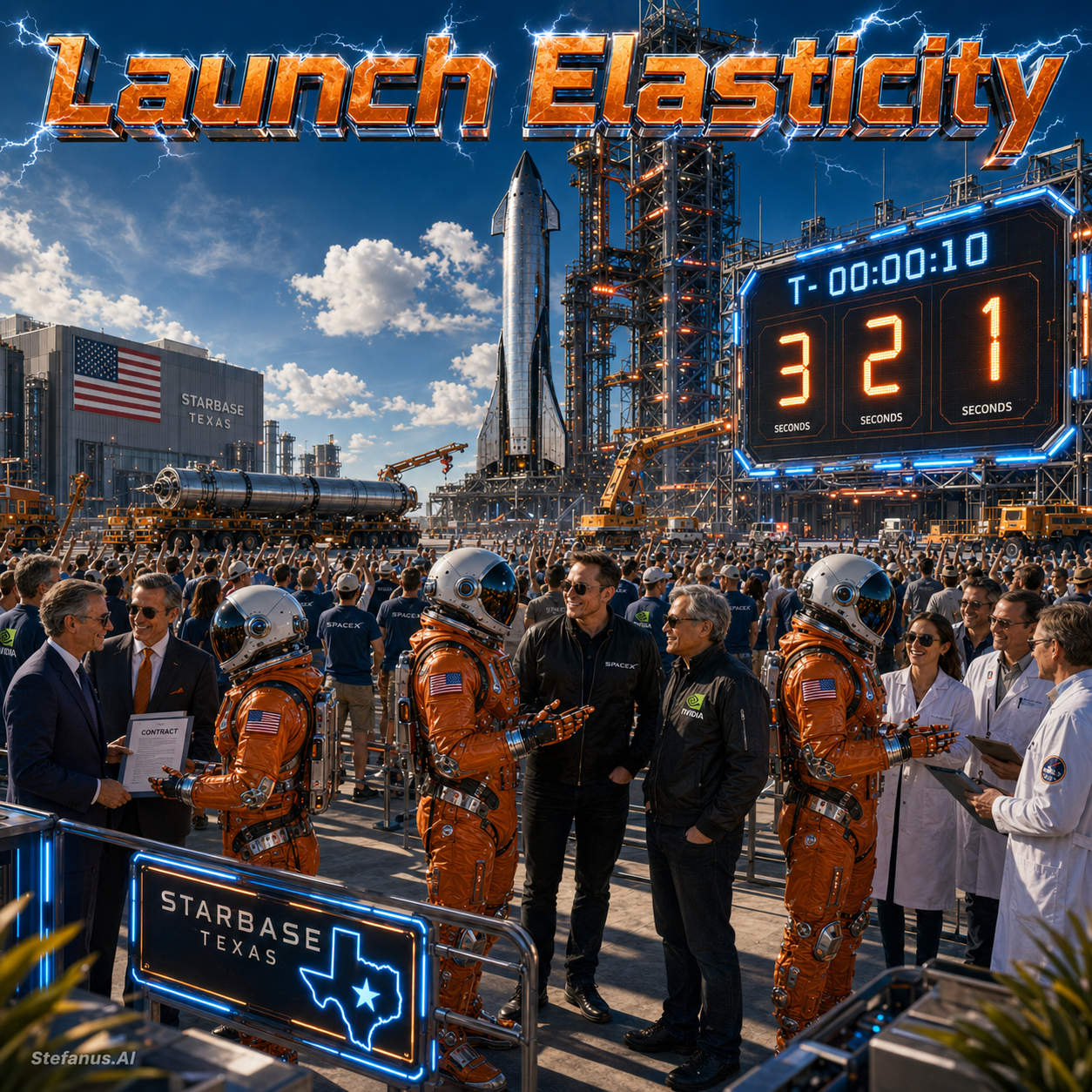

Introduction: When the Datacenter Queue Leaves the Ground
On August 25, 2026, the future of artificial-intelligence infrastructure acquired an unexpectedly physical address: Pecan Island, Louisiana. At a carefully staged event in Vermilion Parish attended by Louisiana Governor Jeff Landry, senior state officials, business leaders, and a room full of reporters, SpaceX unveiled plans for Starbase Louisiana, a proposed $100 billion complex covering roughly 125,000 acres of coastal wetlands about fifty miles south of Lafayette. The facility would become SpaceX’s fourth United States launch location and its second Starbase campus, joining Boca Chica in Texas and the Starship pads under construction in Florida, and it is intended eventually to support thousands of Starship flights per year to Earth orbit, the Moon, Mars, and beyond. Construction is expected to begin in 2027, while SpaceX has targeted 2029 for the site’s first Starship launch.[1] State officials described the commitment as the largest capital investment in Louisiana history, one expected to create more than 3,000 direct jobs paying an average annual salary of $92,600, nearly triple the prevailing wage in Vermilion Parish, with Elon Musk suggesting in a recorded address that the number could eventually approach 10,000.[2]
“We’re here to build something that will open a pathway to the stars.”
— Gwynne Shotwell, President and Chief Operating Officer, SpaceX [3]
The announcement was enormous even by the standards of the contemporary AI-capital-expenditure boom, a boom in which the four largest hyperscalers alone now plan roughly $760 billion of combined capital expenditure in 2026, up from approximately $413 billion the year before.[4] Yet Starbase Louisiana is envisioned as something categorically different from another launchpad. SpaceX described a largely self-sustaining industrial complex containing on-site methane propellant production, dedicated power generation, deep-water shipping capable of bringing Starship vehicles in from Texas, extensive vehicle-processing infrastructure, and potentially an airport, all organized around a single objective: converting access to orbit from an aerospace event into a repeatable industrial process.[5] Independent reporting suggested the site could ultimately be engineered to conduct on the order of ten thousand launches per year, a figure that would have been dismissed as science fiction at any earlier moment in the history of spaceflight.[6]
“Today is a pivotal moment for Louisiana. This announcement pushes our state beyond $250 billion in new investment.”
— Governor Jeff Landry, State of Louisiana [7]
But buried inside the sheer scale of the Louisiana announcement was a much more consequential idea, one that this paper takes as its point of departure. Starship is increasingly being positioned not merely as a transportation system for astronauts, telecommunications satellites, or Mars missions, but as an infrastructure layer for artificial intelligence itself. In late January 2026, SpaceX filed an application with the Federal Communications Commission for a constellation of up to one million satellites that would function as orbital data centers, promising to operate spacecraft with what the company called unprecedented computing capacity to power advanced AI models and the applications that rely on them.[8] By mid-2026 the constellation had a name, Starmind, a first-generation satellite design, AI1, capable of hosting an Nvidia Rubin NVL72 rack behind a 75-meter solar wing, and a claimed deployment pathway that runs directly through Starship’s launch cadence: a million tonnes of satellite hardware per year, adding as much as 100 gigawatts of orbital AI compute capacity annually once the rocket is flying at industrial frequency.[9][10] SpaceX’s Louisiana project is explicitly connected to these AI-satellite ambitions, which means that rocket manufacturing and launch capacity have quietly become part of the emerging economics of compute itself.[1]
That possibility changes the geography of the AI infrastructure debate, and it changes the economics that sit underneath the geography.
For most of the current AI buildout, the critical questions have been terrestrial ones, and they have been questions about electricity. Where can a hyperscaler obtain 500 megawatts, one gigawatt, or several gigawatts of reliable power? Which utility has spare transmission capacity, and how long is its interconnection queue? Can a county board approve the datacenter over local opposition? Is sufficient water available for cooling? Can nuclear, natural gas, renewables, batteries, or even life-extended coal plants deliver electrons quickly enough to match the depreciation schedules of the chips they will feed? Who pays for the new substations and transmission lines, and what happens to residential ratepayers when speculative datacenter demand enters the grid queue faster than power plants can be constructed? The International Energy Agency has projected that global electricity consumption by data centres will more than double to around 945 terawatt-hours by 2030, slightly more than the entire present-day electricity consumption of Japan, with the United States accounting for by far the largest share of the increase and data centres representing nearly half of all American electricity demand growth between now and the end of the decade.[11]
“AI is one of the biggest stories in the energy world today.”
— Fatih Birol, Executive Director, International Energy Agency [12]
These questions are becoming more acute rather than disappearing. On September 1, 2026, Reuters reported that proposed large-load electricity requests, predominantly involving data centers, had surpassed 700 gigawatts across major portions of the Midwest, Mid-Atlantic, and South, a figure more than ten times industry estimates of current United States data-center power consumption, with utilities and state regulators increasingly alarmed that much of this demand is duplicative or speculative, the now-notorious phenomenon of “ghost” demand.[13] In Texas alone, interconnection requests from data centers and other large users have soared from roughly 48 gigawatts in 2023 to more than 474 gigawatts, prompting the state to audit large requests, while Pennsylvania, Ohio, and other jurisdictions are constructing stronger financial and disclosure requirements, and utilities such as Exelon have slashed their estimates of high-probability datacenter demand by 40 percent the moment collateral requirements were imposed.[13][14]
“When you don’t know what is real…”
— Thomas Gleeson, Chairman, Public Utility Commission of Texas, on planning the grid around speculative datacenter demand [13]
Orbital compute proposes something radically different. It proposes to move the marginal unit of AI infrastructure to a place where there is no interconnection queue because there is no grid, no county permitting board because there is no county, no water constraint because there is no water, and continuous solar power because there is no night in a dawn–dusk sun-synchronous orbit. But it does not thereby escape scarcity. It relocates scarcity, and the location to which scarcity moves is the launch pad.
If AI infrastructure can eventually be placed above the terrestrial grid, the economic bottleneck migrates with it. A datacenter in Virginia waits for transmission; an orbital datacenter waits for a rocket. A datacenter campus in Texas competes for megawatts; an orbital computing constellation competes for kilograms to orbit. A terrestrial AI campus measures its expansion partly through the availability of substations, turbines, and transformers; an orbital AI system measures its expansion through Starship production rates, launchpad availability, launch licenses, propellant logistics, payload mass fractions, satellite manufacturing throughput, orbital slots, and, above all, the number of reusable flights that can actually occur every day. The relevant constraint therefore changes from grid interconnection capacity to launch transportation capacity.
This paper calls that emerging relationship Launch Elasticity.
In its strictest economic interpretation, Launch Elasticity can be expressed as the responsiveness of deployable orbital computing capacity to changes in effective launch capacity:
Launch Elasticity = % Change in Deployable Orbital Compute / % Change in Effective Launch Capacity
Effective launch capacity itself is not simply the number of rockets available. It is a composite of launch frequency, payload mass, cost per kilogram, turnaround time, vehicle reliability, satellite-production capacity, launch-site availability, regulatory approval, orbital congestion, and the useful operating life of the hardware being placed in orbit. A rocket that could theoretically fly daily contributes little effective capacity if its engines cannot be manufactured quickly enough, if its pads require weeks of refurbishment, if regulators cap its cadence, or if the satellites it is supposed to carry cannot be produced in matching volume.
The concept therefore asks a more important question than whether orbital datacenters are technologically possible, a question that has already been argued at length by engineers, investors, and skeptics. It asks instead: what happens to the economics of artificial intelligence when rocket cadence becomes one of the variables determining the marginal cost of compute? That question is no longer hypothetical. Nvidia, whose data-center revenue reached a record $89.0 billion in the single quarter ended July 26, 2026, has taken direct equity positions in orbital-compute ventures; Google has committed prototype satellites to orbit; Axiom Space has operational data nodes flying today; and the White House has made a fivefold expansion of national launch cadence an explicit object of federal policy.[15][16][17][18] The queue to intelligence is beginning, at its speculative frontier, to become a queue to orbit.
Why I Choose the Title “Launch Elasticity”
I choose Launch Elasticity because the phrase identifies the economic variable that may ultimately determine whether orbital AI remains an experimental niche or becomes a genuine extension of the global AI infrastructure system. The decisive breakthrough may not come merely from building a powerful space-hardened GPU, placing solar panels around a satellite, or proving that inference can occur in orbit; all three of those things have, in early form, already happened. Starcloud flew the first data-center-grade Nvidia H100 to orbit in November 2025, Axiom’s nodes are processing workloads above the atmosphere, and Google has irradiated its Trillium TPUs in a proton beam and found them serviceable for a shielded five-year mission.[16][17][19] Orbital computing becomes economically meaningful only if computing hardware can be launched, replaced, and upgraded at sufficient volume and sufficiently low cost, sustained over years rather than demonstrated once. In that world, the economics of AI infrastructure become permanently sensitive to the economics of rocket transportation. More frequent launches could increase available compute; higher launch costs could constrain it; reusable vehicles could rewrite depreciation assumptions; a single launch failure could destroy an entire block of capacity before it produces its first token; and regulatory delays could function much like today’s transmission-interconnection delays, converting engineering readiness into stranded intention.
I also choose the term because it distinguishes this paper from broader discussions of an Orbital Intelligence Economy, of space-based intelligence generally, or of an orbital datacenter industry considered as a market category. Those concepts describe where computation could occur. Launch Elasticity describes the mechanism determining how fast that economy can scale, and mechanisms are where industrial fortunes are actually made and lost. It shifts the analysis from science fiction toward industrial economics, in the same way that the study of terrestrial AI infrastructure long ago shifted from admiring model architectures toward counting transformers, turbines, and interconnection agreements. The central question is no longer simply whether we can put AI in space. It becomes: how many useful tokens can the AI economy place into orbit for every additional unit of launch capacity, capital, and time?
There is a final reason for the title, and it is a disciplinary one. Elasticity is a concept economists reach for when two markets that were previously analyzed separately become coupled, when a change in the price or quantity of one begins to propagate measurably into the other. For seventy years, the launch market and the computing market had essentially nothing to say to each other; the rocket equation and Moore’s Law lived in different textbooks. The events of 2025 and 2026, from Starcloud’s H100 to SpaceX’s million-satellite filing to a presidential memorandum on launch cadence, are the first evidence that these two markets are being welded together. When that welding is complete, a delay at a Louisiana launchpad will move the marginal cost of a token in the same way that a delayed substation moves it today. Launch Elasticity is the name this paper gives to the strength of that coupling.

Section 1: From Grid Elasticity to Launch Elasticity
Every infrastructure era has a hidden elasticity, a quiet ratio that determines how quickly ambition can become capacity. In the railroad era it was the responsiveness of track-miles to steel production; in the electrification era it was the responsiveness of generation to turbine manufacturing; in the first two decades of the cloud era it was the responsiveness of server capacity to semiconductor supply. The AI era began by assuming its binding elasticity was chips, discovered painfully in 2023 and 2024 that it was actually electricity and the machinery that delivers electricity, and may now be preparing, at its most speculative frontier, to discover a third: the responsiveness of compute to launch. This section traces that migration, because Launch Elasticity cannot be understood except as the successor to a grid elasticity that is presently failing under load.
1.1 The Terrestrial Constraint: AI Has Become an Electricity Business
The modern AI economy begins with algorithms but increasingly ends with physical infrastructure. Frontier models require chips; chips require datacenters; datacenters require electricity; electricity requires generation, transmission, transformers, substations, fuel, land, water, and regulatory approval. Each link in this chain has, at some point in the past three years, become the binding constraint on the system as a whole, and the industry’s capital flows have chased the constraint down the stack with remarkable speed. Nvidia’s quarterly revenue reached $96.2 billion in the quarter ended July 26, 2026, more than doubling year over year, with data-center revenue of $89.0 billion representing roughly 92 percent of the company; Goldman Sachs now expects aggregate hyperscaler AI infrastructure spending to reach $1.2 trillion in 2027; and the four largest cloud companies have financed this expansion by taking on historic quantities of debt, with Alphabet’s balance rising from roughly $16 billion to $100 billion in a single year.[15][20][21]
This is the logic of what I have elsewhere called the Five-Layer AI Economy:
| Layer | Domain | Terrestrial Bottlenecks |
| Layer 1 | Energy | Generation, transmission, transformers, interconnection queues, fuel, water |
| Layer 2 | Chips | Advanced nodes, HBM memory, advanced packaging, export controls |
| Layer 3 | Datacenters and Compute Infrastructure | Land, permits, construction labor, cooling, grid access |
| Layer 4 | Models | Training compute, data, talent, capital |
| Layer 5 | Applications and Agentic Systems | Inference capacity, latency, distribution, trust |
The extraordinary growth of Layer 4 and Layer 5 has propagated downward until Layer 1 has become one of AI’s principal constraints, which is why the September 2026 Reuters finding of more than 700 gigawatts of pending large-load requests matters so much: it demonstrates that the queue into the terrestrial energy layer is now so long, and so contaminated by speculative and duplicative requests, that regulators can no longer distinguish real demand from phantom demand, and are responding with fees, collateral requirements, audits, and in Texas’s case an outright pause on approvals while the review proceeds.[13] The uncertainty cuts in both directions, as consumer advocates have warned, because a grid planned around ghost demand either over-builds at ratepayer expense or under-builds and threatens reliability.[13] The terrestrial system, in other words, is not merely slow; it is becoming epistemically unmanageable, unable even to know what it is being asked to build.
Orbital computing does not eliminate the Five-Layer AI Economy. It rearranges it, and the rearrangement is the subject of the next subsection.
1.2 The Orbital Reconfiguration of the Five Layers
An orbital system produces a modified architecture in which each layer survives but changes its physical form, its supplier base, and its constraint structure:
| Layer | Orbital Form | What Changes |
| Layer 1: Orbital Energy | Solar arrays, batteries, power electronics | Continuous dawn–dusk sunlight replaces grid interconnection; radiators replace cooling towers |
| Layer 2: Space-Ready Compute Silicon | Radiation-tolerant GPUs, TPUs, memory, networking silicon, optical terminals | Shielding, error correction, and thermal limits join the chip-design equation |
| Layer 3: Orbital Datacenters | Compute satellites, constellations, optical meshes, ground stations, launch infrastructure | The launchpad becomes part of the datacenter; the rocket becomes construction equipment |
| Layer 4: Orbital Models | Inference-optimized and autonomy-optimized models | Bandwidth to Earth and on-board autonomy shape which workloads fit |
| Layer 5: Space-Native Applications and Agents | Autonomous satellite agents, Earth observation, defense, communications, science | Latency, sovereignty, and resilience become product features |
Layer 1 is where the case for orbit begins. In a dawn–dusk sun-synchronous orbit a solar array is illuminated almost continuously, avoiding clouds, atmosphere, and night, which is why Google’s Project Suncatcher analysis concluded that panels in such orbits can generate substantially more energy than equivalent terrestrial installations, and why SpaceX’s AI1 satellite design devotes a 75-meter solar wing and roughly 30 meters of radiator panel to feeding and cooling approximately 250 kilowatts of peak compute, enough to host a full Nvidia Rubin NVL72 rack in a single spacecraft.[9][19] Layer 2 is where the case is tested, because terrestrial accelerators were never designed for total ionizing dose or single-event upsets; Google’s decision to fire a 67 MeV proton beam at its Trillium TPUs, and its finding that the chips survived radiation levels consistent with a shielded five-year low-Earth-orbit mission, was arguably the single most important engineering data point of the entire orbital-compute movement to date.[19] Layer 3 is where this paper lives, because it is the layer into which the rocket has been annexed. And Layers 4 and 5 are where the economics must ultimately be redeemed, because satellites that cannot sell tokens, imagery, security, or autonomy back to paying customers are simply very expensive debris in waiting.
The Five-Layer framework therefore survives, but its physical geography changes, and with the geography changes the identity of the marginal constraint.
1.3 What Exactly Is Launch Elasticity?
Launch Elasticity should be treated as a measurable industrial concept rather than a metaphor, and measurement requires decomposition. A useful expanded framework is:
Orbital Compute Deployment Capacity = (Launch Cadence × Useful Payload × Reusability × Satellite Production × Hardware Utilization) / (Launch Cost × Failure Risk × Replacement Rate × Regulatory Friction)
The numerator describes the industrial system’s throughput. Launch cadence is the number of flights per unit time; useful payload is the mass of revenue-generating hardware per flight after structure, shielding, and deployment mechanisms are subtracted; reusability multiplies the effective fleet; satellite production determines whether there is anything worth launching; and hardware utilization determines whether orbited compute actually produces tokens or idles for want of bandwidth, power, or demand. The denominator describes the system’s friction. Launch cost converts cadence into capital burn; failure risk converts each flight into a probabilistic loss of an entire capacity block; replacement rate captures the brutal fact that AI accelerators depreciate economically in three to five years while satellites are engineered to survive far longer; and regulatory friction, from FCC constellation licensing to FAA launch approvals to environmental review, operates exactly as interconnection queues operate on Earth, as a tax denominated in time.
The paper must therefore distinguish launch capacity from effective launch capacity. A rocket theoretically capable of flying daily has little economic significance if engines cannot be produced quickly enough, launchpads require lengthy refurbishment, regulators limit cadence, satellites cannot be manufactured in sufficient numbers, or payload integration becomes the bottleneck. SpaceX itself implicitly conceded this distinction when it asked the FCC to waive the standard milestone rules requiring half a constellation within six years and full deployment within nine, on the grounds that the timeline depends entirely on a rocket that had, at the time of filing, not yet demonstrated full and rapid reusability.[10] Launch Elasticity therefore measures the complete industrial system, not the rocket alone, in precisely the way that grid elasticity measures generation, transmission, transformers, and permitting together rather than power plants alone.
1.4 The Launch Queue as the New Interconnection Queue
Terrestrial developers speak constantly about the power queue, the years-long line of projects waiting for a utility to study, approve, and physically connect their load. The orbital economy is already creating its analogue: a launch queue.
Companies are beginning to reserve rocket capacity years in advance, just as hyperscalers reserve electricity and datacenter capacity today, and the earliest evidence suggests that secured transportation is becoming a strategic asset in its own right. Starcloud, the Redmond, Washington orbital-datacenter company, raised a $250 million Series A extension at a $2.3 billion post-money valuation on August 21, 2026, led by Manhattan West with participation from Nvidia and Cisco Investments among others, bringing its total capital raised since its 2024 founding to $450 million; the company stated explicitly that the new capital would fund manufacturing buildout, joint engineering with Nvidia, and the procurement of future launch capacity.[16][22][23] Its declared destination is a constellation of 88,000 satellites delivering 20 gigawatts of orbital compute, with production lines for its Starcloud-3 spacecraft rising inside a new 100,000-square-foot facility in Woodinville, Washington.[16]
“Last November we put the first NVIDIA H100 in orbit.”
— Philip Johnston, Co-Founder and Chief Executive Officer, Starcloud [16]
Yet Starcloud’s binding challenge is not obtaining AI chips, which its investor now manufactures, nor even radiation-hardening them, which its Starcloud-1 mission substantially de-risked. Its challenge is obtaining rides to space at a price that closes the business case, and its own chief executive has been unusually candid that the company cannot compete with terrestrial energy costs until Starship flies frequently, with commercial access hoped for in 2028 or 2029 and a fallback plan of continuing to launch smaller spacecraft on Falcon 9 if the larger rocket is delayed.[24]
“We’re not going to be competitive on energy costs until Starship is flying frequently.”
— Philip Johnston, CEO of Starcloud, on the launch-cost dependency of orbital datacenters [24]
This is what a launch queue looks like in its infancy: valuations that partly capitalize secured or anticipated transportation, funding rounds earmarked for launch procurement, and business plans whose central risk disclosure is another company’s flight rate. Dedicated launch availability will carry premiums; launch contracts will be traded, collateralized, and litigated; and startup fortunes will hinge on a manifest position in exactly the way that datacenter fortunes today hinge on an interconnection position. The queue has not left the economy. It has merely changed what it is a queue for.
1.5 The New Scarcity Hierarchy
The migration can be summarized as a reordering of the scarcity stack:
| Rank | Terrestrial AI Scarcity | Orbital AI Scarcity |
| 1 | Power (generation and delivery) | Launch slots and cadence |
| 2 | Interconnection queue position | Rockets and engines |
| 3 | Transformers and substations | Useful payload mass to orbit |
| 4 | Construction labor and permits | Satellite manufacturing throughput |
| 5 | Chips and advanced packaging | Space-qualified chips and optical terminals |
| 6 | Water and cooling | Orbital power and radiator area |
This creates a different industrial bottleneck map, and potentially an entirely new asset class surrounding guaranteed launch rights, in the way that transmission congestion rights, capacity-market obligations, and power purchase agreements became tradeable financial instruments once terrestrial scarcity was formalized. It also creates a new category of industrial-policy target, because a government that wishes to accelerate national AI capacity in orbit must subsidize, permit, and de-risk items one through four of the right-hand column, none of which appear in any existing AI strategy document written before 2025. Section 5 will return to this point, because in August 2026 the United States government wrote precisely such a document.
1.6 Three Regimes of Launch Elasticity
It is analytically useful to recognize that Launch Elasticity, like most elasticities, is not a single number but a curve with distinct regimes, and that the orbital-compute economy will pass through those regimes in sequence if it develops at all. In the inelastic regime, where the industry sits today, additional demand for orbital compute produces almost no additional deployed capacity, because launch supply is fixed in the short run by pad counts, vehicle availability, and licensing; capital raised for orbital datacenters in this regime is spent mostly on waiting, on manufacturing ahead of transport, and on securing manifest positions, which is precisely how Starcloud describes the use of its August 2026 proceeds.[16][22] In the transitional regime, which Starship’s maturation and the federal thousand-launch target are designed to open, each increment of launch capacity translates into a large increment of deployed compute, because a backlog of manufactured satellites, qualified designs, and committed capital is waiting to flow through the widening aperture; this is the regime in which fortunes are made, because prices for launch remain high while volumes begin to scale, and it is the regime every participant is racing to time correctly. In the elastic regime, the mature state that Bezos’s twenty-year horizon and Google’s mid-2030s learning curves gesture toward, launch becomes a commodity input like terrestrial electricity, cadence ceases to bind, and the constraint migrates yet again, most plausibly to orbital governance, spectrum, thermal engineering, or simply to demand.[19][51]
The practical value of the three-regime framing is that it disciplines both forecasting and valuation. Claims about orbital compute are frequently incommensurable because their authors are implicitly describing different regimes: Zubrin’s “fantasy” is a true statement about the inelastic present extrapolated forward, Musk’s two-to-three-year cost-parity prediction is a claim that the transitional regime is imminent, and Bezos’s decades are a bet on the elastic endgame without a timetable for the middle.[25][51] An investor, a policymaker, or a rival hyperscaler does not need to decide who is right in the abstract; each needs to estimate the boundary dates between regimes, because every contract, incentive, and capital commitment in this industry is, at bottom, a wager on when the curve bends.

Section 2: The Industrial Economics of Putting Intelligence Into Orbit
If Section 1 established that the constraint is migrating, this section asks what the migration does to prices, to cost accounting, and to the capital structure of the AI industry. The honest answer is that it complicates all three, because it inserts a transportation industry, with its own cost curves, failure modes, and learning rates, directly into the production function of intelligence. The economics of orbital compute cannot be derived from datacenter economics plus a launch surcharge; they are a genuinely hybrid discipline, and the hybrid has properties that neither parent possessed.
2.1 Cost per Kilogram Becomes Part of Cost per Token
The terrestrial AI industry evaluates GPU acquisition cost, electricity per kilowatt-hour, utilization, cooling, networking, depreciation, datacenter rent, and financing cost, and it has developed an elaborate analytical apparatus for each. Orbital AI adds another variable, transportation cost to orbit, and the variable is not small. Falcon 9 today delivers mass to low Earth orbit at roughly $3,600 per kilogram, while the business models of orbital-datacenter developers generally require figures an order of magnitude lower; Starcloud has indicated that its Starship-launched Starcloud-3 spacecraft could deliver power at costs on the order of five cents per kilowatt-hour if commercial launch lands around $500 per kilogram, and Google’s published Suncatcher analysis anticipates learning-curve projections of roughly $200 per kilogram by the mid-2030s, at which point launch-plus-operations costs could become roughly comparable, per kilowatt-year, to the energy costs of an equivalent terrestrial datacenter.[24][25][26]
“The cost of launching and operating a space-based data center could become roughly comparable to the reported energy costs of an equivalent terrestrial data center.”
— Travis Beals, Senior Director, Paradigms of Intelligence, Google [26]
Eventually, therefore, investors will need to derive something like:
Orbital Cost per Token = Compute Cost + Satellite Cost + Launch Cost + Communications Cost + Replacement Cost
Every term in that expression is coupled to the launch system. Satellite cost falls with production volume, but production volume is rational only if launch volume exists to absorb it; the space engineer Andrew McCalip has cautioned that the industry takes future Starship pricing for granted while overlooking that the satellites themselves currently cost nearly a thousand dollars per kilogram to build, and his published modeling suggests a one-gigawatt orbital datacenter would presently cost approximately $42.4 billion, nearly three times its terrestrial equivalent.[27] Communications cost depends on optical terminals and ground stations whose deployment is itself launched. Replacement cost is launch cost wearing a depreciation schedule. That is what it means to say that rocket economics have become part of AI economics: cost per kilogram is no longer an aerospace statistic but an input into the marginal price of a token.
2.2 Starship as AI Infrastructure
This is the analytical significance of Starship, and it deserves to be stated carefully, because the vehicle is usually analyzed as a rocket among rockets. A rocket ceases to be merely an aerospace vehicle when the payload consists of industrial quantities of AI infrastructure. Starship would then function conceptually like a combination of heavy freight transportation, datacenter construction logistics, transmission infrastructure, cloud-capacity deployment, and an infrastructure upgrade mechanism, all fused into a single reusable machine. Its published trajectory through 2026 illustrates both the promise and the fragility of that role: the program’s twelfth and thirteenth test flights achieved orbital insertion and a soft Indian Ocean splashdown of the upper stage, with the vehicle recovered intact enough to be towed for examination, while full, rapid, economically meaningful reusability of both stages remained a work in progress.[6][10] SpaceX’s constellation plan envisions hourly Starship launches beginning as early as 2028, each carrying roughly 200 tons of payload, with satellites manufactured at a dedicated Gigasat factory in Bastrop, Texas, and first deployments targeted for late 2027.[28]
Every improvement in payload capacity, reuse count, or turnaround time therefore propagates directly into the supply curve of orbital compute, exactly as a cheaper turbine or a faster transformer factory propagates into the supply curve of terrestrial compute. And every shortfall propagates too, which is why the equity research firm MoffettNathanson calculated that the million-satellite plan would require on the order of 3,000 Starship launches per year, roughly eight per day, and why Ars Technica’s Eric Berger, in the most detailed independent cost analysis published to date, concluded that the bare-bones cost of deploying one million satellites exceeds a trillion dollars and that the entire business case hinges on Starship achieving exceptional, sustained performance.[29][30] Berger’s interlocutor McCalip put the engineering-economic verdict in a single sentence:
“It’s only a question of whether this is a rational thing to scale up economically.”
— Andrew McCalip, space engineer, in Eric Berger’s Ars Technica analysis of orbital datacenter viability [30]
2.3 Cadence Matters More Than Spectacle
The history of spaceflight has emphasized individual launches, singular events witnessed, televised, and memorialized. Orbital AI requires the opposite mentality, and the inversion is total. A one-million-satellite vision cannot be evaluated through spectacular individual launches; it requires industrial cadence, the dull, repetitive, factory-like frequency that turns transportation into logistics. The important metric becomes launches per week, launches per day, tons delivered per month, and useful compute deployed per year, which is why SpaceX’s claim that Starbase Louisiana could eventually support thousands of flights annually matters more economically than the symbolism of the site’s first launch in 2029, and why the company’s own stated arithmetic, a million tonnes launched per year yielding roughly 100 gigawatts of annual compute additions at approximately 100 kilowatts per tonne, is best read not as a promise but as a cadence requirement.[1][10]
The comparison with current reality is sobering and clarifying at once. In 2025, all United States entities together conducted fewer than 200 orbital launches, of which SpaceX flew roughly 85 percent.[31] The gap between two hundred launches per year and thousands is not a gap that better engineering alone can close; it is a gap of pads, propellant plants, engine factories, range scheduling, airspace integration, environmental review, and workforce, which is to say a gap of industrial systems. Musk has argued that SpaceX’s decade of operating Starlink, the only constellation of its scale ever flown, gives the company a uniquely relevant operational base for this transformation.[32]
“We are the only operator that has any experience of that scale.”
— Elon Musk, on SpaceX’s qualification to operate million-satellite constellations [32]
Skeptics answer that experience operating ten thousand communications satellites does not license extrapolation to a million computing satellites lofted by a vehicle still in test. Robert Zubrin, the aerospace engineer and Mars Society founder who has known Musk for a quarter century, delivered the bluntest version of the case:
“Launching a million satellite orbital data center constellation is fantasy.”
— Dr. Robert Zubrin, aerospace engineer and founder of the Mars Society [25]
The purpose of this paper is not to adjudicate between these positions but to observe what they share: both sides agree that cadence is the crux. Musk’s own prediction that space will become the lowest-cost way to generate AI compute within two to three years stands or falls entirely on flight rate, and Zubrin’s incredulity is incredulity about flight rate, about 8,700 annual launches materializing from a program that has yet to re-fly a Starship booster routinely.[25] When optimists and skeptics disagree about everything except the identity of the decisive variable, the analyst’s job is to name the variable. That variable is Launch Elasticity.
2.4 Replacement Economics and Hardware Obsolescence
AI chips age economically faster than many traditional satellites, and this asymmetry creates one of the most profound and least discussed problems in orbital computing. A telecommunications satellite designed to operate for fifteen years can tolerate relatively slow technological change, because a transponder’s economic function is stable across its engineering life. A frontier AI accelerator may be surpassed within a few years or even sooner; Nvidia’s own architecture cadence has moved from Hopper to Blackwell to Blackwell Ultra to the Rubin generation in barely four years, and the company’s guidance in August 2026 anticipated continued annual rhythm.[15][21] Orbital computing therefore faces a structural tension between satellite engineering life and AI hardware economic life. A satellite might remain perfectly functional while its processor becomes commercially obsolete, a stranded rack in a place where no technician can reach it.
High Launch Elasticity provides one possible answer: replace the hardware frequently enough that the orbital fleet tracks the frontier-compute curve, deorbiting or degrading old spacecraft while new ones carry the newest silicon. This is, in effect, what SpaceX already practices with Starlink, whose satellites are designed for roughly five-year lives and continuous generational replacement, and it is the tacit assumption behind constellation designs that place spacecraft in low, quickly decaying orbits. Low Launch Elasticity produces the opposite outcome, which the Harvard researcher and former NASA official Rebekah Reed has described with precision in her critique of the field: aging orbital hardware demands either sophisticated in-space servicing or the acceptance of degrading performance and stranded capital, capital that ultimately becomes debris.[33]
“…risk of collisions and debris, threatening communications, weather and navigation services.”
— Rebekah Reed, Harvard University, former NASA associate director, on the externalities of scaled orbital datacenters [33]
The replacement problem is therefore not a footnote to the launch problem; it is the launch problem, iterated indefinitely. An orbital AI fleet is not a thing one builds; it is a flow one sustains, and the sustainable flow rate is set by the same cadence variable that governs initial deployment.
2.5 Depreciation Above Earth
This leads to a new accounting question, deceptively technical and genuinely consequential. Should an orbital AI satellite be depreciated like a satellite, over ten to fifteen years; like a server, over four to six; like a datacenter shell, over twenty or more; like a GPU cluster, whose useful life the hyperscalers have already revised repeatedly in their financial statements; or like transportation-dependent infrastructure, whose value is contingent on the continued existence of an affordable resupply line? The answer will influence project finance, insurance pricing, leasing structures, and expected returns, because depreciation schedules are where physical assumptions become cash-flow assumptions. If orbital hardware must be replaced every three or four years to remain competitive, then frequent low-cost launch is not merely desirable; it becomes a covenant-level requirement, something lenders will demand be contractually secured before capital is advanced, in the way that terrestrial datacenter lenders demand executed power purchase agreements today. One can anticipate, without excessive imagination, launch-availability covenants, cadence-linked insurance premia, and constellation-refresh reserve accounts appearing in the financing documents of the 2030s. The rocket, in other words, is about to acquire a credit rating.
2.6 Financing the Coupling: Capital Markets Meet the Countdown Clock
The final industrial-economic observation of this section concerns capital markets, because the coupling of launch and compute is being priced in real time even while its physics remains unproven. The terrestrial side of the ledger is already extraordinary: the hyperscalers’ 2026 capital expenditure of roughly $760 billion is being financed by a widening mix of record debt issuance, tenant prepayments, structured partnerships, and equity, with Alphabet alone executing an $80 billion equity raise and the sector’s free cash flow compressing toward zero even as revenues grow, a financing posture that leaves investors acutely sensitive to any technology that promises a cheaper marginal gigawatt.[4][20] Onto this ledger the orbital ventures have grafted themselves with remarkable speed. Starcloud’s valuation more than doubled in five months on the strength of one flown GPU and one strategic investor; Cowboy Space commanded $2 billion pre-revenue; and SpaceX’s own public-market debut was marketed substantially on the orbital-datacenter narrative, with the Starmind program featured prominently in filings supporting a valuation that crossed $1.5 trillion, so that a measurable fraction of one of the largest market capitalizations on Earth now rests on an elasticity that does not yet exist.[22][38][44][47]
This is not necessarily irrational, but it is unusually reflexive, in the sense that the financing itself changes the probability of the outcome being financed. Capital raised on the orbital narrative funds the Gigasat factory, the Louisiana pads, and the launch procurement that alone can make the narrative true; conversely, a funding winter would slow cadence investment and validate the skeptics whose arguments triggered it. Launch Elasticity therefore has a financial multiplier: markets that believe in future cadence supply the capital that creates it, within the hard limits that engineering and regulation impose. The closest historical analogues, railway manias, fiber overbuilds, the terrestrial datacenter boom itself, suggest both that reflexive financing can genuinely summon infrastructure into existence and that it reliably summons more of it than first-order demand justifies, with the excess resolved through consolidation and repricing rather than demolition. Orbital compute, if it follows the pattern, will experience its own version of dark fiber: dark constellations, hardware lofted ahead of demand, awaiting the workloads that make it shine. Whether that prospect is a warning or a roadmap depends, as everything in this paper depends, on the cost of the next launch.

Section 3: The Orbital AI Supply Chain
Industries are made of supply chains before they are made of markets, and the surest sign that orbital compute has crossed from speculation into industrial formation is that its supply chain is beginning to assemble in public, company by company, filing by filing, funding round by funding round. This section maps that chain as it stood in September 2026, from the semiconductor giants adapting their silicon for vacuum, to the hyperscaler running proton-beam experiments on its own accelerators, to the startups racing to occupy niches before the giants arrive, to the hundreds of component categories beneath them all. The map matters because Launch Elasticity is a property of the whole chain, not of any single firm; a constellation is only as elastic as its least elastic supplier.
3.1 Nvidia Goes to Space
Orbital AI converts semiconductor competition into aerospace competition, and Nvidia’s behavior through 2026 shows a company taking that conversion seriously. Starcloud’s collaboration with Nvidia began when the startup flew the first Nvidia H100 to orbit aboard Starcloud-1 in November 2025, a spacecraft of roughly sixty kilograms carrying approximately one hundred times the computing power of anything previously flown; since March 2026 the two companies have been engineering the Nvidia Space-1 Vera Rubin Module, a computing system explicitly designed for an environment where cooling depends on large radiators and components must endure radiation and thermal extremes, and in August Nvidia converted collaboration into ownership by joining Starcloud’s $250 million round as an investor.[16][22] Nvidia hardware likewise anchors SpaceX’s plans, with the AI1 satellite specified around the Rubin NVL72 rack architecture.[9]
This signals the potential emergence of a new chip category, space-native AI accelerators, in which the design envelope is defined not by a datacenter’s power budget but by a spacecraft’s radiator area, shielding mass, and single-event-upset tolerance. The competitive landscape could eventually include Nvidia’s space modules, Google’s radiation-tested TPUs, custom hyperscaler silicon adapted for orbit, and specialized processors built from the transistor up for orbital inference. The strategic logic for the chipmakers is straightforward and slightly circular: if orbit becomes a real venue for compute, the company whose silicon is qualified for orbit first inherits the venue; and the act of investing in orbital ventures helps will the venue into existence. Jensen Huang’s framing of the present moment, delivered with Nvidia’s August 2026 results, applies to orbit with special force, because a satellite is the purest possible embodiment of the idea that compute has become a revenue-bearing capital asset:
“AI has reached its inflection point… Now, compute is revenue.”
— Jensen Huang, Founder and CEO, NVIDIA, announcing record Q2 FY2027 results [15]
3.2 Google and Project Suncatcher
Google’s Project Suncatcher demonstrates that the orbital-compute thesis extends well beyond SpaceX, and it contributes something the field otherwise lacks: published, peer-reviewable engineering analysis from a hyperscaler with no rocket to sell. Announced in November 2025 as a research moonshot, Suncatcher explores networks of solar-powered satellites equipped with Google’s TPUs and linked by free-space optical communication, with a learning mission in partnership with Planet slated to launch two prototype satellites by early 2027.[34][35] The company’s preprint describes dawn–dusk sun-synchronous constellations of 81-satellite clusters flying within a roughly one-kilometer formation, spacecraft separated by only hundreds of meters so that inter-satellite laser links can reach the tens of terabits per second that distributed machine-learning workloads demand; a bench demonstration has already achieved 1.6 terabits per second, and the Trillium TPU radiation campaign found the chips’ memory subsystems began to falter only at nearly three times the expected shielded five-year mission dose.[19][26][36]
“It’s going to require us to solve a lot of complex engineering challenges.”
— Sundar Pichai, CEO of Google, announcing Project Suncatcher [34]
Suncatcher matters to this paper for two reasons. First, its economics are stated in explicitly launch-elastic terms: Google’s analysis concludes that space-based machine-learning compute is precluded neither by physics nor by insurmountable economics, but its cost-parity projection depends on launch prices falling to roughly $200 per kilogram on mid-2030s learning curves, which is to say the hyperscaler has independently arrived at the same conclusion as the startups, that the rocket is the price-setter.[19][26] Second, Suncatcher previews the reproduction of terrestrial cloud competition above Earth. The future contest might involve Nvidia-ecosystem constellations versus TPU-ecosystem constellations versus the vertically integrated SpaceX–xAI infrastructure, which since the February 2026 merger of xAI into SpaceX combines models, chips demand, satellites, and launch inside a single $1.25 trillion corporate entity, versus independent orbital clouds selling neutrality as a feature.[10]
3.3 Starcloud and the Independent Orbital Cloud
Starcloud represents the third structural model: an independent infrastructure company, aligned with but not owned by any hyperscaler or launch provider, attempting to become to orbital compute what the early independent datacenter operators were to terrestrial cloud. Its trajectory has been extraordinarily rapid even by AI-era standards, from Y Combinator’s summer 2024 cohort, to the fastest unicorn in the accelerator’s history at a $1.1 billion valuation in March 2026, to $2.3 billion five months later, with total capital of $450 million raised in under two years.[16][22][23] Its funding round of August 2026 shows that institutional capital is beginning to treat orbital compute as more than a laboratory experiment, and the composition of the round is as informative as its size: Nvidia connects the dominant terrestrial accelerator ecosystem to the venture, while Cisco’s participation connects the networking layer, an explicit acknowledgment that an orbital datacenter is above all a networking problem wearing a thermal problem’s clothing.[16]
“Cisco has long been a leader in secure data center infrastructure.”
— Aleem Rizvon, Vice President, Cisco Investments, on joining Starcloud’s round [37]
Starcloud is not alone in the independent lane. Cowboy Space raised $275 million at a $2 billion valuation earlier in 2026 to develop rockets whose upper stages convert into orbital compute platforms after launch, a design that collapses the launch queue and the compute asset into a single vehicle and thereby represents perhaps the purest architectural bet on Launch Elasticity yet attempted; Orbital, an a16z-backed entrant, is targeting more than 100,000 spacecraft; and Lonestar Data Holdings has flown missions to the International Space Station and the lunar surface to prove off-planet data storage and resilience.[22][38] The independents’ collective wager is that the orbitalscaler era, like the hyperscaler era before it, will leave room for specialized infrastructure firms, and their collective vulnerability is identical: every one of them buys launch from someone else, or must become a launch company to avoid doing so.
3.4 Axiom and the Early Orbital Cloud
Not every orbital-datacenter architecture requires gigantic AI constellations, and the most operationally advanced deployments of 2026 are also the most modest. Axiom Space deployed its Data Center Unit-1 prototype aboard the International Space Station in the fall of 2025, running cloud computing, AI and machine-learning, data fusion, and space cybersecurity applications, and on January 11, 2026 its first two dedicated free-flying Orbital Data Center nodes reached low Earth orbit aboard the first tranche of Kepler Communications’ optical relay constellation, whose ten 300-kilogram satellites each carry optical terminals, multi-GPU compute modules, and terabytes of storage, and which entered commercial service with optical connectivity in August 2026.[17][46][39] Axiom’s architecture emphasizes in-orbit processing for other spacecraft, real-time exploitation of national-security and commercial satellite data, lower-latency multi-sensor fusion, and Earth-independent cybersecurity, rather than any immediate attempt to replace terrestrial hyperscale campuses, with a fully connected node aboard the ISS targeted by 2027.[38][39]
This suggests that orbital compute may emerge incrementally, along a value ladder rather than in a single leap:
Edge Processing → Orbital Cloud Nodes → AI Inference Constellations → Large Orbital Compute Networks → Potential Orbital AI Factories
Each rung of the ladder has progressively higher Launch Elasticity requirements. Edge processing for satellites already in orbit requires almost none; kilowatt-scale cloud nodes ride rideshare missions; inference constellations of tens of thousands of spacecraft require Starship-class cadence; and training-scale orbital AI factories require the full industrial vision of Starbase Louisiana. The ladder also disciplines the debate, because critics of the top rung are frequently answered with evidence from the bottom rung and vice versa. The Breakthrough Institute’s analysis, for instance, concludes that large-scale orbital datacenters remain distant while satellite edge computing is the one segment that could plausibly flourish within the decade, a position entirely compatible with both Axiom’s operational success and skepticism about million-satellite filings.[40]
3.5 The Supply Chain Beneath the Rocket
Orbital computing would create demand well beyond rockets and GPUs, and the breadth of that demand is easy to underestimate. A scaled orbital AI economy would require radiation-tolerant memory and advanced packaging qualified for thermal cycling; high-efficiency, mass-produced space solar cells, for which SpaceX has already planned a ten-gigawatt manufacturing plant in Bastrop County, Texas; deployable radiator systems and two-phase thermal loops; optical inter-satellite links manufactured in the tens of thousands rather than the dozens; launch-resistant server structures engineered for 6-g ascent loads rather than seismic codes; networking silicon; batteries and power electronics; a global lattice of optical and radio ground stations; standardized satellite buses; shielding; electric propulsion for station-keeping and deorbit; and autonomous fleet-management software able to operate a million-node datacenter that no human hand can touch.[9][28]
Therefore orbital AI could eventually create an entirely new industrial extension of the Five-Layer AI Economy, a parallel supplier ecosystem in which familiar categories acquire unfamiliar qualifications. The investment implication is that Launch Elasticity, while named for the rocket, will be bottlenecked at various moments by whichever of these component industries scales most slowly, exactly as terrestrial AI has been serially bottlenecked by HBM memory, advanced packaging, transformers, and turbines. The companies that resolve those secondary bottlenecks, the makers of radiators, optical terminals, and space solar at automotive volumes, may prove to be the pick-and-shovel winners of the orbital era, whatever becomes of the constellation flagships.

Section 4: The Constraints That Launch Elasticity Cannot Magically Eliminate
Every enthusiasm requires an audit, and the enthusiasm for orbital compute requires a more searching audit than most, because its promotional narrative, infinite solar power, no neighbors, no permits, invites the inference that space is a place without constraints. It is not. Space substitutes one constraint set for another, and several of the substituted constraints are harder, not softer, than their terrestrial counterparts. This section catalogues the constraints that survive even under generous Launch Elasticity assumptions, because a concept is only useful if its limits are stated as honestly as its powers. High Launch Elasticity determines how fast hardware reaches orbit; it says nothing about whether the hardware works, connects, persists, or is welcome once it arrives.
4.1 Heat Does Not Disappear in Space
Space offers abundant solar energy but creates a genuinely difficult thermal environment, and the difficulty is the mirror image of the abundance. Terrestrial datacenters reject heat into air and water through convection, evaporative cooling towers, and liquid loops, all of which depend on a surrounding medium. In vacuum there is no medium, and heat must principally be rejected through radiation, which scales with radiator area and the fourth power of radiator temperature. The arithmetic is unforgiving: SpaceX’s AI1 design allocates roughly 100 to 160 square meters of deployable radiator to reject the waste heat of a single rack-class payload, with independent thermal analysis suggesting an ammonia-loop radiator of that size dissipating 250 kilowatts from both faces would run near 85 degrees Celsius, and a 20-megawatt orbital facility, small by terrestrial standards, would require radiator fields exceeding 20,000 square meters.[9][28]
“Thermal management and cooling in space is generally a huge problem.”
— Lilly Eichinger, CEO, Satellives, in MIT Technology Review’s assessment of orbital datacenters [41]
MIT Technology Review’s survey of the field adds a subtle orbital-mechanics twist: the continuously illuminated orbits that make solar power attractive also deny spacecraft the cooling respite of Earth’s shadow, holding equipment temperatures near 80 degrees Celsius, uncomfortably hot for long-term electronics reliability.[41] This means a satellite cannot be evaluated simply by asking how many GPUs can physically fit inside it. One must ask how many GPUs can operate continuously without exceeding the thermal system’s ability to reject heat, and the answer converts directly into launched mass, because radiators are heavy, and launched mass converts back into Launch Elasticity. Heat, in orbit, is paid for in kilograms.
4.2 Radiation Changes the Chip Problem
Advanced AI accelerators are designed for terrestrial datacenters, environments in which the most exotic hazard is a power sag. Orbit introduces total ionizing dose that degrades transistors cumulatively, single-event upsets that flip bits and crash kernels, and solar particle events that can damage unhardened electronics outright. The early empirical news is better than pessimists expected: Google’s proton-beam campaign found Trillium TPUs surviving without damage at doses consistent with a shielded five-year mission, with memory subsystems, the most vulnerable components, degrading only at nearly triple that exposure, and Starcloud’s H100 has operated on orbit since late 2025.[19][36] But encouraging bench results do not abolish the systems problem, because the operational question is not whether a chip survives but what error rates, checkpoint overheads, redundancy allocations, and shielding masses are required to make a fleet of a million chips commercially dependable. Shielding adds mass; mass increases launch requirements; launch requirements raise transportation costs; and thus an engineering problem becomes an economic problem and feeds directly back into Launch Elasticity. Radiation is not a barrier to orbital compute. It is a tax on it, denominated, once again, in kilograms.
4.3 Networking Becomes the Orbital Backplane
A cluster is not simply a collection of processors, and this is the constraint that most sharply divides credible orbital workloads from incredible ones. Modern AI infrastructure depends on staggering quantities of inter-chip and inter-server communication; Nvidia connects a single GPU into a training cluster at approximately 7.2 terabits per second, while today’s best optical inter-satellite links deliver roughly 100 gigabits per second with next-generation systems promising perhaps 400, a shortfall of one to two orders of magnitude per GPU before one accounts for the tens of thousands of GPUs that frontier training requires.[42] Aerospace veterans such as David Karpf have argued from these numbers that frontier-scale training in orbit is presently implausible, and that the field’s real near-term opportunity lies in sovereignty-sensitive and latency-tolerant workloads rather than head-to-head competition with terrestrial clusters, a caution echoed by researchers who note that inference, which parallelizes cleanly and tolerates looser coupling, is the natural first orbital workload while training remains bandwidth-bound.[42][43]
Orbital AI therefore requires high-capacity optical networking between satellites and reliable, weather-resilient communications between orbit and Earth, and the economics of space compute could consequently depend as much on network topology as on processors themselves. Google’s answer, flying satellites hundreds of meters apart so that link budgets close at tens of terabits, is an orbital-mechanics solution to a networking problem, and it illustrates the deeper point: in space, the network is not a layer on top of the infrastructure, it is the infrastructure’s geometry.[19][26] This extends the concept of networking silicon into a new geography without duplicating it. Networking becomes the connective tissue allowing thousands of physically separated compute satellites to behave as one distributed system, and the terminal count, tens of optical heads per spacecraft multiplied across constellations, becomes yet another manufactured item whose production rate feeds the elasticity equation.
4.4 Debris, Congestion, and Orbital Externalities
A massive expansion in AI satellites would produce consequences that terrestrial datacenters, whatever their sins against local water tables and viewsheds, simply do not create. Roughly 14,000 active satellites orbit Earth today, most of them Starlink; SpaceX has filed for up to one million more, Starcloud for 88,000, and Chinese entities for constellations totaling 200,000, so that the filings of a single eighteen-month period exceed all satellites launched in the history of spaceflight by more than an order of magnitude.[10][16] The externalities include collision risk and the long tail of Kessler-style cascade scenarios; orbital congestion and the precedent-setting burden this places on an FCC that has never evaluated a constellation even one-tenth this size; atmospheric effects from launch emissions and from the alumina and metal vapor of mass re-entries; interference with ground-based astronomy; spectrum contention; and the diplomatic problem that low Earth orbit is a global commons being enclosed by private filings.[10][33][43]
Harvard’s Rebekah Reed has made the sharpest version of the governance argument, warning that scaling orbital datacenters to match terrestrial demand would accelerate congestion and degrade the night sky while creating stranded capital that becomes debris as components fail, and Brookings has argued that the feasibility gap itself is a governance risk, because companies can monetize regulatory ambiguity, capitalizing bold filings into trillion-dollar valuations, faster than institutions can resolve it.[33][44] The formulation this paper proposes is that high Launch Elasticity without high orbital-governance capacity creates infrastructure growth faster than institutions can manage its externalities, and that the ratio between the two, call it the governance coverage ratio, will determine whether the orbital buildout resembles the orderly electrification of the twentieth century or the enclosure conflicts of the eighteenth.
4.5 Reliability Becomes Portfolio Risk
A terrestrial datacenter failure disables a building; a launch failure destroys an entire batch of newly manufactured compute before it produces a single token, and does so in a fraction of a second, on camera, with total loss. This changes infrastructure finance in ways the insurance industry is only beginning to price. A Starship carrying thirty to fifty AI1-class satellites represents, at plausible hardware costs, a nine-to-ten-figure cargo; a program launching daily places a meaningful percentage of annual capacity additions at risk in every flight; and a fleet dependent on a single vehicle family and a small number of launch sites concentrates correlated risk in a way terrestrial portfolios, diversified across hundreds of independent buildings and dozens of utilities, never do.[9][28] Insurers, lenders, and investors will eventually price rocket reliability, launch-provider concentration, satellite failure probability, replacement cadence, and orbital-risk exposure as a bundle, and the pricing will feed back into the cost of capital for the whole sector. Launch reliability therefore becomes a component of AI-capacity reliability, and a launch vehicle’s demonstrated success streak becomes, in a precise financial sense, part of the credit quality of the compute it carries. Northeastern University’s Josep Jornet has offered the appropriately sober timeline for how quickly any of this hardens into dependable infrastructure:
“…some of the building blocks tested in the next couple of years.”
— Professor Josep Jornet, Northeastern University, on the realistic near-term horizon for orbital datacenters [45]

Section 5: Geopolitics, Governors, and the Political Economy of Orbital Compute
Infrastructure is never merely technical, and the largest infrastructures are always, in the end, political settlements: agreements about whose land is taken, whose taxes are abated, whose environment is altered, and whose security is served. Terrestrial AI has already learned this the hard way, in county commission hearings, ratepayer revolts, and state legislative fights over datacenter incentives. Orbital AI, for all its promise of escaping earthly friction, will be born inside the same political economy, because rockets are built by workers, launched from coastlines, licensed by agencies, financed under national law, and contested by neighbors. This section examines the political economy of Launch Elasticity at three scales, the state, the federal government, and the international system, and argues that at each scale, launch policy is quietly becoming AI policy.
5.1 Louisiana Becomes Part of the Five-Layer AI Economy
Starbase Louisiana demonstrates that orbital AI will retain a terrestrial political geography. Rockets may operate in space, but their factories, launchpads, propellant systems, ports, and workforces remain located within states and communities, and those communities retain the power to welcome, tax, slow, or resist them. Governor Landry has presented the project as transformational economic development, the capstone of an investment portfolio he values at more than $250 billion, promising thousands of high-wage jobs in a parish where the promised average salary of $92,600 is nearly double prevailing wages; in place of property taxes, SpaceX has agreed to pay local taxing authorities $25 million per year plus a $20 million upfront payment, alongside anticipated state incentives.[2][5][7]
At the same time, the announcement immediately generated the political frictions familiar from terrestrial datacenter development, transposed into a coastal key. Pecan Island is a protected habitat for dozens of migratory bird species, and its receding marshes buffer inland communities against flooding; environmental groups note that Starship operations in Texas have blasted shorebird nests with gravel and debris; local landowners protested both the project’s potential air, light, and noise pollution and the extensive non-disclosure agreements under which state officials negotiated it, with one Pecan Island camp owner attending the celebration holding a sign reading “Paradise Lost.”[3][5] Shotwell answered with commitments to fund thousands of acres of marsh creation using dredged material and offshore sediment, a promise whose credibility will be tested over decades.[1] The market, for its part, rendered its verdict within hours: shares of the newly public SpaceX rose on the announcement, a reminder that launch infrastructure is now a listed asset class whose political risks are priced daily.[47]
The political question consequently becomes: which states become the terrestrial gateways to the orbital AI economy? Texas has Boca Chica and the planned Gigasat and Terafab complexes, the latter a $16.8 billion AI-chip facility announced in the same August as the Louisiana site; Florida has the Cape; California has Vandenberg; and Louisiana has now purchased, with regulatory speed and fiscal generosity, a position in the launch layer of the AI stack.[48] Governors have become, in effect, competing suppliers of Launch Elasticity.
5.2 From Datacenter Incentives to Spaceport Incentives
States currently compete for fabs, datacenters, battery factories, semiconductor packaging plants, and hyperscaler campuses, deploying a now-standardized toolkit of tax abatements, expedited permitting, workforce subsidies, and infrastructure commitments. The next competition could encompass launch facilities, satellite factories, orbital-compute manufacturing, propellant infrastructure, ground-station networks, and space-chip facilities, and the Louisiana transaction provides the template: payments in lieu of taxes, negotiated environmental commitments, state-funded coastal engineering, and confidentiality throughout the courtship. This would create a new form of state industrial policy at the intersection of aerospace and AI, and it will import the unresolved controversies of datacenter incentives, whether the jobs materialize, whether the fiscal terms recoup the abatements, whether the environmental commitments bind, into a domain with even longer time horizons and even larger externalities. The scholarly literature on datacenter incentives is, at best, ambivalent about their returns; the literature on spaceport incentives does not yet exist, and the states are writing its case studies before its methods.
5.3 Federal Launch Policy Becomes AI Policy
On August 20, 2026, the White House issued National Security Presidential Memorandum 17, a comprehensive National Space Transportation Policy superseding the Obama-era directive of 2013, and it reads, to an economist, like nothing so much as an industrial-policy program for Launch Elasticity. The memorandum directs more than a dozen federal agencies to expand United States launch and re-entry capacity toward an explicit target: more than 1,000 launches and re-entries annually by 2030, roughly a fivefold increase over the fewer-than-200 United States launches of 2025, of which SpaceX conducted some 85 percent.[31][49]
“…support more than 1,000 launches and reentries each year.”
— The White House, Fact Sheet on the National Space Transportation Policy, August 2026 [18]
The policy’s instruments map almost one-to-one onto the elasticity framework of Section 1.3. It orders the identification of federal land suitable for new launch and re-entry sites, with a new federal re-entry site to be designated within ninety days, expanding the pad numerator; it directs expedited facility permitting and environmental review, shrinking the regulatory-friction denominator; it requires the Pentagon and NASA to publish range-scheduling criteria within 180 days that maximize commercial access to federal ranges, addressing cadence; it tasks Commerce and the FCC with securing spectrum for launch and on-orbit activities; and it directs the integration of space launch into air-traffic modernization, so that a thousand annual launches do not paralyze the national airspace.[49][50] It pairs these with a commercial-first procurement doctrine, instructing agencies to avoid competing with private providers absent national-security necessity, and with a general requirement that government payloads fly on American-manufactured vehicles.[47][50]
If orbital AI becomes significant, launch policy will no longer belong solely to aerospace policy. It becomes AI policy, because cadence caps compute; industrial policy, because engine factories and propellant plants are the new fabs; energy policy, because orbital solar is generation capacity by other means; telecommunications policy, because the constellation is also a network; and national-security policy, because the same cadence that lofts inference racks lofts sensors and interceptors. NSPM-17 is best understood as the first federal document to treat launch cadence as a strategic production quota, and its 2030 target will function for the orbital economy the way renewable portfolio standards functioned for the electricity transition: as a demand signal that reorganizes private investment years before the physical capacity exists.
5.4 The U.S.–China Dimension
The geopolitical competition surrounding AI currently focuses heavily on advanced accelerators, semiconductor manufacturing equipment, and export controls, a chokepoint architecture built on the assumption that compute is manufactured in fabs and installed in buildings. Orbital AI could add an additional chokepoint set: reusable heavy-lift rockets, high-cadence launch sites, mass satellite manufacturing, space-qualified AI chips, optical communications terminals, spectrum rights, ground-station networks, and autonomous spacecraft software. Chinese entities have already filed for constellations totaling roughly 200,000 satellites, filings that analysts read partly as orbital-plane reservations, which is to say as queue positions in the coming allocation of low Earth orbit itself.[10] A country with abundant AI chips but inadequate launch capacity could face a new kind of infrastructure limitation, and conversely a country with formidable launch cadence could partially offset semiconductor disadvantages by fielding larger fleets of somewhat less capable orbital hardware, trading silicon quality for deployment quantity in a way terrestrial economics never permitted.
This suggests an eventual national-security metric of the form:
National Orbital Compute Capacity = Domestic Chips × Satellite Manufacturing × Launch Capacity × Orbital Energy × Network Capacity
The multiplicative structure is the point: a zero or near-zero in any factor collapses the product, no matter how dominant the others. Export-control regimes designed for chips will, on this logic, eventually extend to space-qualified accelerators, optical terminals, and perhaps launch services themselves, and the treaty architecture of orbit, from the Outer Space Treaty’s non-appropriation principle to ITU spectrum coordination, will come under exactly the strain that trade law came under when semiconductors became strategic.
5.5 Launch Sovereignty
A deeper strategic concept follows. Countries presently worry about compute sovereignty, whether they possess domestic AI infrastructure, domestic model capability, and jurisdictional control over the data and inference on which their governments and industries depend; the European sovereign-cloud debate, the Gulf states’ gigawatt AI campuses, and national AI-factory programs are all expressions of this anxiety. Orbital AI could require something beyond compute sovereignty: launch sovereignty, the assured national ability to place, replace, and service orbital infrastructure without another state’s permission. If access to orbital compute depends upon a small number of launch providers concentrated in one or two jurisdictions, then nations without independent heavy-lift capability could become structurally dependent on foreign infrastructure even if they possess their own models, their own chips, and their own applications, a dependency more absolute than energy dependency because it cannot be diversified by pipeline or tanker. Europe’s institutional studies of space-based datacenters, Japan’s and India’s launch programs, and the Gulf states’ investments in launch ventures are early recognitions of the stakes. The rocket therefore becomes part of the sovereignty stack, and the sovereignty stack becomes taller and more expensive than any but a handful of states can afford, which is itself a geopolitical outcome worth naming: Launch Elasticity, distributed as unevenly as it currently is, concentrates the orbital layer of the AI economy in fewer hands than any terrestrial layer has ever been concentrated.
5.6 From Hyperscalers to “Orbitalscalers”
The terrestrial AI economy produced the hyperscaler, an organizational form defined by the vertical integration of land, power, buildings, silicon procurement, networks, platforms, and increasingly models. The orbital AI economy could eventually produce another organizational category, the orbitalscaler, vertically combining launch, satellite manufacturing, energy, compute, networking, models, and applications inside a single firm. SpaceX is uniquely positioned to test this structure because it already operates the world’s dominant launch capability and the largest communications constellation, and because the February 2026 merger of xAI into SpaceX placed frontier models, training demand, satellite factories, and rockets under one roof at a combined valuation of $1.25 trillion, with the orbital datacenter program featured prominently in the IPO narrative that followed.[10][44][47] An executive at xAI has reportedly wagered a counterpart at Anthropic that one percent of global compute will be in orbit by 2028, a bet that is unserious as a forecast and deeply serious as a statement of corporate intent.[38]
But Google, with Suncatcher and its TPU ecosystem; Nvidia, seeding the independent constellation builders; Axiom, Kepler, Starcloud, Cowboy Space, and Lonestar in their specialized niches; and Blue Origin, whose founder has framed orbital datacenters as the natural next step of space industrialization, together demonstrate that the market need not evolve around one company.[22][38][51]
“…we’re going to start building these giant gigawatt data centres in space.”
— Jeff Bezos, founder of Amazon and Blue Origin, Italian Tech Week [51]
The central industrial question becomes whether orbital compute develops as an open ecosystem, with merchant launch, standardized buses, and interoperable optical networks, or as a set of vertically integrated infrastructure empires, each controlling its own rockets, satellites, and workloads. The history of terrestrial computing suggests both outcomes can coexist for decades, but it also suggests that whoever controls the scarcest layer sets the terms for everyone above it. In orbit, for the foreseeable future, the scarcest layer is launch.

Section 6: What Have We Learned? Seven Pillars
A long argument deserves a compact settlement. This section distills the paper into seven pillars, five carried forward from the analysis of constraint migration, industrial economics, supply chains, surviving limits, and political economy, and two added because the events of 2026, the skeptics’ interventions and the replacement-economics problem, have earned them independent standing. Together they constitute the working doctrine of Launch Elasticity as this paper understands it in September 2026.
Pillar 1 — Launch Capacity Could Become Compute Capacity
The first lesson is that rocket transportation may eventually become part of the AI capacity equation itself. Today, gigawatts determine how quickly many terrestrial datacenters can expand, and the 700-gigawatt ghost-demand queue shows what happens when the capacity equation saturates.[13] Tomorrow, portions of the orbital AI economy could depend on launches per day, tons per launch, and cost per kilogram, with SpaceX’s own arithmetic, a million tonnes per year yielding on the order of 100 gigawatts of annual orbital compute additions, standing as the maximal statement of the equivalence.[10] Where the megawatt was the unit of AI ambition, the tonne-to-orbit may join it. This is the essence of Launch Elasticity.
Pillar 2 — Orbital Compute Does Not Escape the Five-Layer AI Economy; It Reconstructs It
Space does not eliminate energy, chips, infrastructure, models, or applications; it changes their physical implementation. Energy becomes orbital solar power harvested in perpetual dawn; chips become radiation-tolerant accelerators qualified by proton beam; datacenters become constellations whose racks are satellites; networks become optical meshes whose topology is orbital mechanics; and applications become increasingly space-native and autonomous. The Five-Layer AI Economy therefore expands vertically, from terrestrial infrastructure toward orbital infrastructure, retaining its logic while exchanging its geography, and every analytical tool developed for the terrestrial stack, bottleneck mapping, capex tracking, elasticity measurement, transfers upward with appropriate translation.
Pillar 3 — Rocket Cadence Could Become as Important as GPU Production
A million AI satellites would require industrial logistics unprecedented in spaceflight. The relevant economic breakthrough is consequently not simply a larger rocket; it is reusable, repetitive, predictable launch, the conversion of an aerospace event into a freight schedule. The difference between one Starship launch per month and dozens per day produces radically different orbital-compute economics, which is why identical hardware appears uneconomic in MoffettNathanson’s low-cadence arithmetic and plausible in SpaceX’s high-cadence arithmetic; the disagreement is not about satellites but about flight rate.[10][29] The same hardware that fails at low cadence could become competitive at extremely high cadence. That is elasticity in action, and it is why this paper’s title names cadence rather than hardware.
Pillar 4 — Orbital AI Creates New Chokepoints Rather Than Eliminating Scarcity
Moving compute away from terrestrial grids does not abolish scarcity; it relocates scarcity, with a nearly poetic symmetry. Transformers become launchpads. Interconnection queues become launch queues and FCC constellation dockets. Water constraints become radiator constraints. Grid reliability becomes launch reliability. Datacenter permits become launch licenses and spectrum permits. County opposition becomes coastal-parish opposition and astronomers’ objections. Every technological escape from one constraint creates another constraint elsewhere in the system, and the investor’s task in every infrastructure era is the same: identify where scarcity will sit next, and own it before it is priced.
Pillar 5 — Launch Elasticity Could Become a Strategic Measure of National AI Power
If significant AI infrastructure eventually operates in orbit, nations may measure technological strength not merely by semiconductor fabs, datacenter megawatts, or frontier models, but by reusable launch capacity, launch cadence, satellite-production throughput, orbital energy capacity, space-qualified AI chips, optical-network capacity, and sovereign access to launch. NSPM-17’s thousand-launch target is the first explicit national quota of this kind, and the multiplicative national-capacity formula of Section 5.4 predicts that the resulting hierarchy of orbital AI power will be steeper and narrower than any terrestrial hierarchy.[18][49] The Five-Layer AI Economy would consequently acquire a sixth geographical dimension, not another conceptual layer, but an additional physical domain in which the existing five layers can operate. Earth would no longer contain the entire AI economy.
Pillar 6 — The Skeptics’ Case Is Itself an Economic Input
The sixth pillar is methodological. The most valuable analyses of orbital compute published in 2025 and 2026 have been the adversarial ones: Berger’s trillion-dollar deployment arithmetic, MoffettNathanson’s eight-launches-a-day requirement, McCalip’s thousand-dollar-per-kilogram satellite costs and $42.4 billion gigawatt, Karpf’s terabit bandwidth gap, Reed’s stranded-capital-as-debris warning, Zubrin’s flat verdict of fantasy, and the measured academic caution of researchers like Jornet.[25][27][29][30][33][42][45] These are not obstacles to the Launch Elasticity framework; they are its calibration data, because each skeptical quantity, a cost per kilogram, a required flight rate, a bandwidth shortfall, is precisely a coefficient in the elasticity equation. A field that can be criticized in numbers is a field that has become an industry, and the honest version of the orbital thesis is not that the skeptics are wrong but that every one of their numbers is a function of cadence, and cadence is the variable under the most concentrated industrial attack in the history of spaceflight. The skeptics define the distance; Launch Elasticity measures the speed of approach.
Pillar 7 — The Orbital Race Will Be Won by Whoever Industrializes Replacement, Not Deployment
The final pillar looks past the deployment race that dominates headlines toward the quieter race that will decide the outcome. Because AI hardware obsolesces in three to five years while the frontier advances annually, an orbital fleet is a flow, not a stock: whoever operates constellations at scale must launch a meaningful fraction of their entire fleet’s replacement mass every single year, forever, merely to stand still on the compute frontier. Deployment is a project; replacement is a metabolism. The economics of Section 2.4 and 2.5, depreciation schedules, refresh reserves, launch-availability covenants, all point to the same conclusion: the durable competitive advantage in orbital AI belongs not to whoever reaches orbit first, nor even to whoever deploys the most, but to whoever builds the lowest-cost, highest-reliability, most institutionally secure replacement pipeline, the combination of factory, rocket, pad, license, and capital that can sustain the metabolism across decades and hardware generations. Starbase Louisiana is best understood as a bid to own that metabolism, and every serious competitor will eventually need an answer to it.

Conclusion: When the Queue to Artificial Intelligence Becomes a Queue to Orbit
The artificial-intelligence infrastructure race has always been a race against bottlenecks. First came the shortage of advanced GPUs, when allocation letters from a single chipmaker determined corporate strategy. Then came shortages of datacenter capacity, transformers, transmission, power generation, advanced packaging, high-bandwidth memory, construction labor, and available interconnection, until by September 2026 the queue into the American grid had swollen past 700 gigawatts of claimed demand that regulators cannot even verify.[13] Each constraint exposed something important about AI: intelligence may appear digital to the person typing into a model, but the industrial system behind that interaction is profoundly physical, and its physics keeps sending the bill.
Orbital computing extends this principle farther than almost any previous AI infrastructure proposal. It does not make artificial intelligence weightless. It makes the weight of intelligence economically measurable. Every server, accelerator, radiator, optical terminal, battery, and kilogram of shielding must first overcome Earth’s gravity, and consequently the cost of launching intelligence becomes inseparable from the cost of producing intelligence. The rocket equation, the oldest constraint in spaceflight, becomes a line item in the newest industry on Earth.
That is why the August 25 announcement of Starbase Louisiana deserves to be understood as something larger than another SpaceX expansion. A $100 billion site designed eventually to support thousands of Starship flights per year represents an effort to industrialize access to orbit, and it arrived in the same fortnight as a presidential memorandum quota of a thousand annual launches, a quarter in which Nvidia booked $89 billion of data-center revenue and invested in an orbital-datacenter startup, and a Reuters investigation documenting the epistemic collapse of the terrestrial interconnection queue.[1][13][15][16][49] If SpaceX, Google, Starcloud, Nvidia, Axiom, and their future competitors succeed in placing increasingly powerful AI infrastructure above Earth, industrialized launch will have become one of the foundational inputs into computing itself, and if they fail, the record of their failure will be denominated in the same variable, in flights that did not happen at the price that was promised.
The title Launch Elasticity therefore fits this paper because it identifies the variable connecting two industries that until recently were analyzed separately: artificial intelligence and reusable launch transportation. An orbital datacenter is not economically transformative merely because it works; Axiom’s nodes work today, and the world’s marginal token is still minted in Virginia and Texas.[17] It becomes transformative when it can scale, and scalability depends on whether additional demand for orbital intelligence can be answered with additional launches quickly enough, cheaply enough, and reliably enough to keep the infrastructure economically competitive against a terrestrial industry that is itself investing three-quarters of a trillion dollars a year in its own expansion.[4]
On Earth, AI developers increasingly ask: how many megawatts can we obtain, and when can the grid connect them? In orbit, they may eventually ask: how many tons of intelligence can we launch, and how quickly can we launch the next generation? That difference is the central thesis of this paper. Launch Elasticity is the point at which rocket cadence becomes an economic input into artificial intelligence, the coupling coefficient between the oldest transportation problem and the newest production problem our species has set itself.
If that transition occurs, the rocket will no longer be merely the vehicle that transports the datacenter. The launch system will have become part of the datacenter itself, and the countdown clock at Pecan Island will be, among all the other things it is, a market signal, ticking toward the marginal cost of thought.

Footnotes / Endnotes:
[1] Reuters via Fox Business — “SpaceX unveils $100B Louisiana launch site expected to create thousands of jobs” (Aug. 2026) — https://www.foxbusiness.com/fox-news-tech/spacex-unveils-100b-louisiana-launch-site-expected-create-thousands-jobs
[2] Louisiana Economic Development — “SpaceX Launches New Era of Commercial Spaceflight with $100 Billion Louisiana Campus” (Aug. 25, 2026) — https://www.opportunitylouisiana.gov/news/spacex-launches-new-era-of-commercial-spaceflight-with-100-billion-louisiana-campus
[3] Wes Muller, Louisiana Illuminator — “Musk plans $100 billion SpaceX launch site in coastal Louisiana” (Aug. 25, 2026) — https://lailluminator.com/2026/08/25/spacex-louisiana-2/
[4] Statista — “Big Tech’s AI Spending to Reach $760 Billion in 2026” (Jul. 31, 2026) — https://www.statista.com/chart/35046/capital-expenditure-of-meta-alphabet-amazon-and-microsoft/
[5] Technology.org — “SpaceX Plans $100B Starbase in Louisiana” (Aug. 26, 2026) — https://www.technology.org/2026/08/26/spacex-starbase-louisiana-pecan-island/
[6] New Atlas — “SpaceX Announces $100-Billion Starbase Louisiana Spaceport” (Aug. 2026) — https://newatlas.com/space-systems/spacex-build-worlds-largest-spaceport-louisiana/
[7] Yahoo Finance / Fox Weather — “SpaceX announces massive multibillion-dollar Starbase development on Louisiana coast” (Aug. 2026) — https://ca.finance.yahoo.com/news/spacex-announces-massive-multibillion-dollar-231606135.html
[8] Data Center Dynamics — “SpaceX files for million satellite orbital AI data center megaconstellation” (Feb. 2026) — https://www.datacenterdynamics.com/en/news/spacex-files-for-million-satellite-orbital-ai-data-center-megaconstellation/
[9] BigGo Finance — “SpaceX Unveils ‘Starmind’ Orbital AI Data Center Constellation Plan, Up to 1 Million Satellites” (Aug. 2026) — https://finance.biggo.com/news/d719d8d2-700b-44d6-ba85-d828129cffe4
[10] Gadgetbond — “Elon Musk confirms ‘Starmind’ as SpaceX’s AI satellite constellation name” (Jun. 24, 2026) — https://gadgetbond.com/starmind-spacex-ai-satellite-constellation-named/
[11] International Energy Agency — “Energy and AI,” World Energy Outlook Special Report, Executive Summary — https://www.iea.org/reports/energy-and-ai/executive-summary
[12] Fatih Birol, IEA, quoted in S&P Global Commodity Insights — “Global data center power demand to double by 2030 on AI surge” — https://www.spglobal.com/energy/en/news-research/latest-news/electric-power/041025-global-data-center-power-demand-to-double-by-2030-on-ai-surge-iea
[13] Reuters (Laila Kearney et al.) via Investing.com — “Texas’ halt on powering data centers reflects US reckoning over ‘ghost’ demand” (Sep. 1, 2026) — https://www.investing.com/news/stock-market-news/analysistexas-halt-on-powering-data-centers-reflects-us-reckoning-over-ghost-demand-4883715
[14] The Next Web — “Texas has 474GW of data centre requests and no idea how many are real” (Sep. 2026) — https://thenextweb.com/news/texas-ghost-demand-data-centre-grid-queues
[15] NVIDIA Corporation — “NVIDIA Announces Financial Results for Second Quarter Fiscal 2027” (Aug. 26, 2026) — https://nvidianews.nvidia.com/news/nvidia-announces-financial-results-for-second-quarter-fiscal-2027
[16] Starcloud via Business Wire — “Starcloud Raises $250 Million at $2.3 Billion Valuation to Scale AI with Orbital Data Centers” (Aug. 21, 2026) — https://www.businesswire.com/news/home/20260821884035/en/Starcloud-Raises-$250-Million-at-$2.3-Billion-Valuation-to-Scale-AI-with-Orbital-Data-Centers
[17] Axiom Space — “Orbital Data Centers” (first two ODC nodes launched Jan. 11, 2026) — https://www.axiomspace.com/orbital-data-center
[18] The White House — “Fact Sheet: President Donald J. Trump Launches the Golden Age of Space Transportation” (Aug. 2026) — https://www.whitehouse.gov/fact-sheets/2026/08/fact-sheet-president-donald-j-trump-launches-the-golden-age-of-space-transportation/
[19] Google Research — “Exploring a space-based, scalable AI infrastructure system design” (Project Suncatcher preprint summary) — https://research.google/blog/exploring-a-space-based-scalable-ai-infrastructure-system-design/
[20] TMT Finance — “2026 hyperscaler capex tops US$700bn – analysis” (Aug. 2026) — https://www.tmtfinance.com/intel/2026-hyperscaler-capex-tops-us700bn-analysis
[21] CNBC (Kif Leswing et al.) — “Nvidia earnings takeaways: Huang forecasts 70% fiscal 2028 revenue growth” (Aug. 26, 2026) — https://www.cnbc.com/2026/08/26/nvidia-nvda-earnings-report-q2-2027-live-updates.html
[22] Jason Rainbow, SpaceNews — “Nvidia joins Starcloud’s $250 million orbital data center funding round” (Aug. 2026) — https://spacenews.com/nvidia-joins-starclouds-250-million-orbital-data-center-funding-round/
[23] Alan Boyle, GeekWire — “Starcloud raises $250M to support the creation of data center satellite network in league with Nvidia” (Aug. 2026) — https://www.geekwire.com/2026/starcloud-250m-data-center-satellite-network-nvidia/
[24] Tim De Chant, TechCrunch — “Starcloud raises $170 million Series A to build data centers in space” (Mar. 30, 2026) — https://techcrunch.com/2026/03/30/starcloud-raises-170-million-series-ato-build-data-centers-in-space
[25] Kevin Holden Platt, Forbes — “SpaceX Vow To Loft 1 Million AI Satellites Could Spark Doomsday Dive” (May 31, 2026) — https://www.forbes.com/sites/kevinholdenplatt/2026/05/31/spacex-vow-to-loft-1-million-ai-satellites-could-spark-doomsday-dive/
[26] Maria Deutscher, SiliconANGLE — “Google to launch satellites equipped with its TPU AI chips in 2027” (Nov. 2025) — https://siliconangle.com/2025/11/04/google-launch-tpu-equipped-satellites-2027/
[27] Tim De Chant, TechCrunch — “What will it actually take to get data centers into space?” (Andrew McCalip cost modeling) — https://techcrunch.com/?p=3091790
[28] Crypto Briefing — “SpaceX’s million-satellite constellation hinges on Starship” (Jul. 16, 2026) — https://cryptobriefing.com/spacex-satellite-constellation-starship-compute/
[29] Futurism — “There’s a Blinking Warning Sign for the Data Centers in Space Industry” (MoffettNathanson estimates, Apr. 2026) — https://futurism.com/artificial-intelligence/blinking-warning-sign-space-data-centers
[30] Eric Berger, Ars Technica, summarized at Six Colors — “Are orbital data centers economically viable?” (Mar. 2026) — https://sixcolors.com/link/2026/03/are-orbital-data-centers-economically-viable/
[31] Rachel Jewett, Via Satellite — “White House Targets Support for 1,000 Launches Per Year by 2030” (Aug. 21, 2026) — https://www.satellitetoday.com/government-military/2026/08/21/white-house-targets-support-for-1000-launches-per-year-by-2030/
[32] Mike Wall, Space.com — “Elon Musk wants to put 1 million AI satellites in space. Here’s how SpaceX could do it” (Jun. 2026) — https://www.space.com/space-exploration/satellites/elon-musk-wants-to-put-1-million-ai-satellites-in-space-heres-how-spacex-could-do-it
[33] Rebekah Reed (Harvard University / Financial Times essay), covered in Futurism — “Data Centers in Space Are Even More Cursed Than Previously Believed” (Mar. 2026) — https://futurism.com/artificial-intelligence/data-centers-space-cursed
[34] Data Center Dynamics — “Project Suncatcher: Google to launch TPUs into orbit with Planet Labs” (2025–2026) — https://www.datacenterdynamics.com/en/news/project-suncatcher-google-to-launch-tpus-into-orbit-with-planet-labs-envisions-1km-arrays-of-81-satellite-compute-clusters/
[35] Sundar Pichai / Google — “Meet Project Suncatcher, a research moonshot to scale machine learning compute in space” (Nov. 4, 2025) — https://blog.google/innovation-and-ai/technology/research/google-project-suncatcher/
[36] Anisha Sircar, Forbes — “Google Plans To Run AI Data Centers In Space With Project Suncatcher” (Nov. 2025) — https://www.forbes.com/sites/anishasircar/2025/11/11/google-unveils-project-suncatcher-to-run-ai-on-solar-satellites-in-orbit/
[37] Technology.org — “Starcloud Raises $250M for Data Centers in Orbit” (Aleem Rizvon, Cisco Investments) (Aug. 24, 2026) — https://www.technology.org/2026/08/24/starcloud-250-million-orbital-data-centers/
[38] Anthony Lopopolo, Quartz — “Startups building orbital data centers before Big Tech” (Jul. 3, 2026) — https://qz.com/orbital-data-center-startups-competitive-landscape-061526
[39] Axiom Space — “Axiom Space to Launch Orbital Data Center Nodes to Support National Security, Commercial, International Customers” — https://www.axiomspace.com/release/axiom-space-to-launch-orbital-data-center-nodes-to-support-national-security-commercial-international-customers
[40] The Breakthrough Institute — “Data Centers Won’t Be In Space Anytime Soon” (Feb. 2026) — https://thebreakthrough.org/issues/energy/data-centers-wont-be-in-space-anytime-soon
[41] Michael Allen, MIT Technology Review — “Four things we’d need to put data centers in space” (Apr. 3, 2026) — https://www.technologyreview.com/2026/04/03/1135073/four-things-wed-need-to-put-data-centers-in-space/
[42] Via Satellite — “Are Orbital Data Centers the Next Frontier of AI Infrastructure?” (David Karpf on bandwidth constraints, Jun. 2, 2026) — https://www.satellitetoday.com/technology/2026/06/02/are-orbital-data-centers-the-next-frontier-of-ai-infrastructure/
[43] Forethought Research — “Will We Really Put Data Centers in Space?” (May 2026) — https://www.forethought.org/research/will-we-really-put-data-centers-in-space
[44] The Brookings Institution — “Orbital data centers’ feasibility gap is a governance risk” (Jun. 25, 2026) — https://www.brookings.edu/articles/orbital-data-centers-feasibility-gap-is-a-governance-risk/
[45] Prof. Josep Jornet, Northeastern University — “The Future of Space Computing and the Hurdles for Orbital AI” (Northeastern Global News) — https://coe.northeastern.edu/?p=54889
[46] Introl — “Orbital Data Center Race 2026” (Kepler Communications Tranche 1 and Axiom ODC nodes) — https://introl.com/blog/orbital-data-centers-space-computing-race-2026
[47] TheStreet — “SpaceX plans a $100 billion Louisiana spaceport” (SPCX market reaction, Aug. 2026) — https://www.thestreet.com/investing/stocks/spacex-spcx-plans-louisiana-starbase-spaceport
[48] Billionaires.Africa — “Elon Musk’s SpaceX to build $100 billion Louisiana launch site on Pecan Island” (Terafab context, Aug. 27, 2026) — https://www.billionaires.africa/2026/08/27/elon-musks-spacex-to-build-100-billion-louisiana-launch-site-on-pecan-island-with-up-to-10-000-jobs-by-2029/
[49] ExecutiveGov — “White House Issues National Space Transportation Policy” (NSPM-17, Aug. 21, 2026) — https://www.executivegov.com/articles/white-house-national-space-transportation-policy
[50] Benzinga (Reuters reporting) — “Trump Orders 1,000 Space Launches a Year by 2030 — That’s 5x Today’s Pace” (Aug. 2026) — https://www.benzinga.com/markets/tech/26/08/61355105/trump-orders-1000-space-launches-a-year-by-2030-thats-5x-todays-pace
[51] Reuters — “Data centres in space? Jeff Bezos thinks it’s possible” (Italian Tech Week, Turin) — https://tech.yahoo.com/science/articles/data-centres-space-jeff-bezos-131836701.html