
Introduction: From the Value of an Answer to the Value of a Finished Job
On August 23, 2026, Reuters reported a striking number that at first appeared to be nothing more than another milestone in the extraordinary financial ascent of artificial intelligence startups. Perplexity’s annualized revenue had climbed from less than $250 million at the beginning of 2026 to more than $750 million, and Nvidia — already an investor across several of the company’s earlier financing rounds — was reportedly in discussions to invest again at a valuation exceeding $30 billion, more than fifty percent above the roughly $20 billion valuation the company had finalized only a year earlier.[1] A revenue run rate that more than triples inside eight months would be remarkable in any industry. In artificial intelligence, in 2026, it barely registers as unusual. But buried inside those financial figures was a more consequential clue about where the AI economy may be heading. According to the reporting, part of Perplexity’s growth was being propelled not simply by better search or better answers, but by Perplexity Computer, its cloud-based AI agent designed to automate professional, computer-based tasks on behalf of its users.[1,2]
That distinction deserves sustained attention, because it marks the boundary between two different economic products. Perplexity originally became prominent by helping people find, synthesize, and understand information — by improving the quality, speed, and trustworthiness of answers. Computer represents something categorically different. The product is described as an independent digital worker capable of coordinating tools, conducting parallel research, creating documents and assets, managing communications, operating connected applications, maintaining context across sessions, scheduling recurring work, and executing multi-step workflows from beginning to end.[2] Instead of stopping after telling the user what should be done, the system increasingly proceeds into the work itself.
The progression may sound incremental, almost bureaucratically tidy when written as a sequence:
Search → Answer → Reason → Act → Complete
Economically, however, those five stages are not equivalent, and the market is beginning to price the difference. A model that tells an employee how to construct a financial analysis produces information. A system that retrieves the financial data, constructs the model, checks the calculations, writes the analysis, prepares the presentation, distributes it to the appropriate people, and schedules the next review produces something closer to a completed unit of work. Information can be extraordinarily valuable, but a finished job carries a different kind of value entirely: it substitutes not merely for a moment of human thinking, but for an entire chain of human coordination, attention, and follow-through.
That difference is the foundation of this paper. I call it the Delegation Premium.
Why I Chose the Term “Delegation Premium”
I chose the term Delegation Premium because the next phase of artificial intelligence may be defined less by what a model knows than by how much responsibility a person or organization is willing — and able — to delegate to it. During the first generation of widespread generative AI adoption, the user remained at the center of nearly every workflow. A person asked a question, received an answer, evaluated the answer, copied information into another application, performed the next step, returned to the model for additional assistance, and ultimately remained responsible for connecting each step into a completed process. The model could be extraordinarily intelligent while still functioning primarily as an assistant — a brilliant adviser permanently confined to the passenger seat.
Agentic systems alter that relationship in a way that is easy to describe and difficult to overstate. The user increasingly specifies an objective rather than every intermediate action: “Prepare the competitive analysis.” “Reconcile these accounts.” “Find the qualified prospects and update the CRM.” “Analyze these contracts and identify the exceptions.” “Fix the software issue, test it, document it, and prepare the pull request.” The economic product is therefore no longer merely intelligence delivered through an answer. It is responsibility transferred across a task horizon.
The second reason for choosing the term is that markets have always placed a higher value on an outcome than on instructions describing how to produce that outcome. A company does not ultimately need a paragraph explaining how an invoice should be reconciled; it needs the invoice reconciled correctly. A software company does not principally need advice describing how a bug could be fixed; it needs reliable working code, merged and deployed. A sales organization does not need ten suggestions for prospects; it wants qualified prospects researched, contacted, recorded, followed up with, and converted. The premium therefore emerges from the distance between assistance and completion — and from the willingness of buyers to pay for that distance to be closed by a machine rather than by additional human labor.
A useful conceptual expression captures the idea:
DP = Expected Value of Delegated Completion − Expected Value of Answer-Only Assistance
More specifically:
DP = (Probability of Successful Completion × Economic Value of Outcome) − Compute Cost − Human Oversight Cost − Error and Risk Cost − Value Already Captured by Conventional Assistance
The higher the completion reliability, the longer the task horizon, the greater the number of tools the system can coordinate, and the less human intervention required, the larger the potential Delegation Premium. Each of those variables is now measurable, and — as this paper will document at length — each is moving in the same direction at once.
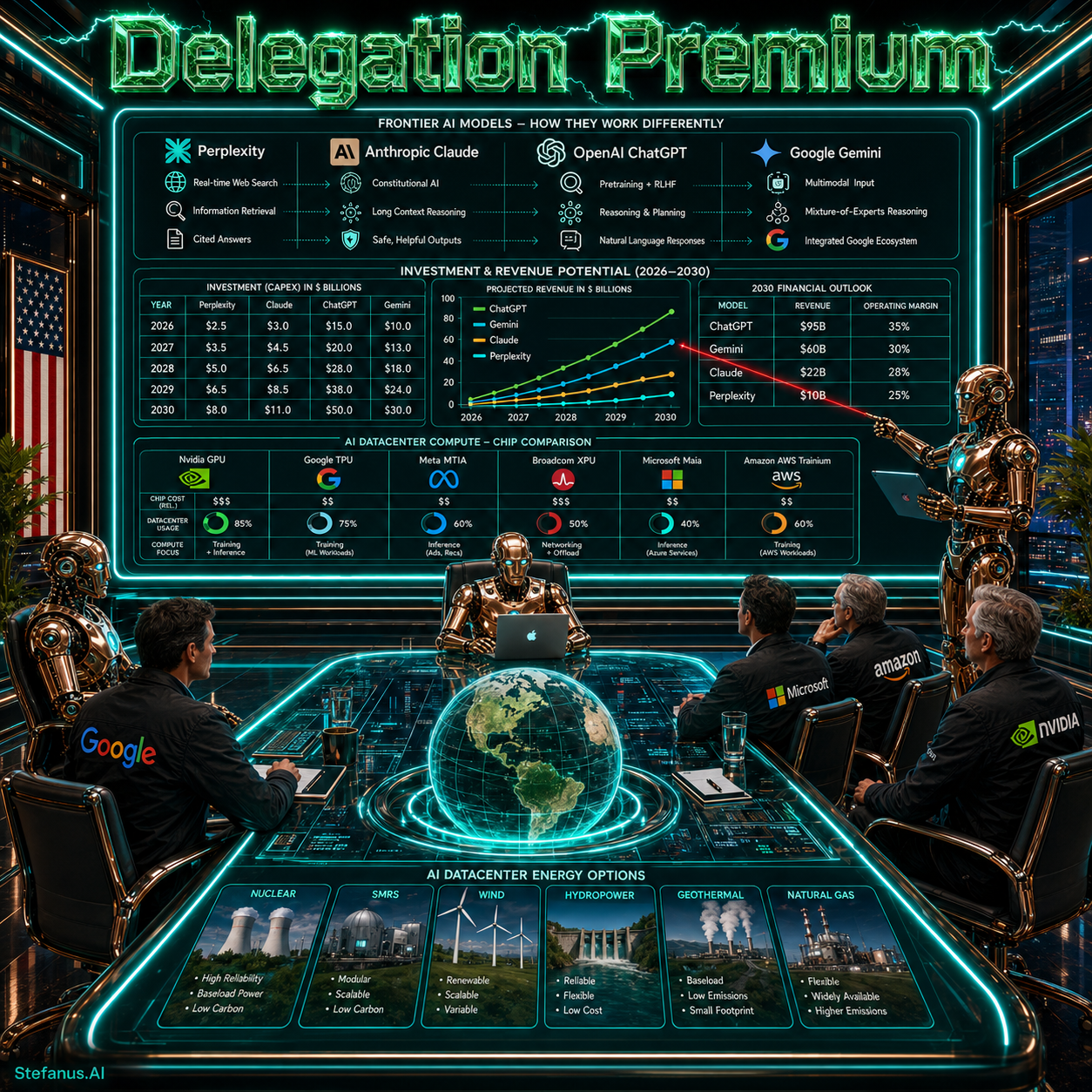
This framing helps explain why the competition among OpenAI, Anthropic, Google, Microsoft, Perplexity, and other AI companies is shifting beyond benchmark performance alone. OpenAI reported in August 2026 that enterprise AI usage is moving “from assistance to execution,” and that its agentic Codex system accounted for 64 percent of combined Codex and ChatGPT output tokens among its enterprise customers as of June 2026.[3] OpenAI separately found that users are handing agents tasks corresponding to ever-longer periods of human work: by May 2026, more than 70 percent of sampled individual Codex users had made at least one request estimated to represent more than an hour of human labor, and more than 80 percent had made a request representing more than thirty minutes.[4] Sam Altman had anticipated the shift at the start of the agentic era in strikingly plain language:
“We believe that, in 2025, we may see the first AI agents “join the workforce” and materially change the output of companies.”
— Sam Altman, CEO, OpenAI [5]
Anthropic is observing a related movement from the other side of the market. Its economic research on roughly 400,000 Claude Code sessions from approximately 235,000 people between October 2025 and April 2026 found usage shifting steadily toward more end-to-end agentic work — operating software, analyzing data, producing documents — while the estimated economic value of the typical task rose approximately 27 percent over the period studied, benchmarked against the price of comparable work on freelance marketplaces.[6] And Nvidia, the company whose accelerators power nearly all of this activity, has begun describing the phenomenon in the language of labor rather than the language of software:
“The buildout of AI factories — the largest infrastructure expansion in human history — is accelerating at extraordinary speed. Agentic AI has arrived, doing productive work, generating real value and scaling rapidly across companies and industries.”
— Jensen Huang, Founder and CEO, NVIDIA [7]
Satya Nadella, presiding over a Microsoft fiscal year in which Azure surpassed $100 billion in annual revenue for the first time, compressed the entire thesis of this paper into a single sentence on the company’s July 2026 earnings release:
“We are advancing the frontier on the cost-to-outcome curve, ensuring every customer can turn tokens into business results.”
— Satya Nadella, Chairman and CEO, Microsoft [8]
Tokens into business results. Cost-to-outcome. Agents doing productive work. Assistance to execution. Four of the most powerful companies in the industry, in four different corners of the stack, have independently converged on the same vocabulary — and it is the vocabulary of completed work, not the vocabulary of intelligence. These developments suggest that the AI industry may be moving toward a new economic hierarchy: intelligence is valuable; useful intelligence is more valuable; actionable intelligence is more valuable still; and reliable completion may command the highest premium of all.
That is the hypothesis this paper examines. The argument proceeds in seven sections. Section 1 traces the transition from the answer economy to the completion economy and introduces the five-stage Delegation Ladder. Section 2 develops the economics of delegation — the finished task as the new unit of value, the supervision ratio, parallel machine labor, and the transformation of enterprise software into digital labor infrastructure. Section 3 examines the agentic arms race among OpenAI, Anthropic, Google, and Perplexity as it stood in August 2026. Section 4 steps back and reviews what the empirical literature from 2020 through 2026 — from Stanford, MIT, Harvard, METR, the IMF, and the AI laboratories themselves — actually tells us about productivity, task horizons, and the limits of the evidence. Section 5 propagates the Delegation Premium backward through the Five-Layer AI Economy, from agents down through models, datacenters, chips, and electricity. Section 6 confronts the limits of delegation: trust, liability, verification, labor markets, and politics. Section 7 distills the argument into seven pillars, and the Conclusion explains why “Delegation Premium” is the appropriate name for the transition now underway.

Section 1: From the Answer Economy to the Completion Economy
1.1 The First AI Economy Was Built Around Answers
The first commercial wave of generative AI revolved around a deceptively simple interface: a blank text box. Users supplied prompts. Models supplied responses. Everything else — the judgment about whether the response was correct, the labor of moving it into the systems where work actually lives, the responsibility for what happened next — remained with the human. The economic unit was consequently easy to understand and easy to bill. AI companies sold access to intelligence through subscriptions, API calls, tokens, seats, or usage tiers. The model produced something; the human completed the workflow.
This arrangement created tremendous economic value, and the empirical record examined in Section 4 confirms that it did so quickly and measurably. But it also left in place what might be called the completion gap between AI output and organizational outcome. A model might summarize a customer complaint, but someone still had to update the ticket. It might analyze a market, but someone still had to prepare the board presentation. It might recommend a software fix, but someone still had to alter the repository, run the tests, and deploy the change. It might draft an email, but someone still had to determine whether sending it was appropriate — and then send it. The assistant reduced cognitive labor without assuming operational responsibility. It made the human faster without making the human less necessary at any individual step of the chain.
The distinction matters because organizations do not experience productivity at the level of individual answers. They experience it at the level of completed processes: the closed ticket, the filed report, the shipped feature, the reconciled ledger. As long as every AI contribution had to pass through human hands before becoming an organizational outcome, the technology’s throughput was capped by the availability, attention, and working hours of the people operating it. The answer economy was, in this precise sense, a bottlenecked economy.
1.2 The Completion Gap
The Completion Gap can be represented as a chain of handoffs:
AI Recommendation → Human Interpretation → Human Action → Verification → Finished Outcome
Agentic AI attempts to compress that chain:
Objective → Agent Execution → Verification → Finished Outcome
Every eliminated handoff has economic significance, and the significance compounds. It reduces coordination costs — the meetings, messages, and context-switching that surround every transfer of work between parties. It reduces waiting time, because the task no longer queues behind the initiating employee’s other obligations. It potentially reduces labor hours, because steps that previously required a person now require only supervision. It allows tasks to continue after the initiating employee turns to other work, or goes home, or goes to sleep. Most importantly, it changes the economic object being purchased. Organizations begin buying not merely access to intelligence, but increasing quantities of machine-executed work — and the empirical usage data from OpenAI and Anthropic in Sections 3 and 4 shows that this is precisely what enterprise customers, measured in tokens and task horizons, are now doing.[3,6]
1.3 The Five Stages of Delegation
The transition can be understood through a five-stage Delegation Ladder. Each stage describes what the AI system is trusted to do, which technologies dominate it, and what the human retains.
Table 1. The Delegation Ladder: Five Stages from Retrieval to Completion
| Stage | What the AI Does | Dominant Technology | What the Human Retains |
| Stage One — Retrieval | Locates information relevant to a query | Search engines; retrieval systems | Everything: interpretation, synthesis, action, outcome |
| Stage Two — Generation | Produces text, code, images, and analysis on demand | Generative models (2020–2023 wave) | Evaluation, integration, every subsequent step of the workflow |
| Stage Three — Reasoning | Decomposes complicated problems into steps; weighs alternatives | Reasoning models (2024–2025 wave) | Execution: tools, systems, actions, and responsibility |
| Stage Four — Execution | Operates tools, applications, browsers, terminals, and databases | Agents (2025–2026 wave) | Objective-setting, authorization, and verification |
| Stage Five — Completion | Coordinates multiple steps until a defined outcome is achieved and verified | Agent orchestration systems (emerging) | Judgment, exception handling, accountability |
Moving upward through the ladder does not eliminate the previous stage. Completion still requires retrieval, generation, and reasoning, just as a factory still requires raw materials and machine tools. Instead, each level incorporates the earlier capabilities and wraps additional responsibility around them. This is why the ladder is economically cumulative rather than substitutive: a Stage Five system embeds the value of all four stages beneath it, and then adds the value of the eliminated handoffs on top. It is also why measurement regimes built for lower stages — benchmark scores, tokens generated, answers per session — systematically understate what is happening at the top of the ladder, where the relevant question is no longer how well the system answered but whether the work got done.
1.4 From Prompt Engineering to Objective Engineering
An important consequence of this transition is a change in how people interact with AI — and therefore in what human skill the market rewards. The earlier generation of AI encouraged workers to become better prompt writers: to learn the incantations, the phrasings, the few-shot examples that coaxed the best single response out of a model. The agentic generation increasingly rewards people who become better objective designers. The relevant question becomes less “How should I ask the model this question?” and increasingly “What outcome should I assign, what constraints should I establish, what authority should I delegate, what tools should I connect, and how will I know whether the task was completed correctly?”
That represents a movement from prompt engineering toward what might be called delegation engineering — a discipline that looks far less like clever writing and far more like management. It requires decomposing goals, specifying acceptance criteria, setting permission boundaries, and designing verification. It is telling that Anthropic’s large-scale study of Claude Code sessions found exactly this division of labor emerging organically in the field: in a typical session, people made roughly 70 percent of the planning decisions — what to build, what counts as done — while Claude made roughly 80 percent of the execution decisions — which files to change, what code to write, which commands to run.[6] The human is becoming the author of objectives; the machine is becoming the author of actions. Andrew Ng saw the outline of this shift before most of the industry did, arguing as early as 2024 that the workflow layer, not the model layer, would carry the next wave of progress:
“I think AI agentic workflows will drive massive AI progress this year — perhaps even more than the next generation of foundation models. This is an important trend, and I urge everyone who works in AI to pay attention to it.”
— Andrew Ng, Founder of DeepLearning.AI; Adjunct Professor, Stanford University [20]
1.5 Why Completion Changes Willingness to Pay
Suppose two systems use equally capable underlying models. System A produces an excellent twenty-page analysis. System B produces the same analysis, creates a presentation from it, reconciles the supporting spreadsheet, updates the project system, sends an approved summary to the correct recipients, and schedules a follow-up review. The model intelligence may be identical. The economic utility is not — and neither is the willingness to pay. System A saved its user perhaps two hours of drafting. System B saved its user the drafting, plus the assembly, plus the coordination, plus the follow-through, and it did so without consuming the scarcest resource in any organization: the sustained attention of a capable employee.
This is the core of the Delegation Premium. Companies may increasingly pay premiums not simply for models with higher benchmark scores, but for systems capable of converting model intelligence into trusted organizational outcomes. Pricing behavior across the industry already gestures in this direction: agentic products are consistently positioned and priced above their conversational siblings, agentic workloads consume multiples of the tokens that conversational ones do precisely because they carry work further,[3] and the fastest-growing revenue lines at companies like Perplexity are the ones attached to task automation rather than question answering.[1] The remainder of this paper takes that observation seriously and asks what follows from it — for pricing, for infrastructure, for labor, and for the competitive order of the AI industry itself.

Section 2: The Economics of Delegation
2.1 The New Unit of AI Value: The Finished Task
Tokens have been an extremely useful technical and commercial measurement for generative AI. They are countable, meterable, and neutral across use cases, and they gave the industry a common currency during a period when nobody knew what else to count. But businesses do not ultimately optimize their organizations around tokens, any more than they optimize around kilowatt-hours or CPU cycles. They optimize around outcomes: orders processed, software released, customers served, contracts reviewed, fraud detected, reports prepared, products designed, research completed, revenue generated, problems resolved. Tokens are an input measure masquerading, temporarily, as an output measure — and the masquerade only worked as long as the distance between a token and an outcome was short enough for buyers not to notice the difference.
Agentic systems stretch that distance and then invert it. A single delegated task may consume hundreds of thousands or millions of tokens across planning, tool calls, retries, and verification; OpenAI notes explicitly that agentic workflows generate more output precisely because they carry out longer, multi-step tasks, which is part of why Codex came to represent 64 percent of enterprise output tokens by June 2026.[3] When token consumption per unit of value can vary by three orders of magnitude depending on how a task is executed, the token stops being a sensible unit of account for the buyer. This creates the strong possibility that the mature agent economy gradually changes AI pricing from price per token toward combinations of price per agent, price per workflow, price per completed task, and price per successful transaction — and eventually toward the purest expression of the Delegation Premium: price per outcome. The history of every general-purpose technology suggests this trajectory. Electricity was once sold by access to the dynamo; it ended up priced into every product it touched. Computing was once sold by the mainframe hour; it ended up priced by the seat, then the service, then the transaction. Machine intelligence is now beginning the same migration, from input metering toward outcome pricing, and the companies that control verification of outcomes will control the pricing power that comes with it.
2.2 The Delegation Premium Equation, Variable by Variable
The Delegation Premium introduced in the Introduction grows or shrinks according to five variables. Each deserves careful treatment, because each is now the object of direct corporate competition and direct empirical measurement.
1. Task Horizon. How long can the system work independently — minutes, hours, days, or repeatedly for months on a schedule? This variable has moved from anecdote to measurement. METR’s influential research program found that the length of tasks frontier AI systems can complete autonomously at a 50 percent success rate — measured by how long the same tasks take human professionals — has been doubling approximately every seven months since 2019, a trend the organization has described as consistent and, in recent periods, possibly accelerating.[9,10,11] On the demand side, OpenAI’s data shows users climbing the same curve from the other direction: between December 2025 and May 2026, the share of individual Codex users who assigned at least one task estimated at more than 30 minutes of human work rose to 80.6 percent, and the share assigning tasks of more than one hour rose to 70.2 percent, with the share submitting tasks of more than eight hours rising nearly tenfold over the first half of 2026.[4,12] Capability supply and delegation demand are climbing the task-horizon ladder together.
2. Tool Reach. How many real systems can the agent operate — email, CRM, spreadsheets, browsers, code repositories, accounting systems, databases, calendars, procurement systems, internal applications? A brilliant model with no hands creates advice; a competent model with broad, governed tool access creates outcomes. The industry’s infrastructure investments make the priority clear: the rapid standardization of connector protocols such as the Model Context Protocol, and Google’s decision to launch its legal-industry agent platform with a dozen pre-built integrations into the document management, e-discovery, and research systems law firms already run,[13] both reflect the recognition that tool reach, not raw intelligence, is the binding constraint on delegated value.
3. Completion Reliability. Can the agent finish correctly — not impressively, but dependably? This may ultimately matter more than spectacular demonstrations. An agent that completes 99.9 percent of a repetitive administrative workflow can be built into a business process; a more intellectually dazzling agent that succeeds 70 percent of the time can only be built into a demo. Anthropic’s session-level research offers a sobering calibration here: under its strictest measure of success — verifiable evidence such as passing tests or committed work — expert users achieved success rates near 90 percent while novices achieved roughly 15 percent, with software engineers verifying at 34 percent on average and every major occupational group landing within seven percentage points of them.[6] Reliability, in other words, is not yet a property of the agent alone; it is a joint property of the agent and the person supervising it, a fact whose economic consequences are developed in Section 6.
4. Supervision Compression. How much human attention is still required per unit of delegated work? If an employee must monitor every action, much of the Delegation Premium evaporates into oversight cost. If one employee can responsibly supervise ten, fifty, or eventually hundreds of agentic workstreams, the economics change dramatically. The variable is already visible in the field: OpenAI reports that more than 10 percent of Codex users managed three or more concurrent agents at least once a week by mid-2026,[12] while skeptics supply the counterweight — Sol Rashidi, chief strategy officer at Cyera and a senior fellow at the Harvard Kennedy School, reported abandoning half of the agents she had deployed because they demanded constant supervision:
“I just fired half my agents because they were unreliable.”
— Sol Rashidi, Chief Strategy Officer, Cyera; Senior Fellow, Harvard Kennedy School [30]
Both data points are true simultaneously, and together they define the frontier: the Delegation Premium accrues exactly where supervision compresses, and it dissipates exactly where it does not.
5. Outcome Value. A successfully delegated $20 task and a successfully delegated $20 million decision are not economically equivalent, and no serious analysis should treat an hour of automated data entry and an hour of automated contract negotiation as the same quantity of “agent work.” As reliability improves, agents may move progressively upward into higher-value processes — and the early evidence suggests the climb has begun, with Anthropic estimating that the economic value of the average Claude Code task, benchmarked against freelance-market pricing for comparable work, rose 27 percent in just six months.[6]
Table 2. The Five Variables of the Delegation Premium, with 2026 Empirical Anchors
| Variable | Question It Answers | 2026 Empirical Anchor |
| Task Horizon | How long can the agent work without a human? | 50%-success time horizons doubling roughly every 7 months since 2019 (METR); 70% of Codex users assigning 1-hour-plus tasks by May 2026 [4,9] |
| Tool Reach | How many real systems can the agent operate? | Platform launches shipping with 10–12 pre-built enterprise connectors as standard (e.g., Gemini Enterprise for Legal) [13] |
| Completion Reliability | Does the work actually get finished correctly? | Verified success ranges from ~15% (novices) to ~90% (experts) in 400,000 analyzed agent sessions [6] |
| Supervision Compression | How many workstreams can one human oversee? | Over 10% of Codex users running 3+ concurrent agents weekly; practitioner reports of agents “fired” for demanding oversight [12,30] |
| Outcome Value | How valuable is the delegated task itself? | Average task value up 27% in six months against freelance-market benchmarks [6] |
2.3 The Supervision Ratio
One of the most important future measurements of the AI economy may become the Human-to-Agent Supervision Ratio: one human to N autonomous workstreams. Today’s knowledge worker often uses one AI assistant, serially, in the gaps of their own attention. Tomorrow’s knowledge worker may supervise ten agents; a manager may supervise dozens; an organization may operate thousands. The productivity question therefore changes from “How much faster can AI make one employee?” to “How many parallel streams of productive machine work can one employee responsibly supervise?” That is not a refinement of the old question. It is a different economic model, in the same way that the question “How many machines can one operative tend?” defined factory economics in a way that “How much faster does this tool make one craftsman?” never could.
The ratio also clarifies where the returns to skill migrate. In the answer economy, skill was expressed in the quality of one’s questions and one’s ability to evaluate single responses. In the completion economy, skill is expressed in the width of the supervision span one can sustain without a fall in verified quality — and the Anthropic data suggests the span is already sharply unequal, with experts eliciting more than twice the actions and five times the output per instruction compared with novices, and abandoning troubled sessions at roughly one-third the rate.[6] The supervision ratio, in other words, is not merely a property of the technology. It is a property of the human capital operating it, which is why Section 6 argues that expertise changes shape under delegation rather than depreciating.
2.4 Parallel Labor
Human beings carry a severe and biologically fixed constraint: attention is largely sequential. A person can hold one demanding task in focus at a time, and every study of multitasking confirms the heavy switching costs of pretending otherwise. Agents are not bound by this constraint. One employee can initiate market research while another agent analyzes a spreadsheet, another audits contracts, another monitors competitors, another examines support tickets, and another prepares a presentation — all simultaneously, all persistently, all without fatigue. OpenAI’s internal experience offers a preview of what this looks like when adoption friction is low: within OpenAI itself, the average engineer now generates 99 percent of output tokens through the agentic Codex system rather than the conversational ChatGPT interface, every department including Legal and Recruiting has crossed to majority agentic use, and the heaviest users distribute enormous quantities of agent runtime across multiple parallel agents.[4,12]
Parallelism therefore magnifies the Delegation Premium in a way that per-task comparisons systematically miss. The important innovation is not necessarily that one agent works faster than one employee at one task — on many tasks, today, it does not, a point the empirical literature in Section 4 makes uncomfortably clear. It is that one employee becomes capable of directing many simultaneous streams of machine labor, so that organizational throughput detaches from individual human attention for the first time in the history of knowledge work.
2.5 From Software Seat to Artificial Worker
Traditional enterprise software sells tools to workers. The emerging agent market increasingly sells systems that perform portions of the worker’s task. The distinction is subtle in a product demo and fundamental on an income statement. A CRM seat provides a salesperson with software; a sales agent researches leads, qualifies them, drafts outreach, logs the information, and schedules the follow-ups. An accounting application provides tools; an accounting agent increasingly operates those tools. Software organizes work. Agents increasingly perform work. The enterprise software industry may therefore gradually find itself competing with a new category — digital labor infrastructure — whose natural pricing comparators are not software seats at all, but wages, contractor rates, and business-process-outsourcing contracts. When Anthropic benchmarks the value of agent sessions against freelance marketplaces,[6] and when OpenAI denominates delegated tasks in hours of equivalent human labor,[4] the industry is already, quietly, doing exactly this arithmetic. The comparison set has changed, and with it, the ceiling on what the products can charge.
2.6 Illustrative Arithmetic: How the Premium Scales
A simple, deliberately stylized arithmetic exercise shows why the five variables interact multiplicatively rather than additively. Consider a mid-level professional task worth $500 in completed form — a reconciled account, a drafted and filed report, a qualified and logged prospect list. In the answer economy, an assistant that accelerates the human by 20 percent captures perhaps $100 of that value in saved labor, with the human still consuming the remainder of the workflow in coordination and execution. In the completion economy, an agent that finishes the task end-to-end at 95 percent verified reliability, with fifteen minutes of human review, captures nearly the entire $500 — minus compute, minus review time, minus the expected cost of the 5 percent of cases requiring human rework. The premium per task is therefore several multiples of the assistance value. Now scale by the supervision ratio: if one employee can responsibly oversee eight such workstreams in parallel, the value throughput attributable to that single employee’s attention rises not by 20 percent but by several hundred percent — which is precisely why the supervision ratio, and not the per-task speedup, is the number that will appear, eventually, in productivity statistics.
Table 3. Stylized Comparison: Assistance Economics vs. Delegation Economics (illustrative $500 task)
| Dimension | Assistance (Answer Economy) | Delegation (Completion Economy) |
| Value captured per task | ~$100 (20% human speedup) | ~$450+ (near-full completion, net of review and rework) |
| Human attention consumed | Full task duration (human executes) | Minutes of specification and verification |
| Parallelism per employee | 1 (attention is sequential) | N concurrent workstreams (supervision ratio) |
| Binding constraint | Human working hours | Completion reliability and verification cost |
| Natural pricing comparator | Software subscription | Wages, contractor rates, BPO contracts |
| Failure mode | Bad answer, caught in use | Wrong action, requiring audit and reversal |
The last row of the table is not a footnote; it is the hinge of the entire analysis. Assistance fails safe — a bad answer sits inert until a human acts on it — while delegation fails active, which is why Section 6 argues that governance and verification are not costs imposed on the Delegation Premium but the very mechanisms that permit it to exist at scale.

Section 3: The Agentic Arms Race — OpenAI, Anthropic, Google, Perplexity, and the New Completion Layer
3.1 Perplexity Computer and the Search-to-Work Transition
Perplexity offers a particularly useful case study because its short corporate history makes the broader transition unusually visible. The company’s original differentiation centered on finding and synthesizing information — on being the best possible answer engine. Computer extends that value proposition into execution: the product is described as coordinating sub-agents, using numerous connected applications, conducting parallel research, creating documents and applications, managing recurring work, and executing multi-step professional workflows in the cloud.[2] The August 2026 Reuters reporting therefore matters well beyond Perplexity itself. When the revenue run rate of a prominent AI company more than triples inside eight months, and the reporting attributes part of that growth specifically to the agent product rather than the answer product, while its most important supplier weighs an investment at a valuation of roughly forty times revenue,[1] financial markets are receiving an early and unusually clean commercial signal of the Delegation Premium: investors are not merely paying for better answers; they are underwriting the transition from answering to working.
3.2 OpenAI: From Chat Interaction to Delegated Work
OpenAI’s August 2026 enterprise research constitutes the most detailed public dataset yet assembled on the delegation transition, and its findings are worth stating carefully. As of June 2026, the agentic Codex system generated 64 percent of combined Codex and ChatGPT output tokens among enterprise customers, which the company presented explicitly as evidence of a shift “from assistance to delegation, giving agents the context and tools to complete complex tasks.”[3] The companion academic working paper, “The Shift to Agentic AI: Evidence from Codex,” documents the mechanics beneath the headline: in the week preceding June 11, 2026, 60.3 percent of Codex turns invoked at least one external tool against 21.9 percent of ChatGPT turns; the median worker’s output tokens rose at least tenfold in every job function between November 2025 and June 2026; and adoption spread far beyond software, with weekly active Codex users inside enterprises growing 108-fold in legal functions, 41-fold in sales and hiring, and 26-fold in marketing since February 2026.[12,32] The frontier is also pulling away from the median: the top 10 percent of enterprise customers by usage intensity generated 8.3 times the output tokens per active user of typical firms in June, up from 2.6 times in January — a widening dispersion that looks less like the diffusion of a feature and more like the early, unequal adoption curve of a new factor of production.[32]
The interaction model itself is what has changed. The old model ran: Employee → ChatGPT → Answer → Employee. The emerging model runs: Employee → Objective → Agent → Tools → Actions → Completed Work → Employee Review. The employee moves from operator toward supervisor — and OpenAI’s own workforce, where adoption frictions are minimal, shows the end state: every department, including non-technical ones, now uses the agentic system as its primary AI tool for work.[4]
3.3 Anthropic: Claude and the Economics of Extended Execution
Anthropic provides the complementary signal: not how much agentic work is happening, but how the collaboration inside it is structured. Its 2026 research on roughly 400,000 Claude Code sessions found usage moving steadily toward end-to-end activities — operating software rose from 14 to 21 percent of sessions over the study period, writing and data analysis roughly doubled to about 20 percent, and the share of sessions devoted to fixing broken code fell from 33 to 19 percent, a decline that is itself a reliability signal.[6] Most strikingly, the research found that greater domain expertise allows users to delegate more execution to Claude and to succeed more often when they do: experts elicited more actions and more output per instruction, persisted through difficulties at far higher rates, and achieved verified success rates several times those of novices, while every major occupational group succeeded at coding tasks within a few points of professional software engineers.[6]
This suggests that agents may not simply replace expertise; expertise increases the value extracted from delegation. The skilled employee knows what objective matters, what constraints matter, which errors are unacceptable, what evidence proves success, and when intervention is required. Human capital therefore changes shape rather than simply depreciating — a finding with direct consequences for the labor-market analysis in Section 6, and one that converges from field data with what Erik Brynjolfsson and his co-authors have long argued from theory: that the economically and socially preferable direction for AI is complementing human judgment rather than imitating and displacing it.[17]
3.4 Google and Vertical Agentization
On August 25, 2026, Google expanded Gemini Enterprise into the legal sector, unveiling what it described as “an enterprise-grade, purpose-built agentic AI solution engineered for the complex requirements and workflows of the legal industry,” with launch customers including the legal teams of Cleary Gottlieb, Freshfields, Weil, and Williams & Connolly, purpose-built skills for tasks such as brief drafting, citation verification, contract lifecycle management, and regulatory horizon scanning, and secure connectors into the platforms law firms already operate — iManage, NetDocuments, Everlaw, RelativityOne, Docusign, Harvey, and Thomson Reuters among them.[13] Reuters characterized the launch as a stable of AI agents able to “handle specialized legal and administrative functions without significant human oversight,” and noted that a parallel financial-services edition shipped the same day, with further industry editions to follow.[14]
That development points toward an important structural stage of the completion economy: vertical agentization. Instead of one generic AI assistant serving every industry, specialized agents are developing around legal work, financial analysis, medicine, manufacturing, sales, cybersecurity, engineering, procurement, logistics, government administration, and scientific research. The Delegation Premium therefore becomes industry-specific, because completion means something different in every vertical. A legal agent’s premium depends on legal reliability and citation integrity; a software agent’s premium depends on executable, testable code; a financial agent’s premium depends on numerical accuracy and regulatory compliance; a manufacturing agent’s premium depends on safe control of physical systems. Verticalization is also, not incidentally, where the moats will form: the connectors, the compliance certifications, the domain-specific verification machinery, and the accumulated trust of an industry are far harder to replicate than a model checkpoint.
3.5 Models Become Components of Agent Systems
The agentic transition may also weaken the long-held assumption that users will select products primarily according to the identity of the underlying model. An agent system can orchestrate several models: one plans, another codes, another searches, another inspects images, another verifies results — with routing decisions made on cost, latency, and reliability rather than brand. Microsoft’s public positioning of “agent-first primitives” in Azure and its emphasis on the cost-to-outcome curve reflect exactly this architecture,[8] and the emergence of tiered model routing — expensive frontier models for ambiguous, high-stakes reasoning, inexpensive models for well-specified execution — is already reshaping enterprise cost structures. The product users pay for is consequently no longer a single model but an orchestration system capable of completing the assignment. Competition shifts from “Whose model is smartest?” toward “Whose system gets the work done most reliably?” — a reframing with enormous consequences for Nvidia, the hyperscalers, the model laboratories, the enterprise software incumbents, and the startups building the completion layer, because it relocates the durable margin from intelligence production, which is commoditizing, to outcome delivery, which is not.

Section 4: What the Evidence Says — A Review of the 2020–2026 Literature
A thesis about economic value should be disciplined by evidence, and the period from 2020 to 2026 has produced an unusually rich empirical literature on what generative and agentic AI actually does to work. This section reviews that literature in rough chronological order — from the early exposure studies, through the first field experiments, to the agentic measurement programs of 2025 and 2026 — and it deliberately includes the findings that complicate the Delegation Premium as well as those that support it. The honest summary is that the evidence for large productivity effects at the task level is strong; the evidence for reliable autonomous completion is real but conditional; and the macroeconomic verdict remains genuinely contested among the most credentialed economists studying the question.
4.1 The Exposure Studies: Mapping What Could Be Delegated (2023)
The first wave of scholarship asked a static question: which tasks are exposed to large language models at all? Eloundou, Manning, Mishkin, and Rock’s widely cited “GPTs are GPTs” estimated that around 80 percent of the U.S. workforce could have at least 10 percent of their work tasks affected by LLMs, while approximately 19 percent of workers could see at least half of their tasks affected — with exposure, unusually for an automation technology, rising with income and education rather than falling.[24] Exposure studies do not measure adoption, quality, or completion; they measure theoretical reach. But they established the crucial baseline fact that the addressable surface of knowledge work is enormous, which is why every subsequent finding about reliability and delegation carries such large economic stakes.
4.2 The Field Experiments: Assistance Works (2023–2025)
The second wave moved from mapping to measurement, and its findings were consistent and striking. Noy and Zhang’s randomized experiment on professional writing tasks, published in Science, found that access to ChatGPT reduced time taken by about 40 percent while raising output quality, with the largest gains accruing to the initially weakest performers.[22] Brynjolfsson, Li, and Raymond’s landmark study of a generative AI assistant deployed to thousands of customer-support agents — the first major field study of the technology at work — found productivity gains averaging around 14–15 percent, again concentrated among novice and lower-skilled workers, who effectively absorbed some of the tacit knowledge of their most capable colleagues through the model.[21] Dell’Acqua and colleagues’ experiment with over 750 Boston Consulting Group consultants found that consultants using GPT-4 completed 12 percent more tasks, 25 percent faster, at more than 40 percent higher quality — inside what the authors memorably called the “jagged technological frontier,” the irregular boundary within which AI performs superbly and beyond which it confidently fails, so that consultants who trusted it on tasks outside the frontier performed worse than those with no AI at all.[23]
Read together, the field experiments established three durable facts. First, assistance-stage AI produces genuine, large, measurable productivity gains at the task level. Second, those gains are heterogeneous, compressing skill gaps in routinized work while amplifying the importance of judgment about when to trust the machine. Third — and most importantly for this paper — all of these gains were achieved with the human still executing the workflow. They are, in the vocabulary of Section 1, measurements of Stage Two and Stage Three value. The Delegation Premium concerns what lies above them.
4.3 The Capability Curves: Task Horizons Double (2025–2026)
The decisive contribution of the 2025–2026 period was to make autonomy itself measurable. METR’s research program — beginning with Kwa et al.’s “Measuring AI Ability to Complete Long Software Tasks” — proposed evaluating models by the length of tasks they can complete autonomously, denominated in the time the same tasks take human professionals. The headline finding: the 50 percent-success time horizon of frontier systems has doubled approximately every seven months for six years, from seconds in 2019 to many hours by 2026, with task length strongly predicting success (R² ≈ 0.83) and no clear evidence of plateau; follow-up work extended the analysis across nine benchmark families spanning scientific reasoning, computer use, and robotics and observed broadly similar rates of improvement, while noting that 2024–2025 progress may have accelerated beyond the original trend.[9,10,11] Whatever one’s view of extrapolation, the task horizon has become the single most economically legible capability metric in the field, because it is denominated in the currency organizations actually spend: human working time.
The same period supplied an essential corrective. METR’s own randomized controlled trial of experienced open-source developers working in their own mature repositories found that using early-2025 AI tools made them 19 percent slower — even as the developers themselves believed they had been sped up by roughly 20 percent.[25] The result is not a contradiction of the capability curves; it is a boundary condition on them. In high-context, high-standards environments, the cost of reviewing, correcting, and integrating machine output can exceed the cost of doing the work oneself — and human perception of the balance is unreliable. Any honest account of the Delegation Premium must carry this study alongside the enthusiasm: delegation pays only where verification is cheaper than execution, and one of the central engineering projects of the agentic era is precisely to drive down the cost of verification.
4.4 The Usage Telemetry: Delegation Observed in the Wild (2025–2026)
The third body of evidence comes from the laboratories’ own large-scale usage measurement — a genre that barely existed before 2025. Anthropic’s Economic Index program has tracked how Claude usage maps onto occupational tasks across successive reports,[31] and its June 2026 Claude Code study, discussed throughout this paper, documented the 70/80 planning-execution split, the 27 percent rise in average task value, the migration of sessions from debugging toward operation and creation, and the persistent returns to domain expertise.[6] OpenAI’s Enterprise Signals report and its companion working papers documented the token-share shift to agentic tools, the tenfold growth in median output per worker across job functions, the spread of agentic use from engineering into legal, sales, hiring, and marketing at triple-digit multiples, and the seven-fold growth of ChatGPT Enterprise output tokens between June 2025 and March 2026, concentrated among larger, more R&D-intensive firms with prior investments in organizational capital.[3,12,32] That last detail deserves emphasis, because it replicates one of the oldest findings in the economics of technology — stretching back to Brynjolfsson’s work on information technology in the 1990s — that general-purpose technologies pay off in proportion to the complementary organizational investment made around them. Delegation, the telemetry suggests, is not a product feature that firms simply switch on. It is an organizational capability that firms build.
4.5 The Macroeconomic Dissent: The Acemoglu Position
No review of this literature is honest without its most distinguished skeptic. Daron Acemoglu, Institute Professor at MIT and 2024 Nobel laureate in economics, has consistently estimated far smaller aggregate effects than the industry consensus: on the order of 0.55 percent total-factor-productivity gains over a decade, with only around 5 percent of tasks profitably automatable in the near term, corresponding to a GDP boost of roughly 1 to 1.5 percent.[18] Interviewed in May 2026 specifically about the agentic wave, he identified agentic AI deployments as one of the three developments he watches most closely — while remaining skeptical that agents can substitute for the messy, multi-tasked, tacit-knowledge-laden work most humans actually perform.[19] His broader critique is directional as much as quantitative:
“We’re using it too much for automation and not enough for providing expertise and information to workers.”
— Daron Acemoglu, Institute Professor, MIT; Nobel Laureate in Economic Sciences [19]
The Delegation Premium framework does not require Acemoglu to be wrong. It requires only relative prices: that completed machine work commands a premium over machine assistance wherever both are feasible. Whether the aggregate of such premiums amounts to a 0.5 percent productivity story or a 5 percent one depends on exactly the variables his skepticism targets — reliability outside narrow task boundaries, the tacit-knowledge problem, and the true cost of supervision — which is why those variables, rather than benchmark scores, are the correct objects of forecasting attention.
4.6 The Institutional Assessments: IMF, Stanford, and the Economists’ Statement
Finally, the institutional literature has converged on the scale of the stakes even where it diverges on the timeline. The International Monetary Fund estimates that about 40 percent of jobs globally, and 60 percent in advanced economies, will be affected by AI through enhancement, elimination, or transformation,[16] and its Managing Director has been blunt about the preparedness gap:
“We also see that we remain under-prepared for the impact of AI on the labor market. It is like a tsunami hitting the labor market, especially in advanced economies, where we assess 60% of jobs to be impacted.”
— Kristalina Georgieva, Managing Director, International Monetary Fund [15]
In July 2026, sixteen Nobel laureates joined leading economists and AI researchers — organized by Erik Brynjolfsson, Ajay Agrawal, Anton Korinek, and Tom Cunningham — in a statement warning that increasingly capable AI systems could reshape the economy at unprecedented speed and calling for institutions equal to the transition.[17] Brynjolfsson’s framing of the choice is the closest thing the economics profession currently has to a policy consensus on direction:
“We must act now to guide AI to complement humans rather than simply imitate them — and to generate prosperity for the many, not just the few.”
— Erik Brynjolfsson, Jerry Yang and Akiko Yamazaki Professor, Stanford University [17]
Table 4. The 2020–2026 Empirical Literature at a Glance
| Study / Program | Year | Core Finding | Implication for the Delegation Premium |
| Eloundou et al., “GPTs are GPTs” | 2023 | ~80% of workers exposed on ≥10% of tasks; exposure rises with income | The addressable surface of delegable knowledge work is vast [24] |
| Noy & Zhang (Science) | 2023 | Writing tasks ~40% faster, higher quality; largest gains for weakest performers | Assistance-stage value is large and real [22] |
| Brynjolfsson, Li & Raymond | 2023–25 | ~14–15% productivity gain for support agents; novices gain most | AI transmits tacit expertise; gains are heterogeneous [21] |
| Dell’Acqua et al., “Jagged Frontier” | 2023 | +12% tasks, +25% speed, +40% quality inside the frontier; losses outside it | Judgment about when to delegate is itself the scarce skill [23] |
| METR time-horizon program | 2025–26 | 50%-success task length doubling ~every 7 months since 2019 | The feasible delegation horizon is expanding exponentially [9,10,11] |
| METR developer RCT | 2025 | Experienced devs 19% slower with AI in mature repos, while believing the opposite | Delegation pays only where verification is cheaper than execution [25] |
| Anthropic Claude Code study | 2026 | 70/80 planning-execution split; task value +27% in six months; strong returns to expertise | Delegation is a human-machine joint production function [6] |
| OpenAI Enterprise Signals / Codex paper | 2026 | 64% of enterprise output tokens agentic; 10× median output growth; frontier-firm gap widening to 8.3× | Delegation is diffusing fast but unevenly, favoring prepared organizations [3,12,32] |
| Acemoglu (macro estimates) | 2024–26 | ~0.55% TFP over a decade; ~5% of tasks profitably automatable near-term | The aggregate premium is bounded by reliability and tacit knowledge [18,19] |
| IMF assessments | 2024–26 | 40% of jobs globally, 60% in advanced economies affected | The distributional stakes of the transition are first-order [15,16] |

Section 5: Delegation Premium Across the Five-Layer AI Economy
The Delegation Premium originates visibly in the application layer, but its economic effects travel backward through the entire Five-Layer AI Economy — the stack running from electricity, through chips, datacenters, and models, up to applications and agents. This section traces the propagation layer by layer, because the single most important macro-financial question of the late 2020s — whether the trillions of dollars now committed to AI infrastructure earn their cost of capital — resolves, ultimately, at the top of the stack, in the quantity of valuable work the infrastructure finishes.
5.1 Layer Five — Applications and Agents Become the Demand Engine
The agent layer transforms AI from an occasional query service into persistent productive infrastructure. A chatbot might receive several questions in a day, each consuming seconds of compute. An agent may work for hours on a single objective. A persistent agent may operate every day, on schedule, indefinitely. Thousands of enterprise agents can execute millions of workflows simultaneously. Layer Five therefore becomes capable of generating vastly greater recurring inference demand than the answer economy ever could — and the token telemetry confirms it: agentic workloads consume multiples of conversational ones by construction, because carrying a task to completion requires planning, tool calls, retries, and verification that a single answer never does.[3,12] The demand engine of the AI economy is migrating from human curiosity, which is bounded by waking hours, to organizational objectives, which are not.
5.2 Layer Four — Models Become Engines Inside Larger Systems
Models remain critical, but the source of competitive differentiation expands beyond benchmark intelligence. The questions that determine a model’s value inside an agent system are operational: Can it use tools reliably? Can it maintain state across long contexts? Can it follow extended instructions without drift? Can it recover after failure rather than compounding it? Can it understand and respect permissions? Can it verify its own work? Can it cooperate with other agents? Can it remain dependable across task horizons measured in hours rather than seconds? Reasoning quality remains valuable, but operational reliability becomes equally strategic — and the two are not the same axis, as every deployment engineer who has watched a brilliant model fail to close a browser dialog can attest. The model layer’s own economics also shift: orchestration systems route between expensive frontier models and inexpensive execution models on a per-step basis, which means model companies increasingly compete not for the whole task but for the steps within it where their capability premium survives the routing decision.
5.3 Layer Three — Datacenters Become Machine-Labor Factories
Agentic systems create an unusual infrastructure implication. Human employees stop working at night; cloud agents do not. Scheduled and persistent systems can conduct research, monitor events, analyze data, process requests, generate software, and prepare reports continuously, around the clock, across time zones. The datacenter therefore begins to look less like an information warehouse and more like a factory producing machine labor — a facility whose output is measured not in stored bytes or served queries but in completed workflows per unit time. This reinterpretation gives economic content to the extraordinary construction programs of Amazon, Microsoft, Google, Meta, Oracle, and others: combined capital expenditures of the four largest hyperscalers reached approximately $166 billion in the second calendar quarter of 2026 alone, up 87 percent year over year, with Microsoft’s quarterly capex and finance leases at $41 billion and its commercial remaining performance obligations — contracted future demand — standing at $678 billion.[27,28] The output of those facilities is not merely tokens. Increasingly, the economically meaningful output is completed machine work, and the utilization rate of the global AI infrastructure base depends on how much of it materializes.
5.4 Layer Two — AI Chips Become Labor-Capacity Infrastructure
The same reinterpretation reaches Nvidia GPUs, Google TPUs, Amazon’s Trainium, custom ASICs, and the accelerator roadmaps behind them. A GPU cluster can be measured technically through FLOPS, memory bandwidth, or inference throughput. But the agentic economy introduces another conceptual measure: how much productive machine work can this compute infrastructure support? This links the accelerator economy directly to enterprise labor economics. A rack of GPUs may eventually be valued not only by how many tokens it generates but by how many useful agent-hours and completed workflows those tokens enable — which is precisely the framing Nvidia’s own leadership now uses, describing its datacenter platforms as “AI factories” whose product is productive work.[7] The financial scale of the layer is difficult to overstate: Nvidia’s fiscal 2026 revenue reached a record $215.9 billion, up 65 percent, with fourth-quarter datacenter revenue of $62.3 billion, and the company opened fiscal 2027 with $81.6 billion in quarterly revenue, up 85 percent year over year, guiding to roughly $91 billion for the quarter ending July 2026.[7,26] Whether those numbers represent the rational front-running of a machine-labor economy or an overbuilt answer economy is, in the framework of this paper, exactly equivalent to asking how large the Delegation Premium turns out to be.
5.5 Layer One — Electricity Becomes an Input Into Machine Labor
Finally, the causal chain reaches electricity: Electricity → Chips → Datacenters → Models → Agents → Completed Work. This is where the Delegation Premium connects most directly with the Five-Layer AI Economy. The ultimate economic justification for enormous power demand is not electricity consumption itself — no economy has ever grown rich by using more energy per se — but the productive output created at the opposite end of the stack. If agentic systems become capable of completing larger quantities of economically valuable work, firms can rationally pay more for electricity, compute, accelerators, datacenter capacity, models, and agent services, because each input is priced against the value of the finished labor it enables. In this way the Delegation Premium propagates backward through all five layers, and the power-plant investment decisions of the 2020s become, at one remove, bets on the completion reliability of software agents.
5.6 Persistent Inference
This propagation creates one final distinction between chatbot economics and agent economics: the distinction between interactive and persistent inference. Interactive inference waits for people — it is demand shaped like human attention, spiky, diurnal, and bounded. Persistent inference continues without them: monitoring supply chains, watching markets, reviewing network activity, checking inventories, tracking regulatory filings, generating code, processing transactions, analyzing customer behavior, coordinating other agents. Aggregate routing telemetry already shows machine-driven token consumption running at several times human-driven consumption and growing far faster.[3,12] The transition from interactive toward persistent inference could materially increase the utilization rate — and therefore the return on capital — of the global AI infrastructure base, because a factory that runs one shift and a factory that runs three are different businesses even when they contain identical machines.
Table 5. How the Delegation Premium Propagates Through the Five-Layer AI Economy
| Layer | Old Interpretation (Answer Economy) | New Interpretation (Completion Economy) |
| Layer 5 — Applications & Agents | Query services answering human questions | Persistent digital workforce executing organizational objectives |
| Layer 4 — Models | Intelligence engines ranked by benchmarks | Components of orchestration systems ranked by operational reliability |
| Layer 3 — Datacenters | Information warehouses serving queries | Machine-labor factories producing completed workflows around the clock |
| Layer 2 — Chips | Compute measured in FLOPS and throughput | Labor capacity measured in supported agent-hours and finished tasks |
| Layer 1 — Electricity | Operating cost of computation | Primary energy input into an expanding supply of machine-executed labor |

Section 6: The Limits of Delegation — Trust, Liability, Reliability, and the Politics of Machine Work
6.1 Delegation Requires Trust
The Delegation Premium cannot exist without trust, because delegation is, definitionally, the acceptance of another party’s actions in place of one’s own. A spectacular agent that succeeds unpredictably carries limited economic value in high-stakes environments — indeed, unpredictable brilliance can be worth less than predictable mediocrity, because the former cannot be planned around. Organizations must know what the agent did, why it acted, what information it accessed, whether it exceeded its authority, what changed, what remains uncertain, and how the action can be reversed. Enterprise AI therefore requires auditability alongside autonomy, and the maturity of an organization’s agent deployment is better measured by the quality of its logs and rollback machinery than by the sophistication of its prompts.
6.2 The Autonomy Paradox
The most economically valuable agents require independence, but independence produces risk — and the industry’s own security literature now states this directly. Anthropic’s enterprise security guidance for agents is built explicitly on the premise that the capabilities making agents productive also expand the potential consequences of errors and unauthorized actions: an agent with access to dozens of systems and thousands of documents carries an enormous potential “blast radius” if compromised, misconfigured, or manipulated, and unlike a human employee who might pause at a suspicious request, an agent executes at machine speed. The prescribed posture — assume breach, segment by identity, contain the blast radius of each agent, and distinguish least privilege from least agency — imports decades of zero-trust security doctrine into the management of digital labor.[29] This creates what can be called the Autonomy Paradox: more authority yields more economic utility, and simultaneously more potential liability. The commercially successful agent architecture must maximize the first while controlling the second, and the distance between those two curves is precisely where the engineering and governance investment of the next five years will concentrate.
6.3 The Verification Economy
Agents may therefore create an entire complementary industry around verification: agent evaluation, audit trails, machine identity, permission systems, cybersecurity, insurance, monitoring, human approval systems, agent authentication, machine-readable corporate policies, compliance engines, digital signatures, and rollback infrastructure. Delegation does not eliminate governance; it makes governance more valuable, in exactly the way that the joint-stock corporation did not eliminate accounting but instead made auditing one of the great professions of industrial capitalism. The economic logic is worth stating precisely: every reduction in the cost of verifying an agent’s work expands the set of tasks for which delegation is rational, which means the verification economy is not overhead on the Delegation Premium — it is a multiplier of it. The safer an organization can make delegation, the more responsibility it can economically transfer to machines.
6.4 Who Is Responsible When the Agent Acts?
The legal questions become increasingly difficult as agents advance from recommendation to execution. If an AI drafts incorrect advice, human review may catch it, and the human who acted on it bears a familiar kind of responsibility. What happens when an agent acts? Who bears responsibility when an autonomous purchasing agent orders the wrong inventory, when a financial agent executes the wrong transaction, when a sales agent makes an unauthorized representation, when a coding agent introduces a security vulnerability, or when agents contract with other agents? The transition from generation to action moves AI regulation out of the novel territory of content policy and into the oldest territory of commercial law: agency, authority, fiduciary responsibility, and liability. Centuries of doctrine govern when a principal is bound by an agent’s acts — doctrine developed for human agents with legal personhood, salaries, and the capacity to be sued. Adapting it to software agents that act in milliseconds, at scale, under delegated credentials, is among the most consequential legal projects of the coming decade, and the jurisdictions that resolve it clearly first will hold a genuine competitive advantage in attracting agentic commerce, because enterprises deploy responsibility-bearing systems only where responsibility is legible.
6.5 Delegation and the Labor Market
The Delegation Premium should not be reduced to a simplistic prediction that agents eliminate jobs. The more important question is how the composition of jobs changes. Workers may increasingly move from execution toward objective definition, judgment, verification, exception handling, relationship management, strategy, creative direction, and the supervision of machine work — the activities that sit above the Delegation Ladder rather than on it. The empirical record supports compositional change over simple replacement: Anthropic’s data shows humans retaining planning while delegating execution, with returns to domain expertise persisting and even sharpening;[6] OpenAI’s data shows agentic work spreading across occupational functions and blurring boundaries between them, with substantial crossover in AI-assisted work beyond traditional occupational lines;[12,32] and the assistance-era experiments showed the technology compressing skill gaps in routinized tasks while raising the premium on judgment.[21,23] Meanwhile the distributional warnings are serious and institutional: the IMF’s assessment that 60 percent of advanced-economy jobs will be affected, with entry-level and middle-class workers most exposed to the transition’s turbulence,[15,16] is a caution against complacency, not a footnote. The resulting organization may contain fewer rigid distinctions between worker, manager, software user, software developer, and automation operator. Many employees become, in effect, managers of artificial capabilities — and management, historically, has been neither an unskilled nor an evenly distributed occupation.
6.6 The Political Question
For policymakers, the central question will not simply be whether AI “takes jobs.” The more useful questions are operational and distributional: How rapidly is delegated machine work expanding, and in which sectors? Which occupational tasks are moving first, and what happens to the people who performed them? Who captures the productivity gains — firms, workers, consumers, or capital? How should employees be retrained to supervise agents rather than compete with them? How should autonomous actions be audited, and by whom? Which decisions must remain human-controlled as a matter of law rather than convenience? How should liability be assigned when delegated systems err? And what happens to market structure when large companies can deploy thousands of digital workers while small firms cannot — or, in the more hopeful scenario, when agent platforms give small firms access to capabilities previously reserved for large ones? The July 2026 economists’ statement, with its sixteen Nobel signatories, exists precisely because these questions now demand institutional answers on the timescale of the technology rather than the timescale of ordinary policymaking.[17] The economic implications of the Delegation Premium extend well beyond Silicon Valley, because the thing being repriced is not software. It is work.

Section 7: What Have We Learned? Seven Pillars
Pillar 1 — Completion Will Become a More Important Measure of AI Value
The first lesson is that intelligence alone does not determine economic value; the market ultimately rewards useful results. The history of generative AI began with astonishing improvements in the ability of machines to answer questions, write text, generate software, and reason through problems, and the field experiments of 2023–2025 proved those abilities translated into real task-level productivity.[21,22,23] The next stage tests whether those capabilities can be converted into reliably completed work — and the enterprises already reorganizing around agentic tools, the 64 percent token share, the tripling revenue run rates attached to agent products, all suggest the test has begun.[1,3] The AI companies capable of closing the Completion Gap may capture a disproportionate share of enterprise value. That is the first foundation of the Delegation Premium: the closer AI moves to the finished outcome, the larger its potential economic value.
Pillar 2 — Task Horizon May Become as Important as Model Intelligence
The second lesson concerns time. AI capability has traditionally been benchmarked through difficult questions and tests, but agentic systems introduce another dimension: how long can intelligence remain useful without human intervention — thirty seconds, thirty minutes, eight hours, three days, indefinitely through scheduled monitoring? METR’s seven-month doubling of feasible task length gives this dimension a measured trajectory,[9,10] and enterprise demand is climbing the same curve from below.[4] Task horizon could become one of the defining economic metrics of agentic AI, because it is denominated in the one currency every organization prices instinctively: human working time. A highly capable model that requires constant instruction remains an assistant. A sufficiently reliable system that maintains an objective over hours or days becomes something closer to a delegated worker.
Pillar 3 — Agentic AI Will Increase Demand Across All Five Layers
The third lesson is infrastructural. The Delegation Premium begins in Layer Five but creates demand upstream: more delegation means more agent-hours, more agent-hours mean more persistent inference, more inference requires more datacenter capacity, more capacity requires more accelerators, and more accelerators require more electricity. The chain is already visible in the capital accounts — $166 billion of hyperscaler capex in a single quarter, $215.9 billion of annual Nvidia revenue, $678 billion of contracted Microsoft cloud backlog — and the ultimate solvency of that chain rests on the completion economy materializing at its top.[7,26,27,28] Agentic AI should therefore not be viewed only as an application-layer trend. It may become one of the principal demand engines for the entire Five-Layer AI Economy.
Pillar 4 — Reliability, Governance, and Verification Determine the Premium
The fourth lesson is that autonomy alone is insufficient. The maximum Delegation Premium is achieved when systems combine capability, reliability, authority, auditability, and recoverability. A powerful agent without sufficient control may be commercially unusable; a highly constrained agent may be safe but economically unimportant. The competitive frontier lies between those extremes, and the industry’s own zero-trust agent security doctrine — assume breach, contain blast radius, separate least privilege from least agency — is the engineering expression of that frontier.[29] This means AI safety, enterprise governance, identity systems, authorization, logging, and verification are not merely compliance costs. They are economic enablers of delegation: the safer an organization can make delegation, the more responsibility it can economically transfer to machines.
Pillar 5 — Expertise Compounds Delegation Rather Than Being Replaced by It
The fifth lesson emerges most clearly from the 2026 field data and deserves its own pillar. Delegation is a joint production function of machine capability and human expertise. The same agent, in the hands of a domain expert, does more work per instruction, fails less often, recovers more gracefully, and produces verified outcomes at several times the rate achieved by a novice.[6] The assistance-era studies showed AI compressing skill gaps at the bottom of the distribution;[21,22] the delegation-era studies show it amplifying returns to judgment at the top. Both are true, and together they redraw the map of valuable human capital: away from execution skill, toward problem understanding, specification, and verification. The scarce resource in the completion economy is not the ability to do the work. It is the ability to know, quickly and correctly, whether the work was done right.
Pillar 6 — The Winners Will Be Systems and Ecosystems, Not Models Alone
The sixth lesson is competitive. As orchestration systems route tasks across multiple models, and as vertical platforms ship with the connectors, compliance machinery, and industry trust that completion requires, durable advantage migrates from model intelligence — which is diffusing and commoditizing — to completion systems, which accumulate integration depth, verification infrastructure, and institutional trust that cannot be copied by training a larger model.[8,13] The question that will organize the industry’s next competitive era is not “Whose model is smartest?” but “Whose system gets the work done most reliably?” — and the histories of every previous platform transition suggest that the answer will be decided as much by distribution, governance, and ecosystems as by capability.
Pillar 7 — The AI Economy Is Moving From Selling Intelligence Toward Selling Machine Work
The final lesson is the broadest. The foundational commercial product of generative AI has been intelligence on demand. Agentic systems point toward something larger: productive machine capacity on demand. Companies may increasingly purchase not simply model access but thousands or millions of hours of machine-executed work — denominated, priced, and evaluated the way labor is, against outcomes rather than inputs. This could transform pricing models, enterprise software, organizational design, datacenter economics, labor markets, and corporate strategy simultaneously. The ultimate competitive advantage may no longer belong to the organization possessing the smartest AI model. It may belong to the organization capable of converting intelligence into the greatest quantity of trusted, completed work.

Conclusion: Why “Delegation Premium” Fits the Emerging AI Economy
The August 2026 Reuters report about Perplexity provides an appropriate beginning for this paper because the company’s rising revenue offers a small but unusually clean glimpse into a much larger transition. Perplexity became prominent by improving how people obtain answers; its Computer business pushes the product toward something more consequential — a system designed to perform substantial portions of the work that follows the answer — and the market, in the form of a reported $30 billion valuation resting partly on that product, is pricing the difference.[1,2]
Perplexity is not alone, and this paper has tried to show how completely the industry has converged on the same direction from different starting points. OpenAI is reorganizing its enterprise business around delegated work, and can now document — in tokens, task horizons, and occupational spread — that its customers are doing the same.[3,4,12] Anthropic is measuring, at the level of hundreds of thousands of real sessions, how humans and agents divide planning from execution and how expertise multiplies the value of delegation.[6] Google is embedding governed agents into specialized professional environments, beginning with the law.[13,14] Microsoft is rebuilding its cloud around agent-first primitives and describing its mission as turning tokens into business results.[8] Nvidia is describing its datacenter platforms as factories whose product is productive work.[7] The industry is progressively crossing the boundary separating intelligence production from work execution, and the capital markets — $166 billion of quarterly hyperscaler investment, record accelerator revenues, contracted cloud backlogs approaching three-quarters of a trillion dollars — are financing the crossing in advance.[26,27,28]
That boundary is precisely why I chose the title Delegation Premium. The word Delegation identifies what changes between a chatbot and an agent: with a chatbot, the human retains the job and requests assistance; with an agent, the human begins transferring portions of the job itself. The word Premium describes the additional economic value that may arise when that transfer succeeds. The premium does not originate merely because an agent can click buttons, access applications, or operate for long periods. It emerges when those capabilities combine — with reliability, with governance, with verification, with expertise — to reduce the distance between intention and completed economic outcome.
The evidence assembled in Section 4 disciplines the thesis without overturning it. The task-level productivity gains of the assistance era are proven.[21,22,23] The feasible horizon of autonomous work is expanding on a measured, exponential trend.[9,10] Real enterprises are visibly shifting their AI consumption from conversation to delegation.[3,12] And yet the counter-evidence is equally instructive: experienced professionals slowed down by AI in high-context work,[25] practitioners firing unreliable agents,[30] and the most decorated skeptic in the economics profession insisting that the aggregate gains will be modest until the technology serves workers’ expertise rather than merely replacing their tasks.[18,19] The Delegation Premium is not a promise that agents will succeed. It is a framework for pricing exactly the variables — completion reliability, task horizon, tool reach, supervision compression, and outcome value — on which their success or failure will be decided.
That allows the central argument of this paper to be summarized succinctly. The AI economy first monetized answers. It is now monetizing reasoning. The next great market may monetize delegation. And the more reliably AI systems can accept objectives, coordinate tools, persist across time, resolve intermediate problems, recover from errors, verify outcomes, and finish useful work, the larger that Delegation Premium may become.
The concept also fits naturally inside the Five-Layer AI Economy because it explains why advances at Layer Five reverberate backward through every layer beneath it. Energy powers the chips. Chips populate the datacenters. Datacenters run the models. Models provide the intelligence. Agents convert that intelligence into action. Delegation is therefore where trillions of dollars of upstream AI infrastructure ultimately confront the most important economic question of all: what useful work did all this intelligence actually finish? If the answer becomes “a great deal,” then the enormous investments now being made in power plants, grids, GPUs, custom silicon, hyperscale datacenters, and frontier models acquire a much stronger economic justification. They are not merely building machines capable of generating more intelligence. They are constructing infrastructure capable of supporting an expanding global supply of machine-executed labor.
That is why Delegation Premium is the appropriate terminology for this paper. It captures the transition from assistance to responsibility. From output to outcome. From conversation to execution. From intelligence that tells us what to do to intelligence that increasingly helps get it done. And if this transition continues through 2027 and beyond, the most important competitive question in artificial intelligence may no longer be “Which company has the smartest model?” It may increasingly become: “Which company can be trusted to finish the most valuable work?”
That difference is the Delegation Premium.

Footnotes / Endnotes:
[1] Reuters — “Nvidia discusses Perplexity investment at $30 billion-plus valuation, The Information reports” (August 23, 2026). https://www.investing.com/news/stock-market-news/nvidia-discusses-perplexity-investment-at-30-billionplus-valuation-the-information-reports-4872594
[2] citybiz — “Nvidia Eyes New Perplexity Investment at More Than $30 Billion Valuation” (description of Perplexity Computer, August 2026). https://www.citybiz.co/article/892936/nvidia-eyes-new-perplexity-investment-at-more-than-30-billion-valuation/
[3] OpenAI — “From assistance to execution: How enterprises put AI to work” (Enterprise Signals report, August 2026). https://openai.com/index/how-enterprises-put-ai-to-work/
[4] OpenAI — “How agents are transforming work” (June 2026). https://openai.com/index/how-agents-are-transforming-work/
[5] Sam Altman — “Reflections” (personal essay, January 2025). https://blog.samaltman.com/reflections
[6] Anthropic — “How Claude Code is used in practice” (economic research on ~400,000 sessions, June 2026). https://www.anthropic.com/research/claude-code-expertise
[7] NVIDIA — “NVIDIA Announces Financial Results for First Quarter Fiscal 2027” (Jensen Huang remarks, May 2026). https://nvidianews.nvidia.com/news/nvidia-announces-financial-results-for-first-quarter-fiscal-2027
[8] Microsoft — FY26 Q4 Earnings Press Release (Satya Nadella remarks, July 29, 2026). https://www.microsoft.com/en-us/investor/earnings/fy-2026-q4/press-release-webcast
[9] METR — “Measuring AI Ability to Complete Long Software Tasks” (March 2025). https://metr.org/blog/2025-03-19-measuring-ai-ability-to-complete-long-tasks/
[10] Kwa, T., et al. (METR) — “Measuring AI Ability to Complete Long Software Tasks,” arXiv:2503.14499 (2025). https://arxiv.org/abs/2503.14499
[11] METR — “Time Horizon 1.1” (updated task-horizon measurements, January 29, 2026). https://metr.org/blog/2026-1-29-time-horizon-1-1/
[12] OpenAI (research team) — “The Shift to Agentic AI: Evidence from Codex,” working paper, arXiv (June 2026). https://arxiv.org/html/2606.26959v1
[13] Google Cloud — “Google Cloud Launches Gemini Enterprise for Legal” (press release, August 25, 2026). https://www.prnewswire.com/news-releases/google-cloud-launches-gemini-enterprise-for-legal-302859177.html
[14] Reuters (via The Business Standard) — “Google expands Gemini AI platform for law firms, lawyers” (August 25, 2026). https://www.tbsnews.net/tech/google-expands-gemini-ai-platform-law-firms-lawyers-1524741
[15] Kristalina Georgieva (IMF) — Interview, TIME, Davos 2026 collection: “The IMF’s Kristalina Georgieva on the AI ‘Tsunami’ Hitting Jobs” (2026). https://time.com/collections/davos-2026/7339218/ai-trade-global-economy-kristalina-georgieva-imf/
[16] Kristalina Georgieva (IMF) — Remarks, “Leveraging Artificial Intelligence and Enhancing Countries’ Preparedness,” World Governments Summit, Dubai (February 3, 2026). https://www.imf.org/en/news/articles/2026/02/03/md-speech-leveraging-artificial-intelligence-and-enhancing-countries-preparedness
[17] Erik Brynjolfsson et al. (Stanford Digital Economy Lab) — “We Must Act Now: A Statement on AI’s Transformation of the Economy,” with sixteen Nobel laureates (July 13, 2026). https://digitaleconomy.stanford.edu/news/wemustactnow/
[18] Daron Acemoglu (MIT) — Interview, Fortune: “Nobel Laureate Daron Acemoglu on the ‘brainless’ AI discourse” (June 21, 2026). https://fortune.com/2026/06/21/nobel-laureate-daron-acemoglu-ai-productivity-capitalism-democracy/
[19] Daron Acemoglu (MIT) — MIT Technology Review: “Three things in AI to watch, according to a Nobel-winning economist” (May 11, 2026). https://www.technologyreview.com/2026/05/11/1137090/three-things-in-ai-to-watch-according-to-a-nobel-winning-economist/
[20] Andrew Ng (Stanford University; DeepLearning.AI) — Post on X regarding agentic workflows (March 2024). https://x.com/AndrewYNg/status/1770897666702233815
[21] Erik Brynjolfsson, Danielle Li, and Lindsey Raymond — “Generative AI at Work,” NBER Working Paper No. 31161 (2023; published in the Quarterly Journal of Economics, 2025). https://www.nber.org/papers/w31161
[22] Shakked Noy and Whitney Zhang (MIT) — “Experimental evidence on the productivity effects of generative artificial intelligence,” Science, Vol. 381 (2023). https://www.science.org/doi/10.1126/science.adh2586
[23] Fabrizio Dell’Acqua, Edward McFowland III, Ethan Mollick, et al. (Harvard Business School / Wharton / BCG) — “Navigating the Jagged Technological Frontier,” HBS Working Paper 24-013, SSRN (2023). https://papers.ssrn.com/sol3/papers.cfm?abstract_id=4573321
[24] Tyna Eloundou, Sam Manning, Pamela Mishkin, and Daniel Rock — “GPTs are GPTs: An Early Look at the Labor Market Impact Potential of Large Language Models,” arXiv:2303.10130 (2023). https://arxiv.org/abs/2303.10130
[25] METR — “Measuring the Impact of Early-2025 AI on Experienced Open-Source Developer Productivity” (randomized controlled trial, July 2025). https://metr.org/blog/2025-07-10-early-2025-ai-experienced-os-dev-study/
[26] NVIDIA — CFO Commentary, Fourth Quarter and Fiscal 2026 (Form 8-K, SEC filing, 2026). https://www.sec.gov/Archives/edgar/data/1045810/000104581026000019/q4fy26cfocommentary.htm
[27] REX Shares — “NVIDIA Earnings Q2 FY27” tracker, including combined hyperscaler capital expenditures for calendar Q2 2026 (compiled from issuer 8-K filings, August 2026). https://www.rexshares.com/nvidia-earnings/
[28] CNBC — “Microsoft (MSFT) Q4 earnings report 2026” (July 29, 2026). https://www.cnbc.com/2026/07/29/microsoft-msft-q4-earnings-report-2026.html
[29] Anthropic zero-trust framework for AI agents — analysis in Veeam, “Anthropic’s Zero Trust for AI Agents Meets Data Resilience” (June 2026). https://www.veeam.com/blog/zero-trust-ai-agents-data-ai-trust.html
[30] Sol Rashidi (Cyera; Harvard Kennedy School), quoted in BankInfoSecurity — “Enterprise AI Token Spend Shifts From Chat to Agents” (August 2026). https://www.bankinfosecurity.com/enterprise-ai-token-spend-shifts-from-chat-to-agents-a-32539
[31] Anthropic — The Anthropic Economic Index (ongoing research program). https://www.anthropic.com/economic-index
[32] Digital Today — “OpenAI says 64 percent of enterprise output tokens come from Codex; frontier firms use 8.3 times more” (coverage of OpenAI Enterprise Signal report, August 13, 2026). https://www.digitaltoday.co.kr/en/view/92763/openai-says-64-percent-of-enterprise-output-tokens-come-from-codex-frontier-firms-use-8-3-times-more