
Introduction: The Forty-Five Billion Dollar Tenant
On August 26, 2026, an extraordinary number appeared in the artificial-intelligence infrastructure race, and it deserves to be examined slowly, because numbers of this magnitude have a way of being absorbed into the general noise of the AI boom before their meaning has been properly digested: forty-five billion dollars.
Bloomberg reported, and CNBC and Reuters quickly confirmed, that Anthropic has agreed to spend approximately $45 billion over six years to rent AI cloud-computing capacity from Nscale, a London-based infrastructure company barely two years old, at its flagship data-center development in Mason County, West Virginia.[1, 2] The agreement represents roughly 460 megawatts of power capacity, and Nscale is expected to deploy Nvidia’s next-generation Vera Rubin systems—which begin coming online late next year—to supply the computing resources Anthropic needs.[1] Bloomberg offered a translation into household terms that is worth pausing over: 460 megawatts is roughly the amount of electricity that about 345,000 American homes draw at any one moment.[1] Anthropic’s motivation was straightforward but historically significant. The company needed to secure enough capacity, years in advance and before an anticipated public listing, to satisfy the demand it expects for its products, including Claude and the explosively growing Claude Code, whose consumption of inference has become one of the defining workload stories of 2026.[3]
The numbers become even more striking when they are translated from the language of technology into the language of industrial infrastructure. Four hundred sixty megawatts is not merely a larger cloud-computing bill. It is an electricity requirement measurable at the scale traditionally associated with steel mills, aluminum smelters, oil refineries, large mining complexes, and meaningful portions of metropolitan power systems. The six-year commitment averages roughly $7.5 billion per year—a sum that, by itself, would rank among the largest annual industrial procurement contracts in the history of American manufacturing. And what Anthropic is obtaining in exchange is not merely access to an API endpoint or a flexible pool of virtual machines that can be summoned and dismissed by the hour. Economically, the company is reserving a substantial share of a physical production system composed of land, buildings, electrical generation, switchgear, liquid-cooling infrastructure, networking fabric, and an enormous population of advanced AI accelerators that has not yet been manufactured.
The West Virginia location makes the story still more consequential. Nscale describes its Monarch Compute Campus in Mason County, near Point Pleasant, as a development of up to 2,250 acres whose first phase is engineered to host approximately 1.35 gigawatts of AI computing capacity by early 2028, with a multi-phase expansion path exceeding eight gigawatts.[5] The company also describes the site as the first state-certified AI microgrid in the United States—a campus that will generate all of its own power on-site through hundreds of Caterpillar natural-gas generation units fed by Marcellus Shale gas, operating fully independent of the public electric grid, with closed-loop cooling systems that draw no municipal drinking water, and with a projected contribution of more than $80 million in annual tax revenue, roughly $40 million of it earmarked for Mason County schools.[5, 6] If Anthropic’s reported 460-megawatt requirement is set against that first-phase scale, a single frontier-model developer will economically occupy roughly a third of the initial productive capability of an infrastructure complex ultimately measured in gigawatts—occupying, in the language of this paper, the position of an anchor industrial tenant.
There is an additional detail in the reporting that illuminates how quickly this market now moves and how consequential a single tenant’s signature has become. Microsoft signed a letter of intent for the Monarch site in March 2026—announced with considerable fanfare at Nvidia’s GTC conference as a 1.35-gigawatt deployment of approximately 430,000 Vera Rubin GPUs—and then walked away from the arrangement during the summer, which is how Anthropic became the tenant.[4, 7] The campus itself, according to planning documents cited in the press, will cost roughly $71 billion to develop in full, of which approximately $47 billion is the chips.[4] Nscale, meanwhile, is preparing an American initial public offering as soon as next month, carrying a contracted revenue backlog of roughly $51 billion against approximately $100 million of revenue actually booked in a recent quarter—and the Anthropic agreement is now the largest single entry in that backlog.[4] A two-year-old company is going public substantially on the strength of one frontier laboratory’s future demand. That inversion—in which the tenant’s promise creates the landlord’s balance sheet—is precisely the phenomenon this paper sets out to name and explain.
This is why the Anthropic–Nscale agreement should be understood as more than another episode in the now-familiar story of escalating artificial-intelligence capital expenditure. It illustrates a deeper transformation in the relationship between the companies that create intelligence and the companies that own the industrial machinery required to manufacture it.
For most of the cloud-computing era, technology companies celebrated infrastructure abstraction. A customer could increase or reduce usage, move workloads among regions, rent servers by the hour, and largely ignore the power stations, substations, cooling towers, and buildings underneath the software interface. Cloud computing turned physical infrastructure into an apparently frictionless utility, and an entire generation of software strategy was built on the premise that the physical world had been successfully hidden behind an API.
Frontier artificial intelligence is now reversing that abstraction, and the reversal is happening with startling speed. The largest AI laboratories increasingly need such enormous quantities of computation, and need them with such predictability, that the physical infrastructure can no longer remain economically invisible. The laboratory must know where new chips will arrive, when electrical capacity will become available, which generation resources will support it, whether transmission or on-site generation can deliver it, whether cooling can dissipate the resulting heat, and whether the datacenter operator can guarantee the capacity for years rather than hours. The consequence is that the frontier-model company begins to resemble a new category of industrial occupant.
It may not own the datacenter. Consider the remarkable arrangement disclosed this spring: in May 2026, Anthropic signed an agreement with SpaceX to use all of the compute capacity at the Colossus 1 facility in Memphis, Tennessee—the supercomputer originally built by Elon Musk’s xAI for training Grok, and absorbed onto SpaceX’s balance sheet when xAI merged into SpaceX earlier in 2026—gaining access to more than 300 megawatts and over 220,000 Nvidia GPUs within a month of signing.[12, 13] SpaceX’s subsequent S-1 filing revealed the price: approximately $1.25 billion per month through May 2029, roughly $45 billion over the life of the contract, for a facility whose GPU utilization its own operator had recently described as embarrassingly low.[15] The frontier laboratory may not own the electrical generation. It may not own every accelerator installed inside the building. Yet its demand can determine what gets financed, what gets constructed, which chips are purchased, how much electricity is contracted, where the infrastructure is located, and how quickly the entire project must come online.
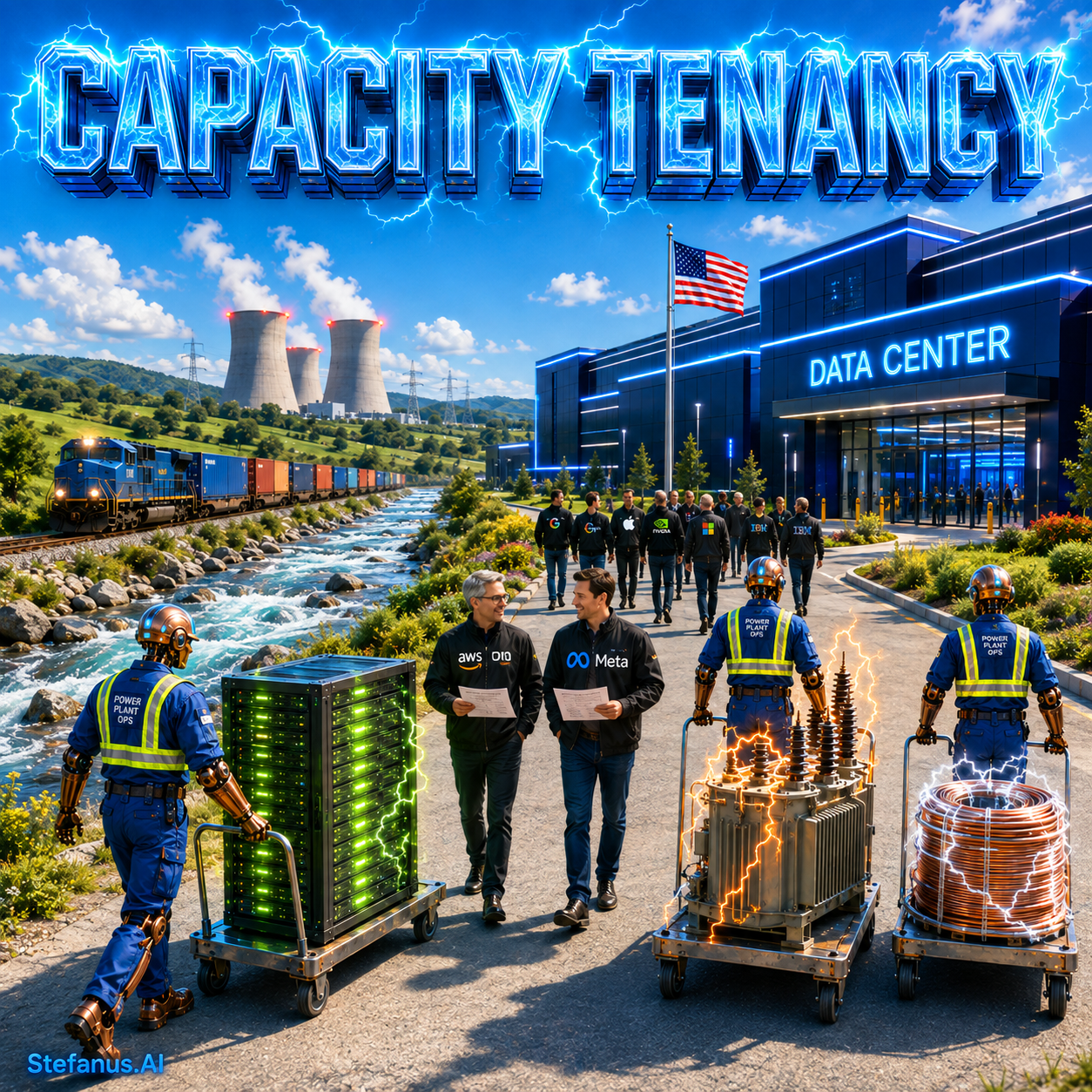
I call this emerging relationship Capacity Tenancy.
Why I Choose the Term “Capacity Tenancy”
I use the term Capacity Tenancy because the traditional vocabulary of the “cloud customer” has become inadequate for explaining the physical and financial relationship now emerging between frontier AI laboratories and the infrastructure beneath them. An ordinary cloud customer purchases a service, consumes it, and pays for what has been consumed. A capacity tenant, by contrast, increasingly anchors an entire industrial system. Its demand can justify tens of billions of dollars of construction, secure long-term project financing, determine accelerator procurement across multiple semiconductor generations, influence electricity-generation planning at the scale of utilities, consume hundreds of megawatts of continuous power, and lock infrastructure providers into technology choices that will last many years beyond the fashion cycles of software. The Anthropic–Nscale agreement is the cleanest single illustration of this phenomenon that the industry has yet produced, but it is far from the only one, and the pattern it exemplifies now runs through essentially every major announcement in the AI infrastructure economy.
The important word in the term is therefore not simply compute. It is capacity. Frontier AI companies are competing for the right to command future quantities of electricity, silicon, rack space, cooling, networking, and datacenter availability before those resources necessarily exist. The economic object being acquired is increasingly a claim on future productive capacity—a promise that, three or five or ten years from now, when intelligence demand reaches its highest value, a particular laboratory will have the enforceable right to convert a particular quantity of electrons and transistors into tokens. That claim may be delivered contractually as cloud services rather than through ownership of the underlying property, but the strategic effect closely resembles industrial tenancy: the customer becomes sufficiently large and sufficiently committed that its anticipated occupancy determines the economics of the underlying asset, in exactly the way an anchor department store once determined whether a shopping mall could be financed, or a long-term liquefied-natural-gas offtake agreement determines whether an export terminal gets built.
The second word, tenancy, deliberately distinguishes this phenomenon from outright infrastructure ownership. Some technology companies will own their datacenters, power plants, and chips directly, in the manner of Meta’s enormous self-built campuses. Others will build primarily through hyperscaler partners, as OpenAI has done with Microsoft and Oracle. Others will rent from specialist providers, from the new class of “new clouds,” or—in one of 2026’s stranger developments—from competing AI companies that possess surplus infrastructure. Capacity Tenancy describes the vast middle ground: a company can exercise enormous economic influence over physical infrastructure without necessarily owning any of it, and that separation of control from ownership is becoming one of the defining structural features of the AI economy.
This distinction matters because Anthropic itself is pursuing what is arguably the most diversified infrastructure strategy of any frontier laboratory, and the portfolio it has assembled over the past ten months reads like an inventory of every possible tenancy structure. In April 2026, Anthropic and Amazon announced an expanded strategic collaboration under which Anthropic committed to spend more than $100 billion over ten years on AWS technologies, securing up to 5 gigawatts of capacity spanning Amazon’s Graviton processors and its Trainium2 through Trainium4 custom accelerators, with nearly one gigawatt of Trainium capacity coming online by the end of 2026; Amazon simultaneously invested a fresh $5 billion in Anthropic with up to $20 billion more to follow, on top of the $8 billion it had previously invested.[8, 9, 10] Anthropic has stated plainly that it trains and runs Claude on a deliberately heterogeneous fleet—AWS Trainium, Google TPUs, and Nvidia GPUs—so that workloads can be matched to the chips best suited for them.[16] In October 2025, Google Cloud committed Anthropic access to as many as one million TPUs, bringing well over a gigawatt of capacity online during 2026 in a deal worth tens of billions of dollars; in April 2026, Anthropic, Google, and Broadcom expanded that relationship with approximately 3.5 gigawatts of next-generation TPU capacity beginning in 2027.[16, 17, 18] In May 2026, as described above, Anthropic leased the entirety of SpaceX’s Colossus 1.[12] Alongside these sit a strategic partnership with Microsoft and Nvidia that includes $30 billion of Azure capacity, a $50 billion commitment with the British neocloud Fluidstack to build custom datacenters in Texas and New York, a $10 billion six-year agreement with the Norwegian cloud startup Volta, a $5 billion compute arrangement with AMD signed in July, and now the $45 billion West Virginia tenancy with Nscale.[3, 12, 19]
A frontier laboratory, in other words, can be a tenant of multiple infrastructures simultaneously. It can occupy Amazon’s Trainium ecosystem. It can consume Google’s TPU capacity. It can rent Nvidia-based systems from a specialist operator in Appalachia and from a rocket company in Tennessee. It can contract for capacity in Norway while building purpose-designed facilities in Texas. The frontier model increasingly sits above a geographically distributed portfolio of industrial capacity claims, the way a global manufacturer sits above a network of plants it operates but does not always own.
That observation carries the larger thesis of this paper, which the remaining sections will develop in detail: artificial intelligence is transforming cloud procurement into industrial capacity procurement, and frontier AI laboratories are evolving from ordinary cloud customers into gigawatt-scale capacity tenants—anchor occupants of an intelligence-manufacturing economy whose factories are datacenters, whose raw material is electricity, and whose machinery is measured in generations of silicon. The conceptual progression the paper traces runs from Cloud Customer to Capacity Tenant to Anchor Tenant to Infrastructure Counterparty to, finally, the Capacity Portfolio as a competitive moat. Along the way, the argument remains anchored in the Five-Layer AI Economy—Energy, Chips, Datacenters, Models, and Applications and Agents—because Capacity Tenancy is, at bottom, the contractual mechanism that binds those five layers into a single interconnected industrial system.
Table 1. Anthropic’s Capacity Portfolio as of August 2026: One Laboratory, Many Landlords
| Partner / Landlord | Structure | Scale | Reported Value | Timing |
| Amazon / AWS | Decade-long custom-silicon commitment (Trainium2–4, Graviton) plus equity investment | Up to 5 GW; ~1 GW by end of 2026; over 1 million Trainium2 chips in use | More than $100B over 10 years; $13B+ invested, up to $20B more | April 2026 expansion[8, 9] |
| Google / Broadcom | TPU capacity via Google Cloud; next-generation TPUs co-developed with Broadcom | Up to 1 million TPUs (1+ GW in 2026); ~3.5 GW more from 2027 | Tens of billions (2025); multi-gigawatt expansion (2026) | Oct 2025; Apr 2026[16, 17, 18] |
| Microsoft / Nvidia | Strategic partnership including Azure capacity | Azure GB300-class capacity | $30B of Azure capacity | Announced Nov 2025[12] |
| Fluidstack | Custom-built dedicated datacenters in Texas and New York | Gigawatt-class campuses coming online through 2026 | $50B American infrastructure commitment | Nov 2025[19] |
| SpaceX (Colossus 1) | Lease of 100% of an existing xAI-built facility in Memphis | 300+ MW; 220,000+ Nvidia GPUs (H100/H200/GB200) | ~$1.25B per month through May 2029 (~$45B) | May 2026[12, 13, 15] |
| Nscale (Monarch, WV) | Six-year capacity tenancy on a state-certified AI microgrid campus; Nvidia Vera Rubin | ~460 MW of a 1.35 GW first phase (8 GW+ site potential) | ~$45B over six years | Aug 26, 2026[1, 2] |
| Volta (Norway) | Six-year cloud-capacity supply from a startup founded January 2026 | Norwegian datacenter capacity | ~$10B | Aug 2026[3] |
| AMD | Compute-related supply arrangement | Instinct-class accelerators | ~$5B | July 2026[3] |
The table above is worth reading twice, because its cumulative meaning is easy to miss when the deals are consumed one press release at a time. Across ten months, a single AI laboratory—one that ended 2025 with roughly $9 billion in run-rate revenue and crossed $30 billion in run-rate revenue by April 2026—has committed on the order of a quarter of a trillion dollars to future computing capacity across at least eight distinct counterparties, four accelerator architectures, three continents, and every tenancy structure known to infrastructure finance.[16, 10] Nothing in the history of software procurement resembles this. A great deal in the history of heavy industry does.

Section 1: From Cloud Customer to Industrial Tenant
Every economic era rests on a bargain that its participants eventually stop noticing, and the cloud era’s bargain was so successful that an entire generation of technology strategy internalized it as a law of nature rather than a contingent arrangement. This section examines that bargain, explains precisely why frontier AI breaks it, and uses the Anthropic–Nscale agreement as the prototype through which the anatomy of the new arrangement—Capacity Tenancy—can be dissected layer by layer. The purpose of proceeding deliberately here is not merely descriptive. Unless one understands why the original cloud abstraction is failing at the frontier, the enormous numbers now circulating through the AI economy will continue to be misread as an exuberant version of ordinary cloud spending, when they are in fact evidence of a different economic species altogether.
1.1 The Original Cloud Bargain: Infrastructure Without Attachment
The original economic promise of cloud computing was flexibility, and it is difficult to overstate how thoroughly that promise reorganized the software industry between roughly 2006 and 2022. Instead of purchasing servers years in advance—guessing at demand, over-provisioning against failure, and depreciating hardware that spent most of its life idle—customers rented computing resources as required, by the hour and eventually by the millisecond. Infrastructure became an operating expense that expanded and contracted with demand, and capital expenditure migrated onto the balance sheets of a small number of hyperscale providers who could aggregate demand across millions of customers and thereby smooth away any individual customer’s volatility.
This architecture encouraged, and indeed depended upon, abstraction. Applications did not need to know which physical server executed their workloads, because orchestration layers made servers interchangeable. Developers did not need to know which transformer supplied electricity to which availability zone, because the provider’s redundancy made electricity invisible. Corporate leaders rarely discussed megawatts, because megawatts were somebody else’s problem, amortized invisibly into a per-hour price. The server became a service; the building became a “region”; the grid became an assumption. The entire vocabulary of cloud computing—elasticity, serverless, on-demand—is a vocabulary of successful forgetting, a celebration of the fact that software people no longer needed to think about the physical world at all.
Capacity Tenancy begins exactly where this abstraction starts to break down. Frontier AI models now demand such large and persistent quantities of computing resources that the infrastructure must increasingly be secured before the model needs it—often years before, and often before the infrastructure itself exists. The governing question changes from a question of consumption, namely how much compute am I consuming today, to a question of industrial planning, namely how much physical computing capacity must I control three, five, or ten years from now, where must it be located, what will power it, and who will guarantee it. That is a fundamentally different planning problem, and it belongs to a different intellectual tradition—not the tradition of software procurement, but the tradition of energy offtake agreements, aircraft order books, and mining concessions.
1.2 Why Frontier AI Is Different From Ordinary Software Economics
Traditional software could scale extraordinarily rapidly without requiring a proportional reconstruction of the physical world, and this property—near-zero marginal cost of distribution—was the foundation of four decades of software economics, from packaged software through SaaS. A social network that doubled its users did not need to double any particular physical thing; a productivity suite that conquered a new continent needed servers, but the servers were a rounding error against the revenue. Frontier AI has a far more demanding relationship with physical reality, because the marginal cost of intelligence is not near zero. Every token generated is electricity converted through silicon into language, and more capable models require more of everything material: larger accelerator clusters, substantially greater memory bandwidth, denser and more exotic networking, liquid cooling capable of removing hundreds of kilowatts per rack, more reliable electrical infrastructure, enormous curated training corpora, and vast standing inference fleets to serve the resulting models to the world.
Reasoning systems deepen the problem in a way that deserves particular emphasis, because it changes the temporal structure of demand. In the earlier paradigm, computation was concentrated in discrete training runs—costly, but episodic. In the current paradigm, computation does not stop when training ends. Test-time compute allows models to think longer to produce better answers, which converts model quality itself into a continuous electricity bill. Long-context inference, reinforcement learning from synthetic environments, large-scale synthetic-data generation, and above all autonomous agents that work for minutes or hours at a stretch all consume infrastructure persistently, around the clock, in rough proportion to the economic value being delivered. The model therefore ceases to be a periodically trained digital artifact and becomes an always-operating industrial workload—less like a software release and more like a blast furnace that must be kept hot.
The macroeconomic footprint of this transition is no longer a matter of projection; it is visible in the national accounts. Harvard economist Jason Furman calculated that investment in information-processing equipment and software, though only about 4 percent of U.S. GDP, accounted for fully 92 percent of American GDP growth in the first half of 2025, and that growth excluding these categories ran at a nearly stationary 0.1 percent annualized rate; Renaissance Macro Research separately estimated that the dollar contribution of the AI data-center buildout to GDP growth had surpassed that of all U.S. consumer spending—remarkable given that consumer spending is two-thirds of the economy.[20] The commentator Rusty Foster compressed the situation into a single memorable line:
“Our economy might just be three AI data centers in a trench coat.”
— Rusty Foster, Today in Tabs, as quoted by Fortune [20]
The joke lands precisely because it is directionally true. When the construction of intelligence factories becomes a first-order driver of national economic growth, the companies whose demand calls those factories into existence have ceased to be software customers in any traditional sense. They have become the anchor demand of an industrial complex.
1.3 The Anthropic–Nscale Case as the Capacity-Tenancy Prototype
The reported Anthropic–Nscale agreement provides an unusually clean prototype through which the anatomy of Capacity Tenancy can be examined, because every structural element of the phenomenon is present in a single contract. The critical numbers are not merely $45 billion and six years, striking as those are. The critical combination is this: 460 megawatts, plus Vera Rubin, plus West Virginia, plus six years, plus one frontier laboratory whose consumer coding product is the proximate source of demand. Each element belongs to a different layer of the AI economy, and the contract binds them all.
Trace the agreement vertically and the entire Five-Layer AI Economy comes into view. Demand for Claude Code—an application through which millions of developers delegate software work to AI agents—sits at Layer 5. That application demand flows down into inference and training demand for Claude and Anthropic’s frontier models at Layer 4. Serving that model demand requires the industrial floor space, cooling, and operations of Nscale’s Monarch campus at Layer 3. The campus is being purpose-built around a specific generation of silicon—Nvidia’s Vera Rubin NVL72 systems, deployed under the Vera Rubin DSX AI Factory reference design, fully liquid-cooled, with modular cable-free trays engineered to cut rack installation from hours to minutes—at Layer 2.[6, 7] And the hundreds of megawatts required to operate those systems begin at Layer 1, with a dedicated on-site fleet of Caterpillar G3500-series natural-gas generators fed by Marcellus Shale pipelines, organized as the first state-certified AI microgrid in the United States.[5, 6] A successful Layer-5 product can now create a contractual obligation stretching downward through all four layers beneath it, and this vertical binding—application demand crystallizing into energy procurement—is one of the most important and least appreciated characteristics of Capacity Tenancy.
The prototype also demonstrates the substitutability of anchor tenants and the speed with which the anchor role is now contested. The Monarch campus was originally organized around Microsoft’s March 2026 letter of intent for the identical 1.35-gigawatt first phase; when Microsoft withdrew during the summer, the capacity did not sit unsold for long, because a frontier laboratory in the middle of a demand surge was waiting.[4] The infrastructure, in other words, was financed and constructed on the premise that some gigawatt-scale tenant would materialize—and one did, within months. That is how anchor-tenant markets behave in commercial real estate and in LNG, and it is now how they behave in artificial intelligence.
1.4 The Megawatt Becomes a Unit of AI Strategy
Software companies traditionally measured their growth through users, subscriptions, API calls, and revenue, and those metrics remain necessary. But frontier AI increasingly requires another metric that would have seemed absurd in a boardroom five years ago: megawatts under control, trending toward gigawatts under control. When Anthropic announces a compute agreement, the headline unit is no longer instances or vCPUs; it is gigawatts—5 with Amazon, roughly 4.5 with Google and Broadcom across two agreements, 0.3 in Memphis, 0.46 in West Virginia.[8, 16, 12, 1] When OpenAI describes Stargate, its infrastructure program with Oracle, SoftBank, and others, the framing commitment is $500 billion for 10 gigawatts, announced at the White House and expanded through a $300 billion, 4.5-gigawatt agreement with Oracle alone.[21, 22] When Dario Amodei sketches the industry’s trajectory, he speaks of AI collectively requiring on the order of 100 gigawatts of capacity by 2028—an electricity vocabulary, not a software vocabulary.[23]
This represents an important change in the structure of competitive strategy. A frontier AI laboratory can possess excellent researchers, powerful models, and rapidly growing applications, and still face a hard ceiling if it cannot obtain enough infrastructure; Anthropic spent parts of 2025 and early 2026 visibly rationing its most capable models behind rate limits precisely because demand outran secured capacity, and it explicitly framed the Colossus 1 lease as the mechanism through which those limits were relaxed—doubling Claude Code’s five-hour rate limits across paid tiers within days of signing.[12, 13] Future competitive comparisons among laboratories will therefore include model quality, inference cost, tokens generated, enterprise adoption, and agent utilization, but they will also include accelerator inventory and secured electrical capacity, disclosed and scrutinized the way airlines disclose fleets and miners disclose reserves. The megawatt begins to function almost like a strategic balance-sheet asset—an off-balance-sheet reserve of future production.
1.5 Capacity Tenancy Versus Capacity Ownership
Capacity Tenancy should not be confused with vertical integration, and the distinction repays careful attention because the industry currently contains all of the alternatives simultaneously, often inside a single company’s strategy. Under the ownership model, a technology company finances and owns the land, the datacenter, the accelerators, and possibly the generation resources; Meta’s program—reported at up to $600 billion of American datacenter investment over three years—is the purest current expression.[19, 24] Under the hyperscaler model, a frontier laboratory relies primarily on infrastructure owned and operated by AWS, Google, Microsoft, or Oracle, as OpenAI historically did with Azure and now does at colossal scale with Oracle under Stargate. Under the neocloud model, a specialist operator such as CoreWeave, Fluidstack, Nscale, or Volta purchases or finances accelerators and sells dedicated AI capacity, frequently borrowing against the GPUs themselves—Nscale, for instance, signed a $1.4 billion delayed-draw term loan backed by its GPU fleet in February 2026.[7] And under the capacity-tenancy model, a frontier laboratory contractually commands very large quantities of infrastructure over extended periods without necessarily owning the underlying physical assets.
Table 2. Four Structures for Commanding AI Infrastructure
| Model | Who Owns the Assets | Who Bears Demand Risk | Exemplars (2025–2026) |
| Ownership | The AI/tech company itself | The owner, fully | Meta’s self-built campuses (~$600B program)[24] |
| Hyperscaler | AWS, Microsoft, Google, Oracle | Shared; smoothed across many customers | OpenAI on Azure; OpenAI–Oracle Stargate ($300B / 4.5 GW)[21, 22] |
| New cloud | Specialist GPU operator (often debt-financed) | The operator, hedged by long contracts | CoreWeave; Fluidstack; Nscale; Volta[3, 7] |
| Capacity Tenancy | Landlord retains ownership; tenant commands use | Transferred substantially to the tenant | Anthropic–Nscale ($45B / 460 MW); Anthropic–SpaceX Colossus 1[1, 12] |
These structures are not mutually exclusive, and the largest AI laboratories will almost certainly operate several simultaneously, as Anthropic already does across the eight relationships catalogued in Table 1. The strategically interesting question therefore shifts. It is no longer primarily a question of who owns the GPU, which is the question an accountant would ask. It is a question of who possesses the enforceable right to use the GPU when intelligence demand reaches its highest value—which is the question an industrialist, a project financier, or a wartime planner would ask. Capacity Tenancy is the name for the growing class of arrangements in which that enforceable right, rather than the asset itself, is the object of competition.

Section 2: The Financial Architecture of Capacity Tenancy
If Section 1 established what Capacity Tenancy is, this section examines what it costs, who finances it, and where the risks settle when the contracts are signed—because the deepest consequences of the phenomenon are financial, and the financial architecture now taking shape around AI capacity contracts is beginning to resemble the project-finance ecosystems that grew up around pipelines, power plants, and aircraft far more than it resembles anything in the history of software. The scale involved forces this resemblance. When the five largest American hyperscalers—Amazon, Microsoft, Alphabet, Meta, and Oracle—are collectively guiding toward roughly $700 billion or more of capital expenditure in 2026 alone, when the four largest are spending approximately $725 billion, up 77 percent from an already record-breaking $410 billion in 2025, and when Goldman Sachs projects a combined $5.3 trillion of hyperscaler capital expenditure between fiscal 2025 and fiscal 2030, the question of how these commitments are funded, secured, and de-risked becomes one of the central questions of global capital markets.[24, 25, 26]
2.1 From Consumption Contract to Infrastructure Commitment
A cloud bill ordinarily reflects usage that has already occurred; it is retrospective, variable, and self-correcting, because a customer whose demand disappoints simply pays less. Capacity Tenancy inverts this temporal structure. The contract concerns capacity that must be secured before demand materializes, priced against forecasts rather than meters, and committed for durations that exceed the planning horizon of the products generating the demand. That inversion shifts risk, and it shifts it decisively toward the AI laboratory. The laboratory must forecast model adoption, inference demand per user, agent utilization, enterprise customer growth, future chip performance per watt, future electricity requirements, competitive pricing pressure, and regulatory developments—all years ahead, and all simultaneously—because the capacity commitment is a single number that silently encodes assumptions about every one of them.
An error in either direction becomes expensive in a way that ordinary cloud consumption never was. Underestimate demand, and the laboratory becomes compute-constrained at precisely the moment its market position is most contestable: it rations customers, throttles its best products, and watches competitors absorb the demand it cannot serve—a scenario Anthropic lived through publicly before its 2026 capacity surge.[12] Overestimate demand, and the laboratory holds billions of dollars of committed payments for infrastructure whose economics were calculated under assumptions the market no longer supports. Capacity planning therefore graduates from an operational task performed by engineers into a major corporate-finance function performed at board level, with consequences comparable to an airline’s fleet plan or a utility’s integrated resource plan. It is revealing that Anthropic’s chief financial officer, Krishna Rao, framed the company’s April 2026 multi-gigawatt TPU expansion in exactly this fiduciary vocabulary:
“A continuation of our disciplined approach to scaling infrastructure.”
— Krishna Rao, Chief Financial Officer, Anthropic [16]
Discipline is the correct word, because the alternative to discipline in capacity procurement is not inefficiency but existential error, in one direction or the other.
2.2 Compute Contracts Begin to Resemble Industrial Offtake Agreements
Capacity Tenancy has deep structural similarities to contracting patterns used elsewhere in industrial economics, and recognizing the family resemblance clarifies what these agreements actually do. A manufacturer guarantees purchases from a supplier so that a new factory can obtain financing. An airline commits to aircraft years before delivery so that the airframer can commit to the supply chain. A utility contracts for electricity from a generating facility that does not yet exist so that its developers can raise construction debt. A buyer of liquefied natural gas enters a twenty-year offtake agreement so that a $30 billion export terminal becomes bankable. In every case, the essential economic service the large customer provides is not money today but certainty about money tomorrow—and certainty is the raw material from which project finance manufactures capital.
Frontier AI has now developed a precisely analogous structure, and the chain of transformations it enables can be stated as a sequence: the AI laboratory creates demand certainty; the infrastructure provider converts that certainty into financing; financing becomes construction; construction becomes energization; energization permits accelerator deployment; and accelerator deployment creates intelligence capacity, completing the circuit back to the laboratory. Model Demand → Capacity Contract → Financing → Datacenter Construction → Power Procurement → Chip Orders → AI Production. The Nscale case makes the mechanism unusually visible: a two-year-old company carrying roughly $51 billion of contracted future revenue against about $100 million of recent quarterly bookings is preparing a New York listing whose entire investment thesis is the credibility of its tenants’ signatures, with Anthropic’s $45 billion now the largest entry in that backlog.[4] The AI contract, in other words, does more than purchase computation. It makes the infrastructure financeable—and in a market where the four hyperscalers’ incremental annual debt has risen from 9 percent of capital expenditure in fiscal 2024 to 32 percent by mid-2026, with Amazon’s trailing free cash flow compressed by 95 percent to roughly $1.2 billion even as it guides $200 billion of annual capex, financeability is the scarcest commodity in the entire system.[26, 27]
2.3 The New Tenant Risk: What If Model Demand Is Wrong?
Capacity Tenancy transfers significant forecasting risk toward frontier AI laboratories, and intellectual honesty requires dwelling on the scenarios in which those forecasts fail, because the industry’s own promotional literature will not. Imagine a laboratory reserving several gigawatts on the assumption that demand for autonomous coding agents continues growing exponentially through the decade. Several things could interrupt that assumption. A competitor could release a dramatically more efficient model, collapsing the price of the marginal token. Inference efficiency could improve faster than demand grows—an outcome the entire semiconductor roadmap is explicitly engineered to produce. Enterprise adoption could plateau; an MIT study circulating in early 2026 found that only 23 percent of business AI deployments were generating clearly measurable returns on investment, a statistic that should give every capacity planner a sleepless night.[28] An open-source model could erode pricing at the application layer. Regulators could restrict an important use case. A recession could compress enterprise AI budgets exactly when the committed payments come due.
The academic skeptics deserve a careful hearing here, precisely because the capacity commitments are so long-lived. Daron Acemoglu, the MIT Institute Professor and 2024 Nobel laureate in economics, has estimated that AI will deliver roughly 0.55 percent of total factor productivity gains over the coming decade, with only about 5 percent of tasks profitably automated in the near term—figures that sit orders of magnitude below the growth assumptions embedded in trillion-dollar infrastructure programs.[29] His summary judgment on the investment boom, delivered in Goldman Sachs’s own research pages, was characteristically dry:
“The devil is ultimately in the details.”
— Daron Acemoglu, Institute Professor, MIT; Nobel Laureate in Economics [30]
And his broader complaint about the discourse surrounding the boom is a warning about analytical seriousness itself:
“What we should be talking about is the displacement and unequalizing roles of AI.”
— Daron Acemoglu, in Fortune, June 2026 [29]
One need not accept Acemoglu’s productivity estimates—the revenue trajectories of the frontier laboratories, with Anthropic tripling from roughly $9 billion to more than $30 billion of run-rate revenue in about a year, are themselves evidence against the most pessimistic readings[16]—to accept the structural point. The AI industry’s great scarcity problem could eventually produce its opposite: stranded compute capacity, the datacenter equivalent of the dark fiber that haunted telecommunications for a decade after 1999. The difference, explored below, is that dark fiber did not depreciate; accelerators do.
2.4 Infrastructure Providers Inherit Counterparty Risk
The landlord side of Capacity Tenancy carries its own risks, and they concentrate rather than diversify. Building infrastructure for a frontier AI laboratory requires enormous capital deployed against a small number of enormous contracts, which raises questions that traditional datacenter operators—whose customer bases were broad and whose leases were small relative to any single campus—never had to answer at this scale. Who guarantees payment if the tenant’s economics deteriorate? How much customer concentration is acceptable when one AI laboratory occupies thirty, forty, or—as with Anthropic at Colossus 1—one hundred percent of a facility?[13] What happens if the tenant wishes to migrate to a new semiconductor architecture before the installed equipment is economically depreciated? What happens if a model company simply fails, in an industry where competitive positions have historically inverted within eighteen months?
These questions transform AI laboratories into counterparties whose creditworthiness directly conditions datacenter financing, and the capital markets have already begun pricing accordingly: Moody’s warned that Oracle’s leverage would push toward four times EBITDA on the strength of Stargate-related capital spending, and lenders evaluating neocloud debt now underwrite the tenant as much as the asset.[22] The credit quality of the model developer propagates downward through the Five-Layer AI Economy—into the landlord’s bond spreads, the chipmaker’s order book, the turbine manufacturer’s backlog, and the county’s tax projections. The International Monetary Fund’s leadership has started saying this out loud. Speaking on the very day the Anthropic–Nscale agreement was reported, IMF Managing Director Kristalina Georgieva acknowledged the boom’s macroeconomic force—
“AI is now becoming a growth engine for the global economy.”
— Kristalina Georgieva, Managing Director, International Monetary Fund, August 26, 2026 [31]
—while cautioning in the same remarks that the future impact of AI remains subject to significant uncertainties, including possible risks to financial stability, and that mounting fiscal pressures and stalled disinflation are worrying both markets and policymakers.[31] Her former first deputy, Gita Gopinath, had gone further months earlier, warning that an AI-driven market reversal could erase on the order of $35 trillion in global asset value and that widespread AI adoption could convert an ordinary downturn into a much deeper crisis—an argument for, in her phrase, an effort at AI-proofing the global economy.[32] When the stewards of the international financial system begin discussing frontier-model demand assumptions as a financial-stability variable, the transformation of the AI laboratory from customer into counterparty is complete.
2.5 The Residual-Value Problem
Capacity Tenancy faces an unusual challenge that conventional commercial leases never confronted, and it may prove to be the most consequential contractual issue in the entire edifice: the building and the machinery age at radically different rates. A datacenter shell, its substations, its cooling plant, and its fiber may remain useful for decades. The accelerators inside it will not. A six-year infrastructure commitment—the exact tenor of the Anthropic–Nscale agreement—crosses multiple semiconductor generations by construction: Vera Rubin succeeds Blackwell, which succeeded Hopper within roughly two years, and Vera Rubin will itself be superseded well before 2032, with Nvidia claiming five-fold inference gains generation over generation.[7] The economics of every capacity contract therefore depend, silently but heavily, on hardware depreciation schedules, upgrade rights, replacement cycles, secondary-market values for used accelerators, power-efficiency improvements that alter the operating-cost calculus, cooling and networking compatibility across generations, and the ability to repurpose the shell for whatever comes next.
This produces a question that will occupy lawyers, lenders, and rating agencies for the rest of the decade: who bears technological obsolescence risk—the tenant, the infrastructure provider, the chip manufacturer, or the financiers? A tenant that has committed $45 billion against a specific chip generation holds, in effect, a short position on semiconductor progress; a landlord that has borrowed against GPUs holds collateral whose half-life is measured in months of roadmap announcements; a lender to either is exposed to a depreciation curve with no century of actuarial history behind it. The answers being negotiated today, contract by contract and largely in private, will determine where the losses land if the industry’s hardware cycle ever runs ahead of its demand cycle—and they will therefore shape the AI industry’s financial resilience as surely as mortgage underwriting standards shaped housing finance.

Section 3: Capacity Tenancy Across the Five-Layer AI Economy
The Five-Layer AI Economy—Energy at the base, then Chips, then Datacenters, then Models, and finally Applications and Agents at the top—is the organizing framework of this body of work, and Capacity Tenancy is best understood as the contractual connective tissue that now runs through all five layers at once. This section walks each layer in turn, from the generator to the agent, showing how a single tenancy agreement propagates obligations and dependencies both downward and upward, and why the layers can no longer be analyzed in isolation. The deeper claim, developed across the five subsections, is that Capacity Tenancy has converted what were once five loosely coupled industries—utilities, semiconductors, real estate, software research, and consumer applications—into a single vertically synchronized production system, in which a subscription decision at the top can ripple into a natural-gas procurement decision at the bottom within a fiscal year.
3.1 Layer 1 — Energy Becomes Part of the Product
At hundreds of megawatts, electricity procurement is no longer a backstage utility expense to be managed by a facilities department; it becomes part of AI production itself, an input as strategic as the silicon. The scale of the transition is documented most authoritatively by the International Energy Agency, whose landmark Energy and AI analysis projects that global electricity consumption by data centers will roughly double from 415 terawatt-hours in 2024 to approximately 945 terawatt-hours by 2030—slightly more than the entire present electricity consumption of Japan—with AI as the most important driver, and with the United States accounting for by far the largest share of the increase.[33] The agency’s 2026 update held the trajectory essentially intact, projecting roughly 950 terawatt-hours by 2030 from a 2025 base near 485, while noting that bottlenecks across the value chain are restraining the most aggressive scenarios.[34] Most arresting of all is the IEA’s American finding: by the end of the decade, the United States is set to consume more electricity for data centers than for the production of aluminum, steel, cement, chemicals, and all other energy-intensive goods combined, with data centers accounting for nearly half of all U.S. electricity-demand growth between now and 2030.[33] The agency’s executive director framed the moment plainly:
“AI is one of the biggest stories in the energy world today.”
— Fatih Birol, Executive Director, International Energy Agency [35]
The Nscale Monarch campus illustrates the direction in which the frontier is moving, and it is a direction that would have been unrecognizable to the cloud industry of 2020: rather than petitioning a utility for grid interconnection and waiting in a multi-year queue, the campus generates all of its own power on-site, behind the meter, through a fleet of Caterpillar natural-gas engines organized as a state-certified microgrid with a runway beyond eight gigawatts, deliberately structured so that its operations draw nothing from local utilities and cannot affect residential rates, with future tie-in provisions that could even export power back to the grid, and with carbon sequestration pursued through West Virginia’s geological capacity.[5, 6] A frontier laboratory’s compute contract with such a campus therefore silently encodes positions on natural-gas supply, turbine and engine manufacturing backlogs, transmission policy, water, emissions, and grid-reliability regulation. The IEA projects that meeting global data-center demand growth to 2035 will require more than 450 additional terawatt-hours of renewable generation and roughly 175 terawatt-hours of new natural-gas generation, much of the latter in the United States[33]—and every gigawatt-scale tenancy signed this year is, in effect, a private allocation of that future energy system. Capacity Tenancy thus pulls the AI laboratory into energy policy even if the laboratory never owns a single generator, which is why Anthropic has found itself publicly promising to pay for electricity-price increases attributable to its data centers—a commitment no software company in history previously needed to contemplate.[13]
3.2 Layer 2 — Semiconductor Roadmaps Become Lease Assumptions
Nscale’s deployment of Nvidia Vera Rubin for the Anthropic tenancy matters because the contractual relationship welds a multi-year infrastructure obligation to a particular generation of semiconductor architecture, and this welding is becoming the standard pattern. Nvidia describes Vera Rubin as an integrated platform for large-scale reasoning and agentic AI—Rubin GPUs and Vera CPUs combined with networking, DPUs, and rack-scale systems delivered as NVL72 units under the DSX AI Factory reference design, one hundred percent liquid-cooled, with modular cable-free trays that reduce installation from roughly two hours to five minutes per unit, and with claimed inference performance five times that of the Blackwell generation.[7] Nvidia increasingly describes the datacenter itself, rather than the individual GPU, as the fundamental unit of AI computation, and that framing aligns exactly with the thesis of this paper: if the datacenter becomes the practical unit of compute, then contractual access to the datacenter is access to an industrial production asset, and the tenant is no longer shopping for chips but for systems of chips embedded within power and cooling infrastructure.
The same welding is visible on the custom-silicon side of the industry, where it runs even deeper because the tenant helps shape the silicon itself. Anthropic’s decade-long AWS commitment spans Trainium2 through Trainium4 and options on future generations of Amazon silicon not yet designed, with more than one million Trainium2 chips already training and serving Claude through Project Rainier, one of the largest compute clusters in the world.[8, 9] Its expanded Google relationship runs through Broadcom, which will co-develop Google TPUs into the next decade and supply Anthropic approximately 3.5 gigawatts of TPU-based capacity from 2027—an arrangement significant enough that analysts project Broadcom AI revenue attributable to Anthropic alone in the tens of billions of dollars annually, and that Broadcom may represent roughly a tenth of TSMC’s 2026 revenue.[17, 23] A capacity tenant of this scale is, functionally, a participant in semiconductor roadmap planning: its demand forecasts become wafer allocations, its workload characteristics become architecture requirements, and its contract tenors become the depreciation schedules against which billions of dollars of fabrication capacity are justified. The lease assumptions and the lithography assumptions have merged.
3.3 Layer 3 — The Datacenter Becomes the Factory Floor
The datacenter is where Capacity Tenancy becomes physically visible, and the language the industry itself now uses—AI factory is Nvidia’s official term, adopted verbatim by Nscale for Monarch—concedes the industrial character of the transformation.[6] A gigawatt-class AI campus must coordinate substations or on-site generation, switchgear, transformers, backup systems, liquid-cooling loops with their pumps and chillers, long-haul and campus fiber, networking switches at extraordinary densities, storage, physical security, racks engineered for hundreds of kilowatts apiece, continuous maintenance, and a perpetual program of hardware replacement as silicon generations turn over. Monarch’s design brief captures the full industrial inventory: enclosed generators with mufflers, berms, sound walls, and setbacks engineered to hold noise inside the campus boundary; closed-loop cooling that consumes no municipal drinking water; and site logistics organized around the delivery cadence of hundreds of thousands of accelerators.[5]
This is why continuing to call such facilities cloud regions actively obscures what they have become. They are highly automated industrial plants whose output happens to be machine intelligence, closer in economic character to a semiconductor fab or an LNG train than to the server closets from which the cloud metaphor descended. The capacity tenant, correspondingly, is renting a share of a factory’s productive output rather than a quantity of undifferentiated service—and the difference is legible in the contracts, which increasingly specify particular buildings, particular chip generations, particular energization dates, and particular megawatt allocations, as the Anthropic–Nscale agreement does with its 460 megawatts within the first of three buildings of Monarch’s initial 1.35-gigawatt phase.[4]
3.4 Layer 4 — Model Roadmaps Become Infrastructure Roadmaps
Capacity availability now influences model development itself, which means causation in the Five-Layer Economy runs upward as well as downward. A laboratory that knows with contractual certainty that hundreds of additional megawatts will energize on specific dates can plan larger training runs, more ambitious reinforcement-learning programs, expanded synthetic-data generation, and more generous inference availability for its customers; Anthropic explicitly connected its 2026 capacity surge to its ability to serve demand that had tripled its run-rate revenue in a year, and to relax the rate limits that had constrained its most enthusiastic users.[16, 12] Conversely, a laboratory that cannot secure capacity must optimize models more aggressively, ration access, raise prices, impose usage limits, delay training, or triage customers—each a strategic concession made not because the science demanded it but because the industrial base did.
Infrastructure has therefore ceased to be merely supportive of model strategy and has begun to determine it. The research roadmap and the energization schedule are now the same document read by different departments, and the competitive implications are profound: between two laboratories of equal scientific talent, the one with the deeper, earlier, and more diversified capacity portfolio can simply run experiments the other cannot afford to imagine. In an industry that believes scale is a primary driver of capability, secured future capacity functions as secured future intelligence.
3.5 Layer 5 — Agents Convert Capacity Into Persistent Demand
The agentic era strengthens Capacity Tenancy further, and it does so by changing the statistical character of demand itself. A chatbot waits for a user; its demand is episodic, diurnal, and correlated with human attention. An agent works—for minutes, hours, or potentially days—searching, reasoning, writing code, running software, inspecting results, retrying failures, calling other models, and coordinating with other agents; its demand approaches the continuous, machine-paced utilization patterns of industrial equipment. Claude Code is the canonical early example, and it is no accident that both Bloomberg’s reporting on the Nscale agreement and Anthropic’s own capacity announcements repeatedly cite coding-agent demand as the workload the new megawatts must serve.[1, 12] If millions of people each operate multiple persistent agents, aggregate compute demand begins to resemble continuous industrial load rather than web traffic—flatter, higher, and far more valuable per megawatt—and the economic case for locking in capacity years ahead becomes correspondingly stronger.
This is the sense in which Capacity Tenancy may prove to be the infrastructure architecture of the agentic economy: agents monetize capacity continuously, continuous monetization justifies long-duration commitments, long-duration commitments finance new capacity, and new capacity enables more agents. Whether that loop compounds virtuously or overshoots into the stranded-capacity scenario of Section 2.3 is the central open question of the next three years, and it will be answered at Layer 5—by whether the agents actually deliver enough value to keep the factories beneath them fully employed.

Section 4: The Strategic Geography of the New AI Tenant
For twenty years, the deepest promise of the cloud was that geography had ceased to matter to software, and for twenty years that promise held well enough that a generation of technology strategy simply deleted the map. Capacity Tenancy restores the map, and this section explains why: why the frontier laboratory is becoming a multi-landlord global occupant, why the physical siting of intelligence production now follows infrastructure economics rather than engineering preference, why governors and county commissions have become participants in the AI capacity market, and why the politics of the November 2026 midterm elections have begun to absorb questions that were, until very recently, the private concerns of datacenter site-selection teams. The essay’s single most compressed formulation belongs here, and it will be defended at length: the cloud has acquired a ZIP code.
4.1 The Frontier Laboratory Becomes Multi-Landlord
Anthropic offers the clearest available example of deliberate infrastructure diversification, and Table 1 has already catalogued the portfolio: Trainium capacity inside Amazon’s estate, TPU capacity inside Google’s, Azure capacity through Microsoft and Nvidia, Nvidia GPU capacity rented from a rocket company in Memphis and a two-year-old British operator in West Virginia, custom Fluidstack campuses rising in Texas and New York, Norwegian capacity through Volta, and AMD silicon arriving through a separate channel.[8, 16, 12, 1, 3] OpenAI’s Stargate program tells the same story in a different structure—Oracle-led campuses in Texas and New Mexico, SoftBank-led sites in Ohio and Texas, CoreWeave partnerships, and expansion into Michigan, Wisconsin, Wyoming, and Pennsylvania, totaling nearly seven gigawatts of planned capacity and more than $400 billion of investment on the way to a ten-gigawatt, half-trillion-dollar commitment.[21, 22] The future AI laboratory, this evidence suggests, will resemble a global industrial corporation operating across multiple factories: multiple landlords, multiple accelerator architectures, multiple electricity systems, multiple jurisdictions, and multiple financing structures, all managed as a single portfolio whose objective is capacity diversification—resilience against the failure, delay, or repricing of any single source.
4.2 Why Geography Returns to Computing
Cloud computing appeared to make location unimportant because the workloads it carried were small relative to the electrical systems beneath them; a region could be placed near talent, near customers, or near cheap land, and the grid would not notice. A 460-megawatt AI cluster cannot be placed anywhere merely because an engineer prefers the region, because at that scale the cluster is itself a significant electrical event. Its location is determined by available generation or the ability to build it, by natural-gas basins and pipeline capacity, by transmission congestion and interconnection queues that now stretch years, by land in contiguous thousands of acres, by water or the engineering to avoid needing it, by permitting regimes and political hospitality, by tax policy, by construction workforce, by long-haul fiber, by the delivery schedules of turbines and transformers that have become the scarcest industrial equipment in America, and by community acceptance that can no longer be assumed.
The geography of artificial intelligence therefore increasingly follows infrastructure economics, and the resulting map looks nothing like the geography of software. It looks like the geography of energy: Mason County, West Virginia, on the Ohio River atop Marcellus gas; Abilene and Milam and Shackelford Counties in Texas inside ERCOT’s buildable grid; Memphis, Tennessee, where xAI erected Colossus at record speed; New Albany, Ohio, and Doña Ana County, New Mexico, and the industrial Midwest of Michigan and Wisconsin and Pennsylvania.[21, 22, 4] The IEA’s finding that American data centers will out-consume the whole of American energy-intensive manufacturing by 2030 is, read geographically, a prediction that the political economy of the industrial heartland—its counties, its utilities, its congressional districts—will absorb the AI economy whether or not it ever writes a line of code.[33]
4.3 Governors Become Participants in the AI Capacity Market
Capacity Tenancy has political consequences because gigawatt-scale tenancy is, from a state’s perspective, industrial recruitment of the classic kind, with all of its promises and all of its hazards. A governor confronted with a proposed AI campus is not evaluating an ordinary technology-office investment; the administration must weigh construction employment against permanent employment—Anthropic’s Fluidstack program, for example, projects roughly 2,400 construction jobs and 800 permanent positions[19]—tax revenue against incentive cost, electricity reliability against new load, generation requirements against consumer rates, environmental effects against economic development, and transmission construction against local opposition. West Virginia’s handling of Monarch shows the emerging playbook: the state certified the nation’s first AI microgrid, structuring the project so that on-site generation insulates ratepayers entirely, while the campus contributes more than $80 million in annual tax revenue with roughly $40 million dedicated to Mason County schools.[5, 6] The decision, in short, increasingly resembles industrial policy, and states are responding as they historically responded to automobile plants and semiconductor fabs—competing not merely to attract technology companies, but to become landlords to the AI economy.
4.4 Communities Become Stakeholders in Model Economics
Capacity Tenancy also rewrites the relationship between frontier models and the communities that host their production, and the rewriting is asymmetrical in a way that deserves honest acknowledgment. A resident of Point Pleasant, West Virginia, may never open Claude, ChatGPT, or Gemini; yet the infrastructure serving those systems now influences local land prices, electrical infrastructure, water systems, construction traffic, tax bases, road wear, ambient noise, air emissions from hundreds of gas engines, school funding, and county politics. Model economics have acquired a local geographic footprint: a surge of coding-agent subscriptions in San Francisco or Singapore becomes, within a fiscal year, a transformer order, a gas-nomination schedule, a construction payroll, and a county-commission agenda item hundreds or thousands of miles away. The cloud acquires a ZIP code—and the ZIP code acquires a stake in whether the model succeeds, because the tax revenue, the jobs, and the long-term value of the campus all depend on the tenant’s demand assumptions proving correct. Mason County is now, economically speaking, long Claude.
4.5 The November 2026 Political Question
All of this converges on a question that governors, legislators, and candidates are carrying into the November 2026 midterm elections, and that will not resolve itself afterward: if AI companies become some of the largest industrial tenants in a state, what obligations should accompany that tenancy? The policy agenda is already legible in the disputes of the past year. Should capacity tenants pay the full incremental cost of grid upgrades their load imposes, or does behind-the-meter generation of the Monarch type make the question moot—and if so, should states require it? Should infrastructure incentives be conditioned on long-duration commitments, so that a tenant cannot harvest a decade of tax abatement against a tenancy it can exit in three years? Should developers guarantee minimum local employment beyond the construction phase? Should the backup and primary generation fleets of AI campuses face conventional emissions rules, a question already contested in Memphis around Colossus? Should AI campuses fund transmission upgrades that benefit the broader grid? Should local taxpayers share in infrastructure risk at all, and should large-load contracts—today negotiated in confidence—be transparent to the ratepayers whose grid they touch? Anthropic’s own pledge to compensate for electricity-price increases attributable to its data centers is an early, voluntary answer to one of these questions; the involuntary, statutory answers are coming.[13]
These are no longer peripheral technology-policy questions to be handled by innovation subcommittees. They are questions of industrial governance—rates, siting, emissions, taxation, and the distribution of risk between global capital and local communities—and they are precisely the questions American states spent the twentieth century learning to ask of steel, autos, chemicals, and power. The AI industry is discovering that when you become an industrial tenant, you inherit the politics of industry.

Section 5: The Capacity-Tenancy Economy of 2027 and Beyond
Having established what Capacity Tenancy is, how it is financed, how it binds the five layers, and where it lands on the map, the argument now turns forward, because the phenomenon is still in its first act. This section develops five forward propositions: that anchor AI tenants will become a precondition of infrastructure finance; that the industry’s scorekeeping must migrate from gigawatts announced to gigawatts occupied; that capacity portfolios will function as competitive moats; that a new financial market will assemble itself around capacity contracts; and that the ultimate systemic risk of the era is capacity arriving before revenue. Each proposition is stated as analysis rather than prophecy, and each is anchored in transactions already visible in 2026.
5.1 The Rise of the Anchor AI Tenant
Large AI infrastructure projects increasingly require an anchor tenant before financing closes, and the market has already run the experiment in both directions. The Monarch campus was conceived, certified, and marketed around an anchor; when Microsoft’s letter of intent evaporated over the summer, the project’s economics demanded a replacement, and Anthropic’s $45 billion signature restored them within months—simultaneously becoming the largest entry in the backlog supporting Nscale’s imminent public listing.[4] The structure mirrors other anchored markets precisely: the anchor tenant provides demand certainty; demand certainty attracts lenders—JPMorgan’s $2.3 billion project-finance loan for Stargate’s Abilene site was an early landmark[22]—lenders permit construction; construction attracts equipment suppliers; and infrastructure availability then attracts additional tenants, producing a self-reinforcing AI industrial cluster of exactly the kind that grew up around anchored ports, malls, and export terminals. A frontier laboratory therefore possesses a novel form of market power that has nothing to do with its models: its signature can create infrastructure. In a capital market hungry for creditworthy AI demand, the ability to anchor a campus is itself a monetizable asset, and laboratories will learn to price it.
5.2 From Gigawatts Announced to Gigawatts Occupied
The next stage of AI infrastructure competition should be measured far more carefully than the current stage has been, because announcements are easy and operational capacity is brutally hard, and the gap between them is where both fortunes and disappointments will be made. A gigawatt does not create intelligence merely because it appears in a press release; it must travel through an entire physical and financial conversion process, and public analysis should track each stage of that journey explicitly. The framework proposed here distinguishes eight states of capacity, arranged as a ladder that every megawatt must climb.
Table 3. The Capacity Conversion Ladder: From Press Release to Production
| Stage | What It Means | What Can Still Go Wrong |
| 1. Announced Capacity | A public commitment or letter of intent exists | Withdrawal (Microsoft at Monarch); repricing; quiet cancellation[4] |
| 2. Contracted Capacity | Binding offtake or tenancy signed (Anthropic–Nscale) | Counterparty credit deterioration; renegotiation |
| 3. Financed Capacity | Debt and equity closed against the contract | Rate shifts; lender concentration limits; collateral doubts |
| 4. Under-Construction Capacity | Site works, shells, and generation being built | Turbine, transformer, and labor shortages; permitting delays |
| 5. Energized Capacity | Power flowing; microgrid or interconnection live | Fuel supply; grid disputes; emissions litigation |
| 6. Accelerator-Installed Capacity | Chips racked, cooled, and networked | Silicon allocation; HBM shortages; generation slippage |
| 7. Tenant-Occupied Capacity | Workloads migrated; tenancy commenced | Software readiness; model-roadmap timing |
| 8. Utilized Capacity | Sustained high utilization producing revenue | Demand shortfall — the 11% Colossus problem[15] |
The ladder’s final rung deserves emphasis, because 2026 has already supplied its cautionary tale: Colossus 1, one of the fastest-built supercomputers in history, was reportedly running at roughly 11 percent GPU utilization before Anthropic leased the entire facility—a monument, however temporary, to the difference between installed capacity and utilized capacity.[15] Applied consistently, this framework would substantially improve the analysis of hyperscaler claims, IPO prospectuses built on contracted backlogs, and national AI-capacity comparisons alike; a $51 billion backlog and $100 million of quarterly revenue are both true statements about Nscale, and only the ladder explains the distance between them.[4]
5.3 Capacity Portfolios Become Competitive Moats
The frontier laboratories that endure may not simply be those with the best models; they may be those with the strongest capacity portfolios, in the same way the airlines that endured deregulation were those with the strongest fleets, gates, and fuel hedges rather than simply the best service. A mature portfolio of the kind Anthropic has assembled includes multi-year hyperscaler commitments, custom-silicon contracts, merchant Nvidia clusters, dedicated purpose-built campuses, generation-linked agreements, neocloud capacity for flexibility, geographically diversified facilities, and options on future accelerator generations—and each element hedges a distinct risk: chip shortages, single-cloud dependence, power constraints, regional outages, export restrictions, and supplier bargaining power.[8, 16, 12, 19] The value of the portfolio is not merely additive but structural: multi-vendor silicon disciplines every supplier’s pricing; multi-state siting disciplines every jurisdiction’s terms; and the demonstrated ability to anchor new campuses gives the laboratory leverage over incumbents that no single-sourced competitor can match. Infrastructure diversification, in short, becomes a form of AI resilience—and, over time, a moat that capital markets will learn to value explicitly, laboratory by laboratory, the way they value proven reserves.
5.4 Capacity Tenancy Could Create a New Financial Market
Once multibillion-dollar capacity contracts become widespread, finance organizes itself around them, and the process is already observably underway. Hyperscalers whose capital expenditure has outrun free cash flow have shifted from self-funding to external capital at scale—incremental annual debt rising from 9 percent of capex in fiscal 2024 to 32 percent by mid-2026 across the big five, supplemented by leasing structures, tenant prepayments, and partnership capital.[26] Neoclouds borrow against GPU fleets, as Nscale’s $1.4 billion delayed-draw facility demonstrates.[7] Banks extend project finance against tenanted campuses; insurance markets are beginning to price interruption and obsolescence; private credit finances accelerators as a distinct asset class; utilities finance generation against contracted datacenter demand; and real-estate investors increasingly treat AI facilities as infrastructure rather than property. The logical endpoint is a valuation grammar in which an AI infrastructure company is priced approximately as contracted megawatts multiplied by tenant credit quality multiplied by contract duration multiplied by hardware economics—a formula Nscale’s imminent IPO will test in public, since its equity story is very nearly that formula with Anthropic’s and Microsoft’s names inserted.[4] Artificial intelligence, having created a new industrial asset class, is now creating the financial market that will trade claims upon it.
5.5 The Ultimate Risk: Capacity Before Revenue
The greatest danger in this entire architecture is that infrastructure construction outruns the revenue generated by AI applications, and the possibility deserves the most serious attention this paper can give it, because the temporal mismatch is structural rather than accidental: AI applications evolve in months, while AI infrastructure is financed in years. The industry can sign enormous contracts because companies expect demand to grow dramatically, and the current evidence supports them—Anthropic from roughly $9 billion to more than $30 billion of run-rate revenue in a year, Google Cloud’s backlog near $460 billion, Oracle’s at $523 billion.[16, 27, 22] But the commitments are long-lived, the markets change quickly, and the capital markets have begun rehearsing the downside: Alphabet’s shares fell seven percent in a single session in July 2026 merely for raising its capital-expenditure ceiling, as investors demanded visible returns on spending that has compressed hyperscaler free cash flow to historic lows.[36, 27] Georgieva’s financial-stability caution and Gopinath’s $35 trillion correction scenario are the institutional versions of the same worry.[31, 32]
Capacity Tenancy therefore contains, inseparably, enormous strategic value and genuine systemic risk. The laboratory that fails to secure enough capacity may lose the AI race to rationing; the laboratory that secures too much capacity at the wrong price may damage its economics for a decade; and a system in which many laboratories over-secure simultaneously transmits the error through landlords, lenders, chipmakers, utilities, and counties in exactly the way Section 2.4 described. The central strategic problem of frontier-AI corporate finance through the end of the decade can thus be stated in one sentence: how much future intelligence should a company reserve today? Every contract examined in this paper is somebody’s answer, written down at nine or ten figures, and the decade will grade them all.

Section 6: What Have We Learned? Seven Pillars
An argument of this length owes its reader a consolidation, and this section provides one—not as a summary that repeats what has been said, but as a set of seven pillars, each a load-bearing conclusion on which the concept of Capacity Tenancy rests. The original framework contained five; the events of 2026, and particularly the financial and utilization evidence assembled in Sections 2 and 5, justify two additions concerning the emerging landlord class and the primacy of utilization over installation. Together the seven pillars are intended to function as a portable analytical instrument: any future announcement in the AI infrastructure economy—an offtake agreement, an IPO, a governor’s press conference, a capex guidance revision—should be interpretable through them.
Pillar 1 — Compute Is Becoming Industrial Capacity
The first lesson is that frontier AI can no longer be understood purely through software economics, because at sufficient scale computation becomes industrial capacity in the full, old-fashioned sense of the term. It requires land in the thousands of acres, electricity in the hundreds of megawatts, machinery costing tens of billions of dollars per campus, financing structured as project finance rather than working capital, and long-term planning across horizons that exceed the product cycles of the software the capacity will serve. And increasingly it requires customers willing to reserve that capacity years in advance, because without the reservation the capacity cannot be financed at all. The shift from cloud customer to capacity tenant marks, quite precisely, the industrialization of artificial intelligence—the moment at which the economics of the technology stopped resembling the economics of software distribution and began resembling the economics of energy, aviation, and heavy manufacturing, with everything that resemblance implies about capital intensity, cyclicality, and political entanglement.
Pillar 2 — The Frontier Laboratory Is Becoming an Infrastructure Counterparty
The second lesson is that the frontier AI laboratory now shapes infrastructure even when it owns none of it. Its contracts determine which datacenters get built and which letters of intent quietly die; which semiconductor generation gets installed in which building on which river; how much electricity gets procured from which fuel; which financings can close and at what spread; and which community becomes home to the facility. Model companies have therefore become counterparties to some of the largest infrastructure projects of the era, and their credit quality, growth assumptions, and technology roadmaps now matter operationally to utilities, lenders, chipmakers, turbine manufacturers, rating agencies, and county governments—constituencies that five years ago had no reason to know these companies existed. When a two-year-old landlord can approach the public markets carrying a $51 billion backlog anchored by a single laboratory’s signature, and when Moody’s adjusts a fifty-year-old software company’s credit outlook because of one AI tenant’s ambitions, the counterparty transformation is not a forecast; it is the present tense.[4, 22]
Pillar 3 — Capacity Contracts Connect All Five Layers
The third lesson is that the Five-Layer AI Economy must be analyzed as a single interconnected industrial system, because Capacity Tenancy has fused its layers contractually. A Claude Code subscription at Layer 5 increases inference demand at Layer 4; that inference requires datacenter capacity at Layer 3; the datacenter requires Nvidia, Amazon, Google, or AMD accelerators at Layer 2; and those accelerators require electricity at Layer 1—a chain the Anthropic–Nscale agreement instantiates in a single document, from coding-agent demand down to Marcellus gas.[1, 5] The chain also runs in reverse with equal force: no electricity means no datacenter; no datacenter means no accelerator deployment; no accelerators mean constrained models; constrained models mean rationed applications—which is precisely the condition Anthropic escaped by leasing Colossus 1 and doubling its rate limits within days.[12] Capacity Tenancy is the contractual bridge across all five layers, and any analysis that examines one layer in isolation—chip demand without power, model economics without datacenter finance—will now systematically misread the system.
Pillar 4 — Geography and Politics Return to the Cloud
The fourth lesson is that AI infrastructure has become geographically and politically grounded in a way the cloud never was. Gigawatt-scale tenants require states, counties, utilities, regulators, construction workforces, and communities, and the physical footprint of artificial intelligence can no longer hide behind the metaphor of the cloud. West Virginia matters, and so do Virginia, Texas, Tennessee, Pennsylvania, Indiana, Ohio, Michigan, Wisconsin, New Mexico, and Arizona; governors matter, utility commissions matter, county supervisors matter, and local voters—who will express themselves in November 2026—matter most of all, because they hold the permits, the rates, and the political legitimacy on which every campus depends.[21, 4] The deeper artificial intelligence penetrates the economy, the more its supposedly virtual infrastructure becomes a question of physical political economy, and the laboratories that internalize this earliest—arriving in communities as accountable industrial citizens rather than extractive tenants—will find that political goodwill is itself a form of secured capacity.
Pillar 5 — The Scarce Asset Is Becoming Future Capacity
The fifth and most important lesson is that the AI race increasingly revolves around something broader than possession of the latest GPU. The scarce strategic asset is credible access to future intelligence-production capacity—a composite of power, chips, datacenters, cooling, networking, capital, and contractual rights, assembled years ahead of need. A frontier laboratory therefore competes along two axes simultaneously: it competes by developing better models, and it competes by securing enough future industrial capacity to operate those models at enormous scale when the demand arrives. Amodei’s sketch of an industry requiring on the order of 100 gigawatts by 2028 is, whatever its precision, the correct genre of statement: the frontier is now described in units of future capacity, and the laboratories are racing to enclose it.[23] This is the essence of Capacity Tenancy, and it explains why the deals of 2025 and 2026 keep growing—each is a claim staked on a resource whose supply is fixed in the short run and whose value every participant expects to rise.
Pillar 6 — A New Landlord Class Is Forming, and Its Balance Sheets Are the System’s Shock Absorbers
The sixth lesson—new to this consolidation—is that Capacity Tenancy is calling into existence a distinct landlord class whose financial architecture will determine how gracefully the system absorbs stress. The class is heterogeneous: hyperscalers whose capex now partially rides on external debt; neoclouds like Nscale, Fluidstack, CoreWeave, and Volta that are essentially leveraged conduits between capital markets and tenant demand; industrial conglomerates like SpaceX that discovered surplus compute on their balance sheets; and energy developers like Fidelis New Energy that entered the market from the generation side.[26, 3, 12, 6] What unites them is that they hold the assets while the tenants hold the demand, which means the landlords hold the residual risk: obsolescence risk on the silicon, refinancing risk on the debt, and concentration risk on tenants whose industry repositions itself every eighteen months. In a benign scenario, this class matures into the utilities of intelligence—boring, contracted, investment-grade. In an adverse scenario, it is where the losses of a demand disappointment would concentrate first, and the fact that its flagship members are approaching public markets at the very peak of backlog optimism is a development financial historians will study either way.[4]
Pillar 7 — Utilization, Not Installation, Is the Truth of the System
The seventh lesson is a discipline for interpretation: in the capacity-tenancy economy, utilization is the only metric that cannot be announced. Gigawatts can be announced; contracts can be announced; financings, groundbreakings, and energizations can all be announced. Sustained, revenue-producing utilization can only be achieved, and the distance between installation and utilization is where the entire bull and bear case for the AI buildout will ultimately be decided—as the image of a 220,000-GPU supercomputer idling at 11 percent utilization, weeks before a rival laboratory leased every rack of it, illustrates more vividly than any argument could.[15] The Capacity Conversion Ladder of Section 5.2 exists to enforce this discipline. Applied honestly, it converts the era’s promotional arithmetic into analyzable claims, and it suggests the correct posture toward the next $45 billion headline: neither credulity nor dismissal, but a single question—on which rung of the ladder does this capacity actually stand, and what must still go right for it to climb?

Conclusion: When Intelligence Signs the Lease
The artificial-intelligence industry began inside an elegant abstraction. Software developers wrote code; cloud companies operated infrastructure; customers paid for whatever computing resources they consumed; and the physical machinery remained largely invisible, humming somewhere behind an API in buildings nobody needed to name. That abstraction was one of the great economic inventions of the early twenty-first century, and it is being dismantled by the very technology it made possible.
The Anthropic–Nscale agreement, reported on the day this paper is dated, illustrates how completely the economics have changed. Approximately $45 billion over six years, roughly 460 megawatts of power capacity, a specific building on a specific 2,250-acre campus above a specific gas basin, and a future deployment of Nvidia Vera Rubin systems cannot adequately be described as a cloud purchase.[1, 2] It is a long-duration claim on an industrial system capable of converting electricity and semiconductors into artificial intelligence—and it sits inside a portfolio of similar claims that now spans Amazon’s custom silicon, Google’s TPUs, Microsoft’s Azure, SpaceX’s Memphis supercomputer, Fluidstack’s purpose-built campuses, Norwegian datacenters, and AMD’s accelerators, assembled by a single laboratory in under a year.[11, 14, 16, 19] That is why I choose the term Capacity Tenancy, and why the term is offered as economics rather than law: its purpose is not to classify Anthropic as the legal tenant of a particular building, but to name a relationship in which a frontier AI laboratory commands enormous quantities of physical infrastructure without necessarily owning any of it.
The capacity matters because the laboratory is reserving future productive capability—the right to manufacture intelligence at a scale and a moment of its choosing. The tenancy matters because control and ownership are separating, and the separation is becoming the industry’s load-bearing structure. A laboratory can depend upon an infrastructure asset, occupy a decisive share of its productive capability, make it financeable by its signature, and determine its equipment configuration down to the chip generation, while leaving ownership—and with it, obsolescence risk, refinancing risk, and the physical burdens of operation—in the hands of another company. Every party to such an arrangement is making a wager about where risk is best held, and the aggregate of those wagers is quietly writing the financial constitution of the AI era.
Project the pattern forward and the largest frontier laboratories come to resemble global industrial corporations with portfolios of capacity spread across hyperscaler estates, specialist neoclouds, dedicated AI factories, private campuses, and—if the orbital ambitions attached to the SpaceX relationship are any guide—perhaps eventually space-based systems.[14] Their strategic maps will contain not simply model releases but megawatts, accelerator deliveries, transmission connections, generation assets, and energization schedules. Their balance between ownership and tenancy will be a competitive choice, revisited annually like a hedging program. Their contracts will function as infrastructure policy; their infrastructure requirements will function as state economic-development policy; their electricity requirements will shape utility planning; their location decisions will animate local politics; their accelerator choices will steer semiconductor supply chains; their utilization assumptions will move capital markets; and their agents—working through the night in datacenters from Mason County to Memphis to Abilene—will ultimately determine whether all of those enormous investments were justified.
This is why Capacity Tenancy fits naturally within the Five-Layer AI Economy, and completes it. Layer 1 supplies the energy. Layer 2 supplies the chips. Layer 3 houses the industrial machinery. Layer 4 creates the intelligence. Layer 5 monetizes that intelligence through applications and agents. Capacity Tenancy is the contractual mechanism now binding those layers together years before the final AI workload actually arrives—the signature that converts a forecast at the top of the stack into gas nominations, wafer starts, construction payrolls, and county school budgets at the bottom.
The ultimate competition among Anthropic, OpenAI, Google, Meta, xAI, and the frontier laboratories still to come may therefore involve far more than which company produces the smartest model. It may depend on which organization most successfully answers three questions, each of which this paper has tried to sharpen. How much intelligence will the world demand? How much physical capacity will be required to produce it? And who has already secured the enforceable right to use that capacity when everyone else wants it? The macroeconomic stakes of getting these answers right are no longer confined to the technology sector: when data-center investment can account for the overwhelming majority of a great power’s economic growth in a half-year, and when the managing director of the IMF discusses AI demand and financial stability in the same breath, the answers belong to everyone.[20, 31]
For decades, software companies became powerful precisely because they needed to own very few physical assets relative to the scale of their businesses; asset-lightness was the whole point. The frontier AI era is producing the opposite paradox. The world’s most advanced software companies are becoming some of the world’s largest consumers of industrial infrastructure—even when somebody else owns it. They may not own the power station. They may not own the campus. They may not own every accelerator. But they can occupy the productive capacity, and occupancy at this scale is a form of power that ownership itself rarely achieved.
And once hundreds of megawatts, tens of billions of dollars, years of contractual commitments, and entire generations of AI hardware are organized around a frontier laboratory’s future demand, that company is no longer merely logging into the cloud. It has become a tenant of the intelligence factory.
That is Capacity Tenancy.

Footnotes and Endnotes:
[1] Bloomberg News, “Anthropic to Pay Nscale $45 Billion for AI Computing Power (August 26, 2026).” https://www.bloomberg.com/news/articles/2026-08-26/anthropic-to-pay-nscale-45-billion-for-ai-computing-power
[2] CNBC, “Anthropic and Nscale strike $45 billion cloud deal, sources say (August 26, 2026).” https://www.cnbc.com/2026/08/26/anthropic-and-nscale-strike-45-billion-cloud-deal-sources-say.html
[3] TechCrunch, “Anthropic continues compute-gobbling streak in $45 billion deal with Nscale (August 26, 2026).” https://techcrunch.com/2026/08/26/anthropic-continues-compute-gobbling-streak-in-45-billion-deal-with-nscale/
[4] The Next Web, “Anthropic signs $45B compute deal with Britain’s Nscale (August 26, 2026).” https://thenextweb.com/news/anthropic-nscale-45b-compute-deal-london-ipo
[5] Nscale, “Monarch Compute Campus West Virginia | AI Infrastructure Development.” https://www.nscale.com/ai-infrastructure/monarch
[6] Nscale (Press Release), “Nscale and Microsoft Announce Collaboration with NVIDIA and Caterpillar to Deliver 1.35GW at Flagship AI Factory Campus in West Virginia (March 16, 2026).” https://www.nscale.com/press-releases/nscale-west-virginia-ai-factory
[7] Data Center Dynamics, “Nscale acquires 8GW Monarch Compute Campus, Microsoft signs on for 1.35GW of compute (March 2026).” https://www.datacenterdynamics.com/en/news/nscale-acquires-8gw-monarch-compute-campus-microsoft-signs-on-for-135gw-of-compute/
[8] Anthropic, “Anthropic and Amazon expand collaboration for up to 5 gigawatts of new compute (April 20, 2026).” https://www.anthropic.com/news/anthropic-amazon-compute
[9] CNBC, “Amazon to invest up to another $25 billion in Anthropic as part of AI infrastructure deal (April 20, 2026).” https://www.cnbc.com/2026/04/20/amazon-invest-up-to-25-billion-in-anthropic-part-of-ai-infrastructure.html
[10] Amazon, “Amazon announces $5B Anthropic investment, up to $20B more (April 20, 2026).” https://www.aboutamazon.com/news/company-news/amazon-invests-additional-5-billion-anthropic-ai
[11] TechCrunch, “Anthropic takes $5B from Amazon and pledges $100B in cloud spending in return (April 20, 2026).” https://techcrunch.com/2026/04/20/anthropic-takes-5b-from-amazon-and-pledges-100b-in-cloud-spending-in-return/
[12] Anthropic, “Higher usage limits for Claude and a compute deal with SpaceX (May 6, 2026).” https://www.anthropic.com/news/higher-limits-spacex
[13] Tom’s Hardware, “Musk’s SpaceX has rented out access to its supercomputer’s 220,000 Nvidia GPUs and 300 megawatts of AI compute power to rival Anthropic (May 7, 2026).” https://www.tomshardware.com/tech-industry/artificial-intelligence/musks-spacex-has-rented-out-access-to-its-supercomputers-220-000-nvidia-gpus-and-300-megawatts-of-ai-compute-power-to-rival-anthropic-musk-says-no-one-set-off-my-evil-detector-antrhropic-also-interested-in-orbital-data-centers
[14] Data Center Dynamics, “Anthropic to use all of SpaceX-xAI’s Colossus 1 data center compute (2026).” https://www.datacenterdynamics.com/en/news/anthropic-to-use-all-of-spacex-xais-colossus-1-data-center-compute/
[15] ActuIA, “Anthropic rents Colossus 1 for $1.25 billion/month on an xAI park capped at 11% capacity (May 21, 2026).” https://www.actuia.com/en/news/anthropic-rents-colossus-1-for-125-billionmonth-on-an-xai-park-capped-at-11-capacity/
[16] Anthropic, “Anthropic expands partnership with Google and Broadcom for multiple gigawatts of next-generation compute (April 6, 2026).” https://www.anthropic.com/news/google-broadcom-partnership-compute
[17] Data Center Dynamics, “Broadcom to develop Google TPUs until 2031; Anthropic signs deal with both companies for 3.5GW of TPUs (2026).” https://www.datacenterdynamics.com/en/news/broadcom-to-develop-google-tpus-until-2031-anthropic-signs-deal-with-both-companies-for-35gw-of-tpus/
[18] LightSource, “Google Sold a Million Chips to Its Own Competition (June 2026).” https://lightsource.ai/blog/google-sold-anthropic-a-million-tpus
[19] TechCrunch, “Anthropic announces $50 billion data center plan (November 12, 2025).” https://www.techcrunch.com/2025/11/12/anthropic-announces-50-billion-data-center-plan/
[20] Nick Lichtenberg, Fortune, “Without data centers, GDP growth was 0.1% in the first half of 2025, Harvard economist says (October 7, 2025).” https://fortune.com/2025/10/07/data-centers-gdp-growth-zero-first-half-2025-jason-furman-harvard-economist
[21] OpenAI, “OpenAI, Oracle, and SoftBank expand Stargate with five new AI data center sites (September 2025).” https://openai.com/index/five-new-stargate-sites/
[22] IntuitionLabs, “Oracle-OpenAI $300B Deal Explained: 2026 Update.” https://intuitionlabs.ai/articles/oracle-openai-300b-deal-analysis
[23] Brendan Burke, Futurum Group, “Anthropic’s Gigawatt-Scale TPU Deal with Broadcom Creates a Structural Advantage (April 2026).” https://futurumgroup.com/insights/anthropics-gigawatt-scale-tpu-deal-with-broadcom-creates-a-structural-advantage/
[24] Brian Sozzi, Yahoo Finance, “Meta, Microsoft, Amazon, and Alphabet are about to spend a shocking amount of money to dominate the AI era (June 3, 2026).” https://finance.yahoo.com/sectors/technology/article/meta-microsoft-amazon-and-alphabet-are-about-to-spend-a-shocking-amount-of-money-to-dominate-the-ai-era-115359575.html
[25] TMT Finance, “2026 hyperscaler capex tops US$700bn – analysis (August 2026).” https://www.tmtfinance.com/intel/2026-hyperscaler-capex-tops-us700bn-analysis
[26] FactSet Insight, “Hyperscalers Tap External Financing as AI Capex Outruns Cash Flow (July 23, 2026).” https://insight.factset.com/hyperscalers-tap-external-financing-as-ai-capex-outruns-cash-flow
[27] Nextwaves Insight, “What Q2 2026 Earnings Must Show on AI Capex ROI (July 20, 2026).” https://nextwavesinsight.com/hyperscaler-q2-2026-earnings-ai-capex-roi/
[28] aivancity (citing Stanford HAI and MIT Sloan research), “AI in 2026: Key Predictions from Stanford Experts (January 2026).” https://aivancity.ai/en/blog/2026-se-dessine-ce-que-les-experts-de-stanford-prevoit-pour-lavenir-de-lintelligence-artificielle/
[29] Fortune, “Nobel Laureate Daron Acemoglu on the ‘brainless’ AI discourse, the myth of capitalism and the Gen Z revolution risk (June 21, 2026).” https://fortune.com/2026/06/21/nobel-laureate-daron-acemoglu-ai-productivity-capitalism-democracy/
[30] Goldman Sachs Global Macro Research (interview with Daron Acemoglu, MIT), “Gen AI: Too Much Spend, Too Little Benefit?.” https://www.goldmansachs.com/images/migrated/insights/pages/gs-research/gen-ai–too-much-spend,-too-little-benefit-/TOM_AI%202.0_ForRedaction.pdf
[31] Business Standard (reporting remarks of Kristalina Georgieva, IMF), “Global economy in tug-of-war between oil shock and AI boom: IMF chief (August 26, 2026).” https://www.business-standard.com/world-news/global-economy-in-tug-of-war-between-oil-shock-and-ai-boom-imf-chief-126082600327_1.html
[32] Jason Ma, Fortune (reporting remarks of Gita Gopinath, IMF), “IMF official delivers stark warning on AI’s potential to turn an ordinary downturn into a severe economic crisis.” https://fortune.com/2024/06/09/ai-risks-recession-economic-crisis-job-losses-financial-markets-supply-chains-imf
[33] International Energy Agency, “Energy and AI — Executive Summary (World Energy Outlook Special Report).” https://www.iea.org/reports/energy-and-ai/executive-summary
[34] International Energy Agency, “Key Questions on Energy and AI — Executive Summary (April 2026).” https://www.iea.org/reports/key-questions-on-energy-and-ai/executive-summary
[35] S&P Global Commodity Insights (quoting Fatih Birol, IEA), “Global data center power demand to double by 2030 on AI surge: IEA (April 10, 2025).” https://www.spglobal.com/energy/en/news-research/latest-news/electric-power/041025-global-data-center-power-demand-to-double-by-2030-on-ai-surge-iea
[36] CNBC, “Amazon, Meta and Microsoft face skeptical investors this week after Google report sparked sell-off (July 28, 2026).” https://www.cnbc.com/2026/07/28/hyperscalers-face-higher-capex-scrutiny-after-alphabet-report-panned.html
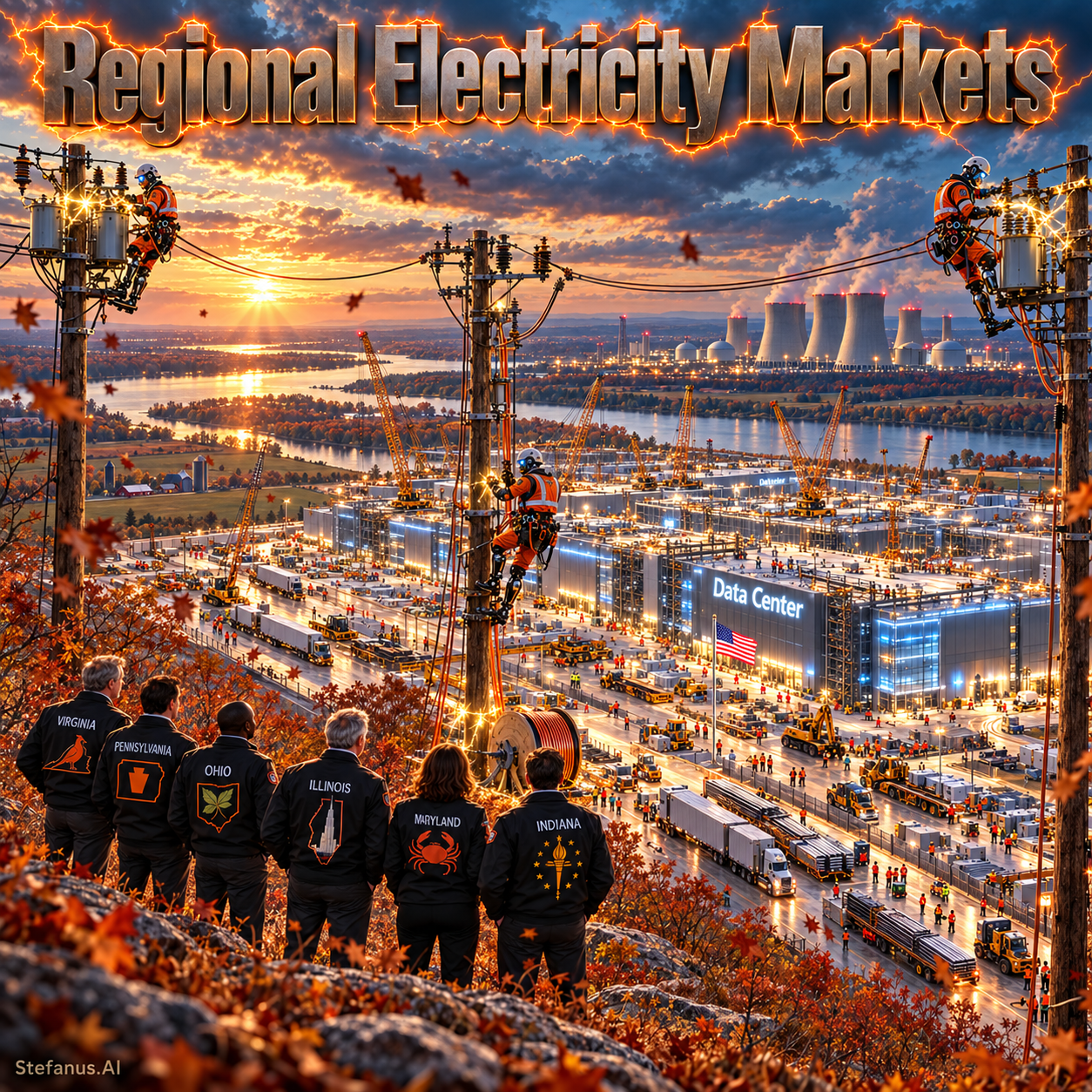
Comments
[…] tens of billions of dollars of GPU-backed credit. For Nvidia and other accelerator manufacturers, rental economics feed directly into customers’ willingness to purchase the next hardware generation, since no […]