


Introduction: The Irreversibility of Intelligence
Technology companies are not primarily optimizing for efficiency. They are optimizing against the possibility of missing the next intelligence revolution. That is the central argument of this paper — and it is an argument that reshapes everything we thought we understood about rational corporate behavior, capital allocation, and the nature of strategic competition in the twenty-first century.
For decades, the dominant framework of corporate finance rested on a relatively simple principle: deploy capital where it produces the highest risk-adjusted return. Firms that deviated from this principle — that spent ahead of demand, built infrastructure before customers arrived, or invested in assets whose returns were distant and uncertain — were penalized by markets and disciplined by boards. Efficiency was the virtue. Waste was the sin. Overbuilding was the cardinal error.
The artificial intelligence era has fundamentally altered this logic. Across the technology sector, firms are committing hundreds of billions of dollars toward data centers, AI accelerators, power infrastructure, nuclear partnerships, and talent acquisition despite considerable uncertainty about the precise shape, timing, and distribution of future demand. According to first-quarter 2026 earnings compiled by the Financial Times, Google, Amazon, Microsoft, and Meta collectively plan to spend $725 billion on capital expenditure in 2026 alone — an increase of 77 percent from 2025’s already record-breaking $410 billion.
This number demands explanation. Traditional economic theory would counsel caution in the face of uncertainty. Instead, hyperscalers are accelerating spending at a rate that has no precedent in the history of commercial technology. This paper argues that the explanation lies not in irrationality, but in a new and coherent strategic framework — one that this paper names Fear of Missing Out AI.[1]
Under the Fear of Missing Out AI framework, the greatest risk is no longer overbuilding infrastructure. The greatest risk is being absent — being capacity-constrained, compute-limited, or strategically irrelevant — when intelligence becomes the dominant economic resource of the twenty-first century. In this framework, the cost of underinvestment is not merely a missed quarter of revenue. It is the potential forfeiture of an entire era of technological and economic leadership.
This paper analyzes the Fear of Missing Out AI phenomenon through four interconnected dimensions: first, the scale of the current infrastructure buildout and the earnings evidence that supports it; second, the physical footprint required to sustain AI at hyperscale — the steel, copper, electricity, silicon, and nuclear power that underpin the digital intelligence economy; third, the emergence of Fear of Missing Out AI as a distinct economic model that redefines what rational overbuilding means; and fourth, the strategic lessons that governments, investors, and corporate leaders must internalize if they are to navigate the intelligence era with clarity and purpose.
The paper draws extensively on Q1 2026 earnings reports, International Energy Agency findings published in April 2026, National Bureau of Economic Research working papers from January 2026, and the assessments of leading academic economists including MIT Nobel Laureate Daron Acemoglu and MIT professor Ricardo J. Caballero, whose January 2026 NBER paper provides the most sophisticated theoretical framework yet for understanding the rationality of speculative growth equilibria in the AI era.
The central lesson is simple but profound: the risk of overbuilding is finite. The risk of missing the intelligence revolution is potentially existential.

Section 1: Hyperscaler CapEx — The Largest Infrastructure Buildout Since the Internet
1.1 The AI Spending Explosion
To appreciate the scale of what is occurring, one must begin with numbers — and the numbers of 2025 and 2026 are extraordinary by any historical standard. In 2025, the five largest hyperscalers committed in aggregate more than $400 billion to capital expenditure, the majority of which was directed toward AI-focused data centers, GPU compute infrastructure, and power generation partnerships. By the time first-quarter 2026 earnings were reported at the end of April 2026, the trajectory had not merely continued — it had accelerated sharply.
Amazon announced projected capital expenditure of $200 billion for the full year 2026 — a figure that positions it as the most aggressive single spender in the group. Google’s parent Alphabet raised its 2026 capex guidance to a range of $180 billion to $190 billion, with CFO Anat Ashkenazi stating publicly that 2027 capex is expected to “significantly increase” compared to 2026.[2] Microsoft committed to $190 billion for the calendar year 2026, well above the $152 billion average analyst estimate, with CFO Amy Hood attributing $25 billion of the increment to rising memory chip and component costs.[3] Meta raised its full-year 2026 guidance to $125 billion to $145 billion, driven by Mark Zuckerberg’s vision for what he has called ‘Meta Superintelligence Labs.’[4]
These are not projections built on the back of idle optimism. They are commitments anchored in real demand signals. Google Cloud reached $20 billion in quarterly revenue in Q1 2026 — growing 63 percent year-over-year — with CFO Ashkenazi disclosing an enterprise cloud backlog of $462 billion, which nearly doubled from the prior quarter. Microsoft disclosed an $80 billion backlog of Azure orders that cannot be fulfilled due to power and capacity constraints. Amazon CEO Andy Jassy noted on a recent earnings call that AWS could be growing faster if not for constraints in chips, power, and server components.
“The AI economy is healthy. The bear thesis is garbage.” [1] — Brent Thill, Analyst, Jefferies, Financial Times, April 30, 2026
The Stargate Project, announced by OpenAI, SoftBank, and Oracle at the White House in January 2025, commits to $500 billion in AI infrastructure investment over four years, with $100 billion deployed immediately. By September 2025, the project was ahead of schedule, with nearly 7 gigawatts of planned capacity secured and over $400 billion committed across multiple U.S. sites. The flagship campus in Abilene, Texas, described internally as ‘Project Ludicrous,’ has already begun receiving NVIDIA GB200 server racks and is expected to scale to 1.2 gigawatts of power — enough to supply approximately one million homes.
NVIDIA CEO Jensen Huang, speaking on a recent earnings call, provided perhaps the most arresting projection of the entire buildout: he estimated that between $3 trillion and $4 trillion will be spent on AI infrastructure before the end of this decade.[5] That projection, delivered without apparent drama by the chief executive of the company whose chips sit at the center of the entire enterprise, captures the magnitude of the transformation underway.
1.2 Quarterly Spending Trends and the Acceleration Pattern
Understanding the Fear of Missing Out AI dynamic requires examining not just the scale of spending, but the trajectory. Capital expenditure by the top four cloud providers — Amazon, Google, Microsoft, and Meta — roughly doubled to approximately $600 billion annually in just two years, as observed by technology analyst Tim Bajarin in his analysis of supply chain constraints. This doubling occurred across a period of genuine macroeconomic uncertainty, rising interest rates, and repeated warnings from financial analysts that the spending could not be justified by near-term revenue.
Yet the spending accelerated. In Q1 2026, Microsoft guided that fourth-quarter capex would exceed $40 billion — a sequential increase that includes roughly $5 billion from higher component pricing. Meta’s capex for the same period came in above analyst estimates, with Zuckerberg calling it ‘a milestone quarter.’ Alphabet posted an 81 percent increase in net income to $62.6 billion on revenue of $110 billion, providing the clearest quarterly evidence yet that AI infrastructure investment, at least for some firms, is already generating measurable returns.
The IEA, in its April 2026 report Key Questions on Energy and AI, confirmed that capital expenditure of five large technology companies surged to more than $400 billion in 2025 and is set to increase by a further 75 percent in 2026.[6] This rate of increase — 75 percent year-over-year — is not the profile of a normal technology investment cycle. It is the profile of a strategic land grab, conducted with an urgency that markets have not seen since the fiber optic buildout of the late 1990s, but at a scale that dwarfs that episode.
1.3 Why Traditional ROI Models Are Being Ignored
The conventional framework for evaluating capital expenditure is straightforward: estimate future cash flows, discount them at an appropriate rate, and invest only when the present value of expected returns exceeds the cost. Applied to the current hyperscaler buildout, this framework generates uncomfortable results. OpenAI’s 2025 revenue was approximately $13 billion, while its capital expenditure commitment over eight years is $1.4 trillion — a ratio that would be considered absurd in any conventional industry analysis. Morgan Stanley estimates that global data center spending between 2025 and 2028 will reach $3 trillion in total.
Mattia Landoni, Associate Professor of Finance at CEIBS, and Renxuan Wang, Assistant Professor of Finance at CEIBS, observed in a November 2025 analysis that sector-wide AI infrastructure capex corresponds to roughly 13 to 20 percent of combined ‘Big Seven’ revenue — a figure that, at the firm level, is ‘even starker’ when examined company by company.[7] Amazon, for instance, is now looking at negative free cash flow of almost $17 billion in 2026, according to Morgan Stanley analysts — and yet Amazon accelerated its spending guidance rather than retreating.
The conventional explanation for this behavior — that executives are caught in a herd mentality or are unable to resist competitive pressure — is insufficient. These are among the most analytically sophisticated corporations in the world, run by leaders who understand capital allocation deeply. A more satisfying explanation is that they have performed a different kind of ROI calculation: one that incorporates not just the expected return on each dollar of infrastructure, but the expected cost of not having that infrastructure when it becomes the decisive competitive resource.
CFO Amy Hood of Microsoft gestured toward this logic when she compared AI infrastructure investment to Microsoft’s earlier cloud buildout: “the investments in AI are traveling on a similar path” to Azure, which took years to generate returns before becoming the company’s most important growth engine.[8]
“For large organizations, there is a fundamental challenge: if your change speed cannot keep up with the possibilities that technology can achieve, you will be taught a lesson.” [2] — Satya Nadella, CEO, Microsoft, Davos 2026
1.4 Intelligence as Strategic Infrastructure
Perhaps the most important conceptual shift underway is the reclassification of AI infrastructure from a corporate investment to a form of national and civilizational infrastructure. The Stargate Project announcement was made at the White House, framed explicitly in terms of American leadership, national security, and strategic competition with China. This framing — AI infrastructure as a public good and geopolitical asset — is not merely rhetorical. It reflects a genuine transformation in how governments and corporations alike are beginning to understand the nature of compute.
Throughout history, certain infrastructure categories have been recognized as foundational to economic life: railroads in the nineteenth century, electrical grids and telecommunications in the twentieth, interstate highways that enabled the logistics economy. In each case, the infrastructure that won determined the economic geography of the era that followed. The nations and companies that built first — even when they built in excess of immediate demand — tended to dominate the industries that grew up around their capacity.
The IMF, in its January 2026 World Economic Outlook update, estimated U.S. growth for 2026 at 2.4 percent — attributing the upward revision in part to a ‘big push from massive investment in artificial intelligence infrastructure including data centers, powerful AI chips and power.’[9] IMF Chief Economist Pierre-Olivier Gourinchas observed that the global economy is ‘shaking off the trade and tariff disruptions of 2025 and is coming out ahead’ of prior expectations, with AI investment serving as a key accelerant of resilience.
This macroeconomic framing elevates AI infrastructure from the realm of corporate strategy to the realm of political economy. When AI infrastructure investment is contributing meaningfully to national GDP growth — Harvard economist Jason Furman has estimated that AI-driven infrastructure investment accounted for 92 percent of U.S. GDP growth in the first half of 2025 — the decision to invest or not invest ceases to be a purely financial question. It becomes a question of strategic positioning for an era whose full dimensions are not yet visible.

Section 2: The Physical Footprint of Intelligence
2.1 Power Hunger — The Electricity Crisis of the AI Era
The artificial intelligence economy is, at its foundation, an electricity economy. Every inference query, every training run, every token generated by a large language model requires power — and as AI systems grow larger and more capable, the power requirements grow with them. What began as an abstract concern about data center energy consumption has become, by 2025 and 2026, one of the most concrete and consequential physical constraints on the pace of the AI buildout.
The International Energy Agency’s April 2026 report Key Questions on Energy and AI — building on its landmark 2025 Energy and AI study — reported that global data center electricity demand surged by 17 percent in 2025, while electricity consumption from AI-focused data centers climbed even faster, growing 50 percent in a single year.[10] To place this in perspective: global total electricity consumption grew by only 3 percent in the same period. The AI infrastructure buildout is growing at roughly seventeen times the rate of the global electricity system that must power it.
The IEA projects that global data center electricity consumption will roughly double from approximately 485 terawatt hours in 2025 to 950 terawatt hours by 2030, at which point the sector will account for approximately 3 percent of global electricity demand.[11] The Brookings Institution, in an April 2026 briefing paper, estimated that data center energy consumption could approach 1,050 terawatt hours by 2026 — which would make data centers, if treated as a single country, the fifth largest energy consumer on earth, between Japan and Russia.[12]
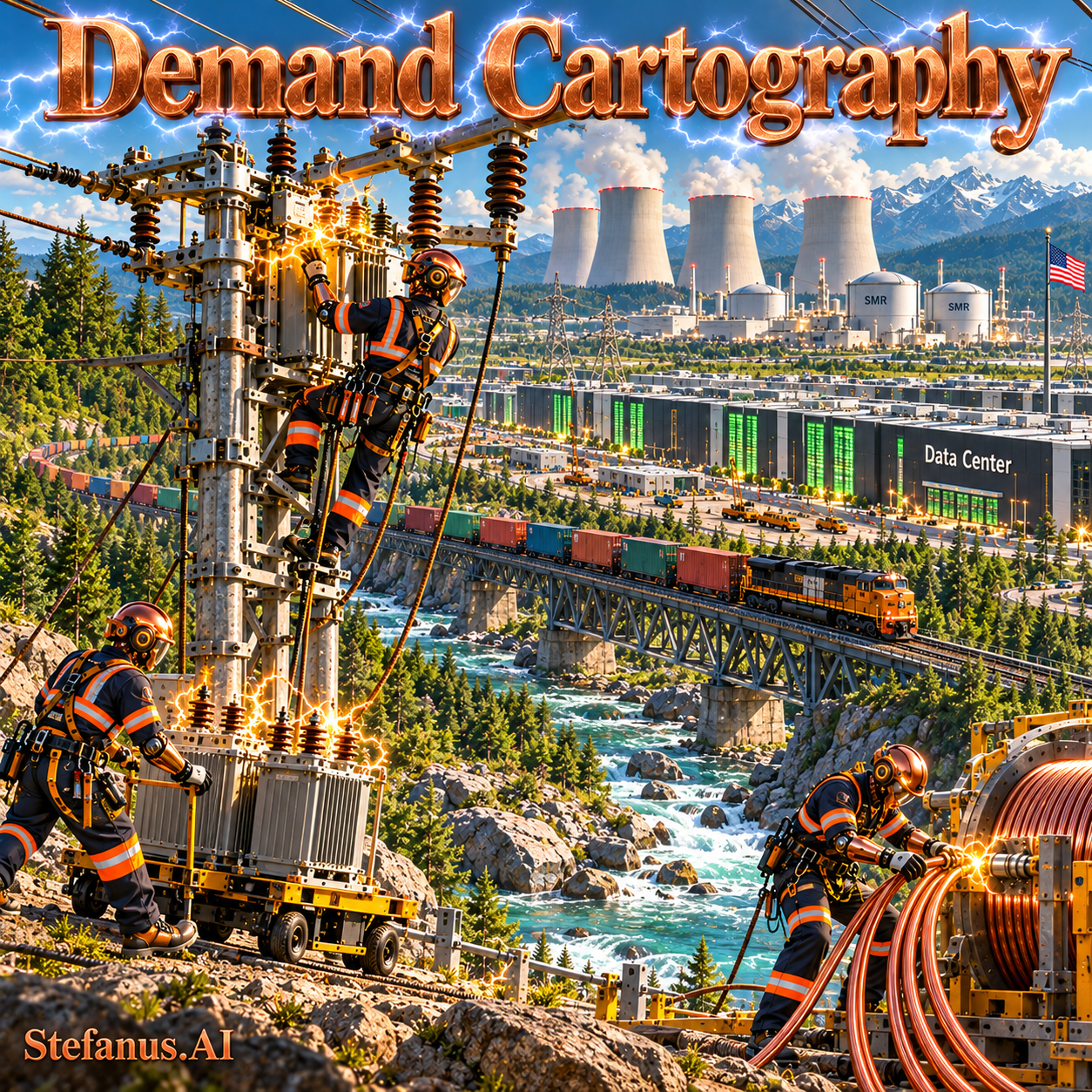
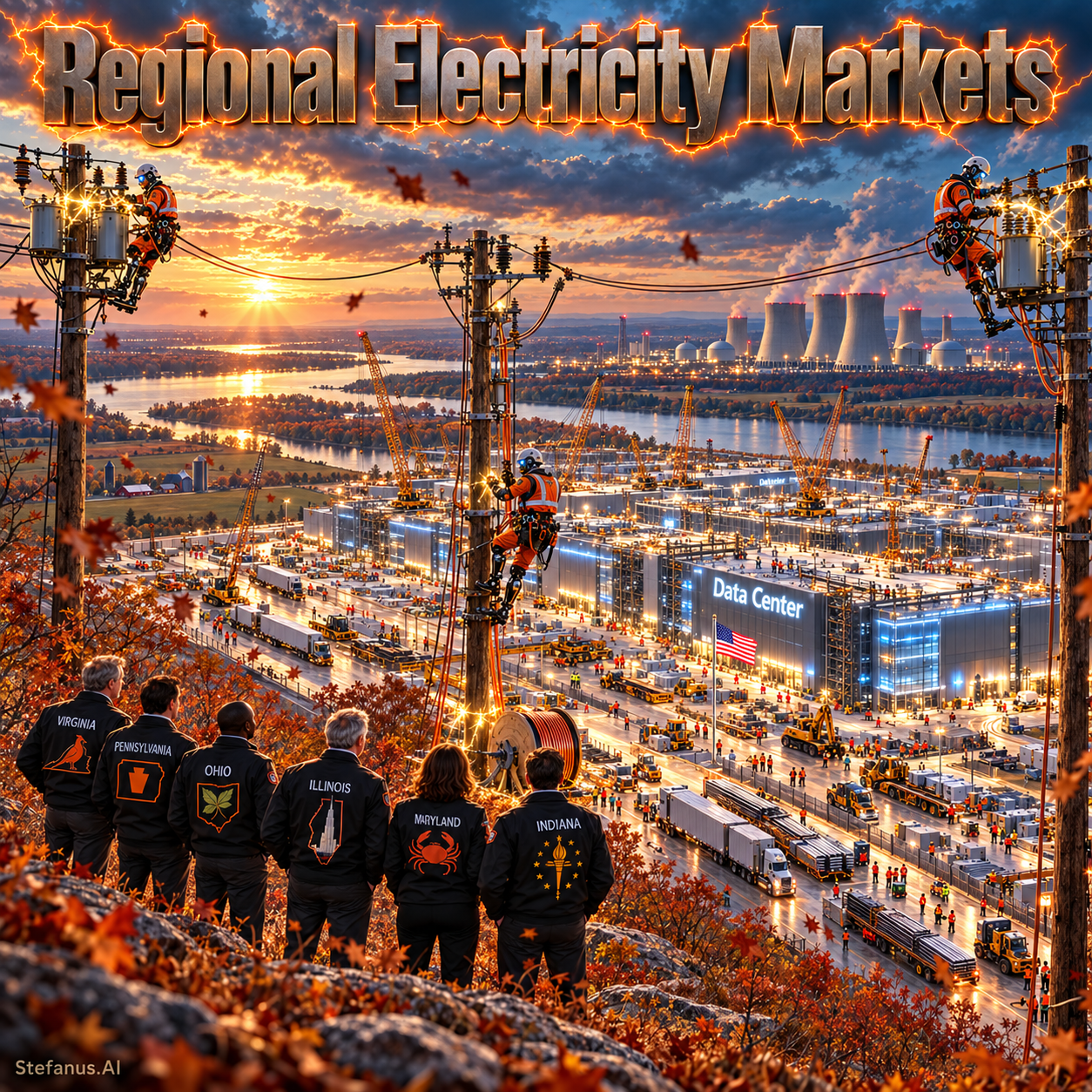
Modern AI campuses are no longer merely data centers in the conventional sense. Full AI training campuses increasingly demand 100 megawatts to over 500 megawatts of power. A 100-megawatt data center load is comparable to the electricity consumption of a small city. The 1.2-gigawatt Stargate flagship campus in Abilene, Texas, will draw power equivalent to approximately one million homes when fully operational. Meta’s planned Hyperion facility in Louisiana, at 2,250 acres and an estimated cost of $10 billion, is engineered to deliver 5 gigawatts of compute power.
These power requirements are already straining the existing grid infrastructure of the United States. Utility interconnection queues — the bureaucratic process by which new electricity consumers apply to connect to the grid — remain severely backlogged. PJM, the transmission operator managing the northeastern and mid-Atlantic grid, anticipates a 5.2 percent capacity shortfall by 2027-2028, requiring approximately $15 billion of new plant investment to cover the data center commitments already in its queue.
2.2 The Nuclear Renaissance — Powering Intelligence with Fission
The urgency of AI’s power appetite has catalyzed what many energy analysts are describing as a nuclear renaissance — a revival of nuclear power as a serious energy source for commercial computing, driven not by government energy policy but by the purchasing decisions of technology corporations seeking stable, carbon-free baseload power that can be contracted over decades rather than years.
The IEA’s April 2026 report documented that the pipeline of conditional offtake agreements between data center operators and small modular reactor (SMR) nuclear projects has grown from 25 gigawatts at the end of 2024 to 45 gigawatts — an 80 percent increase in a single year.[13] This pipeline represents the most significant commercial commitment to nuclear power development in decades, and it is being driven entirely by private capital deployed in response to AI demand.
The specific partnerships being formed are illustrative of the strategic logic at work. In January 2026, Meta partnered with Oklo to develop a 1.2-gigawatt nuclear power campus in Pike County, Ohio — a facility that will house 16 Aurora Powerhouse reactors, each producing 75 megawatts, across 206 acres. Meta provided prepayments to secure nuclear fuel and accelerate Phase 1, which aims to deliver 150 megawatts, with first reactors expected to be operational by 2030. AWS and Talen Energy secured a 17-year power purchase agreement for 1.92 gigawatts of electricity from the Susquehanna nuclear plant in Pennsylvania, accompanied by a $20 billion Amazon investment in Pennsylvania infrastructure.
Microsoft, whose data center in Wyoming is already powered entirely by wind energy, signed agreements in connection with preparations to restart the Three Mile Island reactor in Pennsylvania — the site of the most serious nuclear accident in U.S. history — specifically to supply AI data centers. The symbolism of that commitment is not lost on energy analysts: the facility once synonymous with the risks of nuclear power is being resurrected to power the next generation of artificial intelligence.
“The rapid advance of AI is creating unprecedented electricity demand, with projections showing data center energy consumption doubling by 2028. This strain on an already fragile electric grid is leading technology companies to explore a once-unlikely solution: powering AI data centers with small modular nuclear reactors.” [3] — Shumaker, Loop & Kendrick, LLP, December 2025
The economics of small modular reactors remain unproven at scale — the Vogtle nuclear expansion in Georgia was seven years behind schedule and $18 billion over budget — but for technology companies with decade-long time horizons and existential concerns about power availability, the cost of uncertainty is preferable to the certainty of power scarcity. This is, itself, a manifestation of the Fear of Missing Out AI dynamic: the fear of being power-constrained in the intelligence era is driving commitments to nuclear infrastructure that would have been inconceivable five years ago.
2.3 The AI Chip Scarcity — The Silicon Bottleneck
If electricity is the fuel of the intelligence economy, then advanced semiconductors — specifically NVIDIA’s GPU accelerators and the high-bandwidth memory (HBM) that powers them — are its engine. And as of 2026, the engine is running at capacity, with demand that continues to outpace the semiconductor industry’s ability to build new manufacturing facilities, qualify new processes, and scale complex supply chains.
A May 2026 report by the Center for a New American Security (CNAS) described AI chip production as a “binding constraint on the pace of the AI compute buildout,” noting that the world’s leading AI companies cannot get enough chips.[14] OpenAI CEO Sam Altman summarized the situation with characteristic directness: “Right now, again, it’s chips.”
The bottleneck operates across multiple layers of the semiconductor supply chain simultaneously. TSMC’s advanced packaging technology — chip-on-wafer-on-substrate (CoWoS), which is critical for integrating AI processor dies with HBM memory stacks — was severely constrained through 2024 and early 2025. As packaging capacity expanded, the constraint migrated upstream to HBM memory itself. SK Hynix, Samsung, and Micron — the three dominant producers of HBM — have been operating near full capacity, with lead times of six to twelve months reported across the industry. HBM3 pricing rose 20 to 30 percent year-over-year through 2025, with the trend expected to persist.
Epoch AI’s May 2026 analysis of semiconductor manufacturing capacity documented these distinct phases of constraint with precision: advanced packaging as the binding limit from late 2024 to early 2025, followed by HBM memory tightening through 2025.[15] Even as TSMC’s CoWoS capacity rose toward 75,000 wafers per month in 2025 and is projected to reach 120,000 to 130,000 wafers per month by end of 2026, the four dominant AI chip designers — NVIDIA, AMD, Google, and Amazon’s custom silicon divisions — still consume 80 to 85 percent of total CoWoS supply.
The strategic implications of chip scarcity extend beyond near-term supply friction. In March 2026, when regulatory uncertainty stalled H200 GPU sales to China, NVIDIA redirected TSMC capacity from H200 production to its next-generation Vera Rubin chips, which had confirmed orders from OpenAI, Google, and other American firms. As one person familiar with the decision told CNAS researchers: ‘Nvidia has to move on to what it can achieve with certainty, especially when there’s a shortage of supply for its advanced stuff.’ This episode illustrates how geopolitics, supply constraints, and corporate strategy are becoming inextricably entangled in the intelligence economy.
2.4 The New Industrial Stack of Intelligence
The AI infrastructure buildout is best understood not as a single layer of investment but as a five-layer industrial stack, each layer dependent on the layers below it and constraining the layers above. Understanding this stack — and the interdependencies it creates — is essential for grasping why the Fear of Missing Out AI dynamic is so powerful and why it is so difficult for any individual participant to opt out of the arms race.
The first and most foundational layer is energy — the electricity, transmission infrastructure, generation capacity, and long-term power contracts that enable everything above them. Without reliable, abundant, and affordable power, no data center can operate at scale. The second layer is chips — the advanced semiconductors, HBM memory, and packaging technology that constitute the actual compute capacity of AI systems. The third layer is data centers — the physical facilities, cooling systems, networking infrastructure, and real estate that house the chips and convert electricity into compute. The fourth layer is models — the large language models, multimodal systems, and specialized AI architectures that are trained on the compute and constitute the intelligence that the infrastructure exists to create. The fifth and final layer is applications — the software products, agent systems, APIs, and enterprise workflows through which AI models generate revenue and deliver value to end users.
What is distinctive about the current era is that the bottlenecks are clustered in the bottom three layers rather than the top two. The constraint on AI progress is not a shortage of ideas, data, or model architectures. It is a shortage of electricity, chips, and physical data center capacity. This is the essence of what the IEA means when it observes that ‘the speed of the AI revolution is increasingly contrasting with the speed of the physical, social and economic systems that underpin it.’
2.5 Why the Physical Layer Determines the Winners
The convergence of these physical constraints — power, silicon, data center capacity — creates a dynamic that fundamentally advantages those who build first and build large. Software can be copied. A model architecture can be replicated. A training algorithm can be reverse-engineered. But a 1.2-gigawatt data center campus, a 17-year nuclear power purchase agreement, or a multi-year advance booking of TSMC’s CoWoS packaging capacity cannot be replicated on short notice. These are slow, expensive, and irreversible commitments that create durable competitive moats precisely because they are difficult to reverse.
The AI race is not, in other words, primarily a software race. It is increasingly a race measured in steel, concrete, copper, transformers, electricity, and nuclear power. The hyperscalers who recognized this fact earliest — who understood that intelligence at scale requires physical infrastructure at scale — have positioned themselves to be the infrastructure providers of the intelligence economy, regardless of which AI models ultimately prove most capable.

Section 3: The Fear of Missing Out AI Economic Model — A New Theory of Rational Overbuilding
3.1 From Fear of Missing Out to Corporate Strategy
The concept of Fear of Missing Out (FOMO) entered the popular lexicon as a descriptor of a specific kind of consumer anxiety: the dread, amplified by social media, of being absent from experiences that others are having. As a behavioral phenomenon, it has been studied extensively in the context of individual decision-making, investor psychology, and retail trading behavior. What is novel about the current AI era is the migration of FOMO from the realm of individual psychology to the realm of corporate strategy — and the consequent transformation of overbuilding from a behavioral error into a rational organizational response.
Corporate Fear of Missing Out AI is not driven by anxiety in the emotional sense. It is driven by a sober assessment of asymmetric risk — a calculation, performed by the most analytically sophisticated organizations in the world, that the cost of being absent from the intelligence revolution exceeds the cost of investing aggressively and being wrong about the timeline. This is a structurally different claim from ordinary competitive pressure. It is a claim about the irreversibility of strategic positioning in a winner-take-most technology environment.
3.2 The Economics of Falling Behind
To understand why hyperscalers spend as they do, it is necessary to model what falling behind actually means in the context of AI. The consequences are not merely lower quarterly revenue or a temporarily smaller market share. They are structural and potentially permanent losses across multiple dimensions simultaneously.
The first dimension is model leadership. The frontier AI models — the largest, most capable, most efficient systems — are trained on the most compute. Without sufficient compute, a company cannot train competitive frontier models. Without competitive frontier models, it cannot attract the research talent, the developer community, or the enterprise customers who are building on top of cutting-edge AI capabilities. The second dimension is the developer ecosystem. Developers who build applications on a given cloud platform or AI API tend to stay — not because switching costs are prohibitive in principle, but because the integrations, tooling, and institutional knowledge accumulated over time create genuine friction. The third dimension is enterprise lock-in. Enterprise customers who migrate their data and workflows to a particular AI-enabled cloud environment rarely leave.
The fourth and perhaps most consequential dimension is future market share in the intelligence economy itself — the aggregate of all industries and services that will be transformed by AI over the coming decades. A firm that falls behind in infrastructure today is not merely conceding the AI market of 2026. It is potentially conceding its ability to participate in the economic transformation of healthcare, finance, logistics, manufacturing, media, and every other sector that intelligence will reshape.
This analysis is consistent with the IMF’s April 2026 scenario-planning note on “Global Economic and Financial Implications of Artificial Intelligence,” which identified AI as a ‘macro-critical transition rather than a standard technology shock,’ requiring a new analytical framework precisely because the macroeconomic path will be shaped by ‘the speed and breadth of diffusion and the readiness of institutions and infrastructure to absorb the technology.’[16] In other words: the institutions that build the infrastructure — not merely those that develop the models — will determine who captures the economic gains.
3.3 Why Overbuilding Becomes Rational — The Asymmetric Risk Framework
Under conventional economic theory, overbuilding is irrational. If you build more capacity than demand warrants, you incur excess costs, earn below-market returns on invested capital, and potentially create write-downs that damage the balance sheet. The discipline of markets, the accountability of boards, and the incentives of management all push against overbuilding in a world where demand is predictable and infrastructure is fungible.
Under Fear of Missing Out AI, the calculus is inverted. The key insight is that the potential loss from missing the intelligence revolution is asymmetric with respect to the potential loss from excess infrastructure. If a hyperscaler overbuild its data center capacity and AI demand materializes more slowly than expected, the consequence is underutilized infrastructure, depressed returns on invested capital, and possible write-downs — outcomes that are painful but manageable for firms with the balance sheet strength of Microsoft, Alphabet, or Amazon. These firms can absorb overcapacity.
But if a hyperscaler underbuild and the intelligence revolution materializes as its most optimistic advocates predict — if AI does indeed become the dominant factor of production across the global economy — then the consequence is not merely a bad quarter or a missed product cycle. The consequence is strategic irrelevance in an economy organized around the intelligence resource. This is not a recoverable position. Infrastructure at hyperscale cannot be built on short notice. Power contracts cannot be negotiated after the grid is full. Chip allocations cannot be secured after the queue has closed.
“The risk of financial stress increases, as happened following the expansion of the U.S. railroad network in the late 19th century and, more recently, with the overbuilding of fiber optic telecommunications in the early 2000s, which contributed to stress in bond markets.” [4] — Federal Reserve analysis cited by Luminix AI, 2026
The rational response to this asymmetry is precisely what we observe: overbuilding. The hyperscalers are not ignoring the risk of overcapacity. They are weighing it against the risk of undercapacity and concluding, rationally, that the latter is more dangerous. As Guinness Global Investors observed in their October 2025 scenario analysis, an overbuild of capacity is ‘the most probable outcome, driven by risk asymmetry’ — and in a potential AI scenario, ‘the downside of overinvestment is industry-wide overcapacity, leading to depressed returns on invested capital and potential write-downs, which tech giants are likely to be able to absorb.’
3.4 The Asymmetric Risk Equation
The core equation of the Fear of Missing Out AI framework can be stated formally, if informally expressed:
Risk(Falling Behind) ≫ Risk(Overbuilding)
This inequality drives the spending decisions of every major hyperscaler. It explains why Amazon is projecting negative free cash flow for 2026 and pressing forward regardless. It explains why Alphabet committed to ‘significantly increasing’ 2027 capex even before 2026 spending has been fully deployed. It explains why Microsoft set its calendar-year 2026 capex at $190 billion — $38 billion above analyst consensus — despite explicit warnings from some investors about capital efficiency.
The inequality holds as long as three conditions are met. First, the potential upside of AI dominance must be very large — large enough that the expected value of capturing it exceeds the expected cost of overcapacity. Second, the technology must exhibit first-mover or infrastructure-lock-in properties — such that being early creates durable advantages that latecomers cannot easily replicate. Third, the cost of overcapacity must be bounded and manageable — such that the downside scenario does not threaten the firm’s existence. All three conditions are currently satisfied for the major hyperscalers.
3.5 Intelligence Option Value — Purchasing the Future
A more sophisticated way of understanding the Fear of Missing Out AI spending pattern is through the lens of option value — the financial concept that quantifies the value of the right, but not the obligation, to take an action in the future. Hyperscalers are not simply building infrastructure to serve current demand. They are purchasing options on the future of the intelligence economy: the option to train the next generation of frontier models when they become viable, the option to serve enterprise customers who will need compute at scales not yet imagined, the option to enter new markets that will emerge when AI reaches sufficient capability thresholds.
This framing is consistent with Ricardo J. Caballero’s January 2026 NBER working paper, “Speculative Growth and the AI Bubble,” which develops the most rigorous theoretical framework to date for understanding the rationality of the current investment cycle.[17] Caballero, a Professor of Economics at MIT and a Research Associate at the National Bureau of Economic Research, argues that AI technology can generate “speculative-growth equilibria” — outcomes that are “rational but fragile: elevated valuations support rapid capital accumulation, yet persist only as long as beliefs remain coordinated.”
“AI technology can generate speculative-growth equilibria. These are rational but fragile: elevated valuations support rapid capital accumulation, yet persist only as long as beliefs remain coordinated. Because AI capital is labor-like, it expands effective labor and dampens the normal decline in the marginal product of capital as the capital stock grows.” [5] — Ricardo J. Caballero, MIT / NBER Working Paper 34722, January 2026
Caballero’s framework is important for the Fear of Missing Out AI argument because it demonstrates that the current investment pattern is not necessarily irrational even if some assumptions about AI’s future productivity prove wrong. The investments create real capital, expand effective productive capacity, and generate a funding feedback — rising capitalist wealth lowers the required return — that can sustain high-capital equilibria. The infrastructure being built today is not purely speculative. It is a tangible, durable asset whose value does not depend entirely on the most optimistic AI scenarios materializing.
The option value analogy extends further. Just as oil reserves have value beyond their current extraction rate — because they represent future production potential — AI data center capacity has value beyond its current utilization rate. And just as strategic military assets are maintained at readiness beyond immediate operational requirements, AI infrastructure is being maintained and expanded at a level designed to meet the demands of an intelligence economy whose full scope is not yet visible. These are not productive assets in the conventional sense. They are strategic options.
3.6 The Skeptics and the Productive Tension
The Fear of Missing Out AI framework should not be presented without acknowledging the substantial body of skeptical analysis that challenges its premises. The most rigorous challenge comes from MIT Institute Professor and 2024 Nobel Laureate in Economics Daron Acemoglu, whose research on AI and productivity offers a systematic counterpoint to the most optimistic projections.
Acemoglu projects that AI will increase U.S. GDP by approximately 1.1 to 1.6 percent over the next decade, with an annual productivity gain of roughly 0.05 percent — a far cry from the 7 to 10 percent productivity booms promised by some AI enthusiasts.[18] Speaking to MIT Technology Review in May 2026, Acemoglu identified the absence of broadly usable consumer applications as the missing signal for real economic impact and warned that there is a huge amount of uncertainty in the evidence base, despite the certainty of the rhetoric surrounding AI.
“My argument is that we currently have the wrong direction for AI. We’re using it too much for automation and not enough for providing expertise and information to workers.” [6] — Daron Acemoglu, MIT Institute Professor and Nobel Laureate in Economics, MIT Technology Review, March 2025
Acemoglu’s critique is intellectually honest and analytically grounded. The productivity paradox he invokes — abundant innovation alongside modest measured productivity gains — is real. A February 2026 study published by the National Bureau of Economic Research found that despite 90 percent of firms reporting no impact of AI on workplace productivity, executives projected AI to increase productivity by 1.4 percent and output by 0.8 percent — a disconnect that echoes the productivity paradox of the personal computer era.
However, the Fear of Missing Out AI framework does not depend on the most optimistic AI productivity scenarios being correct. It depends only on the following: that the probability of transformative AI impact is non-negligible; that the cost of missing that transformation is very large; and that the cost of excess infrastructure is bounded. Under these conditions, substantial overinvestment is rational even if the median scenario turns out to be considerably more modest than the bulls predict. The hyperscalers are not betting on the certain arrival of AGI. They are buying insurance against the possibility — and the infrastructure they are building creates real value regardless of when or whether the most transformative scenarios materialize.
3.7 Fear of Missing Out AI as a New Economic Paradigm
The Fear of Missing Out AI framework represents more than a descriptive account of current corporate behavior. It represents the emergence of a new economic paradigm — a mode of capital allocation that is structurally distinct from both conventional return-maximization and from speculative bubble dynamics, though it shares surface features with both.
What makes Fear of Missing Out AI distinctive is the combination of three features that rarely appear together: the scale of investment is unprecedented for private commercial actors; the uncertainty about returns is genuine and acknowledged; and the strategic logic for overbuilding is coherent and publicly articulable. This combination — huge, uncertain, rational — is what makes the current era so remarkable and so difficult to analyze with conventional frameworks.
The AI race is governed less by conventional ROI calculations and more by strategic positioning for a future intelligence economy. In this economy, infrastructure is not merely a means of production. It is a form of currency — a store of strategic value whose purchasing power accrues in the future, when the intelligence economy has matured sufficiently to reveal which infrastructure owners have won and which have been left behind.

Section 4: Strategic Lessons from the Fear of Missing Out AI Era
The Fear of Missing Out AI framework has implications that extend well beyond the balance sheets of the hyperscalers. For governments, institutional investors, corporate boards, and national policymakers, the intelligence economy presents a new set of strategic choices whose consequences will be felt for decades. This section distills the seven most important strategic lessons from the Fear of Missing Out AI era.
Pillar 1: Infrastructure Determines Winners — The Primacy of the Physical Layer
The first and most counterintuitive lesson of the Fear of Missing Out AI era is that infrastructure — not algorithms, not data, not talent — is the primary determinant of long-term competitive position. This claim runs against the dominant narrative of the software era, in which ‘software is eating the world’ and the highest value accrued to the lightest-touch, most scalable, most asset-light business models. In the intelligence economy, that logic is reversed.
Models can be copied, or at minimum replicated through sufficient investment in research. Algorithms can be published, discussed, and reproduced across organizations. Data can be accumulated by any sufficiently motivated actor. But a gigawatt-scale data center campus, a decade-long nuclear power contract, or a multi-year advance booking of leading-edge semiconductor capacity cannot be replicated quickly. These are slow, expensive, and spatially rooted assets that create real moats — not because they are proprietary in the intellectual property sense, but because they are physically scarce and take years to build.
Microsoft’s CEO Satya Nadella framed this directly, describing the company’s focus on what he called “the agentic computing era” — a phrase that signals not merely a software transition but a fundamental repositioning of the company around the compute infrastructure required to support AI agents operating at scale.[19] Amazon CEO Andy Jassy made the same point from a different direction, noting that AWS would be ‘growing faster if not for capacity constraints’ — an acknowledgment that the constraint on the business is not demand, not talent, not software capability, but physical infrastructure.
Pillar 2: Energy Is Becoming the Primary Constraint — The Geopolitics of Electricity
The second strategic lesson is that energy — specifically electricity, transmission capacity, and generation reliability — is rapidly becoming the primary constraint on AI progress. This is a fundamental shift from the intellectual and software-driven constraints that characterized earlier technology eras. It has profound implications for geography, geopolitics, and the competitive landscape of the intelligence economy.
Nations with abundant, reliable, and affordable electricity — whether from hydroelectric, nuclear, natural gas, or renewable sources — will have a structural advantage in hosting AI infrastructure. Nations with constrained grids, high electricity prices, or regulatory barriers to data center development will find themselves at a systematic disadvantage in attracting the investments that anchor the intelligence economy. This is already visible: Stargate Norway was launched specifically because Norway’s renewable hydropower provides an abundance of clean electricity. Meta’s Hyperion campus in Louisiana was sited in part around access to nuclear power. Microsoft’s nuclear partnerships are explicitly framed around securing reliable baseload power.
The IEA’s 2025 Energy and AI report projected global data center electricity consumption growing from 460 terawatt hours in 2024 to over 1,000 terawatt hours in 2030 and 1,300 terawatt hours in 2035.[20] Renewables will meet nearly half of additional demand, but natural gas and coal will also play significant roles, with nuclear becoming increasingly important toward the end of the decade. The energy geography of AI is reshaping the energy geography of the world.
Pillar 3: Speed Matters More Than Efficiency — The Urgency Premium
The third strategic lesson is perhaps the most difficult for traditionally managed organizations to internalize: in the Fear of Missing Out AI era, speed of deployment is more valuable than efficiency of deployment. This is not a permanent truth — in mature, stable markets, efficiency wins. But in the current period of infrastructure land-grabbing, the firm that deploys infrastructure one year earlier than its competitor may capture customer relationships, developer ecosystems, and data flywheel advantages that persist for a decade.
The evidence for this lesson is visible in every aspect of the current buildout. OpenAI described the pace of Stargate construction in September 2025 with the observation: ‘No one in the history of man built data centers this fast.’ Microsoft’s CFO disclosed that the company expects to remain capacity-constrained through at least 2026 even with its accelerated spending — meaning that the bottleneck is build speed, not financial commitment. Alphabet’s cloud backlog of $462 billion represents demand the company cannot yet serve — potential revenue that is being deferred to future periods because the infrastructure does not yet exist to capture it.
For traditional businesses accustomed to optimizing cost per unit, maximizing asset utilization, and managing capital expenditure with multi-year payback discipline, this is a disorienting lesson. But it reflects the fundamental asymmetry of winner-take-most technology markets: the cost of being second is often approaching the cost of being absent.
Pillar 4: Optionality Has Become a Strategic Asset — Build First, Monetize Later
The fourth lesson is that the value of strategic optionality — the right but not the obligation to participate in future economic opportunities — has become a primary driver of capital allocation in the intelligence economy. The hyperscalers are not merely building infrastructure to serve known customers at known prices. They are purchasing the option to serve unknown customers at unknown prices in markets that do not yet exist.
This is a familiar pattern in the history of transformative technology platforms. The railroads that were built ahead of settlement demand in the American West created the conditions under which the West was settled. The telecommunications infrastructure of the twentieth century created the conditions for the internet economy of the twenty-first. In each case, the infrastructure preceded the demand — and those who owned the infrastructure captured the value when the demand arrived.
The IMF’s April 2026 scenario-planning note explicitly addressed this dynamic, noting that “expectations about AI-driven growth can affect real interest rate and debt dynamics ahead of realized gains” — meaning that markets are already pricing in future intelligence economy scenarios that have not yet materialized.[21] The hyperscalers are doing the same at the corporate level: purchasing infrastructure options whose value is indexed to scenarios that may materialize over a 5 to 15 year horizon.
Pillar 5: The Cost of Inaction Exceeds the Cost of Mistakes — Redefining Risk
The fifth lesson inverts the conventional wisdom of risk management. In most investment contexts, the primary risk to manage is the risk of action — of deploying capital incorrectly, of building assets that prove to have been unnecessary, of overextending the balance sheet. In the Fear of Missing Out AI era, the primary risk to manage is the risk of inaction — of being absent from a platform transition whose consequences will define competitive landscapes for a generation.
This lesson has practical implications for corporate boards and institutional investors who are currently questioning the magnitude of hyperscaler spending. The appropriate question is not ‘Can we justify this capex with a conventional DCF model?’ The appropriate question is ‘What is the expected cost of the scenario in which we fail to build this infrastructure and AI becomes as transformative as the most credible forecasters suggest?’ When the second question is answered honestly, the capital commitments begin to look less like overbuilding and more like prudent risk management.
Dec Mullarkey, Managing Director of SLC Management, captured the investor anxiety in April 2026 when he told the Financial Times: ‘Investors continue to be concerned about how Zuckerberg’s once capital-light money machine may be morphing into a capital-intensive incinerator.’ This concern is understandable and not without merit. But it reflects a traditional framework for evaluating capital intensity that may be inadequate to the strategic realities of the intelligence economy.
Pillar 6: AI Is Creating a New Industrial Revolution — The Convergence of Energy, Compute, and Intelligence
The sixth lesson is perhaps the most expansive: artificial intelligence is not merely a new product category or a new software paradigm. It is the foundation of a new industrial revolution — one in which the commanding heights of the economy will be occupied by those who simultaneously control energy generation, compute infrastructure, and intelligence capability.
This convergence is historically unprecedented. The first industrial revolution was organized around steam and coal. The second was organized around electricity and steel. The third was organized around silicon and software. The fourth — the intelligence revolution — is organized around the convergence of all three of its predecessors: electricity (at gigawatt scale), silicon (at the frontier of semiconductor physics), and software (at the level of general intelligence). The firms positioned to win are those that understand and are building across all three dimensions simultaneously.
The IMF’s projection that AI will boost global GDP by approximately 0.5 percent annually between 2025 and 2030 may prove to be a conservative estimate if the intelligence revolution delivers even a fraction of its theoretical potential. JP Morgan Asset Management has noted that AI-related stocks have accounted for 75 percent of S&P 500 returns, 80 percent of earnings growth, and 90 percent of capital spending growth since ChatGPT launched in November 2022. These numbers describe not a sector boom but a structural reorganization of the entire economy around a new productive force.
Pillar 7: Fear of Missing Out AI May Become a Permanent Feature of Capitalism — The Intelligence Imperative
The seventh and final lesson is the most speculative but potentially the most important: the Fear of Missing Out AI dynamic may not be a transitional phase that ends when the infrastructure buildout matures. It may instead become a permanent feature of the competitive landscape — a structural characteristic of an economy in which intelligence is continuously improving, the applications of intelligence are continuously expanding, and the infrastructure required to support that intelligence must continuously grow.
Consider the analogy to globalization. The multinational corporation emerged as an organizational form in response to the opportunities and competitive pressures of global markets. Once established, it became a permanent fixture of capitalism — not because globalization was a one-time transition, but because global markets created ongoing competitive pressures that continuously rewarded firms with global scale. The intelligence economy may operate similarly: not as a one-time infrastructure land-grab followed by a period of consolidation and efficiency, but as an ongoing race in which the frontier of intelligence capability continuously advances and the infrastructure required to stay at the frontier continuously grows.
If this analysis is correct, then Fear of Missing Out AI is not a behavioral anomaly to be corrected when markets eventually discipline excess investment. It is the rational adaptation of corporate strategy to a world in which intelligence is the primary source of value creation and the infrastructure of intelligence is the primary determinant of competitive position. Just as globalization shaped corporate behavior for decades, the pursuit of intelligence leadership may become the dominant organizing principle of the next economic era.

Conclusion: The Defining Economic Logic of the Intelligence Era
The central lesson of this paper is that hyperscalers are not behaving irrationally. They are responding to a new strategic reality in which intelligence is increasingly viewed as the most valuable economic resource in the world — and in which the infrastructure required to create and deploy that intelligence is the primary determinant of who captures its value.
The Fear of Missing Out AI framework helps explain why technology firms continue committing unprecedented amounts of capital toward data centers, GPUs, power generation, nuclear partnerships, and advanced infrastructure despite uncertain near-term returns and explicit warnings from some of the world’s most respected economists. From a traditional capital allocation perspective, such spending appears excessive. From the perspective of strategic competition in an era of potentially transformative technology, however, the greater danger is not overbuilding — it is falling behind.
In this emerging intelligence economy, infrastructure functions as a form of insurance against irrelevance. The hyperscalers are effectively purchasing future strategic options, positioning themselves for a world where access to compute, energy, and intelligence may determine competitive advantage across nearly every industry. The Stargate Project’s $500 billion commitment, Alphabet’s $462 billion cloud backlog, Microsoft’s nuclear energy partnerships, Meta’s 1.2-gigawatt Ohio reactor campus — these are not the products of irrational exuberance. They are the products of a coherent and soberly held strategic theory about the nature of competition in the intelligence economy.
The academic frameworks available to analyze this phenomenon are still developing. Ricardo Caballero’s speculative-growth equilibria model provides the most sophisticated theoretical foundation yet for understanding why elevated valuations and massive capital accumulation can be simultaneously rational and fragile. Daron Acemoglu’s productivity skepticism provides a necessary corrective to the most optimistic scenarios and reminds us that the gap between infrastructure deployment and realized economic value can be long and painful. The IMF’s scenario-planning exercise reminds us that the macroeconomic path of the intelligence economy will be shaped less by frontier capability alone than by the speed and breadth of diffusion and the readiness of institutions to absorb the transformation.
But amid all this uncertainty, one asymmetry stands clear: the cost of overbuilding AI infrastructure is finite and manageable. The cost of missing the intelligence revolution — of being absent when intelligence becomes the dominant productive force of the twenty-first century — is potentially existential for the firms, industries, and nations that find themselves on the wrong side of the divide.
The defining economic logic of the AI era may therefore be summarized in a single principle that this paper has sought to document, explain, and give a name:
The risk of overbuilding is finite. The risk of missing the intelligence revolution is potentially existential.
That is why the world’s largest technology companies continue to build — with an urgency, at a scale, and with a strategic coherence that has no precedent in the history of commercial enterprise. And that is why this paper calls the phenomenon Fear of Missing Out AI.

Footnotes and Endnotes
[1] Financial Times / Tom’s Hardware. “Google, Microsoft, Meta, and Amazon capex spending to hit $725 billion in 2026, up 77% from last year — analyst says bear thesis is ‘garbage’ (April 30, 2026).” https://www.tomshardware.com/tech-industry/big-tech/big-techs-ai-spending-plans-reach-725-billion
[2] Fortune. “Microsoft, Meta, and Google just announced billions more in AI spending. Only Google convinced investors it’s paying off (April 29, 2026).” https://fortune.com/2026/04/29/microsoft-meta-google-ai-capex-spending-billions/
[3] Fortune / Tom’s Hardware. “Microsoft sets calendar-year 2026 capex at $190 billion; CFO Amy Hood Q1 2026 earnings call remarks (April 30, 2026).” https://fortune.com/2026/04/29/microsoft-meta-google-ai-capex-spending-billions/
[4] Artificial Intelligence News. “Big Tech’s AI infrastructure spending paid off — and accelerated: Q1 2026 earnings analysis (April 30, 2026).” https://www.artificialintelligence-news.com/news/big-tech-ai-infrastructure-spending-q1-2026-results/
[5] TechCrunch. “The billion-dollar infrastructure deals powering the AI boom: Jensen Huang projects $3–4 trillion AI infrastructure spend (March 2, 2026).” https://techcrunch.com/2026/02/28/billion-dollar-infrastructure-deals-ai-boom-data-centers-openai-oracle-nvidia-microsoft-google-meta/
[6] International Energy Agency (IEA). “Key Questions on Energy and AI — Data centre electricity use surged in 2025 (April 16, 2026).” https://www.iea.org/news/data-centre-electricity-use-surged-in-2025-even-with-tightening-bottlenecks-driving-a-scramble-for-solutions
[7] Landoni, Mattia and Wang, Renxuan — CEIBS. “Is the stock market really in an ‘AI bubble’? (November 19, 2025).” https://www.ceibs.edu/new-papers-columns/28088
[8] CNBC. “Tech’s massive AI spend is under scrutiny ahead of earnings: Amy Hood compares AI to Microsoft Azure trajectory (January 27, 2026).” https://www.cnbc.com/2026/01/27/big-tech-earnings-2026-ai-spend.html
[9] Reuters / AOL Finance. “IMF sees steady global growth in 2026 as AI boom offsets trade headwinds: Pierre-Olivier Gourinchas, IMF World Economic Outlook update (January 2026).” https://www.aol.com/articles/imf-sees-steady-global-growth-093446583.html
[10] International Energy Agency (IEA). “Key Questions on Energy and AI — Executive Summary: data centre electricity demand grew 17% in 2025, AI-focused data centres surged 50% (April 2026).” https://www.iea.org/reports/key-questions-on-energy-and-ai/executive-summary
[11] International Energy Agency (IEA). “Energy and AI — Executive Summary: data centre electricity set to double to 945 TWh by 2030 (April 2025).” https://www.iea.org/reports/energy-and-ai/executive-summary
[12] Brookings Institution. “Global energy demands within the AI regulatory landscape (Updated April 2, 2026).” https://www.brookings.edu/articles/global-energy-demands-within-the-ai-regulatory-landscape/
[13] International Energy Agency (IEA). “SMR offtake agreement pipeline grows from 25 GW to 45 GW (April 16, 2026).” https://www.iea.org/news/data-centre-electricity-use-surged-in-2025-even-with-tightening-bottlenecks-driving-a-scramble-for-solutions
[14] Center for a New American Security (CNAS). “American AI Companies Can’t Get Enough Chips: AI chip production as ‘binding constraint’ (May 2026).” https://www.cnas.org/publications/reports/american-ai-companies-cant-get-enough-chips
[15] Epoch AI. “Introducing the AI Chip Components Explorer: phases of semiconductor supply chain constraint (May 2026).” https://epoch.ai/blog/introducing-the-ai-chip-components-explorer
[16] International Monetary Fund (IMF). “Global Economic and Financial Implications of Artificial Intelligence: Lessons from a Scenario Planning Exercise — IMF Notes Vol. 2026 Issue 002 (April 2026).” https://www.elibrary.imf.org/view/journals/068/2026/002/article-A001-en.xml
[17] Caballero, Ricardo J. — MIT / NBER. “Speculative Growth and the AI ‘Bubble,’ NBER Working Paper No. 34722 (January 2026).” https://www.nber.org/papers/w34722
[18] Acemoglu, Daron — MIT Institute Professor, Nobel Laureate. “Three things in AI to watch, according to a Nobel-winning economist — MIT Technology Review (May 11, 2026).” https://www.technologyreview.com/2026/05/11/1137090/three-things-in-ai-to-watch-according-to-a-nobel-winning-economist/
[19] National CIO Review. “Big Tech Earnings Show AI Agents Taking Center Stage: Satya Nadella on ‘agentic computing era’ (April 2026).” https://nationalcioreview.com/articles-insights/cio-field-notes/big-tech-earnings-show-ai-agents-taking-center-stage/
[20] International Energy Agency (IEA). “Energy and AI — Energy Supply for AI: global electricity generation to supply data centres (April 2025).” https://www.iea.org/reports/energy-and-ai/energy-supply-for-ai
[21] International Monetary Fund (IMF). “Global Economic and Financial Implications of Artificial Intelligence — expectations about AI-driven growth affecting interest rate dynamics (April 2026).” https://www.imf.org/-/media/files/publications/imf-notes/2026/english/insea2026002.pdf

Comments
[…] “AI” rather than “technology” or “cloud.” The capital cycle described in this paper is not a general technology upgrade cycle. It is monomaniacally […]