
Introduction: From Cowboys on Horseback to Satellites in Orbit
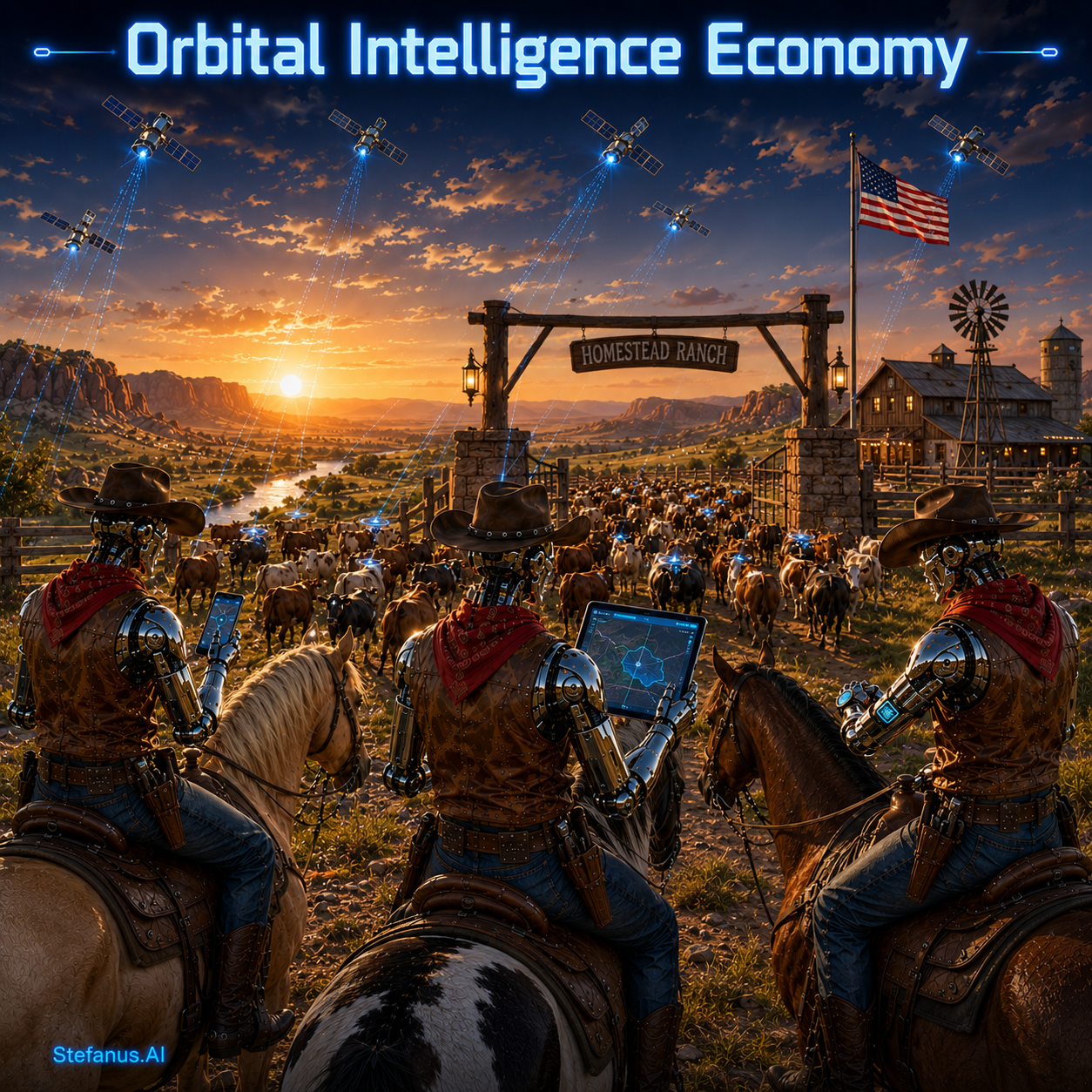
There is a particular image worth holding in mind before any of the technology, financing, or geopolitics in this paper can make sense. Picture a cowboy on horseback, riding for hours across rough, broken terrain, pushing cattle back toward a ranch before nightfall, worried the entire time that rustlers might slip a few head away in the confusion of dust and distance. This has been the basic shape of ranching for longer than anyone alive can remember: a human being, an animal, a fence, and the physical labor required to make the three of them cooperate. It is a useful starting point precisely because it has nothing to do with satellites, and yet it is now being quietly rewritten by them.
Today, a beef rancher in Central Otago, New Zealand, or in any of twenty-two American states, can fit cattle with a solar-powered collar, draw a virtual boundary on a smartphone app, and let an algorithm do what the horse and the fence once did. As a cow approaches the edge of its allotted paddock, the collar emits a tone, then a vibration, and finally, if the animal continues to advance, a mild electric pulse. Cattle learn the cues within days. The company behind this system, Halter, has built more than a clever piece of wearable technology; it has built a sensing and control loop that depends entirely on connectivity, and until recently, that connectivity depended on physical towers bolted to the ground. In April 2026, Halter removed that final dependency. Working with the New Zealand telecommunications carrier One NZ and SpaceX’s Starlink network, the company began offering collars that talk directly to satellites in low Earth orbit, with no towers, no cell coverage, and no line of communication to anything on the ground except the sky itself.
Halter’s founder, Craig Piggott, who began his career as an engineer at Rocket Lab before starting the company in 2016, described the change in terms that apply far beyond cattle ranching.
“Connectivity for virtual fencing was the blocker for the most remote or large operations and direct-to-satellite solves this. With One NZ and Starlink, we’ve removed that barrier. Farmers managing animals on remote, rugged terrain can now access the same tools as operations with full cellular coverage.”
— Craig Piggott, Founder and Chief Executive, Halter [1]
By Halter’s own internal modeling, the change expands its addressable beef-cattle market in the United States by roughly two and a half times, simply by removing the requirement to build and maintain a private radio network on every farm a rancher operates.[2]
The reason this small agricultural story matters to a paper about global infrastructure is that it captures, in miniature, the precise transition this paper is concerned with. We are living through an era that began with satellites as basic communication relays, instruments that moved a signal from one point on Earth to another and did little thinking of their own. It progressed to navigation, the constellation of GPS and its international counterparts, which calculated position but still left interpretation to ground-based systems. It progressed further still to Earth observation, in which satellites captured imagery and beamed enormous volumes of raw pixels down to terrestrial data centers, where the actual work of understanding what the pixels meant, a flooded field, a depleted oil reserve, a herd of cattle that had wandered off course, took place. What is happening now is a fourth transition, and it is the subject of this paper: satellites that no longer merely capture and relay, but capture, process, and sell data and inference directly from orbit, using onboard artificial intelligence chips that increasingly resemble, in miniature, the same accelerators racing through terrestrial data centers on Earth.
This paper names that emerging system the Orbital Intelligence Economy. The name is deliberate, and it is worth explaining why each word was chosen rather than treating the title as a passing flourish. The word orbital anchors the system physically: this is not a metaphor about cloud computing, nor a rebranding of existing satellite communications, but a literal description of compute infrastructure that exists in low Earth orbit, subject to vacuum, radiation, and the punishing economics of launch. The word intelligence carries a deliberate double meaning, gesturing simultaneously toward artificial intelligence as a computational discipline and toward intelligence in the older, more strategic sense long used by governments and militaries: information gathered, interpreted, and acted upon. And the word economy insists that this is not merely an engineering curiosity but a system of capital, revenue, competition, and geopolitical consequence, one already visible in corporate earnings reports, sovereign wealth allocations, and the public statements of company founders, investors, and heads of state. Each of these three words recurs throughout the paper, and each is load-bearing.
The paper proceeds in ten sections. Sections One and Two define the core concept and explain why this shift is occurring at all, beginning with the terrestrial energy crisis that is, more than any single technological breakthrough, the proximate cause of the entire orbital computing movement. Sections Three through Six examine the economic drivers, the scale of the terrestrial bottleneck being escaped, the historical evolution of orbital infrastructure, and the corporate actors, SpaceX, Amazon, Google, Nvidia, and a growing roster of startups, racing to build this new layer of the global economy. Section Seven returns to ground level with real-world applications across finance, climate science, security, and agriculture, including a fuller treatment of the Halter case. Section Eight situates the Orbital Intelligence Economy within the broader, and considerably more fraught, context of geopolitical competition between the United States and China. Sections Nine and Ten synthesize the preceding material into two complementary frameworks, a set of seven structural pillars and a six-layer strategic stack, before the paper concludes by returning to the cowboys with whom it began.

Section 1: Defining the Orbital Intelligence Economy
Before this paper can argue anything about economics or geopolitics, it must be precise about what, exactly, has changed in the technology itself. The change is subtle enough that it is easy to miss, and important enough that missing it leads to badly mistaken conclusions about whether any of this matters. The short version is that satellites have begun to think rather than merely see, and the long version requires understanding both halves of that sentence: what it meant for a satellite only to see, and what it now means for one to think.
1.1 What It Does: Satellites Plus Machine Learning
For most of the history of Earth observation, a satellite’s job ended the moment it captured an image or a sensor reading. The genuinely difficult work, deciding whether a pixel represented a wildfire, a methane plume, a flooded rice paddy, or simply a cloud shadow, happened afterward, on the ground, often hours or days later, after the raw data had been downlinked to a ground station, transferred to a data center, and queued for processing alongside every other satellite pass competing for the same terrestrial compute. This was workable when the volume of imagery was modest and the use cases were largely scientific. It became untenable as the number of satellites in orbit increased by orders of magnitude and as the appetite for near-real-time answers, is that tanker now empty, is that wildfire spreading toward a town, is that crop failing two weeks before anyone on the ground would notice, grew correspondingly large.
The technical answer to this bottleneck has been to move the processing into orbit alongside the sensor. Modern satellite platforms are increasingly equipped with onboard graphics processing units and AI accelerators, the same general category of silicon, if not always the same generation, that powers terrestrial data centers, allowing them to run trained machine learning models directly on the data as it is captured, before any of it ever reaches the ground. Nvidia’s own framing of this shift, delivered at its March 2026 GTC conference, captured the idea succinctly.
“Space computing, the final frontier, has arrived. As we deploy satellite constellations and explore deeper into space, intelligence must live wherever data is generated. AI processing across space and ground systems enables real-time sensing, decision-making and autonomy, transforming orbital data centers into instruments of discovery and spacecraft into self-navigating systems.”
— Jensen Huang, Founder and Chief Executive Officer, Nvidia [3]
What this means in practice is that a satellite passing over a stretch of Amazon rainforest can identify the thermal signature of an active wildfire and transmit only the alert, not the raw imagery, within seconds, freeing the downlink for the next task rather than burdening it with gigabytes of pixels that a human analyst would have had to sift through later. A satellite passing over a shipping lane can flag a vessel engaged in suspicious ship-to-ship transfers without waiting for a ground station to become available. A satellite passing over agricultural land can assess crop health using the same kind of computer vision techniques that, a decade ago, would have required a supercomputer on Earth. This is the first half of the definition: satellites equipped with machine learning models that perform inference, the application of a trained model to new data, while still in orbit, rather than treating the spacecraft as nothing more than a very expensive camera.
1.2 What Is Meant by the Orbital Intelligence Economy
The second half of the definition is economic rather than technical, and it is the half that gives this paper its title. An orbital sensor that merely processes its own data more efficiently is an engineering improvement. An orbital sensor that processes its own data and then sells the resulting intelligence, a crop-yield estimate, a shipping-route disruption alert, a wildfire detection feed, directly to paying customers on Earth, without that intelligence ever having to pass through a terrestrial data center as an intermediate step, is something closer to a new economic sector. This is the Orbital Intelligence Economy: the set of companies, infrastructure, capital flows, and regulatory arrangements organized around the capture, computation, and commercial sale of intelligence generated in orbit.
It is worth being explicit that this economy is still largely in its formation phase rather than its mature phase. As one senior industry analyst observed when assessing claims from several space-computing startups, there is a meaningful difference between flying a single demonstration chip on a single satellite and operating what could honestly be called a data center.
“You can have a Mac Mini on your desktop to run LLMs and call it a data center, but it’s not a real data center.”
— Ali Javaheri, Senior Analyst, PitchBook [4]
This skepticism is a healthy corrective and will recur throughout this paper, but it does not change the underlying trajectory. Whether the current generation of orbital data center prototypes, Axiom Space’s AxDCU-1, Starcloud’s Nvidia H100-equipped satellite, Google’s TPU radiation tests for Project Suncatcher, ever individually scales to gigawatt capacity is almost beside the point. What matters is that every major terrestrial AI infrastructure player, and a swelling roster of well-capitalized startups, now treats orbital compute as a serious line item in its long-term strategy rather than a science-fiction curiosity, and that capital, regulatory filings, and launch manifests already reflect that seriousness.

Section 2: Why Go Beyond Earth?
It would be a mistake to read the previous section and conclude that orbital computing exists because engineers found it interesting to put chips in space. The honest explanation is more mundane and, in its way, more urgent: terrestrial artificial intelligence infrastructure has run into a wall made of electrons, water, land, and political consent, and orbit looks, to a growing number of well-funded executives, like one of the few remaining places left to build at the scale the technology now demands.
2.1 Solving the Terrestrial Energy Crisis
The scale of the problem is not a matter of speculation; it is documented in granular detail by the International Energy Agency, whose 2026 analysis of energy and artificial intelligence found that the world’s largest technology companies pushed capital expenditure on data center infrastructure past four hundred billion dollars in 2025 alone, with a further seventy-five percent increase projected for 2026.[5]
The electricity consequences of that spending are not abstract. According to the same IEA analysis, global electricity demand from data centers grew by seventeen percent in 2025, while electricity consumption specifically attributable to AI-focused data centers surged by fifty percent in a single year, and the agency’s satellite-based tracking of data center construction found that so-called AI factories, purpose-built facilities for frontier model training and inference, had more than tripled in capacity over the preceding eighteen months.[5]
The Lawrence Berkeley National Laboratory’s projections, frequently cited by the Belfer Center for Science and International Affairs at Harvard University, paint a similarly stark picture for the United States specifically: data center electricity demand is expected to grow from one hundred seventy-six terawatt-hours in 2023, already about 4.4 percent of total American electricity consumption, to somewhere between three hundred twenty-five and five hundred eighty terawatt-hours by 2028, or as much as twelve percent of the nation’s entire electricity use.[6]
These are not merely engineering statistics; they are translating directly into higher electricity bills, delayed grid interconnections, and open political conflict. Jonathan Koomey, a research fellow at Stanford University and one of the most established voices on data center energy consumption, has spent years cataloguing the gap between efficiency gains and underlying demand growth, and his assessment of the current moment is unambiguous.
“The efficiency improvements are real and significant, but they are being overwhelmed by the sheer growth in demand. We’ve seen this pattern before, efficiency gains are necessary but not sufficient when the underlying workload is growing exponentially.”
— Jonathan Koomey, Research Fellow, Stanford University [7]
Goldman Sachs, in analysis published in February 2026, estimated that data-center-driven electricity demand alone would add roughly one tenth of a percentage point to core inflation in both 2026 and 2027, concentrated heavily in the mid-Atlantic PJM grid region, while the 2026 Sustainable Energy in America Factbook recorded a 2.3 percent year-over-year increase in national retail power prices, with data center load growth identified as a primary driver.[8]
Alice Hill, who served as senior director for resilience policy on the National Security Council during the Obama administration and is now affiliated with Stanford’s Woods Institute for the Environment, has framed the underlying tension in terms that go beyond simple supply and demand.
“We need to stop treating rapid grid expansion and resilience needs as competing priorities.”
— Alice Hill, Woods Institute for the Environment, Stanford University [9]
Hill’s point, that the grid must simultaneously expand to meet new AI-driven demand and harden itself against an increasingly volatile climate, captures why so many infrastructure executives have begun to treat the terrestrial power grid less as a foundation to build upon and more as a constraint to be designed around, or escaped altogether.
It is worth pausing to note that not every credible analyst agrees the crisis is as severe as headline numbers suggest. The Information Technology and Innovation Foundation pointed out in April 2026 that new data center deals fell more than forty percent between the third and fourth quarters of 2025, that only about one third of announced gigawatt capacity is actually under construction, and that the much-publicized five-hundred-billion-dollar Stargate project in Texas appeared to have stalled amid partner disputes.[10]
This caution is a useful corrective to breathless extrapolation, and this paper takes it seriously rather than dismissing it. But even the most measured analyses agree on the directional point that matters most here: electricity, land, water, and political tolerance for new construction are all becoming scarcer relative to the ambitions of the artificial intelligence industry, even if the precise pace of that scarcity remains genuinely contested.
2.2 Why the Orbital Alternative Is Physically Compelling
Once the terrestrial constraint is taken seriously, the appeal of low Earth orbit becomes considerably less exotic and considerably more like an engineer’s straightforward response to a straightforward problem. A data center floating in a dawn-dusk sun-synchronous orbit experiences near-constant sunlight, with solar panels that, according to Google’s own published research on Project Suncatcher, can be up to eight times more productive than identical panels on the surface of the Earth, while requiring little or no battery storage to bridge the gap between day and night because, from that orbital vantage point, there effectively is no night.[11]
Cooling presents the more genuinely difficult engineering trade-off, and it is worth being honest about the trade-off rather than glossing over it, because it is frequently misunderstood in popular coverage. Space is often described as cold, and the vacuum of space does indeed remove the option of convective cooling, the simple movement of air across a hot surface that every terrestrial data center relies upon. Jensen Huang made this point directly in his own GTC remarks: in space, there is no convection, only radiation, and engineers must design systems that shed heat purely by radiating it away into the surrounding vacuum.[12]
What space offers in exchange is less a free cooling solution than an extraordinarily clean and pollution-free radiative environment, free of the dust, humidity, and biological contamination that complicate terrestrial cooling systems, combined with continuous, unfiltered solar power that eliminates most of the electricity cost terrestrial operators spend simply running their cooling infrastructure in the first place. The trade is not that space is colder than Earth; it is that space removes the energy and land constraints that make terrestrial cooling expensive, while introducing a different and still-unsolved set of thermal engineering challenges that companies from Axiom Space to Sophia Space are actively working through in 2026.
There is also a political dimension to the orbital alternative that is easy to overlook amid the engineering discussion. A data center in orbit pays no property tax, requires no local zoning variance, displaces no wetland, and draws no objection from a county commission worried about strained aquifers. The same community opposition that has stalled or delayed data center projects from Virginia to Georgia to the Netherlands simply does not exist, at least not yet, for a server rack orbiting four hundred kilometers above the Earth’s surface. This is, candidly, less a triumphant feature of the orbital economy than a temporary regulatory vacuum, and Section Eight of this paper returns to the question of who will eventually claim jurisdiction over that vacuum. But for the executives currently racing to build this infrastructure, the absence of a permitting queue is, for now, simply an advantage, and it is one of the more honest reasons the Orbital Intelligence Economy is being built as quickly as it is.

Section 3: Key Drivers and Economics
The Orbital Intelligence Economy did not become commercially plausible because of any single breakthrough. It became plausible because three separate technological curves, launch costs, satellite manufacturing, and inter-satellite networking, crossed thresholds at roughly the same historical moment, each reinforcing the economic logic of the others.
3.1 Falling Launch Costs
The first and most fundamental driver is the collapse in the cost of reaching orbit. According to analysis by Citi cited in regional reporting on the orbital data center race, the cost of launching one kilogram of cargo fell to approximately fifteen hundred dollars in 2022, roughly a thirtyfold decrease from 1981 levels, driven almost entirely by the maturation of reusable rocket technology pioneered by SpaceX.[13]
Google’s own technical analysis for Project Suncatcher goes a step further, projecting that if the historical learning-rate trend in launch pricing continues, costs could fall below two hundred dollars per kilogram by the mid-2030s, a price point at which the company’s researchers calculate that the all-in cost of launching and operating a space-based data center becomes roughly comparable, on a per-kilowatt-year basis, to the reported energy costs of an equivalent terrestrial facility.[11]
It is worth being precise about what this threshold does and does not mean. It does not mean orbital compute is currently cheaper than terrestrial compute; by nearly every credible account, it is not, and will not be for years. What it means is that the gap has narrowed from civilizationally implausible to merely very expensive, and very expensive is a category that well-capitalized technology companies have shown themselves willing to operate within when the strategic upside appears large enough.
3.2 Constellation Deployments
The second driver is a shift in satellite manufacturing philosophy, away from the bespoke, single-use spacecraft that characterized most of the twentieth century’s space programs and toward mass-produced, modular satellite buses built on assembly lines rather than in clean-room workshops. SpaceX’s Starlink constellation, which had grown to approximately 9,600 broadband and mobile satellites in low Earth orbit by the end of the first quarter of 2026, representing roughly seventy-five percent of all active maneuverable satellites in orbit, is the clearest existing proof that this manufacturing philosophy works at scale.[14]
This is precisely the manufacturing logic that orbital computing intends to inherit. As one technical analysis of SpaceX’s newly unveiled AI1 orbital compute satellite observed, the company’s advantage lies less in any single satellite’s capability and more in the fact that scaling its orbital fleet is fundamentally a manufacturing problem to be solved at a factory, rather than a multi-year construction problem of the kind that defines terrestrial data center buildouts.[15]
3.3 Real-Time Inference and Inter-Satellite Networking
The third driver, and the one most directly responsible for transforming satellites from passive observers into active intelligence producers, is the maturation of laser-based inter-satellite links, optical communication terminals that allow satellites to exchange data with one another at high bandwidth without routing every transmission through a ground station. Kepler Communications’ January 2026 launch of ten optical relay satellites, each carrying at least four optical terminals alongside multi-GPU compute modules and terabytes of onboard storage, illustrates the trend concretely: the resulting constellation operates as an internet-protocol-based mesh network with dynamic data routing, compatible with the optical communication standards established by the United States Space Development Agency.[16]
Google’s own engineering work for Project Suncatcher has reached a similar conclusion from a different angle, finding that large-scale machine learning workloads require distributing computation across numerous accelerators connected by links supporting data transfer in the range of tens of terabits per second if orbital compute is to deliver performance genuinely comparable to a terrestrial data center, rather than a slower, more constrained imitation of one.[11]

Section 4: Why Earth Is Running Out of Room for Intelligence
Section Two established that the terrestrial AI buildout faces serious electricity constraints. This section makes the underlying scale of that buildout concrete, because the abstractions, gigawatts, terawatt-hours, capital expenditure, can obscure just how large and how fast the physical footprint of artificial intelligence has grown, and how directly that growth has begun colliding with the limits of land, water, and political tolerance.
4.1 The Gigawatt Problem
The defining unit of measurement in contemporary AI infrastructure is no longer the server rack or even the data center, but the gigawatt, a quantity of power output once associated almost exclusively with large power plants and now casually invoked in corporate announcements about a single computing campus. The Institute for Monetary Fund’s analysis frames the comparison starkly: the report on AI’s economic resource demands describes a single planned campus in Abu Dhabi, backed by OpenAI and its partners, targeting five gigawatts of capacity, matching the output of five nuclear reactors and sprawling across ten square miles of desert.[17]
This is not an isolated example. xAI’s Colossus supercomputer campus in Memphis, Tennessee; OpenAI’s Stargate initiative in Texas; the expanding hyperscale campuses operated by Google, Amazon Web Services, and Meta, each now measures its ambitions in gigawatts rather than megawatts, and each is increasingly built around Nvidia’s successive generations of accelerator architecture, from Hopper to Blackwell to the newly announced Vera Rubin platform, which together have driven the per-rack power density of a modern AI cluster to levels that would have seemed implausible a decade ago.
4.2 The Power Grid Bottleneck
The consequence of gigawatt-scale demand arriving faster than transmission infrastructure can be built is a set of increasingly visible regional bottlenecks. In Virginia, home to the world’s largest concentration of data centers, facilities already consume roughly one quarter of the state’s entire electricity supply, forcing utilities to delay or outright cancel new grid connections for other customers, and turning rising electricity bills into a flashpoint in the state’s gubernatorial politics.[18]
The response in several jurisdictions has been to restart or extend generation capacity that had previously been scheduled for retirement: nuclear plants in Michigan brought back online, coal-fired plants in Pennsylvania granted extended operating lives, and an enormous buildout of new high-voltage transmission lines underway across Texas, even as transmission itself remains, in the assessment of researchers at Harvard’s Belfer Center, the single most binding constraint on how much of the announced data center pipeline ultimately becomes real electricity load rather than remaining a paper commitment.[6]
The International Energy Agency’s 2026 reporting adds a further wrinkle: constrained by slow grid interconnection queues, American data center developers are increasingly turning to onsite natural gas generation to bridge the gap, even though reliably serving a critical and variable data center load this way requires overbuilding onsite generation capacity by thirty to seventy percent relative to actual demand, a costly hedge against a supply chain for gas turbines that is itself badly congested, with turbine prices on track to reach six hundred dollars per kilowatt by the end of 2026, nearly triple their 2019 level.[5]
4.3 The Land and Water Problem
Beyond electricity, the physical footprint of AI infrastructure runs directly into land use and water scarcity, problems that are considerably harder to solve with clever engineering because they are fundamentally questions of geography and community consent rather than thermodynamics. Cooling a gigawatt-scale data center, even with modern liquid cooling techniques that are far more efficient than older air-cooled designs, still typically requires access to substantial water resources, and arid regions, precisely the regions that often offer the cheap land and abundant sunlight that make solar-powered data centers attractive, are also the regions least able to spare that water.
Community opposition has, in many cases, become the binding constraint well before either electricity or water supply formally runs out. Dublin’s grid operator froze approval of new data center projects in 2022, permitting only those facilities that could generate their own power, while Singapore halted new data center approvals altogether that same year and now permits construction only under strict efficiency requirements. Communities across Virginia, Georgia, and Texas in the United States, and Frankfurt, London, and Amsterdam in Europe, have organized increasingly effective opposition to new hyperscale campuses on grounds of land use, electricity rates, and water consumption, a pattern the satellite trade press has explicitly identified as one of the central pressures pushing the industry to consider radical alternatives, from servers on the ocean floor to data centers in orbit.[19]
This is the transition this paper has been building toward across its first four sections. Space does not offer unlimited solar energy and unlimited cooling capacity in some literal, infinite sense; it offers, more precisely, a release valve for the specific terrestrial constraints, grid interconnection queues, water tables, zoning boards, and angry town hall meetings, that have become the binding limits on how quickly artificial intelligence infrastructure can be built on the ground. The remainder of this paper traces how seriously, and how quickly, the industry’s largest players have begun treating that release valve as a genuine engineering and investment priority rather than a thought experiment.

Section 5: The Emergence of the Orbital Intelligence Economy
Having established both the conceptual definition of orbital intelligence and the terrestrial crisis that is propelling it forward, this section steps back to place the present moment within a longer historical arc, and to lay out the infrastructure stack that is now being assembled, layer by layer, in low Earth orbit.
5.1 From Satellites to Data Centers: A Historical Evolution
The history of satellite capability can be read as a steady progression in how much cognitive work is performed in orbit, as opposed to on the ground. The earliest commercial satellites were, in the most literal sense, dumb pipes: they captured a radio signal on one side of the Earth and rebroadcast it on the other, performing no interpretation of the signal’s content whatsoever. The advent of satellite navigation, principally the Global Positioning System and its later international counterparts, added a layer of computation, the triangulation of position from multiple satellite signals, but the actual application of that position, routing a ship, guiding a missile, displaying a location on a smartphone map, still happened entirely on the ground.
Earth observation satellites added a further layer still: the capture of rich, multispectral imagery of the planet’s surface, but for decades the interpretation of that imagery, distinguishing a healthy crop from a diseased one, an empty oil tanker from a full one, remained an almost entirely terrestrial undertaking, dependent on ground stations, fiber-optic backhaul, and data centers built according to the same logic as any other enterprise computing facility. What has changed, and what justifies treating the current period as a genuinely new phase rather than a simple continuation of Earth observation, is that the interpretation itself, the actual exercise of trained machine intelligence, has begun migrating into orbit alongside the sensor that originally captured the data. Communication gave way to navigation, navigation gave way to observation, and observation is now giving way to what might fairly be called orbital intelligence: cognition performed, in real time, on the spacecraft itself.
5.2 Why Orbit Changes Everything
The cumulative advantages of building computing infrastructure in orbit, rather than treating it as a curiosity layered on top of existing terrestrial capacity, are worth enumerating plainly, because they explain why so much capital has moved so quickly behind what was, only a few years ago, dismissed by serious investors as science fiction.
Continuous solar power. A satellite positioned in a dawn-dusk sun-synchronous orbit experiences sunlight for nearly the entirety of its orbital period, free of the day-night cycle, weather, and cloud cover that constrain every terrestrial solar installation, and benefiting from solar irradiance roughly thirty-six percent higher than at the Earth’s surface, since none of the atmosphere’s absorption and scattering stands between the panel and the sun.
Radiative cooling without convection. Space removes the option of air-based cooling but offers, in exchange, an unobstructed path for radiating waste heat directly into the cold background of the vacuum, an engineering trade that companies including Starcloud and Axiom Space are actively working to optimize, even as Nvidia’s own leadership has acknowledged the absence of convective cooling as a genuine and still partially unsolved engineering hurdle.
Global coverage without terrestrial right-of-way. A constellation of satellites in low Earth orbit can, in principle, deliver coverage to any point on the planet’s surface without negotiating land rights, transmission easements, or fiber-optic corridors, a structural advantage that is particularly significant for connecting remote, low-density, or politically unstable regions that terrestrial infrastructure providers have historically found uneconomical to serve.
Strategic positioning. Orbital infrastructure occupies a position that is, by its nature, harder to interdict, regulate, or seize through conventional means than a terrestrial data center sitting inside a single nation’s borders, a feature that carries obvious appeal for military and intelligence applications and is already shaping the national strategies discussed at length in Section Eight.
Reduced terrestrial constraints. Perhaps most practically, orbital infrastructure simply does not compete for the same electricity grid connections, water tables, or zoning approvals that have become the binding constraints on terrestrial AI buildouts, at least for the present moment, before any meaningful regulatory framework for orbital infrastructure has been established.
5.3 The New Infrastructure Stack
Taken together, these advantages are giving rise to a layered infrastructure stack in orbit that mirrors, in its broad structure, the layered stack that underpins terrestrial cloud computing, even as each layer poses distinct engineering and capital challenges that have no exact terrestrial analogue.
Layer One: Launch Systems. The reusable rockets, principally SpaceX’s Falcon 9 and the still-developing Starship, alongside Amazon-backed vehicles including the Vulcan Centaur and New Glenn, that physically deliver satellite hardware to orbit and that, through declining per-kilogram costs, have made every layer above them economically conceivable.
Layer Two: Orbital Power. The solar arrays, power management systems, and, in nascent form, power-beaming technologies, such as the infrared laser transmission system being developed by the startup Cowboy Space, formerly Aetherflux, that generate and distribute electricity within the orbital environment.
Layer Three: Orbital Compute. The radiation-hardened processors and AI accelerators, including Nvidia’s IGX Thor, Jetson Orin, and newly announced Vera Rubin Space-1 module, alongside Google’s experimental Trillium TPU testing, that perform the actual computation and machine learning inference once the satellite is in orbit.
Layer Four: Orbital Networking. The laser-based inter-satellite links and mesh routing architectures, exemplified by Kepler Communications’ optical relay constellation, that allow orbital compute nodes to exchange data with one another and with ground stations at the bandwidth required for genuinely large-scale, distributed machine learning workloads.
Layer Five: Space-Based Intelligence Services. The commercial layer at the very top of the stack, the actual products, crop-yield forecasts, maritime traffic alerts, wildfire detection feeds, financial alternative data, sold by companies to paying customers on Earth, representing the point at which orbital infrastructure converts into the recognizable economic activity that gives the Orbital Intelligence Economy its name.

Section 6: Key Players and New Entrants in Orbital Intelligence
Frameworks and layers are useful for organizing thought, but the Orbital Intelligence Economy is, at this moment, defined less by abstract architecture than by the specific, well-funded, and often fiercely competitive companies racing to build it. This section examines the major incumbents and the most consequential new entrants, drawing wherever possible on disclosures made through the first quarter of 2026.
6.1 SpaceX: The Industrialization of Orbit
No company looms larger over this entire paper than SpaceX, and the company’s own initial public offering prospectus, filed on May 20, 2026, ahead of what is widely expected to be the largest public listing in history, provides an unusually candid window into how its leadership actually thinks about the relationship between rockets, satellite internet, and artificial intelligence.[20]
The headline financial story is that Starlink, originally conceived as a satellite internet service, has become the company’s overwhelming profit engine, even as the company’s launch and AI divisions both post substantial losses. For the full year 2025, SpaceX reported total revenue of 18.7 billion dollars, of which Starlink’s connectivity segment contributed 11.4 billion dollars, or roughly sixty-one percent, generating 4.4 billion dollars of operating income on an adjusted EBITDA basis that grew eighty-six percent year over year. In the first quarter of 2026 alone, Starlink generated 3.26 billion dollars in revenue and 1.19 billion dollars in operating income, the only one of the company’s three reporting segments, alongside Space and the newly merged AI division, to post a profit in that period.[21]
Subscriber growth has been correspondingly dramatic: from 2.3 million paying Starlink subscribers at the end of 2023, to 4.4 million at the end of 2024, to 8.9 million at the end of 2025, to 10.3 million across 164 countries and territories by March 31, 2026, a near-doubling each year that analysts at Quilty Space project will continue, with subscriber counts forecast to reach 16.8 million by the end of 2026.[23]
That growth has come with a notable trade-off. Average revenue per Starlink user fell from ninety-nine dollars per month in 2023 to sixty-six dollars per month by the end of the first quarter of 2026, a deliberate consequence of the company’s aggressive expansion into price-sensitive markets across Africa and Southeast Asia, and a figure that several analysts have flagged as sitting uneasily alongside SpaceX’s simultaneous pitch to investors that its total addressable market, an extraordinary 28.5 trillion dollars by the company’s own estimate, justifies premium, AI-infrastructure-grade valuation multiples.[24]
The AI segment of the business, consolidated through SpaceX’s acquisition of Elon Musk’s xAI in February 2026 in a deal reported at approximately 1.25 trillion dollars, is, by contrast, a significant drag on the company’s overall profitability. SpaceX’s prospectus disclosed a company-wide net loss of between 4.3 and 4.9 billion dollars for 2025, alongside an operating loss of 2.6 billion dollars, driven substantially by the capital intensity of building out the Colossus data center campus and training the Grok large language model; the company declared 12.7 billion dollars in AI-related capital expenditure for 2025 and a further 7.7 billion dollars in the first quarter of 2026 alone.[26]
It is against this financial backdrop that SpaceX unveiled, on June 8, 2026, its first dedicated orbital AI compute satellite, designated AI1. According to the company’s own specifications, each AI1 unit stands twenty meters tall with a seventy-meter wingspan, larger than any communications satellite the company has previously built, and is explicitly described not as a communications relay but as, in the company’s own words, a flying AI supercomputer, a solar-powered orbital compute node designed to run artificial intelligence workloads from space, radiating waste heat directly into the surrounding vacuum.[28]
Elon Musk’s own description of the underlying economic logic, delivered around the AI1 unveiling, was characteristically blunt about the arithmetic the company is betting on.
“The basic math is that launching a million tons per year of satellites generating 100 kW of compute power per ton would add 100 gigawatts of AI compute capacity annually, with no ongoing operational or maintenance needs.”
— Elon Musk, Chief Executive Officer, SpaceX [28]
SpaceX’s stated long-term ambition, again articulated through its own public materials rather than independent analysis, frames the AI1 program as one step toward what the company describes as a Kardashev Type II civilization, a civilization capable of harnessing the full energy output of its home star, with public materials describing an eventual aspiration of putting between five hundred and one thousand terawatts of annual AI satellite capacity into deep space via lunar manufacturing and electromagnetic mass drivers. This is, by any reasonable standard, an extraordinary claim, and this paper treats it accordingly, as a statement of corporate ambition and investor messaging rather than an engineering forecast that should be taken at face value.[28]
6.2 Amazon: Kuiper, Leo, and the AWS Orbital Edge
Amazon’s orbital strategy proceeds from a different starting point than SpaceX’s, less a story of a profitable satellite business subsidizing an ambitious AI bet, and more a story of a dominant cloud computing business, Amazon Web Services, attempting to extend its reach into orbit before a competitor does so first. The company’s satellite constellation, formerly known as Project Kuiper and rebranded in late 2025 as Amazon Leo to signal its transition from speculative research project to core strategic priority, began commercial enterprise beta operations on April 8, 2026, onboarding telecommunications partners including Verizon in the United States and Vodafone across Europe and Africa to integrate Kuiper’s satellite backhaul capability into existing terrestrial 5G networks.[29]
Industry analysts have consistently identified the integration between Amazon Leo and AWS as the company’s distinguishing strategic asset, an architecture under which remote sensor or compute data can be beamed via private satellite link directly into AWS data centers, providing a level of security and latency-controlled integration that a pure connectivity provider without a hyperscale cloud business cannot easily replicate.[29]
As of December 2025, Amazon’s constellation comprised approximately 180 satellites, a figure that trailed the milestones required under its Federal Communications Commission license, which mandates deployment of half of its full 1,618-satellite constellation by July 30, 2026, a deadline that pushed Amazon, notably, to purchase several Falcon 9 launches from its principal rival, SpaceX, simply to remain on schedule.[31]
Internal projections cited in financial reporting place Amazon’s targeted annual revenue from the Leo constellation at twenty billion dollars by 2030, a figure that, if achieved, would still represent a fraction of AWS’s existing cloud revenue, underscoring that Amazon’s orbital ambitions are best understood not as a freestanding business line but as an extension and defense of its much larger existing cloud computing franchise.[29]
6.3 Google: Tensor Processing Units and Project Suncatcher
Google’s approach to orbital computing is the most explicitly research-driven of the major hyperscalers, organized around a long-horizon initiative the company calls Project Suncatcher, a moonshot exploring whether constellations of solar-powered satellites carrying Google’s own Tensor Processing Units, connected by free-space optical links, could one day scale machine learning compute in space.[11]
Google’s published research draws an explicit, almost philosophical comparison to two of its own earlier long-horizon bets that initially appeared technologically premature.
“Like all moonshots, there will be unknowns, but it’s in this spirit that we embarked on building a large-scale quantum computer a decade ago, before it was considered a realistic engineering goal, and envisioned an autonomous vehicle over 15 years ago, which eventually became Waymo and now serves millions of passenger trips around the globe.”
— Project Suncatcher Research Team, Google [11]
On the specific question of radiation hardness, often cited as the single largest unresolved engineering risk for orbital AI compute, Google’s researchers reported genuinely encouraging results from testing the company’s Trillium v6e Cloud TPU in a 67 megaelectronvolt proton beam: while the high-bandwidth memory subsystem proved the most radiation-sensitive component, it did not begin showing irregularities until a cumulative dose of two kilorads, nearly three times the expected five-year mission dose of 750 rads that a properly shielded satellite would be expected to absorb.[11]
Google has set its own milestone for translating this research into flight hardware: a learning mission conducted in partnership with the Earth observation company Planet, slated to launch two prototype satellites carrying Google’s chips by early 2027, alongside a separately announced plan to fly a satellite equipped with Google’s Tensor Processing Units specifically to test chip survivability in 2027.[11]
6.4 Nvidia: The Chip Layer Beneath Every Orbital Bet
Whichever company ultimately wins the race to operationalize orbital data centers, the underlying silicon increasingly traces back to a single supplier. Nvidia’s March 2026 GTC announcement of its Space-1 Vera Rubin Module, alongside its already radiation-approved IGX Thor and Jetson Orin platforms, established the company as the common chip layer beneath an unusually broad coalition of otherwise competing orbital ventures, including Axiom Space, Starcloud, Planet Labs, Kepler Communications, Sophia Space, and Aetherflux.[33]
This positions Nvidia in a role analogous to the one it has long occupied in terrestrial AI infrastructure, less a single competitor in the orbital race than the dominant supplier of the picks and shovels that nearly every competitor in that race depends upon, a position that, if orbital computing scales even modestly over the coming decade, stands to extend the company’s already dominant position in terrestrial AI silicon into an entirely new physical domain.
6.5 Emerging Startups: Axiom Space, Starcloud, and the Smaller Bets
Beneath the four giants discussed above, a genuinely crowded field of well-funded startups has emerged, each pursuing a distinct technical and commercial thesis. Axiom Space, building toward a successor to the International Space Station, launched the first two dedicated orbital data center nodes on January 11, 2026, riding alongside Kepler Communications’ optical relay constellation; these nodes evolved from the company’s AxDCU-1 prototype, which had previously run cloud computing, AI and machine learning, data fusion, and space cybersecurity applications aboard the International Space Station beginning in the fall of 2025. Axiom has separately secured 350 million dollars in funding, including capital from Donald Trump Jr.’s investment vehicle 1789 Capital, and has stated its ambition to scale its orbital data center network from kilowatts to megawatts of processing power over the coming years.[34]
Starcloud, a Redmond, Washington-based startup founded in January 2024 by former SpaceX Starlink, Airbus, and McKinsey personnel, became the fastest company in Y Combinator’s history to reach unicorn status, closing a 170 million dollar funding round on March 30, 2026, that valued the company at 1.1 billion dollars, just seventeen months after its accelerator demo day. The company’s chief executive, Philip Johnston, has been candid about both the company’s early skepticism and its present confidence.
“We have a huge edge by being first. We’ve got the best team in the world for this. We’re moving incredibly quickly. We’re two years ahead in terms of having any kind of data and telemetry from how these chips perform on orbit.”
— Philip Johnston, Chief Executive Officer and Co-Founder, Starcloud [36]
Starcloud, equipped with an Nvidia H100 graphics processing unit aboard its Starcloud-1 satellite, achieved what the company describes as the first instance of training an artificial intelligence model in space, and separately ran a version of Google’s Gemini model in orbit, a partnership that has since attracted Amazon Web Services as a backer of Starcloud’s stated goal of eventually launching a constellation of 88,000 satellites.[34]
Not every executive at a major technology company shares this optimism on the present timeline. Microsoft President Brad Smith, addressing the question directly at a Mobile World Congress event in 2026, struck a notably more cautious tone than his counterparts at SpaceX, Amazon, and Google.
“We’re keeping our feet on the ground.”
— Brad Smith, President, Microsoft [36]
Johnston’s own response to this skepticism is itself instructive about how the industry’s most committed advocates think about the pace of adoption: he acknowledges that orbital computing will not displace terrestrial data centers in the near term, expects the underlying economics to shift in space’s favor within three to five years, but cautions that even then, less than one percent of new global compute capacity coming online would be located in orbit, with a genuine tipping point, in his own estimation, still roughly a decade away.[36]
Two further entrants are worth noting for the distinctiveness of their approach. Sophia Space has raised early-stage funding to develop solar-powered computational tiles compatible with existing satellite and cloud infrastructure, optimized specifically for Nvidia’s Jetson platform and Blackwell architecture. And Cowboy Space, founded in 2024 by Robinhood co-founder Baiju Bhatt under its original name Aetherflux, raised a fifty million dollar Series A from investors including Andreessen Horowitz, Breakthrough Energy Ventures, and the New Enterprise Associates, pursuing an unusually integrated architecture that combines rocket, satellite, and AI compute hardware into individual one-megawatt orbital units; the company’s so-called Galactic Brain initiative pairs orbital compute with power-beaming technology that transmits energy back to Earth via infrared laser, with a 2026 demonstration satellite planned to beam one kilowatt of power from orbit to a ground station in California.[37]

Section 7: Real-World Applications
Abstractions about gigawatts, optical mesh networks, and corporate balance sheets only matter to the extent that they translate into intelligence someone is actually willing to pay for. This section surveys four domains, financial services, climate and weather forecasting, security, and agriculture, in which orbital intelligence has already moved from research demonstration to commercial product, before returning in greater depth to the Halter case study introduced at the outset of this paper.
7.1 Financial Services: Trading on What Satellites See
The financial industry was, in many respects, an early and somewhat unlikely adopter of satellite-derived intelligence, having recognized years before the broader public that imagery of the Earth’s surface could be converted into a tradable informational edge. Companies including Orbital Insight, Ursa Space Systems, and SkyFi now offer hedge funds and asset managers synthetic aperture radar and optical imagery products that quantify global oil storage levels, agricultural yields, mining stockpiles, and shipping activity, often well in advance of the official government statistics that markets have traditionally relied upon.[38]
The empirical case for this informational edge is not merely anecdotal. Research by Panos Patatoukas and Zsolt Katona, professors at the Haas School of Business at the University of California, Berkeley, analyzed 4.8 million satellite images of parking lots across 67,000 American retail stores, supplied by the data provider RS Metrics, to test whether satellite-derived foot traffic data could meaningfully predict retailers’ quarterly earnings ahead of public announcement. Their conclusion was unambiguous: trading strategies informed by this satellite data generated returns of four to five percent within just three days of the relevant earnings announcement, a striking edge for such a short holding period.[39]
The energy and agricultural commodity markets have proven especially receptive to this kind of alternative data. SynMax, a satellite intelligence firm whose founder Bill Perkins has been candid about the stakes involved, uses machine learning to extract signals such as hydraulic fracturing crew activity from imagery of tens of thousands of well pads, predicting natural gas supply ahead of conventional reporting.
“Supply is so critical to price that once this [frac crew] data becomes available to the market, we believe that hedge funds will be unable to trade without it.”
— Bill Perkins, Owner, SynMax [40]
The same logic extends to agriculture, where satellite-derived assessments of crop health, acreage, and yield now inform futures positioning in markets for wheat, soybeans, sugar, and corn, and to maritime trade, where synthetic aperture radar’s ability to penetrate cloud cover and operate at night has made it possible to track ship-to-ship transfers, the quiet, often deliberately obscured handoffs of crude oil or liquefied natural gas cargo, that conventional automatic identification system data alone would miss entirely. As the alternative data market more broadly has grown, hedge fund spending on these sources reached an estimated 15.4 billion dollars in 2025 and is projected to exceed forty billion dollars by 2030.[41]
7.2 Climate and Weather: Forecasting from the Vantage Point of Orbit
Climate and weather forecasting represent perhaps the most institutionally mature application of orbital intelligence, simply because meteorology has relied on satellite data for decades longer than finance or agriculture. What has changed in the current period is the speed and granularity with which that data can be converted into actionable forecasts, as onboard machine learning models increasingly perform initial pattern recognition and anomaly detection in orbit rather than waiting for raw atmospheric data to reach a terrestrial supercomputer. Generative artificial intelligence models developed by research institutes working alongside major science and technology consultancies are increasingly being deployed to synthesize this real-time orbital data with terrestrial weather station readings, improving the lead time available to forecast extreme weather events, from hurricanes to atmospheric river flooding, in ways that matter directly to insurers, agricultural planners, and disaster response agencies.
The International Monetary Fund’s own research has framed the broader relationship between artificial intelligence and climate risk in terms that are unusually direct for an institution typically associated with monetary policy rather than meteorology, observing that the same surge in computing infrastructure driving climate-relevant forecasting improvements is itself a meaningful and growing contributor to the greenhouse gas emissions that make such forecasting necessary in the first place.[43]
7.3 Security: Unblinking Surveillance from Above
The security and defense applications of orbital intelligence are, almost by definition, the domain in which onboard processing delivers the most immediate operational value, because the time between sensing and decision is frequently the entire point. The United States Space Development Agency’s Proliferated Warfighter Space Architecture, an ambitious sensor-to-shooter infrastructure whose conceptual roots trace back to the Strategic Defense Initiative’s Brilliant Pebbles program of the 1980s, is now treated as a prerequisite for the Golden Dome missile defense program, an architecture that depends on space-based data processing to track and characterize threats continuously, without the latency penalty of routing every sensor reading through a ground station first.[44]
China’s own Star Computing program, discussed in greater detail in Section Eight, has been explicit that the strategic value of orbital AI extends well beyond civilian Earth observation. As John E. Shaw, former deputy commander of United States Space Command and now an investor in the space sector, put it at the 2026 Milken Global Conference in Los Angeles, the logic of orbital infrastructure has shifted from advantage to necessity.
“As our infrastructure becomes more valuable in space, space becomes now not a place where we have strategic advantage, it’s a strategic necessity now to protect our capabilities.”
— John E. Shaw, former Deputy Commander, United States Space Command [45]
Secure, AI-driven communications, the ability to encrypt and route sensitive government and defense communications through a constellation that is considerably harder to physically interdict than a terrestrial fiber-optic cable, has likewise become a stated priority for several governments, with the European Union’s own IRIS² constellation explicitly built around sovereignty and resilience rather than commercial maximization alone.[46]
7.4 Agriculture Technology: Securing the Boundaries of Cattle from Orbit
It is worth returning, with the benefit of everything discussed in the preceding six sections, to the case study that opened this paper, because the Halter example is not merely a charming anecdote about cattle; it is a genuinely representative instance of orbital intelligence reducing the supervisory burden on a human workforce, in this case, ranchers, in much the same way that orbital surveillance reduces the supervisory burden on a government analyst or orbital crop monitoring reduces the supervisory burden on a commodities trader.
Each Halter collar, fitted to an individual animal, collects more than six thousand discrete data points every minute, encompassing location, movement, rumination patterns, and a range of behavioral indicators, processing this stream through onboard and cloud-based machine learning models that have been trained to recognize the signatures of heat cycles, illness, and grazing behavior, and that drive the directional audio and vibration cues by which the collar trains the animal to remain within its virtual boundary.[47]
The shift to direct-to-satellite connectivity, completed in April 2026, did not change what the collar computes; it changed where the collar’s instructions can reach. Bevan McKnight, who leases Northburn Station in the Dunstan Mountains of Central Otago and runs two hundred Angus cattle alongside eleven thousand merino sheep across thirteen thousand hectares, offered perhaps the most concrete illustration of what this shift means in practical, on-the-ground terms.
“To do that before this satellite solution would have required 25 towers, so this new practical option makes Halter a no-brainer for us. Virtually fencing our extensive station using Halter will be a game-changer for land utilisation. For the first time, we’ll be able to graze large blocks of land that have never been touched by our cattle, because we had no way of managing them there.”
— Bevan McKnight, Lessee, Northburn Station, Central Otago [48]
The cost structure of the satellite-enabled option is itself instructive about the broader economics this paper has been describing. Halter prices its Starlink-connected collars at nine dollars per animal per month, against eight dollars per animal per month for the tower-based system, a modest premium that nonetheless eliminates the substantial upfront capital cost, frequently in excess of one hundred thousand dollars for the largest American ranches, of constructing and maintaining a private long-range radio network across the property. By Halter’s own account, a comparably sized American ranch would have required approximately fifty individual radio towers to achieve the coverage that a single satellite link now provides.[49]
One NZ’s chief executive, Jason Paris, captured the almost surreal quality of watching a decades-old pastoral tradition connect to the same orbital network increasingly associated with frontier artificial intelligence infrastructure.
“It’s not every day you’re helping cows connect to satellites in space.”
— Jason Paris, Chief Executive Officer, One NZ [50]
Halter’s broader trajectory underscores how quickly this technology has scaled. The company, founded in 2016 by Craig Piggott on a dairy farm in the Waikato region, closed a 377 million New Zealand dollar Series E funding round in late March 2026, led by Peter Thiel’s Founders Fund, at a valuation reported variously between two and 3.3 billion United States dollars depending on the currency conversion and instrument structure cited. The company now operates more than one million collars across roughly two thousand farms in New Zealand, Australia, and twenty-two American states, and has documented pasture productivity gains of up to twenty percent on properties using the system, driven by more precise, data-informed grazing decisions than human observation alone could reliably sustain across thousands of hectares.[51]
The direct-to-satellite shift also illustrates a resilience consideration that recurs throughout discussions of orbital infrastructure more broadly: what happens when the connection itself fails. Piggott has been explicit that Halter’s collars are designed to continue enforcing the most recently received virtual fence lines even if all connectivity, satellite or otherwise, is lost, with a short-range Bluetooth mesh allowing a farmer to issue new commands directly to nearby collars in an emergency, such as moving cattle out of a flooding paddock, even without any link to the company’s cloud platform. This design choice, building meaningful autonomy into the edge device rather than assuming permanent connectivity, is a microcosm of a principle that applies with equal force to orbital data centers processing financial transactions or defense sensor data: the intelligence generated in orbit is most valuable, and most trustworthy, when it can continue functioning intelligently even during the inevitable gaps in the connection back to Earth.[52]

Section 8: The Orbital Intelligence Economy and Geopolitical Competition
It is tempting, after six sections devoted largely to corporate strategy and engineering trade-offs, to treat the Orbital Intelligence Economy as a story about markets rather than states. That temptation should be resisted. Every major government with meaningful space capability has concluded, with varying degrees of public candor, that whoever controls the orbital compute layer will hold a strategic position not unlike the one held by whichever power first mastered satellite navigation, and the resulting competition is already reshaping launch schedules, export control policy, and military doctrine.
8.1 The Space Race Becomes a Compute Race
The original space race, the contest between the United States and the Soviet Union that culminated in the 1969 lunar landing, was fundamentally a race to demonstrate the capacity to leave the Earth at all. The race now underway between the United States and China is a race to determine who can think most effectively once already there, and the language used by participants on both sides reflects this shift with striking consistency. Harvey Fineberg, professor of health policy and management emeritus at the Harvard T.H. Chan School of Public Health, has explicitly invoked the precedent of the original Sputnik shock to frame the present competition.
“This is a Sputnik moment.”
— Harvey Fineberg, Professor Emeritus, Harvard T.H. Chan School of Public Health [53]
Fineberg’s broader argument, that the United States can match rising competitors not by abandoning its own institutions but by investing in the right scientific priorities and the right values, deliberately echoes the original Sputnik-era response, even as he cautions against what he calls illusions about continued American dominance by default.[53]
8.2 The United States and China: Two Distinct Architectures
What makes the current competition more structurally interesting than a simple rivalry is that the United States and China have pursued meaningfully different architectural philosophies, reflecting different starting capabilities, different political economies, and different theories of how orbital advantage actually translates into national power.
The American approach, as catalogued in industry analysis published in early 2026, has been organized around commercial dominance: massive, privately financed low Earth orbit constellations, led overwhelmingly by SpaceX’s Starlink, that achieve global low-latency coverage first and layer increasingly sophisticated AI analytical services on top of that coverage afterward, through partnerships with companies including Planet Labs and ICEYE.[54]
China’s approach has instead been organized from the outset around computing clusters as the primary objective, rather than connectivity as a byproduct of computing capability. The most prominent manifestation, the Three-Body Computing Constellation, developed jointly by ADA Space and Zhejiang Laboratory, saw its first satellites launched in May 2025 and is specifically architected for high-performance, decentralized edge computing across a mesh of satellites, supporting applications ranging from autonomous maritime navigation to rapid military surveillance. A separate state-backed effort, the Star Computing program developed by Guoxing Aerospace Corporation under the China Aerospace Science and Technology Corporation, successfully launched its first twelve satellites from the Jiuquan Satellite Launch Center on May 14, 2025, with an eventual target of 2,800 satellites connected by laser into a single, unified computing network, a figure that Chinese state media has indicated could eventually expand toward thirty thousand.[55]
China’s domestic backing for this effort has been substantial and explicit. The China Aerospace Science and Technology Corporation’s own published priorities for the 15th Five-Year Plan period, covering 2026 through 2030, identify gigawatt-scale space-based digital and intelligence infrastructure as an explicit national objective under the heading of space infrastructure, while the Astro-Future Institute, separately backed by the electronics manufacturer Lenovo and the municipal government of Beijing with at least 140 million yuan in funding, is working toward an eventual sixteen-spacecraft constellation of laser-linked, gigawatt-scale orbital data centers.[55]
The engineering challenge of adapting frontier AI models to function within the size, weight, and power constraints of a satellite has not been trivial for Chinese researchers any more than for their American counterparts. Professor Ma Peifeng, chief designer of the CUHK-1 satellite at the Chinese University of Hong Kong, described the specific technical work required to adapt the DeepSeek large language model for orbital deployment.
“Addressing engineering challenges such as limited onboard computing power and the need for high stability during in-orbit operations, our team has performed lightweight adaptation and workflow restructuring of the DeepSeek large model at the satellite level.”
— Ma Peifeng, Chief Designer, CUHK-1 Satellite, Chinese University of Hong Kong [56]
Independent assessment of which nation currently holds the technical lead is, candidly, contested, and this paper resists the temptation to declare a clean winner. One detailed analysis of Chinese space computing programs concluded that China has, in the relatively narrow domain of orbital edge computing specifically, quietly gained what the author characterized as a likely lead, citing the scale of capital commitment, including a five billion yuan credit line extended to ADA Space by the Sichuan branch of the Bank of China, and the speed of operational deployment relative to American competitors still largely at the demonstration stage.[56]
Other analysts caution against over-reading this apparent lead. The architectural philosophy underlying China’s program, the Newsweek report on the Star Computing constellation noted, is explicitly designed to allow the network to operate free of dependence on terrestrial connections, avoiding both the cooling burden of Earth-based computing and the vulnerability of being tied to ground infrastructure during a potential conflict, a framing that several Western defense officials view as confirmation that the orbital computing race carries military implications considerably beyond the civilian Earth observation use cases that dominate public discussion.[57]
It would also be a mistake to treat the underlying compute race as settled by infrastructure alone, since the semiconductor layer beneath both nations’ orbital ambitions remains a genuinely contested and rapidly shifting variable. Analysis by the Institute for Progress, cited in a 2026 Foreign Affairs assessment of the broader AI competition, found that if the United States exported no advanced AI chips to China at all, its compute capacity advantage in 2026 would exceed tenfold; but under more permissive export scenarios involving Nvidia’s H200 chip, that advantage could shrink to single digits or disappear entirely, even as China’s own domestic chip production remains constrained more by manufacturing bottlenecks than by any shortage of demand.[58]
8.3 Orbital Intelligence Sovereignty
The questions this competition raises for international law and governance remain largely unresolved, and this paper does not pretend to resolve them. Who owns the intelligence generated by a satellite passing over a foreign nation’s territory, in a legal regime built around the principle that the airspace above a country belongs to that country, but that the bands of low Earth orbit above it do not? Who regulates the inference performed by a model running onboard a satellite registered to one nation but observing, and potentially monetizing data about, the territory of another? And perhaps most pointedly, who controls the deployment of an orbital AI system capable of autonomous decision-making in a domain where the latency advantages of onboard processing are precisely what give it military and commercial value?
None of these questions has a settled answer as of mid-2026, and the absence of answers is, this paper would argue, itself a significant feature of the current moment rather than a temporary gap awaiting an obvious resolution. The same regulatory vacuum that Section Two identified as a commercial advantage for orbital infrastructure, no zoning board, no property tax, no local water authority, is also a sovereignty vacuum, and the nations and companies racing to fill physical orbital capacity today are, whether they frame it this way or not, also racing to establish the practical precedents that will eventually harden into whatever governance regime ultimately emerges.
8.4 National Orbital Intelligence Strategies
Beyond the United States and China, a wider set of national strategies is taking shape, each reflecting a distinct calculation about how best to participate in this emerging economy. The European Union’s IRIS² constellation, Infrastructure for Resilience, Interconnectivity, and Security by Satellite, has been explicitly positioned around digital sovereignty and encrypted communication rather than commercial scale, integrating AI-driven analysis of the Copernicus Earth observation program to monitor environmental change and border security, with the European Space Agency separately awarding a contract to Edge Aerospace in May 2026 specifically to study orbital data center use cases, architectures, and implementation roadmaps under its Space Cloud program.[54]
India, Japan, and the United Arab Emirates each occupy distinct positions in this emerging landscape, generally as launch and ground-segment partners to the American and, to a lesser extent, European efforts, while South Korean firms such as TelePIX have carved out a specialized niche in AI-driven anomaly detection for satellite imagery, illegal fishing, oil spills, and similar applications, that international analysts have suggested could position the country to bridge its considerable hardware manufacturing strength with the software-defined orbital layer that increasingly determines competitive advantage in this domain.[54]

Section 9: What Have We Learned? Eight Pillars of the Orbital Intelligence Economy
Having moved from definition, through crisis, through corporate strategy, through application, and through geopolitics, it is worth pausing to synthesize what has actually been established across the preceding eight sections into a single structural framework. This paper proposes eight pillars, expanding the original seven-pillar outline by one, since the preceding discussion of sovereignty and governance in Section Eight proved substantial enough, and distinct enough from national competitiveness narrowly defined, to warrant standing on its own.
Pillar One: Launch Economics. The collapse in per-kilogram launch costs, driven principally by reusable rocket technology, that converted orbital infrastructure from a theoretical possibility into an economically arguable one, and whose continued decline toward the two-hundred-dollar-per-kilogram threshold identified by Google’s own research remains the single most important variable determining how quickly the rest of this framework can scale.
Pillar Two: Space-Based Power. The continuous, high-intensity solar energy available in sun-synchronous orbit, roughly thirty-six percent more intense than at the Earth’s surface and largely free of the day-night cycle, that removes the single largest operating cost burden facing terrestrial AI infrastructure, even as power-beaming technologies, still in early demonstration, attempt to extend that advantage back down to Earth itself.
Pillar Three: Orbital Infrastructure. The physical hardware, satellite buses, radiation shielding, thermal management systems, and modular compute units, being manufactured at increasing scale by companies including SpaceX, Axiom Space, Starcloud, and Kepler Communications, that constitutes the literal, load-bearing infrastructure of this economy.
Pillar Four: AI Compute Density. The successive generations of radiation-hardened AI accelerators, Nvidia’s IGX Thor, Jetson Orin, and Vera Rubin Space-1 platforms foremost among them, alongside Google’s own Trillium TPU testing program, that determine how much genuine machine learning inference and training capability can actually be packed into the size, weight, and power envelope a satellite can sustain.
Pillar Five: Orbital Networking. The laser-based inter-satellite links and mesh routing architectures that allow orbital compute nodes to function as a coordinated distributed system rather than a collection of isolated, individually constrained processors, a requirement Google’s own engineering analysis identifies as essential to achieving performance genuinely comparable to a terrestrial data center.
Pillar Six: Commercial Application. The actual products and services, financial alternative data, climate and weather forecasting, security and defense surveillance, agricultural monitoring exemplified by Halter’s cattle collars, that convert raw orbital compute capacity into revenue, and whose continued growth and diversification will ultimately determine whether this economy becomes self-sustaining or remains dependent on speculative capital.
Pillar Seven: National Competitiveness. The explicit framing, by officials and executives in both the United States and China, of orbital compute capability as a matter of strategic necessity rather than commercial opportunity alone, a framing that is already shaping export control policy, defense procurement, and the relative pace at which each nation’s constellations are being deployed.
Pillar Eight: Orbital Sovereignty and Governance. The largely unresolved legal and regulatory questions, who owns orbitally generated intelligence about a foreign territory, who regulates autonomous decision-making performed by a satellite, who arbitrates disputes over a finite and increasingly congested set of useful orbital planes, that remain open as of mid-2026 and that the eventual resolution of will shape the competitive landscape of this economy for decades beyond the period this paper covers.

Section 10: Strategic Framework, the Six-Layer Orbital Intelligence Economy
The eight pillars above describe the structural components of the Orbital Intelligence Economy in the manner one might describe the load-bearing elements of a building. It is also useful, particularly for readers more accustomed to thinking in terms of strategic stacks than structural pillars, to lay the same material out as a six-layer model, one that deliberately mirrors and extends a more conventional five-layer framework for understanding the terrestrial AI economy, energy, compute, networking, models, and agents, by inserting launch as an irreducible, orbital-specific layer beneath everything else.
Layer One: Energy. The generation and management of electrical power, whether through continuous solar collection in orbit or, on the ground, through the natural gas, nuclear, and grid-purchased electricity increasingly strained by terrestrial AI demand, that underlies every other layer in this stack and remains, on Earth at minimum, the most binding near-term constraint identified throughout this paper.
Layer Two: Launch. The physical transportation of compute and power infrastructure into orbit, a layer with no meaningful terrestrial analogue and one whose declining cost curve, discussed at length in Section Three, is the single precondition for everything above it.
Layer Three: Compute. The radiation-hardened processors and AI accelerators that perform the actual machine learning inference and training, whether aboard a satellite in low Earth orbit or within a terrestrial hyperscale campus, representing the layer at which Nvidia in particular has established a dominant cross-cutting position.
Layer Four: Networking. The communication links, laser-based inter-satellite mesh networks in orbit, fiber-optic backbone and ground stations on Earth, that allow distributed compute nodes to function as a coordinated system rather than a collection of isolated processors.
Layer Five: Models. The trained machine learning models themselves, whether general-purpose large language models adapted for the constrained onboard environment of a satellite, as Chinese researchers have done with DeepSeek, or specialized computer vision models trained for a narrower task such as wildfire detection, crop health assessment, or cattle behavior monitoring.
Layer Six: Agents. The increasingly autonomous decision-making systems built atop these models, capable of acting on their own inferences with minimal human intervention, whether a satellite that decides independently to flag a vessel for ship-to-ship transfer monitoring, a defense system that tracks and characterizes a threat without waiting for ground confirmation, or a cattle collar that decides, on its own, which audio and vibration cues a particular animal needs in a given moment.
This evolution of a five-layer terrestrial AI economy into a six-layer, orbital-inclusive framework is not merely an academic exercise in relabeling. It reflects a genuine claim this paper has tried to substantiate throughout: that orbital intelligence is not a separate economy running alongside the terrestrial AI economy, but an extension of the same underlying stack into a new physical domain, one that inherits the same fundamental requirements, energy, compute, networking, models, and increasingly autonomous agents, while adding launch as the price of admission and removing, at least for now, several of the terrestrial constraints that have made the existing stack so difficult to scale on Earth alone.

Conclusion
It is worth returning, one final time, to the question this paper posed near its outset and has tried to answer with evidence rather than assertion across the ten sections that followed: why name this paper the Orbital Intelligence Economy?
The answer is that no other phrase captures, with equal precision, the three things this paper has tried to demonstrate are simultaneously true. We are entering an era, documented through corporate disclosures, scholarly commentary, and institutional analysis current through the first quarter of 2026, in which modern satellite networks are being equipped with onboard computing power and machine learning capability sophisticated enough to run genuine artificial intelligence models in orbit, not merely to capture and relay raw data for terrestrial processing. This shift is not occurring in a vacuum, in either the figurative or, fittingly, the literal sense; it is occurring because terrestrial AI infrastructure has run into a wall of electricity, water, land, and political consent severe enough that Stanford researchers describe America’s grid as unprepared for what is coming, severe enough that the International Energy Agency documents AI-driven electricity demand surging fifty percent in a single year, and severe enough that some of the wealthiest and most technically capable companies on Earth have concluded that escaping the planet’s surface is now a more tractable problem than waiting for a transmission line to be approved.
And it is occurring as an economy, not merely an engineering project, with SpaceX’s own initial public offering prospectus revealing a satellite internet business generating billions in quarterly revenue precisely so that it can subsidize a far riskier bet on orbital AI compute, with Amazon restructuring its entire Project Kuiper initiative around the strategic logic of extending AWS to the edge of the atmosphere, with Google testing its most advanced chips in particle accelerators to determine whether they can survive a five-year mission in orbit, and with hedge funds already paying billions of dollars for the alternative data this infrastructure produces, even before a single gigawatt-scale orbital data center has been fully operational.
This paper opened with cowboys and closes, fittingly, in roughly the same place. The cowboy on horseback, worried about rustlers in the dust, has not vanished from the world; ranching of that kind continues across millions of hectares where no collar, satellite, or algorithm has yet reached. But on Bevan McKnight’s station in the Dunstan Mountains, and on a growing number of properties across New Zealand, Australia, and twenty-two American states, that cowboy’s labor has been quietly redistributed: from riding the fence line to reading a dashboard, from physically locating a wandering animal to receiving an automated alert generated by a model trained to recognize the behavioral signature of a cow in distress, relayed not through a tower on a hill but through a satellite passing silently overhead. It is a small story, set against the trillion-dollar ambitions of an aerospace company preparing for the largest public listing in history, the multi-gigawatt campuses reshaping America’s power grid, and the great-power competition unfolding between Washington and Beijing over who will own the orbital compute layer of the next century. But it is, this paper has argued, the same story, told at a scale a single rancher can actually see: intelligence that once lived only on the ground has begun, deliberately and at considerable expense, to move into orbit, and the economy now being built around that migration deserves to be understood, studied, and named for what it is.

Footnotes and Endnotes
[1] Craig Piggott, quoted in, “New direct-to-satellite technology launched to help farmers manage cattle from above.” RNZ News, April 29, 2026. https://www.rnz.co.nz/news/business/593669/new-direct-to-satellite-technology-launched-to-help-farmers-manage-cattle-from-above
[2] Auckland’s Halter pulls off a world-first as cattle collars start talking directly to satellites, Newswire, April 28, 2026. https://newswire.co.nz/2026/04/aucklands-halter-pulls-off-a-world-first-as-cattle-collars-start-talking-directly-to-satellites/
[3] Jensen Huang, quoted in, “NVIDIA Launches Space Computing, Rocketing AI Into Orbit.” NVIDIA Newsroom, March 16, 2026. https://nvidianews.nvidia.com/news/space-computing
[4] Ali Javaheri, quoted in, “The AI space race: US and China bet big on orbital data centers.” KrASIA, May 18, 2026. https://kr-asia.com/the-ai-space-race-us-and-china-bet-big-on-orbital-data-centers
[5] Executive summary – Key Questions on Energy and AI, International Energy Agency, April 14, 2026. https://www.iea.org/reports/key-questions-on-energy-and-ai/executive-summary
[6] Rachel Mural et al.,, “AI, Data Centers, and the U.S. Electric Grid: A Watershed Moment.” Belfer Center for Science and International Affairs, Harvard Kennedy School, February 10, 2026. https://www.belfercenter.org/research-analysis/ai-data-centers-us-electric-grid
[7] Jonathan Koomey, quoted in, “The AI Data Center Power Crisis.” Tech Insider, June 2026. https://tech-insider.org/ai-data-center-power-crisis-2026/
[8] The AI Data Center Power Crisis, Tech Insider, June 2026, citing Goldman Sachs analysis and the 2026 Sustainable Energy in America Factbook. https://tech-insider.org/ai-data-center-power-crisis-2026/
[9] Alice Hill, quoted in, “A warning for the AI era: Why America’s energy infrastructure isn’t ready for what’s coming.” Stanford Woods Institute for the Environment, March 11, 2026. https://woods.stanford.edu/news/warning-ai-era-why-americas-energy-infrastructure-isnt-ready-whats-coming
[10] Four Reasons New AI Data Centers Won’t Overwhelm the Electricity Grid, Information Technology and Innovation Foundation, April 7, 2026. https://itif.org/publications/2026/04/07/four-reasons-new-ai-data-centers-wont-overwhelm-the-electricity-grid/
[11] Exploring a space-based, scalable AI infrastructure system design, Google Research, Project Suncatcher, 2026. https://research.google/blog/exploring-a-space-based-scalable-ai-infrastructure-system-design/
[12] Jensen Huang, quoted in, “Nvidia announces Vera Rubin Space-1 chip system for orbital AI data centers.” CNBC, March 16, 2026. https://www.cnbc.com/2026/03/16/nvidia-chips-orbital-data-centers-space-ai.html
[13] The AI space race: US and China bet big on orbital data centers, KrASIA, May 18, 2026, citing Citi launch-cost analysis. https://kr-asia.com/the-ai-space-race-us-and-china-bet-big-on-orbital-data-centers
[14] Tomasz Tunguz,, “SpaceX’s Limitless Ambition: An AI Conglomerate.” Tomasz Tunguz, June 2026. https://tomtunguz.com/spacex-s1-analysis/
[15] SpaceX AI1 Satellite: Orbital AI Data Center Full Breakdown (2026), Carthage Electronics, June 2026. https://carthageelectronics.com/spacex-ai1-satellite-orbital-datacenter-2026/
[16] Orbital Data Center Race 2026, Introl, February 21, 2026. https://introl.com/blog/orbital-data-centers-space-computing-race-2026
[17] Inside the AI-Led Resource Race, International Monetary Fund, Finance & Development, December 2025. https://www.imf.org/en/publications/fandd/issues/2025/12/inside-the-ai-led-resource-race-thijs-van-de-graaf
[18] Inside the AI-Led Resource Race, International Monetary Fund, Finance & Development, December 2025. https://www.imf.org/en/publications/fandd/issues/2025/12/inside-the-ai-led-resource-race-thijs-van-de-graaf
[19] Are Orbital Data Centers the Next Frontier of AI Infrastructure?, Via Satellite, June 2, 2026. https://www.satellitetoday.com/technology/2026/06/02/are-orbital-data-centers-the-next-frontier-of-ai-infrastructure/
[20] Inside SpaceX’s IPO filing – revenue, Starlink, AI and key financials, Hargreaves Lansdown, June 2026. https://www.hl.co.uk/news/inside-spacexs-ipo-filing-revenue-starlink-ai-and-key-financials
[21] SpaceX’s IPO Filing Gives First Look Into Company’s Financials, Via Satellite, May 20, 2026. https://www.satellitetoday.com/finance/2026/05/20/spacexs-ipo-filing-gives-first-look-into-companys-financials/
[22] Starlink Now Drives the Majority of SpaceX’s Revenue, Yahoo Finance, June 2026. https://finance.yahoo.com/markets/stocks/articles/starlink-now-drives-majority-spacexs-180000267.html
[23] SpaceX is heavily reliant on Starlink for growth and profit as it marches toward Nasdaq listing, CNBC, May 21, 2026. https://www.cnbc.com/2026/05/21/spacex-starlink-growth-profit-nasdaq-ipo.html
[24] Starlink growth is getting harder ahead of SpaceX IPO, The Next Web, June 2026. https://thenextweb.com/news/starlink-is-spacexs-cash-machine-but-the-maths-is-getting-harder
[25] AI Infrastructure News: SpaceX S-1 Shows Starlink Profits Funding xAI Losses at Scale, Tech Jacks Solutions, June 2026. https://techjacksolutions.com/ai-brief/ai-infrastructure-news-spacex-s-1-shows-starlink-profits-fun/
[26] AI Infrastructure News: SpaceX S-1 Shows Starlink Profits Funding xAI Losses at Scale, Tech Jacks Solutions, June 2026. https://techjacksolutions.com/ai-brief/ai-infrastructure-news-spacex-s-1-shows-starlink-profits-fun/
[27] SpaceX Revealed Its Rocket Launches Are Losing Millions — Here’s How It Actually Makes Money, Inc., June 2026. https://www.inc.com/chloe-aiello/spacex-revealed-its-rocket-launches-are-losing-millions-heres-how-it-actually-makes-money/91360376
[28] Elon Musk, quoted in, “SpaceX AI1 Satellite: Orbital AI Data Center Full Breakdown (2026).” Carthage Electronics, June 2026. https://carthageelectronics.com/spacex-ai1-satellite-orbital-datacenter-2026/
[29] Amazon’s Project Kuiper Goes Live: Enterprise Beta Begins as Amazon Eyes $20B Satellite Revenue, FinancialContent, April 8, 2026. https://www.financialcontent.com/article/marketminute-2026-4-8-amazons-project-kuiper-goes-live-enterprise-beta-begins-as-amazon-eyes-20b-satellite-revenue
[30] Amazon Leo: The $20B Strategy to Unlock Global E-Commerce, Northwise Project, December 21, 2025. https://northwiseproject.com/amazon-kuiper-project/
[31] Amazon Leo: The $20B Strategy to Unlock Global E-Commerce, Northwise Project, December 21, 2025. https://northwiseproject.com/amazon-kuiper-project/
[32] Nvidia announces Vera Rubin Space-1 chip system for orbital AI data centers, CNBC, March 16, 2026. https://www.cnbc.com/2026/03/16/nvidia-chips-orbital-data-centers-space-ai.html
[33] Orbital Data Centers, Explained, Built In, June 2026. https://builtin.com/articles/orbital-data-centers-ai
[34] Orbital AI: Seattle-area startup Starcloud hits $1.1B valuation to build space-based data centers, GeekWire, by Lisa Stiffler, April 1, 2026. https://www.geekwire.com/2026/orbital-ai-seattle-area-startup-starcloud-hits-1-1b-valuation-to-build-space-based-data-centers/
[35] Orbital Data Centers, Axiom Space, 2026. https://www.axiomspace.com/orbital-data-center
[36] Philip Johnston and Brad Smith, quoted in, “Orbital AI: Seattle-area startup Starcloud hits $1.1B valuation to build space-based data centers.” GeekWire, by Lisa Stiffler, April 1, 2026. https://www.geekwire.com/2026/orbital-ai-seattle-area-startup-starcloud-hits-1-1b-valuation-to-build-space-based-data-centers/
[37] Orbital Data Center Race 2026, Introl, February 21, 2026. https://introl.com/blog/orbital-data-centers-space-computing-race-2026
[38] Satellite Data For Investors: Top Alternative Data Providers, Paragon Intel, 2026. https://paragonintel.com/satellite-data-for-investors-top-alternative-data-providers/
[39] Panos Patatoukas and Zsolt Katona, research cited in, “How Hedge Funds can use SAR + AIS data to make better Investment Decisions.” PierSight, March 19, 2026, citing Berkeley Haas School of Business research. https://piersight.space/blog/how-hedge-funds-can-use-sar-ais-data-to-make-better-investment-decisions
[40] Bill Perkins, quoted in, “SynMax: Stabilizing Commodity Trade With Satellites.” SkyFi. https://skyfi.com/en/blog/synmax-case-study
[41] SynMax: Stabilizing Commodity Trade With Satellites, SkyFi. https://skyfi.com/en/blog/synmax-case-study
[42] How Hedge Funds can use SAR + AIS data to make better Investment Decisions, PierSight, March 19, 2026. https://piersight.space/blog/how-hedge-funds-can-use-sar-ais-data-to-make-better-investment-decisions
[43] AI Can Lift Global Growth, International Monetary Fund, Finance & Development, March 2026. https://www.imf.org/en/publications/fandd/issues/2026/03/point-of-view-ai-can-lift-global-growth-marcello-estevao
[44] Space-based data center, Wikipedia, accessed June 2026, citing Space Development Agency Proliferated Warfighter Space Architecture documentation. https://en.wikipedia.org/wiki/Space-based_data_center
[45] John E. Shaw, quoted in, “The AI space race: US and China bet big on orbital data centers.” KrASIA, May 18, 2026, remarks at the 2026 Milken Global Conference. https://kr-asia.com/the-ai-space-race-us-and-china-bet-big-on-orbital-data-centers
[46] The New Space Race: U.S., China, and EU Battle for AI-Integrated Orbital Infrastructure, SatNews, January 6, 2026. https://news.satnews.com/2026/01/06/the-new-space-race-u-s-china-and-eu-battle-for-ai-integrated-orbital-infrastructure/
[47] Industry Leading Technology – Now Direct to Satellite, Halter®, 2026. https://www.halterhq.com/en-nz/our-technology
[48] Bevan McKnight, quoted in, “Halter’s new Starlink-connected collars: The costs vs its land-lubbing mast system.” NZ Herald, May 11, 2026. https://www.nzherald.co.nz/business/halters-new-starlink-connected-collars-the-costs-vs-its-land-lubbing-mast-system-the-size-of-the-market-it-opens-up/premium/QMG6XGHUGNEGFNNTF3NAWYBTZ4/
[49] Halter’s new Starlink-connected collars: The costs vs its land-lubbing mast system, NZ Herald, May 11, 2026. https://www.nzherald.co.nz/business/halters-new-starlink-connected-collars-the-costs-vs-its-land-lubbing-mast-system-the-size-of-the-market-it-opens-up/premium/QMG6XGHUGNEGFNNTF3NAWYBTZ4/
[50] Jason Paris, quoted in, “Halter’s latest technology is out of this world.” Farmers Weekly, April 28, 2026. https://www.farmersweekly.co.nz/technology/halters-latest-technology-is-out-of-this-world/
[51] Auckland’s Halter pulls off a world-first as cattle collars start talking directly to satellites, Newswire, April 28, 2026. https://newswire.co.nz/2026/04/aucklands-halter-pulls-off-a-world-first-as-cattle-collars-start-talking-directly-to-satellites/
[52] Halter’s new Starlink-connected collars: The costs vs its land-lubbing mast system, NZ Herald, May 11, 2026. https://www.nzherald.co.nz/business/halters-new-starlink-connected-collars-the-costs-vs-its-land-lubbing-mast-system-the-size-of-the-market-it-opens-up/premium/QMG6XGHUGNEGFNNTF3NAWYBTZ4/
[53] Harvey Fineberg, quoted in, “’Race for the future’: Which countries — and what values — will prevail in science.” Yale News, March 31, 2026. https://news.yale.edu/2026/03/30/race-future-which-countries-and-what-values-will-prevail-science
[54] The New Space Race: U.S., China, and EU Battle for AI-Integrated Orbital Infrastructure, SatNews, January 6, 2026. https://news.satnews.com/2026/01/06/the-new-space-race-u-s-china-and-eu-battle-for-ai-integrated-orbital-infrastructure/
[55] China’s Space Enterprises Quietly Lead in-Space AI Compute Capabilities, China in Space, February 27, 2026. https://www.china-in-space.com/p/chinas-space-enterprises-quietly
[56] Ma Peifeng, quoted in, “China’s Space Enterprises Quietly Lead in-Space AI Compute Capabilities.” China in Space, February 27, 2026. https://www.china-in-space.com/p/chinas-space-enterprises-quietly
[57] China Starts Building First Giant Supercomputer Network in Space, Newsweek, May 17, 2025. https://www.newsweek.com/china-starts-building-first-giant-supercomputer-network-space-2073584
[58] The Myth of the AI Race: Neither America Nor China Can Achieve True Tech Dominance, Foreign Affairs, February 6, 2026, citing Institute for Progress analysis. https://www.foreignaffairs.com/united-states/myth-ai-race
[59] Orbital Data Center Race 2026, Introl, February 21, 2026, citing European Space Agency Space Cloud program. https://introl.com/blog/orbital-data-centers-space-computing-race-2026