
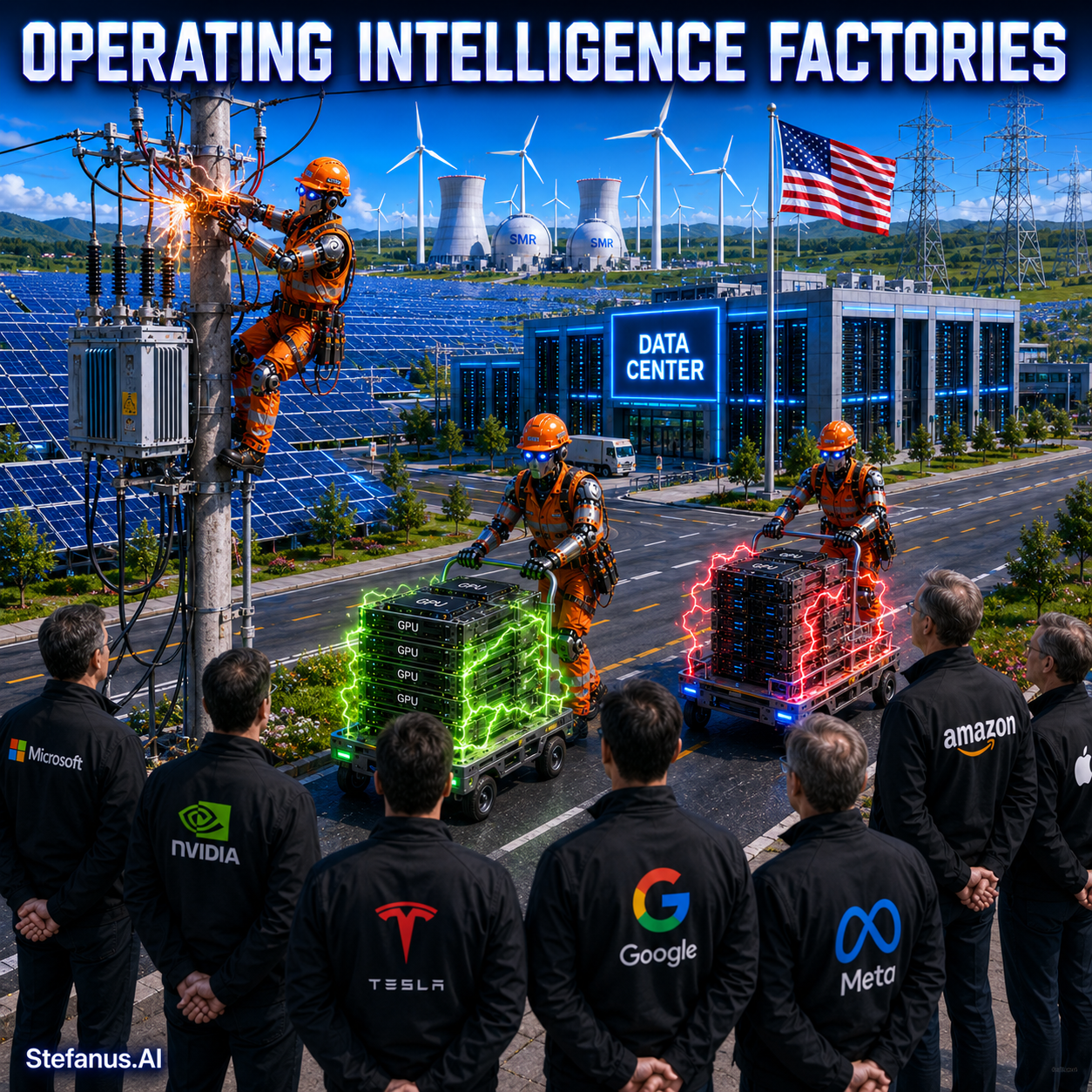

Introduction: The Factory Has Replaced the Laboratory
There is a particular kind of building that defines every industrial age, and the building tells you almost everything about the economics of the era that produced it. The age of steam was defined by the textile mill, a structure organized around a single central shaft turning hundreds of looms. The age of oil was defined by the refinery, an immense lattice of distillation towers and pipe runs designed to crack crude into a hierarchy of useful fractions. The age of the automobile was defined by the assembly line, where Henry Ford discovered that the unit cost of a complex machine collapses when you stop building each one as a bespoke artifact and start manufacturing it as a flow. We are now living through the early industrial period of artificial intelligence, and the building that defines it has only recently come into focus. For most of the past decade we imagined that building as a laboratory — a place of experimentation, of long and expensive and irregular bursts of research activity, where brilliant people trained enormous models in heroic one-time efforts. That image is now obsolete. The building that defines the AI economy of 2026 is not a laboratory. It is a factory.
This paper is titled “Operating Intelligence Factories” for a deliberate reason, and the choice of words is not decorative. A laboratory and a factory are governed by entirely different economic logics. A laboratory optimizes for discovery: its costs are lumpy, its outputs are uncertain, its machinery is reconfigured constantly, and its success is measured in breakthroughs rather than in throughput. A factory optimizes for production: its costs are continuous, its outputs are predictable, its machinery runs without interruption, and its success is measured not in any single brilliant product but in the relentless, low-margin, high-volume manufacturing of a standardized good. The central claim of this paper is that the artificial-intelligence industry has crossed precisely this threshold. The defining activity of frontier AI is no longer the periodic, capital-intensive training run — the research event. It is the continuous, around-the-clock production of inference — the manufacturing process. The factory metaphor is not a flourish laid over the top of a technical discussion. It is the most accurate available description of what a modern AI data center actually does, which is to convert electricity, silicon, and data into a single manufactured product that the industry calls a token, and to do so twenty-four hours a day, every day, at a scale that has no precedent in the history of computation.
The man who has done the most to popularize this framing is also the man who profits most from it. NVIDIA founder Jensen Huang has spent the better part of two years insisting that the structures his company supplies are not data centers in any traditional sense but “AI factories,” and the quarterly results he now reports give the phrase an almost unanswerable weight. In May 2026, announcing record revenue of $81.6 billion for a single quarter — with data-center revenue alone reaching $75.2 billion, up ninety-two percent from a year earlier — Huang described what is happening in the global build-out of compute as nothing less than the largest industrial expansion in human memory.[3,4]
“The buildout of AI factories — the largest infrastructure expansion in human history.”
— Jensen Huang, Founder & CEO, NVIDIA [3]
The factory framing is borne out by the most important operational fact of the present moment: the explosive, almost vertical growth of inference volume. A year earlier, in his fiscal first-quarter results, Huang had already noted that token generation — the literal unit of factory output — was climbing at a rate that dwarfed anything seen in the training era.[5] That observation has since been overwhelmed by the data. By the spring of 2026, Google’s chief executive Sundar Pichai disclosed that the company’s systems were processing more than 3.2 quadrillion tokens every month across its products, a sevenfold increase in a single year.[30] Microsoft’s Satya Nadella, reporting a comparable surge on Azure, framed it in the plain language of a production manager describing a factory running hot.[26] These are not the numbers of a research program. They are the numbers of mass manufacturing.
This paper builds directly on the structural argument of my earlier work on the physical infrastructure of artificial intelligence — in particular the analysis of how the scarcity of immediately deployable compute forced even the best-capitalized AI laboratories into extraordinary arrangements. In that earlier study I documented the moment when, on May 6, 2026, Anthropic agreed to rent the entirety of the Colossus 1 supercomputer cluster from SpaceX for $1.25 billion per month, and when, on June 5, 2026, Google signed a nearly identical agreement for 110,000 of the same NVIDIA GPUs at $920 million per month.[1,2] Those deals were a symptom of a deeper transition. Companies do not commit forty billion dollars to a single three-year compute contract in order to run occasional experiments. They commit that capital because they have become manufacturers, and a manufacturer that cannot guarantee continuous production cannot serve its customers. The Colossus leases were, at bottom, the desperate acquisition of factory floor space by firms whose order books had outrun their plant capacity.
The thesis of this paper proceeds from that observation in three movements. First, the paradigm has shifted: the economic center of gravity in AI has moved decisively from training to inference, from the laboratory to the factory floor, and the consequences of that shift ripple through every layer of the business. Second, inference demand is now scaling faster than anyone’s ability to supply it cheaply, which means the binding constraint on the AI economy is no longer the cleverness of the underlying model but the unit economics of operating the factory that serves it — the cost of a token, the watts behind that token, the uptime of the production line. Third, mastering those unit economics is now the central competitive problem of the industry, and the firms that solve it will not necessarily be the firms with the most brilliant research. They will be the firms that learned, as Ford learned, that in a world of continuous production the decisive advantage belongs to whoever manufactures the standard good most cheaply, most reliably, and at the greatest scale.
The remainder of this paper is organized as a tour of the factory itself. Section 1 examines the raw materials that feed the production line — the electricity and the silicon — and argues that the supply of stable power has become the true governor of factory survival. Section 2 walks the assembly line, surveying the software techniques by which the industry compresses, accelerates, and de-duplicates the work of inference. Section 3 confronts the unit economics directly, dissecting the cost of a single token and the brutal margin mathematics it imposes on every business built on top of AI. Section 4 considers the architecture of the factory network — the choice between vast centralized plants and a distributed mesh of smaller ones. Section 5 turns to the autonomous operation of the line: the orchestration, quality control, and continuous deployment that keep a global fleet of factories running without halting production. Section 6 distills the durable strategic lessons into a set of pillars, and the conclusion looks toward a future in which intelligence becomes a metered utility, as ordinary and as indispensable as electricity or running water.

Section 1: The Raw Materials of the Factory — Power and Silicon
Every factory begins not with its machinery but with its inputs, and the discipline of industrial economics has always understood that the location and cost of raw materials shape an entire industry more powerfully than the ingenuity of its engineers. Steel mills clustered where coal and iron ore could meet cheaply. Aluminum smelters migrated toward hydroelectric dams because the metal is, in a real sense, congealed electricity. Petrochemical complexes grew up beside ports and pipelines. The intelligence factory obeys the same iron law, and its two essential raw materials are now clear: electrical power, consumed continuously and at enormous scale, and specialized silicon, the machinery that converts that power into tokens. The most important strategic insight of the inference era is that these two inputs have switched places in the hierarchy of scarcity. For years the industry assumed that chips were the bottleneck and power was a utility bill. The reverse is now closer to the truth. The factory that cannot secure stable, affordable, around-the-clock electricity cannot operate at all, no matter how many GPUs it has bought.
1.1 The Energy Grid Dilemma: From Burst Power to Unyielding Baseload
The single most consequential difference between the laboratory era and the factory era is the shape of the electrical load. A training run, however massive, is a burst. It draws enormous power for a finite period — weeks or months — and then it ends, the cluster is reconfigured, and the next experiment begins. Inference is not a burst. It is a baseload. When billions of users and millions of automated agents query a model continuously, the factory must run continuously, and the power it draws is not a spike but a flat, unyielding floor that never drops to zero. This is the difference between a foundry that fires its furnace for a special order and a refinery that must keep its towers hot every hour of every day forever. The economic implications are profound, because baseload power is a fundamentally different procurement problem than peak power, and the world’s electrical grids were not built to deliver tens of gigawatts of new, permanent, geographically concentrated industrial demand on the timeline that AI requires.
The International Energy Agency has quantified the wall the industry is approaching. In its landmark analysis of energy and AI, the IEA projects that global electricity consumption by data centers will more than double from roughly 415 terawatt-hours in 2024 to approximately 945 terawatt-hours by 2030 — a quantity slightly greater than the entire electricity consumption of Japan today.[8] Crucially, the AI-specific portion of that demand grows far faster than the aggregate: the agency expects electricity use by accelerated, AI-optimized servers to expand at roughly thirty percent per year, while in the United States data centers are projected to account for nearly half of all electricity-demand growth through the end of the decade, eventually consuming more power than the domestic production of aluminum, steel, cement, and chemicals combined.[10] The IEA’s executive director, Fatih Birol, reduced the entire matter to a single sentence that ought to be engraved over the door of every AI strategy office.[9]
“There is no AI without energy.”
— Fatih Birol, Executive Director, International Energy Agency [9]
Governments have begun to treat this not as an environmental footnote but as a question of national industrial strategy. The Trump administration’s July 2025 AI Action Plan framed the energy constraint in nearly existential terms, observing that American electrical generation capacity has barely grown in half a century even as demand is about to surge.[11] Its language is blunt: the plan states that American energy capacity “has stagnated since the 1970s” even as a rival power has rapidly expanded its own grid.[11] The same administration’s executive order accelerating data-center permitting defined the relevant facilities in terms that make the factory framing official policy — a covered project is one requiring more than one hundred megawatts of new load dedicated to AI inference, training, simulation, or synthetic data generation.[12] By March 2026 the government had gone further still, securing a Ratepayer Protection Pledge under which the largest hyperscalers and AI laboratories — Amazon, Google, Meta, Microsoft, OpenAI, Oracle, and xAI — agreed to “build, bring, or buy” the new generation capacity their factories require rather than passing the cost to ordinary households.[13] When the state is brokering power contracts between utilities and AI firms, the era of treating electricity as a background utility is definitively over.
What makes the baseload problem genuinely difficult, rather than merely large, is the mismatch in timelines. A data center can be built in a year. A model can be trained in months. But securing a gigawatt-scale grid interconnection — negotiating with utility regulators, upgrading transmission, building or contracting new generation — routinely takes three to five years in major American markets. The factory can be ready to manufacture long before the power required to run it can be delivered. This temporal asymmetry is why power, not silicon, is now the true governor of factory survival, and why the firms that locked in electricity early hold a structural advantage that no amount of capital can quickly replicate.
1.2 Silicon Specialization: From Generalized GPUs to Inference-Optimized ASICs
The second raw material is the machinery itself, and here the factory era is driving a quiet but decisive divergence in the kind of silicon the industry buys. In the laboratory era, the general-purpose graphics processing unit reigned supreme, and for good reason: research demands flexibility. When you do not yet know what architecture will win, you want machinery that can be reconfigured for any experiment, and the NVIDIA GPU — with its mature CUDA software ecosystem and its ability to handle both training and inference — was the ideal laboratory instrument. That flexibility is precisely why NVIDIA still commands an estimated eighty to ninety percent of the data-center accelerator market.[14] But flexibility is a luxury, and luxuries are the first thing a cost-conscious factory eliminates. When a plant manufactures the same standardized good billions of times, the economic logic shifts overwhelmingly in favor of specialized, single-purpose machinery that does one job at the lowest possible cost per unit.
This is why the most important hardware story of the inference era is not the next GPU generation but the rise of the application-specific integrated circuit — the ASIC — purpose-built for the matrix arithmetic of inference and stripped of everything else. Google’s Tensor Processing Units, now in their seventh generation with the Ironwood chip that analysts describe as competitive with NVIDIA’s best Blackwell silicon, are the most mature example; they are the machinery on which Google manufactures its 3.2 quadrillion monthly tokens.[15] Amazon’s Trainium and Inferentia lines, which the company claims deliver thirty to forty percent better price-performance than comparable GPU instances and which power Anthropic’s Claude models through the vast Project Rainier cluster, are another.[16] Beyond the hyperscalers, a generation of specialist start-ups has built radically optimized inference silicon: Groq’s Language Processing Unit, designed for inference alone and claiming order-of-magnitude latency advantages, was considered threatening enough that NVIDIA itself moved to absorb its technology in a roughly twenty-billion-dollar transaction at the end of 2025; Cerebras pursued wafer-scale integration; and Etched’s Sohu chip burned the transformer architecture so directly into silicon that it claims to generate tokens at twenty times the rate of an equivalent GPU server.[17,18] The market is voting with its order book: by one industry forecast, custom ASIC shipments are set to grow more than forty percent in 2026, nearly three times the growth rate of GPUs.[14]
Jensen Huang, to his credit, has refused to cede the inference market to the specialists, and has repositioned his own flagship systems explicitly around it. He now describes NVIDIA’s Grace Blackwell platform not as a training machine but as “the king of inference,” arguing that its tightly coupled architecture delivers an order-of-magnitude lower cost per token than its predecessors.[6] The contest between the generalist incumbent and the specialist challengers is, at its heart, a contest about the economics of the factory: whether the flexibility of the general-purpose GPU is worth its premium, or whether the relentless cost pressure of continuous production will, as it has in every prior industrial age, ultimately reward the machine that does one thing supremely well.
1.3 Supply-Chain Operations: Real Estate, Cooling, and the Physical Plant
Beneath the glamour of silicon and the urgency of power lies a third layer of raw-material logistics that is easy to overlook and impossible to escape: the brute physical infrastructure of the factory building itself. The densest AI racks now draw so much power and generate so much heat that traditional air cooling has become inadequate, forcing the industry toward direct liquid cooling — plumbing coolant directly across the chips — with all the mechanical complexity that implies. Securing suitable real estate near both fiber connectivity and power generation, building out the substations and transformers, and managing the multi-year lead times on specialized electrical equipment have become first-order strategic problems. This is the unglamorous reality behind the headline deals: when Anthropic and Google rented the Colossus clusters, what they were really buying was not abstract “compute” but a fully built physical plant — powered, cooled, and connected — that would otherwise have taken them years to construct. In the factory era, the building is not a container for the strategy. The building is the strategy.

Section 2: Assembly-Line Optimization — The Software That Cuts the Cost of a Token
If raw materials determine where a factory can be built, it is the design of the assembly line that determines whether it can turn a profit. Henry Ford’s genius was not that he invented the automobile; it was that he reorganized its manufacture so radically that the cost per car fell by an order of magnitude, transforming a luxury into a mass-market good. The intelligence factory is undergoing precisely this kind of assembly-line revolution, and the remarkable, underappreciated fact of the inference era is that the most powerful cost reductions are coming not from better hardware but from better software — from a relentless campaign of algorithmic optimization that squeezes more tokens out of the same silicon and the same watts. The data on this point is among the most dramatic in the entire economic history of computing, and it deserves to be understood precisely, because it is the engine of everything that follows.
The headline figure comes from Stanford University’s 2025 AI Index, the most authoritative annual survey of the field. It found that the cost of querying a model performing at the level of GPT-3.5 collapsed from roughly twenty dollars per million tokens in late 2022 to about seven cents by late 2024 — “a more than 280-fold reduction” in approximately eighteen months.[20] The same report documented that hardware costs were falling around thirty percent per year while energy efficiency improved roughly forty percent per year, and the independent research group Epoch AI estimated that, depending on the task, inference prices were dropping anywhere from nine to nine hundred times per year.[20,21] A team at the MIT FutureTech project, led by the economist Neil Thompson, assembled the largest dataset of historical benchmark prices yet compiled and reached a complementary conclusion: the price for a given level of capability had, in their words, “decreased remarkably fast, around 10× per year,” and — crucially — they attributed this not to hardware alone but to the combined force of market competition, hardware efficiency, and algorithmic efficiency.[22]
That attribution is the heart of the matter. The cost of a token is falling far faster than Moore’s Law alone could explain, and the surplus is being produced on the assembly line, in software. Microsoft has been unusually candid about the magnitude of these gains; the company reported that through software optimization alone it was “delivering 90% more tokens for the same GPU” compared with a year earlier.[25] A factory that can produce ninety percent more output from identical machinery has not bought new equipment; it has redesigned its assembly line. The remainder of this section surveys the three families of technique by which that redesign is accomplished.
2.1 Model Compression: Quantization, Distillation, and Pruning
The first family of optimization shrinks the product itself so that it fits on cheaper machinery and moves through the line faster. Quantization reduces the numerical precision with which a model’s billions of parameters are stored and computed — from sixteen bits to eight, or even four — dramatically lowering both memory footprint and energy per operation, usually with negligible loss of quality. Distillation trains a small, fast “student” model to reproduce the behavior of a large, expensive “teacher,” capturing most of the capability at a fraction of the operating cost. Pruning removes the parameters that contribute least, trimming the model to its load-bearing essentials. Together these techniques are why a small, distilled, quantized model can now deliver yesterday’s frontier performance at a small fraction of yesterday’s cost — the central mechanism behind the 280-fold price collapse. The importance of this work has not escaped the academy. At a 2026 lecture at the University of Southern California’s Viterbi School, faculty highlighted new quantization methods for compressing the memory that inference consumes, with the USC engineer Salman Avestimehr noting that such algorithmic advances could make model serving “up to 10 times faster and more energy-efficient.”[24]
“Up to 10 times faster and more energy-efficient.”
— Salman Avestimehr, Professor, USC Viterbi School of Engineering [24]
2.2 Throughput Versus Latency: The Central Trade-Off of the Line
Every assembly line must balance two quantities that pull against each other: throughput, the total volume produced per unit of time, and latency, the wait experienced by any individual customer. In the intelligence factory this tension is acute and unavoidable. Batching many user requests together and processing them in parallel maximizes the throughput of the expensive GPU — it keeps the machinery saturated and drives down the cost per token — but it can increase the latency that any single user experiences while their request waits for a batch to fill. Serving each request the instant it arrives minimizes latency but strands expensive silicon at low utilization, raising the unit cost. The entire discipline of inference serving is, in essence, the art of managing this trade-off: maximizing the tokens produced per second per dollar of hardware while holding the customer’s wait below the threshold of frustration. It is the same problem a real factory manager faces in choosing between large efficient production runs and responsive small-batch fulfillment, and it has no universal solution — only an optimum that depends on the specific product and the specific customer.
2.3 Caching and Context Management: Inventory for the Production Line
The third family of technique is, in effect, inventory management — the practice of never manufacturing the same component twice. The dominant example is key-value caching, in which the intermediate computational state a model produces while reading a prompt is stored and reused rather than recalculated from scratch on every subsequent token. In a long conversation or an agentic workflow, this can eliminate an enormous quantity of redundant computation, and providers now price “cached” input tokens at a steep discount precisely because the factory has already done that work and warehoused the result. A related technique, speculative decoding, uses a small fast model to draft several tokens ahead and a large model merely to verify them, accelerating production much as a factory uses a cheap stamping press to rough out a part that a precision machine then finishes. These methods matter enormously because of a structural feature of modern reasoning models: they generate vastly more tokens per request than their predecessors — by some analyses an order of magnitude more — which means the volume of computation per query is rising even as the cost per token falls.[32] Caching and context management are the inventory disciplines that keep that rising volume from overwhelming the line.

Section 3: The Unit Cost of a Token — Supply-Side Economics of Manufactured Intelligence
We arrive now at the conceptual heart of the paper, the place where the factory metaphor stops being an illustration and becomes a balance sheet. Every manufacturing business lives or dies by a single number: the cost to produce one unit of its standardized good, set against the price at which that unit can be sold. For the intelligence factory the unit is the token, and the discipline of operating the factory profitably reduces to a relentless campaign to drive the cost of manufacturing a token below the price at which it can be sold — while the price itself falls, month after month, faster than almost any commodity in industrial history. To understand the AI economy of 2026 is to understand the strange and unforgiving mathematics of the token.
3.1 The Token Economy: Defining the Unit of Manufacture
A token is the atomic unit of the intelligence factory — a word, a fragment of a word, or a symbol that a model consumes as input and produces as output, with roughly four characters or three-quarters of a word per token as a rule of thumb. The entire commercial architecture of the industry is now metered in tokens. Providers buy machinery and power, manufacture tokens, and sell them by the million; the cost per million tokens is the north-star metric of the whole enterprise, the equivalent of cost-per-barrel in oil or cost-per-ton in steel. And the manufacturing volumes have become genuinely difficult to comprehend. Google now processes more than 3.2 quadrillion tokens per month across its surfaces, a figure its chief executive disclosed in May 2026 and which represents a sevenfold annual increase.[30] The trajectory is almost vertical: roughly 9.7 trillion tokens per month in early 2024, 480 trillion by May 2025, around 1.3 quadrillion by that October, and 3.2 quadrillion by the following spring. The head of Google DeepMind, Demis Hassabis, captured the vertigo of this growth when he reported that the company had processed nearly a quadrillion tokens in a single month, more than double the prior month’s total.[31]
“In the AI era, compute capacity is revenue, and profits.”
— Jensen Huang, Founder & CEO, NVIDIA [7]
Huang’s formulation is the supply-side thesis stated in its purest form: in a factory economy, the machinery is the business, because every unit of installed and powered capacity converts directly into manufactured tokens, and manufactured tokens are the product that is sold. This is why the hyperscalers describe themselves not as demand-constrained but as supply-constrained — they can sell every token they can make. The bottleneck is not finding customers. It is building factory capacity fast enough to serve the customers already at the door.
3.2 Fixed Versus Variable Costs: Amortizing the Laboratory Across the Factory
The financial structure of the intelligence factory rests on a sharp distinction between two kinds of cost, and the entire profitability of the enterprise depends on the relationship between them. Training a frontier model is a fixed cost — an enormous, one-time, laboratory-style capital expenditure that can run into the hundreds of millions or, at the frontier, billions of dollars, incurred before a single token is sold. Inference is a variable cost — the ongoing, per-token expense of electricity, hardware depreciation, and cooling that is incurred every time the factory manufactures output. The genius of the business model, when it works, is that the colossal fixed cost of creating the model is amortized across an astronomically large volume of variable, revenue-generating inference operations. A model trained once for a billion dollars becomes profitable only if it then manufactures trillions of tokens at a positive margin. This is why inference volume is not merely an operational statistic but the financial foundation of the entire industry: it is the denominator over which the fixed cost is spread. Industry analyses now estimate that inference accounts for the overwhelming majority of the compute an AI provider consumes in production — commonly cited figures put the inference share of total AI compute at eighty to ninety percent, with training a comparatively small minority.[28,29] The factory, not the laboratory, dominates the cost base because the factory is where the work actually happens.
3.3 The Margin Squeeze and the Race Toward Commoditized Intelligence
Here lies the cruelest dynamic of the inference economy, the one that keeps AI executives awake. The same collapse in the cost of a token that makes AI affordable for everyone also makes it nearly impossible to sustain a premium on the raw product. When a capability that cost twenty dollars per million tokens in 2022 costs seven cents two years later, and when open-weight models are closing the performance gap with proprietary ones to within a couple of percentage points, intelligence at any given level of capability is racing toward commoditization — toward a world in which a token is a token, sold at razor-thin margins on the basis of price and reliability rather than uniqueness.[20] The competitive consequence is a brutal squeeze on every business built atop AI. Software companies that embedded AI features at flat subscription prices have discovered that heavy users — particularly agentic systems that generate many tokens per task — can consume far more in inference cost than the subscription collects, a phenomenon the industry has begun to call “token shock.” In response, firms from Anthropic to Adobe to GitHub have moved toward usage-based and outcome-based pricing, passing the variable cost of manufacture through to the customer.[32] The paradox is exquisite: the providers who manufacture tokens at the very largest scale can earn handsome gross margins — inference at scale has reportedly produced margins of seventy-five percent or more for the most efficient operators — even as the firms that merely resell those tokens find their own margins compressed toward zero.[33] In a commoditized factory economy, the profit accrues to the most efficient manufacturer, and to almost no one else.

Section 4: Factory Architecture — Hyperscale Plants and the Distributed Mesh
Once a firm has decided to manufacture intelligence, it confronts an architectural question as old as industry itself: should production be concentrated in a few colossal centralized plants, or distributed across a mesh of smaller facilities positioned close to the customer? The history of manufacturing offers no single answer — some goods are made most cheaply in vast centralized works, while others are produced near the point of consumption to minimize the cost and delay of transport — and the intelligence factory is discovering that it, too, must operate at both extremes simultaneously. The choice is not academic. It governs the cost, the speed, and even the legality of manufactured intelligence, and the firms that get the architecture right will serve their customers faster and cheaper than those that do not.
4.1 Centralized Hyperscale Versus Decentralized Micro-Factories
The centralizing logic is overwhelming for the most demanding work. Training a frontier model, and serving the largest and most capable models at inference time, benefits from the economies of scale that only a hyperscale plant can provide: hundreds of thousands of tightly interconnected accelerators, drawing hundreds of megawatts, cooled and powered as a single integrated machine. This is the logic that produced the Colossus clusters and that is driving the construction of facilities so large that, by one analysis drawing on Epoch AI’s tracking, at least five individual American data centers are projected to exceed one gigawatt of peak power draw by late 2026 — each consuming as much electricity as a mid-sized city.[37] But the centralizing logic has a countervailing force. A great deal of inference — particularly the smaller, distilled models that now deliver yesterday’s frontier capability — does not require a hyperscale plant at all, and can be manufactured far more efficiently close to the user, in regional facilities or even on the user’s own device. The same compression techniques that cut the cost of a token also shrink the model enough to run on a laptop or a phone, giving rise to a distributed mesh of micro-factories that complements the hyperscale plants rather than replacing them.
4.2 Latency Logistics: Shipping Compute to the Customer
The case for the distributed mesh is, at bottom, a case about logistics — about the physical cost of shipping a product across distance. In manufacturing, transport imposes both expense and delay; in the intelligence factory, the analog is network latency, the time it takes a request to travel from the user to the factory and the answer to travel back. For interactive applications — a conversation, a coding assistant, a voice agent — that round trip is the difference between a tool that feels instantaneous and one that feels sluggish. Positioning inference capacity geographically close to concentrations of users, much as a consumer-goods company positions distribution centers near its markets, reduces this latency and improves the product. The factory that ships its compute to where the customer is will, all else equal, deliver a faster and more satisfying product than the one that forces every request to travel to a distant central plant.
4.3 Data Sovereignty: Isolating the Regional Plant
There is a final force pushing toward a distributed architecture, and it is legal rather than technical. The raw material that flows into the intelligence factory — the user’s data — is increasingly governed by national and regional laws that restrict where it may be processed and stored. Data-sovereignty requirements compel providers to isolate regional factory nodes so that, for instance, European data is manufactured into intelligence on European soil under European law. This is the industrial equivalent of building plants inside tariff walls: not the most efficient arrangement in pure engineering terms, but a necessary accommodation to the political geography in which the factory must operate. Together, latency and sovereignty ensure that the future of intelligence manufacturing is neither purely centralized nor purely distributed, but a deliberate hybrid — vast plants for the heaviest work, a mesh of regional and on-device factories for everything else.

Section 5: The Autonomous Assembly Line — Orchestration, Quality Control, and Continuous Deployment
A factory that runs continuously cannot be operated by hand. The defining operational achievement of mass production was not merely the assembly line but the system of automated control that kept the line running — the scheduling, the quality inspection, the ability to retool without halting output. The intelligence factory, manufacturing tokens around the clock for a global customer base, demands an equivalent layer of autonomous operation, and the maturity of this layer is now one of the clearest dividing lines between a research project and a real manufacturing business. The discipline that supplies it has acquired a name — machine-learning operations, or MLOps — and it is, in effect, the factory-management science of the AI era.
5.1 Dynamic Load Balancing: Routing Across a Global Fleet
The first requirement of an autonomous line is the intelligent routing of work. Demand for inference is wildly uneven — it surges with the working hours of each time zone, spikes with viral events, and varies by the second — and a global fleet of factories must route each incoming request to whichever facility has available capacity, the appropriate hardware, and the lowest latency for that user, all in real time. This dynamic load balancing is what prevents the bottlenecks that would otherwise form when a single plant is overwhelmed while another sits idle. It is the same problem a logistics network solves when it reroutes shipments around a congested port, executed thousands of times per second across a planet-spanning fleet. When this routing fails, the consequence is precisely the “strain on infrastructure” and degraded reliability that even the most sophisticated AI providers have publicly acknowledged during periods of peak demand — the factory-era equivalent of a production line backing up.
5.2 Automated Quality Control: Inspecting the Output for Defects
Every factory needs an inspection regime, and the intelligence factory is no exception — though its defects are subtler than a scratched fender. The output of a model can degrade in ways that are invisible without continuous monitoring: hallucinations, in which the model manufactures confident falsehoods; drift, in which the statistical character of real-world inputs shifts away from what the model was trained on; and the gradual degradation of accuracy as the world changes around a static model. Automated quality control — continuous evaluation of outputs against benchmarks and guardrails, with alerting when quality falls below threshold — is the inspection station of the assembly line. Its importance is rising as inference volumes explode, because at a scale of quadrillions of tokens, even a small defect rate translates into an enormous absolute number of flawed outputs reaching customers. The shift that the Stanford economist and HAI fellow Shana Lynch has described, from an era of AI evangelism toward an era of AI evaluation, is in part a recognition that a manufacturing business must be judged by the consistency of its output, not the brilliance of its prototype.
5.3 Continuous Deployment: Retooling Without Halting Production
Finally, an autonomous line must be able to retool itself without stopping. New and improved models are released constantly, and the factory must be able to swap or upgrade the model running on its production line — or roll back to a previous version if a new one underperforms — without interrupting the continuous stream of tokens flowing to customers. This is the discipline of continuous deployment, and it is what allows an AI provider to improve its product week after week while never taking the factory offline. The combination of dynamic routing, automated quality control, and seamless retooling is what transforms a collection of expensive machinery into a genuine manufacturing operation: one that runs reliably, inspects its own output, and improves continuously, all without halting the production that pays for it.

Section 6: What We Have Learned — The Strategic Pillars of the Factory Era
The transition from laboratory to factory is not merely a change in vocabulary; it is a change in the deep structure of competition, and it carries with it a set of durable lessons that will shape how AI companies, investors, and policymakers think about the coming decade. I organize these lessons into six pillars. Each represents an insight that extends beyond the specific facts of any one company or quarter, and together they describe the strategic logic of an industry that has learned to manufacture intelligence at scale.
Pillar 1 — The Power Bottleneck Dominates
Hardware capability is no longer the binding constraint on the AI economy. Access to stable, affordable, scalable electricity is. The firm that owns the most advanced GPUs but cannot power them is in a worse position than the firm with older silicon and a secured gigawatt of baseload generation. This is the deepest reversal of the factory era, and it explains why the energy strategy of an AI company — its power-purchase agreements, its grid interconnections, its willingness to underwrite new generation — has become as central to its survival as its research agenda. As Fatih Birol of the IEA put it with characteristic economy, there is no AI without energy, and the corollary is that there is no AI factory without a power contract.[8,9]
Pillar 2 — Generalization Is a Luxury
The general-purpose GPU won the laboratory era precisely because research rewards flexibility. But the factory era rewards specialization, because continuous mass production rewards the machine that does one thing at the lowest cost per unit. The rise of inference-optimized ASICs — Google’s TPUs, Amazon’s Trainium and Inferentia, the specialist silicon of Groq and Etched and Cerebras, and NVIDIA’s own inference-tuned systems — is the predictable consequence of a market shifting from experimentation to production.[14,15,16,17] Flexibility will always have a price, and in a factory economy that price is increasingly one the most cost-conscious manufacturers decline to pay.
Pillar 3 — Software Is the Real Cost-Cutter
The most powerful reductions in the cost of a token have come not from new hardware generations but from algorithmic efficiency — quantization, distillation, pruning, caching, and speculative decoding. The Stanford AI Index measured a 280-fold collapse in the price of a given capability in eighteen months, and the MIT FutureTech team led by Neil Thompson found prices falling roughly tenfold per year, attributing the gains substantially to software rather than silicon.[20,22] When a provider can deliver ninety percent more tokens from the same GPU through optimization alone, the lesson is unmistakable: the economic needle moves fastest in the code, not in the foundry.[25]
Pillar 4 — Marginal Costs Dictate Pricing
Traditional software enjoyed near-zero marginal cost — a copy of a program cost nothing to reproduce — and built its fortunes on that fact. The intelligence factory does not have this luxury. Every token manufactured consumes real electricity and real hardware depreciation, so AI businesses cannot survive on traditional software margins unless they ruthlessly drive down the marginal cost of computing a single token. This is why the firms that manufacture at the largest scale and the lowest unit cost can prosper while their resellers are squeezed, and why “token shock” has forced the industry toward usage-based pricing.[32,33] In a commoditized factory economy, whoever owns the lowest marginal cost owns the market.
Pillar 5 — Reliability Trumps Novelty
In a research laboratory, the most brilliant model wins. In a factory serving production workloads, a slightly less capable model that runs with near-perfect uptime at a fraction of the cost is vastly superior to a brilliant one that is too slow, too expensive, or too unreliable to deploy. This is the lesson every mature manufacturing industry eventually learns: customers building their own businesses atop your product value consistency and price over marginal sophistication. The shift from an era of AI evangelism to an era of AI evaluation is the market’s way of saying that the factory will be judged by the reliability of its output, not the dazzle of its demos.
Pillar 6 — Efficiency Breeds Demand: The Jevons Trap
The final and most counterintuitive pillar is that driving down the cost of a token does not reduce total spending on tokens — it increases it. This is the Jevons Paradox, the nineteenth-century observation that improving the efficiency with which a resource is used tends to increase, rather than decrease, the total consumption of that resource, and analysts at the Brookings Institution have explicitly invoked it to explain why the IEA projects data-center electricity demand to double even as every individual operation becomes more efficient.[29] As intelligence grows cheaper, the number of things worth doing with it explodes — reasoning models that consume an order of magnitude more tokens per query, autonomous agents that run continuously, intelligence embedded in every product and process. The factory that becomes more efficient does not slow down. It runs faster, because efficiency is precisely what unlocks the next wave of demand. Every operator of an intelligence factory must plan not for a future of falling consumption but for one of relentlessly rising volume.

Conclusion: Intelligence as a Utility
This paper has argued that the artificial-intelligence industry has crossed a threshold as consequential as any in the history of technology: the transition from the research laboratory to the manufacturing factory, from the heroic one-time training run to the continuous, around-the-clock production of inference. Treating the AI data center as a factory rather than a laboratory is not a rhetorical convenience. It reorganizes the entire financial and technical landscape of the industry, relocating the decisive competitive question from “who can build the most capable model?” to “who can manufacture intelligence most cheaply, most reliably, and at the greatest scale?” The firms that internalize this shift will treat power contracts, specialized silicon, algorithmic efficiency, and operational uptime not as supporting details but as the substance of their strategy. The firms that do not will find themselves, like laboratory-era manufacturers in every prior industrial age, undercut by competitors who understood that the factory floor, not the research bench, is where fortunes are now made.
The competitive moat of the AI era is therefore migrating. It is moving away from the size of one’s training cluster — the laboratory measure of prestige — toward the efficiency of one’s inference factory — the manufacturing measure of survival. This is the central strategic conclusion of the paper, and it is consistent with the structural forces documented across all six sections: the dominance of the power bottleneck, the rise of specialized silicon, the supremacy of software-driven cost reduction, the tyranny of marginal cost, the premium on reliability, and the Jevons-driven explosion of demand. Each of these forces rewards the efficient manufacturer and punishes the firm that mistakes laboratory brilliance for factory competence.
Where does this lead? Toward a future in which intelligence becomes a utility — metered, ubiquitous, and as ordinary in its availability as electricity or running water. The Stanford economist Erik Brynjolfsson, one of the founders of the academic study of the digital economy, has argued that we are leaving the era of AI experimentation behind and entering something more permanent and more economically consequential.[40]
“We are transitioning from an era of AI experimentation to one of structural utility.”
— Erik Brynjolfsson, Director, Stanford Digital Economy Lab [40]
Brynjolfsson’s own preferred analogy is electricity, and it is the right one. The benefits of electrification did not arrive the moment the first generator spun; they arrived only after society built the grid, redesigned its factories, and reorganized its work around the new utility — a process that took decades.[41] Artificial intelligence is following the same path. The intelligence factories now under construction are the power plants of a new general-purpose utility, and the unit economics of operating them — the cost of a token, the watts behind it, the reliability of the line — will determine how cheap and how universal that utility becomes. The institutional voices charged with stewarding the global economy have begun to grasp the stakes. The managing director of the International Monetary Fund, Kristalina Georgieva, has estimated that artificial intelligence could lift global productivity by as much as 0.8 percentage points per year, enough to restore growth to pre-pandemic levels, while warning that the transition is arriving faster than the world is prepared for.[42]
“AI is for real and it is transforming our world.”
— Kristalina Georgieva, Managing Director, International Monetary Fund [43]
That is the promise and the burden of the intelligence factory. If its operators succeed in driving the cost of manufactured intelligence low enough, and in running their production lines reliably enough, then a capability that was, only a few years ago, the rarest and most expensive product on earth will become a universally available utility — a quiet, metered, indispensable input to nearly every human endeavor. The competition to build the most brilliant model will continue, and it will continue to matter. But the deeper contest, the one that will determine who prospers in the age now beginning, is the contest to operate the most efficient intelligence factory. The laboratory gave us the model. The factory will give us the future.

Footnotes & Endnotes
[1] Anthropic / SpaceX (xAI), May 6, 2026 agreement — $1.25 billion/month for the Colossus 1 cluster (220,000 NVIDIA GPUs, 300MW), through May 2029. DataCenter Dynamics, May 2026. https://www.datacenterdynamics.com/en/news/anthropic-to-use-all-of-spacex-xais-colossus-1-data-center-compute/
[2] Google / SpaceX (xAI), June 5, 2026 Cloud Service Agreement — $920 million/month for ~110,000 NVIDIA GPUs, through June 2029. TechCrunch, June 5, 2026. https://techcrunch.com/2026/06/05/google-will-pay-spacex-920m-per-month-for-compute/
[3] Jensen Huang, Founder & CEO, NVIDIA — “The buildout of AI factories — the largest infrastructure expansion in human history.” NVIDIA Q1 FY2027 results press release, May 20, 2026 (U.S. SEC EDGAR). https://www.sec.gov/Archives/edgar/data/0001045810/000104581026000051/q1fy27pr.htm
[4] NVIDIA Q1 FY2027: record revenue $81.6 billion (up 85% YoY); record Data Center revenue $75.2 billion (up 92% YoY). StockTitan summary of NVIDIA results, May 20, 2026. https://www.stocktitan.net/news/NVDA/nvidia-announces-financial-results-for-first-quarter-fiscal-fq78amc9h84m.html
[5] Jensen Huang, NVIDIA — “AI inference token generation has surged tenfold in just one year.” NVIDIA Q1 FY2026 results press release (U.S. SEC EDGAR). https://www.sec.gov/Archives/edgar/data/0001045810/000104581025000115/q1fy26pr.htm
[6] Jensen Huang, NVIDIA — Grace Blackwell with NVLink described as “the king of inference today,” delivering an order-of-magnitude lower cost per token. NVIDIA Q4 FY2026 results press release (U.S. SEC EDGAR). https://www.sec.gov/Archives/edgar/data/0001045810/000104581026000019/q4fy26pr.htm
[7] Jensen Huang, NVIDIA — “In the AI era, compute capacity is revenue, and profits.” NVIDIA Q1 FY2027 earnings call transcript (via Roic.ai). https://www.roic.ai/quote/NVDA/transcripts
[8] International Energy Agency, “Energy and AI” / “Key Questions on Energy and AI” — data-center electricity consumption projected to more than double to ~945 TWh by 2030 (~485 TWh in 2025). IEA, 2025–2026. https://www.iea.org/reports/energy-and-ai/executive-summary
[9] Fatih Birol, Executive Director, IEA — “There is no AI without energy.” IEA news release on the Energy and AI report. https://www.iea.org/news/ai-is-set-to-drive-surging-electricity-demand-from-data-centres-while-offering-the-potential-to-transform-how-the-energy-sector-works
[10] IEA — electricity use by accelerated (AI) servers projected to grow ~30% per year; U.S. data centers to account for nearly half of national electricity-demand growth to 2030. IEA, “Energy demand from AI.” https://www.iea.org/reports/energy-and-ai/energy-demand-from-ai
[11] The White House, “Winning the Race: America’s AI Action Plan,” July 2025 — American energy capacity “has stagnated since the 1970s.” https://www.whitehouse.gov/wp-content/uploads/2025/07/Americas-AI-Action-Plan.pdf
[12] Executive Order 14318, “Accelerating Federal Permitting of Data Center Infrastructure,” July 23, 2025 — defines a covered project as >100 MW of new load dedicated to AI inference, training, simulation, or synthetic data generation. The White House. https://www.whitehouse.gov/presidential-actions/2025/07/accelerating-federal-permitting-of-data-center-infrastructure/
[13] The White House — Ratepayer Protection Pledge (March 2026): Amazon, Google, Meta, Microsoft, OpenAI, Oracle, and xAI agree to “build, bring, or buy” new generation for data centers. https://www.whitehouse.gov/fact-sheets/2026/03/fact-sheet-president-donald-j-trump-advances-energy-affordability-with-the-ratepayer-protection-pledge/
[14] AI accelerator market structure — NVIDIA ~80–92% of the data-center GPU market; custom ASIC shipments projected to grow ~44.6% in 2026 vs ~16.1% for GPUs (TrendForce). CNBC, “Comparing the top AI chips,” Nov 21, 2025; AIMultiple, May 2026. https://www.cnbc.com/2025/11/21/nvidia-gpus-google-tpus-aws-trainium-comparing-the-top-ai-chips.html
[15] Google TPU v7 “Ironwood” (4,614 TFLOPS/chip) described by analysts as competitive with NVIDIA Blackwell. Introl, “AI Accelerators Beyond GPUs,” 2025–2026. https://introl.com/blog/ai-accelerators-beyond-gpus-tpu-trainium-gaudi-cerebras-2025
[16] AWS Trainium / Inferentia — ~30–40% better price-performance than comparable GPU instances; Project Rainier (hundreds of thousands of Trainium chips) powers Anthropic’s Claude. MLQ.ai, “AI Chips & Accelerators.” https://mlq.ai/research/ai-chips/
[17] Groq LPU (inference-only; order-of-magnitude latency advantage) and NVIDIA’s ~$20 billion acquisition of Groq’s technology, December 2025. IntuitionLabs, “Cerebras vs SambaNova vs Groq,” Oct 2025. https://intuitionlabs.ai/articles/cerebras-vs-sambanova-vs-groq-ai-chips
[18] Etched “Sohu” transformer-only ASIC — claims ~20× the token throughput of an equivalent 8-GPU H100 server. “The AI Inference Wars,” Feb 2026. https://themenonlab.blog/blog/ai-inference-accelerators-compared
[20] Stanford HAI, “2025 AI Index Report” — inference cost for GPT-3.5-level capability fell from ~$20 to ~$0.07 per million tokens (Nov 2022–Oct 2024), a “more than 280-fold reduction”; hardware costs −30%/yr, energy efficiency +40%/yr. https://hai.stanford.edu/ai-index/2025-ai-index-report
[21] Epoch AI estimate (via Stanford HAI 2025 AI Index, Chapter 1) — LLM inference prices falling between 9× and 900× per year depending on task. https://hai.stanford.edu/assets/files/hai_ai-index-report-2025_chapter1_final.pdf
[22] Hans Gundlach, Jayson Lynch, Matthias Mertens & Neil Thompson (MIT CSAIL / MIT FutureTech), “The Price of Progress: Algorithmic Efficiency and the Falling Cost of AI Inference,” Nov 2025 — benchmark price “decreased remarkably fast, around 10× per year.” https://futuretech.mit.edu/publication/the-price-of-progress-algorithmic-efficiency-and-the-falling-cost-of-ai-inference
[24] Salman Avestimehr, Professor, USC Viterbi School of Engineering — quantization advances (PolarQuant / vector quantization) can make model serving “up to 10 times faster and more energy-efficient.” USC Viterbi News, May 2026. https://viterbischool.usc.edu/news/2026/05/10-times-faster-10-times-less-energy-solving-ais-memory-bottleneck-with-algorithms-and-coding-theory/
[25] Microsoft — “Through software optimization alone, we are delivering 90% more tokens for the same GPU compared to a year ago.” Cited in Tomasz Tunguz, “Beyond a Trillion: The Token Race,” Sept 2025. https://tomtunguz.com/trillion-token-race/
[26] Satya Nadella, CEO, Microsoft — “We processed over 100 trillion tokens this quarter, up 5× year-over-year — including a record 50 trillion tokens last month alone.” Microsoft earnings, 2025; via The Infrastructure Newsletter. https://www.infranewsletter.com/april-2025
[28] Inference vs. training compute split — industry analyses (citing NVIDIA inference economics) put ~80% of AI compute spend on inference, ~20% on training. Mirantis, “Optimizing Inference Costs,” 2026. https://www.mirantis.com/blog/inference-costs/
[29] Brookings Institution — ~80–90% of AI compute is inference; the Jevons Paradox explains why efficiency gains coexist with doubling data-center electricity demand. “Global energy demands within the AI regulatory landscape,” April 2026. https://www.brookings.edu/articles/global-energy-demands-within-the-ai-regulatory-landscape/
[30] Sundar Pichai, CEO, Alphabet — Google processing >3.2 quadrillion tokens/month as of May 2026 (7× YoY), disclosed at Google I/O 2026. Crypto Briefing, May 2026. https://cryptobriefing.com/google-3-2-quadrillion-tokens-monthly/
[31] Demis Hassabis, CEO, Google DeepMind — Google processed nearly one quadrillion tokens in a single month, more than double the prior month. DataCenter Dynamics, May 2026. https://www.datacenterdynamics.com/en/news/google-processed-nearly-one-quadrillion-tokens-in-june-deepminds-demis-hassabis-says/
[32] “Token shock” and the shift to usage-/outcome-based pricing; reasoning models consume far more tokens per request. PYMNTS, “Token Shock Hits Silicon Valley’s Biggest Spenders,” 2026. https://www.pymnts.com/artificial-intelligence-2/2026/token-shock-hits-silicon-valleys-biggest-spenders/
[33] Inference API gross margins reported at 75%+ for efficient operators (Dylan Patel / SemiAnalysis). Nathan Lambert, “People use AI more than you think,” Interconnects, 2025. https://www.interconnects.ai/p/people-use-ai-more-than-you-think
[37] At least five U.S. data centers projected to exceed 1 GW of peak power draw by late 2026 (Epoch AI; via Financial Times). Tech Jack Solutions, “Amazon Outspent Alphabet and Microsoft,” May 2026. https://techjacksolutions.com/ai-brief/amazon-outspent-alphabet-and-microsoft-by-billions-in-q1-202/
[40] Erik Brynjolfsson, Director, Stanford Digital Economy Lab — “We are transitioning from an era of AI experimentation to one of structural utility” (FT op-ed). Reported in Fortune, Feb 15, 2026. https://fortune.com/2026/02/15/ai-productivity-liftoff-doubling-2025-jobs-report-transition-harvest-phase-j-curve/
[41] Erik Brynjolfsson et al. — AI as a general-purpose technology whose productivity benefits, like electricity, require complementary investment and a redesign of work. “The Paradigm Shifts in Artificial Intelligence” (arXiv). https://arxiv.org/pdf/2308.02558
[42] Kristalina Georgieva, Managing Director, IMF — AI could boost global productivity by up to 0.8 percentage points per year. IMF speech, Feb 3, 2026. https://www.imf.org/en/news/articles/2026/02/03/md-speech-leveraging-artificial-intelligence-and-enhancing-countries-preparedness
[43] Kristalina Georgieva, Managing Director, IMF — “AI is for real and it is transforming our world” (Davos, World Economic Forum). Reported in Fortune, Jan 24, 2026. https://fortune.com/2026/01/24/ai-productivity-economic-spillover-low-wage-workers-imf-chief-kristalina-georgieva/

Comments
[…] where simulation is already operational. The same Omniverse DSX work that lets companies design AI factories has drawn in energy leaders — GE Vernova, Hitachi, Siemens Energy — who are using the reference […]
[…] and take-or-pay purchase obligations—as a secondary currency circulating among AI firms. When a hyperscaler invests in a model developer partly in the form of cloud credits rather than cash, or when a model […]