

Introduction: The End of the Unified Machine
“The digital frontier may serve as a new barrier to global convergence rather than a bridge.”
— International Monetary Fund, Global Economic and Financial Implications of Artificial Intelligence (April 2026)
For the better part of three decades, the digital revolution rested upon a single, rarely examined premise: that the world’s technology supply chain was fundamentally one organism. It was globalized, interdependent, and unified by an economic logic so powerful that it appeared immune to politics. An algorithm conceived in a Silicon Valley office was accelerated by a chip etched in a Taiwanese foundry, assembled inside a factory in mainland China, financed by capital pooled across London, Riyadh, and Singapore, and finally deployed into a borderless cloud accessible from Lagos to La Paz. The genius of that arrangement was that no single nation needed to own the whole; comparative advantage, not sovereignty, dictated who did what. The machine was planetary, and its parts did not ask where they came from.
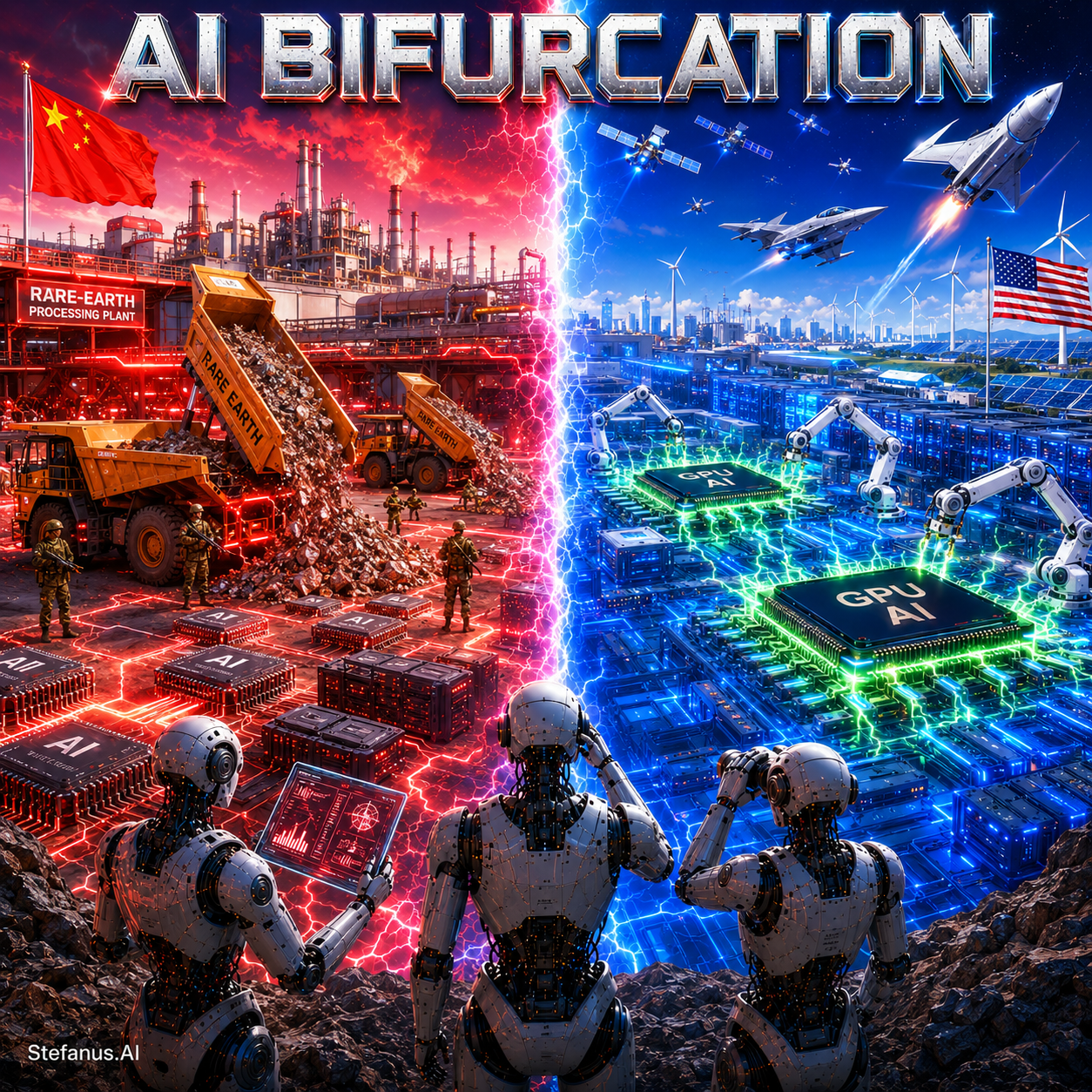
That interconnected reality is now fracturing along its deepest seams. This paper analyzes the structural collapse of the unified technology ecosystem, a phenomenon we identify and develop throughout as AI Bifurcation. Driven by an intensifying contest for supremacy between the United States and the People’s Republic of China, the global landscape of artificial intelligence is no longer drifting; it is splitting, deliberately and systematically, into two parallel, competing, and increasingly mutually exclusive technological domains. What was once a single river of innovation has forked into two channels that share a source but flow toward different seas.
We write this paper in full awareness of how quickly the ground is moving beneath our feet, and the events of the spring and early summer of 2026 supply the urgency. On May 13, 2026, President Donald Trump arrived in Beijing for a high-stakes state visit, accompanied by a delegation of American technology executives that read like a roster of the industry’s commanding heights — Tesla’s Elon Musk, Apple’s Tim Cook, and, after a dramatic last-minute invitation, NVIDIA’s Jensen Huang.[5] The central question hanging over the summit was whether Washington would finally permit the sale of NVIDIA’s advanced H200 accelerators to Chinese firms, and whether Beijing would even want them. The optics were extraordinary: the same American government that had spent years constructing an embargo around its most powerful chips was now, in effect, asking China to buy more of them.[4]
The irony cuts in the other direction too, and it cuts close to home. On June 12, 2026, the United States government, citing national security authorities, issued an export control directive ordering Anthropic to suspend all access to its two most capable frontier models, Fable 5 and Mythos 5, for any foreign national — whether located outside the country or working as a non-citizen employee inside it.[1] The order arrived at 5:21 p.m. Eastern Time, and its scope was so sweeping that the company concluded it had no practical choice but to disable the models for every user worldwide.[3] A nation that has built its strategic identity around staying ahead of China in artificial intelligence had just pulled its own most advanced product from the global market. The questions this raises are not rhetorical. Is the United States now copying the very playbook it once condemned? With the blocking of Mythos 5 and Fable 5, is Washington erecting its own Algorithmic Iron Curtain? Has the world’s foremost market democracy begun to govern its frontier technology with the centralized, security-first reflexes we once associated with a Politburo — with Beijing and Moscow rather than with itself? And how much of this is driven by genuine fear of doomsday capabilities and jailbreakers, and how much by something closer to strategic anxiety?
These are not one-sided dynamics. China has been pursuing its own program of selective closure with equal determination. It has throttled the sale of TikTok’s algorithm under the pressure of a forced divestiture, and in April 2026 its National Development and Reform Commission moved to block Meta’s two-billion-dollar acquisition of Manus, an agentic AI startup founded by Chinese engineers, ordering both parties to unwind the deal entirely on the grounds that it amounted to a hollowing-out of China’s domestic technology base.[6] Beijing has simultaneously discouraged its own national champions from buying NVIDIA’s chips even when Washington permits the sale, capping advanced-chip imports and building its own version of a “small yard, high fence” around its domestic ecosystem,[33] and has thrown the weight of the state behind building an indigenous accelerator ecosystem on Huawei’s Ascend architecture. Both superpowers, in other words, are now drivers of bifurcation rather than merely its targets — Beijing increasingly wielding antitrust law, investment screening, and regulatory authority as instruments of technological defense in precisely the way Washington once monopolized.[34] Each is building a wall and calling it a garden.[7]
This paper ties those scattered conflicts — the Beijing summit, the Anthropic directive, the Manus veto, the TikTok standoff, the H200 deadlock, the Huawei-DeepSeek alliance — into a single coherent argument. We contend that they are not isolated episodes of friction but symptoms of one structural transformation. To map that transformation, we introduce a five-dimensional framework spanning hardware, algorithms, energy infrastructure, state policy, and global diplomacy. Rather than treating the split as a simple trade dispute or a localized hardware shortage, we argue that it represents a permanent structural realignment of global power, one in which computational capacity has become the ultimate proxy for national sovereignty. In the pages that follow, the era of asymmetric bipolarity is taken not as a forecast but as a present condition — already operating, already measurable, and already reshaping the choices available to every nation on Earth.
The Naming Rationale: Why “AI Bifurcation”?
Before advancing the analysis, it is worth pausing on the name itself, because the choice of language is not incidental to the argument — it is the argument in miniature. We have deliberately titled this framework AI Bifurcation rather than reaching for the narrower industry vocabulary already in circulation: “the chip war,” “compute divergence,” or “tech protectionism.” Each of those terms captures a true fragment of the phenomenon, and each, precisely because it is a fragment, distorts the whole. A name is a lens, and the wrong lens trains the eye on the wrong layer.
Our reasoning rests on three propositions, which together justify the broader term.
1. It Captures an Entire Ecosystem, Not Just Hardware
Terms such as “compute bifurcation” imply that the split is confined to silicon — to chips, to the lithography machines that print them, and to the data-center grids that house them. Hardware is indeed the primary catalyst, the place where the fracture first becomes visible and where it is most easily measured. But the rupture has long since mutated beyond the physical layer. It now reaches into software architecture, scientific method, energy policy, capital markets, labor law, and diplomatic alignment. To call it a chip war is to mistake the spark for the fire. The split is total because the stack is total, and each layer pulls the next apart as it goes.
2. It Accounts for Divergent Scientific Philosophies
The term “bifurcation” also captures something a trade vocabulary cannot: the two superpowers are increasingly forced to think differently about the nature of intelligence itself. Cut off from one another’s hardware, they are developing distinct mathematical instincts, distinct software conventions, distinct beliefs about what artificial intelligence is for and how it ought to be built. One ecosystem reaches for the largest possible model; the other reaches for the leanest. These are not merely engineering preferences. They are philosophies of computation, and over time they harden into incompatible worldviews about the relationship between human and machine.
3. It Identifies a Permanent Structural Fork
Finally, “bifurcation” is a precise term borrowed from biology and dynamical systems, where it denotes the moment a single branch splits into two autonomous lineages that thereafter evolve apart and do not rejoin. That precision is the point. It rejects the comforting assumption that the present friction is temporary — a squall that the right trade deal will calm. As the Bruegel economist Alicia García Herrero observed of this dynamic, the world is not experiencing a sudden decoupling so much as “a slow but steady process of bifurcation of technologies as well as technological standards,” a process that, once the building of rival alliances begins, becomes very hard to reverse. The fork, once taken, does not un-fork.
By naming the framework AI Bifurcation, then, we hand researchers and policymakers a holistic macro-lens rather than a hardware-store magnifying glass. The remainder of this paper deploys that lens across five pillars — silicon, software, energy, doctrine, and diplomacy — to show how a single geopolitical contest is rewriting every layer of the technology stack at once.

Section 1 — The Silicon Wall: Hardware and Infrastructure
“Today the fifty-billion-dollar China market is effectively closed to U.S. industry.”
— Jensen Huang, Founder and CEO, NVIDIA (Q1 FY2026 Earnings Call)
Every act of bifurcation needs a first cause, a place where the unified system is physically severed, and in this story that place is the chip. The primary rift in the global technology landscape begins at the silicon layer, because silicon is the one component that cannot be improvised, downloaded, or reasoned around. A nation can write its own code overnight; it cannot conjure a three-nanometer fabrication line, and it is precisely this asymmetry — the brutal physicality of advanced semiconductor manufacturing — that makes the chip the perfect instrument of geopolitical leverage and, therefore, the perfect detonator of a split.
The United States government has wielded that instrument with escalating force. Beginning in October 2022 and tightening through successive waves in 2023, 2024, and into 2026, Washington has used export controls, the foreign direct product rule, and Entity List designations to construct a strict embargo on the flow of cutting-edge AI accelerators and advanced photolithography equipment to China. The official logic was articulated by the Commerce Department’s Bureau of Industry and Security, which framed the controls as a means of “slowing the PRC’s development of advanced AI that has the potential to change the future of warfare” and “impairing the PRC’s development of an indigenous semiconductor ecosystem.”[8] The strategy was christened “small yard, high fence” — a narrow set of technologies fenced off with maximal stringency — but the yard, as we shall see, has a way of growing. As the CSIS analyst Gregory Allen has cautioned, the very notion of a small yard and a high fence must be regarded as aspirational rather than achieved, since China’s yard of strategically sensitive technologies keeps expanding while the allied fence remains full of holes.[31]
1.1 The Two Tracks Diverge
The effect of these interventions has been to cleave world hardware into two distinct supply chains that no longer share a common baseline. The Western track continues to iterate on centralized, hyper-dense clusters fabricated by elite global foundries, above all Taiwan’s TSMC, whose role in this story is difficult to overstate: the Stanford Institute for Human-Centered AI notes that a single company fabricates almost every leading AI chip on Earth, leaving the entire global hardware supply chain dependent on one foundry in Taiwan.[15] On this track, NVIDIA’s Blackwell architecture sets the frontier. The company’s results lay bare just how lucrative — and how concentrated — this track has become. In the quarter ending April 2026, NVIDIA reported record revenue of 81.6 billion dollars, up 85 percent year over year, with data-center revenue alone reaching a record 75.2 billion dollars.[9] Even those figures, analysts noted, arrived against a backdrop of unease about whether expectations had simply outrun any company’s ability to satisfy them.[10]
Yet the same filings reveal the wound that bifurcation has inflicted. NVIDIA recorded no shipments of data-center Hopper products to China during the quarter, compared with 4.6 billion dollars in the same period a year earlier, and it has explicitly declined to assume any Chinese data-center compute revenue in its forward guidance at all.[9] A year earlier, the company had absorbed a 4.5-billion-dollar charge tied to unsellable H20 inventory after a new round of licensing restrictions, and warned of roughly eight billion dollars in further lost H20 revenue in the following quarter.[11] Huang’s own assessment of the cost was unsparing.
“China is one of the world’s largest AI markets and a springboard to global success. With half of the world’s AI researchers based there, the platform that wins China is positioned to lead globally.”
— Jensen Huang, Founder and CEO, NVIDIA [11]
1.2 The Forced March to Self-Reliance
Cut off from the frontier, China has been driven into an accelerated program of hardware self-reliance, and this is the second track. The centerpiece of that effort is Huawei’s Ascend ecosystem, paired with its CANN software stack — China’s deliberate answer to NVIDIA’s dominant CUDA platform. The progress has been real and, for Western planners, sobering. By April 2026 a Huawei-affiliated research team announced it had used Ascend 910C chips to complete post-training for an advanced DeepSeek model, a meaningful leap from the relatively simple task of running finished models for inference toward the far harder discipline of training them.[14] As He Hui, director of semiconductor research at the consultancy Omdia, put it, the significance of these milestones lies in what they prove about the maturity of the parallel track.
“This is a big deal for China’s AI industry. Huawei’s Ascend chips are the country’s best homegrown alternative to Nvidia, and supporting DeepSeek V4 shows that top Chinese AI models can now run on Chinese hardware.”
— He Hui, Director of Semiconductor Research, Omdia [12]
The episode that most clearly announces the permanence of this fork came from NVIDIA’s own chief executive, who recognized the strategic danger with brutal clarity. Reflecting on the prospect that the leading Chinese open model might one day launch first on Chinese silicon rather than his own, Huang did not hedge.
“The day that DeepSeek comes out on Huawei first, that is a horrible outcome for our nation.”
— Jensen Huang, Founder and CEO, NVIDIA [12]
That outcome is no longer hypothetical. The Silicon Wall has done what walls do: it has not merely kept something out, it has forced something new to grow on the other side. The era of a single, standardized hardware baseline for global software development — the quiet foundation on which the entire unified ecosystem rested — has ended, and it will not return by negotiation. A wall can be agreed away in an afternoon; the rival foundry it summons into existence cannot be un-built.

Section 2 — Algorithmic Divergence: Software and Efficiency
“As of March 2026, the gap between the best American and the best Chinese model has collapsed to 2.7 percent, down from as much as 31.6 points in 2023.”
— Stanford HAI, 2026 AI Index Report
If hardware is where bifurcation begins, software is where it becomes interesting, because constraint is the mother of invention and the two ecosystems have been handed radically different constraints. When access to compute fractured, the development of software did not simply slow on one side and accelerate on the other; it diverged in kind. Each ecosystem began to optimize for a different scarce resource, and in optimizing for different scarcities, they arrived at different philosophies of how intelligence ought to be engineered. This is the deepest sense in which the bifurcation is more than a chip war: the two superpowers are coming to disagree about what a model is.
2.1 The Western Brute-Force Track
The Western AI ecosystem, largely unconstrained by chip access and flush with private capital, has leaned into a philosophy of scale. Its instinct is to expend massive computational power to train ever-larger, monolithic foundation models, guarding the resulting weights behind proprietary APIs and orienting the whole enterprise toward the distant horizon of artificial general intelligence. The economics reflect the philosophy. The Stanford AI Index records that the United States attracted 285.9 billion dollars in private AI investment against China’s 12.4 billion — a gap of roughly twenty-three to one — even as the performance distance between the two countries’ best models narrowed almost to nothing.[16] That juxtaposition is the single most important fact in this section, and it deserves to be sat with: the United States is outspending China by more than an order of magnitude and getting, in raw capability terms, a vanishing premium for the money.
2.2 The Chinese Efficiency Track
China, operating under genuine compute scarcity, has pivoted toward a philosophy of extreme algorithmic efficiency. Where the Western instinct is to add parameters, the Chinese instinct is to remove waste. This is the world of Mixture-of-Experts architectures that activate only a fraction of a model’s parameters for any given query, of aggressive quantization, and of the hyper-lean, fiercely competitive models exemplified by the DeepSeek series. The release of DeepSeek’s V4 model in April 2026 crystallized the approach: its Pro variant outperformed every other open-source model on world-knowledge benchmarks, trailing only Google’s closed-source Gemini-Pro-3.1, while running far more cheaply than its competitors and — crucially — enjoying “day zero” adaptation to Huawei’s Ascend silicon.[12] The hardware fork and the software fork, in other words, now reinforce each other: lean models are built to run on the chips a constrained nation can actually obtain.
There is a strategic dimension to this efficiency that goes beyond engineering elegance. While the West increasingly locks its best models behind paywalls, China has leveraged open-source distribution as a deliberate instrument of soft power, releasing capable architectures freely to accelerate global adoption. DeepSeek’s models have consistently ranked among the most downloaded on international open-model platforms, and V4 became the fastest model ever to reach the top of Hugging Face’s trending charts.[13] As Liu Zhiyuan, a computer science professor at Tsinghua University, cautioned in his assessment of V4’s training, the picture is more nuanced than a clean break from NVIDIA — DeepSeek appears to have adapted only part of its training pipeline to domestic chips, with some work likely still running on NVIDIA hardware.[13] The transition is incomplete, but its direction is unmistakable, and direction is what matters in a bifurcation.
The convergence in capability that the Stanford data documents carries a warning for anyone who assumed American algorithmic dominance was durable. Compute scarcity, it turns out, is not only a handicap; it is a forcing function. By denying an opponent access to the easy path of brute-force scaling, the West has inadvertently pressured China onto the harder, and in some respects more valuable, path of efficiency — producing lean models that now threaten to reset the cost economics of the entire industry worldwide. The fence built to slow the rival may have taught it to run.

Section 3 — The Electron Gap: Energy and Datacenter Macro-Economics
“Power constraints will limit AI growth; new power plants aren’t being built fast enough to satisfy AI’s insatiable demand.”
— Mark Zuckerberg, Chairman and CEO, Meta Platforms
Artificial intelligence is often imagined as a creature of pure abstraction, living in the cloud and feeding on data. It is nothing of the kind. Every inference, every training run, every parameter update resolves ultimately into heat and electricity drawn from a physical grid, and it is here — at the humble, unglamorous level of the electron — that the bifurcation narrative delivers its most ironic reversal. For all the Western advantage in silicon design and algorithmic frontier, the constraint that increasingly governs the growth curve of American AI is not the chip. It is the power to run it.
3.1 The American Bottleneck
The United States frontier push is colliding with severe infrastructure headwinds. The country’s domestic power grids, designed for an earlier and gentler era of demand growth, are straining under the concentrated, multi-gigawatt loads that mega-clusters require. The numbers describing this strain have moved from the speculative to the alarming. The Belfer Center at Harvard’s Kennedy School, drawing on Lawrence Berkeley National Laboratory projections, estimates that data-center demand will grow from 176 terawatt-hours in 2023 — about 4.4 percent of total U.S. electricity consumption — to somewhere between 325 and 580 terawatt-hours, or as much as 12 percent of national consumption, by 2028.[17] The grid operator PJM Interconnection, which serves more than sixty-five million people across thirteen states, projects that it will fall a full six gigawatts short of its reliability requirements by 2027.[36] The Brookings Institution frames the global scale of the problem in even starker terms, noting that worldwide data-center electricity consumption — already growing more than four times faster than overall electricity demand — could approach the annual consumption of a mid-sized industrial nation by the end of the decade.[20]
The bottleneck is no longer theoretical; it is already canceling projects. An April 2026 analysis found that nearly half of the U.S. data centers planned for the year were expected to be delayed or canceled, with shortages of transformers, switchgear, and batteries among the primary causes — and only a third of the twelve gigawatts of capacity planned for 2026 actually under construction.[18] There is a bitter twist buried in that supply chain: the same analysis notes that U.S. utilities imported more than eight thousand high-power transformers from China through October 2025, up from fewer than fifteen hundred in all of 2022, even as transformer lead times stretched toward five years.[18] The nation attempting to decouple from China for its chips finds itself quietly recoupling to China for the very equipment needed to power them.
3.2 The Chinese Surplus
China presents the mirror image. Having spent the better part of a decade building generation capacity at a pace without modern precedent — by some accounts adding the equivalent of the entire U.S. power grid in roughly four years — it now enjoys a substantial domestic energy surplus, anchored in its global lead in solar, wind, hydropower, and next-generation nuclear.[18] The strategic implication is captured well by the China-technology analyst Rui Ma, founder of Tech Buzz China, whose assessment frames the energy question as essentially solved on the Chinese side.
“China’s electricity supply is secure and inexpensive; the country has already solved its energy problem, at least in terms of power for its AI infrastructure.”
— Rui Ma, Founder, Tech Buzz China [19]
This produces a structural macroeconomic split that cuts directly against the grain of the hardware story. The West holds the advantage in silicon efficiency — more capable chips, more performance per watt — while China holds the advantage in raw power scalability, the ability to simply throw more electrons at the problem. The danger for the United States, as commentators have noted, is that brute-force abundance can compensate for hardware sophistication: a competitor with inferior chips but limitless power can narrow the gap through sheer scale, much as Huawei’s CloudMatrix clusters have approached the performance of NVIDIA’s flagship systems by ganging together more, lesser parts.[19] The availability of the electron, not the elegance of the algorithm, increasingly dictates the growth curve of national AI — and on that axis, the asymmetry runs the other way.
The energy pillar thus complicates any simple story of American supremacy. It reveals that the bifurcation is not a single race down one track but a contest across multiple, partially independent dimensions, in which each superpower leads on some and trails on others. The West may design the better engine; China may control the better fuel supply. Neither advantage is decisive alone, and the interaction between them is where the strategic future will be decided.

Section 4 — National AI Doctrines: Geopolitical Mandates
“America innovates, while China deploys. The race to the future will not be won by whoever builds the smartest machines, but by whoever builds the smartest systems and deploys them the fastest.”
— Mark Minevich, writing in Newsweek
Beneath the visible machinery of chips and models lie the operating philosophies that direct them, and over the past several years these philosophies have hardened into formal national doctrines. A doctrine is more than a policy; it is a theory of what the technology is for, and the United States and China now hold theories so different that they would build different machines even if they shared the same factories. Understanding the bifurcation at its deepest level means understanding these two competing answers to a single question: what is artificial intelligence ultimately meant to do?
4.1 The American Doctrine: Small Yard, High Fence
The United States has organized its approach around the doctrine that former National Security Advisor Jake Sullivan named “small yard, high fence” — the principle that a narrow set of the most strategically sensitive technologies should be fenced off with maximal stringency while the broader commercial ecosystem flows freely.[21] In practice this has meant tight corporate-state alliances with private champions like NVIDIA, OpenAI, and Anthropic to protect intellectual property, paired with a reliance on market-driven venture capital to fund the frontier. The model is one of public guardrails around private engines: the state defines the perimeter of national security and otherwise leaves the building of intelligence to the market.
The difficulty, as critics across the political spectrum have noted, is that the yard rarely stays small. The codification of chip rules in January 2026 — shifting H200-class licenses from presumption of denial to case-by-case review while layering on a twenty-five percent tariff — revealed an administration improvising the boundaries of its own fence in real time.[32] And the Anthropic episode of June 2026 exposed how far the fence can suddenly extend. When the government ordered Fable 5 and Mythos 5 disabled for all foreign nationals, the company protested that the standard being applied was incompatible with the realities of commercial deployment.
“We disagree that the finding of a narrow potential jailbreak should be cause for recalling a commercial model deployed to hundreds of millions of people. If this standard were applied across the industry, we believe it would essentially halt all new model deployments for all frontier model providers.”
— Anthropic, Official Statement (June 12, 2026) [1]
The episode drew pointed commentary precisely because it seemed to invert the logic of an open market. The AI researcher Gary Marcus argued that the action made little strategic sense given Washington’s stated determination to stay ahead of Beijing, warning that it would push Chinese-born researchers at American labs to return home and lead investors to question whether American AI firms were a safe bet amid such capricious policy.[2] The doctrine of the small yard, it turns out, contains within it the latent capacity to become something much larger — an Algorithmic Iron Curtain drawn not by a rival but by one’s own hand.
4.2 The Chinese Doctrine: AI Plus and the Utility State
China’s doctrine treats artificial intelligence not as a frontier to be raced toward but as a utility to be diffused throughout the body of the economy and the state. Codified in the State Council’s “AI Plus” directive of August 2025, the strategy directs development away from purely consumer-facing applications and existential AGI pursuits and toward the embedding of AI into physical manufacturing, heavy industry, national supply chains, and public governance.[22] The targets are explicit and aggressive: a penetration rate for new-generation intelligent terminals and AI agents exceeding seventy percent by 2027 and ninety percent by 2030.[22] The directive’s own language reveals its ambition, opening with the declaration that AI-powered transformation will reshape the very paradigm of human production and accelerate the formation of a new intelligent economy.[23]
The contrast with the American doctrine could hardly be sharper, and the Atlantic Council’s analysts have drawn it precisely: for China, AI is geopolitical infrastructure — centralized, sovereign, and aligned with Belt and Road–style diplomacy — whereas for the United States, AI is an economic engine and a pillar of national security, anchored in open innovation and private enterprise.[25] One nation pursues capability-maximization at the frontier; the other pursues deployment-maximization across the whole of society. The strategist Mark Minevich distilled the difference into an aphorism worth holding onto, observing that the United States leads in capability-max innovation focused on frontier models while China pursues deployment-max mobilization, embedding AI into every economic and civic process.[24]
Geopolitical friction, in other words, has not merely restricted the flow of technology between the superpowers; it has changed the fundamental design goals of the technology each one builds. The U.S.-China race has split AI development into two distinct teleologies — a Western track chasing generalized, human-like intelligence and an Eastern track prioritizing specialized, industrial automation — and a model built for one purpose is not easily repurposed to the other. The doctrines, like the chips and the code, are bifurcating.

Section 5 — The Non-Aligned Digital Bloc: Third-Party Geopolitics
“Presented with a binary choice between US and Chinese technology, middle powers must balance realism and ambition in maintaining sovereignty over their technology.”
— Chatham House, How Middle Powers Can Weather US and Chinese AI Dominance
The consequences of AI Bifurcation do not stop at the borders of Washington and Beijing. They radiate outward, forcing the roughly one hundred and ninety nations that are neither superpower into a geopolitical dilemma of historic proportions. For these third-party regions — the European Union, the ASEAN bloc, Latin America, the African Union, and the broader Global South — the splitting of the technology stack is not an abstraction to be observed but a choice to be made, and the choice is far more consequential than it first appears. To align is no longer a matter of diplomatic gesture; it is a matter of adopting an entire technological ecosystem, from the silicon up.
5.1 The Anatomy of the Choice
What makes the decision so heavy is its totality. A nation building its national data registries, its smart cities, its defense networks, and its cloud infrastructure must decide whether to anchor them to the expensive, proprietary, capability-leading American stack — NVIDIA and AMD silicon, the models of OpenAI and Anthropic, the hyperscale clouds of Amazon, Microsoft, and Google — or to the highly accessible, cost-effective, open-source Chinese alternative built on Ascend and Cambricon chips, the DeepSeek and Baidu model families, and Huawei’s sovereign cloud offerings.[27] Once the foundational layers are chosen, the higher layers tend to follow, and the dependency compounds with every passing year. This is what analysts mean when they describe the emergence of rival “hemispherical stacks.”
The pressure to choose is not always subtle. The case of the Emirati AI champion G42 became an early and instructive parable: told in effect that it would have to choose between the United States and China, the company divested its Chinese holdings before securing major American investment, illustrating how the superpowers increasingly demand exclusivity as the price of partnership.[28] Yet exclusivity runs against the instincts of many middle powers, who have watched the second Trump administration’s willingness to wield control over critical infrastructure as negotiating leverage and concluded that dependence on any single patron is itself a strategic vulnerability.[28]
5.2 Toward a Digital Non-Aligned Movement
Out of this anxiety a new posture is taking shape, one that consciously echoes the Cold War’s Non-Aligned Movement while adapting it to the logic of compute. Chatham House has mapped four pragmatic strategies available to middle powers — to specialize in a niche of the supply chain, to align fully with one superpower, to share sovereignty through blocs, or to hedge by drawing capabilities from many suppliers — and concluded that the realistic goal is not independence, which is unattainable, but strategic flexibility: the ability to switch providers, absorb disruptions, and avoid coercion.[26] The European Union’s Technological Sovereignty Package, Canada’s 1.6-billion-dollar sovereign AI foundation, and India’s population-scale digital public infrastructure all represent variations on this theme of structured hedging.[26] The clearest articulation of the doctrine frames a “Digital Non-Aligned Movement” not as nostalgia for Cold War rhetoric but as a pragmatic framework for the AI era — one that lets the Global South benefit from global innovation without becoming structurally hostage to a single technological bloc, distributing compute, data, and cybersecurity tools across multiple relationships to build resilience.[35]
The multilateral institutions have begun to register the stakes. At the United Nations launch of the Global Dialogue on AI Governance in September 2025, China aligned itself closely with the developing world, warning that AI governance must not become “a game of the club of wealthy nations,” while the United States stood in conspicuous opposition to binding multilateral mechanisms — a divergence that itself maps the bifurcation onto the architecture of global governance.[30] The highest aspiration of this third path was voiced in the call for what Singapore’s President Tharman Shanmugaratnam has framed as a shared institutional framework for AI — a “Bretton Woods for algorithms” grounded in evidence, transparency, and accountability.[37] It is a noble aspiration. Whether it can hold against the gravitational pull of two rival empires is the open question of the decade.
For now, the evidence suggests that genuine technological neutrality is becoming harder, not easier, to maintain. As the Avasant analysts observe, the dual-stack world presents the Global South with “an illusion of choice, not a path to genuine sovereignty,” since partial local stacks still rest on foundations controlled in Washington or Beijing.[27] AI has become a primary instrument of modern geopolitical influence, and the fragmentation of technology now forces every third-party nation to navigate a world divided by digital iron curtains — to choose, in effect, which empire’s logic will shape the intelligence that governs its citizens’ lives.

Section 6 — What Have We Learned? Synthesis, Key Takeaways, and Lessons
Having walked the five pillars in turn, we can now do what the individual sections could not: see them as a single system. The central lesson of this paper is that AI Bifurcation is not a series of isolated technical disruptions to be managed one at a time, but an interconnected, self-reinforcing geopolitical mechanism in which each pillar feeds the next in a closed and accelerating loop. Export controls alter hardware access; constrained hardware forces algorithmic innovation; lean algorithms reshape energy and infrastructure requirements; those requirements harden into national doctrines; and the doctrines, in turn, reach outward to reshape third-party alliances — which then justify the next round of controls. The loop does not seek equilibrium. It compounds.
This circularity is why no single explanation suffices. One cannot understand the bifurcation by studying chips alone, or software alone, or energy alone, because the causal force lives in the interactions between them. The framework’s value is that it makes those interactions visible. Below we distill the lessons of each pillar, and then add two that emerge only when the pillars are viewed together.
The Pillars and Their Lessons
Pillar 1 — Hardware and Infrastructure. Weaponizing the semiconductor supply chain does not stop an adversary; it permanently fragments global infrastructure and forces the target nation to build an independent domestic supply chain. The Silicon Wall summoned the Ascend ecosystem into being. A control regime designed to preserve a monopoly instead manufactured a competitor, and competitors, once built, do not dissolve when the controls are relaxed.
Pillar 2 — Software and Efficiency. Compute scarcity is a powerful catalyst for software innovation. Restricting an opponent’s access to chips shifts their focus toward algorithmic efficiency, producing lean models — the DeepSeek lineage above all — that disrupt market economics worldwide and erode the very performance lead the controls were meant to protect. The Stanford data showing a 2.7 percent gap is the measure of how completely this dynamic has played out.
Pillar 3 — Energy and Datacenter Macro-Economics. Raw compute capacity is ultimately bounded by energy infrastructure. A nation can possess the most sophisticated chip designs on Earth and still find its AI scaling throttled if its physical grid cannot sustain them. The American transformer shortage and the Chinese energy surplus together prove that the electron, not the algorithm, may set the ceiling on national ambition.
Pillar 4 — Geopolitical Mandates and Doctrines. Geopolitical friction changes the fundamental design goals of technology. The U.S.-China race has split AI development into two paths — a Western track chasing generalized intelligence and an Eastern track prioritizing industrial automation — such that the two ecosystems are no longer building the same kind of thing, and increasingly could not, even if the walls came down.
Pillar 5 — Third-Party Geopolitics and Diplomacy. AI has become a primary tool of modern geopolitical influence. The fragmentation of technology forces third-party nations to navigate a world divided by digital iron curtains, where genuine technological neutrality grows steadily harder to maintain and every infrastructure decision becomes a quiet act of alignment.
Two Emergent Pillars: Lessons Visible Only From Above
Beyond the five structural pillars, the synthesis reveals two further lessons that belong to no single layer because they arise from the behavior of the whole. We offer them as additions to the framework.
Pillar 6 — The Boomerang of Control. Restriction is not a one-way instrument; it returns to shape the restrictor. The United States began the decade as the architect of export controls and has, by mid-2026, started turning those same instruments inward — disabling its own most capable models, as the Anthropic directive demonstrates, on national-security grounds it could not fully articulate. The methods a nation builds to constrain its rival become, almost inevitably, the methods it eventually applies to itself. Beijing’s veto of the Meta-Manus deal and its discouragement of NVIDIA purchases show the same boomerang traveling in the opposite direction. The tools of bifurcation are ambidextrous.
Pillar 7 — The Persistence of Interdependence. Total technological isolation between deeply interdependent great powers remains, for now, a political illusion. Even at the height of the embargo, the H200 deadlock and the American reliance on Chinese transformers reveal that the supply chains are too fluid and too intertwined to sever cleanly. Black markets, transshipment hubs, and quiet recouplings persist beneath the rhetoric of decoupling. The bifurcation is real and deepening, but it is asymmetric and porous rather than absolute — a fork in the river, not a dam across it.
Taken together, these seven lessons describe a system that is simultaneously fragmenting and entangled, divided in its ambitions yet bound by its dependencies. That paradox — separation without true independence — is the defining texture of the bifurcated order, and any policy that ignores either half of it will fail.

Conclusion: Navigating the Fractured Order
The findings of this paper confirm that the global technology ecosystem has entered a permanent state of asymmetric bipolarity. The comfortable illusion of a singular, interconnected global tech landscape — the planetary machine with which we began — has been replaced by the harder reality of AI Bifurcation. The river has forked, and the two channels are cutting their beds deeper with every season.
Throughout this analysis we have insisted on the framework of AI Bifurcation precisely because no single factor — not chip shortages, not software divergence, not energy constraints, not trade policy, not diplomatic realignment — can explain the present shift on its own. The transformation lives in the interaction of these factors across all five structural pillars and the two emergent ones, an interaction that permanently splits the global landscape from the physical silicon layer at the bottom to the architecture of international alliances at the top. To study any one pillar in isolation is to mistake a tributary for the river.
The events that opened this paper — Trump’s Beijing summit and its strange spectacle of an embargoing power soliciting chip sales; the abrupt disabling of Anthropic’s Fable 5 and Mythos 5; Beijing’s veto of the Meta-Manus acquisition; the Huawei-DeepSeek alliance announcing its day-zero silicon adaptation — are not contradictions to be explained away. They are the system behaving exactly as a bifurcating system should: each superpower simultaneously opening and closing, courting and excluding, in a pattern that only makes sense once one accepts that the unified ecosystem is gone and two rival ones have taken its place. The contradictions are the coherence.
As the American and Chinese ecosystems continue to drift apart, they will develop distinct technical standards, distinct security protocols, and distinct philosophies regarding the proper relationship between human and machine. The International Monetary Fund’s April 2026 warning frames the stakes for everyone else with sobering economy.
“International cooperation on AI standards and taxation is pivotal to avoid bifurcation. Rapid AI diffusion risks concentrating production, capital, and rents in a subset of economies with strong infrastructure and AI capabilities, making cooperation on interoperable assurance frameworks particularly important for emerging and developing economies seeking to avoid being locked into low-diffusion equilibria.”
— International Monetary Fund, Global Economic and Financial Implications of Artificial Intelligence (April 2026) [29]
For scientists, for policymakers, and for the global industries that must operate across the fracture, navigating this world requires abandoning the old assumptions of open globalization without lapsing into the fantasy of clean decoupling. Success will demand a deep and unsentimental understanding of the new rules of a bifurcated digital order — an order in which the code a nation writes and the silicon it fabricates have become inextricable from the borders it defends, and in which computational capacity has quietly become the truest measure of sovereignty a state can possess. The machine that once belonged to everyone now belongs to two. Learning to live in the space between them is the work of the coming decade.

Footnotes and Endnotes:
[1] Anthropic, “Statement on the US government directive to suspend access to Fable 5 and Mythos 5,” Anthropic Newsroom (June 12, 2026). https://www.anthropic.com/news/fable-mythos-access
[2] Jeremy Kahn, “Anthropic disables Fable and Mythos AI models following U.S. government export ban,” Fortune (June 13, 2026). https://fortune.com/2026/06/13/anthropic-disables-fable-mythos-export-controls-national-security-threat/
[3] Al Jazeera Staff, “US orders Anthropic to disable AI models for all foreign nationals,” Al Jazeera (June 13, 2026). https://www.aljazeera.com/news/2026/6/13/us-orders-anthropic-to-disable-ai-models-for-all-foreign-nationals
[4] Ryan Browne & Sam Meredith, “Trump-Xi talks could hinge on two tech flashpoints between U.S. and China,” CNBC (May 14, 2026). https://www.cnbc.com/2026/05/14/trump-xi-summit-tech-flashpoints.html
[5] Reuters / Euronews, “These are the tech titans in Beijing with Trump and what they want from China,” Euronews (May 14, 2026). https://www.euronews.com/next/2026/05/14/these-are-tech-titans-in-beijing-with-trump-and-what-they-want-from-china
[6] Kate Park, “China vetoes Meta’s $2B Manus deal after months-long probe,” TechCrunch (April 27, 2026). https://techcrunch.com/2026/04/27/china-vetoes-metas-2b-manus-deal-after-months-long-probe/
[7] Laura He, “China blocks Meta’s acquisition of Chinese-founded AI startup Manus,” CNN Business (April 27, 2026). https://edition.cnn.com/2026/04/27/tech/china-blocks-meta-manus-intl-hnk
[8] U.S. Bureau of Industry and Security, “Commerce Strengthens Export Controls to Restrict China’s Capability to Produce Advanced Semiconductors,” BIS Press Release (December 2, 2024). https://www.bis.gov/press-release/commerce-strengthens-export-controls-restrict-chinas-capability-produce-advanced-semiconductors-military
[9] NVIDIA Corporation, “Form 8-K, First Quarter Fiscal 2027 CFO Commentary,” U.S. Securities and Exchange Commission (May 20, 2026). https://www.sec.gov/Archives/edgar/data/0001045810/000104581026000051/q1fy27cfocommentary.htm
[10] Kif Leswing, “Nvidia earnings: Data center revenue nearly doubles as report stays strong,” CNBC (May 20, 2026). https://www.cnbc.com/2026/05/20/nvidia-nvda-earnings-report-q1-2027.html
[11] Olivier Blanchard & Daniel Newman, “NVIDIA Q1 FY 2026 Revenue Jumps 69% Despite China Export Setback,” Futurum Group (June 3, 2025). https://futurumgroup.com/insights/nvidia-q1-fy-2026-revenue-jumps-69-despite-china-export-setback/
[12] Eduardo Baptista & Liam Mo, “DeepSeek previews new AI model adapted to run on Huawei chips,” Reuters / BNN Bloomberg (April 24, 2026). https://www.bnnbloomberg.ca/business/artificial-intelligence/2026/04/24/deepseek-previews-new-ai-model-adapted-to-run-on-huawei-chips/
[13] Caiwei Chen, “Three reasons why DeepSeek’s new model matters,” MIT Technology Review (April 24, 2026). https://www.technologyreview.com/2026/04/24/1136422/why-deepseeks-v4-matters/
[14] Coco Feng, “Huawei, DeepSeek strengthen China’s AI self-reliance with collaboration on V4 model,” South China Morning Post (April 24, 2026). https://www.scmp.com/tech/big-tech/article/3351349/huawei-deepseek-strengthen-chinas-ai-self-reliance-collaboration-v4-model
[15] AI Index Steering Committee, “The 2026 AI Index Report,” Stanford Institute for Human-Centered Artificial Intelligence (April 2026). https://hai.stanford.edu/ai-index/2026-ai-index-report
[16] Ioanna Lykiardopoulou, “Stanford AI Index 2026: China narrows US lead to 2.7% while spending 23x less,” The Next Web (April 14, 2026). https://thenextweb.com/news/stanford-ai-index-2026-china-us-performance-gap
[17] Rachel Mural et al., “AI, Data Centers, and the U.S. Electric Grid: A Watershed Moment,” Belfer Center for Science and International Affairs, Harvard Kennedy School (February 10, 2026). https://www.belfercenter.org/research-analysis/ai-data-centers-us-electric-grid
[18] Coalition for a Prosperous America, “America’s AI Boom Has a Trade Policy Blind Spot,” CPA Research (May 5, 2026). https://prosperousamerica.org/americas-ai-boom-has-a-trade-policy-blind-spot/
[19] Jowi Morales, “AI experts warn that China is miles ahead of the US in electricity generation,” Tom’s Hardware (August 15, 2025). https://www.tomshardware.com/tech-industry/artificial-intelligence/ai-experts-warn-that-china-is-miles-ahead-of-the-us-in-electricity-generation
[20] Joshua P. Meltzer & Cameron F. Kerry, “Global energy demands within the AI regulatory landscape,” Brookings Institution (April 2, 2026). https://www.brookings.edu/articles/global-energy-demands-within-the-ai-regulatory-landscape/
[21] Jake Sullivan / Morgan Lewis, “Key US Export Controls Considerations for Global Data Center Projects,” Morgan Lewis LawFlash (February 24, 2026). https://www.morganlewis.com/pubs/2026/02/key-us-export-controls-considerations-for-global-data-center-projects
[22] State Council of the People’s Republic of China, “Guideline on Implementing the ‘AI Plus’ Action,” Government of China / Xinhua (August 27, 2025). https://english.www.gov.cn/policies/latestreleases/202508/27/content_WS68ae7976c6d0868f4e8f51a0.html
[23] Trivium China, “The AI Plus initiative – China’s blueprint for AI diffusion,” Trivium China Research (September 4, 2025). https://triviumchina.com/research/the-ai-plus-initiative-chinas-blueprint-for-ai-diffusion/
[24] Mark Minevich, “’AI Plus’ Is China’s Master Plan to Build an AI-Native Society by 2035,” Newsweek (November 24, 2025). https://www.newsweek.com/ai-plus-is-chinas-master-plan-to-build-an-ai-native-society-by-2035-opinion-11070502
[25] Konstantinos Komaitis & Iria Puyosa, “Reading between the lines of the dueling US and Chinese AI action plans,” Atlantic Council (August 7, 2025). https://www.atlanticcouncil.org/blogs/new-atlanticist/reading-between-the-lines-of-the-dueling-us-and-chinese-ai-action-plans/
[26] Marietje Schaake et al., “How middle powers can weather US and Chinese AI dominance,” Chatham House (February 2026). https://www.chathamhouse.org/2026/02/how-middle-powers-can-weather-us-and-chinese-ai-dominance
[27] Avasant Research, “The Illusion of AI Sovereignty: Washington and Beijing Still Pull the Strings,” Avasant (January 5, 2026). https://avasant.com/report/the-illusion-of-ai-sovereignty-washington-and-beijing-still-pull-the-strings/
[28] Nick Srnicek / Rest of World, “Countries are choosing between the U.S. and China in the AI race,” Rest of World (January 8, 2026). https://restofworld.org/2026/silicon-empires-nick-srnicek-book/
[29] International Monetary Fund, “Global Economic and Financial Implications of Artificial Intelligence, IMF Notes Vol. 2026, Issue 002,” International Monetary Fund (April 2026). https://www.imf.org/en/Publications/IMF-Notes
[30] Pablo Chavez / CSIS, “What the UN Global Dialogue on AI Governance Reveals About Global Power Shifts,” Center for Strategic and International Studies (October 14, 2025). https://www.csis.org/analysis/what-un-global-dialogue-ai-governance-reveals-about-global-power-shifts
[31] Gregory C. Allen / CSIS, “Balancing the Ledger: Export Controls on U.S. Chip Technology to China,” Center for Strategic and International Studies (May 2026). https://www.csis.org/analysis/balancing-ledger-export-controls-us-chip-technology-china
[32] Mayer Brown, “Administration Policies on Advanced AI Chips Codified, with Reverberations Across AI Ecosystem,” Mayer Brown Insights (January 22, 2026). https://www.mayerbrown.com/en/insights/publications/2026/01/administration-policies-on-advanced-ai-chips-codified
[33] Matt Sheehan / SCMP, “Fighting back, Beijing builds its own ‘small yard, high fence’ to shut out US tech,” South China Morning Post (January 17, 2026). https://www.scmp.com/tech/big-tech/article/3340168/fighting-back-beijing-builds-its-own-small-yard-high-fence-shut-out-us-tech
[34] Lijian Wang / CNBC, “Op-ed: In blocking Meta-Manus deal, China sent a powerful reminder about the AI race,” CNBC (April 28, 2026). https://www.cnbc.com/2026/04/28/china-meta-manus-ai-deal.html
[35] Mahima Duggal / Modern Diplomacy, “AI Sovereignty and the Global South’s Third Way,” Modern Diplomacy (March 21, 2026). https://moderndiplomacy.eu/2026/03/21/ai-sovereignty-and-the-global-souths-third-way/
[36] Common Dreams Staff, “US Electric Grid Heading Toward ‘Crisis’ Thanks to AI Data Centers,” Common Dreams (January 3, 2026). https://www.commondreams.org/news/data-centers-electric-grid
[37] Stefanus.AI, “Silicon Scarcity, Algorithmic Power: How the US–China Bifurcation is Reshaping AI Governance,” Stefanus.AI Research (May 2026). https://stefanus.ai/silicon-scarcity-algorithmic-power-how-the-us-china-bifurcation-is-reshaping-ai-governance-semiconductor-supply-chains-and-the-global-balance-of-compute-power/
Comments
[…] the battleground has shifted. The problem is no longer only whether a chip can be shipped directly from the United States to China. The problem is whether a restricted entity can access the same computational power through a […]
[…] main argument is that the U.S.–China bifurcation is producing neither clean decoupling nor stable coexistence. It is producing a Five-Layer […]