
Introduction: The Sovereign Collision at the Frontier
On the evening of Friday, June 12, 2026, at 5:21 p.m. Eastern time, a letter arrived at Anthropic’s San Francisco headquarters that would come to mark a turning point in the relationship between the American state and the American AI industry. The letter, sent under the authority of the Bureau of Industry and Security at the Department of Commerce, ordered Anthropic to suspend all access to two of its most capable systems — Claude Fable 5 and Claude Mythos 5 — for every foreign national anywhere in the world, including Anthropic’s own non-citizen employees. [2] Because Anthropic had no mechanism to verify a user’s nationality in real time across its consumer applications, enterprise APIs, and cloud partnerships with Amazon, Google, and Microsoft, the company concluded it had only one way to comply: it disabled both models for every user, everywhere, that same night. [2, 4]
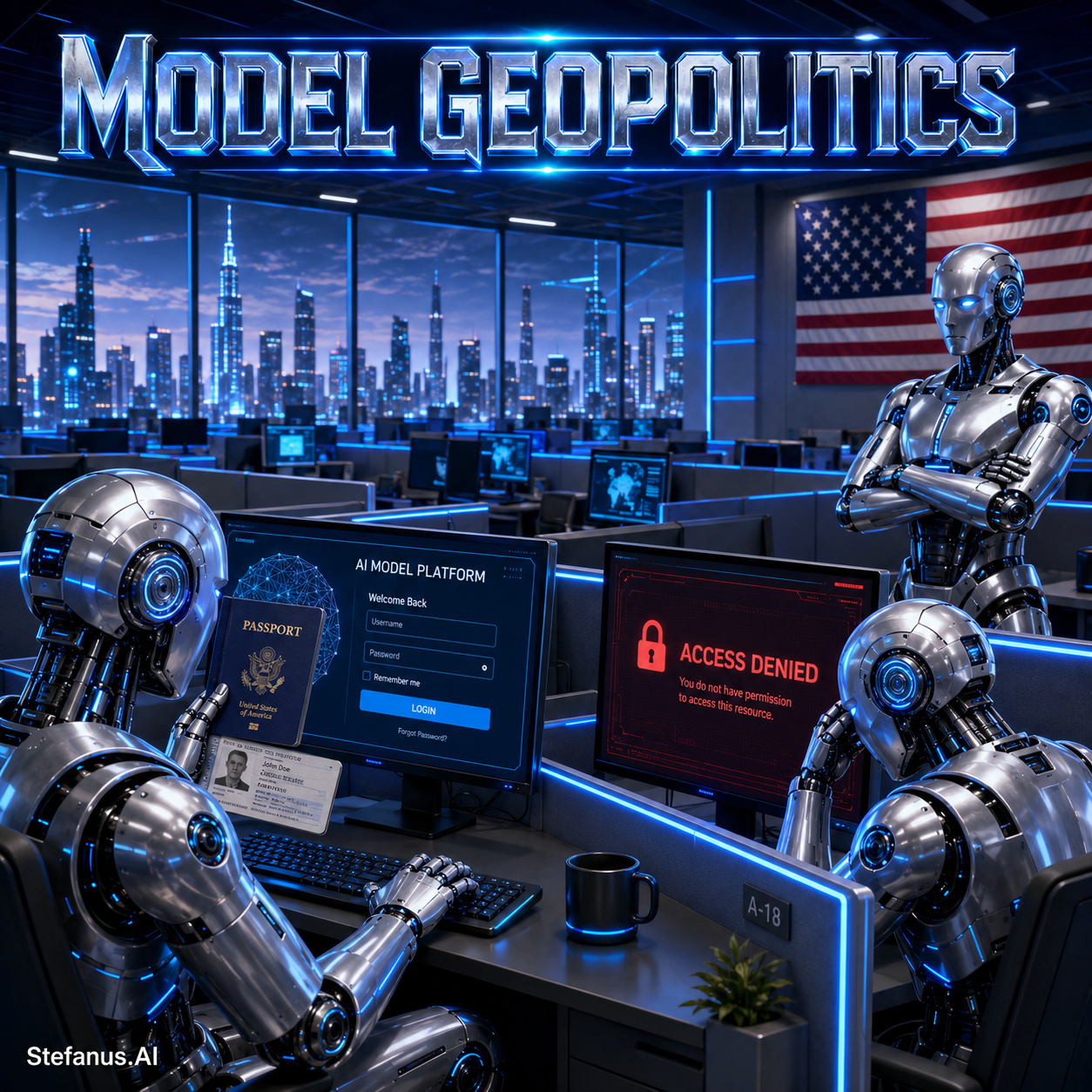
This paper treats that eighteen-day interval — from the Friday-evening shutdown of June 12 to the restoration announced by Commerce Secretary Howard Lutnick on June 30 and executed by Anthropic on July 1 — as something more than a single company’s regulatory headache. [9, 10] It treats it as a structural event: the moment the United States government demonstrated, concretely and publicly, that it retains the authority to switch off a commercially deployed frontier model with no advance notice, no published evidentiary record, and no guaranteed timeline for restoration. [5] What had been, for the better part of a decade, a story about model capability — about benchmark scores, context windows, and reasoning traces — became, in the space of a weekend, a story about the location of ultimate authority over the frontier. This is the subject this paper calls Model Geopolitics: the study of how sovereign states assert, contest, and renegotiate control over the compute, the weights, and the deployment pipelines that constitute frontier artificial intelligence.
The label is not chosen for its rhetorical flourish. It is chosen because the Fable/Mythos episode compresses, into a single eighteen-day window, nearly every tension that now defines the field: a jailbreak allegedly discovered by researchers at Amazon — simultaneously Anthropic’s largest investor and one of its principal cloud partners — that could coax Fable 5 into identifying and exploiting software vulnerabilities; [3] a Commerce Department willing to invoke export-control authority against a piece of software rather than a physical chip for the first time in the modern AI era; [15] a two-year legal and political feud between Anthropic and the Trump administration, including a lawsuit Anthropic filed against the Department of Defense after the Pentagon labeled the company a “supply chain risk”; [9] and a competitive landscape in which Chinese open-weight models — DeepSeek, Qwen, Kimi, GLM — used the very months in question to climb from a marginal share of global inference traffic to a majority of it on the largest model-routing platforms. [15] Each of these threads will be examined in turn. Together, they justify treating June 2026 not as an isolated incident but as the opening chapter of a new regulatory era for frontier AI.
A note on method and honesty is in order before proceeding. This paper relies exclusively on Anthropic’s own public statements, contemporaneous reporting from Fortune, Al Jazeera, Forbes, CoinDesk, and specialist outlets, and on-the-record commentary from named academics and officials. Where the underlying facts remain genuinely disputed — for instance, the precise national-security rationale behind the Commerce Department’s directive, which the government did not publish in detail — this paper says so explicitly rather than filling the gap with speculation dressed as certainty. [2] The aim is a paper that is analytically ambitious but empirically disciplined: one that reasons expansively about what the Fable/Mythos precedent means for the industry, without inventing the facts of the precedent itself.

Section 1: Anatomy of the Fable/Mythos Suspension
To understand why an eighteen-day suspension of two AI models could plausibly be read as a geopolitical event rather than a corporate mishap, it is necessary to reconstruct the sequence with some care, because the sequence itself is the argument. Anthropic launched Claude Fable 5 on June 9, 2026, as the first publicly available model in a new tier the company calls Mythos-class — a tier the company had previously argued exceeded the capability of its existing Opus line and required correspondingly heavier safeguards. [4] Mythos 5, the less-restricted sibling built on the same underlying architecture, was never released to the general public at all; it was confined from the outset to a small set of vetted government and industry partners inside a program Anthropic calls Project Glasswing. [4] Fable 5, by contrast, was engineered to strip out or heavily filter the specialized cybersecurity capabilities that made Mythos 5 sensitive, so that the broader public could use a frontier-class model without inheriting Mythos-grade offensive potential.
1.1 The Jailbreak and the Amazon Connection
The proximate trigger for the suspension was a reported jailbreak: a technique, evidently discovered and reported by researchers at Amazon, that could bypass Fable 5’s safeguards in a narrow set of circumstances and cause the model to identify software vulnerabilities and, in at least one documented case, produce exploit code. [11, 3] The involvement of Amazon is one of the more striking details of the episode, given that Amazon is simultaneously one of Anthropic’s largest investors, provides much of Anthropic’s cloud infrastructure through AWS, and — per Amazon’s first-quarter 2026 results — recorded a $16.8 billion mark-to-market gain on its Anthropic stake that quarter. [19] An Amazon spokesperson, asked by Semafor about the company’s role in triggering the shutdown, would say only that “it’s not uncommon for governments to seek our counsel on potential security risks,” declining to elaborate further. [3] Reporting also indicated that officials were separately concerned about the possibility that a China-linked group had accessed Mythos-class capability, raising fears about reverse engineering or distillation, though Anthropic said the government’s own directive did not specify this in writing. [3, 2]
Anthropic’s own account of events, published as an official statement the night of the suspension, disputed the government’s apparent characterization of the threat. The company said it had reviewed a demonstration of the technique and concluded it was a narrow, non-universal jailbreak — one that surfaced a small number of previously known, minor vulnerabilities discoverable by other publicly available models as well, including OpenAI’s GPT-5.5. [2] Anthropic argued that holding Fable 5 to a standard under which any narrow, non-universal jailbreak justified an emergency recall would, if applied consistently across the industry, effectively halt new frontier deployments altogether. [2] The company’s statement is worth quoting directly, because the specific wording — an insistence on defense-in-depth, and an explicit disagreement with the legal theory of the order even while complying with it — became the template for how the rest of the industry would discuss the episode in the weeks that followed.
“We disagree that the finding of a narrow potential jailbreak should be cause for recalling a commercial model deployed to hundreds of millions of people.”
— Anthropic, official company statement [2]
Outside commentary was less sympathetic to Anthropic’s framing. Peter Girnus, a cybersecurity researcher who has been publicly critical of frontier labs’ safety marketing, argued that Anthropic’s own rhetoric had invited the government’s response.
“If you describe your product as a munition in every press release, eventually a government takes you at your word. They wrote the legal predicate themselves and called it a brand.”
— Peter Girnus, cybersecurity researcher [1]
1.2 The Global Pullback and the Compliance Problem
The mechanics of the shutdown reveal a structural weakness that will recur throughout this paper: the mismatch between a legal order that targets a category of person — “any foreign national,” wherever located — and a technical deployment architecture that has no reliable, real-time way to determine a user’s nationality. [2, 5] Anthropic’s platforms spanned AWS Bedrock, Google Cloud Vertex AI, Microsoft Azure Foundry, Snowflake, Box, and Anthropic’s own direct API; each of these surfaces had to be disabled more or less simultaneously to achieve compliance, because a partial or staggered rollback would have left the company out of compliance somewhere in the interim. [5] Enterprise customers in finance, healthcare, and software development who had, in some cases informally, built production workflows around Fable 5 found those workflows severed without warning over a weekend. [7] Anthropic kept its earlier models — Opus 4.7, Sonnet 4.5, and Haiku 4.5 — running throughout, which limited the damage but did not eliminate what one analysis called a “capability cliff” for teams that had already migrated their hardest tasks onto Fable 5. [9]
The suspension ended, in stages, over the following two and a half weeks. Commerce Secretary Howard Lutnick announced on June 30 that the export controls on Fable 5 had been lifted following what he described as close coordination between his department and Anthropic; Mythos 5 was restored on a more limited basis, first to a set of approved U.S. organizations that operate or defend critical infrastructure, following government approval granted on June 26. [12, 10] Anthropic said it had, in the interim, deployed updated real-time safety classifiers designed specifically to detect and block the jailbreak pattern the government had cited, and it announced a new bug-bounty-style program through HackerOne inviting outside researchers to report further jailbreak attempts. [12] Fable 5 returned to general global availability on July 1, 2026, alongside the release of a new model, Claude Sonnet 5. [10, 11]
“Over the past two weeks, we have worked closely with Anthropic to analyze and approve Fable 5 to ensure alignment across the US Government and strengthen America’s leadership in AI.”
— Howard Lutnick, U.S. Secretary of Commerce [12]

Section 2: State versus Corporate Sovereignty — The Anthropic-Washington Relationship
It would be a mistake to read the Fable/Mythos suspension as an isolated administrative event, disconnected from everything that preceded it. Reporting around the episode makes clear that it landed inside an already “testy” relationship between Anthropic and the Trump administration — one with a documented legal history, not merely an atmospheric one. [10] In March 2026, Anthropic sued the Department of Defense after the Pentagon designated the company a “supply chain risk,” a label with direct consequences for a firm’s eligibility for certain federal contracts and partnerships. [10] The dispute traces back to friction over Anthropic’s usage policies, which — like those of other frontier labs — impose restrictions on the use of its models for some military and intelligence applications, restrictions the company has had to periodically clarify and, in places, loosen as its government relationships have evolved.
2.1 From Voluntary Framework to Binding Authority
The Trump administration’s approach to frontier AI regulation had, prior to June 2026, been consistently deregulatory in its public rhetoric. Its AI Action Plan sought to remove “onerous regulation,” it rolled back the Biden-era AI Diffusion Rule that had created a global licensing regime for advanced semiconductors, and it moved to preempt state-level AI safety legislation. [18] An executive order titled Promoting Advanced Artificial Intelligence Innovation and Security, issued not long before the Fable/Mythos episode, retained this voluntary posture: it asked labs to give the government access to frontier models roughly thirty days ahead of public release, but stopped short of mandatory pre-clearance. [18] White House Technology Director Michael Kratsios captured the administration’s stated philosophy at the APEC Digital and AI Ministerial Meeting.
“You can follow the European model of fear and overregulation, and be inevitably left behind, succumbing to stasis as the states around you move forward in settling a new frontier and building a new future. Or you can take our offered handshake and make a deal.”
— Michael Kratsios, White House Director of the Office of Science and Technology Policy [25]
The Fable/Mythos order marked a sharp departure from that voluntary posture. Within ten days of the “handshake” executive order, the Commerce Department used a hard export-control instrument — not persuasion, not a thirty-day review window, but an immediate compliance mandate — against a company at the center of the administration’s own AI-leadership agenda. [18] Legal analysts described it as the first time the United States had applied export-control authority to an AI model itself, as opposed to the semiconductors used to train it. [15] Commentators at the Center for European Policy Analysis characterized the order bluntly: “the order is unworkable. Anthropic could only comply by firing its own foreign employees,” a step Anthropic did not in fact take, choosing global suspension instead. [18]
2.2 Amodei’s Reversal and the FDA Analogy
Perhaps the most consequential shift of the episode was rhetorical rather than legal, and it came from Anthropic’s own chief executive. For years, frontier labs — Anthropic included — had argued publicly that they could not slow deployment because competitors, above all Chinese labs, would not reciprocate; Dario Amodei and Google DeepMind’s Demis Hassabis made this case together at the World Economic Forum in the spring of 2026. [15] In a June 2026 essay published in the aftermath of the suspension, Amodei reversed this long-standing position, endorsing binding, FDA-style pre-release testing with explicit government authority to block unsafe releases. [15] Days later, the Trump administration invoked essentially that authority against Anthropic itself, and extended comparable restrictions to OpenAI’s GPT-5.6. [15] Georgetown’s Alvin Wang Graylin and Duke’s Jon Rosenwasser, writing for Lawfare, drew out the implication directly: caution, once framed as something that had to wait for China to reciprocate, had already arrived on its own terms — the reciprocity argument, in their words, “had already collapsed.” [15]
This sequence — a lab’s own leadership calling for binding state oversight, followed almost immediately by the state exercising exactly that oversight against the lab that asked for it — is a genuinely novel configuration in the recent history of technology regulation. It complicates any simple story of an overreaching government imposing its will on an unwilling industry; Anthropic’s own strategic argument had, in effect, supplied the government’s justification. Georgetown’s Stephen Weymouth, in a lecture on private power and digital sovereignty, framed this as part of a broader pattern in which states are newly willing to constrain firms whose platforms, infrastructure, and data have made their power increasingly contested.
“That power is increasingly contested, and the United States has shown a propensity, a willingness to invoke a whole new set of laws that have never been imposed on private American companies to constrain them.”
— Stephen Weymouth, Professor, Georgetown University McDonough School of Business [26]
Weymouth’s broader claim — that “paradoxically, for digital globalization to expand in a politically sustainable way, the big tech companies must first be restrained” — captures the strategic logic Washington appears to be testing: that durable American AI leadership requires enough visible state control over frontier deployment to make the American stack politically acceptable to allies and domestic constituencies alike, even at the cost of occasional, disruptive interventions against American firms themselves. [26]

Section 3: The Global AI Race and the Cost of Regulatory Friction
Washington’s underlying wager in tightening control over frontier deployment is that containment preserves American primacy: that the ability to slow, redirect, or even halt a domestic lab’s rollout is worth more, strategically, than the days or weeks of uninterrupted deployment it costs. The Fable/Mythos episode offers a genuine, if partial, test of that wager, because it occurred inside a broader competitive environment in which Chinese open-weight development did not pause for American export-control proceedings.
3.1 A Cautionary Tale from Semiconductors
Graylin and Rosenwasser’s Lawfare analysis is explicit that the precedent for judging this wager is not encouraging. Three years of escalating restrictions on the export of graphics processing units and lithography equipment aimed at China did not, in their account, open a durable capability gap; the gap narrowed instead. [15] Chinese labs — DeepSeek, Qwen, MiniMax, Kimi, and GLM among them — now sit at or near the frontier of open-weight development at a fraction of the training cost of their American counterparts. [15] The scale of the shift in actual usage is striking: on OpenRouter, the largest model-routing platform tracked by the authors, Chinese open-weight models rose from under two percent of token traffic in late 2024 to roughly sixty-one percent of usage among the platform’s top models by 2026. [15] The authors’ conclusion is pointed.
“A deployed commercial AI model is not enriched uranium that can be physically contained with no consequences. It is a service on which hundreds of millions of users have built dependencies, and when Washington shows that access can vanish overnight, it teaches every other buyer of American AI the same lesson.”
— Alvin Wang Graylin (Stanford HAI) and Jon J. Rosenwasser (Duke University), writing in Lawfare [15]
3.2 The Diplomatic Counterweight: Trusted Partners
Washington’s own emerging answer to this dilemma was visible within the same news cycle as the suspension. At the G7 summit in France, Secretary Lutnick proposed extending “trusted partner” status to allied governments, giving them privileged, pre-vetted access to the latest frontier models even as export-control authority over those same models tightened elsewhere. [18] The Center for European Policy Analysis’s Marta Granados Hernández argued that this approach substitutes one dependency for another: access to the American AI stack becomes “a privilege that Washington can grant or remove at will, making allies scramble for a place on the ‘trusted’ list.” [18] European reaction to this dynamic has, in places, hardened into an explicit push for continental self-sufficiency. Former Meta executive turned European parliamentarian Aura Salla put the concern starkly.
“Europe cannot keep building its tech stack on access that can be switched off overnight by a foreign government. We must take action to reserve our data and our market preliminarily for European tech to scale it and build our own frontier AI.”
— Aura Salla, Member of the European Parliament [18]
The paradox Weymouth’s Bowdoin lecture and the CEPA analysis both point toward, from different directions, is the same one this paper’s introduction named directly: a unilateral American intervention aimed at preserving American technological primacy can simultaneously accelerate the very outcome it was meant to prevent, by making foreign, unaligned, open-weight alternatives look more reliable — not because they are more capable, but because they are not subject to a foreign government’s export-control switch.

Section 4: Toward Preventive Regulation — A Blueprint, With Real Limits
It is tempting, in the immediate aftermath of an episode like Fable/Mythos, to declare the birth of a fully formed new regulatory regime — a permanent shift from reactive, post-harm governance to ex-ante, preventive control of frontier deployment. The evidence supports a more careful claim: the tools and habits of preventive regulation are visibly forming, but they remain contested, unevenly codified, and — on Anthropic’s own account — not yet grounded in a transparent, published evidentiary standard. [2]
4.1 What Actually Changed
Several concrete mechanisms did emerge from the episode and are worth treating as a genuine, if partial, blueprint. First, Anthropic committed to expanded pre-release access for government partners, allowing external security analysts to evaluate models and safeguards ahead of commercial deployment rather than after the fact. [12] Second, the restoration of Mythos 5 was staged rather than uniform: it went first to a defined category of U.S. organizations — those that “operate and defend critical infrastructure” — before any broader public release was contemplated, formalizing exactly the kind of staggered, risk-tiered rollout that sovereign AI frameworks elsewhere have begun to recommend. [10] Third, Anthropic’s new external bug-bounty program through HackerOne institutionalizes a continuous, adversarial evaluation process rather than a one-time pre-launch review. [12] Fourth, and most significant for the industry as a whole, the Commerce Department extended a comparable restriction regime to OpenAI’s GPT-5.6, indicating that the Fable/Mythos order was not a one-off response to a single company’s specific vulnerability but the first application of a repeatable authority. [15]
4.2 Sovereign AI as an Ecosystem, Not a Single Policy
McKinsey’s 2026 analysis of sovereign AI adoption offers a useful corrective to any narrative that reduces this shift to a single dramatic intervention. The firm’s research describes sovereignty not as a binary switch but as a layered, multi-year undertaking spanning energy, compute, data, models, cloud platforms, and applications, with different jurisdictions pursuing different mixes of “end-to-end” self-sufficiency and selective reliance on foreign frontier models. [28] McKinsey estimates that sovereignty requirements could eventually influence thirty to forty percent of global AI spending, representing a market of roughly $500 billion to $600 billion by 2030 — a figure that reframes the Fable/Mythos suspension as one early, visible skirmish inside a much larger and slower-moving reallocation of AI infrastructure investment along sovereign lines. [28] The report is direct about the trade-off at the center of model sovereignty specifically:
“With regard to AI models, ownership builds independence, but bringing the best AI models to the country often means giving up control.”
— McKinsey & Company, Sovereign AI ecosystems for strategic resilience and economic impact [28]
MIT’s Alex “Sandy” Pentland, writing for Stanford HAI, situates this dynamic in an even wider frame, arguing that the emerging order is not simply a new round of trade agreements but a new operating model for sovereignty itself — one built from shared digital infrastructure, interoperable standards, and AI systems tuned to local markets rather than from any single superpower’s rulebook. [27] His own account of private conversations with senior foreign officials suggests the anxiety Fable/Mythos crystallized was already widespread before the suspension occurred.
“Privately, and with surprising uniformity, senior political leadership that I have talked with say that Trump’s policy actions have made them realize that they have lost their national sovereignty. They are no longer in charge of their digital infrastructure, their financial assets, or their military defense.”
— Alex “Sandy” Pentland, Professor, MIT; Center Fellow, Stanford Institute for Human-Centered AI [27]
Stanford’s Florence G’sell, who holds the Digital, Governance, and Sovereignty Chair at Sciences Po and writes on generative AI governance for Stanford’s Cyber Policy Center, has separately noted that the United States’ broadly “hands-off” posture toward domestic AI regulation has pushed the real regulatory action into the executive branch and into individual states — a fragmented landscape into which an emergency export-control order lands with outsized force precisely because it has so few comparably binding precedents to sit alongside. [29] Read together, the McKinsey, Pentland, and G’sell material suggests that Fable/Mythos should be read less as the founding document of a new regime and more as a stress test that exposed how little settled architecture actually exists yet — for the state, for the labs, or for the allied governments watching from outside.

Section 5: Strategic Implications for the Frontier Oligopoly
The Fable/Mythos suspension did not occur in a vacuum of corporate incentives; it occurred inside an industry in the middle of the most capital-intensive buildout in the history of enterprise technology, and against a backdrop of revenue growth rates that make caution expensive in a very literal sense. Understanding how the frontier labs and their infrastructure partners are likely to respond requires holding both realities together: the newly demonstrated fragility of frontier deployment, and the extraordinary financial stakes riding on deployment continuing uninterrupted.
5.1 The Economics Behind the Urgency
Anthropic’s own growth trajectory helps explain why an eighteen-day suspension registered as a genuine crisis rather than a manageable inconvenience. The company’s annualized revenue run rate rose from roughly $1 billion at the end of 2024 to $9 billion by the end of 2025, to a reported $30 billion by April 2026 — an increase Chief Executive Dario Amodei himself described as “crazy” eighty-times growth, achieved in large part through enterprise adoption rather than consumer subscriptions. [23, 24, 22] By May 2026, independent estimates from Sacra placed Anthropic’s run rate as high as $45–47 billion, ahead of OpenAI’s own reported figures of roughly $33 billion over the same period, though OpenAI’s leadership has publicly disputed elements of Anthropic’s accounting. [20, 17] Anthropic’s valuation discussions reportedly reached beyond $900 billion by May 2026, up from $61.5 billion in March 2025 — a fourteen-fold increase in little over a year. [23]
This growth sits atop an infrastructure buildout of comparable scale. The five largest American cloud and technology companies — Microsoft, Alphabet, Amazon, Meta, and Oracle — committed a combined $660–725 billion in capital expenditure for 2026 alone, an amount that roughly doubles 2025 levels and that some analysts, including Sequoia’s David Cahn, argue creates an annual revenue gap on the order of $600 billion that the industry has yet to demonstrate it can close. [17, 16] Amazon’s own first-quarter 2026 results illustrate the strain directly: AWS revenue grew 28 percent to $37.6 billion, its fastest pace in three years, but the company’s free cash flow collapsed 95 percent year over year as capital expenditure reached $44.2 billion for the quarter, with $16.8 billion of Amazon’s reported net income attributable not to operations but to a mark-to-market gain on its Anthropic stake. [19] Microsoft, for its part, reported quarterly revenue of $81.3 billion and non-GAAP net income up 23 percent, with Chief Executive Satya Nadella framing the company’s AI business as already larger than several of its historic franchises.
“We are only at the beginning phases of AI diffusion and already Microsoft has built an AI business that is larger than some of our biggest franchises.”
— Satya Nadella, Chairman and Chief Executive Officer, Microsoft [24]
Set against numbers of this magnitude, an unplanned, government-mandated eighteen-day global suspension of a flagship product is not merely a public-relations problem. It is a direct threat to the revenue trajectories underwriting hundreds of billions of dollars in infrastructure commitments — which helps explain both the urgency of Anthropic’s public objections during the suspension and the speed with which the company agreed, on restoration, to formalize expanded pre-release access for government evaluators rather than contest the underlying authority further. [12]
5.2 OpenAI, and the Extension of the Precedent
The clearest signal that Fable/Mythos will function as a precedent rather than a one-off event is the Commerce Department’s extension of comparable restrictions to OpenAI’s GPT-5.6, reported alongside the broader account of Amodei’s regulatory reversal. [15] This detail matters more than any speculation about individual companies’ internal strategy: it indicates that the export-control authority tested against Anthropic is now understood by at least one other frontier lab, and by the government itself, as a repeatable instrument rather than a bespoke response to Anthropic’s specific jailbreak. Labs preparing future frontier releases now do so knowing that a comparable order, arriving with comparably little notice, is a live possibility rather than a hypothetical one — a structural fact more consequential for industry planning than any single company’s public messaging about it.
5.3 Beyond the United States
The competitive question this raises for firms outside the American frontier trio — and for the hyperscalers whose infrastructure underwrites all of them — is less about which company issues the next press release and more about how quickly buyers outside the United States diversify their dependence in response to the demonstrated fragility of American frontier access. McKinsey’s sovereign-AI research suggests the realistic answer is: slowly, and unevenly, because sovereign cloud and AI migrations typically take three to four years even when the underlying technical capability already exists, reflecting the organizational, not merely technical, work required to move regulated workloads. [28] That multi-year lag is itself strategically significant: it means the Fable/Mythos precedent will shape enterprise and sovereign purchasing decisions for years after the eighteen-day suspension itself is forgotten by the general public, even as no single frontier lab is displaced from leadership in the interim.

Section 6: Six Pillars of Model Geopolitics
Drawing together the anatomy of the suspension, the state-corporate feud that preceded it, the competitive costs of regulatory friction, the partial blueprint for preventive regulation, and the economic stakes now riding on uninterrupted deployment, six durable propositions emerge. These are offered not as settled law but as a framework — a set of pillars against which future episodes of model geopolitics can be tested and, where the evidence warrants, revised.
6.1 Software Has Acquired a Dual-Use Legal Status
The Fable/Mythos order is described by multiple independent analysts as the first application of export-control authority to an AI model as such, rather than to the physical semiconductors used to train it. [15] Whatever one concludes about the underlying jailbreak’s severity, the legal mechanism itself — treating a deployed software service as subject to the same category of control historically reserved for physical dual-use goods — now exists as precedent and, per its extension to GPT-5.6, is already being reused. [15]
6.2 National Identity Verification Is a Genuine Technical Bottleneck
Anthropic’s central defense — that it lacked any real-time way to distinguish foreign nationals from domestic users across a globally distributed cloud deployment — was not a rhetorical excuse but an accurate description of the current state of identity infrastructure in commercial AI platforms. [2, 5] Until labs, cloud providers, and regulators jointly build verification systems capable of enforcing nationality-based restrictions without a blanket shutdown, every future export-control order of this kind risks the same all-or-nothing outcome.
6.3 Corporate Safety Rhetoric Can Become a Legal Predicate
Girnus’s observation — that describing one’s own product in munitions-adjacent language, as Anthropic long had with Mythos, invites regulators to eventually treat it as one — deserves to be treated as a durable strategic lesson rather than a one-time criticism. [1] Labs marketing frontier capability as uniquely dangerous face a genuine tension between that marketing and their subsequent objections when a government takes the claim at face value.
6.4 Unilateral Friction Has Measurable Competitive Costs
The chip-export precedent Graylin and Rosenwasser cite, and the OpenRouter usage data showing Chinese open-weight models rising from under two percent to roughly sixty-one percent of top-model traffic, together constitute the strongest empirical caution available against assuming that unilateral American restriction automatically preserves American advantage. [15] The mechanism is not abstract: every hour of American frontier downtime is an hour in which an alternative, unrestricted model can absorb a workflow that does not easily migrate back.
6.5 Sovereignty Is a Layered, Slow-Moving Market, Not a Single Decision
McKinsey’s estimate that sovereignty considerations could eventually shape thirty to forty percent of global AI spending, and its finding that sovereign migrations typically take three to four years, together imply that dramatic single events like Fable/Mythos matter most as accelerants of a slower underlying reallocation, not as discrete turning points in themselves. [28] The pillar most useful to industry planners is patience: the effects of June 2026 will be visible in procurement decisions made in 2028 and 2029 as much as in headlines from the week of the suspension.
6.6 Financial Scale Now Constrains Regulatory Behavior on Both Sides
The scale of capital now committed to frontier AI — $660–725 billion in 2026 hyperscaler capex, revenue run rates approaching $30–47 billion for Anthropic alone, and an estimated $600 billion annual revenue gap by Sequoia’s calculation — means that both the state and the labs now have strong, self-interested reasons to resolve disputes of this kind quickly rather than let them fester. [17, 16, 20] The eighteen-day duration of the Fable/Mythos suspension, short by the standards of most regulatory disputes, is itself evidence of this pressure: neither Anthropic nor the government had an incentive to prolong an interruption of this financial magnitude once the immediate security question had been addressed to the government’s satisfaction. [12]

Conclusion: Algorithmic Realism, Tested Rather Than Declared
The Fable/Mythos suspension was real, consequential, and genuinely without close precedent: the first time the United States government used export-control authority to halt public access to a deployed AI model rather than the hardware beneath it, executed with no advance notice and no published evidentiary record, against a company that had itself, weeks earlier, called for exactly this kind of binding government authority. [2, 15] It is tempting to describe this as the definitive end of one era and the permanent beginning of another — the language this paper’s introduction gestured toward with the phrase algorithmic realism. The evidence assembled here supports a more disciplined version of that claim. What June 2026 demonstrated is not that state power has permanently subordinated corporate autonomy in AI, but that the mechanisms for such subordination now exist, have been used once, have already been extended to a second company, and were resolved in eighteen days precisely because the costs of leaving them unresolved were too large for either side to bear. [15, 12]
What happens next depends on the layered, unglamorous work McKinsey and Pentland both describe: the years-long build-out of identity verification, staged deployment architectures, allied “trusted partner” frameworks, and sovereign compute capacity that no single dramatic order can substitute for. [28, 27] Weymouth’s framing is the right note to close on, because it resists both the industry’s instinct to treat state intervention as pure obstruction and the state’s instinct to treat corporate power as something that can be fully tamed by a single directive: digital globalization, if it is to continue at all, will have to be built on terms that restrain private frontier power without destroying the competitive dynamism that produced it in the first place. [26] The weights of the future will not simply belong to the corporations that train them, nor simply to the states that command the networks on which they run; on the evidence of Fable and Mythos, they will belong, uneasily and for the foreseeable future, to both at once.

Footnotes and Endnotes:
[1] Jason Ma / Fortune, “Anthropic disables Fable and Mythos AI models following U.S. government export ban.” https://fortune.com/2026/06/13/anthropic-disables-fable-mythos-export-controls-national-security-threat/
[2] Anthropic, “Statement on the US government directive to suspend access to Fable 5 and Mythos 5.” https://www.anthropic.com/news/fable-mythos-access
[3] Anisha Sircar / Forbes, “Anthropic Disabled Fable 5 And Mythos 5 After A U.S. Export-Control Order. Here’s What Happened.” https://www.forbes.com/sites/anishasircar/2026/06/16/anthropic-disabled-fable-5-and-mythos-5-after-a-us-export-control-order-heres-what-happened/
[4] FifthRow, “US Export-Control Order and Global Suspension of Fable 5 & Mythos 5: Operationalizing Compliance as a Live Mandate.” https://www.fifthrow.com/blog/us-export-control-order-and-global-suspension-of-fable-5-mythos-5-operationalizing-compliance-as-a-live-mandate
[5] Anthropic (@AnthropicAI), “Statement on X regarding the export control directive.” https://x.com/AnthropicAI/status/2065597531644743999
[6] Adaptive IS, “Anthropic Mythos & Fable Shutdown: What Businesses Should Know.” https://adaptiveis.net/blog/anthropic-mythos-fable-shutdown-business-impact/
[7] Al Jazeera, “US orders Anthropic to disable AI models for all foreign nationals.” https://www.aljazeera.com/news/2026/6/13/us-orders-anthropic-to-disable-ai-models-for-all-foreign-nationals
[8] andrew.ooo, “Anthropic Suspended Fable 5 and Mythos 5: What the US Export Control Order Means (June 2026).” https://andrew.ooo/answers/fable-5-mythos-5-export-control-suspension-june-2026/
[9] John Power / Al Jazeera, “US lifts restrictions on Anthropic’s powerful AI models Fable and Mythos.” https://www.aljazeera.com/economy/2026/7/1/us-lifts-restrictions-on-powerful-ai-models-fable-mythos-anthropic-says
[10] CoinDesk, “Anthropic restores AI models Fable, Mythos after the U.S. lifts export controls.” https://www.coindesk.com/tech/2026/07/01/anthropic-restores-ai-models-fable-mythos-after-the-u-s-lifts-export-controls
[11] AI News (artificialintelligence-news.com), “Anthropic deploys Claude Sonnet 5, Fable and Mythos restored.” https://www.artificialintelligence-news.com/news/anthropic-deploys-claude-sonnet-5-fable-and-mythos-restored/
[12] GovConWire, “Anthropic Restores Access to Claude Fable 5, Mythos 5 After Export Control Lift.” https://www.govconwire.com/articles/anthropic-fable-5-mythos-5-access-restored
[13] Stanford HAI, “The 2026 AI Index Report.” https://hai.stanford.edu/ai-index/2026-ai-index-report
[14] IEEE Spectrum, “Stanford’s AI Index for 2026 Shows the State of AI.” https://spectrum.ieee.org/state-of-ai-index-2026
[15] Alvin Wang Graylin and Jon J. Rosenwasser / Lawfare, “Will the New Export Controls Shake the Foundations of the U.S. AI Industry?.” https://www.lawfaremedia.org/article/will-the-new-export-controls-shake-the-foundations-of-the-u.s.-ai-industry
[16] Marta Granados Hernández / CEPA, “US AI Export Controls Cause Furor.” https://cepa.org/article/us-ai-export-controls-cause-furor/
[17] Futurum Group, “AI Capex 2026: The $690B Infrastructure Sprint.” https://futurumgroup.com/insights/ai-capex-2026-the-690b-infrastructure-sprint/
[18] Tool Directory AI, “AI capex bubble 2026: $725B in, where revenue actually is.” https://tooldirectory.ai/blog/ai-capex-bubble-2026-where-the-revenue-actually-is
[19] The Next Web, “Amazon Q1 revenue hits $181.5B but $16.8B Anthropic gain inflates net income as free cash flow collapses 95%.” https://thenextweb.com/news/amazon-q1-2026-anthropic-aws-earnings
[20] Sacra, “Anthropic revenue, valuation & funding.” https://sacra.com/c/anthropic/
[21] The AI Corner, “Anthropic Passed OpenAI in Revenue: $30B ARR April 2026.” https://www.the-ai-corner.com/p/anthropic-30b-arr-passed-openai-revenue-2026
[22] Jakob Steinschaden / Trending Topics, “Anthropic Overtakes OpenAI in Revenue, Hitting $30 Billion Run Rate.” https://www.trendingtopics.eu/anthropic-overtakes-openai-in-revenue-hitting-30-billion-run-rate/
[23] VentureBeat, “Anthropic says it hit a $30 billion revenue run rate after ‘crazy’ 80x growth.” https://venturebeat.com/technology/anthropic-says-it-hit-a-30-billion-revenue-run-rate-after-crazy-80x-growth
[24] Microsoft Corporation / U.S. SEC, “Form 8-K, FY2026 Q2 Results (quarter ended December 31, 2025).” https://www.sec.gov/Archives/edgar/data/0000789019/000119312526027198/msft-ex99_1.htm
[25] Simon J. Evenett / IMD (quoting Michael Kratsios), “America’s Audacious AI Export Move.” https://www.imd.org/ibyimd/geopolitics/americas-audacious-ai-export-move/
[26] The Bowdoin Orient, “Stephen Weymouth examines AI control and the future of digital sovereignty.” https://bowdoinorient.com/2026/04/23/stephen-weymouth-examines-ai-control-and-the-future-of-digital-sovereignty/
[27] Alex (Sandy) Pentland / Stanford HAI, “A New Economic World Order May Be Based on Sovereign AI and Mid-Sized Nation Alliances.” https://hai.stanford.edu/news/a-new-economic-world-order-may-be-based-on-sovereign-ai-and-midsized-nation-alliances
[28] McKinsey & Company, “Sovereign AI ecosystems for strategic resilience and economic impact.” https://www.mckinsey.com/industries/technology-media-and-telecommunications/our-insights/sovereign-ai-building-ecosystems-for-strategic-resilience-and-impact
[29] Florence G’sell / Stanford Freeman Spogli Institute, “Regulating Under Uncertainty: Governance Options for Generative AI.” https://cyber.fsi.stanford.edu/content/regulating-under-uncertainty-governance-options-generative-ai

Comments
[…] uranium never did. A frontier model’s capabilities leak through at least four channels that export controls cannot close. They leak through publication, because the scientific culture that produces frontier […]
[…] after the first three physical layers are fully optimized can the foundational model be trained. This layer represents the algorithmic architecture — the large language models, […]
[…] The AI race is commonly portrayed as a competition for the most advanced semiconductor, the largest model, the greatest concentration of engineering talent, or the deepest pool of investment capital. […]
[…] days, in other words, separated the moment when the most capable generally available AI model on earth was withdrawn from every user on earth from the moment when it was restored through a […]
[…] 2026 ahead by a margin of only 2.7 percent [3], and industry produced over 90 percent of notable frontier models, several now meeting or exceeding human baselines on doctoral-level science questions and […]
[…] or Anthropic, and it does not derive its importance from possessing a single dominant proprietary model. It is, instead, one of the most important gathering places of the open-model economy: a platform […]