
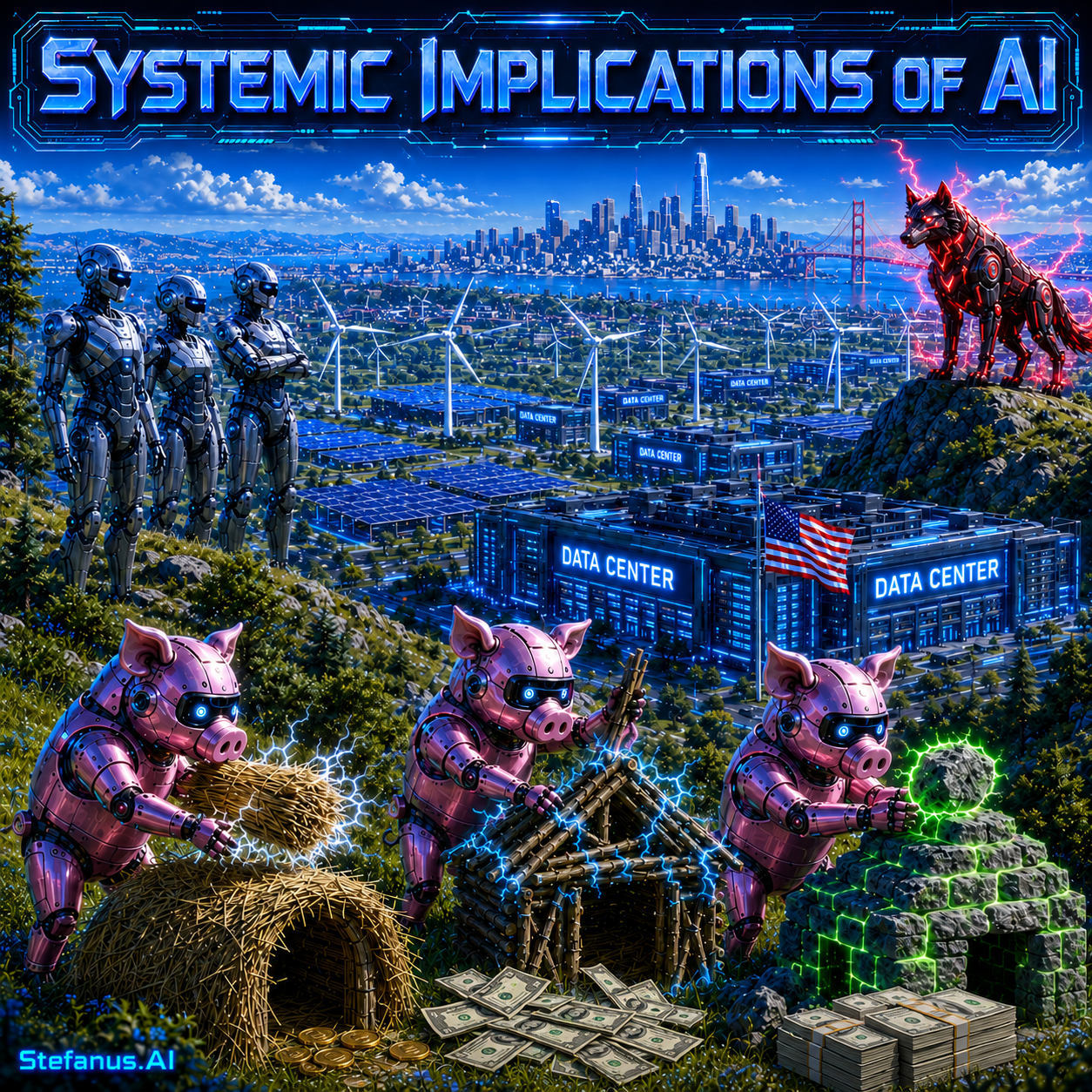

Introduction: The Three Houses and the Hungry Wolf
When I first sketched the outline of this paper, my mind drifted, unexpectedly, to the oldest of children’s parables: The Three Little Pigs. Three brothers leave home to seek their fortunes, and each builds a house to shelter against a hungry wolf. The first pig, prizing speed and thrift above all, throws up a house of straw; the wolf huffs, puffs, and levels it in a breath. The second pig, a touch more prudent but still unwilling to spend, builds in sticks—cheaper materials, faster construction—and his house, sturdier than the first, nonetheless collapses under the same gale. Only the third pig, who labors long and pays dearly for brick and mortar, builds a structure that stands when the wolf finally arrives and exhausts himself against the walls.
It is a fable about the price of permanence, and it maps with almost eerie precision onto the global contest now underway over artificial intelligence. The house of sticks is the model of AI being built today in China—pragmatic, cost-disciplined, engineered around less powerful, sanction-constrained accelerators and a homegrown chip-making base that has lifted its self-sufficiency from roughly 15 percent in 2019 to about 25 percent in 2025. [43] The house of brick is the strategy of the United States and its allies, who pay extraordinary sums for the most advanced GPUs that Nvidia and Taiwan Semiconductor can produce, and who pour hundreds of billions into colossal data centers that drink rivers of power. The brick house stands—for now. But the parable, retold for the age of compute, carries a twist the original never imagined.
In the fairy tale, the wolf is a fixed adversary: he huffs, he puffs, and the physics of his lungs never change. In the AI economy, the wolf is the velocity of the technology itself. Models change not by the season but, it sometimes feels, by the second—new architectures, new training recipes, new efficiencies that render last year’s frontier ordinary. The question this paper presses, again and again, is therefore sharper than the one the third pig faced. It is not merely whether brick beats straw. It is whether the cost of building in brick—the trillion-dollar bet on physical, depreciating, power-hungry infrastructure—can possibly be justified when the thing the bricks are meant to house is mutating faster than the mortar can dry. Should the hyperscalers, in other words, keep spending as if the wolf will always huff the same way?
This study answers that question across six movements. First, it argues for the materiality of AI: the necessity of dragging the academic and market discourse down from the cloud of intangible software and into the heavy, contested, physical world of fabs, substations, copper, and concrete. Second, it documents the 2026 capex supercycle—an unprecedented, tech-led capital surge that has reshaped global supply chains and rewritten national energy strategy. And third, it follows that surge to its logical terminus: the capital drain, the stranded asset, and the capex anxiety that now stalks the very firms doing the spending. The title of this paper, Systemic Implications of AI, is not a prophecy. It is a diagnosis of the present.

Section 1 — The 2026 Infrastructure Boom: Geopolitical Hubs and Hardware Monopolies
The Deep Premise
For three decades, the dominant intellectual habit when thinking about computing was to treat it as weightless. Software “ate the world,” in the famous phrase, precisely because it seemed to do so without mass—an idea, copied infinitely at zero marginal cost, escaping the frictions of geography and matter. Artificial intelligence has shattered that illusion. The frontier model is not weightless; it is the most physically demanding artifact the information economy has ever produced. To train and serve it requires a tightly choreographed stack of advanced lithography, exotic packaging, high-bandwidth memory, custom networking, megawatts of firm power, and millions of gallons of cooling water—each link in the chain concentrated, in many cases, in a single firm, a single island, or a single regional grid. The result is that compute has acquired the one property that converts an economic input into a geopolitical asset: it cannot be easily moved, copied, or replaced. This section maps the chokepoints.
1.1 The New “Straits of Hormuz”: Taiwan and the Geography of Advanced Silicon
Every era of geopolitics has its physical chokepoint—a narrow passage through which a disproportionate share of the world’s lifeblood must flow, and whose closure would convulse the global system. For oil, it was the Strait of Hormuz. For compute, it is the island of Taiwan, and more precisely the back-end packaging lines clustered around it. Taiwan Semiconductor Manufacturing Company fabricates an estimated 72 percent of the world’s leading-edge foundry output; South Korea’s SK Hynix and Samsung together command roughly 88 percent of the high-bandwidth memory market that feeds every AI accelerator; and a single chokepoint technology—TSMC’s Chip-on-Wafer-on-Substrate, or CoWoS, advanced packaging—has become the true binding constraint on the supply of frontier chips. [12]
The concentration is almost difficult to overstate. Projections placed Taiwan at roughly 45 percent of global advanced-packaging capacity entering 2026, and Nvidia alone is reported to have booked more than half of TSMC’s entire CoWoS allocation for 2026 and 2027. [13] TSMC’s own chief executive has acknowledged that CoWoS capacity is effectively sold out through 2026, forcing the company to spread overflow work to outside packaging houses such as ASE and Amkor even as it scales its in-house lines roughly fourfold under a $56 billion capital program. [14][16]
CoWoS capacity remains extremely tight and is sold out through 2026.
— C. C. Wei, Chief Executive Officer, TSMC [14]
Geography compounds the fragility. Even chips fabricated at TSMC’s flagship Arizona facility must, today, still travel back to Taiwan for advanced packaging; Nvidia’s Blackwell-class accelerators are stitched together through CoWoS processes that Arizona is not scheduled to replicate at scale until close to 2029. [15] This is the uncomfortable truth beneath every sovereign “re-shoring” announcement: for the remainder of this decade, the most consequential machines in the world economy converge on a strait of silicon a hundred miles wide, within artillery range of a rival superpower. The brick house, it turns out, has a single load-bearing wall—and it is not in America.
1.2 Sovereignty Versus Hyperscale Dominance
If the hardware layer narrows to an island, the cloud layer narrows to a boardroom. A recent Epoch AI estimate found that just five American hyperscalers—Amazon, Google, Meta, Microsoft, and Oracle—controlled roughly 71 percent of global AI compute as of April 2026, up from 63 percent only two years earlier. [22] That figure is the quiet center of gravity of twenty-first-century power. When the capacity to train and run advanced models is held by a handful of firms domiciled in one country, every other nation faces a structural choice it never consented to: rent your cognitive infrastructure from a foreign corporation, or be excluded from the frontier altogether.
This is the asymmetric dependency that has driven the global scramble for “sovereign AI.” Stanford’s 2026 AI Index documents the response in hard numbers: between 2018 and 2025, Europe and Central Asia expanded their state-backed AI supercomputing clusters from 3 to 44, while whole regions of the Global South have managed only a handful between them; through 2024, East Asia and the Pacific had enacted 77 data-localization measures, with sub-Saharan Africa and Europe close behind. [41] Sovereignty, once a matter of borders and currency, is being redefined as the capacity to own one’s own compute—and most of the world does not.
1.3 The Data-Center Gold Rush: Land, Copper, Concrete, and Water
Beneath the abstraction of “the cloud” lies a startlingly literal land grab. A modern AI cluster is a civil-engineering megaproject: tens of thousands of tons of steel and concrete, vast reserves of cooling water, and astronomical quantities of copper for the power distribution that feeds the racks. The competition for these inputs has become its own theater of conflict. The International Energy Agency reports that wait times for critical grid components such as large transformers and high-voltage cables have roughly doubled in the past three years, while gas-turbine deliveries now stretch years into the future—so much so that the agency estimates around 20 percent of planned data-center projects are at risk of delay purely because the physical supply chain cannot keep pace. [17]
The IEA frames the capital intensity with a memorable comparison: an AI-focused data center is roughly ten times more capital-intensive than an aluminium smelter, which is why the prospect of curtailing one to stabilize a grid is so economically painful. [17] The “gold rush” metaphor is therefore precise in a way its users rarely intend. Like the original, it is less about the gold than about the picks, shovels, water rights, and rail lines—and like the original, it is generating booms and busts in the supplying industries (transformers, switchgear, liquid cooling, turbines) long before the miners themselves know whether the claim will pay out.
1.4 The Energy Chokepoint: When the Grid Becomes the Battlefield
Of all the physical constraints, electricity is the one that converts a corporate buildout into a question of national security. Global data-center electricity demand grew an estimated 17 percent in 2025, and demand from AI-specific data centers surged roughly 50 percent in a single year. [18] The IEA’s base case projects total data-center consumption nearly doubling from about 415 terawatt-hours in 2024 to roughly 945 terawatt-hours by 2030—a figure that, were data centers a country, would rank among the largest electricity consumers on Earth. [19][20]
Crucially, the burden is not evenly spread. Because data centers concentrate in specific places, they account for more than 20 percent of all electricity-demand growth in advanced economies through 2030, even as they remain a smaller share globally. [17] Harvard’s Belfer Center has chronicled the strain in Virginia, the densest data-center market on the planet, where rapid load growth has compressed utility planning horizons, triggered the first base-rate increase in a generation, and forced grid operators to rethink the very definition of firm service. [21] The lesson is stark: in the age of AI, local energy security has become a direct proxy for AI dominance. The nation that cannot power the cluster cannot host the frontier—and the grid, not the algorithm, becomes the battlefield.

Section 2 — Macroeconomic Shockwaves: The Great 2026 Capex Explosion
The Deep Premise
There is a moment in every capital cycle when an investment program stops being a corporate decision and becomes a macroeconomic event—when the sums involved are large enough that they distort interest rates, redirect national savings, and reshape the price of unrelated goods. The 2026 AI capex supercycle is that moment. The four largest American hyperscalers alone guided toward roughly $725 billion of capital expenditure for the year, up about 77 percent from 2025’s already-record $410 billion, with credit analysts pushing the top-five total toward $750 billion—a third consecutive year of growth exceeding 60 percent. [3][2] Goldman Sachs now models a cumulative $5.3 trillion of capital spending across the big four hyperscalers between 2025 and 2030. [5] Numbers of this magnitude do not stay inside the technology sector. They leak.
2.1 Capital Divergence: The Great Liquidity Diversion
Capital is finite, and every dollar routed into a GPU cluster is a dollar not routed somewhere else. The first-order macroeconomic consequence of the supercycle is therefore a vast diversion of liquidity away from traditional manufacturing, non-AI venture capital, and consumer-facing investment, and toward the construction of digital infrastructure. The clearest evidence is in the free-cash-flow lines of the spenders themselves. Alphabet’s trailing-twelve-month free cash flow fell to $64.4 billion even as quarterly free cash flow compressed to $10.1 billion, and the company raised its 2026 capex guidance to $180–$190 billion. [7] Amazon’s trailing free cash flow collapsed roughly 95 percent to about $1.2 billion, with a single quarter’s $44.2 billion in capital expenditure flipping quarterly free cash flow deeply negative. [8][6]
The market noticed the strain, and named it. The capital-light, asset-light business model that made the platform companies the most profitable enterprises in history is being deliberately abandoned in favor of something far heavier and far riskier—a transformation that one asset manager captured with surgical bluntness:
Zuckerberg’s once capital-light money machine may be morphing into a capital-intensive incinerator.
— Dec Mullarkey, Managing Director, SLC Management [9]
That single image—the money machine becoming an incinerator—is the macroeconomic anxiety of 2026 distilled to a sentence. When the most cash-generative firms on the planet voluntarily torch their free cash flow to build depreciating infrastructure, the capital they consume is withdrawn from the wider pool that funds everything else. The supercycle is not merely large; it is rivalrous.
2.2 Supply-Chain Inflationary Spillovers
The second-order shock is inflationary, and it travels through the bill of materials. The breakneck construction of AI clusters has bid up the price of the specialized components they require—advanced packaging, high-bandwidth memory, and the heavy electrical equipment that connects a campus to the grid. By 2026, memory was on track to consume roughly 30 percent of hyperscaler data-center spending, a fourfold increase over 2023, and Deloitte’s 2026 outlook projected memory-component price spikes on the order of 50 percent by mid-year. [9][47]
These are not contained within the data center. As memory producers redirected output toward higher-margin AI customers, they starved the consumer-electronics supply chain, contributing to a forecast that the global smartphone market would suffer its largest annual decline on record in 2026. [47] Apple, citing higher component and chip costs, raised prices on its MacBook and iPad lines—an AI-infrastructure cost surfacing, improbably, on a household receipt. [46] The transformer and turbine shortages chronicled by the IEA add an industrial-inflation channel that touches every electrified sector, not merely computing. [17] In the age of the supercycle, the cost of training a model and the cost of a new phone have become quietly, structurally linked.
2.3 The Geopolitical Wealth Gap: The Deepening AI Divide
The third shock is distributional, and it falls hardest on those furthest from the buildout. UNCTAD’s Technology and Innovation Report 2025 estimates that the United States captures roughly 70 percent of global private AI investment, that just 100 firms—overwhelmingly American and Chinese—account for some 40 percent of the world’s corporate research-and-development spending, and that the AI market could reach $4.8 trillion by 2033, a value comparable to the entire German economy. [23] Yet 118 countries, mostly in the Global South, are absent from the major forums where AI governance is being written at all. [24]
History has shown that technological progress drives growth but does not on its own ensure equitable distribution.
— Rebeca Grynspan, Secretary-General, UNCTAD [24]
The UN Development Programme sharpened the warning in its December 2025 report, The Next Great Divergence, arguing that unmanaged AI could reverse decades of narrowing global inequality by widening the gaps in economic performance, human capability, and governance simultaneously. [25] The structure of the divide is the cruelty of it: developing nations are leveraged as sources of raw-material extraction—the copper, the cobalt, the rare earths that the clusters consume—while being almost wholly excluded from the high-value infrastructural layer that the materials enable. UNCTAD’s 2026 update found foreign direct investment growing more geographically concentrated still, with roughly 75 percent of flows to developing economies captured by just ten countries. [26] The supercycle, in short, is not lifting all boats. It is raising a few yachts and lowering the tide.

Section 3 — Echoes of History: The Telecom Overbuild and the 2027 Timeline
The Deep Premise
History does not repeat, but capital cycles rhyme with unusual fidelity, because they are driven by the same human sequence: a genuine technological breakthrough, a rational rush to build the infrastructure it requires, an over-extrapolation of demand, a wave of debt-financed overcapacity, and finally a brutal repricing when the revenue fails to arrive on schedule. The most instructive precedent for the AI buildout is not the dot-com equity mania of consumer websites but the less-remembered telecom and fiber-optic overbuild of 1998–2001, when carriers laid vastly more capacity than the market could use for a decade. The parallels are structural, not merely rhetorical, and they point toward a specific and approaching date.
3.1 The Telecom Overbuild (1998–2001) as a Proxy
In the late 1990s, convinced that internet traffic would double every hundred days, telecommunications firms borrowed hundreds of billions to bury fiber-optic cable across continents. The conviction was not wrong about the internet; it was wrong about the timing. When the anticipated demand failed to materialize on the borrowed timetable, the result was the infamous “dark fiber” glut—strands of perfectly good cable lying unused and unlit, their owners bankrupt, their assets eventually sold for pennies on the dollar to the survivors who would, a decade later, make fortunes from them. The fiber was real and ultimately valuable. The capital structure built to finance it was not.
The contemporary echo is precise. Analysts now draw the data-center buildout directly against the fiber overbuild, warning that grid-interconnection delays of up to seven years, material-cost inflation of around 40 percent, and debt-fueled expansion risk leaving a generation of facilities to become the “dark fiber” of the AI age. [27] The debt itself recalls the era: the five largest cloud firms raised roughly $108 billion in bonds in 2025 and issued another $100 billion in early 2026, with Morgan Stanley projecting hyperscaler debt issuance of $250–$300 billion for the year and a wave of GPU-collateralized and data-center-securitized lending layered on top. [40]
3.2 The Monetization Lag: Building Ahead of Demand
The defining structural flaw of the dot-com era was the monetization lag—the multi-year gap between when infrastructure was built and when the demand to fill it actually arrived. The AI cycle exhibits the same gap, and the most rigorous evidence comes from inside the enterprise. MIT’s NANDA initiative, in its widely cited study The GenAI Divide: State of AI in Business 2025, found that roughly 95 percent of enterprise generative-AI pilots delivered no measurable impact on profit and loss, with the share of companies abandoning most AI initiatives jumping to 42 percent in 2025 from 17 percent a year earlier. [28]
The 95% failure rate for enterprise AI solutions is the clearest manifestation of the GenAI Divide.
— Aditya Challapally, Lead Author, MIT NANDA [28]
The macroeconomic counterpart of that micro-failure is the productivity puzzle. The Nobel laureate Daron Acemoglu of MIT has, against the industry’s euphoria, modeled the realistic gains with disciplined modesty—estimating that AI will raise total factor productivity by well under one percent over a decade, and lift U.S. GDP by perhaps 1.1 to 1.6 percent in the same span, an order of magnitude below the boosters’ promises. [30][31] His diagnosis of why is, for a paper about infrastructure, the crux of the matter:
We’re using it too much for automation and not enough for providing expertise and information to workers.
— Daron Acemoglu, Institute Professor, MIT [31]
A review of the empirical evidence published in early 2026 reinforced the caution, finding largely null or modest aggregate labor-market effects despite rapid adoption—adjustment “at the margin” rather than the wholesale transformation the capex implicitly assumes. [29] If the productivity gains are real but slow, and the infrastructure is built fast and financed with debt, the monetization lag is not a footnote. It is the fault line.
3.3 From Supply Constraint to Overcapacity
The final movement of the historical analogy is the phase transition from scarcity to glut. Through most of 2025 and into 2026, the binding story was supply constraint: compute brokers described demand outpacing supply at ratios as extreme as fifty to one, and even four-year-old Nvidia H100 accelerators were re-renting at rising rates, hoarded by operators who refused to sell inventory worth more in their own racks than on their balance sheets. [37] Scarcity of that intensity is intoxicating; it makes overbuilding feel not merely safe but mandatory.
But scarcity is precisely the condition that breeds overcapacity, because every rational actor races to build into the shortage at once, and the capacity arrives in a lumpy wave long after the orders are placed. The fiber glut of 2001 was born in the fiber shortage of 1999. The open question this paper poses is whether the AI clusters of 2027—financed against contracted demand that may or may not convert, depreciating on schedules that short-sellers such as Michael Burry argue understate the true economic life of a GPU by as much as $176 billion across the big spenders over 2026–2028—will be the dark fiber of their generation. [11][36] The supply constraint of today is the overcapacity of tomorrow, hiding in plain sight.

Section 4 — 2027 and Beyond: The Great Capital Drain, the Compute Cold War, and Capex Anxiety
The Deep Premise
Every supercycle ends, and the manner of its ending is determined by what the spenders do at the precise moment that capital discipline reasserts itself against capital euphoria. This section argues that 2027 is the likely inflection point—the year in which lagging commercial return on investment, mounting pressure on free cash flow, and a more hawkish cost of capital collide to force the hyperscalers to cap or freeze the budgets they raised so triumphantly in 2026. The consequences ripple outward in three waves: a sharp investment-reversal cliff, a stranded-asset trap, and a hardening of techno-nationalist protectionism that I have elsewhere called the Algorithmic Iron Curtain.
4.1 The Investment-Reversal Cliff: From Building to Renting
The first and most telling signal that the cycle is maturing is behavioral: the largest builders are beginning, quietly, to rent. The logic is one of risk transfer. AI hardware depreciates with frightening speed—a $30,000 GPU can be substantially obsolete in a few years—so leasing capacity from specialized “newcloud” providers lets a hyperscaler convert capital expenditure into operating expenditure and, critically, leaves someone else holding the depreciating asset if demand cools. [39] The frontier labs are pioneering the all-of-the-above procurement model: Anthropic’s compute portfolio now spans CoreWeave for production workloads, Google and Broadcom TPUs, Amazon’s Trainium, Microsoft and Nvidia capacity on Azure, and—in a May 2026 deal—tens of billions of dollars of leased allocation from Elon Musk’s xAI, including access to the 300-megawatt Colossus cluster. [38][37]
I have analyzed the architecture of these partnerships at length in earlier work in this series, tracing xAI’s entangled datacenter relationships with Anthropic and Google, and Meta’s decision to rent grid-scale batteries from Tesla Energy rather than build its own—both early tremors of the same shift from owning to renting. [49][50] The deeper question is whether the newcloud layer is a permanent stratum of the AI stack or merely a temporary relief valve for a supply shortage. McKinsey’s historical reminder is sobering: during the Cloud 1.0 era of the early 2000s, a wave of firms that plugged compute gaps were, once the hyperscalers expanded their own capacity, almost all “acquired, sidelined, or forced into niche roles.” [37]
The hyperscalers themselves are not blind to the reckoning. When Alphabet’s chief financial officer told investors that 2027 capital expenditure would “significantly increase” over 2026, the stock did not rally on the ambition—it sold off on the implication of multi-year free-cash-flow compression. [10] That inversion of the usual reflex, where a promise to invest is punished rather than rewarded, is the precise market signature of capex anxiety. The question hanging over every earnings call is no longer whether the firms can spend, but whether they should—and whether they have begun, however quietly, to suspect the answer is no.
4.2 The Stranded-Asset Trap
If 2027 brings the freeze, it also brings the trap. A stranded asset is one that has become economically unviable before the end of its accounting life, and the centralized AI mega-cluster is unusually exposed to the condition. It is enormous, fixed, located for reasons of power availability rather than commercial flexibility, and depreciating against a hardware roadmap that obsoletes it every eighteen months. Should the contracted demand underwriting it fail to convert—should the enterprise monetization documented by MIT continue to lag—the cluster does not gently wind down. It sits underutilized, hungry for power it can no longer commercially justify, and fast-depreciating on a balance sheet whose debt was raised against the assumption of full utilization. [28][40]
There is, moreover, a financial circularity that makes the trap more dangerous than a simple overbuild. Three of the four hyperscalers booked large non-cash gains in the first quarter of 2026 from their equity stakes in the very AI labs that have committed to buying their compute—Alphabet recording some $36.8 billion in equity gains, much of it a markup on its Anthropic stake, and Amazon recording $16.8 billion on the same investment. [11] The flywheel—hyperscalers funding model labs, labs committing to multi-year cloud contracts, mark-to-market gains on those labs flattering reported earnings—spins beautifully so long as private-market valuations keep rising. Reverse it, and the stranded data center is joined by a stranded earnings line. The vulnerability is not that any single contract fails; it is that the entire financing architecture depends on liquidity remaining accommodative across a build cycle measured in years.
4.3 Model Protectionism and the Algorithmic Iron Curtain
A capital-starved landscape is fertile ground for techno-nationalism, and the final consequence of the coming drain is geopolitical fragmentation. When compute is scarce and expensive, states stop treating it as a commodity and start treating it as a strategic reserve—to be hoarded, licensed, and weaponized. The machinery is already assembling. The advanced lithography that China cannot yet domestically replicate remains under ASML export restriction; Beijing has answered with state investment exceeding $143 billion and a self-sufficiency drive that has lifted domestic content from 15 to 25 percent in six years. [43] Washington, for its part, has oscillated between restriction and concession—approving, then debating, the export of Nvidia’s H200 to China while Congress advances bills such as the GAIN and SAFE Chips Acts to harden the regime and even fund remote-disabling telemetry on deployed chips. [44]
In earlier work I traced how a single act of model protectionism—the blocking of a frontier lab’s access—knocked down a layer of what Nvidia’s Jensen Huang has called the five-layer AI economy, and signaled the rise of what I termed the Algorithmic Iron Curtain: a world of fragmented technological blocs, aggressive export controls, and chip hoarding. [51] The 2027 capital drain accelerates that curtain’s descent, because scarcity converts every node of the supply chain into a potential instrument of coercion. And yet, as analysts at Chatham House and elsewhere have argued, the chokepoint logic is fraying at the edges: controls work only as long as the controlling power maintains them consistently, and middle powers, wary of outsourcing their security to a stack they do not own, are responding precisely by building sovereign capacity—deepening the very fragmentation the controls were meant to prevent. [41]

Section 5 — What Have We Learned? Six Pillars of Infrastructure Resilience
If the preceding sections diagnose the disease, this one prescribes the regimen. The lesson of the supercycle is not that the AI buildout is a mistake—the technology is real, the demand is real, and the third pig was right to build in something sturdier than straw. The lesson is that resilience, not raw scale, is the property that survives the wolf when the wolf is velocity itself. Six pillars follow.
Pillar 1 — Structural Decentralization
The single most dangerous property of the current architecture is concentration: a handful of firms, one island, a few regional grids. Resilience demands a deliberate migration away from monolithic, geographically vulnerable mega-clusters toward distributed and edge-AI architectures that no single missile, embargo, or grid failure can decapitate. Decentralization is not merely a hedge against geopolitical targeting; it is, as the energy analysis showed, also the path to flexible load that grids can actually absorb.
Pillar 2 — Sovereign Compute Independence
Middle-power nations should not be forced into the binary of renting cognition from a foreign giant or being excluded from the frontier. Public-private blueprints—of the kind already proliferating from the Gulf to Southeast Asia—can establish local, independent data infrastructure that resists both corporate capture and foreign coercion. UNCTAD’s proposal for a shared global compute facility, giving all nations equitable access, belongs in this pillar as the multilateral complement to national effort.
Pillar 3 — Dual-Use Infrastructure Flexibility
The stranded-asset trap is survivable if the asset can pivot. Data-center designs should be engineered for dynamic re-purposing—able to shift from frontier training to general cloud compute, scientific and biotechnology workloads, or even grid-stabilization service if the AI cycle cools. A facility that can only train models is a bet on a single demand curve; a facility that can do five things is an option on the future, and options retain value precisely when forecasts fail.
Pillar 4 — Resource Hedging and Circular Supply Chains
The material chokepoints—copper, rare earths, advanced packaging, high-bandwidth memory—are vulnerable to embargo and price shock. Global recycling standards for precious metals and semiconductor components, alongside strategic stockpiling and a genuinely circular supply chain for decommissioned accelerators, would buffer the system against the kind of memory and rare-earth squeezes that rippled through the market in mid-2026.
Pillar 5 — Post-Bubble Macro Stabilization
Because the supercycle has bound macroeconomic stability to a single capex roadmap, central banks and global trade bodies need intervention frameworks ready before, not after, the freeze. The IMF’s own modeling—that a moderate AI-valuation correction could subtract several tenths of a percentage point from global output—should be the basis for pre-positioned stabilization tools to absorb the deflationary shock of a sudden capex contraction without it metastasizing into a broader credit event.
Pillar 6 — Counterparty and Financing Transparency
A pillar the original outline did not anticipate, but which the first-quarter 2026 disclosures make essential. The circular financing flywheel—hyperscalers funding the labs that buy their compute, then booking mark-to-market gains on those labs—demands radical transparency in depreciation schedules, GPU-collateralized debt, and the credit quality of take-or-pay counterparties. Resilience in a debt-financed buildout is, in the end, a function of whether the market can see the leverage clearly enough to price it before it breaks.

Section 6 — A Framework for Systemic Resilience and Resource Governance
The Deep Premise
Pillars describe what a resilient system looks like; governance describes how to build it before the crisis rather than after. The governing failure of every infrastructure cycle has been reactivity—regulators patching problems that mature capital has already created. The framework below proposes the opposite: a predictive, multilateral architecture that aligns the velocity of compute with the slower physics of energy, materials, and finance.
6.1 Predictive AI Impact Assessments
Policy must shift from reactive regulatory patching to predictive infrastructure and resource mapping. Just as environmental-impact assessments became a precondition for major construction, a class of compute-impact assessments should be required before a hyperscale cluster breaks ground—modeling its draw on the regional grid, its water footprint, its demand on transformer and turbine supply chains, and its stranded-asset risk under a range of demand scenarios. The IEA’s scenario-based methodology, which already models lift-off, base, and headwind cases for AI energy demand, offers a ready template for institutionalizing foresight. [18]
6.2 Multi-Stakeholder Resource Alignment
No single actor can align compute capacity with material limits, because the constraints are distributed across jurisdictions and industries. Governance therefore requires standing coordination among international regulatory bodies, national and regional grid operators, semiconductor and equipment manufacturers, and the technology developers themselves—a forum in which the buildout’s ambitions are continuously reconciled against the physical envelope of what the planet can actually supply. UNCTAD’s call to bring the 118 excluded nations into the governance conversation is not charity; it is a precondition for legitimacy, and for averting the divergence the UNDP warns is otherwise coming. [24][25]
The animating principle of both mechanisms is the same one the energy analysts keep returning to: the speed of the AI revolution is increasingly out of phase with the speed of the physical, social, and economic systems that must underpin it. [18] Governance, properly understood, is the work of re-synchronizing them—of ensuring that the bricks are laid no faster than the ground beneath them can bear the weight.

Conclusion: Why “Systemic Implications of AI” Matches the Current Market Reality
The title of this paper, Systemic Implications of AI, is not a speculative framework draped over an uncertain future. It is an exact diagnosis of a present that arrived while the paper was being written. As the historic first-quarter 2026 earnings reports revealed, the sheer scale of the investment has fundamentally bound macroeconomic stability to the AI infrastructure roadmap—so that one can no longer reason about the global economy without reasoning about capex guidance, and one can no longer reason about capex guidance without reasoning about the grid, the fab, and the wolf of velocity. The combined guided 2026 capital expenditure for the big four hyperscalers tells the story in a single column of figures.
| Hyperscaler | 2026 Guided Capex | Primary Driver |
| Amazon | ~$200 billion | AWS + logistics + custom silicon (Trainium) |
| Microsoft | ~$190 billion | Aggressive Azure capacity buildout |
| Alphabet | $180–$190 billion | Google Cloud acceleration + custom TPUs |
| Meta | $125–$145 billion | Core AI infrastructure (top-end revision) |
| Combined Big Four | ~$725–$750 billion | ~77% YoY surge from 2025’s ~$410 billion |
Sources: company guidance and analyst syntheses, Q1 2026. [1] [2] [3]
This monumental spending—a roughly 77 percent year-over-year surge—proves that AI has ceased to be a software race and become a macroeconomic capital diversion, one that squeezed free cash flow so hard that Alphabet’s fell sharply and Amazon’s collapsed some 95 percent under the weight of front-loaded infrastructure. [7][6] The market’s mood through the first-quarter calls was a defensive arms race: hyperscaler chief executives delivered a unified message that the risk of under-investing vastly outweighed the risk of over-spending, even as cloud revenues grew spectacularly—Google Cloud up 63 percent, AWS accelerating to 28 percent—and even as the first tremors of capex anxiety entered the discourse. [6]
What we should anticipate for the third quarter of 2026 is a reality check. The narrative is shifting from visionary infrastructure expansion to a granular demand audit, in which Wall Street will no longer accept vague promises of future agentic-computing revenue and will instead demand explicit evidence of enterprise-scale monetization to justify the $725 billion outlay. If those reports reveal that adoption is lagging the blistering pace of construction, it will mark the catalyst for the 2027 capital drain this paper has traced.
We did not have to wait long for a preview. In late June 2026—as this paper was being completed—the reckoning arrived in miniature. On June 23 and 24, a deepening AI selloff drove the Nasdaq down 2.2 percent in a single session, semiconductor indices shed more than a trillion dollars of value across the month, and the South Korean KOSPI halted trading as Samsung and SK Hynix fell sharply on fears that soaring component prices would finally squeeze the margins of the technology giants. [45][46][48]
The IMF had warned of exactly this dynamic. Its January 2026 World Economic Outlook modeled how a correction in AI valuations could subtract several tenths of a percentage point from global output, and its managing director had told investors, months earlier, to prepare for turbulence:
Buckle up: uncertainty is the new normal and it is here to stay.
— Kristalina Georgieva, Managing Director, IMF [34]
Pierre-Olivier Gourinchas, the Fund’s chief economist, was more precise about the mechanism, cautioning that a moderate correction in AI stock valuations, coupled with tighter financial conditions, could meaningfully reduce global output and that the spillovers could be broad because so much of the critical AI buildout is funded by private, unlisted, debt-financed firms. [33] Jeff Bezos, characteristically, offered the optimist’s framing—that this is an industrial rather than a purely financial bubble, and that even when it bursts, society may keep the inventions it leaves behind. [35] Both can be true. The fiber laid in 1999 was real and valuable; the companies that laid it still went bankrupt.
And so we return to the three houses. The brick house of the United States and its allies stands, formidable and expensive, against the wolf. But the wolf is no longer a creature of fixed lungs. It is the velocity of the technology itself, and the deepest finding of this paper is that velocity changes the calculus the third pig never had to face. When Daron Acemoglu observes that the truly transformative gains the spending implicitly assumes would require something close to artificial general intelligence—capability we do not yet have—he is, in effect, asking whether the bricks are being laid for a wolf that may not come, or may come in a form the walls were not designed to stop. [32]
For genuinely huge productivity gains from automation, we really, really need something close to AGI.
— Daron Acemoglu, Institute Professor, MIT [32]
That is the systemic implication of AI, stated plainly. The infrastructure is real, the geopolitics is real, the power demand is real, and the capital at stake is real enough to move the world economy. The uncertainty is not whether the buildout matters, but whether the houses being raised in 2026 will, in 2027, prove to be brick—or merely a more expensive and more leveraged kind of straw. The third pig worked hard and built to last. The open question of our decade is whether, this time, working hard and building expensive is the same thing as building to last. The thesis of this paper is that it is not—and that resilience, decentralization, and governance, not raw expenditure, are what will be standing when the wolf has finished huffing.

Footnotes and Endnotes:
[1] Reuters Morning Bid, reported in Yahoo Finance, “Hyperscalers Hit $700 Billion in 2026 AI Spending Plans” (May 2026). https://finance.yahoo.com/sectors/technology/articles/hyperscalers-hit-700-billion-2026-111243744.html
[2] CreditSights, “Tech: Raising Hyperscaler Capex 2026 Estimates” (Feb. 2026). https://know.creditsights.com/insights/tech-raising-hyperscaler-capex-2026-estimates/
[3] Six Point Ventures, “Big Tech AI Spending 2026: $725B Across MSFT, Google, Meta, Amazon,” Value Add VC (2026). https://valueaddvc.com/blog/big-tech-ai-capex-in-2025-microsoft-google-meta-amazon-and-the-spending-race
[4] Jordan Novet & Jake Dollarhide, CNBC, “Tech AI spending approaches $700 billion in 2026, cash taking big hit” (Feb. 6, 2026). https://www.cnbc.com/2026/02/06/google-microsoft-meta-amazon-ai-cash.html
[5] Goldman Sachs estimates, reported in Yahoo Finance, “Meta, Microsoft, Amazon, and Alphabet are about to spend a shocking amount” (2026). https://finance.yahoo.com/sectors/technology/article/meta-microsoft-amazon-and-alphabet-are-about-to-spend-a-shocking-amount-of-money-to-dominate-the-ai-era-115359575.html
[6] The Next Web, “Q1 2026 Big Tech earnings: $650 billion in AI capex and compute constraints” (Apr. 30, 2026). https://thenextweb.com/news/alphabet-amazon-meta-q1-2026-earnings-ai-cloud
[7] Alphabet Inc., 2026 Q1 Earnings Call, Investor Relations (Apr. 29, 2026). https://abc.xyz/investor/events/event-details/2026/2026-Q1-Earnings-Call-2026-nW8kCrBAKS/default.aspx
[8] MLQ.ai Research, “Amazon Q1 FY2026: AWS Hits Escape Velocity While CapEx Overwhelms Free Cash Flow” (May 2026). https://mlq.ai/research/amazon-q1-fy2026-aws-hits-escape-velocity-while-capex-overwhelms-free-cash-flow/
[9] Dec Mullarkey (SLC Management), quoted in Tom’s Hardware, “Big tech’s AI spending plans reach $725 billion” (Apr. 30, 2026). https://www.tomshardware.com/tech-industry/big-tech/big-techs-ai-spending-plans-reach-725-billion
[10] Anat Ashkenazi (Alphabet CFO), reported in “Alphabet Q1 2026 Earnings Reaction” (Apr. 30, 2026). https://www.heygotrade.com/en/blog/alphabet-q1-2026-earnings-reaction/
[11] Michael Burry depreciation analysis, reported in TechTimes (May 19, 2026). https://www.techtimes.com/articles/316801/20260519/amazon-free-cash-flow-fall-38-billion-12-billion-bullish-memo-circulating-justify-bigger.htm
[12] Digital in Asia, “The State of Asia’s AI Chip Race in 2026: TSMC, Samsung, and China’s Semiconductor Stack” (May 2026). https://digitalinasia.com/asian-ai-chip-race-tsmc-samsung-semiconductor/
[13] StartupHub.ai (from CNBC reporting), “AI Chip Bottleneck: Advanced Packaging Demands Accelerate” (Apr. 2026). https://www.startuphub.ai/ai-news/semiconductors/2026/ai-chip-bottleneck-advanced-packaging-demands-accelerate
[14] C. C. Wei (TSMC CEO), reported in Oplexa, “AI Chip Packaging Bottleneck: TSMC Crisis 2026” (Apr. 2026). https://oplexa.com/ai-chip-packaging-bottleneck-2026/
[15] Prism News, “Taiwan’s chip packaging bottleneck keeps U.S. AI supply chain dependent” (June 2026). https://www.prismnews.com/news/taiwans-chip-packaging-bottleneck-keeps-us-ai-supply-chain
[16] AI in Asia, “TSMC’s AI Packaging Capacity Is Running On Overdrive” (May 2026). https://aiinasia.com/greater-china/tsmc-cowos-ai-packaging-capacity-taiwan-supply-chain-2026
[17] International Energy Agency, “Energy and AI — Executive Summary” (2025–2026). https://www.iea.org/reports/energy-and-ai/executive-summary
[18] International Energy Agency, “Key Questions on Energy and AI — Executive Summary” (Apr. 2026). https://www.iea.org/reports/key-questions-on-energy-and-ai/executive-summary
[19] International Energy Agency, “Energy demand from AI,” Energy and AI (2025–2026). https://www.iea.org/reports/energy-and-ai/energy-demand-from-ai
[20] Brookings Institution, “Global energy demands within the AI regulatory landscape” (Apr. 2026). https://www.brookings.edu/articles/global-energy-demands-within-the-ai-regulatory-landscape/
[21] Mural et al., Belfer Center for Science and International Affairs (Harvard), “AI, Data Centers, and the U.S. Electric Grid: A Watershed Moment” (Feb. 10, 2026). https://www.belfercenter.org/research-analysis/ai-data-centers-us-electric-grid
[22] Epoch AI data, reported in The Daily Upside, “Neocloud Competition Heats Up” (2026). https://www.thedailyupside.com/technology/artificial-intelligence/burgeoning-neocloud-competition-heats-up-as-nebius-market-cap-approaches-coreweave/
[23] UN Trade and Development (UNCTAD), Technology and Innovation Report 2025 (Apr. 2025). https://unctad.org/news/ais-48-trillion-future-un-trade-and-development-alerts-divides-urges-action
[24] Rebeca Grynspan (UNCTAD Secretary-General), UN News, “AI’s $4.8 trillion future” (Apr. 3, 2025). https://news.un.org/en/story/2025/04/1161826
[25] United Nations Development Programme, “The Next Great Divergence: Why AI May Widen Inequality Between Countries” (Dec. 2, 2025). https://www.undp.org/asia-pacific/press-releases/ai-risks-sparking-new-era-divergence-development-gaps-between-countries-widen-undp-report-finds
[26] UN Trade and Development (UNCTAD), “AI investment boom risks widening global development divide” (May 6, 2026). https://unctad.org/news/ai-investment-boom-risks-widening-global-development-divide
[27] AInvest, “AI Data Center Overbuild: A Dot-Com Bubble Parallel” (Dec. 2025). https://www.ainvest.com/news/ai-data-center-overbuild-dot-bubble-parallel-2512/
[28] Aditya Challapally et al., MIT NANDA, “The GenAI Divide: State of AI in Business 2025,” reported in Fortune (Aug. 18, 2025). https://fortune.com/2025/08/18/mit-report-95-percent-generative-ai-pilots-at-companies-failing-cfo/
[29] International Center for Law & Economics, “AI, Productivity, and Labor Markets: A Review of the Empirical Evidence” (Feb. 5, 2026). https://laweconcenter.org/resources/ai-productivity-and-labor-markets-a-review-of-the-empirical-evidence/
[30] Daron Acemoglu, “The Simple Macroeconomics of AI,” Economic Policy (2025); MIT Shaping Work. https://shapingwork.mit.edu/research/the-simple-macroeconomics-of-ai/
[31] Daron Acemoglu, interview, MIT Technology Review, “A Nobel laureate on the economics of artificial intelligence” (Feb. 25, 2025). https://www.technologyreview.com/2025/02/25/1111207/a-nobel-laureate-on-the-economics-of-artificial-intelligence/
[32] Daron Acemoglu, interview, Fortune, “Nobel Laureate Daron Acemoglu on AI productivity” (June 21, 2026). https://fortune.com/2026/06/21/nobel-laureate-daron-acemoglu-ai-productivity-capitalism-democracy/
[33] Pierre-Olivier Gourinchas (IMF Chief Economist), Press Conference on the January 2026 World Economic Outlook Update (Jan. 21, 2026). https://www.imf.org/en/news/articles/2026/01/21/tr-01212026-weo-press-conference-on-release-of-the-january-2026-world-economic-outlook-update
[34] Kristalina Georgieva (IMF Managing Director), reported in CNBC, “IMF and Bank of England join growing chorus warning of an AI bubble” (Oct. 9, 2025). https://www.cnbc.com/2025/10/09/imf-and-bank-of-england-join-growing-chorus-warning-of-an-ai-bubble.html
[35] Jeff Bezos, reported by the Associated Press via Milwaukee Independent (Oct. 2025). https://www.milwaukeeindependent.com/newswire/global-financial-leaders-warn-ai-boom-may-inflating-dangerous-new-tech-bubble/
[36] ModulEdge, “Neocloud: How the GPU Cloud Business Works” (June 2026). https://www.moduledge.com/blog/neocloud
[37] Contrary Research, “Why 20% of Neoclouds Won’t Survive The AI Boom” (June 2026). https://research.contrary.com/report/why-20-of-neoclouds-wont-survive-the-ai-boom
[38] HyperFRAME Research, “CoreWeave Reaches a New Scale Threshold” (May 11, 2026). https://hyperframeresearch.com/2026/05/11/coreweave-reaches-a-new-scale-threshold-but-can-the-ai-neocloud-sustain-long-tail-demand/
[39] TeleGeography, “The Hyperscaler AI Arms Race: Reshaping Global Cloud Infrastructure” (2026). https://resources.telegeography.com/hyperscaler-ai-arms-race-reshaping-global-cloud-infrastructure
[40] Sourcery Intelligence, “The Hidden Financial Bubble in AI Infrastructure: Debt, GPU Collateral, and the Capex–Revenue Gap” (May 4, 2026). https://sourceryintel.com/reports/ai-infrastructure-financial-bubble
[41] Stanford HAI, The 2026 AI Index Report — Policy and Governance (Apr. 2026). https://hai.stanford.edu/ai-index/2026-ai-index-report/policy-and-governance
[42] Stanford HAI, The 2026 AI Index Report — Economy (Apr. 2026). https://hai.stanford.edu/ai-index/2026-ai-index-report/economy
[43] Contrary Research, “Deep Dive: Export Controls and the AI Race” (Nov. 2025). https://research.contrary.com/report/drawing-geopolitical-boundaries
[44] International Institute for Strategic Studies (IISS), “The US pivot on regulating AI diffusion” (Dec. 8, 2025). https://www.iiss.org/publications/strategic-comments/2025/12/the-us-pivot-on-regulating-ai-diffusion/
[45] Intellectia, “AI Stocks Selloff June 2026: Nasdaq Falls 2.2% as Tech Giants Tumble” (June 24, 2026). https://intellectia.ai/blog/ai-stocks-selloff-june-2026
[46] CNBC, “Global tech stocks fall as AI infrastructure costs mount” (June 26, 2026). https://www.cnbc.com/2026/06/26/global-tech-stocks-ai-infrastructure-costs-selloff-softbank-apple.html
[47] Kavout, “What Triggered the Recent Semiconductor Sell-Off” (June 2026), citing IDC and Deloitte 2026 outlooks. https://www.kavout.com/market-lens/what-triggered-the-recent-semiconductor-sell-off
[48] “AI bubble,” Wikipedia (accessed June 2026), summarizing the June 23, 2026 KOSPI trading halt and OpenAI commitments. https://en.wikipedia.org/wiki/AI_bubble
[49] Stefanus.AI, “Threesome GPU: Analyzing xAI’s Datacenter Partnerships with Anthropic and Google,” stefanus.ai. https://stefanus.ai/threesome-gpu-analyzing-xais-datacenter-partnerships-with-anthropic-and-google/
[50] Stefanus.AI, “Sleeping with the Frenemy: How Meta and Tesla Became Unlikely Partners in Powering the AI Machine,” stefanus.ai. https://stefanus.ai/sleeping-with-the-frenemy-how-meta-and-tesla-became-unlikely-partners-in-powering-the-ai-machine-and-what-it-reveals-about-the-new-economics-of-tech-rivalry-in-the-age-of-artificial-intelli/
[51] Stefanus.AI, “Model Protectionism: How the Anthropic Block Knocked Down the Second Layer of Jensen Huang’s Five-Layer AI Economy and Signals the Rise of the Algorithmic Iron Curtain,” stefanus.ai. https://stefanus.ai/model-protectionism-how-the-anthropic-block-knocked-down-the-second-layer-of-jensen-huangs-five-layer-ai-economy-and-signals-the-rise-of-the-algorithmic-iron-curtain/