
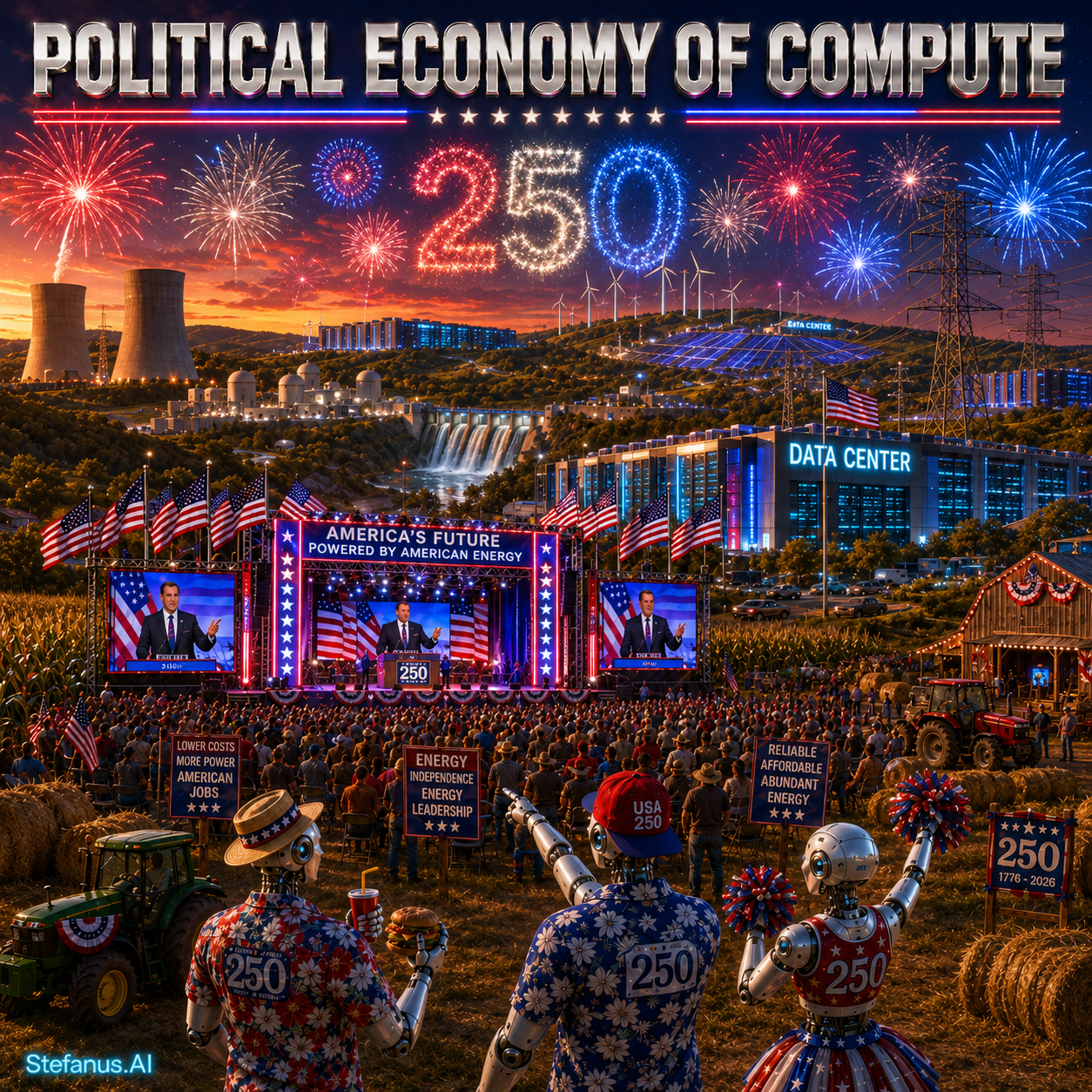

Introduction: The New Industrial Race
There is a quiet, almost unremarked irony sitting at the center of the artificial intelligence boom of the middle 2020s. The most valuable companies in the history of capitalism, firms whose products are made of language, pixels, and probability distributions, have discovered that their destiny is no longer decided in a research lab or a software sprint. It is decided in a permitting office in Loudoun County, on the floor of a turbine factory in Greenville, South Carolina, in a queue for grid interconnection that can run five years long, and in a fabrication plant on the western coast of Taiwan that no software engineer in Silicon Valley can will into existence any faster than physics and concrete allow. Tech executives who once measured their competitive advantage in pull requests and model parameters now find themselves, almost despite themselves, competing not against other software companies but against heavy industrial manufacturing plants, against national militaries, and against entire regional power grids for the same scarce inputs: turbines, transformers, skilled electricians, and high-voltage interconnection slots.
This is the founding observation of this paper, and it is the reason for its title. The modern race for artificial intelligence supremacy is not being won, in the end, by pure mathematics or by the cleverness of a transformer architecture. It is being won, layer by layer, by concrete, copper, steel, and raw electricity. Capital expenditure by just five technology companies surged past $400 billion in 2025 and is set to climb by a further 75 percent in 2026[1], a single-industry investment wave that the International Energy Agency now ranks as larger than global investment in oil and natural gas production combined. The United States alone now hosts 5,427 data centers, more than ten times any other country on Earth[2], and a single foreign company, the Taiwan Semiconductor Manufacturing Company, fabricates nearly every leading-edge chip on which this entire apparatus depends. Compute, in short, has stopped being a backend utility quietly humming in a server closet. It has become the primary material engine of twenty-first-century geopolitics, reshaping national security doctrine, the structure of capital markets, and the contours of the global energy system all at once.
Why, then, title this paper “Political Economy of Compute” rather than reach for a flashier metaphor, such as calling compute “the new oil” or “the new global currency”? The answer is deliberate, and I would argue institutionally durable. “Compute” is not a metaphor. It is the literal, physical substrate: the semiconductor supply chains that begin in a handful of fabrication plants, the trillions of dollars of capital expenditure now flowing through bond markets and private credit vehicles, the high-voltage transmission infrastructure straining under the weight of artificial intelligence factories, and the silicon itself, etched at a scale measured in single-digit nanometers. “Political economy” situates this physical reality inside the oldest and most serious tradition of inquiry into how states, markets, and power interact. Together, the phrase captures something that catchier metaphors obscure: this is not a temporary commodity shock that will pass once supply catches up to demand. It is a structural reorganization of the relationship between technology firms and the state, comparable in scale and permanence to the politics of coal in the nineteenth century or oil in the twentieth.
This paper exists to serve a narrower and more urgent purpose than grand theorizing alone, however. With the 2026 midterm election now barely four months away, and with the nation having just marked its 250th anniversary of independence this very week, candidates running for the House of Representatives and the United States Senate are being asked, almost daily, to take a position on artificial intelligence, on the data centers metastasizing across their districts, on the electricity bills their constituents are now opening with dread, and on whether the federal government should be subsidizing, regulating, or restraining an industry that simultaneously promises American technological supremacy and imposes very real costs on the communities hosting its physical infrastructure. This paper offers candidates, their staff, and the journalists and voters evaluating them a structured way to think through these questions, organized around an original analytical framework I call the Five-Layer AI Economy, adapted from the conceptual “five-layer cake” popularized by NVIDIA chief executive Jensen Huang to describe the technology stack underpinning artificial intelligence. Where Huang’s framing was built to explain a technology stack to investors, this paper repurposes the same five layers — energy, chips, data centers, models, and applications — to explain a political economy to candidates. Each section that follows drills into what is actually happening, as of the early summer of 2026, within one layer of that stack, and then translates the layer’s dynamics into concrete pro and contra talking points: what a candidate should say, and what a candidate should avoid saying or should use to expose an opponent’s vulnerability.
The paper proceeds in seven sections. Sections One through Five move through the five layers in order, from the electrical grid at the foundation up through the consumer- and enterprise-facing applications and agentic systems that sit, for now, at the top of the stack and capture the lion’s share of public attention even though they represent only the visible tip of a much larger material structure. Section Six steps back to distill the pillars, the durable lessons, that should inform any candidate’s approach to AI policy regardless of which layer of the stack a particular news cycle happens to be focused on. Section Seven closes with strategic implications for industrial policy and for the technology industry itself, before a brief conclusion returns to the guiding metaphor of compute as the structural macroeconomic force of the next century.

Section 1: Layer One — Energy, and the Geopolitics of Power Grids
No layer of the AI economy is more electorally combustible, quite literally, than the first. Electricity demand from the world’s data centers grew by seventeen percent in 2025, and electricity consumption from AI-focused data centers specifically surged by fifty percent[1], a rate of growth that the International Energy Agency now states is unprecedented in the history of the modern electricity sector. The agency’s updated central projection has global data-center electricity consumption roughly doubling from 485 terawatt-hours in 2025 to 950 terawatt-hours by 2030[3], an amount of power slightly greater than the entire current electricity consumption of Japan. In the United States specifically, which already hosts the largest concentration of data centers anywhere on the planet and which currently accounts for nearly forty-five percent of global data-center electricity consumption, demand for power tied to data centers is on a trajectory to increase by roughly one hundred and thirty percent by 2030[5]. By the end of this decade, the United States is projected to consume more electricity for data centers than it consumes for the combined production of aluminum, steel, cement, chemicals, and every other energy-intensive industrial good in the national economy.
It would be a mistake, however, to treat this purely as a story of runaway consumption without acknowledging the genuinely remarkable efficiency gains occurring simultaneously at the level of the individual AI task. Software and hardware advances have driven the energy use per AI query down by at least an order of magnitude annually in recent years, a pace of efficiency improvement the IEA characterizes as unprecedented across the entire history of the energy sector, to the point that a simple text query today typically consumes less electricity than running a television for an equivalent period of time[1]. The honest political message, then, is not simply that AI is an energy hog; it is that AI is becoming dramatically more efficient per unit of output even as aggregate demand explodes, because the number of users, the intensity of use, and the rise of energy-hungry autonomous AI agents are all growing even faster than efficiency can compensate for.
“The IEA was early in recognising that there is no AI without energy — and that countries that provide secure, affordable and rapid access to electricity will be one step ahead. Now, we see that while AI is still an energy taker, it is also becoming an energy maker — driving forward innovative solutions like next-generation nuclear reactors, flexible data centres and long-duration energy storage.”
— Fatih Birol, Executive Director, International Energy Agency [4]
This dual character of AI as simultaneously an “energy taker” and an emerging “energy maker” is precisely why the nuclear power revival has become the layer’s defining infrastructural story. Hyperscale technology companies have, in the space of roughly eighteen months, transformed themselves from passive renewable-energy credit purchasers into anchor tenants and direct financiers of nuclear generation, a role previously reserved almost exclusively for regulated utilities. By the spring of 2026, the major technology companies had collectively committed to more than thirteen distinct nuclear power agreements totaling in excess of 9.7 gigawatts[7] of committed capacity: Microsoft’s twenty-year power purchase agreement to restart Three Mile Island’s Crane Clean Energy Center; Amazon’s twenty-billion-dollar conversion of the Susquehanna nuclear campus alongside its 1,920-megawatt power purchase agreement with Talen Energy; Google’s five-hundred-megawatt small modular reactor agreement with Kairos Power; and Meta’s sprawling, multi-gigawatt nuclear portfolio spanning Constellation, Vistra, and Oklo.
“There is this really untapped resource of nuclear energy that is existing or that has exited the grid recently because the economics have pushed them off as more renewables come online.”
— Bobby Hollis, Vice President of Energy, Microsoft [8]
Yet the nuclear renaissance, however genuine, will not arrive in time to relieve the political pressure building over the next four months before the midterm election, because the pipeline of conditional offtake agreements between data center operators and small modular reactor projects, while it has nearly doubled to forty-five gigawatts since the end of 2024, still will not deliver first power until the early 2030s at the earliest. In the interim, the bottleneck has shifted decisively onto local communities and local utilities, and it is here, in the gap between a glossy corporate nuclear announcement and the rate increase that shows up on a constituent’s monthly bill twenty-four months from now, that the energy layer becomes a matter of electoral survival rather than abstract policy. As one veteran tracker of data-center energy economics put it bluntly when summarizing where the genuine uncertainty in the sector now resides:
“The uncertainty has shifted to figuring out which constraint turns projected demand into actual consumption: chips, sites, interconnection, power procurement, utilization, economics, politics, or a combination of them all.”
— dev/sustainability, AI Data Center Energy in 2026 [6]
What Advice for a Candidate Running for Office During Midterm 2026
| PRO — Talking Points to Embrace | CONTRA — Talking Points to Avoid / Opponent Weaknesses |
| – Embrace the genuinely strong jobs and tax-base argument where it is true: in counties like Loudoun, Virginia, data centers have funded roughly forty percent of the local tax base and allowed double-digit residential property tax cuts; cite specific, local, verifiable figures rather than vague “innovation economy” rhetoric. – Champion the principle of “data centers pay for their own power,” often phrased as a “large-load tariff” or “bring-your-own-generation” rule, so that new industrial demand is cost-isolated from residential ratepayers; this is now genuinely bipartisan ground. – Support accelerated nuclear permitting, including small modular reactor licensing reform, as a long-horizon, high-credibility position that signals seriousness about both clean energy and grid reliability without appearing to side with or against Big Tech. – Frame the energy build-out as a national security imperative tied to outcompeting China on AI capability, which resonates with both hawkish Republicans and growth-oriented Democrats without requiring a position on AI regulation itself. – Push for transparency requirements: public disclosure of water usage, diesel backup generator emissions, and the specific rate-design mechanisms utilities use to allocate data-center infrastructure costs, since opacity itself is now a bipartisan grievance. | – Do not promise to simply “ban data centers,” the position taken by one Florida gubernatorial candidate, without a credible alternative for the jobs and tax revenue at stake; it plays well in a soundbite but invites a well-funded backlash and can be outflanked by an opponent offering ratepayer protection instead of prohibition. – Do not accept utility-industry framing uncritically; regulated monopolies have a direct financial incentive to expand capital infrastructure and earn a guaranteed rate of return, and several advocates argue utilities are using data centers as cover to raise rates on everyone, a vulnerability worth probing in any opponent who is unusually close to utility donors. – Avoid taking large campaign contributions from a single hyperscaler or its political action committees without disclosing it, given the bipartisan “techlash” environment where roughly half of Americans now expect data-center energy costs to be a defining issue this cycle. – Do not dismiss community opposition as NIMBYism; in Missouri and Wisconsin, sitting officials who backed data-center deals were removed by voters within months, a pattern any candidate should treat as a leading indicator, not a fringe phenomenon. – Avoid vague AI-boosterism that ignores the distributional question of who bears the electricity cost increase versus who captures the tax revenue and corporate profit, since this asymmetry is precisely what polling shows voters are angriest about. |

Section 2: Layer Two — Chips, GPUs, and Supply Chain Chokepoints
If the energy layer is where AI politics becomes local, the chip layer is where it becomes geopolitical in the classic sense: a contest over a chokepoint resource concentrated in the hands of a small number of firms situated in strategically vulnerable geography. The arithmetic of the bottleneck is stark. TSMC’s chief executive, C.C. Wei, told shareholders at the company’s annual meeting in June 2026 that the company’s advanced-packaging capacity, the so-called CoWoS process that binds together the GPU and high-bandwidth memory dies inside every leading AI accelerator, remains “extremely tight and sold out through 2026”[10]. Nvidia alone has booked approximately eight hundred thousand to eight hundred and fifty thousand CoWoS wafers for 2026, roughly sixty percent of TSMC’s total advanced-packaging output, a reservation that locks in capacity not merely for the current Blackwell generation of GPUs but simultaneously for the next-generation Rubin architecture still in development. What remains, the other forty percent of an already undersized supply line, is contested among Broadcom, AMD, Marvell, and Google’s internal TPU program.
TSMC’s own quarterly results confirm the scale of the windfall this scarcity is producing. The company reported first-quarter 2026 revenue of $35.9 billion, up roughly forty-one percent year over year, with gross margin reaching 66.2 percent, the highest in the company’s history[9], and net profit rising fifty-eight percent[11]. TSMC raised its full-year 2026 capital expenditure guidance to the high end of a $52 billion to $56 billion range, with more than ten percent of that spending now directed specifically at advanced packaging, testing, and mask production rather than the front-end wafer fabrication that has traditionally defined the company’s business. This is, in other words, a company reorganizing its entire capital structure around a single customer category.
“CoWoS assembly capacity is oversubscribed through at least mid-2026.”
— Nvidia management, Q1 2026 earnings call commentary [10]
Behind TSMC sits a yet more singular chokepoint: the Dutch firm ASML, the world’s sole supplier of the extreme ultraviolet lithography machines required to etch the most advanced semiconductor designs onto silicon. ASML’s gross margin reached fifty-three percent in the first quarter of 2026 on net sales of €8.8 billion, and the company raised its full-year 2026 revenue guidance to a range of €36 billion to €40 billion even as its sales exposure to China fell to roughly nineteen percent of total system sales[12], down sharply from thirty-six percent only one quarter earlier, as tightening American export restrictions on lithography equipment took hold. ASML’s chief executive framed the moment in terms candidates should recognize as a structural description of scarcity rather than ordinary cyclical demand:
“The semiconductor industry’s growth outlook continues to solidify, driven by ongoing AI-related infrastructure investments. Demand for chips is outpacing supply.”
— Christophe Fouquet, Chief Executive Officer, ASML [13]
Export controls have become, in this environment, simultaneously a national security instrument and a source of mounting domestic legal and political controversy. The Trump administration’s policy on advanced chip exports to China has oscillated sharply over the past year, from an outright ban on Nvidia’s H20 chip in April 2025, to a reversal permitting H20 sales in July 2025 conditioned on a fifteen percent revenue payment to the federal government, to a further loosening in December 2025 permitting the more capable H200 chip to be sold to vetted Chinese customers under a twenty-five percent duty structure administered through a Taiwan-to-United-States-to-China routing requirement. Legal scholars have argued this revenue-sharing structure is itself unlawful, since the Export Control Reform Act expressly prohibits the Bureau of Industry and Security from charging any ‘fee’ in connection with issuing export licenses, and a percentage of sales revenue functions as precisely such a fee[14]. The Commerce Department has defended the looser posture as a calibrated tightening of security conditions rather than a simple loosening, with its Under Secretary for Industry and Security stating that the revised policy reflects an evolving, rather than diminished, security posture:
“Export controls should evolve with changes in technology, while protecting national security. Permitting the sale of the H200 to China under controlled conditions will strengthen the American technology ecosystem.”
— Jeffrey Kessler, Under Secretary for Industry and Security, U.S. Department of Commerce [15]
Whatever one’s view of the policy’s coherence, the political vulnerability it creates for both parties is symmetrical and significant. Critics on the right argue the administration is selling out the very export-control regime it once championed for revenue, undermining the original national security rationale; critics on the left argue the administration has converted national security policy into a pay-to-play arrangement that primarily benefits a handful of chip companies, and that the underlying inconsistency, banning a chip in April only to permit a more powerful successor chip nine months later, signals that the policy was never primarily about security in the first place. By May 2026, Nvidia chief executive Jensen Huang was travelling alongside President Trump on a state visit to China, anticipating a breakthrough in stalled H200 sales even as no actual chip deliveries had yet occurred due to continuing legal limbo and new Chinese supply-chain countermeasures[16], a vivid illustration of how thoroughly chip policy has become entangled with high-level diplomacy rather than remaining a narrow technical licensing matter.
What Advice for a Candidate Running for Office During Midterm 2026
| PRO — Talking Points to Embrace | CONTRA — Talking Points to Avoid / Opponent Weaknesses |
| – Support funding for domestic semiconductor fabrication capacity, including continued implementation of CHIPS Act-era investments and the build-out of TSMC’s Arizona and Japan facilities, framed as reducing American dependence on a single geographic chokepoint in the Taiwan Strait. – Call for a consistent, rules-based export control regime rather than ad hoc revenue-sharing deals, a position that can attract support from both national-security hawks and good-government reformers simultaneously. – Emphasize the bipartisan stake in Taiwan’s security as inseparable from the stability of the entire global AI supply chain, a framing that elevates the issue above ordinary partisan trade politics. – Highlight venture capital and startup access to compute as a competitiveness issue, since GPU scarcity has structurally advantaged incumbents who can pre-purchase capacity at scale, squeezing out smaller AI companies and innovators in your district. – Push for transparency in how export-control revenue, where it exists, is collected and spent, since opacity around the China chip-revenue arrangements is a target both parties can credibly attack if handled carelessly by an opponent. | – Do not claim simple chip self-sufficiency is achievable in the short term; TSMC alone fabricates nearly every leading-edge AI chip in the world, and Arizona fabs will not match Taiwan’s leading-edge capacity for years, so promises of immediate “made in America” chip independence will not survive scrutiny. – Avoid defending the administration’s revenue-sharing export structure uncritically if you are a Republican, since legal scholars across the spectrum have raised serious statutory concerns about whether a percentage-of-sales arrangement constitutes an unlawful licensing fee. – Avoid attacking all chip exports to China as reckless without acknowledging that the chips currently approved for export, such as the H20, were deliberately designed to underperform relative to frontier hardware, a nuance opponents will use against an oversimplified position. – Do not ignore the advanced-packaging bottleneck in favor of only discussing wafer fabrication; CoWoS and similar packaging capacity, not raw silicon, is now the binding constraint, and a candidate who only talks about “building more fabs” will sound uninformed to industry audiences. – Avoid presenting the chip shortage as purely an opportunity for American firms without acknowledging that scarcity pricing is also driving up costs for downstream American AI startups and cloud customers, a consumer-facing angle opponents can exploit. |

Section 3: Layer Three — Data Centers Buildout
The third layer is where the abstractions of energy policy and chip geopolitics acquire a roof, a foundation slab, and a zip code. The scale of hyperscaler capital expenditure committed to data center construction in 2026 has reached a level that strains ordinary economic comparison. Microsoft, Alphabet, Meta, and Amazon are together on track to spend approximately $725 billion on capital expenditure in 2026, up seventy-seven percent from roughly $410 billion the prior year[17], and Goldman Sachs now projects a combined $5.3 trillion in capital expenditure across the four largest hyperscalers between fiscal year 2025 and fiscal year 2030[18], a figure the bank revised upward from $4.5 trillion in the span of a single earnings season. Individually: Amazon spent $44.2 billion in a single quarter as AWS grew twenty-eight percent and guided toward roughly $200 billion in full-year 2026 capital expenditure; Meta raised its full-year guidance twice within months, first to $115–135 billion and then again to $125–145 billion, citing higher memory-chip component costs; and Alphabet’s capital expenditure guidance roughly doubled toward $175–185 billion even as Google Cloud’s order backlog surged past $460 billion.
This spending is, in the language of Microsoft’s own chief executive, being driven by demand that genuinely outstrips available supply rather than by speculative overbuilding alone: Microsoft’s Azure cloud business added $30.88 billion in fiscal third-quarter capital expenditure, up eighty-four percent year over year, with Satya Nadella confirming that Microsoft’s AI business had surpassed an annual revenue run rate of $37 billion, up one hundred and twenty-three percent year over year[19], while Nvidia’s Jensen Huang described the moment as “the agentic AI inflection point”[20] after the company posted a record $62.31 billion in quarterly data center revenue. The real economy is feeling this directly: Harvard economist Jason Furman has estimated that AI-driven infrastructure investment accounted for ninety-two percent of total United States GDP growth in the first half of 2025[21] alone, an extraordinary concentration of macroeconomic activity in a single category of capital spending.
“AI-driven infrastructure investment accounted for 92% of US GDP growth in the first half of 2025.”
— Jason Furman, Professor of the Practice of Economic Policy, Harvard Kennedy School [21]
Yet the financing structure underneath this build-out has become the layer’s central source of systemic anxiety. As hyperscaler free cash flow has come under strain, with analysts projecting Meta’s free cash flow could fall by as much as ninety percent in 2026, technology companies have shifted decisively from funding data centers out of operating cash flow toward debt, much of it routed through off-balance-sheet special purpose vehicles backed by private credit funds such as Blackstone, Blue Owl Capital, Apollo, and PIMCO. The Bank for International Settlements, in its June 2026 Annual Economic Report, named an AI capital-expenditure bust, opaque circular financing arrangements, and record sovereign debt as the three interlocking pressure points most likely to crack global financial stability[22], warning explicitly that disappointment in AI returns could trigger a sudden pullback in financing that would convert the present capital-expenditure boom into a protracted investment bust. A Bank of America survey of global fund managers found that thirty-four percent now identify hyperscaler capital spending as the most likely source of a future systemic credit event, double the share who said so the prior month[23]. Litigation has already begun: bondholders filed a proposed class action against Oracle in January 2026 alleging the company’s AI-related debt disclosures were misleading, part of a broader pattern of emerging litigation risk that legal analysts now compare to the vendor-financing practices that characterized the dot-com bubble of the late 1990s[24]. The IMF’s own leadership has drawn a similar parallel publicly, warning of the risk a correction in AI-related markets could pose to the broader global economy, particularly for developing economies least able to absorb a shock of that magnitude.
“Disappointment in returns could trigger a sudden pullback in financing and turn the capex boom into a protracted investment bust, with potential knock-on effects on financial conditions.”
— Bank for International Settlements, Annual Economic Report 2026 [22]
Datacenters vs. Local Communities for Clean Energy, and What Advice for a Candidate in Northern Virginia
Nowhere is the tension between corporate capital and community cost more visible than in Northern Virginia, which hosts more than half of the world’s measured internet traffic and generates roughly seventy-four thousand jobs and $9.1 billion for the state’s economy annually[28], concentrated overwhelmingly in Loudoun and Prince William counties, a corridor now informally known as Data Center Alley. The politics here have become a genuine preview of what every data-center-heavy district in the country should expect. A Washington Post–Schar School poll found that fifty-one percent of voters even within Loudoun County itself, the single largest beneficiary of data-center tax revenue in America, now believe data centers are making their tax bills worse, despite the county having cut residential property taxes by thirty percent over the past decade specifically because of data-center revenue[25].
“Anyone in Loudoun County who says they don’t see a benefit from this should look at their tax bill… At some point there are going to be case studies of how the tech companies managed to so badly blow their messaging.”
— Terry Clower, Professor of Public Policy, Schar School of Policy and Government, George Mason University [25]
Part of the explanation for this disconnect between objective fiscal benefit and subjective voter anger lies in how the cost of new transmission and generation infrastructure is allocated. Clean Virginia, a state advocacy group, has argued that the dominant regulated utility benefits enormously from data-center-driven capital expansion, since utilities earn a guaranteed regulatory rate of return on new infrastructure, while simultaneously fielding public blame for the resulting rate increases that residential customers experience.
“They definitely benefit in a major way from having a huge data center demand on the horizon that helps them do what they do best, which is to build very expensive capital infrastructure on which they earn a return.”
— Brennan Gilmore, Executive Director, Clean Virginia [26]
Virginia candidates have already begun translating this dynamic directly into campaign platforms. A Democratic candidate for Virginia’s House of Delegates District 30, which covers part of Loudoun County, made the cost-allocation issue the explicit center of his campaign:
“Folks are spending significantly more on their energy than in other places around the country. Part of that is because Dominion does not allow the data centers to pay for their own infrastructure. That’s being spread out amongst all Virginians, but particularly the folks in proximity to them. These fights are tearing apart towns.”
— John McAuliff, Democratic candidate, Virginia House of Delegates District 30 [27]
What Advice for a Candidate Running for Office During Midterm 2026, and for a Candidate in Northern Virginia Specifically
| PRO — Talking Points to Embrace | CONTRA — Talking Points to Avoid / Opponent Weaknesses |
| – Distinguish clearly between the genuine, auditable fiscal benefit of data centers (job counts, tax revenue, specific property-tax relief figures) and the separate question of cost allocation; voters reward candidates who can hold both truths simultaneously rather than picking a single simplistic narrative. – Support mandatory disclosure of the specific rate class and cost-allocation methodology utilities use for large industrial loads, since the Virginia evidence suggests this technical, unglamorous transparency issue is what voters are actually angriest about beneath the surface-level data-center anger. – For Northern Virginia candidates specifically, support a dedicated large-load tariff structure, modeled on the proposals debated in the 2026 Virginia General Assembly budget impasse, that ring-fences new transmission and generation costs to the industrial customers who caused them. – Highlight the AI infrastructure investment’s outsized contribution to near-term GDP growth as a reason for measured, not reflexive, regulatory caution, while still insisting on consumer cost protections. – Call for sunlight on the debt and off-balance-sheet financing structures underwriting the data-center boom, a position with growing bipartisan support after four U.S. senators sent a joint letter in January 2026 urging federal regulators to investigate the sector’s reliance on opaque private credit. | – Do not let an opponent successfully tag you as either reflexively pro-Big-Tech or reflexively anti-growth; both Texas Governor Greg Abbott, a Republican, and the New York legislature, controlled by Democrats, have moved toward new data-center regulation in 2026, showing the issue does not sort neatly along party lines. – Avoid repeating industry talking points about job creation without acknowledging that data centers, once built, are one of the least labor-intensive forms of large-scale industrial development per dollar invested, a fact opponents will use to puncture inflated jobs claims. – Do not defend a sitting utility’s rate-increase request without independently verifying whether the increase is actually attributable to data-center infrastructure or to other causes, since utilities have a documented incentive to attribute rate increases to data centers regardless of the underlying driver. – Avoid characterizing the AI capital expenditure boom as risk-free; the Bank for International Settlements, the IMF, and Wall Street credit analysts have all flagged the debt-financed character of the buildout as a genuine systemic risk, and an opponent who can show you ignored these warnings will look reckless in hindsight if conditions deteriorate. – Do not accept campaign contributions or endorsements tied to a specific data-center developer currently seeking local rezoning or tax-abatement approval in your district without full public disclosure, given how thoroughly this exact dynamic has already become a flashpoint in Loudoun and Prince William county races. |

Section 4: Layer Four — Models
The fourth layer is the most visible to the general public and, paradoxically, the layer over which Congress and state legislatures have so far exercised the least durable control. The frontier model builders, OpenAI, Anthropic, Google DeepMind, and Meta’s AI division foremost among them, now sit atop a stack worth, by some measures, trillions of dollars in market capitalization, and the question of how much they should self-regulate what they release, withhold, or restrict has become inseparable from a parallel and more explicitly political question: how much authority the federal government should claim over the fifty states that have, collectively, introduced more than one thousand separate pieces of AI legislation since 2023.
The Trump administration’s approach to this layer has been unusually direct in its stated purpose. The December 2025 executive order establishing a National Policy Framework for Artificial Intelligence opens by asserting that “United States leadership in Artificial Intelligence (AI) will promote United States national and economic security and dominance across many domains”[29] and proceeds to instruct the Department of Justice to stand up an AI Litigation Task Force tasked with challenging state AI laws in federal court on the theory that such laws unconstitutionally burden interstate commerce or are preempted by federal policy. The order’s final text, after revision, expressly carves out certain categories of state law from preemption, including laws relating to child safety protections, AI compute and data center infrastructure, and state government procurement and use of AI[30], a narrowing that softened the original draft’s far broader reach but left the central legal theory, and the litigation task force, fully intact.
The administration followed up in March 2026 with a four-page National Policy Framework laying out seven legislative priorities for Congress, including a Ratepayer Protection Pledge under which technology companies voluntarily agreed not to pass data-center electricity costs onto residential households, alongside calls for streamlined federal permitting of data center infrastructure and broad preemption of state laws deemed “unduly burdensome”[31]. The reaction split predictably along industry and advocacy lines: trade groups funded substantially by the AI industry praised the framework’s light-touch posture, while child-safety and AI-risk advocacy organizations criticized its lack of binding liability provisions. House Republican leadership offered immediate and explicit support, framing the issue squarely in great-power competition terms:
“Take action in order to ensure we continue to harness [AI’s] potential and beat China in the global AI race.”
— Speaker Mike Johnson and House Republican leadership, joint statement on the National Policy Framework for Artificial Intelligence [32]
It is critical for any candidate to understand that this preemption push has, twice already in the current Congress, failed to survive the legislative process: it was stripped from the reconciliation budget bill in mid-2025 and never made it into the annual National Defense Authorization Act despite repeated attempts. The states, meanwhile, have not waited for Washington. Colorado, California, Texas, and Utah have all enacted distinct algorithmic accountability statutes, and the resulting patchwork is precisely what the administration’s framework characterizes, not unreasonably, as a compliance burden, even as state legislators across the political spectrum have so far refused to cede the field.
Running parallel to the regulatory fragmentation fight, and arguably more consequential to the long-run trajectory of model quality, is the deepening crisis in the pipeline that has historically supplied American AI labs with talent. According to an analysis of Department of Labor filings, more than eighty percent of labor condition applications certified for new H-1B visas at Amazon, Meta, Google, Microsoft, and Apple in fiscal year 2025 were for occupations connected to artificial intelligence[33], confirming that the H-1B program has become functionally an AI-talent visa rather than a general-purpose skilled-worker channel. Yet the same period has seen the administration impose a one-hundred-thousand-dollar filing fee on new H-1B petitions, finalize a shift from random lottery selection to a wage-weighted selection model beginning with the fiscal year 2027 cohort, and propose eliminating the “duration of status” framework that has historically given international graduate students flexibility to extend their studies. Brookings analysis found that international student enrollment at U.S. universities fell seventeen percent in fall 2025 relative to the prior year, a decline projected to cost the American economy $1.1 billion and nearly twenty-three thousand jobs in the 2025–2026 academic year alone, with California and New York facing the largest absolute declines[34].
“If you zero in on the leading AI startups, the data are striking: 60 percent of the top AI startups had an immigrant founder and 70 percent of those first came to the US on student visas before launching their companies. The US talent pipeline is heavily reliant on students, and these moves stand to throttle it.”
— Jeremy Neufeld, Director of Immigration Policy, Institute for Progress [35]
The strategic risk here is not merely domestic economic friction; it is a direct gift to international competitors actively recruiting the same talent pool the United States is making harder to retain. China launched a new K visa in October 2025 specifically designed to accommodate short-term stays at research labs and entrepreneurial ventures without requiring employer sponsorship, a deliberate contrast to the increasingly restrictive American pathway, while Germany has set a target of adding up to four hundred thousand skilled workers annually. As one China-focused fellow at the Asia Society Policy Institute put it:
“The US is apparently narrowing its immigration funnel, essentially making foreign hiring viable only for the very top earners, while China is experimenting with lowering barriers for younger STEM professionals.”
— Lizzi C. Lee, Fellow on the Chinese Economy, Center for China Analysis, Asia Society Policy Institute [36]
The performance consequences of this contest are no longer hypothetical. Stanford’s 2026 AI Index, the most rigorous and widely cited annual benchmark of global AI capability, found that U.S. and Chinese frontier models have traded the technical lead multiple times since early 2025, and as of March 2026 the leading American model’s advantage over its closest Chinese rival had narrowed to just 2.7 percent[37], down from a far larger gap only two years earlier. The same report found the United States still produces more top-tier models and higher-impact patents, while China has pulled decisively ahead in publication volume, citation counts, total patent output, and industrial robot installations, a divergence that should worry any candidate inclined to treat American AI leadership as a settled, permanent fact rather than a contestable, narrowing advantage that depends directly on the talent and capital decisions made in Washington over the next several years.
What Advice for a Candidate Running for Office During Midterm 2026, for National Office, or for a Candidate in Silicon Valley
| PRO — Talking Points to Embrace | CONTRA — Talking Points to Avoid / Opponent Weaknesses |
| – Support a narrow, carefully scoped federal AI safety floor, addressed specifically at frontier model risk categories such as biological, cyber, and critical infrastructure misuse, that preempts only the narrowest possible category of conflicting state rules, rather than the sweeping preemption currently proposed, which has already failed twice in Congress for lacking broad support. – Champion High-skilled immigration reform explicitly tied to AI competitiveness, such as exempting PhD-level AI researchers and STEM graduates of accredited U.S. universities from H-1B caps, a position increasingly endorsed by technologists and immigration reformers across party lines. – Frame the contest with China explicitly around talent retention as well as chip export policy, since Stanford’s own data shows the capability gap has narrowed to under three percent, undermining any claim that the United States enjoys an unassailable lead that justifies complacency. – Support targeted child-safety and deceptive-AI-output protections at the federal level, an area where the administration’s own framework, industry groups, and child-safety advocates have found rare common ground, making it relatively low-risk political terrain. – For candidates in Silicon Valley or running nationally with an eye toward 2028, position support for frontier AI development as compatible with, not opposed to, robust safety testing and transparency requirements, since polling shows the public does not see these as mutually exclusive. | – Do not support the administration’s broadest preemption theories uncritically; the AI Litigation Task Force’s legal arguments rest on Dormant Commerce Clause and federal-preemption theories that have already drawn bipartisan skepticism in Congress and have twice failed to attract votes even in a Republican-controlled chamber. – Avoid endorsing the one-hundred-thousand-dollar H-1B filing fee or similarly blunt restrictions without acknowledging the direct, documented harm to AI startups, for which immigration attorneys describe the fee as functioning as an existential “startup tax” that large incumbents can absorb but small companies cannot. – Do not claim foreign-born scientists and engineers are a national security liability as a blanket matter; the same talent pipeline restrictions that proponents frame as security measures are demonstrably pushing top researchers toward Chinese, European, and Canadian alternatives, which is a security cost, not a security benefit. – Avoid suggesting AI models should be subject to no federal oversight whatsoever, a position increasingly out of step even with industry leaders who have themselves called for narrowly tailored safety regimes to avoid a fully fragmented fifty-state patchwork. – Do not dismiss the loss of seventeen percent in international student enrollment as an unrelated higher-education issue; it is directly and measurably connected to the AI talent pipeline that both parties claim to want to strengthen, and an opponent who can connect these dots will expose inconsistency. |

Section 5: Layer Five — Applications and Agentic Systems
It is at the fifth and topmost layer, the consumer- and enterprise-facing applications and the autonomous agentic systems now being layered on top of them, that the AI economy finally becomes visible to the ordinary voter, and not coincidentally, it is also the layer that is the genuine money-making engine of the entire stack. Stanford’s 2026 AI Index found that the estimated value of generative AI tools to American consumers reached $172 billion annually by early 2026, up from $112 billion only a year earlier, with the median value captured per user roughly tripling over the same period[38], even though most of these tools remain free or close to free to the end user. Generative AI is now used in at least one business function at seventy percent of organizations surveyed, and private investment in the sector grew one hundred and twenty-seven percent in the most recent measured period, now accounting for sixty percent of all AI investment globally, with generative AI alone capturing nearly half of all private AI funding worldwide.
This is the layer where regional competition is most acute and where the question of why Silicon Valley continues to win is least adequately explained by simple talent density alone. The Bay Area’s advantage compounds three distinct and mutually reinforcing factors: a university research ecosystem anchored by Stanford and the broader University of California system that produces a continuous flow of both technical talent and founders; a venture capital environment so concentrated that a handful of firms, Andreessen Horowitz foremost among them, can write nine-figure checks into a single seed round without syndication; and a network effect in which engineers, designers, and operators who leave one frontier lab or unicorn startup overwhelmingly land at another company within a twenty-mile radius rather than relocating. Other regions, from Austin to Miami to the Research Triangle, have made genuine inroads in specific niches, but none has yet replicated the full self-reinforcing loop of university research, concentrated capital, and talent density operating simultaneously in one place.
What makes this layer distinct from the previous four, however, is the speed and scale at which it has begun directly financing electoral politics, a development with no close precedent in the history of the technology industry’s engagement with Washington. Private investment from venture capitalists Marc Andreessen and Ben Horowitz alone pushed the pro-AI super PAC Leading the Future past $50 million on hand ahead of the 2026 midterms[40], and the broader Leading the Future network, which also draws funding from OpenAI president Greg Brockman and Palantir co-founder Joe Lonsdale, has received over $140 million from industry stakeholders since its 2025 launch[41]. AI-focused super PACs collectively had already spent $43.3 million on congressional races by late June 2026, according to OpenSecrets’ tracking of federal filings[39], with spending concentrated in races where a candidate had taken a visible position favoring state-level AI regulation.
“If Alex Bores is elected, one fairly junior congressperson is not likely to have an enormous impact on the ultimate AI regulation that might be passed in the [next Congress].”
— Commentary on the strategic logic of AI super PAC spending against individual state legislators [39]
The New York state legislator targeted in that commentary, who authored New York’s RAISE Act and subsequently ran for a U.S. House seat, described the experience of becoming a super PAC’s stated top target in stark terms, and explicitly framed his opposition’s spending as evidence of the stakes involved rather than as a deterrent:
“On November 16, as my wife and I were getting ready to celebrate our wedding anniversary, I got an ominous call letting me know that an AI super PAC had named me their number-one enemy and pledged to spend ‘millions’ against my campaign for Congress. Three weeks later, they clarified: at least $10 million.”
— Alex Bores, New York State Assembly Member and 2026 congressional candidate [42]
Notably, this fight is not simply industry-versus-public-interest; it is also intra-industry. Anthropic, which has publicly called for stronger AI safety regulation, has backed rival super PACs that countered OpenAI-aligned spending in the same New York race, with groups linked to the two companies collectively spending more than twenty-three million dollars on dueling messaging in a single congressional primary, evidence that the applications and models layers are now fighting their underlying policy disagreements out directly in electoral contests rather than solely through traditional lobbying. Meanwhile, a parallel and explicitly anti-AI-acceleration grassroots coalition has emerged, drawing support from across the ideological spectrum, from democratic socialist state legislators to libertarian-leaning Republican strategists, united less by a shared theory of AI risk than by shared alarm at the pace and concentration of corporate and political power involved.
“Politicians who choose to do the bidding of Big Tech at the expense of hardworking Americans will pay a huge political price.”
— Brendan Steinhauser, Republican strategist and Chief Executive Officer, Alliance for Secure AI [44]
“I was thinking, why are we getting military people, faith leaders, and everyone signing? And then it hit me: they’re all rooting for Team Human instead of Team Machine.”
— Max Tegmark, physicist and President, Future of Life Institute [43]
What Advice for a Candidate Running for Office During Midterm 2026, or for a Candidate in California or Silicon Valley
| PRO — Talking Points to Embrace | CONTRA — Talking Points to Avoid / Opponent Weaknesses |
| – Acknowledge the genuine, measurable consumer surplus AI applications are already generating, citing Stanford’s own $172 billion annual valuation figure, rather than treating the technology as either pure hype or pure threat; voters respond better to calibrated realism than to either extreme. – For candidates representing innovation hubs, including Silicon Valley itself, champion continued public investment in the university research pipeline, since the Bay Area’s advantage is rooted as much in research infrastructure as in capital concentration, and federal research funding cuts threaten the foundation other regions cannot easily replicate either. – Disclose all super PAC spending, for or against your campaign, tied to AI industry donors, proactively rather than reactively; given that this spending is now reaching eight and nine figures in individual races, voters will discover it regardless, and disclosure framed as transparency plays better than discovery framed as concealment. – Support broadening access to compute and capital for AI startups outside the Bay Area’s existing venture concentration, a position that can appeal to regional economic development interests across red and blue states alike without requiring a position on AI safety regulation per se. – Engage seriously and specifically with labor market displacement concerns in entry-level technical and white-collar roles, since Stanford’s own data shows employment for software developers aged twenty-two to twenty-five has fallen nearly twenty percent since 2024, a concrete, verifiable statistic more persuasive than abstract job-loss rhetoric. | – Do not accept super PAC support, especially from groups explicitly organized to “make an example” of legislators who support AI safety regulation, without recognizing that voters increasingly view concentrated industry political spending itself as the issue, independent of the underlying regulatory merits. – Avoid uncritically repeating the framing that any state-level AI safety regulation necessarily “crushes innovation,” a talking point funded almost entirely by entities with a direct financial stake in the outcome, since it has already proven vulnerable to scrutiny when traced back to its funding sources. – Do not dismiss AI risk activists as fringe; the coalition signing the 2025 statement calling for a halt to unchecked superintelligence development included military leaders and faith leaders alongside technologists, a breadth that should give any candidate pause before treating AI-skeptical voters as a marginal constituency. – Avoid presenting Silicon Valley’s dominance in applications and agentic systems as simply a function of superior talent or work ethic; it is substantially a function of capital concentration and university infrastructure, and a candidate from another region who frames it honestly will be more credible proposing alternatives. – Do not let an opponent successfully paint you as either a tool of Big Tech super PACs or as reflexively anti-technology; both caricatures are now politically live and well-funded, and the candidates most likely to survive 2026 will be those who can articulate a specific, substantive position rather than a tribal one. |

Section 6: What Have We Learned? Pillars One Through Five
Having moved sequentially through energy, chips, data centers, models, and applications, certain structural truths emerge that hold regardless of which layer a particular week’s news cycle happens to be focused on. These are offered as pillars precisely because they are durable: a candidate who internalizes them will be equipped to respond to whatever the AI news cycle produces between now and November, rather than needing a bespoke talking point for every individual headline.
Pillar One: Software Is Fluid, But Compute Is Physical, Finite, and Strictly Bound by Geography
A model weight file can be copied to anywhere on Earth in seconds. A gigawatt of firm electrical capacity cannot. This asymmetry is the single most important fact for any candidate to internalize: the bottlenecks constraining the AI economy in 2026, advanced packaging capacity, EUV lithography throughput, grid interconnection queues, transformer and turbine lead times, are all physical, geographically anchored, and measured in years, not in software release cycles measured in weeks. The United States hosts 5,427 data centers, more than ten times any other country, a concentration that grants real strategic advantage but also concentrates real political risk in a relatively small number of American counties and states[45]. Any candidate’s policy platform that treats AI primarily as a software or regulatory question, rather than as an industrial-policy question about permitting, grid capacity, and physical supply chains, will misdiagnose where the actual leverage and the actual public anger both reside.
Pillar Two: The Digital Divide Is No Longer About Internet Access; It Is About Megawatt Allocation and Raw FLOPS Capacity
A generation of policymakers built their understanding of technology politics around broadband access, the question of who has a connection and who does not. That framework is now obsolete for the AI economy. The relevant divide in 2026 runs between communities and firms that can secure firm electrical capacity and computational access at scale, and those that cannot. A small AI startup priced out of scarce GPU capacity by a hyperscaler’s advance purchase commitment faces a structurally similar disadvantage to a rural community priced out of grid interconnection by a data center’s advance reservation of transmission capacity. Candidates should recognize that equity language borrowed from the broadband era, while well intentioned, will not adequately describe or address this new and more capital-intensive form of access disparity.
Pillar Three: National Initiatives to Build State-Anchored or State-Subsidized Compute Capacity Are Now a Global Norm, Not an Outlier
From the federal government’s own pursuit of identifying federal land for AI infrastructure, to China’s government-guidance funds that have deployed an estimated $184 billion into AI firms since 2000, to the European Union’s parallel efforts to build sovereign compute capacity independent of American hyperscalers, every major power now treats domestic compute capacity as a strategic asset requiring direct state involvement, not a market outcome to be left entirely to private capital. Candidates who frame all government involvement in compute infrastructure as illegitimate central planning will find themselves out of step with the policy consensus actually emerging across both American political parties and every major foreign competitor simultaneously.
Pillar Four: The Politics of AI Infrastructure Do Not Sort Along Conventional Left-Right Lines, and Candidates Who Assume Otherwise Will Misjudge Their Own Coalitions
Texas Governor Greg Abbott, a Republican closely allied with the Trump administration, has urged his state’s legislature to aggressively regulate data center development. New York’s Democratic-controlled legislature passed a one-year moratorium on large-scale data centers that its own Democratic governor has hesitated to sign. A Wisconsin gubernatorial candidate who is a self-described democratic socialist and a libertarian-leaning Republican strategist have arrived, from opposite ideological starting points, at substantially similar skepticism of unchecked data-center expansion. As one analyst tracking this dynamic observed of the broader phenomenon:
“We have this war that is making all prices go up, energy prices go up, so people are super aware of the ways that building other infrastructure in their towns is potentially going to make their access to less expensive energy impossible. I think that works really well across ideological lines.”
— Dana R. Fisher, Director, Center for Environment, Community, and Equity, American University [48]
A polling analyst studying the 2026 cycle specifically identified affordability, rather than ideology, as the variable doing the real explanatory work:
“Since the pandemic, affordability has become a key issue in U.S. politics, and energy prices are the current face of affordability. In our polling, voters support anything to bring down their energy bills, but banning data centers is pretty much the most popular option.”
— Lou Cassino, polling analyst quoted in Newsweek coverage of data center politics [47]
The strategic implication for any candidate is direct: do not assume your party’s traditional posture toward business regulation, environmental policy, or technology will predict where your voters actually stand on data centers specifically. Survey your own district’s affordability anxiety first, and build your AI infrastructure position around that local reality rather than around a national party script.
Pillar Five: The AI Economy’s Financing Structure, Not Merely Its Technology, Is Now a Source of Genuine Systemic Risk That Candidates Cannot Responsibly Ignore
Across every layer examined in this paper, from hyperscaler bond issuance to off-balance-sheet data-center special purpose vehicles to private credit exposure now disclosed by major banks at the request of the Federal Reserve, a single thread recurs: the AI build-out is being financed substantially through debt and opaque structures rather than through equity and disclosed cash flow, and multiple credible institutional voices, the Bank for International Settlements, the International Monetary Fund, and Wall Street’s own credit analysts, have identified this as a genuine and growing systemic vulnerability rather than a speculative talking point confined to AI skeptics. A candidate need not predict whether or when a correction occurs to responsibly call for transparency in how this debt is structured, disclosed, and regulated; doing so is a matter of basic financial stability oversight, not an anti-AI position.

Section 7: Strategic Implications
Three strategic implications follow from the five pillars above, addressed respectively to policymakers, to the technology industry itself, and to candidates navigating the 2026 midterm specifically.
For Industrial Policy: Energy Grids and Semiconductor Supply Chains Must Be Treated as a Single, Unified National Security Vector
The conventional bureaucratic separation between energy policy, housed at the Department of Energy and state public utility commissions, and technology and trade policy, housed at the Commerce Department and the Office of the United States Trade Representative, no longer reflects the operational reality of the AI economy. A export-control decision affecting Nvidia’s chip sales to China has direct, measurable consequences for grid planning in Loudoun County, just as a permitting delay for a natural gas turbine in Texas has direct consequences for whether an American AI lab can train its next frontier model domestically or must shift workloads, and ultimately investment and talent, overseas. Candidates serving on relevant committees should advocate for institutional structures, whether a White House-level coordinating body or formal interagency process, that treat energy and semiconductor policy as genuinely unified rather than coordinating only informally and after the fact.
For the Technology Industry: Mastering Civil Engineering and Local Politics Is No Longer Optional
The hyperscalers and frontier AI labs that built trillion-dollar valuations primarily through software excellence are now, whether they have fully internalized this or not, in the business of civil engineering, utility regulation, and local zoning politics at a scale comparable to a regional utility or a heavy industrial conglomerate. The repeated pattern of public-relations failures, from Loudoun County’s polling showing voters perceive harm despite genuine fiscal benefit, to nationwide data showing roughly half of all 2026 data center projects facing delay or cancellation due to local opposition, suggests the industry has not yet made this transition successfully. Candidates should expect, and can responsibly demand, that companies seeking to build infrastructure in their districts engage with the seriousness and transparency historically expected of utilities and heavy manufacturers, not with the comparatively casual community relations posture common to software companies.
For Candidates Running in the Midterm 2026: Specificity Beats Ideology
The empirical record assembled across all five layers of this paper points toward one consistent conclusion for candidates specifically: voters are not, in aggregate, demanding a categorical position for or against artificial intelligence. They are demanding specific, verifiable answers to specific, local questions: who pays for the new transmission line, whether the chip export policy is being conducted transparently or as a revenue-sharing back-room deal, whether the debt financing a data center down the road is disclosed or hidden in a special purpose vehicle, and whether the candidate asking for their vote has taken money from the same industry whose infrastructure is reshaping their community. The candidates most likely to survive and thrive in this environment will be those who treat AI policy with the same granular, district-specific seriousness traditionally reserved for agriculture policy in farm states or shipping policy in port cities, rather than as an abstract referendum on technological optimism or pessimism.

Conclusion:
Compute has officially left the laboratory and entered the realm of structural macroeconomics. What began, in the framing offered at the start of this paper, as an observation about tech executives finding themselves competing against industrial manufacturing plants and national military grids has, across seven sections, revealed itself to be the central organizing fact of the contemporary AI economy: the contest for artificial intelligence supremacy is being decided as much by who can pour concrete, string copper, and generate electricity at scale as by who can write the most elegant training algorithm.
This is why this paper insisted, from its title onward, on the phrase “political economy of compute” rather than a more fashionable metaphor. “Compute” names the durable, physical substrate, the semiconductor fabrication plants, the capital expenditure, the electrical grid infrastructure, the silicon itself, that will continue to determine the distribution of technological and economic power long after any particular model architecture or chatbot interface has been superseded by its successor. “Political economy” insists that this substrate cannot be understood apart from the states, markets, and institutions that allocate it, finance it, regulate it, and ultimately answer to the voters who live beside it.
For the candidates this paper was written to serve, the practical lesson across all five layers and all seven sections is consistent and, in its way, reassuring in its simplicity: just as coal defined the geopolitical architecture of the nineteenth century and oil defined that of the twentieth, the political economy of compute will substantially dictate the balance of global power for the century now beginning. A candidate who can speak to that reality with specificity, honesty about both the genuine economic benefit and the genuine local cost, and independence from the considerable political spending now flowing from every layer of the stack, will be far better positioned, in November 2026 and in the elections that follow it, than one who treats artificial intelligence as either an unambiguous blessing or an unambiguous threat. The honest answer, as in most matters of political economy, lies in the unglamorous, specific, and continuously contested middle.

Footnotes and Endnotes
[1] International Energy Agency. “Key Questions on Energy and AI.” IEA, Paris, April 2026. https://www.iea.org/reports/key-questions-on-energy-and-ai/executive-summary
[2] Stanford Institute for Human-Centered Artificial Intelligence. “The 2026 AI Index Report.” Stanford HAI, April 2026. https://hai.stanford.edu/ai-index/2026-ai-index-report
[3] International Energy Agency. “Energy and AI — Executive Summary.” IEA, Paris, 2025–2026. https://www.iea.org/reports/energy-and-ai/executive-summary
[4] Fatih Birol. “Remarks on the Key Questions on Energy and AI report.” International Energy Agency, April 2026. https://www.iea.org/news/data-centre-electricity-use-surged-in-2025-even-with-tightening-bottlenecks-driving-a-scramble-for-solutions
[5] Brookings Institution. “Global Energy Demands Within the AI Regulatory Landscape.” Brookings, April 2026. https://www.brookings.edu/articles/global-energy-demands-within-the-ai-regulatory-landscape/
[6] dev/sustainability. “AI Data Center Energy in 2026.” devsustainability.com, May 2026. https://www.devsustainability.com/p/ai-data-center-energy-in-2026
[7] smrintel.com. “Every Nuclear-Powered Data Center Deal: Google, Amazon, Meta and Microsoft.” smrintel.com, May 2026. https://smrintel.com/nuclear-data-center-deals/
[8] Bobby Hollis. “Interview on Microsoft’s nuclear energy strategy.” Trellis, September 2025. https://trellis.net/article/amazon-google-meta-and-microsoft-go-nuclear/
[9] TSMC. “TSMC Q1 2026: What 66% Gross Margins Signal About AI Demand.” Next Waves Insight, April 28, 2026. https://nextwavesinsight.com/tsmc-q1-2026-earnings-margins-ai-infrastructure/
[10] C.C. Wei. “Remarks at TSMC Annual Shareholder Meeting.” TSMC / Silicon Analysts, June 4, 2026. https://www.indmoney.com/blog/us-stocks/tsmc-cowos-bottleneck-ai-chip-supply-squeeze-explained
[11] CNBC. “TSMC First-Quarter Profit Rises 58%, Beats Estimates as AI Demand Fuels Record Run.” CNBC, April 17, 2026. https://www.cnbc.com/2026/04/16/tsmc-q1-profit-58-percent-ai-chip-demand-record.html
[12] CNBC. “ASML Stock Sinks Amid Tightening China Restrictions Despite Strong Earnings, Guidance.” CNBC, April 15, 2026. https://www.cnbc.com/2026/04/15/asml-q1-2026-earnings-report.html
[13] Christophe Fouquet. “Remarks accompanying ASML Q1 2026 results.” ASML / CNBC, April 15, 2026. https://www.cnbc.com/2026/04/15/asml-q1-2026-earnings-report.html
[14] Lawfare Media. “Trump’s Illegal AI Chip Export Controls, and Who Can Challenge Them.” Lawfare, January 28, 2026. https://www.lawfaremedia.org/article/trump-s-illegal-ai-chip-export-controls–and-who-can-challenge-them
[15] Jeffrey Kessler. “Statement on revised semiconductor license review policy for China.” U.S. Department of Commerce, Bureau of Industry and Security, 2026. https://www.bis.gov/press-release/department-commerce-revises-license-review-policy-semiconductors-exported-china
[16] Built In. “Trump Lifted the AI Chip Ban on China, Clearing Nvidia and AMD to Resume Sales: Now What?.” Built In, 2026. https://builtin.com/articles/trump-lifts-ai-chip-ban-china-nvidia
[17] Yahoo Finance / Tom’s Hardware. “Google, Microsoft, Meta, and Amazon Capex Spending to Hit $725 Billion in 2026, Up 77% From Last Year.” Tom’s Hardware, April 30, 2026. https://www.tomshardware.com/tech-industry/big-tech/big-techs-ai-spending-plans-reach-725-billion
[18] Yahoo Finance. “Meta, Microsoft, Amazon, and Alphabet Are About to Spend a Shocking Amount of Money to Dominate the AI Era.” Yahoo Finance / Goldman Sachs estimate, May 2026. https://finance.yahoo.com/sectors/technology/article/meta-microsoft-amazon-and-alphabet-are-about-to-spend-a-shocking-amount-of-money-to-dominate-the-ai-era-115359575.html
[19] Satya Nadella. “Remarks on Microsoft fiscal Q3 2026 earnings call.” Yahoo Finance / Microsoft, May 1, 2026. https://finance.yahoo.com/sectors/technology/articles/hyperscalers-hit-700-billion-2026-111243744.html
[20] Jensen Huang. “Remarks on Nvidia Q4 earnings call regarding data center revenue.” Yahoo Finance / Nvidia, May 2026. https://finance.yahoo.com/sectors/technology/articles/hyperscalers-hit-700-billion-2026-111243744.html
[21] Jason Furman. “Estimate cited in Oliver Wyman analysis of AI capex and U.S. GDP growth.” Harvard University / Oliver Wyman, January 2026. https://www.oliverwyman.com/our-expertise/insights/2026/jan/impact-ai-bubble-burst-on-global-financial-markets.html
[22] Bank for International Settlements. “Annual Economic Report 2026.” BIS, June 28, 2026. https://www.tftc.io/bis-annual-report-2026-ai-bubble-circular-financing-sovereign-debt/
[23] Bloomberg. “AI Data Center Debt Rises as Wall Street Flags Growing Credit Risks.” Bloomberg, May 19, 2026. https://www.bloomberg.com/news/articles/2026-05-19/ai-data-center-borrowing-rapidly-climbs-wall-street-s-risk-list
[24] Quinn Emanuel Urquhart & Sullivan. “Emerging Litigation Risks in AI Data Centers.” Quinn Emanuel client alert, 2026. https://www.quinnemanuel.com/media/4dzkfccz/client-alert-ai-data-center-financing-and-litigation-risks.pdf
[25] Terry Clower. “Interview on Loudoun County data-center tax revenue perceptions.” Washington Post–Schar School poll coverage, April 2026. https://www.winchesterstar.com/poll-in-virginia-a-hot-spot-for-data-centers-voters-have-turned-against-them/article_b57eda40-225d-582d-9752-fbd8e1a67f63.html
[26] Brennan Gilmore. “Interview on Dominion Energy and data-center cost allocation.” The American Prospect, June 2026. https://prospect.org/2026/06/02/jun-2026-take-this-data-center-and-shove-it/
[27] John McAuliff. “Interview on Virginia House of Delegates District 30 campaign.” E&E News by POLITICO, October 2025. https://www.eenews.net/articles/with-data-center-fights-tearing-apart-towns-virginians-cast-ballots/
[28] The Hill. “Virginia Data Center Boom Offers Glimpse Into U.S. Artificial Intelligence Future.” The Hill, January 2026. https://thehill.com/policy/technology/5660972-virginia-data-centers-impact-costs/
[29] Donald J. Trump. “Ensuring a National Policy Framework for Artificial Intelligence (Executive Order).” The White House, December 11, 2025. https://www.whitehouse.gov/presidential-actions/2025/12/eliminating-state-law-obstruction-of-national-artificial-intelligence-policy/
[30] Paul Hastings LLP. “President Trump Signs Executive Order Challenging State AI Laws.” Paul Hastings client alert, 2026. https://www.paulhastings.com/insights/client-alerts/president-trump-signs-executive-order-challenging-state-ai-laws
[31] Crowell & Moring LLP. “White House National AI Policy Framework Calls for Preempting State Laws, Protecting Children.” Crowell & Moring client alert, March 25, 2026. https://www.crowell.com/en/insights/client-alerts/white-house-national-ai-policy-framework-calls-for-preempting-state-laws-protecting-children
[32] CQ-Roll Call / Governing. “White House AI Framework Pushes for Broad Preemption of State Laws.” Governing, March 24, 2026. https://www.governing.com/policy/white-house-ai-framework-pushes-for-broad-preemption-of-state-laws
[33] Forbes / National Foundation for American Policy. “New Immigration Limits Loom As AI Drives H-1B Visas For Tech Companies.” Forbes, February 8, 2026. https://www.forbes.com/sites/stuartanderson/2026/02/08/new-immigration-limits-loom-as-ai-drives-h-1b-visas-for-tech-companies/
[34] Brookings Institution. “How the Trump Administration Is Eroding the Immigrant Talent Pipeline.” Brookings, June 2026. https://www.brookings.edu/articles/how-the-trump-administration-is-eroding-the-immigrant-talent-pipeline/
[35] Jeremy Neufeld. “Interview on H-1B visa fee impact on AI startups.” Bulletin of the Atomic Scientists, October 29, 2025. https://thebulletin.org/2025/10/how-trumps-new-h-1b-fee-will-hurt-silicon-valley-and-ai-startups/
[36] Lizzi C. Lee. “Interview on U.S. and Chinese STEM immigration competition.” Bulletin of the Atomic Scientists, October 29, 2025. https://thebulletin.org/2025/10/how-trumps-new-h-1b-fee-will-hurt-silicon-valley-and-ai-startups/
[37] Stanford Institute for Human-Centered Artificial Intelligence. “Inside the AI Index: 12 Takeaways from the 2026 Report.” Stanford HAI, May 1, 2026. https://hai.stanford.edu/news/inside-the-ai-index-12-takeaways-from-the-2026-report
[38] Stanford Institute for Human-Centered Artificial Intelligence. “Economy Chapter, The 2026 AI Index Report.” Stanford HAI, 2026. https://hai.stanford.edu/ai-index/2026-ai-index-report/economy
[39] NPR. “AI and Tech Are Trying to Influence the Midterm Elections.” NPR, June 22, 2026. https://www.npr.org/2026/06/22/nx-s1-5856359/ai-anthropic-congress-spending-openai-midterms-election
[40] Bloomberg. “AI Super PAC Backed by Andreessen Horowitz Surpasses $50 Million in Funding.” Bloomberg, April 16, 2026. https://www.bloomberg.com/news/articles/2026-04-15/andreessen-horowitz-boost-ai-super-pac-cash-to-over-50-million
[41] Wikipedia. “Leading the Future.” Wikipedia (citing FEC filings, NBC News, Wired, Axios), June 2026. https://en.wikipedia.org/wiki/Leading_the_Future
[42] Alex Bores. “Silicon Valley Is Spending $10 Million Against My Campaign.” The Nation, June 2026. https://www.thenation.com/article/politics/alex-bores-super-pac-money-ai/
[43] Max Tegmark. “Interview on AI risk activism and the Statement on Superintelligence.” TIME, February 19, 2026. https://time.com/7377579/ai-data-centers-people-movement-cover/
[44] Brendan Steinhauser. “Interview on bipartisan AI political backlash.” TIME, February 19, 2026. https://time.com/7377579/ai-data-centers-people-movement-cover/
[45] Stanford Institute for Human-Centered Artificial Intelligence. “The 2026 AI Index Report.” Stanford HAI, April 2026. https://hai.stanford.edu/ai-index/2026-ai-index-report
[46] E&E News by POLITICO. “With Data Center Fights ‘Tearing Apart Towns,’ Virginians Cast Ballots.” E&E News, October 31, 2025. https://www.eenews.net/articles/with-data-center-fights-tearing-apart-towns-virginians-cast-ballots/
[47] Lou Cassino. “Interview on affordability politics and data center backlash.” Newsweek, June 2026. https://www.newsweek.com/cost-me-the-election-data-centers-trigger-voter-backlash-12118327
[48] Dana R. Fisher. “Interview on bipartisan opposition to AI infrastructure.” Grist, June 2026. https://grist.org/politics/data-center-ai-bipartisan-backlash/
Further Reading: Foundational Works on the Political Economy of Technology
The analytical framing of this paper, particularly its insistence on treating compute infrastructure as a site of state power and interdependence rather than a purely technical or market phenomenon, draws on a tradition of scholarship including the following foundational works, which are recommended to readers wishing to situate this paper’s argument within the broader literature on technology and political economy:
- Henry Farrell and Abraham L. Newman. “Weaponized Interdependence: How Global Economic Networks Shape State Coercion.” International Security, 2019
- Chris Miller. “Chip War: The Fight for the World’s Most Critical Technology.” Scribner, 2022
- Nick Couldry and Ulises A. Mejias. “The Costs of Connection: How Data Is Colonizing Human Life and Appropriating It for Capitalism.” Stanford University Press, 2019



Comments
[…] models. It is the movement from systems that produce information to systems that exercise delegated economic power. This distinction matters more than any benchmark score, because information can be ignored while […]
[…] Third, the permitting arena scrambles conventional partisan coalitions in ways that make it electorally decisive in exactly the kinds of districts that decide control of Congress: suburban swing districts where a […]
[…] leaving the country while the review proceeded.[5] The message could not have been clearer: in the new political economy of artificial intelligence, the founders themselves are treated as part of the strategic asset. Duncan Clark, the veteran […]