
Introduction: Three’s Company in The Cloud
There is a word in the lexicon of business strategy — ‘coopetition’ — that has long described the awkward tango between companies that simultaneously cooperate and compete. The airline industry has code-sharing arrangements between rival carriers. Pharmaceutical giants co-fund clinical trials while racing to patent the same molecular pathways. Automotive manufacturers share platform architecture while their marketing departments savage each other in television commercials. But the scene that unfolded in Memphis, Tennessee in the spring of 2026 represents something altogether more concentrated, more consequential, and more intellectually fascinating than anything those older industries produced. It describes a moment when the architects of the world’s most powerful artificial minds decided, for purely material reasons, to share the same physical machines.
On May 6, 2026, Anthropic — the AI safety company founded by Dario and Daniela Amodei, and the creator of the Claude family of frontier models — signed a landmark agreement to rent the entirety of the Colossus 1 supercomputer cluster from SpaceX (the renamed entity formed by Elon Musk’s merger of xAI into SpaceX in February 2026). The price: $1.25 billion per month, for a contract lasting through May 2029.[1] Less than one month later, on June 5, 2026, Google — the colossus of Mountain View whose own Gemini models and proprietary Tensor Processing Units (TPUs) had long been cited as evidence of its independence from outside hardware — signed a nearly identical agreement for 110,000 of the same NVIDIA GPUs at $920 million per month through June 2029.[2] Together, these two commitments generate a combined $2.17 billion in monthly recurring revenue for SpaceX’s AI division — revenue it urgently needs as it prepares for what analysts expect to be the largest initial public offering in the history of global capital markets.
To understand why this matters, one must first understand what it reveals. These are not the purchasing decisions of companies that lacked alternatives. Anthropic was backed by a $5 billion Amazon commitment and had strategic relationships with Google, NVIDIA, and Microsoft for compute supply. Google is among the most sophisticated hardware engineering organizations on the planet, having spent a decade developing its own TPU silicon precisely to avoid dependence on external suppliers. And yet both companies, in the span of a single calendar month, opened their wallets to the tune of billions of dollars per month to rent silicon from a company whose founder had, just months earlier, publicly accused Anthropic of harboring anti-civilizational values and called its AI models ideologically corrupted.
The reason is brutally simple, and it is the central argument of this paper: compute is the new oil, and the wells are running dry. The global shortage of high-performance GPU capacity — driven by semiconductor memory constraints at SK Hynix, TSMC packaging bottlenecks, and demand growth that is compounding at rates no supply chain can match — has created a market where the fastest path to frontier-model capability is not building your own infrastructure. It is renting someone else’s.[3]
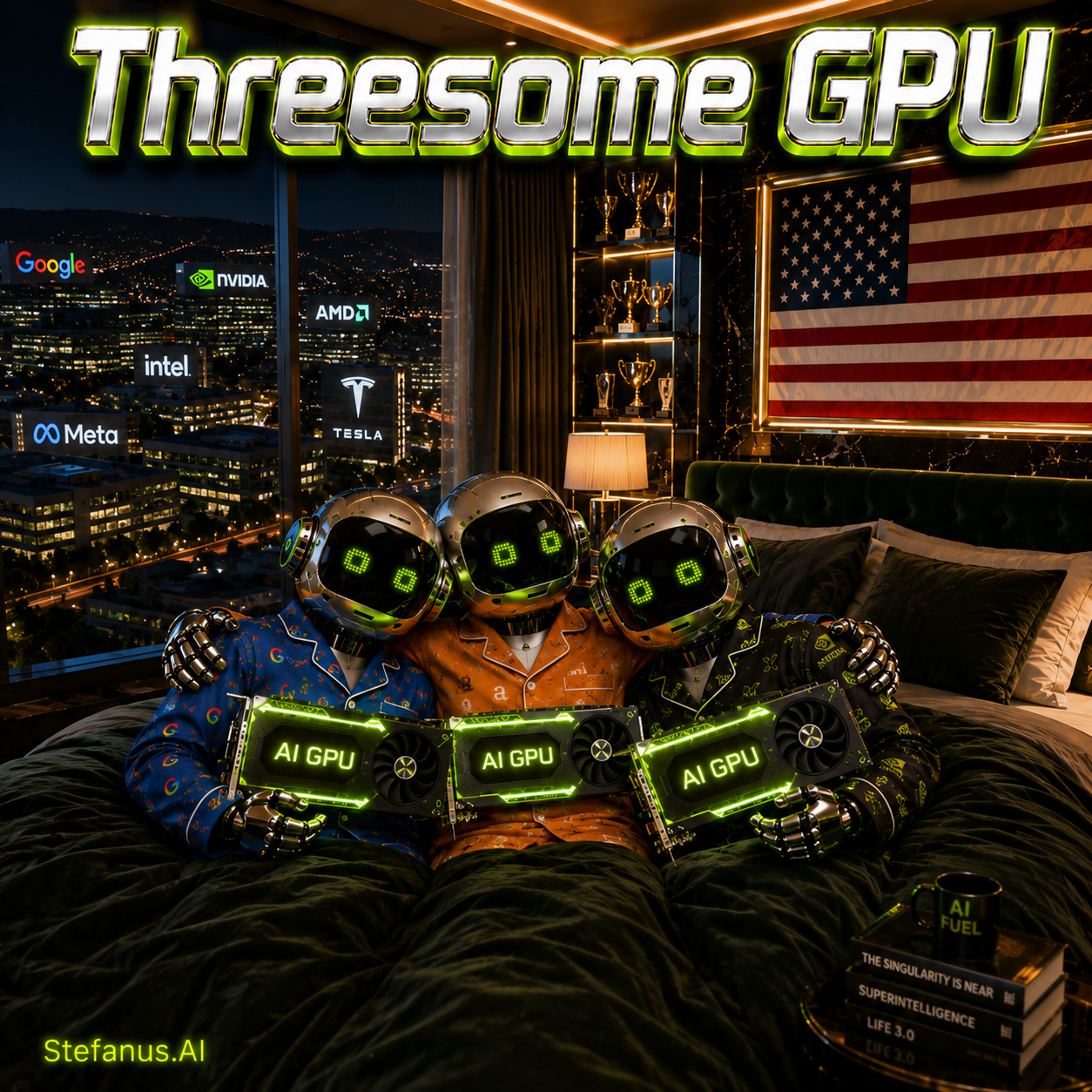
I call this paper ‘Threesome GPU.’ The title is deliberately provocative, and it requires an immediate explanation. In contemporary business literature, a ‘threesome’ describes a triangular strategic partnership — a three-party commercial relationship in which each member of the triangle contributes something the others need, and in which the bonds of mutual dependency are more consequential than any competitive rivalry. A brand, an agency, and a distribution partner. A manufacturer, a logistics operator, and a retailer. In the language of this paper, the triangle is xAI/SpaceX as the infrastructure landlord, Anthropic as the primary tenant training Claude, and Google as the secondary tenant supplementing its Gemini capacity. The term GPU anchors the discussion firmly in its proper technical domain: we are talking about compute clusters, NVIDIA silicon, AI training workloads, and deep learning infrastructure. The word ‘threesome’ is not chosen for shock value. It is chosen because it accurately describes the geometric structure of a relationship that is, at its core, a three-party interdependence built on GPU scarcity.
The paper proceeds in six sections. Section 1 examines the structural drivers of the infrastructure crunch that made these deals inevitable. Sections 2 and 3 are detailed case studies of the Anthropic and Google agreements, respectively. Section 4 analyzes the economics of coopetition and xAI’s strategic positioning as an infrastructure landlord. Section 5 confronts what is arguably the most intellectually difficult aspect of the arrangement: the data security paradox of training proprietary frontier models on hardware owned and operated by a direct competitor. Section 6 distills the enduring lessons this episode teaches about the future of AI infrastructure, market concentration, and the relationship between hardware access and algorithmic supremacy. The conclusion synthesizes all six sections into a unified argument about the structural transformation of the global AI supply chain.

Section 1: The Drivers of The Infrastructure Crunch
Any analysis of the xAI-Anthropic-Google triangle must begin not with the companies themselves but with the physical and economic forces that made the triangle necessary. The infrastructure crunch of 2025–2026 is not a story of corporate miscalculation. It is a story of structural imbalances accumulating across an entire industrial ecosystem — from semiconductor fab floors in Taiwan to power substations in Tennessee — until the pressure became so intense that even the world’s best-capitalized AI companies found themselves scrambling to rent compute from their rivals.
1.1 The Power Bottleneck: Gigawatt-Scale Grid Constraints
The single most underappreciated constraint on frontier AI development is not silicon. It is electricity. Training a next-generation frontier model requires clusters that draw hundreds of megawatts — the equivalent of powering a mid-sized city. Colossus 1 alone draws 300 megawatts.[4] Securing a gigawatt-scale grid connection for a new facility requires years of negotiation with utility regulators, environmental review boards, and local governments. In many US markets, the interconnection queues for large industrial loads run three to five years deep.
The OECD’s 2025 roundtable paper on AI infrastructure competition noted with some alarm that the physical infrastructure underpinning AI has become ‘a highly complex and often highly concentrated’ market, where ‘building and connecting data centres can take years and developing chip manufacturing plants even longer.’[5] For companies trying to scale training runs in 2026, this reality is not abstract. It is an operational wall. You cannot train a model you cannot power.
Microsoft CEO Satya Nadella captured the paradox of the earlier bottleneck phase with unusual candor during a 2024 AI deployment discussion:
“You may actually have a bunch of chips sitting in inventory that I can’t plug in.”
— Satya Nadella, CEO, Microsoft [6]
By 2026, the constraint had inverted. Power infrastructure was catching up in some markets — but the GPU supply chain had become the new chokepoint. Companies found themselves with power but no GPUs to fill it, or GPUs but no power to energize them. The Colossus 1 facility in Memphis represented something rare: 300 megawatts of live, operational compute capacity, fully powered and online, sitting at an embarrassingly low utilization rate of 11 percent. That combination — available power, available silicon, available cooling — is precisely what made it so attractive to Anthropic and Google.
1.2 The Lead-Time Crisis: Structural Delays in Hardware Procurement
At the root of the hardware bottleneck is a semiconductor supply chain that does not scale at software speed. The AI industry’s demand for compute has grown at a pace that no manufacturing ecosystem was designed to accommodate. NVIDIA’s most advanced data center GPUs — the H100, H200, and GB200 chips that populate the Colossus 1 cluster — require advanced packaging at TSMC’s CoWoS facilities and high-bandwidth memory (HBM) from SK Hynix. Both of these inputs are fully allocated years in advance. As one infrastructure analysis noted in early 2026: ‘H100 SXM5 nodes are sitting at 36–52 week lead times from resellers right now. That is not a supply blip. It is a structural problem.’[7]
The HBM market illustrates the depth of the constraint. SK Hynix controls approximately 50 percent of global HBM production, with Samsung at 40 percent and Micron at 10 percent. Memory makers had already sold out HBM production well into 2026, driving price hikes and extended lead times. For AI teams that had not locked in compute in 2024 or early 2025, the options in 2026 were grim: queue for spot capacity, pay massive premiums for whatever was available, or find an entity that had already built the infrastructure and was willing to share it.
The OECD’s competition policy analysis identified this dynamic as a structural barrier to entry: ‘Long lead-times create additional risks which may restrict entry… [chip design] also has proprietary software ecosystems which add additional barriers to develop.’[8] For Anthropic and Google, the calculus was straightforward. Renting Colossus 1 and Colossus 2 capacity from SpaceX allowed them to bypass construction and procurement delays entirely, compressing years of infrastructure development into weeks of contract negotiation.
1.3 Capital Expenditure Realities and the Risk of Building
Even for companies with access to capital, the CapEx burden of frontier AI infrastructure has become staggering. Google’s 2026 capital expenditure guidance of $175 to $185 billion reflects the full-stack commitment required to maintain its position.[9] Microsoft, Amazon, Alphabet, Meta, and Oracle were collectively projected to spend $700 billion or more on infrastructure in 2026, most of it tied to AI.[10] These figures represent genuine industrial investment on a scale comparable to the build-out of the interstate highway system or the national power grid.
The risk, however, is not simply financial. It is temporal. A data center begun in 2026 may not be operational until 2028, by which point the technology it was designed to host may have been superseded by two generations of successor silicon. Building for the frontier is an exercise in betting on the future state of a technology that has been doubling in capability every twelve to eighteen months. Sub-leasing existing, operational infrastructure from an entity like SpaceX/xAI transforms that risk profile dramatically. The tenant pays a premium in monthly fees — $1.25 billion is not cheap by any measure — but avoids the multi-year development cycle, the permitting uncertainty, the construction risk, and the possibility of being stranded with hardware optimized for yesterday’s workloads.
For xAI/SpaceX, the calculus runs in the opposite direction. Having built Colossus 1 in a remarkable 120 days and found itself unable to efficiently train Grok on its heterogeneous mix of H100, H200, and GB200 GPUs — what one analyst memorably described as an ‘eclectic mish-mash architecture’ — the company was left with an asset that was depreciating rapidly and generating almost nothing.[11] The Anthropic and Google leases transformed that depreciating asset into a recurring revenue stream that dwarfs the projected income from Grok’s commercial operations.

Section 2: Case Study 1 — The Anthropic–xAI Agreement
The Anthropic-xAI agreement is, by any measure, one of the most significant commercial transactions in the history of artificial intelligence infrastructure. Its scale, its speed, its economic logic, and the political complexity of the relationship between its parties all combine to make it a case study that will likely be taught in business schools and analyzed by antitrust regulators for years to come.
2.1 Deal Structure and Timeline
The agreement was announced on May 6, 2026, though according to reporting based on SpaceX’s S-1 IPO filing and an Anthropic spokesperson’s confirmation, the contract terms were documented as of May 20, 2026.[12] Under the terms of the deal, Anthropic gained exclusive access to the entirety of Colossus 1: more than 220,000 NVIDIA GPUs spanning H100, H200, and GB200 architectures, backed by 300 megawatts of power capacity.[13] The price is $1.25 billion per month, and the term runs through May 2029 — a commitment that totals approximately $40 billion to $45 billion over its life, making it one of the largest cloud compute contracts ever disclosed. For context, this single compute contract absorbs roughly half of Anthropic’s annualized revenue rate at the time of signing, and is approximately 6.3 times larger than OpenAI’s $11.9 billion five-year commitment with CoreWeave.[14]
The speed with which Anthropic gained access to the facility is as significant as the scale of the commitment. The deal gave Anthropic operational capacity within less than a month of signing — an almost unprecedented timeline for a facility of this size. This reflects the fact that Colossus 1 was not a construction project awaiting completion. It was a fully built, fully powered, and already-operational cluster that xAI had largely vacated in favor of the newer Colossus 2 facility. The keys, metaphorically speaking, were already on the counter.
2.2 Why Anthropic’s Revenues Made This Possible
The Anthropic that signed this deal in May 2026 was a very different company from the research-forward safety lab it had been even eighteen months earlier. Anthropic CEO Dario Amodei revealed in May 2026 that the company had reached an annualized revenue run rate of $30 billion — representing approximately 80x growth — with some analysts estimating the figure had climbed to $43–45 billion ARR by late April 2026.[15] Claude Code, the company’s AI-assisted coding tool, had alone hit $1 billion in annualized revenue within six months of launch and was generating over $2.5 billion in run-rate by February 2026.[16]
The company had also become structurally compute-constrained. As Anthropic publicly acknowledged, demand for Claude had created ‘inevitable strain on our infrastructure,’ impacting ‘reliability and performance’ during peak hours.[17] Against this backdrop, the Colossus 1 lease was not a luxury. It was an operational necessity. Without additional compute, Anthropic risked losing enterprise customers who had come to depend on Claude for production workloads — customers who were each spending over $1 million annually, a cohort that had grown from a dozen to over 1,000 companies in the space of months.
2.3 Strategic Rationale: Why SpaceX and Not AWS?
The most intellectually interesting question raised by the Anthropic-xAI deal is not why Anthropic needed compute — that much is obvious — but why it chose SpaceX as a supplier rather than scaling its existing partnerships with Amazon Web Services, Google Cloud, or Microsoft Azure.
The answer lies in the word ‘immediate.’ Anthropic’s existing cloud partnerships, however deep their long-term commitments, were primarily delivering capacity on future timelines. Amazon’s infrastructure investment commitments were not expected to come fully online until late 2026 or early 2027. Google and NVIDIA partnerships were structured around next-generation silicon that was still being manufactured. Colossus 1, by contrast, was operational and available now — delivering 300 megawatts of working compute to which Anthropic could redirect training and inference workloads within weeks.
There is also a dimension of competitive positioning that deserves acknowledgment. By securing exclusive access to the entire Colossus 1 cluster — physically denying that capacity to other AI labs, at least for the duration of the lease — Anthropic was not just solving its own compute problem. It was simultaneously creating a compute barrier for its competitors. As one industry commentator summarized the alignment with characteristic bluntness: ‘Elon’s enemy is Sam. Dario’s enemy is Sam. Enemy of my enemy is a compute partner.’[18]
Anthropic also disclosed it had ‘expressed interest’ in partnering with SpaceX to develop multiple gigawatts of orbital AI compute capacity — an extraordinary statement that signals the relationship between the two companies extends beyond a single data center rental agreement and into a longer-term infrastructure alliance.[19]

Section 3: Case Study 2 — The Google–xAI Agreement
If the Anthropic deal was surprising, the Google deal was extraordinary. Google is not a company that lacks access to compute. It has spent over a decade engineering its own Tensor Processing Unit hardware specifically to reduce dependence on external silicon suppliers. It has 2026 capital expenditure commitments of $175 to $185 billion, the largest infrastructure spend of any technology company in history. Its Q1 2026 earnings showed Google Cloud revenue surpassing $20 billion — a 63 percent year-over-year increase driven primarily by AI demand. And yet, on June 5, 2026, less than five weeks after the Anthropic deal closed, Google signed a $920 million per month agreement to rent NVIDIA GPUs from SpaceX.
3.1 Deal Structure and Regulatory Disclosure
The Google agreement was disclosed in SpaceX’s amended S-1 registration statement filed ahead of its planned Nasdaq listing.[20] The terms, as disclosed, are as follows: Google will pay SpaceX $920 million per month beginning October 2026, through June 2029 — approximately 32 months at full rate, worth roughly $30 to $32 billion over the life of the contract. In exchange, Google receives access to approximately 110,000 NVIDIA GPUs, along with associated CPUs, memory, and related components.[21] A ramp-up period through September 2026 at reduced fees precedes the full monthly commitment.
The deal includes meaningful contractual protections for Google. If SpaceX fails to deliver access to the committed number of GPUs by September 30, 2026, Google may terminate the agreement after a one-month grace period, or accept whatever capacity is available at a proportionally reduced rate. After December 31, 2026, either party may terminate with 90 days’ notice.
The 90-day cancellation clause — mirroring the same provision in the Anthropic agreement — is significant. It means that what is being presented to investors as a revenue certainty (combined annualized revenue of roughly $26 billion from both deals) is in practice a revocable purchase order. Both Google and Anthropic retain the ability to walk away with a quarter’s notice, a contractual reality that will require careful interpretation by the SpaceX IPO underwriters and the institutional investors evaluating the company’s revenue quality.
3.2 Why Google Needed External Compute
The apparent paradox of Google — a company with its own TPU pipeline and a $175 billion CapEx budget — renting NVIDIA GPUs from SpaceX dissolves when one examines the actual capacity situation. Google’s own Q1 2026 earnings call revealed that the company was ‘compute-constrained,’ with cloud backlog nearly doubling to $462 billion in a single quarter.[22] Sundar Pichai confirmed that demand for Gemini Enterprise AI offerings was growing at nearly 800 percent year-over-year, and that the company was ‘allocating capacity carefully across internal product needs and external cloud demand.’[23]
The critical phrase there is ‘internal product needs.’ Google’s TPU infrastructure — particularly the eighth-generation TPU 8t and TPU 8i chips unveiled at Google Cloud Next 2026 — is being prioritized for internal Gemini training and the company’s own AI product development. The SpaceX NVIDIA GPUs represent supplemental compute capacity that can absorb inference and secondary training workloads without competing with Google’s highest-priority internal work.
There is also a technical argument for maintaining NVIDIA GPU capacity alongside TPUs. Google’s own Q1 2026 earnings call transcript confirms that ‘our custom TPUs, Axion CPUs, and the latest NVIDIA GPUs continue to form the industry’s widest variety of compute options.’[24] Certain workloads — particularly those involving third-party frameworks like PyTorch, or inference configurations optimized for NVIDIA’s TensorRT — run more efficiently on NVIDIA hardware than on Google’s TPUs. The SpaceX capacity provides Google with GPU optionality that its own infrastructure cannot easily replicate.
3.3 Strategic Rationale: The IPO Timing and Dual Motives
One cannot analyze the Google-SpaceX deal without acknowledging its obvious timing relative to the SpaceX IPO. The agreement was disclosed in SpaceX’s S-1 filing approximately one week before shares were expected to begin trading on Nasdaq under the ticker SPCX. In a company whose AI segment (SpaceXAI, the merged xAI division) had lost $6.36 billion in 2025 and posted an operating loss of $2.47 billion on just $818 million in revenue in Q1 2026, the addition of $920 million in monthly recurring revenue from Google — layered on top of $1.25 billion from Anthropic — transforms the financial narrative for prospective IPO investors dramatically.
Morningstar noted the irony with academic precision: ‘In May, Anthropic — one of the company’s chief competitors — agreed to pay xAI $1.25 billion per month to access compute through its Colossus data center… SpaceX is looking to enter similar deals.’[25] The Mirae Asset analysts who modeled the Anthropic deal estimated it at $5 to $6 billion in annual revenue.[26] Together, the two deals provide SpaceX with over $25 billion in annualized compute rental revenue, a figure that materially changes the company’s path to operating profitability — at least on paper.

Section 4: Strategic Implications — The Economics of Coopetition
The economist Adam Brandenburger, then at Harvard Business School, coined the term ‘coopetition’ in his 1996 book of the same name, describing how companies could create more value by cooperating with rivals than by competing with them alone. His framework was built around game theory — specifically the idea that the value pie is not fixed, and that cooperation can enlarge it even when competitors are also fighting over their respective shares. What the Threesome GPU arrangement represents is a form of coopetition that Brandenburger could not have fully imagined: one in which the very hardware used to train a company’s most proprietary assets is physically shared with the company it is trying to beat.
4.1 xAI as the Infrastructure Landlord
The strategic genius of xAI/SpaceX’s positioning — to the extent that ‘genius’ can be applied to a situation partly born of engineering failures at Colossus 1 — lies in what economists call asset monetization. Colossus 1 was running at 11 percent utilization. Its heterogeneous GPU architecture (a mix of H100, H200, and GB200 chips that proved architecturally incompatible with efficient large-model training) had forced xAI to migrate its Grok training workloads to the newer, more homogeneous Colossus 2 facility.[27] Rather than allowing 89 percent of its primary supercomputer to sit idle and depreciate, SpaceX converted it into a $1.25 billion per month recurring revenue line.
This is, structurally, the model of a real estate developer who builds a premium office tower, discovers that its own operations only require two floors, and leases the remaining twenty-eight to tenants at rates that not only cover the construction debt but generate positive cash flow. The analogy extends further: the ‘building’ in this case — the Colossus 1 facility — was constructed in 120 days, a construction speed that is genuinely unprecedented for a 300-megawatt computing facility and that reflects the logistical capabilities of a company that routinely builds orbital launch vehicles.
The IPO incentive layered on top of the asset monetization motive should not be understated. SpaceX is targeting a valuation of $1.75 trillion on the Nasdaq under the SPCX ticker.[28] At that valuation, the $25-plus billion in annualized compute rental revenue from Anthropic and Google is not merely operationally significant — it is narratively essential. It transforms the SpaceX AI segment from a money-losing research experiment into something that resembles a cloud infrastructure business.
4.2 Market Concentration and the AI Oligopoly
The Threesome GPU arrangement raises serious questions about market concentration that competition authorities in the United States, European Union, and elsewhere have only begun to grapple with. The OECD’s 2025 roundtable papers on AI infrastructure competition identified a structural pattern: AI markets are ‘susceptible to competition issues’ due to economies of scale, long lead times, and proprietary software ecosystems that create self-reinforcing advantages for the largest players.[29]
The Anthropic-Google-xAI arrangement concentrates the most powerful GPU clusters in the world among three companies that are, simultaneously, the three most advanced frontier model developers in the United States. A smaller AI lab seeking to train a competing frontier model cannot access Colossus 1 because Anthropic has exclusive access. It faces the same hardware procurement lead times — 36 to 52 weeks — that drove Anthropic and Google to SpaceX in the first place. It cannot match the capital that allows Anthropic to commit $40 billion over three years to a single compute contract. The structural advantage of the incumbents compounds with each deal.
The OECD’s framework for analyzing these dynamics is instructive: ‘Competition concerns may emerge from vertical relationships where cloud service providers are also involved in developing and deploying AI models and applications.’[30] In the Threesome GPU scenario, the concern is not quite vertical integration — it is more precisely a horizontal alliance among frontier developers that effectively closes off a major supply of compute to all other participants in the market.
4.3 The Financial Architecture of the Alliance
Understanding the financial architecture of the Threesome GPU triangle requires holding three accounting perspectives simultaneously. For SpaceX, the Anthropic and Google payments represent gross revenue that offsets its AI segment’s catastrophic operating losses — $6.36 billion in 2025, $2.47 billion in Q1 2026 alone. For Anthropic, the $1.25 billion monthly payment represents a compute cost that, while enormous in absolute terms, is justified by a revenue base that had crossed $30 billion in annualized run-rate — and by the compounding cost of not having sufficient compute to serve enterprise customers who are spending at $1 million or more per year. For Google, $920 million per month is a rounding error in a $175 billion CapEx budget, but it represents optionality — the ability to scale AI workloads now rather than waiting for its own infrastructure to catch up to demand.
The 90-day cancellation clauses in both agreements create a financial structure that is simultaneously robust and fragile. For SpaceX IPO investors, these clauses introduce meaningful revenue uncertainty — the combined $2.17 billion monthly revenue stream can theoretically be extinguished with a single quarter’s notice. For Anthropic and Google, the same clauses provide operational flexibility: if better compute options emerge (from their own buildouts, from new entrants, or from improved semiconductor supply), they can redirect investment within months rather than being locked into multi-year commitments.

Section 5: Data Security and The Paradox of Rival Infrastructure
If the economics of the Threesome GPU arrangement are complex, the security architecture required to make it function is more complex still. At its heart, the arrangement poses a question that would have seemed absurd even a few years ago: how do you train the world’s most valuable and proprietary artificial intelligence models on hardware that is physically owned, operated, and administrated by a company whose founder has publicly accused you of ideological corruption and whose AI models are your direct market competitors?
This is not a hypothetical concern. Frontier model weights — the encoded mathematical representations of everything a model has learned across trillions of parameters — represent years of research, billions of dollars in compute costs, and the core competitive asset of an AI company. If xAI’s system administrators could access, copy, or analyze those weights during training on Colossus 1 hardware, the competitive consequences would be catastrophic. The security architecture that prevents this from happening is therefore not a footnote to the deal. It is a prerequisite for the deal’s existence.
5.1 Logical and Physical Tenant Isolation
5.1.1 Logical Partitioning
The first layer of protection is logical partitioning — the software and network architecture that prevents one tenant’s workloads from accessing another tenant’s data or compute resources, even when running on the same physical hardware. In a multi-tenant GPU environment, this typically involves a combination of Virtual Local Area Networks (VLANs) that segment network traffic between tenants, separate network fabrics with independent routing tables, secure hypervisors that enforce hardware-level boundaries between virtual machines, and Identity and Access Management (IAM) systems that prevent cross-tenant authentication.
For Anthropic’s deployment, the logic of physical isolation makes logical partitioning somewhat redundant — Anthropic has exclusive access to the entire Colossus 1 cluster. There is no co-tenant to isolate from. The isolation challenge is instead between Anthropic’s workloads and the xAI/SpaceX system administrators who physically manage the facility. This distinction matters: in a dedicated-cluster arrangement, the threat model is not a peer tenant but the landlord’s own staff.
5.1.2 Physical Segmentation
Google’s arrangement is more architecturally complex because it involves approximately 110,000 GPUs drawn from what appears to be a different facility than Colossus 1 (which Anthropic occupies exclusively), with SpaceX CEO Elon Musk having previously indicated that Colossus 2 would be reserved for xAI’s own work.[31] This means Google’s capacity may be hosted in a partially shared environment — requiring more rigorous physical and logical segmentation than Anthropic’s dedicated facility.
Physical segmentation in a shared GPU cluster can take several forms. At the hardware level, NVIDIA’s Multi-Instance GPU (MIG) technology allows individual GPUs to be partitioned into isolated instances with separate memory allocations and execution paths. For the scale of Google’s deployment (110,000 GPUs), more likely is a dedicated pod architecture in which Google’s GPU allocation occupies physically separate server racks, connected to a dedicated network fabric, with no shared memory buses or NVLink pathways to xAI-operated hardware. This ‘pod isolation’ approach provides meaningful physical separation without requiring MIG-level partitioning across the entire cluster.
5.2 Guarding the Crown Jewels: Model Weight Protection
5.2.1 NVIDIA Confidential Computing
The most significant technical safeguard against host-level snooping on tenant workloads is NVIDIA’s Confidential Computing architecture, first introduced in the H100 ‘Hopper’ GPU generation.[32] This technology creates a hardware-based Trusted Execution Environment (TEE) that encrypts all data processed in GPU memory using AES-256-GCM encryption, with keys generated inside the GPU’s on-die security processor during device initialization. Critically, the encryption key never leaves the chip — it cannot be accessed by the host operating system, the hypervisor, or any system administrator with root access to the physical server.[33]
When CC mode is active, every write to HBM (High-Bandwidth Memory) is encrypted before the data leaves the GPU’s compute units. On PCIe configurations, Intel TDX or AMD SEV-SNP CPU TEEs encrypt traffic on the bus. On B200 and GB200 systems with NVLink connectivity (the architecture used in multi-GPU training runs), NVLink traffic between GPUs is also encrypted — closing what would otherwise be a plaintext gap in multi-GPU confidential workloads.[34]
“Confidential computing makes trust at runtime measurable, using hardware-enforced isolation and cryptographic attestation across CPUs, GPUs, and interconnects, so customers can prove that sensitive models and data are protected while in use.”
— Corvex AI Cloud, 2026 Production Deployment Report [35]
The implication for the Threesome GPU arrangement is significant. If both Anthropic and Google are operating their training workloads in Confidential Computing mode on the Colossus clusters, the model weights that represent the core of Claude and Gemini would be cryptographically opaque to xAI’s system administrators, even if those administrators had physical access to the servers, root access to the host operating system, and the ability to dump system memory. The weights would exist only as encrypted ciphertext from the perspective of anyone without the cryptographic keys — and those keys, by design, never leave the GPU’s secure enclave.
5.2.2 Exfiltration Risks and Hardware Attestation
Hardware attestation is the mechanism that allows Anthropic and Google to verify that Confidential Computing mode is genuinely active on the hardware they are renting, rather than taking xAI’s word for it. NVIDIA’s H100 and B200 architectures generate a cryptographically signed attestation report during boot — a measurement of the GPU’s firmware and configuration state that can be independently verified against NVIDIA’s public certificate authority.[36] Before committing sensitive model weights to a GPU, a properly secured tenant can remotely attest that the hardware is running genuine NVIDIA firmware in CC-On mode, has not been tampered with, and has established a secure boot chain from the hardware root of trust.
This attestation capability transforms the trust model of third-party GPU rental from ‘trust the landlord’ to ‘verify the hardware.’ It is, in this sense, one of the most consequential security technologies underlying the Threesome GPU arrangement — without it, renting compute for frontier model training from a competitor would be an act of corporate recklessness. With it, it becomes a calculable security decision governed by cryptographic guarantees rather than contractual promises.
5.3 Legal and Operational Kill Switches
5.3.1 The Governance Paradox
The contractual dimension of the Threesome GPU arrangement introduces a governance paradox that no amount of cryptographic engineering can fully resolve. Elon Musk has publicly stated that xAI retains the right to reclaim compute capacity if a tenant’s AI engages in actions that harm humanity. This is not merely a rhetorical position — it reflects a genuine tension at the intersection of AI safety, competitive AI development, and the practical realities of hosting a rival’s most powerful models.
Consider the scenario from SpaceX’s position. Anthropic’s Constitutional AI approach and its refusal to grant the US Department of Defense unrestricted access to Claude models reflects a specific set of values about what AI should and should not do. Google’s Gemini has its own safety constraints, content policies, and operational boundaries. xAI’s Grok has been developed with a different philosophical orientation — more permissive, less filtered, explicitly designed to avoid what Musk describes as ideological bias in AI responses. The question of who gets to define ‘harm to humanity’ — and whether the training workloads of a competitor’s AI models might be deemed to meet that definition — is not merely legal but deeply political.
5.3.2 The 90-Day Offboarding Risk
Both agreements include 90-day cancellation clauses effective after December 31, 2026.[37] In operational security terms, this creates a specific and underappreciated risk: the risk of abrupt, forced offboarding. If either contract is terminated — whether by mutual agreement, by contractual breach, or by the exercise of xAI’s stated right to reclaim capacity — Anthropic and Google face the challenge of ensuring complete cryptographic erasure of their proprietary data from SpaceX’s storage arrays and solid-state drives.
Model training at the scale of Colossus 1 creates enormous data artifacts: checkpoint files stored periodically during training runs, gradient accumulation buffers, optimizer states, dataset shards, and the model weights themselves in their various intermediate and final forms. These are typically stored on high-capacity NVMe storage arrays co-located with the GPU cluster. If an agreement terminates suddenly, the practical challenge of verifying that every byte of proprietary data has been cryptographically erased from xAI-controlled storage — without the ability to independently audit xAI’s storage systems — represents a genuine security gap.
Industry best practice for this scenario involves several mitigations: requiring contractual data destruction certification from SpaceX (backed by penalty clauses), maintaining all sensitive data in encrypted volumes where the tenant holds the encryption keys (meaning xAI retains only useless ciphertext after key destruction), continuous synchronization of checkpoints to tenant-controlled external storage so that no critical data exists solely on xAI-managed systems, and independent forensic audit rights over storage media. Whether Anthropic and Google negotiated these specific provisions is not publicly known, but their absence from a $40 billion compute commitment would represent a significant oversight.

Section 6: What We Have Learned — Five Pillars of The GPU Alliance Era
The Threesome GPU arrangement is not merely a business story. It is a set of structural lessons about the nature of technological competition at the frontier — lessons that will shape how AI companies, investors, regulators, and policymakers think about the next decade of AI development. I organize these lessons into five pillars, each representing a durable insight that extends beyond the specific facts of the xAI-Anthropic-Google triangle.
Pillar 1: Physical Compute Is the New Strategic Moat
The history of technology competition has taught us to worship algorithms. The mythology of Silicon Valley is built on the premise that superior code, deployed faster, will defeat larger incumbents with inferior software. Search engines defeated directories. Streaming defeated broadcast. Cloud defeated on-premises. In each case, the winning innovation was primarily algorithmic or architectural, and the physical infrastructure was treated as a commodity that money could buy.
The Threesome GPU arrangement shatters this mythology for the AI era. In 2026, the constraint on frontier AI capability is not algorithmic sophistication. It is physical: the availability of power, the manufacturability of memory chips, the throughput of packaging lines, the speed of grid interconnection. Companies that secured compute capacity in 2024 — when it was available — now hold a structural advantage over companies that waited. Anthropic’s willingness to commit $40 billion to a compute contract is not evidence of financial recklessness. It is evidence that Anthropic’s leadership understands that in 2026, the model that wins is not necessarily the model that is most cleverly designed. It is the model that had access to enough compute to be trained at all.
The OECD’s 2025 analysis of AI infrastructure competition put this in formal economic terms: AI infrastructure markets exhibit ‘economies of scale — given the very high level of fixed costs at many levels of the supply chain a large degree of scale is needed to cover the fixed costs.’[38] The Threesome GPU arrangement is, in microcosm, the consequence of those economies of scale being fully internalized by the companies that can afford to act on them.
Pillar 2: Competitive Identity Is Increasingly Decoupled from Infrastructure Identity
For most of the history of the technology industry, a company’s competitive identity was closely tied to its infrastructure. Google was Google partly because it ran on Google’s servers, maintained Google’s network, and controlled its own hardware from silicon to software. The idea that Google would rent compute from a competitor — from the very AI lab that Elon Musk founded in part as a response to what he perceived as excessive corporate control of AI development — would have been unthinkable even five years ago.
The Threesome GPU arrangement signals that this identification of competitive identity with infrastructure control is loosening, at least at the frontier of AI development. What defines Anthropic competitively is not the servers it runs on. It is the Constitutional AI methodology, the Claude model architecture, the safety research culture, the enterprise trust it has built with 300,000-plus business customers. None of these are compromised by running on Colossus 1 rather than Amazon data centers. The algorithms, the training data, the human feedback processes, the safety evaluations — all of these remain entirely within Anthropic’s control regardless of whose hardware they run on. The hardware is infrastructure. The competitive assets are elsewhere.
Pillar 3: The Semiconductor Supply Chain Is Now a Geopolitical Variable
The GPU shortage that created the conditions for the Threesome GPU arrangement is not purely a market phenomenon. It is a geopolitical one. TSMC’s CoWoS packaging capacity and SK Hynix’s HBM production — the two primary bottlenecks in the advanced GPU supply chain — are concentrated in Taiwan and South Korea respectively. US export controls on advanced semiconductor technology to China have created a bifurcated global market in which Chinese AI development is simultaneously cut off from the most advanced chips and incentivized to develop alternatives. NVIDIA controls approximately 92 percent of the discrete GPU market for data centers — a concentration that any competition authority would scrutinize carefully in any other industry.[39]
The Threesome GPU arrangement is, in this light, a symptom of geopolitical semiconductor strategy as much as it is a business deal. The US government’s decision to subsidize domestic semiconductor manufacturing through the CHIPS Act — allocating $8.5 billion to Intel, $6.6 billion to TSMC’s Arizona facilities, and $6.4 billion to Samsung — reflects a recognition that compute supply is now a national security variable. When the world’s most powerful AI models can only be trained on hardware whose supply chain passes through a 35-kilometer-wide island in the Taiwan Strait, the geopolitical implications of GPU scarcity extend well beyond corporate earnings reports.
Pillar 4: Revenue Quality in the AI Infrastructure Era Requires New Analytical Frameworks
The financial community’s response to the SpaceX IPO disclosures of the Anthropic and Google compute agreements illustrates a genuine analytical challenge. Are these agreements evidence of a durable, high-quality revenue stream — a cloud-infrastructure business model that generates predictable recurring cash flow? Or are they one-time transactions, driven by a confluence of short-term incentives (Anthropic’s compute crunch, Google’s capacity constraints, SpaceX’s IPO timing), that will not be renewed once the underlying conditions change?
The 90-day cancellation clauses mean that even if we accept the contracts’ nominal multi-year terms at face value, the actual revenue commitment is structured as a rolling quarterly option rather than a locked-in subscription. For SpaceX’s IPO underwriters, the challenge is how to value that optionality in a way that is neither overly optimistic (treating the full $40-plus billion as certain revenue) nor overly conservative (treating the cancellation clauses as implying imminent termination). The history of technology infrastructure contracting suggests that large enterprises rarely exercise cancellation clauses if the service is working well — transition costs are high, and the pain of moving 220,000 GPUs worth of training infrastructure is immense. But the analytical framework for valuing this type of revocable infrastructure commitment at scale is genuinely new.
Pillar 5: The ‘Coopetition’ Model Is the Permanent Structure of Frontier AI, Not a Temporary Stopgap
Perhaps the most important lesson of the Threesome GPU arrangement is the most counterintuitive one: the era of fully vertically integrated frontier AI development — in which a single company controls its own research, its own silicon, its own data centers, its own energy supply, and its own distribution — may never arrive, or may arrive only for a small number of entities with extraordinary capital and ambition.
The capital requirements for true vertical integration at the frontier are now approaching the scale of national industrial infrastructure projects. Google’s $175 to $185 billion CapEx guidance for 2026 is not a budget for a technology company. It is a budget for a small nation-state’s industrial development program. Anthropic’s projected $30 billion in training costs through 2030, while dramatically more efficient than OpenAI’s projected $125 billion, still represents a commitment that only the most heavily capitalized private companies in history can sustain.
For all other participants in the AI ecosystem — including well-funded startups, mid-sized technology companies, academic research institutions, and government-sponsored AI programs — the model going forward is not vertical integration but strategic compute access: identifying the fastest and most efficient path to the compute needed for the next training run, whether through cloud agreements, co-location arrangements, consortium memberships, or, as the Threesome GPU arrangement demonstrates, renting capacity from a competitor who has more than they can use.
The OECD’s warning that this dynamic creates ‘highly concentrated’ markets deserving of active competition policy attention is well-founded.[40] But the concentration it describes is not simply a product of anticompetitive behavior. It is the emergent consequence of a technology whose computational requirements are scaling faster than any supply chain can accommodate, concentrating leadership among the handful of entities that can sustain the capital commitments required to stay at the frontier.

Conclusion: The Threesome GPU Reality and The Future of Frontier AI
This paper set out to examine a historic anomaly: the moment when two of the world’s most sophisticated and well-capitalized frontier AI laboratories signed multi-billion-dollar agreements to rent compute from their most prominent competitor. It has argued, across six sections, that this anomaly is not anomalous at all. It is the logical consequence of a set of structural forces — semiconductor scarcity, power bottlenecks, capital concentration, competitive dynamics — that have been building since at least 2023 and that show no signs of abating.
The thesis with which this paper opened bears repeating in conclusion: while xAI, Anthropic, and Google compete fiercely at the frontier model level, the sheer scarcity of immediately deployable compute has forced a paradigm of coopetition in which xAI has become a foundational infrastructure broker for its direct competitors. What began as an engineering failure — the Colossus 1 cluster’s inability to efficiently train Grok on its heterogeneous GPU architecture — became a $25 billion annual revenue line that is central to the SpaceX IPO narrative and that has, at least temporarily, concentrated the most powerful GPU clusters in the world under the operational dependency of the three most advanced AI labs in the United States.
The security architecture required to make this arrangement function — NVIDIA Confidential Computing, hardware attestation, encrypted VRAM, NVLink fabric encryption, and the cryptographic erasure obligations of the offboarding clauses — represents a new frontier in multi-tenant AI security. It is a frontier that the industry has navigated, at least initially, not through regulatory mandate but through contractual negotiation and cryptographic engineering. Whether those safeguards are sufficient is a question that will only be answered over time, and perhaps only if and when a breach occurs.
The deeper question that the Threesome GPU arrangement leaves open is the one posed in this paper’s final pillar: is this a temporary stopgap or the permanent future? The answer, I believe, is neither and both. As a specific configuration — Anthropic and Google renting from SpaceX, at these specific prices, at these specific GPU counts — it is almost certainly temporary. Anthropic’s own infrastructure buildout, Google’s expanding TPU pipeline, and the eventual easing of semiconductor supply constraints will all shift the economic calculus that makes SpaceX’s Colossus clusters the most attractive option available.
But as a model — frontier AI companies sharing physical infrastructure with competitors when the economics of ownership cannot keep pace with the economics of demand — it is likely to be a recurring feature of the AI era. The capital requirements are too large, the supply chains too constrained, and the competitive pressure too intense for any single company, however well-resourced, to maintain full vertical integration at all times across all workloads. The future of frontier AI is not the monolithic, self-contained lab. It is the strategically networked consortium of coopetitors, sharing hardware when they must, competing on algorithms and training data and human talent when they can.
This is the Threesome GPU reality. It is not a scandal or a surrender. It is the market-clearing mechanism of an industry whose demand for physical compute has, for the first time in the history of technology, outrun the ability of even the world’s richest companies to supply it on their own. In that gap between demand and supply — in the 89 percent of Colossus 1 that xAI could not fill — an entire new era of AI infrastructure economics was born.

Footnotes and Endnotes
[1] Anthropic / SpaceX (xAI) — May 6, 2026 deal announcement. $1.25 billion/month for 220,000 NVIDIA GPUs at Colossus 1, through May 2029. Confirmed via SpaceX S-1 IPO filing and Anthropic spokesperson. DataCenter Dynamics, May 2026. https://www.datacenterdynamics.com/en/news/anthropic-to-use-all-of-spacex-xais-colossus-1-data-center-compute/
[2] Google / SpaceX (xAI) — June 5, 2026 Cloud Service Agreement. $920 million/month for 110,000 NVIDIA GPUs, through June 2029. Disclosed in SpaceX amended S-1 registration statement. TechCrunch, June 5, 2026. https://techcrunch.com/2026/06/05/google-will-pay-spacex-920m-per-month-for-compute/
[3] Spheron Blog — ‘GPU Shortage 2026: How to Secure AI Compute When GPUs Are Sold Out.’ April 6, 2026. Discusses 36–52 week lead times and structural semiconductor bottlenecks. https://www.spheron.network/blog/gpu-shortage-2026/
[4] SpaceX S-1 IPO Filing, May 2026. Colossus 1 facility: 220,000 NVIDIA GPUs, 300MW power. Reported in DataCenter Dynamics and Crypto Briefing. https://cryptobriefing.com/xai-leases-colossus-anthropic-5b-ipo/
[5] OECD (2025). ‘Competition in Artificial Intelligence Infrastructure.’ OECD Roundtables on Competition Policy Papers, No. 330. OECD Publishing, Paris. doi: 10.1787/623d1874-en https://www.oecd.org/en/publications/2025/11/competition-in-artificial-intelligence-infrastructure_69319aee.html
[6] Satya Nadella, CEO, Microsoft — 2024 AI deployment discussion on compute and power constraints. Cited in DataCenter Knowledge, ‘After the Power Crunch, AI Infrastructure Hits a GPU Wall,’ May 2026. https://www.datacenterknowledge.com/infrastructure/after-the-power-crunch-ai-infrastructure-hits-a-gpu-wall
[7] Spheron Blog — ‘GPU Shortage 2026.’ ‘H100 SXM5 nodes are sitting at 36–52 week lead times from resellers right now. That is not a supply blip. It is a structural problem with two root causes: CoWoS packaging capacity at TSMC is fully allocated, and HBM production from SK Hynix cannot keep pace with demand.’ April 2026. https://www.spheron.network/blog/gpu-shortage-2026/
[8] OECD (2025). ‘Competition in Artificial Intelligence Infrastructure.’ Section on Market Features. ‘Long lead-times create additional risks which may restrict entry… chip design also has proprietary software ecosystems which add additional barriers.’ https://www.oecd.org/en/publications/competition-in-artificial-intelligence-infrastructure_623d1874-en/full-report/component-6.html
[9] Alphabet/Google — 2026 CapEx guidance $175–185 billion. Google Cloud Next 2026 and Q1 2026 earnings call (April 29, 2026). The Globe and Mail, April 24, 2026. https://www.theglobeandmail.com/investing/markets/stocks/AMZN/pressreleases/1523656/google-cloud-next-2026-event-bets-big-on-ai-infrastructure/
[10] DataCenter Knowledge — ‘After the Power Crunch, AI Infrastructure Hits a GPU Wall.’ ‘Microsoft, Amazon, Alphabet, Meta, and Oracle could collectively spend $700 billion or more on capital expenditures in 2026.’ May 2026. https://www.datacenterknowledge.com/infrastructure/after-the-power-crunch-ai-infrastructure-hits-a-gpu-wall
[11] WCCFTech — ‘SpaceX Locks Google Into A $920 Million-Per-Month Compute Deal After Anthropic, As xAI Abandons Colossus 1’s Messy GPU Mix.’ Colossus 1 could not efficiently train on heterogeneous H100/H200/GB200 mix. June 5, 2026. https://wccftech.com/spacex-locks-google-into-a-920-million-per-month-compute-deal-after-anthropic-as-xai-abandons-colossus-1s-messy-gpu-mix/
[12] actuia.com — ‘Anthropic rents Colossus 1 for $1.25 billion/month on an xAI park capped at 11% capacity.’ Contract documented by Business Insider on May 20, 2026, from SpaceX’s S-1 and confirmed by Anthropic spokesperson. https://www.actuia.com/en/news/anthropic-rents-colossus-1-for-125-billionmonth-on-an-xai-park-capped-at-11-capacity/
[13] DataCenter Dynamics — ‘Anthropic to use all of SpaceX-xAI’s Colossus 1 data center compute.’ Anthropic to receive ‘more than 300MW of capacity across more than 220,000 Nvidia GPUs within the month.’ May 2026. https://www.datacenterdynamics.com/en/news/anthropic-to-use-all-of-spacex-xais-colossus-1-data-center-compute/
[14] actuia.com — Contract absorbs ‘roughly 6.3 times OpenAI’s annual commitment on the $11.9 billion deal with CoreWeave over five years’ and ‘about half of the ARR of the Claude publisher.’ Mirae Asset analysts modeled the deal at ‘$5–6 billion in annual revenue.’ https://www.actuia.com/en/news/anthropic-rents-colossus-1-for-125-billionmonth-on-an-xai-park-capped-at-11-capacity/
[15] VentureBeat — ‘Anthropic says it hit a $30 billion revenue run rate after crazy 80x growth.’ Dario Amodei, Anthropic CEO, May 2026. Sacra estimates ARR reached $45 billion in May 2026. https://venturebeat.com/technology/anthropic-says-it-hit-a-30-billion-revenue-run-rate-after-crazy-80x-growth
[16] VentureBeat — ‘Claude Code hit $1 billion in annualized revenue within six months of launch… By February 2026, the product was generating over $2.5 billion in run-rate revenue.’ May 2026. https://venturebeat.com/technology/anthropic-says-it-hit-a-30-billion-revenue-run-rate-after-crazy-80x-growth
[17] VentureBeat — Anthropic acknowledged demand for Claude had led to ‘inevitable strain on our infrastructure,’ impacting ‘reliability and performance’ for users during peak hours. May 2026. https://venturebeat.com/technology/anthropic-says-it-hit-a-30-billion-revenue-run-rate-after-crazy-80x-growth
[18] VentureBeat — Industry commentator summary: ‘Elon’s enemy is Sam. Dario’s enemy is Sam. Enemy of my enemy is a compute partner.’ May 2026. https://venturebeat.com/technology/anthropic-says-it-hit-a-30-billion-revenue-run-rate-after-crazy-80x-growth
[19] DataCenter Dynamics — ‘Anthropic said that it has also expressed interest in partnering with SpaceX to develop multiple gigawatts of orbital AI compute capacity.’ May 2026. https://www.datacenterdynamics.com/en/news/anthropic-to-use-all-of-spacex-xais-colossus-1-data-center-compute/
[20] SpaceX amended S-1 registration statement, filed June 5, 2026. Disclosed Google Cloud Service Agreement. Reported by TechCrunch and CNBC. https://techcrunch.com/2026/06/05/google-will-pay-spacex-920m-per-month-for-compute/
[21] TechCrunch — ‘Google will pay SpaceX $920M per month for compute.’ ‘Under the terms of the deal, Google will pay SpaceX $920 million per month from October 2026 through June 2029 for access to approximately 110,000 NVIDIA GPUs, CPUs, memory, and other related components.’ June 5, 2026. https://techcrunch.com/2026/06/05/google-will-pay-spacex-920m-per-month-for-compute/
[22] Google Q1 2026 Earnings Call — April 29, 2026. Cloud revenue $20 billion, up 63% YoY. Backlog nearly doubled to $462 billion. Source: Alphabet Investor Relations. https://abc.xyz/investor/events/event-details/2026/2026-Q1-Earnings-Call-2026-nW8kCrBAKS/default.aspx
[23] Sundar Pichai, CEO, Alphabet — Q1 2026 Earnings Call, April 29, 2026. ‘Strong demand for Gemini Enterprise and AI solutions.’ GenAI products grew nearly 800% YoY. Gemini Enterprise MAU +40% QoQ. https://www.alphaspread.com/security/nasdaq/googl/investor-relations/earnings-call/q1-2026
[24] Alphabet Q1 2026 Earnings Call Transcript — ‘Our custom TPUs, Axion CPUs, and the latest NVIDIA GPUs continue to form the industry’s widest variety of compute options.’ April 29, 2026. https://abc.xyz/investor/events/event-details/2026/2026-Q1-Earnings-Call-2026-nW8kCrBAKS/default.aspx
[25] Morningstar — ‘Financials Look Reckless: Lifting xAI’s Hood in the SpaceX IPO.’ ‘In May, Anthropic — one of the company’s chief competitors — agreed to pay xAI $1.25 billion per month to access compute through its Colossus data center…’ May 2026. https://www.morningstar.com/stocks/financials-look-reckless-lifting-xais-hood-spacex-ipo
[26] Mirae Asset analysts — modeled the Anthropic-xAI deal at ‘$5–6 billion in annual revenue’ for xAI. Cited in Medium (Tanmay Deshpande) and KuCoin. May 2026. https://deshpandetanmay.medium.com/xai-just-leased-222-000-gpus-to-anthropic-the-math-says-its-surrendering-5427b29172ae
[27] WCCFTech — Colossus 1 utilization at 11% by xAI; Colossus 1 could not efficiently train on heterogeneous H100/H200/GB200 mix; xAI migrated to Colossus 2. June 5, 2026. https://wccftech.com/spacex-locks-google-into-a-920-million-per-month-compute-deal-after-anthropic-as-xai-abandons-colossus-1s-messy-gpu-mix/
[28] SpaceX IPO target valuation $1.75 trillion on Nasdaq (ticker: SPCX). Expected listing June 12, 2026. Tech Startups, May 2026; confirmed by Elon Musk on X, March 2026. https://techstartups.com/2026/05/21/spacex-files-for-historic-ipo-at-1-75-trillion-valuation-revealing-6-4b-xai-losses-as-elon-musk-bets-big-on-ai-and-mars/
[29] OECD (2025). ‘Competition in Artificial Intelligence Infrastructure.’ No. 330. ‘AI markets are susceptible to competition issues due to economies of scale, long lead times, and proprietary software ecosystems.’ https://www.oecd.org/en/publications/2025/11/competition-in-artificial-intelligence-infrastructure_69319aee.html
[30] OECD (2025). ‘Competition in Artificial Intelligence Infrastructure.’ Section 4. ‘Competition concerns may emerge from vertical relationships where cloud service providers are also involved in developing and deploying AI models and applications.’ https://www.oecd.org/en/publications/competition-in-artificial-intelligence-infrastructure_623d1874-en/full-report/component-7.html
[31] The Next Web — ‘Google to pay SpaceX $920M/month for AI compute.’ ‘CEO Elon Musk has previously suggested the Colossus 2 facility would be reserved for xAI’s own work.’ June 5, 2026. https://thenextweb.com/news/google-spacex-920-million-month-compute-deal
[32] NVIDIA — ‘Confidential Computing on NVIDIA H100 GPUs for Secure and Trustworthy AI.’ NVIDIA Developer Blog. H100 is ‘the world’s first accelerator’ with hardware-based TEE Confidential Computing. https://developer.nvidia.com/blog/confidential-computing-on-h100-gpus-for-secure-and-trustworthy-ai/
[33] Spheron Blog — ‘Confidential GPU Computing on Cloud: Deploy LLMs with NVIDIA TEE and Encrypted VRAM.’ ‘The encryption key is generated inside the GPU security processor during device initialization and never leaves the chip.’ April 23, 2026. https://www.spheron.network/blog/confidential-gpu-computing-nvidia-tee-encrypted-vram/
[34] Spheron Blog — ‘Confidential GPU Computing on Cloud.’ ‘B200 and GB200 add NVLink encryption in addition to PCIe encryption… This closes the last plaintext gap in multi-GPU confidential workloads.’ April 23, 2026. https://www.spheron.network/blog/confidential-gpu-computing-nvidia-tee-encrypted-vram/
[35] Corvex AI Cloud — Production deployment of Confidential Computing on NVIDIA HGX B200. ‘Confidential computing makes trust at runtime measurable, using hardware-enforced isolation and cryptographic attestation across CPUs, GPUs, and interconnects.’ Barchart / Corvex press release, 2026. https://www.barchart.com/story/news/544507/corvex-among-the-first-companies-to-achieve-verified-production-deployment-of-confidential-computing-for-ai-on-nvidia-hgx-b200-systems
[36] Edgeless Systems Wiki — ‘NVIDIA Hopper H100.’ ‘Together, remote attestation, encrypted communication, and memory isolation provide everything required to extend a confidential-computing environment from a CVM or a secure enclave to a GPU.’ https://www.edgeless.systems/wiki/hardware/nvidia-hopper-h100
[37] TechCrunch — June 5, 2026. Both Anthropic and Google agreements include 90-day cancellation clauses after December 31, 2026. Google may terminate if SpaceX fails to deliver committed GPUs by September 30, 2026. https://techcrunch.com/2026/06/05/google-will-pay-spacex-920m-per-month-for-compute/
[38] OECD (2025). ‘Competition in Artificial Intelligence Infrastructure.’ Overview of the AI Supply Chain. ‘Economies of scale — given the very high level of fixed costs at many levels of the supply chain a large degree of scale is needed to cover the fixed costs.’ https://www.oecd.org/en/publications/competition-in-artificial-intelligence-infrastructure_623d1874-en/full-report/component-5.html
[39] Clarifai Blog — ‘Why GPU Costs Explode as AI Products Scale.’ ‘One dominant vendor commands roughly 92% of the discrete GPU market, while HBM production is concentrated among SK Hynix (~50%), Samsung (~40%), and Micron (~10%).’ https://www.clarifai.com/blog/gpu-cost-while-scaling
[40] OECD (2025). ‘Competition in Artificial Intelligence Infrastructure.’ ‘AI infrastructure markets are both highly complex and often highly concentrated.’ OECD Roundtables on Competition Policy Papers, No. 330. https://www.oecd.org/en/publications/2025/11/competition-in-artificial-intelligence-infrastructure_69319aee.html
Comments
[…] was not a new campus, not a new substation, not a new transformer order. The solution was to rent an existing facility from a competitor. On May 6, 2026, Anthropic announced it had signed a deal with SpaceX — which had absorbed Elon […]
[…] approach is instructive. Its compute-leasing agreements with Anthropic and Google — worth $26 billion in annualized recurring revenue combined — each include a 90-day […]
[…] In that earlier study I documented the moment when, on May 6, 2026, Anthropic agreed to rent the entirety of the Colossus 1 supercomputer cluster from SpaceX for $1.25 billion per month, and […]
[…] behind the Claude model family, and a company Musk had publicly derided only months earlier — had agreed to pay $1.25 billion per month, every month through May 2029, to lease the full 300-megawatt output of […]
[…] deeper break — the value of the chip is not its physical form but its liquid utility: compute. Compute can be rented, pooled, subdivided, and accessed globally in microsecond increments. A GPU physically located in […]
[…] deployment—can be trucked to a site and energized in months. This is the technology of the xAI Colossus complex, where a fleet that grew from 27 to 33 to 46 and, by mid-2026, to a documented 59 turbines […]
[…] in Section 2.1.[13][15] The software has no concept of the grid’s convalescence; it optimizes for GPU-hours, and every scheduler in every facility affected by a regional event will race to reclaim them at […]