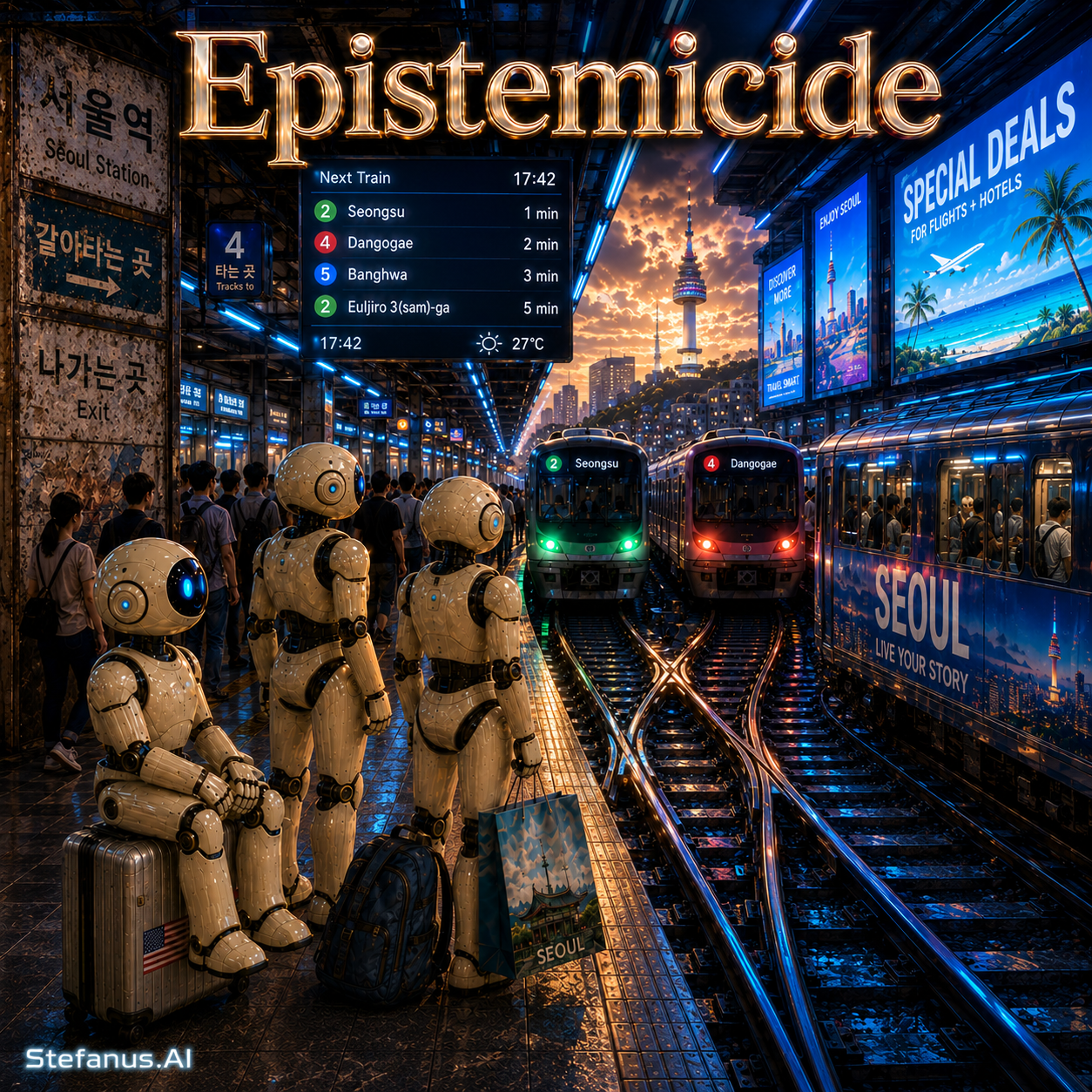

Introduction: The Seoul Subway Platform
On a Seoul subway platform in the early 2000s, the signs of a new linguistic age were everywhere. A teenager texted her friend about a weekend “meeting,” not in the old Korean sense of a gathering, but in the Konglish sense of a social date. A cosmetics advertisement promised a “premium” lifestyle. A café promoted “take-out,” a department store displayed “sale,” and a mobile carrier advertised the newest “smart” service for young consumers who wanted speed, style, and modernity. None of these words felt foreign to the teenager. They were simply part of daily speech — convenient, fashionable, and digitally native.
But to her grandmother, the same language could feel strangely distant. The words were Korean in pronunciation, English in origin, and global in aspiration. They belonged to a younger world shaped by the internet, multinational brands, pop culture, smartphones, private academies, and the prestige of English as the language of modern success. In everyday conversation, this produced only mild confusion. A word like “untact,” widely used in South Korea to describe contactless services, might sound natural to younger speakers while remaining opaque to older generations. What one generation heard as efficient and modern, another heard as unnecessary, exclusionary, or simply unclear.
The deeper divide was not only between Korean and English, but between layers of Korean memory itself. For centuries, much Korean vocabulary had been shaped by Hanja, the Chinese characters historically used to distinguish meanings among words that sounded alike. As South Korea moved toward Hangeul-only education, younger generations gained the clarity and democratic accessibility of the native Korean alphabet, but many also lost familiarity with older textual systems. Historical documents, classical references, and older vocabulary became harder to read without explanation. Even when the words sounded familiar, their older meanings could fade behind modern usage. A law student could pronounce every syllable of a nineteenth-century land record and still be unable to read it; the sounds survived while the script that anchored their meanings receded into the province of specialists.
This is not cultural collapse. Languages always borrow, adapt, simplify, modernize, and reinvent themselves. Korean did not disappear because young people used Konglish, just as English did not disappear when it absorbed French, Latin, Hindi, Arabic, and countless other vocabularies. Indeed, by any external measure the decades in question were a golden age for Korean culture: its cinema, music, literature, and technology reached audiences that no prior generation of Koreans could have imagined. Yet the Korean example reveals something important for the AI age precisely because it is a story of success rather than catastrophe. Knowledge systems do not vanish only through conquest, censorship, or deliberate erasure. They can also be thinned by convenience. They can be displaced by the vocabulary of prestige. They can be made to feel old, inefficient, provincial, or difficult — not by any decree, but by the quiet accumulation of defaults.
The lesson is not that loanwords are dangerous. The lesson is that every society carries its memory inside its language, and that when the language of modernity comes increasingly from elsewhere, older words do not merely become less common; older categories of thought may also become less accessible. The generational friction over Konglish, Hanja, Hangeul, and romanized digital expression is therefore a small preview of a much larger question now facing the artificial intelligence era. If global AI systems are trained, aligned, and optimized primarily through a few dominant languages and cultures, what happens to the quieter knowledge systems that do not scale as easily? What happens to the histories, idioms, metaphors, legal traditions, spiritual vocabularies, and local categories that are too small to dominate the dataset?
South Korea’s linguistic evolution shows that epistemic change rarely arrives as an invasion. More often, it arrives as convenience, aspiration, youth culture, branding, and the promise of being modern. In the age of artificial intelligence, the same process may occur not only through loanwords on billboards, but through the models that answer questions, summarize history, translate culture, tutor children, and decide which forms of knowledge sound authoritative. The danger is not simply that people will speak differently. The danger is that they may gradually learn to think through someone else’s defaults.
Why This Paper Is Named “Epistemicide”
The title of this paper is deliberately severe, and the severity requires justification. “Epistemicide” — the killing of knowledge systems — was coined by the Portuguese sociologist Boaventura de Sousa Santos to describe the destruction of ways of knowing that do not fit the dominant epistemological canon: the marginalization of local, Indigenous, Southern, oral, spiritual, historical, and non-Western knowledge systems by more powerful institutions claiming universal authority.[11] It is a word that belongs to the vocabulary of colonial history, and one might reasonably ask whether it is proportionate to apply it to software. This paper argues that it is, for at least six reasons, and the entire study that follows can be read as an extended defense of the choice.
First, the word names a process rather than an event. Genocide destroys bodies in identifiable acts; epistemicide, in Santos’s account, destroys the credibility, transmission, and institutional life of knowledge over generations, often without a single dramatic moment that could be photographed or prosecuted. That is exactly the temporal signature of what AI dependency threatens: no burning library, only a slow migration of authority from local archives to global models. Second, the word insists that knowledge systems can die. This is an empirical claim, not a metaphorical flourish: languages cease to be spoken, scripts cease to be read, medical and agricultural traditions cease to be practiced, and legal categories cease to be litigated. The Korean encounter with Hanja shows that even a prosperous, sovereign, technologically advanced society can lose easy access to layers of its own written past within two generations — without any villain, through curriculum choices and convenience alone.
Third, the word correctly locates the mechanism in hierarchy rather than in contact. Borrowing between equal knowledge systems is enrichment; absorption of a weaker system by a stronger one, on the stronger system’s terms, is displacement. AI as currently constructed is not a meeting of equals: a handful of firms in two countries train the models through which several billion people will increasingly encounter all knowledge, including knowledge about themselves. Fourth, the word carries an implied accusation of avoidability. Epistemicide is not entropy; it is the outcome of decisions — about training corpora, alignment rules, benchmark design, pricing, and market structure — that could be made differently. Naming the process harshly keeps the responsibility visible. Fifth, the word connects the AI debate to a longer history. Colonial schooling, missionary translation, archive-building, and official-language policy were the epistemicidal instruments of earlier centuries; retrieval pipelines, refusal policies, and model cards are candidates to become their successors, and the continuity deserves a continuous vocabulary. Sixth, and finally, the word is a wager about scale. What earlier empires accomplished slowly, through schools and administrators, a globally distributed model can accomplish quickly, through defaults — because for the first time in history, a single artifact can mediate the daily thinking of a substantial fraction of humanity at once.
A note of intellectual honesty is required before proceeding: this paper uses “epistemicide” as a warning about a trajectory, not a verdict on an accomplished fact. Nothing that follows claims that any culture has already been erased by a chatbot. The claim is narrower and, I believe, more defensible — that the structural conditions under which epistemicide has historically occurred are being rebuilt, at planetary scale, inside the technical and commercial architecture of artificial intelligence, and that the societies most exposed are precisely those least equipped to respond. The remainder of the paper proceeds in six movements. Section 1 maps the fragmentation of the global AI stack into rival spheres. Section 2 analyzes why a divided intelligence order is more unstable than the divided industrial order of the twentieth century. Section 3 defines epistemicide for the AI age and grounds it in the scholarly literature. Section 4 dissects the mechanics of epistemic hegemony — corpus dominance, alignment dominance, infrastructure dependence, benchmark hegemony, and economic exclusion. Section 5 traces the geopolitical responses now emerging, from sovereign AI to cognitive non-alignment. Section 6 distills seven pillars of findings, and the conclusion returns to the Seoul subway platform to ask what the Korean story teaches the rest of the world.
Two consequences dominate the analysis throughout, operating at different depths. The first is structural and visible: the fragmentation of the global technology stack into rival spheres — an algorithmic bipolarity shading into multipolarity — with all the instability that divided systems historically exhibit. The second is deeper and quieter: a struggle over knowledge itself, in which the dominance of a few heavily protected models threatens to export the values, biases, languages, and historical framings of their makers into the cognitive infrastructure of societies that must import intelligence rather than produce it. The first consequence redraws the map; the second redraws the mind.

Section 1: The Fragmentation of the Global AI Stack
Artificial intelligence is splitting into rival technology ecosystems, but the split is not clean. It is a messy, permeable, commercially entangled fragmentation — less an iron curtain than a lattice of chokepoints, subsidies, licenses, and workarounds through which capital, talent, and model weights continue to flow even as governments try to direct the current.
To understand why the fragmentation of AI matters more than the fragmentation of any previous technology, one must begin with what is actually being divided. The industrial disputes of earlier eras partitioned steel, oil, semiconductors for consumer electronics, or telecommunications equipment — important commodities, but commodities nonetheless. What is being partitioned today is a five-layer system that, taken together, constitutes the productive apparatus of machine intelligence itself. Each layer has its own geography, its own chokepoints, and its own politics, and the layers do not fragment at the same speed. A country can be sovereign at one layer and utterly dependent at the next, which is precisely why the map of the AI world is so much harder to read than the map of the Cold War ever was.
1.1 The Five-Layer AI Economy Is Becoming Geopolitical
The stack begins with energy, the layer where AI’s abstractions become brutally physical. Global AI data-center power capacity reached roughly 29.6 gigawatts by the 2026 reporting cycle — enough, as the Stanford AI Index observes, to power New York State at peak demand — and training a single frontier model can now produce tens of thousands of tonnes of carbon-dioxide equivalent.[3] Above energy sits the chip layer, dominated by one designer (NVIDIA), one fabricator (TSMC), and one lithography supplier (ASML), a concentration so extreme that a single export-control decision in Washington can reprice the technological future of a continent. Above chips sit the datacenters — the new ports and railheads of the intelligence economy, whose siting decisions have become instruments of statecraft from Virginia to Abu Dhabi. Above datacenters sit the foundation models, the layer where knowledge itself is compressed, weighted, and aligned. And above the models sits the applications and agents layer, where intelligence finally touches students, clerks, soldiers, and citizens, and where the assumptions baked into the layers below become invisible defaults of daily life.
Table 1. The five-layer AI economy and its geopolitical fault lines.
| Layer | What Is Contested | Principal Chokepoints (2026) | Fragmentation Pressure |
| 1. Energy | Gigawatt-scale power for training and inference | Grid capacity; nuclear, gas, and solar siting; ≈29.6 GW global AI datacenter capacity [3] | National — power cannot be imported at scale; energy geography anchors AI geography |
| 2. Chips | Advanced logic, HBM memory, interconnect | NVIDIA design; TSMC fabrication; ASML lithography; U.S. export controls | Extreme — the sharpest instrument of division; smuggling and domestic substitution as countermeasures |
| 3. Datacenters | Compute campuses, cloud regions, sovereign zones | Hyperscaler capex projected above $1 trillion for 2026 [23]; Gulf mega-campuses such as the 5GW UAE–U.S. AI Campus [20,21] | High — jurisdiction of the datacenter determines jurisdiction of the intelligence |
| 4. Foundation models | Weights, training corpora, alignment rules | A handful of frontier labs in the U.S. and China; top U.S.–China performance gap of 2.7% [2,3] | Bifurcating — closed U.S. frontier vs. increasingly open-weight Chinese distribution [25,26] |
| 5. Applications / agents | Assistants, copilots, tutors, government systems | App-store rules, procurement mandates (EO 14319), platform terms, API pricing [15,16] | Regulatory — the layer where alignment mandates and content rules directly diverge |
The essential point of Table 1 is that fragmentation is not a single decision but a cascade. Export controls at the chip layer provoke open-weight strategies at the model layer; procurement mandates at the application layer reach down to reshape alignment at the model layer; energy scarcity at the bottom of the stack determines which nations can even aspire to sovereignty at the top. The stack fragments as a system, and it is the system — not any single layer — that is becoming the contested operating system of world order.
1.2 The U.S.-Led Sphere: Private Capital at Unprecedented Scale
The American sphere is, above all, a capital phenomenon. The Stanford Institute for Human-Centered Artificial Intelligence reports that global corporate AI investment reached $581.7 billion in 2025, more than doubling year over year, with private investment growing 127.5 percent to $344.7 billion and generative AI alone capturing $170.9 billion of that total.[1] Within this flood of capital, the United States is not merely the leader but the gravitational center: U.S. private AI investment reached $285.9 billion in 2025 — roughly twenty-three times China’s reported $12.4 billion — and California alone accounted for approximately $218 billion, more than three-quarters of the national total.[1,4] The sphere is dominated by hyperscalers and frontier laboratories, protected by export controls, national-security policy, procurement rules, and a datacenter build-out of historic proportions: by mid-2026, financial analysts were projecting that the combined capital expenditures of Alphabet, Amazon, Meta, and Microsoft would exceed one trillion dollars.[23]
The corporate earnings record through the first quarter of 2026 confirms that this is not a speculative bubble in the ordinary sense but an infrastructure super-cycle with a geopolitical spine. NVIDIA — the company whose accelerators constitute the de facto currency of the U.S.-led sphere — reported fiscal fourth-quarter revenue of $68.1 billion in February 2026, up 73 percent year over year, and then reported first-quarter fiscal-2027 revenue of $81.6 billion in May 2026, up 85 percent, with data-center revenue of $75.2 billion growing 92 percent and forward guidance of $91 billion.[22,24] Announcing the February results, the company’s founder captured the industry’s self-understanding in a single phrase:
“the agentic AI inflection point has arrived”
— Jensen Huang, Founder and CEO, NVIDIA, Q4 FY2026 earnings, February 2026 [24]
Yet the same earnings reports reveal the fragmentation etched directly into the balance sheet: NVIDIA shipped no data-center Hopper products to China in the first quarter of fiscal 2027, against $4.6 billion in the comparable quarter a year earlier, and explicitly assumed zero China data-center compute revenue in its outlook.[22] The largest company in the U.S.-led sphere now plans its future on the assumption that the world’s second-largest AI market is, for its most advanced products, closed. Few single facts summarize the divided intelligence order more eloquently.
1.3 The China-Led Sphere: State Direction and the Open-Weight Gambit
The Chinese sphere is organized on a different logic: state-directed, industrial-policy driven, and — in its most consequential strategic innovation — increasingly open-weight in distribution. The turning point came in January 2025, when the Hangzhou-based laboratory DeepSeek released open-weight reasoning models that nearly matched the performance of the top American closed models at a fraction of their reported training cost, intensifying the global debate over the geopolitics of open models.[28] What followed was not a single breakthrough but a pattern: by late 2025, Chinese models from DeepSeek, Alibaba (Qwen), Moonshot, Zhipu, and others accounted for seven of the ten most-downloaded models on Hugging Face, derivatives of the Qwen family alone exceeded one hundred thousand — the largest ecosystem on the platform — and Chinese fine-tuned or derivative models made up roughly 63 percent of all new derivative releases.[25,26] Analysts at Hugging Face documented a “Sino-multimodal period” in which the center of gravity of the open ecosystem shifted decisively eastward.[38]
Beijing has embraced this development as policy. Excluded from the most advanced Western hardware, China has converted exclusion at the chip layer into influence over the global software commons at the model layer: if the world’s students, startups, and governments build on Chinese open weights, then Chinese architectural choices, training distributions, and — subtly — content boundaries propagate outward with every download. Premier Li Qiang made the strategic framing explicit at the World Economic Forum in the summer of 2025, declaring that
“China’s innovation is open and open-source”
— Li Qiang, Premier of the State Council of the People’s Republic of China, World Economic Forum, 2025 [25]
and promising to share indigenous technologies with the world. The performance data suggest the gambit is working. The Stanford 2026 AI Index finds that the U.S.–China gap at the frontier has effectively closed: as of March 2026, the leading American model — Anthropic’s, with an Arena score of 1,503 — led the best Chinese system by only 2.7 percent, down from spreads of 17.5 to 31.6 percentage points across major benchmarks at the end of 2023, and the two countries’ models have traded the top position repeatedly since early 2025.[2,3] China simultaneously leads in AI publication volume (23.2 percent of global output), patent grants (69.7 percent of global filings), and industrial robot installations, while the flow of AI talent into the United States has fallen 89 percent since 2017.[3,5] The bipolar structure of the AI world is therefore not a projection; it is a measurement.
1.4 The Multipolar Middle: Regulators, Financiers, and Hybrid Builders
Beneath the bipolar surface, a thickening multipolar layer is forming, and its members are pursuing three distinguishable strategies. Europe seeks regulatory and sovereignty leverage: the EU AI Act entered full enforcement in January 2026, making Brussels the world’s most consequential rule-writer even as European private investment and frontier-model production lag far behind.[3] The Gulf states are buying centrality through capital, energy, and datacenter geography. The United Arab Emirates committed $1.4 trillion in U.S. investment, and the Stargate UAE project — a one-gigawatt compute cluster built by G42 with OpenAI, Oracle, NVIDIA, Cisco, and SoftBank inside a planned five-gigawatt UAE–U.S. AI Campus in Abu Dhabi, the largest AI infrastructure project outside the United States — broke ground with its first 200-megawatt phase scheduled for the third quarter of 2026.[20,21] Announcing the original Stargate initiative of which the Emirati campus became the first foreign extension, OpenAI’s chief executive framed the stakes in generational terms:
“I think this will be the most important project of this era”
— Sam Altman, CEO, OpenAI, announcing the Stargate Project, January 2025 [37]
Meanwhile India, Japan, Korea, Singapore, Brazil, Indonesia, and others are assembling hybrid national stacks — renting frontier capability where necessary, fine-tuning open weights where possible, and building national datasets, language models, and compute pools where budgets allow. South Korea, fittingly for the country whose linguistic history opens this paper, ranks first in the world in AI patents per capita.[2] The Stanford Index records that more than half of all national AI strategies adopted since 2024 have come from emerging economies, that state-backed supercomputing investment is rising in every region, and that open-source contributions from outside the United States and Europe now approach U.S. levels on GitHub — quantitative evidence of a multipolar layer thickening beneath the U.S.–China duopoly.[4,7]
1.5 Reading the Earnings Tape: What the Corporate Record Reveals
It is worth pausing over the corporate record through the first half of 2026, because quarterly earnings are where geopolitical abstractions are audited against cash. Three signals stand out. The first is the sheer velocity of the infrastructure build: NVIDIA’s data-center revenue of $75.2 billion in a single quarter — growing 92 percent year over year, with supply commitments of $119 billion and a fresh $80 billion added to its buyback authorization — implies that the market now treats the fragmented order not as a risk to be hedged but as a demand engine to be financed.[22,23] Every sovereign AI program, every export-control workaround, and every duplicated regional datacenter is, from the vendor’s side of the ledger, incremental revenue; fragmentation, in other words, has acquired a powerful commercial constituency, which is one more reason to expect it to persist. The second signal is the normalization of exclusion: the disappearance of $4.6 billion in China data-center revenue between comparable quarters was absorbed by the market with barely a tremor, because the excluded demand was instantly replaced by hyperscaler and sovereign demand elsewhere.[22] When the world’s most systemically important technology company can lose an entire superpower’s market and still guide revenue upward to $91 billion, the lesson every capital allocator draws is that the divided order is not merely survivable but profitable — and profitable divisions do not get repaired. The third signal is concentration: with generative AI capturing nearly half of all private AI funding, U.S. firms capturing roughly 83 percent of global private AI investment, and productivity gains concentrating in a small leading cohort of adopters, the economics of the intelligence layer are trending toward the winner-take-most structure that this paper’s epistemic argument presupposes.[1,4] The earnings tape, read carefully, is a geopolitical document.
The picture that emerges from this survey is deliberately untidy. AI fragmentation is not the return of a clean Iron Curtain, with its checkpoints and its unambiguous cartography. It is the birth of a contested operating system for world order — a system in which the same Emirati campus can be simultaneously an instrument of American export strategy and of Emirati sovereignty, in which Chinese open weights run inside American startups, and in which the most important boundaries are drawn not on maps but in procurement rules, license clauses, and model cards.

Section 2: Algorithmic Bipolarity and the Instability of Divided Intelligence
A divided AI system is unstable for a reason that the twentieth century never had to confront in this form: interdependence does not disappear when systems divide — it becomes weaponized. Every connection that survives the split is simultaneously an artery of cooperation and a pressure point of coercion, and the intelligence order of the 2020s is nothing but surviving connections.
The theorists of economic statecraft have taught us that networks confer power on those who control their central nodes, and that in moments of rivalry, chokepoints become weapons. What distinguishes the AI era is the sheer density of the residual interdependence that remains after a decade of deliberate decoupling. Chips still cross borders — legally under license, and illegally through gray markets that no export-control regime has managed to seal. Cloud access crosses borders: a model that cannot be bought can often still be rented, queried, and — through the technique of distillation — partially replicated by training a smaller student model on the outputs of a restricted teacher. Academic talent crosses borders, though far less freely than before; benchmark suites and evaluation norms cross borders; API markets cross borders; and above all, open weights cross borders instantly, universally, and irreversibly, since a model file, once published, cannot be un-published. The result is a system that is porous precisely where its architects intend it to be sealed, and sealed precisely where its users need it to be porous.
2.1 Residual Interdependence as Leverage
Consider how each surviving connection has already been converted into an instrument. Washington restricts the export of advanced accelerators, and the restriction functions as leverage over every nation that must choose between compliance and compute. Beijing responds by flooding the world with capable open-weight models, and the flood functions as leverage over every developer ecosystem that adopts them — for the architecture you build on shapes the roadmap you must follow. NVIDIA’s zero-China quarter, discussed above, is leverage rendered as accounting.[22] Smuggled GPUs, third-country transshipment hubs, and rental arrangements through offshore clouds constitute the countervailing leverage of the excluded. Even model evaluation has become a theater of leverage: when the laboratories most capable of shaping outcomes disclose the least — the Stanford Index records that the average Foundation Model Transparency score fell from 58 to 40 in a single year — opacity itself becomes a competitive and geopolitical instrument.[2,6]
2.2 Why AI Bipolarity Differs from Cold War Bipolarity
It has become fashionable to describe the U.S.–China AI rivalry as a new Cold War, but the analogy conceals more than it reveals, and the differences all point toward greater instability rather than less. The Cold War separated military, industrial, and ideological systems that were, for the most part, already separate: trade between the blocs was marginal, financial entanglement minimal, and the intellectual infrastructures of the two worlds — their universities, publishing houses, and broadcasting systems — ran on parallel tracks that rarely touched. The AI rivalry divides systems that grew up unified. It divides cognition, software, cloud infrastructure, labor markets, cyber capabilities, and education systems simultaneously, and it does so while the two principals remain each other’s research interlocutors, supply-chain partners, and — through open publication — unwilling collaborators. Deterrence in the nuclear age rested on the legibility of capabilities; deterrence in the algorithmic age must cope with capabilities that can be copied, distilled, leaked, and fine-tuned in a weekend.
There is a second difference, and it is the one on which this paper ultimately rests: the battlefield is not only territory but interpretation. Cold War propaganda competed for opinions on top of a shared substrate of facts, however contested; the AI rivalry competes for the substrate itself — for the systems through which the next generation will learn what happened, what is normal, what is safe to say, and what counts as knowledge at all. When the instruments of interpretation are themselves the objects of rivalry, every downstream domain — elections, curricula, courts, markets — inherits the instability.
2.3 The Warnings from the International Institutions
The custodians of the global economic order have begun to say this aloud, in language of unusual directness. The World Economic Forum’s Global Risks Report 2026 elevated geoeconomic fragmentation and societal polarization above extreme weather in its short-term risk ranking — a striking reversal of the previous decade’s hierarchy — and the IMF’s Managing Director, Kristalina Georgieva, told the Davos meeting in January 2026 that the world must accustom itself to more frequent exogenous shocks, warning bluntly that “we are not in Kansas anymore” and that roughly 40 percent of jobs globally, and 60 percent in advanced economies, will be transformed or eliminated by AI in the coming years.[9] Her deeper anxiety, however, was epistemic and institutional rather than merely occupational:
“Wake up. AI is for real, and it is transforming our world faster…”
— Kristalina Georgieva, Managing Director, International Monetary Fund, Davos, January 2026 [8]
— faster, she continued, than policymakers are getting a handle on it, describing an unregulated, market-driven deployment of AI as her “biggest worry.”[8] At the same meeting she reached for a natural-disaster metaphor to describe the labor-market consequences:
“a tsunami is hitting the labour market”
— Kristalina Georgieva, IMF Managing Director, World Economic Forum, January 2026 [7]
adding that she worried about an “accordion of opportunities” far more present in some places than in others — the Fund’s own research having long concluded that, without deliberate policy action, AI is likely to worsen overall inequality both within and between nations.[7] Nor were the corporate principals silent: Microsoft’s chief executive Satya Nadella warned the same Davos audience that AI could lose its “social permission” if its benefits remain concentrated among a handful of powerful firms,[10] while Saudi Arabia’s investment minister Khalid Al-Falih insisted that
“The essence of AI’s power is it has to be accessible”
— Khalid Al-Falih, Minister of Investment, Kingdom of Saudi Arabia, Davos, January 2026 [9]
— and that diffusion must occur not merely within competing economies but globally. When the IMF, the World Economic Forum, the largest software company on earth, and the world’s largest oil exporter converge on the same warning, the warning has ceased to be heterodox.
2.4 The Porosity Paradox: Why the System Cannot Be Sealed
There is, finally, a paradox at the heart of divided intelligence that no previous divided system had to manage: the commodity being contested is information, and information resists containment in ways that steel, oil, and even enriched uranium never did. A frontier model’s capabilities leak through at least four channels that export controls cannot close. They leak through publication, because the scientific culture that produces frontier systems still rewards disclosure of methods, and a sufficiently detailed paper is a partial blueprint. They leak through distillation, because any model exposed to the public through an API can be interrogated at scale and its behavior partially transferred into a smaller student model beyond the reach of any license. They leak through talent, because the knowledge that matters most travels in the heads of researchers whose movements no diffusion rule fully governs. And they leak through open weights themselves, which — once released — replicate across the planet at the speed of a file transfer and can never be recalled. The strategic consequence is perverse: the harder each bloc squeezes the physical layers of the stack (chips, datacenters), the more strategic weight shifts to the informational layers (weights, methods, data), which are precisely the layers that cannot be squeezed. China’s open-weight offensive is the clearest exploitation of this asymmetry to date, but it will not be the last; every actor excluded from one layer of the stack has an incentive to flood the layers that remain open, and the resulting arms race in openness is as destabilizing, in its own way, as any arms race in secrecy.[25,28,38]
2.5 Institutional Stress: Retrofitting a Unified World for Permanent Division
The final source of instability is institutional. The standards bodies, universities, cloud contracts, open-source foundations, supply-chain arrangements, and research collaborations that govern the digital world were built for the relatively unified environment of 2000–2020 — an environment that assumed a single internet, a single scientific commons, and a single, broadly liberal trajectory of technological governance. They are now being retrofitted, clause by clause and consortium by consortium, for permanent division. Standards organizations must decide whether interoperability is a value or a vulnerability. Universities must decide whether a foreign doctoral student is a colleague or a collection risk. Cloud contracts must specify not only uptime but jurisdiction, and open-source licenses drafted for a borderless commons must somehow accommodate export-control law. Each retrofit is individually rational; collectively they dismantle the shared institutional fabric that made rapid, low-friction scientific progress possible in the first place. The divided AI world is therefore more volatile than the divided industrial world not because its weapons are sharper — though they are — but because every remaining connection is now both an opportunity for cooperation and a channel of coercion, and no institution designed in the unified era can tell, from one quarter to the next, which of the two it is hosting.

Section 3: What Is Epistemicide in the AI Age?
Epistemicide is the destruction or displacement of knowledge systems. What artificial intelligence changes is not the phenomenon but its economics: AI makes the process scalable, automated, and — most dangerously — invisible, because the destruction arrives disguised as service.
Every serious concept has a genealogy, and the genealogy of “epistemicide” matters because it disciplines the concept against loose use. The term belongs to Boaventura de Sousa Santos, Emeritus Professor of Sociology at the University of Coimbra and Distinguished Legal Scholar at the University of Wisconsin–Madison, whose life’s work has been an inquiry into why the knowledge of the vanquished so rarely survives the victory of the powerful. This section reconstructs the classical concept, connects it to the adjacent scholarly literature on epistemic injustice, traces the historical shift from colonial schooling to algorithmic mediation, and then states the definition on which the remainder of the paper depends.
3.1 The Classical Definition: Santos and Cognitive Injustice
In Epistemologies of the South: Justice Against Epistemicide (2014), Santos argues that Western modernity, for all its internal diversity, supplied the knowledge system underlying the long cycle of colonialism and global capitalism, and that these historical processes profoundly devalued and marginalized the knowledge and wisdom that had long existed in the global South — Indigenous cosmologies, oral traditions, communal legal orders, medical and agricultural practices, and entire grammars of social meaning.[11] At the center of his account stands the concept of cognitive injustice, which he defines as
“the failure to recognise the different ways of knowing”
— Boaventura de Sousa Santos, Epistemologies of the South: Justice Against Epistemicide (2014) [11]
by which people across the globe run their lives and provide meaning to their existence — and his thesis, stated with a bluntness rare in academic sociology, is that cognitive injustice underlies every other injustice: there is no global social justice without global cognitive justice.[11] In the later work The End of the Cognitive Empire (2018), Santos extends the argument into method, proposing “post-abyssal” epistemologies that would demonumentalize written and archival knowledge and take seriously the knowledges born of struggle — those forms of knowing that dominant cultures of the global North generally discredit, erase, or ignore.[12] Three features of the classical concept deserve emphasis for what follows. First, epistemicide operates through institutions rather than through violence alone: schools, churches, courts, archives, and official languages did the daily work. Second, it operates through hierarchy of credibility rather than through prohibition alone: local knowledge was rarely banned outright; it was reclassified — as folklore, superstition, custom, or dialect — and thereby removed from the category of knowledge. Third, it is compatible with sincere benevolence on the part of its agents, who typically understood themselves to be educating, modernizing, and saving.
3.2 The Adjacent Concept: Epistemic Injustice in Generative AI
A younger scholarly literature, rooted in analytic philosophy rather than in the sociology of the South, has begun to map the same terrain from the other direction. Building on Miranda Fricker’s taxonomy of testimonial and hermeneutical injustice, researchers Jackie Kay, Atoosa Kasirzadeh, and Shakir Mohamed introduced, at the 2024 AAAI/ACM Conference on AI, Ethics, and Society, the concept of “generative algorithmic epistemic injustice,” identifying four configurations of the phenomenon: amplified testimonial injustice, manipulative testimonial injustice, hermeneutical ignorance, and access injustice — illustrated with real-world cases in which generative systems produce or amplify misinformation, perpetuate representational harm, and create epistemic inequities, particularly in multilingual contexts where model quality collapses for so-called under-resourced languages.[13] Subsequent work has extended the taxonomy, proposing the further category of “generative hermeneutical erasure” and cataloguing sources of AI-related epistemic injustice that range from epistemic opacity and automated testimonial prejudice to the exclusion of the global South from AI governance itself.[14] The philosophical literature thus supplies the micro-mechanisms — who is disbelieved, who cannot be understood, who cannot access the instruments of understanding — while Santos supplies the macro-history. Algorithmic epistemicide, as this paper uses the term, is what the micro-mechanisms amount to when they operate at planetary scale for a generation.
3.3 From Colonial Schooling to Algorithmic Mediation
The decolonial literature on technology has already documented the continuity in institutional form. Nick Couldry and Ulises Mejías describe contemporary data extraction as “data colonialism” — a new colonial practice distinctive to twenty-first-century conditions, resting on the premise that data, like colonial land before it, is free and available for appropriation.[29] Abeba Birhane, analyzing the deployment of Western technological systems across Africa, names the pattern the “algorithmic colonization of Africa,” observing that historic patterns of conquest re-emerge under the banner of technological solutions for the developing world.[30] Shakir Mohamed, Marie-Therese Png, and William Isaac, in their influential paper on decolonial AI, show how the coloniality of power persists in digital structures — in socio-cultural imaginations, knowledge systems, and ways of building technology that remain unquestioned inheritances of the past — and cite Paola Ricaurte’s warning that data-centric epistemologies can impose
“ways of being, thinking, and feeling”
— Paola Ricaurte, cited in Mohamed, Png & Isaac, “Decolonial AI” (2020) [31]
that expel alternative worlds and epistemologies from the social order.[31] The instruments have changed even as the pattern persists. Older epistemicide worked through schools, churches, colonial administration, archives, museums, and official languages — institutions that required decades, budgets, and personnel to reshape a society’s knowledge. Algorithmic epistemicide works through search rankings, recommendation systems, machine summarization, translation pipelines, educational assistants, coding tools, government copilots, and retrieval systems — infrastructures that reshape the flow of knowledge continuously, cheaply, and without any identifiable administrator whose decision could be appealed. The comparison can be drawn precisely:
Table 2. Classical versus algorithmic epistemicide: same pattern, new instruments.
| Dimension | Classical Epistemicide (16th–20th c.) | Algorithmic Epistemicide (21st c.) |
| Primary instrument | Schools, missions, archives, censuses, official languages | Training corpora, alignment rules, rankings, retrieval, translation, benchmarks |
| Agent | Empires, churches, colonial administrations | Model developers, platforms, cloud providers, procurement regimes |
| Mechanism of displacement | Prohibition and reclassification of local knowledge as folklore or superstition | Under-representation, mistranslation, unrankability, benchmark invisibility, refusal policies |
| Temporal signature | Generations; visible institutional imposition | Continuous; invisible defaults experienced as convenience |
| Required consent | Coerced attendance and administration | Voluntary adoption — subscription, download, default settings |
| Evidence trail | Decrees, curricula, mission records | Model cards, corpus statistics, refusal logs — largely proprietary and undisclosed [2] |
| Reversibility | Slow — revival movements, script restoration, language nests | Uncertain — depends on data sovereignty, open weights, and local capacity |
3.4 A Definition for the AI Age
With the genealogy in place, the operative definition of this paper can be stated. Algorithmic epistemicide is the erosion, displacement, or erasure of a society’s knowledge systems that occurs because the AI models mediating that society’s knowledge work are trained on, aligned by, and governed through the epistemic assumptions of more powerful societies. Three clauses of the definition carry the analytical weight. “Mediating knowledge work” restricts the concept to systems that stand between people and knowledge — tutors, assistants, search and summarization layers, translation pipelines — rather than to every use of machine learning. “Trained on, aligned by, and governed through” identifies the three channels of foreign epistemic authority, which Section 4 dissects in detail. And “more powerful societies” keeps the concept honest: the issue is not foreignness as such — all knowledge travels — but asymmetry, the condition in which one side writes the defaults and the other side lives inside them.
3.5 What Algorithmic Epistemicide Looks Like in Practice
Because the concept can sound abstract, it helps to render it at human scale, in the registers where the research literature has already documented it. It looks like a schoolchild in Lagos or La Paz asking an assistant about her country’s founding conflicts and receiving a summary organized around the categories — and often the archives — of the former colonial power, because those are the categories the training distribution rewards.[32] It looks like a voice interface that African American users could not reliably control unless they accommodated their speech patterns to the model’s expectations — access injustice operating not through any policy but through the statistics of the corpus.[13] It looks like an Arabic-language assistant, trained largely on translated English data, cheerfully recommending a beer after prayer — a small absurdity that reveals a large structural fact: the model’s Arabic is a costume worn over Anglophone assumptions.[33] It looks like an Indigenous community discovering that the only digital corpus of its language was scraped from semi-private community contexts and now circulates inside systems it never consented to and cannot correct, while machine-generated errors in its language feed back into the next generation of models, distorting authentic usage in a self-reinforcing loop.[33] And it looks, at the level of institutions, like a ministry of education choosing between a world-class foreign tutor-model that misrepresents national history and an accurate local system that does not exist — the choice, always, between misrepresentation and absence. None of these episodes, taken alone, is an epistemicide. Taken together, repeated daily across billions of interactions, and compounded by the feedback loops of Section 4, they are its early administrative record.
The definition also clarifies what algorithmic epistemicide is not. It is not the presence of error or bias in a model, which is universal and correctable. It is not the mere popularity of foreign technology, which is as old as trade. It is a structural condition: the condition in which a society’s principal instruments of learning, remembering, and interpreting are optimized against someone else’s corpus, someone else’s values, and someone else’s benchmarks, so that the society’s own categories survive only to the extent that they happen to be legible to systems built elsewhere. In the AI age, epistemicide does not need to destroy knowledge directly; it only needs to make some knowledge unsearchable, untranslated, unranked, unbenchmarked, or untrusted — and then wait, as convenience does the rest.

Section 4: The Mechanics of Epistemic Hegemony
Epistemic hegemony does not require conquest. It requires default adoption — and default adoption is manufactured through five reinforcing channels: corpus dominance, alignment dominance, infrastructure dependence, benchmark hegemony, and economic exclusion. This section takes each in turn, because a danger described only in the abstract can always be dismissed as rhetoric.
4.1 Corpus Dominance: The View from a Few Powerful Somewheres
Every model is a compression of its training data, and the training data of the dominant models are radically unrepresentative of humanity’s linguistic and epistemic diversity. Most large language models are trained on corpora that are over 90 percent English text, even though fewer than 20 percent of the world’s people speak English; more than half of all websites are in English; and the translation tools with the most expansive coverage supported fewer than fifty African languages as of mid-2024, on a continent where between 1,500 and 2,000 languages are spoken.[33] The consequences are measurable rather than speculative. A study of cultural fidelity in large language models found that 44 percent of the variance in GPT-4o’s ability to reflect a country’s societal values, as measured against the World Values Survey, correlates with the availability of digital resources in that country’s language — and that error rates were more than five times higher for the most poorly resourced languages.[32] Where the digital corpus is thin, the model does not fall silent; it substitutes — answering questions about a society’s history, values, and norms from the perspective of the societies that dominate its training data. Researchers documenting this dynamic warn of histories viewed through a Western lens that can erase or reshape the self-understanding of low-resource settings, and of a compounding cycle in which dominant languages grow stronger through digital use while smaller languages face ever greater corrosive pressure.[32,33] The model’s celebrated “view from nowhere” is, on inspection, a view from a few powerful somewheres — principally the English-language internet, secondarily the Chinese-language internet, and only in trace amounts everywhere else.
Oral traditions, Indigenous knowledge, and local archives suffer a double exclusion under corpus dominance. They are excluded first because they are undigitized, and second because the act of digitizing them for corpus inclusion can itself violate the community protocols that govern them — researchers working with Indigenous languages note that much available digital text comes from private or semi-private community contexts whose uncritical use could expose knowledge the community considers sacred or confidential, while uncorrected machine-generated errors risk amplification in subsequent models, creating a feedback loop that distorts authentic usage.[33] The choice offered to such communities — be misrepresented or be absent — is the signature dilemma of corpus dominance.
4.2 Alignment Dominance: Governance by Model Behavior
If the corpus determines what a model knows, alignment determines what it is willing to say — what it treats as safe, neutral, offensive, factual, disputed, sensitive, or unacceptable. Alignment is often described as a technical safety procedure, but the two AI superpowers have already demonstrated, in formal legal instruments, that model behavior is a governance question of the first order. In July 2025, the White House issued Executive Order 14319, “Preventing Woke AI in the Federal Government,” directing that federal agencies procure only large language models adhering to “Unbiased AI Principles” of truth-seeking and ideological neutrality, on the stated ground that the government must not procure models that
“sacrifice truthfulness and accuracy to ideological agendas”
— Executive Order 14319, The White House, July 23, 2025 [15]
— with implementing guidance from the Office of Management and Budget following in December 2025, imposing transparency, documentation, and disclosure obligations on AI vendors seeking federal contracts.[15,16] Whatever one’s view of the order’s merits, its structural significance is unambiguous: the world’s largest single purchaser of software has made the ideological configuration of model outputs a condition of market access. China reached the same structural conclusion two years earlier from the opposite ideological direction: the Interim Measures for the Management of Generative Artificial Intelligence Services, in force since August 2023, require that AI-generated content
“adhere to the socialist core values”
— Interim Measures for the Administration of Generative AI Services, Art. 4, Cyberspace Administration of China, 2023 [17]
and prohibit broad categories of content deemed threatening to state power, national unity, or social stability, with mandatory algorithm registration, security assessments for services with “public opinion attributes,” and provider responsibility for all generated content.[17,18] Between Washington’s procurement neutrality mandate and Beijing’s content mandate lies the entire political spectrum of the AI age — and every country that imports models aligned under either regime imports, silently, the residue of that regime’s answers to contested questions. Alignment is geopolitics by other means: it decides, at inference time and at planetary scale, which framings of history, religion, territory, gender, and legitimacy a billion users will encounter as the default.
4.3 Cloud and Platform Dependence: Jurisdiction as Destiny
The third channel is the most mundane and, for most of the world, the most binding. Nations without domestic compute must access intelligence through foreign infrastructure — foreign accelerators, foreign clouds, foreign APIs, foreign terms of service — and every layer of that access creates jurisdictional dependence. The government ministry that drafts policy through a foreign copilot has placed its deliberations under someone else’s data-governance regime; the hospital system that routes diagnostic queries through a foreign endpoint has accepted that a licensing dispute, a sanctions decision, or a price change on another continent can interrupt its clinical workflow. Dependence of this kind is not hypothetical: the abrupt exclusion of entire national markets from advanced hardware — visible in NVIDIA’s zero-China Hopper quarter — demonstrates how quickly access can be repriced or revoked when geopolitics demands it.[22] Platform lock-in compounds the exposure over time: workflows, fine-tunes, embeddings, and institutional habits accumulate around a particular provider until switching costs become prohibitive, at which point the provider’s roadmap becomes, in effect, national policy.
4.4 Benchmark Hegemony: What Gets Measured Gets Improved
The fourth channel is the least visible and perhaps the most consequential for knowledge itself. Models improve against benchmarks; laboratories advertise against benchmarks; procurement decisions and investment rounds are justified by benchmarks. What the benchmarks do not measure, the field does not optimize — and the dominant benchmark suites overwhelmingly reward English-language reasoning, Western legal and cultural categories, U.S. test formats, and, in the Chinese ecosystem, Mandarin-language and state-approved knowledge structures. A model can therefore be certified “frontier” while remaining functionally illiterate in Yoruba jurisprudence, Quechua oral history, Javanese honorifics, or Korean Hanja-inflected legal vocabulary, because no leaderboard ever asked. The problem is compounded by collapsing transparency: with the Foundation Model Transparency Index falling from 58 to 40 in 2025 and persistent non-disclosure around training data and post-deployment impact, outside communities cannot even audit the extent of their own exclusion.[2,6] Benchmark hegemony thus completes a circle: corpus dominance creates the deficiency, opacity conceals it, and benchmark design ensures that no competitive pressure ever arises to correct it. Emerging community-driven evaluations — Arabic and Islamic cultural benchmarks, African-language truthfulness suites, localized data initiatives — are the early countermeasures, but they remain marginal to the incentive structure that governs frontier development.[33]
4.5 Economic Exclusion: The Arithmetic of the Frontier
The final channel is brute arithmetic. Frontier-model development now presupposes access to capital on a scale available to only a handful of polities: $285.9 billion of private AI investment flowed into the United States alone in 2025, single training clusters are financed in the tens of billions, and the leading firms’ compute expenditures grow faster than the GDP of most member states of the United Nations.[1,22] Most nations therefore face a constrained menu: import intelligence (buy access to closed frontier models), rent intelligence (build applications atop foreign clouds and APIs), adopt open-weight substitutes (accepting the corpus and alignment residues of their producers), or fall behind. Each option has different costs, but all four share one property — none of them, by itself, confers authorship over the epistemic layer. The IMF’s warning that AI will, absent deliberate policy, worsen inequality within and between countries applies here with special force, because the inequality in question is not only of income but of the capacity to define reality.[7,8] Nobel laureate Daron Acemoglu of MIT has argued that the deepest asset of the technology giants is not their capital but their
“They have persuaded the rest of society that their intentions are benign”
— Daron Acemoglu, Institute Professor, MIT, Nobel Laureate in Economics, MIT Sloan Management Review, 2026 [35]
— what he and Simon Johnson, in Power and Progress, call persuasion power: the ability to make a particular technological trajectory appear natural, inevitable, and universally beneficial, when it is in fact one choice among several, made by a few, on behalf of everyone.[34,35] Epistemic hegemony is persuasion power operating at the level of civilization: it does not order anyone to abandon their categories of thought; it merely makes the alternative categories cheaper, faster, better funded, better benchmarked — and, eventually, the only ones the infrastructure understands.
Table 3. The five channels of epistemic hegemony.
| Channel | What It Controls | Key Evidence (2020–2026) | Who Holds the Lever |
| Corpus dominance | What the model knows; whose reality is statistically “normal” | >90% English training text; <20% of humanity anglophone; 44% of cultural-fidelity variance tied to digital-resource availability [32,33] | Frontier labs; web platforms whose content dominates crawls |
| Alignment dominance | What the model will say; the boundaries of the sayable | EO 14319 “Unbiased AI Principles” (2025); China’s socialist-core-values mandate (2023) [15,17] | U.S. and Chinese governments; lab policy teams |
| Cloud / platform dependence | Whether access exists at all; under whose law | Zero-China Hopper shipments Q1 FY27 vs. $4.6B prior year; >$1T projected hyperscaler capex [22,23] | Hyperscalers; export-control authorities |
| Benchmark hegemony | What gets improved; what remains invisible | Transparency index fell 58 → 40 (2025); English-centric leaderboards; absent local benchmarks [2,6] | Benchmark authors; leaderboard platforms; labs |
| Economic exclusion | Who can author models at all | $285.9B U.S. vs. $12.4B China private investment; most states priced out of the frontier [1] | Capital markets; sovereign wealth; guidance funds |
4.6 The Compounding Loop: Why the Channels Reinforce One Another
The five channels would be dangerous even in isolation; what makes them a machinery is that they compound. Corpus dominance produces models that perform best in dominant languages, which drives adoption in those languages, which generates new digital text in those languages — including machine-generated text now flowing back into future training corpora — which deepens the original dominance. Alignment dominance shapes what users learn to ask, which shapes the interaction logs on which future alignment is tuned. Infrastructure dependence concentrates usage on a few platforms, which concentrates the behavioral data that improves those platforms, which raises the switching costs that sustain the dependence. Benchmark hegemony directs research investment toward measured capabilities, which improves them, which validates the benchmarks. And economic exclusion ensures that the actors who might contest any of these loops lack the capital to enter them. Economists would recognize the structure at once: increasing returns at every layer, with the returns denominated not only in money but in epistemic authority. The historical analogue is the standardization of national languages in nineteenth-century Europe — print capitalism rewarded the dominant dialect, schooling entrenched it, and within three generations the “dialects” that had been full languages survived mainly in folklore collections. The loop, once closed, ran on its own. The AI-era loop is closing faster, across more societies simultaneously, and with less visibility, because its gears turn inside proprietary systems whose transparency, as the Stanford Index documents, is falling rather than rising.[2,6]
Read together, the five channels explain why epistemic hegemony requires no conspiracy and no malice. Each channel is the by-product of an ordinary optimization — for data scale, for regulatory compliance, for unit economics, for measurable progress, for return on capital. Yet their joint effect is a planetary hierarchy of knowledge in which the defaults of two or three societies become the invisible curriculum of all the others. Hegemony of this kind is not seized; it is compiled.

Section 5: Geopolitical Consequences — From Sovereign AI to Cognitive Non-Alignment
The response to algorithmic epistemicide will shape the next phase of geopolitics as surely as the response to nuclear weapons shaped the last century’s. Four responses are already visible: sovereign AI programs, regional knowledge blocs, cultural data protection, and — the most historically resonant of all — a nascent politics of cognitive non-alignment.
5.1 Sovereign AI as Epistemic Self-Defense
The phrase “sovereign AI” entered the global policy lexicon largely through the evangelism of the chip industry, and its commercial motivation should not be forgotten: the doctrine that every nation needs its own AI infrastructure is also, conveniently, a doctrine that every nation needs to buy accelerators. Yet the idea has outgrown its salesman, because it answers a fear that is genuine. When NVIDIA’s founder told the World Governments Summit in Dubai that every country needs to own the production of its own intelligence, the argument he offered was not economic but civilizational:
“It codifies your culture, your society’s intelligence, your common sense, your history – you own your own data”
— Jensen Huang, Founder and CEO, NVIDIA, World Governments Summit, Dubai [19]
— and he advised any developing nation to begin by codifying the language and data of its own culture into its own large language model.[19] Properly understood, then, sovereign AI is not merely economic nationalism with GPUs. It is a claim that nations must retain the capacity to think, educate, govern, and remember in their own institutional voice — that the systems through which a state drafts its laws, teaches its children, and archives its past should not be optimized against a foreign corpus and aligned to a foreign political settlement. The World Economic Forum’s analysts have framed the same point through the language of infrastructure: treating AI as national infrastructure, on par with power grids and water systems, forces the questions that the subscription model conveniently suppresses — who owns it, who governs it, who has access, and how nations avoid being locked into systems they do not control — and for many emerging economies, sovereignty of this kind is not about competitiveness but about whether health algorithms reflect local disease burdens, whether agricultural systems speak local languages, and whether educational platforms embed local knowledge.[36]
The Gulf provides the most vivid demonstration that epistemic self-defense and geopolitical entanglement can be the same project. Stargate UAE — the one-gigawatt cluster within the five-gigawatt UAE–U.S. AI Campus, developed by G42 with OpenAI, Oracle, NVIDIA, Cisco, and SoftBank, its first 200-megawatt phase racing toward completion in the third quarter of 2026 — is simultaneously the flagship of Emirati sovereignty and the first foreign deployment of an American initiative, governed by an assurance framework designed to satisfy U.S. export controls.[20,21] The same ecosystem has produced Jais, the flagship Arabic-first large language model family, and a declared national ambition to become the compute hub for the eight-trillion-dollar economies of the Middle East, Africa, and South Asia.[37] Sovereignty, in the Gulf model, is purchased through interdependence — a paradox that every middle power now studies.
5.2 Regional Knowledge Blocs
As sovereign programs multiply, they are not distributing themselves randomly; they are clustering into recognizable formations, each with a characteristic bargain at its core.
Table 4. The emerging regional knowledge blocs.
| Bloc / Formation | Anchor Strategy | Epistemic Bargain | Representative Facts (2024–2026) |
| U.S.-aligned ecosystem | Private frontier labs + hyperscaler clouds + export-control perimeter | Access to the most capable closed models in exchange for U.S. jurisdictional and alignment defaults | $285.9B private investment; >$1T projected hyperscaler capex; EO 14319 procurement rules [1,15,23] |
| China-aligned ecosystem | State direction + open-weight distribution | Free, capable weights in exchange for Chinese corpus and content boundaries | 7 of top 10 Hugging Face downloads; >100,000 Qwen derivatives; socialist-core-values mandate [17,25,26] |
| EU regulatory-sovereignty ecosystem | Rule-writing power without frontier production | Market access to 450M consumers in exchange for compliance with EU risk categories | AI Act in full enforcement from January 2026 [3] |
| Gulf compute hubs | Capital + energy + geography | Dollar-for-dollar co-investment and U.S. security alignment in exchange for nation-scale compute | $1.4T UAE commitment; 5GW UAE–U.S. AI Campus; Arabic-first models [20,21,37] |
| Hybrid national stacks (India, Japan, Korea, Brazil, ASEAN, Africa, Latin America) | Rent + fine-tune + build selectively | Pragmatic multi-vendor dependence in exchange for optionality | Majority of new national AI strategies from emerging economies; Korea #1 in AI patents per capita [2,7] |
The table should be read as a map of bargains rather than of borders. What each formation trades away, and what it retains, is precisely the epistemic question: the U.S.-aligned bloc retains capability and cedes alignment authority; the China-aligned bloc retains cost and cedes content boundaries; the EU retains rules and cedes production; the Gulf retains infrastructure and cedes strategic autonomy; the hybrid builders retain optionality and cede scale. No formation escapes the trade entirely, because in a world of two model superpowers, every strategy is a strategy of managed dependence.
5.3 The Rise of Cognitive Non-Alignment
The most intellectually interesting development of the mid-2020s is the reappearance, in epistemic form, of a very old idea. In 1955, at Bandung, the newly decolonized states refused to be conscripted into either Cold War bloc; in the 2020s, a growing number of states are refusing full dependence on either American or Chinese models — not out of hostility to either, but out of the recognition that whoever aligns your models aligns, over time, some fraction of your public mind. The toolkit of cognitive non-alignment is already discernible: open-weight models as a base layer (whatever their origin, weights that can be inspected, fine-tuned, and hosted domestically restore a measure of control); local fine-tuning on national corpora; deliberate construction of national datasets — parliamentary records, court decisions, literature, broadcast archives, oral-history digitization under community protocols; regional compute pools that amortize infrastructure costs across neighbors; and multilingual, culturally grounded evaluation systems that make local knowledge visible to the optimization process for the first time.[26,33] The strategy’s vulnerability is equally discernible: open weights are maintained elsewhere, and a base layer one does not produce can shift beneath one’s fine-tunes; non-alignment without capacity is merely diversified dependence.
5.4 Cultural Data Protection: The Archive as Strategic Asset
A fourth response, quieter than sovereign compute but arguably more fundamental, is the reconception of the cultural archive as a strategic national asset. If corpus dominance is the first channel of epistemic hegemony, then the corpus is the first line of defense — and states, universities, and communities have begun to act on that recognition. The policy repertoire is taking shape along three lines. The first is defensive: data-sovereignty rules, community data protocols, and licensing regimes that govern whether and how national text, speech, imagery, and traditional knowledge may enter foreign training pipelines — an extension to the epistemic domain of the protections long applied to antiquities and archaeological patrimony. The second is constructive: the deliberate, funded digitization of what the models currently cannot see — parliamentary records, case law, newspapers, broadcast archives, dialect corpora, and oral histories collected under consent frameworks that respect what communities consider sacred or confidential.[33] The third is evaluative: the construction of national and regional benchmarks — Arabic and Islamic cultural suites, African-language truthfulness datasets, localized data platforms — that make a society’s knowledge legible to the optimization process and thereby create, for the first time, competitive pressure on global developers to represent it correctly.[33] The strategic insight uniting all three lines is that in the AI age, an undigitized archive is an undefended one, while a well-governed corpus is a form of leverage: the society that controls unique, high-quality data about itself possesses the one input that no amount of foreign capital can synthesize. Culture, in this precise sense, has become critical infrastructure.
5.5 AI Inequality as Instability
The international system’s most senior voices have converged on the judgment that an unequal AI order will be an unstable one. The Secretary-General of the United Nations, addressing the Security Council, stated the thesis in a single sentence that has since become the epigraph of the entire debate:
“A world of AI haves and have-nots would be a world of perpetual instability”
— António Guterres, Secretary-General of the United Nations, UN Security Council, December 2024 [5]
— urging that AI must never come to stand for “advancing inequality” and that only by preventing the emergence of fragmented AI spheres can technology serve all humanity, commitments now institutionalized in the Global Digital Compact, the Independent International Scientific Panel on AI, and the Global Dialogue on AI Governance established by the General Assembly in August 2025.[5,6] The IMF supplies the economic corollary: with roughly 40 percent of global employment — and 60 percent in advanced economies — exposed to AI-driven transformation, and with the technology’s benefits accruing first to those who already possess capital, skills, and infrastructure, the Fund’s analysis concludes that AI will likely worsen overall inequality without deliberate policy action.[7,9] What this paper adds to those warnings is the epistemic dimension: the instability of an AI-divided world will flow not only from unequal incomes but from unequal authorship — from the resentment, justified and combustible, of societies that discover their own histories being narrated to their own children in someone else’s categories.
5.6 The Periphery Problem
And here the analysis arrives at its hardest truth. The countries most exposed to algorithmic epistemicide are, almost by definition, the least able to build sovereign AI infrastructure. The society whose language is under-resourced online is the society that cannot finance a national corpus; the state whose archives were plundered or never digitized is the state that cannot fine-tune against them; the nation priced out of accelerators is the nation whose only options are the closed model it cannot govern and the open weight it cannot audit. Wealthy nations can build sovereign models, subsidize datacenters, negotiate cloud terms, protect national datasets, and train local talent. Middle powers can purchase optionality — the Gulf strategy, the Korean strategy, the Indian strategy. But for the periphery, every path runs through someone else’s stack. The resulting stratification is best named plainly: a world of epistemic hegemons, insured middle powers, and dependent knowledge importers — a three-tier order in which the future AI divide will not simply separate rich users from poor users, but societies that can author their own intelligence from societies that must subscribe to someone else’s worldview.

Section 6: What Have We Learned? Seven Pillars
Six sections of evidence and argument reduce, in the end, to seven propositions. They are stated here as pillars because each can bear weight independently, and because the policy architecture of the coming decade — national, regional, and multilateral — will have to be built on all of them at once.
Pillar 1 — Fragmentation Is Now Structural
AI fragmentation is not a temporary distortion awaiting a diplomatic thaw. It is becoming the operating condition of global politics. Chips, cloud, models, data, energy, and standards are being pulled into rival spheres by forces — export controls, procurement mandates, industrial policy, security doctrine — that have institutional momentum measured in decades. The balance sheets already assume it: the leading American chipmaker guides its future on zero advanced-compute revenue from China, and the leading Chinese laboratories build their strategies on permanent exclusion from American hardware.[22,25] Analysis that still treats fragmentation as an aberration will misread every event of the coming decade.
Pillar 2 — Bipolarity Is Visible, Multipolarity Is Growing
The United States and China remain the two dominant AI poles — measured in capital, frontier models, and infrastructure — and the gap between their best systems has collapsed to 2.7 percent.[2,3] But beneath the bipolar surface, open-source development, regional sovereignty strategies, Gulf compute hubs, European rule-writing, and national AI programs across Asia, Africa, and Latin America are creating a thicker multipolar layer: the majority of new national AI strategies now come from emerging economies, and open-source contributions from beyond the U.S. and Europe approach American levels.[4,7] The correct image is not a chessboard with two players but a two-star system with a crowded, increasingly self-organizing belt of planets.
Pillar 3 — Epistemicide Is the Deepest AI Sovereignty Risk
The most serious danger of the AI divide is not that poorer countries will lack productivity tools, real as that loss is. It is that they may lose control over the systems through which their citizens learn, translate, remember, and interpret the world. Corpus dominance, alignment dominance, infrastructure dependence, benchmark hegemony, and economic exclusion together constitute a machinery of displacement that operates through convenience rather than coercion — and convenience, as the Korean linguistic story reminds us, is the most efficient solvent of memory ever devised.[11,32,33]
Pillar 4 — Alignment Is Geopolitics by Other Means
Model alignment is not a neutral technical process. It decides what counts as safe, factual, biased, extremist, legitimate, offensive, or historically acceptable, and both superpowers have now legislated their answers — Washington through procurement mandates for “truth-seeking” and “ideological neutrality,” Beijing through content mandates anchored in socialist core values.[15,16,17] Every alignment choice exported through an API is a small act of foreign policy, and the sum of those exports is a form of soft power more intimate than any broadcast, because it operates inside the sentence-by-sentence texture of daily thought.
Pillar 5 — Sovereign AI Is Epistemic Self-Defense
Sovereign AI should be understood not merely as industrial policy but as cultural and civilizational insurance. It protects the right of societies to think in their own languages, categories, archives, and historical memories — to codify, in the industry’s own phrase, their culture, their common sense, and their history into systems they govern.[19,36] The Gulf demonstrates that such insurance can be bought; Korea and India demonstrate that it can be engineered incrementally; the periphery demonstrates, painfully, that it can also be unaffordable.
Pillar 6 — Open Weights Are a Double-Edged Instrument of Non-Alignment
Open-weight models are simultaneously the most powerful available tool of cognitive non-alignment and a new vector of dependence. They restore inspectability, local hosting, and fine-tuning — the preconditions of epistemic self-determination for any actor priced out of frontier training — and they are, at present, disproportionately Chinese in origin, carrying their producers’ corpus distributions and content boundaries into every derivative.[25,26,27] A serious strategy of non-alignment therefore requires not merely adopting open weights but auditing them, benchmarking them locally, and sustaining the sovereign capacity to replace them; otherwise non-alignment collapses into a change of hegemon rather than an escape from hegemony.
Pillar 7 — Plural Intelligence Is a Choice, Not a Drift
Nothing in the technology forecloses a pluralistic outcome. Multilingual corpora can be built; community data protocols can be respected; benchmarks can be localized; alignment can be made transparent and contestable; compute can be pooled regionally; and international machinery — the scientific panel and global dialogue mandated by the General Assembly — now exists to be used.[6] But the default trajectory, compiled from millions of individually rational optimizations, points the other way. The lesson of every earlier epistemicide is that the destruction was chosen by some and permitted by many; the lesson for this one is that plurality, too, must be chosen — funded, engineered, benchmarked, and defended — or it will not exist.

Conclusion: Returning to the Platform
Return, one last time, to the Seoul subway platform. The teenager who texted about her weekend “meeting” is in her forties now. She types to her own children in Hangeul threaded with romanized abbreviations and English loanwords that her late grandmother would not have recognized; she reads the Korean classics, when she reads them, in modernized editions with the Hanja translated away; and when her daughter asks a question about the Joseon land-tenure system for a school assignment, the answer arrives in seconds — fluent, confident, and summarized by a model trained overwhelmingly on languages other than her own. Nothing in this scene is tragic. Korea remains sovereign, prosperous, and culturally radiant; its alphabet is a masterpiece of accessible design; its pop culture colonizes the world’s screens rather than the reverse. And yet the scene contains, in miniature, every mechanism this paper has described: the prestige vocabulary that arrives as aspiration, the older script that recedes into the province of specialists, the layer of memory that survives physically — in archives, in dictionaries — while becoming practically inaccessible to the generation that inherits it, and now the algorithmic mediator that stands between a child and her own history, translating that history through categories assembled elsewhere. Convenience did all of this. No one decreed it. That is precisely the warning.
This is why the paper bears the name it does, and the reasons can now be restated with the full argument behind them. The name is “Epistemicide,” first, because the phenomenon at stake is the death of knowledge systems, not merely their disadvantage — and languages, scripts, legal categories, and interpretive traditions demonstrably do die. Second, because the mechanism is hierarchical displacement rather than mutual exchange: a handful of models trained in two civilizational centers now mediate the knowledge work of nearly all the others, and asymmetry on that scale has never, in recorded history, left the weaker knowledge systems intact. Third, because the process is structural rather than intentional, and only a strong word keeps a structural process visible; a phenomenon named politely is a phenomenon deferred. Fourth, because the continuity with colonial epistemicide is genuine and documented — the scholarly line from Santos through data colonialism, algorithmic colonization, and decolonial AI is not an analogy but a genealogy.[11,29,30,31] Fifth, because the scale is unprecedented: the instruments of earlier epistemicides reached subjects by the million over centuries; a globally distributed model reaches users by the billion in a product cycle, and generative AI achieved 53 percent population adoption within three years of launch — faster than the personal computer, faster than the internet.[2] And sixth, because the word contains its own imperative. Santos coined it inside a demand — justice against epistemicide — and this paper adopts it in the same spirit: not as an obituary for the world’s knowledge systems, but as an indictment filed while the outcome can still be altered.
The geopolitical consequences of AI fragmentation are therefore more profound than the language of competition usually suggests. The world is not merely entering a race for chips, models, datacenters, and applications. It is entering a race over the conditions of knowledge itself. The first-order consequence is visible: the global technology stack is dividing into rival spheres, with the United States and China forming the two dominant poles while middle powers assemble hybrid strategies of sovereignty, procurement, regulation, and open-source adaptation. The second-order consequence is less visible but more enduring: the societies that cannot build or govern their own intelligence infrastructure may gradually lose influence over how their own histories, languages, values, and categories are represented inside the systems their citizens use every day.
This is the meaning of algorithmic epistemicide. It is not the immediate disappearance of a culture, nor the deliberate destruction of every local archive. It is the slow erosion of epistemic autonomy through dependence on models trained elsewhere, aligned elsewhere, hosted elsewhere, priced elsewhere, and governed elsewhere. A society may continue to speak its language while discovering that its digital assistants handle that language poorly. It may continue to teach its history while discovering that global models summarize that history through foreign categories. It may continue to preserve its traditions while discovering that those traditions are absent from benchmarks, mistranslated in retrieval systems, or treated as folklore rather than knowledge. The loss is not always dramatic. Often, it appears as convenience.
The tragedy is that the societies most exposed to this risk are often the least able to prevent it. Wealthy nations can build sovereign models, subsidize datacenters, negotiate cloud terms, protect national datasets, and train local AI talent. Middle powers can purchase optionality. Poorer societies are offered a narrower menu: import intelligence, rent intelligence, rely on open-weight models maintained elsewhere, or fall behind. This is why the AI divide cannot be understood only as an economic inequality problem. It is also a civilizational authorship problem. Who gets to write the intelligence layer through which the next generation learns the world?
The answer will shape the legitimacy of the AI age. If artificial intelligence becomes a global system in which many societies can preserve, translate, contest, and extend their own knowledge traditions, then AI may become a tool of plural intelligence — the largest expansion of humanity’s collective capacity to know since the printing press. But if it becomes a system in which two or three epistemic hegemons provide the cognitive infrastructure for everyone else, then the world will experience not intelligence abundance, but knowledge dependency at planetary scale — a dependency that no trade agreement can rebalance, because what is being imported is the frame within which all rebalancing would be imagined.
The map is being redrawn by fragmentation. The mind is being redrawn by epistemic hegemony. The central task for states, universities, civil society, and technology builders — the task to which every pillar of this paper points — is to ensure that the future of intelligence does not become the future of epistemicide.

Footnotes and Endnotes:
[1] Stanford Institute for Human-Centered Artificial Intelligence (HAI), “Economy,” The 2026 AI Index Report, Stanford University, April 2026. https://hai.stanford.edu/ai-index/2026-ai-index-report/economy
[2] Stanford HAI, “Inside the AI Index: 12 Takeaways from the 2026 Report,” Stanford University, April–May 2026. https://hai.stanford.edu/news/inside-the-ai-index-12-takeaways-from-the-2026-report
[3] S. Ivanov / The Next Web, “Stanford AI Index 2026: China narrows US lead to 2.7% while spending 23x less on AI investment,” May 2026. https://thenextweb.com/news/stanford-ai-index-2026-china-us-performance-gap
[4] AI Index Steering Committee, Artificial Intelligence Index Report 2026 (full report, 400+ pp.), Stanford HAI, April 2026. https://hai.stanford.edu/assets/files/ai_index_report_2026.pdf
[5] António Guterres, Secretary-General of the United Nations, remarks to the UN Security Council on artificial intelligence and international peace and security, New York, December 19, 2024 (UN doc. SG/SM/22500). https://press.un.org/en/2024/sgsm22500.doc.htm
[6] United Nations, “AI Panel and Dialogue,” Global Digital Compact — Independent International Scientific Panel on AI and Global Dialogue on AI Governance (GA Res. A/RES/79/325, August 26, 2025). https://www.un.org/global-digital-compact/en/ai
[7] Kristalina Georgieva (IMF Managing Director) with Badr Jafar, “The Great Rebalancing: Artificial Intelligence, Jobs, and the Future of Inclusive Growth,” UAE Pavilion dialogue, World Economic Forum, Davos, January 23, 2026 (Access Newswire). https://www.accessnewswire.com/newsroom/en/banking-and-financial-services/imf-chief-warns-ai-%22tsunami%22-hitting-jobs-as-uae-hosts-davos-dialogu-1130002
[8] Fortune, “An AI ‘tsunami’ is coming for young workers, IMF chief warns,” January 23, 2026. https://fortune.com/2026/01/23/imf-chief-warns-ai-tsunami-entry-level-jobs-gen-z-middle-class/
[9] World Economic Forum, “4 takeaways from Davos 2026: New deals, a reckoning, dialogue and questions,” January 2026 (incl. Global Risks Report 2026 ranking and remarks by K. Georgieva and K. Al-Falih). https://www.weforum.org/stories/2026/01/4-takeaways-from-davos-2026/
[10] Business Today, “Davos 2026: AI ‘tsunami’ will leave young workers & middle class at risk, warns IMF chief” (incl. Satya Nadella on AI’s ‘social permission’), January 24, 2026. https://www.businesstoday.in/wef-2026/story/wef-summit-davos-2026-ai-jobs-workers-middle-class-labour-market-imf-kristalina-georgieva-512774-2026-01-24
[11] Boaventura de Sousa Santos, Epistemologies of the South: Justice Against Epistemicide, Routledge / Paradigm Publishers, 2014. https://www.routledge.com/Epistemologies-of-the-South-Justice-Against-Epistemicide/Santos/p/book/9781612055459
[12] Boaventura de Sousa Santos, The End of the Cognitive Empire: The Coming of Age of Epistemologies of the South, Duke University Press, 2018. https://www.dukeupress.edu/the-end-of-the-cognitive-empire
[13] Jackie Kay, Atoosa Kasirzadeh & Shakir Mohamed, “Epistemic Injustice in Generative AI,” Proceedings of the AAAI/ACM Conference on AI, Ethics, and Society (AIES), 2024; arXiv:2408.11441. https://arxiv.org/abs/2408.11441
[14] W. J. T. Mollema, “A Taxonomy of Epistemic Injustice in the Context of AI and the Case for Generative Hermeneutical Erasure,” arXiv:2504.07531, 2025. https://arxiv.org/abs/2504.07531
[15] The White House, Executive Order 14319, “Preventing Woke AI in the Federal Government,” July 23, 2025. https://www.whitehouse.gov/presidential-actions/2025/07/preventing-woke-ai-in-the-federal-government/
[16] Lawfare, “OMB Releases Guidance on Trump’s ‘Woke AI’ Executive Order” (OMB Memorandum M-26-04, signed by Director Russell Vought), December 12, 2025. https://www.lawfaremedia.org/article/omb-releases-guidance-on-trump-s–woke-ai–executive-order
[17] K.C. Halm, W. Wu, J. Seiver & P. Austin (Davis Wright Tremaine LLP), “China’s Cyberspace Administration Releases ‘Interim’ Rules Regulating the Use of Generative AI” (Interim Measures for the Administration of Generative AI Services, effective August 15, 2023). https://www.dwt.com/blogs/artificial-intelligence-law-advisor/2023/07/china-issues-generative-ai-regulations
[18] Matt Sheehan, “China’s AI Regulations and How They Get Made,” Carnegie Endowment for International Peace, 2023. https://carnegieendowment.org/research/2023/07/chinas-ai-regulations-and-how-they-get-made?lang=en
[19] NVIDIA Blog, “NVIDIA CEO: Every Country Needs Sovereign AI” (Jensen Huang, fireside chat with H.E. Omar Al Olama, World Governments Summit, Dubai). https://blogs.nvidia.com/blog/world-governments-summit/
[20] OpenAI, “Introducing Stargate UAE” (with G42, Oracle, NVIDIA, Cisco, and SoftBank; first project of OpenAI for Countries), May 2025. https://openai.com/index/introducing-stargate-uae/
[21] The National (Abu Dhabi), “Stargate UAE’s first phase to be completed in third quarter of 2026” (Khaldoon Al Mubarak, Mubadala), December 5, 2025. https://www.thenationalnews.com/business/2025/12/05/stargate-uaes-first-phase-to-be-completed-in-third-quarter-of-2026/
[22] NVIDIA Corporation, Form 8-K — Q1 Fiscal 2027 results (revenue $81.6B, data-center revenue $75.2B, +92% YoY; no China Hopper data-center shipments vs. $4.6B prior year; Q2 guidance $91.0B), May 20, 2026 (via StockTitan). https://www.stocktitan.net/sec-filings/NVDA/8-k-nvidia-corp-reports-material-event-56086a88bbb4.html
[23] CNBC, “Nvidia earnings takeaways: Data center revenue nearly doubles…” (incl. Evercore and Bank of America projections of >$1 trillion combined 2026 hyperscaler capex), May 20–21, 2026. https://www.cnbc.com/2026/05/20/nvidia-nvda-earnings-report-q1-2027.html
[24] IG International, “NVIDIA Q1 FY 2027 earnings preview” (Q4 FY2026 results: revenue $68.1B, +73% YoY; Jensen Huang on the agentic-AI inflection point), May 13, 2026. https://www.ig.com/en/news-and-trade-ideas/nvidia-q1-fy-2027-earnings-preview-260513
[25] U.S.-China Economic and Security Review Commission (USCC), “Two Loops: How China’s Open AI Strategy Reinforces Its Industrial Dominance,” March 2026 (incl. Premier Li Qiang, WEF 2025). https://www.uscc.gov/sites/default/files/2026-03/Two_Loops–How_Chinas_Open_AI_Strategy_Reinforces_Its_Industrial_Dominance.pdf
[26] Stanford HAI / DigiChina, “Beyond DeepSeek: China’s Diverse Open-Weight AI Ecosystem and Its Policy Implications,” December 2025. https://hai.stanford.edu/policy/beyond-deepseek-chinas-diverse-open-weight-ai-ecosystem-and-its-policy-implications
[27] Tim Keary, “Why China Is Winning the Open Source AI Race,” Forbes, March 25, 2026. https://www.forbes.com/sites/timkeary/2026/03/25/why-china-is-winning-the-open-source-ai-race/
[28] International Institute for Strategic Studies (IISS), “DeepSeek’s Release of an Open-Weight Frontier AI Model,” Strategic Comments, April 2025. https://www.iiss.org/publications/strategic-comments/2025/04/deepseeks-release-of-an-open-weight-frontier-ai-model/
[29] Responsible AI UK, “Decolonising AI: What, Why and How?” (surveying N. Couldry & U. Mejías on data colonialism; A. Birhane on algorithmic colonialism; K. Hao et al. on AI colonialism), University of Nottingham workshop, 2024. https://rai.ac.uk/decolonising-ai-what-why-and-how/
[30] Abeba Birhane, “Algorithmic Colonization of Africa,” SCRIPTed 17:2 (2020), 389. https://script-ed.org/?p=3888
[31] Shakir Mohamed, Marie-Therese Png & William Isaac, “Decolonial AI: Decolonial Theory as Sociotechnical Foresight in Artificial Intelligence,” Philosophy & Technology (2020); arXiv:2007.04068 (citing P. Ricaurte, 2019). https://arxiv.org/pdf/2007.04068
[32] “Cultural Fidelity in Large-Language Models: An Evaluation of Online Language Resources as a Driver of Model Performance in Value Representation,” arXiv:2410.10489, 2024. https://arxiv.org/html/2410.10489v1
[33] Google Research et al., “Amplify Initiative: Building a Localized Data Platform for Globalized AI,” arXiv:2504.14105, 2025 (citing Brinkmann et al. 2025; Joshi et al. 2020; Dewitt Prat et al. 2024), together with “Opportunities and Challenges of Large Language Models for Low-Resource Languages in Humanities Research,” arXiv:2412.04497. https://arxiv.org/pdf/2504.14105
[34] Daron Acemoglu & Simon Johnson, Power and Progress: Our Thousand-Year Struggle Over Technology and Prosperity, PublicAffairs, 2023 — MIT Stone Center / Shaping the Future of Work. https://shapingwork.mit.edu/power-and-progress/
[35] MIT Sloan Management Review, “AI Is Not Improving Productivity: Nobel Laureate Daron Acemoglu” (Me, Myself, and AI podcast), February 2026. https://sloanreview.mit.edu/audio/ai-is-not-improving-productivity-nobel-laureate-daron-acemoglu/
[36] World Economic Forum, “The UAE’s Stargate and AI’s Role as National Infrastructure,” June 2025. https://www.weforum.org/stories/2025/06/stargate-uae-ai-national-infrastructure/
[37] Jake Harrison, “The Gulf AI Year in Review: 2025,” Medium, December 2025 (incl. Sam Altman on the Stargate Project, January 21, 2025; Jais 2 Arabic LLM; UAE token-production goals). https://medium.com/@jakeharrisontech/the-gulf-ai-year-in-review-2025-a3b531fc1f7a
[38] Hugging Face et al., “Economies of Open Intelligence” (analysis of 851,000 open models on the Hugging Face Hub, June 2020 – August 2025; the ‘Sino-Multimodal Period’), arXiv:2512.03073, 2025. https://arxiv.org/pdf/2512.03073