
Introduction: The AI Hyper-Scale Reciprocity Engine
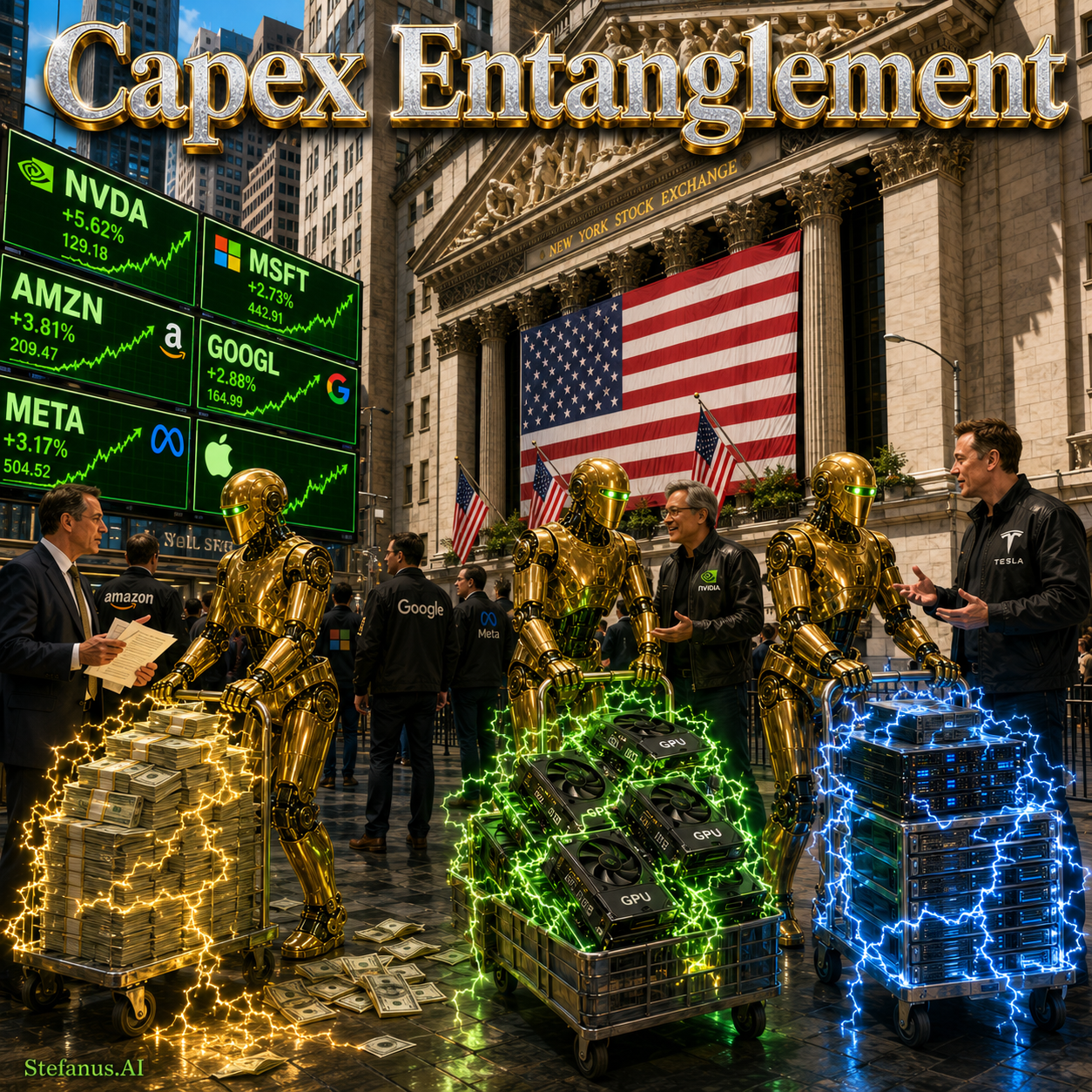
On the morning of November 3, 2025, a single press release added roughly $140 billion to Amazon’s market capitalization before lunch. OpenAI, the maker of ChatGPT, had agreed to purchase $38 billion of cloud computing capacity from Amazon Web Services over seven years—its first contract with the largest cloud provider in the world, and its most decisive step away from Microsoft, the partner that had until January of that year held exclusive rights to its workloads.[1] The deal gave OpenAI immediate access to hundreds of thousands of Nvidia graphics processing units housed in Amazon’s data centers, with the full contracted capacity scheduled for deployment before the end of 2026.[2] Amazon’s shares jumped more than four percent to an all-time high.[8]
Considered in isolation, the announcement looked like ordinary commerce: a large customer buying capacity from a large supplier. But nothing about the transaction was isolated, and that is precisely the point of this paper. Within four months, the relationship had metastasized into something no textbook category could hold. In late February 2026, OpenAI announced a funding round of approximately $110 billion—reported at final close as roughly $122 billion—in which Amazon committed up to $50 billion of equity investment, beginning with an initial $15 billion tranche and a further $35 billion contingent on conditions being met, while Nvidia contributed $30 billion against its earlier stated intention to invest as much as $100 billion as OpenAI deploys Nvidia infrastructure.[3][4] Simultaneously, OpenAI expanded its $38 billion AWS agreement by an additional $100 billion over eight years, and Amazon Web Services became the exclusive third-party cloud distribution provider for Frontier, OpenAI’s newly unveiled enterprise platform.[3] Amazon’s chief executive framed the equity stake in the language of conviction rather than procurement.
“They’re going to be one of the very big winners, we believe, long term.” — Andy Jassy, Chief Executive Officer, Amazon [3]
Consider what this single relationship now contains. Amazon is OpenAI’s investor, holding up to $50 billion of its equity. Amazon is OpenAI’s supplier, selling it $138 billion of contracted compute across the combined agreements. Amazon is OpenAI’s distributor, gatekeeping enterprise access to the Frontier platform through AWS. And Amazon is, through Trainium—its custom silicon line, for which the partnership contemplates two gigawatts of dedicated capacity—OpenAI’s chip designer as well. Money that leaves Amazon’s treasury as an investment returns to Amazon’s income statement as cloud revenue; workloads that OpenAI wins in the enterprise flow back onto Amazon’s infrastructure; and the demand signal generated by the whole arrangement justifies the next round of Amazon’s own capital expenditure, which reached $44.2 billion in the first quarter of 2026 alone—the largest quarterly figure any technology company has ever reported.[18]
This paper names that architecture Capex Entanglement: the condition that arises when equity investments, chip purchases, cloud commitments, energy contracts, and model-distribution agreements create circular financial relationships among the same small group of companies, such that revenue, valuation, and demand can each appear stronger while depending, in meaningful part, on the same circulating capital. The term is deliberately structural rather than pejorative. Entanglement is not fraud, and this paper will take pains to distinguish the transparent, contract-backed reciprocity of the 2024–2026 AI buildout from the concealed round-tripping schemes of the dot-com era. But entanglement is also not neutral. It changes what an income statement means. It changes what a valuation measures. It changes how failure propagates. And it has arrived at a scale that makes those changes macroeconomically significant: Wall Street analysts have identified more than $800 billion in circular financing arrangements crisscrossing the AI supply chain, with OpenAI alone carrying roughly $1.15 trillion in infrastructure commitments to seven major vendors between 2025 and 2035—Broadcom, Oracle, Microsoft, Nvidia, AMD, Amazon, and CoreWeave—many of which are simultaneously its investors.[9]
The $150 Billion Nexus as Template
The paper frames its analysis around what may be called the $150 billion nexus: the paired Amazon–OpenAI (up to $50 billion of equity against $138 billion of compute) and Nvidia–OpenAI (up to $100 billion of intended investment against ten gigawatts of chip deployment) structural agreements. These two arrangements are the definitive templates of the phenomenon, not because they are the only examples—Table 1 below catalogues a dozen more—but because they exhibit every layer of entanglement at once: equity, silicon, cloud, energy, and distribution, fused in single negotiated packages. When Nvidia announced in September 2025 that it would invest up to $100 billion in OpenAI as OpenAI deployed ten gigawatts of Nvidia systems, and OpenAI in turn committed to fill its data centers with Nvidia hardware, the market briefly struggled to decide whether Nvidia had made an investment, booked a sale, or done both.[5] The honest answer—both, and neither cleanly—is the analytical problem this paper exists to address.
Contrasting Linear Supply Chains with Multi-Lateral Alliance Webs
Traditional supply chains are linear and directional. A miner sells to a smelter, which sells to a fabricator, which sells to an assembler, which sells to a consumer; capital flows one way and goods flow the other, and each firm’s revenue is legible as an arm’s-length exchange with a counterparty whose fortunes are only loosely coupled to its own. The AI infrastructure economy of 2025–2026 has replaced this geometry with a multi-lateral alliance web. The same five to ten balance sheets—Nvidia, Microsoft, Amazon, Alphabet, Meta, Oracle, Broadcom, AMD, OpenAI, and Anthropic—appear on both sides of nearly every major transaction, and frequently on three or four sides at once. Microsoft and Nvidia jointly committed up to $15 billion to Anthropic in November 2025, and Anthropic in the same announcement pledged to purchase $30 billion of compute from Microsoft’s Azure cloud, running on Nvidia’s Grace Blackwell and Vera Rubin systems.[12] Oracle signed a five-year, $300 billion cloud agreement with OpenAI whose fulfillment requires Oracle to buy extraordinary volumes of Nvidia hardware, even as Nvidia holds equity exposure to OpenAI.[9] By late July 2026, Nvidia was reported to be working on a fresh round of AI infrastructure deals worth more than $750 billion—including an initiative with SK Group worth more than $500 billion of mutual business and discussions to backstop as much as $250 billion of OpenAI’s data-center lease obligations—prompting a renewed wave of commentary that the financing of the boom had become indistinguishable from the demand it was meant to measure.[10][11]
Situating the Argument: The 2020–2026 Literature
The scholarly and practitioner literature bearing on Capex Entanglement has developed in three distinguishable waves, and this paper positions itself at their confluence. The first wave, spanning roughly 2020 through 2023, treated cloud concentration and platform power as the central problem: a literature of infrastructure studies and platform economics concerned with the market structure of hyperscale computing, the gatekeeping position of a handful of providers, and the dependency of the digital economy on their capital plans. That wave supplied the vocabulary of chokepoints and lock-in on which the present analysis draws, but it analyzed the hyperscalers as landlords of the digital economy—not yet as investors in, and financiers of, their own tenants.
The second wave, catalyzed by the generative AI breakout of late 2022 and running through 2025, was macroeconomic and skeptical of magnitude. Its landmark is Acemoglu’s “The Simple Macroeconomics of AI,” which worked from task-level evidence to a decade-long total factor productivity contribution far below the trillion-dollar projections of the investment banks and consultancies, concluding that only about five percent of economy-wide tasks could be profitably automated within ten years.[33] The Goldman Sachs research franchise crystallized the same tension in its much-cited 2024 inquiry into whether generative AI represented too much spend for too little benefit, and Stanford’s Brynjolfsson and coauthors contributed the most careful empirical evidence on diffusion, documenting in 2025 that employment effects were concentrated among early-career workers in AI-exposed occupations—proof that adoption was real, but proof equally that it was uneven and early.[34] This second wave established the demand-side yardstick against which the supply-side buildout must be measured, and Section 6 leans on it heavily; what it did not examine was the financial architecture through which the buildout was being funded.
The third wave—the circularity literature proper—emerged only in late 2025 and matured with startling speed across 2026, largely outside traditional academic venues and inside the gray literature of investment research, financial journalism, and economist commentary. Its founding exchange was the October 2025 debate opened by Noah Smith’s widely circulated essay asking whether AI’s circular deals constituted round-tripping or legitimate vendor finance, drawing Harvard Kennedy School and Marginal Revolution responses within days;[35] its institutional consolidation came when Bloomberg established a permanently maintained graphic of the deal web in January 2026 and when Harvard Law School’s Program on Negotiation adopted the phenomenon as a teaching case.[5][40] The wave’s analytical poles are now well defined. At one pole, the historical-continuity school—GMO’s revival of the Galbraithian bezzle and the Lucent–Nortel vendor-financing precedent—reads the 2026 structures as a transparent rerun of a familiar cycle;[39] at the other, the reflexivity school argues that transparency itself is the novel variable, and that the danger has migrated from concealed fraud to visible, synchronized fragility.[49] Between them sit the empirical contributions: the take-or-pay contract analyses documenting how utilization traps are built into the deal cohort’s legal structure,[48] the Yale Cowles Foundation valuation work finding AI-related firms trading well above measured performance,[47] and, at the summit of the official sector, the IMF’s escalating treatment of AI-linked valuations across its 2025–2026 World Economic Outlook cycle, culminating in the July 2026 Update’s explicit correction scenario.[30]
What the three waves have not yet produced—and what this paper attempts—is a unified structural account: a framework that names the architecture as such, maps it across all five layers of the AI economy simultaneously, grounds it in the complete first-quarter 2026 earnings record, and derives from it both the accounting reforms and the analytical reorientation that the phenomenon demands. The literature has described the loops one at a time; the task now is to describe the knot.
Roadmap of the Paper
The argument proceeds as follows. Section 1 dissects the anatomy of an entangled loop—equity-for-infrastructure dynamics, the rise of cloud credits as a quasi-currency, and the emergence of the triple-identity entity. Section 2 examines the energy matrix, where twenty- to forty-year power assets are being married to two- to five-year silicon. Section 3 analyzes distribution monopolies and enterprise channel warfare, including the antitrust questions raised by influence without acquisition. Section 4 unpacks Nvidia’s sovereign-scale infrastructure strategy. Section 5 presents Anthropic’s multicloud, multigigawatt arrangements as a structured comparative case study. Section 6 assesses macroeconomic risks: circular revenue inflation, the double-counting trap, depreciation asymmetry, and systemic contagion. Section 7 proposes a disclosure-reform agenda centered on related-party compute purchases and infrastructure concentration reporting. Section 8 distills what we have learned into six pillars of Entangled Capitalism, and the Conclusion considers what synthetic markets imply for the future of sovereign capital.

Section 1: The Anatomy of a Loop — Equity, Silicon, and Cloud Commitments
Every complex financial architecture begins with a simple transaction repeated until it changes character. The transaction at the heart of Capex Entanglement is disarmingly ordinary: a supplier helps a customer afford the supplier’s own product. Automakers have financed car buyers for a century; Lucent and Nortel financed telecom carriers in the 1990s; IBM financed mainframe leases in the 1960s. What distinguishes the 2024–2026 AI economy is not the existence of vendor finance but its recursion, its scale relative to the underlying firms, and its fusion with equity ownership, exclusive distribution, and physical infrastructure control. When the loop closes—when the financier is also the vendor, the vendor is also the shareholder, and the shareholder is also the distribution channel—the individual transactions remain legal and even rational, while the system they compose acquires properties none of them has alone. This section dissects that system into its three constituent mechanisms.
1.1 Equity-for-Infrastructure Dynamics: How Venture Tranches Become Chip Bookings
The signature move of the entangled era is the equity tranche that is recycled, almost immediately and by design, into data center and chip bookings from the investor itself. The mechanism deserves precise description because its accounting consequences are the subject of Section 6. In a conventional venture investment, capital flows from investor to company, and the company deploys it across salaries, research, marketing, and infrastructure purchased from unrelated third parties. In an equity-for-infrastructure arrangement, the investment agreement and the procurement agreement are negotiated as a package: the investor’s capital commitment is sized against, sequenced with, and sometimes formally conditioned upon the recipient’s commitment to purchase the investor’s products. Amazon’s up-to-$50 billion investment in OpenAI—$15 billion initially, $35 billion when conditions are met—was announced in the same breath as the $100 billion expansion of OpenAI’s AWS purchase agreement.[3] Nvidia’s up-to-$100 billion commitment to OpenAI was explicitly structured to be drawn down as OpenAI deploys successive gigawatts of Nvidia infrastructure, with the first tranches tied to systems built on Nvidia’s Vera Rubin platform; in the event, Nvidia’s initial deployment of that intention took the form of a $30 billion participation in OpenAI’s early-2026 funding round.[5][3]
The economic substance of such a package differs from its legal form. Legally, there are two contracts: an investment and a supply agreement. Economically, there is one circuit: the investor finances demand for its own capacity, and a substantial share of the invested dollar returns as the investor’s revenue within quarters. Practitioner analyses through 2026 have documented the breadth of the pattern—AMD’s arrangement with OpenAI paired tens of billions of dollars in chip commitments with equity warrants that could make OpenAI one of AMD’s largest shareholders; Oracle’s $300 billion cloud contract with OpenAI positioned a supplier’s entire growth narrative on a single financed customer; and Nvidia’s investments in CoreWeave sit upstream of CoreWeave’s more than $22 billion of contracts with OpenAI, which runs on Nvidia hardware rented from CoreWeave.[9][5][8] The dollar, in short, does not merely circulate; it circulates through balance sheets that report each pass as fresh economic activity.
Nobel laureate Paul Krugman has offered the most vivid image in the recent literature for this recursion, describing the pattern as a closed serpent of finance.
“financial ouroboros” — Paul Krugman, Nobel Laureate in Economics [36]
Yet the loop is not, in itself, evidence of deception, and the strongest versions of both the bull and bear cases must be stated. Defenders note that building frontier AI is extraordinarily expensive, that advanced chips remain scarce, and that in such a market companies do not simply place orders—they lock in supply by pairing long-term purchase commitments with financing, exactly as capital-intensive commodity industries have always done. Asset manager Janus Henderson characterized the deal wave as the opposite of a vicious cycle.
“virtuous circle” — Janus Henderson, asset management commentary on AI infrastructure deals [5]
Skeptics answer that the virtue of the circle depends entirely on the eventual arrival of end demand that originates outside the circle—and that until it arrives, every participant’s reported growth is partly a reflection of every other participant’s spending. Section 6 returns to this dispute with the accounting evidence.
1.2 The Compute Promissory Note: Cloud Credits as a Secondary Currency
The second mechanism is subtler than the equity tranche and has received far less scholarly attention: the rise of committed compute—cloud credits, reserved capacity, and take-or-pay purchase obligations—as a secondary currency circulating among AI firms. When a hyperscaler invests in a model developer partly in the form of cloud credits rather than cash, or when a model developer’s multi-year compute commitment is booked by the provider as remaining performance obligations, an instrument has been created that behaves like money within the alliance web while never quite appearing as money on anyone’s books. The credit inflates the recipient’s effective war chest without an immediate cash transfer; it inflates the provider’s contracted backlog—Google Cloud’s backlog surpassed $460 billion in the first quarter of 2026, and Microsoft has disclosed an Azure backlog of roughly $80 billion that it cannot yet fulfill due to power constraints—without immediate revenue recognition; and it binds the two parties into a mutual dependency that neither can exit without impairing both.[18][52]
The compute promissory note has three properties that make it systemically interesting. First, it is illiquid and bilateral: unlike cash, a $10 billion credit on Azure cannot be spent at AWS, which means the instrument itself enforces customer lock-in. Second, it is contractually rigid: research on the 2024–2026 deal cohort documents that take-or-pay terms—minimum spend floors, reserved capacity that expires, fixed lease payments, and penalties for underuse—require payment regardless of utilization, so that a model developer whose revenue ramp lags its commitment schedule faces a scissors of fixed compute obligations against variable income.[48] Third, it is valuation-relevant on both sides simultaneously: the same committed dollar supports the provider’s backlog multiple and the developer’s capacity-based credibility with its own investors. A promissory note that raises two valuations at once is doing more work than a dollar should.
1.3 The Triple-Identity Entity: Supplier, Anchor Investor, and Distributor at Once
The third mechanism is organizational: the emergence of what this paper calls the triple-identity entity—a single technology giant operating concurrently as a foundational compute supplier, an equity anchor, and a downstream product distributor for the same counterparty. Amazon’s relationship to OpenAI after February 2026 is the canonical instance: supplier of $138 billion in contracted compute, anchor investor of up to $50 billion, and exclusive third-party cloud distributor of the Frontier enterprise platform.[3] Microsoft’s relationship to OpenAI is the founding instance: a cumulative $13 billion-plus investment that grew into an approximately 27 percent stake in OpenAI Group PBC, a roughly 20 percent revenue share, a $250 billion Azure purchase commitment by OpenAI, and distribution of OpenAI models through Azure and the Copilot product family.[1][9] Google occupies all three roles with respect to Anthropic, as Section 5 details, holding an investment position that reached $40 billion by April 2026 while supplying up to a million TPUs and distributing Claude through Google Cloud’s Vertex AI.[15]
The triple identity matters because each role generates information and leverage that the others can exploit, and because the roles’ obligations can conflict. As supplier, the hyperscaler sees the developer’s utilization curves, cost structure, and technical roadmap in near real time. As investor, it holds governance rights, information rights, and a valuation interest in the developer’s fundraising narrative. As distributor, it controls the developer’s access to enterprise customers and observes exactly which of those customers adopt the developer’s models—intelligence of obvious value to the hyperscaler’s competing first-party models. Traditional conflicts doctrine in corporate law contemplates directors who sit on two boards; it has little to say about a counterparty that is simultaneously your largest cost line, your largest shareholder, your sales force, and your competitor. Section 3 takes up the competitive implications; here the point is architectural. The triple-identity entity is the node at which the five layers of the AI economy fuse, and its existence is what converts a set of bilateral deals into a genuine entanglement.
Table 1. The Circular Deal Ledger: Principal Entangled Arrangements, 2023–July 2026
| Parties | Equity / Financing Leg | Procurement / Commitment Leg | Distribution or Other Leg |
| Microsoft ↔ OpenAI | ~$13B+ invested; ~27% stake; ~20% revenue share | OpenAI commits ~$250B to Azure | OpenAI models in Azure, Copilot |
| Amazon ↔ OpenAI | Up to $50B investment ($15B initial) | $38B AWS deal expanded by $100B over 8 years; 2 GW Trainium contemplated | AWS exclusive third-party distributor of Frontier |
| Nvidia ↔ OpenAI | Up to $100B intent; $30B into 2026 round; ~$250B lease backstop in talks | 10 GW of Nvidia systems | CUDA ecosystem embedding |
| Oracle ↔ OpenAI | Stargate co-development | ~$300B cloud contract over 5 years | Oracle buys Nvidia chips to serve OpenAI |
| AMD ↔ OpenAI | Equity warrants toward ~10% | 6 GW of AMD accelerators | — |
| Broadcom ↔ OpenAI | Co-design partnership | 10 GW custom accelerators (~$350B est.) | — |
| CoreWeave ↔ OpenAI / Nvidia | Nvidia equity stake in CoreWeave | >$22B OpenAI contracts on Nvidia GPUs | — |
| Microsoft + Nvidia ↔ Anthropic | Up to $15B combined ($5B + $10B) | Anthropic buys $30B Azure; up to 1 GW Grace Blackwell / Vera Rubin | Claude in Microsoft Foundry |
| Google ↔ Anthropic | Investment reaching ~$40B; ~$350B valuation | Up to 1M TPUs (>1 GW), expanded to ~3.5–5 GW with Broadcom | Claude on Vertex AI |
| Amazon ↔ Anthropic | ~$8B early investment; up to $25B more (Apr 2026) | >$100B AWS over 10 years; Project Rainier ~500K Trainium2; up to 5 GW | Claude on Amazon Bedrock |
| Nvidia ↔ SK Group | Strategic partnership (Jul 2026) | >$500B mutual business incl. memory and AI factories | — |
Sources: compiled from company announcements and reporting cited in the endnotes.[1][3][5][9][10][12][13][14][15][16][54]

Section 2: The Energy Matrix — Grid Demands and Power Offtake Monopolies
If capital is the bloodstream of the entangled economy, energy is its skeleton—the slowest-moving, hardest-to-replicate, and most jurisdictionally contested layer of the five-layer stack. The deepest irony of the AI buildout is that an industry defined by objects that obsolesce in two to five years has made itself structurally dependent on assets—nuclear reactors, transmission corridors, gas turbines, hydroelectric allocations—that are planned in decades and licensed across political generations. Understanding Capex Entanglement therefore requires understanding how the alliance webs of Section 1 have extended themselves into the physical grid, converting electricity from a utility input into a strategic instrument of exclusion, and how the mismatch between silicon time and energy time has become one of the defining risk transfers of the era.
2.1 Gigawatt-Scale Dependencies: The Trainium Commitment and Its Kin
The unit of account in AI infrastructure negotiation has quietly shifted from dollars to gigawatts, and the shift is analytically revealing. A gigawatt is not a financial abstraction; it is a claim on a specific place—on land, water, substation capacity, and interconnection position—and it can be promised only by an entity that controls that place. When the Amazon–OpenAI partnership contemplates two gigawatts of Trainium capacity, the commitment binds three scarcities at once: Amazon’s custom silicon allocation, Amazon’s data center campuses, and Amazon’s contracted power.[3] When OpenAI’s September 2025 arrangement with Nvidia specified ten gigawatts of Nvidia systems—roughly four to five million chips—and its subsequent agreements added six gigawatts of AMD accelerators and ten gigawatts of Broadcom co-designed silicon, the aggregate implied electrical demand of a single private company’s roadmap approached the peak load of a mid-sized industrial nation.[7] The gigawatt denomination is how the industry admits, without quite saying so, that the binding constraint has migrated below the silicon layer.
The scale is corroborated from the demand side of the grid. Microsoft has disclosed that roughly $80 billion of Azure backlog cannot be fulfilled because power is unavailable, and its management has identified electricity—not chips—as the gating factor on cloud growth.[52] Interconnection wait times for new data center campuses now exceed five years in several U.S. regions, which means that a hyperscaler’s 2031 competitive position is being determined by queue positions filed in 2025.[57] The five-year queue converts energy access into a first-mover moat: capital can be raised in weeks and chips procured in quarters, but a grid connection missed today cannot be repurchased at any price until the next decade. Entangled alliances form partly to pool exactly this scarcity—an equity investment buys not only compute but a place in the partner’s interconnection portfolio.
2.2 Nuclear and Renewable Pre-Orders: Locking the Grid via Long-Term PPAs
The clearest expression of energy-layer entanglement is the wave of long-term power purchase agreements through which hyperscalers have effectively pre-ordered the output of entire power plants—including plants that do not yet operate. The template transaction was signed in September 2024, when Microsoft agreed to a twenty-year PPA with Constellation Energy to restart Unit 1 of the Three Mile Island nuclear plant in Pennsylvania—closed for economic reasons in 2019 and adjacent to the unit that suffered America’s worst commercial nuclear accident in 1979. The restarted reactor, rebranded the Crane Clean Energy Center, will deliver approximately 835 megawatts of carbon-free baseload power—enough for roughly 800,000 homes—with Microsoft holding rights to effectively the entire output for its data centers; Constellation called it the largest power purchase agreement in its history, and by early 2026 the restart was running ahead of schedule, with grid synchronization targeted for 2027.[42][43]
The Three Mile Island deal ignited what industry observers have described as a nuclear arms race among the hyperscalers. Amazon expanded its arrangement with Talen Energy to secure nearly two gigawatts from the Susquehanna nuclear station; Alphabet partnered with Kairos Power to deploy a fleet of small modular reactors totaling some 500 megawatts by the early 2030s; and across the sector, operators moved to directly underwrite grid expansion through long-duration PPAs, nuclear restarts, and dedicated generation procurement.[43][44] Two strategic advantages recur across these transactions. The first is price stability: a twenty-year fixed-price PPA insulates the buyer from an electricity market in which prices have spiked under the combined weight of AI demand and transport electrification. The second—and for this paper’s purposes the more important—is capacity reservation as exclusion. A gigawatt committed to one hyperscaler’s campuses is a gigawatt that no rival, and no unaffiliated AI startup, can obtain in that region on any timeline shorter than a new plant’s construction. The PPA is thus a competitive weapon that never appears in any antitrust market-share table, because the market it forecloses—deliverable megawatts at specific nodes—is not one competition authorities have historically measured.
2.3 Energy as Capital: Why Power Became the Ultimate Bargaining Chip
The deepest transformation is conceptual: within the entangled economy, energy has begun to function as capital—an appreciating, collateralizable, strategically allocatable asset—rather than as an operating expense. Three observations support this claim. First, power availability now determines the sequencing of the entire capital stack above it: Microsoft attributed its record $190 billion fiscal-2026 capital expenditure plan in part to the race to secure powered land, and all four major hyperscalers now report power, ahead of silicon, as the primary constraint on deployment.[44][52] Second, energy access has become the currency of alliance formation. Anthropic’s arrangements, examined in Section 5, secure gigawatts across three different hyperscalers precisely because no single partner could deliver the required power on the required timeline; OpenAI’s Stargate program with Oracle and SoftBank is, at bottom, a vehicle for aggregating sites and megawatts. Third, financial markets have repriced the energy layer as if it were technology: Constellation’s equity more than doubled in the year of the Microsoft deal, and BlackRock’s chairman, speaking at the Milken Institute conference, inverted the entire bubble debate by locating the scarcity in physics rather than finance.
“There is not an AI bubble. There is the opposite.” — Larry Fink, Chairman and CEO, BlackRock, at the Milken Institute Global Conference [23]
Fink’s completion of the thought—that the economy is short power and short compute—captures the strongest version of the entanglement bulls’ case: if the binding constraint is physical, then circular financing is simply how a civilization mobilizes capital fast enough to relieve it. But the observation cuts both ways. An architecture premised on permanent scarcity of power inherits the political economy of power: siting fights, ratepayer backlash, transmission politics, and sovereign intervention. The entangled firms have not escaped the market; they have annexed the grid, and with it the grid’s oldest conflicts. The asymmetry between the twenty- to forty-year life of the energy assets now being contracted and the two- to five-year life of the silicon they will feed is deferred to Section 6, where its accounting consequences can be treated with the seriousness they deserve.
Table 2. Representative Hyperscaler Energy Commitments Supporting Entangled AI Alliances
| Buyer | Counterparty / Asset | Structure | Scale | Horizon |
| Microsoft | Constellation — Three Mile Island Unit 1 (Crane Clean Energy Center) | 20-year fixed-price PPA; nuclear restart | ~835 MW | Restart targeted 2027; 20 years |
| Amazon | Talen Energy — Susquehanna nuclear station | Expanded offtake adjacent to data center campus | ~2 GW | Multi-decade |
| Alphabet | Kairos Power | SMR fleet development agreement | ~500 MW | Early 2030s deployment |
| Amazon (for Anthropic) | Project Rainier campuses | Dedicated AI cluster power | ~1M Trainium2 chips; up to 5 GW contemplated | ~$11B+ site buildout |
| OpenAI ecosystem | Stargate (Oracle, SoftBank) | Site and power aggregation vehicle | Multi-GW (4.5 GW Oracle tranche reported) | 2025–2030s |
Sources: compiled from reporting cited in the endnotes.[7][14][16][42][43][44]

Section 3: Distribution Monopolies and Enterprise Channel Warfare
Capital, silicon, and energy determine what can be built; distribution determines who gets paid. The least glamorous layer of the five-layer stack is, for exactly that reason, where entanglement produces its most durable competitive effects. A model developer can, in principle, switch chip vendors between training runs and arbitrage cloud providers across regions. What it cannot easily do is replace the enterprise sales channel—the procurement relationships, security certifications, marketplace placements, and existing cloud commitments—through which corporate customers actually buy AI. The hyperscalers understood this earlier than their critics did, and the distribution provisions embedded in the 2025–2026 deal wave may prove more consequential than the headline equity figures that overshadowed them.
3.1 Gating the Enterprise Frontier: AWS as OpenAI’s Exclusive Third-Party Channel
The February 2026 Amazon–OpenAI expansion contained a clause that received a fraction of the attention paid to the $50 billion investment but arguably deserved more: AWS became the exclusive third-party cloud distribution provider for Frontier, OpenAI’s enterprise platform.[3] The provision means that an enterprise wishing to deploy OpenAI’s flagship business offering through any hyperscale cloud other than Microsoft’s existing arrangements must do so through Amazon—on Amazon’s marketplace, mediated by Amazon’s contracts, and metered against the customer’s existing AWS spending commitments. For OpenAI, the clause purchased instant access to the largest installed base of enterprise cloud relationships in the world. For Amazon, it converted a supplier-investor position into a toll position: every Frontier deployment routed through AWS deepens the customer’s dependence on AWS primitives—storage, networking, identity, and the surrounding application estate—regardless of whose model performs the inference.
Exclusivity in distribution is the oldest strategy in enterprise software, but its combination with the investor and supplier roles is new. A distributor that merely resold Frontier would negotiate margin; a distributor that owns up to $50 billion of the vendor’s equity and supplies $138 billion of its compute negotiates architecture. The customer acquisition moat is thus double-walled: OpenAI’s enterprise growth is channeled onto Amazon’s rails, and the intelligence generated by that growth—which industries adopt, at what usage intensity, with what complementary services—accrues to a partner that also fields competing first-party models and competing custom silicon. Anthropic’s parallel presence across Amazon Bedrock, Google Vertex AI, and Microsoft Foundry represents the multi-homed alternative to exclusive gating, and the contrast between the two distribution strategies is developed in Section 5.
3.2 The Monetization Loop: How Distribution Guarantees Secondary Revenues
Distribution agreements in the entangled economy are not primarily about the distributed product’s margin; they are about the gravitational field the product creates. When a corporate workflow is rebuilt around a frontier model delivered through a hyperscaler’s channel, the model’s API fees are frequently the smallest line in the resulting invoice. The customer’s data must live adjacent to the inference for latency and governance reasons, which sells storage. The application logic wrapping the model runs on the hyperscaler’s compute, which sells instances. The retrieval systems, vector databases, monitoring, and security tooling are drawn from the hyperscaler’s catalog, which sells the long tail. This is the monetization loop: distribution funnels the partner’s model adoption back into the hyperscaler’s proprietary services, guaranteeing secondary revenues that dwarf the primary transaction and that appear nowhere in the distribution agreement itself.
The loop’s financial signature is visible in the 2026 earnings record. Amazon reported AWS growth of 28 percent in the first quarter of 2026—its fastest in years—alongside a custom chip business that reached a $20 billion revenue run rate; Microsoft disclosed an AI revenue run rate above $37 billion; Google Cloud’s quarterly revenue crossed $20 billion with a backlog above $460 billion.[18][52] Each of these figures is presented to investors as evidence of AI demand, and each is real cash from real customers. But each also embeds, inextricably, the recycled spending of financed partners and the secondary revenues of gated distribution—which is why, as Section 7 documents, sophisticated investors have begun demanding that cloud revenue be disaggregated by the independence of its source.
3.3 Anti-Competitive Lock-In, and Influence Without Acquisition
The distribution webs raise two distinct competition problems, and conflating them has weakened public debate. The first is classic foreclosure: the exclusion of unaffiliated rivals from channels and inputs. Mid-market AI chip startups and independent model developers confront a market in which the leading customers are financed by the leading suppliers, the leading distribution channels are owned by the leading investors, and the leading energy positions are locked behind decade-long PPAs. A startup with a superior accelerator cannot sell it to a frontier lab whose compute is contractually committed, at take-or-pay floors, to the startup’s giant competitors for a decade; a startup with a superior model cannot reach enterprise customers whose marketplace of record has an equity interest in steering demand elsewhere. None of this requires any individual contract to be unlawful; the exclusion is an emergent property of the web.
The second problem is the one antitrust law is least equipped to see: influence without full acquisition or formal control. The entangled giants have, with striking consistency, structured their positions to remain below the thresholds that trigger merger review—minority stakes, non-voting shares, revenue-share agreements, capacity commitments, and board observer rights rather than board seats. Microsoft’s roughly 27 percent interest in OpenAI’s public benefit corporation, Google’s investment position in Anthropic reaching $40 billion against a $350 billion valuation, and Nvidia’s lattice of minority positions across its own customer base each confer profound practical influence—over roadmaps, over exclusivity, over the counterparty’s very solvency—while formally preserving the target’s independence.[9][15][5] Both the U.S. Federal Trade Commission and the European Commission opened inquiries into the cloud-AI partnership structures, including the multi-layered Microsoft–OpenAI relationship and merger-by-hire talent transactions, and the FTC’s January 2025 staff report on AI partnerships had already flagged that equity-plus-compute arrangements can confer material influence over model developers—shaping access to compute, talent, and exclusivity—without the formal control that triggers merger review.[57] Yet as of mid-2026 no major entangled alliance has been unwound, and the enforcement toolkit—defined around horizontal overlap and vertical integration—continues to strain against multi-lateral circular alliance webs in which every firm is simultaneously upstream and downstream of every other. Section 8’s fifth pillar returns to this regulatory blind spot.

Section 4: Nvidia’s $100 Billion Sovereign Infrastructure Strategy
No account of Capex Entanglement can avoid placing Nvidia at its center, because Nvidia is the entity through which every loop eventually passes. Whether the capital originates as a hyperscaler’s equity tranche, a model developer’s venture round, a neocloud’s debt facility, or a sovereign fund’s strategic allocation, the majority of it terminates—one to three transactions later—in the purchase of Nvidia systems. This gives Nvidia a structural position unlike any vendor in the history of capital goods: it is the common supplier to all sides of every alliance, the common investor in many of them, and increasingly the common guarantor of the financing that connects them. Nvidia’s data center revenue grew from roughly $15 billion annually before the ChatGPT era to $115 billion, and in the first quarter of its fiscal 2027 reached a record $75.2 billion in a single quarter, up 92 percent year over year.[26][52] The strategy that produced those figures deserves dissection on its own terms.
4.1 The Hardware Hegemony: Unpacking the $100 Billion OpenAI Deployment
The September 2025 announcement that Nvidia intended to invest up to $100 billion in OpenAI, disbursed progressively as OpenAI deploys ten gigawatts of Nvidia systems, was the moment the entangled architecture became undeniable to general observers.[5] The structure is best understood as a milestone-linked demand guarantee wearing the clothing of a venture investment. Each gigawatt OpenAI stands up triggers a tranche of Nvidia capital; each tranche of Nvidia capital funds, in substantial part, the purchase of the systems whose deployment triggers the next tranche. Nvidia thereby converts its own balance sheet—fattened by the very sales the arrangement guarantees—into the financing that removes its largest customer’s principal constraint. When market skepticism about OpenAI’s trillion-dollar commitment stack intensified, Nvidia’s response was not retreat but escalation: by July 2026, the company was in discussions to backstop as much as $250 billion of OpenAI’s data-center lease obligations and had unveiled a partnership with SK Group encompassing more than $500 billion of mutual business, part of a fresh deal round exceeding $750 billion that promptly revived the circularity debate across financial media.[10][11]
The word sovereign in this section’s title is chosen deliberately. Commitments of this magnitude—guarantees measured in fractions of national GDP, alliances with the industrial champions of allied states, capacity allocations that shape which countries can train frontier models—are the traditional instruments of states, not vendors. Nvidia has, in effect, assumed the underwriting function that governments performed for railways and telegraphs: it socializes the demand risk of the infrastructure that consumes its products, across a network of counterparties whose fortunes it simultaneously supplies, finances, and holds.
4.2 Co-Dependence Risk: CUDA as the Embedded Software Layer
Nvidia’s second strategic instrument is not financial but architectural: the embedding of its CUDA software layer into the foundational clusters of every financed partner. A cluster purchased with Nvidia-linked capital is not merely a collection of Nvidia chips; it is a decade of code—kernels, compilers, communication libraries, and orchestration frameworks—written against Nvidia’s proprietary interfaces. The software layer converts a hardware purchase into an ecosystem membership, and ecosystem membership into switching costs that outlive any individual chip generation. This is why Nvidia’s investments in customers are best understood as ecosystem defense: a partner whose clusters, tooling, and engineering culture are CUDA-native will price the cost of defecting to AMD, to custom silicon, or to a hyperscaler’s in-house accelerator not at the hardware delta but at the full replatforming cost of its software estate.
The co-dependence runs in both directions, and therein lies the risk. Nvidia’s revenue concentration in a handful of entangled counterparties—hyperscalers building their own competing silicon, and model developers whose solvency depends partly on Nvidia’s own financing—means that the ecosystem’s defense mechanism doubles as its contagion channel. The hyperscalers’ custom-silicon programs (Google’s TPU with Broadcom, Amazon’s Trainium, Microsoft’s Maia 200, Meta’s MTIA) are, among other things, negotiating leverage against exactly this dependence, and their acceleration is the clearest evidence that Nvidia’s partners understand the entanglement as vividly as its critics do.[53][44]
4.3 Venture Capital as a Sales Funnel: Subsidizing the Purchase of One’s Own Chips
Nvidia’s third instrument is the systematic use of direct investment to subsidize the purchase of its own products by prominent AI labs and GPU clouds—the practice that most directly echoes the vendor-financing episodes of prior technology cycles. The pattern’s genealogy matters, because it is the strongest weapon in the skeptics’ arsenal. During the telecom boom of the late 1990s, equipment vendors including Lucent and Nortel lent billions to cash-strapped carriers who used the loans to buy the vendors’ gear; the vendors booked sales and profits up front and realized the losses only when the customers defaulted—an episode the asset manager GMO has revived as the paradigmatic case of what Galbraith called the bezzle, the interval during which dubious but not necessarily illegal accounting sustains imaginary wealth.[39] Veteran short seller Jim Chanos has argued that the AI cycle risks repeating the pattern in updated dress.
“putting money into money-losing firms so those firms can order their chips” — Jim Chanos, founder, Kynikos Associates [38]
The rebuttal, articulated across the 2025–2026 practitioner literature, is that today’s arrangements differ from the Lucent era in three material respects: the deals are disclosed rather than concealed, the assets financed are tangible and productive rather than fictitious, and the end demand—hundreds of millions of users and rapidly growing enterprise adoption—verifiably exists.[35][49] Economists Noah Smith and Tyler Cowen have both pressed this distinction, noting that legal, transparent vendor finance of a valuable product is commonplace and healthy. The strongest synthesis in the literature accepts the distinction and then denies that it settles the question: transparency removes the fraud risk but not the reflexivity risk. When capital finances the very demand that justifies the financier’s own valuation, the system behaves like a microphone aimed at its own speaker—stable at low volume, self-amplifying past a threshold—and the visibility of the wiring does nothing to change the acoustics.[49] Whether the 2026 system is below or beyond that threshold is precisely what the revenue-quality and contagion analyses of Section 6 attempt to assess.

Section 5: Case Study — Anthropic’s Multicloud, Multigigawatt Entanglement
If the Amazon–OpenAI and Nvidia–OpenAI agreements are the definitive templates of Capex Entanglement, Anthropic’s arrangements across Amazon, Google, Microsoft, Nvidia, Broadcom, and independent infrastructure providers constitute its most instructive counter-template: a deliberate strategy of multi-homed entanglement, in which the same structural dependencies are accepted but distributed across rival patrons so that no single loop can close completely around the company. The case rewards close study for two reasons. First, Anthropic’s revenue trajectory—an annualized run rate that grew from roughly $9 billion at the end of 2025 to more than $30 billion by April 2026, with the number of business customers spending over $1 million annually more than doubling in two months—makes it the clearest available example of a frontier lab whose demand growth is verifiably dominated by external enterprise customers rather than by its investors’ recycled capital.[14][15] Second, its capital structure shows that entanglement admits of degrees and designs: the architecture that concentrates risk in the OpenAI constellation has been consciously diversified in the Anthropic one.
5.1 The Three-Hyperscaler Portfolio
Anthropic is the only frontier model developer that counts all three hyperscale cloud providers as simultaneous investors, suppliers, and distributors. The Amazon relationship came first and remains the deepest: roughly $8 billion of early investment, expanded in April 2026 by a commitment of up to $25 billion more, against Anthropic’s pledge to spend more than $100 billion on AWS over ten years; its physical anchor is Project Rainier, a cluster of nearly 500,000 Trainium2 chips that came online in under a year—with AWS committing one million Trainium chips to Anthropic by the end of 2025 and up to five gigawatts of Trainium capacity contemplated across the partnership—at a site whose full buildout is expected to cost some $11 billion.[16][12][8][46] The Google relationship supplies the rival silicon: an October 2025 agreement granting access to as many as one million TPUs and bringing well over a gigawatt of capacity online in 2026, worth tens of billions of dollars—Google’s largest external TPU commitment, involving the kind of silicon Reuters characterized in terms that underline its strategic novelty.
“traditionally reserved for internal use” — Reuters, characterizing Google’s TPU allocation to Anthropic [16]
In April 2026 that arrangement was tripled: Anthropic, Google, and Broadcom—Google’s TPU co-design partner under a supply assurance agreement running through 2031—signed for approximately 3.5 gigawatts of next-generation TPU capacity beginning in 2027, up to five gigawatts overall, with Google’s cumulative investment in Anthropic reaching roughly $40 billion at a post-money valuation near $350 billion.[14][15][53] Anthropic’s chief financial officer marked the moment in unambiguous terms.
“our most significant compute commitment to date” — Krishna Rao, Chief Financial Officer, Anthropic [15]
The Microsoft–Nvidia leg completed the portfolio in November 2025: Microsoft committed up to $5 billion and Nvidia up to $10 billion of investment, while Anthropic agreed to purchase $30 billion of Azure compute capacity and to contract up to one additional gigawatt running on Nvidia’s Grace Blackwell and Vera Rubin systems—Nvidia’s first deep technical collaboration with Anthropic—with Claude models made available to enterprise customers through Microsoft Foundry.[12][54] The result is a company distributed across Amazon Bedrock, Google Vertex AI, and Microsoft Foundry at once: the only frontier models available on all three hyperscale clouds, with each hyperscaler holding an equity interest in the models’ success.[12]
5.2 What the Counter-Template Teaches
Three lessons emerge from the Anthropic configuration, each qualifying the darker readings of Sections 1 through 4. The first is that multi-homing converts entanglement from a solvency risk into a bargaining structure. Because Anthropic can shift marginal workloads among Trainium, TPU, and Nvidia-on-Azure estates, no single patron’s silicon roadmap, price schedule, or strategic pivot can hold the company hostage; the patrons instead compete to subsidize it, and the existence of each loop disciplines the terms of the others. The second lesson is that entanglement and genuine demand are not mutually exclusive: the tripling of run-rate revenue to more than $30 billion in a single quarter, driven by enterprise API adoption and agentic coding tools, demonstrates that a heavily financed company can nonetheless exhibit revenue whose growth is not primarily an echo of its financing.[14] The third lesson is cautionary and returns us to the paper’s thesis: even the diversified version deepens the aggregate web. Every additional patron is an additional balance sheet whose reported growth now depends partly on Anthropic’s spending, and Google’s willingness to commit its scarcest strategic asset—TPU allocation traditionally reserved for Gemini—to the developer of Gemini’s chief rival shows how thoroughly the logic of entanglement now overrides even sibling-division rivalry within a single corporate family.[16] Anthropic’s $50 billion commitment to U.S. domestic compute infrastructure, announced in November 2025 and extended through the Broadcom-era expansions, further binds the company into the national industrial-policy layer of the stack.[14]
Table 3. Anthropic’s Entanglement Map, as of July 2026
| Patron | Investment Position | Compute / Silicon Commitment | Distribution Channel |
| Amazon | ~$8B early; up to $25B additional (Apr 2026) | >$100B AWS over 10 years; Project Rainier ~500K Trainium2; ~1M chips by end-2025; up to 5 GW | Amazon Bedrock |
| Cumulative ~$40B; ~$350B post-money valuation | Up to 1M TPUs, >1 GW online 2026; +~3.5 GW next-gen TPU (with Broadcom) from 2027; up to 5 GW | Google Vertex AI | |
| Microsoft | Up to $5B | $30B Azure purchase commitment | Microsoft Foundry |
| Nvidia | Up to $10B | Up to 1 GW on Grace Blackwell / Vera Rubin | CUDA ecosystem collaboration |
| Broadcom (with Google) | Supply assurance through 2031 | Next-gen TPU co-design and delivery | — |
Sources: compiled from reporting cited in the endnotes.[12][14][15][16][53][54]

Section 6: Macroeconomic Risks and Systemic Valuation Cascades
The preceding sections described an architecture; this one asks what happens inside it, and what could happen to it. Four risks are analyzed in ascending order of generality: the inflation of reported revenue by circular flows; the double-counting of the same capital across multiple valuation frames; the asymmetry between rapidly depreciating silicon and generational energy assets; and the contagion dynamics of a web in which one highly connected node’s stumble propagates through every layer simultaneously. The analysis draws on the full first-quarter 2026 earnings record, the depreciation literature of 2024–2026, and the International Monetary Fund’s July 2026 assessment of AI-linked financial stability risk.
6.1 Circular Revenue Inflation: When the Investment Becomes the Revenue
The first-order accounting question posed by Capex Entanglement is deceptively simple: how much of the AI economy’s reported revenue would exist without the AI economy’s own financing? The question does not accuse any firm of misstatement—every dollar of AWS revenue from OpenAI, Azure revenue from Anthropic, or Nvidia revenue from CoreWeave is genuine consideration for genuine services under disclosed contracts. The problem is inferential, not legal: investors price hyperscaler and semiconductor equities on the premise that revenue growth measures external demand, and circular flows quietly weaken that premise. When Company A’s investment in Company B becomes a principal source of Company A’s revenue growth, the income statement remains accurate while becoming less informative. A Harvard Kennedy School analysis of the parallel with the late-1990s cross-selling economy captured both the resemblance and the difference: today’s firms deliver tangible products to real customers, yet their collective spending still runs far ahead of end-market monetization.
“companies bought each other’s services to inflate perceived growth” — Paulo Carvão, Senior Fellow, Harvard Kennedy School, on the dot-com precedent [35]
The scale of the inferential problem is now measurable. Practitioner tallies place more than $800 billion of criss-crossing investment-and-procurement arrangements across the AI supply chain, against which OpenAI—the web’s most connected private node—projects losses of roughly $14 billion in 2026 while carrying commitments of approximately $1.15 trillion through 2035.[9] Financial media institutionalized the concern: Bloomberg began maintaining a standing graphic tracking the circular deals in early 2026, and by mid-year, earnings analysis routinely distinguished revenue from independent third parties from revenue originating with counterparties the supplier itself had financed.[5][50] The distinction has begun to discipline private markets as well: with OpenAI and Anthropic both viewed as IPO candidates, PitchBook analysis identified revenue quality—the independence of demand from financing—as among the foremost metrics public investors would scrutinize.[4] The vocabulary itself has migrated from trading desks into the mainstream: “circularity” became Wall Street’s caution word of the cycle, the deliberate echo of the “round-tripping” label of the dot-com years,[41] and Harvard Law School’s Program on Negotiation now teaches the AI deal wave as a live case study in how negotiated reciprocity can shade into revenue inflation.[40] OpenAI’s chief executive has met the criticism head-on, dismissing what he called breathless concern and framing the commitment stack as a rational wager on a demonstrated trajectory.
“We are taking a forward bet that it’s going to continue to grow.” — Sam Altman, Chief Executive Officer, OpenAI, on the company’s infrastructure commitments [6]
The bet may well pay. But a forward bet financed by one’s own suppliers is a different instrument from a forward bet financed by the market, and the difference is exactly what the phrase revenue quality exists to capture.
6.2 The Double-Counting Trap: One Dollar, Three Balance Sheets
The second risk generalizes the first from income statements to valuations. A single committed dollar in the entangled economy can be counted, with full legal propriety, in at least three places at once: as asset growth on the investor’s balance sheet (the equity stake, marked to the recipient’s latest round), as backlog or revenue on the supplier’s disclosures (the compute commitment), and as capacity-based credibility in the recipient’s own fundraising narrative (the secured infrastructure that justifies the next valuation). Because the investor and the supplier are frequently the same firm, and because the recipient’s valuation feeds back into the investor’s marks, the system contains an internal multiplier: each new deal raises several valuations simultaneously, and those raised valuations collateralize the next deal. This is the reflexive amplifier that distinguishes 2026’s transparent circularity from simple vendor finance—the microphone-and-speaker dynamic in which visibility of the wiring does not prevent feedback.[49] Analysts have further documented that the amplification increasingly runs through opaque channels: an estimated $1.8 trillion of AI-related financing sits off balance sheet in special purpose vehicles, joint ventures, and lease structures, against roughly $1.4 trillion on balance sheet, prompting one widely circulated warning that invoked the canonical case of structural opacity.
“Enron’s crime wasn’t having special purpose vehicles. Enron’s crime was hiding them.” — Gil Luria, Head of Technology Research, D.A. Davidson [37]
Luria’s formulation is precise and worth dwelling on: the 2026 structures are disclosed, and disclosure is a genuine safeguard—but disclosure of individual instruments does not equal legibility of the system. No single filing anywhere reports the consolidated exposure of the alliance web; each firm discloses its own contracts, and the double-counted dollar hides in the aggregation gap between them.
6.3 Infrastructure Depreciation: Rapidly Aging Chips versus Generational Energy Assets
The third risk is where entanglement meets physics, and it is the subject of the fiercest accounting debate of the cycle. The AI capital stock is bifurcated across radically different time horizons. At one pole sit the chips: Nvidia’s own cadence now delivers a substantially superior accelerator generation roughly every year, and Microsoft’s annual filing concedes that its computer equipment lasts anywhere from two to six years.[24] At the other pole sit the energy assets contracted in Section 2: twenty-year nuclear PPAs, forty-year plant lives, multi-decade transmission investments. Capex Entanglement welds these two time signatures into single deal packages—gigawatt PPAs justified by chip fleets that will be obsolete before the reactor restarts—and the weld is where the financial stress concentrates.
The depreciation numbers involved are no longer footnote material. Over the past several years the hyperscalers progressively extended server useful-life assumptions from three or four years to six, a change that at 2026 spending levels is seismic: with the five largest hyperscalers projected by the Futurum Group to spend roughly $660 to $690 billion on infrastructure in 2026—nearly three-quarters of it AI-specific—capex depreciated over three years would produce approximately $220 billion of annual expense, versus roughly $110 billion over six years: a $110 billion swing in operating income arising purely from an estimate.[27][51] The direction of travel then reversed in the most telling way possible: in early 2025 Amazon shortened the useful life of a subset of its servers from six years to five, absorbing a $700 million hit to operating income and $920 million of accelerated depreciation, and its stated rationale deserves quotation because it is the industry testifying against its own prior assumption.
“the increased pace of technology development, particularly in the area of artificial intelligence” — Amazon, disclosure accompanying its server useful-life reduction [25]
Short seller Michael Burry, the most vocal skeptic, has estimated that if true economic lives are closer to three years than six, the industry’s understated depreciation compounds to roughly $176 billion across 2026–2028; defenders—including detailed practitioner modeling that depreciates compute over six years and other infrastructure over fourteen—respond that sustained excess demand for compute and improving fleet management make six years defensible, with hyperscaler revenues just clearing the depreciation expense.[25][24][29] Accounting scholarship stresses that useful-life extensions are changes in estimate under ASC 250, not corrections of error, and that more than $100 billion of construction-in-progress on hyperscaler balance sheets means today’s depreciation reflects yesterday’s investment cycle—the full expense wave from the 2025–2026 buildout has not yet reached any income statement.[28] Microsoft’s chief executive disclosed his own hedge against the treadmill, describing deliberate pacing of chip purchases to avoid being caught with obsolete fleets.
“stuck with four or five years of depreciation on one generation” — Satya Nadella, Chief Executive Officer, Microsoft, on the risk of mistimed GPU purchases [26]
The first-quarter 2026 filings quantify how far spending has outrun expense recognition: combined quarterly capex for the big four reached $129.8 billion—up 80 percent year over year—running at nearly three times the rate their income statements currently recognize as depreciation, with Amazon’s trailing-four-quarter capex crossing 100 percent of its operating cash flow; capex-to-revenue ratios across the group, which ran at 10 to 15 percent before the AI era, now stand at 25 to 30 percent.[19][55] Two-thirds of Microsoft’s quarterly capex went to short-lived assets, primarily GPUs and CPUs.[17] The depreciation wall, in short, is scheduled but not yet arrived; the entangled deals of 2025–2026 have booked the demand while deferring the expense, and the years 2027–2028 are when the two meet.

Figure 1. Combined capital expenditures of Amazon, Microsoft, Alphabet, and Meta: approximately $226 billion in 2024, $410 billion in 2025, and roughly $725 billion guided for 2026—an increase of about 77 percent year over year, with Goldman Sachs projecting a cumulative $5.3 trillion from 2025 through 2030.[20][52]

Figure 2. Quarterly capital expenditures roughly doubled year over year at each of the four largest hyperscalers between Q1 2025 and Q1 2026 (Microsoft figures reflect fiscal Q3, mapped to the calendar quarter). Combined Q1 2026 spending of $129.8 billion ran at nearly three times currently recognized depreciation.[17][19]
Table 4. The Depreciation Asymmetry: Asset Lives Across the Entangled Capital Stock
| Asset Class | Typical Stated Life | Contested Economic Life | Share of Current Capex |
| AI accelerators (GPUs/TPUs/custom) | 5–6 years | 2–5 years (Burry, Damodaran and others argue shorter) | Largest single component; ~2/3 of Microsoft Q1 2026 capex was short-lived assets |
| Servers, networking, storage | 5–6 years | 3–6 years | Substantial |
| Data center shells and improvements | 10–25 years | Broadly accepted | Significant |
| Power assets under PPA (nuclear, SMR) | 20–40 years | Broadly accepted | Off balance sheet via PPA |
| Grid interconnection positions | Multi-decade | Appreciating (queue scarcity) | Not capitalized |
Sources: company filings and analyses cited in the endnotes.[17][19][24][25][26][27][28][29]
6.4 Systemic Contagion Risk: Modeling the Cascade
The final risk is the one that transforms an accounting debate into a macroeconomic question: what happens when one highly connected model developer falters? The web’s topology supplies the answer. A frontier lab that misses its revenue ramp does not merely disappoint its own investors; it simultaneously impairs the equity marks of its hyperscaler patrons, strands the take-or-pay commitments on its suppliers’ backlogs, undermines the demand assumptions beneath its chip vendors’ valuations, and orphans gigawatts of contracted power whose twenty-year obligations survive the two-year silicon they were procured to feed. Because the same few balance sheets occupy every position, the loss does not diversify across the system—it multiplies through it. The take-or-pay literature identifies the trigger mechanism with precision: minimum-spend obligations are signed against back-end-loaded revenue ramps, so a business can remain on plan narratively while drifting off plan financially until the divergence surfaces all at once.[48]
The concern has reached the commanding heights of official-sector analysis. The International Monetary Fund’s July 2026 World Economic Outlook Update, while crediting AI-related investment with adding roughly half a percentage point to United States GDP growth in 2025 and lifting economies across the technology value chain, singled out concentrated AI valuations as a principal downside risk to the global outlook.
“frothy equity valuations … could correct sharply” — International Monetary Fund, World Economic Outlook Update, July 2026 [30]
The Fund’s modeled “AI disappoints” scenario—in which investors reassess productivity gains, technology markets undergo an acute correction, and AI capital spending retrenches—reduces global output by approximately 1.2 percent over the following years, transmitted through wealth effects, cross-border portfolio exposures, and tighter global financial conditions extending well beyond the technology sector—an assessment that led the Fund, in trimming its outlook, to name lofty AI-linked market expectations alongside war and trade fragmentation among the principal global risks.[31][30][32] Independent academic evidence points the same direction: a Cowles Foundation analysis at Yale, using data from 2023 to 2025, found many AI-related firms trading at valuations well above what their measured performance supports—the classic statistical signature of a bubble, with the customary caveat that bubbles are reliably identified only in retrospect.[47] Morgan Stanley’s strategists, projecting that hyperscaler AI capex will exceed the dot-com era’s telecom boom in both magnitude and duration—with the hyperscalers driving roughly 40 percent of all Russell 1000 cash capital expenditure over 2026–2028, more than $2 trillion—cautioned that if AI capex disappoints, leverage could rise faster than output; their summary judgment was measured but unmistakable.
“vigilance is a 2026 responsibility” — Morgan Stanley, research note on AI capex and credit risk [22]
Academic macroeconomics supplies the demand-side reason for vigilance. MIT Institute Professor and Nobel laureate Daron Acemoglu’s widely debated analysis estimates that only about five percent of economy-wide tasks can be profitably performed by AI within a decade, implying a GDP contribution he characterizes in deliberately deflationary terms.
“nontrivial, but modest” — Daron Acemoglu, Institute Professor, MIT, on AI’s likely decade-long GDP effect [33]
If Acemoglu’s arithmetic is even directionally correct, the gap between the productivity gains that end-customers will pay for and the infrastructure being financed to serve them is the systemic exposure—an exposure the White House Council of Economic Advisers’ January 2026 assessment of AI and the economy surveyed alongside Stanford economist Erik Brynjolfsson’s 2025 findings that employment effects are so far concentrated among early-career workers in exposed occupations, evidence that diffusion is real but uneven.[34] The counterpoint, pressed by Federal Reserve commentary and by the optimists’ camp, is that unlike prior bubbles the AI firms generate substantial actual revenue and measurable output, and corporate cash positions are far stronger than in 1999.[56] The market’s own behavior through July 2026 suggests the verdict remains open: Alphabet’s raised 2026 capex forecast triggered a seven percent single-day decline and dragged Amazon, Meta, and Microsoft down with it, as investors—confronting Meta’s projected $138.9 billion of spending, guided to be “notably larger” than 2025’s and unaccompanied by any cloud business to externalize it—shifted their attention decisively from top-line beats to payback timelines.[21][46][45] The cascade has not happened; the market has merely demonstrated, repeatedly, that it knows where the fault line lies.

Section 7: Disclosure Reform — Making the Entangled Economy Legible
Diagnosis obligates prescription. If the argument of Sections 1 through 6 is correct—that the individual transactions of the entangled economy are lawful and largely disclosed, while the system they compose is illegible—then the appropriate regulatory response is neither prohibition nor complacency but a targeted expansion of disclosure designed to restore the informativeness of the financial statements the entanglement has quietly degraded. This section proposes five reforms, ordered from least to most demanding, and grounds each in an information failure documented earlier in the paper.
First, related-party compute revenue disaggregation. Cloud providers and chip vendors should disclose, quarterly, the share of segment revenue derived from counterparties in which the reporting firm (or its consolidated affiliates) holds an equity interest above a de minimis threshold, has extended vendor financing, or has provided guarantees. Market practice is already moving this direction—by mid-2026, earnings analysis routinely attempted to separate third-party revenue from financed-counterparty revenue, and PitchBook identified revenue quality as the decisive metric for the anticipated OpenAI and Anthropic listings—but analysts are currently forced to reconstruct the split from deal announcements rather than reading it from filings.[50][4] A single mandated line would collapse that reconstruction cost to zero.
Second, symmetric commitment disclosure. Take-or-pay compute obligations should be disclosed with the same rigor on both sides of the contract: as remaining performance obligations by the provider and as fixed contractual commitments, with a maturity ladder, by the purchaser. The utilization-trap literature shows that the danger concentrates precisely where back-end-loaded revenue ramps meet front-loaded minimum-spend floors; a maturity ladder makes that scissors visible years before it closes.[48]
Third, infrastructure concentration reporting. Firms whose operations depend on AI infrastructure should disclose concentration metrics for their compute and power supply chains—the share of capacity sourced from their top three counterparties, and the share of contracted power tied to single assets or single grid regions—paralleling the customer-concentration disclosures long required of suppliers. The gigawatt commitments of Sections 2 and 5 are systemic facts hiding in press releases; they belong in risk-factor tables.
Fourth, useful-life sensitivity disclosure. Given that a three-versus-six-year assumption on AI hardware swings industry operating income by an amount on the order of $110 billion annually, filers with material AI fleets should disclose the depreciation impact of a one-year change in useful-life assumptions, along with the fleet’s age distribution and the share of construction-in-progress not yet depreciating.[27][28] The information exists in every hyperscaler’s fixed-asset ledger; investors are currently asked to price the largest capex cycle in corporate history without it.
Fifth, consolidated exposure mapping for off-balance-sheet structures. The estimated $1.8 trillion of AI-related financing routed through special purpose vehicles, joint ventures, and lease structures should be brought within a standardized disclosure regime that permits aggregation across filers.[37] Luria’s dictum—that the historical crime was concealment, not structure—defines the standard: the goal is not to forbid the vehicles but to ensure that a diligent reader of public filings can reconstruct the web’s consolidated exposure to its most connected nodes. No such reconstruction is possible today, and Section 6.2’s double-counting trap lives in exactly that gap.
None of these reforms restrains a single dollar of investment. Collectively, they would convert Capex Entanglement from a structure legible only to its architects into one legible to its financiers—which is, historically, the difference between capital formation and capital misallocation discovered too late.

Section 8: What Have We Learned? The Six Pillars of Entangled Capitalism
The evidence assembled across this paper resolves into six structural propositions—six pillars of what may fairly be called Entangled Capitalism, the mode of capital formation that the frontier AI economy has improvised under pressure of its own requirements. They are stated here as findings, each traceable to the sections that established it.
Pillar 1: Balance Sheet Reciprocity
Capital in the entangled economy is no longer spent; it is cycled through closed, synthetic vendor-customer loops in which the same dollar performs successive tours of duty as investment, procurement, revenue, and collateral. The Amazon–OpenAI nexus—up to $50 billion of equity against $138 billion of compute and an exclusive distribution channel—is the template, and the more than $800 billion of documented circular arrangements is the measure.[3][9] Reciprocity is the system’s engine and its exposure: it manufactures bankable demand in both directions, and it means that no participant’s reported strength can be evaluated without evaluating every counterparty’s.
Pillar 2: Architectural Co-Design
Software, silicon, and energy are no longer purchased off the shelf; they are optimized natively together, inside the alliances, before any product reaches an open market. Anthropic’s models are co-engineered against Trainium, TPU, and Grace Blackwell estates simultaneously; OpenAI co-designs custom accelerators with Broadcom while embedding CUDA across its Nvidia fleet; Google’s TPU roadmap is contractually fused to Broadcom through 2031.[16][15][53][9] Co-design deepens performance and deepens lock-in in the same gesture: the artifact that emerges is superior precisely because it cannot be procured elsewhere.
Pillar 3: Revenue Round-Tripping and the Limits of GAAP
Traditional revenue recognition, built for arm’s-length exchange, struggles to convey the informational content of non-cash cloud-credit exchanges, financed procurement, and investor-supplied demand. The statements remain accurate; their meaning thins. The industry’s own testimony—Amazon shortening server lives while peers extend them, two-thirds of Microsoft’s quarterly capex flowing into short-lived assets, capex running at triple recognized depreciation—shows GAAP straining to timestamp a capital cycle moving faster than its categories.[25][17][19] The reform agenda of Section 7 is the necessary response.
Pillar 4: Structural Chokepoints
Durable dominance in the entangled economy belongs to those who control the physical boundaries of the system: energy-grid allocation, advanced packaging, high-bandwidth memory, and interconnection queue position. Twenty-year nuclear PPAs, five-gigawatt silicon reservations, and supply-assurance agreements running to 2031 are the era’s true barriers to entry—unmeasured by market-share statistics and unreachable by capital alone, since the queues they command cannot be shortened by money.[42][43][14] The chokepoints are where entanglement hardens from finance into geography.
Pillar 5: Regulatory Blindspots
Antitrust doctrine built for horizontal overlap and vertical integration fails against multi-lateral circular alliances in which influence is exercised through minority stakes, capacity commitments, revenue shares, and exclusivity—each below the threshold of control, all together amounting to it. The FTC’s and European Commission’s inquiries into cloud-AI partnerships identified the problem without yet producing a remedy equal to it; as of mid-2026, no major entangled alliance has been restructured by any competition authority.[57] The blind spot is not accidental: the structures were engineered to occupy it.
Pillar 6: Contagion by Construction
The sixth pillar—added here to the five with which this inquiry began—is that systemic fragility in the entangled economy is not an accident of the architecture but a property of it. The same design choices that manufacture certainty in the upswing (mutual financing, take-or-pay floors, shared infrastructure, cross-held equity) pre-install the transmission channels of the downswing, which is why the IMF’s correction scenario propagates a technology repricing into a 1.2 percent hit to global output, and why a single guidance revision by one hyperscaler in July 2026 repriced all four within a trading day.[31][21] Entangled Capitalism does not eliminate the business cycle; it synchronizes its participants to a single cycle, and synchronization is the textbook precondition of cascade.

Conclusion: Synthetic Markets and the Future of Sovereign Capital
This paper began with a press release that moved $140 billion of market value in a morning, and it ends with the claim that such mornings are no longer measurements of a market but performances within an architecture. The intertwined networks of Nvidia, OpenAI, Amazon, Microsoft, Google, Anthropic, Oracle, Broadcom, and their satellites have progressively decoupled frontier AI development from traditional open-market supply and demand. Prices inside the web are negotiated among counterparties who hold each other’s equity; demand inside the web is underwritten by the suppliers who will book it; capacity inside the web is reserved decades ahead by the customers who will consume it. The result is what this paper has called a synthetic market: not a false market—the chips are real, the electrons are real, the enterprise adoption curling upward through every 2026 earnings report is real—but a constructed one, in which the signals that outside observers use to read reality are endogenous to the structure being read.
Three closing syntheses follow. The first concerns analysts and investors: the unit of analysis must shift from the individual corporate income statement to the allied ecosystem. Evaluating Nvidia without OpenAI’s commitment stack, Amazon without Anthropic’s ramp, or Microsoft without its simultaneous positions in both frontier labs is now a category error; the relevant balance sheet is the consolidated—and nowhere consolidated—balance sheet of the web itself. The tools for that analysis barely exist, which is why Section 7’s disclosure agenda is offered not as regulatory hygiene but as the precondition of rational pricing.
The second concerns the state. Capital formation at this scale and self-referentiality has historically been the province of sovereigns—railway guarantees, war finance, Bretton Woods—and the entangled firms have, without announcement, assumed sovereign functions: underwriting national compute capacity, restarting nuclear plants, allocating gigawatts among allied and rival developers, and negotiating with actual sovereigns as peers, from SK Group’s half-trillion-dollar alignment with Nvidia to Anthropic’s $50 billion American infrastructure pledge.[10][14] The question of the coming decade is not whether states will notice this assumption of function but on what terms they will contest or co-opt it.
The third is the paper’s final claim, stated plainly. Capex Entanglement is not a temporary pathology of a speculative bubble, destined to unwind into the linear supply chains of the prior era. It is a permanent structural evolution—an institutional technology invented to manufacture market certainty in the face of capital requirements that no linear market could mobilize on the required timeline. It may yet fail; Section 6 has catalogued exactly how, and the depreciation wall of 2027–2028 will administer the first true stress test. But whether it fails or holds, it will not be un-invented. The circular architecture of interlocked investors, customers, and suppliers is now the operating system of the most capital-intensive technological transition in history, and the work of economics, accounting, and law in the years ahead is not to marvel at it, nor to condemn it, but to make it legible—before its next loop closes.

Endnotes:
[1] MacKenzie Sigalos and Jordan Novet, “OpenAI signs $38 billion cloud computing deal with Amazon,” CNBC, November 3, 2025. https://www.cnbc.com/2025/11/03/open-ai-amazon-aws-cloud-deal.html
[2] Bloomberg News, “Amazon Inks $38 Billion Deal With OpenAI to Supply Nvidia Chips,” Bloomberg, November 3, 2025. https://www.bloomberg.com/news/articles/2025-11-03/amazon-inks-38-billion-deal-with-openai-to-supply-nvidia-chips
[3] CNBC Staff, “OpenAI announces $110 billion funding round with backing from Amazon, Nvidia, SoftBank,” CNBC, February 27, 2026. https://www.cnbc.com/2026/02/27/open-ai-funding-round-amazon.html
[4] Morningstar (with PitchBook analysis by Harrison Rolfes), “Ahead of IPOs, AI Giants Keep Making Circular Deals. Here’s Why That’s a Risk,” Morningstar, May 2026. https://www.morningstar.com/stocks/ahead-ipos-ai-giants-keep-making-circular-deals-heres-why-thats-risk
[5] Bloomberg Graphics, “AI Circular Deals: How Microsoft, OpenAI and Nvidia Keep Paying Each Other,” Bloomberg, January 22, 2026 (continuously updated). https://www.bloomberg.com/graphics/2026-ai-circular-deals/
[6] Gulf News (with Associated Press reporting), “OpenAI and Amazon sign $38 billion deal for AI computing power,” Gulf News, November 2025. https://gulfnews.com/technology/open-ai-amazon-sign-38-billion-ai-deal-1.500332425
[7] The Hill, “OpenAI, Amazon sign $38 billion computing deal,” November 2025. https://www.aol.com/news/openai-amazon-sign-38-billion-171615265.html
[8] Laura Bratton, “Amazon stock jumps on $38 billion deal with OpenAI to use hundreds of thousands of Nvidia chips,” Yahoo Finance, November 3, 2025. https://finance.yahoo.com/news/amazon-stock-jumps-on-38-billion-deal-with-openai-to-use-hundreds-of-thousands-of-nvidia-chips-145357373.html
[9] BlockEden Research, “The Great AI Circular Financing Loop: When Vendors Fund Their Own Customers,” BlockEden, March 6, 2026. https://blockeden.xyz/blog/2026/03/06/ai-circular-financing-loop-vendor-financing/
[10] Bloomberg News, “Nvidia’s $750 Billion in Deals Reignite Circular AI Fears,” Bloomberg, July 27, 2026. https://www.bloomberg.com/news/articles/2026-07-27/nvidia-s-750-billion-deals-revive-fear-of-ai-circular-financing
[11] CNBC, “Jim Cramer warns AI’s circular financing frenzy echoes the dot-com bubble,” CNBC, July 27, 2026. https://www.cnbc.com/2026/07/27/jim-cramer-warns-ai-circular-financing-echoes-dot-com-bubble.html
[12] Sebastian Moss et al., “Anthropic to purchase $30bn in Microsoft Azure credits, Nvidia and Microsoft to invest in AI company,” Data Center Dynamics, November 2025. https://www.datacenterdynamics.com/en/news/anthropic-to-purchase-30bn-in-microsoft-azure-credits-nvidia-and-microsoft-to-invest-in-ai-company/
[13] CNBC, “Google and Anthropic announce cloud deal worth tens of billions of dollars,” CNBC, October 23, 2025. https://www.cnbc.com/2025/10/23/anthropic-google-cloud-deal-tpu.html
[14] Yahoo Finance, “Anthropic announces deal with Google, Broadcom, says revenue has tripled,” Yahoo Finance, April 7, 2026. https://finance.yahoo.com/sectors/technology/articles/anthropic-google-broadcom-tpu-deal-113234906.html
[15] Pasquale Pillitteri, “Nvidia vs Google TPU: How the AI Chip Competition Is Reshaping the Market,” April 2026. https://pasqualepillitteri.it/en/news/1441/nvidia-vs-google-tpu-anthropic-ai-chip-2026
[16] LightSource, “Google Sold a Million Chips to Its Own Competition,” LightSource Blog, June 18, 2026. https://lightsource.ai/blog/google-sold-anthropic-a-million-tpus
[17] Om Malik, “What I Learned about Hyperscalers’ AI Spend,” om.co, April 30, 2026. https://om.co/2026/04/30/what-i-learned-about-hyperscalers-ai-spend/
[18] Yahoo Finance, “Hyperscalers Hit $700 Billion in 2026 AI Spending Plans,” Yahoo Finance, May 1, 2026. https://finance.yahoo.com/sectors/technology/articles/hyperscalers-hit-700-billion-2026-111243744.html
[19] Silicon Analysts, “Hyperscaler AI Capex 2026: $434B Trailing Four Quarters, D&A Lag, Debt Wave,” Silicon Analysts, July 2026. https://siliconanalysts.com/analysis/hyperscaler-ai-capex-depreciation-wall-2026
[20] Quartz via Yahoo Finance, “Meta, Microsoft, Amazon, and Alphabet are about to spend a shocking amount of money to dominate the AI era” (citing Goldman Sachs estimates), June 3, 2026. https://finance.yahoo.com/sectors/technology/article/meta-microsoft-amazon-and-alphabet-are-about-to-spend-a-shocking-amount-of-money-to-dominate-the-ai-era-115359575.html
[21] Jordan Novet, “Amazon, Meta and Microsoft face skeptical investors this week after Google report sparked sell-off,” CNBC, July 28, 2026. https://www.cnbc.com/2026/07/28/hyperscalers-face-higher-capex-scrutiny-after-alphabet-report-panned.html
[22] TheStreet (summarizing Morgan Stanley research), “Morgan Stanley sounds alarm on new AI spending bubble risk,” TheStreet, March 2, 2026. https://www.thestreet.com/investing/morgan-stanley-sounds-alarm-on-new-ai-spending-bubble-risk
[23] MindStudio, “AI Bubble or Structural Boom? $805B CapEx Forecast vs. Every Prior Tech Bubble Compared” (reporting Larry Fink’s Milken Institute remarks and Morgan Stanley forecasts), May 2026. https://www.mindstudio.ai/blog/ai-bubble-or-structural-boom-capex-forecast-comparison
[24] CNBC, “The question everyone in AI is asking: How long before a GPU depreciates?” CNBC, November 14, 2025. https://www.cnbc.com/2025/11/14/ai-gpu-depreciation-coreweave-nvidia-michael-burry.html
[25] Dave Friedman, “The $176 Billion Accounting Question” (Buy the Rumor; Sell the News), Substack, 2025. https://davefriedman.substack.com/p/the-176-billion-accounting-question
[26] TechBuzz, “The $1 Trillion GPU Question: How Fast Do AI Chips Lose Value?” TechBuzz, November 14, 2025. https://www.techbuzz.ai/articles/the-1-trillion-gpu-question-how-fast-do-ai-chips-lose-value
[27] Forbes Business Council, “The Hidden Variable In The AI Rally: A Depreciation Reality Check,” Forbes, April 17, 2026. https://www.forbes.com/councils/forbesbusinesscouncil/2026/04/17/the-hidden-variable-in-the-ai-rally-a-depreciation-reality-check/
[28] Olga Usvyatsky, “Deep Quarry: Useful Lives of GPUs — Key Considerations,” National Law Review. https://natlawreview.com/article/deep-quarry-useful-lives-gpus-key-considerations
[29] David Vellante and colleagues, “Resetting GPU depreciation: Why AI factories bend, but don’t break, useful life assumptions,” SiliconANGLE, November 22, 2025. https://siliconangle.com/2025/11/22/resetting-gpu-depreciation-ai-factories-bend-dont-break-useful-life-assumptions/
[30] International Monetary Fund, “World Economic Outlook Update, July 2026,” IMF, July 8, 2026. https://www.imf.org/-/media/files/publications/weo/2026/update/july/english/text.pdf
[31] CNBC Africa (interview with Deniz Igan, IMF Research Department), “IMF’s July 2026 World Economic Outlook,” July 2026. https://www.cnbcafrica.com/media/7783529459895/imfs-july-2026-world-economic-outlook
[32] Reuters, “IMF dials back global economic outlook again citing war, trade and lofty AI expectations,” July 9, 2026. https://bilyonaryo.com/2026/07/09/imf-dials-back-global-economic-outlook-again-citing-war-trade-and-lofty-ai-expectations/money/
[33] MIT Sloan School of Management, “A new look at the economics of AI” (on Daron Acemoglu, “The Simple Macroeconomics of AI”), MIT Sloan Ideas Made to Matter. https://mitsloan.mit.edu/ideas-made-to-matter/a-new-look-economics-ai
[34] Council of Economic Advisers, The White House, “Artificial Intelligence and the Great Divergence,” January 2026 (citing Brynjolfsson et al. 2025 and Acemoglu 2024). https://www.whitehouse.gov/wp-content/uploads/2026/01/Artificial-Intelligence-and-the-Great-Divergence-5.pdf
[35] Noah Smith, “Should we worry about AI’s circular deals?” (quoting Paulo Carvão, Harvard Kennedy School), Noahpinion, October 24, 2025. https://www.noahpinion.blog/p/should-we-worry-about-ais-circular
[36] Nihir Jain, “Circular Funding or Smart Strategy? Inside the Trillion-Dollar AI Web” (quoting Paul Krugman), Medium, November 2025. https://medium.com/@nihir4321/circular-funding-or-smart-strategy-inside-the-trillion-dollar-ai-web-2b26b141cc6a
[37] Mike “Mish” Shedlock, “$1.8 Trillion in Off-Balance Sheet AI Risk Reminiscent of Enron” (quoting Gil Luria, D.A. Davidson), MishTalk, July 2026. https://mishtalk.com/economics/1-8-trillion-in-off-balance-sheet-ai-risk-reminiscent-of-enron/
[38] Deecon Consulting, “AI’s Circular Financing: Bubble or Sustainable Boom?” (quoting Jim Chanos), December 2025. https://www.deeconconsulting.com/deecon-struct/ais-circular-financing-bubble-or-sustainable-boom
[39] GMO LLC, “Valuing AI: Extreme Bubble, New Golden Era, or Both,” GMO Viewpoints. https://www.gmo.com/americas/research-library/valuing-ai-extreme-bubble-new-golden-era-or-both_viewpoints/
[40] Program on Negotiation, Harvard Law School, “What Are Circular Deals?” PON Daily Blog, April 2026. https://www.pon.harvard.edu/daily/dealmaking-daily/what-are-circular-deals/
[41] Washington Post Opinions, “AI boom investment ‘circularity’ harkens to dot-com years,” The Washington Post, December 8, 2025. https://www.washingtonpost.com/opinions/2025/12/08/ai-boom-investment-circular-dot-com-bubble/
[42] TipRanks, “Microsoft (NASDAQ:MSFT) to Power AI with Energy from Three Mile Island Nuclear Plant,” September 2024. https://www.tipranks.com/news/microsoft-nasdaqmsft-to-power-ai-with-energy-from-three-mile-island-nuclear-plant
[43] TokenRing AI via FinancialContent, “Powering the AI Frontier: Inside Microsoft’s Plan to Resurrect Three Mile Island,” January 28, 2026. https://markets.financialcontent.com/stocks/article/tokenring-2026-1-28-powering-the-ai-frontier-inside-microsofts-plan-to-resurrect-three-mile-island
[44] Global Data Center Hub, “Microsoft Q3 FY2026: The $190B Capex Plan That Repriced AI,” May 2026. https://www.globaldatacenterhub.com/p/microsoft-q3-fy2026-the-190b-capex
[45] Guinness Global Investors, “Are we in an AI bubble?” (quoting Mark Zuckerberg), 2025. https://www.guinnessgi.com/insights/are-we-in-an-ai-bubble
[46] “The AI Bubble — No One’s Happy,” May 20, 2026 (compiling JPMorgan, Barclays, and earnings-call analysis). https://nooneshappy.com/article/the-ai-bubble/
[47] Built In, “How Circular Financing Is Fueling the AI Boom” (citing Cowles Foundation, Yale University, working paper), April 21, 2026. https://builtin.com/articles/ai-circular-financing
[48] Working paper, “AI Circular Financing and the Coming Shakeout: Vendor Funding, Round-Tripping, and Hyperscaler Power in the Data-Center Boom,” ResearchGate, January 2026. https://www.researchgate.net/publication/399553337_AI_Circular_Financing_and_the_Coming_Shakeout_Vendor_Funding_Round-Tripping_and_Hyperscaler_Power_in_the_Data-Center_Boom
[49] Dave Friedman, “Circular deals in AI: legal, visible, still dangerous,” Substack, January 29, 2026. https://davefriedman.substack.com/p/circular-deals-in-ai-legal-visible
[50] The AI Circular Economy (live tracker of AI cross-financing, citing IMF July 2026 WEO Update), accessed July 2026. https://ai-circular-economy.com/
[51] Futurum Group, “AI Capex 2026: The $690B Infrastructure Sprint,” February 12, 2026. https://futurumgroup.com/insights/ai-capex-2026-the-690b-infrastructure-sprint/
[52] Value Add VC / Trace Cohen, “$725B AI Capex 2026: Amazon $200B, Google $185B, Meta $125B, Microsoft $120B,” June 23, 2026. https://valueaddvc.com/blog/ai-hyperscaler-capex-compared-why-microsoft-google-meta-and-amazon-are-all-spending-at-once
[53] Hashrate Index, “Inside the Custom AI Chip Race: Google, AWS, Microsoft, Meta, OpenAI,” May 8, 2026. https://hashrateindex.com/blog/hyperscaler-ai-asic-market-report-part-1/
[54] Larry Dignan, “Anthropic, Microsoft Azure, Nvidia ink $30 billion compute pact,” Constellation Research, November 2025. https://www.constellationr.com/insights/news/anthropic-microsoft-azure-nvidia-ink-30-billion-compute-pact
[55] StrongMocha, “The $725 Billion Question: Hyperscaler Capex Q1 2026 and What the Earnings Don’t Answer,” June 10, 2026. https://strongmocha.com/ai-infrastructure-data-centers/the-725-billion-question-hyperscaler-capex-q1-2026-and-what-the-earnings-don-t-a/
[56] FXEmpire, “Can the AI Bubble Survive 2026 Credit Tightening and Reality Checks?” December 25, 2025. https://www.fxempire.com/forecasts/article/ai-market-faces-2026-test-as-credit-stress-and-valuations-peak-1569164
[57] PredictStreet via FinancialContent, “Microsoft (MSFT) 2026: The Architecture of the AI Utility,” January 7, 2026. https://markets.financialcontent.com/wral/article/predictstreet-2026-1-7-microsoft-msft-2026-the-architecture-of-the-ai-utility
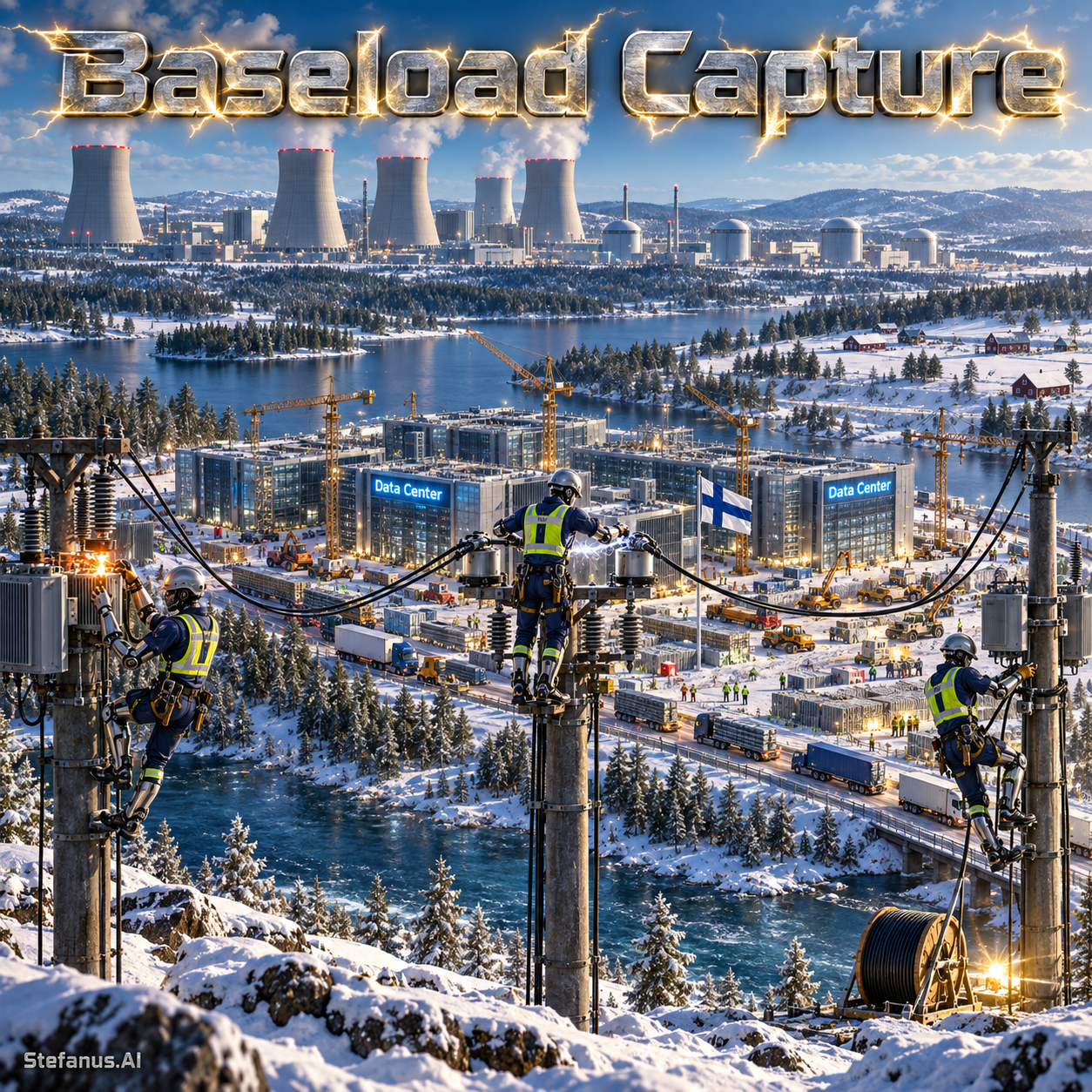
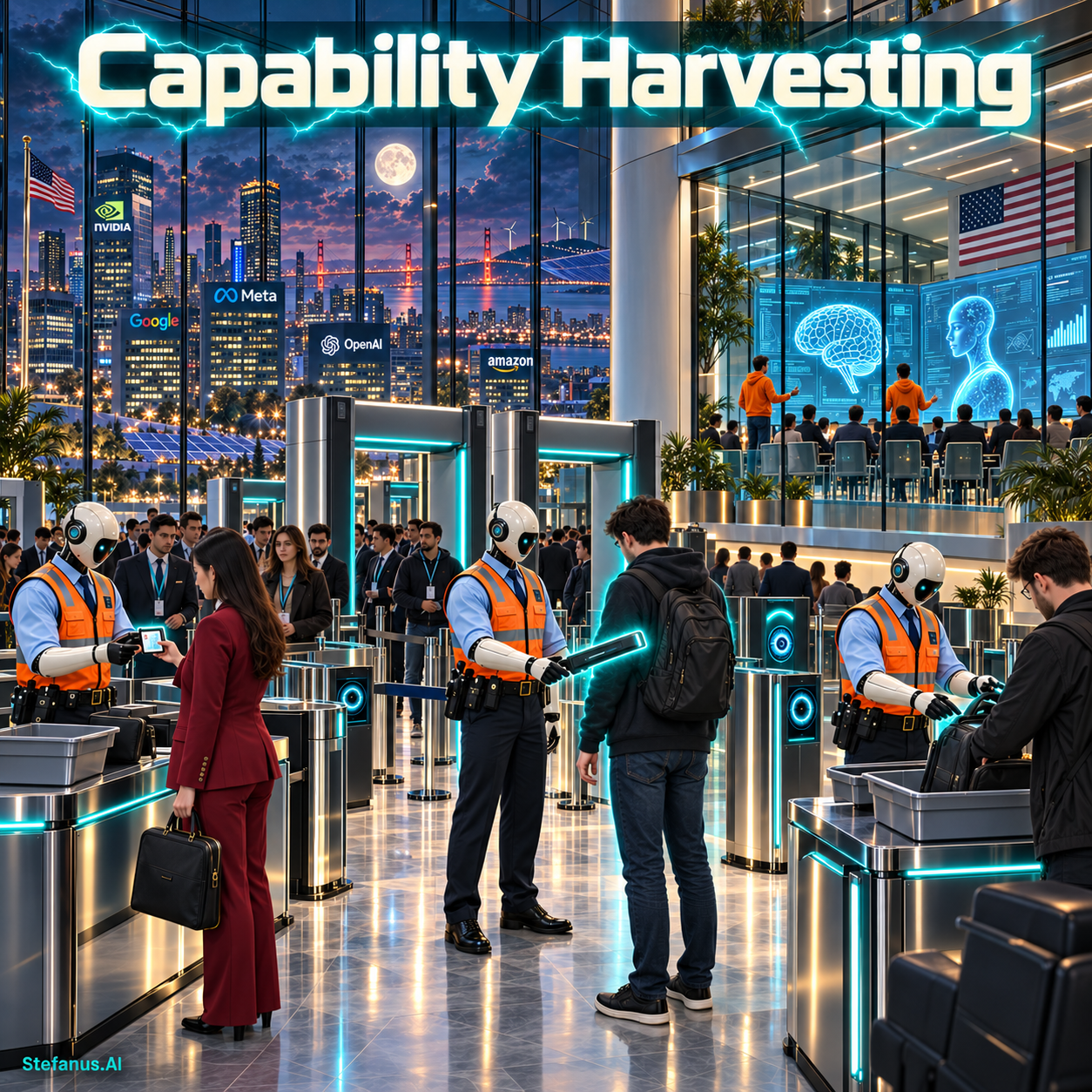
Comments
[…] technology era, investors, suppliers and customers could be conceptually separated even when they occasionally overlapped. A venture-capital firm invested money. A semiconductor manufacturer sold processors. A cloud […]
[…] architecture helped produce the extraordinary capital-expenditure cycle involving Microsoft, Meta, Amazon, Google, Oracle, xAI, OpenAI’s infrastructure […]
[…] Amazon, Alphabet, and Meta — disclosed during their Q2-2026 earnings season that their combined capital expenditure for calendar 2026 would reach approximately $760 billion, up from roughly $413 billion in 2025, […]