
Introduction: When a Retirement Date Stopped Meaning “The End”
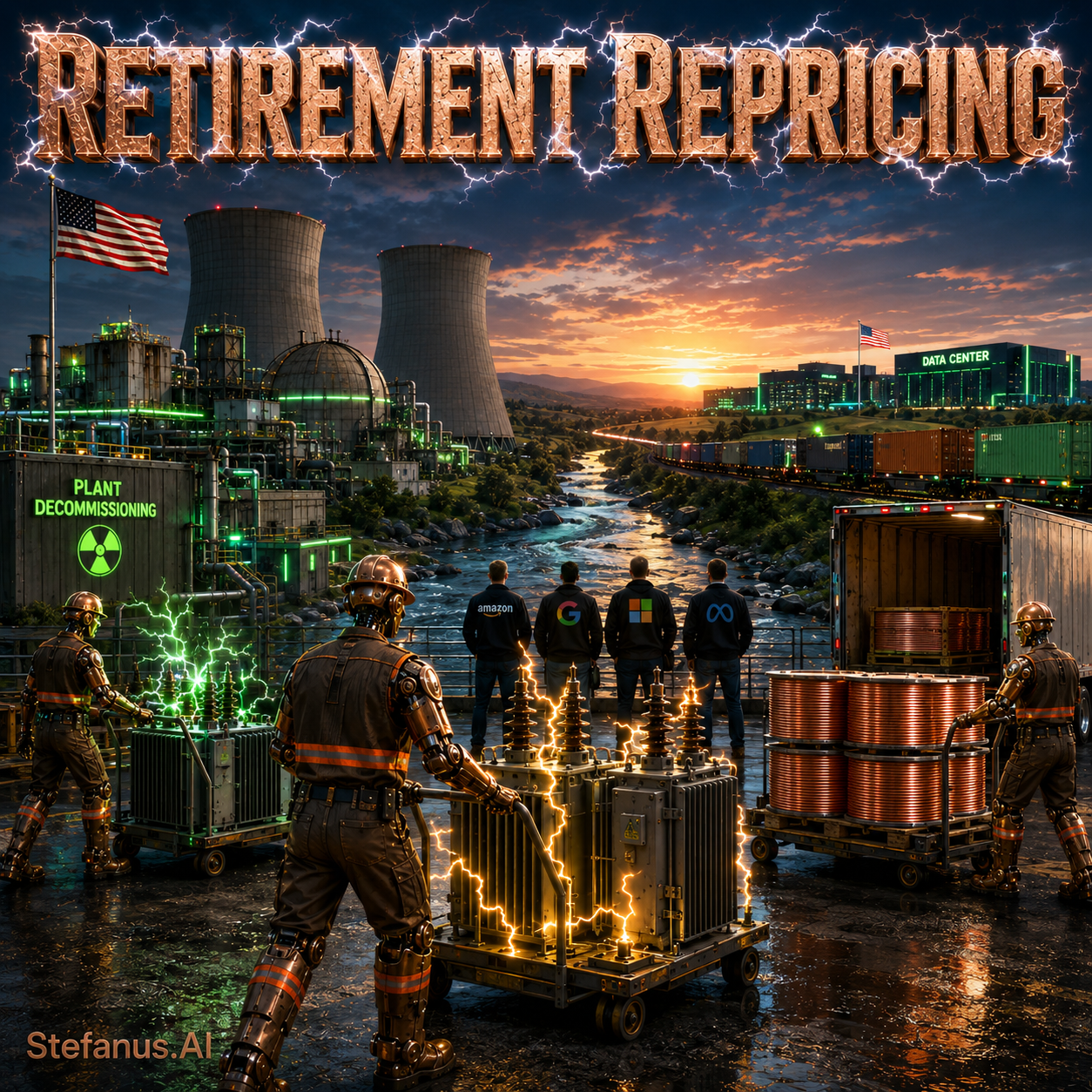
Picture a power plant in its final season. The scene is familiar to anyone who has followed American electricity over the past two decades, because it has played out hundreds of times. The last scheduled coal train arrives and is quietly logged as the last. The maintenance budget shrinks to the minimum required to limp across the finish line, because no rational chief financial officer spends real money on a machine with a death certificate. Workers begin to drift away — the young ones to gas plants and wind farms, the older ones to retirement parties in the break room. The accountants write the asset down toward its salvage value. The decommissioning consultants arrive with binders full of demolition schedules, groundwater studies, and community-transition grants. The control room, which once hummed with the low anxiety of keeping the lights on for a million homes, settles into the strange calm of a hospice.
And then, in the middle of this long goodbye, something happens that the retirement plan never modeled. The grid needs power again — not marginally, not seasonally, but structurally. A datacenter developer with a household name and a nine-figure checkbook appears at the county courthouse asking about the substation. The federal government issues an emergency order, invoking wartime-era statutes, commanding the dying plant to live. Capacity prices in the regional auction slam into their administrative ceiling. Transmission engineers report that a new grid connection of equivalent size would take seven to twelve years to recreate. Suddenly the asset that everyone had agreed to bury is receiving offers. The funeral becomes a bidding war.
This paper is about that reversal — not as an anecdote, but as a system. Between 2024 and August 2026, the United States witnessed the first commercial nuclear plant ever brought back from decommissioning status; a second shuttered reactor rebuilt under a twenty-year contract with a single software company; at least five fossil plants in four states ordered by the federal government to keep operating past their approved retirement dates; a state governor negotiating a consent decree so that his state’s two largest coal plants could run four extra years; a regulated utility outbidding a datacenter developer for a bankrupt coal plant, largely to keep its grid connection on the public network; and the largest wholesale electricity market in the world falling short of its reliability requirement for the third consecutive year while clearing at its price cap.[8,9] None of these events, taken alone, would justify a new framework. Taken together, they reveal one: in the AI economy, the retirement of a power plant is no longer a terminal event. It is a strategic option — and options get repriced.
The central thesis of this paper: in the AI economy, retirement itself has become a repricable asset.
I call this phenomenon Retirement Repricing, and the name is deliberate on three levels. First, it borrows honestly from financial economics: a retirement date used to function like the expiration of a worthless option, and the AI electricity boom has moved that option back into the money, which means the market must now reprice it — the same asset, the same steel and copper, but a radically different valuation because the state of the world changed. Second, it captures the fact that what is being repriced is not primarily electricity, or even capacity, but the retirement decision itself: the right to keep an asset alive, to restart it, to extend it, or to sell its grid position to the highest bidder has acquired a market value that can be measured in federal loans, purchase-power agreements, consent decrees, and auction premiums. Third, it names a political transformation: retirement used to be an administrative milestone processed quietly by utility commissions, and it has now become a contested public decision fought over by governors, attorneys general, federal secretaries, hyperscalers, unions, and neighbors — which is precisely what happens when something that used to be worthless becomes valuable.
The empirical backdrop is no longer in dispute. The International Energy Agency projects that global data-center electricity consumption will roughly double from the mid-2020s to about 945–950 TWh by 2030 — more than the entire electricity consumption of Japan today — with AI-optimized facilities more than quadrupling their draw, and with data centers accounting for nearly half of all U.S. electricity-demand growth this decade.[1,2,3] IEA Executive Director Fatih Birol has reduced the matter to a single sentence that belongs at the head of any paper on this subject:
“There is no AI without energy – specifically electricity.”
— Fatih Birol, Executive Director, International Energy Agency [3]
On the demand side of that sentence sits an unprecedented corporate capital cycle. In their fiscal 2026 guidance and earnings calls through the second quarter of 2026, the four largest hyperscalers — Amazon (roughly $200 billion), Alphabet ($175–185 billion), Microsoft (tracking well above $120 billion and by some estimates toward $190 billion), and Meta ($115–135 billion, later raised) — committed a combined total that analysts place between $650 billion and $725 billion in capital expenditure for a single calendar year, up more than 60 percent from 2025’s already record levels, the overwhelming majority directed at AI data centers, chips, and the power to run them.[5,6] Stanford’s AI Index 2026 counts 5,427 AI data centers in the United States alone — more than ten times any other country — with U.S. AI data-center power capacity reaching 29.6 gigawatts, roughly comparable to New York State at peak demand.[7] Harvard’s Belfer Center, launching a joint Kennedy School–SEAS project on the question in February 2026, calls the collision of this demand with the American grid “a watershed moment” for the electricity system.[58]
On the supply side sits a grid that spent twenty years planning for decline. Utilities and regional operators scheduled hundreds of retirements on the assumption of flat demand, cheap gas, and tightening environmental rules. That assumption is gone. PJM Interconnection — the thirteen-state market serving 67 million people — now forecasts its summer peak to climb roughly 85 gigawatts over fifteen years, to more than 241 gigawatts by 2040, against an all-time record of about 167 gigawatts set in 2006; its ten-year annual growth rate, forecast at 0.3 percent as recently as 2021, is now 3.6 percent.[11,12] When demand accelerates that fast while supply additions crawl, every scheduled retirement becomes a negotiation.
The Five-Layer AI Economy
This paper sits inside a framework I use across my work, which I call the Five-Layer AI Economy. The AI economy is best understood as a vertical stack of five interdependent layers: Layer One — Energy, the electrons, generation assets, transmission, and grid positions without which nothing above exists; Layer Two — Chips, the accelerators, memory, and fabrication capacity that convert electricity into computation; Layer Three — Datacenters, the buildings, cooling, and siting decisions that convert abstract chip demand into geographically concentrated megawatt demand; Layer Four — Models, the training runs and inference fleets whose load profiles and flexibility determine what the lower layers must deliver; and Layer Five — Applications & Agents, the consumer and enterprise adoption that makes inference demand persistent, structural, and — crucially for this paper — politically undeniable.
Retirement Repricing occurs principally in Layer One. But its causes descend from Layer Five, and its consequences propagate back upward through all five layers: an agent deployed in an insurance back office in Ohio contributes, through a long causal chain, to the question of whether a sixty-year-old coal plant on the shore of Lake Michigan is permitted to die. Section 8 traces that chain explicitly. The sections before it build the evidence: Section 1 develops the economics of the retirement option; Sections 2 and 3 present the nuclear restarts and the fossil extensions as two faces of the same phenomenon; Section 4 argues that the deepest object of repricing is the grid connection itself; Section 5 examines the political economy through three governors; Section 6 asks the distributive question — who captures the Retirement Premium — and proposes a seven-part public-interest test; Section 7 distills the lessons into seven pillars; and Section 8 closes the loop with the Five-Layer framework before the Conclusion.

Section 1: The Closure Date Becomes an Option
To understand why retirement is being repriced, we must first understand what a retirement date actually was in the old regime — because the quiet assumptions buried in that regime are exactly what the AI boom has detonated. For most of the twenty-first century, a power-plant retirement announcement was one of the most credible commitments in American infrastructure. It was negotiated over years, blessed by integrated resource plans, priced into capacity markets, written into environmental consent agreements, and relied upon by every actor in the system: competitors sized their investments against it, grid operators planned transmission around it, communities budgeted their tax bases through it, and replacement resources were procured because of it. A retirement date was not a prediction. It was a promise, and the entire planning architecture of the grid treated it as one.
1.1 Why Plants Traditionally Retire
The traditional drivers of retirement formed a slow, grinding, one-directional machine, and it is worth walking through them because each has now been perturbed. Fuel costs pushed coal out as shale gas collapsed the marginal price of the competing megawatt-hour after 2008. Maintenance economics turned against age: a fifty-year-old boiler or a forty-year-old steam generator demands escalating capital just to stand still, and that capital must be recovered over a shrinking remaining life. Environmental compliance imposed discrete cliff-edges — wastewater effluent limits, mercury rules, regional haze, cooling-water intake standards — where the cost of the next upgrade exceeded the value of the remaining asset, so owners rationally chose the exit. Low wholesale prices, driven by cheap gas and zero-marginal-cost renewables, starved baseload plants of the energy margins that once financed their fixed costs. Cheap competing generation meant that any capacity gap left by a retirement could be filled quickly and inexpensively, which made retirement low-risk for the system. Age and reliability told their own story in forced-outage rates. Capital requirements competed inside utilities against grid modernization and renewables with better regulatory treatment. And corporate strategy — ESG commitments, portfolio decarbonization pledges, activist pressure — supplied the final push, converting economic tendencies into announced dates.
Notice the deep structural feature of this machine: every one of these forces assumed that the electricity the plant produced was replaceable, and that demand was, at best, flat. Under flat demand, a retirement is a subtraction from a stable total, easily offset. The option to keep the plant alive was worthless because no state of the world existed in which anyone would pay for it. That is why plants were run into the ground in their final years, why spare parts were cannibalized, why steam generators were left unpreserved — a choice Holtec’s critics would later invoke at Palisades — and why decommissioning trust funds, not operating budgets, dominated end-of-life planning. The system did not merely expect these plants to die; it invested in the finality of their deaths.
1.2 What Changed
What changed is the single most important macro-fact in Layer One of the AI economy: the return of sustained, structural electricity-demand growth to the developed world after two decades of stagnation. The drivers are cumulative and mutually reinforcing. AI factories — training and inference campuses measured in hundreds of megawatts and increasingly in gigawatts — arrived with load profiles that are dense, continuous, and geographically concentrated. Hyperscale datacenters more broadly continued their cloud expansion beneath the AI layer. Semiconductor fabs, re-shored under industrial policy, added their own gigawatt-class loads. Advanced manufacturing, battery plants, and hydrogen projects layered on top. Electrification of vehicles, heating, and industry supplied the broad base beneath the spikes. The Lawrence Berkeley National Laboratory projects U.S. data centers alone rising from about 4.4 percent of national electricity consumption in 2023 to between 6.7 and 12 percent by 2028; BloombergNEF now projects roughly 20 percent by 2035.[4,55] Gartner estimates worldwide data-center power demand will grow 27 percent in 2026 alone, from 104 to 132 gigawatts, reaching 290 gigawatts by 2030.[59]
Not every credentialed observer believes this amounts to an emergency, and intellectual honesty requires saying so. Princeton’s Jesse Jenkins — among the most influential energy-systems modelers of his generation — has cautioned against panic, noting that even a quadrupling of the recent annual demand-growth rate returns the United States only to growth rates it routinely absorbed in earlier eras:
“It’s not a crisis.”
— Jesse D. Jenkins, Associate Professor, Princeton University [57]
Jenkins’s point is well taken at the national, decadal scale: America has built fast before and can build fast again. But Retirement Repricing does not live at the national, decadal scale. It lives at the nodal, five-year scale — in specific interconnection queues, specific substations, specific summers in specific MISO and PJM zones where reserve margins have thinned toward or below target.[60] At that scale, the shortage is not of energy in the abstract but of time: time to permit, time to interconnect, time to build. And time, as Section 1.4 argues, is precisely the asset that an existing plant — even a dying one — possesses in abundance.
1.3 The Retirement Repricing Equation
We can now state the framework formally. In the old regime, the value of keeping a plant alive past its retirement date was, to a first approximation, zero or negative: continuation revenue minus continuation cost, with revenue capped by depressed wholesale prices. In the new regime, the value of the retirement option is the sum of several distinct components, each of which has a real-world counterpart in the cases this paper examines:
Table 1. The Retirement Repricing Equation: Retirement Option Value = V(energy) + V(capacity) + V(contract) + V(position) + V(policy) − C(continuation)
| Component | Definition | Where It Appears in 2024–2026 |
| V(energy) | Expected energy margins under structurally higher demand and scarcity pricing | PJM wholesale power costs up 54% in one year; day-ahead prices clearing above $2,000/MWh in July 2026 heat events [9] |
| V(capacity) | Capacity-market or bilateral capacity value under binding shortage | PJM 2028/29 auction clearing at its $325/MW-day cap; $554.72 but for the cap [8,10] |
| V(contract) | Premium a creditworthy offtaker will pay for firm, sited power | Microsoft’s 20-year PPA underwriting the Crane restart; Google’s 25-year deal behind Duane Arnold [22,27] |
| V(position) | Replacement value of the interconnection, substation, land, water, and zoning | AEP outbidding a datacenter developer for Longview; gas-plant permits attached to the site [39,40] |
| V(policy) | Value conferred (or compelled) by state and federal intervention | DOE 202(c) orders; DOE loans of $1.52B (Palisades) and $1B (Crane); Michigan’s $300M grant; Pennsylvania’s consent decree [15,25,28,36] |
| C(continuation) | Costs of continued operation: fuel, maintenance, compliance, restart capital, liabilities | Consumers Energy’s $135M net loss keeping Campbell alive through Dec. 2025; Eddystone compliance conditions [30,34] |
Three properties of this equation drive everything that follows. First, the components are owned by different actors: V(contract) is largely created by hyperscalers, V(policy) by governments, V(position) by history, and C(continuation) is frequently paid by ratepayers — which is why Section 6’s distributive question is unavoidable. Second, the equation can be positive even when the plant’s own energy economics remain negative: Campbell and Eddystone lose money as merchant generators, yet federal orders assign their availability a public value and socialize the loss.[30,32] Third, and most subtly, the equation applies not only to operating plants approaching retirement but to plants already shut, already decommissioning, already half-dismantled — because the dominant terms, V(position) and V(contract), survive the death of the machinery. That is the insight that made Palisades thinkable.
1.4 The Hidden Value of Time
If this paper has a single economic foundation, it is this: the primary scarce asset in Layer One of the AI economy is not fuel, not turbines, and not even capital — it is time-to-power. Every component of the equation above is, at bottom, a claim about time. A hyperscaler signing a premium PPA is buying time: the difference between energizing a campus in 2027 versus 2031 is measured, at current AI economics, in billions of dollars of foregone revenue and in strategic position that may never be recovered. Microsoft’s fiscal disclosures through 2026 describe tens of billions of dollars of cloud backlog it cannot serve because of power constraints — demand that exists, contracted, waiting on electrons.[6]
Now consider what an existing plant is, seen through this lens. It is a warehouse of already-spent time. Its interconnection agreement encodes five to seven years of queue position that a new project must serve from the beginning — PJM alone has processed more than 170,000 MW of interconnection requests since 2023 and still measures its pipeline in years.[8] Its high-voltage substation and transmission lines encode a decade of siting fights that no longer need to be fought. Its air, water, and land permits encode regulatory processes that would today attract organized opposition. Its industrial zoning encodes county-level politics settled a generation ago. Its cooling-water rights encode allocations that, in the Great Lakes and the arid West alike, might be unobtainable de novo. Its workforce — licensed reactor operators, boiler crews, high-voltage electricians — encodes training pipelines measured in years per person. Even its community relations encode decades of tax payments and school sponsorships that a greenfield developer must build from zero against rising local resistance to datacenter and energy development.
New projects can buy almost everything else. They can buy turbines, though gas-turbine order books now stretch years. They can buy land, engineering, and labor at a price. What they cannot buy at any price is the calendar. A restart, an extension, or an acquisition of an existing plant is therefore best understood as a time arbitrage: paying a premium over book value that is still far below the shadow price of the years the asset embodies. Palisades will have consumed roughly four years and well over two billion dollars of combined public and private support from acquisition to restart — an enormous sum for 800 MW, until one notes that no new nuclear plant on Earth, and very few new gas plants in PJM or MISO, could have delivered firm power on that site on that timeline at any budget.[14,15] The restart looks expensive against the past and cheap against the alternative. That asymmetry — expensive against the past, cheap against the alternative — is the signature of every Retirement Repricing transaction in this paper.
Existing generation possesses the one thing new projects cannot purchase: years already spent getting built.

Section 2: From Decommissioning to Recommissioning — The Nuclear Restarts
Nowhere is Retirement Repricing more visible, more expensive, or more institutionally radical than in nuclear power, because nuclear retirement was designed to be irreversible. Under the Nuclear Regulatory Commission’s framework, a plant that certifies permanent cessation of operations and permanent fuel removal surrenders its authority to operate; decommissioning trust funds unlock; the licensing basis is dismantled along with the plant. For half a century, no commercial reactor that entered that pipeline ever came back. The assumption of irreversibility was so complete that it was not even written down as an assumption — it was simply the physics of the regulatory state. The 2024–2026 period broke it, twice, in two instructively different ways.
2.1 Case Study One — Palisades: Policy-Led Repricing
The Palisades Nuclear Plant in Covert, Michigan, permanently ceased operations on May 20, 2022, after more than four decades of service — a casualty of the old machine: an expiring power-purchase agreement, cheap gas, and an owner, Entergy, eager to exit merchant nuclear.[13] Holtec International acquired the plant for decommissioning, which was Holtec’s established business. Then the world changed underneath the transaction. By early 2023, Holtec was asking the NRC a question the agency had never before been asked in earnest: how does a plant come back? The NRC established a dedicated Palisades Restart Panel to invent the answer — restore the operational licensing basis, return systems to service, inspect everything — and by August 25, 2025, Palisades had formally transitioned from decommissioning back to operations status under NRC oversight, the first such reversal in American history.[13,14]
The financing tells you who repriced the retirement. The U.S. Department of Energy extended a $1.52 billion loan; the State of Michigan added a $300 million grant; Holtec layered its own capital on top; and long-term power-purchase agreements with rural electric cooperatives — Wolverine Power Cooperative foremost among them, with terms running 28 years — supplied the revenue certainty.[14,15] Note what is absent from that list: a hyperscaler. Palisades is policy-led Retirement Repricing. The premium was paid by federal and state governments acting on energy-security, climate, and industrial-policy grounds, with the AI demand boom operating as the macro backdrop that made the politics easy rather than as the contractual counterparty. The same site is now slated for two Holtec SMR-300 small modular reactors, supported by a further $400 million federal award — the clearest possible statement that what was revalued was not merely a reactor but a nuclear-licensed, grid-connected, water-adjacent industrial site with decades of community coexistence already banked.[15,21]
Honesty requires the ledger’s other side, because Retirement Repricing is not a fairy tale about old machines springing effortlessly back to life. The restart has been hard — harder than its sponsors advertised. Thousands of steam-generator tubes were found cracked and required sleeving, a consequence of layup practices during the shutdown years; the NRC documented quality-assurance and records shortfalls; environmental groups sued, arguing federal law forbids resurrecting a decommissioning plant; target dates slipped from late 2025 to early 2026 to late March 2026 and onward.[16,20] By July 2026, Holtec announced a “watershed moment” — the last major projects closed out, the turbine-generator on turning gear, new fuel on site, more than 5,000 smaller work activities remaining — while declining to commit to a firm date; founder and CEO Kris Singh told the Financial Times he expects restart within the year, ahead of the plant’s contractual obligation to supply power by March 2027.[17,18,19] A federal appeals court, meanwhile, left the NRC’s restart exemption in place, clearing the principal legal obstacle.[19] As of this writing in August 2026, the United States stands at the threshold of its first completed nuclear resurrection — close enough that Michigan’s governor has already claimed it in the past tense, a political fact Section 5 will examine.
Holtec International President Kelly Trice, describing the passivation of the primary system in March 2026, framed the undertaking’s ambition in terms that quietly reveal the repricing logic — the goal is not to squeeze a few years from an old machine but to position it, in his words, for
“safe, reliable operation for decades”
— Kelly Trice, President, Holtec International [15]
Then ask the question that matters for the framework: what became more valuable — the reactor or the site? The honest answer is both, and the decomposition is instructive. The reactor carries V(energy) and V(capacity): 800 MW of firm, carbon-free power in a MISO zone whose reserve margins have thinned alarmingly.[60] The site carries V(position) and much of V(policy): the interconnection, the Lake Michigan cooling water, the nuclear-experienced community, and the SMR future. If the reactor alone had been the prize, the economics would have collapsed under the steam-generator repairs. It was the site’s option value — restart now, expand later — that kept the project alive through every delay. Retirement Repricing, in its purest form, is site repricing wearing a reactor’s clothes.
2.2 Case Study Two — Crane: Demand-Contracted Repricing
If Palisades is policy-led, the Crane Clean Energy Center is its mirror image: demand-contracted Retirement Repricing, in which a single private buyer’s electricity demand creates the commercial foundation for resurrecting generation that had become uneconomic. The plant in question could hardly be more symbolically loaded. Three Mile Island Unit 1 — the undamaged sibling of the reactor that partially melted down in 1979 — operated as a top-performing unit until 2019, when merchant economics killed it: cheap gas, no capacity premium for carbon-free firmness, no buyer for its virtues.[22] Constellation retired it. Five years later, in September 2024, Constellation announced a twenty-year power-purchase agreement with Microsoft that would fund the unit’s restoration under a new name honoring longtime chief nuclear officer Chris Crane, with operations targeted for 2028 and subsequently accelerated to 2027 after PJM approved an expedited interconnection review.[22,23]
The project has since accumulated every layer of the repricing stack. Constellation reports the restart running ahead of schedule, with staffing past 65 percent by mid-2025, main generator and turbine testing complete, steam-generator and diesel inspections done, a second reactor-operator license class beginning in early 2026, and a license-extension pursuit to at least 2054; the company projects a $16 billion addition to Pennsylvania’s GDP.[22,23] In November 2025, the Department of Energy added a $1 billion federal loan — meaning that even this most private of restarts now carries a public-finance layer.[25] Constellation CEO Joe Dominguez captured the sponsors’ framing:
“we’re on track to make history ahead of schedule”
— Joe Dominguez, President & CEO, Constellation Energy [24]
Yet Crane also exposes the limiting factor that no contract can wish away. Market analysts noted through early 2026 that while the reactor may be technically ready in 2027, full grid integration could slip toward 2031 in adverse transmission scenarios — the socket, once again, proving scarcer than the generator.[26] And Crane forces the question this paper regards as one of its most consequential: does a hyperscaler become a virtual utility planner when its PPA determines whether an 835-MW nuclear station exists? The traditional answer — that a PPA is just a bilateral contract — no longer describes reality. Microsoft’s signature did what two decades of Pennsylvania energy policy did not: it reversed a nuclear retirement. A private company’s procurement decision now performs the resource-adequacy function that integrated resource planning once performed, but without the accountability apparatus — no commission hearings, no ratepayer intervenors, no public-interest standard — that disciplined the utilities whose role it partially absorbs. That is a very Stefanus.AI question, because it sits exactly at the seam between Layer Three (datacenter siting and procurement) and Layer One (generation existence), and because the answer will shape whether the AI economy’s energy layer is governed by public planning, private contracting, or an improvised hybrid of both.
The pattern is already propagating. NextEra Energy is restarting the 615-MW Duane Arnold plant in Iowa — shut in 2020 — under a 25-year supply arrangement announced with Google, targeting operation by early 2029.[27] Three shuttered American reactors, three resurrection paths: one financed principally by the state (Palisades), one by a hyperscaler contract (Crane), one by a utility-tech hybrid (Duane Arnold). The retirement-reversal market now has enough transactions to have segments.
Table 2. The nuclear restart market: three plants, three repricing mechanisms
| Plant | Shutdown | Restart Mechanism | Anchor Finance / Offtake | Status (Aug. 2026) |
| Palisades (MI), ~800 MW | 2022 | Policy-led restart from decommissioning | DOE $1.52B loan; Michigan $300M; co-op PPAs to 28 yrs [14,15] | Final readiness; first-ever NRC decommissioning-to-operations reversal [13,17] |
| Crane / TMI-1 (PA), ~835 MW | 2019 | Demand-contracted restart | Microsoft 20-yr PPA; DOE $1B loan [22,25] | Ahead of schedule toward 2027; transmission timing risk [23,26] |
| Duane Arnold (IA), ~615 MW | 2020 | Utility-tech hybrid restart | 25-yr arrangement with Google [27] | Targeting early 2029 [27] |

Section 3: Coal Refuses to Retire — The Fossil Face of Retirement Repricing
It would be comfortable — and commercially convenient for many of the actors involved — to tell the AI-energy story as an automatic nuclear renaissance: clean firm power rises from the grave to feed the machines, and the climate ledger balances. The evidence of 2025–2026 forbids that comfort. The very same scarcity that repriced Palisades and Crane has repriced coal and oil-fired steel that was scheduled, planned, and in some cases legally committed to die. Retirement Repricing is technology-agnostic. It revalues whatever is connected, whatever is firm, and whatever exists — and most of what exists and is scheduled to retire in America is fossil. This section examines four cases that together map the fossil half of the phenomenon, from federal compulsion to state accommodation to private acquisition.
3.1 Case 1 — J.H. Campbell, Michigan: Compelled Continuation
The J.H. Campbell coal plant in West Olive, Michigan — roughly 1,400 MW on the Lake Michigan shore — was scheduled to retire on May 31, 2025, after a multi-year Michigan Public Service Commission process in which Consumers Energy procured replacement resources and the regional operator, MISO, signed off on the plan.[29,32] One week before the date, the Department of Energy invoked Section 202(c) of the Federal Power Act — an emergency authority historically reserved for wars, natural disasters, and acute grid crises — and ordered the plant to remain available. It has renewed that order every ninety days since: August 2025, November 2025, February 2026, and May 2026, the fifth order carrying the plant through August 16, 2026, and by that point holding it more than a year past its approved death.[28,32] The administration’s stated rationale has evolved into an explicitly AI-inflected doctrine: the combination of datacenter demand growth and scheduled coal retirements, it argues, constitutes a standing national energy emergency; DOE credits the plant’s operation through Winter Storm Fern and summer heat events, and notes that in 2025 more than 17 gigawatts of coal capacity nationally were “saved” from retirement.[28,32]
The costs are not hypothetical. Consumers Energy reported a net loss of $135 million through December 31, 2025 — more than $600,000 per day — from operating a plant it had planned to close, and has filed to recover tens of millions from ratepayers across eleven Midwestern states, with the remainder expected to follow.[30] Michigan Attorney General Dana Nessel has filed successive rehearing requests and petitions in the D.C. Circuit, joined by other states and public-interest groups, accusing the federal government of
“propping up an aging coal plant at a staggering and completely unnecessary cost”
— Dana Nessel, Attorney General of Michigan [29]
Environmental Defense Fund counsel Ted Kelly, whose organization argued the consolidated challenge before the D.C. Circuit in May 2026, states the systemic objection — that emergency powers are overwriting years of coordinated state, utility, and grid-operator planning — in terms this framework should take seriously, warning that the practice
“sets a terrible precedent for grid planning”
— Ted Kelly, Director and Lead Counsel, U.S. Clean Energy, Environmental Defense Fund [31]
For the Retirement Repricing framework, Campbell is the polar case of V(policy) operating alone — and coercively. No market repriced this retirement; the federal government did, by fiat, and assigned the cost to ratepayers who had already paid for its replacement. The plant’s own energy economics remain negative; its owner did not want the extension; the state actively opposes it. Campbell demonstrates that once retirement becomes a repricable object, it can be repriced against the will of everyone who owns and regulates it — which is exactly why Section 6’s public-interest test insists on asking who benefits and when extensions end. And Campbell is not alone: the administration has extended five coal plants across Michigan, Indiana, Colorado, and Washington, plus a gas-and-oil plant in Pennsylvania, under the same authority.[31]
3.2 Case 2 — Eddystone, Pennsylvania: The Emergency That Renews Itself
That Pennsylvania plant deserves its own treatment, because it shows the temporal danger most clearly. Eddystone Units 3 and 4 — two 380-MW dual-fuel steam units on the Delaware River south of Philadelphia, installed between 1967 and 1970 — were slated to shut on May 31, 2025.[35] DOE ordered them to remain available on May 30, 2025, and has renewed the order in ninety-day increments five times; the current order, No. 202-26-24, runs from May 25 through August 22, 2026, directing PJM and Constellation to keep the units available under economic dispatch, with environmental-limitation conditions and daily compliance reporting.[33,34] The government’s own record shows what “emergency” means in practice: between June and December 2025 the units generated a modest 26,971 MWh — a few days’ output for a plant their size — called upon during heat alerts and Winter Storm Fern.[34] Energy Secretary Chris Wright defends the orders on the ground that dispatchable oil and gas units that perform during peak stress
“are inherently the most valuable”
— Chris Wright, U.S. Secretary of Energy [34]
Whatever one’s view of that proposition, note the institutional pattern: a statute designed for acute emergencies is being used as a rolling ninety-day subscription, renewed each quarter for more than a year, with no announced terminus. In the same 2026 order series, DOE separately authorized PJM to deploy backup generation resources at data centers themselves during emergencies — a remarkable closing of the loop in which the load that justifies the emergency becomes part of the emergency response.[33] Eddystone poses this paper’s Exit Test in its sharpest form: a temporary reliability measure with no defined end is not a temporary measure. It is industrial policy conducted in ninety-day installments.
3.3 Case 3 — Keystone and Conemaugh, Pennsylvania: Negotiated Extension
The third case shows a state government choosing, rather than resisting, fossil Retirement Repricing — and doing so with lawyers rather than emergency powers. Keystone and Conemaugh, in Indiana and Armstrong Counties, are Pennsylvania’s two largest coal plants, roughly 1,700 MW each, more than 3,400 MW combined. In 2021 their owner, Keystone-Conemaugh Projects LLC — a consortium including Talen Energy and private-equity investors — announced closure by the end of 2028 rather than pay for compliance with federal wastewater-effluent limits.[37] At the end of 2025, citing datacenter-driven demand and the price signals it produced, the company reversed course.[37,38] But reversal created a legal problem: continued operation meant continued violation. The Shapiro administration’s solution, filed April 20–21, 2026, in the Indiana County Court of Common Pleas, was a consent decree: the plants may operate through 2032, conditioned on permit applications within 60 days, construction of wastewater-treatment upgrades on a fixed schedule, and penalties of up to $1,500 per day for noncompliance.[36,38] Governor Josh Shapiro framed the decision entirely in affordability terms:
“Pennsylvanians are worried about rising energy costs right now”
— Josh Shapiro, Governor of Pennsylvania [36]
The trade-offs are explicit and quantifiable. Each plant emitted more than three million tons of CO₂ in 2024 — together the equivalent of well over a million cars — and environmental advocates note the bitter irony that the electricity crunch being cited is driven partly by the very datacenter development the same administration promotes.[37] Union leaders, for their part, count hundreds of family-sustaining jobs preserved and describe the decree as commonsense all-of-the-above policy.[41] For the framework, Keystone-Conemaugh is negotiated Retirement Repricing: the owner captures the market upside of continuation; the state converts its environmental leverage into enforceable upgrades and a defined outer date; and the retirement, rather than being canceled or compelled, is literally re-contracted — with a court supervising the new terms. Among the fossil cases, it is the one that most resembles what Section 6 will argue a well-governed repricing should look like, whatever one concludes about its substance.
3.4 Case 4 — Longview, West Virginia: The Auction for a Socket
The fourth case moved from courtroom to auction room — and produced the single most revealing transaction of the entire period. The Longview plant near Morgantown, West Virginia, is one of America’s newest and most efficient coal units: roughly 700–710 MW, completed in 2011 at a cost near $2 billion, and nonetheless a serial bankrupt, felled repeatedly by construction defects and cheap gas.[40,41] In August 2026, American Electric Power announced an agreement to acquire it — and, according to a person familiar with the process, AEP narrowly outbid a “household name” datacenter developer that had reportedly considered dedicating the plant’s entire output to its own AI facility, removing from the regional grid the power equivalent of roughly 355,000 homes.[40] AEP’s CFO Trevor Mihalik told the Financial Times the utility pursued Longview aggressively after losing bids for other regional generating assets; the deal, expected to close in late 2026 or early 2027, includes permits for a future 1,200-MW combined-cycle gas plant and a solar array at the site.[39,40] Consumer advocates immediately drew the ratepayer line — Energy Efficient West Virginia’s policy director insisting that West Virginians
“should not have to pay for power plants”
— Emmett Pepper, Policy Director, Energy Efficient West Virginia (on infrastructure serving data centers) [41]
Longview compresses the entire thesis into one bidding war. A twice-bankrupt coal plant — an asset the old regime had effectively priced at distress — attracted competing bids from a datacenter developer and a major utility, and the utility’s stated logic was not primarily the coal unit but the position: the interconnection, the site, the gas-plant permits, the optionality. AEP disclosed alongside the deal that its contracted load growth through 2030 had reached 69 gigawatts, with $78 billion of planned investment from 2026 through 2030 — numbers unimaginable for an American utility five years ago.[39] When a datacenter developer and a utility fight over a bankrupt plant, neither is bidding on nostalgia. Both are bidding on the socket. That observation is the bridge to Section 4.
Before crossing it, state the uncomfortable conclusion this section compels. The AI energy transition may simultaneously accelerate new clean generation and delay the retirement of old fossil generation. Both can be true — and in 2026 America, both are true. The same demand curve funds Crane’s carbon-free resurrection and Campbell’s compelled coal year; the same governor celebrates a consent decree for coal and GRID standards requiring escalating clean-firm procurement.[36,47] Any analysis — and any climate accounting — that models only one side of this ledger is describing a different country than the one that exists.
Table 3. Fossil Retirement Repricing, 2025–2026: four plants, four mechanisms
| Plant | Capacity | Original Retirement | Repricing Mechanism | Current Terminus |
| J.H. Campbell (MI) | ~1,400 MW coal | May 31, 2025 | Federal 202(c) emergency orders, renewed 5× [28,32] | Aug. 16, 2026 order; no announced end |
| Eddystone 3 & 4 (PA) | 2 × 380 MW gas/oil | May 31, 2025 | Federal 202(c) emergency orders, renewed 5× [33,34] | Aug. 22, 2026 order; no announced end |
| Keystone & Conemaugh (PA) | ~3,400 MW coal | Dec. 31, 2028 | State consent decree with wastewater upgrades [36,38] | 2032, court-supervised |
| Longview (WV) | ~700 MW coal + gas permits | Distressed / bankruptcy | Utility acquisition, outbidding datacenter developer [39,40] | Continued grid service; 1,200-MW gas option |

Section 4: The Price of an Existing Grid Connection
Strip away the reactors, the boilers, and the politics, and ask what all eight plants in Sections 2 and 3 have in common. It is not fuel — they span uranium, coal, oil, and gas. It is not ownership — they span merchant generators, regulated utilities, private equity, and a decommissioning specialist. It is not even operability — two of them were legally dead. What they share is grid position: a live, high-capacity interconnection to the bulk power system, with the substation, high-voltage lines, cooling infrastructure, water rights, industrial zoning, and hundreds of contiguous acres that surround it. This section argues that grid position is the deepest object of Retirement Repricing — that the AI boom is repricing the socket, not merely the generator — and that once this is seen, the strangest features of the 2025–2026 record become legible.
Begin with the market evidence. On July 14, 2026, PJM announced the results of its Base Residual Auction for the 2028/2029 delivery year: the price cleared at the FERC-approved cap of $325/MW-day across the entire footprint; absent the cap, PJM calculated the price would have reached $554.72 — seventy percent higher; total charges reached $16.4 billion; and, most importantly, the auction procured roughly 6.8 gigawatts less than PJM’s reliability requirement, the equivalent of nearly seven large nuclear reactors, and the third consecutive year the market has fallen short.[8,9,10] Only about 525 MW of genuinely new resources cleared.[10] PJM’s leadership stated the diagnosis plainly, acknowledging in its announcement that
“demand for electricity continues to grow faster than electricity supply”
— David Mills, President & CEO, PJM Interconnection [8]
PJM’s independent market monitor, Monitoring Analytics, attributes $6.3 billion — 38 percent — of the latest auction’s charges to datacenter demand, and $29.4 billion of the $63.6 billion across the last four auctions; its president, Joseph Bowring, urges the industry to
“recognize that it is really a paradigm shift”
— Joseph Bowring, President, Monitoring Analytics (PJM Independent Market Monitor) [42]
The forward curve is steeper still. PJM’s 2026 Long-Term Load Forecast projects the summer peak rising roughly 85 GW over fifteen years to more than 241 GW by 2040 — and 253 GW by 2046 — against a 2006 record of about 167 GW and current installed capacity near 182 GW; large-load additions, overwhelmingly datacenters, account for more than the entirety of near-term peak growth as base demand contracts, and for 78 percent of growth over the full horizon.[11,12,44] The operator’s response has been institutionally unprecedented: a proposed one-time Backstop Procurement auction, filed with FERC in mid-2026 to run as soon as September, to buy back the 6.8-GW shortfall under a $555/MW-day cost cap, alongside “connect and manage” frameworks and datacenter-curtailment proposals.[10,43] Wholesale power costs in PJM jumped 54 percent in a single year; day-ahead prices cleared above $2,000/MWh during the July 2026 heat.[9]
Now translate those numbers into the microeconomics of a single site. In a market that is short 6.8 GW against its reliability target, that is clearing at an administrative cap, and whose queue — even after processing 170,000 MW of requests since 2023 — still prices new entry in years, what is the market-clearing value of a 500-MW or 1,700-MW node that is energized today? It is not the discounted cash flow of the aging machine bolted to it. It is the replacement cost of the position: the substation that would take five years to permit and build; the high-voltage lines that would take a decade and a corridor fight; the cooling water that might be unobtainable; the industrial zoning that predates modern land-use resistance; the hundreds of acres of graded, road-served, rail-served, fenced industrial land. An old plant is a depreciating machine attached to an appreciating address. For decades, accounting saw only the machine. The AI economy sees the address.
AI is repricing the socket, not merely the generator.
This lens resolves the section’s puzzles one by one. It explains why AEP fought a datacenter developer for a bankrupt coal plant and bundled the purchase with permits for a gas plant not yet built: the coal unit is the socket’s current tenant, the gas plant its next one.[39,40] It explains why Holtec’s Palisades project survived every steam-generator setback: the SMR campus needs the site more than the site needs the old reactor.[15] It explains why Constellation is pursuing a Crane license to 2054 against a Microsoft contract of twenty years: the position outlives the PPA.[22] It explains why “retired” increasingly means “held in strategic reserve”: mothballing preserves the interconnection rights that demolition may forfeit. And it explains the datacenter industry’s parallel behavior — co-locating behind the meter at existing plants, buying decommissioned industrial sites, and bidding for generation outright — because from Layer Three’s perspective, time-to-power is the binding constraint and the socket is where the time is stored.
It also yields the section’s policy corollary, which Section 6 will formalize. If the scarce, publicly-enabled asset is the grid position — created over decades by eminent domain, ratepayer-financed transmission, and public siting decisions — then the windfall from its repricing is not obviously the private property of whoever happens to hold the deed on the day the AI boom arrives. The socket was built by everyone. The question of who may monetize it has barely been asked, and it is the right question.

Section 5: The Political Economy of the Retirement Reversal — A Tale of Three Governors
If retirement has become a repricable asset, then someone must govern the repricing — and in the American federal system, that someone is, to a remarkable degree, the governor. Governors sign the grants, direct the environmental agencies, appoint the utility commissioners, negotiate with the hyperscalers, and absorb the electoral consequences of electricity bills. The 2025–2026 record offers a natural experiment: three governors — two Democrats in restructured Eastern markets, one Democrat in California’s managed hybrid — each confronting Retirement Repricing in a different register. Their divergences map the emerging politics of Layer One; their convergences reveal something deeper, which is that the politics of building new electricity and the politics of un-retiring old electricity are becoming the same politics.
5.1 Gretchen Whitmer — Michigan: Chosen Restart versus Compelled Extension
Michigan under Governor Gretchen Whitmer presents the sharpest paradox in the national record, and resolving it teaches the section’s central distinction. On one side, Whitmer has been the indispensable political sponsor of the Palisades nuclear revival: she lobbied the Department of Energy from 2022 onward, shepherded the $300 million state appropriation, signed 2023 legislation mandating 100 percent clean power — with nuclear explicitly included — and has framed the restart, together with its planned SMR expansion, as proof that reopening the plant will, in her words,
“lower energy costs, reaffirm Michigan’s clean energy leadership”
— Gretchen Whitmer, Governor of Michigan [21]
In her eighth and final State of the State address on February 25, 2026, she claimed the milestone outright, listing among her administration’s firsts:
“The first state to ever restart a nuclear power plant at Palisades.”
— Gretchen Whitmer, Governor of Michigan, 2026 State of the State Address [45]
That the sentence ran slightly ahead of the reactor — which in February 2026 had not yet achieved restart, and as of August 2026 stands at the threshold — is itself a datum: retirement reversal has become so politically valuable that governors claim it in the past tense before the neutrons cooperate.[17,19] On the other side of the very same ledger, Whitmer’s administration, through Attorney General Nessel, is in federal court fighting to stop the federal government from keeping the Campbell coal plant alive, at ratepayer expense, a year past its approved retirement.[29,31]
A careless reading calls this hypocrisy — pro-restart at Palisades, anti-extension at Campbell. The careful reading extracts the distinction that should anchor the politics of Retirement Repricing everywhere: the difference between a chosen restart and a compelled extension. Palisades was chosen: initiated by the asset owner, endorsed by the state’s elected institutions, financed through appropriations subject to democratic scrutiny, aligned with an enacted statutory framework, and aimed at decades of clean operation. Campbell is compelled: imposed by a federal emergency order over the objection of the owner, the state regulator, and the state’s law officers, financed by involuntary ratepayer surcharges across eleven states, and justified by an emergency the state insists is fabricated.[29,30] The technology difference — nuclear versus coal — matters less than the consent difference. Retirement Repricing is legitimate, on this view, when it is an act of accountable public choice, and illegitimate when it is an act of federal fiat that overrides accountable public choice. Michigan is not confused. Michigan is drawing the constitutional line.
5.2 Josh Shapiro — Pennsylvania: The Laboratory of Everything
If Michigan draws the line, Pennsylvania contains the entire map. No American jurisdiction concentrates more of this paper’s subject matter: the Crane nuclear restart under Microsoft’s PPA;[22] the Eddystone federal emergency orders;[34] the Keystone-Conemaugh consent decree;[36] the epicenter of PJM’s datacenter-driven capacity crisis and its pass-through to Pennsylvania bills;[9,10] and now the nation’s most developed state-level attempt to govern the boom — Governor Shapiro’s Responsible Infrastructure Development (GRID) Standards, previewed in his February 2026 budget address and released in full on May 27, 2026.[46]
The GRID Standards deserve close attention because they are, in effect, the first codified answer to Section 6’s cost-causation question. Built on four pillars — energy affordability, transparency and community engagement, workforce and economic development, and environmental protection — they condition Commonwealth support (fast-track permitting, sales-and-use tax exemptions, coordinated project services) on developers agreeing to build, bring online, or buy the incremental capacity their load requires, within the same grid region, at their own full cost, with an escalating clean-firm share: 10 percent in 2027, 14.5 percent in 2030, 32 percent by 2035.[46,47] Shapiro’s framing is candid about the political pressure behind the policy — he describes himself as
“putting clear guardrails in place to hold developers accountable”
— Josh Shapiro, Governor of Pennsylvania, announcing the GRID Standards [48]
In June 2026 the Pennsylvania House passed HB 2650 by an overwhelmingly bipartisan vote to codify the standards in law — evidence that datacenter accountability is becoming one of the rare energy questions with cross-party traction.[49] Pennsylvania is therefore this paper’s primary laboratory, running every experiment simultaneously: demand-contracted nuclear restart, federally compelled fossil extension, state-negotiated fossil extension, capacity-market crisis, and a nascent regime for making the demand side pay. Whether the experiments cohere is another matter. The same administration that requires datacenters to bring their own clean-firm power has extended 3,400 MW of coal to 2032; the same governor praised for the GRID Standards is praised by the coal alliance for the consent decree.[38,47] Coherence may be the wrong test. Shapiro’s Pennsylvania is what Retirement Repricing looks like when a state accepts the boom, monetizes it, and attempts — in real time, under affordability pressure, in a governor’s-race spotlight — to govern it.
5.3 Gavin Newsom — California: The Reluctant Convert
California supplies the third register: Retirement Repricing as reversal of one’s own prior decision. In 2016, PG&E, the state, environmental groups, and labor agreed to retire Diablo Canyon — California’s last nuclear plant, 2,240 MW, roughly nine percent of in-state generation — with Unit 1 to close in 2024 and Unit 2 in 2025. Governor Gavin Newsom supported that trajectory. Then came the August 2020 rolling blackouts, the reliability scare of the early 2020s, and the new demand projections; in 2022 Newsom signed SB 846, extending operations through 2030 and directing PG&E to seek federal relicensing.[50,51] On April 2–3, 2026, the Nuclear Regulatory Commission approved the full twenty-year renewals — its 100th renewed operating license — authorizing Unit 1 to November 2044 and Unit 2 to August 2045, with state and regional agencies from the Coastal Commission to the regional water board having cleared their pieces beforehand.[50,51] Newsom welcomed the decision in the language of climate-era statecraft, celebrating the extension as part of
“cementing the Golden State as a global powerhouse”
— Gavin Newsom, Governor of California [52]
The structure of the California case rewards attention. Federal regulators have now provided the licensing runway for nearly two more decades of operation — but state law, under SB 846, authorizes operation only through 2030, so how much of the runway is used remains a decision of the California Legislature.[51] The retirement option, in other words, has been deliberately re-engineered into a renewable state political option: California can extend in increments, each extension a fresh act of public choice. One may debate whether that design produces optimal investment signals for PG&E; one cannot deny that it embodies, in statute, the chosen-versus-compelled principle Michigan is asserting in court. And Newsom’s arc — from presiding over a negotiated nuclear retirement to celebrating its cancellation — demonstrates the section’s final finding: Retirement Repricing is bipartisan and trans-ideological in effect, even when its preferred technologies differ. A Trump administration extends coal by emergency order; Whitmer restarts nuclear by appropriation; Shapiro extends coal by consent decree and hosts nuclear by hyperscaler contract; Newsom extends nuclear by statute. Four actors, four instruments, one direction: against the scheduled disappearance of existing firm capacity.
Table 4. The political instruments of Retirement Repricing, 2024–2026
| Governor / Actor | Asset & Action | Instrument | Consent Character |
| Whitmer (MI) | Palisades nuclear restart (+SMRs) | $300M state grant; DOE loan; clean-energy statute [15,21] | Chosen restart |
| Whitmer / Nessel (MI) | Campbell coal extension — opposed | Litigation against federal 202(c) orders [29,31] | Compelled extension (resisted) |
| Shapiro (PA) | Keystone & Conemaugh coal to 2032 | Consent decree with environmental upgrades [36,38] | Negotiated extension |
| Shapiro (PA) | Crane nuclear restart; GRID Standards | Interconnection advocacy; developer accountability regime [22,46] | Chosen / market-hosted |
| Federal DOE | Campbell, Eddystone, and others | FPA §202(c) rolling emergency orders [28,33] | Compelled extension |
| Newsom (CA) | Diablo Canyon to 2030 (runway to 2044/45) | SB 846; NRC 20-year license renewals [50,51] | Chosen extension, legislatively metered |

Section 6: Who Captures the Retirement Premium?
Every preceding section has established that a premium exists. Palisades commanded $1.52 billion in federal loans and $300 million in state grants; Crane commanded a twenty-year contract from the world’s most valuable software company and a billion-dollar federal loan; Keystone and Conemaugh converted a death sentence into six years of capacity revenue at cap-clearing prices; Longview, a serial bankrupt, became the object of a bidding war; and across PJM, the mere continued existence of old capacity is being remunerated at $325/MW-day — $16.4 billion in a single auction year.[8,15,25,36,40] Call the difference between an asset’s value under the old regime of scheduled death and its value under the new regime of strategic optionality the Retirement Premium. This section asks the question that economics can pose but only politics can answer: when AI makes an old power plant valuable again, who gets the money?
The candidate list is long, and everyone on it has a colorable claim: the plant owner who bore the risk of holding the asset; utility shareholders whose rate base may absorb it; the datacenter whose demand created the scarcity; ratepayers who financed the surrounding grid for a century; local communities who breathed the plant’s air and schooled its workers’ children; state governments whose grants and consent decrees enabled continuation; federal taxpayers standing behind the loans and emergency orders; landowners and transmission owners whose property appreciates with every megawatt of induced demand. The 2024–2026 record shows the premium flowing, in practice, to five principal beneficiaries — and shows the costs flowing somewhere else.
6.1 Asset Owners
The first and most direct capture accrues to whoever holds the deed. Retired and near-retired assets are receiving valuations their owners could not have imagined in 2021: Holtec, a privately held decommissioning specialist, has been transformed by Palisades into a restart-and-SMR company preparing a public offering, its S-1 built substantially on the plant it bought to demolish;[14] Constellation cleared 18,875 MW in the latest PJM auction for roughly $2.2 billion in 2028/29 capacity revenue, with Vistra and Talen adding $1.3 billion and $1.2 billion respectively — fleets of exactly the aging, firm, connected assets this paper describes;[9] Longview’s creditors, after years of bankruptcy haircuts, finally found two eager buyers at once.[40] Where the owner also took genuine restart risk — Holtec’s cracked steam generators, Constellation’s restoration capital — a return is defensible. Where the owner merely held a socket while the world changed, the premium is a windfall in the strict sense: unearned appreciation from a demand shock the owner did nothing to create.
6.2 Hyperscalers
The second capture is subtler because it is denominated in time rather than dollars. What Microsoft obtained at Crane, and Google at Duane Arnold, is time-to-power: firm, sited, carbon-accounted electricity years earlier than any new-build alternative could deliver it, in the exact market where their loads concentrate.[22,27] Given the revenue at stake per AI campus-year and the disclosed backlogs constrained by power availability, the option value of those years plausibly exceeds the entire capital cost of the restarts — which is precisely why the PPAs pencil at premium prices.[6] The hyperscalers also capture something less quantifiable: priority. A contracted restart is capacity that answers to its offtaker before it answers to the region, and the Longview episode — a developer reportedly contemplating taking 700 MW entirely off-grid for one facility — shows the limiting case in which time-to-power for one buyer becomes power subtracted from everyone else.[40]
6.3 Utilities
Regulated utilities capture the premium twice. As buyers, they acquire existing capacity below replacement cost — AEP’s stated Longview logic — keeping it on the public grid and, potentially, in the rate base, where it earns a regulated return for decades; AEP’s $78 billion five-year plan and 69 GW of contracted load growth sketch the scale of the opportunity.[39] As incumbents, they benefit from every scarcity signal that raises the value of their fleets and every demand forecast that justifies new investment. The regulatory risk runs the other way: West Virginia’s consumer advocates were immediate and explicit that any Longview costs shifted to household ratepayers for the benefit of datacenter service would be fought — the classic cost-allocation battle of the coming decade, fought at the scale of entire generating stations.[41]
6.4 Governments
Federal and state governments capture jobs, investment announcements, tax base, and — not to be underestimated — narrative. Whitmer’s “first state to ever restart a nuclear power plant” and Shapiro’s $16-billion-to-GDP framing for Crane are the currency of gubernatorial legacy; the Trump administration’s “17 gigawatts of coal saved” is the currency of an energy-dominance platform.[22,28,45] Governments also capture strategic infrastructure: a restarted reactor or an extended coal fleet is optionality on the state’s own industrial future. What governments frequently do not capture is a share of the financial premium proportional to the public money at risk — the DOE loans, the state grants, the ratepayer-funded emergency payments — a point to which the public-interest test returns.
6.5 Communities
Communities sit at the bottom of the capture waterfall, receiving the residual — and bearing most of the non-financial costs. Covert Township keeps 600 union jobs and a nine-figure annual economic contribution; the Conemaugh valley keeps its IBEW locals employed and its school district funded.[15,41] But West Olive keeps its coal dust and its $600,000-a-day surcharge spread across eleven states; Eddystone’s neighbors keep the oil-and-gas peaker no one planned to still be running; every community near a repriced plant keeps the pollution, the water draw, the transmission construction, and — through PJM’s capacity pass-through — electricity bills that Monitoring Analytics attributes in the tens of billions to datacenter demand.[30,34,42] Harvard’s Ari Peskoe, director of the Electricity Law Initiative and the scholar who has done most to map these flows, states the distributive baseline without decoration:
“We’re all paying for the energy costs of the world’s wealthiest corporations.”
— Ari Peskoe, Director, Electricity Law Initiative, Harvard Law School [53]
Peskoe and Eliza Martin’s study — “Extracting Profits from the Public” — documents the mechanisms: special contracts approved in opaque proceedings, socialized transmission upgrades, and ratemaking complexity that conceals cross-subsidy; his 2026 work extends the argument to FERC’s 1994-vintage transmission-pricing policy, and his prescription is direct:[54,56]
“Regulators can and should fix the utility industry’s methods for spreading infrastructure costs.”
— Ari Peskoe, Harvard Law School, to Newsweek (July 2026) [55]
If AI creates the Retirement Premium, policymakers must determine whether the premium belongs entirely to the asset owner — or partly to the public that financed, and depends upon, the grid surrounding it.
6.6 A Public-Interest Test for Retirement Reversals
The cases of Sections 2 through 5 were governed by improvisation: emergency statutes stretched past their design, consent decrees invented under deadline, loan facilities repurposed, auction rules patched with backstops. Improvisation was forgivable in the first years of a paradigm shift. It will not be forgivable in the next hundred reversals — and there will be a next hundred, because the load forecasts guarantee it.[11,44] What follows is the policy core of this paper: before any regulator, legislature, or federal agency permits, finances, mandates, or subsidizes a retirement reversal, it should require documented answers to seven questions. The test is deliberately technology-neutral — it applies to a coal extension and a nuclear restart alike — because the framework’s whole point is that these are instances of one phenomenon.
6.6.1 The Reliability Test
Is the plant actually necessary for system reliability — demonstrated with current data, at the locational and seasonal granularity where reliability actually lives, by an entity that does not profit from the answer? The Campbell litigation turns on exactly this: the state and its regulator say the replacement plan was adequate; the federal order asserts emergency without, opponents argue, showing one.[29,31] A reversal that cannot pass an evidentiary reliability test is not a reliability measure. It is a subsidy wearing reliability’s uniform.
6.6.2 The Alternatives Test
Could transmission, storage, demand flexibility, curtailment-capable datacenter interconnection, or accelerated new generation solve the identified problem more cheaply or cleanly within the relevant window? PJM’s own toolkit — backstop procurement, connect-and-manage, datacenter backup-generation deployment — demonstrates that the alternatives space is wide and largely unexplored before extensions are ordered.[33,43] An extension chosen without pricing its alternatives is not chosen; it is defaulted into.
6.6.3 The Beneficiary Test
Who primarily benefits — households, the regional grid, or one large customer? A reversal serving broad load shares its benefits as widely as its costs; a reversal whose output is contractually dedicated to a single campus is private infrastructure and should be financed, sited, and priced as such. The Longview near-miss — 355,000 homes’ worth of power nearly redirected to one facility — is the cautionary benchmark.[40]
6.6.4 The Cost-Causation Test
Who created the incremental demand, and who pays for the response? This is the oldest principle in utility regulation and the one most violated in the current record: eleven states’ ratepayers are financing Campbell’s losses; PJM-wide consumers are financing a capacity premium the market monitor attributes substantially to datacenters.[30,42] Pennsylvania’s GRID Standards — build, bring, or buy your own capacity, in-region, at full cost, with escalating clean-firm shares — are the first serious codification of the principle at state level and deserve study as a template.[46,47]
6.6.5 The Duration Test
Is the shortage temporary or structural — and does the chosen instrument match? A structural shortage addressed with rolling ninety-day emergency orders produces Eddystone: permanent policy administered in quarterly increments, with none of the investment certainty of a real commitment and none of the reviewability of a real proceeding.[33,34] Conversely, a temporary shortage addressed with a decade-long rate-based commitment saddles ratepayers long after the need has passed. Instrument-matching is not pedantry; it is the difference between a bridge and a ratchet.
6.6.6 The Environmental Test
What emissions, water, waste, and local-health liabilities accompany the extension — quantified, disclosed, and either mitigated or explicitly accepted by the jurisdictions that will bear them? The Keystone-Conemaugh decree, whatever its faults, at least names its terms: six million-plus tons of CO₂ annually, wastewater upgrades on a schedule, penalties for slippage, an outer date.[36,37] The 202(c) orders, by contrast, append environmental-compliance boilerplate to extensions whose environmental review was, in effect, the emergency declaration itself.[34] Honest accounting is the minimum; the AI economy’s climate ledger cannot be balanced with entries no one is required to write down.
6.6.7 The Exit Test
Finally, and most importantly: when does the supposedly temporary extension actually end — and what force makes the ending real? A date certain, a depreciation schedule, a legislatively metered runway like California’s SB 846 structure, a court-supervised terminus like Pennsylvania’s 2032 — these are exits.[36,51] A ninety-day order renewed five times with no announced terminus is not an exit; it is an option held by the extender, renewable forever.[28,33] The Exit Test matters enormously because the single greatest danger of Retirement Repricing is precisely this: temporary reliability measures becoming permanent industrial policy — an outcome nobody voted for, arriving in installments too small to trigger the vote.
Table 5. The Seven-Question Public-Interest Test for Retirement Reversals
| # | Test | Question | Failing Pattern (2025–26 examples) |
| 1 | Reliability | Is the plant demonstrably necessary, at locational granularity? | Contested emergency findings (Campbell) [29] |
| 2 | Alternatives | Could transmission, storage, flexibility, or new build solve it cheaper? | Extensions ordered before alternatives priced [43] |
| 3 | Beneficiary | Households, the region, or one datacenter? | Output nearly dedicated to a single campus (Longview bid) [40] |
| 4 | Cost-Causation | Who caused the demand; who pays for the response? | Eleven states’ ratepayers funding Campbell’s losses [30] |
| 5 | Duration | Temporary or structural — and does the instrument match? | Rolling 90-day orders for structural shortage (Eddystone) [33] |
| 6 | Environmental | Are liabilities quantified, disclosed, mitigated, or accepted? | Boilerplate compliance riders on emergency extensions [34] |
| 7 | Exit | When does it actually end — and what makes the end real? | Serial renewals with no announced terminus [28] |

Section 7: What Have We Learned? Seven Pillars
Frameworks earn their keep by compressing evidence into transferable propositions. Seven pillars follow from the record assembled above — five inherited from the paper’s original design, two added because the 2026 evidence demanded them.
7.1 Pillar One — Retirement Is No Longer Binary
The old state machine had two states: operating and gone. The new machine has at least six: operating; retiring-but-repricable; extended under order or decree; mothballed in strategic reserve; decommissioning-but-restartable; and restarted. A generating asset can now move from operating to retiring, from retiring to strategic reserve, from decommissioning to restart, and from utility ownership to hyperscaler-adjacent acquisition — every one of those transitions is instantiated in Sections 2 and 3.[13,28,36,40] Planners, investors, and regulators who still model retirement as an absorbing state are modeling a grid that no longer exists.
7.2 Pillar Two — Interconnection May Be Worth More Than Generation
An aging generator can be replaced; a 500-MW grid position near a datacenter cluster may take a decade to reproduce. The Longview auction, the Palisades SMR campus, and the gas permits bundled into AEP’s acquisition all price the socket above the machine.[15,39,40] The corollary for policy: interconnection rights, not steel, are where the windfalls concentrate — and where windfall governance should concentrate too.
7.3 Pillar Three — Hyperscalers Are Becoming Energy-Market Actors
Microsoft’s PPA resurrected Crane; Google’s arrangement underwrites Duane Arnold; a household-name developer bid for Longview outright; and DOE now writes datacenter backup generation into emergency orders.[22,27,33,40] Companies whose formal role is “customer” are functionally deciding which major generating assets exist — virtual utility planners without a utility’s obligations. The governance gap between their influence and their accountability is among the most consequential open questions in Layer One.
7.4 Pillar Four — AI Complicates the Energy Transition; It Does Not Simply Accelerate It
The same demand boom finances nuclear resurrection and clean-firm procurement mandates while simultaneously creating the incentives — and the emergency rationales — that keep coal and oil steel alive past their appointed deaths.[28,36,46] The IEA projects renewables meeting half of datacenter demand growth to 2035 with natural gas expanding 175 TWh alongside — acceleration and delay, in the same forecast.[1] Climate analysis of the AI economy must carry both columns of the ledger or forfeit its claim to seriousness.
7.5 Pillar Five — Retirement Has Become Political
A decision once processed in the administrative quiet of resource plans is now fought by attorneys general, ordered by federal secretaries, negotiated by governors, celebrated in State of the State addresses, and litigated in the D.C. Circuit.[29,36,45] The next generation of governors may be judged not merely on how much new electricity they build — but on which old electricity assets they allow to disappear, on what terms, and at whose expense.
7.6 Pillar Six — Emergency Powers Are Becoming Energy Policy
Five fossil plants in four states, extended under a wartime-era statute, in rolling ninety-day increments, over the objection of states and owners, with costs socialized across regions — this is no longer an anecdote; it is an operating model.[28,31,33] Whatever one’s substantive view of the extensions, the procedural precedent — that a standing macro-trend (AI demand growth) can constitute a standing “emergency” justifying indefinite federal override of state resource planning — will outlive this administration and this technology cycle. The Exit Test exists because Pillar Six is already true.
7.7 Pillar Seven — The Retirement Premium Is a Distributive Event
Tens of billions of dollars in capacity charges, loan facilities, grants, surcharges, and acquisition premiums have already moved because retirements were repriced — and the movement has a direction: toward asset owners, hyperscalers, and incumbent utilities, away from ratepayers and host communities, with governments capturing narrative and jobs but rarely a proportional financial return on public money at risk.[9,30,42,53] Distribution is not a side effect of Retirement Repricing. It is the main event, and pretending otherwise is how the backlash gets built.

Section 8: The Five-Layer AI Economy — Closing the Loop
This is where the paper’s framework separates itself from energy journalism, however excellent. The cases above are usually reported as grid stories — a Michigan story, a PJM story, a coal story. They are better understood as the Layer One expression of a five-layer system, in which decisions at each layer propagate downward as demand and upward as constraint. Walk the stack.
8.1 Layer One — Energy: Where Retirement Repricing Originates
Layer One is the substrate: generation, transmission, interconnection, fuel, water, and the regulatory apparatus around them. Retirement Repricing is a Layer One phenomenon by definition — it revalues Layer One assets. But nothing in Layer One caused it. Left to itself, the layer was executing an orderly decline: scheduled retirements, flat demand, cheap replacement. The causal energy entered from above.
8.2 Layer Two — Chips: The Demand Transmission Mechanism
Every accelerator shipped is a standing claim on electricity for its service life. Nvidia’s data-center revenue reaching $197.3 billion in its fiscal 2026 — up from $115.2 billion a year earlier — is, read through this framework, a forward order book on gigawatts.[6] Gartner’s projection that AI-optimized servers will surpass conventional servers in power consumption by 2027 marks the moment the chip layer’s composition, not just its size, began dictating Layer One’s required firmness: accelerators run hot, dense, and continuously.[59]
8.3 Layer Three — Datacenters: Geography Is Destiny
Layer Three converts abstract chip demand into geographically concentrated megawatt demand — and geography is where repricing bites. The 5,427 U.S. AI datacenters do not spread evenly; they cluster where fiber, land, tax treatment, and above all time-to-power align, which is why five PJM zones spanning Virginia, West Virginia, Pennsylvania, Ohio, and Illinois are projected to at least double their annual energy demand by 2046.[7,44] A cluster decision in Loudoun County or Monongalia County is, functionally, a decision about which nearby retirements become options — Longview’s bidders understood this perfectly.[40]
8.4 Layer Four — Models: Load Profiles and Flexibility
Layer Four determines what kind of electricity Layers Three through One must deliver. Training runs are large, interruptible in principle, and increasingly flexible in siting; inference fleets are distributed, latency-bound, and continuous. As the industry’s center of gravity shifts from training to inference, the load becomes less like a factory that can schedule around scarcity and more like a hospital that cannot — raising the premium on exactly the firm, always-on capacity that retiring plants embody. Model-efficiency gains cut the other way, and honest forecasting — as Jenkins insists — must carry that uncertainty; but the 2025 data point is stark: electricity use at AI-focused datacenters grew roughly 50 percent in a single year.[3,57]
8.5 Layer Five — Applications & Agents: The Structural Turn
Layer Five is where episodic becomes structural. A demonstration model is a curiosity; a hundred million daily users and a fleet of enterprise agents embedded in claims processing, code review, logistics, and customer service are a permanent industrial load — persistent inference demand that survives hype cycles because it is stitched into workflows. This is the layer that makes datacenter electricity consumption structural rather than episodic, and it is the layer that makes the politics irreversible: legislators do not order emergency extensions for a fad. They order them for what they have concluded is the new baseline of the economy.[28,32]
Now run the propagation in full, downward and back up. An enterprise in Layer Five deploys agents at scale → persistent inference demand rises → Layer Four fleets expand and firm up their load profiles → Layer Three developers race for sites with time-to-power, clustering where sockets exist → Layer Two accelerator orders convert capital into standing claims on gigawatts → Layer One confronts demand its retirement schedule never modeled → capacity markets clear at caps, emergency orders issue, PPAs resurrect reactors, consent decrees extend coal → and the resulting costs, emissions, and premiums propagate back up the stack as power-constrained backlogs, GRID-style procurement mandates, curtailment rules, and — eventually — the price of every token served to Layer Five’s users. The stack is a circuit, not a cascade.
A decision made in Layer Five can travel backward through the Five-Layer AI Economy until it changes whether a sixty-year-old power plant is allowed to retire.

Conclusion — What Makes Retirement Repricing Especially Powerful
Return, finally, to the plant where this paper began — the one settling into its hospice calm. Under the framework developed here, we can now say precisely what happened to it. Its closure date, once the most credible commitment in the system, became an option. Its socket became scarcer than its steam. Its time-already-spent became the one asset money could not replicate. Its retirement became a public question fought by governors and secretaries, priced by auctions and PPAs, financed by loans and surcharges. And the force that did all of this was not an energy policy at all. It was the adoption curve of artificial intelligence, five layers up the stack, arriving in the control room as a demand forecast nobody’s decommissioning binder contained.
Why insist on the name Retirement Repricing — and re-state, at the close, the reasons given at the opening? Because each word carries analytical weight the alternatives lack. “Retirement,” not “plant life,” because the object being revalued is the decision and the date — the institutional commitment — not merely the machinery; the framework covers restarts of the legally dead, extensions of the still-living, and acquisitions of the bankrupt precisely because all three are transactions in retirement decisions. “Repricing,” not “reversal” or “renaissance,” because the phenomenon is a valuation event before it is anything else — sometimes the repriced option is exercised (Palisades, Crane), sometimes it is merely held (mothballed reserves, Diablo’s legislatively metered runway), and sometimes it is exercised against the owner’s will (Campbell) — and because “renaissance” smuggles in an optimism the coal cases refute. And the compound, “Retirement Repricing,” because it names a market where none existed: a market in endings, with buyers (hyperscalers, utilities, governments), sellers (asset owners), regulators (barely), prices (now observable), and — as Section 6 argued — a distribution of gains and losses that no one has yet been required to justify.
The stakes are larger than electricity economics. Infrastructure is a society’s memory of its own decisions — what it chose to build — and its retirement schedule is a society’s statement of intent — what it chooses to leave behind. For two decades, America’s statement of intent was legible: less coal, eventually less of everything old, replaced at leisure. The AI economy has torn up that statement and is drafting a new one in real time, through instruments — emergency orders, bilateral PPAs, consent decrees, backstop auctions — that were never designed to draft statements of intent at all. Which yields the formulation this paper has been building toward, and on which it should close:
The AI revolution is becoming powerful enough to alter not only what infrastructure America builds next, but what infrastructure America is permitted to abandon.
A technology that determines what may be built is an economic force. A technology that determines what may be abandoned — that reaches into the graveyard of the industrial economy and adjudicates, plant by plant, which deaths stand and which are revoked — is something more: a sovereign force, exercising a power over collective endings that used to belong exclusively to public deliberation. The task ahead is not to resist that force, which the load forecasts render futile, nor to celebrate it, which the coal ledger renders naive. The task is to govern it: to insist that every repriced retirement pass a public test — reliability proven, alternatives priced, beneficiaries named, costs assigned to their causers, durations matched to instruments, environmental liabilities written down, and exits made real. Retirement Repricing is the first great governance problem of the AI economy’s physical layer. It will not be the last. But how we answer it will establish the precedents — procedural, distributive, and constitutional — for every layer above.

Footnotes / Endnotes:
[1] International Energy Agency, “Energy and AI — Executive Summary”, IEA, Paris. https://www.iea.org/reports/energy-and-ai/executive-summary
[2] International Energy Agency, “AI is set to drive surging electricity demand from data centres”, IEA News. https://www.iea.org/news/ai-is-set-to-drive-surging-electricity-demand-from-data-centres-while-offering-the-potential-to-transform-how-the-energy-sector-works
[3] Space Daily (citing IEA / Fatih Birol), “The electricity the world’s data centres swallow may roughly double by 2030”, Space Daily, July 2026. https://spacedaily.com/m-the-electricity-the-worlds-data-centres-swallow-may-roughly-double-by-2030-to-a-level-so-vast-it-rivals-a-whole-industrial-nation-they-may-draw-about-945-terawatt-hours-a-year-close-to-all-of-japa/
[4] Brookings Institution, “Global energy demands within the AI regulatory landscape”, Brookings, April 2026. https://www.brookings.edu/articles/global-energy-demands-within-the-ai-regulatory-landscape/
[5] CNBC (Jordan Novet et al.), “Tech AI spending approaches $700 billion in 2026, cash taking big hit”, CNBC, Feb. 6, 2026. https://www.cnbc.com/2026/02/06/google-microsoft-meta-amazon-ai-cash.html
[6] Nick Patience, “AI Capex 2026: The $690B Infrastructure Sprint”, Futurum Group, Feb. 12, 2026. https://futurumgroup.com/insights/ai-capex-2026-the-690b-infrastructure-sprint/
[7] Stanford University HAI (via ConstructConnect News), “Stanford AI Index 2026: Data Center Boom Concentrates Risk and Environmental Costs”, ConstructConnect, April 2026. https://news.constructconnect.com/stanford-ai-index-2026-data-center-boom-concentrates-risk-and-environmental-costs
[8] PJM Interconnection, “PJM Capacity Auction Procures 138,318 MW of Generation Resources (2028/2029 BRA News Release)”, PJM, July 14, 2026. https://www.pjm.com/-/media/DotCom/about-pjm/newsroom/2026-releases/20260714-pjm-capacity-auction-procures-138318-mw-of-generation-resources.pdf
[9] Ethan Howland, “PJM capacity prices hit price cap, reserve shortfall grows”, Utility Dive, July 2026. https://www.utilitydive.com/news/pjm-capacity-auction-price-cap-reserve-shortfall/825282/
[10] Tsvetana Paraskova, “PJM Auction Comes Up 6.8 Gigawatts Short As Data Centers Devour Power”, OilPrice.com, July 2026. https://oilprice.com/Energy/Energy-General/PJM-Auction-Comes-Up-68-Gigawatts-Short-As-Data-Centers-Devour-Power.html
[11] PJM Interconnection, “PJM’s Updated 20-Year Forecast Continues To See Significant Long-Term Load Growth”, PJM Inside Lines, Jan. 2026. https://insidelines.pjm.com/pjms-updated-20-year-forecast-continues-to-see-significant-long-term-load-growth/
[12] Sonal Patel, “PJM Dials Back Near-Term Load Outlook but Maintains Steep Long-Term Growth Trajectory”, POWER Magazine, Jan. 15, 2026. https://www.powermag.com/pjm-dials-back-near-term-load-outlook-but-maintains-steep-long-term-growth-trajectory/
[13] U.S. Nuclear Regulatory Commission, “Palisades Nuclear Plant (Restart Oversight)”, NRC.gov. https://www.nrc.gov/info-finder/reactors/pali
[14] Holtec Nuclear Corp., “Form S-1 Registration Statement (Palisades restart, PPAs, SMR-300 program)”, U.S. Securities and Exchange Commission, 2026. https://www.sec.gov/Archives/edgar/data/0002104277/000119312526301023/d40440ds1.htm
[15] Fox 17 West Michigan, “Palisades Nuclear Plant another step closer to restarting (Kelly Trice; DOE $1.52B loan; $400M SMR grant)”, Fox17online.com, March 30, 2026. https://www.fox17online.com/news/local-news/palisades-nuclear-plant-another-step-closer-to-restarting
[16] Michigan Public Radio, “Palisades nuclear plant restart plans pushed back to “early 2026””, Michigan Public, Dec. 17, 2025. https://www.michiganpublic.org/environment-climate-change/2025-12-17/palisades-nuclear-plant-restart-plans-pushed-back-to-early-2026
[17] David Dalton, “Holtec Announces ‘Watershed Moment’ In Bid To Restart Palisades Nuclear Plant”, NucNet, July 5, 2026. https://www.nucnet.org/news/holtec-announces-watershed-moment-in-bid-to-restart-palisades-nuclear-plant-7-5-2026
[18] World Nuclear News, “Palisades enters final stage of work before restart”, World Nuclear News, July 4, 2026. https://www.world-nuclear-news.org/articles/palisades-enters-final-stage-of-work-before-restart
[19] American Nuclear Society, “Palisades: Restart projects, Holtec IPO, lawsuit dismissal—but no restart date (Kris Singh, Financial Times)”, ANS Nuclear Newswire, July 8, 2026. https://www.ans.org/news/article-8187/palisades-restart-projects-holtec-ipo-lawsuit-dismissal-but-no-restart-date/
[20] Canary Media, “America’s first nuclear plant restart may be near the finish line”, Canary Media, 2026. https://www.canarymedia.com/articles/nuclear/americas-first-nuclear-plant-restart
[21] Circle of Blue (Great Lakes News Collaborative), “A Nuclear Shift Buoyed by Billions, and the Waters of the Great Lakes (Gov. Whitmer statement)”, Circle of Blue, Feb. 18, 2026. https://www.circleofblue.org/2026/water-energy/a-nuclear-shift-buoyed-by-billions-and-the-waters-of-the-great-lakes/
[22] Constellation Energy, “Crane Clean Energy Center (plant profile and restart program)”, ConstellationEnergy.com. https://www.constellationenergy.com/about/locations/crane-clean-energy-center.html
[23] Constellation Energy, “One Year Later: Crane Clean Energy Center Still in the Spotlight and Ahead of Schedule”, Constellation Newsroom, Sept. 23, 2025. https://www.constellationenergy.com/news/2025/09/one-year-later-crane-clean-energy-center-still-in-the-spotlight-and-ahead-of-schedule.html
[24] Data Centre Magazine, “Microsoft & Constellation’s Bid to Restart Three Mile Island (Joe Dominguez remarks)”, Data Centre Magazine, June 2025. https://datacentremagazine.com/critical-environments/microsoft-constellation-restarting-a-nuclear-reactor
[25] CNBC (Spencer Kimball), “Trump administration backs Three Mile Island nuclear restart with $1 billion loan to Constellation”, CNBC, Nov. 18, 2025. https://www.cnbc.com/2025/11/18/trump-nuclear-three-mile-island-crane-loan-constellation-ceg.html
[26] Sahm Capital / Simply Wall St, “Constellation Energy Reactor Restart With Microsoft Raises Timing And Earnings Questions”, SahmCapital.com, March 27, 2026. https://www.sahmcapital.com/news/content/constellation-energy-reactor-restart-with-microsoft-raises-timing-and-earnings-questions-2026-03-27
[27] Engineering News-Record, “Tasks Delay Restart of Palisades Nuclear Site Until Possibly Late March (incl. Duane Arnold–Google)”, ENR, Jan. 29, 2026. https://www.enr.com/articles/62386-tasks-delay-restart-of-palisades-nuclear-site-until-possibly-late-march
[28] U.S. Department of Energy, “Energy Secretary Saves Midwest from Losing Critical Coal Generation Ahead of Peak Summer Demand (Campbell 202(c) order)”, Energy.gov, May 18, 2026. https://www.energy.gov/articles/energy-secretary-saves-midwest-losing-critical-coal-generation-ahead-peak-summer-demand
[29] Michigan Department of Attorney General, “AG Nessel to Challenge New DOE Order Forcing Illegal, Costly Operations of J.H. Campbell Plant”, Michigan.gov, Feb. 20, 2026. https://www.michigan.gov/ag/news/press-releases/2026/02/20/ag-nessel-to-challenge-new-doe-order
[30] Environmental Defense Fund, “Trump Administration Extends Michigan Coal Plant Fourth Time, as Costs Balloon to Staggering $135 Million”, EDF.org, Feb. 18, 2026. https://www.edf.org/media/trump-administration-extends-michigan-coal-plant-fourth-time-costs-balloon-staggering-135
[31] Environmental Defense Fund (Ted Kelly), “Trump administration illegally extends costly Michigan coal plant over a year past its planned retirement”, EDF.org, May 18, 2026. https://www.edf.org/media/trump-administration-illegally-extends-costly-michigan-coal-plant-over-year-past-its-planned
[32] Michigan Public Radio (Dustin Dwyer), “Feds renew order to keep J.H. Campbell coal plant open”, Michigan Public, May 18, 2026. https://www.michiganpublic.org/environment-climate-change/2026-05-18/feds-renew-order-to-keep-j-h-campbell-coal-plant-open
[33] U.S. Department of Energy, Office of Cybersecurity, Energy Security, and Emergency Response, “2026 DOE 202(c) Orders (compendium, incl. Order Nos. 202-26-17, 202-26-23, 202-26-24)”, Energy.gov/CESER. https://www.energy.gov/ceser/2026-doe-202c-orders
[34] U.S. Department of Energy, “Energy Secretary Keeps Critical Generation Online in Mid-Atlantic (Eddystone; Sec. Chris Wright)”, Energy.gov, May 21, 2026. https://www.energy.gov/articles/energy-secretary-keeps-critical-generation-online-mid-atlantic-0
[35] American Public Power Association, “Secretary of Energy Orders Pennsylvania Power Plant Units to Remain Available”, PublicPower.org, Feb. 23, 2026. https://www.publicpower.org/periodical/article/secretary-energy-orders-pennsylvania-power-plant-units-remain-available
[36] Commonwealth of Pennsylvania, Office of the Governor, “Shapiro Administration Files Motion to Enter Consent Decree on Power (Keystone & Conemaugh)”, PA.gov, April 21, 2026. https://www.pa.gov/governor/newsroom/2026-press-releases/shapiro-administration-files-motion-to-enter-consent-decree-on-p
[37] Reid Frazier, “Gov. Shapiro moves to keep 2 coal-fired power plants open in Western Pa., as energy demand from data centers grows”, The Allegheny Front, April 24, 2026. https://www.alleghenyfront.org/josh-shapiro-coal-fired-power-plants-data-centers-keystone-conemaugh/
[38] abc27 News (WHTM), “Pennsylvania will keep 2 coal-fired power plants open, earning praise from Shapiro and Trump”, abc27.com, April 22, 2026. https://www.abc27.com/pennsylvania/pennsylvania-will-keep-2-coal-fired-power-plants-open-earning-praise-from-shapiro-and-trump/
[39] Mike Tony, “AEP makes Longview Power Plant, gas-fired project site deal”, The Herald-Dispatch, Aug. 2026. https://www.herald-dispatch.com/business/aep-reaches-deal-to-acquire-longview-power-plant-gas-fired-project-site-in-mon-county/article_6885ae02-25b4-47cc-8f1e-26024a5495a6.html
[40] The Well News, “Utility Acquires West Virginia Coal Plant as AI Power Demand Intensifies (AEP outbids datacenter developer; CFO Trevor Mihalik to FT)”, TheWellNews.com, Aug. 2026. https://www.thewellnews.com/utilities/utility-acquires-west-virginia-coal-plant-as-ai-power-demand-intensifies/
[41] Curtis Tate, “AEP To Buy Longview Power Plant (Emmett Pepper statement)”, West Virginia Public Broadcasting, Aug. 2026. https://wvpublic.org/story/energy-environment/aep-to-buy-longview-power-plant/amp/
[42] mGrid (citing Joseph Bowring / Monitoring Analytics and Utility Dive), “Data Centers Drove $6.3 Billion of PJM’s Latest Capacity Auction Cost, Market Monitor Says”, mgrid.org, July 23, 2026. https://mgrid.org/2026/07/23/data-centers-drove-6-3-billion-of-pjms-latest-capacity-auction-cost-market-monitor-says/
[43] Ethan Howland, “PJM board proposes backstop capacity auction, data center curtailment plans”, Utility Dive, July 2026. https://www.utilitydive.com/news/pjm-board-backstop-capacity-auction-data-center-curtailment/826347/
[44] Modo Energy Research, “Data centers define PJM’s 2046 load forecast”, Modo Energy, Feb. 27, 2026. https://modoenergy.com/research/en/pjm-load-forecast-data-centers-2046
[45] Governor Gretchen Whitmer, “2026 State of the State Address (as prepared for delivery)”, Michigan.gov, Feb. 25, 2026. https://www.michigan.gov/whitmer/news/press-releases/2026/02/25/whitmer-2026-state-of-the-state-address-as-prepared-for-delivery
[46] Commonwealth of Pennsylvania, Office of the Governor, “Gov Shapiro Releases Full GRID Standards to Protect Pennsylvanians”, PA.gov, May 27, 2026. https://www.pa.gov/governor/newsroom/2026-press-releases/gov-shapiro-releases-full-grid-standards-to-protect-pennsylvania
[47] Inside Climate News, “Pennsylvania’s Governor Has a Plan to Make Data Centers Bring Their Own Energy. Now Comes the Hard Part.”, InsideClimateNews.org, June 8, 2026. https://insideclimatenews.org/news/28052026/pennsylvania-gov-shapiro-ai-data-center-plan/
[48] Barney Dixon, “Strict new data center GRID standards unveiled by Pennsylvania’s Governor Shapiro”, Data Center Dynamics, May 28, 2026. https://www.datacenterdynamics.com/en/news/strict-new-data-center-grid-standards-unveiled-by-pennsylvanias-governor-shapiro/
[49] Commonwealth of Pennsylvania, Office of the Governor, “PA House Passes Legislation to Codify Gov Shapiro’s GRID Standards (HB 2650)”, PA.gov, June 24, 2026. https://www.pa.gov/governor/newsroom/2026-press-releases/news–pa-house-passes-legislation-to-codify-gov-shapiro-s-grid-s
[50] PG&E Corporation, “U.S. Nuclear Regulatory Commission Approves License Renewal Application for Extended Operations of Diablo Canyon”, Investor.PGECorp.com, April 2, 2026. https://investor.pgecorp.com/news-events/press-releases/press-release-details/2026/U-S–Nuclear-Regulatory-Commission-Approves-License-Renewal-Application-for-Extended-Operations-of-Diablo-Canyon/default.aspx
[51] Office of Governor Gavin Newsom, “Governor Newsom welcomes approval of Diablo Canyon license renewals, delivering on California’s commitment to a clean and reliable grid”, Gov.CA.gov, April 2, 2026. https://www.gov.ca.gov/2026/04/02/governor-newsom-welcomes-approval-of-diablo-canyon-license-renewals-delivering-on-californias-commitment-to-a-clean-and-reliable-grid/
[52] American Nuclear Society, “NRC approves Diablo Canyon license renewal, extension (Gov. Newsom statement)”, ANS Nuclear Newswire, April 3, 2026. https://www.ans.org/news/2026-04-03/article-7906/nrc-approves-diablo-canyon-license-renewal-extension/
[53] Floodlight News (Robert Zullo), “Power for data centers could come at ‘staggering’ cost to consumers (Ari Peskoe)”, FloodlightNews.org, March 2025. https://floodlightnews.org/power-for-data-centers-could-come-at-staggering-cost-to-consumers/
[54] Ethan Howland (on Eliza Martin & Ari Peskoe), “Utilities may subsidize data center growth by shifting costs to other ratepayers: Harvard Law paper”, Utility Dive, March 10, 2025. https://www.utilitydive.com/news/utilities-subsidize-data-center-growth-ratepayer-cost-shif-harvard-peskoe/742001/
[55] Newsweek, “How Data Centers Could Spike US Electricity Bills By 2035 (BloombergNEF; Ari Peskoe)”, Newsweek, July 2026. https://www.newsweek.com/how-data-centers-could-spike-us-electricity-bills-by-2035-12232504
[56] Ari Peskoe, “An outdated FERC policy is undermining the White House’s ratepayer protection pledge”, Utility Dive (op-ed), April 15, 2026. https://www.utilitydive.com/news/ferc-transmission-policy-white-house-ratepayer-protection-peskoe/815438/
[57] Bloomberg (via Data Center Knowledge), “AI’s Power Needs Not as Bad as Feared, Princeton Professor Says (Jesse D. Jenkins)”, DataCenterKnowledge.com. https://www.datacenterknowledge.com/ai-data-centers/ai-s-power-needs-not-as-bad-as-feared-princeton-professor-says
[58] Rachel Mural, Henry Lee, Minlan Yu, Le Xie, et al., “AI, Data Centers, and the U.S. Electric Grid: A Watershed Moment”, Harvard Kennedy School Belfer Center, Feb. 10, 2026. https://www.belfercenter.org/research-analysis/ai-data-centers-us-electric-grid
[59] Gartner, Inc. (Linglan Wang), “Gartner Says Data Center Electricity Consumption to Grow 26% in 2026”, Gartner Newsroom, June 10, 2026. https://www.gartner.com/en/newsroom/press-releases/2026-06-10-gartner-says-data-center-electricity-demand-to-grow-26-percent-in-2026
[60] Energy Network Media Group, “The DOE Just Triggered an Emergency Order to Keep the Coal Burning This Summer (MISO reserve margins, Summer 2026)”, ShaleMag.com, June 13, 2026. https://shalemag.com/doe-emergency-order-michigan-coal-summer-2026/