Author: Dr. Stefanus Hadi, Ph.D.
-
Agentic Capitalism: The Race to a Trillion-Line Economy of Autonomous Actors
Consider a simple, everyday interaction with CVS Pharmacy. You receive a notification that your prescription has been filled, accompanied by options to pick it up in-store, pay online, or request delivery within a defined time window. Beneath this seemingly routine experience lies a coordinated system that verifies insurance eligibility, manages inventory, processes transactions, and schedules fulfillment across multiple operational layers. This is a basic form of delegation, where software systems execute predefined tasks on behalf of a user within structured constraints. Now extend this model beyond rule-based automation into a system capable of reasoning, adaptation,…
-
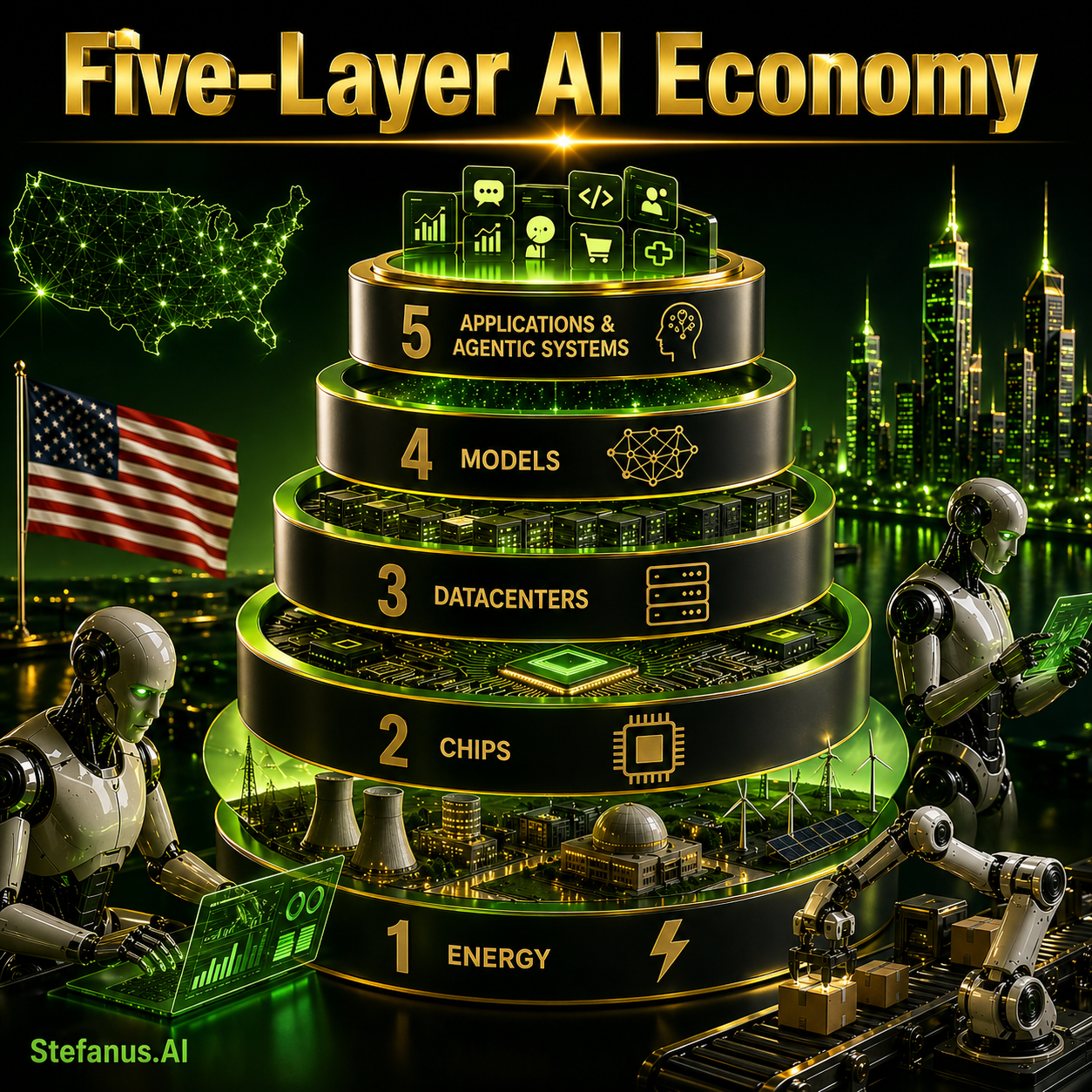
Five-Layer AI Economy: What Is It? Who Are the Key Players? — Mapping Power, Influence, and Value Across the Full Stack of Intelligence
On April 16, 2026, at Stanford Graduate School of Business, Jensen Huang described artificial intelligence as a “five-layer cake”—a conceptual model spanning energy, chips, datacenters, models, and applications. This same framing appeared earlier at the World Economic Forum Annual Meeting, where the idea of AI as infrastructure—not software—was repeatedly emphasized. “AI is not just software. It is infrastructure.”¹ This paper takes that conceptual statement and expands it into a fully articulated economic framework: the Five-Layer AI Economy. This is not a metaphor. It is a structural model. Artificial intelligence today is not a single market,…
-

Lobbying Intelligence: AI Firms Flock to Washington in Q1 2026 and the Rise of Policy-Driven Compute Power
In January 2025, a striking visual emerged from the inauguration of the new U.S. president: a front-row constellation of technology elites—founders, CEOs, and their spouses—representing the most powerful hyperscale companies in the world. Among them were leaders tied to Meta, Google, Amazon, Nvidia, and newer AI-native actors such as OpenAI and Anthropic. What appeared ceremonial was, in reality, structural. The convergence of political power and computational power had entered a new phase. Yet, beneath this continuity of influence, a divergence began to form. Reports in early 2026 revealed that two relative newcomers—OpenAI and Anthropic—had dramatically…
-
Gigarmageddon: The System That Cannot Guarantee Power in the Age of Exponential AI
Have you noticed something subtle, almost invisible, yet increasingly persistent? Every time you type a prompt into systems like OpenAI’s ChatGPT, Google’s Gemini, Microsoft’s Copilot, or Anthropic’s Claude, the responses feel slightly shorter, sometimes cut off, occasionally delayed—forcing you to wait those extra seconds as the system “thinks.” This is not accidental. This is not purely algorithmic. This is the earliest consumer-facing signal of a deeper structural constraint: energy scarcity in the age of artificial intelligence. We are still in 2026—not even 2030—yet the system already hints at limits. Now imagine a world just a…
-
Super Intelligence X-Files (SIXF): Unsolved Systems in the Five-Layer AI Economy
Introduction — Why SIXF, Why Now We are no longer at the beginning of artificial intelligence. We are at the beginning of its industrialization phase — and the numbers confirm that the stakes have never been higher. In 2026 alone, global spending on AI is forecast to reach $2.52 trillion, representing a 44% year-over-year surge, according to Gartner.1 AI infrastructure investment alone accounts for $401 billion of that figure.1 The scale is staggering at the hyperscaler level: the five largest U.S. cloud and AI infrastructure providers — Microsoft, Alphabet, Amazon, Meta, and Oracle — have…
-

Power Bottleneck: Energy Constraints and the Structural Limits of AI Expansion in the United States
The modern artificial intelligence revolution—defined by hyperscale models, agentic systems, and trillion-line codebases—is often framed as a problem of compute, talent, and capital. Yet beneath these visible layers lies a far more rigid constraint: electricity. No matter how sophisticated models designed by companies like OpenAI, Anthropic, or Google become, their ultimate throughput is governed not by algorithms, but by watts. The paradox is striking. At the exact moment when AI systems are approaching exponential capability—through agentic architectures, autonomous reasoning, and continuous inference—the underlying electrical infrastructure in the United States remains largely linear, aging, and in…
-
Trillion Lines of Code: From Billionaires to Trillionaires, from Gigafactories to Terafactories, and the Hyperscale Race to Dominate the AI Age
The modern technology economy is no longer satisfied with scale measured in millions or even billions. It now operates in the language of the extreme—giga, tera, and soon, peta—as a signaling mechanism of power, ambition, and inevitability. From “Gigafactories” to “Terafabs,” from “Cloud” to “Constellations,” naming itself has become a strategic act: to define the future before competitors can contest it. Elon Musk has popularized terms like Gigafactory and now Terafactory (Terafab) to describe industrial systems capable of unprecedented output. Meanwhile, Jeff Bezos has leaned into concepts like Terawave and space-based infrastructure—suggesting that computation and…
-
Industrialization of Intelligence: Building the Five-Layer AI Economy in the Race Toward a Trillion Lines of Code
On April 16, 2026, at the Stanford Graduate School of Business, Jensen Huang articulated what may ultimately be recognized as one of the defining frameworks of the modern era: intelligence is no longer merely engineered—it is being industrialized. He described five foundational layers—energy, chips, data centers, models, and applications—that together form the infrastructure of a new economic system. At first glance, this appears to be a technical stack. But embedded within his remarks—particularly around agentic systems, the evolution of work, and the importance of global talent—was something deeper: this system does not run on infrastructure…
-

Tera Corridor: Building America’s Compute Sovereignty in Texas’ Trillion-Dollar AI Capital Wars, One Terafab at a Time
While outlining this paper, I was reminded of my time in graduate school at University of Southern California in Los Angeles, where one of the foundational readings centered on classical economic theory: the enduring principle that “location, location, location” defines industrial organization. From Alfred Weber’s early 20th-century work on industrial location to modern urban economics, firms have historically clustered around natural resources, labor pools, and transportation networks.¹ Cement plants formed near limestone deposits. Steel industries emerged beside coal and iron. Manufacturing followed railroads, ports, and waterways. Geography was destiny because production was bound to matter.…
-
Semiconductor Geopolitics: The U.S.-China AI Chip War and the Race for Semiconductor Supremacy
Semiconductors are no longer merely industrial inputs embedded in smartphones and laptops—they are the foundational infrastructure of modern civilization. From artificial intelligence (AI) systems and autonomous vehicles to quantum computing, advanced military systems, financial networks, and global communications, semiconductors form the invisible backbone of the modern economy. In 2025, global semiconductor sales reached approximately $791.7 billion, growing at over 25% year-over-year, with projections approaching $1 trillion annually in the near term.¹ This is not cyclical growth—it is structural, driven by the rapid expansion of AI, electrification, and digital infrastructure at a planetary scale. What makes…
-
Thermal Arbitrage: Exploiting Temperature Differences for Compute Advantage
One decade ago, I visited a data center in El Segundo, operated by one of the largest web hosting companies in the United States where I worked at the time. The moment I stepped into the server hall, I was greeted not by silence, but by a roaring, immersive environment of racks stretching endlessly, and a cold, fog-like vapor hanging in the air. It felt less like entering a building and more like stepping into a stage production, where chilled air rushed through ducts and vents like dry ice spilling over a concert floor. That…
-
Compute Constellations: AI Infrastructure Beyond Earth and the Rise of Distributed Orbital Intelligence
The opening months of 2026 mark a structural turning point—not in space exploration, but in the architecture of intelligence itself. While Jeff Bezos continued to capture global attention through Blue Origin missions, Elon Musk demonstrated a different form of power through SpaceX—the ability to operate persistent infrastructure in orbit. “Space is transitioning from exploration to infrastructure.”¹— Martin Elvis, Harvard-Smithsonian Center for Astrophysics At the same time, a constraint on Earth is becoming unavoidable. “Electricity demand from data centers could double by 2026.”²— International Energy Agency “AI is using so much energy that computing firepower is…
-
TeraEconomics: From TeraWave to Terafabs—The Semiotics of Scale in the Trillionaire Age
For nearly two decades, the technology industry has been obsessed with a single archetype: the billionaire founder. Wealth was the metric, valuation the scoreboard, and scale the silent assumption. But by 2026, this narrative is collapsing under its own weight. The emergence of trillion-dollar firms such as Apple Inc., Microsoft, and NVIDIA has fundamentally altered the ceiling of ambition. A billion is no longer aspirational—it is baseline. What replaces it is not merely a new number, but a new language. The word “TERA”—denoting one trillion—has begun to seep into naming conventions of next-generation infrastructure. This…
-
Gigawatt Sovereignty: Energy as the Ultimate Constraint in the Age of AI
The defining contest of the artificial intelligence era is no longer about who builds the most advanced models, but who can power them at scale. As AI systems expand into trillion-parameter architectures and hyperscale deployments, electricity demand has crossed a critical threshold: from megawatts to gigawatts. This transition marks a structural shift in the foundations of technological power. This paper introduces the concept of Gigawatt Sovereignty—a new framework that captures how control over gigawatt-scale energy infrastructure determines leadership in AI, industrial production, and global influence. Sovereignty in the 21st century is no longer defined solely…
-
Terafab Economics: From Gigafactories to Terafactories—The Rise of Trillion-Dollar AI Manufacturing Zones
The frontier of industrial power is no longer defined by production capacity alone—it is defined by the scale at which computation can be manufactured, integrated, and deployed. What began as a revolution in software has evolved into a contest over physical infrastructure, energy systems, and fabrication dominance. This paper introduces a new term: Terafab Economics. Terafab Economics describes the emergence of trillion-dollar, vertically integrated AI manufacturing zones capable of producing computation at terawatt-scale energy and tera-level processing output, where fabrication, energy, and deployment converge into a single industrial system.¹ Over a decade ago, Elon Musk…
-
Distributed Leviathan: How AI is Redistributing Sovereignty from Governments to Networks, Corporations, and Infrastructure Systems
The structure of power is undergoing a transformation that is both subtle and profound. For centuries, political authority has been organized around the sovereign state—centralized, territorially bound, and ultimately responsible for governance. That model assumed governments controlled the systems that mattered most: communication, intelligence, infrastructure, defense, and economic coordination. That assumption no longer holds. This paper introduces the term Distributed Leviathan. The concept of Leviathan, drawn by Thomas Hobbes, describes a singular sovereign authority: one state, one center of control, one ultimate source of decision-making. In simple terms, it represents centralized power. But the AI…
-
Synthetic Hegemony: When Influence Is Computed—AI, Manufactured Reality, and the Inevitable Shift of Power
Before artificial intelligence began shaping the modern information landscape, influence was already being engineered in subtle but powerful ways. Bestselling books do not always become popular organically. Authors and publishers often coordinate bulk purchases through networks of supporters to push titles onto the The New York Times bestseller list. Musicians releasing a new album may rely on coordinated streaming and early purchases to secure a position on the Billboard Top 100. At live concerts, free tickets are sometimes distributed to ensure that venues appear full, creating the visual impression of overwhelming demand. In politics, campaign…
-
Infrastructure Primacy: America Has the Capital, Land, and Talent—Where Infrastructure Is Built Determines Power
The center of technological competition is no longer defined solely by innovation, nor by the sophistication of algorithms or models. Instead, power is increasingly determined by something more physical, more capital-intensive, and more geographically constrained: infrastructure. The decisive question is no longer who invents, but who builds—and where those systems are built. This paper adopts the term Infrastructure Primacy to describe this shift. The phrase reflects a structural transformation in global power dynamics: the primacy of infrastructure over invention. In earlier eras, technological leadership could be achieved through intellectual breakthroughs alone. Today, breakthroughs must be…
-
Temporal Supremacy: Power, Speed, and the Collapse of Human-Time Governance
The defining competition of the 21st century is no longer determined solely by territory, capital, or even technological capability. It is increasingly defined by time, specifically, the ability to operate, decide, and act faster than competing systems. The term “Temporal Supremacy” is therefore not metaphorical. It describes a structural shift in how power is acquired and exercised: those who dominate time dominate outcomes. Temporal Supremacy refers to the condition in which actors—whether corporations, states, or autonomous systems—gain decisive advantage by compressing the interval between signal, decision, and execution. Artificial intelligence is the first technology in…
-
Compute Mercantilism: AI Dominance, Strategic Infrastructure, and the New Economics of Power in a Post-Gold World
Global power has always been tied to what nations accumulate and control. In earlier eras, this meant land, gold, and industrial output. In the 20th century, it shifted toward oil and energy systems. In the 21st century, a new axis is emerging: compute capacity—the ability to generate intelligence at scale. This paper adopts the term compute mercantilism to describe this transformation. Classical mercantilism was defined by the accumulation of gold reserves and the pursuit of trade surpluses to strengthen national power. Today, a similar logic is reappearing—but instead of gold, nations are accumulating: The analogy…
-
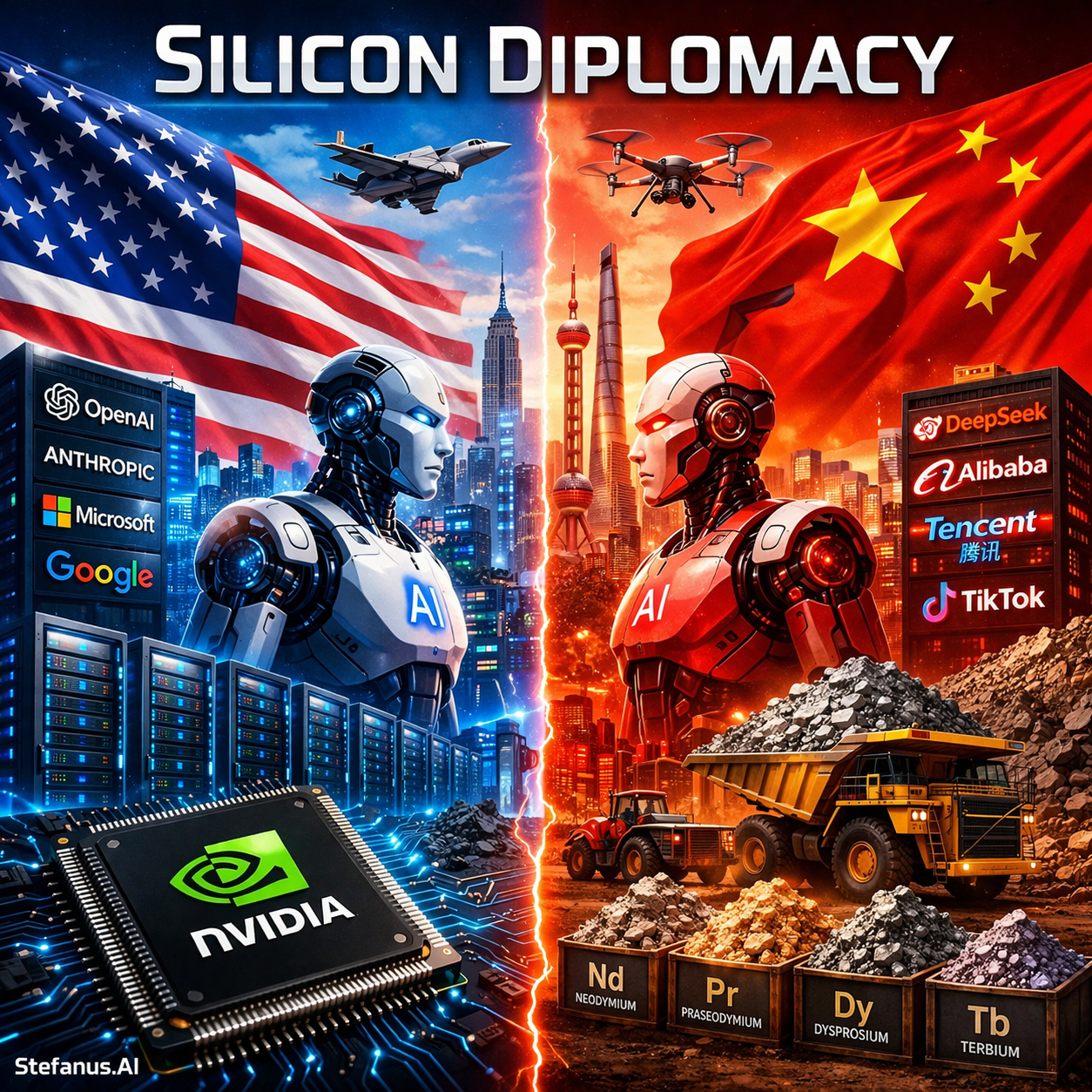
Silicon Diplomacy: Chips, Power, and the Rewiring of U.S.–China Relations
The dominant conflicts of the 21st century are not fought primarily with fighter jets, missiles, or territorial invasions. They are fought through infrastructure—specifically, the infrastructure that produces intelligence. Artificial intelligence has transformed semiconductors into the most strategic resource of the modern era. Unlike oil, which powered industrial economies, chips power cognition itself—the ability to model, predict, decide, and govern. As Christopher Miller argues: “The world economy runs on chips.” [1] (Wikipedia) This transformation has created a new form of geopolitical interaction: This paper defines that system as Silicon Diplomacy: A form of geopolitical competition in…
-
Welcome to the Frontier of Gigawatt Infrastructure: AI Companies Are Becoming Energy Companies as Data Centers Build Their Own Power Systems
Artificial intelligence is entering a phase where its defining constraint is no longer intelligence—it is power. For more than a decade, the narrative around AI has focused on models, data, and compute. But beneath that layer lies a more fundamental reality: every unit of intelligence requires continuous electricity. As AI systems scale, they no longer behave like software—they behave like industrial systems, consuming energy at unprecedented levels. This paper defines the current moment as the era of Gigawatt Infrastructure. The term is chosen deliberately for three reasons: According to the International Energy Agency (IEA): “Global…
-
Orbital Resilience: Transmission Risk, Sovereignty Gaps, and the Fragility of Intelligence Beyond Earth
The center of technological competition is no longer confined to software—it is shifting toward the infrastructure that enables intelligence at scale. What matters now is not only how systems are designed, but where they operate. As computation expands beyond terrestrial data centers into satellites and orbital platforms, physical location becomes a strategic variable, transforming infrastructure itself into a primary source of power. Yet this shift introduces a new and largely underestimated domain of vulnerability. Orbital infrastructure is often framed as a solution to terrestrial risk—offering insulation from conflict, geographic redundancy, and truly global reach. But…
-
Energy Autarky: The Sovereign Stack of AI Power—Electricity, Compute, and the End of Digital Globalization
Artificial intelligence is often described as a breakthrough in software. That description is incomplete. What is unfolding is a transformation of infrastructure—one that shifts the foundation of intelligence from code to current, from models to megawatts. The defining constraint of this era is no longer algorithmic capability. It is electricity. Why This Term: “Energy Autarky” I deliberately chose the term Energy Autarky over the more commonly used “energy security.” Because the two are not the same. Energy security assumes: It belongs to the logic of globalization. Energy autarky, by contrast, represents something far more radical.…
